RSS

Monthly Archives: September 2016

Encounters With God: The Healing of Naaman -2 Kings 5:1-27


The prophet Elijah is named twenty-nine times in the New Testament while Elisha is named only once. “And many lepers were in Israel in the time of Elisha the prophet, and none of them was cleansed except Naaman the Syrian” (Luke 4:27, nkjv).

Naaman was a Gentile and the commander of the army of an enemy nation, so it’s no wonder the congregation in Nazareth became angry with the Lord, interrupted His sermon and carried Him out of the synagogue. After all, why would the God of Israel heal a man who was a Gentile and outside the covenant?

He was an enemy who kidnapped little Jewish girls, and a leper who should have been isolated and left to die. These people knew nothing about the sovereign grace of God. Like Naaman, they became angry, but unlike Naaman, they didn’t humble themselves and trust the Lord.[1]

The story of the healing of Naaman in 2 Kings 5:1-27 is the account of a man with a very serious medical problem—leprosy. He found no help in his own country, but he had heard that there was a cure available in Israel. He commenced a “top down” approach to bring about his healing, but, to his dismay, found that this method didn’t work. He learned that God had a “bottom up” solution to his problem.

Our text describes how God graciously frustrates Naaman’s “top down” approach and initiates a “bottom up” solution. The fact of the matter is that God is not impressed or moved by man’s “top down” efforts, because it is God who is at the top, and not men, not even men of position and power, like Naaman, or the kings of Syria and Israel. We should listen well and learn about this “bottom up” system, because it is normally the way that God works, especially when it comes to the salvation of men.

An Encouraging Word, From an Unlikely Source 2 Kings 5:1-3 (NIV)
1  Now Naaman was commander of the army of the king of Aram. He was a great man in the sight of his master and highly regarded, because through him the LORD had given victory to Aram. He was a valiant soldier, but he had leprosy.
2  Now bands from Aram had gone out and had taken captive a young girl from Israel, and she served Naaman’s wife.
3  She said to her mistress, “If only my master would see the prophet who is in Samaria! He would cure him of his leprosy.”

The first thing we are told about Naaman is that he was a great man, highly esteemed by his master, the king of Syria. This is the kind of thing which impresses men. It is also the kind of thing which causes some people to think that God should be impressed as well. They foolishly reason that powerful people should gain a hearing from God.

He was a “giant” in the mind of his master, the king of Syria. He had been incredibly successful in leading the Syrians in their attacks against Israel. Our author goes on to inform us that Naaman was indeed a great warrior (verse 1), but then he goes on to tell us something that neither Naaman nor his king knew—Naaman’s military success was not primarily the result of his courage or military skills; it was the result of God’s sovereign plan and purpose: “for through him the LORD had given Syria military victories” (verse 1).

Naaman’s success in his battles with Israel was God’s judgment on Israel, because of the sins of His people: “The heavens above your heads will be as brass and the earth beneath you as iron. 24 The LORD will make the rain of your land like powder and dust; it will come down upon you from the sky until you are destroyed.…” 45 “All these curses will fall upon you, pursuing and overtaking you until you are destroyed, because you do not obey the LORD your God by keeping his commandments and statutes that he has demanded of you. 46 These curses will be as a sign and wonder with reference to you and your descendants forever. 47 Because you have not served the LORD your God joyfully and wholeheartedly with the abundance of everything you have, 48 you will instead serve your enemies whom he will send against you bringing hunger, thirst, nakedness, and lack of everything; they will place an iron yoke on your neck until they have destroyed you” (Deuteronomy 28:23-24, 45-48).

As great as he is, Namaan has one very serious problem—he has leprosy. He is still highly esteemed by his master, the king of Syria, but there is hardly a disease which could be more devastating to Naaman. The king of Syria was Ben Hadad II, and as commander of the army, Naaman was the number two man in the nation. But with all his prestige, authority, and wealth, Naaman was a doomed man because under his uniform was the body of a leper. It appears from verse 11 that the infection was limited to one place, but leprosy has a tendency to spread and if left unchecked, it ultimately kills. Only the power of the God of Israel could heal him.

It would surely spell the end of his military career, and in time, perhaps his life as well. I am sure that he attempted every possible cure that money could buy in Syria, but with no success. A ray of hope came from a most unlikely source—an Israelite slave girl, the servant of Naaman’s wife. She had been captured by the Syrians on one of the raids they had successfully carried out against Israel.

The girl was a slave, but because she trusted the God of Israel, she was free. Even more, she was a humble witness to her mistress. Her words were so convincing that the woman told her husband and he in turn informed the king. Never underestimate the power of a simple witness, for God can take words from the lips of a child and carry them to the ears of a king.

This Israelite slave girl is a most remarkable person. She has every reason to hate Naaman and his wife. Her master is responsible for many raids against Israel, and therefore the death of many Israelites—perhaps even this young girl’s parents. Instead of hating her master and finding a certain amount of pleasure in his humiliating disease, this young girl seems to genuinely care about the well-being of her master and her mistress. She manifests true submission, which is seen in her desire to bring about what is in her master’s best interest.

Naaman’s healing and salvation are directly attributable to the faithfulness of this young girl. The word “young” in verse 2 is translated “little” in several versions of the Bible (KJV, NAU, NJB), and “young” in others (NET Bible, NIV, NKJV). The word in the original text seems to be almost the opposite of the word “respected” in 2 Kings 4:8, describing the Shunammite woman. I believe the author is not only telling us that this “little” girl is “young,” but that she is a person of no social standing whatever. She is on the bottom rung of the Syrian social ladder. (By the way, as a leper, Naaman is nearly on a par with her, socially, perhaps even a bit lower.) It was no doubt humbling for Naaman to have to act on the advice of his young and insignificant Israelite slave girl, but he was a desperate man.

A Top Down Response to Naaman’s Problem – 2 Kings 5:4-7 (NIV)
4  Naaman went to his master and told him what the girl from Israel had said.
5  “By all means, go,” the king of Aram replied. “I will send a letter to the king of Israel.” So Naaman left, taking with him ten talents of silver, six thousand shekels of gold and ten sets of clothing.
6  The letter that he took to the king of Israel read: “With this letter I am sending my servant Naaman to you so that you may cure him of his leprosy.”
7  As soon as the king of Israel read the letter, he tore his robes and said, “Am I God? Can I kill and bring back to life? Why does this fellow send someone to me to be cured of his leprosy? See how he is trying to pick a quarrel with me!”

Naaman couldn’t leave Syria without the king’s permission, and he also needed an official letter of introduction to Joram, king of Israel. After all, Syria and Israel were enemies, and the arrival of the commander of the Syrian army could be greatly misunderstood. Both Naaman and Ben Hadad wrongly assumed that the prophet would do whatever the king commanded him to do and that both the king and the prophet would expect to receive expensive gifts in return. For that reason, Naaman took along 750 pounds of silver and 150 pounds of gold, plus costly garments. The servant girl had said nothing about kings or gifts; she only pointed to Elisha the prophet and told her mistress what the Lord could do.

Neither Naaman nor his wife seems to have doubted the testimony of the Israelite servant girl. He is faced with a very real problem with protocol. How does a Syrian military commander like Naaman go about requesting the help of an Israelite prophet?

The prophet is the prophet of Yahweh, the one true God. This means that for all intents and purposes, Naaman will be admitting that his “gods” are powerless to heal him, and that only Israel’s God can do so. This also places Naaman in the very awkward position of having to travel to Israel, a country that he has often entered in his official position as commander of the armies of Syria.

In the past, he has come to Israel to attack it and to take prisoners. Now, he needs help from an influential leader in Israel. How does one handle a sticky situation like this?

There seem to be only two possible approaches. The first is the ego-saving method of using the “top down” approach. The second would require Naaman to humble himself and to ask for healing—the “bottom up” approach.

Not surprisingly, Naaman and his master, the king of Syria, chose the “top down” approach. He obtained the king of Syria’s permission and assistance to pursue healing in Israel. The king of Syria (Benhadad I, 890-843 B.C.) wrote a letter to the king of Israel, Joram (Jehoram, 848-841 B.C.), politely demanding that he see to it that Naaman be healed. And if the letter would not intimidate the king of Israel into arranging for Naaman’s healing, there was also the incentive provided by the offer of the money which Naaman had brought with him.

Besides, paying well for his healing would keep Naaman on “higher ground” (i.e., higher status), thus enabling him to maintain his dignity. (If it is embarrassing to have to ask for a ride in someone else’s car; it is not embarrassing for you to ride in the Rolls Royce for which you paid a small fortune.)

The king of Syria’s request was one that the king of Israel could hardly refuse, and yet it seemed that he had no way of fulfilling it. As the reader can see, it was really not a problem at all, but the king of Israel failed to see the solution. The king of Syria assumed that there was a close relationship between the king of Israel and the prophet of Israel, as there should have been. Upon receiving this letter, the king of Israel should have called for Elisha the prophet, who could heal Naaman. But because the kings of Israel had ceased to seek divine guidance, and because they assumed that the prophets always spoke against them, it never entered this king’s mind to turn to Elisha for help when he was in trouble.

The king’s words, “Am I God? Can I kill or restore life?” (verse 7) are most enlightening. The king knows that only God can restore a man to life or cure a leper. The reader knows that both Elijah (1 Kings 17:17-24) and Elisha (2 Kings 4:18-27) have raised someone from the dead. If the curing of the sick and raising of the dead is work which only God can do, then why does it not occur to the king of Israel that the prophet who speaks for God can heal Naaman? Is it that the king does not think of seeking God’s help through the prophet — or that he refuses to do so?

In spite of the king of Israel’s folly, Elisha heard that the king had torn his clothes and so he sent word to the king. His words were a rebuke for the king’s distress, which was completely inappropriate in this situation. There was no need for the king to tear his garments; all the king needed to do was to send Naaman to Elisha to be healed. In this way, Naaman would come to know that there was indeed a prophet in Israel (verse 8).

No Red Carpet Treatment for Naaman – 2 Kings 5:8-14 (NIV)
8  When Elisha the man of God heard that the king of Israel had torn his robes, he sent him this message: “Why have you torn your robes? Have the man come to me and he will know that there is a prophet in Israel.”
9  So Naaman went with his horses and chariots and stopped at the door of Elisha’s house.
10  Elisha sent a messenger to say to him, “Go, wash yourself seven times in the Jordan, and your flesh will be restored and you will be cleansed.”
11  But Naaman went away angry and said, “I thought that he would surely come out to me and stand and call on the name of the LORD his God, wave his hand over the spot and cure me of my leprosy.
12  Are not Abana and Pharpar, the rivers of Damascus, better than any of the waters of Israel? Couldn’t I wash in them and be cleansed?” So he turned and went off in a rage.
13  Naaman’s servants went to him and said, “My father, if the prophet had told you to do some great thing, would you not have done it? How much more, then, when he tells you, ‘Wash and be cleansed’!”
14  So he went down and dipped himself in the Jordan seven times, as the man of God had told him, and his flesh was restored and became clean like that of a young boy.

Naaman arrived at Elisha’s house with his whole retinue of attendants. It must have been a most impressive sight to behold. I believe this is precisely what Naaman hoped for, because he was still seeking to be healed from “the top down.” Can you imagine what Gehazi must have thought as he looked out the window and saw this entourage arriving?

Surely Naaman expected the “red carpet” treatment, because he was a VIP. He was a revered and feared military commander. He had a letter from the king of Syria, and he had just come from the king of Israel, with whom he had an audience, even though he had dropped in unexpectedly.

Naaman had his own preconceived ideas about how his healing should take place. He assumed that on his arrival, Elisha would be duly impressed with his power and prestige, and that he would take note of all the chariots (not just one) parked outside his door, along with those who accompanied him. He would have liked to have been able to point out that he had come with silver and gold and fine garments to pay for Elisha’s services. He could not imagine anyone not seizing this opportunity.

Likewise, he expected that this “miracle for hire” would be performed with all the pomp and circumstance that such an occasion required. After all, if you go out to eat at a fine restaurant, you expect the service to greatly surpass that which you would receive at a fast food restaurant.

In Naaman’s mind, he envisioned Elisha coming out personally and giving him his undivided attention. Naaman anticipated that the miracle would then be performed immediately, in some dramatic fashion (not unlike some religious folks perform for their television audiences today). He would certainly call on the name of his god and wave his hand over the diseased area, healing Naaman with the style and dignity that suited a man of his stature.

Things did not go as Naaman expected. From what we can read, there is no indication the king of Syria’s letter ever was read to Elisha, or that anyone even had the chance to explain why Naaman had come. As a prophet (or seer) of God, Elisha would not necessarily have had to be told why Naaman had come—he could have known (see 2 Kings 5:26). And of course the prophet could also have been informed by someone who had been there when Naaman appeared before the king of Israel.

I am inclined to think that Gehazi came out and began to convey Elisha’s message to Naaman before this Syrian commander had the chance to say anything. This was a way of letting Naaman know from the beginning that Elisha was in charge. And so Gehazi conveys Elisha words to Naaman: Naaman is to go to the Jordan River and to immerse himself seven times, after which he will most certainly be healed of his leprosy.

When Naaman hears this message, communicated to him by a (mere) servant, he becomes furious. He is insulted that he has not been treated in a manner worthy of his position. He expected to deal directly with the prophet and to “take charge” of his healing.

Elisha knew that Naaman had to be humbled before he could be healed. Accustomed to the protocol of the palace, this esteemed leader expected to be recognized publicly and his lavish gifts accepted with exaggerated appreciation, because that’s the way kings did things. But Elisha didn’t even come out of his house to welcome the man! Instead, he sent a messenger (Gehazi?) instructing him to ride thirty-two miles to the Jordan River and immerse himself in it seven times. Then he would be cleansed of his leprosy

Naaman had been seeking help and now his search was ended. He wanted the prophet to heal him immediately and in the manner he expected. He was insulted that he would be told to immerse himself. Worse yet, he was greatly angered that he would be told to immerse himself in the muddy waters of the Jordan. In his homeland, there were many beautiful rivers. If he had to immerse himself, he would do so in one of the crystal clear rivers of Syria, like the Abana or the Pharpar.

Why is Naaman so angry? What is the problem? If Naaman began his journey at Damascus, then he had traveled over one hundred miles to get to Samaria, so another thirty miles or so shouldn’t have upset him. But it did, for the great general became angry. The basic cause of his anger was pride. He had already decided in his own mind just how the prophet would heal him, but God didn’t work that way.

The Lord had already been working on Naaman’s pride and there was more to come. King Joram wasn’t able to heal him, the prophet didn’t come to court or even come out to greet him, and he had to dip in the dirty Jordan River, not once, but seven times. And he a great general and second in command over the nation of Syria!

If he were to be “saved” from his incurable disease, he wanted to be saved “his way,” in a way that was easy on his ego, and which left him in control of the situation. It was humiliating enough for a Syrian celebrity to come to Israel and to seek healing from an Israelite prophet. But to be told he must be healed in such a humiliating fashion was more than he was willing to tolerate.

Fortunately for Naaman, his servants reasoned with him and prevailed. They were very diplomatic with their master, and their argument was convincing. Naaman was desperately in need. He was willing to pay a very high price, or to do something very difficult, if necessary.

Once again, the Lord used servants to accomplish His purposes (vv. 2-3). If Naaman wouldn’t listen to the command of the prophet, perhaps he would heed the counsel of his own servants. Elisha didn’t ask him to do something difficult or impossible, because that would only have increased his pride. He asked him to obey a simple command and perform a humbling act, and it was unreasonable not to submit.

When he came up from the water the seventh time, his leprosy was gone and his flesh was like that of a little child. By his obedience he demonstrated his faith in God’s promise, and the Lord cleansed him of his leprosy. One writer said, “He lost his temper; then he lost his pride; then he lost his leprosy; that is generally the order in which proud rebellious sinners are converted.”

Naaman gave a clear public testimony that the Lord God of Israel was the only true and living God and was the God of all the earth. He renounced the false gods and idols of Syria and identified himself with Jehovah. What an indictment this testimony was against the idol-worshiping king and people of Israel!

Naaman grasps the logic of the argument and concedes the point. He goes to the Jordan and dips himself seven times in its waters. And when he comes forth after dipping the final time, his skin was like that of a young child. He was completely healed.

No Tipping Please – 2 Kings 5:15-19a (NIV)
15  Then Naaman and all his attendants went back to the man of God. He stood before him and said, “Now I know that there is no God in all the world except in Israel. Please accept now a gift from your servant.”
16  The prophet answered, “As surely as the LORD lives, whom I serve, I will not accept a thing.” And even though Naaman urged him, he refused.
17  “If you will not,” said Naaman, “please let me, your servant, be given as much earth as a pair of mules can carry, for your servant will never again make burnt offerings and sacrifices to any other god but the LORD.
18  But may the LORD forgive your servant for this one thing: When my master enters the temple of Rimmon to bow down and he is leaning on my arm and I bow there also–when I bow down in the temple of Rimmon, may the LORD forgive your servant for this.”
19  “Go in peace,” Elisha said….

The man who did not even see Elisha when he first arrived outside his house now has a face-to-face conversation with the prophet. Naaman’s words are exactly what we would hope for in a new believer. I think our author meant for Naaman to be a rebuke to the Israelites who would read this account. Here was a man whom we would have called a “raw pagan” at the time he first arrived in Israel. There is a radical change in this man’s attitudes and actions after his healing. Naaman came from a country that worshipped false gods, and yet after his healing, he was able to confess, “I know that there is no God in all the earth except in Israel” (verse 15).

It is one thing to say that God alone is God, but Naaman sought to apply this newly obtained knowledge. First, Naaman sought to apply this knowledge as it related to his personal worship. It may seem somewhat strange to us, but Naaman asked Elisha for two mule loads of earth to take back to Syria with him. Here is a man who recently boasted that the waters of Syria were far superior to the waters found in the River Jordan. Now, he finds Israelite soil more precious than Syrian soil. How can this be?

Naaman was starting to grow in his understanding of the Lord, but he still had a long way to go. Elisha refused his gifts, but Naaman asked if he could take some native soil with him to Syria to use in his worship of Jehovah. In those days, people had the idea that the gods of a nation resided in that land, and if you left the land, you left the god behind. But Naaman had just testified that Jehovah was God in all the earth (v. 15)! However, taking that soil was a courageous act, because his master and his friends would surely ask Naaman what it meant, and he would have to tell them of his faith in the God of Israel.

In his second request, Naaman showed unusual insight, for he realized that the king would expect him to continue his official acts as the commander of the army. This included accompanying the king into the temple of Rimmon, the Syrian equivalent of Baal. Naaman was willing to perform this ritual outwardly, but he wanted Elisha to know that his heart would not be in it. Naaman anticipated that his healing and his changed life would have an impact on the royal court and eventually lead to the king’s conversion. Instead of criticizing believers who serve in public offices, we need to pray for them, because they face very difficult decisions.

It’s interesting that Elisha didn’t lecture him or admonish him but just said, “Go in peace.” This was the usual covenant blessing the Jews invoked when people were starting on a journey. The prophet would pray for him and trust God to use him in his new ministry in Syria. Naaman’s leprosy was gone, he still had the treasures, he carried soil from Israel, and he knew the true and living God. What a witness he could be in that dark land—and Naaman’s servant girl would join him!

Naaman was concerned about his worship in another way, which concerned his work. As commander of the army of the king of Syria, it would seem that he was also the king’s bodyguard. As such, he would accompany the king wherever he went, providing him with protection. This included the king’s worship of his heathen god at the temple of Rimmon. The king would literally be leaning on Naaman’s arm as he bowed down to his god, and this would require Naaman to bow down, too. Naaman assured Elisha that even though he might be bowing down with the king, he would no longer be worshipping Syrian gods. That was now a part of his past.

With these words, this new convert, Naaman, revealed insight which the people of Israel lacked. He knew that to truly worship God, he must worship as God had instructed. He knew as well that to worship God alone meant that he could worship no other gods.

Naaman responded in another way to his newly found faith in God. He sought to show his appreciation by offering Elisha the payment for services rendered which he had brought with him. He had originally planned to purchase his healing, and Elisha had overruled that plan. But now that he is healed, I think Naaman simply wishes to meet Elisha and to sincerely express his deep gratitude and appreciation. We know that he wanted to discuss his concerns about worshipping the one true God appropriately.

Naaman was prepared to express a great deal of gratitude. He had brought with him 10 units of silver, 6,000 shekels of gold, and 10 suits of clothes (verse 5). It is difficult and probably impossible to express this in monetary terms that would be meaningful to us, but one Old Testament text makes it clear that this “payment” was worth a great deal of money.

In 1 Kings 16:24, we are told that king Omri of Israel paid Shemer two talents of silver for the hill on which he then built the capital city of Samaria. The silver alone which Naaman brought was worth five times this much, and that does not take into account the gold and the clothing. Naaman came prepared to pay generously for his healing.

Naaman was completely healed, and he could not have been happier with the results of his visit to Israel. It is easy to see why he would wish to meet with Elisha, and why he would gladly leave all that he had brought with him to pay for his healing. He urged Elisha to take it, but Elisha firmly refused. This was a work of God’s grace, and he did not want Naaman to have any confusion on this point. Elisha did not want to leave room for Naaman to conclude that he had contributed, in some measure, to his healing. It was only after it became clear that Elisha would not be persuaded to take any gift that Naaman asked if he could take some Israelite soil back to Syria. As Naaman left to return to his homeland, it was apparent that he had gained much and had lost nothing but his arrogance and his leprosy.

[1] Bible Exposition Commentary (BE Series) – Old Testament – The Bible Exposition Commentary – History.

 
Leave a comment

Posted by on September 29, 2016 in Encounters, Encounters with God


Encounters With God: “Abraham: The Great Adventure” Genesis 11:27-12:9


abraham-n-isaac4Genesis 11:27 begins a new division in the book of Genesis. The book of Genesis can be structured by tracing four great events and four great people. The four great events are laid out in chapters 1-11: Creation, Fall, Flood, and Nations. The four great people complete the book in chapters 12-50: Abraham, Isaac, Jacob, and Joseph. The point being: God’s first concern is all the people of the world (Gen 1-11), but the focus of Genesis (and the rest of the Pentateuch) is on God’s choice and care of His chosen people, Israel (Gen 12-50).

This sovereign choice begins with the call of Abram. The book of Genesis covers more than 2,000 years and more than 20 generations; yet, it spends almost a third of its text on the life of this one man (11:27-25:18). What a reminder that God truly cares about people and considers individuals valuable. This passage is going to challenge us to live a life of faith.

At the core of this story is the principle of God’s sovereign choice of an individual. God’s call to Abram was pure

grace. There is no evidence in the text that God chose Abram because he merited favor. On the contrary, God chose Abram from a family steeped in idolatry. He did this so that He might receive all the glory for what became of Abram.

In Genesis 11:30, Moses makes an emphatic remark that Abram’s wife, Sarai, “was barren; she had no child.” Sarai’s infertility tests Abram’s faith and drives the whole story.

God appears to Abram…God tells him what he going to do: Faith steps out (12:1-3). 1  The LORD had said to Abram, “Leave your country, your people and your father’s household and go to the land I will show you.

The famous call of Abram in 12:1 was a command to go away from three things and unto one thing. The three things that God called Abram to forsake were natural sources of security for any ancient, Near Eastern nomad. God lists the three in rapid succession, each succeeding item narrowing the base of personal support and security:

(1) His country (or “land”) was his nationality and was the largest group in which Abram moved.

(2) His people (or “clan”) was smaller than his tribe, but larger than his immediate family. Such groups in ancient tribal societies provide personal identity and security.

(3) His father’s household referred probably to a call to give up his right of inheritance in his extended family.

To abandon his father’s house would certainly involve giving up his economic security. God removed anything that might weigh him down or prove to be unnecessary for a trek through the woods.

The term “go” is literally “go by yourself” and can emphasize loneliness, isolation. Abram needs to find his own place and his own identity by disassociating himself from the familiar and the group.

Put yourself in Abram’s sandals. I’m sure there was a good part of Abraham that would have just liked to stay in Haran or perhaps move back to the home he knew in Ur, where he married his wife and where all the family could be together. The only promise from God was that He would reveal the path to Abram. There was no visible certainty of his future. Abram was to follow the command of the Lord to leave Haran and go to a land he had never seen before. He is to step out in blind faith…a land God would show him.

Would you have gone? Are you willing to obey the voice of the Lord when He goes against all that makes sense and feels? When everything screams in you against it, are you willing to leave your job for the uncertainties of a higher calling? Faith steps out in obedience. Abraham made the choice to trust God and God blessed him exceedingly.

In these three verses, we see the inauguration of God’s covenant with Abraham. This covenant is everlasting (13:15; 17:7-8, 13, 19), unconditional (15:9-12; 17-18), and literal. It involves a land (12:7; 13:14-15, 17; 17:8), a seed (12:2; 13:16; 15:4-5; 15:18; 17:4-6), and a blessing (12:3; 17:2, 6; 18:18).

In these verses, God gave Abram a seven-fold promise. The call had two imperatives, each with subsequent promises. The first imperative was to go (“Go forth from your country…to the land which I will show you”), and the second imperative was to be (“and so you shall be a blessing”). Abraham’s obedience would bring great blessing. Also notice that five times in these verses you will see the phrase, “I will…” Everything is from God Himself.

  1. “I will make you a great nation” (12:2). This promise is connected to the “seed” promise of 3:15. Since the fall of man, God chose certain lines of human descent to carry forward the promise that He would send a deliverer to crush Satan. That line now flowed through Abram to the Hebrew people (13:16; John 8:37), to the descendants of Ishmael (17:18-20), and eventually to all believers (John 8:39; Rom 4:16; Gal 3:6-7, 29). When God called Abram to separate from his family and his country, He did so with the purpose of producing from Abram a great nation.

As the founder of the Jewish nation, Abram was appointed by God to be a witness to the rest of mankind concerning God (Isa 44:8). Further, that race was to be a storehouse of divine revelation (Rom 3:2) and a channel of blessing to the world (15:8-12). The ultimate objective in God’s choice of Abram was to prepare the world for the coming Messiah and Savior of that world (Isa 53). Do you see how God carefully unfolds His program through individuals? Have you asked Him to reveal His plan for your life?

  1. “I will bless you” (12:2). The word “bless,” which occurred five times in chapters 1-11, now occurs five times in 12:1-3. God wants to bless his people. In fact, if you remember, this goes right back to creation where God blessed Adam and Eve (1:28) and then, later, that original blessing was repeated in 5:2. God also blessed Noah and restated the mandate in creation, namely, that man rule (9:1-2). God’s plan is to bless the world.

Indeed, the term “blessing” (barak) includes God’s gracious provisions of personal well-being, long life, wealth, peace, abundance of food and crops, children, and personal knowledge of Himself and His ways. Yes, God’s plan is to bless the world. When God blesses someone, He intervenes in their life to do good things. God’s blessing to Abram caused him to prosper in all that he did. He was blessed both temporally (13:14-18; 15:18) and spiritually (15:6; John 8:56).

  1. “I will make your name great” (12:2). To be given a great name is to have a good reputation and a secure identity. The builders of the Tower of BAbraml tried to make a name for themselves (11:4) and thereby gain power and prestige before the world and in the face of God. On the other hand, Abram’s power and prestige was to come directly from God.
  2. “You shall be a blessing” (12:2). The Hebrew text says, “Be a blessing,” not “you shall be a blessing.” This was a command rather than a prediction. However as Abram blessed others he would become a blessing. God chose the family of Abram through which He would channel His blessings to the nations of the world, thereby drawing all nations to Himself (cf. Gen 10). We never experience God’s best for us until we are used to touch the life of someone else. Who can you bless today?
  3. “I will bless those who bless you” (12:3). Now God moves from personal blessing to global blessings. Those who honor Abram and his God will be blessed.
  4. “The one who curses you I will curse” (12:3). Unfortunately, not everyone in the world wants God’s blessing, or the way He has chosen to carry it out. There will be people who will curse or level insults and accusations against Abram and in so doing bring a curse from God on their heads. They will be cut off from the hope of blessing.
  5. “And in you all the families of the earth will be blessed” (12:3). This is the great messianic promise fulfilled in Abram’s descendant, Christ (John 8:56-58; Gal 3:16).

Faith experiences obstacles. Genesis 12:4-6 (NIV) 4  So Abram left, as the LORD had told him; and Lot went with him. Abram was seventy-five years old when he set out from Haran.
5  He took his wife Sarai, his nephew Lot, all the possessions they had accumulated and the people they had acquired in Haran, and they set out for the land of Canaan, and they arrived there.
6  Abram traveled through the land as far as the site of the great tree of Moreh at Shechem. At that time the Canaanites were in the land.

Abram demonstrated phenomenal faith in light of God’s call and was thoroughly blessed for it. So it is with us as well when we trust in Christ. But that does not mean everything in our lives will run smoothly. Quite the opposite actually. Did Abram know he was headed to Canaan (12:5)? Apparently not. Hebrews 11:8 states that “he went out, not knowing where he was going.”

Moses goes on to inform us that “Abram was seventy-five years old when he departed from Haran.” Though he lived to 175 years old, Abram was no spring chicken when he decided to follow the Lord to Canaan. Age is no hindrance to faith and taking bold steps for the Lord. It’s never too late. Despite Abram’s age, responsibilities, and various commitments, he stepped forward in a venture of faith, in obedience to God. Fortunately, this principle remains true today.

In 11:30, the text had gone out of its way to point out that Sarai was barren, that she didn’t even have a single child. Then, in 12:2, God says He’s going to make a great nation out of Abram. Well, it’s obvious that it won’t be through Sarai—she’s barren. So it must be through someone else. But here in 12:5 we learn that there isn’t a “someone else.” We are told that Abram took his wife Sarai. In spite of the obvious tensions, Abram must have believed God’s promise.

Sometimes we forget what childlessness meant in the ancient Near East. It involved shame, social ridicule, and implied that the woman/couple were not in the favor of the gods. Why then should they trust the Lord when He makes “promises about a nation; they don’t even have a single child.

Sometimes, some of our greatest struggles believing God and His good promises center in one way or another around our kids. So it was with Abram and Sarai. Certainly they made mistakes along the way, but overall they trusted the God who loves to do the impossible. What are you trusting God for that only He can do? In order for faith to grow it must see beyond the obstacles and pain to the God of our circumstances.

Faith is not just believing God for great things and responding to His promises, it also involves a commitment to live as He desires in light of the circumstances He permits in our lives. Faith builds character; so also Abram. He knew that God had called him to go to this new land, even though he didn’t know where he was going. His faith gave him the courage and determination to live for God in a pagan land.

By faith he overcame the struggles and trials of leaving family, the barrenness of his wife, and the hostilities of living in a foreign land. By faith he gained an exemplary character and did not succumb to the unbelievers around him…His life matched his words, so to speak.

Hebrews 11:8-12 (NIV) By faith Abraham, when called to go to a place he would later receive as his inheritance, obeyed and went, even though he did not know where he was going.
9  By faith he made his home in the promised land like a stranger in a foreign country; he lived in tents, as did Isaac and Jacob, who were heirs with him of the same promise.
10  For he was looking forward to the city with foundations, whose architect and builder is God.
11  By faith Abraham, even though he was past age–and Sarah herself was barren–was enabled to become a father because he considered him faithful who had made the promise.
12  And so from this one man, and he as good as dead, came descendants as numerous as the stars in the sky and as countless as the sand on the seashore.

God can be trusted (Gen 15)

We know that God is trustworthy, he does not lie. However, God wanted us to understand this…He does something remarkable: He obligates Himself: Genesis 15:17-18 (NIV) 17  When the sun had set and darkness had fallen, a smoking firepot with a blazing torch appeared and passed between the pieces.
18  On that day the LORD made a covenant with Abram and said, “To your descendants I give this land, from the river of Egypt to the great river, the Euphrates–

Whenever make agreement, business, sale, lease, etc. You make a contract. If not, may cause problems later on. Sense of assurance that will be true to agreement…if not, can do something about it.

God has made a contract with us…not because he cannot be trusted. God is true, and does not lie. He did it to assure us who struggle in our faith.

God is Able to do all things (Genesis 17:15-21 (NIV) 15  God also said to Abraham, “As for Sarai your wife, you are no longer to call her Sarai; her name will be Sarah.
16  I will bless her and will surely give you a son by her. I will bless her so that she will be the mother of nations; kings of peoples will come from her.”
17  Abraham fell facedown; he laughed and said to himself, “Will a son be born to a man a hundred years old? Will Sarah bear a child at the age of ninety?”
18  And Abraham said to God, “If only Ishmael might live under your blessing!”
19  Then God said, “Yes, but your wife Sarah will bear you a son, and you will call him Isaac. I will establish my covenant with him as an everlasting covenant for his descendants after him.
20  And as for Ishmael, I have heard you: I will surely bless him; I will make him fruitful and will greatly increase his numbers. He will be the father of twelve rulers, and I will make him into a great nation.
21  But my covenant I will establish with Isaac, whom Sarah will bear to you by this time next year.”

Abraham is ready to be a great, great-grand parent. Abraham laughs.  Why? 90 & 100 year-olds don’t go around having children! Did he rush home and eagerly tell Sarah?

Genesis 18:9-15 (NIV) 9  “Where is your wife Sarah?” they asked him. “There, in the tent,” he said.
10  Then the LORD said, “I will surely return to you about this time next year, and Sarah your wife will have a son.” Now Sarah was listening at the entrance to the tent, which was behind him.
11  Abraham and Sarah were already old and well advanced in years, and Sarah was past the age of childbearing.
12  So Sarah laughed to herself as she thought, “After I am worn out and my master is old, will I now have this pleasure?”
13  Then the LORD said to Abraham, “Why did Sarah laugh and say, ‘Will I really have a child, now that I am old?’
14  Is anything too hard for the LORD? I will return to you at the appointed time next year and Sarah will have a son.”
15  Sarah was afraid, so she lied and said, “I did not laugh.” But he said, “Yes, you did laugh.”

Obviously Abraham did nothing. Otherwise, she would have said, “so that’s what’s gotten into him lately.”

Nothing is impossible for God, even if we struggle to believe

God desires faithful obedience

Genesis 22:1-10 (NIV) 1  Some time later God tested Abraham. He said to him, “Abraham!” “Here I am,” he replied.
2  Then God said, “Take your son, your only son, Isaac, whom you love, and go to the region of Moriah. Sacrifice him there as a burnt offering on one of the mountains I will tell you about.”
3  Early the next morning Abraham got up and saddled his donkey. He took with him two of his servants and his son Isaac. When he had cut enough wood for the burnt offering, he set out for the place God had told him about.
4  On the third day Abraham looked up and saw the place in the distance.
5  He said to his servants, “Stay here with the donkey while I and the boy go over there. We will worship and then we will come back to you.”
6  Abraham took the wood for the burnt offering and placed it on his son Isaac, and he himself carried the fire and the knife. As the two of them went on together,
7  Isaac spoke up and said to his father Abraham, “Father?” “Yes, my son?” Abraham replied. “The fire and wood are here,” Isaac said, “but where is the lamb for the burnt offering?”
8  Abraham answered, “God himself will provide the lamb for the burnt offering, my son.” And the two of them went on together.
9  When they reached the place God had told him about, Abraham built an altar there and arranged the wood on it. He bound his son Isaac and laid him on the altar, on top of the wood.
10  Then he reached out his hand and took the knife to slay his son.

God is faithful, and expects us to be faithful as well. Notice the drama: And they walked . . .and they walked…had to be most difficult thing for him…first he had to send Ishmael away, now this! But God was testing his loyalty and faithfulness: Genesis 22:11-15 (NIV) 11  But the angel of the LORD called out to him from heaven, “Abraham! Abraham!” “Here I am,” he replied.
12  “Do not lay a hand on the boy,” he said. “Do not do anything to him. Now I know that you fear God, because you have not withheld from me your son, your only son.”
13  Abraham looked up and there in a thicket he saw a ram caught by its horns. He went over and took the ram and sacrificed it as a burnt offering instead of his son.
14  So Abraham called that place The LORD Will Provide. And to this day it is said, “On the mountain of the LORD it will be provided.”
15  The angel of the LORD called to Abraham from heaven a second time

Abraham passed! Genesis 22:16-19 (NIV) 16  and said, “I swear by myself, declares the LORD, that because you have done this and have not withheld your son, your only son,
17  I will surely bless you and make your descendants as numerous as the stars in the sky and as the sand on the seashore. Your descendants will take possession of the cities of their enemies,
18  and through your offspring all nations on earth will be blessed, because you have obeyed me.”
19  Then Abraham returned to his servants, and they set off together for Beersheba. And Abraham stayed in Beersheba.

God swore by Himself to bless him…Faith is not about mental agreement, but faithfulness. Sometimes God calls you to do things that not make sense. May be very, very difficult…But God will bless your faithfulness.

This is an example of what faith is all about. You believe in God? Question should be:  Are you faithful and obedient?

 
Leave a comment

Posted by on September 22, 2016 in Encouragement


A study of Church History/Restoration Movement – The Early Church


jville07Attention has been called to the divine pattern for the church as it is revealed on the pages of the New Testament. The church as we see it in the New Testament was just as God wanted it. It was characterized by unity of doctrine, organization, worship and work. Various New Testament writers sounded a note of warning that a great apostasy would take place-men would depart from the faith, speaking perverse things.

We now turn to secular history and begin the arduous task of tracing the development of various circumstances and ideas which presented themselves after the close of the New Testament period. The particular period of church history in which we are interested in this lesson is what is known as “The Ante-Nicene Period.” By “Ante-Nicene period” is meant the period between the close of the New Testament and the Council of Nicea (325 A.D.) at which the Nicene Creed was adopted.

THE CONDITION OF THE ROMAN WORLD

At the time that Christianity had its beginning, the Roman Empire was ruled by men placed at its head by the army. The population consisted of three classes: the wealthy, the slaves, and the middle class of free-citizens. The wealthy lolled in luxury, being served by their salves.

The poorer classes only lived for bread and circuses. The circuses were brutal, debasing, and bloody;… The nation groaned under heavy taxation that went for such a waste and extravagance… The state came first, the home had little place in Paganism. Women were considered as chattel property : and little children were often cruelly mistreated : and if born deformed, or their parents did not want them, they were exposed to die, or killed.1

Most of the emperors were cruel, wicked and extravagant. “It was into such a morally degenerate, sensual and cruel world that Christianity was thrust, to conquer and raise to a fit place in which to live.”2

PERSECUTIONS AGAINST THE EARLY CHURCH

During the New Testament period of the church its members were subjected to various attacks by the enemies of Christianity. At the first, the source of persecution was the Jews. But, when the Roman government began to recognise Christianity as a religion separate from Judaism, it was regarded as an illegal religion. Christians then came under the fire of heathen persecutors.

In the life-time of the apostles, the two main waves of persecution which swept over the church at the hands of heathen rulers were waged by Nero (A.D.89-96).

Of the persecution by Nero, Fisher says, The first marked instance of heathen enmity on record was the persecution under Nero. It is described by the Roman historian Tacitus. From his account we see that the Christians were then well known as a distinct sect. Nero, who was justly detested for his brutal tyranny, in order to avert form himself what was, perhaps, a groundless suspicion of having set Rome on fire, accused the Christians of having kindled the flames which had laid in ashes a great part of the city.3 Fisher quotes form Tacitus who tells how a “vast multitude were convicted…. And in their death they were made the subjects of sport, for they were convered with hides of wild beasts, and worried to death by dogs, or nailed to crosses, or set fire to, and when day declined were burned to serve for nocturnal lights.”4

The persecution of the emperor Domitian reached its height about A.D.95. Domitian is described by historians as a cruel and worthless ruler with a jealous temper. He caused hundreds of believers to be put to death. Among those who perished was his own cousin. Many were banished and the property of others was confiscated.

SOME PRINCIPAL PERSECUTORS AND SOME PROMINENT MARTRYS AFTER THE CLOSE OF THE NEW TESTAMENT PERIOD

It will be impossible to mention and discuss all heathen rulers who had a part in persecuting the follower of Christ during this period. Reference will be made to some of the principal ones.

About 111 A.D. Pliny, governor of Bithynia, wrote letters to the emperor Trajan calling his attention to a problem that had been created in his district by the increasing number of Christians. He called Christianity a “superstition” and expressed concern because so many had become Christians that the temples of the heathen gods were almost forsaken. Those who made their living by selling animals to be sacrificed to heathen gods had suffered great loss in business.

Pliny desired instructions as to how to treat these Christians. Trajan replied that they were to be left alone unless they were prosecuted by accusers who would given their names. If convicted, they were to be given an opportunity to renounce their faith in Christ. If they refused, they were to be punished. While this appeared to be lenient in a way, at the same time it laid the way open for wholesale persecutions by unscrupulous men who were willing to accuse and testify against the Christian falsely.

One of the most prominent martyrs under the reign of Trajan was Ignatius of Antioch. While being taken to Roman he exhorted Christians on the way and prayed that he might have the honor of dying for Christ. He was thrown to the wild beasts in the Roman amphitheatre about 108 A.D. Fox’s Book of Martyrs says that as Ignatius heard the roaring of the lions, he shouted: “I am the wheat of Christ: I am going to be ground with the teeth of wild beasts, that I may be found pure bread.”5

Marcus Aurelius, who reigned from 161 to 180 A.D., is described as a just and virtuous ruler, and yet he poured out bitter persecutions upon the followers of Christ. He was determined to restore the ancient religious practices and the old Roman way of life. He regarded the Christians as innovators and, therefore, sought to suppress them by force. He used many cruel means in putting believers to death.

A prominent martyr during his reign was Polycarp. He was brought before the governor and called upon to curse the name of Jesus Christ. His reply was: “Six and eighty years have I served him, and he has done me nothing but good; and how could I curse him, my Lord and Saviour!”6 Whereupon, he was burned to death (155 A.D).

The followers of Christ were persecuted by emperor after emperor through the years, some fierce, others mild. A period of peace from persecutions was introduced by the reign of Gallineus in 260 A.D. which lasted for about forty years. During this period, large expensive church buildings were erected and the church became rich, its members worldly and contentious.

The most formidable and systematic of all the persecutions of this period was the last one which was waged by Diocletian in 303. He was a man of great talents as a statesman and was a conservative Roman. He “determined to exterminate Christianity and to reinstate the ancient system of worship.”7

Hurlbut describes the drastic measures of Diocletian in the following statement:

In a series of edicts it was ordered that every copy of the Bible should be burned; that all churches-which had arisen throughout the empire during the half-century of comparative rest from persecutions-should be torn down; that all who would not renounce the Christian religion should lose their citizenship and be outside the protection of the law. In some places the Christians were assembled in their churches, which were set on fire, and burned with all the worshipers within their wall.8

Rest came to the church from persecution by heathen emperor in 313 A.D. When Constantine issued his Edict of Toleration. “By this law Christianity was sanctioned, its worship was made lawful, and all persecution ceased, not to be renewed while the Roman Empire endured.”9

REASONS FOR THESE PERSECUTIONS

Upon first thought it might be regarded as strange that a body of religious believers so harmless as the followers of Christ should be the object of such bitter wrath as that which was poured out by these heathen rulers. But a reflection upon certain facts and circumstances will help one to see why this occurred.

  1. Heathenism welcomed many gods. The Romans were noted for their multiplicity of gods. Christianity, however, opposed all worship except to the one God, Jehovah.
  2. Idol worship was interwoven with all phases of life among the Roman citizens. Christians refused to offer sacrifices to these false gods. Consequently, they were branded as atheists and enemies of their fellowmen.
  3. Emperor worship was required of all, Christians refused to “bow down” before the emperor’s image. For this reason they failed to pass the chief test of loyalty to the State.
  4. After the destruction of Jerusalem, Christianity came to be regarded as an offspring of Jewish fanaticism.
  5. The secret meetings of the Christians, a they assembled in the caves and catacombs for worship, aroused suspicion. Wild rumors spread abroad as to the real purpose of these meetings.
  6. Christianity looked upon all as equals. It made no distinction between masters and slaves. This, of course was contrary to the spirit of the Roman world.
  7. Business interests often caused Christians to be persecuted. When those who made and sold images saw their business hindered because multitudes were turning from idol gods to serve the living God, they sought to suppress Christianity.
  8. Another cause of persecution against believers was superstition. They were charged with causing famines. Pestilences, and plagues in the land.
  9. The influence of pagan philosophies which were propagated by the Stoics and Epicureans caused men to look down upon Christianity because it was accepted by the common and unlettered class, and because it preached a system of faith and did not prove anything on philosophical grounds. Modernists object to Christianity on the same ground today-that it is a system of blind faith.

Those who reject Christ as the Son of God may profess great learning and depth of thought as they talk glibly of the blindness of Christianity. But, it should be remembered that this idea is not a new discovery with them; they borrowed it from pagan philosophers!

BEHAVIOUR OF CHRISTIANS UNDER  PERSECUTION

Under the terrors of persecution, there were many who lacked the courage to endure and so renounced their faith in Christ to save their lives. Thousands, however, held their faith as dearer than their lives and all earthly things. These suffered untold agony, and many died rather than to deny Christ who died for them. The meekness and undaunted faith and courage of those Christians under persecution became more than a match for all the armed power of Rome. Their example is an inspiration to Christians in all ages to stand firm in the faith. Persecutions of today may be in different forms from those suffered by early Christians, but regardless of whether it comes in the form of bodily harm, ridicule, or slander we must endure. Christ suffered for us; Why should we not be willing to suffer for him?

References

  • Homer Hailey, “The Church In The Ante-Nicene Period,” Abilene Christian College Lectures (Abilene, Texas, 1934), 18.
  • Ibid. 1, 19.
  • George P. Fisher, History of the Christian Church (New York, 1945), 31.
  • Ibid.
  • Fox’s Book of Martyrs, William B. Forbush, ed. (Philadelphia, 1926), 8.
  • Fisher, History of the Christian Church, 48.
  • Ibid. 50.
  • Jesse Lyman Hurlbut, The Story of the Christian Church (Philadelphia 1933), 56.
  • Ibid. 57.
 
Leave a comment

Posted by on September 18, 2016 in Church


Encounters With God: “The Story of Noah…and Faith” – Genesis 6:9-8:22


Toward the end of the 19th century, Swedish chemist Alfred Nobel awoke one morning to read his own obituary in the local newspaper: “Alfred Nobel, the inventor of dynamite, who died yesterday, devised a way for more people to be killed in a war than ever before, and he died a very rich man.” There was only one problem; Alfred Nobel had not died. Actually, it was his older brother who had died, but a newspaper reporter had somehow gotten it wrong.

Regardless of how it happened, the account had a profound effect on Alfred Nobel. He decided he wanted to be known for something other than developing the means to kill people efficiently and for amassing a fortune in the process. So he initiated the Nobel Peace Prize, the award for scientists and writers who foster peace. Nobel said, “Every man ought to have the chance to correct his epitaph in midstream and write a new one.”

How will you be remembered when your time on earth is over? When you are gone, how will others describe your faith in God? The story of Noah will challenge us to answer these questions. Today, we will be looking at the better part of three chapters because the narrative treats these paragraphs as one long section. We will read through this section because we value learning God’s Word but some portions will be given more attention.

Write your epitaph –  Genesis 6:5-12 (NIV)

5  The LORD saw how great man’s wickedness on the earth had become, and that every inclination of the thoughts of his heart was only evil all the time.
6  The LORD was grieved that he had made man on the earth, and his heart was filled with pain.
7  So the LORD said, “I will wipe mankind, whom I have created, from the face of the earth–men and animals, and creatures that move along the ground, and birds of the air–for I am grieved that I have made them.”
8  But Noah found favor in the eyes of the LORD.

9  This is the account of Noah. Noah was a righteous man, blameless among the people of his time, and he walked with God.
10  Noah had three sons: Shem, Ham and Japheth.
11  Now the earth was corrupt in God’s sight and was full of violence.
12  God saw how corrupt the earth had become, for all the people on earth had corrupted their ways.

We learn four important things about Noah. First, Noah was a “righteous man.” The word translated “righteous” (tsaddiq) connotes “conformity to the standard.” In the case of Noah, he conformed to the standard set by God.

Second, Noah was “blameless.” The word “blameless” (tamim) involves the idea of completeness. Noah conformed to the standard set by God and his life was “complete,” with no essential quality missing. The modifying phrase “in his time” indicates all the more clearly that Noah’s righteousness and blamelessness stood out against his contemporaries’ sinfulness. Noah was not only righteous in the sight of God; he also had a credible reputation among the people of his day.

Third, Noah “walked with God.” This means he had daily, step-by-step fellowship with God. He had God as his companion as he walked through life. This type of imitate fellowship does not happen by osmosis; it must be cultivated. It takes work to be godly. Is your walk with God vibrant?

Lastly, Noah walked with God before his family. Noah’s godliness was the godliness of a man who was involved in ordinary life. He did not withdraw from society. Real godliness is not like that. Noah was out and about in God’s world. He provided for his family. The linking of the names of his sons with his faithful life surely indicates that Noah influenced his family in spiritual matters. Apparently, Noah instructed his family to believe in God…and they did! More often than not, when a husband and father exert spiritual leadership in the home, the entire family responds and follows his lead.

    2 Peter 2:5 (NIV) …if he did not spare the ancient world when he brought the flood on its ungodly people, but protected Noah, a preacher of righteousness, and seven others…Genesis 6:3 (NIV) Then the LORD said, “My Spirit will not contend with man forever, for he is mortal; his days will be a hundred and twenty years.”

     It is interesting to note, however, that Noah’s only converts were his wife, his sons, and their wives (6:18). Apparently, not a single person outside his family paid the slightest attention to what he had to say. He preached for the better part of 120 years and won no converts other than his own family. Nevertheless, by God’s grace, Noah won those that mattered most. Our top priority must always be to influence our family members for Christ.

This is one of the top requirements of leadership.

(1 Timothy 3:4-5 (NIV) 4  He must manage his own family well and see that his children obey him with proper respect.
5  (If anyone does not know how to manage his own family, how can he take care of God’s church?)

1 Timothy 3:12 (NIV) 12  A deacon must be the husband of but one wife and must manage his children and his household well.

Titus 1:6 (NIV) 6  An elder must be blameless, the husband of but one wife, a man whose children believe and are not open to the charge of being wild and disobedient.

Obey God’s Word

Genesis 6:13-14 (NIV) For the second time in three verses, the Lord mentions the “violence” of mankind:

13  So God said to Noah, “I am going to put an end to all people, for the earth is filled with violence because of them. I am surely going to destroy both them and the earth.
14  So make yourself an ark of cypress wood; make rooms in it and coat it with pitch inside and out.

Dimensions Noah’s Ark Contemporary Equivalent
Length 450 feet 1½ American football fields
Width 75 feet 7 parking spaces
Height 45 feet 3 stories
Cubic Feet 1.5 million 800 railroad boxcars
Capacity 14,000 gross tons Princess of the Orient

17  I am going to bring floodwaters on the earth to destroy all life under the heavens, every creature that has the breath of life in it. Everything on earth will perish.  18  But I will establish my covenant with you, and you will enter the ark–you and your sons and your wife and your sons’ wives with you.

This is the first occurrence of the word “covenant” (berith) in the Old Testament. In the wake of our tragedies and trials, God wants to do the same for us. He longs to speak to us through His Word. He wants to draw us close to Him. Are you running to Him or away from Him? This verse also illustrates another important biblical principle. While God bestows His saving grace and love on individuals, He is concerned about their families as well.

19  You are to bring into the ark two of all living creatures, male and female, to keep them alive with you.
20  Two of every kind of bird, of every kind of animal and of every kind of creature that moves along the ground will come to you to be kept alive.

Apparently, all of the animals would “come to” Noah voluntarily (6:20). It would seem that he would not have to hunt them down or look for them in remote places. Their natural instinct for self-preservation, energized by a special act of God, would bring them to Noah’s ark.

21  You are to take every kind of food that is to be eaten and store it away as food for you and for them.” 22  Noah did everything just as God commanded him.

In chapter 7, he then repeats this phrase three more times (Genesis 7:5 (NIV) And Noah did all that the LORD commanded him.

Genesis 7:9 (NIV) male and female, came to Noah and entered the ark, as God had commanded Noah.

Genesis 7:16 (NIV) The animals going in were male and female of every living thing, as God had commanded Noah. Then the LORD shut him in.

No doubt he was called a fool and worse. Just imagine how many Noah jokes people came up with over a century! But he went on believing and working. Noah remained obedient, doing exactly what God said for 25, 50, 75, 100 years…until the ark lay like a huge coffin on the land. What a powerful reminder that God sometimes calls His servants to obey Him even when it seems nonsensical. In these situations, all that we can do is trust in the promises of God’s Word.

This section also reminds us that it is possible to be right with God, even amidst surrounding iniquity. God is the same today as He was to Noah, and if only we are willing to fulfill the conditions we too shall walk with God and please Him.

Trust in God’s Provision – Genesis 7:1-16 (NIV) 1  The LORD then said to Noah, “Go into the ark, you and your whole family, because I have found you righteous in this generation.
4  Seven days from now I will send rain on the earth for forty days and forty nights, and I will wipe from the face of the earth every living creature I have made.”
5  And Noah did all that the LORD commanded him.
6  Noah was six hundred years old when the floodwaters came on the earth.
7  And Noah and his sons and his wife and his sons’ wives entered the ark to escape the waters of the flood.

God is still a holy God. He still hates sin. He still is slow to judge. He watches the sin of man and warns that it will not be allowed to go on and on forever. God tells that world what He will do. In His grace, God warns His people. He tells us in advance that sinful men do not deserve to live on God’s earth. This is the basic message of the Genesis flood.

Like Genesis 1, the account of the flood is structured by a careful counting of the days (371 total days).

  • 7 days of waiting for the waters to come (7:4, 10),
  • 40 days of water rising (7:12, 17),
  • 150 days of waters prevailing (7:24; 8:3),
  • 40 days of water receding (8:6),
  • 7 days of waiting for the waters to recede (8:10), and
  • 7 more days of waiting for the waters to recede completely (8:12).

Remember God’s power – Genesis 7:23 (NIV) Every living thing on the face of the earth was wiped out; men and animals and the creatures that move along the ground and the birds of the air were wiped from the earth. Only Noah was left, and those with him in the ark.

The flood is to be a reminder to us of the reality of final judgment Matthew 24:38-39 (NIV) 38  For in the days before the flood, people were eating and drinking, marrying and giving in marriage, up to the day Noah entered the ark;
39  and they knew nothing about what would happen until the flood came and took them all away. That is how it will be at the coming of the Son of Man.

Luke 17:27 (NIV) People were eating, drinking, marrying and being given in marriage up to the day Noah entered the ark. Then the flood came and destroyed them all.

2 Peter 2:5 (NIV) “…if he did not spare the ancient world when he brought the flood on its ungodly people, but protected Noah, a preacher of righteousness, and seven others;

2 Peter 3:5-6 (NIV) But they deliberately forget that long ago by God’s word the heavens existed and the earth was formed out of water and by water. 6  By these waters also the world of that time was deluged and destroyed.

God holds the world accountable for its behavior. It tells us that God is grieved over our sin and the harm it does to others. He will not put up with it forever.

We live in a moral universe, and to go against the moral laws which God has built into the world invites disaster. Sin affects our personal lives, our families, our church, our community, our nation, and ultimately, our world.

We cannot escape the fact that we are responsible to God for our behavior and that a future judgment is coming when we will answer for the way in which we have lived. That simple fact should dramatically affect our perspective in life and make us desire to be faithful to the God who has been faithful to us.

Rejoice in God’s grace. – Genesis 8:1-22 (NIV) But God remembered Noah and all the wild animals and the livestock that were with him in the ark, and he sent a wind over the earth, and the waters receded. 15  Then God said to Noah, 16  “Come out of the ark, you and your wife and your sons and their wives. 17  Bring out every kind of living creature that is with you–the birds, the animals, and all the creatures that move along the ground–so they can multiply on the earth and be fruitful and increase in number upon it.”
18  So Noah came out, together with his sons and his wife and his sons’ wives.
19  All the animals and all the creatures that move along the ground and all the birds–everything that moves on the earth–came out of the ark, one kind after another.
20  Then Noah built an altar to the LORD and, taking some of all the clean animals and clean birds, he sacrificed burnt offerings on it.
21  The LORD smelled the pleasing aroma and said in his heart: “Never again will I curse the ground because of man, even though every inclination of his heart is evil from childhood. And never again will I destroy all living creatures, as I have done.
22  “As long as the earth endures, seedtime and harvest, cold and heat, summer and winter, day and night will never cease.”


Leave a comment

Posted by on September 15, 2016 in God


Do You Have These Symptoms of Marital Distress?


Many in your situation experience these emotions and thoughts as their marriage is unraveling:

Devastated:  “I’ve lost my dream of marital happiness.”

Hopeless:  “I don’t know what to do.”

Pessimistic: “Even marriage counseling probably won’t help.”

Angry, especially if there’s been an affair: “How could he (or she) do this?”

Embarrassed:  “What will I tell my family, friends, and neighbors?”

Afraid: “How can I handle this financially? I’ve read that an average divorce in the U.S. costs over $20,000.”

Worried:  “How will the kids be affected if we divorce?”

Lonely: “How will I find someone else? I don’t want to deal with the dating scene again.”

 
Leave a comment

Posted by on September 12, 2016 in Marriage


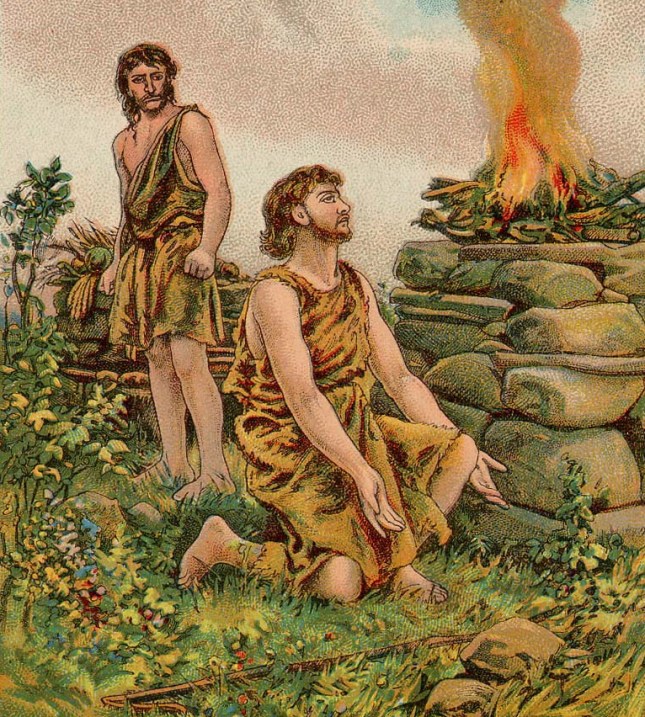
Encounters With God: “Raising Cain” – Genesis 4:1-16


If you don’t learn to deal with your temper, it will turn you into a monster of a person. It can change you into someone you don’t want to be. This is what happened to Cain in Genesis 4. He had a bad temper to start with, but he didn’t deal with it. Eventually, it turned him into this other person…an evil person.

However, Cain’s main problem was not an anger problem; his problem was a worship problem! The expression of inappropriate anger was a sin that was symptomatic of a greater problem. In Genesis 4:1-26, we will learn from the account of Cain how to worship God on His terms.

The birth of the two sons (4:1-2). Our account begins with these words: “Now the man had relations with his wife Eve, and she conceived and gave birth to Cain” (4:1a). After the fall, Adam and Eve began a family.

Eve gave birth to “Cain” whose name means, “acquire, get, or possess.” Eve responded to Cain’s birth by saying, “I have gotten a man child with the help of the LORD” (4:1b). The literal rendering of Eve’s reply is, “I have gotten a son, the Lord.” Eve understood from the prophecy of 3:15 that one of her offspring would bring about her redemption.

There is an implicit declaration of faith and gratitude (cf. 3:20). Eve acknowledges that God has enabled her to bear a child, a child through whom her deliverance may soon come.

In 4:2a, Moses records, “Again, she gave birth to his brother Abel” (4:2a). Unlike Cain’s name, Abel’s name is not explained by Eve. However, the Hebrew word “Abel” is the word “vanity” or “breath,” appearing throughout Ecclesiastes. Traditionally understood, his name reflects on the temporary nature of his existence. It is important to notice the terms “brother” and “Abel” each appear seven times, stressing the relationship between the two men. In these opening verses, Moses is trying to prepare us for what is to come.

The worship of the two brothers (4:2b-5). In 4:2b, Moses writes, “And Abel was a keeper of flocks, but Cain was a tiller of the ground.” Abel is a shepherd and Cain is a farmer. Both of these vocations are noble; one is not better than the other. This leads into an exercise in worship in 4:3-5a: “So it came about in the course of time that Cain brought an offering to the LORD of the fruit9 of the ground. Abel, on his part also10 brought of the firstlings of his flock and of their fat portions. And the LORD had regard for Abel and for his offering; but for Cain and for his offering He had no regard.” Both brothers bring offerings to the Lord suitable to their vocations (4:3). Yet, God regarded Abel and his offering and not Cain and his offering (4:4b).11 Some insist that the reason for this is Abel offered a blood sacrifice while Cain did not. However, there does not appear to be anything wrong with Cain offering fruit as opposed to animal sacrifice.

Later in Israel’s history, grain offerings and harvest offerings are legitimate expressions of worship that God accepts and even commands. So if it is not a failure to bring a blood sacrifice, why does God reject Cain and his offering?

The New Testament authors inform us that God regarded Abel because he had faith (Heb 11:4) while Cain did not (Jude 11-13 and 1 John 3:11-12). Therefore, it seems clear that Abel was in relationship with God and Cain was separated from God. A very important principle is this: “God always inspects the giver and the worshipper before He inspects the gift, service, or worship.”

There is also an interesting clue in the Genesis account that tells us about Cain and Abel and their offerings. In 4:4, Moses records that Abel offers “the firstlings of his flock” (cf. Exod 34:19; Deut 12:6; 14:23) and the “fat portions” (cf. Num 18:17) for his offering. The word that is translated “fat portions” means “choicest, best part, or abundance.” Abel gave what cost him most—the firstborn!

On the other hand, Cain merely offers “the fruit,” not the first fruit, of the ground (4:3). Abel brought the best parts of his flocks and Cain was not so particular. Abel went out of his way to worship God by giving his best. Cain merely discharged a duty.

One of the key themes throughout Scripture is God seeks worship that is perfect and costly (Leviticus 22:20-22 (NIV)
20  Do not bring anything with a defect, because it will not be accepted on your behalf.
21  When anyone brings from the herd or flock a fellowship offering to the LORD to fulfill a special vow or as a freewill offering, it must be without defect or blemish to be acceptable.
22  Do not offer to the LORD the blind, the injured or the maimed, or anything with warts or festering or running sores. Do not place any of these on the altar as an offering made to the LORD by fire.
     2 Samuel 24:24 (NIV)

24  But the king replied to Araunah, “No, I insist on paying you for it. I will not sacrifice to the LORD my God burnt offerings that cost me nothing.” So David bought the threshing floor and the oxen and paid fifty shekels of silver for them.

He will not be satisfied with second best (Malachi 1:6-14 (NIV)
6  “A son honors his father, and a servant his master. If I am a father, where is the honor due me? If I am a master, where is the respect due me?” says the LORD Almighty. “It is you, O priests, who show contempt for my name. “But you ask, ‘How have we shown contempt for your name?’
7  “You place defiled food on my altar. “But you ask, ‘How have we defiled you?’ “By saying that the LORD’s table is contemptible.
8  When you bring blind animals for sacrifice, is that not wrong? When you sacrifice crippled or diseased animals, is that not wrong? Try offering them to your governor! Would he be pleased with you? Would he accept you?” says the LORD Almighty.
9  “Now implore God to be gracious to us. With such offerings from your hands, will he accept you?”–says the LORD Almighty.
10  “Oh, that one of you would shut the temple doors, so that you would not light useless fires on my altar! I am not pleased with you,” says the LORD Almighty, “and I will accept no offering from your hands.
11  My name will be great among the nations, from the rising to the setting of the sun. In every place incense and pure offerings will be brought to my name, because my name will be great among the nations,” says the LORD Almighty.
12  “But you profane it by saying of the Lord’s table, ‘It is defiled,’ and of its food, ‘It is contemptible.’
13  And you say, ‘What a burden!’ and you sniff at it contemptuously,” says the LORD Almighty. “When you bring injured, crippled or diseased animals and offer them as sacrifices, should I accept them from your hands?” says the LORD.
14  “Cursed is the cheat who has an acceptable male in his flock and vows to give it, but then sacrifices a blemished animal to the Lord. For I am a great king,” says the LORD Almighty, “and my name is to be feared among the nations.

Romans 12:1 (NIV)
1  Therefore, I urge you, brothers, in view of God’s mercy, to offer your bodies as living sacrifices, holy and pleasing to God–this is your spiritual act of worship.

The Butterball Company set up a Thanksgiving hotline to answer questions about cooking turkeys. One woman asked if she could use a turkey that had been in the bottom of her freezer for 23 years. The Butterball expert—how’s that for a job title—told her it would probably be safe if the freezer had been below zero the entire time. But the expert warned her that even if the turkey was safe to eat, the flavor would likely have deteriorated and wouldn’t be worth eating. The woman said, “That’s what I thought. We’ll give the turkey to our church.”16 While this is an amusing story, it does hit a bit close to home for some Christians. Sin first shows itself in what you give God.

Motives matter to God. God is not impressed with those who do the right thing for the wrong reason. This truth is taught throughout the Bible. In Matthew 15:8, Jesus looks at the Pharisees and quotes Isaiah, “These people honor Me with their lips, but their hearts are far from Me.” Sometimes people can have very bad motives for doing good things.

What are our motives for serving the Lord? Every so often we need to do a motive checkup and ask ourselves: Why am I nice to other people? Why do I put money in the offering plate?

Whatever the cause of God’s rejection of Cain’s offering; the narrative itself focuses our attention on Cain’s response. It is there that the narrative seeks to make its point.

The response of the oldest brother (4:5b-8). When Cain learned that God had “no regard” for his offering, “[he] became very angry and his countenance fell” (4:5b). Cain became angry with God! Rather than being concerned about remedying the situation and pleasing God, he became very angry. We must stop here and ask these questions of ourselves: How do we respond when God says no?

When God convicts us and deals with the sin in our lives, how do we respond? Do we seek to make things right? Do we come before the Lord in worship and confession with a humble and contrite heart?

In customary fashion, in 4:6, the Lord pursues Cain with three consecutive questions: “Why are you angry? And why has your countenance fallen? If you do well, will not your countenance be lifted up?” God was not pleased with Cain or his offering. These first two questions demonstrate that He was even more displeased by Cain’s response. Yet, many of us have been told by other well-meaning Christians that it is perfectly acceptable to get mad at God.

In 4:7, the Lord says, “And if you do not do well, sin is crouching at the door; and its desire is for you, but you must master it.” This clearly implies that Cain knew what was right. He knew the quality of offering to bring and chose not to bring it. He knew his heart was not right, but he chose not to address it. Yet, this verse also shows God’s grace, for Cain was still invited to bring the correct offering. God warned Cain and He wanted Cain to “do well,” but Cain hardened his heart. Sin is like a wild animal ready to pounce and devour its victim. What a graphic picture the Lord paints! What a reminder that we do indeed have a choice whether or not to sin.

The Bad News:

Sin is waiting on us (“crouching at the door”). The influence of the world, the flesh, and the Devil are always conspiring our fall. If one doesn’t trip us up, the other will. All that is needed is “an opportunity” (lit. “a place,” Eph 4:27).

Sin desires us (“its desire is for you”). Most of us have experienced desire or passion for an individual of the opposite sex, right? Well, sin has an unholy desire and passion for us. The Devil wants to kill us, but since he can’t, he will do all that he can to destroy and render us ineffective.

The Good News:

We can master sin (“but you must master it”). We have the power to overcome sin. When temptation knocks, we can send Jesus to the door. We have been given all that we need to say “no” to sin.

We must be broken and humble before God (“be of sober spirit”). This is crucial. If we are to stand a chance against the power of sin, we must acknowledge our helplessness. We must honestly believe that, without the enablement and empowerment of the Holy Spirit, we are at sin’s mercy. We must understand the wickedness of our flesh. This will require the Lord to break us of our pride and self-reliance. We must always be on guard (“be on the alert”). Sin is sly and unpredictable. Sometimes, sin goes after us when we’re at our peak, when we feel untouchable and incapable of committing a sin. Other times, sin fights dirty and will attack when we are down, discouraged, and defeated. Yet, if we know how sin operates, we will be prepared and make sure that we’re always on our guard.

Unfortunately, instead of heeding God’s warning, Cain ignored God’s words and allowed himself to be mastered by sin. This resulted in the very first murder. Moses writes of the tragic event in 4:8: “Cain told Abel his brother. And it came about when they were in the field, that Cain rose up against Abel his brother and killed him.” In his anger, Cain took the life of another human being…and his victim was his very own brother. The use of “rise up” is most appropriate, since the “rising up” of Cain to kill his brother is a direct consequence of the “falling” of his countenance, when Abel’s offering was accepted but his was not.24 Under the Mosaic Law, the fact that a killing took place in a field, out of the range of help, was proof of premeditation (cf. Deut 22:25-27). We cringe at such a horrible act and think, “I could never do something like that.” But if we were honest, many of us would have to confess our own lists of people we’ve assassinated with our words or attitudes.

Ephesians 4:27 says if you don’t control your anger, you give the Devil a foothold (lit. “a place”) in your life. That is what Cain did. Uncontrolled anger and jealousy resulted in Abel’s death and destroyed Cain’s life too. Don’t let it happen in your life. Acknowledge that the attitude is wrong, confess it to the Lord, and ask His help in overcoming this destructive attitude.

The pursuit of a gracious God (4:9-16). In 4:9, Cain foolishly thought he could hide his sin from God. He’s following in his father’s footsteps (3:8). Yet, God seeks Cain just like He sought Adam and Eve. God is a seeker. After Cain’s treacherous sin, the Lord does the unthinkable—he dialogues with Cain. He speaks with grace, not wrath. The Lord says to Cain, “Where is Abel your brother?” Cain responds by saying, “I do not know.” Cain begins on a sinful note by lying to God. Puny old Cain tells an omniscient God that he doesn’t know where his brother Abel is. Come on! The fact that Cain can dispassionately deny what he has done and show a total lack of care and concern for his brother closely parallels man’s total lack of regard for woman in 3:12, where man icily refers to his companion as “the woman” and places all the blame on her, thereby revealing a complete absence of the intimacy and companionship that earlier had characterized their relationship.

To make matters worse, Cain goes on to utter the infamous old adage, “Am I my brother’s keeper?” This was a tragic mistake on Cain’s part. Now, if I was God, I would have smoked Cain right where he stood! But not the Lord! Instead, He asks Cain a follow-up question that is the same question He asked Eve (3:13): “What have you done?” Wouldn’t you just hate to be Cain right now? The Lord then stops asking questions and says, “The voice of your brother’s blood is crying to Me from the ground” (4:10). This is a key sentence. The words “to me” demonstrate how seriously God takes first-degree murder. When another person kills a baby, a child, or an adult made in the image of God (1:26; 9:6), the blood of the victim cries out to God! Sin cannot be covered up from God. It can be hidden from people, but not from God. Secret sin on earth is open scandal in heaven!

As a consequence of Cain’s act of deliberate sin, God curses him (4:11-12), just like He cursed the serpent (3:14) and the ground (3:17-19). Woe! Moses records these tragic words: “Now you are cursed from the ground, which has opened its mouth to receive your brother’s blood from your hand. When you cultivate the ground, it will no longer yield its strength to you; you will be a vagrant and a wanderer on the earth.”27 This is the first instance in Scripture where a human is “cursed.” The ultimate penalty for a Hebrew is not death, but exile, a loss of roots.

In 4:13-14, “Cain said to the LORD, ‘My punishment is too great to bear! Behold, You have driven me this day from the face of the ground; and from Your face I will be hidden, and I will be a vagrant and a wanderer on the earth, and whoever finds me will kill me.’”

In 4:15, the Lord speaks again to Cain, “‘Therefore whoever kills Cain, vengeance will be taken on him sevenfold.’ And the LORD appointed a sign31 for Cain, so that no one finding him would slay him.” God continues to demonstrate His grace and compassion—even to Cain! The Lord gave Cain a sign before judgment was carried out. Isn’t this just like the Lord?

In 4:16, we read these sad words: “Then Cain went out from the presence of the LORD, and settled in the land of Nod,34 east of Eden.” One question that is asked is: Did Cain repent? Probably not. The New Testament Scriptures uniformly speak of Cain in the negative with phrases like “the way of Cain” (Jude 11) and one “who was of the evil one and slew his brother” (1 John 3:12). His life is contrasted with “righteous Abel” (Matt 23:35).


Leave a comment

Posted by on September 8, 2016 in Encounters with God


Are you covered?


YouTube JesusIsLordofthisWebSite placeforyou2

 ——————————————–

In recent months, several natural and unnatural calamities have struck our country and community. Terrorists destroy buildings and lives; planes fall from the sky; evil people have given ‘hate mail’ a new meaning. Periodically, hurricanes ‘huff, and puff, and blow our East Coast houses down,’ and earthquakes ‘shake, rattle, and roll’ our West Coast structures. A little closer to home, fires often destroy neighborhood houses, storms ‘leave us in the dark,’ and auto accidents injure those we know.

Usually, upon finding out that no one was injured, we immediately ask, ‘Were they covered?’ We are interested in whether victims had insurance and sympathize the more with those who did not. It multiplies the sorrow of misfortune if there is no ‘starting over’ check.

Insurance companies provide a valuable service and most of us have been wisely counseled by informed agents. They always advise people to ‘take out some coverage-you never know when you might need it.’  Though we do not like to pay the premiums, most of us realize that the potential benefits are worth the price to be ‘covered.’ We often advise our children to take out a policy ‘just in case.’

There is a spiritual angle to the ‘insurance business.’

GOD IS IN THE INSURANCE BUSINESS.

There is a sense in which God is in the insurance business. He promised Moses that He would ‘cover’ him as He passed by (Ex. 33:22), and Moses promised the tribe of Benjamin, ‘…the Lord shall cover him all the day long, and he shall dwell between his shoulders’ (Deut. 33:12). In a beautiful word picture, the Psalmist describes God’s protection:  ‘Surely he shall deliver thee from the snare of the fowler, and from the noisome pestilence. He shall cover thee with his feathers, and under his wings shalt thou trust: his truth shall be thy shield and buckler’ (Psa. 91:3, 4).

From His vantage point, God can see an impending disaster worse than any hurricane or earthquake. It will not destroy just one house, or even town-but the whole earth (2 Pet. 3:10). It will not involve only a few hundred or thousand people, but all the people of the whole earth (2 Cor. 5:10). God is providing coverage for those willing to ‘pay the premiums.’ Jesus put it this way:

For which of you, intending to build a tower, sitteth not down first, and counteth the cost, whether he have sufficient to finish it? Lest haply, after he hath laid the foundation, and is not able to finish it, all that behold it begin to mock him, Saying, This man began to build, and was not able to finish. Or what king, going to make war against another king, sitteth not down first, and consulteth whether he be able with ten thousand to meet him that cometh against him with twenty thousand? Or else, while the other is yet a great way off, he sendeth an ambassage, and desireth conditions of peace. So likewise, whosoever he be of you that forsaketh not all that he hath, he cannot be my disciple (Lk. 14:28-33).

CHRISTIANS ARE INSURANCE AGENTS.

If God is in the insurance business, then we are His agents. We seek to ‘cover’ our friends, relatives, neighbors, co-workers, fellow citizens, and, actually, all our ‘brothers come down from Adam.’ Love motivates us. Gratitude sends us. When Noah was uncovered in his tent, Shem and Japheth took a garment and went backwards to cover their father’s shame (Gen. 9:23). They did what love always does-cover the shame of sinners. The Bible teaches us to do just that:

  •  ‘Hatred stirreth up strifes; but love covereth all sins’ (Prov.10:12).
  • ‘A fool’s wrath is presently known; but a prudent man covered shame’ (Prov. 12:16).
  • ‘He that covereth a transgression seeketh love; but he that repeateth a matter separateth very friends’ (Prov. 17:9).
  • ‘And above all things have fervent charity among your-selves: for charity shall cover the multitude of sins’ (1 Pet. 4:8).

Love does not ‘sweep sin under the rug.’  In younger days, our older brothers or buddies from school occasionally pressed us to ‘cover for them’ to keep them from the wrath of parents or teachers. It never worked. The truth came out and then we looked as bad as they did. Sin is like a rubber tire-it won’t stay buried (Num. 32:23; 1 Tim. 5:24, 25). So, then, what does the Bible mean when it says that ‘love covereth all sins?’ We cover sins by assisting sinners in getting rid of them. James wrote: ‘Let him know, that he which converteth the sinner from the error of his way shall save a soul from death, and shall hide a multitude of sins’ (5:20).

ARE YOU COVERED?

It does no good to cover one’s sins so that others do not know of them. Children may hide things from their parents, husbands and wives may hide things from each other, and workers may hide things from their employers, but no one hides anything from God (Heb. 4:13). ‘He that covereth his sins shall not prosper: but whoso confesseth and forsaketh them shall have mercy’ (Prov. 28:13).

The only way to cover one’s sins is to have them erased from the mind of God (Heb. 8:12). For sinners this is done through faith in His Son (Jn. 3:16), repentance (turning from sinful behavior) (Lk. 13:3), confession of faith (Rm. 10:9, 10), and immersion in water to have sins blotted out (Acts 2:38). For erring Christians, sins are covered by repentance, confession, and prayer (Acts 8:22).

‘Blessed is he whose transgression is forgiven, whose sin is covered’ (Psa. 32:1).

 
Leave a comment

Posted by on September 5, 2016 in Encouragement


Encounters With God: Adam and Eve: Paradise Lost – Genesis 3:1-7


Top Pickup Lines Used By Adam

  1. “You know you’re the only one for me!”
  2. “Do you come here often?”
  3. “Trust me, this was meant to be!”
  4. “Look around, baby. All the other guys around here are animals!”
  5. “I already feel like you’re a part of me!”
  6. “Honey, you were made for me!”
  7. “Why don’t you come over to my place and we can name some animals?”
  8. “You’re the girl of my dreams!”
  9. “I like a girl who doesn’t mind being ribbed!”
  10. “You’re the apple of my eye!”

By studying this passage, we will learn how sin entered the world and how we can overcome our sin. Let’s first set the scene: At the end of Genesis 2, life is perfect. Adam and Eve are naked in a lush and plush garden enjoying fellowship with the Lord and each other (2:25). Then something happens that forever changed the world.

The Serpent’s Scheme (3:1): Our story begins with the following description: “Now the serpent was more crafty than any beast of the field which the LORD God had made” (3:1a).

Mankind’s first temptation comes through the mouth of “the serpent.” The creature here is a literal serpent that Satan embodied to carry out this temptation. The Hebrew word for “serpent” carries the idea of bright and shiny. This describes its general appearance as beautiful and pleasant to be around. The serpent made a good pet and was probably constantly around Adam and Eve. In fact, it is also probable, that for this reason, Satan chose to use the serpent as his disguise to deceive Eve.

The serpent is called “more crafty than any beast of the field.” The Hebrew word for “crafty” (arum) sounds like the word for “naked” (arumim, 2:25). While Adam and Eve were naked in innocence, the Serpent was crafty in deception. The word “crafty” is not primarily a negative term in the Bible. Rather, it often suggests wisdom. The description of the Serpent as “crafty” is in direct contrast to the foolishness exhibited by the first man and woman. In man’s quest to be wise like God (3:6), man made a most foolish decision. Instead of enjoying all that was “very good” (1:31) man went after that which was clearly forbidden.

In 3:1b, the Serpent speaks to the woman and asks the first question recorded in Scripture: “Indeed, has God said, ‘You shall not eat from any tree of the garden?’” This is not an innocent conversation starter. The Serpent reduces God’s command to a question. Satan is so subtle. He does not directly deny God’s Word, but introduces the assumption that God’s Word is subject to our judgment.

Notice how Satan spins the question. He does not say, “Why would God keep you from eating the fruit of one tree?” It was couched in more deceptive words as he implies that God, who has forbidden one tree, has forbidden them all. However, the issue was one tree, not “any [every] tree of the garden.” The Devil’s words were misleading, and that is the way temptation always comes.

Satan focused Eve’s attention on God’s one prohibition. He suggested that God did not really want what was best for Adam and Eve but rather was withholding something from them that was essentially good. He hinted that God’s line of protection was actually a line that He drew because He was selfish. The Serpent wants God’s Word to appear harsh and restrictive. Satan is cleverly attempting to plant a seed of doubt in Eve’s mind concerning God’s Word and God’s goodness.

Do you believe God is holding something back from you? Is He preventing you from attaining something that is rightfully yours? Satan does not wish us to ponder the grace of God, but to grudgingly meditate upon His denials. We are to understand that denials (doing without, prohibitions) come from the hand of a good and loving God: “No good thing does He withhold from those who walk uprightly” (Ps 84:11). When temptation comes, stop to think before you take and eat.

Instead of rebuking the Serpent for its craftiness and calling Adam in for spiritual assistance, Eve listens. Eve’s first mistake was to listen to teaching that did not come from either God or Adam. Her second mistake was to listen to teaching that was contrary to God’s previous instructions. Eve placed herself in a vulnerable position by accepting dialog with the Serpent.

One of the questions you may have is: why did the Serpent talk to the woman? Why didn’t he talk to Adam or both of them as a couple? I believe Satan attempted to put a wedge between husband and wife to conquer by dividing, thus to capture their minds and cause them to act in disobedience to God’s Word. That’s why God puts such a high premium on the oneness of husband and wife and why, as husbands and wives, we need to encourage one another and build up one another.

2. The Woman’s Response (3:2-3). Instead of shunning the Serpent, Eve obliged him by carrying on a conversation. Rather than running from this one who dared to mock God’s character, she stays to debate. This is never wise. The Devil is not reasonable so there is no point in trying to reason with him. Not to mention, it is always dangerous to flirt with temptation. The moment Eve detected the Serpent insinuating something suspicious about God’s goodness, she should have kicked dirt in his face and made tracks. But instead, she stayed to argue. There are many Christians today that think they can counter the Devil. So they talk trash to him, stomp him under their feet, and make light of his power. We must always remember to have a healthy degree of respect for Satan. He is powerful. We are no match for him apart from Christ’s power working in and through us.

Let’s take a close look at Eve’s reply in 3:2-3: “From the fruit of the trees of the garden we may eat; but from the fruit of the tree which is in the middle of the garden, God has said, ‘You shall not eat from it or touch it, or you will die.’”

In her reply to the Serpent, Eve attempts to defend God’s honor but in the process distorts His Word. First, while God said, “From any tree of the garden you may eat freely” (2:16), Eve said, “From the fruit of the trees of the garden we may eat” (3:2). Eve omitted “any” and “freely,” the two words that emphasized the generosity of God (cf. Rom 8:32). Eve subtracts from God’s Word.

Likewise, Eve had a distorted impression of the severity of God in pro­hibiting the fruit of the Tree of the Knowledge of Good and Evil. She expressed God’s instruction in these words: “You shall not eat from it or touch it, lest you die” (3:3). But God had said, “But from the tree of the knowledge of good and evil you shall not eat, for in the day that you eat from it you shall surely die” (2:17). Eve magnified God’s strictness—“Just touch the tree, and zap you’re dead!” Her comment suggested that God is so harsh that an inadvertent slip would bring death. Here, Eve adds to God’s Word.

While exaggerating the prohibition to the point where even touching the tree was evil, Eve had unconsciously downplayed the judgment of God by omitting the word “surely,” and by failing to report that death would come on the day of the offense. In other words, Eve emphasized God’s severity, but under­estimated the fact that judgment would be executed surely and soon. Satan’s first attack on the woman was that of a religious seeker, in an effort to create doubts about the goodness of God and to fix her attention on what was forbidden as opposed to all that was freely given. In this final example, Eve softens God’s Word.

Satan’s scheme was quite diabolical. Had he begun to challenge the rule of God or Eve’s faith in Him, her choice would have been an easy one. But Satan erroneously stated God’s command with a question so as to appear that he was misinformed and needed to be corrected. Few of us can avoid the temptation of telling another that they are wrong. And so, wonder of wonders, Eve has begun to walk the path of disobedience while supposing that she was defending God to the Serpent.

3. The Serpent’s Kill (3:4-5). In 3:1b, Satan operated as a sly ole dog, but now in 3:4-5 Satan unleashes his beastly self. Moses records, “The serpent said to the woman, ‘You surely will not die! For God knows that in the day you eat from it your eyes will be opened, and you will be like God, knowing good and evil’” (3:4-5). In the first question (3:1b), Satan tiptoed up to Eve on her blindside, but now he steamrolls over her on the broadside with a bald-faced lie. The Hebrew places the word lo (“not”) in front of God’s declaration: “Not—you shall surely die!” It’s the Serpent’s word versus God’s Word. It’s crucial to understand the “Father of Lies” (John 8:44) is so saturated with lies that he even attempts to make God out to be a liar!

Satan’s strategy began rather innocently by introducing and encouraging doubt. His strategy quickly culminates in a blatant denial of God’s Word (cf. 2:17). In denying it he imputed motives to God that were not consistent with God’s character. God’s true motive was the welfare of man, but the Serpent implied it was God’s welfare at man’s expense. This added suggestion seemed consistent with what the Serpent had already implied about God’s motives in 3:1. Having entertained a doubt concerning God’s Word, Eve was ready to accept a denial of His Word.

As 3:4 reveals, the first thing Satan wants to deny is the doctrine of God’s judgment. He denies the penalty for sin. He says in effect, “You won’t reap what you sow.” Here is the lie that has allured the human race from the beginning: There is no punishment for disobedience. But the Bible again and again makes it clear that no one can get away with sin. It is imperative that we recognize there are consequences for sinful actions.

To make this direct contradiction of God’s Word seems reasonable; Satan invents a false motive for God. God, he says, has really invented a nonexistent penalty to keep you in your place. He is afraid you will rise to His level. If you knew as much as God knows, you would become a threat to Him. Eve’s response is fatal. She divorces her God-given reason from God’s Word and relies on her own limited experience.

This constitutes the great sin of man: to live independently of God. That is the root of sin. It is interesting to note that what the Serpent said about Eve’s being as God was a half-truth. Adam and Eve did not die immediately, and their eyes were opened. Ironically, she was already as God, having been made in His image (1:26). She did become like God in that she obtained a greater knowledge of good and evil by eating of the tree. However, she became less like God because she was no longer innocent of sin. Her relationship with God suffered. Though she remained like God she could no longer be with Him. The consequent separation from God is the essence of death (2:17).

The first doctrine Satan denied in Scripture was that sin results in death (separation from God), or we could say, the doctrine that God will not punish sin. This is still the truth he tries hardest to get people to disbelieve.

Also interesting to note is that the Serpent only speaks twice (3:1b, 4-5). That’s all the talk that was needed to plunge man downward into the spiral of sin. The success of the Serpent can be attributed to his cunning ability to question the goodness of God. The central theme of Genesis 1-2: God will provide the “good” for human beings if they will only trust Him and obey Him, is challenged by the Serpent. He cleverly suggests that God is indeed keeping “good” from His creation. The Serpent’s claim directly contradicted the main point of Genesis 1 and 2, namely, that God would provide what is good for man.

4. The Man and Woman’s Sin (3:6-7). In 3:6a: “When the woman saw that the tree was good for food, and that it was a delight to the eyes, and that the tree was desirable to make one wise, she took from its fruit and ate.” In 3:1-5, the Serpent initiated the first two steps. But in 3:6, he let Eve’s natural desires carry her into his trap. James countered this argument 2,000 years ago when he wrote, “But each one is tempted when he is carried away and enticed by his own lust” (Jas 1:14).

Eve’s basic needs and desires fell into three categories that share parallels with 1 John 2:15-17.

Human Need Genesis 3:6 Temptations 1 John 2:15-17 Parallel
Physical “Good for food” The lust of the flesh
Emotional “Delight to the eyes” The lust of the eyes
Intellectual    “Desirable to make one wise” The boastful pride of life

The next phrase is absolutely devastating: “and she [Eve] gave also to her husband with her, and he ate” (3:6b). Not only did Eve sin, but in her distorted thinking and her false sense of accomplishment, she also gave the fruit to her husband. When Eve brought the fruit to Adam, she was acting contrary to the “helper” principle (cf. 2:18). Instead of benefiting and aiding Adam, she is contributing to his downfall. She is actually inviting him and pressuring him to accept that which is contrary to divine viewpoint.

What sin have you invited a loved one to talk you into committing? Disobedience of God’s Word almost always affects someone else. Most tragically, it affects those we love the most. Eve’s disobedience affected her husband, her children, her grandchildren, her great-grandchildren, and every descendant since. The problem of sin doesn’t stop with the choice. Choosing to sin leads to consequences.

The word “with” is what is so devastating about this verse. Adam was with Eve while this tempting dialogue with the Serpent was going on. Sadly, Adam did not say a word and then he sinned willfully by eating of the fruit. Make no doubt about it; although the woman was deceived, the man was not. Adam passively watched everything. He sinned willfully, eyes wide-open, without hesitation. His sin was freighted with sinful, self-interest. He had watched Eve take the fruit, and nothing happened to her. He sinned willfully, assuming there would be no consequences. Everything was upside-down. Eve followed the snake, Adam followed Eve, and no one followed God.

In this biblical account, the man chooses to obey his wife rather than God (cf. 3:17). Adam rejected his relationship with God and embraced Eve. He said no to the Creator of all his blessings, and said, “Yes,” to a created one. He turned down the divine design of Gen 1:28 and turned it over to Satan.

Our passage closes in 3:7 with these tragic words: “Then the eyes of both of them were opened, and they knew that they were naked; and they sewed fig leaves together and made themselves loin coverings.”

The moment Adam and Eve sinned, they received the knowledge of good and evil. As a result, they “knew that they were naked.” Their nakedness was beautiful…but when sin entered the world, nakedness became shameful outside of the marriage relationship (cf. 2:25).

Satan’s Strategy:

  1. Satan attacks the family. He didn’t concern himself with Adam until he was married.
  2. Satan attacks new believers and those that aren’t in relationships with other believers. They are usually easy prey.
  3. Satan attacks when you least expect it. He loves the element of surprise. When you are at ease, relaxed, off guard, or secure, watch out! Eve was in a perfect environment, without a care in the world, when Satan attacked.
  4. Satan attacks our trust in God.
  5. Satan poisons truth with lies.
  6. Satan appeals to our pride.
  7. Satan makes promises that won’t be kept.

Your Response:

  1. Realize your vulnerability.
  2. Strengthen your weakness. Beware of sowing “wild oats” and then praying for a “crop failure”!
  3. Deepen your faith.
  4. Know and utilize God’s Word (2 Tim 2:15). “It is written” (Matt 4). Ignorance or disregard of God’s Word makes one very vulnerable to temptation (Ps 119:11).
  5. Stand strong. Refuse to yield (Eph 6:10).
  6. Resist Satan (Jas 4:7; 1 Pet 5:8-9).
  7. Trust in God’s provision (Ps 16:11). Express gratitude to Him for all that He has done for you.
 
Leave a comment

Posted by on September 1, 2016 in Encounters with God