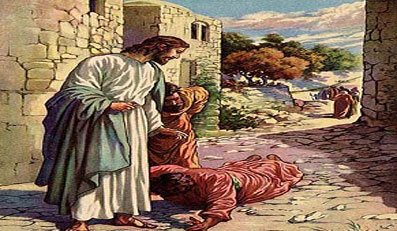
 (Luke 7:1-6 NIV) When Jesus had finished saying all this in the hearing of the people, he entered Capernaum. {2} There a centurion’s servant, whom his master valued highly, was sick and about to die. {3} The centurion heard of Jesus and sent some elders of the Jews to him, asking him to come and heal his servant. {4} When they came to Jesus, they pleaded earnestly with him, “This man deserves to have you do this, {5} because he loves our nation and has built our synagogue.” {6} So Jesus went with them. He was not far from the house when the centurion sent friends to say to him: “Lord, don’t trouble yourself, for I do not deserve to have you come under my roof.
After Jesus’ great sermon he returns to Capernaum. While he is there, a notable centurion sends to Jesus a delegation of Jewish elders. They beg Jesus to heal the centurion’s servant. Now Matthew says the centurion came himself. Does that mean that Matthew and Luke contradict each other? Not necessarily. Matthew’s account is merely an abbreviation of the event. Since the centurion was responsible for the delegation he, himself, is described as coming to Jesus. Besides, that fits Matthew, since he typically leaves out any positive comments about Jewish leaders. In contrast, Luke gives the more detailed account which characteristically shows mercy to Gentiles. What we have, then, is not a contradiction but a variation in their presentations.
The emphasis of this passage is on the centurion, not on the sick servant. In fact, even the syntax of this sentence places the word “centurion” in a prominent position so it sticks out even though the subject of the sentence is the servant.
A centurion was a military leader in the Roman army comparable to a lieutenant. As the title “centurion” suggests, he was in charge of one hundred men. The New Testament speaks of several centurions and all in favorable terms. (1) The centurion at the cross of Christ proclaimed his faith that Jesus was the Son of God or possibly a son of a god (Mt 27:54; Mk 15:39; Lk 23:47). (2) Cornelius, of Acts 10-11, demonstrated full faith in Jesus. He and his house received the Holy Spirit and were baptized. (3) Julius, in Acts 27, guarded Paul on the way to Rome. He was both reasonable and fair. (4) Only one centurion, Acts 22:25-26, may be viewed as a villain. He was about to flog Paul. But he was just doing his job and did, in fact, stop when he learned that Paul was a Roman citizen. Over all, our impression of centurions is positive. They seem to be reasonable, unbiased, and submitted to authority.
His servant is “valued highly.” In several other passages this refers to positions of highest honor. In both Luke 7:7 and Matthew 8:6 he will be referred to, not as a servant, but as a child. In other words, he is more than just a servant. He had become like a son to the centurion.
Upon hearing of Jesus’ reputation for healing, this centurion sends a delegation of Jewish elders to ask Jesus for help. It was rare that Jews would go out of their way for a Gentile. But this was a rare Gentile. He had provided influence and likely much of his own money to help build the Capernaum synagogue. And now, one good deed deserves another.
(Luke 7:6-8 NIV) So Jesus went with them. He was not far from the house when the centurion sent friends to say to him: “Lord, don’t trouble yourself, for I do not deserve to have you come under my roof. {7} That is why I did not even consider myself worthy to come to you. But say the word, and my servant will be healed. {8} For I myself am a man under authority, with soldiers under me. I tell this one, ‘Go,’ and he goes; and that one, ‘Come,’ and he comes. I say to my servant, ‘Do this,’ and he does it.”
The delegation of Jewish elders apparently overstep their bounds, or at least the centurion’s desires, when they ask Jesus to go to the man’s house. Thus, a second delegation, comprised of the centurion’s personal friends, is sent to keep Jesus from coming to the house.
Their message is simple: “Don’t trouble yourself” (lit. “Don’t be hassled”). This construction means to “stop” whatever action is in progress. The centurion either sees or hears the procession and doesn’t want Jesus to bother himself further by entering his home. He is probably not just talking about the trouble of coming all the way to his house. If Jesus were to enter the house of a Gentile, he would be criticized by his own countrymen (cf. Acts 10:28). This centurion is looking out for Jesus’ best interests and trying to protect his reputation.
Being a soldier, the centurion understands the power of the spoken word. Jesus doesn’t need to be present or touch the servant. He simply needs to command it to be done (cf. Ps 107:20). Such is the nature of authority. Even so, there is no precedent for believing in “distance healing” save the one incident when Jesus healed the nobleman’s son in Capernaum while he was twenty miles away in Cana (Jn 4:46-54). Perhaps this fellow had heard about that. Even so, his faith is astounding.
The centurion makes a keen comparison between his military position and the spiritual position of Jesus and his Father. He had superiors from whom he was given authority and subordinates to whom he gave commands. He recognizes that Jesus is granted authority from God and is authorized to give commands to his subordinates (e.g., diseases and elements).
(Matthew 8:10-13 NIV) When Jesus heard this, he was astonished and said to those following him, “I tell you the truth, I have not found anyone in Israel with such great faith. {11} I say to you that many will come from the east and the west, and will take their places at the feast with Abraham, Isaac and Jacob in the kingdom of heaven. {12} But the subjects of the kingdom will be thrown outside, into the darkness, where there will be weeping and gnashing of teeth.” {13} Then Jesus said to the centurion, “Go! It will be done just as you believed it would.” And his servant was healed at that very hour.
(Luke 7:10 NIV) Then the men who had been sent returned to the house and found the servant well.
This is one of only two times that Jesus was amazed. He is amazed here at the incredible faith of a Gentile, and in Mark 6:6, in Nazareth, he was amazed at the lack of faith of his own countrymen. It is a paradox that the Jews, who had the Scriptures (Rom 3:1-2), would lack faith, while the Gentiles should demonstrate such faith.
Jesus lays out a paradox of his own. The Jews, who would expect to participate in the Messianic banquet (Isa 25:6; Mt 26:29; Lk 22:30), were kicked out. But the foreigners were allowed in. The simple lesson of this narrative is that Jesus respects faith, not ethnicity. Hence, we have a dramatized prediction of Gentile inclusion (Acts 10-11).
In the Gospels and the Book of Acts, Roman centurions are presented as quality men of character, and this one is a sterling example. The Jewish elders had little love for the Romans in general and Roman soldiers in particular, and yet the elders commended this officer to Jesus. He loved the Jewish people in Capernaum and even built them a synagogue. He loved his servant and did not want him to die. This centurion was not a Stoic who insulated himself from the pain of others. He had a heart of concern, even for his lowly servant boy who was dying from a paralyzing disease (Matt. 8:6).
Matthew’s condensed report (Matt. 8:5-13) does not contradict Luke’s fuller account. The centurion’s friends represented him to Jesus and then represented Jesus to him. When a newscaster reports that the President or the Prime Minister said something to Congress or Parliament, this does not necessarily mean that the message was delivered by them in person. It was probably delivered by one of their official representatives, but the message would be received as from the President or Prime Minister personally.
We are impressed not only with this man’s great love, but also his great humility. Imagine a Roman officer telling a poor Jewish rabbi that he was unworthy to have Him enter his house! The Romans were not known for displaying humility, especially before their Jewish subjects.
But the characteristic that most impressed Jesus was the man’s faith. Twice in the Gospel record we are told that Jesus marveled. Here in Capernaum, He marveled at the faith of a Gentile; and in Nazareth, He marveled at the unbelief of the Jews (Mark 6:6). The only other person Jesus commended for having “great faith” was a Gentile woman whose daughter He delivered from a demon (Matt. 15:28). It is worth noting that in both of these instances, Jesus healed at a distance (see Ps. 107:20; Eph. 2:11-13).
The centurion’s faith certainly was remarkable. After all, he was a Gentile whose background was pagan. He was a Roman soldier, trained to be self-sufficient, and we have no evidence that he had ever heard Jesus preach. Perhaps he heard about Jesus’ healing power from the nobleman whose son Jesus had healed, also at a distance (John 4:46-54). His soldiers may also have brought him reports of the miracles Jesus had performed, for the Romans kept close touch with the events in Jewish life.
The important word in Luke 7:8 is “also.” (It should be in Matt. 8:9 as well, but the kjv omits it for some reason. The nasb has “too” in both places.) The officer saw a parallel between the way he commanded his soldiers and the way Jesus commanded diseases. Both the centurion and Jesus were under authority, and because they were under authority, they had the right to exercise authority. All they had to do was say the word and things happened. What tremendous faith this man exhibited! No wonder Jesus marveled.
If this Roman, with very little spiritual instruction, had that kind of faith in God’s Word, how much greater our faith ought to be! We have an entire Bible to read and study, as well as nearly 2,000 years of church history to encourage us, and yet we are guilty of “no faith” (Mark 4:40) or “little faith” (Matt. 14:31). Our prayer ought to be, “Lord, increase our faith!” (Luke 17:5)
Verse-by-Verse
(7:1-10) Introduction: Jesus Christ meets the need of everyone—Gentile or Jew, rich or poor, leader or follower, ruler or slave. He bridges the gaps, prejudices, and divisions between men. The one essential for securing His help is faith. A person must have faith in Christ and His power. The fact is clearly demonstrated in what happened between this soldier and Jesus. Note that Jesus termed this man’s faith “great faith.”
- Jesus returned to Capernaum (v.1).
- Great faith cares deeply for people (v.2).
- Great faith feels unworthy in approaching Jesus Christ (v.3).
- Great faith seeks God (v.4-5).
- Great faith is centered in Jesus Christ (v.6-8).
- Great faith stirs the great power of Jesus Christ (v.9-10).
(7:1) Jesus Christ, Headquarters: Jesus returned to Capernaum. Capernaum was His headquarters where He now lived.
(7:2) Care: great faith cares deeply for people. The soldier was a man who cared deeply for people. Note the word “dear” (entimos) meaning esteemed, honored, precious, prized. In the society of that day, a slave was nothing, only a tool or a thing to be used as the owner wished. He had no rights whatsoever, not even the right to live. An owner could mistreat and kill a slave without having to give an account. But this soldier loved his slave. This reveals a deep concern and care for people. It would have been much less bother to dispose of the slave or to ignore him and just let him die, but not this soldier. He cared. Note how he personally looked after the slave, a person who meant nothing to the rest of society. But his arms and love were wide open to do all he could to help this person who was helpless. This alone, helping a person who meant nothing to society, was bound to affect Christ dramatically.
DEEPER STUDY
Centurion: an officer in the Roman armed forces. He commanded about one hundred soldiers. To the Jew, the centurion had three things against him: he was bitterly hated because he was non-Jewish, a Gentile; he was of the nation that had conquered Palestine, Rome; and he was of the armed and occupying force. Every time a centurion is mentioned in the New Testament it is with honor.
- There was the centurion who had great faith in the power of Jesus (Matthew 8:5).
- There was the centurion who recognized Jesus hanging on the cross as the Son of God (Matthew 27:54).
- There was the centurion, Cornelius, who was the first Gentile convert to the Christian church (Acts 10:22).
- There was the centurion who recognized that Paul was a Roman citizen and rescued him from the rioting mob (Acts 23:17-23).
- There was the centurion who took steps to deliver Paul from being murdered after being informed of the Jews’ plan (Acts 24:23).
- There was the centurion whom Felix ordered to escort and look after Paul (Acts 24:23).
- There was the centurion who escorted Paul on his last journey to Rome. He treated Paul with great courtesy and accepted him as the leader when the storm struck the ship (Acts 27:43).
The structure of the Roman military was built around the Roman legion which consisted of 6000 men.
The Roman legion was divided into cohorts: each cohort had 600 soldiers. This means there were ten cohorts in each legion.
The cohort was divided into centuries. Each century had 100 men and was led by a centurion. The centurions were the backbone of the Roman legions. They were the leaders in closest contact with the men; therefore, they were the officers upon whom the top brass depended so heavily (William Barclay. The Gospel of Matthew, Vol.1. “The Daily Study Bible.” Philadelphia, PA: Westminister Press, 1956, p.306).
The central character is a Roman centurion; and he was no ordinary man.
(i) The mere fact that he was a centurion meant he was no ordinary man. A centurion was the equivalent of a regimental sergeant-major; and the centurions were the backbone of the Roman army. Wherever they are spoken of in the New Testament they are spoken of well (cp. Luke 23:47; Acts 10:22; 22:26; 23:17, 23, 24; 24:23; 27:43). Polybius, the historian, describes their qualifications. They must be not so much “seekers after danger as men who can command, steady in action, and reliable; they ought not to be over anxious to rush into the fight; but when hard pressed they must be ready to hold their ground and die at their posts.” The centurion must have been a man amongst men or he would never have held the post which was his.
(ii) He had a completely unusual attitude to his slave. He loved this slave and would go to any trouble to save him. In Roman law a slave was defined as a living tool; he had no rights; a master could ill-treat him and even kill him if he chose. A Roman writer on estate management recommends the farmer to examine his implements every year and to throw out those which are old and broken, and to do the same with his slaves. Normally when a slave was past his work he was thrown out to die. The attitude of this centurion to his slave was quite unusual.
(iii) He was clearly a deeply religious man. A man needs to be more than superficially interested before he will go the length of building a synagogue. It is true that the Romans encouraged religion from the cynical motive that it kept people in order. They regarded it as the opiate of the people. Augustus recommended the building of synagogues for that very reason. As Gibbon said in a famous sentence, “The various modes of religion which prevailed in the Roman world were all considered by the people as equally true; by the philosopher as equally false; and by the magistrate as equally useful.” But this centurion was no administrative cynic; he was a sincerely religious man.
(iv) He had an extremely unusual attitude to the Jews. If the Jews despised the gentiles, the gentiles hated the Jews. Antisemitism is not a new thing. The Romans called the Jews a filthy race; they spoke of Judaism as a barbarous superstition; they spoke of the Jewish hatred of mankind; they accused the Jews of worshipping an ass’s head and annually sacrificing a gentile stranger to their God. True, many of the gentiles, weary of the many gods and loose morals of paganism, had accepted the Jewish doctrine of the one God and the austere Jewish ethic. But the whole atmosphere of this story implies a close bond of friendship between this centurion and the Jews.
(v) He was a humble man. He knew quite well that a strict Jew was forbidden by the law to enter the house of a gentile (Acts 10:28); just as he was forbidden to allow a gentile into his house or have any communication with him. He would not even come to Jesus himself. He persuaded his Jewish friends to approach him. This man who was accustomed to command had an amazing humility in the presence of true greatness.
(vi) He was a man of faith. His faith is based on the soundest argument. He argued from the here and now to the there and then. He argued from his own experience to God. If his authority produced the results it did, how much more must that of Jesus? He came with that perfect confidence which looks up and says, “Lord, I know you can do this.” If only we had a faith like that, for us too the miracle would happen and life become new.
(7:3) Rejection—Unworthiness: great faith feels unworthy in approaching Jesus. The soldier was a man who had heard about Jesus and what he had heard made him feel unworthy. Note several things.
- Luke’s account differs from Matthew’s. Luke says the centurion sent some religious leaders to approach Jesus, whereas Matthew says that the centurion approached Jesus. What needs to be remembered is that in a dictatorial society, whatever a leader commands others to do is counted as his act, as he himself having done it. The leader’s representatives act for him; thus, he is said to have done it.
- The centurion was in a place where he could hear about Jesus. He was where he could hear the message of hope, and when the news came, he did not close his mind or ignore it. He responded.
- The centurion, however, felt unworthy to approach Jesus himself. Why?
He was a soldier, trained to take life and probably guilty of having taken life. What he had heard about Christ was the message of love and brotherhood.
He was a sinner, a terrible sinner, a Roman heathen, totally unworthy and rejected in the eyes of most. He felt that Jesus, too, would count him unworthy and reject him.
- The centurion requested help from others. He asked them to intercede for him. Note: he did not allow his sense of unworthiness and rejection to defeat him; neither was he too proud to ask for help, despite his superior position.
(7:4-5) Seeking God—Jew—Gentile—Rejected—Prejudice: great faith seeks God. The soldier was a man who sought God.
- He was not a superficial religionist. He had heard about the God of Israel and accepted Him, rejecting the gods of Rome. This he did despite the hostility and rejection of the Jews. He was so drawn to God that he evidently was going to let nothing stop him from discovering the truth.
- He was a man of faith (Luke 7:9), a man who loved God. The very reason he would love the Jewish nation (a people who despised him) and build a synagogue was because of his love for God. His faith and love had to be genuine. It was most unusual for a Gentile, especially a Gentile official, to care for the Jews. Anti-semitism was the common thing. The Jew and Gentile had no dealings with one another. Note how far he went to serve God: he loved those who had formerly rejected and despised him, and he did what he could to edify and enhance the worship of God’s people by building a synagogue. His love and faith were so strong and evident that those who had despised him now felt close to him—close enough to intercede for him.
(7:6-8) Faith: great faith is centered in Jesus Christ. The centurion was a man of faith. The centurion illustrated perfectly what faith is (Hebrews 11:6).
- It is believing that “Christ is”: that He is sovereign Lord (Hebrews 11:6). All power is subject to Him.
- It is believing that “Christ is a rewarder of those that diligently seek Him” (Hebrews 11:6). He will use His power in behalf of those who do seek Him.
Note that the centurion had diligently sought Jesus, believing Jesus could meet his need. Many believers diligently seek the Lord, but the centurion’s faith was so much greater than most believers. Why? Because he believed that the Word of Christ was all that was needed. Jesus did not have to be present for the need to be met. As a centurion, he had authority over men. All he had to do was issue an order and it was carried out, whether he was present or not. He was a sovereign commander. He was saying, “How much more are you, O’ Lord. But speak the word only, and my need shall be met.” What a forceful and powerful lesson on faith for all!
(7:9-10) Faith—Jesus Christ, Power of: great faith stirs the great power of Jesus. The centurion was a man who stirred the great power of Jesus.
- Jesus marvelled. Only twice is Jesus said to have marvelled at people: at the centurion, and at the people in Nazareth because of their unbelief (Mark 6:6). What an impact this man made upon Jesus!
- Jesus embraced and commended the soldier. He embraced him for his faith, not for who he was or for what he had done as a soldier. Believing, that is, true faith, is a rare thing. Not many believe; yet belief in Christ is one of the greatest qualities of human life—a quality ignored, neglected, and in some cases denied.
He commended him before others. There are times when recognition and commendation are to be given, but again, note for what. It is for spiritual graces, for spiritual strength. However, caution should always be exercised lest the temptation of pride and self-importance set in.
- Jesus healed the servant, and His power to meet the centurion’s request proved His Messiahship—that He was truly the Son of God.


 Proud to be TJ's man