The 1993 movie “Shadowlands” tells the bittersweet love story involving the writer C. S. Lewis and Joy Gresham. At the beginning of the film, Lewis was lecturing on the subject of pain in a hall full of people. He told them,
Pain is God’s megaphone to rouse a deaf world. … We are like blocks of stone out of which the sculptor carves the forms of men. The blows of his chisel which hurt us so much are what make us perfect.
In the course of the movie, Lewis met Joy Gresham, and she began to fall in love with him. Lewis, a confirmed bachelor, was at first interested only in a friendship with Joy. One day, as the two were sitting down for afternoon tea in his apartment, Joy exploded in frustration at Lewis. She shouted, I have only now just seen it–how you have arranged a life for yourself where no one can touch you. Everyone that’s close to you is either younger than you or weaker than you or under your control.
Slowly, Lewis came to realize that Joy was right about the way he had insulated his life from feelings and pain. Later, when Joy was in the hospital with cancer, Lewis proposed marriage to her; and in 1956 they became husband and wife. The next four years were wonderful years for them, in spite of the ever-present cloud of cancer that hung over their bliss.
During this time they took a late honeymoon trip to see a beautiful valley which was depicted in a painting on their wall. Rain began to fall as they were walking in the field, so they sought shelter in a shed where hay was stored. While they sat there, Joy insisted on discussing her coming death. In a steady voice, she said,
Let me just say it before this rain stops and we go back…. That I am going to die and I want to be with you then too. The only way I can do that is if I’m able to talk to you now…. I think it can be better than just managing. What I’m trying to say is the pain then is part of the happiness now. That’s the deal.
—————————————————
It is one of the most precious things in the world to have a house and a home into which one can go at any time and find rest and understanding and peace and love. That was doubly true for Jesus, for he had no home of his own; he had nowhere to lay his head (Luke 9:58). In the home at Bethany he had just such a place. There were three people who loved him; and there he could find rest from the tension of life.
The greatest gift any human being can give another is understanding and peace. To have someone to whom we can go at any time knowing that they will not laugh at our dreams or misunderstand our confidences is a most wonderful thing. It is open to us all to make our own homes like that. It does not cost money, and does not need lavish hospitality. It costs only the understanding heart.
Sir William Watson, in his poem Wordsworth’s Grave, paid a great tribute to Wordsworth:
“What hadst thou that could make so large amends,
For all thou hadst not and thy peers possessed?
Motion and fire, swift means to radiant ends?-
Thou hadst for weary feet, the gift of rest.”
No man can have a greater gift to offer his fellow men than rest for weary feet; and that is the gift which Jesus found in the house in Bethany, where Martha and Mary and Lazarus lived.
The name Lazarus means God is my help, and is the same name as Eleazar. Lazarus fell ill, and the sisters sent to Jesus a message that it was so. It is lovely to note that the sisters’ message included no request to Jesus to come to Bethany. They knew that was unnecessary; they knew that the simple statement that they were in need would bring him to them. Augustine noted this, and said it was sufficient that Jesus should know; for it is not possible that any man should at one and the same time love a friend and desert him. C. F. Andrews tells of two friends who served together in the First World War. One of them was wounded and left lying helpless and in pain in no-man’s-land. The other, at peril of his life, crawled out to help his friend; and, when he reached him, the wounded man looked up and said simply: “I knew you would come.” The simple fact of human need brings Jesus to our side in the twinkling of an eye.
When Jesus came to Bethany he knew that whatever was wrong with Lazarus he had power to deal with it. But he went on to say that his sickness had happened for God’s glory and for his. Now this was true in a double sense-and Jesus knew it. (i) The cure would undoubtedly enable men to see the glory of God in action. (ii) But there was more to it than that. Again and again in the Fourth Gospel Jesus talks of his glory in connection with the Cross. John tells us in 7:39 that the Spirit had not yet come because Jesus was not yet glorified, that is to say, because he had not yet died upon his Cross.
When the Greeks came to him, Jesus said: “The hour has come for the Son of Man to be glorified” (John 12:23). And it was of his Cross that he spoke, for he went straight on to speak of the corn of wheat which must fall into the ground and die. In John 12:16 John says that the disciples remembered these things after Jesus had been glorified, that is after he had died and risen again. In the Fourth Gospel it is clear that Jesus regarded the Cross both as his supreme glory and as the way to glory. So when he said that the cure of Lazarus would glorify him, he was showing that he knew perfectly well that to go to Bethany and to cure Lazarus was to take a step which would end in the Cross-as indeed it did.
With open eyes Jesus accepted the Cross to help his friend. He knew the cost of helping and was well prepared to pay it.
When some trial or affliction comes upon us, especially if it is the direct result of fidelity to Jesus Christ, it would make all the difference in the world if we saw that the cross we have to bear is our glory and the way to a greater glory still. For Jesus there was no other way to glory than through the Cross; and so it must ever be with those who follow him.
The raising of Lazarus from the dead was not our Lord’s last miracle before the cross, but it was certainly His greatest and it aroused the most response both from His friends and His enemies. It showed His mastery of human problems and a convincing proof of His claim to be the resurrection and the life.
John selected this miracle as the seventh in the series recorded in his book because it was really the climactic miracle of our Lord’s earthly ministry. He had raised others from the dead, but Lazarus had been in the grave four days. It was a miracle that could not be denied or avoided by the Jewish leaders!
If Jesus can do nothing about death, then whatever else He can do amounts to nothing. “If in this life only we have hope in Christ, we are of all men most miserable” Paul said in 1 Cor. 15:19. Death is man’s last enemy (1 Cor. 15:26), but Jesus has defeated this horrible enemy totally and permanently.
The emphasis in this chapter is on faith; you find some form of the word believe at least 8 times in this account. Another theme is “the glory of God” (11:4, 40).
This event took place during the last winter of Jesus’ life, following His withdrawal into Perea (10:40) and prior to His last Passover (12:1). It marked the high point of His ministry in the neighborhood of Jerusalem and made the concluding appeal to the crowd on the basis of signs.
The division of belief and unbelief which had already become apparent in the crowd became fixed after the miracle!
The last two verses in chapter 10 which supply the historical setting for the raising of Lazarus form a connecting link between the beginning of Jesus’ ministry and its close:
– the allusion to John the Baptist recalls the statement of 4:1 that Jesus had left Judea the first time because of the concern the Pharisees showed over His great success. They were alarmed because “He was baptizing more disciples than John.”
– Now upon His return to the same region, He openly discussed their hostility (Matt. 19:1ff and Mark 10:1ff) and accepted the belief of the testimony of His forerunner.
The long interim between the early contacts with John the Baptist in Perea and this later ministry had not caused the people to forget John’s message nor to lessen their appreciation of Jesus.
In what Jesus said and did, He sought to strengthen the faith of three groups of people:
- THE DISCIPLES (11:1-12).
| Discussion Starters
1. If your best friend did not come when you needed him/her, how would you feel? a. very angry b. deserted c. hurt d. assume there was a good reason e. terrible, but I would never show it 2. Why do you think Jesus delayed two days before setting out to see Lazarus? a. he knew he couldn’t make it before Lazarus’ death b. he was warned that people were out to kill him c. he needed time to prepare himself d. God had a greater purpose in mind
3. Why do you think Jesus told his disciples that Lazarus was sleeping at first when he knew Lazarus was dead? a. he didn’t want to deal with their shock b. he wanted to deal with their shock at a later time c. he needed time to work through his own feelings first d. he didn’t want them to think the situation was hopeless |
“Now a man named Lazarus was sick. He was from Bethany, the village of Mary and her sister Martha. {2} This Mary, whose brother Lazarus now lay sick, was the same one who poured perfume on the Lord and wiped his feet with her hair. {3} So the sisters sent word to Jesus, “Lord, the one you love is sick.” {4} When he heard this, Jesus said, “This sickness will not end in death. No, it is for God’s glory so that God’s Son may be glorified through it.” {5} Jesus loved Martha and her sister and Lazarus. {6} Yet when he heard that Lazarus was sick, he stayed where he was two more days. {7} Then he said to his disciples, “Let us go back to Judea.” {8} “But Rabbi,” they said, “a short while ago the Jews tried to stone you, and yet you are going back there?” {9} Jesus answered, “Are there not twelve hours of daylight? A man who walks by day will not stumble, for he sees by this world’s light. {10} It is when he walks by night that he stumbles, for he has no light.” {11} After he had said this, he went on to tell them, “Our friend Lazarus has fallen asleep; but I am going there to wake him up.” {12} His disciples replied, “Lord, if he sleeps, he will get better.””
We need to observe that John carefully identifies Lazarus through a connection with Mary and Martha, indicating that he was not very well known at this time when the account of the miracle was written. And the reference to Mary in verse 2 shows that she was well known for her annointing of the Lord’s feet.
We sometimes think of the disciples as “supersaints,” but such was not the case. They often failed their Lord, and He was constantly seeking to increase their faith. After all, one day He would leave them and they would have the responsibility of carrying on the ministry. If their faith was weak, their work could never be strong.
Jesus was at Bethabara, about 20 miles from Bethany (1:28; 10:40). It is one of the most precious things in the world to have a house and a home into which one can go at any time and find rest, understanding, peace, and love. That was doubly true for Jesus, for he had no home of his own. In the home at Bethany he had just such a place.
One day, a messenger arrived with the sad news that Lazarus, a close friend of Jesus was sick. If the man had traveled quickly, without any delay, he could have made the trip in one day.
Jesus sent him back the next day with the encouraging message recorded in verse 4. Then Jesus waited two more days before He left for Bethany; and by the time He and the disciples arrived, Lazarus had been dead for four days…meaning that Lazarus had died the very day the messenger left to contact Jesus!
We may find it strange that John shows us Jesus staying two whole days where he was when he received the news about Lazarus. Commentators have advanced different reasons to explain this delay. (i) It has been suggested that Jesus waited so that when he arrived Lazarus would be indisputably dead. (ii) It has therefore been suggested that Jesus waited because the delay would make the miracle he proposed to perform all the more impressive. The wonder of raising to life a man who had been dead for four days would be all the greater. (iii) The real reason why John tells the story in this way is that he always shows us Jesus taking action entirely on his own initiative and not on the persuasion of anyone else. In the story of the turning of the water into wine at Cana of Galilee (John 2:1-11) John shows us Mary coming to Jesus and telling him of the problem. Jesus’s first answer to Mary is: “Don’t bother about this. Let me handle it in my own way.” He takes action, not because he is persuaded or compelled to do so, but entirely on hie own initiative. When John tells the story of Jesus’s brothers trying to dare him into going to Jerusalem (John 7:1-10), he shows us Jesus at first refusing to go to Jerusalem and then going in his own good time. It is always John’s aim to show that Jesus did things, not because he was pressed to do them, but because he chose to do them in his own good time. That is what John is doing here. It is a warning to us. So often we would like Jesus to do things in our way; we must leave him to do them in his own way.
When Jesus finally announced that he was going to Judaea, his disciples were shocked and staggered. They remembered that the last time he was there the Jews had tried to find a way to kill him. To go to Judaea at that time seemed to them-as indeed humanly speaking it was-the surest way to commit suicide.
Then Jesus said something which contains a great and permanent truth. “Are there not,” he asked, “twelve hours in the day?” There are three great truths implied in that question.
(i) A day cannot finish before it ends. There are twelve hours in the day, and they will be played out no matter what happens. The day’s period is fixed, and nothing will shorten or lengthen it. In God’s economy of time a man has his day, whether it be short or long.
(ii) If there are twelve hours in the day there is time enough for everything a man should do. There is no need for a rushed haste.
(iii) But, even if there are twelve hours in the day, there are only twelve hours. They cannot be extended; and therefore, time cannot be wasted. There is time enough, but not too much; the time we have must be used to the utmost.
The legend of Dr Faustus was turned into great drama and poetry by Christopher Marlowe. Faustus had struck a bargain with the devil. For twenty-four years the devil would be his servant and his every wish would be realized; but at the end of the years the devil would claim his soul. The twenty-four years have run their course, the last hour has come, and Faustus now sees what a terrible bargain he has struck.
“Ah, Faustus, Now hast thou but one bare hour to live,
And then thou must be damn’d perpetually;
Stand still, you ever-moving spheres of heaven,
That time may cease, and midnight never come.
Fair Nature’s eye, rise, rise again and make
Perpetual day; or let this hour be but
A year, a month, a week, a natural day,
That Faustus may repent and save his soul!
O lente, lente currite, noctis equi!
The stars move still, time runs, the clock will strike,
The devil will come, and Faustus must be damn’d.”
Nothing in the world could give Faustus more time. That is one of the great threatening facts in the life of man. There are twelve hours in the day-but there are only twelve hours in the day. There is no necessity for haste; but, equally, there is no room for waste. There is time enough in life, but there is never time to spare.
Jesus goes on to develop what he has just said about time. He says that if a man walks in the light, he will not stumble; but if he tries to walk in the night, he will stumble.
John again and again says things which have two meanings, one which lies on the surface and is true, and another which lies below the surface and is truer yet. It is so here.
(i) There is a surface meaning which is perfectly true and which we must learn. The Jewish day, like the Roman day, was divided into twelve equal hours, from sunrise to sunset. That of course means that the length of an hour varied according to the length of the day and the season of the year. On the surface Jesus simply means that a man will not stumble when the sun is shining, but when the dark comes down he cannot see the way. There was no street lighting in those days, at least not in the country places. With the dark, the time for journeying was done.
Jesus is saying that a man must finish the day’s work within the day, for the night comes when work is ended. If a man had one wish it might well be that he might come to the end of each day with its work completed. The unrest and the hurry of life are so often simply due to the fact that we are trying to catch up on work which should have been done before. A man should so spend his precious capital of time and not dissipate it on useless extravagances, however pleasant, that at the end of each day he is never in debt to time.
(ii) But below the surface meaning is another meaning. Who can hear the phrase the light of the world without thinking of Jesus? Again and again John uses the words the dark and the night to describe life without Christ, life dominated by evil. In his dramatic account of the last meal together, John describes how Judas went out to make the dreadful final arrangements for the betrayal. “So, after receiving the morsal, he immediately went out; and it was night” (John 13:30). The night is the time when a man goes from Christ and when evil possesses him.
The gospel is based on the love of God; but whether we like it or not, there is a threat also at its heart. A man has only so much time to make his peace with God through Christ; and if he does not do so the judgment must follow. So Jesus says: “Finish your greatest work; finish the work of getting yourself right with God while you have the light of the world; for the time comes when for you, too, the dark must come down and then it will be too late.”
No gospel is so sure that God loved the world as the Fourth Gospel is; but also no gospel is so sure that love may be refused. It has in it two notes-the glory of being in time; and the tragedy of being too late.
When the messenger arrived back home, he would find Lazarus already dead. What would his message convey to the grieving sisters now that their brother was already dead and buried? Jesus was urging them to believe His Word no matter how discouraging the circumstances might appear.
No doubt the disciples were perplexed about several matters:
– If Jesus loved Lazarus, why did He permit him to get sick?
– Why did Jesus delay to go to the sisters?
– For that matter, why didn’t He heal Lazarus at a distance, as He did the nobleman’s son (4:43-54)
– The record makes it clear that there was a strong love relationship between Jesus and this family (11:3, 5, 36)
– Yet our Lord’s behavior seems to contradict this love?!
The statement that “Jesus loved” Lazarus is a strange one, for some, because Christ loves all people…but it doesn’t mean that He didn’t have special friends while upon the earth.
To appreciate what these three meant to Jesus, ask yourself a simple question: if you had an emergency at 2:00 a.m., whom would you call? Jesus would have called these three close friends.
God’s love for His own is not a pampering love; it is a perfecting love. The fact that He loves us, and we love Him, is no guarantee that we will be sheltered from the problems and pains of life. After all, the Father loves His Son: and yet the Father permitted His beloved Son to drink the cup of sorrow and experience the shame and pain of the cross.
The message to the sisters did not say that their brother would not die. It promised only that death would not be the ultimate result, for the ultimate result would be the glory of God.
The disciples were bewildered because Jesus was ready to return to Judea when only a short time before the Jews had attempted to stone him. Jesus replied that duty, not safety, was His first obligation.
Was His delay waiting for Lazarus to die? No, because it’s likely that he died while the messenger made the trip. His death of four days did provide greater authenticity to the miracle and greater opportunity for people to believe, including His own disciples: {13}“Jesus had been speaking of his death, but his disciples thought he meant natural sleep. {14} So then he told them plainly, “Lazarus is dead, {15} and for your sake I am glad I was not there, so that you may believe. But let us go to him.” {16} Then Thomas (called Didymus) said to the rest of the disciples, “Let us also go, that we may die with him.””
John here uses his normal method of relating a conversation of Jesus. In the Fourth Gospel, Jesus’s conversations always follow the same pattern. Jesus says something which sounds quite simple. His saying is misunderstood, and he goes on to explain more fully and unmistakably what he meant. So it is with his conversation with Nicodemus about being born again (John 3:3-8); and his conversation with the woman at the well about the water of life (John 4:10-15).
Jesus here began by saying that Lazarus was sleeping. To the disciples that sounded good news, for there is no better medicine than sleep. But the word sleep has always had a deeper and a more serious meaning. Jesus said of Jairus’s daughter that she was asleep (Matthew 9:24); at the end of Stephen’s martyrdom we are told that he fell asleep (Acts 7:60). Paul speaks about those who sleep in Jesus (1 Thessalonians 4:13); and of those witnesses of the Resurrection who are now fallen asleep (1 Corinthians 15:6). So Jesus had to tell them plainly that Lazarus was dead; and then he went on to say that for their sake this was a good thing, because it would produce an even which would buttress them even more firmly in their faith.
The final proof of Christianity is the sight of what Jesus Christ can do. Words may fail to convince, but there is no argument against God in action. It is the simple fact that the power of Jesus Christ has made the coward into a hero, the doubter into a man of certainty, the selfish man into the servant of all. Above all, it is the plain fact of history that again and again the power of Christ has made the bad man good.
That is what lays so tremendous a responsibility on the individual Christian. The design of God is that every one of us should be a living proof of his power. Our task is not so much to commend Christ in words-against which there is always an argument, for no one can ever write Q.E.D. after a Christian verbal proof-but to demonstrate in our lives what Christ has done for us. Sir John Reith once said: “I do not like crises; but I like the opportunities which they supply.” The death of Lazarus brought a crisis to Jesus, and he was glad, because it gave him the opportunity to demonstrate in the most amazing way what God can do. For us every crisis should be a like opportunity.
At that moment the disciples might well have refused to follow Jesus; then one lonely voice spoke up. They were all feeling that to go to Jerusalem was to go to their deaths, and they were hanging back. Then came the voice of Thomas: “Let us, too, go that we may die with him.”
All Jews in those days had two names-one a Hebrew name by which a man was known in his own circle, the other a Greek name by which he was known in a wider circle. Thomas is the Hebrew and Didymus the Greek for a twin. So Peter is the Greek and Cephas is the Hebrew for a rock; Tabitha is the Hebrew, and Dorcas the Greek for a gazelle. In later days the apocryphal Gospels wove their stories around Thomas, and they actually in the end came to say that he was the twin of Jesus himself.
At this moment Thomas displayed the highest kind of courage. In his heart, as R. H. Strachan said, “There was not expectant faith, but loyal despair.” But upon one thing Thomas was determined-come what may, he would not quit.
Gilbert Frankau tells of an officer friend of his in the 1914-18 war, an artillery observation officer. His duty was to go up in a captive balloon and to indicate to the gunners whether their shells fell short of or over the target. It was one of the most dangerous assignments that could be given. Because the balloon was captive, there was no way to dodge; he was a sitting target for the guns and planes of the enemy. Gilbert Frankau said of his friend: “Every time he went up in that balloon he was sick with nerves, but he wouldn’t quit.”
That is the highest form of courage. It does not mean not being afraid. If we are not afraid it is the easiest thing in the world to do a thing. Real courage means being perfectly aware of the worst that can happen, being sickeningly afraid of it, and yet doing the right thing. That was what Thomas was like that day. No man need ever be ashamed of being afraid; but he may well be ashamed of allowing his fear to stop him doing what in his heart of hearts he knows he ought to do.
When Jesus announced that He was returning to Judea, His disciples were alarmed, because they knew how dangerous it would be. But Jesus was willing to lay down His life for His friends (15:13). He knew His return to Judea and the miracle of raising Lazarus would precipitate His own arrest and death.
He calmed their fears by reminding them that He was on the Father’s schedule, and that nothing could harm them. They felt Lazarus was still alive, so Jesus makes it very plain! “He is dead.”
But notice Thomas’s response: we think of him as a doubter, but he was also a devoted man, willing to go with Jesus into danger and risk his own life. We may not admire his faith, but we can certainly applaud his loyalty and courage! Didymus means “twins.” Nowhere in scripture do we know of a reference as to whom that twin might be.
- THE SISTERS: MARY AND MARTHA (11:17-40).
Jesus was concerned not only about the faith of His own disciples, but also about the faith of the two sisters.
“On his arrival, Jesus found that Lazarus had already been in the tomb for four days. {18} Bethany was less than two miles from Jerusalem, {19} and many Jews had come to Martha and Mary to comfort them in the loss of their brother. {20} When Martha heard that Jesus was coming, she went out to meet him, but Mary stayed at home.
In order to visualize this scene we must first see what a Jewish house of mourning was like. Normally in Palestine, because of the climate, burial followed death as quickly as possible. There was a time when a funeral was an exceedingly costly thing. The finest spices and ointments were used to anoint the body; the body itself was clothed in the most magnificent robes; all kinds of valuables were buried in the tomb along with the body. By midway through the first century all this had become a ruinous expenditure. Naturally no one wished on such an occasion to be outdone by his neighbor, and the wrappings and robes with which the body was covered, and the treasures left in the tomb, became ever more expensive.
The matter had become almost an intolerable burden which no one liked to alter-until the advent of a famous Rabbi called Gamaliel the Second. He gave orders that he was to be buried in the simplest possible linen robe, and so broke the extravagance of funeral customs. To this day at Jewish funerals a cup is drunk to Rabbi Gamaliel who rescued the Jews from their own ostentatious extravagance. From his time on the body was wrapped in a simple linen dress which was sometimes called by the very beautiful name of the travelling-dress.
As many as possible attended a funeral. Everyone who could was supposed, in courtesy and respect, to join the procession on its way. One curious custom was that the woman walked first, for it was held that since woman by her first sin brought death into the world, she ought to lead the mourners to the tomb. At the tomb memorial speeches were sometimes made. Everyone was expected to express the deepest sympathy, and, on leaving the tomb, the others stood in two long lines while the principal mourners passed between them. But there was this very wise rule-the mourners were not to be tormented by idle and uninvited talk. They were to be left, at that moment, alone with their sorrow.
In the house of mourning there were set customs. So long as the body was in the house it was forbidden to eat meat or to drink wine, to wear phylacteries or to engage in any kind of study. No food was to be prepared in the house, and such food as was eaten must not be eaten in the presence of the dead. As soon as the body was carried out all furniture was reversed, and the mourners sat on the ground or on low stools.
On the return from the tomb a meal was served, which had been prepared by the friends of the family. It consisted of bread, hard-boiled eggs and lentils; the round eggs and lentils symbolized life which was always rolling to death.
Deep mourning lasted for seven days, of which the first three were days of weeping. During these seven days it was forbidden to anoint oneself, to put on shoes, to engage in any kind of study or business, and even to wash. The week of deep mourning was followed by thirty days of lighter mourning.
So when Jesus found a crowd in the house at Bethany, he found what anyone would expect to find in a Jewish house of mourning. It was a sacred duty to come to express loving sympathy with the sorrowing friends and relations of one who had died. The Talmud says that whoever visits the sick shall deliver his soul from Gehenna; and Maimonides, the great medieval Jewish scholar, declared that to visit the sick takes precedence of all other good works. Visits of sympathy to the sick, and to the sorrowing, were an essential part of Jewish religion.
A certain Rabbi expounded the text in Deuteronomy 13:4: “You shall walk after the Lord your God.” He said that text commands us to imitate the things which God is depicted as doing in scripture. God clothed the naked (Genesis 3:21); God visited the sick (Genesis 18:1). God comforted the mourners (Genesis 25:11); God buried the dead (Deuteronomy 34:6). In all these things we must imitate the actions of God.
Respect for the dead and sympathy for the mourner were an essential part of Jewish duty. As the mourners left the tomb, they turned and said: “Depart in peace,” and they never mentioned the name of the one who had died without invoking a blessing on it. There is something very lovely in the way in which the Jews stressed the duty of showing sympathy to the mourner.
It would be to a household crowded with sympathizers that Jesus came that day.
Without question, these two friends had said one thing over and over: “Lord,” Martha said to Jesus, “if you had been here, my brother would not have died. {22} But I know that even now God will give you whatever you ask.” here was likely a tinge of disappointment but also some evidence of faith.
We can almost hear the sting of disappointment in her words. “If only” may be the saddest sentiment in any language. Martha must have been hurt by Jesus’ delay in coming to them…Jesus stood there ‘and took it’ as she expressed her pain, her confusion, and her disappointment.
In this story, too, Martha is true to character. When Luke tells us about Martha and Mary (Luke 10:38-42), he shows us Martha as the one who loved action, and Mary as the one whose instinct was to sit still. It is so here. As soon as it was announced that Jesus was coming near, Martha was up to meet him, for she could not sit still, but Mary lingered behind.
When Martha met Jesus her heart spoke through her lips. Here is one of the most human speeches in all the Bible, for Martha spoke, half with a reproach that she could not keep back, and half with a faith that nothing could shake. “If you had been here,” she said, “my brother would not have died.” Through the words we read her mind. Martha would have liked to say: “When you got our message, why didn’t you come at once? And now you have left it too late.” No sooner are the words out than there follow the words of faith, faith which defied the facts and defied experience: “Even yet,” she said with a kind of desperate hope, “even yet, I know that God will give you whatever you ask.”
Jesus said “Your brother will rise again.” Martha answered: “I know quite well that he will rise in the general resurrection on the last day.” Now that is a notable saying. One of the strangest things in scripture is the fact that the saints of the Old Testament had practically no belief in any real life after death. In the early days, the Hebrews believed that the soul of every man, good and bad alike, went to Sheol. Sheol is wrongly translated Hell; for it was not a place of torture, it was the land of the shades. All alike went there and they lived a vague, shadowy, strengthless, joyless ghostly kind of life.
This is the belief of by far the greater part of the Old Testament. “In death there is no remembrance of thee: in Sheol who can give thee praise?” (Psalm 6:5). “What profit is there in my death if I go down to the pit? Will the dust praise thee? Will it tell of thy faithfulness?” (Psalm 30:9). The Psalmist speaks of “the slain that lie in the grave, like those whom thou dost remember no more; for they are cut off from thy hand” (Psalm 88:5). “Is thy steadfast love declared in the grave,” he asks, “or thy faithfulness in Abaddon? Are thy wonders known in the darkness, or thy saving help in the land of forgetfulness?” (Psalm 88:10-12). “The dead do not praise the Lord, nor do any that go down into silence” (Psalm 115:17). The preacher says grimly: “Whatever your hand finds to do, do it with your might; for there is no work or thought or knowledge or wisdom in Sheol, to which you are going” (Ecclesiastes 9:10).
It is Hezekiah’s pessimistic belief that: “For Sheol cannot thank thee, death cannot praise thee; those who go down to the pit cannot hope for thy faithfulness” (Isaiah 38:18). After death came the land of silence and of forgetfulness, where the shades of men were separated alike from men and from God. As J.E. McFadyen wrote: “There are few more wonderful things than this in the long history of religion, that for centuries men lived the noblest lives, doing their duties and bearing their sorrows, without hope of future reward.”
Just very occasionally someone in the Old Testament made a venturesome leap of faith. The Psalmist cries: “My body also dwells secure. For thou dost not give me up to Sheol, or let thy godly one see the pit. Thou dost show me the path of life; in thy presence there is fullness of joy, in thy right hand are pleasures for evermore” (Psalm 16:9-11). “I am continually with thee; thou dost hold my right hand. Thou dost guide me with thy counsel, and afterward thou wilt receive me to glory” (Psalm 73:23, 24). The Psalmist was convinced that when a man entered into a real relationship with God, not even death could break it. But at that stage it was a desperate leap of faith rather than a settled conviction. Finally in the Old Testament there is the immortal hope we find in Job. In face of all his disasters Job cried out:
“I know that there liveth a champion,
Who will one day stand over my dust;
Yea, another shall rise as my witness,
And, as sponsor, shall I behold-God;
Whom mine eyes shall behold, and no stranger’s.”
(Job 14:7-12; translated by J. E. McFadyen).
Here in Job we have the real seed of the Jewish belief in immortality.
The Jewish history was a history of disasters, of captivity, slavery and defeat. Yet the Jewish people had the utterly unshakable conviction that they were God’s own people. This earth had never shown it and never would; inevitably, therefore, they called in the new world to redress the inadequacies of the old. They came to see that if God’s design was ever fully to be worked out, if his justice was ever completely to be fulfilled, if his love was ever finally to be satisfied, another world and another life were necessary.
As Galloway (quoted by McFadyen) put it: “The enigmas of life become at least less baffling, when we come to rest in the thought that this is not the last act of the human drama.” It was precisely that feeling that led the Hebrews to a conviction that there was a life to come.
It is true that in the days of Jesus the Sadducees still refused to believe in any life after death. But the Pharisees and the great majority of the Jews did. They said that in the moment of death the two worlds of time and of eternity met and kissed. They said that those who died beheld God, and they refused to call them the dead but called them the living. When Martha answered Jesus as she did she bore witness to the highest reach of her nation’s faith.
Note the contrasts between the two sisters:
– Martha was active. She met Jesus at the outskirts of town…Mary remained in the house, lost in mournful contemplation.
The events of Luke 10:38-42 makes it clear that these two sisters were quite different in their personalities. Martha was the worker, the active one, while Mary was the contemplative one who sat at the feet of Jesus and listened to His word.
Because of this, we would expect Martha to rush out to meet Jesus while Mary sat in the house, weeping with her friends.
– Martha’s greeting laid emphasis on my brother, a hint of her agressive and possessive personality. Mary’s statement emphasized her brother. This emphasized her tender nature. (Note to teachers: the difference aappears in the word order of the Greek text, in which the last word is the most emphatic. Martha’s words end with the possessive pronoun “my” (vs. 21) while Mary’s words with the noun “brother” (vs. 32).
– Martha expressed a general assent to the hope of the resurrection; Mary prostrated herself before Jesus in adoration and said nothing concerning her expectations.
– Martha was vocal; Mary was tearful.
Both had personal faith in Jesus as a man and a friend, though it is obvious from Martha’s response to Jesus’ command to remove the stone showed that she did not anticipate any immediate restortion of her brother.
| Discussion Starters
1. Of the five stages of grief, where were (1) Thomas (2) Martha on his arrival (3) Mary at the tomb (4) some of the Jews (vs. 37)? a. denial\isolation: He is not really dead b. anger: He’s dead and you let him die c. bargaining: If you’ll do this, I’ll do that d. depression: I don’t want to talk about it e. acceptance: He’s dead and there’s nothing we can do about it
2. If you had been there and saw Jesus crying, how would you have felt? a. embarassed for him: grown men don’t cry b. relieved: It’s okay to cry c. awkward: Let’s get on with it d. mad: You could have done something if you had gotten here earlier, and now all you can do is blubber e. comforted: He really cared
3. Why did Jesus ask the friends to “take away the stone” and “take off the grave clothes and let him go?” a. he needed their help b. he didn’t like the smell c. he wanted to convince them that Lazarus had really been dead d. he wanted them to be part of the healing process e. he always works in cooperation with human instruments
|
When Jesus gave them a response, Martha was quick to think of a solution in the future, in the last days: “Jesus said to her, “Your brother will rise again.” {24} Martha answered, “I know he will rise again in the resurrection at the last day.””
The response by Jesus is the fifth of the “I Am” statements. It is important to note that Jesus did not deny what Martha said about the future resurrection.
By His teaching, miracles, and His own resurrection, Jesus clearly taught the resurrection of the human body.
He has declared once for all that death is real, that there is life after death, and that the body will one day be raised by the power of God. But He went one step further: He transformed this doctrine, taking it out of a book and putting it into a person: “Jesus said to her, “I am the resurrection and the life. He who believes in me will live, even though he dies; {26} and whoever lives and believes in me will never die. Do you believe this?”
When Jesus responded to Martha, saying, “Your brother shall rise again” (11:23), we have no way of knowing how that statement sounded to her. Was it painful? Did it sound like so many of the empty, hollow words one sometimes hears at a funeral home? Could it have sounded like a rebuke for her lack of faith? Whatever her first reaction to Jesus’ words might have been, Martha spiritualized them and replied, “I know that he will rise again in the resurrection on the last day” (11:24).
In this setting Jesus spoke some of the most world-changing words of His entire ministry. He said to Martha, “I am the resurrection and the life; he who believes in Me shall live even if he dies, and everyone who lives and believes in Me shall never die” (11:25, 26a). It is important, at this point, to notice what Jesus did not say. He did not say, “I will resurrect Lazarus.” He did not say, “I will experience a resurrection Myself.” He expressed much more than these ideas when He proclaimed, “I am the resurrection and the life.” Here we encounter another “I am” statement in the Gospel of John. Jesus was making another claim to divinity, at the same time defining His relationship to that great enemy, Death.
By proclaiming Himself as the resurrection, Jesus was not promising that His followers would never face physical death, nor was He promising that He would never face death Himself.
Instead, He was claiming that because He would die and rise again, breaking the power of death, His followers would never again have the same relationship to death. Resurrection for them would be much more than a miraculous, one-time event; it would be a new reality about life!
Martha’s next words reflect a tremendous faith and a deep understanding of spiritual matters. When Jesus asked her if she believed Him, she replied, “Yes, Lord; I have believed that You are the Christ, the Son of God, even He who comes into the world” (11:27). Even before witnessing the marvelous miracle that was about to take place, Martha demonstrated the kind of faith the Gospel of John was written to create!’
Following Martha’s encounter with Jesus, she returned to her home to tell her sister about the Lord’s arrival. Upon hearing that Jesus was nearby, Mary hurried to meet Him. When she mel Jesus, she fell at His feet and repeated her sister’s painful words: “Lord, if You had been here, my brother would not have died” (11:32). We have all experienced pain, grief, sorrow, and frustration such as Mary must have experienced at that moment. As a result, we are all ready to go with Jesus to Lazarus’ tomb.
As we notice the response of the Jews toward these two sisters, one thing is clear: while they consoled the sisters (vs. 19), were faithful in their attendance to the family (vs. 31), and expressed some appreciation of the attitude of Jesus (vs. 36), it is clear that Judaism had not prepared them toward any testimony to eternal life.
While we thank God for what the Bible teaches, we realize that we are saved by a the Redeemer, Jesus Christ, and not by the doctrine written in a book. When we know Him by faith and are in His family, we need not fear the shadow of death.
When we are sick, we want a doctor and not a medical book or formula. When we are being sued, we want a lawyer and not a law book. And when we face our last enemy, death, we want a Savior!
The words in verse 26 in the Greek form a double negative: “never die!” Those who are in Christ don’t die, spiritually. They live in eternity with God.
When we trust in Jesus, we enter into two new relationships:
- We enter into a new relationship with God. When we believe that God is as Jesus told us that He is, then we become absolutely sure of His love; we become absolutely sure that He is above all a redeeming God. The fear of death vanishes, for death means going to the great lover of the souls of men.
- We enter into a new relationship with life. When we accept Jesus, when we take His commands as our laws, and when we realize that He is there to help to live as He has commanded, life becomes a new thing. It is clad with a new loveliness, a new winsomeness, a new strength. And when we accept Christ’s way, life becomes so lovely a thing that we cannot conceive of it ending imcomplete.
Martha did not hesitate to affirm her faith: {27} “Yes, Lord,” she told him, “I believe that you are the Christ, the Son of God, who was to come into the world.” The words “I believe” are in the perfect tense, indicating a fixed and settled faith. And she immediately went and found her sister: {28} “And after she had said this, she went back and called her sister Mary aside. “The Teacher is here,” she said, “and is asking for you.” {29} When Mary heard this, she got up quickly and went to him.”
Why did Martha call Mary secretly? Possibly because of the danger involved: they knew that the Jewish leaders were out to arrest Jesus. When Mary went to meet Jesus, her friends misunderstood her actions and thought she was going to the tomb to weep:
“Now Jesus had not yet entered the village, but was still at the place where Martha had met him. {31} When the Jews who had been with Mary in the house, comforting her, noticed how quickly she got up and went out, they followed her, supposing she was going to the tomb to mourn there.”
Her first words echoed what Martha had already said (vs. 21): “When Mary reached the place where Jesus was and saw him, she fell at his feet and said, “Lord, if you had been here, my brother would not have died.”
Mary and Martha were weeping, and her friends joined in the weeping, as Jewish people are accustomed to do. The response of Jesus is quite graphic in the original language: {33} “When Jesus saw her weeping, and the Jews who had come along with her also weeping, he was deeply moved in spirit and troubled.”
The word used was to groan within and “be moved with indignation.” Jesus became angry! Why? Because of what sin and death was doing to the people. Death is an enemy, and Satan uses the fear of death as a terrible weapon.
One writer put it this way: “The words denote indignation rather than sorrow. As He looked upon the cemetery at Bethany, a silent memorial to the devastation that death had wrought on the human race, He was angered against man’s great enemy. Death to Him was not an impassable enemy, but a call to battle.”
The identical Greek root word is used in the following ways: Matthew 9:30: “..and their sight was restored. Jesus warned them sternly, “See that no one knows about this.” Mark 1:43: “…Jesus sent him away at once with a strong warning…”
This concept also gives us an image of the extend of His care for us: Hebrews 2:14-18: “Since the children have flesh and blood, he too shared in their humanity so that by his death he might destroy him who holds the power of death–that is, the devil– {15} and free those who all their lives were held in slavery by their fear of death. {16} For surely it is not angels he helps, but Abraham’s descendants. {17} For this reason he had to be made like his brothers in every way, in order that he might become a merciful and faithful high priest in service to God, and that he might make atonement for the sins of the people. {18} Because he himself suffered when he was tempted, he is able to help those who are being tempted.”
The next two responses by Jesus are interesting: one is surprising and the other expected: {34} “Where have you laid him?” he asked. “Come and see, Lord,” they replied. {35} Jesus wept.”
The surprise? Why did Jesus have to ask where the tomb was located? He knew that Lazarus had died, but didn’t know the burial place. The answer? Our Lord never used His divine powers when normal human means would suffice.
“Jesus wept” is a short statement but very deep in nature. His was a silent weeping (the Greek word is used nowhere else in the New Testament) and not the loud lamentation of the mourners.
There are other occasions when Jesus was troubled by sin and unbelief:
– He grieved at the unbelief of the Jews in Mark 3:5
– He was troubled at the last supper over the one who was about to betray Him in John 13:21
– He was troubled of soul when the Greeks were brought to Him and He was made vividly aware of the cruel suffering He was about to endure in John 12:2.7
But why did He weep at all? He had known for some time that Lazarus was dead…and He knew He was about to raise him up! It reveals to us the humanity of Jesus; He was entering into all of our experiences and knows how we feel. We see in His tears the tragedy of sin but also the glory of heaven.
Some have suggested that perhaps He was weeping because He was about to call Lazarus back into a wicked world.
The friends saw His tears as an evidence of His love: “Then the Jews said, “See how he loved him!” Others felt He could have prevented the death, since He’d had the power to open the eyes of the blind man: “But some of them said, “Could not he who opened the eyes of the blind man have kept this man from dying?” Apparently they had said things similar to that of Mary and Martha.
* THE GREAT ACT (11:38-40)
“Jesus, once more deeply moved, came to the tomb. It was a cave with a stone laid across the entrance. {39} “Take away the stone,” he said. “But, Lord,” said Martha, the sister of the dead man, “by this time there is a bad odor, for he has been there four days.” {40} Then Jesus said, “Did I not tell you that if you believed, you would see the glory of God?””
One thing seems to be certain: no one present really expected a miracle…except Martha! Notice: she knew here that Lazarus was about to come out of the grave and he would smell! Whether or not she knew he’d come out alive is questionable!
Jesus gently reminded her of the message He had sent at least three days before (vs. 4), and He urged her to believe it. True faith relies on God’s promises and it releases God’s power. Martha relented, and the stone was rolled away: “So they took away the stone.”
Of all the “signs” recorded in the Gospel of John, none was greater than what happened at Lazarus’ tomb. Three times in chapter 11 Jesus claimed that these events took place so that people might see “the glory of God” (11:4, 15, 40). Each step of the way we have seen the glory of God in Jesus’ teachings and miracles; but up to this point in the Gospel of John, the raising of Lazarus is where the glory of God–the presence of God in Christ–shines most brilliantly. It is as if we have been reading this Gospel by a lamp with a switch which is able to make the light brighter or dimmer. The farther we go in John, the brighter the light becomes. When we reach chapter 11, the light becomes almost blinding. We have seen the glory of God in many ways already; we see it most powerfully in the next few verses.
‘As a side note to Martha’s confession, Leon Morris (The New International Commentary on the New Testament [Grand Rapids, Mich.: Baker Book House, 1986], 551) noted how unfortunate it is that Martha is most famous for her busyness (Luke 10:41) rather than for her remarkable confession.
* THE JEWS (11:41-57)
The emphasis from this point on was on the faith of the spectators, the people who had come to comfort Mary and Martha. Jesus paused to pray: “So they took away the stone. Then Jesus looked up and said, “Father, I thank you that you have heard me. {42} I knew that you always hear me, but I said this for the benefit of the people standing here, that they may believe that you sent me.”
He thanked the Father that the prayer had already been heard…but when had He prayed? It’s likely that it was when He was told that His friend was sick (11:4). The plan was likely revealed to Him, and He obeyed His Father’s will. His purpose now was clear: He wanted the unbelieving spectators to know that His Father had sent Him.
A quaint Puritan writer said that if Jesus had not named Lazarus by name when He called out, He would have emptied the whole cemetery!
He called out His name and he came out: “When he had said this, Jesus called in a loud voice, “Lazarus, come out!” {44} The dead man came out, his hands and feet wrapped with strips of linen, and a cloth around his face. Jesus said to them, “Take off the grave clothes and let him go.”
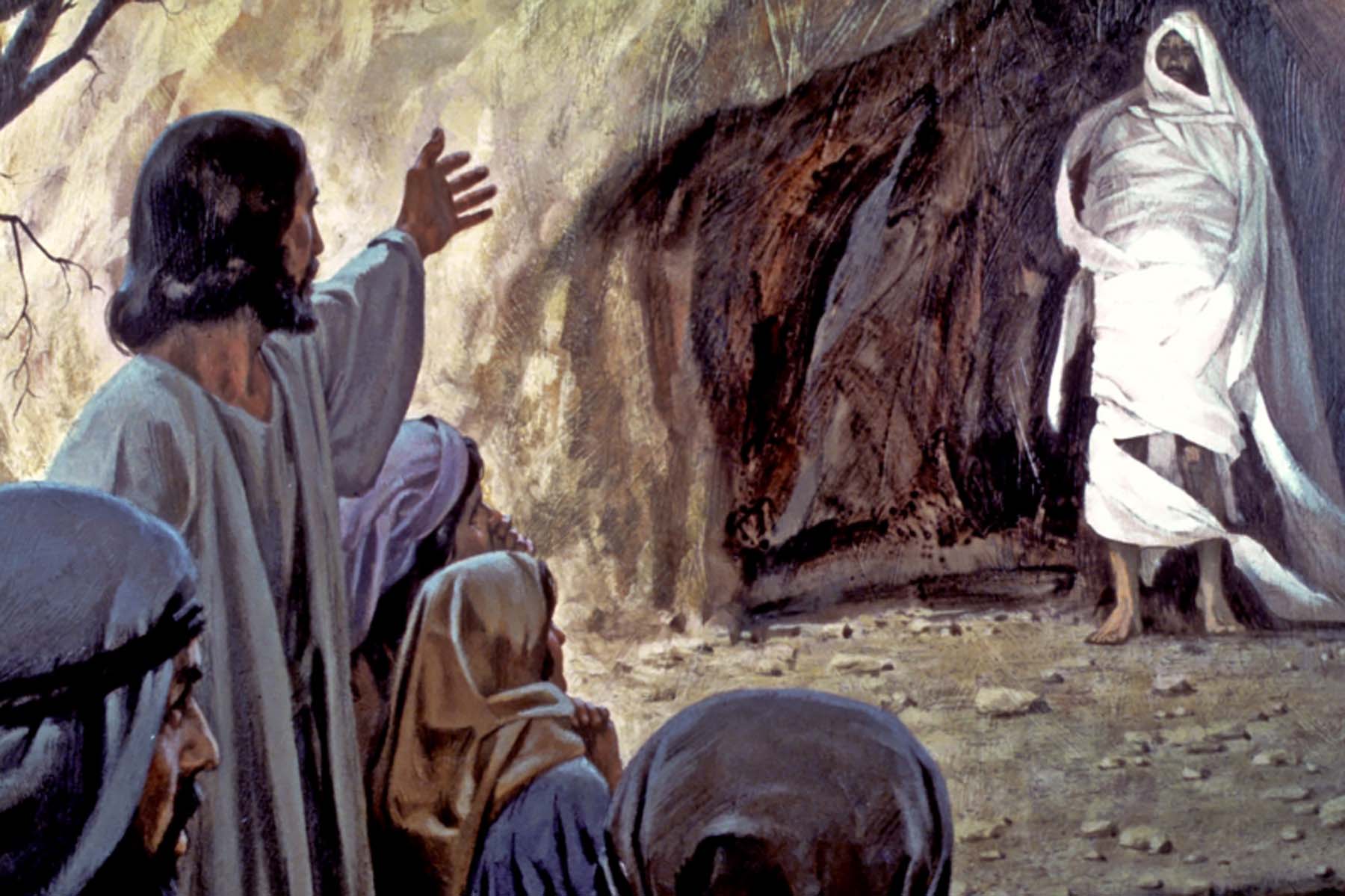
We must have in our minds a picture of the usual Palestinian tomb. It was either a natural cave or hewn out of the rock. There was an entrance in which the bier was first laid. Beyond that was a chamber, usually about six feet long, nine feet wide and ten feet high. There were usually eight shelves cut in the rock, three on each side and two on the wall facing the entrance, and on these shelves the bodies were laid. The bodies were enveloped in linen but the hands and feet were swathed in bandage-like wrappings and the head was wrapped separately. The tomb had no door, but in front of the opening ran a groove in which was set a great stone like a cartwheel that was rolled across the entrance to seal the grave.
Jesus asked that the stone should be moved. Martha could think of only one reason for opening the tomb-that Jesus wished to look on the face of his dead friend for the last time. Martha could see no consolation there. She pointed out that Lazarus had been in the tomb for four days. The point is this. It was Jewish belief that the spirit of the departed hovered around his tomb for four days, seeking an entrance again into his body. But after four days the spirit finally left for the face of the body was so decayed that it could no longer be recognized.
Then Jesus spoke his word of command which even death was powerless to oppose.
“He speaks, and, listening to his voice,
New life the dead receive.”
And Lazarus came forth. It is weird to think of the bandaged figure staggering out from the tomb. Jesus told them to unloose the hampering grave-clothes and wrappings and let him go.
There are certain things to note.
(i) Jesus prayed. The power which flowed through him was not his; it was God’s, “Miracles,” said Godet, “are just so many answered prayers.”
(ii) Jesus sought only the glory of God; he did not do this to glorify himself. When Elijah had his epic contest with the prophets of Baal, he prayed: “Answer me, O Lord, that this people may know that thou art God” (1 Kings 18:37).
Everything Jesus did was due to the power of God and designed for the glory of God. How different men are! So much that we do is attempted in our own power and designed for our own prestige. It may be that there would be more wonders in our life, too, if we ceased to act by ourselves and for ourselves and set God in the central place.
It was an unquestioned miracle that even the most hostile spectator could not deny! “Therefore many of the Jews who had come to visit Mary, and had seen what Jesus did, put their faith in him.”
The resuscitation of Lazarus could not properly be classed as a resurrection, some feel, because he resumed the same status that he had before his illness.
As with previous miracles, the people were divided in their response. “But some of them went to the Pharisees and told them what Jesus had done. {47} Then the chief priests and the Pharisees called a meeting of the Sanhedrin. “What are we accomplishing?” they asked. “Here is this man performing many miraculous signs. {48} If we let him go on like this, everyone will believe in him, and then the Romans will come and take away both our place and our nation.”
It was necessary that the Sanhedrin meet to discuss what to do with Jesus. Caiaphas was a Sadducee, not a Pharisee (Acts 23:6-10), but the two factions could always get together to fight a common enemy. Caiaphas certainly uttered a divine prophesy: Jesus would die for the nation so that the nation would not perish.
“Then one of them, named Caiaphas, who was high priest that year, spoke up, “You know nothing at all! {50} You do not realize that it is better for you that one man die for the people than that the whole nation perish.” {51} He did not say this on his own, but as high priest that year he prophesied that Jesus would die for the Jewish nation, {52} and not only for that nation but also for the scattered children of God, to bring them together and make them one. {53} So from that day on they plotted to take his life.”
The official decision that day was that Jesus must die (see Matt.12:14; Luke 19:47; John 5:18; 7:1, 19-20, 25). The leaders thought that they were in control of the situation, but it was God who was working out His predetermined plan. Originally, they wanted to wait until after the Passover, but God had decreed otherwise.
“Therefore Jesus no longer moved about publicly among the Jews. Instead he withdrew to a region near the desert, to a village called Ephraim, where he stayed with his disciples. {55} When it was almost time for the Jewish Passover, many went up from the country to Jerusalem for their ceremonial cleansing before the Passover.” {56} They kept looking for Jesus, and as they stood in the temple area they asked one another, “What do you think? Isn’t he coming to the Feast at all?” {57} But the chief priests and Pharisees had given orders that if anyone found out where Jesus was, he should report it so that they might arrest him.”
Now the Passover Feast of the Jews was near; and many from the country areas went up to Jerusalem before the Passover Feast to purify themselves. So they were looking for Jesus; and, as they stood in the Temple precincts, they were talking with each other and saying: “What do you think? Surely it is impossible that he should come to the Feast?” Now the chief priests and Pharisees had given orders that if anyone knew where Jesus was, he should lodge information with them, that they might seize him.
Jesus did not unnecessarily court danger. He was willing to lay down his life, but not so foolishly reckless as to throw it away before his work was done. So he retired to a town called Ephraim, which was near Bethel in the mountainous country north of Jerusalem (cp. 2 Chronicles 13:19).
By this time Jerusalem was beginning to fill up with people. Before the Jew could attend any feast he had to be ceremonially clean; and uncleanness could be contracted by touching a vast number of things and people. Many of the Jews, therefore, came up to the city early to make the necessary offerings and go through the necessary washings in order to ensure ceremonial cleanness. The law had it: “Every man is bound to purify himself before the Feast.”
These purifications were carried out in the Temple. They took time, and in the time of waiting the Jews gathered in excited little groups. They knew what was going on. They knew about this mortal contest of wills between Jesus and the authorities; and people are always interested in the man who gallantly faces fearful odds. They wondered if he would appear at the feast; and concluded that he could not possible come. This Galilean carpenter could not take on the whole might of Jewish ecclesiastical and political officialdom.
But they had underrated Jesus. When the time arrived for him to come, nothing on earth would stop him coming. Martin Luther was a man who hurled defiance at cautious souls who sought to hold him back from being too venturesome. He took what seemed to him the right course “despite all cardinals, popes, kings and emperors, together with all devils and hell.” When he was cited to appear at Worms to answer for his attack on the abuses of the Roman Catholic Church, he was well warned of the danger. His answer was: “I would go if there were as many devils in Worms as there are tiles on the housetops.” When told that Duke George would capture him, he answered: “I would go if it rained Duke Georges.” It was not that Luther was not afraid, for often he made his greatest statements when both voice and knees were shaking; but he had a courage which conquered fear. The Christian does not fear the consequences of doing the right thing; he fears rather the consequences of not doing it.
From the concluding verses of the chapter, it seems that by this time, Jesus had been classed as an outlaw. It may be that the authorities had offered a reward for information leading to his apprehension and that it was this that Judas sought and received. In spite of that Jesus came to Jerusalem, and not skulking in the back streets but openly and in such a way as to focus attention upon himself. Whatever else we may say of Jesus, we must bow in admiration before his death-defying courage. For these last days of his life he was the bravest outlaw of all time.
Ephraim was about 15 miles north of Jerusalem. The crowd was gathering for the Passover feast, and the pilgrims were wondering if Jesus would attend the feast even though He was in danger. He was now on the “wanted” list, because the council had made it known that anyone who knew where Jesus was must report it to the officials.
A point we need to make here: the rich man in hades had argued that “if one went to them from the dead, they will repent.” (Luke 16:30). Lazarus came back from the dead,and the officials wanted to kill Him!
And what about today? Jesus, too, has come back from the dead! The stage has been set for the greatest drama in history, during which man would do his worst and God would give His best!
————————————————
I do not know how Jeremiah did it! Almost every time the Old Testament prophet stood up to preach, his congregation got smaller. Because of the time in which he lived, the truth he was called to preach was almost all bad news. Israel had descended too far into wickedness, and God had decided to send them into captivity in Babylon.
Jeremiah’s message to Israel was to “take their medicine” and peacefully accept their judgment. As a result, the people hated him and wished that he were dead!
This study from John 11 can make the teacher today feel a little like Jeremiah. While this passage contains some wonderfully good news, it requires that we first face something we may not want to face.
The painful truth is that we will all die! Life is fatal. However young, strong, and healthy we may be at this moment, someday we will die! It may be today or tomorrow or eighty years from now, but we all will die.
We try in many ways to avoid having to face this terrible truth. We try to convince ourselves that if we exercise enough, eat the right foods, wear our seat belts, drink purified water, and put on sunscreen when we go outside, then we will be protected from death. In the end, nothing can protect us from the fact that the death rate in this world is 100 percent!
You are probably thinking, “I do not want to hear this today! I have had a hard week, and now I am being reminded that I will die!” I would not bring up such a painful, distressing subject if the gospel did not provide the answer to it. Jesus, in the marvelous story in John 11, proclaims to people of all time, “I am the resurrection and the life.” It is wonderful news, but we had to be reminded of the bad news first in order to appreciate it.
Funerals have a way of reminding us that our best efforts cannot protect us from the crushing power of death.
The story of Jesus at Lazarus’ tomb helps us to confront our own fears of death. Because of what Jesus did then and still does today, we do not have to deny the reality of death in order to be happy in this life.
As Christians, we do not run from death; we face it. We do not pretend that it will not happen to us; we proclaim to the world that we have an answer to it. This new attitude is seen in the following two examples from the writings of Paul: (Rom. 8:38-39) “For I am convinced that neither death nor life, neither angels nor demons, neither the present nor the future, nor any powers, {39} neither height nor depth, nor anything else in all creation, will be able to separate us from the love of God that is in Christ Jesus our Lord.”
(1 Cor. 15:54-55) “When the perishable has been clothed with the imperishable, and the mortal with immortality, then the saying that is written will come true: “Death has been swallowed up in victory.” {55} “Where, O death, is your victory? Where, O death, is your sting?””
John Donne, a seventeenth-century poet and preacher, chose for a time to sleep in a coffin in order to discipline his mind and soul about the greatest issues of life and death.
A few years ago a preacher I know had a somewhat similar experience. Unable to find sufficient time for study and prayer because of the constant noise and activity around my office, he mentioned my problem to a good friend who runs a local funeral home. A short time later he told me he had thought of a solution to my dilemma. You can imagine my surprise when he took me to the second floor of the funeral home and showed me where he was having a small study built for me–it was in the back corner of his casket warehouse!
It was one of the most wonderful gifts I have ever been given, and it became the one place in town where I could get away from everything to study, think, and pray. (After all, no one is going to bother a person in a casket warehouse!)
Since that time I have often wondered if perhaps all sermons should be written in a funeral home, the shadow of life’s most difficult reality.
Having to walk past the embalming room and through a room filled with caskets reminded me that my main mission is not to help people lead more pleasant lives; it is to help people find real life. It is not to remove all grief from their hearts; it is to show them the way past grief to the resurrection. It is not just to help them face the pressures and stresses of the world; it is to prepare them to meet their God (Amos 4:12).
SOME CLOSING LESSONS
Faith is like love in that it, too, is always beginning. For example, in the Gospel of John, the disciples had already come to have faith in Jesus by the time we reach chapter 11.
Andrew believed on the day when he left John the Baptist to follow Jesus (1:41), Philip believed on the day when Jesus called him (1:45), and Nathanael believed when Jesus said He had seen him under the fig tree (1:49).
The disciples who attended the wedding feast in Cana believed when they saw that Jesus had turned the water into wine (2:11). We are told that Peter and the other disciples who witnessed the feeding of the five thousand and heard the Bread of Life discourse also believed (6:69). Even after all of these statements of faith, Jesus told His disciples that He was glad for the opportunity to raise Lazarus so that they might believe (11:15)!
Faith is like that–always beginning.
Many of us already believe, at least to some degree. Then, one day, we face something that is so lifechanging that we never look at faith in the same way again. This encounter may be a blessing or a trial, the birth of a child or a fifty-foot fall. Suddenly, we see everything differently, and it seems that faith is beginning all over!
Today the Gospel of John calls us to believe (20:31). Many of us hear that call and think, “I already believe.” However, if we will listen and seek and follow, we may find that faith is only beginning in us!
FAITH IS FULL OF PROMISE
When Martha met Jesus outside of Bethany, her brother had been in the tomb for four days. She lamented that if Jesus had only been there, her brother would not have died.
In response to her grief, Jesus said, “I am the resurrection and the life; he who believes in Me shall live even if he dies, and everyone who lives and believes in Me shall never die. Do you believe this?” (11:25, 26).
Jesus’ words provide a powerful motivation to believe. Faith is hard work, and a lazy person will simply not put forth the effort. We do not believe just because we want to believe, but we will never believe if we do not want to believe. Faith involves dedication, obedience, sacrifice, and, oftentimes, tears. However, a rich promise is made to all who will believe.
In this respect, faith is like hard work in college; the student does it because of the promised payoff of getting a good job. Working hard at one’s career is rewarded with a good paycheck or promotion. Make no mistake about this: Faith does not earn a reward, but God’s promises are what motivate us to continue down the long, difficult, sometimes trying road to faith.
FAITH IS FOCUSED ON JESUS
John’s faith moves us toward faith in Jesus. What we need is not faith in parents, faith in the apostles, faith in other Christians, faith in the church, or even faith in faith. Rather, we need faith in Jesus.
In Martha’s powerful statement of faith, she told Jesus, “… I have believed that You are the Christ, the Son of God, even He who comes into the world” (11:27; emphasis mine). When Jesus, His disciples, Martha, Mary, and the crowd of mourners were later gathered outside Lazarus’ tomb, Jesus prayed to the Father, saying, “And I knew that Thou hearest Me always; but because of the people standing around I said it, that they may believe that Thou didst send Me” (11:42).
This is consistent with the rest of the Gospel of John, where the purpose is to produce faith “that Jesus is the Christ, the Son of God” (20:31).
John Paton was a missionary to Africa who taught and baptized a large number of people. Because the Bible was not available in the language of the people he was teaching, Paton began the long and difficult work of Bible translating.
The task went fairly smoothly until he began trying to translate the word “believe.” As strange as it may seem, there was no word in this language for “believe.” How could one possibly translate the Bible without a word for “believe”?
Then, one day as Paton was struggling with this linguistic problem, a Christian man from the village came to visit him. This man had been working hard all day and was exhausted.
When he sat down in a chair he gave a weary sigh of relief and said, “It is so good to lean your whole weight on something.” Paton realized that he had found an expression for “believe”: To believe is to “put your whole weight on Jesus.”‘ Faith is focused on Jesus and nothing less.
FAITH IS DIVISIVE
As the people stood outside Lazarus’ tomb and saw him walk out alive, they were presented with an unavoidable fork in the road. They had seen Lazarus dead, had prepared him for burial, had placed him in a tomb, and had placed a stone over the mouth of the cave.
They were eyewitnesses to these events. Then, because of Jesus’ miracle, these same people had become witnesses of Lazarus’ rising! Would they believe? They could not avoid making a decision.
John recorded the division that took place among the observers of the miracle that day:
“Many therefore of the Jews, who had come to Mary and beheld what He had done,
believed in Him. But some of them went away to the Pharisees, and told them
the things which Jesus had done” (11:45, 46).
Amazingly, these people all witnessed the same events but reacted in opposite ways. Some saw that they were in the presence of the power of God, so they placed their faith in Jesus that day. Others only “saw” a juicy piece of gossip and scurried off to Jerusalem to tell the Jewish leaders about the stir created by Jesus.
The division among the people that day is no insignificant part of the story. On the contrary, division is the very nature of the story of Jesus: When people hear about Jesus, they are forced to make a decision, one way or the other, about His true identity. There is no neutral ground.
Jesus and the apostle John both push us relentlessly toward a decision. Is Jesus the Son of God, or was He a fraud? Either He is divine, or He was a blasphemer deserving death. What is your decision?
FAITH IS THREATENING
Some of those who had witnessed Lazarus’ resurrection went to the chief priests and the Pharisees in Jerusalem to tell them what the teacher from Nazareth had done.
As they made their report, they complained, “If we let Him go on like this, all men will believe in Him, and the Romans will come and take away both our place and our nation” (11:48).
They realized that faith in Jesus would change lives, change families, and even change a nation. They realized–perhaps better than most Christians today–· just how “dangerous” faith is.
An old song says about love that “it will lift you up, never let you down, take your world and turn it all around. The same should be said about faith in Jesus.
The tendency today is to expect too little in regard to faith. Many Christians have made faith too easy, too soft, too undemanding.
Wilbur Pees expressed this tendency in the following sarcastic paragraph: I would like to buy $3 worth of God, please, not enough to explode my soul or disturb my sleep, but just enough to equal a cup of warm milk or a snooze in the sunshine. I don’t want enough of Him to make me love a black man or pick beets with a migrant. I want ecstasy, not transformation; I want the warmth of the womb, not a new birth. I want a pound of the Eternal in a paper sack. I would like to buy $3 worth of God, please”
The faith to which Jesus invites us may well change our entire lives. John wanted to make sure that we understand the possible costs involved in following Jesus. We may suffer, we may be persecuted, and we may lose everything we own. Compared with the rich promises of faith, the costs seem strangely insignificant!
JOHN 11 in review
In this chapter is the seventh of the miracles John recorded. Here we see salvation pictured as resurrection from the dead, the giving of life to the dead. Use your concordance and see how much John has to say about life; he uses the word thirty-six times. Lazarus represents the salvation of the lost sinner in seven ways. Let’s take a closer look at each of these.
- He Was Dead (11:14)
The unsaved person is not just sick; he or she is spiritually dead (Eph. 2:1-3; Col. 2:13). When a person is physically dead, she does not respond to such things as food, temperature, or pain. When a person is spiritually dead, he does not respond to spiritual things. She has no interest in God, the Bible, Christians, or church until the Holy Spirit begins to work in her heart.
God warned Adam that disobedience would bring death (Gen. 2:15-17)—physical death (the separation of the soul from the body) and spiritual death (the separation of the soul from God). Revelation 20:14 calls hell the second death, that is eternal death. What sinners dead to God’s ways need is not education, medicine, morality, or religion; they need new life in Jesus Christ.
- He Was Decayed (11:39)
There are three resurrections recorded in the Gospels, apart from that of our Lord Himself. Christ raised a twelve-year-old girl who had died (Luke 8:49-56), a young man who had been dead several hours (Luke 7:11-17), and an older man who had been in the tomb four days (John 11). The point is that all three were dead. One person cannot be “more dead” than another. The only difference lay in the degree of decay. Is this not true of sinners today? The moral church member is not “decayed” like the person on skid row, but he is still dead.
III. He Was Raised and Given Life (11:41-44)
The sisters’ Jewish friends could only sympathize and weep; it took Christ to give the man life. How did Christ give him life? By the power of His word. This is the way He raised all three dead people mentioned above (see John 5:24 and Eph. 2:1-10).
Why did Christ raise Lazarus? Because He loved him (v. 5 and v. 36) and because it brought glory to God (v. 4). This is why He has saved us. We deserve to die and go to hell, but because of His great love, He rescued us. (Read again Eph. 1:3-14 and 2:1-10.)
Keep in mind that salvation is not a set of rules; it is life (John 3:14-21, 36; 5:24; 10:10; 1 John 5:10-13). This life is a Person—Jesus Christ. When dead sinners hear the voice of the Son of God (the Word) and believe, they are given eternal life (John 5:25). To reject that Word is to be dead forever.
- He Was Loosed (11:44)
Lazarus was bound hand and foot and so could not free himself. The believer is not to be bound by the graveclothes of the old life, but should walk in the freedom of the new life. Read carefully Col. 3:1-17 to learn how the Christian is to “put off” the graveclothes and “put on” the “grace clothes” of the new life. It is a poor testimony for a Christian to carry with him the things of the old life.
- He Witnessed to Others (11:45)
In John 11:45 and 12:9-11 and 17, we see that Lazarus caused quite a stir in the area! People saw him and believed in Christ! In fact, he was a walking miracle, just as every Christian ought to be (Rom. 6:4). The great crowd that gathered on Palm Sunday came not only because of Jesus, but also because of Lazarus. In 12:11 we are told that Lazarus was causing people to trust Christ, but this kind of witness is the privilege and duty of every Christian.
- He Fellowshipped with Christ (12:1-2)
In looking ahead to 12:1-2 we see Lazarus sitting at the table with Christ, feasting with Him. This is the rightful place for the Christian who has been “raised…and made…to sit together in heavenly places in Christ Jesus” (Eph. 2:5-6). By spending time with Christ, Lazarus was showing his gratitude for Christ’s mercy and love. He learned lessons from His Word and received new power to walk with Christ and to witness. The miracle of salvation gives us eternal life, but we must fellowship with Christ daily to be able to grow in the spiritual life.
It is interesting to note that the entire family at Bethany demonstrates what the Christian life is like. Mary is always found at Jesus’ feet, listening to His Word (Luke 10:38-42; John 11:32; 12:3). Martha is a picture of service; she is found busily doing something for Christ. Lazarus speaks of testimony, a daily walk that leads others to Christ. These three practices must be in our Christian experience: worship (Mary), work (Martha), and walk (Lazarus).
VII. He Was Persecuted (12:10-11)
The Jews hated Lazarus because he convinced others of Christ’s deity (12:10-11). Many of the chief priests were Sadducees who did not believe in the resurrection, and Lazarus was living proof that the Sadducees were wrong. Had the priests not been overruled by God, they would have put an extra cross on Calvary for Lazarus. (“Yes, and all that desire to live godly in Christ Jesus will suffer persecution”—2 Tim. 3:12 [NKJV].) Satan always fights a living miracle that testifies on God’s behalf.


 Proud to be TJ's man