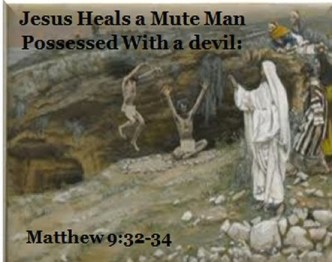
9:32 While they were going out, a man who was demon-possessed and could not talk was brought to Jesus. Jesus could hardly come or go without someone in need coming to him! This time, as Jesus and his disciples were leaving, a man who was demon-possessed and could not talk was brought to Jesus. The word translated “could not talk” is kophos, which can mean deaf, unable to talk, or both. Such disabilities are not always the work of demons, because Jesus healed many people of illness and disability without casting out demons. Matthew wanted his readers to understand, however, that in this situation a demon was at work. While Jesus was on earth, demonic forces seemed especially active. Although we cannot always be sure why or how demon possession occurs, it causes both physical and mental problems. In this case, the demon made the man unable to talk. (For more on demons and demon possession, see commentary on 8:28–34.)
9:33–34 And when the demon had been cast out, the one who had been mute spoke; and the crowds were amazed and said, “Never has anything like this been seen in Israel.” N Matthew avoided detail about the exorcism of the demon (he had already established Jesus’ authority over demonic powers, see 8:16, 28–34) and focused instead on the reaction of the crowd. After Jesus cast out the demon, the mute man was able to speak.
Once again, the ever-present crowds were amazed. They had never seen anything like this. The teachings Matthew recorded in chapters 5–7 established Jesus’ authority; the miracles grouped in chapters 8 and 9 revealed Jesus’ power and divinity. The crowds saw God’s power at work in Jesus and began to realize that he was one of the greatest prophets.
The religious leaders, however, saw something entirely different: But the Pharisees said, “It is by the prince of demons that he drives out demons.” In these words of the Pharisees, Matthew was showing the full extent of their rejection of Jesus. This chapter has the Pharisees accusing Jesus of four different sins: blasphemy, befriending outcasts, impiety, and serving Satan, the prince of demons. In Scripture Satan is constantly portrayed as the imitator of God, so the Pharisees may have been referring to this belief. They tried to explain Jesus away by saying that he was only imitating God but was really in league with Satan—and that’s why the demons obeyed him.
Matthew showed how Jesus was maligned by those who should have received him most gladly. Why did the Pharisees do this?
(1) Jesus bypassed their religious authority.
(2) He weakened their control over the people.
(3) He challenged their cherished beliefs.
(4) He exposed their insincere motives. While the Pharisees questioned, debated, and dissected Jesus, people were being healed and lives changed right in front of them. Their skepticism was based on jealousy of Jesus’ popularity. The opposition to Jesus was intensifying; Jesus was far too powerful and popular for the Pharisees’ comfort.[1]
[1] Bruce B. Barton, Matthew, Life Application Bible Commentary (Wheaton, IL: Tyndale House Publishers, 1996), 193–194.


 Proud to be TJ's man