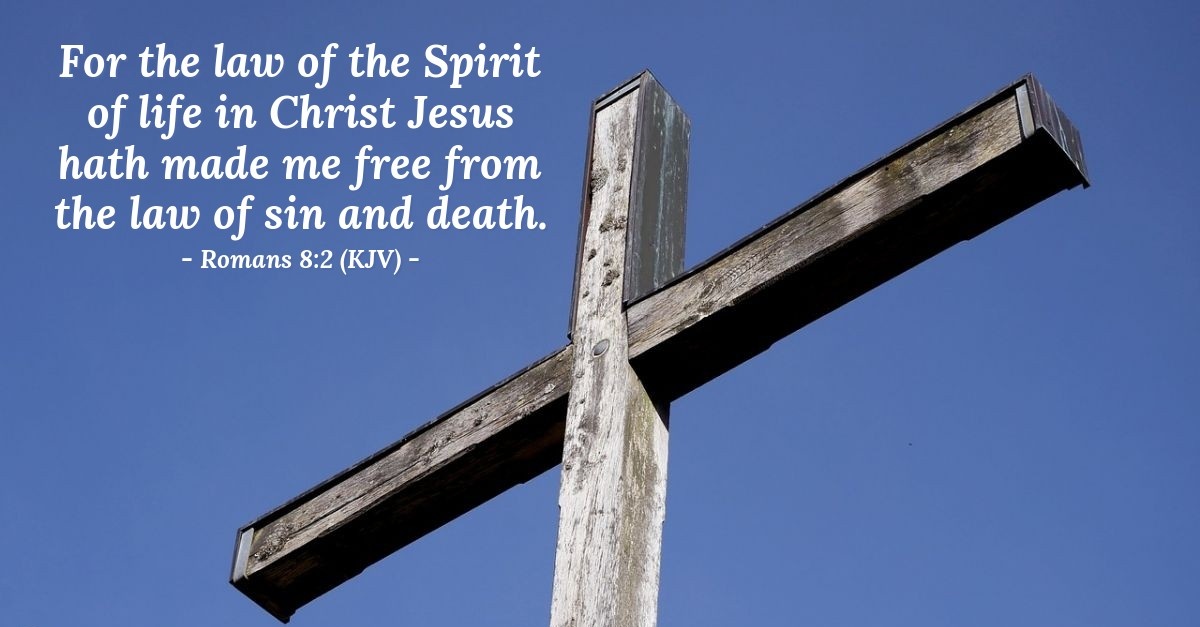
For the law of the Spirit of life in Christ Jesus has set you free from the law of sin and of death. (8:2)
Because of the way Paul spoke these words, we often miss some of the subtle points he is making. He gives us what I call “a word salad,” a lot of things mixed together that needs to be “chewed.”
Verse 2 says that we have been “set free” from something, and it’s important for us to understand it.
People spend a big part of their lives trying to qualify.
- On the job, an employee hopes that his performance qualifies him for a raise or promotion.
- In a dating relationship, the boy and the girl will each try hard to impress the other to “qualify” as someone special in that one’s eyes.
- A major hurdle in a university doctoral program is cleared when the student passes the qualifying exams.
On the other hand, in certain situations trying to “qualify” is inappropriate.
- Take, for instance, a child’s relationship with his or her parents. A child should feel unconditional love and acceptance from his parents. The child should not have to feel as though he must “qualify” for his parents’ love by his achievements. He should be able to receive their love simply by being their child.
- The problem comes, however, when parents set unrealistically high standards and expectations for their child. They expect the child to behave perfectly, to achieve above all others both in the classroom and in athletics, and to use adult reasoning in every situation. (We sometimes try to live out our dreams [or correct our failures] through our children?)
- In that kind of situation, the child never feels as though he “qualifies” for the parents’ love and acceptance. At some point, the child may simply quit trying to win his parents‘ approval and just give up. If he is trying his hardest and never gets anywhere, why try at all?
Which way is it with God? Do we have to qualify with Him, or is striving to earn His acceptance inappropriate?
Many believe that we have to “qualify” in order to please God and have a relationship with Him. The idea is that, to be a Christian, you either have to be a “good person” (usually defined as “a nearly perfect person”) or you have to do all the “right things.”
The other side of the coin is that, if you fail to qualify, you cannot please God.
An author wrote of a recollection from childhood of hearing a lesson based on the story of Moses’ disobedience when he struck a rock to make water come out of it instead of speaking to the rock as God had commanded. Because of his disobedience, Moses was not allowed to enter the promised land (Numbers 20:2-12).
The application of this story was made in this way: “Moses was a good man, but he made one mistake and did not enter the promised land. So, you had better not make one mistake because you see what will happen to you if you do!”
The use of that story fails to take into account that God still accepted Moses as His servant, that Moses apparently died in the grace of God (Deuteronomy 34:5, 6), that Satan had to argue with God’s angel about Moses’ body (Jude 9), and that Moses appeared with Jesus with God’s endorsement at the Transfiguration (Mark 9:4).
God meted out that particular discipline to Moses for that particular act, but that does not say anything about God’s punishment for “one mistake” that you or I might make.
“If I’ve messed up once,” you might think, “I’m no better off than the prostitute or the drunk! So why try? I’ll never qualify with God anyway.” I wonder how many who have dropped out of the church have done so for this very reason.
Something is not right with this perspective. Something is wrong with the notion that we must go through life unsure about whether we are Christians and whether we will go to heaven when we die. One attempted fix is the hope that you pray for forgiveness right before you die, you will be all right. No, something is not right with this approach to God.
Jesus has good news for us. He frees us from the hopeless treadmill of earning salvation (which is impossible anyway) and saves us on the basis of faith (or trust) in His grace.
Jesus saves us not on the basis of our goodness, but on the basis of His goodness, as God’s perfect Son who gave Himself as the sacrifice for our sins. That is good news. That means that we can be saved and know it. That means we can have hope.
“Your Works Have Saved You”? When Jesus was on earth, dealing with people face to face and showing mankind what God is like, how many times did He tell someone, “You have earned salvation”? Never!
He told the woman with the long-term hemorrhage (Mark 5:34), and He also told the sinful woman who anointed His feet (Luke 7:50) that their faith had saved them (or “made them whole”).
The paralytic on the mat (Mark 2:5) and the thief on the cross (Luke 23:43) performed no act that merited forgiveness, but they each received forgiveness from Jesus.
All of these incidents are pictures of faith, illustrations of what it means to come to Jesus in simple trust of who He is, regardless of the merit of one’s actions.
Jesus has plenty to say about works. The judgment scene portrayed in Matthew 25:31-46 shows that one’s eternal destiny is determined by what one does.
In Matthew 12:37, Jesus said, “By your words you shall be justified, and by your words you shall be condemned.”
What a person does, even in terms of his speech, has direct impact on his eternal status before God.
But the main theme of Jesus’ teaching is that a person’s heart has to be right (Mark 7:20-23). From that correct center the correct actions will come. Correct actions that do not flow from a heart of trust mean nothing.
Jesus shocked the religious leaders of His day by eating with tax-gatherers and with people whom the religious leaders termed “sinners” (Luke 5:30-32). “Why do you eat and drink with the tax-gatherers and sinners?”
They asked Jesus’ disciples. Jesus told them, “Because they need Me.”
He did not just associate with people who “qualified,” that is, people who justified themselves in their own eyes.
He did not operate from the perspective that there are good people and there are bad people and that is the way it is.
He came to call “bad” people to a new life, a life in which “goodness” would be given to them by God on the basis of their faith in Christ.
The very reason Jesus associated with “sinners” was that they did not “qualify” on the basis of their works, and they knew it. Jesus wanted to bring about a deeper goodness within the person, on the basis of faith in Him.
Is There Salvation Apart From Works of Law?
What is this “faith” or “trust” on which salvation depends? Paul, who did more “works” for the Lord than perhaps anyone else but who also called himself the foremost sinner (1 Timothy 1:15), provides an insight into this basis of our salvation in Romans 3.
In Romans 3:19-28, there appear to be two similar but distinct ideas about “law” at work. Paul makes reference to (1) “the Law,” meaning the law of Moses, and also to (2) “law” (no “the”), referring to the general idea of works and law-keeping.
Paul says in Romans 3:9 that “both Jews and Greeks [i. e., all people] are all under sin.”
The law (of Moses) speaks to this, he says, and he quotes several Old Testament passages to prove his point. Then in verse 20 he says, “By the works of the Law [the general principle of doing works of merit] no flesh will be justified in [God’s] sight; for through the Law [general principle] comes the knowledge of sin.
But now,” he goes on to say in verses 21 and 22, “apart from the Law [that general principle of works] the righteousness of God has been manifested, being witnessed by the Law [of Moses] and the Prophets, even the righteousness of God through faith in Jesus Christ for all those who believe.” (Emphasis mine.)
In verse 28 he concludes, “We maintain that a man is justified by faith apart from works of the Law [works of merit to gain favor],” since “by the works of the Law no flesh will be justified” (v. 20).
Paul is saying this: Law-keeping, the good works that we might do, will not save us. Works religion does not earn salvation. You will never qualify for salvation by trying to earn it through your own works.
Something else, something different, is needed. That “something else” was provided by God, who offers salvation on the basis of faith or trust in Christ. Salvation by faith is not the same kind of approach to God that trying to be saved by “law” is. It is “witnessed to” by the Old Testament law, but it is a different, and superior, approach to God. This faith is an absolute dependence on Jesus’ death on the cross as your salvation. You do not “earn” or merit anything. You trust that Jesus has accomplished salvation for you by His merit.
This contrast between the works we do and the faith by which we approach God is vividly portrayed in Paul’s description of himself in Romans 7. He says, “The good that I wish, I do not do; but I practice the very evil that I do not wish” (v. 19). He wants to do right, but sin in him does wrong. “Wretched man that I am!” he cries (v. 24). “Who will set me free from the body of this death?”
The answer? “Thanks be to God through Jesus Christ our Lord!” (v. 25). Paul’s works did not stack up high enough to reach salvation, and they never would. He knew he could not earn God’s acceptance by his actions because his actions were so often wrong.
Rather than living a life of always trying to “qualify” and always failing, Paul says, “There is therefore now no condemnation for those who are in Christ Jesus. For the law of the Spirit of life in Christ Jesus has set you free from the law of sin and of death” (Romans 8:1, 2).
The “law of sin and of death” says that if you sin, you die. However, the “law of the Spirit of life in Christ Jesus” says that if you are in Christ, you will live because of the presence of faith in your life.
“But I’m Not Good Enough To Be A Christian”
How many times have you heard the statement “But I’m not good enough to be a Christian”? Have you said it yourself? An idea many hold is that a person has to be good enough to become a Christian.
This person believes that only when he quits a particular sin or brings his general level of morality to a higher plane will he be able to approach God and qualify to be a Christian. This idea may reflect the works/salvation misunderstanding we have been talking about.
Actually, however, that standard line may be little more than a cop-out, unconscious though it may be. The problem is not that you are not good enough to be a Christian.
The problem is that you do not admit that you are bad enough to need to become a Christian. The statement is not always made out of a heart seeking to change and to come closer to God. The statement sometimes is made as an excuse for why that person is making no movement or change at all.
He says, “I’m not good enough to be a Christian—but I’m doing pretty well, and a lot better than some who call themselves Christians,” or “I’m not good enough to become a Christian. There’s nothing I can do about it because God has set too high a standard for me to meet.”
This person plods through life in this sort-of good, sort-of bad never-never land, never making a commitment to anyone beyond himself and never looking for God’s real definition of “qualifying.
”What would Jesus say to the person who laments, “I’m not good enough. . . .”?
- He would say, “You’re the very person I came for!
- If you will admit your sinfulness, I can work in your life.
- I didn’t come for people who think they are good enough. There’s not much I can do for them.”
- No one is “good enough” to be a Christian.
The question is, What are you going to do about it?


 Proud to be TJ's man