31 What, then, shall we say in response to this? If God is for us, who can be against us?
For a long time in our Christian experience we somehow had the idea that God was against us:
- That He was just waiting for me to make a mistake so that He could teach me a lesson by bringing judgment upon me.
- Every bad thing that happened to me I blamed on God. I figured that He was punishing me for something.
- I thought that somehow I had to earn God’s favor or approval.
- Somehow I had to persuade Him to love me, I thought that His love was something that I had to deserve.
- Basically I thought that God loved good boys/girls and hated bad boys/girls.
- That song about Santa Claus making out a list and checking it twice, “going to find out who’s naughty and nice” was sort of describing God.
- I did not comprehend the extent of God’s love for me.
- Should Satan ever hassle you concerning God’s love for you just look at the cross.
- For God commended His love towards us in that while we were yet sinners, Christ died for the ungodly.
John 3: 16 “For God so loved the world, that He gave His only begotten Son, that whoever believes in Him shall not perish, but have eternal life.
17 “For God did not send the Son into the world to judge the world, but that the world might be saved through Him.
- “He who believes in Him is not judged; he who does not believe has been judged already, because he has not believed in the name of the only begotten Son of God.
In broad terms, Paul may be encouraging specific reflection on the evidences we have that God is for us. One way of doing this is to replace these things with some of the phrases Paul has used earlier in this chapter. For example, what then shall we say in response to the fact that “there is now no condemnation for those who are in Christ Jesus” (8:1 )?
Or, what then shall we say in response to the fact that “the Spirit helps us in our weakness” (8:26)? What then shall we say in response to the fact that “in all things God works for the good of those who love him” (8:28)?
The other option for considering what to say in response is the choice Paul makes. He asks rhetorical questions, the answers to which require application of the pattern God has already established for our day-to-day experiences.
So, for instance, since God has shown that he is for us, who of any real significance can be against us?
Or, since God “did not spare his own Son … how will he not also, along with him, graciously give us all things?” (8:32).
Paul wants to let believers know, in no uncertain terms, that their salvation is sure and secure. When we fully realize that God has called, justified, and glorified us, we can do nothing but fall before him in humble gratitude.
If God is for us, who can be against us? Satan and those under his power are against us, but in the end, God promises the victory. No one will oppose God and his followers forever; their dreadful end is also sure.
32 He who did not spare his own Son, but gave him up for us all–how will he not also, along with him, graciously give us all things?
8:32 He who did not spare his own Son, but gave him up for us all. How much is God “for” us? So much that he gave us his only Son to die for us. (The Greek word behind “for” is huper, a benefactive pronoun meaning “on behalf of.”) Only through Christ’s death are we been made acceptable to God. The word for spare is the same word for “withheld,” used in Genesis 22:12, when God said to Abraham, “You have not withheld from me your son, your only son”
Our major struggle with prayer is not that God doesn’t answer. What upsets us is that he seldom answers in line with our plans or schedule. At those times we may think that God is intentionally withholding something from us. But God has already given us the greatest gift of all. Remembering God’s gift will help us see that God is working for our good even when we can’t immediately see it. So when we are most tempted to doubt God’s love for us, we ought to express our love to him. This allows us to apply the lesson of verse 28, trusting that God is working in all things for our good.
How will he not also, along with him, graciously give us all things? God sacrificed his Son to save us; will he now invalidate that sacrifice by refusing to help and guide believers? No, instead, he promises to give us all things to bring us to the ultimate goal—our sanctification and glorification. These things come under the guideline as the things in verse 28; they are experiences God will give us as he “works for the good” that he has planned for us (see also Matthew 6:33). When the Bible promises that God will answer our prayers, it does not oblige God to give us anything we ask of him. Rather, these promises are reminders that we are presenting requests to someone who is infinitely free and powerful to act. The fact that his grace motivates his giving ensures that his gifts are best for us.
33 Who will bring any charge against those whom God has chosen? It is God who justifies.
8:33 Who will bring any charge against those whom God has chosen? Paul’s next question is, Who can press charges or accuse us? At first we might think of Satan because he is our accuser (Revelation 20:10).
Who then is bringing charges against you? Satan.
REV 12:10 And I heard a loud voice saying in heaven, Now is come salvation, and strength, and the kingdom of our God, and the power of his Christ: for the accuser of our brethren is cast down, which accused them before our God day and night.
Many times our enemies lay charges against us, and sometimes even our friends. God is not laying any charges against you.
Satan is always condemning us. Every time you stumble or fall, he is there to condemn you, he tries to discourage you from trying to follow Jesus or come to God.
- He is constantly trying to focus you on your weakness rather than on God’s strength.
- He seeks to persuade you that you must earn God’s favor.
- He is constantly telling you that you do not deserve to be saved.
- The problem is that he can often build a strong case against us.
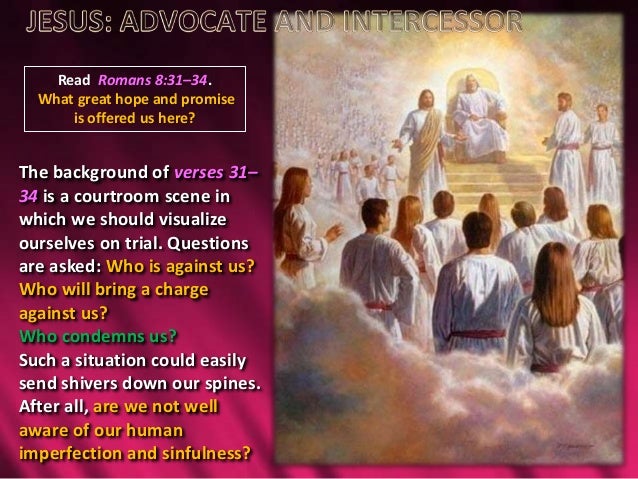
8:34 Who is he that condemns? Christ Jesus, who died–more than that, who was raised to life–is at the right hand of God and is also interceding for us.
Like the last question, this one focuses on charges, but in Greek it carries a future tense: Who will condemn? Jesus Christ has been appointed by God to judge the world (John 5:22, 27; Acts 17:31), but Christ Jesus, who died … is at the right hand of God, who indeed intercedes for us. This is a divine court. God has already declared us “not guilty.” Any further charges of guilt are thrown out of court. Jesus would not condemn those for whom he died. Because he was raised to life, Christ Jesus is at God’s right hand interceding for us in heaven (see also Psalm 110:1; Mark 12:35–37; Hebrews 4:14–16). The Spirit intercedes for us (8:27) and Christ intercedes for us. How much more advocacy do we need?
This is the greatest truth in all the world. God did not have to act for man, but He did. Therefore, believers can rest assured that nothing, absolutely nothing shall ever separate them from the plan and purpose of God.
- The Father is for us and proved it by giving His Son (Rom. 8:32).
- The Son is for us (Rom. 8:34)
- And so is the Spirit (Rom. 8:26).
- In His person and His providence, God is for us.
The believer needs to enter into each new day realizing that God is for him.
“There is no need to fear, for his loving Father desires only the best for His children, even if they must go through trials to receive His best. ”
The argument here is from the lesser to the greater.
- If when we were sinners, God gave us His best, now that we are God’s children, will He not give us all that we need?
- Jesus used this same argument when He tried to convince people that it was foolish to worry and fear. God cares for the birds and sheep, and even for the lilies; surely He will care for you!
Matt. 6:30 “But if God so clothes the grass of the field, which is alive today and tomorrow is thrown into the furnace, will He not much more clothe you? You of little faith!
31 “Do not worry then, saying, ‘What will we eat?’ or ‘What will we drink?’ or ‘What will we wear for clothing?’
32 “For the Gentiles eagerly seek all these things; for your heavenly Father knows that you need all these things.
33 “But seek first His kingdom and His righteousness, and all these things will be added to you.
Understanding the meaning of justification brings peace to our hearts. When God declares the believing sinner righteous in Christ, that declaration never changes.
Our Christian experience changes from day to day, but justification never changes. We may accuse ourselves, and men may accuse us; but God will never take us to court and accuse us. Jesus has already paid the penalty and we are secure in Him.
A dual intercession keeps the believer secure in Christ: the Spirit intercedes (Rom. 8:26-27) and the Son of God intercedes (Rom. 8:34).
The same Savior who died for us is now interceding for us in heaven.
As our High Priest, He can give us the grace we need to overcome temptation and defeat the enemy: (Hebrews 4:14-16) “Therefore, since we have a great high priest who has passed through the heavens, Jesus the Son of God, let us hold fast our confession. {15} For we do not have a high priest who cannot sympathize with our weaknesses, but One who has been tempted in all things as we are, yet without sin. {16} Therefore let us draw near with confidence to the throne of grace, so that we may receive mercy and find grace to help in time of need.”
As our Advocate, He can forgive our sins and restore our fellowship with God: (1 John 1:9-10) “If we confess our sins, he is faithful and just and will forgive us our sins and purify us from all unrighteousness. {10} If we claim we have not sinned, we make him out to be a liar and his word has no place in our lives.”
(1 John 2:1-2) “My dear children, I write this to you so that you will not sin. But if anybody does sin, we have one who speaks to the Father in our defense–Jesus Christ, the Righteous One. {2} He is the atoning sacrifice for our sins, and not only for ours but also for the sins of the whole world.”
Christ does four wonderful things for us.
- Christ has died for us.
Christ is our glorious Savior. When we honestly come to Him, He does not condemn us for our sin and shame; He forgives us. He is able to forgive us because He died for us. Christ has already paid the penalty for sin.
- Christ has risen from the dead for us.
Christ is our risen Lord. His resurrection does two marvelous things for the believer.
The resurrection of the Lord proves that God was perfectly satisfied with the death of Jesus Christ. What Christ did—His dying for our sins—was acceptable to God; therefore, God has accepted Jesus’ death for us. God has approved His dying for us.
The resurrection of the Lord gives the believer a new life, making the believer a new creature and a new man.
Christ has been exalted for us.
He is our exalted Lord. He sits face to face with God at His right hand. This gives two assurances to the believer.
The believer shall also be exalted into the presence of God. Just as Christ lives face to face with God, the believer shall also live face to face with God throughout all eternity.
The Lord Jesus Christ is exalted as the Sovereign and majestic Lord of the universe. He is the Ruler who reigns and rules over all, who possesses all might and power and is full of all wisdom and truth. He is the One who is going to destroy and utterly eliminate sin and evil in the world. He is the One who is going to establish a kingdom of righteousness and justice, love and truth in the new heavens and earth.
Christ makes intercession for us before the throne of God.
He is our great Intercessor, our Mediator and Advocate who stands between God and man. It is Christ Jesus who brings us to God and who makes redemption, even the forgiveness of our sins, possible.
1 Peter 3: 9 “The Lord is not slow about His promise, as some count slowness, but is patient toward you, not wishing for any to perish but for all to come to repentance.


 Proud to be TJ's man