 We Americans do not handle delays very well. Our culture simply does not like to wait. Yet we wait less today than men have ever waited.
We travel at high speed waiting less to arrive at a distant place. Communications which formerly took months now are completed in seconds. Meals which used to take hours to cook are now done in minutes in microwave ovens.
People used to have to wait until they had cash to purchase a new car or home. Now these things are bought on credit. We do not have to wait. Fewer and fewer people are willing to wait until marriage to enjoy the pleasures of sex. We Americans are not accustomed to waiting.
Men do not enjoy waiting for anything, or anyone, including God. But the trust is men have been waiting on God all through history.
Noah waited a good 100 years or so for the flood to come upon the earth (compare Genesis 5:32; 6:10; 7:6).
Abraham and Sarah waited 25 years for the birth of the son God had promised them (compare Genesis 12:4; 21:5).
Abraham did not even possess the promised land in his lifetime, and it was more than 400 years until his descendants took possession of it (compare Genesis 12:1-3; 15:12-16).
From their constant questions about the coming of our Lord’s kingdom, it was evident the disciples were not excited about waiting either.
When Jesus tarried three days before going to the place Lazarus had fallen sick and died, both Martha and Mary cautiously chided Jesus for coming too late (see John 11:21, 32).
God’s promises never come too late; in truth, they are never “late” at all. When the Scriptures indicate a time for God’s actions, the fulfillment is always precisely on time (see Exodus 12:40-41).
When Jeremiah prophesied that Judah would be expelled from the land and held captive in Babylon for 70 years (Jeremiah 25:11-12), the fulfillment of this prophecy would take place precisely at the end of 70 years. Knowing this, Daniel prayed accordingly (Daniel 9:1-3ff.).
Likewise, the birth of the Lord Jesus came about exactly on schedule (Galatians 4:4-5).
God is never “late;” He is always “on time.”
But there are mockers who seek to convince themselves and others that the promise of our Lord’s second coming is false based upon the passage of much time and compounded by no visible evidences that He will come at all.
A woman who worked for the Internal Revenue Service at times had to communicate with delinquent taxpayers. On one occasion she called Anchorage and was patched through to a ham operator in the Aleutian Islands. Two hours later the ham operator raised the taxpayer’s home base and from there reached him at sea with his fishing fleet.
After the woman identified herself as being with the IRS in Utah, there was a long pause. Then over the static from somewhere in the North Pacific came: “Ha! Ha! Come and get me!” (In Reader’s Digest, “Life in These United States,” 10/82)
A lot of people scoff at God and the warning of His coming judgment like that fisherman scoffed at the IRS. They somehow think that either it will never happen because it hasn’t happened yet or that if it ever does happen, they’ll be okay.
And while few are so bold as openly to scoff at God and the judgment, many do so practically by living as if they will never stand before Him to give an account. The idea of facing Him in judgment is so far from their minds that it never affects how they live.
Mockers believe they have given God plenty of time to fulfill His promise to return and thus have now concluded that His time is up. “If He hasn’t come by now,” they say, “He simply isn’t coming.”
Another prevalent response: I read of a minister who was talking with a colleague about the destruction of Sodom and Gomorrah. The colleague said, “Well, if that’s the way God really is, then I’m not going to believe in Him!”
That is strange logic! Not believing in God doesn’t make Him go away. Yet I’ve often heard people dismiss God’s judgment by saying, “I believe in a God of love. He would never judge anyone, except maybe the worst of the worst of sinners.”
Or, some will say, “I don’t believe in the Old Testament God of judgment. I believe in Jesus, who never condemned anyone.”
Really? Jesus spoke more often and more graphically about hell than anyone else in the Bible. He used the story of Sodom’s destruction to warn about the final judgment when He returns (Luke 17:29-32).
The entire Bible, from Genesis to Revelation, reveals a God who will bring judgment on sinners, but who shows mercy to those who repent of their sins and trust in Him.
Peter saw no hope for these apostates/false teachers; their doom was sealed. His attitude was different from that of “tolerant” religious people today who say, “Well, they may not agree with us, but there are many roads to heaven.”
Peter made it clear that these false teachers had “forsaken the right way” (2 Peter 2:15), which simply means they were going the wrong way!
In our text, Peter wants his readers to know that although God’s judgment may be delayed, it is absolutely certain. He uses three historical examples of judgment and two examples of God’s rescuing the righteous from judgment both to warn and to encourage. The warning is, God will righteously judge all the ungodly. None will escape. The encouragement is, God will rescue the godly from judgment. Therefore, we should have the courage to stand firm in following God in an ungodly world.
Since God judges all the ungodly and mercifully saves the godly, we should stand firm in following Him and resist all false teaching.
In this section, Peter proved that judgment finally does come, no matter how secure the sinner might feel. He used three examples to verify this truth (see also Jude 6-8).
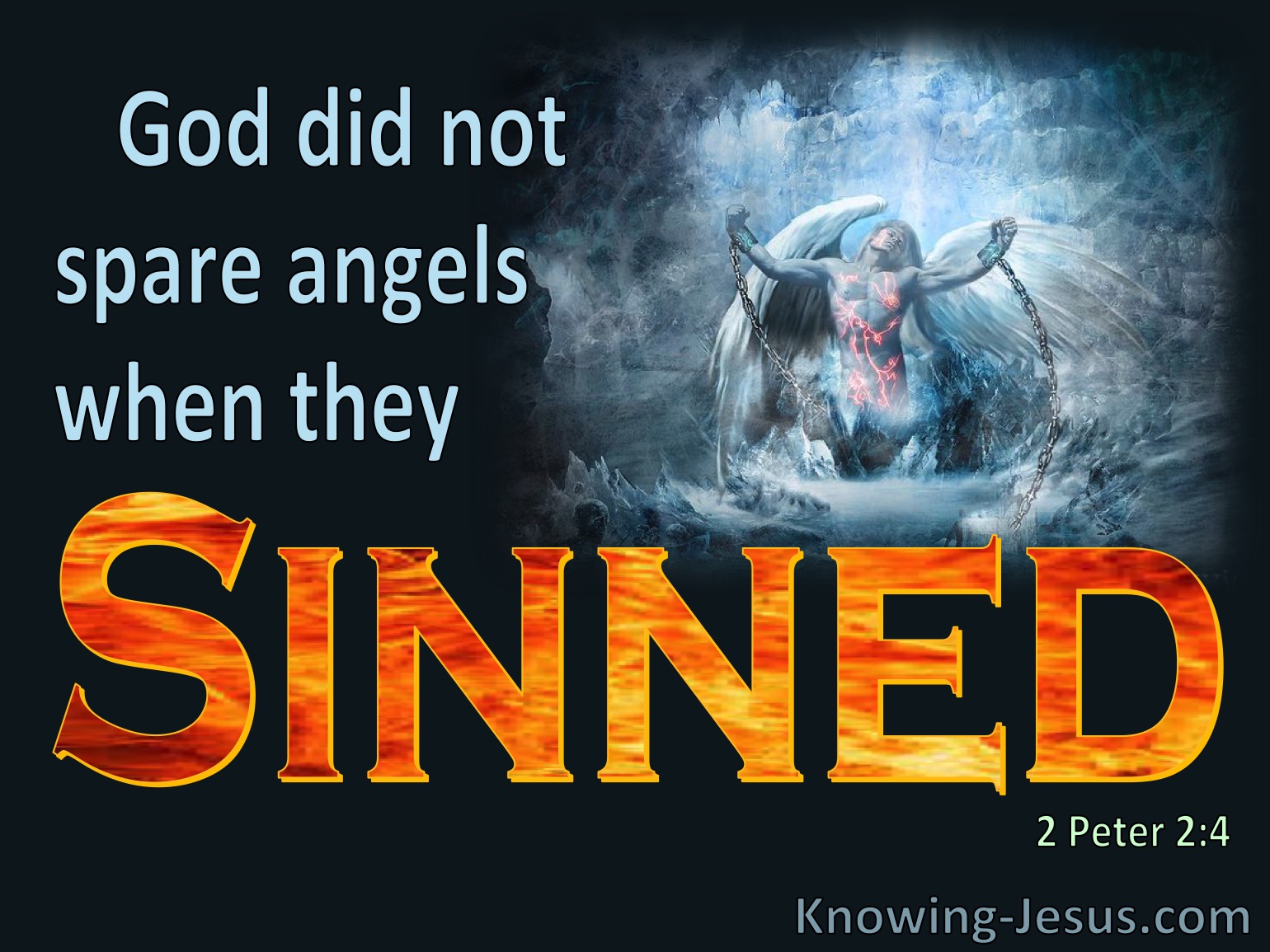
The fallen angels (2:4). For if God did not spare the angels when they sinned, but cast them into hell and committed them to chains of deepest darkness to be kept until the judgment.
We wish we knew more about the creation of the angels and the fall of Lucifer and his host, but most of these details are shrouded in mystery.
Many Bible students believe that Isaiah 14:12-15 describes the fall of Lucifer, the highest of the angels. Some students feel that Ezekiel 28:11-19 also deals with the same topic.
Revelation 12:4 suggests that perhaps one third of the angels fell with Lucifer, who became Satan, the adversary of God.
If some people still did not believe in future judgment and punishment, Peter gave examples of how God had judged evil in the past.
If God did not even spare his angels, neither will he spare the false teachers. Judgment will come. The angels who sinned were cast … into hell. That phrase in Greek is one word (used only here in the New Testament), literally meaning “to cast into Tartarus.”
In Greek mythology, Tartarus, located in the lowest part of the underworld, was the place of punishment of rebellious gods and the departed spirits of very evil people.
These angels were imprisoned in this hell, committed … to chains of deepest darkness.
False teachers will face the same judgment as the rebellious angels. Where are these fallen angels now? We know that Satan is free and at work in the world (1 Peter 5:8), and that he has an army of demonic powers assisting him (Eph. 6:10-12), who are probably some of the fallen angels.
It is not necessary to debate the hidden mysteries of this verse in order to get the main message: God judges rebellion and will not spare those who reject His will.
If God judged the angels, who in many respects are higher than men, then certainly He will judge rebellious men.
The old world (2:5). If he did not spare the ancient world when he brought the flood on its ungodly people, but protected Noah, a preacher of righteousness, and seven others. I think that with the flood we often get so hung up on the geologic issues or questions of how Noah could get all those animals on the ark that we miss the main point, namely, that the flood was a horrific judgment on the entire earth.
Everyone and everything that were not on the ark perished! The Bible uses the flood story as a warning to everyone since that time that a far worse future judgment is coming, when all the ungodly who are not “on board” Jesus Christ will perish eternally.
Peter referred to the Flood three times in his two letters (see 1 Peter 3:20; 2 Peter 2:5; 3:6). God did not spare the ancient world—for the great sinfulness of all mankind led him to destroy the entire rebellious civilization.
Yet even as God was destroying all the sinful people in Noah’s day, he powerfully protected those who followed him, eight people in all: Noah and seven of his relatives (his wife, three sons, and their wives, Genesis 8:16).
Genesis 6:3 indicates that God waited 120 years before He sent the Flood. All during that time, Noah ministered as a “herald” of God’s righteousness. If you want to read a description of the world before the Flood, read Romans 1:18ff.
Salvation had been available to everyone (Peter described Noah as a preacher of righteousness); however, few had chosen to believe.
Gentile civilization had become so corrupt that it was necessary for God to wipe the earth clean. He saved only eight people, Noah and his family, because they had faith in God (Heb. 11:7).
But nobody believed Noah’s message! Jesus made it clear that people were enjoying their normal lives up to the very day that Noah and his family entered the ark! (Luke 17:26-27).
No doubt there were plenty of “experts” who laughed at Noah and assured the people that a rainstorm was out of the question. Had anybody ever seen one? The apostates in Peter’s day used that same argument to “prove” that the Day of the Lord would not come (2 Peter 3:3ff).
God’s punishment is not arbitrary. Those who deserve punishment will receive his punishment; those who trust in him will receive his grace. Peter’s readers should understand the comparison—those who choose the wrong path face eternal consequences.
CHOICES – The choices sound simple—follow God or rebellious humanity— but there was nothing simple about Noah’s decision.
- His faith in God gave him the reputation of an outcast, a fool. No one wants to feel that way today. We rely too readily on the approval of others.
- Noah invested all he had in God’s promise. He placed his entire family fortune, everything he had, inside that ark. Today, we rely on diversified portfolios to protect against uncertain markets. We don’t trust our financial security to God alone.
- Noah’s witness was entirely rejected. He convinced no one. As a preacher, he would have been regarded as a total failure.
Today, we smartly pick careers that provide significant incentive and reward. Who would decide to invest his or her life when there are no observable results to be gained?
If the choice between God and the world seems simple and clear, perhaps you have not counted the real cost. Very few counselors today will advise the Noah track. It’s just too risky. But there really is no other choice!
When you compare our world with Noah’s world, you see some frightening parallels. The population was multiplying (Gen. 6:1), and the world was filled with wickedness (Gen. 6:5) and violence (Gen. 6:11, 13).
Lawlessness abounded. True believers were a minority, and nobody paid any attention to them! But the Flood came and the entire population of the world was destroyed. God does indeed judge those who reject His truth. The choices sound simple—follow God or rebellious humanity— but there was nothing simple about Noah’s decision.
Sodom and Gomorrah (2:6). If he condemned the cities of Sodom and Gomorrah by burning them to ashes, and made them an example of what is going to happen to the ungodly. A third example of God’s certain punishment of evil is the cities of Sodom and Gomorrah. Genesis 18–19 describes the sinfulness of these cities and Abraham’s effort to keep them from being destroyed.
When not even ten righteous people could be found in the cities, God destroyed the cities by burning them to ashes: “The Lord rained on Sodom and Gomorrah sulfur and fire from the Lord out of heaven; and he overthrew those cities, and all the Plain” (Genesis 19:24–25).
After the conflagration, “Abraham … looked down toward Sodom and Gomorrah and toward all the land of the Plain and saw the smoke of the land going up like the smoke of a furnace” (Genesis 19:27–28).
Lot’s future sons-in-law thought that he was joking when he warned them to flee the impending judgment.
In what sense were their filthy deeds “unlawful”? They were contrary to nature (see Rom. 1:24-27). The flagrant sin of Sodom and the other cities was unnatural sex, sodomy, or homosexual behavior, a sin that is clearly condemned in Scripture (Lev. 18:22; Rom. 1:24-27; 1 Cor. 6:9).
In spite of Abraham’s intercessory prayer (Gen. 18:22ff) and Lot’s last-minute warning, the people of Sodom perished in fire and brimstone.
Ezekiel (16:49) also informs us that the people of Sodom were arrogant and had abundant food and ease, but they did not help the poor.
Peter states that God made the people of Sodom “an example to those who would live ungodly lives thereafter.”
In other words, the judgment on Sodom and Gomorrah was not a one-time oddity. It is in Scripture as a warning of the judgment to come.
Having cited these three examples of certain judgment, Peter then applied the lesson to the subject at hand, the false teachers
2:9 Then the Lord knows how to rescue the godly from trial, and to keep the unrighteous under punishment until the day of judgment.
God has reserved the unjust for special punishment on that day of judgment. The false teachers may seem successful (for “many” follow them), but in the end, they will be condemned.
What a contrast between the false teachers and the true children of God! We have an inheritance reserved for us (1 Peter 1:4) because Jesus Christ is preparing a home for us in heaven (John 14:1-6).
Some people would have us believe that God will save all people because he is so loving. But it is foolish to think that God will cancel the last judgment. Don’t ever minimize the certainty of God’s judgment on those who rebel against him.
We have a lot of emphasis on tolerance of others and the self-help benefits of the Bible, but we must not dilute God’s clear words of warning. To turn away from God is to turn to ruin.
Conclusion. I read recently of a brochure that a funeral home printed and displayed on the day of a burial: “For God so loved the world that He gave His only begotten Son, so that whoever believes in Him shall have eternal life.” But they left out some crucial words: “shall not perish but have eternal life”!
Jesus didn’t come and die on the cross just to give us warm, fuzzy feelings about God’s love.
He offered Himself to pay the penalty for sin that we deserved to rescue us from the wrath to come (1 Thess. 1:10).
The preservation of Noah and the rescue of Lot give us the hope that if we trust in Christ and turn from our sins, and are immersed in water in order to have our sins forgiven, God will mercifully spare us from the judgment to come.
e.


 Proud to be TJ's man