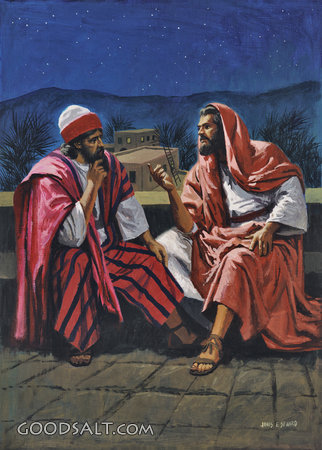
 The opening ministry of Jesus in Jerusalem had attracted a great deal of attention, both favorable and unfavorable. Many of the people believed (2:23).
Jesus knew their hearts and that their faith was weak and unstable and so while He encouraged their belief, He did not trust Himself to them for more. They needed more time.
The story of Nicodemus is presented by John as a contrast to those who were described in 2:23-24. Nicodemus is an instance of Christ’s knowledge of men and of one to whom He could trust Himself, unlike those in 2:24.
Nicodemus cannot overlook the weight of the evidence. His fellow Pharisees will quickly begin to find alternative explanations for Jesus’ success, but Nicodemus cannot get away from his personal conviction that Jesus has some kind of divine mission, and that He possesses divine authority by which He speaks and heals. I am now inclined to read the first verses of chapter 3 in this way: “Rabbi, we know that you are a teacher who has come from God. For no one could do the miraculous signs that you do unless God were with him …”
I am not sure Nicodemus knows what to say from here on, or that he came with a predetermined agenda for this interview. If he does have a plan, we do not know what it was as he never gets to it. He simply tells Jesus that, from what he has personally seen, he has concluded that Jesus has come from God on some divinely inspired mission. Having said this, Nicodemus may have waited, hoping Jesus would take up the subject where he leaves off, fill in all the blanks, and answer all his questions. If this is his hope, he is in for a big disappointment.
Nicodemus is the “cream of the Jewish crop.” One dare not dream of having life any better than he has it. He is a Jew, a Pharisee, a member of the Sanhedrin (the highest legal, legislative and judicial body of the Jews), and a highly respected teacher of the Old Testament Scriptures. Can you imagine being Nicodemus and having Jesus tell you that all of this is not enough to get you into the kingdom of God? Yet this is precisely what Jesus tells Nicodemus. If a man like Nicodemus is not good enough for the kingdom of God, then who is? That is the question, and Jesus has the answer, which John records for us. Let us listen well to the inspired words of this Gospel to learn how one must enter the kingdom of God.
The three main interviews within the next two chapters exhibit Jesus’ method of dealing skillfully with three different types of personality with the purpose of bringing them to belief.
These early believers were not where Jesus wanted them eventually to be in their faith. They had faith, but it was not the kind of faith that would allow them to understand fully who Jesus really was. Jesus wanted to communicate more about Himself and the kingdom of God, but such concepts were difficult to discuss with large groups of people. Consequently, John related Jesus’ teaching on true, Christian faith by recounting the private, nighttime encounter between Jesus and Nicodemus.
The Setting
While the exact chronology of the following events may not be accurate, the sequence outlined by these texts cannot be too far from the way our Lord’s teaching (and John the Baptist’s) caught the attention of the Jewish religious leaders, particularly the Pharisees:
46 After three days they found him in the temple, sitting among the teachers, listening to them and asking them questions. 47 And all who heard Jesus were astonished at his understanding and his answers (Luke 2:46-47).
19 Now this was John’s testimony when the Jewish leaders sent to him priests and Levites from Jerusalem to ask him, “Who are you?” 20 He confessed—he did not deny but confessed— “I am not the Christ.” 21 So they asked him, “Then who are you? Are you Elijah?” He said, “I am not.” “Are you the Prophet?” He answered, “No.” 22 Then they said to him, “Who are you? Tell us so that we can give an answer to those who sent us. What do you say about yourself?” 23 John said, “I am the voice of one crying out in the desert, ‘Make straight the way of the Lord,’ as Isaiah the prophet said.” 24 (Now they had been sent from the Pharisees.) 25 So they asked John, “Why then are you baptizing if you are not the Christ, nor Elijah, nor the Prophet?” (John 1:19-25)
30 However, the Pharisees and the experts in religious law rejected God’s purpose for themselves, because they had not been baptized by John (Luke 7:30).
28 When Jesus finished saying these things, the crowds were amazed by his teaching, 29 because he taught them like one who had authority, and not like their experts in the law (Matthew 7:28-29).
17 On one of those days, while he was teaching, there were Pharisees and teachers of the law sitting nearby (who had come from every village of Galilee and Judea and from Jerusalem), and the power of the Lord was with him to heal the sick (Luke 5:17).
At the age of 12, our Lord accompanied Mary and Joseph to Jerusalem to celebrate the Passover with them. When His family left for home, Jesus stayed behind, His absence unnoticed. When Mary and Joseph returned to Jerusalem in search of Jesus, they found Him in the temple listening to the teachers and asking questions (Luke 2:46). It wasn’t long before they were asking Jesus questions, and they were amazed at His answers (2:47). Our Lord was already an astounding teacher at 12 years of age, whose understanding of the Scriptures amazed Israel’s finest scholars.
A number of years later, John the Baptist commenced his public ministry, proclaiming the Word of God and calling Israel to repentance in preparation for the coming of Messiah. The Jewish religious leaders took note of him and sent a delegation to inquire about his ministry and message. It is apparent that the Pharisees chose not to identify themselves with John and his preaching, as they refused to be baptized by him (Luke 7:30).
When Jesus began His public ministry, the people who heard Him recognized a difference between His teaching and that of the Jewish religious teachers. Jesus taught as one having authority and not as their experts in the law. Our Lord’s authority was evident in His healing of the sick and casting out of demons. It also seems to have been evident in the impact His words made on His listeners. The experts in the law taught with great dogmatism (Romans 2:17-20; 1 Timothy 1:6-7; 2 Peter 2:18), but their message lacked the power of our Lord’s words. His teaching seems to have “rung true” to His audience.[1]
We learn from Luke 5:17, the Pharisees quickly take note of Jesus. At some point in time, Pharisees from the entire nation of Israel gather to observe His ministry and teaching. We know from Luke’s words that Jesus was also performing miracles at this time. It is uncertain whether this occurred before or after our Lord’s interview with Nicodemus, but it must have been close to the time Nicodemus comes to Him by night, as our text in John describes. The Pharisees are hard pressed to speak critically of our Lord or His ministry. How can His teaching be criticized? How can anyone speak against Him, when He performs miracles openly, and many take note of them? Jesus makes the Pharisees look bad, and there seems to be little they can say against Him at the moment, though this will soon change. But Jesus does not have much good to say about them:
17 “Do not think that I have come to abolish the law or the prophets. I have not come to abolish but to fulfill. 18 I tell you the truth, until heaven and earth pass away not the smallest letter or stroke of a letter will pass from the law until everything takes place. 19 So anyone who breaks one of the least of these commands and teaches others to do this, will be called least in the kingdom of heaven; but whoever does them and teaches others to do so will be called great in the kingdom of heaven. 20 For I tell you, unless your righteousness goes beyond that of the experts in the law and the Pharisees, you will never enter the kingdom of heaven” (Matthew 5:17-20).
Jesus performed His first sign at the wedding in Cana of Galilee, but very few even realized what had happened. It was the cleansing of the temple which captured the attention of the religious leaders (John 2:18-22), while the signs our Lord accomplished in Jerusalem caught the attention of many others (John 2:23-25). Still, the Pharisees were not the ones who caught the brunt of our Lord’s attack. They were not the ones behind the merchandising which took place in the temple courts. This was the work of the priests and of the Sadducees.[2] It may be that the Pharisees even stood by as Jesus cleansed the temple, looking on with great satisfaction as the priests and Sadducees were publicly humiliated.[3]
All of these events seem to rivet the Pharisees’ attention on Jesus. We know one Pharisee in particular is greatly impressed—a Pharisee named Nicodemus. At one time, I thought Nicodemus was seeking, on behalf of the Pharisees, to recruit Jesus as a kind of junior partner. I am not certain Nicodemus’ colleagues would even have accepted Jesus into their ranks. I also thought Nicodemus came with a memorized script, and when Jesus interrupted him, he was totally disarmed and disoriented.
I now view our text in a different light. For the moment, suppose you are a renowned pianist, trained by the finest concert pianist the world has ever known. When you perform, crowds gather to listen. Everyone hails you as the master in your area of musical expertise.
Now suppose some young man comes along who grew up in the Ozarks and who never had a piano lesson in his life, but simply taught himself to play on a broken-down instrument in his grandmother’s house. When this hillbilly musician comes to town, his talent is discovered, and people throng to hear him perform. When he does, tears come to the eyes of those in his audience. You too listen to him play. You, better than anyone else, recognize in him a musical genius that you have never had and that you never will. When you hear him play, you wish you had his abilities.
I believe this is the way Nicodemus must have felt about Jesus. Nicodemus is a Pharisee who is at the top of his field. Not only is he a member of the Sanhedrin, he is the most renowned Bible teacher of his day—the “Billy Graham” of first century Jerusalem. Yet when he hears Jesus teach, he hears the answers to questions that have bothered him for years. He watches the crowds as they listen to Jesus, and he knows he has never held the attention of an audience like Jesus does. Jesus speaks in simple terms, but His message has great power. Nicodemus observes the miracles Jesus performs, knowing he has never performed so much as one miracle. By nearly any standard, Nicodemus does not hold a candle to Jesus.
THE INTERVIEW WITH NICODEMUS
“Now there was a man of the Pharisees named Nicodemus, a member of the Jewish ruling council.”
For the most part we see Jesus surrounded by the ordinary people, but here we see him in contact with one of the aristocracy of Jerusalem.
“Religious” people are often the most difficult to lead to Christ. They may be brilliant scholars, gifted leaders, or just “good folks,” but they can suffer from a blindness that is almost impenetrable. A class example is Nicodemus.
| Small Group Discussion Starters
1. Why did Nicodemus come to Jesus at night? a. he couldn’t wait until morning b. he worked during the day c. he was afraid of being seen d. he wanted time alone with Jesus 2. Of the three levels of communication, how did the conversation start out? a. mouth to mouth-polite talk b. head to head-intellectual talk c. heart to heart- deep sharing 3. What is the condition for obtaining eternal life, according to verses 16-18? a. feeling sorry for yourself b. feeling sorry for your sins c. living a clean life d. going to church every Sunday e. receiving God’s free gift by faith 4. How do you think Nicodemus came away from this conversation with Jesus? a. totally confused b. enlightened c. a silent follower of Jesus d. intellectually convinced e. with “food for thought” |
He had an impeccable resume. If heaven could be earned from one’s accomplishments, Nicodemus would have had change left over!
But when he met Jesus, he, the leading teacher of Israel, would be the one raising his hand and asking the elementary-school questions.
There are certain things we need to know:
– Nicodemus must have been wealthy.
When Jesus died Nicodemus brought for his body “a mixture of myrrh and aloes about an hundred pound weight” (John 19:39), and only a wealthy man could have brought that.
– He was a Pharisee.
In many ways the Pharisees were the best people in the whole country. There were never more than 6,000 of them; they were what was known as a chururah, or brotherhood. They entered into this brotherhood by taking a pledge in front of three witnesses that they would spend all their lives observing every detail of the scribal law.
– He was a ruler of the Jews.
This is to say he was a member of the Sanhedrin, which was a court of 70 members and was the supreme court of the Jews. Of course, under the Romans its power was limited, but they were still exclusive.
They had religious jurisdiction over every Jew in the world; and one of its duties was to examine and deal with anyone suspected of being a false prophet. Again, it was amazing that Nicodemus should come to Jesus at all!
Nicodemus was a strict interpreter of the law! He was respected! He was “Mr. Everything” in his society.
“He came to Jesus at night and said, “Rabbi, we know you are a teacher who has come from God. For no one could perform the miraculous signs you are doing if God were not with him.”
There are two reasons why he could have come at night: First, it may have been a sign of caution. It’s likely that Nicodemus may not have wished to commit himself by coming to Jesus by day. We must not condemn him; the wonder is that with his background, he came to Jesus at all! It was infinitely better to come at night than not at all.
Second, the rabbis declared that the best time to study the law was at night when a man was undisturbed. Throughout the day Jesus was surrounded by crowds of people all the time.
His statement of greeting showed he was a gentleman and a thinker: a gentleman, because he paid Jesus a sincere compliment; a thinker, because his words implied that he’d obviously observed Jesus’ works, and had concluded that only a heaven-sent person could perform them.
“In reply Jesus declared, “I tell you the truth, no one can see the kingdom of God unless he is born again.”” “How can a man be born when he is old?” Nicodemus asked. “Surely he cannot enter a second time into his mother’s womb to be born!”” Jesus answered, “I tell you the truth, no one can enter the kingdom of God unless he is born of water and the Spirit.” “Flesh gives birth to flesh, but the Spirit gives birth to spirit.” (3:3-6).
When John relates conversations that Jesus had with enquirers, he has a way of following a certain scheme:
– the enquirer says something
– Jesus answers in a saying that is hard to understand
– that saying is misunderstood by the enquirer
– Jesus answers with a saying that is even more difficult to understand
– they then begin teaching and understanding
The reply of Jesus was startling because of its abruptness. At first the statement seemed almost irrelevant; yet it really was the expression of Jesus’ discernment.
Because “He knew what was in man,” He saw in Nicodemus a man who was truly seeking the kingdom of God!
To a Jew, the idea of baptism would be repugnant since it connoted the ceremony by which an unclean Gentile became a member of the Jewish faith. It would involve humiliation, and an acknowledgment that he, a Pharisee, needed to repent just like the Gentile “dogs.”
The water and the Spirit are the agents and instruments in producing the birth. The Spirit is living and active…the water is inanimate. The Spirit is the active agent, the water the instrument of birth. It is the fleshly part of man that is born of the flesh; but it is the spirit within man that must be born again or begotten of the Spirit.
A special study of the attitude behind this important command:
Jesus often said in His ministry what I believe that these verses are trying to say; to show us in fuller form what Jesus said many times in His earthly ministry: “Unless you can humble yourself and become like a little child, you cannot enter the kingdom of God.”
This metaphor about humbling self is expressed in the extreme context here with Nicodemus…and he even talks about grown ups, even needing to “be born again.”
This humbling process involves:
– starting their spiritual life from scratch
– seeking grace from God
– looking to Jesus for faith for what we cannot do of ourselves
– willing to accept a divine analysis of the human condition
– willing to accept the divine cure for the human ailment
Jesus was saying: “The fact that you are who you are could make it harder for you to enter the kingdom of God than some others. You need to forget everything you ever heard or thought about being saved…and listen to my commands and do them.”
Prostitutes and thieves may enter the kingdom ahead of someone with the background of Nicodemus. It will always be harder for those who stand on plateaus and have to step down, give up their position of pride, or give up the notion that men should come to them for answers, as they did to Nicodemus!
Humility! It’s the most difficult of all virtues! YET it’s the foundation for the Christian! Remember Matthew 5:3: “Blessed are the poor in spirit, for theirs is the kingdom of heaven.” It’s the first “Be-attitude” and it’s first for a purpose:
– to be “poor in spirit” means to be “poor in ego”
– without this attitude, the other be-attitudes won’t come!
This is difficult, isn’t it? It’s difficult for anyone to admit they might be wrong, that we might need to change our viewpoint and our ways! And Jesus blows Nicodemus out of his saddle here. Nicodemus had all the credentials and they wouldn’t be the right ones!——
——————————————-
And, without doubt, Jesus realized that He surprised him with the answer:
“You should not be surprised at my saying, ‘You must be born again.’ {8} The wind blows wherever it pleases. You hear its sound, but you cannot tell where it comes from or where it is going. So it is with everyone born of the Spirit.””
In the Hebrew and Greek, the word for wind (“pneuma”) can also be translated “spirit.” It is likely that the evening wind was blowing as Nicodemus and Jesus sat on the housetop conversing.
One of the symbols of the Spirit of God in the Bible is the wind or breath (Job 33:4; John 20:22; Acts 2:2). When Jesus used this symbol, Nicodemus should have readily remembered Ezekiel 37:1-14. The prophet saw a valley full of dead bones; but when he prophesied to the wind, the Spirit came and gave the bones life.
Again, it was the combination of the Spirit of God and the Word of God that gave life.
No one has seen the wind, but all of us have seen its effects, the devastation caused by severe wind storms. This mighty wind has lowered trees, razed homes, and destroyed lives. We have not seen the wind, but we have seen what the wind has done.
So one cannot see the quiet working of the Holy Spirit, but all who are saved can testify to the fact that its effects are visible. We have seen lives snatched from alcoholism, prostitution, and thievery, being transformed into peaceful, law-abiding citizens with a holy love for God and man. How do we account for this? The new birth, the miracle of the holy Spirit!
Water is the symbol of cleansing. When Jesus takes possession of our lives, when we love him with all our heart, soul, mind and strength…the sins of the past are forgiven and forgotten.
The Spirit is the symbol of power. When Jesus takes possession of our lives it is not only that the past is forgotten and forgiven; if that were all, we might well proceed to make the same mess of life over again. But into life there enters a new power which enables us to be what by ourselves we could never be and to do what by ourselves we could never do.
Water and Spirit stand for the cleansing and the strengthening power of God, which wipes out the past and gives victory in the future!
“”How can this be?” Nicodemus asked. {10} “You are Israel’s teacher,” said Jesus, “and do you not understand these things? {11} I tell you the truth, we speak of what we know, and we testify to what we have seen, but still you people do not accept our testimony. {12} I have spoken to you of earthly things and you do not believe; how then will you believe if I speak of heavenly things? {13} No one has ever gone into heaven except the one who came from heaven–the Son of Man. {14} Just as Moses lifted up the snake in the desert, so the Son of Man must be lifted up, {15} that everyone who believes in him may have eternal life.”
Nicodemus came “by night,” and he was still in the dark! Our Lord stated clearly that his knowledge of the Old Testament should have given him the light he needed (vs. 10). Nicodemus knew the facts recorded in scripture, but he could not understand the truths.
Nicodemus has now responded in three ways:
– “Rabbi, you are a teacher from God…your signs show that”
– “How can a man be born old? Can He enter his mother’s womb again?”
– “How can this be?”
Nicodemus was earnestly seeking for answers…and was not afraid to reveal his lack of understanding. Christ did not answer him directly, but rebuked him for his spiritual incompetency…as if to say, “you ought to know.”
Nicodemus was not just an ordinary teacher…he was a well-known teacher of high rank and position, respected and admired by his people. A man in such a position should have a masterful grasp of spiritual truth. He should have been familiar with the Scripture passages telling of new life through the Messiah.
Faith that leads to a new birth
Conservative columnist Cal Thomas is known among his peers in the news business as a man of deep Christian convictions.
Once when a story broke that involved someone who was known to be a Christian, one of Thomas’ colleagues asked him, “Cal, aren’t you a born-again Christian?” He asked in return, “What do you mean by that?” The friend did not have any idea what his question meant, so Thomas said, “Yes, I am, but let me tell you what I mean by ‘born again.'”
The phrase “born of water and the Spirit,” has been the source of much debate. Various suggestions have been offered as to the meaning of the water which fall into three categories. First, “water” might refer to the water associated with physical birth, such as amniotic fluid, or semen. However, there are no clear examples in Jewish literature of birth being associated with either of these types of “water.”
Second, water might refer to purification. Some suggest that Jesus was calling Nicodemus to submit to John’s baptism, which has just been mentioned (Jn 1:23, 26; 3:23). Aside from the fact that John’s baptism was not associated with the Spirit, John himself has started pointing people away from himself and toward Jesus. Perhaps the cleansing is not a ritual washing but a symbolic reference to the Holy Spirit. After all, the OT often associates the Holy Spirit with both wind and water (Gen 1:2; Joel 2:28-29; Isa 44:3; Ezek 36:25-27), especially in terms of bringing people to life (Isa 32:15-17; 55:1-3; Jer 2:13; 17:13; Zech 14:8). In addition, the word “spirit” is also translated “wind.” Thus, Jesus may be saying that in order to be born from above one must be birthed through wind and water. Both metaphors describe the Holy Spirit, both come from heaven, and both are symbols of cleansing in the OT.
Third, the water may refer to baptism. We support this third option for the following reasons:
(1) Both nouns (water and spirit) are governed by a single preposition. Thus, Jesus refers to one birth, not two.
(2) The words “water” and “Spirit” are linked in Ezekiel 36:25-27 where the author looks forward to an eschatalogical cleansing which afford its recipients a new heart and a new spirit. This appropriately pictures the sacrament of baptism.
(3) The concept of baptism has already been introduced by John. Thus we are not surprised to encounter both water and spirit baptism (Jn 1:25-26, 28, 31-33).
(4) Water and Spirit are connected in other baptism passages (Mt 28:19; Acts 2:38; 19:1-7; Titus 3:5).
(5) The Greek and Latin Fathers interpret this verse unanimously as immersion.
(6) In the very next pericope we find Jesus baptizing (Jn 3:22).
(7) John’s original readers could hardly have read this combination (water & Spirit), and not thought of baptism.5
Indeed, Christian baptism is anachronistic here. Jesus could hardly have rebuked Nicodemus (v. 10) for not submitting to Christian baptism which has not yet even been instituted. But John’s baptism (Jn 1:26) will give way to Jesus’ baptism (Jn 1:33; 3:22) which will become Christian baptism (Mt 28:19).
The new birth begins and ends with the power of God. Jesus declared to Nicodemus that the new birth is both possible and available because of the power of the Holy Spirit (3:6-8). We can become so caught up in how to receive the gift of God that we forget how incredible it is that the Spirit of God is available to us in the first place!
Because being born again is rooted in the power of God, it also gives us hope of real and significant change in our lives. When we make plans to see old friends we have not seen in years, we always wonder how much they have changed. Having known them years earlier and having been acquainted with their basic personalities, it is easy for us to assume that they are still the same people we knew twenty or forty years earlier. Could they have experienced serious changes in their lives? For Christians, the answer is a resounding “Yes!” By the power of God we are being changed.
Faith is a crucial aspect of the new birth. This faith is not just any decision about Jesus (3:2), but the decision to trust Him as the Christ, the Son of God (20:31). Jesus compared this faith to the faith that was required of the Israelites in the wilderness when Moses raised up the bronze serpent (3:14; Numbers 21:4-9).
At that time the Israelites were grumbling against Moses and against God for bringing them out into the wilderness. Weary of their complaints, God sent fiery serpents into their camp, and many people were bitten and died. The people cried out to God for deliverance, and Moses was instructed to place a bronze serpent on a pole. If those who were bitten by a snake looked on the bronze serpent, they would not die. This action required faith enough to look on the serpent; but when they looked, they were healed by the power of God. Jesus was “lifted up” on the cross (John 12:32, 34), and those who look to Him in faith and obedience are also saved by the power of God!
A Decision That Is Proclaimed
The new birth is possible because of the power of God. It is motivated and facilitated by one’s faith in Jesus (3:16). However, it is realized only when the decision to believe is publicly confessed in baptism, when one is “born of water and the Spirit” (3:5).
This decisive act marks the beginning of a new relationship between a person and God and a new relationship between that person and the community of other believers in Jesus, the church. The new birth indeed involves a personal faith in Jesus Christ, but it requires that personal faith to express itself in the very public action of baptism (Mark 16:15, 16; Acts 2:38; 22:16).
The story is told that George Whitefield (171470) preached frequently from the text we have just studied. One day a friend asked him, “George, why do you preach so often on the text ‘You must be born again’?” Whitefield firmly replied, “Because you must be born again!” To all who believe that Jesus was an outstanding man, a great teacher, but less than the Son of God, Jesus says, “You must be born again.”
To all who think that basic goodness is enough for God, Jesus says, “You must be born again.”
To all who are comfortable with their cultural religions, Jesus says, “You must be born again. ”
To all who seek only a personal, private religion, Jesus says, “You must be born again.”
To all who view baptism as a meaningless, irrelevant historic relic, Jesus says, “You must be born again.”
There are two kinds of misunderstanding:
- There is the man who misunderstands because he has not yet reached a stage of knowledge and of experience at which he is able to grasp the truth.
When one is in this state, our duty is to do all we can to explain to him so he will be able to grasp the knowledge which is being offered to him.
- There is also the man who is unwilling to understand.
There is a failure to see which comes from the refusal to see. A man can deliberately shut his mind to truth which he does not wish to accept. If a man does not wish to acknowledge his own failings or does not wish to be changed, he will deliberately shut his eyes and his mind and his heart to the power which can change him.
* When a person is unfamiliar with an idea, use something they are familiar with…Jesus went to the brazen serpent (Numbers 21:8) and made a direct comparison between the serpent and Himself.
On their journey through the wilderness the people of Israel murmured and complained and regretted that they had ever left Egypt. To punish them God sent a plague of deadly fiery serpents; the people repented and cried for mercy.
God instructed Moses to make an image of a serpent and to hold it up in the midst of the camp; and those who looked upon it were healed. The serpent was the emblem of sin, as Nicodemus would recognize. The destiny of the individual was determined by his response to God’s invitation. The serpent seems to have been given as a test of their faith in Moses.
I wonder how many Israelites died on that occasion because the idea of looking at a serpent was so preposterous!?!
In both cases (Christ and the serpent):
– death threatens as a punishment for sin
– it is God Himself who, in His sovereign grace, provides a remedy
– this remedy consists of something (or some One) which (who) must be lifted up, in public view
– the belief or faith of the individual was crucial in the healing
The idea of being “lifted up” has a double meaning: Jesus was lifted up upon the cross; and Jesus was also lifted up into glory at His ascension. The same Greek word (“hupsoun”) is used here relating to the cross (8:28; 12:32) and also of Jesus’s ascension (Acts 2:33; 5:31; Phil. 2:9). And the two are connected…for without one, the other would not be possible!
Did Nicodemus believe on this occasion? Verse 11 tells us that he did not accept Jesus’ testimony at that time. Verse 12 implies that the earthly should have made the heavenly easier. We don’t know for sure, but John’s style throughout the gospel up to this point says that if he had obeyed here, John would have told us about it…that’s been his pattern thus far.
But notice:
– Nicodemus spoke on behalf of fairness in judging Jesus (7:50)
– He assisted Joseph of Arimathea in removing the body of Jesus from the cross and burying it (19:38-42)
– He was willing to admit that Jesus performed miracles and that He was a teacher of God (cpt. 3)
[1] So too, we might add, with the teaching of John the Baptist. There was something forceful about his teaching, that even attracted and fascinated a man like Herod, and yet John never performed a sign (John 10:41).
[2] The Sadducees are named seven times in Matthew, and once each in Mark and Luke. John never names them.
[3] I am not suggesting that the priests or the leaders of the Sadducees were actually present at the cleansing of the temple at the outset, but they most certainly got there in time to challenge our Lord (see John 2:18ff.).


 Proud to be TJ's man