You are famished. You haven’t eaten for several days, but you have been invited to a banquet. You arrive and are seated with the other guests as huge platters of delicious smelling food are served. But then you discover that you have a rather serious problem: your arms will not bend at the elbow! You can’t get the food from your plate to your mouth! Then you learn that everyone else at the banquet has the same problem! No one can taste this feast unless he decides to go for it face first, like a pig.
But then one guy gets an idea. He reaches down with his fork and gets a mouthful of food. With his stiff arm, he swings it over into his neighbor’s mouth. His neighbor reciprocates and soon everyone is feeding one another and enjoying the banquet.
That’s a rough picture of how God’s people should function. God made us as individuals and we should not deny it. But at the same time, He has made us as interdependent individuals. We are many members, but one body in Christ. He wants us to learn to work together. God Himself is a Trinity. He is one God consisting of three persons, each of which is fully God. The three persons are in perfect unity of being and harmony in working together. God wants His people to reflect His image by working together in unity and harmony.
But that’s easier said than done. How do we do it? Nehemiah 3 provides us with an illustrative answer. It’s an account of the division of labor in rebuilding the wall of Jerusalem under Nehemiah’s leadership. At first glance (and perhaps at second and third glance), it is not an easy passage to preach. One well-known Bible teacher allegorizes the gates in the chapter, assigning a spiritual meaning to each one. The Sheep Gate refers to Christ, the Good Shepherd, where the Christian life must begin. The Fish Gate refers to Christ’s calling us to be fishers of men. The Old Gate means that we should reject all the modern, newfangled ideas and get back to the old paths. Etc.!
Another usually profitable author launches off the verses that mention men working by their houses to deal with the importance of the Christian family. A third mentions the chapter in one sentence and moves on to chapter four. Even C. H. Spurgeon takes the reference to the Broad Wall (3:8) to springboard into a sermon on the need for the church to be separate from the world. While I agree with his point, I fail to see that as the meaning of this text.
Why did God include Nehemiah 3 in Scripture? What does He want us to learn from it? I believe that it’s here to show us the importance of working together to accomplish God’s purpose.
To accomplish God’s purpose, we need a common vision, dedicated leaders, and willing workers who do their part.
These three elements are either explicit or implicit in our text: the common vision to rebuild the wall; Nehemiah as the leader who had instilled that vision; and, all the people who got involved.
1. To accomplish God’s purpose, we need a common vision for the task.
You can’t work together if everyone has a different notion of what you’re trying to accomplish. If one man had thought that the purpose was to construct a decorative fence, but the next guy envisioned a fortress, chaos would have reigned! If they had gotten very far, it would have looked ridiculous. They needed to agree on a common vision so they could work together harmoniously.
Their task was specific and measurable: to rebuild the wall around Jerusalem to provide a defense against their enemies. I envy them in that the project could be completed fairly quickly and everyone could say, “We did it!”
But the church’s task is not so easily attained. Our task is to see the Great Commission fulfilled by proclaiming the gospel to every people group on earth. But more than just evangelism, that task requires raising up churches in every people group that teach their people to obey all that Jesus commanded (Matt. 28:20). And the supreme goal of God’s purpose through His church is that He would be glorified, that His name would be hallowed on earth as it is in heaven.
As we saw in chapter 1, that will happen as His people find their sufficiency and joy in Jesus Christ. As John Piper says, “God is most glorified in us when we are most satisfied in Him.” And so our goal is to spread a passion for God’s glory among the nations by proclaiming the gospel and by helping all His saints to savor Jesus Christ as their greatest joy and treasure. That’s our vision.
Everything we do for the Lord should have that vision in mind, even though it’s not as immediately obvious how every task contributes to the vision. For example, if you get an opportunity to talk to someone about Jesus Christ and he responds to the gospel, that is obviously related to the vision!
But what about cleaning up the kitchen after a church social? Helping with that task probably won’t directly result in many souls being added to the kingdom. But even so, it is a vital task that contributes to the overall cause. If no one chose to do it, it could seriously hinder the well-being of the church! Or, someone could do it with a grumbling spirit, complaining about how insensitive others are who don’t get involved. Or, you can do it with joy in your heart because God has saved you and made you a part of His church. He gets the glory and your life radiates the joy of knowing Jesus Christ.
Again, our overall vision is to spread a passion for God’s glory among the nations by proclaiming the gospel and by helping all of His saints to savor Jesus Christ as their greatest joy and treasure.
2. To accomplish God’s purpose, we need dedicated leaders who can help everyone work toward the common vision.
God accomplishes His purpose through people, but people need leaders to motivate and organize them for the cause. The people listed in Nehemiah 3 had been living there for years. But the wall didn’t get built until God raised up Nehemiah to lead the charge. It’s interesting that Nehemiah is never mentioned in chapter 3 (3:16 refers to a different man), but his labor is behind the whole chapter.
He did at least seven things that good leaders do:
(1) A leader must not mind if the credit goes to others.
Nehemiah didn’t want a huge sign over the main gate or a bronze plaque reading: THE NEHEMIAH MEMORIAL WALL. Rather, Nehemiah was committed to the task. He wanted the wall to be built so that God’s name would be exalted in Jerusalem and His people would no longer be a reproach. Nehemiah knew that God would recognize his efforts. He was laboring to hear “well done” from the Lord (13:31).
(2) A leader must motivate people.
The Jews had been back in the land for 90 years, but the wall hadn’t been built. But then Nehemiah came along and got everyone excited about the idea. They went to work and put up the wall in record time, in spite of opposition.
Motivation is a key to productivity. You’ve experienced this. You’ve had a project that didn’t get done for a long time. You procrastinated because you just were not motivated to do it. Then something inside you changed. Maybe it was a deadline: Clean the house before the relatives arrived for a visit. Maybe you saw the value of getting it done. You thought, “I’m tired of looking at a weed-overgrown back yard. I’m going to landscape it.” You got motivated and finished the project rather quickly.
The difficult thing about motivating a group of people is that what motivates some turns off others. Even Nehemiah couldn’t get the nobles of Tekoa to join the project (3:5). One wise way that Nehemiah motivated the people was to assign many of them to work on the portion of the wall that they had particular interest in. The priests worked on the Sheep Gate (3:1), where the people would bring sacrifices to the temple. Others repaired the wall in front of their own homes (3:10, 23, 28–30). They had a personal incentive to do a good job!
(3) A leader must plan and organize.
It is obvious from the smooth operation outlined in chapter 3 that Nehemiah had done some extensive planning and organizing. He had figured out in advance how to go about this huge task. He broke the project down into manageable units. He assigned the available workers to the various units and worked to coordinate them so that everything fit together. As we saw last week, planning and prayer are not opposed to one another, as long as we don’t rely on our plans.
And there is nothing wrong with organization, as long as we are flexible enough to adapt to the strengths and weaknesses of the individuals involved. Sometimes people emphasize that the body of Christ is a living organism, not an organization. While that is true and must not be forgotten, we also should remember that every living organism is highly organized. There is nothing wrong and everything right with organization as long as it furthers the efficient functioning of the organism.
(4) A leader must delegate.
Nehemiah couldn’t possibly have done all this work by himself. He had to entrust it to the workers and give them the authority to get the job done. Sometimes, to be honest, it is easier to do the job myself rather than to delegate it. But as the job grows in size, the necessity of delegation grows.
Some pastors/ministers keep their hand on every aspect of the ministry, and they often burn out. I sometimes baffle people because I don’t have a clue about what is going on in some aspects of the ministry here. I don’t see that as my job. God has given gifts to His people and they are competent to carry on His work. I’m available as a resource if there is a problem. But I do not need to have my hand on everything. I couldn’t do that and get done what God has given me to do. If God has called you to lead, always ask yourself, “Can someone else do this as effectively or more effectively than I can?” By delegating, you involve more workers and you get more done.
(5) A leader must oversee.
Delegating does not mean dumping or dictating! To dump something on someone and walk away from it is not effective leadership. To dictate every detail is not to delegate with proper freedom. While Nehemiah delegated the work, you can be sure that he went around inspecting the progress, talking to his leaders, helping them keep things moving toward the goal. In 3:20, he notes that Baruch zealously repaired a section of the wall. Apparently, Nehemiah knew not only who was doing what, but also how they were doing it. Baruch did an exceptional job.
The elders are to give oversight to the flock. That involves the balance between giving guidance and counsel as needed, but also giving the freedom to workers to carry out their ministries in accordance with their own gifts and ideas, in line with Scripture and the overall vision.
(6) A leader must give proper recognition.
Apparently Nehemiah wrote down in detail who was doing what on this project (I can’t imagine him remembering all these names without writing them down!). Some are mentioned as completing more than one section of the wall (3:4 & 21; 5 & 27). But the important thing was not that Nehemiah recognized every worker, but that God recognized them by including their names here. I’ll be honest that I’m always a little nervous to give recognition by name for fear that I’ll forget someone who will get his feelings hurt. But in spite of that, it is proper to give recognition for a job well done.
(7) A leader must not get distracted by those who are not cooperative.
Nehemiah 3:5 mentions in passing the nobles of Tekoa who refused to join the project, perhaps out of petty pride. To the nobles’ shame, the people of Tekoa built two sections of the wall, and some nobles from other towns rolled up their sleeves and went to work (3:9, 12). But Nehemiah didn’t expend any energy on the nobles of Tekoa. Rather, he worked with the many willing workers. Those who didn’t get involved were the losers in the long run.
To accomplish God’s purpose, we need a common vision and dedicated leaders. Finally,
3. To accomplish God’s purpose, we need willing workers who do their part.
The people heard Nehemiah’s vision and they responded, “Let’s arise and build” (2:18). Working together they accomplished what no one could have accomplished individually.
Four things:
(1) The workers were willing to cooperate and coordinate with one another for the overall cause.
While some worked in front of their own homes (as already noted), many others came from outlying cities to help (3:2, 5, 7, 13, 14, 16, 17). After the project was through, they returned home without any daily personal benefit. Perhaps they could dwell more securely in their villages with a strong capital in Jerusalem. They would have enjoyed knowing that the temple was secure behind the wall, so that they could go there for the annual feasts. But beyond any personal benefits, they were willing to work for the overall cause, that the name of the Lord and His people would no longer be a reproach among the nations.
Also, they coordinated the project so that all the parts fit together. Each person knew what his task was and did it, but he did it in harmony and conjunction with others. It would not have worked if one guy built his section but didn’t interlock it with the section of the guy next to him. If you’ve ever played with your kids’ interlocking building blocks, you know that each section of a wall must be locked into the next section, or it will fall over. The guys building the gates had to coordinate with the guys building the walls around the gates. In the church, it is not enough to have a bunch of independent ministries alongside each other. We all should work together in supporting the overall cause of Christ.
(2) The workers were willing to complement each other for the overall cause.
Everyone couldn’t do the same job. Some worked on the walls. Others worked on the gates. Hanging a large gate is not an easy task! Some were strong enough to carry heavy stones or bricks. Others had to do lighter work. But each worker was important to the cause. As Paul tells us (1 Cor. 12:12–30), the body is not one member, but many. The foot dare not think that it is not a vital part of the body because it is not a hand. And the hand would be foolish to despise the foot. Each part has a specific and important function to fulfill. Each part depends on the other parts in order for the whole body to function properly.
(3) Some workers were willing to work outside of their areas of strength.
The priests (including the high priest) got involved building the Sheep Gate and a portion of the wall (3:1). They didn’t learn how to do that in seminary! Maybe they had to get some pointers on how to build and hang a gate from some of the men who were experienced in that sort of thing. Some of the city officials rolled up their sleeves and joined their people in the work (3:9, 12). They didn’t view manual labor as beneath their dignity. Some of the workers were goldsmiths and perfume makers by trade (3:8). They weren’t used to this kind of rugged labor. They probably had aches in muscles they never knew that they had before this, but they joined in the work. One man made repairs with his daughters (3:12)! Apparently they did more than made lunch and lemonade!
Sometimes people will say, “I’m not going to work on a cleanup crew because that’s not my spiritual gift.” Your spiritual gift should help you know where to concentrate your efforts, but there are many jobs where we’re all called to pitch in, whether it’s our gift or not. The point of Nehemiah 3 is that everyone got involved. The New Testament is clear that if you’re a Christian, you are in the ministry (service) and you will give an account of your ministry to the Master someday (Matt. 25:14–30). The danger is that the “one-talent” Christian will think that his part is insignificant and he won’t use it for the Master. But the Master expects every servant to use what He has entrusted to him.
(4) Some workers were willing to do the less glamorous or desirable jobs.
Malchijah (3:14) repaired the Refuse (or Dung) Gate. It was at the south of the city, and opened to the Kidron Valley where the people brought all their trash to burn. If he is the same Malchijah mentioned in 3:31, he was a goldsmith by trade, and he also helped out with repairs on another part of the wall. There were probably a lot more volunteers to repair the Fountain Gate than there were for the Refuse Gate! But Malchijah realized that the job needed to get done, and he was willing to do it for the cause.
Conclusion
Years ago I heard a story that I’ve never forgotten because it challenged my cultural mindset with what I believe is a more biblical point-of-view. I’ve shared it with you before, but I tell it again because it illustrates our text so well. Some Western missionaries in a remote area of the Philippine Islands set up a croquet game in their front yard. Several of their Agta Negrito neighbors became interested, and so the missionary explained the rules, gave each one a mallet and ball, and got them going.
As the game progressed, opportunity came for one of the players to take advantage of another by knocking that person’s ball out of the court. The missionary explained the procedure, but his advice puzzled his Negrito friend. “Why would I want to knock his ball out of the court?” he asked. “So you will win!” the missionary explained. The short native, clad only in a loincloth, shook his head in bewilderment. In that hunting and gathering society, people survive not by competing, but by sharing equally in every activity.
The game continued, but no one followed the missionary’s advice. When a player successfully got through all the wickets, the game was not over for him. He went back and gave aid and advice to his fellow players. As the final player moved toward the last wicket, the game was still very much a team effort. Finally, when the last wicket was played, the whole group shouted happily, “We won! We won!”
That’s how the church should function. We should work together cooperatively, not competitively. When one member scores a point, it’s a point for the whole team.
Studying this chapter reminded me of several things at our church. One was the two work days we had to demolish the old facility so that we could remodel. It was a real joy to see all the men working together for a common goal, and we got a lot done. It also brought to mind what happened again just this week, as the ladies came together to orchestrate the annual Craft Sale for missions. Their efforts combine to raise thousands of dollars to further the cause of Christ around the globe. I could also mention AWANA or Sunday School, but I’m likely to leave a worthy ministry out! We all should see these things and shout, “We won!”
But some of you attend services here, but you aren’t serving in any part of the cause. I’m so glad that you come, and I hope that you’re learning and growing. Maybe you’re just taking a much-needed rest, and that’s okay. But if you know Christ, you’re a vital part of the body. At some point, the Lord wants you to get involved in the cause. Here’s how 1 Peter 4:10–11 puts it:
“As each one has received a special gift, employ it in serving one another as good stewards of the manifold grace of God. Whoever speaks, is to do so as one who is speaking the utterances of God; whoever serves is to do so as one who is serving by the strength which God supplies; so that in all things God may be glorified through Jesus Christ, to whom belongs the glory and dominion forever and ever. Amen.”
Nehemiah faced a great challenge and had great faith in a great God, but he would have accomplished very little had there not been great dedication on the part of the people who helped him rebuild the wall. With the kind of humility that befits a godly leader, Nehemiah gave all the credit to the people when he wrote, “So built we the wall … for the people had a mind to work” (Neh. 4:6).
British humorist Jerome K. Jerome said, “I like work, it fascinates me. I can sit and look at it for hours.” When it comes to the work of the Lord, there is no place for spectators or self-appointed advisors and critics; but there is always room for workers. As you study this chapter, you will discover principles that apply to all human labor, especially the work of building the church.
The purpose of the work
Nehemiah was concerned about only one thing, the glory of God. “Let us build up the wall of Jerusalem, that we be no more a reproach” (2:17; and see 1:3; 4:4; 5:9). The Gentiles delighted in mocking their Jewish neighbors by pointing out the dilapidated condition of Jerusalem. After all, the Jews claimed that their capital city was “beautiful for situation, the joy of the whole earth” (Ps. 48:2). They said that God loved “the gates of Zion more than all the dwellings of Jacob” (87:2). If God loved Jerusalem so much, why were the walls in ruin and the gates burned? Why was the “holy city” a reproach? Why didn’t the Jews do something?
For the most part, the world today ignores the church. If it does pay any attention to the church, it is usually to condemn or mock. “If you are the people of God,” unbelievers ask, “why are there so many scandals in the church? If God is so powerful, why is the church so weak?” Whether Christians like it or not, we are living in a day of reproach when “the glory has departed” (1 Sam. 4:21).
The purpose of all ministry is the glory of God and not the aggrandizement of religious leaders or organizations (1 Cor. 10:31; 2 Cor. 4:5). The words of Jesus in His high priestly prayer ought to be the motivating force in all Christian ministry: “I have glorified Thee on the earth; I have finished the work which Thou gavest Me to do” (John 17:4). God has a special task for each of His children (Eph. 2:10); and in the humble, faithful doing of that task, we glorify His name.
Of course, the rebuilding of the walls and the setting of the gates also meant protection and security for the people. Jerusalem was surrounded by enemies, and it seemed foolish for the residents to improve their property when nothing was safe from invasion and plunder. Over the years, the citizens had become accustomed to their plight. Like too many believers in the church today, they were content to live with the status quo. Then Nehemiah arrived on the scene and challenged them to rebuild the city to the glory of God.
The pattern of the work
Nehemiah was a leader who planned his work and worked his plan, and the way he did it is an example for us to follow. Thirty-eight individual workers are named in this chapter, and forty-two different groups are identified. There were also many workers whom Nehemiah did not name whose labors were important; and each worker—named and anonymous—was assigned a place and a task.
“A great many people have got a false idea about the church,” said evangelist D.L. Moody. “They have got an idea that the church is a place to rest in … to get into a nicely cushioned pew, and contribute to the charities, listen to the minister, and do their share to keep the church out of bankruptcy, is all they want. The idea of work for them—actual work in the church—never enters their minds.”
In 1 Corinthians 12 and 14, Paul compared individual Christians to members of the human body: Each member is important, and each has a special function to perform. I recall the relief that came to my own heart when I realized that God didn’t expect me to do everything in the church, but rather to use the gifts He gave me in the tasks that He assigned. When I started doing that, I discovered I was helping others discover and develop their own gifts; and all of us accomplished more for the Lord.
The people finished this difficult task because they obeyed the same leader, kept their eyes on the same goal, and worked together for the glory of God. Neither the enemy outside the city nor the difficulties inside the city distracted them from their God-given task. Like Paul, they said, “This one thing I do” (Phil. 3:13).
The word built is used six times in Nehemiah 3 and means “rebuilt.” George Morrison reminds us “that for this restoration no new material was needed. In the debris of the ruined masonry lay all the material required … and it seems to me that is always so when the walls of Zion are rebuilt” (Morning Sermons, London: Hodder and Stoughton, 1931, p. 249). It is not by inventing clever new things that we take away the church’s reproach, but by going back to the old truths that made the church great in ages past. They lie like stones in the dust, waiting for some burdened Nehemiah to recover them and use them.
The word repair is used thirty-five times; it means “to make strong and firm.” Nehemiah wasn’t interested in a “quick fix,” a whitewashed wall that would soon crumble (Ezek. 13:1-16; 22:28). They were building to the glory of God, and therefore they did their best.
The gates of Jerusalem had been destroyed by fire (Neh. 1:3; Jer. 17:27; Lam. 1:4), so Nehemiah requisitioned timber from the king’s forest and had new gates constructed (Neh. 2:8) and put into place (6:1; 7:1). The gates were important to the safety of the people and the control of who went in and out of the city (7:3; 13:15-22). If the Lord loves the gates of Zion (Ps. 87:2), then His people ought to love them too.
Locks and bars are mentioned five times (Neh. 3:3, 6, 13-15). Locks refer to the sockets into which the bars were fitted, thus making it difficult for anyone outside to open the gates. It isn’t enough that we simply do the work of God; we must also make sure that what we do is protected from the enemy. “Watch out that you do not lose what you have worked for, but that you may be rewarded fully” (2 John 8, niv).
- The people in the work
The more I’ve read this chapter, the more I’ve found it a very helpful description of life in a community. It’s a great picture of what life in the church ought to be. As you get acquainted with the various people mentioned in Nehemiah 3, you will find yourself saying, “This is just like the church today!” Circumstances change but human nature remains pretty much the same.
What we find in this chapter are more than thirty households mentioned by their family names, and a number of places that people came from. Some lived in the city of Jerusalem, but some were from Jericho (verse 2), and some from Tekoa (verse 5). The regions of Gibeon and Meronoth are both mentioned (verse 7). Folks came from different places and joined together to be part of this work.
God uses all kinds of people.
The chapter mentions rulers and priests (vv. 1, 12-19), men and women (v. 12), professional craftsmen (vv. 8, 32), and even people from outside the city (vv. 2, 5, 7). There was a place for everyone, and a job for everyone to do.
Leaders must set the example (Neh. 3:1-2).
(Nehemiah 3) “Eliashib the high priest and his fellow priests went to work and rebuilt the Sheep Gate. They dedicated it and set its doors in place, building as far as the Tower of the Hundred, which they dedicated, and as far as the Tower of Hananel. {2} The men of Jericho built the adjoining section, and Zaccur son of Imri built next to them.
If anybody in the city should have been busy in the work, it was the priests, for the glory of the Lord was involved in the project. That the high priest used his consecrated hands to do manual labor shows that he considered the work on the wall to be a ministry to the Lord. “Therefore, whether you eat or drink, or whatever you do, do all to the glory of God” (1 Cor. 10:31, nkjv). Eliashib enlisted the other priests to work at the sheep gate in the northeast corner of the city. Since the sacrifices came into the city that way, the priests would be especially interested in that part of the project.
Sad to say, Eliashib did not remain true to his calling; for later he allied with the enemy and created serious problems for Nehemiah (Neh. 13:4-9). Some people who enthusiastically begin their work may drop out or turn against it for one reason or another. Eliashib’s grandson married a daughter of Sanballat (v. 28), and this alliance no doubt influenced the high priest.
Some people will not work (Neh. 3:5).
{5} The next section was repaired by the men of Tekoa, but their nobles would not put their shoulders to the work under their supervisors.
Tekoa was a town about eleven miles from Jerusalem, and some of their people traveled to Jerusalem to assist in the work. What a contrast between these people and their nobles! The Tekoites built in two places on the wall (vv. 5 and 27), while their nobles refused to bend the neck and work in even one place. Were these “aristocrats” so important in their own eyes that they could not perform manual labor? Yet Paul was a tentmaker (Acts 18:3), and Jesus was a carpenter (Mark 6:3).
The Tekoites were not the only “outsiders” to go to Jerusalem to work on the wall; for men also came from Jericho (Neh. 3:2), Gibeon, and Mizpah (v. 7). Their loyalty to their nation and their Lord was greater than their local interests. They were certainly safer back in their own communities, but they risked their lives to do the work of the Lord (Acts 15:25-26).
Some people do more work than others (Neh. 3:11, 19, 21, 24, 27, 30).
{11} Malkijah son of Harim and Hasshub son of Pahath-Moab repaired another section and the Tower of the Ovens.
{19} Next to him, Ezer son of Jeshua, ruler of Mizpah, repaired another section, from a point facing the ascent to the armory as far as the angle.
{21} Next to him, Meremoth son of Uriah, the son of Hakkoz, repaired another section, from the entrance of Eliashib’s house to the end of it.
{24} Next to him, Binnui son of Henadad repaired another section, from Azariah’s house to the angle and the corner,
{27} Next to them the men of Tekoa repaired another section, from the great projecting tower to the wall of Ophel.
{30} Next to him, Hananiah son of Shelemiah, and Hanun, the sixth son of Zalaph, repaired another section. Next to them, Meshullam son of Berekiah made repairs opposite his living quarters.
Most workers are glad to lay down their tools when their job is finished, but these people asked for additional assignments. It isn’t enough for us to say that we have done as much as others; we must do as much as we can as long as the Lord enables us. Jesus asked, “What do you do more than others? (Matt. 5:47, nkjv)
Some do their work at home (Neh. 3:10, 23, 28-30).
{10} Adjoining this, Jedaiah son of Harumaph made repairs opposite his house, and Hattush son of Hashabneiah made repairs next to him.
{23} Beyond them, Benjamin and Hasshub made repairs in front of their house; and next to them, Azariah son of Maaseiah, the son of Ananiah, made repairs beside his house.
{28} Above the Horse Gate, the priests made repairs, each in front of his own house. {29} Next to them, Zadok son of Immer made repairs opposite his house. Next to him, Shemaiah son of Shecaniah, the guard at the East Gate, made repairs.
At least six different workers, plus an unknown number of priests, repaired the portions of the wall that were nearest to their own houses. If all of us would follow this example, our neighborhoods and cities would be in much better shape! Of course, there is a spiritual lesson here: Christian service begins at home. A Chinese proverb says, “Better to be kind at home than to burn incense in a far place”; and Paul wrote, “Let them learn first to shew piety at home” (1 Tim. 5:4).
Some people work harder than others (Neh. 3:20).
{20} Next to him, Baruch son of Zabbai zealously repaired another section, from the angle to the entrance of the house of Eliashib the high priest.
Baruch is the only worker of whom it is said that the work was done “earnestly” (“zealously,” niv). The Hebrew word means “to burn or glow” and suggests that Baruch burned a lot of energy! “Whatever your hand finds to do, do it with all your might” (Ecc. 9:10, niv). Paul admonished the slaves to work hard for their masters because they were really working for Christ (Eph. 6:5-8). Lazy workers not only rob themselves and the Lord, but they also rob their fellow workers. “He also that is slothful in his work is brother to him that is a great waster” (Prov. 18:9).
- The places of the work
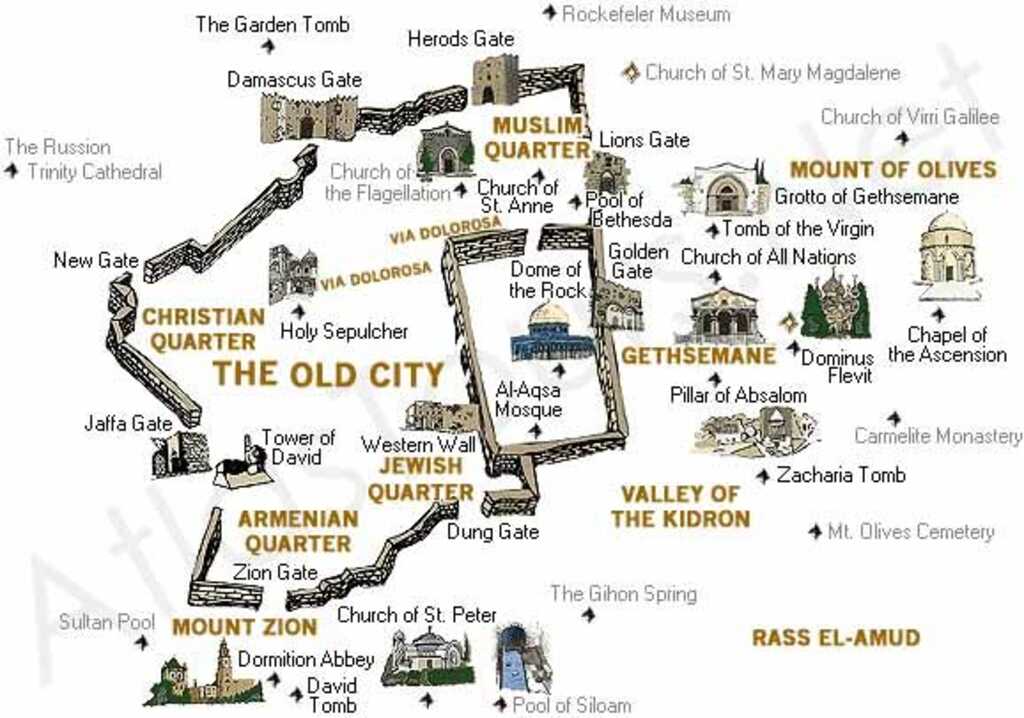
Nehemiah began his list of the “work stations” with the Sheep Gate in the northeast corner of the city (Neh. 3:1). Then he moved counterclockwise around the walls to the Gate Hammiphkad (“the Muster Gate”), which was adjacent to the Sheep Gate and just above the East Gate (v. 29). In his record, he names ten gates and several towers and other landmarks. He describes the work on the north wall first (vv. 1-7), then the western wall (vv. 8-13), then the southern point of the city (v. 14), and finally the eastern wall (vv. 15-32).
His primary purpose was to document for posterity and the official records the names and accomplishments of the people who worked on the wall. Without straining the text, however, we can glean from this chapter some spiritual illustrations to encourage us in our own personal lives and ministries.
The Sheep Gate (Neh. 3:1, 32).
(Nehemiah 3:1) “Eliashib the high priest and his fellow priests went to work and rebuilt the Sheep Gate. They dedicated it and set its doors in place, building as far as the Tower of the Hundred, which they dedicated, and as far as the Tower of Hananel.”
(Nehemiah 3:32) “and between the room above the corner and the Sheep Gate the goldsmiths and merchants made repairs.”
This was the gate through which the animals were brought into the city, including the temple sacrifices. The gate was near the temple area, so it was logical that the priests make this their special project. This is the only gate of which it is recorded that it was “sanctified,” that is, dedicated to God in a special way.
This gate reminds us of Jesus Christ, the Lamb of God who died for the sins of the world (John 1:29; 5:2). Nehemiah could have begun his record with any of the gates, but he chose to start and end the report with the Sheep Gate. Jesus is the “Alpha and Omega, the beginning and the ending” (Rev. 1:8). Apart from Him and His sacrifice, we would have nothing eternal and satisfying. Nothing is said about the gate’s “locks and bars,” for the way is never closed to the lost sinner who wants to come to the Savior.
The Fish Gate (Neh. 3:3).
(Nehemiah 3:3) “The Fish Gate was rebuilt by the sons of Hassenaah. They laid its beams and put its doors and bolts and bars in place.”
This was located to the west of the Sheep Gate, and between the two stood the Tower of Hammeah (“the hundred”) and the Tower of Hananeel (v. 1). These two towers were a part of the city’s defense system and were close to the citadel, where the soldiers guarded the temple and protected the northern approach to the city which was especially vulnerable. Merchants used this gate when they brought fish from the Mediterranean Sea, and there may have been a fish market near the gate. In any event, it was a key entrance to the city.
The Old Gate (Neh. 3:6)
(Nehemiah 3:6) “The Jeshanah Gate was repaired by Joiada son of Paseah and Meshullam son of Besodeiah. They laid its beams and put its doors and bolts and bars in place.”
This is probably the Corner Gate (2 Kings 14:13; Jer. 31:38), located at the northwest corner of the city. Some students identify this with the “Mishneh Gate”; the Hebrew word means “second quarter” or “new quarter” (Zeph. 1:10, niv). In Nehemiah’s day, the northwest section of the city was “the mishneh” or “new quarter”; and this gate led into it. What a paradox: the old gate leads into the new quarter! But it is from the old that we derive the new; and if we abandon the old, there can be nothing new (see Jer. 6:16 and Matt. 13:52).
The Valley Gate (Neh. 3:13)
(Nehemiah 3:13) “The Valley Gate was repaired by Hanun and the residents of Zanoah. They rebuilt it and put its doors and bolts and bars in place. They also repaired five hundred yards of the wall as far as the Dung Gate.”
This is where Nehemiah began his nocturnal investigation of the ruins of the city (2:13). It was located at the southwest corner of the city walls, about 500 yards from the Dung Gate; and both opened into the Valley of Hinnom. The workers here not only restored the gate, but they also repaired the section of the wall between the two gates. It is likely that this long section of the wall—over 1,700 feet—was not as severely damaged as the other sections.
Every Christian needs a “valley gate,” for God opposes the proud but gives grace to the humble (1 Peter 5:5-6). It is only as we yield to Christ and serve others that we can truly enter into the fullness of the life He has for us (Phil. 2:1-11).
The Dung Gate (Neh. 3:14)
(Nehemiah 3:14) “The Dung Gate was repaired by Malkijah son of Recab, ruler of the district of Beth Hakkerem. He rebuilt it and put its doors and bolts and bars in place.”
This was located at the southernmost tip of the city, near the Pool of Siloam. It was a main exit to the Valley of Hinnom, where the city disposed of its garbage. The word gehenna means “valley of Hinnom” and identified this area that Jesus used as a picture of hell, “where their worm dieth not, and their fire is not quenched” (Mark 9:44). King Manasseh had sacrificed children to idols in that valley (2 Chron. 33:6), and King Josiah had desecrated the place by turning it into a rubbish heap (2 Kings 23:10).
The sanitary disposal of waste materials is essential to the health of a city. This gate did not have a beautiful name, but it did perform an important service! It reminds us that, like the city, each of us individually must get rid of whatever defiles us, or it may destroy us (2 Cor. 7:1; 1 John 1:9).
The Fountain Gate (Neh. 3:15)
(Nehemiah 3:15) “The Fountain Gate was repaired by Shallun son of Col-Hozeh, ruler of the district of Mizpah. He rebuilt it, roofing it over and putting its doors and bolts and bars in place. He also repaired the wall of the Pool of Siloam, by the King’s Garden, as far as the steps going down from the City of David.”
This was on the east wall, just north of the Dung Gate, in a very strategic location near the Pool of Siloam, the old City of David and the water tunnel built by King Hezekiah (2 Kings 20:20). The Gihon Spring that fed the water system was an important source of water in the city.
In the Bible, water for drinking is a picture of the Holy Spirit of God (John 7:37-39), while water for washing is a picture of the Word of God (Eph. 5:26; John 15:3). Spiritually speaking, we have moved from the Valley Gate (humility) to the Dung Gate (cleansing) to the Fountain Gate (fullness of the Spirit).
The Water Gate (Neh. 3:26)
(Nehemiah 3:26) “and the temple servants living on the hill of Ophel made repairs up to a point opposite the Water Gate toward the east and the projecting tower.”
Led from the old City of David to the Gihon Spring, located adjacent to the Kidron Valley. Jerusalem was one of the few great cities of antiquity that was not built near a great river, and the city depended on reservoirs and springs for its water. The text does not say that this gate was repaired, but only that the workers repaired the walls adjacent to it. The “Nethinims” (“those who are given”) were probably temple servants, descendants of the Gibeonites who were made drawers of water (Josh. 9:23). They would naturally want to live near the most important source of water for the city.
If the Fountain Gate reminds us of the Spirit of God, the Water Gate reminds us of the Word of God. In fact, it was at the Water Gate that Ezra and the priests conducted a great “Bible conference” and explained the Scriptures to the people (8:1ff). That this gate is not said to have been repaired, as were the others, suggests that the Word of God stands forever and will not fail (Ps. 119:89; Matt. 24:35). The Bible does not need to be repaired or improved.
“The Ophel” (Neh. 3:26-27)
(Nehemiah 3:26-27) “and the temple servants living on the hill of Ophel made repairs up to a point opposite the Water Gate toward the east and the projecting tower. {27} Next to them, the men of Tekoa repaired another section, from the great projecting tower to the wall of Ophel.”
It was a hill south of the temple area, between the Horse Gate and the Water Gate. It was especially fortified and had a tower. The temple servants lived in that area because it was close to the water supply.
The Horse Gate (Neh. 3:28)
(Nehemiah 3:28) “Above the Horse Gate, the priests made repairs, each in front of his own house.”
It stood north of the Water Gate, adjacent to the temple area. It was here that wicked Athaliah was executed (2 Chron. 23:15). God warned His people not to trust in horses and chariots (Deut. 17:14-20), but Solomon imported them from Egypt (1 Kings 10:26-29), and they became an important part of the nation’s defense system (Isa. 2:7). The Horse Gate reminds us that there is warfare in the Christian life (2 Tim. 2:1-4) and that we must always be ready to do battle (Eph. 6:10-18). It is significant that the priests repaired this gate as well as the Sheep Gate. Both were near the temple area.
The East Gate (Neh. 3:29)
(Nehemiah 3:29) “Next to them, Zadok son of Immer made repairs opposite his house. Next to him, Shemaiah son of Shecaniah, the guard at the East Gate, made repairs.”
It led directly to the temple and is probably what we know today as the Golden Gate. Tradition says that Jesus entered the temple on Palm Sunday through this gate. In the sixteenth century, the gate was sealed up with blocks of stone by the Turkish sultan, Sulayman the Magnificent. Jewish and Christian tradition both connect the Golden Gate with the coming of the Messiah to Jerusalem, and Muslims associate it with the future judgment.
Ezekiel saw the glory of the Lord depart from the temple at the East Gate (Ezek. 10:16-22; 11:22-25), and the Lord will return to the city the same way (43:1-5). So, we have every reason to associate this gate with the coming of the Lord and to remind ourselves to “abide in Him; that, when He shall appear, we may have confidence, and not be ashamed before Him at His coming” (1 John 2:28).
The Gate Hammiphkad (Neh. 3:31)
(Nehemiah 3:31) “Next to him, Malkijah, one of the goldsmiths, made repairs as far as the house of the temple servants and the merchants, opposite the Inspection Gate, and as far as the room above the corner;”
It was located at the northeast corner of the city. The Hebrew word has a military connotation and refers to the mustering of the troops for numbering and inspection. The niv and nasb both translate it “the Inspection Gate.” This is where the army was reviewed and registered. The north side of Jerusalem was the most vulnerable to attack, so this was a logical place to locate the army. When our Lord returns, He will gather His people together and review their works in preparation for giving out rewards for faithful service (1 Cor. 3:10-15; 2 Cor. 5:9-10; Rom. 14:10-12).
In this report, Nehemiah does not mention the Gate of Ephraim (Neh. 8:16; 12:39) or the Gate of the Guard (12:39). The former may have been on the north wall, looking toward the area of Ephraim; and the latter may have been associated in some way with “The Inspection Gate.” Some translate it “The Prison Gate.” It may have been the “court of the guard” named in 3:25.
Nehemiah’s record ends with the Sheep Gate (v. 32), the place where he began (v. 1). Because they have rejected their Messiah, the people of Israel today have no sacrifice, no temple, and no priesthood (Hosea 3:4). Thank the Lord, here and there, individual Jews are trusting Christ; but the nation as a whole is blinded in unbelief (Rom. 11:25ff). When they see their Messiah, they will believe and be saved (Zech. 12:10-13:1).
No one person could have accomplished the work of repairing the walls and restoring the gates. It took leadership on Nehemiah’s part and cooperation on the part of the people. Each had a place to fill and a job to do. So it is with the church today: We must work together if we are to finish the work to the glory of God.
“Therefore, my beloved brethren, be steadfast, immovable, always abounding in the work of the Lord, knowing that your labor is not in vain in the Lord” (1 Cor. 15:58, nkjv).
Steven J. Cole, “Lesson 3: We Won! (Nehemiah 3:1–32),” in Nehemiah, Steven J. Cole Commentary Series (Dallas: Galaxie Software, 2017), Ne 3:1–32.The Book of Nehemiah
Commentary by Robert Jamieson


 Proud to be TJ's man