RSS

Author Archives: Gary Davenport

Unknown's avatar

About Gary Davenport

Christian man, husband, father, father-in-law, and granddaddy

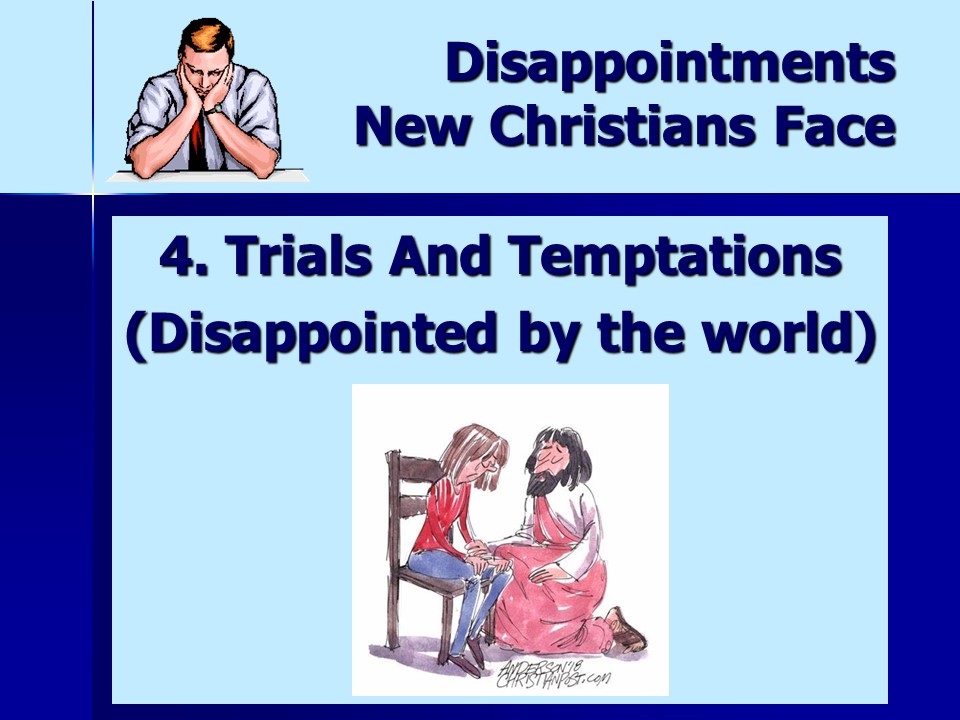
Disappointments New Christians Face: #4 Living in the World – Disappointment by the World


Worldly discouragements:

Some Christians become discouraged at the wickedness in the world. Lot’s soul was vexed by the wickedness he witnessed every day (2 Peter 2:7–8 (ESV) and if he rescued righteous Lot, greatly distressed by the sensual conduct of the wicked 8 (for as that righteous man lived among them day after day, he was tormenting his righteous soul over their lawless deeds that he saw and heard);

Some Christians become discouraged by persecution (1 Thessalonians 3:1–8 (ESV) Therefore when we could bear it no longer, we were willing to be left behind at Athens alone, 2 and we sent Timothy, our brother and God’s coworker in the gospel of Christ, to establish and exhort you in your faith, 3 that no one be moved by these afflictions. For you yourselves know that we are destined for this. 4 For when we were with you, we kept telling you beforehand that we were to suffer affliction, just as it has come to pass, and just as you know. 5 For this reason, when I could bear it no longer, I sent to learn about your faith, for fear that somehow the tempter had tempted you and our labor would be in vain. 6 But now that Timothy has come to us from you, and has brought us the good news of your faith and love and reported that you always remember us kindly and long to see us, as we long to see you— 7 for this reason, brothers, in all our distress and affliction we have been comforted about you through your faith. 8 For now we live, if you are standing fast in the Lord.

Some Christians become weary of struggling against sin (Hebrews 12:3–4 (ESV) Consider him who endured from sinners such hostility against himself, so that you may not grow weary or fainthearted. 4 In your struggle against sin you have not yet resisted to the point of shedding your blood. 4. Some Christians become discouraged by crisis. Job suffered a crisis that none of us have or likely will experience. While he did experience discouragement, he remained faithful to God

(James 5:11 (ESV) Behold, we consider those blessed who remained steadfast. You have heard of the steadfastness of Job, and you have seen the purpose of the Lord, how the Lord is compassionate and merciful.

We sing a song titled “I Have Decided To Follow Jesus” (#299), and the second verse reads, “Tho’ none go with me I still will follow, no turning back”. This is the attitude we ought to adopt.

What you can do:

  1. Be encouraged by Jesus’ prayer. Jesus warned that disciples would have trouble in the world (John 16:33), but Jesus prayed to the Father asking that He would “keep them from the evil one” (John 17:15).
  2. Be encouraged by Jesus’ example. Jesus understands the temptations and discouragements we face and can sympathize with us (Hebrews 4:14–16 (ESV) Since then we have a great high priest who has passed through the heavens, Jesus, the Son of God, let us hold fast our confession. 15 For we do not have a high priest who is unable to sympathize with our weaknesses, but one who in every respect has been tempted as we are, yet without sin. 16 Let us then with confidence draw near to the throne of grace, that we may receive mercy and find grace to help in time of need.

Jesus Himself endured all manner of sufferings because He kept in view the joy that was before Him (Hebrews 12:2).

  1. Be encouraged by God’s Sovereignty. Whatever we face, God will ensure that all things work together for our good (Romans 8:28 (ESV) And we know that for those who love God all things work together for good, for those who are called according to his purpose.

What can others do?

  1. Demonstrate what it means to “seek first the kingdom of God” (Matthew 6:33).

Does your daily life exemplify this to the people you work with? to your family and to your friends? Are you making it clear to others where your priorities lie

  1. Make it clear by your example who it is we love the most (i.e., not our jobs, hobbies, etc.) (1 John 2:15–17 (ESV) Do not love the world or the things in the world. If anyone loves the world, the love of the Father is not in him. 16 For all that is in the world—the desires of the flesh and the desires of the eyes and pride of life—is not from the Father but is from the world. 17 And the world is passing away along with its desires, but whoever does the will of God abides forever.
  2. Develop close friendships with new Christians (Acts 2:46; 4:32; Romans 12:15). Friendships centered around Christ and His work, not just social interests.

Often the new Christian is drawn away from a consistent Christian life by the cares of the world–by the job, the family, hobbies and pleasures of life. Not necessarily bad in themselves but so time consuming that they take up all free time. No time left for Christ.

Your friends will often serve to discourage you by luring you back into the things of the world, the old self-destructive patterns of life as well as harmless hobbies and pastimes that just take up too much time. We’ve got to “wise up” to these subtle temptations.

Paul warned “Do not be misled: bad company corrupts good character. Come back to your senses as you ought, and stop sinning; for there are some who are ignorant of God…” (I Cor. 15:33-34)

Pleasures and responsibilities Luke 8:14 (ESV) And as for what fell among the thorns, they are those who hear, but as they go on their way they are choked by the cares and riches and pleasures of life, and their fruit does not mature.

Discouragement by friends 1 Corinthians 15:33–34 (ESV) Do not be deceived: “Bad company ruins good morals.” 34 Wake up from your drunken stupor, as is right, and do not go on sinning. For some have no knowledge of God. I say this to your shame.

Developing relationships that are in the Lord, not just social interests. Develop close friendships with Christians IN THE LORD

Friendships centered around Christ and His work . Not just social interests.

 
Leave a comment

Posted by on July 11, 2024 in Disappointments


Things to Do in the Face of Disappointment


Living In Grace Blog: Dealing with disappointment

You didn’t get the job you wanted. Somebody you love let you down. Whatever the circumstances, it didn’t turn out how you expected, and now you’re disappointed.

You prayed about it, meditated on scriptures, sought Godly counsel, and things still didn’t work out for you. You wonder what happened to “ask and you shall receive.”

You’re left paralyzed, wondering how to pick up the pieces and make your next move.

To say it’s painful is an understatement—no matter the magnitude of the disappointment. If you don’t tend to those feelings, it can cause you to spiral into deep depression and despair.

Disappointment is a hard pill to swallow. Nobody likes it, but it’s something we will face throughout our lifetime.

If you stop and think about, the Bible is full of disappointed people—John, Moses, David, Jacob, Hannah, etc.

Even Jesus experienced disappointment on many levels during His life: when people didn’t heed the Good News, when His disciples didn’t believe, when He encountered the ritualistic mindsets of the Pharisees—to name a few. Perhaps His greatest disappointment was when God didn’t save Him from the cross.

The good thing is that those biblical characters all overcame disappointment to accomplish their goals and do great things. We all know Jesus overcame the greatest disappointment for us.

We will face disappointment again and again in our lives, but how we respond to it should change over time.

We shouldn’t go on the emotional roller coaster every time we don’t get what we want or what we expected.

It should become less about what we desire and more about what God desires for us. As Jesus prayed when He asked God to spare Him the suffering He knew He would face on the cross, “yet not my will, but yours be done” (Luke 22:42).

It’s also important to remember that God didn’t disappoint you—life’s circumstances and people disappointed you. When something bad happens in life, it’s not a time to blame God, it’s a time to run to him.

Since disappointment is something we’ll all experience, it’s important to be able to respond to it in a positive manner.

Here are three healthy ways to deal with disappointment:

MOURN, THEN RELEASE YOUR DISAPPOINTMENT TO GOD

You experienced a loss, so it’s natural to mourn. Have a period where you feel sad about the situation, then pick yourself up.

It might take time, but you must make a decision to move past the disappointment. Don’t run from it—face it and release it.

Pray about it, being honest with God about how you feel. But don’t let disappointment be a shadow over your life.

EVALUATE AND ADJUST YOUR EXPECTATIONS

There is another side to disappointment. It can be crippling, but it also can be humbling, since it is a way to examine where and in whom we place our hope.

Misplaced hope ultimately leads to disappointment. Assessing that disappointment can be a starting point in readjusting our expectations about the things we want in life.

It’s natural and normal to want things and to want to excel, but issues arise when we begin to believe our happiness is based on achieving that goal or being with that person.

What happens when you lose that job you love? Where do you turn when that person walks out of your life? You become deflated, hopeless.

Learn to place your hope solely in God. That truly is the most secure place for it to be.

GET MOVING

Don’t wallow in your disappointment. Wallowing is not productive and can actually be harmful.

Get your mind off your circuitousness and get active. Pick up a new hobby, visit friends or volunteer at an organization that inspires you. Reach beyond yourself and help somebody in need or help someone achieve their goals.

Disappointment can also be a time of renewed resourcefulness. Try something else, go in a different direction or maybe approach things a new way. If one dream dies, pick up another one and keep moving forward in life.

We will all face disappointment many times in our life. We were never promised everything we want or an easy life. We live in a broken world and that is not possible. In fact, Psalms tells us “the righteous person may have many troubles” (Psalm 34:19).

However, you can rest assured that even though you didn’t get what you wanted, God is with you and will never forsake you (Deuteronomy 31:6). In fact, He will still use that disappointing situation for your good (Romans 8:28).

 
Leave a comment

Posted by on July 8, 2024 in Disappointments


What Happened to Conscience?


What Good Is A Conscience? - Doug Husen - Business mind, Pastors Heart | Corona District 4

The early morning crash of a Brink’s armored truck on a Miami highway in January held up a mirror to our nation’s cultural decline. While the driver and a fellow Brink’s officer lay bruised and bleeding, a festive atmosphere broke loose outside the truck as thousands of dollars blew n the breeze.

Motorists stopped in rush hour traffic, then scooped up cash before resuming their commutes to the office. Thousands of crisp bills and shiny coins rained down an overpass onto a Miami neighborhood. Below, mothers with babies grabbed coins and piled them into strollers. An elderly woman filled a box. A young school girl dumped her book bag and loaded it with coins and bills.

Onlookers and participants had plenty of justifications and rationalizations.

“Which is more moral,? asked one resident of the impoverished neighborhood, ‘to return the money and leave your children improvised-or maybe send them to college and enrich the family for generations”‘

“We deserve a little something,? said another.

“The Lord was willing for it to happen here,? one man commented. ‘there’s a lot of poverty. It was a miracle.’

Police estimated that more than 100 people helped themselves to money during the melee. Middle class on their way to work made off with thousands.

Was this a shocking event? It shouldn’t have been. What happened in Miami was born out of a cultural drift that has left us unsure of absolute right and wrong or at least unwilling to live by such a code. We reward rule-breakers and ridicule those who extol morality. Life’s ultimate reward is money and having it is the end to our worries.

Maybe the Miami incident says more about character than we care to consider.

There were some heroes on that day in Miami. Several people came forward and turned money over to authorities.

“I have children, and I needed to set a good example,? said Faye McFadden, a mother who earns $5.00 an hour at a department store. “It was important for me to do what I felt was right.’

Herbert Tarvin, 11, came forward after his teacher at St. Francis Xavier Elementary School lectured students about making the right decision. He went to police with 85 cents.

“I knew it was wrong for me to keep anything,? Herbert told a television reporter, “and I knew if I kept it I would have been stealing.’

Manny Rodriguez, a firefighter who recovered a bag containing $330,000 in cash, summed things up pretty well.

“People were almost killed in that truck and people are calling it a blessing from God. That wasn’t a blessing; it was a test. The rich, the poor, the middle class-everybody should have a conscience.?

The trouble with the advice, “Follow your conscience” is that most people follow it like someone following a wheelbarrow—they direct it wherever they want it to go, and then follow behind.

Conscience tells us that we ought to do right, but it does not tell us what right is—that we are taught by God’s word.

Did you know that ever since 1811 (when someone who had defrauded the government anonymously sent $5 to Washington D.C.) the U.S. Treasury has operated a Conscience Fund? Since that time almost $3.5 million has been received from guilt-ridden citizens.

Myself

I have to live with myself, and so I want to be fit for myself to know, I want to be able, as days go by, Always to look myself straight in the eye;

I don’t want to stand, with the setting sun, And hate myself for the things I’ve done.
I don’t want to keep on the closet shelf A lot of secrets about myself, And fool myself, as I come and go, Into thinking that nobody else will know The kind of a man I really am; I don’t want to dress up myself in sham.

I want to go out with my head erect, I want to deserve all men’s respect; But here in the struggle for fame and pelf I want to be able to like myself.

I don’t want to look at myself and know That I’m bluster and bluff and empty show. I can never hide myself from me; I see what others may never see;

I know what others may never know, I never can fool myself, and so, Whatever happens, I want to be
Self-respecting and conscience free. Edgar Guest

Once we assuage our conscience by calling something a “necessary evil,” it begins to look more and more necessary and less and less evil. – Sidney J. Harris

Conscience is that faculty in me which attaches itself to the highest that I know, and tells me what the highest I know demands that I do. It is the eye of the soul which looks out either toward God or toward what it regards as the highest authority. If I am in the habit of steadily facing toward God, my conscience will always introduce God’s perfect law and indicate what I should do. The point is, will I obey? I have to make an effort to keep my conscience so sensitive that I walk without offense. I should be living in such perfect sympathy with God’s Son that in every circumstance the spirit of my mind is renewed.

The one thing that keeps the conscience sensitive to Him is the habit of being open to God on the inside. When there is any debate, quit. There is no debate possible when conscience speaks. – Oswald Chambers

What is conscience and why is it important? Conscience is the inner sense of right and wrong that guides our actions and choices. It helps us to act in accordance with our moral values and to avoid harming others or ourselves. But what are moral values and where do they come from? Morality is the system of principles and rules that governs our behavior and judgments in relation to ourselves, others, and the world. Morality can have different sources, such as nature, reason, emotion, intuition, tradition, culture, religion, or law.

Conscience is not a fixed or universal concept, but rather a dynamic and personal one that can vary depending on these sources of morality. Conscience can also change over time as we learn from our mistakes and grow as human beings. Conscience plays a vital role in our ethical decision-making and moral behavior. It helps us to evaluate the consequences of our actions and to choose the best course of action in different situations. Conscience also motivates us to act on our moral convictions and to stand up for what we believe in. Conscience can also help us to cope with guilt, remorse, or regret when we fail to live up to our moral standards or when we harm others or ourselves.

Conscience is not always easy to follow or to understand. Sometimes we may face dilemmas or conflicts between our conscience and other factors, such as social pressure, self-interest, or emotions. Sometimes we may ignore or suppress our conscience because we fear the consequences of acting on it or because we rationalize our immoral behavior. Sometimes we may have doubts or uncertainties about what our conscience is telling us or whether it is reliable or accurate.

Conscience is not a perfect or infallible guide, but rather a fallible and imperfect one that requires constant reflection and evaluation. We need to examine our conscience regularly and critically, and to seek feedback from others who can help us to clarify our moral values and judgments. We also need to educate and inform our conscience by learning from various sources of moral wisdom, such as philosophy, religion, literature, history, science, and art. We also need to respect and appreciate the diversity of conscience among different people and cultures, and to engage in dialogue and cooperation with them.

Conscience is a precious and powerful gift that makes us human and moral beings. It enables us to act with integrity, responsibility, compassion, and justice. It also challenges us to grow and improve as individuals and as members of society. Conscience is not something that we have, but something that we are.

 
Leave a comment

Posted by on July 4, 2024 in Miscellaneous


Disappointments New Christians Face: Problem #3 Too much negative teaching” (disappointed by their teachers)


The Constant Refrain

(Exodus 34:6) “And he passed in front of Moses, proclaiming, “The LORD, the LORD, the compassionate and gracious God, slow to anger, abounding in love and faithfulness…”

God is a holy God and His nature is not to be taken for granted…but His nature is clearly revealed again…He wants to save!

Relate rebellious nature of the children of Israel and see the end result:

(Numbers 14:18) “‘The LORD is slow to anger, abounding in love and forgiving sin and rebellion. Yet he does not leave the guilty unpunished; he punishes the children for the sin of the fathers to the third and fourth generation.'”

The law is read before a large group of people and, after standing for hours, they repented of their sins…and remembered God in the past and related it to their present:

(Nehemiah 9:17) “They refused to listen and failed to remember the miracles you performed among them. They became stiff-necked and in their rebellion appointed a leader in order to return to their slavery. But you are a forgiving God, gracious and compassionate, slow to anger and abounding in love. Therefore you did not desert them…”

Psalmist complains about the abuse he’s taken in life:

(Psalms 86:15) “But you, O Lord, are a compassionate and gracious God, slow to anger, abounding in love and faithfulness.”

(Psalms 103:8-14) “The LORD is compassionate and gracious, slow to anger, abounding in love. {9} He will not always accuse, nor will he harbor his anger forever; {10} he does not treat us as our sins deserve or repay us according to our iniquities. {11} For as high as the heavens are above the earth, so great is his love for those who fear him; {12} as far as the east is from the west, so far has he removed our transgressions from us. {13} As a father has compassion on his children, so the LORD has compassion on those who fear him; {14} for he knows how we are formed, he remembers that we are dust.”

This statement is like John 3:16 to the Jewish people……it is given as a constant reminder for the Israelites…..(Psalms 145:8) “The LORD is gracious and compassionate, slow to anger and rich in love.”

16 “For God so loved the world, that he gave his only Son, that whoever believes in him should not perish but have eternal life. 17 For God did not send his Son into the world to condemn the world, but in order that the world might be saved through him.

(Joel 2:13) “Rend your heart and not your garments. Return to the LORD your God, for he is gracious and compassionate, slow to anger and abounding in love, and he relents from sending calamity.”

(Jonah 4:2) “He prayed to the LORD, “O LORD, is this not what I said when I was still at home? That is why I was so quick to flee to Tarshish. I knew that you are a gracious and compassionate God, slow to anger and abounding in love, a God who relents from sending calamity.”

(Nahum 1:3) “The LORD is slow to anger and great in power; the LORD will not leave the guilty unpunished. His way is in the whirlwind and the storm, and clouds are the dust of his feet.”

We are converted to Christ, not the church’s shepherds, teachers, minister, worship leader or friends.

  • Primary focus of your life should be your relationship with God.
  • let’s overcome disappointments by seeking to think more maturely in Christ.

Certainly there is a place for learning about those in error. But there can be dangers involved in doing so…if it is done in an arrogant, self-righteous spirit. If it is done to make us feel good or superior.

Such As Constantly Exposing Denominational Errors

  • Certainly there is a place for learning about those in error
  • But there can be dangers involved in doing so…
  • If it is done in an arrogant, self-righteous spirit
  • If it is done to make us feel good or superior
  • If it is done to the exclusion of learning what WE need to do if we are not careful, it can create carnal Christians, given to strife and envy

WHEN “NEGATIVE” TEACHING IS CALLED FOR…It should be done:

  • For the purpose of trying to understand and teach those in error: 2 Timothy 4:1–2 (ESV) I charge you in the presence of God and of Christ Jesus, who is to judge the living and the dead, and by his appearing and his kingdom: 2 preach the word; be ready in season and out of season; reprove, rebuke, and exhort, with complete patience and teaching.

Acts 20:27 (ESV) for I did not shrink from declaring to you the whole counsel of God.

When “negative teaching” is called for…
1. It should be done: for the purpose of trying to understand and teach those in error…out of love.
2. It should be done as Paul did it…
a. With prayer for their souls
b. With recognition for their accomplishments Romans 10:1–3 (ESV) Brothers, my heart’s desire and prayer to God for them is that they may be saved. 2 For I bear them witness that they have a zeal for God, but not according to knowledge. 3 For, being ignorant of the righteousness of God, and seeking to establish their own, they did not submit to God’s righteousness.

It should be done with the qualities mentioned in 2 Timothy 2:24–26 (ESV) And the Lord’s servant must not be quarrelsome but kind to everyone, able to teach, patiently enduring evil, 25 correcting his opponents with gentleness. God may perhaps grant them repentance leading to a knowledge of the truth, 26 and they may come to their senses and escape from the snare of the devil, after being captured by him to do his will.

If it is done to the exclusion of learning what WE need to do.

If we are not careful, it can create carnal Christians, given to strife and envy

It should be done with the qualities mentioned in (2 Tim 2:24-26) “And the Lord’s servant must not quarrel; instead, he must be kind to everyone, able to teach, not resentful. {25} Those who oppose him he must gently instruct, in the hope that God will grant them repentance leading them to a knowledge of the truth, {26} and that they will come to their senses and escape from the trap of the devil, who has taken them captive to do his will.”
   What can we do?

  • Never get weary in doing good. Proper time God will reward. (Gal. 6:9)
  • What God wants to do through your life He will do and no one can stop it.
  • What God doesn’t want you to do, don’t try to do, you will be a failure.
  • Your First concern should be your relationship with God.

Other Reason • Sometimes God allows you to be ignored to test you or build you up in you spiritual characters. (Ex. Joseph, David, etc)

  • God may want to see what is in your heart. (Deut. 8:2)
  • People may do it intentionally but believe in God’s sovereignty

Disappointed by Lack of Opportunities. You can’t do what you want to do or what you used to do.

  • You want to do something but you have no opportunities to do
  • There are others who are already doing it and you don’t get chance.
  • You were doing something for a long time and now you are in a new place and no one is recognizing you. There are people who already do it.
  • Parents are worried and argue/fight for getting opportunities for children.
  • What can we do? • Believe in the Sovereignty of God.
  • Understand that what you are its because of God and it is God who has anointed you. (Ex. David)
  • You are a resource in the hands of God and he will use in what way He wants and not in the way you want.
  • Humble and commit yourself to God. God will use you in a way and at the time he wants. (Jam 4:10. 1 Peter 5:6)
  • Allow God to mould and build your children in His way.

Four Stages of Spiritual Growth • Christians generally go through four stages of spiritual growth…

  • The “ball of fire” stage, following their conversion to Christ
  • The “reality” stage, when the disappointments start to come in
  • The “up and down” stage…

Here, people either grow through it to the next stage… or they fall away, or become apathetic (i.e., “pew-warmers”)

Finally, those who persevere reach the stage of “steady as they go”, where growth is progressive and steady.

“But the path of the just is like the shining sun, That shines ever brighter unto the perfect day.” – Proverbs 4:18

Conclusion-Disappointments. There may be other disappointments new Christians face, but I have found these to be quite common

  • To reach that stage where we will grow steadily…
  • We need to have REALISTIC EXPECTATIONS of problems to come

The Christian life can sometimes feel like a roller coaster ride when strong hope and faith collide with an unexpected reality. When our prayers aren’t answered as we desired and our dreams become shattered, disappointment is the natural result. 

 
Leave a comment

Posted by on June 27, 2024 in Disappointments


Disappointments New Christians Face: #2 Imperfect Christians (New Christians may become disappointed in their brothers and sisters)


Think back to the time when you first came to the Lord and made your decision to become a Christian. You might have been a young child in Sunday school. It may have been when you were a teenager at church camp, or later on as an adult.

It could have been a sudden and dramatic experience where you felt the load of sin and guilt lift off of you in such a way that it was overwhelming to say the least. Or it could have been a gradual experience–steady and sure–but you realized that a transformation was taking place.

Look back to that time–then and now. Has your Christian experience been all smooth sailing? All joy? All uphill with no disappointments?

Sometimes we get our eyes too much on people and the inconsistencies we see in their lives. New Christians especially will be overwhelmed by Christians who do not “practice what they preach” and allow these people to become stumbling blocks to them.

This really hurts when you see others that you have looked up to do something that shocks you. You might say, “I just can’t believe that they did that!”

This may occur in Bible classes, meetings, anywhere & harsh words can be destructive! They see those not practicing what they preach. It hurts when it happens in whom they look up to.

Hypocrisy:

1. Peer pressure. Peter withdraws from the Gentiles and even leads Barnabas astray for fear of his Jewish brethren (Galatians 2:11-14).

2. Immorality. Some preach morality, but are themselves immoral (1 Corinthians 5:1-13; cp. Romans 2:21-23).

3. Partiality. Fussing over rich visitors and ignoring poor visitors (James 2:1-6).

Unfaithfulness:

1. Turning back. John Mark turned back and went to Jerusalem while with Paul and Barnabas on a missionary journey (Acts 13:13; cp. 15:36-41).\

2. Straying. Hymenaeus and Philetus strayed from the truth and preached false doctrine (2 Timothy 2:16-18)

3. Forsaking. Demas forsook Paul and fell away due to his love of the world (2 Timothy 4:9-10).

What can be done?

1. What God has promised: (i) He has promised to “never forsake you” (Hebrews 13:5),

(ii) despite any discouragement, He will give you the strength to carry on (Philippians 4:13),

(iii) He provides others to comfort (2 Corinthians 1:3-4) and encourage us (Romans 1:11-12) – Barnabas was an encourager (Acts 11:23).

2. What you can do: a. What you need to realize: (i) Your faith is your own. It is you that shall stand before the judgment seat of Christ (Romans 14:10), which means you strive on your own to obtain the prize; we must not allow the behavior of others to become an excuse to fall away1 (1 Corinthians 9:24). Note Paul’s attitude when all forsook him: “But the Lord stood with me” (2 Timothy 4:16-18),

(ii) You are seeking to please God (2 Corinthians 5:9), not men, and obtain His praise (Romans 2:29), and

(iii) you must “work out [cultivate, carry out to the goal, and fully complete] your own salvation with fear and trembling” (Philippians 2:12).

1. Change your focus – don’t focus on those that discourage you, focus on those that encourage you (Philippians 2:19; 1 Thessalonians 3:2; Hebrews 6:11-12),

(ii) encourage yourself in the Lord (1 Samuel 30:6),

(iii) give yourself to prayer and study (Psalms 119:25, 28; Jeremiah 15:16).

3. What others can do: (i) encourage those that are discouraged (1 Thessalonians 5:14). Timothy was sent to Thessalonica to encourage the brethren (1 Thessalonians 3:1-2),

(ii) Set yourself forth as an example of steadfastness in the face of discouragement (1 Timothy 4:12; Titus 2:6-8); encouraging them to press on (Philippians 3:12-14),

(iii) show them that others are experiencing the same discouragement (1 Peter 5:8-9)

One instance between Paul and Peter certainly tells us that this is not new. Galatians 2:11–14 (ESV) But when Cephas came to Antioch, I opposed him to his face, because he stood condemned. 12 For before certain men came from James, he was eating with the Gentiles; but when they came he drew back and separated himself, fearing the circumcision party. 13 And the rest of the Jews acted hypocritically along with him, so that even Barnabas was led astray by their hypocrisy. 14 But when I saw that their conduct was not in step with the truth of the gospel, I said to Cephas before them all, “If you, though a Jew, live like a Gentile and not like a Jew, how can you force the Gentiles to live like Jews?”

Paul and Peter got into it over some inconsistencies. It is critical in our Christian life not to pattern our lifestyle after people because there is always the chance that they may let you down and you will be disappointed.

Other times Christians are disappointed by the way that other Christians treat people. Harsh words and criticism may cut to the bone especially for new Christians. This can happen in the church, in Sunday school classes, committee meetings or anywhere. Insensitive, harsh words can cause new Christians, especially, to turn away from the faith. How do you treat other people? Are you abrasive and rude to people? How do people even know that you are a Christian?

Warnings of Paul: Galatians 5:15 (ESV) But if you bite and devour one another, watch out that you are not consumed by one another.

1 Corinthians 11:17–22 (ESV) But in the following instructions I do not commend you, because when you come together it is not for the better but for the worse. 18 For, in the first place, when you come together as a church, I hear that there are divisions among you. And I believe it in part, 19 for there must be factions among you in order that those who are genuine among you may be recognized. 20 When you come together, it is not the Lord’s supper that you eat. 21 For in eating, each one goes ahead with his own meal. One goes hungry, another gets drunk. 22 What! Do you not have houses to eat and drink in? Or do you despise the church of God and humiliate those who have nothing? What shall I say to you? Shall I commend you in this? No, I will not.

1 Corinthians 1:11–13 (ESV) For it has been reported to me by Chloe’s people that there is quarreling among you, my brothers. 12 What I mean is that each one of you says, “I follow Paul,” or “I follow Apollos,” or “I follow Cephas,” or “I follow Christ.” 13 Is Christ divided? Was Paul crucified for you? Or were you baptized in the name of Paul?

Harsh words can be devastating to those new in the faith.

Be consistent in our judgments Matthew 7:1–5 (ESV) Judge not, that you be not judged. 2 For with the judgment you pronounce you will be judged, and with the measure you use it will be measured to you. 3 Why do you see the speck that is in your brother’s eye, but do not notice the log that is in your own eye? 4 Or how can you say to your brother, ‘Let me take the speck out of your eye,’ when there is the log in your own eye? 5 You hypocrite, first take the log out of your own eye, and then you will see clearly to take the speck out of your brother’s eye.

Allow love to rule Ephesians 4:1–3 (ESV) I therefore, a prisoner for the Lord, urge you to walk in a manner worthy of the calling to which you have been called, 2 with all humility and gentleness, with patience, bearing with one another in love, 3 eager to maintain the unity of the Spirit in the bond of peace.

Jesus said in John 13:34-35, “A new commandment I give unto you that ye love one another as I have loved you–BY THIS shall all men know that ye are my disciples, if you have LOVE ONE TO ANOTHER.

You can tell people, “I love you with the love of the Lord,” but if you don’t treat them nice, it is just an empty statement and does more harm than good.

ILLUSTRATION: We had a preacher’s wife who would hug people and say, “I love you with the love of the Lord.” Then she would treat you really nasty.

I Timothy 4:12 tells us to “…set an example for the believers in speech, in life, in love, in faith and in purity.” We need to be careful to set better examples for others by the way we relate to others.

2 Timothy 1:15 (ESV) You are aware that all who are in Asia turned away from me, among whom are Phygelus and Hermogenes.

2 Timothy 4:10 (ESV) For Demas, in love with this present world, has deserted me and gone to Thessalonica. Crescens has gone to Galatia, Titus to Dalmatia.

2 Timothy 4:16 (ESV) At my first defense no one came to stand by me, but all deserted me. May it not be charged against them!

We can help by confessing wrong when it occurs. Reminding them that older Christians are also growing.

Philippians 3:12–14 (ESV) Not that I have already obtained this or am already perfect, but I press on to make it my own, because Christ Jesus has made me his own. 13 Brothers, I do not consider that I have made it my own. But one thing I do: forgetting what lies behind and straining forward to what lies ahead, 14 I press on toward the goal for the prize of the upward call of God in Christ Jesus.

Both Peter and James speak about disappointments especially that new Christians face. Although we all face disappointments as we go through our Christian journey, sometimes the disappointments seem more overwhelming for anyone new in their faith. Problems and disappointments not only overwhelm us but some even fall by the wayside and give up–some quit going to church altogether and say, “I just can’t make it. It’s no use. I just give up… Things are a mess.”

Peter and James wanted to help people understand some of the disappointments that they would face and help them to progress in their faith rather than to become a “spiritual drop out.”

1 Peter 1:6–9 (ESV) In this you rejoice, though now for a little while, if necessary, you have been grieved by various trials, 7 so that the tested genuineness of your faith—more precious than gold that perishes though it is tested by fire—may be found to result in praise and glory and honor at the revelation of Jesus Christ. 8 Though you have not seen him, you love him. Though you do not now see him, you believe in him and rejoice with joy that is inexpressible and filled with glory, 9 obtaining the outcome of your faith, the salvation of your souls.

Peter is connecting with the people when he says, “I know how you feel when you have to put up with every kind of aggravation in the meantime.” But he goes on to say, “Pure gold put in the fire comes out of it PROVED to be pure. Genuine faith put through this suffering comes out PROVED genuine” (Message Bible I Peter 1:6-9).

James 1:2–4 (ESV) Count it all joy, my brothers, when you meet trials of various kinds, 3 for you know that the testing of your faith produces steadfastness. 4 And let steadfastness have its full effect, that you may be perfect and complete, lacking in nothing.

James follows up this same idea by saying, “Count it a sheer gift when tests and challenges come at you from all sides. You know that under pressure your faith-life is forced into the open and shows its true colors. So don’t try to get out of anything prematurely. Let it do its work so you become mature and well developed–not deficient in any way” (Message Bible, James 1:2-4).

These two writers are telling us that we will face disappointments when we become a Christian, but it is not necessarily a bad thing for it only serves to test our faith and to show that it is genuine. The hassles we go through serve their purpose–to help us become strong and mature in our faith.

STORY: Justin had two goals in life. One was to have fun and the other was to do nothing. According to his Mother, he does both quite well. He headed for the school bus one fall morning and a few minutes later, he was back at the front door. His mother opened the door and saw Justin standing there. She demanded to know why he was not on the bus. He said, “I’ve quit school.” “Quit school,” she repeated in disbelief. “Why have you quit school?” Without hesitation the six-year old dropout said, “It’s too long, it’s too hard, and it’s too boring!” “Justin,” his Mother said firmly, “You have just described life! Now get back on that bus!”

Peter and James are telling us the same thing in these scriptures. Throughout this paragraph Paul maintained a balance between conscious personal responsibility for one’s own life and looking out for the needs of others. By laying aside our attitudes of superiority, we can be ready to help others.

Realize that you will not always maintain the “ball of fire” stage. There is also the “reality stage” when disappointments start to come but where growth begins to take place. Faith is tested but that is not a bad thing. There are the “up and down stages” like Peter experienced as well. But keep on going–you’ll get to the “steady as a rock stage” where growth is progressive and steady.

Proverbs 4:18 says, “But the path of the just is like the shining sun, that shines brighter unto the perfect day.”

This lesson is designed to help us understand and deal with some of the disappointments new Christians face. The way to handle disappointment doesn’t change, because the key is re-focusing on God, and He doesn’t change. He is good, and He is faithful, all the time. No matter what.

I have found two “power tools” for dealing with the pain of when our hopes and expectations are deferred or, worse, obliterated.

First, take a firm hold on the comforting truth of the sovereignty of God: a good and loving God is in control. He permits nothing to touch our lives without His express permission, with a perfect purpose. If God allows disappointment to darken our days, it is His good gift of a “something better” later.

Disappointment may be preparation for something in the future. It may be a just-right tool for producing Christlikeness—spiritual maturity—in us. It may prevent something bad we couldn’t possibly foresee.

The second power tool is God’s command to give thanks for all things (Ephesians 5:20), in all things (1 Thessalonians 5:18).

We don’t have to feel goose-bumpy, warm-and-fuzzy thankful; giving thanks is a choice of the will. When we give thanks for something God has chosen to allow into our lives, we are acknowledging He is Lord, that He is “large and in charge.”

We are acknowledging that He has the right to allow disappointment to cast its shadow on our lives, and it keeps us connected rightly to our Creator, as His creature. “Lord, I thank You for allowing this deep disappointment into my life, even though I don’t understand how You could possibly redeem it and make it okay.” That’s what trust looks like, and it pleases the Lord. It also helps us maintain an eternal perspective, that everything—everything—is part of a much bigger picture we cannot see.

 
Leave a comment

Posted by on June 24, 2024 in Disappointments


Disappointments New Christians Face: Problem #1 Same Old Weaknesses (New Christians may become disappointed with themselves)


What is the wise, biblical, God-honoring way to handle disappointment? Fortunately, we have lots of examples of people in the Bible who wrestled with disappointment:

Women carrying the pain of years and years of infertility (measured month by month)—Sarah, Rebekah, Rachel, Samson’s mother, the Shunammite woman, Elizabeth.

Joseph served for years with faithfulness and integrity inside a prison for a crime he did not commit; after correctly interpreting the dreams of fellow prisoners with access to the pharaoh, his hopes of being freed were dashed when the cupbearer forgot him.

An individual. Simon the sorcerer was converted, but was tempted to offer the apostles money for the power to impart the gift of the Spirit. Peter condemned him and he promptly repented (Acts 8:9-25).

A couple. Satan tempted Ananias and Sapphira to lie; they both yielded and were killed (Acts 5:1-11).

A church. Paul was concerned that the brethren in Thessalonica may have yielded to Satan’s temptation to fall away. But Paul had nothing to fear because they had not yielded (1 Thessalonians 3:1-5).

A great many in a city. After obeying the gospel, those in the city of Samaria rejoiced greatly (Acts 8:8).

David was anointed as future king, but the years dragged on as he was chased by a mentally ill king consumed by paranoia. The Psalmists anguished numerous times: “How long, O Lord?”

Solomon, with his wisdom super-power, wrote in Proverbs that “hope deferred makes the heart sick” (Proverbs 13:12). The distance between our hopes/expectations and reality—“hope deferred”—constitutes disappointment.

Seeing new Christians grow in the faith is a great blessing.

3 John 3–4 (ESV) For I rejoiced greatly when the brothers came and testified to your truth, as indeed you are walking in the truth. 4 I have no greater joy than to hear that my children are walking in the truth.

2 John 4 (ESV) I rejoiced greatly to find some of your children walking in the truth, just as we were commanded by the Father.

Yet, not all grow as they should…

Luke 8:13–14 (ESV) And the ones on the rock are those who, when they hear the word, receive it with joy. But these have no root; they believe for a while, and in time of testing fall away. 14 And as for what fell among the thorns, they are those who hear, but as they go on their way they are choked by the cares and riches and pleasures of life, and their fruit does not mature.

Problems and disappointments sometimes overwhelm them, and some fall away and do not beat lasting fruit.

Romans 5:1-5 “1Therefore, since we have been made right in God’s sight by faith, we have peace with God because of what Jesus Christ our Lord has done for us.

(NLT): Because of our faith, Christ has brought us into this place of undeserved privilege where we now stand, and we confidently and joyfully look forward to sharing God’s glory.  

We can rejoice, too, when we run into problems and trials, for we know that they help us develop endurance.

And endurance develops strength of character, and character strengthens our confident hope of salvation.

And this hope will not lead to disappointment. For we know how dearly God loves us, because he has given us the Holy Spirit to fill our hearts with his love.”

Christians face lot of disappointments which are Internal many times.

  • Many People don’t come up open regarding it and hence go with it.
  • If it is not addressed from a biblical point of view then it can create problems like self condemnation, self pity etc.
  • People can be deceived by devil by not allowing them to overcome it or understand what is God’s will or way out of it.
  • Some people burst out and try to solve it but many keep silent and carry it and ultimately one day it bursts itself. Sometimes its too late!

Sometimes you may hear the statement, “Come to Jesus and all of your problems will be solved.” When people find they are still facing the same weaknesses as before, they wonder, “What is wrong with me?”

Have you ever felt this way? Why am I still having a struggle with temptations? Why don’t I FEEL joyful all the time? Why do I still have the same addictions? Why does my temper still flare up at the drop of a hat? Why do I still have financial problems? I thought Jesus would “FIX” all of this for me.

Many people become Christians excited about the forgiveness of sins, the chance to start over, excited about the help God is going to give them to change.

But many times the changes that will take place happen gradually rather than instantaneously–in the ongoing growing process. So people begin to feel disappointed in themselves and think there is nothing to Christianity.

ILLUSTRATION: A teenager at Juvenile Detention said, “I prayed once and nothing happened so I’m not going to pray anymore.”

Some of us have unrealistic expectations for ourselves. We live in an instant society where computers are not fast enough, food preparation takes too long, and we impatiently honk our hors if the red light doesn’t change fast enough.

We think our Christian growth should take place instantly but this is not realistic. When we come to Christ He DOES forgive us of our sins the minute we ask, but that is THE BEGINNING of our transformation toward maturity. Our faith is tested and tried over time to see if it is genuine–to see if it can stand the fire of the refining process.

Temptations and tests may be just as strong or stronger for Christians and especially for new Christians who may expect too much too soon.

Do not be disappointed in yourself if you seem to stumble over and over again. Peter, who wrote these words for believers, was a Christian who was always getting his foot in his mouth, blurting out something inappropriate, disappointed in himself. But he didn’t give up–he became a ROCK–a steadfast person of faith.

They were excited about forgiveness…excited about starting over…excited about God’s help to change.

Then they discover: some temptations are still strong and others are stronger! This can be discouraging.

How can we help? Teach them that “transformation” is a process.

Remind them of God’s ONGOING…willingness to forgive and strengthen.

HOW CAN WE HELP?

By teaching them that “transformation” is an on-going process:

(Rom 12:1-2) “I urge you therefore, brethren, by the mercies of God, to present your bodies a living and holy sacrifice, acceptable to God, which is your spiritual service of worship. {2} And do not be conformed to this world, but be transformed by the renewing of your mind, that you may prove what the will of God is, that which is good and acceptable and perfect.”

By reminding them of God’s willingness to forgive and provide strength

(Phil 2:12-13) “Therefore, my dear friends, as you have always obeyed–not only in my presence, but now much more in my absence–continue to work out your salvation with fear and trembling, {13} for it is God who works in you to will and to act according to his good purpose.”

(1 John 1:9) “If we confess our sins, he is faithful and just and will forgive us our sins and purify us from all unrighteousness.”

(1 John 2:1) “My dear children, I write this to you so that you will not sin. But if anybody does sin, we have one who speaks to the Father in our defense–Jesus Christ, the Righteous One.”

Philippians 2:12–13 (ESV) Therefore, my beloved, as you have always obeyed, so now, not only as in my presence but much more in my absence, work out your own salvation with fear and trembling, 13 for it is God who works in you, both to will and to work for his good pleasure.

This Ought to Concern Us…Older Christians have a responsibility to those who are young in the faith.

Romans 15:1–3 (ESV) We who are strong have an obligation to bear with the failings of the weak, and not to please ourselves. 2 Let each of us please his neighbor for his good, to build him up. 3 For Christ did not please himself, but as it is written, “The reproaches of those who reproached you fell on me.”

What God has done:

He has provided spiritual armor that we might protect ourselves from the onslaughts of Satan (Ephesians 6:10-18)

He has promised to provide a way out of every temptation and will not allow us to be tempted above that which we can bear (1 Corinthians 10:13; James 4:7)

He has provided an advocate with the Father to make intercession for us (1 John 2:1-2).

What we can you do:

Make sure you are maintaining your relationship with God through prayer – you speaking to God (Luke 22:40; 1 Thessalonians 5:17) and study – God speaking to you (1 Peter 2:1-3; Colossians 3:16; Galatians 5:16).

A failure to maintain your relationship with God will inevitably mean you will fail in all areas of your lives

Guard your heart (Proverbs 4:23): keep your mind focused on things above (Colossians 3:2), set no wicked thing before your eyes (Psalms 101:3), and keep yourself separate from the world (1 John 2:15-17)

make no provision for the flesh (Romans 13:14).

 
Leave a comment

Posted by on June 20, 2024 in Disappointments


What to Do As You Wait – 2 Peter 3:14-16


31 Bible verses about Working Hard And Not Being Lazy

“Therefore, beloved, since you look for these things, be diligent to be found by Him in peace, spotless and blameless, and regard the patience of our Lord to be salvation; just as also our beloved brother Paul, according to the wisdom given him, wrote to you, as also in all his letters, speaking in them of these things, in which are some things hard to understand, which the untaught and unstable distort, as they do also the rest of the Scriptures, to their own destruction” (3:14-16).

Imagine the case of a man who has been cast upon a dreary inhospitable, deserted island. He knows the “mayday” message was heard, the coordinates of his location  were  understood, and that soon a vessel will come and bear him away.

He paces its barren and deserted sands, looks at the overcast sky, and anxiously awaits the arrival of the rescue ship which will carry him to a land of light and life.

Such is much like the Christian saint. He is an exile far from his home. His sentiments are correctly stated in the emotionally charged statements of Paul, “For indeed in this house we groan, longing to be clothed with our dwelling from heaven; . . . indeed while we are in this tent, we groan, being burdened, . . .” (2 Corinthians 5:2, 4).

Peter expressed this sentiment when he exhorted his readers to be “looking for and hastening the coming of the day of God” (3:12).

The believer knows that the rescue vessel is prepared and the convoy is ready which will bear him away from a barren wilderness to a happy land flowing with milk and honey. But the rescue seems so far away! It seems we are stuck waiting to be rescued.

The anxiety of waiting is well known. Each of us  has  yearned  for  some  important  event  to arrive, and the waiting has seemed endless. Each passing day adds to the anxiety of the delay. Delays are irritating and depressing.

The gloomy periods of waiting spawned the Army’s ridiculous motto, “Hurry up and wait!”

Peter’s present words are written to brethren who, like us, were stuck waiting for the second coming. They were impatient and restless.

The thought that the second coming would never take place had pricked the minds of several (3:4). Peter turns to this delay and deals with it so his brethren could accept the delay and act properly during it.

The Bible is quite frank in stating that a delay would exist between the ascension of Christ and His second coming. Even with the large number of Bible texts advising us about the delay, it is still easy to join with those in Peter’s time and ask, “Why is the delay so long?”

The gracious Father in heaven never wants His children to be left in a quandary of faith.

He provided the readers of Peter’s second letter an answer to this nagging question. The delay is now in progress; we are stuck waiting. Peter reveals what we should do while we are stuck waiting in 2 Peter 3:14-16.

REMEMBER TO . . . DO YOUR UTMOST TO BE PREPARED (3:14)

Peter’s words stress preparation in two broad areas. Preparation with God. First, there must be preparation with God—“peace” (3:14). Although some see this peace being applied to all relationships shared in the church (to God, self, and others), the context seems to limit it only to one’s relationship with God.

Those who await the second coming of Christ must be sure they have made proper peace with God.   A peaceful relationship with God results only when one has been justified through Christ’s sacrifice.  It is impossible for one to have peace with God until this process has been completed. In 1:2-4, Peter referred to this reconciliation and peace with God.

He remarked that believers had become partakers of the divine nature “having escaped the corruption that is in the world.”

When we realize that we are terminal people living  on  a  terminal  earth  (3:10),  we  should quickly sue for peace with God. How do you stand in regard to having secured “peace” with the Almighty God?

Preparation for Life

Second, there must be preparation in life—“spotless and blameless” (3:14). The words found here are the exact opposite of those found in 2:13 describing the people wedded to the ungodliness of this world: “They are stains and blemishes.”

To help you understand the interesting use found here, consider the words in the original Greek. “Spot” is translated from the word  spiloi,  while “spotless” comes from the Greek word aspilos. The word “blemish” is from momoi, while “blameless” is derived from amometos.

Peter urges believers to live  exactly  opposite  from  those  in  the  world. Believers are to be free from the vices which stain and blot the soul (cf. Revelation 3:4). Basically, this point addresses the morality of daily living. Believers are to make sure they live as their Lord did.

Christ lived each day “unblemished and spotless” (1 Peter 1:19). When believers discipline their lives, they will live in the same way and be prepared for the Lord’s return (1 John 3:3).

This encouragement is timely for God’s children today. How easy it is to become engrossed in this world and forget about the world that is to come!

Peter tries to warn us about being blinded by the anxieties and cares of this world. He urges us to “be diligent.” The term literally means to strive earnestly, zealously for an objective.

One of the newer translations renders this phrase as “make every effort.” We must have enthusiasm as we wait for the Lord to return. A halfhearted response will never do.

This response of Peter to the anxious cries of his brethren who longed for the second coming needs to be understood today. Use this time to prepare yourself for the Lord’s return.

Prepare first, by establishing a peaceful relationship between yourself and God. Prepare, second, by living a life of moral uprightness. Prepare by being diligent.

As one old saint faced the end of his days, he reflected on these timely words of Peter. His remarks are impressive: “There is nothing more certain than death; nothing more uncertain than the time of dying. I will, therefore, be prepared for that at all times, which may come at any time, and must come at one time or another. I shall not hasten my death by being ready, but sweeten it. It makes me not die the sooner, but the better.”

While you are stuck waiting for Christ to come back, use every minute to make sure you are ready.

REMEMBER TO . . . KEEP YOUR MIND FOCUSED ON THE PURPOSE OF DELAY (3:15a)

Peter asks his readers to remember a point that he has already forcefully made. The delay in Christ’s return exists so that all who so desire may be saved (cf. 3:9). You could paraphrase the point like this, “And remember why He is waiting. He is giving us time to get His message of salvation to others.” Instead of viewing the de- lay as a broken promise by God, we are urged to see it as evidence of His great patience to provide all men with peace.

The godless may scoff at the delay because they fail to understand its benevolent purpose. They fail to realize that during the delay God is holding the door of salvation open as long as possible. But when the Bridegroom comes for His bride, the door of hope will be slammed shut never to be reopened. All who wait until the last minute to be saved will face the same catastrophe as the foolish virgins. They returned after buying additional oil for their lamps only to find “the door was shut” and their pleas for the door to be reopened fell upon deaf ears (cf. Matthew 25:1-13).

Christians have a pressing duty to realize that they are bound by the delay in Christ’s return to reach others by teaching them the gospel. During the delay, it is wrong for God’s saints to imagine that they have no duty or obligation to the lost. Christ spoke of His mission: “My meat is to do the will of Him that sent me, and to accomplish His work.” His mission was to come to earth to save lost men (John 3:16). But He urged the same mission upon His disciples: Do you not say, “There are yet four months, and then comes the harvest”? Behold, I say to you, lift up your eyes, and look on the fields, that they are white for harvest.  Already he who reaps is receiving wages, and is gathering fruit for life eternal; . . . (John 4:35, 36).

Since the Lord is delaying His return so lost souls can be saved, do you see your personal duty to help seek and save lost souls? The time is short. We must act quickly in seizing opportunities to fulfill our obligations.

The following story illustrates the plight of present-day evangelistic zeal in the church. When a little boy was lost in the woods, an alarm was sounded. The whole community responded: Fishermen abandoned their boats, merchants closed and left their shops, farmers forsook their plows and fields, and housewives left their washing and ironing. Everyone turned out to hunt for the little fellow. Feverish haste was evident because during the night harm might come to him.

With their tireless searching, the frightened child was found. As a result of the rescue, joy was felt by all. Today that little boy is grown. He is lost again, but no one seems to care. His mom and dad are too busy making a living.

The church is too busy and seems not to care. No alarm is sounded. Yet a far worse fate looms ahead for him now—he is lost in sin and no one seems to care enough to do anything about it. Be diligent in using the delay to save the souls of those who are lost.

REMEMBER TO . . . HANDLE THE SCRIPTURES IN THE RIGHT WAY (3:15b, 16)

The delay in Christ’s return has been adequately explained (cf. 3:8-13). Even with that clear explanation, some will refuse to accept it.

The emphasis in this point is upon doctrinal steadfastness. We must be sure to handle rightly God’s Word (cf. 2 Timothy 2:15). Peter says that some unethical teachers “distort” the Scriptures. This term refers to the action of a windless wrench, an instrument of torture, or the “rack.”

Peter uses it here to portray the distortion, straining, and twisting that false teachers use on truth. They will twist and torture the truth so that it appears to uphold their error. Those who participate in such acts will face destruction (3:16b).

God expects us to act with responsibility when we interpret His Book. We must be consistent with all other biblical texts. We must not change fundamental doctrines.

During the in-between stage while we are waiting for Christ’s return, God has given us the Bible to guide us. Let us be honest in its doctrine and truthful in its application to our lives. To do otherwise brings a grim harvest on the judgment day! How deadly delay can be when it comes to obeying God’s commands to be saved. Do not wait! When you to do until He comes?”

These pressing questions are clearly answered by Peter. We are indeed stuck  waiting  for  Jesus  Christ  to  return.  But being stuck does not mean we should be doing nothing. Peter tells us, “Be diligent!

Two Approaches to the Bible (2 Peter 3:14, 16)

  1. The Right Approach. “Be diligent” (3:14). This leads to peace, spotlessness, and blamelessness


  1. 2. The Wrong “Distort” the Scriptures to suit our prejudices (3:16). This leads to destruction

CONCLUSION

The Lord has delayed His return so our delay in rendering obedience to His will may cease. Peter’s thoughts could not be stated in clearer terms. Procrastination on our part will only lead to tragedy. Let us be careful and not hesitate or prolong our delay in obeying His command understand this point.

 
Leave a comment

Posted by on June 17, 2024 in 2 Peter


Scripture (Truth) Twisters – 2 Peter 3:14-18


Peter believes the Scriptures play a vital role in the life of the Christian (see 1 Peter 1:22–2:3; 2:8; 3:1; 2 Peter 1:3-4, 12-21; 2:21; 3:1-7, 14-18). And he does not cease challenging us to turn our attention to the Scriptures.

Even while Peter points us to the Word, he warns that some will seek to turn us from the truths of the Scriptures by perverting the teaching of Scripture. He does not look for prophets to arise, apparently because prophets are no longer necessary. After all, God has spoken fully and finally in Christ (Hebrews 1:1-3; 2:1-4).

But he does warn us false teachers will arise. They may not claim to reveal new truth from God on the level of Scripture, but they will seek to distort the Scriptures, twisting them to teach something vastly different from the intended meaning of the Bible.

In these closing verses of his second epistle, Peter draws our attention one final time to the Scriptures and the crucial role they play in our lives. He wants us to know that Paul’s letters are part of the inspired Word of God and that Paul is not one of the false teachers, although some distort his words to mean something far from what he intended.

If Paul is blamed for teaching error, Peter wants his readers to know Paul is not the one at fault. Paul’s teaching is in agreement with the revelation God gave through the Old Testament prophets, with the teaching of our Lord, and with the writings of the other apostles.

We sometimes hear someone say, “Your interpretation of Scripture is but one of many interpretations.” If we want to convince someone our interpretation of the Scriptures is correct, they might respond that the Bible is capable of meaning whatever one wants it to mean. This, of course, could be said of any writing.

We must not wrongly conclude that men’s failure to interpret Scripture accurately proves God did not clearly reveal Himself and His message to men in the Bible. Neither is it true that the meaning of Scripture is so obscure it is virtually impossible to discern. There is one correct interpretation of Scripture, and the rest is often the result of Scripture twisting, whether intentional or not.

Our purpose in this concluding lesson of 2 Peter is to note the characteristics of Scripture twisters so we may be alert to their presence among us. Further, we will identify the most common ways men twist the meaning of Scripture to help us avoid those errors in our study and interpretation of the Bible. In this way, we will be able to sharpen our interpretive skills and “accurately handle the word of truth” (2 Timothy 2:15).

What We Should Know About Scripture Twisters

(1) We should expect Scripture twisters to arise within the church. We can expect to arise from within the church those who will twist the meaning of Scriptures as they interpret, apply, and teach the Bible.

(2) We should also know the most likely areas for error to be introduced. Peter informs us that Scripture twisters deny a coming day of judgment (3:1-4), even though their judgment is sure (2:1, 3, 9, 12, 17). It would seem from 2 Peter 2:1 that Scripture twisters twist the Scriptures concerning the person and the work of Jesus Christ in that they “deny the Master who bought them.” In addition, Scripture twisters undermine the Biblical teaching on holy living (2 Peter 2:2; contrast 3:11, 14). I have seem it happen most often when a group of ‘church leaders’ decide to take a weekend away to study again what scripture teaches about a given subject…and you can usually predict that they will come to a ‘new understanding’ related to the use of instruments, women, and even whether they should serve communion on Saturday night ‘because it might encourage more participation of the young people.”

(3) Those who twist Scripture will twist any or all of the Bible, but they will often base their teachings on an obscure or problematic text. Peter acknowledges that some of Paul’s writings are “difficult to understand” (verse 16). These seem to be the starting point for the truth twisters. They begin with a problematic passage, developing their unorthodox doctrines, and then turn to the clear, emphatic texts, denying what they dogmatically teach.

(4) Those who twist Scripture are described by Peter as “untaught and unstable.” The two terms are introduced by a common article. This seems to indicate these two terms are to be viewed as interrelated.

(5) Scripture twisters have ulterior motives which are far from pure. The teachings of the Scripture twisters is self-serving and often rooted in greed and the desire for monetary gain (Titus 1:11; Jude 11, 16; contrast Acts 20:33; 1 Thessalonians 2:5-6; 1 Timothy 3:3; 6:3-5). For some, their twisted teaching is rooted in the ambition to have a personal following (Acts 20:30). They exploit their victims out of greed (2:3) and not out of a genuine love and concern (see 2 Peter 1:12-15; 1 Thessalonians 2:3-12).

(6) The appeal of Scripture twisters is in providing a pretext for self-indulgence and sin for their followers, as well as themselves. They entice those who are immature and vulnerable…scripture twisters assure men Christians can indulge the flesh (Jude 4) with no consequences.

(7) Those who twist Scripture do so to their own destruction It is little wonder that Scripture twisters deny the second coming of our Lord and the judgment to come. After all, His coming is a day of judgment for them. But Peter’s teaching is clear. Those who distort the truth of God’s Word do so to their own destruction (3:16; see also 2:1, 3, 9-13, 20-22; 3:7).

Sharpening our Sensitivity to Scripture Twisters

Peter’s words are written so Christians will be on their guard, alert to those who twist the Scriptures. He expects the saints not only can, but should, be able to discern those who pervert God’s Word.

Every Christian should be able to recognize those about whom Peter warns us.

We must be like the Bereans, always putting the teaching of others (even those whom we respect) to the test. Does the teaching we receive square with the truths of God’s Word (see Acts 17:11)? Bible teaching must never be a substitute for our own personal study of the Word of God; it is an enhancement to our own study. Good teaching should only encourage and facilitate the personal study of God’s Word, never discourage it.

Second, the best preventative for false teaching by others is to actively pursue godliness and personal spiritual growth. Those who do not know God personally through faith in Jesus Christ are not able to comprehend the truths of God’s Word. Those who know God, and who desire to do His will, will be enabled to understand divine truth.

Levels of Error

Not all errors are alike. Some errors are more dangerous and even more culpable than others. Some errors stem from ignorance. We simply do not know the Scriptures well enough. It may be that we speculate where we should simply acknowledge our ignorance (see Deuteronomy 29:29) and study the Word to determine the truth.

Some errors are errors of personal opinion or belief. For example, Christians may differ over the interpretation of a particular passage, especially a problematic passage. Everyone cannot be right. Perhaps no one is right. So long as we identify our interpretation as our opinion, I do not think we are in trouble. But when we teach our opinion as absolute truth, we are venturing into dangerous waters.

We need to distinguish between our convictions, which we should not impose on others, and the teaching of God’s principles and commands which all are to accept and practice. Paul is very careful to indicate to his readers those matters which are his personal conviction and those which are not.

I believe we should distinguish between those errors we sincerely hold as personal opinion or conviction and those we teach and advocate to others as God’s truth. Once we take on the role of teacher, we assume responsibility not only for ourselves, but for others, which is an awesome thing.

No wonder James admonishes us that not many should become teachers (James 4:1). Those things we teach others as the command of Christ become matters of great importance, and if we err on this level, we err seriously, to our own shipwreck and that of any who follow us in our error.

We should also beware of teaching in such a way us to set aside or undermine what God has given to His people as a clear command. We are told by our Lord to teach believers all that He has commanded us (Matthew 28:18-20), so let us see that the commands of Christ are the curriculum of discipleship. To fail to teach these, or to teach them in error, is very serious business.

Ways We Twist Scripture

(1) We err greatly in our interpretation and application of God’s Word when we subordinate the revelation of God’s truth to our own reason. When God’s command is clear, it does not matter nearly so much that we understand why the command is given as that we obey it. Too many Christians refuse to believe or obey Scripture until it makes sense to them. Some think Christians should understand the “full depth of injury” that others have brought upon them before they forgive them.

Adam and Eve did not understand why God forbade them to eat of the tree of the knowledge of good and evil. They did not need to know this. In fact, eating of the tree is what would give them this knowledge. All they needed to know was that God had given this command and then to obey it.

More faith is required to obey God when we don’t understand why than to obey when the reasons are glaring us in the face.

(2) We are on very dangerous ground when we seek to “integrate” God’s truth, as revealed in Scripture, with “man’s truth,” as currently understood and taught from outside the Scriptures. “All truth is God’s truth,” we are told. That statement has a dangerous tendency, as currently applied. It tends to put all “truth” on the same level. It suggests that what is currently believed to be “true” through science, for example, is just as surely true as the truths of the Bible. It suggests that such scientific truth is just as certainly true as biblical truth. It suggests that secular “truth,” as currently understood, is just as important and as necessary to apply as God’s truth.

I do not believe this to be true. Only God’s truth—the truth God has revealed in His Word—is true truth, that which we can be assured is truth. Scientific truths continue to change. Biblical truth never changes.

How sad to see Christians rushing back to the Scriptures to reinterpret them because modern science has apparently exposed some new truth which challenges God’s truth as taught in his Word. How sad to hear Christians who are alleged experts in some secular field proclaim these “truths” on the same level as the truth of God’s Word.

The Bible is the only revelation of truth which is inspired, inerrant, and infallible. The Bible reveals every truth essential for life and godliness. It is not God’s truth (as revealed in Scripture), plus other “truth,” which we need to live godly lives; it is God’s truth alone.

Any truth not found in God’s truth is subordinate to God’s truth, and it is secondary to God’s truth, if indeed it is true at all. No wonder Christians are reading so many books beside (and often in place of) the Bible. They think they will find truth which is more necessary and important there. They are wrong. If any book is of great value to the Christian, it will be one which turns our attention and allegiance back to the Book.

(3) We twist the Scriptures when we “strain gnats and swallow camels.” This error was practiced by the scribes and Pharisees. They made much of the little details of the Scriptures, but they missed the main point. They put much emphasis on the specific commands of the Law but failed to grasp the major principles like justice and mercy, matters about which the prophets spoke.

And so it was that in the Sermon on the Mount Jesus interpreted the Law in such a way as to get to the heart of the Law. The Law not only prohibits murder, it requires us to deal with hatred by granting or seeking forgiveness.

The Law not only prohibits immorality, it teaches us to deal with impure thoughts as sin. This is the reason David loved the Law of God and meditated upon it (see Psalm 119).

The Law teaches us the principles of life and reveals to us the character and the heart of God. When we spiritualize the Scriptures, causing them to teach what they do not, we are beginning to twist the Scriptures.

(4) We twist the Scriptures when we take them farther than they were intended to be interpreted or applied. The Judaizers of Paul’s day took the command to be circumcised and imposed it upon the Gentiles, insisting they must do so to be saved (cf. Acts 15:1-2).

(5) We twist the Scriptures when we accommodate our own culture in the interpretation and application of God’s Word. In its most blatant form, we find the Scriptures to be in error or invalid when our cultural values differ from what they teach. And so it is that some have set aside Paul’s teaching on the role women are to play in the church.

Now, many ordain women as ministers and as overseers. We look down upon Paul for being a chauvinist. And in matters which are sensitive, we either play down or remain silent if the Scriptures collide with culture.

And so the sin of homosexuality is no longer called sin and condemned as such. To do so would require that we exercise discipline on those who practice what God condemns.

In order to have large, “successful,” happy churches, we do not hold to the same standards of marriage and divorce our Lord did. To do so would be to alienate and offend some and reduce church roles and budgets.

(6) We twist the Scriptures when we fail to hold seemingly contradictory truths in tension. We like to have our truth in neat little packages, all nicely labeled and easy to keep separated. And so we, like the Pharisees of old, want truth to be one way or the other, but not both:

16 And they sent their disciples to Him, along with the Herodians, saying, “Teacher, we know that You are truthful and teach the way of God in truth, and defer to no one; for You are not partial to any. 17 Tell us therefore, what do You think? Is it lawful to give a poll-tax to Caesar, or not?” (Matthew 22:16-17).

They wanted Jesus to tell them they should pay their taxes or they should not. They were trying to press Jesus into saying men should either obey Caesar or obey God. Either way, they could get Jesus in trouble. Jesus told them they should submit to God and to Caesar. They couldn’t have it all one way.

Truths must be held in tension. God is sovereign. Nothing happens that is not a part of His sovereign decree. Yet we have been commanded to do certain things. We are humanly responsible for our decisions and actions. These two truths, the sovereignty of God and the responsibility of man, are both true and must be held in tension. Those who would seek to hold one truth and deny the other will distort the Scriptures.

(7) We twist the Scriptures by the misappropriation of truth. Grace is now distorted to sanctify sin. Grace is our excuse for sin, rather than an escape from sin. Sovereignty is an excuse for inactivity and passivity, etc. The Scriptures are twisted to excuse sin rather than expose and eradicate it.

(9) We twist the Scriptures when we selectively deny biblical teachings or commands. Sometimes this is a bold, outright denial of the truth of God’s Word. We do it by setting certain Scriptures aside, not by denying their truth, but by denying their application to us. Some set aside Paul’s teachings (not to mention Peter’s) on the conduct of women by telling us these teachings were for a different time and a different culture.

In His Great Commission, Jesus instructed the church to make disciples by “teaching them to observe all that I have commanded you” (Matthew 28:20). How many of our Lord’s commandments, as recorded in the Gospels, are taken seriously today, by evangelical, conservative Christians? By you?

Conclusion

Peter knows he is soon to die. Knowing this, he is intent on calling his readers to continually remember and apply the truths of God’s Word. How much nearer we are to the day of our Lord’s return. And how many are those who seek to twist the Scriptures to their destruction and, if possible, ours. Let us be men and women of the Word.

We are individually responsible to discern error and to respond to it biblically.

As the last days approach, let us fix our hope on the Lord Jesus Christ. Let us seek to live holy lives, so that we practice and proclaim the excellencies of God before a godless world. May we be men and women of the Word, encouraged in our study of the Bible by faithful teachers and turning from those who are false.

 
Leave a comment

Posted by on June 13, 2024 in 2 Peter


The Day of the Lord: Hope for Growing Christians – 2 Peter 3:1-10


2 Peter 3 #1 'The Day Of The Lord Will Come' - YouTube

3:1 Dear friends, this is now my second letter to you. I have written both of them as reminders to stimulate you to wholesome thinking.  In this passage we see clearly displayed the principles of preaching which Peter observed.

(1) He believed in the value of repetition. He knows that it is necessary for a thing to be said over and over again if it is to penetrate the mind.

(2) He believed in the need for reminder. Again and again the New Testament makes it clear that preaching and teaching are so often not the introducing of new truth but the reminding of a man of what he already knows.

(3) He believed in the value of a compliment. The Greek word literally means “sun-judged.” A piece of pottery was “sun-judged” when it was held up to the sunlight in order to see any flaws or cracks. The thinking and intentions of God’s people must be able to stand up under scrutiny and not be led astray by immoral desires (Philippians 4:8–9). It is his intention to rouse their pure mind. By using this phrase Peter appeals to his people as having minds uncontaminated by heresy. It is as if he said to them: “You really are fine people—if you would only remember it.”

WHOLESOME MINDS

If Peter were writing today, what concepts and ideas would he warn us against? He would warn us against beliefs that

•      the difference between right and wrong is all a matter of personal choice. You ought to feel good about your beliefs and not offend anyone else’s choices.

•      religion provides value only if it helps a person adjust to life and get a sense of self-worth. Religion that worries people is spooky and medieval.

•      the worst sin is being intolerant of someone else’s ideas. After all, who are you to judge another person’s preferences?

In contrast, Christians today believe that God is real, that God has spoken, that he is in control, and that all people should believe in him. Let God’s Word determine your thinking. He, not the world around us, sets our standards.

3:2 That you should remember the words spoken in the past by the holy prophets, and the commandment of the Lord and Savior spoken through your apostles. (4) He believed in the unity of Scripture. As he saw it there was a pattern in Scripture; and the Bible was a book centered in Christ. The Old Testament foretells Christ; the gospels tell of Jesus the Christ; and the apostles bring the message of that Christ to men.

Because God’s Word is true, we must pay attention to it and take its message seriously. New converts must be taught the Word and established in the doctrines of the faith, for new Christians are the false teacher’s primary targets. But older Christians must also be reminded of the importance of Bible doctrine and, in particular, the doctrines that relate to the return of Christ. Prophetic teaching must not lull us to sleep. Rather, it must awaken us to live godly lives and to seek to win the lost.

3:3 First of all you must understand this, that in the last days scoffers will come, scoffing and indulging their own lusts. The “last days” began with Christ’s resurrection and will continue until his return.

The more the false teachers scoff, the more the Christians should be settled in their faith, knowing that this was only further assurance of Christ’s second coming.


SCOFFERS AND INQUIRERS

In some churches, it’s considered discourteous to question anything. If you raise a question, you’re challenging authority and acting like a scoffer. Ironically, that kind of church is a scoffer’s dream-come-true. Where questions are not allowed, false teachers flourish like maggots in a garbage can.

To inquire is a good thing. Inquirers raise honest, heartfelt questions; scoffers avoid real questions in favor of arguments that diminish God’s stature and ignore God’s Word. Inquirers want to know God better; scoffers want to hear themselves talk.

While guarding against scoffers, healthy churches encourage inquirers. A church should never be a place where your mind closes down. Are you a scoffer or an inquirer?

3:4 And saying, “Where is the promise of his coming? For ever since our ancestors died, all things continue as they were from the beginning of creation!”  What is their argument? The uniformity of the world. “Nothing cataclysmic has happened in the past,” they argue, “so there is no reason to believe it will happen in the future.” They take the “scientific approach” by examining evidence, applying reason, and drawing a conclusion. The fact that they willfully ignore a good deal of evidence does not seem to disturb them.

The scientific approach works admirably in matters that relate to the material universe, but you cannot take Bible prophecy into a laboratory and treat it as though it were another hypothesis.

For that matter, the so-called “laws of science” are really only educated conclusions based on a limited number of experiments and tests. These laws are generalizations, always subject to change, because no scientist can perform an infinite number of experiments to prove his claim. Nor can he completely control all the factors involved in the experiments and in his own thinking.

3:5–6  They deliberately ignore this fact, that by the word of God heavens existed long ago and an earth was formed out of water and by means of water. What these scoffers were forgetting in their argument (that the world had remained unchanged since creation) was that God had created the world. The Creation disproves their “all things continue” argument because the creation of the earth was an imposed change on the formless void (Genesis 1:1–2). The very reason the world was continuing on in a stable, predictable pattern was because God, in his grace, had created it that way.

By the word of God the heavens were created (Genesis 1:6–8). By the word of God, an earth was formed out of water and by means of water (referring to the waters being gathered to allow the dry land to appear, Genesis 1:9–10).

However, this stability should not be taken for granted. The false teachers deliberately chose to ignore the fact that God had been involved in the world. For the waters that had parted in order to allow the dry land to appear had returned and covered the entire world—this was God’s judgment.

Peter continued:  By these waters also the world of that time was deluged and destroyed.  As the creation was an act of God, so was the Flood. World refers to God’s judgment and destruction of the inhabitants of the world, not the world itself.

3:7 But by the same word the present heavens and earth have been reserved for fire, being kept until the day of judgment and destruction of the godless.  By God’s word, the heavens and the earth were created (3:5); by his word, the earth’s inhabitants were destroyed in judgment (3:6); by the same word God will bring future judgment and destruction. God had intervened before; he will intervene again.

But instead of destruction by water, Peter wrote that the heavens and earth have been reserved for fire. In Noah’s day the earth was judged by water; at the Second Coming it will be judged by fire.

Peter’s point was that destruction would come and the godless (those who have not believed) will not escape.

3:8 But, beloved, do not forget this one thing, that with the Lord one day is as a thousand years, and a thousand years as one day.  Not only were they ignorant of what God had done in the past (2 Peter 3:5), but they were also ignorant of what God was like. When you study the works of God, especially in the Old Testament, you can see that He is never in a hurry, but He is never late.

He could have created the entire universe in an instant, yet He preferred to do it over a period of six days. He could have delivered Israel from Egypt in a moment, yet He preferred to invest eighty years in training Moses. For that matter, He could have sent the Savior much sooner, but He waited until “the fullness of the time was come” (Gal. 4:4). While God works in time, He is not limited by time.

To God, a thousand years is as one day, and one day as a thousand years. God can accomplish in one day what it would take others a millennium to accomplish! He waits to work, but once He begins to work, He gets things done!

The question still remained, “Why was the Lord delaying so long?”  Peter offered two reasons in 3:8–9. First of all, the Lord does not count time as people do. He is above and outside of the sphere of time. God sees all of eternity past and eternity future.


ANY DAY NOW

To Christians wondering about God’s delayed return, Peter offers a three-part challenge.

1.    When has God ever failed to keep a promise? Never, and God will not fail now.

2.    When has God ever fulfilled a promise in quite the exact way all of us smart people think he should? Never. So don’t get too smart now.

3.    What could God possibly be waiting for? Well, look around at needy souls, lost without a Savior, ignorant of God’s promise. If you don’t have a tear in your eye, you’ve missed the point of God’s patience. Stop wondering; start spreading the word. Don’t let any human reasoning deter you from your hope and your duty.

3:9  The Lord is not slack concerning His promise, as some count slackness, but is longsuffering toward us, not willing that any should perish but that all should come to repentance.

The second reason for the Lord’s delay concerning His promise (the promise of his return) was not slackness. God was not tardy or late. Unlike people, God does not forget his promises, nor is he late in following through on them. Instead, the Lord is delaying his return because he is longsuffering and compassionate. He wants as many people as will to come to faith in him.

The Christian has three bold reasons for believing in His return: (1) He was once here (John 1:1-17; 1 John 1:1-3); (2) He has promised to return (John 14:1-3; Acts 1:10, 11; Revelation 22:12); (3) Jerusalem was destroyed (A.D. 70) and overridden by the Gentiles as Jesus prophesied would take place prior to His return (Matthew 24; Mark 13; Luke 21). What Jesus foretold concerning Jerusalem has come to pass and cannot be denied.

Love is the reason that he delays the destruction of the world. God desires all people to be saved. He is not indifferent. God gave people free will. Some will exercise their free will and reject God, but this is not God’s desire.

God is loving, but he also executes perfect justice. His perfect love causes him to be merciful to those who recognize their sin and turn back to him, but he cannot ignore those who willfully sin.

God’s “delay” is actually an indication that He has a plan for this world and that He is working His plan. There should be no question in anybody’s mind whether God wants sinners to be saved.

1 Timothy 2:4 affirms that God “will have all men to be saved, and to come unto the knowledge of the truth.” These verses give both the negative and the positive, and together they assure us that God has no pleasure in the death of the wicked (Ezek. 18:23, 32; 33:11). He shows His mercy to all (Rom. 11:32) even though not all will be saved.

 3:10   But the day of the Lord will come as a thief in the night.  The day of the Lord is the day of Christ’s return and of God’s judgment on the earth. Peter explained that no matter how long it might take, the Day of the Lord will come, and it will come unexpectedly. We should live each day as though Christ could return at any moment. Christians must be morally clean and spiritually alert.

The Day of the Lord will be a time of judgment and destruction, for  the heavens will disappear with a roar; the elements will be destroyed by fire, and the earth and everything in it will be laid bare.

 
Leave a comment

Posted by on June 10, 2024 in 2 Peter


Why Doesn’t God Give Up On Me? – 2 Peter 3:9-10


2 Peter 3:9 — Verse of the Day for 05/10/4009

This is an extremely skeptical world. We live in extremely skeptical times. We are suspicious of everything. We tend to think that everything is guided by ulterior motives. We tend to believe that true openness and genuine honesty do not exist.

Our skepticism profoundly impacts the way we look at God. We do not place as much emphasis on what God said as on what God did not say. We are devoted to determining what God actually wants. We often attempt to determine God’s true desires by “reading between the lines.”

I sincerely doubt that any of us are capable of imagining the enormous frustration that we inflict on God.

Have you ever considered how easily God could have “given up” on humanity? Have you ever considered how easily God could have decided that one of the worst mistakes He ever made was creating humans with a free will?

If God were human, He would have cut His losses a long time ago. To me the greatest evidences that God is not human are seen in His patience, His forgiveness, and His mercy.

No human, not even the best of the best, can endure as much abuse, misrepresentation, and neglect as does God, and remain patient, forgiving, and merciful.

Important for us to relate more and more with the nature of God…important that we come to know Him as He really is. We begin with a strange text:

Abraham’s Bargain (Genesis 18:16-33). When God’s intentions regarding Sodom and Gomorrah becomes clear, Abraham is concerned because he has family down there. He begins bartering with God…think of his audacity….50…45…40…30…20 …10.

This is the very nature of God! He longs to save! The primary character of this text is not Abraham but God.

The Constant Refrain

(Exodus 34:6) “And he passed in front of Moses, proclaiming, “The LORD, the LORD, the compassionate and gracious God, slow to anger, abounding in love and faithfulness…”

God is a holy God and His nature is not to be taken for granted…but His nature is clearly revealed again…He wants to save!

Relate rebellious nature of the children of Israel and see the end result:

(Numbers 14:18) “‘The LORD is slow to anger, abounding in love and forgiving sin and rebellion. Yet he does not leave the guilty unpunished; he punishes the children for the sin of the fathers to the third and fourth generation.'”

The law is read before a large group of people and, after standing for hours, they repented of their sins…and remembered God in the past and related it to their present:

(Nehemiah 9:17) “They refused to listen and failed to remember the miracles you performed among them. They became stiff-necked and in their rebellion appointed a leader in order to return to their slavery. But you are a forgiving God, gracious and compassionate, slow to anger and abounding in love. Therefore you did not desert them…”

Psalmist complains about the abuse he’s taken in life:

(Psalms 86:15) “But you, O Lord, are a compassionate and gracious God, slow to anger, abounding in love and faithfulness.”

(Psalms 103:8-14) “The LORD is compassionate and gracious, slow to anger, abounding in love. {9} He will not always accuse, nor will he harbor his anger forever; {10} he does not treat us as our sins deserve or repay us according to our iniquities. {11} For as high as the heavens are above the earth, so great is his love for those who fear him; {12} as far as the east is from the west, so far has he removed our transgressions from us. {13} As a father has compassion on his children, so the LORD has compassion on those who fear him; {14} for he knows how we are formed, he remembers that we are dust.”

This statement is like John 3:16 to the Jewish people……it is given as a constant reminder for the Israelites…..(Psalms 145:8) “The LORD is gracious and compassionate, slow to anger and rich in love.”

(Joel 2:13) “Rend your heart and not your garments. Return to the LORD your God, for he is gracious and compassionate, slow to anger and abounding in love, and he relents from sending calamity.”

(Jonah 4:2) “He prayed to the LORD, “O LORD, is this not what I said when I was still at home? That is why I was so quick to flee to Tarshish. I knew that you are a gracious and compassionate God, slow to anger and abounding in love, a God who relents from sending calamity.”

(Nahum 1:3) “The LORD is slow to anger and great in power; the LORD will not leave the guilty unpunished. His way is in the whirlwind and the storm, and clouds are the dust of his feet.”

What Patience Is/Is Not

Patience is “slow to anger” and “steadfastness.”

Patience is not: apathy or tolerance. God is holy and He will reckon eventually with the unholiness of man and his willful decisions…of his ignoring the teachings of God. “Whatever” will not be tolerated by God when all is made right on His timetable.

Patience With a Purpose

God’s patience is for the purpose of giving an opportunity to repent. (Romans 2:4) “Or do you show contempt for the riches of his kindness, tolerance and patience, not realizing that God’s kindness leads you toward repentance?”

(2 Peter 3:9-10) “The Lord is not slow in keeping his promise, as some understand slowness. He is patient with you, not wanting anyone to perish, but everyone to come to repentance. {10} But the day of the Lord will come like a thief. The heavens will disappear with a roar; the elements will be destroyed by fire, and the earth and everything in it will be laid bare.”

Why has Christ not yet returned to earth? Because God loves man; He does not want any person to perish, not a single person. God is not slack in fulfilling His promise nor is He powerless to return and judge the earth. He has not returned for one reason and one reason only. He wants more and more people to come to repentance.

Very simply, God is slow to give in and to judge and condemn us. God loves and cares for us despite our sin and rebellion, cursing and rejection. This is the very reason He sent Christ to save us. He loves and cares for us; therefore, He is suffering a long time with us.

God wants no person to perish. To perish is a terrible thing. It means to be utterly lost and destroyed. It means to lose eternal life and to be cut off from life forever and ever.

It means to be spiritually destitute, completely empty of all good. It means to suffer the judgment, condemnation, and punishment of separation from God forever and ever. It means to be in a state of suffering forever and ever apart from God.

The point is this: God does not want us perishing; He does not want us cut off and separated from Him. God wants us to spend eternity with Him not apart from Him.

There are in this passage three great truths on which to nourish the mind and rest the heart.

Time is not the same to God as it is to man.  As the Psalmist had it:  “A thousand years in thy sight are but as yesterday when it is past, or as a watch in the night” (Psalm 90:4).

When we think of the world’s hundreds of thousands of years of existence, it is easy to feel dwarfed into insignificance; when we think of the slowness of human progress, it is easy to become discouraged into pessimism.

There is comfort in the thought of a God who has all eternity to work in.  It is only against the background of eternity that things appear in their true proportions and assume their real value.

We can also see from this passage that time is always to be regarded as an opportunity.  As Peter saw it, the years God gave the world were a further opportunity for men to repent and turn to him.  Every day which comes to us is a gift of mercy.  It is an opportunity to develop ourselves; to render some service to our fellow-men; to take one step nearer to God.

Finally, there is another echo of a truth which so often lies in the background of New Testament thought.  God, says Peter, does not wish any to perish.

Ever and again there shines in Scripture the glint of the larger hope.  We are not forbidden to believe that somehow and some time the God who loves the world will bring the whole world to himself.

A Word Straight to You and Me. God hasn’t and will never give up on you and me! It’s easy for us to think God acts toward us the way we act toward each other. We’ve all had people “give up on us” as a result of some disagreement or event. One of the great tragedies is when family “gives up on us.” The message today: God doesn’t give up on us.

Patience. God is often more patient with us than we are with ourselves. We assume that if we fall, we aren’t born again. If we stumble, then we aren’t truly converted. If we have the old desires, then we must not be a new creation.

If you are anxious about this, please remember, “God began doing a good work in you, and I am sure he will continue it until it is finished when Jesus Christ comes again” (Phil. 1:6 ).[1]

Closing comments

God’s people are to be patient. The psalmist learned to be patient when confronted with the prosperity of the wicked:

Psalm 37:1–3 (ESV) Fret not yourself because of evildoers; be not envious of wrongdoers! 2 For they will soon fade like the grass and wither like the green herb. 3 Trust in the Lord, and do good; dwell in the land and befriend faithfulness.

Psalm 37:9–13 (ESV) For the evildoers shall be cut off, but those who wait for the Lord shall inherit the land. 10 In just a little while, the wicked will be no more; though you look carefully at his place, he will not be there. 11 But the meek shall inherit the land and delight themselves in abundant peace. 12 The wicked plots against the righteous and gnashes his teeth at him, 13 but the Lord laughs at the wicked, for he sees that his day is coming.

Psalm 37:34–38 (ESV) Wait for the Lord and keep his way, and he will exalt you to inherit the land; you will look on when the wicked are cut off. 35 I have seen a wicked, ruthless man, spreading himself like a green laurel tree. 36 But he passed away, and behold, he was no more; though I sought him, he could not be found. 37 Mark the blameless and behold the upright, for there is a future for the man of peace. 38 But transgressors shall be altogether destroyed; the future of the wicked shall be cut off.

Patience is a fruit of the Spirit (Gal. 5:22). Christian love is patient (1 Cor. 13:4, 7).  Christians need patient endurance in the face of persecution. Perseverance is part of maturity (Jas. 1:2-4). Job’s perseverance is another example for suffering Christians (Jas. 5:11).

[1] Lucado, M., & Gibbs, T. A. 2001, 1996. God’s inspirational promises . J. Countryman: Nashville, TN

 
Leave a comment

Posted by on June 6, 2024 in 2 Peter