RSS

Author Archives: Gary Davenport

Unknown's avatar

About Gary Davenport

Christian man, husband, father, father-in-law, and granddaddy

Scoffers, Judgment and Mercy – 2 Peter 2:4-9


The Bible was right. Like it or not... | CreateDebate

We Americans do not handle delays very well. Our culture simply does not like to wait. Yet we wait less today than men have ever waited.

We travel at high speed waiting less to arrive at a distant place. Communica­tions which formerly took months now are completed in seconds. Meals which used to take hours to cook are now done in minutes in microwave ovens.

People used to have to wait until they had cash to purchase a new car or home. Now these things are bought on credit. We do not have to wait. Fewer and fewer people are willing to wait until marriage to enjoy the pleasures of sex. We Americans are not accustomed to waiting.

Men do not enjoy waiting for anything, or anyone, including God. But the trust is men have been waiting on God all through history.

Noah waited a good 100 years or so for the flood to come upon the earth (compare Genesis 5:32; 6:10; 7:6).

Abraham and Sarah waited 25 years for the birth of the son God had promised them (compare Genesis 12:4; 21:5).

Abraham did not even possess the promised land in his lifetime, and it was more than 400 years until his descendants took possession of it (compare Genesis 12:1-3; 15:12-16).

From their constant questions about the coming of our Lord’s kingdom, it was evident the disciples were not excited about waiting either.

When Jesus tarried three days before going to the place Lazarus had fallen sick and died, both Martha and Mary cautiously chided Jesus for coming too late (see John 11:21, 32).

God’s promises never come too late; in truth, they are never “late” at all. When the Scriptures indicate a time for God’s actions, the fulfillment is always precisely on time (see Exodus 12:40-41).

When Jeremiah prophesied that Judah would be expelled from the land and held captive in Babylon for 70 years (Jeremiah 25:11-12), the fulfillment of this prophecy would take place precisely at the end of 70 years. Knowing this, Daniel prayed accordingly (Daniel 9:1-3ff.).

Likewise, the birth of the Lord Jesus came about exactly on schedule (Galatians 4:4-5).

But there are mockers who seek to convince themselves and others that the promise of our Lord’s second coming is false based upon the passage of much time and compounded by no visible evidences that He will come at all.

A woman who worked for the Internal Revenue Service at times had to communicate with delinquent taxpayers.

On one occasion she called Anchorage and was patched through to a ham operator in the Aleutian Islands. Two hours later the ham operator raised the taxpayer’s home base and from there reached him at sea with his fishing fleet.

After the woman identified herself as being with the IRS in Utah, there was a long pause. Then over the static from somewhere in the North Pacific came: “Ha! Ha! Come and get me!” (In Reader’s Digest, “Life in These United States,” 10/82)

A lot of people scoff at God and the warning of His coming judgment like that fisherman scoffed at the IRS. They somehow think that either it will never happen because it hasn’t happened yet or that if it ever does happen, they’ll be okay.

And while few are so bold as openly to scoff at God and the judgment, many do so practically by living as if they will never stand before Him to give an account. The idea of facing Him in judgment is so far from their minds that it never affects how they live.

Mockers believe they have given God plenty of time to fulfill His promise to return and thus have now concluded that His time is up. “If He hasn’t come by now,” they say, “He simply isn’t coming.”

Another prevalent response: I read of a minister who was talking with a colleague about the destruction of Sodom and Gomorrah. The colleague said, “Well, if that’s the way God really is, then I’m not going to believe in Him!”

That is strange logic! Not believing in God doesn’t make Him go away. Yet I’ve often heard people dismiss God’s judgment by saying, “I believe in a God of love. He would never judge anyone, except maybe the worst of the worst of sinners.”

Or, some will say, “I don’t believe in the Old Testament God of judgment. I believe in Jesus, who never condemned anyone.”

Really? Jesus spoke more often and more graphically about hell than anyone else in the Bible. He used the story of Sodom’s destruction to warn about the final judgment when He returns (Luke 17:29-32).

The entire Bible, from Genesis to Revelation, reveals a God who will bring judgment on sinners, but who shows mercy to those who repent of their sins and trust in Him.

In our text, Peter wants his readers to know that although God’s judgment may be delayed, it is absolutely certain.

He uses three historical examples of judgment and two examples of God’s rescuing the righteous from judgment both to warn and to encourage.

The warning is, God will righteously judge all the ungodly. None will escape. The encouragement is, God will rescue the godly from judgment. Therefore, we should have the courage to stand firm in following God in an ungodly world.

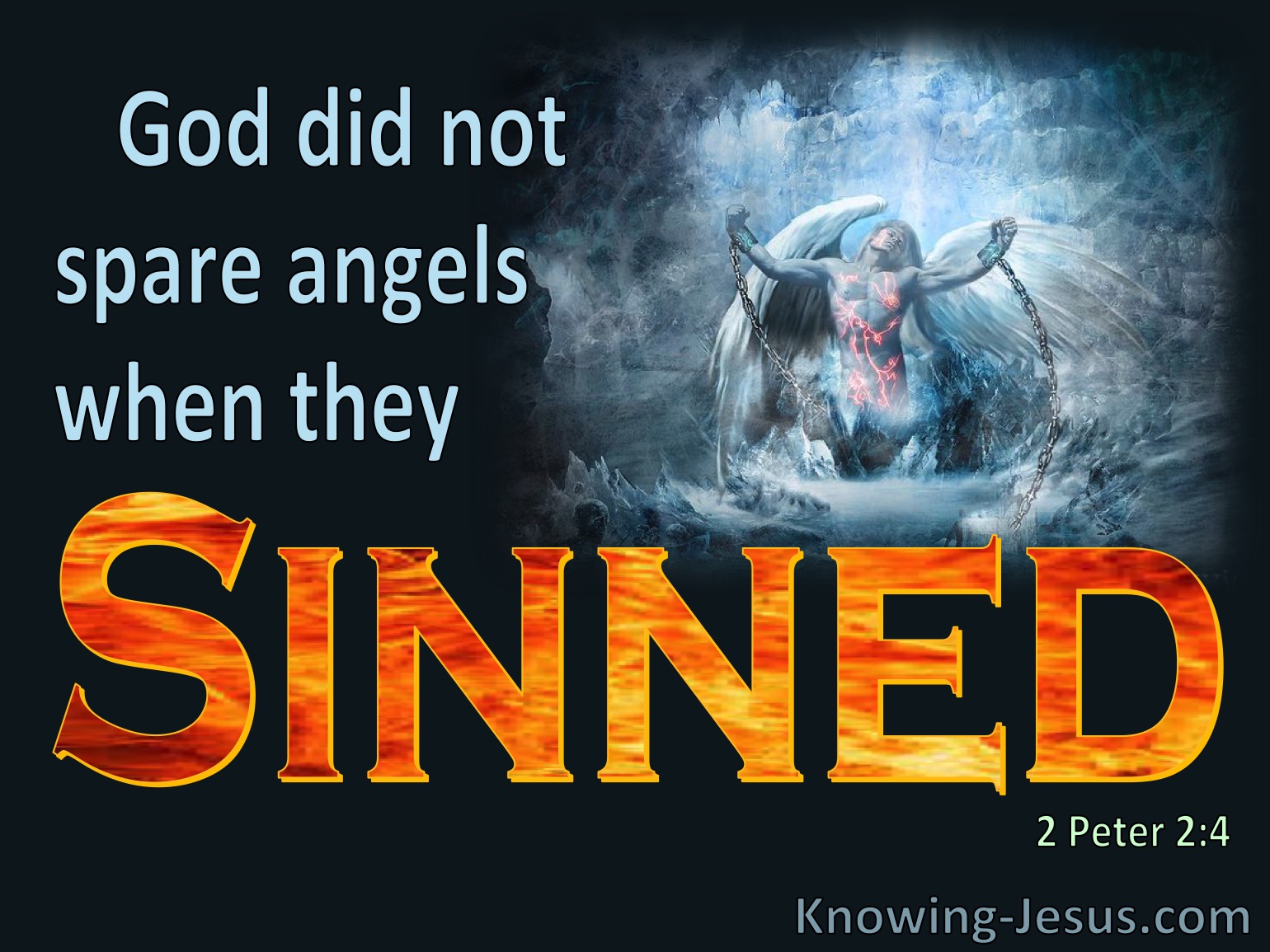
The fallen angels (2:4). For if God did not spare the angels when they sinned, but cast them into hell and committed them to chains of deepest darkness to be kept until the judgment.

We wish we knew more about the creation of the angels and the fall of Lucifer and his host, but most of these details are shrouded in mystery.

Many Bible students believe that Isaiah 14:12-15 describes the fall of Lucifer, the highest of the angels. Some students feel that Ezekiel 28:11-19 also deals with the same topic.

Revelation 12:4 suggests that perhaps one third of the angels fell with Lucifer, who became Satan, the adversary of God.

If God did not even spare his angels, neither will he spare the false teachers. Judgment will come. The angels who sinned were cast … into hell. That phrase in Greek is one word (used only here in the New Testament), literally meaning “to cast into Tartarus.”

In Greek mythology, Tartarus, located in the lowest part of the underworld, was the place of punishment of rebellious gods and the departed spirits of very evil people.

These angels were imprisoned in this hell, committed … to chains of deepest darkness.

It is not necessary to debate the hidden mysteries of this verse in order to get the main message: God judges rebellion and will not spare those who reject His will.

If God judged the angels, who in many respects are higher than men, then certainly He will judge rebellious men.

The old world (2:5). If he did not spare the ancient world when he brought the flood on its ungodly people, but protected Noah, a preacher of righteousness, and seven others. I think that with the flood we often get so hung up on the geologic issues or questions of how Noah could get all those animals on the ark that we miss the main point, namely, that the flood was a horrific judgment on the entire earth.

Everyone and everything that were not on the ark perished! The Bible uses the flood story as a warning to everyone since that time that a far worse future judgment is coming, when all the ungodly who are not “on board” Jesus Christ will perish eternally.

Yet even as God was destroying all the sinful people in Noah’s day, he powerfully protected those who followed him, eight people in all: Noah and seven of his relatives (his wife, three sons, and their wives, Genesis 8:16).

Genesis 6:3 indicates that God waited 120 years before He sent the Flood. All during that time, Noah ministered as a “herald” of God’s righteousness.

Nobody believed Noah’s message! Jesus made it clear that people were enjoying their normal lives up to the very day that Noah and his family entered the ark! (Luke 17:26-27).

No doubt there were plenty of “experts” who laughed at Noah and assured the people that a rainstorm was out of the question. Had anybody ever seen one? The apostates in Peter’s day used that same argument to “prove” that the Day of the Lord would not come (2 Peter 3:3ff).

God’s punishment is not arbitrary. Those who deserve punishment will receive his punishment; those who trust in him will receive his grace.

Peter’s readers should understand the comparison—those who choose the wrong path face eternal consequences.

If you want to read a description of the world before the Flood, read Romans 1:18ff.

CHOICES – The choices sound simple—follow God or rebellious humanity— but there was nothing simple about Noah’s decision.

  • His faith in God gave him the reputation of an outcast, a fool. No one wants to feel that way today. We rely too readily on the approval of others.
  • Noah invested all he had in God’s promise. He placed his entire family fortune, everything he had, inside that ark. Today, we rely on diversified portfolios to protect against uncertain markets. We don’t trust our financial security to God alone.
  • Noah’s witness was entirely rejected. He convinced no one. As a preacher, he would have been regarded as a total failure.

If the choice between God and the world seems simple and clear, perhaps you have not counted the real cost.

When you compare our world with Noah’s world, you see some frightening parallels. The population was multiplying (Gen. 6:1), and the world was filled with wickedness (Gen. 6:5) and violence (Gen. 6:11, 13).

Lawlessness abounded. True believers were a minority, and nobody paid any attention to them! But the Flood came and the entire population of the world was destroyed. God does indeed judge those who reject His truth. The choices sound simple—follow God or rebellious humanity— but there was nothing simple about Noah’s decision.

Sodom and Gomorrah (2:6). If he condemned the cities of Sodom and Gomorrah by burning them to ashes, and made them an example of what is going to happen to the ungodly.

Genesis 18–19 describes the sinfulness of these cities and Abraham’s effort to keep them from being destroyed.

When not even ten righteous people could be found in the cities, God destroyed the cities by burning them to ashes: “The Lord rained on Sodom and Gomorrah sulfur and fire from the Lord out of heaven; and he overthrew those cities, and all the Plain” (Genesis 19:24–25).

After the conflagration, “Abraham … looked down toward Sodom and Gomorrah and toward all the land of the Plain and saw the smoke of the land going up like the smoke of a furnace” (Genesis 19:27–28).

Lot’s future sons-in-law thought that he was joking when he warned them to flee the impending judgment.

These actions today are being condoned/praised rather than seen for what they represent. In what sense were their filthy deeds “unlawful”?

They were contrary to nature (see Rom. 1:24-27). The flagrant sin of Sodom and the other cities was unnatural sex, sodomy, or homosexual behavior, a sin that is clearly condemned in Scripture.

Or do you not know that the unrighteous will not inherit the kingdom of God? Do not be deceived: neither the sexually immoral, nor idolaters, nor adulterers, nor men who practice homosexuality, 10 nor thieves, nor the greedy, nor drunkards, nor revilers, nor swindlers will inherit the kingdom of God. 11 And such were some of you. But you were washed, you were sanctified, you were justified in the name of the Lord Jesus Christ and by the Spirit of our God.

In spite of Abraham’s intercessory prayer (Gen. 18:22ff) and Lot’s last-minute warning, the people of Sodom perished in fire and brimstone.

Peter states that God made the people of Sodom “an example to those who would live ungodly lives thereafter.”

In other words, the judgment on Sodom and Gomorrah was not a one-time oddity. It is in Scripture as a warning of the judgment to come.

2:9 Then the Lord knows how to rescue the godly from trial, and to keep the unrighteous under punishment until the day of judgment.

God has reserved the unjust for special punishment on that day of judgment. The false teachers may seem successful (for “many” follow them), but in the end, they will be condemned.

What a contrast between the false teachers and the true children of God! We have an inheritance reserved for us (1 Peter 1:4) because Jesus Christ is preparing a home for us in heaven (John 14:1-6).

Some people would have us believe that God will save all people because he is so loving. But it is foolish to think that God will cancel the last judgment. Don’t ever minimize the certainty of God’s judgment on those who rebel against him.

We have a lot of emphasis on tolerance of others and the self-help benefits of the Bible, but we must not dilute God’s clear words of warning. To turn away from God is to turn to ruin.

Conclusion. I read recently of a brochure that a funeral home printed and displayed on the day of a burial: “For God so loved the world that He gave His only begotten Son, so that whoever believes in Him shall have eternal life.” But they left out some crucial words: “shall not perish but have eternal life”!

Jesus didn’t come and die on the cross just to give us warm, fuzzy feelings about God’s love.

He offered Himself to pay the penalty for sin that we deserved to rescue us from the wrath to come (1 Thess. 1:10).

The preservation of Noah and the rescue of Lot give us the hope that if we trust in Christ and turn from our sins, and are immersed in water in order to have our sins forgiven, God will mercifully spare us from the judgment to come.

 
Leave a comment

Posted by on June 3, 2024 in 2 Peter


Scoffers, Judgment and Mercy – 2 Peter 2:4-10


What Does 2 Peter 2:4 Mean?We Americans do not handle delays very well. Our culture simply does not like to wait. Yet we wait less today than men have ever waited.

We travel at high speed waiting less to arrive at a distant place. Communica­tions which formerly took months now are completed in seconds. Meals which used to take hours to cook are now done in minutes in microwave ovens.

People used to have to wait until they had cash to purchase a new car or home. Now these things are bought on credit. We do not have to wait. Fewer and fewer people are willing to wait until marriage to enjoy the pleasures of sex. We Americans are not accustomed to waiting.

Men do not enjoy waiting for anything, or anyone, including God. But the trust is men have been waiting on God all through history.

Noah waited a good 100 years or so for the flood to come upon the earth (compare Genesis 5:32; 6:10; 7:6).

Abraham and Sarah waited 25 years for the birth of the son God had promised them (compare Genesis 12:4; 21:5).

Abraham did not even possess the promised land in his lifetime, and it was more than 400 years until his descendants took possession of it (compare Genesis 12:1-3; 15:12-16).

From their constant questions about the coming of our Lord’s kingdom, it was evident the disciples were not excited about waiting either.

When Jesus tarried three days before going to the place Lazarus had fallen sick and died, both Martha and Mary cautiously chided Jesus for coming too late (see John 11:21, 32).

God’s promises never come too late; in truth, they are never “late” at all. When the Scriptures indicate a time for God’s actions, the fulfillment is always precisely on time (see Exodus 12:40-41).

When Jeremiah prophesied that Judah would be expelled from the land and held captive in Babylon for 70 years (Jeremiah 25:11-12), the fulfillment of this prophecy would take place precisely at the end of 70 years. Knowing this, Daniel prayed accordingly (Daniel 9:1-3ff.).

Likewise, the birth of the Lord Jesus came about exactly on schedule (Galatians 4:4-5).

God is never “late;” He is always “on time.”

But there are mockers who seek to convince themselves and others that the promise of our Lord’s second coming is false based upon the passage of much time and compounded by no visible evidences that He will come at all.

A woman who worked for the Internal Revenue Service at times had to communicate with delinquent taxpayers. On one occasion she called Anchorage and was patched through to a ham operator in the Aleutian Islands. Two hours later the ham operator raised the taxpayer’s home base and from there reached him at sea with his fishing fleet.

After the woman identified herself as being with the IRS in Utah, there was a long pause. Then over the static from somewhere in the North Pacific came: “Ha! Ha! Come and get me!” (In Reader’s Digest, “Life in These United States,” 10/82)

A lot of people scoff at God and the warning of His coming judgment like that fisherman scoffed at the IRS. They somehow think that either it will never happen because it hasn’t happened yet or that if it ever does happen, they’ll be okay.

And while few are so bold as openly to scoff at God and the judgment, many do so practically by living as if they will never stand before Him to give an account. The idea of facing Him in judgment is so far from their minds that it never affects how they live.

Mockers believe they have given God plenty of time to fulfill His promise to return and thus have now concluded that His time is up. “If He hasn’t come by now,” they say, “He simply isn’t coming.”

Another prevalent response: I read of a minister who was talking with a colleague about the destruction of Sodom and Gomorrah. The colleague said, “Well, if that’s the way God really is, then I’m not going to believe in Him!”

That is strange logic! Not believing in God doesn’t make Him go away. Yet I’ve often heard people dismiss God’s judgment by saying, “I believe in a God of love. He would never judge anyone, except maybe the worst of the worst of sinners.”

Or, some will say, “I don’t believe in the Old Testament God of judgment. I believe in Jesus, who never condemned anyone.”

Really? Jesus spoke more often and more graphically about hell than anyone else in the Bible. He used the story of Sodom’s destruction to warn about the final judgment when He returns (Luke 17:29-32).

The entire Bible, from Genesis to Revelation, reveals a God who will bring judgment on sinners, but who shows mercy to those who repent of their sins and trust in Him.

Peter saw no hope for these apostates/false teachers; their doom was sealed. His attitude was different from that of “tolerant” religious people today who say, “Well, they may not agree with us, but there are many roads to heaven.”

Peter made it clear that these false teachers had “forsaken the right way” (2 Peter 2:15), which simply means they were going the wrong way!

In our text, Peter wants his readers to know that although God’s judgment may be delayed, it is absolutely certain. He uses three historical examples of judgment and two examples of God’s rescuing the righteous from judgment both to warn and to encourage. The warning is, God will righteously judge all the ungodly. None will escape. The encouragement is, God will rescue the godly from judgment. Therefore, we should have the courage to stand firm in following God in an ungodly world.

Since God judges all the ungodly and mercifully saves the godly, we should stand firm in following Him and resist all false teaching.

In this section, Peter proved that judgment finally does come, no matter how secure the sinner might feel. He used three examples to verify this truth (see also Jude 6-8).

The fallen angels (2:4). For if God did not spare the angels when they sinned, but cast them into hell and committed them to chains of deepest darkness to be kept until the judgment.

We wish we knew more about the creation of the angels and the fall of Lucifer and his host, but most of these details are shrouded in mystery.

Many Bible students believe that Isaiah 14:12-15 describes the fall of Lucifer, the highest of the angels. Some students feel that Ezekiel 28:11-19 also deals with the same topic.

Revelation 12:4 suggests that perhaps one third of the angels fell with Lucifer, who became Satan, the adversary of God.

If some people still did not believe in future judgment and punishment, Peter gave examples of how God had judged evil in the past.

If God did not even spare his angels, neither will he spare the false teachers. Judgment will come. The angels who sinned were cast … into hell. That phrase in Greek is one word (used only here in the New Testament), literally meaning “to cast into Tartarus.”

In Greek mythology, Tartarus, located in the lowest part of the underworld, was the place of punishment of rebellious gods and the departed spirits of very evil people.

These angels were imprisoned in this hell, committed … to chains of deepest darkness.

False teachers will face the same judgment as the rebellious angels. Where are these fallen angels now? We know that Satan is free and at work in the world (1 Peter 5:8), and that he has an army of demonic powers assisting him (Eph. 6:10-12), who are probably some of the fallen angels.

It is not necessary to debate the hidden mysteries of this verse in order to get the main message: God judges rebellion and will not spare those who reject His will.

If God judged the angels, who in many respects are higher than men, then certainly He will judge rebellious men.

The old world (2:5). If he did not spare the ancient world when he brought the flood on its ungodly people, but protected Noah, a preacher of righteousness, and seven others. I think that with the flood we often get so hung up on the geologic issues or questions of how Noah could get all those animals on the ark that we miss the main point, namely, that the flood was a horrific judgment on the entire earth.

Everyone and everything that were not on the ark perished! The Bible uses the flood story as a warning to everyone since that time that a far worse future judgment is coming, when all the ungodly who are not “on board” Jesus Christ will perish eternally.

Peter referred to the Flood three times in his two letters (see 1 Peter 3:20; 2 Peter 2:5; 3:6). God did not spare the ancient world—for the great sinfulness of all mankind led him to destroy the entire rebellious civilization.

Yet even as God was destroying all the sinful people in Noah’s day, he powerfully protected those who followed him, eight people in all: Noah and seven of his relatives (his wife, three sons, and their wives, Genesis 8:16).

Genesis 6:3 indicates that God waited 120 years before He sent the Flood. All during that time, Noah ministered as a “herald” of God’s righteousness. If you want to read a description of the world before the Flood, read Romans 1:18ff.

Salvation had been available to everyone (Peter described Noah as a preacher of righteousness); however, few had chosen to believe.

Gentile civilization had become so corrupt that it was necessary for God to wipe the earth clean. He saved only eight people, Noah and his family, because they had faith in God (Heb. 11:7).

But nobody believed Noah’s message! Jesus made it clear that people were enjoying their normal lives up to the very day that Noah and his family entered the ark! (Luke 17:26-27).

No doubt there were plenty of “experts” who laughed at Noah and assured the people that a rainstorm was out of the question. Had anybody ever seen one? The apostates in Peter’s day used that same argument to “prove” that the Day of the Lord would not come (2 Peter 3:3ff).

God’s punishment is not arbitrary. Those who deserve punishment will receive his punishment; those who trust in him will receive his grace. Peter’s readers should understand the comparison—those who choose the wrong path face eternal consequences.

CHOICES – The choices sound simple—follow God or rebellious humanity— but there was nothing simple about Noah’s decision.

  • His faith in God gave him the reputation of an outcast, a fool. No one wants to feel that way today. We rely too readily on the approval of others.
  • Noah invested all he had in God’s promise. He placed his entire family fortune, everything he had, inside that ark. Today, we rely on diversified portfolios to protect against uncertain markets. We don’t trust our financial security to God alone.
  • Noah’s witness was entirely rejected. He convinced no one. As a preacher, he would have been regarded as a total failure.

Today, we smartly pick careers that provide significant incentive and reward. Who would decide to invest his or her life when there are no observable results to be gained?

If the choice between God and the world seems simple and clear, perhaps you have not counted the real cost. Very few counselors today will advise the Noah track. It’s just too risky. But there really is no other choice!

When you compare our world with Noah’s world, you see some frightening parallels. The population was multiplying (Gen. 6:1), and the world was filled with wickedness (Gen. 6:5) and violence (Gen. 6:11, 13).

Lawlessness abounded. True believers were a minority, and nobody paid any attention to them! But the Flood came and the entire population of the world was destroyed. God does indeed judge those who reject His truth. The choices sound simple—follow God or rebellious humanity— but there was nothing simple about Noah’s decision.

Sodom and Gomorrah (2:6). If he condemned the cities of Sodom and Gomorrah by burning them to ashes, and made them an example of what is going to happen to the ungodly. A third example of God’s certain punishment of evil is the cities of Sodom and Gomorrah. Genesis 18–19 describes the sinfulness of these cities and Abraham’s effort to keep them from being destroyed.

When not even ten righteous people could be found in the cities, God destroyed the cities by burning them to ashes: “The Lord rained on Sodom and Gomorrah sulfur and fire from the Lord out of heaven; and he overthrew those cities, and all the Plain” (Genesis 19:24–25).

After the conflagration, “Abraham … looked down toward Sodom and Gomorrah and toward all the land of the Plain and saw the smoke of the land going up like the smoke of a furnace” (Genesis 19:27–28).

Lot’s future sons-in-law thought that he was joking when he warned them to flee the impending judgment.

In what sense were their filthy deeds “unlawful”? They were contrary to nature (see Rom. 1:24-27). The flagrant sin of Sodom and the other cities was unnatural sex, sodomy, or homosexual behavior, a sin that is clearly condemned in Scripture (Lev. 18:22; Rom. 1:24-27; 1 Cor. 6:9).

In spite of Abraham’s intercessory prayer (Gen. 18:22ff) and Lot’s last-minute warning, the people of Sodom perished in fire and brimstone.

Ezekiel (16:49) also informs us that the people of Sodom were arrogant and had abundant food and ease, but they did not help the poor.

Peter states that God made the people of Sodom “an example to those who would live ungodly lives thereafter.”

In other words, the judgment on Sodom and Gomorrah was not a one-time oddity. It is in Scripture as a warning of the judgment to come.

Having cited these three examples of certain judgment, Peter then applied the lesson to the subject at hand, the false teachers

2:9 Then the Lord knows how to rescue the godly from trial, and to keep the unrighteous under punishment until the day of judgment.

God has reserved the unjust for special punishment on that day of judgment. The false teachers may seem successful (for “many” follow them), but in the end, they will be condemned.

What a contrast between the false teachers and the true children of God! We have an inheritance reserved for us (1 Peter 1:4) because Jesus Christ is preparing a home for us in heaven (John 14:1-6).

Some people would have us believe that God will save all people because he is so loving. But it is foolish to think that God will cancel the last judgment. Don’t ever minimize the certainty of God’s judgment on those who rebel against him.

We have a lot of emphasis on tolerance of others and the self-help benefits of the Bible, but we must not dilute God’s clear words of warning. To turn away from God is to turn to ruin.

Conclusion. I read recently of a brochure that a funeral home printed and displayed on the day of a burial: “For God so loved the world that He gave His only begotten Son, so that whoever believes in Him shall have eternal life.” But they left out some crucial words: “shall not perish but have eternal life”!

Jesus didn’t come and die on the cross just to give us warm, fuzzy feelings about God’s love.

He offered Himself to pay the penalty for sin that we deserved to rescue us from the wrath to come (1 Thess. 1:10).

The preservation of Noah and the rescue of Lot give us the hope that if we trust in Christ and turn from our sins, and are immersed in water in order to have our sins forgiven, God will mercifully spare us from the judgment to come.

e.

 
Leave a comment

Posted by on May 30, 2024 in 2 Peter


Beware Of Counterfeits – 2 Peter 2:1-3


2 Peter 1:3 - Wellspring Christian MinistriesWhen you think of cruelty, you probably think of terrorists blowing up innocent people or of evil parents abusing a little child. But you probably wouldn’t think of false prophets.

John MacArthur writes, “Nothing is more wicked than for someone to claim to speak for God to the salvation of souls when in reality he speaks for Satan to the damnation of souls.”

It’s interesting that in 2 Peter 2 there are no direct exhortations or commands. Rather, Peter just describes the false teachers and their evil ways at length.

It’s as if he is holding up a Most Wanted Poster with some hideous, evil-looking characters, saying, “This is what these guys look like, so watch out for them!”

One of the most successful rackets in the world today is that of selling “fake art.” Even some of the finest galleries and private collections have been invaded by paintings that are clever counterfeits of the great masters.

But counterfeits are nothing new. Satan is the “great imitator” (2 Cor. 11:13-15), and he has been hard at work ever since he deceived Eve in the Garden (Gen. 3:1-7).

He has false Christians (Matt. 13:38; John 8:44), a false gospel (Gal. 1:6-9), and even a false righteousness (Rom. 9:30-10:4).

The nation Israel was constantly being led astray by false prophets. Elijah had to contend with the prophets of Baal when they promoted a pagan religion.

It was the Jewish false prophets who did the most damage, for they claimed to speak for Jehovah God.

Why do people follow the pseudo-prophets? Because the religion of the false prophets was easy, comfortable, and popular. The fact that the false prophets preached a false peace did not worry the people (Jer. 6:14). That was the message they wanted to hear!

Jesus had told the disciples that false teachers would come:

  • “Beware of false prophets, who come to you in sheep’s clothing but inwardly are ravenous wolves. You will know them by their fruits” (Matthew 7:15–16).
  • “And many false prophets will arise and lead many astray” (Matthew 24:11).

Peter spared no words against these false teachers, explaining their evil characteristics and motives, the danger of their teaching, and the certainty of their fate.

The church has done a great deal to identify false teachers and cults today, so what dangers do we face?

False teachers today may be the ones who ignore or leave out elements of scriptural teaching such as:

  • warnings about Christ’s second coming
  • dangers of cultural infiltration into our lifestyles through materialism and secularism
  • pitfalls of sexual immorality and greed.

Peter presented three aspects of this subject of false teachers in the church.

  1. Beware of false teachers because they are a perpetual threat to God’s people

“But false prophets also arose among the people, just as there will also be false teachers among you ….” The first phrase refers back to the history of God’s people in the Old Testament.

It is true that Christians have wrongly divided over minor doctrinal disputes, personality conflicts, and other petty issues. Such divisions are sin.

But it is also a sin to minimize doctrine to the point where in the name of love and unity, we tolerate false teachers who deny the fundamental doctrines of the faith.

  1. C. Ryle: “Controversy in religion is a hateful thing. It is hard enough to fight the devil, the world and the flesh, without private differences in our own camp. But there is one thing which is worse than controversy—and that is false doctrine tolerated, allowed, and permitted without protest …. Three things there are which men never ought to trifle with—a little poison, a little false doctrine, and a little sin.”

2. Beware of false teachers because their methods are subtle and deceptive.

Peter says (v. 1) that these false teachers “will secretly introduce destructive heresies.” They will use (v. 3) “false words.”

We get our word “plastic” from the Greek word for “false.” It meant, “made up,” or “fabricated.”

The false teachers were accusing Peter and the apostles of following “cleverly devised tales” (1:16), but Peter counters by saying that they are making up their own stories and doctrines.

In contrast to the inspired prophets and apostles, who wrote down God’s revealed truth in His Word, these false teachers were tools of Satan to promote deception.

The Greek word translated “secretly introduce” means to bring in from outside. They add worldly concepts to the Bible and give them the same authority as Scripture.

False teachers often use Scripture, but they twist it by bringing in teaching from outside to pervert the true meaning of Scripture. Often, they are not up-front about their agenda.

They cleverly work in a little error here and another error there, until they have taken people into a complete denial of the gospel. Paul warned that just as Satan disguises himself as an angel of light, even so his servants also disguise themselves as servants of righteousness (2 Cor. 11:13-15). But they use subtlety and deception to gain followers.

3. Beware of false teachers because their doctrine is destructive.

Peter calls their teaching, “destructive heresies.” The word heresy originally was a neutral term that referred to a school of thought or a teaching. It can also refer to factions or divisions within the church (Gal. 5:20; 1 Cor. 11:18; Titus 3:10).

But by adding the word “destructive,” Peter shows that he is talking about seriously wrong doctrine that destroys lives and churches and, if unchecked, leads to eternal judgment.

Peter takes us to the root of their destructive heresy when he adds (2:1), “even denying the Master who bought them.” Master is a strong word for Sovereign or Owner.

We get our word “despot” from it, but in New Testament times it did not have the negative connotation that “despot” has in our language.

It was used for the earthly master of slaves or to emphasize God’s absolute lordship.

Here (and in Jude 4) it refers to Jesus Christ. These false teachers were denying, both by their teaching and lifestyle, the lordship of Jesus Christ as the rightful owner of His people.

If someone claims that you can believe in Jesus Christ as Savior and yet not submit to Him as Lord, it is destructive doctrine. It deceives people into thinking that they are saved because they “accepted Christ through baptism.”

But Jesus said that He will say to such people, “I never knew you; depart from Me, you who practice lawlessness” (Matt. 7:23). They will be damned because their lives denied “the Master who bought them.”

4. Beware of false teachers because their influence is alluring.

“Many will follow their sensuality…” (2:2). They had a large following. They were “successful!”

It’s amazing how the Christian world thinks that if a man has a huge following, he must be sound in the faith. If he builds a megachurch, the Christian world looks to him as a leader, without questioning what he teaches.

These false teachers invariably cater to the flesh. They do not preach against sin. They do not mention divine judgment or hell.

They avoid truths like denying yourself, taking up your cross, and following Christ no matter what the cost.

Rather, they soothe people with uplifting thoughts about how much God loves you and wants you to have your best life now.

If they ever mention the death of Christ, they say that He did it because He believed in your great worth. Now you need to believe in yourself and ask God to help you fulfill your dreams. People follow that kind of false teaching by the droves, because it feeds their pride.

5. Beware of false teachers because their motives are impure.

Peter shows that these men are driven by two related evil motives: sensuality and greed. At the root of both of these is their own self-centeredness and pride. They want to exploit their followers to gratify themselves.

There is always a connection between false doctrine and impure living. Sometimes it’s difficult to figure out which came first, but invariably, they are intertwined.

False doctrine leads to ungodly living, but the reverse is also true. If a man gets involved in sexual sin, the Bible convicts him. So he has to change the teaching somehow to dodge his guilty conscience.

6. Beware of false teachers because their teaching and lifestyles result in dishonor to the way of the truth.

Peter says (2:2), “because of them the way of the truth will be maligned.”

The Christian faith is the way of the truth because Jesus Himself is “the way, the truth, and the life” (John 14:6).

But when professing Christians, and especially professing Christian leaders, do not live according to the truth of God’s Word, unbelievers mock and disregard the truth.

The TV preachers who live lavishly while milking their audiences for more money and the well-known pastors who get exposed in sex scandals cause the world to scoff at the faith. Steer clear of them all!

7. Beware of false teachers because they and all that follow them are heading toward eternal destruction.

Peter uses the word “destruction” 5 of the 18 times that it appears in the New Testament.

He adds (v. 3), “their judgment from long ago is not idle and their destruction is not asleep.”

He also uses the word in 3:7 in reference to “the day of judgment and the destruction of ungodly men” and again in 3:17, where he says that the false teachers twist the Scriptures “to their own destruction.”

The fact that many follow the evil example of their conduct is proof that people would rather follow the false than the true, the sensual rather than the spiritual.

These false teachers are very successful in their ministry:

  • They have glowing statistics to report and crowds gather to hear them!
  • They flatter sinners and tell them the kind of ego-building words that they want to hear.

Religion can be a tremendous tool for exploiting weak people, and these false teachers use religion just to get what they can. They are not ministers; they are merchandisers.

The true minister of Jesus Christ has nothing to hide: his life and ministry are an open book. He preaches the truth in love and does not twist the Scriptures to support his own selfish ideas.

The false teachers are not dummies. Their “made-up” stories were not so ridiculous that gullible people would dismiss them as jokes. The false teachers were probably experts at stretching the truth … until the final product was no longer the truth.

We have in the church today two kinds of false teachers. First, there are those who “loose” what God has “bound.” (See Matthew 16:19 and 18:18.)

That is, they teach as unnecessary some things that in God’s sight are essential.

Second, there are those who would “bind” what God has “loosed.” That is, they teach as necessary some things that God did not make essential.

I call this “Jesus +.

Safeguards will help along the way:

  • Pay attention to the teacher’s ethical and moral behavior. The Bible stresses that false teachers will have immorality in their lives. Watch how they treat people and money. Don’t excuse or cover up bad behavior.
  • Choose your church carefully. Is the living Christ at the center of your church’s ministry? Do leaders pray? Is the Bible honored and taught? Is God at work there?

“False” churches may be very busy, but their teaching reveals the void when Christ and the Bible are pushed to the side. If that is the case, go somewhere else.

 
Leave a comment

Posted by on May 27, 2024 in 2 Peter


Growing In Godliness – 2 Peter 1:5-7


Pursue Virtue and Knowledge (10/3/21) Dennis Godin | Biddeford Church of Christ

Tired of a boring, do-nothing religion—the kind that shuffles into a pew on Sunday and stays awake by thinking about what what you have to do when you get home that afternoon?

Peter has a deal for us. “Off the couch,” he says. “Let’s start growing’.”

These eight qualities move us from couch-potato faith (lots of bulk, not much activity) to marathon faith (lean, mean, light, strong, and on the move).

Peter gives us a plan for moral development, but he gives us few clues for how we should present these truths to others.

The only clue seems to be that the eight virtues are presented in four pairs, indicating that one virtue develops out of the other. So we know they are progressive and active.

Some have explained the relationship of these virtues to each other like steps or rungs on a ladder. We must reach one in order to progress to the next. Others see them as spokes of a wheel to be developed simultaneously.

Perhaps they are like the Russian dolls, where each contains a smaller box inside of the other. This would indicate that to discover the next virtue, we must realize and express the prior one.

  • We must fully cooperate with God, using all diligence in developing each characteristic.
  • We can meditate and ask God for discernment for how we should understand and apply each one.
  • In areas where we are weak, we can double our efforts to exemplify the virtue.

The Christian Life Begins with Faith (2 Peter 1:1-4). “Faith” is, of course, the first characteristic, for without it, Christians are no different from the pagans in the world around them.

The faith Peter referred to is faith in Christ, faith that brings them into the family of God. While people might have some of the following characteristics by nature, those are worthless in eternity without being grounded in faith.

Peter called it “like precious faith.” It means that our standing with the Lord today is the same as that of the Apostles centuries ago. They had no special advantage over us simply because they were privileged to walk with Christ, see Him with their own eyes, and share in His miracles.

Faith Results in Spiritual Growth (2 Peter 1:5-7). Where there is life, there must be growth. The new birth is not the end; it is the beginning. God gives His children all that they need to live godly lives, but His children must apply themselves and be diligent to use the “means of grace” He has provided.

Peter now lists seven characteristics of the godly life.

These graces relate to each other the way the branch relates to the trunk and the twigs to the branch. Like the “fruit of the Spirit” (Gal. 5:22-23), these qualities grow out of life and out of a vital relationship with Jesus Christ.

The first quality of character Peter listed was virtue. It basically means “excellence.” To the Greek philosophers, it meant “the fulfillment of a thing.” When anything in nature fulfills its purpose, that is “virtue—moral excellence.”

The word was also used to describe the power of the gods to do heroic deeds. The land that produces crops is “excellent” because it is fulfilling its purpose. The tool that works correctly is “excellent” because it is doing what a tool is supposed to do.

A Christian is supposed to glorify God because he has God’s nature within; so, when he does this, he shows “excellence” because he is fulfilling his purpose in life. True virtue in the Christian life is not “polishing” human qualities, no matter how fine they may be, but producing divine qualities that make the person more like Jesus Christ.

Faith helps us develop virtue, and virtue helps us develop knowledge (2 Peter 1:5).

The word translated “knowledge” in 2 Peter 1:2-3 means “full knowledge” or “knowledge that is growing.” The word used here suggests practical knowledge or discernment.

It refers to the ability to handle life successfully. It is the opposite of being “so heavenly minded as to be of no earthly good!” This kind of knowledge does not come automatically.

Knowledge leads to patience and patience leads to self-control.

Knowledge can leads us to be cruel in applying scripture to others in our teaching. It could easily cause us to be arrogant or conceited.

Self control helps us to be tender, kind, discerning in our application of God’s word, to self and especially to others.

Patience is the ability to endure when circumstances are difficult.

“He that is slow to anger is better than the mighty; and he that ruleth his spirit than he that taketh a city” (Prov. 16:32).

“He that hath no rule over his own spirit is like a city that is broken down and without walls” (Prov. 25:28).

Patience is not something that develops automatically; we must work at it. God uses difficult people or difficult situations to develop this quality.

Whatever happened to self-control? Many books and speakers guide wandering souls to self-fulfillment, self-satisfaction, and self-awareness. Not many tackle self-control.

Self-control requires an honest look at our strengths and weaknesses, with emphasis on the latter. It means building the will to say no when a powerful appetite inside you screams yes.

To self-control, add godliness: “God-likeness.”

In the original Greek, this word meant “to worship well.” It described the man who was right in his relationship with God and with his fellowman.

Perhaps the words reverence and piety come closer to defining this term.

It is that quality of character that makes a person distinctive. He lives above the petty things of life, the passions and pressures that control the lives of others.

He seeks to do the will of God and, as he does, he seeks the welfare of others.

We must never get the idea that godliness is an impractical thing, because it is intensely practical. The godly person makes the kinds of decisions that are right and noble.

He does not take an easy path simply to avoid either pain or trial. He does what is right because it is right and because it is the will of God.

To godliness, add brotherly kindness: a virtue that Peter must have acquired the hard way, for the disciples of our Lord often debated and disagreed with one another.

If we love Jesus Christ, we must also love the our brothers and sisters in Christ.

“Be kindly affectioned one to another with brotherly love” (Rom. 12:10).

The fact that we love our brothers and sisters in Christ is one evidence that we have been born of God (1 John 5:1-2).

But there is more to Christian growth than brotherly love; we must also have the sacrificial love that our Lord displayed when He went to the cross.

The kind of love (“charity”) spoken of in 2 Peter 1:7 is agape love, the kind of love that God shows toward lost sinners.

This is the love that is described in 1 Corinthians 13, the love that the Holy Spirit produces in our hearts as we walk in the Spirit (Rom. 5:5; Gal. 5:22).

When we have brotherly love, we love because of our likeness to others; but with agape love, we love in spite of the differences we have.

It is impossible for fallen human nature to manufacture these seven qualities of Christian character.

They must be produced by the Spirit of God.

To be sure, there are unsaved people who possess amazing self-control and endurance, but these virtues point to them and not to the Lord. They get the glory.

When God produces the beautiful nature of His Son in a Christian, it is God who receives the praise and glory.

Spiritual Growth Brings Practical Results (2 Peter 1:8-11) How can the believer be certain that he is growing spiritually? Peter gave three evidences of true spiritual growth.

Fruitfulness (v. 8).

Christian character is an end in itself, but it is also a means to an end. The more we become like Jesus Christ, the more the Spirit can use us in witness and service.

The believer who is not growing is idle (“barren”) and unfruitful. His knowledge of Jesus Christ is producing nothing practical in his life.

The word translated “idle” also means “ineffective.” The people who fail to grow usually fail in everything else!

Some of the most effective Christians I have known are people without dramatic talents and special abilities, or even exciting personalities; yet God has used them in a marvelous way.

Why? Because they are becoming more and more like Jesus Christ. They have the kind of character and conduct that God can trust with blessing. They are fruitful because they are faithful; they are effective because they are growing in their Christian experience.

These beautiful qualities of character do exist “within us” because we possess the divine nature. We must cultivate them so that they increase and produce fruit in and through our lives.

Vision (v. 9).

Nutritionists tell us that diet can certainly affect vision and this is especially true in the spiritual realm. The unsaved person is in the dark because Satan has blinded his mind (2 Cor. 4:3-4). A person has to be born again before his eyes are opened and he can see the kingdom of God (John 3:3).

But after our eyes are opened, it is important that we increase our vision and see all that God wants us to see. The phrase cannot see afar off is the translation of a word that means “shortsighted.” It is the picture of somebody closing or squinting his eyes, unable to see at a distance.

There are some Christians who fail to see the greatness of God’s family around the world. Some believers see the needs at home but have no vision for a lost world.

Jesus admonished His disciples, “Lift up your eyes, and look on the fields; for they are white already to harvest” (John 4:35).

Some congregations today are like the church at Laodicea: they are proud that they are “rich and increased with goods, and have need of nothing,” and do not realize that they are “wretched, and miserable, and poor, and blind, and naked” (Rev. 3:17). It is a tragedy to be “spiritually nearsighted,” but it is even a greater tragedy to be blind!

If we forget what God has done for us, we will not be excited to share Christ with others. Through the blood of Jesus Christ we have been purged and forgiven!

God has opened our eyes! Let’s not forget what He has done! Rather, let’s cultivate gratitude in our hearts and sharpen our spiritual vision.

Life is too brief and the needs of the world too great for God’s people to be walking around with their eyes closed!

Security (vv. 10-11).

If you walk around with your eyes closed, you will stumble! But the growing Christian walks with confidence because he knows he is secure in Christ.

It is not our profession of faith that guarantees that we are saved; it is our progression in the faith that gives us that assurance.

The person who claims to be a child of God but whose character and conduct give no evidence of spiritual growth is deceiving himself and heading for judgment.

While it is true that God must work in us before we can do His will (Phil. 2:12-13), it is also true that we must be willing for God to work, and we must cooperate with Him.

Divine election must never be an excuse for human laziness.

The Christian who is sure of his election and calling will never “stumble” but will prove by a consistent life that he is truly a child of God.

He will not always be on the mountaintop, but he will always be climbing higher.

In fact, the growing Christian can look forward to “an abundant entrance” into the eternal kingdom!

The Greeks used this phrase to describe the welcome given Olympic winners when they returned home.

The word ministered in 2 Peter 1:11 is the same as the word add in 2 Peter 1:5, and is the translation of a Greek word that means “to bear the expenses of a chorus.”

When the Greek theatrical groups presented their dramas, somebody had to underwrite the expenses, which were very great. The word came to mean “to make lavish provision.”

If we make lavish provision to grow spiritually (2 Peter 1:5), then God will make lavish provision for us when we enter heaven!

Just think of the blessings that the growing Christian enjoys: fruitfulness, vision, security—and heaven’s best! All this and heaven too!

The Christian life begins with faith, but that faith must lead to spiritual growth—unless it is dead faith. But dead faith is not saving faith (James 2:14-26). Faith leads to growth and growth leads to practical results in life and service. People who have this kind of Christian experience are not likely to fall prey to apostate false teachers.


Leave a comment

Posted by on May 23, 2024 in 2 Peter


Handling Life’s Difficulties: Growing Solid Through Suffering – 1 Peter 5:6-14


Pin on Amen!! Holy Words.One of the most crucial lessons to learn as a Christian is how to handle suffering. In this fallen world, suffering is a certainty.

It may be the physical suffering that goes with living in these frail bodies that get sick and die. It may be the grief of watching a loved one suffer and die.

It may be problems stemming from your own sin or from others’ sins against you. It may be the common pressures of life, of providing a living and wondering how you’re going to pay all the bills.

It may be the emotional suffering of struggling with feelings of inadequacy, loneliness, anger, worry, or fear.

But wherever it comes from, suffering is inevitable. And, it can make you grow bitter or better, depending on how you handle it.

It is significant that in Jesus’ parable of the sower, two of the three soils that failed to produce a crop represent people who did not know how to handle suffering.

The rocky soil, Jesus explained, pictures those who receive the word joyfully at first, but do not sink down roots, so that when affliction or persecution comes, they fall away.

The thorny ground reflects those who seem to grow for a while, but then allow, among other things, the worries of the world to choke out the word so that it does not bear fruit unto eternal life (Mark 4:16-19).

1. To grow solid through suffering, humble yourself before God (5:6-7).

The Greek word translated “anxieties” comes from a word meaning to divide. Anxieties divide our minds, so that we cannot concentrate on anything else.

Someone has defined “worry” as “a small trickle of fear that meanders through the mind until it cuts a channel into which all other thoughts are drained.”

Thus worries and anxieties distract us from the productive things God wants us to do and consume us by diverting all our thoughts into these channels of fear.

Why is there a need for humbling yourself in a time of trial? Because at the heart of anxiety is the proud notion that I can handle things by myself.

We all have a sinful tendency to lift ourselves up and to pull the Lord down. We’ll call on God for a little boost now and then, to get us through something.

But we don’t know what it means to cast ourselves totally upon the Lord until He yanks the rug out from under us through some trial that is bigger than us. Even then we tend to scramble to regain control without submitting to God’s mighty hand over us.

At the root of this self-reliance is pride. Suppose you were on a ship which encountered a fierce storm at sea. You don’t know anything about handling a ship in such rough waters, but the captain is a seasoned veteran who has brought his ship safely through many such storms.

Wouldn’t it be the height of arrogance for you to go up on the bridge and tell him how to run the ship or, even worse, to take the helm from him?

George Muller used to tell the story of a boy who was walking along the road carrying a heavy load. A man came along in a horse-drawn cart and offered him a ride. The boy climbed in the cart, but he kept the heavy load on his shoulders. When the man asked him why he didn’t put the load down on the cart, the boy replied that he didn’t want to burden the horse!

We’ve climbed into the cart of salvation through Christ. He is in fact bearing our load. Why don’t we let go and put it all on Him?

We’re prone to doubt two things in a time of intense trial: God’s sovereign control over circumstances: “Where is God in all this?”

And, we doubt His concern for us: “If God is in control and cares, then why is this happening to me?”

Peter says that we must bow and acknowledge God’s mighty hand—His sovereignty and power. He wasn’t asleep at the helm when this trial hit me. And, we must bow and affirm His loving care—He cares for me personally, in spite of how it may seem in the middle of my crisis.

How do we cast all care upon God? Try this simple prayer: “Heavenly Father, you know what problems I face today. You know where I will meet discouragement, and where I may feel too weak to go on. You know that most of my anxiety is over worldly pursuits that won’t matter when I am with you in eternity. Today I will trust you each hour for the strength, wisdom, and love to make this day worthwhile. In all my busyness today, let me feel all your joy. In Christ’s name, Amen.”

2. To grow solid through suffering, resist the devil (5:8-9).

No sooner has Peter got us to relax by casting our cares on the Lord than he yells, “Wake up! Be alert! There’s a lion on the prowl, and he’ll eat you for lunch if you aren’t careful!”

George Morrison put it: “God does not make His children carefree in order that He may make them careless”

The fact is, in a time of trial, you are especially vulnerable to the enemy of our souls. You must be sober and alert so that you can resist his attacks.

When it comes to dealing with the devil, Christians often go to one of two extremes: Either they see the devil behind every bush; or, they ignore him altogether.

The former are more prevalent in Christian circles now than the latter. These folks see the devil everywhere. They go around casting out the demons of every common cold, the demons of car trouble, the demons behind emotional problems, etc.

They often blame the devil for problems that stem from their own sin or mistakes.

But the Bible just tells us to resist the devil.

The devil will get you to think that you’re the only one in the world going through the kind of suffering you’re experiencing. Your trial is unique! Surely, no one else understands! “They have slain your prophets, and I alone am left!”

Remember that verse 6 comes before verse 9: We must bow before God before we stand against the devil.

Resisting the devil is a defensive posture. I don’t advise stalking him like a lion hunter. But if he roars against us, we stand firm in the full armor of God and he will flee.

Also, we need to understand that we are to flee certain sins, but resist the devil.

3. To grow solid through suffering, trust the sovereign Lord (5:10-11).

Peter is saying, “God hasn’t forgotten you in your trial. He is the God of all grace, who called you to His eternal glory in Christ in the first place. Thus you can trust Him to use the trial for His purpose in your life, because He is the sovereign Lord who has all dominion forever and ever!”

But trusting God has fallen on hard times in Christian circles. It is viewed as about the most impractical thing you can do. If you came to me with a big problem in your life and asked, “What should I do?” and I said, “I think you should trust God,” you’d probably go away thinking, “What worthless counsel!”

And yet from cover to cover the Bible extols the practical benefits of putting our trust in the living God as the way to deal with our problems!

You ask, “How can I trust God? It seems so hard to do when I’m in the middle of a crisis!” There are at least four ways to nurture your faith suggested in these two short verses (9 & 10):

  • Put the trial in perspective. It will only last “for a little while.” You say, “For a little while! I’ve been going through this suffering for years!” But even a whole lifetime is a little while in light of eternity.
  • Put God in perspective. He is “the God of all grace.” His grace is like the ocean, a limitless supply, that keeps breaking over our lives time and time again. It will never run out.

Remember, God withholds grace from the proud, but gives it to the humble (5:5), those who lower themselves by admitting their total need. So in your time of trial, come as a needy soul and ask, and He will give you abundant grace to meet your need.

He is mighty to save His people from every trial, if it be His will. Even more, He is mighty to save us from eternal destruction. Nothing can separate us from His love and care. In your trial, rehearse in your mind God’s mighty strength as seen over and over in the Bible.

  • Put God’s calling and purpose for you in perspective. He “called you to His eternal glory in Christ.” You didn’t come to Him by your own strength or effort. He called you.

He didn’t call you to condemn you, but to bring you to His eternal glory in Christ. You will dwell in His presence throughout eternity. In your trial, look ahead to what God has promised for those whom He has called, and you can trust Him to bring you through it.

  • Put God’s purpose for trials in perspective. He Himself will “perfect, confirm, strengthen and establish you.” “Perfect” means to equip, repair, or render complete. It was used of Peter “mending” his fishing nets (Matt. 4:21).

God will put you back together after the trial so that you will be useful to Him. “Confirm” means to fix, set fast, or strengthen. Jesus told Peter that after he was restored from his denial of Jesus, he would “strengthen” [same word] his brothers.

“Establish” means to lay the foundation. Jesus used it to describe the house founded on the rock that withstood the storm (Matt. 7:25).

Thus the overall idea is that the sovereign God will use the trials to establish you in your faith and to equip you to serve others in His cause. So you can trust Him in the process. Thus, to grow solid through suffering, humble yourself before God, resist the devil, and trust the sovereign Lord. Finally,

4. To grow solid through suffering, stand firm with other saints in God’s true grace (5:12-14).

This section is the concluding greeting of the letter. But it contains a powerful truth, stated also at the end of 5:9, that you don’t go through suffering alone. And there is a strong testimony that what Peter has written is God’s true grace and an exhortation to stand firm in it.

Note first that we go through suffering with other believers. These final verses are brimming with warm relationships.

When we go through trials, we should go through them together, supporting one another as family in Christ.

 
Leave a comment

Posted by on May 20, 2024 in 1 Peter


Handling Life’s Difficulties: Prescription For A Healthy Church – 1 Peter 5:1-5


1 Peter 5:1 | 1 peter, 1 peter 5, Biblical verses

Healthy churches are hard to find! What makes for a healthy church? Many scriptural elements could be listed. Especially important is a strong commitment to God’s Word, our only authority for faith and practice.

But what makes a commitment to God’s Word happen? The answer is strong leadership. Most churches rise and fall with the quality of leadership. But, of course, leaders can’t lead without supportive followers.

And, even with strong leaders and supportive followers, that ubiquitous sin, human pride, often gets in the way and causes problems. With those factors in mind, Peter here gives us a prescription for a healthy church:

In a healthy church, the elders will shepherd and the flock will submit, all in a spirit of mutual humility.

Times of persecution demand that God’s people have adequate spiritual leadership. If judgment is to begin at God’s house (1 Peter 4:17), then that house had better be in order, or it will fall apart!

This explains why Peter wrote this special message to the leaders of the church, to encourage them to do their work faithfully. Leaders who run away in times of difficulty are only proving that they are hirelings and not true shepherds (John 10:12–14).

Peter wrote this letter just before Emperor Nero began cruelly persecuting Christians in Rome and throughout the empire.

About thirty years earlier, Peter, fearing for his life, had three times denied even knowing Jesus (John 18:15–27).

Since then, having learned how to stand firm in an evil world, Peter encouraged other Christians, who were facing pressure to deny their faith. Peter believed and lived what he wrote in this letter—later he was executed by the Romans for believing in and preaching Christ.

Those who stand for Christ will be persecuted because the world is ruled by Christ’s greatest enemy. But just as the small group of early believers stood against persecution, so we must be willing to stand for our faith with the patience, endurance, and courage that Peter exhibited.

The churches to which Peter wrote were facing “fiery ordeal,” 4:12. Such trials test the cohesiveness and strength of a church.

  1. In a healthy church, the elders will shepherd the flock (5:1-4).

In the New Testament there are three terms used to describe the same office of leadership in the church, each from a slightly different perspective.

Elder focuses on the character qualities of the man, that he is a mature man of God. As 1 Timothy 3:1-7 and Titus 1:5-9 make clear, the main qualification for elders is not that they have impressive spiritual gifts. Rather, it is that they be godly men.

Overseer (or, “Bishop”; Greek, “episkopos”) is used interchangeably with elder (Acts 20:17, 28; Titus 1:5, 7) and looks at the primary function of the office, to superintend matters in the local church.

The third term, Pastor (which means “Shepherd”) looks at the function of the elder/overseer from the metaphor of the church as God’s flock. It focuses on the tasks of providing leadership, care, feeding, and protection for God’s people.

Peter points out the requirement, the responsibility and the reward of shepherding God’s flock:

A. The requirement for shepherding is a close personal experience with Christ (5:1). So I exhort the elders among you, as a fellow elder and a witness of the sufferings of Christ, as well as a partaker in the glory that is going to be revealed:

Peter models what he is exhorting: He does not lord it over these men, although as an apostle, he could have asserted his authority. “Apostle” referred to men entrusted with authority from Christ to establish churches.

“Lording it over” the flock (5:3) recalls the silly debates the twelve had about who was the greatest, and the Lord’s teaching about the greatest being the servant of all. “Be clothed with humility” recalls Jesus taking a towel and girding Himself as He washed the disciples’ feet (John 13:1-17).

An elder who wants to shepherd the flock conscientiously must be a student of the apostolic witness in Scripture, especially as it relates to the cross (“the sufferings of Christ”) and the coming kingdom of Christ (“the glory that is to be revealed”).

The cross is at the center of the Christian life and an elder must live by the cross daily and be able to help others to do so.

Focusing on the suffering of Christ is the motivation for dealing with sin and for loving Christ more. Focusing on the glory that is to be revealed in Christ’s coming kingdom makes an elder live in holiness and hope in light of Christ’s coming.

  1. The responsibility of shepherding is to exercise oversight with the right attitude (5:2-3).shepherd the flock of God that is among you, exercising oversight, not under compulsion, but willingly, as God would have you; not for shameful gain, but eagerly; not domineering over those in your charge, but being examples to the flock.

Being the spiritual leader of a flock has its dangers, and Peter pointed out some of the sins that the elders must avoid. The first was laziness—“not by constraint but willingly.”

Paul stresses this in his qualifications for an elder: “not greedy of filthy lucre” (1 Tim. 3:3); “not given to filthy lucre” (Titus 1:7). He must not be a lover of money nor devote himself to pursuing money.

It means a willingness to serve because of a readiness and an eagerness within the heart. This is the difference between a true shepherd and a hireling: a hireling works because he is paid for it, but a shepherd works because he loves the sheep and has a heart devoted to them.

Be an example to the flock (v. 3). The contrast is between dictatorship and leadership. You cannot drive sheep; you must go before them and lead them. It has been well said that the church needs leaders who serve and servants who lead.

It is by being an example that the shepherd solves the tension between being “among” the sheep and “over” the sheep. People are willing to follow a leader who practices what he preaches and gives them a good example to imitate.

Peter here sums up the shepherding task with the term, “exercising oversight” Peter here describes this attitude with a series of three contrasts:

(1) “Not under compulsion, but voluntarily, according to the will of God” (5:2)

A man should not be in leadership out of duty, but out of delight. Paul says that an overseer should “aspire to the office” (1 Tim. 3:1).

Yet serving as an overseer is not a matter of self-willed ambition, but rather of the calling of God, as seen in the phrase, “according to God,” which probably means, “according to God’s will.”

During times of persecution, an elder and his family would be the first targets. The rest of the time, pastoral leadership is more often the grind of mucking out the stalls rather than the glory of recognition. So an overseer must serve gladly because God has called him to the task, not grudgingly because he was forced into it.

(2) “Not for sordid gain, but with eagerness” (5:2)

The opposite of serving under compulsion is serving eagerly. But some serve eagerly for the wrong reasons, either financial gain (here) or power (next phrase).

(3) “Nor yet as lording it over those allotted to your charge, but proving to be examples to the flock” (5:3)

The word underscores the fact that the flock belongs to God and is entrusted to overseers as those who will answer to God.

Rather than leading by lording, they are to lead by example. This does not mean that elders can never exercise authority (Titus 1:11; 2:15). There are times when they must take a stand and say, “We are not going to do that….allow this practice or this false teaching to go on in this church.”

Sometimes they must enforce church discipline or confront spiritual bullies. But their normal mode of leadership should be their example of godly living.

We need to remember that leadership is more a responsibility than a privilege. If a man is into leadership for the perks, whether status, money, or power, he is abusing a sacred trust.

Leadership, whether in the church, the home, or the government, means that you’re the one whom God holds accountable for the direction of things under your care.

“If that thought doesn’t cause you to break out in a cold sweat, then you’ve got wrong ideas about leadership!”

Thus, the requirement for shepherding is a close personal experience with Christ. The responsibility of shepherding is to exercise oversight with the right attitude.

C. The reward for shepherding is the unfading crown of glory (5:4). And when the chief Shepherd appears, you will receive the unfading crown of glory.

The rewards for the work don’t come until the Chief Shepherd returns. That Christ is the “Chief Shepherd” again reminds us that we are only under-shepherds, accountable to the Chief.

Our motivation for serving as pastors must never be to receive the praise of men, but only the desire to hear on that great day, “Well done, good and faithful servant!”

2. In a healthy church, the flock will submit to the elders (5:5a). Likewise, you who are younger, be subject to the elders.

There is some debate over why Peter singles out “young men.” My understanding is that he assumed that the women would be in submission to the elders; but young men are more prone to resent their authority.

Younger men are often more impatient and idealistic than the more mature men in leadership. They may not understand why the elders don’t move more quickly. So he singles them out as representing all in the church who are not elders and tells them to submit.

Submission does not mean mute acceptance of decisions. There is a place for expressing disagreement and voicing concerns. But submission is primarily an attitude of respect and a recognition of rank.

If the elders go against a clear principle of Scripture, then the flock is responsible to appeal to them based upon the Word.

If an elder is violating Scripture, he should be removed from office, since no human authority transcends God’s authority.

3. In a healthy church, everyone will relate to one another in a spirit of humility (5:5b). Clothe yourselves, all of you, with humility toward one another, for “God opposes the proud but gives grace to the humble.”

Peter was recalling Jesus taking the towel and girding Himself as He washed the disciples’ feet.

Humility (lit., “lowliness of mind”) is the robe with which we all must gird ourselves. The Bible never exhorts us to think more highly of ourselves than we do or to improve our self-esteem, as we’re being told to do by many Christian writers. But it often tells us that we need to humble ourselves.

Humility is being aware of our own insufficiency, but trusting in Christ’s all-sufficiency.

Chrysostom called humility “the foundation of our philosophy.”

Augustine said, “If you ask me concerning the precepts of the Christian religion, first, second, third, and always I would answer, Humility.”

Nothing could be worse than to have God set Himself against you! Nothing is more essential than receiving His grace!

 
Leave a comment

Posted by on May 16, 2024 in 1 Peter


“Handling Life’s Difficulties” Facts About Furnaces – 1 Peter 4:12-19


1 Peter 4:12-19 - Verse by Verse

The early Christians must have wondered why they were targeted with such abuse and hatred when they were living peacefully and striving to do God’s will.

However, Jesus himself suffered, and he warned his followers that they too would face suffering.

Christians should not be surprised by suffering, for this is what Jesus had said to Peter and the other disciples at the Last Supper, “If they persecuted me, they will persecute you also” (John 15:20).

A participant in the Last Supper, the apostle John, later wrote, “Do not be astonished, brothers and sisters, that the world hates you” (1 John 3:13). Peter offered this warning to his readers as well.

Every Christian who lives a godly life experiences a certain amount of persecution. On the job, in school, in the neighborhood, perhaps even in the family, there are people who resist the truth and oppose the Gospel of Christ.

No matter what a believer says or does, these people find fault and criticize.

Peter explained about a special kind of persecution—a “fiery trial”—that was about to overtake the entire church.

It would not be occasional personal persecution from those around them, but official persecution from those above them. Thus far, Christianity had been tolerated by Rome because it was considered a “sect” of Judaism, and the Jews were permitted to worship freely.

That attitude would change and the fires of persecution would be ignited, first by Nero, and then by the emperors that followed.

Peter gave the believers four instructions to follow in the light of the coming “fiery trial.”

Expect Suffering (1 Peter 4:12) Beloved, do not be surprised at the fiery trial when it comes upon you to test you, as though something strange were happening to you.

Persecution is not something that is alien to the Christian life. Throughout history the people of God have suffered at the hands of the unbelieving world.

Christians are different from unbelievers (2 Cor. 6:14-18), and this different kind of life produces a different kind of lifestyle. Much of what goes on in the world depends on lies, pride, pleasure, and the desire to “get more.” A dedicated Christian builds his life on truth, humility, holiness, and the desire to glorify God.

This conflict is illustrated throughout the Bible. Cain was a religious man, yet he hated his brother and killed him (Gen. 4:1-8). The world does not persecute “religious people,” but it does persecute righteous people.

Why Cain killed Abel is explained in 1 John 3:12: “Because his own works were evil, and his brother’s righteous.”

The Pharisees and Jewish leaders were religious people, yet they crucified Christ and persecuted the early church. “But beware of men,” Jesus warned His disciples, “for they will deliver you up to the councils, and they will scourge you in their synagogues” (Matt. 10:17).

Imagine scourging the servants of God in the very house of God!

God declared war on Satan after the Fall of man (Gen. 3:15), and Satan has been attacking God through His people ever since.

Christians are “strangers and pilgrims” in an alien world where Satan is the god and prince (John 14:30; 2 Cor. 4:3-4).

Whatever glorifies God will anger the enemy, and he will attack. For believers, persecution is not a strange thing. The absence of satanic opposition would be strange!

Jesus explained to His disciples that they should expect opposition and persecution from the world (John 15:17-16:4).

But He also gave them an encouraging promise: “In the world ye shall have tribulation: but be of good cheer; I have overcome the world” (John 16:33). It was through His death on the cross of Calvary, plus His resurrection, that He overcame sin and the world (John 12:23-33; see Gal. 6:14).

The image of “fire” is often applied to testing or persecution even in modern conversation. “He is really going through the fire,” is a typical statement to describe someone experiencing personal difficulties.

It is important to note that not all of the difficulties of life are necessarily fiery trials. There are some difficulties that are simply a part of human life and almost everybody experiences them.

Unfortunately, there are some difficulties that we bring on ourselves because of disobedience and sin. Peter mentioned these in 1 Peter 2:18-20 and 3:13-17. The fiery trial he mentioned in 1 Peter 4:12 comes because we are faithful to God and stand up for that which is right.

It is because we bear the name of Christ that the lost world attacks us.

Christ told His disciples that people would persecute them, as they had Him, because their persecutors did not know God (John 15:20-21).

The word “happened” is important; it means “to go together.” Persecution and trials do not just “happen,” in the sense of being accidents. They are a part of God’s plan, and He is in control.

Rejoice in Suffering (1 Peter 4:13-14)

Literally, Peter wrote, “Be constantly rejoicing!” In fact, he mentioned joy in one form or another four times in these two verses! “Rejoice … be glad also with exceeding joy …. Happy are ye!”

The world cannot understand how difficult circumstances can produce exceeding joy, because the world has never experienced the grace of God (see 2 Cor. 8:1-5).

Peter named several privileges that we share that encourage us to rejoice in the midst of the fiery trial.

Our suffering means fellowship with Christ (v. 13).

13 But rejoice insofar as you share Christ’s sufferings, that you may also rejoice and be glad when his glory is revealed.

It is an honor and a privilege to suffer with Christ and be treated by the world the way it treated Him. Not every believer grows to the point where God can trust him with this kind of experience, so we ought to rejoice when the privilege comes to us. “And they [the Apostles] departed from the presence of the council, rejoicing that they were counted worthy to suffer shame for His name” (Acts 5:41).

Christ is with us in the furnace of persecution (Isa. 41:10; 43:2). When the three Hebrew children were cast into the fiery furnace, they discovered they were not alone (Dan. 3:23-25). The Lord was with Paul in all of his trials (Acts 23:11; 27:21-25; 2 Tim. 4:9-18), and He promises to be with us “to the end of the age” (Matt. 28:20, nasb). In fact, when sinners persecute us, they are really persecuting Jesus Christ (Acts 9:4).

Our suffering means glory in the future (v. 13).

“Suffering” and “glory” are twin truths that are woven into the fabric of Peter’s letter. The world believes that the absence of suffering means glory, but a Christian’s outlook is different.

The trial of our faith today is the assurance of glory when Jesus returns (1 Peter 1:7-8). This was the experience of our Lord (1 Peter 5:1), and it shall also be our experience.

But it is necessary to understand that God is not going to replace suffering with glory; rather He will transform suffering into glory.

Jesus used the illustration of a woman giving birth (John 16:20-22). The same baby that gave her pain also gave her joy. The pain was transformed into joy by the birth of the baby.

The thorn in the flesh that gave Paul difficulty also gave him power and glory (2 Cor. 12:7-10). The cross that gave Jesus shame and pain also brought power and glory.

Mature people know that life includes some “postponed pleasures.” We pay a price today in order to have enjoyments in the future.

Our suffering brings to us the ministry of the Holy Spirit (v. 14). 14 If you are insulted for the name of Christ, you are blessed, because the Spirit of glory and of God rests upon you.

He is the Spirit of glory and He has a special ministry to those who suffer for the glory of Jesus Christ. This verse can be translated “for the presence of the glory, even the Spirit, rests on you.”

The reference is to the Shekinah glory of God that dwelt in the tabernacle and in the temple (Ex. 40:34; 1 Kings 8:10-11). When the people stoned Stephen, he saw Jesus in heaven and experienced God’s glory (Acts 6:15; 7:54-60). This is the “joy unspeakable and full of glory” that Peter wrote about in 1 Peter 1:7-8.

In other words, suffering Christians do not have to wait for heaven in order to experience His glory. Through the Holy Spirit, they can have the glory now. This explains how martyrs could sing praises to God while bound in the midst of blazing fires.

Our suffering enables us to glorify His name (v. 14). Tell them you are a Christian—bring Christ’s name into the conversation—and things will start to happen. Our authority is in the name of Jesus, and Satan hates that name. Every time we are reproached for the name of Christ, we have the opportunity to bring glory to that name.

The word “Christian” is found only three times in the entire New Testament (1 Peter 4:16; Acts 11:26; 26:28). The name was originally given by the enemies of the church as a term of reproach; but in time, it became an honored name.

Of course, in today’s world, the word “Christian” means to most people the opposite of “pagan.” But the word carries the idea of “a Christ one, belonging to Christ.”

Polycarp was the Bishop of Smyrna about the middle of the second century. He was arrested for his faith and threatened with death if he did not recant. “Eighty and six years have I served Him,” the saintly Bishop replied, “and He never did me any injury. How can I blaspheme my King and my Savior?”

“I have respect for your age,” said the Roman officer. “Simply say, ‘Away with the atheists!’ and be set free.” By “the atheists” he meant the Christians who would not acknowledge that Caesar was “lord.”

The old man pointed to the crowd of Roman pagans surrounding him, and cried, “Away with the atheists!” He was burned at the stake and in his martyrdom brought glory to the name of Jesus Christ.

Examine Your Life (1 Peter 4:15-18) 15 But let none of you suffer as a murderer or a thief or an evildoer or as a meddler. 16 Yet if anyone suffers as a Christian, let him not be ashamed, but let him glorify God in that name. 17 For it is time for judgment to begin at the household of God; and if it begins with us, what will be the outcome for those who do not obey the gospel of God? 18 And “If the righteous is scarcely saved, what will become of the ungodly and the sinner?”

In the furnace of persecution and suffering, we often have more light by which we can examine our lives and ministries.

The fiery trial is a refining process, by which God removes the dross and purifies us. Meanwhile, God’s judgment begins “at the house of God,” the church (1 Peter 2:5). This truth ought to motivate us to be as pure and obedient as possible.

There are several questions we should ask ourselves as we examine our own lives.

Why am I suffering? (v. 15)

If a professed Christian breaks the law and gets into trouble, or becomes a meddler into other people’s lives, then he ought to suffer!

Am I ashamed, or glorifying Christ? (v. 16)

This statement must have reminded Peter of his own denial of Christ (Luke 22:54-62). Jesus Christ is not ashamed of us (Heb. 2:11)—though many times He surely could be!

The Father is not ashamed to be called our God (Heb. 11:16).

Am I seeking to win the lost? (vv. 17-18)

Note the words that Peter used to describe the lost: “Them that obey not the Gospel …. the ungodly and the sinner.” The argument of this verse is clear: If God sends a “fiery trial” to His own children, and they are saved “with difficulty,” what will happen to lost sinners when God’s fiery judgment falls?

The phrase scarcely be saved means “saved with difficulty,” but it does not suggest that God is too weak to save us. The reference is probably to Genesis 19:15-26, when God sought to rescue Lot from Sodom before the city was destroyed. God was able—but Lot was unwilling! He lingered, argued with the angels, and finally had to be taken by the hand and dragged out of the city! Lot was “saved as by fire” and everything he lived for went up in smoke (see 1 Cor. 3:9-15).Times of persecution are times of opportunity for a loving witness to those who persecute us (see Matt. 5:10-12, 43-48). It was not the earthquake that brought that Philippian jailer to Christ, because that frightened him into almost committing suicide! No, it was Paul’s loving concern for him that brought the jailer to faith in Christ.

Commit Yourself to God (1 Peter 4:19) 19 Therefore let those who suffer according to God’s will entrust their souls to a faithful Creator while doing good.

When we are suffering in the will of God, we can commit ourselves into the care of God. Everything else that we do as Christians depends on this. The word is a banking term; it means “to deposit for safekeeping” (see 2 Tim. 1:12).

This picture reminds us that we are valuable to God. He made us, redeemed us, lives in us, guards, and protects us.

This commitment is not a single action but a constant attitude. “Be constantly committing” is the force of the admonition. How do we do this? “By means of welldoing.” As we return good for evil and do good even though we suffer for it, we are committing ourselves to God so that He can care for us. This commitment involves every area of our lives and every hour of our lives.

Why did Peter refer to God as “a faithful Creator” rather than “a faithful Judge” or even “a faithful Savior”? Because God the Creator meets the needs of His people (Matt. 6:24-34).

It is the Creator who provides food and clothing to persecuted Christians, and who protects them in times of danger. When the early church was persecuted, they met together for prayer and addressed the Lord as the “God, which has made heaven, and earth, and the sea, and all that in them is” (Acts 4:24). They prayed to the Creator!

 
Leave a comment

Posted by on May 14, 2024 in 1 Peter


‘Step out of the boat:’ entered full-time ministry May 13, 1979


On May 13, 1979, Terry and I ‘stepped out of the boat’ and entered full-time ministry. I had been a sports writer since graduating from MTSU for over seven years, but took the opportunity to return to our alma-mater to be the campus minister at the Middle Tennessee Christian Center. Even though there have been many ‘ups and downs,’ it is a decision I have never regretted, and I now enter my 45th year.

Certainly the blessings of ministry far outweigh the realities listed below, yet ministry is definitely not easy. That is why ministry must be a calling and not simply a “job”. If you can’t reconcile with these difficult realities and challenges concerning ministry, then perhaps you should avoid it all together (some apply, others not so much).

My dad told me plenty of things as we discussed this crucial decision, but both he and Mom were full of encouragement, though Mom acknowledged after a few years that she felt I should have followed my dad’s example and kept my “full-time job” and been a part-time minister/teacher. He did say one thing that I have always laughed about: “Gary, Sundays come around really fast when you are preparing two lessons and two Bible class studies per week.” I have found that to be absolutely true, though I usually cannot wait for Monday morning to come around so I can ‘begin again.’

I have learned much from some special people in my life, Lately, one of those dear friends asked me “why would you accept criticism from someone you would never go to for advise?” Amen! And often people find it ‘convenient’ to agree with you only when you follow their advise, when, in actuality, they are accepting you only for what they see in you that duplicates/mirrors them. Impossible! A most recent lesson? I try daily not to micro-manage someone else’s personality…wishing that others would follow that idea in regard to me.

I was both a preacher’s kid (PK) and an elder’s kid (EK), so I’ve felt ‘eyes on me’ throughout most of my life. I also was (am) concerned that my five children (and seven grand children) must have ‘felt those eyes on them’ as well. It is a shame that has to be the case, and I understand some of the reasoning…but others should have no right to expect a higher standard for me or Terry and my children/grandchildren than the one they have for themselves. Jesus Christ puts a high standard on ALL of us. On my desk are two statements: (1) To err is human; to blame it on the other guy is even more human. And, (2) thank you for not minding my business.

I am still negotiating this thing we call ‘ministry.’

—————————-

I find these timely reminders to be useful when one decides to enter ministry…wishing I had learned some of these sooner in my life (MANY have NOT applied to me, thankfully, but presented here as ‘food for thought’):

  1. You will probably begin by ministering to a church that is barely growing (if at all), is opposed to change, doesn’t pay well, has seen ministers come and go, doesn’t respect the position as Biblically as they should, doesn’t understand what the Bible says a minister’s or a church’s jobs are, and will only follow you when they agree with you (thus, they’ll really only follow themselves).
  2. You will feel very lonely on a consistent basis, feeling like no one truly knows you or cares how you feel, because you do not want to burden your family, and trust-worthy peers are few and far in-between. Because of the ”super-Christian” myth accredited to ministers literally, you will find it extremely difficult to disclose your deep thoughts and feelings to others. Thus, you will struggle with loneliness.
  3. You will be persecuted for preaching the truth, mostly from your brothers and sisters in the pews. You shouldn’t be surprised by the sight of your own blood. You’re a Christian, after all (Matt. 16:24).
  4. You will think about quitting yearly or monthly, if not weekly or even daily…do not make important decisions on Mondays, since they are a day with ‘let downs’ after the ‘high’ of Sunday worship.
  5. You will be criticized, rarely to your face, and frequently behind your back. This criticism will come from those that love you, those that obviously do not like you, and often from shepherds and Christians that barely know you.
  6. Not everyone will respond positively to your preaching, teaching, or leadership. You will bring people to tears with the same sermon: one in joy, another in anger (I have done this).
  7. You will fight legalism and liberalism, along with laziness, ignorance, tradition, and opposition. Yet, your greatest enemy will be your own heart (Jere. 17:9).
  8. You will feel like a failure often, and when you do appear to succeed, the fruit that is produced cannot be accredited to you. God alone gives the increase (1 Cor. 3:7). Thus, there is little “sense of accomplishment in ministry” that you may be accustomed to in other vocations. I have always mowing my yard, since it gives me ‘a beginning and an end.’
  9. You will make people angry regardless how godly you handle yourself; it comes with the position.
  10. Not everyone will like you.

———————-

I worked as a copy boy on weekends at the News-Free Press as a junior in high school and a sports writer during my senior year of high school and then was the sports editor of the MTSU Sidelines school newspaper seven semesters.

During my freshman year, I also wrote a weekly article on MTSU football for the Nashville Banner. After my freshman year, I worked during the summer in sports department at the Chattanooga Times.

I was the Christian Center student president my junior year…we got married on July 2, 1971 and worked our senior years before graduating (1972) and moving to Chattanooga to work with the Chattanooga News-Free Press for seven years.


2016-05-11 16.34.03

Eric and Tonia would often go over to the Main House on Friday/Saturday evenings and just see who was around before it was bedtime


2016-05-11 16.34.20

Board members with Dr. Wiser (front right) when we introduced a plaque honoring past leaders at an annual fund-raising banquet. To this day, I am the only person who was a student, student president, and director at the Christian Center.

2016-05-11 16.34.38

A picture of the Main House when they renovated it several years later (it is no longer there, being replaced with a new Christian Center)

2016-05-11 16.34.48

Gary King was the student president during my first year as director. The students were always so friendly/nice to our children…I think they enjoyed having a family around since they were away from home in college


2016-05-11 16.36.36

I did the publications while the director and we had some successful fund-raising efforts

2016-05-11 16.38.50

During my photography class, I super-imposed this shot of Terry over one of the campus buildings

2016-05-11 16.40.42

After a busy week, I would often sit under a shade tree in our front yard to read/enjoy the time (the backyard was usually muddy and not inviting at all)

2016-05-11 16.40.47

This was the ‘doll house,’ where Terry lived with other girls while we were students and we lived in it while there as director

2016-05-11 16.41.03

2016-05-11 16.32.38

Terry was again a great model for me during my photography class

2016-05-11 16.42.49

This was taken in April 1980 when Gregory joined our happy family

2016-05-11 16.42.23 2016-05-11 16.42.43  2016-05-11 16.43.48
 

2016-05-11 16.34.07

Ray Bevans enjoying time with Tonia (I think Ray was the first ‘crush’ she had on a boy)

2016-05-11 16.44.24

The students loved coming by our house on their way to/from classes to see Eric and Tonia ‘hanging out’

2016-05-11 16.44.55 2016-05-11 16.45.03


Leave a comment

Posted by on May 12, 2024 in Family


“Handling Life’s Difficulties” The Church’s Conduct In The End Times – 1 Peter 4:7-11


Are We Living in the End Times?

Every once in a while you read about a wacky religious group that has become so convinced that the Lord’s coming is imminent that they have sold everything they owned and gone out to sit on a hilltop and await His coming.

When these ‘prophets’ make predictions that do not come true, it ought to remove their ideas forever from the news cycle and our mind.

The simple fact is that behind this there is one inescapable and most personal truth. For everyone of us the time is near. The one thing which can be said of every man is that he will die. For every one of us the Lord is at hand. We cannot tell the day and the hour when we shall go to meet him; and, therefore, all life is lived in the shadow of eternity.

It does raise the question that Peter addresses in our text for today’s study: How should the church conduct itself in light of the fact that we are living in the end times?

These verses are sandwiched in a context dealing with the persecution Peter’s readers were facing. In both the preceding and following sections, Peter brings in the certainty that Jesus Christ will return to judge all people (4:5, 17).

In our text, he is telling the church how to relate to one another in light of the present suffering and the future judgment.

Trials have a way of either driving a family closer together or further apart. Peter wants to make sure that the churches to which he wrote would draw together as the persecution intensified and as the coming day of the Lord draws nearer.

An Expectant Attitude toward Christ (1 Peter 4:7a) The end of all things is at hand…

This verse gives us the vertical component (how we relate to God) to help us overcome the pressure to sin. Verses 8 and 9 give the horizontal component (how we relate to other people).

Christians in the early church expected Jesus to return in their lifetime (Rom. 13:12; 1 John 2:18). The fact that He did not return does not invalidate His promise (2 Peter 3; Rev. 22:20).

No matter what interpretation we give to the prophetic Scriptures, we must all live in expectancy. The important thing is that we shall see the Lord one day and stand before Him. How we live and serve today will determine how we are judged and rewarded on that day.

This attitude of expectancy must not turn us into lazy dreamers (2 Thes. 3:6ff) or zealous fanatics.

Peter has just mentioned how Christ is ready to judge the living and the dead (4:5). Some believers had died, which may have drawn ridicule from scoffers (4:6): “The Christians died just like everyone else! What difference does your Christianity make? Those ‘holy Joes’ who died just missed out on all the fun they could have had!” But Peter asserts, “Now the end of all things has come near.”

Today many would scoff and say, “That’s crazy! It’s been over 2,000 years and life goes on. How can anyone say that the end of all things has come near?”

Peter answers that charge in 2 Peter 3:3-10. What such scoffers don’t realize is that God’s view of time and ours are significantly different. A thousand years with the Lord is as one day. Any extension of time that God gives before the certain, coming judgment is due to His patience and mercy: He does not wish for any to perish. But that judgment is delayed does not mean that judgment is not coming!

And, while the signs of the times look as if the return of Christ is very close, even if He does not return in our lifetimes, we are individually very near the end, aren’t we? None of us is certain that we will be alive tomorrow. So we all need to live in light of the fact that the end of all things is near.

Does that mean that we make no plans for the future, that we sell everything and go sit on a hilltop? No, of course not!

Although he is no theologian, newspaper columnist Sydney J. Harris was on target when he wrote, “The art of living successfully consists of being able to hold two opposite ideas in tension at the same time: first, to make long-term plans as if we were going to live forever; and second, to conduct ourselves daily as if we were going to die tomorrow.”

Because the end of all things is near, Peter shows how God’s people should live.

The church should glorify God through prayer, love, and service (4:7b-11).

We are to have a clear head; we are to take Christ’s return seriously. Persecution and suffering battle against clear-mindedness; self-control is difficult when one faces injustice.

If Christ is ready to judge the living and the dead (4:5), if it is time for judgment to begin with the household of God (4:17), then here is how we, as His people, should conduct ourselves.

There are commands in three areas (prayer, love, and serving one another), but the overarching principle comes at the end of verse 11: “so that in all things God may be glorified through Jesus Christ, to whom is the glory and dominion forever and ever. Amen.”

God’s glory is a rather nebulous concept, so let me explain what it means and what it means to glorify Him.

The Hebrew word (“kabod”) translated “glory” has the nuance of weight or heaviness. It points to the riches or power of a person of importance, much as we may say, “He’s a heavyweight” or “a man of substance.”

The Greek word (“doxa”) comes from a word meaning “to seem or think,” and has the nuance of reputation or honor.

When applied to God, His glory is His inherent majesty and infinite worth. God’s glory is intrinsic to His being. It is the manifestation of His perfect attributes, often expressed on earth by light brighter than the sun (Matt. 17:2; Acts 26:13; Rev. 1:16).

In the Old Testament, God’s glory was often seen as a bright cloud or a fire (Exod. 24:16-18; 40:34-35).

It is debatable, grammatically, whether “to whom” (1 Pet. 4:11) refers to God or to Jesus Christ, although it really doesn’t matter (Rev. 1:6 clearly attributes glory and dominion to Jesus Christ).

Hebrews 1:3 asserts, Jesus Christ “is the radiance of [God’s] glory and the exact representation of His nature and upholds all things by the word of His power.”

Jesus Himself claimed that the Father had given all judgment to the Son “in order that all may honor the Son, even as they honor the Father” (John 5:23). So, as believers, we are to glorify God through Jesus Christ, who has revealed the Father to us.

To glorify God means to show forth His excellencies to others, or, as I’ve often said, in street language, to glorify God is to make Him look good as He really is.

If a photographer glorifies some natural wonder, he makes us revel in the inherent beauty of that scene. We see the photograph and gasp, “Look at the colors and grandeur of that mountain!”

If a literary critic glorifies an author, he brings forth the subtle nuances of language and plot in a way that makes us exclaim, “Wow! That author has a rare ability with words!”

When the photographer or critic does his work rightly, we don’t extol the photographer or critic; we extol the object toward which they point. We say, “What a beautiful scene!” Or, “What a tremendous author or work of literature!”

And when Christians properly glorify God, people should exclaim, “What a great being God is!”

Peter mentions three means of conduct which will glorify God: prayer, love, and serving in line with the gifts God has bestowed on us.

The church should glorify God through prayer (4:7b). …therefore be self-controlled and sober-minded for the sake of your prayers.

Prayer glorifies God because it acknowledges our weakness and dependence upon Him. Not to pray is, in effect, to assert our own sufficiency and arrogance, in that we’re acting on our own.

So as we recognize the critical times in which we live, our own inadequacy, and God’s total sufficiency, we should be driven to prayer. Peter mentions two somewhat synonymous qualities which will help us to be people of prayer:

First, “Be of sound judgment.” Knowing that we are in the end times should not make us go off the deep end. Rather, we should keep our wits about us, or be sensible. The same word is used as a qualification for elders (NASB–”prudent,” 1 Tim. 3:2; “sensible,” Titus 1:8). It points to a man who is levelheaded, not impulsive, not swayed by fluctuating emotions.

The danger is not that we will think too lowly of ourselves, but that we will think too highly of ourselves. Sound judgment concerning ourselves will move us to prayer as we recognize our own sinfulness and weakness, but also, God’s holiness and strength.

Second: “Be sober.” (See 1:13; 5:8; Peter uses it 3 out of 6 NT uses). It is also a quality for elders (1 Tim. 3:2). It means, literally, “don’t be drunk,” but Peter intends more than not being intoxicated by liquor.

He means that we should be alert and self-controlled. We should have the clarity of mind and resulting good judgment that mark a person who is not drunk in contrast to the one under the influence.

The church should glorify God through love (4:8). Above all, keep loving one another earnestly, since love covers a multitude of sins.

“Above all” does not pit love against prayer, as if you can choose love and neglect prayer. Rather, Peter is calling our attention to the priority of love for fellow Christians as a central part of the Christian faith.

Jesus said that love for one another is His new commandment, the mark by which the world will know that we are His followers (John 13:34-35).

Peter didn’t doubt that his readers were practicing love, but he knew that under trials it’s easy to start taking out our frustrations on those closest to us. So he writes, “Keep fervent in your love for one another.” “Fervent” (lit., “to stretch” or “strain”) was used of an athlete stretching and straining every muscle toward the end of the race. As we see the Lord’s coming drawing near, we should exert ourselves to love one another.

This implies that love is not a warm, fuzzy feeling. Rather, it takes sustained, strenuous effort, such as athletes expend as they near the finish line. The fact that love can be commanded shows that it is primarily an action, not an emotion, although often there will be an emotional element involved. But often biblical love is more sweat than sweet. It involves effort!

That’s implicit in the phrase, “Love covers a multitude of sins.” It’s fairly easy to love people who don’t sin against you. But biblical love extends even to those who wrong you.

Peter seems to have in mind the fact that love is ready to forgive and careful to protect the offender from needless exposure. The one who loves doesn’t keep a feud going by retaliating or holding a grudge.

This does not mean that love ignores, overlooks, or tries to hide sin. The “covering of sins” is the ability that believers have to forgive one another because Christ has forgiven them. Love works as a shock absorber, cushioning and smoothing out the bumps and irritations caused by fellow believers.


A GOOD INVESTMENT

We should live expectantly because Christ is coming. Peter gives six admonitions for how to prepare for the end times.

  1. Live each day as though Christ could return at once (4:7).
  2. Keep a clear head, not getting carried away by self-indulgence (4:7).
  3. Stay disciplined and alert for prayer (4:7).
  4. Make active expressions of love a priority (4:8).
  5. Be faithful in the stewardship of your gifts, investing your time and talent where they will make an eternal difference (4:10).
  6. In everything, praise God as the source of your energy and the reason for your service (4:11)
 
Leave a comment

Posted by on May 9, 2024 in 1 Peter


“Dealing With Life’s Difficulties” The Rest Of Our Time -1 Peter 4:1-6


Pin on Biblical

Living for Jesus Christ is not easy. When we live for Christ, really live righteous and godly lives, the unbelievers of the world reject us. They want little to do with pure righteousness and pure godliness. A godly life convicts them and demands that they live like God or else face His judgment. Therefore, the world often ridicules, mocks, abuses, and sometimes kills the genuine believer.

How can the believer handle and conquer such persecution when he is so unjustly treated? There is one way: he should arm himself with the mind of Jesus Christ. Jesus Christ suffered persecution and He suffered persecution to the ultimate degree. He has shown us how to handle and conquer persecution. Therefore, arm yourself with the mind of Christ.

  1. It is dying to self, denying oneself, ceasing from sin (v.1).
  2. It is doing God’s will for the rest of one’s days (v.2).
  3. It is being fed up with sin, knowing that one has sinned enough (v.3).
  4. It is bearing the strange look by the world (v.4-5).
  5. It is following the example of those gone before (v.6).

The Christian is committed to abandon the ways of heathenism and to live as God would have him to do.

Peter had a great deal to say about time (1 Peter 1:5, 11, 17, 20; 4:2-3, 17; 5:6). Certainly the awareness of his own impending martyrdom had something to do with this emphasis (John 21:15-19; 2 Peter 1:12ff).

If a person really believes in eternity, then he will make the best use of time. If we are convinced that Jesus is coming, then we will want to live prepared lives. Whether Jesus comes first, or death comes first, we want to make “the rest of the time” count for eternity.

And we can! Peter described four attitudes that a Christian can cultivate in his lifetime (“the rest of his time”) if he desires to make his life all that God wants it to be.

A Militant Attitude toward Sin (1 Peter 4:1-3)

The picture is that of a soldier who puts on his equipment and arms himself for battle. Our attitudes are weapons, and weak or wrong attitudes will lead us to defeat. Outlook determines outcome, and a believer must have the right attitudes if he is to live a right life.

Terry and I have eaten at restaurants where the lights are low, and you need a miner’s helmet to find your table. I often remark that the prices are usually lower when the lights are low. We had been seated several minutes before we started looking at the menu, and I remarked that I was amazed how easily I could read it. “Yes,” said my friend, “it doesn’t take us long to get accustomed to the darkness.”

There is a sermon in that sentence: It is easy for Christians to get accustomed to sin. Instead of having a militant attitude that hates and opposes it, we gradually get used to sin, sometimes without even realizing it. The one thing that will destroy “the rest of our time” is sin. A believer living in sin is a terrible weapon in the hands of Satan. Peter presented several arguments to convince us to oppose sin in our lives.

Think of what sin did to Jesus (v. 1).

Since therefore Christ suffered in the flesh, arm yourselves with the same way of thinking, for whoever has suffered in the flesh has ceased from sin…

The phrase arm yourselves is a military metaphor. With what were they to arm themselves? The same intention, the same courageous attitude and mind-set that Christ had toward suffering.

This does not mean that believers should actively seek martyrdom—the next verse describes how the believers are to live the rest of their earthly lives. Nonetheless, they should arm themselves for death if necessary.

If believers suffer, it ought to be for living the Christian faith; they ought to suffer courageously, knowing that God will ultimately be victorious.

Those who are armed with this intention have an unswerving resolve to do God’s will in every situation; those so armed will be able to stand strong in the face of any persecution.

They can persevere because of their personal relationship with Jesus Christ (see John 15:20–21).

For what purpose should believers arm themselves “with the same intention”? Peter explained that whoever has suffered in the flesh has finished with sin.

The question arises, if the believers were to arm themselves to suffer in order to stay away from sin, how could that be suffering as Christ suffered? How did Christ’s suffering accomplish his being “finished with sin”?

Taken alone, this phrase sounds as though Peter was saying that suffering cleanses people from sinning. We know that is not the case, however, because many people have suffered for the Lord, yet are not completely cleansed of sin, for no person can be without sin (see 1 John 1:8).

We will not be sinless until Christ returns. In addition, Jesus did not need to be cleansed from sin by suffering, for he was without sin in his nature and never sinned in his behavior.

Christians, having died in Christ, are one with him and are legally free from the penalty of sin. They are in union with Christ, so they regard themselves as dead to sin. Believers are no longer bound by sin’s penalty; they must strive, in practice, to be free from its power.

Christ’s suffering made him victorious over Satan; believers’ suffering, if they follow Christ’s example, can strengthen their faith and solidify their obedient lifestyle. Believers ought to “arm” themselves with a resolve to be like Christ when they face suffering.

Our goal in life is to “cease from sin.” We will not reach this goal until we die, or are called home when the Lord returns; but this should not keep us from striving.

Peter did not say that suffering of itself would cause a person to stop sinning. Pharaoh in Egypt went through great suffering in the plagues, and yet he sinned even more! I have visited suffering people who cursed God and grew more and more bitter because of their pain.

Suffering, plus Christ in our lives, can help us have victory over sin.

Enjoy the will of God (v. 2). As a result, he does not live the rest of his earthly life for evil human desires, but rather for the will of God.

The contrast is between the desires of men and the will of God. Our longtime friends cannot understand the change in our lives, and they want us to return to the same “excess of riot” that we used to enjoy.

But the will of God is so much better! If we do the will of God, then we will invest “the rest of our time” in that which is lasting and satisfying; but if we give in to the world around us, we will waste “the rest of our time” and regret it when we stand before Jesus.

The will of God is not a burden that the Father places on us. Rather it is the divine enjoyment and enablement that makes all burdens light. We may not always understand what He is doing, but we know that He is doing what is best for us. We do not live on explanations; we live on promises.

Remember what you were before you met Christ (v. 3). For you have spent enough time in the past doing what pagans choose to do–living in debauchery, lust, drunkenness, orgies, carousing and detestable idolatry.

Peter’s words picture people without God diving into all kinds of human desires and passions, desperately trying to find real pleasure or fulfillment.

Without hope in Christ for life in eternity, all they can do is live for self-gratification. “Plunge with them” is also translated “join them” or “run with them”—referring to the Christian’s former group of friends and their common activities.

This pictures the incomprehensible act of deliberately jumping into a raging torrent to one’s death.

In other words, these friends had sought pleasure by denying themselves nothing. Together, they did it all.

A Patient Attitude toward the Lost (1 Peter 4:4) They think it strange that you do not plunge with them into the same flood of dissipation, and they heap abuse on you.

Unsaved people do not understand the radical change that their friends experience when they trust Christ and become children of God.

They do not think it strange when people wreck their bodies, destroy their homes, and ruin their lives by running from one sin to another!

But let a drunkard become sober, or an immoral person pure, and the family thinks he has lost his mind!

As Peter had explained in 4:3, that was “enough.” Believers no longer wanted to be involved in these activities and said so to their friends. Not only did these former friends think it strange that the Christians had suddenly stopped joining them, but they also became the persecutors.

They heap abuse on you describes the reaction of people who love darkness when they become confronted by the light. This is the process of peer pressure. The four steps are: (1) We don’t do it, (2) they’re surprised, (3) they mock us, (4) we are tempted even more to give in to sin (implying the sins listed in 4:3).

A believer’s refusal to participate in an activity is a silent condemnation of that activity. Unbelievers then react with hostility, often because they want to justify their actions or silence their own consciences.

THE 180-DEGREE TURN: Christians are an odd bunch. They don’t plunge into every party. They go to church when other good people play sports, enjoy the sunshine, or catch up on sleep.

They give money away when other fine people struggle along to maximize investment potential.

They pray about matters that normal, reasonable, levelheaded people would gladly sue over. They leave when the party heats up. They seem satisfied with monogamy. How quaint!

A person whose life changes radically at conversion may experience contempt from his or her old friends. He may be scorned not only because he refuses to participate in certain activities, but also because his priorities have changed and he is now heading in the opposite direction.

His very life incriminates their sinful activities. Mature Christians should help new believers resist such pressures of opposition by encouraging them to be faithful to Christ.

There are times when looking back at your past life would be wrong, because Satan could use those memories to discourage you. But God urged Israel to remember that they had once been slaves in Egypt (Deut. 5:15).

Paul remembered that he had been a persecutor of believers (1 Tim. 1:12ff), and this encouraged him to do even more for Christ.

We must be patient toward the lost, even though we do not agree with their lifestyles or participate in their sins.

In fact, our contact with the lost is important to them since we are the bearers of the truth that they need. When unsaved friends attack us, this is our opportunity to witness to them (1 Peter 3:15).

{5} But they will have to give account to him who is ready to judge the living and the dead.

Unbelievers who live immorally (4:3) and who “heap abuse” on Christians (4:4) will one day give an account of their actions and words to the one whom they are ultimately slandering—God himself.

This gives believers great relief and confidence—they will receive justice. Scripture makes clear the certainty of judgment.

All will give an account to God, including believers, so we must be ready. We have no reason to taunt those who are in line for judgment because this final judgment will be universal.

The unsaved may judge us, but one day, God will judge them. Instead of arguing with them, we should pray for them, knowing that the final judgment is with God. This was the attitude that Jesus took (2:23), and also the Apostle Paul (2 Tim. 2:24-26).

{6} For this is the reason the gospel was preached even to those who are now dead, so that they might be judged according to men in regard to the body, but live according to God in regard to the spirit.

Peter was referring to those dead at that time of his writing who had heard and accepted the gospel. Many people in the early church had concerns about life after death.

In Thessalonica, Christians worried that loved ones who died before Christ’s return might never see Christ (1 Thessalonians 4:13–18). They wondered if those who died would be able to experience the promised eternal life.

Peter explained that these believers, though they had been judged in the flesh as everyone is judged—that is, they died physically as everyone dies physically—will still one day live in the spirit as God does.

Perhaps some of the “abuse” heaped on the believers (4:4) included unbelievers’ scoffing that it meant nothing to be a Christian because the Christians simply died like everyone else.

Peter’s readers needed to be reminded that the dead (both the faithful and their oppressors) would be raised from the dead—the faithful to eternal reward, the unfaithful to eternal punishment.

God’s judgment will be perfectly fair, Peter pointed out, because even those dead from ages past had heard the gospel. The Good News was first announced when Jesus Christ preached on the earth, but it has been operating since before the creation of the world (Ephesians 1:4), and it eternally affects all people, the dead as well as the living.


1 Comment

Posted by on May 6, 2024 in 1 Peter