RSS

Author Archives: Gary Davenport

Unknown's avatar

About Gary Davenport

Christian man, husband, father, father-in-law, and granddaddy

Uncommon Things We Believe Series #5 Autonomous Church Government – Acts 14:19-23


(Acts 14:19-23)  Then some Jews came from Antioch and Iconium and won the crowd over. They stoned Paul and dragged him outside the city, thinking he was dead. {20} But after the disciples had gathered around him, he got up and went back into the city. The next day he and Barnabas left for Derbe. {21} They preached the good news in that city and won a large number of disciples. Then they returned to Lystra, Iconium and Antioch, {22} strengthening the disciples and encouraging them to remain true to the faith. “We must go through many hardships to enter the kingdom of God,” they said. {23} Paul and Barnabas appointed elders for them in each church and, with prayer and fasting, committed them to the Lord, in whom they had put their trust.

The church of our Lord is a wonderful institution, built according to a Divine pattern and purpose.

(Ephesians 3:10-11)His intent was that now, through the church, the manifold wisdom of God should be made known to the rulers and authorities in the heavenly realms, {11} according to his eternal purpose which he accomplished in Christ Jesus our Lord.

As we look around the religious world, we find that there are a number of  kinds of church government.  One question that comes to mind in seeing this considerable diversity is, “Does the Bible have anything to say on the subject?”

In churches of Christ, we commonly believe that the Scriptures supply us with the form of church government that God desires. We believe that this biblical pattern includes: local autonomy, heavenly rather than earthly headquarters, qualifications and responsibilities for elders and deacons, and a style of leadership that is very different from that of the world.

The Local Autonomy Of The Church

(Acts 14:23)  Paul and Barnabas appointed elders for them in each church and, with prayer and fasting, committed them to the Lord, in whom they had put their trust.

(Titus 1:5)  The reason I left you in Crete was that you might straighten out what was left unfinished and appoint elders in every town, as I directed you.

The New Testament shows no government beyond that of the local congregation. Each congregation was to develop its own autonomous government overseen by a plurality of elders.

(Ephesians 4:11-12)  It was he who gave some to be apostles, some to be prophets, some to be evangelists, and some to be pastors and teachers, {12} to prepare God’s people for works of service, so that the body of Christ may be built up

The church of the New Testament is an absolute Monarchy (with Christ as the head) but is granted democratic self-government power, exercised indirectly through the elders who are the official representatives, rulers, and overseers of the people. It is limited to matters of opinion and expediency.

The wrong kind of leadership: (Luke 22:25)  Jesus said to them, “The kings of the Gentiles lord it over them; and those who exercise authority over them call themselves Benefactors.

THE MEANING OF CONGREGATIONAL AUTONOMY

  1. Congregational autonomy means equality before God. Each congregation stands before God on equal ground. No church can exercise authority over another church “in the name of” Christ or “ by faith.” (Gal. 3: 17.)
  2. It means to be self-governing. Each congregation has equal authority to plan, manage and do its own work, to discipline its own members, within its divinely ordained framework, without interference, coercion, or dictation from regional presbyters, district superintendent, general overseer, pope, or any human authority. (1 Cor. 16:3.)
  3. It means proper respect for the jurisdiction of elders. The Bible teaching concerning the jurisdiction of elders helps to clarify how congregations are to function under their leadership.

(a) “Over you in the Lord” defines the realm and nature of their leadership. (1 Thes. 5: 12.) It is spiritual (“in the Lord), not political or worldly. (Matt. 22: 2 1; John 18: 36.)  Elders are over (not under) the entire congregation in which the Holy Spirit made them bishops. (1 Thes: 5: 12; Acts 20:28.)

(b) Their jurisdiction as elders is limited to “the charge allotted to you,” which is “the flock of God which is among you.” (1 Pet. 5:2,3; Acts 20:28.) The influence of elders may extend far beyond the congregation. (Matt. 28:18; 13:38; Acts 11:27-30; 13: l-3; 2 Cor. 8: 16-21.)

(c) The nature of their authority is not legislative, but administrative. They cannot authorize what God has not, or forbid what he commands and allows. (Acts 15 : 10, 24.) It is not despotic or democratic, but is derived from and exists within the framework of the divine law of God’s kingdom. It is not arbitrary authority, but loving leadership motivated, tempered and governed by the will and purpose of God. It is not individual or a pyramid-like authority, but a collective, group, shared authority of equals who stand on the same ground. It is not the absolute, high-handed rule of domineering commanders, but the work of loving pastors who follow the meek and lowly Son of Man in feeding, leading and living among the flock of God-men who rule well by example in a faithful and humble way that inspires imitation. (Eph. 4:ll; John 13:1-16; 1 Pet. 5:1-4; Heb. 13:7.)

  1. It means to be independent but not isolationist. Each congregation is truly independent, without being isolationist. When a congregation adopts an unfeeling, unconcerned, isolationist attitude, it departs from the Lord’s teaching.
  2. It means to be mutually free and mutually helpful. Each congregation is obligated to assist sister congregations. They must share the material and spiritual blessings of life with the needy. (Acts 11: 22-24; 11:27-30; Phil. 4: 15-17)
  3. Leo Boles wrote in Feb., 1940: “The wisdom of God is seen in such an arrangement for His church. If one became corrupted in doctrine or affected by evil practices, the other churches would not be so affected. If dissension arose in one, it would not spread to the others; if one perished, the others would not be dragged down. If a window is made of one large pane, a break injures the entire pane; but if it can be made of several panes, it is not so bad to break one. The independence of the churches is a protection for each other.”

Even the Apostles worked within the context of local congregations (Acts 13:1-3).

(Acts 13:1-3)  In the church at Antioch there were prophets and teachers: Barnabas, Simeon called Niger, Lucius of Cyrene, Manaen (who had been brought up with Herod the tetrarch) and Saul. {2} While they were worshiping the Lord and fasting, the Holy Spirit said, “Set apart for me Barnabas and Saul for the work to which I have called them.” {3} So after they had fasted and prayed, they placed their hands on them and sent them off.

The Apostles gave doctrine to the churches and settled matters of dispute:

(1 Corinthians 11:1.)  In the following directives I have no praise for you, for your meetings do more harm than good.

The Jerusalem Council of Acts 15 does not violate this principle of local independence. This was a miraculously endowed gathering (15:28), and thus the resolution adopted was clearly with the help of a direct revelation from the Holy Spirit. No such revelation is available today.

The New Testament in its complete form is the standard that thoroughly furnishes us today. No council of men has any authority over groups of churches.

The Heavenly Headquarters Of The Church (Eph. 1:19-23).

(Ephesians 1:19-23)  and his incomparably great power for us who believe. That power is like the working of his mighty strength, {20} which he exerted in Christ when he raised him from the dead and seated him at his right hand in the heavenly realms, {21} far above all rule and authority, power and dominion, and every title that can be given, not only in the present age but also in the one to come. {22} And God placed all things under his feet and appointed him to be head over everything for the church, {23} which is his body, the fullness of him who fills everything in every way.

The church Jesus built has no earthly headquarters, simply because the Head of the church is quartered in Heaven (Acts 2:33; Col. 3:1-3). Even Jerusalem in the early days of the church was not the headquarters for the church (Gal. 2:1-10).

Paul took his orders from Christ, not from Jerusalem (vv. 7-10).  Those in Jerusalem were not above others in the church (v. 6).  Again, we are reminded that the local congregation was the highest expression of earthly church government.

The Qualifications And Work Of Elders And Deacons (I Tim. 3:1-13; Titus 1:5-9).

As we might expect, if God gave offices for the local church (Phil. 1:1), then He gave qualifications for the offices. Elders or presbyters, overseers or bishops, pastors or shepherds (the KJV uses six English words to translate three Greek words) are designations all referring to the same office.

Acts 20:17 (ESV) Now from Miletus he sent to Ephesus and called the elders of the church to come to him.

Acts 20:28 (ESV) Pay careful attention to yourselves and to all the flock, in which the Holy Spirit has made you overseers, to care for the church of God, which he obtained with his own blood.

1 Peter 5:1-4 (ESV) So I exhort the elders among you, as a fellow elder and a witness of the sufferings of Christ, as well as a partaker in the glory that is going to be revealed: 2  shepherd the flock of God that is among you, exercising oversight, not under compulsion, but willingly, as God would have you; not for shameful gain, but eagerly; 3  not domineering over those in your charge, but being examples to the flock. 4  And when the chief Shepherd appears, you will receive the unfading crown of glory.

The work of elders was primarily that of shepherding and overseeing the local church in a mature manner—as the biblical designations for the work imply.

Deacons served under elders in the church of the New Testament (Phil. 1:1). The name “deacon” is but the common term for a servant or minister.  In the special work that also used this name, there were qualification relating both to character and life situation.

Unlike today, when the place of deacons often replaces that of elders, in New Testament times deacons were not congregational decision makers. Acts 6:1-6 demonstrates the role of deacons in relationship to church leadership (as the church was developing toward maturity, Apostles, at first, functioned somewhat as elders in a local congregation).

The leadership of the local congregation, though authoritative (Heb. 13:17), is not exercised as in secular institutions (Matt. 20:20-28). Serving, not lording over, is a distinctive feature of biblical leadership.

In fact, no one elder has any more authority than any other member of the church, that is why “elder(s)” were appointed in all the churches.  An elder’s authority is exercised in pursuing the decisions of an eldership, as these decisions reflect the will of Christ (Eph. 2:20).

There is no “one man” rule in the church, except as it is in the Man Jesus Christ. Elders, therefore, must be careful not to speak unilaterally for the eldership.

Shepherds are to know the congregation and be willing to serve the best interests of the brethren with their very lives (cf. Jn. 10:11-15). It might well be said of shepherds that they should “smell like sheep.”

Though “uncommon” in this world, the pattern for the church’s government is nevertheless easy to see. If God had wanted it another way, He would have given it another way.        We were promised all things in Christ (Jn. 14:26; 16:13; II Pet. 1:2-3).  Let us “contend earnestly” for what we were “once for all given” (Jude 3).

 
Leave a comment

Posted by on December 18, 2023 in Uncommon Things


Uncommon Things We Believe Series #4 Miraculous Gifts Have Ceased


One of the most emotionally charged issues in contemporary expressions of religion has to do with the subject of miracles. Most every television or radio program that has a religious emphasis will teach that miracles are an active part of today’s Christianity.

When something amazing happens, we often say, “It’s a miracle!” But more than likely that is not technically correct. It was not a true miracle. It was amazing, it was abnormal, etc., but was it a miracle?

The Jews of our Lord’s day did not challenge the actual events, but rather the power by which these miracles were performed (cf. Mark 3:22ff.). They associated his power to Beelzebub…evil….and Jesus clearly taught them (to their shame) that a “kingdom divided against itself will not stand.”

Nicodemus stated the belief that most of us here today would understand:

(John 3:1-5)  Now there was a man of the Pharisees named Nicodemus, a member of the Jewish ruling council. {2} He came to Jesus at night and said, “Rabbi, we know you are a teacher who has come from God. For no one could perform the miraculous signs you are doing if God were not with him.”

(Luke 7:18-23)  John’s disciples told him about all these things. Calling two of them, {19} he sent them to the Lord to ask, “Are you the one who was to come, or should we expect someone else?” {20} When the men came to Jesus, they said, “John the Baptist sent us to you to ask, ‘Are you the one who was to come, or should we expect someone else?'” {21} At that very time Jesus cured many who had diseases, sicknesses and evil spirits, and gave sight to many who were blind. {22} So he replied to the messengers, “Go back and report to John what you have seen and heard: The blind receive sight, the lame walk, those who have leprosy are cured, the deaf hear, the dead are raised, and the good news is preached to the poor. {23} Blessed is the man who does not fall away on account of me.”

What is a miracle?

(1) A scientist gave the following definition of a miracle on a1995 PBS program. He said, “A miracle is nothing more than a natural law not discovered.” So, he doesn’t believe in miracles. He thinks everything can be explained scientifically. This is an attitude which at the least denies any intervention into our world by God, and more than likely means that scientist denies the existence of God.1

I don’t see how raising someone from the dead, restoring a blind man’s sight, etc. are natural laws not yet discovered. This is obviously a bad definition. The fact that anyone would take this guy seriously is a sad commentary on our society.

(2) A computer magazine had the following definition in its word-for-the-day section: “Coincidence is a miracle where God chooses to remain anonymous.” In other words, there is no such thing as coincidence. This elevates almost everything to the status of being a miracle.

I would have to go along with the idea that there is no such thing as coincidence or chance. If there is such a thing as chance, then God has an equal out there in the universe, against which He is competing. Think about that statement for a minute. If there is such a thing as chance, then God has an equal out there in the universe that He is competing against. In other words, God is not in control. So, although I think that God is control and is involved in our lives, does that mean that these events are miracles? No.

These two illustrations represent opposite extremes. The truth is somewhere in the middle. What is a miracle? If we look at the words the New Testament uses for miracles we see the following:

(1) It is an act of a supernatural being. The word dunamis has the idea of a supernatural power. It speaks primarily of the agent of the act. That power may be delegated to a human agent.

The question is where did Jesus’ power to do the miracle come from. There are two options – either from God or from Satan. Obviously, Jesus’ power came from God.

(2) Another word – terasa – speaks of the effect. A miracle is an unusual event. Terasa speaks of the wonderment of the event – as in signs and wonders. As a matter of fact, terasa is always used with semeion.

(3) The Greek word semeion means sign. A miracle is a significant event. It has purpose. Matthew, Mark and Luke uses the first two more. John uses the word semion, because he is focused on the purpose of Jesus in performing the miracles.  The concept of semeion is to point to something greater…such as a miracle in John points the participants or viewer to God.

(4) Therefore, in our search for a definition, if we combine the ideas of these words used in the New Testament, we might come up with the following definition:

Definition: A miracle is an unusual and significant event (terasa) which requires the working of a supernatural agent (dunamis) and is performed for the purpose of authenticating the message or the messenger (semeion).

I don’t want to imply that God can’t do a miracle without a miracle worker or that He can only do miracles when He needs to authenticate His message. But, examination of Old Testament and New Testament miracles shows that when a human is the agent performing a miracle, the purpose is authentication of the person and his message.

For example: Moses, Elijah, Jesus, Apostles… That is the norm. It is a little oxymoronic to use the words norm and miracles in the same sentence, but I think it is important to establish what the norm is if possible because of what various people teach concerning miracles.


We commonly call God’s work that stays within the recognized laws of nature, “providence.” Consequently we do pray, believing that God hears and will answer providentially.

Therefore, when someone calls something a “miracle,” we should understand that they may simply mean what we mean by the word “providence.” We need to not debate with those with whom we merely differ semantically.

Nevertheless, in a theological manner, we do believe that there is a work of God that is above our common understanding of how nature functions, and we call this kind of work a “miracle.” We commonly believe in this sense of the word that miracles have ceased.

Our basis for this belief is rooted in the Holy Spirit’s teaching in the Scriptures relative to a special kind of work that would cease at the close of the Apostolic Age of the first century. We do not believe that God is incapable of working miracles, but that He has revealed that He would not do so in Post Apostolic times.

Miraculous gifts: their purpose and method of reception

What was the purpose of miracles in the ministry of Christ, or in the apostolic age? As noted above, their design must be consistent with the lofty theme of redemption.

Of the early disciples who were endowed with spiritual gifts, Mark declares:

“And they went forth, and preached everywhere, the Lord working with them, and confirming the word by the signs that followed” (Mk. 16:20).

The function of the signs was to confirm the revelatory process, i.e., the word of truth being communicated from God to man.

The writer of Hebrews argues similarly. He declares that the message regarding the “great salvation,” which at the first had been  “spoken through the Lord, was confirmed unto us by them that heard; God also bearing witness with them, both by signs and wonders, and by manifold powers, and by gifts of the Holy Spirit, according to his own will” (Heb. 2:3-4).

Of special interest in these passages is the term “confirm” (Grk. bebaioo). The word denotes evidence that establishes the validity of the divinely-given word (Brown, I.658). The supernatural gifts of the primitive age, therefore, had as their design the establishment of the credibility of Christ and His spokesmen, and so ultimately, the validation of their message, namely, that Jesus Christ is the Son of God, the Savior of the world!

Now observe this very important point. If it can be established that those early miracles do corroborate the testimony of Christ, and those commissioned by Him; and further, that the recording of these events in the New Testament was designed to perpetually accomplish that function, then it stands as demonstrated that the repetition of such signs is not needed today.

The fact is, that is exactly what is affirmed by the apostle John. He declares that the “signs” of Christ, which he records in his gospel account, “are written [gegraptai – perfect tense, abiding effect] that ye may believe that Jesus is the Christ, the Son of God . . .” (Jn. 20:31).


It ought to be abundantly clear, therefore, that since the miracles of the Bible continue to accomplish their original purpose, there is no need for a repetition of them today. They are not being replicated in this age!


Next, we should explore the method of gift reception, as that concept is set forth in the New Testament. Christ, of course, was empowered directly by God to work miracles. Such signs demonstrated that He was a “man approved of God” (Acts 2:22).

So far as New Testament information goes, there were only two ways by which others received spiritual gifts in the apostolic era. The first was by means of Holy Spirit baptism, i.e., an overwhelming direct endowment of the Spirit’s power. Second, miraculous gifts were bestowed by the imposition of the apostles’ hands. Let us consider the biblical facts regarding these two matters.

Holy Spirit baptism was demonstrated in only two New Testament situations. It was given to the apostles of Christ (Acts 1:5; 2:4), and then, as a very special case, it was received by the household of Cornelius (Acts 10:44-47; 11:15-17). Is Holy Spirit baptism available today? We can show that it is not by the following logical arguement.

First, when Paul wrote to the Ephesians (c. A.D. 62), he affirmed that there was but “one baptism” at that time (Eph. 4:5). It is generally conceded that this baptism must be either Holy Spirit baptism, or water baptism. If it can be established that the “one baptism” of Ephesians 4:5 is water baptism, then it is obvious that “Spirit baptism” was no longer available.

That water baptism is age-lasting is demonstrated by the fact that it is the baptism of the great commission (cf. Mt. 28:19-20; Mk. 16:16). In Matthew’s account, the Lord promised that as long as his people were making disciples, baptizing, teaching, etc., He would accompany them always, even to the end of the age. Whatever the baptism of this passage is, therefore, it continues in force until the end.

This baptism, however, must be water baptism, as evidenced by the fact that it is administered by human beings: “Go . . . make disciples . . . baptizing . . . .” On the other hand, Holy Spirit baptism had no human administrator; it was bestowed directly by Christ (Mt. 3:11).

It must be concluded, therefore, that the “one baptism” of Ephesians 4:5 was water baptism; consequently, Holy Spirit baptism had become obsolete. Such being the case, spiritual gifts are not received via Holy Spirit baptism today.

The Evidence For Our “Uncommon” Belief.

Jesus said that the Holy Spirit would lead the Apostles into “all things,” and “all truth” (Jn.14:16-18, 26; 16:13).


(John 14:16-18)  And I will ask the Father, and he will give you another Counselor to be with you forever– {17} the Spirit of truth. The world cannot accept him, because it neither sees him nor knows him. But you know him, for he lives with you and will be in you. {18} I will not leave you as orphans; I will come to you.

(John 14:26)  But the Counselor, the Holy Spirit, whom the Father will send in my name, will teach you all things and will remind you of everything I have said to you.

(John 16:13)  But when he, the Spirit of truth, comes, he will guide you into all truth. He will not speak on his own; he will speak only what he hears, and he will tell you what is yet to come.

It is important that we understand to whom Jesus intended the words of the Scriptures just cited. We must “rightly divide” or “accurately handle” the Bible to determine to whom words are spoken (2 Tim. 2:15).

The words of John 14:16-18, 26; 16:13 were for the Apostles.

The promise included that the Apostles would not forget what Jesus had said to them—we were not alive during Jesus’ ministry and thus He said nothing to us directly. Therefore “all things” and “all truth” came in the lifetime of the Apostles.

The Apostles’ ministry contributed to the “foundation” or initial work of the Church Age (Eph. 2:20).

(Ephesians 2:20)  built on the foundation of the apostles and prophets, with Christ Jesus himself as the chief cornerstone.

They were told to wait for the Holy Spirit in Jerusalem and then preach the gospel throughout the world—they received the Spirit and then began to preach (Lk. 24:49; Acts 1:5, 8; 2:1-4).

(Luke 24:49)  I am going to send you what my Father has promised; but stay in the city until you have been clothed with power from on high.”

(Acts 1:5)  For John baptized with water, but in a few days you will be baptized with the Holy Spirit.”

(Acts 1:8)  But you will receive power when the Holy Spirit comes on you; and you will be my witnesses in Jerusalem, and in all Judea and Samaria, and to the ends of the earth.”

(Acts 2:1-4)  When the day of Pentecost came, they were all together in one place. {2} Suddenly a sound like the blowing of a violent wind came from heaven and filled the whole house where they were sitting. {3} They saw what seemed to be tongues of fire that separated and came to rest on each of them. {4} All of them were filled with the Holy Spirit and began to speak in other tongues as the Spirit enabled them.

Through them “the faith” was “once for all delivered” (Jude 3). Miracles were a special sign to confirm the work of the Apostolic Age.

The miracles confirmed the commission of the Apostles and were given through their hands (2 Cor. 12:12; cf. Rom. 15:18-19; Mk. 16:20; Heb. 2:3-4).  Only the Apostles could impart miraculous gifts.

(Mark 16:20)  Then the disciples went out and preached everywhere, and the Lord worked with them and confirmed his word by the signs that accompanied it.

(Romans 15:18-19)  I will not venture to speak of anything except what Christ has accomplished through me in leading the Gentiles to obey God by what I have said and done– {19} by the power of signs and miracles, through the power of the Spirit. So from Jerusalem all the way around to Illyricum, I have fully proclaimed the gospel of Christ.

(2 Corinthians 12:12)  The things that mark an apostle–signs, wonders and miracles–were done among you with great perseverance.

(Hebrews 2:3-4)  how shall we escape if we ignore such a great salvation? This salvation, which was first announced by the Lord, was confirmed to us by those who heard him. {4} God also testified to it by signs, wonders and various miracles, and gifts of the Holy Spirit distributed according to his will.

For a time they were the only ones performing miracles (Acts 2:43; 3:1-10; 5:33).

(Acts 2:43)  Everyone was filled with awe, and many wonders and miraculous signs were done by the apostles.

(Acts 3:1-10)  One day Peter and John were going up to the temple at the time of prayer–at three in the afternoon. {2} Now a man crippled from birth was being carried to the temple gate called Beautiful, where he was put every day to beg from those going into the temple courts. {3} When he saw Peter and John about to enter, he asked them for money. {4} Peter looked straight at him, as did John. Then Peter said, “Look at us!” {5} So the man gave them his attention, expecting to get something from them. {6} Then Peter said, “Silver or gold I do not have, but what I have I give you. In the name of Jesus Christ of Nazareth, walk.” {7} Taking him by the right hand, he helped him up, and instantly the man’s feet and ankles became strong. {8} He jumped to his feet and began to walk. Then he went with them into the temple courts, walking and jumping, and praising God. {9} When all the people saw him walking and praising God, {10} they recognized him as the same man who used to sit begging at the temple gate called Beautiful, and they were filled with wonder and amazement at what had happened to him.

(Acts 5:33)  When they heard this, they were furious and wanted to put them to death.

Other than by Holy Spirit baptism, miraculous gifts could be conveyed only by an apostle of Christ. Note the evidence:

  1. Philip, the evangelist (not an apostle), could perform miracles, but he could not pass that gift along to others. Accordingly, apostles, namely Peter and John, were sent to Samaria, where Philip had been preaching, so that the church there might be furnished with certain divine gifts (cf. Acts 8:5-6; 14-17).
  2. In connection with the foregoing circumstances, Simon the sorcerer “saw that through the laying on of the apostles’ hands the Holy Spirit was given” (8:18). He wanted to purchase that privilege for himself, but he was informed that he had neither part nor lot in that matter, i.e., the impartation of spiritual gifts.
  3. At Ephesus, Paul laid his hands on twelve converts and “they spake with tongues and prophesied” (Acts 19:6).
  4. There was an unruly element within the church at Corinth that denied Paul’s apostleship. Such, however, was a very illogical position, for that church possessed spiritual gifts (1 Cor. 12-14), and they had received them from none other than Paul. The “signs of an apostle” had been wrought among them (2 Cor. 12:12), so Paul forcefully could say:

“If to others I am not an apostle, yet at least I am to you; for the seal of mine apostleship are ye in the Lord” (1 Cor. 9:2).

The Corinthian church (with its spiritual gifts) was, therefore a “seal” (divine documentation of Paul’s apostleship), and accordingly, indirect evidence that such gifts were received only from an apostle!

  1. Paul urged Timothy to “stir up the gift of God,” which, says he, “is in you through [dia – denoting the instrument or agency by means of which the gift was imparted (Arndt, 179)] the laying on of my hands” (2 Tim. 1:6).

Since, therefore, there is no Holy Spirit baptism today; and further, since there are no apostles (or successors to them) in this age, it should be quite clear that men are not in possession of supernatural gifts of the Spirit in this post-apostolic era of the Christian dispensation.

The miraculous gifts were to cease when their purpose was complete (I Cor. 13:8-13; Eph. 4:11-16).

(1 Corinthians 13:8-13)  Love never fails. But where there are prophecies, they will cease; where there are tongues, they will be stilled; where there is knowledge, it will pass away. {9} For we know in part and we prophesy in part, {10} but when perfection comes, the imperfect disappears. {11} When I was a child, I talked like a child, I thought like a child, I reasoned like a child. When I became a man, I put childish ways behind me. {12} Now we see but a poor reflection as in a mirror; then we shall see face to face. Now I know in part; then I shall know fully, even as I am fully known. {13} And now these three remain: faith, hope and love. But the greatest of these is love.

(Ephesians 4:11-16)  It was he who gave some to be apostles, some to be prophets, some to be evangelists, and some to be pastors and teachers, {12} to prepare God’s people for works of service, so that the body of Christ may be built up {13} until we all reach unity in the faith and in the knowledge of the Son of God and become mature, attaining to the whole measure of the fullness of Christ. {14} Then we will no longer be infants, tossed back and forth by the waves, and blown here and there by every wind of teaching and by the cunning and craftiness of men in their deceitful scheming. {15} Instead, speaking the truth in love, we will in all things grow up into him who is the Head, that is, Christ. {16} From him the whole body, joined and held together by every supporting ligament, grows and builds itself up in love, as each part does its work.

Prophecy (miraculous pronouncements, Acts 2:17), tongues (languages given miraculously, Acts 2:5-12), knowledge (miraculous knowledge, I Cor. 12:8), would all cease when they completed their work (I Cor. 13:9-10).

These gifts would cease, but faith hope and love would abide (I Cor. 13:13). The gifts, therefore, were designed to cease before Jesus returned, since faith and hope would end at Jesus’ Second Coming.

The “perfect” was simply the completion of Jesus’ promise to His disciples in John 14:26; 16:13. The gifts were part of a process that went from a partial knowledge to the faith “once for all delivered to the saints” (Jude 3).

When the “unity of the faith” (the faith as a unit) was realized, the miraculous work of the Apostolic Age would cease (Eph. 4:13). This must be referring to a first century event since the church was to be given no additional instruction beyond the “all things” and “all truth” given the Apostles.

To go beyond Apostolic teaching was to be “accursed” (Gal. 1:8-9).

(Galatians 1:8-9)  But even if we or an angel from heaven should preach a gospel other than the one we preached to you, let him be eternally condemned! {9} As we have already said, so now I say again: If anybody is preaching to you a gospel other than what you accepted, let him be eternally condemned!

The Scriptures supply everything we need to do every good work (II Tim. 3:16-17). The Bible has long since been complete—since the first century.

The miracles of the Apostolic Age both revealed and confirmed the truth God had promised to give (Heb. 2:3-4).

Cessation of miracles: two contexts considered

Were miraculous gifts to abide with the church until the end of time, or, due to their specific design, were they only a temporary phenomena? This matter is discussed rather comprehensively in two New Testament contexts. We will consider each of these.

In 1 Corinthians 13, the inspired apostle addresses the duration of spiritual gifts in the Lord’s church. He commences by showing that these gifts must be exercised in love, for miraculous powers, void of love, were worthless. This theme was quite appropriate in view of the disposition of rivalry which threatened the unity of the Corinthian congregation (some exalting certain gifts above others, etc.).

From this initial instruction there is a very natural transition into the character and permanence of love, in contrast to the transitory function of spiritual gifts.


Of the nine gifts mentioned in chapter 12:8-10, Paul selects three to illustrate his argument. Significantly, all three were related directly to the revealing of God’s will to man. The apostle affirms that prophecies shall be done away; tongues shall cease; knowledge, i.e., supernatural knowledge, shall be done away. It is wonderfully clear, therefore, that these three gifts (and by implication all miraculous gifts) were not designed to be a permanent fixture within the church.

In 1 Corinthians 13:9, Paul contends that God’s will, by means of these spiritual gifts (knowledge, prophecy, etc.) was made known gradually, i.e., “in part.” The expression “in part” translates the Greek to ek merous, literally, “the things in part.” It denotes “a part as opposed to the whole” (Abbott-Smith, 284).

And so, we make the following argument;

  1. The “in part” things shall be done away.
  2. But, the “in part” things are the supernatural gifts by which the will of God was revealed.
  3. Thus, the supernatural gifts, by which the will of God was made known, were to be terminated.

But the question is: when were these gifts to pass away?

The answer is: “when that which is perfect is come.” In the Greek Testament, the expression literally reads, to teleion, “the complete thing.” The term “perfect,” when used of quantity, is better rendered “complete” or “whole.”

So, we may reason as follows:

  1. Whatever the “in part” things are partially, the “whole” is, in completed form.
  2. But, the “in part” things were the spiritual gifts employed in the revealing of God’s will (word).
  3. Therefore, the “whole” was God’s will (word) – as conveyed through the gifts – completely revealed.

Within this context, therefore, the apostle actually is saying this:

God’s revelation is being made known part-by-part, through the use of spiritual gifts; when that revelation is completed, these gifts will be needed no longer, hence, will pass away from the church’s possession.

As noted scholar W. E. Vine observed:

“With the completion of Apostolic testimony and the completion of the Scriptures of truth (‘the faith once for all delivered to the saints’, Jude 3. R.V.), ‘that which is perfect’ had come, and the temporary gifts were done away” (184).

Remember this vital point. Spiritual gifts and the revelatory process were to be co-extensive. If men are performing miracles today, their messages are as binding as the New Testament record! If such is the case, the New Testament is not the final word.

This theme is similarly dealt with in Ephesians 4, where it is affirmed that when Christ “ascended on High” He “gave gifts unto men” (8ff). The gifts were miraculously endowed functions in the church (e.g., apostles, prophets, evangelists, pastors, and teachers). The design of these capacities was “for the perfecting [katartismos] of the saints.”

The original word denotes “complete qualification for a specific purpose” (Analytical Greek Lexicon, 220). Or, as Arndt & Gingrich render it, “to equip the saints for service” (419).

Moreover, the duration of these supernatural governments was specified. They were to continue “till we all attain unto the unity of the faith” (4:13). “Till” is from mechri, and it suggests a “specification of time up to which this spiritual constitution was designed to last” (Ellicott, 95).

The word “unity” (henotes) basically means “oneness” (Analytical, 119). It derives from the term hen, the neuter of heis, and it emphasizes oneness “in contrast to the parts, of which a whole is made up” (Arndt, 230).

Finally, the expression “the faith” refers to the revealed gospel system (cf. Gal. 1:23; 1 Tim. 5:8).

And so, to sum up: the apostle contends that spiritual gifts would continue until the gospel system, in its individual parts (as portrayed in 1st Corinthians 13) came together in oneness, i.e., the completed or whole revelation (New Testament record) (see MacKnight, 335). Ephesians 4 and 1st Corinthians 13 are wonderfully complimentary.

Two common objections considered

We will now consider a couple of arguments that frequently are employed in an attempt to prove that miracles did not cease with the apostolic age.

First, some contend Paul taught that spiritual gifts would continue to the very end, i.e., unto the coming of Christ. 1st Corinthians 1:6-8 is cited to establish this. We offer the following points:

  1. It is not certain that miraculous gifts are even in view within this context. Meyer argues that spiritual blessings in general are under consideration, not miraculous gifts (I.19).
  2. Even if miraculous gifts are in view, the text no more asserts that they will be operative until the Lord’s return, than it does that the Corinthians themselves would remain alive until that event.
  3. The word “end” can mean “to the uttermost” (cf. Jn. 13:1), and thus the reference may not be to the end of “time.”
  4. One may be confirmed (sustained) through the message of the inspired Word (2 Tim. 3:16,17), hence, be unreprovable in the day of Christ, without needing to possess supernatural gifts.

Second, it is claimed that the Lord is as powerful today as He was in the first century; and so, He can perform signs today.

But the question is not one of God’s power; it is a matter of His will. Does He will to perform miracles today? He does not will to create men directly from the dust of the earth. He does not will to feed us with manna from heaven, etc., though He is powerful enough to do such feats. The “He-has-the-power” quibble proves nothing.


The scholarly T. H. Horne presented a remarkable summary statement of this matter that is worthy of consideration.

“Why are not miracles now wrought? – we remark that, the design of miracles being to confirm and authorize the Christian religion, there is no longer any occasion for them, now that it is established in the world, and is daily extending its triumphs in the heathen lands by the divine blessing of the preached gospel. Besides, if they were continued, they would be of no use, because their force and influence would be lost by the frequency of them; for, miracles being a sensible suspension or controlment of – or deviation from – the established course or laws of nature, if they were repeated on every occasion, all distinctions of natural and supernatural would vanish, and we should be at a loss to say, which were the ordinary and which the extraordinary works of Providence. Moreover, it is probable that, if they were continued, they would be of no use, because those persons who refuse to be convinced by the miracles recorded in the New Testament, would not be convinced by any new ones: for it is not from want of evidence, but from want of sincerity, and out of passion and prejudice, that any man rejects the miracles related in the Scriptures; and the same want of sincerity, the same passions and prejudices, would make him resist any proof, any miracle whatever. Lastly, a perpetual power of working of miracles would in all ages give occasion to continual impostures, while it would rescind and reverse all the settled laws and constitutions of Providence. Frequent miracles would be taught to proceed more from some defect in nature than from the particular interposition of the Deity; and men would become atheists by means of them, rather than Christians” (I.117).

What about modern “miracles”?

How does one deal with the alleged “miracles” of this modern age? In the first place, we really are not obligated to defend, as divine, a modern event simply because it may have certain elements that are difficult to explain.

There are many illusions that modern magicians perform which the average person cannot explain; they do have natural explanations though. They are not miracles.

That aside, there are several possible bases for so-called modern miracles. As an example, let us focus upon alleged “faith healings.”

  1. Some instances of “faith healings” are pure fakery. Consider the case of Peter Popoff, miracle-working cleric of Upland, California. Popoff, who claimed the supernatural ability to provide secret information about people in his audiences (in conjunction with “healing” them), was receiving such data through a tiny hearing aid, the messages being transmitted by his wife from backstage.

Prominent magician James Randi exposed the entire affair on nation-wide television (139-181). Randi also demonstrated that Popoff was providing rented wheelchairs for people who could actually walk; then, at his services, he was pronouncing them healed.

  1. Some “miracle cures” are claimed by people who honestly believe that God has healed them. The fact is, however, they had nothing organically wrong with them. Their ailment was psychosomatic. This means that though some bodily feature was actually affected, the real root of the problem was mental or emotional; hence, by suggestion a cure might be effected.

It has been estimated that some 55% (or more) of the patients applying for medical treatment in the United States suffer from psychosomatic illnesses. In fact, Dr. William S. Sadler has written:

“It is generally believed by experienced physicians that at least two-thirds of the ordinary cases of sickness which doctors are called upon to treat would, if left entirely alone, recover without the aid of the doctor or his medicine” (15).

Taking advantage of this type of sickness, the faith-healer, in an atmosphere of hysteria and feverish emotionalism, produces some phenomenal “cures.” But there is nothing miraculous about such cases.

A physician in Toronto, Canada investigated thirty cases in which Oral Roberts claimed miraculous healing was effected; he “found not one case that could not be attributed to psychological shock or hysteria” (Randi, 288). Dr. William S. Sadler affirmed that after twenty-five years of sympathetic research into faith-healing, he had not observed a solitary case of an organic disease being healed.

It is commonly known that an African witch-doctor can literally command a believer in voodoo to die, and within the prescribed time, the victim will expire. This evidences the powerful control of the mind over the body. Surely no one will claim, though, that a witch-doctor has “the Spirit of God.”

  1. Another explanation for some so-called faith cures is a phenomenon known as spontaneous remission. Spontaneous remission is an unexpected withdrawal of disease symptoms, and an inexplicable disappearance of the ailment. It occurs in about one out of every 80,000 cancer patients.

Joseph Mayerle of Bremerton, Washington had exploratory surgery; it was discovered that he was consumed with cancer. His physicians gave him only a few months to live. Months sped by and his disease utterly vanished. There was nothing miraculous about it. According to newspaper accounts, Mr. Mayerle, a bartender, made no claim to faith, prayer, or a miracle-cure. Wouldn’t a faith-healer have delighted in taking credit for that case?

Conclusion

There is one final point of this presentation that needs to be pressed with great vigor. There is no alleged miracle being performed today by Pentecostals, or those of a similar “Christian” persuasion, that cannot be duplicated by various cults and “non-Christian” sects.


Those who practice Christian Science, Mormonism, Catholicism, Transcendental Meditation, Yoga, Psychic Healing, Scientology, New Age Crystal Healing, etc., claim the same type of “signs” as the Pentecostals. In fact, more than 20 million Americans annually report mystic experiences (including healing) in their lives (Psychology Today, 64).

Since the Scriptures clearly teach that the purpose of miracles, as evidenced in biblical days, was to confirm the message proclaimed, hence, to validate the Christian system, do the multiple alleged examples of miracle-workings indicate that the Lord has authenticated all of these woefully contradictory systems? Think of the implications of that – especially in light of Paul’s affirmation that God is not the author of confusion (1 Cor. 14:33).

There is abundant evidence that genuine miracles were performed by divinely appointed persons in the first century, but there is no proof whatever that such wonders are being replicated in this modern age.

Practical considerations.

The miracles of Jesus and the Apostles would fully heal large crowds instantly (Matt. 4:23-24; 8:16; 14:14; Acts 5:16; 8:7). Do people go into hospitals today and heal everyone?

Even Jesus’ strongest critics could not dispute His healings—where is the indisputable evidence today?

Additionally,…Where are the dead being raised? Where are thousands being fed from a few scraps of food.  Who is walking on water?

Can God heal us? Certainly, and we should pray for that if it is His will, but we must also seek His wisdom in finding other solutions (diet, medical help, etc.) and have the faith to rest in what He wants to do in and through us in the process.

Above all, we know He wants to mature us spiritually regardless of whether He suddenly or gradually heals us or not. Our need is to seek help, pray for wisdom, removal if it’s His will, but above all to rest in His fatherly grace and plan.

God is still at work on earth and in the church, but we are convinced that what we have defined as miracle is no longer a part of the Father’s plan.

The Meaning of the Miracles  (Mark 4: 35-41)

It is a sad truth is that many theologians throughout the history of the church have not taken any of the miracles of our Lord seriously. The Jews of our Lord’s day did not challenge the actual events, but rather the power by which these miracles were performed (cf. Mark 3:22ff.)

The heathen Greeks did not challenge the miraculous event either, but only its interpretation.93 Others, such as Spinoza, held the pantheistic view that miracles were contrary to the nature of God.94

Miracles were considered impossible by Spinoza because of his presuppositions. Skeptics, like Hume, held that miracles are simply incredible, because they contradict man’s normal experience.95 Since Hume doubted that nothing could be known with absolute certainty, those phenomenon which took place outside of the normal course of nature could never be accepted as true.

Schleiermacher and others explained the miraculous in terms of the unknown and misunderstood. Our Lord’s miracles were ‘relative miracles,’ as a savage might consider television, which he does not understand.96 The Rationalistic School would have men believe that Christ never claimed to perform any miracles. Only those who sought the spectacular found something miraculous in the records.97 Christ did not change the water to wine at Cana, but merely provided a new supply of wine. He did not walk on the water, but on the nearby shore. Others, Like Woolston have found the Gospel miracles to have no factual or historical validity, but are merely ‘tales’ which contain a much deeper spiritual truth.98

Such are the views of the skeptics and critics of God’s Word. But for the sincere student of Scripture, there is no satisfaction in these theories. The miracles are an integral part of our Lord’s ministry. They not only authenticate His message; they are a vital part of it.99

The Terms Employed

The miraculous works of our Lord Jesus were communicated by the use of three primary terms, each of which accentuated one particular facet of the supernatural activity of Christ. These three terms are found together in several passages. “Men of Israel, listen to these words: Jesus the Nazarene, a man attested to you by God with miracles and wonders and signs which God performed through Him in your midst, just as you yourselves know” (Acts 2:22, cf. also 2 Corinthians 12:12; 2 Thessalonians 2:9).

The term ‘miracle’ (dunamis), emphasizes the mighty work that has been done, and, in particular, the power by which it was accomplished. The event is described in terms of the power of God in action.

If ‘miracle’ emphasizes the cause of the miraculous event, ‘wonder’ (teras) , underscores its effect on those who are witnesses. On many occasions, the crowds (even the disciples) were amazed and astonished by the works of our Lord (e.g. Mark 2:12; 4:41; 6:51, etc.). Origen pointed out long ago that this term ‘wonder’ is never employed alone in the New Testament, but always in conjunction with some other term which suggests something far greater than a mere spectacle.100

The most pregnant term used with reference to the miracles of our Lord is ‘sign’ (se„meion), which focuses upon the deeper meaning of the miracle.101 A sign is a miracle which conveys a truth about our Lord Jesus. A miracle is usually a sign, but a sign need not always be a miracle (cf. Luke 2:12).

The miracles of our Lord are at one and the same time a visible manifestation of divine power (miracle) an awe-inspiring spectacle (wonder), and an instructive revelation about God (sign).102

Classification of the Miracles

Perhaps the most common classification of the miracles of our Lord is into three categories: (1) those which pertain to nature; (2) those which pertain to man; and, (3) those which pertain to the spirit world.103


I find it helpful to distinguish between what can be called ‘Class A’ and ‘Class B’ miracles. ‘Class A’ miracles overrule or transcend the laws of nature. Such would be the case of our Lord’s walking on the water (Mark 6:45-52). Here the law of gravity was overruled. ‘Class B’ miracles do not overtly violate natural laws. For example, the stilling of the storm did not appear to violate any natural law. Storms on this lake, we are told, stopped as quickly as they commenced. The fact that it stopped at the time of our Lord’s rebuke is evidence of His sovereignty over nature. ‘Class B’ miracles would be viewed by unbelievers as mere coincidence. ‘Class A’ miracles, such as the raising of Lazarus were an outright affront to natural laws and processes (thus the statement, ‘he stinks’ in John 11:39, stressing the normal course of nature). Both categories, ‘Class A’ and ‘Class B,’ are miracles, but ‘Class A’ miracles are more undeniably so to the skeptic.

Characteristics of the Miracles of Our Lord

Miraculous deeds were not unknown to the age in which our Lord revealed Himself to men. But the miracles which He accomplished were far different than those claimed by other religions. For a few moments, we shall attempt to characterize the miracles of our Lord:104


(1) They were truly historical. In the Gospel accounts, the writers have not presented the miracles of our Lord as anything other than actual events. They are not true myths, mythical stories with ‘spiritual lessons,’ but real events conveying spiritual truths. The Miracles of other religions are far more mythical in nature. Though perhaps not precisely stated, we can sense a kind of ‘once upon a time’ mood. Not so in the Gospels.


(2) They were reasonable. The miracles of the Apocryphal Gospels are fantastic and questionable.105 They are completely out of character, with Jesus arbitrarily and capriciously using His supernatural powers. In contrast, the Gospels show a highly ethical use of His power, in a way totally consistent with His person.


(3) They were useful. Almost every miracle of our Lord was designed to meet a physical need. Our Lord refused to employ His powers to satisfy His own appetites, or to ensure His protection. He turned down every invitation to do the miraculous to satisfy idle curiosity (cf. Luke 23:8).


(4) They were accomplished openly. The miracles were performed in the most public situations, not oft in a dark corner. While so many alleged ‘miracles’ of today defy documentation, those of our Lord were mainly public.


(5) They were accomplished simply. Others who claimed to be ‘miracle workers’ always operated with a great deal of ritual and ceremony. A ‘miracle’ was an extravaganza, a carrying-on with pomp and circumstance. Our Lord most often merely spoke a word, and at times performed His miraculous deeds at a distance (cf. Matthew 8:5-13).


(6) They were accomplished instantly. With very few exceptions, the miracles of Jesus were completed instantly and completely.


(7) They were accomplished in a variety of circumstances. While some could do their deeds only under the most controlled environment, Jesus did His works under a great variety of circumstances. His powers were demonstrated over nature, over sickness and disease, and over the forces of Satan. The sicknesses He healed were of amazing variety.106


(8) They were accomplished on the basis of faith. The miracles of the Gospels were accomplished on the basis of faith, either that of our Lord (cf. John 11:41-43), or of the one cured (cf. Mark 5:34), or of others who are concerned (cf. Matthew 8:10, Mark 2:5). Where there was little faith, little was accomplished (cf. Mark 6:5,6).


(9) They were gratuitous. While in the cults, a fee of payments was expected, the miracles of our Lord were free of charge. No fee was expected or accepted. Our Lord’s ministry, from start to finish, was one of grace.


(10) They were free from retaliation. With the possible exception of the cursing of the fig tree (Mark 11:12-14) none of the miracles of Jesus were of a punitive or negative variety. This is in contrast, not only to the desires of his own disciples (Luke 9:52-56), but also the practices of other ‘healers’ of His day, and even of what often occurred in the Old Testament.107


(11) They were eschatological. The miracles of Jesus were evidence of the dawn of a new age. With the presentation of Jesus as Messiah, a new age had begun. He had come to restore man from his fallen state, and creation from the chaos resulting from sin. He had come to restore and to save. Man had been placed an the earth to rule over it. When the last Adam (Jesus Christ) came nature immediately recognized its master. When our Lord confronted sickness and disease He mastered it. He came to save, and thus the word often used for healing was ‘to save.’108

The Purpose of the Miracles

Several purposes emerge from the Scriptures for the exercise of miracles by our Lord.

(1) They attracted men. Though not the primary thrust of our Lord’s miraculous ministry, one outcome was that His miracles attracted men and women who were anxious to hear His message. To many, His deeds were at least those of a prophet (cf. John 3:2; 4:19). Here was a man with a message from God.

Our Lord made many attempts to avoid the spectacular and to arouse misdirected Messianic hopes (Matthew 8:4; 12:16; 16:20, etc.). But we must also recall that it was the miraculous healing ministry of Jesus which drew the multitudes to the place where the Sermon on the Mount was delivered (Matthew 4:24-25).

(2) They accredited Jesus. It was expected that when Messiah came He would be accredited by miracles. When our Lord presented Himself at the synagogue in Nazareth, He quoted a passage from Isaiah chapter 61:

“And the book of the prophet Isaiah was handed to Him. And He opened the book, and found the place where it was written, ‘The Spirit of the Lord is upon Me, because He anointed Me to preach the gospel to the poor. He has sent Me to proclaim release to the captives, and recovery of sight to the blind, to set free those who are downtrodden, to proclaim the favorable year of the Lord” (Luke 4:17-19) .


The people expected Messiah to present Himself by signs (John 7:31). Our Lord’s power over demons demonstrates the coming of the Kingdom: “But if I cast out demons by the finger of God, then the Kingdom of God has come upon you” (Luke 11:20). By reason of His work alone, men should receive Him as Messiah (John 10:37-38).


(3) They reveal God. As we have previously noted, the miracles of Jesus were not merely deeds to authenticate the message of Messiah, but a vital part of that message. The miracles not only revealed the power of God, but His person. In the miracles of Jesus we see the sympathy and compassion of God. Jesus was deeply moved by human suffering and need (cf. John 11:35). These needs prompted Him to action. Again, the miracles reveal Jesus to be the Redeemer and Restorer of a fallen universe. He came to save.

 
Leave a comment

Posted by on December 14, 2023 in Uncommon Things


Uncommon Things We Believe #3 A Christian Can Fall From Grace – 2 Peter 2:18-22


A great many people within the religious world believe that a child of God cannot fall from grace. This view is summed up by the words of Sam Morris, in a booklet published at the beginning of this century, “We take the position that a Christian’s sins do not damn his soul. The way a Christian lives, what he says, his character, his conduct, or his attitude toward other people have nothing whatever to do with the salvation of his soul.”

This teaching of the “impossibility of apostasy” is a doctrine commonly rejected by those who follow the New Testament pattern for their work, worship, and doctrine. Why have we chosen to be so uncommon by rejecting this teaching?

Where Did It All Come From?

  • Plato had a view of God and His sovereignty that was taken to develop a philosophy holding matter to be evil and spirit to be good.
  • The epistles of John were written against the teachings of the Gnostics, who came to practice this entirely.
  • Augustine, much influenced by Plato, disassociated works done in the flesh from having anything to do with salvation—how could that which was thought to be evil do any useful thing?
  • Calvin further developed Augustine’s theology to come up with a concept of God’s sovereignty that left no place for humanity to contribute anything, even secondary contributions—he believed any contribution man might make would compromise God’s exalted place over the creation.
  • Though not believing there were any conditions to salvation, he avoided universalism by having God simply pick some to be saved and some to be lost.
  • Since man had nothing to do with the process, there were no conditions, the gift was only offered to those God willed to have it, it could not be rejected by the elect or embraced by the non-elect, and you could not lose it after you got it.

Salvation is a gift from God offered to all mankind. We are free to accept or reject salvation. Once we accept salvation, we are still free to make choices. We can become unfaithful and lose our salvation or we can remain faithful until death and receive a crown of life. (Revelation 2:10)

Most of the New Testament was written to Christians encouraging them to remain faithful and receive eternal life. If a man could not lose his salvation, why write all these letters encouraging him not to lose it?

It has long been my personal view that no one who has put their faith in Christ should fall from grace…they almost have to ‘want’ to be lost (based on their habitual choices) since God is so willing to forgive us!

In short, a view of man’s nature from Greek philosophy, rather than from the Bible, came to influence the way people viewed Christianity.

First, Some Clarification.

We do not mean that a Christian has no security. Faithful Christians do have security.

(1 John 5:13)  I write these things to you who believe in the name of the Son of God so that you may know that you have eternal life.

(John 10:27-28)  My sheep listen to my voice; I know them, and they follow me. {28} I give them eternal life, and they shall never perish; no one can snatch them out of my hand.

(1 Corinthians 10:13)  No temptation has seized you except what is common to man. And God is faithful; he will not let you be tempted beyond what you can bear. But when you are tempted, he will also provide a way out so that you can stand up under it.

(1 John 1:7)  But if we walk in the light, as he is in the light, we have fellowship with one another, and the blood of Jesus, his Son, purifies us from all sin.

However, we believe the Bible teaches that a faithful Christian can become habitually (it become the pattern of their life) unfaithful:

(Hebrews 10:26-31)  If we deliberately keep on sinning after we have received the knowledge of the truth, no sacrifice for sins is left, {27} but only a fearful expectation of judgment and of raging fire that will consume the enemies of God. {28} Anyone who rejected the law of Moses died without mercy on the testimony of two or three witnesses. {29} How much more severely do you think a man deserves to be punished who has trampled the Son of God under foot, who has treated as an unholy thing the blood of the covenant that sanctified him, and who has insulted the Spirit of grace? {30} For we know him who said, “It is mine to avenge; I will repay,” and again, “The Lord will judge his people.” {31} It is a dreadful thing to fall into the hands of the living God.

Neither do we mean that the works of a Christian are the basis of his/her salvation. Works cannot save in the primary sense, only in the secondary sense.

In the primary sense, the sense that accounts for salvation and pays the price for it, we cannot be saved by works (Rom. 4:1-8). Only through Christ can we who are sinners be saved (Rom. 3:21-27).

Works relate to our salvation in the secondary sense, the accessing of the gift of salvation. Faith without works is dead (James 2:26). In the sense of merit, our works have nothing to do with our initial or continued salvation.  In the sense of faith in God, our works are a necessary expression of true faith.

We do what we do as Christians out of appreciation and due to maturity…not in order to earn salvation. It’s the idea of “bringing our salvation to maturity.”

In a common sense answer: why were the epistles written except to teach, encourage and warn first century Christians in regard to their life in the world. If it doesn’t matter what one does after becoming a Christian, why so much emphasis on that most important aspect of our life?

(2 Timothy 3:16-17)  All Scripture is God-breathed and is useful for teaching, rebuking, correcting and training in righteousness, {17} so that the man of God may be thoroughly equipped for every good work.

The Bible Clearly Teaches That A Child Of God Can Fall From Grace.

Those who trust in law keeping can fall from grace (Gal. 5:4).

 (Galatians 5:4)  You have been severed from Christ, you who are seeking to be justified by law; you have fallen from grace.

Those who become partakers of the Holy Spirit can fall from grace (Heb. 6:4-6).

(Hebrews 6:4-6)  For it is impossible for those who were once enlightened, and have tasted the heavenly gift, and have become partakers of the Holy Spirit, {5} and have tasted the good word of God and the powers of the age to come, {6} if they fall away, to renew them again to repentance, since they crucify again for themselves the Son of God, and put Him to an open shame.

Those who escape the defilement’s of the world can fall from grace (2 Peter 2:20-22).

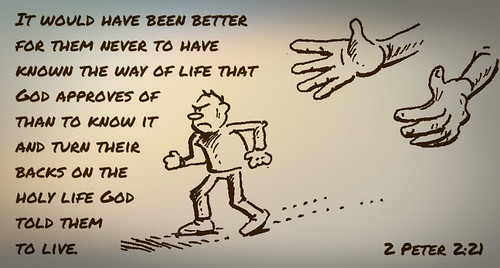
(2 Peter 2:18-22)  For they mouth empty, boastful words and, by appealing to the lustful desires of sinful human nature, they entice people who are just escaping from those who live in error. {19} They promise them freedom, while they themselves are slaves of depravity–for a man is a slave to whatever has mastered him. {20} If they have escaped the corruption of the world by knowing our Lord and Savior Jesus Christ and are again entangled in it and overcome, they are worse off at the end than they were at the beginning. {21} It would have been better for them not to have known the way of righteousness, than to have known it and then to turn their backs on the sacred command that was passed on to them. {22} Of them the proverbs are true: “A dog returns to its vomit,” and, “A sow that is washed goes back to her wallowing in the mud.”

But What About Ephesians 2:8-9?

(Ephesians 2:8-9)  For by grace you have been saved through faith, and that not of yourselves; it is the gift of God, {9} not of works, lest anyone should boast.

We are saved through faith, but not a dead, inactive faith. We are not saved by works that attempt to earn our salvation. Thus, salvation is of grace, even though we must respond to grace.

Conditional Grace.

The Bible teaches that grace is unearned, yet conditioned on responsive faith. Acts 2:36-38 shows there are conditions to be met before salvation can be received. Colossians 1:22-23 demonstrates that there are conditions to be met to remain in salvation.

If there were no conditions to grace, everyone would be saved, yet conditions are not necessarily associated with earning salvation.

  • If I offered ten dollars to everyone here unconditionally, would you think you should get ten dollars?
  • If I conditioned the ten dollars on you coming up and getting it, do you think you would accept a “gift” by coming forward?
  • If I agree to pay you five dollars an hour to stripe the parking lot and you worked two hours, would you think you had earned your ten dollars?

When we look at all of what the Bible has to say—The Big Picture—, we see that a Christian can fall from grace, but not a faithful Christian. What we have commonly believed, though uncommon in the religious world, is in complete harmony with the Scriptures.

Our response?

Realize the worst situation a person can place their soul’s condition in—is to be an unfaithful Christian. There is no hope at all because they have rejected the one hope that is offered to the sinner!

(Galatians 6:1-2)  Brothers, if someone is caught in a sin, you who are spiritual should restore him gently. But watch yourself, or you also may be tempted. {2} Carry each other’s burdens, and in this way you will fulfill the law of Christ.

The Greek word is “kartartizo” and is the same word used in:

(Matthew 4:21)  Going on from there, he saw two other brothers, James son of Zebedee and his brother John. They were in a boat with their father Zebedee, preparing their nets. Jesus called them,

(Hebrews 11:3)  By faith we understand that the universe was formed at God’s command, so that what is seen was not made out of what was visible.

Imagine the picture of mature Christians working diligently to mend or form or restore the lives of individual brothers and sisters in Christ who are struggling and “drifting” away.

 
Leave a comment

Posted by on December 11, 2023 in Uncommon Things


Uncommon Things We Believe Series: #2 We Don’t Believe That Jesus Will Reign On Earth For 1,000 Years – Revelation 20:1-6


(Revelation 20:1-6)  And I saw an angel coming down out of heaven, having the key to the Abyss and holding in his hand a great chain. {2} He seized the dragon, that ancient serpent, who is the devil, or Satan, and bound him for a thousand years. {3} He threw him into the Abyss, and locked and sealed it over him, to keep him from deceiving the nations anymore until the thousand years were ended. After that, he must be set free for a short time. {4} I saw thrones on which were seated those who had been given authority to judge. And I saw the souls of those who had been beheaded because of their testimony for Jesus and because of the word of God. They had not worshiped the beast or his image and had not received his mark on their foreheads or their hands. They came to life and reigned with Christ a thousand years. {5} (The rest of the dead did not come to life until the thousand years were ended.) This is the first resurrection. {6} Blessed and holy are those who have part in the first resurrection. The second death has no power over them, but they will be priests of God and of Christ and will reign with him for a thousand years.

One of the popular doctrines among some denominations is the idea that Christ came to the earth with the view of establishing a kingdom on the earth. But this was prevented when Satan caused Christ to be crucified, thus thwarting God’s plan. The church was then set up as a temporary solution until Christ returned to set up the kingdom over which he would reign for 1,000 years.

The first matter has to do with prophecy and fulfillment. We remember that Daniel had a vision that depicted a statue made up of four parts — a head of gold, breast, and arms of silver, belly, and thigh of brass, and legs and feet of iron and clay. Then a great stone rolled down and struck the image’s feet so that it fell and was destroyed.

The four parts of the image represented the Babylonian kingdom in Daniel’s time, followed by the Medo-Persian Empire, then the Greek, and finally the Roman Empire.

God then explains to Daniel the meaning of the vision with respect to the legs and feet of the statue. “In the days of those kings the God of heaven will set up a kingdom which will never be destroyed, and that kingdom will not be left for another people; it will crush and put an end to all these kingdoms, but it will itself endure forever” (Daniel 2:44).

It is interesting to note that since the days of the Roman Empire there has never been any kingdom or empire that has ruled over the known world as in those centuries.

What happened in the 1st Century, A.D? Christ came to set up or establish God’s spiritual kingdom. Notice the words of Christ himself in Mark 9:1: “And Jesus was saying to them, “Truly I say to you, there are some of those who are standing here who will not taste death until they see the kingdom of God after it has come with power.

Note what Christ was preaching: “From that time Jesus began to preach and say, “Repent, for the kingdom of heaven is at hand” (Matthew 4:17). What does the phrase “at hand” mean? That means near, close, and does not mean “thousands of years in the future.”

Daniel was told that in the days of the Roman Empire God’s spiritual kingdom would be set up. Christ said that within the lifetime of some who were then living the kingdom of God would come with power.

If this did not happen, then we have a problem with Satan having more power than God. Who can believe it? And where are these 2,000-year-old people? Does anyone know where they are? Christ said some then living would not die before the kingdom came. Well, it did come a short time later on the Day of Pentecost in Acts 2 when the church was established.

Consider a promise God made to Abraham concerning the dwelling place of his descendants. “And it came about when the sun had set, that it was very dark, and behold, [there appeared] a smoking oven and a flaming torch which passed between these pieces. On that day the LORD made a covenant with Abram, saying, ‘To your descendants I have given this land, From the river of Egypt as far as the great river, the river Euphrates’” (Genesis 15:17-18).

Now read what Allen Ross, a professor at the Dallas Theological Seminary, wrote about this prophecy. “Israel has never possessed this land in its entirety, but she will when Christ returns to reign as Messiah.”

Let’s compare that with what God has said. “Now Solomon ruled over all the kingdoms from the River to the land of the Philistines and to the border of Egypt; they brought tribute and served Solomon all the days of his life” (I Kings 4:21). “Now Solomon had 4,000 stalls for horses and chariots and 12,000 horsemen, and he stationed them in the chariot cities and with the king in Jerusalem. And he was the ruler over all the kings from the Euphrates River even to the land of the Philistines, and as far as the border of Egypt” (II Chronicles 9:25-26).

So, just what is this kingdom that God said was coming to the world? The kingdom is the church. The image of the kingdom refers to Christ’s reign, and we are citizens of this kingdom.

The image of the church refers to us individuals who have been called together out of the world of darkness to be a body of people, the spiritual body of Christ. In fact, the Greek word for “church” is “ekklesia,” which literally means “called out.” The church is a body of people who have been “called out” of the world to be citizens of the kingdom of God.

Christ occupies two positions. He is our high priest, and he is our spiritual king. Notice a prophecy concerning this in Zechariah 6:13: “Yes, it is He who will build the temple of the LORD, and He who will bear the honor and sit and rule on His throne. Thus, He will be a priest on His throne, and the counsel of peace will be between the two offices.”‘ Notice that it said that Christ “sit and rule on His throne,” and that “he will be a priest on His throne.” That prophecy says that he will sit and rule on His throne, which is describing a king. And at the same time, he is a priest. This does not say he is a priest now and will be a king later.

We are in the kingdom now. “For He rescued us from the domain of darkness, and transferred us to the kingdom of His beloved Son” (Colossians 1:13) That’s present tense, not future tense. There is a future that is associated with the kingdom, as Paul explained in I Corinthians 15:24: “then comes the end, when He hands over the kingdom to the God and Father, when He has abolished all rule and all authority and power.” That’s not on the earth but in heaven.

This doctrine is very prominent among the Jehovah’s Witnesses and is also a tenet of Baptist churches and other denominations. While the scriptures clearly refute this idea, one of the strongest arguments against this false doctrine is that it means that Satan has more power than God.

If Satan prevented God and Christ from fulfilling the intent and promise to establish the kingdom when Christ came in the first century, what will prevent Satan from thwarting God’s purpose the second time, or the third time, or whenever? That would make Satan the ruler of the universe rather than God. Who can believe it?

Premillennialism and the Bible

Our nation was shocked, saddened, and angered on September 11, 2001, by the events that transpired in our nation — the cold-blooded murder of thousands. And people wonder, why this hatred, why this insane rage? A few days after the atrocities, I spent some time talking with a peaceful Islamic young woman from Bangladesh that my wife and I have befriended. She asked me the same question, and although she understood some of it, there was a part of it concerning which she had no clue. She has been threatened, with a bloody ax drawn on her whiteboard, and hateful things shouted at her and her friends.

Why do they hate us?

Although there are various underlying causes, two principal things stand out.

  1. On May 14, 1948, the U.N. basically established Israel as a Jewish state, and Palestinians were driven out of their homeland. I understand many Palestinians still live in refugee camps 50 years later. This has not set well with Palestinians and their Arab neighbors, most of whom are Muslims. Two of our presidents, Truman and Carter, strongly supported Premillennial views, and thus have strongly supported Israel against the claims of the disenfranchised Palestinians. Thus the hatred for the Israelis, who have not always been good neighbors, also spills over to the US. (And the Palestinians have not always been good neighbors, either.) The Jewish and Premillennial influence upon our congress continues to shape our foreign policy, which is viewed as anti-Arab, and thus anti-Muslim.
  2. A second matter has to do with US forces in Saudi Arabia. This is where Mohammed is buried, and where two of Islam’s holiest sites are—Medina and Mecca. The radical Muslims, such as Osama bin Laden, believe that no infidel should set foot in this holy land. Thus, even though Osama is a Saudi, he has denounced the Crown Prince for allowing the infidel Americans to have troops there. So he vowed to drive them out by whatever means of force he can.

Now, What Is Premillennialism?

No two groups teach exactly alike, but all have major points of agreement.

  • The kingdom of the Old Testament prophecies has not been established, and we now have the “church phase.”
  • God’s promises to Abraham to make his seed a great nation are not yet fulfilled
  • Christ came to set up his kingdom, but he was thwarted in this, so set up the church instead, intending to return later to set up his kingdom.
  • The Jews as a nation will be converted and restored to Palestine.
  • Christ will return to earth, establish his kingdom, and reign for 1,000 years on David’s literal throne in Jerusalem.

There are many other factors, but these are the core ideas that drive Premillennialism.

Thus this theory drives the US government to prop up Israel so that we might help God fulfill his purpose. Nearly every protestant denomination is infested with this teaching — some more so than others. This is a part of the doctrines of Presbyterian, Baptist, Methodist, Jehovah’s Witness, Church of God and Seventh Day Adventist denominations, etc. Radio and TV preachers daily send this error into the homes of the unwary and thus lead them astray. Some, such as the Jehovah’s Witnesses, send people into homes and further spread this erroneous doctrine. Ergo, we need to understand the Bible, lest we also are misled, and so that we can help others to a correct understanding.

Premillennialism teaches that God has guaranteed to restore the Israelites to Palestine and that not until then will the kingdom of Old Testament prophecy be set up or established.

Premillennialism teaches that the Jews never occupied all the land God promised to them. Therefore, the Old Testament kingdom of Israel will have to be restored with the Jews in Palestine, so that God’s promise can be redeemed and fulfilled. But God’s Word says they did receive the full promise. “So Jehovah gave unto Israel all the land which he sware to give unto their fathers; and they possessed it, and dwelt therein” (Joshua 21:43).

Premillennialism teaches that Abraham’s descendants are “in the flesh” rather than “in faith.” But note that the gospel teaches that there is now no more distinction between Jew and Gentile in God’s sight, but that the true descendant of Abraham is the Christian.

In writing of the new relationship that we have with God, the apostle Paul wrote

“For he is not a Jew who is one outwardly; neither is that circumcision which is outward in the flesh” (Romans 2:28-29).

The point is carried further in Galatians 3:7“Know therefore that they that are of faith, the same are sons of Abraham?”

And later in the chapter, he writes:

“For ye are all sons of God, through faith, in Christ Jesus. For as many of you as were baptized into Christ did put on Christ. There can be neither Jew nor Greek, there can be neither bond nor free, there can be no male and female; for ye all are one [man] in Christ Jesus. And if ye are Christ’s, then are ye Abraham’s seed, heirs according to promise” (Galatians 3:26-29). Paul clearly points out that the true sons of God are now related by a spiritual connection, not by being born into a Jewish family.

Most premillennialist teach that Christ intended to set up his kingdom while on Earth, but the Jews would not allow him to do so. Ergo he returned to the Father, set up the church as a substitute, and when the Jews are ready, he will return and establish the original kingdom.

But look at John 6:15“Jesus therefore perceiving that they were about to come and take him by force, to make him king, withdrew again into the mountain himself alone.” Actually, the Jews wanted an earthly kingdom and tried to help Christ establish it. But the Premillennial theory denies this.

We see in Ephesians 3:10-11 that the church was in the eternal purpose of God, and not a mere “afterthought” or “substitute.” God has revealed his will “to the intent that now unto the principalities and the powers in the heavenly places might be made known through the church the manifold wisdom of God, according to the eternal purpose which he purposed in Christ Jesus our Lord.”  Do you see the point? The existence of the church was “according to the eternal purpose” of God. Yet Premillennialism denies this, saying the church would not have been set up if the Jews had only received the kingdom when Christ came.

Note John 17:4“I glorified thee on the earth, having accomplished the work which thou hast given me to do.”

Here Jesus claims he accomplished the mission of the Father as prophesied in many Old Testament passages. One of them is Daniel 2:44. As Daniel is interpreting the dream of Babylon’s King Nebuchadnezzar, he describes the four world kingdoms that succeed one another. The fourth kingdom was to be the great Roman Empire. Look at what Daniel said by inspiration from God:

“And in the days of those kings shall the God of heaven set up a kingdom which shall never be destroyed, nor shall the sovereignty thereof be left to another people; but it shall break in pieces and consume all these kingdoms, and it shall stand for ever.”

God says that during the Roman Empire, his kingdom would be established. Christ said he fulfilled what he was given to do. But Premillennialism denies this, claiming Christ failed in his mission. Question: If Christ failed the first time, what would keep him from failing the second, third, or fourth time?
If he has all power but didn’t have enough power to overcome Satan then where will he get more power to overcome the next time?

Premillennialism teaches that the righteous dead will be raised when Christ returns and that the unrighteous dead will be raised at the end of his reign, at least 1,000 years later.

There are some serious problems with this idea, and John 5:28-29 points out one such problem.  “Marvel not at this: for the hour cometh, in which all that are in the tombs shall hear his voice, and shall come forth; they that have done good, unto the resurrection of life; and they that have done evil, unto the resurrection of judgment.”  Christ says all will hear, and all will come forth when the hour (not two hours) cometh. But Premillennialism denies this, separating the coming forth by one thousand years.

Matthew 25:31-34,41 teach that the good and bad are to be judged at the same time. “But when the Son of man shall come in his glory, and all the angels with him, then shall he sit on the throne of his glory: and before him shall be gathered all the nations: and he shall separate them one from another, as the shepherd separateth the sheep from the goats; and he shall set the sheep on his right hand, but the goats on the left. Then shall the King say unto them on his right hand, Come, ye blessed of my Father, inherit the kingdom prepared for you from the foundation of the world … Then shall he say also unto them on the left hand, Depart from me, ye cursed, into the eternal fire which is prepared for the devil and his angels.”  Does the picture presented here allow a thousand years between? In no way. But the Premillennial view separates the judgments by one thousand years.

The Premillennialist counters by saying that Matthew 25 refers only to Gentiles and not Jews, therefore there is not one judgment. But Jesus made the gospel for all nations. “Go ye therefore, and make disciples of all the nations, baptizing them into the name of the Father and of the Son and of the Holy Spirit” (Matthew 28:19). If the Premillennial theory is true, the gospel is only for Gentiles now, and not for all. Thus we see how Premillennialism tries to patch up its contradiction with one passage and winds up contradicting another, and so it is with all false prophets.

We are taught in Revelation 1:7 that when Christ returns, every eye will see him.

“Behold, he cometh with the clouds; and every eye shall see him, and they that pierced him; and all the tribes of the earth shall mourn over him.” Premillennialism says that when Christ comes only the righteous shall see him first, and the unrighteous later. But this verse says that every eye shall see his return. Which shall we believe?

Premillennialism teaches that after the second coming, Christ and his saints will reign over all the Earth for 1,000 years.

They read in Revelation 20 a one-thousand-year reign.

“And I saw an angel coming down out of heaven, having the key of the abyss and a great chain in his hand. And he laid hold on the dragon, the old serpent, which is the Devil and Satan, and bound him for a thousand years, and cast him into the abyss, and shut it, and sealed it over him, that he should deceive the nations no more, until the thousand years should be finished: after this he must be loosed for a little time. And I saw thrones, and they sat upon them, and judgment was given unto them: and I saw the souls of them that had been beheaded for the testimony of Jesus, and for the word of God, and such as worshipped not the beast, neither his image, and received not the mark upon their forehead and upon their hand; and they lived, and reigned with Christ a thousand years. The rest of the dead lived not until the thousand years should be finished. This is the first resurrection. Blessed and holy is he that hath part in the first resurrection: over these the second death hath no power; but they shall be priests of God and of Christ, and shall reign with him a thousand years” (Revelation 20:1-6).

This is the foundation passage of premillennial theory:

“It is on this passage that the whole doctrine of the millennium as such has been founded. It is true that there are elsewhere in the scriptures abundant promises that the gospel will ultimately spread over the world; but the notion of a millennium as such is found in this passage alone” (Albert Barnes, noted Presbyterian commentator).

I don’t propose to unravel all the mystery of the passage, but consider this: Premillennials admit that many expressions in the chapter are figurative and symbolical and cannot be taken literally, but they insist on a literal one thousand years. The advocates of the theory read many things into the passage that absolutely are not there.

Consider the fact that in the passage there is:

  1. No mention of second coming
  2. No mention of a bodily resurrection
  3. No mention of a reign on earth
  4. No mention of a literal throne of David
  5. No mention of Jerusalem or Palestine
  6. No mention of us
  7. No mention of Christ on earth

When theorists read into the passage things that are not there, they add to the Word of God, and are rewarded accordingly.  “I testify unto every man that heareth the words of the prophecy of this book, if any man shall add unto them, God shall add unto him the plagues which are written in this book: and if any man shall take away from the words of the book of this prophecy, God shall take away his part from the tree of life, and out of the holy city, which are written in this book” (Revelation 22:18-19).

Another Scripture that gives these mistaken teachers a problem is I Thessalonians 4:17. The apostle Paul is writing concerning some false conceptions the readers had about the Lord’s return and assures them:

“For this we say unto you by the word of the Lord, that we that are alive, that are left unto the coming of the Lord, shall in no wise precede them that are fallen asleep. For the Lord himself shall descend from heaven, with a shout, with the voice of the archangel, and with the trump of God: and the dead in Christ shall rise first; then we that are alive, that are left, shall together with them be caught up in the clouds, to meet the Lord in the air: and so shall we ever be with the Lord” (I Thessalonians 4:15-17).

These verses clearly teach that those in the graves will be caught up together with the saved of those alive to meet the Lord in the air, and thus ever to be with the Lord. It does not say one word about Christ ever setting foot on this earth, or the saints returning to the earth. But Premillennialism teaches a round trip, saying these shall return to the earth to reign after a short time.

In John 18:36, we see that the Jews in Christ’s time clearly expected an earthly kingdom, with the promised Messiah reigning in the flesh. They hoped he would raise an army, throw off the yoke of Rome and make Israel a great nation again, as it was in the days of David and Saul. When Pilate was questioning Jesus about the charges made against him that he was a king, Christ responded by saying,  “My kingdom is not of this world: if my kingdom were of this world, then would my servants fight, that I should not be delivered to the Jews: but now is my kingdom not from hence.”

This verse shows that Christ was not anticipating an early rule or an earthly kingdom, and therefore the charges against him were mistaken. If they were mistaken, the modern theorists are also mistaken.

Peter says that the events on Pentecost — the preaching of the gospel and the establishment of the church or kingdom — ushered in a dispensation known as the last days. In responding to the charge that the apostles were drunk, Peter states “but this is that which hath been spoken through the prophet Joel: And it shall be in the last days, saith God, I will pour forth of My Spirit upon all flesh: And your sons and your daughters shall prophesy, And your young men shall see visions, And your old men shall dream dreams” (Acts 2:16-17). Thus the age of the last days is not a period of time in the future, and this does not allow the Premillennial idea of an age on earth to follow this present age.

Jeremiah 22:30 deals a deathblow to the Premillennial theory. Let’s read the context (Jeremiah 22:24-30) as God is warning King Coniah that he is the last of the lineage of David that would ever sit on a throne ruling in Judah.

“As I live, saith Jehovah, though Coniah the son of Jehoiakim king of Judah were the signet upon my right hand, yet would I pluck thee thence; and I will give thee into the hand of them that seek thy life, and into the hand of them of whom thou art afraid, even into the hand of Nebuchadrezzar king of Babylon, and into the hand of the Chaldeans. And I will cast thee out, and thy mother that bare thee, into another country, where ye were not born; and there shall ye die. But to the land whereunto their soul longeth to return, thither shall they not return. Is this man Coniah a despised broken vessel? is he a vessel wherein none delighteth? wherefore are they cast out, he and his seed, and are cast into the land which they know not? O earth, earth, earth, hear the word of Jehovah. Thus saith Jehovah, Write ye this man childless, a man that shall not prosper in his days; for no more shall a man of his seed prosper, sitting upon the throne of David, and ruling in Judah.”

What is the significance of this prophecy? Christ cannot occupy a throne, ruling in Jerusalem in Judah, since he is of the lineage of David and of the tribe of Judah. The first chapter of Matthew goes to great lengths to prove Christ’s genealogy. Now, if Coniah was the last of David’s seed to sit on a throne in Judah, there is no way that those who teach Premillennialism can get Christ to sit on David’s throne and rule for a thousand years in Jerusalem. God says it won’t happen! Rather, Christ is now King of kings and Lord of lords, ruling from heaven.

“I charge thee in the sight of God, who giveth life to all things, and of Christ Jesus, who before Pontius Pilate witnessed the good confession; that thou keep the commandment, without spot, without reproach, until the appearing of our Lord Jesus Christ: which in its own times he shall show, who is the blessed and only Potentate, the King of kings, and Lord of lords; who only hath immortality, dwelling in light unapproachable; whom no man hath seen, nor can see: to whom be honor and power eternal. Amen” (I Timothy 6:13-16).

Notice that this speaks of Christ’s reigning in the present tense, not in the future as the Premillennial theory would have us believe.

It Minimizes the Church

The premillennial position makes the church a mere accident which is diametrically the opposite of what Paul wrote in Ephesians 3:11. He declared that it was “according to the eternal purpose of God.” A serious consequence of the premillennial doctrine is that it destroys faith in the church of our Lord Jesus Christ.

R.H. Boll of Louisville, Kentucky, was the leader of the premillennial movement among churches of Christ. He referred to the church as “a new spiritual contingent” (Word and Work, March, 1938). The word “contingent” means “a happening by chance or unforeseen causes” (Webster’s Seventh Collegiate Dictionary, p. 180). According to the premillennial theory, had it not been for the rejection of the Messiah by the Jews, the old literal kingdom of David would have been re-established and the church would never have been brought into existence. Who can believe that the church, purchased by His Son’s blood and filled with His Spirit, is accidental or by chance?12

In the first place, the Old Testament prophets never foretold an earthly king nor an earthly kingdom. The Jews, including the apostles, were expecting a restoration of the literal kingdom of Israel (Acts 1:6) as are the modern-day premillennialists; but Jesus did not come to establish a literal and earthly kingdom.

The kingdom He established began on the day of Pentecost (Acts 2), the reign of Jesus is spiritual (I Corinthians 15:25-26) and the very nature of the kingdom is spiritual (John 18:36Romans 14:17). The terms” church” and “kingdom” are used interchangeably in the New Testament (Matthew 16:18-19), and to be in the kingdom is to be in the church (Colossians 1:18Revelation 1:9).

Jesus is the head of the church (Colossians 1:18) and rules over His kingdom (I Corinthians 15:25-26Revelation 1:6). The idea that the kingdom was postponed because of rejection by the Jews, and the church is an interruption” (“a parenthesis” as expressed by H.A. Ironside) was fathered by J.N. Darby in the latter part of the nineteenth century.

He insisted that the church is distinctly not a part of God’s initial redemptive plan (Clarence C. Bass, Backgrounds of Dispensationalism, p. 27). This idea is generally believed by modern premillennialists. It was promoted in churches of Christ by R.H. Boll (as previously mentioned) and is popularized by C.I. Scofield in the publication of his Bible with premillennial notes. The church was not only in the mind of God (Ephesians 3:11) but is spiritual Israel, fulfilling in Christ the promise to Abraham (Galatians 3). It manifests the manifold wisdom of God (Ephesians 3:10), is a part of the “mystery” (the divine plan of redemption, vs. 6), and will remain as long as the earth shall endure (vs. 21).

It Minimizes the Gospel

Since the church is a part of the divine “mystery” (Ephesians 3:5-6), if the church is minimized, then so is the gospel; because the gospel is the revelation of the “mystery.” It reveals the salvation of man in the church; therefore, to minimize one is to minimize the other.

It Nullifies God’s Promise

Both John the Baptist and Jesus preached that the kingdom was at hand (Matthew 3:24:17). “At hand” is from the Greek word engizo, and is translated “nigh” or “near.” But if the kingdom was postponed, these prophecies failed and God would not be true to His promise. The result would be that what Jesus preached was not the gospel of the kingdom (Mark 1:14-15), for the kingdom did not come. Multitudes had responded in good faith that the kingdom would come. If it did not come, then God was not true to His promise. It should be noted also that not one word was uttered about national repentance being the condition that the kingdom would come. Furthermore, if God did not know that the kingdom would be postponed when He made His promise, then God would not be omniscient. God announced something that he did not know would be postponed. And, if the kingdom was postponed, then the veracity of Jesus would be impeached because He promised that which did not come. Remember, He even said that some living then would not die before they would “see the kingdom of God come with power” (Mark 9:1). Who can believe that God and Jesus made a false promise? Such is the serious consequence of premillennialism.

It Makes the Great Commission Void

Jesus said that all power was given to Him in heaven and on earth and that His apostles were to teach all nations (Matthew 28:18-19). Premillennialists contend that the “nations” referred to by Jesus at the judgment (Matthew 25:31-32) does not mean the Jews, but rather the Gentiles. They think the “nations” mean the Gentiles as distinguished from Israel. But the commission says go and teach “all the nations.” If the term “nations” never refers to Jews, then Peter was preaching in vain to the Jews on the day of Pentecost in Acts 2. The consequences are that the great commission is nullified as far as the Jew is concerned. Where is the commission for the Jew? There is none if this contention is correct. And, if Jesus does not exercise all power now, then the great commission is nullified. As to the contention that “nations” refer only to the Jews, is a mistake to begin with; because the Greek word ethnos that is translated “nations” in Matthew 25:32 is also the same form which appears in Luke 24:47 and Acts 17:26. In both verses, the context itself shows that all races are referred to — all men and not only Gentiles. Luke 24:47 is fulfilled in Acts 2 when repentance and remission of sins were preached “in his name unto all the nations, beginning from Jerusalem.” The preaching at that time was to Jews; therefore, Jews are included in “all nations.” The gospel is God’s power to save everyone who obeys it, Jews and Gentiles alike (Romans 1:16).

It Denies “The Last Days”

Premillennialists deny that we are now living in “the last days.” They refer to this present period as “the church age” and”the last days” will not begin until after the return of Jesus from heaven. According to them, there are to be a literal one thousand years after the days called the last ones. But Peter identified the time of “the last days” when he declared on the day of Pentecost,”but this is that which hath been spoken through the prophet Joel: And it shall be in the last days…” (Acts 2:16-17). Jesus came at the end of the Jewish dispensation (Hebrews 1:1) and the day of Pentecost inaugurated the period known as “the last days,” the age in which we are now living. Peter was referring to this present age, not the end of time, when he referred to “the last days” in II Peter 3:2. Mockers would occur throughout this present age. Paul speaks of “later times” in I Timothy 4:1, referring to this present age when some, would “fall away from the faith“; and then gave specific examples of how they would do so. There is a difference between the expressions “the last day” and “the last days.” Last days mean this present dispensation, whereas “the last day” means the end of it. All the dead are to be raised (both the righteous and the wicked): when Jesus comes the second time (John 5:28-29). This will take place on “the last day” (John 6:44). Here we simply observe that if it is the last day, there cannot be 365,000 more to follow. Note also that the righteous and the wicked will be raised together, at the same time; therefore, there can be no intervening interval of one day between the resurrection of the two classes, much less an interval of 365,000 days as claimed by the premillennialists.

It Demotes Jesus From His Throne

When Jesus ascended to heaven, He occupied His throne, which is said to be forever (Hebrews 1:8). But premillennialists claim that Jesus is not on His throne, but on His Father’s throne. Hebrews 1:3 and 8:1 declare that He is on the right hand of the majesty “on high” and “in the heavens.” This earth is now His footstool (Isaiah 66:1Acts 7:49); so premillennialism demotes Jesus by bringing Him down to sit upon a literal, carnal, temporal and dilapidated throne on earth. It would bring Him down to His footstool.

That premillennialism demotes Christ, we consider Acts 2:30-32 where Peter said that Jesus was raised up to sit on David’s throne. He sits and rules not only upon His throne but also upon David’s throne. It is on this throne that He now reigns as Lord of lords and King of kings, and He will continue to reign until He has put the last enemy under His feet (I Corinthians 15:25). R.H. Boll is quoted as saying that “Jesus Christ is King de jure et potentia, but not King de facto et actu” (Latin, king by right but not in fact and in act) (See N.B. Hardeman, Tabernacle Sermons, Vol. 4, p. 162; Boles-Boll Discussion, p. 174-75). So, according to this position, rather than Jesus being actually King in fact now; He only rules with the expectation of being King, consequently assuming more the role of a crown prince. It virtually denies that Jesus is, in reality or in fact, reigning now. But in Revelation. 1:5-6 we are said to be a kingdom of priests, and we are now reigning with Him on earth (Revelation 5:9-10). Notice that we were made a kingdom (past tense) and we reign upon the earth (present tense). This present reign with Christ began when He ascended into heaven and will continue until His second coming. This will be the end when the kingdom is returned to the Father (I Corinthians 15:20-25).

It Denies Salvation To Gentiles

Israel became an established kingdom in 1095 B.C. Then the kingdom divided in 975 B.C. Two tribes remained with the house of David (tabernacle of David) and his seed continued on the throne until 586 B.C., when Zedekiah was dethroned. Amos prophesied that the tabernacle of David would be rebuilt (Amos 9:11). Jesus is of the seed of David and He was raised up to sit on the throne of David (Acts 2:30-32). This is a fulfillment of II Samuel 7:12. David had prophesied that “of the fruit of his loins he would set one upon this throne” (Acts 2:30). Why was the tabernacle of David to be rebuilt? The answer is given in Acts 15:13-17, “that the residue of men may seek after the Lord, and all the Gentiles, upon whom my name is called.” This is quoted from the Septuagint, the Greek translation of the Old Testament. Premillennialists say that the tabernacle of David will not be rebuilt until Christ returns, and will be set up on earth. But the tabernacle of David was rebuilt that the Gentiles might seek the Lord. We insist, therefore, that if Jesus Christ is not on David’s throne now, then there is no promise of any Gentile being saved now. The tabernacle of David exists in the church. Christ is on David’s throne in heaven, not on earth. We stress that if the tabernacle, or lineage of David, has not been restored, then Gentiles do not have the privilege of seeking the Lord. Some consequences of premillennialism are that the Jews are not included in the great commission, the Gentiles cannot seek the Lord and, thus, the redeeming purpose and power of the gospel are destroyed.

We do believe that Jesus will return, but we do not believe He is coming to reign on earth for 1000 years.

2 Peter 3:8-13 teaches that the return of Christ will bring the destruction of the earth.

(2 Peter 3:8-13)  But do not forget this one thing, dear friends: With the Lord a day is like a thousand years, and a thousand years are like a day. {9} The Lord is not slow in keeping his promise, as some understand slowness. He is patient with you, not wanting anyone to perish, but everyone to come to repentance. {10} But the day of the Lord will come like a thief. The heavens will disappear with a roar; the elements will be destroyed by fire, and the earth and everything in it will be laid bare. {11} Since everything will be destroyed in this way, what kind of people ought you to be? You ought to live holy and godly lives {12} as you look forward to the day of God and speed its coming. That day will bring about the destruction of the heavens by fire, and the elements will melt in the heat. {13} But in keeping with his promise we are looking forward to a new heaven and a new earth, the home of righteousness.

I Thessalonians 4:13-18 shows that when Jesus returns the righteous will join Him in the air.

(1 Thessalonians 4:13-18)  Brothers, we do not want you to be ignorant about those who fall asleep, or to grieve like the rest of men, who have no hope. {14} We believe that Jesus died and rose again and so we believe that God will bring with Jesus those who have fallen asleep in him. {15} According to the Lord’s own word, we tell you that we who are still alive, who are left till the coming of the Lord, will certainly not precede those who have fallen asleep. {16} For the Lord himself will come down from heaven, with a loud command, with the voice of the archangel and with the trumpet call of God, and the dead in Christ will rise first. {17} After that, we who are still alive and are left will be caught up together with them in the clouds to meet the Lord in the air. And so we will be with the Lord forever. {18} Therefore encourage each other with these words.

We believe that literal language is not to be interpreted figuratively, but we also believe figurative language should not be interpreted literally.

Revelation 20 is the scripture used by Pre-Mil to establish their doctrine of the 1,000 year reign of Christ. Pre-millennialism is the view of the “last things” which holds that the second coming of Christ will be followed by a period of world wide peace and righteousness, before the end of the world, called “the millennium” or “the kingdom of God” during which Christ will reign as King in person on this earth.” (J.G. Vos)

“By Pre-millennial we mean before the Millennium.  That is, before the period of 1,000 years spoken of in Revelation 20:1-6.  This period is spoken of in others scriptures as the Kingdom, and is described in glowing terms by the prophets as a time when the earth shall be blessed with a universal rule of righteousness.” (Clarence Larken – Dispensational Truth).

We need to see that Revelation 20 does not teach an earthly reign of Christ. Christ is now King, reigning on David’s throne in Heaven.

Teaching of Revelation 20:1-6: What this passage DOES NOT mention:

  • A second coming of Christ.
  • A bodily resurrection
  • A reign on earth.
  • The literal throne of David.
  • Jerusalem or Palestine
  • Us – you and me
  • Christ on earth

What passage DOES mention:

Binding of Satan-Key passage (Verse 1-3; Matt. 12:28-29; Heb. 2:14-15)

Souls on Thrones (v. 4), Who were these souls?  Those beheaded for witness of Jesus.  Those who had not the mark of the beast, nor worshipped the beast or his image.

Who was reigning?  These souls were reigning with Christ.  In Rev. 6:9-11, these same souls were under the altar, here they are elevated to thrones (plural).  If the 1,000 years are literal, the beheading is literal and that leaves us out of the millennium.  These souls “lived and reigned,” past tense.  Only those souls “they”, not “we” lived and reigned.

What is the “Thousand Years?”  Thousand is a definite number put for an indefinite.  It is the vision of victory, complete victory.  No reference to time (Psa. 50:10; 105:8; 2 Peter 3:8).  Number denotes completeness, perfection, infinity.

Literal or figurative – which?

Revelation is a book of symbols, figures, and signs. Signs, symbols, and types do not signify, symbolize and typify themselves. It is a violation to make literal application of the figurative imagery of Revelation.

Books like Revelation are clearly figurative in nature (Rev. 1:20).  To say that the “1,000 years” of Revelation 20:1-6 is literal while the “chain,” “dragon,” and “serpent” are said to be figurative is a style of interpretation that does not convict.

Real Story Of A Much Misapplied Text. Context is vital for a proper understanding of Matthew 24.

  • The destruction of Jerusalem raises the questions that bring Jesus’ discussions in this chapter (cf. Matt. 23:32-39).
  • The Jews mistakenly believed that the temple would not fall until the end of the world, due to a misunderstanding of Psalm 132:13-14.
  • This is why Matthew, writing to Jews, records Jesus addressing the separate issues of the fall of Jerusalem and the end of the world.
  • The Mark and Luke, writing to Gentiles, do not take up the more complete division of Matthew.
  • It is very clear that Matthew changes from events associated with visable signs to happenings for which their would be no signs.

Consider this…

  • Verses 4 thru 33 speak of observable events that will clearly signal the need for action (vs. 15-22, 32-33).
  • If verses 15-22 refer to the Second Coming, what difference would it make if it were a Sabbath, or Winter, or if women were with child? What good would it do to flee to the mountains?
  • Verses 36-51 speak with equal clarity of an absence of signs and, therefore, continual preparedness (vs. 36, 37-39, 42, 43, 44).
  • Jesus, Himself, did not know when these things would happen (v.36).
  • Of Jerusalem’s fall, Jesus said (v. 34) it would come within the time of the generation then living (cf. Matt. 26:64; Mk. 9:1, note the figurative language of Matt. 26:64 and how it did not rule out an application to the people of Jesus’ day, compare with 24:30).
  • Of the end of all the creation, Jesus said He did not know.
  • The verses before Matthew 24:34 that many think could only apply to the Second Coming employ typical Apocalyptic imagery that simply refers to the fall of a nation from power (Isa. 13:10; 34:4; Ezek. 32:7-8; Joel 2:10; Isa. 19:1; Ezek. 38:16, etc.).

Conclusion

These are not all, but just a few of the glaring contradictions between Premillennialism and the Bible. Let us not be misled by materialistic, Christ-dethroning, and Scripture-denying theories and speculations of men. But let us serve him who is now King of kings, who is reigning over his kingdom, and preparing a place for his people. (John 14:1-3) By serving him now, we will be prepared for the judgment to come. “And inasmuch as it is appointed unto men once to die, and after this cometh judgment” (Hebrews 9:27). There will be no second chance — this will happen once.

 
Leave a comment

Posted by on December 7, 2023 in Uncommon Things


Uncommon Things We Believe Series: #1 A Proper View of Scripture: One Faith – 2 Peter 1:19-21


Most people know they need guidance for their lives. Just over a thousand randomly selected persons were surveyed recently on behalf of a life insurance/financial services company. 75% said they believed they were created by God for a purpose, but only 45% of those said they understood what that purpose was.

The questions more people in that survey said they would like to ask God than any other?

  1. “What is my purpose on Earth?”
  2. “Will I have life after death?”
  3. “Why do bad things happen?”

To some of us, it would seem strange that anybody would want to ask such things of God. We’d likely reply that He has already answered them.

Christians believe that God does communicate with the men and women He has created in His image and that the primary vehicle through which He does so is the Bible.

The Barna Research Group discovered a few years back that 10 % of the 1,000 people in one of its polls thought Joan of Arc was Noah’s wife, 16% were sure the New Testament contained a book written by Thomas the apostle, and 38% thought the Old and New Testaments were written a few years after the death of Jesus.

While it may be impractical and impossible for every Christian to be a genuine biblical scholar. It’s not unreasonable to expect that every Christian should be a regular reader and prayerful student of Scripture.

  • A goal for this  congregation in 2015 is to create an attitude toward the Word of God that will carry outside the walls of our classrooms and beyond the experience of a given worship assembly.
  • We want people to revere Scripture.
  • I will want to challenge us to dedicate more time to our 9:30 a.m. Bible classes here
  • We want to communicate both the importance, fun, and reward of Bible study.
    Important Truth Concerning the Bible
    Origin — The Bible is ultimately from God.

The psalmist declared, Psalm 119:11 (ESV) I have stored up your word in my heart, that I might not sin against you.

Our Lord himself announced that “Man shall not live by bread alone, but by every word that proceeds out of the mouth of God” (Matt. 4: 4).

Paul had words of praise for the Christians at Thessalonica in that they received the gospel message, not as the word of men, “but, as it is in truth, the word of God” (I Thess. 2: 13).

There is surely a sense in which we may say God speaks to us through both nature and persons or events in our lives. But ultimately he has communicated with us through select persons called “prophets” and through the written accounts of their God-supplied messages.

(2 Peter 1:19-21)  And we have the word of the prophets made more certain, and you will do well to pay attention to it, as to a light shining in a dark place, until the day dawns and the morning star rises in your hearts. {20} Above all, you must understand that no prophecy of Scripture came about by the prophet’s own interpretation. {21} For prophecy never had its origin in the will of man, but men spoke from God as they were carried along by the Holy Spirit.

In this text, Peter affirms the value and trustworthiness of the early church’s Bible — the writings of the Old Testament prophets. He was emphatic in urging his own readers to “pay attention” to the words of Scripture for themselves.

This parallels Paul’s text about the Word of God: “All Scripture is God-breathed and is useful for teaching, rebuking, correcting and training in righteousness, so that the man of God may be thoroughly equipped for every good work” (2 Tim. 3:16-17).

Inspiration

Can we be sure that the writers who penned the original manuscripts did so infallibly?

Yes we can, and the process by which God protected the integrity of his word is called “inspiration.”

The expression “inspired of God” (literally in the Greek Testament, “God-breathed”) suggests that the divine Author of the sacred writings breathed into the minds of his select writers the exact message he wanted conveyed to mankind. And the biblical writers happily acknowledged this; they did not claim originality for their productions.

It is true, of course, that God utilized the talents, backgrounds, personalities, etc. of the inspired writers to convey His divine message. Nonetheless, it is an indisputable fact that the Lord so guided the sacred writers that they expressed Heaven’s will with absolute precision.

God enabled certain specially chosen individuals to know the otherwise unknowable or interpret the otherwise merely puzzling and communicate those insights correctly.  We believe the Bible in inerrant (without error) and authoritative.

Transmission

The original writings, which collectively came to be called the “Bible,” have faded into oblivion. Not a single one of those original autographs remains – and doubtless for good reason. Men, had they access to those ancient scrolls, would likely worship them rather than their Author. And so, in the providence of God, they have long since vanished.

Does that suggest, though, that the copies we now possess are not reliable as depositories of divine truth? Not in the least. Sacred oversight has seen to it that the Scriptures have been remarkably and accurately preserved – and the biblical record bears testimony to this.

For instance, Paul states that Timothy, from his earliest years, had known the sacred writings which were able to make the young man wise unto salvation (2 Tim. 3:15). The “sacred writings” here referred to are the books of the Old Testament.

Timothy had perhaps been guided by his godly mother and grandmother (2 Tim. 1:5) who doubtless took him to synagogue services whenever opportunity presented itself.

In the synagogue, the sacred text would be read. Obviously, however, those ancient synagogues possessed only copies of the original Old Testament autographs. The integrity of those narratives was so preserved, though, that Paul could affirm that their original design remained intact, that is, making men wise unto salvation.

Translation

The original text of the Bible was in three languages. The Old Testament was written in Hebrew (with some minor portions in Aramaic) and the New Testament was penned in Greek. Since most people do not read their Bibles in the original languages, they are dependent upon a translation.

The question is therefore appropriate: can one know that he is reading the genuine word of God even though he is employing a translation? Of course he can, and we need only to appeal to the New Testament itself to prove the point.

The most important version of the Old Testament was the Septuagint. In about 250 B.C., down in Alexandria, Egypt, the Hebrew Pentateuch was translated into Greek. The remainder of the Old Testament was done in piecemeal fashion, being completed by at least 117 B.C.

At the time Christ came to earth, this Greek translation had become the Bible of the Jewish people. This is doubtless why the writers of the New Testament, when appealing to the Old Testament, most often quoted from the Septuagint. In fact, of the three hundred or more quotations in the New Testament, the vast majority agree with the Septuagint.

The Lord Jesus himself frequently quoted from this version. Christ could even quote from the Greek translation and say:

(Matthew 22:31-32)  But about the resurrection of the dead–have you not read what God said to you, {32} ‘I am the God of Abraham, the God of Isaac, and the God of Jacob’ ? He is not the God of the dead but of the living.”…demonstrating that the translation process did not destroy sacred truth.

Comprehension

But here is another question of great importance. What if one grants that the Scriptures have been faithfully transmitted and translated: is it not a fact that man’s mind is so hopelessly corrupt, and the Bible is a book so shrouded in mystery, that one cannot understand it without supernatural guidance?

No, that is not the truth (though it is commonly taught by both Catholic and Protestant theologians). Romanism alleges that the Bible “is but a dead letter calling for a divine interpreter” [Conway, The Question Box, 76], which is supposed to be the clergy of the Catholic Church.

And many sectarian groups contend that man is so depraved by sin that he cannot comprehend the teaching of the Bible; he is thus in “need of an inward supernatural teaching of the Spirit” [Hodge, Systematic Theology, 1, 671. Both of these views are quite erroneous.

In the parable of the sower, Jesus said that the good soil is “he that hears the word, and understands it” (Mt. 13:23).

(Ephesians 3:4)  In reading this, then, you will be able to understand my insight into the mystery of Christ,

(Ephesians 5:17)  Therefore do not be foolish, but understand what the Lord’s will is.

It has never ceased to amaze me that a host of demoninational teachers can all claim to have a supernatural, illuminating guidance of the Holy Spirit, and yet teach a hundred contradictory doctrines.

Any person who has an honest heart and strong desire to understand the will of God, if he will but exercise enough discipline to study hard, applying sound principles of interpretation, can comprehend the plain and essential elements of the Scriptures.

Demonstration

A mere theoretical knowledge of the Bible is worthless. Christ declared: Luke 11:28 (ESV)  But he said, “Blessed rather are those who hear the word of God and keep it!”

We must allow the word of God to work in us: James 1:22 (ESV) But be doers of the word, and not hearers only, deceiving yourselves.

The Low View of Scripture Shared By The Wicked

In general, the ungodly have a dangerously low view of Scripture. It is often so low that they reject it, hate it and in some cases try to destroy it and the person speaking it out. It can be like that even for the religiously ungodly:

I know you are Abraham’s descendants. Yet you are ready to kill me, because you have no room for my word. (John 8:37)

Therefore, as tongues of fire lick up straw and as dry grass sinks down in the flames, so their roots will decay and their flowers blow away like dust; for they have rejected the law of the LORD Almighty and spurned the word of the Holy One of Israel. (Isa 5:24)

But to the wicked, God says: “What right have you to recite my laws or take my covenant on your lips? You hate my instruction and cast my words behind you.” (Psa 50:16,17)

For rebellion is like the sin of divination, and arrogance like the evil of idolatry. Because you have rejected the word of the LORD, he has rejected you as king. (1 Sam 15:23)

But for those who are self-seeking and who reject the truth and follow evil, there will be wrath and anger. (Rom 2:8)

Propositions to govern our thinking as we approach the subject of the authority of the Scriptures

  1. We have no right to hold a different view of Scripture than that held by Jesus himself.

There is a judge for the one who rejects me and does not accept my words; that very word which I spoke will condemn him at the last day. (John 12:48)

That is the first fact we must hold in mind as we come to this subject of the authority of the Word. To put it another way, the authority of the Bible rests squarely upon the authority of Jesus Christ himself.

To be a Christian at all means that we have fully accepted the authority of Jesus. It is an utter inconsistency to say that we accept what the Bible says about Christ and reject what He says about Scripture.

You see the utter inconsistency of that position? We cannot call him Lord, and say he has the right to choose our mates, and to pick our line of work, and to govern our life in all its attitudes and ways — even to trust our eternal destiny into his hands — but we cannot believe him when he speaks of the creation of man, or the sanctity of marriage, or the sinfulness of certain sexual acts.

  1. We have no right to views of Scripture which are different from the apostles’ view of Scripture.

The apostles, like our Lord, are our teachers. We are not theirs. It is Karl Barth who says, “We cannot stand and look over the apostles’ shoulders, correcting their work. It is they who stand looking over our shoulders, correcting our work.”

The apostles, in writing the New Testament, everywhere declare that their authority is simply the Lord’s authority. They, too, rest the authority of their words squarely upon the authority of the Lord Jesus.

These men who lived in the 1st century and associated with the Lord Jesus, who heard his words, and who so ministered in power throughout the world of their day as to transform the generation in which they lived, knew far more about what God thought and said than any man studying theology today.

  1. We can never discover the depths of Scripture’s insights into life without first accepting it as true and authoritative.

What I am saying is that we must first believe Scripture before we can understand it. As long as we keep asking, “Should this passage be here? Is it genuine, is it real? Has it been inserted? Is it a legend? Is it a fairy tale? Is it something that is merely the thinking of the apostles and was never in the mind of Christ?”

— if this is our constant approach then we can never get around to asking, “What does this say to me? What does it mean? Where is the wisdom hidden in this that I need so desperately in my life?”

Those students and pseudo-scholars who feel they are a final authority on what ought to be here, and what ought not to be here, never seem to be able to understand what is written. They never seem able to say anything about the depths of Scripture or the teaching of it, for they exclude themselves from understanding by their attitude of judgment over it.

  1. Scripture does not need to be defended, but simply declared.

No one today has access to divine truth by means of any personal interview with deity. God does not speak in dreams, visions, or by a supernatural illumination of the Holy Spirit.

Objective revelation has been made known through the completed Bible, and men will only be exposed to the message of the Scriptures as we distribute the sacred volume and proclaim its saving message.

Every single Christian must take seriously his obligation to teach the Bible consistent with his divinely appointed role, ability, and opportunity.

The whole testimony of this church is to the fact that it is the preaching and the exposition of the Bible that establishes its authority. We do not need to defend it, just declare it, proclaim it.

One Faith: A Call To Arms! – Philippians 1:27; Jude 3

A note posted on a religious website, discussing sexuality as a spiritual experience…says “it is OK be monogamist OK to be Poly, Gay, Lesbian, Bi, Straight, Asexual; OK to be different; OK to follow our own path; OK to make our own choices without being judged, particularly in this community.”

The truth tells us that while people may indulge their sinful desires in that way, we don’t please God like that.

How do we know? Where do we go for direction? We believe there is One Lord, and today we see there is one place where we can go to find the written directions. The “one faith” does not refer to the act of believing, but to the body of doctrines which we believe. The one faith is the Gospel.

(Philippians 1:27 NIV)  Whatever happens, conduct yourselves in a manner worthy of the gospel of Christ. Then, whether I come and see you or only hear about you in my absence, I will know that you stand firm in one spirit, contending as one man for the faith of the gospel

(Jude 1:3 NIV)  Dear friends, although I was very eager to write to you about the salvation we share, I felt I had to write and urge you to contend for the faith that was once for all entrusted to the saints.

It is not scriptural to speak of “many faiths” or “interfaith activities” as many do. There are not two faiths nor several faiths. There is only one faith that leads into God’s presence and that is the faith founded by the Lord Jesus Christ.

Contrary to what Oprah and others are teaching, there is no other approach to God. If a person wishes to live with God—to be approved and accepted by Him—that person has to approach God through the faith of the Lord Jesus Christ.

(2 Thessalonians 2:13-14 NIV)  But we ought always to thank God for you, brothers loved by the Lord, because from the beginning God chose you to be saved through the sanctifying work of the Spirit and through belief in the truth. {14} He called you to this through our gospel, that you might share in the glory of our Lord Jesus Christ.

The point is this: every believer has come to God in the very same way—by believing in the Lord Jesus Christ. Faith in Him is the only way, the only true faith. Therefore, standing before God and having come to Him through the same faith, there is no room for any differences. We all stand on the same ground, on the same level: the ground and level of faith.

If you want to be a member of this congregation, realize that we believe there is One body, One Spirit, One Hope, One Lord, and One Faith.

Read Jude 1-4

Why did Jude write this letter?

To warn his readers that the apostates were already on the scene! Peter had prophesied that they would come (2 Peter 2:1-3; 3:3ff), and his prophecy had been fulfilled.

He wrote to “exhort” them (Jude 3). In the Greek language, this word was used to describe a general giving orders to the army; hence the atmosphere of this letter is “military.” Jude had started to write a quiet devotional letter about salvation, but the Spirit led him to put down his harp and sound the trumpet! The Epistle of Jude is a call to arms.

The Army (Jude 1-2)

The Captain of the army is Jesus Christ, and the soldiers He commands are people who share a “common salvation” through faith in Him. Jude called them saints and addressed them as sanctified.

Not only are God’s saints set apart, but they are also preserved. This means “carefully watched and guarded.” The believer is secure in Jesus Christ. This same word is used in Jude 6 and 13 (“reserved”) and also in Jude 21 (“keep yourselves”).

The Enemy (Jude 3-4)

I must confess that I sympathize with Jude. I would much rather encourage the saints than declare war on the apostates. But when the enemy is in the field, the watchmen dare not go to sleep. The Christian life is a battleground, not a playground. Jude wasted no time in identifying the enemy.

They were ungodly (v. 4b).

This is one of Jude’s favorite words. While these men claimed to belong to God, they were, in fact, ungodly in their thinking and their living.

They were deceitful (v. 4c).

They “crept in unawares.” The Greek word means “to slip in secretly, to steal in undercover.” How could false brethren get into true assemblies of the saints? The soldiers had gone to sleep at the post! The spiritual leaders in the churches had grown complacent and careless. This explains why Jude had to “blow the trumpet” to wake them up.


They were enemies of God’s grace (v. 4d).

Why did they enter the churches? To attempt to change the doctrine and “turn the grace of our God into lasciviousness” (Jude 4). The word lasciviousness simply means “wantonness, absence of moral restraint, indecency.” A person who is lascivious thinks only of satisfying his lusts, and whatever he touches is stained by his base appetites.

Many scriptures warn us that the apostates would argue, “You have been saved by grace, so you are free to live as you please!” The apostates, like the cultists today, use the Word of God to promote and defend their false doctrines.

They seduce young, immature Christians who have not yet been grounded in the Scriptures. Every soldier of the Cross needs to go through “basic training” in a local church so that he knows how to use the weapons of spiritual warfare.

They denied God’s truth (v. 4e).

Jude was affirming strongly the deity of Jesus Christ. Jesus Christ is God! But the apostates would deny this. They would agree that Jesus Christ was a good man and a great teacher, but not that He was eternal God come in human flesh. The first test of any religious teacher, as we have seen, is, “What do you think of Jesus Christ? Is He God come in the flesh?”

Anyone who denies this cardinal doctrine is a false teacher no matter how correct he may be in other matters. If he denies the deity of Christ, something will always be missing in whatever he affirms.

They were ordained to judgment (v. 4a).

Jude did not write that these men were ordained to become apostates, as though God were responsible for their sin. They became apostates because they willfully turned away from the truth. But God did ordain that such people would be judged and condemned. The Old Testament prophets denounced the false prophets of their day, and both Jesus Christ and His Apostles pronounced judgment on them.

Why should these men be judged by God? To begin with, they had denied His Son! That is reason enough for their condemnation! But they had also defiled God’s people by teaching them that God’s grace permitted them to practice sin.

How, then, should the church respond to the presence of this insidious enemy? By earnestly contending for the faith.

“The faith” refers to that body of doctrine that was given by God through the Apostles to the church. The word doctrine is found at least sixteen times in the Pastoral Epistles alone.

What does it mean to “contend for the faith”? The Greek word is an athletic term that gives us our English word agonize. It is the picture of a devoted athlete, competing in the Greek games and stretching his nerves and muscles to do his very best to win.

You never fight the Lord’s battles from a rocking chair or a soft bed! Both the soldier and the athlete must concentrate on doing their best and giving their all. There must also be teamwork, believers working together to attack and defeat the enemy.

Sometimes you hear well-meaning people say, “Well, it’s fine to contend for the faith, but don’t be so contentious!” While it is true that some of God’s soldiers have been the cause of quarrels and divisions, it is also true that some of them have paid a great price to defend the faith.

As Christian soldiers, we must not fight each other or go around looking for trouble. But when the banner of Christ is in danger of being taken by the enemy, we cannot sit idly by, nor can we ever hope to win the victory by wearing kid gloves.

Charles Spurgeon once said that “the new views are not the old truth in a better dress, but deadly errors with which we can have no fellowship.” I cannot endure false doctrine, however neatly it may be put before me. Would you have me eat poisoned meat because the dish is of the choicest ware?”

Paul admonished both Timothy and Titus to make sure the believers were being taught “sound doctrine,” which means “healthy doctrine,” doctrine that promotes the spiritual health of the local church.

While individual teachers and preachers may disagree on the fine points of theology, there is a basic body of truth to which all true Christians are committed.

He exhorted Timothy to entrust the Word to other faithful men (2 Tim. 2:2). You and I would not have the Word today were it not for faithful believers down through the ages who guarded this precious deposit and invested it in others.

The church is always one generation short of extinction. If our generation fails to guard the truth and entrust it to our children, then that will be the end! When you think of the saints and martyrs who suffered and died so that we might have God’s truth, it makes you want to take your place in God’s army and be faithful unto death.

False doctrine is a deadly poison that must be identified, labeled, and avoided. We must always speak the truth in love, and the weapons we use must be spiritual. At the same time, we must dare to take our stand for “the faith” even if our stand offends some and upsets others. We are not fighting personal enemies, but the enemies of the Lord.

It is the honor and glory of Jesus Christ that is at stake. “Fight the good fight of faith” (1 Tim. 6:12).

The Victory (Jude 5-7)

Jude reached back into Old Testament history and gave examples of God’s victory over those who had resisted his authority and turned from the truth. The point Jude was making is that God judges apostates. Therefore, the false teachers who had crept into the church would also one day be judged. Their seeming success would not last; God would have the last word.

The sin of Israel was rebellious unbelief (Heb. 3:12). The sin of the angels was rebellion against the throne of God. The sin of Sodom and Gomorrah was indulging in unnatural lust. Unbelief, rebellion against authority, and sensual indulgence were sins characteristic of the false teachers.

The conclusion is obvious: the apostates will be judged. But, meanwhile, God’s soldiers must stay on duty and see to it that these false teachers do not creep into the ranks and start to lead people astray.

Read Jude 1:17-25

What can we do practically to oppose the enemy and maintain the purity and unity of the church?

For one thing, we must know the Word of God and have the courage to defend it. Every local church ought to be a Bible institute, and every Christian ought to be a Bible student.  The pulpit needs to declare positive truth as well as denounce error.

Second, we must “watch and pray.”

The Christian life must never stand still; if it does, it will go backward. The enemy is already here and we dare not go to sleep! Spiritual leaders in local congregations need to be alert as they interview candidates for baptism and church membership. Congregations must exercise discernment as they select spiritual leaders.

Finally, we must have the courage to maintain a position of biblical separation from those who deny Christ and the fundamental doctrines of the Word. This does not mean that we separate from fellow believers over minor doctrinal differences, or that we practice “guilt by association.” God’s true army needs to stand together in the battle for truth.

 
Leave a comment

Posted by on December 4, 2023 in Uncommon Things


The Benefits of Being Christians #6 The Spiritual Mind – Romans 8:9-11


You, however, are not in the flesh but in the Spirit, if in fact the Spirit of God dwells in you. Anyone who does not have the Spirit of Christ does not belong to him. 10 But if Christ is in you, although the body is dead because of sin, the Spirit is life because of righteousness. 11 If the Spirit of him who raised Jesus from the dead dwells in you, he who raised Christ Jesus from the dead will also give life to your mortal bodies through his Spirit who dwells in you.

The spiritual richness, both theological and practical, of this chapter is beyond calculation and surpasses adequate comment. When read by a believer with an open mind and an obedient heart, it is incredibly enriching.

It is one of the supreme life-changing chapters in Scripture. It moves along in an ever-ascending course, concluding in the marvelous paean of praise and assurance: “For I am convinced that neither death, nor life, nor angels, nor principalities, nor things present, nor things to come, nor powers, nor height, nor depth, nor any other created thing, shall be able to separate us from the love of God, which is in Christ Jesus our Lord” (Rom. 8:38-39).

The Holy Spirit is mentioned but once in the first seven chapters of Romans, but is referred to nearly twenty times in chapter 8. The Spirit is to a believer what God the Creator is to the physical world. Without God, the physical world would not exist. It has been created and is continually sustained by the omnipotent power of God.

So the Holy Spirit—who also, of course, participated in the creation of the world—is to the Christian. The Holy Spirit is the divine agent who creates, sustains, and preserves spiritual life in those who place their trust in Jesus Christ. It is the Holy Spirit who ultimately will bring every believer into the full consummation of his salvation by granting him eternal glory in the presence of God.

It should be made clear that the Holy Spirit is not merely an influence or an impersonal power emanating from God. He is a person, the third member of the Trinity, equal in every way to God the Father and God the Son. The doctrine of God’s being one essence, yet existing in three persons, is one of the most certain truths in Scripture. Yet the Holy Spirit is often not respected as every bit as much a divine person as the Father and the Son.

Among the many characteristics of personhood that the Holy Spirit possesses and manifests are: He functions with mind, emotion, and will; He loves the saints, He communicates with them, teaches, guides, comforts, and chastises them; He can be grieved, quenched, lied to, tested, resisted, and blasphemed.

The Bible speaks of His omniscience, His omnipotence, His omnipresence, and His divine glory and holiness. He is called God, Lord, the Spirit of God, the Spirit of the Lord, the Spirit of Yahweh (or Jehovah), the Spirit of the Father, the Spirit of the Son, the Spirit of Jesus, and the Comforter and Advocate for believers.

Scripture reveals that the Holy Spirit was fully active with the Father and Son in the creation and that He has been with believers and enabled and empowered them since Pentecost (since suggest even before though not in the same indwelling way). He has always been convicting men of sin, giving salvation to those who truly believed, and teaching them to worship, obey and serve God rightly.

The Holy Spirit has been the divine agent who uniquely came upon God’s servants and inspired God’s sovereignly-chosen men to pen God’s Word. True believers have always served God not by human might or power but by the Holy Spirit (cf. Zech. 4:6). The Spirit was involved in Jesus’ conception as a human being and in Jesus’ baptism, anointing, temptation, teaching, miracles, death, and resurrection.

Since Pentecost, the Holy Spirit has indwelt all believers, illuminating their understanding and application of God’s Word as well as empowering them for sanctification in a greater way than had every occurred before. He fills them, seals them, communes with them, fellowships with them, intercedes for them, comforts them, admonishes them, sanctifies them, and enables them to resist sin and to serve God.

Paul divides people into two categories—those who let themselves be controlled by their sinful nature and those who follow after the Holy Spirit. We would be in the first category if Jesus hadn’t offered us a way out.

After we say yes to Jesus, we want to continue following him because His way brings life and peace. We must consciously choose to center our life on God.

Use the Bible to discover God’s guidelines, and then follow them. In every perplexing situation ask, “What would Jesus want me to do?” When the Holy Spirit points out what is right, do it eagerly. [1]

How do we cooperate with the Holy Spirit’s control?

Ask for greater openness and responsiveness to the Holy Spirit’s guidance.

Consciously humble ourselves before God, so we are not too proud to change.

Look to God’s Word for guidance.

Obey where we have clear direction, so that our forward  movement will enhance the Holy Spirit’s leading. (It makes little sense to steer a parked car!) When was the last time you prayed as Jesus did, “Nevertheless, may your will, not mine, be done”? Have you ever worried about whether or not you are a

Christian? A Christian is anyone who belongs to Christ by faith and has the Spirit of God living in him or her. If you have sincerely trusted Christ for your salvation and have acknowledged him as Lord, then the Holy Spirit has come into your life, and you are a Christian. You won’t know that the Holy Spirit has come if you are waiting for a certain feeling; you will know he has come because Jesus

promised he would.

When the Holy Spirit is working within you, you will believe that Jesus Christ is God’s Son and that eternal life comes through him (1 John 5:5); you will begin to act as Christ directs (Romans 8:5; Galatians 5:22–23); you will find help in your daily problems and in your praying (Romans 8:26–27); you will be empowered to serve God and do his will (Acts 1:8; Romans 12:6ff.), and you will become part of God’s plan to build up his church (Ephesians 4:12–13).

Do You Belong to Christ? Romans 8:9-11

The most important question that you ever need to answer is, “Do I belong to Christ?”

If you belong to Christ, all of God’s promises are “yes” for you in Him: 2 Corinthians 1:20 (ESV) For all the promises of God find their Yes in him. That is why it is through him that we utter our Amen to God for his glory.

If you belong to Christ, you are reconciled to God, your sins are all forgiven, you can enjoy fellowship with Him every day, and you know that if you were to die today, you would be with the Lord in the glory of heaven forever.

So, do you belong to Christ? You may say, “Yes, I was immersed in water way back at summer camp when I was 16…but do you belong to Christ?

“Yes, the worker told me that if I prayed that prayer, I could be assured that I’m going to heaven.” Really? Where does the Bible say that praying a prayer will get you into heaven? You need to make sure that you belong to Christ based on what the Bible says.

One of Paul’s main reasons for writing Romans 8 was to give assurance to us who believe in Jesus Christ that we belong to Him for time and eternity.

He begins with the most wonderful statement imaginable (Rom. 8:1), “Therefore there is now no condemnation for those who are in Christ Jesus.”

Then he explains (8:2), “For the law of the Spirit of life in Christ Jesus has set you free from the law of sin and of death.”

The new life that the Holy Spirit imparts frees you from the condemnation that resulted from your sin. Jesus, God’s eternal Son, bore the penalty that the law demanded, so that its requirement of perfect righteousness is met in Him (8:3-4a). This is what Paul has earlier called “justification.”

Then Paul describes those who have been justified (8:4b): [they] “do not walk according to the flesh but according to the Spirit.”

He goes on to describe this contrast further. Those who have not been justified are “according to the flesh” (8:5a). They “set their minds on the things of the flesh.”

Those who have been justified are “according to the Spirit.” They “set their minds on the things of the Spirit.”

He explains further why this is so (8:6): “For the mind set on the flesh is death, but the mind set on the Spirit is life and peace.” Those who have not been justified are in a state of spiritual death or separation from God. Those who have been justified enjoy new life (from the Spirit of life, 8:2) and peace with God.

Then (8:7-8) he explains further the unbelieving mind, which is set on the flesh: It “is hostile toward God; for it does not subject itself to the law of God, for it is not even able to do so, and those who are in the flesh cannot please God.”

Those in the flesh are spiritually incapable even of trusting in Christ for salvation because of their innate rebellion against Him. For them to be saved, God’s Spirit must raise them from spiritual death to life.

Now Paul turns to those who have experienced the new birth and explains: Romans 8:9-11 (ESV) You, however, are not in the flesh but in the Spirit, if in fact the Spirit of God dwells in you. Anyone who does not have the Spirit of Christ does not belong to him. 10  But if Christ is in you, although the body is dead because of sin, the Spirit is life because of righteousness. 11  If the Spirit of him who raised Jesus from the dead dwells in you, he who raised Christ Jesus from the dead will also give life to your mortal bodies through his Spirit who dwells in you.

If God’s Spirit dwells in you, you belong to Christ; and though your physical body will die, God will raise your body from the dead.

1. You are in the Spirit if the Spirit of God dwells in you, which is a mark of everyone who belongs to Christ (8:9).

  1. H. Spurgeon (Metropolitan Tabernacle Pulpit [Pilgrim Publications], 19:529) calls verse 9 “one of the most solemn texts in the whole Bible.” He says, “It is so sweeping: it deals with us all…. And it deals with the most important point about us, for to belong to Christ is the most essential thing for time and eternity.” Thus,

A. It is absolutely vital to have the Spirit of God dwelling in you, because if you do not, you do not belong to Christ.

As we have seen, Paul divides all people into just two categories: Those who are “in the flesh” and those “in the Spirit.” There is no category for so-called “carnal” Christians, who claim that Jesus is their Savior, but not their Lord. While the process of bringing every area of life under the lordship of Christ is lifelong, every true Christian is involved in that process. If the direction of your life is not, “Jesus, You are my Lord and I submit all of myself that I am aware of to You,” then you are not a Christian in the vital sense of that word. You are in the flesh, hostile toward God, and not subject to His Word (8:7).

Being a Christian is not a matter of going to church or believing certain doctrines of the Christian faith or trying to live by certain moral standards. Of course, true Christians do all of those things, but the vital thing is that the Holy Spirit has caused you to be born again. Jesus said this very plainly to Nicodemus, a Pharisee and ruler of the Jews. Talk about going to church—this man went to the temple to pray several times a day. He never skipped a religious observance to go fishing! Talk about believing in certain doctrines—he had memorized large portions of the Hebrew Scriptures. Talk about morality—this man was scrupulous about keeping the Ten Commandments.

But Jesus’ opening words to him were (John 3:3), “Truly, truly, I say to you, unless one is born again he cannot see the kingdom of God.” He went on to say (John 3:7), “Do not be amazed that I said to you, ‘You must be born again.’” Peter spoke of the same thing (1 Pet. 1:3): “Blessed be the God and Father of our Lord Jesus Christ, who according to His great mercy has caused us to be born again to a living hope through the resurrection of Jesus Christ from the dead” (see, also James 1:18; Titus 3:4-6). So when we are born again, the Holy Spirit imparts new life to us and takes up residence in us. Thus it is a matter of spiritual life or death to have the Spirit of God dwelling in you or not.

Some Pentecostal groups teach that you must receive the Holy Spirit subsequent to salvation. They base this on a misinterpretation of Acts 19:2, where Paul encounters some disciples of John the Baptist and asks, “Did you receive the Holy Spirit when you believed?” When they reply no, Paul explains some things, prays for them, and they receive the Holy Spirit. But it’s important to understand that Acts is a transitional book from the age of the Law, when the Spirit was only given to some and could be withdrawn (Ps. 51:11) to the age of the promised Holy Spirit, who permanently indwells all who are born again (John 7:39; 14:17; 1 Cor. 12:13). Romans 8:9 makes it clear that if you have been born again, you have the Holy Spirit dwelling in you. If you don’t have the Spirit, you do not belong to Christ.

This does not mean that we should not ask for a deeper experience of the Spirit’s presence and power. We must yield more and more of ourselves to the Spirit’s control as we become aware of areas that we have not given to Him. We are commanded to walk by means of the Spirit (Gal. 5:16) and to be filled with (or controlled by) the Spirit (Eph. 5:18). But if you have been born again and your trust is in Christ as Savior and Lord, you do not need to receive the Holy Spirit. He dwells in every believer.

Paul states it negatively (8:9b), “But if anyone does not have the Spirit of Christ, he does not belong to Him.” Think about the opposite: If you have the Spirit, you do belong to Christ. He bought you with His blood. You are not your own; you are His slave. In 1 Corinthians 6:19-20, Paul also combines the idea of the indwelling Holy Spirit and belonging to Christ: “Or do you not know that your body is a temple of the Holy Spirit who is in you, whom you have from God, and that you are not your own? For you have been bought with a price; therefore glorify God in your body.”

I can’t help but think that the church would be very different if everyone would live daily in the reality of the truth, “I am not my own; I now belong to Christ.” My tongue is not my own to use to yell at my family when I’m upset. I must use it to glorify Christ. My eyes are not my own, to look lustfully at women. I must use my eyes to glorify Christ. My money is not my own to use as I please. I must use it to glorify Christ. My time is not my own to squander on frivolous pursuits. I need to use it to serve and glorify Christ. It’s a life-transforming principle! The mark of being a Christian is, the Spirit dwells in you and you now belong to Christ.

By the way, note how Paul interchanges terms in these verses. The Holy Spirit is called “the Spirit of life in Christ Jesus” (8:2) because He imparts new life to us in Christ. In 8:9 He is called “the Spirit of God,” indicating that He is God and that He carries out God’s purposes. He is called “the Spirit of Christ” because Christ sent Him to the church when He returned to the Father. His role is to glorify Christ (John 16:14). When He was on the earth, Jesus lived in the power of the Holy Spirit (Luke 4:1). He is also called “the Spirit of Him who raised Jesus from the dead” (8:11) to emphasize that if He dwells in us, God will through the Spirit resurrect our bodies.

Also, Paul moves easily from the Spirit dwelling in us to Christ dwelling in us. Douglas Moo (The Epistle to the Romans [Eerdmans], p. 491) explains, “What this means is not that Christ and the Spirit are equated or interchangeable, but that Christ and the Spirit are so closely related in communicating to believers the benefits of salvation that Paul can move from one to the other almost unconsciously.” Thomas Schreiner points out (Romans [Baker], p. 414), “Texts like these provided the raw materials from which the church later hammered out the doctrine of the Trinity.”

Thus it is absolutely vital to have the Spirit of God dwelling in you, because if you do not, you do not belong to Christ. But how can you know whether or not the Spirit indwells you? Is it a warm feeling inside of you or a tingling sensation? A woman once told me that she knew that the Spirit was in our church because when she came in the building her hands tingled. I wanted to suggest that she get a check-up with a neurologist!

B. There are distinguishing marks by which you can tell if the Spirit dwells in you.

After speaking to Nicodemus about the new birth, Jesus drew an analogy between the effects of the wind and the effects of the Holy Spirit. We can’t see the wind, but we can see its effects. When a piece of paper blows by, you do not assume that it is flying on its own like a bird. You assume that the wind is blowing it. So it is with the Spirit. You can’t see the Spirit, but you can see His effects.

In Romans 8, Paul shows a number of things that the Spirit does. He sets you free from the law of sin and of death (8:2). He gives new life and peace with God (8:6). The Spirit will raise our mortal bodies (8:11); He enables us to kill our sin (8:13); testifies to us that we are God’s children (8:16); and, helps us to pray (8:26). And, by way of implied contrast (8:7-8), the Spirit reconciles us to God and enables us to submit to His Word and to please Him.

I can’t comment much and this list is not comprehensive, but here is one negative and nine positive marks by which you can tell if the Spirit dwells in you:

(1). Speaking in tongues is not a sign that the Spirit dwells in you.

I must point this out because some Pentecostal denominations claim that speaking in tongues is the sign that you have the Holy Spirit. But this is contrary to Paul’s statement that all do not have the gift of tongues (1 Cor. 12:30). It’s debatable whether or not the gift of tongues is valid for today. But if it is valid, it must be translatable language, not babble. You cannot interpret or translate babble. It’s just nonsense syllables. Language has definable structure and vocabulary. The biblical gift of tongues is the miraculous ability to speak in a language that you have not learned so that a speaker of that language could understand you. But most of what is called tongues today is just nonsense syllables. Non-Christians have experienced the same phenomena, obviously without the power of the Holy Spirit. Positively,

(2). If the Spirit dwells in you, you have experienced the new birth.

You may not remember the exact time or place, but you know that the Spirit of God has changed your heart from being a God-hater to being a God-lover. He changed you from trusting in your own good works to trusting in Christ alone.

(3). If the Spirit dwells in you, you are drawn to Jesus Christ and you desire to know and honor Him (John 16:14-15; Eph. 3:16-17).

(4). If the Spirit dwells in you, you have been flooded with God’s love so that you have hope in Him (Rom. 5:5; 15:13).

(5). If the Spirit dwells in you, you regard Scripture as His Word of truth and you are growing to understand it.

Jesus calls Him “the Spirit of truth” (John 14:17; 15:26). He inspired the writers of Scripture (2 Pet. 1:21; 2 Tim. 3:16). He helps us to understand the many riches that God gives us through the written Word (1 Cor. 2:10-16).

(6). If the Spirit dwells in you, His fruit is growing in your life and the deeds of the flesh are diminishing.

Fruit takes time, but it should be evident that you are growing in love, joy, peace, patience, kindness, goodness, faithfulness, gentleness, and self-control (Gal. 5:22-23).

(7). If the Spirit dwells in you, you will have a growing hatred of sin and love of holiness.

He is the Holy Spirit. He works to make us holy (set apart from this evil world), beginning on the thought level (1 Cor. 6:11, 19; 2 Cor. 3:18; Rom. 14:17; 1 Thess. 4:7-8).

(8). If the Spirit dwells in you, you will be growing in praise, joy, and thankfulness toward God (Luke 1:67ff; 2:26-32; 10:21; Acts 13:52; Eph. 5:18-20; Phil. 3:3).

(9). If the Spirit dwells in you, you will be growing in prayer (Rom. 8:26; Eph. 6:18; Jude 20).

(10). If the Spirit dwells in you, you will tell others about Christ.

Acts 1:8: “But you will receive power when the Holy Spirit has come upon you; and you shall be My witnesses….” The Book of Acts is the story of the early church bearing witness of Jesus and the resurrection through the Spirit’s power.

So the point of verse 9 is, if you belong to Christ, you have the Holy Spirit indwelling you. But, if He is the Spirit of life (8:2), then why do believers die?

2. We who are in the Spirit are still subject to physical death, even though the Spirit has given us life (8:10).

Romans 8:10: “And if Christ is in you, though the body is dead because of sin, yet the spirit is alive because of righteousness.” By “body,” Paul means the physical body. “Dead because of sin” means that our bodies are still under the curse of death as a result of the fall (5:12; 6:23). We all die physically because Adam sinned. Death remains as the penalty on the human race until Christ’s work is consummated (Rom. 8:23; 1 Cor. 15:26).

Commentators and translators are divided over whether “spirit” refers to the human spirit (NASB) or to the Holy Spirit (ESV, NIV, NKJV). (The original Greek did not use capital letters.) It’s difficult to decide, as there are good arguments for both. If it refers to the human spirit, the sense is, your spirit is alive because you are righteous in Christ. This seems to complement the contrast with the dead human body. But the word Paul uses is not “alive,” but “life.” This fits better with the Holy Spirit, the Spirit of life (8:2). The sense then would be, as Thomas Schreiner explains (p. 415), “The presence of the Spirit demonstrates that believers will not be saddled with their weak and corruptible bodies forever. The Spirit is a life-giving Spirit and will overcome death through the resurrection of the body.” The reason that the Spirit is life to us is that we are righteous in Christ through justification.

3. We who are in the Spirit have the promise that He who raised Jesus from the dead will also resurrect our mortal bodies through His Spirit who dwells in us (8:11).

The instant we die physically, our spirit goes to be with the Lord (2 Cor. 5:6-8; Luke 23:43), while our bodies decompose. But the instant Jesus returns, God will give us new resurrection bodies, which will be suited for the new heavens and earth, in which righteousness dwells (2 Pet. 3:13; 1 Cor. 15:12-57).

Jesus is the prototype. His resurrection body is a physical body, but it is not subject to disease or death. The God who raised Jesus from the dead (Eph. 1:19-20) will also raise our bodies from the grave at the moment that Jesus returns (1 Cor. 15:50-57). Whether a person was burned at the stake, died at sea and was eaten by sharks, was blown to bits by an explosion, or decomposed in a grave, God will resurrect those bodies in a recognizable but new, indestructible body. And so we shall always be with the Lord.

Conclusion

Without Christ, life is grim and futile. As the bumper sticker says, “Life is tough and then you die.” Even if you make it to 100, so what? But if you belong to Christ, no matter when you die you have the certain hope that the God who raised Jesus from the dead will raise you through His Spirit who dwells in you.

Near the end of his life, D. L. Moody said, “Soon you will read in the newspaper that I am dead. Don’t believe it for a moment. I will be more alive than ever before” (cited by Randy Alcorn, Heaven [Tyndale], p. 31).

And so I can’t urge you strongly enough to make sure you can answer “yes” to the question, “Do you belong to Christ?”

[1] Bruce B. Barton, David Veerman, and Neil S. Wilson, Romans, Life Application Bible Commentary (Wheaton, IL: Tyndale House Publishers, 1992), 153.

 
Leave a comment

Posted by on November 30, 2023 in Romans 8


The Benefits of Being Christians #5 The Indwelling of the Holy Spirit – Romans 8:7-11


You, however, are not in the flesh but in the Spirit, if in fact the Spirit of God dwells in you. Anyone who does not have the Spirit of Christ does not belong to him. 10  But if Christ is in you, although the body is dead because of sin, the Spirit is life because of righteousness. 11  If the Spirit of him who raised Jesus from the dead dwells in you, he who raised Christ Jesus from the dead will also give life to your mortal bodies through his Spirit who dwells in you. 

That is as plain as you can make it. Nothing could be plainer than that. If anyone does not have the Spirit of Christ, he does not belong to Christ. You see, you cannot tell if a person is a Christian by what he does at any given moment. He may do exactly the same thing as a non-Christian, and he may be very cruel, vindictive, natural, lustful, and sinful in every way when he does it. At that moment, you cannot tell any difference between the Christian and the non-Christian.

But there is a difference, Paul says. One has the Spirit of Christ in him, the Holy Spirit, and eventually that will make a fantastic difference in his behavior. The other does not, and he will continue in sin and even get worse and worse.

In fact, the apostle suggests by this that the actions of a non-Christian may actually be much better than those of a Christian. There are non-Christians who are kinder, more thoughtful, and more gracious than Christians. People say, “Look at them! If their lives are so nice and pleasant, surely they must be Christians.” But it is not necessarily so. He that does not have the Spirit of Christ is none of his.

The difference will show up in the ultimate tests of life. When the crunch comes, one will collapse and fall and the other will rise and, eventually, conquer. A Christian can live “according to the flesh” even though he is not “in the flesh.” Those distinctions have to be made very clearly.

The evidence of conversion is the presence of the Holy Spirit within, witnessing that you are a child of God: (Romans 8:16)  The Spirit himself testifies with our spirit that we are God’s children.

Your body becomes the very temple of the Holy Spirit:  (1 Corinthians 6:19-20)  Do you not know that your body is a temple of the Holy Spirit, who is in you, whom you have received from God? You are not your own; {20} you were bought at a price. Therefore honor God with your body.

Even though the body is destined to die because of sin (unless, of course, the Lord returns), the Spirit gives life to that body today so that we may serve God. If we should die, the body will one day be raised from the dead, because the Holy Spirit has sealed each believer:

(Ephesians 1:13-14)  And you also were included in Christ when you heard the word of truth, the gospel of your salvation. Having believed, you were marked in him with a seal, the promised Holy Spirit, {14} who is a deposit guaranteeing our inheritance until the redemption of those who are God’s possession–to the praise of his glory.

What a difference it makes in your body when the Holy Spirit lives within. You experience new life, and even your physical faculties take on a new dimension of experience.

Christians, according to Paul, do not need to receive the Spirit, but to respond to the Spirit, in faith and obedience for assurance, guidance, empowerment, and a host of other ministries.

Paul, and every Christian, faces two problems as dealt with in our text: first, the problem of sin; second, the problem of righteousness. Our problem with sin is that we do it. Our problem with righteousness is that we do not, and cannot, do it.

God solved the first problem by condemning sin in the flesh through the death of our Lord at Calvary. Now, in verses 9-11, Paul tells us how God has provided the solution for the second problem.

God’s Law reveals the standard of righteousness. The Law tells us what righteousness is like. The Christian agrees with the Law of God, that it is “holy, righteous, and good.” The problem is the strength of sin and the weakness of our flesh. As Paul has shown in verses 5-8, the flesh cannot please God. God has provided the means for Christians to live in a way that enables them to fulfill the requirement of the Law and to please God. God’s provision—for Christians only—is the power of His Holy Spirit, who indwells every Christian.

The flesh is dead, because of sin. But the Spirit is alive, living within us, so that righteousness will result. The Spirit, who indwells every true believer, is the same Spirit who raised the dead body of our Lord from the dead (verse 11). Our problem, as Paul says in Romans 7:24, is “the body of this death.” Our bodies, which are dead due to sin, so far as doing that which is righteous, the Spirit will raise to life, as He raised the body of our Lord to life. And so the problem of righteousness has been solved. We cannot, by the flesh, please God and do that which is righteous. We can, by means of the Spirit, fulfill the requirement of the Law and please God.

And so the two problems (1) of sin and (2) of righteousness have been solved, by God, through the work of our Lord Jesus Christ and the ministry of the Holy Spirit. There is no condemnation for sin for all who are in Christ, by faith. Sin, on the other hand, has been condemned in the flesh. The righteousness which we could not do, because of the deadness of our fleshly bodies, God accomplishes through His Spirit, who raises dead bodies to life.

A person is spirited, driven to live according to the spirit that is within him. The Holy Spirit has the power to drive the believer to live as Christ lived. We can look at the spirit of a person and tell if he has the Spirit of Christ. If he does, then he bears the fruit of Christ’s Spirit. The Spirit and His fruit are seen in the life of the believer. The true believer proves that he is “in” Christ, that he is placed and positioned “in” Christ by the life which he lives.

Instances of miraculous activity through the Holy Spirit’s clothing or coming upon these Christians throughout the book of Acts are in contrast to the general promises made to all Christians. Penitent, baptized believers are promised the “gift of the Holy Spirit” (Acts 2:38).

John referred to the Holy Spirit as being given to Christians (1 John 3:24; 4:13), as did Paul in 1 Thessalonians 4:8.

In Galatians 4:6 we read, “And because you are sons, God has sent forth the Spirit of His Sn into our hearts.”

It is important to notice the contrast of the Spirit’s being given or sent “into our hearts” and the Spirit’s “falling upon” Christians. When the Spirit “fell upon” or “came upon” someone, miraculous activity was always involved. However, the presence of the Holy Spirit in the first century did not always involve miraculous activity.

John the Baptist was “filled with the Holy Spirit” from his mother’s womb (Luke 1:15), yet he “performed no sign” (John 10:41). Every Christian is commanded to “be filled with the Spirit” (Ephesians 5:18), but this does not mean that all Christians are to perform signs and wonders.

Today the Holy Spirit’s work is providential (behind the scenes) rather than in the same open, obvious, and miraculous way characteristic of His work in the first-century church. Our present lesson will focus upon His providential work.

 INDWELT BY THE SPIRIT (HIS PROVIDENTIAL WORK)

The relationship of the Holy Spirit to the Christian today is described by the Greek word oikeo. This word is translated in the New American Standard Bible as “dwell,” “indwell,” and “live.” It comes from the Greek word meaning “house” (oikos), and it is used four times to describe the Holy Spirit’s relationship with Christians (Romans 8:9, 11; 1 Corinthians 3:16; 2 Timothy 1:14).

What a beautiful thought Paul conveyed in teaching how the Holy Spirit takes up His personal residency within the bodies of Christians and dwells in them, for they are God’s New Testament temple.

This leads us to the important question “If the Holy Spirit is present and is working in our lives today, what does He do for us?” Some sincere Christians are asking this question today. Several years ago I was visiting with an elder who confessed that he had believed for a long time that he had been given the gift of the

Holy Spirit at his baptism. “But,” he added, “I really do not know why I received this gift. If the Holy Spirit no longer imparts miraculous gifts, why is He present?” We need to give some serious thought to this question.

 The Spirit as a Seal

The Bible teaches that the Holy Spirit seals us as the children of God. Paul wrote, “You were sealed in Him with the Holy Spirit of promise” (Ephesians 1:13). As we repent and are baptized by water baptism into Christ, we are clothed with Christ (Galatians 3:27).

Through the gift of the Holy Spirit, Jesus comes into our lives, and God places His seal upon us, marking us as His children. In the first century, seals were used to assure protection and security. For example, the

tomb of Jesus was sealed by the Roman government (Matthew 27:66) to ensure that no one could steal the body of our Lord. The 144,000 in Revelation 7 were sealed as a means of identification and protection of God’s saved ones.

The seal of the Holy Spirit is God’s invisible sign to the spirit world that we are His property and that He will personally protect and provide for us until “the day of [our] redemption” (Ephesians 4:30). The Holy Spirit is God’s mark, His living assurance of our sonship and of the Father’s love.

 The Spirit as a Pledge

The Holy Spirit is also “given as a pledge of our inheritance” (Ephesians 1:14). Some translations render the Greek word arrabon as “earnest” or “deposit.” The idea is that the Holy Spirit is God’s down payment toward our eternal inheritance in heaven. He is God’s personal pledge to us that He will faithfully keep His part of the new covenant we have entered into with Jesus. It is interesting that the modern Greek word arrabona is the word for engagement ring.

When a young man gives a young woman his personal pledge to marry her, he gives her an arrabona (engagement ring) to show his commitment to the future marriage. This figure is full of meaning as we remember Paul’s words from 2 Corinthians 11:2:3 “For I am jealous for you with a godly jealousy; for I betrothed you to one husband, that to Christ I might present you as a pure virgin.” The presence of the Holy Spirit in our lives is God’s personal pledge that if we remain faithful to our marital vows to Jesus that one of these days we will be presented to Him as His perfect bride (see Ephesians 5:25–27; Revelation 21:2). In a sense, in this earthly life we are Jesus’ fiancée, while in the heavenly realm we will be His wife.

The Spirit as a Gift

The gift of the Holy Spirit also involves God’s gift of eternal life to His children. In contrast to being dead in sin and indwelt by the spirit of Satan (Ephesians 2:1, 2), God’s children are “alive together with Christ” (Ephesians 2:5). Separation from God is spiritual death. To be joined “together with Christ” through the indwelling Spirit is life. “And the witness is this, that God has given us eternal life, and this life is in His

Son. He who has the Son has the life; he who does not have the Son of God does not have the life” (1 John 5:11, 12).

When our souls were washed by the blood of the Lamb, Jesus Himself began to live in us, imparting eternal life to our spirits! To be “born of water and the Spirit” (John 3:5) is to have the very life of Jesus planted into our spirits through God’s Holy Spirit. Jesus illustrated the life of the Spirit in His parable of the vine and the branches in John 15.

Just as the branch draws its life from the vine, so we draw our life from Jesus, the spiritual Vine. We abide in Christ through faith; and as we draw life from Him, He produces His spiritual fruit of righteousness in us (John 15:4; Galatians 5:22, 23). “And if Christ is in you, . . . the spirit is alive because of righteousness” (Romans 8:10). The indwelling presence of the Holy Spirit becomes in each of us “a well of water springing up to eternal life” (John 4:14) and flowing from our inner beings as “rivers of living water” (John 7:38, 39).

The Spirit as an Inner Strength

The indwelling presence of the Holy Spirit strengthens God’s children in spiritual warfare against Satan. Paul declared that “by the Spirit” we put “to death the deeds of the body” (Romans 8:13). Many Christians trust their own strength and determination to overcome Satan. They need to be reminded of Jesus’ warning: “For apart from Me you can do nothing” (John 15:5). In contrast to having an attitude of self-sufficiency, Paul expressed a confident faith: “I can do all things through Him who strengthens me” (Philippians 4:13). The Christian life is a life of faith in which we fix “our eyes on Jesus, . . . so that [we] may not grow weary and lose heart” (Hebrews 12:2, 3). Our victory is in the Lord Jesus Christ and “in the strength of His might” (Ephesians 6:10).

Have you ever noticed how the Christian armor described in Ephesians 6 is related to the Lord Jesus Himself? We are to gird our loins with truth, and Jesus is “the truth” (John 14:6). We are to “put on the breastplate of r i g h t e o u s n e s s ” (Ephesians 6:14), and Jesus is our righteousness (1 Corinthians 1:30).

We are to “shod [our] feet with the preparation of the gospel of peace” (Ephesians 6:15), and Jesus is the gospel message (cf. 1 Corinthians 2:2; 15:3, 4). We are to take up “the shield”  e “take the helmet of salvation” (Ephesians 6:17) as we trust Jesus for our eternal salvation (cf. Acts 4:12). Jesus, as the Word of God, (John 1:1) is “the sword of the Spirit” (Ephesians 6:17), through whom we can fight the attacks of Satan.

No wonder the Holy Spirit glorifies Jesus, and not Himself (John 16:14). It is through the Holy Spirit that we are “strengthened with power . . . in the inner man” so that “Christ may dwell in [our] hearts through faith” (Ephesians 3:16, 17). “Christ in you, [is] the hope of glory” (Colossians 1:27). The Spirit strengthens us as we focus the eyes of our faith upon Jesus and trust Him for His strength to fight the good fight of faith.

Alexander Campbell wrote, . . . without this gift [of the Holy Spirit] no one could be saved or ultimately triumph over all opposition. . . . He knows but little of the deceitfulness of sin, or of the combating of temptation, who thinks himself competent to wrestle against the allied forces of the world, the flesh, and the devil. . . . [But] by His Holy Spirit, in answer to our prayers, [God] works in us, and by us, and for us, all that is needful to our present, spiritual, and eternal salvation.1

 The Spirit as a Helper

The Holy Spirit also helps God’s children in prayer. Paul commanded Christians to “pray at all times in the Spirit” (Ephesians 6:18). To “pray . . . in the Spirit” involves more than praying from the heart. Any worship offered “in spirit and truth” (John 4:24) is worship that recognizes the role of the Holy Spirit as He helps us in our prayers to God. What a wonderful assurance that the Spirit who abides in heaven is also the Spirit who abides in the church! We read, “The Spirit Himself intercedes for us with groanings too deep for words; and He who searches the hearts knows what the mind of the Spirit is, because He intercedes for the saints  according to the will of God” (Romans 8:26, 27). When we pray, the Spirit Himself prays with us, giving us the great assurance that prayers offered in faith and from our innermost beings arise to the Lord as sweet incense (Revelation 8:3, 4).

CONCLUSION

As we learn of the Spirit’s activity in helping us to live the Christian life to the glory of our God, we can see the need to “be filled with the Spirit” (Ephesians 5:18). A Spirit-filled life is a life focused upon Jesus rather than upon self. It is a life yielded to Jesus as Lord, and our Lord is not just some distant king we serve.  Through His Holy Spirit He is an ever-present Shepherd who promises to restore our souls and to provide for our every need. Each Christian can say with the psalmist, “Surely goodness and lovingkindness will follow me all the days of my life, and I will dwell in the house of the Lord forever” (Psalm 23:6). Amen!

 
1 Comment

Posted by on November 27, 2023 in Romans 8


The Benefits of Being Christians #4 Two Groups, Two Destinies Romans 8:5-6


In recent years several polls have shown disturbing beliefs and behaviors among those who profess to be Christians. For example, a Pew Forum poll indicated that 57% of evangelical church attenders believe many religions can lead to eternal life.

Other surveys show that only 9% of teens and 32% of adults who claim to be born again believe in moral absolutes. That means that over 90% of “born again” teens and two-thirds of “born again” adults do not believe in moral absolutes!

These shocking numbers may be explained in part by a lack of solid biblical preaching. But beneath this lack of solid preaching is a basic misunderstanding about the nature of the gospel.

Have we have wrongly assumed that when someone makes a decision to be immersed in water in order to have their sins forgiven but not yield to Him as Lord? Or we mistakenly assume that all who profess Jesus as Lord, especially those who serve Him, will go to heaven. But Jesus made it clear that only those who obey Him can expect to be welcomed into heaven.

Matthew 7:21-27 (ESV) “Not everyone who says to me, ‘Lord, Lord,’ will enter the kingdom of heaven, but the one who does the will of my Father who is in heaven. 22  On that day many will say to me, ‘Lord, Lord, did we not prophesy in your name, and cast out demons in your name, and do many mighty works in your name?’ 23  And then will I declare to them, ‘I never knew you; depart from me, you workers of lawlessness.’ 24  “Everyone then who hears these words of mine and does them will be like a wise man who built his house on the rock. 25  And the rain fell, and the floods came, and the winds blew and beat on that house, but it did not fall, because it had been founded on the rock. 26  And everyone who hears these words of mine and does not do them will be like a foolish man who built his house on the sand. 27  And the rain fell, and the floods came, and the winds blew and beat against that house, and it fell, and great was the fall of it.”

The Bible is clear that salvation is a matter of God’s imparting new life to a person who was dead in his sins. And such new life always manifests itself in changed belief and behavior.

This is not to say that those cannot fall into gross sins. But it is to say that they cannot live complacently in sin. While growth in godliness is a lifelong process, there is such growth in the lives of all who have been born of the Spirit.

Paul paints a picture of these two distinct groups: those according to the flesh; and, those according to the Spirit.

Since there are only two groups of people with two very different destinies, make sure that you are “according to the Spirit,” not the flesh.

1. There are two and only two groups of people in the world: Those who are according to the flesh and those who are according to the Spirit.

Romans 8:5 (ESV) For those who live according to the flesh set their minds on the things of the flesh, but those who live according to the Spirit set their minds on the things of the Spirit.

“Those who are according to the flesh” describes the spiritual condition of unbelievers. The nature of each group determines their present behavior and their final destiny.

There is a popular but mistaken view that there are two optional tracks for the Christian life. If you’re prone toward masochism (masochism: the tendency to derive pleasure, from one’s own pain or humiliation) you can sign up for the discipleship track. Under this plan, you give up everything to follow Christ.

  • You have to deny yourself and take up your cross daily.
  • You will suffer hardship, sacrifice, and perhaps even martyrdom.
  • You have to give the control of all of your material assets to Christ.
  • You may be required to take the gospel to a foreign culture, where you’ll live in difficult and perhaps dangerous circumstances.
  • But, your rewards in heaven will be great. This discipleship track is for the super-committed.

The other track, the “cultural Christian track,” is for the rest of us more “ordinary” believers. Under this plan, be immersed in water in order to have sins forgiven (to make sure that you’ll go to heaven), but also pursue your dreams for success and personal fulfillment in this life.

  • You get the best of both worlds without needing to be gung ho, like those on the discipleship track.
  • You can enjoy the fellowship of a good church and pursue the American dream at the same time.
  • Just drop something in the offering plate once in a while to pay your dues.
  • Once in a while you can volunteer to help out at the church, when it fits in with your busy schedule.
  • Don’t be too hard on yourself about obedience to the Bible. After all, we’re all human. God is gracious and He understands your weaknesses.
  • So accept yourself and don’t think that you have to be all-out for Jesus. That’s just for the fanatics on the discipleship track.

But Jesus made it clear that there is only one track for the Christian life: Mark 8:34-38 (ESV) And calling the crowd to him with his disciples, he said to them, “If anyone would come after me, let him deny himself and take up his cross and follow me. 35  For whoever would save his life will lose it, but whoever loses his life for my sake and the gospel’s will save it. 36  For what does it profit a man to gain the whole world and forfeit his soul? 37  For what can a man give in return for his soul? 38  For whoever is ashamed of me and of my words in this adulterous and sinful generation, of him will the Son of Man also be ashamed when he comes in the glory of his Father with the holy angels.”

It’s pretty clear that Jesus is talking about eternal life or eternal condemnation. If you want eternal life, you must die to self and follow Jesus.

In Paul’s language, that describes a person who is “according to the Spirit.”

The other track describes those who are “according to the flesh.” These are the only two groups in the world when it comes to eternal life or eternal death.

  1. These two groups are sharply distinguished by different mindsets. Paul describes the mindset of those who are according to the flesh as “the things of the flesh” (8:5). This mindset is death (Romans 8:6: For to set the mind on the flesh is death, but to set the mind on the Spirit is life and peace.)

It is hostile toward God, not subject to God’s law (8:7), and not pleasing to God (8:8).

On the other hand, the mindset of those who are according to the Spirit is “the things of the Spirit” (8:5). This mindset is life and peace (8:6).

By implication, since it is the opposite of the mindset of the flesh, the mindset of those who are according to the Spirit is friendly toward God, subject to His law, and pleasing to Him.

To be “according to” the flesh means to live under the flesh, to make it your rule, or to obey it. To live “according to” the Spirit means to be “ruled and determined by His awakening, regenerating, illuminating presence; characterized by the fact that He dwells in [us]”

Those who are according to the flesh set their minds on the things of the flesh (8:5a).

These deeds include sins that we might categorize as sensual (immorality, impurity, drunkenness); but they also include worshiping false gods, strife, jealousy, and anger.

So to live according to the flesh is to live independently of God, in dependence on oneself, with self at the center. The fleshly person may be outwardly moral, but his motives and goals are for his own glory or gain or comfort, without regard for the glory of God or the good of others.

To set one’s mind on the things of the flesh is much the same as when John says in 1 John 2:15-16, “Do not love the world nor the things in the world. If anyone loves the world, the love of the Father is not in him. For all that is in the world, the lust of the flesh and the lust of the eyes and the boastful pride of life, is not from the Father, but is from the world.”

Loving the world or setting one’s mind on the things of the flesh means to live for the temporal things that the world values, in disregard of God and eternity.

B. Those who are according to the Spirit set their minds on the things of the Spirit (8:5b).

To set your mind on the things of the Spirit does not mean that you go around with your head in the clouds, detached from everyday matters.

It does not mean that you must join a monastery and spend hours every day in meditation and prayer. It does not mean that you do not get your hands dirty with mundane things like work, paying bills, cleaning the house, fixing meals, mowing your lawn, or reading the newspaper.

Rather, to set your mind on the things of the Spirit means to relate all of life to God and His Word. God has seen fit in His Word to tell us how to have our sins forgiven and to have eternal life through faith in Christ.

That is the most important thing, because you could die at any moment and stand before God. That is why Paul says in Col. 3:1-4: Therefore, if you have been raised up with Christ, keep seeking the things above, where Christ is, seated at the right hand of God. Set your mind on the things above, not on the things that are on earth. For you have died and your life is hidden with Christ in God. When Christ, who is our life, is revealed, then you also will be revealed with Him in glory.

So to set your mind on the things of the Spirit means especially to think often about matters of salvation. It means to worship God and commune with Him.

In the context of Colossians 3, Paul goes on to talk about sex, greed, anger, abusive speech, and truthfulness. He gives practical commands regarding relationships, marriage, child-rearing, and work.

These two distinct groups are marked by mindsets that lead to two completely different destinies: death or life and peace. Romans 8:6: For to set the mind on the flesh is death, but to set the mind on the Spirit is life and peace.

The scary part is this: If those who are dead in their sins continue in that state until they die physically, they will continue throughout eternity in the awful condition of separation from God, under the penalty of His just wrath.

The Bible calls this the second death and it is spent in the lake of fire (Rev. 20:14). The next verse (Rev. 20:15) adds, “And if anyone’s name was not found written in the book of life, he was thrown into the lake of fire.”

This state of eternal spiritual death does not mean that those in hell are annihilated or cease to exist. That would be a blessing for them! But the Bible is clear that eternal spiritual death means enduring conscious torment forever (Mark 9:43-48; Luke 16:16-31; Rev. 14:10-11).

These frightening truths come to us from the Lord Jesus Himself and from John, the apostle of love. If we reject this truth, we are not following Jesus.

The good news is, if you have been given new life through the Holy Spirit, although your physical body will die (Rom. 8:10), God will resurrect your body (8:11) and you will enjoy life and peace with Him and with all the saints throughout eternity.

The application of our text is obvious: Make sure that you have new life through God’s Spirit and that you are not living according to the flesh!

Do you remember the “big rocks” illustration? A professor came in with a large jar filled to the brim with big rocks. He asked the class, “Is the jar full?” “Yes,” they responded. He poured in some pea gravel and shook it down through the cracks. “Is it full now?” They weren’t so sure. He poured in some sand. Then he added water. The point of the illustration is, if you don’t put the big rocks in first you won’t be able to fit them in at all. Schedule your priorities or they will get crowded out by the urgent but trivial. Your biggest rock is your relationship with God. Set your mind on the things of the Spirit!

 
Leave a comment

Posted by on November 23, 2023 in Romans 8


The Benefits of Being Christians #3 “The Power to Obey God” Romans 8:3-4


In the context of the larger book of Romans, Paul has worked diligently to get us to this point of this complex chapter:

  • Chapter 5: Free from the wrath of God.
  • Chapter 6: Free from the dominion of sin.
  • Chapter 7: Free from a law keeping system.
  • Chapter 8: In Christ, there is no condemnation.

He also revealed his own struggle (and ours): Romans 7:15b–20 (ESV) For I do not do what I want, but I do the very thing I hate. 16 Now if I do what I do not want, I agree with the law, that it is good. 17 So now it is no longer I who do it, but sin that dwells within me. 18 For I know that nothing good dwells in me, that is, in my flesh. For I have the desire to do what is right, but not the ability to carry it out. 19 For I do not do the good I want, but the evil I do not want is what I keep on doing. 20 Now if I do what I do not want, it is no longer I who do it, but sin that dwells within me.

God Frees Us from Sin’s Penalty and Power (8:1–4)

Paul’s heart-cry in 7:24, “Who will rescue me from this body of death?”, was immediately answered in brief: “Thanks be to God through Jesus Christ our Lord” (7:25a).

While the main concern of this question and its answer is freedom from the power of indwelling sin, we need to be reminded again of the main point already established in 3:21–5:21, that the penalty for our sin has been paid in full by Jesus.

In the midst of our intense spiritual struggle against sin, in which we are sometimes on the losing end, we need not fear that our forgiveness is in jeopardy. Christ has already secured this for us on the cross

The Law cannot claim you (8:2). You have been made free from the law of sin and death. You now have life in the Spirit. You have moved into a whole new sphere of life in Christ. The Law no longer has any jurisdiction over you: you are dead to the Law (Rom. 7:4) and free from the Law (Rom. 8:2).

The Law cannot condemn you (8:3). Christ has already suffered that  condemnation for you on the cross. The Law could not save; it can only condemn. But God sent His Son to save us and do what the Law could not do.

8:3  What the law was powerless to do.  Freedom over sin never can be obtained by obedience to the law. The law cannot help us because it was weakened by the flesh.

But what the law can’t do, God did by sending his own Son in the likeness of sinful man. Jesus Christ was a “likeness” of us. This likeness (homoious) was not merely an appearance; he was completely human (John 1:14), with the same desires that yield to sin, yet he never sinned (see 2 Corinthians 5:21; Hebrews 2:17–18; 4:14–16).

Christ took on humanity in order to be our sin offering. Because Christ was sinless, his death passed the “death sentence” on sin for all of us, setting us free from sin’s power over us: he condemned sin in the flesh.  Jesus gave himself as a sacrifice (“sin offering”) for our sins.

In Old Testament times, animal sacrifices were continually offered at the temple. These animals brought to the altar had two important characteristics: they were alive, and they were “without flaw.” The sacrifices showed the Israelites the seriousness of sin: innocent blood had to be shed before sins could be pardoned (see Leviticus 17:11). But animal blood could not really remove sin (Hebrews 10:4); and the forgiveness provided by those sacrifices, in legal terms, was more like a stay of execution than a pardon.

Those animal sacrifices could only point to Jesus’ sacrifice that paid the penalty for all sin. Jesus’ life was identical with ours, yet unstained by sin. So he could serve as the flawless sacrifice for our sins.

In him, our pardon is complete. The tables are turned so that not only is there “no condemnation for those who are in Christ Jesus,” but also the very sin that guaranteed our condemnation is itself condemned by Christ’s sacrifice.

Grace was given that the law might be fulfilled. —Augustine

The Law cannot control you (8:4). The believer lives a righteous life, not in the power of the Law, but in the power of the Holy Spirit. The Law does not have the power to produce holiness; it can only reveal and condemn sin.

The law of Moses did exactly what it was designed to do, but it did a lousy job doing what it was never designed to do.

  • It was designed to show man his sin and it did a tremendous job of it.
  • The law of Moses condemned every person who ever tried to keep it in its entire 1500+ year history! (Excluding Jesus, of course.
  • The law wasn’t designed to set us free. For that purpose it was impotent, weak, sick. Paul spent the first half of his life living under the law of Moses and we just read in chapter 7 how ineffective it was for him. It only showed him how bad he really was!

The sacrifice of Jesus takes away the sin that frustrates us so much in the struggle and would certainly condemn us in the end!

Look again at verse 4: “in order that the requirement of the Law might be fulfilled…” In the original language, that word “fulfilled” was used to describe the leveling up of a hole in the ground.

The law of Moses showed us that it was impossible. But God has come and filled up the hole! We can walk again on level ground! Praise God!

The indwelling Holy Spirit enables us to walk in obedience to God’s will. The righteousness that God demands in His Law is fulfilled in you through the Spirit’s power.

In the Holy Spirit, you have life and liberty (Rom. 8:2) and “the pursuit of happiness” (Rom. 8:4).

     8:4 The righteous requirements of the law might be fully met in us. The requirement of the law is holiness (see Leviticus 11:44–45; 19:2; 20:7); but the law is powerless to make us holy because of our innate sinfulness.

Only through Christ’s death and the resulting freedom from sin can we no longer live according to the flesh but according to the Spirit and thus fulfill the righteous requirements of the law.

The Holy Spirit is the one who helps us become holy. The Holy Spirit provides the power internally to help us do what the law required of us externally.

It is the Spirit who produces “fruit” in us; only in this way can we fulfill the requirements of the law. But Paul has already made it clear that the law is powerless to save. So why do its requirements still need to be met?

The law is God’s law and was never meant to be cast aside. Paul makes a distinction between two kinds of obedience to the law. He speaks against the obedience to the law that stays merely at the level of the flesh (such as being circumcised because the law required it) and the obedience that depends on God’s Holy Spirit.

Only the latter fulfills the law. When we live according to the Spirit, we actually do meet the requirements of the law. Or, as Paul puts it, the requirements of the law are met in us.

The Spirit-led Christian, as he yields to the Lord, experiences the sanctifying work of the Spirit in his life. “For it is God that worketh in you, both to will and to do of His good pleasure” (Phil. 2:13).

When an opportunity to do something that might be momentarily enjoyable presents itself, but you know it would be wrong to do it, is there any kind of struggle that goes on in your life? You know there is. A part of you wants to do it and a part of you doesn’t. An inner struggle ensues.

Question: Are you the only Christian who struggles that way? Answer: Every Christian struggles that way. Even the great Apostle Paul struggled that way!

If we had lived in the first century, we would have looked at Paul and said, “Wow! What a spiritual man! What an overcomer!” But I suspect Paul would have corrected us in that. He would have said, “What a wretched man! You don’t know the half of it.”

Within the universe there is a law so important that it has become the law of the Holy Spirit. It is called “the law of the Spirit of life.” What is meant by this law? Very simply, life is in Jesus Christ and in Him alone.

Whatever life is—energy, being, spirit, love, joy, peace—it is all in Jesus Christ and nowhere else.

Within Christ, within His very being is the Spirit of life, the very energy and being of life. This fact is important, so important that God has written it into the laws of the universe.

The “law of sin and death” simply means the rule and reign of death. Every man dies: death rules and reigns over every man. But the Spirit of God frees a man from the rule and reign of death.

The Spirit of life frees the believer from both sin and death. The Holy Spirit frees the believer to live as Christ lived, to actually live out the life which Christ lived. The active energy of life, the dynamic force and being of life—all that is in Christ Jesus—is given to the believer.

He lives now and shall live forever. He senses this and knows this. Life to him is a spirit, a breath, a consciousness of being set free through Christ. Even when he sins and guilt sets in, there is a tug, a power (Holy Spirit) that draws him back to God.

He asks forgiveness and removal of the guilt (1 John 1:9), and immediately upon asking, the same power (the Holy Spirit) instills an instantaneous assurance of cleansing.

The spirit of life, the consciousness of living instantaneously takes up its abode within him once again. He feels free again, and he feels full of life in all its liberating power and freedom.

He bubbles over with all the depth of the richness and fulness of life itself. He is full of the “Spirit of life.” Life itself becomes once again a spirit, a consciousness of living. He lives now and forever.

The Spirit gives life by doing what the law could not do. The law could not make man righteous because man’s flesh is too weak to keep the law. No man has ever been able to keep the law of God, not to perfection or even close to perfection.

All flesh has miserably failed—come far short of God’s glory and law. Consequently, all flesh dies physically and spiritually.

Therefore, righteousness and life just cannot come by the law. But what the law could not do, the Spirit is able to do. He can provide righteousness and life.

The Spirit gives life by Christ condemning sin in the flesh.

Whatever the man sows in Christ, he reaps: God matches it. Whatever a man measures out to Christ, the same is measured back to the man: God matches it. In fact, Scripture says that God will even go beyond and do much more than we ask or think (cp. Ephes. 3:20).

Therefore, the man who walks after the “Spirit of life” which is in Christ Jesus is given the Spirit of life. The Holy Spirit fulfills and credits him with the righteousness of the law, with the right to live eternally.

The Christian who is dedicated to his or her heavenly Father through Christ, will someday hear those words, “Well done, good and faithful servant, enter into the joy of your Master.” And he/she will do this in spite of the weaknesses of the flesh. Halleluia! Thanks be to God through Jesus Christ our Lord! That is good news! That is a real benefit!

 
Leave a comment

Posted by on November 20, 2023 in Romans 8


The Benefits of Being Christians #2 Free From The Need To Earn – Romans 8:2


For the law of the Spirit of life in Christ Jesus has set you free from the law of sin and of death. (8:2)

Because of the way Paul spoke these words, we often miss some of the subtle points he is making. He gives us what I call “a word salad,” a lot of things mixed together that needs to be “chewed.”

Verse 2 says that we have been “set free” from something, and it’s important for us to understand it.

People spend a big part of their lives trying to qualify.

  • On the job, an employee hopes that his performance qualifies him for a raise or promotion.
  • In a dating relationship, the boy and the girl will each try hard to impress the other to “qualify” as someone special in that one’s eyes.
  • A major hurdle in a university doctoral program is cleared when the student passes the qualifying exams.

On the other hand, in certain situations trying to “qualify” is inappropriate.

  • Take, for instance, a child’s relationship with his or her parents. A child should feel unconditional love and acceptance from his parents. The child should not have to feel as though he must “qualify” for his parents’ love by his achievements. He should be able to receive their love simply by being their child.
  • The problem comes, however, when parents set unrealistically high standards and expectations for their child. They expect the child to behave perfectly, to achieve above all others both in the classroom and in athletics, and to use adult reasoning in every situation. (We sometimes try to live out our dreams [or correct our failures] through our children?)
  • In that kind of situation, the child never feels as though he “qualifies” for the parents’ love and acceptance. At some point, the child may simply quit trying to win his parents‘ approval and just give up. If he is trying his hardest and never gets anywhere, why try at all?

Which way is it with God? Do we have to qualify with Him, or is striving to earn His acceptance  inappropriate?

Many believe that we have to “qualify” in order to please God and have a relationship with Him. The idea is that, to be a Christian, you either have to be a “good person” (usually defined as “a nearly perfect person”) or you have to do all the “right things.”

The other side of the coin is that, if you fail to qualify, you cannot please God.

An author wrote of a recollection from childhood of hearing a lesson based on the story of Moses’ disobedience when he struck a rock to make water come out of it instead of speaking to the rock as God had commanded. Because of his disobedience, Moses was not allowed to enter the promised land (Numbers 20:2-12).

The application of this story was made in this way: “Moses was a good man, but he made one mistake and did not enter the promised land. So, you had better not make one mistake because you see what will happen to you if you do!”

The use of that story fails to take into account that God still accepted Moses as His servant, that Moses apparently died in the grace of God (Deuteronomy 34:5, 6), that Satan had to argue with God’s angel about Moses’ body (Jude 9), and that Moses appeared with Jesus with God’s endorsement at the Transfiguration (Mark 9:4).

God meted out that particular discipline to Moses for that particular act, but that does not say anything about God’s punishment for “one mistake” that you or I might make.

“If I’ve messed up once,” you might think, “I’m no better off than the prostitute or the drunk! So why try? I’ll never qualify with God anyway.” I wonder how many who have dropped out of the church have done so for this very reason.

Something is not right with this perspective. Something is wrong with the notion that we must go through life unsure about whether we are Christians and whether we will go to heaven when we die. One attempted fix is the hope that you pray for forgiveness right before you die, you will be all right. No, something is not right with this approach to God.

Jesus has good news for us. He frees us from the hopeless treadmill of earning salvation (which is impossible anyway) and saves us on the basis of faith (or trust) in His grace.

Jesus saves us not on the basis of our goodness, but on the basis of His goodness, as God’s perfect Son who gave Himself as the sacrifice for our sins. That is good news. That means that we can be saved and know it. That means we can have hope.

“Your Works Have Saved You”? When Jesus was on earth, dealing with people face to face and showing mankind what God is like, how many times did He tell someone, “You have earned salvation”? Never!

He told the woman with the long-term hemorrhage (Mark 5:34), and He also told the sinful woman who anointed His feet (Luke 7:50) that their faith had saved them (or “made them whole”).

The paralytic on the mat (Mark 2:5) and the thief on the cross (Luke 23:43) performed no act that merited forgiveness, but they each received forgiveness from Jesus.

All of these incidents are pictures of faith, illustrations of what it means to come to Jesus in simple trust of who He is, regardless of the merit of one’s actions.

Jesus has plenty to say about works. The judgment scene portrayed in Matthew 25:31-46 shows that one’s eternal destiny is determined by what one does.

In Matthew 12:37, Jesus said, “By your words you shall be justified, and by your words you shall be condemned.”

What a person does, even in terms of his speech, has direct impact on his eternal status before God.

But the main theme of Jesus’ teaching is that a person’s heart has to be right (Mark 7:20-23). From that correct center the correct actions will come. Correct actions that do not flow from a heart of trust mean nothing.

Jesus shocked the religious leaders of His day by eating with tax-gatherers and with people whom the religious leaders termed “sinners” (Luke 5:30-32). “Why do you eat and drink with the tax-gatherers and sinners?”

They asked Jesus’ disciples. Jesus told them, “Because they need Me.”

He did not just associate with people who “qualified,” that is, people who justified themselves in their own eyes.

He did not operate from the perspective that there are good people and there are bad people and that is the way it is.

He came to call “bad” people to a new life, a life in which “goodness” would be given to them by God on the basis of their faith in Christ.

The very reason Jesus associated with “sinners” was that they did not “qualify” on the basis of their works, and they knew it. Jesus wanted to bring about a deeper goodness within the person, on the basis of faith in Him.

Is There Salvation Apart From Works of Law?

What is this “faith” or “trust” on which salvation depends? Paul, who did more “works” for the Lord than perhaps anyone else but who also called himself the foremost sinner (1 Timothy 1:15), provides an insight into this basis of our salvation in Romans 3.

In Romans 3:19-28, there appear to be two similar but distinct ideas about “law” at work. Paul makes reference to (1) “the Law,” meaning the law of Moses, and also to (2) “law” (no “the”), referring to the general idea of works and law-keeping.

Paul says in Romans 3:9 that “both Jews and Greeks [i. e., all people] are all under sin.”

The law (of Moses) speaks to this, he says, and he quotes several Old Testament passages to prove his point. Then in verse 20 he says, “By the works of the Law [the general principle of doing works of merit] no flesh will be justified in [God’s] sight; for through the Law [general principle] comes the knowledge of sin.

But now,” he goes on to say in verses 21 and 22, “apart from the Law [that general principle of works] the righteousness of God has been manifested, being witnessed by the Law [of Moses] and the Prophets, even the righteousness of God through faith in Jesus Christ for all those who believe.” (Emphasis mine.)

In verse 28 he concludes, “We maintain that a man is justified by faith apart from works of the Law [works of merit to gain favor],” since “by the works of the Law no flesh will be justified” (v. 20).

Paul is saying this: Law-keeping, the good works that we might do, will not save us. Works religion does not earn salvation. You will never qualify for salvation by trying to earn it through your own works.

Something else, something different, is needed. That “something else” was provided by God, who offers salvation on the basis of faith or trust in Christ. Salvation by faith is not the same kind of approach to God that trying to be saved by “law” is. It is “witnessed to” by the Old Testament law, but it is a different, and superior, approach to God. This faith is an absolute dependence on Jesus’ death on the cross as your salvation. You do not “earn” or merit anything. You trust that Jesus has accomplished salvation for you by His merit.

This contrast between the works we do and the faith by which we approach God is vividly portrayed in Paul’s      description of himself in Romans 7. He says, “The good that I wish, I do not do; but I practice the very evil that I do not wish” (v. 19). He wants to do right, but sin in him does wrong. “Wretched man that I am!” he cries (v. 24). “Who will set me free from the body of this death?”

The answer? “Thanks be to God through Jesus Christ our Lord!” (v. 25). Paul’s works did not stack up high enough to reach salvation, and they never would. He knew he could not earn God’s acceptance by his actions because his actions were so often wrong.

Rather than living a life of always trying to “qualify” and always failing, Paul says, “There is therefore now no condemnation for those who are in Christ Jesus. For the law of the Spirit of life in Christ Jesus has set you free from the law of sin and of death” (Romans 8:1, 2).

The “law of sin and of death” says that if you sin, you die. However, the “law of the Spirit of life in Christ Jesus” says that if you are in Christ, you will live because of the presence of faith in your life.

“But I’m Not Good Enough To Be A Christian”

How many times have you heard the statement “But I’m not good enough to be a Christian”? Have you said it yourself? An idea many hold is that a person has to be good enough to become a Christian.

This person believes that only when he quits a particular sin or brings his general level of morality to a higher plane will he be able to approach God and qualify to be a Christian. This idea may reflect the works/salvation misunderstanding we have been talking about.

Actually, however, that standard line may be little more than a cop-out, unconscious though it may be. The problem is not that you are not good enough to be a Christian.

The problem is that you do not admit that you are bad enough to need to become a Christian. The statement is not always made out of a heart seeking to change and to come closer to God. The statement sometimes is made as an excuse for why that person is making no movement or change at all.

He says, “I’m not good enough to be a Christian—but I’m doing pretty well, and a lot better than some who call themselves Christians,” or “I’m not good enough to become a Christian. There’s nothing I can do about it because God has set too high a standard for me to meet.”

This person plods through life in this sort-of good, sort-of bad never-never land, never making a commitment to anyone beyond himself and never looking for God’s real definition of “qualifying.

”What would Jesus say to the person who laments, “I’m not good enough. . . .”?

  • He would say, “You’re the very person I came for!
  • If you will admit your sinfulness, I can work in your life.
  • I didn’t come for people who think they are good enough. There’s not much I can do for them.”
  • No one is “good enough” to be a Christian.

The question is, What are you going to do about it?

 
Leave a comment

Posted by on November 16, 2023 in Romans 8