RSS

Author Archives: Gary Davenport

Unknown's avatar

About Gary Davenport

Christian man, husband, father, father-in-law, and granddaddy

Atheism #6 From Total Loss To Great Faith  


Facebook    YouTube   placeforyou2

Napoleon Bonaparte put a man by the name of Charney into prison. A little flower grew within the enclosed prison yard. Above this flower was written, “All things come by chance.” (A concise commentary on the philosophy of the French Revolutionaries.) But day by day, as Charney took his lonely walk this flower was teaching him lessons of trust. He made a frame to support it and a shelter to protect it. He felt that all things could not come by chance, “there is One who made this flower so wonderfully beautiful and keeps it alive.” He brushed the lying words from the wall and in his heart he felt “he who made all things is God.” The Empress Josephine, hearing of Charney’s love for the flower, became interested in his plight. She thought, “a man that loves and tends to a flower cannot be a bad man.” She persuaded the Emperor to set him free. Charney carried the little flower home and carefully tended it in his own greenhouse. It had taught him to believe in God and had also delivered him from prison. [1]

There is another illustration of this transition. His story is found in 2 Kings 5. Naaman’s life is the account of a practical atheist whose life of total loss turned to great gain through faith. Read his transition from atheism to faith in 2 Kings 5:15‑17:

(2 Kings 5:15-17 NIV)  Then Naaman and all his attendants went back to the man of God. He stood before him and said, “Now I know that there is no God in all the world except in Israel. Please accept now a gift from your servant.” {16} The prophet answered, “As surely as the LORD lives, whom I serve, I will not accept a thing.” And even though Naaman urged him, he refused. {17} “If you will not,” said Naaman, “please let me, your servant, be given as much earth as a pair of mules can carry, for your servant will never again make burnt offerings and sacrifices to any other god but the LORD.

The honest seeker of Truth has to wrestle with the question of God’s existence. One cannot blithely dance through life and evade the question. God’s existence, or absence, has a direct bearing on our everyday lives. Modern man faces two options regarding God – Atheism or Theism. Honest investigation must give each option close scrutiny – nothing should be glossed over; integrity in study is the rule.  In previous lessons we have given an honest examination of Atheism’s option and have seen that it is a philosophy with defense. It has erected a system of belief that is based upon bias and hatred.

Study has revealed that for Atheistic philosophy to be consistent it must “make sense out of a random first cause, denounce as immoral all moral denunciations, express meaningfully all meaninglessness, and find security in hopelessness. This is a tall order, even for a wizard with word” [Zacharias, p. 112]. This exposure of Atheism forces the honest searcher to reject it as a viable pattern for life. After Atheism is discounted only Theism is left as a philosophy of life. This is the conclusion which Charney, Naaman, and countless multitudes accepted. And they are right for Theism is the only reasonable conclusion!

With these thoughts in mind look now and observe how the honest searcher of Truth will turn from the total loss of Atheism to the rewards of great faith in Theism!

A Review Of Atheism’s Basic Tenets

Throughout this series we have seen how Atheism voids earthly life of any purpose, meaning, and value. As a reminder look again at these points.

First, there is a TOTAL LOSS OF ORIGIN.

According to Atheistic thought God is regarded as a residue of a dark, ignorant past. It suggests that any connection of our origin with God is absurd. According to Atheistic philosophy, human origin can be traced back to non‑living matter. All life becomes “non‑living” matter in motion! Consistent with this suggestion is the theory that all life originated in “slime” – every living structure, even those of the greatest complexity, was systematically assembled by natural processes! But this concept of origin is not justified. Science asserts that all [even non‑living matter] had a beginning point! Not one particle of evidence exists for the concept of evolution which is necessary to Atheism.

Second, there is a TOTAL LOSS OF MORALITY.

According to Atheism, man is a creature of instinct and impulse. He is a higher animal that is capable of choice, but nonetheless still an animal. Atheism thus denies absolute morality. Its advocates claim that right or wrong are relative issues that must be modified by each generation. Atheism consigns humans to an existence that is incapable of moral behavior. But this tenet leads to great loss; a pit of despair such as awaits only animals. Instant gratification from instinct and impulse “digs mudholes that nurture progressive filth. Animals have no choice. For them mudholes are the only alternative possible, and so their filth remains. But humans are capable of moral decisions that impose ‘mudhole’ accountability to which the Bible imparts eternal consequences” [Gange, p. 147].

Third, there is TOTAL LOSS OF MEANING.

Atheism can identify no purpose for earthly existence. We are here by chance; live by instinct; and, die for extinction! What a morbid philosophy! Since life has no spiritual meaning man feeds upon the scum of fleshly appetites and slides into the mudhole of despair. By denying humans the purpose for life’s meaning, Atheism has forced us to an existence of utter despondency.

Fourth, there is TOTAL LOSS OF HOPE.

Even though Atheism postulates that evolution will ultimately bring the utopia of man’s goodness, it fails. But the goal of Atheism is well beyond the reality of existence. Man without God is incapable of “goodness.” Brilliant mortal minds may devise the most complex engineering machines but mortal brilliance cannot engineer a hopeful existence for earthly life without God! Atheism’s loss of hope is keenly felt by its devotees. Listen to this mournful resignation of the total loss of hope . . .

Self‑exiled Harold wanders forth again, With nought of Hope left, but with less of gloom;

The very knowledge that he lived in vain, That all was over this side of the tomb,

Had made Despair a smilingness assume. –Childe Harold, Byron

Having exiled hope by its basic tenets, Atheism seeks to destroy it for all humanity. Today, through its influence, millions regard the Bible as sprinkled with fantasy and myth; Christianity is suited only for children; faith is seen as the activity of fools; biblical promises are a psychological crutch. By publishing these statements Atheism has prevented many from possessing hope. And why not? Having exiled hope for itself, Atheism seeks to prevent any from possessing it!

Fifth, there is a TOTAL LOSS OF REASON.

Atheism screams for a verification of God’s existence by rational certainty. Since it cannot verify God by sight, sound, or touch, it claims that “reason justifies” the rejection of Deity. But such is error. Atheism claims that there is no God, but it does not offer any “reasonable justification” for its claim! “One can jump off a high building and all the way down shout that there’s no such thing as gravity, but eventually the bottom must come and with it the price of such folly” [Gange, p.152]. Such is likewise true with Atheism’s protestations that “reasonable” evidence is not found for God’s existence.

A Response – Theism Brings Great Faith!

The pitiless void of Atheism is set in stark contrast to the option of Theism. All that is lacking in Atheism is abundantly supplied in the belief that a great God does exist! Two inescapable points support the rationale for accepting Theism and rejecting Atheism.

First, Theism provides the only acceptable “world view.”

One’s “world view” prescribes behavior, ideas, experiences, and purposes in life. The “world view” interprets all of life’s choices and acts. Everyone is directed by a world view. Common sense mandates that we reason through the many world views and select the one that will bring the greatest joy and satisfaction to earthly life. But how do we select a world view that will bring joy and satisfaction?  The following criteria offers a suitable guide [Zacharias, p. 189].

(1) Look for factual support that refuses false and arbitrary conclusions. This means that the facts are not based upon a biased view.

(2) Make sure that it maintains a high degree of internal consistency. Truth is always consistent. A truthful world view cannot rest upon tenets that are contradictory.

(3) Look for good explanatory powers. As the view looks at life question how it compiles facts, how its deductions lead to theories, and how sensible are the laws which prescribe behavior patterns.

(4) Be sure to avoid the extremes of being either too simple or too complex in its theories.

(5) Make sure it possesses more than one live of evidence. Evidence should emerge from several sources and all evidence should consistently relate to theories.

(6) It should be able to refute contradictory world views. Its consistency should enable it to possess a foundation of Truth that causes it to rise above all other world views.

Whenever one has decided upon a world view, s/he is able to explain earthly existence so that meaning and purpose are found. Such a world view passes three critical questions: Is it logically consistent in all it postulates? Is it founded upon adequate data? Is it livable, or relevant to modern man?

After all possible world views are scrutinized with these criterion it will be seen that only Theism offers a world view that is satisfactory. Atheism is repeatedly unable to pass these criterion! Thus, Theism offers the only logical, consistent, and systematic world view.

Second, Theism provides the philosophy of life that is best suited to man’s needs.

Any conclusion (decision for action) is reached by following a three step method that first examines assumptions, then sets forth arguments, and finally dictates application to life. Atheism’s vulnerability is exposed and Theism’s strength is magnified with this process. Notice how these three steps unite to form a strong foundation for Theistic Philosophy.

It begins with logic that offers consistent reasoning. The goal is to strive toward Truth and reject error. This first step helps one understand why a fact is believed and why the belief system should be maintained.

After grasping the logical facts, it then looks beyond reason and focuses upon imagination and feeling (i.e. it has the ability to “dream”). With this step mortal minds are able to perceive future satisfaction because basic needs are met. But there is a danger in this second step – one can allow feelings to create an absolute that rejects reason. When this happens the mortal mind ignores the logical facts and follows a delusion. Often those who follow feelings after ignoring logic create incredible perverted practices or fall prey to agony. A fitting quote illustrates – “One who marries on the strength of ‘puppy‑love’ will live a ‘dog’s life’!” Or, “Many a man in love with a dimple makes the mistake of marrying the whole girl.” But when this step is exercised with the logical facts, it enables the mortal mind to imagine and strive toward the noble and right and make the world a better place. It is unfortunate that many who follow Theism fail to guard themselves against the temptation of allowing feelings to overrule facts. This is just as dangerous as the Atheist disclaiming God’s existence because of emotions. “The person who takes emotions as a starting point for determining truth in clutching the finger of feeling thinks he has grabbed the fist of truth” [Zacharias, p. 181].

After facts are accepted and reinforced by emotions, a third step is taken – patterns for daily living are prescribed. This is where the “Whys?” of life are given. Here is the test of reality. This is where moral opinions are tested for one’s practices will be judged on the consistency of the first two points.

Theism is able to prescribe the best philosophy for earthly life because it is able to provide three basic facts for modern minds. It can offer a reasonable pattern for life. This reasonable pattern is workable in daily life. And, its precepts can be transferred to other generations without modification. As such, Theism is the only philosophy, able to offer man consistent arguments as to what he must believe, illustrate those beliefs by appealing to imaginations that are firmly rooted in factual promises, and finally apply those beliefs to a prescribed pattern of behavior and urge all to comply in that lifestyle!

This ability of Theism highlights the inability of Atheism to do the same thing. If Atheism uses feelings/emotions to direct one’s lifestyle it faces multiple contradictions. Atheism cannot appeal to life’s experiences as a rule for living because human experiences only lead to the dilemma of contradictions. Atheism cannot begin with factual data for it has none. The only beginning point is with Truth that can be proven, experienced, and prescribed. But Atheistic philosophy is utterly incapable of presenting such “Truth.”

Look back to 2 Kings 5 and observe how the Syrian General found Theism as the only workable philosophy in life. Naaman tried these basic steps in looking for an answer to the empty void and hopeless plight of his life. Notice how he illustrates this process.

He came to Israel with a world view that accepted all religions. He was basically a pragmatic atheist for he did not have an absolute faith in God but accepted any “god” as long as it worked for his best interest. But after he was cleansed from his leprosy Naaman was convinced that there was only one God (2 Ki 5:15).

What accounts for this dramatic shift in such a brief time? The answer is simple ‑ Naaman utilized the process of reasoning described above and concluded that there was but one God. This is evident from the following observations: He possessed factual evidence of God’s power apart from an emotional/feeling basis (v. 11,15).  He then found a consistency about that factual data and this consistency could not be denied (v.13‑14). He next arrived at an explanation, from the facts and experiences, that prescribed a certain behavior (v.15‑17).

Prior to a belief in Jehovah God, Naaman struggled with the emptiness and void of Atheistic philosophy. But after he changed his world view his life was full and satisfying. He could leave “in peace” (v. 19) because he had found the one true God. Such a transition from total loss to great gain remains possible for all honest searchers today!

The Results And Consequences Of This Series

The issue of Atheism and Theism is not a matter for intellectuals to bandy about in debates. This issue touches every human being. The far‑reaching scope of this series is evident in three points . . .

First, in choosing between these two philosophies, one chooses between the essential dignity and ultimate destiny of mankind!

Atheism has only the dreariest prospect for humanity. Theism holds the only hope for mankind. Here is where the atheist  must face the honest cruelty of his position!

Second, one’s choice between these two philosophies will decide the potential for either irretrievable loss or inestimatable gain.

Should one choose Atheism there is no hope, meaning, or significance. How can a reasonable mind make such a choice?

Third, this choice reflect either the willingness or reluctance to admit one’s need for God.

The atheist often rejects God not because of intellectual reasoning or factual evidence, but because of a self‑willed arrogance. History epitomizes such in the “Romantic” Poets. Ironically their writings portray the hollowness of their positions. Shelly’s “Ozymandias” depicts the futility of atheistic arrogance. The statue speaks these disconcerting words :

‘My name is Ozymandias, King of Kings: Look on my works, ye Mighty, and despair!’
Nothing besides remains. Round the decay Of that colossal wreck, boundless and bare
The lone and level sands stretch far away.

Shelly’s portrayal of arrogant atheism is true. The choice of God’s existence or absence reveals a willingness or reluctance to humble self in acknowledging the need for God’s strength.

Concluding Thoughts

Man’s worldview decides his purpose and happiness in life. The only reasonable worldview is that which sees earthly life as a preparation period for heavenly splendor. This leads one to see God’s handiwork in earth (Ac 17:24‑28). It leads us to see that God does exist (Da 2:28a). It prescribes the need for all humans to view their world from the philosophy of Theism. Such a program is illustrated in haughty Nebuchadnezzar who finally changed his worldview to admit Theism (cf Da 2:47; 4:34‑37).

Viewing earthly life with a God‑centered view allows us to see the Almighty’s compassion, desire to be known by mortals, and willingness to restore fallen man (cf Ac 17:27; Jn 3:16). From the Christian worldview it is not accidental that in the beginning a compassionate God created man for fellowship in the bliss of Eden. Is not accidental that a compassionate God closes the last Book of the Bible with the same compassion exhorting man to “Come!” (Rv 22:17).  [2]
[1] (Elon Foster, New Cyclopedia Of Prose Illustrations. New York: Funk & Wagnalls, 1877, p. 52). Charney is an excellent illustration of how Atheism’s “total loss” can become Faith’s “great gain”!

[2] For further reading and research on this lesson

Origins And Destiny, Dr. Robert Gange. Word Publishing, 1986.

Christianity And Liberalism, J. Gresham Machen. Wm. B. Eerdmans Publishing Co., 1923.

A Shattered Visage: The Real Face Of Atheism, Ravi Zacharias.  Wolgemuth & Hyatt, Publishers, Inc., 1990.

[1] (Elon Foster, New Cyclopedia Of Prose Illustrations. New York: Funk & Wagnalls, 1877, p. 52). Charney is an excellent illustration of how Atheism’s “total loss” can become Faith’s “great gain”!

[2] For further reading and research on this lesson

Origins And Destiny, Dr. Robert Gange. Word Publishing, 1986.

Christianity And Liberalism, J. Gresham Machen. Wm. B. Eerdmans Publishing Co., 1923.

A Shattered Visage: The Real Face Of Atheism, Ravi Zacharias.  Wolgemuth & Hyatt, Publishers, Inc., 1990.

 
Leave a comment

Posted by on October 27, 2014 in Article


Atheism #5 Losing Life’s Meaning


Rousseau’s atheism is well known. Also well known is the despair which clouded his later years. Evidence of this is found in this quotation.

“I now found myself, in the decline of life, a prey to tormenting maladies, and believing myself at the close of my career without having once tasted the sublime pleasures after which my heart panted. Why was it that, with a soul naturally expansive, whose very existence was benevolence, I never found one single friend with feelings like my own? A prey to the cravings of a heart which have never been satisfied, I perceived myself arrived at the confines of old age, and dying ere I had begun to live. I considered destiny as in my debt for promises which she had never realized. Why was I created with faculties so refined, yet which were never intended to be adequately employed? I felt my own value, and revenged myself of my fate by recollecting and shedding tears for its injustice.”


The search for meaningful existence is what Rousseau vainly strove to discover. His empty conclusion has been the lot of millions who tried to explain life’s meaning apart from God’s existence. This search for “meaning” has long plagued man.


In recent years the radical 60’s brought this into clear focus. Numerous “encounters” were suggested to a gullible generation as the means to discover meaning and purpose in life. Others retreated to groups who attempted to explain “meaning” in absurd terms (the “beatnicks” or the “hippies”). Still others tried psychedelia only finding a greater emptiness in their search for a reason of meaningful existence on Earth.


These futile efforts illustrate another tragic failure of Atheism – it leads to existence with no purpose or meaning! Atheism cannot tell us the meaning of life for it has rejected God who alone gives meaning to life. In the end Atheism offers a view of life which results in monotony, tediousness, and futility!


The tragic meaninglessness of Atheism is found in Lord Byron’s last poem, written three months before his

death. It is titled, “On This Day I Completed My Thirty‑Sixth Year.” His devotion to atheistic principles led him to despair of life at the young age of thirty‑six.  Listen to his dispirited words,

My days are in the yellow leaf; The flowers and fruits of Love are gone;

The worm, the canker, and the grief Are mine alone!


However  man does not have to face the gloom of Byron and Rosseau as life on Earth is lived. There is another option which gives life meaning and makes it rich, rewarding, and pleasurable. It is a belief that there is a God in heaven. It is a life lived with assurance in the Almighty’s existence, sovereignty, and lovingkindness.


Consider these two options as one considers the question of life’s meaning. Common sense will dictate the foolishness of Atheism and the promise of Theism.


The Futile Option ‑ ATHEISM!

First, we are told to change our attitudes and meaning will be found in life!

The old cliche orders us, “If life gives you a lemon, make lemonade!” This is the only prescription offered by Atheism. It suggests that our thought process will change everything that is uncomfortable in life. We are told that our inner‑vision can lift us above life’s petty ills. But there is a big problem with this counsel – changing one’s attitude does not erase the haunting question, “Why am I here?” A change of attitude does not replace aimless existence with a defined agenda for living. The monotony and pointlessness of life remains no matter how successful we become at ignoring this real question!


Trying to find meaning to life without God by changing your attitude makes about as much sense as changing the deck chairs on the Titanic! Man needs more than an adjusted attitude to make life meaningful. He needs more than a change in scenery to tranquilize his cancerous boredom!


Second, it is suggested that we avoid questioning life’s meaning.

This approach encourages us to ignore the issue. Atheism claims that real “meaning” in life is subjective and cannot be measured with objectivity. But then how can Atheism contend that some lives are not “worth” living (i.e.  those born impaired, the aged, the incurable, or others that Atheism justifies as subjects for euthanasia)?  How can Atheism contend that some lives are “worth” living while others are “worthless” if we cannot ask for meaning?  Again, ignoring this issue does not give life meaning and value. Ignoring the question requires humans to live as unthinking robots. Voltaire’s remark reveals the absurdity of Atheism trying to ignore the question of life’s meaning. “Man is a stranger to his own research. He knows not whence he comes, nor whither he goes. Tormented atoms in a bed of mud, devoured by death, a mockery of fate.” (Quoted by Zacharias, p. 81). Trying to answer the question of life’s meaning by ignoring it only brings great despair!


Third, pursuing pleasure will give meaning to life.

We are told that the panacea of all trials, futility, tediousness, and frustration is pleasure. But this answer is lacking satisfaction. Some will party through life and find compounded emptiness. Pleasure alone cannot free us from the agony of meaningless existence. Our modern society has access to all that should make life pleasurable – labors are lightened, medical advances are astonishing, and entertainment is abundant.  Modern man is freed from the thousands of tyrannies that once spoiled happiness. You would think that those living in our modern age would be the most contented of all civilizations.  But even with access to these wonderful advancements, modern man finds greater apathy, terrifying fears, and agonizing emptiness.  His chains of meaningless existence have not been broken!  Why? “When the pleasure button is repeatedly pressed and can no longer deliver or sustain, the emptiness that results is terrifying” [Zacharias, p. 86]. While Atheism advises us that when we find pleasure we will find meaning, the tragic reality is that meaningful existence is never found!


Fourth, success in life brings meaning.

It is suggested that once we “have made it” then life will have meaning. But this is another of Atheism’s lies. Millions of lives testify to the fact that success in business, riches in material goods, fame and glory do not bring meaning to life. The best illustration of this is found in the acclaimed film “Chariots Of Fire” which chronicled the British 1924 Olympic Track team. Two men (Eric Liddle and H.S. Abrahams) provided and amazing contrast. Liddle, later a missionary to China, had purpose and meaning in life. He ran to bring God the glory. But Abrahams had no real purpose or meaning in life.  He struggled with the nagging question of existence.  In the movie he confessed, just before winning the gold, “I have ten seconds to prove the reason for my existence, and even then, I’m not sure I will.” He won the gold. He became the “world’s fastest man.” But his meaning for existence was no clearer!


Wall Street and Hollywood are filled with illustrations of how success does not bring meaning to life. Again Atheism fails to answer the pressing issue.  Atheism thus tells us that life’s meaning can be found in an attitude change, pleasure, success, or creativity. But these things only bring feelings of greater futility! Meaning and purpose in life cannot be found in these phantoms of hope.  Our society is wandering aimlessly and drowning in despair because it has followed the piping of Atheism.


The Other Option ‑ GOD!

Thankfully we are not left with the futility of Atheism to explain life’s meaning. Belief in God is able to offer meaning and purpose to life. The Book of Ecclesiastes holds the explanation to the pressing question of life’s meaning.


Ecclesiastes is a book about life that was written by a realist. Solomon is the author and he discusses all aspects of life in an effort to explain the purpose and meaning for living. Throughout this marvelous book one will find discussions about life’s frustrations, pseudo‑success, sexuality, jobs, justice, friends, religion, joy, suffering, and emptiness. We are told that some people will find earthly life void of meaning and they become cynical. Others will view life as refreshing and fulfilling. What is the difference between these two groups? How can some see the same existence in such diverse ways? The difference is in one’s view of God. Those who have a belief in God are drastically different from those who reject God’s existence. This difference is especially visible as the two groups look at life’s meaning.


Those who reject God will find life empty. Such will live selfishly and never find satisfaction. Solomon portrays this group in tragic terms.

(1) They utter a groan of abject futility ‑”Futility of futilities! All is futility” (1:2). They find no meaning, only despair.


(2) Their lives are unable to find meaning in success. In 2:1‑11 Solomon describes how success was impotent. He had it all ‑ “all that my eyes desired I did not refuse them. I did not withhold my heart from any pleasure” (2:10). After he had immersed himself in all desires; after his success had brought him to the pinnacle of fame, “I considered all my activities which my hands had done and the labor which I had exerted, and behold all was futility and striving after wind and there was no profit under the sun” (2:11).


(3) They rest upon knowledge and wisdom to bring meaning but it too fails them (2:12‑17). After Solomon experienced the emptiness of materialism he sought to find meaning through wisdom (2:17). But that too failed.  “So I hated life, for the work which had been done under the sun was grievous to me; because everything is futility and striving after wind” (2:17).


(4) The utter ruin of a meaningless existence awaited for those who rejected God.  “Therefore I completely despaired of all the fruit of my labor for which I had labored under the sun” (2:20; cf 5:15).


This is how Ecclesiastes depicts those who live by Atheism’s tenets. They will find no joy in life and have no hope in death. Such an existence is pointless. No wonder Solomon emphatically pronounced it as “Futility!


Ecclesiastes emphatically states that life has meaning. But meaning is only possible when one believes in God.  12:13 announces this joyful news. “Duty” has been added to our English text to fill the sentence. Literally the verses reads, “This is every man;” “This is the whole of man.” Thus Solomon is saying that fearing God and obeying the Sovereign’s will “is that which makes man whole, complete, or full.” No one is complete, whole, full without a proper relationship with God. This relationship comes only by fearing God and keeping His commands.


According to Ecclesiastes, if you live life without God, then it is not worth living! Life without God is filled with monotony, vain wisdom, future wrath, and certain death! Those who live life with God find a very different end. Living in fear and obedience to God makes earthly existence valuable and rich! (cf 2:24,25; 3:12,13,22; 5:19; 8:15; 9:7‑9; 11:9). The key to finding meaning and purpose in life is to fear God and keep His commands. Solomon’s investigation found this to be “the conclusion.” There is not other answer.


A most interesting fact emerges from Ecclesiastes. Everything that increases the emptiness of Atheism’s philosophy, adds joy to those who believe and obey God. Remember we are told that Atheism urges us to change our attitudes to find meaning in life, but a change of attitude does not answer the issue of existence. But when God is factored into the question we are told that attitude changes will bring great joy! (cf 11:5,8; 7:16,17,21). We are told to ignore the question of life’s meaning by Atheism only to discover that it cannot be ignored. But when God is factored into the question we discover that life’s meaning can be found ‑ “this is the whole of man” (12:13b). We were told by Atheism that pleasure pursued will bring meaning only to discover that pleasure pursued brings emptiness. But when God is factored into the issue pleasure enhances earthly joy (9:7‑9). Atheism told us that success would bring meaning to life. But success brought only grief and despair. However when God is factored into the question, success compounds joy and purpose (11:1).


Concluding Thoughts

What makes human existence meaningful? According to William Glasser, “There are two qualities which add meaning to life: the need to love and be loved and, the need to feel that we are worthwhile to ourselves and others.” (Reality Therapy. New York: Harper & Row Pub., 1965, p. 9). Solomon told us this long ago in Ecclesiastes 12:13,14!


A life that has meaning in existence also possesses great value. This is possible because of the following points.  First, a fear of God brings one into a proper relationship with Him. This “fear” is an awe and reverence. This “fear” puts God in a proper place of authority for guiding earthly life. Second, keeping His commands reveals a consistent lifestyle and assures of great joy (cf Ps 119:97). Third, life will be lived with a view to God’s Judgement. Every deed will be judged by the Holy Father. This reveals that God is concerned enough about me to inspect all of my life. His concern about every aspect of my life underscores the fact that my life has meaning and value!


Those who ignore and reject God will face earthly existence with a fear that life holds neither value or meaning. Honesty compels them to view themselves as “Tormented atoms in a bed of mud, devoured by death, a mockery of fate.” The Atheist must face “The Conclusion” of Ecclesiastes 12:13. The choice for all is clear – it is either Ecclesiastes 1:2 or Ecclesiates 12:13. What is your purpose and meaning for earthly existence?

 
Leave a comment

Posted by on October 25, 2014 in Article


Upcoming events at the Sunset Avenue congregation


Facebook    YouTube   placeforyou2TSOC_wallpaper

New Sunday morning class 9:30 a.m.

David series Introduction

Combining this study with Psalm study

Spending time with Jesus Mark 3

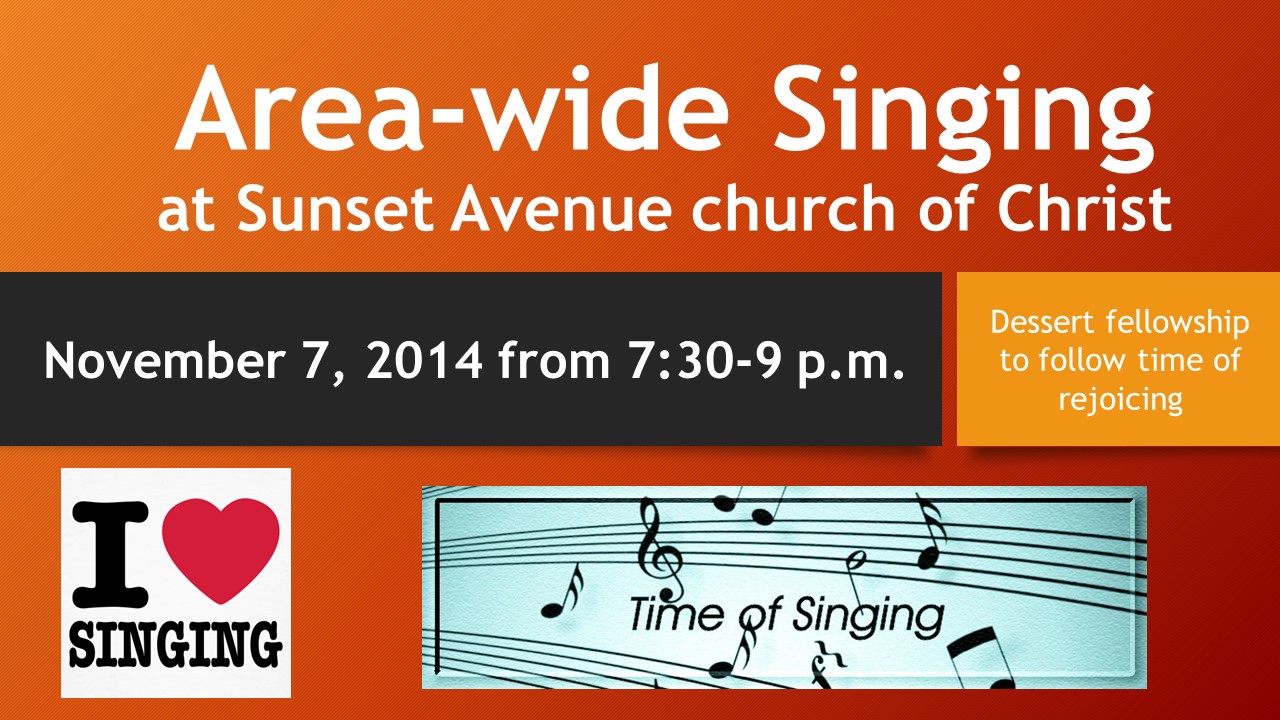
Area-wide Singing

 
Leave a comment

Posted by on October 23, 2014 in Article


Atheism#4 Losing Hope In Life


Once when Miss Roscoe was in his room, some of his infidel friends came to visit and in a loud, heartless manner said, “Tom Paine, it is said you are turning Christian, but we hope you will die as you have lived.” They then went away. Turning to Miss Roscoe, Paine said, “You see what miserable comforters they are.”

     Once he asked her if she had read any of his writings. She told him that she had begun The Age Of Reason, but it had made her so mad she had thrown it into the fire. “I wish all had done as you,” he said, “for if the Devil ever had any agency in any work, he had it in my writing that book.”

     When going to carry him refreshment, she repeatedly heard him uttering, “Lord! Lord God!” or, “Lord Jesus, have mercy on me!” It was observed that during his illness he wrote a great deal. But, as nothing was ever heard of these writings, it was presumed that his infidel associates had destroyed them, finding them not in keeping with his former views. [1]

This article focuses upon a sobering fact – the death of our mortal bodies. Those who reject God are especially affected by death. It is Shakespeare’s Hamlett that offers a good illustration of this dilemma. In mulling over the question “to be or not to be,” the sleep of death is contemplated. “For in that sleep of death what dreams may come … Must give us pause.” Indeed such is true. If there is consciousness (dreams) after death, there is the sobering issue of immortality to answer. And such a possibility is the deathknell of Atheism!

Death is an ironic subject. It is oft thought but seldom discussed. It is called the last enemy, the unknown quantity, the thief of strength and opportunity. Modern technology has opened limitless vistas of knowledge. We can chronicle the beginning of life from the minuscule zygote to the birth of the baby. We can trace life from fetal development to gerontology. But even today we know as much about the moment after death as we have known for centuries!

All who reject Holy Scripture are ignorant about the nether world.  And ignorance spawns fear. It is at death that “atheism meets its nemesis. Any system that does not know the origin of man and cannot give his reason for being, certainly must remain silent of his destiny, or at best, argue for nothingness” [Zacharias, p. 93‑94].

The most frightening aspect of death to the worldling is that at the instant of death we leave everything we have and take everything we are! All the wealth amassed, achievements accumulated, and honors received are worth nothing for “there are no pockets in burial shrouds”!  

Death reveals Atheism’s flaws clearly. Atheism offers no comfort. Bertrund Russell observed, “All the labors of the ages, all the devotion, all the inspiration, all the noonday brightness of human genius, are destined to extinction … and the whole temple of man’s achievement must inevitably be buried beneath the debris of a universe in ruins.” Following this dark assessment Russell concluded that humans face only “the firm foundation of unyielding despair” [2]

Who, in rational thinking, wants a life like this?  And yet such is Atheism’s consequence.  Such a worldview leads to a preposterous view of man. This is humorously summarized by Zacharias, “In the end, the atheistic view reduces the botanist from studying daffodils to fertilizing them, the scientist from measuring the ‘big bang’ to becoming  a small fizzle, and the geologist from investigating the geological column to becoming embedded in one of its layers” [p. 95].

There is no greater doom than this fatalistic perspective about earthly life which Atheism invites man to accept.  Consider the stark contrast between life’s hopelessness offered by Atheism and life’s hopefulness offered by belief in Jehovah God.

Questions About Death Which ATHEISM Fails To Answer.

There is a failure to answer the finality of relationships ceasing. 

Nothing threatens life’s dreams, hopes, aspirations, and accomplishments like the death of a dearly loved one. Many grieve themselves to death because death has separated them. Why is the loss of a special relationship so critical to humans? Because humans were created dependent upon bonds of special relationships. Without these special relationships human existence is hollow and void. Genesis 2:18 verifies this fact. In the splendor of Eden’s bliss there was something about man’s existence that was “not good.” He lacked the bond of special relationships. Yet Atheism allows death to reduce this bond to cold extinction!  Atheism cannot explain the void which death causes. Atheism is unable to offer hope for a death severed union. The human heart yearns to meet departed loved ones again. Atheism does not destroy that longing.  Atheism does not silence the question “What about __________?  Where is s/he?”

Atheism fails to answer the apportionment of justice for evil and good. 

Even the atheist pursues justice ‑ his philosophy denies such, but he still pursues it! But Atheism holds no response for the nagging query of how justice can be meted for evil when the wicked is dead. Some atheistic beliefs have tried to resolve this problem by appealing to reincarnation. But such is insufficient. Atheism has no answer for the reign of evil!

Atheism fails to answer the futility of earthly labors.

This predicament is well summed up in Luke 12:20 when God asks the Fool what profit all his labors would be when death took him. According to Atheism all human efforts are ultimately useless! The atheistic position naturally leads one to uphold that all labor to benefit humanity is absurd.  Atheistic concern is purely self‑centered. The atheist advocates humanitarian projects is a hypocrite! Atheism holds no answer to those who ask, “Why should I work, sacrifice self‑pleasure, and aid humanity’s progress?”

Atheism fails to answer the “sense” of eternity which resides within every human heart. 

Honesty forces all to admit a sense of the eternal. We “know” that there is “something” beyond earthly existence. The savages sent their dead prepared for happy hunting. The Norseman set their dead sailing for Valhala to reign among the heros of the past. Even in their ignorance these brutes acknowledged what the “intellectual” atheist cannot accept! Solomon observed that God “has also set eternity in their heart” (Eccl 3:11). No matter how much materialism one finds, s/he is still empty until God is found! Atheism cannot explain this “sense” of the eternal.

Atheism cannot answer how “hope” is abandoned by its worldview. 

Having “killed God” Atheism is left without reason for existence, morality for guidance, meaning for life, and hope during and after life! The loss of hope is cancerous and destroys all possibility for joy in the present. “Hope” is the one indispensable factor essential for meaning in life.

These words of Percy Bysshe Shelly reflect the unanswerable plight of the atheistic philosophy :

        Alas! I have no hope, nor health, Nor peace within nor calm around,

        Nor that content, surpassing wealth, The sage in meditation found,

           And walked with inward glory crowned ‑‑ Nor fame, nor power, nor love, nor leisure.

           Others I see whom these surround ‑‑ Smiling they live, and call life pleasure;

        To me that cup has been dealt in another measure -Stanzas Written In Dejection Near Naples, 1818

To all who share P. B. Shelley’s atheistic outlook comes his forlorn hopelessness.

The loss of “hope” in earthly life has drastic consequences. Every endeavor survives because of hope. Without hope all is futile and morbid. Without hope despair strangles and overcomes our vision. It is this hopelessness that has fueled the modern society’s preoccupation with immoral sexuality, drug abuse, terrorism, and crime. Humans seek meaning and purpose in life. But with a society guided by atheistic principles there is no hope. Each heart will struggle to find hope/meaning via some avenue.

Our youth illustrate this desperate grasp. Young people, struggling to find hope, grasp at astrology, witchcraft, shallow sex, and anything else that offers promise of meaning. They live in a society that has rejected God and now they desperately search for something to give meaning to existence! Atheism has abandoned hope for the future. Atheism cannot offer any encouraging vision. It offers only a world  without hope; a fate of oblivion into “unyielding desperation;” a burial beneath the debris of a universe in chaotic ruin. What “reasonable” person desires this philosophy of life?

Questions About Death Which God FULLY Answers.

In dramatic contrast to Atheism’s emptiness are the complete and comforting answers of Jehovah God! Note carefully these answers which leads to hopeful living.

God says that while death severs earthly relationships there is the provision for such separation to be temporary!

At the Battle of Gaines’ Mill, two brothers were wounded at the same time. They were found by a friend, embraced in one another’s arms, talking of home, mother, and their love of God and country. They prayed for each other, for absent friends, and especially for mother. Soon the younger died. The elder, being blind from a wound, knew it not and continued to speak encouraging words to him. Hearing no reply he said, “Poor little Rob’s asleep.” It was his last sleep and in a few minutes more they joined company in that land where the sound of battle will never disturb! (Foster, Vol. 1, page 171). For the believer there is hope of reunion after death!  David spoke of this upon the death of his baby (2 Sa 12:23); Christ spoke of this at Heaven’s great feast (Mt 8:11). Other texts offer hope for separated relationships (cf Lk 20:34‑36; Mt 25:34; Col 1:12; 1 Ths 4:17; Hb 12:23; Rv 5:9).

God says that justice will be meted to both good and evil.

The answer simply says, “God will judge both the righteous man and the wicked man” (Eccl 3:17; cf Eccl 11:9; 12:13,14; Ro 2:5‑9; 1 Co 3:8; Da 7:9,10; 12:2).

God says that all earthly labors have value here and hereafter.

The believer has hope because no effort is futile! Two soldiers were discussing the death of a comrade. “He got his discharge.” “Not quite.” “Well, if not discharged I’d like to know what he is?” “Only transferred.” “Transferred where?” “To the other department.” “What for?” “For duty.” “What duty?” “Don’t know, that depends on what he’s fit for.” (Foster, Vol. 1, p. 173). Believers are “fit for” reward “for their works follow with them” (Rv 14:13b; cf Eccl 3:12,13; 9:10; Mt 10:42; 25:35,36; Col 1:10; Hb 6:10; Rv 22:14).

God says that the “sense” of the eternal is present because there is the presence of an eternal soul within each human being!

The query, “What must I do, that I may have eternal life?” (Mt 19:16b) presses upon all hearts (cf Eccl 12:6,7; 2 Co 5:1). Only God answers this question.

God says that “hope” is reserved and encourages all to obey heaven’s will (Ro 8:24,25).

The “abundant life” can be realized here as well as hereafter (Jn 10:10)!

Concluding Thoughts 

The death factor has tremendous bearing upon the existence or void of “hope.” The fruits of Atheism are tragic – it offers no Mind for one’s origin, no law for morality, no meaning to enhance existence, and no hope to brighten its future. This dark existence is aptly addresses in Ephesians 2:11,12 as those without God are described.

However, faith in God’s existence offers complete victory in life here and hereafter! In this world he that is today the conqueror may tomorrow be the defeated.  Pompey is eclipsed by Caesar, and then he falls at the hands of conspirators; Napoleon conquered nearly all of Europe and was then himself conquered. But the Christian’s conquest of death is absolute. The result is final. The believer has vanquished the last enemy and has no more battles to fight! Let all saints join with Moses and call for our society to choose God and thus choose life! (Dt 30:19‑20). [3]
 ————————————————————-

[1]  Elon Foster, New Cyclopedia Of Prose Illustrations, Vol. 1. New York: Funk & Wagnalls, Co., 1870, p. 174.

[2] Bertrund Russell, “A Free Man’s Worship.” Mysticism And Logic And Other Essays. London: Allen & Unwin, 1963, p.41. 

[3] Sources Used And Suggested For Additional Study

Dr. Robert Gange, Origins And Destiny, chapter 15, “Why does physical reality terminate in man?” Dallas: Word Publishing, 1986..

John L. Kachelman, Jr., Studies In Judges, chapter 4, “An Erring Philosophy,” Quality Publications.

Ravi Zacharias, A Shattered Visage: The Real Face Of Atheism, Brentwood, TN: Wolgemuth & Hyatt Publishers, Inc., 1990

 
Leave a comment

Posted by on October 20, 2014 in Article


Atheism #3 The Character of Atheism


Jean Meslier (1678-1733) was a Roman Catholic priest who served as Vicar of Bue in Champagne, France for thirty years. Voltaire (1694-1778), the French deist who vigorously opposed Christianity and sought to fashion his own naturalistic religion, described Meslier as “the most singular phenomenon ever seen among all the meteors fatal to the Christian religion.”

 In a recent essay, A.J. Mattill, Jr., a Contributing Editor for The American Rationalist (a small journal published bi-monthly out of St. Louis), gushes over Meslier, applauding him as one of the great champions of skepticism.


As a preliminary matter, we must make two observations.

 First, if Meslier was any sort of symbolic luminary at all, he must have been a “meteor,” i.e., a phenomenon that provides no significant or lasting illumination, and who appeared as but a “glitch” in the galaxy of literary history. The priest was most obscure. I have consulted several sources – from The Encyclopedia Britannica to The Oxford Dictionary of the Christian Church – and I cannot find a solitary reference to the gentleman – not even an allusion to his name! Apparently he is considered illustrious only by the atheists.

 Second, what is this insanity about Meslier’s influence being “fatal” to the Christian religion? It is not even legitimate hyperbole to suggest that any skeptic has proved “fatal” to Christianity – or, for that matter, the whole of them combined. Voltaire himself was not (though he boasted he would be), and he was much more of a significant influence than Meslier.

 But consider for a moment this rogue whom skepticism extols so highly.

 When Jean Meslier died at the age of 55, three handwritten manuscripts were discovered in his home. Authored and signed by Meslier, these documents were titled, My Testament. The writings contained a series of confessions by the priest – combined with a vicious attack against the Bible. The documents revealed that his entire life had been a sham.

 Supposedly, his religious faith was abandoned as an adolescent, but, wishing to obey his father, he pursued the vocation of a priest.

 Here is a portion of his confession, directed to the members of his parish, as reported by Mattill (The American Rationalist, June/July, 1999, p. 3).

“I was nevertheless compelled to teach you your religion and to carry out that false duty that I had committed myself to as the vicar of our parish … I had the displeasure of finding myself annoyingly obliged to act and speak totally against my own feelings, to entertain you with foolish nonsense and vain superstition that I hated, condemned, and disliked in my heart. I, however, declare that I never did it without great pain and extreme repugnance. This is why I hated so much the vain functions of my ministry, particularly all those idolatrous and superstitious celebrations of masses, and those vain and ridiculous administerings of sacraments that I had to carry out. I cursed them thousands and thousands of times in my heart, when I was obliged to do them, and particularly when I had to carry them out with a bit more attention and a bit more solemnity than usual.”

 Aram Vartanian, writing in The Encyclopedia of Unbelief (Buffalo, NY: Prometheus Books, 1985, II, p. 448), says that Meslier was “[f]rustrated and incensed by the hypocritical role he felt condemned to play during his lifetime” (emp. WJ).

 Two observations are in order.

First, one can only wonder if the direction of Jean Meslier’s life would have been altered had he known genuine Christianity, as opposed to the corruptions of the apostate Romish system (cf. 1 Tim. 4:1ff). Those who pervert the primitive Christian arrangement – as designed by God and revealed in the New Testament, thus paving the way for unbelief – will have a heavy responsibility to bear in the day of judgment.

 Second, what does it say about the character of atheism when the skeptics virtually “canonize” a man whom they concede to be a life-long hypocrite, and who was able to express his true convictions only posthumously?

 Consider the following scenario.

Carl Sagan was an atheist who spent the whole of his adult life opposing God and casting reflection upon His Son. Now that Sagan is dead, suppose there were discovered among his possessions a manuscript in which he secretly professed his faith in Christ, and apologized for his hostility toward things sacred. Does anyone imagine for a moment that the Christianity community would be ecstatic – applauding the gentleman and making of him a causa celebratio?

Not hardly!

 But such is the difference between the character of Christianity and that of infidelity.

 The Folly of Atheism[1]

Jesus once warned: “Whosoever shall say, ‘You fool,’ shall be in danger of the hell of fire” (Mt. 5:22). And yet elsewhere, the Lord, in addressing the scribes and Pharisees, declared: “You fools …” (23:17). While the superficial student might see a conflict here, actually, there is none; the respective passages are addressing different matters.

 In the earlier context, Christ is condemning the impulsive, insulting use of hateful epithets for the purpose of venting one’s personal hostility. “Fool” (Greek – more) may be designed to reflect upon the character of an adversary, in the sense of: “You scoundrel!” (Bruce, 107).

 On the other hand, the word “fool” (or a kindred term, e.g., “foolish”) may be employed calmly and objectively to describe someone who is acting in a senseless, stupid fashion. To certain misguided Christians, who were being seduced away from Christ towards the Mosaic regime, Paul could say: “O foolish Galatians…” (Gal. 3:1). J.B. Phillips rendered the phrase: “O you dear idiots of Galatia” (393).

It makes for a fascinating study to explore the sort of person who is denominated as a “fool” in Scripture. Let us consider but one example – that of the atheist.

 A thousand years before the birth of Jesus, the poet-king of Israel wrote: “The fool hath said in his heart, there is no God” (Psa. 14:1). The Hebrew term for “fool” is nabal, which signifies a “senseless” person. Especially is the word used of one who has “no perception of ethical and religious claims” (Brown, et al., 614).

 In the Greek version of the Old Testament, the word rendered “fool” is aphron, literally, “mindless.” It represents “the lack of common sense perception of the reality of things natural and spiritual” (Vos, 44). In the passage just cited, the “fool” denies the existence of God (cf. 53:2); elsewhere in the same book the term describes one who insults his or her Creator continually (74:22). The prophet Isaiah employed the word of the individual who stands in contrast to a noble-minded person (32:5).

 Why is the one who affirms – “There is no God!” – a fool? There are many factors.

  1. In defiance of one of the most elementary principles of logic, the atheist suggests that “something” (e.g., the Universe) came from “nothing;” that zero plus zero equals something greater than zero.

Victor Stenger, an atheistic professor at the University of Hawaii, admits that “everyday experience and common sense” supports the concept that something cannot come from nothing. Nevertheless, he suggests that “common sense is often wrong, and our normal experiences are but a tiny fraction of reality” (26-27). If you want to be an atheist, you must put your “common sense” on the shelf!

  1. Atheists contend that the entire Universe, estimated to be 20 billion light years across (the distance light could travel in 20 billion years at the rate of 186,000 miles per second) accidentally derived from a submicroscopic particle of matter. As one writer expresses it: “Astonishingly, scientists now calculate that everything in this vast universe grew out of a region many billions of times smaller than a single proton, one of the atom’s basic particles” (Gore, 705). This is totally nonsensical.
  2. Atheism contends that the marvelously ordered Universe, designated as “Cosmos” by the Greeks because of its intricate design, is merely the result of an ancient explosion (the Big Bang). Does a contractor pile lumber, brick, wire, pipe, etc., on a building site, blast it with dynamite, and expect a fine dwelling to result? Is that the way atheists build their houses? To so argue is to reveal a truly “senseless heart” (cf. Rom. 1:21).
  3. In spite of millions of examples in nature, which suggest that biological life can only derive from a living source, atheists believe that billions of years ago, life was accidentally generated from inorganic materials. Common sense and experimentation argue otherwise, but skeptics are willing to abandon logic and opt for the myth of “spontaneous generation,” because the only other alternative is “special creation.” To atheists that simply is not a possibility. Why? Because the fool, for emotional reasons, has already decided: “There is no God.”
  4. Atheists believe that blind, unintelligent forces of nature, via genetic mutations and the process of natural selection, produced the myriads of delightful creatures that inhabit Earth’s environment. The skeptic can see that a simple pair of pliers, with only four components, must have been designed by an intelligent being, yet he argues that the human body, with its 100 trillion constituent elements (cells), organized into ten magnificent systems, is merely the result of a marriage between Mother Nature and Father Time. How very stupid such ideology is!
  5. Atheists believe that from a tiny speck of inorganic, self-created matter, human consciousness and moral sensitivity evolved. That is utterly ludicrous; can a rock decide to “think”? Can a proton “feel” guilt? The notion that morality has developed merely as a survival factor (cf. Hayes, 174), is asinine in the extreme. Plants have survived; do they possess a moral code? And what if one decides that he doesn’t care about the “survival” principle? Can he do any “wrong”?

 When men refuse to have God in their knowledge, he gives them up to a “reprobate mind,” i.e., one which does not “pass the test” (Rom. 1:28). They are not “intellectuals,” as they fantasize; they are fools.

 As G.K. Chesterton once said: “When men cease to believe in God, they do not believe in nothing; they believe in anything!” [2]

Losing The Virtue Of Goodness By John Kachelman

“The enemies of religion cannot leave it alone. They laboriously attempt to smash religion. They cannot smash religion; but they smash everything else” [G.K. Chesterton, Lunacy And Letters. New York: Sheed & Ward, 1958, p. 191]. Such was never more accurate than in the realm of ethical standards. The atheistic philosophies have subtly decimated the ethical basis of morality. Society today reflects the distorted values which Isaiah condemned (Is 5:20).

 Religious expression has been denied in modern society because of the atheistic persuasion. A book detailing the ACLU notes, “For all intents and purposes, the ACLU has been able to harass out of existence public expression of faith” [Grant, Trial And Error p. 72]. In our courts, schools, and communities we have been forced to silence regarding religious matters. Loud objectors have convinced us that the Constitution’s founding principles designed a government free FROM religion, instead of one free FOR religion.  And this is the consequence of atheism’s influence! Atheistic ideas have scored a significant victory in the sequestering of religious expression. Yet this advance poses another obstacle that exposes the flaws of atheism. In brief this “victory” reveals that atheism is utterly incapable of producing “goodness” in society! This is concluded from the following thoughts.

 In every culture there is an understood “code of oughtness” which establishes the foundation for laws, justice  and society’s welfare.  “Oughtness” is linked with purpose. When you eliminate the “oughtness” from existence you eliminate the purpose for life and chaos will follow. A good illustration is given by Ravi Zacharias (p. 47ff). He suggests the simple watch has a simple purpose ‑ to tell time. However you describe a watch you must describe it as a time‑telling mechanism. The watch is designed with a purpose, an “oughtness.”

 When it loses that purpose (fails to keep accurate time) it loses its meaning for existence! Such is true with human society. When society loses its sense of “ought” (its awareness of right/wrong) it also loses its purpose for existence. Such citizens will aimlessly wander about asking, “Why are we here?” “What are we to do?” From the Garden of Eden to the splendor of the heavenly Eden restored, man’s purpose (that which s/he ought to do) is to honor the Heavenly Father through labors, service, and honor. When man/woman loses this awareness of the “ought” they lose the purpose and meaning of life.

 It is this point that exposes atheism’s failure. A self‑caused world has no sense of “ought”; no morality (for how can one give up the Christian Faith and expect live to live by Christian Ethics?); and, there is no abiding sense of right and wrong. Holy Scripture gives repeated warnings about rejecting God because the consequences of such rejection have a paramount impact – a rejection of the spiritual for the fleshly! (cf Ro 8:5‑7; 1 Co 2:14; Gal 5:17; Ep 2:1‑3; 4:17‑19; Tit 3:3). Once one rejects God then s/he loses the sense of “oughtness” for existence. Such is a tragic penalty which is often rashly gained and leisurely regretted.

 Those who follow atheism’s allurement will find themselves adrift in the stormy seas of life without chart or compass. They will sail into hopelessness guided by meaninglessness. Life will be void of purpose. An inner‑turmoil is constantly fueled by the unanswerable query, “Why am I alive?  What is my purpose for being here?”

 The ethical quagmire of atheism affords no escape for those rejecting Deity. Look and observe how atheism fails to be a suitable alternative to theism because it eliminates the virtue of goodness in human society.

 The BASIS For Ethics

“Ethics” is simply the standard upon which right or wrong is decided. Any ethical standard operates from a basis of origin. Whatever ethical standard is used, one will appeal to this origin in every decision. Christian Faith has such an ethical basis, as well as Atheism.

C. S. Lewis, a well‑known apologist of theism, suggests that there are three questions upon which any ethical standard must stand if it is to offer society a workable program [Peter Kreeft, Three Philosophies Of Life. San Francisco: Ignatius Press, 1989, p. 17ff].  He uses the metaphor of ships sailing upon the seas.  First, the ships must know how to avoid bumping into one another.  This sets the standard for social ethical behavior.  Second, the ships must know how to stay shipshape and avoid sinking.  This sets the standard for individual ethical behavior. We must know what virtues to add, vices to avoid, and characters to build if we want to avoid personal tragedy.  Third, the ships must know why they are at sea.  This points to the philosophical ethical standards ‑ the reason for existence.

 The Holy Scriptures clearly provide explanation for these three ethical bases. The Bible tells us how to act socially. The Bible tells us how to act individually. And the Bible tells us the reason for existence on earth. Although several texts explain each, 2 Timothy 3:17 aptly summarizes, “That the man of God may be complete, furnished completely unto every good work.”

 The Atheist miserably fails to establish a workable ethical basis using these three standards. Atheism flatly rejects the last two and practically ignores the first! By such atheism has brought about . . .

 The DISSOLUTION Of Ethics Today

Since atheism has erased the “WHY” of human existence, those following its philosophy are forced to decide life’s choices in tragic ways. Look at society and observe how the Scriptural Ethic has vanished.

First, we are promised unlimited “freedoms” only to discover greater bondage. As a result of the “freedoms” of speech and privacy we are almost bankrupt of basic morality! The virtues of respect, honor, truth, and compassion have been sacrificed upon the alter of self‑centeredness. “Porn Kings” live in splendor because they enjoy “freedom” of speech. Homosexuality has been legitimized because of a “freedom” of privacy. But it is a deceptive freedom (cf 2 Pt 2:18‑19).

 Second, the traditional ethics of right/wrong are attacked with scorn and ridicule. The old morality has been replaced with the new morality that has neither absolute rights or wrongs! Ethical decisions today are based upon feelings of the moment, not upon decisions of thought. Today’s society is called to “duty” to the downtrodden and oppressed.  The atheistic philosophy argues that man alone is the savior of fellow‑man. But, to what purpose is this “duty.” From what higher level of morality can atheism call for benevolence?  Having erased God, the atheist has no higher level than himself and that is inadequate! Duty to whom and duty to what purpose cannot be answered by atheism! This is supported as we observe . . .

 The CONSEQUENCES Of Atheistic Ethics

What happens when one tries to live as a law unto himself without God’s ethic? Tragic consequences will come (Ro 1:21). This is practically seen in the following :

 First, the lives of those who rejected God illustrate the perversness of a self‑guided ethic. Names from history such as Marx, Sarte, Bertrund Russell, Hemmingway, and a host of others reveal that those who trust in a self‑guided morality will live life with a lack of cohesion; relationships will be void of commitment; fidelity will be a dream unattainable [See Paul Johnson, Intellectusals. New York: Harper & Row, 1988]. 

 Hitler was such a person.  In Auschwitz, Hitler’s words comment upon the goal of a self‑guided ethic, “I freed Germany from the stupid and degrading fallacies of conscience and morality . .  . I want young people capable of violence ‑ imperious, relentless, and cruel.” [Zacaharias, p. 59].  These goals were achieved in the Third Reich and have survived to our modern times. The sanctity of life is ignored by the abortionaries and mercy killers. The self‑guided ethic justifies killing those who are “ill‑suited” and “ill‑equipped” to live as “contributing citizens.”

 Second, survival is the only ethic of atheism. Since there is no God, there are no moral obligations to help another at the sacrifice of self. Those honored as “heros” in the past because of personal sacrifice for the good of others are seen as “stupid” by the atheistic philosophy. What is the justification for sacrifice under atheism? There is none! The harsh consequence of atheism is that people will look out only for self and have a callous disregard for others!

 Third, violence is the bitter fruit. Since one is concerned only with self, then s/he will do anything to another to gratify self! In atheism there can be NO WRONG with murder, rape, torture, or any other cruelty because it is simply the “survival of the fittest”! Those who are persuaded by atheism’s ethics feel more compassion for the murderer than the murdered; for the adulterer than for the betrayed! Atheism actually convinces us that the real guilty party is the victim rather than the perpetrator of the crime!

 Fourth, a never ending erosion of life’s value. “The universal solvent ‘the death of God’ has effectively dissolved the life sustaining crucible of morality. But like all universal solvents, the problem of how and where to contain it becomes paramount” [Zacharias, p.66].  Such is a sobering thought. If atheism’s ethics are allowed to progress then we will no longer have any sense of morality ‑ all will be destroyed!

 CONCLUDING THOUGHTS

Thus we see two ethical standards. One, Christianity, offers logic, meaning, purpose, and practicality. It holds hope for society’s longevity. Then there is Atheism. It offers that which is intolerable and unlivable. It portrays no hope, no meaning, and only selfish practice. It dissolves  society’s foundation.

 The only abiding Code of Oughtness, that gives meaning to life, is the Holy Bible! Even though the ACLU has advanced atheism’s morality, there is still religious expression in our land!

 In our public buildings, irrefutable evidence of our country’s Christian heritage abounds: the 10 Commandments hang over the head of the Chief Justice in the Supreme Court; in the House and Senate chambers appear the words, ‘In God We Trust’; in the capitol rotunda is the figure of the crucified Christ; carvings on the capitol dome testify to, ‘The New Testament according to the Lord and Saviour Jesus Christ’; the Great Seal of the United States proclaims, ‘Annuit Coeptis,’ which means, ‘God has smiled on our undertaking’; under the seal is inscribed the phrase from Lincoln’s Gettysburg Address, ‘This nation under God’; the walls of the Library of Congress are adorned with the words of Psalm 19:1 and Micah 6:8; engraved on the metal cap of the Washington Monument are the words ‘Praise be to God’; and lining the stairwell are numerous Scripture verses that apply the Christian Faith to every sphere of life from the family to business, from personal character to government” [Grant, p.77‑78].

 Once again we see the utter folly of Atheism. Those who are influenced by it follow a course of ethical behavior which will cause them to lose the virtue of goodness! [3]

“In a universe of blind physical forces and genetic replication, some people are going to get hurt, and other people are going to get lucky; and you won’t find any rhyme or reasoning to it, nor any justice. The universe we observe has precisely the properties we should expect if there is at the bottom, no design, no purpose, no evil and no good. Nothing but blind pitiless indifference. DNA neither knows nor cares. DNA just is, and we dance to its music.” – Richard Dawkins, Out of Eden, NY: Basic Books 1992, p 133. 

Dawkins is one of the most vocal and visible atheists of our day, and the above statement is an atheist statement of faith. We can show that DNA cannot be the product of chance, and we can argue that the whole question of biological cause to behavior is poorly answered by evolution; but it might be useful to ask what case atheists can make for any kind of morality? If there is “no evil and no good” then everything is a function of survival of the fittest. How can you make a meaningful case for law and order from such a belief system? 

  Atheists are quick to point out that those that believe in God fail as much as atheists do in living any kind of meaningful morality. Whether you agree with that assessment or not, there is no question that believers do immoral things, and the problems that our Catholic friends and neighbors find themselves in right now is a classic demonstration of that – but one certainly not confined to Catholicism. Atheists will also argue that you cannot have an ordered society unless there is an agreement about basic issues of what you will allow and what you won’t allow.

An atheist will say that they have as much reason to be moral and not murder or rape as any Christian, because society will dissolve into anarchy if they do so and that doesn’t benefit their own personal survival. I used to make that argument as an atheist in loud and vocal terms, and it sounds good to many people.

The problem is that it doesn’t work. As an atheist if I could get away with something that would bring me pleasure, I only had to answer to myself and thus there was no reason not to do it. As long as it didn’t hurt anyone else, there was no right or wrong or good or evil, so there was no reason not to do it.

The problem with that thinking is that none of us could ever know the ultimate result of what we do. Having sex with an animal or a same sex partner didn’t appear to me to be anyone else’s business when I was an atheist, and had it not been for the fact that I was in love with a Christian girl who was rock solid in her own moral beliefs, I would have done all of those things.

I would never have known about animals carrying STDs or that such activity would have enormous emotional and spiritual affects on my life later on. My belief system as an atheist was totally unworkable – and led me to the brink of suicide.

Dawkin’s argument is not only strongly opposed by evidence, it is a totally impractical and unworkable system. Unfortunately, since September 11, a lot of people are believing it, and since he is a prolific and aggressive author and speaker it is going to get widespread press and support. Recently the ACLU has gone to court saying that abstinence is a religious position. This says that anything that has a moral standard that suggests that there is right and wrong conduct has to be religious in nature. I am sure that Dawkins would agree with that. I would argue that there is no moral standard in atheism, and that this is a strong apologetic for the teachings of Jesus Christ. (By John Clayton). [1]
———————— 

[1]John Clayton was an atheist for 20 years and actively involved with Madalyn O’Hair and her organization. He became a believer in God through detailed studies in science.

 [1] These two fine articles were written by Wayne Jackson and are posted on the Christian Courier website.

[2] Sources for these two articles:

Brown, Francis; Driver, S.R.; Briggs, Charles (1907), Hebrew-English Lexicon of the Old Testament (London: Oxford University Press). 
Bruce, A.B. (1956), “Matthew,” The Expositor’s Greek Testament, W. Robertson Nicoll, Ed. (Grand Rapids: Eerdmans), Vol. I. 
Gore, Rick (1983), “The Once And Future Universe,” National Geographic, June. 
Hayes, Judith (1996), In God We Trust: But Which One? (Madison, WI: Freedom From Religion Foundation). 
Phillips, J.B. (1972), The New Testament in Modern English (New York: Macmillan). 
Stenger, Victor J. (1987), “Was the Universe Created?” Free Inquiry, Summer, Vol. 7, No. 3. 
Vos, Geerhardus (1899), Dictionary of the Bible, James Hastings, Ed. (Edinburgh: T.&T. Clark), Vol. II.


[3] Sources used by John Kachelman and suggested for further study

George Grant, Trial And Error. Brentwood, TN: Wolgemuth & Hyatt, Pub., 1989.

Paul Johnson, Intellectuals. New York: Harper & Row, 1988.

Cal Thomas, Uncommon Sense. Brentwood, TN: Wolgemuth & Hyatt Pub., 1990.

Thomas B. Warren & Wallace I. Matson, The Warren‑Matson Debate On The Existence Of God. Jonesboro, AR: National Christian Press, 1978.

Ravi Zacharias, A Shattered Visage : The Real Face Of Atheism. Brentwood, TN: Wolgemuth & Hyatt Pub., 1990.


Leave a comment

Posted by on October 15, 2014 in Article


#2 Atheism: Losing Life’s Essence


Each reader has seen the crude depiction of the “Missing Link” – squat, bent bodies with dull, beastly features. The drawings convincingly portray the missing connection between monkey and man. Even the scientific designations are such that the novel student of “origins” is instantly impressed.  After all, how would you react to names such as Australopithecus and Hesperopithecus haroldcookii?

 These discoveries have been used as the bedrock of evolutionary theory. Millions of children have been exposed to the fabricated timeline of human evolutionary development. Each of evolution’s “Missing Links” has been exposed as a complete failure! [Richards, p. 94ff].

 Some may see no connection between evolution and atheism. But the two are intimately connected. In fact, either philosophy is dependent upon the other. You cannot have one without the other! Why is atheism dependent upon evolution’s absurdities? The answer lies in the issue of “origins.”

 To explain the origin of life one either admits God’s existence or advocates evolution. Because of his rejection of God the atheist must accept evolution. This is an ill‑fated position revealing the failure of atheism.

 Why People Believe in Evolution by Wayne Jackson

The most insidious and damaging ideology ever foisted upon the mind of modern man is the notion that human beings are but animals, and the offspring of other, more primitive creatures. It is known as the theory of organic evolution. This concept has been reflected in recent years in such volumes as Phil Donahue’s, The Human Animal (1986), and in the earlier production, The Naked Ape (1967), (as man was characterized) by zoologist, Desmond Morris.

 Tragically, multiplied thousands across the land have ingested, to a greater or lesser degree (sometimes even with a religious flavor), this nefarious dogma. But why? Have folks intellectually analyzed the matter, and thus, on the basis of solid evidence and argument, accepted this viewpoint. Not at all; rather, for a variety of emotional reasons, this concept is entertained so readily.

 In 1974, Marshall and Sandra Hall published a book titled, The Truth: God or Evolution? In the opening section of this excellent volume, the authors listed several reasons why the evolutionary theory is embraced by so many. With credit to them for the germ thoughts, I would like to expand the discussion.

 Brainwashing

Since the issuance of Charles Darwin’s, The Origin of Species (1859), there has been a massive campaign to flood the “intellectual market” with evolutionary propaganda. Though such ideas by no means originated with Darwin, he popularized evolution more than anyone else. His book sold out (1,025 copies) the first day of its release.

 Another significant milestone was the famous Scopes Trial, conducted in Dayton, Tennessee in July of 1925. Twenty-four year old John Thomas Scopes, a high school science teacher, had agreed to violate Tennessee’s Butler law, which forbade the teaching of any theory that holds man has descended from a lower form of life. The entire affair was “rigged,” but it brought together William Jennings Bryan (three-time Democratic nominee for president), who volunteered to represent the state, and the famed criminal defense attorney, Clarence Darrow, who defended Scopes. The trial, the first ever to be broadcast on radio, brought national attention to the issue of creation vs. evolution. As a result of that encounter, the concept of creationism was cast into an unfavorable light, and evolutionary dogma gained considerable respectability, albeit undeserved.

 From that time, however, the theory of evolution has accelerated in influence via the media and the public school system. Today, there exists a determined campaign for the indoctrination of evolution, and millions have absorbed it into their minds.


Intimidation

Hand-in-hand with the brainwashing factor is the impact of intimidation. Supposedly, evolutionary doctrine has the endorsement of “science.” In 1966, H. J. Muller, a prominent geneticist, circulated a statement signed by 177 biologists. It asserted that evolution is a “scientific law” which is as firmly established as the rotundity of the earth.

 Since most folks want to be thought of as “educated,” and as they have been led to believe that “all educated people believe in evolution,” they have defected to the Darwinian camp. Most of these individuals could not cite a solitary argument in defense of evolution; they simply believe it is fact because “the scientists say so.”

 Informed people should know the following:

  1. Evolution is not a scientific law. It is a mere hypothesis that falls quite beyond the pale of the scientific method (observation, experimentation, and verification).
  2. There are numerous laws, e.g., the laws of thermodynamics, genetics, etc., which contradict evolutionary assertions.
  3. Many scientists dispute that evolutionary dogma is true science. Evolutionist Robert Jastow, for example, has conceded that belief in the accidental origin of life is “an act of faith,” much, he says, like faith in the power of a Supreme Being (Until the Sun Dies, New York: Warner Books, 1977, p. 52).

Theodore N. Tahmisian, a nuclear physicist with the Atomic Energy Commission, has said:

“Scientists who go about teaching that evolution is a fact of life are great con men, and the story they are telling may be the greatest hoax ever. In explaining evolution we do not have one iota of fact … It is a tangled mishmash of guessing games and figure jaggling … If evolution occurred at all, it was probably in a very different manner than the way it is now taught” (Fresno Bee, Aug. 20, 1959).


It is hardly necessary, therefore, to yield to the pressures of evolutionary brow-beating. We ought not to be cowed down; we should be more aggressive, demanding that those who affirm their confidence in evolution argue their case logically.

 Religious Confusion

Some have been thrust toward evolutionary ideology because they are repelled by the confused (and sometimes cruel) state of the religious world. Religionists have sacrificed their own children in the name of “gods” (cf. Jer. 19:5). In the Far East the cobra is worshipped as deity. “Christians” (so-called) have warred with the devotees of Islam.

 Catholics allege that the bread and wine of “the Eucharist” magically turn into the body and blood of Jesus, while Protestants insist that such does not occur. Some contend that “baptism” is administered only by immersion, while others allege that “sprinkling” or “aspersion” will suffice. A rather unique view suggests that it takes all three “modes” to constitute the “one baptism” of Ephesians 4:5 (cf. Wycliffe Bible Dictionary, Peabody: MA: Hendrickson, 1998, p. 201).

 This disunity has driven many to disenchantment with religion in general, which includes a rebellion against divine revelation. This, of course, is precisely what Jesus indicated. He admonished those who professed a loyalty to him to be “one,” that “the world might believe” (Jn. 17:20-21); the Lord thus implied that disunity would produce the opposite effect, i.e., unbelief.

 But people need to realize that a departure from the original does not negate the genuineness of the original. The segmented status of “religiondom” does not authenticate evolution. The fact of the matter is, the evolutionists are as divided as the religionists.

 For example, Sir Francis Crick, co-discoverer of DNA, contended that biological life evolved here on earth. On the other hand, Sir Fred Hoyle has argued that “spontaneous generation” occurred in outer space! Some Darwinians speculate that the evolutionary process has occurred quite gradually, over eons of time. Supposedly this explains the lack of transitional forms in the fossil record. Others (e.g., Richard Goldschmidt, and more recently, Stephen Gould of Harvard), suggest that evolution has proceeded rapidly, almost in snatches.

 There is wholesale disagreement among the advocates of evolution. Those, therefore, who have fled from religion because of its disunity, have found no haven in Darwinism.

 A World of Disorder

Many feel that our world environment, which is so characterized by brutality and suffering, is more consistent with Darwin’s tooth-and-claw, “survival-of-the-fittest,” principle, than it is with the notion that the earth is tended by a benevolent God. There might be some leverage in this argument if there were no other rational explanation for the ills of this globe.

 But the fact is, a compelling case can be made for the proposition that life’s tragedies are the result of man’s rebellion against his Creator; and negative consequences have been allowed to follow as an educational process on behalf of the human family. In our recently published book, The Bible and Mental Health, we have an entire chapter chronicling some of the values of human affliction.

But here is another matter for consideration. While the believer has some basis for explaining the presence of “evil” in a fashion that is consistent with the existence of a powerful and benevolent God, the evolutionist has no reasonable explanation as to why there is a human sensitivity within man that judges some things to be “evil” and others “good.” How can a package of mere “matter,” which, according to atheism, is the sum of man, arrive at a rational, moral judgment concerning this phenomenon called “evil”? The problem of “evil” is more challenging for the evolutionist than for the creationist.

 Tangible Evidence

Many folks are impressed with the evolutionary case because it is buttressed, they believe, with tangible evidence, whereas religion seems to partake of a dreamy, surreal environment. After all, scientists have “fossils” to prove their case, don’t they?

 This argument is exceptionally deceptive for the following reasons:

  1. All of the fossils ever collected represent less than 1% of the potential evidence, according to David Raup of Chicago’s Field Museum (Museum Bulletin, Jan., 1979, p. 50).
  2. Not a single fossil has ever been discovered that clearly demonstrates a link between basic organism “kinds.”
  3. All fossil evidence is subject to interpretation; and even evolutionists dispute the data.

For example, when Donald Johanson and his colleagues discovered the few bone fragments they dubbed “Lucy,” back in 1974, they alleged that this little creature walked on two legs, and was on-the-way to becoming human. Numerous evolutionists, however, seriously disputed this. We discussed this matter in considerable detail in the October, 1986 issue of the printed Christian Courier.

 But Bible believers are not without “tangible” evidence in the defense of their case. Numerous archaeological discoveries have been made which support the historicity of the Scriptures (see our book, Biblical Studies in the Light of Archaeology.

 If, then, a general case can be made for the factual correctness of the Bible, one may reasonably conclude that its affirmations regarding the origin of humanity are correct as well.

 Escape from Responsibility

Another reason why many so readily accept evolution as the explanation for mankind, is that such allows them to “cut loose” from God, and hence to be free from moral and religious obligations. They thus can become their own “gods,” and write their own rules. Richard Dawkins says that “Darwin made it possible to be an intellectually fulfilled atheist” (The Blind Watchmaker, New York: W.W. Norton, 1986, p. 6).

 This viewpoint was vividly illustrated some years ago when Clarence Darrow spoke to the inmates of the Cook County jail in Chicago. Hear him.

“I do not believe there is any sort of distinction between the real moral conditions of the people in and out of jail. One is just as good as the other. The people here can no more help being here than the people outside can avoid being outside. I do not believe that people are in jail because they deserve to be. They are in jail simply because they cannot avoid it on account of circumstances which are entirely beyond their control and for which they are in no way responsible” (Arthur Weinberg, Attorney For The Damned, New York: Simon & Schuster, 1957, pp. 3-4; emp. WJ).

 This shocking statement reveals the motive of some evolutionists.

 People do not believe in evolution because they have been led there by solid evidence. They are stampeded into the Darwinian community by superficial, emotional, and personal factors. They only delude themselves when they think otherwise.

 Consider how evolution leads man to a total loss of life’s essence.

 THE CONTRADICTIONS OF EVOLUTION

1. Evolution contradicts basic laws of Physics. 

The 1st Law of Thermodynamics teaches that natural processes do not bring things into existence from nothing. But evolution must contend that once nothing existed and suddenly “nothing” produced something. True Science admits that the universe began from nothing. Hence the evolutionary theory contradicts this basic law.

 2. The “New Generalized 2nd Law of Theromdynamics” also reveals evolutionary errors.

This Law asserts that had the universe been here forever, it would now be in a state of “rest” because in natural processes the order [complex] always dissolves into the disorder [simple].

 Natural processes NEVER begin with the simple and ascend to the complex! Natural processes are locked into a strict order that cannot be broken. But evolution argues that matter has the marvelous ability to perform brief “miracles” where natural processes are suspended and the matter transcends natural laws. But such a theory contradicts the laws of True Science!

 3. Evolution contradicts basic common sense. 

When all is studied the evolutionist still has no logical, scientific explanation for origins. Vain efforts have been made to provide explanations. One example will suffice, although many could be cited. F.H.C. Crick, discoverer of the DNA molecule, had a profound effect upon genetics/biology. He was an evolutionist who struggled to explain origins. He suggested that life on earth originated when a bacteria form was transmitted to Earth by a missile from some other part of outerspace! [Zacharias, p.39]

 4. Evolution contradicts basic facts of True Science.

True facts are not presented by the evolutionists unless they are shrouded with fabrication. So called “experts” are called to testify to the validity of evolutionary progress. Many “facts” are presented. But it is helpful to remember that an “expert” is only one who agrees with one’s worldview and “facts” are often assumptions that reinforce the worldview of the “expert.”

 THE TRAGEDY OF EVOLUTION

The greatest tragedy of evolution is found in its assertion that humans are just another animal that live on a higher plane of awareness and activity. But this is false! Practical observations reveal this tragedy. When man and monkey are compared we see enormous differences. There is an absolute distinction that sets human life apart from animal life. Emotive awareness also refutes evolution’s tragic conclusion. At death we “know” that a difference exists between man and animal. No amount of evolutionary talk will convince us otherwise (cf Eccl 3:19‑21; 12:7). 

 The differences between man and monkey raise a number of probing questions haunting the evolutionist. Why are there such dramatic differences IF man is just another animal? Does this difference enable man to participate in a destiny inaccessible to the monkey? Could this destiny include “eternity”? What quality in man enables him to defeat even the mightiest of beasts?  What is there that makes human life “human” and animal life “animal”?

 The tragedy of evolution is beginning to be measured in our century as ethical madness, inane cruelties, and desolation are sweeping civilization. Evil and immorality abound because human life has lost its “humanness” and thus has lost its meaning and value!

 THE IGNORANCE OF EVOLUTION

This system is advocated to support the philosophy of atheism. It is advanced by the leading “Intellectuals” of our century. But it is ignorant of the sublime words of Psalm 8.

 In Psalm 8 we read of God’s glory and man’s dignity. These are two elements which evolution has erased from the modern mind.  The Scriptures reveal that man’s dignity is inescapably connected to God’s glory – if God has no glory then man has no dignity! The Psalm elaborates on man’s dignity and presents human beings in a majestic portrait. Man is created by God and has an intrinsic value and dignity that is not found in animals. Man is placed over the animals because he is far different!

 Even though evolution is advocated by the “Intellectuals,” it is a theory of gross ignorance! It ignores man’s uniqueness; his creation by the Almighty; his authority over animals; his essence as the image of God!  In this ignorance man has lost the essence of daily living!

 Put in simple terms, atheism eliminates human dignity, self‑worth, and personal value via evolution. Its tragic conclusion is stated by Jacques Monod, “Man at least knows that he is alone in the unfeeling immensity of the universe, out of which he emerged by chance.” [Chance And Necessity, London: E.T. Collins, 1973, p. 167].

 We are on Earth either as a consequence of a “Mindless First Cause” or we are here by the design of a Mighty Creator. With one position you have neither purpose nor meaning in life. With the other, your life has purpose, meaning, and existence. Surely the reasonable mind will see the folly of evolution!

 Problems for the Theory of Evolution by Wayne Jackson
 New articles come to our attention occasionally which contain data that really throw a “monkey wrench” into the theory of evolution. Let me mention three such items I’ve seen in relatively recent times.

Evolutionary scientists date the earth at approximately 4.5 to 5 billion years old. Most folks are not aware that there is really no incontrovertible scientific proof to establish these fantastic dates. They are grounded in a series of assumptions that are based upon evolutionary premises. In other words, the “clock” is rigged to provide the “long ages” of earth’s history.

 Why is this the case? Because, as everyone concedes, “time” is an absolutely essential ingredient in the Darwinian scheme. Dr. George Wald of Harvard called it the “hero of the plot.” Evolutionists need vast amounts of time for the millions of evolutionary changes to occur which would produce the amoebae-to-man phenomenon.

 It has been demonstrated many times, however, that the “evolutionary clocks” are terribly flawed (see our Courier Publications for, Creation, Evolution, and the Age of the Earth). Here is a recent example.

 Remember the Mount St. Helens volcanic eruption? It occurred on May 18, 1980. That was less than twenty years ago. As a result of that catastrophe, a new lava dome was formed on the site. Not long ago, it was “dated” by the radio-metric method. Guess how old it turns out to be? It yielded a date of 2.8 million years! If that does not demonstrate that the “clock” is broken, then what would?

 Here is another interesting item. Tens of millions of fossils have been found beneath the surface of the earth that provide us with a veritable library of what life was like upon the ancient earth. And the record contains some surprising mysteries.

 For instance, one of the foundation stones of the evolutionary theory is that of “natural selection.” This is the idea that in the struggle of life, the stronger survive, while the weaker are eliminated. This was Darwin’s “survival of the fittest.” While there is some truth in the principle, it is taken much too far by the disciples of Darwin. If this has been the guiding factor in evolution, over vast periods of time, one would expect to find, in the fossil record, evidence of the increasing hardiness of the species as time passes.

 Actually, just the opposite is true. The fossil record bears mute testimony to the fact of degeneration. Earth’s creatures were much more robust in the past than they now are. For example, the January (2000) issue of National Geographic magazine reports concerning a huge depository of fossils found in a large cave in Brazil. It contained, for instance, the skull of a spider monkey that was twice the size of modern spider monkeys. The fossil of a twenty foot ground sloth was also discovered. These discoveries literally shout, “digression!” – not “progression.”

It is commonly believed that fossils take vast ages to form; this, supposedly, is another of those “proofs” employed by novices to suggest an earth millions of years old. This doesn’t make a lot of sense, of course, when you think about the fact that when animals die, they are usually consumed by other animals, or simply decay away. But here is a bizarre news item.

 The theory of evolution is so besieged with problems that it’s amazing it is so widely believed. But then, most people do not investigate. They simply believe what they are told – especially when it has the fumes of “science.” Many scientists have a vested interest in pushing evolution. Why is that? Because the only other alternative is creation. And that, of course, points to God – and a responsibility to him. For them, that is simply out of the question.

 Sources For Further Study :

Gange, Dr. Robert. Origins And Destiny, Word Publishing.

Richards, Lawrence, It Couldn’t Just Happen. Ft. Worth: Sweet Publishing, 1987.

Zacharias, Ravi. A Shattered Visage. Brentwood, TN: Wolgemuth & Hyatt Publishers, 1990.

 
Leave a comment

Posted by on October 10, 2014 in Article


#1 Atheism: Its Great Challenge


(Romans 1:18-32 NIV)  The wrath of God is being revealed from heaven against all the godlessness and wickedness of men who suppress the truth by their wickedness, {19} since what may be known about God is plain to them, because God has made it plain to them.

 {24} Therefore God gave them over in the sinful desires of their hearts to sexual impurity for the degrading of their bodies with one another. {25} They exchanged the truth of God for a lie, and worshiped and served created things rather than the Creator–who is forever praised. Amen. {26} Because of this, God gave them over to shameful lusts. Even their women exchanged natural relations for unnatural ones. {27} In the same way the men also abandoned natural relations with women and were inflamed with lust for one another. Men committed indecent acts with other men, and received in themselves the due penalty for their perversion. {28} Furthermore, since they did not think it worthwhile to retain the knowledge of God, he gave them over to a depraved mind, to do what ought not to be done.

 A comment at the outset

We face difficult times. Massachusetts, California, Oregon, and New York are “pressing the legal envelope” and marrying same-sex individuals against state and federal laws. Christians aren’t surprised, because 2-4% of our country (it seems) has proven what Romans 1 describes: that people who deny the truth about God are going their sinful ways and homosexuality and lesbianism is the natural result.  The Supreme Court ruled that it will not address the issue, clearing the way for many of our states to continue down this path.

John McArthur makes the following comment, which is in complete agreement with many other religious leaders’ words: “In the United States and many other western countries it is not uncommon for homosexual males to have 300 partners a year. Even when relationships are on a friendly basis, the most bizarre acts imaginable are committed, and mutilation is common. In his biography (Where Death Delights, by Marshall Houts [New York: Coward-McCann, 1967]), the New York City forensic expert Dr. Milton Helpern, who makes no claim of being a Christian and avoids making moral judgments about homosexuality, nevertheless comments that, after having performed thousands of autopsies, he would warn anyone who chooses a homosexual lifestyle to be prepared for the consequences: “When we see … brutal, multiple wound cases in a single victim … we just automatically assume that we’re dealing with a homosexual victim and a homosexual attacker.… I don’t know why it is so, but it seems that the violent explosions of jealousy among homosexuals far exceed those of the jealousy of a man for a woman, or a woman for a man. The pent-up charges and energy of the homosexual relationship simply cannot be contained. When the explosive point is reached, the result is brutally violent.… But this is the ‘normal’ pattern of these homosexual attacks, the multiple stabbings, the multiple senseless beatings that obviously must continue long after the victim dies” (pp. 269-70).

 A San Francisco coroner estimated that ten percent of his city’s homicides were probably related to sado-masochistic sex among homosexuals (cf. Bob Greene, “Society’s Been Given Far Too Much Rope,” the Chicago Tribune [19 March 1981], sec. 2, p. 1). Yet in spite of such impartial and damning evidence, many people, including a large number of psychologists and other social professionals, persist in maintaining there is no scientific proof that homosexuality is abnormal or harmful to society. Some even assert that attempts to convert homosexuals to heterosexuals are ethically questionable. The city government of San Francisco has even conducted workshops to teach homosexuals how to avoid serious bodily harm while engaging in sado-masochistic sex—although by definition, both sadism and masochism are destructive! The very purpose of both deviations is to inflict pain and harm, sadism on others and masochism on oneself. Many mass murderers seem to be homosexuals.

 Unimaginably, many church denominations in the United States and elsewhere have ordained homosexuals to the ministry and even established special congregations for homosexuals. One denominational group claims that homosexuality is no more abnormal than left-handedness.

 Instead of trying to help their children become free of sexual deviation, many parents of homosexuals have banded together to defend their children and to coerce society, government, and churches to recognize and accept homosexuality as normal. In many cases, religions that hold homosexuality to be a sin are blamed for the tragic results that homosexuals bring on themselves and on their families and friends. Evangelical Christianity in particular is often made the culprit and is accused of persecuting innocent people who cannot help being what they are.

 But in both testaments God’s Word condemns homosexuality in the strongest of terms. Under the Old Covenant it was punishable by death. Paul declares unequivocally that, although homosexuality can be forgiven and cleansed just as any other sin, no unrepentant homosexual will enter heaven, just as will no unrepentant fornicator, idolater, adulterer, effeminate person, thief, covetous person, drunkard, reviler, or swindler (1 Cor. 6:9-11; cf. Gal. 5:19-21; Eph. 5:3-5; 1 Tim. 1:9-10; Jude 7).

 As a result, it is felt that this study is important at this time. It shows much of what serves as a foundation to many of these lifestyle decisions. Certainly, those “who deny the truth about God” would fit into categories similar to that of the atheist.

 Nobody talks so constantly about God as those who insist that there is no God. – Heywood Broun, Gaily the Troubadour, Arthur Guiterman, 1936 .

 God is not discoverable or demonstrable by purely scientific means, unfortunately for the scientifically minded. But that really proves nothing. It simply means that the wrong instruments are being used for the job. – J.B. Phillips in For This Day

 On August 7, 1961 the world heard the cynicism of Atheistic philosophy clearly defined.  On that memorable day Soviet cosmonauts orbited our planet and safely returned. Later one was recounting his feat at the 1962 World’s Fair.

 An interview on May 7, 1962 recorded him saying: “Some say God is living there [in space].  I was looking around very attentively.  But I did not see anyone there.  I did not detect angels or gods … I don’t believe in God.  I believe in man, his strength, his possibilities, and his reason.” [Lawrence Richards, It Couldn’t Just Happen, Ft. Worth: Sweet Pub., 1987, p. 15]. 

 The communistic press quickly picked up on his remarks and soon there appeared cartoons depicting space travellers cynically searching for God in outer space. The unspoken message was clear – it is absurd to believe in a Supreme Being of the Bible called Jehovah God!

 But Titov’s challenge was not new.  In Psalm 42:3, 10 the existence, care, and provision of Jehovah God were questioned with a sarcastic pitch:

(Psalms 42:3 NIV)  My tears have been my food day and night, while men say to me all day long, “Where is your God?”

 (Psalms 42:10 NIV)  My bones suffer mortal agony as my foes taunt me, saying to me all day long, “Where is your God?”


In 2 Chronicles 32:10‑16 we find blatant atheism:

(2 Chronicles 32:10-16 NIV)  “This is what Sennacherib king of Assyria says: On what are you basing your confidence, that you remain in Jerusalem under siege? {11} When Hezekiah says, ‘The LORD our God will save us from the hand of the king of Assyria,’ he is misleading you, to let you die of hunger and thirst. {12} Did not Hezekiah himself remove this god’s high places and altars, saying to Judah and Jerusalem, ‘You must worship before one altar and burn sacrifices on it’? {13} “Do you not know what I and my fathers have done to all the peoples of the other lands? Were the gods of those nations ever able to deliver their land from my hand? {14} Who of all the gods of these nations that my fathers destroyed has been able to save his people from me? How then can your god deliver you from my hand? {15} Now do not let Hezekiah deceive you and mislead you like this. Do not believe him, for no god of any nation or kingdom has been able to deliver his people from my hand or the hand of my fathers. How much less will your god deliver you from my hand!” {16} Sennacherib’s officers spoke further against the LORD God and against his servant Hezekiah.

 God’s existence, care, provision, and leadership are challenged with Assyrian sarcasm (v. 15):

(2 Chronicles 32:15 NIV)  Now do not let Hezekiah deceive you and mislead you like this. Do not believe him, for no god of any nation or kingdom has been able to deliver his people from my hand or the hand of my fathers. How much less will your god deliver you from my hand!”

 We could easily add to this list.  Throughout history man has heard the clamor of atheistic proponents.  What used to be shrugged off as ignorance about the Almighty has now become the standard of “reason” for the intelligentsia of modern opinion!

 Atheism offers an unparalleled challenge in our present day.  Today’s children are impressed with atheistic philosophy in almost every spectrum in life.  From Saturday morning cartoons to “religious” programs of self‑help the subtle forces of Atheism are found.  Too many have ignored this challenge. 

 We need to consider Atheism and reckon its danger to society’s existence (cf Ps 33:12; Pr 14:34):

 (Psalms 33:12 NIV)  Blessed is the nation whose God is the LORD, the people he chose for his inheritance.

 (Proverbs 14:34 NIV)  Righteousness exalts a nation, but sin is a disgrace to any people.

 What can be said about Atheism?  Does God really exist or is He only a “psychological necessity”?

 In this series we will examine Atheism and expose its glaring inconsistencies, unanswerable faults, and gross inaccuracies.

 Description of Atheism: [1]

“Atheism is not a religion in the sense that Christianity, Islam, and Judaism are. Conventional religions usually include a belief in the nature of deity, other religious beliefs, a moral code, religious rituals and sacraments, and a membership in a religious community. Rather, an Atheist’s belief system about a supreme being is confined to one factor: the existence or non-existence of a deity. He or she will have a personal moral code. However, it would generally be derived from purely secular considerations, and will be unrelated to any religious texts.”

 Most Atheists have analyzed the available material evidence for the existence of one or more deities (gods and/or goddesses) and have concluded that there is no real evidence of the existence of gods or goddesses. They believe that the universe, Earth and its life probably evolved by perfectly natural processes. They see no evidence of intervention by a supernatural entity. They generally feel that ethical and moral systems governing human behavior can be developed without reference to any code of behavior of allegedly divine origin. Other Atheists are people who have simply never been exposed to belief in a deity or deities and therefore have no belief in them.

 In ancient Greece, the term was used to refer to people who did not believe in the official pagan religion; i.e. unbelievers. “Atheism is derived from the Greek, atheos, and means simply ‘away from the belief in a god or gods.’ ” [2]

 In ancient Rome, Christians were often called Atheists because they did not believe in the pantheon of Roman gods and goddesses. Until the word Agnosticism came into general usage during the 19th century, people we now call Agnostics were commonly lumped together with Atheists.

 “Atheist” according to most modern dictionaries:

Most dictionaries define an “Atheist” as a person who either passively believes that no God exists, and/or who actively asserts this belief. For example:

Webster’s New World Dictionary®, Third College Edition defines an Atheist as “a person who believes that there is no God.” This definition implies that Atheists have investigated proofs and for the existence and non-existence of God, and have decided that no God exists or that the probability of one existing is phenomenally small. It seems to include a “closet” Atheist: one who believes that there is no God but does not assert this belief to others. This definition would seem to imply that a person who believes in the existence of a Goddess, but not a God, is also an Atheist. This definition will probably not satisfy many Goddess worshipersWebster Dictionary, 1913 had a more inclusive definition that includes non-male deities: “One who disbelieves or denies the existence of a God, or supreme intelligent Being.”  So did Webster’s 1828 Dictionary:  One who disbelieves the existence of a God, or Supreme intelligent Being.
Websters Collegiate® Dictionary defines an Atheist as “one who denies the existence of God.” This is a particularly vague definition, because it does not define which God is being referred to. If Websters means the Christian God, then it would seem to imply that anyone who does not believe in the Trinity is an Atheist — including Jews, Muslims, Hindus, Buddhists, Wiccans, Sikhs, and Atheists. The word “denies” would seem to imply that the individual actively promotes their belief.
Other definitions:

The American Heritage® Dictionary of the English Language, Fourth Edition: “One who disbelieves or denies the existence of God or gods.”
The Cambridge International dictionary of English: “someone who believes that god or gods do not exist.
The Oxford English Dictionary, 2nd edition: “Disbelief in, or denial of, the existence of a god.
The Masonic Dictionary: “One who does not believe in God.”


 How This Deadly Challenge Arose

Atheism has never lacked a spokesman.  Even in Eden the care, provision, and protection of God were questioned (Gen. 3:1):

(Genesis 3:1 NIV)  Now the serpent was more crafty than any of the wild animals the LORD God had made. He said to the woman, “Did God really say, ‘You must not eat from any tree in the garden’?”

 From that beginning Satan effectively used a number of spokesmen, movements, and groups to propel the Atheistic philosophy.  A survey of history provides an interesting discovery as to how Satan manipulated forces to achieve the evil, atheistic end.  Consider some of the most prominent of these points.

 First, begin with Galileo, a 16th century mathematician, physicist, and astronomer.  He dared suggest that Earth was not the center of the solar system, just a part of it.  Such was considered blasphemy that cast questions upon God’s creation.  The Inquisition forced him to recant but his theory did not die.  Some began to see his theory as evidence for a determined, mechanical Universe.  Such a Universe could not possibly have a caring, protective God overlooking it. Rejoicing was prompted because “scientific” grounds justified a rejection of Deity could stand.

 Second, the character of Charles Darwin presents an interesting study in the development of Atheistic philosophy. His theory of man’s origin shook the bedrock of Christian Faith.  But Darwin’s hypothesis was only a logical step of a mechanical world‑view – if the Universe was not superintended by Deity, but working in a mechanical manner, why not man? 

 Thus arose “grounds” upon which a mechanistic view of man could be argued.  Man/Woman were seen to have arrived upon earth through natural causes.  The cynical rejected God believing that there was not the slightest suggestion of the Supernatural about man’s origin.

 Atheism thus appealed to “scientific evidence” to support its rejection of Deity.  Atheism had “proved” there was no God by twisting Galileo’s theory and by accepting the unacceptable theory of evolution.

 Third, another to figure in Satan’s Atheistic strategy was Karl Marx.[3]  Here was a bitter enemy of religion.  His life is a sad story of how rejection of Deity leads only to compounded sorrow.  Marx’s supreme goal in life was to destroy the influence of religion.  He saw Darwin’s theory as the means by which he could eliminate religion and establish the long sought “classless” society.

 The fourth point that surfaces as atheistic philosophy is considered is the field of psychology. Sigmond Freud used a biased view of religion as a basis of his theories that would further destroy the credibility of religion.  Freud saw religion as the culprit in all deviant behavior.  He saw all compulsions rooted in religion, repressive morals.  He saw ethics as dangerous hindrance to man’s true self.  He branded the beliefs of the Church as the “future of an illusion”, the title of one of his books.  Recent research has revealed the corruption of Freud. 

 Today the honest student realizes that Freud’s theories were presented to accommodate the psychologist’s immorality and rejection of God.  But Freud had planted the seed that Atheism needed.  Psychologists following him propagated Freud’s atheistic principles. Abraham Maslow’s hierarchy of needs suggested that man has the ability of “self‑actualization” within himself.  Thus, Maslow removed the need for God in life.  B.F. Skinner’s writings and theories further removed God from man and reduced man to the level of a mere animal.

 Throughout psychology there was a philosophy that man was a pawn to environment. Thus was removed from man any accountability for choices made.  After all who could be accountable for “S/he was the product of the environment!”

 God was effectively erased.  Man’s accountability was denied. In the end, it was “society” that was to blame and the only way to correct the wrong was for the government to legislate. Correction through repentance because of a belief in God was scoffed. 

 The idea that man was personally accountable was regarded as ludicrous.  Thus guilt was removed from the person and placed upon society.  The absence of a righteous Deity was regarded as an outdated myth.  These influences of the radical psychologists persist even in our modern times.

 They become deeply ingrained and accepted as truth.  No one dares counter their teachings.  Thus Satan has effectively manipulated a denial of God’s right to command behavior and man’s obligation to obey.

 Fifth, the writers of the 1800’s Romanticism sped Atheism’s advance.  Names as Lord Byron, P.B. Shelly, Wordsworth, Coleridge, etc., brought to the public literature which glorified the Bohemian lifestyle, attacked religion, glorified the myth of an attainable perfection for humanity, and claimed that happiness was possible only for those strong enough to wrest happiness for himself.  The cynicism of life that these authors reflected infected society with hopelessness and fueled the Atheistic philosophy.

 Sixth, Satan’s manipulation of philosophers is amazing. Among the many stands one of inestimable influence ‑ Frederich Nietzsche.  He was a German who hinged the nineteenth and twentieth centuries.  His writings were widely read and respected.  Hitler, Mussolini, and Stalin were influenced by Nietzsche.[4] 

 Literary authors fell under his influence.  It was Nietzsche’s philosophy that led to the “God Is Dead!” movement in the twentieth century.  It was Nietzsche’s influence that made “orthodoxy” wrong.  He claimed that an objective right and wrong were tenets held by ignorant fools. 

Nietzsche was honest about the ramifications of his philosophical thoughts.  He looked at earthly life where God was missing and saw an agonizing picture.  Those following him would live in a world that had no Mind behind existence; no transcending Voice giving counsel; no light at the end of life giving hope.  Nietzsche’s philosophy led to an abject loneliness of existence on a planet that had no future!

 Nietzsche’s insight was admirable.  He saw a world that had “killed” God. He suggested that since God had been killed then the twentieth century would be marked by two dire facts: It would be the bloodiest century in man’s civilization. And, it would be marked by universal madness. 

 One only has to read daily media reports to see he was correct.  Without God, man has nothing but tragedy!

 Satan uses these factors masterfully and brought about the current crisis in our day.  Notice today’s society as bearing the bitter fruits of these factors: 

(1)  Nietzsche considered the Beatitudes as damning in life.  To him they only emphasized weakness.  A society ruled by Beatitudes would be a society of “losers”.  Hence he urged the strong to persevere, dominate, and crush. 

 (2) Moral law has been abandoned.  If the universe and man are products of determinism, and there is no God superintending, it is absurd to claim absolute right/wrong.  Our modern society is lawless.  Absolute morality is rejected in favor of situationalism.  Our youth have been educated in a civilization that does not enjoin moral law or educate in moral knowledge! 

 (3) Since man is the product of Evolution, s/he is not  accountable for even the most heinous crimes.

 The Folly Of The Challenge Exposed

A simple principle exposes Atheism as a foolish philosophy – Error is always contradictory.  Such is true with Atheism.  It is a philosophy riddled with inconsistencies and contradictions.  Yet those who espouse its tenets fail to see this point.

 This series will focus upon this folly.  Each article will explore a facet of Atheistic philosophy and demonstrate its inconsistency and error.  At the same time it will be shown that belief in God is not only creditable but is the only reasonable option.

 Atheism is a philosophy that is void of all significance and is filled with self‑contradictions.  Whenever we are aware of these glaring errors, the challenge of Atheism will be lessened.

 Concluding Observations

Many can still recall the events of Christmas Day 1968. On that day three other “space travellers” would offer an observation regarding Deity.  Three Americans were the first humans to travel around the “dark” side of the Moon.  Having fired their rockets they were homebound on Apollo 8. 

 They saw the Earth as no human eyes ever had.  The dramatic portrait has appeared numerous times since and no living human has not seen Earth as Apollo 8 saw it coming from behind the Moon.  Earth rose over the Moon’s horizon, draped in a beautiful mixture of blue and white.  It was bordered by the glistening light of the Sun against the void of black space. 

 At this awe‑inspiring moment, the first words heard, from the crew who had gone where no other humans had gone, “In the beginning God …”  Their conclusion was quite different than Major Titov’s! 

 What shall modern man do with Atheism’s challenge?  Let us follow King Hezekiah.  When he was confronted with the Assyrian cynicism he trusted in the Almighty for vindication (2 Kings  19:14):

(2 Kings 19:14 NIV)  Hezekiah received the letter from the messengers and read it. Then he went up to the temple of the LORD and spread it out before the LORD.

 His faith did not waver.  His resolve was not weakened.  He rested confidently knowing that God would be vindicated (cf 2 Ki 19:22, 28, 34‑35; 2 Chron 32:21):

(2 Kings 19:22 NIV)  Who is it you have insulted and blasphemed? Against whom have you raised your voice and lifted your eyes in pride? Against the Holy One of Israel!

 (2 Kings 19:28 NIV)  Because you rage against me and your insolence has reached my ears, I will put my hook in your nose and my bit in your mouth, and I will make you return by the way you came.’

 (2 Kings 19:34-35 NIV)  I will defend this city and save it, for my sake and for the sake of David my servant.” {35} That night the angel of the LORD went out and put to death a hundred and eighty-five thousand men in the Assyrian camp. When the people got up the next morning–there were all the dead bodies!

 (2 Chronicles 32:21 NIV)  And the LORD sent an angel, who annihilated all the fighting men and the leaders and officers in the camp of the Assyrian king. So he withdrew to his own land in disgrace. And when he went into the temple of his god, some of his sons cut him down with the sword.

 Tragic consequences have historically fallen upon all who choose to ignore the contradictions of Atheism.  NO matter how loudly Atheism challenges Jehovah God, the philosophy can never resolve the dilemma of a world without God!

 Numbers of Atheists

Estimates of the numbers of Atheists are hopelessly inaccurate:

According to the 2001 World Almanac, Atheists number:

121 million in Asia
56 million in the former USSR
23 million (3.5%) in Europe
2.7 million in Latin America
1.6 million (0.5%) in North America
0.4 million in Oceania
0.4 million in Africa [5]


American Atheists claim that almost 30 million Americans are Atheists. 
According to the 1991 Canadian Census, there are only 13,515 Atheists in Canada. However, this number cannot be an accurate value. Many Atheists probably identified themselves to the census taker as Humanists, Free thinkers, Unitarian Universalists, Ethical Culturalists, persons of no religion, etc.
The Graduate Center of the City University of New York conducted a massive interview of over 50,000 adults. They estimate that 902,000 (0.4%) of Americans identify themselves as Atheists. The number of Atheists exceeds the number of followers of all of the organized religions, except for Christianity, Judaism, Islam and Buddhism. If one were to count the number of Agnostics among the Humanists, Unitarian Universalists, and those who refused to answer the pollster, they would probably outnumber all of the organized religions in the country, except for Christianity and perhaps Judaism.
A Canadian Angus-Reid poll taken in the mid-1990’s found that about 14% of Canadians are Atheists; that would total over 4 million Atheists, circa 2002. The pollsters found out, apparently to their embarrassment, that Atheists formed the largest single religious category of Canadians. So they split the group into two sub-classifications: real Atheists, and Atheists who attend religious services. This made certain that a Christian classification became the largest.

 A new, tongue-in-cheek, name for Atheists:

Paul Geisert and Mynga Futrell of California decided to create a new word for “Atheists,” in order to encourage them to come out of the closet in spite of the heavy prejudice against them. Taking a cue from homosexuals and their embracing of the term “gay,” Geisert and Futrell suggest that “bright” become a synonym for “Atheist.” Richard Dawkins wrote in The Guardian: “People reluctant to use the word atheist might be happy to come out as bright.” [6]


Brezhnev’s Widow

As Vice President, George H. W. Bush represented the U.S. at the funeral of former Soviet leader Leonid Brezhnev. Bush was deeply moved by a silent protest carried out by Brezhnev’s widow. She stood motionless by the coffin until seconds before it was closed. Then, just as the soldiers touched the lid, Brezhnev’s wife performed an act of great courage and hope, a gesture that must surely rank as one of the most profound acts of civil disobedience ever committed: She reached down and made the sign of the cross on her husband’s chest. There in the citadel of secular, atheistic power, the wife of the man who had run it all hoped that her husband was wrong. She hoped that there was another life, and that that life was best represented by Jesus who died on the cross, and that the same Jesus might yet have mercy on her husband. — Gary Thomas, in C.T., October 3, 1994, p. 26

Stalin’s Daughter

Some years ago, when the news broke out that Joseph Stalin’s daughter had defected from Communism and Russia, many people were startled. Her statement given to reporters who met her plane in New York, told why she defected: “I found it impossible to exist without God in one’s heart. I came to that conclusion myself, without anybody’s help or preaching. That was a great change because since that moment the main dogmas of Communism lost their significance for me. I have come here to seek the self-expression that has been denied me for so long in Russia.”

   That woman’s struggle was a terrible one. To leave Russia, she had to leave two children in Moscow and realize that it would be, as she said, “Impossible to go back.”

   Pascal said there is within every person a “God-shaped vacuum.” He’s right. Historians Will and Ariel Durant observed in their summery volume, The Lessons of History, that There never has been a significant example of morality apart from belief in God.” — Morning Glory, 2-5-94

Madman

Have you not heard of the madman who lit a lamp in the bright morning and went to the marketplace crying ceaselessly, “I seek God! I seek God!” There were many among those standing there who didn’t believe in God so he made them laugh.

 “Is God lost?” one of them said.  “Has he gone astray like a child?” said another. “Or is he hiding? Has he gone on board ship and emigrated?” So they laughed and shouted to one another.

 The man sprang into their midst and looked daggers at them. “Where is God?” he cried. “I will tell you. We have killed him–you and I We are all his killers! But how have we done this? How could we swallow up the sea? Who gave us the sponge to wipe away the horizon? What will we do as the earth is set loose from its sun?” – Friedrich Nietzsche, 1889

 Nietzsche’s point was not that God does not exist, but that God has become irrelevant. Men and women may assert that God exists or that He does not, but it makes little difference either way. God is dead not because He doesn’t exist, but because we live, play, procreate, govern, and die as though He doesn’t.

— C. Colson, Kingdoms in Conflict, p. 181

No Belief in God

According to the teaching of our Lord, what is wrong with the world is precisely that it does not believe in God. Yet it is clear that the unbelief which he so bitterly deplored was not an intellectual persuasion of God’s non-existence. Those whom he rebuked for their lack of faith were not men who denied God with the top of their minds, but men who, while apparently incapable of doubting him with the top of their minds, lived as though he did not exist. — John Baillie, in Our Knowledge of God

50 Years Ago

In the book Gaily the Troubadour, published in 1936, Arthur Guiterman wrote the following poem. Reading his observations, you wouldn’t guess it was written nearly fifty years ago.

   First dentistry was painless; Then bicycles were chainless And carriages were horseless  And many laws, enforceless. Next, cookery was fireless, Telegraphy was wireless, Cigars were nicotineless  And coffee, caffeinless. Soon oranges were seedless, The putting green was weedless, The college boy hatless, The proper diet, fatless, Now motor roads are dustless, The latest steel is rustless, Our tennis courts are sodless, Our new religions, godless.  — Source unknown

 [1] From website: ReligiousTolerance.org: “Atheism: About Atheism or atheists”

[2] “Atheism,” American Atheists, at: http://www.atheists.org/drive.thru/atheism.html#fallacies 

 [3] [See Paul Johnson, Intellectuals, New York: Harper & Row, 1988.  Johnson provides an excellent discussion of the influential “intellectuals” and how their philosophies impacted modern thought.]

[4] [Paul Johnson, Modern Times, New York: Harper & Collins, 1991, p. 48]

[5] The World Almanac and Book of Facts (2001), Page 692.

 [6] Michael Kesterton, “Social Studies: A daily miscellany of information…” The Globe and Mail, 2003-JUL-2.

 
Leave a comment

Posted by on October 5, 2014 in Article


Challenging The Atheist


An atheist is one who does not believe in God. He accepts the idea that
the universe as we know it came into existence by natural means. He looks
to evolution as part of the answer as to the origin of life and ultimately
of humanity itself. He claims that he is too intelligent to live by
superstition and suggests that faith in God as Creator of the worlds is
just that. He belittles those who live by faith and asks for proof. He
claims to only believe that which is rational and can be seen and tested.

Alas! That is what he wants others to believe about him as they admire
his intellect and reason. But does he really have it all figured out? Has
he found the answers to mans’ origin? Has he proved that God does not exist?

Christians have a God-given responsibility to so equip themselves that
they are “always being ready to make a defense to everyone who asks you to
give an account for the hope that is in you, yet with gentleness and fear”
(I PETER 3:15). It occurs to me that the atheist who mocks and ridicules
should at least do likewise; that he should “always be ready to make a
defense to everyone that asks him to give an account for the hopelessness
and despair that is in him…”.

THE UNBELIEVER LIVES BY FAITH
“…in order that you may be sons of your Father who is in heaven; for
he causes His sun to rise on the evil and the good, and sends rain on the
righteous and the unrighteous” (MATTHEW 5:45).

While the atheist denies that God has anything at all to do with the
sun or the rain, he still lives by faith in something. He plants his crops
believing that the sun and rain will cause his efforts to be rewarded.
Atheists mock faith, but still live by it. They put their faith in the
all-sufficiency of matter as they order their lives. The difference between
the believer and atheist is that the believer accepts that there is a
purpose being fulfilled by his life and that God has provided the means to
sustain his life. The atheist believes that his life is an accident and
there is no purpose being fulfilled and the fact that he can grow food is
just a lucky break.

THE ATHEIST BELIEVES IN SOMETHING ETERNAL
“Even from eternity I am He; And there is none that can deliver out of
My hand; I act and who can reverse it?” (ISAIAH 43:13).

The atheist scoffs at the idea of an eternal God without beginning. But
as he ridicules those who believe in a Supreme Being, he, himself believes
that something has always been. There simply is no other reasonable
alternative because something exists now and something cannot come from
nothing. So what has always been here if not God? The idea that matter has
always existed flies in the face of all we know about the physical laws and
properties that govern matter. Or, we could put it this way: The believer
holds that God created matter, life and mind while the atheist holds that
matter created mind, intelligence and finally the idea of God. Which is
more reasonable?

THE ATHEIST BELIEVES LIFE CAME FROM NON-LIFE
“I charge you in the presence of God, who gives life to all things…”
(I TIMOTHY 6:13).

People once believed that non-living matter could produce living
things. If dead meat were left to itself, sure enough living maggots would
appear. It was Louis Pasteur who first overthrew the false idea. He showed
that the maggots came from flies and not from the meat itself. Pastuer was
correct: living things come from living things.

A living thing coming from dead matter has never been observed and is
without any factual foundation at all, and yet this is exactly what the
atheist believes. The Bible affirms that life comes from life. This has
been observed time and time again without any exception at all. Again,
which is the most reasonable to believe?

THE ATHEIST INSISTS THAT DESIGN IN NATURE IS ACCIDENTAL
“O Lord, how many are Thy works! In wisdom Thou hast made them all; The
earth is full of Thy possessions” (PSALM 104:24).

The universe is a complex system. We can find order and design from the
most immense galaxies down to the smallest atom. We find amazing things
that animals do by instinct apart from which they could not survive. We can
predict the movement of heavenly bodies because of the physical laws by
which they are governed. We see with our eyes and hear with our ears and
sing songs with our voices. The various systems found in the human body
function not by accident but by plan. There were a series of articles in
Reader’s Digest which discussed this: “I Am Joe’s Heart”, Eye, Lung, etc.
Who could believe that Joe is here by accident and not by plan? The atheist
can.

THE ATHEIST CANNOT TRUST HIS OWN THOUGHTS
“Because that which is known about God is evident within them; for God
made it evident to them” (ROMANS 1:19).

Ask the atheist where thought comes from. He thinks there is no God, so
what is the source of human thought? Are his thoughts merely a product of
blind chance and random occurrences? One atheist put it this way: Thought
is “a form of vibration and sensation in the nerve fibers of the brain and
of the nervous system”. Get this: what you think is dependent only on how
your brain sloshes around! So why is the atheist so proud of his supposed
intellect if all he is and thinks is a product of random forces with no
purpose? He may talk about such ideals as morality and love, but if moving
lumps of matter is all we are then those ideals lose their meaning. If man
is only a purposeless machine that developed by accident then why be
morally outraged when one of them kills another?

And that brings us to our concluding point. We wonder why crime,
brutality and violence are on the increase. We shudder as we witness so
many hopeless and aimless lives being wasted. We see emotional wrecks
unable to cope. What is happening? We are reaping the first fruits of atheism.

 
Leave a comment

Posted by on October 3, 2014 in Article


Evidence for God’s Existence


No doctrine or aspect of theology is more basic than the doctrine of God, sometimes referred to as Theology Proper. Since the term theology (the study of God) is often used of the study of other biblical subjects like the Bible, angels, man, salvation, and so on, Theology Proper is the designation sometimes used for just the study of God Himself. Rather than an exhaustive treatment, the study which follows is designed to be a general overview of the key features of what the Bible teaches about God, His existence, Persons, and attributes of the Triune God—Father, Son, and Holy Spirit. Here is an essential part of the foundation needed for solid spiritual growth and insight into life in general and into the Christian life in particular.

Jeremiah 9:23-24 Thus says the Lord, “Let not a wise man boast of his wisdom, and let not the mighty man boast of his might, let not a rich man boast of his riches; 24 but let him who boasts boast of this, that he understands and knows Me, that I am the Lord who exercises lovingkindness, justice, and righteousness on earth; for I delight in these things,” declares the Lord.

This study will be helpful for the new Christian or anyone who needs to get a handle on the essential elements of the doctrine of God. It will also benefit those looking for a review of these essentials, perhaps for Sunday school teachers in the preparation of material for their classes, or for those training disciples.

The Possibility of the Knowledge of God

The Bible gives witness to two facts regarding the knowledge God. First, it teaches us that God is incomprehensible, and but then it also declares that God is knowable. Both are true, but not in an absolute sense. To say that God is incomprehensible simply means that finite man cannot know everything there is to know about God who is an infinite being. To say that God is knowable means that, though incomprehensible, God can be known and man can grow in the knowledge of God, at least in a limited sense and to the degree that is needed for man to trust God and have a personal and growing relationship with Him.

God’s incomprehensibility is declared in passages like Job 11:7 and Isaiah 40:18:

Job 11:7 Can you discover the depths of God? Can you discover the limits of the Almighty?

Isaiah 40:18 To whom then will you liken God? Or what likeness will you compare with Him?

The fact that God is knowable is evidenced by the very gift of the Bible as God’s revelation of Himself to man, but note also the following passages:

John 14:7 If you had known Me, you would have known My Father also; from now on you know Him, and have seen Him.

John 17:3 And this is eternal life, that they may know Thee, the only true God, and Jesus Christ whom Thou hast sent.

1 John 5:20 And we know that the Son of God has come, and has given us understanding, in order that we might know Him who is true, and we are in Him who is true, in His Son Jesus Christ. This is the true God and eternal life.

The Importance of This Study

Unfortunately, many are turned off by the term “doctrine” or “theology.” For many people these two terms mean something boring, impractical, and useless, but nothing could be more removed from the truth. Bible doctrine, the teaching of the Bible as God’s supernatural revelation to man, is the necessary foundation for knowing and understanding God, His creation (including man himself), and His plan for mankind. People, whether they realize it or not, have a set of presuppositions which form their doctrinal viewpoint or theological perspective about God, the world, and man himself. And this viewpoint, whether picked up through formal instruction or simply by the process of osmosis from their culture, is not without serious repercussions on the way people think and act. People eventually become like whatever god they worship. Concerning idols, the Psalmist wrote, “Those who make them will be like them, and so will all who trust in them” (Ps. 115:8 NIV).

The late Francis Schaeffer wrote of the significance of one’s world view, which, in the final analysis, represents one’s doctrinal perspective about God and life:

There is a flow to history and culture. This flow is rooted and has its wellspring in the thoughts of people. People are unique in the inner life of the mind—what they are in their thought world determines how they act. This is true of their value systems and it is true of their creativity …

People have presuppositions, and they will live more consistently on the basis of these presuppositions than even they themselves may realize. By presuppositions we mean the basic way an individual looks at life, his basic world view, the grid through which he sees the world. Presuppositions rest upon that which a person considers to be the truth of what exists. People’s presuppositions lay a grid for all they bring forth into the external world. Their presuppositions also provide the basis for their values and their basis for their decisions.

“As a man thinketh, so is he,” is really most profound. An individual is not just the product of the forces around him. He has a mind, an inner world …

Most people catch their presuppositions from their family and surrounding society the way a child catches measles. But people with more understanding realize that their presuppositions should be chosen after a careful consideration of what world view is true …

It is important to realize what a difference a people’s world view makes in their strength as they are exposed to the pressure of life. That it was the Christians who were able to resist religious mixtures, syncretism, and the effects of the weakness of Roman culture speaks of the strength of the Christian world view. This strength rested on God’s being an infinite-personal God and his speaking in the Old Testament, in the life and teaching of Jesus Christ, and in the gradually growing New Testament. He had spoken in ways people could understand. Thus the Christians not only had knowledge about the universe and mankind that people cannot find out by themselves, but they had absolute, universal values by which to live and by which to judge the society and the political state in which they lived …[1]

The many references in the New Testament to doctrine or teaching (83 times these words are found in the NASB New Testament) make it clear that doctrine or theology is not a cold and impotent force, but a vital element to the spiritual, moral, and social being of mankind (1 Tim. 1:3; 4:6, 16; 2 Tim. 3:10, 16; 4:2-3). Indeed, it is the difference between life and death, a sense of significance and happiness, and joy and peace. It is the doctrines of the Bible which bring people into a factual knowledge of the “true and living God” which must form the basis for knowing God personally. Only then can people turn from all the false gods of the world to the one true and living God (1 Thess. 1:9).

A healthy relationship with God must begin with an intellectual knowledge of who He is, which then matures into a deeper personal experience of knowing God in life. God manifests Himself to us on the mountain peaks, in the valleys, in the swamps—in all aspects of our lives.[2]

The study of the knowledge of God, just one of the many doctrinal themes in Scripture, is the greatest theme that can engage the mind of man. Nothing can even begin to parallel it in its impact on a man’s life. Undoubtedly, for this very reason, the very first words of the Bible introduce us to the reality of God as the source of the universe, “In the beginning God created the heavens and the earth” (Gen. 1:1).

These, the very first words of the Bible, are most basic to the understanding of the whole. No more important words have ever been uttered or written. Compton, the physicist, calls them the most wonderful words ever written. All else in the Bible stands or falls upon the validity and truthfulness of these words. Study of the person and work of God is of inestimable importance and value for all who would know the truth. Without a proper understanding of Him and His plan, everything else in the Bible and in life becomes hazy and meaningless.[3]

In his book Knowing God, J. I. Packer writes:

The world becomes a strange, mad, and painful place and life in it is a disappointing and unpleasant business for those who do not know about God. Disregard the study of God, and you sentence yourself to stumble and blunder through life blindfold as it were, with no sense of direction and no understanding of what surrounds you. This way you can waste your life and lose your soul.[4]

In John 17:3 Christ prayed these instructive words, “And this is eternal life, that they may know Thee, the only true God, and Jesus Christ whom Thou hast sent.” Here was Christ’s own definition of salvation and life. Christ who was sent to be both the revelation of God to man and the reconciliation of man to God declares that knowing God is the essence of eternal life. But by eternal life Christ was not simply speaking of gaining an entrance into heaven, but of knowing and experiencing an eternal quality of life now, a life of meaning, purpose, and usefulness to God and mankind with peace and joy. All the real issues and questions of life ultimately find their answer in the knowledge of God which comes to man through Jesus Christ and the Scripture, Genesis through Revelation.

Before moving into the specifics of the doctrine of God, a few things should be said about theology as a whole.

Definition of Theology

The term theology is a compound of two Greek words, theos, meaning “God,” and logos, meaning “word, speech, expression, dis­course.” Both Jesus Christ as the Living Word and the Bible as the written word are the Logos of God. That which the living and written Word reveals is theology—a discourse on the specific subject of God. Though the word theology is never found in Scripture, it is Scriptural in character. In Romans 3:2 we have the words, ta logia tou theou, “the oracles of God,” meaning the discourses or utterances of and about God. In 1 Peter 4:11 we find logia theou, meaning “the utterances of God,” and in Luke 8:21 we find, ton logon tou theou, “the Word of God.”

Distinctions in the Types of Theology

In the use of the term theology several types develop depending on how the Word is used.

(1) A theological system: The word theology may be used of an exponent of a theological system as Augustinian, Calvinistic, Arminian, Covenant, or Dispensational theology.

(2)  A method, source, or content of theology: It may be used of the source or content of the theology or the method of theology as:

  • Natural theology—Facts concerning God and His universe derived from nature or creation.
  • Revealed theology—Facts concerning God and His universe derived from Scripture as a whole.

(3) Biblical theology: Facts concerning God and His universe as set forth in the various books of the Bible from whence we derive other classifications as Pauline, Johannine and Petrine theologies.

(4) Historical theology: The study of the historical development of doctrine as well as its variations and heretical departures.

(5) Theology proper: This is theology in its true and proper sense. Theology proper contemplates only the Person of God—Father, Son and Holy Spirit, existence and attributes without refer­ence to the works of each person of the trinity. This is a part of systematic theology.

(6) Systematic theology: This is the collecting, scientifically arranging, and categorizing, comparing, exhibi­ting, and defending all facts from all sources concerning God and His works.

For our knowledge of God to be accurate, the primary source must be the Bible, the special revelation of God, and the primary method must be the literal inductive method which is founded on a careful study of Scripture especially in the original languages in which it was written, Hebrew, Aramaic, and Greek.

A true and accurate systematic theology must also be an exegetical theology and a revealed or scriptural theology. This is primary. Too often the study of theology is man-centered, i.e., centered around what the so-called great theologians have said, historical theology, rather than centered in the Bible. This does not mean we ignore the writings of these men as they have sought to represent what the Scripture teaches, but our final conclusions need to be based on Scripture itself as much as is humanly possible.

Divisions of Theology

These are the categories which should form a part of any system of systematic theology:

Bibliology: From biblos + logos. This is the study of the Bible, i.e., revelation, inspiration, preservation, canonization and illumination.

Theology Proper: From theos + logos. This is the study of the essence, being, and trinity of God.

Angelology: From angelos + logos. This is the study of angels, fallen and unfallen.

Anthropology: From anthropos + logos. This is the study of man, his creation, make-up, innocence and fall.

Hamartiology: From hamartia + logos. This is the study of sin, its nature, derivation and classifications.

Soteriology: From soterios + logos. This is the study of God’s plan and work of salvation for mankind.

Ecclesiology: From ekklesia + logos. This is the study of the church, universal and local.

Eschatology: From eschatos + logos. This is the study of prophecy and last things. Dispensations may also be included.

Christology: From Christos + logos. This involves the study of the Person and work of the Lord Jesus Christ, the God-Man.

Pneumatology: From pneuma + logos. This involves the study of the Person of the Holy Spirit.

Systems of Perception Used in Theology

Rationalism:

In rationalism reason becomes the sole guide in discovering and learning about God whether in Scripture or in nature. Here the supernatural is generally explained away by human reason and its bias against the supernatural, i.e., the supernatural is irrational to the human mind and must be rejected.

Empiricism:

This is the system of pursuing knowledge through observation and experiment. In the empirical system, everything must be checked out through the senses. One must be able to smell, see, touch, hear, or taste in order to know or come to a bonafide conclusion. The empirical method or the empiricist is one who depends on experience or observation alone, without regard to theory or faith.

Faith:

This is complete confidence in someone or something expressed in a non-meritorious way. Faith is the primary and Biblical means of perception (Heb. 11:3 “by faith we understand”).

Faith is the means by which we understand spiritual phenomenon. Spiritual phenomenon is an infinite subject beyond the exper­ience and reason of man. But faith is an infinite means of perception which alone is able to grasp the infinite. By the faith means of perception, a person reads the Bible, sees a fact of spiritual phenomenon and accepts it by faith. This becomes spiritual fact or truth by which an individual operates and has con­fidence. But is this rational? Does one have to put his brain in neutral with the faith means of perception?

(1) In Matthew 18:3 Christ said, “I tell you the truth, unless you change and become like little children, you will never enter the kingdom of heaven” (NIV). Children humbly accept a lot of things as true by faith, but always because they have confidence in a person, parent, or teacher. So with faith all biblical facts are accepted because of an underlying faith in God’s person and then in God’s Word. Faith begins with someone higher and greater than ourselves where rationalism and empiricism do not. They begin and end with man.

(2) Faith as a means of perception is not irrational, nor unreasonable, nor without evidence. So we read in Scripture that nature sings out the fact of God, giving constant evidence not only for the reality of God, but for something of the nature of God (Ps. 19:1-6; Rom. 1:19-20). The Bible holds fantastic evidence that its source is in God and that God has given us this book without error. For evidence of this, see the book, Evidence Demands a Verdict, by Josh McDowell, Campus Crusade.

(3) John came to the tomb in unbelief, saw the evidence within, reasoned, and went away in faith; but behind this were the previous words of Christ along with the evidence in the empty tomb (John 20:30-31). However, reason alone or rationalism, because of its bias, would say this cannot be true because it is supernatural, and this is unreasonable. Or empiricism alone would say—I have not observed it so it cannot be true, or unless I observe it, it cannot be true. Thomas, who doubted at first, may have been an empiricist (John 20:1-10, 26-31).

Illustration: The statement “the cow jumped over the moon” is irrational and cannot be believed because of what we have observed about cows and their limitations. But the statement “So the sun stood still and the moon stopped” (Josh. 10:13), though it defies our understanding, is not irrational because of what we know and believe about God. This is perception by faith.

False Views About God

The following are a few of the false views about God. These are either a product of rationalization or the failure of men to accept the Word of God by faith or both. They are the gropings of the human mind that operate on negative volition and as unaided by faith and God’s revelation (cf. Rom. 1:18-20). These systems reveal the truth of 1 Corinthians 2:14.

But a natural man does not accept the things of the Spirit of God; for they are foolishness to him, and he cannot understand them, because they are spiritually appraised.

Atheism:

Atheism is open and positive denial of the existence of God (Ps. 14:1). The word atheism comes from a + theos which means no God. It does not refer to a mere ignorance of God, but applies to one who considers himself informed on the claims and evidence for the existence of God and who emphatically denies them.

There are three types of atheist, practically speaking:

(1) The Absolute Atheist. This is one who denies the absolute existence of God. Here is the person who argues and says “I have examined all the facts as to the existence of God and I deny them as proving His existence.”

(2) The Providential Atheist. This is the person who simply doubts the existence of God, but firmly denies His providential dealings and the care of God for the things of this world. However, this person in effect denies the being of God for he strips Him of His omnipotence, wisdom, mercy, justice and righteousness. Why? Because of their desire to be uncontrolled in their lust patterns. This kind of atheist is sometimes called a Deist. In every atheist there is a moral twist (see Ps. 14:1f). He denies God be­cause he wants freedom from any responsibility for his sin. He is like the person who does not want to come to the light because his deeds are evil (John 3:19-20).

(3) The Practical Atheist. By this we refer to a secret or partial atheism which is present in the majority of the world. These do not actually deny the being of God, but by their actions and lifestyle, by their evil and neglect of God, or by the denial of certain aspects and rights of His divine and sovereign Being over them, they deny Him and act as though there were no God.

Titus 1:16 They profess to know God, but by their deeds they deny Him, being detestable and disobedient, and worthless for any good deed.

Agnosticism:

This word comes from a + gnosis which means “not knowing.” This school of thought does not deny the existence of God, only that there are no sufficient grounds (i.e., rational proof or empirical proof) that God exists—or that if God does exist He can be known. In reality it is an unwillingness to accept any of the sources of the knowledge of God (innate, tradition, nature, revelation), and an unwillingness to act in faith. Instead, it says I cannot know.

Materialism:

This is the system which tries to explain everything by physical causes which can be observed and understood. It denies and excludes any spiritual causes. Materialism is closely related to empiricism.

Polytheism:

Polytheism is a system of theology which believes in many gods. It has been claimed by unbelievers and by many evolutionists that all men were first polytheists and then evolved to monotheism. But the Bible shows that polytheism is a product not of evolution but devolution and degeneration. The idea found in evolution that monotheism, or the belief in one God, is a refinement of polytheism is contrary to the record of the Bible and even recent discoveries archaeologically. Scripture shows that polytheism is the product of man turning away from God and is specifically related to the deceptions of Satan as it is found in the false religions of the world. Polytheism is in no way similar to the biblical doctrine of the trinity which teaches that God is three in personality, but one in essence.

Pantheism:

This is the belief that God is in everything and that everything is God. This system confuses God with nature, matter with Spirit, and the creation with the Creator. Also, pantheism must not be confused with the omnipresence of God. The Bible teaches that God is every­where, but not in everything. God as Creator is independent of, distinct, and separate from the creation.

Deism:

The term “deism” is from the Latin word deus, meaning God, and is closely allied to the Greek word theos. This system acknowledges that there is a God, that He is personal, infinite, holy, and the Creator of all things, but denies that He sustains the universe. The Deist says that God just put things into motion. He is the Creator but not the Sustainer. Deism rejects the Scriptures, anything supernatural, and the idea that God is providentially working in this world.

Tritheism:

This is the doctrine that the Godhead consists of three independent Gods. This is a false view of the doctrine of the trinity, or better, triunity. Tritheism misses the oneness of the triunity of God.

There are many other false systems such as Positivism, Monism, Dualism, and Pluralism, but the plethora of these false systems simply show the futility of what the soulish mind can come up with when it tries to operate apart from the divine revelation of God. It is inconceivable, then, that God would leave man without a revelation of Himself.

Conclusion

The naturalistic arguments which debate the existence of God engender various philosophies. From these inconclusive and questionable theories the spiritual mind turns with relief to the complete, satisfying, and authoritative revelation of God set forth in the Bible.[5]

The Revelation of the Existence of God
(Opposed to Atheism)

Can a person prove that God exists? No, not really, but if we believe in the existence of God, we should be able to give reasonable evidences for why we believe what we believe. This section is designed to help us do that as well as aid in thinking about some of the ramifications of believing in the existence of God.

The message of the Bible, or the gospel, is always equated with truth and it is presented as the opposite of error. Further, the Bible teaches us that man can know the truth and that God holds man responsible to know it. God plainly holds men responsible for not receiving and believing the truth (Rom. 1:18; 2:8; 2 Thess 2:10-12). Such verses would be meaningless unless there was some kind of clear and objective evidence by which men could come to a knowledge and conviction of the truth. If such were not the case, God would not hold man responsible for there would be no way to tell truth from error.

Many like to make the claim there is no absolute truth or that you cannot know the truth. They claim you really cannot know truth unless it can be verified by observable scientific testing and data. Morally, philosophically, and theologically, everything is simply relative. This is agnosticism, but the agnostic’s position is really unsupported by the evidence.

Pilate’s reaction to Jesus’ statement when He was on trial may be an illustration of this not just because of what Pilate said, but because of what Christ first said to Pilate. Christ said, “everyone who is of the truth hears my voice.” Pilate then replied, “What is truth?” (John 18:37-38) Like all atheists, practical, intellectual, or philosophical, or like an agnostic, Pilate thought he could excuse himself from moral responsibility to God and humanity, or to truth itself by claiming truth cannot be known.

But in this statement, Christ shows us that knowing truth is ultimately a moral issue. Those who are of the truth, those who really want to know, can and will listen to the evidence that God has given us so that men may know the truth. The apostle Paul teaches us the exact same thing in Romans 1:18f. The fact is there is tremendous and bonafide evidence that there is a God out there, He exists. The problem is not one of evidence, but of rebellion and negative volition to God (Ps. 14:1; Rom. 1:21, 23, 25, 28; 3:9-18). It is a moral problem. The moral issue always overshadows the intellectual or evidential issues. As Paul Little writes,

It is not that man cannot believe—it is that he “will not believe.” Jesus pointed the Pharisees to this as the root of the problem. “You refuse to come to me,” he told them, “that you may have life” (John 5:40). He makes it abundantly clear that moral commitment leads to a solution of the intellectual problem. “If any man’s will is to do his will, he shall know whether the teaching is from God or whether I am speaking on my own authority” (John 7:17). Alleged intellectual problems are often a smoke screen covering moral rebellion.

A student once told me I had satisfactorily answered all his questions, “Are you going to become a Christian?” I asked. “No,” he replied. Puzzled, I asked, “Why not?” He admitted, “Frankly, because it would mess up the way I’m living.” He realized that the real issue for him was not intellectual but moral.

The question is often asked, “If Christianity is rational and true, why is it that most educated people don’t believe it?” The answer is simple. They don’t believe it for the very same reason that most uneducated don’t believe it. They don’t want to believe it. It’s not a matter of brain power, for there are outstanding Christians in every field of the arts and sciences. It is primarily a matter of will.[6]

Then why do we bother with giving answers and evidence for the existence of God or any other area that is questioned? First, because the Bible tells us to be “ready to make a defense to everyone who asks you to give an account for the hope that is in you, yet with gentleness and reverence” (1 Pet. 3:15). The reason for this is because people do have genuine doubts and questions and they deserve solid evidence.

John Stott struck a balance when he said, “We cannot pander to a man’s intellectual arrogance, but we must cater to his intellectual integrity.”[7]

Can we prove, then, that God exists? No! Not in the same way that you can prove something by scientific method in the laboratory by observable and repeatable experiments. However, observable data for the existence of God does exist. It exists in such degree and clarity that to deny it, one must deny his rational processes because of a bias against the supernatural and the issue of the moral twist spoken of earlier.

We must be clear from the outset that it is not possible to “prove” God in the scientific method sense of the word. But it can be said with equal emphasis that you can’t “prove” Napoleon by the scientific method. The reason lies in the nature of history itself and in the limitations of the scientific method, it must be repeatable … But history in its very nature is non-repeatable. No one can “rerun” the beginning of the universe or bring Napoleon back or repeat the assassination of Lincoln or the crucifixion of Jesus Christ. But the fact that these events can’t be “proved” by repetition does not disprove their reality as events.

There are many real things outside the scope of the scientific method as a means of verification … To insist that God be “proved” by the scientific method is like insisting that a telephone be used to measure radioactivity. It simply wasn’t made for that.[8]

So what is the evidence for the existence of God? The evidence falls into two categories: (1) General or naturalistic evidence—reasonable evidence from the world around us, and (2) special or revealed evidence—the evidence from the Bible. Though the evidence for the supernatural character of the Bible is a subject that comes under the doctrine of bibliology (the study of the Bible), there is tremendous evidence that the Bible is truly unique and the inerrant and infallible Word of God. It is not a book that man would write if he could or could write if he would (Lewis Sperry Chafer). Ryrie writes:

General revelation includes all that God has revealed in the world around us, including man, while special revelation includes various means He used to communicate His message in what was codified in the Bible. General revelation is sometimes called natural theology and special revelation is called revealed theology. But, of course, what is revealed in nature is also revealed in theology. Some writers use the labels prelapsarian for general revelation and postlapsarian or soteric for special revelation. However, both general and special revelation are (a) from God and (b) about God.[9]

Characteristics of General (Naturalistic) Revelation

As Ryrie points out, General Revelation, as the title suggests, is simply general and broad in the following ways:[10]

(1) It is general in its scope in that it witnesses to all people as the following passages suggest:

Matthew 5:45 in order that you may be sons of your Father who is in heaven; for He causes His sun to rise on the evil and the good, and sends rain on the righteous and the unrighteous.

Acts 14:17 and yet He did not leave Himself without witness, in that He did good and gave you rains from heaven and fruitful seasons, satisfying your hearts with food and gladness.

It is general geographically in that it encompasses the entire globe.

Psalm 19:1-4 The heavens are telling of the glory of God; And their expanse is declaring the work of His hands. 2 Day to day pours forth speech, And night to night reveals knowledge. 3 There is no speech, nor are there words; Their voice is not heard. 4 Their line has gone out through all the earth, And their utterances to the end of the world. In them He has placed a tent for the sun. (Emphasis mine.)

(3) It is general in its methodology since it uses a universal means, the varied elements of God’s creation like the heat of the sun and the human conscience, to declare the reality and glory of God (Ps. 19:1-6; Rom. 2:14-15).

Simply because it is a revelation that thus affects all people wherever they are and whenever they have lived it can bring light and truth to all, or, if rejected, brings condemnation.[11]

General or Naturalistic Arguments

The following arguments are drawn from natural revelation, from the world around us, in contrast to the revealed or super­natural revelation of the Scripture. This is bonafide evidence for God-consciousness as the Apostle Paul shows in Romans 1:19-20. The basic idea of these arguments is that as we study the world in which we live one can reasonably conclude that there must be a God. In the final analysis, however, one only comes to this conclusion by the perception of faith. Why? Because in spite of the evidence, one does not see God; one sees only the evidence of God, but not God Himself.

Illustration: When a man walking through the woods finds the tracks of a deer that has passed there only hours before, he knows that a deer was there because of the evidence of the tracks even though he does not see the deer. So (as with the tracks of the deer) we may know that God exists by the tracks He has left everywhere in the world.

The Moral Argument

Man has an intellectual and moral nature which demands God as his Creator. Man’s conscience, which is a law to man, necessitates a Law-Giver. Man’s free will implies a Great Will. Without God as the basis for right and wrong, no government would be possible except on the principle, “might makes right.”

Though it becomes defiled and seared by sin (1 Tim. 4:2; Tit. 1:15), to some degree all men have that faculty called conscience with its constant impulse to choose the right and leave the wrong. Society and government are based on this recognition of virtue and truth, but where does that come from? The only logical explanation is the existence of a God whose ways are holy, just, and good. A material universe without God as Supreme Governor would of necessity lack moral values and distinctions.

The Argument From Design (Teleological, telos, “end”)

The universe is a cosmos not a chaos. “Adaptation of means to an end imply a Designer.” Paley, the philosopher, used the illustration of a man finding a watch in the woods. If you found a watch and then found it also kept good time, you are forced to conclude that it had a designer (Isa. 45:18). How much more is this not true with the universe and its infinite complexity.

The earth itself is evidence of design. “If it were much smaller an atmosphere would be impossible (e.g. Mercury and the moon); if much larger the atmosphere would contain free hydrogen (e.g. Jupiter and Saturn). Its distance from the sun is correct—even a small change would make it too hot or too cold. Our moon, probably responsible for the continents and ocean basins, is unique in our solar system and seems to have originated in a way quite different from the other relatively much smaller moons. The tilt of the [earth’s] axis insures the seasons, and so on.”[12]

Another illustration is a stone wall. Rocks falling in a land­slide never form a properly placed, neat, uniform stone wall. Rather, such a stone wall proves design and a designer. So the world, in all its perfection and design, must have had a Designer. Stated in the form of syllogism the argu­ment is as follows:

  • Major Premise: Design presupposes an intelligent architect.
  • Minor Premise: The world shows evidence of design in every part.
  • Therefore: The world has a designer or intelligent architect, who is God.

The Cosmological Argument

The Greek word cosmos means “an orderly arrangement.” Every effect must have its adequate cause. The universe is an adequate cause, and the only sufficient cause is God. Where did the universe come from if not from God the Creator? Reason and probability are on the side of creation, not chance or mere force (Rom. 1:20; Acts 17:28-29). Stated in the form of syllogism the argument is as follows:

  • Major Premise: Every effect has an adequate cause.
  • Minor Premise: The world is an effect.
  • Therefore: The world has an adequate cause outside itself which produced it, namely God.

The Esthetic Argument

There is beauty in the universe and human beings have a unique ability to appreciate it. From whence comes this correspondence between the beauty in creation and the ability of man to appreciate it? This indicates design, intelligence, personality, and so, God.

The Ontological Argument (The idea of a supreme being)

Man not only has an idea of a God, but he pictures that God is a supreme being, one who is perfect, independent, and infinite. Where does this idea come from if there is no such being?

This argument is generally considered the most profound and Keyser in his book, A System of Christian Evidences, has an excellent statement:

We can not think of the relative without also thinking of an absolute. We can not think of the derived without also thinking of the underived. We can not think of the dependent without also thinking of the independent. We can not think of the imperfect without also thinking of the perfect. We can not think of the finite without also thinking of the in­finite.

Now, if these concepts are not true, and there is no perfect, absolute, infinite Being, then man’s thinking, in its deepest constitution is null and void. If that were true, all our thinking would be insane and futile. Can we believe that?[13]

Sometimes this argument is called, The Religious or General Argument with the argument going something like this: Since the belief in God and super­natural beings is universal even among the most backward tribes, it must therefore come from within man, it is something innate. The question is, could it have come from civilization or even from education when people all over the world possess it whether they are civilized and educated or not? The logical answer is no.

Then, where could such an idea come from if there is no God? There is always something to satisfy the desires which are common to the whole human race. There is food for the hungry, water for the thirsty, and a God for the thirsty soul. Stated in the form of a syllogism the argument is as follows:

  • Major Premise: An intuitive and universal belief among men must be true.
  • Minor Premise: The belief that there is a God is universal and intuitive among men.
  • Therefore: The belief that there is a God is true.

There are some very interesting facts regarding the universal belief in God.

(1) More than 90 percent of the religions of the world acknowledge the existence of one supreme being and some even anticipate God’s redeeming concern.

(2) In every case, this monotheistic belief predated other forms of worship or beliefs and heathenistic practices. This is true the world over on every continent.

(3) These other forms of heathenistic and polytheistic practices were invariably the result of failing to pursue the knowledge of God. Failure to pursue belief in the one Supreme Being created a vacuum into which false and demonic beliefs quickly rushed. As an illustration, ancient Chinese and Koreans had believed in a Supreme God who created all things. In China his name was Shang Ti and in Korea it was Hananim, The Great One. This belief predated Confucianism, Taoism, and Buddhism. It goes back 2600 years before Christ and worshippers throughout China and Korea seem to have understood from the beginning that Shang Ti/Hananim must never be represented by idols.[14]

Little writes:

It is very significant that recent anthropological research has indicated that among the farthest and most remote primitive peoples, today, there is a universal belief in God. And in the earliest histories and legends of peoples all around the world the original concept was of one God, who was the Creator. An original high God seems once to have been in their consciousness even in those societies which are today polytheistic. This research, in the last fifty years, has challenged the evolutionary concept of the development of religion, which had suggested that monotheism—the concept of one God—was the apex of a gradual development that began with polytheistic concepts. It is increasingly clear that the oldest traditions everywhere were of one supreme God.[15]

Biblical Evidence for the Existence of God

The Existence of God Is Assumed by Scripture

Perhaps because it is so evident everywhere, no writer of Scripture, Old or New Testament, attempts to set down arguments for the existence of God. It is a fact taken for granted. The Bible simply begins with “In the beginning God” (Gen. 1:1), and nowhere is His existence argued. Why? Because of the abundant evidence in the universe for the existence of God (Psalm 19:1-4), and because they that come to God must believe that He is. God is perceived primarily by faith as a result of positive volition (see John 18:37; 7:17; Jer. 29:13).

Heb. 11:6 And without faith it is impossible to please Him, for he who comes to God must believe that He is, and that He is a rewarder of those who seek Him.

Biblical Theism

Biblical theism refers to what the Bible has to say about the reality, essence, and works of God, and it draws upon the marvelous revelation of God as it is found in the Holy Bible.

Biblical theism confirms the legitimate conclusions of naturalistic theism and also adds to it so much that is revealed only in the Bible. Though reason and revelation combine in any systematic theology, in approaching biblical theism certain assumptions are necessary.

Problems of interpretation of the Bible are recognized in systematic theology, but within orthodoxy there is no problem of the trustworthiness of Scripture … The Bible clearly reveals the existence of God who has all the attributes properly recognized in Deity.[16]

Regarding biblical theism Robert Lightner writes:

Since God did not seek to prove and defend His existence in His own Word, perhaps that is not man’s task either. We have been given the Bible which, while it does not seek to defend God’s existence before the skeptic or the unbeliever, does assume God’s existence and presents irrefutable evidence that He is, that He has worked in the past and is working today. In the Old Testament, for example, God’s existence and presence in the world is established by appeal to his­torical evidence (i.e., Ex. 4:1ff; 14:30f; Num. 14:11; Josh. 2:8-11, etc.). Also, in the Word of God we are told of His Son who came to reveal God to men (John 1:18). Surely, no one can read God’s Word with any degree of seriousness and go on denying the reality of God’s existence. Either God is all that Scripture makes Him out to be or the Bible is the biggest and most deceptive hoax ever compiled …

No doubt the strongest evidence for God’s existence in the Bible comes from the Lord Jesus Christ Himself. Let it be stated clearly again here by way of introduction, to deny the existence of the God of the Bible is to repudiate the Christ of Scripture.

The Son of God was the great Revealer of God. God also revealed Himself in the words of Scripture and in the miraculous deeds recorded there. Added to these evidences of His revelation it must also be said He reveals Himself to the believing heart through the personal experience of the Holy Spirit who “beareth witness with our spirits” (Rom. 8:16).

The revelation of God in the Bible reveals His infinite love and grace. But like His revelation in nature, apart from the illuminating ministry of the Holy Spirit the message will not be believed or understood.[17]

Conclusion

The big question is what does the fact of the existence of God means to us as human beings?

First, the knowledge of the existence of God means that man is put here by design. It means that while all God’s creatures have purpose, due to man’s particular uniqueness among the creatures of God, man has special purpose and meaning. We are not merely the product of time plus chance or some impersonal force. We are each the result of a personal God who created us for Himself with meaning and purpose. But the details of this purpose are found only in the Bible, God’s special revelation of Himself. Creation of course cannot and does not reveal this. Creation’s primary role is to give man the evidence and basis for God-consciousness (Ps. 19:1-6; Rom. 1:18-20).

Second, the knowledge of God means responsibility. The fact that there is a supreme and perfect being, a divine sovereign who created us for His purposes, means that we are each responsible to Him for the way we live and for what we do with the life He has given us.

Third, the knowledge of God’s existence means that we have the responsibility to search and seek to know God personally and intimately, to be thankful, and to worship Him accordingly (Rom. 1:18-23). The facts are, however, that man in his fallen state does not search for God, at least not on his own (Rom. 3:11). But in His grace, God constantly works to draw men to Himself (see John 1:9; 6:44; 7:17; 12:32; Acts 17:27-28; Rom. 2:4; Jer. 29:13; 2 Chron. 15:2, 4).

Sadly, most people, even with the conviction that God exists, live like practical atheists, as though God does not exist or as though He is indifferent to man. One of the reasons for this is the principle found in two passages: the principle of God’s patience and slowness to act against man’s sin.

Psalm 50:21 These things you have done, and I kept silence; You thought that I was just like you; I will reprove you, and state the case in order before your eyes.

Ecclesiastes 8:11-12 Because the sentence against an evil deed is not executed quickly, therefore the hearts of the sons of men among them are given fully to do evil. 12 Although a sinner does evil a hundred times and may lengthen his life, still I know that it will be well for those who fear God, who fear Him openly.

People think they are getting by or that God is just an old man sitting in the heavens who smiles on the indiscretions of His children. This can be illustrated by the hymns we so often sing. We sing hymns indicating our faith, but then live so differently.

  • We sing Sweet Hour of Prayer, but are content with 5 or 10 minutes a day.
  • We sing Onward Christian Soldiers, but a lot of Christians are AWOL.
  • We sing O For a Thousand Tongues to Sing, but often use the one we have in complaining.
  • We sing There Shall Be Showers of Blessings, but are ready to miss church when it rains.
  • We sing Blest Be the Tie the Binds, and let the least little thing sever it.
  • We sing Serve the Lord with Gladness, and gripe, gripe, gripe.
  • We sing I Love to Tell the Story, but are often embarrassed to mention it.

May we live and serve the Lord knowing that He truly is and lives as the sovereign and loving God of the universe.
[1] Frances A. Schaeffer, How Should We Then Live? Fleming H. Revell, Old Tappan, NJ, 1976, pp. 19-22.

[2] Gary E. Vincelette, Basic Theology: Applied, Wesley & Elaine Willis, John & Janet Masters, editors, Victor Books, Wheaton, IL, p. 15.

[3] Robert P. Lightner, The God of the Bible, An Introduction to the Doctrine of God, Baker Book House, Grand Rapids, 1973, p. 9.

[4] J. I. Packer, Knowing God, InterVarsity Press, Downers Grove, IL, 1973, pp. 14-15.

[5] Lewis Sperry Chafer Systematic Theology, Vol. 1, Abridged Edition, John F. Walvoord, Editor, Donald K. Campbell, Roy B. Zuck, Consulting Editors, Victor Books, Wheaton, IL, 1988, p. 131.

[6] Paul Little, Know Why You Believe, InterVarsity Press, Downers Grove, IL, revised edition 1968, p. 4.

[7] Ibid., p. 5.

[8] Ibid., p. 8.

[9] Charles C. Ryrie, Basic Theology, Victor Books, Wheaton, IL, 1987, p. 28.

[10] Ibid., p. 28

[11] Ibid., p. 28.

[12] Little, p. 11, quoting R.E.D. Clark, Creation, London: Tyndale Press, p. 10.

[13] Keyser, A System of Christian Evidences,  pp. 196-197.

[14] Richardson, Eternity In Their Hearts, Regal Books, pp. 63f.

[15] Little, p. 8, citing Samuel Zwemer, The Origin of Religion, New York, Loizeaux Brothers as the source of this information.

[16] Chafer, p. 135.

[17] Lightner, pp. 23-24.

 
Leave a comment

Posted by on October 1, 2014 in Article, God


Finding Friendships…A faithful friend is an image of God, one of life’s greatest assets


Men’s Life magazine surprised itself with a survey – asking its readers “What’s the most important thing in your life?”  And no, it was not sex, it was not career, it was neither fame nor fortune. The most important things to 63 percent of the men were their wives and ninety percent of married men called their wives their best friend.[1]

I am one fortunate guy. I married the ‘love of my life’ and get to spend every day with her, soon to be our 34th year.  She is my best friend! Perhaps the only one who could stand me for 42 years, 10 months, 19 days, 56 hours and 36 minutes (exact at the moment this is being written)…and counting!

She was in my parent’s prayers since before our births, and in my deepest, most private utterances to God since the early teen years.

It’s tempting to suggest that I am one lucky guy, except that it was more than luck that we found each other when we did. Too many things simply had to be worked out by God!

Norman Douglas said “to find a friend one must close one eye; to keep him, two.” That might be one way TJ looks at me?

It is true that a friend is one who knows all about you and likes you just the same. Terry is my friend, one who knows me as I am, understands where I’ve been, accepts who I’ve become, and still, gently invites me to grow. She one who makes me be my best.

She has a special quotation: “A friend is someone who knows the song in your heart and can sing it back to you when you have forgotten the words.”

Our marriage is a series of successive surprises. Happily married couples appreciate what they each bring to the relationship. Their union is more than just the process of addition. One plus one now equals a deep sense of valuing and being valued.

We’re working every day on our friendship. Our friendship depends on mutual care and a sense of trust.  We’ve come to know that old friends are as comfortable as our favorite pair of shoes.  New ones are as exciting as the best of life’s adventures.  And best of all, having friends gives us the privilege of being a friend.

I wish we knew the author who wrote:

There are those who pass like ships in the night. Who meet for a moment, then sail out of sight

With never a backward glance of regret; Folks we know briefly then quickly forget.

Then there are friends who sail together Through quiet waters and stormy weather

Helping each other through joy and through strife. And they are the kind who give meaning to life.


One man summarized what he had learned during a Dale Carnegie course: If you want to keep friends and have people like you, there are three things you must never do. Each one of these begins with a “C”. The first one is, “Never complain”; the second, “Never condemn;” and the last one, “Never criticize.”

I especially find C. S. Lewis’ words delightful: ‘Eros will have naked bodies; friendship naked personalities.”  I suppose anything you can do together as a couple helps strengthen your marriage.

I heard Dr. Dobson on a radio station describe a problem I‘ve seen several times in marriages.  The bride expects her new husband to always be romantic and to carry her emotionally.  The groom expects to be able to go out to conquer the world and come home at night to his “help meet” who will stroke his male ego, bragging on him for the way he provides for the family.  Dr. Dobson called both of these two selfish.  He says that each partner in a marriage should look for ways to take care of the other.  My job is to love my wife, not to evaluate her support of me.  I believe that sounds like Paul in Ephesians 5:25.  He writes, “Husbands, love your wives, just as Christ loved the church and gave himself up for her.”

The Bible says iron sharpens iron–butter doesn’t sharpen iron. A man must be strong in who he is and a woman must be strong in who she is, like two pieces of iron. Sure, they’ll rub together and it won’t always be pleasant. But it will be beneficial. Working through their differences is what makes couples strong.

I love the poem that describes what I enjoy: O, the comfort — the inexpressible comfort of feeling safe with a person, Having neither to weigh thoughts, Nor measure words — but pouring them right out — just as they are — Chaff and grain together, Certain that a faithful hand will take and sift them — Keep what is worth keeping — And with the breath of kindness blow the rest away.[2]

Real friends don’t care if your socks don’t match. Real friends have a great time doing absolutely nothing together. A real friend warms you by her presence, trusts you with her secrets, and remembers you in her prayers.

Our friends are the people whom we choose; usually friends are the same sort of people as ourselves. My neighbor is the man whom I do not choose; he is the man whom God gives to me. He is the man who happens to live in the house next to mine; he is the man who happens to sit opposite to me in the train; he is the clerk who works at the desk next to mine. I have no right to say that he is no concern of mine, because, if I am a Christian, I know that he is the man whom God has given to me.

A friend is one who warns you. A friend is someone who understands your past, believes in your future, and accepts you today just the way you are.

Are you cultivating such friends?  Are you being a friend?  Are there a few folks who will stand near you, sheltering you with their branches?

Jay Kesler has said that one of his great hopes in life is to wind up with at least eight people who will attend his funeral without once checking their watches.  I love it!  Do you have eight people who’ll do that? [3]

“Two boys in the last war were devoted pals and friends. After a bitter battle one day, one of the boys found that his pal was missing and knew that he was somewhere out there in No-man’s Land.  He asked for permission to go out after his friend but the commander said it was no use for no one was alive out there after the withering fire of many hours.  After great insistence, he was finally given permission to go.  Some time later he came back with the limp body of his friend over his shoulder. The commander said, “Didn’t I tell you it was no use to go?”  to which the boy replied with radiance in his eyes, “But it was.  I got there in time to hear him whisper, ‘I knew you’d come.'”

We don’t know the source of these words, but they speak to all of us who have that ‘special person’ in our life: A friend is: a push when you’ve stopped, a word when you’re lonely, a guide when you’re searching, a smile when you’re sad,  a song when you’re glad.

A friend will joyfully sing with you when you are on the mountaintop, and silently walk beside you through the valley.

Our model for friendship is that of the Christian and Jesus Christ, who said to His disciples, “You are my friends if you do what I command. I no longer call you servants, because a servant does not know his master’s business. Instead, I have called you friends, for everything that I learned from my Father I have made known to you.” (John 15:14-15). Out of this passage we can compile a list of things for which we are chosen and to which we are called:

We are chosen for joy.  However, hard the Christian way is, it is, both in the travelling and in the goal, the way of joy.  There is always a joy in doing the right thing.  The Christian is the man of joy, the laughing cavalier of Christ.  A gloomy Christian is a contradiction in terms, and nothing in all religious history has done Christianity more harm than its connection with black clothes and long faces.  It is true that the Christian is a sinner, but he is a redeemed sinner; and therein lies his joy.  How can any man fail to be happy when he walks the ways of life with Jesus?

We are chosen for love.  We are sent out into the world to love one another.  Sometimes we live as if we were sent into the world to compete with one another, or to dispute with one another, or even to quarrel with one another.  But the Christian is to live in such a way that he shows what is meant by loving his fellow men.  It is here that Jesus makes another of his great claims.  If we ask him:  What right have you to demand that we love one another?  His answer is:  “No man can show greater love than to lay down his life for his friends-and I did that.” Many a man tells men to love each other, when his whole life is a demonstration that that is the last thing he does himself.  Jesus gave men a commandment which he had himself first fulfilled.

Jesus called us to be his friends.  He tells his men that he does not call them slaves any more; he calls them friends.  Now that is a saying which would be even greater to those who heard it for the first time than it is to us.  Doulos, the slave, the servant of God was no title of shame; it was a title of the highest honour.  Moses was the doulos of God (Deuteronomy 34:5); so was Joshua (Joshua 24:29); so was David (Psalm 89:20).  It is a title which Paul counted it an honour to use (Titus 1:1); and so did James (James 1:1).

The greatest men in the past had been proud to be called the douloi, the slaves of God.  And Jesus says:  “I have something greater for you yet, you are no longer slaves; you are friends.”  Christ offers an intimacy with God which not even the greatest men knew before he came into the world.

The idea of being the friend of God has also a background.  Abraham was the friend of God (Isaiah 41:8).  In Wisdom 7:27, wisdom is said to make men the friends of God.  But this phrase is lit up by a custom which obtained both at the courts of the Roman Emperors and of the eastern kings.  At these courts there was a very select group of men called the friends of the king, or the friends of the Emperor.  At all times they had access to the king:  they had even the right to come to his bedchamber at the beginning of the day.  He talked to them before he talked to his generals, his rulers, and his statemen.  The friends of the king were those who had the closest and the most intimate connection with him.

Jesus called us to be his friends and the friends of God.  That is a tremendous offer.  It means that no longer do we need to gaze longingly at God from afar off; we are not like slaves who have no right whatever to enter into the presence of the master; we are not like a crowd whose only glimpse of the king is in the passing on some state occasion.  Jesus gave us this intimacy with God, so that he is no longer a distant stranger, but our close friend.

Jesus did not only choose us for a series of tremendous privileges.  He called us to be his partners.  The slave could never be a partner.  He was defined in Greek law as a living tool.  His master never opened his mind to him; the slave simply had to do what he was told without reason and without explanation.  But Jesus said:  “You are not my slaves; you are my partners.  I have told you everything; I have told you what I am trying to do, and why I am trying to do it.  I have told you everything which God told me.”  Jesus has given us the honour of making us partners in his task.  He has shared his mind with us, and opened his heart to us.  The tremendous choice laid before us is that we can accept or refuse partnership with Christ in the work of leading the world to God.

Jesus chose to be ambassadors.  “I have chose you,” he said, “to send you out.”  He did not choose us to live a life retired from the world, but to represent him in the world.  When a knight came to the court of King Arthur, he did not come to spend the rest of his days in knightly feasting and in knightly fellowship there.  He came to the king saying:  “Send me out on some great task which I can do for chivalry and for you.”  Jesus chose us, first to come in to him, and then to go out to the world.  And that must be the daily pattern and rhythm of our lives.

Jesus chose us to be advertisements.  He chose us to go out to bear fruit, and to bear fruit which will stand the test of time.  The way to spread Christianity is to be Christian.  The way to bring others into the Christian faith is to show them the fruit of the Christian life.  Jesus sends us out, not to argue men into Christianity, still less to threaten them into it, but to attract them into it; so to live that its fruits may be so wonderful that others will desire them for themselves. [4]

Believers form a bond of “friends,” a spiritual bond founded by Christ Himself. Being a “friend” of Jesus is conditional. A person has to know and do His commandments in order to be a friend. The implication is clear: there is no way to be His friend apart from knowing what He says. It is His Word that tells men about Him. Therefore, a person has to diligently seek to learn His Word and to do what He says in order to know Him and to become His friend.

The point is clear: friends relate and commune with each other, share and respond to the word of each other, rejoicing when the word or conversation is that of joy; and helping when the word or request is that of needing help. They come to each other’s assistance, in both good and bad occasions.

Two men were traveling together, when a bear suddenly met them on their path.  One of them climbed up quickly into a tree and concealed himself in the branches.  The other, seeing that he must be attacked, fell flat on the ground, and when the bear came up and felt him with his snout, and smelt him all over, he held his breath, and feigned the appearance of death as much as he could.

The bear soon left him, for it is said he will not touch a dead body.  When he was quite gone, the other traveler descended from the tree, and jocularly inquired of his friend what it was the bear had whispered in his ear.  “He gave me this advice,” his companion replied.  “Never travel with a friend who deserts you at the approach of danger.”

Jesus Christ revealed and made known exactly what God told Him. It is the Word of God that gives birth and structure to the bond of “friends.” Our relationship with Him brings substance and purpose. It provides focus as we seek to “work out our salvation” (bring it to maturity) in our daily endeavors. And what is done is for God’s glory, not ours!

When the first World War ended, the King and Queen of Belgium wanted to honor President Herbert Hoover for the aid they had received during the war from the United States. After considering the various honors, the monarch offered Hoover his choice of three decorations.  President rejected all of the honors stating: “You have stood at the gateway of civilization and held back the tide of aggression, while we have only shared with you what we had to give.  For that one does not ask for honors.” The King and Queen responded, “He is our very great friend.” Desiring to adequately express their appreciation for his efforts, they created a new order to which Hoover alone belonged, “Friend of the Belgian people.”

We need to complete the apostle John’s instruction, because being a ‘friend of Christ’ has obligation and brings opportunity: “You did not choose me, but I chose you and appointed you to go and bear fruit–fruit that will last. Then the Father will give you whatever you ask in my name.” (John 15:16)

The supreme purpose of believers is to go and bear fruit. Believers are the chosen and ordained of Christ, and they have been given the very same purpose of Christ Himself: to go into all the world and bear fruit among men. This is one of the great verses of Scripture.

Most of us have many acquaintances but very few friends, and even some of our friends may prove unfriendly or even unfaithful. What about Judas? “Yes, mine own familiar friend, in whom I trusted, which did eat of my bread, hath lifted up his heel against me” (Ps. 41:9). Even a devoted friend may fail us when we need him most. Peter, James, and John went to sleep in the Garden when they should have been praying; and Peter even denied the Lord three times. Our friendship to each other and to the Lord is not perfect, but His friendship to us is perfect.

One day while he was a fugitive, David was near Bethlehem, his home city, and he longed for a drink of water from the well by the gate. Three of his mighty men were close enough to David to hear his sigh, and they risked their lives to bring their king the water that he wanted (2 Sam. 23:15-17). That is what it means to be a friend of the king.

Believers are not called to be an exclusive club of retirees who have it made and who can go about doing what they want, knowing they are eternally secure. Believers are the ambassadors of Christ in the world. Once they have been saved, their duty—their sole reason for being appointed and left in this world—is to deliver the message of their King.

Loneliness is a growing problem in our society. A study by the American Council of Life Insurance reported that the most lonely group in America are college students. That’s surprising! Next on the list are divorced people, welfare recipients, single mothers, rural students, housewives, and the elderly. To point out how lonely people can be, Charles Swindoll mentioned an ad in a Kansas newspaper. It read, “I will listen to you talk for 30 minutes without comment for $5.00.” Swindoll said, “Sounds like a hoax, doesn’t it? But the person was serious. Did anybody call? You bet. It wasn’t long before this individual was receiving 10 to 20 calls a day. The pain of loneliness was so sharp that some were willing to try anything for a half hour of companionship.”

Vance Packard called us “a nation of strangers.” Louise Bernikow calls loneliness “an American epidemic.” A T & T urges us to “reach out and touch someone.” The television, computer, and bank-teller machine eliminate the need for others. It doesn’t have to be that way!

Paul Simon of Simon & Garfunkle wrote the following lyrics:

      Don’t talk of love, I’ve heard the word before; It’s sleeping in my memory of feelings that have died.

      I have no need of friendship, friendship causes pain.  If I never loved, I never would have cried.

      I am a rock; I am an island.  I have my books and my poetry to protect me.

      Shielded in my armor,  Hiding in my room,  Deep within my womb,

      I touch no one and no one touches me.  I am a rock; I am an island.


Maybe Paul’s trouble can be summed up in the little word I.

Unless and until we can live with ourselves, we cannot live with other people. But equally, unless and until we have learnt to live fully and creatively with others we cannot hope to live with ourselves. [5]

An English publication offered a prize for the best definition of a friend.  Among the thousands of entries received were the following: “One who multiplies joys, divides grief”; “One who understands our silence”; “A volume of sympathy bound in cloth”; and “A watch which beats true for all time and never runs down.”   But the entry which won the prize said, “A friend–the one who comes in when the whole world has gone out.”

Often the most loving thing we can do when a friend is in pain is to share the pain–to be there even when we have nothing to offer except our presence and even when being there is painful to ourselves.

This was pointed out in a poignant way due to funeral recently. A relative of a close friend had passed away suddenly and it was difficult on the family. I wanted to be of comfort but didn’t really know what to say.

I went to the side of the casket with my friend and just stood in silence; words simply were not there. After a few minutes, we moved away and hug, again in silence.

Later, at home, I ‘kicked myself’ for not ‘doing more…saying more, wanting to be a strong support.’

A few days later, a letter came in the mail: “Thanks for being there. I couldn’t have made it without you,” my friend wrote. Sometimes just our caring presence makes the difference!

Mr. Alter’s fifth-grade class at Lake Elementary School in Oceanside, California, included fourteen boys who had no hair. Only one, however, had no choice in the matter. Ian O’Gorman, undergoing chemotherapy for lymphoma, faced the prospect of having his hair fall out in clumps. So he had his head shaved. But then 13 of his classmates shaved their heads, so Ian wouldn’t feel out of place.

“If everybody has his head shaved, sometimes people don’t know who’s who,” said 11-year-old Scott Sebelius in an Associated Press story (March 1994). “They don’t know who has cancer, and who just shaved their head.” Ten-year-old Kyle Hanslik started it all. He talked to some other boys, and before long they all trekked to the barber shop.

“The last thing he would want is to not fit in,” said Kyle. “We just wanted to make him feel better.” Ian’s father, Shawn, choked back tears as he talked about what the boys had done. He said simply, “It’s hard to put words to.” [6]

“Carry each other’s burdens, and in this way you will fulfill the law of Christ” (Gal. 6:2).

Across the grasslands of East Africa, live some of nature’s most fascinating animals.  The rhinoceros, a two-horned terror of tremendous speed, size and agility, is feared by most of the creatures in the wild.  Being one of the most dangerous animals in the world, the rhino is avoided by most animals, that is, except the buffalo bird. Watching the rhinoceros in his natural habitat, you would see these birds perched on his back.  From time to time, some would be pecking into his back much as a woodpecker would work away at an old tree.  Others would be flying about the head of the rhino and still others lighting on his ears and pecking away.

The most amazing thing is that the rhino does not attack, for the two have an understanding. From birth, the rhino has poor eyesight.  In addition, his body is covered with parasites which he cannot control.  The flock of birds on his back do him a great service by eating these parasites, which are the whole of their diet.  If there is any danger in the area, these birds let out a shrill call warning the rhino of what he cannot see.

In return for this service, they are protected from their natural predators by one of Africa’s largest mammals. In a real sense, these two totally different animals of the world kingdom are fulfilling the responsibilities of mutual friendship.

Helen Keller once said, “With the death of every friend I love — a part of me has been buried — but their contribution to my being of happiness, strength and understanding remains to sustain me in an altered world.”

Sam Davis was a Confederate spy executed at Pulaski, Tennessee, for his crime. When captured by the Union army, he had in his possession some papers of vital importance.  After examining the case closely, the officers in charge knew he must have had an accomplice in securing the papers.  He was court-martialed, led out before the firing squad and blindfolded.  Then the officer in charge put forward a proposition: “If you will give us the name of the man who furnished you this information, you may go free.” Sam Davis did not hesitate in his reply, “If I had a thousand lives I would give them all before I would betray a friend.” “Loyalty thou are indeed a gem, seldom found in the hearts of men.”  Most of us would be better off if we had a friend like Sam Davis.

It was an unusual occasion in Dallas.  The men ranged from early 30’s to 45. Before the price of oil plummeted, a number of them had been making more than $1 million a year.  Now they were meeting in a hotel on a retreat.  They were discussing perseverance. . . how to survive. . . how to make it. Some were unemployed.  Some had lost their homes.  Some had lost their businesses.  As I recall, one or two had lost their wives. Some were still shocked that a Texas oil economy could plummet.  They were talking about what it takes to persevere under such adverse circumstances. One book that came into great discussion by Jim Smith, the leader of the group, was  The Friendless  American Male. You see, women build a friendship primarily by sharing.  But American males primarily build a friendship through activities. When you’re hard pressed, when you begin to doubt your own ability, when you realize that what comes up can also come down, when you’re hurt and on the inside bleeding. . . you need a friend.  A SAFE friend.  A friend with whom you can share not just the bright side of your life. . . but the dark side of your life.  Not just the ups . . . but also the downs. That’s why each man present at this retreat was urged: “If you don’t have one friend, by all means, get one!  Try out how safe you are with him.  Share a confidence with him. . . see if it gets back to you be repetition.  Gradually see how much you can trust him. . .  so that you can at least bare your soul with one human being on the face of the earth. Because everyone needs such a friend.”

The king of the comics, as far as I’m concerned, is still Peanuts by Charles Schulz. I love Linus, Lucy, Schroeder, Pigpen, the Little Red-Haired Girl, and Charlie Brown. There’s a ring of reality to their relationships.

One sequence comes to mind. Linus has just written a comic strip of his own, and he wants Lucy’s opinion. In the first frame, he tentatively hands Lucy his comic strip and says, “Lucy, would you read this and tell me if you think it is funny?”

In the next frame, you see Lucy patting her foot, and a little bit of a grin comes across her face. She looks at Linus and says, “Well, Linus, who wrote this?”

Linus with his chest heaved out and a great big grin says, “Lucy, I wrote that.”

In the next frame, you see Lucy wadding it up, throwing it to the side, and saying, “Well, then, I don’t think it’s very funny.”

In the final frame, you see Linus picking up his comic strip, throwing his blanket over his shoulder, looking at Lucy and saying, “Big sisters are the crab grass in the lawn of life.”

We find that humorous. I dare say if you and I thought long and hard enough, we’d remember being the crab grass in the lawn of somebody else’s life. None of us wants to be a loser. None of us wants to be a source of discouragement. And yet, if we’re not careful, we can find ourselves being more pessimistic than optimistic, more discouraging than encouraging. [7]

Insomuch as anyone pushes you nearer to God, he or she is your friend. When Justin Armour was a rookie wide receiver with the Buffalo Bills, some veteran teammates invited him to a preseason party. Justin went, and couldn’t believe what he saw: Gorgeous women everywhere, offering free sex to any of the guys who wanted it.

“It was the most eye-opening experience I’ve ever had,” Justin says. “I had heard about things like this, but I was so naive. I got out of there as fast as I could!”

As a single Christian guy, Justin had committed to saving sex for marriage. To do so, he knows he’s got to run from temptation.

“I’d rather not have my mind polluted by those things. Once you’ve been in a couple situations where’s there’s temptation, you learn how to avoid them and you don’t go back.” Justin also calls his best friend and accountability partner, Steve Stenstrom.

“You need someone to hold you accountable for walking with Christ,” says Justin. “Steve does that for me. He knows everything about my life, good and bad, and there’s nothing he won’t hold me accountable for.” [8]

Henson Towne wrote: Around the corner I have a friend, In this great city that has no end. Yet days go by and weeks rush on,  And before I know it a year is gone, And I never see my old friend’s face; For life is a swift and terrible race. He knows I like him just as well as in the days when I rang his bell and he rang mine.

“We were younger then…and now we are busy, tired men…tired with playing a foolish game; tired with trying to make a name. “Tomorrow,” I say, “I will call on Jim, just to show that I’m thinking of him. But tomorrow comes — and tomorrow goes; and the distance between us grows and grows. Around the corner! — yet miles away… “here’s a telegram, sir.” “Jim died today.” And that’s what we get — and deserve in the end — around the corner; a vanished friend.”

As the movie Brian’s Song poignantly depicted, the friendship between Gale Sayers and Brian Piccolo deepened into one of the best relationships in the history of sports.

Then, during the 1969 season, Piccolo was cut down with cancer. He fought to play the season out, but he was in hospitals more than he was in the games. Gale Sayers flew to be beside him as often as possible.

They had planned, with their wives, to sit together at the Professional Football Writers annual dinner in New York, where Sayers was to be given the George S. Halas Award as the most courageous player in pro football. But instead Pick was confined to his bed at home. As he stood to receive the award, tears sprang to Sayer’s eyes. The ordinarily laconic black athlete had this to say as he took the trophy:

“You flatter me by giving me this award, but I tell you here and now that I accept it for Brian Piccolo. Brian Piccolo is the man of courage who should receive the George S. Halas Award. I love Brian Piccolo and I’d like you to love him. Tonight, when you hit your knees, please ask God to love him too.”

“I love Brian Piccolo.” How often do we hear men say words such as those? But how much more enriched our lives could be if we dared to declare our affection as Sayers did that night in New York.

Alan Loy McGinnis relates the following: “In my hometown an obscure nurseryman died recently. His name was Hubert Bales, and he was the shyest man I ever met. When he talked, he squirmed, blinked his eyes rapidly, and smiled nervously. Hubert never ran in influential circles. He grew shrubs and trees, working with his hands the plot of land left by his father. He was anything but an extrovert.

“Yet when Hubert died, his funeral was the largest in the history of our little town. There were so many people that they filled even the balcony of the church. Why did such a shy man win the hearts of so many people? Simply because, for all his shyness, Hubert knew how to make friends. He had mastered the principles of caring, and for more than 60 years he had put people first. Perhaps because they recognized that his generosity of spirit was an extra effort for someone so retiring, people loved him back. By the hundreds.”

Henry Penn, former president of the Society of American Florists, tells what he calls one of the most memorable incidents of his life as a florist. One day two boys and a girl about ten years of age made a visit to his store. They wore ragged clothes, but had clean faces and hands. The boys took off their caps when they entered the shop. One of them stepped forward and said solemnly, “We’re the committee and we’d like some very nice yellow flowers.”

Penn showed them some inexpensive spring flowers but the boy said, “I think we’d like something better than that.”

“Do they have to be yellow?” asked Penn.

“Yes, sir,” was the reply.

“Mickey would like even better if they were yellow because he had a yellow sweater.”

“Are these for a funeral?” the florist asked quietly.

The boy nodded. The girl turned to keep back the tears.

“She’s his sister,” the boy explained. “he was a good kid — a truck — yesterday — he was playing in the street. We saw it happen.”

Then the other boy added, “Us kids took up a collection. We got eighteen cents. Would roses cost an awful lot, Mister? Yellow roses?”

Touched by the story of the tragedy and the loyalty and love of these youngsters, Penn replied, “I have some nice yellow roses here that I’m selling for eighteen cents a dozen.”

“Gee, those would be swell!” exclaimed one of the boys.

“Mickey would like those,” the other one confirmed.

“I’ll make up a nice spray,” promised the sympathetic florist, “with ferns and a ribbon. Where shall I send them?”

“Would it be all right, Mister, if we took ’em now?” asked one of the boys.

“We’d kinda like to take ’em over and give ’em to Mickey ourselves. He’d like it better that way.”

Penn accepted the eighteen cents. The “committee” carrying the kind of flowers “Mickey would like” walked out of the shop. Said Penn, “I felt uplifted for days. Unbeknownst to them, I had a part in their tribute to their friend.”

As Terry says often, “the best vitamin for making friends: B1.”

ten commandments of friendship

1. Speak to people — there is nothing as nice as a cheerful word of greeting.

2. Smile at people — it takes 72 muscles to frown, but only 14 to smile!

3. Call people by name — the sweetest music to anyone’s ear is the sound of their own name.

4. Be friendly and helpful — if you would have friends, be friendly.

5. Be cordial — speak and act as if everything you do were a real pleasure.

6. Be genuinely interested in people — you can like everyone IF YOU TRY.

7. Be generous with praise; cautious with criticism.

8. Be considerate of the feelings of others — it will be appreciated.

9. Be thoughtful of the opinions of others.

10. Be alert to give service — what counts most in life is what we do for others!

David Letterman’s Top 10 Signs You Have No Friends

1. No calls from salespeople pushing MCI’s “Friends and Family” plan.

2. You go to a video store and say out loud to yourself, “Well, what do you want to rent tonight?”

3. You send birthday cards to members of “The McLaughlin Group.”

4. You are one of the five best solitaire players in the world.

5. Your initials are G.S., and you own a Major League baseball team in the Bronx.

6. At your funeral, the entire eulogy is, “Yep, he’s dead.”

7. Having a Super Bowl party means dressing up your dogs and tying then to the furniture.

8. James Taylor sings the first bars of “You’ve Got a Friend,” notices you in the audience and stops.

9. You’re still drinking from the same keg you bought on New Year’s Eve 1987.

10. All your phone calls start with “900.” [9]

—————————————————————-

[1] Associated Press, 9/4/90

[2] The English poet and novelist, Dinah Craik

[3] Charles R. Swindoll, Hope Again, (Word, 1996), p. 121.

[4] Ibid, William Barclay.

[5] Esther de Waal in Living with Contradiction: Reflections on The Rule of St. Benedict.  Christianity Today, Vol. 40, no. 8.

[6] Sherman L. Burford, Fairmont, West Virginia. Leadership, Vol. 15, no. 3.

[7] Rod Cooper, “The Kiss of Encouragement,” Preaching Today, Tape No. 141.

[8] Mark Moring; Men of Integrity, Vol. 1, no. 1.

[9] Late Show With David Letterman,” CBS, Reader’s Digest, January 1996, p. 82.

 
Leave a comment

Posted by on September 30, 2014 in Family