Category Archives: Church
“Disappointments New Christians Face”


There is great joy in seeing new Christians grow in the faith:
(Rom 15:1-2) “We who are strong ought to bear with the failings of the weak and not to please ourselves. {2} Each of us should please his neighbor for his good, to build him up.”
1. SAME WEAKNESSES AS BEFORE (Disappointed with themselves)
1. Excited about forgiveness of sins…
…but they soon discover….
1. By teaching them that “transformation” is an on-going process:
2. By reminding them of God’s willingness to forgive and provide strength

Ill treatment by Christians…
WHAT CAN WE DO?
(1 Tim 4:12) “Don’t let anyone look down on you because you are young, but set an example for the believers in speech, in life, in love, in faith and in purity.”
(Phil 3:12-14) “Not that I have already obtained all this, or have already been made perfect, but I press on to take hold of that for which Christ Jesus took hold of me. {13} Brothers, I do not consider myself yet to have taken hold of it. But
1. Demonstrate what it means to “seek first the kingdom of God”
4. FALSE CONCEPTIONS ABOUT PROSPERITY (Disappointed by lack of success)
(1 Pet 1:6-9) “In this you greatly rejoice, though now for a little while you may have had to suffer grief in all kinds of trials. {7} These have come so that your faith–of greater worth than gold, which perishes even though refined by fire–may be proved genuine and may result in praise, glory and honor when Jesus Christ is revealed. {8} Though you have not seen him, you love him; and even though you do not see him now, you believe in him and are filled with an inexpressible and glorious joy, {9} for you are receiving the goal of your faith, the salvation of your
5. TOO MUCH “NEGATIVE” TEACHING (Disappointed by their teachers)
When “negative teaching” is called for…
b. With recognition for their accomplishments
3. It should be done with the qualities mentioned in (2 Tim 2:24-26) “And the Lord’s servant must not quarrel; instead, he must be kind to everyone, able to teach, not resentful. {25} Those who oppose him he must gently instruct, in the hope that God will grant them repentance leading them to a knowledge of the truth, {26} and that they will come to their senses and escape from the trap of the devil, who has taken them captive to do his will.”
What about Israel and the Jews? Acts 28:16-20

——————————————–
A Quick Review Of Other Millennial Assertions.
Daniel 9:24-27 is supposed to represent a “prophetic clock” that stops ticking at the death of Christ and does not start ticking again until seven years of tribulation, recorded in the book of Revelation, at the “first phase” of the Second Coming of Christ.
Where is the gap? Where does the Bible show that the “clock” stops for 2000 years before it resumes ticking?
Why not let the 70 weeks of Daniel be literal like the 1000 years of Revelation (dispensationalists commonly say the weeks are actually 490 years)?
 Revelation 20:1-6 is alleged to show a literal 1000 year reign of Christ, on the earth, on David’s throne. Where is the earth mentioned in Revelation 20:1-6)? Is Satan’s chain literal, and if not, why in a book of symbols should the 1000 years be literal? Where is Jerusalem and David’s throne in Revelation 20:1-6?
The book of Revelation has the Father and the Son located in heaven (4:1; 5:1, 6; 6:9-11). he slain of Revelation 6:9-11 were to wait in God’s presence until the full number of martyrs came in—the very thing that happens in Revelation 20:4. This is a heavenly scene.
What Christians Need To Be Doing As They Face The Millennium.
Matthew 24:42-51 makes it clear that since we do not know when Jesus will return, we should live in faith at all times. alking in the light is the way of security (I Jn. 1:7). Seeking God’s kingdom and His righteousness are first priorities (Matt. 6:33). God gives glory to the quiet, everyday kind of faith (I Thess. 4:11-12). Those who have relied on sensational things rather than on simple trust and obedience will be disappointed (Matt. 7:21-23).
WHAT ABOUT ISRAEL AND THE JEWS? (Acts 28:16-20)
INTRODUCTION
- R.DeHaan said, “Following the Rapture of the church, God will gather Israel into Canaan, rebuild the temple, re-establish the Old Testament form of worship and sacrifices.”
- Christ then appears to set up the earthly kingdom with Jerusalem as its capital.
- Hal Lindsey – “Late Great Planet Earth” pp. 42-47
- Uses Matthew 24 to teach a rebuilt temple.
- Israel restored to her land.
- Sacrificial system and Sabbath re-instituted.
- According to Pre-Mill., the land promises God made to Israel have not been fulfilled, and were eternal in nature.
- Questions to be answered:
- What were the promises God made to Israel?
- Have these promises been fulfilled?
- Were those promises conditional or unconditional?
- Where is the “Israel of God” today?
- WHAT WERE THE PROMISES GOD MADE TO ISRAEL? (Gen. 12:1-7; 13:14-17).
- God promised Abram:
- A new land.
- Would be a great nation
- God would bless him and make his name great
- Through Abram, all families of the earth would be blessed.
- Physical and spiritual blessings.
- What land was promised?
- The land he traveled to upon the command of God (Gen. 12:6-7).
- The larger land of Canaan (Gen. 15:18; Ex. 23:30-31) to the river Euphrates.
- Promises made to Abraham and His seed (Gen. 17:8; Ex. 6:4-8).
- God promised Abram:
II. HAVE THESE PROMISES BEEN FULFILLED?
- Land of Promise has been fulfilled (Deut. 1:7-8; Joshua 21:43-45; 2 Samuel 8:3; 2 Chron 9:26; Neh. 9:7-8).
- When was this promise fulfilled?
- Following the bondage in Egypt as Moses let Israel to and Joshua lead them into the Canaan Land.
- Abraham himself received not one foot of Canaan – but his seed did.
- Pre-Mill. say that Abraham must be raised from the dead to enter millennial kingdom in order to possess the land.
- Stephen said “the time drew near” while Israel was in Egyptian bondage (Acts 7:17).
III. WERE LAND PROMISES CONDITIONAL OR UNCONDITIONAL?
- Pre-Mill. say unconditional (Gen. 17:7-8). “Everlasting covenant”
- Word translated “everlasting” means “age-lasting.” Same for Sabbath and other O.T. rituals which are not kept today.
- As long as Law of Moses lasted, these things lasted. When Law of Moses ended, these things ended.
- Notice the conditions of keeping the land (Deut. 8:19-20; 28:29-30, 63, 64; Josh. 23:14-16; 1 Kings 9:3-7).
- Israel lost their land.
- Northern Kingdom carried away by Assyria.
- Southern Kingdom carried away by Babylon (2 Chron. 36:17-19).
- Restoration promises (Deut. 30:1-3; Ezek. 37:11-22; Isa. 10:20-23 (remnant return) Jer. 30:3).
- Has Israel been restored? (2 Chron. 36:20-23; Jer. 25:11-13; Ezra 9:9).
- All prophecies concerning the return to the land, rebuilding of the temple, etc., were made prior to 516 B.C. Since the rebuilding of the temple of that time – following a return to Palestine – there have been no prophecies concerning a return to the land or a rebuilding of the temple.
- WHO ARE THE ISRAEL – JEWS OF GOD TODAY?

- Jesus spoke of a “new kingdom” to the Jews of his day (Matt. 21:41-45; 23:38; 24:1-35).
- Circumcision nor uncircumcision avail anything – but new creature (Gal. 5:6).
- Christians are now God’s Jews – God’s Israel (Rom. 2:28-29; Gal. 3:26-29; Rom. 4:13-16; 9:7-8).
- Conversion destroys nationality (Col. 3:10-11).
- Paul’s allegory of two women (Gal. 4:21-31).
- Two women are two covenants – OLD AND NEW.
- Two sons – two nations – fleshly and spiritual.
- Hagar and Ishmael had nothing in common with Sarah and Isaac. National Israel has nothing in common with spiritual Israel.
- Final verdict – “Cast out the bondwoman and her son.” National Israel cannot have an inheritance with Spiritual Israel. CHRISTIANS ARE THE ONLY ISRAEL GOD HAS TODAY!
- Can Jews be saved today?
- Yes, all men come to God the same way, through Christ (Eph. 2:14-18).
- The same gospel is for all (Matt. 28:18-20).
- Great commission was for the Jews also (Acts 10:34-43).
- Paul’s prayer for Israel was “that they might be saved” (Rom. 10:1-4).
- No New Testament passages affirm or predict a return of Jews to Palestine and a second chance to accept Christ as Messiah. It is now or never!
CONCLUSION
- God promised Israel the Canaan land and they occupied that land hundreds of years ago.
- The nation God promised to make of Abram’s seed no longer exists as it did in Old Testament times.
(appreciation to Bill Craddock for much of this material)
Willing to Worship…A man can no more diminish God’s glory by refusing to worship him than a lunatic can put out the sun by scribbling the word darkness on the walls of his cell
Erwin Lutzer said, “If we haven’t learned to be worshipers, it doesn’t really matter how well we do anything else. “
Realizing the awesome presence of God is quite a discovery. It changes our life. Our worship. Our Eternity.
The plea is a simple one:
Bring yourself and your spirit of worship. Bring reverence for God and His house. Bring your offering (the tithe plus).
Bring a spirit of love and fellowship. Bring a hearty handshake and a smile. Bring a kind word and helpful thoughts.
Bring your willingness to help sing, and sing out of your heart. Bring a friend or relative. Be sure to bring your visiting friend.
Bring your best each Sunday to worship. Get the church-going habit.
In their book Lessons from History, Will and Ariel Durant observed, “There is no significant example in history, before our time, of a society successfully maintaining moral life without the aid of religion.”
I hope Charles Spurgeon was incorrect, when he observed that “ I believe a very large majority of churchgoers are merely unthinking, slumbering worshipers of an unknown God.”
We have crowded God out of the center by replacing Him with ourselves. And it is much worse to have a false idea of God than no idea at all.
A wife remarked to her husband after the church service: “Did you see the hat Mrs. Jones was wearing?” “No,” said her husband, “I didn’t.” “Did you see the new dress Mrs. Smith had on?” she asked. “I’m afraid I didn’t,” said her husband. To this his wife replied: “Well a lot of good it does YOU to go to church!”
God used to rage at the Israelites for frequenting holy groves. I only wish I could find one. Somehow, in the secularizing sweep in our world, we have lost the light out of the treetops. We’ve lost the sense of holiness that somehow permeates the sacred groves, and there isn’t anything sacred to most of us anymore.
We have gone all the way from pantheism to pan-atheism–from a view of life that found God in everything to a view of life that finds God in nothing. [We have gone] from a view of life where everything was holy to a view where we hardly ever see anything holy anymore. [1]
The majority of us do not enthrone God, we enthrone common sense. We make our decisions and then ask the real God to bless our god’s decision. [2]
The one essential condition of human existence is that man should always be able to bow down before something infinitely great. If men are deprived of the infinitely great, they will not go on living and will die of despair. The Infinite and the Eternal are as essential for man as the little planet on which he dwells.[3]
Men must worship something, if they do not worship an unseen Being who loves and cares for them, they will worship the works of their own hands; they will secretly bow down to the things that they see, and hear, and taste, and smell; these will be their lords and master.[4]
A silent love is acceptable only from the lower animals. God has given us speech that we should call upon his name. Worship is to religion what fragrance is to the flower.[5]
G. Campbell Morgan told a story about a father and his young daughter who were especially close. They enjoyed spending time together. If he went for a walk or made a social call, she wanted to go along. But then he began to notice a change. When he asked her to accompany him on errands, she made excuses. As the weeks passed, he became concerned about it.
When his birthday came, she presented him with a pair of slippers she had made. Then he realized that she had been working on them while he was out of the house. “Darling, I like these slippers very much,” he said gently, “but next time buy the slippers and let me have you all the days. I would rather have you than anything you can make for me.”
Beyond any work we may do for God, time spent in His presence must take priority. He desires our fellowship first of all. If our worship is neglected, our work will be deficient.
It’s a necessary lesson to discover that worship does not satisfy our hunger for God; it only whets our appetite.
If we yearned after God even as much as a cow yearns for her calf, we would be the worshiping and effective believers God wants us to be. If we longed for God as a bride looks forward to the return of her husband, we would be a far greater force for God than we are now. [6]
God wants us to worship Him. He doesn’t need us, for He couldn’t be a self-sufficient God and need anything or anybody, but He wants us. When Adam sinned it was not he who cried, “God, where art Thou?” It was God who cried, “Adam, where art thou?”[7]
It is a terrible thing to be grateful and have no one to thank, to be awed and have no one to worship. [8]
Ten Values of Church Attendance:
1. It keeps your heart in constant tune with God.
2. It keeps your mind on the great necessity for having God’s word spread throughout all nations.
3. It improves your character by learning the great examples that Christ gave to us.
4. It improves your disposition by learning to be meek and humble like Christ.
5. It helps in your everyday life by learning to love one another, even as Christ loved you.
6. It teaches you to give and know the wonderful joy you receive by giving.
7. It teaches you to pray, for prayer is the answer to many of your problems.
8. It gives your soul great joy and comfort to worship and know that God is near.
9. It shows the world that you are working for Christ and His Kingdom.
10. It is what Christ intended for you to do. “For where two or three are gathered together in my name, there am I in the midst of them.”[9]
The church is not:
* An ark for the saving of a select few.
* A ferryboat to take effortless passengers to the shores of heaven.
* A life insurance company, with no obligation on policy holders except the payment of a small annual premium.
* A social set, welcoming certain people and excluding others from its fellowship.
* A Sunday pleasure club for the providing of pleasant occupation on the day of rest.
The church is:
* A lifeboat for the rescue of sin-wrecked and perishing souls.
* A family, in which love and service are expected from each member to each member.
* An organized community, with constant activities and continual growth and development.
* A company of believers who have found the one way of life and obey the one Lord of life.
* A union of those who love for the benefit of those who suffer.
* A center of social worship, in which the spiritual life of each is helped by the spiritual life of his fellow.
* The representative — the “body” — of Jesus Christ on the earth, reflecting his spirit and controlled by his will.
I like the following list, which speaks not only to sporting events but also worship: The reasons why I’m giving up sports (football in the fall, baseball in the summer, basketball in the winter). I’ve had it all. I quit attending sports once and for all, and here are my excuses:
1. Every time I went, they asked for money.
2. The people I sat next to didn’t seem friendly.
3. The seats were too hard and not comfortable at all.
4. I went to many games but the coach never came to call on me.
5. The referees made decisions that I couldn’t agree with.
6. The game went into overtime and I was late getting home.
7. The band played numbers I’d never heard before and it wasn’t my style of music.
8. It seems the games are always scheduled when I want to do other things.
9. I suspect that I was sitting next to some hypocrites. They came to see their friends and they talked during the whole game.
10. I was taken to too many games by my parents when I was growing up.
11. I hate to wait in the traffic jam in the parking lot after the game.
Adrian Rogers maintains that Americans attend church at least three times in their life. When they are hatched, matched, and dispatched. The first time they throw water. The second time they throw rice. The third time they throw dirt.
Reasons for attending church fall into two categories — good and bad. In the bad column are these: Attending is socially acceptable. God is angry if I don’t. Going merits His favor. I feel better. Such motivations dishonor God, and some are the devil’s lies.
In the good column are these reasons: God’s Word commands it. I need Christian fellowship. Others need my encouragement. I can hear the Word. I can meet God.
A story might help to explain. One day the telephone rang in the minister’s office of the Washington church attended by the President. An eager voice said, “Tell me, do you expect the President to be there Sunday?” “That I cannot promise,” the minister said patiently. “But we do expect God, and we fancy it will be incentive enough for a reasonably large attendance.
Ted Malone, whose radio show came on early in the morning, told of the Idaho shepherd who wrote: “Will you, on your broadcast, strike the note ‘A’? I’m a sheepherder way out here on a ranch, far away from a piano. The only comfort I have is my old violin. It’s all out of tune. Would you strike ‘A’ so that I might get in tune?”
Malone honored the request. Later he received a “thank you” note from the distant shepherd saying, “Now I’m in tune.”
One of the purposes and responsibilities of personal and public worship is to enable the aspirant to keep tuned to the Great Shepherd.
One of the joys of the Christian life is to help others recapture the missing note!
Have you known of someone who could have written this following letter: “Dear Minister: You often stress attendance at worship as being very important for a Christian, but I think a person has a right to miss now and then. I think every person ought to be excused for the following reasons and the number of times indicated:
Christmas (Sunday before or after)
New Year (Party lasted too long)
Easter (Get away for holidays)
July 4 (National holiday)
Labor Day (Need to get away)
Memorial Day (Visit hometown)
School Closing (Kids need break)
School Opens (One last fling)
Family Reunions (Mine & wife’s)
Sleep late (Saturday night activities)
Deaths in Family
Anniversary (Second honeymoon)
Sickness (One per family member)
Business Trips (A must)
Vacation (Three weeks)
Bad Weather (Ice, snow, rain, clouds)
Ball games
Unexpected Company (Can’t walk out)
Time changes (Spring ahead; fall back)
Special on TV (Super Bowl, etc.)
“That leaves only two Sundays per year. So, you can count on us to be in church on the fourth Sunday in February and the third Sunday in August unless providentially hindered. Sincerely, A Faithful Member.”
No Excuse Sunday
To make it possible for everyone to attend church next Sunday, we are going to have a special “No Excuse Sunday.” Cots will be placed in the foyer for those who say, “Sunday is my only day to sleep in.” Murine will be available for those with tired eyes… from watching television too late on Saturday night. We will have steel helmets for those who say, “The roof would cave in if I ever came to church.” Blankets will be provided for those who think the church is too cold, and fans for those who think the church is too hot. We will have hearing aids for those who say, “The Minister speaks too softly,” and cotton for those who say he preaches too loudly.
Score cards will be available for those who wish to list the hypocrites present. Some relatives will be in attendance for those who like to go visiting on Sunday. There will be 100 T.V. dinners for those who cannot go to church and cook dinner also. One section will be devoted to trees and grass for those who like to seek God in nature. Finally, the sanctuary will be decorated with both Christmas poinsettias and Easter lilies for those who have never seen the church without them.
Just suppose the Lord would begin tomorrow to make people as sick as they claim to be on Sunday. Just suppose the Lord would take away the child whom the parents use as an excuse for staying away from church. Some things sound humorous, but they are serious! What is your excuse? See you next Sunday!?
One hour with God infinitely exceeds all the pleasures and delights of this lower world. A. W. Tozer said, “We are called to an everlasting preoccupation with God.”
Orthodox Jews avoided Samaria because there was a long-standing, deep-seated hatred between them and the Samaritans.
The Samaritans were a mixed race, part Jew and part Gentile, that grew out of the Assyrian captivity of the ten northern tribes in 727 b.c. Rejected by the Jews because they could not prove their genealogy, the Samaritans established their own temple and religious services on Mt. Gerizim.
This only fanned the fires of prejudice. So intense was their dislike of the Samaritans that some of the Pharisees prayed that no Samaritan would be raised in the resurrection! When His enemies wanted to call Jesus an insulting name, they called Him a Samaritan (John 8:48).
He made it clear that all religions are not equally acceptable before God, that some worshipers act in ignorance and unbelief.
It was a devastating statement to say that worship would no longer be limited to the Jewish temple. This ties in with John 2:19-21 and also Stephen’s statement in Acts 7:48-50. John’s Gospel clearly reveals that there is a new sacrifice (John 1:29), a new temple (John 2:19-21; 4:20-24), a new birth (John 3:1-7), and a new water (John 4:11). Jews reading this Gospel should realize that God has established in Jesus Christ a whole new economy. The Old Covenant Law has been fulfilled and set aside.
Arthur Pink had a specific perspective of those who offer false worship: ‘They bring their bodies to the house of prayer but not their souls. They worship with their mouths but not in spirit and in truth.
“They are sticklers for early morning communion with God but they take no thought about keeping their hearts with all diligence.
“They boast of their orthodoxy but disregard the precepts of Christ.
“Multitudes of professing Christians abstain from external acts of violence, yet hesitate not to rob their neighbors of a good name by spreading evil reports against them.
“They contribute regularly to the church but shrink not from misrepresenting their goods and cheating their customers persuading themselves that business is business.
“They have more regard for the laws of man than those of God for his fear is not before their eyes.”
In a false worship we may detect three faults. First, a false worship is a selective worship. It chooses what it wishes to know about God and omits the rest.
One of the most dangerous things in the world is a one-sided religion. It is very easy for a man to accept and hold such parts of God’s truth as suit him and to disregard the remainder.
We would do well to remember that, although no man will ever grasp the whole orb of truth, it is total truth that we should aim at, not the snatching at fragments which happen to suit ourselves and our own position.
Second a false worship is an ignorant worship. Worship ought to be the approach to God of the whole man. A man has a mind and he has a duty to exercise it.
Religion may begin with an emotional response; but the time comes when that emotional response has to be thought out. E. F. Scott said that religion is far more than merely the strenuous exercise of the intellect, but that nonetheless a very great part of religious failure is due to nothing other than intellectual sloth.
To fail to think things out is in itself a sin. In the last analysis, religion is never safe until a man can tell, not only what he believes, but why he believes it. Religion is hope, but it is hope with reason behind it (1 Peter 3:15).
Finally, a false worship is a superstitious worship. It is a worship given, not out of a sense of need nor out of any real desire, but basically because a man feels that it might be dangerous not to give it.
Many a person will refuse to walk beneath a ladder; many a person will have a pleased feeling when a black cat crosses his path; many a person will pick up a pin with the idea that good luck will follow; many a person will have an uncomfortable feeling when he is one of thirteen sitting at a table.
He does not believe in these superstitions, but he has the feeling that there might be something in them and he had better play safe.
There are many people whose religion is founded on a kind of vague fear of what might happen if they leave God out of the reckoning. But real religion is founded not on fear but on the love of God and gratitude for what God has done. Too much religion is a kind of superstitious ritual to avert the possible wrath of the unpredictable gods. [10]
A man’s spirit is the highest part of him. That is the part which lasts when the physical part has vanished. That is the part which dreams the dreams and sees the visions which, because of the weakness and faultiness of the body, may never be carried out. It is the spirit of a man which is the source of his highest dreams and thoughts and ideals and desires.
The true worship is when man, through his spirit, attains to friendship and intimacy with God. Genuine worship does not consist in coming to a certain place nor in going through a certain ritual or liturgy nor even in bringing certain gifts. True worship is when the spirit, the immortal and invisible part of man, speaks to and meets with God, himself immortal and invisible.[11]
I believe that if we are to be and to do for others what God means us to be and to do, we must not let adoration and worship slip into second place, “For it is the central service asked by God of human souls; and its neglect is responsible for much lack of spiritual depth and power.”
Perhaps we may find here the reason why we so often run dry. We do not give time enough to what makes for depth, and so we are shallow; a wind, quite a little wind, can ruffle our surface; a little hot sun, and all the moisture in us evaporates. It should not be so. [12]
Let me recite some lines from some ancient prayers from the black church. We have some people in every tradition who pray pretty much the same prayer every Sunday if they’re asked to pray. Many of these lines are well known all over the black church.
One of the lines is, “Lord, I thank you that the blood is running warm in my veins this morning and that my bed was not my cooling board.” Cooling board is a reference to the slab of concrete or marble on which a dead body lies in the mortuary. They just let your body cool down.
You get these old saints who say, “Lord, I thank you that this morning when I rose, my bed was not my cooling board. One more day to praise you and thank you. You’ve been good.”
Or another line is, “Lord, I want to thank you that you’ve allowed my golden moments to roll on.” I love that line: “You could have stopped my life at any point, but you allowed my golden moments to roll on.” God says, “I’ve been good to you. You ought to worship and praise me.” [13]
We’ll close with these words:
If my lips could sing as many songs as there are waves in the sea:
if my tongue could sing as many hymns as there are ocean billows:
if my mouth filled the whole firmament with praise:
if my face shone like the sun and moon together:
if my hands were to hover in the sky like powerful eagles
and my feet ran across mountains as swiftly as the deer;
all that would not be enough to pay you fitting tribute,
O Lord my God. [14]
[1] Annie Dillard, Preaching Today.
[2] Oswald Chambers in The Oswald Chambers Devotional Reader. Christianity Today, Vol. 36, no. 9.
[3] Fyodor Dostoyevsky, Leadership, Vol. 19, no. 1.
[4] Frederick Denison Maurice, Virtue, Vol. 21, no. 1.
[5] Henry Van Dyke in The Upward Path. Christianity Today, Vol. 42, no. 7.
[6] A. W. Tozer in Men Who Met God. Christianity Today, Vol. 30, no. 15
[7] Ibid, Tozer.
[8] Phillip Yancey, Open Windows, Marriage Partnership, Vol. 5, no. 4.
[9] Manhattan Messenger, Pulpit Helps, May 1996, p. 25.
[10] The Gospel of John Vol. 1 and 2, The Daily Study Bible Series Revised Edition by William Barclay
[11] Ibid
[12] Amy Carmichael in Edges of His Ways. Christianity Today, Vol. 39, no. 13.
[13] Richard Allen Farmer, “The ‘What’s’ and the ‘Why’ of Worship,” Preaching Today, Tape No. 150.
[14] Hymn probably composed in the Talmudic period, 3rd-5th century A.D., in Praying with the Jewish Tradition (comp. Elias Kopciowski). Christianity Today, Vol. 41, no. 9.
Errors of Hierarchical Discipleship
A study of Crossroadism, the Boston Movement, and the ‘International Church of Christ’
The doctrines and practices under discussion did not originate among churches of Christ. The Boston/Crossroads movement is merely a spin-off of a larger movement in the denominational world, based on a doctrine of discipleship which results in an authoritarian pyramid form of leadership.
Historically, the hierarchical discipleship movement may be the most revolutionary religious development of the twentieth century. This
dynamic movement is influencing denominations and religious bodies around the world.
It is comparable to the Methodist Movement of the eighteenth century.
Points in common are an emphasis on methodic routine in personal
devotion, militant evangelistic zeal, authoritarian hierarchical
organization, the forming of close-knit cells, and the direct involvement
of all members in evangelism.
Hierarchical discipleship is extremely versatile. It can be applied in
virtually any church or evangelistic organization. Being based on private
personal relationships, it can be introduced by stealth.
Although the movement began among denominational churches, it has spread
to churches of Christ in various forms. The Boston/Crossroads Movement is
not the only form this movement takes in our brotherhood. Some of the
same errors are also being promoted through ‘church growth’ and ‘soul
winning’ workshops and seminars.
The following questions will be discussed:
A. Why does God allow false teachers in the church?
B. What is the doctrinal foundation of this movement?
C. How were these ideas introduced among churches of Christ?
D. May we have a hierarchy?
E. What are the basic fallacies of pyramid discipleship?
F. How should we treat people in this movement?
WHY DOES GOD ALLOW FALSE TEACHERS IN THE CHURCH?
Jesus said many false prophets would arise and lead many astray (Matt.
24:11). He also told us how to recognize them. Here are some
characteristics of false teachers mentioned in the New Testament.
Matthew 7:15-23
They appear righteous outwardly but bear evil fruits.
They say ‘Lord, Lord’ but do not do the will of God.
They think their ‘mighty works’ in the name of Christ prove that they are
acceptable to God, but in reality they are evildoers.
Matthew 20:25-28
They lord it over others and exercise authority over them like the rulers
of the Gentiles.
Matthew 23:1-10
They bind heavy burdens, hard to bear, and lay them on men’s shoulders.
They do their deeds to be seen by men.
They love being called Rabbi by men.
They set themselves up as masters and fathers.
Matthew 24:24
They try to deceive the elect.
Romans 16:17,18
They cause divisions and offenses contrary to the doctrine which has been
taught.
They do not serve the Lord, but their own appetites.
They use fair and flattering words to deceive the hearts of the
simple-minded.
2 Corinthians 11:3,4,13-15
They preach another Jesus and have a different spirit.
They preach a different gospel.
They are deceitful workmen disguising themselves as apostles of Christ
and as servants of righteousness.
Galatians 1:6-9
They pervert the gospel of Christ and preach a gospel which is different
than the original gospel.
Galatians 2:3,4
They are false brethren who would take away our freedom and bring us into
bondage.
Colossians 2:4,8,16-22
They deceive people with persuasive words.
They cheat people through philosophy and empty deceit, according to human
tradition, according to the basic principles of the world.
They try to bind the old law on Christians.
They delight in false humility.
They are puffed up by their carnal thinking.
The regulations they make, according to commandments and doctrines of
men, have an appearance of wisdom in promoting self-centred religion,
false humility and neglect of the body, but actually are worthless.
2 Thessalonians 2:5-12
They use wicked deception.
They do not love the truth.
1 Timothy 1:3-11
They teach a different doctrine.
They desire to be teachers of the law without understanding either what
they are saying or the things about which they make assertions.
1 Timothy 4:1-4
They are hypocritical liars whose consciences are seared.
1 Timothy 6:3-5
They teach things which do not agree with the sound words of our Lord
Jesus Christ and the teaching which accords with godliness.
They are puffed up with conceit.
They are depraved in mind and destitute of the truth.
2 Timothy 4:3,4
They teach myths contrary to sound doctrine.
Titus 1:10-14
They are insubordinate men, empty talkers, and deceivers.
They teach myths and commands of men.
Hebrews 13:9
They bring diverse and strange teachings.
2 Peter 3:16,17
They twist the Scriptures to their own destruction.
2 John 7-11
They are deceivers.
They go ahead and do not abide in the doctrine of Christ.
They bring a different doctrine.
3 John 9,10
They like to have the preeminence.
They resist apostolic authority.
Jude 3,4
They do not proclaim the faith which was once for all delivered to the
saints.
Paul wrote that false teachers would arise both from without and from
within: “For I know this, that after my departure savage wolves will come
in among you, not sparing the flock. Also from among yourselves men will
rise up, speaking perverse things, to draw away the disciples after
themselves” (Acts 20:29,30).
Peter gave the same warning: “But there were also false prophets among
the people, even as there will be false teachers among you, who will
secretly bring in destructive heresies, even denying the Lord who bought
them, and bring on themselves swift destruction. And many will follow
their destructive ways, because of whom the way of truth will be
blasphemed. By covetousness they will exploit you with deceptive words”
(2 Peter 2:1-3).
Jesus said it would happen. Paul said it would happen. Peter said it
would happen. So it shouldn’t surprise us when it does!
Actually, God uses false teachers to test us: “If there arises among you
a prophet or a dreamer of dreams, and he gives you a sign or a wonder,
and the sign or the wonder of which he spoke to you comes to pass,
saying, ‘Let us go after other gods which you have not known, and let us
serve them,’ you shall not listen to the words of that prophet or that
dreamer of dreams, for the LORD your God is testing you to know whether
you love the LORD your God with all your heart and with all your soul”
(Deut. 13:1-3).
Do you really love God? If you don’t, some false teacher will lead you
astray. Do you love the truth? If you don’t, God will send you a delusion
that you might believe a lie (2 Thes. 2:11).
People who love God are people who seek God and heed the Word of God
rather than the word of man: “And when they say to you, ‘Seek those who
are mediums and wizards, who whisper and mutter,’ should not a people
seek their God? Should they seek the dead on behalf of the living? To the
law and to the testimony! If they do not speak according to this word, it
is because there is no light in them” (Isaiah 8:19,20). In the New
Testament Peter gives the same charge: “If anyone speaks, let him speak
as the oracles of God” (1 Peter 4:11).
THESE TWO VERSES ARE EXTREMELY IMPORTANT. WRITE THEM DOWN (Isaiah
8:19,20; 1 Peter 4:11). WRITE THEM ON YOUR HEART. LET YOUR MOUTH BE
GUIDED BY THEM. “If anyone speaks, let him speak as the oracles of God.”
“To the law and to the testimony! If they do not speak according to this
word, it is because there is no light in them.”
Not only do these verses tell us to SPEAK according to the Word of God,
but also to KEEP QUIET otherwise.
This world is full of teachers who darken counsel by words without
knowledge because there is no light in them.
Listen carefully to the following quotation. A series of articles
entitled ‘Progressive Revelation’ appeared in the bulletin of the ‘Boston
Church of Christ’ from May 1st through June 5th, 1988. This is from Part
II which was published on May 8th. I quote: “Any religious group which
strongly emphasizes doctrinal accuracy runs a risk of losing perspective
and losing God. Historically, the churches of Christ have been noted for
such an emphasis. One of the mottos in the early Restoration Movement
was, ‘We speak where the Bible speaks and are silent where the Bible is
silent.’ If the Bible did not specifically authorize a given practice, it
was viewed with suspicion.
“This approach has led to a type of blind traditionalism because it has
essentially ruled out the idea that God will progressively lead His
church by granting new insights and applications. An insistence that we
must have ‘book, chapter and verse’ for anything new has virtually
guaranteed that we will have nothing new, even if the old is a failure.
Without a strong conviction that God is ACTIVELY leading His people both
individually and collectively, we are doomed to a stale, dying religion.
“A better motto for disciples who are ‘progressive’ (into making
progress) would be the following: ‘Where the Bible speaks, we are silent;
where the Bible is silent, we speak.’ Thus, if God has specified
something, we shut up and submit. But if He has not, then we have the
freedom to discover the most effective way to carry out His principles.
Success is of God. If He is truly leading us, we will not be
unsuccessful. PERIOD!” End of quotation.
Now what do you think of that? Where the Bible speaks, they are silent.
Where the Bible is silent, they speak. I rather prefer Peter’s motto:
“If anyone speaks, let him speak as the oracles of God” (1 Peter 4:11).
Or, as God said through Jeremiah: “He who has My word, let him speak My
word faithfully” (Jeremiah 23:28). God’s word is like a hammer that
breaks the rock in pieces (Jer. 23:29). Let us put this movement under
the hammer of God’s word. If they do not speak according to this word, it
is because there is no light in them.
I wish to make clear that my main purpose is not to be AGAINST certain
false teachers. My main purpose is to be FOR God and His Son, Jesus
Christ. Because I am FOR the truth, however, I must be AGAINST error.
Yet, it’s not enough to be against some error. I know brethren who are
strongly opposed to Crossroadism, who themselves do and teach things
which are just as bad, if not worse! The world is full of false teachers
and the church has its fair share. We must be able to recognize and avoid
ALL of them. The only way we can do this is to really KNOW THE TRUTH.
Search the Scriptures daily (Acts 17:11). Buy the truth and do not sell
it (Proverbs 23:23). “Trust in the LORD with all your heart, and lean not
on your own understanding” (Proverbs 3:5). I plead with you. Your eternal
salvation depends upon it.
Jesus tells us: “If you abide in My word, you are My disciples indeed.
And you shall know the truth, and the truth shall make you free” (John
8:31,32). If we don’t ‘strongly emphasize doctrinal accuracy’ we cannot
be disciples of Christ. PERIOD.
We have already learned that false teachers are to be expected among us,
that God allows this to test us to see if we love Him, and that false
teachers can be recognized because they do not speak according to the
Word of God.
WHAT IS THE DOCTRINAL FOUNDATION OF THIS MOVEMENT?
This movement is based on the thesis that Christ’s master/disciple
relationship with the twelve apostles is a pattern to be followed in
making, training and leading disciples today. According to this doctrine,
a true disciple of Christ will make other disciples who learn to follow
Christ by following him in an authoritarian teacher/student relationship.
This training includes teaching new disciples how to make other
disciples, and how to train and lead them in the same way. A chain of
these master/disciple relationships results in a pyramid.
Fundamental Error of the Movement
The fundamental error of the master/disciple movement is that Jesus
TRAINING HIS APOSTLES is used as a pattern for MAKING DISCIPLES, whereas
these are entirely different matters. Jesus made many disciples, not
just twelve. In Luke 6:17 we read of “a crowd of His disciples.”
According to Luke 19:37 “the whole multitude of the disciples began to
rejoice and praise God.”
From among His many disciples, Jesus chose twelve to commission and train
as APOSTLES: “And when it was day, He called His disciples to Him; and
from them He chose twelve, whom He also named apostles” (Luke 6:13). The
apostles occupy a unique position in the foundation of the church (Eph.
2:20; Rev. 21:14). The example of their being chosen, trained and
commissioned had no other equivalent in the first century and has no
equivalent in the church today.
What is a Disciple?
A disciple is a learner and a follower of the teachings of a master. The
word is used in various contexts in the New Testament. Not only Jesus,
but also John the Baptist and the Pharisees had disciples (Mark 2:18).
In a more restricted sense, the word is used as a designation for the
twelve apostles (Matt. 10:1,2). To avoid misapplication one must
determine from the context whether reference is being made to the twelve,
or to Jesus’ disciples in general. (For example, compare Matthew 19:23
with 19:28; Mark 6:35,45 with 6:7,30 and Mark 11:14 with 11:11.) Many of
the doctrinal errors of the authoritarian discipleship movement result
from a failure to observe this distinction.
In Acts 6:1,2 the church is spoken of as the multitude of the disciples.
At Antioch the disciples were for the first time called Christians (Acts
11:26). In other words, a Christian is a disciple of Christ.
In a more general sense, some people are called disciples in Acts 19:1-3
when they knew only the baptism of John and had not yet been baptized in
the name of Christ.
Incorrect Definition
Advocates of pyramid discipleship use an incorrect definition for the
word ‘disciple.’ They define a disciple as a Christian who is trained
through a subordinate relationship with another Christian. This
unscriptural definition results from an incorrect concept of how one
becomes a disciple of Christ.
‘Disciple’ as a Verb
Most advocates of hierarchical discipleship like to use the word
‘disciple’ as a verb. When they speak of ‘discipling someone to Christ’
they don’t refer to preaching the gospel so someone can become a
disciple. They refer to a period of training under the leadership of one
person.
Kip McKean of the Boston Church of Christ believes that a Christian
should ‘get discipled’ by some more mature Christian. In a lesson
entitled: ‘The Saints in the Kingdom of Light’ presented in England at
the 1984 ‘United Kingdom Missions Conference’ of the Central London
Church of Christ he indicated that it takes at least three years to
disciple a Christian to Christ. He also said the following: “Get
discipled by men. Most of you have discipling relationships. Some of you
don’t. You need to find them. It’s Biblically commanded. How could you
not have them? If you have them, get open. Like Moab say, ‘I’m just here
to learn.’ Get humble. Get submissive. Get loyal and learn. You’ve got
great people to learn from.”
“And I make it clear with the people I’m discipleship partners with, that
that’s the purpose of our relationship. I verbally say that: ‘I’m going
to disciple you to Christ,’ so the relationship is defined just like
Jesus defined it when He said, ‘Come follow me, and I’ll make you fishers
of men.’ They know what relationship they’re getting themselves into. And
if Jesus had to say it, don’t you think we have to say it? I think so.”
“You must have a discipling relationship with another man who is older in
the Lord to be able to help you become a strong Christian.” (These
quotations are from a cassette recording distributed by the Crossroads
Tape Ministry, Gainesville, Florida).
This idea of discipling a Christian to Christ is foreign to the New
Testament. In Greek there is a verb form of the word ‘disciple’ which is
found four times in the New Testament (Matt. 13:52; 27:57; 28:19; Acts
14:21). In the first two passages it is intransitive and means to be or
to become a disciple. In Matthew 28:19 and in Acts 14:21 the word is
transitive and means to make disciples.
On what do they base their definition of ‘discipling’ as one Christian
shepherding another Christian to maturity? Sometimes an appeal is made
to Ephesians 4:11-13 which teaches that a Christian is to grow to
maturity in the body of Christ. But that process is not called
‘discipling’ and nothing is said about a master/disciple relationship.
Another passage used is Luke 6:40. “A disciple is not above his teacher,
but everyone who is perfectly trained will be like his teacher.”
Actually, this passage proves their definition to be incorrect. Must one
be perfectly taught before he is ‘discipled’ to Christ? Is being
perfectly taught something one can attain during a three-year crash
course under some other disciple? Or is this a goal for a lifetime of
learning from Christ? And WHO is the ‘teacher’ in this verse? Some other
disciple or Christ?
Their wrong definition changes the goal into the prerequisite. There are
hundreds of disciples of Christ for whom I have great respect. But I have
yet to meet one who is already ‘fully taught.’ Becoming fully taught to
be like Christ is the goal of discipleship, not the prerequisite.
How Does One Become a Disciple of Christ?
People became disciples of John the Baptist and of Christ during His
earthly ministry by repenting and being baptized. At that time the
message of both was: “Repent, for the kingdom of heaven is at hand!”
(Matt. 3:2; 4:17). They who refused to be baptized “rejected the counsel
of God” (Luke 7:30). Jesus left Judea when the Pharisees heard that He
“made and baptized more disciples than John” (John 4:1).
Before returning to the Father He commanded His followers: “Go into all
the world and preach the gospel to every creature. He who believes and is
baptized will be saved” (Mark 16:15,16). In the wording of Matthew
28:19,20 they were told: “Go therefore and make disciples of all the
nations, baptizing them in the name of the Father and of the Son and of
the Holy Spirit, teaching them to observe all things that I have
commanded you.”
It has been argued that since ‘make disciples’ (second person plural
aorist imperative active) is the main verb of the sentence and ‘going,’
‘baptizing’ and ‘teaching’ are participles, discipling includes both
baptizing and teaching to observe all things.
Whom are we to disciple? All the nations. Nations (accusative) is the
direct object of the verb ‘disciple.’ If ‘disciple’ as a verb means what
advocates of authoritarian discipleship claim, is it possible to disciple
a nation? Of course not. In most versions this verb is correctly
translated ‘to make disciples of.’ Then it makes sense. ‘Make disciples
of all the nations.’ That is possible.
Whom are we to baptize and teach to observe all things? Is it possible to
baptize a nation? Greek pronouns usually agree in gender with their
antecedent. ‘Nations’ is neuter; ‘them’ in verses 19 and 20 is masculine.
It is to be understood — as is stated in Mark — that only those who
believe are to be baptized. “He who believes and is baptized will be
saved” (Mark 16:16). And whom are you going to teach to observe all
things? One who doesn’t believe? One who refuses to be baptized? Or one
who has believed, has been baptized, and has been made a disciple? You
are not going to make much progress teaching someone to observe all
things until AFTER he has become a disciple!
Disciples ARE to be taught to observe all that their Master has
commanded. They ARE to grow to maturity in Christ. But this is not called
‘discipling’ in the New Testament. And the above passages certainly say
nothing about becoming the disciple of someone OTHER THAN CHRIST.
The way to make disciples is to preach the gospel. “When they had
preached the gospel to that city and made many disciples, they returned
to Lystra, Iconium and Antioch, strengthening the souls of the disciples”
(Acts 14:21,22). A subordinate relationship with some other disciple is
not required in ‘making disciples’ or ‘discipling’ (the verb form is used
in this passage).
“And the word of God spread, and the number of the disciples multiplied
greatly in Jerusalem, and a great many of the priests were obedient to
the faith” (Acts 6:7). When someone believes the gospel and is obedient
to the faith by repenting and being baptized he becomes a disciple of
Christ (Mark 16:16; Matt. 28:19; Acts 2:38; 6:7).
What were the results of Peter’s sermon on Pentecost? “Then those who
gladly received his word were baptized; and that day about three thousand
souls were added to them” (Acts 2:41).
In the New Testament, people became disciples by being obedient to the
faith, not by being trained in a subordinate relationship with some other
disciple.
Disciples were called Christians (Acts 11:26). One becomes a disciple of
Christ in exactly the same way one becomes a Christian. As a disciple
(learner) he will continue to grow and become more like Christ (Eph.
4:11-16).
According to the hierarchical discipleship movement one becomes a
disciple through authoritarian training under some more mature disciple.
According to the Scriptures one becomes a disciple by being baptized into
Christ. As a disciple, he grows to maturity in the body of Christ.
One Error Leads to Another
The fundamental error made by advocates of pyramid discipleship is to use
the example of Christ training His APOSTLES as a pattern for MAKING
DISCIPLES, whereas these are different matters entirely. This results not
only in a wrong idea as to how one becomes a disciple, but also in an
incorrect definition of a disciple. Other errors branch out from these
roots.
May Christians Have Disciples?
May we follow Christ’s example and train others by means of a
teacher/disciple relationship patterned after the relationship Jesus had
with His apostles?
We may not follow Christ’s example in everything. Christ is the Head of
the church. May we follow His example in this? (The Pope does!)
Adventists say we should follow Christ’s example and keep the Sabbath.
Neither may we follow the example of the apostles in everything. They
imparted the Holy Spirit by the laying-on of hands (Acts 8:18). May we
follow this example? (Catholic bishops and Pentecostals do!)
May we follow Christ’s example and teach others the same way He taught
His apostles? No, Jesus has EXPRESSLY FORBIDDEN IT. “But you, do not be
called, ‘Rabbi’; for One is your Teacher, the Christ, and you are all
brethren. Do not call anyone on earth your father; for One is your
Father, He who is in heaven. And do not be called teachers, for One is
your Teacher, the Christ” (Matt. 23:8-10).
Both Jesus and John the Baptist were called Rabbi by their disciples
(John 9:2; 3:26). A Rabbi was a teacher who had a master/disciple
relationship with his students. According to the usual practice,
disciples might eventually become Rabbis themselves and have disciples of
their own.
Jesus tells His disciples, however, that they are not to be called Rabbi.
They would always remain disciples. He is the only Rabbi and His
disciples are all brethren.
When Jesus says we have but ONE teacher, it is the same word used in
other places to describe Christian teachers (Acts 13:1; 1 Cor. 12:28-30;
Eph. 4:11-16). What is the difference between what is allowed and what is
not allowed?
The word ‘Rabbi’ qualifies the meaning of the word ‘teacher’ in Matthew
23:8. We may have teachers in the church, but not Rabbis. In other words,
Christian teachers may not have disciples. WHAT JESUS FORBIDS IS AN
ORGANIZATIONAL TEACHER/STUDENT RELATIONSHIP AMONG HIS FOLLOWERS. And this
is exactly what is advocated in the authoritarian discipleship movement!
Jesus is our only Master Teacher. Teachers in the church may not have an
organizational position ABOVE the ones they teach. We are all brethren.
The word used in Matthew 23:10 for ‘teachers’ (also translated ‘masters’
or ‘leaders’) is not the usual word for ‘teacher,’ ‘master’ or ‘leader’
but is a word which is found only in this verse. It means a ‘guide
teacher.’
Members of the Orthodox Church are encouraged to find a ‘spiritual
director’ to help them grow. The concept is similar. Christ, however, has
provided evangelists, pastors and teachers to build up the body (Eph.
4:11). We are not to accept one certain person as our ‘guide teacher’ or
‘spiritual director’ to help us grow. Christ is our spiritual director,
no one else!
We may have teachers in the church, but not Rabbis or spiritual
directors. Teacher/disciple relationships have been forbidden by Christ.
May We Call a Brother ‘My Disciple’?
It is common in the authoritarian discipleship movement for one person to
refer to those he is training as ‘my disciples.’ Kip McKean stated at the
1984 ‘United Kingdom Missions Conference’ in London: “You must fall in
love with your disciple, that you are discipling to Christ.”
Jesus refers to His followers as ‘My disciples.’ In the New Testament no
Christian ever calls another Christian ‘my disciple.’
With reference to Paul we read in Acts 9:25, “Then the disciples took him
by night and let him down through the wall in a large basket.” One finds
‘his disciples’ instead of ‘the disciples’ in many modern translations.
These versions are based on certain manuscripts from the 4th and 5th
centuries which differ greatly from the majority of manuscripts. Not only
in the Received Text, but also in the ancient translations (Vulgate,
Syriac, Coptic, Ethiopic and Armenian) one finds ‘the disciples.’
It is beyond the scope of this lecture to discuss the relative merits of
manuscripts. We might ask however: Is it safe to base a practice on a
reading not found in most manuscripts? If ‘his disciples’ is correct,
then this is the only place in the New Testament where the word
‘disciple’ is used to describe a relationship between two Christians.
Even then we would have to bear in mind that Paul was an INSPIRED APOSTLE
(Acts 22:15; 26:16-18; 1 Tim. 2:7; 2 Tim. 1:11). Because we continue in
the apostles’ doctrine (Acts 2:42) there is a limited sense in which we
also might be called disciples of Paul. (See John 9:28 where the Jews
refer to themselves as disciples of Moses.) Since we are NOT inspired
apostles, however, even if Paul did have disciples, that would not
authorize us to have disciples.
As mentioned above, a common error of sectarians is to apply passages to
themselves which refer to the exclusive office of Christ or His apostles.
Paul warned against those who would try to make CHRIST’S disciples into
THEIR disciples: “For I know this, that after my departure savage wolves
will come in among you, not sparing the flock. Also from among yourselves
men will rise up, speaking perverse things, to draw away the disciples
after themselves” (Acts 20:29,30).
May One Christian Exalt Himself Above Another?
Jesus said, “A disciple is not above his teacher, nor a servant above his
master. It is enough for a disciple that he be like his teacher, and a
servant like his master” (Matt. 10:24,25).
According to Philippians 2:3 we are to be humble and to esteem others
better than ourselves. If you call a fellow Christian ‘my disciple’ you
are exalting yourself above your brother. If he is YOUR disciple then you
are HIS TEACHER in a way which violates Matthew 23:8-10.
Jesus also said, “It is enough for a disciple that he be like his
teacher” (Matt. 10:25). Is it enough for you to be like some other
Christian? Certainly not. That would be coming far short of being like
Christ. We have but one Teacher and we are all brethren. When we make
disciples, we are to make disciples of Christ, not disciples of men.
The Meaning of ‘My Son in the Faith’
It is argued that the biblical expression ‘my son in the faith’ is
equivalent to ‘my disciple.’ What Paul means when he refers to Timothy as
‘my true son in the faith’ (1 Tim. 1:2) is clarified in 1 Corinthians
4:15-17. “For though you might have ten thousand instructors in Christ,
yet you do not have many fathers; for in Christ Jesus I have begotten you
through the gospel. Therefore I urge you, imitate me. For this reason I
have sent Timothy to you, who is my beloved and faithful son in the Lord,
who will remind you of my ways in Christ, as I teach everywhere in every
church.” (See also Philemon 10 where Paul speaks of Onesimus as his son,
begotten during his imprisonment.)
The Corinthians were Paul’s children in the faith because he had begotten
them through his PREACHING OF THE GOSPEL. Others had helped them grow
after they became Christians. They had MANY INSTRUCTORS (not just one).
Paul’s expression ‘son in the Lord’ does not involve a Rabbi/disciple
relationship.
When someone responds to our preaching and becomes a child of God we are
in a sense that person’s “father” in the faith and he is our “child.” It
is also true that those who become Christians learn much by imitating the
faith of their teachers. But nothing indicates that a Christian is the
disciple of the one who taught him.
These passages must be understood in the light of the command of Christ:
“But you, do not be called, ‘Rabbi’; for One is your Teacher, the Christ,
and you are all brethren. Do not call anyone on earth your father; for
One is your Father, He who is in heaven” (Matt. 23:8,9).
What then is the difference between calling someone ‘my son in the faith’
and calling him ‘my disciple’? Simply this: The first expression, if
understood correctly, is Biblical and the second is not. I say ‘if
understood correctly’ because one could easily use these Biblical words
with a meaning different than Paul’s meaning. In the Catholic and the
Orthodox Church this passage is quoted to justify calling a priest
‘Father’! If you ‘beget’ someone by sowing the seed of the gospel (the
Word of God) in his heart then he is your child in the faith. But that
does not make you his master teacher. If he became YOUR disciple,
something was sown other than the Word of God. The Word of God produces
disciples of Christ.
Paul and Timothy
Some have argued that the training of Christians in a teacher/disciple
relationship is no different than the situation where young evangelists
work with more experienced preachers as Timothy and others worked with
Paul.
There is a great difference, however, between being the disciple of
someone and working with someone.
Timothy was already a disciple and was “well spoken of by the brethren”
before Paul invited him to accompany him (Acts 16:1-3). Paul’s purpose
was NOT to ‘disciple him to Christ.’ He refers to Timothy as his fellow
worker (Rom. 16:21) and his helper (Acts 19:22). He also calls him “our
brother and minister of God, and our fellow labourer in the gospel of
Christ” (1 Thes. 3:2). Timothy was Paul’s fellow worker, not his
disciple.
Paul uses similar terms for others who accompanied him. He calls Titus
his partner and fellow worker (2 Cor. 8:23). He refers to Philemon (whom
he had taught the gospel) as his fellow labourer (Philemon 1). Clement,
Aristarchus, John Mark, Justus, Demas, and Luke are all called fellow
workers (Phil. 4:3; Col. 4:10,11; Philemon 24).
A close personal tie developed between Paul and Timothy during their many
years of service together. Of him Paul wrote: “You know his proven
character, that as a son with his father he served with me in the gospel”
(Phil. 2:22). This resulted from their personal association, not from a
hierarchical form of leadership.
If a master/disciple relationship developed between an experienced
preacher and a young evangelist, that would be wrong. Some have also
tried to justify a teacher/disciple relationship by the example of Paul’s
letters to Timothy and Titus. But these are inspired letters from an
apostle! Expressions of Paul’s apostolic authority cannot serve as
examples for US to follow!
Was Paul a Disciple of Barnabas?
In an attempt to fabricate a hierarchical chain of discipleship in the
New Testament, many writers in this movement state that Paul was a
disciple of Barnabas.
This has no Biblical basis whatever. Paul was NOT a disciple of Barnabas.
The passages which tell of Paul’s associations with Barnabas do not
indicate that there was a master/disciple relationship between them. In
the early years of Paul’s ministry he was with Barnabas no more than two
weeks! (See Galatians 1:11-24 and Acts 9:26-30.) What Paul writes in the
first two chapters of Galatians indicates that he was a disciple of
Christ and of no one else!
Who is Your Spiritual Father?
“You are all brethren. Do not call anyone on earth your father; for One
is your Father, He who is in heaven” (Matt. 23:8,9).
In London, Kip McKean spoke about ‘spiritual fathers.’
“Yes, we need to be brothers. But sometimes we’re afraid of adopting the
pattern of the Bible and being a father in the gospel to someone, because
being a father is so much responsibility.”
“You know, I think that one of the things that I saw falling short as an
earthly parent that I see falling short with a lot of brothers as
spiritual fathers is that they don’t urge their brothers. There’s not a
hard-line discipline. And you can be buddy-buddy all you want, but being
buddy-buddy doesn’t change people’s lives. When you lay it out, when
you’re hard-line, then things change.”
“And when that man, that father in the faith, is hard-line it makes a
difference in their lives.”
(Cassette recording: ‘Saints in the Kingdom of Light.’)
In this lesson Kip McKean teaches that each Christian should have a more
mature brother as his spiritual father to disciple him to Christ using
hard-line discipline. Can we be true disciples of Christ while accepting
someone other than God as our spiritual father and someone other than
Christ as our teacher?
Certainly not. We would be trampling under foot the words of our Lord:
“But you, do not be called, ‘Rabbi’; for One is your Teacher, the Christ,
and you are all brethren. Do not call anyone on earth your father; for
One is your Father, He who is in heaven” (Matt. 23:8,9).
May We Be Followers of Men?
Although not affiliated with Boston, Milton Jones wrote a book entitled
‘Discipling: the Multiplying Ministry’ (1982, Star Bible & Tract Corp.,
Ft. Worth, Texas) which advocates these same ideas. In it he complains
that most Christians today would be hesitant to say, ‘Be followers of
me.’ He admits that some would even consider such to be blasphemy (Page
34).
It sounds like blasphemy to me. In an attempt to justify his statement he
quotes two verses in which Paul says, “Imitate me, just as I also imitate
Christ” (1 Cor. 11:1; 4:16). He also quotes from Hebrews where it is
stated that we are to imitate the faith of our leaders (Heb. 13:7). I try
to imitate the faith of fellow Christians. I think of J.C.Bailey (who
first went to India to preach when he was 59 and who after almost 30
years is still doing what he can) as one who has a great faith worthy of
imitation. But we may not be disciples of J.C.Bailey! That is a
completely different matter. Following men has been the cause of apostacy
down through the ages.
Man-Made Rules and Regulations
In the authoritarian discipleship movement rules and regulations are
enforced which admittedly are not found in the Scriptures. It is argued
that extra-Biblical rules and regulations are necessary to keep
inexperienced Christians from going astray.
Robert Nelson in his book ‘Understanding the Crossroads Controversy’
(1981, Robert Nelson, Gainesville, Florida) gives these man-made rules
the strange name of ‘Bible principle rules’ (page 84). In the appendix he
compares them to the rules and regulations of Christian colleges (Ap
I-1). In so doing he reveals the error of his thinking.
A Christian college is a human institution and as such may have human
regulations. No one is obligated to attend a certain school. If he
doesn’t like its regulations, he may chose a school with rules more to
his liking.
The church of Christ, however, is a divine institution and no one but God
may make rules for its members. The question is not whether certain rules
are good or bad, but whether men have the right to make rules for God’s
church.
One of the first doctrinal problems in the church was an attempt by
Jewish false teachers to bind things which God had not bound. The saints
at Colossae had allowed false teachers who used “philosophy and empty
deceit, according to the tradition of men, according to the basic
principles of the world, and not according to Christ” (Col. 2:8) to
persuade them to follow man-made rules and regulations. Paul rebuked
them: “If you died with Christ from the basic principles of the world,
why, as though living in the world, do you subject yourselves to
regulations — ‘Do not touch, do not taste, do not handle,’ which all
concern things which perish with the using — according to the
commandments and doctrines of men? These things indeed have an appearance
of wisdom in self-imposed religion, false humility, and neglect of the
body, but are of no value against the indulgence of the flesh” (Col.
2:20-23).
Human rules and regulations may have an APPEARANCE OF WISDOM, but
actually they are worthless. They are not an expression of spirituality,
but of worldliness!
This form of worldliness has been a popular heresy in every age. The
world is run on the basis of human authority and outward regulations. It
HAS to be, because an outward rule is the only thing men can ENFORCE. But
the kingdom of God is different. It is not based on law enforcement.
The New Covenant is written on the heart.
I recently had the privilege of baptizing a man who left the Jehovah’s
Witnesses 12 years ago. He said he knew something was wrong with them
because he didn’t have the liberty Jesus promised those who know the
truth.
Christian leaders violate the liberty of Christ when they impose man-make
regulations on the flock, rather than teaching them to observe the things
which CHRIST has commanded.
A rule-maker always tries to justify his little regulations on the basis
of the principles they are SUPPOSED to advance.
Bible study and prayer are necessary for growth in Christ. Instead of
teaching and exhorting the brethren to study the Word and to pray without
ceasing, the rule-maker comes up with a neat little package called ‘quiet
time.’ Someone who has had his ‘quite time’ every day can feel really
religious. But shame on you if you missed a couple of days this week. The
sons of God are treated like children in a kindergarten who are told to
lay their heads on their desks for five minutes. Instead of encouraging
fellowship, the rule-maker comes up with “brother’s keepers.”
Neo-methodism is extremely influential in current religious thought, no
doubt as a reaction to indifference. When you beg people to do what is
right and they won’t listen, it is tempting to try to MAKE them do what
is right. This tendency is affecting the church adversely, not only in
the Crossroads/Boston apostasy, but also in the name of Mission Methods,
Church Growth Methods, Church Organization Methods and Devotional
Methods.
Methodism always goes hand in hand with authoritarianism. When you start
making rules, someone must ENFORCE them. Otherwise they don’t work. This
approach appeals to worldly people because it makes them feel so
righteous and it gets fast visible (though superficial) results. Also,
interestingly enough, it is especially appealing to young intellectuals.
John Wesley’s methodistic movement started as a devotional group at
Oxford. Their purpose in meeting was to deepen their spiritual life by
prayer and study of the Scriptures. They were first called ‘methodists’
by others because they were unusually precise and ‘methodic’ in their
religious observances. Sound familiar?
In the hierarchical organization Wesley set up, he was a real tyrant.
When one of their groups in Glasgow decided to be led by a “Session” (a
Presbyterian term referring to leadership by a group composed of the
elders and the preacher), Wesley wrote the following letter to his
evangelist in charge: “Cork, May 10, 1789. My Dear Brother, –‘Sessions’!
‘elders’! We Methodists have no such custom, neither any of the Churches
of God that are under our care. I require you, Jonathan Crowther,
immediately to dissolve that session (so called) at Glasgow. Discharge
them from meeting any more. And if they will leave the Society, let them
leave it. We acknowledge only preachers, stewards, and leaders among us,
over which the assistant in each circuit presides. You ought to have kept
to the Methodist plan from the beginning. Who had my authority to vary
from it? If the people of Glasgow, or any other place, are weary of us,
we will leave them to themselves. But we are willing to be still their
servants, for Christ’s sake, according to our own discipline, but no
other. John Wesley.” (This quotation is from a METHODIST book: “Church
Organisations” James H. Rigg, Third Edition, Publ. Charles H. Kelly,
London, 1897, page 261). Sound familiar? And the Methodists really grew!
Wow! What success!
One preacher, who is not in the Boston/Crossroads movement, said he had
become tired of pleading with people to do what they are obligated to do.
He suggested an authoritarian approach of just telling people what to do.
Especially in times of apathy, it is tempting to try to MAKE people do
what is right, but that is not God’s way. Jesus is not a door-crasher.
“Behold, I stand at the door and knock. If anyone hears My voice and
opens the door, I will come in to him and dine with him, and he with Me”
(Rev. 3:20). To whom did Jesus say that? To Christians whom he had just
called to repentance: “As many as I love, I rebuke and chasten. Therefore
be zealous and repent” (Rev. 3:19).
Even though we do sometimes get tired, we must keep on pleading with
people, beseeching them to do what is right, exhorting them. But let us
never rob them of their responsibility by coercing them.
Jeremiah said to Zedekiah: “Please, obey the voice of the LORD which I
speak to you. So it shall be well with you, and your soul shall live”
(Jer. 38:20).
A beautiful word which is used many times in the N.T. is PARAKALEO which
can mean variously: exhort, beseech, plead, beg, encourage, comfort.
Examine the following passages in which it is used: Luke 3:18; Acts 2:40;
11:23; 14:22; 15:32; Rom. 12:1,8; 15:30; 16:17; 1 Cor. 1:10; 4:13,16;
14:31; 16:15; 2 Cor. 2:8; 5:20; 6:1; 10:1; Eph. 4:1; Phil. 4:2; 1 Thes.
2:11,12; 4:1,10; 5:14; 2 Thes. 3:12; 1 Tim. 2:1; 5:1; 6:2; 2 Tim. 4:2;
Titus 1:9; 2:6,15; Philemon 9,10; Heb. 3:13; 10:25; 13:19,22; 1 Peter
2:11; 5:1,12; Jude 3. See also Gal. 4:12 and 2 John 5 where similar words
are used (beg and request).
We should not try to force man-made rites and regulations on others, nor
should we allow others to bind them on us.
Submission
In the hierarchical discipleship movement much emphasis is placed on
submission and loyalty to the ‘discipler’ who is above one.
We are indeed told to submit to our leaders (1 Cor. 16:16; Heb. 13:17; 1
Peter 5:5). Wives are also to submit to their husbands. But this may not
be twisted into: Elders, boss the flock! Husbands, boss your wives! I
don’t know about your wife, but mine — although she does a fairly good
job of being submissive — will not be bossed! Sometimes you can make
people do things, but that is not submission.
An example of the authoritarian approach was given by the preacher
mentioned above. He was pleased that one of their elders had announced on
Sunday morning: “You are expected to be here tonight and you are expected
to have your sheets filled in.”
Before I explain what is wrong with this, let me give a good example in
comparison. I recently saw the following in a bulletin: “Tonight our
brother will be bringing a lesson to us at the 6.30 hour. Your shepherds
want to provide ‘food for thought’ for the spiritual strength you will
need for the coming week, so don’t neglect the opportunity for your
nourishment.”
Isn’t that beautiful? A command is given. One may give a command IF IT IS
BACKED BY THE WORD OF GOD, and this one is (Heb. 10:25). Contrary to what
some believe, it is not necessarily wrong to be absent from a second
meeting on the Lord’s day … unless it is because of NEGLECT, unless one
is “forsaking the assembling of ourselves together.”
To say to a whole congregation: “You are expected to be here this
evening” is wrong because there may be people present whom God DOES NOT
EXPECT to be there. It is presumptuous for elders to expect something God
does not expect. The Lord may have a task for some that evening which is
more important than being at the meeting. Would that be “forsaking the
assembly”? Remember the widow’s mite? There may be some who because of
age or infirmity show much more dedication to God by coming ONCE each
week, than someone else who is in good health shows by being there every
time the door is open. Would they necessarily be “forsaking the assembly”
if they stayed home? What about a couple who must travel a great distance
to attend services? Would they be “forsaking the assembly” if they
studied the Scriptures and praised God in their own home on Sunday night?
There are many, many things about our service to God which can only be
decided by ourselves, and we shall each have to be responsible for our
decisions on the last day.
This elder was being presumptuous, self-willed and unjust. He was trying
to lord it over the flock. If that is his customary behaviour, he is not
qualified to be an elder (Titus 1:7,8).
The second part of his command was: “And you are expected to have your
sheets filled in.” That is about as childish as one can get. A
commandment of man is being forced upon the people of God.
It seems to be one of the current fads in the U.S. to have question
sheets to fill in. We were given lots of sheets to fill in on our last
trip to America. Most were of such a nature that I am SURE God didn’t
mind at all when we didn’t fill them in! They were often passed out at
what was called a ‘Bible study.’ Usually, one could get along quite well
without a Bible. Once when my parents complained that there had not been
a single verse from the Bible read during a ‘Bible study,’ they heard the
reply: “Oh, but you were five minutes late. You missed the Bible verse!”
But let’s assume that some question sheets have been prepared which are
excellent means of increasing ones knowledge of Christ and His word. Do
the elders have a right to ‘expect’ that everyone fill them in? To offer
them as a help, even to encourage brethren to use them, would be fine,
but to ‘expect’ that everyone fill them in is binding something which God
has not bound.
When someone does not speak according to the word of God it is because
there is no light in him. Man-made rules and regulations are an
expression of worldliness.
Cross-Examination and Coercion
Cross-examination is used as a means of ‘training’ Christians in the
authoritarian discipleship movement. Members are encouraged to have
so-called ‘spiritual’ discussions after services asking each other
questions such as: “Did you read your Bible and have quiet time every day
this week? Did you invite someone to Bible study every day?”
Once a week, in a private prayer session with some more ‘mature’
disciple, the cross-examination is extended to the area of specific sins:
“Did you commit sin A, B, C or D this week?”
Is this according to Scripture? Paul wrote: “Examine yourselves as to
whether you are in the faith. Prove yourselves. Do you not know
yourselves, that Jesus Christ is in you? — unless indeed you are
disqualified” (2 Cor. 13:5).
A slip of paper was given to me many years ago by a former Jehovah’s
Witness I baptized. It is the sheet all Jehovah’s Witnesses must hand in
each week showing how much literature they sold, how many Bible studies
they conducted, and the number of hours they ‘witnessed.’ A sister who
was formerly a J.W. told me she wrote across her sheet once: “Did Paul
have to do this?”
The Jehovah’s Witnesses deny they coerce their members, claiming the
report is only for planning. It is obvious, however, that it places them
under compulsion to work an ‘acceptable’ number of hours. Instead of
‘examining themselves’ they are being coerced by their leaders.
The use of compulsion to get Christians to do even something good is
contrary to the doctrine of Christ. Christians are to be taught and
admonished to do what is right, but they are never to be coerced.
No compulsion is to be used, for example, with regard to giving: “So let
each one give as he purposes in his heart, not grudgingly or of
necessity; for God loves a cheerful giver” (2 Cor. 9:7).
At a Catholic mass I once attended the priest walked up and down every
row looking each person straight in the eye as he passed the collection
basket! Most, of course, felt compelled to contribute. I smiled and said:
“No thank you.”
I have also heard of elders in the church who violated this principle.
They visited Christians in their homes and intimidated them by asking how
much they were giving. They claimed they had a right to know. In some
cases they even told people how much to give! Paul said ‘Examine
yourselves’ not ‘Cross-examine each other.’ He told the Corinthians:
“With me it is a very small thing that I should be judged by you or by a
human court. … He who judges me is the Lord” (1 Cor. 4:3,4). The Greek
word for ‘judge’ in this verse means to ‘examine’ as in a court of law.
Paul used the same word two chapters earlier when he wrote: “He who is
spiritual judges all things, yet he himself is [rightly] judged by no
one” (1 Cor. 2:15).
The principle of self-examination also applies to the Lord’s supper: “Let
a man examine himself, and so let him eat of that bread and drink of that
cup” (1 Cor. 11:28).
Paul wrote to Philemon about Onesimus, his run-away slave, whom Paul had
taught the gospel: “whom I wished to keep with me, that on your behalf he
might minister to me in my chains for the gospel. But without your
consent I wanted to do nothing, that your good deed might not be by
compulsion, as it were, but voluntary” (Philemon 13,14).
Christians are to serve voluntarily. Compulsion robs them of the
opportunity. The elders of one congregation which had been influenced by
the Boston/Crossroads movement told a couple who lived more than a hour’s
drive away from the meeting place that they would be disfellowshipped if
they didn’t attend certain mid-week meetings regularly.
We are told to confess our sins to one another and to pray for one
another (James 5:16). We are not told to cross-examine one another! A
cross-examination, whether by a priest in a confessional, or by some
presumptuous ‘more mature’ disciple, is a slap in the face of Christ.
“Who are you to judge another’s servant? To his own master he stands or
falls. Indeed, he will be made to stand, for God is able to make him
stand” (Rom. 14:4).
Does this mean that we may never reprimand a brother for sin? Certainly
not. There is a great difference, however, between helping a brother who
has sinned, and cross-examining a brother!
Moreover, not all Christians are qualified: “Brethren, if a man is
overtaken in any trespass, you who are spiritual restore such a one in a
spirit of gentleness, considering yourself lest you also be tempted. Bear
one another’s burdens, and so fulfill the law of Christ. For if anyone
thinks himself to be something, when he is nothing, he deceives himself.
But let each one examine his own work, and then he will have rejoicing in
himself alone, and not in another. For each one shall bear his own load”
(Gal. 6:1-5).
Coercion is common in politics and business. False religions also use
compulsion effectively to manipulate their members.
Followers of Christ, however, do not coerce one another. They obey
Christ: “You know that the rulers of the Gentiles lord it over them, and
those who are great exercise authority over them. Yet it shall not be so
among you” (Matt. 20:25,26).
“Where the Spirit of the Lord is, there is liberty” (2 Cor. 3:17). We may
not misuse our liberty as a cloak for evil (Gal. 5:13; 1 Peter 2:16). But
neither may we submit to someone who would bring us into bondage: “But
this occurred because of false brethren secretly brought in (who came in
by stealth to spy out our liberty which we have in Christ Jesus, that
they might bring us into bondage), to whom we did not yield submission
even for an hour, that the truth of the gospel might continue with you”
(Gal. 2:4,5). “You were bought at a price; do not become slaves of men”
(1 Cor. 7:23).
How Serious Are These Errors?
Extremely so! When brethren usurp the authority of Christ and advocate
unscriptural church government it is not just a ‘matter of opinion’ or a
‘method of evangelism.’
Heartrending divisions have already occurred in many places where false
teachers have infiltrated congregations and built up a following. When
called to order by the elders they refused to repent, took ‘their
disciples’ and left. In other cases they gained control of the
congregation and those who did not agree with them had to leave.
Smooth-talking men of influence are doing all they can to champion these
ideas. In private discussions and in long letters brethren have lovingly
shown them from the Scriptures the errors they are making, but most of
them refuse to listen and repent. They are leading many astray.
HOW SHOULD WE TREAT PEOPLE IN THIS MOVEMENT?
What should our attitude be toward people from churches practising
hierarchical discipleship? There is no reason to doubt that these
congregations include people who believe in Christ and have been baptized
into His body. If such persons wish to worship with us and are willing to
respect Biblical leadership they should be received in love. As the need
arises, the way of God can be explained to them more accurately (Acts
18:26).
Beware of the Wolves
False teachers, however, must be rejected: “I urge you, brethren, note
those who cause divisions and offenses, contrary to the doctrine which
you learned, and avoid them” (Rom. 16:17). Advocates of pyramid
discipleship HAVE caused division through the introduction of a
hierarchical form of church government which conflicts with Biblical
principles of leadership.
How we treat them is not an optional matter. God has COMMANDED us to note
false teachers and to avoid them! “For those who are such do not serve
our Lord Jesus Christ, but their own belly, and by smooth words and
flattering speech deceive the hearts of the simple” (Rom. 16:18).
Paul warned that certain brethren would draw away disciples after
themselves. May we never be among them. “For I know this, that after my
departure savage wolves will come in among you, not sparing the flock.
Also from among yourselves men will rise up, speaking perverse things, to
draw away the disciples after themselves. Therefore watch” (Acts
20:29-31).
False Pleas for Unity
Keep in mind that wolves are always in favour of unity between wolves and
sheep. But what they have in mind is not conducive to the well-being of
the sheep!
We all need to pray for peace and unity among God’s people. At the same
time we must remember that there can be no unity between truth and
falsehood. Among Christians there are always some who do not love the
truth. They do not study the word, or they study the word but do not
accept what it says. Such people are extremely susceptible to being
misled by false teachers. That is why divisions have always taken place
down through the ages and always will. Actually, they purify the church
(1 Cor. 11:18,19).
Those who added musical instruments to the worship a century ago
emphasized unity. They wanted to be accepted, unscriptural practices and
all. Understandably, for that would allow them to spread their false
teachings further. They emphasized unity and divided the church.
Advocates of the ‘Missionary Society’ also emphasized unity as they
divided the church over their sectarian ‘method of evangelism.’ Actually,
the Society was a flop. But that did not deter its champions. What if it
had been a ‘success’? Would it have been less unscriptural? It would have
been more dangerous, especially in a country like America where ‘success’
is a national god.
Those who now worship with instruments still want us to ACCEPT them. They
claim they want unity. But THEY CAUSE DIVISION. As they caused division a
century ago, so they cause division now by their agitations. Their plea
for unity is hypocritical. Their desire for unity is not great, or they
would be willing to put aside unscriptural worship for the sake of unity.
They are more dedicated to mechanical music than to unity on the basis of
God’s Word. Their goal is unity on their own terms, not unity in Christ.
Division has ALREADY COME as a result of the authoritarian discipleship
movement. Many people have already accepted these false teachings and
practices, who show no signs of repenting.
Those who follow Christ, refuse to follow men, and a parting of the ways
is inevitable between those who walk straight ahead on the narrow road
and those who turn aside. Division is always sad, but it is better than
apostasy.
The Corinthians
The argument has been made by some who are in favour of amoebic unity
that the Boston/Crossroads type churches are “every bit as faithful to
the word of God as the Corinthians.”
The Corinthians had serious problems, but they also had an excellent
characteristic: when Paul wrote to them they REPENTED (2 Cor. 7:7-15)!
Those who reject Christ’s authority by advocating teacher/disciple
relationships among Christians (contrary to Matt. 23:8-10) and by setting
up a hierarchy with men over tens, fifties, hundreds and thousands
(contrary to Mark 10:42,43) have been warned clearly and repeatedly about
the errors of their ways, but they REFUSE to repent.
What would Paul have done if the Corinthians had refused to repent? He
said that anyone who rejected what he wrote was to be rejected (1 Cor.
14:38)! He also said he was ready to punish every disobedience (2 Cor.
10:6).
And what did Paul say about those who had led the Corinthians astray?
“For such men are false apostles, deceitful workmen, disguising
themselves as apostles of Christ. And no wonder, for even Satan disguises
himself as an angel of light. So it is not strange if his servants also
disguise themselves as servants of righteousness. Their end will
correspond to their deeds” (2 Cor. 11:13-15).
Do not dishonour the Corinthians by comparing them with advocates of
authoritarian discipleship. The Corinthians repented of their many sins.
The ‘disciplers’ have not repented and most of them probably never will.
As one of their evangelists said: “It’s going to be something you’ll have
to deal with for a long time, probably from now on.”
Avoid Them
No, we may not unite with people who cause dissensions in the body of
Christ. If Romans 16:17,18 ever applied to anyone, it applies to leaders
in the ‘get discipled by men’ movement: “Now I urge you, brethren, note
those who cause divisions and offenses, contrary to the doctrine which
you learned, and avoid them. For those who are such do not serve our Lord
Jesus Christ, but their own belly, and by smooth words and flattering
speech deceive the hearts of the simple.”
Love
Be sure to maintain the spirit of Christ in your dealings with those who
are misled or confused. Resistance to error can do more harm than good if
it is not Christlike.
Love must be our motive in opposing the doctrines of these men. We love
them and hope they will repent. We also love the souls they are deceiving
and the church they are dividing.
A Blessing or a Curse?
For those who know and love the Word of God, this ‘discipleship’ movement
will be a blessing. When the subject is discussed they will test all
things and retain that which is good. They will be forced to restudy
discipleship and this will deepen their commitment as followers of
Christ.
People who become Christians through this movement, if they love the
truth, will continue to grow in knowledge. Eventually they will cast off
human domination and will find their way to congregations which submit to
the authority of Christ, as has already occurred in many cases.
Certain people, however, are in danger of being deceived and led astray;
for example, those for whom numerical ‘success’ is more important than
truth, those who are intrigued by human theories and doctrines, those who
prefer being told what to do rather than accepting their own
responsibility, and those who like to exercise authority over others.
Statistics can be Deceiving
Fidelity to New Testament principles and practice is the ONLY valid
measure of success. Numerical ‘success’ on an unscriptural foundation is
not true success. An impressive house can be built on sand, but only the
house on the Rock will stand. A child can count the seeds in an apple,
but only God knows how many apples are in a seed.
Watch Out!
Total commitment is Biblical, regimentation is not. New Testament
teaching on discipleship and personal commitment to Christ certainly
needs to be stressed. But after someone presents a stirring plea for you
to follow Christ, be careful that he doesn’t trick you into following HIM
instead.
Let us follow the old paths and not be led astray by human precepts and
practices even if they do have “an appearance of wisdom” (Col. 2:23).
Only if we continue in the word of Christ are we truly His disciples
(John 8:31).
The church has left the building. Which came first, the mission or the church?
Powerpoint file: The Church has left the building: Which came first? The mission or the church?
God’s initiative to work salvation God calls Moses and sends him on mission to Egypt. Notice how other nations (Canaan, Egypt) and not just Israel are the focus of God’s mission.
Genesis 12:1-9 (NIV) The Lord had said to Abram, “Leave your country, your people and your father’s household and go to the land I will show you. “I will make you into a great nation and I will bless you; I will make your name great, and you will be a blessing. I will bless those who bless you, and whoever curses you I will curse; and all peoples on earth will be 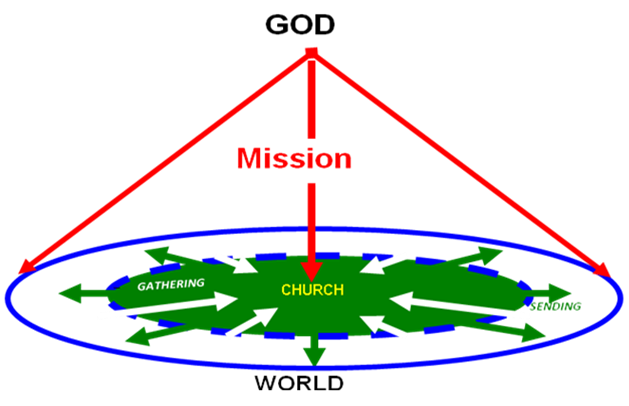 blessed through you.” So Abram left, as the Lord had told him; and Lot went with him.
Abram was seventy-five years old when he set out from Haran. He took his wife Sarai, his nephew Lot, all the possessions they had accumulated and the people they had acquired in Haran, and they set out for the land of Canaan, and they arrived there.
Exodus 3:7-12 (NIV) The Lord said, “I have indeed seen the misery of my people in Egypt. I have heard them crying out because of their slave drivers, and I am concerned about their suffering. So I have come down to rescue them from the hand of the Egyptians and to bring them up out of that land into a good and spacious land, a land flowing with milk and honey–the home of the Canaanites, Hittites, Amorites, Perizzites, Hivites and Jebusites. And now the cry of the Israelites has reached me, and I have seen the way the Egyptians are oppressing them. So now, go. I am sending you to Pharaoh to bring my people the Israelites out of Egypt.” But Moses said to God, “Who am I, that I should go to Pharaoh and bring the Israelites out of Egypt?” And God said, “I will be with you. And this will be the sign to you that it is I who have sent you: When you have brought the people out of Egypt, you will worship God on this mountain.”
The disciples are gathered up and involved in God’s mission. Notice that mission begins by bidding God to sent out harvesters. Luke 10:1-3 (NIV) After this the Lord appointed seventy-two others and sent them two by two ahead of him to every town and place where he was about to go. He told them, “The harvest is plentiful, but the workers are few. Ask the Lord of the harvest, therefore, to send out workers into his harvest field. Jesus sends the apostles just as he was sent by the Father. (v. 21).
John 20:19-23 (NIV) On the evening of that first day of the week, when the disciples were together, with the doors locked for fear of the Jews, Jesus came and stood among them and said, “Peace be with you!” After he said this, he showed them his hands and side. The disciples were overjoyed when they saw the Lord. Again Jesus said, “Peace be with you! As the Father has sent me, I am sending you.” And with that he breathed on them and said, “Receive the Holy Spirit. If you forgive anyone his sins, they are forgiven; if you do not forgive them, they are not forgiven.”
Biblical understandings of the kingdom of God Most Americans are not familiar with the implications of living within a kingdom. Often interchangeable with the terms “reign of God” or “rule of God.”
- We are to receive the reign of God like a little child (Mark 10:15; Luke 18:17)
- We inherit the kingdom (Mt. 25:34; 1 Cor. 6:9-10; Gal. 5:21)
- We enter the reign of God (Mt. 5:20; 7:21; 18:3; 19:23-24; Mk 9:47; 10:23-25).
- We are never mentioned as building or establishing the kingdom. That is God’s work.

Receiving the kingdom involves accepting the generosity of the king. Inheriting the kingdom involves becoming an heir…a member of the king’s house. Entering a kingdom involves conforming to the way of life established by the king.
The lordship of Christ is often reduced to individual concerns. When salvation is reduced to individualistic concerns, Christ is regarded as personal savior, or “Lord of my life.” When it is a limited perspective, the church tends to ignore that God has exalted Christ as Lord universally.
In Acts 2, Peter asserts that God has made Jesus Lord regardless of the acceptance or rejection of the crowd. He calls them to repent of their rejection of the objective reality of Jesus’ lordship and not simply acceptance of a subjective experience of that lordship
(Acts 2:36-41 (NIV) “Therefore let all Israel be assured of this: God has made this Jesus, whom you crucified, both Lord and Christ.” When the people heard this, they were cut to the heart and said to Peter and the other apostles, “Brothers, what shall we do?” Peter replied, “Repent and be baptized, every one of you, in the name of Jesus Christ for the forgiveness of your sins. And you will receive the gift of the Holy Spirit. The promise is for you and your children and for all who are far off–for all whom the Lord our God will call.” With many other words he warned them; and he pleaded with them, “Save yourselves from this corrupt generation.” Those who accepted his message were baptized, and about three thousand were added to their number that day.
The relationship between church and mission…remembering…the mission is God’s initiative
- we are those who have received, inherited, and entered into the kingdom of God
- God has exalted Christ as Lord over all creation.
John 17:14-18 (NIV) I have given them your word and the world has hated them, for they are not of the world any more than I am of the world. My prayer is not that you take them out of the world but that you protect them from the evil one. They are not of the world, even as I am not of it. Sanctify them by the truth; your word is truth. As you sent me into the world, I have sent them into the world.
Begins with God and the world. Mission is more than just an adjunct activity of the church. Mission cannot be reduced to obedience to a command to evangelize. God sends Christ and Christ sends His church. God rules over the entire world despite the fact that some reject that rule. The church is formed and made visible because God gathers the church from the world.
When we say that “the church has a mission,” we tend to view the church as a sort of machine that comes in a kit so that when we assemble it properly according to the instructions and turn on the power it goes to work. But the Bible never pictures the church as an independent institution that churns out a product or repeats a task under its own power. The biblical view of the church is not a static organization that determines its own mission. Rather, God has a mission in this world and God is about his mission; He is calling and sending people caught up in that mission and they are the church.
 The biblical view of the church
The followers of Christ are called “The Way.” (Acts 9:2)
- The church is the transformation of the old humanity into the new humanity (Eph. 2:15).
The church is the result of God’s Activity
- we are the fish caught up in the dragnet (Mt. 13:47-50)
- we are the sheaves of wheat gathered in harvest (Mt. 13:24-30)
- we are the mustard tree sown by the sower (Mk 4:30-32)
- we are persecuted believers on the run who tell the story that changes the world (Acts 8).
The mission of God is a tidal wave breaking onto the shores of earth and the church is caught up in it. The mission of God is like a storm front moving into this world. The church is like a pile of leaves or a drift of snow gathered up by the wind. (John 3:8) We are the visible evidence of God’s invisible activity in the world.
The mission of God has a church. Treasure in a brown paper: 2 Cor. 4:7-12 2 Corinthians 4:1-6 (NIV) Therefore, since through God’s mercy we have this ministry, we do not lose heart. Rather, we have renounced secret and shameful ways; we do not use deception, nor do we distort the word of God. On the contrary, by setting forth the truth plainly we commend ourselves to every man’s conscience in the sight of God. And even if our gospel is veiled, it is veiled to those who are perishing. The god of this age has blinded the minds of unbelievers, so that they cannot see the light of the gospel of the glory of Christ, who is the image of God. For we do not preach ourselves, but Jesus Christ as Lord, and ourselves as your servants for Jesus’ sake. For God, who said, “Let light shine out of darkness,” made his light shine in our hearts to give us the light of the knowledge of the glory of God in the face of Christ.
2 Corinthians 4:7-12 (NIV) But we have this treasure in jars of clay to show that this all-surpassing power is from God and not from us. We are hard pressed on every side, but not crushed; perplexed, but not in despair; persecuted, but not abandoned; struck down, but not destroyed. We always carry around in our body the death of Jesus, so that the life of Jesus may also be revealed in our body. For we who are alive are always being given over to death for Jesus’ sake, so that his life may be revealed in our mortal body. So then, death is at work in us, but life is at work in you.
The believer is simply a “jar of clay”; it is the treasure within the vessel that gives the vessel its value. The important thing about a vessel is that it be clean, empty, and available for service. We must focus on the treasure and not on the vessel. Paul was not afraid of suffering or trial, because he knew that God would guard the vessel so long as Paul was guarding the treasure. God permits trials, God controls trials, and God uses trials for His own glory. God is glorified through weak vessels.
I need your ideas of service projects we could do to help others.
New studies beginning August 3


——————————————–
There are many question words in any language. In English, most of the question words begin with WH: “What,” “When,” “Where,” Who,” and “How.” Much knowledge is gained by asking these questions. However, the question that troubles us the most is the one that I did not mention: “WHY.” This is the one we ask each other more often than any of the other questions. We want to know the reason behind every event under the sun and rhyme for everything that happens. Why did you forget our anniversary? Why were you not present at our junior’s baseball game? Why did you go there? Why did you do this, and why did you not do that?
But all these WHY questions pale when compared to the “WHY” question that we are sometimes forced to ask God.
Imagine, for example, you have three sons. Of course, you love them all. But the youngest is the most cherished one. It is the hardest to let him go. He leaves home after high school for college. He is just about done with college – one more year to go. He calls you to tell you that he will be coming home for Thanksgiving. You are eagerly waiting for the time when he will be home. Just a week or so before he comes home, you get a phone call from his roommate. Your son had a motorcycle accident . . . . He was killed. What kind of parents would you be if you did not raise your fist before God and ask “WHY? Why did You let this happen?”
The age-old question that man has raised is this: why would an all powerful and loving God allow such things? An atheist, of course, would have a ready answer: “There is no God. If there was a God, certainly He would not allow such things.” In anything and everything, an atheist finds proof for denying the existence of God because “
Most churches have invested big money in facilities that are attractive and functional. While a church building is a great tool, we have to keep in mind that God’s mission for the world is much bigger than being nice people inside a beautiful facility.
God has a mission for the world. It includes the things we do at the church building, but it is bigger because he is Lord of all creation. “All things were created by him and for him. He is before all things, and in him all things hold together. And he is the head of the body, the church” (Col. 1:16-18).
The church exists to serve the mission of God, and he draws us out of the church building into the world he loves. Church buildings, like money, are a wonderful servant but a terrible master. This series calls us to lift our eyes from the concerns of day-to-day church life to reflect on God’s grand scheme for all of creation.
The Heart of Who We Are
A new sermon has been posted on YouTube: https://www.youtube.com/watch?v=IPI1p9rI1mo
——————————————–
People in America are searching for a church. The confusion and division in the religious world has resulted in many names and creeds. The Sunset Avenue congregation has no creed but Christ, accepts no book but the Bible, and wears no name but Christian. When we follow the Bible only, we will be “Christians only.”
The aim of our congregation may be simply stated – we seek to be a place to believe, belong, and become. To accomplish this we are teaching biblical principles and conversion. (Matthew 28:18-20) serving God and mankind. (Matthew 22:36-39) and exhorting one another (Colossians 3:16). We are striving to have members who are truly consecrated to God and his Church.
 The Sunset Avenue church of Christ is an independent, Bible believing church – a family of Christians aiming to be faithful in every way to Jesus Christ. We are involved in many ministries throughout the week, and we come together regularly to be encouraged through Bible study, prayers, teaching and praise.
You and your family are important
You can see by this brief introduction that your entire family is very important. It is our desire to learn the specific needs of all who come our way that we might continue expanding our ministry system in areas that will bring others closer to Christ. If you have questions or concerns about our fellowship, please feel at ease in speaking with one of our elders, ministers or members.
What is the distinctive plea of the church of Christ? by Batsell Barrett Baxter
It is primarily a plea for religious unity based upon the Bible. In a divided religious world it is believed that the Bible is the only possible common denominator upon which most, if not all, of the God-fearing people of the land can unite. This is an appeal to go back to the Bible. It is a plea to speak where the Bible speak and to remain silent where the Bible is silent in all matters that pertain to religion. It further emphasizes that in everything religious there must be a “Thus saith the Lord” for all that is done. The objective is religious unity of all believers in Christ. The basis is the New Testament. The method is the restoration of New Testament Christianity.
The Historical background of the Restoration Movement
One of the earliest advocates of the return to New Testament Christianity, as a means of achieving unity of all believers in Christ, was James O’Kelly of the Methodist Episcopal Church. In 1793 he withdrew from the Baltimore conference of his church and called upon others to join him in taking the Bible as the only creed. His influence was largely felt in Virginia and North Carolina where history records that some seven thousand communicants followed his leadership toward a return to primitive New Testament Christianity.
In 1802 a similar movement among the Baptists in New England was led by Abner Jones and Elias Smith. They were concerned about “denominational names and creeds” and decided to wear only the name Christian, taking Bible as their only guide. In 1804, in the western frontier state of Kentucky, Barton W. Stone and several other Presbyterian preachers took similar action declaring that they would take the Bible as the “only sure guide to heaven.” Thomas Campbell, and his illustrious son, Alexander Campbell, took similar steps in the year 1809 in what is now the state of West Virginia. They contended that nothing should be bound upon Christians as a matter of doctrine which is not as old as the New Testament.
Although these four movements were completely independent in their beginnings eventually they became one strong restoration movement because of their common purpose and plea. These men did not advocate the starting of a new church, but rather a return to Christ’s church as described in the Bible.
Members of the church of Christ do not conceive of themselves as a new church started near the beginning of the 19th century. Rather, the whole movement is designed to reproduce in contemporary times the church originally established on Pentecost, A.D. 30. The strength of the appeal lies in the restoration of Christ’s original church.
How many churches of Christ are there?
The most recent dependable estimate lists more than 15,000 individual churches of Christ. The “Christian Herald,” a general religious publication which presents statistics concerning all the churches, estimates that the total membership of the churches of Christ is now 2,000,000. There are more than 7000 men who preach publicly. Membership of the church is heaviest in the southern states of the United States, particularly Tennessee and Texas, though congregations exist in each of the fifty states and in more than eighty foreign countries. Missionary expansion has been most extensive since the second World War in Europe, Asia and Africa. More than 450 full time workers are supported in foreign countries. The churches of Christ now have five times as many members as were reported in the U.S. Religious Census of 1936.
How are the churches organizationally connected?
Following the plan of organization found in the New Testament, churches of Christ are autonomous. Their common faith in the Bible and adherence to its teachings are the chief ties which bind them together. There is no central headquarters of the church, and no organization superior to the elders of each local congregation. Congregations do cooperate voluntarily in supporting the orphans and the aged, in preaching the gospel in new fields, and in other similar works.
Members of the church of Christ conduct forty colleges and secondary schools, as well as seventy-five orphanages and homes for the aged. There are approximately 40 magazines and other periodicals published by individual members of the church. A nationwide radio and television program, known as “The Herald of Truth” is sponsored by the Highland Avenue church in Abilene, Texas. Much of its annual budget of $1,200,000 is contributed on a free-will basis by other churches of Christ.
The radio program is currently heard on more than 800 radio stations, while the television program is now appearing on more than 150 stations. Another extensive radio effort known as “World Radio” owns a network of 28 stations in Brazil alone, and is operating effectively in the United States and a number of other foreign countries, and is being produced in 14 languages. An extensive advertising program in leading national magazines began in November 1955.
There are no conventions, annual meetings, or official publications. The “tie that binds” is a common loyalty to the principles of the restoration of New Testament Christianity.
How are the churches of Christ governed?
In each congregation, which has existed long enough to become fully organized, there is a plurality of elders or presbyters who serve as the governing body. These men are selected by the local congregations on the basis of qualifications set down in the scriptures (1 Timothy 3:1-8). Serving under the elders are deacons, teachers, and evangelists or ministers. The latter do not have the authority equal to or superior to the elders. The elders are shepherds or overseers who serve under the headship of Christ according to the New Testament, which is a kind of constitution. There is no earthly authority superior to the elders of the local church.
What does the church of Christ believe about the Bible?
 The original autographs of the sixty six books which make up the Bible are considered to have been divinely inspired, by which it is meant that they are infallible and authoritative. Reference to the scriptures is made in settling every religious question. A pronouncement from the scripture is considered the final word. The basic textbook of the church and the basis for all preaching is the Bible.
Do members of the churches of Christ believe in the virgin birth?
Yes. The statement in Isaiah 7:14 is taken as a prophecy of the virgin birth of Christ. New Testament passages such as Matthew 1:20, 25, are accepted at face value as declarations of the virgin birth. Christ is accepted as the only begotten Son of God, uniting in his person perfect divinity and perfect manhood.
Does the church of Christ believe in predestination?
Only in the sense that God predestines the righteous to be eternally saved and the unrighteous to be eternally lost. The statement of the apostle Peter, “Of a truth I perceive that God is no respecter of persons, but in every nation he that feareth him and worketh righteousness is acceptable unto him” (Acts 10:34-35.) is taken as an evidence that God did not predestine individuals to be eternally saved or lost, but that each man determines his own destiny.
Why does the church of Christ baptize only by immersion?
The word baptize comes from the Greek word “baptizo” and literally means, “to dip, to immerse, to plunge.” In addition to the literal meaning of the word, immersion is practiced because it was the practice of the church in apostolic times. Still further, only immersion conforms to the description of baptisms as given by the apostle Paul in Romans 6:3-5 where he speaks of it as a burial and resurrection.
No. Only those who have reached the “age of accountability” are accepted for baptisms. It is pointed out that the examples given in the New Testament are always of those who have heard the gospel preached and have believed it. Faith must always precede baptism, so only those old enough to understand and believe the gospel are considered fit subjects for baptism.
Do ministers of the church hear confession?
No. Ministers or evangelists of the church have no special prerogatives. They do not wear the title of Reverend or Father, but are addressed simply by the term Brother as are all other men of the church. Along with elders and others they do counsel and advise those seeking help.
Are prayers addressed to the saints?
No. God the Father is considered the only one to whom the prayers may be addressed. It is further understood that Christ stands in a mediatorial position between God and man (Hebrews 7:25). All prayers are therefore offered through Christ, or in the name of Christ (John 16:23-26).
How often is the Lord’s supper eaten?
It is expected that every member of the church will assemble for worship on each Lord’s day. A central part of the worship is the eating of the Lord’s supper (Acts 20:7). Unless providentially hindered, each member considers this weekly appointment as binding. In many instances, as in the case of illness, the Lord’s supper is carried to those who are hindered from attending the worship.
What kind of music is used in the worship?
As a result of the distinctive plea of the church – a return to New Testament Faith and practice – acappella singing is the only music used in the worship. This singing, unaccompanied by mechanical instruments of music, conforms to the music used in the apostolic church and for several centuries thereafter (Ephesians 5:19). It is felt that there is no authority for engaging in acts of worship not found in the New Testament. This principle eliminates the use of instrumental music, along with the use of candles, incense, and other similar elements.
Does the church of Christ believe in heaven and hell?
Yes. The statement of Christ in Matthew 25, and elsewhere, are taken at face value. It is believed that after death each man must come before God in judgment and that he will be judged according to the deeds done while he lived (Hebrews 9:27). After judgment is pronounced he will spend eternity either in heaven or hell.
Does the church of Christ believe in purgatory?
No. The absence of any reference in the scriptures to the temporary place of punishment from which the soul will eventually be released into heaven prevents the acceptance of the doctrine of purgatory.
By what means does the church secure financial support?
Each first day of the week the members of the church “lay by in store as they have been prospered” (1 Corinthians 16:2). The amount of any individual gift is generally known only to the one who gave it and to the Lord. This free-will offering is the only call which the church makes. NO assessments or other levies are made. No money-making activities, such as bazaars or suppers, are engaged in. A total if approximately $200,000,000 is given on this basis each year.
Does the church of Christ have a creed?
No. At least, there is no creed in the usual sense of the word. The belief of the church is stated fully and completely in the Bible. There is no other manual or discipline to which the members of the church of Christ give their allegiance. The Bible is considered as the only infallible guide to heaven.
How does one become a member of the church of Christ?
In the salvation of man’s soul there are 2 necessary parts: God’s part and man’s part. God’s part is the big part, “For by grace you have been saved through faith, and that not of yourselves, it is the gift if God; not of works, that no man should glory” (Ephesians 2:8-9). The love which God felt for man led him to send Christ into the world to redeem man. The life and teaching of Jesus, the sacrifice on the cross, and the proclaiming of the gospel to men constitute God’s part in salvation.
Though God’s part is the big part, man’s part is also necessary if man is to reach heaven. Man must comply with the conditions of pardon which the Lord has announced. Man’s part can clearly set forth in the following steps:
Hear the Gospel. “How shall they call on him whom they have not believed? and how shall they believe him whom they have not heard? and how shall they hear without a preacher?” (Romans 10:14).
Believe. “And without faith it is impossible to be well pleasing unto him; for he that cometh to God must believe that he is, and that he is a rewarder of them that seek after him” (Hebrews 11:6).
Repent of past sins. “The times of ignorance therefore God overlooked; but now he commandeth men that they should all everywhere repent” (Acts 17:30).
Confess Jesus as Lord. “Behold here is water; What doth hinder me to be baptized ? And Philip said, if thou believeth with all thy heart thou mayest. And he answered and said, I believe that Jesus Christ is the Son of God” (Acts 8:36-37).
Be baptized for the remission of sins. “And Peter said unto them, Repent ye, and be baptized everyone of you in the name of Jesus Christ unto the remission of your sins and ye shall receive the gift of the Holy Spirit” (Acts 2:38).
Live a Christian life. “Ye are an elect race, a royal priesthood, a holy nation, a people for God’s own possession, that ye may show forth the excellencies of him who called you out of darkness into his marvelous light” (1 Peter 2:9).
OPEN INVITATION
Now that you are aware of a church in the 21th century which is built according to the blue prints of Christ’s original church, why not become a member of it? In becoming a member of it, you will be called upon to do nothing which you cannot read in the New Testament. You will then live and worship just as the apostle-guided Christians of the first century did.
Not only is this return to New Testament Christianity a wonderful basis upon which all believers in Christ can unite, it is absolutely solid ground. If we do just what our Lord commanded we know that our salvation is certain. Come with us as we go back to the Bible, back to Christ and his church!
Order in the Church – What do the elders look like? 1 Timothy 3
Paul spells out 15 qualifications so that there are no doubts as to what spiritual maturity entails. Before we examine the qualifications in more detail, several things need to be said:
First, most of these qualities are prescribed elsewhere in the Bible for every Christian, including women. So we all should be seeking to grow in these areas. The moment we became a member of the body of Christ we are in the ministry, and we are given gifts for ministry.
It is not the elders who are to do the work of the ministry: We are!
 Second, spiritual maturity takes time, effort, and discipline (1 Timothy 4:7 (NIV) Have nothing to do with godless myths and old wives’ tales; rather, train yourself to be godly.
There are no shortcuts. We live in a day when we’re used to instant everything. But there is no such thing as instant godliness. The crucial question is, Are you involved in the process?
Third, no one is perfectly qualified to be a church leader. These qualities, for the most part, are not the kind of thing where you can say, “I’ve arrived!” There is always going to be room for growth. If you require perfection, no one would qualify as an elder. But at the same time, an elder should not be in glaring violation of any qualification. If he is weak in any area, he should be aware of it and should be working on that area.
2 Corinthians 2:16 (NIV) To the one we are the smell of death; to the other, the fragrance of life. And who is equal to such a task?
(2 Corinthians 3:5-6 (NIV) Not that we are competent in ourselves to claim anything for ourselves, but our competence comes from God. He has made us competent as ministers of a new covenant–not of the letter but of the Spirit; for the letter kills, but the Spirit gives life.
Elders are to be watching for this. That is what the word for elder, episkopos, means — “looking over.”
Elders are to be looking to see what the Lord is doing with his people, and utilizing the opportunities that arise on every hand. They are to be instructed in what the Lord has said in his Word so as to be able to guide this new and exciting thing that is coming into being, correcting it if need be. That is the work of elders. So it is a “noble task,” as Paul says.
Elders are to know and to seek the mind of the Lord, to guide the burgeoning ministry of the congregation as it develops, in direct inspiration of the Spirit of God, as each one in the congregation finds what the Lord wants him or her to do. The elders are to oversee that, to guide it, to correct it, if need be, along the lines of what the Scriptures teach and what the Spirit of God has led them to understand as they seek the mind of the Lord in prayer.
Those are the things you look for:
First, an elder’s reputation. “Above reproach” (KJV, NKJV = “blameless”). That does not mean he must never have had anything gone wrong. If that were so none of us would make it. It means that when something did go wrong he handled it rightly, dealt with it openly, giving every indication of desiring to be a godly, righteous man.
Second, he is to be a “one-woman man,” literally. It is to be very evident that an elder is committed to one woman, his wife, whom he loves.
A third requirement is that an elder be known for a number of good habits he has formed:
First, “Temperate” (KJV = “vigilant”) Basically, that means to be calm. He is not to be flighty or nervous, constantly jumping from one thing to another.
“Prudent” (NIV = “self-controlled”; KJV = “sober”; NKJV = “sober-minded”): A kind of inner peace governs him; a discipline of life keeps him level and steady.
“Respectable” (KJV, NKJV = “of good behavior”): The word really means “orderly,” to have an orderly life, not to have everything going helter-skelter, unable to lay his hands on anything and not knowing what is happening.
“Hospitable” (KJV = “given to hospitality”): Literally, the original means, “a lover of strangers.” He is quick to open his heart and home to others. He is not afraid to meet new people. He’s able to make them feel relaxed and welcome. All Christians are exhorted to pursue hospitality (Rom. 12:13) and to be hospitable without complaint (1 Pet. 4:9).
An elder must be able to teach. He must be able to expound the Scriptures, to correct those who are misusing them and recognize error when it appears.
An elder is not to “not given to much wine.” The fact that our Lord and the disciples did drink wine was a common experience in that day. But it was not to be over-indulged; there was to be no reproach in this area.
Another requirement is that an elder be “not violent,” i.e., not a contentious, angry man who is always attacking others.
Then he must not be “quarrelsome.” The word really is “stubborn,” not insisting on his own point of view at all costs.
He must not be in it for what he can get (not a “money lover”). He must not be out to keep up with the Joneses, but must maintain a simple lifestyle, without undue affluence evident.
Then an elder has to have a certain record of accomplishment in three specific areas.
First, He must manage his own household well, keeping his children submissive and respectful in every way; for if a man does not know how to manage his own household, how can he care for God’s church? {1 Tim 3:4-5 RSV}
The first thing you look for is whether the man has a well-managed family. Look at his children. Are they obedient, or are they the scandal of the church, nobody can control them? I know that ministers’ and elders’ children are under more inspection than others. (They get that way from playing with the children of the other members of the church!)
But his children are to be obedient and courteous in their responses, learning how to address life. This does not necessarily govern the children after they have grown up and left home. The word used here is “small children.” This is a test of a man.
This does not mean he is not to have any problems ever come in his family. What this urges us to observe is how he handles those problems. Does he evade them by busying himself in his business, or does he tackle those problems?
He must not be a recent convert, or he may be puffed up with conceit and fall into the condemnation of the devil. {1 Tim 3:6 RSV}
“A good reputation with those outside” (KJV = “a good report”; NKJV = “a good testimony”): He should be recognized in the community as a man of moral character and proper conduct. His business dealings should be honest and right. This should be true of all Christians, but especially of leaders. Non-Christians should not be able to bring the charge of “hypocrite” against a church leader.
Servants: Official & Otherwise (1 Timothy 3:8-13) All Christians are servants; some should be “official” servants. Christ is our supreme example of servanthood.
A farmer had a team of horses in which one horse consistently worked harder than the others. The farmer said, “They’re all willin’ horses. The one’s willin’ to pull, and the rest are willin’ to let him.”
Sadly, that’s how it often is in the local church. Everybody is willing: a few are willing to work and the rest are willing to let them.
A. The office of deacon is recognized in Scripture.
Most scholars agree that the office of “deacon” (= “servant”) finds its roots in Acts 6:1-6. There were a number of widows in the church without any means of income who were served food on a daily basis. But a problem arose when the Greek-speaking Jews felt that their widows were being neglected in favor of the native Hebrews. They needed some fair administrators to handle the situation so that the apostles would be free to devote their time to prayer and the ministry of the Word.
Men deacons: There are eight qualifications:
(a) “Dignified” (KJV = “grave”; NKJV = “reverent”; NIV = “worthy of respect”). The word is the opposite of being a goof-off or clown. A deacon should have a seriousness of purpose about him, so that those he serves sense that he is concerned for them and so they trust and respect him.
(b) “Not double-tongued” (NIV = sincere). He cannot be a man who tells one person one thing, but another person the opposite in an attempt to please everybody. Since the deacon was involved in handling church finances, he had to be a man of his word.
(c) “Not addicted to much wine”. Since wine was commonly served as a gesture of hospitality, it was important for a deacon, making his rounds from house to house, to exercise control or else he could become a drunkard.
(d) “Not fond of sordid gain” (NKJV = “not greedy for money”; NIV = “not pursuing dishonest gain”). Since a deacon’s duties often involved the distribution of money and gifts to the needy, there was always the possibility for embezzlement. A deacon could not be a man who would pursue dishonest gain.
(e) “Holding to the mystery of the faith with a clear conscience” (the NIV’s “deep truths” is misleading). A deacon must be a man of conviction regarding the central truths of the Christian faith. In addition to sound doctrine, he must be sound in obedience (“clear conscience”).
(f) “Tested and found beyond reproach” (NIV = “if there is nothing against them”; KJV, NKJV = “blameless.” It means, literally, “not called to account.” This is to be determined by “testing,” which means that a man has an observed track record before he is put into office. You don’t put a man into office and then test him to see if he’s trustworthy. Test him first and then recognize him.
It’s obvious that the church should never recognize someone as a deacon in order “to get him involved,” or because he’s “willing to work.” The real issue, as far as holding office in the church is concerned, is proven spiritual maturity, both for elders and deacons.
Wives: “Not malicious gossips” (KJV, NKJV = “not slanderers”). If they went from house to house with juicy tidbits of private information, they could ruin a church very quickly. They must be able to control their tongues.
“Faithful in all things.” She must be trustworthy. She must follow through on assigned tasks. If an elder knows of a family that needs care of some kind, and assigns it to a deaconess, he needs to be able to trust her to follow through. We must commit ourselves to know, live by, and defend God’s Word of Truth.
Who’s in charge of the church? Christ exercises headship over His church through spiritually mature men who shepherd His flock
The basic principle of church government is that Jesus Christ is the Head of His church.
Who is in charge of the church? Jesus Christ is! It is His church; He bought it with His blood. The local church does not belong to the minister, to the elders, or to the congregation. It belongs to Jesus Christ who alone is the Head .
Ephesians 1:20-23 (ESV) “…that he worked in Christ when he raised him from the dead and seated him at his right hand in the heavenly places, far above all rule and authority and power and dominion, and above every name that is named, not only in this age but also in the one to come. And he put all things under his feet and gave him as head over all things to the church, which is his body, the fullness of him who fills all in all.
Never in the New Testament are the leaders of the local church referred to as “head” of the church. Neither is the church viewed as a democratic organization, where the members are free to vote their own minds on issues. The key question in church government is not, “What is the mind of the members?” but, “What is the mind of Christ?”
The church is a living organism, with Jesus Christ as the living Head. While an organism is organized, it is more: it is living, responsive to the living Head. The church is a living organism in which every member is to be submissive and responsive to the Head and in mutual dependence and interaction with the other members so that the will of the Head may be carried out in a harmonious corporate manner.
So the main function of church government is to allow Christ to exercise His headship over His church. Having that view of church government results in an entirely different way of conducting church business. If you view the church as a democratic organization where every member has a right to vote, you’re into church politics.
“You’ve got to build your power base as a new leader in a church.” If you operate that way, you’re simply trying to manage and manipulate a bunch of self-willed people expressing their wishes through majority rule.
Christ exercises His headship through spiritually mature elders.
What are the responsibilities of the overseer? They are to rule (1 Tim. 5:17), to teach (1 Tim. 5:17), to pray for the sick (James 5:14), to care for the church (1 Peter 5:1–2), to be examples for others to follow (1 Peter 5:1–2), to set church policy (Acts 15:22ff.), and to ordain other leaders (1 Tim. 4:14).
The first ‘requirement’ is that they desire the work. The word “aspire” means to stretch oneself out or to reach after. This is not ambition for power and status, but a reaching toward spiritual maturity so that you can serve the Chief Shepherd by helping to shepherd His flock.
You should be taking advantage of every opportunity to serve God’s people, building caring relationships with others with the goal of seeing them become mature in the faith.
I actually heard an elder say “maybe if we make _____ an elder he’ll attend more on Sunday night.”
The church should not put a man into the office of elder so that he can serve; it should recognize as elders the men who are already living the life and doing the work. We need men who desire that fine work of oversight in this flock.
Do You Really Want to Be a Shepherd? (by Jerrie Barber)
“Before someone takes a job, position, opportunity, I think it is good to understand the job description. If there are parts of the responsibility that you don’t like, can’t stand, and will not tolerate, don’t take the job. Find something else to do.
Elders, shepherds, pastors, or overseers will be working with sheep. It is good to understand the nature of sheep. Do you like to work with sheep? If not, don’t take the job. Sheep are:
1. Dumb. “O Lord, I know the way of man is not in himself; It is not in man who walks to direct his own steps” (Jeremiah 10:23, NKJV).
2. Dirty. “for all have sinned and fall short of the glory of God” (Romans 3:23). “If we say that we have no sin, we deceive ourselves, and the truth is not in us” (1 John 1:8).
3. Disoriented. “There is a way that seems right to a man, But its end is the way of death.” (Proverbs 16:25).
All sheep are this way. “All we like sheep have gone astray; We have turned, every one, to his own way; And the Lord has laid on Him the iniquity of us all” (Isaiah 53:6).
What is an elder?
The New Testament gives a fuller picture of the elder and his work than most people realize.
1. An older man. The Greek word presbyteros gives us the English derivatives “presbyter” and “presbytery” (I Timothy 4:14). He is a man of maturity, looked up to for his experience, wisdom and leadership ability.
2. An overseer. Our English word “bishop” is derived from episkopos, which means overseer (Acts 20:28; Titus 1:5,7).
3. A shepherd of God’s flock. (Acts 20:28; I Peter 5:1-4). “Pastors” in Ephesians 4: 11 is used to translate the poimen, which everywhere else is translate shepherd.
4. A steward manager of God’s business (Titus 1:7). This passage does not say that he is to be blameless in living; but he is to be a man with nothing laid to his charge, because he is God’s manager of the household of God on earth.
5. A teacher. (I Timothy 3:2; 5:17; Ephesians 4:11-16; Titus 1:9-11).
6. A superintendent caretaker, one presiding or taking the lead (I Timothy 3:5; 5:17; I Thessalonians 5:12). In these passages prohistemi is sometimes translated “rule” or “are over you”; but it means to stand before, lead, attend to. Jesus told the apostles they must not exercise authority as rulers do (Matthew 20:25-27). Peter taught the elders they must not be lords over the flock (I Peter 5:1-4).
Elders have responsibility for every kind of action and program by which all the members are built up in the faith, matured spiritually, completely filled with Christ, and: used in the service of the Lord. The key word is responsibility:
a. Responsibility for instruction of all in divine truth;
b. responsibility for protection from being led astray;
c. responsibility for correction of ideas and actions which are contrary to Christ’s rule in each of us;
d. responsibility for direction of every member in a life that works to contribute to the growth and good of all the rest.
The responsibility of the elders is to serve and lead the people in the will of Christ, even if they are resisted or persecuted for it.
Elders should be a plurality.
The term is always used in the plural with regard to a single local church (see Acts 14:23; 20:17; Phil. 1:1; Titus 1:5). The only one-man ruler in the New Testament is Diotrephes, whom the Apostle John castigates because “he loves to be first” and he exercised heavy-handed authority by himself (3 John 9-10).
Elders should shepherd God’s flock. (Acts 20:28; 1 Pet. 5:2.) What a shepherd does for his sheep: He knows them (John 10:14); he leads them (John 10:3-4); he feeds them and guides them into the rich pastures of God’s Word (John 10:9; 1 Thess. 5:12; Titus 1:9; Heb. 13:7); he guards them from wolves (John 10:12; Acts 20:29-30); he seeks the lost and straying sheep and helps heal their wounds by getting them restored to the Lord (John 10:16; Ezek. 34:4-5); he corrects the erring or rebellious (2 Tim. 4:2); he equips the flock for maturity so that they can serve the Lord as He has gifted them (Eph. 4:11-16).
Thus the answer to “who is in charge of the church?” is, Jesus Christ is! He exercises His headship in the local church through elders who are spiritually mature men, selected by God and recognized by the church, who through example and servant-hood shepherd His flock.
John 10:11-13 (NASB) “I am the good shepherd; the good shepherd lays down His life for the sheep. 12 “He who is a hired hand, and not a shepherd, who is not the owner of the sheep, sees the wolf coming, and leaves the sheep and flees, and the wolf snatches them and scatters them. 13 “He flees because he is a hired hand and is not concerned about the sheep.
1 Thessalonians 5:12-13 (ESV)We ask you, brothers, to respect those who labor among you and are over you in the Lord and admonish you, and to esteem them very highly in love because of their work. Be at peace among yourselves.
Hebrews 13:17 (ESV) Obey your leaders and submit to them, for they are keeping watch over your souls, as those who will have to give an account. Let them do this with joy and not with groaning, for that would be of no advantage to you.
1 Peter 5:1-3 (ESV) So I exhort the elders among you, as a fellow elder and a witness of the sufferings of Christ, as well as a partaker in the glory that is going to be revealed: shepherd the flock of God that is among you, exercising oversight, not under compulsion, but willingly, as God would have you; not for shameful gain, but eagerly; not domineering over those in your charge, but being examples to the flock.
Order in the Church – The Priority Of Prayer 1 Timothy 2:1-7
1 Timothy 2:1-7 (NIV) “I urge, then, first of all, that requests, prayers, intercession and thanksgiving be made for everyone– {2} for kings and all those in authority, that we may live peaceful and quiet lives in all godliness and holiness. {3} This is good, and pleases God our Savior, {4} who wants all men to be saved and to come to a knowledge of the truth. {5} For there is one God and one mediator between God and men, the man Christ Jesus, {6} who gave himself as a ransom for all men–the testimony given in its proper time. {7} And for this purpose I was appointed a herald and an apostle–I am telling the truth, I am not lying–and a teacher of the true faith to the Gentiles.”
1 Timothy 2:1-7 (MSG) 1 The first thing I want you to do is pray. Pray every way you know how, for everyone you know. 2 Pray especially for rulers and their governments to rule well so we can be quietly about our business of living simply, in humble contemplation. 3 This is the way our Savior God wants us to live. 4 He wants not only us but everyone saved, you know, everyone to get to know the truth we’ve learned: 5 that there’s one God and only one, and one Priest-Mediator between God and us—Jesus, 6 who offered himself in exchange for everyone held captive by sin, to set them all free. Eventually the news is going to get out. 7 This and this only has been my appointed work: getting this news to those who have never heard of God, and explaining how it works by simple faith and plain truth.
As Paul begins to tell Timothy how to conduct oneself in the local church (3:15), he puts prayer as the first priority (2:1, “First of all”). But Paul is not just talking about the need for prayer in general. He is talking about the need for prayer as it relates to the salvation of the lost
1. Prayer that all be reached with the gospel is in line with God’s plan (2:1-2, 8). Prayer is not a nicety, but a necessity. God is sovereign, yet His sovereign plan includes the prayers of His people. If we are involved with God’s plan for the world, then we will be praying in line with His plan.
A. God’s plan involves all kinds of prayer for all kinds of people.
• “Entreaties” = prayer stemming from a sense of need. Sensing our lack and God’s sufficiency, our impotence and God’s omnipotence, should move us to pray.
• “Prayers” = a general term for prayer to God….refers to requests for needs that are always present, in contrast to specific and special needs.
• “Petitions” = means to converse freely; it pictures someone who can go into the presence of the king and talk freely with him on your behalf.
• “Thanksgivings” = this points to the fact that we must express not only our petitions, but our gratitude to God for His gracious answers.
Not only do we need all kinds of prayer, but also we need to pray for all kinds of people. In his case, this included the cruel maniac, Nero, who later executed both Peter and Paul, who lit his gardens in the evenings with Christians covered with pitch, burned as human torches. Prayer is God’s means for removing tyrants and establishing peace.
It is extraordinary to trace how all through its early days, those days of bitter persecution, the Church regarded it as an absolute duty to pray for the Emperor and his subordinate kings and governors.
Justin Martyr writes: “We worship God alone, but in all other things we gladly serve you, acknowledging kings and rulers of men, and praying that they may be found to have pure reason with kingly power” (Apology 1: 14,17).
B. God’s plan involves the spread of the gospel so that all may be saved. We should pray that those in authority would govern so that we might enjoy a tranquil and quiet life. But the purpose for such a life is not that we might be comfortable and happy, but so that we can grow in “godliness and dignity” with a view toward the maximum spread of the gospel.
C. God’s plan designates men as taking the leadership in prayer.
God wants “men” (the Greek word in 2:8 means “males,” men in contrast to women) to take the leadership in the prayer life of the church.
2. Prayer that all be reached with the gospel is in line with God’s pleasure (2:3-4).
Note the words, “good” (beautiful, pleasant), “acceptable,” and “desire.” God’s desire is for the salvation of all men. The Lord told Ezekiel (33:11), “I take no pleasure in the death of the wicked, but rather that the wicked turn from his way and live.”
3. Prayer that all be reached with the gospel is in line with God’s provision (2:5-6) and God’s procedure (2:7).
That one way of salvation involves a mediator between God and men, the man Christ Jesus. In order for God to be reconciled to sinful man, man had to pay for his sin. The price was death, because the wages of sin is death. But God provided a representative man to be the substitute for all other men through His death. He became the ransom, the one who paid the price to release us from bondage to sin and judgment. This ransom is sufficient for all who will receive it.
The Conduct Of Women In The Church (1 Timothy 2:9-15)
I didn’t write the Bible. I just try to report what it says. But sometimes people get upset with me because they don’t like the forecast. For some that’s the case when I tell you what the Bible says about the conduct of women in the church.
Being a Christian means obeying apostolic doctrine, not changing the message to be more compatible with our times. The conduct of women in the church should be marked by godliness and submission to male leadership.
1 Timothy 2:8-15 (NIV) I want men everywhere to lift up holy hands in prayer, without anger or disputing. I also want women to dress modestly, with decency and propriety, not with braided hair or gold or pearls or expensive clothes, but with good deeds, appropriate for women who profess to worship God. A woman should learn in quietness and full submission. I do not permit a woman to teach or to have authority over a man; she must be silent. For Adam was formed first, then Eve. And Adam was not the one deceived; it was the woman who was deceived and became a sinner. But women will be saved through childbearing–if they continue in faith, love and holiness with propriety.
(MSG) 8 Since prayer is at the bottom of all this, what I want mostly is for men to pray—not shaking angry fists at enemies but raising holy hands to God. 9 And I want women to get in there with the men in humility before God, not primping before a mirror or chasing the latest fashions 10 but doing something beautiful for God and becoming beautiful doing it. 11 I don’t let women take over and tell the men what to do. 12 They should study to be quiet and obedient along with everyone else. 13 Adam was made first, then Eve; 14 woman was deceived first—our pioneer in sin!—with Adam right on her heels. 15 On the other hand, her childbearing brought about salvation, reversing Eve. But this salvation only comes to those who continue in faith, love, and holiness, gathering it all into maturity. You can depend on this.
1. The proper attire of Christian women: not focused on outward appearance, but on godliness (2:9-10).
When a woman dresses for the worship service to attract attention to herself, she has violated the purpose of worship.
Our grooming and clothing says a lot about our values and the way we think. If a woman dresses in a sensuous manner or if by inordinate attention to grooming she emphasizes external beauty, it reveals that her emphasis is on the superficial and worldly rather than on that which is significant from God’s perspective. He is not prohibiting a woman from looking attractive, as long as she is not seductive or showy. Nor is he putting an absolute ban on a woman’s braiding her hair or wearing modest jewelry. He’s talking about emphasis. He was correcting women who went to great expense and effort to braid jewels and expensive ornaments into their hair. Their clothing was showy and expensive.
2. The proper attitude of Christian women: not assertive, but submissive to male church leadership (2:11-15).
When it comes to the roles of men and women, the Bible is clear that both male and female reflect the image of God (Gen. 1:27). Men are not superior over women nor women over men. In Christ, men and women are equal (Gal. 3:28), but at the same time, they are to fulfill different roles.
A. The realm of submission involves activities where a woman would exercise authority over a man (2:11-12).
Paul wants women to learn as long as their attitude is marked by two qualities: “quietness” and “submissiveness.”
The word translated “quietly” doesn’t mean absolute silence, but rather to have inner tranquility or peace (see 2:2). When the church gathers, however, women are to listen to the men who teach quietly … with entire submissiveness. Heôsuchia appears at the beginning of verse 11 (quietly), and the end of verse 12 (quiet), thus bracketing Paul’s teaching on the role of women with the principle of silence.
Order in the Church #3
The Priority Of Prayer (1 Timothy 2:1-7)
1 Timothy 2:1-7 (NIV) “I urge, then, first of all, that requests, prayers, intercession and thanksgiving be made for everyone– {2} for kings and all those in authority, that we may live peaceful and quiet lives in all godliness and holiness. {3} This is good, and pleases God our Savior, {4} who wants all men to be saved and to come to a knowledge of the truth. {5} For there is one God and one mediator between God and men, the man Christ Jesus, {6} who gave himself as a ransom for all men–the testimony given in its proper time. {7} And for this purpose I was appointed a herald and an apostle–I am telling the truth, I am not lying–and a teacher of the true faith to the Gentiles.”
1 Timothy 2:1-7 (MSG) 1 The first thing I want you to do is pray. Pray every way you know how, for everyone you know. 2 Pray especially for rulers and their governments to rule well so we can be quietly about our business of living simply, in humble contemplation. 3 This is the way our Savior God wants us to live. 4 He wants not only us but everyone saved, you know, everyone to get to know the truth we’ve learned: 5 that there’s one God and only one, and one Priest-Mediator between God and us—Jesus, 6 who offered himself in exchange for everyone held captive by sin, to set them all free. Eventually the news is going to get out. 7 This and this only has been my appointed work: getting this news to those who have never heard of God, and explaining how it works by simple faith and plain truth.
As Paul begins to tell Timothy how to conduct oneself in the local church (3:15), he puts prayer as the first priority (2:1, “First of all”). But Paul is not just talking about the need for prayer in general. He is talking about the need for prayer as it relates to the salvation of the lost
1. Prayer that all be reached with the gospel is in line with God’s plan (2:1-2, 8). Prayer is not a nicety, but a necessity. God is sovereign, yet His sovereign plan includes the prayers of His people. If we are involved with God’s plan for the world, then we will be praying in line with His plan.
A. God’s plan involves all kinds of prayer for all kinds of people.
• “Entreaties” = prayer stemming from a sense of need. Sensing our lack and God’s sufficiency, our impotence and God’s omnipotence, should move us to pray.
• “Prayers” = a general term for prayer to God….refers to requests for needs that are always present, in contrast to specific and special needs.
• “Petitions” = means to converse freely; it pictures someone who can go into the presence of the king and talk freely with him on your behalf.
• “Thanksgivings” = this points to the fact that we must express not only our petitions, but our gratitude to God for His gracious answers.
Not only do we need all kinds of prayer, but also we need to pray for all kinds of people. In his case, this included the cruel maniac, Nero, who later executed both Peter and Paul, who lit his gardens in the evenings with Christians covered with pitch, burned as human torches. Prayer is God’s means for removing tyrants and establishing peace.
It is extraordinary to trace how all through its early days, those days of bitter persecution, the Church regarded it as an absolute duty to pray for the Emperor and his subordinate kings and governors.
Justin Martyr writes: “We worship God alone, but in all other things we gladly serve you, acknowledging kings and rulers of men, and praying that they may be found to have pure reason with kingly power” (Apology 1: 14,17).
B. God’s plan involves the spread of the gospel so that all may be saved. We should pray that those in authority would govern so that we might enjoy a tranquil and quiet life. But the purpose for such a life is not that we might be comfortable and happy, but so that we can grow in “godliness and dignity” with a view toward the maximum spread of the gospel.
C. God’s plan designates men as taking the leadership in prayer.
God wants “men” (the Greek word in 2:8 means “males,” men in contrast to women) to take the leadership in the prayer life of the church.
2. Prayer that all be reached with the gospel is in line with God’s pleasure (2:3-4).
Note the words, “good” (beautiful, pleasant), “acceptable,” and “desire.” God’s desire is for the salvation of all men. The Lord told Ezekiel (33:11), “I take no pleasure in the death of the wicked, but rather that the wicked turn from his way and live.”
3. Prayer that all be reached with the gospel is in line with God’s provision (2:5-6) and God’s procedure (2:7).
That one way of salvation involves a mediator between God and men, the man Christ Jesus. In order for God to be reconciled to sinful man, man had to pay for his sin. The price was death, because the wages of sin is death. But God provided a representative man to be the substitute for all other men through His death. He became the ransom, the one who paid the price to release us from bondage to sin and judgment. This ransom is sufficient for all who will receive it.
The Conduct Of Women In The Church (1 Timothy 2:9-15)
I didn’t write the Bible. I just try to report what it says. But sometimes people get upset with me because they don’t like the forecast. For some that’s the case when I tell you what the Bible says about the conduct of women in the church.
Being a Christian means obeying apostolic doctrine, not changing the message to be more compatible with our times. The conduct of women in the church should be marked by godliness and submission to male leadership.
1 Timothy 2:8-15 (NIV) I want men everywhere to lift up holy hands in prayer, without anger or disputing. I also want women to dress modestly, with decency and propriety, not with braided hair or gold or pearls or expensive clothes, but with good deeds, appropriate for women who profess to worship God. A woman should learn in quietness and full submission. I do not permit a woman to teach or to have authority over a man; she must be silent. For Adam was formed first, then Eve. And Adam was not the one deceived; it was the woman who was deceived and became a sinner. But women will be saved through childbearing–if they continue in faith, love and holiness with propriety.
(MSG) 8 Since prayer is at the bottom of all this, what I want mostly is for men to pray—not shaking angry fists at enemies but raising holy hands to God. 9 And I want women to get in there with the men in humility before God, not primping before a mirror or chasing the latest fashions 10 but doing something beautiful for God and becoming beautiful doing it. 11 I don’t let women take over and tell the men what to do. 12 They should study to be quiet and obedient along with everyone else. 13 Adam was made first, then Eve; 14 woman was deceived first—our pioneer in sin!—with Adam right on her heels. 15 On the other hand, her childbearing brought about salvation, reversing Eve. But this salvation only comes to those who continue in faith, love, and holiness, gathering it all into maturity. You can depend on this.
1. The proper attire of Christian women: not focused on outward appearance, but on godliness (2:9-10).
When a woman dresses for the worship service to attract attention to herself, she has violated the purpose of worship.
Our grooming and clothing says a lot about our values and the way we think. If a woman dresses in a sensuous manner or if by inordinate attention to grooming she emphasizes external beauty, it reveals that her emphasis is on the superficial and worldly rather than on that which is significant from God’s perspective. He is not prohibiting a woman from looking attractive, as long as she is not seductive or showy. Nor is he putting an absolute ban on a woman’s braiding her hair or wearing modest jewelry. He’s talking about emphasis. He was correcting women who went to great expense and effort to braid jewels and expensive ornaments into their hair. Their clothing was showy and expensive.
2. The proper attitude of Christian women: not assertive, but submissive to male church leadership (2:11-15).
When it comes to the roles of men and women, the Bible is clear that both male and female reflect the image of God (Gen. 1:27). Men are not superior over women nor women over men. In Christ, men and women are equal (Gal. 3:28), but at the same time, they are to fulfill different roles.
A. The realm of submission involves activities where a woman would exercise authority over a man (2:11-12).
Paul wants women to learn as long as their attitude is marked by two qualities: “quietness” and “submissiveness.”
The word translated “quietly” doesn’t mean absolute silence, but rather to have inner tranquility or peace (see 2:2). When the church gathers, however, women are to listen to the men who teach quietly … with entire submissiveness. Heôsuchia appears at the beginning of verse 11 (quietly), and the end of verse 12 (quiet), thus bracketing Paul’s teaching on the role of women with the principle of silence.
Adam was there ‘with’ Eve
Genesis 3:3-24 (NIV) When the woman saw that the fruit of the tree was good for food and pleasing to the eye, and also desirable for gaining wisdom, she took some and ate it. She also gave some to her husband, who was with her, and he ate it. Then the eyes of both of them were opened, and they realized they were naked; so they sewed fig leaves together and made coverings for themselves.
Adam was ‘passive’ in that situation and it ‘encouraged’ Eve to take upon herself a role not intended…with terrible consequences.
God expects the man to lead the relationship.


 Proud to be TJ's man