RSS

Category Archives: Family

What NOT to Buy Your Wife


mothers-dayAlthough the only person a man usually shops for is his wife, the whole experience is a stressful one. Many a man has felt extreme frigid temperatures for a long period based on a poor present decision.

As a veteran of these wars, I’m still not sure what to buy my wife, but I’ll pass on what not to buy her:

1. Don’t buy anything that plugs in. Anything that requires electricity is seen as utilitarian.

2. Don’t buy clothing that involves sizes. The chances are one in seven thousand that you will get her size right, and your wife will be offended the other 9999 times. ‘do I look like a size 16″? she’ll say. Too small a size doesn’t cut it either: “I haven’t worn a size 8 in 20 years!’

3. Avoid all things useful. The new silver polish advertised to save hundreds of hours is not going to win you any brownie points.

4. Don’t buy anything that involves weight loss or self-improvement. She’ll perceive a six-month membership to a diet center as a suggestion that’s she’s overweight.

5. Don’t buy jewelry. The jewelry your wife wants, you can’t afford. And the jewelry you can afford, she doesn’t want.

6. And, guys, do not fall into the traditional trap of buying her frilly underwear. Your idea of the kind your wife should wear and what she actually wears are light years apart.

7. Finally, don’t spend too much. “How do you think we’re going to afford that”? she’ll ask. But don’t spend too little. She won’t say anything, but she’ll think, “Is that all I’m worth”?

—Herb Forst in Cross River, NY, Patent Trader, in Reader’s Digest, p. 69

 
1 Comment

Posted by on May 6, 2016 in Family


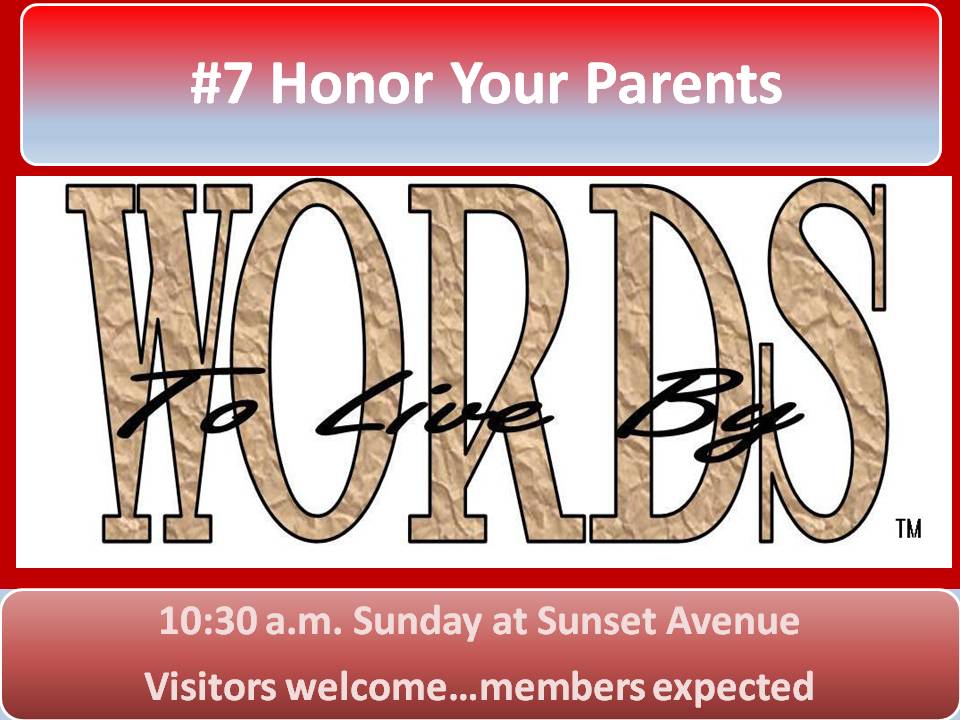
Words To Live By Series #7 Honor Your Parents


Sunday 1030amThe fifth of these Words to Live By brings us to a fundamental responsibility in human relations. The commandment says: Exodus 20:12 (ESV) “Honor your father and your mother, that your days may be long in the land that the LORD your God is giving you.

Our own common sense tells us that we need some rules for preserving and strengthening family life.

The family is being challenged for its right to endure. Many are choosing to forego marriage. Others are substituting life together without marriage for the traditional marriage relationship.

Those who do choose the traditional arrangement are having problems keeping things together and achieving stability within their marriages.

The family is primary to God as a means for blessing and guiding human lives. With the failure of so many homes in the different ways already identified, the will of God is being thwarted too frequently. One of the rules for right living points to the need for keeping the family strong through proper relationships between children and their parents.

What does it mean to honor our mother and father? To honor means more than demonstrating sentimental feelings. The word “honor” literally means to give weight or heaviness. To honor someone then means that we take them seriously.

Mark 7:9-13 (ESV) 9  And he said to them, “You have a fine way of rejecting the commandment of God in order to establish your tradition! 10  For Moses said, ‘Honor your father and your mother’; and, ‘Whoever reviles father or mother must surely die.’ 11  But you say, ‘If a man tells his father or his mother, “Whatever you would have gained from me is Corban”’ (that is, given to God)— 12  then you no longer permit him to do anything for his father or mother, 13  thus making void the word of God by your tradition that you have handed down. And many such things you do.”

Ephesians 6:1-3: “Children, obey your parents in the Lord, for this is right. Honor your father and mother this is the first commandment with a promise, ‘that it may be well with you and that you may live long on the earth.'”

There are some things that commend themselves to us as proper and right. Surely one of those things is showing honor to the man and woman responsible for bringing you into the world, feeding you, getting your cavities filled, nursing you when you were sick, and doing the million other things that go with being a parent.

Children can always derive great personal benefit from seeking and heeding the counsel of their parents. A child who has finished high school or a few years of college may already have more education than his parents; what he may not realize is that he is not yet as smart as his parents. There are some things that nobody learns except by living, having experience, failing at some things and bouncing back. The best lessons about life come from the good counsel of godly parents. If you have a relationship with people who have lived long enough to learn those lessons and who will share their wisdom with you, your life will be blessed.

We should honor our parents because the day will come when we cannot show them the honor we would like to give. Some don’t have your parents with you any longer. I hope you don’t have to look back with regret. I once told my parents that I appreciated all they had done for me…my mother promptly said this: “Do you know what you can do? Do it for your own children.”

Respect Is a Two-Way Street

The Bible teaches that children need discipline. “He who spares the rod hates his son, but he who loves him is diligent to discipline him” (Proverbs 13:24). The sort of discipline spoken of here is administered with patience, tenderness, and love.

Severity of punishment in dealing with children violates the teaching of Paul: “Fathers, do not provoke your children to anger, but bring them up in the discipline and instruction of the Lord” (Ephesians 6:4).

Obedience must be learned, and it is the job of parents to teach it to their children. “Train up a child in the way he should go, and when he is old he will not depart from it” (Proverbs 22:6). Children need to cooperate with their parents in creating a good home. Parents should not have to fight their children for control of the family.

In America, several factors tend to undermine honoring parents.

(1.) There is the impact of technology. In previous generations fathers were often craftsmen, who had learned their trade from their fathers. It took a son years to match his own father in skills, and he would only gradually pass him up.

Now, a child in elementary school may be learning things that parents never heard of. Who of us, for example, would want to try to explain some of the math our kids are being taught in school? Thus, each new generation quickly surpasses the preceding generation in the knowledge it possesses. There is much temptation for the younger generation to think of its parents as out of date, antiquated in thinking. In a society where knowledge is prized more than wisdom, the older generation is fortunate to be respected, let alone honored, by the younger generation.

(2) Because of the rapid increase of divorce, children are often called upon to honor one parent and to despise the other. Neither parent can seem to tolerate the thought of the former mate having the respect of their child. If this were not bad enough, Freudian Psychology has provided each generation with an excuse to blame all of its problems on family members from our past. Countless expeditions into the parental past has provided many individuals with an expensive excursion into past history in order to pin the blame for their sins on someone else, often one or both parents.

(3) If it is possible to pin the blame for our problems on someone else, it is also easy to pin the responsibility of caring for aging parents on someone else. Perhaps more than any other time in history, we are looking to the government to carry much of the burden families have borne in providing for the needs of their aging parents. Social Security, Medicare, Medicaid, and other government programs are viewed as the means for handling our obligation as children to our parents.

1 Timothy 5:8 (ESV) But if anyone does not provide for his relatives, and especially for members of his household, he has denied the faith and is worse than an unbeliever.

(4) Honor is due to more than just parents. The New Testament requires the Christian to honor all men (Romans 12:10; 1 Peter 2:17). Learning to honor parents is thus a significant step in the direction of honoring others.

(5) If children must give honor to their parents, then parenting must be an honorable occupation. One should hardly have to make such a statement, but in today’s world it is necessary to do so. The fact that women line up at abortion clinics around the country and in various parts of the world suggests that bearing and raising children is viewed as something far less than a blessing. This rejects the clear teaching of the Bible. Those who would leave the home and seek fulfillment in the working world in order to gain dignity and respect have also turned from the truth of God’s Word. Let those who would seek to avoid parenting be reminded that in God’s Word parenting is a most honorable occupation.

(6) The way in which one relates to parents changes with conversion. When a person comes to Christ through baptism, there are a number of significant changes. When a person becomes a child of God by faith, God becomes a Father to them in a new and previously unknown way. While God was once denied, and His authority rejected (Ephesians 2:1‑3), now He is our Heavenly Father, with final authority, authority which has priority over all others, including fathers and mothers. As we have seen from our Lord’s teaching, faith in Christ may alienate children from their parents.

(7) The way in which one relates to parents changes with marriage. Marriage is usually the first of several dramatic changes in the child’s relationship with his parents. In the Book of Genesis, God revealed that marriage was to bring about a change in the way a child relates to his parents: “For this cause a man shall leave his father and his mother, and shall cleave to his wife; and they shall become one flesh” (Genesis 2:24).

  • First, the son leaves the authority structure of his parents home to establish a new home, under his authority. This passage draws the son out from under his parents’ authority, as he had once been. My parents or Terry’s parents no longer had authority/control over us when we married…but of course are available to offer counsel when we asked for it.
  • Second, the son is to leave home so that his devotion and affection will be primarily focused upon his wife. Certainly the son’s affection toward his parents is not terminated, but leaving his home lessens the competition between a man’s father and mother and his wife for his devotion and attention.
  • Third, the instruction in this text suggests to us that the parent‑child relationship is temporary, the husband‑wife relationship is permanent.

(8) We honor our parents most when we obey and honor God in our lives. The highest goal of parents is to raise the child God has entrusted to them in such a way as to encourage and promote trust in God and obedience to His Word. Whenever a child trusts in God and obeys His Word, He honors his parents. Even an unbelieving parent is honored by a believing and obedient child.

(9) Honoring parents does not always mean that the child does what his parents want. Father and Mother are not to be honored because they are perfect, but because they are parents. They, like their children, are plagued with the frailties of mankind. They, like their children, sin. They will therefore make many mistakes in the parenting process. They will command that their children do the wrong things, at times. At times they will also forbid their children to do what is right.

(10) Honoring parents may someday require parenting parents. It is an irony indeed, but those who were once parented by fathers and mothers often find themselves parenting their parents in their final years of life. The parent that once fed and diapered the child may in the last days of their life be fed and diapered by their children. The child who was once parented now becomes his parent’s parent, making decisions for them, sometimes having to make choices against their will, even deciding how long to allow artificial, life preserving devices to maintain some semblance of life. There is no thought less pleasant than this, but for many it has been, is, or will be a reality.

(11) Since we must honor all men, this means that parents must honor their children. Much has been said and written about developing self‑esteem in children. I think I would differ with some of this teaching, based upon the fact that much self‑esteem is simply renamed pride, and the Book of Proverbs has more to say about the need for humility in a child than self-confidence (and certainly than self‑love). We must, however, deal with our children in a way that not only manifests our own dignity (cf. 1 Timothy 3:4), but also reflects the dignity of the child as a creation of God, one for whom Christ died. Thus, we must honor our children, as we must honor all others.

 
Leave a comment

Posted by on February 22, 2016 in counsel, Family, Marriage, Sermon


Confident Children and How They Grow — Blessing or Bother?


Eric and Wendy’s November 2015 report from mission work in Rwanda

How could I ever forget the birth of our first child? It was early in the morning and I was rather groggy, but even through the fog of the years I can still project on the screen of my mind some vivid scenes from my memory bank. I can still see the doctor announcing with a note of happy triumph, “It’s a girl!”raising-children-through-positive-parenting-05

Little did I realize it at the moment, but I would hear that very same announcement two more times, each with a little less of the happy triumph. After all, variety is the spice of life, and what father in his right mind doesn’t want a little girl to put her arms around his neck and say, “I love you, Daddy.”

I have learned, however, that God knows far better than I do what my needs are. Since he gave me those boys, and since they are exactly what I need for my own spiritual growth and blessing, no human being could make me give any one of them up of my own volition. Next to the wonderful wife the Lord has given me, they are the most precious things in this world to me. Those beautiful words of the ancient poet of Israel have taken on new meaning

Psalm 127:3 (NIV) Sons are a heritage from the Lord, children a reward from him. (5) Blessed is the man whose quiver is full of them. They will not be put to shame when they contend with their enemies in the gate. “

It is quite obvious that somebody wrote that a long time ago. There are not many people in 21st century America with the Psalmist’s viewpoint on children. A modern version might sound more like this: Lo, children are a burden from the Lord; and the fruit of the womb must be his way of testing us. As the source of endless work and continual aggravation, so are the children of one’s youth. Unhappy is the man who hears his neighbor ask, “Do all those kids belong to you?”

We can understand why folks might feel that way. Many children are rebellious, disobedient, disrespectful, and unmannerly–not very pleasant to be around. It’s no wonder that some people have decided not to have any at all. What has gone wrong? Where did we lose God’s perspective? The first verse of Psalm 127 may provide us with a clue. “Except the Lord build the house, they labor in vain that build it.”

Stable and successful homes are built by God. He is the architect and the general contractor. He has drawn the blueprint, and he wants to provide the direction and give the orders. All he needs are some laborers–husbands, wives and children–who will study the blueprint provided in his Word, then follow his di­rections. Any other procedure is going to result in frustration and failure.

The basic problem in many homes is that we have departed from God’s blueprint and have substituted man’s. God is no longer the architect and builder. We are following instead the blueprint drawn by psychiatrists, psychologists, modern educators, doctors, and even syndicated columnists. Much of the advice we get from these sources is good. But if some parts of a blueprint are good and other parts are faulty, the result is going to be a weak building.

The Bible is still the best textbook ever written on rearing children. We need to find out what it says and obey it. “Except the Lord build the house, they labor in vain that build it.”

It is gratifying to note an increasing alarm about the situation. Newspaper and magazine articles, along with a growing number of books on the subject, are warning people of the dangers of an unhappy home and are trying to help them repair the damage. The information may be helpful, but unless people are willing to turn their hearts and homes over to the Lord, it may be too little too late.

Listen to the Psalmist again. “Except the Lord keep the city, the watchman waketh but in vain.” No ancient city was safe from attack no matter how thick its walls nor alert its guards unless God was protecting it. Likewise, no home is safe from the attack of Satan unless it has been consciously committed to the Lord, unless he has been put in charge.

The homes where Jesus Christ reigns as Lord in the lives of every family member are the homes that will tower above the rest in love, serenity, happiness, mutual concern one for another, and the ability to adjust to people outside the home.

Some folks think there are other ways to produce a happy home. For example, “Work, work, work, as hard as you can. Provide all the material things of this world for your children. Maybe that will make them happy.” If dad doesn’t make enough money to do it, mom goes to work too.

Read on in Psalm 127. “It is vain for you to rise up early, to sit up late, to eat the bread of sorrows; for so he giveth his beloved sleep.” The bread of sorrows is simply bread secured through toil and trouble. Food is essential, but God can provide it without taking fathers and mothers away from their children day and night to pursue that elusive and almighty dollar.

God has no time for laziness. He blesses honest work, but he can supply the things we need without anxious efforts and ceaseless self-activity. The Psalmist says God provides for his beloved ones, literally, “in sleep,” the idea being in calm, restful, confident trust in him.

The society in which we live has perverted our perspective. We have been sold a bill of goods, the false theory that we owe our children all the things they want. We hear parents say, “But we want them to have all the things we never had.” So they have things, but they don’t know who they are, or why they are here, or what they ought to accomplish in life. The most incor­rigible rebels in our society are not necessarily the under­privileged. They are kids who have had all that money can buy but were never loved, appreciated, and accepted. (Borrowed)

 mp3iconYouTube JesusIsLordofthisWebSite placeforyou2 575273_579331012148169_1163921425_n


Leave a comment

Posted by on December 7, 2015 in Family


Children can become empty and lonely on the inside…


 mp3icon YouTube JesusIsLordofthisWebSite placeforyou2

Free book from Gary: The Measure of One’s Life book

——————————————–

Picture1Children can become empty and lonely on the inside when nobody has ever really cared for them or tried to understand them. They never had a warm and loving relationship with their parents. Many of them don’t really know their parents, and furthermore they don’t care to. Their parents don’t know them either. They were too busy making money and having fun to listen to what their kids were saying. And so, we’re told, the younger generation is facing an identity crisis. They’re crying for attention, groping for some sort of significant relationship with somebody who cares.

The saddest thing is that this is happening in professing Christian homes as well as in unbelieving homes. What is the answer? The answer begins with believing what God says right here in this Psalm and acting on the basis of it. “Lo, children are a heritage of the Lord.” The word heritage signifies an inheri­tance given, not according to hereditary right, but according to the willing desire of the giver. Every new child born into a Christian home is a gracious gift from God, a lovely legacy from the Lord entrusted to our care to be loved, cherished, provided for and properly molded for his glory. “The fruit of the womb is his reward.”

Again, the word reword does not mean something earned or deserved, but something freely given through the generous decision of the giver. The inability to have children is no stigma, therefore. It doesn’t mean God is angry with us or isn’t smiling on us. It simply means that he knows best what we need. And he also knows there are the masses of unloved chil­dren whom childless couples can pour their lives into with great spiritual profit for all concerned. He always gives what is best. But when he allows us to have children, they are a gracious gift from him. There is no question about that when we stand over the crib and stare down at our beautiful bundle of joy, peacefully sleeping or contentedly cooing. We may begin to wonder a little about it during those first 2:00 a.m. feedings. And the doubts may really balloon if that little bundle of joy becomes a threatening intruder who upsets our schedule, re­stricts our freedom to do as we please, monopolizes our time, or seems to alienate the affections of our mate. That’s when we need to flee to the Word, and to the Lord of the Word, to have our spirits encouraged and our perspective adjusted. Children are a heritage from the Lord.

Maybe you are well on your way down the precarious path of parenthood. When you look at your child, what do you see? A nerve shattering machine, or a heritage from the Lord? A house wrecker, or a heritage from the Lord? A work maker, or a heritage from the Lord? A source of embarrassment before your friends, or a heritage from the Lord? A competitor for your spouse’s attention, or a heritage from the Lord?

Will you ask God to help you get your perspective straight? “Lord, help me see my children as a blessed gift from your gracious hand.” You may need to pray it many times a day for awhile, but that could become the beginning of some exciting new changes in your home, the gateway to genuine joy in your relationship with your children.

Children are much more sensitive to our attitude toward them than we imagine. And they often respond with the same sort of attitudes they receive. They act as they sense we are acting toward them, and that’s where most of our discipline problems begin. Oh, we love them, but they make so many demands on us that inconvenience us and bother us. So our old natures rebel and we let them know in subtle little ways that they are a bother. And they become more of a bother. They won’t get much love and affection that way, but at least they’ll get attention, and that’s better than nothing. But they will grow up with hostilities, complexes, and resentments that defy de­scription.

One day sooner than we think they’ll be gone, and we won’t remember the muddy shoes, the messy rooms, the embarras­sing moments they caused us or the encroachments they made on our time. We’ll only remember the happy times we spent together. And we’ll wish there had been many more. There could have been if we had looked on them as a blessing from the Lord rather than a burden or a bother.

Children are not only a precious inheritance, however. They are also likened to arrows. There is a difference of opinion as to what this scriptural metaphor is intended to teach. Arrows are a source of protection, and maybe the Psalmist was referring to the care and protection which children can give their parents in later years. But arrows, unlike swords, could go where the warrior himself could not reach. Such is the case with our children. From many a godly home arrows have reached to the ends of the earth, carrying the gospel message to sin darkened hearts. They were like arrows in their father’s hand.

But arrows have to be made. They don’t just happen. God gives us a child like a raw piece of wood, and asks us to shape him. So we whittle, sand, and polish, fashioning that stick into an arrow, straight and strong. Children are not just an inheritance, you see; they are a sacred trust. God loans them to us for awhile to prepare them for his use. They really belong to him, and the sooner we acknowledge that, the more willing we shall become to get on with the shaping process. One dramatic way of acknowledging it is to dedicate them to God. If they belong to him anyway, then let us decisively acknowledge that by consecrating them to his use for his glory just as Hannah and Elkanah did with their son, Samuel (1 Sam. 1:9‑28). Let us promise God that with his help we will mold their young lives into the kind of people he wants them to be.

A husband and wife ought to give their child to God even before he is born. And they should pray together after the birth of the child, willingly dedicating themselves to train him as God directs. Some churches conduct public child dedication services. In others, the pastor participates in a quiet act of dedi­cation in the home. The important thing is that the parents themselves covenant with God to handle their children as a sacred trust, arrows to be shaped for God’s glory.Picture2

Raising children is obviously a serious responsibility. And isn’t it strange–for almost any other job we are required to take some specialized training first. But for the most important business in life, the shaping of young lives for God’s glory, we can get away with none at all if we want to. For that reason some people have drawn the erroneous conclusion that being a good parent comes naturally. On the contrary, it takes a great deal of study and continuous attention to the assignment. But God’s guidebook is available, and we are going to search it for the help we need. Since this is one job we can’t quit, we might as well press on together and learn what God has to say about being a better parent.

Before we do, though, will you note the last verse in this great Psalm? “Happy is the man who hath his quiver full of them: they shall not be ashamed, but they shall speak with the enemies in the gate.”

How many children constitute a full quiver? That may vary with each couple depending on how many children God wants you to have. My quiver is full at three, but yours is between you and the Lord. It isn’t clear in the verse exactly who will not be ashamed, the parents or the children. But in a Picture4Christ controlled home where God is the builder and parents are laboring for him, neither the parents nor the children will be ashamed of each other.

But Satan, the enemy of God’s people, will be subdued and God will thus be glorified. Isn’t that what you desire for your family?

Dedicate yourself and your children to God. Ask him to help you view them as a precious inheritance, arrows to be shaped, lives to be molded.

Ask him to keep your eyes on the potential rather than the problems and to give you the wisdom you need for the great task ahead.


1 Comment

Posted by on September 3, 2015 in Family


A Smile for Married Folks…


 placeforyou2mp3icon YouTube JesusIsLordofthisWebSite575273_579331012148169_1163921425_n

 ——————————————–

HIS: Sometimes women are overly suspicious of their husbands. When Adam stayed out very late for a few nights, Eve became upset. “You’re running around with other women,” she charged. “You’re being unreasonable,”

Adam responded. “You’re the only woman on earth.” The quarrel continued until Adam fell asleep, only to be awakened by someone poking him in the chest. It was Eve. “What do you think you’re doing?” Adam demanded. “Counting your ribs,” said Eve.

——————————-

husband and wife jokes(1)HERS: A man was sitting quietly reading his paper one morning, peacefully enjoying himself, when his wife sneaked up behind him and whacked him on the back of his head with a huge frying pan.

 MAN: “What was that for?”

 WIFE: “What was that piece of paper in your pants pocket with the name Marylou written on it?”

 MAN: “Oh honey, remember two weeks ago when I went to the horse races? Marylou was the name of one of the horses I bet on.”

 The wife looked satisfied, apologized, and went off to work around the house. Three days later the man was once again sitting in his chair reading and his wife repeated the frying pan swatting.

 MAN: “What was that for this time?”

 WIFE: “Your horse called.”

 “. . . be sure your sin will find you out ” – Numbers 32:23

 
Leave a comment

Posted by on August 3, 2015 in Family, Marriage


Prayer for the Children


 mp3iconFacebook    YouTube JesusIsLordofthisWebSite placeforyou2

 ——————————————–

 We pray for the children who …

… sneak popsicles before supper,

… erase holes in their math workbooks and can never find their shoes.No Fear


We pray for the children who …

… don’t know how to run down the street in a new pair of sneakers,

… are born in places where we wouldn’t be caught dead,

… and, have never been to the circus.


We pray for the children who …

… bring us sticky kisses and fistfuls of dandelions,

… hug us in a hurry and forget their lunch money.


We pray for the children who …

… never get dessert or have a “safe” blanket to drag behind them,

… watch their parents watch them die,

… can’t find bread to steal,

… don’t have any rooms to clean up,

… don’t have pictures on anybody’s dresser, and

… whose monsters are real.


We pray for the children who …

… spend all their allowance before Tuesday,

… throw tantrums in the store and pick at their food,

… like ghost stories and shove dirty clothes under the bed,

… never rinse out the tub and get visits from the tooth fairy, and

… whose tears we sometimes laugh at and smiles can make us cry.


We pray for the children who …

… whose nightmares come in the daytime,

… will eat anything and have never seen a dentist,

… aren’t spoiled by anybody, and

… go to bed hungry and cry themselves to sleep.


We pray for the children who …

… want to be carried and for those who must, and

… we never give up on and for those who don’t get a second chance.


We pray for the children who …

… we smother, and

… will grab the hand of anybody kind enough to offer it.


1 Comment

Posted by on July 30, 2015 in Family


Household/children ‘management’ tips…


 placeforyou2mp3iconFacebook    YouTube 575273_579331012148169_1163921425_n

——————————————–

I have finally taken the time to offer some household/children ‘management’ tips that we used when our children were younger….proved effective as we all grew together in these areas.

helpful-tips-image-web-design-sydney1. “First Call.” We used the words ‘first call’ when it was 5-10 minutes before time to sit down for a meal. It means all those who were in the house planning to eat were to get their hands washed and be close to the kitchen so when it was time to sit down for the “second call” we were there ready to sit down and eat.

2. “Coming.” We have lived in a few places where we were comfortable allowing the children to play ‘in the woods’ or ‘down the street’ away from the house. We wish we had owned a loud bell or whistle, but our voices worked most of the time. Our instructions: when we called one of the children’s names, their only response that was needed or acceptable: “coming.” Not ‘what?’ Not ‘what do you want?’ Nothing but: “coming.” And, of course, they would then immediately begin coming home.

3. “Dust busters.” On a regular basis, we had a collective effort to “gain control” of our family rooms but setting a 10-minute alarm and every person in the house would work as hard and efficiently as possible to vacuum, straighten, dust, etc., the main rooms in the house. It is simply amazing the work that 5 people could accomplish in what was actually 50 minutes, as I look back at it.

Incidentally, we also expected our children to work in their rooms at least once a week to “let us see the floor.” How it looked during jesusinthehomethe week mattered less to us (respecting their teen years and privacy) but we did need to have the rooms cleaner, etc. They were also pretty wise to realize that it helped that they kept their doors closed most of the days in between those cleaning opportunities.

4. “Cutting the cake.” Sometimes the children would be ultra-competitive, and it would show itself in the kitchen occasionally…even to the point of who got the biggest piece of cake.’ We decided a good way to defuse the situation was to have a different one cut the cake into pieces, and then the different ones would get to choose theirs first…the cutter the last piece that time. Of course, the one doing the cutting would be very-y-y-y careful to cut them the same size so he would get a ‘fair amount.’

* TJ and I would both greatly appreciate any comments offered that would add to this list…for the good of other parents out there.

 
1 Comment

Posted by on July 23, 2015 in Family


What Do Husbands Really Want in a Wife?


 placeforyou2mp3iconFacebook    YouTube JesusIsLordofthisWebSite575273_579331012148169_1163921425_n

 ——————————————–

Because many men do not discuss feelings as easily as most women do, wives are often shocked when their husband actually voices his desire to separate or divorce. They might have suspected that their spouse wasn’t entirely happy, but they didn’t think he’d ever be the one to end the marriage.

article-0-026FBC8000000578-196_468x592Sometimes the husband can’t give a specific answer as to why he feels the way he does. He just finally gets to the point where he can’t continue living the way he is. Sometimes, these feelings are brought to a head by the awareness that he’s getting older and life is passing him by. Or the feelings of discontent can be activated when another female finds him attractive and makes a play for him.


“What does he want from me that I’m not giving him?”

  • “How can I be interested in sex when I’m exhausted from everything I do for our three kids every day?”
  • “We’ve made it through some really tough times and I thought things were getting better, so why would he leave now?”

All of these questions and many others haunt the surprised wives.

To better understand what husbands want, let’s look at some of the priorities men have shared with me in marriage counseling sessions:

Men want to be appreciated for what they contribute to the marriage and family. They don’t want to be taken for granted. Some men have said, “I feel like she only values my paycheck and if I weren’t here anymore, she’d be fine with that.” Everyone likes to feel appreciated, and husbands are no exception.

It’s easy to focus on what a spouse isn’t doing, especially if a husband and wife are disagreeing about how much each should help with the kids or around the house. The wise wife will express appreciation for what her husband is currently doing and for the positive qualities he brings to the marriage, even while discussions continue about things she’d like to see done differently in the future.

Husbands enjoy seeing their wives smile and laugh, and they find smiles and laughter appealing. They do enjoy having their wives appreciate their jokes or stories, but they also like to see their wives just looking happy in general. This doesn’t mean going around with a fake grin and pretending everything is fine when it isn’t. But it does mean keeping a sense of humor in spite of problems and being able to shut the door on worries temporarily when you have some “down time” with your spouse.

Husbands want to feel that their wives really care about their welfare and about them on a deep level. They want their wife to spend time with them, to be concerned about their health, happiness, and well-­being.

Especially as men age, the feeling that a spouse doesn’t really care about them cuts deeply, even if the husband never shows that he’s hurt by the lack of affection and caring. They don’t want to feel that the kids always come first and that their preferences and needs are overlooked.

In numerous homes, this dynamic is what gets off balance and leads to serious relationship problems. The wife thinks she’s doing what’s best by putting the kids’ needs first, not realizing that the husband is as hurt as he is by this.

Husbands want private time with their wives—not just for sex, although that’s important­­but also to do activities together on their own. This is where making time for a “date night out” every week or so is important. Then the husband and wife can see a movie they want to see, uninterrupted by the kids, or have a peaceful meal at a restaurant. They can go bowling or dancing or get together with friends and keep their identity as an adult couple, not just as parents.

I have seen couples in counseling through the years who have decided not to ever leave their kids with a babysitter or go out on their own. This is always a red flag to me of an unwise course of action in the marriage. A heightened sense of passion between spouses is helped by time alone, “date time,” private time, time for the important part of the relationship that exists beyond the kids to be strengthened and nurtured.

Husbands want a satisfying sex life. You knew we’d eventually get to sex, didn’t you? So here it is. A marriage without a passionate sex life is lacking a key ingredient that wives all too often underestimate. And the reality is that a husband who does not have a satisfying sexual relationship with his wife is much more vulnerable to becoming involved with someone else.

Yes, I know there are couples who over time stop having sex and yet both partners choose to stay in the marriage, but in many cases, there’s a resulting sense of resignation and dullness in the marriage. The fire or passionate spark that helps a couple to stay together is missing, so there’s often a lack of “life” or energy in the relationship.

Wives can argue until they’re blue in the face that sex shouldn’t mean so much to husbands, but the reality is that it usually does have a high priority on the husband’s list. Why? Because it feels good, because it makes him feel attractive and desired, because it enhances satisfaction with the marriage, because it can help the husband to feel closer and more connected to his wife, and because it relieves stress.

Use these five areas above to open discussion with your husband about how he feels in the marriage and whether his needs are being met. After all, that’s one of the keys to marriage success—opening the communication door so that each spouse can share from his or her viewpoint and feel heard by the partner.

 
Leave a comment

Posted by on July 6, 2015 in Family


Are you in love? Do you love enough?


 placeforyou2mp3iconFacebook    YouTube  575273_579331012148169_1163921425_n

 ——————————————–

A young man said to his father at breakfast one morning, “Dad, I’m going to get married.” “

How do you know you’re ready to get married?” asked the father. “Are you in love?” “I sure am,” said the son. “How do you know you’re in love?” asked the father.

“Last night as I was kissing my girlfriend good-night, her dog bit me and I didn’t feel the pain until I got home.”

Some years ago, Dr. Karl Menninger, noted doctor and psychologist, was seeking the cause of many of his patients’ ills. One day he called in his clinical staff and proceeded to unfold a plan for developing, in his clinic, an atmosphere of creative love. All patients were to be given large quantities of love; no unloving attitudes were to be displayed in the presence of the patients, and all nurses and doctors were to go about their work in and out of the various rooms with a loving attitude. At the end of six months, the time spent by patients in the institution was cut in half.

fellowship-love1.jpgSome strange conversations are often wrapped around the subject of “love.” A 20-year-old daughter earnestly prayed before climbing into bed: “Dear God, I don’t ask anything for myself, but I do pray for my mother. Please give mother a handsome son-in-law to love.”

On the other hand, some seem to be over anxious about landing someone who will love them.  The mountain man was doing the best he could to be chivalrous.  He carried a washtub on his back and a chicken under his arm, had a cane in one hand and led a calf with the other.  Still his new girlfriend was wary. Either that or she was trying to cover up what she really wanted. As they approached the dark woods she held back, saying, “I’m afraid to walk with you in there.  You might try to hug me and kiss me.” “How on earth do you think I could manage that?” the mountaineer asked.  “As you can see, I’m pretty well loaded down.” “Well,” she said, “you COULD stick that cane in the ground, tie the calf up to it, and put the chicken under the washtub.”

A story tells about a fellow who was far away from home, and in a small town. He had in his possession only one thing, a $1,000 bill, but nothing else, no small change, no identification, nothing. He was famished for food, ravenously hungry, but he could buy nothing, for no one would take his $1,000 bill. It was not until he found a way to break that bill down into small change that he could spend any of it.

Our love for God, quite similarly, must be broken down into small, spendable change.

The teachings of the Hasidic rabbis often provide insight into God’s ways. One story comes from Levi Yitzhak of Berdichev in the Ukraine.  He confessed that the learned the meaning of love from a drunken peasant.  The rabbi was visiting a tavern owner in Poland’s countryside. As he entered the tavern, he immediately noticed two peasants at a table.  Both were gloriously in their cups. Arms around one another, they were protesting how much each loved the other. Suddenly Ivan said to his friend, “Peter, tell me, what hurts me?” Stunned, Peter sat back into his chair and blurted out, “How do I know what hurts you?” Ivan’s response cut through the drunken stupor:  “If you don’t know what hurts me, how can you say that you love me?”

None of us are loved perfectly. . . I heard recently of a couple who were trying to raise their little three year old so that he would never know fear. They didn’t paddle him, they never scolded him, they never said no, and they let him go where he wanted to go when he wanted to go, and do what he wanted to do when he wanted to do it. 

Some may think that this sound like heaven. . . when it didn’t sound like heaven to the person who was telling me this story.  This young couple happened to live by a busy highway. They had to go to a social activity and so they asked my friend to take care of this little boy. 

My friend said he had never had such a task on his hands before.  Can you imagine trying to take care of a three year old that knew no fear?  He was continually disappearing. . . and where did he want to go???? Of course, he wanted to go out and stand in the middle of the highway to watch the cars whiz by on either side.  The young parents thought that they were loving the child perfectly but they were just preparing the child for hurt, injury, and pain.

A man was known to carry a little can of oil wherever he went.  If he passed through a door that squeaked, he put a drop of oil on the hinges, and if a gate was hard to open, he oiled the latch.  So he passed through life lubricating all the creaking places, and making it a little more pleasant for those who followed after him. There is no telling how many lives we could keep from “rusting and squeaking” and how many gates we could open to happiness, if only we would carry a little oil of brotherly love and human kindness in an effort to prevent  lives of Christians from rusting away in sin.

John Haggai in his book Lead On tells about Dr. Claude H. Barlow, a missionary to China and one of the most revered foreigners to work in that land. A strange disease for which he knew no remedy was killing people.  There were no research laboratories for this disease, so Dr. Barlow conducted his own research.  He studied the disease, filling a notebook with his observations.  He then procured a vial of disease germs and sailed for the United States. 

Before he arrived, he took the germs into his own body, then went to the John Hopkins University Hospital to be observed. Claude Barlow was very sick now.  He allowed his old professors at John Hopkins to use him for experimentation. A cure was found, which a healthy Claude Barlow took back to China with him.  His efforts saved countless lives.

When asked about the experience, Dr. Barlow replied, “Anyone would have done the same thing.  I happened to be in a position of vantage and had the chance to offer my body.”

I doubt that just anyone would have done that, don’t you? Only a person with a very special kind of love in his or her heart would make that kind of sacrifice.  It is that very special kind of love proceeding from the heart of God that determined to  make a supreme sacrifice so that you might be saved. Without that love we would all still be orphans in a strange and hostile universe.  But that love does exist.  It exists in the church . . . it exists among people around this earth who have had an encounter with Jesus.

Being In Love

C. S. Lewis in Mere Christianity wrote, “Being in love is a good thing, but it is not the best thing. There are many things below it, but there are also things above it. You cannot make it the basis of a whole life. It is a noble feeling, but it is still a feeling. Now no feeling can be relied on to last in its full intensity, or even to last at all….In fact, the state of being in love usually does not last….But of course ceasing to be ‘in love’ need not mean ceasing to love. Love…is a deep unity, maintained by the will and deliberately strengthened by habit; reinforced by the grace which both partners ask and receive from God….They can retain this love even when each would easily, if they allowed themselves, be ‘in love’ with someone else. ‘Being in love’ first moved them to promise fidelity: this quieter love enable them to keep their promise. It is on this love that the engine of marriage is run: being in love was the explosion that started it.”

At the entrance to the harbor at the Isle of Man, there are two lights, which guide the mariner into the harbor. One would think the two signals would confuse the pilot. But the fact is, he has to keep them in line, and so long as he keeps the two lights in line his vessel is safe. And it is just as we keep our eyes on the two signals — the love of God, and the love of man — that we keep the channel, and are safe from the rocks on either hand. [2]

The height of our love for God will never exceed the depth of our love for one another.  Love is never lost.  If not reciprocated, it will flow back and soften and purify the heart.

We can risk loving as passionately as God loves.  For we know that the love God makes possible is no scarce resource that must be hoarded so that it may be distributed in dribs and drabs–a little here and a little there.  Love is not a rare commodity; rather, the more we love with the intense particularity of God’s love, the more we discover that we have the capacity to love. [3]

If you have love in your heart, you always have something to give. No one ever said it better than C. S. Lewis: To love at all is to be vulnerable.  Love anything, and your heart will certainly be wrung and possibly be broken.  If you want to make sure of keeping it intact, you must give your heart to no one, not even to an animal. Wrap it carefully round with hobbies and little luxuries; avoid all entanglements; lock it up safe in the casket or coffin of your selfishness.  But in that casket -safe, dark, motionless, airless — it will change.  It will not be broken; it will become unbreakable, impenetrable, irredeemable….  The only place outside Heaven where you can be perfectly safe from all the dangers of love… is Hell.

     We become vulnerable when we love people and go out of our way to help them.  That’s what the wealthy industrialist Charles Schwab declared after going to court and winning a nuisance suit at age 70. Given permission by the judge to speak to the audience, he made the following statement:  “I’d like to say here in a court of law, and speaking as an old man, that nine-tenths of my troubles are traceable to my being kind to others.  Look, you young people, if you want to steer away from trouble, be hard-boiled.  Be quick with a good loud no to anyone and everyone.  If you follow this rule, you will seldom be bothered as you tread life’s pathway. Except you’ll have no friends, you’ll be lonely, and you won’t have any fun!”  Schwab had made his point — love may bring heartache, but it’s worth it!

Whenever people expend themselves, they want results.  If they lay down life, they want someone’s life raised up.  If they empty themselves, they want someone to be filled.  They want their sufferings to bear fruit.

If this doesn’t happen, they’re tempted to give up.  The refusal of the gift quickly becomes a reason not to offer it.  Instead of leaning into resistance with love, they’ll back off and say, “Well, we tried.”

However, the motive for offering love is not that it be successful.  Christians want reponse, but they are not bound to it. They sacrifice for others because they are the recipients of sacrifice.  They are the current generation of a long line of broken bodies and shed blood.

This gift Christians have received, they freely give.  They join the living history in enacting the dream of God, [which] is a people sustained and transformed by mutual sacrificial love. [4]

Do you love enough?

Show me a church where there is love, and I will show you a church that is a power in the community.  In Chicago a few years ago a little boy attended a Sunday school I know of. When his parents moved to another part of the city the little fellow still attended the same Sunday school, although it meant a long, tiresome walk each way. A friend asked him why he went so far, and told him that there were plenty of others just as good nearer his home.

“They may be as good for others, but not for me,” was his reply.

“Why not?” she asked.

“Because they love a fellow over there,” he replied.

If only we could make the world believe that we loved them, there would be fewer empty churches, and a smaller proportion of our population who never darken a church door. Let love replace duty in our church relations, and the world will soon be evangelized. [5]

We’d be better people and have greater churches if we’d live according to this poem:

Lord, let me live from day to day In such a self-forgetful way,
That, even when I kneel to pray, My prayer shall be for others.

Help me, in all the work I do, Ever to be sincere and true,
And know that all I’d do for Thee, Must needs be done for Others.

Let “self” be crucified and slain, And buried deep, nor rise again;
And may all efforts be in vain, Unless they be for Others.

And when my work on earth is done, And my new work in heaven begun
May I forget the crown I’ve won, While thinking still of Others.

Yes, Others, Lord, yes, Others. Let this motto be;
Help me to live for Others, That I may live with Thee.

 
Leave a comment

Posted by on June 25, 2015 in Family


What Do Wives Really Want in a Husband? #2


 placeforyou2mp3iconFacebook    YouTube JesusIsLordofthisWebSite575273_579331012148169_1163921425_n

 ——————————————–

We looked earlier at what wives really want in a husband and we identified two things in particular. Wives want a soul mate who they feel deeply connected to and they want emotional support and emotional intimacy. This means that they want a husband who will talk about his feelings and who values having an emotional connection.

lichtenstein-jeff-loveyoutoo-blogsizeSo what’s a husband who has neglected this important area of marriage to do? The first thing is to understand the necessity of emotional intimacy in a happy marriage. The second thing is to take action. The following steps will help in making a beginning:

  1. Set a time with your spouse when you can talk and process the day’s events. Some days, you might only need 10-15 minutes to keep your emotional connection strong. On other days, you may have more to share and reflect on. During this time with your spouse, make a real effort to share your feelings. When your wife talks, concentrate and listen to her. Listen to the feelings that are beneath the words she is saying. If you’re not sure of something, check it out by asking a question. Communicate by your words and your actions that you value this special time with your wife, and protect it from intrusions.
  2. Push yourself past your comfort zone in making an effort to really share your feelings, problems, and concerns. I have known husbands who didn’t share important happenings in their life because they didn’t want to worry their wives. They didn’t realize how left out and unnecessary their wife was going to feel when she found out later. A common reaction is for a wife to feel that her husband doesn’t really “need” her if he doesn’t confide in her. Wives can feel very hurt and rejected when a husband doesn’t share his feelings, challenges, hurts, and unresolved problems.

And if you bury your feelings of anger or resentment toward your wife about something that has happened, just because you feel uncomfortable having to express these feelings, you are setting the stage for bigger problems later on. If you’re upset, state what you’re feeling and why. Talk about the situation, look for a solution that’s a win­-win one for your marriage, and then let it go.

  1. Watch your natural tendency to want to offer solutions prematurely when your wife brings up a decision she is wrestling with. Most men like to solve problems, and they also like to be helpful to their wives. So a husband’s first reaction to hearing about a problem his wife is having is to want to offer a solution immediately. This often irritates the wife, much to the surprise of the husband. His agenda is to solve the problem quickly and get it over with. Her agenda is to discuss the situation and process it with her husband. She doesn’t necessarily want him to tell her what to do—she wants his listening ear. When a husband really understands this gender ­based difference, he realizes that he doesn’t have to feel pressure to solve his wife’s problems. He just needs to listen and be supportive as she talks about them.
  2. Remember that most change occurs when you make a number of small steps in a new direction. You won’t change overnight, but if you consistently keep trying to improve, your actions can have a significant impact on the quality of your marriage. And most wives don’t expect their husband to change radically in a short time; they just want to see that he’s at least making an effort to meet more of their emotional needs. I have seen small actions on the part of a husband save a marriage. Wives want to know that their husbands care about them, that they value them, and that they want to be emotionally supportive. And they want to see the actions that accompany this: a real concern for their feelings, a desire to share intimate details of their life, and the motivation to connect daily on an emotional level.
 
Leave a comment

Posted by on June 18, 2015 in Family