RSS

Category Archives: God

What is God like?


cropped-god-is-love.jpgWhat is God like? Answers don’t come easy, because of the immensity of the subject. God is huge, filling the universe. Also people might know the right words, but they seem to become hollow shells because they can’t comprehend them.

We say that God is holy, righteous, loving, gracious, Father-Son-Spirit, but we don’t know what all this means. How do we know the words are empty? We can tell by the way many Christians behave!

Our behavior exposes our failure to understand the words coming out of our mouths. We can talk about God, but we do not know Him! God is not like us — He’s one of a kind! God is different from men. Anyone trying to know God and learn to relate to Him must begin with this fundamental truth.

God is not optional! Unlike everything else, God is absolutely necessary, like water for fish. We can’t just “take God or leave Him” — He is inescapable, even more so than death and taxes. We must not be too “familiar” with God, or regard Him as optional…we must learn to let God be God.

W. Tozer wrote concerning the desperate need for the church to revise its concept of God due to a very distorted conception of Him: It is my opinion that the Christian conception of God current in these middle years of the twentieth century is so decadent as to be utterly beneath the dignity of the Most High God and actually to constitute for professed believers something amounting to a moral calamity.[1]

Tozer goes on to say, The heaviest obligation lying upon the Christian Church today is to purify and elevate her concept of God until it is once more worthy of Him—and of her.[2]

W. Pink is of the same opinion: The god of this century no more resembles the Sovereign of Holy Writ than does the dim flickering of a candle the glory of the midday sun. The god who is talked about in the average pulpit, spoken of in the ordinary Sunday school, mentioned in much of the religious literature of the day, and preached in most of the so-called Bible conferences, is a figment of human imagination, an invention of maudlin sentimentality. The heathen outside the pale of Christendom form gods of wood and stone, while millions of heathen inside Christendom manufacture a god out of their carnal minds.[3]

One day it occurred to me that God is the most fascinating person alive and that getting to know Him could well be the most helpful thing that ever happened to me. The more I probed His nature the more convinced I became that knowing Him is the solution to most of my problems. I became convinced that knowing God better was the answer to many of their problems as well. I decided that I want to get to know God intimately, and that I want to help others get to know Him as well, if I possibly can.

God is knowable, and He does want to be known. As a matter of fact, He tells us that our eternal state depends upon knowing Him. Jesus said, “And this is eternal life, that they may know Thee, the only true God, and Jesus Christ whom Thou hast sent” (John 17:3). Knowing God and His Son Jesus is the heart of the whole matter of eternal life. The word know in this verse does not refer to a casual acquaintance either. It is the kind of knowledge that comes through living contact and personal relationship. If knowing God is that important, maybe we ought to talk about how we can get to know Him.

A mother was approached by her young son, who asked, “Mommy, did God make Himself?”  Realizing that such questions by children are very important and must be answered, she dropped what she was doing and sat down with her youngster for a little talk.  Pointing to her wedding band, she said, “This is a ‘love ring,’ which your daddy gave me when we were married.  Look at it closely and tell me where it begins and where it ends.”

The youngster examined it carefully and then said, “There’s no starting place and stopping place to a ring.”  The mother replied, “That’s the way it is with God.  He had no beginning and has no end, yet He encircles our lives with His presence. He is too wonderful, too great, for our minds to understand. Nobody ever made God — He always was!”  Somehow the boy realized that for God to be God, He could not have been created. He had to be without beginning and without end.

Martin Luther once was so depressed over a prolonged period that one day his wife came downstairs wearing all black.  Martin Luther said, “Who died?”  She said, “God has.”  He said, “God hasn’t died.” And she said, “Well, live like it and act like it.”

____________________________

[1] A. W. Tozer, The Knowledge of the Holy (New York: Harper and Row, Publish­ers, 1961), p. 10.

[2] Ibid., p. 12.

[3] Arthur W. Pink, Gleanings in the Godhead, pp. 28-29.

 
Leave a comment

Posted by on December 11, 2017 in God


Why is knowing God so important?


  1. It shapes our moral and ethical standards.
  2. It directly affects our response to pain and hardship.
  3. It motivates our response toward fortune, fame, power, and pleasure.
  4. It gives us strength when we are tempted.
  5. It keeps us faithful and courageous when we are outnumbered.
  6. It enhances our worship and prompts our praise.
  7. It determines our lifestyle and dictates our philosophy.
  8. It gives meaning and significance to relationships.
  9. It sensitizes our conscience and creates the desire to be obedient.
  10. It stimulates hope to go on, regardless.
  11. It enables us to know what to reject and what to respect while I’m invited to planet Earth.
  12. It is the foundation upon which everything rests!
 
Leave a comment

Posted by on October 25, 2017 in God


Seven Things That God Hates Series: A Heart That Devises Wicked Plans


Prov. 6:16-19 (NKJV) These six things the Lord hates, Yes, seven are an abomination to Him: 17A proud look, A lying tongue, Hands that shed innocent blood, 18A heart that devises  wicked plans,  Feet that are swift in running to evil, 19 A false witness who speaks lies, And one who sows discord among brethren.

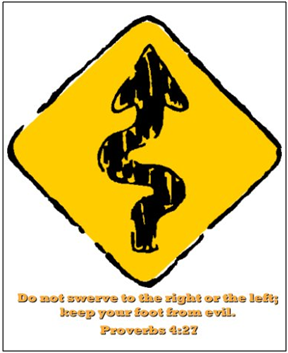
swerveAll we need to do is read the news on the internet or watch the local television news to  be aware of, or at least reminded of, how evil men will spend their time devising wicked plans.  Let’s examine God’s feelings about this subject and how we can avoid finding God’s disfavor, but rather his favor.

What direction do we find from God’s Word?

(Genesis 6:5 NIV)  The LORD saw how great man’s wickedness on the earth had become, and that every inclination of the thoughts of his heart was only evil all the time.

(Psalms 34:6 NIV)  This poor man called, and the LORD heard him; he saved him out of all his troubles.

(Romans 1:30 NIV) “…slanderers, God-haters, insolent, arrogant and boastful; they invent ways of doing evil; they disobey their parents…”

God Is Concerned About The Heart. Implicitly, this passage teaches that God knows all things and that nothing escapes his attention.

(Ecclesiastes 12:14 NIV)  For God will bring every deed into judgment, including every hidden thing, whether it is good or evil.

(Matthew 15:18-20 NIV)  But the things that come out of the mouth come from the heart, and these make a man ‘unclean.’ {19} For out of the heart come evil thoughts, murder, adultery, sexual immorality, theft, false testimony, slander. {20} These are what make a man ‘unclean’; but eating with unwashed hands does not make him ‘unclean.'” God looks at the roots, and not just the fruit.

(Romans 1:32 NIV)  Although they know God’s righteous decree that those who do such things deserve death, they not only continue to do these very things but also approve of those who practice them.

How To Overcome This Sin.

(Isaiah 32:7-8 NIV)  The scoundrel’s methods are wicked, he makes up evil schemes to destroy the poor with lies, even when the plea of the needy is just. {8} But the noble man makes noble plans, and by noble deeds he stands.

(Matthew 10:16 NIV)  I am sending you out like sheep among wolves. Therefore be as shrewd as snakes and as innocent as doves.

(Matthew 12:43-45 NIV)  “When an evil spirit comes out of a man, it goes through arid places seeking rest and does not find it. {44} Then it says, ‘I will return to the house I left.’ When it arrives, it finds the house unoccupied, swept clean and put in order. {45} Then it goes and takes with it seven other spirits more wicked than itself, and they go in and live there. And the final condition of that man is worse than the first. That is how it will be with this wicked generation.”

(Luke 16:8 NIV)  “The master commended the dishonest manager because he had acted shrewdly. For the people of this world are more shrewd in dealing with their own kind than are the people of the light.

(Ephesians 3:20 NIV)  Now to him who is able to do immeasurably more than all we ask or imagine, according to his power that is at work within us,

(Philippians 4:8 NIV)  Finally, brothers, whatever is true, whatever is noble, whatever is right, whatever is pure, whatever is lovely, whatever is admirable–if anything is excellent or praiseworthy–think about such things.

Let’s begin to trust God more to do what he said he would do.  Let us plan, devise, and pray for great things. Let’s stop expending energy in useless and trivial pursuits, but rather let us meditate, devise, and work out ways to further the cause of Christ.

 
Leave a comment

Posted by on October 15, 2017 in Doctrine, God


Seven Things That God Hates Series: A Lying Tongue…and False Witness


Prov. 6:16-19 (NKJV) These six things the Lord hates, Yes, seven are an abomination to Him: 17A proud look, A lying tongue, Hands that shed innocent blood, 18A heart that devises  wicked plans,  Feet that are swift in running to evil, 19 A false witness who speaks lies, And one who sows discord among brethren.

The second thing that God hates in this list of seven, is a lying tongue.  In this lesson, we want to identify what it is to lie, and why it is so bad.

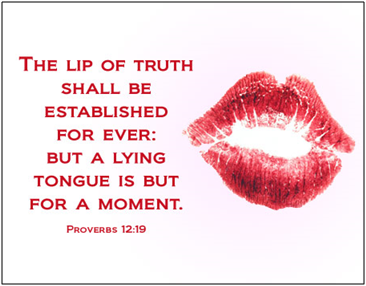
truthThe Problem Of Lying. Recent surveys show us areas where our nation generally consider trivial this important issue: 36% lie about important matters. 86% lie to their parents. 75% lie to their friends. 73% lie to their siblings. 69% lie to their spouses. 91% of those surveyed stated that they lie.

No wonder David said, “All men are liars” (Psalm 116:11). Do we want to live in a society wherein lying is so prevalent? I’m suspicious when I hear someone say, “Well, to tell you the truth…” or “to be perfectly honest with you…”  Do they have to use particular phrases to make us feel comfortable in believing what they are saying?

Ways In Which We Lie. We speak of “White lies, big lies, small lies.” Twist words. Half truths. Misstatement of fact. Bodily movement. Gossip. Exaggeration. Insinuation. Flattery. Presuming.

I think we all know from our youth up until now that lying is wrong.  Thus we attempt to salve our consciences when we do what we know is wrong. A former Secretary of State once said, “That’s not a lie; it’s a terminological inexactitude. Also a tactical misrepresentation.” 

Why Lying Is So Wrong. It is contrary to the very nature of God (Hebrews 6:18 NIV)  God did this so that, by two unchangeable things in which it is impossible for God to lie, we who have fled to take hold of the hope offered to us may be greatly encouraged..

It destroys our credibility (Job 27:5 NIV)  I will never admit you are in the right; till I die, I will not deny my integrity.

Conclusion: While lying is contrary to the character of God, so is speaking the truth in a hurtful and vindictive way (Ephesians 4:15 NIV)  Instead, speaking the truth in love, we will in all things grow up into him who is the Head, that is, Christ.

The fate of all liars (Revelation 21:8 NIV)  But the cowardly, the unbelieving, the vile, the murderers, the sexually immoral, those who practice magic arts, the idolaters and all liars–their place will be in the fiery lake of burning sulfur. This is the second death.”

  • A half truth is a whole lie. Yiddish Proverb
  • A liar isn’t believed even when he speaks the truth. German Proverb
  • A lie travels around the world while truth is putting her boots on. French Proverb
  • All lies are not told—some are lived. Arnold Glasgow
  • It is almost always through fear of being criticized that people tell lies. Paul Tournier (1898–1986)
  • No man has a good enough memory to make a successful liar. Abraham Lincoln (1809–1865)
  • One lie gives birth to another. Terence (c. 186–c. 159 b.c.)
  • Sin has many tools, but a lie is the handle that fits them all. Oliver Wendell Holmes (1809–1894)
 
Leave a comment

Posted by on October 11, 2017 in Doctrine, God


Seven Things That God Hates Series: Hands That Shed Innocent Blood Proverbs 6:16-19


Prov. 6:16-19 (NKJV) These six things the Lord hates, Yes, seven are an abomination to Him: 17A proud look, A lying tongue, Hands that shed innocent blood, 18A heart that devises  wicked plans,  Feet that are swift in running to evil, 19 A false witness who speaks lies, And one who sows discord among brethren.

love neighborThe third thing that God hates in this list of seven, are hands that shed innocent blood. Since the very beginning when Cain, out of jealousy, killed is brother Abel, this world has become a killing ground. Just what does God think of all this killing?

Thou Shalt Not Kill (Exodus 20:13). Most translations appropriately replace the word “kill” with the word “murder.” (Exodus 21:13, 14, 15, 16,17,23, 29) Killing commanded by God.

Not all “killing” is the same. Justifiable homicide – self defense: (Exodus 22:2-3 NIV)  “If a thief is caught breaking in and is struck so that he dies, the defender is not guilty of bloodshed; {3} but if it happens after sunrise, he is guilty of bloodshed. “A thief must certainly make restitution, but if he has nothing, he must be sold to pay for his theft.

(Matthew 24:43 NIV)  But understand this: If the owner of the house had known at what time of night the thief was coming, he would have kept watch and would not have let his house be broken into.

Accidental homicide – (read Numbers 35:9ff).

Judicial homicide – (Deuteronomy 19:13 NIV)  Show him no pity. You must purge from Israel the guilt of shedding innocent blood, so that it may go well with you.

(Romans 13:4 NIV)  For he is God’s servant to do you good. But if you do wrong, be afraid, for he does not bear the sword for nothing. He is God’s servant, an agent of wrath to bring punishment on the wrongdoer.

Murder – (Exodus 21:22-23 NIV)  “If men who are fighting hit a pregnant woman and she gives birth prematurely but there is no serious injury, the offender must be fined whatever the woman’s husband demands and the court allows. {23} But if there is serious injury, you are to take life for life,

(Numbers 35:16-21 NIV)  “‘If a man strikes someone with an iron object so that he dies, he is a murderer; the murderer shall be put to death. {17} Or if anyone has a stone in his hand that could kill, and he strikes someone so that he dies, he is a murderer; the murderer shall be put to death. {18} Or if anyone has a wooden object in his hand that could kill, and he hits someone so that he dies, he is a murderer; the murderer shall be put to death. {19} The avenger of blood shall put the murderer to death; when he meets him, he shall put him to death. {20} If anyone with malice aforethought shoves another or throws something at him intentionally so that he dies {21} or if in hostility he hits him with his fist so that he dies, that person shall be put to death; he is a murderer. The avenger of blood shall put the murderer to death when he meets him.

As A Man Thinks In His Heart. (Proverbs 23:7) As a man thinks in his heart, so is he.

(Matthew 5:20-22) God deals with the roots, not just the fruits.

(1 John 3:15) Whoever hates his brother is a murderer, and you know that no murderer has eternal life abiding in him.

Guard your heart (Proverbs 4:23) Keep your heart with all diligence, for out of it spring the issues of life.

Control your anger (Proverbs 19:11) The discretion of a man makes him slow to anger, and it is to his glory to overlook a transgression.

Bless & do good to your enemies (Romans 12:15 NIV)  Rejoice with those who rejoice; mourn with those who mourn.

(Romans 12:17 NIV)  Do not repay anyone evil for evil. Be careful to do what is right in the eyes of everybody.

(Romans 12:21 NIV)  Do not be overcome by evil, but overcome evil with good.

Conclusion: God offers forgiveness. (2 Corinthians 5:17) If anyone is in Christ, he is a new creation; old things has passed away; behold, all things have become new.

 
Leave a comment

Posted by on October 8, 2017 in Doctrine, God


Seven Things That God Hates Series: “A Proud Look” Proverbs 6:16-19


Prov. 6:16-19 (NKJV) These six things the Lord hates, Yes, seven are an abomination to Him: 17A proud look, A lying tongue, Hands that shed innocent blood, 18A heart that devises  wicked plans,  Feet that are swift in running to evil, 19 A false witness who speaks lies, And one who sows discord among brethren.

What the Book of Psalms is to devotional life, Proverbs is to practical life. Psalms makes the heart warm toward God; Proverbs makes the face shine toward men.

The stated purpose of Proverbs is to impart wisdom (1:1ff.). In addition to being “a book of poetry,” Proverbs is classified as “wisdom literature.” Wisdom has been defined as “the practical application of knowledge”; wisdom in Proverbs includes that, but goes deeper. It is “coming to see things as God sees them.” “The fear of the Lord is the beginning of wisdom” (9:10).

Wisdom is imparted in the book through proverbs. Proverbs were an important teaching tool, since most people could not read and manuscripts were few. Proverbs were easily committed to memory. They were especially useful for teaching the young (note the phrase “my son” in 1:8, 10; 2:1; etc.). Solomon is the main writer of the book (1:1; 10:1; 25:1). Jewish tradition says Solomon wrote the book in middle age. Of the three thousand proverbs he wrote (1 Kings 4:32), these have been preserved.

Part of getting to know someone better is learning one’s likes and dislikes.  In an effort to reveal himself to us, God has told us in Scripture the things he likes and the things he hates. In fact, in Proverbs 6:16-19, God enumerates seven things that he hates.  In the next few weeks, we want to examine these seven things God hates and maybe better understand why he hates them.

A Proud Look . To my knowledge, pride is the first and oldest problem of God’s creation. It was the downfall of Satan (1 Timothy 3:6 NIV)  He must not be a recent convert, or he may become conceited and fall under the same judgment as the devil.). It had a role in the downfall of man: (Genesis 3:6 NIV)  When the woman saw that the fruit of the tree was good for food and pleasing to the eye, and also desirable for gaining wisdom, she took some and ate it. She also gave some to her husband, who was with her, and he ate it.

(1 John 2:16 NIV)  For everything in the world–the cravings of sinful man, the lust of his eyes and the boasting of what he has and does–comes not from the Father but from the world).

Our society associates the number 13 with “bad luck.”  There are at least 13 passages in the book of Proverbs condemning pride.  (Proverbs 8:13 NIV)  To fear the LORD is to hate evil; I hate pride and arrogance, evil behavior and perverse speech.(Proverbs 11:2 NIV)  When pride comes, then comes disgrace, but with humility comes wisdom.

(Proverbs 13:10 NIV)  Pride only breeds quarrels, but wisdom is found in those who take advice. (Proverbs 14:3 NIV)  A fool’s talk brings a rod to his back, but the lips of the wise protect them.

(Proverbs 15:25 NIV)  The LORD tears down the proud man’s house but he keeps the widow’s boundaries intact. (Proverbs 16:5 NIV)  The LORD detests all the proud of heart. Be sure of this: They will not go unpunished.

(Proverbs 16:18-19 NIV)  Pride goes before destruction, a haughty spirit before a fall. {19} Better to be lowly in spirit and among the oppressed than to share plunder with the proud.

(Proverbs 21:4 NIV)  Haughty eyes and a proud heart, the lamp of the wicked, are sin! (Proverbs 21:24 NIV)  The proud and arrogant man–” Mocker” is his name; he behaves with overweening pride.

The heart of our wretched rebellion is that each of us wants to be number one. We make ourselves the center of all our thoughts and hopes and imaginings. This vicious lust to be first works its way outward not only in hatred, war, rape, greed, covetousness, malice, bitterness, and much more, but also in self-righteousness, self-promotion, manufactured religions, and domesticated gods.

We ruefully acknowledge how self-centered we are after we have had an argument with someone. Typically, we mentally conjure up a rerun of the argument, thinking up all the things we could have said, all the things we should have said. In such reruns, we always win. After an argument, have you ever conjured up a rerun in which you lost?

Why Pride Is So Bad ?

  1. Pride Will Alienate People. We are in the “people business.” Our job as Christians is to attract people, not repel them. (Luke 14:16-23). Not only will pride cause people to be ambivalent toward us, but will actually move them to opposition.
  2. Pride Makes Us Think We Are Better Than Others. (read Luke 18:9-14).
  3. Pride blinds us to our own faults. (Luke 17:10 NIV)  So you also, when you have done everything you were told to do, should say, ‘We are unworthy servants; we have only done our duty.'”
  4. Pride Keeps Us From Work. (Nehemiah 3:5 NIV) The next section was repaired by the men of Tekoa, but their nobles would not put their shoulders to the work under their supervisors.
  5. Pride Will Drive A Wedge Between Us And God. (Psalms 10:4 NIV) In his pride the wicked does not seek him; in all his thoughts there is no room for God.

Conclusion: (James 4:10 NIV)  Humble yourselves before the Lord, and he will lift you up.

 
Leave a comment

Posted by on October 5, 2017 in Doctrine, God


Seven Things That God Hates Series: “Feet Swift In Running To Evil” Proverbs 6:16-19


Prov. 6:16-19 (NKJV) These six things the Lord hates, Yes, seven are an abomination to Him: 17A proud look, A lying tongue, Hands that shed innocent blood, 18A heart that devises  wicked plans,  Feet that are swift in running to evil, 19 A false witness who speaks lies, And one who sows discord among brethren.

Often times people are surprised when one speaks of “God hating” anything. However, Scripture is full of things that God hates. Hatred, itself is not sinful, but rather the object of one’s hated is what can be sinful. We sometimes need to be reminded that God is both good and severe (read Romans 11:22).

The Sin Defined — There is a distinction to be made in one who stumbles due to weakness and one who revels in sin.

(Proverbs 11:27) “He who earnestly seeks good finds favor, But trouble will come to him who seeks evil.”

God is patient with us as we stumble, but those who throw restraint to the wind, are those who are condemned in this passage. If only we were as swift to doing good as we are to doing evil.

(Exodus 23:2) “You shall not follow a crowd to do evil…”

How To Overcome Sin

  1. Resist the Devil. (James 4:6) “Therefore submit to God. Resist the devil and he will flee from you.”
  2. Follow the impulses of the Spirit rather than the flesh. (Galatians 5:17) “For the flesh lusts against the Spirit, and the Spirit against the flesh; and these are contrary to one another, so that you do not do the things that you wish.”
  3. Meditate upon God’s word. (Psalm 119:97,11) Oh, how I love Your law! It is my meditation all the day…Your word I have hidden in my heart, That I might not sin against You!”
  4. (Matthew 6:13) “…And do not lead us into temptation, But deliver us from the evil one….”

 “He Who Sows Discord Among Brethren”

The last matter that is mentioned in this passage in Proverbs is “he who sows discord among Brethren.” Let’s examine together why it is that God hates this action.

The Need For Unity

  1. So that the world might believe.

(John 17:20-21 NIV)  “My prayer is not for them alone. I pray also for those who will believe in me through their message, {21} that all of them may be one, Father, just as you are in me and I am in you. May they also be in us so that the world may believe that you have sent me.

  1. So that we can succeed. (Matthew 12:25 NIV) Jesus knew their thoughts and said to them, “Every kingdom divided against itself will be ruined, and every city or household divided against itself will not stand.
  2. So that we can do the work we are called to do. (read Acts 6:1-7).
  3. (Ephesians 4:1-3 NIV)  As a prisoner for the Lord, then, I urge you to live a life worthy of the calling you have received. {2} Be completely humble and gentle; be patient, bearing with one another in love. {3} Make every effort to keep the unity of the Spirit through the bond of peace. Do we try hard enough?

Why Some Sow Discord.

  1. They’re more interested in their own agenda than the Lord’s. Pride won’t allow them to back up. (Philippians 2:3-4 NIV) Do nothing out of selfish ambition or vain conceit, but in humility consider others better than yourselves. {4} Each of you should look not only to your own interests, but also to the interests of others.
  2. They are bored. An idle mind is the Devil’s playground. Either we’ll work constructively, or we’ll find something destructive to do.
  3. Some have simply failed to put develop the mind of Christ. (Ephesians 4:31-32 NIV) Get rid of all bitterness, rage and anger, brawling and slander, along with every form of malice. {32} Be kind and compassionate to one another, forgiving each other, just as in Christ God forgave you.

What Should We Do With One Who Sows Discord?

     (Matthew 5:43-45 NIV)  “You have heard that it was said, ‘Love your neighbor and hate your enemy.’ {44} But I tell you: Love your enemies and pray for those who persecute you, {45} that you may be sons of your Father in heaven. He causes his sun to rise on the evil and the good, and sends rain on the righteous and the unrighteous.

 (Romans 16:17 NIV)  I urge you, brothers, to watch out for those who cause divisions and put obstacles in your way that are contrary to the teaching you have learned. Keep away from them.

 (Titus 3:10-11 NIV)  Warn a divisive person once, and then warn him a second time. After that, have nothing to do with him. {11} You may be sure that such a man is warped and sinful; he is self-condemned.           

Let us endeavor to keep the unity of the Spirit in the bond of peace. May we never find ourselves fighting against God, ignoring the welfare of the body of Christ, to pursue an agenda or to satisfy our pride. May we work together in peace, to the end that the world might be saved, and God will be glorified.

 
1 Comment

Posted by on October 1, 2017 in Doctrine, God


Faith Pleases God! — Hebrews 11:1, 6


There is much we could say about pleasing God, but we want to focus on one aspect that is crystal clear, based on what we read in Hebrews 11:1, 6.  Faith is absolutely essential to pleasing God.  We need to grasp how central faith is to pleasing God and not only grasp its importance but actually have faith.

How to tell whether we actually have faith (look at context of each statement).

  • Humility There is no such thing as a proud faith. (Matthew 8:10 NIV)  When Jesus heard this, he was astonished and said to those following him, “I tell you the truth, I have not found anyone in Israel with such great faith.
  • Calmness: (Daniel 3:17-18 NIV) If we are thrown into the blazing furnace, the God we serve is able to save us from it, and he will rescue us from your hand, O king. {18} But even if he does not, we want you to know, O king, that we will not serve your gods or worship the image of gold you have set up.”

     (Matthew 6:30 NIV)  If that is how God clothes the grass of the field, which is here today and tomorrow is thrown into the fire, will he not much more clothe you, O you of little faith?

     (Mark 4:40 NIV)  He said to his disciples, “Why are you so afraid? Do you still have no faith?”

     (John 14:1 NIV)  “Do not let your hearts be troubled. Trust in God; trust also in me.

  • Whether we Approach God: (Ephesians 3:12 NIV) In him and through faith in him we may approach God with freedom and confidence.

     (Hebrews 10:22 NIV)  “…let us draw near to God with a sincere heart in full assurance of faith, having our hearts sprinkled to cleanse us from a guilty conscience and having our bodies washed with pure water.”

  • Whether we obey God….especially when you don’t understand or agree with what God says. (Romans 1:5 NIV)  Through him and for his name’s sake, we received grace and apostleship to call people from among all the Gentiles to the obedience that comes from faith.

     (Galatians 5:6 NIV)  For in Christ Jesus neither circumcision nor uncircumcision has any value. The only thing that counts is faith expressing itself through love.

     (1 Thessalonians 1:3 NIV)  We continually remember before our God and Father your work produced by faith, your labor prompted by love, and your endurance inspired by hope in our Lord Jesus Christ.

Act on the faith you do have (Luke 17:5-10) don’t focus on size of faith, act in faith.

Allow difficulties to grow faith. I’m inclined to complain or to pray for removal of the difficulty, which is essentially to pray for God to remove the opportunity to grow faith.

 
Leave a comment

Posted by on September 11, 2017 in God


Christian Evidences Series: The Menace of Modernism


Studies in Christian Evidences by Waymon D. Miller

(This little booklet was developed in 1961 but is now out of print. For that reason, it is provided here for your use and edification in hopes that one more soul will come to believe today)

Introduction:

1. Modernism is perhaps as vicious and dangerous an enemy as has ever confronted Christianity.
(a) This is so because it is a subversive element found inside of Christianity, and seeks to discredit and undermine the Christian religion from within.
(b) Another reason for its great danger is its deceptive nature. Being found inside Christianity, it is viewed under the disguise of Christianity..
(c) While found inside Christianity, it is definitely unchristian, and seeks to destroy the fundamental doctrines of the Christian religion.

2. A clear and concise definition of modernism is virtually impossible, though it has its distinctive marks by which it is readily identified.
(a) A definition of modernism is difficult because it offers no distinct, clearly-defined platform, and is not found in any one
particular religious group, but in many.
(b) Modernism is, however, a rationalistic philosophy, negative in nature, that seeks a denial of every fundamental premise of Christianity.
(c) In effect, modernism is a philosophic system of theistic infidelity, or religious rationalism.

3. Modernism is a misnomer, for religious infidelity and rationalism is not at all new.
(a) During the apostolic era there were those of the modernistic persuasion of our time: those who preached another gospel (Gal. 1:6-9),
those who elevated human wisdom above the wisdom of God (I Cor. 1:18-29), those who denied the resurrection (I Cor. 15:12-19), those who denied the incarnation (I John 4:2-3; 2 John 7); those who denied the Lord (Jude 3-4; 2 Peter 2:1)
(b) Groups which denied the fundamentals of Christianity were also found in the post-apostolic age: the Gnostics of the first century, the
Marcionites of the second century, the Neo-Platonics and Manicheans of the third century, and the Pelagians of the fourth century.
(c) This summary of the Gnostics of the first centruy bears a remarkable resemblance to modernists of our time: (1) They claimed to have a deeper and truer view of Christianity. (2) They rejected the of  the scriptures. (3) They maintained that belief in one’s self is belief
in God. (4) They contended that Christ will deliver men by his coming, not by his atonement. (5) They rejected the virgin birth of Christ. (6)
They ridiculed orthodoxy. (7) They professed that salvation is by illumination, or intellectual achievement.

4. The nature of modernism may be summarized by the following quotations:
(a) James M. Gray, in his book modernism describes this great evil in this manner: “Modernism is a revolt against the God of Christianity. 
Modernism is a revolt against the Bible of Christianity. It is a revolt against the Christ of Christianity.”
(b) T.T. Shields stated: “Modernism, when it is finished, is sheer lawlessness; it rejects all authority except the authority that resides
in the individual himself. . . .Modernism is a naturalistic religion. It grows out of the pride of the human mind that magnifies men and
minimizes God; it holds that authority in religion is in man’s own consciousness, rather than objectively in the Book as the revelation of
God himself.”
(c) Frank Pack defined modernism in this manner: “Modernism masquerades as Christianity, but denies everything distinctively Christian. It
rejects the divinity of Christ, man’s need of salvation, the authority of the Bible as the revealed will of God, the reality of miracles, the
resurrection of the dead, the divine origin of the church, the hope of the second coming and judgement, confidence in any supernatural interest
in prayer.”
(d) Defining modernism positively, Pack continues: “It is a system of religious ethics finding its basis in the concept of the universal
fatherhood of an immanent God and the universal brotherhood of man-a system exalting human authority and reason, and rejecting all that does not come within the approval of naturalistically guided human thinking.  While infesting churches, its faith is utterly different from New
Testament Christianity.” (Article, Gospel Advocate, July 26, 1951, p. 470)

I. THE PREVALENCE OF MODERNISM:

1. The Christian who has made no study of these matters would be utterly amazed at how extensively modernism has been spread in many churches.
(a) Modernistic preachers fill the pulpits of some of the largest churches of America, many religious journals are edited by modernists,
and many so-called “Christian” universities and colleges are thoroughly modernistic.

2. Professor George H. Betts, professor of education, Northwestern University, sent a questionnaire to 1309 ministers in the Chicago area
and to students of five religious seminaries. The churches represented twenty of the largest denominations in America. Some of the questions
and answers from ministers and students were:

                                                                                                          Ministers         Students
(a) Do you believe in the existenceof an actual devil?                        40% No         82% No

(b) Do you believe in the Genesis account of creation?                     47% Yes        5% Yes
c. Do you believe the Bible as a  final revelation?                              66% Yes        18% Yes
(d) Do you believe in the virgin birth of Christ?                                  71% Yes        25% Yes
(e) Do you believe that Christ diedfor our sins?                                 70% Yes        29% Yes
(f) Do you believe in the existence of heaven?                                   57% Yes        1% Yes
(g) Do you believe in the existence     of hell?                                    53% Yes        1% Yes
(h) Do you believe in a bodily resurrection for man?                         62% Yes        18% Yes
(i) Do you believe in a final judgment for man?                                 60% Yes        17% Yes
(j) Do you believe in the second coming of Christ?                          40% Yes        8% Yes

3. This survey by Professor Betts has also been analyzed in the following manner, with reference to the great fundamental doctrines of
the Bible:
(a) God. Only 87% of the ministers queried believed that God is omnipotent; only 79% believed that He is unchangeable, only 84% believed
that God assumes any direct part in the running of the universe. It was disclosed also that 64% of Congregationalist ministers, 28% of
Methodists, 14% of Evangelicals, and 12% of Baptists rejected the doctrine of the Trinity.
(b) Christ. Among these ministers, only 71% accepted the doctrine of the virgin birth of Christ, 76% believed Christ of equal power,
authority, and knowledge with God, 58% believed that when Christ was upon the earth He was limited in knowledge about the earth and scientific facts in general, 70% believed the death of Christ obtained the forgiveness of sins, 84% believed He actually arose from the dead, and 82% believed that He is now interceding for us with the Father.
(c) The Bible. Only 55% believed the Bible was uniquely inspired and is God’s message for us, 66% believed that the New Testament is God’s final revelation, only 38% believed the Bible is wholly free from legend or myth, only 34% believed every part of the Bible of divine authority, 70% believed the inspiration of the Bible different from any other religious literature, and 77% believed that the New Testament is an infallible
guide.
(d) Sin. Only 60% of these ministers believed in a personal devil, 53% believed men are born with a sinful, depraved nature, and 60% denied that the fall of Adam brought sin, death, and suffering to the human race. 

(e) Creation and Evolution. Only 47% accepted the Genesis account of creation, 61% believed the idea of evolution to be consistent with the
idea of God as Creator, and only 33% believed the theory of evolution to be a denial that man was created in the image of God.

4. Dan Gilbert, author and evangelist, in the “World Wide Christian Conservation,” related the following information obtained in his
experience with modernists:
(a) One minister commented: “The machinery of protestantism is securely in the grip of the liberal element. That’s what really counts. So long
as the great seminaries, publishing houses, the denominational organizations, are controlled by liberalism, there is no chance for the
orthodox to make a comeback.”
(b) After addressing a group of ministers in Washington, D.C. on the subject of “The Faith or Our Fathers,” a well known minister remarked: 
“We liberal clergymen are no longer interested in the fundamentalist-modernist controversy. We do not believe we should waste
our time engaging in it. So far as we are concerned, it makes no difference whether Christ was born of virgin or not. We don’t even
bother to formulate and opinion on the subject.”
(c) After speaking in Arlington, Virginia, a minister remarked: “We have closed our minds to such trivial considerations as the questions of
the resurrection of Christ. If you fundamentalists wish to believe that nonsense we have no objection, but we have more important things to
preach about than the presence of an empty tomb 20 centuries ago.” 

(d) A Virginia minister summarized the modernistic philosophy by saying: “We are interested in human life and human destiny on earth. We
don’t know or care whether there is life beyond the grave. We presume that there is a God, but we know that he will ever be a mystery to us. 
We do not know or care whether God possesses personality or not. He may be just an impersonal force. Religion means very little, if anything. 
In the modern world of religion has no vital place. The function of the modern minister is to guide the thinking people along social and economic
lines. Morals, like religion, are out of date. The world today requires a new social order. The younger generation won’t need either morals or
religions if we create a social order in which ignorance and poverty have no place. We are moving in the direction of the elimination of prayer
from our services entirely. We still include it, occasionally, to please those who are accustomed to it. Prayers is a sort of habit with folks. 
It takes time to educate them to a realization that it is a hangover from the superstitious past. We do not teach the Bible to our young people. 
Our youth program is centered around recreation.”

II. THE ORIGIN OF MODERNISM:
1. It is not possible to establish a definite date as the point of the origin of modernism, but it had its beginning in the 18th century.
(a) Modernism is not a concrete and dogmatic system of ideas, but is composed of numerous divergent philosophies of religion developed during the 18th and 19th centuries.
(b) So gradually was this philosophic system developed that no date can be pointed to as its birthday, and no person can be identified as its
sole author.

2. How modernism developed.
(a) Following the wake of the Protestant Reformation in Germany there arose a revolt among the intellectuals of Europe to conservation
Protestantism.
(b) The scholars in Germany in particular, and later in other European countries, turned from religion to philosophy.
(c) These scholars regarded human reason as the supreme authority in life, and rejected everything that could not be rationally explained.
(d) Philosophers who exerted tremendous influence during this period were: Baruch Spinoza, Albrecht Richl, David Hume, Immanuel Kant, Georg W. F. Hegel, Jean Astrue, John Locke, Julius Wellhausen, William James, and John Dewey.
(e) Leading theologians who contributed much to the development of modernistic thought were: Wilhelm M. L. deWette, Johann Semler, Karl
Barth, Emil Brunner, Albert Schweitzer, Soren A. Kierkegaard, Rudolf Bultman, David F. Strauss, Reinhold Niebuhr, and Friedrich Schleiermacher.
(f) Spinoza is credited with having initiated the movement of higher criticism (destructive criticism of the Bible).
(g) Albrecht Ritschl has been styled by some as the “father of modernism.”

III. EXAMPLES OF POSITIONS OF MODERNISTS:
1. The modernistic view of the Bible.
(a) Modernists reject the Bible as an inspired, infallible Book that is final authority in religion.
(b) “The Higher Criticism at once degraded into what it is today-a skeptical crusade against the Bible, tending to lower it to the level of
a purely human book.” (The Bible and Modern Criticism, Sir Robert Anderson, p. 43)
(c) Dr. Lyman Abbott expressed the typical modernistic view: “An infallible book is an impossible conception, and today no one really
believes our Bible is such a book.”
(d) Bishop Barnes stated: “The Old Testament is Jewish literature. In it are to be found folklore, defective history, half-savage morality,
obsolete forms of worship based on primitive and erroneous ideas of the nature of God, and crude science.” (From Heresies Exposed, William C. Irvine, p. 117)

2. Religion.
(a) Modernism views religion in the light of philosophy, and the religion of modernists is a mixture of pantheism, natural religion,
deism, and rational philosophy.
(b) Without the true Bible meaning, modernists use such terms as “incarnation,” “resurrection,” “atonement,” “redemption,” “salvation,”
and the like. But a highly metaphorical meaning is intended for these.
(c) To the modernist, “salvation” is solely a matter of personal experience, or one’s consciousness of God.
(d) The doctrines of the New Testament are meaningless to a modernist, for he holds no formal, dogmatic faith.
(e) In preaching the doctrine of “the Fatherhood of God and the brotherhood of man,” modernists believe all religions to be valid and
equally “inspired.” Schopenhaur, for instance, believed Buddhism to be superior in purity and wisdom to Christianity.

3. The modernistic view of Christ.
(a) The modernists hold Christ to be a mere man, deny that He is the Son of God, deny his virgin birth, deny that He performed actual miracles,
and deny that He is Savior.
(b) They believe Christ was a superb teacher, and extoll His teachings as containing excellent ethical values.
(c) “The sole factor in the redemptive work of Christ, in the opinion of Schleiermacher, was his person, his supernatural birth, resurrection,
ascension, and his second advent were regarded as of little moment.”
(d) When asked by letter of December 8, 1952 from W.W. Otey if it is essential for one to believe in the virgin birth and atonement of Christ,
Edgar J. Goodspeed relied: “No, not at all. The Virgin Birth is simply an oft repeat ancient Greek way of describing the moral sonship to God.” 
(Christ or Modernism, Otey, p. 38)
(e) In replying to the same questions, Millar Burrows wrote: “I never have believed that the virgin birth of Jesus was an essential article of
Christian faith. As for the doctrine of blood atonement, I feel that in the form in which it has usually been presented it is foreign to the
teaching of the Bible.” (Ibid., p. 39)
(f) In his book, “The Quest of the Historical Jesus,” Albert Schweitzer asserts Christ is not discovered through the Scriptures, but rather He is “the spirit of Jesus revealed in one’s own religious experience.”

Here is another link for further thoughts on this subject:

The Menace of Modernism



Leave a comment

Posted by on August 28, 2017 in God


Christian Evidences Series: Why We Believe in God


Studies in Christian Evidences by Waymon D. Miller

(This little booklet was developed in 1961 but is now out of print. For that reason, it is provided here for your use and edification in hopes that one more soul will come to believe today)

Introduction:
1. The premise of the existence of God is one of paramount importance to
man and religion.
(a) It would be frightful to imagine a world without a God, a universe
without a Creator, sinners without a Savior, and the human race without
eternal hope!
(b) It is instinctive for man to believe in the existence of a supreme
Being.
(c) Man is naturally religious, and requires an Object upon which to
bestow his worship.
(d) Faith in God is a fundamental requirement of the religion of the
Bible. (Hebrews 11:6)
(e) The moral and spiritual situation of man demands the existence of
God. So Voltaire stated, “If there were no God, it would be necessary to
invent him.”

2. There is need to examine the proof’s of the existence of God, even
for those who believe in Him.
(a) We live in an age of skepticism, and need to be able to
intelligently meet this issue.
(b) To examine afresh these matters will serve to strengthen our faith. 
“Let your hearts be strengthened in the Lord.” (Eph. 6:10. Conybeare’s
translation)
(c) We need to be familiar with the proof principles of the existence of
God for our own information.
(d) We will be able by such studies to see that belief in God does not
rest upon blind, unreasoning faith.

  JesusIsLordofthisWebSite  575273_579331012148169_1163921425_n

I. KINDS OF UNBELIEF AND REASONS FOR IT:    
    
1. There are numerous classes and varieties of unbelief in the existence
and authority of God.
(a) Skepticism. A skeptic is one who possesses doubt and uncertainty of
the existence of God, and as a result does not believe in Him.
(b) Atheism. An atheist is one who so strongly disbelieves in God that
he denies there is a God.
(c) Infidelity. The infidel is one who rejects Christianity, and
occupies a position of disbelief.
(d) Agnosticism. The agnostic affirms that he does not know if there is
a God, and therefore does not believe in Him.
(e) Freethought. The freethinker asserts his right of freedom of
thought, independent of authority or revelation, to believe or disbelieve
in God.
(f) Theistic Infidelity. This is a species of infidelity held by
professed Christians who reject numerous fundamental truths of the Bible.
Among this group are the liberals and theistic evolutionists.
(g) The Willful and Untaught. Some are unbelievers because they
deliberately choose this, but others because they are untaught and have
had no opportunity to believe.

2. What are some of the reasons for unbelief in God? In his book,
Therefore Stand, Wilbur M. Smith lists the following as a number of
reasons for unbelief:
(a) Man has fallen away from God, and has a bias toward Him.
(b) The darkness of the mind of the natural man prevents his
appreciation of spiritual values.
(c) The pride of man, which resents dependence upon a Supreme Being. 
(cf. John 5:44)
(d) The determination to live without God.
(e) Educational influences that have by their character created the
attitude of skepticism.
(f) Increasing supremacy of the material and the subordination of the
spiritual.
(g) The affects of sin, and the sinner’s self-justification.
(h) Ignorance of the Word of God and of true Christianity.
(i) Some deliberately determine not to believe in God.

II. PHILOSOPHICAL ARGUMENTS:
1. Through the years rational and philosophical arguments have been
developed in support 
support of belief in God.
(a) These complicated arguments involve philosophical principles
unfamiliar to the average person.
(b) They will be briefly stated here so that some familiarity with them
may be gained at least.

2. The Cosmological Argument. 
(a) This argument approaches the issue of the existence of God from the
viewpoint of the existence of the world.
(b) The very existence of the world argues a beginning and an actuating
cause, which cause believers affirm is God.
(c) If the universe had an origin, there must have been some causative
force behind it, for there is no such thing as an uncaused beginning.
(d) “God is the infinite and perfect Spirit in whom all things have
their source, support, and end.”-A.H. Strong.
(e) Herbert Spencer speaks of “the absolute certainty that we are ever
in the presence of an infinite and eternal energy from which all things
proceed.”

3. The Teleological Argument.
(a) The object of this argument is to demonstrate and end or the purpose
of all things that comprise the universe.
(b) Simply stated, this argument affirms that order and purpose require
an intelligent cause, or that the design of anything in itself suggests a
designer.
(c) The presence of a beautiful building argues the work of an
architect, an engineer and a builder.
(d) The presence of the universe, therefore, wonderfully produced and
precisely arranged, argues divine intelligence behind it.
(e) We have evidence all about us of marvelous design: man, the
planetary system, flowers, animals, the chemical elements, principles of
physics, and the like.

4. The Moral Argument.
(a) The fact that man possesses moral concepts of right and wrong, which
are not of human origin, also argues the existence of a Supreme Being.
(b) The fact that these moral laws, unvarying from generation to
generation, so frequently condemn man shows that man is not the author of
them.
(c) Sophocles speaks of “the unwritten laws of God that know not change;
they are not of today or yesterday, but live forever.”
(d) Immanuel Kant, the philosopher, was so strongly impressed with the
strength of the moral argument that he was willing to rest the case of
the existence of God on it.

5. The Ontological Argument.
(a) the ontological argument asserts the existence of God from the fact
that man has a concept of Him.
(b) Since man does possess a concept of a Supreme Being, from what
source is this concept derived?
(c) The fact is that man’s concept of a Supreme Being is received
through inspiration, and is of divine origin.
(d) Man also possesses ideas of the infinite and supernatural-a
supernatural Being that possesses the attributes of infinite goodness,
perfection, justice, holiness, power, wisdom, and authority. These
attributes are the very ones that are distinct qualities of God.

III. LOGICAL REASONS FOR BELIEF IN GOD:
1. There is universal belief in a God who created, sustains, and governs
all things.
(a) All peoples everywhere, regardless of religion or culture, have a
consciousness of a Supreme Being.
(b) Cicero said, “There is no nation so barbarous, no race so savage, as
not to be firmly persuaded of the being of God.”
(c) How de we account for this universal consciousness of God, and what
is its origin, if there is no Supreme Being?

2. There also exists a universal consciousness of God, and what is its
origin, if there is no Supreme Being?
(a) The most primitive tribes, as well as cultured men, possess a
conviction that a Supreme Being must be propitiated and answered to.
(b) This universal concept is that the Supreme Being is infinite, holy
and just, and calls man’s misdeeds to judgement.
(c) From what source is this sense of accountability derived if there is
not Supreme Being?

3. The hand of God is clearly seen in the creation.
(a) All of the speculative theories concerning the origin of the
universe are far from conclusive and satisfactory.
(b) There is convincing evidence, however, that the material things of
the world could not have existed from eternity in that all matter is
subject to change and decay.
(c) All things of the universe exhibit wonderful design, and they could
not have originated by chance since chance does not require purpose and
design.
(d) In that there is design in all things, the things that exist did not
form themselves or occur spontaneously.
(e) It would be preposterous to imagine that a rock falling from a
mountain could burst itself into a sculptural masterpiece. It is also
absurd to imagine that the universe originated in any such accidental
manner.
(f) The physical law of cause and effect argues the existence of a great
Cause of the universe.

4. The order and government of the universe also argues the existence of
a Governor and Author of these laws.
(a) Our material world is governed by an infinite number of natural
laws. If no supreme Governor exists, where did these natural laws
originate?
(b) The precise position and movement of planets, seasons, temperature,
moisture, animals, and plants are regulated as to make man’s earthly
existence possible.
(c) Consider the arrangement of our planet to accommodate life: such
important factors as the size and mass of the earth designed to retain
essential gasses, the length of day caused by the speed at which the
earth rotates on its axis (1,000 m.p.h.), the precise tilting of the
earth on its axis of 23 degrees to govern temperature and the seasons,
the proper distance of the moon from the earth to regulate the tides, the
proper distance of the earth from the sun to govern temperature, and the
relation between water and land masses which regulates the supply of
oxygen essential for animal life and carbon dioxide and oxygen essential
to plant life.

5. Man possesses a conscience to regulate his moral conduct.
(a) Animals possess no such sense of moral judgment. Where did man
receive it, and how are we to account for it?
(b) Why is man filled with fear and remorse even when committing secret
wrongs?
(c) If there are no principles of right or wrong, or if there is no God
to whom we must answer, why this merciless condemnation of conscience?

6. The natural laws of the universe evidence such mathematical precision
as to imply divine intelligence behind them.
(a) Some of these laws are fixed and unalterable. For instance, 2 + 2 =
4. This is a fixed rule. No other answer is possible.
(b) Chemical combinations also show this mathematical precision and
fixedness. For instance, two parts hydrogen and one part oxygen always
make water.
(c) In the universe all things are constructed of a proper combination
of the 96 basic elements, and the same combination always produces the
same thing.
(d) The infinitely precise laws regulating our solar system enable
scientists to accurately predict with accuracy a solar eclipse. What or
Who established these marvelous laws of our solar system?
(e) In the realm of natural law, everything is seen to reproduce after
its own kind. This again illustrates the uniformity of natural law and
precludes chance.

7. The instinctive religious disposition of man requires the existence
of an Object upon which he can bestow his worship.
(a) Man possesses an instinctive religious nature. It has been aptly
expressed that “man is incurably religious.”
(b) The most primitive and the most cultured people have their religion,
though it may range from the superstitious and crude to the most cultured
and refined.
(c) This religious disposition has been found to exist universally in
all races and throughout all ages.
(d) Is it possible that man could possess a misguided instinct? Could
his religious nature be reasonably thought to be his only deceptive
instinct?
(e) The great masses have always, through this natural religious
feeling, accepted the idea of the existence of God, and of man’s need to
worship Him.
(f) Since all men everywhere possess this religious disposition, how can
this be accounted for except that it was implanted in man to cause him to
“fear God and keep His commandments”?
(g) Thus the whole human race gives testimony to God, and of man’s need
to worship Him.

IV. BELIEF IN GOD MEETS THE DEEPEST HUMAN NEEDS:
1. Since man is seen to possess a tenacious conviction of the existence
of a Supreme Being, God is the fulfillment of that conviction and need.
(a) The spiritual needs of man are as real and insistent as any of the
other needs of man.
(b) It is as natural for the soul to crave God as it is for the boy to
crave food, water, clothing, or rest.
(c) To stifle religious impulses will distort the personality of the
whole man. The needs of the soul cry out for satisfaction.

2. Belief in God creates a sense of well being and calm confidence
obtained in no other manner.
(a) When the life of man is deprived of the compass of religion, man is
adrift upon a constantly uneasy sea.
(b) The unbelieving soul is devoid of this sense of well being, and has
instead feelings of fear, guilt, doubt, and apprehension.
(c) Only the believer in God can possess a sense of inward well being
and a peace that “passeth understanding.”

3. Belief in God is necessary for man to find himself, to know himself,
and see himself as he really is.
(a) The believer in God sees himself as an infinitely frail and unworthy
creature who is dependent upon the forgiving mercy and sustaining grace
of God.
(b) The believer divests himself of all self-trust, realizing his
insignificance and worthlessness, and how completely dependent he is upon
God.
(c) When man is made to see that he lives, breathes, and has his
existence in God, he is the more impressed with his reliance upon Him in
all things.
(d) Belief in god enables man to see the infinite holiness and goodness
of Jehovah, and the infinite worthlessness of himself.

4. Belief in God enable man to properly appreciate the greatness of
human dignity and the purpose of human life.
(a) To believe in God enables man to see who he is, why he is, where he
is, where he has been, where he is going, what he is, and what he by
God’s grace can become.
(b) Knowing himself to be fashioned after the image of God, he
appreciates the divine aspect of his being, and that the grand purpose of
his existence is to glorify God.
(c) To the believer, life has purpose. It is not merely animal
existence, but he lives for spiritual purposes as well.
(d) The idea that we are God’s creatures and objects of His love gives
the highest possible meaning to life, whereas unbelief has never achieved
meaning or moral good.
(e) No other person has as much to live for as the believer.

5. Belief in God enables man to live in communion with the infinite.
(a) The believer is lifted above the meaningless reality of the material
things, and vies them as but means to the end of heavenly things.
(b) While in this life he prepares for a heavenly citizenship, and he
realizes that one’s life is not determined so much by what he has as Who
he has.
(c) The believer has constant communion with God, walks with the
Creator, and his soul reaches into the infinite.

6. Belief in God imparts hope beyond this earthly experience.
(a) The Christian life is begun on earth and completed in the endless
realm of eternity.
(b) By faith we look beyond the tragedies of life to the triumphs of
glory, and an existence of eternal bliss.
(c) No philosophy of life is so richly rewarding for time and eternity
as that of belief in God

 
Leave a comment

Posted by on August 24, 2017 in God