RSS

Category Archives: Miracles

The Miracles of Jesus #20  Raising Lazarus from the Dead – John 11:1-58


The 1993 movie “Shadowlands” tells the bittersweet love story involving the writer C. S. Lewis and Joy Gresham. At the beginning of the film, Lewis was lecturing on the subject of pain in a hall full of people. He told them,

Pain is God’s megaphone to rouse a deaf world. … We are like blocks of stone out of which the sculptor carves the forms of men. The blows of his chisel which hurt us so much are what make us perfect.

In the course of the movie, Lewis met Joy Gresham, and she began to fall in love with him. Lewis, a confirmed bachelor, was at first interested only in a friendship with Joy. One day, as the two were sitting down for afternoon tea in his apartment, Joy exploded in frustration at Lewis. She shouted, I have only now just seen it–how you have arranged a life for yourself where no one can touch you. Everyone that’s close to you is either younger than you or weaker than you or under your control.


Slowly, Lewis came to realize that Joy was right about the way he had insulated his life from feelings and pain. Later, when Joy was in the hospital with cancer, Lewis proposed marriage to her; and in 1956 they became husband and wife. The next four years were wonderful years for them, in spite of the ever-present cloud of cancer that hung over their bliss.

During this time they took a late honeymoon trip to see a beautiful valley which was depicted in a painting on their wall. Rain began to fall as they were walking in the field, so they sought shelter in a shed where hay was stored. While they sat there, Joy insisted on discussing her coming death. In a steady voice, she said,

Let me just say it before this rain stops and we go back…. That I am going to die and I want to be with you then too. The only way I can do that is if I’m able to talk to you now…. I think it can be better than just managing. What I’m trying to say is the pain then is part of the happiness now. That’s the deal.

—————————————————

It is one of the most precious things in the world to have a house and a home into which one can go at any time and find rest and understanding and peace and love.  That was doubly true for Jesus, for he had no home of his own; he had nowhere to lay his head (Luke 9:58).  In the home at Bethany he had just such a place.  There were three people who loved him; and there he could find rest from the tension of life.


The greatest gift any human being can give another is understanding and peace.  To have someone to whom we can go at any time knowing that they will not laugh at our dreams or misunderstand our confidences is a most wonderful thing.  It is open to us all to make our own homes like that.  It does not cost money, and does not need lavish hospitality.  It costs only the understanding heart.

Sir William Watson, in his poem Wordsworth’s Grave, paid a great tribute to Wordsworth:

“What hadst thou that could make so large amends,

For all thou hadst not and thy peers possessed?

Motion and fire, swift means to radiant ends?-

Thou hadst for weary feet, the gift of rest.”

No man can have a greater gift to offer his fellow men than rest for weary feet; and that is the gift which Jesus found in the house in Bethany, where Martha and Mary and Lazarus lived.

The name Lazarus means God is my help, and is the same name as Eleazar.  Lazarus fell ill, and the sisters sent to Jesus a message that it was so.  It is lovely to note that the sisters’ message included no request to Jesus to come to Bethany.  They knew that was unnecessary; they knew that the simple statement that they were in need would bring him to them.  Augustine noted this, and said it was sufficient that Jesus should know; for it is not possible that any man should at one and the same time love a friend and desert him.  C. F. Andrews tells of two friends who served together in the First World War.  One of them was wounded and left lying helpless and in pain in no-man’s-land.  The other, at peril of his life, crawled out to help his friend; and, when he reached him, the wounded man looked up and said simply:  “I knew you would come.”  The simple fact of human need brings Jesus to our side in the twinkling of an eye.

When Jesus came to Bethany he knew that whatever was wrong with Lazarus he had power to deal with it.  But he went on to say that his sickness had happened for God’s glory and for his.  Now this was true in a double sense-and Jesus knew it.  (i)  The cure would undoubtedly enable men to see the glory of God in action.  (ii)  But there was more to it than that.  Again and again in the Fourth Gospel Jesus talks of his glory in connection with the Cross.  John tells us in 7:39 that the Spirit had not yet come because Jesus was not yet glorified, that is to say, because he had not yet died upon his Cross.

When the Greeks came to him, Jesus said:  “The hour has come for the Son of Man to be glorified” (John 12:23).  And it was of his Cross that he spoke, for he went straight on to speak of the corn of wheat which must fall into the ground and die.  In John 12:16 John says that the disciples remembered these things after Jesus had been glorified, that is after he had died and risen again.  In the Fourth Gospel it is clear that Jesus regarded the Cross both as his supreme glory and as the way to glory.  So when he said that the cure of Lazarus would glorify him, he was showing that he knew perfectly well that to go to Bethany and to cure Lazarus was to take a step which would end in the Cross-as indeed it did.

With open eyes Jesus accepted the Cross to help his friend.  He knew the cost of helping and was well prepared to pay it.


When some trial or affliction comes upon us, especially if it is the direct result of fidelity to Jesus Christ, it would make all the difference in the world if we saw that the cross we have to bear is our glory and the way to a greater glory still.  For Jesus there was no other way to glory than through the Cross; and so it must ever be with those who follow him.

The raising of Lazarus from the dead was not our Lord’s last miracle before the cross, but it was certainly His greatest and it aroused the most response both from His friends and His enemies. It showed His mastery of human problems and a convincing  proof of His claim to be the resurrection and the life.

John selected this miracle as the seventh in the series recorded in his book because it was really the climactic miracle of our Lord’s earthly ministry. He had raised others from the dead, but Lazarus had been in the grave four days. It was a miracle that could not be denied or avoided by the Jewish leaders!

If Jesus can do nothing about death, then whatever else He can do amounts to nothing. “If in this life only we have hope in Christ, we are of all men most miserable” Paul said in  1 Cor. 15:19. Death is man’s last enemy (1 Cor. 15:26), but Jesus has defeated this horrible enemy totally and permanently.

The emphasis in this chapter is on faith; you find some form of the word believe at least 8 times in this account. Another theme is “the glory of God” (11:4, 40).

This event took place during the last winter of Jesus’ life, following His withdrawal into Perea (10:40) and prior to His last Passover (12:1). It marked the high point of His ministry in the neighborhood of Jerusalem and made the concluding appeal to the crowd on the basis of signs.

The division of belief and unbelief which had already become apparent in the crowd became fixed after the miracle!

The last two verses in chapter 10 which supply the historical setting for the raising of Lazarus form a connecting link between the beginning of Jesus’ ministry and its close:

– the allusion to John the Baptist recalls the statement of 4:1 that Jesus had left Judea the first time because of the concern the Pharisees showed over His great success. They were alarmed because “He was baptizing more disciples than John.”

– Now upon His return to the same region, He openly discussed their hostility (Matt. 19:1ff and Mark 10:1ff) and accepted the belief of the testimony of His forerunner.


The long interim between the early contacts with John the Baptist in Perea and this later ministry had not caused the people to forget John’s message nor to lessen their appreciation of Jesus.

In what Jesus said and did, He sought to strengthen the faith of three groups of  people:

  1. THE DISCIPLES (11:1-12).
Discussion Starters

1. If your best friend did not come when you needed him/her, how would you feel?

a. very angry

b. deserted

c. hurt

d. assume there was a good reason

e. terrible, but I would never show it

2. Why do you think Jesus delayed two days before setting out to see Lazarus?

a. he knew he couldn’t make it before Lazarus’ death

b. he was warned that people were out to kill him

c. he needed time to prepare himself

d. God had a greater purpose in mind


3. Why do you think Jesus told his disciples that Lazarus was sleeping at first when he knew Lazarus was dead?

a. he didn’t want to deal with their shock

b. he wanted to deal with their shock at a later time

c. he needed time to work through his own feelings first

d. he didn’t want them to think the situation was hopeless

   “Now a man named Lazarus was sick. He was from Bethany, the village of Mary and her sister Martha. {2} This Mary, whose brother Lazarus now lay sick, was the same one who poured perfume on the Lord and wiped his feet with her hair. {3} So the sisters sent word to Jesus, “Lord, the one you love is sick.” {4} When he heard this, Jesus said, “This sickness will not end in death. No, it is for God’s glory so that God’s Son may be glorified through it.” {5} Jesus loved Martha and her sister and Lazarus. {6} Yet when he heard that Lazarus was sick, he stayed where he was two more days. {7} Then he said to his disciples, “Let us go back to Judea.” {8} “But Rabbi,” they said, “a short while ago the Jews tried to stone you, and yet you are going back there?” {9} Jesus answered, “Are there not twelve hours of daylight? A man who walks by day will not stumble, for he sees by this world’s light. {10} It is when he walks by night that he stumbles, for he has no light.” {11} After he had said this, he went on to tell them, “Our friend Lazarus has fallen asleep; but I am going there to wake him up.” {12} His disciples replied, “Lord, if he sleeps, he will get better.””

We need to observe that John carefully identifies Lazarus through a connection with Mary and Martha, indicating that he was not very well known at this time when the account of the miracle was written. And the reference to Mary in verse 2 shows that she was well known for her annointing of the Lord’s feet.

We sometimes think of the disciples as “supersaints,” but such was not the case. They often failed their Lord, and He was constantly seeking to increase their faith. After all, one day He would leave them and they would have the responsibility of carrying on the ministry. If their faith was weak, their work could never be strong.

Jesus was at Bethabara, about 20 miles from Bethany (1:28; 10:40). It is one of the most precious things in the world to have a house and a home into which one can go at any time and find rest, understanding, peace, and love. That was doubly true for Jesus, for he had no home of his own. In the home at Bethany he had just such a place.

One day, a messenger arrived with the sad news that Lazarus, a close friend of Jesus was sick. If the man had traveled quickly, without any delay, he could have made the trip in one  day.

Jesus sent him back the next day with the encouraging message recorded in verse 4. Then Jesus waited two more days before He left for Bethany; and by the time He and the disciples arrived, Lazarus had been dead for four days…meaning that Lazarus had died the very day the messenger  left to contact Jesus!


We may find it strange that John shows us Jesus staying two whole days where he was when he received the news about Lazarus.  Commentators have advanced different reasons to explain this delay.  (i)  It has been suggested that Jesus waited so that when he arrived Lazarus would be indisputably dead.  (ii)  It has therefore been suggested that Jesus waited because the delay would make the miracle he proposed to perform all the more impressive.  The wonder of raising to life a man who had been dead for four days would be all the greater.  (iii)  The real reason why John tells the story in this way is that he always shows us Jesus taking action entirely on his own initiative and not on the persuasion of anyone else.  In the story of the turning of the water into wine at Cana of Galilee (John 2:1-11) John shows us Mary coming to Jesus and telling him of the problem.  Jesus’s first answer to Mary is:  “Don’t bother about this.  Let me handle it in my own way.”  He takes action, not because he is persuaded or compelled to do so, but entirely on hie own initiative.  When John tells the story of Jesus’s brothers trying to dare him into going to Jerusalem (John 7:1-10), he shows us Jesus at first refusing to go to Jerusalem and then going in his own good time.  It is always John’s aim to show that Jesus did things, not because he was pressed to do them, but because he chose to do them in his own good time.  That is what John is doing here.  It is a warning to us.  So often we would like Jesus to do things in our way; we must leave him to do them in his own way.

When Jesus finally announced that he was going to Judaea, his disciples were shocked and staggered.  They remembered that the last time he was there the Jews had tried to find a way to kill him.  To go to Judaea at that time seemed to them-as indeed humanly speaking it was-the surest way to commit suicide.


Then Jesus said something which contains a great and permanent truth.  “Are there not,” he asked, “twelve hours in the day?”  There are three great truths implied in that question.

(i)  A day cannot finish before it ends.  There are twelve hours in the day, and they will be played out no matter what happens.  The day’s period is fixed, and nothing will shorten or lengthen it.  In God’s economy of time a man has his day, whether it be short or long.

(ii)  If there are twelve hours in the day there is time enough for everything a man should do.  There is no need for a rushed haste.

(iii)  But, even if there are twelve hours in the day, there are only twelve hours.  They cannot be extended; and therefore, time cannot be wasted.  There is time enough, but not too much; the time we have must be used to the utmost.

The legend of Dr Faustus was turned into great drama and poetry by Christopher Marlowe.  Faustus had struck a bargain with the devil.  For twenty-four years the devil would be his servant and his every wish would be realized; but at the end of the years the devil would claim his soul.  The twenty-four years have run their course, the last hour has come, and Faustus now sees what a terrible bargain he has struck.

“Ah, Faustus, Now hast thou but one bare hour to live,

And then thou must be damn’d perpetually;

Stand still, you ever-moving spheres of heaven,

That time may cease, and midnight never come.

Fair Nature’s eye, rise, rise again and make

Perpetual day; or let this hour be but

A year, a month, a week, a natural day,

That Faustus may repent and save his soul!

O lente, lente currite, noctis equi!

The stars move still, time runs, the clock will strike,

The devil will come, and Faustus must be damn’d.”

Nothing in the world could give Faustus more time.  That is one of the great threatening facts in the life of man.  There are twelve hours in the day-but there are only twelve hours in the day.  There is no necessity for haste; but, equally, there is no room for waste.  There is time enough in life, but there is never time to spare.


Jesus goes on to develop what he has just said about time.  He says that if a man walks in the light, he will not stumble; but if he tries to walk in the night, he will stumble.

John again and again says things which have two meanings, one which lies on the surface and is true, and another which lies below the surface and is truer yet.  It is so here.

(i)  There is a surface meaning which is perfectly true and which we must learn.  The Jewish day, like the Roman day, was divided into twelve equal hours, from sunrise to sunset.  That of course means that the length of an hour varied according to the length of the day and the season of the year.  On the surface Jesus simply means that a man will not stumble when the sun is shining, but when the dark comes down he cannot see the way.  There was no street lighting in those days, at least not in the country places.  With the dark, the time for journeying was done.

Jesus is saying that a man must finish the day’s work within the day, for the night comes when work is ended.  If a man had one wish it might well be that he might come to the end of each day with its work completed.  The unrest and the hurry of life are so often simply due to the fact that we are trying to catch up on work which should have been done before.  A man should so spend his precious capital of time and not dissipate it on useless extravagances, however pleasant, that at the end of each day he is never in debt to time.

(ii)  But below the surface meaning is another meaning.  Who can hear the phrase the light of the world without thinking of Jesus?  Again and again John uses the words the dark and the night to describe life without Christ, life dominated by evil.  In his dramatic account of the last meal together, John describes how Judas went out to make the dreadful final arrangements for the betrayal.  “So, after receiving the morsal, he immediately went out; and it was night” (John 13:30).  The night is the time when a man goes from Christ and when evil possesses him.

The gospel is based on the love of God; but whether we like it or not, there is a threat also at its heart.  A man has only so much time to make his peace with God through Christ; and if he does not do so the judgment must follow.  So Jesus says:  “Finish your greatest work; finish the work of getting yourself right with God while you have the light of the world; for the time comes when for you, too, the dark must come down and then it will be too late.”

No gospel is so sure that God loved the world as the Fourth Gospel is; but also no gospel is so sure that love may be refused.  It has in it two notes-the glory of being in time; and the tragedy of being too late.

When the messenger arrived back home, he would find Lazarus already dead. What would his message convey to the grieving sisters now that their brother was already dead and buried? Jesus was urging them to believe His Word no matter how discouraging the circumstances might appear.

No doubt the disciples were perplexed about several matters:

– If Jesus loved Lazarus, why did He permit him to get sick?

– Why did Jesus delay to go to the sisters?

– For that matter, why didn’t He heal Lazarus at a distance, as He did the nobleman’s son (4:43-54)

– The record makes it clear that there was a strong love relationship between Jesus and this family (11:3, 5, 36)

– Yet our Lord’s behavior seems to contradict this love?!

The statement that “Jesus loved” Lazarus is a strange one, for some, because Christ loves all people…but it doesn’t mean that He didn’t have special friends while upon the earth.

To appreciate what these three meant to Jesus, ask yourself a simple question: if you had an emergency at 2:00 a.m., whom would you call? Jesus would have called these three close friends.

God’s love for His own is not a pampering love; it is a perfecting love.  The fact that He loves us, and we love Him, is no guarantee that we will be sheltered from the problems and pains of life. After all, the Father loves His Son: and yet the Father permitted His beloved Son to drink the cup of sorrow and  experience the shame and pain of the cross.

The message to the sisters did not say that their brother would not die. It promised only that death would not be the ultimate result, for the ultimate result would be the glory of God.

The disciples were bewildered because Jesus was ready to return to Judea when only a short time before the Jews had attempted to stone him. Jesus replied that duty, not safety, was His first obligation.

Was His delay waiting for Lazarus to die? No, because it’s likely that he died while the messenger made the trip. His death of four days did provide greater authenticity to the miracle and greater opportunity for people to believe, including His own disciples: {13}“Jesus had been speaking of his death, but his disciples thought he meant natural sleep. {14} So then he told them plainly, “Lazarus is dead, {15} and for your sake I am glad I was not there, so that you may believe. But let us go to him.” {16} Then Thomas (called Didymus) said to the rest of the disciples, “Let us also go, that we may die with him.””

John here uses his normal method of relating a conversation of Jesus.  In the Fourth Gospel, Jesus’s conversations always follow the same pattern.  Jesus says something which sounds quite simple.  His saying is misunderstood, and he goes on to explain more fully and unmistakably what he meant.  So it is with his conversation with Nicodemus about being born again (John 3:3-8); and his conversation with the woman at the well about the water of life (John 4:10-15).

Jesus here began by saying that Lazarus was sleeping.  To the disciples that sounded good news, for there is no better medicine than sleep.  But the word sleep has always had a deeper and a more serious meaning.  Jesus said of Jairus’s daughter that she was asleep (Matthew 9:24); at the end of Stephen’s martyrdom we are told that he fell asleep (Acts 7:60).  Paul speaks about those who sleep in Jesus (1 Thessalonians 4:13); and of those witnesses of the Resurrection who are now fallen asleep (1 Corinthians 15:6).  So Jesus had to tell them plainly that Lazarus was dead; and then he went on to say that for their sake this was a good thing, because it would produce an even which would buttress them even more firmly in their faith.


The final proof of Christianity is the sight of what Jesus Christ can do.  Words may fail to convince, but there is no argument against God in action.  It is the simple fact that the power of Jesus Christ has made the coward into a hero, the doubter into a man of certainty, the selfish man into the servant of all.  Above all, it is the plain fact of history that again and again the power of Christ has made the bad man good.

That is what lays so tremendous a responsibility on the individual Christian.  The design of God is that every one of us should be a living proof of his power.  Our task is not so much to commend Christ in words-against which there is always an argument, for no one can ever write Q.E.D. after a Christian verbal proof-but to demonstrate in our lives what Christ has done for us.  Sir John Reith once said:  “I do not like crises; but I like the opportunities which they supply.”  The death of Lazarus brought a crisis to Jesus, and he was glad, because it gave him the opportunity to demonstrate in the most amazing way what God can do.  For us every crisis should be a like opportunity.

At that moment the disciples might well have refused to follow Jesus; then one lonely voice spoke up.  They were all feeling that to go to Jerusalem was to go to their deaths, and they were hanging back.  Then came the voice of Thomas:  “Let us, too, go that we may die with him.”

All Jews in those days had two names-one a Hebrew name by which a man was known in his own circle, the other a Greek name by which he was known in a wider circle.  Thomas is the Hebrew and Didymus the Greek for a twin.  So Peter is the Greek and Cephas is the Hebrew for a rock; Tabitha is the Hebrew, and Dorcas the Greek for a gazelle.  In later days the apocryphal Gospels wove their stories around Thomas, and they actually in the end came to say that he was the twin of Jesus himself.

At this moment Thomas displayed the highest kind of courage.  In his heart, as R. H. Strachan said, “There was not expectant faith, but loyal despair.”  But upon one thing Thomas was determined-come what may, he would not quit.

Gilbert Frankau tells of an officer friend of his in the 1914-18 war, an artillery observation officer.  His duty was to go up in a captive balloon and to indicate to the gunners whether their shells fell short of or over the target.  It was one of the most dangerous assignments that could be given.  Because the balloon was captive, there was no way to dodge; he was a sitting target for the guns and planes of the enemy.  Gilbert Frankau said of his friend:  “Every time he went up in that balloon he was sick with nerves, but he wouldn’t quit.”

That is the highest form of courage.  It does not mean not being afraid.  If we are not afraid it is the easiest thing in the world to do a thing.  Real courage means being perfectly aware of the worst that can happen, being sickeningly afraid of it, and yet doing the right thing.  That was what Thomas was like that day.  No man need ever be ashamed of being afraid; but he may well be ashamed of allowing his fear to stop him doing what in his heart of hearts he knows he ought to do.

   When Jesus announced that He was returning to Judea, His disciples were alarmed, because they knew how dangerous it would be. But Jesus was willing to lay down His life for His friends (15:13). He knew His return to Judea and the miracle of raising Lazarus would precipitate His own arrest and death.

He calmed their fears by reminding them that He was on the Father’s schedule, and that nothing could harm them. They felt Lazarus was still alive, so Jesus makes it very plain! “He is dead.”

But notice Thomas’s response: we think of him as a doubter, but he was  also a devoted man, willing to go with Jesus into danger and risk his own life. We may not admire his faith, but we can certainly applaud his loyalty and courage! Didymus means “twins.” Nowhere in scripture do we know of a reference as to whom that twin might be.

  1. THE SISTERS: MARY AND MARTHA (11:17-40).

   Jesus was concerned not only about the faith of His own disciples, but also about the faith of the two sisters.

   “On his arrival, Jesus found that Lazarus had already been in the tomb for four days. {18} Bethany was less than two miles from Jerusalem, {19} and many Jews had come to Martha and Mary to comfort them in the loss of their brother. {20} When Martha heard that Jesus was coming, she went out to meet him, but Mary stayed at home.

In order to visualize this scene we must first see what a Jewish house of mourning was like.  Normally in Palestine, because of the climate, burial followed death as quickly as possible.  There was a time when a funeral was an exceedingly costly thing.  The finest spices and ointments were used to anoint the body; the body itself was clothed in the most magnificent robes; all kinds of valuables were buried in the tomb along with the body.  By midway through the first century all this had become a ruinous expenditure.  Naturally no one wished on such an occasion to be outdone by his neighbor, and the wrappings and robes with which the body was covered, and the treasures left in the tomb, became ever more expensive.


The matter had become almost an intolerable burden which no one liked to alter-until the advent of a famous Rabbi called Gamaliel the Second.  He gave orders that he was to be buried in the simplest possible linen robe, and so broke the extravagance of funeral customs.  To this day at Jewish funerals a cup is drunk to Rabbi Gamaliel who rescued the Jews from their own ostentatious extravagance.  From his time on the body was wrapped in a simple linen dress which was sometimes called by the very beautiful name of the travelling-dress.

As many as possible attended a funeral.  Everyone who could was supposed, in courtesy and respect, to join the procession on its way.  One curious custom was that the woman walked first, for it was held that since woman by her first sin brought death into the world, she ought to lead the mourners to the tomb.  At the tomb memorial speeches were sometimes made.  Everyone was expected to express the deepest sympathy, and, on leaving the tomb, the others stood in two long lines while the principal mourners passed between them.  But there was this very wise rule-the mourners were not to be tormented by idle and uninvited talk.  They were to be left, at that moment, alone with their sorrow.

In the house of mourning there were set customs.  So long as the body was in the house it was forbidden to eat meat or to drink wine, to wear phylacteries or to engage in any kind of study.  No food was to be prepared in the house, and such food as was eaten must not be eaten in the presence of the dead.  As soon as the body was carried out all furniture was reversed, and the mourners sat on the ground or on low stools.

On the return from the tomb a meal was served, which had been prepared by the friends of the family.  It consisted of bread, hard-boiled eggs and lentils; the round eggs and lentils symbolized life which was always rolling to death.

Deep mourning lasted for seven days, of which the first three were days of weeping.  During these seven days it was forbidden to anoint oneself, to put on shoes, to engage in any kind of study or business, and even to wash.  The week of deep mourning was followed by thirty days of lighter mourning.

So when Jesus found a crowd in the house at Bethany, he found what anyone would expect to find in a Jewish house of mourning.  It was a sacred duty to come to express loving sympathy with the sorrowing friends and relations of one who had died.  The Talmud says that whoever visits the sick shall deliver his soul from Gehenna; and Maimonides, the great medieval Jewish scholar, declared that to visit the sick takes precedence of all other good works.  Visits of sympathy to the sick, and to the sorrowing, were an essential part of Jewish religion.

A certain Rabbi expounded the text in Deuteronomy 13:4:  “You shall walk after the Lord your God.”  He said that text commands us to imitate the things which God is depicted as doing in scripture.  God clothed the naked (Genesis 3:21); God visited the sick (Genesis 18:1).  God comforted the mourners (Genesis 25:11); God buried the dead (Deuteronomy 34:6).  In all these things we must imitate the actions of God.

Respect for the dead and sympathy for the mourner were an essential part of Jewish duty.  As the mourners left the tomb, they turned and said:  “Depart in peace,” and they never mentioned the name of the one who had died without invoking a blessing on it.  There is something very lovely in the way in which the Jews stressed the duty of showing sympathy to the mourner.

It would be to a household crowded with sympathizers that Jesus came that day.

Without question, these two friends had said one thing over and over: “Lord,” Martha said to Jesus, “if you had been here, my brother would not have died. {22} But I know that even now God will give you whatever you ask.” here was likely a tinge of disappointment but also some evidence of faith.

We can almost hear the sting of disappointment in her words. “If only” may be the saddest sentiment in any language. Martha must have been hurt by Jesus’ delay in coming to them…Jesus stood there ‘and took it’ as she expressed her pain, her confusion, and her disappointment.

In this story, too, Martha is true to character.  When Luke tells us about Martha and Mary (Luke 10:38-42), he shows us Martha as the one who loved action, and Mary as the one whose instinct was to sit still.  It is so here.  As soon as it was announced that Jesus was coming near, Martha was up to meet him, for she could not sit still, but Mary lingered behind.


When Martha met Jesus her heart spoke through her lips.  Here is one of the most human speeches in all the Bible, for Martha spoke, half with a reproach that she could not keep back, and half with a faith that nothing could shake.  “If you had been here,” she said, “my brother would not have died.” Through the words we read her mind.  Martha would have liked to say:  “When you got our message, why didn’t you come at once?  And now you have left it too late.”  No sooner are the words out than there follow the words of faith, faith which defied the facts and defied experience:  “Even yet,” she said with a kind of desperate hope, “even yet, I know that God will give you whatever you ask.”

Jesus said “Your brother will rise again.”  Martha answered:  “I know quite well that he will rise in the general resurrection on the last day.”  Now that is a notable saying.  One of the strangest things in scripture is the fact that the saints of the Old Testament had practically no belief in any real life after death.  In the early days, the Hebrews believed that the soul of every man, good and bad alike, went to Sheol.  Sheol is wrongly translated Hell; for it was not a place of torture, it was the land of the shades.  All alike went there and they lived a vague, shadowy, strengthless, joyless ghostly kind of life.

This is the belief of by far the greater part of the Old Testament.  “In death there is no remembrance of thee:  in Sheol who can give thee praise?”  (Psalm 6:5).  “What profit is there in my death if I go down to the pit?  Will the dust praise thee?  Will it tell of thy faithfulness?”  (Psalm 30:9).  The Psalmist speaks of “the slain that lie in the grave, like those whom thou dost remember no more; for they are cut off from thy hand” (Psalm 88:5).  “Is thy steadfast love declared in the grave,” he asks, “or thy faithfulness in Abaddon?  Are thy wonders known in the darkness, or thy saving help in the land of forgetfulness?” (Psalm 88:10-12).  “The dead do not praise the Lord, nor do any that go down into silence” (Psalm 115:17).  The preacher says grimly:  “Whatever your hand finds to do, do it with your might; for there is no work or thought or knowledge or wisdom in Sheol, to which you are going” (Ecclesiastes 9:10).

It is Hezekiah’s pessimistic belief that:  “For Sheol cannot thank thee, death cannot praise thee; those who go down to the pit cannot hope for thy faithfulness” (Isaiah 38:18).  After death came the land of silence and of forgetfulness, where the shades of men were separated alike from men and from God.  As J.E.  McFadyen wrote:  “There are few more wonderful things than this in the long history of religion, that for centuries men lived the noblest lives, doing their duties and bearing their sorrows, without hope of future reward.”

Just very occasionally someone in the Old Testament made a venturesome leap of faith.  The Psalmist cries:  “My body also dwells secure.  For thou dost not give me up to Sheol, or let thy godly one see the pit.  Thou dost show me the path of life; in thy presence there is fullness of joy, in thy right hand are pleasures for evermore” (Psalm 16:9-11).  “I am continually with thee; thou dost hold my right hand.  Thou dost guide me with thy counsel, and afterward thou wilt receive me to glory” (Psalm 73:23, 24).  The Psalmist was convinced that when a man entered into a real relationship with God, not even death could break it.  But at that stage it was a desperate leap of faith rather than a settled conviction.  Finally in the Old Testament there is the immortal hope we find in Job.  In face of all his disasters Job cried out:

“I know that there liveth a champion,

Who will one day stand over my dust;

Yea, another shall rise as my witness,

And, as sponsor, shall I behold-God;

Whom mine eyes shall behold, and no stranger’s.”

(Job 14:7-12; translated by J. E. McFadyen).

Here in Job we have the real seed of the Jewish belief in immortality.

The Jewish history was a history of disasters, of captivity, slavery and defeat.  Yet the Jewish people had the utterly unshakable conviction that they were God’s own people.  This earth had never shown it and never would; inevitably, therefore, they called in the new world to redress the inadequacies of the old.  They came to see that if God’s design was ever fully to be worked out, if his justice was ever completely to be fulfilled, if his love was ever finally to be satisfied, another world and another life were necessary.

As Galloway (quoted by McFadyen) put it:  “The enigmas of life become at least less baffling, when we come to rest in the thought that this is not the last act of the human drama.”  It was precisely that feeling that led the Hebrews to a conviction that there was a life to come.

It is true that in the days of Jesus the Sadducees still refused to believe in any life after death.  But the Pharisees and the great majority of the Jews did.  They said that in the moment of death the two worlds of time and of eternity met and kissed.  They said that those who died beheld God, and they refused to call them the dead but called them the living.  When Martha answered Jesus as she did she bore witness to the highest reach of her nation’s faith.


Note the contrasts between the two sisters:

– Martha was active. She met Jesus at the outskirts of town…Mary remained in the house, lost in mournful contemplation.

The events of    Luke 10:38-42 makes it clear that these two sisters were quite different in their personalities. Martha was the worker, the active one, while Mary was the contemplative one who sat at the feet of Jesus and listened to His word.

Because of this, we would expect Martha to rush out to meet Jesus while Mary sat in the house, weeping with her friends.


– Martha’s greeting laid emphasis on my brother, a hint of her agressive and possessive personality. Mary’s statement emphasized her brother. This emphasized her tender nature. (Note to teachers: the difference aappears in the word order of the Greek text, in which the last word is the most emphatic. Martha’s words end with the possessive pronoun “my” (vs. 21) while Mary’s words with the noun “brother” (vs. 32).


– Martha expressed a general assent to the hope of the resurrection; Mary prostrated herself before Jesus in adoration and said nothing concerning her expectations.


   – Martha was vocal; Mary was tearful.

   Both had personal faith in Jesus as a man and a friend, though it is obvious from Martha’s response to Jesus’ command to remove the stone showed that she did not anticipate any immediate restortion of her brother.

Discussion Starters

1. Of the five stages of grief, where were (1) Thomas (2) Martha on his arrival (3) Mary at the tomb (4) some of the Jews (vs. 37)?

a. denial\isolation: He is not really dead

b. anger: He’s dead and you let him die

c. bargaining: If you’ll do this, I’ll do that

d. depression: I don’t want to talk about it

e. acceptance: He’s dead and there’s nothing we can do about it


2. If you had been there and saw Jesus crying, how would you have felt?

a. embarassed for him: grown men don’t cry

b. relieved: It’s okay to cry

c. awkward: Let’s get on with it

d. mad: You could have done something if you had gotten here earlier, and now all you can do is blubber

e. comforted: He really cared


3. Why did Jesus ask the friends to “take away the stone” and “take off the grave clothes and let him go?”

a. he needed their help

b. he didn’t like the smell

c. he wanted to convince them that Lazarus had really been dead

d. he wanted them to be part of the healing process

e. he always works in cooperation with human instruments


When Jesus gave them a response, Martha was quick to think of a solution in the future, in the last days:   Jesus said to her, “Your brother will rise again.” {24} Martha answered, “I know he will rise again in the resurrection at the last day.””

   The response by Jesus is the fifth of the “I Am” statements. It is important to note that Jesus did not deny what Martha said about the future resurrection.

By His teaching, miracles, and His own resurrection, Jesus clearly taught the resurrection of the human body.

He has declared once for all that death is real, that there is life after death, and that the body will one day be raised by the power of God. But He went one step further: He transformed this doctrine, taking it out of a book and putting it into a person: “Jesus said to her, “I am the resurrection and the life. He who believes in me will live, even though he dies; {26} and whoever lives and believes in me will never die. Do you believe this?”

   When Jesus responded to Martha, saying, “Your brother shall rise again” (11:23), we have no way of knowing how that statement sounded to her. Was it painful? Did it sound like so many of the empty, hollow words one sometimes hears at a funeral home? Could it have sounded like a rebuke for her lack of faith? Whatever her first reaction to Jesus’ words might have been, Martha spiritualized them and replied, “I know that he will rise again in the resurrection on the last day” (11:24).

    In this setting Jesus spoke some of the most world-changing words of His entire ministry. He said to Martha, “I am the resurrection and the life; he who believes in Me shall live even if he dies, and everyone who lives and believes in Me shall never die” (11:25, 26a). It is important, at this point, to notice what Jesus did not say. He did not say, “I will resurrect Lazarus.” He did not say, “I will experience a resurrection Myself.” He expressed much more than these ideas when He proclaimed, “I am the resurrection and the life.” Here we encounter another “I am” statement in the Gospel of John. Jesus was making another claim to divinity, at the same time defining His relationship to that great enemy, Death.

By proclaiming Himself as the resurrection, Jesus was not promising that His followers would never face physical death, nor was He promising that He would never face death Himself.

Instead, He was claiming that because He would die and rise again, breaking the power of death, His followers would never again have the same relationship to death. Resurrection for them would be much more than a miraculous, one-time event; it would be a new reality about life!

   Martha’s next words reflect a tremendous faith and a deep understanding of spiritual matters. When Jesus asked her if she believed Him, she replied, “Yes, Lord; I have believed that You are the Christ, the Son of God, even He who comes into the world” (11:27). Even before witnessing the marvelous miracle that was about to take place, Martha demonstrated the kind of faith the Gospel of John was written to create!’

Following Martha’s encounter with Jesus, she returned to her home to tell her sister about the Lord’s arrival. Upon hearing that Jesus was nearby, Mary hurried to meet Him. When she mel Jesus, she fell at His feet and repeated her sister’s painful words: “Lord, if You had been here, my brother would not have died” (11:32). We have all experienced pain, grief, sorrow, and frustration such as Mary must have experienced at that moment. As a result, we are all ready to go with Jesus to Lazarus’ tomb.

   As we notice the response of the Jews toward these two sisters, one thing is clear: while they consoled the sisters (vs. 19), were faithful in their attendance to the family (vs. 31), and expressed some appreciation of the attitude of Jesus (vs. 36), it is clear that Judaism had not prepared them toward any testimony to eternal life.

While we thank God for what the Bible teaches, we realize that we are saved by a the Redeemer, Jesus Christ, and not by the doctrine written in a book. When we know Him by faith and are in His family, we need not fear the shadow of death.

When we are sick, we want a doctor and not a medical book or formula. When we are being sued, we want a lawyer and not a law book. And when we face our last enemy, death, we want a Savior!

The words in verse 26 in the Greek form a double negative: “never die!” Those who are in Christ don’t die, spiritually. They live in eternity with God.

   When we trust in Jesus, we enter into two new relationships:

  1. We enter into a new relationship with God. When we believe that God is as Jesus told us that He is, then we become absolutely sure of His love; we become absolutely sure that He is above all a redeeming God. The fear of death vanishes, for death means going to the great lover of the souls of men.


  1. We enter into a new relationship with life. When we accept Jesus, when we take His commands as our laws, and when we realize that He is there to help to live as He has commanded, life becomes a new thing. It is clad with a new loveliness, a new winsomeness, a new strength. And when we accept Christ’s way, life becomes so lovely a thing that we cannot conceive of it ending imcomplete.

Martha did not hesitate to affirm her faith:  {27} “Yes, Lord,” she told him, “I believe that you are the Christ, the Son of God, who was to come into the world.” The words “I believe” are in the perfect tense, indicating a fixed and settled faith. And she immediately went and found her sister: {28} “And after she had said this, she went back and called her sister Mary aside. “The Teacher is here,” she said, “and is asking for you.” {29} When Mary heard this, she got up quickly and went to him.”

   Why did Martha call Mary secretly? Possibly because of the danger involved: they knew that the Jewish leaders were out to arrest Jesus. When Mary went to meet Jesus, her friends misunderstood her actions and thought she was going to the tomb to weep:

“Now Jesus had not yet entered the village, but was still at the place where Martha had met him. {31} When the Jews who had been with Mary in the house, comforting her, noticed how quickly she got up and went out, they followed her, supposing she was going to the tomb to mourn there.”

   Her first words echoed what Martha had already said (vs. 21): “When Mary reached the place where Jesus was and saw him, she fell at his feet and said, “Lord, if you had been here, my brother would not have died.”

   Mary and Martha were weeping, and her friends joined in the weeping, as Jewish people are accustomed to do. The response of Jesus is quite graphic in the original language: {33} “When Jesus saw her weeping, and the Jews who had come along with her also weeping, he was deeply moved in spirit and troubled.”

   The word used was to groan within and “be moved with indignation.” Jesus became angry! Why? Because of what sin and death was doing to the people. Death is an enemy, and Satan uses the fear of death as a terrible weapon.

One writer put it this way: “The words denote indignation rather than sorrow. As He looked upon the cemetery at Bethany, a silent memorial to the devastation that death had wrought on the human race, He was angered against man’s great enemy. Death to Him was not an impassable enemy, but a call to battle.”

The identical Greek root word is used in the following ways: Matthew 9:30: “..and their sight was restored. Jesus warned them sternly, “See that no one knows about this.” Mark 1:43: “…Jesus sent him away at once with a strong  warning…”

   This concept also gives us an image of the extend of His care for us: Hebrews 2:14-18: “Since the children have flesh and blood, he too shared in their humanity so that by his death he might destroy him who holds the power of death–that is, the devil– {15} and free those who all their lives were held in slavery by their fear of death. {16} For surely it is not angels he helps, but Abraham’s descendants. {17} For this reason he had to be made like his brothers in every way, in order that he might become a merciful and faithful high priest in service to God, and that he might make atonement for the sins of the people. {18} Because he himself suffered when he was tempted, he is able to help those who are being tempted.”

   The next two responses by Jesus are interesting: one is surprising and the other expected:  {34} “Where have you laid him?” he asked. “Come and see, Lord,” they replied. {35} Jesus wept.”

The surprise? Why did Jesus have to ask where the tomb was located? He knew that Lazarus had died, but didn’t know the burial place. The answer? Our Lord never used His divine powers when normal human means would suffice.

“Jesus wept” is a short statement but very deep in nature. His was a silent weeping (the Greek word is used nowhere else in the New Testament) and not the loud lamentation of the mourners.

There are other occasions when Jesus was troubled by sin and unbelief:

– He grieved at the unbelief of the Jews in Mark 3:5

– He was troubled at the last supper over the one who was about to betray Him in John 13:21

– He was troubled of soul when the Greeks were brought to Him and He was made vividly aware of the cruel suffering He was about to endure in John 12:2.7

But why did He weep at all? He had known for some time that Lazarus was dead…and He knew He was about to raise him up! It reveals to us the humanity of Jesus; He was entering into all of our experiences and knows how we feel. We see in His tears the tragedy of sin but also the glory of heaven.

Some have suggested that perhaps He was weeping because He was about to call Lazarus back into a wicked world.

The friends saw His tears as an evidence of His love: “Then the Jews said, “See how he loved him!”  Others felt He could have prevented the death, since He’d had the power to open the eyes of the blind man: “But some of them said, “Could not he who opened the eyes of the blind man have kept this man from dying?” Apparently they had said things similar to that of Mary and Martha.


* THE GREAT ACT (11:38-40)

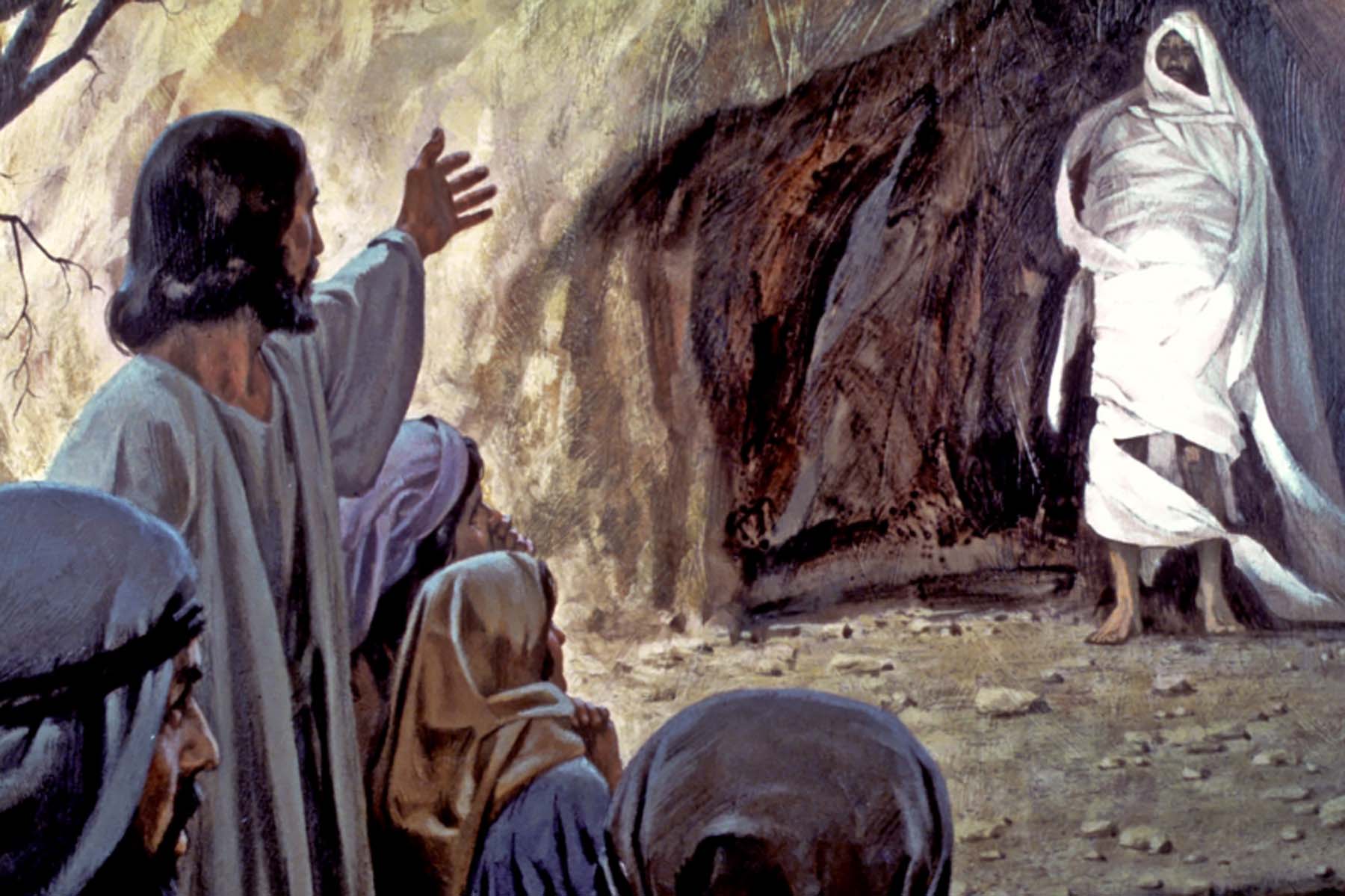
Jesus, once more deeply moved, came to the tomb. It was a cave with a stone laid across the entrance. {39} “Take away the stone,” he said. “But, Lord,” said Martha, the sister of the dead man, “by this time there is a bad odor, for he has been there four days.” {40} Then Jesus said, “Did I not tell you that if you believed, you would see the glory of God?””

   One thing seems to be certain: no one present really expected a miracle…except Martha! Notice: she knew here that Lazarus was about to come out of the grave and he would smell! Whether or not she knew he’d come out alive is questionable!

Jesus gently reminded her of the message He had sent at least three days before (vs. 4), and He urged her to believe it. True faith relies on God’s promises and it releases God’s power. Martha relented, and the stone was rolled away: “So they took away the stone.”

    Of all the “signs” recorded in the Gospel of John, none was greater than what happened at Lazarus’ tomb. Three times in chapter 11 Jesus claimed that these events took place so that people might see “the glory of God” (11:4, 15, 40). Each step of the way we have seen the glory of God in Jesus’ teachings and miracles; but up to this point in the Gospel of John, the raising of Lazarus is where the glory of God–the presence of God in Christ–shines most brilliantly. It is as if we have been reading this Gospel by a lamp with a switch which is able to make the light brighter or dimmer. The farther we go in John, the brighter the light becomes. When we reach chapter 11, the light becomes almost blinding. We have seen the glory of God in many ways already; we see it most powerfully in the next few verses.

    ‘As a side note to Martha’s confession, Leon Morris (The New International Commentary on the New Testament [Grand Rapids, Mich.: Baker Book House, 1986], 551) noted how unfortunate it is that Martha is most famous for her busyness (Luke 10:41) rather than for her remarkable confession.


* THE JEWS (11:41-57)

   The emphasis from this point on was on the faith of the spectators, the people who had come to comfort Mary and Martha. Jesus paused to pray: “So they took away the stone. Then Jesus looked up and said, “Father, I thank you that you have heard me. {42} I knew that you always hear me, but I said this for the benefit of the people standing here, that they may believe that you sent me.”

   He thanked the Father that the prayer had already been heard…but when had He prayed? It’s likely that it was when He was told that His friend was sick (11:4). The plan was likely revealed to Him, and He obeyed His Father’s will. His purpose now was clear: He wanted the unbelieving spectators to know that His Father had sent Him.

A quaint Puritan writer said that if Jesus had not named Lazarus by name when He called out, He would have emptied the whole cemetery!

He called out His name and he came out: “When he had said this, Jesus called in a loud voice, “Lazarus, come out!” {44} The dead man came out, his hands and feet wrapped with strips of linen, and a cloth around his face. Jesus said to them, “Take off the grave clothes and let him go.”


We must have in our minds a picture of the usual Palestinian tomb.  It was either a natural cave or hewn out of the rock.  There was an entrance in which the bier was first laid.  Beyond that was a chamber, usually about six feet long, nine feet wide and ten feet high.  There were usually eight shelves cut in the rock, three on each side and two on the wall facing the entrance, and on these shelves the bodies were laid.  The bodies were enveloped in linen but the hands and feet were swathed in bandage-like wrappings and the head was wrapped separately.  The tomb had no door, but in front of the opening ran a groove in which was set a great stone like a cartwheel that was rolled across the entrance to seal the grave.


Jesus asked that the stone should be moved.  Martha could think of only one reason for opening the tomb-that Jesus wished to look on the face of his dead friend for the last time.  Martha could see no consolation there.  She pointed out that Lazarus had been in the tomb for four days.  The point is this.  It was Jewish belief that the spirit of the departed hovered around his tomb for four days, seeking an entrance again into his body.  But after four days the spirit finally left for the face of the body was so decayed that it could no longer be recognized.


Then Jesus spoke his word of command which even death was powerless to oppose.


“He speaks, and, listening to his voice,

New life the dead receive.”


And Lazarus came forth.  It is weird to think of the bandaged figure staggering out from the tomb.  Jesus told them to unloose the hampering grave-clothes and wrappings and let him go.


There are certain things to note.


(i)  Jesus prayed.  The power which flowed through him was not his; it was God’s, “Miracles,” said Godet, “are just so many answered prayers.”


(ii)  Jesus sought only the glory of God; he did not do this to glorify himself.  When Elijah had his epic contest with the prophets of Baal, he prayed:  “Answer me, O Lord, that this people may know that thou art God” (1 Kings 18:37).


Everything Jesus did was due to the power of God and designed for the glory of God.  How different men are!  So much that we do is attempted in our own power and designed for our own prestige.  It may be that there would be more wonders in our life, too, if we ceased to act by ourselves and for ourselves and set God in the central place.


   It  was an unquestioned miracle that even the most hostile spectator could not deny!  “Therefore many of the Jews who had come to visit Mary, and had seen what Jesus did, put their faith in him.”

   The resuscitation of Lazarus could not properly be classed as a resurrection, some feel, because he resumed the same status that he had before his illness.

As with previous miracles, the people were divided in their response. “But some of them went to the Pharisees and told them what Jesus had done. {47} Then the chief priests and the Pharisees called a meeting of the Sanhedrin. “What are we accomplishing?” they asked. “Here is this man performing many miraculous signs. {48} If we let him go on like this, everyone will believe in him, and then the Romans will come and take away both our place and our nation.”

   It was necessary that the Sanhedrin meet to discuss what to do with Jesus. Caiaphas was a Sadducee, not a Pharisee (Acts 23:6-10), but the two factions could always get together to fight a common enemy. Caiaphas certainly uttered a divine prophesy: Jesus would die for the nation so that the nation would not perish.

  “Then one of them, named Caiaphas, who was high priest that year, spoke up, “You know nothing at all! {50} You do not realize that it is better for you that one man die for the people than that the whole nation perish.” {51} He did not say this on his own, but as high priest that year he prophesied that Jesus would die for the Jewish nation, {52} and not only for that nation but also for the scattered children of God, to bring them together and make them one. {53} So from that day on they plotted to take his life.”

   The official decision that day was that Jesus must die (see Matt.12:14; Luke 19:47; John 5:18; 7:1, 19-20, 25). The leaders thought that they were in control of the situation, but it was God who was working out His predetermined plan. Originally, they wanted to wait until after the Passover, but God had decreed otherwise.

  “Therefore Jesus no longer moved about publicly among the Jews. Instead he withdrew to a region near the desert, to a village called Ephraim, where he stayed with his disciples. {55} When it was almost time for the Jewish Passover, many went up from the country to Jerusalem for their ceremonial cleansing before the Passover.” {56} They kept looking for Jesus, and as they stood in the temple area they asked one another, “What do you think? Isn’t he coming to the Feast at all?” {57} But the chief priests and Pharisees had given orders that if anyone found out where Jesus was, he should report it so that they might arrest him.”


Now the Passover Feast of the Jews was near; and many from the country areas went up to Jerusalem before the Passover Feast to purify themselves.  So they were looking for Jesus; and, as they stood in the Temple precincts, they were talking with each other and saying:  “What do you think?  Surely it is impossible that he should come to the Feast?” Now the chief priests and Pharisees had given orders that if anyone knew where Jesus was, he should lodge information with them, that they might seize him.


Jesus did not unnecessarily court danger.  He was willing to lay down his life, but not so foolishly reckless as to throw it away before his work was done.  So he retired to a town called Ephraim, which was near Bethel in the mountainous country north of Jerusalem (cp. 2 Chronicles 13:19).


By this time Jerusalem was beginning to fill up with people.  Before the Jew could attend any feast he had to be ceremonially clean; and uncleanness could be contracted by touching a vast number of things and people.  Many of the Jews, therefore, came up to the city early to make the necessary offerings and go through the necessary washings in order to ensure ceremonial cleanness.  The law had it:  “Every man is bound to purify himself before the Feast.”


These purifications were carried out in the Temple.  They took time, and in the time of waiting the Jews gathered in excited little groups.  They knew what was going on.  They knew about this mortal contest of wills between Jesus and the authorities; and people are always interested in the man who gallantly faces fearful odds.  They wondered if he would appear at the feast; and concluded that he could not possible come.  This Galilean carpenter could not take on the whole might of Jewish ecclesiastical and political officialdom.


But they had underrated Jesus.  When the time arrived for him to come, nothing on earth would stop him coming.  Martin Luther was a man who hurled defiance at cautious souls who sought to hold him back from being too venturesome.  He took what seemed to him the right course “despite all cardinals, popes, kings and emperors, together with all devils and hell.” When he was cited to appear at Worms to answer for his attack on the abuses of the Roman Catholic Church, he was well warned of the danger.  His answer was:  “I would go if there were as many devils in Worms as there are tiles on the housetops.”  When told that Duke George would capture him, he answered:  “I would go if it rained Duke Georges.”  It was not that Luther was not afraid, for often he made his greatest statements when both voice and knees were shaking; but he had a courage which conquered fear.  The Christian does not fear the consequences of doing the right thing; he fears rather the consequences of not doing it.


From the concluding verses of the chapter, it seems that by this time, Jesus had been classed as an outlaw.  It may be that the authorities had offered a reward for information leading to his apprehension and that it was this that Judas sought and received.  In spite of that Jesus came to Jerusalem, and not skulking in the back streets but openly and in such a way as to focus attention upon himself.  Whatever else we may say of Jesus, we must bow in admiration before his death-defying courage.  For these last days of his life he was the bravest outlaw of all time.


Ephraim was about 15 miles north of Jerusalem. The crowd was gathering for the Passover feast, and the pilgrims were wondering if Jesus would attend the feast even though He was in danger. He was now on the “wanted” list, because the council had made it known that anyone who knew where Jesus was must report it to the officials.

A point we need to make here: the rich man in hades had argued that “if one went to them  from the dead, they will repent.” (Luke 16:30). Lazarus came back from the dead,and the officials wanted  to kill Him!

And what about today? Jesus, too, has come back from the dead! The stage has been set for the greatest drama in history, during which man would do his worst and God would give His best!

————————————————

I do not know how Jeremiah did it! Almost every time the Old Testament prophet stood up to preach, his congregation got smaller. Because of the time in which he lived, the truth he was called to preach was almost all bad news. Israel had descended too far into wickedness, and God had decided to send them into captivity in Babylon.

Jeremiah’s message to Israel was to “take their medicine” and peacefully accept their judgment. As a result, the people hated him and wished that he were dead!

This study from John 11 can make the teacher today feel a little like Jeremiah. While this passage contains some wonderfully good news, it requires that we first face something we may not want to face.

The painful truth is that we will all die! Life is fatal. However young, strong, and healthy we may be at this moment, someday we will die! It may be today or tomorrow or eighty years from now, but we all will die.

We try in many ways to avoid having to face this terrible truth. We try to convince ourselves that if we exercise enough, eat the right foods, wear our seat belts, drink purified water, and put on sunscreen when we go outside, then we will be protected from death. In the end, nothing can protect us from the fact that the death rate in this world is 100 percent!

You are probably thinking, “I do not want to hear this today! I have had a hard week, and now I am being reminded that I will die!” I would not bring up such a painful, distressing subject if the gospel did not provide the answer to it. Jesus, in the marvelous story in John 11, proclaims to people of all time, “I am the resurrection and the life.” It is wonderful news, but we had to be reminded of the bad news first in order to appreciate it.

Funerals have a way of reminding us that our best efforts cannot protect us from the crushing power of death.

The story of Jesus at Lazarus’ tomb helps us to confront our own fears of death. Because of what Jesus did then and still does today, we do not have to deny the reality of death in order to be happy in this life.

As Christians, we do not run from death; we face it. We do not pretend that it will not happen to us; we proclaim to the world that we have an answer to it. This new attitude is seen in the following two examples from the writings of Paul:  (Rom. 8:38-39)  “For I am convinced that neither death nor life, neither angels nor demons, neither the present nor the future, nor any powers, {39} neither height nor depth, nor anything else in all creation, will be able to separate us from the love of God that is in Christ Jesus our Lord.”

   (1 Cor. 15:54-55)  “When the perishable has been clothed with the imperishable, and the mortal with immortality, then the saying that is written will come true: “Death has been swallowed up in victory.” {55} “Where, O death, is your victory? Where, O death, is your sting?””

   John Donne, a seventeenth-century poet and preacher, chose for a time to sleep in a coffin in order to discipline his mind and soul about the greatest issues of life and death.

A few years ago a preacher I know had a somewhat similar experience. Unable to find sufficient time for study and prayer because of the constant noise and activity around my office, he mentioned my problem to a good friend who runs a local funeral home. A short time later he told me he had thought of a solution to my dilemma. You can imagine my surprise when he took me to the second floor of the funeral home and showed me where he was having a small study built for me–it was in the back corner of his casket warehouse!

It was one of the most wonderful gifts I have ever been given, and it became the one place in town where I could get away from everything to study, think, and pray. (After all, no one is going to bother a person in a casket warehouse!)

Since that time I have often wondered if perhaps all sermons should be written in a funeral home, the shadow of life’s most difficult reality.

Having to walk past the embalming room and through a room filled with caskets reminded me that my main mission is not to help people lead more pleasant lives; it is to help people find real life. It is not to remove all grief from their hearts; it is to show them the way past grief to the resurrection. It is not just to help them face the pressures and stresses of the world; it is to prepare them to meet their God (Amos 4:12).


SOME CLOSING LESSONS

Faith is like love in that it, too, is always beginning. For example, in the Gospel of John, the disciples had already come to have faith in Jesus by the time we reach chapter 11.

Andrew believed on the day when he left John the Baptist to follow Jesus (1:41), Philip believed on the day when Jesus called him (1:45), and Nathanael believed when Jesus said He had seen him under the fig tree (1:49).

The disciples who attended the wedding feast in Cana believed when they saw that Jesus had turned the water into wine (2:11). We are told that Peter and the other disciples who witnessed the feeding of the five thousand and heard the Bread of Life discourse also believed (6:69). Even after all of these statements of faith, Jesus told His disciples that He was glad for the opportunity to raise Lazarus so that they might believe (11:15)!

Faith is like that–always beginning.

Many of us already believe, at least to some degree. Then, one day, we face something that is so lifechanging that we never look at faith in the same way again. This encounter may be a blessing or a trial, the birth of a child or a fifty-foot fall. Suddenly, we see everything differently, and it seems that faith is beginning all over!

Today the Gospel of John calls us to believe (20:31). Many of us hear that call and think, “I already believe.” However, if we will listen and seek and follow, we may find that faith is only beginning in us!


FAITH IS FULL OF PROMISE

When Martha met Jesus outside of Bethany, her brother had been in the tomb for four days. She lamented that if Jesus had only been there, her brother would not have died.

In response to her grief, Jesus said, “I am the resurrection and the life; he who believes in Me shall live even if he dies, and everyone who lives and believes in Me shall never die. Do you believe this?” (11:25, 26).

Jesus’ words provide a powerful motivation to believe. Faith is hard work, and a lazy person will simply not put forth the effort. We do not believe just because we want to believe, but we will never believe if we do not want to believe. Faith involves dedication, obedience, sacrifice, and, oftentimes, tears. However, a rich promise is made to all who will believe.

In this respect, faith is like hard work in college; the student does it because of the promised payoff of getting a good job. Working hard at one’s career is rewarded with a good paycheck or promotion. Make no mistake about this: Faith does not earn a reward, but God’s promises are what motivate us to continue down the long, difficult, sometimes trying road to faith.


FAITH IS FOCUSED ON JESUS

John’s faith moves us toward faith in Jesus. What we need is not faith in parents, faith in the apostles, faith in other Christians, faith in the church, or even faith in faith. Rather, we need faith in Jesus.

In Martha’s powerful statement of faith, she told Jesus, “… I have believed that You are the Christ, the Son of God, even He who comes into the world” (11:27; emphasis mine). When Jesus, His disciples, Martha, Mary, and the crowd of mourners were later gathered outside Lazarus’ tomb, Jesus prayed to the Father, saying, “And I knew that Thou hearest Me always; but because of the people standing around I said it, that they may believe that Thou didst send Me” (11:42).

This is consistent with the rest of the Gospel of John, where the purpose is to produce faith “that Jesus is the Christ, the Son of God” (20:31).

John Paton was a missionary to Africa who taught and baptized a large number of people. Because the Bible was not available in the language of the people he was teaching, Paton began the long and difficult work of Bible translating.

The task went fairly smoothly until he began trying to translate the word “believe.” As strange as it may seem, there was no word in this language for “believe.” How could one possibly translate the Bible without a word for “believe”?

Then, one day as Paton was struggling with this linguistic problem, a Christian man from the village came to visit him. This man had been working hard all day and was exhausted.

When he sat down in a chair he gave a weary sigh of relief and said, “It is so good to lean your whole weight on something.” Paton realized that he had found an expression for “believe”: To believe is to “put your whole weight on Jesus.”‘ Faith is focused on Jesus and nothing less.


FAITH IS DIVISIVE

As the people stood outside Lazarus’ tomb and saw him walk out alive, they were presented with an unavoidable fork in the road. They had seen Lazarus dead, had prepared him for burial, had placed him in a tomb, and had placed a stone over the mouth of the cave.

They were eyewitnesses to these events. Then, because of Jesus’ miracle, these same people had become witnesses of Lazarus’ rising! Would they believe? They could not avoid making a decision.

John recorded the division that took place among the observers of the miracle that day:


 “Many therefore of the Jews, who had come to Mary and beheld what He had done,

believed in Him. But some of them went away to the Pharisees, and told them

the things which Jesus had done” (11:45, 46).

Amazingly, these people all witnessed the same events but reacted in opposite ways. Some saw that they were in the presence of the power of God, so they placed their faith in Jesus that day. Others only “saw” a juicy piece of gossip and scurried off to Jerusalem to tell the Jewish leaders about the stir created by Jesus.

The division among the people that day is no insignificant part of the story. On the contrary, division is the very nature of the story of Jesus: When people hear about Jesus, they are forced to make a decision, one way or the other, about His true identity. There is no neutral ground.

Jesus and the apostle John both push us relentlessly toward a decision. Is Jesus the Son of God, or was He a fraud? Either He is divine, or He was a blasphemer deserving death. What is your decision?


FAITH IS THREATENING

Some of those who had witnessed Lazarus’ resurrection went to the chief priests and the Pharisees in Jerusalem to tell them what the teacher from Nazareth had done.

As they made their report, they complained, “If we let Him go on like this, all men will believe in Him, and the Romans will come and take away both our place and our nation” (11:48).

They realized that faith in Jesus would change lives, change families, and even change a nation. They realized–perhaps better than most Christians today–· just how “dangerous” faith is.

An old song says about love that “it will lift you up, never let you down, take your world and turn it all around. The same should be said about faith in Jesus.

The tendency today is to expect too little in regard to faith. Many Christians have made faith too easy, too soft, too undemanding.


Wilbur Pees expressed this tendency in the following sarcastic paragraph: I would like to buy $3 worth of God, please, not enough to explode my soul or disturb my sleep, but just enough to equal a cup of warm milk or a snooze in the sunshine. I don’t want enough of Him to make me love a black man or pick beets with a migrant. I want ecstasy, not transformation; I want the warmth of the womb, not a new birth. I want a pound of the Eternal in a paper sack. I would like to buy $3 worth of God, please”

The faith to which Jesus invites us may well change our entire lives. John wanted to make sure that we understand the possible costs involved in following Jesus. We may suffer, we may be persecuted, and we may lose everything we own. Compared with the rich promises of faith, the costs seem strangely insignificant!


JOHN 11 in review

In this chapter is the seventh of the miracles John recorded. Here we see salvation pictured as resurrection from the dead, the giving of life to the dead. Use your concordance and see how much John has to say about life; he uses the word thirty-six times. Lazarus represents the salvation of the lost sinner in seven ways. Let’s take a closer look at each of these.


  1. He Was Dead (11:14)

The unsaved person is not just sick; he or she is spiritually dead (Eph. 2:1-3; Col. 2:13). When a person is physically dead, she does not respond to such things as food, temperature, or pain. When a person is spiritually dead, he does not respond to spiritual things. She has no interest in God, the Bible, Christians, or church until the Holy Spirit begins to work in her heart.


God warned Adam that disobedience would bring death (Gen. 2:15-17)—physical death (the separation of the soul from the body) and spiritual death (the separation of the soul from God). Revelation 20:14 calls hell the second death, that is eternal death. What sinners dead to God’s ways need is not education, medicine, morality, or religion; they need new life in Jesus Christ.


  1. He Was Decayed (11:39)

There are three resurrections recorded in the Gospels, apart from that of our Lord Himself. Christ raised a twelve-year-old girl who had died (Luke 8:49-56), a young man who had been dead several hours (Luke 7:11-17), and an older man who had been in the tomb four days (John 11). The point is that all three were dead. One person cannot be “more dead” than another. The only difference lay in the degree of decay. Is this not true of sinners today? The moral church member is not “decayed” like the person on skid row, but he is still dead.


III. He Was Raised and Given Life (11:41-44)

The sisters’ Jewish friends could only sympathize and weep; it took Christ to give the man life. How did Christ give him life? By the power of His word. This is the way He raised all three dead people mentioned above (see John 5:24 and Eph. 2:1-10).

Why did Christ raise Lazarus? Because He loved him (v. 5 and v. 36) and because it brought glory to God (v. 4). This is why He has saved us. We deserve to die and go to hell, but because of His great love, He rescued us. (Read again Eph. 1:3-14 and 2:1-10.)


Keep in mind that salvation is not a set of rules; it is life (John 3:14-21, 36; 5:24; 10:10; 1 John 5:10-13). This life is a Person—Jesus Christ. When dead sinners hear the voice of the Son of God (the Word) and believe, they are given eternal life (John 5:25). To reject that Word is to be dead forever.


  1. He Was Loosed (11:44)

Lazarus was bound hand and foot and so could not free himself. The believer is not to be bound by the graveclothes of the old life, but should walk in the freedom of the new life. Read carefully Col. 3:1-17 to learn how the Christian is to “put off” the graveclothes and “put on” the “grace clothes” of the new life. It is a poor testimony for a Christian to carry with him the things of the old life.


  1. He Witnessed to Others (11:45)

In John 11:45 and 12:9-11 and 17, we see that Lazarus caused quite a stir in the area! People saw him and believed in Christ! In fact, he was a walking miracle, just as every Christian ought to be (Rom. 6:4). The great crowd that gathered on Palm Sunday came not only because of Jesus, but also because of Lazarus. In 12:11 we are told that Lazarus was causing people to trust Christ, but this kind of witness is the privilege and duty of every Christian.


  1. He Fellowshipped with Christ (12:1-2)

In looking ahead to 12:1-2 we see Lazarus sitting at the table with Christ, feasting with Him. This is the rightful place for the Christian who has been “raised…and made…to sit together in heavenly places in Christ Jesus” (Eph. 2:5-6). By spending time with Christ, Lazarus was showing his gratitude for Christ’s mercy and love. He learned lessons from His Word and received new power to walk with Christ and to witness. The miracle of salvation gives us eternal life, but we must fellowship with Christ daily to be able to grow in the spiritual life.


It is interesting to note that the entire family at Bethany demonstrates what the Christian life is like. Mary is always found at Jesus’ feet, listening to His Word (Luke 10:38-42; John 11:32; 12:3). Martha is a picture of service; she is found busily doing something for Christ. Lazarus speaks of testimony, a daily walk that leads others to Christ. These three practices must be in our Christian experience: worship (Mary), work (Martha), and walk (Lazarus).


VII. He Was Persecuted (12:10-11)

The Jews hated Lazarus because he convinced others of Christ’s deity (12:10-11). Many of the chief priests were Sadducees who did not believe in the resurrection, and Lazarus was living proof that the Sadducees were wrong. Had the priests not been overruled by God, they would have put an extra cross on Calvary for Lazarus. (“Yes, and all that desire to live godly in Christ Jesus will suffer persecution”—2 Tim. 3:12 [NKJV].) Satan always fights a living miracle that testifies on God’s behalf.


 
Leave a comment

Posted by on October 12, 2023 in Miracles


The Miracles of Jesus #19 Healing of the Man Born Blind – John 9:1-41


Is life simply a large accident, a giant game of chance? The question as to why events happen in our lives has been posed repeatedly.

It has been the theme of classic movies and literature, and it is asked daily by real people, especially in moments of tragedy and loss. Jesus offered a unique way of addressing the question of “Why?” in our study today.

In our study we find one of the best attested miracles or Scripture. Not only do we read the test-

money of the one upon whom the miracle was performed, but that of his parents and friends, as well as the reluctant Pharisees.

The evidence was examined from every possible angle and the proof was unquestionable. If it were not so tragic, this chapter would be comical.

Here is a man blind from birth healed by the Nazarene and the Pharisees, rather than accept the evident fact that Jesus healed him, chose to question the man’s former blindness!

Next, his parents, out of cowardice, “pass the buck” and will not take sides with their son. And in verses 24-34, this common-sense man makes the learned Pharisees look ridiculous! He becomes the questioner instead of the questioned.

The healing of this blind man is an illustration of the progress of the conflict between Jesus and His opponents, and is an outstanding example of the development of belief and unbelief:

– the belief is exemplified in the man

– the unbelief is exemplified in the reaction of the Pharisees, who examined and finally excommunicated the man

This episode was:

– sign demonstrating Jesus’ power

– an interview which afforded another instance of His dealing with men

– a crisis which brought fresh response, positive and negative, to His ministry

* THE CASE

   It is my understanding that a person goes blind in the United States every 20 minutes. This man was born blind! but the greatest miracle will not be the fact that his eyes were opened…the great event was his heart opening to Jesus

It cost him everything to confess Jesus as the Son of God, but he was willing to do it.

The action was opened by the contact which Jesus made with a beggar who was sitting by the roadside in Jerusalem. Beggars were common in the Orient and Jesus healed many cases (Mark 8:23. 10:46).

He also mentions this fact as one of the marks of the Messiah in the message He sends back to John the Baptist in Matthew 11:1-6: “After Jesus had finished instructing his twelve disciples, he went on from there to teach and preach in the towns of Galilee. {2} When John heard in prison what Christ was doing, he sent his disciples {3} to ask him, “Are you the one who was to come, or should we expect someone else?” {4} Jesus replied, “Go back and report to John what you hear and see: {5} The blind receive sight, the lame walk, those who have leprosy are cured, the deaf hear, the dead are raised, and the good news is preached to the poor. {6} Blessed is the man who does not fall away on account of me.””

 Let’s note the different way the blind man was viewed by those around him.

– To the disciples, he was a theological analysis:

  “As he went along, he saw a man blind from birth. {2} His disciples asked him, “Rabbi, who sinned, this man or his parents, that he was born blind?” {3} “Neither this man nor his parents sinned,” said Jesus, “but this happened so that the work of God might be displayed in his life. {4} As long as it is day, we must do the work of him who sent me. Night is coming, when no one can work. {5} While I am in the world, I am the light of the world.””

   The question recognized his miserable plight, and it’s very clear that the disciples felt certain that someone had sinned to bring it about.

The book of Job shows that this is not always the case and Jesus showed it also in Luke 13:1-5: “Now there were some present at that time who told Jesus about the Galileans whose blood Pilate had mixed with their sacrifices. {2} Jesus answered, “Do you think that these Galileans were worse sinners than all the other Galileans because they suffered this way? {3} I tell you, no! But unless you repent, you too will all perish. {4} Or those eighteen who died when the tower in Siloam fell on them–do you think they were more guilty than all the others living in Jerusalem? {5} I tell you, no! But unless you repent, you too will all perish.””

It’s very clear that they were more interested in solving the abstract problem than in ministering to the individual who had aroused it. They regarded him as a sinner who was less important than their debate!

Affliction, sorrow, pain, disappointment, and loss are always opportunities to display God’s grace. It enables the suffer to show God in action. When trouble and disaster fall upon a man who does not know God, that may’ might collapse from the burden. But when they fall on a man who walks with God they bring out the strength and the beauty, and the endurance and the nobility, which are within a man’s heart when God is there.

It is told that when an old saint was dying in an agony of pain, he sent for his family, saying: “Come and see how a Christian can die.” It is when life hits us a terrible blow that we can show the world how a Christian can live and, if need be, die.

The man born blind from birth was in darkness, but Christ came to provide light. How it must have cheered the heart of the blind man to hear these words! God gave men the day for work and the night for rest: we must all do God’s work while there is time to do it.


– To the neighbors, he was a beggar.

 “His neighbors and those who had formerly seen him begging asked “Isn’t this the same man who used to sit and beg'” (9) Some claimed that he was. Others said. “No, he only looks like him. ” But he himself insisted, “I am the man. “

He had likely been dependent upon their generation for his support, and while they probably held no hard feelings toward him, they regarded him more or less of a nuisance He was unproductive, contributing nothing to the life of the community, and was “one more mouth to feed.” They were not necessarily unkind…but they were indifferent

– To the Pharisees, he was a tool to trap Jesus.

“They brought to the Pharisees the man who had been blind. {14} Now the day on which Jesus had made the mud and opened the man’s eyes was a Sabbath. {15} Therefore the Pharisees also asked him how he had received his sight. “He put mud on my eyes,” the man replied, “and I washed, and now I see.””

   They had no interest in the man, but were eager to employ him as a witness, if possible. Since the healing was performed on the Sabbath, he would be useful to them in incriminating Jesus.

Later, when they found he was not useful for this purpose, they cast him off and excommunicated him.

– To Jesus: He viewed him as a man

To Jesus, he was a man who needed help! He felt that the man’s condition called for action rather than debate or discussion.

 “Having said this, he spit on the ground made some mud with the saliva, and put it on the man’s eyes. (7) “Go, ” he told him, “wash in the pool of Siloam” (this word means Sent). So the man went and washed, and came home seeing.”

This is the only miracle recorded we have by Jesus on one defective from birth. And verse 3 (“but this happened so that the work of God might be displayed in his life’?) ought to give comfort to all afflicted today: God’s purposes on this earth can be fulfilled through the most difficult of circumstances.

THE CURE

The motive for the cure was compassion. Jesus had little to gain by performing the miracle, since He needed to offer no further proof to the multitude of what He could do.

He must have realized that healing this man on the Sabbath would cause an even more violent protest from the rulers than had the healing of the man at the pool earlier in His ministry. Nevertheless, He did it because of His concern for the individual.

One thing is for certain: the cure was undeniable! Nobody who knew this man challenged its reality.

All acknowledged:

– that he had been born blind

– that the man who was professedly cured was identical with the blind beggar and that he could actually see


There are some questions we might attempt to answer before discussing the results of this healing:

  1. Why did Christ anoint the man’s eyes with mud made from spittle? The Jews believed there were medicinal qualities in spittle, especially if it was from a distinguished person.

And there were definite traditions observed by the Pharisees which prohibited the application of medications on the Sabbath; the law read: “as to fasting spittle, it is not lawful to put it so much as upon the eyelids.”

Perhaps Jesus wanted to challenge their binding of traditions as “matters of life and death.” It could also have been because He wanted to give the blind man some symbolic or expressive action in order that he might know the power to heal his blindness came from Jesus.

One thing is for certain: Jesus took the methods and customs of his time and used them to gain the confidence of his patient. Touch and hearing would be this man’s chief avenues of contact with the outside world.  He had already heard the conversation between Jesus and the disciples, and would have thought it not too reassuring.

The man could have been healed without the clay and spittle, but the Lord deals with individuals differently. He works in mysterious ways, His wonders to  perform.  Christ  said  “go”  and  the  man went…obedience to the plan of God brought happiness.

  1. Why did Jesus send him to the pool of Siloam?

The pool of Siloam was one of the landmarks of Jerusalem, and was the result of one of the great engineering feats of the ancient world.

The water supply of Jerusalem had always been precarious in the event of a siege. It came mainly from the Virgin’s Fountain or the Spring Gihon, which was situated in the Kidron Valley. A staircase of 33 rock-cut steps led down to it; and there, from a stone basin, people drew the water.

It was just inside the southeast portion of the city wall and quite a distance from the temple. There were certainly other facilities much handier where the man might wash.

There are two likely reasons:

  1. He sent the man there to test his faith. Faith must be tested and expressed. Neither the mud nor the water had any medicinal qualities except as Jesus used them miraculously.
  2. This pool probably had some symbolic, typical, or spiritual Messianic significance to the Jews.

THE CONFESSION

As we look closely at this blind man’s confession

of faith, we will notice, initially, that it was positive and that his different statements are filled with facts in simple and direct language.

And notice the use of the words “I” and “me.” The miracle was part of this man’s firsthand knowledge, and his witness could not be set aside.

  “”How then were your eyes opened?” they demanded. {11} He replied, “The man they call Jesus made some mud and put it on my eyes. He told me to go to Siloam and wash. So I went and washed, and then I could see.” {12} “Where is this man?” they asked him. “I don’t know,” he said.”

Since the Pharisees were the custodians of the faith, it was right that the healed man be brought to them for investigation. The fact that they studied this miracle in such detail is only further proof that Jesus did indeed heal the man!

Notice the testimony:

– he had been born blind

– a man named Jesus anointed his eyes and commanded him to wash in Siloam

– he washed

– he returned seeing

Three groups of people questioned the blind man, and it’s important that we note the different levels of faith displayed by the healed man:

– The neighbors, motivated by curiosity.

They just wanted to know what had happened. The blind man responded with the facts.

– The Pharisees, whose motive was controversy

The fact of the Sabbath Day was a more important matter than whether or how the thing was done. Jesus must be a sinner, since He’d broken a law by healing on the Sabbath, they supposed.

The healed man’s response: he is a prophet! Moses, Elijah, and Elisha did perform miracles. The Jewish people would look upon their prophets as men of God who could do wonderful things by the power of God.

But the Pharisees did not want to see Jesus given that kind of high designation.

   “Some of the Pharisees said, “This man is not from God, for he does not keep the Sabbath.” But others asked, “How can a sinner do such miraculous signs?” So they were divided. {17} Finally they turned again to the blind man, “What have you to say about him? It was your eyes he opened.” The man replied, “He is a prophet.””

We must admire the courage of this man to stand up to this group of rebellious people. It is not always easy to be a Christian witness…it takes courage to stand against sin and against the world that delights in sin.

Verses 18-34 give us the reaction to the statement in verse 17; stage by stage the objections of unbelief are beaten back.

– The man’s parents

“The Jews still did not believe that he had been blind and had received his sight until they sent for the man’s parents. {19} “Is this your son?” they asked. “Is this the one you say was born blind? How is it that now he can see?” {20} “We know he is our son,” the parents answered, “and we know he was born blind. {21} But how he can see now, or who opened his eyes, we don’t know. Ask him. He is of age; he will speak for himself.” {22} His parents said this because they were afraid of the Jews, for already the Jews had decided that anyone who acknowledged that Jesus was the Christ would be put out of the synagogue. {23} That was why his parents said, “He is of age; ask him.””

   The parents were afraid to say much, but they did identify him as their son and they affirmed that he had been born blind. Without a doubt, this was not a case of mistaken identity.

They appealed to their son’s age and maturity for any future answers…and would claim nothing more.

– The healed man

The Pharisees wanted someone (anyone!?) to admit that Jesus was a sinner…but the man simply restates the facts and concludes that no sinner could heal a blind man.

  “A second time they summoned the man who had been blind. “Give glory to God, ” they said. “We know this man is a sinner.” {25} He replied, “Whether he is a sinner or not, I don’t know. One thing I do know. I was blind but now I see!” {26} Then they asked him, “What did he do to you? How did he open your eyes?” {27} He answered, “I have told you already and you did not listen. Why do you want to hear it again? Do you want to become his disciples, too?””

   Anxious to settle the case, the Pharisees did call the man in; and this time, they put him under oath. “Give God the praise” is a form of Jewish “swearing in” at court.

His response is both wonderful and simple: I was blind, now I see! He did not debate the character of Jesus, because that was beyond his knowledge and experience. But he could see!

We admire the boldness of the man in asking those irate leaders if they wanted to follow Jesus!

THE CONSEQUENCES

This miracle illustrated clearly the consequences of belief and unbelief. Persistent faith brought healing and progressive enlightenment.

As the blind man acted on the simple imperative of Jesus, he progressed from one step of faith to another, until Jesus’ voluntary revelation of Himself brought the man to its highest attainment and reward.

The poor beggar is not awed by the presence of the Pharisees. He is a man with a good and honest heart upon which the truth has fallen and is slowly bringing forth fruit.

It’s fair to say that this man is more amazed at the willful blindness of the Pharisees than anything else. He is sincere, honest and logical…and it gets him into trouble.

“Then they hurled insults at him and said, “You are this fellow’s disciple! We are disciples of Moses! {29} We know that God spoke to Moses, but as for this fellow, we don’t even know where he comes from.” {30} The man answered, “Now that is remarkable! You don’t know where he comes from, yet he opened my eyes. {31} We know that God does not listen to sinners. He listens to the godly man who does his will. {32} Nobody has ever heard of opening the eyes of a man born blind. {33} If this man were not from God, he could do nothing.” {34} To this they replied, “You were steeped in sin at birth; how dare you lecture us!” And they threw him out.”

   The unbelief of the Pharisees began with a misunderstanding of the law and of Jesus. The law was for them a tradition to be kept, a dead letter, not a living voice. It resulted in a prejudice that blinded them to anything but their on pre-conceived opmlons.

Pride (vs. 29) and bigotry (vs. 34) caused them to drive away the very man from whom they might have taken lessons offaith.

The only way they could think to maintain their self-begotten prestige was to attack the character of the beggar and excommunicate him.

This is the normal procedure for the rulers of the Jews–if they could not disprove the miracles attesting to Christ’s message, they would threaten the messengers or do them bodily harm (Acts 4: 16-21).

Two forms of discipline were possible:

(1) the temporary exclusion, which cut off a man from fellowship until his penitence warranted restoration; it lasted only 30 days; (2) the permanent ban, which pronounced a curse on him and put him out forever. It might even be determined that this one could even be denied the privilege of dealing with local merchants.

Nothing could be more humiliating for a Jew than being excommunicated from the synagogue!

The first one is likely here, since a vote of the Sanhedrin was necessary for the second. When Jesus heard of the unfortunate results, he was moved with pity and sought out the man. His question was simple and to the point:  (35) “Jesus heard that they had thrown him out, and when he found him, he said. ‘”Do you believe in the Son of Man?”

The man was unwilling to commit himself without knowing why and more: (36)”Who is he, sir?” the man asked. “Tell me so that I may believe in him.”

   Upon getting Jesus’ answer, he immediately responded, which represents the final stage of belief: “Jesus said. “You have now seen him; in fact, he is the one speaking with you. ” (38) Then the man said, “Lord, I believe, ” and he worshiped him. (39) Jesus said “For judgment I have come into this world, so that the blind will see and those who see will become blind.”

The story ends with a rhetorical question posed by some Phahsees: (40) “Some pharisees who were with him heard him say this and asked, “What? Are we blind, too? (41) Jesus said, “lf you were blind, you would not be guilty of sin; but now that you claim you can see, your guilt remains.”

They expected Jesus to esempt them from the condemnation of His previous statement (vs. 39). His reply was devastating: if they really were blind, and admitted the fact, their confession would lead to the removal of their sin.

Their inability to discern their own failure as evidenced by their complacent assumption of spritual sight aggravated the situation and made their sin all the more lasting!

While the blind man gained physical and spiritual light through faith, the Pharisees lost the light they had and lapsed into complete spiritual darkness.

Closing Thought

When I think about those who have “displayed the works of God” in suffering, several people come to mind.

One is a young man who has limited mental ability. I am sure that his mother and father must have asked themselves and God a million times why their son was born this way. I will always remember the night of their son’s baptism, when he responded to the invitation at the conclusion of a sermon. There was not a dry eye in the assembly when he confessed his faith in Jesus and said with beautiful simplicity “I just want to do what God wants me to do.” In that moment the work of God was displayed in that young man’s life.

I also think of a preacher I once heard soon after he was told that he had a potentially terminal disease. He told the church that his prayer to God was that he might get well; but if he could not get well, his prayer would be that God would help him show the church how to die. A few months later he did just that; in his dying the work of God was displayed!

Another example of one who displayed the work of God in suffering is a Christian woman who struggled for years with cancer and recently went on to be with the Lord. Many times I heard people ask “Why?” In looking back on her years of illness, I am convinced that she demonstrated the work of God through her illness in a way that few people ever do in their good health.

The ultimate example of living with purpose, of course, is Jesus on the cross. It was unfair, and it was cruel. It was, in many ways, a tragedy; yet Jesus hung on the cross so that the “works of God might be displayed” in His life and death.

No one I have ever met can explain why Jesus had to suffer on the cross. I do not believe we will understand that completely until we reach heaven. Even a small child, however, can appreciate the fact that the work of God was displayed in a marvelous way because Jesus went to the cross. He lived and died for the purposes of God.

All of us face something that could cause us to believe that God has turned His back on us and that we could not possibly be used for the glory of God. Some may say, “But I am divorced”: “I struggle in my marriage”; “I have problems with my children”; “I am ill”; or “I am too old /young. ” Jesus walks into our world and says, in essence, “I will not tell you why you face the difficulties you are now facing, but I will tell you this: The work of God can be displayed in your life in spite of your problems–perhaps even because of your problems!”

An example of this is Paul, who was tormented by his familiar “thorn in the flesh” (2 Corinthians 12:7). Three times he asked the Lord to remove it.

I am sure that Paul imagined how much more he could accomplish for God if only he were free from his affliction, yet the Lord refused to remove Paul’s thorn in the flesh.

Instead, God left him with this message: “My grace is sufficient for you, for power is perfected in weakness” (2 Corinthians 12:9).

Paul finally accepted God’s decision that he could better demonstrate God’s power through weakness than through strength and good health.

In this Paul gave us a model to follow in dealing with afflictions. First, we ask God to deliver us from our pain. This is our natural human reflex to pain, and it is right to cry out for deliverance. The second step for the Christian, however, is to say to God, “Come what may, You be glorified in my life.” Whatever our situations, we can all be used to display the work of God!

JOHN 9 in review

This chapter presents the sixth of seven special miracles recorded in John’s Gospel as witnesses to Christ’s deity (20:30-31). The first three signs show how a person is saved: through the Word (water to wine), by faith (healing the nobleman’s son), and by grace (healing the impotent man). The last four signs show the results of salvation: satisfaction (feeding the 5,000), peace (stilling the storm), light (healing the blind man), and life (raising Lazarus).

  1. The Cure (9:1-7)
  2. The man has the characteristics of the lost sinner.

(1) He was blind (Eph. 4:18; John 3:3; 2 Cor. 4:3-6). The unsaved, though intellectual like Nicodemus, can never see or understand spiritual things. See 1 Cor. 2:14-16.

(2) He was begging. The unsaved are poor in God’s sight, though perhaps rich in the eyes of the world. They are begging for something to satisfy their deepest needs.

(3) He was helpless. He could not cure himself; others could not cure him.

  1. The cure shows how Christ saves a sinner.

(1) He came to the man in grace. Christ could have passed him by, for it was the Sabbath and He was supposed to rest (v. 14). While the disciples argued about the cause of the blindness, Jesus did something for the man.

(2) He irritated the man. A speck of dirt irritates the eye; imagine how cakes of clay must have felt. But the dirt in his eyes encouraged him to go wash. It is just so with the preaching of the Word: it irritates sinners with conviction so that they want to do something about their sins. (See Acts 2:37.)

(3) He cured the man by His power. The man proved his faith in Christ by being obedient to the Word. “Religion” today wants to give men substitutes for salvation, but only Christ can deliver from the darkness of sin and hell.

(4) The cure glorified God. All true conversions are for God’s glory alone. See Eph. 1:6, 12, 14; 2:8-10.

(5) The cure was noticed by others. His parents and neighbors saw a change in his life. So it is when a person is born again—others see the difference it makes (2 Cor. 5:17).

  1. The Controversy (9:8-34)

The religious leaders had let it be known that anyone who confessed Christ openly would be cast out of the synagogue (v. 22). This meant, of course, losing friends and family and all the benefits of the Jewish religion. It was this declaration that forced the blind man’s parents and neighbors to “beat around the bush” when asked about his amazing cure.

The son’s simple confession in v. 11 exalted Christ, though at that time he did not fully know who “the man called Jesus” really was.

The Pharisees attacked Christ by saying He was not of God (v. 16) and calling Him a sinner (v. 24). The son told what he knew (v. 25) and showed the Pharisees how foolish their thinking was (vv. 30-33). The simple-hearted believer knows more spiritual truth than unsaved educated theologians. (See Ps. 119:97-104.) The final result: they excommunicated the man from the synagogue.

It would have been easy for the son to hide his confession and thus avoid controversy, but he fearlessly stood his ground. He knew what a difference Christ had made in his life, and he could not deny it. Everyone who has met Christ and trusted Him should make it known openly.

III. His Confession (9:35-41)

The man did not realize it then, but the safest place for him was outside the Jewish religious fold. The Jews cast him out, but Christ took him in! Like Paul (see Phil. 3:1-10), this man “lost his religion” but found salvation and went to heaven.

Note carefully how this man grew in his knowledge of Christ:

(1) “A man called Jesus” (v. 11) was all he knew when Christ healed him.

(2) “A prophet” (v. 17) is what the man called Him when the Pharisees questioned him.

(3) “A man of God” (vv. 31-33) is what he concluded Jesus to be.

(4) “The Son of God” (vv. 35-38) was his final and complete confession of faith. (See 20:30-31.)

“The path of the righteous is like the first gleam of dawn, shining ever brighter till the full light of day,” states Prov. 4:18 (NIV), and this man’s growth in “light” proves it.

A Christian is one who has light in his heart (2 Cor. 4:6) and who is a light in the world (Matt. 5:14). He walks in the light (1 John 1) and produces the fruit of light (Eph. 5:8-9). The man’s “Lord, I believe!” was the turning point in his life.

The same light that leads one person can blind another (vv. 39-41). The Pharisees admitted that they could see, and therefore they were guilty because they rejected the evidence and would not receive Christ. The Gospel brings about different reactions from different kinds of hearts: the blind sinner receives the truth and sees; the self-righteous religious person rejects the truth and becomes even more blind spiritually. It is a dangerous thing to reject the light.

 
Leave a comment

Posted by on October 9, 2023 in Miracles


The Miracles of Jesus #18 Walking on Water – Matthew 14:24–33; Mark 6:47–52; John 6:16–21


This narrative contains not one, but four miracles: (1) Walking on water, (2) causing Peter to walk on water, (3) calming of the storm, and (4) immediately arriving at land. It complements the story of the feeding of the 5,000 by highlighting the sovereignty of Jesus. Not only is he like God the Creator (Gen 1:1), he is like God the Spirit, hovering over the chaotic waters (Gen 1:2). Furthermore, this story continues the theme that has run through this section—misunderstanding who Jesus is. He is, of course, misunderstood by the crowds. Earlier, even John the Baptist questioned who Jesus was. And even now his own disciples don’t really know Jesus, even after the feeding of the 5,000 (Mk 6:52).

Mk 6:47–49 with Mt 14:24, Jn 6:19, 17 When evening came, the boat was in the middle of the lake {a considerable distance from land, buffeted by the wavesMT}, and he was alone on land. 48 He saw the disciples straining at the oars, because the wind was against them. {When they had rowed three or three and a half miles, they saw Jesus approaching.JN} About the fourth watch of the night {by now it was dark, and Jesus had not yet joined themJN} he went out to them, walking on the lake. He was about to pass by them, 49 but when they saw him walking on the lake,

Mt 14:26–27 they were terrified. “It’s a ghost,” they said, and cried out in fear.27 But Jesus immediately said to them: “Take courage! It is I. Don’t be afraid.”

Surely this party of 5,000 lasts until early evening, perhaps 9 p.m. It would not be the kind of thing one was eager to end. It will take Jesus a good little while to calm the excited crowd and dismiss both his Twelve and then the 5,000. He prays from late evening until about 3 a.m. when he joins the apostolic band.
From his mountain vantage point, Jesus can see a good distance across the lake in the light of the full moon that accompanies Passover. He can see they have been driven off course. Instead of heading toward Bethsaida on the north shore, they are approaching Genneseret on the southwest shore. They are about three or three-and-a-half miles away, pretty close to the middle of the lake. Obviously, they have been struggling for the better part of the night against the strong headwind.

This must have been a difficult incident for the Apostles. Surely they shared the crowd’s sentiments of making Jesus king. After all, they had much to gain from such a move; and such was their expectation of a political Messiah. Jesus sent them away, much to their disappointment. What’s worse, they were sent into a storm. Being in the middle of the lake in the middle of this storm perhaps caused them to question the Lordship of Jesus even after such an event as the feeding of the 5,000. They needed the added lesson of Jesus walking on water.

John makes masterful use of the verbs in this section which give a real eyewitness flavor to his account.

He employs the imperfects “were proceeding” and “was getting rough” or “was rising” to picture the condition, respectively of the men in the boat and on the sea. But between these imperfects he makes use of the pluperfects (darkness) “had come (to be)” and (Jesus) “had not yet come,” to indicate what had (or had not yet) happened before the disciples had reached the opposite shore. (Hendriksen, p. 224)

Thus, we picture two scenes. One is of Jesus, praying in the calm serenity of the night. The other is of the Apostles some three miles away, laboring at the oars in the middle of a storm. The Apostles are neither out of sight nor out of mind of the Master.

Jesus sets out right across the middle of the lake! He is coming to the aid of his disciples. So why does Mark say, “He was about to pass them by?” Is he just kidding around? Is he going to beat them to the other side by taking a shortcut? One solution is that they are close enough to land that Jesus is simply going to meet them when they come ashore in just a little bit. McInerny offers a more sophisticated explanation. He notices that the words “pass by” are used in the OT for theophanies of Yahweh. Perhaps Mark is alluding to the fact that Jesus’ walking on water is tantamount to an appearance of God. A third solution is that they simply don’t notice Jesus until he is parallel to the boat. Then they think he is a ghost going by. Thus, “pass them by” is the disciples’ impression, not Jesus’ intention.

No wonder the Apostles are frightened. Their eyes are fixed on this eerie apparition—a human-like figure emerging through the waves in the middle of a storm-tossed lake. It is natural to assume that it is a ghost (a disembodied spirit). Who today would come up with a different conclusion? Their sadness of heart and physical fatigue certainly cannot be helping their disposition.

Jesus immediately tries to calm them by identifying himself. “ ‘It is I’ reads, more literally, I am. This is not bad grammar but a conscious echo of the divine name of Yahweh, as in Exod 3:14. Though still somewhat veiled, this is perhaps Jesus’ clearest self-revelation of his divinity to date” (Blomberg, p. 235).

Granted, this is a difficult narrative to believe … as was the feeding of the 5,000. Many have attempted to explain these two miracles away by naturalistic means. This simply won’t do. The texts clearly say what they intend. Either they are literary inventions with theological purposes, deliberate lies, or God breaking into natural law. We must accept them or reject them. But to explain them away is not intellectually honest.

Mt 14:28–33 “Lord, if it’s you,” Peter replied, “tell me to come to you on the water.”
29 “Come,” he said. Then Peter got down out of the boat, walked on the water and came toward Jesus. 30 But when he saw the wind, he was afraid and, beginning to sink, cried out, “Lord, save me!”

Mk 6:51–52 Immediately Jesus reached out his hand and caught him. “You of little faith,” he said, “why did you doubt?” 32 And when they climbed into the boat, the wind died down. 33 Then those who were in the boat worshiped him, saying, “Truly you are the Son of God.” 51 They were completely amazed, 52 for they had not understood about the loaves; their hearts were hardened.

Jn 6:21 21 Then they were willing to take him into the boat, and immediately the boat reached the shore where they were heading.

Peter walking on the water is found only in Matthew. It tells of both the faith and failing of Peter. He is impetuous, sometimes arrogant, and quick to speak before he thinks. But the bottom line is that aside from Jesus, he holds the water-walking record.

“If it is you” (v. 28) might be translated better “Since it is you” [first-class condition]. Jesus bids him to come … and he does. Unfortunately, he is quickly distracted and begins to sink.

What a stark contrast between Matthew 14:33 and Mark 6:51–52! We observe first of all that true worship is often a by-product of fear which comes from understanding who Jesus really is. Second, we see that even those who spent the most time with Jesus still did not fully know who he was. Third, we understand that being excited about Jesus’ deeds (i.e., miracles) does not necessarily mean that we correctly interpret them.
Suddenly they are at the shore. This may simply mean that they are pretty close to the shore when Jesus gets into the boat. Or it may be a divine “transport” that we don’t understand any better than we do water-walking. But how foolish it would be to reject the narrative because it does not submit to what we can figure out. We might find ourselves in the same categories as Jesus’ unbelieving disciples (frighteningly similar to Jesus’ enemies)—“their hearts were hardened.”

75 Healings at Gennesaret (Mt 14:34–36; Mk 6:53–56) [MK 6:]53 When they had crossed over, they landed at Gennesaret and anchored there. 54 As soon as they got out of the boat, people recognized Jesus. 55 They ran throughout that whole region and carried the sick on mats to wherever they heard he was. 56 And wherever he went—into villages, towns or countryside—they placed the sick in the marketplaces. They begged him to let them touch even the edge of his cloak, and all who touched him were healed.

Gennesaret is a fertile plain on the west side of the lake. Josephus says, “One may call this place the ambition of nature, where it forces those plants that are naturally enemies to one another to agree together” (JW 3.518). The boat was blown off course in the storm. Originally they were heading toward Capernaum (Jn 6:17), more specifically, its suburb, Bethsaida (Mk 6:45). The seasick disciples decide to walk from Gennesaret back to Capernaum. There are probably a couple of disciples assigned to sail the boat back to its home port after breakfast.

Jesus is well known, and when the people of the area hear that he is passing through, they line the streets with cots and wheelchairs, waiting for him to pass by. This event epitomizes and summarizes Jesus’ healing ministry (cf. Mt 8:1–17; 9:18–34; Mk 1:32–34; 3:7–12). Matthew’s extra strong word for healing [diasozō], indicates that the crowds were restored to complete health.

Jesus doesn’t take the time to stop for a “healing service.” Rather, he allows the crowds to touch him on his way through. He is in typical Palestinian garb, complete with prayer tassels at the edge of his robe (cf. Num 15:37–39; Deut 22:12). The popular belief was that power flowed from the individual into his garments, especially the prayer tassels. We witnessed the same superstition with the woman with a flow of blood (§ 67, Mt 9:20–21; Mk 5:24–34). If they can touch his tassels they believe they will be healed. By the time Jesus arrives at Capernaum there must have been a massive parade left in the wake of his healings. The Capernaum synagogue is about to break their record attendance.

Verse-by-Verse study

The pinnacle of this passage is the disciples’ worship of Jesus as they confessed, “You are certainly God’s Son” (v. 33). Though the Father had said this of Jesus at His baptism (3:17) and even the demons at Gadara addressed Him as the Son of God (8:29), but this was the first time the twelve unequivocally declared their Master to be God’s Son.

Within the events of Matthew 14:22-33 are five demonstrations, or proofs, of Jesus’ deity that led to the disciples’ confession. Within the period of but a few hours they received unmistakable verifications of Jesus’ divine authority, divine knowledge, divine protection, divine love, and divine power.

Proof of His Divine Authority

And immediately He made the disciples get into the boat, and go ahead of Him to the other side, while He sent the multitudes away. And after He had sent the multitudes away, He went up to the mountain by Himself to pray; and when it was evening, He was there alone. (14:22-23)

The first affirmation of Jesus’ deity on this occasion was His demonstration of divine authority. The fact that Jesus made the disciples get into the boat strongly suggests they were reluctant to leave Him and perhaps had argued with Him about it. As soon as the five thousand men, along with the women and children, had been fed and the twelve baskets of leftovers picked up, the multitude said, “This is of a truth the Prophet who is to come into the world” and “they were intending to come and take Him by force, to make Him king” (John 6:14-15a). To prevent that from happening, Jesus “withdrew again to the mountain by Himself alone” (v. 15b). He was indeed the predicted King, but He would not establish an earthly kingdom. In any case, it was not the crowd’s prerogative to crown Him.

The disciples no doubt thought the recognition of the crowd was long overdue and rejoiced that Jesus was at last being acknowledged as the Messiah, the coming King who would overthrow the Herods and Rome and establish Israel in her rightful place of world leadership (though they were wrong in this assumption!). Jesus Himself had taught them to pray for the kingdom to come (Matt. 6:10), and this seemed an opportune time for Him to begin making the answer to that prayer a reality.

The disciples were also probably thinking of the high positions they would have as Jesus’ chief administrators in the kingdom and of the prestige and power those offices would bring. They had suffered indifference and indignities with the Lord for some two years, while living from hand to mouth. Now that the crowd was at fever pitch in support of Jesus, what better time could there be to make His first public move toward the throne? It seems certain that the worldly, self-centered, and ambitious Judas, in particular, would have strongly fostered such thinking among his fellow disciples.

Knowing their thoughts and the growing influence of the crowd on them, Jesus removed them from the evil solicitation by commanding them to get into the boat, and go ahead of Him to the other side. At least in part because of their susceptibility to the political plans of the people, He made the disciples leave.

John identifies the specific destination on the other side as Capernaum (6:24) and Mark as Gennesaret (6:53), a small, fertile plain on the western shore of the Sea of Galilee between Capernaum and Magdala. It was a short trip across the northern tip of the sea, one that most of the disciples had made many times. But they resisted leaving now not only because of the enthusiasm of the crowd to make Jesus king but also because they did not want to be separated from Jesus. Although they were weak in faith and easily influenced, they nevertheless were deeply devoted to the Lord and felt incomplete and vulnerable when He was not with them. They may also have not wanted to leave then because they could feel the wind starting to blow and were cautious about making even that short trip after dark in bad weather.

But regardless of the reasons for their reluctance, the disciples got into the boat and departed. They were under the Lord’s authority, but He did not have to use supernatural force to make them leave. His firm word was enough, and it is to their credit that they obeyed. When He told them to cross over ahead of Him to the other side, that is what they did.

Jesus also demonstrated His divine authority over the multitudes, who, despite their great numbers (probably twenty-five thousand or more), could not make Jesus do anything contrary to His Father’s plan and will. After He sent the disciples on their way to Capernaum, He sent the multitudes away as well. They were determined to make Him king in their own way and for their own purposes, but they could not. Without argument or fanfare, He simply dispersed the multitudes, and they bedded down for the night wherever they could near Bethsaida Julias, a few miles inland from the northeast shore of the lake.

Jesus has authority over the destinies of all men, including their final judgment (John 5:22). He has authority over all the supernatural world, including the evil world of Satan and his demonic fallen angels (Mark 1:27). He has authority over the holy angels, whom He could at any time have summoned to His aid (Matt. 26:53). The crowds who heard Him deliver the Sermon on the Mount recognized that “He was teaching them as one having authority” (Matt. 7:29). When He sent the twelve out on their first mission, He delegated to them part of His own “authority over unclean spirits, to cast them out, and to heal every kind of disease and every kind of sickness” (Matt. 10:1). And in His Great Commission He declared to the eleven who remained, “All authority has been given to Me in heaven and on earth” Matt. 28:18.

Jesus has sovereign control over everything in heaven and on earth. He commands and controls men; He commands and controls angels, fallen and holy; and He commands and controls nature.

And after He had sent the multitudes away, He went up to the mountain by Himself to pray; and when it was evening He was there alone. Jesus had little time to rest or to spend unhurried hours with the disciples. He only had time to pray, after which He would miraculously encounter the disciples in the middle of the furious wind at sea.

Jesus’ temptations neither began nor ended with the three in the wilderness immediately after His baptism. At the end of that session, the devil only “departed from Him until an opportune time” (Luke 4:13). The enthusiasm of the crowds and the disciples to make Him king was very much like the third temptation in the wilderness, in which Satan offered Jesus “all the kingdoms of the world, and their glory.” (Matt. 4:8-9) “What better time to establish your kingdom than the Passover season, and in what better way than by marching triumphantly into Jerusalem at the head of thousands of faithful, enthusiastic supporters?” the devil may have asked. Jesus would surely gather many more thousands on the way to the Holy City, and His supernatural power would guarantee victory against any opposition. He could easily conquer the Herods, and even mighty Rome would be no match for the Son of God. He could bypass the cross and avoid the agony of having to take the sin of the world upon Himself.

Whatever thoughts Satan may have tried to put into His mind, Jesus turned His back on that evil just as He did on all other. He then came before His heavenly Father to pray. In a sense He did celebrate a victory, but it was over temptation, not Rome; and He turned His attention to His heavenly Father, whom He joined in intimate, refreshing communion. As in the Garden, He doubtlessly longed to be restored to the glorious fellowship He had had with His Father before the world even came into existence (John 17:5). But He had other things yet to do.


At he close of His earthly ministry, Jesus told Peter, “Behold, Satan has demanded permission to sift you like wheat; but I have prayed for you, that your faith may not fail” (Luke 22:32). Many times before He did it in His high priestly prayer (John 17:6-26), Jesus prayed for His disciples, and it is likely that He prayed for them on this occasion.

By this time it was the second evening of the day, which lasted from six to nine o’clock. The multitudes had been fed during the earlier evening (Matt. 14:15), which was from three to six. And as it became dark, Jesus was there alone in the mountain.

Proof of His Divine Knowledge

But the boat was already many stadia away from the land, battered by the waves; for the wind was contrary. And in the fourth watch of the night He came to them, walking on the sea. (14:24-25)

The second proof of Jesus’ deity was His demonstration of divine knowledge. In obedience to His command the disciples had entered the boat and headed for the other side of the Sea of Galilee. Soon after they left, however, a violent wind erupted, and they were caught many stadia away from the land. A stadia was about an eighth of a mile, and John informs us that the many stadia amounted to twenty-five or thirty (in the Greek text), or “about three or four miles” John 6:19.

Because in a normal trip across the northern end of the Sea of Galilee the boat would not have traveled more than a mile or two from shore at any point, the storm had obviously carried it several miles south, out into the middle of the lake. The disciples and their little craft were being battered by the waves, and the wind was contrary, pushing them farther and farther away from their destination and closer and closer to disaster. Whether or not the boat had a sail, it would have been useless in the high winds and tossing waves. The only means of movement was rowing, and they were desperately “straining at the oars” (Mark 6:48) for their very lives.

The disciples were already confused, frustrated, disillusioned, and disappointed that Jesus had sent them away. Though they must have wondered why He sent them to certain death, the twelve are to be admired for their obedience and perseverance. Although the night was dark, the sea stormy, and the situation apparently hopeless, they were doing their best to do what the Lord commanded. The worst part was that Jesus was not with them. During a similar storm, they had awakened Him and He “rebuked the winds and the sea; and it became perfectly calm” (Matt. 8:26). But now He was miles away. He probably heard the storm and was aware of their plight; but there seemed no way He could get to them. If all the disciples together could not row against the wind and waves, one man could never do it.

Jesus knew of their situation long before it happened, and He did not have to rush away from prayer in order to be on time to help. The storm and the disciples were equally in His hands, and He knew in advance exactly what He would do with both.

The night was divided into four watches, or shifts. The first was from six to nine, the second from nine to twelve, the third from twelve to three, and the fourth from three to six. The fourth watch of the night therefore included the time just before dawn, indicating the disciples had been at sea for at least nine hours, most of the time battling the wind storm.

Jesus waited a long time before He came to them, just as He waited until Lazarus had been dead for several days before He came to Bethany. In both instances, He could have come much sooner than He did and in both in-stances He could have performed the ensuing miracle without being present—just as He had done in healing the centurion’s servant (Matt. 8:13). He could, of course, have prevented the death of Lazarus and the rising of the wind in the first place. But in His infinite wisdom Jesus purposely allowed Mary and Martha and the disciples to reach the extremity of need before He intervened. He knew everything about all of them, and had known it since before they were born. And He knew infinitely better than they did what was best for their welfare and for God’s glory.

The disciples should have been rejoicing with David that, “If I make my bed in Sheol, behold, Thou art there. If I take the wings of the dawn, if I dwell in the remotest part of the sea, even there Thy hand will lead Me, and Thy right hand will lay hold of me” (Ps. 139:8-10). The twelve should have remembered that “the Lord also will be a stronghold for the oppressed, a stronghold in times of trouble” (Ps. 9:9), that the Lord was their fortress and deliverer and their rock of refuge (Ps. 18:2), and that He would keep them safe even as they walked “through the valley of the shadow of death” (Ps. 23:4). They should have remembered God’s word to Moses out of the burning bush: “I have surely seen the affliction of My people who are in Egypt, and have given heed to their cry because of their taskmasters, for I am aware of their sufferings” (Ex. 3:7). They should have remembered that, just before Abraham would have plunged the knife into Isaac’s heart, the Lord provided a ram to take Isaac’s place (Gen. 22:13).

But in the exigencies of the night, the twelve had forgotten those psalms and the Lord’s power in which they exult. They had little confidence that the Lord, who had known all about the suffering of His people in Egypt and did not forsake them, was relevant in that storm. They saw no relation between their plight and the fact that God had provided a substitute for Isaac when he faced death.

The disciples had even forgotten Jesus’ own assurance that their heavenly Father knew all their needs before they asked Him (Matt. 6:32) and that not even a single sparrow “will fall to the ground apart from your Father” and that “the very hairs of your head are all numbered” (10:29-30). All they could think of was their danger and all they could feel was fear.

But Jesus had not forgotten the disciples, and He came to them through the very danger that threatened to destroy them, walking on the sea. He used the trial as His footpath. He could not physically see them from the mountain or through the stormy darkness, but He knew exactly where they were. God’s vision is not like ours, because “The eyes of the Lord are in every place, watching the evil and the good.” (Prov. 15:3) “There is no creature hidden from His sight, but all things are open and laid bare to the eyes of Him with whom we have to do” Heb. 4:13.

Proof of His Divine Protection

And when the disciples saw Him walking on the sea, they were frightened,  saying, “It is a ghost!” And they cried out for fear. But immediately Jesus  spoke to them, saying, “Take courage, it is I; do not be afraid.” (14:26-27)

The third proof of Jesus’ deity was manifested in His protection of the disciples. As He first approached them, they thought they were getting anything but help, because, when the disciples saw Him walking on the sea, they were frightened, saying, “It is a ghost!” And they cried out for fear.    (from which saw is derived) means to look intently, indicating that the disciples’ gaze was transfixed on the apparition before them. At first Jesus did not walk directly toward the boat but appeared to be passing by (Mark 6:48); but that made little difference to the disciples. For a ghost to be anywhere near them was enough to make them frightened almost out of their senses. The term ghost is the Greek , which refers to an apparition, a creature of the imagination, and is the word from which come the English phantom and phantasm.

Many liberal interpreters insist that the disciples only thought they saw Jesus walking across the water as their tired and frightened minds played tricks on them. But it would have been quite impossible for all twelve of them to simultaneously experience the same imagined apparition. And such an explanation hardly accounts for the fact that Jesus somehow got into the boat with them, and that as soon as He did the storm instantly ceased. The writers make a point of the fact that the boat was a great distance from the shore. Neither, as some suggest, could the disciples have seen Jesus walking along the beach while appearing to be walking on the water—even in broad daylight. Either they lied in reporting the event or it occurred as they say it did.

Because of the darkness, the mist from the wind and waves, the fatigue from rowing, and the fear that already gripped them because of the storm, they did not recognize Jesus when He appeared to them. Mark reports that “they all saw Him” (Mark 6:50), but none of them suspected it was Jesus. And their fear instantly turned into abject terror as they beheld the form they thought was a ghost come to add to their torment. In the dark before the dawn, hopelessness turned to utter horror and despair. In their panic they could not help but cry out for fear.

Although Jesus was testing the disciples’ faith, He understood their frailty. He calmed their fear by saying simply, Take courage, it is I; do not be afraid. In spite of the raging winds, the waves battering against the boat, and their fear-stricken minds, they immediately recognized their Master’s voice. It was not the time for an explanation of why He was there, of what He planned to do next, or of why He had not come sooner. It was time to give courage, to still the storm that raged within the disciples, even before stilling the one that raged without.

Jesus did not walk on the water to teach the disciples how to do it. Peter tried and failed; and there is no record of any of the others ever doing it at all. The Lord’s purpose was to demonstrate His loving willingness to do whatever is necessary to rescue His children. He did not have to walk on the water to save them, but His doing so gave them an unforgettable reminder of the power and extent of His divine protection. It was not to teach them to walk on water but to teach them that God can and will act on behalf of His own.

We will never find ourselves in a place where Christ cannot find us; and no storm is too severe for Him to save us from it. He protects His own, whom He will never fail or forsake (Josh. 1:5; Heb. 13:5). The lesson for the disciples is the lesson for us: There is no reason for God’s people to fear. There is no reason for anxiety, no matter how hopeless and threatening our problems seem to be. Life is often stormy and painful, often threatening and frightening. Some believers suffer more than others, but all suffer at some time and in some way. In spite of that, the storm is never so severe, the night never so black, and the boat never so frail that we risk danger beyond our Father’s care.

When Paul was on the ship taking him to Rome to appear before Caesar, it encountered an exceptionally violent storm in the Mediterranean Sea near the island of Crete. After the crew had thrown all the cargo, tackle, supplies, and food overboard, the ship was still in danger of foundering on the rocks. Paul had warned they should remain in the safety of the port at Fair Havens through the winter, but his advice was not heeded by the centurion or the pilot of the ship. When everyone else on board had despaired of reaching land alive, an angel appeared to Paul assuring him that, although the ship would be lost, no lives would be. Yet even before the angel’s message, Paul, unlike the fearful disciples, was at perfect peace and offered encouragement to those on the ship with him, saying, “Keep up your courage, men, for I believe God, that it will turn out exactly as I have been told” Acts 27:25.

So the disciples who were reluctant to leave Jesus and go to Capernaum obeyed by rowing out into the storm they knew was coming, and Jesus honored their faithfulness. When believers are in the place of obedience they are in the place of safety, no matter what the circumstances. The place of security is not the place of favorable circum-stance but the place of obedience to God’s will.

Proof of His Divine Love

And Peter answered Him and said, “Lord, if it is You, command me to come to You on the water.” And He said, “Come!” And Peter got out of the boat, and walked on the water and came toward Jesus. But seeing the wind, he became afraid, and beginning to sink, he cried out, saying, “Lord, save me!” And immediately Jesus stretched out His hand and took hold of him, and said to him, “O you of little faith, why did you doubt?” (14:28-31)

The fourth proof of Jesus’ deity was His demonstration of divine love. Although Mark and John report Jesus’ walking on the water, only Matthew tells of this incident concerning Peter.

Peter’s if did not reflect doubt that it was actually his Lord, because going out onto the water to join an unidentified ghost was the last thing Peter would have done. He was naturally impetuous and brash, and more than once his overconfidence got him into trouble—including trouble with the Lord. But it would have taken more than brashness for this life-long fisherman to have ventured out on the water without benefit of a boat, because no one on board better knew the dangers of Galilee storms than Peter. He had probably been thrown into the water at times by high winds or waves and had seen others experience the same trauma. He was no fool, and it is highly unlikely that impetuosity would have so easily overridden his reason and instinctive caution.

It seems much more probable that Peter was overjoyed to see Jesus and that his supreme concern was to be safely with Him. Mere impetuosity might have caused him to jump out of the boat, expecting Jesus somehow to come to his rescue. But he knew better, and he therefore asked the Lord, Command me to come to You on the water. He knew Jesus had the power to enable him to walk on the water, but he did not presume to attempt the feat without His express instruction. Peter’s request was an act of affection built on confident faith. He did not ask to walk on water for the sake of doing something spectacular, but because it was the way to get to Jesus.

Peter did many things for which he can be faulted. But he is sometimes faulted for things that reflect love, courage, and faith as much as brashness or cowardice. For instance, although he denied the Lord while in the courtyard during Jesus’ trial, he was nevertheless there, as close to Him as he could get. The rest of the disciples were nowhere to be found. On the Mount of Transfiguration, Peter’s suggestion was unwise but it was prompted by sincere devotion: “Lord, it is good for us to be here; if You wish, I will make three tabernacles here, one for You, and one for Moses, and one for Elijah” (Matt. 17:4). He genuinely loved Jesus and sincerely wanted to serve and please Him. Peter did not resist Jesus’ washing his feet because of pride, but because, in his deep humility, he could not conceive of His Lord washing the feet of anyone so unworthy. And when Jesus explained the significance of what He was doing, Peter said, “Lord, not my feet only, but also my hands and my head” John 13:9.

Peter was continually in the Lord’s shadow and footsteps. By reading between the lines of the gospel accounts it is not difficult to imagine that Peter sometimes followed so closely behind Jesus that he bumped into Him when He stopped. Peter sensed in Jesus’ presence a wonderful safety and comfort, and that is where Peter now wanted to be. It was safer to be with Jesus on the water than to be without Him in the boat.

Peter’s love for Jesus was imperfect and weak, but it was real. Three times Jesus asked Peter if he loved Him, and each time Peter responded affirmatively. Jesus did not contradict Peter’s answer but reminded him of his obligation to care for his Master’s sheep and warned him of the great cost his love would demand (John 21:15-18). Tradition has it that when Peter was about to be crucified, he requested being put on the cross upside down, not feeling worthy to die in the same way as his Lord.

Jesus’ telling Peter to come confirms the disciple’s right motive. Jesus never invites, much less commands, a person to do anything sinful. Nor is He ever a party to pride or presumption. With the greatest of compassion, Jesus told Peter to come, highly pleased that he wanted to be with his Lord.

As much as anything else, it was Peter’s great love for Christ that made him the leader of the disciples. He appears to have been the closest to Christ, and is always named first in lists of the twelve. Just as the Lord never rejects weak faith, but accepts it and builds on it, He also never rejects weak and imperfect love. With great patience and care He takes the love of His children and, through trials and hardships as well as successes and victories, builds that love into greater conformity to His own love.

Jesus’ telling Peter, “Come!” was an act of love. John declared, “We have come to know and have believed the love which God has for us.” In fact, he goes on to say, “God is love” (1 John 4:16; cf. v. 8). It is God’s nature to be loving, just as it is water’s nature to be wet and the sun’s to be bright and hot. He loves his own with an infinite, uninfluenced, unqualified, unchanging, unending, and perfect love.

Christians most perfectly reflect their heavenly Father when they are loving, especially to each other. “If someone says, ‘I love God,’ and hates his brother, he is a liar,” John continues to explain; “for the one who does not love his brother whom he has seen, cannot love God whom he has not seen” 1 John 4:20.

Although Peter was sincere, he did not comprehend the reality or the extremity of what he was asking to do. From the relative safety of the boat the feat did not seem so terrifying; but once Peter got out of the boat, and walked on the water and came toward Jesus, the situation appeared radically different. Peter temporarily took His eyes off the Lord and, seeing the wind, he became afraid, and beginning to sink, he cried out, saying, “Lord, save me!” His faith was enough to get him out of the boat, but it was not enough to carry him across the water.

Faith is strengthened by its being taken to extremities it has never faced before. Such strengthening is basic to Christian growth and maturity. “Blessed is a man who perseveres under trial,” James says; “for once he has been approved, he will receive the crown of life, which the Lord has promised to those who love Him” (James 1:12). The Lord takes us as far as our faith will go, and when it ends we begin to sink. It is then that we call out to Him and He again demonstrates His faithfulness and His power, and our faith learns to extend that much further. As we trust God in the faith we have, we discover its limitations; but we also discover what it can yet become.

When Peter was beginning to sink, he was probably fully clothed and would have had great difficulty swimming through the high waves. And in his fright he could think of nothing but drowning. But as soon as he cried out …“Lord, save me,” he was safe, because immediately Jesus stretched out His hand and took hold of him.

When Jesus rebuked him, saying, O you of little faith, why did you doubt? Peter must have wondered at the question. The reason for his doubt seemed obvious. He was bone weary from rowing most of the night, scared to death by the storm and then by what he thought was a ghost, and now it seemed he was about to drown before he could reach the Lord. He had never been in such a situation before, and it may be that his actually walking a few feet on the water added to his shock.

But Peter’s weak faith was better than no faith; and, as in the courtyard when he denied the Lord, at least he was there and not holding back like the rest. He at least started toward Jesus, and when he faltered, the Lord took him the rest of the way

Jesus had been interceding for Peter and the others while He was on the mountain, and now He came directly to their aid in the midst of the storm. The Lord goes before us and He goes with us. When we get frustrated, anxious, bewildered, and frightened, Satan tempts us to wonder why God allows such things to happen to his children. And if we keep our attention on those things we will begin to sink just as surely as Peter did. But if we cry out to the Lord for help, He will come to our rescue just as surely as He did to Peter’s.

Peter would one day write, “In this you greatly rejoice, even though now for a little while, if necessary, you have been distressed by various trials, that the proof of your faith, being more precious than gold which is perishable, even though tested by fire, may be found to result in praise and glory and honor at the revelation of Jesus Christ” 1 Pet. 1:6-7.

Proof of His Divine Power – And when they got into the boat, the wind stopped. (14:32)

The most spectacular miracle was accomplished without Jesus saying a word or raising a hand. The moment He and Peter got into the boat with the other disciples, the wind stopped. It was as if the wind was simply waiting for the miracle to be finished; and when it had served its purpose, it stopped.

Just as instantaneously, “the boat was at the land to which they were going” (John 6:21). They had been three or four miles out to sea and the storm was still raging as fiercely as ever; but in an instant it stopped and the boat was at its destination. On the basis of normal human experience it is hardly surprising that the disciples “were greatly astonished” (Mark 6:51). But the disciples had been having astounding displays of Jesus’ miraculous power for two years, and for them these remarkable events should not have been astonishing. We learn from Mark that their amazement resulted from their not having “gained any insight from the incident of the loaves”—or from Jesus’ earlier stilling of the storm or from any other great work He had done—because “their heart was hardened” Mark 6:52.

Yet in that moment those same hearts were softened and those eyes opened as they had never been before; and those who were in the boat worshiped Him, saying, “You are certainly God’s Son!” They were now more than simply amazed, as the crowds and they themselves had always been. They were taken past amazement to worship, which is what Jesus’ signs and miracles were intended to produce. At last they were beginning to see Jesus as the One whom God highly exalted and on whom He bestowed the name which is above every name, and at whose name “every knee should bow of those who are in heaven, and on earth, and under the earth, and that every tongue should confess that Jesus Christ is Lord, to the glory of God the Father.” (Phil. 2:9-11)


Leave a comment

Posted by on October 5, 2023 in Miracles


The Miracles of Jesus #17 Jesus and the Syro-Phoenician Woman – (Mt 15:21–28; Mk 7:24–30)


This Syro-Phoenician woman is a pathetic picture. She represents everything a good Jew wanted to avoid. She is a woman. And since there are apparently no men in her life, she is left alone to fend for herself in a hostile environment. Worse than this, her daughter is demon-possessed. This would raise suspicions that there was some kind of sin in her life. Worse than that, she is a dirty Gentile. Yet by the end of this episode, she will be a model of faith, what every Christian wants to be. Oddly enough, however, Jesus calls her a dog. We are a bit perplexed and embarrassed by that. It cries out for some kind of explanation.

Mt 15:21 Leaving that place, Jesus withdrew to the region of Tyre and Sidon.

Mk 7:24 He entered a house and did not want anyone to know it; yet he could not keep his presence secret.

Mk 7:24 He entered a house and did not want anyone to know it; yet he could not keep his presence secret.

Things are heating up in Galilee as a result of the recent murder of John the Baptist, feeding 5,000, sermon on the bread of life, and the investigative team from the Jerusalem Passover. In fact, things are getting a little too hot. It is time for Jesus to retire to a quieter spot. So he heads northwest to the region of Phoenicia, now called Lebanon. He doesn’t have to go far. This territory borders Galilee on the northwest. Phoenicia was hostile territory. Tyre and Sidon, the major cities of Phoenicia, epitomize Israel’s ancient enemies.

Here we find Jesus on the edge of “enemy territory” hunkered down in some secret hideaway. His seclusion is not long-lived because his reputation had already reached these parts a year ago (Mk 3:8; Lk 6:17). So it couldn’t have been more than a few days before this “woman came out” [exelthousa] of Gentile territory and cornered him in his hideout.

Mt 15:22 with Mk 7:25

How does this Gentile get into a Jewish home? We can only suppose that she slips in among a crowd of Jews, no doubt to the chagrin of this kosher home owner. Also, we can’t imagine that she is alone in finding out where Jesus is. So we can assume this event takes place amidst a fairly large and mongrel crowd.

{25 In factMK} 22 A Canaanite woman {a Greek, born in Syrian PhoeniciaMK} from that vicinity {as soon as she heard about himMK} came to him, crying out, “Lord, Son of David, have mercy on me! My {littleMK} daughter is suffering terribly from demon-possession.”

Nationally this woman is a Phoenician. Politically she is a Syrian. Ethnically, her roots go back to the Canaanites (Mt 15:22). By using this term, Matthew takes us back to the OT and conjures up the ancient rivalries and angers that have festered for so long. Culturally and linguistically she is a Greek (probably meaning Gentile).

Her trouble is simple. Her daughter is demon-possessed. She knows she has no right to petition this Jewish healer, but neither does she have much choice. Jesus is the only one who can help her. She addresses him with a most kosher Messianic title: Son of David (cf. Mt 9:27; 12:23; 15:22; 20:30–31; 21:9, 15; 22:42). It is not what one expects to roll off the lips of a Syro-Phoenician woman. Why is this foreigner addressing Jesus like this? First, using the name of a powerful historical figure was a common feature in first-century magic and exorcisms (cf. Acts 19:13). In this bicultural, bilingual region, it would be reasonable to assume the locals are relatively fluent in Jewish affairs. She is probably familiar with the Jewish Messianic expectations and a few of their more common titles. She may be using this title both to honor Jesus and to invoke the power of his ancestor to appropriate a healing for her daughter.

Second, the OT predicted that Jehovah, the God of the Jews, would bless the whole world through these people and specifically David’s kingdom:

v Isaiah 9:7: Of the increase of his government and peace there will be no end. He will reign on David’s throne and over his kingdom, establishing and upholding it with justice and righteousness from that time on and forever. The zeal of the LORD Almighty will accomplish this.

v Isaiah 11:10: In that day the Root of Jesse will stand as a banner for the peoples; the nations will rally to him, and his place of rest will be glorious.

v Amos 9:11: In that day I will restore David’s fallen tent. I will repair its broken places, restore its ruins, and build it as it used to be, so that they may possess the remnant of Edom and all the Nations who bear my name (See also Gen 12:3; Deut 32:43; Ps 18:49; 67:2; 98:2; 117:1; Isa 2:2; 42:6; 49:6, 22; 51:4; 52:10; 60:3; Joel 2:28; Mal 1:11).

What this woman is asking for, as an outsider, is to be blessed by the Jewish Messiah. Jesus is wanting her to realize is that she can be an insider in God’s plan. Jesus is now the Jewish Messiah but soon will become the universal Lord. So Jesus rejects her request, not because he disdains Gentiles (cf. Jn 4), but because she is not ready to receive the blessing until she understands who she is in God’s eyes. If Jesus were now to give her what she asked for, he would be capitulating to the popular demand to become a “do-gooder.” To label Jesus as a “nice guy who helps people” is to “damn him with faint praise.” What she must ask for is not merely a miracle, but primarily a sign.

Mt 15:23–24 Jesus did not answer a word. So his disciples came to him and urged him, “Send her away, for she keeps crying out after us.” 24 He answered, “I was sent only to the lost sheep of Israel.”

This does not seem like the Jesus we have imagined. He has always befriended the down-and-outers. You could not get much more down and out in the Jewish community than to be a Gentile woman with a demonized daughter!

The disciples are annoyed by the situation. She is a persistent pest, following them around, begging, bothering, shouting to them as they are on their way. Aside from being a woman, she is a Gentile, which irks them all the more. It’s not too tough to imagine these guys asking Jesus to get rid of her (Jn 4:27; Lk 9:54). But this request may not be as harsh as it seems. The text does not say the disciples ask Jesus to send her away empty-handed, but merely that he gets rid of her. In fact, v. 24 makes much more sense if we understand the disciples to say, “Give her what she wants and be done with her.”

Verse 24 is clear enough to understand … but not in this context. We know that Jesus’ earthly ministry was directed toward the Jews (Mt 10:5–6; Jn 1:11) and that it would eventually extend to all peoples (Mt 10:18; 28:18–20; Jn 10:16). We find this “Jew first” pattern consistent in the book of Acts (1:8; 10:34–35; 13:46–47; 18:6; 19:8–9; 28:28) and stated by Paul himself in Romans 1:16; 2:9–10 (cf. Mk 7:27). The quandary in this context is why Jesus says, “I was sent only to Jews,” then he goes ahead and helps this woman anyway.
Jesus is not only teaching her, he is also teaching the Twelve. They need to understand this terribly difficult lesson that the Kingdom of God is for all people. True, she is not yet a part of the chosen people, but that does not mean that she has no place in the “house.” Jesus’ demonstration of this truth is subtle, but brilliant!

Mt 15:25–26 with Mk 7:25–27 The woman came and knelt before him {fell at his feet.MK} “Lord, help me!” she said. {26 She begged Jesus to drive the demon out of her daughter.MK} 26 He replied, “{27 First let the children eat all they want,MK} It is not right to take the children’s bread and toss it to their dogs.”

Mk 7:28–30 with Mt 15:27–28 “Yes, Lord,” she replied, “but even the dogs under the table eat the children’s crumbs {that fall from their masters’ table.”MT} 29 Then he told her, “{Woman, you have great faith! Your request is granted.MT} For such a reply, you may go; the demon has left your daughter.” {And her daughter was healed from that very hour.MT} 30 She went home and found her child lying on the bed, and the demon gone.

This woman has resigned her pride; she needs help! In a society where men typically intercede for women, she oversteps her bounds out of her extreme need. Kneeling at Jesus’ feet, she is the only person in Mark’s Gospel to call him Lord. Jesus has already put her off with his silence and now he puts her off blatantly with his words. He does this not to kick her while she’s down, but to raise her level of understanding.

To the Jews all dogs were dirty. In addition, “dog” was one of the common Jewish terms for Gentiles. So Jesus is calling this woman a dirty dog. The Greeks, on the other hand, loved dogs and commonly allowed them in their houses as pets. That’s obviously how this Greek woman interprets Jesus’ word here, kynaria (especially with its diminutive ending). Even so, it was still a slam. This woman’s humility is impressive. So also is her wit and persistence. She has now come to understand (a) that Jesus is her only hope, and (b) that she has a part in God’s “household.” She is now ready to receive God’s blessing through Jesus, and he is happy to give it.

More details

(15:21-28) Introduction: this is a difficult passage to understand because of Jesus’ apparent attitude toward a person with such a desperate need. He was both silent (Matthew 15:23) and pointed (Matthew 15:24, 26). However, one thing needs to be remembered: we do not know what was happening in the heart of the woman, but Christ did. He knew every thought of her heart, and He knew exactly what was needed to lead her to a personal faith in Him.

In addition to this very basic fact, three other things are clearly known.

  1. Christ was not rejecting the woman nor refusing to meet the need of a desperate person. He never turned from a person who genuinely sought Him.
  2. Christ was not harsh or mean to the woman. His harshness (justice) is never manifested except against sin.
  3. At first the woman saw Jesus only as the Son of David, a great miracle worker. She saw Him only in terms of earthly power, as a great man who was to liberate people from their ills and problems whether national or personal. She needed to grow in her concept of Christ.


The fact that the woman needed to grow in her faith is probably the key to interpreting what is happening between Christ and the woman. She simply needed to learn step by step that Jesus is the Lord who is to be worshipped (Matthew 15:25). He is the Master of all lives (or dogs, Matthew 15:26-27) and a person must persist and demonstrate humility in seeking Him.

  1. Jesus withdrew to Gentile coasts (v.21-22).
  2. A cry of need (v.22).
  3. A persistence that would not quit (v.23-24).
  4. A spirit that worshipped Jesus as Lord (v.25).
  5. A spirit of humility and surrender (v.26-27).
  6. A great faith (v.28).


The Bible has much to say about faith. It speaks of weak faith, strong faith, bold faith, rich faith, abiding faith, steadfast faith, dead faith, precious faith, common faith, unfeigned faith, working faith, obedient faith, and many other kinds.

It also speaks of little faith and great faith, and this text contains the second reference in Matthew’s gospel in which Jesus speaks of great faith. Of the Roman centurion who asked for his servant to be healed Jesus said, “I have not found such great faith with anyone in Israel” (8:10). In both cases the person expressing great faith was a Gentile; and in this second instance the context seems to imply that the woman’s faith not only was for the deliverance of her daughter but was also for personal salvation.

(15:21-22) Coasts: Jesus withdrew to Gentile coasts. He withdrew to the northern border of Tyre and Sidon. The word “coasts” (ta mere) means the ports or borders. Jesus was deliberately withdrawing to the borders of Gentile country. He needed time and quiet to prepare both Himself and His disciples for the end. The only place He could find freedom from the crowds and from His opponents was in the northern area, the area bordering Gentile territory. No Jew was likely to enter Gentile areas. From this point to His re-entering the coasts of Magdala (Matthew 15:39), the miracles He performed were in behalf of the Gentiles. In the present passage a desperate woman approached Jesus .

It should be noted that this event foreshadowed the spread of the gospel worldwide and God’s great desire for all barriers to be broken down.

Until this time Jesus had carried on most of His ministry in Galilee; but now He went away because of the rapidly mounting pressures that faced Him there.

He was under pressure first of all from the multitudes who followed Him from place to place and were convinced He was the long-predicted Messiah. They were right in recognizing that His miraculous powers marked Him as the true Messiah, but they were wrong about the kind of Messiah He had come to be. They expected Him to deliver them from the oppressive Romans and their Herodian lackeys and to usher in an unending period of political freedom and material prosperity. After His feeding of the five thousand, they even intended “to come and take Him by force, to make Him king” John 6:15.

Second, Jesus was under the pressure of possible arrest and execution by Herod Antipas, who thought Jesus was John the Baptist come back from the dead (Matt. 14:2). The king’s jealous hatred of anyone who threatened his throne would have led him to murder Jesus just as coldly as he had John.

The greatest pressure, however, was from the Jewish religious leaders. The scribes and Pharisees of Galilee had already determined to destroy Jesus (12:14), and after He rebuked and embarrassed the delegation from Jerusalem by showing the ungodliness of their man-made traditions (15:1-9), the danger from the religious establishment escalated. As Alfred Edersheim commented, Jesus “was saying distinctly un-Jewish things,” and even the enthusiasm of the multitudes cooled rapidly when He began to make clear what allegiance to Him demanded (John 6:60-66).

Besides His need for physical refreshment and time to be alone with the twelve, Jesus therefore had those additional reasons to find a place of temporary retreat. He had moved away by going across the Sea of Galilee to Bethsaida Julias, only to be followed by a massive crowd whom He miraculously fed. And after crossing back over to the Plain of Gennesaret just south of Capernaum, He was immediately recognized and was again surrounded by the sick, crippled, and diseased who wanted healing.

Jesus therefore withdrew from the frenzy of Galilee and traveled northwest into the district of Tyre and Sidon, out of the land of Israel and beyond the jurisdiction of both Herod and the Jewish religious leaders. The district of Tyre and Sidon was the Gentile territory of ancient Phoenicia, an area now in southern Lebanon, on the eastern coast of the Mediterranean Sea. It is possible that He and the disciples spent most of their time in the foothills of the mountains, which would have been a refreshing change in climate from the hot and arid region of Galilee.

More importantly, Jesus would gain time to be alone with the disciples and to further prepare them for His coming crucifixion and their apostolic ministry. Palestine afforded no privacy and numerous dangers, but Jesus did not withdraw out of fear. When the time came for Him to face the cross, “He resolutely set His face to go to Jerusalem” Luke 9:51; cf. 19:28.

Some interpreters believe that Jesus’ statement “I was sent only to the lost sheep of the house of Israel” (Matt. 15:24) indicates that He could not have actually gone into a Gentile area and that this woman must have come down into Galilee to see Jesus just as many others had done. But Mark makes clear that Jesus not only went to the “region of Tyre” but that He “came through Sidon to the Sea of Galilee” (7:24, 31). It is true, however, that the Lord did not go to this area to minister but to rest, just as centuries earlier the Lord had sent Elijah to that same region to rest at the home of the widow at “Zarephath, which belongs to Sidon” 1 Kings 17:9.

When Jesus went to the house near Tyre, “He wanted no one to know of it; yet He could not escape notice” (Mark 7:24b). As Archbishop Trench commented, “Like perfume betrays itself, so He whose name is perfume poured out cannot be hid.” Jesus did not purposely expand His ministry into Gentile territory, but many people of that area had heard of Him and already had gone into Galilee to see and hear Him and to be healed (Matt. 4:24-25; Mark 3:8).

In His omniscience Jesus was not surprised at being discovered or of being drawn into ministry. Many Gentiles, illustrated by the Roman centurion, were more humbly receptive than the Jewish multitudes, who often took Jesus’ healings as a matter of their rightful heritage. In their thinking, the Messiah belonged exclusively to Israel, and He was obligated to serve, heal, and liberate His fellow Jews. It was that proud and self-righteous attitude that drove the multitude to try to force a crown on Him (John 6:15).

But most of the native Gentiles in and near Palestine were less religiously and intellectually proud than their Jewish neighbors. They had long since lost their military and commercial power as well as much of their religious and cultural heritage. Their pagan religious systems had repeatedly failed them and now had little influence on their living. They were empty, in need, and open to help. Jesus had told the Jews of Chorazin, Bethsaida, and Capernaum that if Tyre, Sidon, and Sodom had experienced a revelation of God’s power such as they had been witnessing, those Gentile cities would have repented and been spared judgment (Matt. 11:21-23).

Jesus’ first priority was to minister to God’s people Israel, to reveal Himself as their Messiah and to offer them the kingdom; but He always extended Himself to open hearts and never refused a person of any race or culture who came to Him in faith. The Lord’s going to the Gentile region of Tyre and Sidon must have been refreshing because of the people as well as the climate. They were deep in darkness, but many anxiously sought for light (cf. John 1:9-11).

Whether Jew or Gentile, the person who approached Jesus with true faith and humility was always received. The person who came with an empty but open heart left with a filled heart, while the person who came with a filled and closed heart left with nothing. Jesus declared, “Come to Me, all who are weary and heavy-laden, and I will give you rest” (Matt. 11:28); and He promised, “The one who comes to Me I will certainly not cast out” John 6:37.

The gospel came through the Jews (John 4:22) and first to the Jews, but it was never intended to be only for them. The gospel “is the power of God for salvation to everyone who believes, to the Jew first and also to the Greek” (Rom. 1:16). The Great Commission was to “make disciples of all the nations” (Matt. 28:19), beginning with Jerusalem but reaching “even to the remotest part of the earth” (Acts 1:8). Israel was the channel through which the gospel would be carried to the entire world.


(15:22) Intercession: a cry of need. The woman cried out for three things.

  1. She cried for mercy. No matter the need, Jesus can never turn from a desperate cry for His mercy. But two things are essential: one must cry for mercy, and one must cry to Him, the true Lord. Many cry, but not to Him.
  2. She cried for the Son of David to hear her.
  3. She cried not for herself, but for another person, her daughter. The woman had a desperate need—her daughter was under the power of Satan.

Note another fact. She had an inadequate concept of Jesus, yet she got Jesus’ attention. How? She possessed two qualities from which Jesus can never turn.

  1. She truly loved another person, her own daughter. She loved so deeply that she considered her daughter’s problem her own: “Have mercy on me,” she cried. Her love was much more than the normal love or sympathy. It was true oneness, a union of living between her and her daughter that she felt.
  2. She approached the right person, Jesus Himself, and cried out for mercy. Despite her inadequate understanding of Him, she did the right thing: she approached the true Lord and cried for His mercy.


Jesus’ encounter with the Canaanite woman is the story of a faith Jesus called great (v. 28). Great faith is, of course, a relative term. This woman’s faith was not great because it was stronger or more sincere or mature than the faith of many Jews who believed in Christ but because it was based on so little light. When Peter’s faith faltered and he began to sink into the water, Jesus referred to it as “little faith” (Matt. 14:31). In general character it was greater than this woman’s faith and surely greater than the faith of the other eleven disciples, who did not even attempt to walk on the water, but it was not as strong as it should have been for that situation. Peter was a Jew and therefore had the heritage of God’s Word and special blessing. More than that, he had lived for nearly two years in intimate fellowship with the Son of God. He had seen virtually every miracle Jesus performed and heard virtually every word He preached and taught. He had saving faith in Jesus as his Lord and Savior and had left everything to follow Him; but his great privilege and advantage was no guarantee that, under severe testing, his faith might not be reduced to relatively little.

The Canaanite woman, on the other hand, had been raised in a pagan culture that had been renowned for its wickedness and vileness. She was a descendant of a people God had commanded Israel to conquer and “utterly destroy” (Deut. 7:2). She had no heritage of God’s Word, God’s blessing, or of His Tabernacle, Temple, priesthood, or sacrifices. Therefore, because she believed so much relative to so little revelation, Jesus called her faith great (Matt. 15:28). And from her story we can propose five general qualities that mark all great faith: It is repentant, properly directed, reverent, persistent, and humble.


Because this woman was a Canaanite, “of the Syrophoenician race” (Mark 7:26), she was probably a worshiper of Astarte and other pagan deities that were popular in that region. The fact that she came to Jesus, a Jewish teacher and healer, indicates she was disillusioned with the idolatry and immoral debauchery that characterized her religion. In turning to Jesus, she turned from the way of Satan and sin to the way of God, and that is the essence of repentance.


The woman’s plea is further proof of her penitence. She knew she did not deserve Jesus’ help, that she was unworthy of Him, and that her only hope for undeserved forgiveness was in His gracious mercy. By definition, the person who asks for mercy asks for something undeserved. This woman did not come demanding but pleading. She did not ask Jesus’ help on the basis of her own goodness but on the basis of His.


Mercy is integral to God’s redemptive work for man. From the time of the Fall, man has had no way back to God except through His merciful grace. It is not surprising, therefore, that in the New Testament and the Greek Old Testament (Septuagint) various forms of the verb     (to have mercy) are used some five hundred times.


When the Sinai covenant was renewed with the people of Israel, God declared Himself to Moses as “The Lord, the Lord God, compassionate and gracious, slow to anger, and abounding in lovingkindness and truth; who keeps lovingkindness for thousands, who forgives iniquity, transgression and sin” (Ex. 34:6-7). In his reply Moses said, “If now I have found favor in Thy sight, O Lord, I pray, let the Lord go along in our midst, even though the people are so obstinate; and do Thou pardon our iniquity and our sin, and take us as Thine own possession” (v. 9). In his profound penitential psalm written after he confessed his sin with Bathsheba, David pleaded for nothing but mercy: “Be gracious to me, O God, according to Thy lovingkindness; according to the greatness of Thy compassion blot out my transgressions” Ps. 51:1.


Faith that apprehends the blessings of Christ involves repentance that comes from a deep and sincere sense of unworthiness. In his book All of Grace (Chicago: Moody, pp. 97-100) Charles Spurgeon wrote:  Repentance is the inseparable companion of faith. All the while that we walk by faith and not by sight, the tear of
repentance glitters in the eye of faith. That is not true repentance which does not come of faith in Jesus, and that is not true faith in Jesus which is not tinctured with repentance. Faith and repentance, like Siamese twins, are vitally joined together.… Faith and repentance are but two spokes in the same wheel, two handles of the same plow. Repentance has been well described as a heart broken for sin and from sin, and it may equally well be spoken of as turning and returning. It is a change of mind of the most thorough and radical sort, and it is attended with sorrow for the past and a resolve of amendment in the future.… Repentance of sin and faith in divine pardon are the warp and woof of the fabric of real conversion.


Repentance adds nothing to faith but is rather an integral part of it. Saving faith is repentant faith. “Repentance toward God and faith in [the] Lord Jesus Christ” are inseparable (Acts 20:21). Because they are inseparable, Scripture sometimes refers to salvation as repentance. Paul declares that “the kindness of God leads you to repentance’ (Rom. 2:4), and Peter that God does not desire “for any to perish but for all to come to repentance” 2 Pet. 3:9.


Great faith must, of course, be directed at the right object. Those who believe that somehow in some way, by some means everything will ultimately work out for the good have faith in an illusion. To declare, “Somewhere there’s somebody who hears every prayer” or “I believe in the darkest night a candle glows,” is to believe in nothing more trustworthy than your own imagination and wishful thinking. It is unbelievably foolish to put ultimate trust in something or someone you know nothing about. When John Greenleaf Whittier wrote, “The steps of faith fall on the seeming void and find the rock beneath,” he proved himself a better poet than theologian.


That sort of faith is essentially faith in faith, which is to say no faith at all. To jump out of an airplane with a parachute is an act of faith. To jump without a parachute while exclaiming, “I believe,” is an act of stupidity. To say no more than, “I believe in love,” “I believe in believing,” or, “I believe it will all work out,” is contentless faith and therefore pointless and powerless. It shows no more sense than to go on vacation and leave your three-year-old child behind with instructions to look after the house and pay all the bills while you are gone.


For faith to make sense and to have power it must be placed in a trustworthy object; and as the Canaanite woman turned her back on her idols she placed her faith in the Lord, the Son of David. Despite her pagan background, she had heard of the Jews’ coming Messiah, who was called the Son of David; and she reverently addressed Jesus as her sovereign and omnipotent Lord. She had heard of the Messiah’s great power and also sensed His great goodness; and she treated Him with both dignity and expectancy. She approached Him in the same reverent, trusting spirit as the leper who met Jesus after the Sermon on the Mount “and bowed down to Him, saying, ‘Lord, if You are willing, You can make me clean’” (Matt. 8:2).


After the irreverent treatment of the Lord by the scribes and Pharisees—who had called Him a drunk, a companion of sinners, and demon-controlled—it must have been refreshing for Jesus to hear this Gentile woman come to Him with such respect and submission. Although she did not yet understand the full meaning of Christ’s lordship or messiahship, she came with a sense of awe and wonder.


This woman loved her young daughter more than her own life, and she came to the only source of help she knew of. Her faith was great because she turned from faith in false gods, dumb idols, and pagan deities to faith in Jesus Christ. Her trust in Astarte may have seemed satisfactory while things were going well; but when her daughter became cruelly demon-possessed, the mother discovered she could get no help from a goddess of stone. She therefore left her religious system, left her pagan family and friends, left her false belief that had no answers or power, and came to the only One who could help her. By her appeal to Christ, she publicly affirmed His power over her former gods of wood and stone and metal. Like the Thessalonian believers, she had “turned to God from idols to serve a living and true God” 1 Thess. 1:9.


(15:23-24) Persistence: a persistence that would not quit. The woman faced three major obstacles.

  1. There was the silence of Jesus. Note what really happened: the woman’s love and sense of desperation were really seen. She loved so much that she was not going to let Jesus go until He helped her. She kept after Jesus…
  • despite His silence.
  • despite the objection of the disciples.
  • despite her being undeserving.
  1. There was the objection of the disciples. It seems that two things happened to the disciples. The woman was creating an embarrassing situation by “crying after” them. Because of their aggravation and because of their life-long training, they judged the lady to be unworthy of Jesus’ help because she was a Gentile. They expected Jesus to send her away. She must have followed them for some time. Jesus seemed to ignore her, so the disciples assumed He would not help such a despised person. The disciples had two lessons to learn.
  2. Faith has to be awakened in a person’s heart before Christ can minister. A person cannot just haphazardly approach Christ at every whim and fancy and expect to receive help. There must be a true and sincere heart, a genuine seeking and an awakened faith. This is apparently what Jesus was doing with the woman: awakening her faith.
  3. The servant of God must minister from a heart filled with compassion for all. He must minister to the despised as well as to the accepted.


  1. There was the strange statement of Jesus that she was undeserving: “I am not sent but unto the lost sheep of the house of Israel.” There was no rejection whatever in this statement to the woman. It was merely a statement of fact. Jesus had come primarily to the house of Israel while on earth. He had to concentrate His ministry if He was to achieve His purpose. But why make this statement to the woman? There were apparently two reasons.
  2. The woman needed to learn persistence, humility, and trust.
  3. The woman needed to learn that there is only one true religion and only one true Messiah. She was a Greek from a proud pagan society. She had been and probably still was a worshipper of false gods; therefore she was undeserving of being heard by the true Messiah or true Lord. She had recognized Christ as the Son of David, as the miracle worker of the Jews who was delivering them from their diseases, but what she needed was to see that He was the only Messiah of all and the only hope of all. No other religion, no other gods could do anything for her or for anyone else. He alone was her hope. He alone was to be the Lord and Master whom she was to worship. She had to learn the same lesson that the Samaritan woman at the well had to learn: salvation is of the Jews (John 4:22).


Thought 1. There is a difference in the way people seek Jesus and pray.

1) There is the prayer of chance or of no expectancy. Many people pray this way. They pray because they think God just might hear. They are not quite sure—they cannot point to any (and certainly not to many) instances when He really did answer, but they pray anyway just in case He might hear.

2) There is the prayer of persistence or perseverance, the prayer that will not take “no” or silence for an answer. This was the woman’s prayer. She truly loved her daughter and she was desperate. She knew Jesus was her only hope, so she would not quit. She would not be discouraged by anything—not by silence, not by an objection, not even by an apparent rebuff.


Great faith does not give up; it is not deterred by obstacles, setbacks, or disappointments. Jesus therefore tested the faith of this woman by setting up a series of barriers. Some people have to struggle against strong doubts before they come to fully trust Christ for salvation. Others have to struggle against the objections and arguments of friends and family. Still others struggle to believe because they have never heard the gospel clearly presented or because they see inconsistencies in the lives of Christians they know. This woman, however, had barriers placed in her way by the Savior Himself.


Sometimes the hardest response to accept is no response at all, and that is what this woman received from Jesus as He did not answer her a word. The disciples apparently interpreted Jesus’ ignoring the woman as a sign of unconcern and wondered why He did not dismiss her. As she continued to plead with Jesus and He continued to ignore her, His disciples became more upset with the woman and more puzzled about the Lord. In frustration they came to Him and kept asking Him to do something about this nuisance who not only was getting on their nerves but was attracting attention at a time when Jesus wanted to get away from the pressures and demands of the crowds. Finally they said, “Send her away, for she is shouting after us.”


The disciples response was insensitive and prejudiced. They did not want to be bothered by this Gentile woman who was interfering with their plans and peace of mind. In advising the Lord to send her away, they may have had in mind His healing the daughter first, sensing that that would be the only thing that would make the woman leave. And on the surface it seems as if Jesus was equally, if not more, insensitive, because He did not even acknowledge her presence. Commenting on the Lord’s seeming indifference, the early church Father Chrysostom wrote, “The Word has no word. The fountain is sealed. The Physician holds back his remedy.”


But Jesus did nothing unloving and nothing without a divine purpose. He had had enough of superficiality and shallowness, of the pretended faith of those who selfishly got what they wanted from Him and left. But more than that He wanted to test the woman’s faith to bring it to full flower. He put up the barriers not to keep her away but to draw her closer. He also used the occasion to show the disciples the value of persistent faith and to help them distinguish between the genuine and the superficial. He erected barriers that only genuine, persistent faith could hurdle. (Cf. Matt. 19:16-22, where Jesus placed barriers before the young man to test the genuineness of his plea for eternal life.)


Speaking directly to the disciples, but within the hearing of the woman, Jesus said, I was sent only to the lost sheep of the house of Israel. The hardness of heart suggested by His silence now seemed to be confirmed by His words. We do not know what the disciples thought of Jesus’ comment, but they must have wondered why He had so willingly healed the servant of the Roman centurion and offered the water of life to the Samaritan woman at Sychar but now refused to help this woman simply because she was not of the house of Israel.


But by those words Jesus assured the disciples that His plan of redemption was still on course. Israel was still the Lord’s chosen people and the kingdom was still offered first to the seed of Abraham. Despite their hostility, resentment, and rejection, the Lord would continue to call the house of Israel to repentance. His primary ministry was still to the children of the covenant. It was not yet time to move to the Gentile nations, because the full opportunity to Israel had not as yet been presented. It is important to note that even after the crucifixion and resurrection, Peter still referred to Israel as “the sons … of the covenant,” to whom Jesus was first sent for blessing and cleansing (Acts 3:25-26).


Whatever effect Jesus’ response had on the disciples, it must have been a painful blow to the woman. Most people would have indignantly said, “So much for your God of love, your message of compassion, and your narrow bigoted religion. I want nothing to do with a God or religion like that.” But this woman had no resentment or bitterness, only an abiding love for her afflicted little girl and a determination to have her freed from her demonic torture. She also knew that the gods her people worshiped did not care. She knew Jesus was the only hope and that she had nowhere else to turn. She said in effect what Peter had said not long before: “Lord, to whom shall we go?” (John 6:68).


(15:25) Worship: a spirit that worships Jesus as Lord. The woman came to Jesus and worshipped Him as Lord. She called Him “Lord” before (Matthew 15:22), but now she took the one essential step: she worshipped Him as Lord.


To bow down means to prostrate oneself and is frequently translated “to worship.” Whether or not the woman’s bowing down was intended to be worship, it was clearly an act of humility. She threw herself at Jesus feet and pleaded with even greater desperation, Lord, help me!


But again Jesus put her off, saying to her the same basic truth He had just pointed out to the disciples (v. 24): It is not good to take the children’s bread and throw it to the dogs.


Two different Greek words are used in the New Testament for dogs. One refers to the mangy and often vicious mongrels that ran in packs and lived largely off garbage and carcasses of dead animals. The dogs referred to here, however, were household pets that were sometimes treated almost like family.


Even so, Jesus’ remarks were far from a compliment. The woman knew that children’s referred to Jews and dogs referred to Gentiles, because both figures were commonly used by Jews. Jesus’ words sounded much like the insults Jews frequently cast at Gentiles and that the woman had probably heard many times before.


But she was undaunted, and in an incredible flash of insight she picked up on Jesus’ own illustration, saying, Yes, Lord; but even the dogs feed on the crumbs which fall from their master’s table. She knew she was sinful and unworthy of anything He had to offer and was willing to concede that she was less deserving than Jews. In doing so she demonstrated a complete absence of the pride, self-reliance, and self-righteousness that characterized most Jews. She was willing to settle for the crumbs which fall from their master’s table, because that would be enough to meet her needs. A tiny leftover of Jesus’ great power could heal her daughter, and that was all she asked.


Although Jesus’ priority mission was to the Jews, the crumbs of the gospel did indeed fall from their table and feed humble Gentiles who hungered for the Bread of Life.


(15:26-27) Humility: a spirit of humility and surrender. These words could be interpreted as harsh except for one thing: Jesus never spoke harshly or rejected anyone who came to Him with a desperate need. If a person was truly sincere and had the potential of trusting Him as Lord, He always accepted the person. So whatever happened, we know the words were not meant to be harsh or rejecting.

What do they mean then? Again, Jesus had to move the woman forward in faith and trust and in a clear understanding of just who He is: the Lord and Master of everyone’s life, not just of the Jews. He is much more than just the Son of David. He also had to teach her that salvation is of the Jews and that He is that Salvation, the Master of all lives. He is telling her this: “It is not right to take the bread of the gospel that belongs to the true worshippers of God and give it to the “dogs,” that is, the heathen.

The woman was a Greek, a proud people with a rich heritage who despised the Jews. She was a worshipper of false gods, a heathen, an outsider, a sinner; and He was the Messiah, the Master of all lives. Was she willing to humble and surrender herself to Him as the Master of her life?

With great spiritual insight, she clearly saw and confessed in humility that she was nothing spiritually: she was only “a dog,” but being a dog of the family she had the right to eat the crumbs that fell from His table.


(15:28) Faith: the woman had a great faith. One thing rises above all others in the experience of this mother: she believed that Jesus could meet her need, and she would not let Him go until He met her need. Her belief was so strong that she would not quit—despite being met with silence, irritation, opposition, apparent rebuff, and being told that she was undeserving (Matthew 15:23-24). There is no way to describe the scene except “O woman, great is thy faith.”

Imagine this also: she believed that Christ’s power could overcome space and time. Her daughter was back home! What enormous faith!

But note a critical point: her faith in Jesus’ power, as great as it was, was not enough. Her faith was not what caused Jesus to answer her prayer. What caused Jesus to answer her prayer was her personal humility (surrender) and worship of Him as Lord. Christ answers the prayer and exercises His power in behalf of those who (1) surrender (humble) themselves to Him and (2) worship Him as Lord.


After putting up a barrier of silence and then a double barrier of seeming rejection, Jesus heard what He wanted to hear. Her seeking heart would not give up. Like Abraham, she grew strong in faith through God’s testing (Rom. 4:20), and like Jacob wrestling with the Lord (Gen. 32:26), she would not let go until He blessed her. She fulfilled the pledge of Jeremiah 29:13-14, “‘And you will seek Me and find Me, when you search for Me with all your heart. And I will be found by you,’ declares the Lord.”


Highly pleased with the woman’s response, Jesus declared, O woman, your faith is great. Without having heard the Sermon on the Mount, she came with the humble, mourning, meek, and seeking heart that God requires for kingdom entrance (Matt. 5:3-6). She exhibited the attitude expressed in Luke 16:16 of vigorously pressing forward into the kingdom and in Luke 13:24 of striving, struggling, straining every nerve to enter it.


Because of her great faith, Jesus granted her wish that her little child be delivered from the demon, and her daughter was healed at once. As Spurgeon observed, “The Lord of glory surrendered to the faith of the woman.” She kept asking until she received, seeking until she found, and knocking until it was opened to her (cf. Matt. 7:7).


Leave a comment

Posted by on September 28, 2023 in Miracles


The Miracles of Jesus #15 Cleansing the Leper – Matthew 8:1-4


Matthew 8 begins where chapter 4 leaves off, with the Sermon on the Mount as a sort of parenthesis in between. At the end of chapter 4, Jesus was “going about in all Galilee, teaching in their synagogues, and proclaiming the gospel of the kingdom, and healing every kind of disease and every kind of sickness among the people.

And the news about Him went out into all Syria; and they brought to Him all who were ill, taken with various diseases and pains, demoniacs, epileptics, paralytics; and He healed them. And great multitudes followed Him from Galilee and Decapolis and Jerusalem and Judea and from beyond the Jordan” (vv. 23-25). Jesus then “went up on the mountain” (5:1), where He preached His great sermon, and then came down from the mountain, still followed by “great multitudes” (8:1).

In the Sermon on the Mount Jesus turned the religious beliefs and practices of popular Judaism, especially those of the scribes and Pharisees, topsy-turvy. He had told them, in effect, that their teaching was wrong, their living was wrong, and their attitude was wrong. Virtually everything they believed in, stood for, and hoped in was unbiblical and ungodly. The Lord overturned their entire religious system and exposed them as religious hypocrites and spiritual phonies.

Unlike other Jewish teachers of that day, Jesus did not quote the Talmud, the Midrash, the Mishnah, or other rabbis. He recognized no written authority but the Old Testament Scripture and even put His own words on a par with Scripture. “The result was,” Matthew explains, “that when Jesus had finished these words [the Sermon on the Mount], the multitudes were amazed at His teaching; for He was teaching them as one with authority, and not as their scribes” (Matt. 7:28-29).

In establishing Jesus’ messiahship Matthew demonstrated His legal qualification through His genealogy, His prophetic qualification through the fulfillment of prophecy by His birth and infancy, His divine qualification by the Father’s own attestation at His baptism, His spiritual qualification by His perfect resistance to Satan’s temptations, and His theological qualification through the teaching of the Sermon on the Mount.

In chapters 8 and 9 Matthew dramatically sets forth still another qualification: Jesus’ divine power. Through the miracles of these two chapters, Matthew shows beyond doubt that Jesus is, in fact, the very Son of God, because only God could perform such supernatural feats. In an astounding display of power, Jesus cleansed a leper, healed two paralytics, cooled a fever, calmed a storm at sea, cast out demons, raised a girl from the dead, gave sight to two blind men, restored speech to a man made dumb by demons, and healed every other kind of disease and sickness.

These two chapters are particularly critical to understanding the life and ministry of Christ. In this section Matthew records a series of nine miracles performed by the Lord, each one selected out of the thousands He performed during His three-year ministry. The nine miracles of Matthew 8-9 are presented in three groups of three miracles each. In each group Matthew recounts the miracles and then reports the Jews’ response.

Jesus’ miracles were the supreme proof of His divinity and the irrefutable credentials of His messiahship. Matthew’s purpose in recording the miracles, like Jesus’ purpose in performing them, was to confirm His deity and His claim to be the Messiah of Israel and the Savior of the world. In many ways this section is the heart of Matthew’s message.

When Jesus first called His twelve disciples, He charged them not to go to Gentiles or Samaritans but “to the lost sheep of the house of Israel. ‘And as you go, preach, saying “The kingdom of heaven is at hand.” Heal the sick, raise the dead, cleanse the lepers, cast out demons; freely you received, freely give’” (10:5-8).

Tragically, however—and inexplicably from a human point of view—many of the Jews who saw Jesus’ miracles concluded that He performed them by demonic rather than by divine power (Matt. 12:24). As more and more Jews rejected Him, Jesus turned His attention to the establishment of the Gentile church. He also began to speak more in parables, which the unbelieving Jews could not understand because of their spiritually hardened hearts (13:11-13).

It should be noted that the apostle John also recorded the miracles in his gospel as proof signs of Jesus’ divinity and messiahship. When the Jewish leaders criticized Jesus for healing on the Sabbath, accused Him of blasphemy, and then sought to kill Him for claiming to be equal to God, “Jesus therefore answered and was saying to them, ‘Truly, truly, I say to you, the Son can do nothing of Himself, unless it is something He sees the Father doing; for whatever the Father does, these things the Son also does in like manner. For the Father loves the Son, and shows Him all things that He Himself is doing; and greater works than these will He show Him, that you may marvel. For just as the Father raises the dead and gives them life, even so the Son also gives life to whom He wishes’” (John 5:16-21). A short while later He further explained, “The works which the Father has given Me to accomplish, the very works that I do, bear witness of Me, that the Father has sent Me” (v. 36).

Still later Jesus said to His Jewish listeners, “I told you, and you do not believe; the works that I do in My Father’s name, these bear witness of Me … I and the Father are one” (John 10:25, 30). When “the Jews took up stones again to stone Him,” Jesus said, “I showed you many good works from the Father; for which of them are you stoning Me?… If I do not do the works of My Father, do not believe Me; but if I do them, though you do not believe Me, believe the works, that you may know and understand that the Father is in Me, and I in the Father” (vv. 31-32, 37-38).

To His troubled disciples, who even late in His ministry could not comprehend His relationship to the Father, Jesus had to explain again, “Do you not believe that I am in the Father, and the Father is in Me? The words that I say to you I do not speak on My own initiative, but the Father abiding in Me does His works. Believe Me that I am in the Father, and the Father in Me; otherwise believe on account of the works themselves” John 14:10-11; 15:24.

In his stated purpose for writing this gospel, John says, “Many other signs therefore Jesus also performed in the presence of the disciples, which are not written in this book; but these have been written that you may believe that Jesus is the Christ, the Son of God; and that believing you may have life in His name” 20:30-31.

The first three miracles reported in detail by Matthew (cf. 4:23-24) all involve the healing of physical affliction. In New Testament times disease was rampant and medical science as we know it did not exist. If a person survived a serious disease it was usually because the malady had run its course. Whether or not it was fatal, most disease caused great pain and suffering, for which there was little remedy. Sufferers were often left scarred, deformed, crippled, or otherwise debilitated for the rest of their lives. Plagues would sometimes wipe out entire villages, cities, or even regions. The list of diseases was long, and life expectancy was short.

Many diseases are mentioned in Scripture. We read of various forms of paralysis and atrophy, which would encompass such things as muscular dystrophy and poliomyelitis. The Bible frequently speaks of blindness, which was rampant because it could be caused by countless forms of disease, infection, and injury. Deafness was almost as common and had almost as many causes. We are told of boils, infected glands, various forms of edema, dysentery, mutism and other speech disorders, epilepsy, intestinal disorders, and many unidentified diseases.

When Jesus healed, He did so with a word or a touch, without gimmicks, formulas, or fanfare. He healed instantaneously, with no drawn out period of waiting or of gradual restoration. He healed totally, not partially, no matter how serious the disease or deformity. He healed everyone who came to Him and even some who never saw Him. He healed organic as well as functional afflictions. Most dramatically and powerfully of all, He even raised the dead.

It is small wonder, therefore, that Jesus’ healing miracles brought such immediate and widespread attention. For people who seldom had means to alleviate even the symptoms of disease, the prospect of complete cure was almost too astounding to be believed. Even the rumor of such a thing would bring a multitude of the curious and hopeful. For those of us who live in a society where basic good health is accepted largely as a matter of course, it is difficult to appreciate the impact Jesus’ healing ministry had in Palestine. Jesus instructed the disciples not to take any money because people would have paid them all they had for health, and that could easily have corrupted the disciples’ motives and objectives (see 10:8-9). For a brief period of time disease and other physical afflictions were virtually eliminated as Jesus went through the land healing thousands upon thousands (see Matt. 4:23-24; 8:16-17; 9:35; 14:14; 15:30; 19:2; 21:14; etc.). As Jesus Himself said on several occasions, His miraculous works alone should have been more than enough reason to believe in Him (John 10:38; 14:11). Such things had never happened before in the history of the world and could only have a divine cause. That is what made the rejection of the scribes, Pharisees, Sadducees, and others so self-condemnatory. No one could deny that Jesus performed the miracles, and only the most hard-hearted resistance to the truth could make a person reject His divinity in the face of such overpowering evidence. Those who would not believe in Jesus were indicted by every miracle He performed.

In the first three miracles of Matthew 8 the Lord healed a leper, a paralytic, and a woman with a fever. Beside the fact that each of them involved healing, these three miracles have four other common characteristics. First of all, in each of them Jesus dealt with the lowest level of human need, the physical. Although even earthly life involves much more than the physical, the physical part has its importance, and Jesus was lovingly sympathetic to those with physical needs. He thereby revealed the compassion of God toward those who suffer in this life.

Second, in each of the first three miracles Jesus responded to direct appeals, either by the afflicted person himself or by a friend or relative. In the first case the leper himself asked Jesus to make him clean (8:2); in the second the centurion asked in behalf of his servant (v. 6); and in the third (v. 14), several unnamed friends or relatives asked on behalf of Peter’s mother-in-law as we learn from the parallel account in Luke 4:38.

Third, in each of the first three miracles Jesus acted by His own will. Though He was sympathetic to the needs of those who were afflicted and was moved by the appeals for help, He nevertheless acted sovereignly by His own volition (vv. 3, 13, 15).

Fourth, in all three miracles Jesus ministered to the needs of someone who, especially in the eyes of the proud Jewish leaders, was on the lowest plane of human existence. The first person He helped was a leper, the second was a Gentile soldier and his slave, and the third was a woman. We learn from John that Jesus first revealed His messiahship to a despised Samaritan adulteress in Sychar (John 4:25-26), and we learn from Matthew that these three miracles of His early ministry served the humblest members of society. Our Lord showed special compassion toward those for whom society had special disdain.

(8:1-4) Introduction—Leprosy—Salvation—Spiritual Cleansing: this passage is a beautiful picture of spiritual cleansing. The power of Jesus to heal and cleanse the most defiled person is clearly seen.

  1. Multitudes followed Jesus (v.1).
  2. The leper, the most unclean and defiled person (v.2).
  3. The Lord Jesus (v.3).
  4. The cleansed man (v.4).

(8:1) Jesus Christ, Response to: multitudes followed Jesus. They followed because they were astonished at His teaching.

(8:2) Seeking Christ: there was the leper—the most defiled and unclean person. The leper dramatically demonstrates that no person is too unclean, polluted, dirty, or sinful to come to Jesus Christ. Note three significant points.

  1. The leper came to Jesus. He came despite what people thought. He came…
  • despite being “utterly unclean” (Romans 3:23; cp. Romans 3:10-18).
  • despite being considered dead (Ephes. 2:1; Ephes. 4:18; 1 John 5:12).
  • despite being an outcast and ostracized by people.
  • despite being considered polluted and incurable by people.
  1. The leper worshipped Jesus. The word worship (proskuneo) means to reverence; to pay homage. The attitude of reverence and worship was shown by bowing. The leper was desperate and knew his desperate plight. He was not allowed to approach within six feet of anyone. However, he rushed up to Jesus and fell prostrate before Jesus’ feet and worshipped Him. The leper demonstrated two significant things by rushing up and worshipping Jesus.
  • His desire and willingness to break away from the world and its restrictions.
  • His acknowledgment that Jesus was worthy of worship.
  1. The leper asked and trusted Jesus for cleansing. The leper did not ask merely to be healed, but he asked to be cleansed. He wanted to be restored, that is, made whole and saved completely. He wanted all the rights and privileges of a whole man. He wanted to be completely restored with men (socially) and with God (religiously).

The words “If thou wilt” show two things.

  1. It shows great faith in Jesus. The leper believed that Jesus had the power to heal him; it was just a matter of Jesus choosing to cleanse him.
  2. It shows that the leper appealed to Jesus’ heart, not to His power. He believed and knew Jesus had the power. What was needed was for the leper to touch Jesus’ heart. In essence what the leper asked for was the love and the power of God.

The leper asked to be cleansed. God says that all men must ask if they wish to be cleansed. “Whosoever shall call upon the name of the Lord shall be saved” (Romans 10:13). The leper did two things that we must all do when we ask Christ to cleanse us.

  1. He genuinely trusted Christ: believed in Him and His power.
  2. He offered himself to Christ: bowed and received the love and power of Christ to cleanse him.
  3. Not every leper came to Jesus for cleansing. Every generation has its unbelievers who do not come to Him for cleansing.
    1. Some just do not trust Jesus. They do not believe in Him nor His power.
    2. Some know about Jesus, but are just unwilling to offer themselves to Him. They are unwilling to bow and to receive His love and power.

(8:1-4) Leprosy: William Barclay points out that leprosy was the most terrible disease in the day of Jesus, greatly feared. It was disfiguring and sometimes fatal. In the Bible leprosy is a type of sin (The Gospel of Matthew, Vol.1, p.300).

  1. The leper himself was considered utterly unclean—physically and spiritually. He could not approach within six feet of any person including family members. “His clothes shall be rent, and his head bare, and he shall put a covering upon his upper lip, and shall cry, ‘Unclean, unclean’ ” (Leviticus 13:45).
  2. He was judged dead—the living dead. He had to wear a black garment so he could be recognized as being among the dead.
  3. He was banished as an outcast, totally ostracized from society—earthly and heavenly. “All the days wherein the plague shall be in him he shall be defiled; he is unclean; he shall dwell alone; without the camp shall his habitation be” (Leviticus 13:46). He could not live within the walls of any city; his dwelling had to be outside the city gates.
  4. He was thought to be polluted, incurable by any human means whatsoever. He could be cured by God and His power alone. (Note how Jesus proved His Messiahship and deity by healing the leper.)

Imagine the anguish and heartbreak of the leper, being completely cut off from family and friends and society. Imagine the emotional and mental pain. There are other recorded instances of lepers being healed (cp. Matthew 10:8; Matthew 11:5; Mark 1:40; Luke 7:22; Luke 17:12; and perhaps Matthew 26:6; cp. Mark 14:3).

(8:1-4) Jesus Christ: this is the first healing miracle performed by Jesus in Matthew. Christ proved two things when He healed the leper.

  1. Jesus proved Himself to be God, to possess the power of God. The people knew no one could cure a leper but God (2 Kings 5:7).
  2. Jesus proved Himself to be the Messiah, the Savior of the world. He not only pronounced the leper cured, as the priests did; He cleansed the leper. He took the man’s leprosy (sin) away; He cleansed the man thoroughly and completely.

(8:1-4) Healing—Suffering: this leper was healed. In looking at miraculous healings the question is often asked, why are all faithful believers not healed when they are sick and ask for healing? Some walk ever so faithfully before God and they believe that God does heal; and they have as much faith, if not more faith, than some who are healed. Why then are they not also healed?

The reason is God. When God looks at our requests, He considers at least four things.

  1. God’s glory. Would granting the request bring the greatest glory to God’s name?
  2. Our good, not only physically, but spiritually. What particular spiritual grace or quality do we need to learn: endurance, self-control, trust, dependence?
  3. Spiritually, within ourselves: will granting our request strengthen us more spiritually? Which way will our faith and trust in God grow more?
  4. Spiritually, without ourselves: how does God now want to use us—as a constant prayer warrior? As an unbelievable testimony to His empowering spiritual strength, no matter the physical condition? Consider something else: What do the people need with whom God wants to use us? What is the best way for God to reach them—by demonstrating His strength in and through our trial? No matter what some may claim, the power of God is often more forcibly seen by manifesting itself through infirmities and weaknesses.
  5. God’s wisdom. He knows what is needed by whom; when it is needed; for whom it is needed; where it is needed; how it is needed; why it is needed.
  6. God’s mercy. He wills above all else for men to know His mercy. He does whatever is needed to demonstrate His mercy to men. Sometimes walking through the trials of life reveals His mercy more; sometimes removing the trials reveals His mercy more. He chooses the best way for both the sufferer and those who surround him.

(8:3) Compassion—Salvation: there was the Lord Jesus. The heart of Jesus was deeply touched by the leper. The sight just gripped His heart. The man’s condition was wretched. Just imagine…

 his body full of sores

his flesh eaten away

his loneliness

his desperation

      his alienation

his emptiness

his helplessness


  1. Jesus “touched” the leper. Note that before saying a word, Jesus reached out for the man: He “put forth His hand, and touched him.” When no one else would, Jesus reached out for the most defiled. How long had it been since anyone had touched him? Weeks? Months? Years?

So many will not touch the most defiled. They will have nothing to do with them. They shun and avoid them. Too often, even when the defiled wander into church, the church gets rid of them as soon as possible. So many in the church have little time for the defiled. They neglect and leave them where they are. Too many believers and too many churches have lost the sense of mission to reach the most defiled.

  1. Jesus said, “I will.” These words say several significant things about Jesus.
  • Jesus was not willing even for the most defiled to perish (2 Peter 3:9).
  • Jesus did not have to be urged to help the most defiled. The most defiled simply had to approach Jesus with a sincere heart.
  • Jesus did not have to be paid to help the most defiled. The leper did nothing but come to Jesus, believing that Jesus would cleanse him.

“I will.” The mission of Jesus Christ is to seek and to save that which is lost, no matter how defiled (Luke 19:10; Matthew 9:12-13; Matthew 20:28). The church is called to the very same mission (John 20:21). Jesus Christ said go—go to “every creature,” to every human being (Mark 16:15; cp. Matthew 28:19-20).

  1. Jesus cleansed. The leper had acknowledged Jesus’ power. Now he received that power: he was cleansed physically and ceremonially, that is, religiously and spiritually. Note that Jesus cleansed the man immediately. He did not hesitate; there was no waiting. The man meant business with Jesus; he genuinely wanted to be cleansed. Jesus knew his sincerity, so He cleansed him immediately. The idea is that He cleansed him through and through (cp. Psalm 5:7; 1 John 1:9).

(8:4) Pride—Witnessing: there was the cleansed man. After the leper had been cleansed, he still needed to do two things—two things that every genuine believer must do.

  1. The cleansed man had to be aware of pride. The leper had been cleansed and delivered from the pit of defilement. There were many still in the pit where he had come from. Jesus knew this man’s heart, knew that he stood in danger of temptation, the temptation of self importance. He could have easily gone about saying what is so often heard: “Jesus has cleansed me. But for the grace of God, I would still be a sinner.” Of course, this was true. But to go about proclaiming such would have tended to separate him apart as more favored than others, and he was not a favorite of God. God has no favorites. He was just a man who had been desperately unclean and whom Christ had cleansed. The cleansed man needed to proclaim Christ and His cleansing power, not his own cleansing. He deserved nothing, especially the grace of God; therefore, he had no reason to profess, “But for the grace of God….” Such would have been self-centered, prideful, and boastful. Jesus wanted to prevent such a profession.
  2. The cleansed man had to obey the law. Jesus told the man to obey the law for two reasons.
  • He cared deeply for the cleansed man. He wanted him to be restored, accepted, and reunited with his family and friends They would accept him only if he was proven to be cured.
  • He wanted the man to respect God’s law and to walk in it for the remainder of his life.

The Wretched Man: A Leper

The great multitudes that followed Jesus when He had come down from  the mountain did not do so because they adored Him as their Messiah. Most of the crowd, no doubt, was simply curious, never before having seen anyone perform miracles or heard anyone speak with such authority (4:23-25; 7:28-29). They were uncommitted observers, amazed by what Jesus said and did but not convicted of their need of Him as Lord and Savior.

The root word behind leper means “scaly,” which describes one of the earliest and most obvious characteristics of leprosy. There continues to be much debate among scholars as to whether or not the disease Commonly called Hansen’s disease today is the same as biblical leprosy. Many biblical terms for diseases simply describe observable symptoms that could apply to several different physical afflictions. In addition to that, some diseases change over the course of years, as immunities develop and new strains of infectious microorganisms are formed.

Most medical historians believe that leprosy originated in Egypt, and the leprosy bacillus called myobacterium leprae has been found in at least one mummy that also showed the typical scaly evidence of the disease on its skin. The Old Testament scholar R. K. Harrison maintains that the symptoms described in Leviticus 13 “could presage clinical leprosy” (Colin Brown, ed. The New International Dictionary of New Testament Theology [Grand Rapids: Zondervan, 1975], 2:465). It seems safe to assume, therefore, that ancient leprosy was virtually the same as contemporary Hansen’s disease.

This severe form of leprosy was the most feared disease of the ancient world, and even today it cannot be totally cured, though it can be kept in check by proper medication. Although some 90 percent of people in modern times are immune to such contagion of leprosy, it was much more communicable in ancient times. Spongy, tumor-like swellings would eventually grow on the face and body, and the bacillus would become systemic and affect Internal organs, while the bones would begin to deteriorate. Untreated in ancient times, it produced a weakness which made the victim vulnerable to tuberculosis or other diseases.

In order to protect His chosen people, God gave strict and specific regulations to Moses regarding leprosy, the details of which are found in Leviticus 13. A person suspected of having the disease was taken to a priest for examination. If he showed signs of having more than a superficial skin problem, he was isolated for seven days. If the symptoms became worse, the person was isolated for seven more days. If, at that time the rash had not spread further; the person was pronounced clean. If, however, the rash had become worse, he was pronounced unclean. When leprosy was immediately evident from a person’s hair turning white and his having raw swollen flesh, he was pronounced unclean on the spot and no isolation period was involved. A less serious type of disease caused the entire skin to turn white, in which case the affected person could be considered clean.

That disease was probably a form of psoriasis, eczema, vitiligo, tuberculoid leprosy, or perhaps a condition which Herodotus and the great Greek physician Hippocrates called leukodermia. When a person was found to have the serious form of leprosy, his clothes were to be torn, his head uncovered, his mouth covered (to prevent spread of the disease), and he was to cry, “Unclean! Unclean!” wherever he went to warn others to stay clear of him. Lepers were legally ostracized and forbidden to live in any community with their fellow Israelites (Num. 5:2). Among the sixty-one defilements of ancient Judaism, leprosy was second only to a dead body in seriousness. The Talmud forbade a
Jew from coming closer than six feet to a leper, and if the wind was blowing, the limit was one hundred fifty feet.

Recent medical studies confirm that Hansen’s disease can be passed on to others when it is inhaled through the air—a good reason for a leper to cover his mouth, as the Leviticus regulations required. People have also contacted the disease from touching an object handled by a leper—again showing the value of the Leviticus standard, which required the burning of contaminated clothes. In his book Unclean! Unclean! L. S. Huizenga describes some of the horrors of leprosy.

The disease which we today call leprosy generally begins with pain in certain areas of the body. Numbness follows. Soon the skin in such spots loses its original color. It gets to be thick, glossy, and scaly … As the sickness progresses, the thickened spots become dirty sores and ulcers due to poor blood supply. The skin, especially around the eyes and ears, begins to bunch, with deep furrows between the swellings, so that the face of the afflicted individual begins to resemble that of a lion. Fingers drop off or are absorbed; toes are affected similarly. Eyebrows and eyelashes drop out. By this time one can see the person in this pitiable condition is a leper. By a touch of the finger one can also feel it. One can even smell it, for the leper emits a very unpleasant odor. Moreover, in view of the fact that the disease-producing agent frequently also attacks the larynx, the leper’s voice acquires a grating quality. His throat becomes hoarse, and you can now not only see, feel, and smell the leper, but you can hear his rasping voice. And if you stay with him for some time, you can even imagine a peculiar taste in your mouth, probably due to the odor. (Grand Rapids: Eerdmans, 1927, p. 149; cited in William Hendriksen, The Gospel of Matthew [Grand Rapids: Baker, 1973], p.388)

Although advanced leprosy is generally not painful, because of the nerve damage it is disfiguring, debilitating, and can be repulsive in the extreme, and has therefore for millennia been one of the most dreaded of diseases. One ancient rabbi said, “When I see lepers I throw stones at them lest they come near me.” Another said, “I would not so much as eat an egg that was purchased on a street where a leper had walked.”

An up-to-date look at modern leprosy reveals more of its character. Dr. Paul Brand, world-renowned expert on the treatment of Hansen’s disease has provided much help in understanding the unique nature of this affliction. Hansen’s disease (HD) is cruel, but not at all the way other diseases are. It primarily acts as an anesthetic, numbing the pain cells of hands, feet, nose, ears, and eyes. Not so bad, really, one might think. Most diseases are feared because of their pain—what makes a painless disease so horrible? Hansen’s disease’s numbing quality is precisely the reason such fabled destruction and decay of tissue occurs. For thousands of years people thought HD caused the ulcers on hands and feet and face which eventually led to rotting flesh and loss of limbs. Mainly through Dr. Brand’s research, it has been established that in 99 percent of the cases, HD only numbs the extremities. The destruction follows solely because the warning system of pain is gone.

How does the decay happen? In villages of Africa and Asia, a person with HD has been known to reach directly into a charcoal fire to retrieve a dropped potato. Nothing in his body told him not to. Patients at Brand’s hospital in India would work all day gripping a shovel with a protruding nail, or extinguish a burning wick with their bare hands, or walk on splintered glass. Watching them, Brand began formulating his radical theory that HD was chiefly anesthetic, and only indirectly a destroyer.

On one occasion, he tried to open the door of a little storeroom, but a rusty padlock would not yield. A patient—an undersized, malnourished ten-year-old—approached him smiling. “Let me try, sahib, doctor,” he offered and reached for the key. With a quick jerk of his hand he turned the key in the lock. Brand was dumbfounded. How could this weak youngster out-exert him? His eyes caught a telltale clue. Was that a drop of blood on the floor?

Upon examining the boy’s fingers, Brand discovered the act of turning the key had gashed a finger open to the bone; skin, fat, and joint were all exposed. Yet the boy was completely unaware of it! To him, the sensation of cutting his finger to the bone was no different from picking up a stone or turning a coin in his pocket. The daily routines of life ground away at the HD patient’s hands and feet, but no warning system alerted him. If an ankle turned, tearing tendon and muscle, he would adjust and walk crooked. If a rat chewed off a finger in the night, he would not discover it missing until the next morning … … Stanley Stein (author of Alone No Longer) went blind because of another cruel quirk of HD. Each morning he would wash his face with a hot washcloth. But neither his hand nor his face was sensitive enough to temperature to warn him that he was using scalding water. Gradually he destroyed his eyes with his daily washing. (Philip Yancey, Where Are You God When It Hurts? [Grand Rapids: Zondervan, 1977], pp. 32-34)

Leprosy is a graphic illustration of sin. Like leprosy, sin infects the whole person, and it is ugly, loathsome, corrupting, contaminating, alienating, and incurable by man. Lepers in ancient Israel were vivid object lessons of in. Yet a leper was the first to be healed by Jesus in this series of miracles in Matthew and the fact that the leper came to Him was astounding in itself, because lepers were forbidden to come close to non-lepers.

Four things about this particular leper stand out. First of all he came to Jesus with confidence. He obviously Sensed a love and tenderness in Jesus that allowed him to approach Him without fear of reprisal (such as being stoned) or even of reprimand. He somehow knew that Jesus was neither afraid of him nor ashamed to associate with him. He did not shout to Jesus from a distance, as he was supposed to do, but approached Him directly and without hesitation. Because he realized Jesus was not ashamed of him, he was less ashamed of himself. He
thought of nothing but his great need and of Jesus’ ability and willingness to meet that need.

Second, the man came to Jesus with reverence. His boldness did not come from presumption but from humble adoration. When he reached Jesus he bowed down to Him (from which comes bowed down) literally means to prostrate oneself and is most often translated “to worship” (See Matt. 2:2; 4:9, 10; John 4:20-24; Acts 7:43; Rev. 4:10; 19:10). From the reverential nature of his request it seems that the leper addressed Jesus as Lord not simply in the sense of “Sir,” but as an acknowledgment of deity. He felt he was in the presence of God and that therefore Jesus could heal him of his terrible disease. It is both interesting and instructive to note that the scribes and Pharisees who were doubtlessly in the multitude that day were beautifully and richly attired, yet were inwardly corrupt, proud, and unbelieving. By contrast, the leper appeared loathsome and repulsive on the outside, but inwardly he was reverent and believing.

Third, the leper came to Jesus with humility. He came expectantly but not demandingly, saying, Lord, if you are willing. He asked to be healed only if it were the Lord’s will. He did not claim to be worthy or deserving, but left himself in the Lord’s hands to do as He would. The implication seems to be that the leper was quite willing to remain leprous if that were the Lord’s will. Obviously he wanted to be healed, but he did not explicitly ask Jesus for healing, almost as if that were too much to presume. He simply acknowledged Jesus’ ability to heal him. How far that humble spirit is from the demands of many Christians today who make claims on God’s healing, blessing, and favor as if those were their inherent rights. This man claimed no rights, and his first concern was not his own
welfare at all, but the Lord’s will and glory.

Fourth, the leper came with faith, declaring, You can make me clean. He literally said, “You have the power to make me clean.” That is faith at its highest—the absolute conviction that God is able, coupled with humble
submission to His sovereignty in the exercise of His power. The man knew that Jesus was not obligated to heal him, but he also knew that He was perfectly capable of doing it. He had the faith of Shadrach, Meshach, and Abednego, who declared to Nebuchadnezzar, “If it be so, our God whom we serve is able to deliver us from the furnace of blazing fire; and He will deliver us out of your hand, O king. But even if He does not, let it be known to you, O king, that we are not going to serve your gods or worship the golden image that you have set up” Dan. 3:17-18.

The leper came with confidence because he believed Jesus was compassionate, with reverence because he believed Jesus was God, with humility because he believed Jesus was sovereign, and with faith because he believed Jesus had the power to heal him. In response to that faith, Jesus stretched out His hand and touched him, saying, “I am willing; be cleansed.” Jews were forbidden by the Mosaic law to touch a leper, because he was unclean (Lev. 5:3). To do so was to expose themselves to both ceremonial and physical contamination. They could not help a leper by touching him, but only harm themselves. Yet it is certain that lepers yearned for the touch of another human being. In their isolation and social stigma they no doubt would have given anything for even brief intimate contact with someone besides other lepers.

Jesus could have healed with only a word, as He did on numerous other occasions. But He made an obvious point of touching this man. That simple act in itself was amazing, not in the sense of being sensational and spectacular—as are the supposed miracles of many modern healers—but simply in the fact that the Son of God lovingly condescended to touch the outcast of outcasts whom no other man would even come near.

The healing was instantaneous: immediately his leprosy was cleansed. Jesus did not need to heal in stages, although at times He chose to do so (Mark 8:22-26; John 9:6-7). When He touched defilement it went away. The scene on this occasion must have been startling—to see a deformed, shriveled, scaly, sore-covered, derelict suddenly stand upright, with perfect arms and legs, with his face smooth and unscarred, his hair restored, his voice normal, and his eyes bright. The marvels of modern medical science pale beside such miraculous restoration.

The first requirement of faith is obedience, and as soon as the leper was cleansed, Jesus said to him, “See that you tell no one; but go, show yourself to the priest, and present the offering that Moses commanded, for a testimony to them.” Before he celebrated his new lease on life, and even before he testified to others about his miraculous cleansing, the man was to fulfill the requirements of the Mosaic law by having the temple priests attest to his cure.

This process, described in Leviticus 14, involved taking two birds and killing one of them over running water. The live bird, along with cedar wood, a scarlet string, and some hyssop, was then dipped in the blood of the slain bird. The former leper was then sprinkled seven times and pronounced clean by the priest, and the live bird was set free. The cleansed person was then to wash his clothes, shave off all his hair, and bathe himself. He could then rejoin Israelite society, although he had to remain outside his tent for seven days. The final act on the eighth day was to bring the required guilt, sin, and grain offerings—according to what could be afforded—and to be anointed by the priest on various parts of the body.

Jesus may have told the man not to say anything about his healing in order not to increase the crowd’s adulation of Him simply as a miracle worker, or perhaps He wanted to discourage their looking to Him as a political deliverer. It may have been that the Lord was still in His period of humiliation and that His exaltation by the crowd at this time would have been premature in the divine plan.

All of those reasons could have been involved, but Jesus’ instruction to go, show yourself to the priest, and present the offering that Moses commanded, was specifically given for a testimony to them, that is, to the multitude and especially to the Jewish leaders. Although Jesus devastated the hypocritical, superficial, and unbiblical standards and practices of the scribes and Pharisees, He did not want the people to think He was violating the requirements of God’s law—which He had just declared He came to fulfill, not destroy (5:17). In addition to that, when the priest declared the man clean—as he would have to do because of the obvious healing—Jesus’ miracle would be officially confirmed by the Jewish establishment. It is likely also for this reason that Jesus told the man not to tell anyone else before he presented himself to the priest for examination. If word that his healing was done by Jesus reached Jerusalem ahead of the man, the priests would no doubt have been reluctant to verify the cleansing.

Sadly, the man who had shown such confident and humble faith in his joyous exuberance did not also show immediate obedience. We learn from Mark that he became so excited that “he went out and began to proclaim it freely and to spread the news about, to such an extent that Jesus could no longer publicly enter a city, but stayed out in unpopulated areas; and they were coming to Him from everywhere” Mark 1:45.

As Jesus remarked several times in various words, “Which is easier, to say, ‘Your sins are forgiven,’ or to say, ‘Rise and walk’?” (Matt. 9:5; cf. Mark 2:9; Luke 5:23). The Lord’s greatest purpose was to cleanse sin, not sickness, and even His physical cleansings became illustrations of the spiritual cleansing He offered. The healing of leprosy was especially powerful in that regard, because its great physical destructiveness, pervasiveness, ugliness, and incurableness represent the even greater destructiveness, pervasiveness, ugliness, and incurableness of sin. Just as leprosy destroys physical health and makes a person an outcast with other men, so sin destroys spiritual health and makes a person an outcast with God. But just as Christ can cure leprosy, He can also cure sin; and just as His cleansing from leprosy restored men to human fellowship, His cleansing from sin restores them to God’s.

Much modern evangelism and personal witness is weakened by failure to confront men with the terribleness and danger of their sin. Coming to Christ is not getting on a popular bandwagon of religious sentimentality. It is facing and confessing one’s sin and bringing it to the Lord for cleansing. True conversion takes place when, like the leper, desperate people come to Christ humbly confessing their need and reverently seeking His restoration. The truly repentant person, like this leper, comes with no pride, no self-will, no rights, and no claim to worthiness. He sees himself as a repulsive sinner who has absolutely no claim to salvation apart from the abundant grace of God. He comes believing that God can and will save him only as he places his trust in Jesus Christ.

After a person is saved from sin, Jesus’ first requirement is that he henceforth obey the Word of God. Only a life-style of holy living can give proper testimony to what Jesus Christ has done in saving us. It is best to say nothing of our relationship to Jesus Christ unless our living reflects something of His holiness and will. When a Christian lives obediently, then both his actions and his words testify to Christ’s goodness and power.

 
Leave a comment

Posted by on September 21, 2023 in Miracles


The Miracles of Jesus #14- Feeding the 5,000 Matt. 14:15-21; Mark 6:35-44; Luke 9:12-17; John 6:4-13


[JN 6:]4The Jewish Passover Feast was near. 5When Jesus looked up and saw a great crowd coming toward him, he said to Philip, “Where shall we buy bread for these people to eat?” 6He asked this only to test him, for he already had in mind what he was going to do. 7Philip answered him, “Eight months’ wagesNIV-7-1 would not buy enough bread for each one to have a bite!”

This Passover, likely April, a.d. 29, marks the transition between Jesus’ second and third year of ministry. The Passover is more than a chronological marker. It helps explain the presence of such a large crowd, especially those who would begin their annual migration to Jerusalem. It also explains their fervor to proclaim Jesus King. Jewish religious nationalism surged during this feast. As this excited band makes its way around the lake, surely they collect an entourage from each of the towns and villages they pass. By the time the parade reaches Jesus’ landing sight, it is enormous. As Jesus looks up, he sees this crowd closing in on him (cf. Jn 4:25).

Why Philip? We don’t know. Perhaps Jesus has a particular lesson to teach him (cf. Jn 14:8-9); perhaps he is just the closest. Philip’s precise answer indicates that he has calculated the cost. As Jesus continues to teach and heal, Philip will have ample time not only to consider his answer but to ponder the question. Obviously Jesus is not interested in Philip’s answer but in his response.

Mk 6:35-38 with Lk 9:12 35By this time it was late in the day, so his disciples [the TwelveLK] came to him. “This is a remote place,” they said, “and it’s already very late. 36Send the people away so they can go to the surrounding countryside and villages [and find food and lodgingLK] and buy themselves something to eat.”

37But he answered, “You give them something to eat.”

They said to him, “That would take eight months of a man’s wagesNIV-7-2! Are we to go and spend that much on bread and give it to them to eat?”

38”How many loaves do you have?” he asked. “Go and see.”

When they found out, they said, “Five—and two fish.”

Late in the day probably indicated three to five o’clock in the afternoon.7-4 Since they are in a remote place, the people will need sufficient time to get to the nearest town(s), which might be several miles away, to find a “bed and breakfast.” The Apostles have learned, in some degree, to care for people as Jesus has. No doubt they are also moved by the growling of their own stomachs. Remember, they have not yet had a chance to eat.

When Jesus tells the Twelve to feed the crowd, we can just sense Iscariot getting nervous. If indeed they had that much money, which is doubtful, that would have nearly drained their reserves. That makes any accountant nervous, especially one in the habit of obfuscating funds.

Jesus sends them to scour the crowds to see what is on hand. They come back empty handed … almost. They commandeer a little boy’s lunch: five little loaves and two small fish.7-5 The loaves are not like ours. They are small, flat and round (perhaps not more than four inches in diameter). They are barley loaves, the food of the poor, but not necessarily poor food. The fish are probably pickled and used as relish for his bread, not the main part of his meal. The closest thing we have would be canned sardines. It was just enough to satisfy a little boy, but pretty pathetic in the shadow of this crowd.

Jn 6:8-11 with Mt 14:18-19, Mk 6:41, Lk 9:16 8Another of his disciples, Andrew, Simon Peter’s brother, spoke up, 9”Here is a boy with five small barley loaves and two small fish, but how far will they go among so many [unless we go and buy food for all this crowdLK]?”

10Jesus said, “[Bring them here to me.MT] Have the people sit down.” There was plenty of grass in that place, and the men sat down [in groups of hundreds and fiftiesMK], about five thousand of them. 11Jesus then took the [fiveMT,MK,LK] loaves [and looking up to heaven, HeMT,MK,LK], gave thanks [and broke the loaves,MT,MK,LK] and distributed to those who were seated as much as they wanted. He did the same with the [twoMT,MK,LK] fish.

Three times John mentions Andrew bringing someone to Jesus: (1) Peter (1:40-41); (2) this boy (6:8-9); and (3) some Greeks (12:22). This was clearly his forte. We are impressed with the humility of a man who was one of the first two disciples, yet (seemingly willingly) takes a back-seat to his brother, Simon Peter. He was almost in the inner circle, but not quite, save Mark 13:3 during the Olivet Discourse. Andrew brings the boy with his meager meal; but still assumes that they are going to take a trip to the supermarket.

The spring grasses that accompany Passover make a welcome carpet for this company. They divide into groups of fifties and hundreds which make for easy calculation and distribution. Mark uses an interesting word to describe these groups (6:40), [] which literally means “garden plots.” All those people laying back7-6 on the grassy plain below where Jesus stood must have looked like a flower garden of God.

Jesus looks into heaven and gives thanks prior to the meal, which is the typical practice of the Jewish head of the house. He may even have recited a typical prayer of thanksgiving such as this one: “Blessed art Thou, O Lord our God, King of the Universe, who brings forth bread from the earth” (m. Ber. 6:1).

It is curious to note that none of the four Gospel writers even give a hint as to how this miracle took place. It is simply assumed that Jesus had regenerative powers (perhaps reminiscent of Elijah, 2 Kgs 4:42-44). As he was able to transform the water to wine in Cana, so now he reproduces ex nihilo barley loaves and “fishettes.” Jesus has, at other times, demonstrated power over the inanimate—miraculous catch of fish (Lk 5:5-10) and the calming of the sea (Lk 8:24). But there is a qualitative difference here in his creative ability (cf. Jn 1:1-4; Col 1:16-17).

Jn 6:12-13 12When they had all had enough to eat, he said to his disciples, “Gather the pieces that are left over. Let nothing be wasted.” 13So they gathered them and filled twelve baskets with the pieces of the five barley loaves left over by those who had eaten.

 Mt 14:21 21The number of those who ate was about five thousand men, besides women and children.

Jesus was economical, not as part of his mission but as part of his nature. He never preached environmentalism or animal rights, but simply lived a theology of man as the steward of God’s creation. He viewed man as the ruler and caretaker of the earth. It was available for man to use, but not to exploit.

These sturdy wicker baskets were “a distinctively Jewish basket for carrying kosher food” (Blomberg, p. 233). The number twelve may be symbolic of the twelve tribes or even the twelve Apostles.

Feeding the 4000 (Matt. 15:32-38; Mark 8:1-9a)

The feeding of the four thousand looks an awful lot like the feeding of the five thousand. Some scholars think that Matthew and Mark simply repeat them as a literary doublet to emphasize a point.7-42 However, there are enough differences between the two feedings that the most natural reading of the texts suggests two separate events.7-43 The similarity between the events shows how Jesus ministered comparably to both the Jews and the Gentiles during this portion of his ministry.

Mk 8:1-3 1During those days another large crowd gathered. Since they had nothing to eat, Jesus called his disciples to him and said, 2”I have compassion for these people; they have already been with me three days and have nothing to eat. 3If I send them home hungry, they will collapse on the way, because some of them have come a long distance.”

Jesus’ fame spreads quickly through the Decapolis. Because he stays put for several days, the crowds begin to mushroom. After three days of healing and teaching, the crowd’s backpacks and lunch-pails are empty. Instead of going home for more food, many of them fast so they can stay and hear Jesus. It’s a good thing, too, for if they leave now, Jesus will be gone by the time they return.

Now it is time for Jesus to leave. But he fears that if he sends this fasting crowd away with nothing to eat they might faint before they get home. Jesus’ compassion shines all the more brightly against the trivia of our daily existence.

Mk 8:4-9 with Mt 15:33-38 4His disciples answered, “But where in this remote place can anyone [weMT] get enough bread to feed them?” 5”How many loaves do you have?” Jesus asked. “Seven,” they replied. 6He told the crowd to sit down on the ground. When he had taken the seven loaves and given thanks, he broke them and gave them to his disciples to set before the people, and they did so. 7They had a few small fish as well; he gave thanks for them also and told the disciples to distribute them. 8The people [allMT] ate and were satisfied. Afterward the disciples picked up seven basketfuls of broken pieces that were left over. 9About four thousand men were present [besides women and childrenMT].

Are these guys dense, or what?! Have they so soon forgotten the feeding of the 5,000 (cf. Mk 6:52). Before we hang these fellows, we ought to point out a few things.

  1. First, Jesus did not always provide miracles (Jn 5:4-6; Mt 13:58). Nor is it necessarily “spiritual” to expect this (Mt 12:38-45; 16:1).
  2. Second, the disciples may not be doubting Jesus’ ability, but his willingness to do for these Gentiles what he has done for the Jews.
  3. Third, Matthew’s emphatic use of the word “we” (15:33) may suggest they are not doubting Jesus’ ability but their own, to perform the miracles that Jesus has done. After all, Jesus empowered them to do what he did (Mt 10:1, 8). Perhaps they think he wants them to try their hand at feeding a few thousand people.
  4. Finally, an honest look at the contemporary church would hardly paint a better picture of our faith in Jesus to provide and sustain. Even though Jesus has proven trustworthy time and time again, our lives betray an embarrassing level of unbelief.

 Verse-by-Verse study

Introduction: what Jesus was doing in this event is twofold. (1) He was demonstrating or proving His Messiahship, and (2) He was teaching His disciples their part in the work of God. He was teaching them the raw essentials for ministry. He had called them to minister, to show people that He, the Messiah, was the answer to human helplessness. They were to meet the day to day needs of people and to help them through the trials and problems of life. He had to teach them a critical truth: they would never be able to do the job in their own strength. Their human resources were just too inadequate to meet the needs of the world. Humanism, man and his ability alone, could never get the job done.

Man and his resources could only take care of some of the needs, and man and his resources would always end up having to send multitudes away to fend for themselves (Matthew 14:15). Why is this true? Why is humanism such a futile failure? Why can man himself not meet all the needs of the world? Because so few see the multitude in their need and even fewer experience compassion for them (Matthew 14:14). Most say, “Send the multitude away, that they may go…and buy themselves” (Matthew 14:15). But Jesus said, “They need not depart; give ye them to eat” (Matthew 14:16).

It is at this point that man fails and fails so miserably. He has his eye stuck to the earth, only on human resources. What Jesus said is profound: “Bring them [your human resources] here to me” (Matthew 14:18). What would happen if men would bring their human resources to Christ? The resources would become wonderfully multiplied and the world’s needs would be met.

  1. Essential 1: seeing people and having compassion (v.15).
  2. Essential 2: accepting one’s duty to minister (v.16-17).
  3. Essential 3: trusting Christ to use one’s resources (v.18-21).

The fact that the feeding of the five thousand is the only one of Jesus’ many miracles recorded in all four gospels, testifies to its unique importance. In each gospel account this miracle is placed at the climax of the Lord’s ministry.

When Jesus began His extensive Galilean ministry, it was almost completely public. The Lord sought out the crowds, going from town to town and city to city, proclaiming the gospel of the kingdom to all who would listen. The King openly manifested Himself before the people of Israel and offered them the opportunity to receive Him as their Lord.

But from the earliest days, the religious leaders were skeptical; and soon they became unfriendly and ultimately hostile. The clearer Jesus’ message became, the higher the flames of their opposition flared. With the death of John the Baptist and Herod’s fear that Jesus was John returned from the dead, the political antagonism was also becoming manifest. Herod felt threatened by Jesus just as he had been by John the Baptist; and he would not have hesitated doing to Jesus what he had done to John.

The reaction of the people was mixed and fickle. Although the citizens of Nazareth had twice rejected Jesus because of their familiarity with Him as a boy and young man, most of the people were still fascinated by His miracles. With the miracle of creating food for feeding the crowd of five thousand, Jesus’ popularity reached its pinnacle as the people tried to take Him by force to be their king and deliverer (John 6:15).

As the religious and political opposition became more intense and the allegiance of the crowds more vacillating, Jesus began to spend less time in public and more time in private with His disciples. During the last year of His life, He devoted the majority of His attention to the twelve, preparing them for what was soon to happen to Him in the crucifixion and for what would soon after that happen to them as they embarked on their task of laying the foundation for His church.

When the disciples of John the Baptist brought the news of John’s death to Jesus, He withdrew from the area of Capernaum so that He could be alone with His own disciples (Matt. 14:13a; cf. Mark 6:31). Jesus was not afraid for His life, because He knew no one could take it from Him unless He permitted it (John 10:18). He withdrew to avoid premature confrontation with Herod, to be alone with His Father, and to explain the significance of John’s death to His disciples.

Jesus also needed refreshment. Even if all the reaction to Him had been positive, He would have been physically drained after such a rigorous schedule of teaching and healing. The growing opposition of His enemies, the fickleness of the multitudes, and the continued misunderstanding and immaturity of His disciples made the drain immeasurably worse.

But when the multitudes heard that Jesus had gone to the other side of the Sea of Galilee, “they followed Him on foot from the cities” (Matt. 14:13b). Some of the people even arrived before Jesus and the disciples did (Mark 6:33), while the lame and sick obviously took much longer. But almost all of them came out of selfish motives, “because they were seeing the signs which He was performing on those who were sick” (John 6:2). They came to be healed or to watch the healings. Few came for what Jesus could do for them spiritually.

The majority of the multitude were thrill seekers, whose ranks at this time were probably swelled by Jews passing through Galilee on their way to the annual Passover celebration in Jerusalem (John 6:4). Their perspective was self-centered and self-indulgent. In addition to wanting to be healed or entertained, many no doubt hoped this great miracle worker would prove Himself to be the political Messiah who would use His power to overthrow the hated Roman oppressors and their puppet Herod.

But the expectations of the people neither determined nor undermined the importance of the occasion. As He often does, God chose to accomplish His purposes in the very face of ungodly human motives and desires. In Matthew 14:14-21 the Lord’s plan continues to unfold flawlessly according to His perfect divine will.

 The Deeds of Piety

And when He went ashore, He saw a great multitude, and felt compassion for them, and healed their sick. (14:14)

As Jesus went ashore, He saw a great multitude, whose men alone numbered five thousand, “aside from women and children” (v. 21). Because women seemed especially drawn to Jesus, it is likely many of them came
together in groups or with their fathers or brothers—in addition to those who came with their husbands and children. Children were considered a great blessing from the Lord, and most families in those days were large. It is therefore not unreasonable to estimate that the total crowd exceeded twenty-five thousand.

The normal inclination would have been to ignore the people and keep going or to have dismissed the multitude, telling them that no healings or other signs would be performed. It would have been easy to go so far into the hills that most of the people could not have followed or to go back into the boat and head for a location where they would not be discovered.

But Jesus did not follow the usual human inclinations and, although He was exhausted and in great need of rest, He was drawn to them because He felt compassion for them. (to have compassion) means literally to be moved in one’s bowels, or viscera, where the ancients considered the emotions and feelings to reside. The Son of God was not remote or coldly calculating and analytical concerning men’s needs but was deeply moved by the suffering, confusion, despair, and spiritual lostness of those around Him. Jesus felt pain, experiencing genuine anguish for the suffering of others, whether they were believer or unbeliever, Jew or Gentile, man or woman, young or old, wealthy or poor. He must have felt much as He did when He approached Lazarus’s grave and wept (John 11:35) and when He looked out over Jerusalem through tears and said, “If you had known in this day, even you, the things which make for peace! But now they have been hidden from your eyes” (Luke 19:42).

He represented the compassionate heart of God even more fully than had Jeremiah, who declared to rebellious Judah, “But if you will not listen to [God’s warning], my soul will sob in secret for such pride; and my eyes will bitterly weep and flow down with tears” Jer. 13:17.

In His great mercy, Christ extended His compassion even to the shallow self-centered thrill seekers. He again revealed the loving heart of God toward those who would not understand or believe and who He knew would ultimately reject Him. The Lord likewise empowered the apostles to cure disease, cast out demons, and heal the crippled and afflicted—with no restrictions or qualifications (Matt. 10:1)—rather than to demonstrate God’s power by moving buildings from one place to another or by doing other such dazzling but impersonal wonders. That kind of miracle would have demonstrated the Lord’s power, but it would have shown nothing of His compassion and mercy.


Jesus also felt compassion because of His perfect perception of hell and the torment those would face who did not receive Him. Even as He lovingly healed their bodies, He had infinitely greater concern to heal their souls. Even after Jesus healed a body, it could become sick or crippled again. But when He heals a sin-diseased soul, it is forever freed from sin’s dominion and penalty.

 (sick) means to be weak, without strength. These afflicted ones whom Jesus healed obviously made a special effort to follow Him around the northern end of the Sea of Galilee. Most of them probably had to be carried or helped along by relatives or friends, and they arrived many hours after the rest of the crowd. Above all else they wanted to be healed by this Man who had such compassionate power.

Jesus postponed His rest, His privacy, His time alone with the disciples, and even His time with His Father in order to meet the needs of those helpless people who suffered.

 (14:15) Compassion: the first essential for ministry is seeing people and having compassion. There is a sharp contrast between the compassion of Jesus and the disciples.

  1. Jesus’ compassion was very strong. Refer back to Matthew 14:14 for the picture of Jesus’ example of compassion. His compassion had caused His heart to pour out to the multitude, and He had been ministering most of the day.

Note two things about Jesus and the multitudes.

  1. Jesus saw the multitudes. He was very observant, always looking for people in order to help them. He had “come not to be ministered unto, but to minister” (Matthew 20:28).
  2. Jesus felt compassion. The helplessness of the people pierced His heart. He saw precious, immortal souls who were hurting and being pressed under the weight of human problems. He was moved to help them and to teach His disciples the great necessity of seeing people and of feeling a gripping compassion for them.
  3. The compassion of the disciples was very weak. They had a concern for the people, but a gripping compassion was missing. Their problem was the same problem that has always enslaved men. Men see nothing but their own human power and resources; they see nothing but man, his humanness. Their eyes are on the earth and on man alone. Therefore, they live only as humanists. The result is this: their power and resources are just as they have always been—inadequate. They think in terms of doing just what the disciples did: ignoring and sending the multitude away.

We often feel that we need what resources we have in order to take care of our needs. Therefore, we ignore the crying needs of those who are around us and those who are scattered all over the world.

 “Say not ye, There are yet four months, and then cometh harvest? behold, I say unto you, Lift up your eyes, and look on the fields; for they are white already to harvest” (John 4:35).

 “And let us not be weary in well doing: for in due season we shall reap, if we faint not” (Galatians 6:9).

 The Dullness of Perspective

And when it was evening, the disciples came to Him, saying, “The place is desolate, and the time is already past; so send the multitudes away, that they may go into the villages and buy food for themselves.” But Jesus said to them, “They do not need to go away; you give them something to eat!” And they said to Him, “We have here only five loaves and two fish.” (14:15-17)

The Jews had two periods of evening, one from three to six and the other from six to nine. This was the first evening, which was just prior to sunset. Because of the lateness in the day, the disciples were concerned about what the crowd would have to eat. The place was desolate, many miles from the nearest town, which, in any case, could not have provided food for such a vast horde of people. Not only was it near the end of the day, but the long trip had doubtlessly made the people hungrier than usual.

From John’s account we learn that Jesus had brought up the matter of feeding the multitude much earlier in the day. Even while the “great multitude was coming to Him,” Jesus had said to Philip, “Where are we to buy bread, that these may eat?” (John 6:5). Jesus did not ask Philip the question in order to get advice but “to test him; for He Himself knew what He was intending to do” (v. 6). Philip was from that area and would most likely have known what food would have been available; but Jesus was hoping Philip would look to Him rather than to human and earthly resources. Unfortunately, Philip was more awed at the magnitude of the crowd than the magnitude of Jesus’ power, and he responded incredulously, “Two hundred denarii worth of bread is not sufficient for them, for everyone to receive a little” (v. 7). A denarius was the normal day’s wage for a common laborer, but it was obvious that nearly six month’s of such wages would not be enough to feed the thousands of people that were assembled. Philip knew they did not have a fraction of the money needed to buy enough food, even if they bought the cheapest bread available.

Either at this point or later in the day, Andrew discovered a small boy who had “five barley loaves and two fish;” but, like Philip, he was quick to express his despair: “but what are these for so many people?” (John 6:8-9). Apparently the Lord let Philip and Andrew continue to think about His request during the rest of the day, while He was healing the multitudes and also “speaking to them about the kingdom of God” (Luke 9:11). He provided a day-long test of the disciples’ faith.

As we look back on the scene from our two-thousand-year vantage point, it seems impossible that even when Jesus said to them, “They do not need to go away; you give them something to eat!” the idea of His feeding the people miraculously did not enter the disciples’ minds. Seeing no further than their own resources, they replied, We have here only five loaves and two fish. It would seem to have required so little faith and to have been so natural for the disciples to expect Jesus to feed the crowd. But they were like a person who stands in front of Niagara Falls and asks where he can find a drink. They were face to face with the supreme power in the universe and yet were spiritually blind. They knew it, but they did not know it. Had anyone asked them if Jesus could do such a thing, their answer would have been an unhesitating and unanimous, “Of course He can!” But even when prompted by Jesus’ suggestion, they saw their own lack instead of His sufficiency.

We are tempted to think that, had we been there, our first thought would have been to ask Jesus to feed the multitudes, as He had proved Himself capable of doing hundreds of times. What could have been a more obvious solution than to have the Son of God create food to feed this crowd, just as He had created wine for the wedding guests at Cana? That would hardly have been an impossible challenge to the One who healed every sort of disease, raised the dead, cast out demons, walked on water, and instantaneously calmed a fierce storm. Yet, how many times has every believer faced a crisis that seemed overwhelming and insurmountable and failed to consider the Lord’s power?

Despite two years of walking with the Lord, hearing Him teach God’s truth and seeing Him demonstrate miraculous power, the twelve were too spiritually dull to see the obvious. They were looking only with their human eyes and only at human resources.

 (14:16-17) Ministering: the second essential for ministry is accepting one’s duty to minister.

  1. The charge of Christ is, “Give”—give what resources you have—it is your duty to give. The command of Christ is to every man: “give.” We are to take what resources we have and give to meet the desperate needs of the multitude. We all have the duty and responsibility to give whatever we have, no matter how little or how small.
  2. The disciples’ humanism still showed itself. They still could not see beyond the physical world, although they were at least thinking about the human need and the resources they had to meet the need. This is understandable, for the only life they had really known was life lived on the human plane. They had always looked only at what they had, only at what man could do with what little he had. They had not yet seen what God could do with human resources yielded to Him.

                 “Then said Jesus unto his disciples, If any man will come after me, let him deny himself, and take up his cross, and follow me. For whosoever will save his life shall lose it: and whosoever will lose his life for my sake shall find it” (Matthew 16:24-25).

                 “But rather give alms of such things as ye have; and, behold, all things are clean unto you” (Luke 11:41).

                 “Sell that ye have, and give alms; provide yourselves bags which wax not old, a treasure in the heavens that faileth not, where no thief approacheth, neither moth corrupteth” (Luke 12:33).

 Note that the disciples were being awakened to the need and moved by Christ. They were now willing to offer and share what they had. But note: being aware and being moved to share will not get the job done. God is needed! We have to take our resources and turn them over to God. Why?

Because man has a problem down deep within that underlies all his problems, a problem that causes the physical needs of his experience. His physical needs are only the symptoms or results of the underlying cause. The underlying cause is sin, that is, selfishness, greed, envy, pride, prejudice, lying, stealing, cheating, indulgence, extravagance, hoarding, and so much more. Man’s spirit has to be changed before the needs of the world will ever be met.

  •   The earth has the potential to meet some needs of every man, but few men have the free spirit to act unselfishly.
  •   The earth itself does not have the means to give abundant life (security, self-esteem, godly esteem, love, joy, peace, etc.). (Cp. John 10:10.)
  • The earth itself does not have the means to give eternal life (Ephes. 2:4-7).

 The Display of Power

And He said, “Bring them here to Me.” And ordering the multitudes to recline on the grass, He took the five loaves and the two fish, and looking up toward heaven, He blessed the food, and breaking the loaves He gave them to the disciples, and the disciples gave to the multitudes, and they all ate, and were satisfied. And they picked up what was left over of the broken pieces, twelve full baskets. And there were about five thousand men who ate, aside from women and children. (14:18-21)

Here is the primary focus of the story, in which the disciples’ dullness of perspective is overruled by Jesus’ display of power. No doubt with sadness in His eyes, Jesus said, “Bring them here to Me,” referring to the loaves and fish. He had to tell the disciples to do what, by this time, should have been second nature to them. He was saying, in effect, “I knew that you did not have sufficient food or money to feed the people, and I knew that
you had no way of getting it. I never expected you to feed them from your own resources or by your own power. In asking you to feed them I was asking you to trust Me. Without having to tell you, I was giving you the opportunity to bring to Me what little you had and trust Me for the rest.”

The northeastern shore of the Sea of Galilee is often beautiful and green with grass in the spring of the year. But instead of sitting, the people had been standing up in order to see and hear and Jesus better. He therefore ordered the multitudes to recline on the grass, to make themselves more comfortable and to make distribution of the food easier. He sat them (which literally means “garden bed by garden bed”), in groups of hundreds and fifties (Mark 6:40), allowing paths between the groups for the disciples to walk while serving. In their brightly-colored garments the crowd must have resembled an enormous mosaic of flower beds or a gigantic quilt spread across the hillside.

The people probably had little if any idea why they were so carefully seated in groups. The disciples may have guessed why, but they still did not know how. When the people were seated, Jesus took the five loaves and the two fish; but before He performed the miracle He had planned all along, looking up toward heaven, He blessed the food, giving thanks to His heavenly Father (John 6:6, 11; cf. 1 Tim. 4:3-5).

Then the Lord broke the loaves and gave them to the disciples, who, in turn, gave to the multitudes, and they all ate. We are not told exactly at what moment the miracle took place. Apparently it was a continuous multiplication that occurred as the disciples walked among the groups distributing the food. The men could not possibly have carried containers large enough to hold all the food, even with it divided into twelve parts. There was no fanfare and no dramatic change from little to much. The miracle was all but invisible, its magnitude being
evident only as the thousands of people all ate.

(to be satisfied) was used of animals who stayed at the feed trough until they wanted nothing more to eat. Jesus uses the same term in the Beatitudes when He promises that those who hunger and thirst for righteousness “shall be satisfied” (Matt. 5:6). Because the multiplied barley loaves and fish were divinely created, the satisfaction the people experienced must have been like no other in their lives. This food was perfect, not tainted by the Fall and its consequent corruption of all the earth through sin.

There was more than enough food to satisfy the multitudes, and a considerable amount was left over of the broken pieces, twelve full baskets. After the food had been distributed among the groups, each disciple had a basket of food left for himself, out of which he could share with Jesus! In the great economy of God, there was neither too little nor too much. As already noted, the fact that there were about five thousand men who
ate, aside from women and children
, indicates the total crowd could have been as large as twenty-five thousand.

Although Matthew does not mention it, at this point the people were so awed at Jesus’ power that they tried “to come and take Him by force, to make Him king” (John 6:15). Here was a Man who not only could heal all their diseases but could deliver them from the constant work and preparation needed to put food in all their stomachs—all with but a word, and sometimes even without a word. They were convinced beyond doubt that Jesus was their kind of Messiah, and they were determined to crown Him king. They were right that He was the Messiah; but they were wrong about the kind of Messiah He was. He was not the political deliverer or food supplier they were expecting, and His coronation was not in their power to perform. During the present age, as Jesus later declared, His “kingdom is not of this world” John 18:36.

The great multitude that day was composed of three groups: the twelve disciples, the believing remnant among the multitudes, and the vast majority of unbelievers. In regard to each group we can discern many spiritual lessons.

The twelve were established. The twelve disciples were the constant object of Jesus’ concern, instruction, and training. It was upon their shoulders that the establishing of His church would soon fall, and He knew the time of their training for this task was short. From this one incident alone, He taught them a number of important principles and truths. First, He gave them the example of withdrawing from needless danger. Martyrdom or any other type of suffering that is sought as a form of self-glory is not endured for the sake of the Lord. The disciples also learned the importance of rest and solitude, even when in the midst of serving the Lord. Sometimes, as
here, rest cannot be attained in the way or at the time we prefer; but even the Lord in His humanity did not escape the need for rest, solace, and refreshment.

The twelve learned the importance of spending time away from work with those with whom one labors. Coworkers need special time together to support one another and to share needs and feelings.

Jesus also confirmed the disciples’ need to show compassion for those in need, even when the needy are fickle and undeserving. The Son of God selflessly met the needs of the multitude that day, although He knew that most of them would soon lose interest in Him and fall away. He taught them that, as important as rest and leisure are, these must sometimes be sacrificed to meet the even more important needs of others. The believer has no inalienable rights to personal freedom and benefits. Everything we have, including our own needs and rights,
should be expendable in serving others in Christ’s name (See 1 Cor. 9).

Jesus taught the disciples that, in meeting the physical needs of others, they were also to minister the truth of the kingdom. A “social gospel” that does not witness to men’s need for spiritual salvation through Christ is no gospel at all (See Gal. 1:6-9).

Jesus taught the disciples to do things in an orderly and careful manner, just as God does (1 Cor. 14:33, 40). Along with the lesson of orderliness was the even more important lesson of obeying the Lord even when the reason cannot be seen. The twelve were told to divide the multitude into groups of fifties and hundreds (Mark 6:40) before they knew the purpose for doing it. And after Jesus blessed the loaves and fish and handed them to the disciples, the food probably did not begin to multiply until it was distributed. The miracle became effective only as the disciples obeyed Jesus’ command.

Jesus also demonstrated God’s great generosity in providing enough food for every person to be fully satisfied, yet with an economy of stewardship that allowed no waste. Ours is a God of abundant providence, who does not give stingily. The ministry of God’s servants should also be characterized by giving without reserve or measure, considering the needs of others before our own. Before the disciples knew that food would be left for them, they obediently gave all they had to the multitudes. Just as the food did not begin to multiply until after the disciples started to distribute it, their own needs were not met until they had met the needs of others. The little bit of food Jesus handed to the disciples was far short of enough to feed even twelve men. It was one little boy’s lunch. But in obedience to Jesus, they gave away even what little they had.

The supreme lesson for the disciples was to learn to trust God to supply what seems impossible. Even after pondering all day over Jesus’ instruction for them to feed the crowd themselves, the thought of turning to Him did not enter their heads. Like most of us, they were still inclined to look everywhere but to Him, even after having experienced so many previous miracles. And within that lesson was the lesson that, although God is perfectly able to do His work without us and without what we have, He chooses to use us and our meager resources to magnify
His goodness and His power.

God’s plan of redemption involves the witness, the work, and the means of those who belong to Him. In His infinite wisdom, the Lord most fully manifests His power through our weakness and His abundance through our poverty (1 Cor. 1:26-29). God often uses the small things to greater effectiveness than the things that are thought to be the greatest and most promising.

As the song goes, “Little becomes much in the Master’s hand.” God used a baby’s cry to move the heart of Pharaoh’s daughter and a shepherd’s crook to work mighty miracles in Egypt. He used a boy and his slingshot to slay Goliath and rout the Philistine army. He used a poverty-stricken widow to sustain Elijah and a young girl to lead the leprous Naaman to Elisha. He used Balaam’s donkey to teach His truth and the jawbone of another donkey to slay a thousand men. He used a little child to teach His disciples humility, and He used one boy’s lunch to feed twenty-five thousand people.

 The faithful remnant was confirmed. Among the huge multitude were a few who had already trusted in Christ for salvation and who followed Him to the other side of the lake not to be healed or entertained but to be spiritually blessed. There were also those who sought and received salvation. The next day some of them asked Jesus, “What shall we do, that we may work the works of God?” and begged, “Lord, evermore give us this bread” (John 6:28, 34). That elect remnant saw God’s divine power at work in Jesus and glorified Him. With their spiritual eyes they not only saw the crowds being fed but the Lord’s compassion being manifested. They saw Jesus’ great integrity and stewardship. He did not resort to spectacular demonstrations that mesmerized His audience, like so many charlatans and false healers have done and continue to do. They also saw a manifestation of the kingdom of God, because they saw the King Himself at work. They saw the King graciously minister to His subjects and even to those who would not have Him as their sovereign.

 The unbelieving rejecters were revealed. By far the greatest amount of soil on which the gospel of the kingdom fell that day was hard and thorny. Most of the people saw nothing more than what seemed an amazing feat of magic. They saw the human Jesus plainly, but they could not see the divine Son of God at all. They had their stomachs filled to a satisfaction they had never before experienced; but they did not have so much as a taste of the Bread of Life. They left physically filled but spiritually empty. Because they had received great light from God but preferred darkness, they went home further from Him and in greater sin than when they came. They came there for what Jesus could give them; but their self-indulgent, unbelieving hearts prevented them from receiving His greatest gift of all.

 (14:18-21) Ministering: the third essential for ministry is trusting Christ to use one’s resources.

  1. The disciples’ duty is to bring his resources to Christ. Christ did not meet the need apart from the disciples’ resources. We have to bring our resources to Him if we are to see the needs of men met. Two facts are universally true: we are helpless in meeting the needs of men apart from God, and God is helpless without the commitment of His disciples.

No matter how little we may have, it is needed, and we are held responsible for bringing it to Christ. Christ wants disciples who will give what resources they have. It is the resources of His disciples, not angels, that God uses to show His love and His truth to others. Thus, for the cause of Christ and for the sake of the world, we must bring our resources to Christ and trust Him to effectively use them in meeting the needs of so desperate a world.

 “Give, and it shall be given unto you; good measure, pressed down, and shaken together, and running over, shall men give into your bosom. For with the same measure that ye mete withal it shall be measured to you again” (Luke 6:38).

 “Upon the first day of the week let every one of you lay by him in store, as God hath prospered him, that there be no gatherings when I come” (1 Cor. 16:2).

 “Every man shall give as he is able, according to the blessing of the lord thy God which he hath given thee” (Deut. 16:17).

 “Honor the lord with thy substance, and with the first fruits of all thine increase” (Proverbs 3:9).

 2.Jesus’ example of how our resources are to be used is threefold. (1) Christ took the resources given Him; (2) gave thanks; and (3) used the resources. He will always, without fail, do the same with whatever we give—if we will just give all that we have.

In these three acts Christ teaches how to use what resources we have.

a)   Take them: surrendering them to Christ and His purposes.

b)   Thank God: acknowledge Him as the source of the resources.

c)   Use them: giving all we have to those who are so hungry, lost, and in such desperate need throughout the world.

  1. The disciples’ part in the ministry of the Lord was also threefold.
  2. They had to share.
  3. They had to save and demonstrate thriftiness, showing the glorious bounty of God. They had to be serving as an example of how resources should be used.
  4. They had to observe the power of Christ themselves, ever learning and strengthening their own faith so that they could serve ever more forcibly in the future.

Christ did not heap up the bread all at once. The provision grew as it was distributed. It was in the breaking, in the use of the resource that it met the need of men. We must give what we have to Christ and then trust Him to multiply it enough to meet the need. Very simply, that is our part in meeting the needs of the world. We take what we have and do what we can, trusting Christ to multiply it enough to meet the need.

When we share what Christ gives, He fills everyone. There is enough, more than enough, and there is satisfaction. The needs of people are met. But it all depends upon one thing: our sharing. We must share what God gives.

Whatever we share, God multiplies. God can take a little and make it go a long way.


Leave a comment

Posted by on September 18, 2023 in Miracles


The Miracles of Jesus #13 Healing the Gerasene Demoniac – Matt. 8:28-34; Mark 5:1-20; Luke 8:26-39


A quick overview of the gospel accounts

This miracle confronts us with the idea of demon-possession which is so common in the gospels. The ancient world believed unquestioningly and intensely in evil spirits. The air was so full of these spirits that it was not even possible to insert into it the point of a needle without coming against one. Some said that there were seven and a half million of them; there were ten thousand of them on a man’s right hand and ten thousand on his left; and all were waiting to work men harm. They lived in unclean places such a s tombs, and places where no cleansing water was to be found. They lived in the deserts where their howling could be heard. (We still speak of a howling desert.)

They were specially dangerous to the lonely traveler, to the woman in childbirth, to the newly married bride and bridegroom, to children who were out after dark, and to voyagers by night. They were specially dangerous in the midday heat, and between sunset and sunrise. The male demons were called shedim, and the female lilin after Lilith. The female demons had long hair, and were specially dangerous to children; that was why children had their guardian angels (cp. Matthew 18:10).

As to the origin of the demons different views were held. Some held that they had been there since the beginning of the world. Some held that they were the spirits of wicked, malignant people, who had died, and who even after their death still carried on their evil work. Most commonly of all they were connected with the strange old story in Genesis  6:1-8. That story tells how the sinning angels came to earth and seduced mortal women. The demons were held to be the descendants of the children produced by that evil union.

To these demons all illness was ascribed. They were held to be responsible, not only for diseases like epilepsy and mental illness, but also for physical illness. The Egyptians held that the body had thirty-six different parts, and that every one could be occupied by a demon. One of their favorite ways of gaining an entry into a man’s body was to lurk beside him while he ate, and so to settle on his food.

It may seem fantastic to us; but the ancient peoples believed implicitly in demons. If a man gained the idea that he was possessed by a demon, he would easily go on to produce all the symptoms of demon-possession. He could genuinely convince himself that there was a demon inside him. To this day anyone can think himself into having a pain or into the idea that he is ill; that could happen even more easily in days when there was much of what we would call superstition, and when men’s knowledge was much more primitive than it is now. Even if there are no such things as demons, a man could be cured only by the assumption that for him at least the demons were the realest of all things.

When Jesus came to the other side of the lake, he was confronted by two demon-possessed men, who dwelt in the tombs, for the tombs were the natural place for the demons to inhabit. These men were so fierce that they were a danger to passers-by, and the prudent traveler would give them a very wide berth indeed.

W.M. Thomson in The Land and the Book tells us that he himself, in the nineteenth century, saw men who were exactly like these two demon-possessed men in the tombs at Gadara:

“There are some very similar cases at the present day—furious and dangerous maniacs, who wander about the mountains and sleep in caves and tombs. In their worst paroxysms they are quite unmanageable, and prodigiously strong….And it is one of the most common traits of this madness that the victims refuse to wear clothes. I have often seen them absolutely naked in the crowded streets of Beirut and Sidon. There are also cases in which they run wildly about the country and frighten the whole neighborhood.”

Apart from anything else, Jesus showed a most unusual courage in stopping to speak to these two men at all.

If we really want the details of this story we have to go to Mark. Mark’s narrative (Mark 5:1-19) is much longer, and what Matthew gives us is only a summary. This is a miracle story which has caused much discussion, and the discussion has centered round the destruction of the herd of pigs. Many have found it strange and have considered it heartless that Jesus should destroy a herd of animals like this. But it is almost certain that Jesus did not in fact deliberately destroy the pigs.

We must try to visualize what happened. The men were shouting and shrieking (Mark 5:7; Luke 8:28). We must remember that they were completely convinced that they were occupied by demons. Now it was normal and orthodox belief, shared by everyone, that when the Messiah and the time of judgment came, the demons would be destroyed. That is what the men meant when they asked Jesus why he had come to torture them before the proper time. They were so convinced that they were possessed by demons that nothing could have rid them of that conviction other than visible demonstration that the demons had gone out of them.

Something had to be done which to them would be unanswerable proof. Almost certainly what happened was that their shouting and shrieking alarmed the herd of pigs; and in their terror the pigs took to flight and plunged into the lake. Water was fatal to demons. Thereupon Jesus seized the chance which had come to him. “Look,” he said, “Look at these swine; they are gone into the depths of the lake and your demons are gone with them for ever.” Jesus knew that in no other way could he ver convince these two men that they were in fact cured. If that be so, Jesus did not deliberately destroy the herd of swine. He used their stampede to help two poor sufferers believe in their cure.

Even if Jesus did deliberately work the destruction of this herd of pigs, it could surely never be held against him. there is such a thing as being over-fastidious. T. R. Glover spoke of people who think they are being religious when in fact they are being fastidious.

We could never compare the value of a herd of swine with the value of a man’s immortal soul. It is unlikely that we refuse to eat bacon for breakfast or pork for dinner. Our sympathy with pigs does not extend far enough to prevent our eating them; are we then to complain if Jesus restored sanity to two men’’ minds at the cost of a herd of pigs? this is not to say that we encourage or even condone cruelty to animals. It is simply to say that we must preserve a sense of proportion in life.

The supreme tragedy of this story lies in its conclusion. Those who were herding the pigs ran back to the town and told what had happened; and the result was that the people of the town besought Jesus to leave their territory at once.

Here is human selfishness at its worst. It did not matter to these people that two men had been given back their reason; all that mattered to them was that their pigs had perished. It is so often the case that people in effect say, “I don’t care what happens to anyone else, if my profits and my comfort and my ease are preserved.” We may be amazed at the callousness of these people of Gadara, but we must have a care that we too do not resent any helping of others which reduces our own privileges.

This is a powerful and tender narrative. Jesus has just subdued the natural forces of the storm. He now subdues the spiritual forces of darkness.

 [MK 5:]1They went across the lake to the region of the Gerasenes.NIV-6-43 [which is across the lake from GalileeLK] 2When Jesus got out of the boat, a man with an evilNIV-6-44 spirit [two demon-possessed menMT] came from the tombs to meet him. [For a long time this man had not worn clothes or lived in a house, butLK] 3This man lived in the tombs, and no one could bind him any more, not even with a chain. 4For he had often been chained hand and foot [and kept under guardLK], but he tore the chains apart and broke the irons on his feet [and had been driven by the demon into solitary placesLK]. No one was strong enough to subdue him. [They were so violent that no one could pass that way.MT] 5Night and day among the tombs and in the hills he would cry out and cut himself with stones.

If we piece together the synoptic narratives, we discover that Jesus probably left Capernaum between six and seven p.m. (cf. Mk 4:35). Because of the storm, it likely took three to four hours to go across the lake (less than five miles). Thus, it is now probably sometime between 9 p.m. and midnight. The action takes place under a starlit sky with an audience of hired hands who watch the swine.

This land is opposite Galilee, in Gentile territory, on the east bank of the lake. This holds special importance to Luke as he outlines the Gospel going to the Gentiles. Matthew labels it as Gadara rather than Gerasa. Gadara was a well-known city some sixteen miles away and seven miles back from the lake. Thus, this portion of the lake was in Gadarene territory. About half a mile from the lake was a small city named Gerasa. This is probably where Jesus landed for it is the only place on the lake where the cliff is close enough to the water for the pigs to rush down and drown. Strictly speaking, it is incorrect to speak of the area as “Gerasene.” The similarities in names likely caused the confusion with the transcribers.

This area has a narrow bank, met abruptly by high limestone cliffs full of caves. Archaeologists have found tombs twenty feet square with side recesses for bodies. These were used to bury the dead. Poor indigents sometimes used the caves as shelters as well as tombs. This is not uncommon even today.

Matthew says that two demon possessed men met Jesus. Luke and Mark only concentrate on the more prominent of the two—the one who did the speaking. He comes running up to Jesus and falls at his feet. Here we have a classic description of a demoniac (Liefeld, p. 913): (1) Nakedness—disregard for personal dignity, (2) social isolation, (3) retreat to simple shelter (i.e., caves), (4) recognition of Jesus’ deity, (5) demonic control of speech, (6) shouting, (7) extraordinary strength—tearing chains apart is impressive power. Besides all this he was not only homicidal but almost suicidal (Mt 8:28; Mk 5:5). He was the talk and terror of the town.

Mk 5:6-10 with Lk 8:28, 31, Mt 8:29 6When he saw Jesus from a distance, he ran and fell on his knees in front of him. 7He shouted at the top of his voice, “What do you want with me, Jesus, Son of the Most High God? Swear to God [I beg youLK] that you won’t torture me! [before the appointed timeMT]” 8For Jesus had said to him, “Come out of this man, you evil spirit!”

9Then Jesus asked him, “What is your name?”

“My name is Legion,” he replied, “for we are many.” 10And he begged Jesus again and again not to send them out of the area [into the AbyssLK].

This idiomatic expression, “What do you want with me” (lit. “What to me and to you”), can be understood in a number of ways: “What do we have in common?” or “What business do you have with me?” or “Why are you interrupting my life?” He is essentially asking Jesus what is the meaning and/or significance of this encounter.

The second part of this demoniac’s address, “Son of the Most High God” sounds odd coming from a demon. It is as kosher as a dill pickle. In the OT “Most High God” is an orthodox title for Jehovah (Gen 14:18-22; Num 24:16; Isa 14:14; Dan 3:26; 4:2). So why is it coming from a demon? It may be that the demon is trying to invoke the name of God before Jesus invokes the name of the demon. You see, the current practice of exorcism was to conjure up the names of powerful people and “gods” in order to overpower the demon and send him away. Whoever had the most impressive resume of names supposedly won.

This fellow had a long list of names backing him. But only one is given—Legion. This term refers to a unit of the Roman army generally consisting of 6,000 men. It is not necessary, however, to take this as a literal number. Jewish rhetoric often referred to multiple demon possession as “legion.” Nonetheless, the fellow is in bad shape. He is filled with a slug of evil spirits.

The demons have Jesus way outnumbered. Still, they are petrified of him. They know he has the authority and sufficient power to punish them. They are well aware, in fact, of their impending imprisonment in the Abyss at the judgment (cf. Mt 25:41; 2 Pet 2:4; Jude 6). They beg the Master not to sentence them prematurely.

The word “Abyss” originally meant “bottomless.” In general it refers to the realm of the dead. It has various specific meanings ranging from primeval chaos to the prison of evil beings (cf. Rom 10:7; Rev 9:1-3; 11:7; 17:8; 20:1-3). Matthew adds the note (8:29), “before the appointed time.” Eventually Satan and all his cohorts will be punished and locked up (Rev 20:1-3, 10). They are not asking to be delivered. They know this is not possible. They are asking, however, to have their full time to wreak havoc on the earth.

Mk 5:11-13 with Mt 8:30-31 [30Some distance from themMT] 11A large herd of pigs was feeding on the nearby hillside. 12The demons begged Jesus, “[If you drive us outMT] Send us among the pigs; allow us to go into them.” 13He gave them permission, and the evil spirits came out and went into the pigs. The herd, about two thousand in number, rushed down the steep bank into the lake and were drowned.

There were about 2,000 pigs in the herd. If the number of a legion and the pigs were exact, that would make three demons to one pig. No wonder they committed suicide. But doesn’t that make Jesus guilty of destroying private property? Not at all. Jesus only permitted it, he did not cause it. Let’s not blame God for Satan’s work. Besides, pigs were unclean animals to the Jews. We can hardly expect Jesus to honor a herd of pigs. The bottom line is that Jesus considers the soul of one man more valuable than 2,000 pigs. And that can scarcely be criticized.

Why do the demons ask to enter the pigs and then immediately destroy their hosts? Perhaps the demons know that Jesus will be blamed for the destruction of the herd. Thus, they are trying to cause trouble for Jesus. At the same time, demons are naturally destructive. They are doing nothing essentially different to the pigs than they did to the man. It is simply not true that Satan (and his cohorts) take care of their own. They typically destroy whatever they can get their hands on.

Mk 5:14-17 with Mt 8:34, Lk 8:37 14Those tending the pigs ran off and reported this in the town and countryside, and the people went out to see what had happened. 15[Then the whole town went out to meet Jesus.MT] When they came to Jesus, they saw the man who had been possessed by the legion of demons, sitting there [at Jesus’ feetLK], dressed and in his right mind; and they were afraid. 16Those who had seen it told the people what had happened to the demon-possessed man—and told about the pigs as well. 17Then the people began to plead with Jesus to leave their region [because they were overcome with fearLK].

It must be close to midnight. As the shepherds (or pig herders) report this incident, they are waking up the owner(s) of the flock. An emergency town meeting is called in the middle of the night.

For the first time in who knows how long, this demoniac is liberated. The townspeople gather on the shore of the lake in the wee hours of the morning. There they find the ex-demoniac sitting, sane, and dressed, perhaps even in Jesus’ own tunic. When they see this they are afraid. But what frightens them? They knew the power of the demoniac; they couldn’t control him even with chains. But Jesus had. That kind of power was beyond them. They also know their major cash crop was just destroyed. They need a scapegoat. Jesus is available. Instead of submitting to his power, they expel him out of fear.

This is a community decision (cf. “all the people”). It is easier to ask Jesus to leave than to figure out the complexity of the situation and where they stand. Peter had asked Jesus to leave after the great catch of fish (Lk 5:8). But there was one big difference. Peter did it because he caught a glimpse of Christ’s holiness and his own sinfulness. These people did it because they caught a glimpse of Jesus’ power and wanted to protect themselves from it. Jesus stayed and worked with Peter. But because of the Gerasene unbelief, Jesus leaves them as they requested. He is a gentleman. He won’t foist himself upon you.

Mk 5:18-20 18As Jesus was getting into the boat, the man who had been demon-possessed begged to go with him. 19Jesus did not let him, but [sent him away [and]LK] said, “Go home to your family and tell them how much the Lord has done for you, and how he has had mercy on you.” 20So the man went away and began to tell in the DecapolisNIV-6-45 how much Jesus had done for him. And all the people were amazed.

The ex-demoniac begs to go with Jesus. The imperfect verb indicates that he continues to beseech Christ. Why does he want to go? Obviously, he loves Jesus and appreciates what he has done. And he knows that if he stays close to Jesus the demons will not come back. But beyond his love for Jesus, he will always be the ex-demoniac (like an ex-con), to these Gadarenes. He will always have the scars on his body as a reminder to the community of who he was. And the town will associate him with the loss of 2,000 pigs. He wants a fresh start and a new identity. According to Jesus, however, it is more important that he witnesses in his community with his old identity.

Jesus sends him home to his family. The content of his message is simple. He is to tell two things: (a) “How much God has done for you” and (b) “How he has had mercy on you.” We often make evangelism far too complex. Here we have an ex-demoniac with merely one evening of “Bible College” education. He simply goes home and tells his story. The results are phenomenal. He not only goes throughout the whole town but through the entire Decapolis, a group of ten Greek cities.

But that is not the end of the story. The next time Jesus returns to that area, he has a wonderful reception and feeds 4,000. No doubt, it is largely due to the testimony of this one man.

This dramatic incident is most revealing. It shows what Satan does for a man: robs him of sanity and self-control; fills him with fears; robs him of the joys of home and friends; and (if possible) condemns him to an eternity of judgment. It also reveals what society does for a man in need: restrains him, isolates him, threatens him, but society is unable to change him. See, then, what Jesus Christ can do for a man whose whole life—within and without—is bondage and battle. What Jesus did for these two demoniacs, He will do for anyone else who needs Him.

 Christ came to them, and even braved a storm to do it. This is the grace of God! He delivered them by the power of His Word. He restored them to sanity, society, and service. The account in Mark 5:1-21 shows that one of the men asked to become a disciple of the Lord. But, instead of granting his request, Jesus sent him home to be a witness. Christian service must begin at home.

There are three prayers in this event: (1) the demons besought Jesus to send them into the swine; (2) the citizens besought Him to leave; and (3) the one man besought Him to let him follow (see Mark 5:18-20). Jesus answered the prayers of the demons and the citizens, but not the prayer of the healed man!

We can construct a “statement of faith” from the words of the demons. (Demons do have faith; see James 2:19.) They believed in the existence of God and the deity of Christ, as well as the reality of future judgment. They also believed in prayer. They knew Christ had the power to send them into the swine.

The fact that the demons destroyed 2,000 pigs is nothing compared with the fact that Jesus delivered two men from the powers of Satan. God owns everything (Ps. 50:10-11) and can do with it as He pleases. Jesus values men more than pigs or sheep (Matt. 12:12). He brought peace to these men’s lives and to the community where, for a long time, they had been causing trouble.

Verse-by-Verse study

Jesus Casts Out Demons: Saving Men, 8:28-34

Matthew adds to the convincing evidence of Jesus’ messiahship and divinity by showing His power over the supernatural as well as over disease, deformity, and the natural world. For Jesus to redeem the earth and reverse the curse, He would have to have total power over Satan and his demon hosts. In order to rescue fallen humanity He would have to be able to overpower the evil forces that hold men in physical, mental, and spiritual bondage. Throughout the gospel record, therefore, we repeatedly find accounts of Jesus’ ability to cast out demons from those under their evil control. He exercised His power instantaneously, authoritatively, and with total success—often by the use of but a single word, as in the present instance.

In the wilderness temptations Jesus demonstrated His power to resist Satan; now He demonstrates His power to overcome and completely subdue Satan. In His dealing with the kingdom of darkness He not only would not bend to Satan but made Satan bend to Him. As the apostle John tells us, “The Son of God appeared for this purpose, that He might destroy the works of the devil” (John 3:8). The Lord became a Man and came into the world in order to destroy the works of Satan. When He comes again to establish His kingdom He will incarcerate Satan for a thousand years, at the end of which, after a brief freedom, he and his evil co-workers will be cast into the lake of fire, where “they will be tormented day and night forever and ever” (Rev. 20:2, 7-10). By casting out demons during His earthly ministry, Jesus gave dramatic, powerful, and repeated evidence of His power over Satan. As He explained to a multitude near Jerusalem, “If I cast out demons by the finger of God, then the kingdom of God has come upon you” Luke 11:20.

When the disciples tried to cast out demons they found out how extremely difficult it is. Although Jesus had given them “power and authority over all the demons” (Luke 9:1), they discovered that casting out demons was not as easy for them as for Him (Matt. 17:16, 19). Many Jews of New Testament times were involved in exorcism by means of various formulas and rituals, with no real success. That is why Jesus’ total success was so surprising. “What is this? A new teaching with authority!” exclaimed the incredulous Jews at Capernaum. “He commands even the unclean spirits, and they obey Him” (Mark 1:27). Because Jesus cast out demons with such ease, some of the people concluded that He must therefore be in collusion with the devil, and they declared, “He casts out demons by Beelzebul, the ruler of the demons” (Luke 11:15). When the seven sons of Sceva tried to cast an evil spirit out of a man by the power of “Jesus whom Paul preaches,… the evil spirit answered and said to them, ‘I recognize Jesus, and I know about Paul, but who are you?’ And the man, in whom was the evil spirit, leaped on them and subdued all of them and overpowered them, so that they fled out of that house naked and wounded” Acts 19:13-16.

In the account of the two demon-possessed men, Matthew first describes the possession by the demons, then the power of Christ over the demons, and finally the perspective of the people in regard to Jesus.

Jesus was doing two things in this experience.

  1. Jesus was demonstrating His power to deliver men from the darkest forces imaginable—men possessed by “devils” (demons, evil spirits). He wanted the world to know that He had now combatted and conquered the forces of evil.
  2. “We wrestle not against flesh and blood, but against principalities, against powers, against the rulers of the darkness of this world, against spiritual wickedness in high places” (Ephes. 6:12).
  3. On the cross Christ “spoiled principalities and powers”; Christ “made a show of them openly, triumphing over them” (Col. 2:15; cp. Hebrews 2:14-15). What this means is…
  • that the depth of evil was openly seen by taking the life of God’s Son.
  • that by suffering death on the cross God’s Son openly showed just how evil the principalities and powers are.

But contrary to what they expected, while He was on the cross Christ bore the sins of the whole world, “triumphing over” the forces of evil.

  1. He was “raised from the dead, and placed at [God’s] own right hand…far above all principality and power, and might, and dominion, and every name that is named, not only in this world, but in that which is to come” (Ephes. 1:20-21).
  2. He now proclaims the most glorious hope for man.

                             “All power is given unto me in heaven and earth” (Matthew 28:18).

                             “[He] is the head of all principality and power” (Col. 2:10).

 Why does He not just take over now? Why has He not assumed His sovereign reign over the universe yet?

                             “The Lord is not slack concerning His promise, as some men count slackness; but is longsuffering to us-ward, not willing that any should perish, but that all should come to repentance” (2 Peter 3:9; cp. these verses 3:3-4, 8-18).


  1. Jesus was demonstrating that He searches for men everywhere. He wants all men to be saved, even those who are the most wild and mean. And He wants everyone to know that He is out to save all, even the worst of men. Therefore, He set out to save two men who were as possessed with devils as could be. We may avoid the wildest and meanest and have little to do with those in bad conditions, but Christ longs to save them.


  1. Jesus went where no other men would go (v.28-31).
  2. Jesus saved those whom no other men could reach (v.32).
  3. Jesus was rejected again by covetous men (v.33-34).


DEEPER STUDY

(8:28-34) Evil Spirits—Demons—Satan: the Bible teaches that there are beings in the spiritual world who are evil just as there are men in this world who are evil. The Bible calls these beings “evil spirits.” Note that the very word evil is used in their name which describes exactly what their nature and mission are. “Evil spirits” apparently have a leader called the evil one. He is sometimes called by other names describing the terrible work he is out to do in defiance of God.

Some deny a force of evil in an unseen world, whereas the person who accepts the Bible as the authoritative Word of God accepts what the Bible teaches about their presence.

Those who deny evil spirits feel that a civilized and scientific society knows better; it is just too intelligent to accept evil beings in an unseen world who have the power to possess, obsess, and oppress men. Three primary reasons lead to this conclusion.

  1. The existence of evil spirits in an unseen world cannot be scientifically proven.
  2. The behavior of what is called evil spirits seems to exist more and to be more marked in unscientific societies that tend to stress evil spirits.
  3. The behavior of those possessed is thought to be nothing more than mental illness.

There are huge problems with the denial of an evil spirit behind the seen world. The denial just leaves so much unanswered.

  1. How can mental illness explain such behavior as is witnessed so often upon the scene of human history? Consider Hitler and other mass murderers and the many other inhuman atrocities committed against people. Realistically, several facts militate against all inhuman behavior being assigned to mental illness.
  2. There is the fact that so many who did so much evil were nurtured in the arms of a mother or someone else who did care. Mental illness points out deviations from healthy rearing. But realistically the deviations can come nowhere close to matching the terrible atrocities. And the deviation from normal behavior does not always vary that much until the terrible atrocity is committed.
  3. A human being who is mentally ill cannot move among sound people for too long without being found out. True mental illness cannot fake that much and that often. Its behavior deviates often enough that others know that a person is acting extremely abnormal. A mentally ill person can be detected and reached out to by caring people.
  4. A person who is mentally ill cannot move among a large number of sound leaders and convince them all to commit atrocity after atrocity. Realistically, there has to be more than mental illness behind inhuman behavior that is deceiving (blinding) and so terribly destructive.
  5. The claim that demon-like behavior exists more in unindustrialized societies has two faults.
  6. Such a claim is disputable, although probably true. But the point is this: a scientific society that is dominated by unbelief is bound to ascribe abnormal behavior to whatever it feels causes the defect. Therefore…abnormal behavior is always ascribed to mental illness. severe abnormal behavior is marked up as unexplainable or due to a complete diverse (split) personality.

However, claiming that something is unexplainable or coming up with a new name does not do away with reality, the truth of what actually exists. (There is not that much difference between the psychological belief in two complete personalities within a body and Scriptural belief which also says that two persons can possess a body—the man himself and an evil spirit.)

  1. The Bible claims that the evil spirits of the unseen world are highly intelligent and deceptive.
  • When a man thinks he “walks in light” (is enlightened or scientific), the Bible says the evil one fashions himself into an angel of light and uses strategies of light. Therefore, men would naturally call abnormal behavior by some natural or humanistic term as mental illness (2 Cor. 11:14-15; Ephes. 6:11).
  • When a person believes in evil spirits and opens his life to such spirits, the evil one uses the strategies of what men call dark spirits.

In their accounts of this incident, Mark (5:2) and Luke (8:27) mention only one demon-possessed man but do not state that only one was present. For their particular purposes they chose to focus on the more dominant of the two men. Demon-possessed simply means to be demonized, to be under the control of a demonic spirit, without regard to the kind or degree of control. Although its accounts of demonized people reflect many different conditions and degrees of control, Scripture does not clearly distinguish between being possessed, obsessed, or oppressed by demons.

Demonization may be defined as a condition in which one or more demons inhabits and gains control over a human being. Demons can attack men spiritually, mentally, and physically. In the spiritual realm they promote false religions, demon worship, the occult, and innumerable kinds of immorality, including murder (Rev. 9:20-21; 18:23-24). In the intellectual and psychological realm they promote such things as false doctrines; insanity and masochism, as in this demon-possessed man, who gashed himself with stones (Mark 5:5); and inability to speak and suicidal mania (See Mark 9:17-22).

Demon domination was a common affliction in New Testament times, even among God’s chosen people, the Jews. In the apostolic church, the gift of miracles, or powers, was the ability to cast out demons. It is interesting, however, that we read of no account of demon possession in the city of Jerusalem. Throughout history, including modern times, that particular aspect of Satan’s activity seems to appear more commonly in rural and unsophisticated areas than in sophisticated urban society. It is also more common where animistic religion and its accompanying fear and worship of evil spirits are strong. In more advanced societies, a person who is seriously deranged by demons is likely to be considered insane and placed in a mental institution, and it seems certain that many people who are diagnosed as mentally ill are actually demonized.

It is significant that Jesus never blamed a person for being either diseased or demon controlled. He recognized them as victims of powers beyond their own control and as in need of deliverance, not exhortation or condemnation.

As we see with these two men who were demon-possessed, the personality and voice of a demon can at will, and sometimes continuously, eclipse the personality and voice of the occupied person. When Jesus asked one of the men, “What is your name?” the demon responded through the man’s mouth, saying, “My name is Legion; for we are many” Mark 5:9.

These men lived in burial chambers that were commonly hewn out of rock hillsides or cliffs on the outskirts of a town or city, and as they saw Jesus approaching they met Him as they were coming out of the tombs. It is possible they were Jews, for whom touching a dead body was the greatest ceremonial defilement. If so, their being forced by the demons to live in a cemetery was an additional humiliation and torment.

They were so exceedingly violent that no one coud pass by that road. We learn from the other gospel accounts that at least one of the men wore no clothes and that he had such great strength that no chain could keep him bound. He was often driven into the desert by the demons and spent much of his time ranting and raving, “crying out and gashing himself with stones” Mark 5:4-5; Luke 8:27-29.

What do we have to do with You meant, “What are You doing here and why are You bothering us?” By addressing Jesus as Son of God the demons showed that they immediately recognized who He was. Mark reports that one of the men “ran up and bowed down before Him” (5:6). The word from which “bowed down” comes  is usually translated “worship,” because it represents the most common Near Eastern act of adoration and reverence. The term carries the idea of profound awe and respect. Demons hate and loathe
everything about God, yet they are powerless to do anything but bow down before Him when in His presence—just as one day at His name every knee will “bow of those who are in heaven, and on earth, and under the earth” Phil. 2:10.

Demons are fallen angels, and before they joined Satan in his rebellion against God they knew intimately each member of the Trinity. Though they had never before seen Him in human form, they instantly recognized Jesus as the second Person of the Godhead. As spirits, they recognized His spirit. They knew intuitively that they were standing in the presence of the Son of God, the “Son of the Most High God,” as Mark (5:7) and Luke (8:28) report As we learn from another encounter of Jesus with demons, they also “knew Him to be the Christ,” that is, the Messiah (Luke 4:41).

They knew Jesus was their divine antagonist and that He had full power and authority to destroy them at will. By their question, Have You come here to torment us before the time? they acknowledged that they knew there was a divinely appointed time, not yet come, when He would indeed judge them and punish them with eternal damnation. Their eschatology, like the rest of their theology, was factually correct. As James tells us, “the demons also believe, and shudder” (James 2:19). They shudder because their belief is that of recognition but not acceptance, and they fully realize the consequence of rejecting God.

In light of their knowledge about His divine power and plan it seems strange that Satan and his fallen hosts bothered to tempt and attack Jesus. But the supreme deceivers are also supremely self-deceived, and in their evil delusions they somehow hoped to frustrate Christ in His humanity. By inducing Him to sin, perhaps they could drag Him down to the lake of fire with them when judgment came. Perhaps they thought He was somehow less powerful and righteous on earth than they knew Him to have been in heaven. In any case, it is the nature of Satan and of those who belong to him to oppose God, no matter what the consequences or prospect for success.

The demons understood much more about Jesus’ identity and about the divine plan of redemption and judgment than did the twelve disciples at that time. It was much later that Peter confessed before Jesus, “Thou art the Christ, the Son of the living God,” a truth he came to know only by divine revelation (Matt. 16:16-17). The demons knew they were not destined for judgment until after the Millennium and they consequently wondered why Christ now had dealings with them. It was much too early for their scheduled time of torment, and yet they sensed that Jesus was about to interrupt and destroy their present evil work.

In desperation the demons looked around for a way of escape, and they spotted a herd of many swine feeding in a pasture. The great size of the herd, which numbered 2,000 animals (Mark 5:13), indicates that the number of demons was also large (see also Mark 5:9). If You are going to cast us out was not a statement of uncertainty or mere possibility. The idea is, “In light of the fact that You are about to cast us out,…” Knowing Jesus’ compassion for men and His divine plan to destroy the works of the devil, the demons knew He would not let them continue to inhabit and torment the two men.

The request of the demons seems bizarre, and we are not told why they asked to be sent into the heard of swine. Perhaps they thought the Lord had changed His timetable for judgment and would otherwise immediately throw them into the great abyss. Even inhabiting pigs would be immeasurably better than that because swine were the most unclean of all unclean animals to the Jews. Perhaps the demons thought Jesus would not care if the demons took control of them or, by inhabiting and then destroying the pigs, perhaps they could cause the pigs’ owners and others in the area to turn against Jesus. Perhaps Jesus would be killed for killing the pigs. Whatever the reason for the demons’ request, it was predicated on the clear understanding that Jesus would not allow them to remain where they were.

The Power of Christ

And He said to them, “Begone!” And they came out, and went into the swine, and behold, the whole herd rushed down the steep bank into the sea and perished in the waters. (8:32)

When the disciples cast out demons even with God’s commissioning and empowering, it often required considerable time and persistence as well as prayer and fasting (Matt. 17:21; Mark 9:29). But Jesus cast the entire legion of demons out of the two men with but a word: Begone! He gave permission to the demons (see Luke 8:32) in the form of a command which they were powerless to disobey, and immediately they came out, and went into the swine.

Again we can only wonder at the demons’ reason for doing what they did. Whether they directed the whole herd to rush down the steep bank into the sea where they perished in the waters, or whether that was simply the animals’ frenzied response to being inhabited by the evil spirits, it seems likely the demons knew the outcome in advance. But we do not know why they did what they did or what happened to them after the pigs drowned.

As fallen angels, demons are extremely powerful beings (see 2 Kings 19:35; Ps. 103:20; 2 Pet. 2:11). When an angel was sent with a message for the prophet Daniel, he was delayed by a demon (called “the prince of the kingdom of Persia”) for three weeks, and the Lord had to send the archangel Michael to his aid (Dan. 10:13). It is therefore hardly surprising that Paul warns us that even as God’s own children we cannot withstand the attacks of demons apart from the Lord’s armor, especially the shield of faith (Eph. 6:16).

Demons have superior intelligence (Ezek. 28:3-4), superior strength (Mark 5:4; Acts 19:16), superior supernatural powers to perform “signs and false wonders” (2 Thess. 2:9), and the superior experience of having existed long before the creation of the world, first as holy angels and then as fallen. They not only have great knowledge of God’s nature and power but also great knowledge of man’s nature and weaknesses. As spirit beings they are not limited by time, space, or form. Only the Lord Jesus Christ has the power to bruise Satan’s head and it will only be by the Lord’s power that he will be bound and cast into the abyss and eventually into the lake of fire and brimstone (Rev. 20:3, 10). It required tremendous power to cast out so many demons as Jesus did in the country of the Gadarenes, yet He did it in an instant.

Many people wonder why Jesus would allow so many animals, even unclean pigs, to be destroyed just to cater to the bizarre request of a bunch of demons. But animals were created for man’s use and consumption, and those pigs were destined for slaughter anyway. Their being drowned brought considerable financial loss, but if the owners were Jews—as they may well have been—they had no business raising pigs in the first place. But the souls of the two possessed men were of infinitely greater value than the two thousand animals, and Jesus did not hesitate to permit such a relatively small sacrifice to be made on the men’s behalf.

The primary lesson of this passage, however, does not have to do with the right to raise or eat pigs or with the relative value of pigs and human beings. The Lord’s supreme purpose in casting out the demons and Matthew’s purpose in reporting it were to demonstrate Jesus’ authority and power over Satan and his forces. The fact that the demons went into the swine and the swine reacted in the frenzy they did was dramatic and convincing evidence that they had left the two men. Their fierceness and violence was transferred to the pigs and there could be no doubt in the minds of observers as to what had happened.

The Perspective of the People

And the herdsmen ran away, and went to the city, and reported everything, including the incident of the demoniacs. And behold, the whole city came out to meet Jesus; and when they saw Him, they entreated Him to depart from their region. (8:33-34)

When the herdsmen saw what happened to their pigs, they ran away. The fact that they reported everything, including the incident of the demoniacs, indicates they realized the connection between the two demon-possessed men and what had happened to the animals. The pigs’ mass suicide proved that Jesus had indeed cast the demons out of the men. Further evidence, which the herdsmen and the others discovered when they returned to the scene, was that one of the men—and presumably the other as well—was clothed and sat in his right mind at Jesus’ feet (Luke 8:35).

The townspeople, probably including the owners of the pigs, were so amazed by the report that the whole city came out to meet Jesus. That they came specifically to meet Jesus shows that He was the focus of attention. He was of greater concern to them than either the pigs or the two previously possessed men. Contrary to the suggestion of many interpreters through the centuries, there is no indication in the text that the response of the people was due to their materialistic concern over the loss of so many pigs. Though they were possibly present, the owners of the pigs are not mentioned in any of the three gospel accounts. The issue was not the demons, the pigs, or the two men, but Jesus.

The people of the city (probably Gerasa) did not even give Him the reluctant reverence shown by the demons. They did not seem the least interested in finding out who He was or why He had come to their area. They wanted nothing to do with Him, and entreated Him to depart from their region. They had at first simply come out “to see what it was that had happened,” but when “they came to Jesus and observed the man who had been demon-possessed sitting down, clothed and in his right mind, the very man who had the ‘legion’ … they became frightened” (Mark 5:14-15). They were not angry or resentful but scared.

When unholy men come face-to-face with the holy God, they are terrified. Again we are reminded that when Isaiah “saw the Lord sitting on a throne, lofty and exalted,” he exclaimed, “Woe is me, for I am ruined! Because I am a man of unclean lips, and I live among a people of unclean lips; for my eyes have seen the King, the Lord of hosts” (Isa. 6:1, 5). After Peter witnessed Jesus’ miraculous provision of fish that nearly swamped two fishing boats, “he fell down at Jesus’ feet, saying, ‘Depart from me, for I am a sinful man, O Lord’” (Luke 5:8). When the storm came on the Sea of Galilee, the disciples were afraid, but when they saw Jesus still the storm they were even more afraid (Mark 4:38-41). They were more afraid of Jesus than the storm, because they realized that God Himself was in the boat with them. The sinner who knows he faces God can only see his sin, and the result is fear.

We are not told exactly what the people from the city thought of Jesus. We only know that they had a glimpse of the supernatural and it caused them to panic. They saw One who could control demons, who could control animals, and who could restore shattered minds to sanity—and they wanted nothing to do with Him.

Here we find the first opposition to Jesus recorded in the gospels. The people did not ridicule or persecute Jesus; they simply asked Him to leave them alone. Perhaps they resented His righteousness exposing their sin, His power exposing their weakness, or His compassion exposing their hardness of heart. Perhaps they could not tolerate Jesus because of His perfection. But unlike the scribes and Pharisees, these people showed no interest at all in who Jesus was or in His teaching or work. They seemed totally indifferent to His person and ministry. They did not care if He was the Messiah. They did not seem to care whether His powers were good or whether He was from God. They did not care anything about Him, except that He would go away. Their rejection of Jesus was in the form of great indifference, the same indifference to God shown by most men throughout history—the indifference that wants to let God alone and to be left alone by God. The Lord was an intrusion with whom they did not want to be bothered.

In great contrast to the attitude of those people, one of the men who had been demon-possessed begged Jesus “that he might accompany Him” (Mark 5:18). He was so grateful to Jesus for deliverance and so drawn to Him in love and adoration that he could not bear to be separated from Him. But Jesus had other plans for the man, and “He did not let him, but He said to him, ‘Go home to your people and report to them what great things the Lord has done for you, and how He had mercy on you.’” (v. 19) Jesus sent the man back to his own people—quite probably the very people who had asked Jesus to leave—to testify to them of the Lord’s love and mercy. The man was to be an evangelist and missionary to his own people, living testimony that the One whom they had rejected nevertheless loved and sought to redeem them. Even to those who entreat Him to depart, Jesus extends His grace.

Jesus, Mission: Jesus went where no other men would go.

  1. Jesus went among the evil possessed. These two men were as possessed with evil as any have ever been. (Cp. Mark and Luke to have a complete picture of their plight.) They were so possessed and acted so insane that no man would dare reach out with a helping hand. In fact, no man dared go near them. Yet God cares for all and cares equally. He cared for these as much as He cared for any. And He wants His people to care and to reach out to all no matter how bad their condition. Christ was to demonstrate such care for all succeeding generations, so He went where no men dared to go. He went among those who were the epitomy of men possessed with devils.
  2. Jesus went among the dead. Note two things.
  3. These men lived among the tombs, in the grave yard.
  4. These men represented the living dead—all men without Christ are “dead in their sins.” The difference between the two possessed men and all others is that they were the picture of the worst of the living dead. They show just how far away some can slide from God and from their families and friends. They can be so possessed with evil that they are completely cut off from both God and man, living as though among the dead (cp. Ephes. 2:1-3; Ephes. 5:14; Col. 2:13).

Note two things.

1)   Where the depth of evil can lead: “among the dead.”

2)   How far a person can go in giving himself over to evil or devils: he can literally ruin his life. We all know some who have given themselves over to evil so much that they have fallen into the pits. They have become so cut off from others that they live as “among the dead.”

3) Jesus went among the fierce. Some men are dangerous; they are so given over to evil that they are a threat to everyone. The two possessed men were “exceeding fierce.” They threatened any who passed by.

Why were the two possessed men fierce? Why do men become fierce and dangerous?

1)   Some give themselves over to evil step by step. They grow more and more evil. They walk so long in pride and envy, selfishness and lust that they rebel against giving of themselves. They react with malice and revenge against any who wish equal treatment. Sensual stimulation and material things—wealth, recognition, and power—and things within the world become the ambition of their lives, and they focus their attention accordingly. They walk so long therein that they become obsessed and possessed; they react with anger against any position or relationship that does not grant their desire.

2)   Some become so self-centered and selfish, walking so long therein, that they react violently if they do not receive the attention and recognition they desire or get what they want. They behave so selfishly that they become “possessed with devils.”

3)   Some give themselves over to evil so much that they become possessed with evil. They are capable of acting and reacting so coldly that everyone becomes nothing but pawns to do their bidding. If anyone expresses a different position, they become an immediate threat.

4)   Some are ignored, neglected, rejected, and abused so much that they withdraw and become subject to being possessed with the negative reactions of evil: self-centeredness, self-pity, anger, hostility, malice, bitterness, revenge, and on and on.

When the heart is not filled with God, it is filled with self and evil, and it sometimes becomes angry and fierce against people and positions. There is no exception; everyone without God experiences some anger and fierceness during their journey without God. Some go so far as to become possessed with an evil spirit of fierceness.

  1. Jesus went among the defiant. Men rebel against God; rebellion in God’s eyes is defiance, that is, rejection of Him and His will. These men rebelled and were as defiant as men can be. Note three facts.
  2. They protested Jesus’ presence: “cried out” in defiance against His presence. How many of us protest and have times that we do not want His presence?
  3. They recognized Him as the Son of God. They recognized something that many today refuse to acknowledge.
  4. They acknowledged a day of torment, of judgment yet to come. They did something many try to deny.

Note several important lessons.

1)   It is not the knowledge that God exists that makes a person a child of God. It is love: love of God and love of man. The person who truly reaches out for God and for man is born of God.

2)   Evil spirits have nothing to do with Christ. Christ did not come to save fallen angels, but fallen men. Christ went to a graveyard to save these two men. He will go anyplace to save anyone. How much more should we be willing to go anyplace to reach fallen men?

3)   Some men react against Jesus Christ just as these evil spirits did.

  1. a) They can call Jesus Christ the Son of God and have nothing to do with Him.
  2. b) They can acknowledge a day of torment and still have nothing to do with Him.
  3. c) They can reject Him, protest His presence, oppose His right to control their lives, rebel against His interference, even hate Him and feel animosity toward Him.

4)   Some men may be nagged with the question: Do we have anything to do with God? Man is the concern of God, and the fact that a person may be nagged with the question is a good sign. Such a man can find God and find deliverance if he will diligently seek God.

  1. Jesus goes among the malicious, the devourers, the destroyers. The evil spirits are said to be the ones speaking here. They recognized Jesus’ sovereignty. Note how the evil spirits thought and worked.
  2. They were indwelling and hurting these men physically, mentally, and spiritually.
  3. They wished (if exorcised from human bodies) to hurt other men by damaging and destroying their property.
  4. They wished (if exorcised) to keep other men from Christ by destroying their property and having them blame God for the devastation and loss.

Jesus Christ went where no man would go. He went to those who were malicious and would devour and destroy. And because He went, He was able to deliver two men.

(8:32) Salvation—Spiritual Cleansing: Jesus saved those whom no other men could reach.

  1. There is the power of His Word. The devil’s power may be great, but the Word of Christ is omnipotent (all-powerful).
  2. There is the result of His Word. The men were saved and the evil spirits were cast out of the men. Christ has the power to deliver and save. All He has to do is say, “Go,” and whatever evil dwells in a man is gone. The man is delivered from all evil—its presence, guilt, and consequences. The man is “saved to the utmost” (Hebrews 7:25).

Some may seem hopeless to us. They may rage, rebel, and defy God; but Christ can and will reach them. We just need to go to them in the name of our Lord, for He has the power to deliver and save. This is the very purpose of this experience. It is a demonstration of His power to save men who are gripped by the depths of darkness.

The power of Christ is able and all sufficient, sufficient enough to meet any need. The evil spirits were two of the worst ever described, yet they were expelled and the men were delivered.

DEEPER STUDY

(8:32) Evil Spirit: a question needs to be asked about the swine that were killed (Matthew 8:30-32). There were about two thousand of them (Mark 5:13). Why were they killed? As this is discussed, it should be noted that Christ did not kill them. He, of course, knew they would be killed; but the evil spirits were the ones who drove them wildly over the cliff. Why did Christ allow the owners to suffer such a great loss?

There are several possible answers.

  1. It was a visible sign that the two possessed men were truly saved and freed from the evil spirits. Everyone knew beyond question that the two were possessed. Only a dramatic act could give unquestionable proof.
  2. It was to convince those who did not believe in evil spirits that there are most definitely evil spirits who do possess bodies. (Unbelievers such as the Sadducees and other liberal thinkers of the day needed to see the truth.)
  3. It was to teach obedience and holiness. It was against the law for a Jew to own and eat swine (Leviticus 11:7; cp. Isaiah 65:3-4; Isaiah 66:17). If the owners were Jews (and they probably were), they were sinning against the law. Jesus was thereby teaching that His presence demanded holiness and obedience to the law.
  4. It was to teach the value of a human soul. The two possessed men were of far more value than any amount of material wealth, and even more so if the wealth was gained by illegal means.
  5. It was to attract the attention and open the door for the evangelization of the surrounding district. No doubt the news of the Messiah’s presence and power would spread and stir people to open their hearts and receive the message of the healed demoniacs (Luke 8:38-40).
  6. It was to drive home Jesus’ holiness and to arouse the people to acknowledge it; thereby the seeking and honest heart would be open for salvation (Luke 8:38-40).
  7. It was to awaken covetous men to the fact that they were gripped by greed. They were doomed unless they forsook their material possessions and turned to the Messiah (Matthew 19:16-26). This could have been the best way and the only chance for them to be awakened to their need and to the power of Christ to deliver them.
  8. It was to show and reveal the true nature of evil spirits.

(8:33-34) Covetousness—Jesus Christ, Response—Rejection: Jesus was rejected again by no other than covetous men.

  1. The covetous heard of the Lord’s presence and behavior. The herd-keepers ran into the city to report what had happened. Note: the whole city went out to meet Him and all reacted against the loss of the wealth. Nothing was acknowledged of the good done.
  2. There was good in that a great deliverance had taken place. Two hopeless men had been healed and delivered.
  3. There was good in the truth about the swine. Whatever was behind the destruction of the swine, it was for the good of all involved.
  4. The covetous felt nothing in common with Christ. “When they saw Him,” they saw only a man standing there who had destroyed their property. They were blind to the glorious work and deliverance of the two possessed men. Salvation was not on their mind—business was. Their thoughts were engulfed in their material loss, not in heaven’s gain.

When the covetous see the Lord, they experience an immediate response: they feel nothing in common with Christ and His demand for self-denial.

The Lord’s attitude and demands toward material possessions are stringent. A covetous man is forced either to repent, that is turn from all material seeking, or to outrightly reject Christ (Matthew 19:16-22).

  1. The covetous rejected and expelled Christ. The covetous did not come to be saved by the Messiah, but to expel Him. They expelled Him who had the power to expel all the evil forces that had gripped their lives and that was leading them down the road to material destruction.
 
Leave a comment

Posted by on September 14, 2023 in Miracles


The Miracles of Jesus #12  Calming the Storm – Matthew. 8:18, 23-27; Mark 4:35-41; Luke 8:22-25


A quick overview from the gospel accounts

This is a powerful and important narrative. It is the first time in the Synoptics that Jesus’ power acted upon the inanimate. It brought fear and astonishment, even to his closest followers. Some have tried to explain this event as coincidence or relegate it to myth or imagination. None of these, however, adequately explain such vivid eyewitness details. Furthermore, it is admitted more and more that an anti-supernatural bias is scientifically and philosophically indefensible.

At the same time, this event is more than a mere account of a historic event. Miracles are somewhat like enacted parables of the kingdom.6-137 That very night, after Jesus preached a sermon on the kingdom of God, all in parables, he demonstrated two important aspects of the kingdom. First, Jesus demonstrates God’s power (cf. Ps 104:7; 107:23-30).6-138 In other words, the kingdom of God had broken into human history. Second, Jesus saves his people through the storm.6-139

Mk 4:35-38 with Mt 8:18, 24-25, Lk 8:23-24 35That day when evening came, [when Jesus saw the crowds around himMT] he said to his disciples, “Let us go over to the other side.” 36Leaving the crowd behind, they took him along, just as he was, in the boat. There were also other boats with him. 37[Without warningMT] a furious squall came up, and the waves broke over the boat, so that it was nearly swamped [and they were in great danger.LK] 38Jesus was in the stern, sleeping on a cushion. The disciples woke him and said to him, [LordMT] [Master, MasterLK] “Teacher, don’t you care if we drown?”

Jesus has finished his sermon in parables inside the house. Apparently there are still crowds at the door waiting for him to come out and teach them. Perhaps it was apparent to the disciples that they were going to get no sleep that night unless they left town (Mk 4:35). Without taking time to change clothes or shower they hop in the boat for a quick getaway. But they aren’t quick enough. The crowds attempt to follow Jesus in other boats. This is a mistake as they will discover shortly. A violent storm is brewing. Either they will be driven back to shore by the storm or dropped to the bottom of the lake.

The storm comes suddenly, as is common on the Sea of Galilee. The lake sits in a basin, 685 feet below sea level, surrounded by hills 2,000 feet high. When the winds come across those hills they sweep down quickly and with great force. This “furious squall”  is the word used for a hurricane. It is a tremendously powerful storm.

Meanwhile, Jesus falls asleep in the stern on a cushion (likely made of sheepskin). This is the only place we read of Jesus sleeping, which is all the more amazing since the boat is “swamped” and “in danger.” Both of these words are in the imperfect verb tense, indicating an ongoing dilemma for the disciples. In other words, the boat was being filled up with water. It is one of those sturdy, steady, but slow fishing boats. Thirteen men would certainly be a “full house.” As the waves beat against the side and blow into the boat, they sink deeper and deeper into the water.

The disciples wake Jesus and say, “Master, Master we’re going to drown” (Lk 8:24). This “Master,” used only by Luke, means “commander.” They are not only surprised that he is sleeping through all this, but also a bit peeved. By their response to the miracle, it seems obvious that they were not expecting Jesus to calm the storm. Rather, they need all hands on deck to help man the oars or bail out the boat.

Mk 4:39-41 with Lk 8:25, Mt 8:27 39He got up, rebuked the wind and said to the waves, “Quiet! Be still!” Then the wind died down and it was completely calm.

40He said to his disciples, “Why are you so afraid? Do you still have no faith?”

41They were terrified and [in fear and amazementLK] asked each other, “Who is this? [What kind of man is this?MT] Even the wind and the waves obey him!”

Both the words “rebuked”  and “be quiet” , referring to the winds and waves, are used in narratives of casting out demons (cf. Mk 1:25). Thus, there is a strong connection between Jesus calming the sea and casting out the demons at Gerasa. Both are under his command and control. Both show Jesus’ divine authority.

The elements bey Jesus’ voice and there is silence on the Sea of Galilee. As co-creator (Jn 1:1-18; Col 1:16) and co-sustainer (Col 1:17; Heb 1:3), the physical universe responds to the commands of its master.

Mark alone contains Jesus’ rebuke of their lack of faith (which he repeats a number of times, cf. Mk 7:18; 8:17-18, 21, 32-33; 9:19). Jesus has demonstrated power over disease, demons, and death. Now he shows that he is even master of the elements. For fishermen, this is powerful! It is not surprising that they had no faith for such a miracle. This is truly extraordinary!

In Capernaum (Mk 1:27), they asked “what is this.” But now the question becomes “Who is this?” And that is the key question this miracle is designed to answer. The Pharisees oppose him, the crowds wonder at him. Why, even his closest companions don’t know who he really is. But his deeds reveal the truth. Jesus is God revealed in human form.

Verse-by-verse study

(8:18) Introduction: Jesus Christ attracts people. He has made such an impact upon the world that human history itself measures its years by the date of His birth and death (B.C. – Before Christ, and A.D. – anno Domini, in the year of the Lord). Jesus predicted: “And I, if I be lifted up from the earth [the cross], will draw all men unto me” (John 12:32).

Multitudes—Jesus Christ, Response: the multitude was attracted to Jesus. Note that the multitude gathered about Jesus because they had desperate needs, and He was meeting their needs out of a heart of deep compassion (cp. Matthew 8:16-17). The whole countryside and surrounding towns were swarming with people who had heard that He was in Capernaum, and they had flocked to Him. They were attracted to what they were hearing, ever hoping to have their needs met.

People often come to Jesus Christ because of what they can get out of Him. Men have a faint idea and some understanding that He can meet needs, so when they face bad situations they come to Him and to the church for help.

There are several reasons why the multitude is attracted to Jesus.

1)   Some like what they see: lives are changed for good, people are helped, ministry is carried on for the public good, and good works abound. Some people agree with what is being done—at least in spirit—and they are perfectly willing to be identified with such a movement.

2)   Some profess Christ and belong to a church because of the image and social standing it brings. Professing Christ, even if it is done quietly or silently, opens doors. Membership in Christ’s church is even listed and expected by some employers when hiring personnel. Belonging to a church helps to show a well-rounded and moral person. Some just want the image that profession of faith conveys.

3)   Some follow Christ and His church because of family and friends. They are urged to belong to a church; therefore, they profess and attend—some regularly, others irregularly.

4)   Some feel more comfortable following Christ and attending church. Their consciences would bother them if they did not profess Him and attend church at least occasionally. They profess and attend only enough to feel comfortable and to keep their consciences subdued.

5)   Some have a faint understanding of God. They want to be approved and accepted by Him. They know that they must show some interest in Him if they wish Him to show interest in them, looking after and caring for them. So they profess Him and attend church as much as they deem necessary in order to secure His approval and care.

6)   Some have seen God’s power to change lives and deliver through terrible trials. It may have been in the life of a family member, a friend, a fellow employee, a relative, or a distant acquaintance. But the power of Christ was clearly evident. Thus they know that Christ and His church might be able to help them when trouble comes.

7)   Some believe Jesus is the Savior, the promised Messiah, and they want to be identified with Him. So they follow Him and His church.

Jesus Calms a Storm: Conquering Fear and Nature, 8:23-27

At creation God ordained man to be king of the earth, to “rule over the fish of the sea and over the birds of the sky and over the cattle and over all the earth, and over every creeping thing that creeps on the earth” (Gen. 1:26). But when man fell into sin, he was dethroned and lost his sovereignty over the earth. He lost his God-given majesty along with his innocence. With the rest of the earth man was cursed and corrupted. He lost his dominion, and both man and earth lost their glory. The control of earth fell into the hands of the usurper, Satan, who now reigns as ruler of this world and age (John 12:31; 14:30). Man’s sin, earth’s corruption, and Satan’s rule have brought sickness, pain, death, hardship, sorrow, war, injustice, falsehood, hunger, natural disaster, demonic activity, and every other evil that plagues the world.

But from the beginning, and even before the beginning, God planned the redemption of both man and the earth, reversing the curse. According to His divine plan, God’s own Son would come to earth twice in the process of that redemption—the first time to redeem man and the second time to redeem the earth. In His first coming Jesus Christ came in humility, going to the cross and rising from the grave to redeem man from sin. In His second coming He will come in blazing glory and establish a completely new heaven and earth—redeeming the whole of creation for all eternity

In the coming spiritual kingdom of God (heaven), His ultimate plan for earth will be restored—without sin, pain, disease, hatred, hardship, sorrow, disaster, or demons. There will be only holiness, righteousness, truth, peace, love, and beauty. Everything that now blights man’s happiness, that breaks his heart, that frustrates his hopes, that disrupts and perverts his dominion will be removed forever. For all time and eternity the universe will be redeemed.

As we look at mankind and the present earth, however, it is glaringly obvious that man himself could never effect such changes. Man cannot solve the natural problems of environment, weather, droughts, famines, disease, and sickness. Someone has said that for every problem science solves, six others are created in its place. The greater our advancements, the more severe the complications.

Even less can man solve his moral and spiritual problems. As we become more advanced in psychology, sociology, criminology, and diplomacy, we also become more engulfed in psychological disorders, sociological problems, and in crime and war.

The power to reverse the curse and bring a new heaven and a new earth not only is infinitely beyond man but is inconceivable to man. We cannot imagine the power necessary to make such a radical recreation of the universe, any more than we can imagine the power it took to create it in the first place and to sustain it. Man has the capability to destroy his world, but not the power to perfect it.

The psalmist tells us that “power belongs to God” (Ps. 62:11). He speaks of “the greatness of Thy power” (79:11) and of the one “who dost establish the mountains by His strength, being girded with might.” (65:6) David cried out, “O God, Thou art my God; I shall seek Thee earnestly; my soul thirsts for Thee, my flesh yearns for Thee, in a dry and weary land where there is no water. Thus I have beheld Thee in the sanctuary, to see Thy power and Thy glory” (Ps. 63:1-2). Paul reminds us that, “since the creation of the world His invisible attributes, His eternal power and divine nature, have been clearly seen, being understood through what has been made” Rom. 1:20.

The more man delves into the universe, the more amazing and awesome the wonder of creation becomes. Telescopes can take us some four billion light years—about twenty-five sextillion miles—into space, and yet we have not come near the edge of the universe. We have discovered certain gravitational principles that keep the stars and planets in their orbits, yet we are far from fully explaining those principles, much less duplicating them. The earth spins on its axis at a thousand miles an hour at the equator, travels in a five-hundred-eighty-million-mile orbit around the sun at about a thousand miles a minute, and, with the rest of its solar system, careens through space at an even faster speed in an orbit that would take billions of years to complete. The energy of the sun has been estimated to be equivalent to five-hundred-million-million-billion horsepower. There are at least one-hundred-thousand-million other suns in our galaxy, most of them larger than ours.

God is also creator and sustainer of the microcosm. A teaspoon of water contains a million-billion-trillion atoms, which themselves are composed of still smaller particles of energy. Smaller subparticles of those particles are still being discovered.

We know Jesus Christ “upholds all things by the word of His power” (Heb. 1:3). He energizes every atom and every atomic particle and subparticle in the universe. That is the power of our God and Savior! If He has power to create and sustain the earth, surely He has power to recreate it. He has the power to bring back Eden and, indeed, create a new earth that far surpasses Eden.

Jesus Christ came into the world, in part, to demonstrate that power, to show for all who would see it that He was indeed the Son of God. The promised Messiah and King had power to redeem man from sin and to give him renewed sovereignty over a renewed earth. As noted in the previous chapter, Matthew has already shown that Jesus had the right genealogy, the right birth, the right baptism, the right success over temptation, and the right message.

God had said that the One who would reverse the curse would come through the line of David, and Jesus did. God had said this Deliverer would be born of a virgin, and Jesus was. God had said He would be approved by the Father, and Jesus was. God had said He would be more powerful than Satan, and Jesus proved that He was. God had said His Son would speak the truth, and Jesus did. God had said He would have power over disease and death, and Jesus proved that He did.

Above all else the miracles were foretastes of kingdom power. When Jesus healed diseases and restored broken bodies, He previewed the kingdom, in which there would be no sickness or deformity. When He cast out demons, He previewed the kingdom, in which there would be no demonic activity. When He raised the dead, He previewed the kingdom, in which there would be no death.

After Jesus had both forgiven and healed the paralytic, He said that He had done so “in order that you may know that the Son of Man has authority on earth” (Matt. 9:6). When the multitudes saw Jesus’ miracles, “they were filled with awe, and glorified God, who had given such authority” (9:8).

To prepare them for His transfiguration, Jesus told His disciples, “‘Truly I say to you, there are some of those who are standing here who shall not taste death until they see the kingdom of God after it has come with power.’ And six days later, Jesus took with Him Peter and James and John, and brought them up to a high mountain by themselves. And He was transfigured before them; and His garments became radiant and exceedingly white” (Mark 9:1-3).

As He taught in the Capernaum synagogue one Sabbath, the people “were amazed at His teaching, for His message was with authority” (Luke 4:32). When He cast a demon out of a man in that synagogue, they were still further amazed and exclaimed, “With authority and power He commands the unclean spirits, and they come out.” (v. 36)

In the opening words of his letter to the Romans, Paul speaks of Jesus’ being “declared the Son of God with power,” (1:4) and in First Corinthians speaks of Him as “Christ the power of God and the wisdom of God” (1:24). The supreme proof of Jesus’ divinity and messiahship was His absolute authority and power over everything on earth.

In Matthew 8:23-27 Jesus demonstrates His unlimited power over the natural world. His stilling the storm is the first miracle of the second group of three miracles presented in chapters 8 and 9.

(8:23-27) Introduction—Messiah—Messiahship: What was the purpose of this experience? Why was a storm allowed to arise on the sea with Christ in the boat? The answer is given in Matthew 8:27. And what a marvelous purpose it was: to stir His people to ask, “What manner of man is this?” He proved again that He is the Messiah! Calming the storm did three things.

  1. It demonstrated who He is: the Sovereign Lord who has all power—even power over nature.
  2. It strengthened the belief of His followers: belief in Him as the Messiah and in His personal care as their Savior.
  3. It gave to all generations a picture of His care and power—His care and power to deliver through all the storms of life (trials and fearful experiences).

It does not matter what the storm or trial is nor how terrifying it may be, Christ is able to deliver and bring about the most assuring calm. Few trials could be as terrifying as being caught in a life-threatening storm at sea. In this experience God demonstrated His wonderful care and power to deliver believers through the storms of life.

  1. A basic fact: true disciples follow Him no matter what (v.23).
  2. A fearful experience: a great storm (v.24).
  3. A terrifying discovery: man is not able to handle the situation (v.24).
  4. A desperate approach: Lord, awake – save us (v.25).
  5. A challenging question (v.26).
  6. A strong, powerful deliverance: a great calm (v.26).
  7. A marvelous purpose (v.27).

(8:23) Discipleship—Self-denial: And when He got into the boat, His disciples followed Him. And behold,
there arose a great storm in the sea, so that the boat was covered with the waves; but He Himself was asleep. (8:23-24)

A basic fact—true disciples follow Jesus no matter what. The words “His disciples followed Him” are significant. His disciples followed Him wherever He went. They had made a genuine commitment; they were now committed to following Him regardless of the circumstances and the cost. We have some idea of the sacrifice His disciples made through a glimpse into Peter’s family (Matthew 8:14-17). Remember, Peter and the others had left home, seldom to return, at least for any length of time. Just imagine the cost, the enormous sacrifice it was for them and their families!

Not everyone follows Jesus. It was only a short distance around the lake (twelve miles) and only eight miles across. Jesus could have easily walked around the lake, but He chose to go by sea in order to rest and to share this experience with the disciples. But note: there is nothing said about the multitudes following Him now, not like they were following after the Sermon on the Mount (Matthew 8:1). Why were they not following?

1) The extra distance? (The effort required to follow Jesus was just too demanding.)

2) The potentially dangerous storms as one journeyed? (The journey to follow Jesus involved too many storms of abuse and ridicule, persecution and questions.)

3) The cost of passage? (The cost of following Jesus required too much sacrifice, the denial of too many creature comforts.)

4) The unbelief and dislike of His miracles and claims?

The Particulars

After confronting the three superficial followers with the true cost of  discipleship (8:18-22; Luke 9:61-62), Jesus got into the boat to go to the other side of the Sea of Galilee, which is about 13 miles long and as much as 8 miles wide.

The disciples who followed Him included the twelve, some of whom were in the same boat as Jesus, along with other followers who went in separate boats (Mark 4:36). Because Jesus healed many people and talked with the three professing disciples after “evening had come,” (v. 16) it was probably well into the night when the small flotilla departed.

Disciple simply means a follower, learner, or pupil. The word itself has no spiritual connotation, and it is used of superficial followers of Jesus as well as of genuine believers. Because the Sermon on the Mount is essentially a message on salvation, the disciples who gathered on the mountain to hear Jesus (Matt. 5:1) obviously included unbelievers. The two men who approached Jesus just before He entered the boat are called disciples (Matt. 8:21; cf. v. 19), but their leaving Him proved them to be fake disciples. The men of Jesus’ inner circle are often referred to as disciples (Matt. 10:1), yet unbelieving Judas ended up betraying the Lord.

At least four categories of disciples are seen in the gospels. The first and broadest group were the curious, those who followed Jesus for a while simply to find out what He was like. They were fascinated and intrigued by what He said and did, but they would not surrender to Him as Lord and Savior. We see some of these disciples in John 6. When Jesus proclaimed, “‘Truly, truly, I say to you, unless you eat the flesh of the Son of Man and drink His blood, you have no life in yourselves,’” … “Many therefore of His disciples, when they heard this said, ‘This is a difficult statement; who can listen to it?’” … “As a result of this many of His disciples withdrew and were not walking with Him anymore” John 6:53, 60, 66.

The second category of disciple included those who were intellectually convinced of Jesus’ divine message and power. When Nicodemus came to Jesus at night, he said, “Rabbi, we know that You have come from God as a teacher; for no one can do these signs that You do unless God is with him” (John 3:2). But at that point he was not yet committed to Jesus. As the Lord went on to point out, Nicodemus was not born again and consequently had no spiritual relationship to God, no participation in His kingdom, and no eternal life. (vv. 3-15)

The third category of disciple was composed of secret believers. Joseph of Arimathea was such a clandestine follower until he asked Pilate for permission to bury Jesus in his own tomb and thereby proclaimed allegiance to his Savior (Matt. 27:57-58).

In the fourth category of disciples were the true and open believers, those who were publicly and permanently committed to Jesus Christ. The small group of disciples who followed Him was more than just the twelve and no doubt included all four kinds.

The boat was probably a small, open fishing craft of the type commonly used by fishermen such as Peter, James, and John. The Sea of Galilee lies just over 600 feet below sea level, near the northern end of the Jordan River. Mt. Hermon rises 9,200 feet to the north, and strong northerly winds often plummet down the upper Jordan valley with great force. When they meet the warmer air over the Galilee basin, the intensity is increased. Hitting the cliffs on the eastern shore, the winds swirl and twist, causing the waters beneath them to churn violently. The
fact that they come quickly and with little warning makes the storms all the more dangerous and frightening.

Storm literally means a shaking and is the term from which we get seismic, seismograph, and related terms. The storm was so violent that it shook the water in the lake as if it were a glass of water in the hands of a great giant. The exclamation behold intensifies the rapid and surprising manner in which there arose a great storm in the sea. The storm became so fierce that the boat was covered with the waves, and Mark explains that “the waves were breaking over the boat so much that the boat was already filling up” Mark 4:37.

Yet Jesus Himself was asleep, no doubt being exhausted from the long day’s work of healing and teaching. Just before we see one of His most awesome demonstrations of deity, we see a touching picture of His humanness. The Lord was bone weary, and He slept so soundly that not even the tossing of the boat, the noise of the wind, or the blowing water in His face awakened Him. He was soaked to the skin while lying on hard planks with only a cushion for His head (Mark 4:38).

Yet this was all part of the divine plan. The storm was howling, the wind and waves were about to swamp the boat as it tossed about on the water like a cork—and the Creator of the world slept soundly in the midst of it all. Although in His divinity He was omniscient, in His humanness He was at this time oblivious to the turmoil that surrounded Him.

(8:24) Trials—Trouble—Afflictions: a fearful experience—a great storm arose. This was a most fearful experience; the apostles’ very lives were threatened (Matthew 8:25). The waves were covering the boat (Matthew 8:24). It was, so to speak, a trial of trials. If Jesus could teach them His care through this experience, they would know He could take care of them through any storm or trial.

Note three things.

  1. The storm arose immediately, unexpectedly: “Behold, there arose.”
  2. The storm was great: the waves were covering the boat.
  3. The storm was life-threatening: “we perish” (Matthew 8:25).

We face many storms throughout life, fearful storms.

1) Some storms swoop down upon us totally unexpectedly. There is no warning, no sign of their coming. But they come, and as long as we follow Jesus, they will come.

2) Some storms are great. Their waves and repercussions slash against us. They overwhelm us and threaten to engulf us.

3) Some are life-threatening. We see no escape, no way out, no deliverance. There seems to be no way to carry on, not in the present circumstances.

Nature itself can appear calm and secure; it can seem serene and safe. But its storms can arise quickly, unexpectedly. Some persons are frightened by the storm’s billowing clouds rolling in upon one another, the roar of thunder, the flash of lightening, and the torrent of rain. It is dangerous and life-threatening to anyone who is not sheltered and protected.

The picture is also true with some of the trials of life—trials which everyone has or will have. What we need is the shelter and protection of Jesus Christ Himself.

(8:24) Helplessness—Weakness: a terrifying discovery—man is not able to handle the situation. The terrifying discovery was twofold.

  1. They, the seasoned and self-confident fishermen, were unable to handle this particular storm. Note these facts about the disciples and the storm.
  2. They were seasoned fishermen. They knew the sea and the boat; they knew how to handle themselves in the midst of any situation or trial. The same is true with many of us. We are seasoned at living and in handling the storms of life. We feel that no trial or situation can swoop down upon us beyond our control. We are completely self sufficient, or so we think and feel.
  3. They were face to face with a storm so severe that they were not able to save themselves. No doubt they had faced storms before, but they had never confronted a situation as terrifying as this severe storm. Everyone of us will face a storm that terrifies us some day. The terrifying storm will be beyond our control. We will not be able to save ourselves.
  4. They were frightened and terrified. They were completely helpless and hopeless, left to themselves. When the terrifying storm hits us, it will leave us fearful, helpless, and hopeless.
  5. They apparently had tried to handle the storm without Jesus until the situation got out of control (cp. Matthew 8:25). This, of course, is the root of the problem in many of our situations: lack of trust and faith in Christ and failing to call upon Him soon enough to prevent desperation.
  6. They were without the immediate help of Jesus. To them, He was asleep. Jesus was present, yet He seemed so far away; He seemed asleep. He was out of reach, unaware of their desperate plight, unconscious of their need—so the disciples thought. How often our lack of trust and sin cause us to feel that the Lord is unaware and out of reach and untouched by our need.

(8:25) Seeking God: a desperate approach—Lord, awake – save us.

And they came to Him, and awoke Him, saying, “Save us, Lord; we are perishing!” And He said to them, “why are you timid, you men of little faith?” (8:25-26a)

Note these significant lessons.

1)   Imminent danger can drive us to Christ, but we need to remember three critical things.

  1. a) We can wait too long. We can die and slip into eternity before we know it.
  2. b) We run a terrible risk in waiting. We overlook something: a person who decides to wait until the last minute is not all that sincere about Christ, and Christ knows it.
  3. c) We waste a lifetime of living – really living in all the fulness of life. Abundant life comes only through Christ—the life that brings unbelievable confidence and assurance, security and self-worth, love and joy, peace and rest.

2)   There is one ingredient so often missed in asking Christ to save us—one ingredient that determines whether we are heard or not: a true sense of need—a desperate plea for help beyond ourselves—a crying out to the Lord Himself—a diligent seeking.

3)   Their cry included the steps necessary for Christ to save us.

  1. a) They believed He could save them: so they came to Him.
  2. b) They confessed their need to be saved, that they were perishing.
  3. c) They cried out in desperation for Christ to save them.

4) A desperate cry that will not quit will awaken the Lord to our need. No matter what it may be, persevering in prayer will awaken Him and bring the answer .

(8:26) Fear—Unbelief: a challenging question. The disciples were going through two human experiences, but they were aware of only one: the experience of terrible fear. What they failed to see was completely hidden to them. They were experiencing the root cause of fear: little faith. Their trust in Christ (that their lives were completely in His keeping and under His care) was lacking. Their trust was incomplete and immature. They were not sure that He was aware of their desperate need. But He was, just as He is aware of all needs—always. He was the One who asked, “Why are ye fearful?” It was as though He was shocked at their lack of faith.

Note several lessons.

1)   Christ was not disturbed with their calling and interrupting His sleep. He was disturbed with their fear and lack of trust. He is never disturbed with our crying out to Him.

2)   There is no excuse for a disciple’s fear. Of all people, believers are supposed to be the persons trusting Him, knowing that He is looking after their lives. Believers are to know His supernatural strength; they are supposed to walk through all things courageously, even death.

3)   The disciples neglected Christ. They could have prevented much of their problem if they had gone to Christ earlier. As pointed out earlier, they were trying to handle the situation by themselves, confident of their own ability. How often we walk in self-confidence, not paying enough attention to the Lord and His care. We always need to be calling upon Him, not waiting until the last moment, expecting Him to step in and meet our emergency (1 Peter 5:7; Ephes. 6:18).

4)   Christ rebukes fear and unbelief. Fear and unbelief dishonor Him. It says to the world that Christ is not enough. He is not strong enough and does not care enough and does not love enough to look after us in our trouble and sin. How foolish we are (John 3:16; 1 Peter 5:7; Matthew 11:28-30)!

5)   Faith is to be several things.

  • Faith is to be the foundation of our lives, not a beam for emergency support.
  • Faith is to be the flow of our behavior, not the serum for emergencies.
  • Faith is to be the permeating thought of our mind, not the sporadic thought aroused by need.
  • Faith is to be the constant plea of our heart, not the occasional cry of desperation.

6)   Storms and trials can lead to terrible discouragement and fear…

  • fear that one has gone too far for recovery.
  • fear that no one really cares.
  • fear that one is a stumblingblock and a burden to others.
  • fear that there is no real reason for living.

But there is hope—in Christ. He is The Great Deliverer from fear. In fact, He is The Great Deliverer from all trials and temptations.

(8:26) Deliverance—Jesus Christ, Power: a strong, powerful deliverance—a great calm. Christ is the Sovereign Lord over all nature. He can do what He wills for any of us. He arose and rebuked the storm—then there was an instantaneous calm. But note this: the disciples misread both the situation and Christ’s presence. When they awoke Christ, Christ pointed out their fear immediately—even before He arose and answered their need.

This says something of critical importance: all the problems of the world are known by Christ and providentially overruled by Him. He does not have to rush to meet them. Problems are not a danger or threat to the child of God. This does not mean that we shall not suffer or die, nor that we do not have to bear terrible trials. The disciples had to experience this storm and they had to experience many other storms. But Christ was with them, and He is always with us. He will strengthen and carry us through all the storms of life. In fact, as with the disciples, God uses the storms of life to teach us more and more trust in Him. If there were no trials, there would be no need to trust Him.

How often we misread the presence of Christ, thinking He is out of reach. And how often we misread the storm, thinking it is out of His control. The problem is, we are not walking close enough to Him to be conscious of His presence and care. He will speak and calm the storm at the very best time, after everyone has learned what they are supposed to learn through the storms.


Several of the twelve disciples were fishermen, and we can be certain they  had done everything possible to save themselves. They were probably just as  tired as Jesus was, but were far too afraid to sleep. They had nowhere else to turn  but to Jesus and were exactly where God wanted them to be. Sometimes the Lord has to bring us to a point of absolute desperation before He can get our attention, and that is what He did with those disciples whose boat was about to be swamped or torn to pieces. They had run out of human solutions and had only Jesus to turn
to. Perhaps the one who could cleanse lepers, restore sight to the blind, and heal every other sort of disease also had power over the wind and the sea. Their great fear was mixed with a glimmer of faith as they came to Him, and awoke Him, saying, “Save us, Lord; we are perishing!” Had they had the confidence in Jesus that He had in His Father, they would have been as calm and unconcerned as He.

The story is told of a hardened old sea captain who was quite vocal about his atheism. One night during a storm he was washed overboard and his men heard him crying out to God for help. When he was finally rescued one of the men asked him, “I thought you didn’t believe in God.” He replied, “Well, if there isn’t a God, there ought to be one for times like this.” Many people turn to the Lord only when every other resource has been exhausted. When sickness, death, loss of job, or some other tragedy comes, they cry out to God much as the disciples did to Jesus.

God is always pleased when men turn to Him, especially for salvation. People can be healed, comforted, saved from financial ruin, and helped in many other ways without God’s direct intervention, but the person who is not saved has absolutely no resource but the Lord. God loves to hear a sinner’s cry of desperation, because realizing one’s own inadequacy is the first step in turning to Him. He also loves to hear His own people cry out to Him, even in desperation, because that is a sign they remember to whom they belong.

Even the greatest saints of God have at times forgotten their heavenly Father and become swamped by circumstances.

  • The psalmist cried, “Why dost Thou stand afar off, O Lord? Why dost Thou hide Thyself in times of trouble?” (Ps. 10:1).
  • The writer of Psalm 44 lamented: “But for Thy sake we are killed all day long; we are considered as sheep to be slaughtered. Arouse Thyself, why dost Thou sleep, O Lord?” (vv. 22-23).
  • Even Isaiah was dismayed at God’s seeming inability to help His people. “Awake, awake,” he cried out, “put on strength, O arm of the Lord; awake as in the days of old, the generations of long ago” (Isa. 51:9).

Like the disciples during the storm, he wondered why God slept while His people were perishing.

Jesus’ first response to the disciples’ plea was to rebuke them gently for their lack of faith. He said to them, “why are you timid, you men of little faith?”  (timid) has the basic meaning of being fearful or cowardly, and the disciples must have wondered why Jesus wondered at them. How could He ask why they were afraid and timid, when they obviously had everything to be afraid of? The great question in their minds was why Jesus was not afraid. It was the middle of the night, the storm was sure to wash them overboard or sink the boat,
and any response but fear seemed foolish and unnatural. Jesus’ calmness so perplexed the disciples that they accused Him of insensitivity: “Teacher, do You not care that we are perishing?” (Mark 4:38).

But Jesus turned the rebuke back upon them. Why are you timid, He asked, and then gave the answer as part of the question: you men of little faith? They were fearful because they were faithless, timid because they had little faith. “Don’t you believe in Me and in My power?” He asked, in effect. “Haven’t you seen enough of My power and experienced enough of My love to know you are perfectly safe with Me? You have seen Me perform miracle upon miracle, even on behalf of those who never trusted in Me or even bothered to thank Me. You have seen My power and My compassion, and you should know that because of My power I can help you and that because of My compassion I will help you. Even if you should drown, don’t you know that would mean instant heaven?
What, then, do you have to be worried about?”

The disciples knew the Psalms. Many times they had heard and repeated the words of Psalm 89: “O Lord God of Hosts, who is like Thee, O mighty Lord? Thy faithfulness also surrounds Thee. Thou dost rule the swelling of the sea; when its waves rise, Thou dost still them” (vv. 8-9). They had sung, “God is our refuge and strength, a very present help in trouble. Therefore we will not fear, though the earth should change, and though the mountains slip into the heart of the sea: though its waters roar and foam, though the mountains quake at its swelling pride” (Ps. 46:1-3).

They knew well the majestic and comforting words of Psalm 107:

Those who go down to the sea in ships, who do business on great waters; they have seen the works of the Lord, and His wonders in the deep. For He spoke and raised up a stormy wind, which lifted up the waves of the sea. They rose up to the heavens, they went down to the depths; their soul melted away in their misery. They reeled and staggered like a drunken man, and were at their wits’ end. Then they cried to the Lord in their trouble, and
He brought them out of their distresses. He caused the storm to be still, so that the waves of the sea were hushed. Then they were glad because they were quiet; so He guided them to their desired haven. (Ps. 107:23-30)

It was a literal fulfillment of those verses that Jesus was about to accomplish on the Sea of Galilee.

The believer who is aware of God’s power and love has no reason to be afraid of anything. Because God both can and will take care of His children, there is no hardship or danger through which He cannot or will not take them.
God’s power and love will see us through any storm, and that is the essence of what we need to know and consider when we are in trouble.

Yet every believer realizes from his own experience that knowing about God’s power and love and trusting in them do not always go together. Our weaknesses and frailties are so much a part of us that, even after we have witnessed God doing marvelous things, we still fall into doubt and fear. In fact, like Elijah after the great miracle on Mt. Carmel and the disciples after the great miracles in Capernaum, we sometimes are most afraid just after we have been overwhelmed with God’s greatness. We marvel at His greatness, but as soon as trouble comes we forget His greatness and see only the trouble.

Faith needs constant strengthening, as the disciples eventually came to realize. “Increase our faith!” they pleaded of Jesus (Luke 17:5). Even believers are subject to disbelief, and the more we believe, the more we also want to try out with the father of the boy with the unclean spirit, “I do believe; help my unbelief” (Mark 9:24). We know God can provide, but we also know how easily we can fail to trust in His provision. We know God loves us, but we also know how easily we can forget His love. We know He gives peace that passes understanding, but we also know how easily we can fall into worry and despair. When it is coupled with little faith, even much knowledge about God leaves us timid and afraid when trouble comes.

The Power

Then He arose, and rebuked the winds and the sea; and it became perfectly calm. (8:26b)

Jesus arose, and rebuked the winds and the sea, saying, “Hush, be still” (Mark 4:39). At the word of the Creator the storm could do nothing but become perfectly calm. The winds stopped, the waves ceased, the air cleared, and the water became as glass. Storms normally subside gradually, with winds and waves diminishing little by little until calm is restored. But this storm subsided faster even than it had come; it came suddenly and ceased instantly. Though small in comparison to hurricanes and typhoons, that storm on the Sea of Galilee had generated multiplied millions of units of horsepower. Yet Jesus stopped it with a word—an easy feat compared to His bringing the entire world into existence with a word.

The one who had control over diseases and demons also had control over nature. And as Matthew would proceed to show, He also had power to forgive sins and to raise the dead.

Why did the disciples call upon Jesus now? Why not earlier?

  • The situation was totally out of control, beyond their ability to handle.
  • They were about to perish and die.
  • They had waited and waited, tried and tried to handle the situation themselves. They were prideful men: big, sturdy, capable, seasoned, and prideful in their profession. They had always handled every situation before; they could handle this one, or so they thought.

In the final analysis, the disciples confessed their need. They broke through their pride and came to Jesus. But note: they had almost waited too late, humanly speaking (Matthew 8:24-25). Jesus stirred Himself and heard their confession.

(8:27) Power: a marvelous purpose. The disciples marvelled; they had never seen anything like it—even the winds and seas obeyed Him.

And the men marveled, saying, “what kind of a man is this, that even the winds and the sea obey Him?” (8:27)

  1. They now knew more about what it meant to call Him “Lord.” He was the sovereign Lord who possessed all power over nature—the same power that the prophets of old proclaimed for God.
  2. They also knew more about what it meant to trust Him and His Word. He was able to control even the elements of nature. They could now depend upon His power to do whatever was needed. In Him the power was available to control all things and to do all things.

Marveled refers to extreme amazement and can carry the idea  of portending. The men could not imagine what kind of a man Jesus was, that even the winds and the sea obey Him. Mark reports that, along with their great amazement, the men were also “very much afraid” (4:41). They were now more afraid of the one who had stilled the storm than they had been of the storm itself.

Many of them had encountered dangerous storms, but none had encountered such supernatural power as Jesus here displayed.

After God had declared His great power and majesty, Job exclaimed, “I have heard of Thee by the hearing of the ear; but now my eye sees Thee; therefore I retract, and I repent in dust and ashes” (Job 42:5-6). When Isaiah “saw the Lord sitting on a throne, lofty and exalted, with the train of His robe filling the temple,” he declared, “Woe is me, for I am ruined! Because I am a man of unclean lips, and I live among a people of unclean lips; for my eyes have seen the King, the Lord of hosts” (Isa. 6:1, 5).

After Daniel beheld the Lord, he testified:  “No strength was left in me, for my natural color turned to a deathly pallor, and I retained no strength. But I heard the sound of his words; and as soon as I heard the sound of his words, I fell into a deep sleep on my face, with my face to the ground” (Dan. 10:8-9).

When Peter saw Jesus miraculously provide the great catch of fish, “he fell down at Jesus’ feet, saying, ‘Depart from me, for I am a sinful man, O Lord!’” (Luke 5:8). When Paul encountered the risen Christ on the Damascus road, “he fell to the ground … And though his eyes were open, he could see nothing” Acts 9:4, 8.

God’s majesty is so overwhelming that when He displays Himself in even a small part of His glory men cannot stand in His presence. These disciples suddenly realized that God was standing in the very boat with them, and they were terrified by His power and His holiness. On a similar and later occasion Peter walked on the water. But when the wind came up, he became afraid, and Jesus not only held up His faithless disciple but also caused the wind to stop. “And those who were in the boat worshiped Him, saying, ‘You are certainly God’s Son!’” (Matt. 14:29-33).

Isaac Watts wrote: We sing the mighty power of God, Who bade the mountains rise. Who spread the flowing seas abroad, And built the lofty skies. We sing the wisdom that ordained The sun to rule the day. The moon shines full at His command, And all the stars obey. Lord, how Thy wonders are displayed Where e’er we turn our eyes, When e’er we view the ground we tread, Or gaze upon the skies. There’s not a plant nor flower below But makes Thy glories known, And clouds arise and tempest blow By order of Thy throne. He closes with the beautiful lines: On Thee each moment we depend, If Thou withdraw we die. O may we ne’er that God offend, Who is forever nigh.

The same Christ who stilled the Sea of Galilee is the Christ who keeps every atom and every star in its orbit. He keeps the universe in balance and provides for each plant and animal. One day He is coming to restore the world that sin defiled, to make completely new the heavens and the earth. Even now He is the God who gives eternal life to those who trust in Him, and who will calm their every storm and give strength for their every tragedy. 

 
Leave a comment

Posted by on September 11, 2023 in Miracles


The Miracles of Jesus #11 Healing Two Women – Matt. 9:18-26; Mark 5:21-43; Luke 8:40-56


After preaching in parables the day before, calming the storm that night, healing the demoniac and getting kicked out of town, Jesus could probably use a little rest. He returns to Capernaum from Gadara after a sleepless night, save one little catnap in the boat. The crowds line the shore in anticipation of his arrival. There will be no rest for the weary.

There is a common theme that runs through the healing of the demoniac, the woman with an issue of blood and Jairus’ daughter. It is this: they were all considered ritually unclean. Demons, blood and death not only made the individual unclean but all who touched them. Among the rabbis, Jesus alone touches these and makes them clean.

Mk 5:21-24a with Lk 8:40-42, Mt 9:18 21When Jesus had again crossed over by boat to the other side of the lake, a large crowd [expecting himLK] gathered around him while he was by the lake. 22Then one of the synagogue rulers, named Jairus, came there [and knelt before him.MT] Seeing Jesus, he fell at his feet 23and pleaded earnestly with him, [to come to his houseLK] “My little daughter [about twelveLK] is dying [has just diedMT]. Please come and put your hands on her so that she will be healed and live.” 24So Jesus went with him.

This girl is Jairus’ only child , Lk 8:42], not merely his only daughter (niv) (cf. Lk 7:12; Jn 3:16). She is about twelve years old. That’s when a Jewish girl became a woman. Thus, for the last twelve years this couple has been unable to have another child. Their prospects for more children are pretty slim. Even as they speak, her young life is slipping away.

Jairus, as a synagogue ruler, is a prominent member of his community. It is his job, as a layman, to direct the services and affairs of the synagogue. In the wake of Jesus’ rising opposition, Jairus may be risking his position by coming to him for help. But the urgency of the situation demands that he now seek Jesus’ help. Since Jesus was in Capernaum just the day before, we might assume that the girl’s sickness took a drastic turn for the worse during the night. In his moment of need, Jairus humbles himself by falling at Jesus’ feet (an action associated with honor and worship). Jesus responds immediately to his request and leads the urgent entourage toward Jairus’ home.

Mk 5:24b-29 with Lk 8:42, Mt 9:20 A large crowd followed and pressed around him [almost crushed himLK]. 25And a woman was there who had been subject to bleeding for twelve years. 26She had suffered a great deal under the care of many doctors and had spent all she had, yet instead of getting better she grew worse. 27When she heard about Jesus, she came up behind him in the crowd and touched [the edge ofMT] his cloak, 28because she thought, “If I just touch his clothes, I will be healed.” 29Immediately her bleeding stopped and she felt in her body that she was freed from her suffering.

The crowd is “crushing” Jesus. This is the same word used in the parable of the soils to describe how the weeds “choked out” the good seed. There are two other words also used to describe this crowding: “crowding,” and  “pressing against” or “crushing,” both used in Luke 8:45. This crowd is downright rude. You can just imagine how forceful and pushy Jairus and this woman had to be to elbow their way up to Jesus. Their needs press them on.

This thronging crowd is rushing on toward Jairus’ house. Time is of the essence to save this girl. But the procession is brought to a screeching halt by this unnamed woman. She has been bleeding for twelve years. Although the bleeding is not described, it is assumed to be a gynecological problem. Edersheim notes that this must have been common: On one leaf of the Talmud not less than eleven different remedies are proposed of which at most only six can possibly be regarded as astringents or tonics, while the rest are merely the outcome of superstition, to which resort has had in the absence of knowledge. Such as the ashes of an Ostrich-Egg, carried in summer in a linen, in winter in a cotton rag; or a barley-corn found in the dung of a white she ass (I:620).

The law of Moses in Leviticus 15:25-33, as well as Jewish custom, would have put heavy restrictions on the social activity of this woman. She would have been excluded from temple worship, public fraternizing, and anyone she touched would subsequently become unclean (Num 19:22). This is not just a medical problem; it is a social problem as well.

Mark gives us some information that Luke, the physician, neglected to tell us for obvious reasons: “She had suffered a great deal under the care of many doctors and had spent all she had, yet instead of getting better she grew worse” (5:26).

This woman is apparently acting out of Hellenistic superstition which assumed that a healer’s power was transferred to his clothes. But she gets results! Jesus respects her faith, and she is healed through her deliberate act of touching the edge of his cloak. This was most likely one of the tassels which hung from the corners of his prayer shawl (Num 15:38-39; Deut 22:12). This is, admittedly, an odd healing miracle. But it will not be the only time such a thing takes place (cf. Acts 5:15 [the shadow of Peter]; Acts 19:11-12 [the handkerchief of Paul]). God respected her faith even if it flowed from the superstitions of the day.

Mk 5:30-31 with Lk 8:45 30At once Jesus realized that power had gone out from him. He turned around in the crowd and asked, “Who touched my clothes?”

[When they all denied it, Peter said, “Master”LK] 31”You see the people crowding against you,” his disciples answered, “and yet you can ask, ‘Who touched me?’”

Lk 8:46 46But Jesus said, “Someone touched me; I know that power has gone out from me.”

Mk 5:32-34 with Lk 8:47, Mt 9:22 32… Jesus kept looking around to see who had done it. 33Then the woman, [seeing that she could not go unnoticed,LK] knowing what had happened to her, came and fell at his feet and, trembling with fear, told him the whole truth. [In the presence of all the people, she told why she had touched him and how she had been instantly healed.LK] 34He said to her, “[Take heartMT] Daughter, your faith has healed you. Go in peace and be freed from your suffering.”

Jesus is aware that power left him. So he asks who touched his clothes. It is humorous that they all deny it when they were all over him just a moment ago! To Peter the question is unreasonable. How could Jesus possibly feel someone touch his clothes while he was being mauled?

Did Jesus really not know who touched him? And if not, how did this woman “sneak a healing out of him?” There are two good possibilities. First, Jesus knew the woman’s faith when she touched him. So he healed her. Now, he wants to fan the flicker of her faith into a flame by pointing her out to the crowd. A second possibility, which seems more likely, is that Jesus did not know who this woman was but his Father did. God saw what was going on and allowed his power to flow through his Son and into the body of this woman. Now Jesus, using his power to see into people’s hearts, is searching the crowd so that he can show this woman that while her superstition was wrong her faith was right.

This woman had not gone unnoticed. This may indicate that Jesus did know who she was. He may even have been looking her right in the eyes. Or it may have been her trembling that was giving her away.

This elicits her full public confession which she wants to avoid. After all, gynecological bleeding is not the kind of thing you want to talk about. Jesus isn’t trying to embarrass her by making her reveal her problem. But if her faith is to be fully developed, not to mention that of the crowd, she needs to make a public statement.

By Jesus’ kind words, he not only removes her fear for having touched him, but he removes the public stigma over her problem. She has been fully healed, therefore should be fully reinstated into her community.

Here is the only place where Jesus addresses someone as “daughter.” Furthermore, his words, “Go in peace” would echo the Hebrew word, “Shalom.” This was more than a greeting or a wish for one’s physical well-being. It was a prayer for a person’s wholeness before man and God. For the first time in twelve years she can receive such a greeting.

Mk 5:35-40a with Lk 8:49-53 35While Jesus was still speaking, some men came from the house of Jairus, the synagogue ruler. “Your daughter is dead,” they said. “Why [Don’tLK] bother the teacher any more?”

36Ignoring what they said, Jesus told the synagogue ruler, “Don’t be afraid; just believe, [and she will be healed.”LK]

37He did not let anyone follow him except Peter, James and John the brother of James [[and] the child’s father and mother.LK] 38When they came to the home of the synagogue ruler, Jesus saw a commotion [and the flute players,MT] with people crying and wailing loudly. 39He went in and said to them, “Why all this commotion and wailing? [Stop wailing,LK] [Go awayMT] The child is not dead but asleep.” 40But they laughed at him [knowing that she was dead.LK]

During this delay, Jairus is no doubt a bit antsy. His frustration is worsened by the tragic news that his daughter has just died. “Death” is placed at the very beginning of the Greek sentence for emphasis. It comes out something like this: “Your daughter is DEAD!”

The servants are concerned with Jesus as well as Jairus. They don’t want him needlessly bothered. But Jesus ignores their message. He quickly grabs Jairus’ attention and tries to refocus it from fear to faith.

Mark makes it look like Jesus stops the crowd where they are and does not allow them to come to Jairus’ house. Luke probably expresses it more clearly when he says that Jesus only allows three apostles in the house (Peter, James and John), along with the child’s parents. These inner three are also given the exclusive privilege of seeing the transfiguration (Mt 17:1; Mk 9:2; Lk 9:28) and following Jesus into the garden of Gethsemane (Mt 26:37; Mk 14:33).

Outside the house there is quite a commotion. According to Jewish burial rites, a crowd would gather and make a great deal of noise. Even poor families were required to hire at least two flute players and one mourner (m. Ketub. 4:4). The word “mourning” involves beating the chest as a sign of sorrow. It apparently takes Jesus and Jairus long enough to get there that a funeral crowd has already gathered.

Jesus tells them to stop mourning because she is not dead but only asleep. He used that same figure of speech to describe Lazarus (Jn 11:11; cf. Mt 27:52; Acts 13:36; 1 Cor 11:30; 15:20, 51; 1 Thess 4:14). The crowd, taking his words literally, laugh at him. They know when someone has died. They are not stupid, but they think Jesus is. Then again, Peter had just committed the same error when Jesus said, “Someone touched me.”

Mk 5:40b-43 with Lk 8:54-56 After he put them all out, he took the child’s father and mother and the disciples who were with him, and went in where the child was. 41He took her by the hand and said to her, “!” (which means, “Little girl [my childLK], I say to you, get up!”). 42[Her spirit returned, andLK] Immediately the girl stood up and walked around (she was twelve years old). At this they [her parentsLK] were completely astonished. 43He gave strict orders not to let anyone know about this, and told them to give her something to eat.

26News of this spread through all that region.

When Jesus raises this little girl from the dead she is completely restored. She does not just “wake up;” she gets up and starts walking around. Furthermore, Jesus tells her parents to get her something to eat. (She must have been a typical teenager).

It is also curious that Jesus commands the parents not to tell anyone about the miracle. If Jesus ever said anything unreasonable, this was it! The crowd already knows that she is dead. It would be pretty difficult to conceal her once she is revived. Likely what Jesus means is to conceal the details of the raising. In other words, don’t talk about how Jesus did it. We can understand why. The crowds are already oppressive. The Gerasene demoniac was commanded to go tell what had happened since that country needed to develop faith. This place is bursting with faith, curiosity, and crowds.

Jesus does not need any more publicity here! In fact, in the very next chapter (Lk 9:7-9) Jesus’ reputation as a miracle worker is going to lead to an official inquiry by Herod. All this attention would lead to a premature announcement and incomplete understanding of his Messiahship. The crowds have already been told that she was only sleeping. They may accept this as a resuscitation from a coma. This would still be considered a wonderful miracle but not quite as phenomenal as raising her from the dead. Despite Jesus’ attempt to “play down” this miracle, news of it spreads like wildfire.6-144

This is the second of three raisings Jesus performed. The first was the widow’s son at Nain (Lk 7:11ff). The third will be Jesus’ personal friend Lazarus, in Bethany (Jn 11). Like his OT counterparts, Elijah and Elisha (cf. 1 Kgs 17:20-24; 2 Kgs 4:17-37), the power of God flowed through Jesus even to raise the dead.

Verse-by-Verse

Matthew tells this story much more briefly than the other gospel writers do. If we want further details of it we must read it in Mark 5:21-43 and in Luke 8:40-56. There we discover that the ruler’s name was Jairus, and that he was a ruler of the synagogue (Mark 5:22; Luke 8:41).

Perhaps no man in modern times has seemed before the eyes of the world to have been more at peace with himself and others than Mahatma Gandhi. He was the image of a tranquil soul who possessed perfect inner harmony. Fifteen years before he died, he wrote, “I must tell you in all humility that Hinduism as I know it entirely satisfies my soul. It fills my whole being and I find a solace in the Bhagavad and Upanishad that I miss even in the Sermon on the Mount.” But just before his death he wrote, “My days are numbered. I am not likely to live very long, perhaps a year or a little more. For the first time in fifty years I find myself in the slew of despond.” Even the tranquil Gandhi had to face the reality of death and the inability of his man-made religion to give him answers or comfort in face of it.

A Turkish watchmaker decided to build a special grave for himself that had an eight-inch window on top, an electric light, and a button beside the window connected to an outside alarm. In case he was accidentally buried alive and managed to revive, he could press the button to summon help. He instructed his friends to leave the light burning for seven days after his death and to turn it off only if they were sure he was actually dead.

Cemeteries have been a companion of man throughout history, a constant reminder that he is mortal. And as the earth’s population grows, grave space is becoming extremely scarce in some places, and more and more people are turning to cremation. We live in a dying world, where before all of us looms the inevitability of death. We are deteriorating human beings in a deteriorating world that is marked by tragedy, sorrow, pain, and death. Since the Fall, there has been a curse on the earth, and that curse has sent the earth and all of its inhabitants careening and spiraling into disasters, tears, sickness, and the grave.

Most of us could recite a long list of those we know who have recently suffered painful illness, serious accident, loss of a loved one, breakup of a family, or some other tragedy. Children have lost a mother, parents have lost a child or are watching him daily grow weaker from a debilitating disease. Many people suffer continual pain for which even the strongest medicine has lost its effectiveness. Others face long months and years of rehabilitation as they seek to adjust their lives to the loss of limb, sight, hearing, or motor function.

When Mary came out to meet Jesus as He was approaching Bethany after the death of Lazarus, John reports that when He “saw her weeping, and the Jews who came with her, also weeping, He was deeply moved in spirit, and was troubled.” Jesus Himself wept, and, “again being deeply moved within, came to the tomb” (John 11:33-38).

Not only was the Lord touched by the grief of Mary, Martha, and her friends, but in the infinity of His mind He could also stretch His thinking back throughout all the eons of human history and perceive the immeasurable pain that sin brought to man. As a sympathizer beyond anything we could imagine, Jesus was deeply grieved, because He could see clearly and completely the pain and power of sin.

Sin was not God’s purpose for man. All things in the world were created for the good and blessing of man, but sin corrupted that goodness and blessing and brought a curse in its stead. In God’s time sin will one day have run its course and be forever destroyed.

“Behold, the tabernacle of God is among men, and He shall dwell among them, and they shall be His people, and God Himself shall be among them, and He shall wipe away every tear from their eyes; and there shall no longer be any death; there shall no longer be any mourning., or crying, or pain; the first things have passed away” Rev. 21:3-4.

The Old Testament prophets predicted that the Messiah would have power to bring back wholeness to life, (Isa. 30:26; 35:5-6; 53:5; Mal. 4:2; etc.) and when Jesus came into the world He demonstrated that power. Though the final fulfillment of the prophecies regarding His power would be in the future, Jesus fully proved His ability to fulfill them during His ministry in Palestine—where He virtually banished disease, changed water into wine, multiplied food, calmed storms, cast out demons, forgave sins, and raised the dead. He gave a sampling of the great and glorious future kingdom in which there would no longer be need for healing or food or calming of storms or raising from the dead.

When John the Baptist was facing imminent death in Herod’s prison and sent his disciples to ask Jesus if He were truly the Messiah, Jesus told them, “Go and report to John what you hear and see: the blind receive sight and the lame walk, the lepers are cleansed and the deaf hear, and the dead are raised up” Matt. 11:4-5.

Jesus’ miracles were the verification of His divine might which He would reveal some day to reverse the curse and to restore righteousness, harmony, and peace in all of His creation. Already the people had “brought to Him many who were demon-possessed; and He cast out the spirits with a word, and healed all who were ill in order that what was spoken through Isaiah the prophet might be fulfilled, saying, ‘He Himself took our infirmities, and carried away our diseases.’” (Matt. 8:16-17; cf. Isa. 53:4)

“Just as the Father raises the dead and gives them life,” Jesus said, “even so the Son also gives life to whom He wishes” John 5:21.

This ruler of the synagogue was a very important person. He was elected from among the elders. He was not a teaching or a preaching official; he had “the care of the external order in public worship, and the supervision of the concerns of the synagogue in general.” He appointed those who were to read and to pray in the service, and invited those who were to preach. It was his duty to see that nothing unfitting took place within the synagogue: and the care of the synagogue building was in his oversight. The whole practical administration of the synagogue was in his hands.

It is clear that such a man would come to Jesus only as a last resort. He would be one of those strictly orthodox Jews who regarded Jesus as a dangerous heretic; and it was only when everything else had failed that he turned in desperation to Jesus. Jesus might well have said to him. “When things were going well with you, you wanted to kill me; now that things are going ill, you are appealing for my help.” And Jesus might well have refused help to a man who came like that. But he bore no grudge; here was a man who needed him, and Jesus’ one desire was to help. Injured pride and the unforgiving spirit had no part in the mind of Jesus.

So Jesus went with the ruler of the synagogue to his house; and there he found a scene like pandemonium. The Jews set very high the obligation of mourning over the dead. “Whoever is remiss,” they said, “in mourning over the death of a wise man deserves to be burned alive.” There were three mourning customs which characterized every Jewish household of grief.

There was the rending of garments. There were no fewer than thirty-nine different rules and regulations which laid down how garments should be rent. The rent was to be made standing. Clothes were to be rent to the heart so that the skin was exposed. For a father or mother the rent was exactly over the heart; for others it was on the right side. The rent must be big enough for a fist to be inserted into it. For seven days the rent must be left gaping open; for the next thirty days it must be loosely stitched so that it could still be seen; only then could it be permanently repaired. It would obviously have been improper for women to rend their garments in such a way that the breast was exposed. So it was laid down that a woman must rend her inner garment in private; she must then reverse the garment so that she wore it back to front; and then in public she must rend her outer garment.

There was wailing for the dead. In a house of grief an incessant wailing was kept up. The wailing was done by professional wailing women. They still exist in the east and W. M. Thomson in The Land and the Book describes them: “There are in very city and community women exceedingly cunning in this business. They are always sent for and kept in readiness. When a fresh company of sympathizers comes in, these women make haste to take up a wailing, that the newly-come may the more easily unite their tears with the mourners. They know the domestic history of every person, and immediately strike up an impromptu lamentation, in which they introduce the names of their relatives who have recently died, touching some tender chord in every heart; and thus each one weeps for his own dead, and the performance, which would otherwise be difficult or impossible, comes easy and natural.”

There were the flute-players. The music of the flute was especially associated with death. The Talmud lays it down: “The husband is bound to buy his dead wife, and to make lamentations and mourning for her, according to the custom of all countries. And also the very poorest amongst the Israelites will not allow her less than two flutes and one wailing woman but, if he be rich, let all things be done according to his qualities.” Even in Rome the flute-players were a feature of days of grief. There were flute-players at the funeral of the Roman Emperor Claudius, and Seneca tells us that they made such a shrilling that even Claudius himself, dead though he was, might have heard them, So insistent and so emotionally exciting was the wailing of the flute that Roman law limited the number of flute-players at any funeral to ten.

We can then picture the scene in the house of the ruler of the synagogue. The garments were being rent; the wailing women were uttering their shrieks in an abandonment of synthetic grief; the flutes were shrilling their eerie sound. In that house there was all the pandemonium of eastern grief.

Into that excited and hysterical atmosphere came Jesus. Authoritatively he put them all out. Quietly he told them that the maid was not dead but only asleep, and they laughed him to scorn. It is a strangely human touch this. The mourners were so luxuriating in their grief that they even resented hope.

It is probable that when Jesus said the maid was asleep, he meant exactly what he said. In Greek as in English a dead person was often said to be asleep. In fact the word cemetery comes from the Greek word koimeterion, and means  a place where people sleep. In Greek there are two words for to sleep; the one is kiomasthai, which is very commonly used both of natural sleep and of the sleep of death; the other is katheudein, which is not used nearly so frequently of the sleep of death, but which much more usually means natural sleep. It is katheudein which is used in this passage.

In the east cataleptic coma was by no means uncommon. Burial in the east follows death very quickly, because the climate makes it necessary. Tristram writes: “Interments always take place at latest on the evening of the day of death, and frequently at night, if the deceased have lived till after sunset.” Because of the commonness of this state of coma, and because of the commonness of speedy burial, not infrequently people were buried alive, as the evidence of the tombs shows. It may well be that here we have an example, not so much of divine healing as of divine diagnosis; and that Jesus saved this girl from a terrible end.

One thing is certain, Jesus that day in Capernaum rescued a Jewish maid from the grasp of death.

Although Jesus had great compassion on the suffering and afflicted people who came to Him (Mark 1:41; Matt. 9:36; 14:14), He did not heal and cleanse them and raise their dead simply for their own sakes. He performed those miracles to demonstrate His deity and to establish His credentials as the Messiah predicted by the Old Testament prophets (See Matt. 8:16-17; 9:35; 11:5).

In 9:18-26, Matthew gives the first miracle in his third set of three miracles (see 8:1-22 and 8:23-9:17)—a miracle that was actually a double miracle, a miracle within a miracle. He raised a young girl from the dead, and during the process restored health to a woman who was considered by society all but dead. He demonstrated His power to restore life to the whole body and to restore wholeness to any part of the body.

The Canadian scientist G. B. Hardy one time said, “When I looked at religion I said, I have two questions. One, has anybody ever conquered death, and two, if they have, did they make a way for me to conquer death? I checked the tomb of Buddha, and it was occupied, and I checked the tomb of Confucius and it was occupied, and I checked the tomb of Mohammed and it was occupied, and I came to the tomb of Jesus and it was empty. And I said, There is one who conquered death. And I asked the second question, Did He make a way for me to do it? And I opened the Bible and discovered that He said, ‘Because I live ye shall live also.’”

That is the supreme, two-part question that all mankind faces. Has anyone conquered death? And if so, did he provide a way for others to conquer death? That is the question dealt with in the present passage.

Within this text we not only see a miracle within a miracle but also a beautiful picture of Jesus’ response to people in need. We see the dual portrayal of His power and His sensitivity, His authority and His gentleness, His sovereignty and His openness, His majesty and His lovingkindness. We see in particular that Jesus was accessible, touchable, and impartial as well as powerful. Of the two principal characters in this account besides Jesus, one was an influential ruler and the other an outcast. The one was wealthy and the other poor. Yet in common they had great needs and a great Helper.

Jesus Was Accessible

While He was saying these things to them, behold, there came a synagogue official, and bowed down before Him, saying, “My daughter has just died; but come and lay Your hand on her, and she will live.” (9:18)

While He was saying these things refers to the conversation Jesus had just been having with the critical Pharisees and confused disciples of John the Baptist (vv. 11-17), in which our Lord made clear that He had come to save only those who acknowledge and confess their sins and that the ways of the old life of the flesh and the new life of the spirit are totally incompatible.

Mark (5:22) and Luke (8:41) explain that the man who came up to Jesus was named Jairus and that he not only was an (synagogue official) but was the chief official, or elder, of the synagogue. He was therefore the highest ranking religious official in Capernaum, responsible for the total administration and operation of the synagogue. He supervised the worship services and oversaw the work of the other elders, which included teaching, adjudicating disputes, and other such leadership duties.

As the ranking member of the Jewish religious establishment in Capernaum, which would have included scribes and Pharisees, Jairus may well have been a Pharisee himself. As is clear from the earlier sections of Matthew and of the other gospels, the religious establishment in general was already developing strong opposition to Jesus even in this relatively early stage of His ministry. Jairus could not have escaped being aware of this opposition, and when he came to Jesus for help he knew he would face criticism and pressure from his peers.

Yet when he faced Jesus he did not seek to protect himself by going at night, as Nicodemus did, or by disguising his true motive and need with an involved and veiled religious question. We are not told what he then thought about Jesus’ messiahship, but to have bowed down before Him was to offer an act of great homage and reverence—and the Greek term behind bowed down is most often rendered “worshiped” (See Matt. 4:10; John 4:21-24; 1 Cor. 14:25; Rev. 4:10; etc.). The act involved prostrating oneself before the honored person and kissing his feet, the hem of his garment, or the ground in front of him.

Such acts of reverence were not, of course, always completely sincere. … also used of the mother of James and John, who “came to [Jesus] with her sons, bowing down.” (Matt. 20:20, emphasis added). Her seeming act of reverence was entirely external and self-serving. She did not desire Jesus’ honor and glory but only that He would grant that “in Your kingdom these two sons of mine may sit, one on Your right and one on Your left” (v. 21).

By contrast, everything Jairus did proved his humility and sincerity. Like that of the mother of James and John, his request was in behalf of his child, but it was a selfless request that, by its very asking for the humanly impossible, honored Jesus’ power, compassion, and grace. Whatever thoughts he may have had about
the reaction of his fellow religious leaders, he knew that Jesus was the only source of help for his daughter, who had just died. Nothing else mattered as he came to the Lord in anguish and utter desperation.

From the more detailed accounts of Mark and Luke we learn that when Jairus first came to Jesus, his daughter was not yet dead but was “at the point of death” (Mark 5:23; cf. Luke 8:42). A short while later messengers from his house informed him that she had died and counseled him not to “trouble the Teacher anymore” (Mark 5:35). Matthew begins his story at that point.

The daughter was twelve years old, in the first year of her womanhood according to Jewish custom. The day after his thirteenth birthday a Jewish boy was recognized as a man, and a day after her twelfth birthday a Jewish girl was recognized as a woman. Jairus’s daughter had just come into the flower of womanhood, but to her father she was still his little girl, whose life was dearer to him than his own. The sunshine of her childhood had turned into the shadow of death.

The Jewish establishment had no resources that would help a father facing such tragedy, and Jairus knew that the only hope for his daughter lay in the Man whom that religious establishment ridiculed and was coming to despise. God obviously had already been working in the father’s heart, because his request evidences absolute conviction that Jesus was able to do what was asked: Come and lay Your hand on her, and she will live. His faith was without reservation or a hint of doubt. He swallowed his pride and his fear. He did not care what his neighbors, his family, or even his fellow religionists thought. Nothing would keep him from seeking Jesus’ help.

So the first thing that brought Jairus to Jesus was deep need. Often some great tragedy drives a person to Christ. The person who feels no needs in his life has no hunger for God. That is why the first step in witnessing is to convince people of their need of salvation and therefore of Christ as the only means for obtaining it. As noted in the previous chapter, the person who does not see his sin and his lostness sees no reason to be saved from them. Similarly, the person who has a need but thinks it can be met by human resources sees no reason for coming
to the supernatural Lord for help.

Jairus was already convinced that human resources could not save the life of his daughter, and he was also already convinced of Christ’s power to do it. It may have been that, until it was obvious she was dying, he hesitated seeking Jesus’ help. But now he knew he had only one hope for help. He did not come to Christ out of an entirely pure motive, because his first concern was his daughter’s life and his own despair. He did not come primarily to adore or glorify Jesus but to seek life for his daughter and relief of pain and anguish for himself. But he trusted in Jesus for that help, and he found Him to be accessible.

That is the second thing that brought him to Jesus, his faith. He believed Jesus had the power to do what he asked of Him. Such great faith is especially amazing in light of the fact that Jesus had not yet performed a resurrection miracle. He had healed many life-threatening diseases, but He had not brought anyone back to life after dying. Yet without hesitation or qualification, Jairus asked Jesus to do just that—raise his daughter from death. Come lay Your hand on her, and she will live.

Jesus marveled at the faith of the centurion who believed that He could heal the man’s servant by simply saying the word. “Truly I say to you,” Jesus said, “I have not found such great faith with anyone in Israel” (Matt. 8:9-10). But Jairus even believed that a touch of Jesus’ hand could raise his daughter from the dead. His faith also surpassed that of Martha, who believed Jesus could have kept her brother Lazarus from dying but gave up hope once he was dead (John 11:21).

Even when Jesus said, “Your brother shall rise again,” she thought the promise could only be fulfilled in “the resurrection on the last day” (vv. 23-24). With such great faith in Jesus’ power to restore life, it is hard to believe that Jairus did not also trust that Jesus was as able to forgive his sins and raise him to spiritual life as He was able to raise his daughter to physical life.

Jesus was not a religious guru surrounded by servants to do His every bidding, nor was He a monastic who removed Himself from the life and activities of ordinary people. Nor did he establish a hierarchy of intermediaries through whom people would have to go before seeing Him, if they saw Him at all.

Even though He was the Son of God, Jesus “became flesh, and dwelt among us,” (John 1:14) as a Man among men. He walked the streets of the cities, and visited the smallest villages. He talked with the great among men and with the humble, with the rich and poor, the healthy and the sick, the noble and the outcast. He talked with the educated and successful and the uneducated and deprived. He talked with young and old, male and female, Jew and Gentile.

Almost everywhere Jesus went He was in the midst of a crowd, because the people would not let Him alone. Among those crowds were three kinds of people—the critical and resentful religious leaders, especially the self-righteous scribes and Pharisees; the curious and uncommitted onlookers who saw Jesus only as a powerful, authoritative, and fascinating contrast to those religious leaders; and the guilty, hurting, desperate people who came to Jesus for help from sin, sickness, and tragedy. These people asked Jesus their deepest questions and brought to Him their profoundest needs, because He listened, cared, and acted in their behalf. The Creator of the universe, the Master of the world, the King of kings and Lord of lords was not too busy to stoop in mercy to serve His creatures.

Jesus Was Available

And Jesus rose and began to follow him, and so did His disciples. (9:19)

Jesus responded to Jairus by being available as well as accessible. Jesus could just as well have sent the power to raise the girl from where He was, but in a demonstration of self-giving love and compassion He rose and began to follow the grieving father to where his daughter now lay dead. Jesus was willing to be interrupted and to go out of His way to serve others in His Father’s name. There were doubtlessly many other sick and hurting people where Jesus was, but the need of the moment demanded that He go with Jairus.

In somewhat similar fashion, in the midst of a highly fruitful ministry in Samaria, the Lord sent an angel to Philip saying, “Arise and go south to the road that descends from Jerusalem to Gaza” (Acts 8:26). As soon as Philip arrived there, he met “an Ethiopian eunuch, a court official of Candace, queen of the Ethiopians, who was in charge of all her treasure; and he had come to Jerusalem to worship” (v. 27). When the Holy Spirit told Philip to join the Ethiopian, Philip found an eager inquirer about God and proceeded to lead the man to faith in Jesus Christ (vv. 35-37). As soon as the new believer was baptized, “the Spirit of the Lord snatched Philip away; and … Philip found himself at Azotus” many miles away (vv. 39-40).

God not only is sensitive to the needs of the multitude but to the cry of an individual. He sometimes leads His servants, as He often led His own Son, to temporarily put a seemingly larger ministry aside in order to concentrate on one person. The Lord makes certain His promise that “the one who comes to Me I will certainly not cast out” John 6:37.

Joining Jesus in the short trip to Jairus’ house were his disciples, along with a great multitude” Mark 5:24.

(9:18-19) Hopelessness—Seeking Jesus: there was the hopeless cry for life (Part 1). The man who cried for help was a ruler and a father. Luke says that the ruler’s name who oversaw the administration of the synagogue at Capernaum was Jairus. The synagogue ruler was an elected position among the religious leaders. The person was highly respected, both capable and popular, a person who wielded great power. He determined who was to teach in the synagogue worship and supervised the whole operation. He was one of the most important men in a community.

Jairus’ daughter was only twelve years old. Jairus was a man of strong love, a man who loved his daughter ever so deeply; and he was a man of strong courage. He showed remarkable courage in approaching Jesus, for he went against the tide of the other religionists who were violent in their thoughts against Jesus. The other religionists were bound to react against Jairus. Only the sense of desperation would stir him to approach Jesus, and then he would approach Jesus only as a last resort. It was the desperate need of his daughter that drove him to Jesus.

  1. Note four things about the man and his desperation.
  2. His hopelessness: he was so hopeless he interrupted Jesus while Jesus was preaching and teaching. His little daughter was dead, gone forever. He loved his daughter and he apparently loved her more deeply than most. He stood up against the world, that is, against the censoring and hostility of his peers. He was an elected official by the religious elders; therefore, he was probably risking his position by coming to Christ. Only an unusual love and belief would have driven him to approach Jesus in the face of so much opposition (cp. Matthew 9:34).

One thing should always receive priority over all else—the cry of a hopeless and helpless person. When the hopeless and helpless approach us, we should immediately stop and go to them and do what we can. Prayer, study, preaching—all are to take a back seat to helping those who have need. Note: the need Jesus met was immediate and urgent. There was not even time to say a word. Jesus was silent. He simply responded by arising and going as requested.

  1. His attitude: he worshipped Jesus; he fell down at the Lord’s feet. Remember this was a distinguished man, an elected official who oversaw the administrative responsibilities of the most important institution in a Jewish city—the synagogue. He was a dynamic example of how leaders should approach Christ: in humility, worship, and faith.

We will never know the mercy of Christ until we humble ourselves and become as little children (Matthew 18:3). Too often, the desperate needs of loved ones drives us into a state of helplessness and hopelessness, of depression and self-pity. The need may be severe illness, terrible trouble, or death. However, despair is not the answer to desperate needs. The answer is to lift up our heads to Jesus for the salvation of our loved ones. We are to come before Christ and ask Him to help us. He never turns away.

  1. His request: he asked Jesus to come and touch his daughter.
  2. His faith: “She shall live.” This man was a man of great faith. He believed that if Jesus would just come, his daughter would live. He believed Christ could raise her from the dead.

Note two lessons.

1)   This is the very same faith, a great faith, that we must have.

  1. a) We must believe that Jesus can meet our desperate needs.
  2. b) We must believe that Jesus can raise us up from the dead (John 6:39-40, 44, 54; 1 Cor. 15:12-58; 1 Thes. 4:13-18).

2)   This man was driven to Jesus by a tragic event. God uses tragedy to drive us to Jesus. Every man should approach Jesus in tragedy, but he should approach in a spirit of worship and belief—truly believing and trusting that Jesus will help.

  1. Note Jesus’ response to the father’s desperation. Jesus arose and acted by following the man, by going to his house where the need was. There was no hesitation whatsoever.

Note three lessons.

1)   The ruler was so desperate that he interrupted Jesus while Jesus was preaching and teaching. Jesus did not stop him nor rebuke him. He said nothing. He simply responded to the man’s desperate and hopeless cry. Jesus always receives and responds to a man…

who is desperate,

who confesses his hopelessness and helplessness,

who acknowledges his need and believes that Jesus can help.

2)   Jesus never turns from a desperate man who comes to Him. In fact, He does not even hesitate to help the man. He will not even take the time to speak. He will arise and follow the desperate man to meet his need. Jesus is ever ready to help. He longs to help.

3)   Note that Jesus will visit us wherever our need is. In this event Jesus left his meeting and the opportunity to preach and teach in order to meet the desperate need. What a lesson for us! How much we need to learn what the priorities really are!

Jesus Was Touchable and Impartial

And behold, a woman who had been suffering from a hemorrhage for twelve years, came up behind Him and touched the fringe of His cloak; for she was saying to herself, “If I only touch His garment, I shall get well.” But Jesus turning and seeing her said, “Daughter, take courage; your faith has made you well.” And at once the woman was made well. (9:20-22)

The multitude that followed Jesus and the disciples was “pressing in on Him” (Mark 5:24b), and in the crowd was a woman who had been suffering from a hemorrhage for twelve years. As Jesus was on His way to minister to a single desperate person among a large number of needy persons, His attention was called to still another single individual—one whom a less sensitive person might never have noticed. Again, an interruption became an opportunity

Like Jairus, this woman knew that only Jesus could help her. And just as Jairus’ daughter had known twelve years of life and laughter with her family, this woman had known twelve years of misery and ostracism from her family. The girl had known twelve years of sunshine and happiness, while the woman had known twelve years of shadow and tears.

The woman’s hemorrhage, perhaps caused by a tumor or other disease of the uterus, caused her to be ceremonially unclean according to Old Testament law. Because she continually bled, she could not even be temporarily cleansed and was therefore continually unclean. Mark, not seeking to protect the medical profession, tells us that she “had endured much at the hands of many physicians, and had spent all that she had and was not helped at all, but rather had grown worse” (Mark 5:26). The physician Luke, perhaps concerned about the reputation of his profession, says that this particular case was humanly incurable, that she “could not be healed by anyone” Luke 8:43.

The stigma and humiliation of such a hemorrhage were perhaps second only to those of leprosy. Such affliction was not uncommon, and the Jewish Talmud prescribed eleven different cures for it. Among the remedies, most of them superstitious, was that of carrying the ashes of an ostrich egg in a linen bag in the summer and in a cotton bag in the winter. Another involved carrying around a barleycorn kernel that had been found in the dung of a white female donkey.

The Mosaic law specified that a woman who suffered from such “a discharge of her blood many days, not at the period of her menstrual impurity, or if she has a discharge beyond that period, all the days of her impure discharge … shall continue as though in her menstrual impurity; she is unclean. Any bed on which she lies all the days of her discharge shall be to her like her bed at menstruation; and every thing on which she sits shall be unclean, like her uncleanness at that time. Likewise, whoever touches them shall be unclean and shall wash his clothes and bathe in water and be unclean until evening” (Lev. 15:25-27). After seven days without any bleeding a woman was considered ceremonially clean and could then offer the prescribed sacrifices (vv. 28-29).

But the woman who approached Jesus at Capernaum had had no remission of bleeding for twelve years and was therefore perpetually in a state of ceremonial uncleanness. Her condition caused her to be excluded from the synagogue and Temple, because she would contaminate anyone and everything she touched and render them unable to participate in worship. Even her associations with her own family, including her husband if she was married, had to be carried on from a distance. In addition to her social and religious isolation she was also penniless, having spent all her resources on ineffective treatments and probably a few charlatans.

According to biblical requirements, Jewish men were to “make for themselves tassels on the comers of their garments” and “put on the tassel of each corner a cord of blue” (Num. 15:38; cf. Deut. 22:12). The threads of the tassels and cords were woven in a pattern that represented faithfulness and loyalty to the Word of God and holiness to the Lord. Wherever a Jew went, those tassels reminded him and testified before the world that he belonged to the people of God. Consistent with their typical hypocrisy and pretension, the Pharisees lengthened “the tassels of their garments” in order to call attention to their religious devotion (Matt. 23:5). In much later times, persecuted Jews in Europe wore the tassels on their undergarments for the very opposite reason—to avoid
identification and possible arrest. Modified forms of the tassel are still sewn on the prayer shawls of orthodox Jews today.

It was probably such a tassel that the woman with the hemorrhage took hold of. Having nowhere else to turn, she came up behind Jesus and touched the fringe of His cloak. The phrase She was saying to herself is more precisely rendered, “She kept saying to herself,” which conveys the idea of repetition. She was saying over and over to herself, If I only touch His garment, I shall get well. The single thought on her mind was to get close enough to Jesus just to touch His garment.

When the godly Sir James Simpson lay dying, a friend said to him, “Well, James, soon you will be able to rest on the bosom of Jesus.” In typical humility he replied, “I don’t know that I can quite do that, but I do think I can take hold of His garment.”

In her embarrassment and shame the woman who followed Jesus in the crowd wanted to be unnoticed. She would simply touch His garment, confident that even that indirect contact with Him was enough. Her confidence was not in vain, and in the touching she was immediately cleansed of her defilement.

Jesus turning and seeing her said, “Daughter, take courage; your faith has made you well.” Luke tells us that she was healed before Jesus spoke. As soon as she touched His cloak, “immediately the flow of her blood was dried up; and she felt in her body that she was healed of her affliction” (Mark 5:29). Before Jesus Himself knew of her specifically (cf. Luke 8:46), she was healed. He became aware of the miraculous occurrence only when He realized that power had gone out of Him (Luke 8:46). His words of assurance, your faith has made you well, simply confirmed what had already happened. Jesus did not care that her touching even His clothing would make Him ceremonially unclean in the eyes of fellow Jews. He was touchable even by the untouchable.

Throughout His earthly ministry thousands of people came in contact with Jesus, and many hundreds of them talked with Him and touched Him; but many of them were not touched by Him. Throughout the history of the church, countless others—such as Mahatma Gandhi, mentioned above—have also come in close contact with Jesus; and many of them, too, have remained untouched by Him. He knows the difference between the person who approaches Him out of mere religious curiosity or a sense of adventure and the one who comes to Him in desperation and genuine faith.

The woman’s expectations seem to have been almost superstitious, as she perhaps thought there was some power even in the clothing of this miracle worker. Yet Jesus spoke to her with words of tenderness, warmth, and intimacy: Daughter, take courage. Whatever else may have been in her mind, her faith was genuine and was acceptable to the Lord. It was enough to make her well.

The common Greek word for physical healing, the term used by Mark when he explains that this woman “was healed of her affliction” (Mark 5:29, cf. 34). In saying that she “could not be healed by anyone,” Luke used another word for physical healing, (Luke 8:43) from which we get therapeutic. But the three references to being made well in Matthew 9:21-22, as well as those in the parallel passages of Mark 5:34 and Luke 8:48; the usual New Testament term for being saved from sin.

When the blind beggar Bartimaeus asked Jesus to restore his sight, Jesus replied, “Go your way; your faith has made you well” (Mark 10:52). Here (“has made you well”) is also used in connection with the healed person’s faith. Bartimaeus had repeatedly called Jesus the “Son of David,” (vv. 47-48) a common messianic title. It therefore seems probable that his being made well, like that of the woman with the hemorrhage, included spiritual salvation as well as physical healing.

After Jesus forgave the sins of the prostitute who washed His feet with her tears and wiped them with her hair, He spoke to her exactly the same words that He spoke to the woman with the hemorrhage and to Bartimaeus although the English translations of that phrase are not always the same. In Luke 7:50 it is rendered, “Your faith has saved you,” clearly indicating that the restoration was entirely spiritual (because no physical healing was involved) and that it resulted from the forgiveness of sins based on trust in the Lord (v. 48).

In his account of the ten lepers who pleaded with Jesus to cure them, Luke reports that all ten “were cleansed” (Luke 17:14) but that it was only to the one man who glorified God and returned to give thanks that Jesus said, “Your faith has made you well” (v. 19). Ten men were cleansed, but only one was saved.

It is unfortunate that most English translations do not make clear that all of the renderings of “made well” and “saved” just mentioned—which in each case the Lord Himself specifically said resulted from the person’s faith—come from the same Greek verb. That fact strongly implies that a redemptive aspect was involved in each of those incidents.

In the gospel accounts we read of multitudes of people being healed completely apart from any faith on their part or the part of another person. Jesus performed His miracles of healing by His sovereign will, often in response to faith, but not conditioned by it. The centurion’s servant was healed without having any contact with Jesus and perhaps even without being aware that he might be healed. Jairus’ dead daughter obviously could not have had faith. But no one is ever saved apart from faith, and there seems reason to believe that the woman who touched Jesus’ garment that day trusted Him for spiritual as well as physical healing.

The two things that bring men and women to Jesus Christ are deep-felt personal need and genuine faith, and the woman with the hemorrhage had both.

(9:20-22) Hopelessness: there was the secret hope for health by a woman. She had been hemorrhaging for twelve years. She was desperately hopeless, feeling ashamed, embarrassed, and unworthy. According to the law she was not to be in the crowd surrounding Jesus at all. She was supposed to be isolated, but her desperation drove her to Jesus. She felt that Jesus would never touch her because she was unclean, but she had heard so many wonderful things about Him: if she could only touch His garment, He would never know, and she would be healed. Imagine her great faith! Jesus’ response was fourfold.

  1. Jesus turned to the woman. There was no way Jesus could have felt the touch to His robe. He was being pressed and thronged by the crowd, yet when she stepped up behind Him and touched His robe, He knew. How?
  2. Her faith touched Him. It is faith that touches Jesus. Faith will never go unnoticed nor be ignored by Jesus.
  3. Virtue (power and life) went out from Jesus into her. When a person places his faith in Jesus and His power, it touches Jesus, and Jesus infuses His virtue (His power and life) into that person. That is what life and salvation are all about: the infusion of God’s virtue, power, and life into the spirit of man.

Jesus stopped and turned to the woman. To Jesus the most important work in all the world is meeting a person’s need. The more desperate the need, the more Jesus wants to stop and face the need. Nothing will keep Jesus from stopping and turning to a person who comes to Him in desperation.

  1. Jesus saw the woman. He saw her desperation, her confession of hopelessness, her need, her faith; and His heart went out to her from the depths of compassion.

The Lord cares for all, no matter how rejected, cut off, or ostracized. A person may be considered unclean, dirty, polluted, contaminated, lost forever; but that person is precious to our Lord. His heart goes out in tenderness and care to the greatest of sinners.

  1. Jesus adopted the woman. He called her “daughter” and adopted her into the family of God. He spoke to her in behalf of the Father and gave her the assurance that she was accepted by God. The fact that God would help her was conveyed to her immediately. Note also that Jesus said, “be of good cheer.” She experienced the consolation and assurance of God immediately.

Note: When a person really comes to God in desperation, God immediately gives a knowledge of adoption and comfort. He gives such a release from pressure and desperation that the person’s spirit sighs and revels in the new found peace.

  1. Jesus made her whole. His virtue (power and life) was infused into her and she was saved and made whole. She had feared facing Jesus because she feared being rebuked. She was wrong. Jesus longed to heal the desperate among the people. No person is too dirty for Him. In fact, the more unclean a person is, the more He wants to cleanse and make him whole. Imagine such a Savior!

The fact that Jesus ministered equally to the outcast woman and the leading elder of the synagogue certainly reveals His divine impartiality. He was not offended by the woman’s taking hold of His tassel with her unclean hands. He did not resent her presuming to seek His help while He was engulfed by a demanding multitude and on His way to raise a young girl from her deathbed. No person in need ever interfered with Jesus’ ministry, because “the Son of Man did not come to be served, but to serve and to give His life a ransom for many” (Matt. 20:28). And as He had just declared to the self-righteous Pharisees, He “did not come to call the righteous, but sinners” (Matt. 9:13). He came to seek and save sinners who knew they were sinners—and such persons have always
been more likely to be the poor and insignificant of the world. “For consider your calling, brethren,” Paul reminds the Corinthian believers, “that there were not many wise according to the flesh, not many mighty, not many noble; but God has chosen the foolish things of the world to shame the wise, and God has chosen the weak things of the world to shame the things which are strong, and the base things of the world and the despised, God has chosen, the things that are not, that He might nullify the things that are” 1 Cor. 1:26-28.

In their book Fearfully and Wonderfully Made, Paul Brand and Phil Yancey quote from the novelist Frederick Buechner, who wrote: Who could have predicted that God would choose not Esau, the honest and reliable, but Jacob the trickster and heel, that He would put the finger on Noah, who hit the bottle, or on Moses, who was trying to beat the rap in Midian for braining a man in Egypt and if it weren’t for the honor of the thing, he’d just as soon let Aaron go back and face the music, or the prophets, who were a ragged lot, mad as hatters most of them … ?

Then Brand and Yancey add:  The exception seems to be the rule. The first humans God created went out and did the only thing God asked them not to do. The man He chose to head a new nation known as “God’s people” tried to pawn off his wife on an unsuspecting Pharaoh. And the wife herself, when told at the ripe old age of ninety-one that God was ready to deliver the son He had promised her, broke into rasping laughter in the face of God. Rahab, a harlot, became revered for her great faith. And Solomon, the wisest man who ever lived, went out of his way to break every proverb he so astutely composed.

Even after Jesus came the pattern continued. The two disciples who did most to spread the word after His departure, John and Peter, were the two He had rebuked most often for petty squabbling and muddle headedness. And the apostle Paul, who wrote more books than any other Bible writer, was selected for the task while kicking up dust whirls from town to town sniffing out Christians to torture. Jesus had nerve, in trusting the high-minded
ideals of love and unity and fellowship to this group. No wonder cynics have looked at the church and sighed, “If that group of people is supposed to represent God, I’ll quickly vote against Him.” Or, as Nietzsche expressed it, “His disciples will have to look more saved if I am to believe in their Savior.” (Grand Rapids: Zondervan, 1980, pp. 29-30)

How wonderful that God is more gracious than men. God never excuses disobedience, unfaithfulness, or any other sin. But He will forgive every sin that is placed under the atoning death of His Son, Jesus Christ. Position, prestige, or possessions give no advantage with Him, and lack of those things gives no disadvantage. As Peter learned only after much resistance to the idea, “God is not one to show partiality” (Acts 10:34; cf. 1 Pet. 1:17). In Christ “there is neither Jew nor Greek, there is neither slave nor free man, there is neither male nor female” Gal. 3:28.

Jesus Was Powerful

And when Jesus came into the official’s house, and saw the flute-players, and the crowd in noisy disorder, He began to say, “Depart; for the girl has not died, but is asleep.” And they began laughing at Him. But when the crowd had been put out, He entered and took her by the hand; and the girl arose. And this news went out into all that land. (9:23-26)

It is Jesus’ power that most uniquely sets Him apart from other men. We can be accessible, available, touchable, and impartial, reflecting to some extent those qualities that He perfectly exemplified. But only He has power to heal leprosy, restore sight, overpower demons, forgive sins, and raise the dead.

After the interlude involving the woman with a hemorrhage, Jesus continued on His way and came to the official’s house, where the young daughter of Jairus lay dead. We are not told how long she had been dead, but it was obviously long enough to have summoned the professional flute-players and for the crowd of mourners already to be in noisy disorder.

In great contrast to those in the western world of our day, funerals in most ancient cultures, including that of Israel in the time of Christ, were not occasions for quiet whispers and soothing music. They were instead characterized by the loud wailing of voices and the harsh dissonance of musical instruments such as those of the hired flute-players on this occasion. The result, not unintended, was great noisy disorder.

Jewish funerals involved three prescribed ways of expressing grief and lamentation. First was the tearing, or rending, of one’s garment, for which tradition had developed some thirty-nine different regulations and forms. Among other things, the tearing was to be done while standing up, and the tear was to be directly over the heart if the mourner was the father or mother of the deceased. Otherwise it was to be near the heart. The tear had to be large enough to put a fist through, but could be sewn up with large, loose stitches for the first thirty days—to provide covering of the body while allowing the tear to be clearly noticeable. For sake of modesty, women would rip their undergarments and wear them backwards.

The second way of expressing grief was by the hiring of professional women mourners, who would loudly wail the name of the one who had just died. They would also intermingle the names of other family members who had died in the past. Sorrow was intentionally intensified as memories of old grief were added to the new. Every tender chord was touched, and agony was magnified with loud shrieks, wailing, and groanings.

The third way of expressing grief involved hiring professional musicians, most often flute-players, who, like the hired mourners, would play loud, disconcerting sounds meant to reflect the emotional discord and confusion of grief.

The Talmud declared that “the husband is bound to bury his dead wife and to make lamentations and mourning for her according to the custom of all countries. Also the very poorest among the Israelites will not allow her less than two flutes and one wailing woman.” Reflecting such “customs of all countries,” the Roman statesman Seneca reported that there was so much screaming and wailing at the death of the emperor Claudius that some onlookers felt Claudius himself probably heard the noise from his grave.

Because Jairus was the highest ranking religious leader in Capernaum and was no doubt a man of means, the number of paid mourners and musicians at his daughter’s funeral was probably large. When Jesus came upon them He said, Depart; for the girl has not died, but is asleep. Depart was more a command than a request, the same command Peter used a number of years later when he sent the mourning widows out of the room where their dear friend Dorcas lay dead (Acts 9:40).

Jesus surprised and annoyed the mourners first of all by His asking them to leave. They were following the long-established and revered traditions set down by respected rabbis centuries earlier. What they were doing was not only proper but required. Jesus surprised and annoyed them even more, however, by daring to suggest that the girl has not died, but is asleep. In scorn and derision, they began laughing at Him. It was the hard, haughty laughter of those who gloat over a foolish act or statement by someone to whom they feel superior. That their weeping could so quickly turn to laughter, even mocking laughter, betrayed the fact that their mourning was a paid act and did not reflect genuine sorrow. It also betrayed their complete lack of faith in Jesus’ power to raise the girl from the dead.

Jesus knew the girl was dead, just as He knew Lazarus was dead when He said to His disciples, “Our friend Lazarus has fallen asleep; but I go, that I may awaken him out of sleep” (John 11:11). As He explained to His incredulous disciples on that occasion, His reference to sleep signified actual death—though it was temporary—and not “literal sleep.” Jesus then “said to them plainly, ‘Lazarus is dead’” (vv. 13-14).

When the crowd of hired mourners had been put out, Jesus entered the room and took her by the hand. Mark informs us that Jesus allowed only Peter, James, John and the girl’s parents to go into the room with Him, and that, as He took her by the hand, He also said to her, “‘Talitha kum!’ (which translated means, ‘Little girl, I say to you, arise’)” (Mark 5:40-41). At that time, “her spirit returned, and she rose immediately” (Luke 8:55). Jesus could just as easily have raised her by only speaking the words, or by saying nothing at all. But His touching and speaking to her manifest a compassion and tenderness that far exceeded what was only necessary.

It is hardly surprising that when Jesus performed His first miracle of resurrection this news went out into all that land. It was now evident that Jesus not only had power to heal disease, cast out demons, and forgive sins, but had power even to raise the dead! This account is the pinnacle of Matthew’s presentation of Jesus messianic credentials. The Son of Man has demonstrated His power over every enemy of man, including Satan and death. He truly holds “the keys of death and Hades” Rev. 1:18.

In Christ there is no longer reason to fear sickness, disease, demons, deformity, tragedy, or even death. As believers, we can even rejoice in dying, because our Lord has conquered death. Though we will not be brought back to this life, we will be raised to new life. In Him is fullness of joy and life everlasting. “No longer must the mourners weep,” a poet reminds us, “nor call departed children dead, for death is transformed into sleep and every grave becomes a bed.”

When as a young man D. L. Moody was called upon to preach a funeral sermon, he began to search the gospels to find one of Jesus’ funeral messages—only to discover that He never preached one. He found instead that Jesus broke up every funeral He attended by raising the dead person back to life. When the dead heard His voice, they immediately came to life.

Arthur Brisbane has pictured the funeral of a Christian as a crowd of grieving caterpillars, all wearing black suits. As they crawl along mourning their dead brother and carrying his cocoon to its final resting place, above them flutters an incredibly beautiful butterfly, looking down on them in utter disbelief.

Death can strike God’s saints in unexpected, painful, and seemingly senseless ways. Yet He does not promise to give explanations for such tragedies. Instead He gives the wondrous assurance that “he who believes in Me shall live even if he dies” (John 11:25).

(9:23-26) Jesus Christ, Power: there was the hopeless cry for life (Part 2). Again, this desperate cry was by the ruler and father in behalf of his daughter. There are several significant facts to note.

  1. The trying delay (Matthew 9:20-22). Why did Jesus allow the woman to delay Him? No need is greater than the need arising from death. Jesus knew that the ruler’s desperation was bound to grow more uneasy by allowing the woman to delay Him. But He also knew that the ruler’s confidence and assurance would be strengthened by seeing Him meet the woman’s need. Perhaps the man needed to be strengthened. Whatever the reason for allowing the delay, Jesus knew.

Jesus always knows what is best for us and when to meet our need. We should not become fearful, questioning and unbelieving when our needs are not immediately met. Jesus is going to meet the need of anyone who approaches Him in humility and faith.

  1. The atmosphere in the ruler’s house. The atmosphere was noisy, the grief loud.

Note two lessons.

1)   Loud noise and grief do not create the proper atmosphere for Jesus to work and meet our needs. We should rid ourselves of such distraction—get quiet, meditate, pray, and trust the Lord to do His work.

2)   The world suffers loud noise and grief because it has no hope over death. But the Lord longs to meet the grief of the believer’s heart with the quiet assurance and hope He has given. Assurance is the promise given to the believer who truly hopes in the Lord (Titus 2:13).

  1. The strong demand. Jesus demanded a quiet, prayerful atmosphere. He said, “give place,” depart, go, be gone with the noise and loud grief. There is no room for this behavior in the face of faith. We are seldom conscious of Jesus attempting to comfort us in the midst of noise and loud mourning.
  2. The daughter’s death. She was dead, and Luke says unmistakably that the people laughed Jesus to scorn “knowing that she was dead” (Luke 9:53). Mark says that certain ones even came to meet the ruler and said, “thy daughter is dead” (Mark 5:35). Men dread and fear death, so they soften its thought by calling it sleep (see note— 1 Thes. 4:13).
  3. The mourners’ reaction. They scorned Jesus. They knew what death was. They were around death all the time, especially the paid mourners. It was the practice of the wealthy to pay professional mourners to grieve over the death of their loved ones. There was no question she was dead and not asleep. There is also the possibility that they scorned Jesus to discourage the ruler from allowing Jesus to help. They knew somewhat of Him and His power because Capernaum was His home, the center of His ministry. If He raised his daughter, they would lose their work and payment.

Most men scoff at the idea of Jesus raising the dead (cp. 1 Cor. 15:12f; 1 Cor. 15:35f; 2 Peter 3:3f. These passages will show clearly the questions that cause men to scoff.)

1)   Men often mock and scorn what they do not understand.

2)   We must believe and trust and confess with Paul, “O the depth of the riches both of the wisdom and knowledge of God! how unsearchable are His judgments, and His ways past finding out!” (Romans 11:33).

The people were put out. Scorners are not worthy to witness the Lord’s power. Only the meek and receptive are.

  1. The power of His hand. The description of our Lord’s power is both beautiful and assuring.
  2. “He went in.” He will always come in to us wherever we are, if our hearts will only reach out to Him as the ruler’s heart did. We may be disabled but He will come to help us.
  3. He “took her by the hand.” He reached to infuse His power and life into her. He will infuse His power and life into us if we will only call upon Him.
  4. He raised her up: “she arose.” Jesus will raise us up, meeting our desperate needs on this earth, and He will also raise us up in the last day. (Cp. John 5:22-30.)

Jesus’ power can and will touch any need.

1)   He can touch the most desperate needs of all—the needs arising from the death of loved ones.

2)   He can touch the desperate needs of people through our intercession. Our loved ones may be helpless even as this young daughter was, but if we will pray, Jesus will use His sovereign power to touch their need.

  1. The result of His power. Jesus’ fame was spread abroad. The raising of the dead was proof that Jesus was the Messiah. The people talked and talked about His power, but note how many still did not believe. They still refused to commit their lives to Him. How precious are those of succeeding generations who have not seen, yet believe.
 
Leave a comment

Posted by on September 7, 2023 in Miracles


The Miracles of Jesus #10 Healing the Centurion’s Servant – Matthew 8:5-13; Luke 7:1-10


(Luke 7:1-6 NIV)  When Jesus had finished saying all this in the hearing of the people, he entered Capernaum. {2} There a centurion’s servant, whom his master valued highly, was sick and about to die. {3} The centurion heard of Jesus and sent some elders of the Jews to him, asking him to come and heal his servant. {4} When they came to Jesus, they pleaded earnestly with him, “This man deserves to have you do this, {5} because he loves our nation and has built our synagogue.” {6} So Jesus went with them. He was not far from the house when the centurion sent friends to say to him: “Lord, don’t trouble yourself, for I do not deserve to have you come under my roof.

After Jesus’ great sermon he returns to Capernaum. While he is there, a notable centurion sends to Jesus a delegation of Jewish elders. They beg Jesus to heal the centurion’s servant. Now Matthew says the centurion came himself. Does that mean that Matthew and Luke contradict each other? Not necessarily. Matthew’s account is merely an abbreviation of the event. Since the centurion was responsible for the delegation he, himself, is described as coming to Jesus. Besides, that fits Matthew, since he typically leaves out any positive comments about Jewish leaders. In contrast, Luke gives the more detailed account which characteristically shows mercy to Gentiles. What we have, then, is not a contradiction but a variation in their presentations.

The emphasis of this passage is on the centurion, not on the sick servant. In fact, even the syntax of this sentence places the word “centurion” in a prominent position so it sticks out even though the subject of the sentence is the servant.

A centurion was a military leader in the Roman army comparable to a lieutenant. As the title “centurion” suggests, he was in charge of one hundred men. The New Testament speaks of several centurions and all in favorable terms. (1) The centurion at the cross of Christ proclaimed his faith that Jesus was the Son of God or possibly a son of a god (Mt 27:54; Mk 15:39; Lk 23:47). (2) Cornelius, of Acts 10-11, demonstrated full faith in Jesus. He and his house received the Holy Spirit and were baptized. (3) Julius, in Acts 27, guarded Paul on the way to Rome. He was both reasonable and fair. (4) Only one centurion, Acts 22:25-26, may be viewed as a villain. He was about to flog Paul. But he was just doing his job and did, in fact, stop when he learned that Paul was a Roman citizen. Over all, our impression of centurions is positive. They seem to be reasonable, unbiased, and submitted to authority.

His servant is “valued highly.” In several other passages this refers to positions of highest honor. In both Luke 7:7 and Matthew 8:6 he will be referred to, not as a servant, but as a child. In other words, he is more than just a servant. He had become like a son to the centurion.

Upon hearing of Jesus’ reputation for healing, this centurion sends a delegation of Jewish elders to ask Jesus for help. It was rare that Jews would go out of their way for a Gentile. But this was a rare Gentile. He had provided influence and likely much of his own money to help build the Capernaum synagogue. And now, one good deed deserves another.

(Luke 7:6-8 NIV)  So Jesus went with them. He was not far from the house when the centurion sent friends to say to him: “Lord, don’t trouble yourself, for I do not deserve to have you come under my roof. {7} That is why I did not even consider myself worthy to come to you. But say the word, and my servant will be healed. {8} For I myself am a man under authority, with soldiers under me. I tell this one, ‘Go,’ and he goes; and that one, ‘Come,’ and he comes. I say to my servant, ‘Do this,’ and he does it.”

The delegation of Jewish elders apparently overstep their bounds, or at least the centurion’s desires, when they ask Jesus to go to the man’s house. Thus, a second delegation, comprised of the centurion’s personal friends, is sent to keep Jesus from coming to the house.

Their message is simple: “Don’t trouble yourself” (lit. “Don’t be hassled”). This construction means to “stop” whatever action is in progress. The centurion either sees or hears the procession and doesn’t want Jesus to bother himself further by entering his home. He is probably not just talking about the trouble of coming all the way to his house. If Jesus were to enter the house of a Gentile, he would be criticized by his own countrymen (cf. Acts 10:28). This centurion is looking out for Jesus’ best interests and trying to protect his reputation.

Being a soldier, the centurion understands the power of the spoken word. Jesus doesn’t need to be present or touch the servant. He simply needs to command it to be done (cf. Ps 107:20). Such is the nature of authority. Even so, there is no precedent for believing in “distance healing” save the one incident when Jesus healed the nobleman’s son in Capernaum while he was twenty miles away in Cana (Jn 4:46-54). Perhaps this fellow had heard about that. Even so, his faith is astounding.

The centurion makes a keen comparison between his military position and the spiritual position of Jesus and his Father. He had superiors from whom he was given authority and subordinates to whom he gave commands. He recognizes that Jesus is granted authority from God and is authorized to give commands to his subordinates (e.g., diseases and elements).

(Matthew 8:10-13 NIV)  When Jesus heard this, he was astonished and said to those following him, “I tell you the truth, I have not found anyone in Israel with such great faith. {11} I say to you that many will come from the east and the west, and will take their places at the feast with Abraham, Isaac and Jacob in the kingdom of heaven. {12} But the subjects of the kingdom will be thrown outside, into the darkness, where there will be weeping and gnashing of teeth.” {13} Then Jesus said to the centurion, “Go! It will be done just as you believed it would.” And his servant was healed at that very hour.

(Luke 7:10 NIV)  Then the men who had been sent returned to the house and found the servant well.

This is one of only two times that Jesus was amazed. He is amazed here at the incredible faith of a Gentile, and in Mark 6:6, in Nazareth, he was amazed at the lack of faith of his own countrymen. It is a paradox that the Jews, who had the Scriptures (Rom 3:1-2), would lack faith, while the Gentiles should demonstrate such faith.

Jesus lays out a paradox of his own. The Jews, who would expect to participate in the Messianic banquet (Isa 25:6; Mt 26:29; Lk 22:30), were kicked out. But the foreigners were allowed in. The simple lesson of this narrative is that Jesus respects faith, not ethnicity. Hence, we have a dramatized prediction of Gentile inclusion (Acts 10-11).

In the Gospels and the Book of Acts, Roman centurions are presented as quality men of character, and this one is a sterling example. The Jewish elders had little love for the Romans in general and Roman soldiers in particular, and yet the elders commended this officer to Jesus. He loved the Jewish people in Capernaum and even built them a synagogue. He loved his servant and did not want him to die. This centurion was not a Stoic who insulated himself from the pain of others. He had a heart of concern, even for his lowly servant boy who was dying from a paralyzing disease (Matt. 8:6).

Matthew’s condensed report (Matt. 8:5-13) does not contradict Luke’s fuller account. The centurion’s friends represented him to Jesus and then represented Jesus to him. When a newscaster reports that the President or the Prime Minister said something to Congress or Parliament, this does not necessarily mean that the message was delivered by them in person. It was probably delivered by one of their official representatives, but the message would be received as from the President or Prime Minister personally.

We are impressed not only with this man’s great love, but also his great humility. Imagine a Roman officer telling a poor Jewish rabbi that he was unworthy to have Him enter his house! The Romans were not known for displaying humility, especially before their Jewish subjects.

But the characteristic that most impressed Jesus was the man’s faith. Twice in the Gospel record we are told that Jesus marveled. Here in Capernaum, He marveled at the faith of a Gentile; and in Nazareth, He marveled at the unbelief of the Jews (Mark 6:6). The only other person Jesus commended for having “great faith” was a Gentile woman whose daughter He delivered from a demon (Matt. 15:28). It is worth noting that in both of these instances, Jesus healed at a distance (see Ps. 107:20; Eph. 2:11-13).

The centurion’s faith certainly was remarkable. After all, he was a Gentile whose background was pagan. He was a Roman soldier, trained to be self-sufficient, and we have no evidence that he had ever heard Jesus preach. Perhaps he heard about Jesus’ healing power from the nobleman whose son Jesus had healed, also at a distance (John 4:46-54). His soldiers may also have brought him reports of the miracles Jesus had performed, for the Romans kept close touch with the events in Jewish life.

The important word in Luke 7:8 is “also.” (It should be in Matt. 8:9 as well, but the kjv omits it for some reason. The nasb has “too” in both places.) The officer saw a parallel between the way he commanded his soldiers and the way Jesus commanded diseases. Both the centurion and Jesus were under authority, and because they were under authority, they had the right to exercise authority. All they had to do was say the word and things happened. What tremendous faith this man exhibited! No wonder Jesus marveled.

If this Roman, with very little spiritual instruction, had that kind of faith in God’s Word, how much greater our faith ought to be! We have an entire Bible to read and study, as well as nearly 2,000 years of church history to encourage us, and yet we are guilty of “no faith” (Mark 4:40) or “little faith” (Matt. 14:31). Our prayer ought to be, “Lord, increase our faith!” (Luke 17:5)

Verse-by-Verse

(7:1-10) Introduction: Jesus Christ meets the need of everyone—Gentile or Jew, rich or poor, leader or follower, ruler or slave. He bridges the gaps, prejudices, and divisions between men. The one essential for securing His help is faith. A person must have faith in Christ and His power. The fact is clearly demonstrated in what happened between this soldier and Jesus. Note that Jesus termed this man’s faith “great faith.”

  1. Jesus returned to Capernaum (v.1).
  2. Great faith cares deeply for people (v.2).
  3. Great faith feels unworthy in approaching Jesus Christ (v.3).
  4. Great faith seeks God (v.4-5).
  5. Great faith is centered in Jesus Christ (v.6-8).
  6. Great faith stirs the great power of Jesus Christ (v.9-10).

(7:1) Jesus Christ, Headquarters: Jesus returned to Capernaum. Capernaum was His headquarters where He now lived.

(7:2) Care: great faith cares deeply for people. The soldier was a man who cared deeply for people. Note the word “dear” (entimos) meaning esteemed, honored, precious, prized. In the society of that day, a slave was nothing, only a tool or a thing to be used as the owner wished. He had no rights whatsoever, not even the right to live. An owner could mistreat and kill a slave without having to give an account. But this soldier loved his slave. This reveals a deep concern and care for people. It would have been much less bother to dispose of the slave or to ignore him and just let him die, but not this soldier. He cared. Note how he personally looked after the slave, a person who meant nothing to the rest of society. But his arms and love were wide open to do all he could to help this person who was helpless. This alone, helping a person who meant nothing to society, was bound to affect Christ dramatically.

DEEPER STUDY

Centurion: an officer in the Roman armed forces. He commanded about one hundred soldiers. To the Jew, the centurion had three things against him: he was bitterly hated because he was non-Jewish, a Gentile; he was of the nation that had conquered Palestine, Rome; and he was of the armed and occupying force. Every time a centurion is mentioned in the New Testament it is with honor.

  1. There was the centurion who had great faith in the power of Jesus (Matthew 8:5).
  2. There was the centurion who recognized Jesus hanging on the cross as the Son of God (Matthew 27:54).
  3. There was the centurion, Cornelius, who was the first Gentile convert to the Christian church (Acts 10:22).
  4. There was the centurion who recognized that Paul was a Roman citizen and rescued him from the rioting mob (Acts 23:17-23).
  5. There was the centurion who took steps to deliver Paul from being murdered after being informed of the Jews’ plan (Acts 24:23).
  6. There was the centurion whom Felix ordered to escort and look after Paul (Acts 24:23).
  7. There was the centurion who escorted Paul on his last journey to Rome. He treated Paul with great courtesy and accepted him as the leader when the storm struck the ship (Acts 27:43).

The structure of the Roman military was built around the Roman legion which consisted of 6000 men.

The Roman legion was divided into cohorts: each cohort had 600 soldiers. This means there were ten cohorts in each legion.

The cohort was divided into centuries. Each century had 100 men and was led by a centurion. The centurions were the backbone of the Roman legions. They were the leaders in closest contact with the men; therefore, they were the officers upon whom the top brass depended so heavily (William Barclay. The Gospel of Matthew, Vol.1. “The Daily Study Bible.” Philadelphia, PA: Westminister Press, 1956, p.306).

The central character is a Roman centurion; and he was no ordinary man.

(i)  The mere fact that he was a centurion meant he was no ordinary man.  A centurion was the equivalent of a regimental sergeant-major; and the centurions were the backbone of the Roman army.  Wherever they are spoken of in the New Testament they are spoken of well (cp. Luke 23:47; Acts 10:22; 22:26; 23:17, 23, 24; 24:23; 27:43).  Polybius, the historian, describes their qualifications.  They must be not so much “seekers after danger as men who can command, steady in action, and reliable; they ought not to be over anxious to rush into the fight; but when hard pressed they must be ready to hold their ground and die at their posts.”  The centurion must have been a man amongst men or he would never have held the post which was his.

(ii)  He had a completely unusual attitude to his slave.  He loved this slave and would go to any trouble to save him.  In Roman law a slave was defined as a living tool; he had no rights; a master could ill-treat him and even kill him if he chose.  A Roman writer on estate management recommends the farmer to examine his implements every year and to throw out those which are old and broken, and to do the same with his slaves.  Normally when a slave was past his work he was thrown out to die.  The attitude of this centurion to his slave was quite unusual.

(iii)  He was clearly a deeply religious man.  A man needs to be more than superficially interested before he will go the length of building a synagogue.  It is true that the Romans encouraged religion from the cynical motive that it kept people in order.  They regarded it as the opiate of the people.  Augustus recommended the building of synagogues for that very reason.  As Gibbon said in a famous sentence, “The various modes of religion which prevailed in the Roman world were all considered by the people as equally true; by the philosopher as equally false; and by the magistrate as equally useful.”  But this centurion was no administrative cynic; he was a sincerely religious man.

(iv)  He had an extremely unusual attitude to the Jews.  If the Jews despised the gentiles, the gentiles hated the Jews.  Antisemitism is not a new thing.  The Romans called the Jews a filthy race; they spoke of Judaism as a barbarous superstition; they spoke of the Jewish hatred of mankind; they accused the Jews of worshipping an ass’s head and annually sacrificing a gentile stranger to their God.  True, many of the gentiles, weary of the many gods and loose morals of paganism, had accepted the Jewish doctrine of the one God and the austere Jewish ethic.  But the whole atmosphere of this story implies a close bond of friendship between this centurion and the Jews.

(v)  He was a humble man.  He knew quite well that a strict Jew was forbidden by the law to enter the house of a gentile (Acts 10:28); just as he was forbidden to allow a gentile into his house or have any communication with him.  He would not even come to Jesus himself.  He persuaded his Jewish friends to approach him.  This man who was accustomed to command had an amazing humility in the presence of true greatness.

(vi)  He was a man of faith.  His faith is based on the soundest argument.  He argued from the here and now to the there and then.  He argued from his own experience to God.  If his authority produced the results it did, how much more must that of Jesus?  He came with that perfect confidence which looks up and says, “Lord, I know you can do this.”  If only we had a faith like that, for us too the miracle would happen and life become new.

(7:3) Rejection—Unworthiness: great faith feels unworthy in approaching Jesus. The soldier was a man who had heard about Jesus and what he had heard made him feel unworthy. Note several things.

  1. Luke’s account differs from Matthew’s. Luke says the centurion sent some religious leaders to approach Jesus, whereas Matthew says that the centurion approached Jesus. What needs to be remembered is that in a dictatorial society, whatever a leader commands others to do is counted as his act, as he himself having done it. The leader’s representatives act for him; thus, he is said to have done it.
  2. The centurion was in a place where he could hear about Jesus. He was where he could hear the message of hope, and when the news came, he did not close his mind or ignore it. He responded.
  3. The centurion, however, felt unworthy to approach Jesus himself. Why?

He was a soldier, trained to take life and probably guilty of having taken life. What he had heard about Christ was the message of love and brotherhood.

He was a sinner, a terrible sinner, a Roman heathen, totally unworthy and rejected in the eyes of most. He felt that Jesus, too, would count him unworthy and reject him.

  1. The centurion requested help from others. He asked them to intercede for him. Note: he did not allow his sense of unworthiness and rejection to defeat him; neither was he too proud to ask for help, despite his superior position.

(7:4-5) Seeking God—Jew—Gentile—Rejected—Prejudice: great faith seeks God. The soldier was a man who sought God.

  1. He was not a superficial religionist. He had heard about the God of Israel and accepted Him, rejecting the gods of Rome. This he did despite the hostility and rejection of the Jews. He was so drawn to God that he evidently was going to let nothing stop him from discovering the truth.
  2. He was a man of faith (Luke 7:9), a man who loved God. The very reason he would love the Jewish nation (a people who despised him) and build a synagogue was because of his love for God. His faith and love had to be genuine. It was most unusual for a Gentile, especially a Gentile official, to care for the Jews. Anti-semitism was the common thing. The Jew and Gentile had no dealings with one another. Note how far he went to serve God: he loved those who had formerly rejected and despised him, and he did what he could to edify and enhance the worship of God’s people by building a synagogue. His love and faith were so strong and evident that those who had despised him now felt close to him—close enough to intercede for him.

(7:6-8) Faith: great faith is centered in Jesus Christ. The centurion was a man of faith. The centurion illustrated perfectly what faith is (Hebrews 11:6).

  1. It is believing that “Christ is”: that He is sovereign Lord (Hebrews 11:6). All power is subject to Him.
  2. It is believing that “Christ is a rewarder of those that diligently seek Him” (Hebrews 11:6). He will use His power in behalf of those who do seek Him.

Note that the centurion had diligently sought Jesus, believing Jesus could meet his need. Many believers diligently seek the Lord, but the centurion’s faith was so much greater than most believers. Why? Because he believed that the Word of Christ was all that was needed. Jesus did not have to be present for the need to be met. As a centurion, he had authority over men. All he had to do was issue an order and it was carried out, whether he was present or not. He was a sovereign commander. He was saying, “How much more are you, O’ Lord. But speak the word only, and my need shall be met.” What a forceful and powerful lesson on faith for all!

(7:9-10) Faith—Jesus Christ, Power of: great faith stirs the great power of Jesus. The centurion was a man who stirred the great power of Jesus.

  1. Jesus marvelled. Only twice is Jesus said to have marvelled at people: at the centurion, and at the people in Nazareth because of their unbelief (Mark 6:6). What an impact this man made upon Jesus!
  2. Jesus embraced and commended the soldier. He embraced him for his faith, not for who he was or for what he had done as a soldier. Believing, that is, true faith, is a rare thing. Not many believe; yet belief in Christ is one of the greatest qualities of human life—a quality ignored, neglected, and in some cases denied.

He commended him before others. There are times when recognition and commendation are to be given, but again, note for what. It is for spiritual graces, for spiritual strength. However, caution should always be exercised lest the temptation of pride and self-importance set in.

  1. Jesus healed the servant, and His power to meet the centurion’s request proved His Messiahship—that He was truly the Son of God.


Leave a comment

Posted by on September 4, 2023 in Miracles