 This chapter is filled with many “nuggets” of information about our Lord:
– we see the humanity of Jesus (“tired”)
– we see the Deity of Jesus
– we see the universality of the gospel
– we see spontaneous evangelism
– we see true worship defined
Beginning with His cleansing of the temple at Jerusalem (John 2:13-22), including a considerable public ministry in the environs of Jerusalem and ending with the Lord’s departure into Galilee, a period of approximately 8-9 months have transpired.
| Small Group Discussion Starters
1. What was the Samaritan woman really saying in reply to Jesus’ question, “will you give me a drink?”
a. do you know who I am (an outcast)?
b. why would you talk to me?
c. you’re giving me too much attention
d. you’re threatening me
2. What was the woman’s response when Jesus said, “You you knew the gift of God and who it is that asks you for a drink, you would have asked him and he would have given you living water?”
a. stumbling for an answer at first
b. arousing of a spiritual desire for something
c. curious: “Is it possible this is the thing I’ve been looking for?”
d. skeptical: “Who do you think you are?”
3. How does the woman respond when Jesus explains…”the water I give will become a spring of water welling up to eternal life?…”
a. puzzled: “Are you kidding me?’
b. desirous: “I’d love to have it.”
c. open: “I’m ready.”
4. Why didn’t the woman give up on his conversation when Jesus told her, “Go, call your husband and come back?”
a. she was intrigued by His willingness to talk
b. she realized she had nothing to hide
c. what Jesus offered appealed to her
d. he treated her with respect
e. she knew he spoke the truth and that he could help her
f. she didn’t want to lose the chance to get her questions answered |
Here is a third reason Jesus made the move from Judea to Galilee. He is likely avoiding an imminent confrontation with the Pharisees. Jesus’ popularity is swelling (John 3:26). The crowds are growing, even more than they had for John. This irritated the competitive, jealous spirits of the Pharisees (cf. Mt 27:18). “The influence of the Pharisees was far greater in Judea than in Galilee, and the Sanhedrin would readily have arrested Jesus had he remained in Judea (Jn 7:1; 10:39)” (McGarvey, p. 140). Furthermore, with the arrest of John (Mt 4:12; Mk 1:14), Jesus is the sole target both of the Pharisees’ aggression and the disciples’ devotion.
Meanwhile, Jesus is practicing immersion. This is obviously not Christian baptism since Jesus has neither died nor risen again (cf. Rom 6:1-6). It is simply the continuation of John’s baptism for remission of sins (Mk 1:4) as the entrance into the kingdom (Jn 3:5). But for now, it marks those who are willing to become like children (Lk 18:16-17) and be born again (Jn 3:5).
In a typical parenthetical comment (cf. Jn 3:24; 4:8,9b), we learn that Jesus delegates the baptismal act to his disciples (Jn 4:2). This would avoid the very controversy which later embroiled Paul in 1 Corinthians 1:14-17.
“The Pharisees heard that Jesus was gaining and baptizing more disciples than John, {2} although in fact it was not Jesus who baptized, but his disciples. {3} When the Lord learned of this, he left Judea and went back once more to Galilee. {4} Now he had to go through Samaria. {5} So he came to a town in Samaria called Sychar, near the plot of ground Jacob had given to his son Joseph. {6} Jacob’s well was there, and Jesus, tired as he was from the journey, sat down by the well. It was about the sixth hour.”
We know that John’s disciples were watching our Lord and His disciples. They resented our Lord’s ministry because it was overshadowing theirs (John 3:26). It looked as though Jesus was putting them out of business, and they didn’t like it. The Pharisees were also watching Jesus (Luke 5:17), just as they took careful note of John the Baptist (John 1:19-28), whose popularity they feared (Luke 20:4-6). Intent upon gaining their own following (see Matthew 23:15), the Pharisees were bitterly jealous of our Lord’s success (see John 11:47-48; compare Matthew 27:18).
But it was not yet time for our Lord to take on the Pharisees. That time would come soon enough. To let the situation cool a bit, Jesus left Judea and returned north to Galilee, no doubt relieving the fears of the Pharisees. They must have felt that Jesus could cause them little trouble there. You may remember that even Nathanael felt that no one important could come from Nazareth (John 1:45-46). The Pharisees seem to agree:
50 Nicodemus, who had gone to Jesus before and who was one of the rulers, said, 51 “Our law does not condemn a man unless it first hears from him and learns what he is doing, does it?” 52 They replied, “You aren’t from Galilee too, are you? Investigate carefully and you will see that no prophet comes from Galilee!” 53 And each one departed to his own house (John 7:50-53, emphasis mine).
It must be with a sigh of relief that the Pharisees receive the report that Jesus has left[1] Judea and returned to Galilee. Their relief will only be temporary.
In many ways, the encounter with this woman stands in comparison/contrast with Jesus’ interview with Nicodemus. She was an outsider, he was an insider. He was prestigious, she was an outcast. She was ignoble, he was held in honor. The similarity of both, however, is their eager expectation of the coming Messiah. In the remainder of this chapter, John will lay out three important themes: Living Water, True Worship, and Gentile Inclusion. All three of these find their fulfillment in the person of Jesus.
We would also do well to pay attention to the “water” talk thus far in John. In chapter 1 John used water for baptism of repentance as entrance into the kingdom. In chapter 2 Jesus turned the water in the purification jars into wine, a potential foreshadowing of the new kingdom he was inaugurating. In chapter three Jesus told Nicodemus that he must be born again of water and the Holy Spirit. And now, at the well of Samaria, Jesus offers himself, the living water, to this Samaritan woman.
Let us set the scene of this incident. Palestine is only 120 miles long from north to south. But within that 120 miles there were in the time of Jesus three definite divisions of territory:
– in the extreme north lay Galilee
– in the extreme south lay Judea
– in between lay Samaria
Jesus did not wish at this stage of his ministry to be involved in a controversy about baptism, so he decided to transfer His operations to Galilee. But Jesus also had the underlying compulsion of the Divine Will that sought out the lost “Samaritan sheep.” There was a soul to win!
The name Samaritans originally was identified with the Israelites of the Northern Kingdom (2 Kings 17:29). When the Assyrians conquered Israel and exiled 27,290 Israelites, a “remnant of Israel” remained in the land. Assyrian captives from distant places also settled there (2 Kings 17:24).
This led to the intermarriage of some, though not all, Jews with Gentiles and to widespread worship of foreign gods.
By the time the Jews returned to Jerusalem to rebuild the Temple and the walls of Jerusalem, Ezra and Nehemiah refused to let the Samaritans share in the experience (Ezra 4:1-3; Neh. 4:7). The old antagonism between Israel to the north and Judah to the south intensified the quarrel.
The Jewish inhabitants of Samaria identified Mount Gerizim as the chosen place of God and the only center of worship, calling it the “navel of the earth” because of a tradition that Adam sacrificed there. Their scriptures were limited to the Pentateuch, the first five books of the Bible.
Moses was regarded as the only prophet and intercessor in the final judgment. They also believed that 6,000 years after creation, a Restorer would arise and would live on earth for 110 years. On the Judgment Day, the righteous would be resurrected in paradise and the wicked roasted in eternal fire.
In the days of Christ, the relationship between the Jews and the Samaritans was greatly strained (Luke 9:52-54; 10:25-37; 17:11-19; John 8:48). The animosity was so great that the Jews bypassed Samaria as they traveled between Galilee and Judea.
They went an extra distance through the barren land of Perea on the eastern side of the Jordan to avoid going through Samaria. Yet Jesus rebuked His disciples for their hostility to the Samaritans (Luke 9:55-56), healed a Samaritan leper (Luke 17:16), honored a Samaritan for his neighborliness (Luke 10:30-37), praised a Samaritan for his gratitude (Luke 17:11-18), asked a drink of a Samaritan woman (John 4:7), and preached to the Samaritans (John 4:40-42). Then in Acts 1:8, Jesus challenged His disciples to witness in Samaria. Philip, a deacon, opened a mission in Samaria (Acts 8:5).
A small Samaritan community continues to this day to follow the traditional worship near Shechem. There was a century-old feud between the Jews and the Samaritans; but the quickest way from Judea to Galilee was through Samaria (the alternate route would take twice as long). As one approached Samaria, the town of Sychar; just short of Sychar the road to Samaria forks…and at this fork of the road stands to this day the well known as Jacob’s well:
– Jacob bought the ground in Genesis 33:18-19
– Jacob, at his deathbed, had bequested to land to Joseph (Gen. 48:22)
– On Joseph’s death in Egypt, his body had been taken back to Palestine and buried there (Joshua 24:32)
Nearly all archaeologists and scholars today can point to a definite place and say with certainty “Jesus sat on these stones.”
The sixth hour was midday. The Jewish day runs from 6 a.m. to 6 p.m. and the sixth hour was 12 o’clock. The heat was at its greatest and Jesus was weary and thirsty from His travels.
The Samaritans were a “mongrel” or “mixed” race grown up in Samaria from the importation of Assyrians after the deporting of the Israelites from the land after a defeat in battle, around 722 B.C. Imported Assyrians married within the poorer classes of Israelites, offering only formal worship to God while worshipping the gods of Assyria.
When the Jews were allowed to return to their homelands, 51 years later, by decree by Cyrus, the Samaritans asked to aid in rebuilding and restoring the temple…but were refused.
They were regarded as enemies and the Jews would not eat, drink, or engage in social activities with them, though they did trade with them. To make matters worse, the Samaritans could not trace their genealogy, which placed an even greater to the genealogy-conscious Jews (see 8:48).
As Jesus made His way from Judea to Galilee, he “had to” pass through Samaria. Politically, Samaria was not a distinct region, but its culture and religion were definitely distinct from that of Israel. We would do well to recall the historical relationship between Israel and Samaria.
Under Rehoboam, the son of Solomon, the United Kingdom of Israel split into two fragments (1 Kings 12): the northern kingdom of Israel, led by the rebel Jeroboam, and the southern kingdom of Judah, under Rehoboam. Because Jeroboam feared that the two kingdoms might reunite, he established a counterfeit religion, with its own place of worship—Bethel (1 Kings 12:25-33). Later, a wicked northern king named Omri built the city of Samaria, which he made his capital, the capital of the Northern Kingdom. He also built a temple and an altar to Baal, a heathen deity (1 Kings 16:24-34). Eventually, the name of this city became synonymous for the entire Northern Kingdom, and thus its name, Samaria.
After repeated warnings from God’s prophets, divine judgment finally came at the hand of the Assyrians, who defeated Israel and scattered the middle and upper classes throughout the other nations they had conquered. They replaced the dispersed Israelites with heathen from other lands (2 Kings 17:23ff.). These heathen intermarried with the remaining Israelites resulting in a nation of half-breeds, a most distasteful and evil thing for a devout Jew (see Ezra 9 and 10; Nehemiah 13). Worse yet, the true religion of Israel became intermingled with heathen idolatry.
When the Jews of the Southern Kingdom of Judah were later taken captive by the Babylonians, they were allowed to maintain their racial and religious identity. After their 70 years of captivity were completed and they were granted permission to return to their own land, a number did so. When these returning exiles set out to rebuild the temple and Jerusalem, the Samaritans offered to help them and were summarily refused (Ezra 4:2ff.). In about 400 B.C., the Samaritans constructed their own rival temple on Mount Gerizim. At the end of the second century B.C., this temple was destroyed by John Hyrcanus, the Hasmonean ruler of Judea. This greatly increased hostilities between the Jews and the Samaritans.
The Samaritans professed to believe in the God of Israel and awaited the coming of Messiah (see John 4:25). They accepted only the first five books of the Law, but rejected the rest of the Old Testament Scriptures. Wherever they found it necessary to justify their religion and their place of worship, they modified the Law. The relationship between the Jews and the Samaritans was definitely strained.
Having said this, I am not convinced things were as bad as some seem to think. It is often said that the Jews would not pass through Samaria. Instead, we are told, they would go East, cross the Jordan River, head north or south, bypassing Samaria, and then cross the River Jordan again when they neared their destination. D. A. Carson, citing Josephus, maintains that Jews much more commonly passed through Samaria.[2] It would therefore seem that only a few strict Jews refused to do so.
If John chapter 1 informs us of our Lord’s deity, this chapter speaks also of His humanity: Jesus was tired. It was just about high noon,[3] so that our Lord’s fatigue may have been partly related to the heat of the day. Weary from their journey, Jesus and His disciples come to a parcel of land that Jacob had given to his son Joseph (Genesis 48:22?). On this land, a mile or so from the city of Sychar,[4] was Jacob’s well.[5] It was a deep well—a hundred feet deep or so—fed by a spring. Other water was available in the area, closer to town, but this well may have provided the best water. It was at this well that Jesus sat down to rest.
Why the emphasis on Jacob, and on this well which once belonged to him? It seems as though this woman (and perhaps the Samaritans more generally) took pride in claiming Jacob as their forefather. This is especially strange in the light of the way this patriarch is portrayed in the Book of Genesis. I don’t remember any self-respecting Jew boasting about being a descendant of Jacob, but only of being Abraham’s offspring (see Matthew 3:9). John sets the scene so that this woman will ask if Jesus is greater than Jacob, and the answer will be, “Yes” (see also John 6:30-36; 8:53).
Just as in the Book of Genesis,[6] the “well” in John 4 seems to be significant. One cannot help but be reminded of Abraham’s servant, who asks Rebekah for a drink of water at a well in Paddan-aram (Genesis 24:11f.). There, the character qualities of Rebekah were revealed at the well. In the case of our Lord, this woman’s presence at the well at this time of day may be further evidence of this woman’s lack of character, or at least her lack of popularity among the women of Sychar.
Notice Jesus’s tact and persistence—and her growth.
– He began on the ground of her kindness…she saw Jesus as a Jew (vs. 7-9).
“When a Samaritan woman came to draw water, Jesus said to her, “Will you give me a drink?” {8} (His disciples had gone into the town to buy food.) {9} The Samaritan woman said to him, “You are a Jew and I am a Samaritan woman. How can you ask me for a drink?” (For Jews do not associate with Samaritans.)”
Three things about this woman seem to put her at a distinct disadvantage. First, she is a Samaritan. Second, she is guilty of sexual immorality, and third, she is a woman. We have already commented about the way the Jews felt toward the Samaritans. We are not left in doubt as to how the Pharisees would have dealt with such a woman:
36 Now one of the Pharisees asked Jesus to have dinner with him, so he went into the Pharisee’s house and took his place at the table. 37 Then when a woman of that town, who was a sinner, learned that Jesus was dining at the Pharisee’s house, she brought an alabaster flask of perfumed oil. 38 As she stood behind him at his feet, weeping, she began to wet his feet with her tears. She wiped them with the hair of her head, kissed them, and anointed them with the perfumed oil. 39 Now when the Pharisee who had invited him saw this, he said to himself, “If this man were a prophet, he would have known who and what kind of woman this is who is touching him, that she is a sinner” (Luke 7:36-39).[7]
Neither should we be surprised that our Lord would deal with this woman in a very different manner, as seen by Luke’s conclusion to this story in his Gospel:
40 So Jesus answered him, “Simon, I have something to say to you.” He replied, “Say it, Teacher.” 41 “A certain creditor had two debtors; one owed him five hundred silver coins, and the other fifty. 42 When they could not pay, he canceled the debts of both. Now which of them will love him more?” 43 Simon answered, “I suppose the one who had the bigger debt canceled.” Jesus said to him, “You have judged rightly.” 44 Then, turning toward the woman, he said to Simon, “Do you see this woman? I entered your house, you gave me no water for my feet, but she has wet my feet with her tears and wiped them with her hair. 45 You gave me no kiss, but from the time I entered she has not stopped kissing my feet. 46 You did not anoint my head with oil, but she has anointed my feet with perfumed oil. 47 Therefore I tell you, her sins (which were many) are forgiven, thus she loved much; but he who is forgiven little, loves little.” 48 Then Jesus said to her, “Your sins are forgiven.” 49 But those who were at the table with him began to say among themselves, “Who is this, who even forgives sins?” 50 He said to the woman, “Your faith has saved you; go in peace” (Luke 7:40-50).
The Pharisees had a very simple system for being holy—they simply kept their (physical) distance from sinners. They thought sin was contagious, and that one could catch it by merely being close to sinners. This is one reason they are so distressed when they see our Lord having such close contact with “sinners”:
27 After this Jesus went out and saw a tax collector named Levi sitting at the tax booth; and he said to him, “Follow me.” 28 So Levi got up and followed him, leaving everything behind. 29 Then Levi gave a great banquet for Jesus in his house; and there was a large crowd of tax collectors and others sitting at the table with them. 30 But the Pharisees and their experts in the law complained to his disciples, saying, “Why do you eat and drink with tax collectors and sinners?” 31 Jesus answered them, “Those who are well have no need of a physician, but those who are sick; 32 I have not come to call the righteous, but sinners to repentance” (Luke 5:27-32).
I must admit that I have come to view the “woman at the well” differently than I once did. I have also come to feel compassion toward her, as our Lord did. Here in chapter 4 and again in chapter 8 (the woman caught committing adultery), we see that the Jews were inclined to look down upon these two women as “loose women,” which indeed they were.
On the other hand, they were certainly no more guilty than the men with whom they committed sexual immorality. In John chapter 8 only the woman is accused before our Lord. The couple was caught in the very act of adultery (8:4), and yet only the woman was apprehended and brought to Jesus. Why was the man not brought before our Lord as well? There was obviously a double standard—one for men, and another for women.
The “woman at the well” is a woman whose sins are apparent, but she has not sinned alone. In those days, husbands divorced their wives, but wives did not divorce their husbands. If this woman was married and divorced five times, then five men divorced her.[8] This woman was “put away” five times. Think of how she must feel about herself. And the man she is now living with is not her husband. She isn’t even married this time, but just living with (or sleeping with) a man, perhaps another woman’s husband. This woman has been passed around by some of the male population of Sychar. Jesus’ words not only call the woman’s attention to her sins; they call our attention to the sins of the men of that city.
The third thing which puts the “woman at the well” at a disadvantage is the fact that she is a woman. John does not tell us the disciples are shocked to find Jesus talking to this Samaritan woman because she is a Samaritan, or because she is sinful (they don’t know this). They are surprised to see Him talking with her because she is a woman. There may be a race issue here, but there is also a gender issue. The Jews were inclined to hold a very demeaning view of women.[9] The disciples seem to embrace this view.[10] They cannot fathom why Jesus would be “wasting His time” talking to a woman.
With this background in mind, let us consider the process by which the woman at the well is brought to faith in Jesus as the Messiah. You will see by the way the text is formatted at the beginning of this lesson that I have highlighted the interchange between Jesus and this woman. A similar interchange occurs between Jesus and Nicodemus in chapter 3. There is a significant difference, however. The more Jesus tells Nicodemus about Himself and His teaching, the more uneasy Nicodemus becomes. His questions and comments become shorter and shorter, until he simply disappears from the text.
The conversation with the Samaritan woman is quite different. Each interchange brings her closer to faith. The conversation moves from literal drinking water to the spiritual “water” of salvation. Her grasp of who Jesus is continues to grow, until she eventually trusts in Him as the Messiah. While Nicodemus comes to faith very slowly and somewhat reluctantly, the woman at the well seems to much more quickly grasp the issues and trust in Jesus as the Messiah. While Nicodemus, an influential leader among the Jews, brings no one to Christ, the woman at the well brings the whole town out to hear Jesus, and eventually to trust in Him. Let us consider the conversion of this Samaritan woman in terms of the process by which she is drawn to faith.
This woman was everything that Nicodemus was not:
– he was a Jew; she was a Samaritan
– He was a man; she was a woman
– He was learned; she was ignorant
– He was morally upright; she was sinful
– He was wealthy and from the upper class of society; she was poor, and probably an outcast
– He recognized Jesus’ merits and sought Him out; she saw Him as a curious traveler and was quite indifferent to Him initially
– He was serious and dignified; she was flippant and possibly boisterous
A Rabbi could not speak to a woman in public–not even his own wife or daughter! There were several different kinds of Pharisees. One of the groups was called the “bruised and bleeding” Pharisees because they closed their eyes when they saw a woman approaching and would then walk into walls, houses, etc., and hurting themselves. They were bruised and bleeding because they were always running into things to avoid seeing a woman in public!
She responded to Jesus but couldn’t resist the opportunity to apparently “have some fun” with Him. In essence she said: “We Samaritans are to you the scum of the earth, but we will serve well enough when you are thirsty.”
– Jesus took no offense..and appealed to her curiosity (vs. 10-12).
“Jesus answered her, “If you knew the gift of God and who it is that asks you for a drink, you would have asked him and he would have given you living water.” {11} “Sir,” the woman said, “you have nothing to draw with and the well is deep. Where can you get this living water? {12} Are you greater than our father Jacob, who gave us the well and drank from it himself, as did also his sons and his flocks and herds?”
Like all good personal workers, Jesus refused to get involved with needless discussion. She was doing what many people do when truth comes into the picture…she was using “scripture (her beliefs, etc.) to avoid truth.” Her reference in verses 11-12 showed that the wall was broken down and she was ready for serious conversation.
The Samaritans claimed descent from Jacob through Joseph and the tribes of Ephraim and Manasseh.
– Jesus appealed to her desire for physical satisfaction…she saw Jesus as greater than Jacob (vs. 13-15)
“Jesus answered, “Everyone who drinks this water will be thirsty again, {14} but whoever drinks the water I give him will never thirst. Indeed, the water I give him will become in him a spring of water welling up to eternal life.” {15} The woman said to him, “Sir, give me this water so that I won’t get thirsty and have to keep coming here to draw water.”
She did not realize Jesus was speaking of spiritual things. To her, His promise was a gratification of common human laziness. She made the mistake great crowds made later in John 6:26: she sought Jesus for the physical good she could get from Him, not the signs.
– Jesus appealed to her ambition (vs. 16).
“He told her, “Go, call your husband and come back.”
If she wanted badly enough what He had to offer, she would be willing to exert herself to obtain it. It would require a walk of a mile in the hot sun with only the word of a stranger to make it worthwhile. But the command had a double edge for it cut sharply at her heart: she must disclose some of her personal life. Her reply: “I’m not ready for that, least of all an investigation by a Jew.”
Why would Jesus now ask her to go call her husband? Is Jesus calling her to submit to her husband’s spiritual leadership? Is he calling her to repent of her sinfulness? Is he allowing the reader to understand his love for the sinful? Is he seizing the opportunity to demonstrate his omniscience?
Whatever his motives [we understand here the tenuous nature of psychoanalyzing a historical figure], Jesus effectively grabs her attention and draws her to himself. Because Jesus knew her previous life, she was convinced that he could deliver on this living water stuff.
Very abrupt is the woman’s answer. She, who has been so very talkative (note 4:11, 12, 15), suddenly becomes close-mouthed. It is interesting to count the number of words in her various replies: according to the Greek in verse nine she uses 11 words … in verse fifteen, 13 words … in verses eleven and twelve, 42 words … but in verse seventeen, only 3 words: “not I-have husband” (Hendriksen, p. 164).
Jesus apparently hit a sensitive button. Then he calls further attention to it by placing the word “husband” at the beginning of the sentence, giving it an extra punch.
It is not so surprising that she has had five husbands. Divorce was especially common among the Romans of the day who generally kept a wife at home and a mistress for social events. Even the Jews, following the liberal teachings of Hillel, divorced their wives with alarming regularity. Hillel even permitted divorce “if she burnt his dinner while cooking.” The Samaritan ethic of marriage was likely somewhere in between that of the Romans and that of the Jews.
– Jesus appealed to her moral sense…she recognized him as a prophet (vs. 17-20).
“I have no husband,” she replied. Jesus said to her, “You are right when you say you have no husband. {18} The fact is, you have had five husbands, and the man you now have is not your husband. What you have just said is quite true.” {19} “Sir,” the woman said, “I can see that you are a prophet. {20} Our fathers worshiped on this mountain, but you Jews claim that the place where we must worship is in Jerusalem.”
Jesus turned her life inside out before her very eyes! It shocked her and put her on the defensive. It’s been accurately observed that “like many others whose moral position is challenged, she took refuge in arguing impersonally about religion. She used “religion” to avoid truth!”
Jesus, by His power to search her heart and reveal her past sins, has revealed her sin and made her desirous of righteousness and also manifested, to some extent, His omniscient and divine nature, and thus provided the way to righteousness.
Her response in verse 20 had to do with a long-standing fight between the Jews and the Samaritans. This was a “hot-button” for her people.
According to the Jews, Jerusalem was the only God-ordained place of worship (Deut 12:5-11; 1 Kgs 9:3; 2 Chr 3:1). According to the Samaritans it was Gerizim. The Samaritans taught that Adam was created from the dust of Mount Gerizim, that the flood never covered it, that the ark came to rest there, and that Jacob wrestled with the angel there. They also felt that Abraham offered Isaac on Gerizim.
Their ancestors had worshipped there since the time of Nehemiah and a temple had been erected long before. It was so holy to them that the Samaritans could not conceive of worship anywhere else! We also need to realize that the Samaritans recognized only the first five books of the Old Testament, the Pentateuch, as authoritative.
How could they know of the prophetic promises concerning salvation from the Jews through God’s suffering Servant?
Because he was a Jew, she assumed that Jesus would “fight” that Mount Moriah in Jerusalem was the acceptable place; she sought to involve him in this age-long controversy.
Jesus skillfully dealt with both the controversial issue and the deeper personal need concealed behind it ( was a sensitive issue, and He spoke only the truth).
We might stop here and ask why did she believe all this, with no scriptural basis? Because it was tradition. Her fathers and grandfathers had always believed this..and she did as well.
| ‘Food’ For The Future
1. How do you respond when someone speaks to you unepectedly?
a. pretend I didn’t hear
b. try to be courteous
c. look around at who’s there
d. move away quickly
e. answer any questions
2. How would you compare your own spiritual beginnings with God to that of the woman at the well?
a. more intellectual
b. different, but just as real
c. even more crazy
d. I’ll have to think about that
3. In your own experience, do you think the circumstances surrounding your own encounter were coincidental or part of the plan and purpose of God?
a. purely coincidental
b. more than coincidental
c. still trying to figure this out
4. If Jesus were to stop by the “watering hole” where you hang out, what would you probably ask you right now? (be honest)
a. what are you doing with your life?
b. are you satisfied with what you’re doing?
c. are you looking for the real thing?
d. other: ___________________________
5. How would you describe the way God is working in your life right now?
a. master architect
b. construction foreman
c. coach on the sidelines
d. big boss in the grandstands
e. trainer
f. cheerleader
g. sculptor
h. h. other:_________________ |
– Jesus appealed to her religious sense…she recognized him as the Christ (vs. 21-25).
“Jesus declared, “Believe me, woman, a time is coming when you will worship the Father neither on this mountain nor in Jerusalem. {22} You Samaritans worship what you do not know; we worship what we do know, for salvation is from the Jews. {23} Yet a time is coming and has now come when the true worshipers will worship the Father in spirit and truth, for they are the kind of worshipers the Father seeks. {24} God is spirit, and his worshipers must worship in spirit and in truth.” {25} The woman said, “I know that Messiah” (called Christ) “is coming. When he comes, he will explain everything to us.”
Jesus begins with a tremendous statement: “Salvation is from the Jews.” He made no concession to her position, and He was blunt. But He also very quickly made the matter not of time or space, but of the heart.
God is spirit, and not confined to things or places. And here reply showed a measure of sincerity in her heart. They revealed both hope and ignorance.
Both Jews and Samaritans erred in thinking that worship was a specific deed done with the body at a certain locale rather than a heart bent on knowing and loving God. Jesus now introduces a new relationship with God (Jer 31:31-34; Heb 8:8-12), where the Spirit of God and the spirit of man commingle (1 Cor 2:10-14; 6:19).
Indeed, salvation is from the Jews: Psalm 147:19-20; Isaiah 2:3; Amos 3:2; Micah 4:1-2; Romans 3:1-2; 9:3-5, 18. A time is coming quickly, however, when the temple veil will be torn asunder (Mt 27:51), and salvation will be for all peoples (Acts 10:34-35). The emphasis will shift from the place to a person. The people of God will realize that God does not need a temple built with human hands (Acts 7:48; 17:24).
“God is Spirit.” Theology flows from the lips of Jesus in simple chunks that children can get a hold of but that theologians cannot fathom. Such is this little nugget of truth. It answers so many questions about the nature of God and yet leads us to just as many more.
– Jesus appealed to her faith (vs. 26).
“Then Jesus declared, “I who speak to you am he.”
Hearing His words created faith in her heart, but, then, that’s what Paul said would happen in Romans 10:17: “Consequently, faith comes from hearing the message, and the message is heard through the word of Christ.”
Jesus wasted no words: He revealed Himself more openly to her than He had even to Nicodemus. In this one instance Jesus had overcome the woman’s indifference, materialism, selfishness, moral turpitude, and religious prejudice, ignorance, and indefiniteness.
She doesn’t know how to respond to Jesus. He has her pinned. So she just blows it off saying, “Well, the Messiah will make it all clear to us.” So Jesus said: “Lady, I am the Messiah.” It would be another two years before Jesus is this clear again about his identity (Mt 16:16-18). He knows the Samaritans are not going to force him to be a political Messiah (cf. Jn 6:15). Furthermore, since he is only going to be there for two days he is able to be a bit more forward. The Samaritans did, indeed, have a high Messianic expectation (Acts 8:9; Josephus, Antiquities of the Jews 18. 85), as is evidenced by their response.
“Just then his disciples returned and were surprised to find him talking with a woman. But no one asked, “What do you want?” or “Why are you talking with her?” {28} Then, leaving her water jar, the woman went back to the town and said to the people, {29} “Come, see a man who told me everything I ever did. Could this be the Christ?” “ They came out of the town and made their way toward him.”
These verses reveal to us the consciousness Jesus had of His mission and verse 30 implies that the people from the town were not skeptical but were looking for the Deliverer. Her leaving the water pots indicated her excitement and plans to come back.
Note the lessons, or steps here:
– The experience to face herself and see herself as she really was. It was similar to Peter when he caught the many fish in Luke 5:8: “When Simon Peter saw this, he fell at Jesus’ knees and said, “Go away from me, Lord; I am a sinful man!”
– She staggered at Christ’s ability to see into her heart. He is like the surgeon who sees the evil and diseased, and takes it away.
‘Her first instinct? To share her discovery? “First to find, then find, then to tell” are two great steps of the Christian life.
“Meanwhile his disciples urged him, “Rabbi, eat something.” {32} But he said to them, “I have food to eat that you know nothing about.” {33} Then his disciples said to each other, “Could someone have brought him food?” {34} “My food,” said Jesus, “is to do the will of him who sent me and to finish his work”
The disciples also got involved with the physical, rather than the spiritual. They couldn’t figure out why Jesus was not hungry and thirsty.
Let me attempt to paint this picture as I see it. Jesus and His disciples stop at the well. Jesus is tired and remains there while His disciples go into town to buy food. After they leave, the Samaritan woman arrives, and a conversation begins which John records for us. The conversation ends just as the disciples return from Sychar. The woman leaves her waterpot behind and rushes back to town. The disciples then urge Jesus to eat what they have just brought from town. In the background, just over the shoulders of the disciples, the people of Sychar are approaching en masse, to see and hear the One of whom the woman has testified.
The disciples arrive from Sychar just in time to observe the conversation between Jesus and the Samaritan woman end. They are astounded that Jesus has been talking with her. This is not because she is a Samaritan, nor because she is a sinner (they don’t know about her moral life, as Jesus does), but simply because she is a woman. This is not so much a case of racial bias as a manifestation of gender bias on the part of the disciples. They cannot think of a good reason why Jesus would be talking to a woman. Morris helps us understand why, from the Jewish point of view:
Perhaps the greatest blot on the Rabbinic attitude to women was that, though the Rabbis held the study of the Law to be the greatest good in life, they discouraged women from studying it at all. When Ben Azzai suggested that women be taught the Law for certain purposes R. Eliezer replied: ‘If any man gives his daughter a knowledge of the Law it is as though he taught her lechery’ (Sot. 3:4).[11]
In spite of their amazement that Jesus would talk to a woman, the Lord’s disciples do not bring it up. Perhaps they have put their foot in their mouth one too many times lately, so that none wishes to be embarrassed by being the one to ask another stupid question. They are at least beginning to learn that what our Lord does is always right, even if Judaism calls it wrong.[12] Perhaps the disciples simply set their question aside because of a more important matter—lunch. It sounds silly, doesn’t it? But is it not the case? Are the disciples not preoccupied with getting our Lord to eat? Why would this be?
Several reasons come to mind, none of which are particularly pious. The best reading one could give the disciples’ words would be something like: “Jesus, You’re tired, and You need to regain Your strength. Please eat because You need the nourishment if we are to continue our journey.” There may be some of that here. It may also be that the disciples have been waiting to eat until Jesus can eat with them. They may wish that He would eat so they can eat also. (Or, perhaps Peter has already wolfed down half a sandwich, and with his mouth full, urges Jesus to do likewise: “Com’ on, Jesus, eat up.”) Finally, the disciples may be preoccupied with lunch because this is what they have worked so hard to provide, walking all the way into town and back. They went to town to purchase food. Having gone to all this effort to obtain lunch for our Lord, the least He can do is to take time to eat it. The disciples might have been a collective, male version of Martha (see Luke 10:38-42).
Once again, our Lord’s response to His disciples’ prodding is not what we expect. Instead of speaking of literal food, He talks of spiritual “food.” Our Lord’s response to His disciples sets down some very important principles, principles which not only governed His life and ministry, but which should guide His disciples as well—and we are to be included among such “disciples.”
(1) Our Lord’s most essential “food” is doing the Father’s will by completing His work (verse 34). Why does Jesus refer to His “work” as His “food”? I wonder if the answer is not suggested in the temptation of our Lord:
1 Then Jesus, full of the Holy Spirit, returned from the Jordan River and was led by the Spirit in the desert, 2 where for forty days he was tempted by the devil. He ate nothing during those days; and when they were completed, he was hungry. 3 The devil said to him, “If you are the Son of God, command this stone to become bread.” 4 Jesus answered him, “It is written, ‘Man does not live by bread alone’” (Luke 4:1-4).
Jesus is hungry because He has been fasting for 40 days. Satan seeks to persuade Him to command a stone to become bread. Of course, Jesus has the power to do so. But Jesus refuses, citing from Deuteronomy 8:
1 “Every commandment which I command you today you must be careful to observe, that you may live and multiply, and go in and possess the land of which the LORD swore to your fathers. 2 And you shall remember that the LORD your God led you all the way these forty years in the wilderness, to humble you and test you, to know what was in your heart, whether you would keep His commandments or not. 3 So He humbled you, allowed you to hunger, and fed you with manna which you did not know nor did your fathers know, that He might make you know that man shall not live by bread alone; but man lives by every word that proceeds from the mouth of the LORD” (Deuteronomy 8:1-3, NKJV).
God allowed the Israelites to experience hunger as a test, to show what was in their hearts. Even Satan believes that men will worship God if He blesses them with everything they want (see Job 1:6-12). The real test of men’s faith and obedience to God comes in the midst of adversity and affliction. Thus, God allowed the Israelites to experience hunger and thirst so that the condition of their hearts would be made evident, either by their obedience or by their rebellion.
Our Lord undergoes a similar testing in the wilderness, which involves His fasting for 40 days. Satan seeks to tempt our Lord to “create” bread to satisfy His hunger. Jesus refuses, pointing to this text in Deuteronomy, which parallels His circumstances. “Man does not live by bread alone,” Jesus reminds Satan, “but by every word that proceeds from the mouth of the Lord.” It is not just physical bread that sustains our Lord (or anyone else); it is God’s Word, and specifically obedience to it.[13]
When Jesus is pressed by His disciples to eat, He refuses to do so, telling them that He has other “food” to eat, of which they are unaware. In so doing, He is expressing the same truth He spoke to Satan, which God, through Moses, spoke to the Israelites. It is not just eating physical food that sustains us; it is doing the will of God. If eating interferes with doing the will of God, eating must be set aside, not obedience to God. Fulfilling God’s will—providing and proclaiming salvation (even to the Gentiles!)—was our Lord’s primary purpose and calling. He would not allow a meal to keep Him from it. There is work to be done at this very moment—the people of the city are almost there. This is no time for lunch.
Is this not the truth that underlies the practice of fasting? I know some may make more of fasting than they should. Fasting is not magic; it does not manipulate God to do our will. It is our submission to His will, as evidenced by the fact that our time is better spent in prayer or in some specific ministry than in eating a meal. Is this not also evident on less frequent occasions, when a husband and wife voluntarily agree to abstain from sexual relations, so that they can devote themselves to prayer (see 1 Corinthians 7:5)?
I must confess that very few things keep me from a meal. Jesus subordinated eating to doing the will of God. Usually, we should eat, so that we have the strength to do His will (see 1 Samuel 14:24-30). But there are times when we must let nothing keep us from full devotion to our duty. Doing God’s will is more important than downing a meal. I wonder what we are willing to do without so that the gospel can be shared with those who are lost and destined for an eternity in hell?
(2) Our Lord’s mission was all the more urgent because His time on earth was short (verses 35ff.). Does Jesus not have the time to sit down and eat a sandwich? Jesus has a sensitivity to the proper time for things to be done (see John 2:4; 7:6)—His time really is limited. And because He has so little time, He will not take the time which eating a meal requires.
Surely the application to saints today is obvious. Do we realize how short the time may be? Do we have a sense of urgency about our mission? It is the wicked servant who feels there is much time, and therefore no need for urgency (Luke 12:35-48). The Word of God consistently challenges us to redeem the time, for our time is short.
15 Therefore, be very careful how you live, not as unwise, but as wise, 16 taking advantage of every opportunity, because the days are evil. 17 For this reason do not be foolish, but be wise by understanding what the will of the Lord is (Ephesians 5:15-17).
29 And I say this, brothers and sisters: the time is short. So then those who have wives should be as those who have none, 30 those with tears like those not weeping, those who rejoice like those not rejoicing, those who buy like those without possessions, 31 those who use the world as though they were not using it to the full. For the present shape of this world is passing away (1 Corinthians 7:29-31).
Conduct yourselves with wisdom toward outsiders, making the most of the opportunities (Colossians 4:5).
You do not know about tomorrow. What is your life like? For you are a puff of smoke that appears for a short time and then vanishes (James 4:14).
Blessed is the one who reads the words of this prophecy aloud, and blessed are those who hear and obey the things written in it, because the time is near (Revelation 1:3).
The time for the harvest is now— not later. It seems that the statement, “There are four more months and then comes the harvest” is a way of saying that harvest time is still a ways off. That may be true for the grain harvest, but it is not true for the harvest of souls about to take place right there, within moments. There is no time to lose, no time to waste. Harvest time has come.
(3) Our Lord fulfilled His mission, but He has given us the task of proclaiming the gospel to a lost world before He returns. The time is short, and a team of workers is required to complete the task (verses 36-38). It would seem that a different group of individuals had sown the fields than those who were to reap the harvest. I believe this is still true today. Where wheat is grown in the United States today, the farmers may plant their own crops, but the time to harvest is so short that a caravan of professional harvesters is often employed. Trucks and combines are brought in, and the fields are harvested within hours. If there is undue delay in the harvest, much of the grain is lost.
The disciples have no idea that a great “harvest” is about to take place, and that they are the harvesters. They have been so preoccupied with lunch, while others have been at work sowing the gospel. In the past, the prophets had sown the seed through their words and the Scriptures. Men like John the Baptist[14] had also sown the seed of the gospel. And this very day the Samaritan woman has gone into the town, bearing testimony that Jesus is at the well, and that He has “told her all she had done.” She did the sowing; now it is time for Jesus and His disciples to reap. No wonder there is no time for lunch. The “fields are already white for harvest.”[15]
In our country, individual effort is highly prized and rewarded. Competition seems more appropriate than cooperation. Jesus tells His disciples that they are about to reap a harvest, but He also reminds them that they are reaping where others have sown. It is not their work alone. They are completing what others have begun. Evangelism in not a one man-show, but a team effort.
SHARING THE WONDER
There is little wonder that the disciples were in a state of bewildered amazement when they returned from their errand to the town of Sychar and found Jesus talking to the Samaritan woman. We have already seen the Jewish idea of women. The Rabbinic precept ran: “Let no one talk with a woman in the street, no, not with his own wife.” The Rabbis so despised women and so thought them incapable of receiving any real teaching that they said: “Better that the words of the law should be burned than deliver to women.” They had a saying: “Each time that a man prolongs converse with a woman he causes evil to himself, and desists from the law, and in the end inherits Gehinnom.” By Rabbinic standards Jesus could hardly have done a more shatteringly unconventional thing than to talk to this woman. Here is Jesus taking the barriers down.
There follows a curiously revealing touch. It is the kind which could hardly have come from anyone except from one who had actually shared in this scene. However staggered the disciples might be, it did not occur to them to ask the woman what she was looking for or to ask Jesus why he was talking to her. They were beginning to know him; and they had already arrived at the conclusion that, however surprising his actions were, they were not to be questioned. A man has taken a great step to real discipleship when he learns to say: “It is not for me to question the actions and the demands of Jesus. My prejudices and my conventions must go down before them.”
By this time the woman was on her way back to the village without her water-pot. The fact that she left her water-pot showed two things. It showed that she was in a hurry to share this extraordinary experience, and it showed that she never dreamed of doing anything else but come back. Her whole action has much to tell us of real Christian experience.
(i) Her experience began with being compelled to face herself and to see herself as she was. The same thing happened to Peter. After the draft of fishes, when Peter suddenly discovered something of the majesty of Jesus, all he could say was: “Depart from me; for I am a sinful man, O Lord” (Luke 5:8). Our Christian experience will often begin with a humiliating wave of self-disgust. It usually happens that the last thing a man sees is himself. And it often happens that the first thing Christ does for a man is to compel him to do what he has spent his life refusing to do-look at himself.
(ii) The Samaritan woman was staggered by Christ’s ability to see into her inmost being. She was amazed at his intimate knowledge of the human heart, and of her heart in particular. The Psalmist was awed by that same thought. “Thou discernest my thoughts from afar…. Even before a word is on my tongue, lo, O Lord, thou knowest it altogether” (Psalm 139:1-4). It is told that once a small girl heard a sermon by C. H. Spurgeon, and whispered to her mother at the end of it: “Mother, how does he know what goes on in our house?” There are no wrappings and disguises which are proof against the gaze of Christ. It is his power to see into the depths of the human heart. It is not that he sees only the evil there; he sees also the sleeping hero in the soul of every man. He is like the surgeon who sees the diseased thing, but who also sees the health which will follow when the evil thing is taken away.
(iii) The first instinct of the Samaritan woman was to share her discovery. Having found this amazing person, she was compelled to share her find with others. The Christian life is based on the twin pillars of discovery and communication. No discovery is complete until the desire to share it fills our hearts; and we cannot communicate Christ to others until we have discovered him for ourselves. First to find, then to tell, are the two great steps of the Christian life.
(iv) This very desire to tell others of her discovery killed in this woman the feeling of shame. She was no doubt an outcast; she was no doubt a byword; the very fact that she was drawing water from this distant well shows how she avoided her neighbours and how they avoided her. But now she ran to tell them of her discovery. A person may have some trouble which he is embarrassed to mention and which he tries to keep secret, but once he is cured he is often so filled with wonder and gratitude that he tells everyone about it. A man may hide his sin; but once he discovers Jesus Christ as Saviour, his first instinct is to say to men: “Look at what I was and look at what I am; this is what Christ has done for me.”
THE MOST SATISFYING FOOD
This passage follows the normal pattern of the conversations of the Fourth Gospel. Jesus says something which is misunderstood. He says something which has a spiritual meaning. It is at first taken with an uncomprehending literalism and then slowly he unfolds the meaning until it is grasped and realized. It is exactly the same as Jesus did when he talked to Nicodemus about being born again, and when he talked to the woman about the water which quenched the thirst of the heart for ever.
By this time the disciples had come back with food, and they asked Jesus to eat. They had left him so tired and exhausted that they were worried that he did not seem to want to eat any of the provisions which they had brought back. It is strange how a great task can lift a man above and beyond bodily needs. All his life Wilberforce, who freed the slaves, was a little, insignificant, ailing creature. When he rose to address the House of Commons, the members at first used to smile at this queer little figure; but as the fire and the power came from the man, they used to crowd the benches whenever he rose to speak. As it was put: “The little minnow became a whale.” His message, his task, the flame of truth and the dynamic of power conquered his physical weakness. There is a picture of John Knox preaching in his old age. He was a done old man; he was so weak that he had to be half lifted up the pulpit steps and left supporting himself on the book-board; but before he had long begun his sermon the voice had regained its old trumpet-call and he was like “to ding the pulpit into blads (to knock the pulpit into splinters) and leap out of it.” The message filled the man with a kind of supernatural strength.
Jesus’s answer to his disciples was that he had food of which they knew nothing. In their simplicity they wondered if someone had brought him food to eat. Then he told them: “My food is to do the will of him who sent me.”
The great keynote of Jesus’s life is submission to the will of God. His uniqueness lies in the very fact that he was the only person who ever was or who ever will be perfectly obedient to God’s will. It can be truly said that Jesus is the only person in all the world who never did what he liked but always what God liked.
He was God-sent. Again and again the Fourth Gospel speaks of Jesus being sent by God. There are two Greek words used in the Fourth Gospel for this sending. There is apostellein which is used seventeen times and pempein which is used twenty-seven times. That is to say, no fewer than forty-four times the Fourth Gospel speaks, or shows us Jesus speaking, about his being sent by God. Jesus was one who was under orders. He was God’s man.
Then once Jesus had come, again and again he spoke of the work that was given him to do. In John 5:36 he speaks of the works which his Father has given him to do. In 17:4 his only claim is that he has finished the work his Father gave him to do. When he speaks of taking up and laying down his life, of living and of dying, he says: “This commandment have I received of my Father” (10:18). He speaks continually, as he speaks here, of the will of God. “I have come down from heaven,” he says, “not to do my own will, but the will of him who sent me” (6:38). “I always do,” he says, “what is pleasing to him” (8:29). In 14:23 he lays it down, out of his personal experience and on his personal example, that the only proof of love lies in the keeping of the commandments of the one a man claims to love. This obedience of Jesus was not as it is with us, a spasmodic thing. It was the very essence and being, the mainspring and the core, the dynamic and the moving power of his life.
It is his great desire that we should be as he was.
(i) To do the will of God is the only way to peace. There can be no peace when we are at variance with the king of the uerse.
(ii) To do the will of God is the only way to happiness. There can be no happiness when we set our human ignorance against the divine wisdom of God.
(iii) To do the will of God is the only way to power. When we go our own way, we have nothing to call on but our own power, and therefore collapse is inevitable. When we go God’s way, we go in his power, and therefore victory is secure.
– Jesus had two main objectives in His ministry:
- He came to do the will of His Father. Never did He deviate from that mission.
- He came to finish the work on this earth. It did not mean to finish all that could be done…but to consummate the work of salvation.
“Do you not say, ‘Four months more and then the harvest’? I tell you, open your eyes and look at the fields! They are ripe for harvest. {36} Even now the reaper draws his wages, even now he harvests the crop for eternal life, so that the sower and the reaper may be glad together. {37} Thus the saying ‘One sows and another reaps’ is true. {38} I sent you to reap what you have not worked for. Others have done the hard work, and you have reaped the benefits of their labor.” {39} Many of the Samaritans from that town believed in him because of the woman’s testimony, “He told me everything I ever did.” {40} So when the Samaritans came to him, they urged him to stay with them, and he stayed two days. {41} And because of his words many more became believers.”
All this that was happening in Samaria had given Jesus a vision of a world to be harvested for God. When he said: “Four months, and the harvest will come,” we are not to think that he was speaking of the actual time of year that it was in Samaria at that time. If that were so, it would have been somewhere round about January. There would have been no exhausting heat; and there would have been no scarcity of water. One would not have needed a well to find water; it would have been the rainy season, and there would have been plenty of water.
What Jesus is doing is quoting a proverb. The Jews had a sixfold division of the agricultural year. Each division was held to last two months-seedtime, winter, spring, harvest, summer and the season of extreme heat. Jesus is saying: “You have got a proverb; if you sow the seed, you must wait for at least four months before you can hope to begin to reap the harvest.” Then Jesus looked up. Sychar is in the midst of a region that is still famous for its corn. Agricultural land was very limited in stony, rocky Palestine; practically nowhere else in the country could a man look up and see the waving fields of golden corn. Jesus swept his gaze and his hand round. “Look,” he said, “the fields are white and ready for the harvest. They took four months to grow; but in Samaria there is a harvest for the reaping now.”
For once, it is the contrast between nature and grace of which Jesus is thinking. In the ordinary harvest men sowed and waited; in Samaria things had happened with such divine suddenness that the word was sown and on the spot the harvest waited. H. V. Morton has a specially interesting suggestion about the fields white for the harvest. He himself was sitting at this very spot where Jacob’s well is. As he sat, he saw the people come out from the village and start to climb the hill. They came in little batches; and they were all wearing white robes and the white robes stood out against the ground and the sky. It may well be that just at this moment the people started to flock out to Jesus in response to the woman’s story. As they streamed out in their white robes across the fields, perhaps Jesus said: “Look at the fields! See them now! They are white to the harvest!” The white-robed crowd was the harvest which he was eager to reap for God.
Jesus went on to show that the incredible had happened. The sower and the harvester could rejoice at the same time. Here was something no man might expect. To the Jew sowing was a sad and a laborious time; it was harvest which was the time of joy. “May those who sow in tears reap with shouts of joy! He that goes forth weeping, bearing the seed for sowing, shall come home with shouts of joy, bringing his sheaves with him” (Psalm 136:5, 6).
There is something else hidden below the surface here. The Jews had their dreams of the golden age, the age to come, the age of God, when the world would be God’s world, when sin and sorrow would be done away with and God would reign supreme. Amos paints his picture of it: “Behold the days are coming, saith the Lord, when the ploughman shall overtake the reaper, and the treader of grapes him who sows the seed” (Amos 9:13). “Your threshing shall last the time of vintage, and the vintage shall last the time for sowing” (Leviticus 26:5). It was the dream of that golden age that sowing and reaping, planting and harvesting, would follow hard upon the heels of each other. There would be such fertility that the old days of waiting would be at an end. We can see what Jesus is gently doing here. His words are nothing less than a claim that with him the golden age has dawned; God’s time is here; the time when the word is spoken and the seed is sown and the harvest waits.
There was another side to that-and Jesus knew it. “There is another proverb,” he said, “and it too is true-one sows and another harvests.” Then he went on to make two applications of that.
(a) He told his disciples that they would reap a crop which had been produced not by their labour. He meant that he was sowing the seed, that in his Cross, above all, the seed of the love and the power of God would be sown, and that the day would come when the disciples would go out into the world and reap the harvest that his life and death had sown.
(b) He told his disciples that the day would come when they would sow and others would reap. There would be a time when the Christian Church sent out its evangelists; they would never see the harvest; some of them would die as martyrs, but the blood of the martyrs would be the seed of the church. It is as if he said: “Some day you will labour and you will see nothing for it. Some day you will sow and you will pass from the scene before the harvest is reaped. Never fear! Never be discouraged! The sowing is not in vain; the seed is not wasted! Others will see the harvest which it was not given to you to see.”
So in this passage there are two things.
(i) There is the reminder of an opportunity. The harvest waits to be reaped for God. There come times in history when men are curiously and strangely sensitive to God. What a tragedy it is if Christ’s Church at such a time fails to reap Christ’s harvest!
(ii) There is the reminder of a challenge. It is given to many a man to sow but not to reap. Many a ministry succeeds, not by its own force and merits, but because of some saintly man who lived and preached and died and left an influence which was greater in his absence than in his presence. Many a man has to work and never sees the results of his labours. I was once taken round an estate which was famous for its rhododendrons. Its owner loved their acres and knew them all by name. He showed me certain seedlings which would take twenty-five years to flower. He was nearly seventy-five and would never see their beauty-but someone would. No work for Christ and no great undertaking ever fail. If we do not see the result of our labours, others will. There is no room for despair in the Christian life.
Jesus wanted His disciples also to be laborers. It didn’t matter whether they were sowers or reapers…so long as they were working. It was December (or early January), and the spring harvest was still four months away. But Jesus says “Look, the fields are white.” As they did, perhaps they saw the white cloaked Samaritans marching across the green fields to meet this potential Messiah. The harvest indeed was plentiful (cf. Mt 9:37-38; Lk 10:2).
“He who sows and he who reaps may rejoice together” is an allusion to Amos 9:13. This passage describes the joy of the Messianic era when the harvest is so fruitful and so sudden that the sower and the reaper work alongside one another. “One sows, and another reaps.” Jesus is clearly calling the disciples to reap, but who have been the sowers? Answer: Moses, Prophets, John the Baptist, Jesus, and even the Samaritan woman.
And verse 35 gives us a glimpse into the missionary vision of our Lord…for the Samaritans were “harvested” in Acts 8:5-8: “Philip went down to a city in Samaria and proclaimed the Christ there. {6} When the crowds heard Philip and saw the miraculous signs he did, they all paid close attention to what he said. {7} With shrieks, evil spirits came out of many, and many paralytics and cripples were healed. {8} So there was great joy in that city.”
It is significant that these “signs” were more fruitful among those who lived at some distance from the holy city than for its inhabitants, the former being less blinded by tradition. The Samaritans accepted the Lord because of what he said, the Galileans by what they saw Him do.
The disciples must have thought there were “no prospects” as they approached the city of Sychar; but just the opposite was true! The harvest was ready and needed only faithful workers to claim it!
For some reason, when it comes to witnessing for Christ, it is always the “wrong time and the wrong place.” It takes faith to sow the seed, and we must do it even when the circumstances look discouraging.
We don’t know just how deep and how mature their faith is, but they do call him the “Savior of the world” (cf. Mt 1:21; Lk 2:11; Acts 5:31; 13:23; Phil 3:20; Eph 5:23; Titus 1:4; 2:13; 3:6; 2 Tim 1:10; 2 Peter 1:1, 11; 2:20; 3:2, 18).
There will be others who apprehend the Christ in such a short period of time. When your heart is open, it does not take long to see Jesus for who he is (Mt 8:5-13; Mk 15:39; Lk 1:42; Jn 1:49; Acts 16:31-34).
McGarvey notes that this text breaks down three formidable walls: (1) Racial prejudice; (2) Gender—Jesus endorses this woman’s fitness to receive spiritual instruction and even her suitability to announce his presence and position; (3) Moral rectitude. Jesus has indeed come to save the least and the lost.
John 4:39-42: “Many of the Samaritans from that city believed on him, because of the woman’s story, for she testified: “He told me all things that I have done.” So when the Samaritans came to him, they asked him to stay amongst them, and he stayed there two days. And many more believed when they heard his word, and they said to the woman: “No longer do we believe because of your talk. We ourselves have listened to him, and we know that this is really the Saviour of the World.”
In the events which happened at Samaria we have the pattern by which the gospel so often spreads. In the rise of belief among the Samaritans there were three stages.
(i) There was introduction. The Samaritans were introduced to Christ by the woman. Here we see full-displayed God’s need of us. Paul said: “How are they to hear without a preacher?” (Romans 10:14). The word of God must be transmitted by man to man. God cannot deliver his message to those who have never heard it unless there is someone to deliver it.
“He has no hands but our hands To do his work today:
He has no feet but our feet To lead men in his way:
He has no voice but our voice To tell men how he died:
He has no help but our help To lead them to his side.”
It is at once our precious privilege and our terrible responsibility to bring men to Christ. The introduction cannot be made unless there is a man to make it.
Further, that introduction is made on the strength of personal witness. The cry of the Samaritan woman was: “Look what he has done for me and to me.” It was not to a theory that she called her neighbours; it was to a dynamic and changing power. The church can expand until the kingdoms of the world become the kingdoms of the Lord only when men and women themselves experience the power of Christ, and then transmit that experience to others.
(ii) There was nearer intimacy and growing knowledge. Once the Samaritans had been introduced to Christ, they sought his company. They asked him to stay with them that they might learn of him and come to know him better. It is true that a man must be introduced to Christ, but it is equally true that once he has been introduced he must himself go on to live in the presence of Christ. No man can go through an experience for another man. Others may lead us to the friendship of Christ, but we must claim and enjoy that friendship ourselves.
(iii) There came discovery and surrender. The Samaritans discovered in Christ the Saviour of the world. It is not likely that they themselves put it exactly that way. John was writing years afterwards, and was putting the discovery of the Samaritans into his own words, words which enshrine a life-time’s living with and thinking about Jesus Christ. It is only in John that we find this tremendous title. We find it here and in 1 John 4:14. To him it was the title par excellence for Christ.
John did not invent the title. In the Old Testament God had often been called the God of salvation, the Saviour, the saving God. Many of the Greek gods had acquired this title. At the time John was writing the Roman Emperor was invested with the title Saviour of the World. It is as if John said: “All that you have dreamed of has at last in Jesus come true.”
We do well to remember this title. Jesus was not simply a prophet, who came with a message in words from God. He was not simply an expert psychologist with an uncanny faculty for seeing into the human mind. True, he showed that very skill in the case of the Samaritan woman, but he showed more than that. He was not simply an example. He did not come simply to show men the way in which life ought to be lived. A great example can be merely heart-breaking and frustrating when we find ourselves powerless to follow it.
Jesus was Saviour. He rescued men from the evil and hopeless situation in which they found themselves; he broke the chains that bound them to the past and gave them a power which enabled them to meet the future. The Samaritan woman is in fact the great example of his saving power. The town where she stayed would no doubt have labelled her a character beyond reformation; and she herself would no doubt have agreed that a respectable life was beyond her. But Jesus came and doubly rescued her; he enabled her to break away from the past and he opened a new future to her. There is no title adequate to describe Jesus except Saviour of the World.
John 4:43-45: “Two days after Jesus left there and went to Galilee. Jesus himself declared that a prophet has no honour in his own country. But when he came into Galilee, the Galilaeans welcomed him, because they had seen all that he had done at Jerusalem at the Feast, for they too had gone to the Feast.”
All three synoptic gospels tell of the saying of Jesus that a prophet has no honour in his own country (Mark 6:4; Matthew 13:57; Luke 4:24). It was an ancient proverb with much the same meaning as our own “familiarity breeds contempt.” But John introduces it in a very strange place. The other gospels introduce it on occasions when Jesus was rejected by his own countrymen; John introduces it on an occasion when he was accepted.
It may be that John is reading the mind of Jesus. We have already seen that Jesus had left Judaea and set out for Galilee to avoid the controversy that an increasing publicity was bringing to him. The hour of conflict had not yet come (John 4:1-4). It may be that his astonishing success in Samaria had actually surprised him; his words about the astonishing harvest have the ring of glad surprise about them.
It may well be that Jesus set out for Galilee hoping to find rest and retirement there, because he did not expect those of his native country to respond to him. And it may be that exactly the same happened in Galilee as happened in Samaria, that against all expectations there was a surge of response to his teaching. We must either explain the saying in this way or assume that somehow it has crept into the wrong place.
However that may be, this passage and the one before give us the unanswerable argument for Christ. The Samaritans believed in Jesus, not because of someone else’s story but because they themselves had heard him speak things whose like they had never heard. The Galilaeans believed in him, not because someone had told them about him but because they had seen him do in Jerusalem things whose like they had never seen. The words he spoke and the deeds he did were arguments to which there was no answer.
Here we have one of the great truths of the Christian life. The only real argument for Christianity is a Christian experience. It may be that sometimes we have to argue with people until the intellectual barriers which they have erected are battered down and the citadel of their mind capitulates. But in the great majority of cases the only persuasion we can use is to say: “I know what Jesus is like and I know what Jesus can do. All that I can ask you to do is to try him yourself and to see what happens.” Effective Christian evangelism really begins when we can say: “I know what Christ has done for me,” and go on to say: “Try him, and see what he can do for you.”
Here again tremendous personal responsibility is laid upon us. No one is likely to attempt the experience unless our own lives show its value. There is little use in telling people that Christ will bring them joy and peace and power, if our own lives are gloomy, worried and defeated. Men will be persuaded to try the experiment only when they see that for us it has ended in an experience which is much to be desired.
FAITH IS TIED TO BEHAVIOR
At a critical point in His conversation with the woman, Jesus asked her to go and bring her husband. When she said that she had no husband, Jesus said, “You have well said, ‘I have no husband’; for you have had five husbands, and the one whom you now have is not your husband; this you have said truly” (4:17, 18).
At first it seems like a strange interruption in a deeply spiritual conversation. Why would Jesus jump from talking about “living water” to asking her to bring her husband? The response of the woman and Jesus’ reaction to that response indicate that Jesus changed the subject for the very purpose of making sure she brought her whole life to the Lord, not just her curiosity. Until she reevaluated her personal life, her faith would be a fraud.
It is possible that some of her husbands could have died. However, the context seems to indicate that the marriages ended in divorce.
While faith is not tied to circumstances, it is crucially important that we connect our faith with our behavior. It is possible for one to express belief in Jesus but refuse Him entry into his life.
When one comes seeking the way of faith, it is essential that he bring his whole life to the Lord. You may have heard of the soldiers who fought years ago in an army that was “Christian.” When the soldiers were baptized, they would keep their right arms out of the water. In this way they could do with their right arms whatever they pleased in battle, declaring, “This arm hasn’t been baptized!”
Jesus’ question to the woman was His way of saying that she had to give the Lord her whole life or nothing at all.
The association of obedience with real faith is expressed in numerous places in the New Testament. Jesus said in Matthew 7:21, “Not everyone who says to Me, ‘Lord, Lord,’ will enter the kingdom of heaven; but he who does the will of My Father who is in heaven.” Years later, James wrote, “Faith, if it has no works, is dead, being by itself” James 2:17).
Faith and obedience simply cannot be separated. The Samaritan woman could not have come to true faith until she was willing to let Jesus into every area of her life.
Jesus’ asking this woman to bring her husband is like His asking you and me today to bring Him our checkbooks, our tax returns, our daily planners, or our diaries. Faith is not an aspect of our lives; it involves our whole lives.
Jesus did not disqualify the woman from the kingdom because of her past, but He insisted that she bring to Him her whole life. He asked her to make a break with her sinful past. Faith, if separated from the way we live, is not faith at all!
FAITH IS EXPRESSED IN TRUE WORSHIP
When Jesus asked the woman to bring her husband, it seemed as if the conversation was taking a major detour; yet, as we have seen, it did not.
Next, the woman said, “Our fathers worshiped in this mountain, and you people say that in Jerusalem is the place where men ought to worship” (4:20).
It appears that she was trying to detract from her personal situation by embroiling Jesus in a religious controversy. However, Jesus used her question to continue leading her to God.
First, He told her that true worship was not tied to any specific place, including Jerusalem and Mt. Gerazim. In saying this, He did not mean that Mt. Gerazim was as good as Jerusalem, for He made clear that “salvation is from the Jews” (4:22). “But,” He declared, “an hour is coming, and now is, when the true worshipers shall worship the Father in spirit and truth; for such people the Father seeks to be His worshipers” (4:23).
Worship, Jesus taught her, is not a matter of place. Both Jerusalem and Mt. Gerazim were soon to be irrelevant. True worship is in spirit (in contrast to the specific, physical regulations of Old Covenant worship) and in truth (in contrast to the shadow of the Old Covenant).
On this question, the Samaritan woman was probably guilty of the same misconceptions held by the Twelve. For her, Jesus was untying worship from a certain place and was pointing her in the direction of true worship. Because of the spiritual nature of God, true worship is a matter of the spirit.
John Killinger told of a conversation he had with an aging minister who was nearing retirement. As the two men walked through the magnificent church building where the older man preached, Killinger asked him about his daily thoughts at that point in his life. One of his frequent thoughts, he replied, was about love:
“By love,” he said, “I mean this.” He waved his hand in a semi-sweep, indicating the extremely
large church building completed within the last five years. “I used to think that the ultimate
was to build this building. You know, the old edifice complex. Now that it’s built, I think a lot
about love. What good is a building if the people aren’t changed? I’d like to spend the rest of
my ministry teaching people how to love. If they don’t learn .. .” His words trailed off
in another gesture, a gesture of partial hopelessness, as if he didn’t know if he could pull
it off, as if his glorious success as a builder was somehow fatally flawed by his discovery too
late that love is the goal of everything.”
Many issues attach themselves to religion; some are more important than others. Greater than all other issues are those of faith, worship, and love. Jesus pointed a needy and confused Samaritan woman in the direction of what is r significant in life when He pointed her in the direction of true, spiritual worship. Most other matters, including temples and holy mountains, mean nothing in comparison to that.
Conclusion
This is a great text, is it not? There are many lessons to be learned from this text, but I shall conclude by pointing out only a few. Is this whole chapter not a prototype, a foretaste of things to come? Was it not due to the hardness of heart and unbelief of the Jews that the gospel came to the Gentiles? What an amazing example of the grace of God, manifested toward sinners, and what an encouragement! Once again we see that those who reject the gospel are those who think themselves “too good for it.” But this woman, along with many from her home town, acknowledge their sin and find salvation in Jesus Christ. No one is ever too sinful to be saved, but many are those who are too “righteous” (self-righteous) to be saved. John chapter 4 prepares us for the great harvest of Gentile sinners, who are soon to be saved as a result of the death, burial and resurrection of Jesus Christ, and the rejection of Him as Messiah by the Jews.
What an amazing thing that our Lord found it necessary to pass through Samaria. Why was this? Well, of course it was because God had purposed to save these Samaritans from their sins. But there is yet another reason, a very simple one: These Samaritans would not come to Jesus, but Jesus did come to them. I think there is sometimes the presumption that the unbelievers should come to us, but it is a presumption on our part, and a bad one. “Go” is an important word in the great commission, and Jesus has set the example for us.
If the church is saying, “Come” to unbelievers, let us remember that our Lord says, “Go” to the church. The first thing the Samaritan woman does is to “go” to those who are lost in her home town.
Our text challenges me to question just how committed I am to obeying our Lord. The “work” to which our Lord was committed was the “Father’s work,” the work of salvation. He was so committed to completing His work that He refused to eat a meal when it interfered with this work. Am I as committed to the salvation of men as God is? Am I willing to forego a meal, a restful evening, a bigger house, a more affluent lifestyle, so that God’s work might be advanced? This text exposes my own self-centeredness, my own reluctance to subordinate my self-interests to God’s interests.
I am also challenged to reevaluate what inspires and motivates me. My appetites provide me with strong motivation to eat and to satisfy myself. God’s purposes and work motivated our Lord. Food gives us strength and sustenance. If our Lord’s “food” was to complete the work His Father had given Him, then His strength and motivation for service came from this work. I hear a lot these days about “burnout,” and I’ve always been troubled because I don’t find this term in the Bible. Now, I’m beginning to wonder if the concept is biblical. Are Christians “burning out” because they have been working too hard at doing the Father’s will? It seems to me that if the Father’s work is that which strengthens and empowers us, then we can hardly “burn out” by making His work our work. This whole matter needs to be given more careful thought in the light of our text.
If the salvation of the lost is so important, then it is clear that nothing should keep us from it—even something as “good” as “lunch.” Is this not what Jesus told His disciples? And if something essentially good and necessary may need to be set aside to complete God’s work, then surely those things which are not good must to be set aside too:
1 Therefore, since we are surrounded by such a great cloud of witnesses, we must get rid of every weight and the sin that clings so closely, and run with endurance the race set out for us, 2 keeping our eyes fixed on Jesus, the pioneer and perfecter of our faith. For the joy set out for him he endured the cross, disregarding its shame, and has taken his seat at the right hand of the throne of God (Hebrews 12:1-2).
What are some of the hindrances we ought to set aside so that we can more effectively carry out the Father’s will in the salvation of men? We have already seen that we must set aside “self-interest.” In our text, we see that we must also set aside our prejudices in regard to race, culture, and gender (to mention a few). We must set aside all self-righteousness, realizing that Christ came to save sinners, among whom we are chief (see 1 Timothy 1:12-16).
We must set aside our false views of piety. We are not more holy for separating ourselves from any contact with sinners. We are holy when we put off those practices that once characterized us as sinners. Keeping our distance from sinners as the Pharisees did was ineffective in making them more pious, and it kept them from sharing the light of the gospel with those who needed it.
We must also set aside erroneous ideas as to whom God can use to save others. Why do so many Christians today (of those who do attempt to evangelize) seem to fix their attention and focus their efforts on the “Nicodemuses” of our time? Why do we go after those whom we suppose to have position and power, thinking they will bring more to Christ? Does the contrast between Nicodemus in chapter 3 and the woman at the well in chapter 4 not teach us something? Is this not exactly what the Apostle Paul taught?
18 For the message about the cross is foolishness to those who are perishing, but to us who are being saved it is the power of God. 19 For it is written, “I will destroy the wisdom of the wise, and I will thwart the cleverness of the intelligent.” 20 Where is the wise man? Where is the expert in the Mosaic Law? Where is the debater of this age? Has God not made the wisdom of the world foolish? 21 For since in the wisdom of God, the world by its wisdom did not know God, God was pleased to save those who believe by the foolishness of preaching. 22 For Jews demand miraculous signs and Greeks ask for wisdom, 23 but we preach about a crucified Christ, a stumbling block to Jews and foolishness to Gentiles. 24 But to those who are called, both Jews and Greeks, Christ is the power of God and the wisdom of God. 25 For the foolishness of God is wiser than human wisdom, and the weakness of God is stronger than human strength. 26 Think about the circumstances of your call, brothers and sisters. Not many were wise by human standards, not many were powerful, not many were members of the upper class. 27 But God chose what the world thinks foolish to shame the wise, and God chose what the world thinks weak to shame the strong. 28 God chose what is low and despised in the world, what is regarded as nothing, to set aside what is regarded as something, 29 so that no one can boast in his presence. 30 He is the reason you have a relationship with Christ Jesus, who became for us wisdom from God, and righteousness and sanctification and redemption, 31 so that, as it is written, “Let the one who boasts, boast in the Lord.”
Finally, our text is instructive as to how we should evangelize the lost. I have already pointed out that we must see the importance of this ministry—it is God’s passion, and it should be ours as well. It is so important we should be willing to miss a meal (or more) to do it. We need to set aside our prejudices and rearrange our priorities. We need to go where the lost can be found. And, we need to start by talking to people where they are, in terms of things they understand, and that they know they need. We should move from these matters to the deeper issues of sin and of salvation. We need to earn the right to do this, and it will very likely take much more time that it took our Lord. But it is what God wants us to do, indeed what He commands us to do. It is what He did to seek and to save us. It is what we need to do as well.
Following Jesus’ words about worship, the Samaritan woman again tried to change the subject. “I know that Messiah is coming (He who is called Christ); when that One comes, He will declare all things to us” (4:25). Jesus then did something startling–something that is extremely rare in the Gospels: He told her exactly who He was! “I who speak to you am He” (4:26).
It was not to priests or kings that He made such a revelation; it was to an immoral Samaritan woman! Jesus saw in her heart fertile soil for the seed of the kingdom, so He shared with her the message of God.
In the end, you and I are standing at the well with Jesus. Bringing our confusion, our hopes, our past, and our pain, we encounter the Son of God. We listen and try to understand as He teaches us these truths: (1) Faith is above circumstances, (2) faith is tied to behavior, and (3) faith is expressed in true worship. As surely as Jesus invited the Samaritan woman to travel the road of faith, He invites you and me today!
[1] Morris observes, “John’s word for ‘left’ is unusual in the sense of leaving a place. It often has the meaning ‘abandon’ (as in v. 28 of the woman’s waterpot), and there may be something of this meaning here.” Leon Morris, The Gospel According to John (Grand Rapids: Wm. B. Eerdmans Publishing Co., 1971), p. 253. Morris then cites Morgan: “‘We should not misinterpret the thought if we said He abandoned Judaea. He did go back, but very seldom. He had been to Judaea. He had gone to the Temple. He had exercised His ministry in the surrounding country with marvellous success; but hostility was stirring there, and He left Judaea; He broke with it.’” Morris, p. 253, fn. 10.
[2] “Popular commentators have sometimes insisted that the longer route through the Transjordan was the customary route for Jewish travelers, so great was their aversion to Samaritans; this in turn suggests that the ‘had to’ language (edei) reflects the compulsion of divine appointment, not geography. Josephus, however, provides ample assurance not only that the antipathy between Jews and Samaritans was strong, but also that Jews passing from Judea to Galilee or back nevertheless preferred the shorter route through Samaria (Ant. Xx.118; Bel. Ii. 232; Vita 269).” D. A. Carson, The Gospel According to John (Grand Rapids: William B. Eerdmans Publishing Company, 1991), p. 216. Morris adds, “Josephus uses exactly the expression rendered ‘must needs’ when he says, ‘for rapid travel, it was essential to take that route (i.e. through Samaria).’” Morris, p. 255. He further adds, “Josephus says that it was the custom of the Galileans to pass through Samaria when they went up to Jerusalem for the feasts (Ant. xx, 118).” Morris, p. 255, fn. 16.
[3] There is some discussion about the time here, since there were two ways of reckoning time in that day: the Roman method (by which reckoning it would have been evening), and the Jewish method, which puts the woman’s arrival at noon. Overall, it seems best to assume that the woman reached the well at noon, when others may not have been so likely to come. This also serves to contrast the woman’s arrival with that of Nicodemus, who came to Jesus at night.
[4] The exact location of “Sychar” is not known. Morris writes, “Sychar is perhaps to be identified with the village called Askar, near Shechem. There is a reference to Jacob’s buying of a piece of ground in this vicinity (Gen. 33:19). … There is no Old Testament reference to his having dug a well there, but there is nothing improbable about it.” Morris, p. 257.
[5] The word John uses here is phgh‰, rather than the usual Fre‰ar. “On the difference between the two Loyd comments: ‘A spring is a God-given thing. God creates the spring; man only digs the well.’ It is a curiosity that such a deep well should have been dug in a country where there are many springs. (Godet says that there are as many as eighty springs in the region.) The well must originally have been well over a hundred feet deep, so that digging and lining it was no small task. This has been worked into an argument that the well really was dug by Jacob. Only ‘a stranger in the land’ would have gone to all the trouble to construct such a well in a land as plentifully endowed with springs! Many commentators give the depth of the well as about seventy-five feet, but according to Hendriksen a great deal of debris has been cleaned out and the well restored to its original depth.” Morris, p. 257, fn. 20.
[6] Time does not permit an extensive exploration of the “well motif” in Genesis, but it has been noted elsewhere. Many of the important events in Genesis took place at a well. It was at a well that Abraham’s servant found a wife for Isaac (see Genesis 24). It was also at a well that Jacob first met Rachel (Genesis 29). A spring plays a vital role in the survival of Hagar and her son, Ishmael (Genesis 16).
[7] See also John 8:1-11.
[8] “A woman could not divorce her husband in Jewish law. But under certain circumstances she could approach the court which would, if it thought fit, compel the husband to divorce her (see for example, Mishnah, Ket. 7:9, 10). Or she might pay him or render services to induce him to divorce her (Git. 7:5, 6). In theory there was no limit to the number of marriages that might be contracted after valid divorces, but the Rabbis regarded two, or at the most three marriages as the maximum for a woman (SBk, II, p. 437).” Morris, p. 264, fn. 43.
[9] “Whatever might be thought of the propriety of asking for a drink …, no Rabbi would have carried on a conversation with a woman. One of their sayings ran: ‘A man shall not be alone with a woman in an inn, not even with his sister or his daughter, on account of what men may think. A man shall not talk with a woman in the street, not even with his own wife, and especially not with another woman, on account of what men may say.’” Morris, p. 274, citing SBk, II, p. 438.
[10] Note the change in Peter’s view of women, as reflected in 1 Peter 3:7.
[11] Morris, p. 274, fn. 68.
[12] I would hasten to add here that I do not see the issue as being something inappropriate in the way Jesus is dealing with one of the opposite sex. What Jesus does is shocking, because He gives this woman credit for being capable of an intelligent spiritual and theological conversation, not because He is acting in a morally inappropriate manner toward the opposite sex.
[13] Isn’t it interesting that Adam and Eve did not eat of the fruit of the tree of life, but fell because they disobeyed God by eating of the forbidden fruit of the tree of the knowledge of good and evil? The Corinthians were not willing to miss a meal, so they insisted on eating “meats offered to idols” (1 Corinthians 8-10). So too they would not wait for their brothers and sisters to arrive at the Lord’s Table, choosing rather to indulge themselves to the detriment of those of lesser means (1 Corinthians 11). Food really is a test, is it not?
[14] “J. A. T. Robinson has argued, convincingly to my mind, that the reference is primarily to the work of John the Baptist and his followers. His work in this very area had prepared the way for Jesus and His band.” Morris, pp. 281-282.
[15] The “harvest” seems to have lasted longer than our Lord’s short stay. “Cullmann, who is supported by M. Simon (St. Stephen and the Hellenists, 1958, 00. 36ff.), sees in the ‘others’ the Hellenists of Acts 8 (pre-eminently Philip), who took the gospel to Samaria after which the apostles Peter and John entered the fruits of their labor.” Morris, p. 282, fn. 93.



 “Thou shalt.”
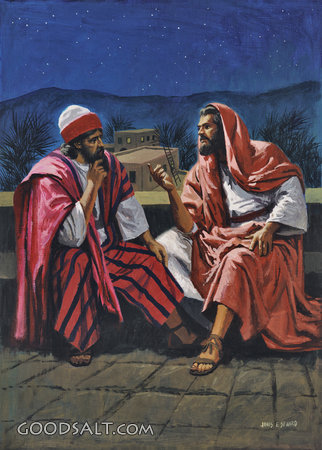 The opening ministry of Jesus in Jerusalem had attracted a great deal of attention, both favorable and unfavorable. Many of the people believed (2:23).


 Proud to be TJ's man