RSS

“Handling Life’s Difficulties” The Church’s Conduct In The End Times – 1 Peter 4:7-11


Are We Living in the End Times?

Every once in a while you read about a wacky religious group that has become so convinced that the Lord’s coming is imminent that they have sold everything they owned and gone out to sit on a hilltop and await His coming.

When these ‘prophets’ make predictions that do not come true, it ought to remove their ideas forever from the news cycle and our mind.

The simple fact is that behind this there is one inescapable and most personal truth. For everyone of us the time is near. The one thing which can be said of every man is that he will die. For every one of us the Lord is at hand. We cannot tell the day and the hour when we shall go to meet him; and, therefore, all life is lived in the shadow of eternity.

It does raise the question that Peter addresses in our text for today’s study: How should the church conduct itself in light of the fact that we are living in the end times?

These verses are sandwiched in a context dealing with the persecution Peter’s readers were facing. In both the preceding and following sections, Peter brings in the certainty that Jesus Christ will return to judge all people (4:5, 17).

In our text, he is telling the church how to relate to one another in light of the present suffering and the future judgment.

Trials have a way of either driving a family closer together or further apart. Peter wants to make sure that the churches to which he wrote would draw together as the persecution intensified and as the coming day of the Lord draws nearer.

An Expectant Attitude toward Christ (1 Peter 4:7a) The end of all things is at hand…

This verse gives us the vertical component (how we relate to God) to help us overcome the pressure to sin. Verses 8 and 9 give the horizontal component (how we relate to other people).

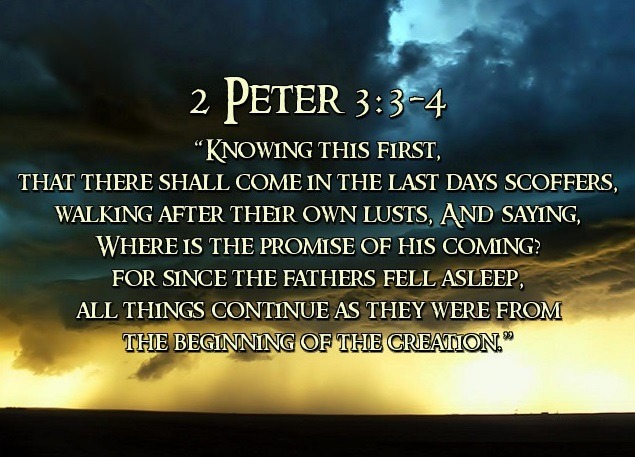
Christians in the early church expected Jesus to return in their lifetime (Rom. 13:12; 1 John 2:18). The fact that He did not return does not invalidate His promise (2 Peter 3; Rev. 22:20).

No matter what interpretation we give to the prophetic Scriptures, we must all live in expectancy. The important thing is that we shall see the Lord one day and stand before Him. How we live and serve today will determine how we are judged and rewarded on that day.

This attitude of expectancy must not turn us into lazy dreamers (2 Thes. 3:6ff) or zealous fanatics.

Peter has just mentioned how Christ is ready to judge the living and the dead (4:5). Some believers had died, which may have drawn ridicule from scoffers (4:6): “The Christians died just like everyone else! What difference does your Christianity make? Those ‘holy Joes’ who died just missed out on all the fun they could have had!” But Peter asserts, “Now the end of all things has come near.”

Today many would scoff and say, “That’s crazy! It’s been over 2,000 years and life goes on. How can anyone say that the end of all things has come near?”

Peter answers that charge in 2 Peter 3:3-10. What such scoffers don’t realize is that God’s view of time and ours are significantly different. A thousand years with the Lord is as one day. Any extension of time that God gives before the certain, coming judgment is due to His patience and mercy: He does not wish for any to perish. But that judgment is delayed does not mean that judgment is not coming!

And, while the signs of the times look as if the return of Christ is very close, even if He does not return in our lifetimes, we are individually very near the end, aren’t we? None of us is certain that we will be alive tomorrow. So we all need to live in light of the fact that the end of all things is near.

Does that mean that we make no plans for the future, that we sell everything and go sit on a hilltop? No, of course not!

Although he is no theologian, newspaper columnist Sydney J. Harris was on target when he wrote, “The art of living successfully consists of being able to hold two opposite ideas in tension at the same time: first, to make long-term plans as if we were going to live forever; and second, to conduct ourselves daily as if we were going to die tomorrow.”

Because the end of all things is near, Peter shows how God’s people should live.

The church should glorify God through prayer, love, and service (4:7b-11).

We are to have a clear head; we are to take Christ’s return seriously. Persecution and suffering battle against clear-mindedness; self-control is difficult when one faces injustice.

If Christ is ready to judge the living and the dead (4:5), if it is time for judgment to begin with the household of God (4:17), then here is how we, as His people, should conduct ourselves.

There are commands in three areas (prayer, love, and serving one another), but the overarching principle comes at the end of verse 11: “so that in all things God may be glorified through Jesus Christ, to whom is the glory and dominion forever and ever. Amen.”

God’s glory is a rather nebulous concept, so let me explain what it means and what it means to glorify Him.

The Hebrew word (“kabod”) translated “glory” has the nuance of weight or heaviness. It points to the riches or power of a person of importance, much as we may say, “He’s a heavyweight” or “a man of substance.”

The Greek word (“doxa”) comes from a word meaning “to seem or think,” and has the nuance of reputation or honor.

When applied to God, His glory is His inherent majesty and infinite worth. God’s glory is intrinsic to His being. It is the manifestation of His perfect attributes, often expressed on earth by light brighter than the sun (Matt. 17:2; Acts 26:13; Rev. 1:16).

In the Old Testament, God’s glory was often seen as a bright cloud or a fire (Exod. 24:16-18; 40:34-35).

It is debatable, grammatically, whether “to whom” (1 Pet. 4:11) refers to God or to Jesus Christ, although it really doesn’t matter (Rev. 1:6 clearly attributes glory and dominion to Jesus Christ).

Hebrews 1:3 asserts, Jesus Christ “is the radiance of [God’s] glory and the exact representation of His nature and upholds all things by the word of His power.”

Jesus Himself claimed that the Father had given all judgment to the Son “in order that all may honor the Son, even as they honor the Father” (John 5:23). So, as believers, we are to glorify God through Jesus Christ, who has revealed the Father to us.

To glorify God means to show forth His excellencies to others, or, as I’ve often said, in street language, to glorify God is to make Him look good as He really is.

If a photographer glorifies some natural wonder, he makes us revel in the inherent beauty of that scene. We see the photograph and gasp, “Look at the colors and grandeur of that mountain!”

If a literary critic glorifies an author, he brings forth the subtle nuances of language and plot in a way that makes us exclaim, “Wow! That author has a rare ability with words!”

When the photographer or critic does his work rightly, we don’t extol the photographer or critic; we extol the object toward which they point. We say, “What a beautiful scene!” Or, “What a tremendous author or work of literature!”

And when Christians properly glorify God, people should exclaim, “What a great being God is!”

Peter mentions three means of conduct which will glorify God: prayer, love, and serving in line with the gifts God has bestowed on us.

The church should glorify God through prayer (4:7b). …therefore be self-controlled and sober-minded for the sake of your prayers.

Prayer glorifies God because it acknowledges our weakness and dependence upon Him. Not to pray is, in effect, to assert our own sufficiency and arrogance, in that we’re acting on our own.

So as we recognize the critical times in which we live, our own inadequacy, and God’s total sufficiency, we should be driven to prayer. Peter mentions two somewhat synonymous qualities which will help us to be people of prayer:

First, “Be of sound judgment.” Knowing that we are in the end times should not make us go off the deep end. Rather, we should keep our wits about us, or be sensible. The same word is used as a qualification for elders (NASB–”prudent,” 1 Tim. 3:2; “sensible,” Titus 1:8). It points to a man who is levelheaded, not impulsive, not swayed by fluctuating emotions.

The danger is not that we will think too lowly of ourselves, but that we will think too highly of ourselves. Sound judgment concerning ourselves will move us to prayer as we recognize our own sinfulness and weakness, but also, God’s holiness and strength.

Second: “Be sober.” (See 1:13; 5:8; Peter uses it 3 out of 6 NT uses). It is also a quality for elders (1 Tim. 3:2). It means, literally, “don’t be drunk,” but Peter intends more than not being intoxicated by liquor.

He means that we should be alert and self-controlled. We should have the clarity of mind and resulting good judgment that mark a person who is not drunk in contrast to the one under the influence.

The church should glorify God through love (4:8). Above all, keep loving one another earnestly, since love covers a multitude of sins.

“Above all” does not pit love against prayer, as if you can choose love and neglect prayer. Rather, Peter is calling our attention to the priority of love for fellow Christians as a central part of the Christian faith.

Jesus said that love for one another is His new commandment, the mark by which the world will know that we are His followers (John 13:34-35).

Peter didn’t doubt that his readers were practicing love, but he knew that under trials it’s easy to start taking out our frustrations on those closest to us. So he writes, “Keep fervent in your love for one another.” “Fervent” (lit., “to stretch” or “strain”) was used of an athlete stretching and straining every muscle toward the end of the race. As we see the Lord’s coming drawing near, we should exert ourselves to love one another.

This implies that love is not a warm, fuzzy feeling. Rather, it takes sustained, strenuous effort, such as athletes expend as they near the finish line. The fact that love can be commanded shows that it is primarily an action, not an emotion, although often there will be an emotional element involved. But often biblical love is more sweat than sweet. It involves effort!

That’s implicit in the phrase, “Love covers a multitude of sins.” It’s fairly easy to love people who don’t sin against you. But biblical love extends even to those who wrong you.

Peter seems to have in mind the fact that love is ready to forgive and careful to protect the offender from needless exposure. The one who loves doesn’t keep a feud going by retaliating or holding a grudge.

This does not mean that love ignores, overlooks, or tries to hide sin. The “covering of sins” is the ability that believers have to forgive one another because Christ has forgiven them. Love works as a shock absorber, cushioning and smoothing out the bumps and irritations caused by fellow believers.


A GOOD INVESTMENT

We should live expectantly because Christ is coming. Peter gives six admonitions for how to prepare for the end times.

  1. Live each day as though Christ could return at once (4:7).
  2. Keep a clear head, not getting carried away by self-indulgence (4:7).
  3. Stay disciplined and alert for prayer (4:7).
  4. Make active expressions of love a priority (4:8).
  5. Be faithful in the stewardship of your gifts, investing your time and talent where they will make an eternal difference (4:10).
  6. In everything, praise God as the source of your energy and the reason for your service (4:11)
 
Leave a comment

Posted by on May 9, 2024 in 1 Peter


“Dealing With Life’s Difficulties” The Rest Of Our Time -1 Peter 4:1-6


Pin on Biblical

Living for Jesus Christ is not easy. When we live for Christ, really live righteous and godly lives, the unbelievers of the world reject us. They want little to do with pure righteousness and pure godliness. A godly life convicts them and demands that they live like God or else face His judgment. Therefore, the world often ridicules, mocks, abuses, and sometimes kills the genuine believer.

How can the believer handle and conquer such persecution when he is so unjustly treated? There is one way: he should arm himself with the mind of Jesus Christ. Jesus Christ suffered persecution and He suffered persecution to the ultimate degree. He has shown us how to handle and conquer persecution. Therefore, arm yourself with the mind of Christ.

  1. It is dying to self, denying oneself, ceasing from sin (v.1).
  2. It is doing God’s will for the rest of one’s days (v.2).
  3. It is being fed up with sin, knowing that one has sinned enough (v.3).
  4. It is bearing the strange look by the world (v.4-5).
  5. It is following the example of those gone before (v.6).

The Christian is committed to abandon the ways of heathenism and to live as God would have him to do.

Peter had a great deal to say about time (1 Peter 1:5, 11, 17, 20; 4:2-3, 17; 5:6). Certainly the awareness of his own impending martyrdom had something to do with this emphasis (John 21:15-19; 2 Peter 1:12ff).

If a person really believes in eternity, then he will make the best use of time. If we are convinced that Jesus is coming, then we will want to live prepared lives. Whether Jesus comes first, or death comes first, we want to make “the rest of the time” count for eternity.

And we can! Peter described four attitudes that a Christian can cultivate in his lifetime (“the rest of his time”) if he desires to make his life all that God wants it to be.

A Militant Attitude toward Sin (1 Peter 4:1-3)

The picture is that of a soldier who puts on his equipment and arms himself for battle. Our attitudes are weapons, and weak or wrong attitudes will lead us to defeat. Outlook determines outcome, and a believer must have the right attitudes if he is to live a right life.

Terry and I have eaten at restaurants where the lights are low, and you need a miner’s helmet to find your table. I often remark that the prices are usually lower when the lights are low. We had been seated several minutes before we started looking at the menu, and I remarked that I was amazed how easily I could read it. “Yes,” said my friend, “it doesn’t take us long to get accustomed to the darkness.”

There is a sermon in that sentence: It is easy for Christians to get accustomed to sin. Instead of having a militant attitude that hates and opposes it, we gradually get used to sin, sometimes without even realizing it. The one thing that will destroy “the rest of our time” is sin. A believer living in sin is a terrible weapon in the hands of Satan. Peter presented several arguments to convince us to oppose sin in our lives.

Think of what sin did to Jesus (v. 1).

Since therefore Christ suffered in the flesh, arm yourselves with the same way of thinking, for whoever has suffered in the flesh has ceased from sin…

The phrase arm yourselves is a military metaphor. With what were they to arm themselves? The same intention, the same courageous attitude and mind-set that Christ had toward suffering.

This does not mean that believers should actively seek martyrdom—the next verse describes how the believers are to live the rest of their earthly lives. Nonetheless, they should arm themselves for death if necessary.

If believers suffer, it ought to be for living the Christian faith; they ought to suffer courageously, knowing that God will ultimately be victorious.

Those who are armed with this intention have an unswerving resolve to do God’s will in every situation; those so armed will be able to stand strong in the face of any persecution.

They can persevere because of their personal relationship with Jesus Christ (see John 15:20–21).

For what purpose should believers arm themselves “with the same intention”? Peter explained that whoever has suffered in the flesh has finished with sin.

The question arises, if the believers were to arm themselves to suffer in order to stay away from sin, how could that be suffering as Christ suffered? How did Christ’s suffering accomplish his being “finished with sin”?

Taken alone, this phrase sounds as though Peter was saying that suffering cleanses people from sinning. We know that is not the case, however, because many people have suffered for the Lord, yet are not completely cleansed of sin, for no person can be without sin (see 1 John 1:8).

We will not be sinless until Christ returns. In addition, Jesus did not need to be cleansed from sin by suffering, for he was without sin in his nature and never sinned in his behavior.

Christians, having died in Christ, are one with him and are legally free from the penalty of sin. They are in union with Christ, so they regard themselves as dead to sin. Believers are no longer bound by sin’s penalty; they must strive, in practice, to be free from its power.

Christ’s suffering made him victorious over Satan; believers’ suffering, if they follow Christ’s example, can strengthen their faith and solidify their obedient lifestyle. Believers ought to “arm” themselves with a resolve to be like Christ when they face suffering.

Our goal in life is to “cease from sin.” We will not reach this goal until we die, or are called home when the Lord returns; but this should not keep us from striving.

Peter did not say that suffering of itself would cause a person to stop sinning. Pharaoh in Egypt went through great suffering in the plagues, and yet he sinned even more! I have visited suffering people who cursed God and grew more and more bitter because of their pain.

Suffering, plus Christ in our lives, can help us have victory over sin.

Enjoy the will of God (v. 2). As a result, he does not live the rest of his earthly life for evil human desires, but rather for the will of God.

The contrast is between the desires of men and the will of God. Our longtime friends cannot understand the change in our lives, and they want us to return to the same “excess of riot” that we used to enjoy.

But the will of God is so much better! If we do the will of God, then we will invest “the rest of our time” in that which is lasting and satisfying; but if we give in to the world around us, we will waste “the rest of our time” and regret it when we stand before Jesus.

The will of God is not a burden that the Father places on us. Rather it is the divine enjoyment and enablement that makes all burdens light. We may not always understand what He is doing, but we know that He is doing what is best for us. We do not live on explanations; we live on promises.

Remember what you were before you met Christ (v. 3). For you have spent enough time in the past doing what pagans choose to do–living in debauchery, lust, drunkenness, orgies, carousing and detestable idolatry.

Peter’s words picture people without God diving into all kinds of human desires and passions, desperately trying to find real pleasure or fulfillment.

Without hope in Christ for life in eternity, all they can do is live for self-gratification. “Plunge with them” is also translated “join them” or “run with them”—referring to the Christian’s former group of friends and their common activities.

This pictures the incomprehensible act of deliberately jumping into a raging torrent to one’s death.

In other words, these friends had sought pleasure by denying themselves nothing. Together, they did it all.

A Patient Attitude toward the Lost (1 Peter 4:4) They think it strange that you do not plunge with them into the same flood of dissipation, and they heap abuse on you.

Unsaved people do not understand the radical change that their friends experience when they trust Christ and become children of God.

They do not think it strange when people wreck their bodies, destroy their homes, and ruin their lives by running from one sin to another!

But let a drunkard become sober, or an immoral person pure, and the family thinks he has lost his mind!

As Peter had explained in 4:3, that was “enough.” Believers no longer wanted to be involved in these activities and said so to their friends. Not only did these former friends think it strange that the Christians had suddenly stopped joining them, but they also became the persecutors.

They heap abuse on you describes the reaction of people who love darkness when they become confronted by the light. This is the process of peer pressure. The four steps are: (1) We don’t do it, (2) they’re surprised, (3) they mock us, (4) we are tempted even more to give in to sin (implying the sins listed in 4:3).

A believer’s refusal to participate in an activity is a silent condemnation of that activity. Unbelievers then react with hostility, often because they want to justify their actions or silence their own consciences.

THE 180-DEGREE TURN: Christians are an odd bunch. They don’t plunge into every party. They go to church when other good people play sports, enjoy the sunshine, or catch up on sleep.

They give money away when other fine people struggle along to maximize investment potential.

They pray about matters that normal, reasonable, levelheaded people would gladly sue over. They leave when the party heats up. They seem satisfied with monogamy. How quaint!

A person whose life changes radically at conversion may experience contempt from his or her old friends. He may be scorned not only because he refuses to participate in certain activities, but also because his priorities have changed and he is now heading in the opposite direction.

His very life incriminates their sinful activities. Mature Christians should help new believers resist such pressures of opposition by encouraging them to be faithful to Christ.

There are times when looking back at your past life would be wrong, because Satan could use those memories to discourage you. But God urged Israel to remember that they had once been slaves in Egypt (Deut. 5:15).

Paul remembered that he had been a persecutor of believers (1 Tim. 1:12ff), and this encouraged him to do even more for Christ.

We must be patient toward the lost, even though we do not agree with their lifestyles or participate in their sins.

In fact, our contact with the lost is important to them since we are the bearers of the truth that they need. When unsaved friends attack us, this is our opportunity to witness to them (1 Peter 3:15).

{5} But they will have to give account to him who is ready to judge the living and the dead.

Unbelievers who live immorally (4:3) and who “heap abuse” on Christians (4:4) will one day give an account of their actions and words to the one whom they are ultimately slandering—God himself.

This gives believers great relief and confidence—they will receive justice. Scripture makes clear the certainty of judgment.

All will give an account to God, including believers, so we must be ready. We have no reason to taunt those who are in line for judgment because this final judgment will be universal.

The unsaved may judge us, but one day, God will judge them. Instead of arguing with them, we should pray for them, knowing that the final judgment is with God. This was the attitude that Jesus took (2:23), and also the Apostle Paul (2 Tim. 2:24-26).

{6} For this is the reason the gospel was preached even to those who are now dead, so that they might be judged according to men in regard to the body, but live according to God in regard to the spirit.

Peter was referring to those dead at that time of his writing who had heard and accepted the gospel. Many people in the early church had concerns about life after death.

In Thessalonica, Christians worried that loved ones who died before Christ’s return might never see Christ (1 Thessalonians 4:13–18). They wondered if those who died would be able to experience the promised eternal life.

Peter explained that these believers, though they had been judged in the flesh as everyone is judged—that is, they died physically as everyone dies physically—will still one day live in the spirit as God does.

Perhaps some of the “abuse” heaped on the believers (4:4) included unbelievers’ scoffing that it meant nothing to be a Christian because the Christians simply died like everyone else.

Peter’s readers needed to be reminded that the dead (both the faithful and their oppressors) would be raised from the dead—the faithful to eternal reward, the unfaithful to eternal punishment.

God’s judgment will be perfectly fair, Peter pointed out, because even those dead from ages past had heard the gospel. The Good News was first announced when Jesus Christ preached on the earth, but it has been operating since before the creation of the world (Ephesians 1:4), and it eternally affects all people, the dead as well as the living.


1 Comment

Posted by on May 6, 2024 in 1 Peter


“Handling Life’s Difficulties” Salvation in Four Scenes – 1 Peter 3:18-22


The Gospel | Youth Challenge

This is a great passage on the salvation bought by the death of Jesus Christ.  In the clearest of terms it tells us why Christ died and what the death of Christ does for man. In fact, this verse explains the death of Christ so clearly that it leaves the hearer without excuse if he fails to understand why Christ died.

Although this passage is one of the most difficult in the New Testament, it begins with something which anyone can understand.  The point that Peter is making is that, even if the Christian is compelled to suffer unjustly for his faith, he is only walking the way that his Lord and Savior has already walked.

The suffering Christian must always remember that he has a suffering Lord.  In the narrow compass of these verses Peter has the greatest and the deepest things to say about the work of Christ.

SCENE 1: SALVATION PURCHASED

The Setting: Golgotha.   The Time: The relatively recent past.   The Characters: Jesus, His enemies, and you.

17 For it is better to suffer for doing good, if that should be God’s will, than for doing evil. 18 For Christ also suffered once for sins, the righteous for the unrighteous, that he might bring us to God, being put to death in the flesh but made alive in the spirit…

It is clear that Peter’s main subject is salvation. He spoke of Christ’s part in our salvation—“Christ also suffered for sins once”—and of our part—“baptism . . . now saves you”. Perhaps we can best understand Peter’s reasoning if we consider the passage as a drama about salvation set in four scenes.

(i)  He lays it down that the work of Christ was unique and never need be repeated.  Christ died once and for all for sins. The priestly sacrifices in the Temple have to be repeated daily but Christ made the perfect sacrifice once and for all when he offered himself up (Hebrews 7:27).

(ii)  He lays it down that that sacrifice was for sin.  Christ died once and for all for sins.

We may put it this way.  Sin is that which interrupts the relationship which should exist between God and men.  The object of sacrifice is to restore that lost relationship.  The death of Christ upon the Cross, however we explain it, avails to restore the lost relationship between God and man.

(iii)  He lays it down that that sacrifice was vicarious.  Christ died once and for all for sins, the just for the unjust.  That the just should suffer for the unjust is an extraordinary thing.  At first sight it looks like injustice.

The suffering of Christ was for us; and the mystery is that he who deserved no suffering bore that suffering for us who deserved to suffer.  He sacrificed himself to restore our lost relationship with God.

(iv)  He lays it down that the work of Christ was to bring us to God.  Christ died once and for all for sins, the just for the unjust, that he might bring us to God.

SCENE 2: SALVATION PICTURED

The Setting: The wicked world of Noah’s day.     The Time: The far distant past. The Characters: Jesus, the disobedient, and the obedient

in which he went and proclaimed to the spirits in prison, because they formerly did not obey, when God’s patience waited in the days of Noah, while the ark was being prepared, in which a few, that is, eight persons, were brought safely through water. Baptism, which corresponds to this, now saves you, not as a removal of dirt from the body but as an appeal to God for a good conscience, through the resurrection of Jesus Christ…

We must first note that this phrase is very misleading. The idea of the New Testament is not that Jesus descended into hell but that he descended into Hades. The difference is this. Hell is the place of the punishment of the wicked; Hades was the place where all the dead went.

We need to see a lesson in homiletics (how to preach): if an illustration is so complicated that you have to explain it, you’d better pick another one. The point of an illustration is to make something clear, not to make it more confusing. Also, if a verse is difficult, find other verses that make it easier to understand.

Hebrews 9:27 And just as it is appointed for man to die once, and after that comes judgment, 28 so Christ, having been offered once to bear the sins of many, will appear a second time, not to deal with sin but to save those who are eagerly waiting for him.

Notice that earlier in this book he speaks of the prophets’ predicting by “the spirit of Christ which was in them” (1:11).

Speaking of the preaching of the apostles themselves, Paul said that Christ “came and preached peace to you that were afar off” (Eph. 2:17); but Christ preached to the Ephesians through human instruments, nevertheless it is said that he “came and preached” to them.

Therefore, “If Christ is said by Paul to go and do, what he did by his apostles, Christ may with equal propriety be said by Peter to go and do what he did by Noah.”

Peter says that in the Spirit Christ preached to the spirits in prison, who were disobedient in the time when the patience of God waited in the days of Noah, when the ark was being built.

During Noah’s building of the ark (120 years), Christ’s “spirit” was in Noah preaching to all the unbelieving people. 1 Peter 1:11 refers to the “Spirit of Christ” residing in the Old Testament prophets, and 2 Peter 2:5 describes Noah as “a herald of righteousness”.

Christ spoke through Noah to the people for 120 years as Noah was building the ark (Genesis 6:3). During that time, God was waiting patiently for any to repent of their sins. But none did.

Those who consider this to be the correct meaning of Peter’s words consider that Noah and his family were a righteous minority among a huge majority of evil people.

  • Just as Noah faced unjust persecution, so Peter’s readers were also facing unjust persecution.
  • Just as Noah had no converts, they might not either.
  • Just as Noah knew that judgment would come soon, so Peter’s readers knew that God would soon judge the world. Ultimately, as Noah and his family were saved from the floodwaters, so those who believe will be saved from eternal death.

Peter wanted to contrast those who were disobedient with those who were obedient. He wanted to remind his readers that not only will the obedient be saved (like the eight souls saved by water), but also the disobedient will perish. That would have been a comforting thought to those who faced persecution.

SCENE 3: SALVATION PROCURED

The Setting: Our own world.      The Time: The present.     The Characters: Ourselves, God, and the resurrected Christ.

21 Baptism, which corresponds to this, now saves you, not as a removal of dirt from the body but as an appeal to God for a good conscience, through the resurrection of Jesus Christ…

Baptism puts one into a relationship with God, Christ, and the Holy Spirit that makes it possible for him to stay saved. The effects of baptism continue to go on and on saving a person.

Clear conscience: Conscience is that faculty in me which attaches itself to the highest that I know, and tells me what the highest I know demands that I do.

It is the eye of the soul which looks out either toward God or toward what it regards as the highest authority.

If I am in the habit of steadily facing toward God, my conscience will always introduce God’s perfect law and indicate what I should do. The point is, will I obey?

I have to make an effort to keep my conscience so sensitive that I walk without offense. I should be living in such perfect sympathy with God’s Son that in every circumstance the spirit of my mind is renewed.

The one thing that keeps the conscience sensitive to Him is the habit of being open to God on the inside. When there is any debate, quit. There is no debate possible when conscience speaks. – Oswald Chambers

Conscience is not a fixed or universal concept, but rather a dynamic and personal one that can vary depending on these sources of morality.

Conscience can also change over time as we learn from our mistakes and grow as human beings. Conscience plays a vital role in our ethical decision-making and moral behavior.

It helps us to evaluate the consequences of our actions and to choose the best course of action in different situations. Conscience also motivates us to act on our moral convictions and to stand up for what we believe in.

Conscience can also help us to cope with guilt, remorse, or regret when we fail to live up to our moral standards or when we harm others or ourselves.

A good conscience is not necessarily a proof of salvation. Saul of Tarsus enjoyed a good conscience the whole time he was persecuting Christians, and yet he was as lost as he could be (see Acts 23:1).

The Greek term that is translated “answer” in 1 Peter 3:21 basically means a request, or an appeal. It is found only in this passage in the New Testament, but it is employed in other sources in Greek literature.

The main point is that, although Christ died to bring us to God, we cannot come to Him unless we cooperate in our salvation, unless we accept God’s gift of salvation by being baptized. That is the way we accept, receive, and procure salvation.

Conscience is a precious and powerful gift that makes us human and moral beings. It enables us to act with integrity, responsibility, compassion, and justice. It also challenges us to grow and improve as individuals and as members of society. Conscience is not something that we have, but something that we are.

SCENE 4: SALVATION PERFECTED

The Setting: Heaven.    The Time: From the past through eternity.   The  Characters:  Jesus  and  all  the  host  of heaven.

22 who has gone into heaven and is at the right hand of God, with angels, authorities, and powers having been subjected to him.

Having just mentioned the resurrection, Peter went on to speak of where Christ is now—in heaven with “angels and authorities and powers being made subject unto him.” By so doing, he completed the picture of suffering innocence that triumphs in the end. (See also Philippians 2:5-11.)

That thought would have sustained the first readers: If Christ, who suffered innocently, in the end is glorified in heaven, so could they be.

Furthermore, our thinking is brought back to Christ, with whom he began this passage and with whom he will begin his discussion of the next topic. This is, of course, no surprise, since to Peter, Jesus Christ is the hero of the entire book.

Christ is mentioned, either by name, by a pronoun that refers to Him, or by a figure (such as a living stone or a shepherd), in at least 36 out of the 105 verses in the book—in more than one-third of the verses.

What we want to emphasize is that salvation was not completed until Christ ascended to heaven. Then He became Lord and Christ (Acts 2:36); then He was crowned King of the kingdom; then He presented His own blood as the once-for-all sacrifice for our sins; then He became our great High Priest; then He became, in His fullness, our Savior.

 
Leave a comment

Posted by on April 29, 2024 in 1 Peter


“Handling Life’s Difficulties” Preparing for the best! – 1 Peter 3:8–17


07 1 Peter 3:8-17 Who is there to harm you? — Wednesday in the Word

A devoted minister was facing serious surgery, and a friend visited him in the hospital to pray with him. “An interesting thing happened today,” the minister told him. “One of the nurses looked at my chart and said, ‘Well, I guess you’re preparing for the worst!’

I smiled at her and said, ‘No, I’m preparing for the best. I’m a Christian, and God has promised to work all things together for good.’

Boy, did she drop that chart and leave the room in a hurry!”

Peter wrote this letter to prepare Christians for a “fiery trial” of persecution, yet his approach was optimistic and positive. “Prepare for the best!” was his message.

Cultivate Christian Love (1 Peter 3:8–12).

3:8  Finally, all of you, live in harmony with one another; be sympathetic, love as brothers, be compassionate and humble.

“When iron is rubbed against a magnet it becomes magnetic. Just so, love is caught, not taught. One heart burning with love sets another on fire. The church was built on love; it proves what love can do.” Frank C. Laubach

Peter listed five building blocks for unity

  1. Live in harmony, also translated “have unity of spirit,” refers to working together for the common goal of spreading the gospel, having common attitudes and ideas. Just as different notes form chords to make beautiful harmonies, so different people can live and work together for God.
  2. Be sympathetic means being willing to share in others’ needs and being responsive to their feelings, having sensitivity and compassion toward others.
  3. Love as brothers means loving fellow Christians (brothers and sisters in Christ). The Greek word is philadelphos, referring not only to family love, but to the special love that should draw all Christians together.
  4. Be compassionate, means to be conscious of others’ needs but includes a drive to alleviate the need in some way. The Greek word is literally the internal organs, and refers to one’s deepest feelings. Believers ought to be deeply touched and moved by the hurts, pain, needs, and joys of fellow believers and then act to help them. They should be affectionate and sensitive, quick to give emotional support.
  5. Humble means having an honest estimate of oneself before God. Humility does not negate one’s own worth or abilities, nor does it inflate them. Instead, a humble Christian can honestly view his or her characteristics and abilities with thankfulness to God.

3:9  Do not repay evil with evil or insult with insult, but with blessing, because to this you were called so that you may inherit a blessing.

Peter described how they should act toward those in the pagan culture—a culture that would soon become very hostile toward them. As Christians, we can live on one of three levels:

  1. We can return evil for good, which is the satanic level.
  2. We can return good for good and evil for evil, which is the human level.
  3. Or, we can return good for evil, which is the divine level.

3:10 For “Those who desire life and desire to see good days, let them keep their tongues from evil and their lips from speaking deceit.”

Verses 10–12 are a quotation of Psalm 34:12–16. The theme is that God hears and helps those who are afflicted or in trouble—a perfect psalm considering the theme of this letter.

These people have found contentment in God and can live “good days” no matter how bad their situations might become.

3:11 “Let them turn away from evil and do good.” People’s words are connected to their actions. Those who “keep their tongues from evil and their lips from speaking deceit” (3:10) have turned away from evil. Their God-honoring speech is then accompanied by action—they then can do good.

3:12 “For the eyes of the Lord are on the righteous, and his ears are open to their prayer.” God not only sees them but also that he watches over them for their good. God sees all their difficulties and persecutions.

Nothing happens to God’s people that he has not allowed for some purpose. Whatever happens, God’s people know that his promises of blessing—whether in this life or in the life to come—are certain.

Not only are the Lord’s eyes open and watching, but his ears are open to their prayer. He listens when his people call to him. He knows all their needs. He hears their prayers in suffering.

 “But the face of the Lord is against those who do evil.” This warning implies a drastic threat of imminent judgment, not just God’s disapproval.

Practice the Lordship of Christ (1 Peter 3:13–15)

Now who is there to harm you if you are zealous for what is good? 14 But even if you should suffer for righteousness’ sake, you will be blessed. Have no fear of them, nor be troubled, 15 but in your hearts honor Christ the Lord as holy, always being prepared to make a defense to anyone who asks you for a reason for the hope that is in you; yet do it with gentleness and respect,…

The setting of the Isaiah quotation is significant. Ahaz, King of Judah, faced a crisis because of an impending invasion by the Assyrian army.

The kings of Israel and Syria wanted Ahaz to join them in an alliance, but Ahaz refused; so Israel and Syria threatened to invade Judah! Behind the scenes, Ahaz confederated himself with Assyria!

The Prophet Isaiah warned him against ungodly alliances and urged him to trust God for deliverance. “Sanctify the Lord of hosts [armies] Himself; and let Him be your fear, and let Him be your dread” (Isa. 8:13).

As Christians, we are faced with crises, and we are tempted to give in to our fears and make the wrong decisions. But if we “sanctify Christ as Lord” in our hearts, we need never fear men or circumstances.

Our enemies might hurt us, but they cannot harm us. Only we can harm ourselves if we fail to trust God. Generally speaking, people do not oppose us if we do good; but even if they do, it is better to suffer for righteousness’ sake than to compromise our testimony.

Our English word apology comes from the Greek word translated “answer,” but it does not mean “to say I am sorry.” Rather, it means “a defense presented in court.”

“Apologetics” is the branch of theology that deals with the defense of the faith. Every Christian should be able to give a reasoned defense of his hope in Christ, especially in hopeless situations.

A crisis creates the opportunity for witness when a believer behaves with faith and hope, because the unbelievers will then sit up and take notice.

We are witnesses, not prosecuting attorneys! We must also be sure that our lives back up our defense.

Peter did not suggest that Christians argue with lost people, but rather that we present to the unsaved an account of what we believe and why we believe it, in a loving manner. The purpose is not to win an argument but to win lost souls to Christ.

Here’s how ordinary people can be ready to witness (make a defense for their hope) without needing to become theological scholars:

  • Pray, read the Bible, and review God’s promises every day. Then you’ll be ready to explain why you’re hopeful.
  • Make praising Christ your daily practice. If you focus on his power and glory, you will be fortified and courageous to speak to others.
  • Be as natural in witnessing as you are in conversation. Talk like you, not imitating anyone else. Find the clues in your life that help explain God’s Good News to others. If you are a plumber, talk about God’s love like running water. If you are a doctor, portray God’s love as a healing force.
  • Respond with care. Trust God to melt stony hearts. “A gentle answer turns away wrath, but a harsh word stirs up anger” (Proverbs 15:1).
  • Listen to your audience. Where are their heads and hearts? What burdens them? Listen long and hard. Frame your witness in the words and at the level your audience will understand.

Maintain a Good Conscience (1 Peter 3:16–17)

16 having a good conscience, so that, when you are slandered, those who revile your good behavior in Christ may be put to shame. 17 For it is better to suffer for doing good, if that should be God’s will, than for doing evil.

The conscience is that internal judge that witnesses to us, that enables us to “know with,” either approving our actions or accusing.

Conscience may be compared to a window that lets in the light of God’s truth. If we persist in disobeying, the window gets dirtier and dirtier, until the light cannot enter. This leads to a “defiled conscience” (Titus 1:15).

“Shame arises from the fear of men, conscience, from the fear of God.”

A “seared conscience” is one that has been so sinned against that it no longer is sensitive to what is right and wrong (1 Tim. 4:2).

It is even possible for the conscience to be so poisoned that it approves things that are bad and accuses when the person does good! This the Bible calls “an evil conscience” (Heb. 10:22). A criminal feels guilty if he “squeals” on his friends, but happy if he succeeds in his crime!

Conscience depends on knowledge, the “light” coming through the window. As a believer studies the Word, he better understands the will of God, and his conscience becomes more sensitive to right and wrong.

A “good conscience” is one that accuses when we think or do wrong and approves when we do right. It takes “exercise” to keep the conscience strong and pure (Acts 24:16).

If we do not grow in spiritual knowledge and obedience, we have a “weak conscience” that is upset very easily by trifles (1 Cor. 8).

How does a good conscience help a believer in times of trial and opposition?

  1. For one thing, it fortifies him with courage because he knows he is right with God and men, so that he need not be afraid.
  2. A good conscience gives us peace in our hearts; and when we have peace within, we can face battles without. The restlessness of an uneasy conscience divides the heart and drains the strength of a person, so that he is unable to function at his best. It’s difficult for us to boldly witness for Christ if conscience is witnessing against us.
  3. A good conscience removes from us the fear of what other people may know about us, say against us, or do to us. When Christ is Lord and we fear only God, we need not fear the threats, opinions, or actions of our enemies.

Peter made it clear that conscience alone is not the test of what is right or wrong. A person can be involved in either “welldoing” or “evildoing.”

For a person to disobey God’s Word and claim it is right simply because his conscience does not convict him, is to admit that something is radically wrong with his conscience.

Conscience is a safe guide only when the Word of God is the teacher.

If we are to maintain a good conscience, we must deal with sin in our lives and confess it immediately (1 John 1:9). We must “keep the window clean.”

We must also spend time in the Word of God and “let in the light.”

A strong conscience is the result of obedience based on knowledge, and a strong conscience makes for a strong Christian witness to the lost. It also gives us strength in times of persecution and difficulty.


Leave a comment

Posted by on April 25, 2024 in 1 Peter


Handling Life’s Difficulties: Living With A Difficult Husband – 1 Peter 3:1-7


What does attractive living look like? How does it act?

These verses can be tough to explain and apply in light of our modern culture. It’s tough enough to teach about the submission of wives to godly husbands. But to teach that wives should submit even to husbands who are ungodly seems cruel and insensitive.

Wife abuse is widespread…even among Christians. Furthermore, we live in a society that values individual rights, especially of those who are pushed down by the system (such as women). We’re constantly encouraged to stand up for our rights and to fight back when we’re wronged.

To understand our text, we must see that Peter’s theme (which began at 2:11) is still Christian witness in an alien world. Peter didn’t want to compound the problem with a wife’s defiant behavior. So he gives instruction on how Christian women could live with their unbelieving mates in a way that would bear witness for Christ.

Christian wives were to accept the authority of their husbands in obedience to Christ to keep harmony in the family and to encourage unbelieving husbands to believe.

When a Christian wife interacted with an unbelieving husband, she needed to be submissive according to cultural norms in order to save her marriage and sometimes even her life.

But she ought not participate in her husband’s pagan religion or submit to actions that dishonored God.

However, when both wife and husband were Christians, the woman should respect the God-given authority of her husband, while the husband exercised his authority in a loving and gentle manner.

For marriage and family relationships to run smoothly, there must be one appointed leader—and God has appointed the husband and father. The wife should willingly follow her husband’s leadership in Christ, acknowledging that this is his responsibility.

Submission does not mean blind obedience, nor does it mean inferiority. A wife who accepts her husband’s authority is accepting the relationship that God has designed and giving her husband leadership and responsibility.

What do these verses NOT say?

  • Do not leave.
  • Do not lead.
  • Do not nag him to death.

Rather, the believing wife should follow the principles Peter sets forth here, namely, that …

A Christian wife should live with a difficult husband so that he is attracted to Christ by her behavior.

Peter’s point is that disobedient husbands are more likely to be won by godly practice than by preaching from their wives. They will notice attractive behavior and through it be drawn to the source of that behavior—a relationship with Jesus Christ. I want to look at seven aspects of such attractive behavior and then answer three practical questions that arise.

Attractive behavior involves submitting to authority.

Peter says she should accept the authority of her husband….choose to cooperate voluntarily with someone else out of love and respect for God and for that person.

Two things about authority and submission. First, the purpose of authority is to protect and bless those under authority, not to benefit the one in authority.

Christian submission never requires us to disobey God, submit to abuse, or participate in what our Holy Spirit-directed conscience forbids.

There is a sense in which Christ submits Himself to the church in self‑sacrificing service, but at the same time, clearly He is in authority over the church.

God never tells husbands to get their wives to submit to them. All the commands to submit are directed to wives, not to husbands. A husband who focuses on his authority is out of line. His responsibilities are to love his wife sacrificially (Eph. 5:25) and to live with her in an understanding way, granting her honor (1 Pet. 3:7).

Attitude is crucial. A disobedient little boy was told to sit in the corner. He said, “I may be sitting on the outside, but I’m standing on the inside.” That’s defiance, not submission.

On the other hand, a person under authority can be strong in arguing for a point of view and yet have a submissive attitude.

Submission involves an attitude of respect and a recognition of the responsibility of the one in authority. Rather than trying to thwart his will through manipulation or scheming, a submissive wife will seek to discover what her husband wants and do it to please him, as long as it doesn’t involve disobedience to God.

The source of many marital problems is that the wife is seeking to control the husband to meet what she perceives as her needs and the husband is seeking to dominate the wife to meet what he perceives as his needs. So you have a constant tug of war going on.

Attractive behavior involves purity.

“Chaste” (3:2) can be translated “purity” (NIV). It is used in the New Testament to refer to abstaining from sin (1 Tim. 5:22).

The wife who wants to win her husband to Christ must live in obedience to God. She will be morally pure.

Her husband won’t distrust her because she’s a flirt with other men. She won’t use deception or dishonesty to try to get her own way.

Attractive behavior involves reverence.

A godly wife will live in the fear of God, aware that He sees all that is going on (“in the sight of God,” 3:4).

To live in the fear of God means that we recognize His holiness and wrath against all sin and therefore live obediently, even when it’s hard.

Attractive behavior involves doing what is right.

You have become Sarah’s children “if you do what is right.” Peter emphasizes this concept (2:12, 14, 15, 20; 3:6, 11, 13, 16, 17; 4:19). It always occurs in the context of others doing wrong toward us and points to the fact that our behavior shouldn’t be determined by how others treat us.

We’re so prone to react to wrong treatment with more wrong treatment and then to blame our sin on the other person’s sin. But God wants us to be prepared to respond to wrongs against us by doing what is right.

Attractive behavior involves an emphasis on the inner person over outward appearance.

The point of 3:3‑4 is not that a woman should neglect her outward appearance, but rather that her emphasis should be on the inner person. Peter’s point is that the emphasis should be on attractive character qualities, which are imperishable.

Husbands are to understand their wives.

We all have a deep-seated longing to be understood by at least one other person who cares for us and accepts us for who we are. We all enter marriage with high hopes for a deepening understanding to be built between us and our mate. And yet, all too often, a couple grows increasingly callused toward one another.

In American culture, for some reason, men are often inept at understanding their wives on a deep level. So there are disappointments and hurt feelings that never get resolved.

The husband shrugs his shoulders, ignores his wife whom he doesn’t understand, and pours himself into his job, which seems to be something he can handle.

She shares her feelings with women friends and gets caught up in the frenzy of raising children and running a household. And then the nest starts emptying and the wife starts thinking about going back to school and getting a fulfilling job at about the same time the husband realizes that he isn’t fulfilled through his job and what he really wants is intimacy with his distant wife.

A. Understanding your wife involves developing and maintaining togetherness in your marriage.

Peter says that you should “live with” your wife. You say, “I’ve got that down! We both live at the same address and share the same bed and eat many meals together.”

A husband is to promote a spirit of emotional, spiritual, and physical closeness that is only possible in the commitment of marriage.

It’s significant that Peter puts the responsibility for togetherness on the husband, not on the wife.

In our culture, women are often the relational ones. Men aren’t real communicative; they just sort of grunt. But the Bible puts the burden for intimacy in marriage primarily on the husband.

If there is a drift in your marriage, men, you are to take the initiative to bring things back together. This doesn’t mean that a wife can’t act first if she notices a distance in the relationship. Men we are to be active, not passive, in developing and maintaining a close relationship with our wives.

I read a true story about a man who made a private vow to try to be a loving, giving, unselfish husband for the two weeks of the family’s vacation. He worked hard at noticing his wife, of attending to her needs, of doing what she wanted to do, even if he really rather would have done something else. It went great. Toward the end of the time, he made a new vow to keep on choosing to love his wife like this.

But on the last night of the vacation, his wife was obviously upset. Finally she blurted, “Tom, do you know something I don’t?” “What do you mean?” he asked. “Well … that checkup I had several weeks ago … our doctor … did he tell you something about me? Tom, you’ve been so good to me … am I dying?” It took a moment for it all to sink in. Then Tom burst out laughing, took her in his arms, and said, “No, honey, you’re not dying; I’m just starting to live.” (Tom Anderson, “How Love Came Back,” Reader’s Digest [10/86], pp. 129-130.)

Maybe husbands should treat their wives as if they were about to die!

It may sound perfectly obvious, but one way to develop and maintain togetherness in your marriage is to do things together. So many couples live in their own separate worlds. Men, help your wife with the dishes sometimes, not just because she needs the help, but to be together.

Take walks together, go shopping together when you can. If you can’t tolerate shopping, at least drive her there sometimes and sit in the mall and watch the people or read a book. The idea is, to be together so that you intertwine your lives.

Simone Signoret observed, “Chains do not hold a marriage together. It is threads, hundreds of tiny threads, which sew people together through the years.”

B. Understanding your wife involves knowing her well.

“Dwell together with your wives according to knowledge.” This comes partly through spending time together. The Greek word means to grasp the full reality and nature of the object, based upon experience and evaluation.

Knowing your wife is not automatic. It takes time and effort.

Every husband needs to become an avid student of his wife. You need to know her personality, her likes and dislikes, her needs, her strengths, her weaknesses, her fears, her hopes, her joys.

Such knowledge is a personal trust to be guarded with great care. You should never bring up a vulnerable point as artillery in a disagreement.

C. Understanding your wife involves knowing God and His truth well.

To dwell with your wife “according to knowledge” means knowing her well. But also it has the nuance of knowing spiritual truth well.

This is implicit in the phrase, “as fellow‑heirs of the grace of life.” This points to the vast spiritual riches that are ours equally as men and women through faith in Christ (1 Pet. 1:4, 13).

This means, men, that if you’re spiritually passive, you’re not being obedient to what God wants you to be doing as a husband.

A lot of men feel inadequate spiritually. Their wives spend time going to Bible studies so that they know more about spiritual things than their husbands do. Many men leave early for work and come home late, too exhausted to spend time alone with God.

Husbands are to honor their wives.

A wife deserves honor (the Greek word has the nuance of value or worth).

Notice the fine balance that Peter lays out: On the one hand, the wife is the “weaker vessel,” who should submit to her husband (3:1) for the protection and care she needs.

On the other hand, she is a fellow-heir of the grace of life, which means that she is not inferior personally or spiritually. Her husband is not to dominate her, but rather to assign to her a place of honor. Thus the Bible maintains a distinctive role for the sexes, but it does not put down women as second-class citizens.

A major part of honoring your wife involves how you speak to her and about her. There is no room for jokes or sarcasm that put down your wife. Also, if you have children, it is your job as head of the household to make sure that they honor their mother.

You model it by treating her with honor, but you enforce it by disciplining them for disrespect toward her.

So the two commands are, Understand your wife; and, honor your wife. The result is:

The result of understanding and honoring your wife will be an effective prayer life.

Peter is calling attention to something we often forget or deny: That there is always a correlation between your relationship with your wife and your relationship with God.

If you don’t want a roadblock thrown up in your prayer life, then you must understand and honor your wife.

 
Leave a comment

Posted by on April 22, 2024 in 1 Peter, Marriage


“Handling Life’s Difficulties” What To Do When Your Boss Isn’t Fair – 1 Peter 2:18-25


Long Suffering, A Gift or A Strength – To God be The glory, Amen

If you are a parent of children old enough to talk, you have heard them complain, “But that isn’t fair!” And you responded, “Life isn’t fair!” We are born with a strong inner sense of fairness and a strong desire to fight for our rights when we have been treated unfairly. Although we know that life isn’t fair, we’re prone to fight back when we’re the victims of unfair treatment.

Let’s assume that you are a conscientious worker on your job. You get to work early, you’re careful not to extend your lunch breaks, and sometimes you stay late on your own time to finish a job. You’re careful not to waste company time with excessive chit-chat. You work hard and produce for the company. Because you’re a Christian, you don’t go out drinking after hours with the boss and you don’t swap the latest dirty jokes with him.

Another worker is, in your opinion, a goof off. He often comes in late, he spends a lot of time chatting with the secretaries, he takes long lunches, and he does sloppy work which you often have to correct. But he also goes out drinking with the boss and he always has a new dirty joke that sends the boss into hysterics. When a promotion opens up, he gets the better job and you are overlooked.

Life isn’t fair! The important question is, “How do you respond when you’re treated unfairly?” How should you respond? How should a Christian respond when treated unfairly, especially on the job?

That is the question Peter addresses. My guess is that you’re not going to like his answer. (I can guess that because I don’t like his answer either!) His answer is, When treated unfairly by a superior, we should submissively endure by entrusting ourselves to God, the righteous Judge.

Be subject … This means “submit, or obey”; and “It is the key word in this epistle, occurring 6 times in all.”

In this text Peter is talking about submission—submission to authorities in government, submission to masters, and all of this is in the context of suffering. When people look at Christians, they shouldn’t find those who are slandering their leaders or starting riots to overthrow government, even in the case of injustice, such as persecution or slavery.

Remember, in this context Nero is on the throne and Christians are being thrown to the lions and burned at the stake. It seems like an ideal time to fight back, but that is not what Peter teaches the Christians to do. He tells them to submit to the unjust authorities in leadership.

The situation for submission is one in which we are under authority. Peter was writing to slaves but much in this section applies to our work relationships. Because God is in control, we face each day with his power and love. If you receive some hard knocks today, turn them over to God. If you’ve been cheated, give the problem to God.

If employees do not fulfill their responsibilities, admit your loss and trust God fully.

Christians must never seek revenge, no matter how bad the circumstances. The impulse for revenge comes from people who think that systems or bosses or powerful people are in control.

Christians believe that God has ultimate power. Be careful. This verse does not advocate passivity or weak-willed submission to cruel people.

God’s way is for us to identify the nature of the relationship: Am I under the authority of the person who is treating me unfairly? That is the first question I must ask to determine how I should act in a given situation.

God has ordained various spheres of authority. He is the supreme authority over all, of course. But under God there is the sphere of human government (1 Pet. 2:13-17; Rom. 13:1-7). Also, there is the sphere of the family, in which husbands have authority over wives (1 Pet. 3:1-6; Eph. 5:22-24) and parents over children (Eph. 6:1-4).

There is the sphere of the church, in which elders have authority over the flock (1 Pet. 5:1-5; Heb. 13:17). And there is the sphere of employment in which employees must be subject to employers.

  1. The motives for submission are to please God and bear witness to the lost.

Twice (2:19a, 20b) Peter says that submitting to unjust treatment “finds favor with God.”

Many of the readers of this letter would have known all too well what it meant to “bear up” under the pain of unjust suffering.

By being conscious of God when they suffered, they were remembering God’s care and love for them.

They focused on the fact that they were suffering injustice as Christ had suffered injustice, and they knew that one day God would right all wrongs. This gave them the proper attitude, enabled them to persevere, and kept their practice from being mere passive acceptance.

The idea is that God gives grace to the humble, not to the defiant, assertive, and self-reliant. If we defy an authority which God has placed over us, we are, in effect, defying God Himself. Thus, conscious of God, we should seek to submit to please Him, trusting Him to deal with the unjust authority.

If you’re being treated unfairly at work, you may be looking at a tremendous opportunity to bear witness for Christ by your behavior. If you yield your rights in a Christlike manner, people will notice and may wonder, “Why doesn’t he fight for his rights?” Maybe you’ll get an opportunity to tell them.

THE FACE OF SUFFERING. We may suffer for many reasons. Some suffering comes as the direct result of our own sin; some happens because of our foolishness; and some is the result of living in a fallen world.

Peter writes about suffering that comes as a result of doing good. Jesus never sinned, and yet he suffered so that we could be set free.

When we follow Christ’s example and live for others, we too may suffer. Our goal should be to face suffering as he did—with patience, calmness, and confidence, knowing that God controls the future.

  1. The pattern for submission is Jesus Christ. Christ left an example for us to follow in His steps (2:21).

When we patiently suffer injustice, we are following our supreme example in Christ. He suffered great injustice in order to obtain our salvation:

• He endured the unbelief of his own people (John 1:11).

• He endured a trial by religious leaders already committed to his death (Mark 14:1; John 11:50).

• He endured the lies of false witnesses (Matthew 26:59–60).

• He endured beating and mockery from his people and from the Roman soldiers (Mark 14:64–65; 15:16–20).

• He endured merciless flogging (Mark 15:15).

• He endured an excruciatingly painful death by crucifixion (Mark 15:22–37).

• He endured the insults of bystanders as he suffered on the cross (Mark 15:29–32).

• He endured a time of separation from God (Mark 15:33–34).

Peter set up Christ as the model for the believers to follow.

They should face injustice from harsh masters or from other authorities with supreme dignity, trusting God’s control.

The word example is literally, “underwriting.” It was a school word. Teachers would lightly trace the letters of the alphabet so that students could write over them to learn how to write.

Or, as in our day, teachers would put examples of the alphabet up in the room for students to look at to copy as they formed their letters. Christ is that kind of example for us. If we follow how He lived, we will form our lives correctly.

Following “in His steps” pictures a child who steps in his father’s footprints in the snow. Where the father goes, the child goes, because he puts his feet in those same footprints. Peter says that we are called to the same purpose as Christ was (2:21).

If our Master’s footprints led to the cross where He suffered unjustly, so we can expect to die to self and suffer unjustly. If we respond as He did, people will see our Savior in us.

Many people will never read the Bible, but they do read our lives. They should see Christlikeness there, not a defiant spirit of self-will that characterizes those who are living for themselves and the things of this world.

  1. The principle of submission involves not retaliating when we are wronged. 2:22 “He committed no sin, and no deceit was found in his mouth.”

Peter quoted from Isaiah 53:9, Isaiah’s prophecy about the suffering of the coming Messiah. Christ’s suffering was completely unjust because he never committed any sin or spoke any lies; there was no good reason for his being condemned to death.

Isaiah 53:7: “He was oppressed and He was afflicted, yet He opened not His mouth; He was led as a lamb to the slaughter, and as a sheep before its shearers is silent, so He opened not His mouth” (nkjv).

Jesus did not return abuse nor did he threaten. How tempting it must have been to expose the liars at his trial, to come down from the cross in a great display of power, or to blast his enemies with God’s wrath.

Instead, he entrusted himself to him who judges justly. Jesus suffered patiently because he knew that God would have the final say. Jesus regarded God as sovereign, so he put the outcome of his life in God’s hands. He was confident of God’s righteous judgment.

As Jesus entrusted (the verb is imperfect, he “kept entrusting”) himself and his sufferings to God, so all believers can entrust themselves and their suffering into God’s hands.

Knowing that God will ultimately right all wrongs is a great comfort to believers who are suffering, and it helps them respond correctly in their sufferings.

Don’t minimize or deny a person’s cruel behavior, for that will only encourage the person to continue to be abusive and discourage him or her from getting help.

You may need to confront the problem in order to protect innocent family members from danger. Don’t rationalize or excuse abuse. Seek help from the professionals God has given us. Those who don’t stop the cycle of abuse may live to see those victims become abusers themselves.

When Jesus was wronged, He did not retaliate in kind. He could have called legions of angels to strike down His enemies. He could have selfishly stood up for His rights (after all, He is Lord of the universe!). But He didn’t. He always acted selflessly, even when He did confront His accusers. While we’ll never be as unselfish as Jesus, it is a goal we should strive for.

There are four things mentioned which we need to keep in mind when we are treated unfairly.

First, Jesus did not commit sin. He always acted in obedience to the Father, never in self-will.

Second, there was never any deceit in His mouth. He didn’t bend the facts to win the argument or get His own way. When He defended Himself, He was always truthful.

Third, when He was reviled, He didn’t revile in return. He didn’t trade insults.

Fourth, He uttered no threats. He didn’t say, “Just you wait! I’ll get even with you!” In other words, Jesus didn’t respond to verbal abuse with more verbal abuse. Neither should we.

  1. The means of submission is to entrust ourselves to the Righteous Judge.

Jesus made it through the cross by continually entrusting Himself to the Father who judges righteously. He knew that He would be vindicated by being raised from the dead and enthroned at the right hand of the Majesty on high.

He knew that His persecutors would be judged and dealt with according to their sins. So He “delivered Himself up” (the literal translation of “entrusted”) to God.

Jesus entrusted Himself to the Father, knowing that even though the way led to the cross, it also led through the cross to the glory beyond.

Even so, we can entrust ourselves to God. The way will lead to the cross; but also, it will lead through the cross to the glory that awaits us in heaven.

God is the righteous Judge who will someday right every wrong and bring vengeance on those who resist His authority. Our task is to trust Him by submitting to human authority, even when we are treated unfairly.

 
Leave a comment

Posted by on April 18, 2024 in 1 Peter


Handling Life’s Difficulties: Christian Citizenship – 1 Peter 2:13-17


Michael York - "God and Government: 1 Peter 2:13-17" - May 31, 2015 - YouTube

We Americans live in a country that was founded on a revolution and in which defiance of government authority is viewed as a basic constitutional right. The question here: what is the proper relationship of Christian citizens toward their government?

Christians must live as good citizens by submitting to human government.

“Submit” (2:13) is a dirty word to Americans, but it is a favorite with Peter. In fact, it dominates much of the rest of this epistle (it occurs in 2:13, 18; 3:1, 5, 22; 5:5; the concept is implicit in 4:12-19).

It is a military word, meaning to put oneself under another in rank. Submission is an attitude of respect that results in obedience to authority and positive good deeds. While there are exceptions, we need to be careful not to run to the exceptions, but to make sure that our normal posture toward government is that of submission.

As Christian citizens, we should submit to the authority vested in human government. The word translated “ordinance” in our Authorized Version simply means “creation or institution.” It does not refer to each individual law, but to the institutions that make and enforce the laws. It is possible to submit to the institutions and still disobey the laws.

For example, when Daniel and his three friends refused to obey the king’s dietary regulations, they disobeyed the law; but the way that they did it proved that they honored the king and respected the authorities (Dan. 1).

They were not rebels; they were careful not to embarrass the official in charge or get him into trouble; and yet they stood their ground. They glorified God and, at the same time, honored the authority of the king.

Peter and the other Apostles faced a similar challenge shortly after Pentecost (Acts 4–5). The Jewish council commanded them to stop preaching in the name of Jesus, but Peter and his associates refused to obey (see Acts 4:19; 5:29).

They did not cause a rebellion or in any way question or deny the authority of the council. They submitted to the institution but they refused to stop preaching. They showed respect to their leaders even though these men were opposed to the Gospel.

It is important that we respect the office even though we cannot respect the man or woman in the office. As much as possible, we should seek to cooperate with the government and obey the law; but we must never allow the law to make us violate our conscience or disobey God’s Word.

Unfortunately, some zealous but ignorant Christians use these differences as opportunities for conflict and loud sermons about “freedom” and “separation of church and state.”

When a local church constructs and furnishes a building, there is a local code that must be obeyed. The government has no right to control the pulpit or the business meeting, but it has every right to control matters that relate to safety and operation.

If the law requires a certain number of exits, or fire extinguishers, or emergency lights, the church must comply. The state is not persecuting when it sets up the code, nor is the church compromising when it obeys the code.[1]

Those to whom Peter wrote lived with a government and society that was not favorable toward the Christian faith. Both Peter and Paul were executed at the hands of the Roman tyrant Nero. It was not until the fourth century, under Constantine, that Christianity was afforded official legitimacy and protection by the government.

I want to look first at the purpose of human government; then at the meaning of submission to government; at the reason for submission to government; and, finally, at the limits of submission to government.

1. The purpose of human government: To promote justice and peace in society.

The government should promote justice and peace by upholding law and order and by maintaining reasonable national defense.

Peter writes (2:14) that kings and governors are “for the punishment of evildoers and the praise of those who do right.”

This points to the power of the state to use capital punishment, as well as lesser punishment, to bring about justice for all. The Old Testament often talks about the role of the king in promoting justice and righteousness in society.

The government does this (in part) by legislating morality. Don’t let anybody sell you the idea that we shouldn’t legislate morality. That is precisely what the government does, and rightly so.

Laws against murder and theft are moral and biblical. Laws against racial discrimination reflect the biblical teaching that God is no respecter of persons (Acts 10:34; Deut. 10:17).

Laws should protect citizens from sin (for example, pornography and prostitution laws, drug laws, etc.). The fact that something is illegal will restrain many who otherwise may be tempted to engage in the particular activity.

The real debate is, which morality should we legislate? Laws against abortion, laws protecting the handicapped and the elderly, laws against pornography and child abuse, and many other such issues, can be argued for on the grounds of basic human rights, apart from Christianity.

Most unbelievers recognize the inherent “rightness” of the Golden Rule. We can use this biblical ethical standard as the basis for legislating proper morality in our democratic, pluralistic country.

Although Peter doesn’t touch on it specifically, a result of promoting justice will be promoting peace and order in society.

1 Timothy 2:1-2 states that we should pray for kings and those in authority “in order that we may lead a tranquil and quiet life in all godliness and dignity.”

For us to live a quiet and tranquil life, the government must maintain adequate national defense so that we are not overrun by some totalitarian power that would rob us of our peace and liberty. And internally the government should not interfere with religious liberty, within the bounds of human safety and rights. Thus government should promote justice and peace in society.

  1. The meaning of submission to government. Submission means obedience to the laws of the state.

The basic meaning of the word “submit” is “obey.” Christians must obey the laws of their government unless those laws force them to disobey God. “Kings” we can apply to federal laws; “governors” we can apply to state and local laws. To give practical examples, we need to pay our taxes and comply with traffic laws

Submission means showing respect to governmental authorities.

You can obey with a rotten attitude. But Peter says that we are to “honor all men,” and specifies, “Honor the king” (2:17).

But what if he’s a scoundrel? Even if we can’t respect a leader because he is corrupt or immoral, we should respect his office.

Again, this isn’t an American tradition. We make jokes about our political leaders, portraying them as buffoons or idiots. Political satire is accepted fare. I confess that some of the things politicians do invite satire!

Jesus called Herod a fox, so there may be some basis for taking a swipe at certain political leaders. But we need to be careful to promote respect for government authorities. Since God ordained government authority, to despise such authority is to despise God Himself.

C. Submission means positive good deeds.

“That by doing right you may silence the ignorance of foolish men” (2:15).

“To silence” means, literally, to muzzle. The idea is that by our active good deeds, we take away the basis for criticism of Christianity from those who oppose it.

When Christians live like that in the midst of a pagan culture, it is a powerful testimony. On the other hand, when professing Christians disrespect authority, when they disobey the law, or when they just withdraw from society and live unto themselves without doing good deeds, it leaves a bad taste in the mouths of those who are prone to criticize Christianity.

When Israel was sent into exile in Babylon, their situation was parallel to that of Christians today, in that they were strangers and aliens in a foreign land, looking to be restored to their promised land.

God told Jeremiah (29:5-6) to tell the exiles to build houses there, plant gardens, take wives and raise children. Then He added, “And seek the welfare of the city where I have sent you into exile, and pray to the Lord on its behalf; for in its welfare you will have welfare” (lit., “peace”).

That’s good counsel for Christians who are exiled as strangers and aliens in this wicked world: Build houses, live in them, plant gardens, raise families, seek and pray for the welfare of the cities where we live.

Buy property, work to improve the schools, help out in community projects, be good citizens. Submitting to government means that we obey the law, respect authorities, and do good deeds in our communities.

3. The reason for submission to government: For the Lord’s sake.

“Submit yourselves for the Lord’s sake” (2:13). There are at least two ideas inherent in this phrase:

A. Since God ordains civil government, by submitting to it, we submit to Him.

Remember, both Paul and Peter wrote when the debauched, godless Nero was on the throne. Daniel lived under the ruthless Nebuchadnezzar. Since both rulers obviously fell far short of the ideal, we must conclude that we cannot make exceptions to the biblical principle of obedience to government authority based on how bad the ruler may be.

Peter wrote (2:16), “Act as free men, and do not use your freedom as a covering for evil, but use it as bondslaves of God.”

True freedom is living righteously in submission to God. Anything less means that we’re enslaved to sin.

B. Since Christians are identified with God, our submission to government bears witness for God.

When it comes to politics, we need to remember that while God uses civil government to accomplish His purposes (thus it is proper for Christians to serve in political leadership and be involved in the political process), evangelism is His primary means of dealing with world problems and bringing lasting change. If we get sidetracked into winning political victories for our cause, but do not win men and women to Christ, we ultimately fail.

We are to love even our enemies, of course. But Peter singles out our love for the Christian brotherhood because if Christians fight among themselves, the watching world shrugs its shoulders and says, “Why become a Christian? They’re no different than anyone else.”

4. The limits of submission to government: When honoring the government violates the fear of God.

Peter differentiates between God and the king: “Fear God, honor the king.”

The emperor deserves appropriate honor, but he is not on the same level with God. If he violates his responsibility which has been given to him by God, then the believer is responsible to confront that violation (Dan. 5:18-28) and, if it comes down to it, to obey God rather than men (Acts 4:19-20; 5:29).

He demotes the emperor and his government from being absolutely sovereign, in that he (and it) are creations, not the Creator. But he also gives dignity to each ruler and government, in that he is created by God, and thus worthy of our honor.

If it comes to a tug of war between God and government, we must follow God. If the government forces us to disobey God, we first appeal to the government, if possible.

If we have opportunity, we confront the government with its wrong. But if all that fails, we disobey the government and submit to our punishment.

[1] Warren W. Wiersbe, The Bible Exposition Commentary, vol. 2 (Wheaton, IL: Victor Books, 1996), 405.

 
Leave a comment

Posted by on April 15, 2024 in Sermon


“Reaching a Firm Conclusion” – Ecclesiastes 12


Ecclesiastes 12:13 - Bible verse - DailyVerses.net

Getting older is something that no one (except children) wants to do but everybody does. It is such a common feature of our humanity that the subject of age has generated more wisdom and humor than almost any other.

For example, Ogden Nash has said, “Middle age is when you have met so many people that every new person you meet reminds you of someone else.”

Bill Cosby tells about going to the Mayo Clinic for a physical examination at the age of forty-nine. When he asked the doctor for his opinion of his physical condition, the medic replied, “Oh, everything is normal. If you died tomorrow, no one would be surprised.”

Regardless of how we approach old age— fighting it, joking about it, or trying not to think about it—it is inevitable.

We begin to age from the point of conception onward. Our physical development peaks in adolescence and reaches maturity at age twenty-five to thirty-five. These are the years when most athletes are at their peak. Shortly thereafter, we begin to decline.

If a normal life span is seventy years, then “middle age” is not fifty, as we frequently speak of it—it is thirty-five! The period of physical decline is frequently referred to as “senescence,” the downhill part of life, from the point of maximal functioning until death. As we get further along in the process of senescence, life usually becomes more difficult, and depending on our circum- stances, less enjoyable.

This decline in both physical and mental vigor is what our text is about. In 12:1 Solomon admonishes the young to remember God “be- fore the evil days come.” By “evil days” Solomon does not refer to moral evil; he means the difficult days, the “days of trouble” (NIV).

These are the years of old age, years in which many “find no pleasure.” If we do not respond to God before this period of our youth, Solomon warns, we may never do so. Therefore, he advises to remember God now.

Remember (12:1–8). How easy it is to neglect the Lord when you are caught up in the enjoyments and opportunities of youth. We know that dark days (11:8) and difficult [evil] days (12:1) are coming, so we had better lay a good spiritual foundation as early in life as possible. During our youthful years, the sky is bright (11:7); but the time will come when there will be darkness and one storm after another.

Verses 3–7 give us one of the most imaginative descriptions of old age and death found anywhere in literature. The meaning may be:

keepers of the house—Your arms and hands tremble.

strong men—Your legs, knees, and shoulders weaken and you walk bent over.

grinders—You start to lose your teeth.

windows—Your vision begins to deteriorate.

doors—Either your hearing starts to fail, or you close your mouth because you’ve lost your teeth.

grinding—You can’t chew your food, or your ears can’t pick up the sounds outdoors.

rise up—You wake up with the birds early each morning, and wish you could sleep longer.

music—Your voice starts to quaver and weaken.

afraid—You are terrified of heights and afraid of falling while you walk down the street.

almond tree—If you have any hair left, it turns white, like almond blossoms.

grasshopper—You just drag yourself along, like a grasshopper at the close of the summer season.

desire—You lose your appetite, or perhaps your sexual desire.

long home—You go to your eternal [long] home and people mourn your death.

Verse 6 describes a golden bowl—a lamp—hanging from the ceiling on a silver chain. The chain breaks and the bowl breaks. The fragile “cord of life” is snapped and the light of life goes out. Only wealthy people could have such costly lamps, so Solomon may be hinting that death is no respecter of persons.

All of this description amounts to a depressing one of the aging process and the sadness of death. But Solomon’s purpose is not to depress us but to rouse us to action. “Remembering” God does not mean simply to think about Him, but to allow the knowledge of Him to shape our lives— before old age sets in.

He compared his words to “goads” and “nails” (v. 11), both of which are necessary if people are to learn God’s truth. The “goads” prod the people to pay attention and to pursue truth, while the “nails” give them something on which to hang what they have learned.

YOU OWE HIM THE STRENGTH OF YOUR YOUTH

Our lives are God’s gift, and we are stewards of life just as we are stewards of money. If we fail to use our lives to serve God, we are stealing them from Him. As Israel gave God the “first fruits” of their produce and livestock, we are to give God the “first fruits” of life itself, not the “leftovers.” If you have been thinking that you will serve God “later,” realize that “later” is not what He demands. He wants you to serve Him now, with your total being.

IT WILL KEEP OLD AGE FROM BEING WORSE THAN IT HAS TO BE

Youth is a crucial period in determining the course of the rest of one’s life. Habits, both good and bad, are formed in youth. The early years contain numerous pitfalls, many of which can affect you for the rest of your life. Doing God’s will can save you from making these tragic mistakes.

Besides, most people who deliberately wait to remember God never remember God. If He is unimportant to you now, it is unlikely that He will be later. There are exceptions, but the general rule is that the longer you wait to obey God, the less likely it is that you will ever do so. Eventually, if you wait until the time of life described in 12:1-5, you may be mentally unable to change. Waiting is dangerous.

Chuck Swindoll points out, “God has designed us to be empty without Him.” Old age can be a time of peaceful satisfaction or of deep regret.

TRUTH IS NOT ALWAYS PLEASANT TO HEAR, BUT IT IS NECESSARY

“In addition to being a wise man, the Preacher also taught the people” (12:9). Solomon passed on what he  learned, especially in his writing of proverbs. In so doing, his commentator says he “sought to find delightful words,” but at the same time, he made sure that he wrote “words of truth.”

He had no desire to offend or upset those he taught, but he felt compelled to tell the truth, even if offense was the result. The NEB translates verse 10 this way: “He chose his words to give pleasure, but what he wrote was the honest truth.” (Emphasis mine.)

Life is a stewardship: fear God (Eccl. 12:13–14)

We don’t own our lives, because life is the gift of God (Acts 17:24–28). We are stewards of our lives, and one day we must give an account to God of what we have done with His gift. Some people are only spending their lives; others are wasting their lives; a few are investing their lives. Corrie ten Boom said, “The measure of a life, after all, is not its duration but its donation.” If our lives are to count, we must fulfill three obligations.

Fear God (v. 13). Ecclesiastes ends where the Book of Proverbs begins (Prov. 1:7), with an admonition for us to fear the Lord. (See 3:14; 5:7; 7:18; and 8:12–13.)

The “fear of the Lord” is that attitude of reverence and awe that His people show to Him because they love Him and respect His power and His greatness. The person who fears the Lord will pay attention to His Word and obey it. He or she will not tempt the Lord by deliberately disobeying or by “playing with sin.” An unholy fear makes people run away from God, but a holy fear brings them to their knees in loving submission to God.

“The remarkable thing about fearing God,” wrote Oswald Chambers, “is that, when you fear God, you fear nothing else; whereas, if you do not fear God, you fear everything else.”

Keep His commandments (v. 13). God created life and He alone knows how it should be managed. He wrote the “manual of instructions” and wise is the person who reads and obeys. “When all else fails, read the instructions!”

The fear of the Lord must result in obedient living, otherwise that “fear” is only a sham. The dedicated believer will want to spend time daily in Scripture, getting to know the Father better and discovering His will. “The fear of the Lord is the beginning of knowledge, but fools despise wisdom and instruction” (Prov. 1:7).

The last phrase in verse 13 can be translated “this is the end of man” (i.e., his purpose in life), or “this is for all men.” Campbell Morgan suggests “this is the whole of man.”

He writes in The Unfolding Message of the Bible, “Man, in his entirety, must begin with God; the whole of man, the fear of God” (p. 228).

Prepare for final judgment (v. 14). “God shall judge the righteous and the wicked” (3:17). “But know that for all these God will bring you into judgment” (11:9, NKJV). Man may seem to get away with sin (8:11), but their sins will eventually be exposed and judged righteously. Those who have not trusted the Lord Jesus Christ will be doomed forever.

Is life worth living? Yes, if you are truly alive through faith in Jesus Christ. Then you can be satisfied, no matter what God may permit to come to your life.

You can receive life in Christ and—be satisfied!

Why should we remember God before old age comes? Why not worry about such matters later in life?

THE INEVITABLE CONCLUSION OF LIFE IS DEATH

In one sobering image of death (12:5), Solomon says that man “goes to his eternal home.” This “going” is e0xpressed by a Hebrew participle which opened. If you are ever going to “remember God in your youth,” that  means you must do it now. You will never be any younger, and the “evil days” of old age are coming. If you have been waiting to serve God, it is past time to start. Do not delay. Choose for yourself joy, both now and in eternity.

By the time we reach the latter half of Ecclesiastes 12, we have come a long way with Solomon. We have seen the results of his experiments with pleasure, wealth, human wisdom, folly, work, sex, alcohol, and everything else he could think of. He declares, “Vanity of vanities; all is vanity!”

Solomon has learned some important lessons in the process, especially that life “under the sun” offers nothing in and of itself. It has been a profound, sobering, and sometimes disturbing experience. But Solomon is much the wiser for it, and hopefully we are too.

 
Leave a comment

Posted by on April 11, 2024 in Ecclesiastes


Getting the most out of life – Ecclesiastes 11:1-6


Ecclesiastes 11:5 - Bible verse - DailyVerses.net

By now we are familiar with Solomon’s recurring lament about life: “Vanity of vanities! All is vanity.” Over and over he has reminded us that life is frequently disappointing, unfair, oppressive, tragic, and seemingly without point or meaning.

All of that could have a numbing effect on our outlook that could lead to a virtual paralysis about life. We might ask, “What’s the use? Isn’t it better to just withdraw from life as much as possible to avoid getting hurt?”

In spite of Solomon’s mournful refrain, with- drawing from life was certainly not his conclusion as to how to respond to its pain and unfairness. Instead, in spite of all the seeming vanity about life “under the sun,” he issues in chapters 11 and 12 a stirring call to action.

Chuck Swindoll paraphrases Solomon’s exhortation with the words “Go for it!” Be “bullish” about life! Since life is full of pitfalls, we will have to work at it to find any meaning and satisfaction. So we had better get on with the task.

The text, 11:1-6, is about getting the most out of life. There are numerous applications of Solomon’s  words:  social,  economic,  spiritual, evangelistic, etc. As we look at these verses, make your own applications as they best apply to your own life.

Here are Solomon’s suggestions for getting the most out of life:

INVEST IN THE LIFE OF FAITH

Ecclesiastes 11:1 is often quoted but seldom understood as Solomon intended: Ecclesiastes 11:1 (ESV) Cast your bread upon the waters, for you will find it after many days.

Solomon would have agreed with the modern proverb: “Nothing ventured, nothing gained.” If life is going to be full and meaningful, it has to be a life of faith.

“Casting your bread” refers to the willingness to risk yourself now in anticipation of the future.

The imagery is probably drawn from ancient maritime trading. Trading by sea was a long, expensive process. One had to be willing to risk a great deal and be patient in order to see any return. But to those who were willing to risk it, the rewards could be great.

Some live only for the here and now. They take no risks, leave nothing to chance, are willing to wait for nothing if there is the slightest possibility that it might not come through. For such people, life can become incredibly dull! But the life of faith trusts that what we do by faith now has sure returns. After all, that is what our hope of heaven is all about. Such confidence leads us to be “risk-takers for the Lord.” This boldness about life and willingness to take risks causes people to leave behind the comforts and security of home to take the message of Jesus to other lands.

This boldness motivates parents and Bible class teachers to invest hours, days, and years of their lives to the training of sometimes wiggly, inattentive children in the ways of the Lord. All diligent servants of Christ are convinced that all “bread” cast in Jesus’ name eventually comes back!

BE GENEROUS

Generosity is a better guarantee of the future than stinginess. Solomon admonishes us to give freely to others in anticipation of some day being in need ourselves: Ecclesiastes 11:2 (ESV) Give a portion to seven, or even to eight, for you know not what disaster may happen on earth.

The idea is not to give in anticipation of a reward, for that would not be true generosity. The generous ones find that in their time of need, they have many friends. On the other hand, those who live their lives in a self-protective mode, looking out for no one but themselves, find that in their time of  need,  self  is  all  they  have!  We  cheat  only ourselves by being stingy.

ACT IN FAITH DESPITE THE PROBLEMS OF LIFE

Ecclesiastes 11:3 (ESV) If the clouds are full of rain, they empty themselves on the earth, and if a tree falls to the south or to the north, in the place where the tree falls, there it will lie.

Problems of life will come, and there is nothing that we can do to stop them. Clouds produce rain, trees fall, and accidents happen.

Some of these inevitable things will be bad things. As the next verse says, some will allow those inevitable  bad  things  to  keep  them  from  the business of life: Ecclesiastes 11:4 (ESV) He who observes the wind will not sow, and he who regards the clouds will not reap.

We cannot allow our focus to be on the negatives of life. We must carry on with life’s plans, expecting setbacks, but believing that our effort will be rewarded. A particular manifestation of “looking at the clouds” occurs when some people take every setback in life as some sort of “sign” from God. If some plan falls through or becomes more difficult than anticipated, they conclude that God is “telling them something” and immediately seek a change of course. Followed to the extreme, this tendency would cause some people to be afraid to do anything!

To see the fallacy of such an idea, think of Paul. What if he had taken each obstacle thrown in his way as a sign that he was not doing God’s will? Would much of the Gentile world have been evangelized? He faced dangers at every turn, yet he was confident that he was doing what God wanted. Why? Because, as he himself put it, he “walked by faith and not by sight.”

Many churches need to learn this lesson. Just because a work for the Lord is difficult, expensive, or risky does not mean that it should not be done! Church leaders sometimes retreat from opportunities to go forward in the cause of Christ, pointing out, “We must be realistic!”

But we must also be sure that we get on with the business at hand—taking the gospel to the world— and not allow “being realistic” to become an excuse for avoiding the difficult or the expensive. Perhaps much of our “realism” is actually “observing the wind” and failing to sow.

ENJOY THE ELEMENT OF MYSTERY IN LIFE

As 11:5 so eloquently puts it, there are some wonderful things about life that man is powerless to bring about or even to explain: Ecclesiastes 11:5 (ESV) As you do not know the way the spirit comes to the bones in the womb of a woman with child, so you do not know the work of God who makes everything.

God causes them to happen, and we stand in awe. When dealing with God, there will always be that element of mystery and wonder and the unexpected because God is all-powerful and can do things that we cannot imagine!

Paul marveled at this mysterious quality of God in Romans 11:33: “Oh, the depth of the riches both of the wisdom and knowledge of God! How unsearchable are His judgments and unfathomable His ways!”

And then there is the wonderful doxology in Ephesians 3:20, 21: “Now to Him who is able to do exceeding abundantly beyond all that we ask or think, according to the power that works within us, to Him be the glory in the church and in Christ Jesus to all generations forever and ever. Amen.”

We should never allow ourselves to think that we have God all figured out, that we know exactly what He will and will not do. As God, He remains free to act as He wills, and we are in awe at His power and wisdom, both of which far surpass our own.

But that is precisely what makes the life of faith an adventure! Living by faith in the God of the Bible is unquestionably the most exciting way to live. Think of Abraham.

When he was far past the normal point in life for being able to father a child, God said to him, “You will have a son.” How could it be so? The answer is simply, God!

Do not hold back! Live the life of faith, and see what God will do in your life.

INVEST WIDELY IN LIFE

Ecclesiastes 11:6 (ESV) In the morning sow your seed, and at evening withhold not your hand, for you do not know which will prosper, this or that, or whether both alike will be good.

A wise farmer will always sow more seed than he thinks he needs. It is a basic principle of agriculture. One cannot be stingy with the seed and reap a vast harvest. There could be many applications of this principle. Invest yourself in many aspects of life. Then, in spite of disappointment in some areas, there will still be something rewarding about life.

Another would be the suggestion to enjoy as many activities as possible, in order to avoid becoming too narrowly focused.

One obvious application for Christians involves evangelism. Jesus told us that the “seed” in His parable of the sower is the Word of God. And the more of that seed we sow, the more we will reap. Is your congregation not having enough conversions? Sow more seed! Teach everyone you can.

Solomon knew that life gives a poor return for a poor investment; therefore, he challenges us to invest ourselves fully. Jesus said, “If anyone wishes to come after Me, let him deny himself, and take up his cross, and follow Me. For whoever wishes to save his life shall lose it; but whoever loses his life for My sake shall find it” (Matthew 16:24, 25; emphasis mine).

Live the life of faith. Do not be thrown off track by the obstacles. Do not be frightened by the risks. “In due season we shall reap!”

Solomon now gives additional suggestions for getting the most out of life.

LIFE IS TO BE ENJOYED, NOT ENDURED

Verse 7 says, Light is sweet, and it is pleasant for the eyes to see the sun. This may seem like a meaningless proverb until we observe the usual meaning of the Old Testament symbolism of “light.”

This word frequently stands for the goodness and joy of life. Job 18:5, 6 says, “Indeed, the light of the wicked goes out, and the flame of his fire gives no light. The light in his tent is darkened, and his lamp goes out above him.”

Psalms 97:11 says, “Light is sown like seed for the righteous, and gladness for the upright in heart.”

Solomon also proclaims that in spite of its “vanity,” life has its good aspects, and it is good to enjoy them.

Life is beautiful and worthy of being cared for . . . and enjoyed. . . . It is in the spirit of the whole book that, along with the call to earnest activity, there should be the call to the pleasant enjoyment of life: he who faithfully labors has a right to enjoy his life.

But someone might wonder, “Why do we need to be told that?” The answer is that some of life’s “vanities” often cause us to think that we are not supposed to enjoy life. Maybe you grew up around unhappy, negative-thinking people who gave you the impression that life is not supposed to be enjoyed.

An enormous load of guilt feelings is passed from their parents, teachers, and others of importance to them that causes them to feel they are unworthy of a happy life.

They may think that something is wrong if they are not sad or struggling with a deep problem. Solomon—and God—says, “Wrong!” Christians are not to spend their lives with a dismal outlook. God wants His people to be joyful and appreciative of His blessings. If anyone is to look for the bright side in this world, it must be the people of God, those who can look beyond circumstances and see life’s real meaning and true beauty which is found in a knowledge of its Creator.

According to the opening chapters of Genesis, Satan, not God, injected the element of vanity into life “under the sun.” Satan wants to eradicate God’s joy from our lives, but God wants to eradicate the vanity and fill us with joy.

In spite of the inevitable “vanity,” much is good about life, and it is all right to enjoy it!

EVERY PHASE OF LIFE IS TO BE ENJOYED

There is (or can be) something good about life at every stage. “Indeed, if a man should live many years, let him rejoice in them all” (11:8a).

We may at times have to look for the good, but it is there for the finding. Obviously, it is easier to find the good at some times in life than at others. Youth is generally a time of optimism and strength.

But changes come, and that in itself can be depressing (see 12:1-8). It is not enjoyable to see your skin sag, your eyes grow dim, your strength diminish, or your hair staring back at you from the bathroom sink! But Solomon advises us not to spend our lives bemoaning the changes. Rather, we should look for the unique joys that come with each phase of life.

Solomon gives an interesting and sobering reason for what he says about enjoying all of life’s phases: “Let him remember the days of darkness, for they shall be many” (11:8b). This is merely a poetic way of saying, “You had better enjoy life now; you will be dead for a very long time!”

The certainty of death makes it imperative to enjoy life while we can. Many people “die” years before their time by refusing to look for the good in life and by making themselves miserable.

Of course, we know something about death that Solomon did not know: that it can be even better than earthly life because of Christ.

Even for Christians, our time in this life is limited, and we should use it to the fullest. The psalmist said, “So teach us to number our days, that we may present to Thee a heart of wisdom” (Psalms 90:12).

And Jesus said, “We must work the works of Him who sent Me, as long as it is day; night is coming, when no man can work” (John 9:4).

YOUTH IS NOT TO BE WASTED

“Rejoice, young man, during your childhood, and let your heart be pleasant during the days of young manhood” (11:9a).

Solomon seems to advise against the tendency to feel sorry for ourselves and create our own brand of misery. Youth is the time to learn that life is, to a great extent, what you choose to make it. So much of the way our lives turn out depends on our outlook.

A popular saying is, “Have a good day.” It is a pleasant sentiment, but it does not mean much. A better exhortation would be “Make it a good day!”

We must take the initiative in molding and using our circumstances—good and bad— to the fullest. Solomon advises the young man to “remove vexation from your heart and put away pain from your body” (11:10).

No one can remove all of the pain and frustration from life, but we should remove all we can and not make ourselves miserable! “. . . because childhood and the prime of life are fleeting.”

Neither youth nor the prime of life are permanent, and neither holds the ultimate answer to life’s meaning. En- joy your youth, Solomon says, and do not waste it, but realize that there is more to life than its first twenty or thirty years.

WE ARE MORALLY AND SPIRITUALLY RESPONSIBLE FOR THE WAY WE LIVE

The first part of verse 9 could be misunderstood as teaching that we should each do as we please: Ecclesiastes 11:9 (ESV) Rejoice, O young man, in your youth, and let your heart cheer you in the days of your youth. Walk in the ways of your heart and the sight of your eyes. But know that for all these things God will bring you into judgment.

But the last statement provides a necessary corrective to that idea: Ecclesiastes 11:9 (ESV)  Rejoice, O young man, in your youth, and let your heart cheer you in the days of your youth. Walk in the ways of your heart and the sight of your eyes. But know that for all these things God will bring you into judgment.

These words are intended to provide a balanced view of life. Life is to be enjoyed, but limits are to be observed. God will call us to account for all we do.

This balanced understanding will save us from misusing our lives. Many of the problems plaguing today’s youth are tragic, for they are unnecessary and avoidable. Alcohol and drug abuse, teen pregnancy, the danger of AIDS—all complicate life needlessly. Life has enough “vanity” without making it worse!

Solomon is not just talking about the “natural consequences” of sin. We must face God in judgment and answer for the lives we have lived.

Solomon has no clear conception of what this judgment will be like, but his faith in a moral God makes it a certainty. All that we do—whether in youth or old age—is done in God’s sight, and we must answer for it.

CONCLUSION

What does Solomon recommend about getting the most out of life? Enjoy it to the fullest. Do not be detoured by the obstacles or waste any part of it. Above all, be conscious of your responsibility to God for the way you live.

In this way you can have the “abundant life” that Jesus talked about.

 
Leave a comment

Posted by on April 8, 2024 in Ecclesiastes


Sermons from Ecclesiastes: Myths of Wealth – Ecclesiastes 5:10–17


The Moneylender and His Wife—a famous painting by the Renaissance artist Quentin Massys—confronts us with the choice that everyone must make between God and money. The moneylender is sitting at home, with a measuring scale and a pile of money in front of him on the table, carefully assessing the value of a single coin.

Yet our eye is also drawn to the woman sitting next to him, the moneylender’s wife. She is leafing through a Bible or a book of spiritual exercises, which presumably was bought by her wealthy husband.

She is having her devotions, except she is distracted by all the money being counted. As she turns the page, her gaze is captivated by the coin in her husband’s hand.

Massys painted this image to make a serious point. His adopted city of Antwerp had become a world center for business and trade. But Massys saw how easily money can pull our souls away from the worship of God.

All of us feel this tension. We know that God demands our highest allegiance. We believe that nothing is more precious than the message of his gospel—the forgiveness of our sins and the free gift of eternal life through faith in Jesus Christ.

Yet we are easily distracted. Sometimes we would rather thumb through a mail-order catalog than listen to what God has said in his Word.

To this point the Preacher has been talking about wealth and poverty on the national scale, but beginning in verse 10 he brings things down to the personal level.

Public officials are not the only people who want to get more money; this is a temptation for all of us. So the Preacher warns us about the vanity of prosperity: “He who loves money will not be satisfied with money, nor he who loves wealth with his income; this also is vanity” (Ecclesiastes 5:10).

Here we have a well-known truth, stated as a proverb, to which the Preacher adds his typical editorial comment about vanity.

No matter how much money they have, people who live for money are never satisfied. They always want more.

John D. Rockefeller was one of the richest men in the world, but when someone asked him how much money was enough, he famously said, “Just a little bit more.”

Most Americans have at least a mild case of this deadly disease. Even if we are thankful for what we have, we often think about the things that we do not have and how to get them.

This explains the sudden pang of discontent we feel when we realize that we cannot afford something we want to buy or the   guilt we feel because we bought it anyway, and now we are in debt as a result.

The appetite for what money can buy is never satisfied. The only way to curb it is to be content with what God provides.

What he did in this section was demolish several of the myths that people hold about wealth. Because they hold to these illusions, they rob themselves of the blessings God has for them.

Myth #1: Wealth Brings Satisfaction (vs. 10)

10 He who loves money will not be satisfied with money, nor he who loves wealth with his income; this also is vanity.

Some people treat money as though it were a god. They love it, make sacrifices for it, and think that it can do anything. Their minds are filled with thoughts about it; their lives are controlled by getting it and guarding it; and when they have it, they experience a great sense of security.

What faith in the Lord does for the Christian, money does for many unbelievers. How often we hear people say, “Well, money may not be the number one thing in life, but it’s way ahead of whatever is number two!”

The person who loves money cannot be satisfied no matter how much is in the bank account—because the human heart was made to be satisfied only by God (3:11).

“Take heed and beware of covetousness,” warned Jesus, “for one’s life does not consist in the abundance of the things which he possesses” (Luke 12:15, NKJV).

First the person loves money, and then he loves more money, and the disappointing pursuit has begun that can lead to all sorts of problems. “For the love of money is a root of all kinds of evil” (1 Tim. 6:10, NKJV).

Myth #2: Wealth Solves Every Problem (vs. 11)

When goods increase, they increase who eat them, and what advantage has their owner but to see them with his eyes?

There is no escaping the fact that we need a certain amount of money in order to live in this world, but money of itself is not the magic “cure-all” for every problem. In fact, an increase in wealth usually creates new problems that we never even knew existed before.

Solomon mentioned one: relatives and friends start showing up and enjoying our hospitality. All we can do is watch them eat up our wealth.

Or perhaps it is the tax agent who visits us and decides that we owe the government more money.

John Wesley said: “Make all you can, save all you can, give all you can.” Wesley himself could have been a very wealthy man, but he chose to live simply and give generously.

Myth #3: Wealth Brings Peace of Mind (vs. 12)

Sweet is the sleep of a laborer, whether he eats little or much, but the full stomach of the rich will not let him sleep.

The late Joe Louis, world heavyweight boxing champion, used to say, “I don’t like money actually, but it quiets my nerves.” But Solomon said that possessing wealth is no guarantee that your nerves will be calm and your sleep sound.

According to him, the common laborer sleeps better than the rich man. The suggestion seems to be that the rich man ate too much and was kept awake all night by an upset stomach. But surely Solomon had something greater in mind than that.

The Living Bible expresses verse 12 perfectly: “The man who works hard sleeps well whether he eats little or much, but the rich must worry and suffer insomnia.”

More than one preacher has mentioned John D. Rockefeller in his sermons as an example of a man whose life was almost ruined by wealth. At the age of 53, Rockefeller was the world’s only billionaire, earning about a million dollars a week.

But he was a sick man who lived on crackers and milk and could not sleep because of worry. When he started giving his money away, his health changed radically and he lived to celebrate his 98th birthday!

Yes, it’s good to have the things that money can buy, provided you don’t lose the things that money can’t buy.

Myth # 4: Wealth Provides Security (vs. 13-17)

 There is a grievous evil that I have seen under the sun: riches were kept by their owner to his hurt, 14 and those riches were lost in a bad venture. And he is father of a son, but he has nothing in his hand. 15 As he came from his mother’s womb he shall go again, naked as he came, and shall take nothing for his toil that he may carry away in his hand. 16 This also is a grievous evil: just as he came, so shall he go, and what gain is there to him who toils for the wind? 17 Moreover, all his days he eats in darkness in much vexation and sickness and anger.

Poor old Solomon. Here he is grieving his heart out that he can’t take any of it with him! The sad fact of there never having been any kind of a U-Haul attachment for funeral coaches was viewed by the great wise man as “a grievous evil.”

The apostle Paul may have remembered this passage when he wrote, “We brought nothing into the world, for neither can we carry anything out; but having food and covering we shall be therewith content. But they that are minded to be rich fall into temptation and a snare and many foolish and hurtful lusts, such as drown men in destruction and perdition” (1 Tim. 6:7–9).

Several of the great tragedies connected with wealth are mentioned here. (1) “They perish by evil adventure” (Eccl. 5:14). This might occur in a hundred different ways, a false partner, an unwise investment, a natural calamity of some kind, a revolution, a bankruptcy, or something else

(2) “If he hath begotten a son, there is nothing in his hand” (Eccl. 5:14). The inability of the sons of rich men to carry on the successes of their fathers is effectively demonstrated continually in the daily newspapers. I was made aware of a poem that had this line: “All you can hold in your cold dead hand is what you have given away.”

“Nothing … which he may carry away in his hand” (Eccl. 5:15). Oh yes we take something with us when we die; but it is invisible, ‘nothing in our cold dead hand.’

“We take with us our character and our conscience.” We take with us those treasures which we have laid up “in heaven” (Matt. 6:20–21).

We shall also take with us (in the sense that we shall not lose them) those “friends” whom we have made by the proper use of our wealth, wicked as it is, and who, according to our Lord’s promise, “Shall receive us into the eternal habitations.” (Luke 16:9, Revised Standard Version).

The wisest man who ever lived did not know this; and it emphasizes the truth that Christians are exceedingly privileged and blessed. Wiser that Solomon?

Today people lose their money in places like the stock market. In those days their ships foundered at sea or their camel trains were attacked in the wilderness. But whatever the reason, this man took a gamble and ended up destitute as a result.

Keep in mind that Solomon was advocating neither poverty nor riches, because both have their problems (Prov. 30:7–9). The Preacher was warning his listeners against the love of money and the delusions that wealth can bring.

“What profit hath he that laboreth for the wind” (Eccl. 5:16)? See comment on Eccl. 5:15, above, which tells how the rich man indeed may profit magnificently, if he will do it Jesus’ way.

The language of these verses is familiar to anyone who knows the story of Job. When that poor man lost everything that he had, he said, “Naked I came from my mother’s womb, and naked shall I return. The Lord gave, and the Lord has taken away; blessed be the name of the Lord” (Job 1:21).

The Apostle Paul took the same truth and applied it to all of us: “We brought nothing into the world, and we cannot take anything out of the world” (1 Timothy 6:7).

Everything that Solomon says about money is beautifully paraphrased by Randy Alcorn in his book The Treasure Principle, under the heading “Chasing the Wind.” Alcorn quotes each of Solomon’s insights in Ecclesiastes 5:10–15, and then adds his own paraphrase:

  • “Whoever loves money never has money enough” (v. 10). The more you have, the more you want.
  • “Whoever loves wealth is never satisfied with his income” (v. 10). The more you have, the less you’re satisfied.
  • “As goods increase, so do those who consume them” (v. 11). The more you have, the more people (including the government) will come after it.
  • “And what benefit are they to the owner except to feast his eyes on them?” (v. 11). The more you have, the more you realize it does you no good.
  • “The sleep of a laborer is sweet, whether he eats little or much, but the abundance of a rich man permits him no sleep” (v. 12). The more you have, the more you have to worry about.
  • “I have seen a grievous evil under the sun: wealth hoarded to the harm of its owner” (v. 13). The more you have, the more you can hurt yourself by holding on to it.
  • “Or wealth lost through some misfortune” (v. 14). The more you have, the more you have to lose.

The Right Attitude Toward Health and Wealth – Solomon added another important thought: the ability to enjoy life’s blessings is also a gift from God.

Ecclesiastes 5:18-20 (ESV) Behold, what I have seen to be good and fitting is to eat and drink and find enjoyment in all the toil with which one toils under the sun the few days of his life that God has given him, for this is his lot. 19  Everyone also to whom God has given wealth and possessions and power to enjoy them, and to accept his lot and rejoice in his toil—this is the gift of God. 20  For he will not much remember the days of his life because God keeps him occupied with joy in his heart.

 
Leave a comment

Posted by on April 4, 2024 in Ecclesiastes