RSS

The Benefits of Being Christians #5 The Indwelling of the Holy Spirit – Romans 8:7-11


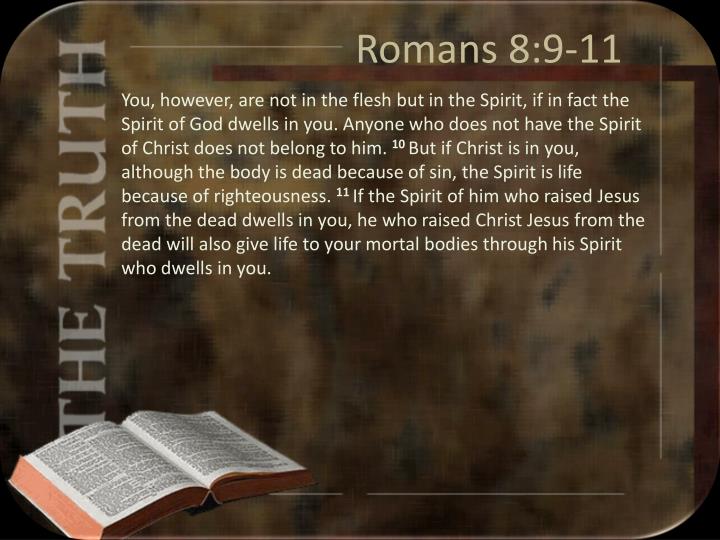
You, however, are not in the flesh but in the Spirit, if in fact the Spirit of God dwells in you. Anyone who does not have the Spirit of Christ does not belong to him. 10  But if Christ is in you, although the body is dead because of sin, the Spirit is life because of righteousness. 11  If the Spirit of him who raised Jesus from the dead dwells in you, he who raised Christ Jesus from the dead will also give life to your mortal bodies through his Spirit who dwells in you. 

That is as plain as you can make it. Nothing could be plainer than that. If anyone does not have the Spirit of Christ, he does not belong to Christ. You see, you cannot tell if a person is a Christian by what he does at any given moment. He may do exactly the same thing as a non-Christian, and he may be very cruel, vindictive, natural, lustful, and sinful in every way when he does it. At that moment, you cannot tell any difference between the Christian and the non-Christian.

But there is a difference, Paul says. One has the Spirit of Christ in him, the Holy Spirit, and eventually that will make a fantastic difference in his behavior. The other does not, and he will continue in sin and even get worse and worse.

In fact, the apostle suggests by this that the actions of a non-Christian may actually be much better than those of a Christian. There are non-Christians who are kinder, more thoughtful, and more gracious than Christians. People say, “Look at them! If their lives are so nice and pleasant, surely they must be Christians.” But it is not necessarily so. He that does not have the Spirit of Christ is none of his.

The difference will show up in the ultimate tests of life. When the crunch comes, one will collapse and fall and the other will rise and, eventually, conquer. A Christian can live “according to the flesh” even though he is not “in the flesh.” Those distinctions have to be made very clearly.

The evidence of conversion is the presence of the Holy Spirit within, witnessing that you are a child of God: (Romans 8:16)  The Spirit himself testifies with our spirit that we are God’s children.

Your body becomes the very temple of the Holy Spirit:  (1 Corinthians 6:19-20)  Do you not know that your body is a temple of the Holy Spirit, who is in you, whom you have received from God? You are not your own; {20} you were bought at a price. Therefore honor God with your body.

Even though the body is destined to die because of sin (unless, of course, the Lord returns), the Spirit gives life to that body today so that we may serve God. If we should die, the body will one day be raised from the dead, because the Holy Spirit has sealed each believer:

(Ephesians 1:13-14)  And you also were included in Christ when you heard the word of truth, the gospel of your salvation. Having believed, you were marked in him with a seal, the promised Holy Spirit, {14} who is a deposit guaranteeing our inheritance until the redemption of those who are God’s possession–to the praise of his glory.

What a difference it makes in your body when the Holy Spirit lives within. You experience new life, and even your physical faculties take on a new dimension of experience.

Christians, according to Paul, do not need to receive the Spirit, but to respond to the Spirit, in faith and obedience for assurance, guidance, empowerment, and a host of other ministries.

Paul, and every Christian, faces two problems as dealt with in our text: first, the problem of sin; second, the problem of righteousness. Our problem with sin is that we do it. Our problem with righteousness is that we do not, and cannot, do it.

God solved the first problem by condemning sin in the flesh through the death of our Lord at Calvary. Now, in verses 9-11, Paul tells us how God has provided the solution for the second problem.

God’s Law reveals the standard of righteousness. The Law tells us what righteousness is like. The Christian agrees with the Law of God, that it is “holy, righteous, and good.” The problem is the strength of sin and the weakness of our flesh. As Paul has shown in verses 5-8, the flesh cannot please God. God has provided the means for Christians to live in a way that enables them to fulfill the requirement of the Law and to please God. God’s provision—for Christians only—is the power of His Holy Spirit, who indwells every Christian.

The flesh is dead, because of sin. But the Spirit is alive, living within us, so that righteousness will result. The Spirit, who indwells every true believer, is the same Spirit who raised the dead body of our Lord from the dead (verse 11). Our problem, as Paul says in Romans 7:24, is “the body of this death.” Our bodies, which are dead due to sin, so far as doing that which is righteous, the Spirit will raise to life, as He raised the body of our Lord to life. And so the problem of righteousness has been solved. We cannot, by the flesh, please God and do that which is righteous. We can, by means of the Spirit, fulfill the requirement of the Law and please God.

And so the two problems (1) of sin and (2) of righteousness have been solved, by God, through the work of our Lord Jesus Christ and the ministry of the Holy Spirit. There is no condemnation for sin for all who are in Christ, by faith. Sin, on the other hand, has been condemned in the flesh. The righteousness which we could not do, because of the deadness of our fleshly bodies, God accomplishes through His Spirit, who raises dead bodies to life.

A person is spirited, driven to live according to the spirit that is within him. The Holy Spirit has the power to drive the believer to live as Christ lived. We can look at the spirit of a person and tell if he has the Spirit of Christ. If he does, then he bears the fruit of Christ’s Spirit. The Spirit and His fruit are seen in the life of the believer. The true believer proves that he is “in” Christ, that he is placed and positioned “in” Christ by the life which he lives.

Instances of miraculous activity through the Holy Spirit’s clothing or coming upon these Christians throughout the book of Acts are in contrast to the general promises made to all Christians. Penitent, baptized believers are promised the “gift of the Holy Spirit” (Acts 2:38).

John referred to the Holy Spirit as being given to Christians (1 John 3:24; 4:13), as did Paul in 1 Thessalonians 4:8.

In Galatians 4:6 we read, “And because you are sons, God has sent forth the Spirit of His Sn into our hearts.”

It is important to notice the contrast of the Spirit’s being given or sent “into our hearts” and the Spirit’s “falling upon” Christians. When the Spirit “fell upon” or “came upon” someone, miraculous activity was always involved. However, the presence of the Holy Spirit in the first century did not always involve miraculous activity.

John the Baptist was “filled with the Holy Spirit” from his mother’s womb (Luke 1:15), yet he “performed no sign” (John 10:41). Every Christian is commanded to “be filled with the Spirit” (Ephesians 5:18), but this does not mean that all Christians are to perform signs and wonders.

Today the Holy Spirit’s work is providential (behind the scenes) rather than in the same open, obvious, and miraculous way characteristic of His work in the first-century church. Our present lesson will focus upon His providential work.

 INDWELT BY THE SPIRIT (HIS PROVIDENTIAL WORK)

The relationship of the Holy Spirit to the Christian today is described by the Greek word oikeo. This word is translated in the New American Standard Bible as “dwell,” “indwell,” and “live.” It comes from the Greek word meaning “house” (oikos), and it is used four times to describe the Holy Spirit’s relationship with Christians (Romans 8:9, 11; 1 Corinthians 3:16; 2 Timothy 1:14).

What a beautiful thought Paul conveyed in teaching how the Holy Spirit takes up His personal residency within the bodies of Christians and dwells in them, for they are God’s New Testament temple.

This leads us to the important question “If the Holy Spirit is present and is working in our lives today, what does He do for us?” Some sincere Christians are asking this question today. Several years ago I was visiting with an elder who confessed that he had believed for a long time that he had been given the gift of the

Holy Spirit at his baptism. “But,” he added, “I really do not know why I received this gift. If the Holy Spirit no longer imparts miraculous gifts, why is He present?” We need to give some serious thought to this question.

 The Spirit as a Seal

The Bible teaches that the Holy Spirit seals us as the children of God. Paul wrote, “You were sealed in Him with the Holy Spirit of promise” (Ephesians 1:13). As we repent and are baptized by water baptism into Christ, we are clothed with Christ (Galatians 3:27).

Through the gift of the Holy Spirit, Jesus comes into our lives, and God places His seal upon us, marking us as His children. In the first century, seals were used to assure protection and security. For example, the

tomb of Jesus was sealed by the Roman government (Matthew 27:66) to ensure that no one could steal the body of our Lord. The 144,000 in Revelation 7 were sealed as a means of identification and protection of God’s saved ones.

The seal of the Holy Spirit is God’s invisible sign to the spirit world that we are His property and that He will personally protect and provide for us until “the day of [our] redemption” (Ephesians 4:30). The Holy Spirit is God’s mark, His living assurance of our sonship and of the Father’s love.

 The Spirit as a Pledge

The Holy Spirit is also “given as a pledge of our inheritance” (Ephesians 1:14). Some translations render the Greek word arrabon as “earnest” or “deposit.” The idea is that the Holy Spirit is God’s down payment toward our eternal inheritance in heaven. He is God’s personal pledge to us that He will faithfully keep His part of the new covenant we have entered into with Jesus. It is interesting that the modern Greek word arrabona is the word for engagement ring.

When a young man gives a young woman his personal pledge to marry her, he gives her an arrabona (engagement ring) to show his commitment to the future marriage. This figure is full of meaning as we remember Paul’s words from 2 Corinthians 11:2:3 “For I am jealous for you with a godly jealousy; for I betrothed you to one husband, that to Christ I might present you as a pure virgin.” The presence of the Holy Spirit in our lives is God’s personal pledge that if we remain faithful to our marital vows to Jesus that one of these days we will be presented to Him as His perfect bride (see Ephesians 5:25–27; Revelation 21:2). In a sense, in this earthly life we are Jesus’ fiancée, while in the heavenly realm we will be His wife.

The Spirit as a Gift

The gift of the Holy Spirit also involves God’s gift of eternal life to His children. In contrast to being dead in sin and indwelt by the spirit of Satan (Ephesians 2:1, 2), God’s children are “alive together with Christ” (Ephesians 2:5). Separation from God is spiritual death. To be joined “together with Christ” through the indwelling Spirit is life. “And the witness is this, that God has given us eternal life, and this life is in His

Son. He who has the Son has the life; he who does not have the Son of God does not have the life” (1 John 5:11, 12).

When our souls were washed by the blood of the Lamb, Jesus Himself began to live in us, imparting eternal life to our spirits! To be “born of water and the Spirit” (John 3:5) is to have the very life of Jesus planted into our spirits through God’s Holy Spirit. Jesus illustrated the life of the Spirit in His parable of the vine and the branches in John 15.

Just as the branch draws its life from the vine, so we draw our life from Jesus, the spiritual Vine. We abide in Christ through faith; and as we draw life from Him, He produces His spiritual fruit of righteousness in us (John 15:4; Galatians 5:22, 23). “And if Christ is in you, . . . the spirit is alive because of righteousness” (Romans 8:10). The indwelling presence of the Holy Spirit becomes in each of us “a well of water springing up to eternal life” (John 4:14) and flowing from our inner beings as “rivers of living water” (John 7:38, 39).

The Spirit as an Inner Strength

The indwelling presence of the Holy Spirit strengthens God’s children in spiritual warfare against Satan. Paul declared that “by the Spirit” we put “to death the deeds of the body” (Romans 8:13). Many Christians trust their own strength and determination to overcome Satan. They need to be reminded of Jesus’ warning: “For apart from Me you can do nothing” (John 15:5). In contrast to having an attitude of self-sufficiency, Paul expressed a confident faith: “I can do all things through Him who strengthens me” (Philippians 4:13). The Christian life is a life of faith in which we fix “our eyes on Jesus, . . . so that [we] may not grow weary and lose heart” (Hebrews 12:2, 3). Our victory is in the Lord Jesus Christ and “in the strength of His might” (Ephesians 6:10).

Have you ever noticed how the Christian armor described in Ephesians 6 is related to the Lord Jesus Himself? We are to gird our loins with truth, and Jesus is “the truth” (John 14:6). We are to “put on the breastplate of r i g h t e o u s n e s s ” (Ephesians 6:14), and Jesus is our righteousness (1 Corinthians 1:30).

We are to “shod [our] feet with the preparation of the gospel of peace” (Ephesians 6:15), and Jesus is the gospel message (cf. 1 Corinthians 2:2; 15:3, 4). We are to take up “the shield”  e “take the helmet of salvation” (Ephesians 6:17) as we trust Jesus for our eternal salvation (cf. Acts 4:12). Jesus, as the Word of God, (John 1:1) is “the sword of the Spirit” (Ephesians 6:17), through whom we can fight the attacks of Satan.

No wonder the Holy Spirit glorifies Jesus, and not Himself (John 16:14). It is through the Holy Spirit that we are “strengthened with power . . . in the inner man” so that “Christ may dwell in [our] hearts through faith” (Ephesians 3:16, 17). “Christ in you, [is] the hope of glory” (Colossians 1:27). The Spirit strengthens us as we focus the eyes of our faith upon Jesus and trust Him for His strength to fight the good fight of faith.

Alexander Campbell wrote, . . . without this gift [of the Holy Spirit] no one could be saved or ultimately triumph over all opposition. . . . He knows but little of the deceitfulness of sin, or of the combating of temptation, who thinks himself competent to wrestle against the allied forces of the world, the flesh, and the devil. . . . [But] by His Holy Spirit, in answer to our prayers, [God] works in us, and by us, and for us, all that is needful to our present, spiritual, and eternal salvation.1

 The Spirit as a Helper

The Holy Spirit also helps God’s children in prayer. Paul commanded Christians to “pray at all times in the Spirit” (Ephesians 6:18). To “pray . . . in the Spirit” involves more than praying from the heart. Any worship offered “in spirit and truth” (John 4:24) is worship that recognizes the role of the Holy Spirit as He helps us in our prayers to God. What a wonderful assurance that the Spirit who abides in heaven is also the Spirit who abides in the church! We read, “The Spirit Himself intercedes for us with groanings too deep for words; and He who searches the hearts knows what the mind of the Spirit is, because He intercedes for the saints  according to the will of God” (Romans 8:26, 27). When we pray, the Spirit Himself prays with us, giving us the great assurance that prayers offered in faith and from our innermost beings arise to the Lord as sweet incense (Revelation 8:3, 4).

CONCLUSION

As we learn of the Spirit’s activity in helping us to live the Christian life to the glory of our God, we can see the need to “be filled with the Spirit” (Ephesians 5:18). A Spirit-filled life is a life focused upon Jesus rather than upon self. It is a life yielded to Jesus as Lord, and our Lord is not just some distant king we serve.  Through His Holy Spirit He is an ever-present Shepherd who promises to restore our souls and to provide for our every need. Each Christian can say with the psalmist, “Surely goodness and lovingkindness will follow me all the days of my life, and I will dwell in the house of the Lord forever” (Psalm 23:6). Amen!

 
1 Comment

Posted by on November 27, 2023 in Romans 8


The Benefits of Being Christians #4 Two Groups, Two Destinies Romans 8:5-6


In recent years several polls have shown disturbing beliefs and behaviors among those who profess to be Christians. For example, a Pew Forum poll indicated that 57% of evangelical church attenders believe many religions can lead to eternal life.

Other surveys show that only 9% of teens and 32% of adults who claim to be born again believe in moral absolutes. That means that over 90% of “born again” teens and two-thirds of “born again” adults do not believe in moral absolutes!

These shocking numbers may be explained in part by a lack of solid biblical preaching. But beneath this lack of solid preaching is a basic misunderstanding about the nature of the gospel.

Have we have wrongly assumed that when someone makes a decision to be immersed in water in order to have their sins forgiven but not yield to Him as Lord? Or we mistakenly assume that all who profess Jesus as Lord, especially those who serve Him, will go to heaven. But Jesus made it clear that only those who obey Him can expect to be welcomed into heaven.

Matthew 7:21-27 (ESV) “Not everyone who says to me, ‘Lord, Lord,’ will enter the kingdom of heaven, but the one who does the will of my Father who is in heaven. 22  On that day many will say to me, ‘Lord, Lord, did we not prophesy in your name, and cast out demons in your name, and do many mighty works in your name?’ 23  And then will I declare to them, ‘I never knew you; depart from me, you workers of lawlessness.’ 24  “Everyone then who hears these words of mine and does them will be like a wise man who built his house on the rock. 25  And the rain fell, and the floods came, and the winds blew and beat on that house, but it did not fall, because it had been founded on the rock. 26  And everyone who hears these words of mine and does not do them will be like a foolish man who built his house on the sand. 27  And the rain fell, and the floods came, and the winds blew and beat against that house, and it fell, and great was the fall of it.”

The Bible is clear that salvation is a matter of God’s imparting new life to a person who was dead in his sins. And such new life always manifests itself in changed belief and behavior.

This is not to say that those cannot fall into gross sins. But it is to say that they cannot live complacently in sin. While growth in godliness is a lifelong process, there is such growth in the lives of all who have been born of the Spirit.

Paul paints a picture of these two distinct groups: those according to the flesh; and, those according to the Spirit.

Since there are only two groups of people with two very different destinies, make sure that you are “according to the Spirit,” not the flesh.

1. There are two and only two groups of people in the world: Those who are according to the flesh and those who are according to the Spirit.

Romans 8:5 (ESV) For those who live according to the flesh set their minds on the things of the flesh, but those who live according to the Spirit set their minds on the things of the Spirit.

“Those who are according to the flesh” describes the spiritual condition of unbelievers. The nature of each group determines their present behavior and their final destiny.

There is a popular but mistaken view that there are two optional tracks for the Christian life. If you’re prone toward masochism (masochism: the tendency to derive pleasure, from one’s own pain or humiliation) you can sign up for the discipleship track. Under this plan, you give up everything to follow Christ.

  • You have to deny yourself and take up your cross daily.
  • You will suffer hardship, sacrifice, and perhaps even martyrdom.
  • You have to give the control of all of your material assets to Christ.
  • You may be required to take the gospel to a foreign culture, where you’ll live in difficult and perhaps dangerous circumstances.
  • But, your rewards in heaven will be great. This discipleship track is for the super-committed.

The other track, the “cultural Christian track,” is for the rest of us more “ordinary” believers. Under this plan, be immersed in water in order to have sins forgiven (to make sure that you’ll go to heaven), but also pursue your dreams for success and personal fulfillment in this life.

  • You get the best of both worlds without needing to be gung ho, like those on the discipleship track.
  • You can enjoy the fellowship of a good church and pursue the American dream at the same time.
  • Just drop something in the offering plate once in a while to pay your dues.
  • Once in a while you can volunteer to help out at the church, when it fits in with your busy schedule.
  • Don’t be too hard on yourself about obedience to the Bible. After all, we’re all human. God is gracious and He understands your weaknesses.
  • So accept yourself and don’t think that you have to be all-out for Jesus. That’s just for the fanatics on the discipleship track.

But Jesus made it clear that there is only one track for the Christian life: Mark 8:34-38 (ESV) And calling the crowd to him with his disciples, he said to them, “If anyone would come after me, let him deny himself and take up his cross and follow me. 35  For whoever would save his life will lose it, but whoever loses his life for my sake and the gospel’s will save it. 36  For what does it profit a man to gain the whole world and forfeit his soul? 37  For what can a man give in return for his soul? 38  For whoever is ashamed of me and of my words in this adulterous and sinful generation, of him will the Son of Man also be ashamed when he comes in the glory of his Father with the holy angels.”

It’s pretty clear that Jesus is talking about eternal life or eternal condemnation. If you want eternal life, you must die to self and follow Jesus.

In Paul’s language, that describes a person who is “according to the Spirit.”

The other track describes those who are “according to the flesh.” These are the only two groups in the world when it comes to eternal life or eternal death.

  1. These two groups are sharply distinguished by different mindsets. Paul describes the mindset of those who are according to the flesh as “the things of the flesh” (8:5). This mindset is death (Romans 8:6: For to set the mind on the flesh is death, but to set the mind on the Spirit is life and peace.)

It is hostile toward God, not subject to God’s law (8:7), and not pleasing to God (8:8).

On the other hand, the mindset of those who are according to the Spirit is “the things of the Spirit” (8:5). This mindset is life and peace (8:6).

By implication, since it is the opposite of the mindset of the flesh, the mindset of those who are according to the Spirit is friendly toward God, subject to His law, and pleasing to Him.

To be “according to” the flesh means to live under the flesh, to make it your rule, or to obey it. To live “according to” the Spirit means to be “ruled and determined by His awakening, regenerating, illuminating presence; characterized by the fact that He dwells in [us]”

Those who are according to the flesh set their minds on the things of the flesh (8:5a).

These deeds include sins that we might categorize as sensual (immorality, impurity, drunkenness); but they also include worshiping false gods, strife, jealousy, and anger.

So to live according to the flesh is to live independently of God, in dependence on oneself, with self at the center. The fleshly person may be outwardly moral, but his motives and goals are for his own glory or gain or comfort, without regard for the glory of God or the good of others.

To set one’s mind on the things of the flesh is much the same as when John says in 1 John 2:15-16, “Do not love the world nor the things in the world. If anyone loves the world, the love of the Father is not in him. For all that is in the world, the lust of the flesh and the lust of the eyes and the boastful pride of life, is not from the Father, but is from the world.”

Loving the world or setting one’s mind on the things of the flesh means to live for the temporal things that the world values, in disregard of God and eternity.

B. Those who are according to the Spirit set their minds on the things of the Spirit (8:5b).

To set your mind on the things of the Spirit does not mean that you go around with your head in the clouds, detached from everyday matters.

It does not mean that you must join a monastery and spend hours every day in meditation and prayer. It does not mean that you do not get your hands dirty with mundane things like work, paying bills, cleaning the house, fixing meals, mowing your lawn, or reading the newspaper.

Rather, to set your mind on the things of the Spirit means to relate all of life to God and His Word. God has seen fit in His Word to tell us how to have our sins forgiven and to have eternal life through faith in Christ.

That is the most important thing, because you could die at any moment and stand before God. That is why Paul says in Col. 3:1-4: Therefore, if you have been raised up with Christ, keep seeking the things above, where Christ is, seated at the right hand of God. Set your mind on the things above, not on the things that are on earth. For you have died and your life is hidden with Christ in God. When Christ, who is our life, is revealed, then you also will be revealed with Him in glory.

So to set your mind on the things of the Spirit means especially to think often about matters of salvation. It means to worship God and commune with Him.

In the context of Colossians 3, Paul goes on to talk about sex, greed, anger, abusive speech, and truthfulness. He gives practical commands regarding relationships, marriage, child-rearing, and work.

These two distinct groups are marked by mindsets that lead to two completely different destinies: death or life and peace. Romans 8:6: For to set the mind on the flesh is death, but to set the mind on the Spirit is life and peace.

The scary part is this: If those who are dead in their sins continue in that state until they die physically, they will continue throughout eternity in the awful condition of separation from God, under the penalty of His just wrath.

The Bible calls this the second death and it is spent in the lake of fire (Rev. 20:14). The next verse (Rev. 20:15) adds, “And if anyone’s name was not found written in the book of life, he was thrown into the lake of fire.”

This state of eternal spiritual death does not mean that those in hell are annihilated or cease to exist. That would be a blessing for them! But the Bible is clear that eternal spiritual death means enduring conscious torment forever (Mark 9:43-48; Luke 16:16-31; Rev. 14:10-11).

These frightening truths come to us from the Lord Jesus Himself and from John, the apostle of love. If we reject this truth, we are not following Jesus.

The good news is, if you have been given new life through the Holy Spirit, although your physical body will die (Rom. 8:10), God will resurrect your body (8:11) and you will enjoy life and peace with Him and with all the saints throughout eternity.

The application of our text is obvious: Make sure that you have new life through God’s Spirit and that you are not living according to the flesh!

Do you remember the “big rocks” illustration? A professor came in with a large jar filled to the brim with big rocks. He asked the class, “Is the jar full?” “Yes,” they responded. He poured in some pea gravel and shook it down through the cracks. “Is it full now?” They weren’t so sure. He poured in some sand. Then he added water. The point of the illustration is, if you don’t put the big rocks in first you won’t be able to fit them in at all. Schedule your priorities or they will get crowded out by the urgent but trivial. Your biggest rock is your relationship with God. Set your mind on the things of the Spirit!

 
Leave a comment

Posted by on November 23, 2023 in Romans 8


The Benefits of Being Christians #3 “The Power to Obey God” Romans 8:3-4


In the context of the larger book of Romans, Paul has worked diligently to get us to this point of this complex chapter:

  • Chapter 5: Free from the wrath of God.
  • Chapter 6: Free from the dominion of sin.
  • Chapter 7: Free from a law keeping system.
  • Chapter 8: In Christ, there is no condemnation.

He also revealed his own struggle (and ours): Romans 7:15b–20 (ESV) For I do not do what I want, but I do the very thing I hate. 16 Now if I do what I do not want, I agree with the law, that it is good. 17 So now it is no longer I who do it, but sin that dwells within me. 18 For I know that nothing good dwells in me, that is, in my flesh. For I have the desire to do what is right, but not the ability to carry it out. 19 For I do not do the good I want, but the evil I do not want is what I keep on doing. 20 Now if I do what I do not want, it is no longer I who do it, but sin that dwells within me.

God Frees Us from Sin’s Penalty and Power (8:1–4)

Paul’s heart-cry in 7:24, “Who will rescue me from this body of death?”, was immediately answered in brief: “Thanks be to God through Jesus Christ our Lord” (7:25a).

While the main concern of this question and its answer is freedom from the power of indwelling sin, we need to be reminded again of the main point already established in 3:21–5:21, that the penalty for our sin has been paid in full by Jesus.

In the midst of our intense spiritual struggle against sin, in which we are sometimes on the losing end, we need not fear that our forgiveness is in jeopardy. Christ has already secured this for us on the cross

The Law cannot claim you (8:2). You have been made free from the law of sin and death. You now have life in the Spirit. You have moved into a whole new sphere of life in Christ. The Law no longer has any jurisdiction over you: you are dead to the Law (Rom. 7:4) and free from the Law (Rom. 8:2).

The Law cannot condemn you (8:3). Christ has already suffered that  condemnation for you on the cross. The Law could not save; it can only condemn. But God sent His Son to save us and do what the Law could not do.

8:3  What the law was powerless to do.  Freedom over sin never can be obtained by obedience to the law. The law cannot help us because it was weakened by the flesh.

But what the law can’t do, God did by sending his own Son in the likeness of sinful man. Jesus Christ was a “likeness” of us. This likeness (homoious) was not merely an appearance; he was completely human (John 1:14), with the same desires that yield to sin, yet he never sinned (see 2 Corinthians 5:21; Hebrews 2:17–18; 4:14–16).

Christ took on humanity in order to be our sin offering. Because Christ was sinless, his death passed the “death sentence” on sin for all of us, setting us free from sin’s power over us: he condemned sin in the flesh.  Jesus gave himself as a sacrifice (“sin offering”) for our sins.

In Old Testament times, animal sacrifices were continually offered at the temple. These animals brought to the altar had two important characteristics: they were alive, and they were “without flaw.” The sacrifices showed the Israelites the seriousness of sin: innocent blood had to be shed before sins could be pardoned (see Leviticus 17:11). But animal blood could not really remove sin (Hebrews 10:4); and the forgiveness provided by those sacrifices, in legal terms, was more like a stay of execution than a pardon.

Those animal sacrifices could only point to Jesus’ sacrifice that paid the penalty for all sin. Jesus’ life was identical with ours, yet unstained by sin. So he could serve as the flawless sacrifice for our sins.

In him, our pardon is complete. The tables are turned so that not only is there “no condemnation for those who are in Christ Jesus,” but also the very sin that guaranteed our condemnation is itself condemned by Christ’s sacrifice.

Grace was given that the law might be fulfilled. —Augustine

The Law cannot control you (8:4). The believer lives a righteous life, not in the power of the Law, but in the power of the Holy Spirit. The Law does not have the power to produce holiness; it can only reveal and condemn sin.

The law of Moses did exactly what it was designed to do, but it did a lousy job doing what it was never designed to do.

  • It was designed to show man his sin and it did a tremendous job of it.
  • The law of Moses condemned every person who ever tried to keep it in its entire 1500+ year history! (Excluding Jesus, of course.
  • The law wasn’t designed to set us free. For that purpose it was impotent, weak, sick. Paul spent the first half of his life living under the law of Moses and we just read in chapter 7 how ineffective it was for him. It only showed him how bad he really was!

The sacrifice of Jesus takes away the sin that frustrates us so much in the struggle and would certainly condemn us in the end!

Look again at verse 4: “in order that the requirement of the Law might be fulfilled…” In the original language, that word “fulfilled” was used to describe the leveling up of a hole in the ground.

The law of Moses showed us that it was impossible. But God has come and filled up the hole! We can walk again on level ground! Praise God!

The indwelling Holy Spirit enables us to walk in obedience to God’s will. The righteousness that God demands in His Law is fulfilled in you through the Spirit’s power.

In the Holy Spirit, you have life and liberty (Rom. 8:2) and “the pursuit of happiness” (Rom. 8:4).

     8:4 The righteous requirements of the law might be fully met in us. The requirement of the law is holiness (see Leviticus 11:44–45; 19:2; 20:7); but the law is powerless to make us holy because of our innate sinfulness.

Only through Christ’s death and the resulting freedom from sin can we no longer live according to the flesh but according to the Spirit and thus fulfill the righteous requirements of the law.

The Holy Spirit is the one who helps us become holy. The Holy Spirit provides the power internally to help us do what the law required of us externally.

It is the Spirit who produces “fruit” in us; only in this way can we fulfill the requirements of the law. But Paul has already made it clear that the law is powerless to save. So why do its requirements still need to be met?

The law is God’s law and was never meant to be cast aside. Paul makes a distinction between two kinds of obedience to the law. He speaks against the obedience to the law that stays merely at the level of the flesh (such as being circumcised because the law required it) and the obedience that depends on God’s Holy Spirit.

Only the latter fulfills the law. When we live according to the Spirit, we actually do meet the requirements of the law. Or, as Paul puts it, the requirements of the law are met in us.

The Spirit-led Christian, as he yields to the Lord, experiences the sanctifying work of the Spirit in his life. “For it is God that worketh in you, both to will and to do of His good pleasure” (Phil. 2:13).

When an opportunity to do something that might be momentarily enjoyable presents itself, but you know it would be wrong to do it, is there any kind of struggle that goes on in your life? You know there is. A part of you wants to do it and a part of you doesn’t. An inner struggle ensues.

Question: Are you the only Christian who struggles that way? Answer: Every Christian struggles that way. Even the great Apostle Paul struggled that way!

If we had lived in the first century, we would have looked at Paul and said, “Wow! What a spiritual man! What an overcomer!” But I suspect Paul would have corrected us in that. He would have said, “What a wretched man! You don’t know the half of it.”

Within the universe there is a law so important that it has become the law of the Holy Spirit. It is called “the law of the Spirit of life.” What is meant by this law? Very simply, life is in Jesus Christ and in Him alone.

Whatever life is—energy, being, spirit, love, joy, peace—it is all in Jesus Christ and nowhere else.

Within Christ, within His very being is the Spirit of life, the very energy and being of life. This fact is important, so important that God has written it into the laws of the universe.

The “law of sin and death” simply means the rule and reign of death. Every man dies: death rules and reigns over every man. But the Spirit of God frees a man from the rule and reign of death.

The Spirit of life frees the believer from both sin and death. The Holy Spirit frees the believer to live as Christ lived, to actually live out the life which Christ lived. The active energy of life, the dynamic force and being of life—all that is in Christ Jesus—is given to the believer.

He lives now and shall live forever. He senses this and knows this. Life to him is a spirit, a breath, a consciousness of being set free through Christ. Even when he sins and guilt sets in, there is a tug, a power (Holy Spirit) that draws him back to God.

He asks forgiveness and removal of the guilt (1 John 1:9), and immediately upon asking, the same power (the Holy Spirit) instills an instantaneous assurance of cleansing.

The spirit of life, the consciousness of living instantaneously takes up its abode within him once again. He feels free again, and he feels full of life in all its liberating power and freedom.

He bubbles over with all the depth of the richness and fulness of life itself. He is full of the “Spirit of life.” Life itself becomes once again a spirit, a consciousness of living. He lives now and forever.

The Spirit gives life by doing what the law could not do. The law could not make man righteous because man’s flesh is too weak to keep the law. No man has ever been able to keep the law of God, not to perfection or even close to perfection.

All flesh has miserably failed—come far short of God’s glory and law. Consequently, all flesh dies physically and spiritually.

Therefore, righteousness and life just cannot come by the law. But what the law could not do, the Spirit is able to do. He can provide righteousness and life.

The Spirit gives life by Christ condemning sin in the flesh.

Whatever the man sows in Christ, he reaps: God matches it. Whatever a man measures out to Christ, the same is measured back to the man: God matches it. In fact, Scripture says that God will even go beyond and do much more than we ask or think (cp. Ephes. 3:20).

Therefore, the man who walks after the “Spirit of life” which is in Christ Jesus is given the Spirit of life. The Holy Spirit fulfills and credits him with the righteousness of the law, with the right to live eternally.

The Christian who is dedicated to his or her heavenly Father through Christ, will someday hear those words, “Well done, good and faithful servant, enter into the joy of your Master.” And he/she will do this in spite of the weaknesses of the flesh. Halleluia! Thanks be to God through Jesus Christ our Lord! That is good news! That is a real benefit!

 
Leave a comment

Posted by on November 20, 2023 in Romans 8


The Benefits of Being Christians #2 Free From The Need To Earn – Romans 8:2


For the law of the Spirit of life in Christ Jesus has set you free from the law of sin and of death. (8:2)

Because of the way Paul spoke these words, we often miss some of the subtle points he is making. He gives us what I call “a word salad,” a lot of things mixed together that needs to be “chewed.”

Verse 2 says that we have been “set free” from something, and it’s important for us to understand it.

People spend a big part of their lives trying to qualify.

  • On the job, an employee hopes that his performance qualifies him for a raise or promotion.
  • In a dating relationship, the boy and the girl will each try hard to impress the other to “qualify” as someone special in that one’s eyes.
  • A major hurdle in a university doctoral program is cleared when the student passes the qualifying exams.

On the other hand, in certain situations trying to “qualify” is inappropriate.

  • Take, for instance, a child’s relationship with his or her parents. A child should feel unconditional love and acceptance from his parents. The child should not have to feel as though he must “qualify” for his parents’ love by his achievements. He should be able to receive their love simply by being their child.
  • The problem comes, however, when parents set unrealistically high standards and expectations for their child. They expect the child to behave perfectly, to achieve above all others both in the classroom and in athletics, and to use adult reasoning in every situation. (We sometimes try to live out our dreams [or correct our failures] through our children?)
  • In that kind of situation, the child never feels as though he “qualifies” for the parents’ love and acceptance. At some point, the child may simply quit trying to win his parents‘ approval and just give up. If he is trying his hardest and never gets anywhere, why try at all?

Which way is it with God? Do we have to qualify with Him, or is striving to earn His acceptance  inappropriate?

Many believe that we have to “qualify” in order to please God and have a relationship with Him. The idea is that, to be a Christian, you either have to be a “good person” (usually defined as “a nearly perfect person”) or you have to do all the “right things.”

The other side of the coin is that, if you fail to qualify, you cannot please God.

An author wrote of a recollection from childhood of hearing a lesson based on the story of Moses’ disobedience when he struck a rock to make water come out of it instead of speaking to the rock as God had commanded. Because of his disobedience, Moses was not allowed to enter the promised land (Numbers 20:2-12).

The application of this story was made in this way: “Moses was a good man, but he made one mistake and did not enter the promised land. So, you had better not make one mistake because you see what will happen to you if you do!”

The use of that story fails to take into account that God still accepted Moses as His servant, that Moses apparently died in the grace of God (Deuteronomy 34:5, 6), that Satan had to argue with God’s angel about Moses’ body (Jude 9), and that Moses appeared with Jesus with God’s endorsement at the Transfiguration (Mark 9:4).

God meted out that particular discipline to Moses for that particular act, but that does not say anything about God’s punishment for “one mistake” that you or I might make.

“If I’ve messed up once,” you might think, “I’m no better off than the prostitute or the drunk! So why try? I’ll never qualify with God anyway.” I wonder how many who have dropped out of the church have done so for this very reason.

Something is not right with this perspective. Something is wrong with the notion that we must go through life unsure about whether we are Christians and whether we will go to heaven when we die. One attempted fix is the hope that you pray for forgiveness right before you die, you will be all right. No, something is not right with this approach to God.

Jesus has good news for us. He frees us from the hopeless treadmill of earning salvation (which is impossible anyway) and saves us on the basis of faith (or trust) in His grace.

Jesus saves us not on the basis of our goodness, but on the basis of His goodness, as God’s perfect Son who gave Himself as the sacrifice for our sins. That is good news. That means that we can be saved and know it. That means we can have hope.

“Your Works Have Saved You”? When Jesus was on earth, dealing with people face to face and showing mankind what God is like, how many times did He tell someone, “You have earned salvation”? Never!

He told the woman with the long-term hemorrhage (Mark 5:34), and He also told the sinful woman who anointed His feet (Luke 7:50) that their faith had saved them (or “made them whole”).

The paralytic on the mat (Mark 2:5) and the thief on the cross (Luke 23:43) performed no act that merited forgiveness, but they each received forgiveness from Jesus.

All of these incidents are pictures of faith, illustrations of what it means to come to Jesus in simple trust of who He is, regardless of the merit of one’s actions.

Jesus has plenty to say about works. The judgment scene portrayed in Matthew 25:31-46 shows that one’s eternal destiny is determined by what one does.

In Matthew 12:37, Jesus said, “By your words you shall be justified, and by your words you shall be condemned.”

What a person does, even in terms of his speech, has direct impact on his eternal status before God.

But the main theme of Jesus’ teaching is that a person’s heart has to be right (Mark 7:20-23). From that correct center the correct actions will come. Correct actions that do not flow from a heart of trust mean nothing.

Jesus shocked the religious leaders of His day by eating with tax-gatherers and with people whom the religious leaders termed “sinners” (Luke 5:30-32). “Why do you eat and drink with the tax-gatherers and sinners?”

They asked Jesus’ disciples. Jesus told them, “Because they need Me.”

He did not just associate with people who “qualified,” that is, people who justified themselves in their own eyes.

He did not operate from the perspective that there are good people and there are bad people and that is the way it is.

He came to call “bad” people to a new life, a life in which “goodness” would be given to them by God on the basis of their faith in Christ.

The very reason Jesus associated with “sinners” was that they did not “qualify” on the basis of their works, and they knew it. Jesus wanted to bring about a deeper goodness within the person, on the basis of faith in Him.

Is There Salvation Apart From Works of Law?

What is this “faith” or “trust” on which salvation depends? Paul, who did more “works” for the Lord than perhaps anyone else but who also called himself the foremost sinner (1 Timothy 1:15), provides an insight into this basis of our salvation in Romans 3.

In Romans 3:19-28, there appear to be two similar but distinct ideas about “law” at work. Paul makes reference to (1) “the Law,” meaning the law of Moses, and also to (2) “law” (no “the”), referring to the general idea of works and law-keeping.

Paul says in Romans 3:9 that “both Jews and Greeks [i. e., all people] are all under sin.”

The law (of Moses) speaks to this, he says, and he quotes several Old Testament passages to prove his point. Then in verse 20 he says, “By the works of the Law [the general principle of doing works of merit] no flesh will be justified in [God’s] sight; for through the Law [general principle] comes the knowledge of sin.

But now,” he goes on to say in verses 21 and 22, “apart from the Law [that general principle of works] the righteousness of God has been manifested, being witnessed by the Law [of Moses] and the Prophets, even the righteousness of God through faith in Jesus Christ for all those who believe.” (Emphasis mine.)

In verse 28 he concludes, “We maintain that a man is justified by faith apart from works of the Law [works of merit to gain favor],” since “by the works of the Law no flesh will be justified” (v. 20).

Paul is saying this: Law-keeping, the good works that we might do, will not save us. Works religion does not earn salvation. You will never qualify for salvation by trying to earn it through your own works.

Something else, something different, is needed. That “something else” was provided by God, who offers salvation on the basis of faith or trust in Christ. Salvation by faith is not the same kind of approach to God that trying to be saved by “law” is. It is “witnessed to” by the Old Testament law, but it is a different, and superior, approach to God. This faith is an absolute dependence on Jesus’ death on the cross as your salvation. You do not “earn” or merit anything. You trust that Jesus has accomplished salvation for you by His merit.

This contrast between the works we do and the faith by which we approach God is vividly portrayed in Paul’s      description of himself in Romans 7. He says, “The good that I wish, I do not do; but I practice the very evil that I do not wish” (v. 19). He wants to do right, but sin in him does wrong. “Wretched man that I am!” he cries (v. 24). “Who will set me free from the body of this death?”

The answer? “Thanks be to God through Jesus Christ our Lord!” (v. 25). Paul’s works did not stack up high enough to reach salvation, and they never would. He knew he could not earn God’s acceptance by his actions because his actions were so often wrong.

Rather than living a life of always trying to “qualify” and always failing, Paul says, “There is therefore now no condemnation for those who are in Christ Jesus. For the law of the Spirit of life in Christ Jesus has set you free from the law of sin and of death” (Romans 8:1, 2).

The “law of sin and of death” says that if you sin, you die. However, the “law of the Spirit of life in Christ Jesus” says that if you are in Christ, you will live because of the presence of faith in your life.

“But I’m Not Good Enough To Be A Christian”

How many times have you heard the statement “But I’m not good enough to be a Christian”? Have you said it yourself? An idea many hold is that a person has to be good enough to become a Christian.

This person believes that only when he quits a particular sin or brings his general level of morality to a higher plane will he be able to approach God and qualify to be a Christian. This idea may reflect the works/salvation misunderstanding we have been talking about.

Actually, however, that standard line may be little more than a cop-out, unconscious though it may be. The problem is not that you are not good enough to be a Christian.

The problem is that you do not admit that you are bad enough to need to become a Christian. The statement is not always made out of a heart seeking to change and to come closer to God. The statement sometimes is made as an excuse for why that person is making no movement or change at all.

He says, “I’m not good enough to be a Christian—but I’m doing pretty well, and a lot better than some who call themselves Christians,” or “I’m not good enough to become a Christian. There’s nothing I can do about it because God has set too high a standard for me to meet.”

This person plods through life in this sort-of good, sort-of bad never-never land, never making a commitment to anyone beyond himself and never looking for God’s real definition of “qualifying.

”What would Jesus say to the person who laments, “I’m not good enough. . . .”?

  • He would say, “You’re the very person I came for!
  • If you will admit your sinfulness, I can work in your life.
  • I didn’t come for people who think they are good enough. There’s not much I can do for them.”
  • No one is “good enough” to be a Christian.

The question is, What are you going to do about it?

 
Leave a comment

Posted by on November 16, 2023 in Romans 8


The Benefits of Being a Christian – #1 A New Gift: The Forgiveness of Sins


Romans 8:1: “Therefore, there is now no condemnation for those who are in Christ Jesus…”

We come to a chapter that has often been called either the greatest or one of the greatest chapters in the Bible.

It begins with “no condemnation” and ends with “no separation.” In between there is “no defeat”.

Personally, I’ve come to Romans 8 again and again when I’ve been disappointed or depressed. I don’t see how you can read Romans 8 and remain down.

If you struggle with guilt…or sin…or go through difficult trials, read Romans 8.

If you don’t know how to pray, read Romans 8. If you’re struggling with assurance of your salvation, read Romans 8.

Interestingly, while the flavor of Romans 8 is exhortation, there is not a single command in the chapter.

There is a noticeable shift from Romans 7 to Romans 8. In chapter 7, “I” is frequent, the law is prominent, and sin is dominant.

In chapter 8, the Holy Spirit is frequent (18x, more than any other NT chapter), God’s grace and persevering love are prominent, and victory over sin is dominant.

Paul’s heart-cry in 7:24, “Who will rescue me from this body of death?”, was immediately answered in brief: “Thanks be to God [because he has rescued me] through Jesus Christ our Lord” (7:25a).

Because we have been rescued by Christ, and are thus in Christ Jesus, we are not condemned. To be in Christ Jesus means to have put our faith in him, becoming a member of his body of believers through obedient faith and an immersion in water in order to have sins forgiven.

There can be no condemnation, for “we have been justified through faith” and “have peace with God through our Lord Jesus Christ” (5:2).

In John 3:17 Jesus said, “God did not send the Son into the world to judge the world, but that the world should be saved through Him.” Then he added, “He that believes on the Son is not condemned, but he that believes not is condemned already.”

Mankind is on death row when sins have not been dealt with as determined by God. Man is condemned because he is a sinner. He does not need to wait until judgment or eternity for condemnation. Jesus said, “He is condemned already.”

What is the answer? The answer is Christ. He who believes on the Son and is baptized in order to have sins forgiven is not condemned.

While the main concern of this question and its answer is freedom from the power of indwelling sin, we need to be reminded again of the main point already established in 3:21–5:21, that the penalty for our sin has been paid in full by Jesus.

In the midst of our intense spiritual struggle against sin, in which we are sometimes on the losing end, we need not fear that our forgiveness is in jeopardy. Christ has already secured this for us on the cross.

Paul deals with two very practical issues: guilt and sin. As we saw in chapter 7, believers fight an inner war. With the new man in Christ, they joyfully concur with the holy commandments of God’s law. But, with the old man (the flesh, or indwelling sin), they are prone to be held captive by the law of sin.

Even though mature believers experience consistent victory over sin, they still struggle daily against the flesh and occasionally lose the battle. So they must understand how to deal with guilt and how to overcome temptation.

When we do sin as Christians, the enemy comes in to stir up doubts about our salvation: “How do you know that your sins are all forgiven? True Christians don’t do what you just did! You’re hopeless! You might as well admit your hypocrisy in claiming to be a Christian and quit trying to be holy.” It is to those practical issues that Paul directs these opening verses:

God has graciously set free from sin’s penalty and power all who are in Christ Jesus.

The verse does not say “no mistakes” or “no failures,” or even “no sins.” Christians do fail and make mistakes, and they do sin.

I like Kenneth Wuest’s translation of this. He said, “Therefore, now, there is not even one bit of condemnation to those who are in Christ Jesus.”

I think that means a couple of things very important to you and me. First, there is no condemnation in the struggle.

This raises the practical question, “As a believer should I feel guilty when I sin?” If there is no condemnation, should we refuse to feel guilty when we disobey God?

I would argue that properly understood, believers should feel guilty when they sin. The guilt stems from the fact that I have violated God’s holy Word. I have disobeyed my loving heavenly Father.

Rather than loving my Savior, who went to the cross on my behalf, I have loved the sin that put Him there. Feelings of guilt that lead to genuine sorrow and repentance when I disobey God are appropriate.

On the other hand, I should not feel the guilt of condemnation that stems from the accuser’s false charge: “True Christians don’t do what you did. You’re not even a Christian!”

If I mourn over my sin and am repentant before God over it, then I must accept His forgiveness and answer the accuser with the blood of the Lamb and the word of my testimony that I trust in Jesus (Rev. 12:10-11; Zech. 3:1-5).

To put it another way, the guilt that I feel when I sin is relational, as a child to my Father. It is not forensic, as a criminal before the judge.

I know that some Christians are unwilling to admit that there is a struggle with the flesh at all. They have a false idea of Christianity. They think Christianity means that God takes this struggle away and removes the temptation so they never have to struggle again.

That certainly would be nice. Unfortunately, it’s not true; and many people have been hurt and have become angry with themselves and God because it doesn’t work that way.

I have seen young Christians become very upset at times because they thought they should no longer have to struggle – and when they did, they thought there was something wrong with them.

I’ve seen others, unwilling to admit their own weakness, look down with disdain on the struggle of others. But my Bible says in I John 1:8, written to Christians, 1 John 1:8, 10 (ESV) If we say we have no sin, we deceive ourselves, and the truth is not in us. 10  If we say we have not sinned, we make him a liar, and his word is not in us. We all have the struggle.

Picture two 10 year old boys in track and field, trying to learn the long jump. One has a father who screams and hollers and threatens and condemns every time his boy messes up. “You good-for-nothing! You’re worthless! You ought to be disowned!” (it’s called conditional love).

I know you’ve all seen the type. The poor kid gets so exasperated, he seldom succeeds. Any desire he might have had to please his dad is sooner or later drowned out in the waves of condemnation. He often just gives up. As an older teenager, he may rebel.

The other boy, though, has a dad who, though he doesn’t rejoice when his boy messes up, helps him up when he falls and is constantly encouraging him to do better.

The boy knows his dad is on his side (it’s called unconditional love). “Come on, son, you can do it. I know it. Just a little higher this time. You can do it.” That boy will probably reach his full potential.

Which kind of Father is God? If you say He’s like the first, you need to go back to kindergarten….you’ve missed something very important in your training.

You don’t know what God is like at all! My point is, there is no condemnation in the struggle! The heavenly father knows we have to learn and grow. He is for us, not against us, even in the struggle.

MAN’S SIN: THE ULTIMATE PROBLEM

Modern man has largely lost the reality and consequences of sin. The word “sin” has been banished from our vocabulary; as result, “forgiveness” has been drained of its meaning and attraction.

The gospel can never be “joyous tidings” to a humanistic culture which recognizes no need for salvation.

The core of the message of Jesus Christ concerns the forgiveness of sins.

Jesus said the thing that would be preached to all nations in His name was this: “repentance and remission of sins” Luke 24:46-47: “This is what is written: The Christ will suffer and rise from the dead on the third day, {47} and repentance and forgiveness of sins will be preached in his name to all nations, beginning at Jerusalem.”

When those who heard the gospel preached on Pentecost (in Acts 2) asked, “Men and brethren, what shall we do?” they were told by Peter, “Repent, and let every one of you be baptized in the name of Jesus Christ for the remission of sins” (Acts 2:37-38).

Paul said while preaching in Antioch in Pisidia, “Therefore, let it be known to you, brethren, that through this Man is preached to you the forgiveness of sins” (Acts 13:38).

Yet, even among Christians, there is a need for renewed emphasis on salvation. Too rarely do we speak of our conversion in terms of being “saved.” Too rarely is the candidate for baptism observed mourning for his past sins, from which, by God’s grace, he is being rescued.

What’s needed? The attitude of David: Psalms 25:16-18: “Turn to me and be gracious to me, for I am lonely and afflicted. {17} The troubles of my heart have multiplied; free me from my anguish. {18} Look upon my affliction and my distress and take away all my sins.”

Those who expressed the deepest love for the Lord were those who had the most honest attitude about their own sin. Luke 7:47: Therefore, I tell you, her many sins have been forgiven–for she loved much. But he who has been forgiven little loves little.” {48} Then Jesus said to her, “Your sins are forgiven.” {49} The other guests began to say among themselves, “Who is this who even forgives sins?” {50} Jesus said to the woman, “Your faith has saved you; go in peace.””

Luke 18:9-14: “To some who were confident of their own righteousness and looked down on everybody else, Jesus told this parable: {10} “Two men went up to the temple to pray, one a Pharisee and the other a tax collector. {11} The Pharisee stood up and prayed about himself: ‘God, I thank you that I am not like other men–robbers, evildoers, adulterers–or even like this tax collector. {12} I fast twice a week and give a tenth of all I get.’ {13} “But the tax collector stood at a distance. He would not even look up to heaven, but beat his breast and said, ‘God, have mercy on me, a sinner.’ {14} “I tell you that this man, rather than the other, went home justified before God. For everyone who exalts himself will be humbled, and he who humbles himself will be exalted.””

1 John 1:7-10 (ESV) But if we walk in the light, as he is in the light, we have fellowship with one another, and the blood of Jesus his Son cleanses us from all sin. 8  If we say we have no sin, we deceive ourselves, and the truth is not in us. 9  If we confess our sins, he is faithful and just to forgive us our sins and to cleanse us from all unrighteousness. 10  If we say we have not sinned, we make him a liar, and his word is not in us.

We believers must never forget the reality of our rescue and our indebtedness to God’s grace in Christ. We can persevere in our daily struggles knowing that “if we are faithless, he will remain faithful, for he cannot disown himself” (2 Tim. 2:13).

Conclusion. There are no more valued promises of God than those of His forgiveness. “For as the heavens are high above the earth, so great is His mercy toward those who fear Him; as far as the east is from the west, so far has He removed our transgressions from us” (Psa. 103:11,12).

“‘Come now, and let us reason together,’ says the Lord, ‘though your sins are like scarlet, they shall be as white as snow; though they are red like crimson, they shall be as wool’” (Isa. 1:18).

 
Leave a comment

Posted by on November 13, 2023 in Romans 8


The Sabbath Controversy in the Gospels


Introduction

A large body of teaching regarding the interpretation of the Sabbath thus began to emerge before and after the coming of Christ. These interpretations were first preserved and passed on as oral traditions and then later put into writing.

In the third century A. D. a written compilation of the oral traditions of the scribes was completed, which was known as the Mishnah. It contained 63 tractates on various subjects of the Law, requiring about 800 pages in English.[1]

Later Judaism set itself to the task of interpreting these interpretations. These commentaries on the Mishnah are called Talmuds. “Of the Jerusalem Talmud there are 12 printed volumes; and of the Babylonian Talmud there are 60 printed volumes.”[2]

The Law lays it down that the Sabbath Day is to be kept holy, and that on it no work is to be done. That is a great principle. But these Jewish legalists had a passion for definition. So they asked: What is work? All kinds of things were classified as work.

For instance, to carry a burden on the Sabbath Day is to work. But next a burden has to be defined.

So the Scribal Law lays it down that a burden is “food equal in weight to a dried fig, enough wine for mixing in a goblet, milk enough for one swallow, honey enough to put upon a wound, oil enough to anoint a small member, water enough to moisten an eye‑salve, paper enough to write a customs house notice upon, ink enough to write two letters of the alphabet, reed enough to make a pen”—and so on endlessly.

So they spent endless hours arguing whether a man could or could not lift a lamp from one place to another on the Sabbath, whether a tailor committed a sin if he went out with a needle in his robe, whether a woman might wear a brooch or false hair, even if a man might go out on the Sabbath with artificial teeth or an artificial limb, if a man might lift his child on the Sabbath Day.

Medical attention could be given only if a life was in danger. To take some examples—a woman in childbirth might be helped on the Sabbath; an infection of the throat might be treated; if a wall fell on anyone, enough might be cleared away to see whether he was dead or alive; if he was alive he might be helped, if he was dead the body must be left until the next day. A fracture could not be attended to. Cold water might not be poured on a sprained hand or foot. A cut finger might be bandaged with a plain bandage but not with ointment. That is to say, at the most an injury could be kept from getting worse; it must not be made better.[3]

In his Antiquities, the Jewish historian Josephus reports that it was also because Jews would not defend themselves on the Sabbath that the Roman general Pompey was able to capture Jerusalem. As was the custom in ancient Roman warfare, Pompey began building a high mound from which his troops could bombard the city. Aware that the Jews defending Jerusalem would not oppose him then, the general did all construction work on the Sabbath. “Had it not been for that practice, from the days of our forefathers, to rest on the seventh day,” Josephus wrote, “this bank could never have been perfected, by reason of the opposition the Jews would have made; for though our Law gave us leave then to defend ourselves against those that begin to fight with us and assault us (this was a concession), yet it does not permit us to meddle with our enemies while they do anything else.”

One section alone of the Talmud, the major compilation of Jewish tradition, has twenty-four chapters listing Sabbath laws. One law specified that the basic limit for travel was 3,000 feet from one’s house; but various exceptions were provided. If you had placed some food within 3,000 feet of your house, you could go there to eat it; and because the food was considered an extension of the house, you could then go another 3,000 feet beyond the food. If a rope were placed across an adjoining street or alley, the building on the other side, as well as the alley between, could be considered part of your house.

Certain objects could be lifted up and put down only from and to certain places. Other things could be lifted up from a public place and set down in a private one, and vice versa. Still others could be picked up in a wide place and put down in a legally free place—but rabbis could not agree about the meanings of wide and free.

Under Sabbath regulations, a Jew could not carry a load heavier than a dried fig; but if an object weighed half that amount he could carry it twice. Eating restrictions were among the most detailed and extensive. You could eat nothing larger than an olive; and even if you tasted half an olive, found it to be rotten and spit it out, that half was considered to have been eaten as far as the allowance was concerned.

Throwing an object into the air with one hand and catching it with the other was prohibited. If the Sabbath overtook you as you reached for some food, the food was to be dropped before drawing your arm back, lest you be guilty of carrying a burden.

Tailors did not carry a needle with them on the Sabbath for fear they might be tempted to mend a garment and thereby perform work. Nothing could be bought or sold, and clothing could not be dyed or washed. A letter could not be dispatched, even if by the hand of a Gentile. No fire could be lit or extinguished—including fire for a lamp—although a fire already lit could be used within certain limits. For that reason, some orthodox Jews today use automatic timers to turn on lights in their homes well before the Sabbath begins. Otherwise they might forget to turn them on in time and have to spend the night in the dark.

Baths could not be taken for fear some of the water might spill onto the floor and “wash” it. Chairs could not be moved because dragging them might make a furrow in the ground, and a woman was not to look in a mirror lest she see a gray hair and be tempted to pull it out. You could carry ink enough to draw only two letters of the alphabet, and false teeth could not be worn because they exceeded the weight limit for burdens.

According to those hair-splitting regulations, a Jew could not pull off even a handful of grain to eat on the Sabbath unless he were starving—which, of course, is often a difficult thing to determine and would be cause for considerable differences of opinion. If a person became ill on the Sabbath, only enough treatment could be given to keep him alive. Treatment to make him improve was declared to be work, and therefore forbidden. To determine just how much food, medicine, or bandaging would be necessary to keep a person alive—and no more—was itself an impossible burden.

Among the many other forbidden Sabbath activities were: sewing, plowing, reaping, grinding, baking, threshing, binding sheaves, winnowing, sifting, dying, shearing, spinning, kneading, separating or weaving two threads, tying or untying a knot, and sewing two stitches.

The Sabbath was anything but a time of rest. It had become a time of oppressive frustration and anxiety. The people were sick to death of this system that had been imposed on them by ungodly, worldly legalists, and they were indeed “weary and heavy-laden” (Matt. 11:28).[4]

(i) To the Pharisee religion was ritual; it meant obeying certain rules and regulations. Jesus broke these regulations and they were genuinely convinced that he was a bad man. It is like the man who believes that religion consists in going to church, reading the Bible, saying grace at meals, having family worship, and carrying out all the external acts which are looked on as religious, and who yet never put himself out to do anything for anyone, who has no sense of sympathy, no desire to sacrifice, who is serene in his rigid orthodoxy, and deaf to the call of need and blind to the tears of the world.

(ii) To Jesus religion was service. It was love of God and love of men. Ritual was irrelevant compared with love in action.

“Our Friend, our Brother, and our Lord, What may Thy service be? Nor name, nor form, nor ritual word, But simply following Thee.”

To Jesus the most important thing in the world was not the correct performance of a ritual, but the spontaneous answer to the cry of human need.[5]

These things to them were the essence of religion. Their religion was a legalism of petty rules and regulations.[6]

We can hardly be surprised to find a head‑on collision between the scribes and Pharisees and our Lord over the issue of the Sabbath. The gospel writers record numerous occasions when the Jewish religious leaders clashed with Jesus over the interpretation of the Sabbath.

Almost always this resulted from an incident in which are Lord “violated the Sabbath” according to the legalistic teachings and interpretations of the scribes and Pharisees. Such incidents are helpful to us in our study of the Sabbath, for they allow us to see some of the ways in which the Bible was wrongly interpreted, as well as the true interpretation of the Sabbath as given by our Lord. Let us learn from the errors of the Jewish religious leaders, and especially from the divine interpretation of the Sabbath by our Lord.

Our method in this message will be to consider a few of the key “Sabbath texts” in the gospels, and to attempt to learn how the legalistic interpretation of the scribes and Pharisees was in error.

Further, we will compare and contrast the wrong interpretation with the correct interpretation of our Lord. Then, at the end of the lesson we will try to summarize our Lord’s teaching on the Sabbath, and to seek to discover some pertinent principles which are relevant to our lives as Christians. In the next (and final) lesson on the Sabbath we will see how the apostles interpreted the Sabbath and how the New Testament church sought to apply the Sabbath in a new dispensation. For now, let us turn to the gospels of the New Testament to see how our Lord’s view of the Sabbath differed from that of religious leaders of His day.

Matthew 12:1‑14

A seemingly innocent act on the part of our Lord’s disciples precipitated an incident in which the Pharisees challenged the Lord Jesus to defend or denounce His disciples: “At that time Jesus went on the Sabbath through the grain fields, and His disciples became hungry and began to pick the heads of grain and eat. But when the Pharisees saw it, they said to Him, ‘Behold, Your disciples do what is not lawful to do on a Sabbath’” (Matthew 12:1‑2).

Let us begin by gaining a sense of the context, gaining an overview of the passage. These verses describe two separate incidents: (1) the protest of the Pharisees that Jesus’ disciples violated the Sabbath by gathering grain and eating it as they walked through the fields; and (2) the issue raised by the synagogue leaders,[7] knowing Jesus was about to heal the man with the withered hand. The Savior meets Jewish objections in the first instance by citing two incidents in the Old Testament where people were vindicated for technically breaking the Sabbath: David, when he took the sacred shewbread and shared it with his men, and the Old Testament priests, who regularly violate the Sabbath by working at their priestly jobs on this day.

Undaunted by the challenge of the Pharisees, our Lord catches His opponents completely off guard by referring to an Old Testament text which remarkably paralleled this situation: “But He said to them, ‘Have you not read what David did, when he became hungry, he and his companions; how he entered the house of God, and they ate the consecrated bread, which was not lawful for him to eat, nor for those with him, but for the priests alone?’” (Matthew 12:3‑4).

Before looking at the response of our Lord, let us make several important observations about what is happening here that is foundational to an accurate interpretation of this text.

(1) Our Lord was not being accused of wrongdoing here. The issue here is the “harvesting” and “threshing” of grain by our Lord’s disciples. Jesus was being challenged to either condemn the deeds of His disciples or to condone them, thereby opposing the authority and the interpretation of the Pharisees.

(2) While the Torah (the Law of Moses) nowhere condemns such an act, the Halakah (the Jewish collection of interpretations) did.

(3) Amazingly, Jesus granted the assumption that the actions of His disciples was “work” and thus a breaking of the Sabbath.

These three facts provided the Lord with a golden opportunity to avoid the issue of the Sabbath, and to concentrate only on the technical questions involved. Often, Jesus did avoid “creating a scene,” whether it be that of performing a miracle publicly, or that of inciting a dispute prematurely between Himself and His adversaries. Here, Jesus could have referred His critics to His disciples, since He had not gathered any heads of grain for Himself, nor had He eaten any. He could have pointed to the fact that the Torah nowhere called such a minimal effort work, and that this was only the fallacious conclusion of some misguided, knit‑picking scholars. Instead, Jesus chose to let these technical matters go by the boards. He wanted to discuss the interpretation of the Sabbath and His activities which could be construed to be a breaking of the Fourth Commandment. Here is a matter Jesus did want to discuss, and He sidestepped every peripheral issue to get to the heart of the matter.

Bearing these things in mind, notice how skillfully our Lord answered the challenge of the Pharisees. Knowing full well that He would not change the Pharisees’ minds about the disciples’ actions being viewed as work, Jesus allowed the allegation of Sabbath‑breaking to go unchallenged (even though wrong). Our Lord then turned His critics’ attention to an Old Testament event which beautifully paralleled His own situation in critical points. He points to the time when David was fleeing from Saul, accompanied by a few men, and when David and his hungry men took consecrated bread from Ahimelech the priest and ate it (cf. 1 Samuel 21:1-9). Note the common denominators of both incidents, which make the Old Testament case a precedent for our Lord’s actions, along with His followers.

(1) David and the Lord both had followers with them, who participated in their “Sabbath‑breaking”.[8]

(2) Food was eaten to alleviate hunger. Hunger prompted Jesus’ disciples to pluck the grain, just as it necessitated David and his men eating the sacred bread.

(3) Something which was sanctified, set apart for a special use, was profaned by being put to a common use. In David’s case, sanctified bread, set apart for use only by the priests’ was eaten. The Lord’s disciples, too, profaned the Sabbath (which was sanctified) by gathering grain, which was common labor.

(4) There were considerations which justified actions that normally would have been condemned as Law‑breaking.

We can see that the similarities in these two situations are similar enough so that the justification for David’s actions (and, of course, his men) might also vindicate our Lord’s disciples from the charge of Law‑breaking. Let us pay close attention to the argument which our Lord puts forward here, for it is a master‑stroke.

This passage contains a great general truth. Jesus said to the Pharisees, “Have you not read what David did?” The answer of course was, “Yes”—but they had never seen what it meant. It is possible to read scripture meticulously, to know the Bible inside out from cover to cover, to be able to quote it verbatim and to pass any examination on it—and yet completely miss its real meaning. Why did the Pharisees miss the meaning—and why do we so often miss it?

Jesus reminded the Pharisees of a familiar story about David and his companions as they fled for their lives south of Gibeah to escape the jealous and vengeful Saul. When they came to Nob, where the Tabernacle was then located, they asked for food. Ahimelech the priest gave them the consecrated bread of the Presence, which was not lawful for him to eat, nor for those with him, but for the priests alone, because there was “no ordinary bread on hand” in the Tabernacle (1 Sam. 21:4).

The bread of the Presence was baked weekly, and each Sabbath twelve fresh loaves (representing the twelve tribes) replaced the previous ones, which could be eaten only by the priests. On that particular occasion, however, an exception was made on behalf of David and his men, who were weak from hunger. God was not offended by that act, and He did not discipline either Ahimelech or David. The Lord was willing for a ceremonial regulation to be violated when doing so was necessary to meet the needs of His beloved people.

If God makes allowances for His own law to be broken under certain circumstances for the welfare of His people, Jesus said, He surely permits purposeless and foolish man-made traditions to be broken for that purpose.[9]

(i) They did not bring to scripture an open mind. They came to scripture not to learn God’s will but to find proof texts to buttress up their own ideas. Far too often men have taken their theology to the Bible instead of finding their theology in the Bible. When we read scripture we must say, not, “Listen, Lord, for thy servant is speaking,” but, “Speak, Lord, for thy servant is listening.”

(ii) They did not bring a needy heart. The man who comes with no sense of need always misses the deepest meaning of scripture. When need awakens, the Bible is a new book.

When we read God’s book we must bring to it the open mind and the needy heart—and then to us also it will be the greatest book in the world. [10]

First, our Lord assumes that the actions of David and his men are acceptable to the Judaism of His day,[11] and thus, to His adversaries. Nobody wanted to accuse David of wrong‑doing here. Second, if this is so, then the Pharisees granted exceptions to the Law. Third, if Law‑breaking was allowed in some cases, it must be to some higher reason or consideration. What, then, are the reasons for which David could be acquitted, and for which our Lord and His disciples could be as well?

1 Samuel 21, David did not specifically ask for any of the sacred bread, that is all that was at hand. Ahimelech volunteered to give David some of this bread so long as his men had not been defiled. I think that there were three reasons why Ahimelech gave this bread without reservation: (1) Ahimelech did not find the Law so rigid as to prohibit meeting the needs of men under such special circumstances. (2) He believed that David had come from the king. (3) He believed that David had been sent on an important assignment by the king. These considerations led the priest to the conclusion that the prohibition of the Law could be set aside in the case of David and his men. Note well that Ahimelech did not cast aside his obligation to preserve the sanctity of the bread. He did insist that David’s men must be free from defilement. One must assume that if this condition were not met, the bread would not have been given these men. The sanctified bread was not profaned in the process.

Ahimelech had some good reasons for giving David and his men bread. Nevertheless, these were probably not the same reasons the Jewish scholars and teachers had for justifying this act of David. My opinion is that they focused on who David was. Since David was God’s anointed, Israel’s next king, it was right for he and his men to eat the consecrated bread and thus to save their lives. Their motto might have been, “better fed than dead.” David’s men could well eat the consecrated bread because of whom it was they followed. The implications for Jesus’ followers should not have passed them by. Luke, in his account of the same event, adds this statement of our Lord, which presses home the point: “The Son of Man is Lord of the Sabbath” (Luke 6:5).[12] If for David’s sake (and thus Israel’s) the Law could be temporarily and technically violated, how much more for the sake of his Lord?

These are all good reasons, and may very well be implied in our Lord’s words to the Pharisees. I think, however, that there was one simple reason which our Lord sought to emphasize above all others—David and his men should have been fed the sacred bread because they were hungry and this was the only food available. The hunger factor is clearly stated by our Lord (Matthew 12:1, 3). Certain things were sanctified, set apart by God, to teach the Israelites about sanctification, not to cause them hardship and suffering. Thus, when Law‑keeping would endanger David’s life or the lives of his men, the practice of the Law could be modified (not ignored altogether) to meet the needs of men.

Mark presses this point in his account of the same incident when he records this statement of our Lord: “The Sabbath was made for man, and not man for the Sabbath” (Mark 2:27). If the Sabbath was made for man’s benefit and not man for the benefit of the Sabbath, then when a particular Sabbath practice posed a hardship on man, it may legitimately, in some exceptional cases, be set aside.[13] How beautifully Jesus turned the tables on His adversaries. It was not He who was unbiblical, they were out of step with the Scriptures.

If the Pharisees thought they had Jesus at a disadvantage in the matter of His disciples’ actions in the grain fields, they were wrong. After the first argument in verses 3 and 4, the Pharisees’ heads must have been spinning, but rather to stop here, suggesting He had but one text in support of His thesis, Jesus struck a second blow, providing yet another precedent for His actions from the Old Testament Scriptures in verses 5‑8:

“Or have you not read in the Law, that on the Sabbath the priests in the temple break the Sabbath, and are innocent? But I say to you, that something greater than the temple is here. But if you had known what this means, ‘I DESIRE COMPASSION, AND NOT A SACRIFICE,’ you would not have condemned the innocent. For the Son of Man is Lord of the Sabbath” (Matthew 12:5‑8).

Not only was David vindicated in the Scriptures and by the Pharisees for partaking of the consecrated bread, along with his followers, the priests who ministered in the temple on the Sabbath were justified in “breaking the Sabbath Law” as well. The argument in verse 5 is meticulous. It is not the greatness of the priests which justified their violation of the Fourth Commandment—it was the greatness of the temple, the greatness of the cause or the work in which the were engaged. No Jew needed to be convinced of the greatness of the temple, and thus temple service was a readily accepted justification for the priests working on the Sabbath.

These two cases which our Lord has cited might be used as precedents for His own actions and attitude toward the Sabbath, but He is not content to leave the matter at that. Jesus is no mere equal to David and to the priests, to be covered by the precedent they have set. He is their superior, their Sovereign. Thus, in the closing words of this argument, the Lord Jesus uses this occasion to boldly claim His deity, which not only allows Him to technically violate the Sabbath, it gives Him the freedom to set it aside altogether if He pleases.

As great as the temple might be to the Pharisee, our Lord claims to be “greater than the temple” (v. 6). By claiming as well to be “Lord of the Sabbath” He is also claiming to be greater than David, or any other man. Why was Jesus justified in doing what He did? Because He who is God can do as He pleases. If God established the Sabbath, and man was commanded to imitate Him in resting on the seventh day, then Jesus, as God, can do away with it, working on it if He pleases, and commanding others to do likewise. God can declare the Sabbath and He can disregard it, too.

Verse 7 strikes at the heart of the problem of His adversaries: they have focused on the mechanical, ritualistic, aspects of the Sabbath, and in so doing they have failed to meet its essence, which is mercy and compassion. They have lingered long over the letter of the Law, but they have missed its spirit.

When Jesus cites the words of the prophet Hosea, “I desire compassion, and not a sacrifice” (6:6),[14] He wields a double‑edged sword. In the first place, He stresses the overriding principle of compassion. For David to have fed his men the consecrated bread may have been a technical violation of the Law, but it was an act of compassion, thus complying with the spirit of that Law. The same can be said for the disciples’ eating the grain on that Sabbath day. Second, the context of this quotation serves as a veiled rebuke to the Pharisees, for in Hosea legalism is condemned, and that condemnation is often directed against the leaders of the nation Israel (cf. Hosea 5:1‑2; 6:9).

The Healing of the Withered Hand (Matthew 12:9‑14)

And departing from there, He went into their synagogue. And behold, there was a man with a withered hand. And they questioned Him, saying, “Is it lawful to heal on the Sabbath?”—in order that they might accuse Him. And He said to them, “What man shall there be among you, who shall have one sheep, and if it falls into a pit on the Sabbath, will he not take hold of it, and lift it out? Of how much more value then is a man than a sheep! So then, it is lawful to do good on the Sabbath” (Matthew 12:9‑14).

The situation is quite different here. It is not the actions of the Lord’s disciples which are at issue, but the anticipated healing of the man with the withered hand. The wickedness of the opponents of our Lord is clearly demonstrated in this text. Jesus departed from the previous debate over the Sabbath and, on the Sabbath, enters the synagogue, apparently the one which His opponents from the last encounter normally attended. This is signaled by the designation “their synagogue” in verse 9.

While we are not told all of the details, it seems relatively clear that Jesus saw the man as he entered the synagogue. That man, if he knew who Jesus was, would have petitioned Him to heal him. Jesus must have stopped at the man’s request and the Pharisees knew that a healing was about to take place. They seized this opportunity to raise a question about the legitimacy of healing on the Sabbath. They did this knowing that Jesus would thus have to take a stand on the Sabbath and also would perform the healing, thus deliberately violating the Law as they interpreted it. Jesus was, in their minds, going to end up “between a rock and a hard place.”

The only “hard place” was that in which our Lord’s adversaries would find themselves by the time His argument was concluded. Jesus took a totally different tack in defending His actions here. He answered their question with one of His own. Here, He did not focus on Himself, nor on the Old Testament Scriptures, but on His adversaries and on His ailing friend nearby. He exposes their hypocrisy by comparing what they justified in themselves with what they condemned in Jesus.

Jesus wished to point out the glaring inconsistency of the Pharisees by showing their double standard in interpreting and applying the Law: one set of standards for themselves; another when judging Him. When it came to a mishap endangering one of their own animals, they had no qualms in “laboring” (thus breaking their interpretation of the Sabbath Law) to rescue it from danger (v. 11). If they valued their cattle so much that they would risk violating the Sabbath, could Jesus be wrong in placing a higher value on an ailing man by healing him on the Sabbath?

The Sabbath Commandment was not to be misinterpreted so as to deprive one of the ability to do good to another in need. The compassion in which the Lord delighted in principle (Hosea 6:6), was the compassion which needed to be applied in particular on this Sabbath day—and was, when Jesus commanded that the man stretch out his hand, so as to be healed (v. 13). While good men would have rejoiced (and some surely did), the adversaries of our Lord went out, counseling together as to how to do away with Him (v. 14). Thus, the Law, if given for man’s good, does not command us to do evil by neglecting to do good to those in need.

John 5:1‑18

Now there is in Jerusalem by the sheep gate a pool, which is called in Hebrew Bethesda, having five porticoes. … And a certain man was there, who had been thirty‑eight years in his sickness. When Jesus saw him lying there, and knew that he had already been a long time in that condition He said to him, “Do you wish to get well?” The sick man answered Him, “Sir, I have no man to put me into the pool when the water is stirred up, but while I am coming, another steps down before me.” Jesus said to him, “Arise, take up your pallet, and walk.” And immediately the man became well, and took up his pallet and began to walk. Now it was the Sabbath on that day. Therefore the Jews were saying to him who was cured, “It is the Sabbath, and it is not permissible for you to carry your pallet.” But he answered them, “He who made me well was the one who said to me, ‘Take up your pallet and walk.’” They asked him, “Who is the man who said to you, ‘Take up your pallet, and walk’?” But he who was healed did not know who it was; for Jesus had slipped away while there was a crowd in that place. Afterward Jesus found him in the temple, and said to him, “Behold, you have become well; do not sin any more, so that nothing worse may befall you.” The man went away, and told the Jews that it was Jesus who had made him well. And for this reason the Jews were persecuting Jesus, because He was doing these things on the Sabbath. But He answered them, “My Father is working until now, and I Myself am working.” For this cause therefore the Jews were seeking all the more to kill Him, because He not only was breaking the Sabbath, but also was calling God His own Father, making Himself equal with God” (John 5:2, 5‑18).

Time will not permit a thorough study of this text, but we will focus our attention on the highlights of the passage as they relate to the Sabbath controversy. Our Lord not only commanded the man to rise up (thus, to be healed), but also to carry his pallet, his bed (thus, technically violating the Jewish interpretation of the Sabbath Law). Initially, the Jews challenged the healed man for violation of the Sabbath. The man was undaunted, believing that anyone who had the power to heal him also had the authority to tell him to carry his bed. Jesus had silently slipped away from the scene, so that the man had not discovered His name.

Later, Jesus found the man, urging him to sin no more, lest greater evil befall him. It was at this time that the man learned his healer’s name was Jesus, and so he reported this to the Jews. This resulted in the Jews turning their wrath toward the Lord Jesus, persecuting Him for His Sabbath violation. Our Lord’s one sentence response is one of the most profound statements in the gospels: “My Father is working until now, and I Myself am working” (John 5:17). This bold statement indicates a significant change in God’s dealings with Israel, a change so dramatic that it required a response which appeared to be a violation of the Old Testament Law, particularly the Fourth Commandment. Let us consider the nature of this change.

(1) Jesus claimed that the Father is no longer resting, but is at work, even on the Sabbath. The Sabbath rest of God, described in Genesis 2:1‑3, was the result of His having finished the work of creation. The work which God was then undertaking in the coming of Christ was the work of redemption. There is thus a change of program, from that of creation (completed) to that of redemption (in process). If Jesus was right (and He surely was) God was also a Sabbath‑breaker, when viewed according to the former standard of the Fourth Commandment as interpreted by the Jews. David’s men could break the Law by eating consecrated bread because their leader did. Jesus’ followers could “harvest” grain on the Sabbath, if it was right for their leader to do so. And now, Jesus Himself can break the Sabbath because God the Father was doing it.

(2) The keeping of the Sabbath was a sign of the Mosaic Covenant, but this sign was to be set aside, along with the covenant, due to the new covenant which Christ would institute by His redemptive work on the cross.

(3) While obedience to God was once manifested by imitating God in ceasing from labor, obedience to God now required the imitation of God in labor. Since God was at work up to and including that very moment (which was on the Sabbath), imitating God required working on the Sabbath as well.

(4) Jesus here not only identified Himself with God, He identified Himself as God. This is evident from the reaction of the Jews to Jesus’ words:

For this cause therefore the Jews were seeking all the more to kill Him, because He not only was breaking the Sabbath, but also was calling God His own Father, making Himself equal with God (John 5:18).

John 7:21‑24

Jesus answered and said to them, “I did one deed, and you all marvel. On this account Moses has given you circumcision (not because it is from Moses, but from the fathers); and on the Sabbath you circumcise a man. If a man receives circumcision on the Sabbath that the Law of Moses may not be broken, are you angry with Me because I made an entire man well on the Sabbath? Do not judge according to appearance, but judge with righteous judgment” (John 7:21‑24).

The debate which began in John chapter 5 was not finished, and so the charge of a “violation of the Sabbath” which was leveled against the Lord Jesus there is picked up again in chapter 7. Verses 21 and 23 of chapter 7 point back to the healing of the man at the pool of Bethesda. Jesus gives one further response in verses 22 and 23 which provides yet another argument in His defense with regard to the charge of breaking the Sabbath by the healing of this man.

When the keeping of the Sabbath is to be practiced according to the interpretation of the Pharisees, there was yet another group of Sabbath-breakers which they must reckon with: those parents who circumcised their sons on the Sabbath. From the legalistic point of view of the Pharisees, it was possible for two of God’s commandments to conflict with each other. The Law of Moses required that a new son must be circumcised on his 8th day (Lev. 12:3). If this day happened to fall on the Sabbath, the Jews who condemned Jesus for healing on this day would themselves circumcise their sons on the same day, and without any sense of guilt. Our Lord’s accusers were once again found to be hypocritical, and superficial in their concept of true obedience.

On the surface, circumcising a son on the Sabbath was an infraction of the letter of the Sabbath Law. In reality, circumcising on the Sabbath was keeping the Sabbath in terms of the spirit of the Law. Righteous judgment must look deeper than just at the outward appearance of an act. The Pharisees were being hypocritical, for they judged Jesus according to a different standard than that by which they judged their own actions.

Conclusion

Our Lord’s commentary on the Fourth Commandment is of great importance and relevance to contemporary Christians. Let us explore some of the implications of His teaching on the Sabbath as we conclude this lesson.

The first lesson which we should learn from the Sabbath controversy in the gospels is that the central and foundational issue underlying the controversy is not Jesus’ interpretation, but Jesus’ identity. The Jews sought to put Jesus to death as a result of His defense. The reason was not only because those who opposed Him were put to shame, but because the Sabbath controversy was but further proof that Jesus was God incarnate.

When you read through the gospels carefully, you will discover that at the outset of His ministry Jesus performed miracles on the Sabbath, but that they were not challenged.[15] What caused the change? What made the “violation of the Sabbath” such a heated issue? The answer is this: Jesus had clearly claimed to be God incarnate. The Sabbath controversy was therefore the attempt to prove Jesus a Law‑breaker, thus proving that such a “sinner” could not be God: “Therefore some of the Pharisees were saying, ‘This man is not from God, because He does not keep the Sabbath.’ But others were saying, ‘How can a man who is a sinner perform such signs?’ And there was a division among them” (John 9:16).

The Gospel of Mark illustrates the sequence of events which led to the Sabbath controversy. In 1:21‑28 Jesus cast an unclean spirit from a man in a synagogue in Capernaum on the Sabbath, yet there was no objection raised, only praise. In chapter 2 Jesus first forgave the sins of the paralytic who had been lowered through the roof of the house where Jesus was speaking. The scribes reasoned that only God could forgive sins, and thus that Jesus was making the claim to be God. Thus, in the closing verses of chapter 2 the Sabbath controversy is commenced. The Sabbath issue was but a symptom problem, an attempt to prove Jesus to be a sinner, and not the Son of God. This debate, like countless other debates throughout church history, was not a search for truth but an attempt to squelch the truth.

The identity of Jesus as the Son of God was the heart of the Sabbath issue. Jesus could work on the Sabbath because He was the Son of God (John 5:16‑17), One greater than the temple (Matthew 12:6), and greater than David—Lord of the Sabbath (Matthew 12:8). Since God the Father was the Sabbath maker, Jesus, as God, can not only break the Sabbath, He can abolish it altogether. As God, Jesus could work on the Sabbath, and more than this, He could offer men true rest, a rest far superior to the Old Testament Sabbath rest, and surely far better than any rest which the Pharisees had to offer. It is no accident that these verses immediately precede the great Sabbath debate in Matthew’s gospel: “Come to Me, all who are weary and heavy‑laden, and I will give you rest. Take My yoke upon you, and learn from Me, for I am gentle and humble in heart; and you shall find rest for your souls. For My yoke is easy, and My load is light” (Matthew 11:28‑30).

There is only one true rest, my friend, and that is the rest which Jesus Christ gives, the rest of forgiveness of sins, the rest of ceasing from striving to be holy, and of being found holy in Him. I pray that this rest is yours.

Second, we learn that the fundamental difference between the interpretation of Jesus and that of the Pharisees was the difference between the precepts of Scripture and the principles of Scripture. If we are to understand the difference between a precept and a principle, we must first define each of these terms and then differentiate between them.

A PRECEPT IS A SPECIFIC RULE, PRESCRIBING A CERTAIN ACTION UNDER CERTAIN CIRCUMSTANCES.

A PRINCIPLE IS A GENERAL GUIDELINE, INTENDED TO RESULT IN DIFFERENT ACTIONS UNDER A VARIETY OF CIRCUMSTANCES.

An example of a precept is: “You cannot go to the store with Sally today.” A principle would be: “I don’t like you spending time with Sally, so don’t associate with her.” In the precept, a specific action is prohibited. In the principle, a general course of action is prescribed.

Our children love rules, not because of their restrictiveness, but because of the ease with which we can overcome them. In the case of the precept “You cannot go to the store with Sally today,” our children can spend time with Sally, just so long as they don’t go to the store. They can even go to the store with her, so long as it is not today. Precepts direct our actions in particular; principles guide our conduct in general.

The difference between the Pharisees and Jesus was the difference between viewing the Old Testament only as precepts and understanding it as teaching principles which guide men’s lives in the application of its precepts, and when there are no precepts which apply to our specific predicament. To the Pharisees, the essence of the Fourth Commandment was this precept: Thou shalt not work. To the Lord Jesus, the essence of this commandment was this principle: Remember the Sabbath day to keep it holy. One could cease from work on the Sabbath (as the Pharisees did) without keeping the Sabbath holy. Contrarily, Jesus (and others, such as the temple priests) could also observe the Sabbath as a holy day by working on it. The Pharisees were so committed to the precept of not working that they neglected—indeed violated—the principle of keeping the Sabbath holy.

The Sermon on the Mount provides us with another example of how our Lord’s method of interpreting the (Old Testament) Scriptures differed from that of the scribes and Pharisees. The Pharisaical method of interpreting the Old Testament commandments looked at them only as precepts, specific rules for specific situations. Where the Old Testament was to general, they added particulars, thus the volumes of Jewish commentaries on the commentaries of the Law.

The Lord did not set aside any of the Old Testament precepts, but He did press beyond the precept to the underlying principle. Thus, the Pharisee could think of himself as a Law‑keeper if he did not kill anyone and did not commit adultery. Jesus sought to show these legalists that they did not go far enough. To the Lord Jesus, anger was murder and lust was adultery, in principle, and thus was sin to be avoided.

Please do not misunderstand me. I am not saying that we should seek to find only the principles of the Bible and forget the precepts. I am saying that we can only properly understand and keep the precepts of the Bible by following the principles of the Bible. Both principle and precept are necessary, but the former takes precedence over the latter.

In distinguishing precepts from principles we are not engaging in mere scholastic calisthenics. This is a very practical necessity for every Christian. Allow me to show you the practicality of differentiating between precepts and principles in two ways. The first has to do with the interpretation and application of the Bible, both of the Old Testament and the New. The second has to do with the vital link between Christian ethics and biblical principles, as well as that between Christian legalism and biblical precept (without biblical principle).

When we come to the interpretation and application of the Old Testament Scriptures, we must do so on the premise that, “All Scripture [specifically the Old Testament is in view here] is inspired by God and profitable for teaching, for reproof, for correction, for training in righteousness” (2 Tim. 3:16).

How can we apply the precepts of the Old Testament when they are given to a different people (the Jews), in a different dispensation, and with a culture and lifestyle that is foreign to our own? The answer: by determining the principle underlying the precept. Sometimes that principle is readily evident (as in the case with the Sabbath). At other times, the principle is hidden within the precept. That is why meditation is necessary to understand God’s Law.

On the surface, nothing could seem more irrelevant to the North Dallas Christian than the commandment, “You shall not muzzle the ox while he is threshing” (Deuteronomy 25:4). As a precept, this commandment would only relate to us if we owned oxen and raised grain. As a precept, therefore, this commandment is irrelevant to today’s Christian. As a principle‑conveying commandment, it has tremendous implications. The ox and the grain are incidental, illustrative of the principle that the one who works ought to benefit from his labor. Paul therefore appeals to this passage when he claims the right to be supported by those to whom he ministers (cf. 1 Corinthians 9:1‑14).

Another Old Testament commandment reads: “You are not to boil a kid in the milk of its mother” (Exodus 23:19; 34:26; Deuteronomy 14:21). The fact that this command is found three times should suggest it has something important to teach us. Since you and I do not raise (or eat) goats, this command has no relevance to us as a precept. The principle underlying it is most relevant to us, as I will attempt to show.

Now no Jew was to feel guilty about drinking goat’s milk. Neither was it wrong to eat a young kid; even when boiled in the milk of another goat. But when a kid was boiled in the milk of its mother, that was going too far. This is because there is a special relationship between the “kid” and its “mother,” the relationship between mother and child (offspring). The milk is the God‑given provision of the mother to sustain and strengthen its offspring. To boil a kid in its mother’s milk is to be insensitive to the relationship of mother, milk, and offspring. The milk which was divinely intended to preserve and promote the life of the kid is being used to destroy that kid (at least from the point of view of the mother goat). How insensitive.

To use that which was designed to preserve life for the purpose of destroying it was forbidden. Every pregnant woman who is considering an abortion should give careful thought to the principle behind this precept about goats, kids, and milk. The uterus of the woman is a place of safety, a means of protecting the child and promoting life and growth, and yet some women go to the abortionist and have them invade their womb and slaughter their child in that place of sanctity and safety. How cruel! How insensitive! How closely this act, in principle, comes to willfully rebelling against God’s commandment.

The distinction between precept and principle is also necessary when we attempt to interpret and apply the teachings of the New Testament to our lives today. The differences between the New Testament world and our own are many, and often we must interpret and apply the precepts of the New Testament in the light of the principle underlying them. For example, this frequently repeated precept is one which few Christians keep: “Greet one another with a holy kiss” (Romans 16:16; 1 Corinthians 16:20; 2 Corinthians 13:12; 1 Thessalonians 5:26; 1 Peter 5:14).

Why do we not do this when it is commanded so often, by so many New Testament writers? Unfortunately we may not obey this precept only out of ignorance or apathy. In studying the history of the church we find that there is a better explanation for the reticence of the church to follow this precept to the letter. Unbelievers often misunderstood what was taking place in the agape or “love feast” of the church (communion). They could only think of this in terms of the sexual indulgence common in heathen orgies. The biblical principle “avoid all appearance of evil” (1 Thessalonians 5:22) was thus applied and thus the church chose to abstain from the practice of greeting one another with a holy kiss. The principle underlying this precept can be understood to be something like this: “visibly express your love for one another.” Since the principle of showing affection for one another can be practiced by other means (e. g. a handshake), Christians have felt no guilt about abstaining from “holy kissing,” especially in our western culture. Once again, distinguishing principle from precept can be of great importance to those who truly wish to be obedient to God in spirit and in truth.

Distinguishing between precept and principle will greatly assist us in avoiding that evil toward which conservative evangelicals are pre-disposed: legalism. Legalism is that tendency to strictly observe the rules, but to forget the reasons, to keep the letter of the Law, but not the spirit of it. Legalism is often related to literalism. While we should take the message of the Bible literally, the principle of a particular commandment may extend beyond the literal words. For example, literalism may view the commandment, “Don’t muzzle the ox …” as applying only to oxen and oxen owners. The principle presses us beyond the literal words without suggesting that they should be ignored. It means that taking God’s word seriously means going beyond the literal words to the principle. Legalism is simply literalism gone bad.

In thinking about my understanding and application of the New Testament, in a number of cases it has been my belief that a “New Testament church” is one which follows the precepts of the apostles and the practices of the churches. By and large this is still true. But my study of the Lord’s interpretation of the Old Testament has cautioned me about priding myself in conforming to the precepts and practices of the New Testament without giving serious thought to its principles. For example, the Scriptures have some very specific statements (precepts) about the role of women in the church. I believe that these must be taken seriously. But it is also possible (perhaps not probable, but possible) that following a particular practice found in the New Testament may violate the principle which underlies it.

Let’s take the troublesome New Testament teaching on women’s head coverings in 1 Corinthians chapter 11. Some churches feel (with great sincerity and conviction) that women should have their heads covered in church. Others are not sure this passage requires head covering at all. The principle underlying the precept (whatever it may be) is clear in the text—it is the principle of headship (of the Father over the Son, of Christ over the church, of the man over the woman cf. v. 3). It is conceivable that the imitation of the practice of the Corinthian church could, in our day and time, actually violate the principle which their practice applied. Thus, a legalistic imitation and repetition of New Testament church practices could, in some situations, be a violation of New Testament principles. Particular practices must therefore always be observed in the light of biblical principle, not on the basis of tradition alone.

To those who resist this thought as heresy, let me warn you that the Pharisees resisted the thought that working on the Sabbath could be the godly thing to do. To those who would love to find in my suggestion an excuse to set aside every New Testament practice which is either bothersome or culturally offensive, let me remind you that exceptions to biblical precepts (Old Testament or New) are few and far between, and based on solid, soul‑searching, agonizing, principle‑oriented study. The desire to preserve tradition as well as the desire to abolish it, should be critically evaluated.

Finally, while biblical precepts (positive and negative) provide us with the outside parameters for our conduct, biblical principles are the basis for the ethics which must guide us where precepts cannot.[16] The legalist wants to believe that life is guided by only two factors: WHAT IS COMMANDED, WHAT IS CONDEMNED. The legalist thinks that all of life can be lived with a kind of code book in hand. In any given situation there must be a specific rule (precept) which tells him what to do or what not to do. There is a broad black line between what one can do and what one cannot. Whenever there is no rule for a given situation, a new rule is made. Thus, the legalism of the Pharisees, and the endless rules and regulations of Judaism.

Christian conduct is not always legislated, but is guided by three essential factors: WHAT IS COMMANDED, ETHICS, WHAT IS CONDEMNED. What I must do. What I should do. What I must not do.

We all have difficulty doing those things we know to be right, and avoiding the things we know to be wrong. Paul’s agony in Romans 7 is familiar to every Christian. But there is another agony which Christians must face: the agony of knowing what is the right thing to do when there is no rule, no precept to tell us what we should do.

Those many things which are neither commanded nor condemned (which included Christian liberties—cf. 1 Corinthians 8‑10; Romans 14) fall into the broad category which many would call ethics. Precepts tell us what we must do or not do; principles guide us in discerning what we should do. Principles are therefore absolutely essential to the development of personal Christian ethics.

Many of the most agonizing issues Christians face today are ethical issues. These include: (1) birth control, (2) belonging to a labor union, (3) going on strike, (4) nuclear weapons and their use, (5) going to war/pacifism, (6) capital punishment. In my opinion these and many other questions are ethical issues, which can only be settled on the basis of principle and by the establishment of strong personal convictions (which means, incidentally, that other Christians may come to different convictions). If we learn from our Lord and other biblical writers how to distinguish biblical precepts from biblical principles we shall have the raw materials necessary for developing a system of personal ethics.

May God enable us to apply the lessons which we have learned from our Lord, by His grace and to His glory.

[1] William Barclay, The Gospel of Matthew (Edinburgh: The Saint Andrew Press, 1963), I, p. 126.

[2] Ibid.

[3] William Barclay, ed., The Gospel of Mark, The Daily Study Bible Series (Philadelphia, PA: The Westminster John Knox Press, 1976), 67.

[4] John F. MacArthur Jr., Matthew, vol. 2, MacArthur New Testament Commentary (Chicago: Moody Press, 1985), 281–283.

[5] William Barclay, ed., The Gospel of Mark, The Daily Study Bible Series (Philadelphia, PA: The Westminster John Knox Press, 1976), 69–70.

[6] Ibid, pp. 124‑125.

[7] The reader will note that the objectors are not precisely identified. Note, however, that Matthew tells us that Jesus went into “their synagogue” (v. 9), and that “they” (v. 10) questioned. In the light of this and of the overall Sabbath debate in the gospels, I think my suggestion that these were the Jewish leaders has some substance.

[8] Some may feel that David and his men are not guilty of Sabbath-breaking, but, more generally, Law‑breaking. In His own words, Jesus spoke of David’s actions as “not lawful” (v. 4). From the passage in 1 Samuel 21 and the stipulations governing the consecrated bread in Leviticus 24:5‑9 it is possible to infer that the particular day David arrived at Nob may have been the Sabbath. In the first place, the Sabbath was the day when the fresh bread replaced the old (Leviticus 24:8). Thus, the priest would have some available to give David. Secondly, in 1 Samuel 21:5 David uses a “much more” argument to show that “today” his men would be even more certain to be undefiled by contact with a woman.

[9] John F. MacArthur Jr., Matthew, vol. 2, MacArthur New Testament Commentary (Chicago: Moody Press, 1985), 285.

[10] William Barclay, ed., The Gospel of Luke, The Daily Study Bible Series (Philadelphia, PA: The Westminster John Knox Press, 1975), 70–71.

[11] This is indeed interesting, for the account of David’s actions in 1 Samuel reveals some rather dubious deeds, including lying to the priest about the true reason for his appearance and request. If the Jews could see fit to justify David’s actions, in spite of some of his questionable actions, how could they possibly fail to approve of our Lord’s deeds?

[12] Luke cites our Lord’s words, “For the Son of Man is Lord of the Sabbath,” after His first defense, while Matthew saves it until the second. The problem (if any existed) is solved by the fact that Luke wants us to see that this statement was underlying our Lord’s whole defense, not just one part of it. Thus, it is introduced in Luke, “And He was saying to them, ‘The Son of Man is Lord of the Sabbath’” (Luke 6:5). This was thus an on‑going, repeated thrust of our Lord’s teaching in this confrontation.

[13] I realize that this statement opens a virtual “Pandora’s box” and yet it can hardly be denied that this is what happened in David’s case, cited here by our Lord. Fallen man will of course want to consider an inconvenience a cause for setting God’s commands aside and this is not acceptable. Nevertheless, the fact that God’s laws have exceptions (as in the case of David) means that some circumstances do justify a modification of the application of the Law. This will be even clearer later on in this study.

[14] To fail to grasp the spirit of the Law is thus to fail to know God as He is, for the Law is the expression of God’s character. Thus, the error of the Pharisees was a distortion of the character and attributes of God. Thus, the second line of Hosea 6:6 reads: “And in the knowledge of God rather than burnt offerings.”

[15] Carson argues that the real issue with our Lord was not the fact that He worked on the Sabbath: “The fact that Jesus does not suffer public outrage for His exorcism [Mark 1:21‑28; Luke 4:31‑37] cannot escape notice; perhaps no Pharisees were present, and he could have opposed Jesus’ Sabbath practices (cf. Luke 13:10‑17). In what immediately follows, Jesus performs another miracle, one of healing (Mark 1:29‑31, Luke 4:[3]8-39), and again there is no adverse reaction, although it may be argued that the miracle occurred in the privacy of a home.

“The absence of opposition may, however, have a more comprehensive explanation. Up to this point Jesus has been scrupulous as far as the Torah is concerned, and has not clashed even with the Sabbath regulation of the Halakah. The Halakah was designed to put a fence around Torah while still leaving the people free to perform necessary tasks and (in the majority view) acts of mercy. It is doubtful that any consideration was given in the early stages to the legitimacy of Sabbath miracles, since the regulations dealt with work on the Sabbath. If the Halakic comments about healing were intended to govern medical practitioners and the ministrations of relatives and the like, it is hard to see how Jesus committed any offense at all. It appears, then, that Jesus’ Sabbath practices were not reviled by anyone at first, until oppostion began to mount and Jesus Himself was reviled. At that point, the Sabbath legislation was used against Him, and attacks against Him were rationalized on the basis of the Halakah.” D. A. Carson, “Jesus and the Sabbath in the Four Gospels,” From Sabbath to Lord’s Day, D. A. Carson, ed. (Grand Rapids: Academie Books, 1982), p. 59.

[16] The connection between ethics and principles is one that has been pointed out by R. C. Sproul: “Ethics is a normative science, searching for the principal foundations [principles] that prescribe obligations or ‘oughtness.’ It is concerned primarily with the imperative and with the philosophical premises upon which imperatives [precepts] are based.” R. C. Sproul, Ethics and the Christian (Wheaton: Tyndale House Publishers, Inc., 1983), pp. 9‑10 (comments in brackets mine).

 
Leave a comment

Posted by on November 10, 2023 in Miracles


The Miracles of Jesus #29 Casting the Demon out of the Lunatic Boy – Matt. 17:14-21


17:14–15 When they came to the crowd, a man came to him, knelt before him, and said, “Lord, have mercy on my son, for he is an epileptic and he suffers terribly; he often falls into the fire and often into the water.” N Jesus, Peter, James, and John came down from the mountain and returned to the other nine disciples (Luke 9:37 says this occurred “the next day”), who apparently were with a crowd. Mark explains that a crowd surrounded the disciples and some teachers of the law who were in a heated argument. The nature of the argument is not stated, but we can assume that the religious leaders were arguing with the disciples about their power and authority or about the power and authority of their Master, because the disciples had tried and failed to cast out a demon (17:16).

A man came from the crowd and knelt before Jesus. Respectfully calling Jesus Lord, he asked for mercy on his son, who was an epileptic. Mark gives more detail, for the man explained that he had come looking for Jesus to heal his son who was possessed by an evil spirit, making him unable to utter any sound (also he could not hear, see Mark 9:25). This was not just a case of epilepsy; it was the work of an evil spirit. The demon’s destructive intent is seen in that the boy would often fall into the fire or water.

17:16       “So I brought him to Your disciples, but they could not cure him.”  Having heard of Jesus’ power to cast out demons, the father had come to Jesus, hoping for a cure for his son. He brought his son to the disciples to drive out the spirit, an appropriate request since the disciples had been given this power (10:1). The disciples could not drive out the demon, however, even though they had been given power to do so (10:8). Matthew records the failure of the disciples throughout this section (14:16–21, 26–27, 28–31; 15:16, 23, 33; 16:5, 22; 17:4, 10–22). It serves to teach that the power to heal is God’s, not ours. We must appropriate it by faith.

17:17–18 “O unbelieving and perverse generation,”Jesus replied, “how long shall I stay with you? How long shall I put up with you?”  Jesus cried out in exasperation, fed up with unbelief and lack of faith. His unusual words carry a biting rebuke. They parallel Moses’ frustration as intercessor for God’s people (Deuteronomy 32:5, 20) and portray God’s frustration with his people (Numbers 14:11; Isaiah 63:8–10). The disciples had been given the authority to do the healing, but they had not yet learned how to appropriate God’s power. Jesus’ frustration was with the unbelieving and unresponsive generation, including the crowd, the teachers of the law (scribes), the man, and the nine disciples. His disciples merely reflected that attitude of unbelief so prevalent in the society.

 “Bring him here to me.” And Jesus rebuked the demon, and it came out of him, and the boy was cured instantly.  Jesus rebuked the demon, and it came out of the boy (Mark’s Gospel describes how the demon convulsed the boy terribly one last time before leaving, Mark 9:26). Demons are never pleased to be told to leave their human dwellings, yet they have no choice but to submit to the higher authority. As always when Jesus healed, the cure was complete.

17:19–20 Then the disciples came to Jesus in private and asked, “Why couldn’t we drive it out?” He replied, “Because you have so little faith.”  The disciples had been unable to drive out this demon, and they asked Jesus why. They had cast out demons before; why hadn’t this demon responded? Jesus pointed to their lack of faith. Perhaps the disciples had tried to drive out the demon with their own ability rather than God’s. If so, their hearts and minds were not in tune with God, so their words had no power. Their question revealed their error; they centered on themselves (we), not on Christ.

 “I tell you the truth, if you have faith as small as a mustard seed, you can say to this mountain, ‘Move from here to there’ and it will move. Nothing will be impossible for you.”  Jesus pointed to the disciples’ lack of faith. Jesus wasn’t condemning the disciples for substandard faith; he was trying to show how important faith would be in their future ministry. It is the power of God, not our faith, that moves mountains, but faith must be present to do so. The mustard seed was the smallest seed known. But like the mustard seed that grew into a large garden plant (13:31–32), even a small “seed” of faith is sufficient. There is great power in even a little faith when God is with us. If we feel weak or powerless as Christians, we should examine our faith, making sure we are trusting not in our own abilities to produce results but in God’s. If we are facing problems that seem as big and immovable as mountains, we must turn our eyes from the mountain and look to Christ for more faith. Then, as Jesus promised, nothing will be impossible. It is not the “amount” of faith that matters; rather, it is the power of God available to anyone with even the smallest faith. We cannot fail when we have faith.

Obedience is the one sure characteristic of the surrender of faith. Faith that is not coupled with obedience is a pretense.  Andrew Murray


FAITH

Jesus underlined the importance of faith and suggested that none of our mountains can stand before it. This remarkable statement has been wrongly used to mean:

•     If you’re sick and prayers do not seem to make a difference, you’ve got a serious problem with faith.

•     Anything you pray for should happen. You’ve got a magical power over other people and events.

•     The Himalayas themselves should be portable, if your faith is strong enough.

So let’s get clear: Faith is not a carte blanche to supernatural power. Faith does not make God your personal genie. But …

Faith is the strongest power in the world, for it connects with God. God rewards faith, even weak faith, and God loves our trust of him, even beginning trust. Where faith is alive and growing, God is present and active. Every day, pray for faith to grow. Every day thank God for the connection that assures us we are not alone.


17:21       “However, this kind does not go out except by prayer and fasting.”  This verse does not appear in most modern translations because the best Greek manuscripts do not have it. However, it does occur in Mark 9:29, although the best manuscripts there do not have “and fasting.” Jesus explained that this kind [of demon] does not go out except by prayer and fasting and that the disciples had not depended on God’s power through prayer. God’s power must be requested and relied upon in each instance.

Prayer is the key that unlocks and reveals faith. Effective prayer needs both an attitude of complete dependence and the action of asking. Prayer demonstrates complete reliance on God. It takes our mind off ourselves and focuses it totally on God. This helps us deal with difficult situations.[1]

[1] Bruce B. Barton, Matthew, Life Application Bible Commentary (Wheaton, IL: Tyndale House Publishers, 1996), 345–347.

 
Leave a comment

Posted by on November 7, 2023 in Miracles


The Miracles of Jesus #28 Delivering the Syrophoenician’s Daughter – Matt. 15:22-28


15:21       Leaving that place, Jesus withdrew to the region of Tyre and Sidon.  Jesus traveled about thirty miles to the region of Tyre and Sidon. These were port cities on the Mediterranean Sea north of Israel. Both cities had flourishing trade and were very wealthy. They were proud, historic Canaanite cities. Jesus withdrew to Gentile territory to evade the opposition of the Pharisees. In David’s day, Tyre had been on friendly terms with Israel (2 Samuel 5:11), but soon afterward the city had become known for its wickedness. Its king even had claimed to be a god (Ezekiel 28:1ff.). Tyre had rejoiced when Jerusalem was destroyed in 586 b.c. because without Israel’s competition, Tyre’s trade and profits would increase.

15:22       Just then a Canaanite woman from that region came out and started shouting, “Have mercy on me, Lord, Son of David; my daughter is tormented by a demon.” N Apparently, a woman had heard about Jesus’ miracle-working power and how he could cast out demons, so she wasn’t going to miss a chance to see him. Mark records that she “fell at his feet” (Mark 7:25; see below 15:25). Matthew called her a Canaanite; Mark described her as a Gentile, a Syrophoenician. Both descriptions are correct. Mark’s designation refers to her political background. His Roman audience would easily identify her by the part of the Empire that was her home. Matthew’s description was designed for his Jewish audience; they remembered the Canaanites as bitter enemies when Israel was settling the Promised Land. Matthew’s Jewish audience would have immediately understood the significance of Jesus helping this woman. Some Bible translations identify her as a Greek. This is also correct because she was a Greek-speaking native of the Phoenician area which had been converted to Greek language and culture after the conquest by Alexander the Great in the fourth century b.c.

The woman called Jesus, Lord, Son of David, showing her acceptance of Jesus’ identity as the Jewish Messiah. She may have been a Greek proselyte. Sometimes Gentiles would convert to Judaism, drawn by the strong moral qualities. This woman came to Jesus on behalf of her daughter, who was tormented by a demon. Obviously this woman was greatly distressed over her daughter’s suffering.


15:23       But he did not answer her at all. And his disciples came and urged him, saying, “Send her away, for she keeps shouting after us.” N Jesus’ silence seems difficult to understand until we read the lesson of faith that he taught both the woman and his disciples (15:24–28). The woman continued to follow after them, and she continued to shout. Finally, the disciples urged Jesus to send her away. This may have meant to get rid of the woman because she was bothering them with her nagging persistence. Or it may have been a request for Jesus to do as she requested, so she would go away and leave them alone. Jesus, always compassionate, would heal the woman’s daughter, but not just to make her stop following them. He had a lesson about faith that he needed to teach this woman. In so doing, he would teach the disciples a lesson as well.

It is possible to become so occupied with spiritual matters that we miss real needs right around us, especially if we are prejudiced against needy people or if they cause us inconvenience. Instead of being bothered, be aware of the opportunities that surround you. Be open to the beauty of God’s message for all people, and make an effort not to shut out those who are different from you.

15:24       He answered, “I was sent only to the lost sheep of Israel.”  Jesus’ words do not contradict the truth that God’s message is for all kinds of people (Psalm 22:27; Isaiah 56:7; Matthew 28:19; Romans 15:9–12). After all, when Jesus said these words, he was in Gentile territory. He ministered to Gentiles on many other occasions also, but always in Jewish territory (4:24–25; 8:5–13). Jesus was simply telling the woman that Jews were to have the first opportunity to accept him as the Messiah because God wanted them to present the message of salvation to the rest of the world (see Genesis 12:3). While on earth, Jesus restricted his mission to Jewish people. In doing so, he was doing his Father’s will (11:27) and fulfilling the promise God made to Jews in the Old Testament. The restricted mission of Jesus and the disciples echoes the principle recorded in 10:5–6. “I was sent only to the lost sheep of Israel” does not mean Jesus came to the Jews alone; rather, it means that he would go to them first (Mark 7:27). “Sheep” was an affectionate term used often for God’s people in the Old Testament.

Jesus was not rejecting the Canaanite woman. Instead, he was explaining that his activities were limited (in his humanity); thus, he had to focus on his goal. Jesus had only a short time on earth. His mission focused on (but was not limited to) the Jews. Jesus tested (in the sense of “probed, challenged, encouraged”) this woman’s faith and used the situation to teach that faith is available to all people. Matthew alone recorded this interchange. His Jewish audience would have been very interested in Jesus’ miracle to help this Gentile woman.

15:25–26 The woman came and knelt before him. “Lord, help me!” she said. He replied, “It is not right to take the children’s bread and toss it to their dogs.”  Undaunted by Jesus’ apparent unwillingness to respond to her request, the woman came and knelt before him, begging for help.

The answer comes in the language of a parable; therefore, we must not press the details too far. Jesus probably spoke Greek to this woman, for she would not have known Aramaic. He used the word kunarion, referring to a little dog, a household pet. The simple parable meant that the children at the table should be fed before the pets; it would not be right to take the children’s food and give it to the dogs. While it is true that in Jewish tradition Gentiles at times were referred to derogatorily as “dogs,” that probably does not apply here. The Greek word used as a derogatory nickname applied to wild dogs or scavenger dogs, not household pets.

By these words, Jesus may have meant that his first priority was to spend time feeding his children (teaching his disciples), not to take food away from them and throw it to the pets. Jesus was not insulting the woman; instead, he was saying that she must not demand what God had ordained for the Jews. She should wait until God’s appointed time when the Gentiles would receive the Good News of the gospel. The point of Jesus’ parable is “precedence”—who gets fed first? The children do.

He is not a mere teacher of the way, as some vainly imagine—a teacher of a system of morality, by the observance of which we may be saved. But Christ is truly the Way. He is Himself the Way. The soul is saved by Christ Himself. – Charles G. Finney


15:27       She said, “Yes, Lord, yet even the dogs eat the crumbs that fall from their masters’ table.” N Unlike many of the Jewish listeners, this Gentile woman understood Jesus’ parable. Her answer was wise, for she explained to Jesus, by extending his parable, that the children who love the pets often drop morsels of food to them. Not all the Jews accepted Jesus, while some Gentiles chose to follow him. Why couldn’t she have some of those crumbs that the Jews didn’t want? She adroitly pointed out that even the dogs ate with (not after) the children. She did not ask for the entire meal; she was perfectly willing to take second place behind the Jews. All she wanted right then was a few crumbs—or one “crumb” in particular—one miracle of healing for her daughter.

Ironically, many Jews would miss out on God’s spiritual healing because they rejected Jesus, while many Gentiles, whom the Jews rejected, would find salvation because they recognized Jesus.


15:28       Then Jesus answered and said to her, “O woman, great is your faith! Let it be to you as you desire.” And her daughter was healed from that very hour.  Jesus was delighted by the faith of the woman. He granted her request because of her humility and persistence. She had made her request in faith that Jesus could perform the healing. His words had been meant to challenge her to greater faith, and she had responded. She understood Christ’s lordship, and she understood the priorities of his mission. No wonder Jesus exclaimed, Great is your faith! On that basis, Jesus healed the woman’s daughter. With his words, her daughter was healed from that very hour. This miracle showed that Jesus’ power over demons was so great that he didn’t need to be present physically, or even to speak any word to the demon, in order to free someone. His power transcended distance.


GETTING PAST “CHURCH PEOPLE”

One of the obstacles the Canaanite woman had to overcome was the dismissive attitude of the disciples. Likewise, seekers today are advised not to judge the gospel on their first impression of most church folk.

If you are seeking help from Jesus, don’t be put off by the airs and attitudes of some people who claim to know him. Christians are not perfect. “Get rid of her,” said the disciples. And so today in many different ways people in need of Jesus are put off by the “righteous.”

If you’re looking for Jesus, don’t stop until you find him. And when you find him, try your best to be as generous and loving to others as he is.

 
Leave a comment

Posted by on November 3, 2023 in Miracles


The Miracles of Jesus #27 Peter’s Payment of the Temple Tax – Matthew 17:24–27


24 After Jesus and his disciples arrived in Capernaum, the collectors of the two-drachma tax came to Peter and asked, “Doesn’t your teacher pay the temple tax?”

It’s not too surprising that Levi, the tax collector, is the only evangelist to record this odd event. Aside from his interest in this unique method of collecting revenue, why does he include it? After all, it appears to interrupt the story line. But upon closer examination, it actually continues the trend that began in Caesarea Philippi. That is, Jesus is exalted by others but humbles himself. No one reading this story would really expect Jesus to pay temple taxes when he was the Son of God. But he does. This sets up a contrast between Jesus’ self-humiliation and the disciples’ self-aggrandizement in the following verses.

This particular tax was not a legal Roman tax. The Jews, however, expected that each male, between ages twenty and fifty would support the temple each year with two drachma (cf. Josephus, Ant. III. 8.2; XVIII, 9.1). This was based on Exodus 30:11–16; 38:25–26, where God commanded support for the tabernacle. The cost was equivalent to about two day’s wages. Why do they ask for it now? We can only guess that since Jesus missed the last Passover, there was some question about him fulfilling his financial obligation as a Jew.

The tax collectors question Peter, who apparently has distinguished himself as the spokesman of the group. Their question is framed so as to expect a positive reply. It might be better translated, “Your teacher pays the temple tax, doesn’t he?” It is of interest that officially ordained rabbis were exempt from this tax. Since Jesus had not attended their schools, he could not rightly claim this advantage.

Mt 17:25–27 “Yes, he does,” he replied.
When Peter came into the house, Jesus was the first to speak. “What do you think, Simon?” he asked. “From whom do the kings of the earth collect duty and taxes—from their own sons or from others?”
26 “From others,” Peter answered.
“Then the sons are exempt,” Jesus said to him. 27 “But so that we may not offend them, go to the lake and throw out your line. Take the first fish you catch; open its mouth and you will find a four-drachma coin. Take it and give it to them for my tax and yours.”

We assume Peter’s reply is without Christ’s consent, though we don’t know for sure. Peter may know that Jesus did, in fact, pay this tax before. When Peter goes back into the house, Jesus is the first to speak. Matthew probably wants us to see that Jesus reads Peter’s mind.

He questions Peter with the use of this brief parable which suggests that because of Jesus’ relationship with God, he is rightly exempt from paying the temple tax. But so that he might not offend the Jewish rulers he goes ahead and pays. Not only is Jesus exempt, but so is Peter because he is a disciple of Jesus. But he, too, is to pay the tax. Notice that the coin Peter is to get would pay for both of them.

Apparently, civil disobedience for a follower of Jesus should be reserved for when the individual is asked to disobey a direct command of God (Exod 1:15ff; Dan 3:1ff; 6:10ff; Acts 4:19; 5:29).

Matthew stops short of telling us that Peter goes out and catches the fish. Perhaps we are to understand that he did go catch a fish that had a coin (lit., statēra, = four drachma), in its mouth. Fish are often attracted to shiny objects. And there have been accounts of fish caught in the Sea of Galilee that have swallowed coins. Thus, perhaps Jesus “saw” the fish before Peter caught it and brought the two together.

Mark E. Moore, The Chronological Life of Christ (Joplin, MO: College Press Publishing Company, 2011), 320–321.

 
Leave a comment

Posted by on November 2, 2023 in Miracles

 
Image

Begin new interim work November 1


1 Comment

Posted by on November 1, 2023 in Sermon