
After preaching in parables the day before, calming the storm that night, healing the demoniac and getting kicked out of town, Jesus could probably use a little rest. He returns to Capernaum from Gadara after a sleepless night, save one little catnap in the boat. The crowds line the shore in anticipation of his arrival. There will be no rest for the weary.
There is a common theme that runs through the healing of the demoniac, the woman with an issue of blood and Jairus’ daughter. It is this: they were all considered ritually unclean. Demons, blood and death not only made the individual unclean but all who touched them. Among the rabbis, Jesus alone touches these and makes them clean.
Mk 5:21-24a with Lk 8:40-42, Mt 9:18 21When Jesus had again crossed over by boat to the other side of the lake, a large crowd [expecting himLK] gathered around him while he was by the lake. 22Then one of the synagogue rulers, named Jairus, came there [and knelt before him.MT] Seeing Jesus, he fell at his feet 23and pleaded earnestly with him, [to come to his houseLK] “My little daughter [about twelveLK] is dying [has just diedMT]. Please come and put your hands on her so that she will be healed and live.” 24So Jesus went with him.
This girl is Jairus’ only child , Lk 8:42], not merely his only daughter (niv) (cf. Lk 7:12; Jn 3:16). She is about twelve years old. That’s when a Jewish girl became a woman. Thus, for the last twelve years this couple has been unable to have another child. Their prospects for more children are pretty slim. Even as they speak, her young life is slipping away.
Jairus, as a synagogue ruler, is a prominent member of his community. It is his job, as a layman, to direct the services and affairs of the synagogue. In the wake of Jesus’ rising opposition, Jairus may be risking his position by coming to him for help. But the urgency of the situation demands that he now seek Jesus’ help. Since Jesus was in Capernaum just the day before, we might assume that the girl’s sickness took a drastic turn for the worse during the night. In his moment of need, Jairus humbles himself by falling at Jesus’ feet (an action associated with honor and worship). Jesus responds immediately to his request and leads the urgent entourage toward Jairus’ home.
Mk 5:24b-29 with Lk 8:42, Mt 9:20 A large crowd followed and pressed around him [almost crushed himLK]. 25And a woman was there who had been subject to bleeding for twelve years. 26She had suffered a great deal under the care of many doctors and had spent all she had, yet instead of getting better she grew worse. 27When she heard about Jesus, she came up behind him in the crowd and touched [the edge ofMT] his cloak, 28because she thought, “If I just touch his clothes, I will be healed.” 29Immediately her bleeding stopped and she felt in her body that she was freed from her suffering.
The crowd is “crushing” Jesus. This is the same word used in the parable of the soils to describe how the weeds “choked out” the good seed. There are two other words also used to describe this crowding: “crowding,” and “pressing against” or “crushing,” both used in Luke 8:45. This crowd is downright rude. You can just imagine how forceful and pushy Jairus and this woman had to be to elbow their way up to Jesus. Their needs press them on.
This thronging crowd is rushing on toward Jairus’ house. Time is of the essence to save this girl. But the procession is brought to a screeching halt by this unnamed woman. She has been bleeding for twelve years. Although the bleeding is not described, it is assumed to be a gynecological problem. Edersheim notes that this must have been common: On one leaf of the Talmud not less than eleven different remedies are proposed of which at most only six can possibly be regarded as astringents or tonics, while the rest are merely the outcome of superstition, to which resort has had in the absence of knowledge. Such as the ashes of an Ostrich-Egg, carried in summer in a linen, in winter in a cotton rag; or a barley-corn found in the dung of a white she ass (I:620).
The law of Moses in Leviticus 15:25-33, as well as Jewish custom, would have put heavy restrictions on the social activity of this woman. She would have been excluded from temple worship, public fraternizing, and anyone she touched would subsequently become unclean (Num 19:22). This is not just a medical problem; it is a social problem as well.
Mark gives us some information that Luke, the physician, neglected to tell us for obvious reasons: “She had suffered a great deal under the care of many doctors and had spent all she had, yet instead of getting better she grew worse” (5:26).
This woman is apparently acting out of Hellenistic superstition which assumed that a healer’s power was transferred to his clothes. But she gets results! Jesus respects her faith, and she is healed through her deliberate act of touching the edge of his cloak. This was most likely one of the tassels which hung from the corners of his prayer shawl (Num 15:38-39; Deut 22:12). This is, admittedly, an odd healing miracle. But it will not be the only time such a thing takes place (cf. Acts 5:15 [the shadow of Peter]; Acts 19:11-12 [the handkerchief of Paul]). God respected her faith even if it flowed from the superstitions of the day.
Mk 5:30-31 with Lk 8:45 30At once Jesus realized that power had gone out from him. He turned around in the crowd and asked, “Who touched my clothes?”
[When they all denied it, Peter said, “Master”LK] 31”You see the people crowding against you,” his disciples answered, “and yet you can ask, ‘Who touched me?’”
Lk 8:46 46But Jesus said, “Someone touched me; I know that power has gone out from me.”
Mk 5:32-34 with Lk 8:47, Mt 9:22 32… Jesus kept looking around to see who had done it. 33Then the woman, [seeing that she could not go unnoticed,LK] knowing what had happened to her, came and fell at his feet and, trembling with fear, told him the whole truth. [In the presence of all the people, she told why she had touched him and how she had been instantly healed.LK] 34He said to her, “[Take heartMT] Daughter, your faith has healed you. Go in peace and be freed from your suffering.”
Jesus is aware that power left him. So he asks who touched his clothes. It is humorous that they all deny it when they were all over him just a moment ago! To Peter the question is unreasonable. How could Jesus possibly feel someone touch his clothes while he was being mauled?
Did Jesus really not know who touched him? And if not, how did this woman “sneak a healing out of him?” There are two good possibilities. First, Jesus knew the woman’s faith when she touched him. So he healed her. Now, he wants to fan the flicker of her faith into a flame by pointing her out to the crowd. A second possibility, which seems more likely, is that Jesus did not know who this woman was but his Father did. God saw what was going on and allowed his power to flow through his Son and into the body of this woman. Now Jesus, using his power to see into people’s hearts, is searching the crowd so that he can show this woman that while her superstition was wrong her faith was right.
This woman had not gone unnoticed. This may indicate that Jesus did know who she was. He may even have been looking her right in the eyes. Or it may have been her trembling that was giving her away.
This elicits her full public confession which she wants to avoid. After all, gynecological bleeding is not the kind of thing you want to talk about. Jesus isn’t trying to embarrass her by making her reveal her problem. But if her faith is to be fully developed, not to mention that of the crowd, she needs to make a public statement.
By Jesus’ kind words, he not only removes her fear for having touched him, but he removes the public stigma over her problem. She has been fully healed, therefore should be fully reinstated into her community.
Here is the only place where Jesus addresses someone as “daughter.” Furthermore, his words, “Go in peace” would echo the Hebrew word, “Shalom.” This was more than a greeting or a wish for one’s physical well-being. It was a prayer for a person’s wholeness before man and God. For the first time in twelve years she can receive such a greeting.
Mk 5:35-40a with Lk 8:49-53 35While Jesus was still speaking, some men came from the house of Jairus, the synagogue ruler. “Your daughter is dead,” they said. “Why [Don’tLK] bother the teacher any more?”
36Ignoring what they said, Jesus told the synagogue ruler, “Don’t be afraid; just believe, [and she will be healed.”LK]
37He did not let anyone follow him except Peter, James and John the brother of James [[and] the child’s father and mother.LK] 38When they came to the home of the synagogue ruler, Jesus saw a commotion [and the flute players,MT] with people crying and wailing loudly. 39He went in and said to them, “Why all this commotion and wailing? [Stop wailing,LK] [Go awayMT] The child is not dead but asleep.” 40But they laughed at him [knowing that she was dead.LK]
During this delay, Jairus is no doubt a bit antsy. His frustration is worsened by the tragic news that his daughter has just died. “Death” is placed at the very beginning of the Greek sentence for emphasis. It comes out something like this: “Your daughter is DEAD!”
The servants are concerned with Jesus as well as Jairus. They don’t want him needlessly bothered. But Jesus ignores their message. He quickly grabs Jairus’ attention and tries to refocus it from fear to faith.
Mark makes it look like Jesus stops the crowd where they are and does not allow them to come to Jairus’ house. Luke probably expresses it more clearly when he says that Jesus only allows three apostles in the house (Peter, James and John), along with the child’s parents. These inner three are also given the exclusive privilege of seeing the transfiguration (Mt 17:1; Mk 9:2; Lk 9:28) and following Jesus into the garden of Gethsemane (Mt 26:37; Mk 14:33).
Outside the house there is quite a commotion. According to Jewish burial rites, a crowd would gather and make a great deal of noise. Even poor families were required to hire at least two flute players and one mourner (m. Ketub. 4:4). The word “mourning” involves beating the chest as a sign of sorrow. It apparently takes Jesus and Jairus long enough to get there that a funeral crowd has already gathered.
Jesus tells them to stop mourning because she is not dead but only asleep. He used that same figure of speech to describe Lazarus (Jn 11:11; cf. Mt 27:52; Acts 13:36; 1 Cor 11:30; 15:20, 51; 1 Thess 4:14). The crowd, taking his words literally, laugh at him. They know when someone has died. They are not stupid, but they think Jesus is. Then again, Peter had just committed the same error when Jesus said, “Someone touched me.”
Mk 5:40b-43 with Lk 8:54-56 After he put them all out, he took the child’s father and mother and the disciples who were with him, and went in where the child was. 41He took her by the hand and said to her, “!” (which means, “Little girl [my childLK], I say to you, get up!”). 42[Her spirit returned, andLK] Immediately the girl stood up and walked around (she was twelve years old). At this they [her parentsLK] were completely astonished. 43He gave strict orders not to let anyone know about this, and told them to give her something to eat.
26News of this spread through all that region.
When Jesus raises this little girl from the dead she is completely restored. She does not just “wake up;” she gets up and starts walking around. Furthermore, Jesus tells her parents to get her something to eat. (She must have been a typical teenager).
It is also curious that Jesus commands the parents not to tell anyone about the miracle. If Jesus ever said anything unreasonable, this was it! The crowd already knows that she is dead. It would be pretty difficult to conceal her once she is revived. Likely what Jesus means is to conceal the details of the raising. In other words, don’t talk about how Jesus did it. We can understand why. The crowds are already oppressive. The Gerasene demoniac was commanded to go tell what had happened since that country needed to develop faith. This place is bursting with faith, curiosity, and crowds.
Jesus does not need any more publicity here! In fact, in the very next chapter (Lk 9:7-9) Jesus’ reputation as a miracle worker is going to lead to an official inquiry by Herod. All this attention would lead to a premature announcement and incomplete understanding of his Messiahship. The crowds have already been told that she was only sleeping. They may accept this as a resuscitation from a coma. This would still be considered a wonderful miracle but not quite as phenomenal as raising her from the dead. Despite Jesus’ attempt to “play down” this miracle, news of it spreads like wildfire.6-144
This is the second of three raisings Jesus performed. The first was the widow’s son at Nain (Lk 7:11ff). The third will be Jesus’ personal friend Lazarus, in Bethany (Jn 11). Like his OT counterparts, Elijah and Elisha (cf. 1 Kgs 17:20-24; 2 Kgs 4:17-37), the power of God flowed through Jesus even to raise the dead.
Verse-by-Verse
Matthew tells this story much more briefly than the other gospel writers do. If we want further details of it we must read it in Mark 5:21-43 and in Luke 8:40-56. There we discover that the ruler’s name was Jairus, and that he was a ruler of the synagogue (Mark 5:22; Luke 8:41).
Perhaps no man in modern times has seemed before the eyes of the world to have been more at peace with himself and others than Mahatma Gandhi. He was the image of a tranquil soul who possessed perfect inner harmony. Fifteen years before he died, he wrote, “I must tell you in all humility that Hinduism as I know it entirely satisfies my soul. It fills my whole being and I find a solace in the Bhagavad and Upanishad that I miss even in the Sermon on the Mount.” But just before his death he wrote, “My days are numbered. I am not likely to live very long, perhaps a year or a little more. For the first time in fifty years I find myself in the slew of despond.” Even the tranquil Gandhi had to face the reality of death and the inability of his man-made religion to give him answers or comfort in face of it.
A Turkish watchmaker decided to build a special grave for himself that had an eight-inch window on top, an electric light, and a button beside the window connected to an outside alarm. In case he was accidentally buried alive and managed to revive, he could press the button to summon help. He instructed his friends to leave the light burning for seven days after his death and to turn it off only if they were sure he was actually dead.
Cemeteries have been a companion of man throughout history, a constant reminder that he is mortal. And as the earth’s population grows, grave space is becoming extremely scarce in some places, and more and more people are turning to cremation. We live in a dying world, where before all of us looms the inevitability of death. We are deteriorating human beings in a deteriorating world that is marked by tragedy, sorrow, pain, and death. Since the Fall, there has been a curse on the earth, and that curse has sent the earth and all of its inhabitants careening and spiraling into disasters, tears, sickness, and the grave.
Most of us could recite a long list of those we know who have recently suffered painful illness, serious accident, loss of a loved one, breakup of a family, or some other tragedy. Children have lost a mother, parents have lost a child or are watching him daily grow weaker from a debilitating disease. Many people suffer continual pain for which even the strongest medicine has lost its effectiveness. Others face long months and years of rehabilitation as they seek to adjust their lives to the loss of limb, sight, hearing, or motor function.
When Mary came out to meet Jesus as He was approaching Bethany after the death of Lazarus, John reports that when He “saw her weeping, and the Jews who came with her, also weeping, He was deeply moved in spirit, and was troubled.” Jesus Himself wept, and, “again being deeply moved within, came to the tomb” (John 11:33-38).
Not only was the Lord touched by the grief of Mary, Martha, and her friends, but in the infinity of His mind He could also stretch His thinking back throughout all the eons of human history and perceive the immeasurable pain that sin brought to man. As a sympathizer beyond anything we could imagine, Jesus was deeply grieved, because He could see clearly and completely the pain and power of sin.
Sin was not God’s purpose for man. All things in the world were created for the good and blessing of man, but sin corrupted that goodness and blessing and brought a curse in its stead. In God’s time sin will one day have run its course and be forever destroyed.
“Behold, the tabernacle of God is among men, and He shall dwell among them, and they shall be His people, and God Himself shall be among them, and He shall wipe away every tear from their eyes; and there shall no longer be any death; there shall no longer be any mourning., or crying, or pain; the first things have passed away” Rev. 21:3-4.
The Old Testament prophets predicted that the Messiah would have power to bring back wholeness to life, (Isa. 30:26; 35:5-6; 53:5; Mal. 4:2; etc.) and when Jesus came into the world He demonstrated that power. Though the final fulfillment of the prophecies regarding His power would be in the future, Jesus fully proved His ability to fulfill them during His ministry in Palestine—where He virtually banished disease, changed water into wine, multiplied food, calmed storms, cast out demons, forgave sins, and raised the dead. He gave a sampling of the great and glorious future kingdom in which there would no longer be need for healing or food or calming of storms or raising from the dead.
When John the Baptist was facing imminent death in Herod’s prison and sent his disciples to ask Jesus if He were truly the Messiah, Jesus told them, “Go and report to John what you hear and see: the blind receive sight and the lame walk, the lepers are cleansed and the deaf hear, and the dead are raised up” Matt. 11:4-5.
Jesus’ miracles were the verification of His divine might which He would reveal some day to reverse the curse and to restore righteousness, harmony, and peace in all of His creation. Already the people had “brought to Him many who were demon-possessed; and He cast out the spirits with a word, and healed all who were ill in order that what was spoken through Isaiah the prophet might be fulfilled, saying, ‘He Himself took our infirmities, and carried away our diseases.’” (Matt. 8:16-17; cf. Isa. 53:4)
“Just as the Father raises the dead and gives them life,” Jesus said, “even so the Son also gives life to whom He wishes” John 5:21.
This ruler of the synagogue was a very important person. He was elected from among the elders. He was not a teaching or a preaching official; he had “the care of the external order in public worship, and the supervision of the concerns of the synagogue in general.” He appointed those who were to read and to pray in the service, and invited those who were to preach. It was his duty to see that nothing unfitting took place within the synagogue: and the care of the synagogue building was in his oversight. The whole practical administration of the synagogue was in his hands.
It is clear that such a man would come to Jesus only as a last resort. He would be one of those strictly orthodox Jews who regarded Jesus as a dangerous heretic; and it was only when everything else had failed that he turned in desperation to Jesus. Jesus might well have said to him. “When things were going well with you, you wanted to kill me; now that things are going ill, you are appealing for my help.” And Jesus might well have refused help to a man who came like that. But he bore no grudge; here was a man who needed him, and Jesus’ one desire was to help. Injured pride and the unforgiving spirit had no part in the mind of Jesus.
So Jesus went with the ruler of the synagogue to his house; and there he found a scene like pandemonium. The Jews set very high the obligation of mourning over the dead. “Whoever is remiss,” they said, “in mourning over the death of a wise man deserves to be burned alive.” There were three mourning customs which characterized every Jewish household of grief.
There was the rending of garments. There were no fewer than thirty-nine different rules and regulations which laid down how garments should be rent. The rent was to be made standing. Clothes were to be rent to the heart so that the skin was exposed. For a father or mother the rent was exactly over the heart; for others it was on the right side. The rent must be big enough for a fist to be inserted into it. For seven days the rent must be left gaping open; for the next thirty days it must be loosely stitched so that it could still be seen; only then could it be permanently repaired. It would obviously have been improper for women to rend their garments in such a way that the breast was exposed. So it was laid down that a woman must rend her inner garment in private; she must then reverse the garment so that she wore it back to front; and then in public she must rend her outer garment.
There was wailing for the dead. In a house of grief an incessant wailing was kept up. The wailing was done by professional wailing women. They still exist in the east and W. M. Thomson in The Land and the Book describes them: “There are in very city and community women exceedingly cunning in this business. They are always sent for and kept in readiness. When a fresh company of sympathizers comes in, these women make haste to take up a wailing, that the newly-come may the more easily unite their tears with the mourners. They know the domestic history of every person, and immediately strike up an impromptu lamentation, in which they introduce the names of their relatives who have recently died, touching some tender chord in every heart; and thus each one weeps for his own dead, and the performance, which would otherwise be difficult or impossible, comes easy and natural.”
There were the flute-players. The music of the flute was especially associated with death. The Talmud lays it down: “The husband is bound to buy his dead wife, and to make lamentations and mourning for her, according to the custom of all countries. And also the very poorest amongst the Israelites will not allow her less than two flutes and one wailing woman but, if he be rich, let all things be done according to his qualities.” Even in Rome the flute-players were a feature of days of grief. There were flute-players at the funeral of the Roman Emperor Claudius, and Seneca tells us that they made such a shrilling that even Claudius himself, dead though he was, might have heard them, So insistent and so emotionally exciting was the wailing of the flute that Roman law limited the number of flute-players at any funeral to ten.
We can then picture the scene in the house of the ruler of the synagogue. The garments were being rent; the wailing women were uttering their shrieks in an abandonment of synthetic grief; the flutes were shrilling their eerie sound. In that house there was all the pandemonium of eastern grief.
Into that excited and hysterical atmosphere came Jesus. Authoritatively he put them all out. Quietly he told them that the maid was not dead but only asleep, and they laughed him to scorn. It is a strangely human touch this. The mourners were so luxuriating in their grief that they even resented hope.
It is probable that when Jesus said the maid was asleep, he meant exactly what he said. In Greek as in English a dead person was often said to be asleep. In fact the word cemetery comes from the Greek word koimeterion, and means a place where people sleep. In Greek there are two words for to sleep; the one is kiomasthai, which is very commonly used both of natural sleep and of the sleep of death; the other is katheudein, which is not used nearly so frequently of the sleep of death, but which much more usually means natural sleep. It is katheudein which is used in this passage.
In the east cataleptic coma was by no means uncommon. Burial in the east follows death very quickly, because the climate makes it necessary. Tristram writes: “Interments always take place at latest on the evening of the day of death, and frequently at night, if the deceased have lived till after sunset.” Because of the commonness of this state of coma, and because of the commonness of speedy burial, not infrequently people were buried alive, as the evidence of the tombs shows. It may well be that here we have an example, not so much of divine healing as of divine diagnosis; and that Jesus saved this girl from a terrible end.
One thing is certain, Jesus that day in Capernaum rescued a Jewish maid from the grasp of death.
Although Jesus had great compassion on the suffering and afflicted people who came to Him (Mark 1:41; Matt. 9:36; 14:14), He did not heal and cleanse them and raise their dead simply for their own sakes. He performed those miracles to demonstrate His deity and to establish His credentials as the Messiah predicted by the Old Testament prophets (See Matt. 8:16-17; 9:35; 11:5).
In 9:18-26, Matthew gives the first miracle in his third set of three miracles (see 8:1-22 and 8:23-9:17)—a miracle that was actually a double miracle, a miracle within a miracle. He raised a young girl from the dead, and during the process restored health to a woman who was considered by society all but dead. He demonstrated His power to restore life to the whole body and to restore wholeness to any part of the body.
The Canadian scientist G. B. Hardy one time said, “When I looked at religion I said, I have two questions. One, has anybody ever conquered death, and two, if they have, did they make a way for me to conquer death? I checked the tomb of Buddha, and it was occupied, and I checked the tomb of Confucius and it was occupied, and I checked the tomb of Mohammed and it was occupied, and I came to the tomb of Jesus and it was empty. And I said, There is one who conquered death. And I asked the second question, Did He make a way for me to do it? And I opened the Bible and discovered that He said, ‘Because I live ye shall live also.’”
That is the supreme, two-part question that all mankind faces. Has anyone conquered death? And if so, did he provide a way for others to conquer death? That is the question dealt with in the present passage.
Within this text we not only see a miracle within a miracle but also a beautiful picture of Jesus’ response to people in need. We see the dual portrayal of His power and His sensitivity, His authority and His gentleness, His sovereignty and His openness, His majesty and His lovingkindness. We see in particular that Jesus was accessible, touchable, and impartial as well as powerful. Of the two principal characters in this account besides Jesus, one was an influential ruler and the other an outcast. The one was wealthy and the other poor. Yet in common they had great needs and a great Helper.
Jesus Was Accessible
While He was saying these things to them, behold, there came a synagogue official, and bowed down before Him, saying, “My daughter has just died; but come and lay Your hand on her, and she will live.” (9:18)
While He was saying these things refers to the conversation Jesus had just been having with the critical Pharisees and confused disciples of John the Baptist (vv. 11-17), in which our Lord made clear that He had come to save only those who acknowledge and confess their sins and that the ways of the old life of the flesh and the new life of the spirit are totally incompatible.
Mark (5:22) and Luke (8:41) explain that the man who came up to Jesus was named Jairus and that he not only was an (synagogue official) but was the chief official, or elder, of the synagogue. He was therefore the highest ranking religious official in Capernaum, responsible for the total administration and operation of the synagogue. He supervised the worship services and oversaw the work of the other elders, which included teaching, adjudicating disputes, and other such leadership duties.
As the ranking member of the Jewish religious establishment in Capernaum, which would have included scribes and Pharisees, Jairus may well have been a Pharisee himself. As is clear from the earlier sections of Matthew and of the other gospels, the religious establishment in general was already developing strong opposition to Jesus even in this relatively early stage of His ministry. Jairus could not have escaped being aware of this opposition, and when he came to Jesus for help he knew he would face criticism and pressure from his peers.
Yet when he faced Jesus he did not seek to protect himself by going at night, as Nicodemus did, or by disguising his true motive and need with an involved and veiled religious question. We are not told what he then thought about Jesus’ messiahship, but to have bowed down before Him was to offer an act of great homage and reverence—and the Greek term behind bowed down is most often rendered “worshiped” (See Matt. 4:10; John 4:21-24; 1 Cor. 14:25; Rev. 4:10; etc.). The act involved prostrating oneself before the honored person and kissing his feet, the hem of his garment, or the ground in front of him.
Such acts of reverence were not, of course, always completely sincere. … also used of the mother of James and John, who “came to [Jesus] with her sons, bowing down.” (Matt. 20:20, emphasis added). Her seeming act of reverence was entirely external and self-serving. She did not desire Jesus’ honor and glory but only that He would grant that “in Your kingdom these two sons of mine may sit, one on Your right and one on Your left” (v. 21).
By contrast, everything Jairus did proved his humility and sincerity. Like that of the mother of James and John, his request was in behalf of his child, but it was a selfless request that, by its very asking for the humanly impossible, honored Jesus’ power, compassion, and grace. Whatever thoughts he may have had about
the reaction of his fellow religious leaders, he knew that Jesus was the only source of help for his daughter, who had just died. Nothing else mattered as he came to the Lord in anguish and utter desperation.
From the more detailed accounts of Mark and Luke we learn that when Jairus first came to Jesus, his daughter was not yet dead but was “at the point of death” (Mark 5:23; cf. Luke 8:42). A short while later messengers from his house informed him that she had died and counseled him not to “trouble the Teacher anymore” (Mark 5:35). Matthew begins his story at that point.
The daughter was twelve years old, in the first year of her womanhood according to Jewish custom. The day after his thirteenth birthday a Jewish boy was recognized as a man, and a day after her twelfth birthday a Jewish girl was recognized as a woman. Jairus’s daughter had just come into the flower of womanhood, but to her father she was still his little girl, whose life was dearer to him than his own. The sunshine of her childhood had turned into the shadow of death.
The Jewish establishment had no resources that would help a father facing such tragedy, and Jairus knew that the only hope for his daughter lay in the Man whom that religious establishment ridiculed and was coming to despise. God obviously had already been working in the father’s heart, because his request evidences absolute conviction that Jesus was able to do what was asked: Come and lay Your hand on her, and she will live. His faith was without reservation or a hint of doubt. He swallowed his pride and his fear. He did not care what his neighbors, his family, or even his fellow religionists thought. Nothing would keep him from seeking Jesus’ help.
So the first thing that brought Jairus to Jesus was deep need. Often some great tragedy drives a person to Christ. The person who feels no needs in his life has no hunger for God. That is why the first step in witnessing is to convince people of their need of salvation and therefore of Christ as the only means for obtaining it. As noted in the previous chapter, the person who does not see his sin and his lostness sees no reason to be saved from them. Similarly, the person who has a need but thinks it can be met by human resources sees no reason for coming
to the supernatural Lord for help.
Jairus was already convinced that human resources could not save the life of his daughter, and he was also already convinced of Christ’s power to do it. It may have been that, until it was obvious she was dying, he hesitated seeking Jesus’ help. But now he knew he had only one hope for help. He did not come to Christ out of an entirely pure motive, because his first concern was his daughter’s life and his own despair. He did not come primarily to adore or glorify Jesus but to seek life for his daughter and relief of pain and anguish for himself. But he trusted in Jesus for that help, and he found Him to be accessible.
That is the second thing that brought him to Jesus, his faith. He believed Jesus had the power to do what he asked of Him. Such great faith is especially amazing in light of the fact that Jesus had not yet performed a resurrection miracle. He had healed many life-threatening diseases, but He had not brought anyone back to life after dying. Yet without hesitation or qualification, Jairus asked Jesus to do just that—raise his daughter from death. Come lay Your hand on her, and she will live.
Jesus marveled at the faith of the centurion who believed that He could heal the man’s servant by simply saying the word. “Truly I say to you,” Jesus said, “I have not found such great faith with anyone in Israel” (Matt. 8:9-10). But Jairus even believed that a touch of Jesus’ hand could raise his daughter from the dead. His faith also surpassed that of Martha, who believed Jesus could have kept her brother Lazarus from dying but gave up hope once he was dead (John 11:21).
Even when Jesus said, “Your brother shall rise again,” she thought the promise could only be fulfilled in “the resurrection on the last day” (vv. 23-24). With such great faith in Jesus’ power to restore life, it is hard to believe that Jairus did not also trust that Jesus was as able to forgive his sins and raise him to spiritual life as He was able to raise his daughter to physical life.
Jesus was not a religious guru surrounded by servants to do His every bidding, nor was He a monastic who removed Himself from the life and activities of ordinary people. Nor did he establish a hierarchy of intermediaries through whom people would have to go before seeing Him, if they saw Him at all.
Even though He was the Son of God, Jesus “became flesh, and dwelt among us,” (John 1:14) as a Man among men. He walked the streets of the cities, and visited the smallest villages. He talked with the great among men and with the humble, with the rich and poor, the healthy and the sick, the noble and the outcast. He talked with the educated and successful and the uneducated and deprived. He talked with young and old, male and female, Jew and Gentile.
Almost everywhere Jesus went He was in the midst of a crowd, because the people would not let Him alone. Among those crowds were three kinds of people—the critical and resentful religious leaders, especially the self-righteous scribes and Pharisees; the curious and uncommitted onlookers who saw Jesus only as a powerful, authoritative, and fascinating contrast to those religious leaders; and the guilty, hurting, desperate people who came to Jesus for help from sin, sickness, and tragedy. These people asked Jesus their deepest questions and brought to Him their profoundest needs, because He listened, cared, and acted in their behalf. The Creator of the universe, the Master of the world, the King of kings and Lord of lords was not too busy to stoop in mercy to serve His creatures.
Jesus Was Available
And Jesus rose and began to follow him, and so did His disciples. (9:19)
Jesus responded to Jairus by being available as well as accessible. Jesus could just as well have sent the power to raise the girl from where He was, but in a demonstration of self-giving love and compassion He rose and began to follow the grieving father to where his daughter now lay dead. Jesus was willing to be interrupted and to go out of His way to serve others in His Father’s name. There were doubtlessly many other sick and hurting people where Jesus was, but the need of the moment demanded that He go with Jairus.
In somewhat similar fashion, in the midst of a highly fruitful ministry in Samaria, the Lord sent an angel to Philip saying, “Arise and go south to the road that descends from Jerusalem to Gaza” (Acts 8:26). As soon as Philip arrived there, he met “an Ethiopian eunuch, a court official of Candace, queen of the Ethiopians, who was in charge of all her treasure; and he had come to Jerusalem to worship” (v. 27). When the Holy Spirit told Philip to join the Ethiopian, Philip found an eager inquirer about God and proceeded to lead the man to faith in Jesus Christ (vv. 35-37). As soon as the new believer was baptized, “the Spirit of the Lord snatched Philip away; and … Philip found himself at Azotus” many miles away (vv. 39-40).
God not only is sensitive to the needs of the multitude but to the cry of an individual. He sometimes leads His servants, as He often led His own Son, to temporarily put a seemingly larger ministry aside in order to concentrate on one person. The Lord makes certain His promise that “the one who comes to Me I will certainly not cast out” John 6:37.
Joining Jesus in the short trip to Jairus’ house were his disciples, along with a great multitude” Mark 5:24.
(9:18-19) Hopelessness—Seeking Jesus: there was the hopeless cry for life (Part 1). The man who cried for help was a ruler and a father. Luke says that the ruler’s name who oversaw the administration of the synagogue at Capernaum was Jairus. The synagogue ruler was an elected position among the religious leaders. The person was highly respected, both capable and popular, a person who wielded great power. He determined who was to teach in the synagogue worship and supervised the whole operation. He was one of the most important men in a community.
Jairus’ daughter was only twelve years old. Jairus was a man of strong love, a man who loved his daughter ever so deeply; and he was a man of strong courage. He showed remarkable courage in approaching Jesus, for he went against the tide of the other religionists who were violent in their thoughts against Jesus. The other religionists were bound to react against Jairus. Only the sense of desperation would stir him to approach Jesus, and then he would approach Jesus only as a last resort. It was the desperate need of his daughter that drove him to Jesus.
- Note four things about the man and his desperation.
- His hopelessness: he was so hopeless he interrupted Jesus while Jesus was preaching and teaching. His little daughter was dead, gone forever. He loved his daughter and he apparently loved her more deeply than most. He stood up against the world, that is, against the censoring and hostility of his peers. He was an elected official by the religious elders; therefore, he was probably risking his position by coming to Christ. Only an unusual love and belief would have driven him to approach Jesus in the face of so much opposition (cp. Matthew 9:34).
One thing should always receive priority over all else—the cry of a hopeless and helpless person. When the hopeless and helpless approach us, we should immediately stop and go to them and do what we can. Prayer, study, preaching—all are to take a back seat to helping those who have need. Note: the need Jesus met was immediate and urgent. There was not even time to say a word. Jesus was silent. He simply responded by arising and going as requested.
- His attitude: he worshipped Jesus; he fell down at the Lord’s feet. Remember this was a distinguished man, an elected official who oversaw the administrative responsibilities of the most important institution in a Jewish city—the synagogue. He was a dynamic example of how leaders should approach Christ: in humility, worship, and faith.
We will never know the mercy of Christ until we humble ourselves and become as little children (Matthew 18:3). Too often, the desperate needs of loved ones drives us into a state of helplessness and hopelessness, of depression and self-pity. The need may be severe illness, terrible trouble, or death. However, despair is not the answer to desperate needs. The answer is to lift up our heads to Jesus for the salvation of our loved ones. We are to come before Christ and ask Him to help us. He never turns away.
- His request: he asked Jesus to come and touch his daughter.
- His faith: “She shall live.” This man was a man of great faith. He believed that if Jesus would just come, his daughter would live. He believed Christ could raise her from the dead.
Note two lessons.
1) This is the very same faith, a great faith, that we must have.
- a) We must believe that Jesus can meet our desperate needs.
- b) We must believe that Jesus can raise us up from the dead (John 6:39-40, 44, 54; 1 Cor. 15:12-58; 1 Thes. 4:13-18).
2) This man was driven to Jesus by a tragic event. God uses tragedy to drive us to Jesus. Every man should approach Jesus in tragedy, but he should approach in a spirit of worship and belief—truly believing and trusting that Jesus will help.
- Note Jesus’ response to the father’s desperation. Jesus arose and acted by following the man, by going to his house where the need was. There was no hesitation whatsoever.
Note three lessons.
1) The ruler was so desperate that he interrupted Jesus while Jesus was preaching and teaching. Jesus did not stop him nor rebuke him. He said nothing. He simply responded to the man’s desperate and hopeless cry. Jesus always receives and responds to a man…
who is desperate,
who confesses his hopelessness and helplessness,
who acknowledges his need and believes that Jesus can help.
2) Jesus never turns from a desperate man who comes to Him. In fact, He does not even hesitate to help the man. He will not even take the time to speak. He will arise and follow the desperate man to meet his need. Jesus is ever ready to help. He longs to help.
3) Note that Jesus will visit us wherever our need is. In this event Jesus left his meeting and the opportunity to preach and teach in order to meet the desperate need. What a lesson for us! How much we need to learn what the priorities really are!
Jesus Was Touchable and Impartial
And behold, a woman who had been suffering from a hemorrhage for twelve years, came up behind Him and touched the fringe of His cloak; for she was saying to herself, “If I only touch His garment, I shall get well.” But Jesus turning and seeing her said, “Daughter, take courage; your faith has made you well.” And at once the woman was made well. (9:20-22)
The multitude that followed Jesus and the disciples was “pressing in on Him” (Mark 5:24b), and in the crowd was a woman who had been suffering from a hemorrhage for twelve years. As Jesus was on His way to minister to a single desperate person among a large number of needy persons, His attention was called to still another single individual—one whom a less sensitive person might never have noticed. Again, an interruption became an opportunity
Like Jairus, this woman knew that only Jesus could help her. And just as Jairus’ daughter had known twelve years of life and laughter with her family, this woman had known twelve years of misery and ostracism from her family. The girl had known twelve years of sunshine and happiness, while the woman had known twelve years of shadow and tears.
The woman’s hemorrhage, perhaps caused by a tumor or other disease of the uterus, caused her to be ceremonially unclean according to Old Testament law. Because she continually bled, she could not even be temporarily cleansed and was therefore continually unclean. Mark, not seeking to protect the medical profession, tells us that she “had endured much at the hands of many physicians, and had spent all that she had and was not helped at all, but rather had grown worse” (Mark 5:26). The physician Luke, perhaps concerned about the reputation of his profession, says that this particular case was humanly incurable, that she “could not be healed by anyone” Luke 8:43.
The stigma and humiliation of such a hemorrhage were perhaps second only to those of leprosy. Such affliction was not uncommon, and the Jewish Talmud prescribed eleven different cures for it. Among the remedies, most of them superstitious, was that of carrying the ashes of an ostrich egg in a linen bag in the summer and in a cotton bag in the winter. Another involved carrying around a barleycorn kernel that had been found in the dung of a white female donkey.
The Mosaic law specified that a woman who suffered from such “a discharge of her blood many days, not at the period of her menstrual impurity, or if she has a discharge beyond that period, all the days of her impure discharge … shall continue as though in her menstrual impurity; she is unclean. Any bed on which she lies all the days of her discharge shall be to her like her bed at menstruation; and every thing on which she sits shall be unclean, like her uncleanness at that time. Likewise, whoever touches them shall be unclean and shall wash his clothes and bathe in water and be unclean until evening” (Lev. 15:25-27). After seven days without any bleeding a woman was considered ceremonially clean and could then offer the prescribed sacrifices (vv. 28-29).
But the woman who approached Jesus at Capernaum had had no remission of bleeding for twelve years and was therefore perpetually in a state of ceremonial uncleanness. Her condition caused her to be excluded from the synagogue and Temple, because she would contaminate anyone and everything she touched and render them unable to participate in worship. Even her associations with her own family, including her husband if she was married, had to be carried on from a distance. In addition to her social and religious isolation she was also penniless, having spent all her resources on ineffective treatments and probably a few charlatans.
According to biblical requirements, Jewish men were to “make for themselves tassels on the comers of their garments” and “put on the tassel of each corner a cord of blue” (Num. 15:38; cf. Deut. 22:12). The threads of the tassels and cords were woven in a pattern that represented faithfulness and loyalty to the Word of God and holiness to the Lord. Wherever a Jew went, those tassels reminded him and testified before the world that he belonged to the people of God. Consistent with their typical hypocrisy and pretension, the Pharisees lengthened “the tassels of their garments” in order to call attention to their religious devotion (Matt. 23:5). In much later times, persecuted Jews in Europe wore the tassels on their undergarments for the very opposite reason—to avoid
identification and possible arrest. Modified forms of the tassel are still sewn on the prayer shawls of orthodox Jews today.
It was probably such a tassel that the woman with the hemorrhage took hold of. Having nowhere else to turn, she came up behind Jesus and touched the fringe of His cloak. The phrase She was saying to herself is more precisely rendered, “She kept saying to herself,” which conveys the idea of repetition. She was saying over and over to herself, If I only touch His garment, I shall get well. The single thought on her mind was to get close enough to Jesus just to touch His garment.
When the godly Sir James Simpson lay dying, a friend said to him, “Well, James, soon you will be able to rest on the bosom of Jesus.” In typical humility he replied, “I don’t know that I can quite do that, but I do think I can take hold of His garment.”
In her embarrassment and shame the woman who followed Jesus in the crowd wanted to be unnoticed. She would simply touch His garment, confident that even that indirect contact with Him was enough. Her confidence was not in vain, and in the touching she was immediately cleansed of her defilement.
Jesus turning and seeing her said, “Daughter, take courage; your faith has made you well.” Luke tells us that she was healed before Jesus spoke. As soon as she touched His cloak, “immediately the flow of her blood was dried up; and she felt in her body that she was healed of her affliction” (Mark 5:29). Before Jesus Himself knew of her specifically (cf. Luke 8:46), she was healed. He became aware of the miraculous occurrence only when He realized that power had gone out of Him (Luke 8:46). His words of assurance, your faith has made you well, simply confirmed what had already happened. Jesus did not care that her touching even His clothing would make Him ceremonially unclean in the eyes of fellow Jews. He was touchable even by the untouchable.
Throughout His earthly ministry thousands of people came in contact with Jesus, and many hundreds of them talked with Him and touched Him; but many of them were not touched by Him. Throughout the history of the church, countless others—such as Mahatma Gandhi, mentioned above—have also come in close contact with Jesus; and many of them, too, have remained untouched by Him. He knows the difference between the person who approaches Him out of mere religious curiosity or a sense of adventure and the one who comes to Him in desperation and genuine faith.
The woman’s expectations seem to have been almost superstitious, as she perhaps thought there was some power even in the clothing of this miracle worker. Yet Jesus spoke to her with words of tenderness, warmth, and intimacy: Daughter, take courage. Whatever else may have been in her mind, her faith was genuine and was acceptable to the Lord. It was enough to make her well.
The common Greek word for physical healing, the term used by Mark when he explains that this woman “was healed of her affliction” (Mark 5:29, cf. 34). In saying that she “could not be healed by anyone,” Luke used another word for physical healing, (Luke 8:43) from which we get therapeutic. But the three references to being made well in Matthew 9:21-22, as well as those in the parallel passages of Mark 5:34 and Luke 8:48; the usual New Testament term for being saved from sin.
When the blind beggar Bartimaeus asked Jesus to restore his sight, Jesus replied, “Go your way; your faith has made you well” (Mark 10:52). Here (“has made you well”) is also used in connection with the healed person’s faith. Bartimaeus had repeatedly called Jesus the “Son of David,” (vv. 47-48) a common messianic title. It therefore seems probable that his being made well, like that of the woman with the hemorrhage, included spiritual salvation as well as physical healing.
After Jesus forgave the sins of the prostitute who washed His feet with her tears and wiped them with her hair, He spoke to her exactly the same words that He spoke to the woman with the hemorrhage and to Bartimaeus although the English translations of that phrase are not always the same. In Luke 7:50 it is rendered, “Your faith has saved you,” clearly indicating that the restoration was entirely spiritual (because no physical healing was involved) and that it resulted from the forgiveness of sins based on trust in the Lord (v. 48).
In his account of the ten lepers who pleaded with Jesus to cure them, Luke reports that all ten “were cleansed” (Luke 17:14) but that it was only to the one man who glorified God and returned to give thanks that Jesus said, “Your faith has made you well” (v. 19). Ten men were cleansed, but only one was saved.
It is unfortunate that most English translations do not make clear that all of the renderings of “made well” and “saved” just mentioned—which in each case the Lord Himself specifically said resulted from the person’s faith—come from the same Greek verb. That fact strongly implies that a redemptive aspect was involved in each of those incidents.
In the gospel accounts we read of multitudes of people being healed completely apart from any faith on their part or the part of another person. Jesus performed His miracles of healing by His sovereign will, often in response to faith, but not conditioned by it. The centurion’s servant was healed without having any contact with Jesus and perhaps even without being aware that he might be healed. Jairus’ dead daughter obviously could not have had faith. But no one is ever saved apart from faith, and there seems reason to believe that the woman who touched Jesus’ garment that day trusted Him for spiritual as well as physical healing.
The two things that bring men and women to Jesus Christ are deep-felt personal need and genuine faith, and the woman with the hemorrhage had both.
(9:20-22) Hopelessness: there was the secret hope for health by a woman. She had been hemorrhaging for twelve years. She was desperately hopeless, feeling ashamed, embarrassed, and unworthy. According to the law she was not to be in the crowd surrounding Jesus at all. She was supposed to be isolated, but her desperation drove her to Jesus. She felt that Jesus would never touch her because she was unclean, but she had heard so many wonderful things about Him: if she could only touch His garment, He would never know, and she would be healed. Imagine her great faith! Jesus’ response was fourfold.
- Jesus turned to the woman. There was no way Jesus could have felt the touch to His robe. He was being pressed and thronged by the crowd, yet when she stepped up behind Him and touched His robe, He knew. How?
- Her faith touched Him. It is faith that touches Jesus. Faith will never go unnoticed nor be ignored by Jesus.
- Virtue (power and life) went out from Jesus into her. When a person places his faith in Jesus and His power, it touches Jesus, and Jesus infuses His virtue (His power and life) into that person. That is what life and salvation are all about: the infusion of God’s virtue, power, and life into the spirit of man.
Jesus stopped and turned to the woman. To Jesus the most important work in all the world is meeting a person’s need. The more desperate the need, the more Jesus wants to stop and face the need. Nothing will keep Jesus from stopping and turning to a person who comes to Him in desperation.
- Jesus saw the woman. He saw her desperation, her confession of hopelessness, her need, her faith; and His heart went out to her from the depths of compassion.
The Lord cares for all, no matter how rejected, cut off, or ostracized. A person may be considered unclean, dirty, polluted, contaminated, lost forever; but that person is precious to our Lord. His heart goes out in tenderness and care to the greatest of sinners.
- Jesus adopted the woman. He called her “daughter” and adopted her into the family of God. He spoke to her in behalf of the Father and gave her the assurance that she was accepted by God. The fact that God would help her was conveyed to her immediately. Note also that Jesus said, “be of good cheer.” She experienced the consolation and assurance of God immediately.
Note: When a person really comes to God in desperation, God immediately gives a knowledge of adoption and comfort. He gives such a release from pressure and desperation that the person’s spirit sighs and revels in the new found peace.
- Jesus made her whole. His virtue (power and life) was infused into her and she was saved and made whole. She had feared facing Jesus because she feared being rebuked. She was wrong. Jesus longed to heal the desperate among the people. No person is too dirty for Him. In fact, the more unclean a person is, the more He wants to cleanse and make him whole. Imagine such a Savior!
The fact that Jesus ministered equally to the outcast woman and the leading elder of the synagogue certainly reveals His divine impartiality. He was not offended by the woman’s taking hold of His tassel with her unclean hands. He did not resent her presuming to seek His help while He was engulfed by a demanding multitude and on His way to raise a young girl from her deathbed. No person in need ever interfered with Jesus’ ministry, because “the Son of Man did not come to be served, but to serve and to give His life a ransom for many” (Matt. 20:28). And as He had just declared to the self-righteous Pharisees, He “did not come to call the righteous, but sinners” (Matt. 9:13). He came to seek and save sinners who knew they were sinners—and such persons have always
been more likely to be the poor and insignificant of the world. “For consider your calling, brethren,” Paul reminds the Corinthian believers, “that there were not many wise according to the flesh, not many mighty, not many noble; but God has chosen the foolish things of the world to shame the wise, and God has chosen the weak things of the world to shame the things which are strong, and the base things of the world and the despised, God has chosen, the things that are not, that He might nullify the things that are” 1 Cor. 1:26-28.
In their book Fearfully and Wonderfully Made, Paul Brand and Phil Yancey quote from the novelist Frederick Buechner, who wrote: Who could have predicted that God would choose not Esau, the honest and reliable, but Jacob the trickster and heel, that He would put the finger on Noah, who hit the bottle, or on Moses, who was trying to beat the rap in Midian for braining a man in Egypt and if it weren’t for the honor of the thing, he’d just as soon let Aaron go back and face the music, or the prophets, who were a ragged lot, mad as hatters most of them … ?
Then Brand and Yancey add: The exception seems to be the rule. The first humans God created went out and did the only thing God asked them not to do. The man He chose to head a new nation known as “God’s people” tried to pawn off his wife on an unsuspecting Pharaoh. And the wife herself, when told at the ripe old age of ninety-one that God was ready to deliver the son He had promised her, broke into rasping laughter in the face of God. Rahab, a harlot, became revered for her great faith. And Solomon, the wisest man who ever lived, went out of his way to break every proverb he so astutely composed.
Even after Jesus came the pattern continued. The two disciples who did most to spread the word after His departure, John and Peter, were the two He had rebuked most often for petty squabbling and muddle headedness. And the apostle Paul, who wrote more books than any other Bible writer, was selected for the task while kicking up dust whirls from town to town sniffing out Christians to torture. Jesus had nerve, in trusting the high-minded
ideals of love and unity and fellowship to this group. No wonder cynics have looked at the church and sighed, “If that group of people is supposed to represent God, I’ll quickly vote against Him.” Or, as Nietzsche expressed it, “His disciples will have to look more saved if I am to believe in their Savior.” (Grand Rapids: Zondervan, 1980, pp. 29-30)
How wonderful that God is more gracious than men. God never excuses disobedience, unfaithfulness, or any other sin. But He will forgive every sin that is placed under the atoning death of His Son, Jesus Christ. Position, prestige, or possessions give no advantage with Him, and lack of those things gives no disadvantage. As Peter learned only after much resistance to the idea, “God is not one to show partiality” (Acts 10:34; cf. 1 Pet. 1:17). In Christ “there is neither Jew nor Greek, there is neither slave nor free man, there is neither male nor female” Gal. 3:28.
Jesus Was Powerful
And when Jesus came into the official’s house, and saw the flute-players, and the crowd in noisy disorder, He began to say, “Depart; for the girl has not died, but is asleep.” And they began laughing at Him. But when the crowd had been put out, He entered and took her by the hand; and the girl arose. And this news went out into all that land. (9:23-26)
It is Jesus’ power that most uniquely sets Him apart from other men. We can be accessible, available, touchable, and impartial, reflecting to some extent those qualities that He perfectly exemplified. But only He has power to heal leprosy, restore sight, overpower demons, forgive sins, and raise the dead.
After the interlude involving the woman with a hemorrhage, Jesus continued on His way and came to the official’s house, where the young daughter of Jairus lay dead. We are not told how long she had been dead, but it was obviously long enough to have summoned the professional flute-players and for the crowd of mourners already to be in noisy disorder.
In great contrast to those in the western world of our day, funerals in most ancient cultures, including that of Israel in the time of Christ, were not occasions for quiet whispers and soothing music. They were instead characterized by the loud wailing of voices and the harsh dissonance of musical instruments such as those of the hired flute-players on this occasion. The result, not unintended, was great noisy disorder.
Jewish funerals involved three prescribed ways of expressing grief and lamentation. First was the tearing, or rending, of one’s garment, for which tradition had developed some thirty-nine different regulations and forms. Among other things, the tearing was to be done while standing up, and the tear was to be directly over the heart if the mourner was the father or mother of the deceased. Otherwise it was to be near the heart. The tear had to be large enough to put a fist through, but could be sewn up with large, loose stitches for the first thirty days—to provide covering of the body while allowing the tear to be clearly noticeable. For sake of modesty, women would rip their undergarments and wear them backwards.
The second way of expressing grief was by the hiring of professional women mourners, who would loudly wail the name of the one who had just died. They would also intermingle the names of other family members who had died in the past. Sorrow was intentionally intensified as memories of old grief were added to the new. Every tender chord was touched, and agony was magnified with loud shrieks, wailing, and groanings.
The third way of expressing grief involved hiring professional musicians, most often flute-players, who, like the hired mourners, would play loud, disconcerting sounds meant to reflect the emotional discord and confusion of grief.
The Talmud declared that “the husband is bound to bury his dead wife and to make lamentations and mourning for her according to the custom of all countries. Also the very poorest among the Israelites will not allow her less than two flutes and one wailing woman.” Reflecting such “customs of all countries,” the Roman statesman Seneca reported that there was so much screaming and wailing at the death of the emperor Claudius that some onlookers felt Claudius himself probably heard the noise from his grave.
Because Jairus was the highest ranking religious leader in Capernaum and was no doubt a man of means, the number of paid mourners and musicians at his daughter’s funeral was probably large. When Jesus came upon them He said, Depart; for the girl has not died, but is asleep. Depart was more a command than a request, the same command Peter used a number of years later when he sent the mourning widows out of the room where their dear friend Dorcas lay dead (Acts 9:40).
Jesus surprised and annoyed the mourners first of all by His asking them to leave. They were following the long-established and revered traditions set down by respected rabbis centuries earlier. What they were doing was not only proper but required. Jesus surprised and annoyed them even more, however, by daring to suggest that the girl has not died, but is asleep. In scorn and derision, they began laughing at Him. It was the hard, haughty laughter of those who gloat over a foolish act or statement by someone to whom they feel superior. That their weeping could so quickly turn to laughter, even mocking laughter, betrayed the fact that their mourning was a paid act and did not reflect genuine sorrow. It also betrayed their complete lack of faith in Jesus’ power to raise the girl from the dead.
Jesus knew the girl was dead, just as He knew Lazarus was dead when He said to His disciples, “Our friend Lazarus has fallen asleep; but I go, that I may awaken him out of sleep” (John 11:11). As He explained to His incredulous disciples on that occasion, His reference to sleep signified actual death—though it was temporary—and not “literal sleep.” Jesus then “said to them plainly, ‘Lazarus is dead’” (vv. 13-14).
When the crowd of hired mourners had been put out, Jesus entered the room and took her by the hand. Mark informs us that Jesus allowed only Peter, James, John and the girl’s parents to go into the room with Him, and that, as He took her by the hand, He also said to her, “‘Talitha kum!’ (which translated means, ‘Little girl, I say to you, arise’)” (Mark 5:40-41). At that time, “her spirit returned, and she rose immediately” (Luke 8:55). Jesus could just as easily have raised her by only speaking the words, or by saying nothing at all. But His touching and speaking to her manifest a compassion and tenderness that far exceeded what was only necessary.
It is hardly surprising that when Jesus performed His first miracle of resurrection this news went out into all that land. It was now evident that Jesus not only had power to heal disease, cast out demons, and forgive sins, but had power even to raise the dead! This account is the pinnacle of Matthew’s presentation of Jesus messianic credentials. The Son of Man has demonstrated His power over every enemy of man, including Satan and death. He truly holds “the keys of death and Hades” Rev. 1:18.
In Christ there is no longer reason to fear sickness, disease, demons, deformity, tragedy, or even death. As believers, we can even rejoice in dying, because our Lord has conquered death. Though we will not be brought back to this life, we will be raised to new life. In Him is fullness of joy and life everlasting. “No longer must the mourners weep,” a poet reminds us, “nor call departed children dead, for death is transformed into sleep and every grave becomes a bed.”
When as a young man D. L. Moody was called upon to preach a funeral sermon, he began to search the gospels to find one of Jesus’ funeral messages—only to discover that He never preached one. He found instead that Jesus broke up every funeral He attended by raising the dead person back to life. When the dead heard His voice, they immediately came to life.
Arthur Brisbane has pictured the funeral of a Christian as a crowd of grieving caterpillars, all wearing black suits. As they crawl along mourning their dead brother and carrying his cocoon to its final resting place, above them flutters an incredibly beautiful butterfly, looking down on them in utter disbelief.
Death can strike God’s saints in unexpected, painful, and seemingly senseless ways. Yet He does not promise to give explanations for such tragedies. Instead He gives the wondrous assurance that “he who believes in Me shall live even if he dies” (John 11:25).
(9:23-26) Jesus Christ, Power: there was the hopeless cry for life (Part 2). Again, this desperate cry was by the ruler and father in behalf of his daughter. There are several significant facts to note.
- The trying delay (Matthew 9:20-22). Why did Jesus allow the woman to delay Him? No need is greater than the need arising from death. Jesus knew that the ruler’s desperation was bound to grow more uneasy by allowing the woman to delay Him. But He also knew that the ruler’s confidence and assurance would be strengthened by seeing Him meet the woman’s need. Perhaps the man needed to be strengthened. Whatever the reason for allowing the delay, Jesus knew.
Jesus always knows what is best for us and when to meet our need. We should not become fearful, questioning and unbelieving when our needs are not immediately met. Jesus is going to meet the need of anyone who approaches Him in humility and faith.
- The atmosphere in the ruler’s house. The atmosphere was noisy, the grief loud.
Note two lessons.
1) Loud noise and grief do not create the proper atmosphere for Jesus to work and meet our needs. We should rid ourselves of such distraction—get quiet, meditate, pray, and trust the Lord to do His work.
2) The world suffers loud noise and grief because it has no hope over death. But the Lord longs to meet the grief of the believer’s heart with the quiet assurance and hope He has given. Assurance is the promise given to the believer who truly hopes in the Lord (Titus 2:13).
- The strong demand. Jesus demanded a quiet, prayerful atmosphere. He said, “give place,” depart, go, be gone with the noise and loud grief. There is no room for this behavior in the face of faith. We are seldom conscious of Jesus attempting to comfort us in the midst of noise and loud mourning.
- The daughter’s death. She was dead, and Luke says unmistakably that the people laughed Jesus to scorn “knowing that she was dead” (Luke 9:53). Mark says that certain ones even came to meet the ruler and said, “thy daughter is dead” (Mark 5:35). Men dread and fear death, so they soften its thought by calling it sleep (see note— 1 Thes. 4:13).
- The mourners’ reaction. They scorned Jesus. They knew what death was. They were around death all the time, especially the paid mourners. It was the practice of the wealthy to pay professional mourners to grieve over the death of their loved ones. There was no question she was dead and not asleep. There is also the possibility that they scorned Jesus to discourage the ruler from allowing Jesus to help. They knew somewhat of Him and His power because Capernaum was His home, the center of His ministry. If He raised his daughter, they would lose their work and payment.
Most men scoff at the idea of Jesus raising the dead (cp. 1 Cor. 15:12f; 1 Cor. 15:35f; 2 Peter 3:3f. These passages will show clearly the questions that cause men to scoff.)
1) Men often mock and scorn what they do not understand.
2) We must believe and trust and confess with Paul, “O the depth of the riches both of the wisdom and knowledge of God! how unsearchable are His judgments, and His ways past finding out!” (Romans 11:33).
The people were put out. Scorners are not worthy to witness the Lord’s power. Only the meek and receptive are.
- The power of His hand. The description of our Lord’s power is both beautiful and assuring.
- “He went in.” He will always come in to us wherever we are, if our hearts will only reach out to Him as the ruler’s heart did. We may be disabled but He will come to help us.
- He “took her by the hand.” He reached to infuse His power and life into her. He will infuse His power and life into us if we will only call upon Him.
- He raised her up: “she arose.” Jesus will raise us up, meeting our desperate needs on this earth, and He will also raise us up in the last day. (Cp. John 5:22-30.)
Jesus’ power can and will touch any need.
1) He can touch the most desperate needs of all—the needs arising from the death of loved ones.
2) He can touch the desperate needs of people through our intercession. Our loved ones may be helpless even as this young daughter was, but if we will pray, Jesus will use His sovereign power to touch their need.
- The result of His power. Jesus’ fame was spread abroad. The raising of the dead was proof that Jesus was the Messiah. The people talked and talked about His power, but note how many still did not believe. They still refused to commit their lives to Him. How precious are those of succeeding generations who have not seen, yet believe.


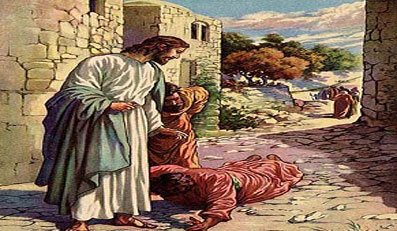 (Luke 7:1-6 NIV) When Jesus had finished saying all this in the hearing of the people, he entered Capernaum. {2} There a centurion’s servant, whom his master valued highly, was sick and about to die. {3} The centurion heard of Jesus and sent some elders of the Jews to him, asking him to come and heal his servant. {4} When they came to Jesus, they pleaded earnestly with him, “This man deserves to have you do this, {5} because he loves our nation and has built our synagogue.” {6} So Jesus went with them. He was not far from the house when the centurion sent friends to say to him: “Lord, don’t trouble yourself, for I do not deserve to have you come under my roof.



 Proud to be TJ's man