RSS

The Church as Family


“A happy family is but an earlier heaven.”

The family you come from isn’t as important as the family you’re going to have.”

“A family is a unit composed not only of children but of men, women, an occasional animal, and the common cold.”

A dad is a fellow who has replaced the currency in his wallet with snapshots of his family.

Being one of nine children, I’m used to hearing remarks about the size of our family. Once when my father had taken four of us to the grocery store, a woman asked him, “Are these all your children?”  “Oh, no,” he innocently replied.  Seeing the look of relief on her face, Dad said with a twinkle in his eye, “The other five are at home.”

Herbert Prochnow tells of a little girl who wrote in an essay on PARENTS: “We get our parents at so late an age that it’s impossible to change their habits.”

A family is more than a collection of human beings who are blood kin.  A family is more than the sum of its parts.  It is a living, shaping, powerful unit that teaches us our most important lessons in life.  It teaches us who we are, how to act, whom to relate to, and what is important in life.

A healthy family

1. communicates and listens

2. affirms and supports one another

3. teaches respect for others

4. develops a sense of trust

5. has a sense of play and humor

6. exhibits a sense of shared responsibility

7. teaches a sense of right and wrong

8. has a strong sense of family in which rituals and traditions abound

9. has a balance of interaction among members

10. has a shared religious core

11. respects the privacy of one another

12. values service to others

13. fosters family table time and conversation

14. shares leisure time

15. admits to and seeks help with problems.

In her best-seller, What Is a Family?, Edith Schaeffer devotes her longest chapter to the idea that a family is a perpetual relay of truth.  A place where principles are hammered and honed on the anvil of everyday living.  Where character traits are sculptured under the watchful eyes of moms and dads.  Where steel-strong fibers are woven into the fabric of inner constitution. The relay place.  A race with a hundred batons.

  • Determination.  “Stick with it, regardless.”      
  • Honesty.  “Speak and live the truth – always.”            
  • Responsibility.  “Be dependable, be trustworthy.”      
  • Thoughtfulness.  “Think of others before yourself.”  
  • Confidentiality.  “Don’t tell secrets.  Seal your lips.”   
  • Punctuality.  “Be on time.”      
  • Self-control.  “When under stress, stay calm.”            
  • Patience.  “Fight irriatability.  Be willing to wait.”       
  • Purity.  “Reject anything that lowers your standards.”
  • Compassion.  “When another hurts, feel it with him.”            
  • Diligence.  “Work hard.  Tough it out.”

And how is this done?  Over the long haul, believe me.  This race is not a sprint, it’s a marathon.  There are no 50-yard dash courses on character building.  Relays require right timing and smooth handoffs – practiced around the track hour after hour when nobody is looking.  And where is this practice track? Where is this place where rough edges cannot remain hidden, must not be left untouched?  Inside your own front door.  The home is God’s built-in training facility.

People are blind to what they really need. They need family, and they need religion. Period. There is such an incredible strength in family, and religion gives you respectability, responsibility and a reverence for life.

During a visit to the children’s Bible class, my preacher friend looked into their serious faces and asked, “Why do you love God?” After a moment a small voice came from the back: “I guess it just runs in the family.”

The Church: A Radical Community

Letter to Diognetus (AD 125): “Although they live in Greek and barbarian cities alike, as each man’s lot has been cast, and follow the customs of the country in clothing and food and other matters of daily living, at the same time (Christians) give proof of the remarkable and admittedly extraordinary constitution of their own commonwealth. They live in their own countries, but only as aliens…they busy themselves on earth, but their citizenship is in heaven. They obey the established laws, but in their own lives they go beyond what the laws require. They love all man, and by all men are persecuted…

Letter to Hadrian (AD 125): “The Christians know and trust their God…If any of them have bondwomen or children, they persuade them to become Christians for the love they have toward them; and when they become so, they call them “brother” without distinction. They love one another…If they see a stranger, they take him into their dwellings and rejoice over him as a real brother; for they do not call each other brother after the flesh, but after the Spirit of “”God. If any among them is poor and needy, and they do not have food to spare, they fast two or three days that they may supply him with necessary food. But, the deeds which they do, they do not proclaim to the ears of the multitude, but they take care that no man shall perceive them. Thus they labor to become righteous. Truly, this is a new people and there is something divine in them.”

(Mark 3:32-35)  “A crowd was sitting around him, and they told him, “Your mother and brothers are outside looking for you.” {33} “Who are my mother and my brothers?” he asked. {34} Then he looked at those seated in a circle around him and said, “Here are my mother and my brothers! {35} Whoever does God’s will is my brother and sister and mother.””

When the first Christians were made part of the New Testament church, begun on the day of Pentecost in Acts 2, they knew hardly anything of Jesus and nothing at all of the “church.” Yet, immediately, they were thrust into a fellowship of other believers – a radical, consuming community which supplanted every other loyalty.

They “devoted themselves” to meeting with a relative strangers (Acts 2:42). They sold their possessions to support one another (Acts 4). They met daily with their new friends to worship and commune in each other’s homes (Acts 2:46). They even rejoiced together when suffering persecution and ridicule!

All this had a revolutionary impact on the families, businesses, and friendships of these first Christians. Old loyalties were exchanged for new ones. The church became almost overnight the primary “reference group” for its members.

In the New Testament, the church  commands the primary allegiance of disciples. No other group of people is allowed to take precedence over God’s people.

Even family ties were subordinated to the family of God. Families of origin were put at risk and even broken:

(Mark 10:29-30)  “”I tell you the truth,” Jesus replied, “no one who has left home or brothers or sisters or mother or father or children or fields for me and the gospel {30} will fail to receive a hundred times as much in this present age (homes, brothers, sisters, mothers, children and fields–and with them, persecutions) and in the age to come, eternal life.”

(1 Cor 7:12-15)  “To the rest I say this (I, not the Lord): If any brother has a wife who is not a believer and she is willing to live with him, he must not divorce her. {13} And if a woman has a husband who is not a believer and he is willing to live with her, she must not divorce him. {14} For the unbelieving husband has been sanctified through his wife, and the unbelieving wife has been sanctified through her believing husband. Otherwise your children would be unclean, but as it is, they are holy. {15} But if the unbeliever leaves, let him do so. A believing man or woman is not bound in such circumstances; God has called us to live in peace.”

This radical sense of community was true of the first century church. Is it true of the church today? Is it true that many other loyalties compete with our devotion to the body of Christ?

Old-school way of thinking:

John Donne, 1633, Holy Sonnets: “No man is an island, entire of itself; every man is a piece of the Continent, a part of the main; if a clod be washed away by the sea, Europe is the less…Any man’s death diminishes me, because I am involved in Mankind; and therefore never send to know for whom the bell tolls; it tolls for thee.”

Modern way of thinking:

“I have no need of friendship, friendship causes pain; its laughter and its loving I disdain…If I never loved I never would have cried…I have my books and my poetry to protect me; I am shielded in my armor. Hiding in my room, safe within my womb, I touch no one and no one touches me. I am a rock, I am an island; and a rock feels no pain, and an island never cries.” (Paul Simon, 1965, I Am A Rock).

All that mattered in 1st Century was being in Christ

(Gal. 3:26-29)  “You are all sons of God through faith in Christ Jesus, {27} for all of you who were baptized into Christ have clothed yourselves with Christ. {28} There is neither Jew nor Greek, slave nor free, male nor female, for you are all one in Christ Jesus. {29} If you belong to Christ, then you are Abraham’s seed, and heirs according to the promise.”

 
1 Comment

Posted by on August 7, 2017 in Church


The Church as the Bride of Christ 


Years ago, every married couple reading this has stood in front of a group of people very similar to this one and made some statements we call “vows” to each other: “Do you take this woman to be your wife? Do you promise to love her, honor her, and submit to her? Do you promise to stay with her and stand by her for as long as you both shall live?”……

There were differences in the details of the vows, in the styles of  weddings, etc., but we each were in circumstances that presented a strong potential:
· we repeated the right words and said “I do” in the right place
· we heard ourselves promise love, honor, obedience, respect, and faithfulness
· every one of us fully believed we’d keep to promises made
· we believed our marriage would be better than any we had ever seen

Many times, the reality and the ideal don’t match. It hasn’t surprised us this week to find that the ‘marriage’ of God and the church has its ‘ups and downs,’ too.

(Isa 62:5) “As a young man marries a maiden, so will your sons marry you; as a bridegroom rejoices over his bride, so will your God rejoice over you.”

(Hosea 2:16-20) “”In that day,” declares the LORD, “you will call me ‘my husband’; you will no longer call me ‘my master.’ {17} I will remove the names of the Baals from her lips; no longer will their names be invoked. {18} In that day I will make a covenant for them with the beasts of the field and the birds of the air and the creatures that move along the ground. Bow and sword and battle I will abolish from the land, so that all may lie down in safety.  {19} I will betroth you to me forever; I will betroth you in righteousness and justice, in love and compassion. {20} I will betroth you in faithfulness, and you will acknowledge the LORD.”

(2 Cor 11:2) “I am jealous for you with a godly jealousy. I promised you to one husband, to Christ, so that I might present you as a pure virgin to him.”

(Rev 21:2) “I saw the Holy City, the new Jerusalem, coming down out of heaven from God, prepared as a bride beautifully dressed for her husband.”

What are some things that makes for a successful marriage? (Must happen in our earthly marriages and also in our marriage to Christ).
· Communication
· Accent the positive
· Don’t rundown in front of others
· Don’t make a list for him..make it for yourself
· Faithfulness (discuss sexual purity here and what God has set in place for those who are married).

Reliving the church’s vows: “Do you, church, take Jesus to be your husband? Do you promise to love him, honor him, and submit to him? Do you promise to stay with him and stand by him for as long as you live?”….

Christians have made similar vows in principle for over 2,000 years and meant every word they said. They believed Jesus was the Son of God. They wanted to make Him both their Master and Lord. They spoke with sincerity, conviction, and hope.

But, like Israel, the faithfulness hasn’t always followed:
(Jer 3:8) “I gave faithless Israel her certificate of divorce and sent her away because of all her adulteries. Yet I saw that her unfaithful sister Judah had no fear; she also went out and committed adultery.”

(Hosea 2:2-4) “”Rebuke your mother, rebuke her, for she is not my wife, and I am not her husband. Let her remove the adulterous look from her face and the unfaithfulness from between her breasts. {3} Otherwise I will strip her naked and make her as bare as on the day she was born; I will make her like a desert, turn her into a parched land, and slay her with thirst. {4} I will not show my love to her children, because they are the children of adultery.

James 4:4: “You adulterous people, don’t you know that friendship with the world is hatred toward God? Anyone who chooses to be a friend of the world becomes an enemy of God.”

The Medium, Measure and Means of Loyalty

(Eph 5:24-27) “Therefore, just as the church is subject to Christ, so let the wives be to their own husbands in everything. {25} Husbands, love your wives, just as Christ also loved the church and gave Himself for her, {26} that He might sanctify and cleanse her with the washing of water by the word, {27} that He might present her to Himself a glorious church, not having spot or wrinkle or any such thing, but that she should be holy and without blemish.”

If the husband makes Christ’s love for the church the pattern for loving his wife, then he will love her sacrificially. Christ gave himself for the church; so the husband, in love, gives himself for his wife.

The husband’s love will also be a sanctifying love. The word sanctify means “to set apart.” In the marriage ceremony, the husband is set apart to belong to the wife, and the wife is set apart to belong to the husband. Any interference with this God-given arrangement is sin.

Our Christian homes are to be pictures of Christ’s relationship to His church. Each believer is a member of Christ’s body, and each believer is to help nourish the body in love

We are one with Christ. The church is His body and His bride, and the Christian home is a divinely ordained illustration of this relationship. This certainly makes marriage a serious matter. The root of most marital problems is sin, and the root of all sin is selfishness.

Submission to Christ and to one another is the only way to overcome selfishness, for when we submit, the Holy Spirit can fill us and enable us to love one another in a sacrificial, sanctifying, satisfying way—the way Christ loves the church.

An All-Inclusive Message
The message of the church is inclusive:

· it is a message of salvation for all souls
· of enlightenment for all minds
· of comfort for all hearts
· of relief for all needs
· of challenge for every life.

It has a message from God and stands for a Redeemer with a message of liberty and a dispensation of grace. It is the guardian of human rights, the hope of humanity and of peace.

It has not come without a high price The cost of the church has been faithfulness and loyalty under persecution. The price has been paid in blood, from that of Christ and the first century Christians to hundreds martyred since.

We have a sacred obligation
The church is God’s tool for proclaiming Christ’s ideals and principles for life. It is founded on sacrifice and maintained by sacrifice. It appeals to the highest instincts of the human heart.

THE MEASURE OF LOYALTY
If our supreme loyalty is to Christ, then self and others will find their rightful place. Christ demands and deserves first place in our life.  (Mat 10:32-42) “”Therefore whoever confesses Me before men, him I will also confess before My Father who is in heaven. {33} “But whoever denies Me before men, him I will also deny before My Father who is in heaven.  {34} “Do not think that I came to bring peace on earth. I did not come to bring peace but a sword. {35} “For I have come to ‘set a man against his father, a daughter against her mother, and a daughter-in-law against her mother-in-law’; {36} “and ‘a man’s enemies will be those of his own household.’ {37} “He who loves father or mother more than Me is not worthy of Me. And he who loves son or daughter more than Me is not worthy  of Me. {38} “And he who does not take his cross and follow after Me is not worthy of Me. {39} “He who finds his life will lose it, and he who loses his life for My sake will find it.  {40} “He who receives you receives Me, and he who receives Me receives Him who sent Me. {41} “He who receives a prophet in the name of a prophet shall receive a prophet’s reward. And he who receives a righteous man in the name of a righteous man shall receive a righteous man’s reward. {42} “And whoever gives one of these little ones only a cup of cold water in the name of a disciple, assuredly, I say to you, he shall by no means lose his reward.””

The real peril is from within:
“The compelling need of our churches is neither larger numbers, more money, nor different programs, but a fuller consecration of the lives of individual church members to Jesus Christ.  “Carelessness, prayerlessness, indifference, lowering of ideals, and open inconsistency of professed Christians within the church constitutes a greater menace to the cause of our Lord than indifference, opposition, infidelity, atheism, or other issues without the church. “The neglect of the devotional life brings flabbiness, indifference and unhappiness. Church discipline seems to have been largely discarded. The standard of Christ is the demand of the times.”

THE MEANS OF EXPRESSING LOYALTY
1. By our priority allegiance
If I truly belong as a husband and wife belong to each, or as children belong to parents, the church will have a real claim upon my personality, my powers, and my possessions.

We ought to be ashamed of ourselves when we put our children’s sports, homework, or recreation activities ahead of our worship and Bible classes!  We ought to be ashamed of ourselves when we work all week no matter how we feel and use it as an excuse to miss worship!

1. By uplifting influence
Jesus demands from each of us a high standard of moral and ethical  conduct. He demands personal purity…” Eph 5:3 But among you there must not be even a hint of sexual immorality, or of any kind of impurity, or of greed, because these are improper for God’s holy people.”

“It is very possible that our churches are suffering a greater loss to the influence for good through the social activities of the individual members than at any other point.  “If we are as loyal and as earnest as we should be about this business of Christianity, we will not go places and do things that are  calculated to retard the progress of the church to which we belong. Uncompromising loyalty to Christ wherever we are placed is one of the inescapable obligations and privileges of the Christian life.”

2. By Christ-like deeds
We might not see ourselves as flattering pictures of Christ, but in the things we say and do, we remind people that Christ dwells upon earth.

“Christianity is more than a vision…it is a life, a power, a mission for God. It is going somewhere; it is accomplishing something; it is increasing the forces of righteousness; it is translating routine into duty; it is making drudgery divine; it is finding out God and cooperating with Him in everyday life.

 
Leave a comment

Posted by on August 3, 2017 in Church


Satan’s use of ‘perfectionism, guilt and shame’


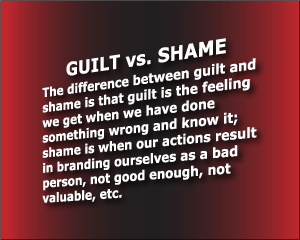
Guilt-vs.-Shame1 Revelation 12:10 (NIV)
10  Then I heard a loud voice in heaven say: “Now have come the salvation and the power and the kingdom of our God, and the authority of his Christ. For the accuser of our brothers, who accuses them before our God day and night, has been hurled down.

2 Corinthians 7:10 (NIV)
10  Godly sorrow brings repentance that leads to salvation and leaves no regret, but worldly sorrow brings death.

Suppose that the believer does not take advantage of his victorious position in Christ. Suppose he refuses to use the spiritual defenses provided. Suppose the believer sins. What then?

You would think that Satan, having led the person into sin, would then leave him to suffer the consequences; but this is not what happens. Satan has one more strategy that can make the disobedient Christian doubly defeated.

When you and I have disobeyed God, Satan moves in for that finishing stroke. He attacks us in our heart and conscience. “So you are a Christian! You go to church, you read your Bible, you even seek to serve the Lord. And look what you have done! If your friends at church knew what kind of a person you really were, they would throw you out!”

See how subtle and merciless Satan really is. Before we sin—while he is tempting us—he whispers, “You can get away with this!” Then after we sin, he shouts at us, “You will never get away with this!”

Have you ever heard his hateful voice in your heart and conscience? It is enough to make a Christian give up in despair!

 It is important that we learn to distinguish between Satan’s accusations and the Spirit’s conviction. A feeling of guilt and shame is a good thing if it comes from the Spirit of God. If we listen to the devil, it will only lead to regret and remorse and defeat.

When the Spirit of God convicts you, he uses the Word of God in love and seeks to bring you back into fellowship with your Father.

When Satan accuses you, he uses your own sins in a hateful way, and he seeks to make you feel helpless and hopeless.

Judas listened to the devil and went out and hanged himself. Peter looked at the face of Jesus and wept bitterly, but later came back into fellowship with Christ.

When you listen to the devil’s accusations (all of which may be true), you open yourself up to despair and spiritual paralysis. “My situation is hopeless!” I have heard more than one Christian exclaim, “I’m too far gone—the Lord could never take me back.” When you have that helpless, hopeless feeling, you can be sure Satan is accusing you.

 As long as you are feeling guilty, you are under indictment and you are moving farther and farther from the Lord. True conviction from the Spirit will move you closer to the Lord.

Satan wants you to feel guilty. Your heavenly Father wants you to know that you can be forgiven. Satan knows that if you live under a dark cloud of guilt, you will not be able to witness effectively or serve the Lord with power and blessing.

Sad to say, there are some ministers/churches that major in guilt. They seem to feel that unless a Christian goes home from service feeling like a failure, the services have not been a blessing.

Definitions and Key Thoughts

Guilt is a feeling of deep regret or remorse caused by feeling responsible for a failure or loss.

Guilt can lead to shame if the feelings of guilt are based on an act or acts that were thought to be sinful or displeasing to an authority figure.

There is a difference between feeling guilty and actually being guilty. If a moral law has been violated, a person is guilty, regardless of whether or not he feels guilty. On the other hand, just feeling guilty doesn’t mean that a moral law has been violated.

It is important to clarify whether the guilt is caused by a sinful act or from inappropriate regret.

True guilt is caused by sin and is God’s way of calling us to repentance and restitution.

False guilt is a burden of responsibility and blame we place on ourselves for failure to live up to our own or someone else’s expectations.

Paul had a situation like that in the church at Corinth. One of the members had fallen into sin and had refused to repent and make things right with God and the church.

1 Corinthians 5:1-6 (ESV)
1  It is actually reported that there is sexual immorality among you, and of a kind that is not tolerated even among pagans, for a man has his father’s wife.
2  And you are arrogant! Ought you not rather to mourn? Let him who has done this be removed from among you.
3  For though absent in body, I am present in spirit; and as if present, I have already pronounced judgment on the one who did such a thing.
4  When you are assembled in the name of the Lord Jesus and my spirit is present, with the power of our Lord Jesus,
5  you are to deliver this man to Satan for the destruction of the flesh, so that his spirit may be saved in the day of the Lord.
6  Your boasting is not good. Do you not know that a little leaven leavens the whole lump?

2 Corinthians 2:6 (ESV) 6  For such a one, this punishment by the majority is enough,

At first, when this sin was detected, the Corinthian believers were very complacent and refused to act. Paul’s letter shocked them into their senses; but then they went to the other extreme and made it so hard on the offender that they would not forgive him!

So Paul had to counsel them,So that on the contrary you should rather forgive and comfort him, lest somehow such a one be overwhelmed by excessive sorrow. Wherefore I urge you to reaffirm your love for him…in order that no advantage be taken of us by Satan; for we are not ignorant of his schemes. 2 Corinthians 2:7, 8, 11

Excessive guilt and sorrow can only lead to depression, despair, and defeat. Sometimes it leads to destruction.

The first epistle of John was written against the teaching of the Gnostics of that time…and we still have some of their ‘way of thinking’ at work in our congregations. It’s the idea that we can grow as individuals to the point that we will eventually be perfect…the discussion of perfectionism.

 1 John 1:8-10 (ESV)
8  If we say we have no sin, we deceive ourselves, and the truth is not in us.
9  If we confess our sins, he is faithful and just to forgive us our sins and to cleanse us from all unrighteousness.
10  If we say we have not sinned, we make him a liar, and his word is not in us. 
Jesus Christ stands at God’s right hand to intercede for us!

1 John 2:1 (ESV)
1  My little children, I am writing these things to you so that you may not sin. But if anyone does sin, we have an advocate with the Father, Jesus Christ the righteous.

Dealing with True Guiltth

Guilt caused by sin requires an understanding of confession and forgiveness.

This kind of guilt is prompted by the Holy Spirit working in the conscience. The individual is motivated to confess sin and experience God’s cleansing.

Confession, request for forgiveness, and/or restitution needs to happen if possible (that is, if the person hurt is still alive, or if restitution is able to be made in any form).

Move On

Once you’ve confessed, apologized, and made restitution, don’t beat yourself up anymore, Leave it with God.

Turn off the mental tape player. Satan, not the Holy Spirit, is the accuser Rev. 12:10). Satan wants to create feelings of condemnation resulting in unnecessary guilt. Turn him off!

Keep a “guilt pot:’ Anytime you feel guilt creeping in, write that guilt feeling on a piece of paper and throw it in the pot. (The pot will remind you that God is the Potter, always at work on you, and you are merely the clay-Isaiah 64:8,)

This perfecting ministry has two aspects to it. As our High Priest, Jesus Christ intercedes for us and provides the grace that we need when we are tested and tempted. If by faith we turn to him and come to the throne of grace, he will see us through to victory.

But if we yield to temptation and sin, then he ministers as our Advocate to forgive us and restore us to fellowship once again.

LOVE FOR ALL song (136)

Love for all and can it be? Can I hope it is for me…I, who strayed so long ago, Strayed so far, and fell so low?

I, the disobedient child, Wayward, passionate and wild…I, who left my Father’s home, In forbidden ways to roam

To my Father can I go? At His feet myself I’ll throw; In His house there yet may be, Place a servant’s place for me.

See! my Father waiting stands; See! He reaches out His hands: God is love, I know, I see, Love for me, yes, even me.

Biblical Insights

So he said, “I heard Your voice in the garden, and I was afraid because I was naked; and I hid myself– Genesis 3:10

Adam already knew he had sinned, He felt an inner awareness of wrongdoing called guilt, given by God as an internal corrective. The realization of guilt could have brought Adam to repentance and confession, Instead, Adam tried to cope with guilt and shame by avoidance and denial.

As long as we blame others and refuse to take responsibility for our wrong actions, we remain mired in sin, Guilt cuts us off from God’s redemptive healing. God invites us to be honest about our sin and confess it to Him, When we do, God is “faithful and just to forgive us our sins and to cleanse us from all unrighteousness” (1 John 1:9),

At the evening sacrifice I arose from my fasting; and having torn my garment and my robe, I fell on my knees and spread out my hands to the Lord my God. And I said: “0 my God, I am too ashamed and humiliated to lift up my face to You, my God; for our iniquities have risen higher than our heads, and our guilt has grown up to the heavens.” -Ezra 9:5-6

Despite our mistakes and failures, God is willing to meet us at our point of need. Sometimes we can make amends by specific action. At other times we suffer the consequences of our sin, but through repentance, we can experience God’s grace and love.

Then Jesus said to those Jews who believed Him, “If you abide in My word, you are My disciples indeed. And you shall know the truth, and the truth shall make you free. . . Most assuredly, I say to you, whoever commits sin is a slave of sin. And a slave does not abide ill the house forever, but a son abides forever. Therefore if the Son makes you free, you shall be free indeed.” -John 8:31-36

No truth is more glorious to imprisoned people than to be told that they are no longer condemned but are set free! Christ brings that good news.

Often, however, believers who have been set free still keep themselves behind bars. They feel guilty about their past, or that they can’t be perfect in this life.

The feeling of guilt is healthy and productive when it helps us to know when we have done something wrong. But oppressive guilt can also keep people from being able to rejoice in their new life in Christ. That kind of guilt is a prison. We needn’t stay locked up if Christ has set us free.

There is therefore now no condemnation to those who are in Christ Jesus, who do not walk according to the flesh, but according to the Spirit. -Romans 8:1

Failure to keep the law perfectly leads to condemnation. Since no one can keep God’s law perfectly, all people are condemned. The law brings guilt because people realize they are powerless to keep it. Christ’s death for us, however, sets us free. If Christ no longer condemns us, then neither should we condemn ourselves.

 But I don’t ‘feel’ forgiven…I don’t ‘feel’ saved. This might be true because

  1. We do not believe God
  2. We do not see ourself as God sees us

 1 John 1:5-8 (ESV)
5  This is the message we have heard from him and proclaim to you, that God is light, and in him is no darkness at all.
6  If we say we have fellowship with him while we walk in darkness, we lie and do not practice the truth.
7  But if we walk in the light, as he is in the light, we have fellowship with one another, and the blood of Jesus his Son cleanses us from all sin. 
Do not listen to the voice of the devil! Instead, listen to the voice of God. Turn to the Word and believe what God says.

Rest assure that your Advocate in heaven is waiting to forgive you and restore you. To delay admitting and confessing sin is only to give Satan a greater opportunity to damage your life and ministry.

 
Leave a comment

Posted by on July 31, 2017 in Encouragement, Sermon


The Church and Us…and Church Loyalty


I want to discuss very candidly today the place, the plan, the purpose, and the power of the church.

Jesus established and loved the church. He commanded his people to be loyal to it and to always give it priority affection and faithful support.

Loyalty has a martial ring to it. We think of our country and the nation’s flag. Loyalty stirs within us something high and holy. We like to think of ourselves as loyal, stalwart, and true.

In Nashville is a statue of one of the Confederacy’s heroes, Sam Davis, who uttered some immortal words: “I would die a thousand deaths, before I would betray a friend.”

The Place of Loyalty
Loyalty is the willing, practical devotion of self and substance to a person or a cause that is believed to be supremely worthwhile. It carries with it faithfulness, trust and confidence.

I would suggest that church loyalty runs much deeper: it calls for devoted allegiance to a Person and a cause. It involves decision, devotion, faithfulness, trustworthiness, and sacrifice.

Josiah Royce called loyalty “the chief of all virtues, the center of all beauty, the fulfillment of the moral law, and the very heart of religion.”

An individual without loyalty is like a ship without a compass. There may be much activity and much “going about” but it will often have little purpose and be unprofitable. Loyalty gives purpose, direction and drive to life.

In any list of Christian virtues, loyalty ranks high…we recognize it in scripture as faithfulness:

(Mat 23:23) “”Woe to you, teachers of the law and Pharisees, you hypocrites! You give a tenth of your spices–mint, dill and cummin. But you have neglected the more important matters of the law–justice, mercy and faithfulness. You should have practiced the latter, without neglecting the former.”

(Rom 3:3) “What if some did not have faith? Will their lack of faith nullify God’s faithfulness?”

(Gal 5:22) “But the fruit of the Spirit is love, joy, peace, patience, kindness, goodness, faithfulness,”

(3 John 1:3) “It gave me great joy to have some brothers come and tell about your faithfulness to the truth and how you continue to walk in the truth.”

(Rev 13:10) “If anyone is to go into captivity, into captivity he will go. If anyone is to be killed with the sword, with the sword he will bekilled. This calls for patient endurance and faithfulness on the part of the saints.”

In our daily lives, there are numerous ‘loyalties’ clamoring for devotion and interest. We must stand firm in our efforts to be loyal to God, to the faith, to the church, to friends and family, and to self!

“Lord,” I said, “I want to be your man, not my own. So to you I give my money, my car—even my home.”
Then, smug and content, I relaxed with a smile…and whispered to God, “I’ll bet it’s been a while since anyone has given so much, so freely?” His answer surprised me. He replied, “Not really. “Not a day has gone by since the beginning of time, that someone hasn’t offered meager nickels and dimes, golden altars and crosses, contributions and penance, stone monuments and steeples; but why not repentance?

“The money, the statues, the cathedrals you’ve built, do you really think I need your offerings of guilt? What good is money that’s meant only to salve the hurting conscience that so many of you have. “Your lips know no prayers. Your eyes, no compassion. But you will go to church (when churchgoing is in fashion).

“Just give me a tear—a heart ready to mold. And I’ll give you a mission, a message so bold—that a fire will be stirred where there was only death. And your heart will be flamed by my life and my breath.” I stuck my hands in my pockets and kicked at the dirt. It’s tough to be corrected…I guess my feelings were hurt. But it was worth the struggle to realize the though: that the cross isn’t for sale and Christ’s blood can’t be bought.”


Leave a comment

Posted by on July 27, 2017 in Church


God’s Design for the Church:  A Building — Eph. 2:19-22 


(Ephesians 2:19-22)  “Consequently, you are no longer foreigners and aliens, but fellow citizens with God’s people and members of God’s household, {20} built on the foundation of the apostles and prophets, with Christ Jesus himself as the chief cornerstone. {21} In him the whole building is joined together and rises to become a holy temple in the Lord. {22} And in him you too are being built together to become a dwelling in which God lives by his Spirit.”

Today’s church has fallen on hard times. Of course, times are always ‘difficult’ for the people of God in one way or another:

  • In the 1st century there were persecutions and the challenges of paganism
  • In the 2nd, the church fought off perverse heresies
  • In the 3rd, institutionalism undermined personal commitment

In every age, the church has faced strenuous and often brutal opposition. Our ‘hard times’ are different. We live in an increasingly ‘post-Christian’ culture, where Christ’s ethic and world-view command less respect and less toleration. The ‘me generation’ seeks to ‘live and let live’ so anyone or anything that lives by a motto ‘die to self and live for the Lord’ is distasteful.

We’re likely facing an identity crisis in today’s church; it’s a struggle with who we are and what we should be about. It threatens to undo us! It certainly wants to neutralize us in regard to our influence in this world!

We’re even having trouble ‘among ourselves’ to determine what the word ‘church means.’ That’s why we’re spend time on subjects related to the church on Sunday mornings here at Mentor.

The greatest building enterprise in the O.T. was no doubt the construction of God’s temple by Solomon.

David had wanted to build the temple, but God said no because he was a man of  war, “But God said to me, You shall not build a house for My name, because you have been a man of war and have shed blood.” (1 Chron. 28:3)

However. David was permitted to gather material for the building of the temple.        The temple was built of the finest and most expensive materials, with greatest care and craftsmanship:

  • Built of stone
  • Paneled with cedar
  • Overlaid with gold.
  • Was twice the size of the tabernacle.
  • Took seven and one-half years to build.
  • Located on  Mt Moriah, perhaps near the place where Abraham came to offer Isaac.
  • 30,000 Israelites were drafted to work on the temple, working in shifts of 10,000 per month.
  • There were 150,000 non-Israelites.
  • The supervisors of all these laborers numbered 3,850.
  • Counting 10,000 Israelites each month, it means 163,850 men worked continuously to construct the temple.

Solomon’s prayer at the dedication of the temple is one of the most beautiful prayers in scripture: (2 Chronicles 6:3-42) .

At the close of the prayer he offered 22,000 oxen and 120,000 sheep in sacrifice to God.    God sent fire to consume the sacrifice – “Now when Solomon had finished praying, fire came down from heaven and consumed the burnt offering and the sacrifices; and the glory of the Lord filled the house.  And the priests could not enter into the house of the Lord, because the glory of the Lord filled the Lord’s house” (2 Chron. 7:1-2).

The temple stood until destroyed by Nebuchadnezzar in 586 B.C.

Christ has built an even greater house for God, called by the N.T. writers, “the church.” It is the most glorious and unique structure ever built for God in the history of the world. In Ephesians 2 Paul shows the progress of the sinner from his lost state to that of salvation through God’s grace.

He closes that chapter by showing that though they had been foreigners and strangers, they were now a part of God’s great building, the church (vs. 19-22). In picturesque, figurative language, the Holy Spirit called the church God’s building.

THE CHURCH IS A “HUMAN” BUILDING!

Unlike the O.T. temple, the church, God’s N.T. building is made out of people. Each Christian provides the material out of which this building is composed. In religious circles when “the church” is spoken of, most are referring to a physical structure. When someone says, “we are going to build a new church,” it’s a building.

The comment, “you have a beautiful church”, it’s the building. When people know the real Mentor church, do they think it is beautiful?

The question, “where is your church?” it’s the building.  (address) People want to get married in the church, somehow feeling it will make for a better marriage than if they got married in a corn field.  (You would be as married, the surroundings would not be as nice.) Some feel they must be in the church to pray.  (You must be in the church to pray as a child of God, but this is not a building)

In our text, Paul said the gentiles were no longer strangers and aliens, but were part of this building. Peter made a similar analogy (1 Peter 2:4-5): “As you come to him, the living Stone–rejected by men but chosen by God and precious to him– {5} you also, like living stones, are being built into a spiritual house to be a holy priesthood, offering spiritual sacrifices acceptable to God through Jesus Christ.”

The church is a building, but a spiritual building. Each Christian is a spiritual stone in the building. They are joined or cemented together by God’s Spirit.

Paul’s picture is not that of hundreds of little organizations being grouped together to make one building. The N.T. does not describe the universal church as being made up of all the denominations of the world. It describes each congregation of Christ’s church as being complete within itself. The universal church is made up of Christians from all over the world, each serving as living stones in this spiritual structure, the church.

We must never confuse the church with a physical building. The N.T. does not have one line about a church building.

The church is commanded to assemble to worship (Heb. 10:25). This command would imply a place of assembly. It is left up to the church as to where it assembles.

According to Paul, Christians are to see themselves as God’s house, and each Christian to see himself as an important part of that house. The world will judge God’s church by Christians, not by the building or place of assembly. Let us make sure that we live as God’s building, that we live in harmony with our position as Christ’s church.

THE CHURCH IS A “LIVING” BUILDING!

A “human” building is a “living” building. Solomon’s temple was made of inanimate material. God’s building today is made up of living stones.

Paul never referred to the church as an institution. Paul saw the church as an organism, a spiritual, living building made of people. It is a living, growing, vibrant entity, not simply a group of people drawn together by common interests. This building is continually added to.

Christ is the foundation and cornerstone to hold the building together. As people are converted, they are added to the structure and it grows, but the building will never be complete.

From the beginning of the church, God adds the saved daily (Acts 2:47). The church will grow until Christ returns. Everything about the building is living:

  • God is referred to as “the living God” (Heb. 4:12) “For the word of God is living and powerful, and sharper than any two edged sword, piercing even to the division of soul and spirit, and of joints and marrow, and is a discerner of the thoughts and intents of the heart.”
  • Jesus is called the “living stone” (1 Peter 2:4).  “Coming to him as to a living stone, rejected indeed by men, but chosen by God and precious.”
  • Christians have a “living hope” (1 Peter 1:3).  “Blessed be the God and Father of our Lord Jesus Christ, who according to his abundant mercy has begotten us again to a living hope through the resurrection of Jesus Christ from the dead.”

The way Christians travel is called the “a new and living way” (Heb. 10:20). Jesus, as the eternal Christ, our mediator, “always lives” to make intercession for us (Heb. 7:25).  A Christian is not a part of an organization, but is a living stone in a living, growing, spiritual house.

THE CHURCH IS A “SPIRIT-INDWELT” BUILDING!

As houses are built to live in, so is God’s building, the church (Eph. 2:21-22). God’s dwelling place on earth is the church. He meets with and dwells among his family through the Spirit.

The church is the visible part of God on earth; God daily lives in and works through his building, the church. A house that is empty with no life within, is sad. If the church uninhabited, like any old empty house it would become worthless. But the true church is not empty, but is full of life and energy because the Spirit of God lives there.

Paganism had its temples throughout the Roman empire. Judaism had its temple in Jerusalem and its synagogues scattered throughout the Roman world where its members tried to keep the law of Moses alive.

However, the most beautiful and elaborate temple in the world, is God’s temple (1 Cor. 3:16-17):

(1 Corinthians 3:16-17)  “Don’t you know that you yourselves are God’s temple and that God’s Spirit lives in you? {17} If anyone destroys God’s temple, God will destroy him; for God’s temple is sacred, and you are that temple.”

Not a temple made with hands, but by God himself. Built upon the foundation taught by the apostles and prophets. Christ is the chief cornerstone.  God places each new Christian, as a living stone, in the building. Matters not where in the world these new stones are located – USA, Russia, Africa, Asia, etc. Because this is true, let us live with wisdom and holiness, obedience and faith.

CONCLUSION

The building of God is “human”, “living”, and “Spirit-indwelt.” If we do not build this building as instructed, we are cheating ourselves. (Story of the builder who took shortcuts on building a fine house only to learn the builder was giving him the house).

We have not only been commissioned to build a building – we have been commissioned “to be” a building. We are to be not just any house, but the very house of God. Those who fail to come into the house cheat themselves. Those who come into the house but fail to live an obedient life, cheat themselves. We cannot build a house for God as Solomon did. However, we can allow ourselves to become a part of God’s house by allowing God to add us to the house of living stones.

 
Leave a comment

Posted by on July 24, 2017 in Church


God’s Power at Work in Us – Ephesians 3:20-21


cropped-bible_study-1-960x480.jpgIf God brings you to it, He will also bring you through it. The power of God has no limit.

The flood. Did not just happen but was planned and announced to Noah at least 120 years before it happened. God controlled the rain and the fountains of the earth. His hatred of sin was shown in His power. This was not to hurt man but to preserve mankind from the destruction of sin. We still see His power today by the rainbow as a continuing covenant with man that He will not destroy the world with water.

Jonah within the big fish. Jonah thought he could run away from God, but he was wrong, for there is no hiding place. He learned how to pray from the belly of a fish in the covering of deep water, and God heard.

God caused the sun to stand still for Joshua (Joshua 10:12-14): “On the day the Lord gave the Amorites over to Israel Joshua said to the Lord in the presence of Israel: ‘O sun, stand still over Gibeon, O moon, over the valley of Aijalon.’ So the sun stood still, and the moon stopped till the nation avenged itself on its enemies, as it is written in the book of Jashar.” The sun stopped in the middle of the sky and delayed going down about a full day. There has never been a day like it before or since, a day when the Lord listened to a man. Surely the Lord was fighting for Israel!”

The Power of God works within us. God’s power is at work through us. The channel of our life must be spiritually clear so His power can flow through us. As individual Christians and as a church body we limit ourselves and truly believe that we cannot do anything. With God’s awesome power at our disposal there is no limit as to what can be done. “The one who is in you is greater than the one who is in the world” (1 John 4:4).

Jesus made a promise that we have never dared to explore.“I tell you the truth, anyone who has faith in me will do what I have been doing. He will do even greater things than these” (John 14:12). Jesus dealt with all kinds of sickness, but we have the power through His resurrection to deal with the souls of men and make them alive in Christ forever.

The God-fearing church that is open to the indwelling power of God can try the impossible. Gideon with 300 men accomplished the impossible. David accomplished the impossible against Goliath in the name of the Lord. We can take risk, be bold and sometimes impractical and unreasonable by human standards. When you try something big, just make sure that there is no way it can happen except by the power of God. Following the resurrection of Jesus, God has chosen to work His power through us.

God is Able. Here is where our faith must take over. He is able to make 9/10ths of our money go further than 10/10ths if we will faithfully bring our tithe to His storehouse. He is able to change totally a life of sin into a beautiful life of righteousness. Peter, a rough fisherman, to the fearless spokesman of God. Paul, the persecutor, to the preacher, church planter and Bible writer.

Spend time in prayer during the next few weeks asking God to help us reach out to those with whom we have an influence…ask them to come be part of that day.

 
Leave a comment

Posted by on July 20, 2017 in Church


“God Bless The U.S.A.” Isaiah 40:21-31


god bless the usaIsaiah 40:21-31 (NIV)
21  Do you not know? Have you not heard? Has it not been told you from the beginning? Have you not understood since the earth was founded?
22  He sits enthroned above the circle of the earth, and its people are like grasshoppers. He stretches out the heavens like a canopy, and spreads them out like a tent to live in.
23  He brings princes to naught and reduces the rulers of this world to nothing.
24  No sooner are they planted, no sooner are they sown, no sooner do they take root in the ground, than he blows on them and they wither, and a whirlwind sweeps them away like chaff.
25  “To whom will you compare me? Or who is my equal?” says the Holy One.
26  Lift your eyes and look to the heavens: Who created all these? He who brings out the starry host one by one, and calls them each by name. Because of his great power and mighty strength, not one of them is missing.
27  Why do you say, O Jacob, and complain, O Israel, “My way is hidden from the LORD; my cause is disregarded by my God”?
28  Do you not know? Have you not heard? The LORD is the everlasting God, the Creator of the ends of the earth. He will not grow tired or weary, and his understanding no one can fathom.
29  He gives strength to the weary and increases the power of the weak.
30  Even youths grow tired and weary, and young men stumble and fall;
31  but those who hope in the LORD will renew their strength. They will soar on wings like eagles; they will run and not grow weary, they will walk and not be faint.

Index of Leading Cultural Indicators, a statistical portrait of American behavioral trends of the past three decades.

Among the findings: Since 1960, while the gross domestic product has nearly tripled, violent crime has increased at least 560%. Divorces have more than doubled. The percentage of children in single-parent homes had tripled. And by the end of the decade 40% of all American births and 80% of minority births will occur out of wedlock. These are not good things to get used to.

In 1940 teachers identified the top problems in America’s schools as: talking out of turn, chewing gum, making noise and running in the hall. In 1990, teachers listed drugs, alcohol, pregnancy, suicide, rape and assault. These are not good things to get used to, either.

There is a coarseness, a callousness and a cynicism to our era. The worst of it has to do with our children. Our culture seems almost dedicated to the corruption of the young. People are losing their capacity for shock, disgust and outrage…

The ancients called our problem acedia, an aversion to spiritual things and an undue concern for the external and the worldly. Acedia also is the seventh capital sin—sloth—but it does not mean mere laziness. The slothful heart is steeped in the worldly and carnal, hates the spiritual and wants to be free of its demands.

When the novelist Walker Percy was asked what concerned him most about America’s future, he answered, “Probably the fear of seeing America, with all its great strength and beauty and freedom…gradually subside into decay through default and be defeated, not by the communist movement, but from within, from weariness, boredom, cynicism, greed and in the end helplessness before its great problems.”

I realize this is a tough indictment. If my diagnosis is wrong, then why, amid our economic prosperity and military security, do almost 70% of the public say we are off track? I submit that only when we turn to the right things—enduring, noble, spiritual things—will life get better.

Most important, we must return religion to its proper place. Religion provides us with moral bearings, and the solution to our chief problem of spiritual impoverishment depends on spiritual renewal. The surrendering of strong beliefs, in our private and public lives, has demoralized society.

Today, much of society ridicules and mocks those who are serious about their faith. America’s only respectable form of bigotry is bigotry against religious people. And the only reason for hatred of religion is that it forces us to confront matters many would prefer to ignore.

Today we must carry on a new struggle for the country we love. We must push hard against an age that is pushing hard against us. If we have full employment and greater economic growth—if we have cities of gold and alabaster—but our children have not learned how to walk in goodness, justice and mercy, then the American experiment, no matter how gilded, will have failed.

Do not surrender. Get mad. Get in the fight.

——————————————-

For hundreds of years, the eagle has been admired for its grandeur, its grace in flight, and its size and awesome power.

The soaring eagle is used by Isaiah the prophet to stir within us an understanding of God’s power….it’s also a picture of the true meaning of liberty…and a good beginning for our lesson today.

Every coin minted in the U.S. bears these words: “LIBERTY: In God we trust.” Our forefathers chose these words to describe the tremendous cost and sacrifice that has been paid to secure our freedom…and to acknowledge God’s hand in making and preserving this nation.

They were confident God was blessing us as a nation…and they warned future generations that the day God was not revered in America, it would cease to be a great nation.

If America has lost its way in our day, it’s because it doesn’t know its own Christian heritage. We need this knowledge to understand why “God shed His grace on Thee.”

I am personally thankful for the religious revival taking place in our land! I find weekly that people are looking for direction….for a sense of meaning…for a value system which has not been part of their family.

I believe (and you do, too) that the answers are found in Jesus Christ and in God’s Word! In Christ lies all the secrets of the universe, the origin of life, the meaning or purpose for life, the direction of history, and of life beyond.

Psalms 33:12: “Blessed is the nation whose God is the LORD, the people he chose for his inheritance.”

Proverbs 14:34: “Righteousness exalts a nation, but sin is a disgrace to any people.”

On July 4, 1776, 56 courageous men signed a Declaration of Independence, which marked the birth of this nation which, under God, was destined for world leadership. Did you realize these facts: of the 56 men:

  • Five were captured and killed by the British
  • 12 had their homes sacked, looted, occupied by the enemy, or burned
  • two lost their sons in the army; one had two sons captured
  • 9 died in the war from bullets or its hardships

The idea is that we are “a nation under God.” Our very political superstructures stand upon Biblical principles.

The forefathers understood the need of a separation of church and state but NOT a divorcement of God from government! The American system is the political expression of Christian ideas…a nation founded upon the rock of religion and rooted in the love of man.

Daniel Webster (in 1851): “Let the religious element in man’s nature be neglected, let him be influenced by no higher motives than low self-interest, and subjected to no stronger restraint than the limits of civil authority, and he becomes the creature of selfish passion or blind fanaticism. On the other hand, the cultivation of the religious sentiment represses licentiousness…inspires respect for law and order, and gives strength to the whole social fabric, at the same time that it conducts the human soul upward to the Author of its being.”

Charles Malik (in 1951..one time ambassador of the U.S.—”The good in the United States would never have come into being without the blessing and the power of Jesus Christ…I know how embarrassing this matter is to politicians, bureaucrats, businessmen and cynics; but, whatever these honored men think, the irrefutable truth is that the soul of America is at its best and highest—Christian.”

What makes America great? The land and the people have made it great for these 229-plus years. We have a generous and sharing system; we struggle for each person’s freedoms.

Thomas Jefferson: “Can the liberties of a nation be secure when we have removed the conviction that these liberties are the gift of God?”

We must also not forget: when great reform swept across Europe, it put the Bible in the hands of the people…and the Restoration Movement, of which we’re part, went further to encourage all people to go “all the way back to the Bible” to restore the New Testament pattern.

Calvin Coolidge: “The foundations of our society and our government rest so much on the teachings of the Bible that it would be difficult to support them if faith in these teachings would cease to be practically universal in our country.”

Romans 13:1-7:”Everyone must submit himself to the governing authorities, for there is no authority except that which God has established. The authorities that exist have been established by God. {2} Consequently, he who rebels against the authority is rebelling against what God has instituted, and those who do so will bring judgment on themselves. {3} For rulers hold no terror for those who do right, but for those who do wrong. Do you want to be free from fear of the one in authority? Then do what is right and he will commend you. {4} For he is God’s servant to do you good. But if you do wrong, be afraid, for he does not bear the sword for nothing. He is God’s servant, an agent of wrath to bring punishment on the wrongdoer. {5} Therefore, it is necessary to submit to the authorities, not only because of possible punishment but also because of conscience. {6} This is also why you pay taxes, for the authorities are God’s servants, who give their full time to governing. {7} Give everyone what you owe him: If you owe taxes, pay taxes; if revenue, then revenue; if respect, then respect; if honor, then honor.”

I know we’re trying desperately to be “politically correct” in our day but we’ve gone too far when we seek to change the meaning of some “tried and tested” Biblical words:

  • drunkenness is called “a social disease”
  • homosexuality is “gay rights and an alternate lifestyle”
  • perversion is now called “pornography, adult entertainment”
  • immorality is called “the new morality”
  • cheating is now “abnormal social development”

This change of words “mentality” has brought a great deal of shame to our homes and to our country:

  • 500,000 heroin addicts and 43 million Americans have experimented with marijuana
  • Crime costs us $2 billion annually; a serious crime is committed every 3.5 seconds; one robbery every 83 seconds; one murder every 27 minutes
  • 9 million alcoholics; suicide is 2nd largest killer of teens

There was a time when we legislated against those things God said were wrong. But gradually we began to tolerate, then accept, then condone openly, and even promote what was once unthinkable.

Think of some myths which are alive and well in our society:

  1. The battle isn’t real. Two greatest problems we face? “I don’t know” and “I don’t care.” The devil is described as a “roaring lion, seeking who he can devour.”
  2. Life began with blind chance. Genesis 1:1: ““In the beginning God created the heavens and the earth.”
  3. We can have morality without religion. (Romans 1:18-22) “The wrath of God is being revealed from heaven against all the godlessness and wickedness of men who suppress the truth by their wickedness, {19} since what may be known about God is plain to them, because God has made it plain to them. {20} For since the creation of the world God’s invisible qualities–his eternal power and divine nature–have been clearly seen, being understood from what has been made, so that men are without excuse. {21} For although they knew God, they neither glorified him as God nor gave thanks to him, but their thinking became futile and their foolish hearts were darkened. {22} Although they claimed to be wise, they became fools”
  4. Whatever is legal is moral. (Jesus taught in Matthew 22:21: “Give to Caesar what is Caesar’s, and to God what is God’s.”).
  5. The role of men and women is interchangeable.
  6. A fetus is not human.
  7. Pornography is a harmless adult pleasure.
  8. The church should have no voice in government. The ballot box is the best place.

I have said it before and believe it still today: we get what we deserve if we are going to elect ungodly men and women to led our country! I have little or no sympathy for any of us today if we don’t vote according to our conscience instead of a political party or according to political dogma.

1 Timothy 2: 1-6: “I urge, then, first of all, that requests, prayers, intercession and thanksgiving be made for everyone– {2} for kings and all those in authority, that we may live peaceful and quiet lives in all godliness and holiness. {3} This is good, and pleases God our Savior, {4} who wants all men to be saved and to come to a knowledge of the truth. {5} For there is one God and one mediator between God and men, the man Christ Jesus, {6} who gave himself as a ransom for all men–the testimony given in its proper time.”

 
Leave a comment

Posted by on July 19, 2017 in Encouragement


Jesus as the “I Am” and “One Sent”


c5f6b188dcd185fbe7f76b5ab2474b96Of all the Gospel writers, John places the most emphasis upon the deity of Christ through recording His actual claims about Himself. When Christ said, “Before Abraham was born, I am” (8:58), the people knew that He was claiming the very name of God that was revealed to Moses at the burning bush (Exodus 3:14). This is why the people tried to stone Him for alleged blasphemy. Christ was and is the eternal I Am. In a series of assertions, He amplified that claim:

  1. I am the bread of life (6:35).
  2. I am the light of the world (8:12; 9:5).
  3. I am the door (10:7).
  4. I am the good shepherd (10:11, 14).
  5. I am the resurrection and the life (11:25).
  6. I am the way, the truth, and the life (14:6).
  7. I am the true vine (15:1).

Other supporting statements in John include “I and the Father are one” (10:30) and “He who has seen Me has seen the Father” (14:9).

Jesus as the One Sent

As Jesus worked to establish His identity and His purpose in the minds of His listeners, He emphasized that He was “sent” from God:

  1. Jesus stated plainly that He was sent from the Father (6:57; 7:29; 8:42; 10:36).
  2. He said, “He who sent Me is with Me;…” (8:29).
  3. He spoke the words of the Father who sent Him (3:34; 7:16; 12:49; 14:24).
  4. He did the will, or the works, of the One who sent Him (4:34; 5:30, 36; 6:38, 39; 9:4).
  5. The world is called to believe in the One who was sent (6:29; 11:42; 17:8, 21, 23, 25).
  6. Jesus said, “No one can come to Me, unless the Father who sent Me draws him;…” (6:44).
  7. He said that the Father who sent Him has borne witness of Him (5:37; 8:18).
  8. He said, “He who beholds Me beholds the One who sent Me” (12:45).
  9. To accept or reject Jesus is to accept or reject the One who sent Him (5:23, 38; 12:44; 13:20).
  10. Jesus said that He would go to Him who sent Him (7:33; 16:5).
  11. He promised that eternal life would come through knowing the One who was sent (5:24; 17:3).
  12. He said that as the Father sent Him, He was sending His disciples (17:18; 20:21).
  13. Jesus warned His followers that they would be rejected by those who do not know the One who sent Him (15:21).
  14. He said that He and the One who sent Him are true (7:18, 28; 8:16, 26).
 
Leave a comment

Posted by on July 17, 2017 in Jesus Christ


The Christian View of Death


According to the Bible, death is best understood as another experience of birth. When our lives began, we lived in the narrow confines of our mothers’ bodies. We developed our capacities of hearing and seeing which could not be used in that place. Then we were born, dying in a small sense of that word, but at the same time thrust into a larger realm of life.

Now we are developing capacities which are not fully exhausted in this brief life-love for God and others. Death will bring us, if we are God’s children, into a still larger experience of life. John wrote, “Beloved, we are God’s children now; it does not yet appear what we shall be, but we know that when he appears we shall be like him, for we will see him as he is” (I John 3:2).

We all will die. But death is another experience of birth for the Christian. We emerge in the other world in the care and keeping of God. The really important death for each of occurs during this physical life when we die to sin and become alive to God. Paul wrote, “How can we who died to sin still live in it? Do you not know that all of us who have been baptized into Christ Jesus were baptized into his death? We were buried therefore with him by baptism into death, so that as Christ was raised from the dead by the glory of the Father, we too might walk in newness of life” (Rom. 6:2-4).

With our trust in God, we allow ourselves to be buried in baptism, as Jesus was buried in the tomb.

Then we are brought forth into the new, more wonderful Christian life. Later, physical death means only a change in our environment and is relatively unimportant. Paul described Jesus as the one “who abolished death and brought life and immortality to light through the gospel” (II Tim.1:10).

About A.D. 125, Aristides, a Greek writer, explained to a friend the success of a new religion he had become acquainted with: “If any righteous man among the Christians passes from this world, they rejoice and offer thanks to God and they escort his body with songs and thanksgiving as if he were setting out from one place to another nearby.”

As Death Approaches

Perhaps you have had the experience of calming a small child who was afraid of the dark. The child’s perceptions of the shadows can change remarkably when a loving parent stands by to give assurance that no harm will come. The faithful promise of the parent gives the child the peace of mind to face the darkness. It is the same way with us. We too face the shadow of fear caused by death. Because we trust the One who has conquered death, we can face the future with the confidence that we will not be harmed. Our real assurance, as death approaches, rests on the character of God, and on the teachings, the promises, and the example of Jesus.

Roland Perdue, in a manuscript meaningfully titled “I Will Die But Death Will Never Hold Me,” tells this story: During a night of fire bombing (in the days of the Blitz of London) a father and his small son ran from their burning house. Seeking some form of shelter, the father jumped into a shell hole in the yard and then he held up his arms for his son to follow. But the small boy, hearing the father’s voice urging him to jump, replied, ‘But I can’t see you.’ The father could see the child outlined against the night sky and the flickering flames, and he answered, ‘But I can see you. Jump.’

The faith by which and in which we live and which enables us to conduct our living and dying with dignity is not that we can see, but that we are seen; not that we can know without doubt, but that we are known by the God who is Lord of us in both our living and in our dying. For nothing can separate us from his love.”

“Be Ye Also Ready”

The Christian is so in tune with spiritual things and so intimate with the Lord that he neither fears nor dreads death. Each of us should strive to live in a state of readiness in case the end should come suddenly. When Christ was on the earth, he admonished his disciples, “. . . you also must be ready; for the Son of man is coming at an hour you do not expect” (Matt. 24:44). A little later he added, “Watch therefore, for you know neither the day nor the hour” (Matt.25:13).

This means, of course, that we need to have not only the superficial elements of our lives ready if the end should come suddenly, but also the deeper things. It is fine to have all of our business and personal things in good shape, but it is infinitely more important for our souls to be ready to meet God in judgment.

This means that we must have become children of God, in the manner prescribed in the New Testament, and that we must be living faithful, obedient lives, serving God and our fellow men.

The ideal is to believe early in life that Jesus Christ is the divine Son of God and to decide to follow Christ. This means repentance, or turning away from the world and its sin; this means the confession of Christ before men; this means obedience to the Lord’s command to be baptized. Then it means living as Christ lived-in purity and in concern for the needs of others.

While it is ideal to begin early in life, it is never too late to begin. One is never too old to have a genuine desire to follow Christ and to be willing to obey him.  The only ultimate tragedy of life is to die outside of Christ. What a blessing to know that not one of us need be lost.

Christ died that we might live, and invites us to come to him and to share eternal life in heaven. As the Christian faces death, he may well remember the words of the poet John Milton, “[Death is the] golden key that opens the palace of Eternity.”

 
Leave a comment

Posted by on July 13, 2017 in Doctrine


Six ways to overcome grief


god-is-loveDr. M. Norval Young has suggested six ways to overcome grief

  1. Accept the sympathy of others graciously. Sometimes they will not know how to express themselves well, but their love is sincere and you help them and yourself in leaning on them for a time.
  2. Recognize that the pain will grow more bearable. The pain of sorrow is acute, but time will help, or rather we should say God will help and he uses time to heal our hurts.
  3. Turn to the Bible with renewed thirst. Someone has said, “I opened the old, old Bible, and looked at a page of Psalms ‘til the wintry sea of my troubles was soothed as by summer calms; for the words that have helped so many, and the ages have made more clear, seemed new in their power to comfort, as they brought me their word of cheer.”
  4. Utilize the power of prayer. As Tennyson said, “There is more wrought by prayer than this world dreams of.” In the words of Frank L. Cox, “Divine comfort is greatly needed. Hearts are broken, bowed down with sorrow, filled with fear. Anxiety, bereavement, and temptation beset us. A humble prayer to “the God of all comfort” brings relief, binds up the broken heart, lightens the burden. Through prayer Jesus found relief and obtained strength to face the foe.
  5. Be even more faithful in worship. Some people make the mistake of withdrawing from the world and of closing the blinds and locking the door. The wise Christian knows that worshipping with others who have suffered will help him. He knows that grief is a common denominator and that the solace of worship will be especially helpful at this time.
  6. Look out and see others who need your help. Work is a blessing when we need to overcome sorrow. There is no substitute for getting busy helping others. The best way to honor the dead is to serve the living

Paul wrote, “I can do all things through Christ who strengthens me” (Phil. 4:13). We can even carry the burden of grief.

 
Leave a comment

Posted by on July 10, 2017 in Encouragement