RSS

Author Archives: Gary Davenport

Unknown's avatar

About Gary Davenport

Christian man, husband, father, father-in-law, and granddaddy

Great and Precious Promises… 2 Peter 1:4


Through these he has given us his very great and precious promises, so that through  them you may participate in the divine nature and escape the corruption in the world  caused by evil desires. (2 Peter 1:4)

        Great and precious promises refers to the numerous offers of divine provision found in Scripture. These promises offer us the glory and virtue of Christ as the basis for our growing participation in the divine nature. We have Christ within us, as He promised (see John 14:23), to enable us to become increasingly Christlike (see 2 Cor. 3:18).

Because we have become new creatures in Christ, we have already escaped the corruption (the moral ruin) that is in the world through lust (perverted desire). We should make our escape from this world evident to all by our godly behavior and the renewing of our mind (see Rom. 12:2). These promises are the fourth resource (vv. 1, 3) upon which believers may draw for sustaining help.

I have heard some incredible promises in my lifetime, just as you probably have also. Most often advertising promises far more than it delivers. But the promises of our text are completely reliable. Indeed, the benefits of heeding Peter’s words, and the consequences of neglecting them, are great.

Listen to his words: “For if you possess these qualities in increasing measure, they will keep you from being ineffective and unproductive in your knowledge of our Lord Jesus Christ. But if anyone does not have them, he is nearsighted and blind, and has forgotten that he has been cleansed from his past sins. Therefore, my brothers, be all the more eager to make your calling and election sure. For if you do these things, you will never fall, and you will receive a rich welcome into the eternal kingdom of our Lord and Savior Jesus Christ. (2 Peter 1:8-11)

Peter calls for diligent, disciplined, life-long effort on the part of the Christian. This is a discipleship text which requires discipline and self-denial. It is a challenge to every Christian for all the days of their lives. No Christian ever works his way through this text to move on to other pursuits.

Heeding Peter’s words keep us from being useless and unfruitful in our relationship with Jesus Christ and enables us to live in the present in light of our past conversion and our hope for the future. Doing as Peter instructs can keep us from stumbling and assure us a triumphant entry into the kingdom of our Lord. Conversely, neglecting Peter’s instruction diminishes our perception and confidence in the salvation God has provided and sets us up for a fall.

Peter’s own words should convince us to pay careful attention, for the benefits pertain to our past, our present walk, and our future hope. May we approach our text with a deep sense of its importance and an open and willing heart eager to hear and heed what God’s Spirit has revealed.

Scripture affirms that “Jesus is the yes to every promise of God.” These promises are the offers of divine provision found in the scriptures. They offer the glory and virtue of Christ to us as the basis for a growing participation in the divine nature. We have Him within us, as he promised, (John 14:23), to enable us to become increasingly Christlike (2 Corinthians. 3:18).

Because we have become new creatures in Christ we have already escaped, by new birth, the corruption (moral ruin) that is in the world through lust (perverted desire). There only remains that we shall make this escape evident to all by our changing behavior.

This expression (“divine nature”) is not different from the concepts of being born again, born from above (cf. John 3:3; James 1:18; 1 Pet. 1:23), being in Christ (cf. Rom. 8:1), or being the home of the Trinity (John 14:17–23). The precious promises of salvation result in becoming God’s children in the present age (John 1:12; Rom. 8:9; Gal. 2:20; Col. 1:27), and thereby sharing in God’s nature by the possession of His eternal life.

Christians do not become little gods, but they are “new creations” (2 Cor. 5:17) and have the Holy Spirit living in them (1 Cor. 6:19,20). Moreover, believers will partake of the divine nature in a greater way when they bear a glorified body like Jesus Christ (Phil. 3:20,21; 1 John 3:1–3)[1]

It is clear from this verse that participation in the divine nature is the starting point of Christian living, and not its goal. This participation becomes more and more evident as we allow our thinking to be renewed (Romans. 12:2) by understanding and appropriating the great and precious promises found in the scriptures. These promises are the fourth resource upon which believers may continually draw for sustaining help.

In verses 3 and 4 there is a tremendous and comprehensive picture of Jesus Christ. (i)  He is the Christ of power.  In him there is the divine power which cannot be ultimately defeated or frustrated.  In this world one of the tragedies of life is that love is so often frustrated because it cannot give what it wants to give, cannot do what it wants to do and must so often stand helpless while the loved one meets disaster.  But always Christ’s love is backed by his power and is, therefore, a victorious love.

He is the Christ of generosity.  He bestows on us all things necessary for true life and true religion.  The word Peter uses for religion is eusebeia, the characteristic meaning of which is practical religion.  Peter is saying that Jesus Christ tells us what life is and then enables us to live it as it ought to be lived.  He gives us a religion which is not withdrawal from life but triumphant involvement in it.

He is the Christ of the precious and great promises.  That does not so much mean that he brings us the great and precious promises as that in him these promises come true.  Paul put the same thing in a different way when he said that all the promises of God are Yes and Amen in Christ (2 Corinthians 1:20).  That is to say Christ says, “Yes.  So let it be,” to these promises; he confirms and guarantees them.  It has been put this way-once we know Jesus Christ, every time we meet a promise in Scripture which begins with the word “Whosoever,” we can immediately say to ourselves, “That means me.

He is the Christ by whom we escape the world’s corruption.  Peter had to meet the antinomians, the people who used the grace of God as an excuse for sin.  They declared that grace was wide enough to cover every sin; therefore, sin does not matter any more, the grace of Christ will win forgiveness for it.  For any man to speak like that is simply to show that he wants to sin.  But Jesus Christ is the person who can help us overcome the fascination of the world’s lust and cleanse us by his presence and his power.  So long as we live in this world sin will never completely lose its fascination for us; but in the presence of Christ we have our defence against that fascination

The word “corruption” has the idea of something decomposing or decaying. “Escaped” depicts a successful flight from danger. At the time of salvation, the believer escapes from the power which the rottenness in the world has over him through his fallen, sinful nature.

He is the Christ who makes us sharers in the divine nature.  Here again Peter is using an expression which the pagan thinkers well knew.  They spoke much about sharing in the divine nature.  But there was this difference-they believed that man had a share in the divine nature by virtue of being man.  All men had to do was to live in accordance with the divine nature already in them.  The trouble about that is that life flatly contradicts it.  On every side we see bitterness, hatred, lust, crime; on every side we see moral failure, helplessness and frustration.  Christianity says that men are capable of becoming sharers in the divine nature.  It realistically faces man’s actuality but at the same time sets no limit to his potentiality.  “I am come,” said Jesus, “that they may have life, and have it abundantly” (John 10:10).  As one of the great early fathers said, “He became what we are to make us what he is.”  Man has it in him to share the nature of God-but only in Jesus Christ can that potentiality be realized.

Jesus Christ is the Messiah of the divine nature or new man. Exceeding great and precious promises have been given to us. The promises are those that have to do with the divine nature of God, the divine nature that is planted within the heart of a person who believes in Jesus Christ.

When a person believes in Jesus Christ, God sends His Spirit, the Holy Spirit, to indwell the heart of the believer. God places within the heart of the believer His own divine nature and makes him a new creature and a new man. The believer is actually born again spiritually. He actually partakes of the divine nature of God through the presence of God’s Holy Spirit.

And note what happens: the believer escapes the corruption that is in the world. He lives eternally, for the divine nature of God can never die. When it is time for the believer to depart this life, quicker than the blink of an eye, his spirit is transferred into heaven, into the very presence of God Himself. Why? Because of the divine presence of God: the believer is a new creature, a new man, a person in whom the very Spirit of God Himself dwells; and the Spirit of God cannot die. The person thereby escapes the corruption of this world.

These promises are great because they come from a great God and they lead to a great life. They are precious because their value is beyond calculation.

God makes a promise; faith believes it, hope anticipates it, patience quietly awaits it. He is the God of promise. He keeps his word, even when that seems impossible; even when the circumstances seem to point to the opposite.

His promises are, virtually, obligations that he imposes upon himself. God’s promises are like the stars; the darker the night the brighter they shine. We know this because God cannot lie. “When God made his promise to Abraham, since there was no one greater for him to swear by, he swore by himself, {14} saying, “I will surely bless you and give you many descendants.” {15} And so after waiting patiently, Abraham received what was promised. {16} Men swear by someone greater than themselves, and the oath confirms what is said and puts an end to all argument. {17} Because God wanted to make the unchanging nature of his purpose very clear to the heirs of what was promised, he confirmed it with an oath. {18} God did this so that, by two unchangeable things in which it is impossible for God to lie, we who have fled to take hold of the hope offered to us may be greatly encouraged.” (Hebrews 6:13-18)

The Revised Standard Version puts it this way, “His precious and magnificent Promises.”  There are so many of God’s promises. I am told that there are over 30,000 promises that God has made His people as recorded in the Bible.

God will keep His promises.  God is faithful. He is not whimsical, capricious, or flippant. He cannot violate His own integrity nor fail to keep His promise. We would have no gospel without God’s faithfulness, no good news unless God could be counted on. Our gospel begins with the claim: Our God is faithful!

Paul tells us that God works in and through all things for the good of those who love Him. (Rom. 8:28).

Professor E. C. Caldwell ended his lecture. “Tomorrow,” he said to his class of students, “I will be teaching on Romans 8. So tonight, as you study, pay special attention to verse 28. Notice what this verse truly says, and what it doesn’t say.” Then he added, “One final word before I dismiss you — whatever happens in all the years to come, remember: Romans 8:28 will always hold true.”

That same day Dr. Caldwell and his wife met with a tragic car-train accident. She was killed instantly and he was crippled permanently. Months later, Professor Caldwell returned to his students, who clearly remembered his last words. The room was hushed as he began his lecture. “Romans 8:28,” he said, “still holds true. One day we shall see God’s good, even in this.”

Notice that his emphasis is on God’s good, not our temporary health, happiness, or prosperity. That perspective allows us to see our suffering and pain as bad in themselves, yet to be reassured that He is working in and through them to fulfill His good purposes.

When we can say, “Lord, use me any way You can to advance Your plan, ” we will have begun to understand the meaning of Romans 8:28. And, as the professor said, this verse will hold true — even through tragedy.

Yes, God is a faithful God, meaning He will keep His promises.

David Livingston, missionary to Africa went to Glasgow University to receive the honorary Doctor of Law Degree. He said, “Would you like for me to tell you what supported me through all the years of exile among people whose language I could not understand and whose attitude toward me was always uncertain and often hostile? It was this promise God had made me, “Lo, I am with you always even unto the end of the world.” “It is the Word of a Gentleman of the most strict and sacred honor.”

When David Livingston was found in the jungles down on his knees, he was cold in death. His Bible was opened to that text upon which he had placed his finger a thousand times.

We are saved by hope according to the Word of the Lord.

(Rom 8:24)  “For we are saved by hope: but hope that is seen is not hope: for what a man seeth, why doth he yet hope for?” 

(Rom 8:25)  “But if we hope for that we see not, then do we with patience wait for it.” 

New Testament hope means “certain expectation.” We are assured that what we hope for will be ours.

Two little girls were counting their pennies. One said, “I have five pennies.” The other said, “I have ten.” “No,” said the first little girl “You have just five cents, the same as I.” “But,” the second child quickly replied, “My father said that when he comes home tonight he would give me five cents, and so I have ten cents.” Trustfully, she counted what her father had promised as though she already had possession of it.

We need to appropriate these promises, believe them, and rest upon them.  A man called upon a needy widow in Scotland. She complained of her condition and remarked that her son was in Australia and doing well. “But doesn’t he help you?” he asked. “No, nothing,” she said, “He writes me once a seek but only sends little pictures.”

He asked to see them and found each of them to be a draft for ten pounds. That is the condition of God’s children. God has given us many “exceeding and precious promises” which we either are ignorant of or fail to appropriate. Many of them seem to be pretty pictures of an ideal peace and rest but are not appropriated as practical helps in daily life.

The promises of God are like keys that unlock doors of difficulty, despair, and doubt.  A scene from Pilgrim’s Progress illustrates the point.  The author John Bunyan portrays Christian, the main character in his allegory, as temporarily at a standstill on his journey to heaven. He finds himself locked in a dungeon beneath Doubting Castle. Then one morning Christian says in amazement, “What a fool am I, to lie in a stinking dungeon, when I may as well walk with liberty! I have a key in my bosom called Promise, that will, I am persuaded, open any lock in Doubting Castle.” To which Hopeful, his traveling companion, exclaims, “That is good news, good brother; pluck it out of your bosom and try!”

So Christian pulls out the key and tries it in the dungeon door. The bolt opens with ease, and Christian and Hopeful hurry out. They then proceed to the outside door that leads into the castle yard, and the key opens it too. One last barrier stands between them and freedom — an iron gate. At first the lock resists. Christian keeps working the key of promise, and finally the heavy gate swings open.

Do you find yourself locked in doubting Castle, held prisoner by despair? Choose to trust one of God’s promises and act upon it today.

Someone has give us some good advice, if we’ll only take it.  “Life is so stressful, so crowded with work and battle and burden that we need all along to fortify ourselves with the promises from God’s Book. One does not even know how to pray like he ought, if he cannot take these promises, and fill his mouth with them, and plead them before God, saying, as did one of old: “Do as thou hast said.” These promises are designed to inspirit us, and rest us, and fortify us. We do not make enough of these promises from God’s Book. They fit every condition in human life. If we will only find it, there is no condition that is not met by a promise out of God’s Book, and these promises give us a grip on spiritual realities.

I summon you today, my busy men and women, to search out these promises from God’s Book constantly and appropriate them, and make them your own, and plead them before Him. One promise from God’s Book has, times without count, anchored a human soul and kept it going in the right way.”

One has said, “No matter how dark, the promises of God all shine brightly.” God’s promises are so precious to us now while we live and they’ll be precious to us when we come to the end of life here. The promises of God will light up the death bed for the Christian.

A young preacher was called on to visit a dying saint, eighty seven years of age, who was a devout Christian. The preacher asked God to give him a message for the time. When he entered the room the old man said to him, “Sir, I am dying. For years I have been feasting upon the promises of God, but this morning I can’t remember a single one of them.” The preacher said, “Dear friend, do you think that God has forgotten any of His promises?” the old man answered, “Praise God, He will remember, won’t He?”

God helps us to stand on His promises.  We live in changing times.  It seems like our society in which we live today is jazzed up and sex drenched. Liberty has become license to sin.  I believe we have some very sad days ahead,  unless we as a nation wake up.

Moral decay is rampant. Man has taken deity out of religion.  Some today are facetious enough to tell us that Jesus Christ was only a good man. We live in an age today where men have taken the supernatural out of christianity, and say the Bible is uninspired.

Morality has been taken out of our preaching in America. So many have become hard and soured on God. Art has been changed on the cinema screen to base sex. Art for art sake can be re-phrased as Art for sex sake.  Nudity has become the subject for a lot of things. Ethics have been taken out of business.  A man’s word and handshake used to be enough, but not anymore.

Our age has taken fidelity out of marriage.  Marriage was designed to be a lifetime commitment but now people view it as temporary. Some make marriage a 90 day option.  Many try out the marriage bed before they try out marriage! We live in a day of pantomime church, pantomime christianity, a see saw theology.

Man is trying to sabotage the Bible, humanize God, deify man, minimize sin, glorify science, secularize religion, glamorize sex and neutralize our society.

On many fronts our nation is in grave danger. With all these terrible things going on in the world, I ask this question today.  Is there anything we can really depend on?

I know we can’t depend on military might, Financial institutions, religious organizations.

We conclude the only thing we can depend on anymore, is that which was always dependable.

The word of God is dependable and true. “In the beginning God”,  is the first statement in the Bible (Genesis 1:1). The next to last statement is, “Even so come Lord Jesus”. (Revelation 22:20 ). There is the alpha and the omega of divine revelation. The beginning and end of Gods message to man.

The God of the Bible is a covenant God.  he can be depended and relied upon. Psalms 119:89   reminds us that Forever O Lord thy word is settled in heaven.  Thy faithfulness is unto all generation. This passage tells us that whatever God has spoken is settled both on earth and in heaven.

When God speaks that settles a matter.  There is no room for debate.  Whether I believe it or not it is settled.  What God said about the church is settled.  What God has said about church attendance is settled.  What God says about the Lord supper is settled.  What God has said about forgiveness and love is settled. There is no room for argumentation

And when we might be prone to think God has forgotten, Peter remind us that “The Lord is not slack concerning his promises as some men count slackness, but is long-suffering toward us, not willing that any should perish but that all should come to repentance.  The writer to the Hebrews also said, Let us hold fast to the profession of our faith, for he is faithful who promised. (Hebrews 10:23).

God is dependable, trustworthy and reliable!  God can produce with all the promises he has made.  God never commits himself to something he cannot do!  In fact God can do all that he said. We can count on all the Lord has said and told us about.

Several years ago a man had a gospel meeting in a southern town.  The preacher was to stay with an elderly couple of the congregation.   The home was modest and small but filled with lots of love.  The preacher had a small room prepared for him the whole week.  The preacher and the couple had tremendous devotionals together.  This older couple was sweet and loving.  They read and prayed together that week.  The bible was worn and well marked. The preacher noticed several passages that were marked and beside the verse there was a TP beside of the passages.  The preacher asked what the markings were far.

The man said the passages that are marked , those are promises of God.  He said and the TP written beside of the verse means they have been tried and proved in my life.

He said when two of my sons were in the service our older boy died in the war.  He said I took mama to the table and held her hand and said we still have the promises of God though I son is gone.  The second boy came home from the war and the second day he was home he was killed by an automobile accident, he said that was devastating.  We lost our second son but we still have the promises of God.

My third child was a daughter.  She came home one day and her marriage was destroyed.  Her husband had become a sexual pervert.  The man took his wife and daughter and said this is terrible but we still have the promises of God.

The man said preacher after this meeting, mama will go in the hospital for some tests and the doctors told us to expect the worst. Even if she goes home to the Lord we will still have the promises of God.

A few weeks after the meeting the preacher wrote the couple and the woman had passed away from the surgery.  The note was answered and said mama’s gone but we still have the promises of God. The promises of God can help us and see us through the most difficult times of life.

Sometimes we feel short changed and cheat in life. We try to be the best person possible but things just does not turn our for us. We need to hear the promise of God.  In the by and by God will make things right for his children.  If we love and serve God, he will make things right.

Life is a tapestry of many colors and hues.  Sometimes in our lives we have dark moments.  Every life has hills and valleys. In the end of all things, our lives will look like a beautiful picture and tapestry. All things will work together for our good. Sometimes things go great, then suddenly something knocks us down into the valley of depression. God says,  keep loving and serving me, and things will work out for your good.

A crippled blacksmith was a Christian.  He had a bedridden wife and a child with polio.  The blacksmith was very happy and cheerful even in the midst of one problem after another.  A man asked him why he was so happy with all his problems.  The blacksmith took a piece of metal and placed the metal in the fire.  The blacksmith then took the metal and placed it on an anvil.  He threw it back in the fire and said it doesn’t have the right temper.  Finally after doing this several times he threw the metal on the scrap heap.   The blacksmith said, everyday I pray to God and tell him to go ahead and put me in the fire, but God, please don’t ever throw me on the scrap heap.

Sometimes in the valley of life, in the fires of life the difficult times remember God can use that experience to make us better and stronger.

I have seen people through the year that have obeyed and been changed by the word of God. Some harlots have been made holy, the doomed and the damned have become redeemed.  The lord can change the life of the most defiled and giove hope and help.

There is a land of new beginnings and that is the kingdom of God, the church.  I am glad to tell you no matter who you have been, what you have done through Christ you can me made new and clean again. The Lord offers a new beginning. That is the promise of the Lord also.

When the sinner believes on Jesus Christ, the Spirit of God uses the Word of God to impart the life and nature of God within. A baby shares the nature of its parents, and a person born of God shares the divine nature of God. The lost sinner is dead, but the Christian is alive because he shares the divine nature. The lost sinner is decaying because of his corrupt nature, but the Christian can experience a dynamic life of godliness because he has God’s divine nature within. Mankind is under the bondage of corruption (Rom. 8:21), but the believer shares the freedom and growth that is a part of possessing the divine nature.

Nature determines appetite. The pig wants slop and the dog will even eat its own vomit (2 Peter 2:22), but the sheep desires green pastures. Nature also determines behavior. An eagle flies because it has an eagle’s nature and a dolphin swims because that is the nature of the dolphin. Nature determines environment: squirrels climb trees, moles burrow underground, and trout swim in the water. Nature also determines association: lions travel in prides, sheep in flocks, and fish in schools.

If nature determines appetite, and we have God’s nature within, then we ought to have an appetite for that which is pure and holy. Our behavior ought to be like that of the Father, and we ought to live in the kind of “spiritual environment” that is suited to our nature. We ought to associate with that which is true to our nature (see 2 Cor. 6:14ff). The only normal, fruit-bearing life for the child of God is a godly life.

Because we possess this divine nature, we have “completely escaped” the defilement and decay in this present evil world. If we feed the new nature the nourishment of the Word, then we will have little interest in the garbage of the world. But if we “make provision for the flesh” (Rom. 13:14), our sinful nature will lust after the “old sins” (2 Peter 1:9) and we will disobey God. Godly living is the result of cultivating the new nature within.

[1]MacArthur, J. J. 1997, c1997. The MacArthur Study Bible (electronic ed.) . Word Pub.: Nashville.

 
1 Comment

Posted by on August 25, 2022 in Christian graces


His Divine Power Has Given…  2 Peter 1:3


His divine power has given us everything we need for life and godliness through our knowledge of Him who called us by his own glory and goodness. (2 Peter 1:3)

At some point in our life, we must realize and then admit that God’s calling the shots. He’s running the show. Either He’s in full control or He’s off His throne.

Why would we want it any other way? Deity means power. It’s guided by His glory and goodness.  At some point we’re forced to pray a simple reality: Dear God, be good to me; The sea is so wide, And my boat is so small.[1]

The apostle Paul identifies the divine power referred to here as “the power of His resurrection” (see Phil. 3:10; 4:13). This power is the third resource for godly living that Peter lists in this letter (v. 1). by glory and virtue: These words suggest the qualities of Jesus that attract believers to Him. The glory that John saw in Jesus (see John 1:14) was His authority and power. The glory that Peter saw probably was manifested at the Transfiguration (vv. 16–18). Jesus’ virtue is His moral excellence that continually awed His disciples.

These are unique expressions in the New Testament. The divine power is the power God used in raising Christ from the dead and is that same power is available to the church (Eph. 1:19, 20). This divine power has provided us with the spiritual ability to live a godly life. The divine nature is the nature that characterizes God, the nature that is expressed in holiness, virtue, righteousness, love, and grace (see 1:5–7). By being regenerated with the divine nature, believers can exhibit the same characteristics.

The genuine Christian is eternally secure in his salvation and will persevere and grow because he has received everything necessary to sustain eternal life through Christ’s power. godliness. To be godly is to live reverently, loyally, and obediently toward God. Peter means that the genuine believer ought not to ask God for something more (as if something necessary to sustain his growth, strength, and perseverance was missing) to become godly, because he already has every spiritual resource to manifest, sustain, and perfect godly living.

“Knowledge” is a key word in 2 Peter (vv. 2,5,6,8; 2:20; 3:18). Throughout Scripture, it implies an intimate knowledge (Amos 3:2), and is even used for sexual intercourse (Gen. 4:1) The knowledge of Christ emphasized here is not a superficial knowledge, or a mere surface awareness of the facts about Christ, but a genuine, personal sharing of life with Christ, based on repentance from sin and personal faith in Him (cf. Matt. 7:21).

This call, as always when mentioned in the NT epistles, is the effectual call to salvation (cf. 1 Pet. 1:15; 2:21; 5:10; see note on Rom. 8:30). This saving call is based on the sinner’s understanding of Christ’s revealed majesty and moral excellence evidencing that He is Lord and Savior. This implies that there must be a clear presentation of Christ’s person and work as the God-Man in evangelism, which attracts men to salvation (cf. 1 Cor. 2:1,2). The cross and resurrection most clearly reveal His “glory and virtue.”[2]

Peter is describing the process by which a relationship with Jesus Christ is communicated to the world at large. He says four things. First of all, he says it is His divine power that has accomplished all this. Everyone in the world wants to tap into divine power, to find within himself, in some sense, the divine life, and to tap into that. Or he wants to find it somewhere else, so that he may share in that life. That is the great concern because every man knows that somehow he has the potential to be godlike. That is his desire, if only he had the power to do it. Somehow he senses, think intuitively, that only God can be godlike, and therefore he has to find that godlike spark or life or however it is described either within himself or somewhere else. By so doing, he can then fulfill his destiny.

The second thing Paul tells us is that this divine power has to do with life and godliness. That is, it relates to every area of life. Not only life in the sense of the observable, the visible, the mundane–but also piety (the word Peter uses), godliness, the realm of the Spirit. This divine power, he says, has relevance not only for the here and now, but it has to do with spiritual things as well. That is, it touches all of life.

It concerns the use of our resources now. It concerns the problems that you face right now. This power has to do with issues just like that, not merely things that happen when you are gathered together as a body of believers here, or when you are doing something that is obviously spiritual. Paul is saying that this power has to do with all of life.

Paul identifies this power as “the power of his resurrection” (Philippians. 3:10). It is a power which all true believers possess which enables them, if they choose to count on it, to do “all things through Christ who strengthens” (Philippians. 4:13). Thus any failure to live a godly life is due to our weakness or folly and not to God’s lack of supply. As has been suggested, this power is meted to us as our knowledge of God and Jesus increases.

The Christian life begins with saving faith, faith in the person of Jesus Christ. But when you know Jesus Christ personally, you also experience God’s power, and this power produces “life and godliness.” 

When you are born into the family of God by faith in Christ, you are born complete. God gives you everything you will ever need “for life and godliness.” Nothing has to be added! God never has to call back any of His “models” because something is lacking or faulty.

Jesus Christ is the Messiah of life and godliness. What is meant by life and godliness? It means all things that are necessary for life.

First, life is the energy, the force, and the power of being. The life which Jesus Christ gives is a life of energy, force, and power.  Whatever is necessary for life is given by Christ. He longs for man to live, to have an abundance of life; therefore He gives all things that will make a person overflow with life.

Second, godliness is living like God and being a godly person. It is living life like it should be lived. God gave man life; therefore, God knows what life should be, and above all things life should be godly just like God.

The word “godliness” (eusebeian) actually means to live in the reverence and awe of God; to be so conscious of God’s presence that one lives just as God would live if He were walking upon earth. It means to live seeking to be like God; to seek to possess the very character, nature, and behavior of God. The man of God follows and runs after godliness. He seeks to gain a consciousness of God’s presence—a consciousness so intense that he actually lives as God would live if He were on earth.

It is impossible for that man to despair who remembers that his Helper is omnipotent. What God expects us to attempt, He also enables us to achieve.

Recently while reading J. Sidlow Baxter, I came across this statement. “Far too many Christians live their life on the battery system.” He went on to explain that as a boy he had ridden on battery driven street cars. When the battery was charged all was well; but when it went dead, so was the street car. Baxter goes on to make this comparison: There are Christian believers who seem to run their spiritual life and service on that system. They go to a convention on the deeper life and when they return they are altogether different, for three weeks. Or they read some powerful Christian biography and as they close the book they say, “Now my life will never be the same.” Nor is it, for three weeks. Some Christians go from crisis to crisis, convention to convention, seminar to seminar, book to book, but have a lot of dead spots in between. They seem to rely on these experiences rather than on Christ.

History tells us that when Crowfoot, the chief of the Blackfoot nation in southern Alberta, gave the Canadian Pacific Railway permission to lay track from Medicine Hat to Calgary, he was given in exchange a lifetime railroad pass.  Reportedly, Crowfoot put the pass in a leather pouch and wore it around his neck for the rest of his life — but he never once availed himself of the rights and privileges it spelled out.  What a tragedy it is when Christians do the same thing with the Word of God, using it as a decorative badge of Christianity, but never availing themselves of the wealth of access to God’s thoughts it affords.

Waste of power is a tragedy. God does not waste the great power of his Spirit on those who want it simply for their own sake, to be more holy, or good, or gifted. His great task is to carry on the work for which Jesus sacrificed his throne and his life–the redemption of fallen humanity.[3]

Martin Luther King, Jr.  offered this encouragement, “So I say to you, seek God and discover Him and make Him a power in your life. Without Him all of our efforts turn to ashes and our sunrises into darkest nights. Without Him life is a meaningless drama with the decisive scenes missing. But with Him we are able to rise from the fatigue of despair to the buoyancy of hope. With Him we are able to rise from the midnight of desperation to the daybreak of joy. St. Augustine was right–we were made for God and we will be restless until we find rest in Him.”

Over lunch, British writer G.K. Chesterton once expounded to fellow writer Alexander Woollcott on the relationship between power and authority.  “If a rhinoceros were to enter this restaurant now, there is no denying he would have great power here.  But I should be the first to rise and assure him that he had no authority whatever.” Chesterton’s vivid example is right.  There is a profound difference between power and authority — and Jesus possessed both.

In his book Forever Triumphant, F.J. Huegel told a story that came out of World War II. After General Jonathan Wainwright was captured by the Japanese, he was held prisoner in a Manchurian concentration camp. Cruelly treated, he became “a broken, crushed, hopeless, starving man.” Finally the Japanese surrendered and the war ended. A United States army colonel was sent to the camp to announce personally to the general that Japan had been defeated and that he was free and in command. After Wainwright heard the news, he returned to his quarters and was confronted by some guards who began to mistreat him as they had done in the past. Wainwright, however, with the news of the allied victory still fresh in his mind, declared with authority, “No, I am in command here! These are my orders.” Huegel observed that from that moment on, General Wainwright was in control.

Huegel made this application: “Have you been informed of the victory of your Savior in the greatest conflict of the ages? Then rise up to assert your rights. Never again go under when the enemy comes to oppress. Claim the victory in Jesus’ Name.” Huegel observed, “We must learn to stand on resurrection ground, reckoning dead the old-creation life over which Satan has power, and living in the new creation over which Satan has no power whatever.

Hudson Taylor said, “Many Christians estimate difficulty in the light of their own resources, and thus they attempt very little, and they always fail. All giants have been weak men who did great things for God because they reckoned on His power and His presence to be with them.” Like David, who said, “The battle is the Lord’s” (1 Sam 17:47), we also need to understand that Jesus is our source, and we can be directly connected to Him.

How’s your power source?  Are you plugged in?  In his book Spiritual Stamina, Stuart Briscoe tells the story of a man who bought a new computer.  Bringing his new prize home, he carefully opened the box, gingerly took the machine out, studied its manual, and connected the wires.  Eagerly he flipped on the power switch — but nothing happened.  Puzzled, the man switched the computer off and rechecked all the connections. He rounded up a screwdriver and fastened the wires more securely.  He read again the relevant portion of the manual.  Satisfied that he’d followed directions, he flipped the computer on — and again nothing happened.  As his anger rose the man’s little girl walked into the room.

“Hi, Daddy!” her cheery voice rang out.  “What a pretty computer! Can I plug it in?”

We are not told that Jesus ever taught His disciples how to preach, but He taught them how to pray. He wanted them to have power with God; then He knew they would have power with man.[4]

Two significant points are made, points that are absolutely essential for us to heed if we wish to have real life. Note where life comes from. It does not come from man himself; life is not in and of man himself. Man dies. He is a dying creature, always in the process of dying, always moving onward toward the grave. Man is as good as dead. And in the process of dying, he experiences all kinds of trials and sufferings such as sickness, disease, accident, emptiness, loneliness, corruption, evil, shortcomings, failures, lies, thefts, killings, wars, and death after death of friends and loved ones.

Man has anything but life; at best he only exists for a few years that are ever so short and frail. Where then can man find life? Who has the power to stop the process of death and to deliver us from death? No man has such power. But note this verse: there is “divine power,” the very power of Christ Himself that can stop death and give us life—life abundant, life now and life eternally. This is the power of Christ, the power to save us from death and to give us life and godliness.

Note how we receive life and godliness: by the knowledge of Christ. We must know Christ personally. We must know Him as our Savior and Lord, surrendering all that we are and have to him. We must be willing to walk and share with Him all day every day, serving Him as the Lord of our lives. We must be willing to know Him by living a godly life, by actually experiencing the life of God as we walk day by day.

Christ has called us to glory and virtue. This is the very life to which He has called us: a life of glory and moral excellence both here on this earth and in heaven. We are to live pure and righteous lives, glorious lives; and when we do, He promises to give us a place in the glory and perfection of heaven. Note that this may read in the Greek: “Christ has called us by His glory and virtue.” That is, it is His glory and virtue (moral excellence) that attracts man and pulls man to seek life and godliness in Him.

Allen Gardiner experienced many physical difficulties and hardships throughout his life. Despite his troubles, he said, “While God gives me strength, failure will not daunt me.” In 1851, at the age of 57, he died of disease and starvation while serving on Picton Island at the southern tip of South America. When his body was found, his diary lay nearby. It bore the record of hunger, thirst, wounds, and loneliness. The last entry in his little book showed the struggle of his shaking hand as he tried to write legibly. It read, “I am overwhelmed with a sense of the goodness of God.” Think of that! No word of complaint, no childish whining, no grumbling at the circumstances — just praise for God’s goodness.

God knows what is good for us better than we ourselves. Let us not make the mistake of judging God’s overall plan for our lives by that portion which happened to be revealed today. God has all eternity in which to bring His plans to fulfillment for our lives. Think not in terms of today, but in terms of eternity. After all, that’s where we’ll spend most of our life.

One of the things that impresses me is that when Abraham Lincoln went off to the Black Hawk War he was a captain and, through no fault of his own, when he returned he was a private. That brought an end to his military career. Then his little shop in a country village “winked out” as he used to say, marking his failure as a businessman. As a lawyer in Springfield, Illinois, he was too impractical, too unpolished, too temperamental to be a success.

Turning to politics he was defeated in his campaign for the legislature, defeated in his first attempt to be nominated for Congress, defeated in his application to be Commissioner of the General Land Office, defeated in the Senatorial election of 1854, defeated in his aspirations for the Vice Presidency in 1856, defeated again in the Senatorial election of 1858.

Then 1861, over 100 years ago, found him in the White House as President of the United States. How did Lincoln interpret this strange succession of failures and frustrations which finally culminated in terrific personal victory? He said, “That the Almighty directly intervenes in human affairs is one of the plainest statements in the Bible. I have had so many evidences of His direction, so many instances when I have been controlled by some other power than my own will that I have no doubt that what this power comes from above.”

If we look for it, we can see the goodness of God no matter what our circumstances.

Baseball pitcher Dan Quisenberry was a three-time All-Star reliever in the 1980s. In the winter of ’96-’97 an aggressive form of brain cancer brought him low. Even so, he always emphasized the goodness of God. Following surgery to remove a tumor, Mr. Quisenberry spoke of his gratitude: “Every day I find things to be thankful for. … Sometimes it’s just seeing a little boy on a bicycle. Sometimes it’s the taste of water. It’s hard to explain.” He died in the fall of 1997 at age 45. Mr. Quisenberry’s minister, Ted Nissen, recalled a post-surgery visit. “He was on such a high, talking about how good God had been to him,” he told the Kansas City Star. “He blessed me on that visit.”

I have been shocked by the number of Christian men and women who come to their deathbeds knowing nothing about the God of love and mercy. They have known instead the Judge of impossible standards, and they have been, naturally enough, afraid to meet that God.

When we seek to win others to Christ, we must never think we possess any power in ourselves, or lead others to believe we do, through any air of superiority or lightness as we proclaim the gospel.  We would do well to heed the advice of Dr. Payson, who said,  “Paint Jesus Christ upon your canvas, and then hold Him up to the people, but hold Him up so that not even your little finger can be seen.

A party of pioneers on the Oregon Trail had suffered for weeks from a scarcity of water and grass for their animals. Most of the wagons had broken down, causing endless delays in the stifling heat. A feeling of fretfulness and futility prevailed. Optimism and cheer were gone. Courage was in limited supply.

One night the leaders called a meeting to air complaints. When they had gathered around the campfire, one man stood up and said, “Before we commence our grief session, don’t you think we should at least first thank God that he has brought us this far with no loss of life, with no serious trouble from the Indians, and that we have enough strength left to finish our journey?

The other settlers agreed. After the brief prayer, all that could be heard was the cries of a distant pack of wolves. There was otherwise stone silence around the campfire, because no one had any grievances they felt were important enough to voice. They suddenly realized if they couldn’t be satisfied with what they’d received, they could at least be thankful for what they’d escaped. Thankfulness enabled them to see the mercies of God they had been overlooking.[5]

A teacher asked the pupils to tell the meaning of loving-kindness.  A little boy jumped up and said, “Well, if I was hungry and someone gave me a piece of bread that would be kindness.  But if they put a little jam on it, that would be loving-kindness.”

God provides for us the bread…and the jam!

[1] Breton fisherman’s prayer, quoted in Celtic Blessings and Prayers, edited by Brendan O’Malley, quoted in “Reflections,” Christianity Today, Vol. 44, No. 13.

[2]MacArthur, J. J. 1997, c1997. The MacArthur Study Bible (electronic ed.) . Word Pub.: Nashville

[3] Alan Redpath in The Life of Victory. Christianity Today, Vol. 43, no. 6.

[4] Dwight L. Moody in D. L. Moody’s Little Instruction Book. Christianity Today, Vol. 43, no. 2.

[5] Gregory L. Jantz, Becoming Strong Again (Baker, 1998), quoted in Men of Integrity, Vol. 2, no. 4.

 
Leave a comment

Posted by on August 22, 2022 in Christian graces


Grace and Peace Be Yours…In Abundance 2 Peter 1:2


“Grace and peace be yours in abundance through the knowledge  of God and of Jesus our Lord.” (2 Peter 1:2)

Jesus proclaimed early in His ministry the intentions of all actions toward mankind: The thief comes only to steal and kill and destroy; I have come that they may have life, and have it more abundantly. (John 10:10).

God never holds back in giving to His children! He lavishes love upon each of us, and is the giver of only good and perfect gifts! He never wants us to stop asking (and being thankful) through prayer and wants our praise to be often, loud and from the heart.

What is it that God gives to us so generously? Grace: giving us that which we do not deserve. Mercy: not giving us what we do deserve.

Grace and peace is a common Christian greeting in the epistles, combining Greek and Hebrew salutations. However, the phrase is more than a salutation to Peter. He sees grace and peace as blessings that spring from the knowledge of God and Jesus. The Greek word translated knowledge is a key word in this letter. It describes a special kind of knowledge, a kind that is complete. Since our knowledge of Jesus grows as we mature in the faith, we will experience His grace and peace on many different occasions in our Christian walk.

The plain and emphatic thesis of the divine word is that the Christian graces can become part of a human life only as that life is related to the power and nature of God in Christ (2 Pet 1:3-4).  There is a vast difference between “the corruption that is in the world by lust” and “the divine nature.”  We must have been delivered out of kingdom of darkness, freed from sin through the blood of Christ, to be able to develop the “divine nature.”

The Christian personality is not the cause of man’s pardon from sin, but is the result of it. One cannot develop a nature like Christ while still living in sin.

Grace (charis) means the undeserved favor and blessings of God. The word undeserved is the key to understanding grace. Man does not deserve God’s favor; he cannot earn God’s approval and blessings. God is too high and man is too low for man to deserve anything from God. Man is imperfect and God is perfect; therefore, man cannot expect anything from God.

Man deserves nothing from God except judgment, condemnation, and punishment. But God is love—perfect and absolute love. Therefore, God makes it possible for man to experience His grace, in particular the favor and blessing of salvation which is in His Son, Jesus Christ.

Peace (eirene) means to be bound, joined, and woven together. It also means to be bound, joined, and woven together with others and with God. It means to be assured, confident, and secure in the love and care of God. A person can experience true peace only as he comes to know Jesus Christ. Only Christ can bring peace to the human heart, the kind of peace that brings deliverance and assurance to the human soul.

Note that Jesus Christ multiplies grace and peace. He gives an abundance of grace and peace; He causes grace and peace to overflow in the life of the genuine believer. There is never to be a lack of grace and peace in the life of any true believer. Every believer is to always be overflowing with joy, with the favor and blessings of God and with peace within his own spirit and with God and others.

A city dweller moved to a farm and bought a cow. Shortly after he did, the cow went dry. When he reported this fact to a neighbor farmer, the farmer expressed surprise. The city man said he was surprised too. “I can’t understand it either, for if ever a person was considerate of an animal, I was of that cow. If I didn’t need any milk, I didn’t milk her. If I only needed a quart, I only took a quart.” The farmer tried to explain that the only way to keep milk flowing is not to take as little as possible from the cow, but to take as much as possible.

Is that not also true of the Christian life? Those who only turn to God in need miss the real joy that flows from a daily infilling of His Spirit.

A man must completely despair of himself in order to become fit to obtain the grace of Christ. Abounding sin is the terror of the world, but abounding grace is the hope of mankind.

As mercy is God’s goodness confronting human misery and guilt, so grace is his goodness directed toward human debt and demerit.[1]

Grace and peace are to come from knowledge, the knowledge of God and of Jesus Christ, our Lord.  This is a strengthened form of “knowledge” implying a larger, more thorough, and intimate knowledge. The Christian’s precious faith is built on knowing the truth about God (cf. v. 3). Christianity is not a mystical religion, but is based in objective, historical, revealed, rational truth from God and intended to be understood and believed. The deeper and wider that knowledge of the Lord, the more “grace and peace” are multiplied.[2]

Closely related to the emphasis on man’s poverty and God’s provisions is the important role of knowledge. Knowledge is referred to in verses 2, 3, 5, 6, and 8. Whenever man departs from God and from divine revelation, he is ignorant. Ignorance is the opposite of knowledge, and it is deadly.

Peter told the Jews that when they murdered and disowned the Holy and Righteous One, the Prince of life, they acted in ignorance (Acts 3:14-17). Likewise, the idolatry of the pagan Athenians was ignorant (Acts 17:23, 30). Paul speaks of the ignorant unbelief of the Jews (Romans 10:3) and of his own ignorance as a persecutor of the church (1 Timothy 1:13).

Peter has written in his first epistle that ignorance is evident in conforming to one’s lusts, while implying that knowledge leads to obedience (1 Peter 1:14). Peter also indicates that the resistance of unbelievers springs from ignorance (1 Peter 2:15). Later in 2 Peter we are told that false teachers are willfully ignorant of the reality of divine judgment in history (2 Peter 3:5). Ignorance is not bliss; it is death.

The New Testament instructs us that the cure for ignorance is knowledge. This is doctrinal knowledge, for it certainly is knowledge of God and knowledge from God. It is scriptural knowledge, and it is true knowledge as opposed to false knowledge. This is the knowledge that protects the believer from false teachers and their teaching.

This knowledge is also the means by which grace and peace are multiplied to us (2 Peter 1:2). Everything pertaining to life and godliness is granted to us through the knowledge of Him who called us (1:3). Knowledge is one of the virtues the Christian should diligently pursue (1:5, 6).

The knowledge of which Peter writes is the knowledge of God as taught by the divinely revealed Word of God. It is also doctrinal knowledge, a propositional knowledge. Some tell us they do not worship doctrine—they worship Jesus. But, apart from doctrine, we cannot know which Jesus we worship.

The maturing Christian is marked by his knowledge of God through the Scriptures (see Ephesians 1:15-23; 4:13; Philippians 1:9; Colossians 1:9-10; 2:2; 3:10; 1 Timothy 2:4; 2 Timothy 2:25; 3:7; Titus 1:1).

Knowledge can be perverted so that it becomes the enemy of love (see 1 Corinthians 8:1). Ideally, knowledge informs and regulates love (Philippians 1:9) and promotes godly living (Colossians 1:9-10). Godly teaching and instruction leads to love (1 Timothy 1:5). We see from the Scriptures that knowledge of God leads to intimate fellowship with God (Philippians 3:10).

Do you “know God,” or are you still ignorant? The way to know God is through His written Word and through the Word Incarnate, Jesus Christ. The Bible tells us about God, and the Lord Jesus revealed God to us in human flesh. He is God, manifested in human flesh; He died in our place and suffered the penalty for our sins. He is the righteous One who offers His righteousness to all who believe in Him, by faith. To know Christ is to know God and to have eternal life.

This knowledge leads us to a greater appreciation and understanding of grace, which binds us with far stronger cords than the cords of duty or obligation can bind us. Grace is free, but when once we take it, we are bound forever to the Giver and bound to catch the spirit of the Giver. Like produces like. Grace makes us gracious, the Giver makes us give.[3]

Because grace emanates from God, it allows us to see Him as He is. Because this is true, we see that grace is love that cares and stoops and rescues. Grace is the love that gives, that loves the unlovely and the unlovable.

Grace is the central invitation to life and the final word. It’s the beckoning nudge and the overwhelming, undeserved mercy that urges us to change and grow, and then gives us the power to pull it off. Our Lord Jesus Christ has three “spiritual commodities” that can be secured from nobody else: righteousness, grace, and peace. When you trust Him as your Saviour, His righteousness becomes your righteousness and you are given a right standing before God (2 Cor. 5:21). You could never earn this righteousness; it is the gift of God to those who believe. “Not by works of righteousness which we have done, but according to His mercy He saved us” (Titus 3:5). Grace is God’s favor to the undeserving. God in His mercy does not give us what we do deserve; God in His grace gives us what we don’t deserve. Our God is “the God of all grace” (1 Peter 5:10), and He channels that grace to us through Jesus Christ (John 1:16).

A man must completely despair of himself in order to become fit to obtain the grace of Christ. It’s the natural state of “emptying self” or “dying to self” so that God can work in our life to give that which we need the most.

When God is working in our life, we sense things about us that otherwise might go unnoticed. A state of mind that sees God in everything is evidence of growth in grace and a thankful heart.

And it makes a difference in our life! Grace binds us with far stronger cords than the cords of duty or obligation can bind us. Grace is free, but when we take it, we are bound forever to the Giver and bound to catch the spirit of the Giver. Like produces like. Grace makes us gracious, the Giver makes us give.[4]

Grace can pardon our ungodliness and justify us with Christ’s righteousness; it can put the Spirit of Jesus Christ within us; it can help us when we are down; it can heal us when we are wounded; it can multiply pardons, as we through frailty multiply transgressions.

The result of this experience is peace, peace with God (Rom. 5:1) and the peace of God (Phil. 4:6-7). In fact, God’s grace and peace are “multiplied” toward us as we walk with Him and trust His promises.

[1] A. W. Tozer (1897–1963)

[2]MacArthur, J. J. 1997, c1997. The MacArthur Study Bible (electronic ed.) . Word Pub.: Nashville

[3] E. Stanley Jones (1884–1973)

[4] E. Stanley Jones (1884–1973)


Leave a comment

Posted by on August 18, 2022 in 1 Peter, Christian graces


A Precious Faith… 2 Peter 1:1


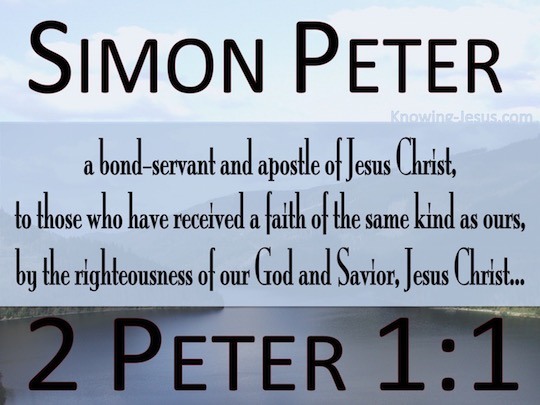
“Simon Peter, a servant and apostle of Jesus Christ, To those who through the righteousness of our God and Savior Jesus Christ have received a faith as precious as ours…” (2 Peter 1:1)

This is a great passage of Scripture. It is one of the greatest in all of Scripture. It is a passage that takes Jesus Christ and lifts Him up as the great Messiah, the Savior of the world who can meet the desperate needs of man. Here is Christ and here is the great gift of Christ the Messiah, the great gift of salvation.

The letter opens with a very subtle and beautiful allusion for those who have eyes to see it and knowledge enough of the New Testament to grasp it.

Peter identifies himself with a balance of humility and dignity. As a servant, he was on equal basis with other Christians—an obedient slave of Christ. As an apostle, he was unique, divinely called, and commissioned as an eyewitness to the resurrection of Christ

In these verses, Peter distills for us the essence of the gospel. He indicates this is not just “his” gospel, but the gospel revealed through Christ, attested to by the Father, and consistent with the teaching of the apostles.

When the Lord Jesus left His disciples to ascend and be with His Heavenly Father, He left the apostles in charge. It was to them and through them that His Word was to be conveyed to others (see Matthew 16:19; John 14:26; 16:12-15; Hebrews 1:1-2; 2:1-4; 2 Peter 1:12-19; 1 John 1:1-4).

He emphasizes that salvation was not attained by personal effort, skill, or worthiness, but came purely from God’s grace. Faith is the capacity to believe (Eph. 2:8,9). Even though faith and belief express the human side of salvation, God still must grant that faith. God initiates faith when the Holy Spirit awakens the dead soul in response to hearing the Word of God.

Nowhere is these verses does Peter speak of what we do to merit God’s salvation. He speaks of God’s grace and of His sufficient provision for our salvation in Christ. This passage has nothing to say about man’s contribution and everything to say about God’s perfection, power, and provision. The righteousness of which we partake is the righteousness of God in Christ which was bestowed upon us (verse 1). It was not that we sought after God (see Romans 3:11), but that God chose us, sought us, and “called us by His own glory and excellence” (verse 3).

I have always been fascinated with the lives of the twelve apostles. Who isn’t? The personality types of these men are familiar to us. They are just like us, and they are like other people we know. They are approachable. They are real and living characters we can identify with. Their faults and foibles, as well as their triumphs and endearing features, are chronicled in some of the most fascinating accounts of the Bible. These are men we want to know.

That’s because they were perfectly ordinary men in every way. Not one of them was renowned for scholarship or great erudition. They had no track record as orators or theologians. In fact, they were outsiders as far as the religious establishment of Jesus’ day was concerned. They were not outstanding because of any natural talents or intellectual abilities.

On the contrary, they were all too prone to mistakes, misstatements, wrong attitudes, lapses of faith, and bitter failure—no one more so than the leader of the group, Peter. Even Jesus remarked that they were slow learners and somewhat spiritually dense (Luke 24:25).

Yet with all their faults and character flaws—as remarkably ordinary as they were—these men carried on a ministry after Jesus’ ascension that left an indelible impact on the world. Their ministry continues to influence us even today. God graciously empowered and used these men to inaugurate the spread of the gospel message and to turn the world upside down (Acts 17:6). Ordinary men—people like you and me—became the instruments by which Christ’s message was carried to the ends of the earth. No wonder they are such fascinating characters.2

We especially identify with Peter, but not when he walked on water or stated his willingness to die for His Lord. That would be too easy for us to claim; our lives just don’t live up to such expressions. The times most common for us to associate with him are the “foot in mouth” situations, when we ‘talk before we think’ and speak on impulse rather than after careful thought. But look at the boldness on his lips (because it was in his heart) when he speaks of this precious faith! It is something he possessed and knew others could, too!

If anybody in the early church knew the importance of being alert, it was the Apostle Peter. He had a tendency in his early years to feel overconfident when danger was near and to overlook the Master’s warnings. He rushed ahead when he should have waited; he slept when he should have prayed; he talked when he should have listened. He was a courageous, but careless, Christian.

A fisherman by trade before he would ‘fish for men,’ Peter knew the value of something previous and of value. His livelihood depended upon that instinct. He was also quite willing for the transformation to take place that would move him from the physical to the spiritual.

Nature reveals that life can be transformed by taking something unattractive and converting it into something of beauty. By its chemical magic a tree or plant can take the dark soil and the waste carbon dioxide in the atmosphere and combine them with the aid of the healing warmth of the sun to produce green leaves, colored flowers, red roses, yellow tulips, blue larkspur, or a million other designs. By means of chemical processes we can take black coal and convert it into red dyes or synthetic rubber or nylon cloth.

Faith gives life a similar transforming power; the power to take trouble or adversity and make it into something lovely and inspiring.3

It reveals a needed reminder: people who stand still may avoid stubbing their toes, but they won’t make much progress. Every church needs people with the courage to try new ideas and run the risk of making mistakes. Otherwise progress never happens. “The better a man is, the more mistakes he will make, for the more new things he will try,” says management consultant Peter Drucker. “I would never promote into a top-level job a man who was not making mistakes — otherwise he is sure to be mediocre.”

A young man who was disconcerted about the uncertainty of his future and in a quandary as to which direction to take with his life, sat in a park, watching squirrels scamper among the trees. Suddenly, a squirrel jumped from one high tree to another. It appeared to be aiming for a limb so far out of reach that the leap looked like suicide. As the young man had anticipated, the squirrel missed its mark, but, it landed, safe and unconcerned, on a branch several feet lower. Then it climbed to its goal and all was well.

An old man sitting on the other end of the bench occupied by the young man, remarked, “Funny, I’ve seen hundreds of ’em jump like that, especially when there are dogs around and they can’t come down to the ground. A lot of ’em miss, but I’ve never seen any hurt in trying.” Then he chuckled and added, “I guess they’ve got to risk it if they don’t want to spend their lives in one tree.”

The young man thought, A squirrel takes a chance. Have I less nerve than a squirrel? He made up his mind in that moment to take the risk he had been thinking about and sure enough, he landed safely, in a position higher than he had even dared to imagine.

Dramatic and significant is the story of the Pilgrims. On December 21, 1620, the voyaging Mayflower dropped anchor in Plymouth Bay, with Captain Christopher Jones at her helm. It had been a grueling voyage, taking the one-hundred-twenty-ton-capacity ship sixty-six days to make the perilous crossing. There had been disease, anxiety, and childbirth among the 102 courageous passengers. Furthermore, they arrived on the black New England shore during a hard winter which ultimately claimed half of their number. However, when spring came and the captain of the Mayflower offered free passage to anyone desiring to return, not a single person accepted.

The fidelity of the forty-one men, who while still aboard the Mayflower had signed the famous Compact beginning with the words, “In ye name of God Amen,” was taking on visible meaning, these chivalrous souls had dedicated themselves to the total causes of freedom. They had come to a wilderness to carve out a better way of life. Faith prompted the voyage; faith sustained the Pilgrims and their religious convictions constrained them to raise their voices in praise. Their hardship, sacrifice, devotion, concept of government, and vigorous religion all remind us of those who sought a country.

The only thing that can defeat the faith God has given you … is you. You must use your faith, exercise your faith, engage your faith. Until it is pressed into service, faith is only potential. To use the old exercise cliche, you must “use it or lose it!”4

Some Christians are so afraid of failure that they become reserved, overly cautious, and uninvolved in life. They follow a policy of guarded living, holding back time, talents, and treasure from God’s service. Their motto is: To keep from failing — don’t try! On the other hand, those who are willing to make mistakes and risk failure are the ones who ultimately achieve great things. Instead of being filled with fear, they go forward in faith. Problems are challenges. While they may not all be solved, these courageous people would rather live with that reality than have a clean record of no

failures and no accomplishments. Benjamin Franklin said one time, “The man who does things makes many mistakes, but he never makes the biggest mistake of all — doing nothing.

I like the poem from Charles Chigna: Try to think of all the words that you could live without; make a list of all those words and throw the worst word out. It’s not a very easy task, you might just rave and rant; but don’t give up before you find the worst bad word is “Can’t.”

God has no more precious gift to a church or an age than a man who lives as an embodiment of his will, and inspires those around him with the faith of what grace can do.

In a recent sermon, Joe Stowell said, “In 1980, America’s economy was in the ditch. The Cold War was in its fury. Russia seemed bigger, more powerful than us, and America entertained the world at the Olympics in Lake Placid. I remember coming home from church the Sunday that America was playing Russia in hockey. It was in the end of the first period, and we were beating the Russians. All of a sudden I realized my stomach was in a knot. My knuckles were white, and I had this anxiety about the game. All through the second period we were ahead. Going into the third period, I knew what would happen. The Russians would score five goals at the end of the game, beat us, and we would be embarrassed again. But we won! It was such a big deal that the national networks played it again. My wife and I watched the whole thing Sunday night. Only this time I didn’t have a knot in my stomach. I leaned back on the couch and put my feet up.

“What made the difference? I could relax because I knew the outcome. When we have faith that God is working for our eternal good, we can have amazing peace even when we don’t know the outcome.”5

J. G. Stipe wrote, “Faith is like a toothbrush. Every man should have one and use it regularly, but he shouldn’t try to use someone else’s.”

Harold Sherman wrote a book entitled, How To Turn Failure Into Success. In it he gives a code of persistence. He says:

1) I will never give up so long as I know I am right.

2) I will believe that all things will work out for me if I hang on to the end.

3) I will be courageous and undismayed in the face of odds.

4) I will not permit anyone to intimidate or deter me from my goals.

5) I will fight to overcome all physical handicaps and setbacks.

6) I will try again and again and yet again to accomplish what I desire.

7) I will take new faith and resolution from the knowledge that all successful men and women have had to fight defeat and adversity.

8) I will never surrender to discouragement or despair no matter what seeming obstacles may confront me.

We have a hard time valuing old age because we misunderstand what life — either young or old — really is. We were created to glorify God. Life is prayer. Life is loving. Life is graciously accepting our circumstances with joy and reflecting God’s goodness through it all. An elderly person, who, in spite of suffering and disability, is more concerned about loving others is the best demonstration of this truth. Allowing people to grow old is not a mistake on God’s part. He intends for that to happen to us so we can learn what life is — and is not.

The faith of Christ is a most precious faith. The word “precious” (time) means of great honor and price; of great value and privilege. The faith of Jesus Christ is precious because it makes us acceptable to God. It ushers us into the very presence of God Himself.

It also means that our standing with the Lord today is the same as that of the Apostles centuries ago. They had no special advantage over us simply because they were privileged to walk with Christ, see Him with their own eyes, and share in His miracles. It is not necessary to see the Lord with our human eyes in order to love Him, trust Him, and share His glory

Peter uses a word which would at once strike an answering chord in the minds of those who heard it. Their faith is equal in honor and privilege. The Greek is isotimos; isos means equal and time means honor. This word was particularly used in connection with foreigners who were given equal citizenship in a city with the natives.

Josephus, for instance, says that in Antioch the Jews were made isotimoi, equal in honor and privilege, with the Macedonians and the Greeks who lived there. So Peter addresses his letter to those who had once been despised Gentiles but who had been given equal rights of citizenship with the Jews and even with the apostles themselves in the kingdom of God.

The faith of Jesus Christ is obtained not earned. The word “obtained” (lachousin) means to secure by lot; to receive by allotment; to be given a share or a portion. No person deserves the precious faith of Jesus Christ. No person can work and earn it. It is a gift of God, a free gift that is given to every person who believes in Jesus Christ through baptism for remission of sins.

A Christian who walks by faith accepts all circumstances from God. He thanks God when everything goes good, when everything goes bad, and for the “blues” somewhere in-between. He thanks God whether he feels like it or not. A faith that hasn’t been tested can’t be trusted.

A man can accept what Christ has done without knowing how it works; indeed, he certainly won’t know how it works until he’s accepted it.

Gerald Yann told us “By faith we are led, not against reason but beyond reason, to the knowledge of God in himself and therefore of ourselves. By hope we are kept young of heart; for it teaches us to trust in God, to work with all our energy but to leave the future to him; it gives us poverty of spirit and so saves us from solicitude. And by love we are not told about God, we are brought to him.”

God does not expect us to submit our faith to him without reason, but the very limits of reason make faith a necessity. Faith and sight are set in opposition to each other in Scripture, but not faith and reason.

True faith is essentially reasonable because it trusts in the character and the promises of God. A believing Christian is one whose mind reflects and rests on these certitudes.6

[1] John MacArthur, Twelve Ordinary Men..

[2] Albert P. Stauderman, Let Me Illustrate, (Augsburg, 1983), p. 12.

[3] Andrew Merritt in My Faith Is Taking Me Someplace. Christianity Today, Vol. 43, no. 7.

[4] Leadership, Vol. 19, no. 2.

[5] John R. W. Stott (1921– )

 
Leave a comment

Posted by on August 11, 2022 in Christian graces


How To Let The Peace Of Christ Rule – Philippians 4:6-9


The word “let” means that we have an active part in allowing the peace of God to rule in our hearts. What must we do? We must practice many disciplines to maintain the peace Christ has given us.

We learn a lot about letting the peace of God rule in our hearts by not only studying Colossians 3:15, but Philippians 4:6–9 as well. Listen to the Philippians text:

Do not be anxious about anything, but in everything, by prayer and petition, with thanksgiving, present your requests to God. And the peace of God, which transcends all understanding, will guard your hearts and your minds in Christ Jesus. Finally, brothers, whatever is true, whatever is noble, whatever is right, whatever is pure, whatever is lovely, whatever is admirable—if anything is excellent or praiseworthy—think about such things. Whatever you have learned or received or heard from me, or seen in me—put it into practice. And the God of peace will be with you (Phil. 4:6–9).

1. The Peace Of God Will Rule In Our Hearts When We Reject Anxieties And Ungodly Fears.

Paul says in order for the peace of God to guard our hearts and minds, we must begin to reject fears and anxieties that steal our peace. Proverbs 12:25 says, “Anxiety in the heart of man brings depression” (NKJV). Many of us harbor fear of the past, the present and the future, and therefore miss the peace of God.

Paul told this congregation that was both being persecuted for the faith (Phil. 1:29) and struggling with division in the church (Phil. 4:2–3) to “be anxious for nothing.” This is the problem with many Christians: they accept fear as normal and rational instead of rejecting it as Scripture says.

Listen, it is not rational to live a life of fear when the God who created heaven and earth and runs everything according to the counsel of his will is your Father (Eph. 1:11). Would it be rational for the daughter of a billionaire to run around afraid of not having enough food to eat? How much more ridiculous is it for a child of God to live in anxiety or fear? Listen to what Paul said about the graciousness of the Father:

What, then, shall we say in response to this? If God is for us, who can be against us? He who did not spare his own Son, but gave him up for us all—how will he not also, along with him, graciously give us all things? (Rom. 8:31–32).

Paul makes an argument from the greater to the lesser. If God sent his only Son to die on the cross for your sins, if God gave his best for you in his Son, how much more will he not ‘graciously’ give you all things? He already gave you his best. Won’t he make sure you have food to eat, clothes on your back, a job for the future? Won’t he make everything work for your good even in horrible situations?

It is not irrational to reject fear. It is irrational to live in fear when God is your Father. First John 4:18 says, “Perfect love casteth out fear” (KJV). When you know the Father’s love, you won’t be running around worrying about this or that because you know God is in control.

  • Fear of failure

Many believers are robbed of God’s peace because they are afraid to fail. Their fear of failure rules in their hearts instead of God. The Israelites went into the Promised Land and chose to not take it because the fear of failure was ruling them. They said the giants were too big. They chose to not let the “peace of Christ” rule.

  • Fear of people

Many believers are robbed of God’s peace because of fear of what others think, say, or do. They are constantly worried about how others feel about them. Therefore, they can never enjoy the peace of the God who is satisfied with them. When people are big and God is small, we are ruled by the former.

  • Fear of the future

Many believers are robbed of God’s peace because of fear of the future. Again, Proverbs says anxiety in the heart of man brings depression. Many Christians worry about what’s next. They worry about tomorrow, and it robs them of peace.

How else do we let the peace of Christ rule in our hearts?

2. The Peace Of Christ Will Rule In Our Hearts When We Live In An Atmosphere Of Prayer.

After telling us to “be anxious for nothing,” Paul says, “But in everything, by prayer and petition, with thanksgiving present your requests unto God” (Phil. 4:6). One of the reasons the peace of Christ doesn’t rule in our hearts is because we don’t pray about “everything.” We don’t live in an atmosphere of prayer. Paul said in 1 Thessalonians 5:17 to pray “without ceasing.” Christians need to learn how to bring prayers before God throughout the entire day, and this practice will result in having a supernatural peace guarding their hearts.

Paul names three types of prayer in this passage we must practice: prayer, petition, and thanksgiving. When he says “prayer,” even though it is a general word for all prayer, he seems to be referring to a type of prayer since he adds the conjunction “and” after it and adds two other types of prayer: “by prayer and petition, with thanksgiving.” “Prayer” seems to refer to “special times of prayer that we share in periods of devotion and worship.”[1] If the peace of Christ is going to rule in our hearts we must constantly worship God throughout the day.

The second type of prayer is “thanksgiving.” The very reason many of us cannot have peace is because we are constantly complaining and arguing whenever something bad happens (cf. Phil. 2:14). Sometimes we don’t even give God thanks when good things happen. Thanksgiving in everything is a discipline we must practice to have Christ’s peace. First Thessalonians 5:18 says, “Give thanks in all circumstances, for this is God’s will for you in Christ Jesus.”

Finally, he says we must give “petitions,” which means bringing our requests before God. Peter said, “Cast your cares before the Lord for he cares for you” (1 Peter 5:7). The very reason we don’t constantly cast our cares—our petitions—before God throughout the day is because we are too independent and too prideful. Pride will keep us from recognizing our need for God in everything and coming to him in humility with our requests. The humble person who knows his weakness, and therefore constantly brings his requests before God, will receive grace. Scripture says, “God opposes the proud but gives grace to the humble” (James 4:6 ESV). One of the aspects of grace that God gives the humble person who constantly brings petitions before him is peace.

Are you practicing living in an atmosphere of prayer?

I think sometimes the discipline of having a prayer and devotional time once a day can distract us from living in an atmosphere of prayer. What do I mean by that? I don’t mean to say that having set times each day to pray and read the Bible is bad. I’m not saying that at all. Those are necessary disciplines in the Christian life. However, many Christians have their time of prayer in the morning and then check off the box. To them, they have done their duty and there is no need to pray more. It’s like completing an assignment and then not thinking about it till the next day. No, Scripture never commands us to have one time a day to pray or read our Bible. The standard is much higher than that. Scripture commands us to pray without ceasing (1 Thess. 5:17). It commands us to meditate on the Word of God day and night (Ps. 1:2). The reason we set one or two times a day aside for devotion is to help us to do it all day.

The one who learns to pray in all things, bringing every thought and concern before the throne room of God, is the person who the peace of Christ will rule in. For many Christians, fear, doubt, and anger are ruling instead of the peace of Christ. The priority of a citizen of heaven must be the rule of Christ’s peace in his heart, and one of the ways that happens is by living in prayer—bringing constant worship, thanksgiving, and petitions before the Father.

3. The Peace Of Christ Will Rule In Our Hearts When We Practice Thinking On Righteous Things.

Finally, brothers, whatever is true, whatever is noble, whatever is right, whatever is pure, whatever is lovely, whatever is admirable—if anything is excellent or praiseworthy—think about such things. Whatever you have learned or received or heard from me, or seen in me—put it into practice. And the God of peace will be with you (Phil. 4:8–9).

Paul gives two requirements needed to experience the God of peace: righteous thinking and righteous practice. We can be sure that where the God of peace is, there his peace is as well. We will consider the need for righteous thinking first.

Again, Paul says that when a believer thinks on godly things, it will result in the God of peace being with them (v. 9). It brings the presence of the giver of this peace into our lives. Listen to what Isaiah 26:3 says: “Thou wilt keep him in perfect peace, whose mind is stayed on thee: because he trusteth in thee” (KJV).

God keeps at perfect peace those whose minds are stayed on him. When our minds are consumed with God and his will, this brings a spirit of peace in our lives. For many Christians, God and his will are not the major concern on their minds every day. Their work, trials, or entertainment is the chief endeavor of their thoughts, and this keeps them from having peace. It is not that we stop thinking about other things; it’s that we learn, as an act of discipline, to make everything an avenue that leads us to meditation on God and his will.

If a person who loves you gives you an expensive piece of jewelry, is it given just for your pleasure? No. The purpose of giving you the jewelry is to help you think about the intimate relationship you share together. To enjoy the jewelry without thinking of the giver is to misuse the gift. The gift is meant to point to the giver and not obscure the giver.

I did not give my wife a wedding ring so she could have an addition to her wardrobe. The ring is a reminder to her, and everybody else, that she is in a covenant relationship with me.

Scripture says that “every good and perfect gift cometh from God above” (James 1:17). He gives “life and breath and everything we need” (Acts 17:25). Each breath is a reminder of our dependence on God. Our food, our job, and our relationships are reminders of the Giver. These gifts were never meant to be enjoyed apart from our relationship with God, and to enjoy them apart from him is to misuse his gifts.

That is how the world lives their lives and that is how many Christians live their lives. They take the gift and enjoy it apart from and in spite of the Giver. However, the one whose mind is stayed on God, thinking on what is noble, pure and just, will experience the presence of the God of peace—the Giver of every good and perfect gift.

In order to think on what is righteous, we must reject what is sinful and saturate ourselves with what is righteous. The reality is that many Christians forfeit Christ’s peace by the music they listen to, the movies they watch, the books they read, the conversations they entertain, etc. In order to think on what is right, we must guard our hearts and minds from all that pollutes and taints us (cf. Prov. 4:23; James 1:27). It must be our daily priority to think on what is righteous as we study God’s Word and think about everything in accordance with his revelation. God and his peace are with the person who practices this as a daily endeavor.

Are you training your mind to enjoy and meditate on the Giver in everything? This does not just happen organically; it is a work of discipline. We must choose to think upon God in everything, through the study of his Word, worship, and appreciation of his gifts. There, the peace of God can rule in our hearts.

How else can we allow the peace of Christ to rule in our hearts?

4. The Peace Of Christ Will Rule In Our Hearts When We Practice Righteousness.

Paul says that not only should we think on what is right, but we must practice it as well. Paul said, “Whatever you have learned or received or heard from me, or seen in me—put it into practice. And the God of peace will be with you” (Phil. 4:9).

When we think on what is right and put into practice God’s truths, then the God of peace will be with us. We have all experienced this before. When we walk in rebellion toward God, we subsequently lose our peace with God. Peace cannot exist without righteousness. Listen to what David said in Psalm 32:2–5:

Blessed is the man whose sin the LORD does not count against him and in whose spirit is no deceit. When I kept silent, my bones wasted away through my groaning all day long. For day and night your hand was heavy upon me; my strength was sapped as in the heat of summer. Selah. Then I acknowledged my sin to you and did not cover up my iniquity. I said, ‘I will confess my transgressions to the LORD’— and you forgave the guilt of my sin. Selah.

David says “blessed” or “happy” is the man whose sin the Lord does not count against him and in whose spirit is no deceit. Happiness and joy are the products of an intimate relationship with God and a righteous walk. But, when David sinned and did not confess his sins, he suffered physical pain; he suffered heart pain as he groaned. His strength was sapped.

We experience this all the time. When we live in sin, we cannot have the peace of God; instead, we experience the discipline of God. David said he could sense the Lord’s hand upon him, taking away his physical strength (v. 4). He groaned all day long. But when he confessed, he began to again walk in the “happiness” of the man who was forgiven.

It’s the same for us. Paul said, “Put these things into practice” and the God of peace will be with you. A righteous life brings peace and the presence of the Giver of peace. When we live and think on sinful things, we forfeit the peace of God and instead bring the wrath of God.

5. The Peace Of Christ Will Rule In Our Hearts When We Walk In Peace With The Body Of Christ.

Finally, in returning to Colossians 3:15, not only does Paul say we must “let the peace of Christ rule” in order to have peace, but we also must maintain peace in our relationships. Look at what he says: “Let the peace of Christ rule in your hearts, since as members of one body you were called to peace.”

This is also a common experience for us when walking in discord with a brother or sister; it removes our joy and peace. Often, instead of thinking on God, we think about how we were mistreated or misunderstood, what we should say or do next, and sometimes how to get even with those who harmed us. We can’t experience the peace of God when we are out of fellowship with one another.

Paul says we are members of one body. When one part of the body is not functioning in harmony with the rest of the body then there is some type of sickness and possibly even a cancer. The body can’t function that way and, similarly, there can be no peace of Christ in our lives when we are in discord with another member of the body.

Look at what David says about walking in unity: How good and pleasant it is when brothers live together in unity! It is like precious oil poured on the head, running down on the beard, running down on Aaron’s beard, down upon the collar of his robes. It is as if the dew of Hermon were falling on Mount Zion. For there the LORD bestows his blessing, even life forevermore (Ps. 133).

When there is peace and unity among the brothers, that is where God’s blessing is. That is where he bestows his peace. But where there is discord he removes his blessing. If we are out of fellowship with a brother or sister in the Lord, one of the ways we “let the peace of Christ rule in our hearts” is by seeking to reconcile that relationship. Romans 12:18 says, “If it is possible, as far as it depends on you, live at peace with everyone.” As much as it depends upon us, we must seek to live in harmony with others. That means we must forgive others, we must bless those who curse us, and we even must serve our enemies. Romans 12:19–21 says,

Do not take revenge, my friends, but leave room for God’s wrath, for it is written: ‘It is mine to avenge; I will repay,’ says the Lord. On the contrary: ‘If your enemy is hungry, feed him; if he is thirsty, give him something to drink. In doing this, you will heap burning coals on his head.’ Do not be overcome by evil, but overcome evil with good.

Discerning God’s Will Through The Peace Of Christ

The first priority of a heavenly citizen is allowing the peace of Christ to rule in our hearts. It is very easy to allow worry to rule, either through the fear of man or fear of the future. Oftentimes fear can lead us to make irrational decisions. However, the child of God who is a citizen of heaven should not be ruled by fear but by the peace of Christ. It must umpire and decide our course of action.

How do we apply this to discerning God’s will? How do we apply this when trying to discern future steps, like “Who I should date or marry?” or “How should I serve in the church?” When trying to discern God’s will we must ask these types of questions concerning the peace of Christ.

  • “Will taking this action disrupt my peace with God?” Each believer must develop sensitivity to his relationship with Christ and the Lord’s peace. Sin always causes discord in our relationship with God. Therefore, if it would be displeasing to God, then we should reject it. The peace of Christ must rule as we seek to do his will on the earth.
  • “Will taking this action disrupt my peace with his body?” Paul said, “It is better not to eat meat or drink wine or to do anything else that will cause your brother to fall.” (Rom. 14:21). If it causes discord in the body instead of peace, we should not do it. This includes rejecting freedoms such as wearing certain clothes, going to certain places, enjoying certain types of entertainment, etc.
  • “Has God given peace in my heart to proceed in this direction?” It has often been said, “Darkness about going is light about staying.”[2] Having no peace many times is enough of an answer to not proceed. Again, peace is not the only determinant; it is possible to have a false peace. It must be tested by God’s Word and the agreement of the saints, but the peace of Christ must be discerned and obeyed.

Christians must develop sensitivity to the peace of Christ. He has left us his peace, and we must let it rule in our hearts. It must decide like an umpire. This should be the priority of every heavenly citizen.

[1] Teacher’s Outline and Study Bible – Commentary – Teacher’s Outline and Study Bible – Philippians: The Teacher’s Outline and Study Bible.

[2] W. MacDonald, Believer’s Bible Commentary: Old and New Testaments, ed. A. Farstad (Nashville: Thomas Nelson, 1995).

 
Leave a comment

Posted by on August 8, 2022 in Disciplines


Faith in the Fire: God’s Still in Control #6 When They Call for the Lions – Daniel 6


in-the-lions-den_wide_t

   I think we are well aware of the thousands of ‘believers’ in this world who have been murdered in recent years…all because they do not believe in a radical Islamic doctrine that is being taught.  Amnesty International reports cases of Christian women hung by their thumbs from wires and beaten with heavy rods, denied food and water and shocked with electric probes.

Elsewhere in the world, Christians face other tortures and persecutions. In Egypt and Pakistan Christians have been imprisoned and tortured merely for preaching their faith. Pakistan recently passed a blasphemy law that forbids speaking or acting against the prophet Mohammed. The punishment for violators is death.

A 12-year-old Christian child was recently sentenced to death under this law and was freed from Pakistan only by international pressure. He is now hiding in a Western country with a bounty on his head similar to that which keeps Salman Rushdie on the run.

Sudan is perhaps the worst violator. Its Islamic government has engaged in a policy of forcible conversion. Many of the black Sudanese in the southern part of the country (the north is Arab) have resisted conversion, in many cases because of adherence to Christianity (a criminal act under Sudanese law). As punishment, the Sudanese government has denied food and medicine to Christians in famine areas and has sold thousands of Christian children–some as young as 6–into slavery.”

Here in the U.S., of course, when we talk about persecution, our idea is having people call us names or City Hall refusing to let us put up religious symbols in the park, or hand out Bibles in the public schools.

What do you think would happen to churches in America if it became illegal to be a Christian as it is in Iran and other Moslem countries? How do you think your own faith would fare under such circumstances?

In one sense, there is really no way to know until you’re there, and “there” is a place where most of us, top-10-persecuted-dark-595x399myself included, don’t want to have to go to find out. Is there anything a person can do to prepare in the event something like that might happen here? None of us would want to lose our faith under such circumstances.

In the earliest days of Christianity, when enemies of Christ wanted to put a stop to the testimony of someone who refused to compromise his faith, they would call for the lions. Christian men, women, and children were put into the arenas with hungry lions when they refused to recant their faith.

In much the same way, as we come into the sixth chapter of Daniel this morning in the last message of our series called “Faith in the Fire: God is in Control” that is what has happened. Daniel has refused to violate the basic tenants of his faith, so they’ve “called for the lions.”

What can we learn from Daniel that might help us in the event it ever comes about that someone should “call for the lions” in the good old USA? Said a little more plainly, what can we do to prepare in the event that the ultimate sacrifice was called for in our lives? How could we remain faithful under that kind of pressure?

Before we read Daniel six, let me inform you of a couple of things that will help you understand what is happening here.

First, Daniel was 80-90 years old when they called for the lions. Don’t picture a young man as we read this chapter.

Second, the lion’s den was the primary form of capital punishment to the Medes and Persians just as the furnace of fire was to the Babylonians, stoning was to the Jews, and crucifixion was to the Romans. It was a means of certain, violent death.

Daniel 6:1-2 (ESV)  It pleased Darius to set over the kingdom 120 satraps, to be throughout the whole kingdom; 2  and over them three high officials, of whom Daniel was one, to whom these satraps should give account, so that the king might suffer no loss.

Apparently Darius used some of the men from the cabinet of Belshazzar, the king he conquered.

Daniel 6:3-4 (ESV) Then this Daniel became distinguished above all the other high officials and satraps, because an excellent spirit was in him. And the king planned to set him over the whole kingdom. 4  Then the high officials and the satraps sought to find a ground for complaint against Daniel with regard to the kingdom, but they could find no ground for complaint or any fault, because he was faithful, and no error or fault was found in him.

We see here a simple case of jealousy with these men. Daniel was appointed over them and they didn’t like it, so they set about to get him out of their way. When they could find nothing immoral or shady in his public service, they decided to frame him in the one area where he might be vulnerable.

  1. Keep on Being What You’ve Been. There is a consistency revealed about Daniel that shows what kind of person he was.

He was one who “distinguished himself” among the others, according to verse 3. Daniel wasn’t a slacker. He had worked hard in the courts of two kings already. Now he was doing the same in the third.

Verse 4 tells us that his opponents could find “no ground of accusation or evidence of corruption” in him. He was morally consistent. The set up a “sting” operation. They went through his files and his trashcans. They hid in the bushes and watched him at home. But they could find no hidden dirt.

The next phrase says “he was faithful, and no negligence or corruption was to be found in him.”

Daniel didn’t suddenly realize he was under surveillance and scramble to cover his tracks like we’ve seen many governing officials do in our day. There was no “Watergate,” “Whitewater,” “Travel Gate,” “Nanny Gate,” or any other kind of Gate in his life!

He was free from corruption in the present because he had been free from corruption in the past. He was already faithful. We’ve seen these things in his life since we began this series. When they called for the lions, he had merely to continue being what he had been.

Occasionally, when watching an interview with athletes before an important game, you’ll hear a reporter ask, “Well, how do you intend to handle this biggest game of your career?” Looking for a story, he’s hoping the athlete will reveal some bright, new, never-heard-of strategy. To that the athlete will say something like, “I’m just going to go out and do what I’ve been doing every day in practice since the beginning of the season.” Nothing new to him. He’s been doing it all along.

You don’t wait until the day of the race to start getting into shape. You don’t wait until the day of the game to start learning to pass the football. You don’t wait for the day you’re investigated to start living a life free from corruption.

What do you do when they call for the lions? You don’t change a thing! You keep on being what you have been. If you’ve been faithful, you’ll continue to be faithful.

Of course, the assumption behind that is that you have been working on being what you ought to be when the pressure isn’t on so that when they call for the lions, you don’t have to change anything.

Daniel 6:5-9 (ESV)  Then these men said, “We shall not find any ground for complaint against this Daniel unless we find it in connection with the law of his God.” 6  Then these high officials and satraps came by agreement to the king and said to him, “O King Darius, live forever! 7  All the high officials of the kingdom, the prefects and the satraps, the counselors and the governors are agreed that the king should establish an ordinance and enforce an injunction, that whoever makes petition to any god or man for thirty days, except to you, O king, shall be cast into the den of lions. 8  Now, O king, establish the injunction and sign the document, so that it cannot be changed, according to the law of the Medes and the Persians, which cannot be revoked.” 9  Therefore King Darius signed the document and injunction.

Darius fell for their scheme.

Daniel 6:10-15 (ESV) When Daniel knew that the document had been signed, he went to his house where he had windows in his upper chamber open toward Jerusalem. He got down on his knees three times a day and prayed and gave thanks before his God, as he had done previously. 11  Then these men came by agreement and found Daniel making petition and plea before his God. 12  Then they came near and said before the king, concerning the injunction, “O king! Did you not sign an injunction, that anyone who makes petition to any god or man within thirty days except to you, O king, shall be cast into the den of lions?” The king answered and said, “The thing stands fast, according to the law of the Medes and Persians, which cannot be revoked.” 13  Then they answered and said before the king, “Daniel, who is one of the exiles from Judah, pays no attention to you, O king, or the injunction you have signed, but makes his petition three times a day.” 14  Then the king, when he heard these words, was much distressed and set his mind to deliver Daniel. And he labored till the sun went down to rescue him. 15  Then these men came by agreement to the king and said to the king, “Know, O king, that it is a law of the Medes and Persians that no injunction or ordinance that the king establishes can be changed.”

Instantly the king realizes he’s been had. I can imagine him calling in his lawyers trying to find some way around this frame-up. But they could find nothing.

  1. Keep on Doing What You’ve Done. Daniel 6:10: When Daniel knew that the document had been signed, he went to his house where he had windows in his upper chamber open toward Jerusalem. He got down on his knees three times a day and prayed and gave thanks before his God, as he had done previously.

Prayer and thanksgiving were nothing new to Daniel. His windows were already open. (The Jews of the captivity always faced Jerusalem when they prayed.) Daniel’s habit was to pray three times a day and he always gave thanks when he prayed.

Upon hearing the news of the edict, he didn’t panic, run upstairs to his room, get out the crowbar because the window on the east side of the house was painted shut or stuck. It was already open because he used it three times a day! The keywords in that sentence are “as he had been doing previously.”

What do you do when they call for the lions? Keep on doing what you’ve been doing – provided you’ve been doing what’s right.

Being ultimately able to face the lions is a lot like cruise control. You set the speed where it ought to be, then keep it there, consistently. You don’t start and stop. That gets you the best mileage and gets you there the quickest.

But it isn’t like an autopilot. You can’t just tell it where you want to go and take a nap. You still have to pay attention!

Making a big trip consists of covering a lot of little miles. Preparation for facing the big trials of life consists of a whole lot of facing the little ones. If you are listening to this message hoping to find some profound secret about the faith, there isn’t one, unless it is profound in its obvious simplicity. Keep on doing what you’ve done.

Daniel 6:16-23 (ESV) Then the king commanded, and Daniel was brought and cast into the den of lions. The king declared to Daniel, “May your God, whom you serve continually, deliver you!” 17  And a stone was brought and laid on the mouth of the den, and the king sealed it with his own signet and with the signet of his lords, that nothing might be changed concerning Daniel. 18  Then the king went to his palace and spent the night fasting; no diversions were brought to him, and sleep fled from him. 19  Then, at break of day, the king arose and went in haste to the den of lions. 20  As he came near to the den where Daniel was, he cried out in a tone of anguish. The king declared to Daniel, “O Daniel, servant of the living God, has your God, whom you serve continually, been able to deliver you from the lions?” 21  Then Daniel said to the king, “O king, live forever! 22  My God sent his angel and shut the lions’ mouths, and they have not harmed me, because I was found blameless before him; and also before you, O king, I have done no harm.” 23  Then the king was exceedingly glad, and commanded that Daniel be taken up out of the den. So Daniel was taken up out of the den, and no kind of harm was found on him, because he had trusted in his God.

  1. Keep on Trusting Whom You’ve Trusted.
    Daniel 6:16: Then the king commanded, and Daniel was brought and cast into the den of lions. The king declared to Daniel, “May your God, whom you serve continually, deliver you!”

Daniel’s unabashed trust in God is obvious here. Even the king knew about it. And the king was even wishing for a rescue!

19  Then, at break of day, the king arose and went in haste to the den of lions. 20  As he came near to the den where Daniel was, he cried out in a tone of anguish. The king declared to Daniel, “O Daniel, servant of the living God, has your God, whom you serve continually, been able to deliver you from the lions?” 21  Then Daniel said to the king, “O king, live forever! 22  My God sent his angel and shut the lions’ mouths, and they have not harmed me, because I was found blameless before him; and also before you, O king, I have done no harm.” 23  Then the king was exceedingly glad, and commanded that Daniel be taken up out of the den. So Daniel was taken up out of the den, and no kind of harm was found on him, because he had trusted in his God.

Was this level of trusting something new in Daniel’s life? Hardly. Remember chapter one and the issue of the king’s food? Remember chapter two and the confidence Daniel had that God could interpret the king’s dream? Remember chapter four where Daniel had the confidence in God to tell the king the truth? Remember chapter five when Daniel trusted God enough to turn down honor and prestige?

Whenever someone fails to trust God in the clutch, it is probably because he hasn’t trusted God in the days when the pressure was lighter.

Daniel is safe. Now the king turns to the guys who framed him.

Daniel 6:24 (ESV)  And the king commanded, and those men who had maliciously accused Daniel were brought and cast into the den of lions—they, their children, and their wives. And before they reached the bottom of the den, the lions overpowered them and broke all their bones in pieces.

At the king’s command, the men who had falsely accused Daniel were brought in and thrown into the lions’ den, along with their wives and children. And before they reached the floor of the den, the lions overpowered them and crushed all their bones.”

Those lions were even hungrier because they hadn’t eaten all night!

Daniel 6:25-28 (ESV) Then King Darius wrote to all the peoples, nations, and languages that dwell in all the earth: “Peace be multiplied to you. 26  I make a decree, that in all my royal dominion people are to tremble and fear before the God of Daniel, for he is the living God, enduring forever; his kingdom shall never be destroyed, and his dominion shall be to the end. 27  He delivers and rescues; he works signs and wonders in heaven and on earth, he who has saved Daniel from the power of the lions.” 28  So this Daniel prospered during the reign of Darius and the reign of Cyrus the Persian.

O.K. We’ve seen what Daniel did when they called for the lions. Let’s look more closely and consider what we should do under similar circumstances.

When the army of Saul was cowering in fear of the Philistine giant, Goliath, and David stepped forward and volunteered to fight him, do you remember what he cited as his confidence? It’s in 1 Samuel 17:36-371 Samuel 17:36-37 (ESV) Your servant has struck down both lions and bears, and this uncircumcised Philistine shall be like one of them, for he has defied the armies of the living God.” 37  And David said, “The LORD who delivered me from the paw of the lion and from the paw of the bear will deliver me from the hand of this Philistine.” And Saul said to David, “Go, and the LORD be with you!”

David fought the biggest battle of his life successfully because he had learned to trust God in the smaller battles of his life. He simply kept trusting Whom he had been trusting.

Polycarp, was believed to be a first century disciple of the Apostle John. He was one of the early Christian martyrs. Just before his execution, he was asked if he had anything more to say. He said “Eighty and six years I have served Christ and He has done me nothing but good; how then could I curse Him now, my Lord and Savior?” He was burned alive.

Do you want to be strong when they call for the lions? How are you doing trusting God in the lesser things?

Conclusion

A Nashville newspaper carried a story a few years back about Mrs. Lila Craig who hasn’t missed attending church in 1,040 Sundays, though she was in her eighties at the time of the article. The editor commented, “It makes one wonder, what’s the matter with Mrs. Craig? Doesn’t she ever have unexpected company?

How is it that she never goes anywhere on Saturday night so that she’s too tired to attend morning worship service the next day? Doesn’t she ever ‘beg off’ to attend picnics or family reunions, or have headaches, colds, nervous spells, or tired feelings? Doesn’t she ever oversleep or need time to read her Sunday newspaper?

Hasn’t she ever become angry at the minister or had her feelings hurt by someone and felt justified in staying home to hear a good sermon on the radio or TV? What’s the matter with Mrs. Craig anyway?”

I suggest to you that Mrs. Craig was doing the same thing Daniel was doing when they called for the lions:
Being what she’d always been

Doing what she’d always done

Trusting Whom she’d always trusted

How about it? If you were investigated right now for integrity, what would be found? If you kept on being what you are right now, would it get you through the ultimate test?

Are the prayer windows in your life open or shut? If you kept on doing what you’re doing right now, would it carry you through?

How about this issue of trust? Consider the last two or three crises in your life. When it was all said and done, did you trust God?

If you said “no” to any of these, you need to get to work! If you said “yes,” then don’t change a thing!


Leave a comment

Posted by on August 4, 2022 in Encounters with God


Faith in the Fire: God’s Still in Control #5: When They Call for Your Honor – Daniel 5


faith under fireHave you ever seen a tragedy coming and could do nothing to stop it? One evening as Terry and I left a Florida Marlins baseball game in South Florida (we’re Cubs fans and they were in town), a car passed us at a high speed and eventually lost control as it sped by.

Careening out of control, the car bounced along the center concrete median. Sparks flew as the underside of the car scraped the concrete curb. It stopped quickly and several other cars bounced around slightly—it was scary and tense and very, very quick in happening. No one was hurt, as it turned out, except for damage to cars.

Reading Daniel 5 gives me that same feeling of helplessness and distress. From our distance in time, our knowledge of history, and the account of Daniel, we know the king, and likely those dining with him at his royal banquet, are destined for destruction. Yet we can do nothing to prevent it. Helplessly, we look on as judgment day comes for king Belshazzar.

Announcement of the king’s coming judgment begins by a mysterious hand writing on the wall of the banquet hall. Crying aloud, the king summons the wise men of Babylon. Their inability to fulfill his instructions only adds to his frustration. When his ability to interpret such matters is made known to the king, Daniel enters the scene.

It was in chapter 2 of the Book of Daniel that king Nebuchadnezzar had a distressing dream, which he demanded that his wise men reveal and interpret; they could not do so. Daniel revealed the dream and its meaning to king Nebuchadnezzar, and in so doing spared the lives of the wise men. In chapter 4, Nebuchadnezzar had yet another dream. Once again, the king first sought the meaning from the other wise men of Babylon. When all others failed to explain the king’s dream, Daniel revealed its meaning and called on the king to repent, so that the threatened outcome might be delayed or prevented.

Another king now sits on the throne in Babylon. His name is Belshazzar.

Nearly 25 years have passed since the events of chapter 4 and over 70 years since chapter 1. Now advanced in years, Daniel is a senior statesman in Babylon. He has outlasted a number of kings and in his time Belshazzar, the last of the Chaldean kings of Babylon, will be killed and Babylon will pass from Chaldean rule to rule by Darius the Mede.

In chapters 1-4, we have an account of the life of Nebuchadnezzar, the first Babylonian king to rule over the captive Jews. The account looks at several events in the life of this great king, which eventually bring him to his knees in worship and praise of the God of Israel. Daniel then passes over several kings, giving us this brief account of the last day in the reign of Belshazzar, the last of the Chaldean kings.

The death of Belshazzar at the hand of Darius is a partial fulfillment of the prophecy revealed to king Nebuchadnezzar by his dream in chapter 2. There, Daniel informed Nebuchadnezzar that his kingdom was the first of four kingdoms to precede the coming of Messiah. His was the kingdom of gold, to be followed by a lesser kingdom of silver (Daniel 2:39). The kingdom of silver is introduced in Daniel 5, when Darius captures Babylon, and Belshazzar is put to death. The Medo-Persian kingdom is born, fulfilling the first part of the prophecy revealed through Daniel.

Belshazzar’s Feast (Daniel 5:1-5)

The great feast of Belshazzar takes place about 25 years after the events of chapter 4. Nebuchadnezzar is long gone and the Persians have surrounded the city of Babylon hoping to conquer it.

The great feast probably happened on October 12, 539 – The night that Babylon fell. Greek historians wrote that a great banquet was in progress that night. These types of feasts were displays of wealth and power.

Understanding how things went from bad to worse in these verses is not difficult. Such seems to have been the scene at Belshazzar’s banquet.[1] One thousand of the king’s nobles were invited, along with their wives or other women. The king was responsible for what happened, and too much wine seems to have contributed to his poor judgment. A false sense of pride and self-sufficiency seems to have dominated the dinner party. The king remembered the expensive vessels which Nebuchadnezzar, his father,[2] had taken when he defeated and captured Jerusalem. How much more impressive the evening would be if they drank their wine from the gold and silver vessels from the temple in Jerusalem.[3]

And so the vessels were brought in. The wine continued to flow freely, and toasts began to be offered. That these pagans were engaged in a kind of drinking bout with the sacred temple vessels was bad enough, but the ultimate blasphemy was toasting the gods of gold, silver, brass, iron, wood, and stone.

God has a limit to how far He will allow men to go in their sin. In His longsuffering and mercy, God may allow men to continue in their sin for a time. But there is a time for judgment.  The king and his Babylonian dinner guests crossed the line that fateful night in the banquet hall of Babylon. Judgment day had come, and the writing on the wall announced its arrival.

The Handwriting of Doom (Daniel 5:6-16)

Against the whitewashed walls of the palace the writing of the “hand” must have been amazing. The words written were in Aramaic, yet the astrologers and magicians could not decipher them. Their ignorance  in the face of a true mystery is a familiar theme ion the book.

Daniel’s refusal of the King’s gifts may indicate the confidence and focus of a man of 90 years of age. His rebuke of Belshazzar contains the telling phrase “though you knew all of this…” The king had not acted in ignorance.

Verses 7 through 9 relate the promise of the king to give rich rewards to anyone able to interpret the writing, but all the wise men failed.

Knowing the power of the Babylonian kings, Belshazzar must have seen many men stand in fear and trembling before him. One might have thought the king was having a heart attack. Barely able to stand, his face was ashen and seized with terror. The raucous laughter turned to deafening silence with all eyes on the king. The king’s eyes were fixed upon the hand as it wrote. As a sense of foreboding and panic fell on the crowd, all eyes turned to the mysterious writing on the wall. The king’s actions alarmed all who were present.

Crying aloud in fear, his speech probably slurred, the king immediately summoned his wise men to the banquet hall. What did these words on the wall mean? He must know. A tempting reward was offered to anyone who could interpret the meaning of the handwriting on the wall.

The queen has great confidence in Daniel’s ability based upon his track record in the history of Babylonian affairs. Her summary of Daniel’s accomplishments in verse 12 suggests that Daniel performed other amazing tasks throughout the lifetime of king Nebuchadnezzar. Those recorded in the Book of Daniel are but a sampling of Daniel’s ministry to the king.

Her confidence does seem to produce a calming effect on the king and his guests. The king summons Daniel to appear before the king and his guests that very night.

The king offered the same reward to Daniel that he had previously offered to anyone who would interpret the handwriting on the wall. It is interesting that he fulfilled his promise to Daniel at the conclusion of this revelation, even though the reward was short-lived.

The Meaning Revealed (Daniel 5:17-30)

1) The inscription is three simple Aramaic words:

Mene, Mene                        Numbered, Numbered

Tekel                                      Weighed

Peres                                      Divided

Having admonished the king, Daniel next proceeded to interpret the writing: Now this is the inscription that was written out: “MENE¯, MENE¯, TEKE¯L, UPHARSIN.” This is the interpretation of the message: “MENE¯”—God has numbered your kingdom and put an end to it. “TEKE¯L”—you have been weighed on the scales and found deficient. “PERE¯S”—your kingdom has been divided and given over to the Medes and Persians (vv. 25–28). [4]

Each word stands for a short sentence. The Babylonians were renowned for their expertise with numbers, and God speaks to Belshazzar in those terms. In the interpretation Daniel dealt with “MENE¯” only once. Many ancient manuscripts do not repeat “MENE¯” in verse 25, thus corresponding exactly with Daniel’s interpretation. “MENE¯,” literally means “numeration” or “evaluation.” “TEKE¯L” literally means “weighing,” and “PERE¯S,” division. Fortunately, we are not left to try to determine the meaning of such a message, for Daniel gave the interpretation.

Though Daniel accepts the gifts, they did not effect the outcome of the prophecy. Further, being elevated to third highest ruler in Babylon was not much of a prize.

Daniel begins by turning down Belshazzar’s reward. Let the king keep his gifts or give them to someone else. Why would he decline Belshazzar’s offer? Daniel knows that the king’s gifts are virtually useless. What good would it do Daniel to be given the third highest office in the administration of Belshazzar when his reign would end that very night? Daniel was God’s servant, divinely gifted to interpret dreams. He would not prostitute his gift by using it for his own gain. Daniel was not “for hire.” As God’s prophet, Daniel spoke to men for God.

Verses 18-24 are fascinating. In these verses Daniel explains the guilt of king Belshazzar. Unfortunately, Belshazzar had not learned the lesson from Nebuchadnezzar’s mistakes (v. 22). Thus the hand was sent from God (v. 24). The writing on the wall, explained in verses 25-28, speak of the imminent judgment of God which will fall upon Belshazzar and his kingdom, due to sin. Daniel spends more time on the king’s guilt than on his punishment, as he devotes more time to explaining the reason for the writing than the meaning of the writing.

The events of Daniel 4 are now repeated, as a lesson which not only Nebuchadnezzar learned but which Belshazzar his son should have learned as well. God sovereignly granted Nebuchadnezzar power, glory, and majesty, and he exercised that power and authority over mankind. But his heart became proud, and he acted arrogantly. God temporarily took away his power and his kingdom, and he became like the beasts of the field, eating grass and living in the elements without shelter. All this happened so that he might recognize God as the ruler over mankind and recognize that all human authority is delegated to men by God, from whom all authority is derived.

Verse 29 indicates that Belshazzar kept his promise to Daniel. He “gave orders, and they clothed Daniel with purple and put a necklace of gold around his neck, and issued a proclamation concerning him that he now had authority as the third ruler in the kingdom.”

BABYLON’S FALL (5:30)

“That same night Belshazzar the Chaldean king was slain” and the kingdom was conquered (v. 30). Thus ended the Babylonian Empire.

The “head of gold” of Nebuchadnezzar’s vision (chapter 2) was now replaced by a breast and arms of silver—the Medes and Persians. 

Lessons for today

Remember The Real Issue.
It’s so easy, in a situation like this, to get your eyes on the wrong thing and forget what those clamoring to honor you are really asking you to do. Flattery can be a heady thing. You can lose sight of what is really going on.

   Of course this issue isn’t always so cute. It must have been flattering for Daniel, probably forgotten and on “inactive duty” since the death of Nebuchadnezzar, to be called once again into the palace for advice. Then for a former captive of a defeated nation to be offered third ruler in the kingdom!
   The promise of honor and acclaim can be a heady thing. It can cause you to lose sight of your ideals.
   The thing Daniel needed to remember in the midst of this incredible offer of honor and acclaim was that this same king had just been hosting a dinner in which the keynote issue was mocking God!
   Sure, the honor might be nice, but will you line up with pagans to get it? Will you participate in their blasphemy? Will you mock and dishonor your Maker in order to be honored yourself? Is it worth that much?
   “Well, when you put it that way, no. But it isn’t always so clear cut. Sometimes it’s in the gray area.” Yeah, I know. The greater the promise of honor and prestige, the grayer it gets! Yet we must discern.
   Someone has aptly written, “Flattery looks like friendship – just like a wolf looks like a dog!”
   What I’m saying is this: Remember the real issue! Get your eyes off the glory and get them back on your God! Discern the issues! Know what is really going on. Don’t let the flattery blind you to the facts.
   Don’t Change the Message.
No one else in the room recognized that Aramaic writing on the wall. He could have said it meant anything he wanted and no one would ever have known the difference. No one, that is, but God.

   Oh that men feared God and feared changing His message more than they craved the attention of men!
   The New Testament warns us about changing the message for the sake of personal desires. After an exhortation to “preach the word,” Paul told Timothy in II Timothy 4:3: “For the time will come when they will not endure sound doctrine, but wanting to have their ears tickled, they will accumulate for themselves teachers in accordance to their own desires; and will turn away their ears from the truth, and will turn aside to myths.”
   Listen to what God said to His prophet, Ezekiel: Ezekiel 3:17-19: “Son of man, I have appointed you a watchman to the
house of Israel; whenever you hear a word from My mouth, warn them from Me. When I say to the wicked, ‘You shall surely die’; and you do not warn him or speak out to warn the wicked from his wicked way that he may live, that wicked man shall die in his iniquity, but his blood I will require at your hand. Yet if you have warned the wicked, and he does not turn from his wickedness or from his wicked way, he shall die in his iniquity; but you have delivered yourself.”
   Fear God’s Judgment.
Perhaps you have, at times, used the phrase, “The handwriting is on the wall,” meaning that what is going to happen is very evident and there is no stopping it. That phrase originated from the story in this passage.

    BIBLE KNOWLEDGE COMMENTARY says this about what happened: “Belshazzar had a false sense of security, because the Persian army… was outside Babylon’s city walls. Their army was divided; part was stationed where the river entered the city at the north and the other part was positioned where the river exited from the city at the south. The army diverted the water north of the city by digging a canal from the river to a nearby lake. With the water diverted, its level receded and the soldiers were able to enter the city by going under the sluice gate. Since the walls were unguarded the Persians, once inside the city, were able to conquer it without a fight.”
   You only get so much warning and then “the handwriting is on the wall.” God will warn of impending judgment only so long, then the ax falls.
   It also should be a warning to cause us to fear God when we’re tempted to put acclaim ahead of principle.

[1] For similar events, recorded in the Bible, see Esther 1 and Mark 6:14-29.

[2] It is generally understood and accepted that the term “father” was used more loosely in the Old Testament of one’s forefather, who may have been a grandfather or even a more distant “father.”

[3] See Daniel 1:2; 2 Kings 24:13; 25:15; Ezra 1:7, 11.

[4] Truth For Today, Life of Daniel series by David Rechtin & Neal Pryor (much of this material is a result of the two issues put out by these two fine writers and this publication, from Searcy, Arkansas

 
Leave a comment

Posted by on August 1, 2022 in Encounters with God


Sayings of Jesus on the Cross: #7 Word of Contentment: “Father, into thy hands I commend my spirit” Luke 23.46


cjmmusic / Psalm 30 - Father, into your hands I commend my spirit

This final saying of Jesus was uttered with His last breath.  But do not think that this committing of Himself to God was something He did only at the end of His life.  This was the theme of His life!  Devotion to God.  Dedication to doing the will of His Father.  Submission and Surrender.  These were all His Passion.

And we who believe on Him judge, that since He died for us, we must live for Him.  He owns us for He bought us with His own precious life’s blood.  May we be as devoted to Him, our Shepherd Who laid down His life for us His sheep, as He was to His Heavenly Father.

Jesus committed Himself to His Father, for He knew the reward awaiting Him.

(Hebrews 12:2 NIV)  Let us fix our eyes on Jesus, the author and perfecter of our faith, who for the joy set before him endured the cross, scorning its shame, and sat down at the right hand of the throne of God.

The Father raised Him from the dead and placed Him at His right hand with authority over all of heaven and earth.  Jesus who died is now alive and the Lord of all.  Love and honor Him.  Surrender your heart to Him.

The Book of Genesis records how God rested when He finished all the work He had been doing. (Genesis 2:2). On the cross Jesus, with the last words he uttered, Jesus spoke of coming home to his Father.

Gone were the words, “Why have you forsaken me?” Gone was the greatest anguish of his soul.

The Father’s loving, approving eyes could once again look upon the Son He loved. The sins that turned him away were left nailed to the cross – but Jesus wasn’t. He came off the cross to live again. His very good work, now completed, earned Him the right to be restored to His Father’s out-stretched hands. There could be no greater rest than this.

Jesus bore our transgressions, iniquities, sin, grief, sorrow, sickness, refection and shame and now, to top it all off, when we thought there was nothing more to add, he bore our tiredness and weariness as well.

In Hebrews chapter 4 we learn that Jesus is our rest, our Sabbath. No longer is the Sabbath one day a week. In the new covenant “Today” is the Sabbath. Every day we find our rest in Him. We rest from the weariness of struggling to pay and atone for our sins.

We all know how we long for rest when we are weary, and how good it is when it finally comes. Our longing for rest is proportional to our weariness. Nothing but rest can take away tiredness and weariness.

No one but Jesus can give us rest from the struggle of sin and from the trials and burdens of this life. “Come unto me all you who are weary and burdened, and I will give you rest”, (Matthew 11:28), is his promise to us. The seventh saying of Jesus from the cross assures us that he will fulfill this promise.

Everything you or I need, everything the whole world needs, was provided by Jesus Christ on the cross. On a number of occasions in the Bible, the number “seven” signifies the completion of something. Maybe that is why it is considered to be a lucky number.

The seven sayings of Jesus from the cross were anything but luck. They reflect the deliberate and planned acts of God – acts of the greatest mercy – acts of the greatest grace!

These words set before us the last act of the Savior ere he expired. It was an act of contentment, of faith, of confidence and of love. The person to whom he committed the precious treasure of his spirit was his own Father. Father is an encouraging and assuring title: well may a son commit any concern, however dear, into the hands of a father, especially such a Son into the hands of such a Father. That which was committed into the hands of the Father was his “spirit” which was on the point of being separated from the body.

Scripture reveals man as a tripartite being: “spirit and soul and body” (1 Thess. 5:23). There is a difference between the soul and the spirit, though it is not easy to predicate wherein they are dissimilar. The spirit appears to be the highest pan of our complex being. It is that which particularly distinguishes man from the beasts, and that which links him to God. The spirit is that which God formeth within us (Zech. 12:1); therefore is he called “The God of the spirits of all flesh” (Num. 16:22). At death the spirit returns to God who gave it (Eccl. 12:7).

The act by which the Savior placed his spirit into the hands of the Father was an act of faith – “I commend”. It was a blessed act designed as a precedent for all his people. The last point observable is the manner in which Christ performed this act: he uttered those words “with a loud voice”. He spoke that all might hear, and that his enemies who judged him destitute and forsaken of God might know it was not so any longer; but instead, that he was dear to his Father still, and could put his spirit confidently into his hands.


“Father, into thy hands I commend my spirit.” This was the last utterance of the Savior ere he expired. While he hung upon the cross, seven times his lips moved in speech. Seven is the number of completeness or perfection. At Calvary then, as everywhere, the perfections of the Blessed One were displayed. Seven is also the number of rest in a finished work: in six days God made heaven and earth and in the seventh he rested, contemplating with satisfaction that which he had pronounced “very good”.

So here with Christ: a work had been given him to do, and that work was now done. Just as the sixth day brought the work of creation and reconstruction to a completion, so the sixth utterance of the Savior was “It is finished.” And just as the seventh day was the day of rest and satisfaction, so the seventh utterance of the Savior brings him to the place of rest – the Father’s hands.

It is noteworthy that this closing cry of the Savior had been uttered by the spirit of prophecy long centuries before the Incarnation. In the thirty-first psalm we hear David’s Son and Lord saying, anticipatively:

In thee, O Lord, do I put my trust; let me never be ashamed: deliver me in thy righteousness. Bow down thine ear to me; deliver me speedily: be thou my strong rock, for an house of defence to save me. For thou art my rock and my fortress; therefore for thy name’s sake lead me, and guide me. Pull me out of the net that they have laid privily for me: for thou art my strength. Into thy hand I commend my spirit thou hast redeemed me, O Low God of truth” (vv. 1-5)!

  1. Here we see the Savior back again in communion with the Father.

This is exceedingly precious. For a while that communion was broken – broken outwardly – as the light of God’s holy countenance was hidden from the Sin-Bearer, but now the darkness had passed and was ended for ever. Up to the cross there had been perfect and unbroken communion between the Father and the Son. It is exquisitely lovely to mark how the awful “Cup” itself had been accepted from the Father’s hand:

“The cup which my Father hath given me, shall I not drink it?” (John 18:11). On the cross, at the beginning, the Lord Jesus is still found in communion with the Father, for had he not cried, “Father, forgive them!” His first cross-utterance then, was “Father forgive” and now his last word is, “Father into thy hands I commend my spirit”. But between those utterances he had hung there for six hours: three spent in sufferings at the hands of man and Satan; three spent in suffering at the hand of God, as the sword of divine justice was “awakened” to smite Jehovah’s Fellow. During those last three hours, God had withdrawn from the Savior, evoking that terrible cry, “My God, my God, why hast thou forsaken me?” But now all is done. The cup is drained: the storm of wrath has spent itself: the darkness is past, and the Savior is seen once more in communion with the Father – never more to be broken.

  1. Here we see a designed contrast.

For more than twelve hours Christ had been in the hands of men. Of this had he spoken to his disciples when he forewarned them that “the Son of man shall be betrayed into the hands of men: and they shall kill him” (Matthew 17:22, 23). Of this had he made mention amid the awful solemnities of Gethsemane: “Then cometh he to his disciples, and saith unto them, Sleep on now, and take your rest: behold, the hour is at hand, and the Son of man is betrayed into the hands of sinners” (Matthew 26:45). To this the angels made reference on the resurrection morning, saying to the women, “He is not here, but is risen: remember how he spake unto you when he was yet in Galilee, saying, The Son of man must be delivered into the hands of sinful men, and be crucified, and the third day rise again” (Luke 24:6, 7).

This received its fulfillment when the Lord Jesus delivered himself up to those who came to arrest him in the Garden. As we saw in an earlier chapter, Christ could have easily avoided arrest. All he had to do was to leave the officers of the priests prostrate on the ground, and walk quietly away. But he did not do so. The appointed hour had struck. The time when he should submit himself to be led as a lamb to the slaughter had arrived. And he delivered himself into “the hands of sinners”. How they treated him is well known; they took full advantage of their opportunity. They gave full vent to the hatred of the carnal heart for God. With “wicked hands” (Acts 2:23) they crucified him. But now all is over. Man has done his worst. The cross has been endured; the appointed work is finished.

  1. Here we see Christ’s perfect yieldedness to God.

How blessedly he evidenced this all the way through! When his mother sought him in Jerusalem as a boy of twelve, he said, “Wist ye not that I must be about my Father’s business?” When an hungered in the wilderness after a forty-days fast and the devil urged him to make bread out of stones, he lived by every word of God. When the mighty works which he had performed and the message he had delivered failed to move his auditors, he submitted to the one who had sent him, saying, “I thank thee, O Father, Lord of heaven and earth, because thou hast hid these things from the wise and prudent, and hast revealed them unto babes” (Matthew 11:25).

When the sisters of Lazarus sent to the Savior to acquaint him with the sickness of their brother, instead of hurriedly going to Bethany, he abode two days still in the place where he was, saying, “This sickness is not unto death but for the glory of God”.

It was not natural affection which moved him to action, but the glory of God! His meat was to do the will of the one who sent him. In all things he submitted himself to the Father. See him in the morning, “rising up a great while before day” (Mark 1:35), in order that he might be in the presence of the Father. See him anticipating every great crisis and preparing himself for it by pouring out his heart in supplication. See him spending the very last hour before his arrest on his face before God.

How fitly might he say, “Take my yoke upon you, and learn of me; for lam meek and lowly in heart.” And as he had lived, so he died – yielding himself into the hands of the Father. This was the last act of the dying Savior. And how exquisitely beautiful. How thoroughly in keeping with the whole of his life! It manifested his perfect confidence in the Father. It revealed the blessed intimacy there was between them. It exhibited his absolute dependency upon God.

  1. Here we see the absolute uniqueness of the Savior.

The Lord Jesus died as none other ever did. His life was not taken from him; he laid it down of himself. This was his claim: “Therefore doth my Father love me, because I lay down my life, that I might take it again. No man taketh it from me, but I lay it down of myself I have power to lay it down, and I have power to take it again” (John 10:17, 18).

The various proofs that Christ’s life was not taken from him have been set before the reader in the Introduction of this book. The most convincing evidence of all was seen in the committal of his spirit into the hands of the Father. The Lord Jesus himself said, “Father, into thy hands I commend my spirit”, but the Holy Spirit, in describing the actual laying down of his life, has employed three different expressions which bring out very forcibly the fact that we are now considering, and the various words used by the Spirit are most appropriate to the respective gospels in which they are found.

  1. Here we see the place of eternal security.

Again and again the Savior spoke of a people which had been “given” to him (John 6:37 etc.), and at the hour of his arrest he said, “Of them which thou gayest me have I lost none” (John 18:9). Then is it not lovely to see that in the hour of death the blessed Savior commends them now into the safe-keeping of the Father!

On the cross Christ hung as the representative of his people, and therefore we view his last act as a representative one. When the Lord Jesus commended his spirit into the hands of his Father, he also presented our spirits along with his, to the Father’s acceptance. Jesus Christ neither lived nor died for himself, but for believers: what he did in this last act referred to them as much as to himself. We must look then on Christ as here gathering all the souls of the elect together, and making a solemn tender of them, with his own spirit, to God.

The Father’s hand is the place of eternal security. Into that hand the Savior committed his people, and there they are forever safe. Said Christ, referring to the elect, “My Father, which gave them me, is greater than all: and none is able to pluck out of my Father’s hand” (John 10:29). Here then is the ground of the believer’s confidence. Here is the basis of our assurance. Just as nothing could harm Noah when Jehovah’s hand had secured the door of the ark, so nothing can touch the spirit of the saint which is grasped by the hand of omnipotence. None can pluck us thence. Weak we are in ourselves, but “kept by the power of God” is the sure declaration of holy writ: “kept by the power of God through faith unto salvation ready to be revealed in the last time” (1 Pet. 1:5). Formal professors who seem to run well for a while may grow weary and abandon the race. Those who are moved by the fleshly excitement of a “revival meeting” endure only for a time, for they have “no root in themselves”. They who rely upon the power of their own wills and resolutions, who turn over a new leaf and promise to do better, often fail, and their last state is worse than the first. Many who have been persuaded by well meaning but ignorant advisers to “join the church” and “live the Christian life” frequently apostatize from the truth. But every spirit that has been born again is eternally safe in the Father’s hand.

  1. Here we see the blessedness of communion with God.

What we have reference to particularly is the fact that communion with God may be enjoyed independently of place or circumstances. The Savior was on the cross, surrounded by a taunting crowd, his body suffering intense agony, nevertheless, he was in fellowship with the Father! This is one of the sweetest truths brought out by our text. It is our privilege to enjoy communion with God at all times, irrespective of outward circumstances or conditions. Communion with God is by faith, and faith is not affected by the things of sight. No matter how unpleasant your outward lot may be, my reader, it is your unspeakable privilege to enjoy communion with God. Just as the three Hebrews enjoyed fellowship with the Lord in the midst of the fiery furnace, as Daniel did in the lion’s den, as Paul and Silas did in the Philippian jail, as the Savior did on the cross, so may you wherever you are! Christ’s head rested on a crown of thorns, but beneath were the Father’s hands!

Does not our text teach very pointedly the blessed truth and fact of communion with the Father in the hour of death! Then why dread it, fellow Christian? If David under the Old Testament dispensation could say, “Yea, though I walk through the valley of the shadow of death, I will fear no evil :for thou art with me” (Psalm 23:4), why should believers now fear, after that Christ has extracted the sting out of death! Death may be “King of terrors” to the unsaved, but to the Christian, death is simply the door which admits into the presence of the Well-beloved. The motions of our souls in death, as in life, turn instinctively to God. “Father, into thy hands I commend my spirit” will be our cry, if we are conscious.

While we tabernacle here we have no rest but in the bosom of God; and when we go hence, our expectation and earnest desires are to be with him. We have cast many a longing look heavenwards, but when the soul of the saved nears the parting of the ways, then it throws itself into the arms of love, just as a river after many turnings and windings pours itself into the ocean. Nothing but God can satisfy our spirits in this world, and none but he can satisfy us as we go hence.

But reader, only believers are warranted and encouraged thus to commend their spirits into the hands of God at the dying hour; how sad is the state of all dying unbelievers. Their spirits, too, will fall into the hands of God, but this will be their misery and not their privilege. These will find it is a fearful thing to fall into the hands of the living God” (Heb. 10:31). Yes, because instead of falling in the arms of love, they will fall into the hands of justice.

  1. Here we see the heart’s true haven.

If the closing utterance of the Savior expresses the prayer of dying Christians it shows what great value they place on their spirits. The spirit within is the precious treasure, and our main solicitude and chief care is to see it secured in safe hands. “Father, into thy hands I commend my spirit.” These words then may be taken to express the believer’s care for his soul, that it may be safe, whatever becomes of the body.

God’s saint who has come nigh to death exercises few thoughts about his body, where it shall be laid, or how it shall be disposed of; he trusts that into the hands of his friends. But as his care all along has been his soul, so he thinks of it now, and with his last breath commits it to the custody of God. It is not, “Lord Jesus receive my body, take care of my dust;” but “Lord Jesus, receive my spirit” – Lord, secure the jewel when the casket is broken.

And now a brief word of appeal in conclusion. My friend, you are in a world that is full of trouble. You are unable to take care of yourself in life, much less will you be able to do so in death. Life has many trials and temptations. Your soul is menaced from every side. On every hand are dangers and pitfalls. The world, the flesh and the devil are combined against you; they are too much for your strength. Here then is the beacon of light amid the darkness. Here is the harbor of shelter from all storms. Here is the blessed canopy which protects from all the fiery darts of the evil one. Thank God there is a refuge from the gales of life and from the tenors of death – the Father’s hand – the heart’s true haven.

 
Leave a comment

Posted by on July 14, 2022 in cross


Sayings of Jesus on the Cross: #6 “It is Finished” John 19:30


It is Finished — Bethel Temple Apostolic Church

“When He had received the drink, Jesus said, “It is finished.”  With that, He bowed His head and gave up His spirit” (John 19:30).

 Jesus wasn’t finished, although it looked like he was. His work was finished! The sacrifice that enabled the restoration of man to God was completed – eternally, nothing was left undone, nothing else was necessary. Complete  satisfaction was made for the debt incurred by the whole human race. The word “forgiven” literally means, “remitted”, a term often used regarding the payment of an account. Full satisfaction for the debt incurred by man and his sin against God’s holy nature, was paid in full by Jesus on the cross.

On the sixth day of creation when God created man, he looked at what He had done and saw that it was very good. (Genesis 1:31). Creation, in all its beauty and wonder was complete. Similarly, the sixth saying of Jesus on the cross marked the completion of re-creation, and it was very, very good. How good was it? Ask any forgiven sinner he’ll tell you! Ask the person healed from cancer by the grace of our Lord, she’ll tell you! Ask the drug addict, the prostitute, the adulterer, the gambler, the thief, the murderer, ask anyone whose life has been changed by Jesus Christ, they’ll all tell you – the finished work of the cross is good, very, very good!

Most People Have Unfinished Business. Have you ever wandered through a cemetery, reading the birth and death dates? So many died in their youth had still had goals they had never realized. Even those who live to old age, find that they didn’t complete all that they had setout to do in life.

Jesus Left No Unfinished Business Jesus was the only perfect man who perfectly completed his perfect work, and he did so in a little over 30 years. I do not believe these words were uttered in despair and resignation, but rather in triumph.

OUR LAST TWO STUDIES have been occupied with the tragedy of the cross; we turn now to its triumph.

In his words, “My God, my God, why hast thou forsaken me?” we beard the Saviour’s cry of desolation; in his words “I thirst” we listened to his cry of lamentation; now there falls upon our ears his cry of jubilation – “It is finished”.

From the words of the victim we turn now to the words of the victor; It is proverbial that every cloud has its silver lining: so had the darkest cloud of all.

The cross of Christ has two great sides to it: it showed the profound depths of his humiliation, but it also marked the goal of the Incarnation, and further, it told the consummation of his mission, and it forms the basis of our salvation.

“It is finished.” The ancient Greeks boasted of being able to say much in little – “to give a sea of matter in a drop of language” was regarded as the perfection of oratory. What they sought is here found.

“It is finished” is but one word in the original, yet in that word is wrapped up the gospel of God; in that word is contained the ground of the believer’s assurance; in that word is discovered the sum of all joy, and the very spirit of all divine consolation.

His Suffering On The Cross Was Finished.

 (Matthew 16:21 NIV)  From that time on Jesus began to explain to his disciples that he must go to Jerusalem and suffer many things at the hands of the elders, chief priests and teachers of the law, and that he must be killed and on the third day be raised to life.

(Matthew 20:22 NIV)  “You don’t know what you are asking,” Jesus said to them. “Can you drink the cup I am going to drink?” “We can,” they answered.

(Luke 22:41-44 NIV)  He withdrew about a stone’s throw beyond them, knelt down and prayed, {42} “Father, if you are willing, take this cup from me; yet not my will, but yours be done.” {43} An angel from heaven appeared to him and strengthened him. {44} And being in anguish, he prayed more earnestly, and his sweat was like drops of blood falling to the ground.

(John 2:4 NIV)  “Dear woman, why do you involve me?” Jesus replied. “My time has not yet come.”

(John 3:14 NIV)  Just as Moses lifted up the snake in the desert, so the Son of Man must be lifted up…

If we knew in advance all the horrors that Jesus knew, how would we have faced life?

His Mission Was Finished.

(Luke 2:49 NIV)  “Why were you searching for me?” he asked. “Didn’t you know I had to be in my Father’s house?”


The Scheme of Redemption is finished; God had a plan for our redemption.  God’s plan is outlined for us in the beginning of the book of Genesis.

 “And I will put enmity between you and the woman, and between your offspring and hers; He will crush your head, and you will strike His heel” (Gen. 3:15).

This passage is talking about Jesus…who was the seed or offspring of the woman – born of Mary…would have “His heel” struck by Satan – that was Jesus’ death…But God also promised that Jesus would crush Satan’s head – that was Jesus’ resurrection.

(Philippians 2:8 NIV)  And being found in appearance as a man, he humbled himself and became obedient to death– even death on a cross!

THE STATEMENT REVEALS THAT JESUS FAITHFULLY FULFILLED HIS MISSION TO SAVE MANKIND FROM SIN.

“It is finished.” This was not the despairing cry of a helpless martyr; it was not an expression of satisfaction that the termination of his sufferings was now reached; it was not the last gasp of a worn-out life.

No, rather was it the declaration on the part of the divine Redeemer that all for which he came from heaven to earth to do, was now done; that all that was needed to reveal the full character of God had now been accomplished; that all that was required by law before sinners could be saved had now been performed: that the flail price of our redemption was now paid.

From the very beginning, God had a plan to save us from our sins.

 “And He made known to us the mystery of His will according to His good pleasure, which He purposed in Christ, to be put into effect when the times will have reached their fulfillment—to bring all things in heaven and on earth together under one head, even Christ.  In Him we were also chosen, having been predestined according to the plan of Him who works out everything in conformity with the purpose of His will” (Eph. 1:9-11).

God’s plan was simple.  Send His son, Jesus, to die (as a sin offering…our sacrificial lamb) on the cross to cleanse us from our sins. Jesus executed God’s game plan perfectly and fulfilled His mission.

Interestingly, Jesus used the Greek word “tetelestai” for “it is finished.”  This word means “paid in full.”  When a debt was fully paid, this word would be written on a loan document, will, or letter.  In the first century, when people had paid their debt in full, they would shout out the word “tetelestai.”  It was a shout of triumph…a shout of victory.  When Jesus said, “it is finished,” He was declaring victory.

And through His victory…we become victorious.

That’s the grace of God in our lives. Jesus took our sin upon Himself and did what we couldn’t do. We have victory over sin and death because Jesus paid our debt in full!

THE STATEMENT REVEALS THE PERSEVERANCE OF JESUS.

In His life, Jesus faced many obstacles.

  1. As a young child, King Herod tried to kill Him.
  2. His family and friends rejected Him.
  3. The religious leaders…the Pharisees and Sadducees branded Him as a false teacher.
  4.  His own disciples abandoned Him and denied even knowing Him.
  5. He was arrested, falsely accused of being a criminal, crucified, and died a horrible death on a cross.  

Although Jesus suffered greatly and faced many obstacles, He never gave up.  He never quit.  He never dropped out of the race.

In this life, you and I are going to face many obstacles.  Because of our faith, our family and friends may reject us. Our co-workers may make fun of us. We may experience physical hardships. But in the end, we must be able to say, “it is finished.”

We must be able to say what Paul said in (2 Timothy 4:7)…“I have fought the good fight, I have finished the race, I have kept the faith.”

Here we see the end of our sins.

The sins of the believer – all of them – were transferred to the Savior. As saith the scripture, “The Lord hath laid on him the iniquity of us all” (Isa. 53:6). If then God laid my iniquities on Christ, they are no longer on me. Sin there is in me, for the old Adamic nature remains in the believer till death or till Christ’s return, should he come before I die, but there is no sin on me.

This distinction between sin IN and sin ON is a vital one, and there should be little difficulty in apprehending it. Were I to say the judge passed sentence on a criminal, and that he is now under sentence of death, everyone would understand what I meant. In like manner, everyone out of Christ has the sentence of God’s condemnation resting upon him.


But when a sinner believes in the Lord Jesus, receives him as his Lord and Master, he is no longer “under condemnation” – sin is no longer on him, that is, the guilt, the condemnation, the penalty of sin, is no longer upon him. And why? Because Christ bore our sins in his own body on the tree (1 Pet. 2:24). The guilt, condemnation and penalty of our sins, was transferred to our substitute. Hence, because my sins were transferred to Christ, they are no more upon me.

Here we see the fulfillment of the law’s requirements.

“The law is holy, and the commandment holy, and just and good” (Rom. 7:12). How could it be anything less when Jehovah himself had framed and given it! The fault lay not in the law but in man who, being depraved and sinful, could not keep it. Yet that law must be kept, and kept by a man, so that the law might be honoured and magnified, and its giver vindicated.

Therefore we read, “For what the law could not do, in that it was weak through the flesh, God sending his own Son in the likeness of sinful flesh, and for sin, condemned sin in the flesh: that the righteousness of the law might be fulfilled in (not “by”) us, who walk not after flesh, but after the Spirit” (Rom. 8:3, 4). The “weakness” here is that of fallen man.

The sending forth of God’s Son in the likeness of sin’s flesh (Greek) refers to the Incarnation: as we read in another scripture, “God sent forth his Son, born of a woman, born under the Law, that he might redeem them that were under the law” (Gal. 4:4, 5 RV). Yes, the Saviour was born “under the law”, born under it that he might keep it perfectly in thought, word and deed. “Think not that I am come to destroy the law, or the prophets: I am not come to destroy. but to fulfill” (Matthew 5:17); such was his claim.

But not only did the Saviour keep the precepts of the law, he also suffered its penalty and endured its curse. We had broken it, and taking our place, he must receive its just sentence. Having received its penalty and endured its curse the demands of the law are fully met and justice is satisfied. Therefore is it written of believers, “Christ hath redeemed us from the curse of the law, being made a curse for us” (Gal. 3:13). And again, “For Christ is the end of the law for righteousness to every one that believeth” (Rom. 10:4). And yet again, ” For ye are not under the law, but under grace” (Romans 6:14).

Here we see the destruction of Satan’s power.

See it by faith. The cross sounded the death-knell of the devil’s power. To human appearances it looked like the moment of his greatest triumph, yet in reality, it was the hour of his ultimate defeat. In view of the cross (see context) the Saviour declared, “Now is the judgment of this world: now shall the prince of this world be cast out” (John 12:31). It is true that Satan has not yet been chained and cast into the bottomless pit, nevertheless, sentence has been passed (though not yet executed); his doom is certain; and his power is already broken so far as believers are concerned.

For the Christian the devil is a vanquished foe. He was defeated by Christ at the cross – “that through death he might destroy him that had the power of death, that is, the devil” (Heb. 2:14). Believers have already been “delivered from the power of darkness” and translated into the kingdom of God’s dear Son (Col. 1:13). Satan, then, should be treated as a defeated enemy. No longer has he any legitimate claim upon us. Once we were his lawful “captives” but Christ has freed us. Once we walked “according to the Prince of the power of the air”; but now we are to follow the example which Christ has left us. Once Satan “worked in us”; but now God worketh in us both to will and to do of his good pleasure. All that we now have to do is to “Resist the devil”, and the promise is, “he will flee from you” (James 4:7).

“It is finished.” Here was the triumphant answer to the rage of man and the enmity of Satan. It tells of the perfect work which meets sin in the place of judgment. All was completed just as God would have it, just as the prophets had foretold, just as the Old Testament ceremonial had foreshadowed, just as divine holiness demanded, and just as sinners needed. How strikingly appropriate it is that this sixth cross-utterance of the Saviour is found in John’s gospel – the gospel which displays the glory of Christ’s deity! He does not here commend his work to the approval of God, but seals it with his own imprimatur, attesting it as complete, and giving it the all-sufficient sanction of his own approval. None other than the Son of God says “IT IS finished” – who then dare doubt or question it.

“It is finished.” Reader, do you believe it? or, are you trying to add something of your own to the finished work of Christ to secure the favour of God? All you have to do is to accept the pardon which he purchased. God is satisfied with the work of Christ, why are not you? Sinner, the moment you believe God’s testimony concerning his beloved Son, that moment every sin you have committed is blotted out, and you stand accepted in Christ! O would you not like to possess the assurance that there is nothing between your soul and God? Would you not like to know that every sin had been atoned for and put away? Then believe what God’s word says about Christ’s death. Rest not on your feelings and experiences but on the written word. There is only one way of finding peace, and that is through faith in the shed blood of God’s Lamb.


“It is finished.” Do you really believe it? Or, are you endeavouring to add something of your own to it and thus merit the favour of God? Some years ago a Christian farmer was deeply concerned over an unsaved carpenter. The farmer sought to set before his neighbour the gospel of God’s grace, and to explain how that the finished work of Christ was sufficient for his soul to rest upon. But the carpenter persisted in the belief that he must do something himself. One day the farmer asked the carpenter to make for him a gate, and when the gate was ready he carried it away to his wagon.

He arranged for the carpenter to call on him the next morning and see the gate as it hung in the field. At the appointed hour the carpenter arrived and was surprised to find the farmer standing by with a sharp axe in his hand. “What are you going to do?” he asked. “I am going to add a few cuts and strokes to your work,” was the response. “But there is no need for it,” replied the carpenter, “the gate is all right as it is. I did all that was necessary to it.” The farmer took no notice, but lifting his axe he slashed and hacked at the gate until it was completely spoiled. “Look what you have done!” cried the carpenter. “You have ruined my work!” “Yes,” said the farmer, “and that is exactly what you are trying to do.

You are seeking to nullify the finished work of Christ by your own miserable additions to it!” God used this forceful object lesson to show the carpenter his mistake, and he was led to cast himself by faith upon what Christ had done for sinners. Reader, will you do the same?

Hours behind the runner in front of him, the last marathoner finally entered the Olympic stadium. By that time, the drama of the day’s events was almost over and most of the spectators had gone home. This athlete’s story, however, was still being played out.

Limping into the arena, the Tanzanian runner grimaced with every step, his knee bleeding and bandaged from an earlier fall. His ragged appearance immediately caught the attention of the remaining crowd, who cheered him on to the finish line.

Why did he stay in the race? What made him endure his injuries to the end? When asked these questions later, he replied, “My country did not send me 7,000 miles away to start the race. They sent me 7,000 miles to finish it.”

Likewise, we as Christians are to finish the race of life. Although we will stumble and endure many hardships, we must get back on our feet and continue running the race. We must make it to the finish line so that we may receive the crown of life.

 
Leave a comment

Posted by on July 11, 2022 in cross


Sayings of Jesus on the Cross: #5  “I Thirst” John 19:28  


“Later, knowing that all was now completed, and so that the Scripture would be fulfilled, Jesus said, “I am thirsty” (John 19:28).

 Of old the Spirit of God moved David to say of the coming Messiah: (Psalms 69:21 NIV)  They put gall in my food and gave me vinegar for my thirst.

How marvelously complete was the prophetic sayings! No essential item was missing from it. Every important detail of the great tragedy had been written down beforehand.

  • The betrayal by a familiar friend (Ps. 4 1:9)
  • The forsaking of the disciples through being offended at him (Ps. 31:11)
  • The false accusation (Ps. 35:11)
  • The silence before his judges (Isa. 53:7)
  • The being proven guiltless (Isa. 53:9)
  • The numbering of him with transgressors (Isa. 53:12)
  • The being crucified (Ps. 22:16)
  • The mockery of the spectators (Ps. 109:25)
  • The taunt of non-deliverance (Ps. 22:7, 8)
  • The gambling for his garments (Ps. 22:18)
  • The prayer for his enemies (Isa. 53:12)
  • The being forsaken of God (Ps. 22:1)
  • The thirsting (Ps. 69:2 1)
  • The yielding of his spirit into the hands of the Father (Ps. 3 1:5)
  • The bones not broken (Ps. 34:20)
  • The burial in a rich man’s tomb (Isa. 53:9)

All plainly foretold centuries before they came to pass. What a convincing evidence of the divine inspiration of the scriptures!

This statement calls to our mind the mystery of the incarnation:

1.Jesus was fully man and fully divine

(Luke 2:52 KJV)  And Jesus increased in wisdom and stature, and in favour with God and man.

(John 1:1-3 KJV)  In the beginning was the Word, and the Word was with God, and the Word was God. {2} The same was in the beginning with God. {3} All things were made by him; and without him was not any thing made that was made.

 (Colossians 2:9 KJV)  For in him dwelleth all the fulness of the Godhead bodily.

(Hebrews 5:8 KJV)  Though he were a Son, yet learned he obedience by the things which he suffered;

But notice how Jesus used his deity?

  1. He has hung on the cross for six hours.
  2. He becomes thirsty.
  3. He has the power to quench his own thirst, but he does not use his powers to his own advantage.

At Calvary, Jesus was offered two drinks.  The first He refused.  The second He requested.  The second came just before 3:00 P.M.  The first came just after 9:00 A.M.

“They came to a place called Golgotha (which means The Place of the Skull). There they offered Jesus wine to drink, mixed with gall; but after tasting it, He refused to drink it.  When they had crucified Him, they divided up His clothes by casting lots” (Mt. 27:33-35).

The Romans first offered Jesus sweet wine mixed with gall.  “Gall” was poisonous liver bile.  It was mixed with sweet wine and given to deaden the pain of dying.  When they offered it to Jesus, He refused it.  He was unwilling to dull the pain with narcotics or poison.  He would faithfully and fully endure the pain.

Late in the afternoon, Jesus requested a drink…for Jesus said, “I thirst” and the Roman soldiers gave Him a drink of sour vinegar-wine mixed with water.  The Roman soldiers who came from Italy to Israel’s hot climate realized how sick they could get drinking the water.  Jerusalem’s water contained bacteria that could make them violently ill, so the soldiers mixed sour wine with local well water.

“Sour wine” was wine that had passed its time and had turned into vinegar.  The soldiers put it in the water hoping to kill the bacteria.  The soldiers on duty that Friday took along this drink for themselves because they expected to sit in the hot sun at Calvary until their duty was complete.

That afternoon when Jesus called, “I thirst,” they took a 24-inch hyssop branch and dipped a sponge in the vinegar-wine water then lifted it too His lips.  This small act of kindness refreshed Jesus’ thirst.

 The physical and spiritual suffering that Jesus endured was all part of God’s plan and in the same way, God has a purpose for our pain.  Something good can always come from our painful situations.

Here we have an evidence of Christ’s humanity.

The Lord Jesus was very God of very God, but he was also very man of very man. This is something to be believed and not for proud reason to speculate upon.

While then there is much about the person of Christ which we cannot fathom with our own understanding, yet there is everything about him to admire and adore: foremost are his deity and humanity, and the perfect union of these two in one person. The Lord Jesus was not a divine man, nor a humanized God; he was the God-man. Forever God, and now forever man.

When the Beloved of the Father became incarnate he did not cease to be God, nor did he lay aside any of his divine attributes, though he did strip himself of the glory which he had with the Father before the world was. But in the incarnation the Word became flesh and tabernacled among men. He ceased not to be all that he was previously, but he took to himself that which he had not before – perfect humanity.

The deity and the humanity of the Savior were each contemplated in Messianic prediction. Prophecy represented the coming one sometimes as divine, sometimes as human. He was the Branch “of the Lord” (Isa. 4:2). He was the Wonderful Counsellor, the mighty God, the Father of the ages (Hebrews), the “Prince of peace” (Isa. 9:6).

The one who was to come forth out of Bethlehem and be ruler in Israel, was one whose goings forth had been from the days of eternity (Micah 5:2). It was none less than Jehovah himself who was to come suddenly to the temple (Mal. 3:1). Yet, on the other hand, he was the woman’s “seed” (Gen. 3:15); a prophet like unto Moses (Deut. 18:18); a lineal descendant of David (2 Sam. 7:12, 13).

He was Jehovah’s “servant” (Isa. 42:1). He was “the man of sorrows” (Isa. 53:3). And it is in the New Testament we see these two different sets of prophecy harmonized.

The one born at Bethlehem was the divine Word. The Incarnation does not mean that God manifested himself as a man. The Word became flesh; he became what he was not before, though he never ceased to be all he was previously. He who was in the form of God and thought it not robbery to be equal with God “made himself of no reputation, and took upon him the form of a servant, and was made in the likeness of men” (Phil. 2:6, 7). The babe of Bethlehem was Immanuel – God with us -he was more than a manifestation of God, he was God manifest in the flesh. He was both Son of God and Son of Man. Not two separate personalities, but one person possessing two natures – the divine and the human.

While here on earth the Lord Jesus gave full proof of his deity. He spake with divine wisdom, he acted in divine holiness, he exhibited divine power, and he displayed divine love. He read men’s minds, moved men’s hearts, and compelled men’s wills. When he was pleased to exert his power all nature was subject to his bidding. A word from him and disease fled, a storm was stilled, the devil left him, the dead were raised to life. So truly was he God manifest in the flesh, he could say, “he that hath seen me, hath seen the Father.”

So, too, while he tabernacled among men, the Lord Jesus gave full proof of his humanity – sinless humanity. He entered this world as a babe and was “wrapped in swaddling clothes” (Luke 2:7). As a child, we are told, he “increased in wisdom and stature” (Luke 2:52). As a boy we find him “asking questions” (Luke 2:46). As a man he was “wearied” in body (John 4:6).

He was “an hungered” (Matthew 4:2). He “slept” (Mark 4:38). He “marvelled” (Mark 6:6). He “wept” (John 11:35). He “prayed” (Mark 1:35). He “rejoiced” (Luke 10:21). He “groaned” (John 11:33). And here in our text he cried, “I thirst”. That evidenced his humanity. God does not thirst. The angels do not. We shall not in glory: “they shall hunger no more, neither thirst anymore” (Revelation 7:16). But we thirst now because we are human and living in a world of sorrow. And Christ thirsted because he was man: “Wherefore in all things it behooved him to be made like unto his brethren” (Heb. 2:17).

 ILLUSTRATION:

Elizabeth Prentiss spent most of her adult life as an invalid, seldom knowing a day without constant pain throughout her body. Yet she was described by her friends as a bright-eyed, cheery woman with a keen sense of humor.

Elizabeth was always strong in her faith and she always encouraged others, until tragedy struck her family beyond what even she could bear.

Elizabeth and her husband lost two of their children.  The loss of two of their children brought great sorrow to Elizabeth’s life. For weeks, no one could console her. In her diary she wrote of “empty hands, a worn-out, exhausted body, and a longing to flee from a world that has so many sharp experiences.”


During this period of grief, Elizabeth cried out to God, asking Him to minister to her broken spirit. It was at this time that Elizabeth’s pain brought something inspirational to all of us!  For many years, the church has been encouraged as they sing the words penned by Elizabeth Prentiss in her deepest sorrow:

 More love to Thee, O Christ, more love to Thee!        Hear Thou the prayer I make on bended knee;
This is my earnest plea: More love, O Christ, to Thee…

Once earthly joy I craved, sought peace and rest; Now Thee alone I seek—Give what is best;
This all my prayer shall be: More love, O Christ, to Thee…

Let sorrow do its work, send grief and pain; Sweet are Thy messengers, sweet their refrain,
When they can sing with me, More love, O Christ, to Thee…

Then shall my latest breath whisper Thy praise; This be the parting cry my heart shall raise;
This still its prayer shall be: More love, O Christ, to Thee.

Elizabeth Prentiss…out of her pain and agony…wrote one of the most inspirational Christian songs in our songbook.  Something good came from her tragedy.

 GOD UNDERSTANDS OUR PAIN BECAUSE HE EXPERIENCED SUFFERING TOO.

One of the essential truths of the Christian faith is the two natures of Christ.  Not only was Jesus fully God…but He was also fully man.  Jesus was not half-man and half-God.  Jesus was completely human and completely divine at the same time.

At times in Christ’s life, we see both His humanity and His divinity.  When Jesus said that He was thirsty…we see His humanity.  He felt the moment of dehydration.  And looking over the entirety of His life, we see even more shared pain.  He experienced the death of a dear friend, Lazarus, and He wept.  He was tempted to sin by Satan.  He was made fun of, called a drunk, beat up, abandoned by His closest friends and left to hang alone on the cross.  He experienced real suffering.

“For we do not have a high priest who is unable to sympathize with our weaknesses, but we have one who has been tempted in every way, just as we are—yet was without sin” (Hebrews 4:15).

Jesus experienced the same life-difficulties that we all face in some form or fashion.

Philip Yancey and Dr. Paul Brand in their book, In His Image, say this: “Our prayers and cries of suffering take on greater meaning because we now know them to be understood by God.  Instinctively, we want a God who not only knows about pain, but shares in it and affected by our own.  By looking at Jesus, we realize we have such a God.  He took onto Himself the limitations of time and space and family and pain and sorrow.”

It is comforting to know that we have a God who understands our suffering, our temptations, and we can be confident that, if nothing else, He will hold us tightly in His loving arms because He understands our painful experiences.

JESUS’ GREATEST THIRST? 

While on the cross, Jesus was certainly physically thirsty and dehydrated.  However, in the spiritual sense, Jesus’ greatest thirst…His greatest desire…is for us to be saved.

(John 4:7-14 NIV)  When a Samaritan woman came to draw water, Jesus said to her, “Will you give me a drink?” {8} (His disciples had gone into the town to buy food.) {9} The Samaritan woman said to him, “You are a Jew and I am a Samaritan woman. How can you ask me for a drink?” (For Jews do not associate with Samaritans.) {10} Jesus answered her, “If you knew the gift of God and who it is that asks you for a drink, you would have asked him and he would have given you living water.” {11} “Sir,” the woman said, “you have nothing to draw with and the well is deep. Where can you get this living water? {12} Are you greater than our father Jacob, who gave us the well and drank from it himself, as did also his sons and his flocks and herds?” {13} Jesus answered, “Everyone who drinks this water will be thirsty again, {14} but whoever drinks the water I give him will never thirst. Indeed, the water I give him will become in him a spring of water welling up to eternal life.”

ILLUSTRATION:

On March 5, 1994, Deputy Sheriff Lloyd Prescott was teaching a class for police officers in the Salt Lake City Library.  As he stepped into the hallway he noticed a gunman herding 18 hostages into the next room.  With a flash of insight, Prescott (dressed in street clothes) joined the group as the nineteenth hostage, followed them into the room, and shut the door.  But when the gunman announced the order in which hostages would be executed, Prescott identified himself as a cop.

In the scuffle that followed, Prescott, in self-defense, fatally shot the armed man.  The hostages were released unharmed.

Likewise, Jesus, dressed himself in street clothes, entered into our world, and freed us from our captor,  On the cross, Jesus died, and delivered us from our hostage taker…Satan

 
Leave a comment

Posted by on July 7, 2022 in cross