RSS

Author Archives: Gary Davenport

Unknown's avatar

About Gary Davenport

Christian man, husband, father, father-in-law, and granddaddy

Six Things To Remember When We Are Treated Unfairly


How do you react when someone treats you unfairly? Let’s say someone double crosses you or cheats you. Maybe someone lies about you and your reputation is damaged. Perhaps your boss chews you out for something you know you didn’t do or singles you out because he doesn’t like what you stand for. What is your typical response? Do you…

unfair

  • Retreat into a depression?
  • Withdraw from human interaction?
  • Look for a way to get even?
  • Vow that you’ll never do anything nice for anyone again?
  • Cheat the next guy down the line because you conclude that it’s a dog-eat-dog world?
  • Become so cynical about the world that you no longer enjoy life?

These responses are all too common. As Christians, we are called by God to be different from the world and this is one area where that difference can really show.

 THE FIRST THING TO REMEMBER WHEN YOU HAVE BEEN TREATED UNFAIRLY IS THAT THIS LIFE ISN’T FAIR.

I suppose some of you might think it is redundant for me to say that, but it never ceases to amaze me that so many Christians get so upset when things don’t come out even.

Whoever said that this life was fair, anyway? I’m not aware of any Bible verse that teaches such a thing. Of course, God will ultimately even things out at the judgment – a point the Bible makes often – but in the here-and-now there are no guarantees. In fact, in a fallen world like ours, with mankind corrupted by a sinful nature and God allowing freedom of choice, it only follows that things are not going to be fair all the time.

Yet, it bugs us, doesn’t it? It bugs me! The bad guy sometimes wins. The criminal gets off Scot-free. The ladder climber who steps on everyone in his path gets the penthouse. The politician lies and gets away with it because the economy is good.

I’m not suggesting here that we shouldn’t do whatever we can when we can to make things right. I’m simply saying that sometimes making things even is beyond what we can do. At that point, so that we don’t go insane at the unbalanced nature of it all, we need to remember that we live in a fallen world and until God redeems this place from the curse and removes sin, it’s not always going to be fair.

I’m not recommending defeatism or fatalism here. I’m simply trying to be realistic. Don’t set your expectations too high. In this life, no matter how you live or what you do, life isn’t always going to be fair.

 THE SECOND THING TO REMEMBER WHEN YOU HAVE BEEN TREATED UNFAIRLY IS THAT WHAT HAPPENS IN YOU IS MORE IMPORTANT THAN WHAT HAPPENS TO YOU.

Things are going to happen in this life that we are powerless to change. We usually cannot rearrange someone else’s behavior toward us, nor can we undo the moments in which someone has hurt us. Maybe it can be prevented next time, but once it has happened, it has happened. There is no backing up.

If we keep reliving the unhappy moment and devote endless hours to appealing the verdict of a wrongdoing in our minds, we will be left spent and miserable. Though it is sometimes hard to see, time passed in the courtroom of our mind trying the case over and over is really time wasted. Even though we’re sure the verdict is guilty, there is usually no way to bring about justice in this life without becoming guilty ourselves. Our best (and sometimes only) recourse is to ask the Lord to change our inner life – to use this evil to bring about good in us.

We’ve seen that Joseph knew this truth. For all that was done to him by his brothers, he could have died a bitter and unhappy man. He didn’t do that though. At some point along the way he decided he would concentrate his energies on being the best person that he could be for God in whatever circumstance he found himself. Over the process of a lifetime, because of this attitude, God could take him from a pit to a palace. One has to wonder how different it might have been had Joseph chosen to spend endless hours licking his wounds and rehearsing his hurts. After 23 years of living with this choice of betterness rather than bitterness, as his brothers stood before him in a position where revenge could have been a snap-of-the-fingers away, his verdict was this: “…you meant evil against me, but God meant it for good…”

Suppose you hold a glass of water as you walk towards me. I carelessly (or deliberately) bump into you. Whatever you have in the glass will probably spill out.

That is the way our lives are. When we are bumped, whatever is inside comes out. For most of us, an injustice done to us personally is a very jarring bump. Sadly, it is disgraceful sometimes the things that spill out.

God wants the things inside the glass cleaned up. From time to time He will allow us to be bumped, sometimes quite forcefully and unjustly, to reveal what is there. A life where the work of the Holy Spirit has been neglected will reveal a cup full of hatred, discord, jealousy, fits of rage, selfish ambition, dissention, faction, and envy. God wants all of that to change. What happens in you is far more important than what happens to you.

THE THIRD THING TO REMEMBER WHEN YOU HAVE BEEN TREATED UNFAIRLY IS THAT GOD IS WATCHING TO SEE WHAT YOU WILL DO.

There is more happening when an injustice is done to us than just the unpleasantness of the moment. God is watching to see what we will do and He sees it all, from beginning to end. As the Scripture clearly reveals, He is testing us. There are so many verses on this subject that I hesitate to pick just one, however, there is a passage that I have found quite helpful at such times. Maybe it can help you.

(1 Pet. 2:19-20) says, “For it is commendable if a man bears up under the pain of unjust suffering because he is conscious of God.  But how is it to your credit if you receive a beating for doing wrong and endure it? But if you suffer for doing good and you endure it, this is commendable before God.”

God is watching to see how we handle unjust suffering.  So what does God want us to do when we suffer unjustly? These verses tell us that it finds favor with God if we “bear up under the pain of unjust suffering.” When we suffer, lets make God proud by enduring the pain and handling it properly.

THE FOURTH THING TO REMEMBER WHEN YOU HAVE BEEN TREATED UNFAIRLY IS THAT YOU MUST NOT BOW TO BITTERNESS.

All of us need to set some standards for ourselves. We need to draw the line in the sand and say, “Beyond this point I will not go – not for comfort – not for security – not for revenge – not for anything!

 Paul wrote to the Ephesians “Get rid of all bitterness, rage and anger, brawling and slander, along with every form of malice” (Eph. 4:31).

 You see there is no part of “all” that allows for an exception. God wants all the bitterness out of you and me.

 ILLUSTRATION:

A doctor told a man that he had rabies. Upon hearing the diagnosis, he took out a piece of paper and started writing on it. The doctor thought, “Oh, he must be making up his will,” so he asked, “What are you doing, making up your will?” The man said, “No, I’m just writing down every person I’m going to bite.”

 Sadly, that is how some folks handle injustice. They are so bitter that they bite everyone else around them. We must never bow to bitterness.

 solidarityTHE FIFTH THING TO REMEMBER WHEN YOU HAVE BEEN TREATED UNFAIRLY IS THAT WHAT YOU DO IS MORE IMPORTANT THAN HOW YOU FEEL.

God has spelled out what our behavior is to be in the kind of situation we’re discussing in many places in Scripture. I’ll mention just a few:

 Matthew   5:44 says, “But I say to you, love your enemies, and pray for those who persecute you…”

 Luke   6:27-28 says, “But I say to you who hear, love your enemies, do good to those who hate you, bless those who curse you, pray for those who mistreat you…”

Romans   12:20 says, “But if your enemy is hungry, feed him, and if he is thirsty, give him a drink..”


It isn’t particularly difficult to figure out what these verses say we must do. The difficult part is our feelings, isn’t it? Why is it so hard…

  • To get on our knees and pray for that person whose carelessness or neglect caused us so much pain?
  • To go down to the store and buy a gift and send it to that person whom we know must hate us?
  • To say something that blesses them rather than cursing them under our breath?

The answer is simple. Every feeling in our bodies is screaming that it isn’t right!

Ah! We’ve come to an important crossroad in this matter. We’ve come to the place where we learn whether we’re serious about our faith or not. The true Christian will strive to do what is right even if his/her feelings aren’t in favor of it.

Many of us have yet to learn this very important part of our faith. Doing the right thing isn’t always the thing that makes us feel good at the moment.

Many of the things God has called us to do require us to go against our feelings for the moment. “Love your enemies?” Who feels like doing that?

But, you see the Christian knows that actions lead, feelings follow. Want to see an example?

 John   3:16 says, “For God so loved the world that He gave his only begotten Son….”

 God loved us so much that He gave His Son. How do you suppose that made God feel? Was He jumping for joy when His Son hung suffering on the cross? What do you think would have happened had God acted on His feelings that day rather than His loving commitment to offer a way for the world to be saved?

The right thing isn’t always the thing that feels good at the moment. Actions lead, feelings follow. Where did the good feelings come in then, when Jesus died on the cross? They came later, after the sacrifice had been made and people were coming to God because of what Jesus did!

Hebrews   12:2 says exactly that: “fixing our eyes on Jesus, the author and perfecter of faith, who for the joy set before Him endured the cross…”

 The joy followed the cross. It didn’t come prior or during. Likewise, the good feelings that result from our doing right usually come after the act, not before. If we wait around in the beginning, hoping to get our feelings to go along with our actions, we’ll seldom do what is right.

How about it?  Are you returning good for evil? Are you turning the other cheek when it is appropriate? Are you walking the second mile? Are you praying for that person who has hurt you so? Are you, like God, allowing whatever blessings you have in your life to fall on the just and the unjust, or are you selective, based on the records you’ve kept of wrongs done against you? Are you blessing rather than cursing? (The word “bless” in this case means literally, “to speak well of.”)

 “But I don’t feel like it!” Welcome to the world of discipleship. It’s that way for all of us.

 THE SIXTH THING TO REMEMBER WHEN YOU HAVE BEEN TREATED UNFAIRLY IS THAT YOU ARE STILL THE BIGGER DEBTOR.

In (Matthew 18), Jesus tells the story of a man who owed a king ten million dollars. There was no way he could pay his debt and in that day, there was no bankruptcy – only debtor’s prison or slavery. As he was about to be thrown into prison, he begged the King to give him another chance and more time to pay. The King listened to his pleading and felt mercy for him. He didn’t just give him more time to pay. He completely forgave the debt. The man walked away free.

You probably know the rest of the story. As soon as he got home he found someone who owed him a few hundred dollars. The man didn’t have the money, so this man who had just been forgiven a debt of millions of dollars had his own debtor thrown into prison. After all, it’s only just. “It’s what the man had coming for what he did to me. He should learn to pay his debts on time! It’s his fault. Fair is fair, right?”

Then the King got word of the whole thing. He was angry and resummoned the man he had forgiven just a short time before. To make the long story short, he called the unforgiving man “wicked” and reinstated his millions of dollars of debt. The man went to prison until he could pay it off – which, of course, was never. He went to prison for the rest of his life.

Then Jesus said, “So shall My heavenly Father also do to you, if each of you does not forgive his brother from your heart.”

 My friends, no matter whom might wrong us, we are still the bigger debtor. We always will be. God has forgiven a huge debt that we could never pay on our own. Because of that, is it really that much for God to ask us to overlook some of these hurts we experience here? I think not.

 Are you one who feels you must even the score here? Then expect God to even the score on you when you get to judgment.

 CONCLUSION 

A certain tenant farmer had worked hard for many years to improve the production of the land he leased. Then something happened that caused him to become very bitter. When it was time to renew his lease, the owner told him he was going to sell the farm to his son who was getting married. The tenant made several generous offers to buy it himself, hoping the man’s decision would be reversed, but his pleading got nowhere.

As the day drew near for the farmer to vacate his home, his weeks of angry brooding finally got the best of him. He gathered seeds from some of the most pesky and noxious weeds he could find. Then he spent many hours scattering them on the clean, fertile soil of the farm, along with a lot of trash and rocks he had collected.

To his dismay, the very next morning the owner informed him that plans for his son’s wedding had fallen through, and therefore he would be happy to renew the lease. He couldn’t understand why the farmer exclaimed in agonizing tones, “What a fool I’ve been!”

 Try as we might to even up the score when we’re treated unfairly, the result for us will be the same as it was for that tenant farmer. At the end, we’ll exclaim, “What a fool I’ve been!”

 
Leave a comment

Posted by on January 28, 2018 in Encouragement, Forgiveness


Getting to know you – and growing to understand each other


When it comes to personality profiles, most have heard of Myers-Briggs, Galen’s four temperaments, DiSC assessment, and the Keirsey Temperament Sorter. One of the lesser known profiles, but just as insightful, was developed by Dr. Gary Smalley and Dr. John Trent.

They base their personalities around animal characteristics. Not only are these entertaining but they are very easy for children to grasp as well. My wife and I often find ourselves saying, “that person sure is a ‘beaver,’” or “you’re such a ‘lion-golden retriever.’”

While these personality types are certainly broad categories, I find them very easy to remember and communicate. This is extremely beneficial when dealing with people and/or employees. Knowing their temperaments can make the work environment, meetings, and projects run much smoother.

Understanding the Animal Temperaments

Many of you will leave this discovery process feeling good about yourself, perhaps better than ever before. You’ll sense who you are, how you fit into a group, and why you tend to be attracted to your mate. If you’re single, this session will show you the kind of person you will be attracted to.

If you’re a parent, this discovery process will explain why your kids do what they do, why one of them is messy or another is bossy. This will help you parent the children individually, instead of lumping them into a generic group. Each child should know their personality strengths, even when they’re young. It’s never too soon to give a personality inventory to your children, because personality traits show up in newborn babies, indicating some character qualities are formed before birth – well before environmental or cultural conditioning takes over. Our personality type can last our entire life. The personality inventory you take is not like a test you fail or pass. It’s more like a fingerprint that shows your tendencies. Tendencies can change, unlike fingerprints. Mine have, yours will.

Discovering your personality strengths and tendencies in relationships will show you what irritates your mate, your parents or your friends. When you see on this evaluation where you have too much of one thing, that is usually what drives your mate nuts.

By making a few adjustments, and by allowing for differences, you will reduce personality conflicts. That’s what happened in my home. Years ago, before the kids married. we all became familiar with our personality strengths and tendencies using this same test and expanding on it. That brought a measure of harmony and tolerance into our home that we didn’t expect.

L is for Lion

Look at the inventory you took and scored yourself in. Those who scored the highest in the L category are our lions or leaders. Their leadership inspires a following. Their many accomplishments inspire awe. In the military, the Lions are the Schwartzkopfs, the Pattons, and other generals. In business, Lions are either the president of their company, or they think they’re the president. Lion-types are take-charge, visionary, and sometimes intimidating people.

Too much of this quality can create a problem in the home or in personal relationships. People in authority who like to take charge can become pushy and overbearing. They can step in front of people or over people – all in order to get things done. Their motto seems to be “We have to do it now — immediately!” Lions don’t want to waste any time. That can be real irritating and offensive to a mate, to a child, or to a friend.

Lion can cause major problems in a marriage. Too much Lion can cause a problem in parent-child relationships, too. A friend of mine had a six-year-old Lion child who once would not let her finish taking a shower. He kept banging on the bathroom door saying, “Mom, I want my bike out of the garage.” She said, “Honey, I’m taking a shower. I’m not dried off completely yet. I’ll be out in a minute.”  “No, I want it now,” the Lion said, as he kept banging away on the door.

The Lion got his way. She gave in, put on her housecoat, not bothering to actually strap it properly, and out to the garage she went. This woman has the type of personality that readily gives in to something like that. Sure enough, when she tugged at the garage door, which she forgot was broken, the door went up with a whoosh. The spring caught her housecoat, and that, too, went up with a whoosh. You can bet she was a sight to behold, as she faced the street trying to hold onto her upraised housecoat. Little Lion children can sure be frustrating!

You know what Lions need when they’re too stressed out? They often need to express their anger. That relaxes them. Time alone also relaxes them. So if you’re married to a Lion, you might want to have some rules on how and when they can express their anger.

O is for Otter

Those of you who scored highest in the 0 category are the Otters. You are a fun-loving type, always looking for a party to happen. Otters can be entertainers, enthusiastic motivators, those who know people who know people who know people.

They know everybody and bring so much fun into our lives and into our world.

(Even though you may have scored the highest on this, you may still have some of another personality type. You may score close on two categories. Usually we are highest in just one or two and Iowan two others.)

As fun-loving as Otters are, there’s a problem with Otters. Otters may be a party-waiting-to-happen, but after saying, “Party? – sure, I’ll be there!” we may not in fact get there. Very likely, Otters will forget to bring the popcorn or whatever else they promised to bring. Why? Because we’re at some other party.

Another problem with Otters is that we can be dangerous and risk-takers. Not only are Otters a bit foolish in the risks we take, we are very verbal, which can also get us in trouble. Another problem with expressive Otters is that our friendships tend to be numerous but not very deep. We tend to raise expectations and hurt somebody’s feelings without meaning to. We’re enthusiastic and excited about someone new, but when we leave the room, we meet somebody else and we’re excited about meeting that person.

Otters goof off too much. Otters love to play practical jokes. The creativity of Otters can become a bit of a nuisance. When I go to a restaurant, I treat menus as mere suggestions, not orders. So I have fun creating my own, ”I’d like to get #5 and #4 in combo, with a little #3 on the side.” It drives my wife nuts because she likes to order #5, wondering why I try to confuse everybody. To an Otter, it’s not as much fun just ordering a plain #5. Otters are very optimistic people. We think anything is possible, and we can do anything.

G is for Golden Retriever

Now, thirdly, we get to that of the Golden Retriever – one that all of you with a high score in the G category can identify with. Golden Retrievers are among the most sensitive people on earth. Stamped on their forehead is the guarantee: “1 won’t hurt you; 1 won’t say mean things to you.” They avoid confrontation, enjoy routine, value loyalty. If you marry one, he or she won’t leave you. Golden ~ Retrievers are the warm, relational, nurturing ones. They feel deeply and will care enough to buy the appropriate card.

Picture a Golden Retriever: the dog that is so loving, follows you with kind, puppy-dog eyes, and cuddles with you. That’s fine character to have in a dog, but too much of this trait in people can be a problem. People who are overly sensitive can be easily hurt. The loyal Golden Retriever can become stubborn in refusing to let go of hurts or grief. Sometimes not even even death can budge a Golden Retriever. Case in pain

Because they’re so loyal and do not like change, Golden Retrievers can take a month to do something spontaneous.  Golden Retrievers can feel the hurts of others so deeply.

Because Golden Retrievers bring every concern home with them, including the cares of colleagues and schoolmates, it’s as if they are the ones entering into the boxing arena. This preoccupation, guilt and worry can weaken a relationship for as long as Golden Retrievers carry the weight of the world on their shoulders.

B is for Beaver

Our fourth group of people are those who scored high in the B category, whom we call Beavers. These are the people who enjoy not only writing instruction manuals, but reading those manuals. They value accuracy, getting things straight, and doing things right. Beavers make good health and safety inspectors, quality controllers, bankers, and accountants. They like quality, not junk. To the extent that we have nice things in the world, we have some Beaver to thank.

Too much Beaver, as with excess in any personality type, can make others feel uncomfortable. They are so serious, they have little tolerance for those who mess up. When you’re with them, you feel like being very careful, because you don’t want to be in trouble with them.

Guess who takes the longest time taking this Personality Strengths Survey? Beavers. Of all the personalities, the ones with the most stomach trouble are the Beavers, because they want their choices to be right. They are the hardest on themselves. You may think that Beavers only harp on your mistakes, but often they are pointing out mistakes in themselves.

Beavers are keenly alert to their own weaknesses and shortcomings. They know whenever they fail to measure up to personal or professional standards.

A person with a strong Beaver trait has his socks all color coordinated and rolled up in the sock drawer, his closet is all neatly arranged, the shoes are all in a row. Beavers have been known to iron their underwear and even fold their dirty clothes. The Otters are lucky if they get clothes in the general area where they have to go. Beavers will make their beds every day, not only at home, but also on the road when staying at a motel with maid service. One Beaver I know even folds the towels in the motel bathroom to make it look like the room has never been used. Do you think this Otter would ever make a bed in a motel, or put the towels back up so no one could tell?

Beavers can be late for meetings or late for dinner. That’s because they must do things right, which means finishing what they started. When they start something Beavers will not quit until they finish, even if that means staying up all night or missing out on some other fun. Yet they may become irritated at other members of the family for not helping them. Beavers, for all the tidy work they do, don’t like to do chores unless they can do them just right.

We use our strengths and blend our differences to love others

That’s a brief look at the Lion, the Otter, the Golden Retriever, and the Beaver. We have different combinations of each personality type within ourselves and within our marriages. My wife has a lot of Beaver and Golden Retriever. It’s very normal for Golden Retrievers to have some Beaver in them. And it’s very normal for a Lion and an Otter to marry a Golden Retriever or Beaver combination.

The couple with the most marriage problems, if they don’t understand each other, is the Lion and the Golden Retriever. The reason they are attracted to each other is because the Lion likes to control and express himself. A husband-Lion finally has in the Golden Retriever-mate someone who will listen, saying to him, “Aye, aye, Sir.” Likewise, the wife-Lion finally has in the Golden Retriever-mate someone to go along, saying to her, “Yes, Ma’am.”

If a particular character trait of yours is too extreme, to the point that it irritates your mate or your children, you can decide to push that trait down and push other traits up. Of course, being Christians causes us to work hard at understanding others and working to get along!

Personality Types

Here is a description of the four personality types based on Gary Smalley’s writings:

Lion- This personality likes to lead.  The lion is good at making decisions and is very goal-oriented.  They enjoy challenges, difficult assignments, and opportunity for advancement. Because lions are thinking of the goal, they can step on people to reach it. Lions can be very aggressive and competitive. Lions must learn not to be too bossy or to take charge in other’s affairs.
Strength: Goal-oriented, strong, direct
Weakness: Argumentative, too dictatorial
Limitation: Doesn’t understand that directness can hurt others, hard time expressing grace

Otter- Otters are very social creature. Otter personalities love people. They enjoys being popular and influencing and motivating others. Otter can sometimes be hurt when people do not like them.  Otter personalities usually have lots of friends, but not deep relationships. They love to goof-off.  (They are notorious for messy rooms.)  Otters like to hurry and finish jobs. (Jobs are not often done well.)
Strength: People person, open, positive
Weakness: Talks too much, too permissive
Limitation: Remembering past commitments, follow through with discipline

Golden Retriever- Good at making friends.  Very loyal.  Retriever personalities do not like big changes.  They look for security. Can be very sensitive.  Very caring. Has deep relationships, but usually only a couple of close friends.  Wants to be loved by everyone. Looks for appreciation. Works best in a limited situation with a steady work pattern.
Strength: Accommodating, calm, affirming
Weakness: Indecisive, indifferent, unable to express emotional, too soft on other people
Limitation: Seeing the need to be more assertive, holding others accountable

Beaver- Organized.  Beavers think that there is a right way to do everything and they want to do it exact that way.  Beaver personalities are very creative.  The y desire to solve everything.  Desire to take their time and do it right. Beavers do not like sudden changes. They need reassurance.
Strength: High standards, order, respect
Weakness: Unrealistic expectations of self & others, too perfect.
Limitation: Seeing the optimistic side of things, expressing flexibility

Communicating Amongst The Animal Temperaments

Listed below are some working ideas to help you better understand your team mates and/or colleagues and become ‘lord of the jungle’:

Lions (D)

Wants You to Be: efficient and to the point

Provide Them With: options, information on what it does and by when, freedom to act, immediate action 

General Strategies: be efficient and competent, support their goals and objectives, if you disagree – argue facts and not personal feelings, be precise, time disciplined, well organized, focus on the results or bottom-line, do not waste their time, let them make the decision

Otters (I)

Wants You to Be: stimulating and interesting

Provide Them With: quality, information on how it will enhance their status, increased talent, originality, uniqueness

 General Strategies: be interested in them, support their dreams, feelings and opinions, be sociable, do not hurry the discussion – give them a chance to verbalize, try not to argue, don’t deal with details – put it all in writing, do not be shy, agree on the specifics of any arrangement

Golden Retrievers (S)

Wants You to Be: cooperative and pleasant

 Provide Them With: assurances, information on how it will affect their circumstances, popular ideas, risk sharing, reliability, assistance in presenting to others

 General Strategies: be non-threatening and sincere, show personal interest and support their feelings, don’t push, move along in a slow manner, show that you are listening, be easy-going, assure them that you stand behind any decisions

Beavers (C)

Wants You to Be: accurate and precise

 Provide Them With: evidence, information on how they can logically justify, systematic plans, progress reviews

 General Strategies: be thorough and well planned, support their thoughtful approach, demonstrate through action rather than words, be exact, organized, and prepared, give them time to verify your words, don’t rush decision making, avoid gimmicks, provide evidence that what you say is true and accurate

Discover Your Personality

Here is a small test to take to find out what your personality is.

Instructions: In each box chose the words that best describe your personality.  Double the number of words you chose and record that number.

Lion

Beaver

Likes authority
Confident
Firm
Enjoys challenges
Problem solver
Bold
Goal driven
Strong willed
Self reliant
Persistent
Takes charge
Determined
Enterprising
Competitive
Productive
Purposeful
Adventurous
Independent
Controlling
Action oriented
Enjoys instructions
Consistent
Reserved
Practical
Factual
Perfectionistic
Detailed
Inquisitive
Persistent
Sensitive
Accurate
Controlled
Predictable
Orderly
Conscientious
Discerning
Analytical
Precise
Scheduled
Deliberate

“Let’s   do it now!”
Double the number chosen:___

“How   was it done in the past?”
Double the number chosen:___

Otter

Golden   Retriever

Enthusiastic
Visionary
Energetic
Promoter
Mixes easily
Fun-loving
Spontaneous
Creative-new ideas
Optimistic
Infectious laughter
Takes Risks
Motivator
Very verbal
Friendly
Enjoys popularity
Likes variety
Enjoys change
Group oriented
Initiator
Inspirational
Sensitive feelings
Calm
Non-demanding
Avoids confrontations
Enjoys routine
Warm and relational
Adaptable
Thoughtful
Patient
Good listener
Loyal
Even keeled
Gives in
Indecisive
Dislikes change
Dry humor
Sympathetic
Nurturing
Tolerant
Peace maker

“Trust   me! It’ll work out!”
Double the number chosen:___

“Let’s   keep things the way they are.”
Double the number chosen:___

 
Leave a comment

Posted by on January 25, 2018 in Encouragement


Countries to visit website in 2017


United States 2451
Canada 154
France 144
China 93
Philippines 77
India 76
United Kingdom 57
South Africa 50
Germany 37
European Union 36
South Korea 28
Australia 28
Brazil 26
Singapore 19
Malaysia 19
Indonesia 17
Nigeria 16
Ghana 14
Norway 13
Japan 13
Thailand 12
Italy 11
New Zealand 10
Switzerland 10
Hong Kong SAR China 8
Saudi Arabia 8
Austria 8
Kenya 8
Rwanda 8
Greece 7
Finland 6
Spain 5
Bahamas 4
Vietnam 4
Croatia 4
Portugal 4
Jamaica 4
Mexico 4
Hungary 4
Sweden 4
Pakistan 4
Ireland 4
Turkey 3
Uganda 3
Egypt 3
Taiwan 3
Romania 3
Russia 3
Papua New Guinea 3
Iraq 3
Dominican Republic 3
Cyprus 3
United Arab Emirates 3
St. Vincent & Grenadines 2
Sri Lanka 2
Mauritius 2
Venezuela 2
Ukraine 2
Colombia 2
Azerbaijan 2
Serbia 2
Argentina 2
Slovenia 2
Ethiopia 2
Myanmar (Burma) 2
Lithuania 2
Peru 2
Bangladesh 1
Netherlands 1
Bolivia 1
Panama 1
Belize 1
Laos 1
Georgia 1
Belgium 1
Palestinian Territories 1
Paraguay 1
Kazakhstan 1
Denmark 1
Brunei 1
Slovakia 1
Czech Republic 1
Poland 1
Haiti 1
Malta 1
Solomon Islands 1
Estonia 1
 
Leave a comment

Posted by on January 13, 2018 in Encouragement


Does God Exist?


discouragemnetMost will agree that the most basic, fundamental question concerning existence is not that nothing is here, but rather that something is here. I am a part of some kind of reality.

I possess a consciousness, an awareness that something is transpiring, unfolding, happening. And you and I are part of it. The reality borne out of our personal observation and experience is that we are participants in a space-time universe which is characterized by a series of events. The mind naturally asks the question, “What is it?” Where did it come from?” Did the cosmos, what we see, simply come into being from nothing, or has this material universe of which we are a part always been here? Or is something or someone which transcends this material universe responsible for bringing it into existence and us with it?

All of these questions relate to the philosophical concept of metaphysics. Webster defines it: “That division of philosophy which includes ontology, or the science of being and cosmology, or the science of fundamental causes and processes in things.”1 When we seek to answer these basic questions, then, we are thinking “metaphysically” about the origin and the causes of the present reality. And at this basic, fundamental level of consideration we really are left with few options, or possible answers, to account for or explain the universe. The three potential candidates are:

(1) Something came from nothing. Most reject this view, since the very idea defies rationality. This explanation to account for the universe is not widely held. Kenny remarks: “According to the big bang theory, the whole matter of the universe began to exist at a particular time in the remote past. A proponent of such a theory, . . . if he is an atheist, must believe that the matter of the universe came from nothing and by nothing.”2 Since nothing cannot produce something by rules of logic (observation, causality), something is eternal and necessary. Since any series of events is not eternal (thus a contradiction), there is, therefore, an eternal, necessary something not identical to the space-time universe.

(2) Matter is eternal and capable of producing the present reality through blind chance. Carl Sagan stated this view clearly when he said, “All that ever was, all that is, and all that ever shall be is the Cosmos.”3 This second view has spawned two basic worldviews-Materialism (or Naturalism) and Pantheism. Both hold the premise that nothing exists beyond matter. Materialism therefore is atheistic by definition. Pantheism is similar but insists that since God does not exist, nature is imbued with “god” in all its parts.

(3) God created the universe. This view, Theism, holds forth the assertion that Someone both transcends, and did create the material universe of which we are a part. There are no other logical alternatives to explain the cosmos. Christians, of course, embrace this third view, along with all other theists, as the most reasonable explanation for what we find to be true of ourselves and of the world. Holding this view is not simply a statement of blind faith. There are sound and rational reasons for preferring this view over the other two. Theism is therefore a reasonable idea. In fact it is more reasonable to believe that God exists than not to believe He exists. Theologians have posed several lines of “proof” to argue for God’s existence. These arguments, while not proving the existence of God, do nevertheless provide insights that may be used to show evidence of His existence.

The Cosmological Argument

Every event has a cause, and that includes the universe. It had a beginning. There was a time when it was not, and a time when it was: An infinite number of real parts of time, passing in succession and exhausted one after another, appears so evident a contradiction that no man, one should think, whose judgment is not corrupted, instead of being improved, by the sciences, would ever be able to admit it.” (emphasis mine)4

Hume is here arguing that time and space are not infinite, not eternal. If this is true, the universe, which is an “effect,” had a cause. Robert Jastrow comments, “The most complete study made thus far has been carried out . . .by Allan Sandage. He compiled information on 42 galaxies, ranging out in space as far as six billion light years from us. His measurements indicate that the universe was expanding more rapidly in the past than it is today. This result lends further support to the belief that the universe exploded into being.”5

He goes on to say: “No explanation other than the big bang has been found for the fireball radiation. The clincher, which has convinced almost the last doubting Thomas, is that the radiation discovered by Penzias and Wilson has exactly the pattern of wavelengths expected for the light and heat produces in a great explosion.”6

Jastrow also concludes the universe is dying: “Once hydrogen has been burned within that star and converted to heavier elements, it can never be restored to its original state. Minute by minute and year by year, as hydrogen is used up in stars, the supply of this element in the universe grows smaller.”7 “Astronomers now find they have painted themselves into a corner because they have proven, by their own methods, that the world began abruptly in an act of creation to which you can trace the seeds of every star, every planet, every thing in this cosmos and on the earth. And they have found that all this happened as a product of forces they cannot hope to discover.”8

Some have argued that an infinite regress of causes may not be logically possible. They say the universe is not a “whole” that needs a single cause, but rather that it is “mutually dependent” upon itself! Mutual dependence misses the point. The real issue is why there is an existing universe rather than a non-existing one. Reality and rationality suggest that every event has a cause. Whole series of events must have a cause as well (since the whole is the sum of the parts). If all the parts were taken away, would there be anything left? If we say yes, then God exists (i.e. an eternal necessary being that is more than the world. If we say no, then the whole is contingent too, and needs a cause beyond it (God).

We will conclude this section with an examination of perhaps the most often-asked question concerning the cosmological argument, “Where did God come from?” While it is both reasonable and legitimate to ask this question of the universe which we have just examined, it is irrational and nonsensical to ask that same question of God, since it implies to Him characteristics found only in the finite universe: space and time. By definition, something eternal must exist outside this space/time continuum. The very question posed reveals the inquirer’s fallacy of reasoning from within his own space/time context! By definition, something eternal must exist outside both time and space. God has no beginning; He IS! (Exodus 3:14).

The Teleological Argument

This second argument for the existence of God addresses the order, complexity, and diversity of the cosmos. “Teleological” comes from the Greek word “telos,” which means “end” or “goal.” The idea behind the argument is that the observable order in the universe demonstrates that it functions according to an intelligent design, something undeniable to an open-minded, intelligent being. The classic expression of this argument is William Paley’s analogy of the watchmaker in his book Evidences. If we were walking on the beach and found a watch in the sand, we would not assume that it washed up on the shore having been formed through the natural processes and motions of the sea. We would rather naturally assume that it had been lost by its owner and that somewhere there was a watchmaker who originally designed and built it with a specific purpose in mind. Intelligence cannot be produced by non-intelligence any more than nothing can produce something. There is, therefore, an eternal, necessary intelligence present and reflected in the space-time universe.

The earth itself is evidence of design. “If it were much smaller an atmosphere would be impossible (e.g. Mercury and the moon); if much larger the atmosphere would contain free hydrogen (e.g. Jupiter and Saturn). Its distance from the sun is correct—even a small change would make it too hot or too cold. Our moon, probably responsible for the continents and ocean basins, is unique in our solar system and seems to have originated in a way quite different from the other relatively much smaller moons. The tilt of the [earth’s] axis insures the seasons, and so on.”[1]

Until about five hundred years ago, humanity had no difficulty in acknowledging God as the Creator of the natural order. The best explanation saw Him as the divine Designer who created it with a purpose and maintained all things by the word of His power (Hebrews 1:3; Colossians 1:17). But the rise of modern science initiated a process we could call the “demythologizing of nature,” the material world. Superstition and ignorance had ascribed spirit life even to forest, brook, and mountain. Things not understood scientifically were routinely accepted to be unexplained, supernatural forces at work.

Slowly, the mysterious, spiritual factor was drained away as scholars and scientists replaced it with natural explanations and theories of how and why things actually worked. After Copernicus, human significance diminished in the vastness of the cosmos, and it was felt only time and research, not God, would be needed to finally explain with accuracy the totality of the natural order. The idea of a transcendent One came to be deemed unnecessary, having been invalidated by the new theory of natural selection.

Ironically, the same science which took God away then, is bringing back the possibility of His existence today. Physics and quantum mechanics have now brought us to the edge of physicality, to a place where sub-atomic particle structures are described by some as spirit, ghost-like in quality. Neurophysiologists grapple with enigmatic observations suggesting that the mind transcends the brain! Psychology has developed an entirely new branch of study (parapsychology) which asserts that psycho-spiritual forces (ESP, biofeedback, etc.) actually function beyond the physical realm.

Molecular biologists and geneticists, faced with the highly-ordered and complex structures of DNA, ascribe a word implying “intelligence” to the chaining sequences: the genetic “code.” And we have already concluded that astrophysicists have settled on the “big bang” which seems to contradict the idea that matter is eternal, and, huge as it is, the universe appears to be finite. Whether we look through the microscope or the telescope it becomes more difficult in the light of experimental science to hold to the old premise that such order and complexity are the products of blind chance. The old naturalistic assumptions are being critically reexamined, challenged, and found to be unconvincing by many of today’s scientists.

r. Walter Bradley, Professor Emeritus of Mechanical Engineering at Texas A & M University states the case: “Discoveries of the last half of the 20th century have brought the scientific community to the realization that our universe and our planet in the universe are so remarkably unique that it is almost impossible to imagine how this could have happened accidentally, causing may agnostic scientists to concede that indeed some intelligent creative force may be required to account for it.”9

The Ontological Argument (The idea of a supreme being)

Man not only has an idea of a God, but he pictures that God is a supreme being, one who is perfect, independent, and infinite. Where does this idea come from if there is no such being?

This argument is generally considered the most profound and Keyser in his book, A System of Christian Evidences, has an excellent statement:

We can not think of the relative without also thinking of an absolute. We can not think of the derived without also thinking of the underived. We can not think of the dependent without also thinking of the independent. We can not think of the imperfect without also thinking of the perfect. We can not think of the finite without also thinking of the in­finite.

Now, if these concepts are not true, and there is no perfect, absolute, infinite Being, then man’s thinking, in its deepest constitution is null and void. If that were true, all our thinking would be insane and futile. Can we believe that?[1] (Little, p. 11, quoting R.E.D. Clark, Creation, London: Tyndale Press, p. 10.)


Sometimes this argument is called, The Religious or General Argument with the argument going something like this: Since the belief in God and super­natural beings is universal even among the most backward tribes, it must therefore come from within man, it is something innate. The question is, could it have come from civilization or even from education when people all over the world possess it whether they are civilized and educated or not? The logical answer is no.

Then, where could such an idea come from if there is no God? There is always something to satisfy the desires which are common to the whole human race. There is food for the hungry, water for the thirsty, and a God for the thirsty soul. Stated in the form of a syllogism the argument is as follows:

  • Major Premise: An intuitive and universal belief among men must be true.
  • Minor Premise: The belief that there is a God is universal and intuitive among men.
  • Therefore: The belief that there is a God is true.

There are some very interesting facts regarding the universal belief in God.

(1) More than 90 percent of the religions of the world acknowledge the existence of one supreme being and some even anticipate God’s redeeming concern.

(2) In every case, this monotheistic belief predated other forms of worship or beliefs and heathenistic practices. This is true the world over on every continent.

(3) These other forms of heathenistic and polytheistic practices were invariably the result of failing to pursue the knowledge of God. Failure to pursue belief in the one Supreme Being created a vacuum into which false and demonic beliefs quickly rushed. As an illustration, ancient Chinese and Koreans had believed in a Supreme God who created all things. In China his name was Shang Ti and in Korea it was Hananim, The Great One. This belief predated Confucianism, Taoism, and Buddhism. It goes back 2600 years before Christ and worshippers throughout China and Korea seem to have understood from the beginning that Shang Ti/Hananim must never be represented by idols.[2]

Little writes: It is very significant that recent anthropological research has indicated that among the farthest and most remote primitive peoples, today, there is a universal belief in God. And in the earliest histories and legends of peoples all around the world the original concept was of one God, who was the Creator. An original high God seems once to have been in their consciousness even in those societies which are today polytheistic. This research, in the last fifty years, has challenged the evolutionary concept of the development of religion, which had suggested that monotheism—the concept of one God—was the apex of a gradual development that began with polytheistic concepts. It is increasingly clear that the oldest traditions everywhere were of one supreme God.[3]

[1] Keyser, A System of Christian Evidences,  pp. 196-197.

[2] Richardson, Eternity In Their Hearts, Regal Books, pp. 63f.

[3] Little, p. 8, citing Samuel Zwemer, The Origin of Religion, New York, Loizeaux Brothers as the source of this information.

The Moral Argument

This argument for God’s existence is based on the recognition of humankind’s universal and inherent sense of right and wrong. (cf. Romans 2:14,15). No culture is without standards of behavior. All groups recognize honesty as a virtue along with wisdom, courage, and justice. And even in the most remote jungle tribes, murder, rape, lying, and theft are recognized as being wrong, in all places and at all times. The question arises, “Where does this sense of morality come from?”

Man has an intellectual and moral nature which demands God as his Creator. Man’s conscience, which is a law to man, necessitates a Law-Giver. Man’s free will implies a Great Will. Without God as the basis for right and wrong, no government would be possible except on the principle, “might makes right.”

Though it becomes defiled and seared by sin (1 Tim. 4:2; Tit. 1:15), to some degree all men have that faculty called conscience with its constant impulse to choose the right and leave the wrong. Society and government are based on this recognition of virtue and truth, but where does that come from? The only logical explanation is the existence of a God whose ways are holy, just, and good. A material universe without God as Supreme Governor would of necessity lack moral values and distinctions.

C. S. Lewis speaks of this early on in his classic work Mere Christianity. He calls this moral law “The Rule of Right and Wrong”–“a thing that is really there, not made up by ourselves.”10 For years Lewis struggled against God because the universe to him seemed unjust and cruel. But he began to analyze his outrage. Where did he get the very ideas of just and unjust? He said, “A man does not call a line crooked unless he has some idea of a straight line.”11

He goes on to suggest that there are three parts to morality. Using the analogy of a fleet of ships on a voyage, he points out that three things can go wrong. The first is that ships may either drift apart or collide with and do damage to one another (alienation, isolation: people abusing, cheating, bullying one another). The second is that individual ships must be seaworthy and avoid internal, mechanical breakdown (moral deterioration within an individual).

Lewis goes on to point out that if the ships keep having collisions they will not remain seaworthy very long, and of course, it their steering parts are out of order, they will not be able to avoid collisions! But there is a third factor not yet taken into account, and that is, “Where is the fleet of ships headed?” The voyage would be a failure if it were meant to reach New York but actually arrived in Buenos Aires (the general purpose of human life as a whole, what man was made for)!12

The human conscience to which Paul refers in Romans 2 is not found in any other animal–only man. The utter uniqueness of this moral compass within humans, along with other exclusively human qualities (rationality, language, worship and aesthetic inclinations) strongly suggest that man not only has a relationship downward to animals, plants and earth, but also a relationship upward to the God in Whose image he is. As we saw God’s great power and intelligence expressed in the first two arguments, we also see here that this sense of morality, not known in the world of nature, comes from the Great Law Giver Who is Himself in character the “straight line” (righteous, just, holy) against which all human actions are measured.

In closing: “For since the creation of the world His invisible attributes, His eternal power and divine nature, have been clearly seen, being understood through what has been made, so they are without excuse.” (Saint Paul, Romans 1:20).

“Only the fool has said in his heart, ‘There is no God.’ ” (King David, Psalm 14:1).

Notes

  1. Webster’s New Collegiate Dictionary (Springfield, Mass.: G. & C. Merriam Co., Publishers, 1953), s.v. “metaphysics”, 528.
  2. Anthony Kenny, Five Ways (London: Routledge Kegan Paul, 1969), 66.
  3. Carl Sagan, Cosmos (New York: Random House, 1980), 4.
  4. David Hume, An Enquiry: Concerning Human Understanding, Great Books of the Western World, vol. 35 (Chicago: William Benton, 1952), 506.
  5. Robert Jastrow, God and the Astronomers (New York: W.W. Norton,, 1978), 94-95.
  6. Ibid., p. 15.
  7. Ibid., 15-16.
  8. Robert Jastrow, “A Scientist Caught Betwen Two Faiths,” interviewed by Bill Durbin, Christianity Today, 26 (6 August 1982):14-18.
  9. Walter L. Bradley, “Is There Scientific Evidence for an Intelligent Creator of the Universe?” (lecture given at High Ground Men’s Conference, Beaver Creek, Colo., Lecture given at High Ground Men’s Conference, 2 March, 2001).
  10. C.S. Lewis, Mere Christianity (New York: MacMillan, 1943), 18.
  11. Ibid., 45.
  12. Ibid., 70-71.
  13. Webster’s New Collegiate Dictionary, s.v. “agnosticism.”
  14. Leith Samuel, Impossibility of Agnosticism (Downers Grove, Ill: InterVarsity, n.d.).
 
Leave a comment

Posted by on January 4, 2018 in God


The Spiritual Value of Lament


grief-927099_640Dictionary.com defines lament as “an expression of grief or sorrow. A formal expression of sorrow or mourning, especially in verse or song; an elegy or dirge.”

Lament is a Biblical concept often ignored by Christians…and looked upon as a negative in our spiritual walk. I wonder why? 

Is it because some of us are just too comfortable that we run away from cries of anguish. Is it because we have forgotten the Biblical injunction to mourn with those who mourn and weep with those who weep?

Mostly we avoid it, given a choice. At best we might sometimes pluck out of its context Lamentations 2: 22- 23: “The steadfast love of the Lord never ceases, his mercies never come to an end; they are new every morning; great is your faithfulness.”

Are we shocked by the way Biblical laments point the finger of blame towards God? Is that why we find the topic of lamenting uncomfortable? 

Jesus: Hebrews 5:7-9 (NIV) During the days of Jesus’ life on earth, he offered up prayers and petitions with loud cries and tears to the one who could save him from death, and he was heard because of his reverent submission. 8 Although he was a son, he learned obedience from what he suffered 9  and, once made perfect, he became the source of eternal salvation for all who obey him

He quoted from Psalm 22, showing His aloneness from God: Psalm 22:1-2(NIV)  My God, my God, why have you forsaken me? Why are you so far from saving me, so far from the words of my groaning? 2  O my God, I cry out by day, but you do not answer, by night, and am not silent.

David in Psalm 13:1-6 (NIV) How long, O LORD? Will you forget me forever? How long will you hide your face from me? 2  How long must I wrestle with my thoughts and every day have sorrow in my heart? How long will my enemy triumph over me? 3  Look on me and answer, O LORD my God. Give light to my eyes, or I will sleep in death; 4  my enemy will say, “I have overcome him,” and my does will rejoice when I fall. 5  But I trust in your unfailing love; my heart rejoices in your salvation. 6  I will sing to the LORD, for he has been good to me.

Wess Daniels has a helpful reflection on Psalm 13: “The important thing about Lament is that our suffering, our darkness, and disorientation is “brought to speech” in relationship with God. There is nothing you experience, no pain too deep, no sense of loss so tragic that you ought not to just take it to God but to make it God’s business to transform the situation.”

Paul in 2 Corinthians 12:8 (NIV) Three times I pleaded with the Lord to take it away from me.

2 Corinthians 12:9-10 (NIV) But he said to me, “My grace is sufficient for you, for my power is made perfect in weakness.” Therefore I will boast all the more gladly about my weaknesses, so that Christ’s power may rest on me. 10  That is why, for Christ’s sake, I delight in weaknesses, in insults, in hardships, in persecutions, in difficulties. For when I am weak, then I am strong

So even if we think the problem is God’s fault we should take it to God. And if we think the problem is an enemy’s fault we should take it to God. And if we think it’s our corporate or personal fault we should take that too to God and cry for restoration.
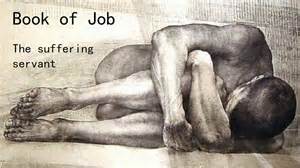
With God’s permission, Satan afflicted Job with a disease we cannot identify. Whatever it was, the symptoms were terrible: severe itching (Job 2:8), insomnia (v. 4), running sores and scabs (v. 5), nightmares (vv. 13-14), bad breath (19:17), weight loss (v. 20), chills and fever (21:6), diarrhea (30:27), and blackened skin (v. 30).

When his three friends first saw Job, they did not recognize him! Eliphaz, Bildad, and Zophar come to offer comfort and they spend most of their time telling Job that he is a terrible sinner due to this pain he is going through. Elihu, the younger of the four, grows impatient near the end of the book because they do not do a very good Job convicting Job.

In this marvelous book, we see Job in a variety of postures with very specific words

th

 being said:

Job 3:1-3 (NIV) After this, Job opened his mouth and cursed the day of his birth. 2  He said: 3  “May the day of my birth perish, and the night it was said, ‘A boy is born!’

Job 3:11 (NIV) “Why did I not perish at birth, and die as I came from the womb?

Job 3:16 (NIV) Or why was I not hidden in the ground like a stillborn child, like an infant who never saw the light of day?

Job 23:1-5 (NIV)  Then Job replied: 2  “Even today my complaint is bitter; his hand is heavy in spite of my groaning. 3  If only I knew where to find him; if only I could go to his dwelling! 4  I would state my case before him and fill my mouth with arguments. 5  I would find out what he would answer me, and consider what he would say.

Job 23:10 (NIV) But he knows the way that I take; when he has tested me, I will come forth as gold.

God speaks: Job 38:1-3 (NIV) Then the LORD answered Job out of the storm. He said: 2  “Who is this that darkens my counsel with words without knowledge? 3  Brace yourself like a man; I will question you, and you shall answer me.

jobheadingJob 40:1-2 (NIV) The LORD said to Job: 2  “Will the one who contends with the Almighty correct him? Let him who accuses God answer him!”

Job 40:8 (NIV) “Would you discredit my justice? Would you condemn me to justify yourself?

Job 42:1-17 (NIV) Then Job replied to the LORD: 2  “I know that you can do all things; no plan of yours can be thwarted. 3  You asked, ‘Who is this that obscures my counsel without knowledge?’ Surely I spoke of things I did not understand, things too wonderful for me to know. 4  “You said, ‘Listen now, and I will speak; I will question you, and you shall answer me.’ 5  My ears had heard of you but now my eyes have seen you. 6  Therefore I despise myself and repent in dust and ashes.”

 7  After the LORD had said these things to Job, he said to Eliphaz the Temanite, “I am angry with you and your two friends, because you have not spoken of me what is right, as my servant Job has. 8  So now take seven bulls and seven rams and go to my servant Job and sacrifice a burnt offering for yourselves.

My servant Job will pray for you, and I will accept his prayer and not deal with you according to your folly. You have not spoken of me what is right, as my servant Job has.”

9  So Eliphaz the Temanite, Bildad the Shuhite and Zophar the Naamathite did what the LORD told them; and the LORD accepted Job’s prayer. 10  After Job had prayed for his friends, the LORD made him prosperous again and gave him twice as much as he had before. 11  All his brothers and sisters and everyone who had known him before came and ate with him in his house. They comforted and consoled him over all the trouble the LORD had brought [allowed] upon him, and each one gave him a piece of silver and a gold ring.

12  The LORD blessed the latter part of Job’s life more than the first.

Some closing thoughts: have we in our relative comfort concentrated our worship too much on the language of praise and thanksgiving? Is that because we are influenced by the language of success and the cultural pursuit of happiness?

Therefore, we equate unhappiness with failure or lack of faith? And in individual and corporate prayer, when we happen to feel OK, we avoid the language of sorrow, confusion and anger? 

Laments use pain, anguish, anger and confusion in a passionate search for some answering comfort or sense of hope. We have to learn to lament and to do it in community, whether that is on our own behalf or as a way of speaking for others in much worse situations.

It isn’t about how things ought to be. It’s about how things are. It’s about people shot by terrorists in Paris. It’s about people living in fear. It’s about situations so dreadful that only God can change things and people and bring hope.

Lament yells deep from an anguished heart – a raw wail that in itself is a prayer (story of family that had a stillborn child just weeks before its birth…it hurt…I told them to stop on an empty road as they drove home…yells at God…express whatever emotion they were feeling at the time…and then trust in God to be with them every second of their life from that moment forward as they would deal with the hurt, pain, sorrow the rest of their life.)

If we care at all about the depths of other people’s suffering around the world, what other language can we use except that of lament? Do we really think that it’s not OK to yell out at God with feelings like that? That God somehow isn’t strong enough to cope with our anger?

Let’s allow Lamentations 3: 31-33 to have the last word: “For the Lord will not reject forever. Although he causes [allows] grief, he will have compassion according to the abundance of his steadfast love; for he does not willingly afflict or grieve anyone.”


Leave a comment

Posted by on December 14, 2017 in counsel, Encouragement, God


Defeating the Goliath in your life  – 1 Samuel 17


Have you met your Goliath? Goliath is that great big giant of an obstacle that seems unbeatable, and impossible to defeat.  It is that one huge problem that you think just might be your undoing — a difficulty so great that it has you entertaining the thought that you are close to throwing in the towel.

Perhaps you have met him in the past.  Or maybe Goliath is troubling you even now.  Most of us have a Goliath or two in our lives. I want to encourage you to confront Goliath today — to deal with this enemy that robs your life of hope and joy.

King Saul of Israel had been fighting tooth and nail for most of his life for every inch of the Promised Land. Even though the land was “Promised,” it did not come easy. (Most promised lands are that way – we have to work and struggle for them.)  Ever since the day Joshua took over the leadership of Israel from Moses, there had been a struggle.  On that very first day when they crossed the Jordan River to head westward to their promised homeland, there was no welcome sign saying, Welcome to the Promised Land!”

Lately, the Philistines had been gaining the upper hand. King Saul was getting older and very weary. Now things had really taken a turn for the worse. The Philistines unveiled their “secret weapon” – a nine foot nine giant named Goliath. This powerful, fearsome creature was out daily taunting the Israelites, issuing a challenge that had King Saul’s army cringing behind their shields. There wasn’t a soldier in the camp who wanted to take on Goliath. Fear and despair took hold in the camp and ate away the courage of every last man. Each day Goliath looked bigger and the soldiers of Saul felt smaller.

You and I probably have times when our Goliaths seem to grow as we seem to shrink. On one particular day, Goliath began shouting insults to the soldiers of Israel and he challenged them to a fight. 

Let’s read 1 Samuel 17:8-11 (NIV) Goliath stood and shouted to the ranks of Israel, “Why do you come out and line up for battle? Am I not a Philistine, and are you not the servants of Saul? Choose a man and have him come down to me. 9  If he is able to fight and kill me, we will become your subjects; but if I overcome him and kill him, you will become our subjects and serve us.” 10  Then the Philistine said, “This day I defy the ranks of Israel! Give me a man and let us fight each other.” 11  On hearing the Philistine’s words, Saul and all the Israelites were dismayed and terrified.

After hearing these threats, an adolescent shepherd boy named David looked around and asked “Who is this person who is insulting the armies of God?” You see, David wasn’t afraid of the Philistine giant. King Saul sent for David and this is the conversation they had: 1 Samuel 17:32-37 (NIV) David said to Saul, “Let no one lose heart on account of this Philistine; your servant will go and fight him.” 33  Saul replied, “You are not able to go out against this Philistine and fight him; you are only a boy, and he has been a fighting man from his youth.” 34  But David said to Saul, “Your servant has been keeping his father’s sheep. When a lion or a bear came and carried off a sheep from the flock, 35  I went after it, struck it and rescued the sheep from its mouth. When it turned on me, I seized it by its hair, struck it and killed it. 36  Your servant has killed both the lion and the bear; this uncircumcised Philistine will be like one of them, because he has defied the armies of the living God. 37  The LORD who delivered me from the paw of the lion and the paw of the bear will deliver me from the hand of this Philistine.” Saul said to David, “Go, and the LORD be with you.” .

So David, instead of putting on armor and a sword, chose to dress casually…carrying only a sling in his hand…with five smooth stones that he collected from the stream.  He was ready for war.  Listen to what David said when he confronted Goliath: (vs. 45-47). David took out a stone, and slung it and it struck Goliath on the forehead and killed him.  The young, weak boy defeated his Goliath.

WE NEED TO TRUST GOD. When David went to fight Goliath, it was not the standard resources that David was trusting in. It was not the armor of Saul or the strength of the whole Israelite army, but it was GOD…David believed that God would defeat Goliath.  If David had bought into the standard thinking, he would have been killed.  He thought outside the box!  God was his strength and the battle was the Lord’s — not his.

When we come to those times of confrontation with Goliath, our first line of defense is our relationship with God.  We must trust in His strength…no matter what others may consider the best way out of our difficulties. No matter what problem or Goliath we may be facing…God can deliver us. Our problems can be solved by trusting and relying upon God!

Most of us, like the Israelites hear the threats of Goliath and loose heart.  We would really like to have the courage of David and his trust in God, but we don’t quite get around to entering the field of battle.

So I would like to ask you for a verdict today. I would like to encourage you to decide to conquer Goliath.  If you will make that decision, surrender your resources – however small or meager – into the hands of God and trust the Lord to walk with you into the battle…You will make a wonderful discovery — a life changing discovery.

You will discover that Goliath is just a wee little man after all!

———————————-

They say there are not atheists in foxholes. It’s amazing how religious and how spiritual we get under pressure in a moment of bargaining.

It was that great American wit, Mark Twain, who once said, “Man is the only animal that blushes, and the only animal that needs to. We are ashamed, are we not, of things we’ve done in the past. Nobody is free who is unforgiven. Instead of being able to look God in the face or to look one another in the face, we want to run away and hide when our conscience troubles us.”


Leave a comment

Posted by on November 30, 2017 in counsel, Encouragement


The value of faith


Faith is like love in that it, too, is always beginning. For example, in the Gospel of John, the disciples had already come to have faith in Jesus by the time we reach chapter 11.

Andrew believed on the day when he left John the Baptist to follow Jesus (1:41), Philip believed on the day when Jesus called him (1:45), and Nathanael believed when Jesus said He had seen him under the fig tree (1:49).

The disciples who attended the wedding feast in Cana believed when they saw that Jesus had turned the water into wine (2:11). We are told that Peter and the other disciples who witnessed the feeding of the five thousand and heard the Bread of Life discourse also believed (6:69). Even after all of these statements of faith, Jesus told His disciples that He was glad for the opportunity to raise Lazarus so that they might believe (11:15)!

Faith is like that–always beginning.

Many of us already believe, at least to some degree. Then, one day, we face something that is so lifechanging that we never look at faith in the same way again. This encounter may be a blessing or a trial, the birth of a child or a fifty-foot fall. Suddenly, we see everything differently, and it seems that faith is beginning all over!

Today the Gospel of John calls us to believe (20:31). Many of us hear that call and think, “I already believe.” However, if we will listen and seek and follow, we may find that faith is only beginning in us!

FAITH IS FULL OF PROMISE

When Martha met Jesus outside of Bethany, her brother had been in the tomb for four days. She lamented that if Jesus had only been there, her brother would not have died.

In response to her grief, Jesus said, “I am the resurrection and the life; he who believes in Me shall live even if he dies, and everyone who lives and believes in Me shall never die. Do you believe this?” (11:25, 26).

Jesus’ words provide a powerful motivation to believe. Faith is hard work, and a lazy person will simply not put forth the effort. We do not believe just because we want to believe, but we will never believe if we do not want to believe. Faith involves dedication, obedience, sacrifice, and, oftentimes, tears. However, a rich promise is made to all who will believe.

In this respect, faith is like hard work in college; the student does it because of the promised payoff of getting a good job. Working hard at one’s career is rewarded with a good paycheck or promotion. Make no mistake about this: Faith does not earn a reward, but God’s promises are what motivate us to continue down the long, difficult, sometimes trying road to faith.

FAITH IS FOCUSED ON JESUS

John’s faith moves us toward faith in Jesus. What we need is not faith in parents, faith in the apostles, faith in other Christians, faith in the church, or even faith in faith. Rather, we need faith in Jesus.

In Martha’s powerful statement of faith, she told Jesus, “… I have believed that You are the Christ, the Son of God, even He who comes into the world” (11:27; emphasis mine). When Jesus, His disciples, Martha, Mary, and the crowd of mourners were later gathered outside Lazarus’ tomb, Jesus prayed to the Father, saying, “And I knew that Thou hearest Me always; but because of the people standing around I said it, that they may believe that Thou didst send Me” (11:42).

This is consistent with the rest of the Gospel of John, where the purpose is to produce faith “that Jesus is the Christ, the Son of God” (20:31).gods-wisdom

John Paton was a missionary to Africa who taught and baptized a large number of people. Because the Bible was not available in the language of the people he was teaching, Paton began the long and difficult work of Bible translating.

The task went fairly smoothly until he began trying to translate the word “believe.” As strange as it may seem, there was no word in this language for “believe.” How could one possibly translate the Bible without a word for “believe”?

Then, one day as Paton was struggling with this linguistic problem, a Christian man from the village came to visit him. This man had been working hard all day and was exhausted.

When he sat down in a chair he gave a weary sigh of relief and said, “It is so good to lean your whole weight on something.” Paton realized that he had found an expression for “believe”: To believe is to “put your whole weight on Jesus.”‘ Faith is focused on Jesus and nothing less.

FAITH IS DIVISIVE

As the people stood outside Lazarus’ tomb and saw him walk out alive, they were presented with an unavoidable fork in the road. They had seen Lazarus dead, had prepared him for burial, had placed him in a tomb, and had placed a stone over the mouth of the cave.

They were eyewitnesses to these events. Then, because of Jesus’ miracle, these same people had become witnesses of Lazarus’ rising! Would they believe? They could not avoid making a decision.

John recorded the division that took place among the observers of the miracle that day:

 “Many therefore of the Jews, who had come to Mary and beheld what He had done, believed in Him. But some of them went away to the Pharisees, and told them the things which Jesus had done” (11:45, 46).

Amazingly, these people all witnessed the same events but reacted in opposite ways. Some saw that they were in the presence of the power of God, so they placed their faith in Jesus that day. Others only “saw” a juicy piece of gossip and scurried off to Jerusalem to tell the Jewish leaders about the stir created by Jesus.

The division among the people that day is no insignificant part of the story. On the contrary, division is the very nature of the story of Jesus: When people hear about Jesus, they are forced to make a decision, one way or the other, about His true identity. There is no neutral ground.

Jesus and the apostle John both push us relentlessly toward a decision. Is Jesus the Son of God, or was He a fraud? Either He is divine, or He was a blasphemer deserving death. What is your decision?

FAITH IS THREATENING

Some of those who had witnessed Lazarus’ resurrection went to the chief priests and the Pharisees in Jerusalem to tell them what the teacher from Nazareth had done.

As they made their report, they complained, “If we let Him go on like this, all men will believe in Him, and the Romans will come and take away both our place and our nation” (11:48).

They realized that faith in Jesus would change lives, change families, and even change a nation. They realized–perhaps better than most Christians today–· just how “dangerous” faith is.

An old song says about love that “it will lift you up, never let you down, take your world and turn it all around. The same should be said about faith in Jesus.

The tendency today is to expect too little in regard to faith. Many Christians have made faith too easy, too soft, too undemanding.

Wilbur Pees expressed this tendency in the following sarcastic paragraph: I would like to buy $3 worth of God, please, not enough to explode my soul or disturb my sleep, but just enough to equal a cup of warm milk or a snooze in the sunshine. I don’t want enough of Him to make me love a black man or pick beets with a migrant. I want ecstasy, not transformation; I want the warmth of the womb, not a new birth. I want a pound of the Eternal in a paper sack. I would like to buy $3 worth of God, please”

The faith to which Jesus invites us may well change our entire lives. John wanted to make sure that we understand the possible costs involved in following Jesus. We may suffer, we may be persecuted, and we may lose everything we own. Compared with the rich promises of faith, the costs seem strangely insignificant!


Leave a comment

Posted by on November 16, 2017 in Encouragement


The Power Of Scripture In The Preacher Personally


by Dr. Roger Pascoe

President, The Institute for Biblical Preaching, Cambridge, Ontario, Canada

The Scriptures must be operative and powerful first and foremost in the preacher personally. A preacher who is called by God, is one who declares “the whole counsel of God” (Acts 20:27) and who believes that …

1. The Bible is divinely inspired (lit. “God-breathed”)

2. The Bible is divinely preserved through the centuries

3. The Bible is divinely authoritative in all matters of faith and practice

4. The Bible achieves its divinely intended purpose (Isa. 55:11)

5. The Bible reliably reveals God’s redemptive plan (cf. 2 Tim. 3:16-17)

Therefore, the preacher must be devoted to, dependent on, and directed by the Scriptures.

1. THE PREACHER MUST BE DEVOTED TO THE SCRIPTURES

He must, like Timothy, continue in the things which you have learned and been assured of, knowing from whom you have learned them (2 Tim. 3:14).Devotion to the Scriptures through continuance in them and obedience to them requires discipline.

2. THE PREACHER MUST BE DEPENDENT ON THE SCRIPTURES

To be dependent on the Scriptures you must know them intimately. To know them intimately you must read them. First, you must read the Scriptures privately. This is a most neglected area in so many preachers’ lives. They read a lot of other material but not the Scriptures. This is the work of Satan to weaken our preaching. Make sure you take time every day to read and meditate on the Scriptures in order to nourish your soul in the Word; to become saturated in the Word. This is not your study time but your devotional time (cf. Ps. 42:2; 1:2).

Daily reading of the Scriptures was one of the ingredients that gave George Mueller such a powerful life. He knew the truth that “man shall not live by bread alone…” (Matt. 4:4). We must be dependent on the Scriptures, just as we are on bread to live.

Be systematic and sequential in your reading. Plan your reading. Think through what you read. Ask, is there…

(a) A promise to claim?

(b) A lesson to learn?

(c) A blessing to enjoy?

(d) A command to obey?

(e) A sin to avoid?

Let the words abide in you (Jn. 15:7). Pray your thoughts from your reading back to God. Let the words produce fruit in you. Share what you have learned at the appropriate time with others. Be obedient to the word you have read.

Second, you must read the Scriptures publicly. Give attention to reading (1 Tim. 4:13). When Paul instructs Timothy to read the word, he also has in mind the public reading in the assembly. In those days it fulfilled the need for reading to those who did not have the Scriptures or could not read them. Today, it fulfills the need to give the proper prominence to the Scriptures in worship.

3. THE PREACHER MUST BE DIRECTED BY THE SCRIPTURES

“But you must continue in the things which you have learned and been assured of, knowing of whom you have learned them, and that from childhood you have known the Holy Scriptures which are able to make you wise for salvation through faith which is in Christ Jesus. All Scripture is God-breathed, and is profitable for doctrine, for reproof, for correction, for instruction in righteousness that the man of God may be complete, thoroughly equipped for every good work.” (2 Tim. 3:14-17)

Every Christian, and preachers in particular, must be directed by the Scriptures as the Word of God. It is impossible to preach powerfully if you do not hold a high view of biblical inspiration. Believing in the inerrancy of Scripture is part of biblical preaching. By sticking with the inspired text, both the preacher and the congregation will adhere to the truth of the Bible. The inspired Scriptures are our ultimate standard for faith and practice. Thus, they carry authority and power. More than that, the Scriptures are fully sufficient and absolutely trustworthy for all that we need in life and ministry.

Every preacher must be directed by the Scriptures. They are our source for what we believe, how we behave, and what we preach. We need nothing else. Indeed, the all-sufficiency of the Scriptures is the basis for our preaching.

a) The Scriptures are sufficient for salvation. The Scriptures are able to make you wise unto salvation (15)

The Bible teaches us our sinful condition before God and reveals the remedy through Christ. No other book can do this.

b) The Scriptures are sufficient for revelation. All Scripture is God-breathed (16)

God-breathed means “inspired by God”. Inspiration is the term used to describe the process by which God, through human agents, recorded in written form (i.e. the Bible) his revelation of himself. God communicated his self-revelation to human authors by the Holy Spirit in such a way that the words they wrote were God’s words (verbal inspiration). There is no part of the Bible which is not inspired (plenary inspiration).

The preacher must be committed to the verbal (the very words) and plenary (the complete) inspiration of the Scriptures by God (cf. 2 Pet. 1:21), which means, therefore, that they are inerrant (without error) and infallible (incapable of error) and that through them God still speaks today – i.e. they are still relevant.

Therefore we believe that …

i) The Bible is “God-breathed” (inspired)

ii) The Bible is without error or contradiction (inerrant)

iii) The Bible is incapable of error (infallible)

iv) The Bible is true in all that is affirms

iv) The Bible is completely trustworthy

The fact of its inspiration is what gives the Bible its authority and guarantees its trustworthiness. This is not a human book written by fallible authors, but a divine book written by an infallible God. This fact for us, as believers, renders the Bible fully trustworthy and authoritative. Because the Scriptures are “God-breathed” they are profitable – useful, beneficial, helpful, and authoritative.

In order to preach with power, a preacher must hold a high view of Scripture. A high view of Scripture means that we believe that the Bible is the written Word of God, that it is God’s self-revelation, that it is complete, that it is fully trustworthy, and that it is our ultimate standard for faith and practice.

As John Stott puts it: It is one thing to believe that God has acted, revealing himself in historical deeds of salvation, and supremely in the Word made flesh. It is another to believe that God has spoken, inspiring prophets and apostles to interpret his deeds. It is yet a third stage to believe that the divine speech, recording and explaining the divine activity, has been committed to writing. (John R. W. Stott, Between Two Worlds, 96).

The Bible reveals God to us. No other book does this like this book. It is unique. This is a high view of Scripture.

A high view of the inspiration of Scripture is vital for preaching the Bible powerfully because it is the sole authority for what we preach; it is the voice / the word of God to us. To have a low view of inspiration is to render God’s Word less than fully trustworthy or authoritative.

The preacher cannot preach with authority and spiritual power if he is not fully convinced that the Word of God is authoritative, without contradiction or error, and is totally reliable and trustworthy. How can a preacher preach with power if the very book that he preaches from is stripped of its authority? A preacher who does not believe that the Bible is inerrant, infallible, and totally inspired by the Holy Spirit cannot fully trust the Bible himself and, therefore, cannot proclaim it to others as fully authoritative and trustworthy. Such preaching, therefore, cannot be powerful.

If a preacher thinks that the Word of God is not reliable, then he must also think that God himself is not reliable. And if God is not reliable, then any sermons about God, based on his Word, cannot be trusted. If a sermon cannot be trusted, it cannot have power.

Any preaching that does not reflect the authority and power of the Bible is itself not authoritative and powerful. Power in the proclamation of the Bible cannot be separated from the authority of the Bible itself. The preacher is merely the mouthpiece for the text, which speaks powerfully for itself.

As Jesus taught in the parable of the sower (Matt. 13), the Word of God itself, as the good seed, bears much fruit. When the Word of God enters the human heart, it produces life because it is living (see Heb. 4:12). The Bible is alive because it is inspired by God (2 Tim. 3:16), and because it is alive, it generates its own power. Therefore, when it is faithfully declared, it carries power with it and accomplishes God’s task (Isa. 55:11).

A high view of the inspiration of Scripture is vital for studying the Bible carefully. If we believe that the Bible is indeed the inspired, inerrant, infallible Word of God, then we should diligently study it in order to understand what it means in its historical context and in order to apply it practically to our lives and the lives of our congregations.

Such a high view of Scripture forces the preacher to carefully research and understand the text. Preachers must exposit the text of Scripture by searching it out, just like the Bereans (Acts 17:11), so that they can accurately convey its meaning and application to their audience.

A high view of the inspiration of Scripture puts an emphasis on the accurate handling of the text rather than an entertaining handling of the text. The primary obligation of the preacher in preparing a sermon outline is to first make sure that it is true and accurate. If we have a high view of inspiration we will obey the biblical injunction to preach the Word (2 Tim. 4:2) and nothing else. Homiletical skill should never camouflage hermeneutical accuracy and faithfulness.

c) The Scriptures are sufficient for doctrineteaching and reproof

Note that the first two characteristics of Scripture (teaching and reproof) deal with doctrine; the second two (correction and training) deal with behaviour. Also, note that teaching is a positive statement while reproof is a negative statement.

On the positive side, the Scriptures are profitable for teaching (16).Scripture is the trustworthy, all-sufficient source for what we believe, teach, and practice. Scripture alone is the basis for pastoral preaching, teaching, counselling – not myths or legends, not psychology, not philosophy, not experience, and not culture or society. It contains all that we need for life and godliness. It is our standard for faith and practice.

On the negative side, the Scriptures are profitable…for reproof (16). To reprove means to refute, rebuke, convict. The Scriptures are fully sufficient and our only reliable resource for refuting and rebuking false teachers and false teaching. Scripture convicts those who hold false doctrine. It exposes the darkness of false teaching by its light. Scripture is the standard and pattern of truth (1:13) which we are to guard (1:14) and to use to convict those who are in error. This is the only authoritative reproof of doctrinal and moral error (cf. Tit. 1:9; Jude 3; Eph. 5:11; 1 Tim. 5:20). We refute doctrinal and moral error by the Scriptures. Truth does not change with the changing times. Preachers must stand firm on the revealed truth and reprove and refute error.

Where “teaching” (positive) and “reproof” (negative) have to do with doctrine, the following characteristics of the Scriptures have to do with behaviour.

d) The Scriptures are sufficient for behaviourcorrection and training

Again there is a negative statement and a positive statement. On the negative side, the Scriptures are profitable… for correction (16). The purpose of correction is restoration to a right relationship with God. The Scriptures are able to correct and restore someone to a right state of Christian conduct and character. The Scriptures are powerful to change a person’s character flaws, beliefs, and behaviour, to straighten them out, to correct improper and false beliefs and behaviour. Those who stray from the truth must be rebuked, corrected, and then restored. While the process of correction is negative, the end result in view, namely, restoration, is positive.

On the positive side, the Scriptures are profitable…for training (instruction) in righteousness. The Scriptures are necessary and sufficient for training / instructing Christians in virtuous, upright, righteous living. The negative process of correction is offset by the positive process of training in righteousness, which has in view the person’s restoration to a right relationship with God and other people. All Christians, and here preachers specifically, must be trained to live righteously before God and the world (cf. Tit. 2:11-12). This is the training that is attained by discipline and correction (as in training up a child). The Scriptures contain the truth that we believe and the direction for our behaviour in compliance with our belief. This is the life of holiness that comes from being directed by the Scriptures.

Now we move from the sufficiency of the Scriptures for doctrine and behaviour to their purpose.

e) The Scriptures are sufficient for edification…so that the man of God may be proficient (fit, capable), fully equipped for every good work (17)

The ultimate purpose of the Scriptures is to render the servant of God spiritually fit and capable of completing the work God has called you to do. The Scriptures provide the training we need for ministry. Just as an athlete requires training to build up his or her muscles, endurance, and capability for a specific sport, so the servant of God is trained for and rendered fit for his or her ministry. The Scriptures are the sole and fully sufficient source of the knowledge and direction we need for ministry.

Through the Scriptures the “man (or, woman) of God” is rendered proficient (capable) for every good work. Our ability in ministry is not a matter of natural talent or intellect, but the calling of God and the sufficiency of his Word. To be capable of carrying out your work for God you need to be proficient in your knowledge and use of Scripture, to think biblically and to apply the Scriptures to life – your own life first, and then the lives of your people. The Scriptures build us up in spiritual maturity(training in righteousness) … and for spiritual activity (for every good work).

They are our primary resource in ministry – not your education, not your eloquence, not your relationships – but your familiarity with the Scriptures, your understanding of the Scriptures, and your application of the Scriptures to life.

Through the Scripture the man or woman of God is fully equipped for every good work – nothing else you need. The Scriptures comprise our complete reference manual for our spiritual work. They are fully sufficient to equip every pastor, church leader, and teacher for every good work,which, from a pastoral perspective, is in essence (i) teaching; (ii) reproof; (iii) correction; and (iv) training in righteousness.

The Scriptures are the complete resource for our ministry of the Word – for doctrine, for reproof, for correction, for instruction in righteousness… to convince, rebuke, exhort (2 Tim. 3:16 … 4:2). The Scriptures build us up in our faith and equip us for the work of the ministry. By them we are proficient (competent), fully equipped, furnished for every good work.Through the sufficiency of the Scriptures, preachers are enabled to do our work of the ministry. We are equipped by the Word for our ministry of equipping others (Eph. 4:12). God does not leave us to our own resources when he calls us into his service. We have the inspired Scriptures which not only make us wise to salvation but also contain all that we need for life and godliness. They thoroughly equip us for every good work (cf. Eph. 2:10).

Part II: Preparing For Preaching

Outlining the Sermon, Part 3: Testing Your Main Points

We are continuing the subject of “outlining the sermon” from the last two editions of this NET Pastors Journal. In this edition, I want to show you how to test the main points of your sermon outline. Your sermon outline should be structured to reveal two essential components:

1. The Main Points Must Be “Homiletically Distinct”

By this I mean that the points of your sermon must be separate thoughts which flow from the text. The language used in your points should follow the natural structure (i.e. development of ideas) in the text. To produce a sermon whose points are homiletically distinct, ask three primary questions of every passage:

A) WHAT IS THE DOMINATING THEME – I.E. THE SUBJECT?

By finding the subject of the Scripture passage, you expose the unifying thought or truth that holds the passage together. And by relating all your sermon points to this subject, your sermon will have unity. So, ask yourself: what is the dominating theme (the big idea, the thesis, the subject) of this passage?

Our task is to preach the message of the text not our own message. Therefore, we do not create the subject of the sermon – rather, the text does. Once we have determined the author’s subject, our task is to construct a message around that subject.

Since you can only preach one subject at a time (unless you want to thoroughly confuse your audience), where a passage of Scripture seems to have more than one subject, select the “dominating” subject that emerges from the text as the one that governs your message. It’s good to state the subject of your message in your introduction.

B) WHAT ARE THE INTEGRATING THOUGHTS – I.E. THE MAIN POINTS?

Main points are the integrating thoughts that provide structure and movement to the passage and, therefore, to your sermon. Ask yourself, What are the integrating thoughts of this passage?

The subject is exposed and developed by the author through integrating thoughts which emerge from the passage and which link together to provide the structure and movement of the sermon.

So ask yourself: “What is the structure of the passage? What thoughts build up and expose the overall theme? What does the writer say about his subject? What are the various “complements” to the subject (to use Haddon Robinson’s terminology)? What is the movement (flow of thought) in the passage? How does the writer integrate his thoughts together to develop his subject? What are the individual ideas and how do they connect together to form an argument, an explanation, or an exhortation?” These questions force you to look for the structure and movement in the passage.

Each thought is an expansion of the subject. The thoughts of the writer become the hooks on which you hang your sermon, the sign posts which direct the sermon, the infrastructure around which you build your sermon, the main points which divide the sermon into points (or, chapters).

Do not force the points by imposing your own structure on the passage. Do not force the text to say what you want to say. You must say what the Word of God says – that’s expository preaching!

The main points of your sermon must be “homiletically distinct – i.e. clear and distinct from one another so that the audience can follow the development of your sermon. You can test your points by asking the following questions

  • Is each point biblical?

Am I letting the Word of God speak for itself (exegesis) or am I imposing my thoughts on the Word (eisegesis)? Is it true to the context? – historical, literary, grammatical, theological, syntactical (even sub-points must come out of the text and integrate with and support the main point). Can your audience see it for themselves in the text?

  • Is each point logical?

Are your points sequential? Do they flow with the text? Is each point progressive in that it moves the ideas of the message forward? Does the progression make sense? Does each point help the sermon move toward a goal? Do they follow the flow of the text? Can the audience see intuitively how you moved from point #1 to point #2 to point #3? And can they see how the text moves from point #1 to #2 to #3? Does each point relate to the subject? Is each point mutually exclusive – i.e. no overlap with other points?

  • Is each point practical, applicable?

Does it answer the question: “So what? What does it have to do with me?” Does it transition from the “then” of the biblical world to the “now” of your congregation? Exposition must be pre-eminently practical. Therefore, it must be applied practically and illustrated relevantly. Exposition must never be divorced from application and illustration (Stephen Olford, Anointed Expository Preaching, 76).

I suggest that you never leave application to the end of the sermon but relate each point as you make it to the lives of the listeners. Otherwise, they will not get the connection between what you have explained and how you have applied it.

  • Is each point critical?

Is each point needed? There must be a purpose, a reason, for each point. Don’t put in points or sub-points that have no purpose and which do not add to the flow of thought and development of the argument.

Don’t be overly zealous in trying to break down your main points into sub-points, sub-sub-points etc. This confuses your listeners and achieves nothing. If you do have sub-points because they are in the text, you do not have to express them as such to your audience – simply make them part of your explanation.

To ensure that each point is necessary and purposeful, you will need to review your structure critically.

  • Is each point memorable?

This is not a requirement of expository preaching; it’s just a good principle for any public speaking. If you want your audience to go away and be able to remember at least the basic points of what you said, it must be memorable. So, word your main points for “hearers” not “readers” (i.e. the ear not the eye).

You can make your points memorable in several ways:

(i) By using various structural techniques in your main points – e.g.

*”Balanced” statements – i.e. a repeated phrase in each point

*Parallel statements – i.e. similarity of grammar and wording

*Alliteration. Alliteration can be very effective by being memorable, or it can be very ineffective by being annoying, forced, unnatural.

(ii) By repetition

Your sermon outline should be sufficiently well done that your audience can see it – recognize the road map; see the progression, movement, main ideas – but not so that it is dominant. We are not preaching to send them home with an outline but with a message from God’s word that is relevant to their lives.

C) WHAT IS THE MOTIVATING THRUST – I.E. THE PURPOSE?

The motivating thrust provides direction and purpose to your sermon. The motivating thrust is the universal truth that the text is teaching and to which the preacher will exhort his listeners to respond.

Determining the motivating thrust gives significance and purpose to the sermon. Some questions to ask yourself here are:

  • Why did the writer write this? What is the sermon intended to do?
  • What does the truth demand? What do you want them to do?
  • What is its purpose, significance?
  • What application are you going to make?
  • What is the “bottom line”?
  • What is the motivating thrust behind this message? Why deliver it at all?

This whole process of structuring your sermon outline all starts with the subject. The subject provides unity to the sermon because from the subject flow the “integrating thoughts” (main points) and the “motivating thrust” (purpose) of the sermon. Therefore, the “formula” is: Unity (from the subject) + movement (the main points) = purpose.

2. The Points Must Be “Harmoniously Related”

While the points must be homiletically distinct (i.e. make their own distinct point and not repeat any of the other points), at the same time they must be “harmoniously related.” By “harmoniously related” we mean that there must be “continuity of thought”. Continuity of thought is what we must aim for in every outline. Just as the writer has continuity of thought in what he wrote, so your sermon outline, based on what he wrote, must have the same continuity of thought. In other words, the text drives the structure. That’s expository preaching!

(a) Harmoniously related thoughts give the sermon unity – i.e. hold it together. And unity flows from the one common denominator of every sermon – the subject. When each point is related to the subject, then the whole structure is “harmoniously related.”

(b) Harmoniously related points give the sermon progression i.e. it’s going somewhere. Progression is derived from the flow and continuity of thought by which each point relates to the point that went before (but doesn’t duplicate it), the point that comes after (but doesn’t duplicate it), and all points relate to the subject and, therefore, are harmoniously related.

Therefore, every point must:

a) Relate to the subject of the passage and sermon. This gives unity and harmony.

b) Relate to the points around it (i.e. the previous and subsequent points). This gives progression. Without this structure and sequential treatment of the text, there will be confusion in the pulpit as well as in the pew(Stephen Olford, Anointed Expository Preaching, 76).

A harmoniously related sermon is like a harmoniously related body. The head is joined to the neck; the neck to the torso; the torso to the arms and legs etc. Thus, the body has symmetry (balance; proportion) and continuity (every part works in harmony with the others). This is how good sermons work.

Part III. Devotional Exposition

“The Communication of the Gospel” (1 Cor. 2:1-5)

By: Dr. Stephen F. Olford

Having proved that the gospel, while not commending itself to human wisdom, is notwithstanding the instrument of God’s power as well as the manifestation of His wisdom, the Apostle now goes on to speak about The Communication of the Message. As a preacher, he knew of the inherent dangers in the methods and motives of public speaking. Indeed, the church at Corinth was divided on this very issue. There were some who preferred Paul’s approach to the style of Apollos; while others were better satisfied with the rugged delivery of Peter, the one-time fisherman.

With this in mind, the Apostle sets out to correct misconceptions concerning the communication of the gospel in two delineations:

I. The Supreme Passion Of A Preacher

And I, brethren, when I came to you, did not come with excellence of speech or of wisdom declaring to you the testimony of God. For I determined not to know anything among you except Jesus Christ and Him crucified (1 Cor. 2:1-2). Drawing heavily upon his own experience, Paul shares with us the twofold secret of the consuming passion of a preacher. The first is:

1) Dedication to the Master: …I determined not to know anything among you except Jesus Christ… (1 Cor. 2:2). Paul uses a word here to describe his dedicated resolve. He says, I determined not to know anything among you except Jesus Christ…. This is the true secret of preaching. This man was so Christ-centered and Christ-controlled that nothing else in the world mattered, except Jesus Christ.

Paul could say, For me to live is Christ… (Phil. 1:21). …I count all things but loss for the excellency of the knowledge of Christ Jesus my Lord…that I may know Him… (Phil. 3:8, 10). …this one thing I do, forgetting those things which are behind, and reaching forth unto those things which are before, I press toward the mark for the prize of the high calling of God in Christ Jesus (Phil. 3:13-14). How true it is that …out of the abundance of the heart the mouth speaks (Matt. 12:34). When a person is full of Christ, he cannot but speak of His Savior and Lord. So there was dedication to the Master. Then also there was:

2) Concentration on the Message: For I determined not to know anything among you except Jesus Christ and Him crucified (1 Cor. 2:2). Instead of conforming to the philosophical approach and oratorical excellence which were so characteristic of public speakers in Corinth, Paul deliberately determined to present Christ in all the simplicity of the essential facts of His death and resurrection. His supreme passion was Christ and Him crucified – “not in His glory but in His humiliation, that the foolishness of the preaching might be doubly foolish, and the weakness doubly weak. The incarnation was in itself a stumbling block; the crucifixion was much more than this” (Bishop Lightfoot).

Some students of the Bible maintain that Paul’s emphasis in Corinth on the cross was because of a sense of failure in the alleged philosophical approach he adopted at Athens. But a study of Acts 17 makes it evident that his preaching there was not basically philosophical. His sermon began with a biblical revelation of creation and ended on the note of the resurrection (Acts 17:24, 31). In other words, even in Athens his central message was that of Christ and Him crucified. Paul knew only too well that only the message of the cross could meet the need of a pagan world. It might seem foolishness to the philosophers and a stumbling block to the religionists, but to those who were being saved it was both the wisdom and the power of God.

Martin Luther’s preaching aroused the church from a thousand year slumber known as the devil’s millennium. It is easy to understand why when we discover how Luther preached. He said, “I preach as though Christ was crucified yesterday, rose again from the dead today, and is coming back to earth tomorrow.” With the supreme passion of the preacher in mind, we now turn to what Paul describes as:

II. The Spiritual Power Of A Preacher

And I was with you in weakness, in fear, and in much trembling. And my speech and my preaching were not with persuasive words of human wisdom, but in demonstration of the Spirit and of power (1 Cor. 2:3-4). The Apostle knew that the content of his message was so unacceptable to the carnal mind that he had no confidence in his ability to communicate it. In fact, he says that he came to Corinth …in weakness, and in fear, and in much trembling (v. 3). J. B. Phillips puts it even more dramatically by quoting Paul as saying: “I was feeling far from strong, I was nervous and rather shaky.”

At the same time, it might be added that his fear was more of God rather than of man. It was a fear in the light of the task committed to him, or what Kay calls “anxious desire to fulfill his duty.” So he says, …my speech and my preaching was not with enticing words of mans wisdom, but in demonstration of the Spirit and of power (v. 4). This means that Paul did not depend on what was known as “the Corinthians words” of excellent speech and poetic persuasion; his confidence, rather, was in:

1) The Power of Divine Revelation: And I was with you in…demonstration of the Spirit… (1 Cor. 2:3-4). The word translated “demonstration” signifies “the most rigorous proof.” As Dr. Leon Morris says, “It is possible for argument to be logically irrefutable, yet totally unconvincing.” Paul’s preaching, however, carried conviction because of the power of the Spirit. This is the essential difference between human reasoning and divine revelation.

If preachers of the gospel trusted in their own speaking powers to convince men and women of sin and righteousness and judgment, they would miserably fail. Only the Holy Spirit can do this (see John 16:8-11). In addition to this, it is clear from this passage that Paul also put his confidence in:

2) The Power of Divine Application: And I was with you…indemonstration of the Spirit and of power (1 Cor. 2:3-4). The phrase “of power” carries us back to what Paul has been saying concerning the dynamic of God (1 Corinthians 1:18). There is something inherent in the gospel of our Lord Jesus Christ which has a dynamic relevance, and therefore an application to everyday life. Preach the gospel to any creature in any country in any age and you will find it just as authoritative and applicable as in the days of the Apostle. This is why Paul exclaims: For I am not ashamed of the gospel of Christ, for it is the power of God to salvation for everyone who believes, for the Jew first and also for the Greek (Romans 1:16).

William Barclay tells of a man who had been a reprobate and a drunkard, but who had been absolutely captured and changed by the Lord Jesus Christ. His work mates knew about this and used to try and shake his faith. They would say, “Surely a sensible man like you cannot believe in the miracles that the Bible talks about. You cannot, for instance, believe that this Jesus of yours turned water into wine.” “Whether He turns water into wine or not,” replied the man, “I do not know. But in my own house I have seen Him turn beer into furniture!” This is the power of divine application.

When a preacher believes that the message he declares can work a miracle, he has learned the secret of spiritual power. However much he may tremble, he can be sure that God will vindicate and demonstrate the power of the cross in transformed lives. To conclude, Paul moves on to:

III. The Single Purpose Of A Preacher

…That your faith should not be in the wisdom of men but in the power of God (1 Cor. 2:5). This was Paul’s single purpose because it was the divine purpose. No preaching of the gospel fulfills what God has designed unless men rest their faith in the power of God. As we have observed already, the power of a preacher is nothing less than the word of the gospel, even our Lord Jesus Christ, crucified and risen again. The problem in Corinth was that the members of the church were seeking to pin their faith on Paul, or Apollos, or Cephas. Therefore, the Apostle was determined to correct such a divisive misplacement of their confidence. For the purpose of the gospel, he realized men and women must be led to exercise:

1) A Sound Faith: …That your faith should not be in the wisdom of men…(1 Cor. 2:5). Paul has convinced us in the preceding verses of the earthly, sensual, and devilish nature of the wisdom of men. For faith to be sound, it must be reposed in the Savior Himself, without dependence upon human wisdom. Paul amplifies his point when he writes later concerning the death and resurrection of the Lord Jesus: …if Christ be not raised, your faith is vain; you are yet in your sins (1 Cor. 15:17). If Christ were not alive from the dead, then sin was not put away, the gospel is not true, the Corinthians had believed a lie, the Apostles were false witnesses, and the loved ones who had fallen asleep had gone forever. So to be fundamentally sound in the faith, a person must believe in the Son of God who literally and physically rose from the dead. All other tenets of evangelical faith are both included and implied in this one central and focal fact of the resurrection of Christ.

Is your faith sound? Does the fact that the Lord Jesus Christ rose from the dead mean more to you than anything else in the world?

2) A Saving Faith: …That your faith should not be in the wisdom of men but in the power of God (1 Cor. 2:5). Paul has interpreted to us the meaning of the power of God in a previous verse. You remember how he said …the preaching of the cross is to them that perish, foolishness; but to us which are saved, it is the power of God (1 Cor. 1:18). A saving faith to Paul was a faith which had and was effecting a mighty transformation in the believing soul. It meant knowing the Lord Jesus as Savior in every sense of the word. Is Christ a living, indwelling, and transforming Savior in your experience? But this faith as interpreted by Paul was also:

3) A Steadfast Faith: …That your faith should not be in the wisdom of men but in the power of God (1 Cor. 2:5). It has well been said that what depends upon a clever argument is ever at the mercy of a clever argument. This is not so with faith when it is reposed in the unchanging Son of God. This is why Paul employs the term stand (KJV – should not stand) which conveys the idea of steadfastness. Two times in this letter he exhorts the believers to be “steadfast in the faith.” The first mention follows the glorious treatment of the unalterable facts of the death and resurrection of our Lord Jesus Christ in chapter 15. Having declared the Savior as the triumphant one, he says: …be steadfast, unmovable, always abounding in the work of the Lord, forasmuch as you know that your labor is not in vain in the lord (1 Cor. 15:58). The second reference coincides with the conclusion of the epistle where the Apostle exhorts: Watch, stand fast in the faith, quit you like men, be strong (1 Corinthians 16:13).

Conclusion: So we have seen what Paul means by the communication of the gospel. He has made it abundantly plain that this unique revelation from heaven is something that cannot be communicated or understood apart from a God-given passion, power, and purpose. Whoever claims to be a preacher must be able to testify to the fact that he has only one determination, and that is to know Christ and Him crucified. A preacher must have only one dynamic, and that is the demonstration of the Spirit and of power. A preacher of the gospel must have only one design, and that is that his hearers should not stand in the wisdom of men but in the power of God. Like Paul, the preacher must recognize that the church of Jesus Christ can never survive the storms of life unless she is built upon the rock of divine revelation rather than on the sands of human philosophy. Let us then go into all the world with the preacher’s passion, power, and purpose – until every creature hears the message of Christ and Him crucified. Such a commission will leave no time for division in our churches and God will add to our membership daily such as should be saved!

Part IV. Sermon Outlines

To listen to the audio version of these sermons in English, click on these links: Link 1 – John 11:25; Link 2 – John 11:26-27

Title: Jesus is the Resurrection and the Life (Jn. 11:25-27)

Point #1: Jesus claims the power that is given to him (25a)

1. Jesus claims the power of resurrection

2. Jesus claims the power of life

Point #2: Jesus promises the life that is in him (25b-26)

1. He promises resurrection life (25b)

2. He promises immortal life (26)

(1) Conditional on faith – those who believe

(2) Conditional on personal faith – do you believe this?

Point #3: Jesus honours the faith that trusts him (27)

1. He honours faith that responds to his word – Yes

2. He honours faith that submits to his authority – Lord

3. He honours faith that confesses his person – Messiah

– He is the promised Messiah, the Son of God

– He is the One who is to come into the world

 
Leave a comment

Posted by on October 19, 2017 in Bible


Seven Things That God Hates Series: A Heart That Devises Wicked Plans


Prov. 6:16-19 (NKJV) These six things the Lord hates, Yes, seven are an abomination to Him: 17A proud look, A lying tongue, Hands that shed innocent blood, 18A heart that devises  wicked plans,  Feet that are swift in running to evil, 19 A false witness who speaks lies, And one who sows discord among brethren.

swerveAll we need to do is read the news on the internet or watch the local television news to  be aware of, or at least reminded of, how evil men will spend their time devising wicked plans.  Let’s examine God’s feelings about this subject and how we can avoid finding God’s disfavor, but rather his favor.

What direction do we find from God’s Word?

(Genesis 6:5 NIV)  The LORD saw how great man’s wickedness on the earth had become, and that every inclination of the thoughts of his heart was only evil all the time.

(Psalms 34:6 NIV)  This poor man called, and the LORD heard him; he saved him out of all his troubles.

(Romans 1:30 NIV) “…slanderers, God-haters, insolent, arrogant and boastful; they invent ways of doing evil; they disobey their parents…”

God Is Concerned About The Heart. Implicitly, this passage teaches that God knows all things and that nothing escapes his attention.

(Ecclesiastes 12:14 NIV)  For God will bring every deed into judgment, including every hidden thing, whether it is good or evil.

(Matthew 15:18-20 NIV)  But the things that come out of the mouth come from the heart, and these make a man ‘unclean.’ {19} For out of the heart come evil thoughts, murder, adultery, sexual immorality, theft, false testimony, slander. {20} These are what make a man ‘unclean’; but eating with unwashed hands does not make him ‘unclean.'” God looks at the roots, and not just the fruit.

(Romans 1:32 NIV)  Although they know God’s righteous decree that those who do such things deserve death, they not only continue to do these very things but also approve of those who practice them.

How To Overcome This Sin.

(Isaiah 32:7-8 NIV)  The scoundrel’s methods are wicked, he makes up evil schemes to destroy the poor with lies, even when the plea of the needy is just. {8} But the noble man makes noble plans, and by noble deeds he stands.

(Matthew 10:16 NIV)  I am sending you out like sheep among wolves. Therefore be as shrewd as snakes and as innocent as doves.

(Matthew 12:43-45 NIV)  “When an evil spirit comes out of a man, it goes through arid places seeking rest and does not find it. {44} Then it says, ‘I will return to the house I left.’ When it arrives, it finds the house unoccupied, swept clean and put in order. {45} Then it goes and takes with it seven other spirits more wicked than itself, and they go in and live there. And the final condition of that man is worse than the first. That is how it will be with this wicked generation.”

(Luke 16:8 NIV)  “The master commended the dishonest manager because he had acted shrewdly. For the people of this world are more shrewd in dealing with their own kind than are the people of the light.

(Ephesians 3:20 NIV)  Now to him who is able to do immeasurably more than all we ask or imagine, according to his power that is at work within us,

(Philippians 4:8 NIV)  Finally, brothers, whatever is true, whatever is noble, whatever is right, whatever is pure, whatever is lovely, whatever is admirable–if anything is excellent or praiseworthy–think about such things.

Let’s begin to trust God more to do what he said he would do.  Let us plan, devise, and pray for great things. Let’s stop expending energy in useless and trivial pursuits, but rather let us meditate, devise, and work out ways to further the cause of Christ.

 
Leave a comment

Posted by on October 15, 2017 in Doctrine, God


Seven Things That God Hates Series: A Lying Tongue…and False Witness


Prov. 6:16-19 (NKJV) These six things the Lord hates, Yes, seven are an abomination to Him: 17A proud look, A lying tongue, Hands that shed innocent blood, 18A heart that devises  wicked plans,  Feet that are swift in running to evil, 19 A false witness who speaks lies, And one who sows discord among brethren.

The second thing that God hates in this list of seven, is a lying tongue.  In this lesson, we want to identify what it is to lie, and why it is so bad.

truthThe Problem Of Lying. Recent surveys show us areas where our nation generally consider trivial this important issue: 36% lie about important matters. 86% lie to their parents. 75% lie to their friends. 73% lie to their siblings. 69% lie to their spouses. 91% of those surveyed stated that they lie.

No wonder David said, “All men are liars” (Psalm 116:11). Do we want to live in a society wherein lying is so prevalent? I’m suspicious when I hear someone say, “Well, to tell you the truth…” or “to be perfectly honest with you…”  Do they have to use particular phrases to make us feel comfortable in believing what they are saying?

Ways In Which We Lie. We speak of “White lies, big lies, small lies.” Twist words. Half truths. Misstatement of fact. Bodily movement. Gossip. Exaggeration. Insinuation. Flattery. Presuming.

I think we all know from our youth up until now that lying is wrong.  Thus we attempt to salve our consciences when we do what we know is wrong. A former Secretary of State once said, “That’s not a lie; it’s a terminological inexactitude. Also a tactical misrepresentation.” 

Why Lying Is So Wrong. It is contrary to the very nature of God (Hebrews 6:18 NIV)  God did this so that, by two unchangeable things in which it is impossible for God to lie, we who have fled to take hold of the hope offered to us may be greatly encouraged..

It destroys our credibility (Job 27:5 NIV)  I will never admit you are in the right; till I die, I will not deny my integrity.

Conclusion: While lying is contrary to the character of God, so is speaking the truth in a hurtful and vindictive way (Ephesians 4:15 NIV)  Instead, speaking the truth in love, we will in all things grow up into him who is the Head, that is, Christ.

The fate of all liars (Revelation 21:8 NIV)  But the cowardly, the unbelieving, the vile, the murderers, the sexually immoral, those who practice magic arts, the idolaters and all liars–their place will be in the fiery lake of burning sulfur. This is the second death.”

  • A half truth is a whole lie. Yiddish Proverb
  • A liar isn’t believed even when he speaks the truth. German Proverb
  • A lie travels around the world while truth is putting her boots on. French Proverb
  • All lies are not told—some are lived. Arnold Glasgow
  • It is almost always through fear of being criticized that people tell lies. Paul Tournier (1898–1986)
  • No man has a good enough memory to make a successful liar. Abraham Lincoln (1809–1865)
  • One lie gives birth to another. Terence (c. 186–c. 159 b.c.)
  • Sin has many tools, but a lie is the handle that fits them all. Oliver Wendell Holmes (1809–1894)
 
Leave a comment

Posted by on October 11, 2017 in Doctrine, God