RSS

Author Archives: TJ's Man

Unknown's avatar

About TJ's Man

Began working with the Sunset Avenue church of Christ in Madera, California on September 8, 2013.

The Anatomy of a Backslider


Learning From One Who Knows By Experience

In 2 Peter 2:20-22 we read of the real possibility and serious consequences of backsliding:
“If they have escaped the corruption of the world by knowing our Lord and Savior Jesus Christ and are again entangled in it and overcome, they are worse off at the end than they were at the beginning. {21} It would have been better for them not to have known the way of righteousness, than to have known it and then to turn their backs on the sacred command that was passed on to them. {22} Of them the proverbs are true: “A dog returns to its vomit,” and, “A sow that is washed goes back to her wallowing in the mud.””

backsliderIt is interesting that we find this passage coming from the inspired pen of Peter…for if anyone knew “firsthand” the reality and dangers of backsliding, it was Peter! He discovered these truths the night he denied Jesus!

The process of backsliding is a gradual one, often overtaking a person by surprise; and lest we fall from our own steadfastness…we shall carefully examine the process that led to Peter’s denial of Christ.
Notice how Peter’s own words in his epistles are designed to prevent the same from happening to us!

THE ANATOMY OF A BACKSLIDER
A. PRIDE – Mark 14:27-31: “You will all fall away,” Jesus told them, “for it is written: “‘I will strike the shepherd, and the sheep will be scattered.’ {28} But after I have risen, I will go ahead of you into
Galilee.” {29} Peter declared, “Even if all fall away, I will not.” {30} “I tell you the truth,” Jesus answered, “today–yes, tonight–before the rooster crows twice you yourself will disown me three times.” {31} But Peter insisted emphatically, “Even if I have to die with you, I will never disown you.” And all the others said the same.”

1. In a boastful manner, Peter claims he will not fall away or deny Christ!
2. In doing so, Peter takes the first step in backsliding: “pride”! – cf. Prov. 16:18
3. Why is this the “first” step? Because the first step in entering the kingdom is humility – Mt 18:3-4. So if we lose “humility”, we take that first step backward
4. Paul’s advice to the Corinthians is very apropos in this regard – cf. _1 Co 10:11

B. LAZINESS – Mark 14:32-42: “They went to a place called Gethsemane, and Jesus said to his disciples, “Sit here while I pray.” {33} He took Peter, James and John along with him, and he began to be deeply distressed and troubled. {34} “My soul is overwhelmed with sorrow to the point of death,” he said to them. “Stay here and keep watch.” {35} Going a little farther, he fell to the ground and prayed that if possible the hour might pass from him. {36} “Abba, Father,” he said, “everything is possible for
you. Take this cup from me. Yet not what I will, but what you will.” {37} Then he returned to his disciples and found them sleeping. “Simon,” he said to Peter, “are you asleep? Could you not keep watch for one hour? {38} Watch and pray so that you will not fall into temptation. The spirit is willing, but the body is weak.” {39} Once more he went away and prayed the same thing. {40} When he came back, he again found them sleeping, because their eyes were heavy. They did not know what to say to him. {41}
Returning the third time, he said to them, “Are you still sleeping and resting? Enough! The hour has come. Look, the Son of Man is betrayed into the hands of sinners. {42} Rise! Let us go! Here comes my betrayer!””

1. Told to keep watch, Peter kept falling asleep
2. It was therefore lack of diligent preparation which caused him to be caught off guard for what was to follow
3. The same thing can happen to us! Without diligence, we too can be found unprepared – Luke 21:34-36. More often than not, it is a “gradual drifting” that catches us off guard – Heb. 2:1-3. But when we are proud of ourselves, we become lazy, and that easily leads to the next step…

C. COWARDICE – Mark 14:54: “Peter followed him at a distance, right into
the courtyard of the high priest. There he sat with the guards and warmed
himself at the fire.”

1. Note that it says “…Peter followed Him at a distance”
2. Now that Jesus had become unpopular…
a. Peter stays far enough away so as not to be identified with
Him
b. Peter was unprepared for the challenge of facing ridicule and
persecution
3. Without diligent preparation, we too can become guilty of
cowardice!
a. Ashamed to be seen carrying a Bible
b. Ashamed to be seen giving thanks
c. Ashamed to be seen with other Christians
d. Perhaps even ashamed to let others know that we are
Christians!
4. And yet, Jesus has made it clear what He thinks of “cowardice”
Mark 8:38; Rev. 21:8
5. When we are ashamed of Christ, it is natural for to fall into
the next step of backsliding…

D. WORLDLINESS – Mark 14:54: “Peter followed him at a distance, right
into the courtyard of the high priest. There he sat with the guards and
warmed himself at the fire.”

1. We now find Peter sitting with the servants of the High Priest
and warming himself by the fire
2. Ashamed to be seen with Christ, it becomes easy to mingle with
those of the world and enjoy their comforts
3. But one cannot be “comforted by the fire” of the world, and not
be “burned”!
a. Close contact with that which can harm has its effects! –
Prov. 6:27-29
b. So it is we cannot “flirt with the world” and walk away
untouched! – 1 Cor. 15:33
4. By the time we become “friends with the world”, it is only a
short time before we take the next and final step of backsliding…

E. DENIAL – Mark 14:66-71: “While Peter was below in the courtyard, one
of the servant girls of the high priest came by. {67} When she saw Peter
warming himself, she looked closely at him. “You also were with that
Nazarene, Jesus,” she said. {68} But he denied it. “I don’t know or
understand what you’re talking about,” he said, and went out into the
entryway. {69} When the servant girl saw him there, she said again to
those standing around, “This fellow is one of them.” {70} Again he denied
it. After a little while, those standing near said to Peter, “Surely you
are one of them, for you are a Galilean.” {71} He began to call down
curses on himself, and he swore to them, “I don’t know this man you’re
talking about.””

1. Away from Christ, at comfort with those in the world, Peter
finds himself denying His Lord and Savior!
2. In so doing, he has put himself in grave danger – Matt. 10:32-33
3. Though we may never actually deny Jesus in “words”, we can
easily backslide to the point of denying Him in “action”…
a. We are called to worship Him…but make excuses why we cannot
b. We are called to serve Him…but render little or no service
c. We are called to stand by His side and suffer for His
name…but stand afar off in the safety of the world’s comfort

[When we deny the Lord, our backsliding is complete; unless we repent,
the only thing left is to one day face the Lord, where we will fully
realize the error of our ways!

For Peter, he fully realized his sin when the Lord turned and looked at
him there in the courtyard:
Luke 22:60-62: “Peter replied, “Man, I don’t know what you’re talking
about!” Just as he was speaking, the rooster crowed. {61} The Lord turned
and looked straight at Peter. Then Peter remembered the word the Lord had
spoken to him: “Before the rooster crows today, you will disown me three
times.” {62} And he went outside and wept bitterly.”

Imagine the feeling in Peter’s heart as those eyes of His Savior pierced
his soul! Like
Judas, Peter wept bitterly over his sin.

Unlike Judas, Peter had “godly sorrow” that results in true repentance (2
Cor. 7:10-11). And years later, we find Peter writing the sort of things
that would prevent us from making the same mistake he did…]

ADVICE FROM ONE WHO LEARNED THE HARD WAY
A. TO GUARD AGAINST “PRIDE”…
1. Peter enjoins “humility” – 1 Peter 5:5-6
2. Indeed, “God resists the proud, but gives grace to the humble”

B. TO WARD AGAINST “LAZINESS”…
1. Peter commands “diligence” – 1 Peter 5:8-9
2. Note especially his words in his second epistle – 2 Peter
1:5,10; 3:14

C. INSTEAD OF “COWARDICE”…
1. Peter charges us to “glorify God” – 1 Peter 4:16
2. Think not of what it means to you, but what it means to God!

D. INSTEAD OF “WORLDLINESS”…
1. Peter tells us to “abstain” – 1 Peter 2:11-12
2. Remember that we are “sojourners and pilgrims”, destined for a
better place than the things of this world have to offer!

E. INSTEAD OF “DENIAL”…
1. Peter exhorts us to ever be ready to “give a defense” – 1 Peter
3:15
2. By careful preparation, we will “defend” Christ, and not “deny”
Christ!

1240991527CONCLUSION
1. From one who learned by the hard road of experience, let’s heed his
advice lest we one day backslide ourselves, and in so doing deny the
Lord! – 2 Peter 3:17-18

2. Remember too that when Peter saw the eyes of his Lord, he realized the
error of his way…
a. Fortunately for him, there was still time to repent
b. But for us, when we see Jesus “face to face”, the time to repent
will be gone…it will be the time for judgment!

3. If we realize that we are guilty of backsliding…
a. Repent now, do not wait until you stand before Jesus
b. Do it now, so that your “face to face” encounter with Jesus will be
terrific, not terrifying!

 
Leave a comment

Posted by on July 20, 2015 in Encouragement


Enhancing communication in Marriage


  placeforyou2mp3iconFacebook    YouTube JesusIsLordofthisWebSite575273_579331012148169_1163921425_n

 ——————————————–

In marriages, many arguments and hurt feelings can be traced back to communication problems. It’s not unusual for spouses to stay in a continual state of frustration, feeling misunderstood and unappreciated.

Unexpressed feelings can pile up and poison the relationship. When you repress your anger, it will always come out later, usually after something minor has upset you.

Communication SkillsYou may find that it’s difficult to have a complete conversation without you or your spouse leaving the room before the conflict is resolved. The emotional buttons that your spouse pushes in you can make you want to bolt and get away from your uncomfortable feelings and reactions.

Learning to communicate more effectively with your spouse requires that you be fully present and attentive. You have to be committed to really listening and hearing, not only with your ears but also with your heart. You want to eliminate any communication blocks that prevent you and your partner from growing in understanding and intimacy.

Communication blocks are anything that you do, verbally or non­verbally, to keep you from connecting deeply with another person. Some examples of communication blocks in marriage are:

* Rolling your eyes and looking resigned or exasperated when your spouse is talking;

* Sighing deeply and loudly when your spouse is sharing his/her viewpoint;

* Looking at your watch or a clock repeatedly;

* Not stopping what you’re doing when your spouse is trying to have a serious talk with you;

* Not making eye contact and not giving your partner your undivided attention;

* Using the time when your spouse is talking to think about other things unrelated to the conversation;

* Tuning your spouse out because you’ve heard the same thing repeatedly and are convinced it’s the same old speech;

* Becoming defensive and angry immediately instead of showing your partner the respect of hearing him/her out;

* Belittling your spouse, name calling, cursing, shaking or pointing a finger, or getting in his/ her face.

* Interrupting your partner before he/she is finished talking.

the-four-communication-skillsIt has been said that for every minute you are angry with someone, you lose sixty seconds of happiness that you can never get back. It just makes good sense to do everything you can to preserve the good will and intimacy of your marriage when conflict, anger, hurt feelings, and disagreements occur.

If you truly love your partner, you will not want to rip him/her to shreds verbally, or to ignore or discount differing opinions and beliefs. You will want to do everything you can to insure that you have quality communication in your relationship and that you are communicating your caring, love, and respect to your spouse

Eleanor Roosevelt once said, “The most important thing in any relationship is not what you get but what you give.” While you cannot control how someone else will react to your efforts, you can commit to doing all you can to create a safe environment where intimacy can flourish.

 
Leave a comment

Posted by on July 13, 2015 in Marriage


What Do Husbands Really Want in a Wife?


 placeforyou2mp3iconFacebook    YouTube JesusIsLordofthisWebSite575273_579331012148169_1163921425_n

 ——————————————–

Because many men do not discuss feelings as easily as most women do, wives are often shocked when their husband actually voices his desire to separate or divorce. They might have suspected that their spouse wasn’t entirely happy, but they didn’t think he’d ever be the one to end the marriage.

article-0-026FBC8000000578-196_468x592Sometimes the husband can’t give a specific answer as to why he feels the way he does. He just finally gets to the point where he can’t continue living the way he is. Sometimes, these feelings are brought to a head by the awareness that he’s getting older and life is passing him by. Or the feelings of discontent can be activated when another female finds him attractive and makes a play for him.


“What does he want from me that I’m not giving him?”

  • “How can I be interested in sex when I’m exhausted from everything I do for our three kids every day?”
  • “We’ve made it through some really tough times and I thought things were getting better, so why would he leave now?”

All of these questions and many others haunt the surprised wives.

To better understand what husbands want, let’s look at some of the priorities men have shared with me in marriage counseling sessions:

Men want to be appreciated for what they contribute to the marriage and family. They don’t want to be taken for granted. Some men have said, “I feel like she only values my paycheck and if I weren’t here anymore, she’d be fine with that.” Everyone likes to feel appreciated, and husbands are no exception.

It’s easy to focus on what a spouse isn’t doing, especially if a husband and wife are disagreeing about how much each should help with the kids or around the house. The wise wife will express appreciation for what her husband is currently doing and for the positive qualities he brings to the marriage, even while discussions continue about things she’d like to see done differently in the future.

Husbands enjoy seeing their wives smile and laugh, and they find smiles and laughter appealing. They do enjoy having their wives appreciate their jokes or stories, but they also like to see their wives just looking happy in general. This doesn’t mean going around with a fake grin and pretending everything is fine when it isn’t. But it does mean keeping a sense of humor in spite of problems and being able to shut the door on worries temporarily when you have some “down time” with your spouse.

Husbands want to feel that their wives really care about their welfare and about them on a deep level. They want their wife to spend time with them, to be concerned about their health, happiness, and well-­being.

Especially as men age, the feeling that a spouse doesn’t really care about them cuts deeply, even if the husband never shows that he’s hurt by the lack of affection and caring. They don’t want to feel that the kids always come first and that their preferences and needs are overlooked.

In numerous homes, this dynamic is what gets off balance and leads to serious relationship problems. The wife thinks she’s doing what’s best by putting the kids’ needs first, not realizing that the husband is as hurt as he is by this.

Husbands want private time with their wives—not just for sex, although that’s important­­but also to do activities together on their own. This is where making time for a “date night out” every week or so is important. Then the husband and wife can see a movie they want to see, uninterrupted by the kids, or have a peaceful meal at a restaurant. They can go bowling or dancing or get together with friends and keep their identity as an adult couple, not just as parents.

I have seen couples in counseling through the years who have decided not to ever leave their kids with a babysitter or go out on their own. This is always a red flag to me of an unwise course of action in the marriage. A heightened sense of passion between spouses is helped by time alone, “date time,” private time, time for the important part of the relationship that exists beyond the kids to be strengthened and nurtured.

Husbands want a satisfying sex life. You knew we’d eventually get to sex, didn’t you? So here it is. A marriage without a passionate sex life is lacking a key ingredient that wives all too often underestimate. And the reality is that a husband who does not have a satisfying sexual relationship with his wife is much more vulnerable to becoming involved with someone else.

Yes, I know there are couples who over time stop having sex and yet both partners choose to stay in the marriage, but in many cases, there’s a resulting sense of resignation and dullness in the marriage. The fire or passionate spark that helps a couple to stay together is missing, so there’s often a lack of “life” or energy in the relationship.

Wives can argue until they’re blue in the face that sex shouldn’t mean so much to husbands, but the reality is that it usually does have a high priority on the husband’s list. Why? Because it feels good, because it makes him feel attractive and desired, because it enhances satisfaction with the marriage, because it can help the husband to feel closer and more connected to his wife, and because it relieves stress.

Use these five areas above to open discussion with your husband about how he feels in the marriage and whether his needs are being met. After all, that’s one of the keys to marriage success—opening the communication door so that each spouse can share from his or her viewpoint and feel heard by the partner.

 
Leave a comment

Posted by on July 6, 2015 in Family


Developing Spiritual Maturity Hebrews 5:12—6:12


 placeforyou2mp3iconFacebook    YouTube 575273_579331012148169_1163921425_n

 ——————————————–

“For though by this time you ought to be teachers.. . .” (5:12).

Spiritual-Maturity
In the Middle Ages, a list was made of the “seven deadly sins.” The authors must have considered these seven sins worse than any others. The “seven deadly sins” contained such expected sins as pride, envy, anger, avarice, gluttony, and lust.

But there is one surprising item— the Greek word accidie, which is normally translated “laziness” or “sloth.” We may not think of it as one of our most serious offenses because to us the word “sin” normally conjures up images of sexual or anti-social offenses. But the church in the first century considered “sloth” to be one of its most serious offenses.

Another characteristic of accidie might be a “couldn’t-care-less” attitude.  We  might think that our problems are very different from those of ancient people because our lives are more complicated than theirs. But listen to this description of a lazy fifth-century monk: “When the poor fellow is beset by it, it makes him detest the place where he is, and loathe his cell; and he has a poor and scornful opinion of his brethren, near and far, and thinks that they are neglectful and unspiritual.

“It makes him sluggish and inert for every task; he cannot sit still, nor give his mind to reading; he thinks despondently how little progress he has made where he is, how little good he gains or does . . . he dwells on the excellence of other and distant monasteries; he thinks how profitable and healthy life is there; how delightful the brethren are, and how spiritually they talk. On the contrary, where he is, all seems harsh and untoward; there is no refreshment for his soul to be got from his brethren, and none for his body from the thankless land; . . . and so, with his mind full of stupid bewilderment and shameful gloom, he grows slack and void of all spiritual energy, and thinks that nothing will do him any good save to go and call on somebody, or else to betake himself to the solace of sleep.” 1

Sloth is  our  problem  as well.  We  see  the debilitating effects of not caring. Discouragement easily robs us of our will to go on with our Christian calling.

The Hebrews’ author says in 6:12, “That you may not be sluggish. . . .”

One of the problems of those Christians was that they had “hands that are weak and the knees that are feeble.” Having lost their original intensity, they were vulnerable to new ideas or doctrines (13:9). This sluggishness was especially evident in the problem of lack of church attendance (10:25) and in their temptation to “neglect” their great salvation. Sluggishness was only the beginning of what could turn into apostasy (6:6).

DULL OF HEARING

There is more than one way to be sluggish. We have already noticed some of the symptoms of sluggishness among the readers of Hebrews. But another aspect of sluggishness is often overlooked. In 5:11, the author suddenly says, “You have become dull of hearing.”

In 5:1-10, he starts the central section of the book showing that Jesus Christ is the high priest after the order of Melchizedek. After describing the levitical requirements for priesthood (5:1-4), he demonstrates that Jesus Christ fulfills all requirements.

Having experienced the agony of suffering (5:8, 9), He has been designated the “high priest according to the order of Melchizedek” (5:10). This fact is first mentioned in 5:10 and is then developed in chapters 5 through 10. For most people, the argument about the high priesthood of Christ is the most memorable section of the epistle. We learn that Jesus is no ordinary priest. Unlike levitical high priests, He lives forever (7:3, 23).

To our surprise, this discussion is interrupted in 5:11. The author leaves the subject to address his readers personally. We know that the author consistently ends his expositions of the Old Testament with some words of encouragement. The longest exhortation in the book is found in 5:11—6:12.

The subject which the author introduced in 5:10 is too difficult for the readers: “Concerning him we have much to say, and it is hard to explain.” The Greek word for “hard to explain” (dusermeneutos) literally means “hard to communicate,” not “hard to interpret.”

Hebrews is sometimes known for its difficult arguments, especially  in  the  description  of  Christ  and Melchizedek. We wonder why the author pursued a matter that is “hard to explain” with Christians who were dropping out of the community.

Why did he not try “pep rallies” or other new gimmicks to stir their interest? Often, we think the church should consider things that are “hard to explain” only after all other matters have been solved. Or we reserve such matters for the experts, not the entire church.

But the author was convinced that matters “hard to explain” were meant for the whole church—even a tired and  bored  church—to  pursue.  In  chapters  7 through 10, he continues this difficult message. We may wonder why the author pursues such a topic in a book on church renewal. The answer is that the only renewal that matters is a lasting renewal. There is a need for depth and roots if we are to maintain our vitality for a long period. A pep rally may be useful for a while. But a church that endures needs a firm anchor (6:19) where it can find the security and encouragement to keep the faith. Archimedes, the Greek mathematician, said, “Give me a place to stand, and I will move the world.” The author introduced a topic “hard to explain” because he knew the church needed a place to stand.

It is easy to lose the balance between the tasks of informing and exhorting in preaching. A sermon that merely informs may never confront the audience with the demands of God on their lives. A sermon which only exhorts may easily be without substance.

The author of Hebrews, a model preacher, knows that a living church maintains its vitality through both exhortation and information. He recognizes that a church needs firm roots in solid, demanding study. He is not afraid of confronting Christians with challenging words. He knows that a faith that is easily reduced to a few slogans does not give a firm place to stand. There is a place in biblical preaching for a challenge to our minds. There is no substitute for words that are “hard to explain” because the enthusiasm for learning provides roots for living.

AN INDICTMENT

Preaching should sometimes confront us with our responsibilities and indict us for our failures. The spiritual-maturityauthor of Hebrews says that the word is difficult to explain because “you are dull in hearing.” The Greek word for “dull” (nothros) is the same word that is translated “sluggish” in 6:12. This word was often used for a lazy student who refused to develop his mind. The author might have said, “The fault does not lie in the word itself. The fault is yours. You have not developed the capacity to understand.”

The readers had apparently been Christians for at least a generation. The author mentions the amount of time which has elapsed since they first became Christians (“by this time,” 5:12). The readers had sufficient time to sharpen their minds and become competent to teach. Their problem was sluggishness manifested in a lack of physical and intellectual energy.

The answer for a tired church, according to the author, is to be fed “solid food.” In the ancient times, a beginning philosophy student was introduced to a few “first principles” by his teachers. The student was often described as a “babe” who had to rely first on “milk” before he went on to “solid food.” The students intended to develop their potential in order to become teachers themselves. Any student who remained at the beginning level for a long period of time caused serious problems.

This was appropriate imagery for the author of Hebrews. After a generation, the readers were still in their infancy (5:13). Their diet consisted of milk, and they were unable to digest the solid food that the author would offer. The author probably looked at the tired community and wanted to say something that would strengthen their faith. But he observed that their lack of intellectual growth made it almost impossible for him to communicate what they needed most. He recognized that the church can never main- tain its identity unless it is grounded in the solid food of the Word of God.

A FAITH FOR OUR MINDS

According to the author of Hebrews, Christianity cannot survive unless it is taught. It must be treasured enough to capture our minds. Christians in every age have set up schools to pursue the scholarly study of Scripture. The health and vitality of Christianity benefits from a respect for learning. As heirs of a long, respected tradition of learning, we depend on the survival of educated church members. Faith must be explained, and faith seeks understanding. Only a shallow, inconsequential religion makes no demands for continued learning.

R. Glover, a great classical scholar, once explained a major reason why Christianity was victorious in the ancient world. There were many causes competing for the people’s commitment, but Christianity conquered their minds and hearts. Glover said Christians did better thinking than other people.

The Christian read the best books, assimilated them, and lived the freest intellectual life the world had known. Jesus had set him to be free to fact. There is no place for an ignorant Christian. From the very start every Christian had to know and to understand, and he had to read the gospels, he had to be able to give a reason for his faith. They read about Jesus, and they knew him, and they knew where they stood. . . . Who did the thinking in that ancient world? Again and again it was the Christian. He out-thought the world.2

 A WASTE OF TIME?

We sometimes think of study as a waste of time or a diversion from more important things. We live in a culture which favors action over reflection. But we must question the value of actions which are not guided by careful study. The author makes a careful distinction between those who are nourished on milk and those who are nourished on meat. Those who exist on milk are “not accustomed to the word of righteous- ness” (5:13). Those who live on meat “have their senses trained to discern good from evil” (5:14). The Greek word for “unskilled” literally means “inexperienced” or “ignorant.” The author says some Christians remain perpetually like beginning students. The “word of righteousness” or the Christian faith remains incomprehensible to them because they have no habit of careful study and reflection and no recognition that faith requires an understanding, responsive mind.

On the other hand, some Christians can distinguish between good and evil because their minds have been trained by practice. The author uses the illustration of an athlete who trains himself through habits of practice and self-control. The same language was sometimes used for the discipline of the philosophy student because he knew the importance of training the mind.

In the same way, there is training in the Christian faith. We can develop the necessary sensitivity to make moral decisions only through such training. Our minds are trained to “distinguish good from evil.” Without this training, we have no way to evaluate new ideas. We may easily become prey for any new popular idea. Without disciplined training in the “word of righteousness,” we cannot distinguish between the Christian faith and the many other claims.

But Christianity is not a religion only for learned people. Paul could describe some of the early Christians as being “not many wise according to the flesh, not many mighty, not many noble” (1 Corinthians 1:26). But Christianity called all of these to use their own gifts to become more intelligent in the faith.

We notice also that it is not just a certain group of experts in Hebrews who were called to develop their understanding of the faith. The words “you are dull of hearing” were addressed to the whole congregation. It was the author’s reminder that, while we may want responsible leadership to guide our study, others need to use their own gifts to grow up in the faith.

Are we also “sluggish in hearing”? What has happened to families who should have a thorough knowledge of the basic content of the Bible? As James Smart wrote in his book The Strange Silence of the Bible in the Church, there is a danger that the church will largely ignore the Bible in its educational curriculum. The indictment of a bored church long ago may also be indictment of contemporary congregations.

Not all educational programs based on the Bible are equally beneficial for the vitality of the church. We often demonstrate that we do not take the Bible seriously by the way we treat it in our programs. In some instances, we abuse it by limiting our study to only a few sections. Sometimes, it is used only to prove a point reached long ago. The mere fact that we use the Bible does not mean that we will “train our senses,” as Hebrews puts it. We grow when we study with enough seriousness to be prepared to hear the whole story, not just the parts we prefer to hear. We wonder why people who read a lot do not read more books on religious subjects. Some people take their Christianity very seriously. They keep informed in many fields by reading the best books.

But they seldom read a book about the realities of faith, about God, Christ, prayer, and the Bible.

Most of us have known people in the church with extraordinary competence in the academic, professional, or business world who have not grown beyond a few fundamentals in the Christian faith. In business they have shown their keen minds and capacity for growth. But they exhibit an unbelievable immaturity when it comes to faith. The author of Hebrews knows sluggish minds do not give vitality to the church.

A WORD OF ENCOURAGEMENT

The preacher’s indictment of his community is not the end of the sermon. Preaching also offers words of hope and encouragement. People must see a reason to engage in the action to which they are called. So the author of Hebrews encourages his community to leave the “elementary doctrines of Christ and go on to maturity” (6:1f.). In this word of exhortation, there is a stern warning that ap- pears in two other instances in Hebrews (10:26f.; 12:17).

If those who have been “once enlightened” fall away, it is impossible to restore them to repentance. The author does not elaborate on his statement, so his warning is hard for us to understand. We must remember, though, that his words are not addressed to people who have already fallen away and are seeking readmission to the church. His major point is that our faith is far too precious to throw away. Our “enlightenment,” or our beginning Christian life, only happens once. To think that we all “fall away” and then return cheapens our salvation. We must “go on to perfection.” Without that progress we will die.

The preacher must also provide the resources that will challenge the people to go on. The author offers two reasons to his community to keep their commitment. First, verses 7 and 8 provide an illustration from nature. The land which receives rain and bears useful fruit is blessed by God. If it bears only thorns and thistles, it will be burned. God calls the land to be responsible. He provides His blessing only if the land does its part. It is the same way with this tired community. God promises His blessing only to those who discipline themselves to grow up in the faith.

Second, we have invested so much of ourselves in the faith that it would be a tragedy to throw it away. The readers of this epistle demonstrated their “earnestness” (spoude) long ago when they served the saints. In 10:32-35, there is another reminder of what their faith had meant to them. They endured loss of property and abuse from their society. They visited prisoners (10:34), endured a hard struggle (10:32), and ministered to the saints (6:10). This faith meant far too much to them to be thrown away now.

Our church life often appears unpleasant. Disagreements with others and dissatisfaction with the direction of the church can cause us to become disheartened and sluggish. We need to remember our previous investment in a cause in which we believed. If God does not forget our “work and labor of love for his sake” (6:10), our past should also stimulate us to “show the same earnestness in realizing the full assurance of hope until the end” (6:11).

If the author of Hebrews had written his book two thousand years later, he probably would have said about the same thing. A weary church in the twentieth century needs to hear both his word of indictment (5:11-14) and his word of encouragement (6:11). Both sound as if they were addressed to us.

* Appreciation to Dr. James Thompson

——————-

1 David H. C. Read, Virginia Woolf Meets Charlie Brown (Grand Rapids, Mich.: Wm. B. Eerdmans Publishing Co., 1968), 141.

2 Donald Baillie, To Whom Shall We Go? (New York: Scribner’s Press, 1955), 63.

 
Leave a comment

Posted by on May 25, 2015 in Article


“God’s Word…and our sins” Hebrews 4:12-16


 placeforyou2mp3iconFacebook    YouTube  jesusislordofthiswebsite575273_579331012148169_1163921425_n

 ——————————————–

Hebrews 4:12-13 (NIV) 12 For the word of God is living and active. Sharper than any double-edged sword, it penetrates even to dividing soul and spirit, joints and marrow; it judges the thoughts and attitudes of the heart. 13 Nothing in all creation is hidden from God’s sight. Everything is uncovered and laid bare before the eyes of him to whom we must give account.

The author’s enthusiasm for the Word of God seems to be naive to many contemporary Christians. Instead of seeing the Word of God as the answer for a dying church, many today suspect that it is the cause for much of our apathy.

Sin in the life of a child of God can bring terrible consequences. We have seen what sin did to Israel: It hardened their hearts, produced unbelief, and kept an entire generation out of the Promised Land.

The writer of Hebrews said that the same misfortunes can befall Christians. He encouraged his readers not to make the mistakes the Israelites made (v. 11).

If sin is so terrible, what can be done about it? Specifically, what should a child of God do with his sins?
For us, words can be cheap. We make promises to each other that we do not take seriously. We make oaths to God that we easily break. It is easy for our words to mean nothing because too often we have turned them into nothing.

But God is different. He says to Jeremiah, “‘Is not My word like fire?’ . . . ‘and like a hammer which shatters a rock?’” (Jeremiah 23:29). Our commitments may be meaningless, but God’s Word is lasting. “The grass withers, the flower fades, but the word of our God stands forever” (Isaiah 40:8).

We cannot hide them (4:11–13)
People deal with their sins in many different ways. Some deny them; others ignore them; many make excuses for them. Then there are those who try to hide them. The author of Hebrews said, in effect, that it is impossible to hide our sins. The Word exposes them (v. 12). Further, God knows when we sin (v. 13).

The Israelites fell because they did not heed God’s Word. The same will be true of us if we do not pay close attention to the teaching of the Scriptures.

In context, “the word of God” refers to the Old Testament passages the writer was quoting, but the message is applicable to all of God’s revealed will.

First, it is “living and active.” God’s Word is “sharper than any two-edged sword” (v. 12a). The Word can reveal even the most carefully hidden sin.

The Bible is not a book of thousands of isolated verses. It concerns the God whose Word is “living and active,” who offers our lives a promise. 

Early Christians were sustained largely by the conviction that the thread running through the Bible was the word of promise:

  • They recalled that God had made promises to Abraham (Genesis 12:2) and David (2 Samuel 7:10-17).
  • In the coming of Jesus Christ, they recognized that God had kept His promise.
  • Paul told his listeners in one speech, “And we preach to you the good news of the promise made to the fathers, that God has fulfilled this promise to our children in that He raised up Jesus” (Acts 13:32, 33).
  • The good news was the word that was “promised beforehand through His prophets in the holy Scriptures” (Romans 1:2).
  • God’s Word—pierces “as far as the division of soul and spirit, of both joints and marrow” (v. 12b). The message is that the Word of God lays bare all of a man. If we look into the Word with an honest heart, we see ourselves as we really are (James 1:22–25).
  • The Word is therefore “able to judge the thoughts and intentions of the heart” (v. 12c; emphasis mine). The Israelites fell in the wilderness because of a heart problem. As our lives are com- pared to God’s Word, our hearts are revealed.

God Knows When We Sin (4:13).
The writer moved easily from the Word of God to God Himself. God’s Word is an expression of Himself; the two cannot be separated.

The passage says that no one can hide from God: “And there is no creature hidden from His sight” (v. 13a). God knows everything. “All things are open” to His eyes (v. 13b).

Think of an individual who has done everything he can to hide the flaws of his body. Then think of his embarrassment as he is stripped of his clothing and every flaw is exposed. Even so, regardless of outward religious show, God sees us as we really are.

Everything is “laid bare to the eyes of Him with whom we have to do” (v. 13c).

Right now God knows all about us, and someday we will stand before Him in judgment and give an account for all that we have said and done. The conclusion from this is that we need to repent of our sins and change our lives!

Words of cheap grace do not sustain the life of the church. It is the confrontation with God’s word of judgment which calls us to repentance and accountability.

We must acknowledge our sins and turn to Jesus for mercy Hebrews 4:14-16 (NIV)
14 Therefore, since we have a great high priest who has gone through the heavens, Jesus the Son of God, let us hold firmly to the faith we profess. 15 For we do not have a high priest who is unable to sympathize with our weaknesses, but we have one who has been tempted in every way, just as we are–yet was without sin. 16 Let us then approach the throne of grace with confidence, so that we may receive mercy and find grace to help us in our time of need.

If we cannot hide our sins, what should we do with them? We should acknowledge them and turn to Jesus for mercy.

We Have a Sympathetic High Priest (4:15).
He passed through the heavens (4:14). The most sacred locale ever entered by an earthly high priest was the physical Holy of Holies (the “Most Holy Place”; NIV), but Jesus went “into heaven itself” (9:24).
He can sympathize with our weaknesses (4:15). This was not always true of earthly high priests.
He is sinless (4:15). This was definitely not true of earthly high priests.

He administers grace. Earthly high priests could administer law and even justice, but not grace. Jesus gives “grace to help in time of need” (4:16).

Verse 14 says that since Jesus is our High Priest, we should “hold fast our confession”—that is, the confession we made before we were baptized, the confession that Jesus is the Christ. If we hold fast that confession, we will never leave Him or cease to follow Him.

To phrase verse 15 positively, “we have a High Priest who can sympathize with our weaknesses because He was tempted in all things as we are (yet without sin).”

We Can Come Before Him With Confidence (4:16).
“Therefore let us draw near with confidence to the throne of grace” (v. 16a). Someday Jesus’ throne will be the throne of judgment; but today, for the faithful child of God, it is “the throne of grace,” which means “the throne that is characterized by and inhabited by grace.”

We need to draw near “so that we may receive mercy and find grace to help in time of need” (v. 16a). We need mercy and grace to be saved; we also need mercy and grace to stay saved.

Hebrews 5:7-10 (NIV) 7 During the days of Jesus’ life on earth, he offered up prayers and petitions with loud cries and tears to the one who could save him from death, and he was heard because of his reverent submission. 8 Although he was a son, he learned obedience from what he suffered 9 and, once made perfect, he became the source of eternal salvation for all who obey him 10 and was designated by God to be high priest in the order of Melchizedek.

Many interpret the “loud cries and tears” are here because of Jesus’ concern about the pain on the cross. While there was much pain involved during those last few hours, the tears and cries here are about the time on the cross when God turned His back on Him as He took on the sins of the whole world.

It should give us an indication why we must deal with our sins God’s way…they separate us from God and it should trouble us with ‘loud cries and tears of our own.’

 
Leave a comment

Posted by on May 17, 2015 in Article


Train Up a Child


 placeforyou2mp3iconFacebook    YouTube  jesusislordofthiswebsite575273_579331012148169_1163921425_n

 ——————————————–

Train up a child……easier said than done? Solomon said it best in Proverbs 22:6: “Train up a child in the way he should go: and when he is old, he will not depart from it.”

The word “train” there speaks to a process whereby we instill into our child the desire (thirst) to do what is right. Training consists of two steps that involve three major activities. The first step is teaching; after teaching comes discipline.

 1. Teaching. Teaching covers two of the three activities. The first thing one does in teaching is to show what or how a thing is done. Then the teacher tells or explains the details of the lesson. After a child has Picture2been taught by being shown or told, he is ready for the last step in training – discipline. The word discipline comes from the word disciple, which means “a follower of.” The child is now ready to practice for himself or herself what the teacher has taught. For a child to be trained, he/she must follow what the teacher does and says.

For example, suppose you want to start training your two-year-old to put his toys away. First, you will show the child how to pick the toys up and how they are to be stored in the toy box. You will talk to the child as you go through the process of showing him all about putting his toys away.

 “Now, Jimmy, you put this toy away,” you direct him. You should then go in with him and help him put them away…and after a few times when you do it together, the child can go put  toy away, following what he saw you do and heard you say. You have taken Jimmy through a process that can be repeated, but each time he is asked to put his toys away “please,” he will know exactly what to do.

But, remember, no child is going to clean their room at the mature level of an adult. You will always have to help IF you want it done at that level!

2. Discipline. Here it is important to point out two types of discipline:

a. Self-discipline. This is when a child follows you willingly, doing what you show and tell him to do. He does it because it is something he wants to do. His will and yours are in agreement. When a child exercises self-discipline, training is most enjoyable.

b. Inflicted discipline. This is when a child decides he doesn’t want to do as he has been told, and you must compel him to follow your lessons. You will accomplish this only by inflicting discipline upon him. If you are a new parent, please don’t get your hopes built up and form a false optimism that your child will always exercise self-discipline with regard to all of your teaching. Be fore-warned: obedience won’t just happen! There will be multitudes of times you will have to inflict discipline upon your little one in order to train him….and the sooner you do this to make him follow, the more quickly your child will develop and exercise his own self-discipline and good judgment.

Wisdom In Raising Children — It costs to acquire wisdom, but it’s worth it! It isn’t enough to own a study Bible and read books about the Bible, helpful as they are. It’s one thing to know about the Bible and quite something else to hear God speak through His Word and teach us His wisdom so that we become more like Jesus Christ.

We should keep in mind two things:1. Life is short; and 2. Our eternal existence is greatly influenced by how we live during this short life. It is imperative, then, that we not waste our time through rash and foolish decisions which not only jeopardize our eternal destiny but can also make this life miserable.

The value of wisdom is especially seen in family relationships: “He who troubles his own house will inherit the wind.” (Prov. 11:29). Life is too short and families grow too fast for us to raise a family through “trial and error”

Consider what many people think is most important in providing for a family Many would say it is the Picture1“necessities” of life such as food and clothing, and a place of shelter. Most would feel that other things are also necessary such as the “finer things” (luxuries) for the children, which parents never had as children. A good “education” for the children,

so they too can be affluent.

  1. Instilling a fear of the Lord  (reverence and awe) Proverbs 15:16: “Better is a little with the fear of the LORD Than great treasure and turmoil with it.”
  2. Giving them love. Proverbs 15:17: “Better is a dish of vegetables where love is Than a fattened ox served with hatred.” Providing an environment where love reigns is more important than providing material abundance. Troubled children come from homes where “love” is lacking, not money!
  3. Providing a peaceful family life. Proverbs 17:1: “Better is a dry morsel and quietness with it Than a house full of feasting with strife.”

What can be done to insure adequate material provisions for the family: Be righteous! Proverbs 20:7: “A righteous man who walks in his integrity– How blessed are his sons after him.”

Today that means putting the kingdom of God first in your life. Then God will watch out for you and providentially see that your needs are adequately met! Children of righteous parents are truly blessed! But parents who fail to put God first go through life without God’s providential help, and their children may suffer as a result! Inspired wisdom is explicit in the proper use of “corporeal punishment.” Used properly, it is a demonstration of true love.

Proverbs 13:24: “He who withholds his rod hates his son, But he who loves him disciplines him diligently.”

Proper discipline has proper objectives Proverbs 22:15: “Foolishness is bound up in the heart of a child; The rod of discipline will remove it far from him.

Proverbs 23:13-14: “Do not hold back discipline from the child, Although you strike him with the rod, he will not die. You shall strike him with the rod And rescue his soul from Sheol.”

Proverbs 29:15: “The rod and reproof give wisdom, But a child who gets his own way brings shame to his mother.”

Proper discipline has its rewards Proverbs 29:17: “Correct your son, and he will give you comfort; He
will also delight your soul.”

Proverbs 19:18: “Discipline your son while there is hope, And do not desire his death.”

It is to be applied before the situation gets of out hand (“while there is hope”). It is also to be applied under controlled circumstances (“do not set your heart on his destruction”). i.e., do not put it off  until you strike in anger. There IS a difference between proper “spanking” and “child abuse”!

Look at these important points when you discipline your children, you’re acting like God discipline is a function of love, and appropriate punishment is not something done to a child but for the child spanking before 18 months of age is not wise and after 12 years of age is not effective it should be reserved for times of defiant or rebellious behavior when love is abundant at home, proper discipline (even a spanking) won’t be resented children are gifts from the Lord but between 15-36 months they don’t want to be restricted in any way. They are the most self-centered, manipulative, and controlling things on the planet…parents must be adults and be in charge.

James Dobson: “The proper time to begin disarming the teenage time bomb is 12 years before it arrives. “Children thrive best in an atmosphere of genuine love, undergirded by reasonable and consistent discipline. In a day of widespread drug usage, immorality, sexually transmitted diseases, vandalism, and violence, we must not depend on hope and luck to fashion the critical attitudes we value in our children.

“In those situations when the child fully understands what he is being asked to do or not to do but refuses to yield to adult leadership, an appropriate spanking is the shortest and most effective route to an attitude adjustment.” (The New Date to Discipline, page 28, 7, and 60-61).

Life is too short and families grow  too fast for us to raise a family  through “trial and error.”

Man’s domestic problems begin when he departs from God’s counsel regarding the home. This study is vital because our understanding of Christ’s relationship to the church is dependent upon His conception of the home. A reminder about Satan The first attack Satan made was against the home: he invaded Eden and led the first  husband and wife into disobedience and judgment.

He is called the “deceiver” and wants us to center our mind upon him, to make us  ignorant of God’s will in our life. He uses lies…Jesus tells us that “Satan is the Father of  all liars…that he cannot tell the truth because it just isn’t in him”….our defense is God’s Word!

He’s also called “the destroyer” and uses suffering in this world to make us impatient with God’s will…we need to remember the unmerited, unending grace that God bestows upon each of us when we choose Jesus and make Him Savior and Lord of our lives!

If he can’t get us through these means, Satan works on our pride and hopes to make us independent of God’s will.  Or he uses accusation as “the accuser” to work on the heart and the conscience to bring an indictment by God’s will.

  1. Satan uses religious leaders today to forbid marriage (1 Tim. 4:1-3). Singleness is a Christian’s option but for most people, marriage is the will of God. Satan’s approach is to convince the person that marriage is sinful. Any teaching  that claims greater spiritual virtues and blessings for the celibate than for the married is of the devil and not from God.
  2. Satan seeks to reverse the headship in the home (1 Tim. 2:11-13; Eph. 5:22-23).  He wants man to be concerned with dictatorship and forget the model of Christ as
    the head of the church; the husband ought to be the head of the wife in a living, loving
    relationship.

What is the answer to life’s difficulties and to Satan’s attacks on our homes? God!! It might be of some comfort to realize that the world has always been a difficult  place in which Christians must live. It has always been opposed to God’s values and God’s will. Satan longs for the soul of any age person who will reject good, right, and truth and turn to his way of thinking.

Christians must daily remind themselves of the clear, simple words of Jesus, from Matthew 7:13-14: “Enter by the narrow gate; for the gate is wide, and the way is broad that leads to destruction, and many are those who enter by it.” {14} “For the gate is small, and the way is narrow that leads to life, and few are those who find it.”

 
Leave a comment

Posted by on May 14, 2015 in Family


A Woman Worthy of Praise” – Proverbs 31:10-31 (preached at Sunset Avenue for Mother’s Day, 2015)


 mother-child

Just a Housewife?

A lawyer met a housewife at a function, and asked her what she did. The housewife replied, “I am socializing two homo-sapiens in the dominant values of the Judeo-Christian tradition in order that they might be instruments for the transformation of the social order into the teleological prescribed utopia inherent in the eschaton.” Then she added, “And what do YOU do?” The lawyer stammered: “Er, I’m just a lawyer.”

Unfortunately many mothers feel very far from the ideal. The sermons are like the story of 2 cows in a pasture. They watch a milk truck pass by w/signs painted: “Enriched w/vitamin D,” “Homogenized!” “Pasteurized!” One cow looks at the other & says,”Every time I see those signs, I feel very inadequate!” 

Our purpose in this lesson is not to make the mothers feel inadequate but to honor their role & applaud their service.

We’re calling upon a man whose name is mentioned only once in scripture, yet this choice portion of literature seems to last forever in our minds as we look for a godly woman.

His name was King Lemuel, and he had a good mother. Listen to the opening verses of this chapter: Proverbs 31:1-9: “The sayings of King Lemuel–an oracle his mother taught him: {2} “O my son, O son of my womb, O son of my vows, {3} do not spend your strength on women, your vigor on those who ruin kings. {4} “It is not for kings, O Lemuel– not for kings to drink wine, not for rulers to crave beer, {5} lest they drink and forget what the law decrees, and deprive all the oppressed of their rights. {6} Give beer to those who are perishing, wine to those who are in anguish; {7} let them drink and forget their poverty and remember their misery no more. {8} “Speak up for those who cannot speak for themselves, for the rights of all who are destitute. {9} Speak up and judge fairly; defend the rights of the poor and needy.””

In verse 10, King Lemuel begins with both a question and a declaration:

Question: a wife of noble character, who can find?

Answer: she is worth far more than rubies!

Verse 30 sums it all up: “Charm is deceptive, and beauty is fleeting; but a woman who fears the Lord is to be praised.”

Many times these verses are presented in such a way that a great deal of guilt is brought forth on the part of the woman and mothers listening. If you do not get up early and buy-and-sell land or provide your family with hand-sewn clothing…these verses are still for your encouragement.

Instead of listing items of activity which should be part of the Christian woman, it is listing characteristics which are then applied to the culture in which we walk and work. The idea: be this kind of woman in your character and your activities will be determined by the particular circumstances which do apply to your life.

  1. She is diligent (vs. 13, 17-18, 27)

Proverbs 31:13: “She selects wool and flax and works with eager hands.”

Proverbs 31:17-18: “She sets about her work vigorously; her arms are strong for her tasks. {18} She sees that her trading is profitable, and her lamp does not go out at night.”

Proverbs 31:27: “She watches over the affairs of her household and does not eat the bread of idleness.”

This trait seems to be mixed with a pleasant spirit and a good attitude. She seems to possess pride in what she does…she’s not happy just to “get by” but in doing a good job. She looks for the best buys, she realizes a profit, and works even into the night.

  1. She’s industrious and efficient (vs. 14, 16, 24)

Proverbs 31:14: “She is like the merchant ships, bringing her food from afar.”th

Proverbs 31:16: “She considers a field and buys it; out of her earnings she plants a vineyard.”

Proverbs 31:24: “She makes linen garments and sells them, and supplies the merchants with sashes.”

She’s a thinking individual. In the investment of her time, she looks for dividends and returns. Instead of focusing on the grind, she looks to the benefits her work will bring.

  1. She’s compassionate (vs. 20, 26).

Proverbs 31:20: “She opens her arms to the poor and extends her hands to the needy.”

Proverbs 31:26: “She speaks with wisdom, and faithful instruction is on her tongue.”

She has a soft heart that can be touched. And this makes her unique and distinct when contrasted to the man: an illustration….a child is hurt and the two responses:

Mother: How are YOU doing? What can I do? (the caring one)

Dad: Why were you running? You scratched the wall! Who’s fault was it? (the investigator).

  1. She has inner beauty (vs. 22, 25).

Proverbs 31:22: “She makes coverings for her bed; she is clothed in fine linen and purple.”

Proverbs 31:25: “She is clothed with strength and dignity; she can laugh at the days to come.”

IF MARRIED: She’s a devoted wife:

  1. She maintains her husband’s confidence (vs. 11a)

Proverbs 31:11a: “Her husband has full confidence in her….”

He’s comfortable in being transparent with her. He can share his feelings of insecurity, inadequacy, and disappointment and know she will keep them to herself.

  1. She meets his needs (vs. 11b).

Proverbs 31:11b: “…and lacks nothing of value.”

She’s supportive and affectionate. She encourages his pursuits, and is committed to him and his efforts.

Remember when God looked at Adam and said: “It is not good that man should be alone.” He made a help-meet that would make him complete. Woman was a special creation of God but also a “corresponding part.”

  1. She seeks his good (vs. 12)

Proverbs 31:12: “She brings him good, not harm, all the days of her life.”

  1. She aids his influence (vs. 23)

Proverbs 31:23: “Her husband is respected at the city gate, where he takes his seat among the elders of the land.”

IF A PARENT: she’s a dependable mother.

  1. She is disciplined (vs. 15, 18-19).

Proverbs 31:15: “She gets up while it is still dark; she provides food for her family and portions for her servant girls.”

Proverbs 31:18-19: “She sees that her trading is profitable, and her lamp does not go out at night. {19} In her hand she holds the distaff and grasps the spindle with her fingers.”

This is not a verse teaching you into hell if you don’t make homemade biscuits early in the morning, etc. But it is teaching a principle of taking charge of your time so you can meet the family needs. If the role of the husband or father in your house is for him to fix breakfast, then, obviously, the specifics would change.

  1. She’s organized (vs. 21).

Proverbs 31:21: “When it snows, she has no fear for her household; for all of them are clothed in scarlet.”

mother-and-childThis verse presents a sense of planning. She takes the challenge of a family as just that, a challenge, and seeks to meet it. It’s not just “a cross to bear.”

  1. She’s dedicated (vs. 27).

Proverbs 31:27: “She watches over the affairs of her household and does not eat the bread of idleness.”

What will be the results of this kind of woman (28-31).

Proverbs 31:28-31“Her children arise and call her blessed; her husband also, and he praises her: {29} “Many women do noble things, but you surpass them all.” {30} Charm is deceptive, and beauty is fleeting; but a woman who fears the LORD is to be praised. {31} Give her the reward she has earned, and let her works bring her praise at the city gate.”

* Her children will bless her! * Her husband will praise her!

* Her peers will be challenged by her! * Her works will bring their own praise!

* Her Lord will be honored by her life!

A Housewife’s Lament

“Make the beds, bandage heads, straighten up the room, wash the windows, cut the grass, see the tulips bloom. Drive the children off to school, drive them back again. Have the cubs to their meetings…then I clean the den.

“Serve on my committee, attend the PTA, forgot to buy the children’s shoes, I can’t do that today. Pay the bills, write a note, fill the cookie jar…Oh, dear, I forgot to go and have them grease the car.

“Catch up on the ironing, scrub the kitchen floor, answer phones and doorbells…need I list some more?

“My pet peeve, I must admit, you surely will agree…when someone will ask: are you employed? I will answer: ‘no, not me…I don’t work…I’m just a homemaker.’”

A husband’s relationship to his excellent wife: (vs. 11-12, 28-29)

Proverbs 31:11-12: “Her husband has full confidence in her and lacks nothing of value. {12} She brings him good, not harm, all the days of her life.”

Proverbs 31:28-29: “Her children arise and call her blessed; her husband also, and he praises her: {29} “Many women do noble things, but you surpass them all.””

  1. He trusts her (vs. 11).He has no cause for suspicion for her. Deep within, he holds confidence in her.
  2. He benefits from her (vs.11).
  3. He’s affirmed by her (vs. 12).
  4. He’s impressed with her and sings her praises (vs. 28-29).

Young men – look for this kind of woman!

Young ladies – strive with God’s help to be this kind of woman!

Fathers and married men – Thank God if you have this kind of woman!

 
Leave a comment

Posted by on May 10, 2015 in Article


New studies beginning August 3


Facebook    YouTube 

 ——————————————–

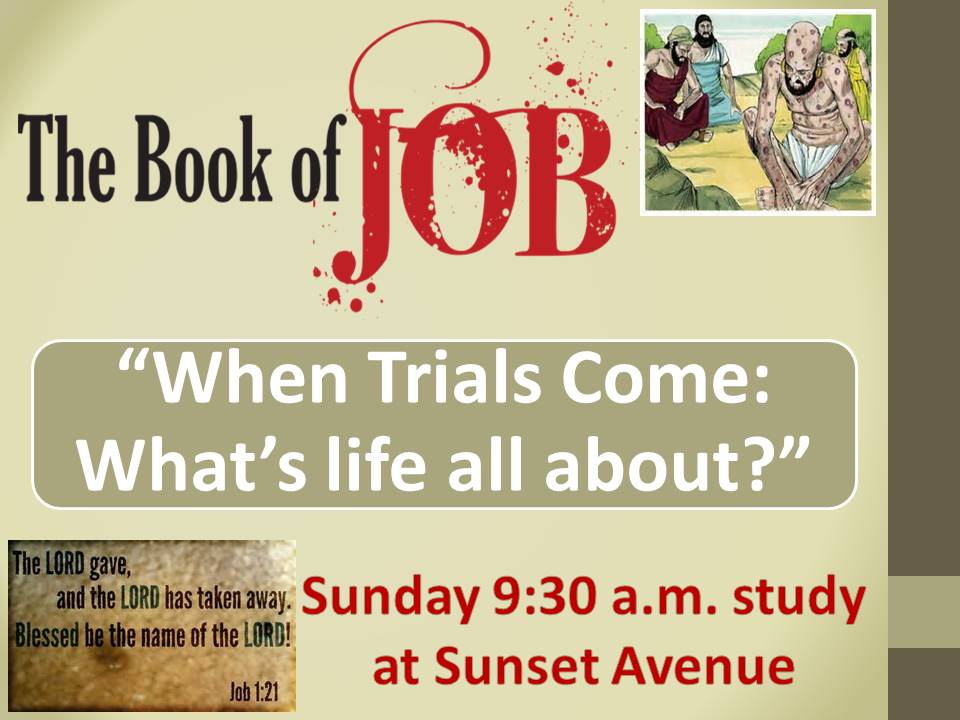
The book of Job When Trials Come 2  

There are many question words in any language. In English, most of the question words begin with WH: “What,” “When,” “Where,” Who,” and “How.” Much knowledge is gained by asking these questions. However, the question that troubles us the most is the one that I did not mention: “WHY.” This is the one we ask each other more often than any of the other questions. We want to know the reason behind every event under the sun and rhyme for everything that happens. Why did you forget our anniversary? Why were you not present at our junior’s baseball game? Why did you go there? Why did you do this, and why did you not do that?

But all these WHY questions pale when compared to the “WHY” question that we are sometimes forced to ask God.

Imagine, for example, you have three sons. Of course, you love them all. But the youngest is the most cherished one. It is the hardest to let him go. He leaves home after high school for college. He is just about done with college – one more year to go. He calls you to tell you that he will be coming home for Thanksgiving. You are eagerly waiting for the time when he will be home. Just a week or so before he comes home, you get a phone call from his roommate. Your son had a motorcycle accident . . . . He was killed. What kind of parents would you be if you did not raise your fist before God and ask “WHY? Why did You let this happen?”

The age-old question that man has raised is this: why would an all powerful and loving God allow such things? An atheist, of course, would have a ready answer: “There is no God. If there was a God, certainly He would not allow such things.” In anything and everything, an atheist finds proof for denying the existence of God because “

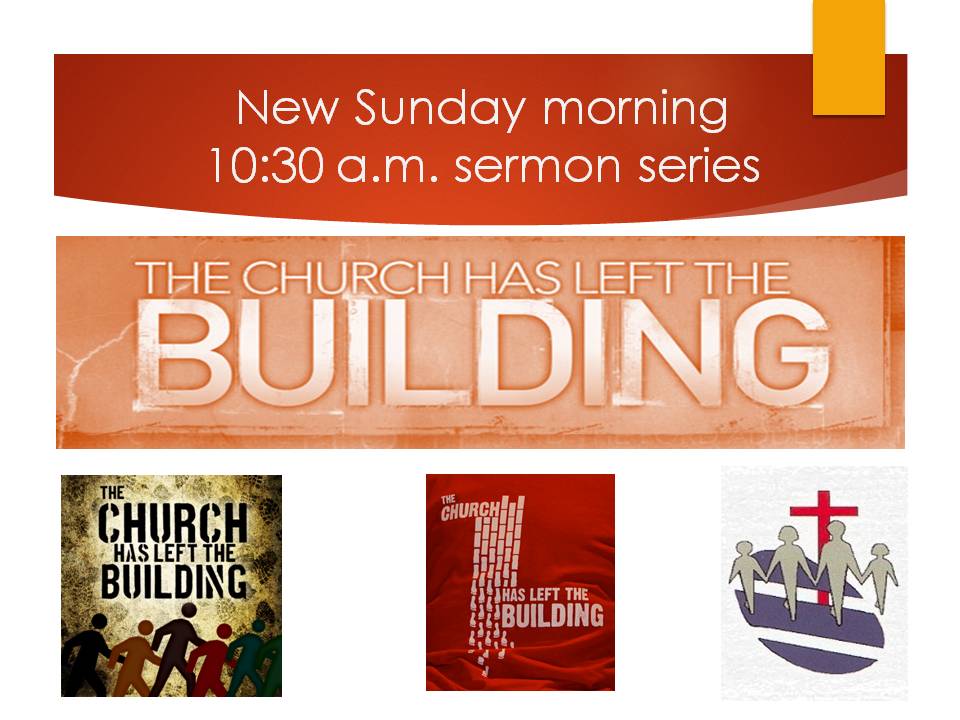
The Church has left the building

Most churches have invested big money in facilities that are attractive and functional.  While a church building is a great tool, we have to keep in mind that God’s mission for the world is much bigger than being nice people inside a beautiful facility.

God has a mission for the world.  It includes the things we do at the church building, but it is bigger because he is Lord of all creation.  “All things were created by him and for him.  He is before all things, and in him all things hold together.  And he is the head of the body, the church” (Col. 1:16-18). 

The church exists to serve the mission of God, and he draws us out of the church building into the world he loves.  Church buildings, like money, are a wonderful servant but a terrible master.  This series calls us to lift our eyes from the concerns of day-to-day church life to reflect on God’s grand scheme for all of creation.


Leave a comment

Posted by on July 31, 2014 in Article, Church, Encouragement


Solving Our Temperament Problems: The problem with pride


Facebook    YouTube 

 ——————————————–

James 4:6: “But He gives a greater grace. Therefore it says, “GOD IS OPPOSED TO THE PROUD, BUT GIVES GRACE TO THE HUMBLE.””

Men want and need to feel good about themselves. What could be more natural and more beneficial
than to feel good about yourself—to have a good self-image? But when does being proud of our position or accomplishments become a sin? Is anything wrong when our chest swells in pride at the home run our son hits?

Pride is a sin of comparison in which we compare our strengths to the other fellow’s weaknesses. In order to make ourselves feel better we put other people down, sometimes verbally and sometimes just mentally. The easiest way to look down on others is to pick out people of less stature and accomplishment. And it’s particularly easy to pick out other people’s weaknesses to compare to our strengths.

The subtle sin of pride beguiles every Christian man. The most invisible of sins, pride seeps into the Christian life like water oozes into the moat around a sand castle on the beach. It requires no effort on our part to get, but all of the strength to keep out.

The Bible talks of two kinds of pride. The first is found in Galatians 6:4:  “But let each one examine his own work, and then he will have reason for boasting in regard to himself alone, and not in regard to another.”

The key to this proper type of pride is to not compare ourselves to others. Rather than testing our self-worth by comparison to others, we are encouraged to self-examination. The Bible stands as the yardstick we measure ourselves against. And when we score well, we congratulate ourselves, but not at the expense of someone else.

The second kind of pride is the one that has a superiority feeling. C.S. Lewis put it this way: “A proud man is always looking down on things and people; and, of course, as long as you’re looking down, you can’t see something that’s above you.”


Jesus tells a parable to just such people, men “who were confident of their own righteousness and looked down on everybody else” (Luke 18:9). A religious leader prayed to God and thanked Him that he was not like all other men – robbers, evildoers, adulterers, and a nearby tax collector, but that he was a good man. And remember who went away justified by God?

Why didn’t he compare himself to Moses, Abraham, or King David? We pick out the weaknesses in others because pride is a sin of comparison in which I compare my strengths to another man’s weaknesses.

What is the answer? Humility! It is described in Romans 12:3: “For through the grace given to me I say to every man among you not to think more highly of himself than he ought to think; but to think so as to have sound judgment, as God has allotted to each a measure of faith.”

A cliché puts it this way: “Humility is not thinking little of yourself, rather it’s simply not thinking of yourself.”

The problem of fear

What are you afraid of? Do you have the job jitters—you think a pink slip may be in a wind? Maybe you work under the constant tension of a boss who seeks to govern via intimidation. Some men sense no direction for their lives, and they fear God has abandoned them. Some fear an uncertain future. Some do not have an assurance that when they die they will be in the presence of God.

Fear ad courage are opposites. Courage is defined as the state of mind that enables one to face hardship or disaster with confidence and resolution. Fear is the agitated state of mind that cripples us from looking any further than the hardship itself.

The Bible repeatedly encourages us not to be afraid: Matthew 14:27:  “But immediately Jesus spoke to them, saying, “Take courage, it is I; do not be afraid.””

2 Timothy 1:7: “For God has not given us a spirit of timidity, but of power and love and discipline.”

1 John 4:18: “There is no fear in love; but perfect love casts out fear, because fear involves punishment, and the one who fears is not perfected in love.”

1 Peter 5:7:  “…casting all your anxiety upon Him, because He cares for you.”

To be afraid is to not fully trust God. He instructs us not to be afraid., promising that if we cast our anxiety upon Him, He will take care of us. The Bible promises that if we trust God with our lives He will meet all of our needs and direct all of our paths.


What do we need in order to fully trust God? Faith! Faith is always oriented toward the future…we don’t need courage to face what we already know. It is an uncertain future that gives birth to doubts and fears.  An old saying sums it up: “We don’t know what the future holds, but we know who holds the future.”

The following cycle of fear is suggested from the story of Jesus and Peter (Matthew 14):

  1. Reality: We see the wind
  2. Response: We become afraid
  3. Result: We begin to sink
  4. Return: “Lord, save me!”
  5. Recovery: Jesus reaches out His hand.

Proverbs 29:25:  “The fear of man brings a snare, But he who trusts in the LORD will be exalted.”

Romans 8:28:  “And we know that God causes all things to work together for good to those who love God, to those who are called according to His purpose.”

The Desire to be Independent

William Ernest Henley: “I am the master of my fate; I am the captain of my soul.”

Jeremiah 10:23: “I know, O Lord, that a man’s life is not his own; it is not for man to direct his steps.”

We are raised to be independent. From their earliest homilies, mom and dad taught us to be independent with our lives and to make our own place. Most men are taught to pull themselves up by their own bootstraps. “Life is what you make of it!” we’re told.

We learn early that we can author our own destiny; we can be the captain of our soul, the master of our own fate–or so it seems.

Men want to control their own lives. Even if we were not taught to seek independence, which most of us were, our own human nature would pull us in that direction. We want the freedom to chart our own course. We want the power to shape the events of our lives. These are the hallmarks of our desire to be independent. But, in our effort to be self-reliant, we often break ranks with God and go our own independent way.

There is an abrupt difference between taking responsibility for our lives and trying to live independently from God. We are to take responsibility for our lives–no one will go to work in our place, no one will pay our bills on our behalf. The difference is this: Responsibility recognizes our part and God’s part. Our part is to trust God and faithfully fulfill our duties. God’s part is to provide for all of our needs and well-being. Independence rebels against the influence of God, thinking it can meet its own needs.

The independent man thinks, “I want to do what I want to do, when I want to do it, wherever I want to do it, with whomever I want to do it. I want to be in control. I want to satisfy my ambitions. I don’t want to be dependent on anyone. People let me down. God will let me down. I can make it on my own.

“If I can be independent then I will not need to rely upon anyone else. I will not have to trust anyone else, and I will be able to avoid the pain of being disappointed and disillusioned. If I can be independent then I can be in control of my own life. I will have the power, whether through money or influence, to get my own way; I will have the freedom to come and go as I please.”

This desire to be independent, more often than not, disguises itself. By all external appearances our mate and friends think we are on the right track, but we often practice a passive sort of self-reliance. Not open rebellion, but we don’t really seek the counsel of God and often shun His advice–we do our own thing.

The opposite of desiring to be independent from God is to trust Him. The man who does not trust God trusts in himself and the philosophies of this world, which is the epitome of indepenence!


Leave a comment

Posted by on July 30, 2014 in Article


Train Up a Child


Train up a child……easier said than done? Solomon said it best in Proverbs 22:6: “Train up a child in the way he should go: and when he is old, he will not depart from it.”

The word “train” there speaks to a process whereby we instill into our child the desire (thirst) to do what is right. Training consists of two steps that involve three major activities. The first step is teaching; after teaching comes discipline.

 1. Teaching. Teaching covers two of the three activities. The first thing one does in teaching is to show what or how a thing is done. Then the teacher tells or explains the details of the lesson. After a child has Picture2been taught by being shown or told, he is ready for the last step in training – discipline. The word discipline comes from the word disciple, which means “a follower of.” The child is now ready to practice for himselfherself what the teacher has taught. For a child to be trained, he/she must follow what the teacher does and says.

For example, suppose you want to start training your two-year-old to put his toys away. First, you will show the child how to pick the toys up and how they are to be stored in the toy box. You will talk to the child as you go through the process of showing him all about putting his toys away.

 “Now, Jimmy, you put this toy away,” you direct him. The child goes and puts the toy away, following what he saw you do and heard you say. You have taken Jimmy through a process that can be repeated, but each time he is asked to put his toys away “please,” he will know exactly what to do.

    2. Discipline. Here it is important to point out two types of discipline: a. Self-discipline. This is when a child follows you willingly, doing what you show and tell him to do. He does it because it is something he wants to do. His will and yours are in agreement. When a child exercises self-discipline, training is most enjoyable. b. Inflicted discipline. This is when a child decides he doesn’t want to do as he has been told, and you must compel him to follow your lessons. You will accomplish this only by inflicting discipline upon him. If you are a new parent, please don’t get your hopes built up and form a false optimism that your child will always exercise self-discipline with regard to all of your teaching. Be fore-warned: obedience won’t just happen! There will be multitudes of times you will have to inflict discipline upon your little one in order to train him….and the sooner you do this to make him follow, the more quickly your child will develop and exercise his own self-discipline and good judgment.

Wisdom In Raising Children — It costs to acquire wisdom, but it’s worth it! It isn’t enough to own a study Bible and read books about the Bible, helpful as they are. It’s one thing to know about the Bible and quite something else to hear God speak through His Word and teach us His wisdom so that we become more like Jesus Christ.

   We should keep in mind two things: 1. Life is short; and 2. Our eternal existence is greatly influenced by how we live during this short life. It is imperative, then, that we not waste our time through rash and foolish decisions which not only jeopardize our eternal destiny but can also make this life miserable.

 The value of wisdom is especially seen in family relationships: “He who troubles his own house will inherit the wind.” (Prov. 11:29). Life is too short and families grow too fast for us to raise a family through “trial and error”

Consider what many people think is most important in providing for a family Many would say it is the Picture1“necessities” of life such as food and clothing, and a place of shelter. Most would feel that other things are also necessary such as the “finer things” (luxuries) for the children, which parents never had as children. A good “education” for the children,

so they too can be affluent.

  1. Instilling a fear of the Lord  (reverence and awe) Proverbs 15:16: “Better is a little with the fear of the LORD Than great treasure and turmoil with it.”
  2. Giving them love. Proverbs 15:17: “Better is a dish of vegetables where love is Than a fattened ox served with hatred.” Providing an environment where love reigns is more important than providing material abundance. Troubled children come from homes where “love” is lacking, not money!
  3. Providing a peaceful family life. Proverbs 17:1: “Better is a dry morsel and quietness with it Than a house full of feasting with strife.”

    What can be done to insure adequate material provisions for the family: Be righteous! Proverbs 20:7: “A righteous man who walks in his integrity– How blessed are his sons after him.”
    Today that means putting the kingdom of God first in your life. Then God will watch out for you and providentially see that your needs are adequately met! Children of righteous parents are truly blessed! But parents who fail to put God first go through life without God’s providential help, and their children may suffer as a result! Inspired wisdom is explicit in the proper use of “corporeal punishment.” Used properly, it is a demonstration of true love. Proverbs 13:24: “He who withholds his rod hates his son, But he who loves him disciplines him diligently.”

Proper discipline has proper objectives Proverbs 22:15: “Foolishness is bound up in the heart of a child; The rod of discipline will remove it far from him.

Proverbs 23:13-14: “Do not hold back discipline from the child, Although you strike him with the rod, he will not die. You shall strike him with the rod And rescue his soul from Sheol.”

Proverbs 29:15: “The rod and reproof give wisdom, But a child who gets his own way brings shame to his mother.”

Proper discipline has its rewards Proverbs 29:17: “Correct your son, and he will give you comfort; He
will also delight your soul.”

Proverbs 19:18: “Discipline your son while there is hope, And do not desire his death.”

It is to be applied before the situation gets of out hand (“while there is hope”). It is also to be applied under controlled circumstances (“do not set your heart on his destruction”). i.e., do not put it off  until you strike in anger. There IS a difference between proper “spanking” and “child abuse”!

Look at these important points when you discipline your children, you’re acting like God discipline is a function of love, and appropriate punishment is not something done to a child but for the child spanking before 18 months of age is not wise and after 12 years of age is not effective it should be reserved for times of defiant or rebellious behavior when love is abundant at home, proper discipline (even a spanking) won’t be resented children are gifts from the Lord but between 15-36 months they don’t want to be restricted in any way. They are the most self-centered, manipulative, and controlling things on the planet…parents must be adults and be in charge.

James Dobson: “The proper time to begin disarming the teenage time bomb is 12 years before it arrives. “Children thrive best in an atmosphere of genuine love, undergirded by reasonable and consistent discipline. In a day of widespread drug usage, immorality, sexually transmitted diseases, vandalism, and violence, we must not depend on hope and luck to fashion the critical attitudes we value in our children. In those situations when the child fully understands what he is being asked to do or not to do but refuses to yield to adult leadership, an appropriate spanking is the shortest and most effective route to an attitude adjustment.” (The New Date to Discipline, page 28, 7, and 60-61).

Life is too short and families grow  too fast for us to raise a family  through “trial and error.”

Man’s domestic problems begin when he departs from God’s counsel regarding the home. This study is vital because our understanding of Christ’s relationship to the church is dependent upon His conception of the home. A reminder about Satan The first attack Satan made was against the home: he invaded Eden and led the first  husband and wife into disobedience and judgment.

He is called the “deceiver” and wants us to center our mind upon him, to make us  ignorant of God’s will in our life. He uses lies…Jesus tells us that “Satan is the Father of  all liars…that he cannot tell the truth because it just isn’t in him”….our defense is God’s Word!

He’s also called “the destroyer” and uses suffering in this world to make us impatient with God’s will…we need to remember the unmerited, unending grace that God bestows upon each of us when we choose Jesus and make Him Savior and Lord of our lives!

If he can’t get us through these means, Satan works on our pride and hopes to make us independent of God’s will.  Or he uses accusation as “the accuser” to work on the heart and the conscience to bring an indictment by God’s will.

  1. Satan uses religious leaders today to forbid marriage (1 Tim. 4:1-3). Singleness is a Christian’s option but for most people, marriage is the will of God. Satan’s approach is to convince the person that marriage is sinful. Any teaching  that claims greater spiritual virtues and blessings for the celibate than for the married is of the devil and not from God.
  2. Satan seeks to reverse the headship in the home (1 Tim. 2:11-13; Eph. 5:22-23).  He wants man to be concerned with dictatorship and forget the model of Christ as
    the head of the church; the husband ought to be the head of the wife in a living, loving
    relationship.

What is the answer to life’s difficulties and to Satan’s attacks on our homes? God!! It might be of some comfort to realize that the world has always been a difficult  place in which Christians must live. It has always been opposed to God’s values and God’s will. Satan longs for the soul of any age person who will reject good, right, and truth and turn to his way of thinking. Christians must daily remind themselves of the clear, simple words of Jesus, from Matthew 7:13-14: “Enter by the narrow gate; for the gate is wide, and the way is broad that leads to destruction, and many are those who enter by it.” {14} “For the gate is small, and the way is narrow that leads to life, and few are those who find it.”

 
Leave a comment

Posted by on July 10, 2014 in Family