RSS

Category Archives: Article

New studies beginning August 3


Facebook    YouTube 

 ——————————————–

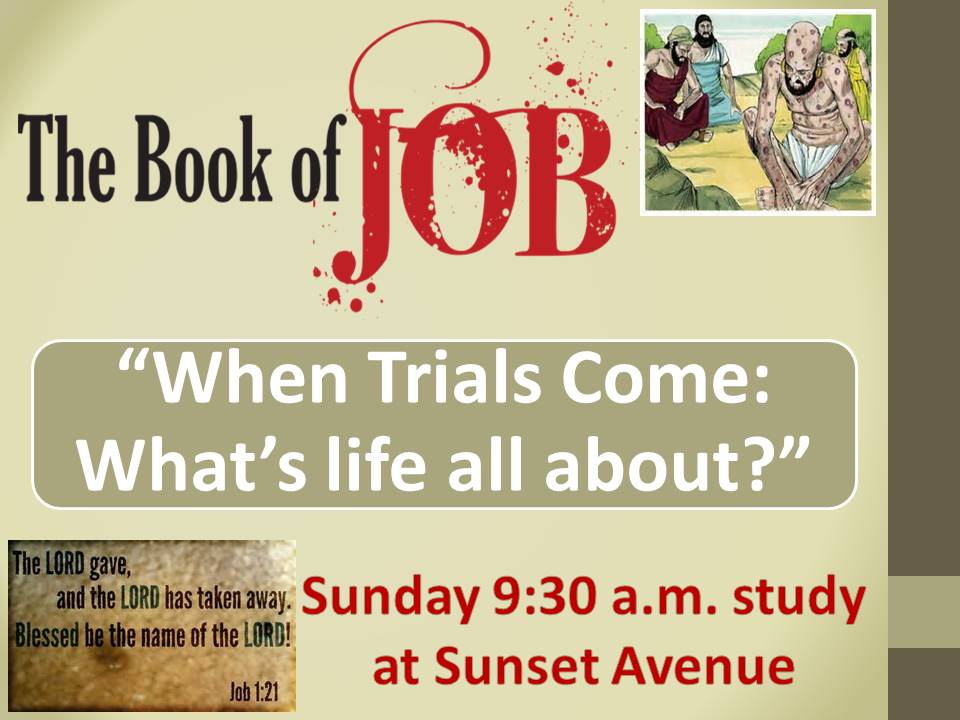
The book of Job When Trials Come 2  

There are many question words in any language. In English, most of the question words begin with WH: “What,” “When,” “Where,” Who,” and “How.” Much knowledge is gained by asking these questions. However, the question that troubles us the most is the one that I did not mention: “WHY.” This is the one we ask each other more often than any of the other questions. We want to know the reason behind every event under the sun and rhyme for everything that happens. Why did you forget our anniversary? Why were you not present at our junior’s baseball game? Why did you go there? Why did you do this, and why did you not do that?

But all these WHY questions pale when compared to the “WHY” question that we are sometimes forced to ask God.

Imagine, for example, you have three sons. Of course, you love them all. But the youngest is the most cherished one. It is the hardest to let him go. He leaves home after high school for college. He is just about done with college – one more year to go. He calls you to tell you that he will be coming home for Thanksgiving. You are eagerly waiting for the time when he will be home. Just a week or so before he comes home, you get a phone call from his roommate. Your son had a motorcycle accident . . . . He was killed. What kind of parents would you be if you did not raise your fist before God and ask “WHY? Why did You let this happen?”

The age-old question that man has raised is this: why would an all powerful and loving God allow such things? An atheist, of course, would have a ready answer: “There is no God. If there was a God, certainly He would not allow such things.” In anything and everything, an atheist finds proof for denying the existence of God because “

The Church has left the building

Most churches have invested big money in facilities that are attractive and functional.  While a church building is a great tool, we have to keep in mind that God’s mission for the world is much bigger than being nice people inside a beautiful facility.

God has a mission for the world.  It includes the things we do at the church building, but it is bigger because he is Lord of all creation.  “All things were created by him and for him.  He is before all things, and in him all things hold together.  And he is the head of the body, the church” (Col. 1:16-18). 

The church exists to serve the mission of God, and he draws us out of the church building into the world he loves.  Church buildings, like money, are a wonderful servant but a terrible master.  This series calls us to lift our eyes from the concerns of day-to-day church life to reflect on God’s grand scheme for all of creation.


Leave a comment

Posted by on July 31, 2014 in Article, Church, Encouragement


Solving Our Temperament Problems: The problem with pride


Facebook    YouTube 

 ——————————————–

James 4:6: “But He gives a greater grace. Therefore it says, “GOD IS OPPOSED TO THE PROUD, BUT GIVES GRACE TO THE HUMBLE.””

Men want and need to feel good about themselves. What could be more natural and more beneficial
than to feel good about yourself—to have a good self-image? But when does being proud of our position or accomplishments become a sin? Is anything wrong when our chest swells in pride at the home run our son hits?

Pride is a sin of comparison in which we compare our strengths to the other fellow’s weaknesses. In order to make ourselves feel better we put other people down, sometimes verbally and sometimes just mentally. The easiest way to look down on others is to pick out people of less stature and accomplishment. And it’s particularly easy to pick out other people’s weaknesses to compare to our strengths.

The subtle sin of pride beguiles every Christian man. The most invisible of sins, pride seeps into the Christian life like water oozes into the moat around a sand castle on the beach. It requires no effort on our part to get, but all of the strength to keep out.

The Bible talks of two kinds of pride. The first is found in Galatians 6:4:  “But let each one examine his own work, and then he will have reason for boasting in regard to himself alone, and not in regard to another.”

The key to this proper type of pride is to not compare ourselves to others. Rather than testing our self-worth by comparison to others, we are encouraged to self-examination. The Bible stands as the yardstick we measure ourselves against. And when we score well, we congratulate ourselves, but not at the expense of someone else.

The second kind of pride is the one that has a superiority feeling. C.S. Lewis put it this way: “A proud man is always looking down on things and people; and, of course, as long as you’re looking down, you can’t see something that’s above you.”


Jesus tells a parable to just such people, men “who were confident of their own righteousness and looked down on everybody else” (Luke 18:9). A religious leader prayed to God and thanked Him that he was not like all other men – robbers, evildoers, adulterers, and a nearby tax collector, but that he was a good man. And remember who went away justified by God?

Why didn’t he compare himself to Moses, Abraham, or King David? We pick out the weaknesses in others because pride is a sin of comparison in which I compare my strengths to another man’s weaknesses.

What is the answer? Humility! It is described in Romans 12:3: “For through the grace given to me I say to every man among you not to think more highly of himself than he ought to think; but to think so as to have sound judgment, as God has allotted to each a measure of faith.”

A cliché puts it this way: “Humility is not thinking little of yourself, rather it’s simply not thinking of yourself.”

The problem of fear

What are you afraid of? Do you have the job jitters—you think a pink slip may be in a wind? Maybe you work under the constant tension of a boss who seeks to govern via intimidation. Some men sense no direction for their lives, and they fear God has abandoned them. Some fear an uncertain future. Some do not have an assurance that when they die they will be in the presence of God.

Fear ad courage are opposites. Courage is defined as the state of mind that enables one to face hardship or disaster with confidence and resolution. Fear is the agitated state of mind that cripples us from looking any further than the hardship itself.

The Bible repeatedly encourages us not to be afraid: Matthew 14:27:  “But immediately Jesus spoke to them, saying, “Take courage, it is I; do not be afraid.””

2 Timothy 1:7: “For God has not given us a spirit of timidity, but of power and love and discipline.”

1 John 4:18: “There is no fear in love; but perfect love casts out fear, because fear involves punishment, and the one who fears is not perfected in love.”

1 Peter 5:7:  “…casting all your anxiety upon Him, because He cares for you.”

To be afraid is to not fully trust God. He instructs us not to be afraid., promising that if we cast our anxiety upon Him, He will take care of us. The Bible promises that if we trust God with our lives He will meet all of our needs and direct all of our paths.


What do we need in order to fully trust God? Faith! Faith is always oriented toward the future…we don’t need courage to face what we already know. It is an uncertain future that gives birth to doubts and fears.  An old saying sums it up: “We don’t know what the future holds, but we know who holds the future.”

The following cycle of fear is suggested from the story of Jesus and Peter (Matthew 14):

  1. Reality: We see the wind
  2. Response: We become afraid
  3. Result: We begin to sink
  4. Return: “Lord, save me!”
  5. Recovery: Jesus reaches out His hand.

Proverbs 29:25:  “The fear of man brings a snare, But he who trusts in the LORD will be exalted.”

Romans 8:28:  “And we know that God causes all things to work together for good to those who love God, to those who are called according to His purpose.”

The Desire to be Independent

William Ernest Henley: “I am the master of my fate; I am the captain of my soul.”

Jeremiah 10:23: “I know, O Lord, that a man’s life is not his own; it is not for man to direct his steps.”

We are raised to be independent. From their earliest homilies, mom and dad taught us to be independent with our lives and to make our own place. Most men are taught to pull themselves up by their own bootstraps. “Life is what you make of it!” we’re told.

We learn early that we can author our own destiny; we can be the captain of our soul, the master of our own fate–or so it seems.

Men want to control their own lives. Even if we were not taught to seek independence, which most of us were, our own human nature would pull us in that direction. We want the freedom to chart our own course. We want the power to shape the events of our lives. These are the hallmarks of our desire to be independent. But, in our effort to be self-reliant, we often break ranks with God and go our own independent way.

There is an abrupt difference between taking responsibility for our lives and trying to live independently from God. We are to take responsibility for our lives–no one will go to work in our place, no one will pay our bills on our behalf. The difference is this: Responsibility recognizes our part and God’s part. Our part is to trust God and faithfully fulfill our duties. God’s part is to provide for all of our needs and well-being. Independence rebels against the influence of God, thinking it can meet its own needs.

The independent man thinks, “I want to do what I want to do, when I want to do it, wherever I want to do it, with whomever I want to do it. I want to be in control. I want to satisfy my ambitions. I don’t want to be dependent on anyone. People let me down. God will let me down. I can make it on my own.

“If I can be independent then I will not need to rely upon anyone else. I will not have to trust anyone else, and I will be able to avoid the pain of being disappointed and disillusioned. If I can be independent then I can be in control of my own life. I will have the power, whether through money or influence, to get my own way; I will have the freedom to come and go as I please.”

This desire to be independent, more often than not, disguises itself. By all external appearances our mate and friends think we are on the right track, but we often practice a passive sort of self-reliance. Not open rebellion, but we don’t really seek the counsel of God and often shun His advice–we do our own thing.

The opposite of desiring to be independent from God is to trust Him. The man who does not trust God trusts in himself and the philosophies of this world, which is the epitome of indepenence!


Leave a comment

Posted by on July 30, 2014 in Article


Solving Our Time Problems


Facebook    YouTube 

——————————————–

The problem of time management shows up as the number one problem men are concerned about in many surveys conducted..we usually just can’t find enough time to accomplish all the things we should do and would like to do. But we have the same number of minutes in a day that others have, don’t we? So it can’t be minutes or days.

Effective Time Management Tips for College StudentsThe problem is less a ‘tips and techniques’ problem than it is a strategic problem. It’s as clear as understanding God’s purpose for our life, living by Biblical priorities, and making plans which reflect God’s will for our lives. God always provides enough time to accomplish His plans! Effectiveness is doing the right job right!

Some steps which can help us:

  • I tell God what I am going to do
  • God responds
  • I beg God to let me do it anyway
  • I humble myself and listen
  • God makes it clear what He is going to do.

 (Prov 16:1)  “The plans of the heart belong to man, But the answer of the tongue is from the LORD.”

(Prov 16:3-4)  “Commit your works to the LORD, And your plans will be established. {4} The LORD has made everything for its own purpose, Even the wicked for the day of evil.”

(Prov 19:21)  “Many are the plans in a man’s heart, But the counsel of the LORD, it will stand.”


Leave a comment

Posted by on July 30, 2014 in Article


Five Attitudes to Untie for a Person’s Anger Knots


Facebook    YouTube 


 ——————————————–

1. Become soft and tender with the person.

“A gentle answer turns away wrath” (Proverbs 15). When a person speaks tenderly with another, the tone literally halts the actions of others. This kind of action shows care and concern—sometimes softness alone can melt an anger-hardened heart.

2.     Understand, as much as possible, what the other person has endured.

peaceofgodWe must seek to see another point of view.  If can walk a mile in their shoes, it helps us to gain a perspective which can open doors instead of close them.

3.     Admit the person has been wounded and admit any wrong in provoking the hurt.

Some of the most difficult words we can express are those words “I am sorry” or “I made a mistake in the way I handled that situation.” A survey confirms that teens know how hard it must be: their number one complaint in a recent survey about their parents could be summed up in five words: “They never say I’m sorry.”

Sometimes we may not think we’re wrong, but our attitude may be. Or we may have acted offensively. If my spirit is critical and angry when I tell my child about a legitimate problem, I’m still wrong.

James 1:20: “….for the anger of man does not achieve the righteousness of God.”

Proverbs 30:33: “For the churning of milk produces butter, And pressing the nose brings forth blood; So the churning of anger produces strife.”

4.     Touch the person gently.

When people handle themselves properly, with love and patience and kindness, the physical and emotional distance can be bridged quickly.

5.     Seek forgiveness – and wait for a response.

Try to elicit a positive response from the person before you turn away; but if you need to, start with the first loving attitude of being soft and work your way back to forgiveness. Remember, too, don’t just respond to your loved one’s words. If you’ve deeply hurt someone, that person may verbally retaliate to hurt you.

 
Leave a comment

Posted by on July 26, 2014 in Article


Learning to Properly Handle Our Anger


William Stafford: “Individuals or whole peoples can gnaw on old grievances, remembering them again and again, renewing them obsessively until the shape of memory and desire is permanently warped along the lines of anger.”

Dr. Gary Smalley, in addition to listing honor as the number one need in our homes today, also suggests that forgotten, unresolved anger is the number one poison – the one thing that is causing more divorce than anything else.

Whether we agree with that assessment or not, we certainly can agree that we simply must learn to deal more effectively with the anger we have in order to have the peaceful homes we need, desire, and deserve.

We think it’s forgotten, or that it has disappeared…yet it comes to life again because anger is usually ‘buried alive’ and it keeps on growing. It is made up of hurt, frustration, and fear. We should not welcome unresolved anger, because that allows it to linger and settle in, bringing harm not only to ourselves but also to those around us.

Anger has three deadly results:

1.     Anger creates distance

Anger almost always creates an unhealthy distance between the parties involved. Do you want to stay or run away from angry people? People are not comfortable being in the presence of any angry person; they won’t want to interact with you; the won’t want you in their room.

If you are married to anConflict-Resolution angry man or woman, he or she will usually try to create distance between you. You may want to get close, but the offended one will pull away. Angry people refute closeness. Improve the relationship, and they will sabotage it. Call it black – they will call it white, just to keep you at arm’s length.

We each have to face out past and check the level of our own anger. We can stop what sometimes becomes a generational pull (we find ourselves acting like our parents!) of ruined relationships by taking responsibility for reducing the level of anger within ourselves.

2.     Anger pushes us into darkness

Ephesians 4:26-27: “BE ANGRY, AND yet DO NOT SIN; do not let the sun go down on your anger, {27} and do not give the devil an opportunity.”

Have you ever found yourself awake in the middle of the night in a hotel room – and you can’t find a light switch? You need to answer the telephone, turn down the air conditioner, or locate the bathroom, but you find yourself groping in inky darkness – walking into a table, knocking the clock off the nightstand, banging your shin on a chair or tripping over the shoes you left on the floor.

Unresolved anger does that in our lives. It rips away our perspective and throws us into chaos. We don’t know where we are. We can’t think logically. We don’t realize what we’re doing to ourselves and those we love. As we blindly lurch and stumble, our families become candidates for serious, possibly permanently, injuries of the heart.

Is it surprising that if unresolved anger puts us at a distance from each other that it might have the identical effect upon our relationship with God?! There is usually a certain correlation between anger and faith; it seems that the greater a person’s unresolved anger, the more difficulty that person has in developing a meaningful spiritual life.

Walking consistently in darkness prevents us from being sensitive or loving toward others. It also kills any interest we have in studying God’s Word and lays any desire to pray into the deep freeze. Further, it robs us of any desire to please and honor Him or to experience His joy, contentment, and peace.

When Satan secures a foothold in a life, it’s no laughing matter. Deception and chaos come through the door with him. Unbelievable pain and destruction follow. Anger trickles into the emotional heart of a relationship, chilling feelings of warmth or attachment. No wonder Paul said:

3.     Anger ties us into knots

Like few other emotions, anger restricts and binds us, tying us into internal knows. Forgiveness, on the other hand, sets us free from those bonds, untying the knots that hold us captive.

The Lord Jesus gives us a powerful word picture of forgiveness: Forgive, and you will be forgiven” (Luke 6:37). The word used here in the original language literally means to “release fully, to unbind or to let go.” It is the only time in the New Testament that this word is translated “forgiven.” It is usually found to be “release” or “free.” (see John 11:44).

The Anger Inventory

To take the inventory, simply rate each statement below, on a scale from 0 (very low) to 10 (very high), for how much it applies to you.

___ 1. I have frequently recurring minor problems.

___ 2. I tend to have difficulty remaining close to people. Others have even said I am “cold.”

___ 3. I continually fail to see the pitfalls in business deals.

___ 4. I have little interest in religious matters.

___ 5. I have many doubts about the existence of God

___ 6. I tend to see religious people as “a bunch of hypocrites.”

___ 7. I tend to be judgmental or overly critical of people.

___ 8. I have a general inability to see my own shortcomings.

___ 9. My image is very important to me. What I wear and drive are big concerns.

___ 10. I often struggle with feelings of low self-value.

___ 11. I often fail to see that my words or actions hurt the feelings of others.

___ 12. My parents divorced before I turned eighteen.

___ 13. I think one or both of my parents drank too much alcohol.

___ 14. My parents seemed addicted to drugs or other substances.

___ 15. My parents abused me.

___ 16. My parents seemed too distant or neglectful to me.

___ 17. I felt that my parents were too controlling of me.

___ 18. I often struggle with feelings of discouragement or depression.

___ 19. I seem to be at odds with several people for long periods of time.

___ 20. I tend to be overly controlling of my mate, children, or friends.

___ 21. I have general feelings of anxiety; I can’t put my finger on what it is that I’m uneasy about.

___ 22. I have sometimes thought about suicide.

___ 23. I have had a hard time forgiving others when they hurt or frustrate me.

___ 24. I have a hard time confronting others when they hurt me, and I know that I’m not that good at getting my anger out.

___ 25. I find myself overly busy most of the time.

___ 26. I find it easier to blame others than to take responsibility for my mistakes.

___ 27. I often overreact to what others say or do to me.

___ 28. I feel I am motivated far too often by fear of failure.

___ 29. I often wish people who have hurt me could be punished somehow.

___ 30. I frequently think that I’ve been cheated out of important areas of life.

___ 31. I get into fights with others that sometimes result in physical aggression, such as throwing things, slapping, or hitting.

___ 32. I don’t really trust anyone other than myself.

  • Now add up the 32 numbers – your waiting…….My total score: _______
  • If your total score is more than 100, there is some help for you offered in available books. If your score is more than 200, see a counselor.
 
Leave a comment

Posted by on July 23, 2014 in Article


Some ‘do’s and don’ts’ for bringing up a child


RULES FOR BRINGING DOWN A CHILD
1. Let him have plenty of money to spend as he likes.

2. Permit him to choose his companions without restraint or guidance.
3. Let him spend Sunday hours on the street or with companions with low ideals as to the Lord’s day.
happy-fathers-day-quotes4. Allow him to go out at night as he pleases and return when he gets ready.
5. Make no inquiry as to where and with whom he spends his leisure time.
6. Teach him to expect pay for all help at home and for all services to others.
7. Allow him to think that good manners are a good substitute for good morals.
8. Do not trouble to interest him in the Bible or to win him to Christ.
9. Let him see that you think church attendance is not important.
10. Never let him hear you pray, especially not for his salvation.

TEN SELECTED RULES FOR BRINGING UP A CHILD
1. Make home the brightest and most attractive place you can.

2. Make him responsible for helping in some daily duties at home.
3. Never punish him in anger, nor to relieve your own feelings, but only in love and for disobedience.
4. Do not ridicule his ideas; talk frankly on matters in which he is interested.
5. Encourage him to invite friends to your home and table.
6. Impress upon his mind the fact that service and honesty are more important than making money.
7. Live Christ before him so that you will be able to talk Christ to him.
8. Let him see your enjoyment and profit from Bible reading and prayer.
9. Set an example in faithful church attendance and interest in the work.
10. Be much in prayer for his salvation and spiritual growth.

 
Leave a comment

Posted by on July 15, 2014 in Article


Children’s Day, 2014 – Basic Needs of Children


 Facebook    YouTube

 ——————————————–

In Man in the Mirror, Patrick Morley tells of a group of fishermen who landed in a secluded bay in Alaska and had a great day fishing for salmon. But when they returned to their sea plane, they found it aground because of the fluctuating tides. They waited until the next morning for the tides to comes in, but when they took off, they only got a few feet into the air before crashing back into the sea. Being aground the day before had punctured one oHappy-Childrens-Day-Wallpaper-FB-Whats-App-Creative-1f the pontoons, and it had filled up with water.

The sea plane slowly began to sink. The passengers, three men and a 12-year-old son of one of the men, prayed and then jumped into the icy cold waters to swim to shore. The riptide was strong, but two of the men reached the shore exhausted. They looked back, and saw the father with his arms around his son being swept out to sea.

The boy had not been strong enough to make it. The father was a strong swimmer, but he had chosen to die with his son rather than to live without him.

Every object of God’s creation has special needs of its own and, in every case, God has provided a method for satisfying those needs.

Human beings have their special needs. Some of these needs are elementary in nature and are easily satisfied. Man needs oxygen, so God created him with lungs which automatically draw oxygen into the body and make it usable for body needs.

Some needs of humans require more effort on man’s part for their satisfaction. For example, man needs water and may have to drill a well in order to find it. He needs food and in order to have sufficient amounts of food he may have to plant, cultivate and harvest vegetables from a garden.

Humans also have spiritual needs and they cannot be provided by automatic responses of the body or by any other entirely physical effort. These spiritual needs have to do with man’s personality, disposition, relation to other humans and his relation to God.

But, as in every case, God has provided a source of satisfaction for these needs. In this case, the source is the home. The home is God’s instrument for satisfying the basic needs of human beings!

Insofar as the needs of children are concerned, parents are the primary providers. Someone has suggested that since God is a spirit and cannot be physically present in all places, he provided every child with a mother and a father to see that his/her needs are satisfied.

1. Children need the security of a stable home life.
Children need to have a firm ground under their feet for proper development. Any parent knows that newborn babies are terribly frightened of falling. And when the baby is frightened by any sudden movement, the best way to calm him is to pick him up and hold him very firmly. This need lasts for a lifetime!

Children need the security that comes from the knowledge that mother and father love each other very much. Quarreling between a child’s parents is like an earthquake which threatens to take away his firm footing.

A child is very sensitive to tension and hostility. Make him grow up in an atmosphere charged with discord and he will be insecure for the rest of his life.

A child also needs to know that he is loved by his parents. There is no way to know how many scores of children are unwanted. Sometimes you hear of a baby who was abandoned by parents who didn’t want him. There is a sense in which this abandoned child is better off than an unwanted child who is kept by his parents and tolerated but not loved!

2. Children need the confidence of their parents.
Children want to be trusted and, in most cases, they will be trustworthy if given the chance to prove them-selves. Teenagers are especially sensitive to a lack of trust by their parents/teachers.

Some parents are constantly questioning their children and indicating that they expect the worst from them. Keep up those suspicious looks and questions and your child will probably decide that it isn’t worth the effort to try to win your confidence and will live up to your lesser expectations!

You should let him/her know that he has your confidence and then he will likely live up to it.

3. Children need the companionship of their parents
Not all the gifts of money and “things” in the world can make up for the failure to give one’s self. A great many “good” men and women have utterly failed as parents because they withheld themselves from their children. Trying so hard to provide a good living and some of the “little extras that we never had,” they lost their children.

One of the saddest stories in the Bible is of Samuel and his sons. They were anything but godly, though Samuel was a true man of God. Why? Because Samuel spent so much time with the “congregation and its problems” that he lost his own family!

4. Children need instruction from their parents.
Children get their information from various sources and, on the basis of the information they are given, they build a life.

We trust our public and private schools to give a general education to our children, and these schools are doing an adequate job (depending upon who you talk to). But there are at least two special areas of instruction where parents have a particular responsibility–sex and religion.

These two areas are the most difficult of all in many ways. Because they are so difficult, some parents simply side-step their responsibility and leave their children to pick up whatever information they may be able to come by on their own.

Because much has already been said about the need for Biblical training on the part of the parents in other lessons, we’ll spend our time here on the subject of sex education.

Some ‘do’s and don’t regarding sex education
· Don’t make your own feelings of shame the basis of instruction

· Don’t avoid warnings about masturbation, homosexual activity and social diseases. Avoid minute details and horror films.
· Don’t think “a young man must have his fling”
· Don’t try to prevent adolescents from becoming interested in the opposite sex
· Don’t try to make cold beings out of young people by being mostly negative
· Don’t accept supersitious beliefs about sex yourself
· Don’t expect to solve all of the child’s problems by sex instruction
· Don’t fail to warn children against persons who use smutty language, tell filthy stories, or who become too familiar in their conduct. Avoid them!
· Don’t treat sex sins as unforgivable

5. Children need to learn to obey.
There is more significance to this than meets the eye. But suffice it to say that Paul commands children in this crucial area: Ephesians 6:1: “Children, obey your parents in the Lord, for this is right.”

The self-discipline which comes by obedience to commands by wise parents is in complete harmony with the will of God, and the common sense of it is clearly seen in the affairs of men.

The first six or seven years of life upon this life can virtually determine eternal destiny! Young children can be taught basic principles and attitudes. They include respect, obedience, and cooperation.

6. Children need the love and fear of God.
Proverbs 14:27: “The fear of the LORD is a fountain of life, turning a man from the snares of death.”

The child needs to know how much God loves them and how He sent His only begotten Son for their sin. This fear is not trembling, but better called respect.

7. Children need examples from their parents.
What you are will mean more to your children than what you say. To really be an effective parent, saying and being will have to be consistent with each other.

8. Children need discipline.
Solomon wrote: Prov. 23:13: “Do not withhold discipline from a child; if you punish him with the rod, he will not die.”

Discipline isn’t always spanking! The word has as its root to “teach.” Our reducing the word to mean only punishment is a great disservice to it.

God’s word is clear on this subject:
Genesis 18:19: “For I have chosen him, so that he will direct his children and his household after him to keep the way of the LORD by doing what is right and just, so that the LORD will bring about for Abraham what he has promised him.”

Heb. 12:9-11: “Moreover, we have all had human fathers who disciplined us and we respected them for it. How much more should we submit to the Father of our spirits and live! {10} Our fathers disciplined us for a little while as they thought best; but God disciplines us for our good, that we may share in his holiness. {11} No discipline seems pleasant at the time, but painful. Later on, however, it produces a harvest of righteousness and peace for those who have been trained by it.”

Anything we can say or any fair method which can be used to teach children proper rules of behavior should be used.

All that we do in this area must be done in fairness. Fairness within the family circle is catching to children. Partiality has long been a cause of family strife and complexes of inferiority and superiority in children that harm and rule their lives. Jacob and Esau and his brethern stand as eternal examples of the inevitable strife generated by parental partiality.

Happy-Childrens-Day-Creative-Wallpaper9. Children need recognition of their achievements.
Parents are quick to notice and long in remembering the mistakes and failures of their children. Fortunate is the child whose parent is as delighted with his successes and achievements as he is disappointed with his failures. We all must have praise and appreciation.

10. Children need to be given responsibility.
The Bible says, in Lamentations 3:27: “It is good for a man to bear the yoke while he is young.”

That simply means that it is wise for parents to teach children a sense of responsibility. This is one reason why giving an allowance to children is an effective teaching device. They also need to have some jobs which are part of being in the family and also learn the importance of keeping one’s promises or to finish an assigned task, etc.

11. Children need to be given a measure of freedom.
Some boys and girls are literally smothered by over-protective parents! Some mothers insist on driving their 12-to-13 year old boys to a Scout meeting and sitting there the whole time until the meeting is over,

watching everything that goes on. They are afraid for them to ride a bicycle or go with a group of their church friends.

While it is important that we use good common sense and check out the places and people they are spending time with, we must also realize that we don’t want weak and timid teenagers who can’t stand on their own two feet! They must be encouraged to try new things. They need to use their imaginations. They need some privacy and freedom. And what better place to have our children when they are in environments where there is proper control and chaperones.

12. Children need unconditional love.
A parent is very foolish indeed who says, “now if you want me to love you, you mind me.” Life is insecure enough without the threat of love being denied within the boundaries of our own family! Children need to

feel their parents’ love through demonstration. They need to be told and shown that they are loved.

13. Children must have the opportunity to grow.
The child must grow mentally, physically, spiritually, and socially. When we grow in favor with God, we are developing spiritually. When we grow in favor with man, we are becoming well adjusted in society.


Leave a comment

Posted by on July 14, 2014 in Article


A Celebration of Family — Do I Really Make A Difference?


I’m not sure I can adequately express how excited this event is for Terry and me. We are getting to meet some of you who have family members worshipping here at Sunset Avenue … and we’ve already heard some of the stories about you!

Where does it begin? Psalm 127:1-5 (NIV)
1  Unless the LORD builds the house, its builders labor in vain. Unless the LORD watches over the city, the watchmen stand guard in vain.
2  In vain you rise early and stay up late, toiling for food to eat– for he grants sleep to those he loves.
3  Sons are a heritage from the LORD, children a reward from him.
4  Like arrows in the hands of a warrior are sons born in one’s youth.
5  Blessed is the man whose quiver is full of them. They will not be put to shame when they contend with their enemies in the gate.

There are some people in 21st century who do not feel this way…a modern version might sound more like this: Lo, children are a burden from the Lord; and the fruit of the womb must be his way of testing us. As the source of endless work and continual aggravation, so are the children of one’s youth. Unhappy is the man who hears his neighbor ask, “Do all those kids belong to you?”

We can understand why folks might feel that way. Some children are rebellious, disobedient, disrespectful — not very pleasant to be around. Some young couples have decided not to have any at all.

In those families, what has gone wrong? Where might we lose God’s perspective? The first verse of Psalm 127 may provide us with a clue. Unless the LORD builds the house, its builders labor in vain.

pic1Stable and successful homes are built by God. He’s the architect and the general contractor. He’s drawn the blueprint, and He wants to provide the direction and give the orders. All He needs are some laborers–husbands, wives and children–who will study the blueprint provided in His Word, then follow His di­rections. Any other procedure is going to result in frustration and failure. It’s because of this simple fact that many in foreign countries that otherwise do not believe in God…are interested in learning about God…because they see couples who have great homes!

Some folks think there are other ways to produce a happy home. For example, “Work, work, work, as hard as you can. Provide all the material things of this world for your children. Maybe that will make them happy.” If dad doesn’t make enough money to do it, mom goes to work too. Read on in Psalm 127. 2  In vain you rise early and stay up late, toiling for food to eat– for he grants sleep to those he loves.

The bread of sorrows is simply bread secured through toil and trouble. Food is essential, but God can provide it without tak­ing fathers and mothers away from their children day and night to pursue that elusive and almighty dollar. God has no time for laziness. He blesses honest work, but he can supply the things we need without anxious efforts and ceaseless self‑activity. The Psalmist says God provides for his beloved ones, literally, “in sleep,” the idea being in calm, restful, confident trust in him.

Every new child born into a Christian home is a gracious gift from God, a lovely legacy from the Lord entrusted to our care to be loved, cherished, provided for and properly molded for his glory. “The fruit of the womb is his reward.”

A husband and wife ought to give their child to God even before he is born. And they should pray together after the birth of the child, willingly dedicating themselves to train him as God directs.

 “Happy is the man who hath his quiver full of them: they shall not be ashamed, but they shall speak with the enemies in the gate.”

Wives, submit yourselves (vv. Ephesians 5:22-24).

22  Wives, submit to your husbands as to the Lord.
23  For the husband is the head of the wife as Christ is the head of the church, his body, of which he is the Savior.
24  Now as the church submits to Christ, so also wives should submit to their husbands in everything.

He gives two reasons for this command: the lordship of Christ (Eph. 5:22) and the headship of the man in Christ (Eph. 5:23). When the Christian wife submits herself to Christ and lets Him be the Lord of her life, she will have no difficulty submitting to her husband.

1 Corinthians 11:3 (NIV)
3  Now I want you to realize that the head of every man is Christ, and the head of the woman is man, and the head of Christ is God.

Husbands, love your wives (vv. 25-32).

25  Husbands, love your wives, just as Christ loved the church and gave himself up for her
26  to make her holy, cleansing her by the washing with water through the word,
27  and to present her to himself as a radiant church, without stain or wrinkle or any other blemish, but holy and blameless.
28  In this same way, husbands ought to love their wives as their own bodies. He who loves his wife loves himself.
29  After all, no one ever hated his own body, but he feeds and cares for it, just as Christ does the church-30  for we are members of his body.
31  “For this reason a man will leave his father and mother and be united to his wife, and the two will become one flesh.”
32  This is a profound mystery–but I am talking about Christ and the church.

The husband is not to “use” his wife for his own pleasure, but rather is to show the kind of love that is mutually rewarding and sanctifying. The marriage experience is one of constant growth when Christ is the Lord of the home. Love always enlarges and enriches, while selfishness does just the opposite.

As he loves her, he is nourishing her. How many people have confessed, “I am starved for love.” There should be no starvation for love in the Christian home, for the husband and wife should so love each other that their physical, emotional, and spiritual needs are met.

If both are submitted to the Lord, and to each other, they will be so satisfied that they will not be tempted to look anywhere else for fulfillment.

Ephesians 6:1-4 (NIV)
1  Children, obey your parents in the Lord, for this is right.
2  “Honor your father and mother”–which is the first commandment with a promise–
3  “that it may go well with you and that you may enjoy long life on the earth.”

4  Fathers, do not exasperate your children; instead, bring them up in the training and instruction of the Lord.

Let the audience see what exasperation looks like!

THE BEST GIFT YOU CAN GIVE YOUR CHILDREN?

LOVE AND RESPECT (Ephesians 5:33)

33  However, each one of you also must love his wife as he loves himself, and the wife must respect her husband.

pic2The secret to the communication code is this:
1. Love is her deepest need and respect is his deepest need. I believe this based on the Bible.
Ephesians 5:33 “Nevertheless let each individual among you also love his own wife even as himself; and let the wife see to it that she respect her husband.”

In other words, a wife needs to feel love and a husband needs to feel respect.

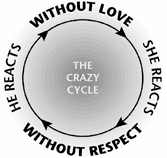
Without love she reacts without respect, and without respect he reacts without love.

Marital craziness is when we keep doing the same thing over and over. The topics change but the crazy cycle continues. Unless couples discover the secret that cracks the communication code, and learn how to get off the Crazy Cycle, things tend to stay a bit crazy! And it really gets crazy when a husband tells his wife, “Oh, stop feeling this way.” Or, a wife says to her husband, “Oh, stop feeling this way.”

The marriage book…and the dieting book.

Read the words from the I Love You card.

This is what I’m really saying every time I say I Love You…

I’m really trying to say so much more than just those three little words;

I’m trying to express so many wonderful feelings about you…

I’m trying to say that you mean more to me than anyone else in the world.

I’m trying to let you know that I adore you and that I cherish the time we spend together.

I’m trying to explain that I want you and that I need you and that I get lost in wonderful thoughts every time I think about you.

And each time I whisper “I love you,” I’m trying to remind you that you’re the nicest thing that has ever happened to me.”

Another card: I love you with all my heart. And my body generally goes where my heart does.

How Being a Strong Christian Will Help Us Have A Happy Marriagepic3

  • Christians are concerned about others.
  • Christians practice love.
  • Christians want the best for others.
  • Christians have a positive sexual ethic.
  • Christians can forgive.
  • Christians make good fathers and mothers.
  • Christians provide for their own.
  • Christians are kind.
  • Christians are unselfish.
  • Christians honor/respect each other

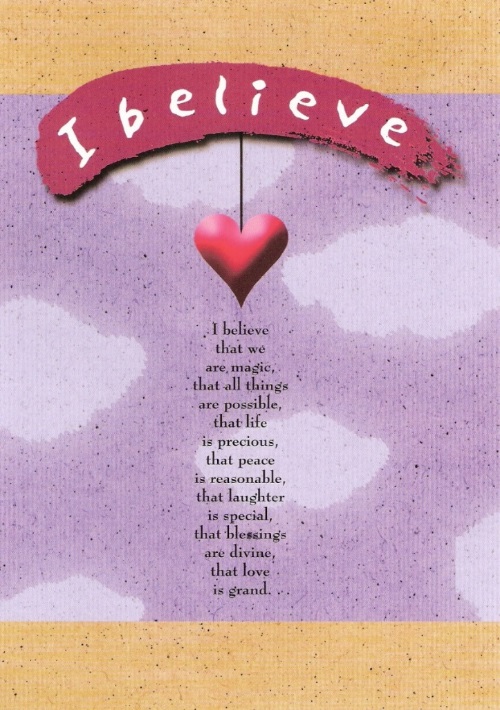
I believe that we are magic, that all things are possible, that life is precious, that peace is reasonable, that laugher is special, that blessings are divine, that love is grand…And that you are the best thing that ever happened to me. I love you.

ADVISE

1.Make A Commitment
2. Make it a Priority
3. Make your marriage fun
4. Learn to communicate, talk, and fight (fair)

pic4My wife & I never fight . . . “But sometimes you can hear us reasoning things out for several blocks.”

5. Deal with your Demons!

  • Find out what you’re doing to harm your marriage and heal it.
  • Dictatorship?
  • Financial irresponsibility?
  • Temper?
  • Pornography?
  • Substance Abuse?
  • You name it…get help! I volunteer my services free of charge…and others here will, too.

“Buy Me a Rose” lyrics
He works hard to give her all he thinks she wants…A three car garage, her own credit cards. He pulls in late to wake her up with a kiss good night. If he could only read her mind, she’d say:

Buy me a rose, call me from work, Open a door for me, what would it hurt; Show me you love me by the look in your eyes. These are the little things I need the most in my life.

Now the days have grown to years of feeling all alone, And she can’t help but wonder what she’s doing wrong. Cause lately she’d try anything to turn his head. Would it make a difference if she said:

Buy me a rose, call me from work, Open a door for me, what would it hurt; Show me you love me by the look in your eyes. These are the little things I need the most in my life.

And the more that he lives the less that he tries To show her the love that he holds inside.
And the more that she gives the more that he sees…This is a story of you and me

So I bought you a rose on the way home from work, To open the door to a heart that I hurt. And I hope you notice this look in my eyes Cause I’m gonna make things right For the rest of your life. I’m gonna hold you tonight. Do all those little things …For the rest of your life.


Leave a comment

Posted by on July 5, 2014 in Article


Evaluate your worship preparation


placeforyou2Preachers often get “out-the-door comments” after the Sunday morning service. Some are just members trying to be encouraging or cordial, but others seem to have a “code” to them.

For example, when someone says, “That was a nice service,” it may really mean “nothing too offensive, nothing too challenging.” “That was interesting” sometimes means “too many deviations from the norm; it’s going to cause you some grief in the very near future.” Even silence can be code, like a dense, dark, ominous cloud promising unpleasantness to come.

While every leader has a responsibility in our worship, I want you to consider your role in the worship service. I invite you to take this personal survey. You don’t need to share it; just honestly evaluate yourself. It might surprise you.

Personal Worship Evaluation Form

DATE __________ NAME (optional) _________________________________

Rank “1” as low and “5” as high. Imagine this is God speaking to you.

__ You prepared yourself for worship long before you arrived at the building.

__ You arrived on time for your appointment with Me (God).

__ You expressed your adoration of Me (God) with enthusiastic singing.

__ You confessed your sin to Me (God) with complete honesty.

__ You gave joyfully and sacrificially to the work of advancing My (God) kingdom.

__ You heard the announcements as invitations for your growth and My (God) service.

__ You humbled yourself in reverence at the reading of My (God) word.

__ You recognized the unique word that I prepared for you in today’s sermon.

__ You gave thanks for the ways you saw Me (God) at work during the past week.

__ You shared your needs in faith that I will hear and handle them.

__ You responded in the way necessary at My (God) invitation after My (God) lesson.


As you worship today, remember who the REAL audience is – God. Family, I encourage you this morning to show Him how much He means to you

 
Leave a comment

Posted by on June 15, 2014 in Article, worship


Quiz for Couples — How’s Your Marriage?


This quiz is based on an understanding of many key studies in the field. Following the Quiz you can add up your points and use the scale to see how you are doing. You should take the scores seriously, but realize that there is a lot that the quiz doesn’t take into account about your relationship.

While these questions are based on studies that assess such things as the likelihood of a marriage working out, we would hate for any one person to take this and assume the worst about their future. Rather, we believe that the quiz can motivate high and medium- high scoring couples to take a serious look at where their marriage is heading–and take steps to turn negative patterns around for the better.

Please answer each of the following questions to see how you are doing. We recommend that you answer these questions by yourself and not share scores with your partner.

Use the following 3 point scale to rate how often you and your mate or partner experience the following:


1 = Never or almost never  2 = Once in awhile  3 = Frequently 

1 2 3 Little arguments escalate into ugly fights with accusations, criticisms, name calling, or bringing up past hurts.

1 2 3 My partner criticizes or belittles my opinions, feelings, or desires.

1 2 3 My partner seems to view my words or actions more negatively than I mean them to be.

1 2 3 When we have a problem to solve, it is like we are on opposite teams.

1 2 3 I hold back from telling my partner what I really think and feel.

1 2 3 I think seriously about what it would be like to date or marry someone else.

1 2 3 I feel lonely in this relationship.

1 2 3 When we argue, one of us withdraws, that is, doesn’t want to talk about it anymore; or leaves the scene.

Determining Your Score:
Add up your points to determine your score. (Include only your scores, do not add to your partner’s!) The ranges we suggest for the quiz are based on results from a nationwide, random phone survey of 947 people (85% married).

8 to 12 “Green Light”
If your total points is in the 8 – 12 range, your relationship is probably in good or even great shape AT THIS TIME, but we emphasize “AT THIS TIME” because relationships don’t stand still. In the next 12 months, you’ll either have a stronger, happier relationship, or you could head in the other direction. To think about it another way, it’s like you are traveling along and have come to a green light. There is no need to stop, but it is probably a great time to work on making your relationship all it can be.

13 to 17 “Yellow Light”
If you scored in the 13-17 range, it’s like you are coming to a “yellow light.” You need to be cautious. While you may be happy now in your relationship, your score reveals warning signs of patterns you don’t want to let get worse. You’ll want to be taking action to protect and improve what you have. Spending time to strengthen your relationship now could be the best thing you could do for your future together.

18 to 24 “Red Light”
Finally, if you scored in the 18-24 range, it’s like approaching a red light. Stop, and think about where the two of you are headed. Your score indicates the presence of patterns that could put your relationship at significant risk. You may be heading for trouble–or already may be there. But there is GOOD NEWS. You can stop and learn ways to improve your relationship now!

 
Leave a comment

Posted by on June 15, 2014 in Article