RSS

Category Archives: Daniel

Faith in the Fire #5: When They Call for Your Honor – Daniel 5


Daniel 5 | Nebuchadnezzar's Grandson's Big Mistake | Mark Finley - YouTube

Have you ever seen a tragedy coming and could do nothing to stop it? One evening as Terry and I left a Florida Marlins baseball game in South Florida (we’re Cubs fans and they were in town), a car passed us at a high speed and eventually lost control as it sped by. Careening out of control, the car bounced along the center concrete median. Sparks flew as the underside of the car scraped the concrete curb. It stopped quickly and several other cars bounced around slightly—it was scary and tense and very, very quick in happening. No one was hurt, as it turned out, except for damage to cars.

Reading Daniel 5 gives me that same feeling of helplessness and distress. From our distance in time, our knowledge of history, and the account of Daniel, we know the king, and likely those dining with him at his royal banquet, are destined for destruction. Yet we can do nothing to prevent it. Helplessly, we look on as judgment day comes for king Belshazzar.

Announcement of the king’s coming judgment begins by a mysterious hand writing on the wall of the banquet hall. Crying aloud, the king summons the wise men of Babylon. Their inability to fulfill his instructions only adds to his frustration. When his ability to interpret such matters is made known to the king, Daniel enters the scene.

It was in chapter 2 of the Book of Daniel that king Nebuchadnezzar had a distressing dream, which he demanded that his wise men reveal and interpret; they could not do so. Daniel revealed the dream and its meaning to king Nebuchadnezzar, and in so doing spared the lives of the wise men. In chapter 4, Nebuchadnezzar had yet another dream. Once again, the king first sought the meaning from the other wise men of Babylon. When all others failed to explain the king’s dream, Daniel revealed its meaning and called on the king to repent, so that the threatened outcome might be delayed or prevented.

Another king now sits on the throne in Babylon. His name is Belshazzar.

Nearly 25 years have passed since the events of chapter 4 and over 70 years since chapter 1. Now advanced in years, Daniel is a senior statesman in Babylon. He has outlasted a number of kings and in his time Belshazzar, the last of the Chaldean kings of Babylon, will be killed and Babylon will pass from Chaldean rule to rule by Darius the Mede.

In chapters 1-4, we have an account of the life of Nebuchadnezzar, the first Babylonian king to rule over the captive Jews. The account looks at several events in the life of this great king, which eventually bring him to his knees in worship and praise of the God of Israel. Daniel then passes over several kings, giving us this brief account of the last day in the reign of Belshazzar, the last of the Chaldean kings.

The death of Belshazzar at the hand of Darius is a partial fulfillment of the prophecy revealed to king Nebuchadnezzar by his dream in chapter 2. There, Daniel informed Nebuchadnezzar that his kingdom was the first of four kingdoms to precede the coming of Messiah. His was the kingdom of gold, to be followed by a lesser kingdom of silver (Daniel 2:39). The kingdom of silver is introduced in Daniel 5, when Darius captures Babylon, and Belshazzar is put to death. The Medo-Persian kingdom is born, fulfilling the first part of the prophecy revealed through Daniel.

Belshazzar’s Feast (Daniel 5:1-5)

The great feast of Belshazzar takes place about 25 years after the events of chapter 4. Nebuchadnezzar is long gone and the Persians have surrounded the city of Babylon hoping to conquer it.

The great feast probably happened on October 12, 539 – The night that Babylon fell. Greek historians wrote that a great banquet was in progress that night. These types of feasts were displays of wealth and power.

Understanding how things went from bad to worse in these verses is not difficult. Such seems to have been the scene at Belshazzar’s banquet.[1] One thousand of the king’s nobles were invited, along with their wives or other women. The king was responsible for what happened, and too much wine seems to have contributed to his poor judgment. A false sense of pride and self-sufficiency seems to have dominated the dinner party. The king remembered the expensive vessels which Nebuchadnezzar, his father,[2] had taken when he defeated and captured Jerusalem. How much more impressive the evening would be if they drank their wine from the gold and silver vessels from the temple in Jerusalem.[3]

And so the vessels were brought in. The wine continued to flow freely, and toasts began to be offered. That these pagans were engaged in a kind of drinking bout with the sacred temple vessels was bad enough, but the ultimate blasphemy was toasting the gods of gold, silver, brass, iron, wood, and stone.

God has a limit to how far He will allow men to go in their sin. In His longsuffering and mercy, God may allow men to continue in their sin for a time. But there is a time for judgment.  The king and his Babylonian dinner guests crossed the line that fateful night in the banquet hall of Babylon. Judgment day had come, and the writing on the wall announced its arrival.

The Handwriting of Doom (Daniel 5:6-16)

Against the whitewashed walls of the palace the writing of the “hand” must have been amazing. The words written were in Aramaic, yet the astrologers and magicians could not decipher them. Their ignorance  in the face of a true mystery is a familiar theme ion the book.

Daniel’s refusal of the King’s gifts may indicate the confidence and focus of a man of 90 years of age. His rebuke of Belshazzar contains the telling phrase “though you knew all of this…” The king had not acted in ignorance.

Verses 7 through 9 relate the promise of the king to give rich rewards to anyone able to interpret the writing, but all the wise men failed.

Knowing the power of the Babylonian kings, Belshazzar must have seen many men stand in fear and trembling before him. One might have thought the king was having a heart attack. Barely able to stand, his face was ashen and seized with terror. The raucous laughter turned to deafening silence with all eyes on the king. The king’s eyes were fixed upon the hand as it wrote. As a sense of foreboding and panic fell on the crowd, all eyes turned to the mysterious writing on the wall. The king’s actions alarmed all who were present.

Crying aloud in fear, his speech probably slurred, the king immediately summoned his wise men to the banquet hall. What did these words on the wall mean? He must know. A tempting reward was offered to anyone who could interpret the meaning of the handwriting on the wall.

The queen has great confidence in Daniel’s ability based upon his track record in the history of Babylonian affairs. Her summary of Daniel’s accomplishments in verse 12 suggests that Daniel performed other amazing tasks throughout the lifetime of king Nebuchadnezzar. Those recorded in the Book of Daniel are but a sampling of Daniel’s ministry to the king.

Her confidence does seem to produce a calming effect on the king and his guests. The king summons Daniel to appear before the king and his guests that very night.

The king offered the same reward to Daniel that he had previously offered to anyone who would interpret the handwriting on the wall. It is interesting that he fulfilled his promise to Daniel at the conclusion of this revelation, even though the reward was short-lived.

The Meaning Revealed (Daniel 5:17-30)

1) The inscription is three simple Aramaic words:

Mene, Mene                        Numbered, Numbered

Tekel                                      Weighed

Peres                                      Divided

Having admonished the king, Daniel next proceeded to interpret the writing: Now this is the inscription that was written out: “MENE¯, MENE¯, TEKE¯L, UPHARSIN.” This is the interpretation of the message: “MENE¯”—God has numbered your kingdom and put an end to it. “TEKE¯L”—you have been weighed on the scales and found deficient. “PERE¯S”—your kingdom has been divided and given over to the Medes and Persians (vv. 25–28). [4]

Each word stands for a short sentence. The Babylonians were renowned for their expertise with numbers, and God speaks to Belshazzar in those terms. In the interpretation Daniel dealt with “MENE¯” only once. Many ancient manuscripts do not repeat “MENE¯” in verse 25, thus corresponding exactly with Daniel’s interpretation. “MENE¯,” literally means “numeration” or “evaluation.” “TEKE¯L” literally means “weighing,” and “PERE¯S,” division. Fortunately, we are not left to try to determine the meaning of such a message, for Daniel gave the interpretation.

Though Daniel accepts the gifts, they did not effect the outcome of the prophecy. Further, being elevated to third highest ruler in Babylon was not much of a prize.

Daniel begins by turning down Belshazzar’s reward. Let the king keep his gifts or give them to someone else. Why would he decline Belshazzar’s offer? Daniel knows that the king’s gifts are virtually useless. What good would it do Daniel to be given the third highest office in the administration of Belshazzar when his reign would end that very night? Daniel was God’s servant, divinely gifted to interpret dreams. He would not prostitute his gift by using it for his own gain. Daniel was not “for hire.” As God’s prophet, Daniel spoke to men for God.

Verses 18-24 are fascinating. In these verses Daniel explains the guilt of king Belshazzar. Unfortunately, Belshazzar had not learned the lesson from Nebuchadnezzar’s mistakes (v. 22). Thus the hand was sent from God (v. 24). The writing on the wall, explained in verses 25-28, speak of the imminent judgment of God which will fall upon Belshazzar and his kingdom, due to sin. Daniel spends more time on the king’s guilt than on his punishment, as he devotes more time to explaining the reason for the writing than the meaning of the writing.

The events of Daniel 4 are now repeated, as a lesson which not only Nebuchadnezzar learned but which Belshazzar his son should have learned as well. God sovereignly granted Nebuchadnezzar power, glory, and majesty, and he exercised that power and authority over mankind. But his heart became proud, and he acted arrogantly. God temporarily took away his power and his kingdom, and he became like the beasts of the field, eating grass and living in the elements without shelter. All this happened so that he might recognize God as the ruler over mankind and recognize that all human authority is delegated to men by God, from whom all authority is derived.

Verse 29 indicates that Belshazzar kept his promise to Daniel. He “gave orders, and they clothed Daniel with purple and put a necklace of gold around his neck, and issued a proclamation concerning him that he now had authority as the third ruler in the kingdom.”

BABYLON’S FALL (5:30)

“That same night Belshazzar the Chaldean king was slain” and the kingdom was conquered (v. 30). Thus ended the Babylonian Empire.

The “head of gold” of Nebuchadnezzar’s vision (chapter 2) was now replaced by a breast and arms of silver—the Medes and Persians.

Lessons for today

Remember The Real Issue.
It’s so easy, in a situation like this, to get your eyes on the wrong thing and forget what those clamoring to honor you are really asking you to do. Flattery can be a heady thing. You can lose sight of what is really going on.
Of course this issue isn’t always so cute. It must have been flattering for Daniel, probably forgotten and on “inactive duty” since the death of Nebuchadnezzar, to be called once again into the palace for advice. Then for a former captive of a defeated nation to be offered third ruler in the kingdom!
The promise of honor and acclaim can be a heady thing. It can cause you to lose sight of your ideals.
The thing Daniel needed to remember in the midst of this incredible offer of honor and acclaim was that this same king had just been hosting a dinner in which the keynote issue was mocking God!
Sure, the honor might be nice, but will you line up with pagans to get it? Will you participate in their blasphemy? Will you mock and dishonor your Maker in order to be honored yourself? Is it worth that much?
“Well, when you put it that way, no. But it isn’t always so clear cut. Sometimes it’s in the gray area.” Yeah, I know. The greater the promise of honor and prestige, the grayer it gets! Yet we must discern.
Someone has aptly written, “Flattery looks like friendship – just like a wolf looks like a dog!”
What I’m saying is this: Remember the real issue! Get your eyes off the glory and get them back on your God! Discern the issues! Know what is really going on. Don’t let the flattery blind you to the facts.
Don’t Change the Message.
No one else in the room recognized that Aramaic writing on the wall. He could have said it meant anything he wanted and no one would ever have known the difference. No one, that is, but God.
Oh that men feared God and feared changing His message more than they craved the attention of men!
The New Testament warns us about changing the message for the sake of personal desires. After an exhortation to “preach the word,” Paul told Timothy in II Timothy 4:3: “For the time will come when they will not endure sound doctrine, but wanting to have their ears tickled, they will accumulate for themselves teachers in accordance to their own desires; and will turn away their ears from the truth, and will turn aside to myths.”
   Listen to what God said to His prophet, Ezekiel: Ezekiel 3:17-19: “Son of man, I have appointed you a watchman to the
house of Israel; whenever you hear a word from My mouth, warn them from Me. When I say to the wicked, ‘You shall surely die’; and you do not warn him or speak out to warn the wicked from his wicked way that he may live, that wicked man shall die in his iniquity, but his blood I will require at your hand. Yet if you have warned the wicked, and he does not turn from his wickedness or from his wicked way, he shall die in his iniquity; but you have delivered yourself.”
   Fear God’s Judgment.
Perhaps you have, at times, used the phrase, “The handwriting is on the wall,” meaning that what is going to happen is very evident and there is no stopping it. That phrase originated from the story in this passage.
BIBLE KNOWLEDGE COMMENTARY says this about what happened: “Belshazzar had a false sense of security, because the Persian army… was outside Babylon’s city walls. Their army was divided; part was stationed where the river entered the city at the north and the other part was positioned where the river exited from the city at the south. The army diverted the water north of the city by digging a canal from the river to a nearby lake. With the water diverted, its level receded and the soldiers were able to enter the city by going under the sluice gate. Since the walls were unguarded the Persians, once inside the city, were able to conquer it without a fight.”
You only get so much warning and then “the handwriting is on the wall.” God will warn of impending judgment only so long, then the ax falls.
It also should be a warning to cause us to fear God when we’re tempted to put acclaim ahead of principle.

[1] For similar events, recorded in the Bible, see Esther 1 and Mark 6:14-29.

[2] It is generally understood and accepted that the term “father” was used more loosely in the Old Testament of one’s forefather, who may have been a grandfather or even a more distant “father.”

[3] See Daniel 1:2; 2 Kings 24:13; 25:15; Ezra 1:7, 11.

[4] Truth For Today, Life of Daniel series by David Rechtin & Neal Pryor (much of this material is a result of the two issues put out by these two fine writers and this publication, from Searcy, Arkansas

 
Leave a comment

Posted by on June 29, 2026 in Daniel


Faith in the Fire Series #4 – When They Call for Truth – Daniel 4


Daniel 4:10-12 Artwork | Bible Art

Some years ago a terrible railroad accident occurred, killing many people. A commuter train had stalled on the tracks just a few minutes before a fast freight was due to arrive. A conductor was quickly sent to flag down the approaching train. Assured that all was well, the passengers relaxed. Suddenly, however, the speeding freight came bearing down upon them. The crash left a ghastly scene of horror.

The engineer of the second train, who escaped death by jumping from the cab, was called into court to explain why he hadn’t stopped. “I saw a man waving a warning flag,” he said, “but it was yellow, so I thought he just wanted me to slow down.” When the flag was examined, the mystery was explained. It had been red, but because of long exposure to the sun and weather it had become a dirty yellow.

When the world calls for truth, our message must be clearly red, not yellow. It must be held up with confidence, waved with concern and candor, accompanied with a message of correction.

I spend a great deal of time daily pondering the requirement as a teacher to tell the truth about important spiritual matters…even when it isn’t popular. That is something that’s expected of teachers/ministers, but not always appreciated.

Think of a circumstance when an individual would suddenly grab his side in pain, double over and fall to the floor. Paramedics were called and he was rushed to the hospital. After a battery of tests and X-rays they found he had a cancerous tumor the size of a small football in his stomach. The doctors give radiation treatment and 3 months later they operated to remove the tumor, now shrunken to the size of a golf ball.

Many people say sin is a negative subject. So is cancer. If you have a cancerous tumor in your stomach the size of a football and they rush you to the hospital, you don’t need the doctor to tell you, ‘It’s just a stomach ache. Take some Mylanta and you’ll be OK.’ You need to know the truth.

How would you like to be the doctor who has to deliver such bad news? It probably wouldn’t be on anyone’s list of favorite things they like to do.

What is true of physical life and the threat of cancer it also true in the case of spiritual life and the reality of sin. Before people can understand and accept the good news of God’s forgiveness and salvation, they need to hear from us the bad news of their condition before God in their sins.

Because telling the truth about sin is quite similar to the doctor who must break the news about cancer, many people shy away from it. They prefer either to say nothing, or to water down the truth so as to somehow soften the blow.

Sadly, preachers and other Christians can become pretty good at watering down or disguising the truth so that it no longer appears to be bad news. Perhaps it is the reason why so many sense no joy in their salvation – they’ve no idea how bad their condition was so they don’t appreciate their deliverance from it.

Delivering good news is a joy. Delivering bad news is unpleasant. Yet it can get even more complicated than that. Imagine delivering bad news to a superior with a penchant for temper tantrums and the power to kill you. Surely the temptation in such a situation would be to tell a little less than the truth, or perhaps some version of “what they want to hear.”

That is the situation for Daniel in the fourth chapter of the book we’ve been studying. Daniel is the “doctor.” The “patient” is Nebuchadnezzar and he has a deadly sin in his life called arrogance. God has decreed his judgment and it is about to come upon him unless he changes his ways. Daniel must deliver the bad news.

This is sermon number four in our series from Daniel called, “Faith in the Fire: God’s in Control.” We’re looking at dealing with calls from the world. This message is titled, “When They Call for Truth.”

Daniel 4:1-37 (ESV)
1   King Nebuchadnezzar to all peoples, nations, and languages, that dwell in all the earth: Peace be multiplied to you!

Notice that this chapter differs from the previous three in that it is written by Nebuchadnezzar himself in the first person. It describes what brought him to become a believer in the God of heaven. It involved some bad news. Penned after the fact, this was either a decree he sent out across his kingdom after the events described, or something he wrote in his memoirs for posterity. Note his high praise for God in the next two verses.

2  It has seemed good to me to show the signs and wonders that the Most High God has done for me.
3  How great are his signs, how mighty his wonders! His kingdom is an everlasting kingdom, and his dominion endures from generation to generation.

It wasn’t always that way. Listen as he describes what happened”
4   I, Nebuchadnezzar, was at ease in my house and prospering in my palace.
5  I saw a dream that made me afraid. As I lay in bed the fancies and the visions of my head alarmed me.
6  So I made a decree that all the wise men of Babylon should be brought before me, that they might make known to me the interpretation of the dream.
7  Then the magicians, the enchanters, the Chaldeans, and the astrologers came in, and I told them the dream, but they could not make known to me its interpretation.
8  At last Daniel came in before me—he who was named Belteshazzar after the name of my god, and in whom is the spirit of the holy gods—and I told him the dream, saying,
9  “O Belteshazzar, chief of the magicians, because I know that the spirit of the holy gods is in you and that no mystery is too difficult for you, tell me the visions of my dream that I saw and their interpretation.
10  The visions of my head as I lay in bed were these: I saw, and behold, a tree in the midst of the earth, and its height was great.
11  The tree grew and became strong, and its top reached to heaven, and it was visible to the end of the whole earth.
12  Its leaves were beautiful and its fruit abundant, and in it was food for all. The beasts of the field found shade under it, and the birds of the heavens lived in its branches, and all flesh was fed from it.
13  “I saw in the visions of my head as I lay in bed, and behold, a watcher, a holy one, came down from heaven.
14  He proclaimed aloud and said thus: ‘Chop down the tree and lop off its branches, strip off its leaves and scatter its fruit. Let the beasts flee from under it and the birds from its branches.
15  But leave the stump of its roots in the earth, bound with a band of iron and bronze, amid the tender grass of the field. Let him be wet with the dew of heaven. Let his portion be with the beasts in the grass of the earth.
16  Let his mind be changed from a man’s, and let a beast’s mind be given to him; and let seven periods of time pass over him.
17  The sentence is by the decree of the watchers, the decision by the word of the holy ones, to the end that the living may know that the Most High rules the kingdom of men and gives it to whom he will and sets over it the lowliest of men.’
18  This dream I, King Nebuchadnezzar, saw. And you, O Belteshazzar, tell me the interpretation, because all the wise men of my kingdom are not able to make known to me the interpretation, but you are able, for the spirit of the holy gods is in you.”

What a story!

Recall now what we are looking for in this passage. We’re looking to see how we should deal with a situation where someone from the world asks one of us for the truth. A careful look reveals four necessary things for the truth-teller to get his message across. The first is…

1. Credibility
Notice back in verses 7 and 8 that Daniel was one of Nebuchadnezzar’s leading advisors. By this time, Daniel had established a track record in the palace, not only of telling the truth, but also knowing it. I have no idea why the king chose to call Daniel in last, after he had consulted the others, unless he wanted to evaluate his advisory team the way he did back in chapter two.

Look at his description of Daniel: “in whom is a spirit of the holy gods.” Nebuchadnezzar wasn’t a believer yet, but he recognized Daniel had something the rest didn’t. From his previous encounters with Daniel, he must also have known that Daniel wouldn’t back away from telling him the truth.

When the world calls on one of us for truth, it will likely be because their observations of our actions have built credibility in them. We have become authentic. Usually unknown to us, the unbeliever has been watching and evaluating us in other circumstances. They’ve noted it when we had the courage to tell the truth and they’ve also noted it when they saw us
hedge. That is why it is so necessary to be truthful in all areas of life, big and little.

Who do you suppose if watching you right now, evaluation your truthfulness? It might surprise you to know who and how many!

If we expect the world to listen to the truth when we tell it, we don’t get there by waiting until they ask before beginning to tell the truth. We tell it now, in the little things that we face every day, knowing that the world is watching. We also don’t go to the world’s shifting standard of truth to learn how to do it (like the Indians learning to make smoke
signals from the movies.) We must be in God’s eternal source of truth, the Bible.

If you were called upon by the world to tell the truth today, would your message be heard or ignored? A lot depends upon your credibility.

Concern
Though it has been repeated to the point of being trite, it is still true that “they don’t care how much you know until they know how much you care.” We see here in the example of Daniel a genuine concern for Nebuchadnezzar.19 Then Daniel, whose name was Belteshazzar, was dismayed for a while, and his thoughts alarmed him. The king answered and said, “Belteshazzar, let not the dream or the interpretation alarm you.” Belteshazzar answered and said, “My lord, may the dream be for those who hate you and its interpretation for your enemies!

Daniel could have said, “Well, it’s about time God dealt with you, you Pagan, for what you did to my people and my family back in Jerusalem!”

We must tell the truth, but we must tell it with compassion. We should preach and teach “as dying men to dying men.”

Our message isn’t delivered from a place of condescension! Without God’s offer of grace to us, given while we were still in our sins, we are no better off than this pagan king! We must never forget it.

3. Candor
Candor is forthright honesty. It’s what you want from your doctor. It’s what you should want from those who teach you. It is what the unbeliever who comes to you seeking truth, needs desperately from you.

When you arrive at the absolute truth about a matter, things that contradict it cannot be right! That makes them wrong in case anyone needs some help figuring it out.

When we speak of telling the truth with candor, we mean telling it like it is, not like we want it to be or we wish it were or our favorite version of it!

From time to time there are people who are with us in the church for a while, then they leave. Often it is because they run aground on this very issue. They get upset because the leadership of this church will not go against the clear commands of scripture to accommodate their situation.

Those of you sitting here this morning don’t always know the issue behind some folks leaving, but you may hear them as they go mumbling things like how “unfair” the shepherds/minister are. My experience has been the “unfair” they are talking about is that these shepherds, who will account to God one day for their stewardship in this place, would not change the absolute truth of the situation to make it convenient for them to disobey God.

In those statements, I said you don’t always know the issue. The reason is that we don’t usually parade people’s personal lives before the church. If you have a question about something said about the elders, though, the best approach is to ask. They are open to questions and not above accountability for their actions. It is just that I can say with certainly that they (and I) are more afraid of some twisting the word of God than they are of someone’s threats to leave.

Candor – forthright honesty – is what is needed when the world calls for truth. We dare not let them down. To do so is fatal.

Though he risked the king’s wrath, Daniel told the truth with candor.
20  The tree you saw, which grew and became strong, so that its top reached to heaven, and it was visible to the end of the whole earth,
21  whose leaves were beautiful and its fruit abundant, and in which was food for all, under which beasts of the field found shade, and in whose branches the birds of the heavens lived—
22  it is you, O king, who have grown and become strong. Your greatness has grown and reaches to heaven, and your dominion to the ends of the earth.
23  And because the king saw a watcher, a holy one, coming down from heaven and saying, ‘Chop down the tree and destroy it, but leave the stump of its roots in the earth, bound with a band of iron and bronze, in the tender grass of the field, and let him be wet with the dew of heaven, and let his portion be with the beasts of the field, till seven periods of time pass over him,’
24  this is the interpretation, O king: It is a decree of the Most High, which has come upon my lord the king,
25  that you shall be driven from among men, and your dwelling shall be with the beasts of the field. You shall be made to eat grass like an ox, and you shall be wet with the dew of heaven, and seven periods of time shall pass over you, till you know that the Most High rules the kingdom of men and gives it to whom he will.
26  And as it was commanded to leave the stump of the roots of the tree, your kingdom shall be confirmed for you from the time that you know that Heaven rules.

To the person in the church, we need to tell the truth about the need to obey God. To the outsider, we need to tell the truth about their sin and the coming effects of it.

Those of you who have used “Sin-Savior-Salvation” lessons to teach someone else the gospel: that is why the lesson on “Sin” comes before the one on “Salvation.” People need to know the truth that, because of their sin, they are lost and could be bound for Hell. Only then will they be interested in Jesus as a Savior and not just a nice man.

It is also true of those of us who have been baptized for remission of sins…our refusal to ‘walk in the light’ and to confess the willful sin in our life…puts our eternal condition in peril.

Credibility, Concern, Candor. These are all things we need when the world calls for truth. It is not the time to back away.

Correction
The call from correction is a call to fix what is wrong. It is the instruction to make straight what is crooked.Here it is from Daniel. 27 Therefore, O king, let my counsel be acceptable to you: break off your sins by practicing righteousness, and your iniquities by showing mercy to the oppressed, that there may perhaps be a lengthening of your prosperity.”

That is our ultimate goal when the world calls for truth. Jesus said, “Unless you repent, you will all, likewise, perish.”

Sin separates and alienates people from God. If it isn’t forgiven, they will go to hell. That is the truth. Repentance is the first step back toward God. It is the point where they change direction. They quit living for themselves and make up their mind they will start living for God.

Repentance is the hardest part of the message because it means a person must stop doing things only to please himself and start doing what pleases his Maker.

For the king it involved abandoning his arrogance and helping other people. It involved getting off the throne of his own life and putting God in His rightful place.

To those seeking truth it is no different. When we tell a person the bad news, that is, his sin has him bound for a fully conscious eternity in hell and that he cannot save himself, we show him God’s answer to his problem. Christ has died to take away his/her sin.

But he must turn from his sinning and accept Christ. He must be baptized to have his sins washed away. He must strive from then on to put God first in his life. In these things we cannot afford to be unclear or try to slip it by.

Daniel 4:28-37 (ESV)
28 All this came upon King Nebuchadnezzar. 29 At the end of twelve months he was walking on the roof of the royal palace of Babylon, 30  and the king answered and said, “Is not this great Babylon, which I have built by my mighty power as a royal residence and for the glory of my majesty?” 31  While the words were still in the king’s mouth, there fell a voice from heaven, “O King Nebuchadnezzar, to you it is spoken: The kingdom has departed from you, 32  and you shall be driven from among men, and your dwelling shall be with the beasts of the field. And you shall be made to eat grass like an ox, and seven periods of time shall pass over you, until you know that the Most High rules the kingdom of men and gives it to whom he will.” 33  Immediately the word was fulfilled against Nebuchadnezzar. He was driven from among men and ate grass like an ox, and his body was wet with the dew of heaven till his hair grew as long as eagles’ feathers, and his nails were like birds’ claws.

34  At the end of the days I, Nebuchadnezzar, lifted my eyes to heaven, and my reason returned to me, and I blessed the Most High, and praised and honored him who lives forever, for his dominion is an everlasting dominion, and his kingdom endures from generation to generation; 35  all the inhabitants of the earth are accounted as nothing, and he does according to his will among the host of heaven and among the inhabitants of the earth; and none can stay his hand or say to him, “What have you done?” 36  At the same time my reason returned to me, and for the glory of my kingdom, my majesty and splendor returned to me. My counselors and my lords sought me, and I was established in my kingdom, and still more greatness was added to me. 37  Now I, Nebuchadnezzar, praise and extol and honor the King of heaven, for all his works are right and his ways are just; and those who walk in pride he is able to humble.

What Preaching is All About? By Wes McAdams

Preaching is the proclamation and explanation of God’s word. Both the Old and New Testaments are full of men who stood before God’s people and explained, “This is what God says, this is what it means, and this is how it applies to us today.”

The church needs to hear the proclamation and explanation of God’s word. We need to hear what it says, what it means, and how it applies to our lives today. When God’s word is proclaimed and explained:

  • it brings glory to God.
  • it unites God’s people of the present with His people of the past.
  • it makes us into a knowledgeable and disciplined community, by encouraging us to stretch our attention spans and develop an ability to hear the word of the Lord.

How We Turn Preaching Into a Competitive Performance

With singing, we often misplace our focus. We focus on the tune and the tempo, when the focus should be on the words of praise. With preaching, we focus on the preacher’s style and delivery, when the focus should be on accurately proclaiming and explaining the word of God.

But think about it, when we sit in the pew and make the sermon about the preacher’s performance – rather than our own walk with Jesus – it takes the pressure off us and puts it on the preacher.

When we have the luxury of sitting and measuring the length and style of the sermon, comparing it with other sermons we’ve heard, our job in the pew is easy. It’s much more difficult for us to accept our God-given responsibility to look beyond the flaws, shortcomings, and human limitations of the preacher in order to discern and apply God’s holy word to our lives.

Pride, Ego, and Self-Esteem

It’s easy to see the harm we do to those we criticize. It’s easy to see how it hurts a preacher’s feelings when we criticize his style; but we might actually be doing more harm to those on whom we constantly brag. When we constantly brag on a preacher’s style and performance, we might very well be stroking his ego.

How To Encourage a Preacher

So how can we show appreciation to our preachers, without being stumbling blocks? Here are a few of my favorite kinds of encouragement:

“That message really made me think. I’m going to have to go home and study some more.”

“I’m convicted. I’m going to make some big changes in my life.”

“God’s word is so powerful.”

“Thank you for telling us the truth.”


Leave a comment

Posted by on June 25, 2026 in Daniel


Faith in the Fire Series #3 When They Call For Open-mindedness – Daniel 3


What does Daniel 3:26 mean? | Bible Art

We live in strange times. Everybody wants a piece of the action when it comes to making everyone else recognize and accept their way of doing things. Years ago, when an immigrant stepped off the boat at Elis Island, his first concern was learning American English and American culture. Today his greatest concern is learning to manipulate the political sytem to his own ends.

And our response to all of this? We’re supposed to welcome it. You’ve all heard of it. It’s described by words like “tolerance,” “broadmindedness,” “open-mindedness,” and the latest social retread: “multiculturalism.”
   The idea seems appealing on the surface. We must be tolerant of others and their belief systems.

The Bible does teach us to be tolerant of others. “And just as you want people to treat you, treat them in the same way.” It also indicates we should be open to learning new truth. “Let everyone be quick to hear, slow to speak and slow to anger…”

The blindness brought on by arrogance and a close

d mind can prevent one from seeing God’s truth. But this new “tolerance” and “open-mindedness” goes beyond that.

(Please listen to this statement.) It not only demands that we be tolerant of the rights of others to believe what they want…this new tolerance it teaches that the ways of each culture must be recognized as equally valid and right.  It’s a mindset that says that no culture is better than any other, no matter what strange or destructive ideas it holds. If you say anything different, you’re a bigot.

Of course, the highway doesn’t go both ways.
· Have you noticed lately that some of the gurus of tolerance and multiculturalism seem just a bit intolerant of your Christian belief structures?
· Have you noticed that in today’s social climate, you can say and do almost anything you want as long as you don’t express your view that someone else’s belief or behavior is wrong?
· Why is it that those who scream “tolerance” so loudly today are so intolerant of the moral base on which this country was built and the people who represent it?
· Everything is tolerated, it seems, except the good old “Judeo-Christian ethic.”

Have you thought very long about what is happening? In first century Rome, people were allowed to believe and worship whatever they chose, much the same as we are today, as long as they first burned a pinch of incense in the name of Caesar and pronounced the words, “Caesar is Lord.”

But what about a unifying idea? What about an idea we enthrone like a god called “multiculturalism.” As long as you recognize that all cultures and religions are equally right, you are free to worship any way you choose. Note what I did not say. I did not say “as long as you recognize that all religions have a right to exist and compete for attention.” I said, “as
long as you recognize that all religions are right.”

When the early Christians faced this issue, their belief in one God made them realize they couldn’t bow down to Caesar or say that all other religions were equally right. This put them on a collision course with their government.

If you’ve heard of the lions and arenas of that era, you know the results. I wonder how it will be if we end up facing the same choices? If the “god” of multiculturalism continues to be held up for admiration and worship until it is so socially acceptable that nothing else is tolerated, will Christians bow down and concede that every religion and lifestyle is true and their faith in one God who calls some behavior “sin” is the only remaining falsehood?

I cannot see the future. Whether such a thing as I have implied will happen in our day remains unknown. I believe, though, that we must be ready for it. We must clearly understand that we cannot bow down to the God of heaven and the god of multiculturalism, too.

So how does a Christian stand in the face of a world that is lining up against absolute truth? How does he/she resist being overrun?  There are answers in the third chapter of Daniel that I want to consider with you this morning. There we find three very brave young men who worshiped the God of heaven. Their names were Shadrach, Meshach, and Abednego.

Through God’s providence, they were members of a Babylonian king’s advisory cabinet. They lived in a culture that recognized many gods. One day the king set up a god for all his subjects to worship. He gathered them all together at a place called the plain of Dura, struck up the band, and told them all to bow down. The three young men refused. The
king threw them into a furnace, then something very remarkable happened.

Read from Daniel 3:1-30 (ESV)
1  King Nebuchadnezzar made an image of gold, whose height was sixty cubits and its breadth six cubits. He set it up on the plain of Dura, in the province of Babylon.
2  Then King Nebuchadnezzar sent to gather the satraps, the prefects, and the governors, the counselors, the treasurers, the justices, the magistrates, and all the officials of the provinces to come to the dedication of the image that King Nebuchadnezzar had set up.
3  Then the satraps, the prefects, and the governors, the counselors, the treasurers, the justices, the magistrates, and all the officials of the provinces gathered for the dedication of the image that King Nebuchadnezzar had set up. And they stood before the image that Nebuchadnezzar had set up.
4  And the herald proclaimed aloud, “You are commanded, O peoples, nations, and languages,
5  that when you hear the sound of the horn, pipe, lyre, trigon, harp, bagpipe, and every kind of music, you are to fall down and worship the golden image that King Nebuchadnezzar has set up.
6  And whoever does not fall down and worship shall immediately be cast into a burning fiery furnace.”
7  Therefore, as soon as all the peoples heard the sound of the horn, pipe, lyre, trigon, harp, bagpipe, and every kind of music, all the peoples, nations, and languages fell down and worshiped the golden image that King Nebuchadnezzar had set up.


8  Therefore at that time certain Chaldeans came forward and maliciously accused the Jews.
9  They declared to King Nebuchadnezzar, “O king, live forever!
10  You, O king, have made a decree, that every man who hears the sound of the horn, pipe, lyre, trigon, harp, bagpipe, and every kind of music, shall fall down and worship the golden image.
11  And whoever does not fall down and worship shall be cast into a burning fiery furnace.
12  There are certain Jews whom you have appointed over the affairs of the province of Babylon: Shadrach, Meshach, and Abednego. These men, O king, pay no attention to you; they do not serve your gods or worship the golden image that you have set up.”
13  Then Nebuchadnezzar in furious rage commanded that Shadrach, Meshach, and Abednego be brought. So they brought these men before the king.


14  Nebuchadnezzar answered and said to them, “Is it true, O Shadrach, Meshach, and Abednego, that you do not serve my gods or worship the golden image that I have set up?
15  Now if you are ready when you hear the sound of the horn, pipe, lyre, trigon, harp, bagpipe, and every kind of music, to fall down and worship the image that I have made, well and good. But if you do not worship, you shall immediately be cast into a burning fiery furnace. And who is the god who will deliver you out of my hands?”
16  Shadrach, Meshach, and Abednego answered and said to the king, “O Nebuchadnezzar, we have no need to answer you in this matter.
17  If this be so, our God whom we serve is able to deliver us from the burning fiery furnace, and he will deliver us out of your hand, O king.
18  But if not, be it known to you, O king, that we will not serve your gods or worship the golden image that you have set up.”


19  Then Nebuchadnezzar was filled with fury, and the expression of his face was changed against Shadrach, Meshach, and Abednego. He ordered the furnace heated seven times more than it was usually heated.
20  And he ordered some of the mighty men of his army to bind Shadrach, Meshach, and Abednego, and to cast them into the burning fiery furnace.
21  Then these men were bound in their cloaks, their tunics, their hats, and their other garments, and they were thrown into the burning fiery furnace.
22  Because the king’s order was urgent and the furnace overheated, the flame of the fire killed those men who took up Shadrach, Meshach, and Abednego.
23  And these three men, Shadrach, Meshach, and Abednego, fell bound into the burning fiery furnace.
24  Then King Nebuchadnezzar was astonished and rose up in haste. He declared to his counselors, “Did we not cast three men bound into the fire?” They answered and said to the king, “True, O king.”
25  He answered and said, “But I see four men unbound, walking in the midst of the fire, and they are not hurt; and the appearance of the fourth is like a son of the gods.”
26  Then Nebuchadnezzar came near to the door of the burning fiery furnace; he declared, “Shadrach, Meshach, and Abednego, servants of the Most High God, come out, and come here!”
Then Shadrach, Meshach, and Abednego came out from the fire.


27  And the satraps, the prefects, the governors, and the king’s counselors gathered together and saw that the fire had not had any power over the bodies of those men. The hair of their heads was not singed, their cloaks were not harmed, and no smell of fire had come upon them.
28  Nebuchadnezzar answered and said, “Blessed be the God of Shadrach, Meshach, and Abednego, who has sent his angel and delivered his servants, who trusted in him, and set aside the king’s command, and yielded up their bodies rather than serve and worship any god except their own God.
29  Therefore I make a decree: Any people, nation, or language that speaks anything against the God of Shadrach, Meshach, and Abednego shall be torn limb from limb, and their houses laid in ruins, for there is no other god who is able to rescue in this way.”

30  Then the king promoted Shadrach, Meshach, and Abednego in the province of Babylon.

What can we learn from the experience of these three men that might be helpful to us in sorting out the confusion of multiculturalism today? I’d like to point out five qualities they had that we should develop. The first is:

Clarity. These men knew what they believed. When the king announced the requirement of bowing down to the image, they knew immediately that they could not do it.

One of the reasons so many Christians are so gullible and identify with the ideas behind multiculturalism is that they are not clear on what they themselves believe. They don’t realize that such a proposition is contrary to the faith they espouse. No wonder they’re confused!

Though I have been reading this chapter in Daniel off and on for many years, it was only this past week that it occurred to me what must have really happened. I had always assumed that when all these musicians got together….but look back at Daniel’s description of the music that was played before the people bowed down to the image.

7  Therefore, as soon as all the peoples heard the sound of the horn, pipe, lyre, trigon, harp, bagpipe, and every kind of music, all the peoples, nations, and languages fell down and worshiped the golden image that King Nebuchadnezzar had set up.

It is probable they weren’t all playing the same song or at least they weren’t playing it the same way!

What a striking illustration of multiculturalism! That is what it sounds like when everyone’s philosophy and belief is viewed as being equal and you’re not allowed to sort it out in the competitive free marketplace of ideas!

We need to know what we believe and why we believe it. Further, we need to know with razor sharp clarity what are the absolutes and what are not.

Have you noticed that in today’s political-religious climate, people who see anything clearly as an issue of ‘right or wrong’ are ridiculed and looked upon as backward?

“There are no absolutes,” we are told. “Everything is relative. We live in a gray world. Everything is fuzzy and unclear. It doesn’t matter who is right, because there really isn’t a right and wrong. That’s the trouble with you Christians. You see everything as black and white.”

Abraham Lincoln seems to have been one who loved wit and wisdom. I’m told that one of his favorite brain-teasers used to make a point with his constituents was to ask, “How many legs would a sheep have if you called his tail a leg?” Naturally, they would respond, “Five.” “Wrong!” Lincoln would reply. “The sheep would still have just four legs. Calling
something a leg doesn’t make it so.”

These young men knew what truth was and knew how to describe it. We should know the same.

Constancy

This was not the first time these young men had resisted giving in to demands that would compromise their faith. We saw them back in the first chapter when the issue was eating the king’s choice food. Remember?

Too many Christians today lack constancy. They’re on-again, off-again. They’re hot, then they’re cold. They’re up, then they’re down. They’re in, then they’re out.  Oh, how we need that today!

Conviction

AMERICAN HERITAGE DICTIONARY: “a fixed or strong belief.”

We sometimes say of a person, “He has a strong moral conviction.” What we mean is that his belief is deep enough to have become rooted and firmly established.  It isn’t a passing thing. Then the dictionary gives another definition that suggests the way a person gets to that fixed or strong belief. It says, “the act or process of convincing.”

When you or I hold a conviction about something, what it means is that we have weighed it and measured it to the point that we have become convinced that it is true beyond a reasonable doubt and that anything that goes against it is false. It is no longer something we hold in the realm of possibility. We have found it to be truth worth defending.

With that in mind, let me ask you, what religious convictions do you hold? I’m not asking you which convictions you’ll allow me to stand up here and promote. That is quite another thing.

I’m not asking you about my convictions. I’m asking about yours. What principles are so settled in your mind that they have become facts that cannot be denied and must be defended?

One of the reasons a philosophy like multiculturalism can be so widely embraced today is that it takes no conviction to hold it. You don’t need to know anything. It’s a brainless, gutless choice.

You don’t have to stand up and defend it. You don’t have to consider the fact that it is illogical and doesn’t add up. It’s popular, so you can even congratulate yourself for being in such a broad stream of prominent people.
· Multiculturalism is the lord of the lazy.
· It is the deity of those who don’t think.
· It is the supreme being of those with no sense, who put their feelings ahead facts.
· Their common sense is on standby.
· It’s the adoration of the apathetic.

Jesus said, “He who is not with Me is against Me; and he who does not gather with Me scatters.”

Confidence.

{17} If we are thrown into the blazing furnace, the God we serve is able to save us from it, and he will rescue us from your hand, O king. {18} But even if he does not, we want you to know, O king, that we will not serve your gods or worship the image of gold you have set up.”

These young men believed that God could rescue them if He chose to do so, even from a blast furnace so hot it burned bystanders. But even if God didn’t deliver them, they weren’t going to bow down. They were convinced that He would deal with them fairly even if they ended up dying for their faith.

To stand against the idol of multiculturalism that is being erected today, we too need confidence. We need to know that we are on God’s side. The only way we can have that assurance is to get on God’s side. Don’t expect God to come to your side. Get on His side! The only way you can do that is to get in His Book and learn what God’s side is!

Courage.

Saying you believe something or have a conviction about it is one thing – standing by it is another. Do you suppose these young men were scared? I cannot imagine it any other way.

Jesus said this on the subject: “And do not fear those who kill the body, but are unable to kill the soul; but rather fear Him who is able to destroy both soul and body in hell.”  Do you want to master the fear of men? Work until you have a greater fear of God.

Conclusion

Let me challenge you with a pledge I found by an anonymous disciple of Jesus. It is called “The Fellowship of the Unashamed.”
“I am part of the “Fellowship of the Unashamed.” I have Holy Spirit power. The die has been cast. I’ve stepped over the line. The decision has been made. I am a disciple of His. I won’t look back, let up, slow down, back away, or be still. My past is redeemed, my present makes sense, and my future is secure. I am finished and done with low living, sight walking, small planning, smooth knees, colorless dreams, tame visions, mundane talking, chintzy giving, and dwarfed goals! I no longer need preeminence, prosperity, position, promotions, plaudits, or popularity. I don’t have to be right, first, tops, recognized, praised, regarded, or rewarded. I now live by presence, learn by faith, love by patience, live by prayer, and labor by power.
“My face is set, my gait is fast, my goal is heaven, my road is narrow, my way is rough, my companions few, my guide reliable, my mission clear. I cannot be bought, compromised, detoured, lured away, turned back, diluted, or delayed. I will not flinch in the face of sacrifice, hesitate in the presence of adversity, negotiate at the table of the enemy, ponder at the pool of popularity, or meander in the maze of mediocrity. I won’t give up, shut up, let go, or slow up until I’ve preached up, prayed up, paid up, stored up, and stayed up for the cause of Christ.   “I am a disciple of Jesus. I must go till He comes, give till I drop, preach till all know, and work till He stops. And when He comes to get His own, He’ll have no problems recognizing me. My colors will be clear.”
Be sure your colors are clear.

 
Leave a comment

Posted by on June 22, 2026 in Daniel


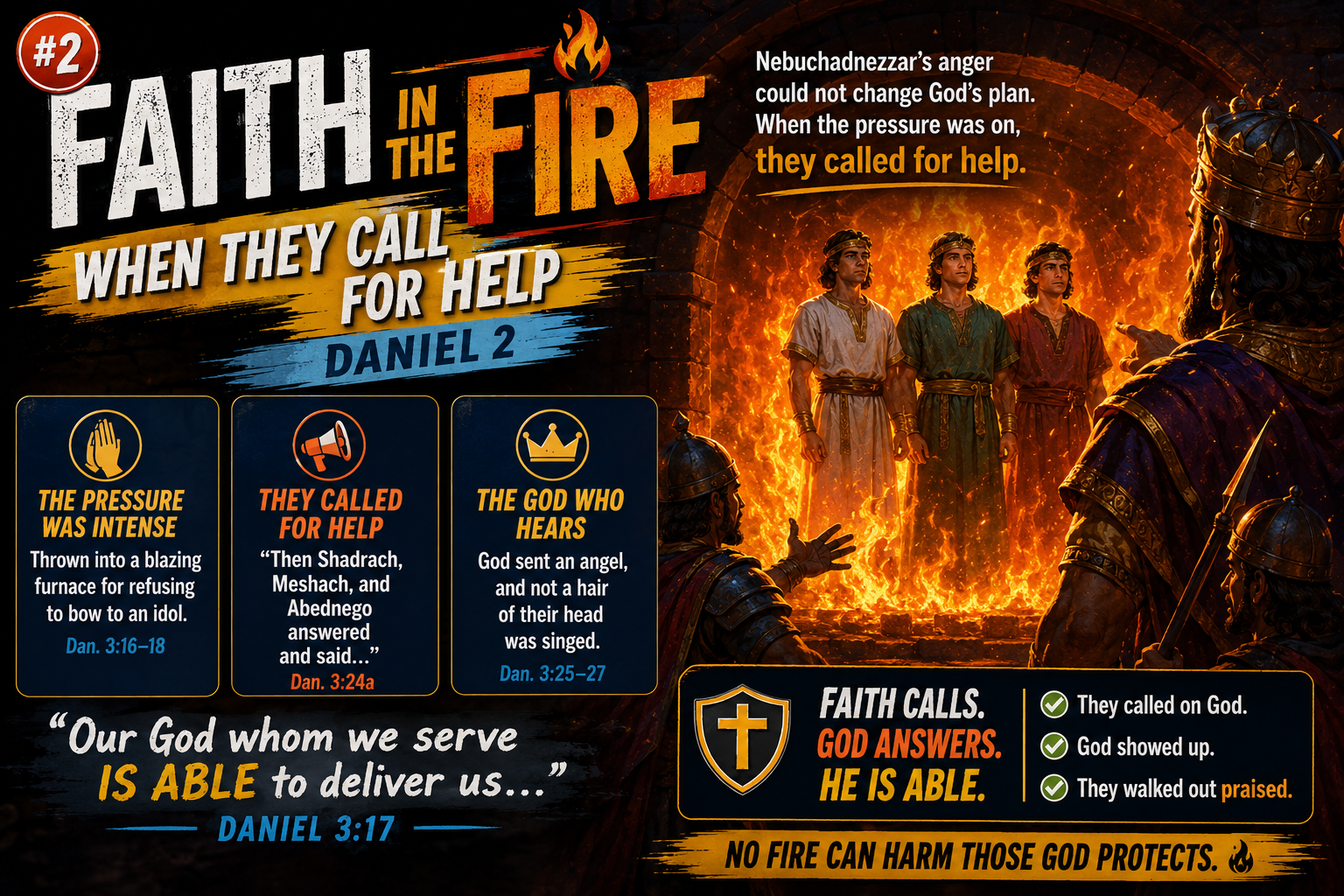
Faith in the Fire #2 When They Call For Help – Daniel 2


“…everybody has something that isn’t working in their life somewhere.”

Most of us in difficult conditions turn to our tried and true solutions first – you know, those little shortcuts and dodges that have bailed us out of trouble before. When these don’t work, we may confide our problem to a trusted friend or two. That failing, we may become desperate. We begin to entertain a willingness to open ourselves to things we haven’t considered before.

In that condition, some of us are, perhaps for the first time, willing to listen to what God might have to say. If, at that point, there is a Christian near us whom we trust and who is ready to help us understand, we find ourselves listening with a new level of attentiveness. For some this can result in becoming lifelong disciple of Jesus.

This process of a crisis bringing the unbeliever to the believer for help has been repeated over and over. It seems to be a prime method God uses to call men and women to Himself.

In the Bible narrative we’re going to consider this morning, we have one of those “turn-to-God-in-time-of-crisis” stories.

This lesson: “When They Call For Help.” How should we respond when someone who doesn’t know God comes to the end of his/her rope and reaches out to us for help?

As we’ve noted already, often an unbeliever’s first serious consideration of his Maker comes in a time of crisis. In this case the unbeliever is the king of Babylon 600 years before Christ – a man named Nebuchadnezzar. The crisis is a dream he had (to him more like a nightmare.) We begin then, with the crisis of:

I. A Rattled King.
Daniel 2:1: “In the second year of his reign, Nebuchadnezzar had dreams; his mind was troubled and he could not sleep.”

Because they possessed almost unlimited power and authority, Oriental leaders were notoriously temperamental and unpredictable, and here Nebuchadnezzar reveals this side of his character.

The Lord gave Nebuchadnezzar a vivid dream that he couldn’t understand, and it distressed him. That the Lord God Almighty would communicate truth to a pagan Gentile king is evidence of the grace of God.

That word “troubled” in this verse in the original language means “to be beaten, compelled, or pushed.” It was the kind of dream that causes one to sit up suddenly in bed, heart pounding, eyes wide, utterly terrified. It was so troubling that the King couldn’t go back to sleep. The plural “dreams” suggests that perhaps this same dream persisted night after night.

The King did what all people do when they hit a situation they cannot control. He turned to his familiar, tried and true solutions first.

Daniel 2:2-4: “So the king summoned the magicians, enchanters, sorcerers and astrologers to tell him what he had dreamed. When they came in and stood before the king, {3} he said to them, “I have had a dream that troubles me and I want to know what it means.” {4} Then the astrologers answered the king in Aramaic, “O king, live forever! Tell your servants the dream, and we will interpret it.””

Now get ready. The king is about to put these men to a test that will expose the limits of their power.

Verse 5: “The king replied to the astrologers, “This is what I have firmly decided: …you  tell me what my dream was and interpret it…”

The king wants not only the interpretation of the dream, he wants them to describe to him the dream itself! Without some sort of supernatural power, that is going to be impossible for them. As you can probably imagine, it didn’t take long for these Chaldeans to realize they were in deep trouble!

By issuing this impossible challenge, the king was unconsciously following the plan of God and opening the way for Daniel to do what the counselors could not do.


Daniel 2:6, 10: “But if you tell me the dream and explain it, you will receive from me gifts and rewards and great honor. So tell me the dream and interpret it for me.”

{10} The astrologers answered the king, “There is not a man on earth who can do what the king asks! No king, however great and mighty, has ever asked such a thing of any magician or enchanter or astrologer.”

What a revealing statement of the limits of human resources in the face of some crises! “There is no earthly solution to a problem like that, O king!” That was the best their most advanced wisdom of their day could produce.

Daniel 2:11: “What the king asks is too difficult. No one can reveal it to the king except the gods, and they do not live among men.””

Daniel 2:12: “This made the king so angry and furious that he ordered the execution of all the wise men of Babylon.”


There is nothing surprising about such a declaration from our perspective. Most of us here have realized that there comes a point when man’s solutions run out. You have to wonder, though, what these guys had been claiming to the king about their powers and abilities prior to this that would provoke such a violent threat.

What we’re talking about here is this: all people, sooner or later, sense the limitations of human resources. The Chaldeans state it well: “It would take a god to do what you are asking!”

There comes a time in the life of every person when you realize you can no longer dodge the bullet. You can no longer get off easy. You can no longer sidestep or ignore the problem or dig yourself out of your predicament.

You’re in trouble and unless there is something beyond the power of man, you won’t escape. At that point, sometimes for the first time, the possibility of a Supernatural Being who transcends human ability becomes relevant. You think, “perhaps there is a God.”

How then do we respond to the world’s call for help? We must first:

1. Realize that unbelievers will come to us in time of crisis.  If you build an authentic, consistent Christian witness, unbelievers in the time of their crisis, will come to you. God will see to it, just like He did here.

You never really know what is going on in the life of that unbeliever next to you until a crisis brings it out into the open. Realize that unbelievers will come to you in time of crisis.
2. A Ready Witness.  
That God would provide a witness is no surprise. What is always surprising to me is how He goes about it sometimes. That is what we see next.

Those words “destroy all the wise men of Babylon” would include Daniel and his three Hebrew friends who proved so faithful to God in chapter one. The King’s edict amounted to a death warrant for them. What is God up to?
Daniel 2:13: “So the decree was issued to put the wise men to death, and men were sent to look for Daniel and his friends to put them to death.”

The Evil One is willing to sacrifice all his false prophets in the city of Babylon if he can destroy four of God’s faithful servants.

Doesn’t it seem a bit strange to you that God would use a death warrant and the fear it would provoke in the minds of Daniel and his friends to bring the seeker and the witness together? Yet that is the way God did it.

Don’t ever think that the difficult circumstances in your life are without purpose in God’s scheme of things.

So Daniel got word of the edict. When the king and his soldiers knocked on his door, he was ready: Daniel 2:14-16: “When Arioch, the commander of the king’s guard, had gone out to put to death the wise men of Babylon, Daniel spoke to him with wisdom and tact. {15} He asked the king’s officer, “Why did the king issue such a harsh decree?” Arioch then explained the matter to Daniel. {16} At this, Daniel went in to the king and asked for time, so that he might interpret the dream for him.”

Those words in verse 16, “asked for time” are translated: “requested that he would appoint a time for him.”

We saw back in verse 8 that the king had already denied the Chaldeans additional time to collaborate. Daniel did the second thing we need to do when an unbeliever is in crisis: take the initiative with discretion and discernment.

“What on earth could I say?”
You could tell him how God has made a difference in your life. You could promise to pray for him. If he sees the need for salvation you could have a few verses handy and show him what he needs to do.

You could enlist a few other Christians to help you hold him up before God in prayer. You could spend time with him and encourage him to hang in there and not give up.

When we recognize that God does things this way, that is, He brings crises into the lives of unbelievers so they will seek Him, and that He uses believers like you and me to deliver His message, we can move forward with enthusiasm knowing that God is with us. He can even help you in your ineptness!

What has always amazed me in reading Daniel’s response to all this is the degree of confidence he had in God – not in himself. He didn’t know what God was going to do! He just knew that the king’s life was spinning out of control and that God was more powerful than any man or circumstance.

We should never face a situation like this alone. Intercession from the rest of the body to invoke God’s help is important. That is how Daniel saw it.

3. Solicit support from God’s people.
In this case we’re talking about prayer support of others which led ultimately to answered prayer from God.

Daniel 2:18-19: “He urged them to plead for mercy from the God of heaven concerning this mystery, so that he and his friends might not be executed with the rest of the wise men of Babylon. {19} During the night the mystery was revealed to Daniel in a vision. Then Daniel praised the God of heaven”

If God is instrumental in bringing crisis to the life of the unbeliever and brings the unbeliever into contact with the ready witness, we must recognize that this whole procedure is primarily His, not ours. We are simply His tools. It is only reasonable that we should go to God and seek his help and guidance through it.

  1. A Revered God. Let’s look again to see what Daniel did. Daniel 2:19-28 (ESV) 19 Then the mystery was revealed to Daniel in a vision of the night. Then Daniel blessed the God of heaven.
    20  Daniel answered and said: “Blessed be the name of God forever and ever, to whom belong wisdom and might.
    21  He changes times and seasons; he removes kings and sets up kings; he gives wisdom to the wise and knowledge to those who have understanding;
    22  he reveals deep and hidden things; he knows what is in the darkness, and the light dwells with him.
    23  To you, O God of my fathers, I give thanks and praise, for you have given me wisdom and might, and have now made known to me what we asked of you, for you have made known to us the king’s matter.”
     

24  Therefore Daniel went in to Arioch, whom the king had appointed to destroy the wise men of Babylon. He went and said thus to him: “Do not destroy the wise men of Babylon; bring me in before the king, and I will show the king the interpretation.”
25  Then Arioch brought in Daniel before the king in haste and said thus to him: “I have found among the exiles from Judah a man who will make known to the king the interpretation.”
26  The king declared to Daniel, whose name was Belteshazzar, “Are you able to make known to me the dream that I have seen and its interpretation?”
27  Daniel answered the king and said, “No wise men, enchanters, magicians, or astrologers can show to the king the mystery that the king has asked,
28  but there is a God in heaven who reveals mysteries, and he has made known to King Nebuchadnezzar what will be in the latter days. Your dream and the visions of your head as you lay in bed are these:

Daniel 2:29-30 (ESV)
29  To you, O king, as you lay in bed came thoughts of what would be after this, and he who reveals mysteries made known to you what is to be.  30  But as for me, this mystery has been revealed to me, not because of any wisdom that I have more than all the living, but in order that the interpretation may be made known to the king, and that you may know the thoughts of your mind.


Daniel 2:31-45.

To sum up what the large image represented: four Gentile kingdoms:

  • The breast and arms of silver—The Medo-Persian kingdom (539-330 B.C.). Darius the Mede conquered Babylon ( 5:30-31).
  • The belly and thighs of bronze—The Grecian kingdom (330-63 B.C.). Alexander the Great established what was probably the largest empire in ancient times. He died in 323 B.C.
  • The legs of iron and feet of iron and clay—The Roman Empire (63 B.C.-ca. A.D. 475). Iron represents strength but clay represents weakness. Rome was strong in law, organization, and military might; but the empire included so many different peoples that this created weakness.
  • The destruction of the image—The coming of Jesus Christ, the Stone, to judge His enemies and establish His universal kingdom.

What started out as possible tragedy—the slaughter of four godly men—was turned into great triumph; and the God of Daniel received great glory. Daniel gave the glory to God!

  1. Pass on the praise.
    It is a heady experience when God uses you to make a difference in the life of an unbeliever. What do you think the temptation is at that point?The temptation is to take the glory for yourself. Daniel realized that his purpose was to glorify God, not himself. In so doing, ultimately, God would honor him.Daniel 2:46-48: “Then King Nebuchadnezzar fell prostrate before Daniel and paid him honor and ordered that an offering and incense be presented to him. {47} The king said to Daniel, “Surely your God is the God of gods and the Lord of kings and a revealer of mysteries, for you were able to reveal this mystery.” {48} Then the king placed Daniel in a high position and lavished many gifts on him. He made him ruler over the entire province of Babylon and placed him in charge of all its wise men.”

    Conclusion
    Everyone has something that doesn’t work someplace… Everyone faces the reality of a crisis in their life sometime. …Everyone has a need somewhere, regardless of how together they seem to be.

    People who have been watching your life and listening to you for weeks, months, or even years. When the crisis comes, you need to be ready. Because we build a credible witness of Christ in your life, they will come.

    Perhaps there is someone here among us this morning who is in a crisis. We don’t want you to leave this building this morning without an opportunity to get help.

    If you would like to talk to one of our ministers or elders, please take one of the attendance cards from the rack in front of you and write your name, phone number, and anything pertinent to your situation and hand it to one of these men.

One of us will call you privately and discreetly this week. We want to help you.

 
Leave a comment

Posted by on June 18, 2026 in Daniel


Faith in the Fire: When They Call For Compromise – Daniel 1


Resumo De Daniel 1

I went to the grocery store to find the opening illustration for the sermon series I want to begin today. Rummaging through the items there, I found the analogy I was looking for. It was on the side of a half-gallon carton of milk. The words were, “Grade A, Pasteurized, Homogenized Milk.”

Pasteurization has to do with heating the milk to a certain temperature and holding it there until certain harmful bacteria are killed. Before the days of pasteurization, people would occasionally die from drinking a glass of milk. Homogenization is the process of mixing up the milk until it has a uniform consistency. We might say it is fully blended. You can always recognize non-homogenized milk because the cream separates and comes to the top.

It occurred to me this past week that homogenization is exactly what the world wants to do with Christians. The world wants to shake us up and blend us so effectively that there is no longer any difference between us and them. The cream no longer comes to the top. It is no longer a separate substance.

Once you’ve been a Christian for awhile, of course, you realize that, while that is what the world around you wants, it isn’t what God wants. He doesn’t want the cream so mixed up with the rest of the milk that there is no difference. He wants us to resist becoming “homogenized” with the world. Yet, staying with our analogy, He hasn’t called us to leave the bottle of milk either. (I believe somewhere I’ve heard the phrase, “In the world but not of the world” used among Christians.) In our day, that is no small assignment. But then again, it never has been.

So how do you pull something like that off? How do you maintain a dynamic, no compromise faith in a deluded world that wants to homogenize you?

This morning we begin a new six part sermons that I’m going to call “Dynamic Faith in a Deluded World.” The idea behind it is this issue of not becoming homogenized with the world. In the process of the world shaking the Christian up, God wants the cream to come to the top, and not to be reduced and dispersed so it is no longer seen.

We’ll turn then, to the first message, which I’ve called “When They Call For Compromise.” Compromise is the most common and straight forward means used by the world to homogenize Christians.

AMERICAN HERITAGE DICTIONARY gives as the third definition under the word Compromise, “A concession to something detrimental…”

If you can be made to abandon key aspects of your faith by compromising what you believe, homogenization will be simple and complete. Watch for the call to compromise as we read the story in Daniel, chapter one.

It begins with the military defeat of what remained of the once powerful nation of Israel and the deportation of certain young men who survived the siege of Jerusalem. The time was 606 B.C.

A. A new home (vv. 1-2)
Daniel 1:1-2: “In the third year of the reign of Jehoiakim king of Judah, Nebuchadnezzar king of Babylon came to Jerusalem and besieged it. {2} And the Lord delivered Jehoiakim king of Judah into his hand, along with some of the articles from the temple of God. These he carried off to the temple of his god in Babylonia and put in the treasure house of his god


No longer were they surrounded by the things of God in Jerusalem, and no longer would they have the influence of their godly parents and teachers.

Imagine four Hebrew boys, teenagers, being snatched from their lovely homes in Jerusalem and moved to faraway Babylon. Since all of them were princes, belonging to the royal family, they were probably not accustomed to this kind of treatment.

It is too bad when the youth of the land must suffer because of the sins of the parents. The Jews had refused to repent and obey the Lord, so (as Jeremiah had warned) the Babylonian army came in 606-586 B.C. and conquered the land.

The policy of taking the youngest and strongest among the survivors of a defeated nation was common in that day. It insured a good flow of slaves for the conquering king to employ in his service and also made it certain that the defeated nation could not rise again against its conquerors.

B. New knowledge (vv. 3-4)

Then the king ordered Ashpenaz, chief of his court officials, to bring in some of the Israelites from the royal family and the nobility–{4} young men without any physical defect, handsome, showing aptitude for every kind of learning, well informed, quick to understand, and qualified to serve in the king’s palace. He was to teach them the language and literature of the Babylonians.”


The old Jewish wisdom had to go; from now on it would be the wisdom of the world, the wisdom of Babylon. They had to learn the wisdom and the language of their captors. The king hoped that this “brainwashing” would make better servants out of them.

In v. 3 we see what fine specimens these four lads were: they were physically strong and handsome, socially experienced and well-liked by others, mentally keen and well-educated, and spiritually devoted to the Lord.

Conservative scholars have placed Daniel and his friends who were among these captives somewhere in the age range of early teens. The next verses describe the plan for re-socialization. It was a clear, out-in-the-open effort to homogenize believers.

But a difficult trial lay ahead of them: the king wanted to force them to conform to the ways of Babylon. He was not interested in putting good Jews to work; he wanted these Jews to be Babylonians!

Christians today face the same trial: Satan wants us to become “conformed to this world” (Rom. 12:1-2). Sad to say, too many Christians give in to the world and lose their power, their joy, and their testimony. Note the changes that these young men experienced:

C. New diets (v. 5)
“The king assigned them a daily amount of food and wine from the king’s table. They were to be trained for three years, and after that they were to enter the king’s service.


For the next three years, the four youths were supposed to eat the king’s diet, which, of course, was contrary to the dietary laws of the Jews. No doubt the food was also offered to the idols of the land, and for the Hebrew youths to eat it would be blasphemy.

D. New names (vv. 6-7)
Among these were some from Judah: Daniel, Hananiah, Mishael and Azariah. {7} The chief official gave them new names: to Daniel, the name Belteshazzar; to Hananiah, Shadrach; to Mishael, Meshach; and to Azariah, Abednego.”


The world does not like to recognize the name of God, yet each of the four boys had God’s name in his own name:
Daniel (“God is my judge”) was changed to Belteshazzar (“Bel protect his life”). Bel was the name of a Babylonian god.
Hananiah (“Jehovah is gracious”) became Shadrach (“the command of the moon god”)

Mishael (“Who is like God?”) became Meshach (“who is like Aku,” one of the heathen gods);
Azariah (“Jehovah is my helper”) became Abednego (“the servant of Nego,” another heathen god).

The Babylonians hoped that these new names would help the youths forget their God and gradually become more like the heathen people with whom they were living and studying.

The Babylonians could change Daniel’s home, textbooks, menu, and name, but they could not change his heart. He and his friends purposed in their hearts that they would obey God’s Word; they refused to become conformed to the world. Of course, they could have made excuses and “gone along with” the crowd. They might have said,  “Everybody’s doing it!” or “We had better obey the king!” or “We’ll obey on the outside but keep our faith privately.” But they did not compromise.

They dared to believe God’s Word and trust God for victory. They had surrendered their bodies and minds to the Lord, as Rom. 12:1-2 instructs, and they were willing to let God do the rest.
Daniel 1:8-16 (ESV)
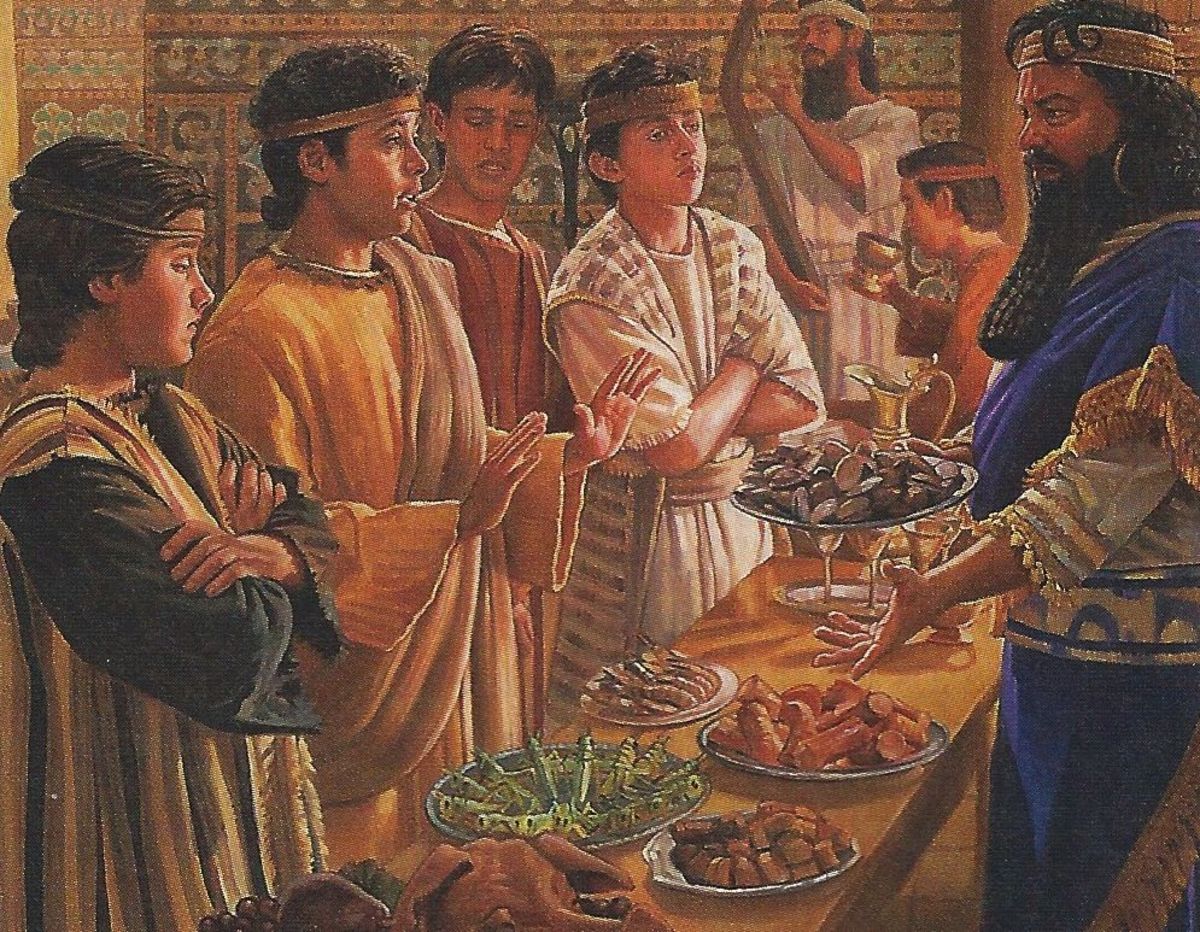
8  But Daniel resolved that he would not defile himself with the king’s food, or with the wine that he drank. Therefore he asked the chief of the eunuchs to allow him not to defile himself.
9  And God gave Daniel favor and compassion in the sight of the chief of the eunuchs,
10  and the chief of the eunuchs said to Daniel, “I fear my lord the king, who assigned your food and your drink; for why should he see that you were in worse condition than the youths who are of your own age? So you would endanger my head with the king.”
11  Then Daniel said to the steward whom the chief of the eunuchs had assigned over Daniel, Hananiah, Mishael, and Azariah,
12  “Test your servants for ten days; let us be given vegetables to eat and water to drink.
13  Then let our appearance and the appearance of the youths who eat the king’s food be observed by you, and deal with your servants according to what you see.”
14  So he listened to them in this matter, and tested them for ten days.
15  At the end of ten days it was seen that they were better in appearance and fatter in flesh than all the youths who ate the king’s food.
16  So the steward took away their food and the wine they were to drink, and gave them vegetables.

Daniel asked for a ten-day test, which was not very long considering that they had three years of training ahead of them; the head servant agreed with their plan.

The servant was afraid to change the king’s orders, lest anything happen to the youths and to himself, so Daniel’s proposed test was a good solution to the problem. Of course, God honored their faith. The boys were fed vegetables and water for ten days, thus avoiding the defiled food of the Babylonians. At the end of the test, the four lads were healthier and more handsome than the other students who ate from the king’s table.

“When a man’s ways please the Lord, He makes even his enemies to be at peace with him” (Prov. 16:7).

Daniel 1:17: “To these four young men God gave knowledge and understanding of all kinds of literature and learning. And Daniel could understand visions and dreams of all kinds.”

A test for ten days is one thing, but what about the three-year course at the University of Babylon? The answer is in v. 17: “God gave them . . . ” all that they needed! He enabled them to learn their lessons better than the other students, and He added to this knowledge His own spiritual wisdom.

Daniel 1:18-21 (ESV)
18  At the end of the time, when the king had commanded that they should be brought in, the chief of the eunuchs brought them in before Nebuchadnezzar.
19  And the king spoke with them, and among all of them none was found like Daniel, Hananiah, Mishael, and Azariah. Therefore they stood before the king.
20  And in every matter of wisdom and understanding about which the king inquired of them, he found them ten times better than all the magicians and enchanters that were in all his kingdom.
21  And Daniel was there until the first year of King Cyrus.


The “magicians and astrologers” in v. 20 were the men of the kingdom who studied the stars and sought to determine what decisions the king should make. They also claimed to interpret dreams.

Certainly Daniel and his friends did not believe the foolish religion and practices of the Babylonians, but they studied just the same, just as a Christian student must do when he attends a university today and is told to learn “facts” that he knows are contrary to God’s Word.

The king himself had to admit that the four Hebrew lads were ten times smarter than his best advisers. Of course, this kind of reputation made the astrologers envious, and it is no wonder they tried to do away with the Jews in later years.
What we have, then, in this passage is clearly a call from the world to compromise and it is no different in principle than the world’s call for God’s people to compromise in any other age, including our own. Yes, the circumstances are usually different, but the issue is always the same.

Someone has written, “Compromise is always wrong when it means sacrificing principle.”

Not all compromise is wrong. There are times when compromise is permissible or even desirable. Remember the dictionary definition of compromise? “A concession to something detrimental.” Note that Daniel and his friends didn’t object to the classes they were assigned to take or the new names then were given. Though they probably didn’t like being given pagan names in place of the ones their parents had given them, they were willing to concede these things. But eating the King’s choice food
was a clear violation of God’s law. That concession could not be made.

When the world calls on us to compromise then, we need to:
1. Be Reasonable. Know the difference between wrongful compromise and allowable concession. Every call for compromise need not be met by strong opposition by God’s person. A Christian should pick his battles carefully. It is only when God’s principles are at stake that we can refuse to be conformed.

When we are called to compromise, we need to know the difference between wrongful compromise and permissible concession. We see it illustrated here in Daniel. These men didn’t object to all that was put upon them. Only the thing that caused them to violate the law of God.

2. Be Resolute.
Look back at verse 8: The words to note there are those translated “made up his mind” or “resolved.” The Hebrew word behind that phrase was one often used to describe the making of a rope. Individual strands or fibers are gathered up and placed side by side, then twisted into a rope. Their combined strength makes a strand that is difficult to break.

The time does come to make up your mind and take your stand. When that time comes, stand!

After Daniel determined that this was an issue for which there could be no compromise, he gathered up every strand of his resolve and made a decision.

A big reason why many compromise, even when they don’t want to, is that they never come to this kind of decision. They know something is wrong, but they beat around the bush, hoping the unpleasant decision will somehow go away. Or, perhaps they try to somehow accommodate the best of both worlds.

It reminds me of the guy Paul Harvey described one time. His words were, “Remember the uncertain soldier in our Civil War who, figuring to play it safe, dressed himself in a blue coat and gray pants and tip-toed out onto the field of battle. He got shot from both directions.”

We need to be resolute. We need to make up our minds. If we don’t, we’ll soon be homogenized. We’ll be no different than the world.

3. Be Respectful.
1:8: “…so he sought permission from the commander of the officials that he might not defile himself.”

I suppose that Daniel could have gone on some hunger strike or something, but he didn’t. He could have protested loudly. Instead, he sought out the commander and respectflly told him his dilemma.

Remember that unbelievers around us need to see a good example so they, too, can be saved. A resolute stand doesn’t mean you should be mean-spirited and disrespectful. This is precisely where many Christians lose the battle and become just like the world.

I’m told that between two farms near Valleyview, Alberta, you can find two parallel fences, only two feet apart, running for about a half mile. Why are there two fences when only one would do? It seems two farmers, Paul and Oscar, had a disagreement that erupted into a feud. Paul wanted to build a fence between their land and split the cost (a reasonable thing to do) but Oscar was unwilling to contribute. Since he wanted to keep the cattle on his land, Paul went ahead and built the fence anyway.

After it was completed, Oscar said to Paul, “I see we have a fence.”  “What do you mean, ‘we'” replied Paul. “I got the property line surveyed and built the fence two feet into my land. That means some of my land is outside the fence. If any of your cows set foot on my land, I’ll shoot them.”

Oscar knew Paul wasn’t joking, so when he eventually decided to use the land adjoining Paul’s pasture, he was forced to build another fence, two feet away. Oscar and Paul are both dead now, but their double fence stands as a monument to their stubbornness and uncalled for disrespect. Being right and doing right does not give us a license to be disrespectful of others. There really is no place for a cantankerous saint of God.

Daniel first sought permission from the commander of the officials to be excused from eating the king’s food. Does that mean if the commander had said “no” he would have gone ahead and defiled himself with the food? No! But it does indicate that, whenever something can be done respectfully, it should be.

Romans 12:18: “If possible, so far as it depends on you, be at peace with all men.”

4. Be Resourceful.
Don’t you think that proposal reflects some careful deliberation and wise, resourceful consideration? I think it is reasonable to believe that, after Daniel made up his mind he would not defile himself with the king’s food, he spent some time considering how to approach the overseer.

Even when intentions are good and God is please with a decision, we must be wise in our approach to the world. You might remember Jesus’ words  were “wise as serpents and cautious [innocent] as doves.” (4)

Being on God’s side doesn’t excuse us from seeking a wise approach to dealing with the world. We must not be reckless in this area. Such seeking of wisdom is based at least partly, on human effort and concern for what is wise.

Two New Testament verses come to mind that are directed to Christians today on the subject of giving a wise response to the world when we have the opportunity:

Colossians 4:6 says, “Let your speech always be with grace, seasoned, as it were, with salt, so that you may know how you should respond to each person.”


1 Peter 3:15 says, “But in your hearts set apart Christ as Lord. Always be prepared to give an answer to everyone who asks you to give the reason for the hope that you have. But do this with gentleness and respect…”

You don’t avoid the world’s homogenization by being a willful dim-wit to wisdom.

I don’t believe God hands a person wisdom like Daniel and his friends exhibited here without their human effort being involved. Do you seek wisdom to know how you should respond when the world calls for compromise?

Conclusion
An interesting thing to watch for from the window of an airplane is the winding path of the rivers below. No two waterways are alike, but they all have one thing in common: they are all crooked. They get that way because they conform to what stands in their way. Another way to look at it is that they follow the path of least resistance. Yes, rivers are crooked because they take the “easy way.”

We, too, can become crooked if we always take the easy way. The things that have been suggested here today from Daniel 1 are not the easy way. They take courage, conviction, and commitment. But if we practice them, they will yield a life that is straight as God intended – and we won’t be homogenized.

 
Leave a comment

Posted by on June 15, 2026 in Daniel