RSS

Category Archives: God

God: One of a kind!


TheInterviewWithGodImagine how an interview with God would go:

Name: God.
Also known as: The Almighty, Jehovah, the Father, Lord.
Occupation: Sustainer and ruler of the universe.
Address: Everywhere.
Sex: Does not apply.
Place of birth: Does not apply.
Social Security: None.
Mother’s maiden name: None.
Dependents: Everyone.
Education: Does not apply.
Honors received: Too numerous to list.

He doesn’t fit a mold, does he? He is, to put it mildly, unique. One of a kind.

Indescribable, some would say! God is beyond cataloging, and no computer resume, no investigating  committee, not even a CIA computer could give an exhaustive profile of who He is and all that He’s done.

Yet we cannot give up! We can’t throw up our hands and dismiss Him as a mystery…we need Him!

It’s amazing in this world the way people respond to God, as they understand Him…it’s very different:
· some grovel before totems
· others bring offerings of chickens and goats
· others kneel five times daily to chant prayers
· others go into trances
· some believe in God so intensely they preach in foreign lands
· others deny His existence by their silence

What is God like? Answers don’t come easy, because of the immensity of the subject. God is huge, filling the universe. Also people might know the right words, but they seem to become hollow shells because they can’t comprehend them.

We say that God is holy, righteous, loving, gracious, Father-Son-Spirit, but we don’t know what all this means.

How do we know the words are empty? We can tell by the way many Christians behave!
· a Christian testifies that God is his creator and then does things that show that he dislikes himself
· a singer rhapsodizes about God’s grace and then worries about sins she committed years before
· a minister preaches about God’s sovreignty and then frets about how he will pay his bills

Our behavior exposes our failure to understand the words coming out of  our mouths. We can talk about God, but we do not know Him! God is not like us — He’s one of a kind! God is different from men. Anyone trying to know God and learn to relate to Him must begin with this fundamental truth.

The word holy means ‘separate’ or ‘set apart.’ The Jews expressed that “God is holy” and immediately felt separate from Him, for instance.

· God is infinite: a term which means God is without limits.
· God is free: of time, ignorance, distance, and weaknesses, which confine humans

God is not optional! Unlike everything else, God is absolutely necessary, like water for fish. We can’t just “take God or leave Him” — He is inescapable, even more so than death and taxes. We must not be too
“familiar” with God, or regard Him as optional…we must learn to let God be God.

The Possibility of the knowledge of God
Children know and understand more today than ever before. At any typical gathering of a Christian family, at a Sunday dinner table, young children can discuss the ‘big-bang’ cosmic dust theory in regards to the theory of evolution.

Many young people, reared in Christian homes, have accepted the Biblical account of creation and the Christian religion in general without any serious examination of their claims. They have merely accepted these teachings without any real understanding of why they believed these and other tenets of Christian faith.

Some of these same people at a later time, perhaps while in military service, or attending college, or working in the city, have found their childhood faith seriously challenged. Many questions have been asked to which they have no answers.

Many a young person has come home sometime later to announce he/she has “lost their faith.” Those with no knowledge of their beliefs are easy prey to those who would destroy faith.

No person, no principle, no institution is exempt from a thorough examination. It is for this reason that young people deserve help in examining the claims of Christianity during the questioning period in
their lives. Parents likewise need guidance in order that they may be ready to answer the questions which their children are asking.

It was Jesus who said: (John 8:32) “Then you will know the truth, and the truth will set you free.””
The apostle Paul wrote: (1 Thessalonians 5:21) “Test everything. Hold on to the good.”

Any religion which will not stand careful scrutiny will not long endure, nor should it endure! We confidently believe that the Christian faith will not only survive but will even florish under honest, open-minded inquiry.

The knowledge of God is desirable. Will Durant wrote: “The greatest question of our time is not communish vs. Individualism, nor Europe vs. America, nor even the East vs. West; it is whether men can bear to live without God.”

Unquestionably the knowledge of God is desirable (and even needed); the religious yearnings of mankind testify to that. It would be frightful to imagine a world without a God, a universe without a Creator, sinners without a Savior, and the human race without eternal hope. It is instinctive for man to believe in the existence of a supreme Being. Man is naturally religious, and requires an Object upon which to bestow his worship.

But is it possible?

The Scriptures attest to two facts: the incomprehensibility of God and the knowability of God. To say that He is incomprehensible is to assert that the mind cannot grasp the knowledge of Him. To say that He is knowable is to claim that He can be known. Both are true though neither in an absolute sense.

To say that God is incomprehensible is to assert that man cannot know everything about Him. To say that He is knowable is not to assert that man can know everything about Him.

Both truths are affirmed in the Scriptures: His incomprehensibility in verses like Job 11:7 and Isaiah 40:18:
(Job 11:7) “”Can you fathom the mysteries of God? Can you probe the limits of the Almighty?”
(Isaiah 40:18) “To whom, then, will you compare God? What image will you compare him to?”

His knowability in verses like John 14:7; 17:3; and 1 John 5:20:
(John 14:7) “If you really knew me, you would know my Father as well. From now on, you do know him and have seen him.””

(John 17:3) “Now this is eternal life: that they may know you, the only true God, and Jesus Christ, whom you have sent.”

Faith in God is a fundamental requirement of the religion of the Bible.
(Hebrews 11:6) “And without faith it is impossible to please God, because anyone who comes to him must believe that he exists and that he rewards those who earnestly seek him.”

The moral and spiritual situation of man demands the existence of God. Vultaire said: “If there were no God, it would be necessary to invent him.”

 
1 Comment

Posted by on June 9, 2016 in God


Coming to Know God


  JesusIsLordofthisWebSite placeforyou2 575273_579331012148169_1163921425_n

 ——————————————–

In the early days of the automobile a man’s Model-T Ford stalled in the middle of the road.  He couldn’t get it started no matter how hard he cranked nor how much he tried to advance the spark or adjust things under the hood.  Just then a chauffeured limousine pulled up behind him, and a wiry, energetic man stepped out from the back seat and offered his assistance.  After tinkering for a few moments the stranger said, “Now try it!”  Immediately the engine leaped to life.  The well-dressed individual then identified himself as Henry Ford.  “I designed and built these cars,” he said, “so I know what to do when something goes wrong.” God, as our creator knows how to “fix” us when our lives are broken by sin.

God is not discoverable or demonstrable by purely scientific means, unfortunately for the scientific minded.  But that really proves nothing.  It simply means that the wrong instruments are being used for the job.

A Sunday School teacher saw one of her little boys drawing furiously with a set of crayons. “What are you doing, Johnny?” she asked. “I’m drawing a picture of God,” said Johnny. “But Johnny,” said the teacher, “nobody knows what God looks like.” Replied Johnny: “Well, they will by the time I’m through with THIS!”

In looking for a challenge or some direction in life, the most challenging task we can approach is the zeal to come to know God. Think how that process might begin with some questions/answers:

Name: God.
Also known as: The Almighty, Jehovah, the Father, Lord.
Occupation: Sustainer and ruler of the universe.
Address: Everywhere.
Sex: Does not apply.
Place of birth: Does not apply.
Social Security: None.
Mother’s maiden name: None.
Dependents: Everyone.
Honors received: Too numerous to list.

God doesn’t fit a mold, does he? He is, to put it mildly, unique. One of a kind. Indescribable, some would say! God is beyond cataloging, and no computer resume, no investigating committee, not even a CIA computer could give an exhaustive profile of who He is and all that He’s done.
God cannot be grasped by the mind. If he could be grasped, he would not be God. Yet we cannot give up! We can’t throw up our hands and dismiss Him as a mystery…we need Him!

Imagine a sheer, steep crag with a projecting edge at the top. Now imagine what a person would probably feel if he put his foot on the edge of this precipice and, looking down into the chasm below, saw no solid footing nor anything to hold on to.

This is what I think the soul experiences when it goes beyond its footing in material things, in its quest for that which has no dimension and which exists from all eternity. For here there is nothing it can take hold of, neither place nor time, neither measure nor anything else; our minds cannot approach it.

And thus the soul, slipping at every point from what cannot be grasped, becomes dizzy and perplexed and returns once again to what is connatural to it, content now to know merely this about God, that it is completely different from the nature of the things that the soul knows. [1]

It’s amazing in this world the way people respond to God, as they understand Him…it’s very different: some grovel before totems; others bring offerings of chickens and goats; others kneel five times daily to chant prayers; others go into trances. Some believe in God so intensely they preach in foreign lands; others deny His existence by their silence.

We need to come to see God in people around us. We need to know Him in a personal way.

I’m thinking of a little boy named Timmy. Timmy was very afraid of the lightning and the thunder. His mom and dad went into his room during a thunderstorm and said, “Now, Timmy, don’t be afraid. God is right here in the room with you.”

He said, “Okay, Mommy and Daddy, I won’t be afraid.”

But then as the mommy and daddy went into their room and started to get ready for bed, the lightning clapped, and the thunder rolled, and Timmy screamed bloody murder. Timmy’s daddy and mommy went back into the room and said, “Honey, we thought we told you, you don’t need to be afraid. God is right here in the room with you.”

Timmy said, “Mommy and Daddy, I know God is right here in the room with me, but I need someone with skin on.” [2]

——–

[1] Gregory of Nyssa (d. about 395), “Eastern Orthodoxy,” Christian History, no. 54.

[2] Thomas Tewell, “The Tenacity of a Bulldog,” Preaching Today, Tape No. 141.

 
Leave a comment

Posted by on June 2, 2016 in God


Understanding World Views


worldview-forum(This comes from many sources over several months; hope it is of use)

We often study the subject of discipleship…and one of the characteristics of a disciple is that he makes more disciples. And making disciples involves witnessing.

It used to be that most people believed there was a God, that the Bible was God’s word. They believed in heaven and hell and unfortunately, most believed that good people went to heaven and bad people went to hell. If you showed them something in the Bible, they tended to believe it was true because the Bible was “the good book” and thought to be true. The usual hurdles to someone believing the gospel were apathy or ignorance.

Tim Keller said: “…the main issue with evangelism in the past was that people knew something about Christianity but it wasn’t personal. They believed in sin, but they had to be shown that “they” were sinners. So, we came up with programs  to encourage people to “do what you know.” They had a Christian intellect, a Christian conscience, but not a Christian heart.1

That has all changed. Now, most don’t believe in God. They don’t believe the Bible is the Word of God. There is little agreement on issues of morality and sin. Now, if you try to present the gospel to someone, you’re more likely to have them say, “That’s just your opinion.” Or “That may be true for you but not for me.”

If you don’t know how to answer statements like these, engaging your neighbor, co-workers, and strangers in a conversation about God, Jesus, life after death, etc. can be frustrating – to say the least – and maybe so scary that you just don’t do it.

What has happened to our culture? The predominant world view is changing. We’re going to study the major world views and how they answer the big questions of life. We are going to examine the different answers and evaluate if they make sense. Hopefully, at the end, you will be better prepared when someone says, “Well, that may be true for you, but not for me.”

We have the strategic advantage because we have the truth. We are going to win the war in the end. But we need some tactical plans for winning battles along the way. We are not going to be learning techniques for arguing. We are going to try to understand the root differences between the world views. Then the inconsistencies will be apparent and easily brought up in conversations with those who hold them.

Some of you may be thinking that we just need to present the gospel and let the Holy Spirit do the rest. While it is true that salvation is a work of the Spirit in the heart of an individual and no amount of logic can convince a person to believe in Jesus, the Bible does actually speak to this issue. 1 Pet 3:15 says we need to be ready to give a defense for what we believe. Paul argued logically with the philosophers in Acts. If we can show someone that they are being illogical or living inconsistent with their belief system, then sometimes that is the first step in them searching for the truth.

If you are not a Christian, then hopefully this study will help you evaluate your own world view and compare it to what the Bible says. One of the most prevalent attitudes today is that there is a division between Faith and Reason. One’s religion is a private matter and based on blind faith. Public issues on the other hand are based on science and reason. What this series will show is that Faith versus Reason is a false dichotomy.

The question should be, “How reasonable is your faith?” Because you will see that all world view systems are based on certain assumptions that we take on faith. The pantheist assumes that the world is immaterial. He can’t prove that nothing exists. In fact, all his senses cry out that he is wrong. The naturalist assumes that God doesn’t exist and then comes up with explanations for things that don’t include God.

If you are already a Christian, then hopefully this study will help you develop a consistent Christian world view. And hopefully, you will understand why you believe what you believe and be able to defend your beliefs when subjects like morality and ethics come up.

One of the criticisms I’ve heard about studying other world views is that it makes it seem like Christianity is just “one of the options.” And some have said that their faith was shaken because of studies like the one we are beginning.

We need to remember Peter’s response to Jesus in John 6. After Jesus told everyone that He was the bread of life and that they needed to drink His blood and eat His flesh, many of his disciples left. Jesus turned to the 12 and asked, “You don’t want to go away too, do you?” Peter’s response was “Lord, to whom would we go? You have the words of eternal life. We have come to believe and to know that you are the Holy One of God!”

He told them what they needed to hear with the perfect tone of voice, love and kindness in his heart, and love for their soul…He also knew some would respond this way.

It seems to me that this applies to our topic. Whenever we encounter something in the Bible that is hard to understand, or our faith is at a low point…that is not a reason to abandon our faith. When we know what the other options are – pantheism, naturalism, etc…we know that the Christian world view doesn’t just have a different set of answers to life’s important questions – it has the “only” answers that make sense. So, this series shouldn’t jeopardize your faith. It should strengthen it when you realize that the other world views aren’t valid options. Their answers are nonsense.

What is a World View?

Your world view is your concept of reality. It is your assumptions or presuppositions about what makes the world go around. Everyone has a world view even if they cannot explain what it is. But a world view is not just some academic, abstract, philosophical construct. It describes our search for answers to life’s most important questions.

Your world view affects the way you look at everything…life, death, politics, religion, parenting, education, etc. Some have likened a world view to a set of glasses through which you see life. Your world view glasses affect how you view certain events and how you respond to them. If your glasses have the correct prescription, then you will see the world accurately. If they are the wrong prescription, your view of the world will be distorted.

Ronald Nash says, “A world view is a set if beliefs about the most important issues in life.”2 So that leads us to ask what are the most important issues or questions in life? It seems that there are several standard world view questions that are asked:

Why is there something rather than nothing? or What is the Origin of the Universe? Does anything really exist? Is it all a figment of our imagination? If it does exist, did it always exist? Is everything that exists just result of time + chance? Or is there a supernatural being out there who created the universe?

Is there a God? Is there a supernatural being that is above time and space? Is that supernatural being just a force, like in Star Wars, or Mother Nature? Or is there a personal God? If so, what is he like?

What is the Nature of Man? Is man just an animal that has evolved differently? Or is he something special? Another part of the question is this: Is man basically good but society makes him do bad things? Or is man’s badness built in?

What is the Basis of Ethics and Morality? We can’t really talk about man being good or bad without having some sort of personal opinion about what is good and what is bad. Where do we get our ideas of good and evil? From ourselves? From nature (survival of the fittest)? From society? From God?

Why is there evil and suffering? The occurrence of evil in the world causes some to conclude that there is no God. The argument is that, if there is a God, then he must not be good or he must not be all-powerful, or he would not let all these bad things happen.

What happens after we die? Do we just cease to exist? Do we get reincarnated and come back to earth as a cow or another person? Do we get absorbed into the cosmic consciousness? Or do we face God and judgment? This is a hard one to “prove” to someone since we are talking about the future. So

What is the meaning of history? Is history a meaningless series of events that just happen? Or is there some purpose to history? Why are we here?

How do you know that you know? We have a truth problem in our society. Anyone who claims to know the truth is criticized as trying to impose “his view” on others. Our society preaches that there is no “truth.” Is there such a thing as truth? How do you know what is true? Do you know stuff because of reason, experience, supernatural revelation, etc.?

The Major World Viewsworldview_chart_gw3

Theism – Theism is the belief that there is a personal God outside of time and space who created the universe out of nothing and is involved in events (supernaturally). He reveals himself to man through nature and through the Bible (Christians) or the Torah (Jews) or the Koran (Muslims). He sets the rules for mankind. And there will be eternal consequences for breaking the rules. Deism is similar to theism. God created everything, but is no longer involved in creation. There is nothing supernatural going on. Praying is a waste of time. Famous people who believed this were Thomas Jefferson and Thomas Paine. It’s not real popular these days because folks who would normally be deists have substituted evolution as an explanation of the origin of the universe.

Pantheism – Everything is god. Everything material is an illusion. Humans are gods. Knowledge is getting in touch with the cosmic consciousness. One of the favorite terms you’ll hear from pantheists is “enlightenment.” History is cyclical and men are reincarnated until they realize their own divinity. This world view is the basis for Hinduism, Buddhism, Christian Science, and New Age teaching.

Naturalism – There is no God. The world and mankind just evolved. Men are just the product of their environment. Morality is decided by man. There is no purpose to history; it just happens. When you die, you cease to exist.

Pluralism – Naturalism has undergone a major change in the past 50 years. Enough of a change that it deserves its own category—Pluralism. Pluralism is very similar to Naturalism, but it’s sort of a cafeteria style world view. People mix and match various aspects of the other world views. It is extremely inconsistent, but that doesn’t seem to matter in a postmodern world. The shift from Naturalism to Pluralism corresponds to the shift from Modernism to Postmodernism.

I’ve used the terms modernism and postmodernism a couple times already and some of you may be wondering what in the world I’m talking about. So, let’s define them.

Modernism: Prior to the Renaissance everyone believed in God and the supernatural. But around 1500 several things happened. Gutenberg developed the printing press which made books available to the masses and learning grew exponentially. Martin Luther began the Reformation, the Renaissance began with the whole new emphasis on art, science, humanism, etc. Reality was what you could see and measure. The myth of progress captivated the world. Man came to believe that science would solve all the problems of mankind. Science would discover the cure for all diseases, control the weather, end poverty, bring about world peace, etc. There were World Fairs touting the marvels of the modern age. This period, called “Modernism,” lasted from the 1500’s to 1960’s. Incidentally, lots of folks believed in post-millennialism as a direct result of this. They thought we were in the millennium and Christ was coming back at the end of it. But that’s another lesson.

Postmodernism: But after the Second World War, people were disillusioned. (Including the post-millennialists) The war to end all wars (WWI) didn’t. WWII and the holocaust happened. It was obvious we weren’t going to bring about world peace. Science wasn’t curing very many diseases. In fact, cancer was becoming more and more prevalent. People recognized that science wasn’t solving man’s problems. Science hadn’t brought about a utopia of progress uniting the human race like it promised. In fact, modernism was rather weak on relationships. People were just cogs in the machine. So, society began rejecting modernism (science) and moving toward something we call “postmodernism.” The name “post”-modernism means “after”-modernism. People are now looking for something else to explain reality. Since naturalism has rejected the existence of God, we have moved from science (with its truth/facts) to existentialism which is basically experience, spirituality, and pragmatism (whatever works).

This shift from modernism to postmodernism is a process, and our generation is right in the middle of it and as such, we are all a little of both.

I think one of the best ways to illustrate this is by comparing older commercials with new ones. Old commercials had guys in white lab coats touting the virtues of various products. Why were they in white lab coats? Because it made them look like scientists and led you to believe that what they were claiming was a scientific fact. Postmodern commercials, on the other hand, consist of beautiful and or rugged looking individuals having a good time in exotic locations. Compare the old Coke/Pepsi “taste test” commercials with the more recent ones. The “taste test” was supposedly a scientific measurement. More people preferred Pepsi. Now you are inundated with multiple images of folks having a great time drinking Coke. Or you’re encouraged to just “Be a Pepper,” etc.

Let’s get back to our discussion of the major world views.The following Chart gives a basic overview of how each world view answers the world view questions.3

—————————————-

Tim Keller, The Supremacy of Christ and the Gospel in a Postmodern World. Audio message from desiringgod.org.

2 Ronald Nash, World-Views in Conflict. p. 16.

3 A modified version of a chart from Mindgames seminar by Probe Ministries.

Theism Pantheism Naturalism (Modernism) Pluralism (Postmodernism)
God Personal Impersonal Non-existent Non-existent
World Creation Spiritual Evolution Evolution
Man Like God Is God Like Animals Like Animals
Immortality Resurrection Reincarnation Annihilation Annihilation

Reincarnation

Destiny Glorification Absorption Extinction Extinction
Authority Divine Revelation Spiritual Enlightenment Human Reason Culture
Truth Absolute Personal Objective/Science Relative/Cultural
Evil Rebellion/Sin Illusion Ignorance Culturally Defined
History Linear Cyclical Chaotic Re-Defined
 
Leave a comment

Posted by on May 26, 2016 in Evidence, God


God’s Attributes: The Wrath of God


wrath-of-GodMost people do not want to think of God’s wrath at all, preferring to think and speak of God’s love. Those who do believe God is a God of wrath as well as a God of love prefer to think of His wrath in the past tense. Many seem to believe God’s wrath is an Old Testament truth, and that with the coming of Christ, we are now safe to think only in terms of God’s love. This is wrong thinking about God.

A. W. Pink observes: It is sad to find so many professing Christians who appear to regard the wrath of God as something for which they need to make an apology, or at least they wish there were no such thing. While some would not go so far as to openly admit that they consider it a blemish on the Divine character, yet they are far from regarding it with delight; they like not to think about it, and they rarely hear it mentioned without a secret resentment rising up in their hearts against it. Even with those who are more sober in their judgment, not a few seem to imagine that there is a severity about the Divine wrath which is too terrifying to form a theme for profitable contemplation. Others harbor the delusion that God’s wrath is not consistent with His goodness, and so seek to banish it from their thoughts. Yes, many there are who turn away from a vision of God’s wrath as though they were called to look upon some blotch in the Divine character, or some blot upon the Divine government. But what saith the Scriptures? As we turn to them we find that God has made no attempt to conceal the fact of His wrath. He is not ashamed to make it known that vengeance and fury belong unto Him.[2]

The wrath of God is not just taught in the Bible, it is a prominent truth in the Scriptures as A. W. Pink calls attention to in his book: A study of the concordance will show that there are more references in Scripture to the anger, fury, and wrath of God, than there are to His love and tenderness.[3]

The wrath of God is an attribute of God as much a part of God as any other attribute, an attribute without which God would be less than God: Now the wrath of God is as much a Divine perfection as is His faithfulness, power, or mercy. It must be so, for there is no blemish whatever, not the slightest defect in the character of God; yet there would be if ‘wrath’ were absent from Him![4]

If we are going to discuss the wrath of God, we must first define it. Pink, one of the students of the attributes of God, defines God’s wrath this way: The wrath of God is His eternal detestation of all unrighteousness. It is the displeasure and indignation of Divine equity against evil. It is the holiness of God stirred into activity against sin. It is the moving cause of that just sentence which He passes upon evil-doers. God is angry against sin because it is a rebelling against His authority, a wrong done to His inviolable sovereignty. Insurrectionists against God’s government shall be made to know that God is the Lord. They shall be made to feel how great that Majesty is which they despise, and how dreadful is that threatened wrath which they so little regarded. Not that God’s anger is a malignant and malicious retaliation, inflicting injury for the sake of it, or in return for injury received. No; while God will vindicate His dominion as Governor of the universe, He will not be vindictive.[5]

J. I. Packer takes us to the dictionary for a definition of wrath: ‘Wrath’ is an old English word defined in my dictionary as ‘deep, intense anger and indignation’. ‘Anger’ is defined as ‘stirring of resentful displeasure and strong antagonism, by a sense of injury or insult’; ‘indignation’ as ‘righteous anger aroused by injustice and baseness’. Such is wrath. And wrath, the Bible tells us, is an attribute of God.[6]

Perhaps a more concise definition will suffice for the purpose of our study: Divine wrath is God’s righteous anger and punishment, provoked by sin.

The Wrath of God in the Old Testament

The Old Testament not only speaks of God’s wrath as one of His attributes, it speaks of His wrath as a part of God’s glory: Then Moses said, “I pray Thee, show me Thy glory!” 19 And He said, “I Myself will make all My goodness pass before you, and will proclaim the name of the Lord before you; and I will be gracious to whom I will be gracious, and will show compassion on whom I will show compassion.” 20 But He said, “You cannot see My face, for no man can see Me and live!” 21 Then the Lord said, “Behold, there is a place by Me, and you shall stand there on the rock; 22 and it will come about, while My glory is passing by, that I will put you in the cleft of the rock and cover you with My hand until I have passed by. 23 Then I will take My hand away and you shall see My back, but My face shall not be seen.” 34:1 Now the Lord said to Moses, “Cut out for yourself two stone tablets like the former ones, and I will write on the tablets the words that were on the former tablets which you shattered. 2 So be ready by morning, and come up in the morning to Mount Sinai, and present yourself there to Me on the top of the mountain. 3 And no man is to come up with you, nor let any man be seen anywhere on the mountain; even the flocks and the herds may not graze in front of that mountain.” 4 So he cut out two stone tablets like the former ones, and Moses rose up early in the morning and went up to Mount Sinai, as the Lord had commanded him, and he took two stone tablets in his hand. 5 And the Lord descended in the cloud and stood there with him as he called upon the name of the Lord. 6 Then the Lord passed by in front of him and proclaimed, “The Lord, the Lord God, compassionate and gracious, slow to anger, and abounding in lovingkindness and truth; 7 who keeps lovingkindness for thousands, who forgives iniquity, transgression and sin; yet He will by no means leave the guilty unpunished, visiting the iniquity of fathers on the children and on the grandchildren to the third and fourth generations” (Exodus 33:18–34:7).

God’s wrath is not an embarrassment to Him. He need never be ashamed, like men, for losing His temper. God’s wrath is inseparably linked with His glory. God brings glory to Himself when He exercises His wrath.

God’s wrath is provoked when men rebel against His Word. After God brought the Israelites out of Egypt, He gave them His laws to guide and govern their conduct so they might be a holy people in whose midst He would dwell. In Deuteronomy 28:1-14, God described the blessings which would result from obedience to the covenant He made with them at Mount Sinai. Verses 15-68 provide a much more extensive and graphic description of His judgment as a consequence of breaking this covenant. In the context of Deuteronomy 28, it is clear that Israel will not keep His covenant and that they will be judged. God will not tolerate sin among His people any more than He will tolerate it in others. The Israelites were destined to drink deeply from the cup of God’s wrath.

God promised to lead the Israelites out of their bondage in Egypt to a land of “milk and honey” (Exodus 13:5; see also Numbers 13:27). These rebels viewed Egypt, the place of their former bondage, as the land of “milk and honey” and the promised land as a barren wilderness and place of bondage. They also rejected Moses’ leadership and proposed a more democratic form of government. God seemed ready to destroy the entire nation (Numbers 16:20-21), but Moses and Aaron knew God better; thus, they petitioned God not to pour out His wrath on all, but only on those who were guilty of this rebellion (verse 22).

Moses then declared a means by which all would know those whom God had appointed to lead His people: And Moses said, “By this you shall know that the Lord has sent me to do all these deeds; for this is not my doing. 29 If these men die the death of all men, or if they suffer the fate of all men, then the Lord has not sent me. 30 But if the Lord brings about an entirely new thing and the ground opens its mouth and swallows them up with all that is theirs, and they descend alive into Sheol, then you will understand that these men have spurned the Lord.” 31 Then it came about as he finished speaking all these words, that the ground that was under them split open; 32 and the earth opened its mouth and swallowed them up, and their households, and all the men who belonged to Korah, with their possessions. 33 So they and all that belonged to them went down alive to Sheol; and the earth closed over them, and they perished from the midst of the assembly. 34 And all Israel who were around them fled at their outcry, for they said, “The earth may swallow us up!” 35 Fire also came forth from the Lord and consumed the two hundred and fifty men who were offering the incense (Numbers 16:28-35).

In Old Testament times, God not only displayed His wrath toward rebellious Israelites, He also demonstrated His wrath against wicked pagans. He destroyed the inhabited earth by means of the flood (Genesis 6-9). He also destroyed the wicked cities of Sodom and Gomorrah (Genesis 19). And after the exodus, He employed the nation Israel to destroy the wicked Canaanites for their sin, just as He had indicated earlier to Abraham: Now when the sun was going down, a deep sleep fell upon Abram; and behold, terror and great darkness fell upon him. 13 And God said to Abram, “Know for certain that your descendants will be strangers in a land that is not theirs, where they will be enslaved and oppressed four hundred years. 14 But I will also judge the nation whom they will serve; and afterward they will come out with many possessions. 15 And as for you, you shall go to your fathers in peace; you shall be buried at a good old age. 16 Then in the fourth generation they shall return here, for the iniquity of the Amorite is not yet complete” (Genesis 15:12-16).

God indicated to Abraham that his descendants would be persecuted in Egypt for 400 years (although God did not name the place), and then He would bring them back to possess the land. The reason for the delay at least in part was to allow the iniquity of the Amorites to fill up. The Israelites were to be the instrument of God’s wrath toward these Canaanites. They were to show no mercy. They must not allow any of the Canaanites to live. This was for Israel’s own good. If allowed to live, the Canaanites would most certainly intermarry with the Israelites and also teach them to sin, duplicating the very sins for which God was pouring out His wrath upon them.

The Wrath of God in the New Testament

Those willing to accept that God is a God of wrath are sometimes eager for the wrath of God to be viewed as primarily an Old Testament matter which is no longer a threat for those who live today. They like to think that with the coming of our Lord Jesus Christ, the subject of wrath is largely a matter of past history. But this is simply not the case.

Since John the Baptist was the last of the Old Testament prophets, we almost expect him to speak of divine wrath. But when John spoke of the wrath to come, he did so in relationship to the coming of the Christ. According to John’s teaching, divine wrath was related to the coming of Messiah in two ways. First, he spoke of Messiah coming to experience the wrath of God. Second, John spoke of Messiah as the One who would execute the wrath of God.

Jesus, the Messiah, Who Was to Experience God’s Wrath

When John the Baptist first saw Jesus and recognized Him as the Messiah, He spoke of Him as the Sin-bearer who was to experience God’s wrath as the “Lamb of God.” The next day he saw Jesus coming to him, and said, “Behold, the Lamb of God who takes away the sin of the world!” (John 1:29).

The expression, “the Lamb of God,” to which John referred has a rich Old Testament background. There was the “Passover lamb,” sacrificed at the time of Israel’s exodus from Egypt (Exodus 12), which was a prototype of our Lord (see 1 Corinthians 5:7). There were the other sacrificial lambs that were a part of Israel’s worship (see Genesis 22:8; Exodus 13:13; 29:39-41; 34:20; Leviticus 3:7, etc.). In particular, there is the “Lamb of God” described by Isaiah which is clearly a reference to the Messiah, the Lord Jesus Christ: “Surely our griefs He Himself bore, and our sorrows He carried; Yet we ourselves esteemed Him stricken, smitten of God, and afflicted. 5 But He was pierced through for our transgressions, He was crushed for our iniquities; the chastening for our well-being fell upon Him, And by His scourging we are healed. 6 All of us like sheep have gone astray, Each of us has turned to his own way; But the Lord has caused the iniquity of us all to fall on Him. 7 He was oppressed and He was afflicted, yet He did not open His mouth; Like a lamb that is led to slaughter, And like a sheep that is silent before its shearers, So He did not open His mouth. 8 By oppression and judgment He was taken away; And as for His generation, who considered That He was cut off out of the land of the living, For the transgression of my people to whom the stroke was due? . . . 10 But the Lord was pleased to crush Him, putting Him to grief; If He would render Himself as a guilt offering, He will see His offspring, He will prolong His days, And the good pleasure of the Lord will prosper in His hand. 11 As a result of the anguish of His soul, He will see it and be satisfied; By His knowledge the Righteous One, My Servant, will justify the many, As He will bear their iniquities (Isaiah 53:4-8, 10-11).

This prophecy speaks of the suffering of the Messiah as the Sin-bearer, the One on whom the sins of the world are laid and thus on whom the wrath of God is poured out. This enables us to understand why our Lord was so troubled by the knowledge that the time of His suffering and death drew near: 27 “Now My soul has become troubled; and what shall I say, ‘Father, save Me from this hour’? But for this purpose I came to this hour. 28 Father, glorify Thy name.” There came therefore a voice out of heaven: “I have both glorified it, and will glorify it again.” 29 The multitude therefore, who stood by and heard it, were saying that it had thundered; others were saying, “An angel has spoken to Him.” 30 Jesus answered and said, “This voice has not come for My sake, but for your sakes. 31 Now judgment is upon this world; now the ruler of this world shall be cast out. 32 And I, if I be lifted up from the earth, will draw all men to Myself.” 33 But He was saying this to indicate the kind of death by which He was to die (Matthew 12:27-34).

Here is why the Lord could say in the Garden of Gethsemene, “My soul is deeply grieved, to the point of death . . .” (Matthew 26:38), and why Luke could tell us our Lord’s sweat in the Garden became as “drops of blood” (Luke 22:44). Who more than our Lord knew the wrath of God toward sin and sinners? Yet He was obedient to the will of the Father to suffer that wrath in the sinner’s place.

Our Lord’s greatest suffering came because He was the object of the Father’s wrath. The great agony of our Lord is seen in these words recorded in the Messianic prophecy of Psalm 22 and then spoken by our Lord as He hung upon the cross: “My God, My God, Why has Thou forsaken Me?” (Psalm 22:1; Matthew 27:46).

One of the most beautiful truths of the Bible for the sinner deserving God’s wrath is summed up by the theological term, propitiation. Propitiation speaks of the satisfaction of God’s holy wrath.

Being justified as a gift by His grace through the redemption which is in Christ Jesus; 25 whom God displayed publicly as a propitiation in His blood through faith. This was to demonstrate His righteousness, because in the forbearance of God He passed over the sins previously committed; 26 for the demonstration, I say, of His righteousness at the present time, that He might be just and the justifier of the one who has faith in Jesus (Romans 3:24-26).

And He Himself is the propitiation for our sins; and not for ours only, but also for those of the whole world (1 John 2:2).

In this is love, not that we loved God, but that He loved us and sent His Son to be the propitiation for our sins (1 John 4:10).

In a chapter entitled, “The Heart of the Gospel,” J. I. Packer has this to say about propitiation in the context of his comments on Paul’s teaching in Romans 3 and 5: The wrath of God against us, both present and to come, has been quenched. How was this effected? Through the death of Christ. ‘While we were enemies, we were reconciled to God through the death of his Son’ ([Romans] 5:10). The ‘blood’—that is, the sacrificial death—of Jesus Christ abolished God’s anger against us, and ensured that His treatment of us for ever after would be propitious and favourable. Henceforth, instead of showing Himself to be against us, He would show Himself in our life and experience to be for us. What, then, does the phrase ‘a propitiation . . . by His blood’ express? It expresses, in the context of Paul’s argument, precisely this thought: that by His sacrificial death for our sins Christ pacified the wrath of God.[7]

Propitiation means God’s wrath has been appeased for all who have trusted in Jesus Christ. The good news of the gospel is that those who have placed their trust in the Lord Jesus as the “Lamb of God” and are baptized for remission of sins are no longer under the sentence of divine wrath: And you were dead in your trespasses and sins, 2 in which you formerly walked according to the course of this world, according to the prince of the power of the air, of the spirit that is now working in the sons of disobedience. 3 Among them we too all formerly lived in the lusts of our flesh, indulging the desires of the flesh and of the mind, and were by nature children of wrath, even as the rest. 4 But God, being rich in mercy, because of His great love with which He loved us, 5 even when we were dead in our transgressions, made us alive together with Christ (by grace you have been saved), 6 and raised us up with Him, and seated us with Him in the heavenly places, in Christ Jesus, 7 in order that in the ages to come He might show the surpassing riches of His grace in kindness toward us in Christ Jesus. 8 For by grace you have been saved through faith; and that not of yourselves, it is the gift of God; 9 not as a result of works, that no one should boast. 10 For we are His workmanship, created in Christ Jesus for good works, which God prepared beforehand, that we should walk in them (Ephesians 2:1-10).

For they themselves report about us what kind of a reception we had with you, and how you turned to God from idols to serve a living and true God, 10 and to wait for His Son from heaven, whom He raised from the dead, that is Jesus, who delivers us from the wrath to come (1 Thessalonians 1:9-10).

Jesus, the Messiah, Who Executes Divine Wrath

John the Baptist was the last Old Testament prophet and the one privileged to introduce Jesus as Israel’s Messiah. When John spoke of the coming Messiah, he spoke of His coming as the One who would execute divine wrath: “Then Jerusalem was going out to him, and all Judea, and all the district around the Jordan; 6 and they were being baptized by him in the Jordan River, as they confessed their sins. 7 But when he saw many of the Pharisees and Sadducees coming for baptism, he said to them, “You brood of vipers, who warned you to flee from the wrath to come? 8 Therefore bring forth fruit in keeping with repentance; 9 and do not suppose that you can say to yourselves, ‘We have Abraham for our father’; for I say to you, that God is able from these stones to raise up children to Abraham. 10 And the axe is already laid at the root of the trees; every tree therefore that does not bear good fruit is cut down and thrown into the fire. 11 As for me, I baptize you with water for repentance, but He who is coming after me is mightier than I, and I am not fit to remove His sandals; He will baptize you with the Holy Spirit and fire. 12 And His winnowing fork is in His hand, and He will thoroughly clear His threshing floor; and He will gather His wheat into the barn, but He will burn up the chaff with unquenchable fire” (Matthew 3:5-12).

Although the primary purpose of our Lord’s first coming was not to execute the wrath of God, Jesus did reveal (God’s) wrath on several occasions. He was angered by the way the Jewish religious leaders had commercialized the worship at the temple, and thus He cleansed the temple of the money changers both at the beginning (John 2:13-17) and at the end (Matthew 21:12-13) of His public ministry. He also had some scathing words of rebuke for the scribes and Pharisees. The “woe’s” of this text are a pronouncement of divine wrath: “Woe to you, scribes and Pharisees, hypocrites! For you build the tombs of the prophets and adorn the monuments of the righteous, 30 and say, ‘If we had been living in the days of our fathers, we would not have been partners with them in shedding the blood of the prophets.’ 31 Consequently you bear witness against yourselves, that you are sons of those who murdered the prophets. 32 Fill up then the measure of the guilt of your fathers. 33 You serpents, you brood of vipers, how shall you escape the sentence of hell? 34 Therefore, behold, I am sending you prophets and wise men and scribes; some of them you will kill and crucify, and some of them you will scourge in your synagogues, and persecute from city to city, 35 that upon you may fall the guilt of all the righteous blood shed on earth, from the blood of righteous Abel to the blood of Zechariah, the son of Berechiah, whom you murdered between the temple and the altar. 36 Truly I say to you, all these things shall come upon this generation. 37 “O Jerusalem, Jerusalem, who kills the prophets and stones those who are sent to her! How often I wanted to gather your children together, the way a hen gathers her chicks under her wings, and you were unwilling. 38 Behold, your house is being left to you desolate! 39 For I say to you, from now on you shall not see Me until you say, ‘Blessed is He who comes in the name of the Lord!’” (Matthew 23:29-39).

There is something particularly significant about Jesus’ words in these verses which I had never noticed. Men not only become subject to the wrath of God for their own sin of rejecting Christ as the Messiah, they also become guilty for the sins of their predecessors. How can this be? The Old Testament saints looked forward to the coming of Messiah through whom God would make atonement for sin (see John 8:56). The Old Testament prophets spoke of the coming of Messiah (see Deuteronomy 18:15; Isaiah 52:13–53:12; Malachi 4).

The scribes and Pharisees professed to honor these saints of old, and yet they denied the One in whom the saints put their trust. In this way, those who reject Christ as the Messiah disassociate themselves from the saints of old and identify themselves with those who rejected, persecuted, and even killed the saints and prophets of old. In rejecting Jesus as Messiah, they cast their vote with those who killed the righteous and thus became guilty of these past sins of unbelieving Jews as well as their own.

Jesus warned those who were inclined to judge on the basis of outward appearances (Luke 16:15). He cautioned them not to assume every earthly calamity is a manifestation of divine wrath and that those who suffer greatly must be guilty of great sin: “Now on the same occasion there were some present who reported to Him about the Galileans, whose blood Pilate had mingled with their sacrifices. 2 And He answered and said to them, “Do you suppose that these Galileans were greater sinners than all other Galileans, because they suffered this fate? 3 I tell you, no, but unless you repent, you will all likewise perish. 4 Or do you suppose that those eighteen on whom the tower in Siloam fell and killed them, were worse culprits than all the men who live in Jerusalem? 5 I tell you, no, but unless you repent, you will all likewise perish” (Luke 13:1-5).

Disaster is not necessarily a manifestation of divine wrath (unless specifically indicated as such), just as prosperity should not be interpreted as proof of piety. Men’s suffering in this life is not necessarily proportionate to their blessings or suffering in eternity as the story of the rich man and Lazarus makes clear (see Luke 16:19-31).

Jesus warned of God’s future wrath upon sinners and taught that a day of wrath is coming which will surpass any previous instance of divine judgment. It will be a terrible day, unparalleled in human history: “Therefore when you see the abomination of desolation which was spoken of through Daniel the prophet, standing in the holy place (let the reader understand), 16 then let those who are in Judea flee to the mountains; 17 let him who is on the housetop not go down to get the things out that are in his house; 18 and let him who is in the field not turn back to get his cloak. 19 But woe to those who are with child and to those who nurse babes in those days! 20 But pray that your flight may not be in the winter, or on a Sabbath; 21 for then there will be a great tribulation, such as has not occurred since the beginning of the world until now, nor ever shall. 22 And unless those days had been cut short, no life would have been saved; but for the sake of the elect those days shall be cut short” (Matthew 24:15-22).

48 “But if that evil slave says in his heart, ‘My master is not coming for a long time,’ 49 and shall begin to beat his fellow slaves and eat and drink with drunkards; 50 the master of that slave will come on a day when he does not expect him and at an hour which he does not know, 51 and shall cut him in pieces and assign him a place with the hypocrites; weeping shall be there and the gnashing of teeth” (Matthew 24:48-51; see also chapter 25).

20 “But when you see Jerusalem surrounded by armies, then recognize that her desolation is at hand. 21 Then let those who are in Judea flee to the mountains, and let those who are in the midst of the city depart, and let not those who are in the country enter the city; 22 because these are days of vengeance, in order that all things which are written may be fulfilled. 23 Woe to those who are with child and to those who nurse babes in those days; for there will be great distress upon the land, and wrath to this people, 24 and they will fall by the edge of the sword, and will be led captive into all the nations; and Jerusalem will be trampled under foot by the Gentiles until the times of the Gentiles be fulfilled.

25 “And there will be signs in sun and moon and stars, and upon the earth dismay among nations, in perplexity at the roaring of the sea and the waves, 26 men fainting from fear and the expectation of the things which are coming upon the world; for the powers of the heavens will be shaken. 27 And then they will see the Son of Man coming in a cloud with power and great glory. 28 But when these things begin to take place, straighten up and lift up your heads, because your redemption is drawing near” (Luke 21:20-28).

This great future wrath of God is necessary and certain because men reject the provision God has made for sinners in the sacrificial death of Christ at Calvary: “For God so loved the world, that He gave His only begotten Son, that whoever believes in Him should not perish, but have eternal life. 17 For God did not send the Son into the world to judge the world, but that the world should be saved through Him. 18 He who believes in Him is not judged; he who does not believe has been judged already, because he has not believed in the name of the only begotten Son of God. 19 And this is the judgment, that the light is come into the world, and men loved the darkness rather than the light; for their deeds were evil. 20 For everyone who does evil hates the light, and does not come to the light, lest his deeds should be exposed. 21 But he who practices the truth comes to the light, that his deeds may be manifested as having been wrought in God . . . He who believes in the Son has eternal life; but he who does not obey the Son shall not see life, but the wrath of God abides on him” (John 3:16-21, 36).

The solution to the problem of sin and judgment is to repent, to acknowledge one’s sin and guilt, and to trust in the Lord Jesus who has borne the wrath of God in the sinner’s place.

“But the things which God announced beforehand by the mouth of all the prophets, that His Christ should suffer, He has thus fulfilled. 19 Repent therefore and return, that your sins may be wiped away, in order that times of refreshing may come from the presence of the Lord; 20 and that He may send Jesus, the Christ appointed for you, 21 whom heaven must receive until the period of restoration of all things about which God spoke by the mouth of His holy prophets from ancient time. 22 Moses said, ‘The Lord God shall raise up for you a prophet like me from your brethren; to Him you shall give heed in everything He says to you. 23 And it shall be that every soul that does not heed that prophet shall be utterly destroyed from among the people’” (Acts 3:18-23).

If men are to escape from the wrath of God, they must repent and trust in the One who bore God’s wrath on Mount Calvary. Those who reject God’s provision for forgiveness and salvation face the future outpouring of divine wrath, a judgment far greater than man has ever seen before. It is of this wrath that the Book of Revelation speaks: “And I looked when He broke the sixth seal, and there was a great earthquake; and the sun became black as sackcloth made of hair, and the whole moon became like blood; 13 and the stars of the sky fell to the earth, as a fig tree casts its unripe figs when shaken by a great wind. 14 And the sky was split apart like a scroll when it is rolled up; and every mountain and island were moved out of their places. 15 And the kings of the earth nd the great men and the commanders and the rich and the strong and every slave and free man, hid themselves in the caves and among the rocks of the mountains; 16 and they said to the mountains and to the rocks, “Fall on us and hide us from the presence of Him who sits on the throne, and from the wrath of the Lamb; 17 for the great day of their wrath has come; and who is able to stand?” (Revelation 6:12-17).

1 And I heard a loud voice from the temple, saying to the seven angels, “Go and pour out the seven bowls of the wrath of God into the earth.” 2 And the first angel went and poured out his bowl into the earth; and it became a loathsome and malignant sore upon the men who had the mark of the beast and who worshiped his image. 3 And the second angel poured out his bowl into the sea, and it became blood like that of a dead man; and every living thing in the sea died. 4 And the third angel poured out his bowl into the rivers and the springs of waters; and they became blood. 5 And I heard the angel of the waters saying, “Righteous art Thou, who art and who wast, O Holy One, because Thou didst judge these things; 6 for they poured out the blood of saints and prophets, and Thou hast given them blood to drink. They deserve it.” 7 And I heard the altar saying, “Yes, O Lord God, the Almighty, true and righteous are Thy judgments.” 8 And the fourth angel poured out his bowl upon the sun; and it was given to it to scorch men with fire. 9 And men were scorched with fierce heat; and they blasphemed the name of God who has the power over these plagues; and they did not repent, so as to give Him glory. 10 And the fifth angel poured out his bowl upon the throne of the beast; and his kingdom became darkened; and they gnawed their tongues because of pain, 11 and they blasphemed the God of heaven because of their pains and their sores; and they did not repent of their deeds (Revelation 16:1-11).

11 And I saw heaven opened; and behold, a white horse, and He who sat upon it is called Faithful and True; and in righteousness He judges and wages war. 12 And His eyes are a flame of fire, and upon His head are many diadems; and He has a name written upon Him which no one knows except Himself. 13 And He is clothed with a robe dipped in blood; and His name is called The Word of God. 14 And the armies which are in heaven, clothed in fine linen, white and clean, were following Him on white horses. 15 And from His mouth comes a sharp sword, so that with it He may smite the nations; and He will rule them with a rod of iron; and He treads the wine press of the fierce wrath of God, the Almighty. 16 And on His robe and on His thigh He has a name written, “KING OF KINGS, AND LORD OF LORDS” (Revelation 19:11-16).

The wrath of God on the wicked is great. Men deserve it. And there is no escaping it. Men know that the outpouring of wrath is from God, a judgment on them for their sin. And yet not one person repents. The time for repentance is past. Those who chose to reject the sacrifice of Christ for their sins must now be judged according to their works. It is a terrible fate, but one which sinners richly deserve. Divine wrath is not just a phenomenon of the Old Testament; it is a certainty of biblical prophecy. Men are urged to take heed and repent while there is still time to escape the wrath of God by faith in Christ.

“And Peter said to them, “Repent, and let each of you be baptized in the name of Jesus Christ for the forgiveness of your sins; and you shall receive the gift of the Holy Spirit” (Acts 2:38).

“Therefore having overlooked the times of ignorance, God is now declaring to men that all everywhere should repent, 31 because He has fixed a day in which He will judge the world in righteousness through a Man whom He has appointed, having furnished proof to all men by raising Him from the dead” (Acts 17:30-31).

The Implications of Divine Wrath

The first and most obvious implication of the biblical doctrine of divine wrath is that sinners desperately need to repent of their sin and place their trust in Christ, who bore God’s wrath for their sin at Calvary. Let me make it more personal. Have your sins been forgiven, or is the wrath of God your fate? The solution is as simple as acknowledging your sin and trusting in the death, burial, and resurrection of Jesus Christ in your place.

The biblical doctrine of the wrath of God should motivate Christians to evangelize, to warn the lost of the impending wrath of God, and to urge them to be saved.

“Now He said to them, “These are My words which I spoke to you while I was still with you, that all things which are written about Me in the Law of Moses and the Prophets and the Psalms must be fulfilled.” 45 Then He opened their minds to understand the Scriptures, 46 and He said to them, “Thus it is written, that the Christ should suffer and rise again from the dead the third day; 47 and that repentance for forgiveness of sins should be proclaimed in His name to all the nations, beginning from Jerusalem.

“Therefore knowing the fear of the Lord, we persuade men, but we are made manifest to God; and I hope that we are made manifest also in your consciences (2 Corinthians 5:11).

“And have mercy on some, who are doubting; 23 save others, snatching them out of the fire; and on some have mercy with fear, hating even the garment polluted by the flesh (Jude 1:22-23).

As we seek to evangelize, we do not do so in the manner of some who would seek to make the gospel more pleasing and palatable. We do not avoid the negative aspects of the gospel. We proclaim the whole gospel, seeking to please God rather than men (see 2 Corinthians 2:14-17; 4:1-2; 5:11; Galatians 1:6-10). We know He has promised to “convict the world of sin, of righteousness, and of judgment” (John 16:8-11), and thus our message must focus on sin, righteousness, and judgment just as Paul’s did (see Acts 17:30-31; 24:25).

The doctrine of the wrath of God is an incentive for the Christian to live a holy life. Our desire should be to please God (2 Corinthians 5:9), and this will be done as we pursue holiness and flee from sin: “But do not let immorality or any impurity or greed even be named among you, as is proper among saints; 4 and there must be no filthiness and silly talk, or coarse jesting, which are not fitting, but rather giving of thanks. 5 For this you know with certainty, that no immoral or impure person or covetous man, who is an idolater, has an inheritance in the kingdom of Christ and God. 6 Let no one deceive you with empty words, for because of these things the wrath of God comes upon the sons of disobedience. 7 Therefore do not be partakers with them (Ephesians 5:3-7).

“As obedient children, do not be conformed to the former lusts which were yours in your ignorance, 15 but like the Holy One who called you, be holy yourselves also in all your behavior; 16 because it is written, “You shall be holy, for I am holy.” 17 And if you address as Father the One who impartially judges according to each man’s work, conduct yourselves in fear during the time of your stay upon earth; 18 knowing that you were not redeemed with perishable things like silver or gold from your futile way of life inherited from your forefathers, 19 but with precious blood, as of a lamb unblemished and spotless, he blood of Christ (1 Peter 1:14-19).

“But the day of the Lord will come like a thief, in which the heavens will pass away with a roar and the elements will be destroyed with intense heat, and the earth and its works will be burned up. 11 Since all these things are to be destroyed in this way, what sort of people ought you to be in holy conduct and godliness, 12 looking for and hastening the coming of the day of God, on account of which the heavens will be destroyed by burning, and the elements will melt with intense heat! 13 But according to His promise we are looking for new heavens and a new earth, in which righteousness dwells. 14 Therefore, beloved, since you look for these things, be diligent to be found by Him in peace, spotless and blameless (2 Peter 3:10-14).

The wrath of God is a reminder of the holiness of God and a measure of God’s hatred of sin. God’s wrath is proportionate to the unrighteousness which provokes it. The immensity of God’s wrath toward sin is an indication of His holy hatred of sin. We should hate it as well.

The wrath of God should make us uncomfortable with sin. In addition, we should never forget that our sin resulted in the suffering and agony of our Savior on whom God’s wrath was poured out. To think lightly of sin is to take Christ’s suffering lightly. To sin willfully is to come dangerously close to crucifying afresh the Son of God (Hebrews 6:6).

Let us take the doctrine of God’s wrath seriously. Let us neither neglect nor conceal it. Let us regard it as a part of the goodness and glory of God. May the doctrine of God’s wrath be an incentive to evangelism and the proclamation of a pure gospel, which includes sin, righteousness, and judgment. To the glory of God and our own good, may this doctrine be the basis for holy living for each of us.

Characteristics of Godly Wrath

(1) Godly wrath is vastly different from the wrath of man (James 1:20).

(2) The wrath of God is always in accordance with the standards set down in Scripture for man’s conduct and the warnings God has given for disobedience (Deuteronomy 29:26-28; 30:15-20; 2 Samuel 12:9-10; 2 Kings 22:10-13; 24:2; 2 Chronicles 19:8-10; 34:18-28; 36:15-16; Jeremiah 22:11-12; 44:2-6).

(3) The wrath of God is in accordance with the deeds of men. God’s wrath is always in direct proportion to man’s sin (Psalm 28:4; Isaiah 59:18; Jeremiah 17:10; 21:14; 25:14; Ezekiel 20:44; 24:14; 36:19).

(4) God’s wrath is slow and controlled, not sudden and explosive (Exodus 34:6; Numbers 14:18).

(5) God’s wrath comes after warning of judgment (see, for example, the warnings given to men in the days of Noah (Genesis 6-9), of Sodom and Gomorrah (Genesis 19), and throughout the Old Testament by the prophets).

(6) God’s wrath is always provoked by man’s sin (Deuteronomy 4:25; 9:18; Jeremiah 25:6-7; 32:32).

(7) God wrath is not exercised in sin but in righteousness (Romans 2:5; James 1:19-20).

——————————————-

[2] A. W. Pink, The Attributes of God, (Swengel Pa.: Reiner Publications, 1968 [Reprint]), p. 75.

[3] Ibid., p. 75.

[4] Ibid., p. 75.

[5] Ibid, p. 76.

[6] J. I. Packer, Knowing God (Downers Grove, Illinois: Inter-Varsity Press, 1973), p. 134.

[7] Ibid., p. 165.

 
Leave a comment

Posted by on May 17, 2016 in God


The Immutability of God


Immutability of God - Pink

Things change all too quickly….just spend the money to go buy a new car and see how quickly you are having to make car repairs! Most often, change is an unpleasant reality of life which we would avoid if we could.

Just go look at one of our earliest church directories. Wow, have some of our folks ever changed! Some no longer have what they used to, and some of us have a lot more of some things than we had back then. One look at a 20-year old world map reveals the existence of nations which were not even conceived of 20 years ago. The recent changes in the former USSR came suddenly and unexpectedly.

Technology has seen perhaps the most dramatic changes in recent times. Computers I once dreamed of owning I now see in garage sales and choose to walk away from with hardly a twinge of temptation, even though the price may be under ten dollars. The computer on which I am writing this message is 50 times as fast as the first desktop I used, which cost twice as much money. Things change so fast we cannot rely on a daily newspaper for up-to-the-minute news; we must have news programs all day long. We thin

Some changes are welcome; some are not. A great comfort for the Christian living in these turbulent, troubled times is the confidence we have that God does not change. Theologians refer to this attribute of God as the “immutability of God.” God does not change. This truth is referred to a number of times in the Scriptures and even in the hymns we sing in church.

Let us reflect on this great attribute, the immutability of God, before considering applications of this truth to our lives.

Psalm 102:1-28 (ESV)
An unnamed psalmist asked an important question in a moment of great trial. The inspired title of Psalm 102 says, “A Prayer of the Afflicted, when he is faint, and pours out his complaint before the LORD.”

This man is in trouble. He is facing some devastating changes in his life. Listen to his lament:

Hear my prayer, O LORD; let my cry come to you! 2  Do not hide your face from me in the day of my distress! Incline your ear to me; answer me speedily in the day when I call! 3  For my days pass away like smoke, and my bones burn like a furnace. 4  My heart is struck down like grass and has withered; I forget to eat my bread. 5  Because of my loud groaning my bones cling to my flesh.

6  I am like a desert owl of the wilderness, like an owl of the waste places; 7  I lie awake; I am like a lonely sparrow on the housetop. 8  All the day my enemies taunt me; those who deride me use my name for a curse.

Is there some kind of life preserver a person can hang on to when, like this psalmist, he feels as though he is about to go under? Is there something solid, stable, and unchanging? There is, and he is going to tell us about it. There is a God who will never cease to exist. But He is more than eternal. He is absolutely unchanging.

9  For I eat ashes like bread and mingle tears with my drink, 10  because of your indignation and anger; for you have taken me up and thrown me down. 11  My days are like an evening shadow; I wither away like grass. 12  But you, O LORD, are enthroned forever; you are remembered throughout all generations.

13  You will arise and have pity on Zion; it is the time to favor her; the appointed time has come. 14  For your servants hold her stones dear and have pity on her dust. 15  Nations will fear the name of the LORD, and all the kings of the earth will fear your glory. 16  For the LORD builds up Zion; he appears in his glory; 17  he regards the prayer of the destitute and does not despise their prayer. 18  Let this be recorded for a generation to come, so that a people yet to be created may praise the LORD: 19  that he looked down from his holy height; from heaven the LORD looked at the earth, 20  to hear the groans of the prisoners, to set free those who were doomed to die, 21  that they may declare in Zion the name of the LORD, and in Jerusalem his praise, 22  when peoples gather together, and kingdoms, to worship the LORD. 23  He has broken my strength in midcourse; he has shortened my days. 24  “O my God,” I say, “take me not away in the midst of my days— you whose years endure throughout all generations!” 25  Of old you laid the foundation of the earth, and the heavens are the work of your hands. 26  They will perish, but you will remain; they will all wear out like a garment. You will change them like a robe, and they will pass away, 27  but you are the same, and your years have no end. 28  The children of your servants shall dwell secure; their offspring shall be established before you.

 In the beginning you laid the foundations of the earth, and the heavens are the work of your hands. {26} They will perish, but you remain; they will all wear out like a garment. Like clothing you will change them and they will be discarded. {27} But you remain the same, and your years will never end. (verses 25-27)

This is one of the first great Biblical statements of God’s immutability. Simply stated, that means God is unchangeable. He is neither capable of nor susceptible to change. And that makes sense.

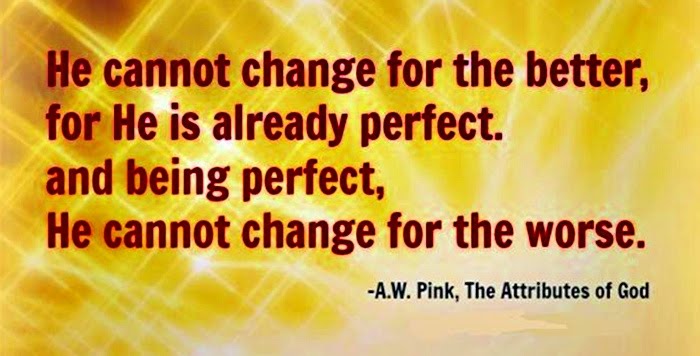
Any change would probably be for the better or for the worse. God cannot change for the better because He is already perfect. And He cannot change for the worse, for then He would be imperfect and would therefore no longer be God.

Created things change; they run down or wear out. It is part of their constitutional nature. But God has no beginning or end. Therefore He cannot change.

The obvious question is, “So God is immutable. What does that mean to me?” If we really want to know Him, then it means everything, for a God who changes would not be worth knowing. We would not be able to trust Him.

Do you trust a friend who changes his attitudes or actions toward you from one day to the next? Of course not. You are not going to open your heart to him, share your feelings with him, or tell him your weaknesses and your needs.

If he is sympathetic and helpful on some occasions but disinterested or judgmen­tal on others, you probably will not take the chance. If he keeps your intimate secrets to himself sometimes but spreads them around on other occasions, you are not going to confide in him anymore.

Human friends sometimes act that way but God never changes. We can trust Him.

And He is never in a bad mood. That is different from us. We get disagreeable periodically. We growl at our spouses, snap at our children, criticize our fellow workers. Not God! His mood never changes. What a pleasure to know that when­ever we approach Him through the merits of His Son He receives us warmly and lovingly.

That is one thing that makes prayer such a pleasure. We know that He is always open to our requests. He never gets tired of our coming to Him. In fact, He keeps inviting us to come. “Call to Me, and I will answer you, and I will tell you great and mighty things, which you do not know” (Jeremiah 33:3).

God Does Not Change

“And also the Glory of Israel will not lie or change His mind; for He is not a man that He should change His mind” (1 Samuel 15:29).

Saul had become king of Israel. As such, he was to lead the Israelites into battle with the Amalekites. He was instructed by God to utterly destroy the king and every living creature, man, woman, child, and even all the cattle (1 Samuel 15:2-3). Saul only partially obeyed God’s instructions, allowing the king to live and keeping the best of the cattle (verses 7-9). Saul simply did not take God’s Word seriously. As a result, God took his kingdom away from him (verses 22-26). Saul then uttered a desperate plea to Samuel, hoping that God would restore his kingdom; instead, Samuel uttered the words of verse 29. Samuel informed Saul that God, the Glory of Israel, was not a man. But as the immutable God, He could not and would not alter His word or change His mind to reverse the consequences He had just pronounced upon Saul’s sin.

Saul, like all too many people today, willfully disobeyed God’s Word hoping God would somehow fail to do as He said. Saul had too little regard for God’s Word and did not see how serious God is concerning disobedience to His Word. He hoped God would also take His own Word lightly by reversing the sentence He had pronounced on the sinner. God always takes His Word most seriously. He not only expects and requires us to obey it, He most certainly will keep His Word regarding the punishment of those who disregard it. God, because He is God, is immutable, and we can be certain He will keep His Word. Everything else in creation is subject to change except the Creator, for He, as God, will not change:

12 But Thou, O LORD dost abide forever; And Thy name to all generations. . . 25 Of old Thou didst found the earth; And the heavens are the work of Thy hands. 26 Even they will perish, but Thou dost endure; And all of them will wear out like a garment; Like clothing Thou wilt change them, and they will be changed. 27 But Thou art the same, And Thy years will not come to an end. 28 The children of Thy servants will continue, And their descendants will be established before Thee” (Psalm 102:12, 25-28, emphasis mine).

6 “For I, the LORD, do not change; therefore you, O sons of Jacob, are not consumed” (Malachi 3:6, emphasis mine).

The immutability of God means that God will follow through with judgment. It also means God will follow through with His promise of salvation. How can one find comfort and be assured of salvation while also being assured of divine judgment? The answer is simple when viewed from the perspective of the cross of Christ. God’s certain judgment fell on His Son, Jesus Christ, and thus by faith in Him, men are saved from their sins and from God’s wrath. Our hope is not in wishful thinking that God will not follow through with punishing sin; our hope is in the certainty that, in Christ, God has judged sin in the flesh once for all so that we may be saved. The immutability of God is a significant part of our hope, for He who has promised to judge sin is the same God who has promised to save us from our sins by judging sin in the person and work of Jesus Christ, His Son.

7 Remember those who led you, who spoke the word of God to you; and considering the result of their conduct, imitate their faith. 8 Jesus Christ is the same yesterday and today, yes and forever. 9 Do not be carried away by varied and strange teachings; for it is good for the heart to be strengthened by grace, not by foods, through which those who were thus occupied were not benefited (Hebrews 13:7-9).

The Book of Hebrews was written to Jewish saints who were beginning to face persecution, probably from their unbelieving Jewish brethren. They were tempted to fall away by renouncing their faith in Christ and embracing Judaism once again. The author of this epistle has repeatedly demonstrated that the old Mosaic covenant was never intended to save men but to prepare them for the new covenant which was fulfilled in Christ. This new covenant is “better,” a key word in Hebrews, and should not be forsaken to return to the old. These saints are exhorted to persist in their faith, even in the midst of persecution. The exhortation to follow in the footsteps of the faithful men through whom they came to salvation is immediately followed by this reminder of the immutability of Jesus Christ.

8 Jesus Christ is the same yesterday and today, yes and forever (Hebrews 13:8).

This statement is very important, for it is a claim of deity. Only God is immutable; only He cannot and does not change. For the writer to tell us that Jesus Christ is the same yesterday, today and forever is to remind us that He is God. No wonder His sacrifice is superior to any and all Old Testament sacrifices! It also is an incentive for faith. Who better to entrust our salvation and eternal well-being to than He who is not only God, but He who cannot and does not change. Our eternal destiny could not be in better hands.

17 Every good thing bestowed and every perfect gift is from above, coming down from the Father of lights, with whom there is no variation, or shifting shadow (James 1:17).

On several occasions, the Scriptures speak of God “repenting” or “changing His mind”

Genesis 6:5-6 (ESV) The LORD saw that the wickedness of man was great in the earth, and that every intention of the thoughts of his heart was only evil continually. 6  And the LORD regretted that he had made man on the earth, and it grieved him to his heart.


Exodus 32:14 (ESV) And the LORD relented from the disaster that he had spoken of bringing on his people.

Jonah 3:10 (ESV) When God saw what they did, how they turned from their evil way, God relented of the disaster that he had said he would do to them, and he did not do it.

2 Samuel 24:16 (ESV) And when the angel stretched out his hand toward Jerusalem to destroy it, the LORD relented from the calamity and said to the angel who was working destruction among the people, “It is enough; now stay your hand.” And the angel of the LORD was by the threshing floor of Araunah the Jebusite.

Do such texts undermine our confidence in the immutability of God? Most certainly not!

First, we must clarify what immutability means. Immutability applies to the nature of God. He is always God, and He is always infinitely powerful. Never will God fail to accomplish His will due to a change in His power to accomplish His purposes.

Second, God is immutable with regard to His character or attributes: “. . . God is immutable in His attributes. Whatever the attributes of God were before the universe was called into existence, they are precisely the same now, and will remain so forever. Necessarily so; for they are the very perfections, the essential qualities of His being. Semper idem (always the same) is written across every one of them. His power is unabated, His wisdom undiminished, His holiness unsullied. The attributes of God can no more change than deity can cease to be. His veracity is immutable, for His Word is ‘forever settled in heaven’ (Ps 119:89).

His love is eternal: ‘I have loved thee with an everlasting love’ (Jer 31:3) and, ‘Having loved his own which were in the world, he loved them unto the end’ (Jn 13:1). His mercy ceases not, for it is ‘everlasting’ (Ps l00:5).”[1]

When Jonah protested against God’s dealings with the Ninevites, he made it clear God was not acting inconsistently with His character but rather He was acting predictably. Jonah sought to flee from the presence of God in a futile attempt to thwart God from acting consistently with His character: But it greatly displeased Jonah, and he became angry. 2 And he prayed to the LORD and said, “Please Lord, was not this what I said while I was still in my own country? Therefore, in order to forestall this I fled to Tarshish, for I knew that Thou art a gracious and compassionate God, slow to anger and abundant in lovingkindness, and one who relents concerning calamity” (Jonah 4:1-2).

When God “relented concerning the calamity which He had declared He would bring upon” the Ninevites, God was not only acting consistently with His character; He was acting consistently with His Word: “At one moment I might speak concerning a nation or concerning a kingdom to uproot, to pull down, or to destroy it; 8 if that nation against which I have spoken turns from its evil, I will relent concerning the calamity I planned to bring on it” (Jeremiah 18:7-8).

This very hope prompted the king of Ninevah to repent, along with the rest of the city (Jonah 3:5-9). God’s actions are predictable because He is immutable. This was the hope of the repentant king of Ninevah and the dread of the pagan-hearted prophet, Jonah.

Third, God’s purposes and promises are immutable (see Romans 11:29).[2] God finishes what He starts. This was the basis for Moses’ appeal to God in Exodus 32 (verses 11-14). Here, God’s actions in response to Moses’ appeal were not a contradiction to His immutability but an outworking of that immutability.

The various dispensations evident in the Bible[3] are not a contradiction to God’s immutability. God’s immutability does not preclude Him from incorporating different economies into His overall plan of redemption.

In Romans 9-11, the apostle Paul shows how all of history is a part of God’s one eternal plan. The failure of the nation Israel and the salvation of the Gentiles were a part of this plan. The Old Testament Scriptures frequently spoke of such matters, although the Jews were not open to listen or to learn. Early in His earthly ministry, Jesus reminded His Jewish brethren of God’s purpose to bless Gentiles as well as Jews, consistent with the Abrahamic covenant (Genesis 12:1-3) and with many other texts (see Luke 4:16-27; Romans 9-11).

Peter and the Immutability of God

As I have considered the subject of God’s immutability, I have become impressed with Peter’s emphasis of this reality. The immutability of God permeates his thinking and is the basis for much of what Peter teaches. We first find this doctrine referred to in Peter’s sermon at Pentecost recorded in Acts 2. Peter was proclaiming the resurrection of Jesus Christ from the dead, not only as a historical fact to which the apostles were witnesses, but also as fulfillment of the Scriptures (see Acts 2:22-35). He was also arguing that the resurrection of our Lord was a theological and practical necessity, stemming from the doctrine of the immutability of God:

22 “Men of Israel, listen to these words: Jesus the Nazarene, a man attested to you by God with miracles and wonders and signs which God performed through Him in your midst, just as you yourselves know—23 this Man, delivered up by the predetermined plan and foreknowledge of God, you nailed to a cross by the hands of godless men and put Him to death. 24 And God raised Him up again, putting an end to the agony of death, since it was impossible for Him to be held in its power. 25 For David says of Him, ‘I WAS ALWAYS BEHOLDING THE LORD IN MY PRESENCE; FOR HE IS AT MY RIGHT HAND, THAT I MAY NOT BE SHAKEN. 26 THEREFORE MY HEART WAS GLAD AND MY TONGUE EXULTED; MOREOVER MY FLESH ALSO WILL ABIDE IN HOPE; 27 BECAUSE THOU WILT NOT ABANDON MY SOUL TO HADES, NOR ALLOW THY HOLY ONE TO UNDERGO DECAY” (Acts 2:22-27).

Peter maintains that “it was impossible” for our Lord not to rise from the dead (verse 24). Why is this so? Peter then quotes from Psalm 16, verses 8-11, where the prophecy states, “NOR ALLOW THY HOLY ONE TO UNDERGO DECAY.”

Decay is a change in state, a downward change. Since Jesus Christ is God and God cannot change, God cannot decay. It was not impossible for Jesus to rise from the dead as some might contend. Rather, it was impossible for Him not to rise since He is immutable, and corruption is change. There may have been the stench of death in the tomb of Lazarus after three days (see John 11:39), but there was no stench in the grave where they laid Jesus. It was impossible for Him to undergo corruption. The resurrection of our Lord was a theological necessity.

In Peter’s first epistle, the immutability of God and His works are prominent. In 1 Peter 1:3-9, Peter speaks of our salvation as that which is imperishable rather than that which is perishable. He speaks of our inheritance as imperishable (verse 4) and also our faith (verse 7). In verses 18-19, Peter speaks of the shed blood of our Lord as precious because it is imperishable. The atonement by which our salvation was accomplished was by means of an imperishable sacrifice so that our salvation is likewise imperishable. In verses 22-25, Peter goes on to speak of God’s Word as imperishable. It is this Word which served as the imperishable seed by which we were begotten. Since our birth is through an imperishable seed, not only is the Word imperishable, but also our life and our love which is born of the Word. Finally, in 1 Peter 5:4, Peter speaks to elders of their imperishable reward, the “unfading crown of glory.” Our salvation is secure because it is imperishable. Thus our salvation, like God, is immutable.

Conclusion

The immutability of God is far from just a theological observation or a hypothetical truth. It is a life-transforming truth from which we can draw a number of implications for our lives.

(1) The immutability of God has tremendous implications regarding the Bible, the Word of God.

  1. I. Packer, in his excellent book, Knowing God, includes a chapter on the immutability of God, where he emphasizes the relevance of this attribute to our lives as Christians: “Where is the sense of distance and difference, then, between believers in Bible time and ourselves? It is excluded. On what grounds? On the grounds that God does not change. Fellowship with Him, trust in His word, living by faith, ‘standing on the promises of God’, are essentially the same realities for us today as they were for Old and New Testament believers. This thought brings comfort as we enter into the perplexities of each day: amid all the changes and uncertainties of life in a nuclear age, God and His Christ remain the same—almighty to save. But the thought brings a searching challenge too. If our God is the same as the God of New Testament believers, how can we justify ourselves in resting content with an experience of communion with Him, and a level of Christian conduct, that falls so far below theirs? If God is the same, this is not an issue that any one of us can evade.”[4]

The immutability of God is closely related to the immutability of the Word of God (Matthew 24:35; 1 Peter 1:22-25), which means His Word is never out of date, never irrelevant to our lives or our times.

(2) The immutability of God is an assurance for Christians

Assurance provides stability and confidence in times of uncertainty and circumstances that appear threatening. Because our God is unchanging, His promises and His purposes are certain; they cannot, and they will not fail. We have an incorruptible sacrifice, the sacrifice of our Lord Jesus Christ, who has accomplished eternal redemption for all who receive it (1 Peter 1:3-9, 17-21; Hebrews 9:12).

We have a “kingdom which cannot be shaken” (Hebrews 12:28). We have a God who deals with us consistently with His character and His Word (see James 1:12-18). We have a Great High Priest who “abides forever and holds His priesthood permanently” (Hebrews 7:24). Our hope and confidence is not in the “uncertainty of riches” but rather in “God, who richly supplies us with all things to enjoy” (1 Timothy 6:17). The prophet Isaiah contrasted the “changing creation with the unchanging Creator” as an encouragement to endurance and faithfulness, even in the dark days of history (Isaiah 50:7-51:16).

(3) The immutability of God is a standard for Christians.

As the “sons of God,” we are to emulate God, to reflect Him in our daily lives (see Matthew 5:43-48). While there is much need for change in our lives (of which we will speak in a moment), there is also the need for us not to change. We are not to allow the world to change us by conforming us to its ungodly mold (Romans 12:1-2). We are not to change by losing heart and abandoning our confession of faith (see Hebrews 6:11-20; 10:19-25, 32-39). We are not to change by forsaking our commitments when fulfilling them is costly to us (Psalm 15:4).

(4) The immutability of God is also an awesome warning that God will fulfill His Word regarding judgment for sin.

God’s immutability is not only a comforting assurance concerning the blessings which God has promised, but also an awesome warning that God will fulfill His Word regarding judgment for sin. When God spoke to Judah concerning the judgment about to come upon this nation for their sins, He spoke of a judgment that was certain, which would not change because He would not change His mind:

 27 This is what the LORD says: “The whole land will be ruined, though I will not destroy it completely. 28 Therefore the earth will mourn and the heavens above grow dark, because I have spoken and will not relent, I have decided and will not turn back.” Jeremiah 4:27-28

In Jeremiah 18:7-8, God promised He would relent of the disaster He pronounced against a wicked nation if they would repent.

Here in Jeremiah 4, God indicates the judgment of which He speaks is irreversible. There is a time for repentance, and during that time men may repent with the assurance that God will forgive their sins and turn from the judgment He threatened. But the time for repentance ends, and then men must face the consequences of their sins.

In Jeremiah 4, God urges Judah to repent (see verse 14), but this plea will be ignored, and so judgment will come. Once the time for repentance has passed, God’s wrath is sure to follow. From this point, God will not turn from the judgment He has announced through His prophets.

Such was the case in the days of Noah. The gospel was proclaimed for over 100 years, but once God shut the door of the ark, the time for repentance was past and the time for judgment had arrived. God will most certainly not “change” regarding judgment, once the time for repentance has passed. Do not err by looking upon God’s grace and mercy in giving a time for repentance as an evidence of divine apathy and assurance that God will not judge men for their sins. Judgment is certain and sure for sinners who rebel against God.

“Here is terror for the wicked. Those who defy Him, break His laws, have no concern for His glory, but live their lives as though He did not exist, must not suppose that, when at the last they shall cry to Him for mercy, He will alter His will, revoke His word, and rescind His awful threatenings. No, He has declared, ‘Therefore will I also deal in fury: mine eye shall not spare, neither will I have pity: and though they cry in mine ears with a loud voice, yet will I not hear them’ (Eze 8:18). God will not deny Himself to gratify their lusts. God is holy, unchangingly so. Therefore God hates sin, eternally hates it. Hence the eternality of the punishment of all who die in their sins.

The divine immutability, like the cloud which interposed between the Israelites and the Egyptian army, has a dark as well as a light side. It insures the execution of His threatenings, as well as the performance of His promises; and destroys the hope which the guilty fondly cherish, that He will be all lenity to His frail and erring creatures, and that they will be much more lightly dealt with than the declarations of His own Word would lead us to expect. We oppose to these deceitful and presumptuous speculations the solemn truth, that God is unchanging in veracity and purpose, in faithfulness and justice (J. Dick, 1850).”[5]

(5) The wicked frequently misapply the immutability of God, making it a pretext for living in sin without fear of retribution.

Sinful men and women often abuse the doctrine of the immutability of God. The immutable God is the One who is the sustainer of all things. Of course, all things continue as they have from the foundation of the world:

Colossians 1:16-17 (ESV) For by him all things were created, in heaven and on earth, visible and invisible, whether thrones or dominions or rulers or authorities—all things were created through him and for him. 17  And he is before all things, and in him all things hold together.

2 Peter 3:3-4 (ESV) …knowing this first of all, that scoffers will come in the last days with scoffing, following their own sinful desires. 4  They will say, “Where is the promise of his coming? For ever since the fathers fell asleep, all things are continuing as they were from the beginning of creation.”  

The constancy of the world in which we live is a matter of common grace, and it is one which testifies of His goodness and grace. Unbelievers misinterpret the consistency of the order of creation, making of it a “proof” that God is not going to judge the world for sin (2 Peter 3:3-4).

How then can we be certain of His judgment?

(1) Because God’s Word warns us of judgment, and God’s Word, like God, does not change.

(2) Because Bible history is filled with examples of God’s intervention into human history to judge sin. This judgment sometimes takes a spectacular form, such as seen in the flood (Genesis 6-7) or in the destruction of Sodom and Gomorrah (Genesis 19). At other times, judgment is delayed so that men might repent and be saved. And sometimes God’s judgment comes in a form not readily recognized as divine judgment.

This is the case in Romans 1:18-32. God’s wrath is evident in allowing men to suffer the downward degradation and corruption of sin so that they are defiled both in mind and body. He judges sinners by allowing them to persist in their sin without divine interruption, thus reaping the whirlwind of consequences for sin. Today in our culture many look at immorality, perversion, and twisted thinking as progress, as a blessing. But we should see it for what it is—divine judgment—a small sampling of what is to come.

(6) The unchanging God is the only means by which sinful men can be changed so as to enter into God’s eternal blessings.

While God does not change, sinful men must change in order to enter into the kingdom of God. This “change” is from one who is a vile sinner, deserving of God’s eternal wrath, to a forgiven sinner, who now stands clothed in the righteousness of God, through faith in Christ. It is God who provides the means whereby sinners can be changed, transformed to new creations, forgiven, justified, having an imperishable hope. What is required of men is to repent, to cease thinking and acting as they once did, acknowledge their sins, and trust in Jesus Christ.

This is not a good work which men do in order to gain God’s favor. Rather, it is a good work which God accomplishes in our lives, the result of His goodness and grace. The only change God will accept is the change which He produces in and through us, through the work of Christ and the Holy Spirit. There is no greater dread than knowing we are sinners, and that God not only hates sin but He will certainly judge sinners. There is no comfort to be found in the immutability of God for the sinner. But for those who have trusted in God’s provision for sinners, there is no greater comfort than to know that the God who chose us, called us, and promised us eternal salvation changes not.

—————————————————

[1] Arthur W. Pink, Gleanings in the Godhead (Chicago: Moody Press, 1975), pp. 35-36.

[2] Some of God’s purposes are temporal and temporary. The Mosaic covenant, for example, was a temporary provision which did not in any way alter or set aside His eternal covenant with Abraham (see Galatians 3:17).

[3] It should be said that even non-dispensationalists believe in dispensations, that is in certain distinctions in God’s program over the course of biblical history. Disagreement arises not over the fact of such differences but over the interpretation of these differences. As a rule, dispensationalists tend to emphasize the differences while covenant theologians emphasize the unity of the whole plan which encompasses the various dispensations.

[4] J. I. Packer, Knowing God (Downers Grove: Inter-Varsity Press, 1973), p. 72.

[5] Arthur W. Pink, Gleanings in the Godhead (Chicago: Moody Press, 1975), p. 37.

 
1 Comment

Posted by on May 9, 2016 in God


Attributes of God – The Holiness of God


1-1-1-1-A-A-holy-holy-holyAs we approach the subject of the holiness of God, let us be mindful of the importance of this divine attribute. R. C. Sproul makes this insightful observation from Isaiah 6: “The Bible says that God is holy, holy, holy. Not that He is merely holy, or even holy, holy. He is holy, holy, holy. The Bible never says that God is love, love, love, or mercy, mercy, mercy, or wrath, wrath, wrath, or justice, justice, justice. It does say that He is holy, holy, holy, the whole earth is full of His glory.”[1]

The term “holy” is often understood in its contemporary usage rather than its true meaning in the Scriptures. For this reason, our study must begin by reviewing several dimensions of the definition of holiness.

(1) To be holy is to be distinct, separate, in a class by oneself. As Sproul puts it:

The primary meaning of holy is ‘separate.’ It comes from an ancient word that meant, ‘to cut,’ or ‘to separate.’ Perhaps even more accurate would be the phrase ‘a cut above something.’ When we find a garment or another piece of merchandise that is outstanding, that has a superior excellence, we use the expression that it is ‘a cut above the rest.’[2] This means that the one who is holy is uniquely holy, with no rivals or competition.

“When the Bible calls God holy it means primarily that God is transcendentally separate. He is so far above and beyond us that He seems almost totally foreign to us. To be holy is to be ‘other,’ to be different in a special way. The same basic meaning is used when the word holy is applied to earthly things.”[3]

The Scriptures put it this way: “Who is like Thee among the gods, O LORD? Who is like Thee, majestic in holiness, Awesome in praises, working wonders? (Exodus 15:11). 2 “There is no one holy like the LORD, Indeed, there is no one besides Thee, Nor is there any rock like our God (1 Samuel 2:2).

There is no one like Thee among the gods, O Lord; Nor are there any works like Thine. 9 All nations whom Thou hast made shall come and worship before Thee, O Lord; And they shall glorify Thy name. 10 For Thou art great and doest wondrous deeds; Thou alone art God (Psalms 86:8-10; see also Psalm 99:1-3; Isaiah 40:25; 57:15).

(2) To be holy is to be morally pure.

When things are made holy, when they are consecrated, they are set apart unto purity. They are to be used in a pure way. They are to reflect purity as well as simple apartness. Purity is not excluded from the idea of the holy; it is contained within it. But the point we must remember is that the idea of the holy is never exhausted by the idea of purity. It includes purity but is much more than that. It is purity and transcendence. It is a transcendent purity.[4]

Who may ascend into the hill of the LORD? and who may stand in His holy place? 4 He who has clean hands and a pure heart, Who has not lifted up his soul to falsehood, And has not sworn deceitfully. 5 He shall receive a blessing from the LORD And righteousness from the God of his salvation (Psalms 24:3-5).

And one called out to another and said, “Holy, Holy, Holy, is the LORD Of hosts, The whole earth is full of His glory.” 4 And the foundations of the thresholds trembled at the voice of him who called out, while the temple was filling with smoke. 5 Then I said, “Woe is me, for I am ruined! Because I am a man of unclean lips, and I live among a people of unclean lips; for my eyes have seen the King, the LORD of hosts” (Isaiah 6:3-5).

(3) For God to be holy is for Him to be holy in relation to every aspect of His nature and character.

When we use the word holy to describe God, we face another problem. We often describe God by compiling a list of qualities or characteristics that we call attributes. We say that God is a spirit, that He knows everything, that He is loving, just, merciful, gracious, and so on. The tendency is to add the idea of the holy to this long list of attributes as one attribute among many. But when the word holy is applied to God, it does not signify one single attribute. On the contrary, God is called holy in a general sense. The word is used as a synonym for his deity. That is, the word holy calls attention to all that God is. It reminds us that His love is holy love, his justice is holy justice, his mercy is holy mercy, his knowledge is holy knowledge, his spirit is holy spirit.[5]

The holiness of God is not merely a theological subject fit for scholars with the interest and stamina to pursue it. Indeed, the holiness of God is a matter of great importance to every living soul. The Christian should be especially concerned with the holiness of God. Several incidents in the Old and New Testaments underscore the importance of holiness to the believer. These examples are but a few of the accounts in Scripture dealing with God’s holiness and its impact on saints.

Moses and the Holiness of God (Numbers 20:1-13; 27:12-14)

Then the sons of Israel, the whole congregation, came to the wilderness of Zin in the first month; and the people stayed at Kadesh. Now Miriam died there and was buried there. 2 And there was no water for the congregation; and they assembled themselves against Moses and Aaron. 3 The people thus contended with Moses and spoke, saying, “If only we had perished when our brothers perished before the LORD! 4 Why then have you brought the LORD’S assembly into this wilderness, for us and our beasts to die here? 5 And why have you made us come up from Egypt, to bring us in to this wretched place? It is not a place of grain or figs or vines or pomegranates, nor is there water to drink.” 6 Then Moses and Aaron came in from the presence of the assembly to the doorway of the tent of meeting, and fell on their faces. Then the glory of the LORD appeared to them; 7 and the LORD spoke to Moses, saying, 8 “Take the rod; and you and your brother Aaron assemble the congregation and speak to the rock before their eyes, that it may yield its water. You shall thus bring forth water for them out of the rock and let the congregation and their beasts drink.” 9 So Moses took the rod from before the LORD, just as He had commanded him; 10 and Moses and Aaron gathered the assembly before the rock. And he said to them, “Listen now, you rebels; shall we bring forth water for you out of this rock?” 11 Then Moses lifted up his hand and struck the rock twice with his rod; and water came forth abundantly, and the congregation and their beasts drank. 12 But the LORD said to Moses and Aaron, “Because you have not believed Me, to treat Me as holy in the sight of the sons of Israel, therefore you shall not bring this assembly into the land which I have given them.” 13 Those [were] the waters of Meribah, because the sons of Israel contended with the LORD, and He proved Himself holy among them (Numbers 20:1-14).

Then the LORD said to Moses, “Go up to this mountain of Abarim, and see the land which I have given to the sons of Israel. 13 And when you have seen it, you too shall be gathered to your people, as Aaron your brother was; 14 for in the wilderness of Zin, during the strife of the congregation, you rebelled against My command to treat Me as holy before their eyes at the water.” (These are the waters of Meribah of Kadesh in the wilderness of Zin.) (Numbers 27:12-14).

Moses had good reason to be angry with the Israelites. They were indeed a “stiff-necked people,” even as God Himself had said (see Exodus 33:5). The Israelites arrived at Kadesh, a place whose name meant “holy.” There, Miriam died and was buried. At Kadesh, there was no water for the people to drink. The people were hostile and a mob contended with Moses and Aaron wishing they were dead, or even better, that Moses and Aaron were. They protested they had not been “led” as much as “mis-led” by Moses to a land far from what they were promised. That there was now no water here was the final straw.

Moses and Aaron went to the doorway of the tent of meeting, and there the glory of the Lord appeared to them. God then commanded Moses to take his rod and speak to the rock, from which water would flow for the people. Moses was furious with the people as he gathered them before the rock, the “spiritual rock.” Instead of merely speaking to the rock as commanded, in his anger, Moses struck the rock twice. The consequences were indeed severe.

Who has not lost his or her temper and done worse than striking a rock with a stick? Yet this act was so serious in God’s sight that He forbade Moses to enter into the land of promise. Moses never saw the land to which he came so close. Why? God told him, and he recorded it for us: “Because you have not believed Me, to treat Me as holy in the sight of the sons of Israel.…” (Numbers 20:12). And by dealing severely with Moses for his transgression, God is said to have “proved Himself holy among them” (verse 13).

In a moment of anger, Moses sinned, and for this sin he was kept from entering the land of promise. The act was striking the rock. But it was much more than this. Striking the rock was an act of disobedience, of failing to follow God’s instructions. Even more, it was identified by God as an act of unbelief:

“Because you have not believed Me, to treat Me as holy in the sight of the sons of Israel, therefore you shall not bring this assembly into the land which I have given them” (verse 12).

The root sin was irreverence, and that irreverence was the cause of Moses’ disobedience[6] and his striking the rock. Moses’ anger with the people overcame his fear of God. His fear of God should have overcome his anger with the Israelites. God took Moses’ irreverence most seriously.

Uzzah and the Holiness of God: (2 Samuel 6:1-11)

Now David again gathered all the chosen men of Israel, thirty thousand. 2 And David arose and went with all the people who were with him to Baale-judah, to bring up from there the ark of God which is called by the Name, the very name of the LORD of hosts who is enthroned [above] the cherubim. 3 And they placed the ark of God on a new cart that they might bring it from the house of Abinadab which was on the hill; and Uzzah and Ahio, the sons of Abinadab, were leading the new cart. 4 So they brought it with the ark of God from the house of Abinadab, which was on the hill; and Ahio was walking ahead of the ark. 5 Meanwhile, David and all the house of Israel were celebrating before the LORD with all kinds of [instruments made of] fir wood, and with lyres, harps, tambourines, castanets and cymbals. 6 But when they came to the threshing floor of Nacon, Uzzah reached out toward the ark of God and took hold of it, for the oxen nearly upset [it.] 7 And the anger of the LORD burned against Uzzah, and God struck him down there for his irreverence; and he died there by the ark of God. 8 And David became angry because of the LORD’S outburst against Uzzah, and that place is called Perez-uzzah to this day. 9 So David was afraid of the LORD that day; and he said, “How can the ark of the LORD come to me?” 10 And David was unwilling to move the ark of the LORD into the city of David with him; but David took it aside to the house of Obed-edom the Gittite. 11 Thus the ark of the LORD remained in the house of Obed-edom the Gittite three months, and the LORD blessed Obed-edom and all his household (2 Samuel 6:1-11).

The Philistines had captured the ark of God and sought to keep it as a trophy of their victory. It soon became evident the ark was the source of much suffering to them. They passed it about and finally determined to be rid of it by sending it back to Israel. They transported it in a way the Philistine priests and diviners recommended. They put a guilt offering of gold in the ark and placed it on a newly-made cart drawn by two cows just separated from their calves (see 1 Samuel 6).

If the Philistines could not stand in the presence of the Holy God of Israel, neither could the people of Beth-shemesh where the ark arrived: And He struck down some of the men of Beth-shemesh because they had looked into the ark of the LORD. He struck down of all the people, 50,070 men, and the people mourned because the LORD had struck the people with a great slaughter. 20 And the men of Beth-shemesh said, “Who is able to stand before the LORD, this holy God? And to whom shall He go up from us?” 21 So they sent messengers to the inhabitants of Kiriath-jearim, saying, “The Philistines have brought back the ark of the LORD; come down and take it up to you” (1 Samuel 6:19-21).

The men of Kiriath-jearim came and took the ark of the LORD and brought it to the house of Abinadab and consecrated Abinadab’s son, Eleazar, to keep the ark, where it remained for some 20 years (1 Samuel 7:1-2). Finally, David, accompanied by 30,000 Israelites, went to Kiriath-jearim to bring the ark to Jerusalem.

The ark was a symbol of the presence of God, a most holy object (see 2 Samuel 6:2) which was to be hidden in the holiest place in the tabernacle, the “holy of holies.” According to God’s instructions, it was to be transported by the Kohathites who carried it by holding onto poles inserted through its attached rings (see Exodus 25:10-22; Numbers 4:1-20). No one was to look into the ark, or they would die.

The day the ark was transported to Jerusalem was a great and happy moment. But they had forgotten how holy this ark was, because it was the place where God’s presence was to abide. Rather than transporting the ark as instructed in the law, the ark was placed on a new ox cart. It was a most jubilant procession as the ark made its way home. What a happy time. But when the oxen stumbled, and it looked as though the cart might be overturned and hurled to the ground, Uzzah reached out to steady the ark. Instantly, he was struck dead by God.

David’s first response was frustration and anger with God. Why had God been so harsh with Uzzah? David seems to have forgotten God’s instructions in the Law about how the ark was to be transported. He also seems to have forgotten how many had previously died when due reverence for the presence of God associated with the ark was not shown. God had spoiled their celebration, and David was miffed. Only upon reflection did David realize the gravity of the error. And concerning Uzzah, God struck him dead because of his irreverence (2 Samuel 6:7).

Irreverence is a dangerous malady. Even when our motives are sincere and we are actively involved in the worship of God, we must constantly be mindful of the holiness of God and maintain a reverence for Him manifested by our obedience to His instructions and commands.

Isaiah and the Holiness of God (Isaiah 6:1-10)

In the year of King Uzziah’s death, I saw the Lord sitting on a throne, lofty and exalted, with the train of His robe filling the temple. 2 Seraphim stood above Him, each having six wings; with two he covered his face, and with two he covered his feet, and with two he flew. 3 And one called out to another and said, “Holy, Holy, Holy, is the LORD Of hosts, The whole earth is full of His glory.” 4 And the foundations of the thresholds trembled at the voice of him who called out, while the temple was filling with smoke. 5 Then I said,

“Woe is me, for I am ruined! Because I am a man of unclean lips, And I live among a people of unclean lips; For my eyes have seen the King, the LORD of hosts.” 6 Then one of the seraphim flew to me, with a burning coal in his hand which he had taken from the altar with tongs. 7 And he touched my mouth [with it] and said, “Behold, this has touched your lips; and your iniquity is taken away, and your sin is forgiven.” 8 Then I heard the voice of the Lord, saying, “Whom shall I send, and who will go for Us?” Then I said, “Here am I. Send me!” 9 And He said, “Go, and tell this people: ‘Keep on listening, but do not perceive; Keep on looking, but do not understand.’ 10 Render the hearts of this people insensitive, their ears dull, and their eyes dim, lest they see with their eyes, hear with their ears, understand with their hearts, and return and be healed” (Isaiah 6:1-10).

The death of Uzziah seems to have spelled the end of an era, a golden era, for Judah. The “good times” were over; the “hard times” were about to commence as verses 9 and 10 indicate. Isaiah’s ministry is commencing from a human point of view at the very worst possible time. His ministry was not going to be regarded a success (as if many of the prophets of old were successful). He was in for a chilly reception. He and his message would be spurned. What did Isaiah need to give him the proper perspective and endurance to persevere in such hard times? The answer: a vision of the holiness of God.

This is precisely what God gave to Isaiah—a dramatic revelation of His holiness. He saw the Lord sitting enthroned, lofty and exalted. The angels who stood above Him were magnificent, and they called out to one another, “Holy, Holy, Holy, is the LORD of hosts, the whole earth is full of His glory” (verse 3). The earth quaked, and the temple was filled with smoke. It was as dramatic a vision of God and His holiness as one could wish to see.

Isaiah’s response is far from what we hear today from many who claim to teach biblical truth. He was not impressed with his “significance.” His “self-esteem” was not enhanced. Just the opposite took place. His vision of the holiness of God caused Isaiah to lament his utter sinfulness. If God was holy, Isaiah saw he was not. Isaiah confessed his own unholiness and that of his people.

What is most significant is that Isaiah sees his sinfulness (and his people’s) evidenced by their “lips.” Isaiah confessed he was “a man of unclean lips” and that he lived among a people with the same malady. How was Isaiah able to be so focused about his sin that he saw it evidencing itself in his speech? Other texts in Scripture say a great deal about the tongue and the way sin is evident in our speech (see, for example, many of the Proverbs, also Matthew 12:32-37; Romans 3:10-14; James 3:1-12).

Notice that if the curse Isaiah recognized was directed toward his lips, so was the cure. One of the seraphim touched Isaiah’s mouth with a burning coal, symbolically cleansing him and his mouth. What is God attempting to accomplish in Isaiah’s life by this vision? I believe God wanted Isaiah to understand that the vision of His holiness was to have a great impact on what he said and how he said it.

The Holiness of Jesus Christ

The promises of the coming of Messiah in the Old Testament became increasingly specific, until it was evident that Messiah must not only be human but divine (see Isaiah 9:6-7; Micah 5:2). As such, He must be holy. And so, when the angel told Mary of the child to be miraculously born of her, a virgin, he said, “The Holy Spirit will come upon you, and the power of the Most High will overshadow you; and for that reason the holy offspring shall be called the Son of God” (Luke 1:35, emphasis mine).

Throughout the life and ministry of our Lord on the earth, it became increasingly clear this was no ordinary man; indeed, He was more than a prophet and more than a mere man. This was the Son of God. Even the demons had to acknowledge Him as the”Holy One of God” (Mark 1:24; Luke 4:34). The things Jesus said and did marked Him out as One who stood head and shoulders above any other (merely human) being. Peter was a professional fisherman, but when he obeyed the instructions of the Lord Jesus, the results were awesome. Peter’s response was appropriate: When Simon Peter saw [that,] he fell down at Jesus’ feet, saying, “Depart from me, for I am a sinful man, O Lord!” (Luke 5:8).

When Jesus healed the demon-possessed dumb man, the multitudes marveled, saying, “Nothing like this was ever seen in Israel” (Matthew 9:33).

When Jesus told the paralytic that his sins were forgiven and then proceeded to heal him, the people could not escape the implications: And Jesus seeing their faith said to the paralytic, “My son, your sins are forgiven.” 6 But there were some of the scribes sitting there and reasoning in their hearts, 7 Why does this man speak that way? He is blaspheming; who can forgive sins but God alone?” 8 And immediately Jesus, aware in His spirit that they were reasoning that way within themselves, said to them, “Why are you reasoning about these things in your hearts? 9 Which is easier, to say to the paralytic, ‘Your sins are forgiven’; or to say, ‘Arise, and take up your pallet and walk’? 10 But in order that you may know that the Son of Man has authority on earth to forgive sins”—He said to the paralytic, 11 “I say to you, rise, take up your pallet and go home.” 12 And he rose and immediately took up the pallet and went out in the sight of all; so that they were all amazed and were glorifying God, saying, “We have never seen anything like this” (Mark 2:5-12).

When the man born blind was healed by Jesus, the scribes and Pharisees were most reluctant to admit that such a miracle had taken place. The blind man could “see” the implications of what had happened, and he pressed them on his interrogators: The man answered and said to them, “Well, here is an amazing thing, that you do not know where He is from, and [yet] He opened my eyes. 31 We know that God does not hear sinners; but if anyone is God-fearing, and does His will, He hears him. 32 Since the beginning of time it has never been heard that anyone opened the eyes of a person born blind. 33 If this man were not from God, He could do nothing” (John 9:30-33).

The Holiness of God and Contemporary Christianity

The holiness of God is not simply a doctrine to which we give assent. Rather, the doctrine of the holiness of God should guide and govern our lives.

(1) The holiness of God should guide and govern our thinking on “God’s acceptance.”

I often hear Christians use the expression “unconditional acceptance.” It seems this term is first applied to God and then to the saints. “God unconditionally accepts us,” they reason, “and so we must accept others unconditionally.” My difficulty is that this is not a biblical expression. Perhaps even worse, it does not appear to be a biblical concept. God does not “accept us regardless” of what we do. Look at the nation Israel. Because of their persistent sin, God said they were no longer His people (see Hosea 1). God did not accept Cain or his offering (Genesis 4:5). God accepts us only through the shed blood of Jesus Christ so that even Christians are not unconditionally accepted, regardless of their attitudes and actions. The holiness of God indicates God does not accept what is not holy. In reality, all God accepts from us is that which He produces in and through us. To speak too glibly about unconditional acceptance appears to encourage careless and disobedient living.

The church cannot “accept” those who profess to be Christians but live like pagans (1 Corinthians 5:1-13). We must discipline and remove those who refuse to live like Christians. The church is to be holy, and this means purging out the “leaven” from its midst. Let those who emphasize unconditional acceptance ponder these words: “And to the angel of the church in Laodicea write: The Amen, the faithful and true Witness, the Beginning of the creation of God, says this: 15 ‘I know your deeds, that you are neither cold nor hot; I would that you were cold or hot. 16 ‘So because you are lukewarm, and neither hot nor cold, I will spit you out of My mouth’” (Revelation 3:14-16).

(2) The doctrine of the holiness of God needs to considered when we speak of accountability.

The concept of “accountability” has been imported from the secular world, some suggest. The church sometimes speaks more of accountability to men than of accountability to God. Let us not forget to whom we must give account: “And I say to you, that every careless word that men shall speak, they shall render account for it in the day of judgment” (Matthew 12:36).

Obey your leaders, and submit [to them]; for they keep watch over your souls, as those who will give an account. Let them do this with joy and not with grief, for this would be unprofitable for you (Hebrews 13:17, emphasis mine; see also 1 Corinthians 3:10-15).

So then each one of us shall give account of himself to God (Romans 14:12).

And in [all] this, they are surprised that you do not run with [them] into the same excess of dissipation, and they malign [you]; 5 but they shall give account to Him who is ready to judge the living and the dead (1 Peter 4:4-5).

———————–

[1] R. C. Sproul, The Holiness of God (Wheaton, Illinois: Tyndale House Publishers, Inc., 1985), p. 40.

[2] Ibid., p. 54

[3] Ibid., p. 55.

[4] Ibid., p. 57.

[5] Ibid., p. 57.

[6] The relationship between fear (or reverence) and obedience is indicated in the New Testament as well as the Old. In 1 Peter 1, Peter calls upon the saints to live in fear of God (1:17). In chapter 2, fear (reverence or respect) is the root of obedience to kings, to cruel slave masters, and obedience to harsh husbands (3:1-6; see also Paul’s words in Ephesians 5:33). Irreverence is the root of disobedience.

[7] William McDougall, An Introduction to Social Psychology (New York: Methuen, 1908), p. 132, cited by Kenneth Prior, The Way of Holiness (Downers Grove: Inter-Varsity Press, rev. ed., 1982), p. 20.

[8] John Calvin, as cited by R. C. Sproul, The Holiness of God, p. 68.

[9] See Os Guiness, Dining With The Devil (Grand Rapids: Baker Book House, 1993), pp. 21-24, for some of the positive contributions of the movement. The rest of the book deals with its critical deficiencies.

 
Leave a comment

Posted by on April 27, 2016 in God


What God’s Power Enables Him To Do


ThePowerofGod672x378_lg(1) All power belongs to God—“Thine is the power. . .” (Matthew 6:13).

(2) He can therefore do all things (Matthew 19:26; Mark 14:36).

(3) Nothing is impossible for God (Luke 1:34-37).

(4) He is able to do what He has purposed (Job 42:1-2; Isaiah 14:27).

(5) He is able to do what He has promised (Romans 4:21).

(6) He is able to judge because He can save and destroy (James 4:12).

(7) He is able to destroy the body and soul in hell (Matthew 10:28).

(8) He is able to forgive sins (Matthew 9:6).

(9) He is able to save us (Isaiah 63:1; Psalm 54:1; Romans 1:16), forever (Hebrews 7:25).

(10) He is able to defend us, to overcome our enemies (Psalm 59:9-11).

(11) He is able to deliver us (Daniel 3-4).

(12) He is able to protect (Psalm 79:1; 91:1) or rescue us (Psalm 79:11).

(13) He is able to make us stand (Romans 14:4).

(14) He is able to come to our aid when tempted (Hebrews 2:18).

(15) He is able to establish us as His saints (Romans 16:25).

(16) He is able to keep Christians (John 10:29; Romans 8:31-39), to keep us from falling (Jude 1:24-25).

(17) He is able to keep that which we have committed to Him to the day of His coming (2 Timothy 1:12).

(18) He is able to raise the dead (Hebrews 11:17-19).

(19) He is able to provide everything for life and godliness (2 Peter 1:3).

(20) He is able to empower us to carry out the Great Commission (Matthew 28:18-20).

 
Leave a comment

Posted by on April 25, 2016 in God


God’s Attributes: The Wisdom of God


gods-wisdomIt is a joy to behold wisdom and knowledge in a man. How much greater then to find in God wisdom and knowledge unsurpassed and infinite. The beauty of God’s character is that each of His attributes compliments the other attributes. We have already considered the infinite power of God—His omnipotence—which enables Him to do anything He chooses. We further studied the goodness of God, which motivates God’s every action toward those who believe, as well as His common grace to unbelievers and believers alike. Now we turn to His infinite wisdom. When we consider these attributes together—God’s goodness, wisdom, and power—we find great comfort and encouragement.

If there is anything the Bible teaches us about God, it is that He is all-wise.

“With Him are wisdom and might; To Him belong counsel and understanding” (Job 12:13).

Do you not know? Have you not heard? The Everlasting God, the LORD, the Creator of the ends of the earth does not become weary or tired. His understanding is inscrutable (Isaiah 40:28).

Oh, the depth of the riches both of the wisdom and knowledge of God! How unsearchable are His judgments and unfathomable His ways! (Romans 11:33; see also Job 9:1-4; 36:5; Isaiah 31:1-2).

God is all-wise, infinitely wise:

“Behold, God is mighty but does not despise [any;] [He is] mighty in strength of understanding” (Job 36:5).

Great is our Lord, and abundant in strength; His understanding is infinite (Psalms 147:5).

God’s wisdom is vastly superior to human wisdom:

“For My thoughts are not your thoughts, neither are your ways My ways,” declares the LORD. 9 “For [as] the heavens are higher than the earth, so are My ways higher than your ways, and My thoughts than your thoughts” (Isaiah 55:8-9; see also Job 28:12-28; Jeremiah 51:15-17).

God alone is wise:

Now to Him who is able to establish you according to my gospel and the preaching of Jesus Christ, according to the revelation of the mystery which has been kept secret for long ages past, 26 but now is manifested, and by the Scriptures of the prophets, according to the commandment of the eternal God, has been made known to all the nations, [leading] to obedience of faith; 27 to the only wise God, through Jesus Christ, be the glory forever. Amen (Romans 16:25-27; see also 1 Timothy 1:17; Jude 1:25).

It is God who is the source of wisdom:

For the LORD gives wisdom; From His mouth [come] knowledge and understanding (Proverbs 2:6).

But if any of you lacks wisdom, let him ask of God, who gives to all men generously and without reproach, and it will be given to him (James 1:5).

What is Wisdom?

One might sum up the meaning of the term “wisdom” with the words, “know how.” Wisdom is based upon knowledge. Often, in fact, wisdom and knowledge are mentioned together (see Jeremiah 10:12; 51:15; Luke 1:17 (AV); Romans 11:33; 1 Corinthians 1:24; 2:5; Colossians 2:3; Revelation 5:12; 7:12). Wisdom cannot exist without a knowledge of all the facts pertinent to any purpose or plan.

The God who is all-wise is also the God who is all-knowing. God knows everything. Theologians use the term “omniscient” when speaking of God’s infinite knowledge. God knows everything about everything. He knows what men are thinking (see Ezekiel 11:5; Luke 5:21-22). He knows everything that is going to happen. He even knows everything that could happen, under any set of circumstances (see, for example, 1 Samuel 23:10-12; 2 Kings 8:10). God cannot devise a bad plan or fail to bring His purposes and promises to their conclusion because He knows everything. His omniscience undergirds His wisdom.

Wisdom is not just knowledge, but “know how.” God’s wisdom enables Him to “know how” to do anything (see 2 Peter 2:9). Wisdom entails the skillfulness to formulate a plan and to carry it out in the best and most effective manner. Bezalel was a craftsman, a man with incredible “wisdom” in the art of making the furnishings for the Tabernacle (see Exodus 31:1-5). Joshua had been given wisdom to know how to lead the nation Israel (Deuteronomy 34:9). Solomon asked for and received the wisdom and knowledge needed to rule Israel (2 Chronicles 1:7-12).

W. Tozer and J. I. Packer have defined wisdom as follows: “In the Holy Scriptures wisdom, when used of God and good men, always carries a strong moral connotation. It is conceived as being pure, loving, and good.… Wisdom, among other things, is the ability to devise perfect ends and to achieve those ends by the most perfect means. It sees the end from the beginning, so there can be no need to guess or conjecture. Wisdom sees everything in focus, each in proper relation to all, and is thus able to work toward predestined goals with flawless precision.”[1]

“Wisdom is the power to see, and the inclination to choose, the best and highest goal, together with the surest means of attaining it. Wisdom is, in fact, the practical side of moral goodness. As such, it is found in its fulness only in God. He alone is naturally and entirely and invariable wise.”

Christians today seek to be wise, but all too often it is not God’s wisdom they seek. They seem ignorant of the fact that there is a false wisdom which must be rejected:

Who among you is wise and understanding? Let him show by his good behavior his deeds in the gentleness of wisdom. 14 But if you have bitter jealousy and selfish ambition in your heart, do not be arrogant and [so] lie against the truth. 15 This wisdom is not that which comes down from above, but is earthly, natural, demonic. 16 For where jealousy and selfish ambition exist, there is disorder and every evil thing. 17 But the wisdom from above is first pure, then peaceable, gentle, reasonable, full of mercy and good fruits, unwavering, without hypocrisy. 18 And the seed whose fruit is righteousness is sown in peace by those who make peace (James 3:13-18).

The wisdom of God and the “wisdom” of men are not the same; they are not compatible. Indeed, they are in opposition to each other:

For the word of the cross is to those who are perishing foolishness, but to us who are being saved it is the power of God. 19 For it is written, “I WILL DESTROY THE WISDOM OF THE WISE, AND THE CLEVERNESS OF THE CLEVER I WILL SET ASIDE.” 20 Where is the wise man? Where is the scribe? Where is the debater of this age? Has not God made foolish the wisdom of the world? 21 For since in the wisdom of God the world through its wisdom did not [come to] know God, God was well-pleased through the foolishness of the message preached to save those who believe. 22 For indeed Jews ask for signs, and Greeks search for wisdom; 23 but we preach Christ crucified, to Jews a stumbling block, and to Gentiles foolishness, 24 but to those who are the called, both Jews and Greeks, Christ the power of God and the wisdom of God. 25 Because the foolishness of God is wiser than men, and the weakness of God is stronger than men (1 Corinthians 1:18-25).

And when I came to you, brethren, I did not come with superiority of speech or of wisdom, proclaiming to you the testimony of God. 2 For I determined to know nothing among you except Jesus Christ, and Him crucified. 3 And I was with you in weakness and in fear and in much trembling. 4 And my message and my preaching were not in persuasive words of wisdom, but in demonstration of the Spirit and of power, 5 that your faith should not rest on the wisdom of men, but on the power of God. 6 Yet we do speak wisdom among those who are mature; a wisdom, however, not of this age, nor of the rulers of this age, who are passing away; 7 but we speak God’s wisdom in a mystery, the hidden [wisdom,] which God predestined before the ages to our glory (1 Corinthians 2:1-7).

The Wisdom of God in Christ and His Church: Ephesians 1 and 3

7 In Him we have redemption through His blood, the forgiveness of our trespasses, according to the riches of His grace, 8 which He lavished upon us. In all wisdom and insight 9 He made known to us the mystery of His will, according to His kind intention which He purposed in Him 10 with a view to an administration suitable to the fulness of the times, that is, the summing up of all things in Christ, things in the heavens and things upon the earth (Ephesians 1:7-10).

8 To me, the very least of all saints, this grace was given, to preach to the Gentiles the unfathomable riches of Christ, 9 and to bring to light what is the administration of the mystery which for ages has been hidden in God, who created all things; 10 in order that the manifold wisdom of God might now be made known through the church to the rulers and the authorities in the heavenly [places.] 11 [This was] in accordance with the eternal purpose which He carried out in Christ Jesus our Lord, 12 in whom we have boldness and confident access through faith in Him. 13 Therefore I ask you not to lose heart at my tribulations on your behalf, for they are your glory (Ephesians 3:8-13).

God’s Wisdom Revealed in Christ to the Church: Ephesians 1

Paul indicates in Ephesians 1 the eternal purpose of God to sum up all things in Christ. In the Old Testament, the coming of Jesus Christ as the promised Messiah was progressively revealed in greater detail. This began with the promise of salvation from sin and the defeat of Satan through Eve’s seed in Genesis 3:15. It was more fully disclosed in the Abrahamic (Genesis 12:1-3) and Davidic (2 Samuel 7:14) covenants. In the Psalms (e.g. Psalm 22) and the prophets (e.g. Isaiah 52:13–53:12), more and more was said about Messiah, until in Micah 5:2, we are told His birthplace.

God promised to bring salvation and blessing not only to the Jews but also to the Gentiles. He promised a Messiah who was a man, the seed of Eve and of Abraham and of David, but also One who was the divine Son of God. He foretold of a coming of Christ in which He would be rejected and suffer for the sins of men (Psalm 22; Isaiah 52:13–53:12) and of a triumphal coming of Messiah to put down His enemies (Psalm 2:7-9; 110). These seemingly contradictory promises made the whole matter of God’s purpose a mystery (see, for example, 1 Peter 1:10-12). But with the first coming of Christ, the mystery has been resolved. And now, as Paul indicates in Ephesians 1, the matter has come into focus in Christ. All of God’s purposes and promises culminate in Christ. And now, in place of wonder at the mystery of the past, we are overcome with wonder at the wisdom of God which accomplished all of this.

God’s Wisdom is Being Revealed Through the Church: Ephesians 3

God’s eternal purpose is to reveal His wisdom to the celestial beings as well as to His church. God is still accomplishing His purpose, which will culminate in the second coming of His Son. When this purpose and program is completed, the full scope of God’s wisdom will have been revealed, and this wisdom will be revealed as so great it will provide the fuel for the praise of God throughout all eternity.

————————————-

[1] A. W. Tozer, The Knowledge of the Holy (San Francisco: Harper and Row, Publishers, 1961), p. 66.

[2] J. I. Packer, Knowing God, p. 80.

 
Leave a comment

Posted by on April 21, 2016 in Doctrine, God


God’s Attributes: The Power of God


ThePowerofGod672x378_lg(These comments come from a variety of sources over several years… obviously much of it comes directly from scripture)

Centuries ago, God promised Abraham and Sarah they would have a son through whose offspring the world would be blessed. But there were problems. Abraham and Sarah were getting on in years, and Sarah was barren. When told she would be the mother of Abraham’s child, the child of promise, Sarah laughed.

In response to her laughter, God spoke these words to Abraham: And the LORD said to Abraham, “Why did Sarah laugh, saying, ‘Shall I indeed bear [a child,] when I am [so] old?’ 14 Is anything too difficult for the LORD? At the appointed time I will return to you, at this time next year, and Sarah shall have a son” (Genesis 18:13-14).

When God rescued the nation Israel from their bondage in Egypt, He led them into the wilderness, where the “menu” was a miraculous provision of manna. But the Israelites began to grumble because they could not enjoy the variety of foods they had eaten in Egypt. In response to their grumbling, God promised to give this great company a diet of meat for an entire month. If the feeding of the 5,000 seems difficult, imagine feeding this huge congregation.

Moses had the same thoughts and expressed his concerns to God: But Moses said, “The people, among whom I am, are 600,000 on foot; yet Thou hast said, ‘I will give them meat in order that they may eat for a whole month.’ 22 Should flocks and herds be slaughtered for them, to be sufficient for them? Or should all the fish of the sea be gathered together for them, to be sufficient for them?” (Numbers 11:21-22).

But God asked another question in response to Moses, a question vitally important to every Christian today: And the LORD said to Moses, “Is the LORD’S power limited? Now you shall see whether My word will come true for you or not” (Numbers 11:23).

The answer to this question is crucial, and the answer of the Bible is clear and unequivocal:

But our God is in the heavens; He does whatever He pleases (Psalm 115:3).

‘‘Ah Lord GOD! Behold, Thou hast made the heavens and the earth by Thy great power and by Thine outstretched arm! Nothing is too difficult for Thee’” (Jeremiah 32:17).

26 And looking upon [them] Jesus said to them, “With men this is impossible, but with God all things are possible” (Matthew 19:26).

God’s Power in Creation

The earliest manifestation of God’s power is seen in the creation of the world in which we live: For since the creation of the world His invisible attributes, His eternal power and divine nature, have been clearly seen, being understood through what has been made, so that they are without excuse (Romans 1:20).

Throughout Scripture, the creation of the world is cited as a compelling testimony of the power of God: (For the choir director. A Psalm of David.) 1The heavens are telling of the glory of God; And their expanse is declaring the work of His hands. 2 Day to day pours forth speech, And night to night reveals knowledge. 3 There is no speech, nor are there words; Their voice is not heard. 4 Their line has gone out through all the earth, And their utterances to the end of the world. In them He has placed a tent for the sun, 5 Which is as a bridegroom coming out of his chamber; It rejoices as a strong man to run his course. 6 Its rising is from one end of the heavens, And its circuit to the other end of them; And there is nothing hidden from its heat (Psalms 19:1-6).

The Power of God in the New Testament

Old Testament prophecies concerning the coming Messiah included the fact of His power. He was called the “Mighty God” (Isaiah 9:6). At the time Messiah’s birth was announced to Mary, she was told this miraculous virgin birth would take place by the power of God: And Mary said to the angel, “How can this be, since I am a virgin?” 35 And the angel answered and said to her, “The Holy Spirit will come upon you, and the power of the Most High will overshadow you; and for that reason the holy offspring shall be called the Son of God. 36 And behold, even your relative Elizabeth has also conceived a son in her old age; and she who was called barren is now in her sixth month. 37 For nothing will be impossible with God” (Luke 1:34-37).

Our Lord’s power was evident through the many miracles He performed (see Acts 2:32; John 3:2). The people were awe-struck by the evidences of His power: And they were all amazed at the greatness of God (Luke 9:43a).

God is omnipotent whether we believe it or not. But it is vitally important that we do believe He is omnipotent. An individual’s grasp of the power of God will transform his thinking and his actions.

No one who takes the Bible seriously can deny the power of God. God is omnipotent; He is all-powerful. This truth transformed the lives of men in the past, and it can transform our lives today. Allow me to suggest several ways the power of God intersects our lives today.

(1) The first thing we should do, in light of the power of God, is to fear, honor, and serve God and God alone.

Then God spoke all these words, saying, 2 “I am the LORD your God, who brought you out of the land of Egypt, out of the house of slavery. 3 You shall have no other gods before Me. 4 You shall not make for yourself an idol, or any likeness of what is in heaven above or on the earth beneath or in the water under the earth. 5 You shall not worship them or serve them; for I, the LORD your God, am a jealous God, visiting the iniquity of the fathers on the children, on the third and the fourth generations of those who hate Me, 6 but showing lovingkindness to thousands, to those who love Me and keep My commandments. 7 You shall not take the name of the LORD your God in vain, for the LORD will not leave him unpunished who takes His name in vain” (Exodus 20:1-7; see also Joshua 4:23-24; Psalm 115:1-15).

(2) Recognizing the Bible teaches God is infinitely powerful should remove the word “impossible” from our vocabulary.

How often we excuse our sin by appealing to our human inability. “But I’m only human,” we say. So we are. But God has not only saved us by His power, He also works in us to sanctify us by His power: And those who are in the flesh cannot please God. 9 However, you are not in the flesh but in the Spirit, if indeed the Spirit of God dwells in you. But if anyone does not have the Spirit of Christ, he does not belong to Him. 10 And if Christ is in you, though the body is dead because of sin, yet the spirit is alive because of righteousness. 11 But if the Spirit of Him who raised Jesus from the dead dwells in you, He who raised Christ Jesus from the dead will also give life to your mortal bodies through His Spirit who indwells you (Romans 8:8-11).

[I pray that] the eyes of your heart may be enlightened, so that you may know what is the hope of His calling, what are the riches of the glory of His inheritance in the saints, 19 and what is the surpassing greatness of His power toward us who believe. [These are] in accordance with the working of the strength of His might 20 which He brought about in Christ, when He raised Him from the dead, and seated Him at His right hand in the heavenly [places], 21 far above all rule and authority and power and dominion, and every name that is named, not only in this age, but also in the one to come (Ephesians 1:18-21).

And for this purpose also I labor, striving according to His power, which mightily works within me (Colossians 1:29).

(3) Our weakness is not a barrier to the power of God. Rather, recognizing our weakness is the basis for our turning to God, depending upon His power to work in us. In this way, God receives all the glory.

But we have this treasure in earthen vessels, that the surpassing greatness of the power may be of God and not from ourselves (2 Corinthians 4:7).

And because of the surpassing greatness of the revelations, for this reason, to keep me from exalting myself, there was given me a thorn in the flesh, a messenger of Satan to buffet me—to keep me from exalting myself! 8 Concerning this I entreated the Lord three times that it might depart from me. 9 And He has said to me, “My grace is sufficient for you, for power is perfected in weakness.” Most gladly, therefore, I will rather boast about my weaknesses, that the power of Christ may dwell in me. 10 Therefore I am well content with weaknesses, with insults, with distresses, with persecutions, with difficulties, for Christ’s sake; for when I am weak, then I am strong (2 Corinthians 12:7-10).

When we minister in the power of God, we need not trust in our own strength and in human methods. Indeed, we dare not do so. Through the “weakness” of a cross, God brought salvation to men. Through the “foolishness” of the message of the cross, men are saved. Through weak and foolish men, God has chosen to proclaim His gospel. Through weak and unimpressive methods, the gospel is proclaimed, trusting in the power of God to convince and convert sinners. In this way, men must give God the glory, and they must trust in Him and in His power, not in men: For consider your calling, brethren, that there were not many wise according to the flesh, not many mighty, not many noble; 27 but God has chosen the foolish things of the world to shame the wise, and God has chosen the weak things of the world to shame the things which are strong, 28 and the base things of the world and the despised, God has chosen, the things that are not, that He might nullify the things that are, 29 that no man should boast before God (1 Corinthians 1:26-29).

This is not the way the church operates today. When we preach, we employ the marketing methods of our day, proven to be successful in producing results. We use persuasive techniques which sell soap and breakfast cereals. When we seek to train and develop leaders, we train men to be leaders following the model and methods of our secular culture rather than teaching them to be servants. The church is more often run on the basis of “good business” principles than on biblical principles. And we offer “therapy” in a thinly disguised version of (poor) secular psychology and psychiatry, rather than challenging men and women to think biblically and to obey the Word of God. Is evangelicalism not like the state of the church Paul sadly describes as the church of the last days?

If We Really Believed in the Power of God

We would come to Him in prayer first: If we really believed God is omnipotent, we would come to Him in prayer first, not as a last resort after having tried every other means and failed. We would forsake trusting in the idols of our day and trust in Him. We would humbly acknowledge that all the blessings we have are a gift of His grace and the result of the working of His power. Our prayers would be filled with praise and thanksgiving, seeing God as the Source of every blessing. We would be filled with faith and hope, knowing that no purpose of God can be thwarted (2 Chronicles 20:6) and that every promise God has made will be fulfilled, in His time, and exactly as He has promised.

We would not give so much credit to Satan – If we really understood the power of God, we would not give so much credit to Satan. We would not look at Satan as though he and God were closely matched rivals who have battled for centuries. We would not dare suppose that in the end God will barely defeat this one who is our deadly foe. We would realize that God is the Creator, and Satan is but a creature. We would know that God’s power is infinite, while Satan’s is finite. We would not minimize Satan’s power, but neither would we overstate his power. God is not battling with Satan with the hope of defeating him; Satan is already a defeated foe, whose final demise is certain (John 12:31; 16:11; Luke 10:18). In the meantime, God is using Satan and his rebellion to achieve His purposes (see 2 Corinthians 12:7-10).

We would not believe the lies of the “good-life gospeleers” – If we really understood and believed in the power of God, we would not believe the lies of the “good-life gospeleers,” those hucksters who line their own pockets by assuring donors that God is standing by with all His power, eager to do their bidding. They lay claim on God’s power by “faith,” by claiming certain possessions like money and healing…. It’s the ‘wealth and health’ message. “God doesn’t want us to suffer,” they say, “but to prosper.” If they really believed in God’s power, they would know God’s power can just as well sustain us through suffering and affliction as it can deliver us from suffering and affliction. They refuse to accept that God often works through suffering to sustain and purify the saint and to demonstrate His grace and power to a lost and dying world (again, see 2 Corinthians 12:7-10).

We would not be so reluctant to obey – If we really believed in the power of God, we would not be so reluctant to obey those commands of God which seem to leave us vulnerable (like, “sell your possessions and give to the poor”) And we would not excuse ourselves from obeying the “impossible” commands like, “love your enemy.” We would live our lives much more dangerously if we really believed God is omnipotent.

 
Leave a comment

Posted by on April 7, 2016 in God


The Many Sides Of God’s Love – Psalm 89  


cropped-12510287_10153326794316658_2876917969286783602_n.jpgWith the deepest of meaning yet with the simplest of phrasing, John wrote in 1 John 4:8 that “God is love”. We’re told in Psalm 89:13-14 that the foundation of God’s throne is righteousness and justice: You have a mighty arm; strong is your hand, high your right hand. 14 Righteousness and justice are the foundation of your throne; steadfast love and faithfulness go before you.

 The core of His being is love. The loving nature of God should prompt us to ask, “How does God love His people?” The answer to this question is given in Psalm 89.

 This is called the majestic Covenant Psalm, which, according to the Jewish arrangement closes the third book of the Psalms. It is the utterance of a believer, in presence of great national disaster, pleading with God, urging the grand argument of covenant engagements, and expecting deliverance and help, because of the faithfulness of Jehovah.
Psalm 89:1-8 (ESV)
1  I will sing of the steadfast love of the LORD, forever; with my mouth I will make known your faithfulness to all generations.

 The Psalmist has a very sad complaint to make of the deplorable condition of the family of David at this time, and yet he begins the Psalm with songs of praise; for we must in everything, in every state, give thanks. We think when we are in trouble we get ease by complaining: but we do more, we get joy, by praising. Let our complaints therefore be turned into thanksgiving; and in these verses we find that which will be in matter of praise and thanksgiving for us in the worst of times, whether upon a personal or public account.

2  For I said, “Steadfast love will be built up forever; in the heavens you will establish your faithfulness.”
3  You have said, “I have made a covenant with my chosen one; I have sworn to David my servant:
4  ‘I will establish your offspring forever, and build your throne for all generations.’” Selah
5  Let the heavens praise your wonders, O LORD, your faithfulness in the assembly of the holy ones!
6  For who in the skies can be compared to the LORD? Who among the heavenly beings is like the LORD,
7  a God greatly to be feared in the council of the holy ones, and awesome above all who are around him?
8  O LORD God of hosts, who is mighty as you are, O LORD, with your faithfulness all around you?

 First, His love is a covenant love.

All of His relationships with man have come out of the covenants He has established with him.

Psalm 89:28 My steadfast love I will keep for him forever, and my covenant will stand firm for him.
29  I will establish his offspring forever and his throne as the days of the heavens.
30  If his children forsake my law and do not walk according to my rules,
31  if they violate my statutes and do not keep my commandments,
32  then I will punish their transgression with the rod and their iniquity with stripes,
33  but I will not remove from him my steadfast love or be false to my faithfulness.
34  I will not violate my covenant or alter the word that went forth from my lips.

 He has bound Himself—in the past and in the present—by the agreements He has made with His people. He will show His love by keeping His part of those promises.

The writer of Hebrews, quoting from Jere­miah 31:33, 34, wrote concerning the new cov­enant for the Christian Era.

Hebrews 8:8-13 (ESV) “Behold, the days are coming, declares the Lord, when I will establish a new covenant with the house of Israel and with the house of Judah,
9  not like the covenant that I made with their fathers on the day when I took them by the hand to bring them out of the land of Egypt. For they did not continue in my covenant, and so I showed no concern for them, declares the Lord.
10  For this is the covenant that I will make with the house of Israel after those days, declares the Lord: I will put my laws into their minds, and write them on their hearts, and I will be their God, and they shall be my people.
11  And they shall not teach, each one his neighbor and each one his brother, saying, ‘Know the Lord,’ for they shall all know me, from the least of them to the greatest.
12  For I will be merciful toward their iniquities, and I will remember their sins no more.”
13  In speaking of a new covenant, he makes the first one obsolete. And what is becoming obsolete and growing old is ready to vanish away.

Under this covenant, God would put His laws in His people’s minds and hearts. The cross is the heart of God’s covenant with us. It brought into being this special age that is governed by the new covenant. What is key for us is to realize that we must participate in this process: allowing time in our busy schedules to take in the knowledge (mind) of God from His Word and allow it time to reach our life (heart..emotions).

Hebrews 9:26 (ESV) for then he would have had to suffer repeatedly since the foundation of the world. But as it is, he has appeared once for all at the end of the ages to put away sin by the sacrifice of himself.

 “The end of the ages” refers to the end of the old covenant and the bringing about of the new age, the age of complete for- giveness from God. Indeed, God is the God of the new covenant, which is His agreement with us to save us through Christ’s blood.

 Second, His love is a faithful love.

He will be true to those who trust in Him by keeping His word to them. Nothing on earth or in heaven is more reliable than God’s love.

34  I will not violate my covenant or alter the word that went forth from my lips.

 11  The heavens are yours; the earth also is yours; the world and all that is in it, you have founded them.
12  The north and the south, you have created them; Tabor and Hermon joyously praise your name.
13  You have a mighty arm; strong is your hand, high your right hand.
14  Righteousness and justice are the foundation of your throne; steadfast love and faithfulness go before you.
15  Blessed are the people who know the festal shout, who walk, O LORD, in the light of your face,
16  who exult in your name all the day and in your righteousness are exalted.
17  For you are the glory of their strength; by your favor our horn is exalted.
18  For our shield belongs to the LORD, our king to the Holy One of Israel.

 24  My faithfulness and my steadfast love shall be with him, and in my name shall his horn be exalted.
25  I will set his hand on the sea and his right hand on the rivers.
26  He shall cry to me, ‘You are my Father, my God, and the Rock of my salvation.’
27  And I will make him the firstborn, the highest of the kings of the earth.

 As certainly as the sun shines and the moon rises, God will keep His eternal word.

35  Once for all I have sworn by my holiness; I will not lie to David.
36  His offspring shall endure forever, his throne as long as the sun before me.
37  Like the moon it shall be established forever, a faithful witness in the skies.” Selah

 God wanted to show us that His promise to us will stand, so He guaranteed it by His word and an oath.

Hebrews 6:17-20 (ESV)  So when God desired to show more convincingly to the heirs of the promise the unchangeable character of his purpose, he guaranteed it with an oath,
18  so that by two unchangeable things, in which it is impossible for God to lie, we who have fled for refuge might have strong encouragement to hold fast to the hope set before us.
19  We have this as a sure and steadfast anchor of the soul, a hope that enters into the inner place behind the curtain,
20  where Jesus has gone as a forerunner on our behalf, having become a high priest forever after the order of Melchizedek.

This assurance of His faithfulness to us gives the strongest hope, which, in turn, provides an anchor for our souls.

Third, His love is a righteous love.

He is holy and cannot sin or be tempted to sin: James 1:13 (ESV) Let no one say when he is tempted, “I am being tempted by God,” for God cannot be tempted with evil, and he himself tempts no one.

He will see to it that His promises are kept, but He will keep them in harmony with His righteous character. If man violates the covenant he has entered into with God, man will be punished; even if God’s people trans­gress and do not keep His commandments, they will suffer the consequences.

Judgment is ­necessary because of the righteous character of His love. No child ultimately appreciates a parental love that contains no high or holy standards.

God’s righteousness demanded the cross. Those who abide in the justification provided by Jesus’ death are protected from the awful condemnation of sin. Our Savior’s sacrifice was a demonstration of God’s righteousness:

 James 1:13 (ESV) Let no one say when he is tempted, “I am being tempted by God,” for God cannot be tempted with evil, and he himself tempts no one.

In Him we have God’s con­tinual offer of His grace. John assured us, “If we confess our sins, He is faithful and righteous to forgive us our sins and to cleanse us from all unrighteousness” (1 John 1:9).

 Fourth, His love has an eternal character.

He loves the world and His people with a deep, abiding, never-ending love. God said of His people, “I have loved you with an everlasting love” (Jeremiah 31:3b). God is the father in the story of the prodigal son (Luke 15), ever watch­ing for the return of His children.

The cross of Jesus rises above time in reach­ing to those who have lived, who are living, and who will live. His death is the crux of the Bible. That which went before looked forward to it, and that which comes after looks backward to it. The cross is the eternal expression of the love of God for man.

No love could be more reassuring and com­forting than the love that God has for His people. His eternal covenant love should inflame within us the desire and the determination to spend our entire lives in His love.

How does God want to be known? For His great power? For His complete knowledge? Psalm 89 says that He is building up the knowledge of His loving­kindness and faithfulness day by day. He wants this special structure of understanding to be known throughout the world and heaven.

 “The Son of God became the Son of Man to change the sons of men into sons of God.”

 
Leave a comment

Posted by on March 28, 2016 in God, Sermon