RSS

Category Archives: Sermon

2014 in review


The WordPress.com stats helper monkeys prepared a 2014 annual report for this blog.

Here’s an excerpt:

A San Francisco cable car holds 60 people. This blog was viewed about 920 times in 2014. If it were a cable car, it would take about 15 trips to carry that many people.

Click here to see the complete report.

 
Leave a comment

Posted by on December 29, 2014 in Sermon


Diary of a Bible…


January: A busy time for me. Most of the family decided to read me through this year. They kept me busy for the first two weeks, but they have forgotten me now.

February: Clean-up time. I was dusted yesterday and put back in my place. My owner did use me for a few minutes last week. He had been in an argument and was looking up some references to prove he was right.

bibleclassesMarch: Had a busy day first of the month. My owner was elected president of the PTA and used me to prepare for a speech.

April: Grandpa visited us this month. He kept me on his lap for an hour reading 1 Cor. 13. He seems to think more of me than do some people in my own household.

May: I have a few green stains on my pages. Some spring flowers were pressed in my pages.

June: I look like a scrapbook. They have stuffed me full of newspaper clippings – one of the girls was married.

July: They put me in a suitcase today. I guess we are off on vacation. I wish I could stay home; I know I’ll be closed up in this thing for at least two weeks.

August: Still in the suitcase.

September: Back home at last and in my old familiar place. I have a lot of company. Two women’s magazine’s and four comic books are stacked on top of me. I wish I could be read as much as they are.

October: They read me a little bit today. One of them is sick. Right now I am sitting in the center of the coffee table. I think that the Minister is coming by for a visit.

November: Back in my old place. Somebody asked today if I were a scrapbook.

December: The family is busy getting ready for the holidays. I guess I’ll be covered up under wrapping paper and packages again…. just as I am every Christmas.

Please, please, keep reading and studying your Bible. Here is why:

  • 40% of our brotherhood attends only one service each week.,,,and that does not usually include Sunday morning Bible classes
  • 50% do not know why we do not use instrumental music in worship.
  • 25% of the above 50% would not mind the use of instrumental music in worship.
  • 10% believe that one church is as good as another.
  • 90% do not subscribe to a religious publication.
  • 75% cannot find the plan of salvation in the Bible.

Most of this comes from a lack of knowledge, but much of it can be attributed to the indifference of members in general to study God’s Word. The sad thing about the whole matter is that the people who need to study the Bible the most are the ones who study it the least at home and will not attend the Bible classes with the saints.


Leave a comment

Posted by on August 20, 2014 in Sermon


The Bible in a time of change — 2 Timothy 3. What is the place of the Bible in the life of the church?


(This is the transcript of my Sunday night sermon, which comes from a variety of sources. Special mention to Dr. James Thompson). 

If we judged from the number of copies sold, the Bible would still have to be counted the most influential book in the world.  Portions of Scripture have been translated into over 1,750 languages.  New translations continue to be published because people continue to buy Bibles. The Bible and books about the Bible outnumber any other field in publishing. It was not surprising to me to know just a few months ago that more Bible are printed in China than in any other country!

This is a good sign, of course.  But to say that the Bible is a best seller is not to say that it is actually being read, for the Bible has a number of functions.  It may have a symbolic and central place in our church buildings or in our homes.  It may be used as a good luck charm, as if its mere presence could keep away evil.  It may belong to our collection of great books, and we may treat it with respect. We may regard it as many people regard Shakespeare—as a treasure from the past.  But does anyone really read it?bibleclasses

What is the place of the Bible in the life of the church?  On the surface, the answer is obvious enough: The church recognizes the inspiration and authority of the Bible for its life and practice.  The Bible is the basis for    preaching, Christian education, and private devotion. While no one has directly challenged these convictions, one may wonder if our actual practice is consistent with our stated belief about the Bible.

The Bible and Its Competition

The fact is, the Bible faces very stiff competition for our time.  To treat it with respect is far easier than actually to read it.  Besides that, the Bible is a very old book, and we live in a time when we are overwhelmed by information and entertainment that appear to be far more relevant than the Bible. 

We face, in the first place, the extraordinary challenge of the electronic media.  This challenge is so great that some have described our era as the beginning of an entirely new age when the printed page is eclipsed by the electronic revolution. 

Television images relayed by satellite from around the world bring war and famine into our living rooms.  Through cable television many of us may choose our entertainment from more than fifty options each evening–from high culture to mindless situation comedies.  Our computer screens will also bring images from countless alternatives into our homes.  We can be surrounded every waking hour by news, music, and information from the electronic media.

This revolution in the media has changed our lives and, in many instances, has brought improvements to the way we live.  Communication advances have produced the “global village” in which we are able to communicate around the world, bringing isolated populations into contact with the rest of the world.  Missionaries in distant lands employ the electronic media to remain in constant contact with their home churches, and advances in learning once reserved for the great institutions are now available worldwide.

As helpful as this revolution may be, it has left us with at least two major unsolved problems.  In the first place, this electronic explosion has produced “information overload,” leaving us overwhelmed by its sheer volume and unable to make good choices. 

In the second place, this quantity of information may omit the very thing a civilization needs most: that which makes better people. None of the available choices may actually create more wholesome lives.

We should also mention that entertainment is a strong competition. Many Christians choose to allow their entertainment choices to take ‘first place’ rather than attend worship and classes where the Scriptures are being taught.

Educational Options from the Past

When Paul wrote 2 Timothy, the church was faced with a variety of teachers.  In 2 Timothy 3:1-5 Paul offers a depressing portrayal of the moral condition which will invade the church “in the last days” (3: 1).  When we read the entirety of the Pastoral Epistles, we recognize that these “last days” have already begun for the church and the community is now involved in a struggle to preserve its identity against these false teachers. 

The danger to the church will be seen in the decadent moral conditions that will invade from the outside as the worst excesses of pagan culture infiltrate the body of believers.  People will be “lovers of self, lovers of money, proud, arrogant, abusive, disobedient to parents, … lovers of pleasure rather than lovers of God” (3:2-4).  Paul anticipates a time when all of the character building that accompanies  “sound teaching” will be endangered in a church that reflects the worst of pagan morality.

The danger to the church is especially acute because the influx of corrupted ethics will come not from marginal Christians who are not fully transformed, but from those who “have a form of godliness” (3:5).  The danger will come from teachers!  The danger is magnified by the fact that the teachers will have eager listeners. 

As the teachers “sneak in” from house to house, they will take advantage of the most vulnerable people in the church.  The women of Paul’s day were especially vulnerable, perhaps because of the differences in education between men and women in the ancient world.  Thus the false teachers will “take captive weak women, burdened with sins and swayed by various impulses, who will listen to anybody and can never arrive at a knowledge of the truth” (3:6-7).

Paul sees, therefore, a church where “education” is taking place.  The problem, of course, is that the education is destructive to character and morality.  Unlike the “sound” or “healthy” teaching that produces healthy lives, this form of education will destroy the moral character of the church.

Preparation for the Educational Ministry

How can we address the challenges posed by education that destroys more than it edifies?  Paul’s warnings in 2 Timothy 3:1-9 were not intended to reduce the church to despair over its future, for this warning was only the prelude to his instructions for meeting the challenge in 2 Timothy 3:10-17.  Deliverance for the church under siege, Paul knew, was a well-equipped leader who could offer an alternative to the polluted teachings that were invading the church.  Only the teacher who had received the proper education could meet that challenge. Timothy was that leader.

What is the proper education for the Christian teacher?  In 2 Timothy 3:14 Paul offers a compelling definition of Christian education when he says, “But as for you, continue in what you have learned and  have firmly believed, knowing from whom you have learned it… .” Timothy’s preparation was two dimensional: he could recall “what he had learned”; but “what he had learned” could not be divorced from those “from whom he had learned.” Legitimate preparation had both a personal and an intellectual dimension.

Timothy was asked to recall those “from whom he had learned” because Christian instruction is never limited to the mere transmission of information.  We learn the Christian faith when we see how it has shaped the lives of our teachers.  We may learn higher mathematics without asking how it has shaped the character of the teachers, but the lifestyle of Christ cannot be transmitted devoid of its effect on the lives of its advocates. 

Timothy’s teacher was Paul, and his education included more than academic lectures.  “Now you have observed my teaching, my conduct, my aim in life, my faith, my patience, my love, my steadfastness… ” (2 Tim. 3:10). just as Jesus had equipped his disciples for service with his call to follow him, Timothy has followed Paul in his ministry. 

Timothy had seen the price which Paul had been willing to pay for his convictions.  He had discovered from Paul’s imprisonments and beatings that “all who desire to live a godly life will be persecuted” (2 Tim. 3:12).  He had also seen in Paul’s conduct the alternative to the decadent morality of other teachers (2 Tim. 3:1-9).

According to 3:15, Timothy had been learning “from infancy.  ” Timothy could not recall a time when the faith had not been regularly communicated.  Where the Christian faith is passed on effectively today, the same combination of factors is likely to be present as in the education of Timothy. 

Paul’s words in 2 Timothy 3:14 remind us that good teaching requires more than good models.  The modeling is meaningless without the content of learning. What Timothy had learned from childhood were “the holy Scriptures.” Long before the printing press made printed Bibles available in every home, Timothy learned “the holy Scriptures, which are able to make you wise for salvation through faith in Christ Jesus” (3:15).  He was now especially equipped to teach the church because he had been educated for the task before him.

All Scripture Is Inspired

What Timothy learned “from childhood” remains the answer for a church in transition.  To a church facing numerous educational options, Paul said, “All Scripture is inspired and is useful for teaching, rebuking, correcting and training in righteousness, so that the man of God may be thoroughly equipped for every good work” (3:16- 17). 

Scripture is the only source for “teaching, correcting and training in righteousness,” and it is the only  source which is capable of “equipping a person to every good work.” What had nourished Timothy “from infancy” is the only source for the church’s continuing health.  Whereas the false teachers were known for their decadent behavior (2 Tim. 3:1-9), Scripture provides the alternative that will result in healthy lives.

Paul’s words about the Scriptures were actually a reference to our Old Testament, for these were the writings   which Timothy had known “from infancy.” However, we   may apply his words appropriately to the entire Bible, for the New Testament writers were also conscious of writing on God’s behalf.  Therefore what Paul says of the “sacred   writings” which Timothy had known can also be said for our entire Bible: they, and only they, are useful “for teaching, rebuking, correction and training in righteousness.  “

Paul adds ‘encouragement’  in 2 Timothy 4:2. IF we are not using ALL of these in our teaching, we are not using Scripture correctly. Rebuking and correction are often necessary.

Although few today will challenge Paul’s words directly, our actual practice may indicate that we are not convinced of the indispensability of Scripture.  One may wonder if Paul’s words are actually believed when the spiritual nutrition of the church consists of little actual reflection on the words of Scripture. 

If we take seriously Paul’s words, we will recognize that education is vital for the continuing health of the church.  However, as Paul’s experience indicates, some forms of learning can be no better than “junk food,” and other forms can be overtly destructive to the health of the church.  The church that meets the challenges of its time ensures that its education is based on the direct encounter with Scripture.

 
Leave a comment

Posted by on August 19, 2014 in Sermon


Life Is A Gift


Today before you think of saying an unkind word – Think of someone who can’t speak.

Before you complain about the taste of your food – Think of someone who has nothing to eat.

Before you complain about your husband or wife – Think of someone who’s crying out to God for a companion.

Today before you complain about life – Think of someone who went too early into eternity.

Before you complain about your children – Think of someone who desires children but they’re barren.

Before you argue about your dirty house, someone didn’t clean or sweep – Think of the people who are living in the streets.

Before whining about the distance you drive – Think of someone who walks the same distance.

And when you are tired and complain about your job – Think of the unemployed, the disabled and those who wished they had your job.

But before you think of pointing the finger or condemning another- Remember that not one of us are without sin and we all answer to one Maker.

And when depressing thoughts seem to get you down – Put a smile on your face and thank God you’re alive and still around.

Life is a gift… Live it… Enjoy it… Celebrate it… And fulfill it.

Be not forgetful to entertain strangers: for thereby some have entertained angels unawares.” Hebrews 13:2

 
1 Comment

Posted by on August 18, 2014 in Sermon


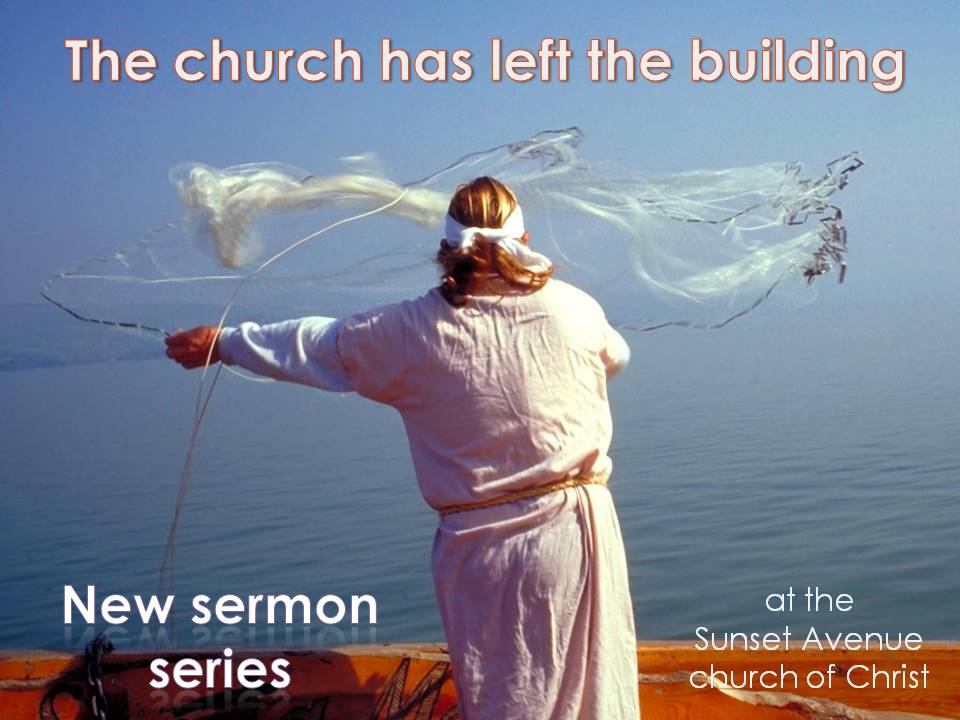
The church has left the building. Which came first, the mission or the church?


Powerpoint file: The Church has left the building: Which came first? The mission or the church?

God’s initiative to work salvation God calls Moses and sends him on mission to Egypt.  Notice how other nations (Canaan, Egypt) and not just Israel are the focus of God’s mission. 

Genesis 12:1-9 (NIV) The Lord had said to Abram, “Leave your country, your people and your father’s household and go to the land I will show you. “I will make you into a great nation and I will bless you; I will make your name great, and you will be a blessing. I will bless those who bless you, and whoever curses you I will curse; and all peoples on earth will be Picture1blessed through you.” So Abram left, as the Lord had told him; and Lot went with him.

Abram was seventy-five years old when he set out from Haran. He took his wife Sarai, his nephew Lot, all the possessions they had accumulated and the people they had acquired in Haran, and they set out for the land of Canaan, and they arrived there.   

Exodus 3:7-12 (NIV) The Lord said, “I have indeed seen the misery of my people in Egypt. I have heard them crying out because of their slave drivers, and I am concerned about their suffering. So I have come down to rescue them from the hand of the Egyptians and to bring them up out of that land into a good and spacious land, a land flowing with milk and honey–the home of the Canaanites, Hittites, Amorites, Perizzites, Hivites and Jebusites. And now the cry of the Israelites has reached me, and I have seen the way the Egyptians are oppressing them. So now, go. I am sending you to Pharaoh to bring my people the Israelites out of Egypt.” But Moses said to God, “Who am I, that I should go to Pharaoh and bring the Israelites out of Egypt?” And God said, “I will be with you. And this will be the sign to you that it is I who have sent you: When you have brought the people out of Egypt, you will worship God on this mountain.”

The disciples are gathered up and involved in God’s mission.  Notice that mission begins by bidding God to sent out harvesters. Luke 10:1-3 (NIV) After this the Lord appointed seventy-two others and sent them two by two ahead of him to every town and place where he was about to go. He told them, “The harvest is plentiful, but the workers are few. Ask the Lord of the harvest, therefore, to send out workers into his harvest field. Jesus sends the apostles just as he was sent by the Father.  (v. 21).   

John 20:19-23 (NIV) On the evening of that first day of the week, when the disciples were together, with the doors locked for fear of the Jews, Jesus came and stood among them and said, “Peace be with you!” After he said this, he showed them his hands and side. The disciples were overjoyed when they saw the Lord. Again Jesus said, “Peace be with you! As the Father has sent me, I am sending you.” And with that he breathed on them and said, “Receive the Holy Spirit. If you forgive anyone his sins, they are forgiven; if you do not forgive them, they are not forgiven.”

Biblical understandings of the kingdom of God Most Americans are not familiar with the implications of living within a kingdom. Often interchangeable with the terms “reign of God” or “rule of God.”

  • We are to receive the reign of God like a little child (Mark 10:15; Luke 18:17)
  • We inherit the kingdom (Mt. 25:34; 1 Cor. 6:9-10; Gal. 5:21)
  • We enter the reign of God (Mt. 5:20; 7:21; 18:3; 19:23-24; Mk 9:47; 10:23-25).
  • We are never mentioned as building or establishing the kingdom. That is God’s work.

Receiving the kingdom involves accepting the generosity of the king. Inheriting the kingdom involves becoming an heir…a member of the king’s house.  Entering a kingdom involves conforming to the way of life established by the king.

The lordship of Christ is often reduced to individual concerns.  When salvation is reduced to individualistic concerns, Christ is regarded as personal savior, or “Lord of my life.”  When it is a limited perspective, the church tends to ignore that God has exalted Christ as Lord universally.

In Acts 2, Peter asserts that God has made Jesus Lord regardless of the acceptance or rejection of the crowd.  He calls them to repent of their rejection of the objective reality of Jesus’ lordship and not simply acceptance of a subjective experience of that lordship

(Acts 2:36-41 (NIV) “Therefore let all Israel be assured of this: God has made this Jesus, whom you crucified, both Lord and Christ.” When the people heard this, they were cut to the heart and said to Peter and the other apostles, “Brothers, what shall we do?” Peter replied, “Repent and be baptized, every one of you, in the name of Jesus Christ for the forgiveness of your sins. And you will receive the gift of the Holy Spirit. The promise is for you and your children and for all who are far off–for all whom the Lord our God will call.” With many other words he warned them; and he pleaded with them, “Save yourselves from this corrupt generation.” Those who accepted his message were baptized, and about three thousand were added to their number that day.

The relationship between church and mission…remembering…the mission is God’s initiative

  • we are those who have received, inherited, and entered into the kingdom of God
  • God has exalted Christ as Lord over all creation.

John 17:14-18 (NIV) I have given them your word and the world has hated them, for they are not of the world any more than I am of the world. My prayer is not that you take them out of the world but that you protect them from the evil one. They are not of the world, even as I am not of it. Sanctify them by the truth; your word is truth. As you sent me into the world, I have sent them into the world.

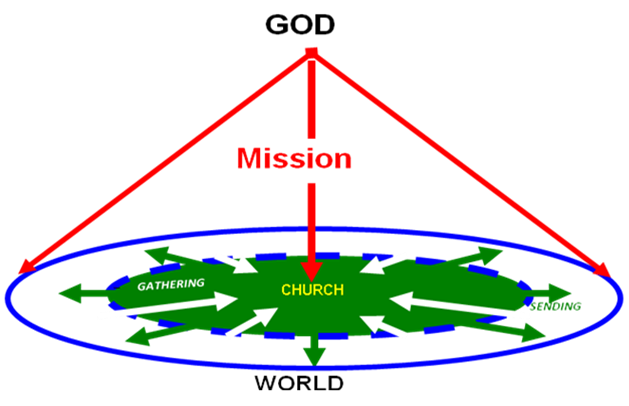
Begins with God and the world.  Mission is more than just an adjunct activity of the church.  Mission cannot be reduced to obedience to a command to evangelize.  God sends Christ and Christ sends His church. God rules over the entire world despite the fact that some reject that rule.  The church is formed and made visible because God gathers the church from the world.

When we say that “the church has a mission,” we tend to view the church as a sort of machine that comes in a kit so that when we assemble it properly according to the instructions and turn on the power it goes to work.  But the Bible never pictures the church as an independent institution that churns out a product or repeats a task under its own power.  The biblical view of the church is not a static organization that determines its own mission.  Rather, God has a mission in this world and God is about his mission; He is calling and sending people caught up in that mission and they are the church. 

The biblical view of the church

The followers of Christ are called “The Way.” (Acts 9:2)

  • The church is the transformation of the old humanity into the new humanity (Eph. 2:15).

The church is the result of God’s Activity

  • we are the fish caught up in the dragnet (Mt. 13:47-50)
  • we are the sheaves of wheat gathered in harvest (Mt. 13:24-30)
  • we are the mustard tree sown by the sower (Mk 4:30-32)
  • we are persecuted believers on the run who tell the story that changes the world (Acts 8).

The mission of God is a tidal wave breaking onto the shores of earth and the church is caught up in it.  The mission of God is like a storm front moving into this world.  The church is like a pile of leaves or a drift of snow gathered up by the wind. (John 3:8)  We are the visible evidence of God’s invisible activity in the world. 

The mission of God has a church. Treasure in a brown paper: 2 Cor. 4:7-12 2 Corinthians 4:1-6 (NIV) Therefore, since through God’s mercy we have this ministry, we do not lose heart. Rather, we have renounced secret and shameful ways; we do not use deception, nor do we distort the word of God. On the contrary, by setting forth the truth plainly we commend ourselves to every man’s conscience in the sight of God. And even if our gospel is veiled, it is veiled to those who are perishing. The god of this age has blinded the minds of unbelievers, so that they cannot see the light of the gospel of the glory of Christ, who is the image of God. For we do not preach ourselves, but Jesus Christ as Lord, and ourselves as your servants for Jesus’ sake. For God, who said, “Let light shine out of darkness,” made his light shine in our hearts to give us the light of the knowledge of the glory of God in the face of Christ.

2 Corinthians 4:7-12 (NIV) But we have this treasure in jars of clay to show that this all-surpassing power is from God and not from us. We are hard pressed on every side, but not crushed; perplexed, but not in despair; persecuted, but not abandoned; struck down, but not destroyed. We always carry around in our body the death of Jesus, so that the life of Jesus may also be revealed in our body. For we who are alive are always being given over to death for Jesus’ sake, so that his life may be revealed in our mortal body. So then, death is at work in us, but life is at work in you.

The believer is simply a “jar of clay”; it is the treasure within the vessel that gives the vessel its value.  The important thing about a vessel is that it be clean, empty, and available for service.  We must focus on the treasure and not on the vessel. Paul was not afraid of suffering or trial, because he knew that God would guard the vessel so long as Paul was guarding the treasure. God permits trials, God controls trials, and God uses trials for His own glory. God is glorified through weak vessels.  

I need your ideas of service projects we could do to help others.  

 
Leave a comment

Posted by on August 10, 2014 in Church, Sermon


Scarecrows and Strawberries – Matthew 25:14-30


 Facebook    YouTube

 ——————————————–

The Church has left the building

(I have begun a new sermon series. These are the powerpoint slides: The Church has left the building)

—————————————————

We begin with the story of a man who walks along a country lane one day and comes upon a lovely garden. In the middle of the garden is a strawberry patch and in the middle of that is a scarecrow.

On each outstretched arm sat a blackbird. Each had obviously been enjoying a feast in the patch. There were also birds around on the fence and in the trees, but none of them seemed to have enjoyed the sweet berries.


Why? They were frightened away by that terrible effigy standing guard in the center of the garden. An effigy, by the way, that was harmless! Two of the birds had figured it out…most had not and were missing out on the feast!

One of the best scarecrow stories you will ever hear is taught by Jesus in Matthew 25:14-30.

Picture2The story has three characters…two of them who immediately receive praise and admiration:

  • For their dedication and commitment to their master
  • For their skillful use of their talents and opportunities
  • For their return of double benefits on the day of reckoning
  • For the commendation they received “well done”  (a commendation we all hope to hear on our day of reckoning)

The third man is so different:

  • He made little or no effort, won no prize, and received no commendation
  • Instead, he lost what he had and was bound and cast into outer darkness
  • It would be difficult for Jesus Himself to find a more pathetic failure!

Why the great difference in these men? Like the story of the birds and the scarecrow, this one foolish man was robbed of his prize and reward by harmless scarecrows. He was cheated by his own groundless fears  “I was afraid.”

The scarecrow of his own thoughts of littleness and insignificance.

Did he have this attitude: “These men are far more capable than I. If I only had the talents and abilities they do, what big things I would do! “But since I have only 1 talent, there’s no use to even try.”

It’s common in many congregations for Christians to be frightened into uselessness by thoughts of their own insignificance or littleness:

“If I could only preach or teach like ______________”

“If I could only lead a class like _________________”

“If I could only lead singing like _________; what great things I would do for the Lord.  BUT since I’m not talented like they are, there doesn’t seem to be much I can do.”

On the day of judgment we won’t be judged by the numbers of accomplishments, but rather by our faithfulness in using what we’ve received.

God will not judge us as to what we would have done IF we had 5 or 10 talents, but “what did you do with what you had?”

(Romans 12:1-11)  “Therefore, I urge you, brothers, in view of God’s mercy, to offer your bodies as living sacrifices, holy and pleasing to God–this is your spiritual act of worship. {2} Do not conform any longer to the pattern of this world, but be transformed by the renewing of your mind. Then you will be able to test and approve what God’s will is–his good, pleasing and perfect will. {3} For by the grace given me I say to every one of you: Do not think of yourself more highly than you ought, but rather think of yourself with sober judgment, in accordance with the measure of faith God has given you. {4} Just as each of us has one body with many members, and these members do not all have the same function, {5} so in Christ we who are many form one body, and each member belongs to all the others. {6} We have different gifts, according to the grace given us.  If a man’s gift is prophesying, let him use it in proportion to his faith. {7} If it is serving, let him serve; if it is teaching, let him teach; {8} if it is encouraging, let him encourage; if it is contributing to the needs of others, let him give generously; if it is leadership, let him govern diligently; if it is showing mercy, let him do it cheerfully. {9} Love must be sincere. Hate what is evil; cling to what is good. {10} Be devoted to one another in brotherly love. Honor one another above yourselves. {11} Never be lacking in zeal, but keep your spiritual fervor, serving the Lord.”

If a man is centered upon himself, the smallest risk is too great for him, because both success and failure can destroy him.  If he is centered upon God, then no risk is too great, because success is already guaranteed–the successful union of creator and creature, beside which everything else is meaningless.

Picture1The scarecrow that kept him from the garden of plenty – unfavorable circumstances.

The man just knew that if he lived somewhere else the market would have been better… another time…another place…difference circumstances….but since he lived where he was and when it was, the circumstances for serving his master were just all wrong.

There are some who have heard the gospel for many years…and always intend to become a Christian someday. It’s always tomorrow, some time, some where….but the circumstances are just right NOW!

The third scarecrow was mistrust of His Lord.

We hear him say that his Master is a hard man (vs. 24). It’s another way of saying “Master, you’re not fair, you’re not just.”

Some look at Christ this way. They fear the task He will set for them is too great.

The fourth scarecrow: the possibility of failure.

Failure is one thing that can be achieved without effort. Failure is not stumbling and falling.  It’s staying on the floor. Failure should be our teacher, not our undertaker.

He was afraid to try anything on behalf of His Master for fear of failure. The possibility of failure didn’t keep us from learning to ride a bike, roller skate, from trying golf, or tennis, or cooking, or sewing, did it?

To achieve anything worthwhile, we have to risk the possibility of making some mistakes. To be so afraid that we refuse to try at all is to have the supreme eternal failure.

Failure doesn’t mean you are a failure — it does mean you haven’t succeeded yet.

Failure doesn’t mean you have accomplished nothing — it does mean you have learned something.

Failure doesn’t mean you have been a fool — it does mean you had a lot of faith.

Failure doesn’t mean you’ve been disgraced — it does mean you were willing to try.

Failure doesn’t mean you don’t have it — it does mean you have to do something in a different way.

Failure doesn’t mean you are inferior — it does mean you are not perfect.

Failure doesn’t mean you’ve wasted your life — it does mean you have a reason to start fresh.

Failure doesn’t mean you should give up — it does mean you must try harder.

Failure doesn’t mean you’ll never make it — it does mean it will take a little longer.

Failure doesn’t mean God has abandoned you — it does mean God has a better idea!

Failure has been correctly identified as the line of least persistence, whereas success is often a question of simply sticking to the job and working and believing while you are sticking.  If a particular job is harder than you might wish, just remember you can’t sharpen a razor on a piece of velvet and you can’t sharpen a man by spoon feeding him.

Failure is never pleasant.  It certainly isn’t enjoyable to lose a job, see a relationship falter, or fail a test.  But the immediate disappointment we feel when we face defeat can be turned into the joy of success if we take the right attitude. Thomas Edison was busy working in his laboratory at 2 o’clock one morning when an assistant came into the room and noticed that the inventor was smiling broadly.  “Have you solved the problem?” he asked.  “No,” replied Edison, “that experiment didn’t work at all. Now I can start over again.”  Edison could

have such a confident attitude because he knew that the road to success is often paved with disappointments that serve to extend the road — not to block it. Each failure brought him a little closer to success.

How did the 4 scarecrows rob the man?

  1. They robbed him of usefulness. He ended up doing nothing because he was frozen by fear into total uselessness.
  2. They robbed him of the joy of service to His Master and fellowman.
  3. They robbed him of any growth through experience.
  4. They robbed him of that which he did possess.
  5. He lost his destiny.

We have scarecrows in our own lives; what is to be done about our scarecrows?

Make use of them. If a bird had good sense he would soar high and search far and wide looking for scarecrows. Seeing a scarecrow is like hearing a dinner bell, or having an invitation to a banquet. Have you ever seen scarecrows in untilled fields, or in deserts?

If a thing seems hard, or causes us fear or apprehension, that’s one indication of its desirability. Those things which cause effort, sweat, struggle, and tears also usually bring a reward worth treasuring and keeping.

But the minute we decide to do something worthwhile, that will count for something…the devil is going to throw up various scarecrows to try to frighten us away from God’s bountiful garden.

When we hear Christ speak of “taking up the cross” and “deny yourself,” the devil wants us to see these matters as frightening effigies…a way of life full of hardships, void of fun and pleasure.

In reality, one who has tried these things and understands what the Lord means by them realizes they are guideposts to real, abundant, fulfilling life!

Defy them. The scarecrow lead the blackbirds to the strawberry patch! How foolish for them not to claim them.

Ever taught a children’s class? Willing to be a helper? Greeted visitors at the door? Maybe the devil is throwing up scarecrows. The thing to do is to face up to your fears…go on in spite of them and win the victory! It takes courage to become a Christian…to help out in a class … to visit a shut-in monthly…IT TAKES NO COURAGE at all to deny Christ.

Realize scarecrows are harmless!

They can’t hurt us! They only frighten us. Fear of rejection, ridicule, criticism…these things can’t harm us unless we let them.

It is not the critic who counts; not the man who points out how the strong man stumbles, or where the doer of deeds could have done them better. The credit belongs to the man who is actually in the arena, whose face is marred by dust and sweat and blood; who strives valiantly; who errs, and comes short again and again, because there is not effort without error and shortcoming; but who does actually strive to do the deeds; who knows the great enthusiasms, the great devotions; who spends himself in a worthy cause; who at best knows in the end the triumphs of high achievement and who at the worst, if he fails, at least fails while daring greatly, so that his place shall never be with those cold and timid souls who know neither victory nor defeat.

 
Leave a comment

Posted by on August 3, 2014 in Sermon


Differences between a college football fan and some church members


By Thom Rainer

Warning: The article below is a bit of sarcastic humor. I am speaking in hyperbole to make a point. The football fan noted represents a very rabid football fan. The church member represents some, but certainly not all, church members.

Disclosure: I tend to be a rabid college football fan. I see my allegiance as an area of devotion that needs significant adjustments downwardly. So I don’t necessarily practice what I preach. For example, even as I type these words, I am reminded that the kickoff for my team’s first game of the season is exactly five weeks from today. [July 26th, 2014]

Caution: While I do write these comparisons with some humor and a lot of hyperbole, you might get just a bit uncomfortable reading them. That may indicate there is some truth in each of them.

1.  A college football fan loves to win. The typical church member never wins someone to Christ.

2. A college football fan gets excited if a game goes into overtime. A church member gets mad if the minister preaches one minute past the allocated time.

3.  A college football fan is loyal to his or her team no matter what. A church member stops attending if things are not going well.

4.  A college football fan is easily recognized by his or her sportswear, bumper stickers, and team flags. Many church members cannot even be recognized as Christians by people with whom they associate.

5.  A college football fan pays huge dollars for tickets, travel, and refreshments for games. A church member may or may not give to his or her church.

6.  A college football fan reads about his or her football team every day. A church member rarely reads the Bible once in the course of a week.

7.  A college football fan attends the game no matter how bad the weather is. A church member stays home if there is a 20 percent chance of rain.

8.  A college football fan invites others to watch the game every week. A church member rarely invites someone to church.

9.  A college football fan is known for his or her passion for the football team. A church member is rarely known for his or her passion for the gospel.

10. A college football fan will adjust gladly to changes in kickoff time. A church member gets mad if his or her service time is changed by just a few minutes.

11. A college football fan is loyal even if he or she never gets to meet the coach. A church member gets mad if the minister does not visit for every possible occasion.

Yes, I admit I do enjoy college football. But I really love Christ’s churches even more. I need to demonstrate that reality more readily. Do you?

So . . . what would you add to my somewhat sarcastic list? Do you see the humor? Do you see some truth?

 
Leave a comment

Posted by on July 31, 2014 in Sermon


The Danger of Excluding God


No decision is wise if it’s made independently of God.  In Joshua 9, the people of Israel made a terrible decision because they left God out of their plans, and had to live with the consequences of a decision which God did not approve:

Decision and risk analysis“Now when all the kings west of the Jordan heard about these things – those in the hill country, in the western foothills, and along the entire coast of the Great Sea as far as Lebanon…came together to make war against Joshua and Israel.

“However, when the people of Gibeon heard what Joshua had done to Jericho and Ai, they resorted to a ruse: They went as a delegation whose donkeys were loaded with worn-out sacks and old wineskins, cracked and mended.  The men put worn and patched sandals on their feet and wore old clothes.  All the bread of their food supply was dry and moldy.  Then they went to Joshua in the camp at Gilgal and said to him and the men of Israel, “We have come from a distant country; make a treaty with us.”

“The men of Israel said to the Hivites, “But perhaps you live near us.  How then can we make a treaty with you?” “We are your servants,” they said to Joshua. But Joshua asked, “Who are you and where do you come from?” They answered: “Your servants have come from a very distant country because of the fame of the Lord your God.  For we have heard reports of him: all that he did in Egypt, and all that he did to the two kings of the Amorites east of the Jordan…. And our elders and all those living in our country said to us, ‘Take provisions for your journey; go and meet them and say to them, “We are your servants; make a treaty with us.”’  This bread of ours was warm when we packed it at home on the day we left to come to you.  But now see how dry and moldy it is.  And these wineskins that we filled were new, but see how cracked they are.  And our clothes and sandals are worn out by the very long journey.”

The men of Israel sampled their provisions but did not inquire of the Lord.  Then Joshua made a treaty of peace with them to let them live, and the leaders of the assembly ratified it by oath. — Joshua 9:1-15, emphasis added

The Israelites gathered data (vv. 7-14), but they missed a crucial step in the process.  “The men of Israel…did not inquire of the Lord” (v. 14). 

Ronald Reagan is credited with saying, “America was founded by people who believed that God was their rock of safety.  He is ours.  I recognize we must be cautious in claiming that God is on our side, but I think it’s all right to keep asking if we’re on His side.” 

If we assume that God is always on our side, we will fall headlong into foolishness. 

We should search ourselves regularly to make sure our thinking is in line with His will. 

We should strive to develop the character and conviction to make decisions that are products of our relationship with God.


Leave a comment

Posted by on July 13, 2014 in Sermon


God’s Ten Most Wanted Men


 Facebook    YouTube


——————————————–

1. The man who puts God’s business above any other business.

2. The man who brings his children to church rather than sends them.
God Created Man

3. The man who is willing to be the right example to every person whom he meets.

4. The man who thinks more of Sunday school than of Sunday sleep.

5. The man who gives what he should to the church and lives on what is left.

6. The man who goes to church for Christ’s sake rather than for himself or someone else.

7. The man who has a passion to help others rather than to be helped himself.

8. The man who has a willing mind rather than a brilliant one.

9. The man who can see his own faults before he sees the faults of others.

10. The man who is more concerned about winning persons to Christ than about winning worldly honors.

 
1 Comment

Posted by on July 9, 2014 in Sermon


Order in the Church – What do the elders look like? 1 Timothy 3


Paul spells out 15 qualifications so that there are no doubts as to what spiritual maturity entails. Before we examine the qualifications in more detail, several things need to be said:

First, most of these qualities are prescribed elsewhere in the Bible for every Christian, including women. So we all should be seeking to grow in these areas. The moment we became a member of the body of Christ we are in the ministry, and we are given gifts for ministry.

 It is not the elders who are to do the work of the ministry: We are!

 061414_1735_ElderNomina3.jpgSecond, spiritual maturity takes time, effort, and discipline (1 Timothy 4:7 (NIV) Have nothing to do with godless myths and old wives’ tales; rather, train yourself to be godly. 

There are no shortcuts. We live in a day when we’re used to instant everything. But there is no such thing as instant godliness. The crucial question is, Are you involved in the process?

Third, no one is perfectly qualified to be a church leader. These qualities, for the most part, are not the kind of thing where you can say, “I’ve arrived!” There is always going to be room for growth. If you require perfection, no one would qualify as an elder. But at the same time, an elder should not be in glaring violation of any qualification. If he is weak in any area, he should be aware of it and should be working on that area.

2 Corinthians 2:16 (NIV) To the one we are the smell of death; to the other, the fragrance of life. And who is equal to such a task?

 (2 Corinthians 3:5-6 (NIV) Not that we are competent in ourselves to claim anything for ourselves, but our competence comes from God. He has made us competent as ministers of a new covenant–not of the letter but of the Spirit; for the letter kills, but the Spirit gives life.

Elders are to be watching for this. That is what the word for elder, episkopos, means — “looking over.”

Elders are to be looking to see what the Lord is doing with his people, and utilizing the opportunities that arise on every hand. They are to be instructed in what the Lord has said in his Word so as to be able to guide this new and exciting thing that is coming into being, correcting it if need be. That is the work of elders. So it is a “noble task,” as Paul says.

Elders are to know and to seek the mind of the Lord, to guide the burgeoning ministry of the congregation as it develops, in direct inspiration of the Spirit of God, as each one in the congregation finds what the Lord wants him or her to do. The elders are to oversee that, to guide it, to correct it, if need be, along the lines of what the Scriptures teach and what the Spirit of God has led them to understand as they seek the mind of the Lord in prayer.

Those are the things you look for:

First, an elder’s reputation. “Above reproach” (KJV, NKJV = “blameless”).  That does not mean he must never have had anything gone wrong. If that were so none of us would make it. It means that when something did go wrong he handled it rightly, dealt with it openly, giving every indication of desiring to be a godly, righteous man.

Second, he is to be a “one-woman man,” literally. It is to be very evident that an elder is committed to one woman, his wife, whom he loves.

A third requirement is that an elder be known for a number of good habits he has formed:

First, “Temperate” (KJV = “vigilant”) Basically, that means to be calm. He is not to be flighty or nervous, constantly jumping from one thing to another.

“Prudent” (NIV = “self-controlled”; KJV = “sober”; NKJV = “sober-minded”): A kind of inner peace governs him; a discipline of life keeps him level and steady.

“Respectable” (KJV, NKJV = “of good behavior”): The word really means “orderly,” to have an orderly life, not to have everything going helter-skelter, unable to lay his hands on anything and not knowing what is happening.

“Hospitable” (KJV = “given to hospitality”): Literally, the original means, “a lover of strangers.” He is quick to open his heart and home to others. He is not afraid to meet new people. He’s able to make them feel relaxed and welcome. All Christians are exhorted to pursue hospitality (Rom. 12:13) and to be hospitable without complaint (1 Pet. 4:9).

An elder must be able to teach. He must be able to expound the Scriptures, to correct those who are misusing them and recognize error when it appears.

An elder is not to “not given to much wine.” The fact that our Lord and the disciples did drink wine was a common experience in that day. But it was not to be over-indulged; there was to be no reproach in this area.

Another requirement is that an elder be “not violent,” i.e., not a contentious, angry man who is always attacking others.

Then he must not be “quarrelsome.” The word really is  “stubborn,” not insisting on his own point of view at all costs.

He must not be in it for what he can get (not a “money lover”). He must not be out to keep up with the Joneses, but must maintain a simple lifestyle, without undue affluence evident.

Then an elder has to have a certain record of accomplishment in three specific areas.

First,  He must manage his own household well, keeping his children submissive and respectful in every way; for if a man does not know how to manage his own household, how can he care for God’s church? {1 Tim 3:4-5 RSV}

The first thing you look for is whether the man has a well-managed family. Look at his children. Are they obedient, or are they the scandal of the church, nobody can control them? I know that ministers’ and elders’ children are under more inspection than others. (They get that way from playing with the children of the other members of the church!)

But his children are to be obedient and courteous in their responses, learning how to address life. This does not necessarily govern the children after they have grown up and left home. The word used here is “small children.” This is a test of a man.

This does not mean he is not to have any problems ever come in his family.  What this urges us to observe is how he handles those problems. Does he evade them by busying himself in his business, or does he tackle those problems?

He must not be a recent convert, or he may be puffed up with conceit and fall into the condemnation of the devil. {1 Tim 3:6 RSV}

“A good reputation with those outside” (KJV = “a good report”; NKJV = “a good testimony”): He should be recognized in the community as a man of moral character and proper conduct. His business dealings should be honest and right. This should be true of all Christians, but especially of leaders. Non-Christians should not be able to bring the charge of “hypocrite” against a church leader.

Servants: Official & Otherwise (1 Timothy 3:8-13) All Christians are servants; some should be “official” servants. Christ is our supreme example of servanthood.

A farmer had a team of horses in which one horse consistently worked harder than the others. The farmer said, “They’re all willin’ horses. The one’s willin’ to pull, and the rest are willin’ to let him.”

Sadly, that’s how it often is in the local church. Everybody is willing: a few are willing to work and the rest are willing to let them.

A. The office of deacon is recognized in Scripture.

Most scholars agree that the office of “deacon” (= “servant”) finds its roots in Acts 6:1-6. There were a number of widows in the church without any means of income who were served food on a daily basis. But a problem arose when the Greek-speaking Jews felt that their widows were being neglected in favor of the native Hebrews. They needed some fair administrators to handle the situation so that the apostles would be free to devote their time to prayer and the ministry of the Word.

Men deacons: There are eight qualifications:

(a) “Dignified” (KJV = “grave”; NKJV = “reverent”; NIV = “worthy of respect”). The word is the opposite of being a goof-off or clown. A deacon should have a seriousness of purpose about him, so that those he serves sense that he is concerned for them and so they trust and respect him.

(b) “Not double-tongued” (NIV = sincere). He cannot be a man who tells one person one thing, but another person the opposite in an attempt to please everybody. Since the deacon was involved in handling church finances, he had to be a man of his word.

(c) “Not addicted to much wine”. Since wine was commonly served as a gesture of hospitality, it was important for a deacon, making his rounds from house to house, to exercise control or else he could become a drunkard.

(d) “Not fond of sordid gain” (NKJV = “not greedy for money”; NIV = “not pursuing dishonest gain”). Since a deacon’s duties often involved the distribution of money and gifts to the needy, there was always the possibility for embezzlement. A deacon could not be a man who would pursue dishonest gain.

(e) “Holding to the mystery of the faith with a clear conscience” (the NIV’s “deep truths” is misleading). A deacon must be a man of conviction regarding the central truths of the Christian faith. In addition to sound doctrine, he must be sound in obedience (“clear conscience”).

(f) “Tested and found beyond reproach” (NIV = “if there is nothing against them”; KJV, NKJV = “blameless.” It means, literally, “not called to account.” This is to be determined by “testing,” which means that a man has an observed track record before he is put into office. You don’t put a man into office and then test him to see if he’s trustworthy. Test him first and then recognize him.

It’s obvious that the church should never recognize someone as a deacon in order “to get him involved,” or because he’s “willing to work.” The real issue, as far as holding office in the church is concerned, is proven spiritual maturity, both for elders and deacons.

Wives“Not malicious gossips” (KJV, NKJV = “not slanderers”). If they went from house to house with juicy tidbits of private information, they could ruin a church very quickly. They must be able to control their tongues.

“Faithful in all things.” She must be trustworthy. She must follow through on assigned tasks. If an elder knows of a family that needs care of some kind, and assigns it to a deaconess, he needs to be able to trust her to follow through. We must commit ourselves to know, live by, and defend God’s Word of Truth.

 
Leave a comment

Posted by on June 21, 2014 in Church, Sermon