RSS

10 Reasons to Believe in the Christian Faith


When stacked up against all other religions, Christianity is the only one that shines with the light of authenticity. Why? 


The Credibility of Its Founder.
Christ said He came from heaven to fulfill prophecy, to die for our sins and to bring to His Father all who believe in Him. Logic says that He was either a liar, a lunatic, a legend or the Lord of heaven. His first-century followers drew their own conclusions. They said they saw Him walk on water, still a storm, heal crippled limbs, feed 5,000 with a few pieces of bread and fish, live a blameless life, die a terrible death and live again. During His ministry, when some of Jesus’ followers took issue with His teachings and left, He asked those closest to Him if they too wanted to leave. Peter spoke for the others when he said, “Lord, to whom shall we go? You have the words of eternal life. We believe and know that you are the Holy One of God” (John 6:68,69, NIV).

cropped-th-51.jpgThe Reliability of Its Book.
Written over a period of about 1,600 years by 40 different authors, the book on which the Christian faith rests tells one story that begins with creation and concludes on the threshold of eternity. The integrity of its historical and geographical record is supported by archaeology. The accuracy with which it has been copied and handed down to us has been confirmed by the Dead Sea Scrolls of Qumran. Originating neither in the East nor the West, but in the Middle East-the cradle of civilization-the Bible continues to speak not only with spiritual power but with convincing prophetic accuracy.


Its Explanations for Life.
All religious systems attempt to give meaning to our existence. All attempt to explain our thirst for significance, the problem of pain and the inevitability of death. All religions attempt to apply the design of the cosmos to our individual lives. It is the Christian faith, however, that reflects the caring attention to detail so evident in the species and ecosystems of the natural world. It is Christ who speaks of a Father who takes note of every sparrow that falls, a Father who numbers even the hairs of our head (Matthew 10:29-31). It is Christ who reveals a God who shows how much He cares for all that He has created. It is Christ who clothed Himself in our humanity to feel what we feel, and then to suffer and die in our place. It is Christ who reveals a God who cares as much about His creation as the design and detail of the natural world indicates (Psalm 19:1-6; Romans 1:16-25).


Its Continuity With the Past.
The Christian faith offers continuity with our deepest ancestral roots. Those who trust Christ are accepting the same Creator and Lord worshiped by Adam, Abraham, Sarah and Solomon. Jesus didn’t reject the past. He was the God of the past (John 1:1-14). When He lived among us, He showed us how to live according to the original plan. When He died, He fulfilled the whole Old Testament sacrificial system. And when He rose from the dead, the salvation He offered fulfilled God’s promise to Abraham that through his descendant He would bring blessing to the whole world. The Christian faith is not new with Christ. From Genesis to Revelation it is one story. It is His story-and ours (Acts 2:22-39; 1 Corinthians 15:1-8).


Its Foundational Claim.
The first Christians were not driven by political or religious dissent. Their primary issues were not moral or social. They were not well-credentialed theologians or social philosophers. They were witnesses. They risked their lives to tell the world that with their own eyes they had seen an innocent man die and then miraculously walk among them three days later (Acts 5:17-42). Their argument was very concrete. Jesus was crucified under the Roman governor Pontius Pilate. His body was buried and sealed in a borrowed tomb. Guards were posted to prevent grave tampering. Yet after three days the tomb was empty and witnesses risked their lives to declare that He was alive.


Its Power to Change Lives.
Not only were the first disciples dramatically changed, but so was one of their worst enemies. Paul was transformed from a Christian killer into one of their chief advocates (Galatians 1:11-24). Later he reflected the changes that had occurred in others as well when he wrote to the church in Corinth: “Do not be deceived: neither the sexually immoral nor idolaters nor adulterers nor male prositutes nor homosexual offenders nor thieves nor the greedy nor drunkards nor slanderers nor swindlers will inherit the kingdom of God. And that is what some of you were. But you were washed, you were sanctified, you were justified in the name of the Lord Jesus Christ” (1 Corinthians 6:9-11).


Its Analysis of Human Nature
The Bible says that society’s real problems are problems of the heart. In an age of information and technology, failures of character have scandalized institutions of family, government, science, industry, religion, education and the arts. In the most sophisticated society the world has ever known, our national reputation is marred by problems of racial prejudice, addiction, abuse, divorce and sexually transmitted disease. Many want to believe that our problems are rooted in ignorance, diet and government. But to our generation and all others, Jesus said, “For out of the heart come evil thoughts, murder, adultery, sexual immorality, theft, false testimony, slander. These are what make a man `unclean'” (Matthew 15:19-20).

Its View of Human Achievement
Generation after generation has hoped for the best. We fought wars that would end all wars. We developed educational theories that would produce enlightened, nonviolent children. We conceived technologies that would deliver us from the oppressive slavery of work. Yet we are as close as ever to what the New Testament describes as an end time marked by wars and rumors of wars, earthquakes, disease, loss of affection and spiritual deception (Matthew 24:5-31; 2 Timothy 3:1-5).


Its Impact on Society.
A carpenter rabbi from Nazareth changed the world. Calendars and dated documents bear silent witness to His birth. From rooftops, necklaces and earrings, the sign of the cross bears visual witness to His death. The Western worldview, which provided a basis for social morality, scientific methodology and a work ethic that fueled industry, had roots in basic Christian values. Social relief agencies, whether in the West or the East, are not fueled by the values of Hinduism, Buddhism, atheism or secular agnosticism, but by the direct or residual values of the Bible.


Its Offer of Salvation.
Alternative religious views have saviors who remain in the grave. No other system offers everlasting life as a gift to those who trust One who has overcome death for them. No other system offers assurance of forgiveness, eternal life and adoption into the family of God by calling on and trusting Someone in the same way a drowning person calls for and relies on the rescue of a lifeguard (Romans 10:9-13). The salvation Christ offers does not depend on what we have done for Him, but on our acceptance of what He has done for us. Instead of moral and religious effort, this salvation requires a helpless admission of our sins. Instead of personal accomplishments of faith, it requires confession of failure. Unlike all other options of faith, Christ asks us to follow Him-not to merit salvation but as an expression of gratitude, love and confidence in the One who has saved us (Ephesians 2:8-10).


You’re not alone if you are still unconvinced about the reasonableness of faith in Christ. But keep in mind Jesus’ claim that we don’t have to resolve our doubts on our own. He said, “If anyone chooses to do God’s will, he will find out whether my teaching comes from God or whether I speak on my own” (John 7:17).

If you do see the reasonableness of faith in Christ, keep in mind that the Bible says to the family of God, “For it is by grace you have been saved, through faith-and this not from yourselves, it is the gift of God-not by works, so that no one can boast” (Ephesians 2:8-9). The salvation Christ offers is not a reward for effort, but a gift to all who put their trust in Him.

Reprinted with RBC Ministries (Radio Bible Class), Grand Rapids, Michigan.

 
Leave a comment

Posted by on August 10, 2014 in Article


The Need for Convictions


INTRODUCTION

I. It is difficult to preach on an unpopular subject–conviction.
A. Our age is opposed, this is an age of toleration.
1. In man’s misguided quest for freedom, he misses the meaning.

B. Perhaps this mistake is most evident in the religious world. 
1. To the most radical, any religious practice is acceptable. 
a. A recent ecumenical meeting had representatives of Protestant
denominations. The Catholics, both Roman and Orthodox were also present.
Most startling, a leader in the Native American religions was asked to
lead a prayer. He did not believe in either the Father or the Son.


1975075_432464496857338_1394685051_nII. This toleration in religion is so different from what is found in the

Scriptures. 
A. Daniel went to the lion’s den instead of changing his prayer schedule.

B. The apostles in the early church 
(Acts 4:7-13) “And when they had placed them in the center, they began to inquire, “By what power, or in what name, have you done this?” {8}
Then Peter, filled with the Holy Spirit, said to them, “Rulers and elders
of the people, {9} if we are on trial today for a benefit done to a sick
man, as to how this man has been made well, {10} let it be known to all
of you, and to all the people of Israel, that by the name of Jesus Christ
the Nazarene, whom you crucified, whom God raised from the dead– by this
name this man stands here before you in good health. {11} “He is the
STONE WHICH WAS REJECTED by you, THE BUILDERS, but WHICH 
BECAME THE VERY CORNER stone. {12} “And there is salvation in no 
one else; for there is no other name under heaven that has been given among 
men, by which we must be saved.” {13} Now as they observed the confidence 
of Peter and John, and understood that they were uneducated and untrained 
men, they were marveling, and began to recognize them as having been with Jesus.”

(Acts 4:18-20) “And when they had summoned them, they commanded them not
to speak or teach at all in the name of Jesus. {19} But Peter and John
answered and said to them, “Whether it is right in the sight of God to
give heed to you rather than to God, you be the judge; {20} for we cannot
stop speaking what we have seen and heard.””

(Acts 5:28-29) “saying, “We gave you strict orders not to continue
teaching in this name, and behold, you have filled Jerusalem with your
teaching, and intend to bring this man’s blood upon us.” {29} But Peter
and the apostles answered and said, “We must obey God rather than men.”

C. Jesus’ message to the churches of Asia was to be strong. His promises
were to “. . . him that overcomes.”

III. Which should we follow–the spirit of the age or the example God’s
people?
A. Is it really necessary to hold a belief against all opposition? 
B. Ask yourself t these two questions
1. If no one stood for anything, if the spirit of the age seen in many
churches prevailed, would the world be a better place?
a. Would more love, compassion and patience exist? 
b. Would crime, illegitimate births, abortions and deaths from AIDS
decrease?

c. The trend of our times is that all of these are increasing as the
spirit of the age prevails.
2. On the other had, if all followed the Biblical teaching, would the world be worse? 
a. If people held to Biblical traditions on love and morality, would we be so worse off?

DISCUSSION
I. THE REASON FOR CONFLICT–OUR CONCEPTION OF TRUTH
A. Few will deny a change in the world’s view of right and wrong. 
1. Some of us have seen a extreme shift in a concept of absolute truth. 
a. In the past, right and wrong were based on principles of law and
morality based on the Bible. 
2. This we can document. 
a. This began first in philosophy. One’s feelings, his non-rational
experience was superior to demonstrated facts.
b. Art became confused. All expressions were acceptable. No wonder that
a gallery once had a picture hung for a week before someone realized
it was upside down. 
c. This then infiltrated the music and culture. “There are many media
for killing men . . . today. They all operate in the same direction: no
truth, no morality. You do not have to go to art galleries or listen to
the more sophisticated music to be influenced by their message. The
common media of cinema and television will do it effectively for you.” 

—from The God Who Is There p. 41

B. Is it possible there are no absolutes, that nothing is right or wrong?
1. Absolutes are a part of much of our lives. We have absolutes in
math, science, medicine, etc. 
2. We have them in our everyday lives. If I wanted to go Melbourne, I
would not take Interstate 75 because I liked the number. If I did, I
would wonder why I was in Naples. 
3. There are some absolutes in our lives that are extremely important. 
a. If I go and buy two shirts at $20 a piece, I will have strong convictions if I am charged 
$50. To me, 2 + 2 +4 is an absolute I will defend. 

C. If we are willing to accept that God’s word is absolute truth, we must
be willing to accept the results. (1 Pet 1:24-25) “For, “ALL FLESH IS
LIKE GRASS, AND ALL ITS GLORY LIKE THE FLOWER OF GRASS. 
THE GRASS WITHERS, AND THE FLOWER FALLS OFF, {25} BUT 
THE WORD OF THE LORD ABIDES FOREVER.” And this is the word 
which was preached to you.”
1. We must believe that Jesus is all He claimed to be.
2. We must accept the reality of sin and the need of salvation. 
3. Life, death and the judgment are real. 

II. THOSE WHO HOLD THESE CONVICTIONS MUST REALIZE THEY ARE IN A WAR.
A. Paul described this conflict. (Eph 6:10-13) “Finally, be strong in
the Lord, and in the strength of His might. {11} Put on the full armor of
God, that you may be able to stand firm against the schemes of the devil.
{12} For our struggle is not against flesh and blood, but against the
rulers, against the powers, against the world forces of this darkness,
against the spiritual forces of wickedness in the heavenly places. {13}
Therefore, take up the full armor of God, that you may be able to resist
in the evil day, and having done everything, to stand firm.”

1. We face the devil’s schemes.
2. We struggle with the powers of the dark world and the spiritual forces of evil.
3. We face the devil’s flaming arrows.

B. We must know our enemies–the devil, the world and the flesh. 
1. The devil is a cosmic force constantly opposed to man.
a. He has helpers Ephesians 6:12
b. The devil has one goal–to cause as many as possible to be lost.
2. We face the world as our enemy. 
a. The world is a mindset opposed to God. 
b. Its goal is to get all to conform. 
c. J. B. Philip’s translation of Romans 12:2 “Don’t let the world
squeeze you into its own mold.”
d. The world calls us to be correct and offend none. (We are to give no
place offense unless our stand for truth offends someone).. The
compelling cry of the world is You have hurt my feelings.”
e. The call is to be politically correct. 
f. So often we hear, ,”I don’t want to be judgmental…”
3. Our third enemy is the flesh. 
a. This is our desires. The goal of the flesh is for us to give in to
selfishness. A woman once called a talk show. She said she had been
married for six months. Her husband had three children by his former
wife, 16, 14 and 1. The woman had dated her husband while his wife was
still expecting. The moderator asked how she could live with a man who
had deserted his family. She said, “He makes me feel good.”

C. If we are right to hold convictions, we must oppose our enemies. 

III. IS THERE ANY HOPE?
A. We must first realize we live in a counter-culture. Christianity
is a culture within a culture. 
1. We are aliens (Heb 11:13) “All these died in faith, without
receiving the promises, but having seen them and having welcomed them
from a distance, and having confessed that they were strangers and exiles
on the earth.”

(1 Pet 2:11) “Beloved, I urge you as aliens and strangers to abstain
from fleshly lusts, which wage war against the soul.”

2. We live in a culture and seemingly are no different. Yet we do
not belong here. Like E. T., we want to go home. 
3. We endure what is necessary to get back to where we belong. 

B. There is hope because God is able. (Rev 3:8) “‘I know your
deeds. Behold, I have put before you an open door which no one can shut,
because you have a little power, and have kept My word, and have not
denied My name.”
a. Jesus holds the keys.
b. He opens a door none can shut. 
c. Though we are weak, we will overcome. 

C. We can hear some say, “Won’t this destroy the church?”
1. How valuable is the church which will to accommodate almost every
worldly practice? One which becomes just as preoccupied in material
things.
One that joins the world’s craze for entertainment instead
of worship and service.
One that loves its sexual standards to attempt to attract
the world. 
If the church will not stand for truth and oppose the
world’s mind set, it should be destroyed. Every time the church has
lowered itself to meet the world, the church has lost.

 
Leave a comment

Posted by on August 8, 2014 in Article


Spiritual Disciplines – What are they?


Facebook    YouTube JesusIsLordofthisWebSite

——————————————–

(Terry and I are hosting our college age/young professionals small group in our home for a few weeks. This will be our ‘outline’ for those sessions)

Celebration of Discipline

Unless we can make progress in the moral and spiritual realms – we may not even survive.

God has given the disciplines…as a means of receiving His grace.

Do not let the disciplines become law! When the Disciplines degenerate into law, they are used to manipulate and control people. We take explicit commands and use them to imprison others. The result of such deterioration is pride and fear. When we genuinely believe that inner transformation is God’s work and not ours, we can put to rest our passion to set others straight. Everybody things of changing humanity and nobody thinks of changing himself.

If we are to progress in the spiritual walk so that the Disciplines are a blessing and not a curse, we must come to the place in our lives where we lay down the everlasting burden of needing the manage others.

Meditation: how do we receive the desire to hear His voice?

In real prayer — we begin to love the things God loves.

We must not be led to believe the Disciplines are for spiritual giants and hence beyond our reach, or for contemplatives who devote all their time to prayer and meditation. Far from it. God intends the Disciplines of the spiritual life to be for ordinary human beings: people who have jobs, who care for children, who must wash dishes and mow lawns. In fact, the Disciplines are best exercised in the midst of our normal daily activities. If they are to have any transforming effect, the effect must he found in the ordinary junctures of human life: in our relationships with our husband and wife, our brothers and sisters, our friends and neighbors.

When one’s inner spirit is set free from all that holds it down, that can hardly be described as dull drudgery.

The primary requirement is a longing after God. Psalm 42:1-2 (NIV) As the deer pants for streams of water, so my soul pants for you, O God. My soul thirsts for God, for the living God. When can I go and meet with God?

Inwardly you have longed to launch out into the deep. Psalm 42:7 (NIV) Deep calls to deep in the roar of your waterfalls; all your waves and breakers have swept over me.

The Spiritual Disciplines are an inward and spiritual reality and the inner attitude of the heart is far more crucial than the mechanics for coming into the reality of the spiritual life.

The natural motions of our lives produce mire and dirt. Sin is part of the internal structure of our lives. No special effort is needed. No wonder we feel trapped.

The moment we feel we can succeed and attain victory over our sin by the strength of our will alone is the moment we are worshipping the will. Willpower will never succeed in dealing with the deeply ingrained habits of sin.

By dint of will people can make a good showing for a time, but sooner or later there will come the unguarded moment when the ‘careless word’ will slip out to reveal the true condition of the heart. We have no intention of exploding with anger or of parading a sticky arrogance, but when we are with people, what we are comes out. The will has the same deficiency as the law – it can deal only with externals. It is not sufficient to bring about the necessary transformation of the inner spirit.

The inner righteousness is a gift from God to be graciously received. The needed change within us is God’s work, not ours.

The Disciplines are God’s way of getting us into the ground; they put us where He can work within us and transform us. God has ordained the Disciplines of the spiritual life as the means by which we are placed where He can bless us. In the Cost of Discipleship Dietrich Bonhoeffer made clear that grace is free, but it is not cheap. Once we clearly understand that God’s grace is unearned and unearnable, and if we expect to grow, we must take up a consciously chosen course of action involving both individual and group life. That is the purpose of the Spiritual Disciplines.

———————————————-

Jonathan Edwards lived by a list of resolutions. For example: “Resolved, never to do anything which I would be afraid to do if it were the last hour of my life.” This statement shows how serious he was about pursuing holiness. It reveals a man who understood the fear of the Lord and sought to live it.

Yet look at another of Edwards’ resolutions: “Resolved, never to give over, nor in the least to slacken, my fight with my corruptions, however unsuccessful I may be.” 

What marvelous balance! Edwards resolved to fight the sin in his life but recog97262076_640  nized that it would be a slow and painful process, one that would often feel unsuccessful. Defeat didn’t weaken his resolve.

Spiritual Disciplines – What are they?

Do you have to have lot of free time to engage in whatever this is? Is it something you can do with friends? Do you have to be in worship?

Spiritual disciplines are practices modeled by the life of our Lord and in the rhythms of the church dating back to the first centuries.

These practices are embedded in the rich history of God’s story in each century as He is writing our stories. They are simple practices that help create space for God and for you to attend to His Presence.

Life is crazy busy. Each of us needs an anchor to hold us down in the midst of the incredible speed at which our lives move. Some days could feel like they are spiraling out of orbit.

Discipline is defined as “training expected to produce a specific character or pattern of behavior.” Discipline is not part of the sin nature, but it is a natural component of the Christian life. In fact, almost nothing of any significance in our lives is ever accomplished without it.

Spiritual disciplines can be described as those behaviors that augment our spiritual growth and enable us to grow to spiritual maturity. This process of spiritual growth and development begins to take place the moment a person encounters the risen Christ and comes to Him for salvation.

The purpose of spiritual discipline is the development of our inner being, that which has been transformed by Christ at salvation (2 Corinthians 5:17 ).

Redeemed believers have experienced the total renewal of the whole person from within, involving differences in thought, feeling and character that may be slower to be evident in our outward behavior.

This is what Paul had in mind when he spoke of taking off the “old self” and putting on the new, “which is being renewed in knowledge in the image of its Creator” (Colossians 3:9-10).

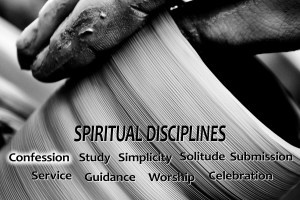
By definition, disciplines are (but are not limited to):Spiritual Disciplines-potter-confession

  1. Repetitive actions driven by spiritual decisions rather than natural environmental reactions.
  2. Deliberately self-induced behaviors that nurture spiritual health and fosters spiritual growth leading to maturity with God.
  3. Deliberately self-induced actions to alter existing life and thought patterns, thereby breaking the normal cycle of life and breaking the focus on intimacy with God.
  4. Spiritual exercises to develop “Sacred Rhythms” to engage in intentional spirituality in the pursuit of intimacy with God.

Why they are called disciplines — They are not the natural intuitive thing to do.

You need to make a conscious choice to engage in them; they are not something you would do of your own accord.

There will times where you don’t feel like doing what is necessary for your spiritual health. However disciplines provide stability and structure in order to carry you through those times you wish to ignore your spiritual health.

Spiritual Disciplines are a personal choice—only you can choose to undertake them at your own pace, but if done correctly you will feel closer to God than ever before. This is something you may need to think about carefully because it is a long journey which will not be easy to undertake.

When we become Christians, we have to develop our faith over time. There are spiritual disciplines that help us become stronger in our faith. Unlike the spiritual gifts, which are provided to us by the Holy Spirit, spiritual disciplines are more like finely honed tools that aid us in our spiritual walks. Yet each of the spiritual disciplines takes time to develop and effort to incorporate into our daily lives.

How Do Spiritual Disciplines Work? A spiritual discipline is a good habit that allows you to remain open to God and develop yourself spiritually. Discipline is one of the hardest things for us to learn. Think of some of our finest athletes. Most of them have a strong sense of discipline, because they have to build up strength, endurance, and skill to be good at a particular sport.

Surgeons spend years developing their surgical skills and learning the human body so that they are able to skillfully fix what is malfunctioning in the body. Our favorite writers have the discipline to sit down every day to write, edit, and re-write until the story is right. They hone their language skills and their ability to see a final product in all of the chaos of storytelling.

That’s what spiritual disciplines are to our faith.

Spiritual disciplines exercise our spirit, mind, and emotions so that we become closer to God. They help us see His will for our lives more clearly so that we can live the life He desires for us. The more we practice these disciplines, the better we get at them, and the stronger we make our faith.

Types of Spiritual Disciplines — There are two types of spiritual disciplines – those that are PERSONAL and those that are corporate. The personal disciplines are those that each individual should develop for him or herself, while the corporate disciplines are one that the entire church body can do together.

Disciplines of Personal Development (Inward)

  1. Prayer – communicating with God (Matt. 6:9)
  2. Meditation – focusing on God and his will  (Phil. 4:8)
  3. Fasting – a reminder of the source of all nourishment (Luke 5:35; Matthew 6:16-18)
  4. Bible Study – careful attention to the reality that God reveals to us, especially through Holy Scripture (Luke 2:46)
  5. Chastity—1 Thessalonians 4:1-8

Disciplines of Service to the Body of Christ (Outward)

  1. Simplicity – seeking God’s Kingdom first (Matt. 6:33)
  2. Submission – placing God’s will above one’s own (Luke 22:42)
  3. Solitude – withdrawing from the world to spend time with God (Matt. 14:23)
  4. Service – supportive action toward others (Mark 10:45)
  5. Evangelism — (Matt. 28:18-20)
  6. Stewardship — (1 Cor. 4:1-2; Luke 10:25-28; 1 Cor. 16:1-2)

Disciplines of Service with the Body of Christ (Corporate)

  1. Confession – acknowledging one’s sin with and to others in the community of faith  (James 5:16)
  2. Seeking Guidance – giving and receiving direction from others along the journey with Jesus  (Acts 15:8)
  3. Celebration – taking joy is what God has done (1 Cor 5:8)
  4. Worship – giving God glory through attitudes and actions (1 Cor. 14:26)

spdiscExamples of How Real Change Happens

The Disciplined Christian can know God’s ways though study…He or she spends time soaking in Scripture, becoming intimately familiar with its message, learning the history of God’s church, and gaining understanding of the practical implications of theology.

The Disciplined Christian is reminded of the source of all blessing and sustenance through fasting…Abstaining from food, time commitments and distractions, from anything that takes focus from Jesus brings clarity, focus, and humility.

The Disciplined Christian can slow down through simplicity…

Seeking the kingdom of God first ultimately causes the believer to cast aside anything that is not holy. The pursuit of wealth and power are the antithesis of the kingdom that Jesus models.

The Disciplined Christian can hear God’s voice more clearly through solitude…Alone time with God helps provide room for silence, waiting on God, and hearing the sometimes still, small voice of his Spirit.

The Disciplined Christian is grieved by sin through confession…Personal and corporate confession provide a way to confront, admit, be convicted of, and deal with sin in the context of a supportive community and ministers of grace.

The Disciplined Christian puts God in the highest place through worship…The believer joins with others in praise and thanksgiving, placing Jesus in the supreme place of honor in his or her life.

Conclusion

These spiritual disciplines help to combat the sinful nature and our naturalistic world view. They can bring the believer into a mental, emotional, and spiritual state of higher awareness of God, his nature, and his kingdom. These tools are one way for individuals and communities to begin to bring their focus back to the Holy One and seek His will.

 
Leave a comment

Posted by on August 7, 2014 in Spiritual Disciplines


10 Reasons to Believe Real Christians Can Look Like They’re Not


Facebook    YouTube 

 ——————————————–

Hindu nationalist leader Mahatma Gandhi said he would be a follower of Christ if it weren’t for Christians And he’s probably not the only one. Why do so many “Christians” so seldom resemble their Lord?

1. Disappointment With God. — Many church people seem to be saying with their actions what they would never admit with their mouths. Even the expressions on their faces suggest that they are unhappy and bored. Their behavior makes it difficult to believe that their faith gives them any real satisfaction. How can others be expected to trust a God who hasn’t lived up to the expectations of His followers? One answer offered by the Bible is that some who claim to be followers of Christ are not authentic. For a while they look genuine. But they are not (Matthew 7:21-23; 13:24-30; 1 John 2:18-19). The infiltration of impostors, however, is not the whole story. The Bible does not hide the fact that real people of faith also have been disappointed with God. Both Old and New Testaments give examples of people who were distraught and even angry with God because He allowed them to suffer circumstances from which they expected Him to protect them (Numbers 14:14; Psalm 73).

2. Distraction. — Under pressure, and even in times of prosperity, real Christians can be distracted from the confidence that their ultimate well-being doesn’t lie in the hands of other people or circumstances. Because of ever-present diversions and distractions, the Bible urges the people of God to renew their minds continually by remembering what God has done for them (Romans 12:1-2). The Scriptures urge believers to keep their hope and faith alive by stirring up the memories of what they already know (see 2 Peter 1:1-15). The reason is clear. A lack of basic Christian behavior can often be attributed to a critical lapse of memory (Deuteronomy 6:10-12).

3. Dangerous Relationships. — Jesus was known by the company He kept. He ate and drank with people with whom other religious leaders wouldn’t think of associating. But Jesus did not eat and drink with such people because He was attracted to their way of life. He did it to be the best friend a sinner ever had. With the wrong motives, the relationships He cultivated would have been dangerous. Without His strong and loving purposes, the accusation that He was a “friend of sinners” would have been more damaging. His own apostle Paul would later write, “Do not be misled: `Bad company corrupts good character.’ Come back to your senses as you ought, and stop sinning” (1 Corinthians 15:33-34). Even the wise King Solomon paid dearly for such forbidden relationships (1 Kings 11:1-13). The resulting confusion caused him to act like someone who had never known God (Ecclesiastes 1-12).

4. Unchanged Tendencies. — Genuine Christians have made decisions of faith that signal a change of direction in their thinking about God and themselves, but they have not overcome their struggle with self-centeredness. Neither are they morally superior to non-Christians. Their capacity to be self-centered remains unchanged (Romans 7:14-25). The downward pull of desire remains as predictable as the law of gravity. When real Christians stop living under the influence of the Spirit and the Word of God (Galatians 5:16-26), it becomes as natural for them to revert to self-interest as for a kite to drift slowly to earth when the wind stops blowing.

5. Self-Reliance. — The God of the Bible asks His people to trust Him on His terms rather than their own. He urges them not to rely on their own understanding but to use their best judgment and sense of reason to rely on Him. He invites His children to let Him live His life through them. Those who forget this principle of God-dependence fail in practice to distinguish themselves as genuine Christians. Even the original disciples of Christ learned about the danger of self-reliance the hard way. On the night of Jesus’ arrest, one of His closest followers, a tough-minded fisherman named Peter, announced that he was ready to follow his teacher to prison or to death (Luke 22:33). But within a few hours he found himself denying repeatedly that he even knew the Man from Galilee. His mistaken confidence was recorded for our warning.

6. Prayerlessness. — Look-alikes have a reputation for being hypocritical in their prayers (Matthew 6:5-8). People of genuine faith use prayer not as a means of impressing others but as an honest means of giving thanks, confessing sins, and asking for direction and help. They know that prayerfulness is not optional for anyone who wants to develop a personal relationship with God. When followers of Christ do not show their dependence in prayer, they can end up acting like anyone else (James 4:1-6). Jesus warned His disciples about this likelihood on the night of His arrest. Pausing from His own struggle in prayer, He urged, “Watch and pray, so that you will not fall into temptation. The spirit is willing, but the body is weak” (Matthew 26:41). They didn’t understand. They slept instead of praying, and within a few hours all had abandoned Him.

7. Carelessness. — King David was a man of authentic faith. By his love for the law of God he distinguished himself as someone committed to avoiding moral and spiritual failure (Psalm 1; 119:11). The Bible itself acknowledges that he was a man after God’s own heart (Acts 13:22). His record of spiritual accomplishments, however, did not keep David from becoming an adulterer and murderer. One night, as others fought his battles, and as he stood in apparent security on his own palace rooftop, David used the power of his office to pursue another man’s wife. In an unguarded moment, David discovered the meaning of the statement, “If you think you are standing firm, be careful that you don’t fall” (1 Corinthians 10:12).

8. An Unexamined Heart. — As a teacher of the heart, Jesus reminded us that unexamined motives can result in complicated forms of self-deception. Many years earlier, the prophet Jeremiah acknowledged the dangers of “inner darkness” when he wrote,”The heart is deceitful above all things and beyond cure. Who can understand it?” (Jeremiah 17:9). Modern psychology has confirmed our tendency to avoid emotional pain through subtle forms of transference and denial. It has documented habits of the heart by which we attempt to blunt the pain of real or false guilt. Psychology, however, cannot change the heart. We all have reason to join King David in his prayer: “Search me, O God, and know my heart; test me and know my anxious thoughts. See if there is any offensive way in me, and lead me in the way everlasting” (Psalm 139:23-24).

9. An Unseen Enemy. — The people of Christ have a spiritual enemy who is attempting to confuse them and neutralize their impact. This adversary is fighting a war of attrition. There are many casualties. Countless numbers of real Christians are rendered ineffective by one who is far more subtle and clever than they think. While he can’t make Christians sin, he and his demons are constantly looking for weaknesses that give him an inroad into the lives of genuine believers (Ephesians 4:27).

10. A Lack of Accountability. — People don’t develop into spiritually mature persons by doing what comes naturally. Neither do they grow in Christlikeness by being left to themselves. Even the strongest Christians were never meant to go it alone. The apostle Paul likened followers of Christ to a human body where all members are dependent on one another (1 Corinthians 12). While many in our day have developed a spirit of independence, such an attitude does not reflect the original intent of Christ for His church. He made it clear that He calls people not only to Himself, but also to one another. You’re not alone if you doubt the genuineness of church people who do not act like followers of Christ. Keep in mind, however, that it’s wrong to assume that people who claim to be Christians aren’t authentic just because their current behavior doesn’t measure up to their claims. While there is never a good excuse for any genuine Christian to live in sin, the fact that God saves people who sin against Him both before and after they believe in His Son is good news for all. If God can save people like this, He can save us as well. He offers forgiveness to all who will acknowledge how wrong they have been to live independently of Him.

 
Leave a comment

Posted by on August 5, 2014 in Article


Scarecrows and Strawberries – Matthew 25:14-30


 Facebook    YouTube

 ——————————————–

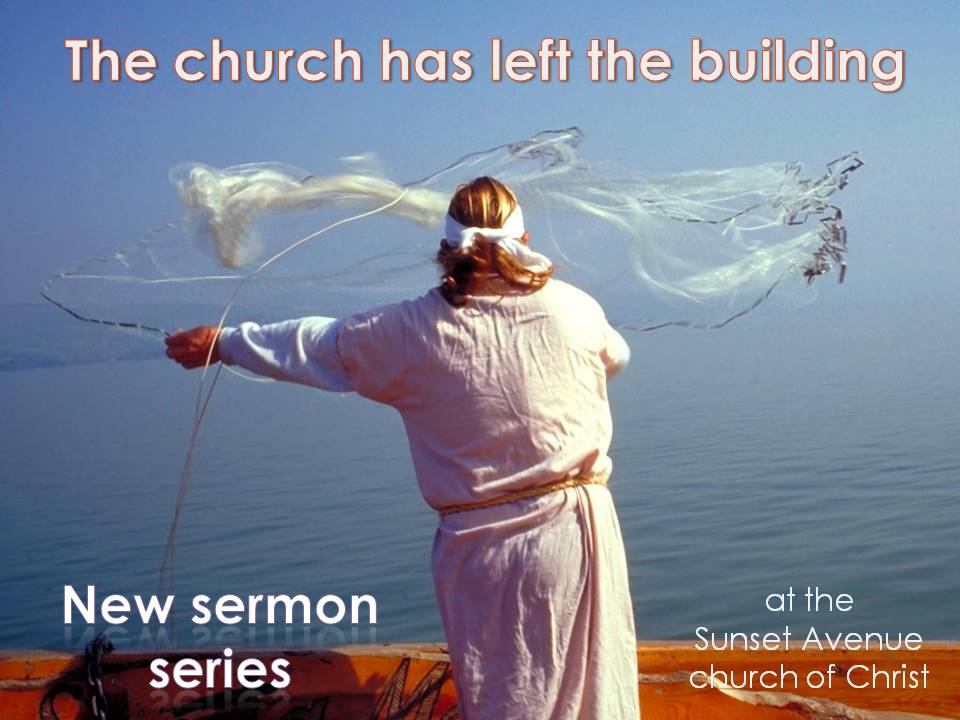
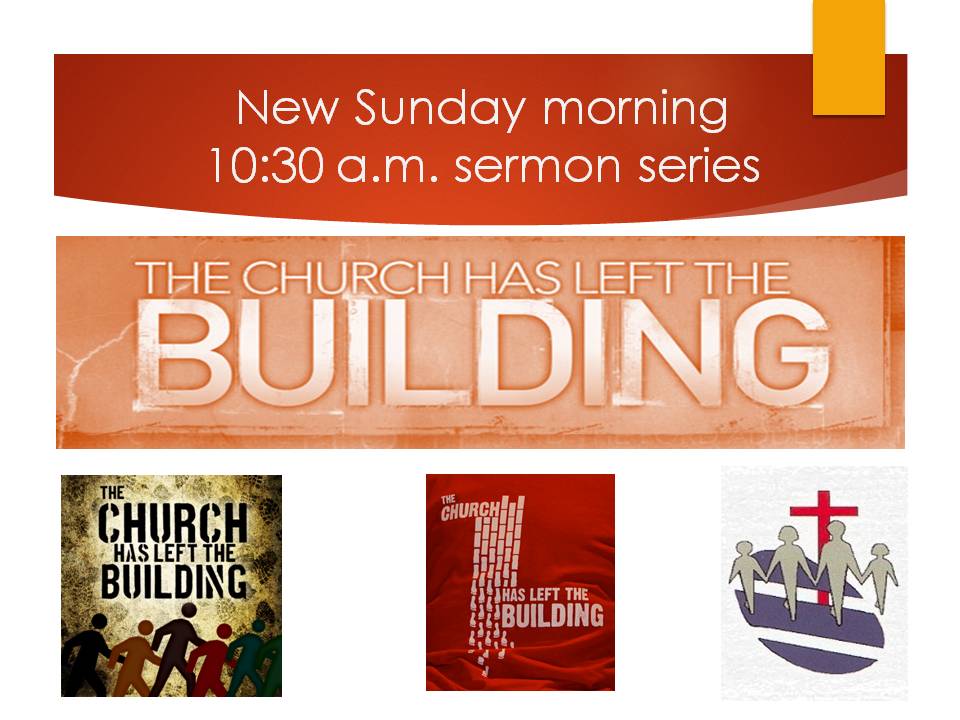
The Church has left the building

(I have begun a new sermon series. These are the powerpoint slides: The Church has left the building)

—————————————————

We begin with the story of a man who walks along a country lane one day and comes upon a lovely garden. In the middle of the garden is a strawberry patch and in the middle of that is a scarecrow.

On each outstretched arm sat a blackbird. Each had obviously been enjoying a feast in the patch. There were also birds around on the fence and in the trees, but none of them seemed to have enjoyed the sweet berries.


Why? They were frightened away by that terrible effigy standing guard in the center of the garden. An effigy, by the way, that was harmless! Two of the birds had figured it out…most had not and were missing out on the feast!

One of the best scarecrow stories you will ever hear is taught by Jesus in Matthew 25:14-30.

Picture2The story has three characters…two of them who immediately receive praise and admiration:

  • For their dedication and commitment to their master
  • For their skillful use of their talents and opportunities
  • For their return of double benefits on the day of reckoning
  • For the commendation they received “well done”  (a commendation we all hope to hear on our day of reckoning)

The third man is so different:

  • He made little or no effort, won no prize, and received no commendation
  • Instead, he lost what he had and was bound and cast into outer darkness
  • It would be difficult for Jesus Himself to find a more pathetic failure!

Why the great difference in these men? Like the story of the birds and the scarecrow, this one foolish man was robbed of his prize and reward by harmless scarecrows. He was cheated by his own groundless fears  “I was afraid.”

The scarecrow of his own thoughts of littleness and insignificance.

Did he have this attitude: “These men are far more capable than I. If I only had the talents and abilities they do, what big things I would do! “But since I have only 1 talent, there’s no use to even try.”

It’s common in many congregations for Christians to be frightened into uselessness by thoughts of their own insignificance or littleness:

“If I could only preach or teach like ______________”

“If I could only lead a class like _________________”

“If I could only lead singing like _________; what great things I would do for the Lord.  BUT since I’m not talented like they are, there doesn’t seem to be much I can do.”

On the day of judgment we won’t be judged by the numbers of accomplishments, but rather by our faithfulness in using what we’ve received.

God will not judge us as to what we would have done IF we had 5 or 10 talents, but “what did you do with what you had?”

(Romans 12:1-11)  “Therefore, I urge you, brothers, in view of God’s mercy, to offer your bodies as living sacrifices, holy and pleasing to God–this is your spiritual act of worship. {2} Do not conform any longer to the pattern of this world, but be transformed by the renewing of your mind. Then you will be able to test and approve what God’s will is–his good, pleasing and perfect will. {3} For by the grace given me I say to every one of you: Do not think of yourself more highly than you ought, but rather think of yourself with sober judgment, in accordance with the measure of faith God has given you. {4} Just as each of us has one body with many members, and these members do not all have the same function, {5} so in Christ we who are many form one body, and each member belongs to all the others. {6} We have different gifts, according to the grace given us.  If a man’s gift is prophesying, let him use it in proportion to his faith. {7} If it is serving, let him serve; if it is teaching, let him teach; {8} if it is encouraging, let him encourage; if it is contributing to the needs of others, let him give generously; if it is leadership, let him govern diligently; if it is showing mercy, let him do it cheerfully. {9} Love must be sincere. Hate what is evil; cling to what is good. {10} Be devoted to one another in brotherly love. Honor one another above yourselves. {11} Never be lacking in zeal, but keep your spiritual fervor, serving the Lord.”

If a man is centered upon himself, the smallest risk is too great for him, because both success and failure can destroy him.  If he is centered upon God, then no risk is too great, because success is already guaranteed–the successful union of creator and creature, beside which everything else is meaningless.

Picture1The scarecrow that kept him from the garden of plenty – unfavorable circumstances.

The man just knew that if he lived somewhere else the market would have been better… another time…another place…difference circumstances….but since he lived where he was and when it was, the circumstances for serving his master were just all wrong.

There are some who have heard the gospel for many years…and always intend to become a Christian someday. It’s always tomorrow, some time, some where….but the circumstances are just right NOW!

The third scarecrow was mistrust of His Lord.

We hear him say that his Master is a hard man (vs. 24). It’s another way of saying “Master, you’re not fair, you’re not just.”

Some look at Christ this way. They fear the task He will set for them is too great.

The fourth scarecrow: the possibility of failure.

Failure is one thing that can be achieved without effort. Failure is not stumbling and falling.  It’s staying on the floor. Failure should be our teacher, not our undertaker.

He was afraid to try anything on behalf of His Master for fear of failure. The possibility of failure didn’t keep us from learning to ride a bike, roller skate, from trying golf, or tennis, or cooking, or sewing, did it?

To achieve anything worthwhile, we have to risk the possibility of making some mistakes. To be so afraid that we refuse to try at all is to have the supreme eternal failure.

Failure doesn’t mean you are a failure — it does mean you haven’t succeeded yet.

Failure doesn’t mean you have accomplished nothing — it does mean you have learned something.

Failure doesn’t mean you have been a fool — it does mean you had a lot of faith.

Failure doesn’t mean you’ve been disgraced — it does mean you were willing to try.

Failure doesn’t mean you don’t have it — it does mean you have to do something in a different way.

Failure doesn’t mean you are inferior — it does mean you are not perfect.

Failure doesn’t mean you’ve wasted your life — it does mean you have a reason to start fresh.

Failure doesn’t mean you should give up — it does mean you must try harder.

Failure doesn’t mean you’ll never make it — it does mean it will take a little longer.

Failure doesn’t mean God has abandoned you — it does mean God has a better idea!

Failure has been correctly identified as the line of least persistence, whereas success is often a question of simply sticking to the job and working and believing while you are sticking.  If a particular job is harder than you might wish, just remember you can’t sharpen a razor on a piece of velvet and you can’t sharpen a man by spoon feeding him.

Failure is never pleasant.  It certainly isn’t enjoyable to lose a job, see a relationship falter, or fail a test.  But the immediate disappointment we feel when we face defeat can be turned into the joy of success if we take the right attitude. Thomas Edison was busy working in his laboratory at 2 o’clock one morning when an assistant came into the room and noticed that the inventor was smiling broadly.  “Have you solved the problem?” he asked.  “No,” replied Edison, “that experiment didn’t work at all. Now I can start over again.”  Edison could

have such a confident attitude because he knew that the road to success is often paved with disappointments that serve to extend the road — not to block it. Each failure brought him a little closer to success.

How did the 4 scarecrows rob the man?

  1. They robbed him of usefulness. He ended up doing nothing because he was frozen by fear into total uselessness.
  2. They robbed him of the joy of service to His Master and fellowman.
  3. They robbed him of any growth through experience.
  4. They robbed him of that which he did possess.
  5. He lost his destiny.

We have scarecrows in our own lives; what is to be done about our scarecrows?

Make use of them. If a bird had good sense he would soar high and search far and wide looking for scarecrows. Seeing a scarecrow is like hearing a dinner bell, or having an invitation to a banquet. Have you ever seen scarecrows in untilled fields, or in deserts?

If a thing seems hard, or causes us fear or apprehension, that’s one indication of its desirability. Those things which cause effort, sweat, struggle, and tears also usually bring a reward worth treasuring and keeping.

But the minute we decide to do something worthwhile, that will count for something…the devil is going to throw up various scarecrows to try to frighten us away from God’s bountiful garden.

When we hear Christ speak of “taking up the cross” and “deny yourself,” the devil wants us to see these matters as frightening effigies…a way of life full of hardships, void of fun and pleasure.

In reality, one who has tried these things and understands what the Lord means by them realizes they are guideposts to real, abundant, fulfilling life!

Defy them. The scarecrow lead the blackbirds to the strawberry patch! How foolish for them not to claim them.

Ever taught a children’s class? Willing to be a helper? Greeted visitors at the door? Maybe the devil is throwing up scarecrows. The thing to do is to face up to your fears…go on in spite of them and win the victory! It takes courage to become a Christian…to help out in a class … to visit a shut-in monthly…IT TAKES NO COURAGE at all to deny Christ.

Realize scarecrows are harmless!

They can’t hurt us! They only frighten us. Fear of rejection, ridicule, criticism…these things can’t harm us unless we let them.

It is not the critic who counts; not the man who points out how the strong man stumbles, or where the doer of deeds could have done them better. The credit belongs to the man who is actually in the arena, whose face is marred by dust and sweat and blood; who strives valiantly; who errs, and comes short again and again, because there is not effort without error and shortcoming; but who does actually strive to do the deeds; who knows the great enthusiasms, the great devotions; who spends himself in a worthy cause; who at best knows in the end the triumphs of high achievement and who at the worst, if he fails, at least fails while daring greatly, so that his place shall never be with those cold and timid souls who know neither victory nor defeat.

 
Leave a comment

Posted by on August 3, 2014 in Sermon


Prequisites in determining God’s will for our life


 Facebook    YouTube 

 ——————————————–

(I was blessed to speak to a great group of campers and adults at Yosemite Bible Camp. This is some of the material collected from a variety of sources that did not make it into my talk with them)

We have seen that the whole matter of God’s will centers around a relationship rather than a program or a technique. The character and quality of this relationship, then, is the key to how sensitive and responsive we will be to His guidance. The five C’s of conversion, commitment, confession, concern, and compliance are prerequisites to guidance, because they are facets of our relationship with God.

CONVERSION Our relationship with God begins when we become His children by trusting in Jesus. “But as many as received Him, to them He gave the right to become children of God even to those who believe in His name, who were born not of blood, nor of the will of the flesh, nor of the will of man, but of God” (John 1:12-13). Until this happens, we do not know God, we cannot please Him (Romans 8:8), and we cannot understand or do His will.

COMMITMENT After becoming a child of God, each Christian must come to the point where he places himself on the altar before God in an act of total commitment. “I urge you therefore, brethren, by the mercies of God, to present your bodies a living and holy sacrifice, acceptable to God, which is your spiritual service of worship” (Romans 12:1).

Without this declaration of God’s complete ownership, our relationship with Him will be compromising and mediocre. Since a living sacrifice tends to crawl off the altar, this initial act of commitment can only be worked out in our lives as it becomes an ongoing process of daily submission to His will. This involves a gradual movement from a worldly to a biblical mind-set as our relationship with God continues to deepen: “And do not be conformed to this world, but be transformed by the renewing of your mind, that you may prove what the will of God is, that which is good and acceptable and perfect” (Romans 12:2).

This all-out commitment and humble dependence upon God is the basis for what the wisdom literature of the Old Testament calls “the fear of the Lord.” When a person pursues this kind of relationship with Him, discernment and direction are natural byproducts. “Who is the man who fears the Lord? He will instruct him in the way he should choose” (Psalm 25:12). “The secret of the Lord is for those who fear Him, and He will make them know His covenant” (Psalm 25:14).

CONFESSION Our fellowship with God is hindered by unconfessed sin. Before the Lord we must openly acknowledge any known sins in our lives (1 John 1:9) and ask Him to illuminate areas we have overlooked (Psalm 139:23-24) so that we will continue to walk in the light. “If we say that we have fellowship with Him and yet walk in the darkness, we lie and do not practice the truth; but if we walk in the light as He Himself is in the light, we have fellowship with one another, and the blood of Jesus His Son cleanses us from all sin” (1 John 1:6-7).

CONCERN An obvious yet sometimes overlooked prerequisite to guidance is a genuine concern on our part to know God’s desires for our lives. We must decidedly want to know His will (John 7:17). At the time of His greatest trial, our Lord cried out, “yet not as I will, but as You will,” and again, “Your will be done” (Matthew 26:39, 42). An attitude of indifference will inhibit our knowledge of God’s will. “So then do not be foolish, but understand what the will of the Lord is” (Ephesians 5:17). Are we merely curious, or do we really want to know what God wants for us?

COMPLIANCE There is little point in pursuing God’s will if we are not willing to comply with it. This begins with obedience in the things He has already made known to us. How can we expect more light if we have not responded to the light we have been given? God’s guidance ceases when it is unaccompanied by our acceptance. Therefore, if we are serious about knowing and doing the will of the Lord, we should examine our lives to see if we are disobeying in areas He has already made clear. Second, we must be willing to comply not only with what God has already shown us, but also with whatever He will show us. An attitude of availability in advance is crucial, because it is the true measure of the degree to which we really trust God as a person.

God’s will for us is “good and acceptable and perfect” (Romans 12:2), but just as the serpent deceived the woman in the garden into thinking otherwise, we too will be tempted to think otherwise. Our natural tendency is to believe that our own plans are in our best interest, and that anything else is a threat to our happiness. This is why so many people limit their availability to God through multiple choice prayers. Instead of giving Him the whole deck, they offer up a small hand of cards (with one or two sticking out prominently) and tell Him, “Pick a card–any card.” This is like the woman who threw a stick in the air to tell her which way to go when she reached a crossroads. After throwing it several times, she was asked why. She quickly replied, “Every time I throw it, the stick points to the road to the left, and I want to take the road to the right–it looks smoother.” So she kept throwing it until it pointed in the desired direction.

When we hold back from giving God an unqualified yes to whatever He may choose for us in the future, we are really questioning whether His character is loving and good. We somehow get the idea that we must make a choice between the misery of God’s will or the happiness of our own. As Paul Little wrote, “So many of us see God as a kind of celestial Scrooge who peers over the balcony of heaven trying to find anybody who is enjoying life. And when he spots a happy person, he yells, ‘Now cut that out!’ That concept of God should make us shudder because it’s blasphemous!”

God is not some cosmic kill-joy who delights in taking advantage of people who are foolish enough to submit their wills to His. The one who loved us enough to sacrifice His Son to save us when we were His enemies (Romans 5:8-10) is certainly worthy of our trust now that we are His children. “He who did not spare His own Son, but delivered Him up for us all, how will He not also with Him freely give us all things?” (Romans 8:32).

We don’t need to “surrender to God’s will” as though we were resigning ourselves to a somber and joyless existence. Instead, we can say with David, “I delight to do Your will, O my God” (Psalm 40:8), knowing that He loves us enough to desire a destiny for us that is beyond our highest hopes. God is causing “all things to work together for good” (Romans 8:28) in the lives of His children, even though the things that happen sometimes do not seem best at the moment (e.g., Joseph and Job).

C. S. Lewis used the illustration of a dog whose leash got hopelessly wrapped around a pole. As the dog pulled to get free, the owner found it necessary to move it in precisely the opposite direction to liberate it from the pole. We are often like that dog, but our heavenly Master loves us and knows what is best for us. The path of our ultimate liberation will sometimes be painful, but we can delight in His will, knowing the glorious destiny that lies ahead of us. Principles for Guidance The set of principles that follows can assist us in the process of making tough decisions, but remember that they are not step-by-step formulas.

COMMUNICATION: WHAT DO THE SCRIPTURES SAY? If we want to know and experience God’s direction, we must communicate with Him through prayer and Scripture. Many Christians are concerned about knowing the will of God, but how many spend even five minutes a day asking God for His wisdom and direction? Prayer should envelop the whole process of guidance. Communication with God also involves a regular time of reading the Bible with an open heart and mind to hear God’s Word for our lives. The Bible is the central revelation for all believers, and its precepts and principles clearly give us the answers to most questions about the will of God in decision-making situations. The Scriptures were provided not only to teach us the way of salvation, but also to guide us in the way we should live after becoming God’s children. “Thy word is a lamp to my feet, and a light to my path” (Psalm 119:105).

God designed His Word to equip us to accomplish “every good work” (2 Timothy 3:16-17), that is, to fulfill His purposes for our lives. God clearly reveals His moral will in the positive and negative commands of the Bible, and these precepts by themselves can guide us through the majority of the decisions we will ever make. In addition, the Bible offers a multitude of general principles that can be effectively applied to very specific circumstances. There is no need for us to seek guidance in areas that have been expressly commanded or forbidden in Scripture. A believer does not need to wrestle, for example, over whether to marry an unbeliever, since the answer is already in the Bible. We can be sure that God will never lead us to do anything that is contrary to His Word.

Since the Bible is our primary source of guidance, we owe it to ourselves to become so familiar with its contents that its precepts and principles become ingrained in our patterns of thought. This process of renewing our minds with the Word takes time and effort, but there is no other way to “prove what the will of God is, that which is good and acceptable and perfect” (Romans 12:2). If we do not program our minds on a daily basis with Scripture, we will find our minds programmed by default with the temporal value system of the world, and our lives will soon reflect those values. Inner renewal is the prerequisite to outer transformation.

As we seek to renew our minds with the commandments and counsel of God’s revealed Word, we must approach it with a resolve to do whatever it says, even if it goes against our wishes. Content without conviction will do us little good, because it is always possible to distort the Scriptures to match the shape of selfish desires. We will avoid self-deception only to the extent that we are willing and open to respond to God’s light. While the Bible is our primary guide to what God wants us to be and to do, our Lord has providentially seen fit to supplement the Scriptures in a number of personal ways. There are several secondary factors that can be useful in discerning God’s direction in specific situations, and the first of these is conscience.

CONSCIENCE: HOW DOES THIS DECISION AFFECT MY LOVE FOR GOD AND OTHERS? This is the ethical dimension of decision making; an option may appear to be sound on the intellectual level, but it may be unsound on the moral level. We cannot avoid the matrix of personal relationships in the decisions we make. Paul stressed the importance of living with a clear conscience: “I also do my best to maintain always a blameless conscience both before God and before men (Acts 24:16; also see Acts 23:1; 1 Timothy 1:5; 2 Timothy 1:3). God has implanted within us an intuitive sense of right and wrong. As we grow in Him, our conscience becomes more sensitive, more attuned to His desires. When we reject the input of our conscience, the proper response is to confess it (1 John 1:9), not to cover it. A failure to respond in this way will place us under a burden of guilt and take the joy out of our lives. Even worse, we can sear our conscience (1 Timothy 4:2) and become callused by repeatedly rejecting its warnings.

COMMON SENSE: DOES THIS DECISION REFLECT GOOD JUDGMENT? A Christian may be committed to the Lord, willing to comply with wherever God leads him, communicating with Him in prayer and in the Word, and enjoying a clear conscience. Even so, he still may not know which option to choose in a specific situation. It is within this framework that common sense should play an important role in the choices we make (outside this framework, common sense may simply feed the me-first mentality). God was not erratic or capricious in the way He designed the universe, and He is not haphazard in His design for the lives of His children. He gave us minds and He wants us to use them to evaluate the consequences of our actions. The Scriptures tell us to “think so as to have sound judgment” (Romans 8:3). We should be level-headed and not rash in the way we evaluate our gifts and opportunities. Paul, for example, stayed where there were open doors (Ephesus) and left when his life was threatened. However, common sense has its limitations and it should never be our only criterion for discerning God’s guidance. There are times when He leads people do things that are contrary to our concept of good judgment. We are often too nearsighted to see the goal He has in mind. Because we see such a small part of the puzzle, we should always be willing to submit our thoughts and plans to His. “The mind of man plans his way, but the Lord directs his steps” (Proverbs 16:9). “For as the heavens are higher than the earth, so are My ways higher than your ways, and My thoughts than your thoughts” (Isaiah 55:9).

CIRCUMSTANCES: HOW DOES MY STATE OF AFFAIRS RELATE TO THIS DECISION? God, who “works all things after the counsel of His will” (Ephesians 1:11), is in sovereign control of the circumstances of our lives. He causes “all things to work together for good” to those who love Him and are called according to His purpose (Romans 8:28). Notice the word “together.” In isolation, some of the things that happen to us may not seem so beneficial, but God uses them in combination for our good. Similarly, He does not allow our circumstances and temptations to overwhelm us without offering us the grace to endure (2 Corinthians 10:13). Because of His providential care and involvement in the details of our lives, we should be sensitive to the situations in which we find ourselves. Factors like finances, aptitude, education, experience, family, spiritual gifts, and occupation all play a part in God’s direction. For instance, if a Christian who is considering a job possibility realizes that her ability, education, and experience do not at all match the qualifications, she should be very hesitant to take another step even if the job opens up. God often works by opening and closing doors as we come to them, but we should be careful not to make this our primary means of guidance. Just because a door is open does not mean that we should go through it. The “throwing out the fleece” approach is rarely valid. It is easy to misread circumstances and interpret them in ways that flatter our preconceived plans. This is like the farmer who wanted to be an evangelist. When he saw a cloud formation that looked like “PC,” he took it to mean “Preach Christ” and left his farm, never thinking that it could also have been interpreted as “Plant Corn.”

COUNSEL: WHAT DO WISE AND GODLY FRIENDS SAY ABOUT THIS DECISION? “Where there is no guidance, the people fall, but in abundance of counselors there is victory” (Proverbs 11:14). “The way of a fool is right in his own eyes, but a wise man is he who listens to counsel” (Proverbs 12:15). “Without consultation, plans are frustrated, but with many counselors they succeed” (Proverbs 15:22). The Bible is full of examples of people who profited by heeding wise counsel and of people who suffered by ignoring it. We are called to exercise wisdom in “teaching and admonishing one another” (Colossians 3:16), and wise counsel involves both. If a decision has significant implications, we should not limit ourselves to our own judgment, but we should also seek the perspective of mature and godly people who have wisdom and experience. Good counsel is both instructive and corrective, and requires frankness, not flattery. Remember, however, that the counsel available in the precepts and principles of Scripture must always be the first and foremost influence in the choices we make. Even the wisest of people are finite and biased, and we must avoid the pitfall of uncritically accepting the advice we receive as if it were a word from the Lord. Ultimately, we alone are responsible for the decisions we make.

COMPULSION: WHAT ARE MY OWN DESIRES? In Romans 8:14 Paul wrote that “all who are being led by the Spirit of God, these are sons of God.” In Philippians 2:13, he said that “it is God who is at work in you, both to will and to workfor His good pleasure.” One of the ways God works in us is to give us the desire to do the things that are pleasing to Him. A compelling desire to move in a specific direction or a burden to minister to certain people may be coming directly from God as a means of guidance. But we should bear in mind that God never gives us desires that are contrary to the commandments and counsel of His Word. Burdens and desires can be a significant input in our decisions as long as they are evaluated in the larger context of communication (prayer and Scripture), conscience, common sense, circumstances, and counsel. Otherwise, we may become victims of desires and inclinations that are not from God.

CONTENTMENT AND CONFIRMATION: DO I HAVE A SENSE OF PEACE AND ASSURANCE ABOUT THIS DECISION? Philippians 4:6-7 tells us that we are to turn our anxieties into peace by offering our problems and needs up to the Lord. God wants us to let the peace of Christ rule in our hearts (Colossians 3:15). If a decision gives us a sense of doubt, distress, or confusion, something is wrong because it is not accompanied by the peace of God. Paul, for example, had an open door for ministry in Troas, but because he had no rest in his spirit, he went instead to Macedonia (2 Corinthians 2:12-13). By itself, peace is a supplemental, not a sufficient principle of guidance. But if a particular option passes the test of the other principles and fails to provide peace, the wisest course of action is to wait on the Lord (if the decision can be deferred) and allow Him to provide further input. The option may be right, but the timing may be wrong.

 
Leave a comment

Posted by on August 1, 2014 in Article


Differences between a college football fan and some church members


By Thom Rainer

Warning: The article below is a bit of sarcastic humor. I am speaking in hyperbole to make a point. The football fan noted represents a very rabid football fan. The church member represents some, but certainly not all, church members.

Disclosure: I tend to be a rabid college football fan. I see my allegiance as an area of devotion that needs significant adjustments downwardly. So I don’t necessarily practice what I preach. For example, even as I type these words, I am reminded that the kickoff for my team’s first game of the season is exactly five weeks from today. [July 26th, 2014]

Caution: While I do write these comparisons with some humor and a lot of hyperbole, you might get just a bit uncomfortable reading them. That may indicate there is some truth in each of them.

1.  A college football fan loves to win. The typical church member never wins someone to Christ.

2. A college football fan gets excited if a game goes into overtime. A church member gets mad if the minister preaches one minute past the allocated time.

3.  A college football fan is loyal to his or her team no matter what. A church member stops attending if things are not going well.

4.  A college football fan is easily recognized by his or her sportswear, bumper stickers, and team flags. Many church members cannot even be recognized as Christians by people with whom they associate.

5.  A college football fan pays huge dollars for tickets, travel, and refreshments for games. A church member may or may not give to his or her church.

6.  A college football fan reads about his or her football team every day. A church member rarely reads the Bible once in the course of a week.

7.  A college football fan attends the game no matter how bad the weather is. A church member stays home if there is a 20 percent chance of rain.

8.  A college football fan invites others to watch the game every week. A church member rarely invites someone to church.

9.  A college football fan is known for his or her passion for the football team. A church member is rarely known for his or her passion for the gospel.

10. A college football fan will adjust gladly to changes in kickoff time. A church member gets mad if his or her service time is changed by just a few minutes.

11. A college football fan is loyal even if he or she never gets to meet the coach. A church member gets mad if the minister does not visit for every possible occasion.

Yes, I admit I do enjoy college football. But I really love Christ’s churches even more. I need to demonstrate that reality more readily. Do you?

So . . . what would you add to my somewhat sarcastic list? Do you see the humor? Do you see some truth?

 
Leave a comment

Posted by on July 31, 2014 in Sermon


New studies beginning August 3


Facebook    YouTube 

 ——————————————–

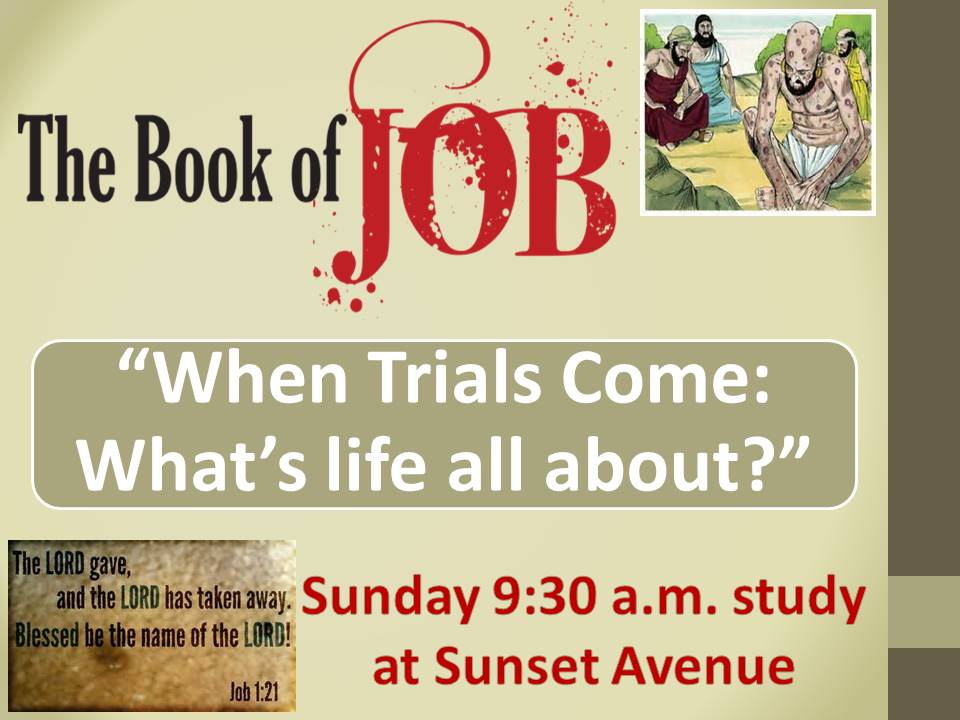
The book of Job When Trials Come 2  

There are many question words in any language. In English, most of the question words begin with WH: “What,” “When,” “Where,” Who,” and “How.” Much knowledge is gained by asking these questions. However, the question that troubles us the most is the one that I did not mention: “WHY.” This is the one we ask each other more often than any of the other questions. We want to know the reason behind every event under the sun and rhyme for everything that happens. Why did you forget our anniversary? Why were you not present at our junior’s baseball game? Why did you go there? Why did you do this, and why did you not do that?

But all these WHY questions pale when compared to the “WHY” question that we are sometimes forced to ask God.

Imagine, for example, you have three sons. Of course, you love them all. But the youngest is the most cherished one. It is the hardest to let him go. He leaves home after high school for college. He is just about done with college – one more year to go. He calls you to tell you that he will be coming home for Thanksgiving. You are eagerly waiting for the time when he will be home. Just a week or so before he comes home, you get a phone call from his roommate. Your son had a motorcycle accident . . . . He was killed. What kind of parents would you be if you did not raise your fist before God and ask “WHY? Why did You let this happen?”

The age-old question that man has raised is this: why would an all powerful and loving God allow such things? An atheist, of course, would have a ready answer: “There is no God. If there was a God, certainly He would not allow such things.” In anything and everything, an atheist finds proof for denying the existence of God because “

The Church has left the building

Most churches have invested big money in facilities that are attractive and functional.  While a church building is a great tool, we have to keep in mind that God’s mission for the world is much bigger than being nice people inside a beautiful facility.

God has a mission for the world.  It includes the things we do at the church building, but it is bigger because he is Lord of all creation.  “All things were created by him and for him.  He is before all things, and in him all things hold together.  And he is the head of the body, the church” (Col. 1:16-18). 

The church exists to serve the mission of God, and he draws us out of the church building into the world he loves.  Church buildings, like money, are a wonderful servant but a terrible master.  This series calls us to lift our eyes from the concerns of day-to-day church life to reflect on God’s grand scheme for all of creation.


Leave a comment

Posted by on July 31, 2014 in Article, Church, Encouragement


Solving Our Temperament Problems: The problem with pride


Facebook    YouTube 

 ——————————————–

James 4:6: “But He gives a greater grace. Therefore it says, “GOD IS OPPOSED TO THE PROUD, BUT GIVES GRACE TO THE HUMBLE.””

Men want and need to feel good about themselves. What could be more natural and more beneficial
than to feel good about yourself—to have a good self-image? But when does being proud of our position or accomplishments become a sin? Is anything wrong when our chest swells in pride at the home run our son hits?

Pride is a sin of comparison in which we compare our strengths to the other fellow’s weaknesses. In order to make ourselves feel better we put other people down, sometimes verbally and sometimes just mentally. The easiest way to look down on others is to pick out people of less stature and accomplishment. And it’s particularly easy to pick out other people’s weaknesses to compare to our strengths.

The subtle sin of pride beguiles every Christian man. The most invisible of sins, pride seeps into the Christian life like water oozes into the moat around a sand castle on the beach. It requires no effort on our part to get, but all of the strength to keep out.

The Bible talks of two kinds of pride. The first is found in Galatians 6:4:  “But let each one examine his own work, and then he will have reason for boasting in regard to himself alone, and not in regard to another.”

The key to this proper type of pride is to not compare ourselves to others. Rather than testing our self-worth by comparison to others, we are encouraged to self-examination. The Bible stands as the yardstick we measure ourselves against. And when we score well, we congratulate ourselves, but not at the expense of someone else.

The second kind of pride is the one that has a superiority feeling. C.S. Lewis put it this way: “A proud man is always looking down on things and people; and, of course, as long as you’re looking down, you can’t see something that’s above you.”


Jesus tells a parable to just such people, men “who were confident of their own righteousness and looked down on everybody else” (Luke 18:9). A religious leader prayed to God and thanked Him that he was not like all other men – robbers, evildoers, adulterers, and a nearby tax collector, but that he was a good man. And remember who went away justified by God?

Why didn’t he compare himself to Moses, Abraham, or King David? We pick out the weaknesses in others because pride is a sin of comparison in which I compare my strengths to another man’s weaknesses.

What is the answer? Humility! It is described in Romans 12:3: “For through the grace given to me I say to every man among you not to think more highly of himself than he ought to think; but to think so as to have sound judgment, as God has allotted to each a measure of faith.”

A cliché puts it this way: “Humility is not thinking little of yourself, rather it’s simply not thinking of yourself.”

The problem of fear

What are you afraid of? Do you have the job jitters—you think a pink slip may be in a wind? Maybe you work under the constant tension of a boss who seeks to govern via intimidation. Some men sense no direction for their lives, and they fear God has abandoned them. Some fear an uncertain future. Some do not have an assurance that when they die they will be in the presence of God.

Fear ad courage are opposites. Courage is defined as the state of mind that enables one to face hardship or disaster with confidence and resolution. Fear is the agitated state of mind that cripples us from looking any further than the hardship itself.

The Bible repeatedly encourages us not to be afraid: Matthew 14:27:  “But immediately Jesus spoke to them, saying, “Take courage, it is I; do not be afraid.””

2 Timothy 1:7: “For God has not given us a spirit of timidity, but of power and love and discipline.”

1 John 4:18: “There is no fear in love; but perfect love casts out fear, because fear involves punishment, and the one who fears is not perfected in love.”

1 Peter 5:7:  “…casting all your anxiety upon Him, because He cares for you.”

To be afraid is to not fully trust God. He instructs us not to be afraid., promising that if we cast our anxiety upon Him, He will take care of us. The Bible promises that if we trust God with our lives He will meet all of our needs and direct all of our paths.


What do we need in order to fully trust God? Faith! Faith is always oriented toward the future…we don’t need courage to face what we already know. It is an uncertain future that gives birth to doubts and fears.  An old saying sums it up: “We don’t know what the future holds, but we know who holds the future.”

The following cycle of fear is suggested from the story of Jesus and Peter (Matthew 14):

  1. Reality: We see the wind
  2. Response: We become afraid
  3. Result: We begin to sink
  4. Return: “Lord, save me!”
  5. Recovery: Jesus reaches out His hand.

Proverbs 29:25:  “The fear of man brings a snare, But he who trusts in the LORD will be exalted.”

Romans 8:28:  “And we know that God causes all things to work together for good to those who love God, to those who are called according to His purpose.”

The Desire to be Independent

William Ernest Henley: “I am the master of my fate; I am the captain of my soul.”

Jeremiah 10:23: “I know, O Lord, that a man’s life is not his own; it is not for man to direct his steps.”

We are raised to be independent. From their earliest homilies, mom and dad taught us to be independent with our lives and to make our own place. Most men are taught to pull themselves up by their own bootstraps. “Life is what you make of it!” we’re told.

We learn early that we can author our own destiny; we can be the captain of our soul, the master of our own fate–or so it seems.

Men want to control their own lives. Even if we were not taught to seek independence, which most of us were, our own human nature would pull us in that direction. We want the freedom to chart our own course. We want the power to shape the events of our lives. These are the hallmarks of our desire to be independent. But, in our effort to be self-reliant, we often break ranks with God and go our own independent way.

There is an abrupt difference between taking responsibility for our lives and trying to live independently from God. We are to take responsibility for our lives–no one will go to work in our place, no one will pay our bills on our behalf. The difference is this: Responsibility recognizes our part and God’s part. Our part is to trust God and faithfully fulfill our duties. God’s part is to provide for all of our needs and well-being. Independence rebels against the influence of God, thinking it can meet its own needs.

The independent man thinks, “I want to do what I want to do, when I want to do it, wherever I want to do it, with whomever I want to do it. I want to be in control. I want to satisfy my ambitions. I don’t want to be dependent on anyone. People let me down. God will let me down. I can make it on my own.

“If I can be independent then I will not need to rely upon anyone else. I will not have to trust anyone else, and I will be able to avoid the pain of being disappointed and disillusioned. If I can be independent then I can be in control of my own life. I will have the power, whether through money or influence, to get my own way; I will have the freedom to come and go as I please.”

This desire to be independent, more often than not, disguises itself. By all external appearances our mate and friends think we are on the right track, but we often practice a passive sort of self-reliance. Not open rebellion, but we don’t really seek the counsel of God and often shun His advice–we do our own thing.

The opposite of desiring to be independent from God is to trust Him. The man who does not trust God trusts in himself and the philosophies of this world, which is the epitome of indepenence!


Leave a comment

Posted by on July 30, 2014 in Article


Solving Our Time Problems


Facebook    YouTube 

——————————————–

The problem of time management shows up as the number one problem men are concerned about in many surveys conducted..we usually just can’t find enough time to accomplish all the things we should do and would like to do. But we have the same number of minutes in a day that others have, don’t we? So it can’t be minutes or days.

Effective Time Management Tips for College StudentsThe problem is less a ‘tips and techniques’ problem than it is a strategic problem. It’s as clear as understanding God’s purpose for our life, living by Biblical priorities, and making plans which reflect God’s will for our lives. God always provides enough time to accomplish His plans! Effectiveness is doing the right job right!

Some steps which can help us:

  • I tell God what I am going to do
  • God responds
  • I beg God to let me do it anyway
  • I humble myself and listen
  • God makes it clear what He is going to do.

 (Prov 16:1)  “The plans of the heart belong to man, But the answer of the tongue is from the LORD.”

(Prov 16:3-4)  “Commit your works to the LORD, And your plans will be established. {4} The LORD has made everything for its own purpose, Even the wicked for the day of evil.”

(Prov 19:21)  “Many are the plans in a man’s heart, But the counsel of the LORD, it will stand.”


Leave a comment

Posted by on July 30, 2014 in Article