RSS

 “Spending time with Jesus: #29 The Teacher’s Tears – John 11:28-37


Several years ago a young couple wanted to talk with their minister after the morning service. They had moved  in from out of state because the wife had landed a good job. But after a short time on the job, she was terminated, from her perspective, without cause. She was angry and bitter towards God because they thought that they had followed Him in moving here. Now they were without work and without funds to move back home.

The minister shared with them that the Lord was in control of their difficult situation and that He had many lessons to teach them if they would trust Him. The husband had a good attitude and seemed teachable, but the wife wouldn’t listen. She kept insisting that God had let them down. Later the husband came for further counsel because she angrily left him to return to their former location.

That woman was a sad example of how we as Christians should not respond when sudden trials come into our lives. The Bible gives us another option: Rather than growing angry and withdrawing from the Lord, we can draw near to Him in submission to His sovereign hand, knowing that He cares for us.

It’s okay to draw near to Him with tears of grief and confusion. The main thing is to draw near with a sub-missive heart, trusting in His sovereign love and care for you.

Mary, the sister of Martha, did that when Jesus came to Bethany after the death of their brother, Lazarus. Martha first went to the Lord as He came into their village, but Mary stayed in the house. Then after her interview with Jesus, Martha came and whispered to Mary (11:28), “The Teacher is here and is calling for you.”

Mary did not say, “I’m too angry right now even to talk to Him!” Rather, she did what we should do in our times of trouble: She got up quickly and went to Jesus (11:29). She fell at His feet weeping and repeated what Martha had said (11:32), “Lord, if You had been here, my brother would not have died.”

The significant thing is that Jesus did not rebuke her for her tears or her lack of faith. Rather, we read in the shortest verse in the English Bible (11:35), “Jesus wept.”

While commentators differ in interpreting Jesus’ emotions here, as I’ll explain, I believe that John wants us to see Christ’s compassion for these sisters in their loss.

This story pictures what Hebrews 4:15-16 declares, For we do not have a high priest who cannot sympathize with our weaknesses, but One who has been tempted in all things as we are, yet without sin. Therefore let us draw near with confidence to the throne of grace, so that we may receive mercy and find grace to help in time of need.

Our text teaches us that …

The call and compassion of the Teacher should cause us to draw near to Him in our trials.

In difficult times, John wants us personally to apply Martha’s words (11:28), “The Teacher is here and is calling for you.”

  1. Christ is the Teacher and He calls us to come to Him and learn from Him in our trials.
  2. We learn the most in the school of Christ when we draw near to Him in our trials.

Martha did not say, as she easily could have, “Jesus is here and is calling for you.” Rather, she calls Him, “The Teacher.” Jesus is the Teacher par excellence and His most effective lessons are often when we’re hurting the most.

We all tend to be rather self-sufficient. Many years ago there was a TV commercial (I can’t remember what it was advertising) where mother was trying to give advice to her young adult daughter and the daughter would reply in frustration, “Mother, please, I’d rather do it myself!”

We’re often like that with the Lord—we think that we can do it by ourselves, without His help.

But then trials hit and we realize the truth of Jesus’ words (John 15:5), “apart from Me you can do nothing.”

It’s at these overwhelming times that we can learn the most about Christ’s all-sufficiency, if we draw near to Him.

Anonymous poem speaks here: Until I learned to trust, I never learned to pray; And I did not learn to fully trust ’til sorrows came my way. Until I felt my weakness, His strength I never knew; Nor dreamed ’til I was stricken that He could see me through. Who deepest drinks of sorrow, drinks deepest, too, of grace; He sends the storm so He Himself can be our hiding place. His heart that seeks our highest good, knows well when things annoy; We would not long for heaven if earth held only joy.

And so, in a time of trials or grief, realize that you’re enrolled in the school of Christ and He has just given you a great opportunity to learn more about His all-sufficiency.

  1. Christ tailors His lessons for each student according to the student’s needs.

Martha was the take-charge, get things done, sister. She was the one (Luke 10:38-42) who was busy getting the meal prepared when Jesus visited their home, while her sister Mary sat at Jesus’ feet, listening to Him teach. She scolded the Lord on that occasion because He didn’t tell Mary to get up and help her. But the Lord gently rebuked Martha for being worried and bothered about so many things, while Mary had chosen the better part.

In John 11, when Martha heard that Jesus was coming, she got up and went to Him. Jesus dealt with her on a doctrinal level, claiming to be the resurrection and the life, and then challenging her (11:26), “Do you believe this?” He knew that she needed this doctrinal foundation so that she would glorify Him in this trial.

But when Mary fell at Jesus’ feet in tears, He sympathized with her and wept, without any discussion of biblical truth. He knew that she needed to feel His compassion and that she later would glorify Him because He entered into her sorrow.

Two applications: First, recognize that the Lord always deals with you according to your personality to teach you what you need to grow in every trial. All parents who have more than one child know that each child is different. You can’t deal with them in exactly the same way because they are wired differently and they learn differently. The Teacher does that with His children. He tutors you individually, in a way that you can best learn the lessons. But you need to try to understand, through prayer and the Word, “What does the Teacher want me to learn through this trial?”

Second, we should be sensitive to the unique personalities of others when we try to comfort or help them in difficult situations. Some may need a word of encouragement, whereas others don’t need any words, but just for you to be with them and cry with them. There is no “one size fits all” when it comes to helping others in their time of need. So pray for sensitivity and wisdom as you try to help.

But for us to trust Jesus as our Teacher in times of trial, we have to know Him. The more we know who He is, the easier it is to trust Him. Thus John shows us that…

  1. The Teacher who calls us to Himself is fully God and fully man; thus He can help us in our trials.

This chapter shows us both Jesus’ humanity and His deity. We see His humanity very plainly in 11:34-35, where Jesus asks the location of the tomb and then He weeps. But we see His deity earlier in the chapter, when He knows that Lazarus is dead and that He is going to raise him from the dead (11:11, 14); and when He tells Martha that He is the resurrection and the life and that whoever believes in Him will live even if he dies and will never die (11:25-26).

Many years ago, I read this paragraph by Alfred Edersheim, (The Life and Times of Jesus the Messiah [Eerdmans] 1:198), and I’ve always remembered it as I read the gospels: “It has been observed, that by the side of every humiliation connected with the Humanity of the Messiah, the glory of His Divinity was also made to shine forth. The coincidences are manifestly undesigned on the part of the Evangelic writers, and hence all the more striking. Thus, if he was born of the humble Maiden of Nazareth, an Angel announced His birth; if the Infant-Saviour was cradled in a manger, the shining host of heaven hymned His Advent. And so afterwards—if He hungered and was tempted in the wilderness, Angels ministered to Him, even as an Angel strengthened Him in the agony of the garden. If He submitted to baptism, the Voice and vision from heaven attested His Sonship; if enemies threatened, He could miraculously pass through them; if the Jews assailed, there was the Voice of God to glorify Him; if He was nailed to the cross, the sun craped his brightness, and earth quaked; if He was laid in the tomb, Angels kept its watches, and heralded His rising.”

The fact that Jesus is fully man means that He can identify and sympathize with our problems. The fact that He is fully God means that He is sovereign over and can help with them. (Of course, the God who made us completely understands us and is full of compassion towards us: Psalm 103:13-14 (ESV) As a father shows compassion to his children, so the LORD shows compassion to those who fear him. 14  For he knows our frame; he remembers that we are dust.

 But Jesus’ humanity especially qualifies Him to sympathize with us: Hebrews 4:15 (ESV)  For we do not have a high priest who is unable to sympathize with our weaknesses, but one who in every respect has been tempted as we are, yet without sin.  

Three aspects of Jesus’ humanity shine from our text (I’m drawing these headings from James Boice, John [Zondervan], one-vol. ed., pp. 749-753, who seems to be following C. H. Spurgeon, Metropolitan Tabernacle Pulpit [Pilgrim Publications], 35:338-346):

  1. Jesus experienced grief and deep feelings, just as we do.

Isaiah (53:3) prophesied that Jesus would be “a man of sorrows, and acquainted with grief.” The fact that Jesus wept at the tomb of Lazarus shows that whatever our grief may be, Jesus knows it and He enters into it with us.

But at this point, we encounter some difficult interpretive matters. The world translated “deeply moved” (11:33 & 38, NASB, ESV, NIV; “groaned, NJKV) is difficult to understand. It’s only used three other times in the New Testament and in those places it has a meaning that does not seem to fit here.

In Matthew 9:30 & Mark 1:43, it means, “strictly charged” or “sternly warned.” In Mark 14:5, it refers to the scolding of the woman (Mary) who anointed Christ with expensive ointment. The parallel (Matt. 26:8) uses a different word to say that they were indignant with her. In the LXX, the word refers to anger or being indignant (Dan. 11:30; noun in Lam. 2:6). Thus many commentators think that in John 11:33 & 38, Jesus was angry or indignant (The New Living Translation). Some think that He was indignant with the unbelief expressed by Mary and the others (11:32, 37); or He was angry with the death that God decreed because of man’s fall into sin.

But S. Lewis Johnson (sermon on this text, online at sljinstitute.net) mentions a Professor Black from the University of St. Andrews who studied this word thoroughly and concluded that it does not have the nuance of anger. And since anger does not seem to fit the context here, some argue that the word can refer to being deeply moved (as the NASB, ESV, & NIV translate it). The word was used in extra-biblical Greek to refer to the snorting of a horse preparing for battle. Calvin (Calvin’s Commentaries [Baker], p. 442) views it as Jesus gearing up for the conflict as our champion in the battle against sin and death.

One other suggestion is worth considering. F. Godet (Commentary on the Gospel of John [Zondervan], 2:184) questions why Jesus didn’t feel the same emotion towards death at the other two resurrections that He performed. He says that here Jesus realizes that raising Lazarus will precipitate the hostility of His enemies that will lead to His own death on the cross. The accompanying verb (11:33, “troubled Himself”) is also used as Jesus contemplates His impending death in John 12:27 & 13:21. Thus perhaps Jesus is deeply moved both by the sisters’ grief and by what He knows will happen after He raises Lazarus. R. H. Lightfoot (cited by Leon Morris, The Gospel According to John [Eerdmans], p. 557, n. 69) commented, “The expression used here implies that He now voluntarily and deliberately accepts and makes His own the emotion and the experience from which it is His purpose to deliver men.”

So while we cannot be certain of the exact meaning of John’s word, we can know that our Savior was not a Stoic. Even though He knew that He was going to raise Lazarus, it didn’t prevent Him from entering into the sisters’ grief. He experienced deep feelings and grief, just as we do. And even though He knows that one day He will wipe away all of our tears (Rev. 21:4) He still sympathizes with us in all of our sorrows.

  1. Jesus was not ashamed to display human emotions.

Jesus could have restrained His tears. After all, He knew that He would soon raise Lazarus. Besides, His tears could be misinterpreted as weakness or frustration on His part, as some of the Jews surmised (11:37). But Jesus did not worry about that. He was completely human (without a sin nature) and His tears show that it’s not wrong to express our feelings as long as our hearts are submissive to God. The NT states three times that Jesus wept (here; Luke 19:41, over Jerusalem’s unbelief; and Heb. 5:7, in the Garden of Gethsemane), but never that He laughed (but, see Luke 10:21).

It’s worth noting that John uses a different word (11:33) for weeping to describe the loud wailing of Mary and the mourners than the word in 11:35, which could be translated, “Jesus burst into tears.” Jesus wept, but He was not wailing in despair. In the words of Paul (1 Thess. 4:13), believers are to grieve, but not as those who have no hope. It’s interesting, also, that while the shortest verse in the English Bible is John 11:35, “Jesus wept,” the shortest verse in the Greek NT is 1 Thessalonians 5:16, “Rejoice always!” Those verses are not contradictory! As Paul put it (Rom. 12:15), “Rejoice with those who rejoice, and weep with those who weep.” Jesus entered into the sorrow of these sisters. As we become more like our Savior, we should not become more stoical, but rather people who express godly emotions.

  1. Jesus’ love underlies all His actions.

In 11:36 we read in response to Jesus’ weeping, “So the Jews were saying, ‘See how He loved him!” And they were right, because John has previously underscored Jesus’ love for Martha, Mary, and Lazarus (11:3, 5). In fact, Jesus’ love for these dear friends was the reason He stayed two days longer where He was, allowing Lazarus to die (11:6). Love always seeks the highest good for the one loved, and the highest good for anyone is that he or she gets a greater vision of God’s glory and thus grows in faith. Both of these aims were behind Jesus’ delay in going to Bethany (11:4, 15, 40).

But some of the Jews questioned both Jesus’ love and His power when they said (11:37), “Could not this man, who opened the eyes of the blind man, have kept this man also from dying?” They couldn’t reconcile Jesus’ love and power with Lazarus’ death. And in a time of severe trials, the enemy may whisper to you, “God must not love you or He isn’t able to prevent trials like you’re going through. You shouldn’t trust Him!”

But at such times, never interpret God’s love by your difficult circumstances, but rather interpret your circumstances by His love (modified from, C. H. Mackintosh, Miscellaneous Writings [Loizeaux Brothers], vol. 6, “Bethany,” pp. 17-18). He could have prevented your trial. But as H. E. Hayhoe wrote (“Sentence Sermons,” exact source unknown), “He will never allow a trial in your life without a needs be on your part and a purpose of love on His part.”

Thus, Christ is the Teacher and He calls you to come to Him and learn from Him in your trials. And, the Teacher who calls us to Himself is fully God and fully man; thus He can help us in our trials. Finally,

  1. In your trials, come to the Teacher just as you are, quickly and submissively.

Martha’s words to Mary (11:28) are the Lord’s words for us when we’re hurting: “The Teacher is here and is calling for you.”

  1. Jesus is always present and is waiting for you to come to Him in your trials.

Jesus was there, but Mary had to get up and go to Him. And even though you may not feel His presence, He is always present and available to give grace if you go to Him in your trials.

  1. Come to Jesus just as you are and share your feelings with Him.

Mary went immediately when she heard that the Teacher was there and calling for her. She didn’t say, “I’ve been crying for four days. My mascara is streaked, my eyes are red and swollen. I can’t go to Jesus like this! I need to go and make myself presentable!”

But we often do that with the Lord. We’re in the midst of a trial or problem and we think, “I can’t go to the Lord until I get myself more together. I’ll wait until I’m calmer and more in control of my emotions.” But grace is for the undeserving, not for the deserving. Go to Jesus with your tears and He will weep with you.

If you’ve never come to Christ for salvation, the only way that you can come is just as you are. If you try to clean up your life or make yourself more presentable to Him, you don’t understand His grace. As the old hymn (by Charlotte Elliott) goes,

Just as I am, without one plea, But that Thy blood was shed for me,

And that Thou bid’st me come to Thee, O Lamb of God, I come! I come.!

  1. Come to Jesus quickly.

Mary “got up quickly and was coming to Him” (11:29). She had friends at her side who were consoling her. She could have thought, “What will they think if I leave them and go to Jesus?” Or, she could have thought that their consolations were enough. But as comforting as our friends may be, they are no substitute for the Teacher who calls us to Himself. Don’t delay: Go to Jesus quickly! The sooner you go, the sooner you’ll experience His comfort and compassion.

  1. Come to Jesus’ feet.

Mary went and fell at Jesus’ feet (11:32). Every time we encounter Mary in the Gospels, she is at Jesus’ feet. In Luke 10:39, she was “seated at The Lord’s feet, listening to His word.” In our text, she pours out her grief at Jesus’ feet. In John 12:3, she anointed Jesus’ feet with the expensive ointment and dried them with her hair, as she prepared Him for His burial. In this, she is an example for us: First, learn God’s word about Jesus. Then you’ll know Him so that you can take your sorrows to Him in a time of grief. That will lead you to worship Him as the one who died for your sins.

Conclusion

A mission executive from the United States was visiting a school in Kenya where he was listening as teenage girls shared how they had been blessed by hearing the Bible in their own language. One girl testified that the verse that had the greatest impact on her was Matthew 5:4, “Blessed are those who mourn, for they will be comforted.”

Another said that the verse that had the greatest impact on her was John 11:35, “Jesus wept.” She said that when she wept in the night, she knew that Jesus was weeping with her.

The mission executive wondered why these two girls were mourning and weeping. He thought that maybe they had chosen these verses to share because they were short and easy to remember. But the school’s teacher leaned over and whispered to him that both of these girls had lost their parents to AIDS.

Jesus’ compassion comforted them in their losses. In the same way, the Teacher calls us to come to Him with our tears. He cares for us and He will cry with us. Come to Him!


Leave a comment

Posted by on March 17, 2025 in Gospel of John


 “Spending time with Jesus: #28 The Great Act – Lazarus John 11


ThePowerofGod672x378_lg“If Jesus can do nothing about death, then whatever else He can do amounts to nothing”

During a good portion of my lifetime, science has been used to oppose the Bible and the Christian faith. In thousands of classrooms across our country, professors and teachers have asked their students, “Does anyone here believe in the Bible?” or “Is anyone here a Christian?”

For too many years now, unbelieving scholars and teachers have been scoffing at Christians and their faith, hoping to shame us into silence. They wish to convince themselves and others that faith is “believing in what isn’t real or true.”

Is our faith ill-founded? Does our faith hang by an intellectual thread? Is faith required because there is too little evidence to support the claims of the Bible? Not at all!

In this message, I am going to suggest something absolutely amazing, at least in the light of those scholars who are also scoffers. I am going to suggest that faith in Jesus Christ is the only reasonable response to biblical revelation. I will further say that it is unbelief that is unbelievable, and that faith in Jesus Christ is the only “reasonable” response to the gospel of Jesus Christ.

In our text, Jesus raises Lazarus from the grave with a prayer and a shout. Providentially, a crowd is present at the grave sight, not only to witness this miracle, but to participate in it.

As a result of this amazing miracle, many of those who are there come to a faith in Jesus and the Messiah. Some do not, and these folks report what has happened to the Jewish religious leaders, who set in motion a plan to arrest and kill Jesus.

By their own words, these leaders of Israel reveal that their unbelief is not due to a lack of evidence, but stems from their desire to protect their own selfish interests.

It is the life-threatening illness of Lazarus which results in a desperate message from Martha and Mary, urging Jesus to come back to the little village of Bethany, just a stone’s throw from Jerusalem.

Jesus deliberately delays His journey to Bethany until Lazarus dies. When He finally arrives near the home of the two sisters He loves, Lazarus has already been buried for four days. Both sisters are perplexed by our Lord’s delay, but both nevertheless reaffirm their faith in Him. By the end of verse 37, Jesus has just arrived at the tomb where Lazarus is buried. It is here that we take up the account.

* THE GREAT ACT (11:38-40)

“Jesus, once more deeply moved, came to the tomb. It was a cave with a stone laid across the entrance. {39} “Take away the stone,” he said. “But, Lord,” said Martha, the sister of the dead man, “by this time there is a bad odor, for he has been there four days.” {40} Then Jesus said, “Did I not tell you that if you believed, you would see the glory of God?””

Lazarus is buried in a cave, with a stone covering the opening. This sounds strikingly similar to the burial sight of our Lord (e.g. Matthew 27:60). The raising of Lazarus almost looks like a dress rehearsal for the resurrection of our Lord in the near future. Jesus orders the stone to be rolled away. We can’t be sure who Jesus orders to move the stone, or who actually does move it. It could be the disciples, of course, but it may just as well be others, such as some of those who have come to mourn with Mary.

I am inclined to think that Jesus deliberately employs those other than His disciples to remove the stone. Doing this would seem to require some measure of faith on their part. Today, we must go through a very strict legal process to gain access to a body once it has been buried. In Judaism, contact with a dead body is defiling. Besides that, it is disgusting, especially after four days. I suspect those who removed the stone received a good whiff of the smell of decaying flesh. These witnesses will not easily be persuaded by a “swoon theory” or any attempt to explain away the literal death (and raising) of Lazarus. Such personal involvement in this process makes these participants even better witnesses to the miracle which is about to occur.

It is Martha, however, who objects to our Lord’s instruction to remove the stone. She protests that too much time has passed. The body will certainly smell very bad, she explains. But beyond this, it just seems to reopen a very painful wound.

It seems quite obvious that Martha is not expecting Jesus to perform any miracle here, and certainly not the raising of one who has been dead for several days. Earlier, Jesus assures her that if she believes, she will see the glory of God (verse 40). By calling this to her attention once again, Jesus is seeking to stretch her faith. Martha relents, and the stone is removed.

Our Lord then lifts His eyes to heaven and begins to pray to His heavenly Father. Having prayed in this manner, Jesus now cries out in a loud voice, “Lazarus, come out!” (verse 43).

It has quite often been observed that if Jesus had not specified “Lazarus,” every dead body in the region would have arisen from the dead. In shouting with a loud voice, Jesus reveals His confidence that the Father will hear Him, and that Lazarus will rise from the dead.

The witnesses to this resurrection are very much involved in the outworking of the miracle. They see and hear Jesus calling Lazarus out of his tomb. They help roll the stone away from the tomb, and they remove the cloth that has been wrapped around the body of Lazarus.

Of all the “signs” recorded in the Gospel of John, none was greater than what happened at Lazarus’ tomb. Three times in chapter 11 Jesus claimed that these events took place so that people might see “the glory of God” (11:4, 15, 40). Each step of the way we have seen the glory of God in Jesus’ teachings and miracles; but up to this point in the Gospel of John, the raising of Lazarus is where the glory of God–the presence of God in Christ–shines most brilliantly.

* THE JEWS (11:41-57)

   The emphasis from this point on was on the faith of the spectators, the people who had come to comfort Mary and Martha. Jesus paused to pray: “So they took away the stone. Then Jesus looked up and said, “Father, I thank you that you have heard me. {42} I knew that you always hear me, but I said this for the benefit of the people standing here, that they may believe that you sent me.”

He thanked the Father that the prayer had already been heard…but when had He prayed? It’s likely that it was when He was told that His friend was sick (11:4). The plan was likely revealed to Him, and He obeyed His Father’s will. His purpose now was clear: He wanted the unbelieving spectators to know that His Father had sent Him.

He called out His name and he came out: “When he had said this, Jesus called in a loud voice, “Lazarus, come out!” {44} The dead man came out, his hands and feet wrapped with strips of linen, and a cloth around his face. Jesus said to them, “Take off the grave clothes and let him go.”

Everything Jesus did was due to the power of God and designed for the glory of God. 

If this Jesus can do nothing about death, then whatever else He can do amounts to nothing.

The same thought is Biblical in nature: “If in this life only we have hope in Christ, we are of all men most miserable” 1 Cor. 15:19. Death is man’s last enemy (1 Cor. 15:26), but Jesus has defeated this horrible enemy totally and permanently.

It  was an unquestioned miracle that even the most hostile spectator could not deny!  “Therefore many of the Jews who had come to visit Mary, and had seen what Jesus did, put their faith in him.”

As with previous miracles, the people were divided in their response. “But some of them went to the Pharisees and told them what Jesus had done. {47} Then the chief priests and the Pharisees called a meeting of the Sanhedrin. “What are we accomplishing?” they asked. “Here is this man performing many miraculous signs. {48} If we let him go on like this, everyone will believe in him, and then the Romans will come and take away both our place and our nation.”

The Pharisees are informed about the miracle at Bethany and quickly call for a meeting of the Sanhedrin. Up to this point, they have not been able to come to a united stand (see 7:45-53), but all that ends here. Up till now, they have been eager to arrest and kill Jesus, but have been unable to do so (see 5:18; 7:11, 30; 8:40, 59; 10:31, 39). They now resolve to change that, and very soon.

John’s account allows the reader to be a “fly on the wall,” overhearing the private conversation that takes place in this emergency meeting of the Sanhedrin. The words that they speak are incredible, almost beyond belief. They express no doubt about the power of our Lord, or the legitimacy of the signs He has performed. They do not deny that the evidence in support of His claims is piling up. In fact, they virtually admit that it is all true.

But in spite of all this evidence, they refuse to bow the knee to Jesus as the Son of God. They refuse to repent of their sins and seek His forgiveness and salvation. They refuse to give up their positions and power.

They acknowledge that if Jesus is not put to death, the entire nation will believe in Him. This may be hyperbole, but they know they are rapidly losing ground. They must act decisively, and they must act soon. If not, they can kiss life as they have known it goodbye. They fear that if the entire nation acknowledges Jesus as the King of Israel, this will precipitate a strong reaction from Rome, which will end the “good times” for them. Ironically, it is not the nation’s acceptance of Jesus as their Messiah which brings about the downfall of the nation, but their rejection of Jesus as God’s Messiah. In but a few years, Rome will march on this nation, capture Jerusalem, destroy the temple, and kill countless Jews. And all this is because Israel rejects her Messiah.

Caiaphas is the High Priest this year, and as the High Priest, he now lays out the course of action which seems necessary: Jesus must die. Far better to sacrifice one person than the entire nation, he reasons. Our Lord’s death seems to spell life (as it is presently) for the rest. What Caiaphas doesn’t realize is that at the very moment he is proposing the death of our Lord, He is being used of God to utter (as the High Priest) a profound prophetic truth. It was God’s plan and purpose that one man—Jesus Christ—should die for the entire nation, and that out of His death many will find eternal life. Caiaphas is speaking for God in spite of his unbelief and rejection of Jesus. Note the arrogance of this man, even as he speaks prophetically. You don’t have to be a believer to be used as God’s mouthpiece. Ask Balaam (or his beast of burden—see Numbers 22–24). And so it is that from this day forward, this very diverse group of Jews is united in its one common purpose of killing Jesus.

Then one of them, named Caiaphas, who was high priest that year, spoke up, “You know nothing at all! {50} You do not realize that it is better for you that one man die for the people than that the whole nation perish.” {51} He did not say this on his own, but as high priest that year he prophesied that Jesus would die for the Jewish nation, {52} and not only for that nation but also for the scattered children of God, to bring them together and make them one. {53} So from that day on they plotted to take his life.”

The official decision that day was that Jesus must die (see Matt.12:14; Luke 19:47; John 5:18; 7:1, 19-20, 25). The leaders thought that they were in control of the situation, but it was God who was working out His predetermined plan. Originally, they wanted to wait until after the Passover, but God had decreed otherwise.

Therefore Jesus no longer moved about publicly among the Jews. Instead he withdrew to a region near the desert, to a village called Ephraim, where he stayed with his disciples. {55} When it was almost time for the Jewish Passover, many went up from the country to Jerusalem for their ceremonial cleansing before the Passover.” {56} They kept looking for Jesus, and as they stood in the temple area they asked one another, “What do you think? Isn’t he coming to the Feast at all?” {57} But the chief priests and Pharisees had given orders that if anyone found out where Jesus was, he should report it so that they might arrest him.”

Now the Passover Feast of the Jews was near; and many from the country areas went up to Jerusalem before the Passover Feast to purify themselves.  So they were looking for Jesus; and, as they stood in the Temple precincts, they were talking with each other and saying:  “What do you think?  Surely it is impossible that he should come to the Feast?” Now the chief priests and Pharisees had given orders that if anyone knew where Jesus was, he should lodge information with them, that they might seize him.

Jesus did not unnecessarily court danger.  He was willing to lay down his life, but not so foolishly reckless as to throw it away before his work was done.  So he retired to a town called Ephraim, which was near Bethel in the mountainous country north of Jerusalem (cp. 2 Chronicles 13:19).

By this time Jerusalem was beginning to fill up with people.  Before the Jew could attend any feast he had to be ceremonially clean; and uncleanness could be contracted by touching a vast number of things and people.  Many of the Jews, therefore, came up to the city early to make the necessary offerings and go through the necessary washings in order to ensure ceremonial cleanness.  The law had it:  “Every man is bound to purify himself before the Feast.”

These purifications were carried out in the Temple.  They took time, and in the time of waiting the Jews gathered in excited little groups.  They knew what was going on.  They knew about this mortal contest of wills between Jesus and the authorities; and people are always interested in the man who gallantly faces fearful odds.  They wondered if he would appear at the feast; and concluded that he could not possible come.  This Galilean carpenter could not take on the whole might of Jewish ecclesiastical and political officialdom.

A point we need to make here: the rich man in hades had argued that “if one went to them  from the dead, they will repent.” (Luke 16:30). Lazarus came back from the dead, and the officials wanted  to kill Him!

   And what about today? Jesus, too, has come back from the dead! The stage has been set for the greatest drama in history, during which man would do his worst and God would give His best!

————————————————

   While this passage contains some wonderfully good news, it requires that we first face something we may not want to face.

   The painful truth is that we will all die! Life is fatal. However young, strong, and healthy we may be at this moment, someday we will die! It may be today or tomorrow or eighty years from now, but we all will die.

   We try in many ways to avoid having to face this terrible truth. We try to convince ourselves that if we exercise enough, eat the right foods, wear our seat belts, drink purified water, and put on sunscreen when we go outside, then we will be protected from death. In the end, nothing can protect us from the fact that the death rate in this world is 100 percent!

   You are probably thinking, “I do not want to hear this today! I have had a hard week, and now I am being reminded that I will die!” I would not bring up such a painful, distressing subject if the gospel did not provide the answer to it. Jesus, in the marvelous story in John 11, proclaims to people of all time, “I am the resurrection and the life.” It is wonderful news, but we had to be reminded of the bad news first in order to appreciate it.

  The story of Jesus at Lazarus’ tomb helps us to confront our own fears of death. Because of what Jesus did then and still does today, we do not have to deny the reality of death in order to be happy in this life.

   As Christians, we do not run from death; we face it. We do not pretend that it will not happen to us; we proclaim to the world that we have an answer to it. This new attitude is seen in the following two examples from the writings of Paul:  (Rom. 8:38-39)  “For I am convinced that neither death nor life, neither angels nor demons, neither the present nor the future, nor any powers, {39} neither height nor depth, nor anything else in all creation, will be able to separate us from the love of God that is in Christ Jesus our Lord.”

(1 Cor. 15:54-55)  “When the perishable has been clothed with the imperishable, and the mortal with immortality, then the saying that is written will come true: “Death has been swallowed up in victory.” {55} “Where, O death, is your victory? Where, O death, is your sting?””

 
Leave a comment

Posted by on March 13, 2025 in Gospel of John


 “Spending time with Jesus: #27 “I Am the Son of God!” John 10:22-42


Then came the Feast of Dedication at Jerusalem. It was winter (23) and Jesus was in the temple area walking in Solomon’s Colonnade ‘The Jews gathered around him, saying “How long will vou keep us in suspense? If you are the Christ, tell us plainly.”

The origin of the Festival of Dedication lies in one of the greatest times of ordeal and heroism in Jewish history.  There was a king of Syria called Antiochus Epiphanes who reigned from 175 to 164 B.C.  He was a lover of all things Greek.  He decided that he would eliminate the Jewish religion once and for all, and introduce Greek ways and thoughts, Greek religion and gods into Palestine.  At first he tried to do so by peaceful penetration of ideas.  Some of the Jews welcomed the new ways, but most were stubbornly loyal to their ancestral faith.

It was in 170 B.C. that the deluge really came.  In that year Antiochus attacked Jerusalem.  It was said that 80,000 Jews perished, and as many were sold into slavery.  It became a capital offence to possess a copy of the law, or to circumcise a child; and mothers who did circumcise their children were crucified with their children hanging round their necks.

The Temple courts were profaned; the Temple chambers were turned into brothels; and finally Antiochus took the dreadful step of turning the great altar of the burnt-offering into an altar to Olympian Zeus, and on it proceeded to offer swine’s flesh to the pagan gods.

It was then that Judas Maccabaeus and his brother arose to fight their epic fight for freedom.  In 164 B.C. the struggle was finally won; and in that year the Temple was cleansed and purified.  The altar was rebuilt and the robes and the utensils were replaced, after three years of pollution.

It was to commemorate that purification of the Temple that the Feast of the Dedication was instituted.  Judas Maccabaeus enacted that “the days of the dedication of the altar should be kept in their season from year to year, by the space of eight days, from the five and twentieth day of the month of Chislew, with gladness and joy” (1 Maccabees 4:59).

For that reason the festival was sometimes called the Festival of the Dedication of the Altar, and sometimes the Memorial of the Purification of the Temple.

But as we have already seen, it had still another name.  It was often called the Festival of Lights.  There were great illuminations in the Temple; and there were also illuminations in every Jewish home.  In the window of every Jewish house there were set lights.

According to Rabbi Shammai, eight lights were set in the window, and they were reduced each day by one until on the last day only one was left burning.  According to Rabbi Hillel, one light was kindled on the first day, and one was added each day until on the last day eight were burning.  We can see these lights in the windows of every devout Jewish home to this day.

These lights had two significances.  First, they were a reminder that at the first celebrating of the festival the light of freedom had come back to Israel.  Second, they were traced back to a very old legend.  It was told that when the Temple had been purified and the great seven branched candlestick relit, only one little cruse of unpolluted oil could be found.  This cruse was still intact, and still sealed with the impress of the ring of the High Priest.

By all normal measures, there was only oil enough in that cruse to light the lamps for one single day.  But by a miracle it lasted for eight days, until new oil had been prepared according to the correct formula and had been consecrated for its sacred use.  So for eight days the lights burned in the Temple and in the homes of the people in memory of the cruse which God had made to last for eight days instead of one.

It is not without significance that it must have been very close to this time of illumination that Jesus said:  “I am the Light of the world.”  When all the lights were being kindled in memory of the freedom won to worship God in the true way, Jesus said:  “I am the Light of the world; I alone can light men into the knowledge and the presence of God.”

“Jesus answered, “I did tell you, but you do not believe. The miracles I do in my Father’s name speak for me, {26} but you do not believe because you are not my sheep. {27} My sheep listen to my voice; I know them, and they follow me. {28} I give them eternal life, and they shall never perish; no one can snatch them out of my hand. {29} My Father, who has given them to me, is greater than all ; no one can snatch them out of my Father’s hand. {30} I and the Father are one.””

Jesus’s answer was that he had already told them who he was.  Jesus’s two great claims had been made in private.  To the Samaritan woman he had revealed himself as the Messiah (John 4:26) and to the man born blind he had claimed to be the Son of God (John 9:37).  But there are some claims which do not need to be made in words, especially to an audience well-qualified to perceive them.

This passage shows at one and the same time the tremendous trust and the tremendous claim of Jesus.

In Jesus’ day, people had different understandings of what “the Christ” would be. If Jesus said, “Yes, I am the Christ,” He would be terribly misunderstood by the people who expected “the Christ” to be a powerful, earthly king like David or Solomon.

If He said, “No,” then He would be denying the truth about Himself.

Jesus promised three things.

(i)  He promised eternal life.  He promised that if they accepted him as Master and Lord, if they became members of his flock, all the littleness of earthly life would be gone and they would know the splendor and the magnificence of the life of God.

(ii)  He promised a life that would know no end.  Death would not be the end but the beginning; they would know the glory of indestructible life.

(iii)  He promised a life that was secure.  Nothing could snatch them from his hand.  This would not mean that they would be saved from sorrow, from suffering and from death; but that in the sorest moment and the darkest hour they would still be conscious of the everlasting arms underneath and about them.  Even in a world crashing to disaster they would know the serenity of God.

He also described the nature of the true believers:

– Sensitivity. They hear my voice (vs. 27)

– Fellowship. I know them (vs. 27)

– Obedience. They follow me (vs. 27)

– Life. I gave them eternal life (vs. 28)

– Assurance. They shall never perish (vs. 28)

– Security. No one shall snatch them out of my hand (vs. 28)

Do these verses teach eternal security, with no possibility of “falling from grace?” The verses clearly indicate that this promise is to those who hear the voice and follow the voice.  Those who fall do so on their own volition; it is not because of any failure of the Lord nor because temptation is irresistible. Before all men is the choice of good and evil; some choose good and some choose evil.

The Jewish leaders understood clearly what He was saying: “Again the Jews picked up stones to stone him, {32} but Jesus said to them, “I have shown you many great miracles from the Father. For which of these do you stone me?” {33} “We are not stoning you for any of these,” replied the Jews, “but for blasphemy, because you, a mere man, claim to be God.””

To the Jews Jesus’s statement that he and the Father were one was blasphemy.  It was the invasion by a man of the place which belonged to God alone.  The Jewish law laid down the penalty of stoning for blasphemy.  “He who blasphemes the name of the Lord shall be put to death; all the congregation shall stone him” (Leviticus 24:16).

He told them that he had spent all his days doing lovely things, healing the sick feeding the hungry, and comforting the sorrowing, deeds so full of help and power and beauty that they obviously came from God.  For which of these deeds did they wish to stone him?  Their answer was that it was not for anything he had done that they wished to stone him, but for the claim he was making.

Our Lord used Psalm 82:6 to refute their accusation and halt their actions: “Jesus answered them, “Is it not written in your Law, ‘I have said you are gods’? {35} If he called them ‘gods,’ to whom the word of God came–and the Scripture cannot be broken– {36} what about the one whom the Father set apart as his very own and sent into the world? Why then do you accuse me of blasphemy because I said, ‘I am God’s Son’? {37} Do not believe me unless I do what my Father does. {38} But if I do it, even though you do not believe me, believe the miracles, that you may know and understand that the Father is in me, and I in the Father.””

The picture in Psalm 82 is that of a court, where God has assembled the judges of the earth, to warn them that they too will one day be judged. These Jewish leaders certainly knew their own language and they knew that Jesus was speaking the truth. If God called human judges ‘gods,’ then why should they stone Him for applying the same title to Himself?

Verse 36 is critical because it gives a double affirmation of the deity of Christ:

– the Father sanctified (set apart) the Son and sent Him into the world

– Jesus states boldly that He was the Son of God (5:25)

What was their response? “Again they tried to seize him, but he escaped their grasp. {40} Then Jesus went back across the Jordan to the place where John had been baptizing in the early days. Here he stayed {41} and many people came to him. They said, “Though John never performed a miraculous sign, all that John said about this man was true.” {42} And in that place many believed in Jesus.”

This was apparently a place which would provide a safe retreat; the Jewish leaders were not likely to follow Him there. Also it was a good place to prepare for His final week of public ministry when He would lay down His life for the sheep.

The place to which Jesus went is most significant.  He went to the place where John had been accustomed to baptize, the place where he himself had been baptized.  It was there that the voice of God had come to him and assured him that he had taken the right decision and was on the right way.  There is everything to be said for a man returning every now and then to the place where he had the supreme experience of his life.

Even on the far side of Jordan the Jews came to Jesus, and they too thought of John.  They remembered that he had spoken with the words of a prophet; but had done no mighty deeds.  They saw that there was a difference between Jesus and John.  To John’s proclamation Jesus added God’s power.  John could diagnose the situation; Jesus brought the power to deal with the situation.  These Jews had looked on John as a prophet; now they saw that what John had foretold of Jesus was true, and many of them believed.

At the Jordan many people came to Him. This was an act of faith on their part. They said, “While John performed no sign, yet everything John said about this man was true” (10:41).

Their words implied that John had not performed any signs, in contrast to Jesus, who had performed many signs. Significantly, the special word John used for “sign” appears in verse 41 for the first time in chapter 10.

Earlier in the chapter, Jesus’ miracles were called only “works,” because they had not produced faith in the hearts of those who had seen them. However, where faith in Jesus is described in verse 41, the word “sign” reappears.

The conclusion of all the events in chapter 10 is that “many believed in Him there” (10:42).  

By this point in the Gospel of John, those who believed in Jesus had come to understand that the content of true belief is that Jesus is the Christ, the Son of God.

They had also come to understand that the cost of this belief could be conflict, division, and even the threat of death. After all, we see them at the end of the chapter with a band of outcasts in the wilderness, following the One in whom they had come to believe.

Even though John presented a tough message about how costly faith can be, his message is, at the same time, one of encouragement. He wanted us to understand that we will be opposed as believers in Christ.

However, it should not surprise us or crush our spirits. Furthermore, the example of Jesus is to stand firm on the truth we believe—even when we are persecuted. His consistent response to violent opposition was to speak truth, and we should do the same.

Jesus is the Door: Have I ‘entered’ in by faith so I can be saved?

Jesus is the Good Shepherd: Have I heard His voice and trusted Him?

Jesus is the Son of God: Do I believe this and is He first in my life?

 
Leave a comment

Posted by on March 10, 2025 in Gospel of John


 “Spending time with Jesus: #26 “Four Perspectives of One Man” John 9:1—41


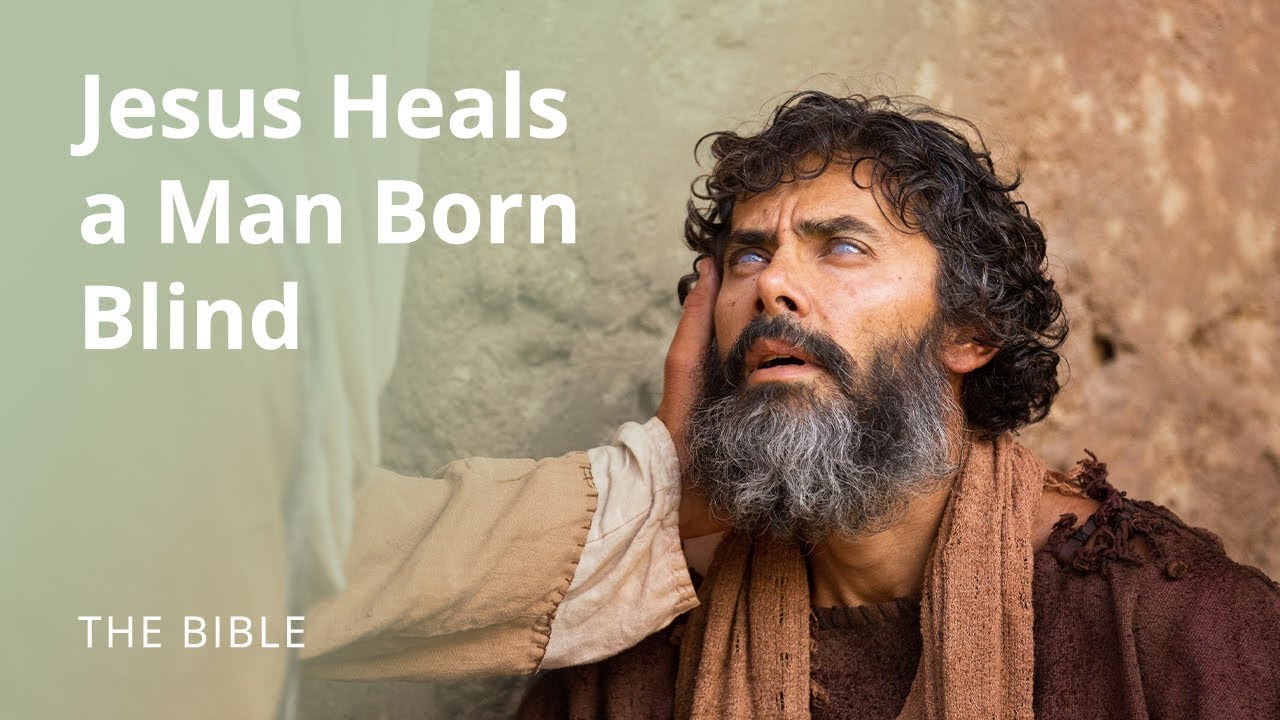
John 9 | Jesus Heals a Man Born Blind | The Bible

Is life simply a large accident, a giant game of chance? The question as to why events happen in our lives has been posed repeatedly.

It has been the theme of classic movies and literature, and it is asked daily by real people, especially in moments of tragedy and loss. Jesus offered a unique way of addressing the question of “Why?” in our study today.

In our study we find one of the best attested miracles or Scripture. Not only do we read the test-

money of the one upon whom the miracle was performed, but that of his parents and friends, as well as the reluctant Pharisees.

The evidence was examined from every possible angle and the proof was unquestionable. If it were not so tragic, this chapter would be comical.

Here is a man blind from birth healed by the Nazarene and the Pharisees, rather than accept the evident fact that Jesus healed him, chose to question the man’s former blindness!

Next, his parents, out of cowardice, “pass the buck” and will not take sides with their son. And in verses 24-34, this common-sense man makes the learned Pharisees look ridiculous! He becomes the questioner instead of the questioned.

The healing of this blind man is an illustration of the progress of the conflict between Jesus and His opponents, and is an outstanding example of the development of belief and unbelief:

– the belief is exemplified in the man

– the unbelief is exemplified in the reaction of the Pharisees, who examined and finally excommunicated the man

This episode was:

– sign demonstrating Jesus’ power

– an interview which afforded another instance of His dealing with men

– a crisis which brought fresh response, positive and negative, to His ministry

* THE CASE

   It is my understanding that a person goes blind in the United States every 20 minutes. This man was born blind! but the greatest miracle will not be the fact that his eyes were opened…the great event was his heart opening to Jesus

It cost him everything to confess Jesus as the Son of God, but he was willing to do it.

The action was opened by the contact which Jesus made with a beggar who was sitting by the roadside in Jerusalem. Beggars were common in the Orient and Jesus healed many cases (Mark 8:23. 10:46).

He also mentions this fact as one of the marks of the Messiah in the message He sends back to John the Baptist in Matthew 11:1-6: “After Jesus had finished instructing his twelve disciples, he went on from there to teach and preach in the towns of Galilee. {2} When John heard in prison what Christ was doing, he sent his disciples {3} to ask him, “Are you the one who was to come, or should we expect someone else?” {4} Jesus replied, “Go back and report to John what you hear and see: {5} The blind receive sight, the lame walk, those who have leprosy are cured, the deaf hear, the dead are raised, and the good news is preached to the poor. {6} Blessed is the man who does not fall away on account of me.””

 Let’s note the different way the blind man was viewed by those around him.

– To the disciples, he was a theological analysis:

  “As he went along, he saw a man blind from birth. {2} His disciples asked him, “Rabbi, who sinned, this man or his parents, that he was born blind?” {3} “Neither this man nor his parents sinned,” said Jesus, “but this happened so that the work of God might be displayed in his life. {4} As long as it is day, we must do the work of him who sent me. Night is coming, when no one can work. {5} While I am in the world, I am the light of the world.””

   The question recognized his miserable plight, and it’s very clear that the disciples felt certain that someone had sinned to bring it about.

The book of Job shows that this is not always the case and Jesus showed it also in Luke 13:1-5: “Now there were some present at that time who told Jesus about the Galileans whose blood Pilate had mixed with their sacrifices. {2} Jesus answered, “Do you think that these Galileans were worse sinners than all the other Galileans because they suffered this way? {3} I tell you, no! But unless you repent, you too will all perish. {4} Or those eighteen who died when the tower in Siloam fell on them–do you think they were more guilty than all the others living in Jerusalem? {5} I tell you, no! But unless you repent, you too will all perish.””

It’s very clear that they were more interested in solving the abstract problem than in ministering to the individual who had aroused it. They regarded him as a sinner who was less important than their debate!

Affliction, sorrow, pain, disappointment, and loss are always opportunities to display God’s grace. It enables the suffer to show God in action. When trouble and disaster fall upon a man who does not know God, that may’ might collapse from the burden. But when they fall on a man who walks with God they bring out the strength and the beauty, and the endurance and the nobility, which are within a man’s heart when God is there.

It is told that when an old saint was dying in an agony of pain, he sent for his family, saying: “Come and see how a Christian can die.” It is when life hits us a terrible blow that we can show the world how a Christian can live and, if need be, die.

The man born blind from birth was in darkness, but Christ came to provide light. How it must have cheered the heart of the blind man to hear these words! God gave men the day for work and the night for rest: we must all do God’s work while there is time to do it.

 – To the neighbors, he was a beggar.

 “His neighbors and those who had formerly seen him begging asked “Isn’t this the same man who used to sit and beg'” (9) Some claimed that he was. Others said. “No, he only looks like him. ” But he himself insisted, “I am the man. “

He had likely been dependent upon their generation for his support, and while they probably held no hard feelings toward him, they regarded him more or less of a nuisance He was unproductive, contributing nothing to the life of the community, and was “one more mouth to feed.” They were not necessarily unkind…but they were indifferent

– To the Pharisees, he was a tool to trap Jesus.

“They brought to the Pharisees the man who had been blind. {14} Now the day on which Jesus had made the mud and opened the man’s eyes was a Sabbath. {15} Therefore the Pharisees also asked him how he had received his sight. “He put mud on my eyes,” the man replied, “and I washed, and now I see.””

   They had no interest in the man, but were eager to employ him as a witness, if possible. Since the healing was performed on the Sabbath, he would be useful to them in incriminating Jesus.

Later, when they found he was not useful for this purpose, they cast him off and excommunicated him.

– To Jesus: He viewed him as a man

To Jesus, he was a man who needed help! He felt that the man’s condition called for action rather than debate or discussion.

 “Having said this, he spit on the ground made some mud with the saliva, and put it on the man’s eyes. (7) “Go, ” he told him, “wash in the pool of Siloam” (this word means Sent). So the man went and washed, and came home seeing.”

This is the only miracle recorded we have by Jesus on one defective from birth. And verse 3 (“but this happened so that the work of God might be displayed in his life’?) ought to give comfort to all afflicted today: God’s purposes on this earth can be fulfilled through the most difficult of circumstances.

THE CURE

The motive for the cure was compassion. Jesus had little to gain by performing the miracle, since He needed to offer no further proof to the multitude of what He could do.

He must have realized that healing this man on the Sabbath would cause an even more violent protest from the rulers than had the healing of the man at the pool earlier in His ministry. Nevertheless, He did it because of His concern for the individual.

One thing is for certain: the cure was undeniable! Nobody who knew this man challenged its reality.


All acknowledged:

– that he had been born blind

– that the man who was professedly cured was identical with the blind beggar and that he could actually see

There are some questions we might attempt to answer before discussing the results of this healing:

  1. Why did Christ anoint the man’s eyes with mud made from spittle? The Jews believed there were medicinal qualities in spittle, especially if it was from a distinguished person.

And there were definite traditions observed by the Pharisees which prohibited the application of medications on the Sabbath; the law read: “as to fasting spittle, it is not lawful to put it so much as upon the eyelids.”

Perhaps Jesus wanted to challenge their binding of traditions as “matters of life and death.” It could also have been because He wanted to give the blind man some symbolic or expressive action in order that he might know the power to heal his blindness came from Jesus.

One thing is for certain: Jesus took the methods and customs of his time and used them to gain the confidence of his patient. Touch and hearing would be this man’s chief avenues of contact with the outside world.  He had already heard the conversation between Jesus and the disciples, and would have thought it not too reassuring.

The man could have been healed without the clay and spittle, but the Lord deals with individuals differently. He works in mysterious ways, His wonders to  perform.  Christ  said  “go”  and  the  man went…obedience to the plan of God brought happiness.

  1. Why did Jesus send him to the pool of Siloam?

The pool of Siloam was one of the landmarks of Jerusalem, and was the result of one of the great engineering feats of the ancient world.

The water supply of Jerusalem had always been precarious in the event of a siege. It came mainly from the Virgin’s Fountain or the Spring Gihon, which was situated in the Kidron Valley. A staircase of 33 rock-cut steps led down to it; and there, from a stone basin, people drew the water.

It was just inside the southeast portion of the city wall and quite a distance from the temple. There were certainly other facilities much handier where the man might wash.

There are two likely reasons:

  1. He sent the man there to test his faith. Faith must be tested and expressed. Neither the mud nor the water had any medicinal qualities except as Jesus used them miraculously.
  2. This pool probably had some symbolic, typical, or spiritual Messianic significance to the Jews.

THE CONFESSION

As we look closely at this blind man’s confession

of faith, we will notice, initially, that it was positive and that his different statements are filled with facts in simple and direct language.

And notice the use of the words “I” and “me.” The miracle was part of this man’s firsthand knowledge, and his witness could not be set aside.

  “”How then were your eyes opened?” they demanded. {11} He replied, “The man they call Jesus made some mud and put it on my eyes. He told me to go to Siloam and wash. So I went and washed, and then I could see.” {12} “Where is this man?” they asked him. “I don’t know,” he said.”

Since the Pharisees were the custodians of the faith, it was right that the healed man be brought to them for investigation. The fact that they studied this miracle in such detail is only further proof that Jesus did indeed heal the man!

Notice the testimony:

– he had been born blind

– a man named Jesus anointed his eyes and commanded him to wash in Siloam

– he washed

– he returned seeing

Three groups of people questioned the blind man, and it’s important that we note the different levels of faith displayed by the healed man:

– The neighbors, motivated by curiosity.

They just wanted to know what had happened. The blind man responded with the facts.

– The Pharisees, whose motive was controversy

The fact of the Sabbath Day was a more important matter than whether or how the thing was done. Jesus must be a sinner, since He’d broken a law by healing on the Sabbath, they supposed.

The healed man’s response: he is a prophet! Moses, Elijah, and Elisha did perform miracles. The Jewish people would look upon their prophets as men of God who could do wonderful things by the power of God.

But the Pharisees did not want to see Jesus given that kind of high designation.

   “Some of the Pharisees said, “This man is not from God, for he does not keep the Sabbath.” But others asked, “How can a sinner do such miraculous signs?” So they were divided. {17} Finally they turned again to the blind man, “What have you to say about him? It was your eyes he opened.” The man replied, “He is a prophet.””

We must admire the courage of this man to stand up to this group of rebellious people. It is not always easy to be a Christian witness…it takes courage to stand against sin and against the world that delights in sin.

Verses 18-34 give us the reaction to the statement in verse 17; stage by stage the objections of unbelief are beaten back.

– The man’s parents

“The Jews still did not believe that he had been blind and had received his sight until they sent for the man’s parents. {19} “Is this your son?” they asked. “Is this the one you say was born blind? How is it that now he can see?” {20} “We know he is our son,” the parents answered, “and we know he was born blind. {21} But how he can see now, or who opened his eyes, we don’t know. Ask him. He is of age; he will speak for himself.” {22} His parents said this because they were afraid of the Jews, for already the Jews had decided that anyone who acknowledged that Jesus was the Christ would be put out of the synagogue. {23} That was why his parents said, “He is of age; ask him.””

   The parents were afraid to say much, but they did identify him as their son and they affirmed that he had been born blind. Without a doubt, this was not a case of mistaken identity.

They appealed to their son’s age and maturity for any future answers…and would claim nothing more.

– The healed man

The Pharisees wanted someone (anyone!?) to admit that Jesus was a sinner…but the man simply restates the facts and concludes that no sinner could heal a blind man.

  “A second time they summoned the man who had been blind. “Give glory to God, ” they said. “We know this man is a sinner.” {25} He replied, “Whether he is a sinner or not, I don’t know. One thing I do know. I was blind but now I see!” {26} Then they asked him, “What did he do to you? How did he open your eyes?” {27} He answered, “I have told you already and you did not listen. Why do you want to hear it again? Do you want to become his disciples, too?””

   Anxious to settle the case, the Pharisees did call the man in; and this time, they put him under oath. “Give God the praise” is a form of Jewish “swearing in” at court.

His response is both wonderful and simple: I was blind, now I see! He did not debate the character of Jesus, because that was beyond his knowledge and experience. But he could see!

We admire the boldness of the man in asking those irate leaders if they wanted to follow Jesus!

THE CONSEQUENCES

This miracle illustrated clearly the consequences of belief and unbelief. Persistent faith brought healing and progressive enlightenment.

As the blind man acted on the simple imperative of Jesus, he progressed from one step of faith to another, until Jesus’ voluntary revelation of Himself brought the man to its highest attainment and reward.

The poor beggar is not awed by the presence of the Pharisees. He is a man with a good and honest heart upon which the truth has fallen and is slowly bringing forth fruit.

It’s fair to say that this man is more amazed at the willful blindness of the Pharisees than anything else. He is sincere, honest and logical…and it gets him into trouble.

“Then they hurled insults at him and said, “You are this fellow’s disciple! We are disciples of Moses! {29} We know that God spoke to Moses, but as for this fellow, we don’t even know where he comes from.” {30} The man answered, “Now that is remarkable! You don’t know where he comes from, yet he opened my eyes. {31} We know that God does not listen to sinners. He listens to the godly man who does his will. {32} Nobody has ever heard of opening the eyes of a man born blind. {33} If this man were not from God, he could do nothing.” {34} To this they replied, “You were steeped in sin at birth; how dare you lecture us!” And they threw him out.”

   The unbelief of the Pharisees began with a misunderstanding of the law and of Jesus. The law was for them a tradition to be kept, a dead letter, not a living voice. It resulted in a prejudice that blinded them to anything but their on pre-conceived opmlons.

Pride (vs. 29) and bigotry (vs. 34) caused them to drive away the very man from whom they might have taken lessons offaith.

The only way they could think to maintain their self-begotten prestige was to attack the character of the beggar and excommunicate him.

This is the normal procedure for the rulers of the Jews–if they could not disprove the miracles attesting to Christ’s message, they would threaten the messengers or do them bodily harm (Acts 4: 16-21).

Two forms of discipline were possible:

(1) the temporary exclusion, which cut off a man from fellowship until his penitence warranted restoration; it lasted only 30 days; (2) the permanent ban, which pronounced a curse on him and put him out forever. It might even be determined that this one could even be denied the privilege of dealing with local merchants.

Nothing could be more humiliating for a Jew than being excommunicated from the synagogue!

The first one is likely here, since a vote of the Sanhedrin was necessary for the second. When Jesus heard of the unfortunate results, he was moved with pity and sought out the man. His question was simple and to the point:  (35) “Jesus heard that they had thrown him out, and when he found him, he said. ‘”Do you believe in the Son of Man?”

The man was unwilling to commit himself without knowing why and more: (36)”Who is he, sir?” the man asked. “Tell me so that I may believe in him.”

   Upon getting Jesus’ answer, he immediately responded, which represents the final stage of belief: “Jesus said. “You have now seen him; in fact, he is the one speaking with you. ” (38) Then the man said, “Lord, I believe, ” and he worshiped him. (39) Jesus said “For judgment I have come into this world, so that the blind will see and those who see will become blind.”

The story ends with a rhetorical question posed by some Phahsees: (40) “Some pharisees who were with him heard him say this and asked, “What? Are we blind, too? (41) Jesus said, “lf you were blind, you would not be guilty of sin; but now that you claim you can see, your guilt remains.”

They expected Jesus to esempt them from the con-

demnation of His previous statement (vs. 39). His reply was devastating: if they really were blind, and admitted the fact, their confession would lead to the

removal of their sin.

Their inability to discern their own failure as evidenced by their complacent assumption of spritual sight aggravated the situation and made their sin all the more lasting!

While the blind man gained physical and spiritual light through faith, the Pharisees lost the light they had and lapsed into complete spiritual darkness.

Closing Thought

When I think about those who have “displayed the works of God” in suffering, several people come to mind.

One is a young man who has limited mental ability. I am sure that his mother and father must have asked themselves and God a million times why their son was born this way. I will always remember the night of their son’s baptism, when he responded to the invitation at the conclusion of a sermon. There was not a dry eye in the assembly when he confessed his faith in Jesus and said with beautiful simplicity “I just want to do what God wants me to do.” In that moment the work of God was displayed in that young man’s life.

I also think of a preacher I once heard soon after he was told that he had a potentially terminal disease. He told the church that his prayer to God was that he might get well; but if he could not get well, his prayer would be that God would help him show the church how to die. A few months later he did just that; in his dying the work of God was displayed!

Another example of one who displayed the work of God in suffering is a Christian woman who struggled for years with cancer and recently went on to be with the Lord. Many times I heard people ask “Why?” In looking back on her years of illness, I am convinced that she demonstrated the work of God through her illness in a way that few people ever do in their good health.

The ultimate example of living with purpose, of course, is Jesus on the cross. It was unfair, and it was cruel. It was, in many ways, a tragedy; yet Jesus hung on the cross so that the “works of God might be displayed” in His life and death.

No one I have ever met can explain why Jesus had to suffer on the cross. I do not believe we will understand that completely until we reach heaven. Even a small child, however, can appreciate the fact that the work of God was displayed in a marvelous way because Jesus went to the cross. He lived and died for the purposes of God.

All of us face something that could cause us to believe that God has turned His back on us and that we could not possibly be used for the glory of God. Some may say, “But I am divorced”: “I struggle in my marriage”; “I have problems with my children”; “I am ill”; or “I am too old /young. ” Jesus walks into our world and says, in essence, “I will not tell you why you face the difficulties you are now facing, but I will tell you this: The work of God can be displayed in your life in spite of your problems–perhaps even because of your problems!”

An example of this is Paul, who was tormented by his familiar “thorn in the flesh” (2 Corinthians 12:7). Three times he asked the Lord to remove it.

I am sure that Paul imagined how much more he could accomplish for God if only he were free from his affliction, yet the Lord refused to remove Paul’s thorn in the flesh.

Instead, God left him with this message: “My grace is sufficient for you, for power is perfected in weakness” (2 Corinthians 12:9).

Paul finally accepted God’s decision that he could better demonstrate God’s power through weakness than through strength and good health.

In this Paul gave us a model to follow in dealing with afflictions. First, we ask God to deliver us from our pain. This is our natural human reflex to pain, and it is right to cry out for deliverance. The second step for the Christian, however, is to say to God, “Come what may, You be glorified in my life.” Whatever our situations, we can all be used to display the work of God!


Leave a comment

Posted by on March 6, 2025 in Gospel of John


 “Spending time with Jesus: #25 I  Am The Light of the World” – John 8:12-30


I recently began to notice a word that keeps popping up these days. This word can have several meanings, I guess, but it seems to be used primarily to end discussions.

At first, I thought it was used only by teen-agers, but I have since heard it on the lips of people of all generations. Increasingly, it is used to say, “It doesn’t matter enough to talk about any further.” The word is “whatever.”

A parent says to a child, “You should do this!” and the child replies, “Whatever.”

A teenage girl encourages her friend to “do the right thing” in a situation, and the answer is “Whatever.”

Two adults argue over politics until one of them has had enough, so he shrugs his shoulders and says, “Whatever.”

On a more significant level, “whatever” can mean that truth does not matter to people It can communicate that you are entitled to your view of truth, I am entitled to my view of truth, and we can assume that we are both equally right.

In the United States in the 1990s, “whatever” is more than a cultural fad; it is a oneword indicator of the way a nation is thinking.

What do you think about my evaluation of this interesting word? Did I hear you say, “Whatever?”

In our text, Jesus challenged the spirit of “whatever.” His message is bold, and His claims cannot be ignored. In the end, you may respond to Him with a joyous “Yes!” or a defiant “No!”–but He will not allow you to answer, “Whatever.”

The Setting

If you consult the commentaries on this text, you will see that many understand the celebration of the Feast of Tabernacles as the background to our Lord’s teaching, to which He constantly refers:

‘He who has not seen the joy of the place of water-drawing has never in his life seen joy’: This extravagant claim stands just before the description of the lighting of the four huge lamps in the temple’s court of women and of the exuberant celebration that took place under the light (Mishnah Sukkah 5:1-4). ‘Men of piety and good works’ danced through the night, holding burning torches in their hands and singing songs and praises. The Levitical orchestras cut loose, and some sources attest that this went on every night of the Feast of Tabernacles, with the light from the temple area shedding its glow all over Jerusalem. In this context Jesus declares to the people, I am the light of the world.[1]

I am more inclined to view our text in the “light” of what we find in the Scriptures than upon historical information obtained elsewhere. Leon Morris appears to take this same approach, focusing on the “pillar of fire” which separated the Israelites from the Egyptians and led God’s people through the wilderness:

Many draw attention to the ceremonies with lights at the Feast of Tabernacles and suggest that Jesus was consciously fulfilling the symbolism suggested by them. There is nothing unlikely in this, especially if the words were uttered reasonably close to the time of the Feast. The feasts were very important to the Jews. They delighted in their observance and rejoiced in their symbolism. And it was important to the Christians that the Christ fulfilled all the spiritual truths to which the feasts pointed. Now the brilliant candelabra were lit only at the beginning of the Feast of Tabernacles. There is a dispute as to the number of nights on which the illumination took place, but none as to the fact that at the close of the Feast it did not. In the absence of the lights Jesus’ claim to be the Light would stand out the more impressively. In favor of this view there is also the fact that the candelabra were lit in the Court of the Women, the most frequented part of the temple, and the very place in which Jesus delivered His address.

Yet, just as the reference to the water in ch. 7 seems to point us back to the rock in the wilderness rather than to the pouring of water from the golden pitcher, so the light may refer us to the pillar of fire in the wilderness. We have noted the reference to the manna in ch. 6, so that in three successive chapters the wilderness imagery seems consistently used to illustrate aspects of Jesus’ Person and work. It must always be borne in mind that light is a common theme in both Old and New Testaments, so that it is not necessary for us to find the source of Jesus’ great saying in any non-biblical place. Elsewhere we read that God is light (I John 1:5) and Jesus Himself said that His followers were ‘the light of the world’ (Matt. 5:14; the expression is identical with that used here). Paul can also speak of Christians as ‘lights in the world’ (Phil. 2:15). It is, of course, plain that such terms must be applied to believers in a sense different from that in which they are applied to Christ. He is the fundamental source of the world’s illumination. They, having kindled their torches at His bright flame, show to the world something of His light.[2]

  1. A. Carson summarizes the symbolism of “light” throughout the Bible:

Of the incarnate Word we have already learned that the life ‘was the light of men’ (cf. notes on 1:4). The light metaphor is steeped in Old Testament allusions. The glory of the very presence of God in the cloud led the people to the promised land (Ex. 13:21-22) and protected them from those who would destroy them (Ex. 14:19-25). The Israelites were trained to sing, ‘The LORD is my light and my salvation’ (Ps. 27:1). The word of God, the law of God, is a light to guide the path of those who cherish instruction (Ps. 119:105; Pr. 6:23); God’s light is shed abroad in revelation (Ezk. 1:4, 13, 26-28) and salvation (Hab. 3:3-4). ‘Light is Yahweh in action, Ps. 44:3’ (H. Conzelmann, TDNT 9, 320). Isaiah tells us that the servant of the LORD was appointed as a light to the Gentiles, that he might bring God’s salvation to the ends of the earth (Is. 49:6). The coming eschatological age would be a time when the LORD himself would be the light for his people (Is. 60:19-22; cf. Rev. 21:23-24). Perhaps Zechariah 14:5b-7 is especially significant, with its promise of continual light on the last day, followed by the promise of living waters flowing from Jerusalem—this passage probably forming part of the liturgical readings of this Feast.…[3]

 THE “I AM” PHRASE

In this passage Jesus talks of “following” himself. We often speak of following Jesus; we often urge men to do so. What do we mean?

The Greek word for “to follow” is “akolouthein” and its meanings combine to shed a flood of light on what it means to follow Jesus.

It has at least five different but closely meanings:

– It is often used of a soldier following his captain.

On the long route marches, into battle, in campaigns in strange lands, the soldier follows whereever the captain may lead. The Christian is the soldier whose conlmander is Christ.

– It is often used of a slave accompanying his master.

Wherever the master goes the slave is in attendance upon him, always ready to spring to his service and to carry out the tasks he gives him to do. He is literally at his master’s beck and call. The Christian is the slave whose joy it is always to serve Christ.

– It is often used of accepting a wise counselor’s opinion.

When a man is in doubt he goes to the expert, and if he is wise he accepts the judgment he receives. The Christian is the man who guides his life and conduct by the counsel of Christ.

– It is often used of giving obedience to the laws of a city or a state.

    If a man is to be a useful member of any society or citizen of any commuaity, he must agree to abide by its laws. The Christian, being a citizen of the kingdom of heaven, accepts the law of the kingdom and of Christ as the law which governs his life.

– It is often used of following a teacher’s line of argument, or of following the gist of someone’s speech.

The Christian is the man who has understood the meaning of the teaching of Christ. He has not listened in dull incomprehension or with slack inattention. He takes the message into his mind and understands, receives the words into his memory and remembers, and hides them in his heart and obeys.

“When Jesus spoke again to the people, he said, “I am the light of the world. Whoever follows me will  never walk in darkness, hut will have the Iight of life.”

It would seem that the Feast of Tabernacles has just recently concluded when our Lord speaks out in the temple, “I am the light of the world. The one who follows me will never walk in darkness, but will have the light of life.” It is interesting to me that as often as simple statements of our Lord were misunderstood (see 8:21ff.), this is one time His audience seems to understand something of what Jesus means when He calls Himself the “light of the world.” Later on, Paul will use the term “light” when he challenges the Jewish religious leaders concerning their own sin:

17 But if you call yourself a Jew and rely on the law and boast of your relationship to God 18 and know his will and approve the superior things because you receive instruction from the law, 19 and if you are convinced that you yourself are a guide to the blind, a light to those who are in darkness, 20 an educator of the senseless, a teacher of little children, because you have in the law the essential features of knowledge and of the truth—21 therefore you who teach someone else, do you not teach yourself? You who preach against stealing, do you steal? 22 You who say not to commit adultery, do you commit adultery? You who abhor idols, do you rob temples? 23 You who boast in the law dishonor God by transgressing the law. 24 For just as it is written, “the name of God is being blasphemed among the Gentiles because of you” (Romans 2:17-24, emphasis mine).

I am inclined to interpret our Lord’s words in the light of texts like these, found in the prophecy of Isaiah:

6 “I, the LORD, have called You in righteousness, And will hold Your hand; I will keep You and give You as a covenant to the people, As a light to the Gentiles, 7 To open blind eyes, To bring out prisoners from the prison, Those who sit in darkness from the prison house” (Isaiah 42:6-7, NKJV, emphasis mine).

“Indeed He says, ‘It is too small a thing that You should be My Servant To raise up the tribes of Jacob, And to restore the preserved ones of Israel; I will also give You as a light to the Gentiles, That You should be My salvation to the ends of the earth’” (Isaiah 49:6, NKJV, emphasis mine).

I believe Israel failed to fulfill her mission as God’s “son” (see Exodus 4:22-23), as did Israel’s kings fail in this same role (see 2 Samuel 7:13-14). What men could not fulfill as God’s “son,” the “Son” did fulfill. And so the Lord Jesus was the perfect “Son.” What Israel failed to do as the “servant of the Lord,” Jesus did as the “Suffering Servant.” Israel was to carry the “good news” of God’s salvation to the Gentiles, but, like the prodigal prophet Jonah, they refused to do so. And so our Lord Jesus came as the “Light of the world.” It was this part of our Lord’s “gospel” which the Jews hated (see Luke 4:16-30; Acts 22:1-24f.).

None of our Lord’s audience chooses to argue about who He claims to be.[4] They quibble with Him over a technicality—His credibility as a witness in His own defense. This is indeed ironic, especially in the light of the story of the woman caught in adultery at the beginning of this chapter. The scribes and Pharisees insisted that this woman be stoned, in order to fulfill the Law of Moses. Jesus did not disagree about her guilt or even her punishment under the law. What He did (which caught His adversaries completely off guard) was to appeal to the Law of Moses as to how they should proceed with the stoning. Under the law, there must be two eye witnesses. When Jesus required that the two witnesses be innocent and that they “cast the first stone,” no one was willing to do so, and the case was dropped for lack of any witnesses who would testify against this woman.

You would think that anyone who opposed Jesus would stay away from the “witness question,” but instead we find our Lord’s opponents attacking Him on this same issue. Does He claim that He testifies for the Father, and the Father testifies about Him? That means there are only two witnesses, and that Jesus is one of the witnesses. Under the law, a man cannot be a witness for himself because of his own interests in the case. Earlier in the Gospel of John, Jesus seems to have conceded this point: “If I testify about myself, my testimony is not true” (John 5:31).

Now, it would seem that this apparent concession is going to be used against Him. Do the Jews finally have Jesus trapped? We should know better than that.

The most important thing about any witness is that he or she is, in fact, a witness. Imagine a car accident in which one person is seriously injured. The injured person seeks damages from the driver of the other car. His attorney needs to prove that the other driver was negligent or in error. A witness is called, but when cross examined it becomes apparent that this “witness” was not even at the scene of the accident. This person simply wants to give their own opinion about something they never saw. This “witness” is not a witness at all! Now, Jesus is a witness. He speaks of those things which He has seen and heard from His Father: “No one has ever seen God. The only One, himself God, who is in the presence of the Father, has made God known” (John 1:18).

9 Nicodemus replied, “How can these things be?” 10 Jesus answered, “Are you the teacher of Israel and yet you don’t understand these things? 11 I tell you the solemn truth, we speak about what we know and testify about what we have seen, but you people do not accept our testimony. 12 If I have told you people about earthly things and you don’t believe, how will you believe if I tell you about heavenly things. 13 No one has ascended into heaven except the one who descended from heaven—the Son of Man” (John 3:9-13).

31 “The one who comes from above is superior to all. The one who is from the earth belongs to the earth and speaks about earthly things. The one who comes from heaven is superior to all. 32 He testifies about what he has seen and heard, but no one accepts his testimony. 33 The one who has accepted his testimony has confirmed clearly that God is truthful. 34 For the one whom God has sent speaks the words of God, for he does not give the Spirit sparingly” (John 3:31-34).

36 “But I have a testimony greater than that from John. For the deeds that the Father has assigned me to complete—the deeds I am now doing—testify about me that the Father has sent me. 37 And the Father who sent me has himself testified about me. You people have never heard his voice nor seen his form at any time, 38 nor do you have his word residing in you, because you do not believe the one whom he sent” (John 5:36-38).

45 “It is written in the prophets, ‘And they shall all be taught by God.’ Everyone who hears and learns from the Father comes to me. 46 (Not that anyone has seen the Father except the one who is from God—he has seen the Father.) 47 I tell you the solemn truth, the one who believes has eternal life” (John 6:45-47).

“I am telling you the things I have seen while with my Father, but you are practicing the things you have heard from your father” (John 8:38).

The defense of our Lord is awesome. The first qualification of a witness is that they be a witness—that they must have personally experienced that of which they testify. The Jewish religious leaders spoke with great authority about things they never experienced. Now, they seek to challenge our Lord’s authority and credibility as a witness. Only He and the Father can testify about heavenly things because they have firsthand knowledge of them. Who else is qualified as a witness if not our Lord?[5] He knows where He has come from and where He is going. His opponents do not know where He has come from nor where He is going.

But they think they know where He is from—Galilee. On the basis of this assumption, they reject Jesus as the promised Messiah:

25 Then some of the residents of Jerusalem began to say, “Isn’t this the man they are trying to kill? 26 Yet here he is, speaking publicly, and they are saying nothing to him. Do the rulers really know that this man is the Christ? 27 But we know where this man comes from. Whenever the Christ comes, no one will know where he comes from” (John 7:25-27).

41 Others said, “This is the Christ!” But still others said, “No, for the Christ doesn’t come from Galilee, does he? 42 Don’t the scriptures say that the Christ is a descendant of David and comes from Bethlehem, the village where David lived?” (John 7:41-42)

50 Nicodemus, who had gone to Jesus before and who was one of the rulers, said, 51 “Our law doesn’t condemn a man unless it first hears from him and learns what he is doing, does it?” 52 They replied, “You aren’t from Galilee too, are you? Investigate carefully and you will see that no prophet comes from Galilee!” (John 7:50-52)

Obviously, no one checked out the actual birthplace of our Lord. They assume it, simply on the basis of appearances. His parents were Galileans, though providentially He was born in Bethlehem of Judah (Luke 2:2-7). He grew up in Nazareth and was called a Nazarene, thus fulfilling prophecy (Matthew 2:23). Many of His disciples and followers were Galileans (Matthew 27:55; Mark 15:40-41). He was raised in Galilee and probably had a Galilean accent (see Mark 14:70). Had anyone done even a little inquiring, they would have known that Jesus was actually born in Bethlehem, and that He was a descendant of David. Had they asked Mary and believed her testimony, they would have known that He was born of a virgin and that He was conceived through the Holy Spirit of God.

These Jews who are judging Jesus are not doing a very good job. They accuse Him of being disqualified as a witness, and yet He alone is qualified to witness about heavenly things. They think they are qualified to judge Him, yet He is the One who is uniquely qualified to judge them. This is not His mission in His first coming, and thus He speaks of judging no one (verse 15). But His judgment is true, because He and the Father are united in this activity as well. The “witnesses” are not only those who alone have “seen” heaven, they are also the ultimate “judges” of all mankind. Jesus can say with complete confidence, as He does, that His witness is true.

Unfortunately, those who are resisting Jesus just don’t seem to get the point. They just can’t stop, and so they ask what I perceive to be a very ugly question: “Where is your father?” (verse 19). I believe this question is intended to be a very cruel blow to Jesus, one that His adversaries hope will silence Him and give those listening to this interchange a chance to have a good laugh at His expense. If they think Jesus is talking about Joseph as His father, they know he has been dead for some time. How then can Jesus speak of His “father” (Joseph) when he is dead? Is there something Jesus has not told them? Is He in communication with the dead? Is Jesus working with a dead man?

Or, worse yet (and more likely in my opinion), they are accusing Jesus of being an illegitimate child, as they do again later in this same chapter: “Then they said to Jesus, ‘We were not born as a result of immorality! We have only one Father, God himself’” (John 8:41b). Their cutting words are intended to embarrass Jesus for being the illegitimate child of Mary and some unknown “lover.” Jesus dares to speak of His Father? Then they will press Him on this point, reminding Him and others that He has no right to speak about having a father.

Jesus is not taken back by this challenge. They are as ignorant on this point as they are on all other counts. They do not know Him; they most certainly do not know His Father. These Jews are the religious elite, the teachers and rulers of the nation, and yet they do not know the most fundamental things about their religion. If they know Jesus, they would know His Father as well. But they do not know Jesus as Messiah nor His Father as God.

In all of this, someone might be inclined to look upon Jesus as the One under fire, the One trying desperately to defend Himself against these powerful leaders. Does anyone look upon Jesus as the victim here? Anyone who does is wrong. In verse 20, John makes a most significant parenthetical remark. It is as though John is a photographer. His camera zooms in on Jesus, then on His accusers, then back to Jesus. Now John gives us a wide-angle shot of this same scene. Jesus is teaching in the temple. He is in the temple courts where the offering boxes are kept:

The place where the offerings were put probably refers to the thirteen ‘shofar-chests’ (probably so named because the ‘chests’ were shaped like shofars … , a trumpet; cf. Mishnah Shekalim 2:1; 6:1, 5). Each was inscribed with the use to which the money collected in it was ostensibly put. Nowhere do we learn explicitly where they were placed, but probably they were located in the Court of the Women, if we may judge from access women had to them (cf. Mk. 12:41-42; cf. SB 2. 37-45). John’s principal point is that no-one seized him, because his time (hora) had not yet come.[6]

I especially enjoy the insight of William Hendriksen here:

Against the wall in the Court of Women stood thirteen trumpet-shaped chests in which the people deposited their gifts for various causes. Hence, taking the part for the whole, this court was sometimes called the Treasury. Here Jesus was teaching, in the immediate proximity of the hall in which the Sanhedrin held (or: used to hold) its sessions. And, though it is possible that this august body, so thoroughly hostile to Jesus, could almost hear the echo of his voice, no one arrested him, because his hour had not yet arrived.[7]

Can you imagine this? The Jews think they are the authorities, the ones in charge. Yet here stands Jesus, the One they are determined to silence by killing Him. He is there in the temple, teaching the people. And He is doing so literally outside the door of the room where the Sanhedrin meets. You can almost hear the hushed whispers inside that room, the voices of men plotting to kill Jesus, while outside can be heard the booming voice of the Savior, proclaiming that He is the “Light of the world.” They cannot even lay a hand on Him whom they reject, on Him whom they purpose to kill—even though He is in easy reach—because it is not yet His time. I ask you this question, “Who is in charge here?”

In John 8 Jesus moves about the temple preaching. His message(s) expands the discussion in chapter 7. We find him first in the court of the women where thirteen trumpet-shaped vessels lined one wall. On the other side of the wall was the meeting room of the Sanhedrin.

This court was reserved for the Pharisees. Here they taught their disciples. Jesus took over their spot. Yet no one stopped him even though he was within earshot of the Sanhedrin. Oh, they wanted to, but his time had not yet come (cf. Jn 2:4; 7:6, 30; 12:23, 27; 17:1). From here Jesus moves out to the porches of the temple. Outside the sanctuary the crowds would be free to ask questions and enter into the conversation. Unfortunately they didn’t much like what he said out there. In fact, they picked up stones from the construction site to kill him (Jn 8:59).

This is the second of Jesus’ “I AM” statements (cf. Jn 6:35; 8:12; 10:7, 9, 11, 14; 11:25; 14:6; 15:1, 5). Perhaps it is the richest. Light is used to represent truth because it exposes what is actually there, and purity because of its own essence.

In the NT these two qualities of light are personified in: (1) God (1 Tim 6:16; 1 John 1:5). (2) Jesus—God’s envoy (Mt 4:16 [Isa 9:1-2]; Lk 2:32; Jn 1:4-5, 9; 3:19; 8:12; 9:5; 12:36, 46-47). (3) Christians—as envoys of Jesus (Mt 5:14; Lk 16:8; Jn 12:36; 1 Thess 5:5). (4) The gospel—as proclaimed by Christians (Acts 26:23; 2 Cor 4:4; Titus 1:3; 2 Pet 1:19). There is a fierce conflict between light and darkness (Jn 1:5; 3:19-21; 12:35; Acts 26:18; Rom 13:12; 2 Cor 6:14; Eph 5:8; 1 Thess 5:5; 1 Pet 2:9; 1 John 2:9).

Darkness hates the light because it exposes and thereby judges its evil deeds (Jn 3:19-21; 1 Cor 3:13; 4:5; Eph 5:13-14). This competition between darkness and light (i.e., God and Satan) will end with the consummation of the kingdom (Col 1:12; 1 John 2:8). Finally, all this “light” theology is embodied in the New Jerusalem which will have as its light the Lord Jesus (Rev 21:23-24; 22:5).

The light of the menorah (candlestick) played a prominent role in the Feast of Tabernacles. Its light spreads across the court of women where Jesus is presently teaching. Perhaps this allusion connects directly with God’s light of the tabernacle. Nonetheless, when Jesus applies to himself the metaphor of “light,” the Pharisees can hardly miss its Messianic implication. They challenge him on such an audacious claim. Again they call him a misguided maverick, speaking on his own behalf. According to the Mosaic law of testimony, any statement required at least two or three witnesses. Twice already Jesus has delineated his supporting witnesses (Jn 5:30-47; 7:16-19). He hardly needs to cover that ground again here.

In fact, John has combined three “wilderness images:” the manna (cpt. 6), the water from the rock (cpt. 7), and the pillar of tire (cpt. 8).

To “follow” the Lord means to believe and trust Him; and the results are life and light for the believer. We follow His words (John 10:4) and His example (1 Peter 2:21; John 13:15, 34-35).

There are some who say they believe on Christ, but they walk contrary to their belief. One who sincerely believes on Christ will “walk in the light”.

There are two things we must do with the gospel of Christ: believe it and behave it. If a man is soundly converted, he will not only believe in his heart, but follow the Lord with his feet.

It may sound like Jesus is contradicting himself in v. 14 (cf. Jn 5:31, and notes). But since the Pharisees have rejected or ignored all of Jesus’ supporting witnesses, what can he do but simply verify his own testimony? Truly, he is the only one who can testify about his heavenly origin (v. 14), his unity with the Father (vv. 15-16), and the consistency between what he says and what God says (vv. 17-18).

No one else has been to heaven and back who can verify the truth of what Jesus says. John and Moses received divine revelation about Jesus, but the Pharisees have rejected their testimony. Jesus’ miracles indicate supernatural power, but the Pharisees have relegated them to a demonic power. The only two witnesses left are Jesus and the Father. The Pharisees have demonstrated a resolute refusal to listen to Jesus. And since they know not the Father, they have no way to receive his testimony. Sadly, Jesus is their only way to the Father, but they have cut him off. They have now burned every bridge out of the valley of the shadow of death.

All that is left is judgment and certain death. Jesus came not to judge the world but to save it (Jn 3:16-17). However, in the process of preaching the gospel of salvation, his words set some parameters around who would and who would not be saved (Jn 5:24). In this slice of time we call the incarnation, it is not the Son of Man who judges, but his words most certainly do. The future nonincarnate Christ will, indeed, pass judgment on this world and all evil men who refuse to accept God’s messenger (Jn 5:26-30).

The unsaved are walking in darkness because they love darkness (3: 17ff). One of the major messages in this gospel is that the spiritual light is now shining, but people cannot comprehend it–and they try to put it out (1:4-5).

Jesus declared, “I am the light of the world” in 8:12. Although modern readers tend to focus on the “light of the world” part of His statement, the most important aspect of what Jesus was saying is found in the first two words: “I am.”

That small phrase has a rich Old Testament background; and to Jesus’ first-century Jewish audience, it probably was the most controversial statement He had ever made. To them it sounded as if He were saying, “I am God.” In the context of the Gospel of John, that is exactly what He was saying!

“I am” is the way God spoke of Himself in the Old Testament. When God met Moses in the burning bush, Moses asked about His name. He was told, “I am who I am” (Exodus 3:14).

 “The Pharisees challenged him, “Here you are, appearing as your own witness; your testimony is not valid. “

Not all the Jewish leaders had left the group, and others had no doubt come along after the woman left. As usual, they debated with Jesus. This time, they accused Him of bearing witness to Himself by claiming to be the Light of the world; and Jewish courts would not permit a person to bear witness to himself.

Their attitude progressively and heatedly escalates from contradiction (vs. 13) to insinuation (vs. 19) to denial (vs. 33) to insult (vs. 48) to sarcasm (vs. 53) and, finally and climactically, to violence (vs. 59).

 “Jesus answered, “Even if I testify on my own behalf, my testimony is valid, for I know where I came from and where I am going. But you have no idea where I come from or where I am going. {15} You judge by human standards; I pass judgment on no one. {16} But if I do judge, my decisions are right, because I am not alone. I stand with the Father, who sent me.”

   There were many reasons why the Pharisees rejected Jesus, but the main one was their ignorance..and also because their zeal (Romans 10:1) lacked knowledge. And it was consistent with their ancestors.  

   Hosea 4:1-3:  “Hear the word of the LORD, you Israelites, because the LORD has a charge to bring against you who live in the land: “There is no faithfulness, no love, no acknowledgment of God in the land. {2} There is only cursing, lying and murder, stealing and adultery; they break all bounds, and bloodshed follows bloodshed. {3} Because of this the land mourns, and all who live in it waste away; the beasts of the field and the birds of the air and the fish of the sea are dying.”

   Hosea 4:6:  “…my people are destroyed from lack of knowledge. “Because you have rejected knowledge, I also reject you as my priests; because you have ignored the law of your God, I also will ignore your children.”

Light has to bear witness to itself! The only people who cannot see the light are blind people.

I recall the first time I flew in an airplane at night. I was fascinated by the changing textures of colored lights in the cities below me. 1 then understood why it was necessary to have blackouts during the war…the enemy pilots could see the smallest evidence of light and thus find the target.

Light bears witness to itself; it tells you it is here.

One of the key words in this section is witness; it’s

used seven times. Jesus made It clear that their witness was not dependable because their judgment was faulty. They judged on the basis of externals, mere human judgment, but He judged on the basis of spiritual knowledge.

They way they judged the woman taken in adultery proved that they neither understood the Law or their own sinful hearts!

They also suffered from a lack of perception: they drew their conclusions from the wrong standard. Looking at externals, they saw only a carpenter’s son. They didn’t have the discernment to see beneath the flesh and blood into the spiritual dimension. His meekness, poverty and apparent powerlessness did wt fulfill their ideal.

John 8:17-20: “In your own Law it is written that the testimony of two men is valid. {18} I am one who testifies for myself; my other witness is the Father, who sent me.” {19} Then they asked him, “Where is your father?” “You do not know me or my Father,” Jesus replied. “If you knew me, you would know my Father also.” {20} He spoke these words while teaching in the temple area near the place where the offerings were put. Yet no one seized him, because his time had not yet come.”

   Because they knew but abused the law, Jesus quotes from it: the testimony of two men was required to validate a judgment.

  Numbers 35:30: “”‘Anyone who kills a person is to be put to death as a murderer only on the testimony of witnesses. But no one is to be put to death on the testimony of only one witness.”

   Deuteronomy 19:15:  “One witness is not enough to convict a man accused of any crime or offense he may have committed. A matter must be established by the testimony of two or three witnesses.”


How does God hear witness to the supreme authority of Jesus?

– The witness of God is in Jesus’ words.

No man could speak with such wisdom unless God had given him knowledge.


– The witness of God in Jesus’ deeds.

No man could do such things unless God was acting through him.


– The witness of God in the effect God had upon men.

He works changes in men which are obviously beyond human power to work. The very fact that Jesus can make bad men good is proof that his power is not simply a man’s power, but God’s.

Wherever and whenever Jesus has been fully displayed (and the cross has been preached), there has been an immediate and overwhelming response in the hearts of men.

Jesus never really answered their question, “Where is your Father?” The word father is used 21 times in

this chapter, so Jesus did not avoid the issue but faced it honestly. He knew that “their father” was not God–but the devil!

These men were religious, and yet they were the children of the devil. Their further attempts to arrest Jesus were again thwarted by the Father, for it was not yet our Lord’s our when He should give His life. When the servant of God is in the will of God, he can have courage and peace as he does his duty.

Why would John mention the fact that Jesus was near the Treasury when He said these words? Because the temple treasury was very near the council chambers of the Sanhedrin.

(8:22)  “This made the Jews ask, “Will he kill himself? Is that why he says, ‘Where I go, you cannot come’?””

   Jesus had already mentioned His leaving them (7:34), but the Jews had misunderstood what He said once again, He warned them: He would leave them, they would not be able to follow Him, and they would die in their sins.

They were wasting their God-given opportunities by arguing with Him instead of trusting Him; and one day soon, their opportunities would end


This verse implies several things:

   – There are certain opportunities which come and do not return. To every man is given the opportunity  to accept Christ; but that opportunity can be refused and lost.

– Truth and life are limited. The time to make a decision is limited–and none of us knows what his limit is. There is every reason for making that time now.

 – There is judgment . The greater the opportunity, the more clearly it beckons, the oftener it comes, the greater the judgment if it is refused or missed.

Luke 12:47-48:  “”That servant who knows his master’s will and does not get ready or does not do what his master wants will be beaten with many blows. {48} But the one who does not know and does things deserving punishment will be beaten with few blows. From everyone who has been given much, much will be demanded; and from the one who has been entrusted with much, much more will be asked.”

    Make no mistake about it…Jesus said they would “die in their sins.” The word for sin is ”hamartia” which onginally had to do with shooting and literally means “a missing of the target.” The man who walks in his sin has missed the target in life.

The other idea is that sin separates us from God. When Adam committed the first sin, his first instinct was to hide himself from God:  

   Genesis 3:8-10:  “Then the man and his wife heard the sound of the LORD God as he was walking in the garden in the cool of the day, and they hid from the LORD God among the trees of the garden. {9} But the LORD God called to the man, “Where are you?” {10} He answered, “I heard you in the garden, and I was afraid because I was naked; so I hid.””

   John 8:22-24)  “This made the Jews ask, “Will he kill himself? Is that why he says, ‘Where I go, you cannot come’?” {23} But he continued, “You are from below; I am from above. You are of this world; I am not of this world. {24} I told you that you would die in your sins; if you do not believe that I am the one I claim to be, you will indeed die in your sins.””

   Once again, the people misunderstood His teaching. They thought He was planning to kill Himself! Suicide was an abhorrent thing to a Jew, for the Jews taught to honor all life. If Jesus committed suicide,  then He would go to a place of judgment. And if this were true, whyu would they want to follow Him?

The Christian has his citizenship in heaven; his affection and attention are fixed heavenward.

Philippians 3:20-21: “But our citizenship is in heaven. And we eagerly await a Savior from there, the Lord Jesus Christ, {21} who, by the power that enables him to bring everything under his control, will transform our lowly bodies so that they will be like his glorious body.”


 (John 8:25-27)  “”Who are you?” they asked. “Just what I have been claiming all along,” Jesus replied. {26} “I have much to say in judgment of you. But he who sent me is reliable, and what I have heard from him I tell the world.” {27} They did not understand that he was telling them about his Father.”

It seems incredible that these religious “experts” should ask, “Who are You?” He had given them every evidence that He is the Son of God, yet they deliberately rejected the evidence.

Jesus replied as if to say, “If you don’t believe what I’ve already said and done, I’m not going to give you any new evidence.”


Jesus boldly made several claims to deity:

– He said He would judge, and judgment to the Jews belonged only to God

– He claimed to be sent by God

– He claimed to have heard from God the things that He taught

John 8:28-30: “So Jesus said, “When you have lifted up the Son of Man, then you will know that I am the one I claim to be and that I do nothing on my own but speak just what the Father has taught me. {29} The one who sent me is with me; he has not left me alone, for I always do what pleases him.” {30} Even as he spoke, many put their faith in him.”

   Certainly, it is clear here that Jesus spoke about His own death, when He would be “lifted up” on the cross (3: 14; 12:32). He would be lifted up in crucifixion and in exaltation and giorification!

It would be His death, burial, resurrection, and ascension that would reveal Himself finally to the Jewish nation. This was the message Peter preached at Pentecost in Acts 2.

Even a Roman soldier, who saw the events of the cross, would say, “truly this man was the Son of God” (Mark 15:29).

The early church, following the example of their Lord (Luke 24:25-27), would show from the Old Testament prophecies both the sufferings and the glory of the Messiah.

Jesus made another stupendous claim: not only was He sent by the Father…but the Father was also pleased with Him.

Salvation is a matter of life or death. People who live in their sins and reject the Savior must die in their sins There is no alternative!

We either receive salvation by grace or experience condemnation under God’s law. We either walk in the light would have eternal life, or walk in die dark-

ness and experience eternal death.


JESUS’ CLAIMS TODAY

What are we to think about Jesus today? Most people are willing to accept that Jesus lived and that He was a good man, but many are not willing to accept that He is, indeed, the Son of God.

Jesus made such a view absurd. He did not claim to be just a good man; He claimed to be “I am.” He did not present Himself as a great philosopher; He presented Himself as the only way to the Father. He did not teach that He had special insight into God; He claimed that He was one with the Father.

His bold claims force us to make a choice to believe or reject His true identity. When it comes to Jesus, “whatever” is not an option. In this matter, the furious Jewish leaders with stones in their hands understood what Jesus was saying better than do unbelievers today who talk about how Jesus was “a good man.”

Concerning this, Josh McDowell wrote:

“To Jesus, who men and women believed him to be was of fundamental importance. To say what Jesus said and to claim what he claimed about himself, one couldn’t conclude he was just a good moral man or prophet. That alternative isn’t open to an individual, and Jesus never intended it to be.’


Years earlier, C. S. Lewis came to a similar conclusion:

“I am trying here to prevent anyone saying the really foolish thing that people often say

about Him: “I’m ready to accept Jesus as a great moral teacher, but I don’t accept His

claim to be God.” That is the one thing we must not say. A man who was merely a man

and said the sort of things Jesus said would not be a great moral teacher. He would

either be a lunatic  on a level with the man who says he is a poached egg–or else he

would be the Devil of Hell. You must make your choice. Either this man was, and is,

the Son of God: or else a madman or something worse. You can shut Him up for a fool,

you can spit at Him and kill Him as a demon; or you can fall at His feet and call Him

Lord and God. But let us not come with any patronizing nonsense about His being a great

human teacher. He has not left that open to us. He did not intend to.”


CONCLUSION

What does all of this mean for us today? First, for those who have grown up in the Christian faith, it forces us to move beyond the “Jesus was a nice man” phase of our own spiritual development. As my children grow up, I want them to be impressed at an early age by Jesus’ kindness and gentleness toward children and people who are hurting. Having such a picture of Jesus is good.

However, if my children never grow beyond that picture of Jesus, if they never realize that Jesus was not only gentle but also bold and demanding, then their faith will fail to mature. Jesus claimed to be “I am.” The old saying is true: “Either Jesus is Lord of all, or He is not Lord at all!”

The encounter with Jesus in John 8 hits sleepy, apathetic Christians like a cold slap in the face. Is He who He says He is? If He is not, then why are we still “playing church”? If He is, then why are we not living and working as if nothing else in life matters as much as the Lord Jesus?

To the man or woman who still attends worship services but is not living as a Christian Monday through Saturday, this meeting with Jesus is a call to make a decision. Each of us must stand on the side of faith or on the side of disbelief.

What do you think about Jesus? Was He a blasphemer? Was He a liar? Was He a lunatic? Is He Lord? You must decide! “Whatever” is not an option!


Jesus as the “I Am”

Of all the Gospel writers, John places the most emphasis upon the deity of Christ through recording His actual claims about Himself.

When Christ said, “Before Abraham was born, I am” (8:58), the people knew that He was claiming the very name of God that was revealed to Moses at the burning bush (Exodus 3:14).

This is why the people tried to stone Him for alleged blasphemy. Christ was and is the eternal I Am. In a series of assertions, He amplified that claim:


  1. I am the bread of life (6:35).
  2. I am the light of the world (8:12; 9:5).
  3. I am the door (10:7).
  4. I am the good shepherd (10:11, 14).
  5. I am the resurrection and the life (11:25).
  6. I am the way, the truth, and the life (14:6).
  7. I am the true vine (15:1).

Other supporting statements in John include “I and the Father are one” (10:30) and “He who has seen Me has seen the Father” (14:9).

Jesus as the One Sent

As Jesus worked to establish His identity and His purpose in the minds of His listeners, He emphasized that He was “sent” from God:

  1. Jesus stated plainly that He was sent from the Father (6:57; 7:29; 8:42; 10:36).
  2. He said, “He who sent Me is with Me;…” (8:29).
  3. He spoke the words of the Father who sent Him (3:34; 7:16; 12:49; 14:24).
  4. He did the will, or the works, of the One who sent Him (4:34; 5:30, 36; 6:38, 39; 9:4).
  5. The world is called to believe in the One who was sent (6:29; 11:42; 17:8, 21, 23, 25).
  6. Jesus said, “No one can come to Me, unless the Father who sent Me draws him;…” (6:44).
  7. He said that the Father who sent Him has borne witness of Him (5:37; 8:18).
  8. He said, “He who beholds Me beholds the One who sent Me” (12:45).
  9. To accept or reject Jesus is to accept or reject the One who sent Him (5:23, 38; 12:44; 13:20).
  10. Jesus said that He would go to Him who sent Him (7:33; 16:5).
  11. He promised that eternal life would come through knowing the One who was sent (5:24; 17:3).
  12. He said that as the Father sent Him, He was sending His disciples (17:18; 20:21).
  13. Jesus warned His followers that they would be rejected by those who do not know the One who sent Him (15:21).
  14. He said that He and the One who sent Him are true (7:18, 28; 8:16, 26).

[1] D. A. Carson, The Gospel According to John (Grand Rapids: William B. Eerdmans Publishing Company, 1991), p. 337.

[2] Leon Morris, The Gospel According to John (Grand Rapids: Wm. B. Eerdmans Publishing Co., 1971), pp. 436-438.

[3] Carson, pp. 337-338.

[4] This may be due to the fact that up until now they don’t understand who He is claiming to be, strange though this may seem to us (see John 8:27).

[5] “If Jesus really stands in the relationship to God in which He says He does, then no mere man is in a position to bear witness. No human witness can authenticate a divine relationship. Jesus therefore appeals to the Father and Himself, and there is no other to whom He can appeal.” Morris, p. 443.

[6] Carson, p. 341.

[7] William Hendriksen, Exposition of the Gospel According to John, 2 vols. (Grand Rapids: Baker Book House, 1953-1954), vol. 2, p. 44.

 
Leave a comment

Posted by on March 3, 2025 in Gospel of John


“Spending time with Jesus: #24 Not Guilty – Overcoming Shame John 8:1-11  


In a scene from East Auburn Baptist Church production of "The Event," Jesus, portrayed by Shawn DeGraff, writes in the dirt and asks the accusers, "He who is without sin, let him cast the first stone," when a woman caught in the act of adultery is brought before him, portrayed by Lisa Roy.

This chapter may contain many people’s favorite story in the entire Gospel of John. This text gathers into eleven short verses the heart and soul of Jesus’ ministry. Although it probably was not originally part of the Gospel of John, it is a powerful passage which leaves us with an unforgettable picture of Jesus.

Like most modern translations, the NASB, ESV, NIV and ASV places 7:53-8:11 in brackets, with the notation that it is not found in most of the ancient manuscripts. This passage appears only in some of the later Greek manuscripts, and, even then, it appears in different places: following John 7:36; 7:44; 7:52; 21:25; and Luke 21:38. In fact, only one Greek manuscript prior to the ninth century has the story.

None of the church fathers who wrote in Greek commented on this passage until the 12th century, although many of them made reference to the passages which immediately precede and follow it. While it is likely that the story actually did occur, it’s also certain that it was not part of John’s original gospel.

Because these verses are known by most Christians, and have often been mistaught and misapplied, we want to take the time in this study to discuss the meaning.

HOW JESUS TREATED A DILEMMA (8:1-9)

“But Jesus went to the Mount of Olives. {2} At dawn he appeared again in the temple courts, where all the people gathered around him, and he sat down to teach them. {3} The teachers of the law and the Pharisees brought in a woman caught in adultery. They made her stand before the group {4} and said to Jesus, “Teacher, this woman was caught in the act of adultery. {5} In the Law Moses commanded us to stone such women. Now what do you say?” {6} They were using this question as a trap, in order to have a basis for accusing him. But Jesus bent down and started to write on the ground with his finger. {7} When they kept on questioning him, he straightened up and said to them, “If any one of you is without sin, let him be the first to throw a stone at her.” {8} Again he stooped down and wrote on the ground. {9} At this, those who heard began to go away one at a time, the older ones first, until only Jesus was left, with the woman still standing there.”

The story begins with Jesus’ going to the Mount of Olives, something that became His routine during the final week before the Crucifixion. Luke 21:37 indicates that Jesus would teach in Jerusalem during the day and retire to the Mount of Olives at night. This was probably at the home of Mary and Martha in Bethany, which was on the eastern slopes of the Mount of Olives.

Early the next morning He returned to Jerusalem and entered the temple. As people gathered around Him, He sat down and began to teach. At some point while this was happening, the scribes and the Pharisees brought to Jesus a woman who had been caught in the act of adultery.

The educated religious Pharisees and scribes present Jesus with a dilemma. Here is a woman caught in the act. She stands in the midst of a murderous mob. She wonders if she will survive the incident. This all happened so suddenly.

She is publicly disgraced and standing alone without so much as the support of her lover. By the way, where is he? If they were caught in the act, why is he not here to receive his just punishment of stoning. Leviticus 20:10 (NIV) “‘If a man commits adultery with another man’s wife–with the wife of his neighbor–both the adulterer and the adulteress must be put to death.

Jesus knew that their motives were wicked (8:6). After all, where was the man? Adultery is not a sin which a person can commit alone, and yet only a woman was brought to Jesus.

They care neither for the sin nor the woman. She is merely a tool to get at Jesus.

In the eyes of the Jewish law adultery was a serious crime. The Rabbis said: “Every Jew must die before he will commit idolatry, murder or adultery.” 

Adultery was one of the three gravest sins and it was punishable by death, although there were certain differences in respect of the way in which the death penalty was to be carried out. 

The dilemma into which they sought to put Jesus was this.  If he said that the woman ought to be stoned to death, two things followed. First, he would lose the name he had gained for love and for mercy and never again would be called the friend of sinners. Second, he would come into collision with the Roman law, for the Jews had no power to pass or carry out the death sentence on anyone. If he said that the woman should be pardoned, it could immediately be said that he was teaching men to break the law of Moses, and that he was condoning and even encouraging people to commit adultery.

At first Jesus stooped down and wrote with his finger on the ground. 

What did He write on the ground? Could He have been reminding them of a passage of warning found in Jeremiah 17:13: “O LORD, the hope of Israel, all who forsake you will be put to shame. Those who turn away from you will be written in the dust because they have forsaken the LORD, the spring of living water.”

It was required by Jewish law that the accusers cast the first stones: Deut. 17:7:  “The hands of the witnesses must be the first in putting him to death, and then the hands of all the people. You must purge the evil from among you.”

One attractive suggestion is that he wrote accusations against the various Sanhedrin members. Another says he wrote a list of their names. Still another supposes that he just doodled to show his disinterest. We’re curious about what he wrote. But apparently it doesn’t matter. The emphasis is on the act of writing, not what was written. While Jesus scribbles in the sand they keep pressing him for an answer. They get more of an answer than they bargain for.

Jesus stands up, adding force to his response. Without disregarding either the law of Moses or this precious person, he simply says, “If any one of you is without sin, let him be the first to throw a stone at her.” Jesus is not saying that her accusers have to be sinless. That would spell the demise of all legal proceedings. He is merely suggesting that they be adequate witnesses.

Deuteronomy 19:16-19 (NIV) If a malicious witness takes the stand to accuse a man of a crime, 17  the two men involved in the dispute must stand in the presence of the LORD before the priests and the judges who are in office at the time. 18  The judges must make a thorough investigation, and if the witness proves to be a liar, giving false testimony against his brother, 19  then do to him as he intended to do to his brother. You must purge the evil from among you.

Exodus 23:1-3 (NIV) “Do not spread false reports. Do not help a wicked man by being a malicious witness. 2  “Do not follow the crowd in doing wrong. When you give testimony in a lawsuit, do not pervert justice by siding with the crowd, 3  and do not show favoritism to a poor man in his lawsuit.

Exodus 23:6-8 (NIV) “Do not deny justice to your poor people in their lawsuits. 7  Have nothing to do with a false charge and do not put an innocent or honest person to death, for I will not acquit the guilty. 8  “Do not accept a bribe, for a bribe blinds those who see and twists the words of the righteous.

Jesus exposes their devious sting operation. They’re trying to nail Jesus, not this woman. Now they, along with this woman, have been caught in the act. Furthermore, those who would throw the first stone, according to Jewish jurisprudence, must be witnesses of the crime. These guys are at the center of this vicious trap. Bull’s-eye! Jesus, with one sentence identifies, criticizes, and dismantles this whole dirty business. He then stoops down and continues to doodle in the dust.

The older ones leave first, their wisdom and moderation having been forged by time. The others follow reluctantly. By and by this whole inner band of accusers disappears, leaving this woman alone with Jesus in the center

The first duty of authority is to try to understand the force of the temptations which drove the sinner to sin and the seductiveness of the circumstances in which sin became so attractive. No man can pass judgment on another unless he at least tries to understand what the other has come through. 

The second duty of authority is to seek to reclaim the wrongdoer. Any authority which is solely concerned with punishment is wrong; any authority, which, in its exercise, drives a wrongdoer either to despair or to resentment, is a failure. The function of authority is not be banish the sinner from all descent society, still less to wipe him out; it is to make him into a good man. The man set in authority must be like a wise physician; his one desire must be to heal.

This incident shows vividly and cruelly the attitude of the scribes and Pharisees to people.  They were not looking on this woman as a person at all; they were looking on her only as a thing, an instrument whereby they could formulate a charge against Jesus.  They were using her, as a man might use a tool, for their own purposes.  To them she had no name, no personality, no feelings; she was simply a pawn in the game whereby they sought to destroy Jesus.

It is extremely unlikely that the scribes and the Pharisees even knew this woman’s name.  To them she was nothing but a case of shameless adultery that could now be used as an instrument to suit their purposes.  The minute people become things the spirit of Christianity is dead.

God uses his authority to love men into goodness; to God no person ever becomes a thing.  We must use such authority as we have always to understand and always at least to try to mend the person who has made the mistake; and we will never even begin to do that unless we remember that every man and woman is a person, not a thing.

Further, this incident tells us a great deal about Jesus and his attitude to the sinner.

Someone has written the lines: “How I wish that there was some wonderful place Called the Land of Beginning Again, Where all our mistakes and all our heartaches And all our poor selfish grief Could be dropped like a shabby old coat at the door, And never put on again.”

In Jesus there is the gospel of the second chance.  He was always intensely interested, not only in what a person had been, but also in what a person could be.  He did not say that what they had done did not matter; broken laws and broken hearts always matter; but he was sure that every man has a future as well as a past.

It involved pity.  The basic difference between Jesus and the scribes and Pharisees was that they wished to condemn; he wished to forgive.  If we read between the lines of this story it is quite clear that they wished to stone this woman to death and were going to take pleasure in doing so.  They knew the thrill of exercising the power to condemn; Jesus knew the thrill of exercising the power to forgive.  Jesus regarded the sinner with pity born of love; the scribes and Pharisees regarded him with disgust born of self-righteousness.

It involved challenge.  Jesus confronted this woman with the challenge of the sinless life.  He did not say:  “It’s all right; don’t worry; just go on as you are doing.”  He said:  “It’s all wrong; go out and fight; change your life from top to bottom; go, and sin no more.”  Here was no easy forgiveness; here was a challenge which pointed a sinner to heights of goodness of which she had never dreamed.  Jesus confronts the bad life with the challenge of the good.

It involved belief in human nature.  When we come to think of it, it is a staggering thing that Jesus should say to a woman of loose morals:  “Go, and sin no more.”  The amazing, heart-uplifting thing about him was his belief in men and women.  When he was confronted with someone who had gone wrong, he did not say:  “You are a wretched and a hopeless creature.”  He said:  “Go, and sin no more.”  He believed that with his help the sinner has it in him to become the saint.  His method was not to blast men with the knowledge-which they already possessed-that they were miserable sinners, but to inspire them with the unglimpsed discovery that they were potential saints.

It involved warning, clearly unspoken but implied.  Here we are face to face with the eternal choice.  Jesus confronted the woman with a choice that day-either to go back to her old ways or to reach out to the new way with him.  This story is unfinished, for every life is unfinished until it stands before God.

He Treated Her With Dignity

Have you ever been present when people were talking about you? Perhaps as a child or as a patient in the hospital, you have had the terrible experience of hearing others talk about you as if you were not even there.

It is a dehumanizing experience. That is what the woman had been subjected to at the hands of the scribes and the Pharisees. She had been an object, a problem, nothing more. When Jesus had faced down her accusers, He turned and spoke to her. The fact that He spoke to her instead of about her was perhaps the most precious gift this woman had ever been given.

Jesus did not view her as an embarrassing failure or an irritating difficulty; He saw her as a person, a creation of God who possessed tremendous God-given worth.

He Treated Her With Compassion

Not only did Jesus treat the woman with dignity, but His behavior toward her also demonstrated amazing compassion. His first compassionate act was writing on the ground. Suddenly, no one was looking at the woman. Diverting the stares of the crowd from the woman to Himself was Jesus’ first precious gift of compassion to her.

He Treated Her With Frankness

He was kind but frank in addressing her sin. Her sin had to be confronted. Today we have many ways that we try to avoid confronting our sin. We try to ignore sin (“1 will not think about that”), deny sin (“I did not do anything wrong”), or even justify sin (” I did that because of my parents, my job, or my culture”).

Jesus, by contrast, insisted that the woman face her sin. He called sin “sin.” We are constantly in need of the same treatment today. Jesus does not respond to our sin by saying, “Don’t worry about it! It’s no big deal!” Instead, He says that sin is His greatest concern, a concern as big as the cross!  In order for redemption to take place, we must first face the reality and the guilt of our sins.

Forgiveness is free but it is not cheap! Jesus perfectly fulfilled the Law so that no one could justly accuse Him of opposing its teachings or weakening its power. by applying the Law to the woman and not themselves, the Jewish leaders were violating both the letter and the spirit of the law. And they thought they were defending Moses!

He Treated Her With Grace and Hope

Nothing in this passage indicates that Jesus forgave the woman of her sin, but He refused to condemn her to death. In this story we are not told how the woman was influenced by what Jesus had done for her. Did she believe? Was she moved to repent of her sin? We cannot be sure of the answers to these questions.

We can be sure, however, that Jesus offered her hope for the future. The sin all too easily becomes his identity. Jesus’ words to the woman shout the message “There is more to your life than just your sin. You can turn from sin!”

CONCLUSION

Sometimes your shame is private. Pushed over the edge by an abusive spouse. Molested by a perverted parent. Seduced by a compromising superior. No one else knows. But you know. And that’s enough.

Sometimes it’s public. Branded by a divorce you didn’t want. Contaminated by a disease you never expected. Marked by a handicap you didn’t create. And whether it’s actually in their eyes or just in your imagination, you have to deal with it—you are marked: a divorcee, an invalid, an orphan, an AIDS patient.

Whether private or public, shame is always painful. And unless you deal with it, it is permanent. Unless you get help—the dawn will never come.

Jesus says, “I also don’t judge you guilty. You may go now, but don’t sin anymore” (vv. 10–11).

If you have ever wondered how God reacts when you fail, frame these words and hang them on the wall. Read them. Ponder them. Drink from them. Stand below them and let them wash over your soul.

Or better still, take him with you to your canyon of shame. Invite Christ to journey with you. Let him stand beside you as you retell the events of the darkest nights of your soul.

And then listen. Listen carefully. He’s speaking. “I don’t judge you guilty.”

And watch. Watch carefully. He’s writing. He’s leaving a message. Not in the sand, but on a cross. Not with his hand, but with his blood. His message has two words: Not guilty.

 
Leave a comment

Posted by on February 27, 2025 in Gospel of John


“Spending time with Jesus: #23 – Feast, Famine, and Living Water! John 7:1-52


Daily Bible Verse | Holy Spirit | John 7:38 (KJV)In chapter 7, we come to a point in John’s Gospel when the opposition to our Lord becomes more intense and more broad-based. Up till now, John has not allowed the opponents of our Lord to “have the floor” to articulate their point of view and carry on a debate with Jesus. Previously, John focused on our Lord’s response to His opponents, without fully conveying their arguments.

Now, they have their chance, and so does our Lord, not only to refute the error of His opponents, but also to introduce some very important new subject matter:

Background:  The Feast of Tabernacles

The events of chapter 7 take place in the context of the Feast of Tabernacles in Jerusalem. If we measure the verses, this period of controversy represents the longest single section of this gospel account. It describes the parallel development of belief and unbelief among the hearers of Jesus and the resultant clash of these two opposing forces.

Chapter 7 opens with Jesus in Galilee as the time approaches for the Feast of Booths. Although this feast is not as familiar as the Passover, it had great importance to the Jews in Jesus’ day. Also called the Feast of “Ingatherings” or “Tabernacles,” the Feast of Booths was one of the three great annual Jewish feasts. It took place around mid-October, about six months after Passover.

Booths (i.e., tabernacles) were erected all over the city, where families would eat and sleep as a reminder of their wilderness dwellings. The candelabra and a parade of torches reminded them of the pillar of fire that led them by night. Each day the priests would carry water from Pool of Siloam and pour it out from a golden vessel. reminding the Jews of the miraculous provision of water from the rock.

It was to be observed by every grown Israelite male in Jerusalem on the 15th day of the 7th month (our October). The feast lasted eight days. Following the Feast of Trumpets and the solemn Day of Atonement, Tabernacles was a festive time for the people.

Booths sprung up everywhere…Just imagine the scene of a father and his sons: “Daddy, why are we moving out of the house for seven days? “Son, we’re going to live in a booth (tent). And 1 want to tell you a story that happened a long time ago…..”

BEFORE THE FEAST (7:1-10).

John captures the last six months of Jesus’ itinerant ministry with a single verse (7:1), “After this, Jesus went around in Galilee, purposely staying away from Judea because the Jews there were waiting to take his life.”

(2) “But  when the Jewish  Feast  of Tabernacles was near, (3) Jesus’ brothers said to him, “You ought  to leave here and go to Judea, so that your disciples may see the miracles you do. (4) No one who wants to become a public figure acts  in secret. Since you are doing these things, show yourself to the world. (5) For even his own brothers did not believe in him.”

Mary bore other children, with Joseph as their father: Matthew 13::55-56: “Isn’t this the carpenter’s son? Isn’t his mother’s name Mary, and aren’t his brothers James, Joseph, Simon and Judas? (56) Aren’t all his sisters with us? Where then did this man get all these things?”

“Therefore Jesus told them, “The right time for me has not yet come; for you any time is right. {7} The world cannot hate you, but it hates me because I testify that what it does is evil. {8} You go to the Feast. I am not yet going up to this Feast, because for me the right time has not yet come. {9} Having said this, he stayed in Galilee. However, after his brothers had left for the Feast, he went also, not publicly, but in secret.” 10  However, after his brothers had left for the Feast, he went also, not publicly, but in secret.

IN THE MIDST OF THE FEAST (7:11-36).

The debate began before Jesus even arrived at the city, and it centered an His character:

“{11} Now at the Feat the Jews were watching for him and asking, “Where is that man?” {12} Among the crowds there was widespread whispering about him. Some said, “He is a good man.” Others replied, “No, he deceives the people.” {13} But no one would say anything publicly about him for fear of the Jews.”

The crowds are as eager as the Sanhedrin to see Jesus. Some were for him, others against. This they can agree on, however: Whenever Jesus turns up, it makes for an exciting show. The crowds debate in a whisper, fearing what the Sanhedrin might do to any of Jesus’ supporters. Their plot to kill Jesus is not yet public (Jn 7:20), but their desire is obvious to those who live in Jerusalem (Jn 7:25).

About the third or fourth day of the feast, Jesus finally arrives. The leaders are surely surprised that he has actually shown up. More surprising still is Jesus’ extraordinary teaching. All the more remarkable, since he has no degree. Their subtle suggestion is that you can’t really trust a self-taught man since he has no guides to insure his orthodoxy. Jesus counters by saying, “I’m not self-taught. God has been my guide!” There is no comparison between the teaching of God and the erudition of men.

THREE DIFFERENT GROUPS

  1. The Jewish leaders.

These were the Pharisees, Sadducees, and the chief priests who lived in Jerusalem and were attached to the temple ministry. The Pharisees and Sadducees differed in theology, but were together in their opposition to Jesus. The exceptions would be Nicodemus and Joseph of Arimathea (19:38-42).

They ultimately would unite in their goal to eliminate Jesus (vs. 30, 32). But this should not surprise us. When a man’s ideals clash with those of Christ, either he must submit or he must seek to destroy him.

  1. The ‘People’ (John 7:12 (NIV) 12 Among the crowds there was widespread whispering about him. Some said, “He is a good man.” Others replied, “No, he deceives the people.”

John 7:20 (NIV) 20  “You are demon-possessed,” the crowd answered. “Who is trying to kill you?”

John 7:31-32 (NIV) 31  Still, many in the crowd put their faith in him. They said, “When the Christ comes, will he do more miraculous signs than this man?” 32  The Pharisees heard the crowd whispering such things about him. Then the chief priests and the Pharisees sent temple guards to arrest him.

  1. The Jews who lived in Jerusalem (vs. 25).

“Not until halfway through the Feast did Jesus go up to the temple courts and begin to teach. {15} The Jews were amazed and asked, “How did this man get such learning without having studied?” {16} Jesus answered, “My teaching is not my own. It comes from him who sent me. {17} If anyone chooses to do God’s will, he will find out whether my teaching comes from God or whether I speak on my own. {18} He who speaks on his own does so to gain honor for himself, but he who works for the honor of the one who sent him is a man of truth; there is nothing false about him. {19} Has not Moses given you the law? Yet not one of you keeps the law. Why are you trying to kill me?””

Jesus could very well have walked straight into a trap here.  He might have said:  “I need no teacher; I am self-taught; I got my teaching and my wisdom from no one but myself.”  But, instead, he said in effect:  “You ask who was my teacher?  You ask what authority I produce for my exposition of scripture?  My authority is God.”  Jesus claimed to be God-taught.  It is in fact a claim he makes again and again.  “I have not spoken on my own authority.  The Father who sent me has himself given me commandment what to say and what to speak”  (John 12:49).  “The words that I say to you I do not speak on my own authority” (John 14:10).

Jesus goes on to lay down a truth.  Only the man who does God’s will can truly understand His teaching.  That is not a theological but a universal truth.  We learn by doing.  A doctor might learn the technique of surgery from textbooks.  He might know the theory of every possible operation.  But that would not make him a surgeon; he has to learn by doing.  A man might learn the way in which an automobile engine works; in theory he might be able to carry out every possible repair and adjustment; but that would not make him an engineer; he has to learn by doing.

Character and doctrine go together, of course. It would be foolish to trust the teachings of a liar. The Jews were amazed at what He taught because He did not have the credentials from their approved rabbinical schools. And since He lacked these credentials, His enemies said that His teachings were nothing but private opinions and not worth much.

Jesus assured His listeners that anyone who wanted to do the Father’s will would be able to determine whether or not Jesus’ teachings were true (7:16-19): “Jesus therefore answered them, and said, ‘My teaching is not Mine, but His who sent Me. If any man is willing to do His will, he shall know of the teaching, whether it is of God, or whether I speak from Myself….”‘

On this public appearance, His teaching took the form of a paradox, asserting both authority (14) and subordination (16), offering a pragmatic test (1719), and issuing in an argument (21-24).

Jesus clearly stated that His doctrine came from the Father. He had already made it clear that He and the Father were one in the works He performed (5:17) and in the judgment that He executed (5:30). Jesus was always conscious that He had come on divine mission to bring a divine message.

Verse 17 is one of the many plain, yet profound, utterances of the Savior. Being a follower of God is more than mere knowledge of what the scriptures say. There must be that surrender of one’s stubborn will to the point where we desire to do God’s will. It is a disposition to do God’s will.

The visitors to the city entered the discussion beginning in verse 20. Jesus had boldly announced that the leaders wanted to kill Him because He had violated the Sabbath and claimed to be God (5:10-18). And, realize, that this occurred a year ago!

“”You are demon-possessed,” the crowd answered. “Who is trying to kill you?” {21} Jesus said to them, “I did one miracle, and you are all astonished. {22} Yet, because Moses gave you circumcision (though actually it did not come from Moses, but from the patriarchs), you circumcise a child on the Sabbath. {23} Now if a child can be circumcised on the Sabbath so that the law of Moses may not be broken, why are you angry with me for healing the whole man on the Sabbath? {24} Stop judging by mere appearances, and make a right judgment.””

Jesus finishes by telling them to try to see below the surface of things and to judge fairly.  If they do, they will not be able any longer to accuse him of breaking the law.

Nevertheless, Jesus persisted in His charge against them and went on to mention His healing of the lame man, the event which had first made the Jewish leaders in Jerusalem want to kill Him (7:21-24).

The residents of Jerusalem entered the conversation: “At that point some of the people of Jerusalem began to ask, “Isn’t this the man they are trying to kill? {26} Here he is, speaking publicly, and they are not saying a word to him. Have the authorities really concluded that he is the Christ ? {27} But we know where this man is from; when the Christ comes, no one will know where he is from.””

“Then Jesus, still teaching in the temple courts, cried out, “Yes, you know me, and you know where I am from. I am not here on my own, but he who sent me is true. You do not know him, {29} but I know him because I am from him and he sent me.” {30} At this they tried to seize him, but no one laid a hand on him, because his time had not yet come.”

“Still, many in the crowd put their faith in him. They said, “When the Christ comes, will he do more miraculous signs than this man?” {32} The Pharisees heard the crowd whispering such things about him. Then the chief priests and the Pharisees sent temple guards to arrest him. {33} Jesus said, “I am with you for only a short time, and then I go to the one who sent me. {34} You will look for me, but you will not find me; and where I am, you cannot come.” {35} The Jews said to one another, “Where does this man intend to go that we cannot find him? Will he go where our people live scattered among the Greeks, and teach the Greeks? {36} What did he mean when he said, ‘You will look for me, but you will not find me,’ and’ Where I am, you cannot come’?””

The Pharisees and Sadducees don’t usually team up (cf. Acts 23:6-8). But here they have a common enemy. They send their guards to arrest Jesus. But they couldn’t get past the force of his teaching.

They are struck with his talk about the ascension (vv. 33-34). Unlike Christians, they have no reference point to understand this. All they can think of is that Jesus will slip away into the diaspora of the Hellenistic world. If Jesus runs away into the far reaches of Gentile territory, he will be safe from the attacks of the Sanhedrin. But as far as the diaspora is from Jerusalem, so far are they from understanding what Jesus means. Yet even this derision of Jesus is prophetic of the victorious spread of the Kingdom of God.

Jesus returns their mockery tit for tat. There will come a time when they will turn to look for Jesus only to find that he is gone (v. 34).

The leaders’ worst fears were being realized as more and more people began to believe in Jesus (7:31).

When the Pharisees heard people muttering about their growing faith, they had the temple guards sent to apprehend Jesus (7:32). Again, they were unable to arrest Jesus until the time came when He was ready–and that was still some time away (7:33-36).

THE LAST DAY OF THE FEAST (7:37-52).

On the last day of the feast, Jesus stood up again and publicly made His claims to be the Messiah. On this occasion He spoke of Himself as the source of living water. This would have been on the eighth day, a very special day on which the priests would take the spotlight and proclaim the chant of Psalm 118:25: “O Lord, save us; O Lord, grant us success.”

For the past seven days a priest has gone to the pool of Siloam and filled up a golden pitcher with water. The crowds have followed as he carried it to the temple. They have watched as he poured this libation offering into a bowl which drains into the base of the altar. This was done while reciting Isaiah 12:3, “With joy you will draw water from the wells of salvation.”

The ceremony remembers God’s divine provision of water from a rock in the wilderness. Playing off this public celebration, Jesus stands and shouts about living water.

With this joyous celebration: in progress, Jesus said, “If any man is. thirsty, let him come to Me and drink. He who believes in Me, as the Scripture said, ‘From his innermost being shall flow rivers of living water'” (7:37, 38).

It has been pointed out that this “great day,” the 21st of the seventh month, is the same date on which the prophet Haggai made a special prediction about the temple (Haggai 2: 1-9).

While the ultimate fulfillment must await the return of Christ to this earth, certainly there was a partial fulfillment when Jesus came to the temple. (Haggai 2:6-7 is quoted in Hebrews 12:26-29 as applying to the return of the Lord).

Equally important is what John wrote about Jesus at this point: “But this He spoke of the Spirit, whom those who believed in Him were to receive; for the Spirit was not yet given, because Jesus was not yet glorified” (7:39).

John offers this explanation in the text, lest we be confused. Jesus was referring to the experience of Israel recorded in Exodus 17:1-7. That water was but a picture of the Spirit of God.

“On hearing his words, some of the people said, “Surely this man is the Prophet.” {41} Others said, “He is the Christ.” Still others asked, “How can the Christ come from Galilee? {42} Does not the Scripture say that the Christ will come from David’s family and from Bethlehem, the town where David lived?” {43} Thus the people were divided because of Jesus. {44} Some wanted to seize him, but no one laid a hand on him. {45} Finally the temple guards went back to the chief priests and Pharisees, who asked them, “Why didn’t you bring him in?” {46} “No one ever spoke the way this man does,” the guards declared. {47} “You mean he has deceived you also?” the Pharisees retorted. {48} “Has any of the rulers or of the Pharisees believed in him? {49} No! But this mob that knows nothing of the law–there is a curse on them.””

CONCLUSION

In American history, the Battle of the Alamo stands as a prime example of bold decisiveness. In 1836 a band of fewer than two hundred men defended a little mission in San Antonio, Texas, against six thousand Mexican troops led by General Santa Anna.

For two weeks they held the Alamo against impossible odds. Then, on March 5, the night before what would surely be the final assault, William Barrett Travis, the commander of the Texans, called a meeting of his men.

Telling them that he knew the invaders would break through the walls the next day, he took his sword and drew a line in the dirt. He invited everyone who wanted to stay and defend the Alamo to step across the line.

One by one they did. Jim Bowie, who was sick on a pallet, asked to be carried across the line. Of 184 men, only one refused to step across the line. The next day all the defenders of the Alamo died in battle. That day there was no standing on the line! A decision had to be made.

 
Leave a comment

Posted by on February 24, 2025 in Gospel of John


“Spending time with Jesus: #22 “Bread Delivered From Heaven” John 6:22-71


It is told that Napoleon and a friend were talking of life as they walked along. It was dark; they walked to a window after they’d entered a room and looked out. There in the sky were distant stars, little more than pin-points of light.

Napoleon, who had sharp eyes while his friend was dim-sighted, pointed to the sky: “Do you see these stars?” he asked. “No,” his friend answered. “I can’t see them.” “That,” said Napoleon, “is the difference between you and me.

The man who is earthbound is living half a life. It is the man with vision, who looks at the horizon and sees the stars, who is truly alive.

As we continue our study of this marvelous sixth chapter of John, we see a group of people earthbound…with no vision of what lay before them.

The purpose of the sign was that Jesus might preach the sermon.  In grace, our Lord fed the hungry people; but in truth, He gave them the Word of God.

This is truly a unique sermon. The crowd asked several questions, some of which Jesus never answers directly. They moved from pseudo-sincerity to open hostility.

By the end of this sermon, Jesus accomplished a couple of things that most preachers try desperately to avoid. He confused his unbelieving audience and alienated all but his closest comrades. On a more positive note, he (a) moved from earth to heaven, (b) made a clarion call for commitment, and (c) came closer to a clear declaration of his identity than he did in his previous two years of ministry.

This section is a powerful teaching of Jesus. The first section deals with the multitudes (vs. 22-40) while the second deals with the Jews (vs. 41-59). The third section (vs. 60-71) contains an interview with the disciples and shows the effect of Jesus’ swords on the inner circle of His own followers.

Jesus tells us to work not “for the food which perishes, but for the food which endures to eternal life…”(6:27a).

WE SEE FOUR RESPONSES BY THE PEOPLE

  1. SEEKING (vs. 22-40).

“The next day the crowd that had stayed on the opposite shore of the lake realized that only one boat had been there, and that Jesus had not entered it with his disciples, but that they had gone away alone. {23} Then some boats from Tiberias landed near the place where the people had eaten the bread after the Lord had given thanks. {24} Once the crowd realized that neither Jesus nor his disciples were there, they got into the boats and went to Capernaum in search of Jesus. {25} When they found him on the other side of the lake, they asked him, “Rabbi, when did you get here?”

This multitude was determined to find Him and carry out their original plan to make Him king. Further, they did not wish to lose a “meal ticket.” The Jews, except for the rich, spent every waking moment toiling for the barest necessities–many were starving.

   “Jesus answered, “I tell you the truth, you are looking for me, not because you saw miraculous signs but because you ate the loaves and had your fill. {27} Do not work for food that spoils, but for food that endures to eternal life, which the Son of Man will give you. On him God the Father has placed his seal of approval.”

  Jesus pointed out that there are two kinds of food: food for the body, which is necessary but not the most important; and food for the inner man, the spirit, which is essential! Food only gives sustains life, but Jesus gives eternal life.

  “Then they asked him, “What must we do to do the works God requires?” {29} Jesus answered, “The work of God is this: to believe in the one he has sent.”

When Jesus spoke about the works of God, the Jews immediately thought in terms of “good” works.  It was their conviction that a man by living a good life could earn the favour of God.  They held that men could be divided into three classes-those who were good, those who were bad and those who were in between, who, by doing one more good work, could be transferred to the category of the good.  So when the Jews asked Jesus about the work of God they expected him to lay down lists of things to do.  But that is not what Jesus says at all.

“So they asked him, “What miraculous sign then will you give that we may see it and believe you? What will you do? {31} Our forefathers ate the manna in the desert; as it is written: ‘He gave them bread from heaven to eat.'” {32} Jesus said to them, “I tell you the truth, it is not Moses who has given you the bread from heaven, but it is my Father who gives you the true bread from heaven. {33} For the bread of God is he who comes down from heaven and gives life to the world.”

“Sir,” they said, “from now on give us this bread.” {35} Then Jesus declared, “I am the bread of life. He who comes to me will never go hungry, and he who believes in me will never be thirsty. {36} But as I told you, you have seen me and still you do not believe. {37} All that the Father gives me will come to me, and whoever comes to me I will never drive away. {38} For I have come down from heaven not to do my will but to do the will of him who sent me. {39} And this is the will of him who sent me, that I shall lose none of all that he has given me, but raise them up at the last day. {40} For my Father’s will is that everyone who looks to the Son and believes in him shall have eternal life, and I will raise him up at the last day.”

  1. MURMURING (vs. 41-51).

“At this the Jews began to grumble about him because he said, “I am the bread that came down from heaven.” {42} They said, “Is this not Jesus, the son of Joseph, whose father and mother we know? How can he now say, ‘I came down from heaven’?” {43} “Stop grumbling among yourselves,” Jesus answered. {44} “No one can come to me unless the Father who sent me draws him, and I will raise him up at the last day. {45} It is written in the Prophets: ‘They will all be taught by God.’ Everyone who listens to the Father and learns from him comes to me. {46} No one has seen the Father except the one who is from God; only he has seen the Father. {47} I tell you the truth, he who believes has everlasting life. {48} I am the bread of life. {49} Your forefathers ate the manna in the desert, yet they died. {50} But here is the bread that comes down from heaven, which a man may eat and not die. {51} I am the living bread that came down from heaven. If anyone eats of this bread, he will live forever. This bread is my flesh, which I will give for the life of the world.”

This passage shows the reasons why the Jews rejected Jesus, and in rejecting him, rejected eternal life.

(i)  They judged things by human values and by external standards.  Their reaction in face of the claim of Jesus was to produce the fact that he was a carpenter’s son and that they had seen him grow up in Nazareth.  They were unable to understand how one who was a tradesman and who came from a poor home could possibly be a special messenger from God.

We must have a care that we never neglect a message from God because we despise or do not care for the messenger. 

(ii)  The Jews argued with each other.  They were so taken up with their private arguments that it never struck them to refer the decision to God.  They were exceedingly eager to let everyone know what they thought about the matter; but not in the least anxious to know what God thought. 

(iii)  The Jews listened, but they did not learn.  There are different kinds of listening.  There is the listening of criticism; there is the listening of resentment; there is the listening of superiority; there is the listening of indifference; there is the listening of the man who listens only because for the moment he cannot get the chance to speak.  The only listening that is worth while is that which hears and learns; and that is the only way to listen to God.

(iv)  The Jews resisted the drawing of God.  Only those accept Jesus whom God draws to him.  The word which John uses for to draw is helkuein.  The word used in the Greek translation of the Hebrew when Jeremiah hears God say as the Authorized Version has it:  “With loving-kindness have I drawn thee” (Jeremiah 31:3).  The interesting thing about the word is that it almost always implies some kind of resistance.  It is the word for drawing a heavily laden net to the shore (John 21:6, 11).  It is used of Paul and Silas being dragged before the magistrates in Philippi (Acts 16:19).  It is the word for drawing a sword from the belt or from its scabbard (John 18:10).  Always there is this idea of resistance.  God can draw men, but man’s resistance can defeat God’s pull.

Grumbling is offensive to God because it demonstrates a lack of trust. We justify it by saying, “I’m not grumbling against God but against the preacher/teacher/elder.” But as these passages show, God’s people have never grumbled against God per se, but against God’s spokesman. Nevertheless, God took it personally. If we reject God’s established authority in our lives we have rejected God, himself.

  1. STRIVING (vs. 52-59).

“Then the Jews began to argue sharply among themselves, “How can this man give us his flesh to eat?” {53} Jesus said to them, “I tell you the truth, unless you eat the flesh of the Son of Man and drink his blood, you have no life in you. {54} Whoever eats my flesh and drinks my blood has eternal life, and I will raise him up at the last day. {55} For my flesh is real food and my blood is real drink. {56} Whoever eats my flesh and drinks my blood remains in me, and I in him. {57} Just as the living Father sent me and I live because of the Father, so the one who feeds on me will live because of me. {58} This is the bread that came down from heaven. Your forefathers ate manna and died, but he who feeds on this bread will live forever.” {59} He said this while teaching in the synagogue in Capernaum.”

During the early years of the Christian faith, the charge of cannibalism was often brought against Christians. Outsiders were often shocked by the language of Christians, particularly when they heard them repeating Jesus’ words about eating His flesh and drinking His blood! What had He meant by such an extreme statement?

Obviously, this is a figure of speech. He is talking about accepting him at the deepest levels. He is speaking of participation and incorporation of his character, purposes, and nature.

The Trans-substantiationists use these verses to support their doctrine of the actual presence of the flesh and the blood of Christ in the Loaf and in the cup. They contend that one must literally partake of the flesh and blood of Jesus, and they, therefore, sacrifice the body of Jesus anew each week at the Mass. 

The Sacramentalists teach that the Christian, by absenting himself from the Lord’s Supper, cuts himself off from any contact with the saving blood of Jesus Christ.

  1. DEPARTING (vs. 60-71)

“On hearing it, many of his disciples said, “This is a hard teaching. Who can accept it?” {61} Aware that his disciples were grumbling about this, Jesus said to them, “Does this offend you? {62} What if you see the Son of Man ascend to where he was before!”

“The Spirit gives life; the flesh counts for nothing. The words I have spoken to you are spirit and they are life. {64} Yet there are some of you who do not believe.” For Jesus had known from the beginning which of them did not believe and who would betray him. {65} He went on to say, “This is why I told you that no one can come to me unless the Father has enabled him.”

“From this time many of his disciples turned back and no longer followed him. {67} “You do not want to leave too, do you?” Jesus asked the Twelve. {68} Simon Peter answered him, “Lord, to whom shall we go? You have the words of eternal life. {69} We believe and know that you are the Holy One of God.” {70} Then Jesus replied, “Have I not chosen you, the Twelve? Yet one of you is a devil!” {71} (He meant Judas, the son of Simon Iscariot, who, though one of the Twelve, was later to betray him.)”

The Greek of verse 66 is much more explicit than the English translation. First, “From this time”  suggests not merely this time but this event. As a result of this sermon many of his disciples abandon ship. They go back home, back to work, back to their old habits, old ways of thinking, etc. For many, this is an abdication of the movement. They not only give up following Jesus, they give up what he represents and teaches. They are not fit for the kingdom (Lk 9:62).

This is perhaps the most “unsuccessful” sermon ever preached. Jesus started with thousands and finishes with a handful. Yet it is a significant turning point in Jesus’ ministry. While he moves closer to a self-revelation, he also shifts from a public ministry to thousands to a more private training of the Twelve. Jesus frames his question in v. 67 so as to expect a negative answer. This is not an invitation for them to leave, but a helpful reminder of why they have chosen to stay.

Characteristically, Peter answers for the group. “The emphatic use of the first person plural pronoun implies a contrast between the Twelve and those who had deserted Jesus” (Tenney, p. 80). And what an answer! Peter probably doesn’t understand the full significance of this sermon, but he gets the main point: Life comes through incorporating Jesus’ words.

(i)  There was defection.  Some turned back and walked with him no more.  They drifted away for various reasons.

(ii)  There was deterioration.  It is in Judas above all that we see this.  Jesus must have seen in him a man whom he could use for his purposes.  But Judas, who might have become the hero, became the villain; he who might have become a saint became a name of shame.

There is a terrible story about an artist who was painting the Last Supper.  It was a great picture and it took him many years.  As model for the face of Christ he used a young man with a face of transcendent loveliness and purity.  Bit by bit the picture was filled in and one after another the disciples were painted.  The day came when he needed a model for Judas whose face he had left to the last.  He went out and searched in the lowest haunts of the city and in the dens of vice.  At last he found a man with a face so depraved and vicious as matched his requirement.  When the sittings were at an end the man said to the artist:  “You painted me before.”  “Surely not,” said the artist.  “O yes,” said the man, “I sat for your Christ.”  The years had brought terrible deterioration.

(iii)  There was determination.  This is John’s version of Peter’s great confession at Caesarea Philippi (Mark 8:27; Matthew 16:13; Luke 9:18).  It was just such a situation as this that called out the loyalty of Peter’s heart.  To him the simple fact was that there was just no one else to go to.  Jesus alone had the words of life.

Peter’s loyalty was based on a personal relationship to Jesus Christ.  There were many things he did not understand; he was just as bewildered and puzzled as anyone else.  But there was something about Jesus for which he would willingly die.  In the last analysis Christianity is not a philosophy which we accept, nor a theory to which we give allegiance.  It is a personal response to Jesus Christ.  It is the allegiance and the love which a man gives because his heart will not allow him to do anything else.

Francis Schaeffer believed that what Peter said in this passage is the key to bringing people to faith in God. When Schaeffer would talk with nonbelievers about God, he would force them to look at the alternatives to faith. He would ask if they were ready to live in a world with no absolute right or wrong, no hope, and no basis for human dignity.

He was convinced that human beings cannot live with such meaninglessness. Schaeffer would lead people to the brink of despair in order to bring them back to Peter’s realization: “Lord, to whom shall we go? You have words of eternal life.”

The preaching of the Word of God always leads to a sifting of the hearts of the listeners. God draws sinners to the Savior through the power of truth, His Word. Those who reject the Word reject the Savior and reject God.

 
1 Comment

Posted by on February 20, 2025 in Gospel of John


“Spending time with Jesus: #21 God’s Specialty: Impossibilities!” – John 6:1-21


A Deeper Hunger (John 6:24-35) | St John's Lutheran Church, Tea Tree Gully

Since John’s Gospel is selective, he does not record events in the life of Jesus that do not help him fulfill his purpose. Between the healing of the paralytic (John 5) and the feeding of the 5,000, many events have taken place, many of which are mentioned in Luke, chapters 6-9, and Mark, chapters 3-6.

During this period, Jesus preached the “Sermon on the Mount” (Matthew 5-7) and gave the parables of the kingdom (Matt. 13). The feeding of the 5,000 was a miracle of such magnitude that it is recorded in all four gospels! Only the story of the crucifixion and the resurrection are recorded by all the gospels!

A great multitude had been following Jesus for several days, listening to His teaching and beholding His miracles.  Jesus had tried to “get away” to rest, but the needs of the crowds pressed Him (Mark 6:31-34).

There are a number of elements in this feeding that have been taken as symbolic. For instance, when Jesus says to eat his flesh and drink his blood, many read into that the Lord’s Supper (cf. Mt 26:20-29; Jn 6:35-59). Others see the twelve baskets as symbols of the twelve tribes/Apostles or the whole meal as a picture of the Messianic banquet. And the bread Jesus offers in a remote place is like the manna that God provided in the wilderness (cf. Jn 6:30-33). The fish became one of the dominant symbols of early Christian art.

No matter what we take as symbolic, Jesus is the centerpiece. Mark highlights his compassion (Mk 6:34). John highlights his power over the inanimate (cf. Jn 2:1-11) and his provision for our spiritual needs (Jn 6:26-59). And Matthew contrasts the sinfulness of Herod’s drunken banquet (Mt 14:3-12) with the beauty of Jesus’ simple feeding of the peasant population. Certainly the people in attendance took this to be a clear demonstration that Jesus was the Messiah (Jn 6:15; cf. 1 Kgs 17:9-16; 2 Kgs 4:42-44).


The Feeding of the 5000 in Its Historical Perspective

Matthew Mark Luke John
  The disciples are sent out. They preach repentance and heal many. 6:7-13 The disciples are sent out, preaching and healing everywhere, “taking nothing for the journey.” 9:1-6  


John the Baptist is dead.

John’s disciples bury him and report it to Jesus. 14:1-12

The death of John the Baptist is reported. 6:14-29 Herod hears of John’s death and rumors about who the people think Jesus is. He wants to see Jesus. 9:7-9  


Jesus withdraws to an isolated place and the crowds follow Him. Jesus heals the sick. 14:13-14 His disciples tell Jesus about their mission experience. Jesus tells them to come away with Him for a while to rest. 6:30-31 The disciples return, report to Jesus, and withdraw to a private spot near Bethsaida where Jesus teaches the multitude and heals the sick. 9:10-11  


Feeding of 5,000

14:15-21

Feeding of 5,000

6:32-44

Feeding of 5,000

9:12-17

Feeding of 5,000

6:1-14

Jesus makes His disciples get into the boat and go to the other side. He dismisses the crowd. He goes alone to pray. 14:22-23 Jesus makes His disciples get in the boat and leave. He bids the crowd farewell, and then goes to the mountain to pray. 6:45-46   People wish to force Jesus to be their king, and so He withdraws to pray. 6:15
Jesus walks on the water.
Disciples say, “You are the Son of God.” 14:24-33
Jesus walks on the water. 6:47-52   Jesus walks on the water. 6:16-21
When Jesus and His disciples arrive, many come to Him, bringing the sick. Jesus heals them, some by touching the fringe of His cloak. 14:34-36 Crowds gather with their sick, wherever they think Jesus will be. Jesus heals many. 6:53-56    


    Great confession and Jesus’ instruction. 9:18-22  


    Call to discipleship.
9:23-27
 
    Transfiguration. 9:28-36  


* GOD’S SPECIALTY: IMPOSSIBILITIES (6:1-21).

   “Some time after this, Jesus crossed to the far shore of the Sea of Galilee (that is, the Sea of Tiberias), {2} and a great crowd of people followed him because they saw the miraculous signs he had performed on the sick. {3} Then Jesus went up on a mountainside and sat down with his disciples. {4} The Jewish Passover Feast was near.”  


The chart on the previous page outlines the events which the Gospels include before and after the feeding of the 5,000, and our Lord’s walking on water. It is quite evident in this chart that John’s Gospel is the most pared down, bare-bones account of these events. This is not to say that John has nothing unique to contribute, for he does. It is in John’s Gospel that we learn the loaves and fishes come from a young lad, and that two disciples, Philip and Andrew, are particularly involved in the miracle of feeding the 5,000. Likewise, John informs us that the loaves were barley bread. Aside from these details, the Synoptic Gospels give us the greatest amount of detail regarding these two miracles.


Unlike the Synoptic Gospels (Matthew, Mark, and Luke), which give considerable attention to the “Great Galilean ministry” of our Lord (Matthew 4:12–15:20; Mark 1:14–7:23; Luke 4:14–9:17), John passes by this period, recording only the first and last miracles of this era. He has his reasons for doing this, which we shall explore a little later on. But for now let us simply review the sequence of events leading up to and beyond these miracles, as we piece them all together from the various Gospel accounts.


Two years into His public ministry, Jesus sent out His twelve disciples by two’s. They went about casting out demons, healing and preaching about the kingdom of God, and calling on men to repent wherever they went. John the Baptist, imprisoned earlier, has just been beheaded by a reluctant Herod, who has second thoughts afterwards. When he hears word of the miraculous ministry and rising popularity of Jesus, Herod fears that Jesus might be John the Baptist raised from the dead. He tries to see Jesus, but is not able to do so. The disciples return from their missionary journeys and begin to report to Jesus all that has happened. Jesus is so besieged by those seeking healing that He has very little time to spend privately with His disciples.


Jesus and His disciples withdraw to a private place near Bethsaida. It seems as though they are alone at last, away from the crowds, so that Jesus can talk with them about their ministry and further teach them. It also appears to provide a time for them to get some much needed rest. Their destination is just outside of Herod’s territory, just out of his reach. All in all, it appears to be a needed break from the frantic pace they have been keeping.


As we well know, it doesn’t work out that way. After the feeding of the 5,000, the crowds are even more intent on forcefully bringing about the promised kingdom. Jesus sends His disciples away in the boat, dismisses the crowds, and then goes off to pray by Himself. When He finishes praying, He begins to make His way across the Sea of Galilee by walking on the water. As He crosses the sea, Jesus comes across His disciples and ends up in the boat with them. Immediately, they arrive at their destination on the western shores of the Sea of Galilee, where many more miracles are performed. Some time after this, Jesus presses His disciples concerning His identity, and Peter makes his “great confession.” The transfiguration of our Lord follows. These are indeed great moments in the ministry of our Lord. The feeding of the 5,000 marks a critical moment in our Lord’s ministry.


Another factor also amplifies the impact of the feeding of the 5,000—the Passover is near (John 6:4). D. A. Carson reminds us of the patriotic and political implications of the Passover:

… the Passover Feast was to Palestinian Jews what the fourth of July is to Americans, or, better, what the anniversary of the Battle of the Boyne is to loyalist Protestants in Northern Ireland. It was a rallying point for intense, nationalistic zeal. This goes some way to explaining their fervour that tried to force Jesus to become king …[1]


Having pointed out the chronology of events we gain from the Synoptic Gospels, I must call your attention to the fact that John does not present his account of the feeding of the 5,000 as one incident in a sequential chain of events. John is developing a theme, and therefore structures his Gospel differently. In the last part of John chapter 1, Jesus is identified as the Messiah by John the Baptist, after which our Lord begins to gather His disciples. In chapter 2, Jesus makes the water into wine and cleanses the temple in Jerusalem. In chapter 3, our Lord has an interview with Nicodemus. He then speaks with the Samaritan woman at the well in chapter 4, resulting not only in her faith, but also in the conversion of most of the citizens of Sychar.


It is here, in chapter 4, that John introduces the subject of “food.”[2] His disciples are intent upon Jesus having something to eat. They cannot understand what “food” He has to “eat” other than the food they have just obtained in town. The opposition to Jesus begins to become serious in chapter 5. Jesus heals the paralytic and then commands him to carry his bed, in spite of it being the Sabbath. On top of this, when attacked as a Sabbath-breaker, Jesus justifies His actions by claiming to be equal with God. By the end of chapter 5, the Jewish religious authorities are more committed than ever to putting Jesus to death.


This brings us to John chapter 6. Jesus changes location, moving from Judea to Galilee. He leaves behind the crowds in Capernaum to be alone with His disciples in an isolated place in the wilderness. It is a time when our Lord’s popularity among the common people is skyrocketing. But by the end of the chapter, many of His would-be followers leave Him, never to follow Him again. If Jesus was rejected by the Jewish authorities in Judea in chapter 5, He is rejected by the masses in Galilee in chapter 6. From this point on in the Gospel of John, it is only a matter of time until Jesus makes His way up to Calvary, bearing a Roman cross and the penalty for our sins.


Yet one more thing should be mentioned before turning to the actual account of the feeding of the 5,000. I cannot avoid the impression that Jesus has been at this wilderness location before. Let me suggest some of my reasons for coming to this conclusion. First, John tells us “Jesus went up the mountainside” (verse 3).[3] John seems to refer to a particular mountainside—the mountainside, not a mountainside. While some scholars point out that the definite article (“the”) does not necessarily indicate a particular, well-known place,[4] it certainly could. I think it does.


Second, there are some interesting parallels between our text in John and Matthew’s account of our Lord’s earlier ministry, when He preached the Sermon on the Mount. The similarities between these two accounts, the one in Matthew 4 and 5, and the other in our text in John, may be summed up as follows:


The Sermon on the Mount Jesus Feeds the 5,000 on the Mount
John the Baptist is arrested (Mat. 4:12) John the Baptist is put to death (Matt. 14:1-12)
Jesus retreats to Galilee (Matt. 4:12) Jesus retreats to Galilee (Matt. 14:13)
Jesus chooses His 12 disciples (Matt. 4:18f.) Jesus sends out His 12 disciples (Mark 6:7-13)
Jesus teaches on the mount (Matt. 5:1f.) Jesus teaches on the mount (Mark 6:34)


Perhaps it is not a point worth belaboring, but it does seem as though this “mountain” is a more familiar place to our Lord, His disciples, and even the crowds than we might think. Would this not help explain why so many people hurry to this place when they realize Jesus is in a boat, heading out across the Sea of Galilee?


There were times when Jesus desired to withdraw from the crowds.  He was under continuous strain and needed rest.  Moreover, it was necessary that sometimes he should get his disciples alone to lead them into a deeper understanding of himself.  In addition, he needed time for prayer.  On this particular occasion it was wise to go away before a head-on collision with the authorities took place, for the time of the final conflict had not yet come.


From Capernaum to the other side of the Sea of Galilee was a distance of about four miles and Jesus set sail.  The people had been watching with astonishment the things he did; it was easy to see the direction the boat was taking; and they hastened round the top of the lake by land.  The River Jordan flows into the north end of the Sea of Galilee.  Two miles up the river were the fords of Jordan.  Near the fords was a village called Bethsaida Julias, to distinguish it from the other Bethsaida in Galilee, and it was for that place that Jesus was making (Luke 9:10).  Near Bethsaida Julias, almost on the lakeside, was a little plain where the grass always grew.  It was to be the scene of a wondrous happening.


At first Jesus went up into the hill behind the plain and he was sitting there with his disciples.  Then the crowd began to appear in droves.  It was nine miles round the top of the lake and across the ford, and they had made the journey with all speed.  We are told that the Feast of the Passover was near and there would be even bigger crowds on the roads at that time.  Possibly many were on the way to Jerusalem by that route.  Many Galilaean pilgrims travelled north and crossed the ford and went through Peraea, and then re-crossed the Jordan near Jericho.  The way was longer but it avoided the territory of the hated and dangerous Samaritans.  It is likely that the great crowd was swelled by detachments of pilgrims on their way to the Passover Feast.


Everyone can list a few things in their life which might fit into the category of “impossible.” Jesus had already shown His disciples some pretty “impossible” things; and great crowds of people were beginning to also take notice.

Thousands of people have gathered in the area around the Sea of Galilee to celebrate the Passover,  and after preaching to them all day, Jesus and the disciples desperately need rest and relaxation.

They had been watching the signs which Jesus had been doing for a long time (2:23), though John does not give them to us in his gospel (Mark 1:29f; 2:1; 3:1; 6:5). The people were eager to hear him again (Luke 9:11) and to get the benefit of his healing power of them that were sick.

Mark (6:46) and Matthew (14:23) tell us that after the miracle Jesus went further up into the mountain (vs. 3) to pray.  There were at least four things which led Jesus to seek retirement:

  1. the news of the death of John the Baptist (Matt. 14)
  2. the sudden, and probably evil, interest of Herod
  3. the return of the 12 from intense evangelistic labors (Matt. 9-10)
  4. the great multitude pressing upon Him continually (Mark 6:33)


This was likely the Lord’s Passover (2:13; 5:1; 6:4 and 13:1), but due to the hostility (7:1) He did not attend this one.

Great opportunities are often disguised as unsolvable problems. Let’s watch as a humanly unsolvable problem becomes a great opportunity when seen from a divine viewpoint:


– From a Human Perspective.

With their limited, human understanding, these weary fishermen can see only a swelling sea of humanity threatening to wash over them. In verse 10 we’re told that this great multitude numbered 5,000 men. Including women and children, this figure could easily have been 8,000-10,000.


– From a Divine Perspective.

From Jesus’ point of view, the crowds weren’t an infringement but an opportunity–a chance to reveal His glory and, at the same time, stretch his disciple’s faith.


He begins with a test for Philip:

“When Jesus looked up and saw a great crowd coming toward him, he said to Philip, “Where shall we buy bread for these people to eat?” {6} He asked this only to test him, for he already had in mind what he was going to do. {7} Philip answered him, “Eight months’ wages would not buy enough bread for each one to have a bite!”

Mark 6:35-36 tells us that initially the disciples suggested that Jesus send the people away…to get rid of the problem. But Jesus knew that the hungry people would faint on the way if somebody did not feed them. It was evening (Matt. 14:15), and that was no time for travel.


At sight of the crowd Jesus’s sympathy was kindled.  They were hungry and tired, and they must be fed.  Philip was the natural man to whom to turn, for he came from Bethsaida (John 1:44) and would have local knowledge.  Jesus asked him where food could be got.  Philip’s answer was despairing.  He said that even if food could be got it would cost more than two hundred denarii to give this vast crowd even a little each.  A denarius was worth about 4p and was the standard day’s wage for a working man.  Philip calculated that it would take more than six months’ wages to begin to feed a crowd like this.


Then Andrew appeared on the scene.  He had discovered a lad with five barley loaves and two little fishes.  Quite likely the boy had brought them as a picnic lunch.  Maybe he was out for the day, and as a boy might, had got attached himself to the crowd.  Andrew, as usual, was bringing people to Jesus.


The boy had not much to bring.  Barley bread was the cheapest of all bread and was held in contempt.  There is a regulation in the Mishnah about the offering that a woman who has committed adultery must bring.  She must, of course, bring a trespass offering.  With all offerings a meat-offering was made, and the meat-offering consisted of flour and wine and oil intermixed.  Ordinarily the flour used was made of wheat; but it was laid down that, in the case of an offering for adultery, the flour could be barley flour, for barley is the food of beasts and the woman’s sin was the sin of a beast.  Barley bread was the bread of the very poor.


The fishes would be no bigger than sardines.  Pickled fish from Galilee were known all over the Roman Empire.  In those days fresh fish was an unheard-of luxury, for there was no means of transporting it any distance and keeping it in an eatable condition.  Small sardine-like fish swarmed in the Sea of Galilee.  They were caught and pickled and made into a kind of savoury.  The boy had his little pickled fish to help the dry barley bread down.


Jesus told the disciples to make the people sit down.  He took the loaves and the fishes and he blessed them.  When he did that he was acting as father of the family.  The grace he used would be the one that was used in every home:  “Blessed art Thou, O Lord, our God, who causest to come forth bread from the earth.”  The people ate and were filled.  Even the word that is used for filled (chortazesthai) is suggestive.  Originally, in classical Greek, it was a word used for feeding animals with fodder.  When used of people it meant that they were fed to repletion.


When the people had eaten their fill, Jesus bade his disciples gather up the fragments left.  Why the fragments?  At Jewish feasts the regular practice was to leave something for the servants.  That which was left was called the Peah; and no doubt the people left their usual part for those who had served them with the meal.


Of the fragments twelve baskets were taken up.  No doubt each of the disciples had his basket (kophinos).  It was bottle-shaped and no Jew ever travelled without his.  Twice Juvenal (3:14; 6:542) talks of “the Jew with his basket and his truss of hay.”  (The truss of hay was to use as a bed, for many of the Jews lived a gipsy life.)  The Jew with his inseparable basket was a notorious figure.  He carried it partly because he was characteristically acquisitive, and partly because he needed to carry his own food if he was going to observe the Jewish rules of cleanness and uncleanness.  From the fragments each of the disciples filled his basket.  And so the hungry crowd were fed and more than fed.


The second solution came from Philip in response to our Lord’s test question. Jesus’ intent is not to humiliate or demean Philip; rather, He wants to stretch Philip’s muscle of faith, to help him grow and make him stronger. A denarius was approximately a day’s wages for the common laborer.  Philip is quick to come to the bottom line in terms of dollars and cents, which they don’t have.

Of course, Philip’s balance sheet doesn’t show the infinite wealth and power of God, who owns the earth and all it contains (Psalm 24:1) and who can do (Ephesians 3:20) “…immeasurably more than all we ask or imagine, according to his power that is at work within us.”

So how does Philip do on his exam?

– he sees only the situation, not the solution

– he’s more concerned about the odds against them than about those for them

– he calculates for only a bare minimum…“for everyone to receive a little”

    While Philip busily burns out the batteries in his pocket calculator, Andrew scurries among the crowd looking for groceries:

“ Another of his disciples, Andrew, Simon Peter’s brother, spoke up, {9} “Here is a boy with five small barley loaves and two small fish, but how far will they go among so many?”

Andrew, who has volunteered for this test, scores somewhat better than Philip. A careful optimist, Andrew at least seeks a solution, even though it is a human one. Putting his nose in a kid’s picnic basket, he finds five flat barley loaves and a couple of pickled sardines. But notice: once again Andrew is busy bringing somebody to Jesus. We don’t know how Andrew met this lad, but we are glad he did! Though Andrew did not have a prominent place in the gospels, he was apparently a “people person” who helped solve problems.

Admittedly, it isn’t much, but Andrew’s approach is better than Philip’s. However, he also becomes overwhelmed by the circumstances.


   We see the response of Jesus to the impossible.

    “Jesus said, “Have the people sit down.” There was plenty of grass in that place, and the men sat down, about five thousand of them. {11} Jesus then took the loaves, gave thanks, and distributed to those who were seated as much as they wanted. He did the same with the fish. {12} When they had all had enough to eat, he said to his disciples, “Gather the pieces that are left over. Let nothing be wasted.” {13} So they gathered them and filled twelve baskets with the pieces of the five barley loaves left over by those who had eaten.”  

Calmly and methodically, Jesus sits the people down, dividing them into manageable groups of hundreds and fifties (Mark 6:40). And taking the scant supply of groceries, He looks to God in prayer and multiplies the food for the masses…and they had 12 baskets full left over!

Jesus looks into heaven and gives thanks prior to the meal, which is the typical practice of the Jewish head of the house. He may even have recited a typical prayer of thanksgiving such as this one: “Blessed art Thou, O Lord our God, King of the Universe, who brings forth bread from the earth” (m. Ber. 6:1).

It is curious to note that none of the four Gospel writers even give a hint as to how this miracle took place. It is simply assumed that Jesus had regenerative powers (perhaps reminiscent of Elijah, 2 Kgs 4:42-44). As he was able to transform the water to wine in Cana, so now he reproduces ex nihilo barley loaves and “fishettes.” Jesus has, at other times, demonstrated power over the inanimate—miraculous catch of fish (Lk 5:5-10) and the calming of the sea (Lk 8:24). But there is a qualitative difference here in his creative ability (cf. Jn 1:1-4; Col 1:16-17).

The practical lesson is clear: whenever there is a need, give all that you have to Jesus and let Him do the rest. Begin with what you have, but be sure you give it all to Him.

Remember, the crowd was made up of five thousand men who were strong enough to go to war–and hungry enough to eat a large amount of food!


However that may be, there were certain people there without whom the miracle would not have been possible.


(i)  There was Andrew.  There is a contrast between Andrew and Philip.  Philip was the man who said:  “The situation is hopeless; nothing can be done.”  Andrew was the man who said:  “I’ll see what I can do; and I’ll trust Jesus to do the rest.”


It was Andrew who brought that lad to Jesus, and by bringing him made the miracle possible.  No one ever knows what will come out of it when we bring someone to Jesus.  If a parent trains up his child in the knowledge and the love and the fear of God, no man can say what mighty things that child may some day do for God and for men.  If a Sunday School teacher brings a child to Christ, no man knows what that child may some day do for Christ and his church.


There is a tale of an old German schoolmaster who, when he entered his class of boys in the morning, used to remove his cap and bow ceremoniously to them.  One asked him why he did this.  His answer was:  “You never know what one of these boys may some day become.”  He was right-because one of them was Martin Luther.

Andrew did not know what he was doing when he brought that lad to Jesus that day, but he was providing material for a miracle.  We never know what possibilities we are releasing when we bring someone to Jesus.


(ii)  There was the boy.  He had not much to offer but in what he had Jesus found the materials of a miracle.  There would have been one great deed fewer in history if that boy had withheld his loaves and fishes.


Jesus needs what we can bring him.  It may not be much but he needs it.  It may well be that the world is denied miracle after miracle and triumph after triumph because we will not bring to Jesus what we have and what we are.  If we would lay ourselves on the altar of his service, there is no saying what he could do with us and through us.  We may be sorry and embarrassed that we have not more to bring-and rightly so; but that is no reason for failing to bring what we have.  Little is always much in the hands of Christ.


How did the people (the crowd) respond?

“After the people saw the miraculous sign that Jesus did, they began to say, “Surely this is the Prophet who is to come into the world.” {15} Jesus, knowing that they intended to come and make him king by force, withdrew again to a mountain by himself.”

When the people saw the “sign” (6:14), they realized that the hand of God was upon Jesus in a special way. They concluded that He was “the Prophet who is to come into the world” (6:14). This expectation of a coming prophet was based on a teaching from the Law where Moses had made this statement: “The Lord your God will raise up for you a prophet like me from among you, from your countrymen, you shall listen to him” (Deuteronomy 18:15).

A few verses later, Moses quoted the Lord: “I will raise up a prophet from among their countrymen like you, and I will put My words in his mouth, and he shall speak to them all that I command him” (Deuteronomy 18:18). With these words echoing in their ears, with patriotic dreams burning in their hearts, and with the remnants of their meal clinging to their beards, the five thousand would-be revolutionaries “were intending to come and take Him by force, to make Him king” (6:15).

Such an intention was not to be taken lightly. If they had made Jesus their king, the powers of Rome would have seen their actions as a declaration of war. In order for one king to be enthroned, another must be dethroned. Nevertheless, that was their intention!

Before going farther in the text, let us imagine what the five thousand were thinking that day. Once they declared Jesus to be their king, what could they expect to happen? Having just eaten their fill of Jesus’ miracle food, they probably expected Jesus to find a sword somewhere and multiply it to equip this ragtag army of farmers and shopkeepers. Then, with their swords glistening in the sun, they would march against Tiberias across the Sea of Galilee.

In short order, they would overwhelm the city and then proceed to march on to their ultimate target, Jerusalem. Since it was Passover season, they would find the Roman garrison stationed there. The battle would be fierce, but in the end the Romans would be vanquished.

Jesus and His army of common men would cleanse the temple of all its pollution and abuses, and the Sadducees would be toppled from their positions of power. When word of the capture of Jerusalem reached Rome, the powerful legions of Rome would be brought against Jesus and His army.

In a spectacular and decisive conflict, the Jews would smash the Romans to become the new world empire. This is probably what the average member of Jesus’ five-thousand-man would-be army thought would happen! However, Jesus had something else in mind.

Jesus aborts their attempt with three decisive actions: (1) He sends his Apostles away. (2) He dismisses the crowd. (3) He disappears into the mountains. Finally, Jesus gets the rest for which he came. It is not rest of the body but privacy with the Father. Clearly, Jesus saw his greatest need to be prayer, not sleep.

THEIR MISTAKE AND OURS

With expectations running high and excitement at a frenzied level, Jesus did a most unexpected thing. He “withdrew again to the mountain by Himself alone” (6:15). He was probably the only one on the entire mountain that day who understood what He was doing. To the Twelve  and the other five thousand followers, it must have seemed as if Jesus had walked away from the very goal He had worked so hard to accomplish.

The best comparison I call think of would involve a person who has devoted four years of his life to becoming the leader of his country. He has campaigned long hours and traveled fifty-two weeks each year to promote his candidacy for office.

Then, finally, all the hard work rays off: In the primary elections, he has won the needed delegates to secure his party’s nomination. However, when the convention is held and the nominating vote is taken, something unthinkable happens. While thousands are screaming their support and waving signs with the candidate’s name on them, the man suddenly rises from his chair and walks out off the concentration center.

Such an act would be unthinkable—but probably no more unthinkable than what Jesus did when the five thousand were ready to make Him  their king.

Jesus again demonstrated His unparalleled ability to stay focused on His ultimate goal. He knew that the crowd’s flattering intentions would not accomplish the ultimate purpose of God; a revolt by the sea would not save the world from sin. Furthermore, He knew that in their present frame of mind there would be no reasoning with them. Therefore, He simply walked away!

Two sights I see in the “mirror” of this text bother me. My first concern is our human tendency to try to force Jesus into our mold. We want to place our expectations on Jesus, rather than letting Him show us who He is. Do we not sometimes make the assumption that Jesus is like us?

Americans tend to think of Him as an American, while Italians think of Him as an Italian. English-speaking people assume that Jesus spoke English, while Spanish-speaking people seem certain that Jesus favored the Spanish language. Rich people see Him as rich, and poor people see Him as poor. Those who are educated picture Jesus as educated, and the uneducated are confident that He shared their distrust of schooling. Emotional people view Jesus as emotional, while calmer people claim that Jesus shared their relaxed demeanor.

The scene of Jesus walking away from the five thousand reminds us of how wrong we can be when we place our own expectations on Jesus. He insisted on doing His Father’s will, even if the whole world misunderstood.

The other warning this short passage gives us is that we, too, can become so caught up in short-term problems that we ignore long-term solutions.

The Jews of Jesus’ day chafed under the domination of the Romans. Longing for the time when someone would bring political freedom to Israel, they overlooked “the lamb of God who takes away the sin of the world!” (1:29).

Do we ever do that? Do we ever become so concerned with immediate problems that we lose sight of life’s biggest issues? Do we ever find ourselves wanting deliverance from taxes, pain, conflict, stress, or work more than we long for deliverance from sin? When we insist on making Jesus fit our expectations and follow our agenda, we are doing what the five thousand did that day on the mountain … and Jesus walked away from them!

The people had seen the miracle, and the gears in their minds begin to turn in selfish and manipulative circles. John alone tells us that the people wanted to make Jesus king by force. Jesus is indeed King of the Jews, but when He does reign, it will be on His terms, not on man’s or Satan’s (see Matthew 4:8-10 and John 6:15).

The Passover was a reminder of the deliverance from the bondage of Egypt. And a deliverance from the bondage of Rome was definitely on their minds here!

Certainly, His miracles and the feeding here of so many would only enhance His popularity…though it was only temporary.

How did the disciples respond?

“When evening came, his disciples went down to the lake, {17} where they got into a boat and set off across the lake for Capernaum. By now it was dark, and Jesus had not yet joined them. {18} A strong wind was blowing and the waters grew rough. {19} When they had rowed three or three and a half miles, they saw Jesus approaching the boat, walking on the water; and they were terrified. {20} But he said to them, “It is I; don’t be afraid.” {21} Then they were willing to take him into the boat, and immediately the boat reached the shore where they were heading.”

This narrative contains not one, but four miracles: (1) Walking on water, (2) causing Peter to walk on water, (3) calming of the storm, and (4) immediately arriving at land. It complements the story of the feeding of the 5,000 by highlighting the sovereignty of Jesus. Furthermore, it continues the theme that has run through this section—misunderstanding who Jesus is. He is, of course, misunderstood by the crowds. Earlier, even John the Baptist questioned who Jesus was. And even now his own disciples don’t really know Jesus, even after the feeding of the 5,000 (Mk 6:52).

    We must not think that the disciples were forgetful or discourteous in leaving Jesus behind, for Mark tells us (6:45) that Jesus sent them ahead, while he persuaded the crowds to go home. Jesus compelled the disciples to get into the boat because He knew they were in danger (Matthew 14:22). The crowd was now aroused and there was a movement to make Him king.

Of course, some of the disciples would have rejoiced at the opportunity to become famous and powerful! Judas would  have become treasurer and perhaps Peter prime minister. But this was not in the plan of God.

Did Jesus know the storm was coming? It’s quite likely! And He sent them into this storm because of the need for balance in their lives…they likely had experienced great joy in being part of a thrilling miracle which brought great public acclaim.

Now they had to face the storm and learn to trust the Lord more. The feeding of the 5,000 was the lesson, and the storm was the examination after the lesson.

We’re given some added insight into this event in Mark 6:51-52: “Then he climbed into the boat with them, and the wind died down. They were completely amazed, {52} for they had not understood about the loaves; their hearts were hardened.”

The feeding of the multitude was used to sift his disciples (vs. 6).  Jesus had to let them know of His real nature and the nature of His kingdom. John gives less space to the walking on water than Matthew or Luke. The story centered in Jesus’ relation to the disciples rather in their peril or in the miracle itself.

This must have been a difficult incident for the Apostles. Surely they shared the crowd’s sentiments of making Jesus King. After all, they had much to gain from such a move; and such was their expectation of a political Messiah. Jesus sent them away, much to their disappointment. What’s worse, they were sent into a storm. Being in the middle of the lake in the middle of this storm perhaps caused them to question the Lordship of Jesus even after such an event as the feeding of the 5,000.  They needed the added lesson of Jesus walking on water.

John makes masterful use of the verbs in this section which give a real eyewitness flavor to his account.

He employs the imperfects “were proceeding” and “was getting rough” or “was rising” to picture the condition, respectively of the men in the boat and on the sea. But between these imperfects he makes use of the pluperfects (darkness) “had come (to be)” and (Jesus) “had not yet come,” to indicate what had (or had not yet) happened before the disciples had reached the opposite shore. (Hendriksen, p. 224)

Thus, we picture two scenes. One of Jesus, praying in the calm serenity of the night. The other of the Apostles some three miles away, laboring at the oars in the middle of a storm. The Apostles are neither out of sight nor out of mind of the Master.


These verses might be divided into three aspects:

  1. Jesus apart from the disciples.

   While Jesus was praying in the mountain alone the disciples waited for Him on or near the shore. The “not yet” in verse 17 implies that the disciples were expecting Him to join them.

The lake of Galilee was shallow, and subject to sudden violent storms which were the terror of the fishermen who ventured upon it. The disciples, expert sailors, knew the signs and were waiting to cross to Capernaum before the storm broke.

They apparently had difficulty rowing, for they had traveled only 3-4 miles from shore, in a  period of some 8-9 hours. It was some 6 miles across. Mark and Matthew tell us it was about the fourth watch of the night (3 a.m.) when Jesus appeared.

But, though He was apart from them, Mark also tells us that Jesus was watching them. Up on the hill Jesus had not forgotten them! He was not too busy with God to think of them. John suddenly realized that all the time they had pulled at the oars Jesus’s loving look was on them.

And when we are “up against it,” Jesus is also watching us. He does not make things easy for us…He lets us fight our own battles. Like a parent watching his son/daughter put on a splendid effort in some athletic contest, He is proud of us; or, like a parent watching his son/daughter let the side down, He is sad. Life is lived with the loving eye of Jesus upon us!


  1. Jesus appearing to the disciples.

John also saw that Jesus comes. Down from the hillside Jesus came to enable the disciples to make the last pull that would reach safety. When our strength is failing, He comes with strength for the last effort that leads to victory!

It must have been startling to see Jesus!  No immediate reaction on the part of the disciples is recorded by John.

They saw Him as He got closer and became afraid. John does not tell that the disciples thought Jesus as a ghost (Matt. 14:26; Mark 6:49). It also does not share the account of Peter walking on the water (Matt. 14:28-31).

And, notice too, that Jesus helps. He watches; He comes, and He helps!

The miracle revealed His power over nature.  There were several miracles here:

– Jesus walked on the water

– Peter did, too!

– Jesus stilled the storm

– And verse 21 tells of another miracle: the boat immediately made the 2-3 mile journey to shore


  1. Jesus received by the disciples.

   Both Jesus and Peter climbed into the boat! The crowd found the boat and the disciples gone, so they crossed the sea hoping for another meal. They found Jesus only to hear Him accuse them of carnal motives in their search.

They still did not understand how Jesus had crossed over, but they acted on the basis of the plain fact. They had a double motive apart from the curiosity explained in verse 22…they had clearly not given up the impulse of the evening before to make Jesus king by force (vs. 15) and they had hopes of still another bountiful feast at the hands of Jesus as He said (vs. 26).


What is our response? Will it be pessimistic, like Philip? Will it be with guarded optimism, like Andrew? Will it be like the other disciples, who seem to have slept through the whole lesson, or like the eager young boy, excited to give what little he has and watch with wide eyes how the Lord will use it to overcome the impossible!?


Conclusion

As great as these two miracles are, very little is made of them in the Gospel of John. Jesus does not even bring them up, when He could have gained great notoriety from them. These two miracles, like virtually all of our Lord’s miracles, are miracles of necessity. Jesus does not frivolously employ His power to satisfy His own desires. (This is evident by His refusal to succumb to Satan’s futile attempts to tempt Him to do so.) Walking on the sea is necessary because Jesus needs to send His disciples away as quickly as possible, before He deals with the crowds. He then needs to return to Capernaum, but in a way that keeps Him from the fanatical king-makers in the crowd. Our Lord’s walking on the water and the boat’s immediate arrival on shore are miracles of necessity.

But why is John’s account of these miracles so terse, so skeletal? Why does he not make more of them? If he does not make something of them, why does he even mention them at all? I believe that on the one hand they hardly need any defense at all, or any explanation, given their relation to the rest of John’s Gospel. John has clearly told us in chapter 1 that Jesus is God. If He, the Word, is the One who called all creation into existence, is it any great wonder that He can create a meal for 5,000 men, or that He can walk on the sea? Jesus’ actions are completely consistent with who John says He is, who God the Father testifies that He is, and who Jesus Himself claims to be. So what is there to explain or to embellish?

Let me attempt to illustrate this in everyday terms. Among other things, I am a mechanic. I fix things, especially cars. If I work outside for a few hours and then come into the house, my wife Jeannette may say to me, “What were you doing out there?” If I answer, “Oh, I was torquing a cylinder head and changing the struts,” I do not expect her to respond, “Wow! That’s incredible! Tell me more about it!” I know what my wife will say (pretty much): “Hmm.” I was doing what she expected, given who I am and what I do. In our text Jesus is doing what we should expect Him to do, given who He is. Neither Jesus nor John feel obliged to provide a drum roll before these miracles or to blow a bugle afterwards. Jesus is doing what we should expect the Son of God to do.

There is another reason John does not make more of these miracles. These miracles are not in the foreground of this chapter, but instead provide the background for what John considers more important material. The main thrust of this chapter is our Lord’s “Bread of Life” discourse, which is occasioned by the miracle of the feeding of the 5,000. John records this miracle because it is the setting for what takes place in the remainder of the chapter, much like the healing of the paralytic sets the scene for the rest of chapter 5.

The feeding of the 5,000 and our Lord’s walking on the sea seem to have a definite connection with Moses and the events of the Exodus. Later in this very chapter, and again in chapter 9, Moses is a prominent figure in the Gospel of John; the Jews who are in opposition to Jesus refer to him as their hero (1:17, 45; 3:14; 5:45-46; 6:32; 7:19, 22, 23; 8:5; 9:28-29). Under the leadership of Moses, the Israelites passed through the sea on dry land, and God provided His people with manna from heaven. Jesus is the One who is greater than Moses. He personally walks on the sea, and He provides bread from heaven, the true bread which gives men eternal life. In our text, these two miracles link Jesus and Moses, and show that Jesus is the greater of the two.

There is another reason for John’s brevity. John, like our Lord (and very much unlike me) is a master of the art of understatement. In chapter 13, John records that Judas Iscariot went out to betray our Lord. Almost incidentally John adds, “and it was night” (John 13:30). This expression is pregnant with meaning, but John does not spell it all out for us. He expects us to meditate upon his words and ponder their significance. Jesus does the same thing in His teaching. When Jesus teaches, people go away scratching their heads, asking themselves, “I wonder what He meant by that?” This method requires the reader to do some thinking, rather than the teacher doing all the reader’s thinking for him or her.

Having learned that our text is preliminary to and preparatory for the “Bread of Life” discourse of our Lord in the latter part of this chapter, there are some principles to be learned from these miracles as we reflect upon them. Let me point out a few in closing.

(1) Jesus commands us to do more than we are (humanly) able, because He enables us to do what He commands. The disciples are inclined to shirk their responsibility to feed these folks because the task is “impossible.” Jesus does not let them off the hook, but rather lays the responsibility for feeding the 5,000 at their feet. What the disciples are not able to do on their own, they accomplish by the power of Jesus Christ. And not only are they able to feed this crowd so that all are filled, they even end up with a surplus.

God ministers through our weakness. He does not select “strong” people so that He can use their strengths; He chooses weak people so that He can demonstrate His power through their weakness (see 1 Corinthians 1:18–2:5; 2 Corinthians 4:7–5:10; also chapters 8, 10, 12). He gives us tasks which we do not have the strength to do ourselves, because He gives us His strength to carry them out.

(2) The magnitude of the task should not be used as our excuse for not attempting it, especially when the task is our Lord’s command. How easy it is to use the magnitude of a given task as our excuse for not obeying our Lord. The Great Commission is a command given by our Lord to His disciples, and thus to His church. The Great Commission is therefore a command we are to obey; it is not a suggestion, and not a request. We are to be about this task, in whatever ways God puts before us. Let us see the magnitude of the mission as the occasion for faith, obedience, and prayers, and not as an excuse for apathy and idleness.

(3) Wonder of wonders, God has chosen to multiply and expand our puny efforts and contributions, so as to accomplish His will. The young lad with five loaves and two fishes had little to offer, but God multiplied what he had. Our efforts are so feeble, so fallible, and yet God uses us as “clay pots” to do His will. Even our failures are used of God to bring about His purposes.[5]

(4) Those whom God uses to minister to the needs of this crowd are also those who gain the most from serving others. I wish to be very careful here, because I am not advocating that we “give in order to get.” But it is interesting to note that this young lad ends up with “all he could eat,” which is probably more than he had in the first place. And the disciples, who thought they had nothing to serve, each ended up with a full basket. As we give ourselves in the service of others, God cares abundantly for our own needs.

(5) The disciples are inclined to limit their ministry to what they have seen and done before. One of the great weaknesses of the church is evident in the statement: “But we’ve always done it this way before.” Some things need to be done a certain way. But often we attempt to solve problems with only those means and methods with which we are familiar, to which we are accustomed. The disciples think of feeding the 5,000 only in terms of buying food at a store. Jesus has a better way. Jesus has a different way, a way they would never expect, a way they would never believe if told about it beforehand. God delights in doing the unexpected, so that His wisdom, power and grace are displayed through His handling of “impossible” situations. When we face difficulties, we should be careful not to limit the ways we expect God to minister through us. We dare not demand or even expect the unusual, but we certainly dare not deny the possibility.

(6) Our Lord cares about and takes care of our needs. Jesus ministers to these people because of their great need for teaching and healing. He also cares about their physical needs, because they are weary and hungry. Do you trust God to care for your needs? Jesus was thinking about feeding the 5,000 long before it ever entered the minds of His disciples. Jesus knew all along what He intended to do. Our Lord cares, and He cares well for our needs. Most of all, He cares about our need for the forgiveness of our sins. As we shall soon see, He became the “Bread of Life” by dying on the cross of Calvary, by bearing the guilt and punishment for our sins. Have you trusted in Him who cared so much that He died on Calvary?

About two years ago, I saw a 4-D stereogram (a “four-dimensional stereogram” is a picture which must be viewed on more than one level. At first glance, it usually appears to be a jumble of colors. If one stares “through” the pattern in just the right way, a second image–a three-dimensional picture–comes into focus) for the first time. I was at a shopping mall with my family, and we came upon a crowd of people standing around a group of posters which were sitting on easels.

The posters contained colorful patterns which held within them spectacular pictures. We all stood around and stared. Some found the beautiful images hidden in the patterns, but others never could “see” them.

John 6:1-15 is like a stereogram At the bottom of the picture is the single word “Victory!” All of us stand around and look intently to see the hidden image. What do we expect to see? Some probably expect to see a dollar sign, while others expect to see their nation’s Capitol building. A few are certain they will see a mansion, and others anticipate catching a glimpse of an army with tanks and bombers. Then, someone begins to see the image that is hidden and whispers softly, “Oh, I see it.”

One by one, everyone starts to see the picture, and it is not what anyone expected. Instead, “Victory!” is a cross.


Do You Live in the Basement?

In Holman Hunt’s famous painting, “The Light of the World,” the latch is on the inside of the door. One critic, when first viewing the painting, called the artist’s attention to the missing latch. The artist said that the door represented man, who, when Christ knocked, must open himself.

When a small boy had seen the painting, he asked his father, “Daddy, why don’t they let Jesus in?” “I don’t know,” the father answered. A moment later the boy said, “Daddy, I know why they don’t let Jesus in. They live in the basement, and they can’t hear him knock.”

——-Joseph A. Smith

[1] D. A. Carson, The Gospel According to John (Grand Rapids: William B. Eerdmans Publishing Company, 1991), p. 269.

[2] There is also the “wine” of chapter 2 and the “water” of chapter 3.

[3] Today we know this place as the Golan Heights.

[4] See the study note in the NET Bible, and also Carson, p. 268. It is interesting that Morris is more inclined to think that the definite article is significant here: “The place of these happenings is defined as ‘the mountain.’ This expression occurs several times in the Gospels (e.g. Matt. 5:1; Mark 3:13), and raises the question whether there was a particular mountain which Jesus and His immediate followers familiarly knew as ‘the’ mountain.” Leon Morris, The Gospel According to John (Grand Rapids: Wm. B. Eerdmans Publishing Co., 1971), p. 342.

[5] David’s sin with Bathsheba resulted in a marriage from which Solomon was later born. David’s foolish act of numbering the Israelites resulted in the purchase of the land on which the temple was later built. The jealous act of Joseph’s brothers was used of God to “save” Jacob and his family, to prosper them in Egypt, and to prepare them to possess the promised land.

 
Leave a comment

Posted by on February 17, 2025 in Gospel of John


“Spending time with Jesus: #20 Witnesses who support His claim to Deity” – John 5:30-47


John 5v30-38 The Witnesses of Christ - Living Hope Bible Church

Notice what is now happening as we begin to close this fifth chapter: Jesus provided us with a miracle, where a man paralyzed for 38 years is instantly healed. Now, Jesus concludes a series of claims, where He testifies that He is the Son of God. Now, He begins a defense, where witnesses are called to verify His claims!

Jesus calls six witnesses to testify on His behalf.  We might seek to put these verses in a courtroom scene…Jesus, in essence, is on trial…but really it’s the hearers who are on trial!

The word “witness” is a key word in John’s gospel; it is used 47 times. Jesus did bear witness to Himself but He knew they would not accept it; so He called in other witnesses.

WITNESS #1: HIS WITNESS CONCERNING HIMSELF (vs. 30-31).

   “By myself I can do nothing; I judge only as I hear, and my judgment is just, for I seek not to please myself but him who sent me. {31} “If I testify about myself, my testimony is not valid.”

In the preceding passage Jesus has claimed the right of judgment.  It was not unnatural that men should ask by what right he proposed to judge others.  His answer was that his judgment was true and final because he had no desire to do anything other than the will of God.  His claim was that his judgment was the judgment of God.

It is very difficult for any man to judge another man fairly.  If we will honestly examine ourselves we will see that many motives may affect our judgment.  It may be rendered unfair by injured pride.  It may be rendered blind by our prejudices.  It may be made bitter by jealousy.  It may be made arrogant by contempt.  It may be made harsh by intolerance.  It may be made condemnatory by self-righteousness.  It may be affected by our own self-conceit.  It may be based on envy.  It may be vitiated by an insensitive or deliberate ignorance.  Only a man whose heart is pure and whose motives are completely unmixed can rightly judge another man-which means to say that no man can.

On the other hand the judgment of God is perfect.

God alone is holy and therefore he alone knows the standards by which all men must be judged.  God alone is perfectly loving and his judgment alone is delivered in the charity in which all true judgment must be given.  God alone has full knowledge and judgment can be perfect only when it takes into account all the circumstances.  The claim of Jesus to judge is based on the claim that in him is the perfect mind of God.  He does not judge with the inevitable mixture of human motives; he judges with the perfect holiness, the perfect love and the perfect sympathy of God.

To many, there is an apparent contradiction between the statement of verse 31 and a statement of Jesus in John 8:14-18: “Jesus answered, “Even if I testify on my own behalf, my testimony is valid, for I know where I cam from and where I am going. But you have no idea where I come from and where I am going. (15) You judge by human standards; I pass judgment on no one. (16) but if I do judge, my decisions are right, because I am not alone. I stand with the Father, who sent me. (17) In your own law it is written that the testimony of two men is valid. (18) I am one who testifies for myself; my other witness is the Father, who sent me.”

The first statement was a concession to the legal rule that a man’s testimony about himself is inadmissible as evidence in court, since it might be assumed that his judgment would be prejudiced. The latter was an avowal of personal competency to speak concerning Himself since He knew more of Himself than anybody else.

The statement of verse 30 indicated that He considered Himself unprejudiced because He was not seeking His own will, but was carrying out the will of Another, who sent Him. Verse 31 implies a simple fact: the Father and the Son are the two witnesses needed!

WITNESS #2: THE WITNESS OF JOHN THE BAPTIST (vs. 32-35).

    “There is another who testifies in my favor, and I know that his testimony about me is valid. {33} “You have sent to John and he has testified to the truth. {34} Not that I accept human testimony; but I mention it that you may be saved. {35} John was a lamp that burned and gave light, and you chose for a time to enjoy his light.”

   The appeal of John the Baptist was really directed to popular opinion. Jesus’ hearers had sent an accredicted deligation to report on John’s message, for Jesus said, “You have sent to John, and He has born witness of the truth.”

They recognized John as the lamp that burneth and shineth…a true illuminator of darkness:

– a lamp bears a borrowed light; it does not light itself

– John had warmth, for his was not the cold message of the intellect but the burning message of the kindled heart

– John had light; its function is to guide, to point men on the way to repentance and to God

– in the nature of things a lamp burns itself out; in giving light it consumes itself; John was to decrease while Jesus increased

Since Jesus’ audience had accepted John, they should also believe his verdict of Jesus! They rejoiced in his message (John’s) until that light turned upon them and revealed their worldliness and sin. Once the light illuminates one’s worthlessness and picks their consciences by openly denouncing their sins, they haughtily reject both the preacher and the message.


Once again Jesus is answering the charges of his opponents.  His opponents are demanding.  “What evidence can you adduce that your claims are true?”  Jesus argues in a way that the Rabbis would understand for he uses their own methods.

(i)  He begins by admitting the universal principle that the unsupported evidence of one person cannot be taken as proof.  There must be at least two witnesses.  “On the evidence of two witnesses or of three witnesses he that is to die shall be put to death; a person shall not be put to death on the evidence of one witness” (Deuteronomy 17:6).  “A single witness shall not prevail against a man for any crime or for any wrong in connection with any offence that he has committed; only on the evidence of two witnesses, or of three witnesses, shall a charge be sustained” (Deuteronomy 19:15).  When Paul threatens to come to the Corinthians with rebuke and discipline he says that all his charges will be confirmed by two or three witnesses (2 Corinthians 13:1).  Jesus says that when a Christian has a legitimate complaint against a brother he must take with him some others to confirm the charge (Matthew 18:16).  In the early church it was the rule that no charge against an elder was entertained unless it was supported by two or three witnesses (1 Timothy 5:19).  Jesus began by fully admitting the normal Jewish law of evidence.

Further, it was universally held that a man’s evidence about himself could not be accepted.  The Mishnah said:  “A man is not worthy of belief when he is speaking about himself.”  Demosthenes, the great Greek orator, laid it down as a principle of justice:  “The laws do not allow a man to give evidence on his own behalf.”  Ancient law well knew that self-interest had an effect on a man’s statements about himself.  So Jesus agrees that his own unsupported testimony to himself need not be true.

(ii)  But there are other witnesses to him.  He says that “Another” is his witness, meaning God.  He will return to that, but for the moment he cites John the Baptist who had repeatedly borne witness to him (John 1:19, 20, 26; 1:29; 1:35, 36).  Then Jesus pays a tribute to John and issues a rebuke to the Jewish authorities.

He says that John was the lamp which burns and shines.  That was the perfect tribute to him.  (a)  A lamp bears a borrowed light.  It does not light itself; it is lit.  (b)  John had warmth, for his was not the cold message of the intellect but the burning message of the kindled heart.  (c)  John had light.  The function of light is to guide, and John pointed men on the way to repentance and to God.  (d)  In the nature of things a lamp burns itself out; in giving light it consumes itself.  John was to decrease while Jesus increased.  The true witness burns himself out for God.

In paying tribute to John, Jesus rebukes the Jews.  They were pleased to take pleasure in John for a time, but they never really took him seriously.  They were, as one has put it, like “gnats dancing in the sunlight,” or like children playing while the sun shone.  John was a pleasant sensation, to be listened to as long as he said the things they liked, and to be abandoned whenever he became awkward.  Many people listen to God’s truth like that; they enjoy a sermon as a performance.  A famous preacher tells how after he had preached a somber sermon on judgment, he was greeted with the comment:  “That sermon was sure cute!”  God’s truth is not a thing by which to be pleasantly titillated; it is often something to be received in the dust and ashes of humiliation and repentance.

But Jesus does not even plead John’s evidence.  He says it is not the human evidence of any fallible man he is going to adduce to support his claims.

(iii)  So he adduces the witness of his works.  He had done that when John sent from prison to ask if he was the Messiah.  He had told John’s enquiring envoys to go back and tell him what they saw happening (Matthew 11:4; Luke 7:22).  But Jesus cites his works, not to point to himself but to point to the power of God working in him and through him.  His supreme witness is God.

Verse 34 gives the purpose of Christ’s coming: that the world might be saved (3:17).

Different writers have said: “The Jews were attracted to John the Baptist like moths to a candle. They were attracted by his brightness, not by his warmth. The interest in the Baptist was a frivolous, superficial, and short-lived excitement.”

WITNESS #3: THE WITNESS OF HIS WORK (S) (vs. 36).

     “I have testimony weightier than that of John. For the very work that the Father has given me to finish, and which I am doing, testifies that the Father has sent me.”

Works in the gospels usually refer to action as illustrative of character. In particular, the word means the miracles which are outstanding in importance and samples of divine power.

Remember Nicodemus in John 3:2? “He came to Jesus at night and said, “Rabbi, we know you are a teacher who has come from God. For no one could perform the miraculous signs you are doing if God were not with him.”

Remember the brothers of our Lord in John 7:3? “Jesus’ brothers said to him, “You ought to leave here and go to Judea, so that your disciples may see the miracles you do.”

Remember the Jewish leaders in Acts 4:16 when describing the apostles? “What are we going to do with these men?” they asked. “Everybody living in Jerusalem knows they have done an outstanding miracle, and we cannot deny it.”

Jesus had used His works to convince the disciples of John the Baptist, who had been put in prison. Matthew 11:1-6: “After Jesus had finished instructing his twelve disciples, he went on from there to teach and preach in the towns of Galilee. {2} When John heard in prison what Christ was doing, he sent his disciples {3} to ask him, “Are you the one who was to come, or should we expect someone else?” {4} Jesus replied, “Go back and report to John what you hear and see: {5} The blind receive sight, the lame walk, those who have leprosy are cured, the deaf hear, the dead are raised, and the good news is preached to the poor. {6} Blessed is the man who does not fall away on account of me.”

But realize that Jesus cites His works, not to point to Himself but to point to the power of God working in Him and through Him. His supreme witness is God!

WITNESS #4: THE WITNESS OF THE FATHER (vs. 37-38).

    “And the Father who sent me has himself testified concerning me. You have never heard his voice nor seen his form, {38} nor does his word dwell in you, for you do not believe the one he sent.”

Verse 37 is a connecting verse between Jesus’ miracles (vs. 36) and the scriptures (vs. 38-39). The direct testimony of the Father is referred to here, and it’s unsure if Jesus was talking about the three voices from heaven:

– at the baptism of Jesus (Matt. 3:17; Mark 1:11; Luke 3:22)

– at the transfiguration (Matt. 17:5-6; Mark 9:7; Luke 9:35)

– after the triumphal entry (John 12:28)

The gospel of John does not even give two of them!…and verse 37 says that “you have never heard his voice nor seen his form.”

It appears evident that He does not mean literal failure to hear and see, for some had heard His voice at the baptism, on the Mount, and in the temple area.

Jesus is probably referring to spiritual reception Jesus had given them God’s Word, but they rejected both Jesus and God’s Word (Joh 14:9).

The early part of this section may be taken in two ways.

(i)  It may be that it refers to the unseen witness of God in a man’s heart.  In his first letter John writes:  “He who believes in the Son of God, has the testimony (of God) in himself” (1 John 5:9, 10).  The Jew would have insisted that no man can ever see God.  Even in the giving of the Ten Commandments “you heard the sound of words, but saw no form; there was only a voice” (Deuteronomy 4:12).  So this may mean:  “It is true that God is invisible; and so is his witness, for it is the response which rises in the human heart when a man is confronted with me.”  When we are confronted with Christ we see in him the altogether lovely and the altogether wise; that conviction is the witness of God in our hearts.  The Stoics held that the highest kind of knowledge comes not by thought but by what they called “arresting impressions;” a conviction seizes a man like someone laying an arresting hand on his shoulder.  It may be that Jesus here means that the conviction in our hearts of his supremacy is the witness of God within.

(ii)  It may be that John is really meaning that God’s witness to Christ is to be found in the scriptures.  To the Jew the scriptures were all in all.  “He who has acquired the words of the law has acquired eternal life.”  “He who has the Law has a cord of grace drawn around him in this world and in the world to come.”  “He who says that Moses wrote even one verse of the Law in his own knowledge is a despiser of God.”  “This is the book of the commandments of God and the Law that endureth for ever.  All they that hold it fast are appointed to life, but such as leave it shall die” (1 Baruch 4:1, 2).  “If food which is your life but for an hour, requires a blessing before and after it be eaten, how much more does the Law, in which lies the world that is to be, require a blessing?”  The Jew searched the Law and yet failed to recognize Christ when he came.  What was wrong?  The best Bible students in the world, people who meticulously and continuously read scripture, rejected Jesus.  How could that happen?

One thing is clear-they read scripture in the wrong way.

(i)  They read it with a shut mind.  They read it not to search for God but to find arguments to support their own positions.  They did not really love God; they loved their own ideas about him.  Water has as much chance of getting into concrete as the word of God had of getting into their minds.  They did not humbly learn a theology from scripture; they used scripture to defend a theology which they themselves had produced.  There is still danger that we should use the Bible to prove our beliefs and not to test them.

(ii)  They made a still bigger mistake-they regarded God as having given men a written revelation.  The revelation of God is a revelation in history.  It is not God speaking, but God acting.  The Bible itself is not his revelation; it is the record of his revelation.  But they worshipped the Bible’s words.

There is only one proper way to read the Bible-to read it as all pointing to Jesus Christ.  Then many of the things which puzzle us, and sometimes distress us, are clearly seen as stages on the way, a pointing forward to Jesus Christ, who is the supreme revelation and by whose light all other revelation is to be tested.  The Jews worshipped a God who wrote rather than a God who acted and therefore when Christ came they did not recognize him.  The function of the scriptures is not to give life, but to point to him who can.

There are two most revealing things here.

(i)  In verse 34 Jesus had said the purpose of his words was “that you may be saved.”  Here he says:  “I am not looking for any glory from man.”  That is to say:  “I am not arguing like this because I want to win an argument.  I am not talking like this because I want to score off you and win the applause of men.  It is because I love you and want to save you.”

There is something tremendous here.  When people oppose us and we argue back, what is our main feeling?  Wounded pride?  The conceit that hates any kind of failure?  Annoyance?  A desire to cram our opinions down other people’s throats because we think them fools?  Jesus talked as he did only because he loved men.  His voice might be stern, but in the sternness there was still the accent of yearning love; his eyes might flash fire, but the flame was the flame of love.


(ii)  Jesus says:  “If another comes in his own name, him you will receive.”  The Jews had their succession of impostors claiming to be the Messiah and every one had his following (cp.  Mark 13:6, 22; Matthew 24:5, 24).  Why do men follow impostors?  Because they are “men whose claims correspond with men’s own desires.”  The impostors came promising empires and victory and material prosperity; Jesus came offering a Cross.  The characteristic of the impostor is the offer of the easy way; Jesus offered men the hard way of God.  The impostors perished and Christ lives on.

WITNESS #5: THE WITNESS OF THE SCRIPTURES (vs. 39-44).

    “You diligently study the Scriptures because you think that by them you possess eternal life. These are the Scriptures that testify about me, {40} yet you refuse to come to me to have life. {41} “I do not accept praise from men, {42} but I know you. I know that you do not have the love of God in your hearts. {43} I have come in my Father’s name, and you do not accept me; but if someone else comes in his own name, you will accept him. {44} How can you believe if you accept praise from one another, yet make no effort to obtain the praise that comes from the only God ?”

   At least 18 unmistakable references to the Old Testament are found in John. There is little doubt that Christ was coming and that He had now come.

The Pharisees were searching:

– for a reason which would preclude the necessity for a command for them to search the scriptures

– Jesus is basing His whole argument as to their unbelief on their perverted use of the Scriptures

– The practice of the Jews at that time was to study each word minutely, and to build absurd mystical and allegorical interpretations around those word studies

– As a result, they rejected the Messiah, because their minds were made up as to what the Messiah must be before they read the Scriptures

They were BIBLIOTRISTS (Bible worshippers)! They worshipped the words of the Bible, but not the Christ of the Bible. We need to always realize that the Bible is merely the inspired record of God’s revelation about His Son. The Devil and his demons could quote scriptures…but they were still BOUND FOR hell! Verse 40 affirms the free will choice of man!

The scribes and Pharisees desired the praise of men.  They dressed in such a way that everyone would recognize them.  They prayed in such a way that everyone would see.  They loved the front seats in the Synagogue.  They loved the deferential greetings of men on the street.  And just because of that they could not hear the voice of God.  Why?  So long as a man measures himself against his fellow men he will be well content.  But the point is not:  “Am I as good as my neighbour?” The point is:  “Am I as good as God?”  “What do I look like to him?”

So long as we judge ourselves by human comparisons there is plenty of room for self-satisfaction, and that kills faith, for faith is born of the sense of need.  But when we compare ourselves with Jesus Christ, we are humbled to the dust, and then faith is born, for there is nothing left to do but trust to the mercy of God.

Jesus finishes with a change that would strike home.  The Jews believed the books which they believed Moses had given them to be the very word of God.  Jesus said:  “If you had read these books aright, you would have seen that they all pointed to me.”  He went on:  “You think that because you have Moses to be your mediator you are safe; but Moses is the very one who will condemn you.  Maybe you could not be expected to listen to me, but you are bound to listen to the words of Moses to which you attach such value-and they all spoke of me.”

Here is the great and threatening truth.  What had been the greatest privilege of the Jews had become their greatest condemnation.  No one could condemn a man who had never had a chance.  But knowledge had been given to the Jews; and the knowledge they had failed to use had become their condemnation.  Responsibility is always the other side of privilege.

WITNESS #6: THE WITNESS OF MOSES (vs. 45-47).

     “But do not think I will accuse you before the Father. Your accuser is Moses, on whom your hopes are set. {46} If you believed Moses, you would believe me, for he wrote about me. {47} But since you do not believe what he wrote, how are you going to believe what I say?””

As His trump card, Jesus pulls an ace out of the deck of Jewish heroes: Moses! Why Moses? Because, like Abraham, Isaac, and Joseph, Moses was one of the founding fathers of Judaism.

The authority of Moses was the greatest of all for Jews!  He spearheaded the Exodus, gave them the Law, and was looked up to with reverence.

But when did Moses ever write of Christ?  Turn back to prophetic pages of Deuteronomy 18:15, 19: “The LORD your God will raise up for you a prophet like me from among your own brothers. You must listen to him…If anyone does not listen to my words that the prophet speaks in my name, I myself will call him to account.”

But how can we be sure Jesus was “the prophet” referred to by Moses? Listen to Peter’s words in Acts 3:18-23: “But this is how God fulfilled what he had foretold through all the prophets, saying that his Christ would suffer. {19} Repent, then, and turn to God, so that your sins may be wiped out, that times of refreshing may come from the Lord, {20} and that he may send the Christ, who has been appointed for you–even Jesus. {21} He must remain in heaven until the time comes for God to restore everything, as he promised long ago through his holy prophets. {22} For Moses said, ‘The Lord your God will raise up for you a prophet like me from among your own people; you must listen to everything he tells you. {23} Anyone who does not listen to him will be completely cut off from among his people.'”

There was no answer by the rabbis to this conclusion of Christ.  The witnesses had been carefully chosen. Each had taken the stand, and the evidence had been judiciously presented. The defense rests!

* There are two more witnesses which we have, which were not available for the Jews.

   – the Holy Spirit (15:26) dwelling within each Christian

– the witness of individual apostles (15:27), who would be ready to speak on His behalf only after being empowered by the Holy Spirit (Acts 1:8)

Certainly, today, we are without excuse!

In reality, we must all weigh the evidence presented here in our life. We must reach a similar verdict, and it will be a matter of life and death.

—————————————

For the teachers: another interesting short study here is the parable of the rich man and Lazarus, which offers some insight as to witnesses which were judged to be “sufficient” in the time of Jesus to convict the human heart. Take the time to discuss some of the lessons there since we’ve allowed two weeks for this long section. (Luke 16:19-31)

CONCLUSION

Today, most people do not take a strong stand for the truth. A major cultural force is pluralism–a movement away from the concept of absolute truth and toward relativism in everything.

All peoples and all religions are viewed as being right in their own way. Our task, we are told, is to understand life from others’ perspectives and to accept others’ views.

In the text we have studied, Jesus steps into our world and says, in essence, “My people should respect all people, love all people, and seek to understand all people. However, some principles cannot be compromised. Some things are true and must be proclaimed as absolute truth, regardless of what anyone else thinks about it.”

  1. Campbell Morgan, “the prince of Bible expositors,” once said about this text, “On the human level, what Jesus did that day and what He said that day cost Him His life. They never forgave Him.” That is another way of saying that in chapter 5 Jesus “crossed the Rubicon.” We can do nothing less than cross with Him.

If we think through the Gospels, we will realize that our Lord’s claim is consistent with everything we read in the New Testament. In the first chapter of John’s Gospel, the apostle boldly claims that our Lord—“the Word”—is God, and that He was actively involved in the creation of the world. We would expect from our Lord’s words in this fifth chapter of John that what the Son sees the Father doing, He will do also. Our Lord’s claim to be God is seconded by John, who tells us that “the Word was God.” John also tells us that “the Word became flesh.”

The temptation of our Lord, described by Matthew and Luke, is completely consistent with what our Lord has said in our text: Jesus claims to be the Son of God. Satan seeks to tempt our Lord, predicated on the fact that He is the Son of God:

3 The tempter came and said to him, “If you are the Son of God, tell these stones to become bread.” 4 But he answered, “It is written: ‘A person is not to live by bread alone, but by every word that comes from the mouth of God.’” 5 Then the devil took him to the holy city, and stood him on the highest point of the temple. 6 He said to him, “If you are the Son of God, throw yourself down. For it is written: ‘He will command his angels about you’ and ‘with their hands they will lift you up, so that you will not strike your foot against a stone’” (Matthew 3:3-6, underscoring mine).

In many ways, the temptation was a testing of our Lord as the Son of God. Having passed this test, it is clear that He alone is qualified to act as the Son of God, which He consistently does.

If Jesus is the Son of God, then His challenge to the religious leaders at the temple makes perfect sense:

18 So then the Jewish leaders responded, “What sign can you show us, since you are doing these things?” 19 Jesus replied, “Destroy this temple and in three days I will raise it up again.” 20 Then the Jewish leaders said to him, “This temple has been under construction for forty-six years, and are you going to raise it up in three days?” 21 But Jesus was speaking about the temple of his body. 22 So after he was raised from the dead, his disciples remembered that he had said this, and they believed the scripture and the saying that Jesus had spoken (John 2:18-22).

If Jesus is the Son of God, then He has the right—indeed the obligation—to correct abuses of the temple, His Father’s house. And since He is the Son of God, He has life in Himself, just as the Father does. No man can take away His life; He gives it up, and He will take it up again (John 10:17-18). Do these religious leaders wish to know just who Jesus thinks He is? He is God, and His resurrection will prove it once for all.[1]

Who Jesus is—the Son of God—explains why He “broke” the Sabbath by working (John 5:1-18). Jesus is the Son of God, and the Son does what He sees His Father doing. Since the Father is at work on the Sabbath, so is the Son.

Since Jesus is the Son of God, the resurrection of Lazarus in John chapter 11 makes perfect sense. Jesus says in our text that since He has life in Himself, He will raise the dead. In the Gospel of John, Lazarus is the first to rise from the dead. Our Lord will rise, too. This explains why His resurrection was a necessity:

22 “Israelite men, listen to these words: Jesus of Nazareth, a man clearly demonstrated to you to be from God by powerful deeds, wonders, and miraculous signs that God performed through him among you, just as you yourselves know—23 this man, who was handed over by the predetermined plan and foreknowledge of God, you executed by nailing him to a cross at the hands of Gentiles. 24 But God raised him up, having released him from the pains of death, because it was not possible for him to be held in its power” (Acts 2:22-24; see also 1 Corinthians 15).

Imagine this: Peter tells us that it was impossible for our Lord not to rise from the dead. Many people today, as in times past, will say just the opposite. They will tell us that it is impossible for Him to rise from the dead. Why was it impossible for Him not to rise? The answer: because of who He is. If Jesus is God, then He has life in Himself. It would therefore be impossible for One who possesses life, who is life, not to live. That is Peter’s point. Let those who would deny the resurrection admit that they must first deny our Lord’s deity before they can deny His resurrection.

The fact that Jesus is the Son of God explains His voluntary death on the cross of Calvary. Jesus is the Son, who does whatever He sees His Father doing. His Father is seeking to save those who are lost. Is it any wonder that Jesus would die on the cross of Calvary? He was doing what His Father was doing—seeking to save lost sinners.

The fact that Jesus is the Son of God explains the agony of our Lord’s suffering at Calvary. Who can read the accounts of our Lord’s agony in Gethsemane, and on the cross of Calvary, without feeling a deep sense of awe at how much He suffered? It was not just the physical suffering of Jesus, because this was not His primary suffering. The great agony of our Lord is recorded in these words,

At about three o’clock Jesus shouted with a loud voice, “Eli, Eli, lema sabachthani?” that is, “My God, my God, why have you forsaken me?” (Matthew 27:46; see Psalm 22:1.)

Jesus was one with His Father (John 10:30). He experienced a unity with the Father which only He, as the Son, could know. And yet it was on the cross that the Father turned His back on the Son. Who can grasp the agony of that separation between Father and Son?

Our text, and our Lord’s claim to be the Son of God, explains the importance and the significance of Easter. I am preaching this message on Easter Sunday. In one sense, this message is not an “Easter message.” It is but the next in a continuing series of messages from the Gospel of John. But it certainly seems providential that we would reach this text on Easter Sunday. Easter is the celebration of our Lord’s resurrection from the dead. If, indeed, He is the Son of God (as He claims to be, and as He surely is), then it would have been impossible for Him not to rise from the dead. But since He has risen from the dead, this historical fact proves that everything Jesus claims about Himself is true. He is the Son of God. And if He is the Son of God, then He has the right to “break the Sabbath,” just as His Father does. He has the right to cleanse the temple and to give life to others. He also has the right to judge all men.

Many people go to church on Easter as a kind of annual ritual. They come to church and tip their hat to God. They talk of the resurrection of Jesus and find a kind of comfort in the fact that He is said to have risen from the dead. Such a view of Easter is shallow and foolish, one that does not square with the Gospels. It most certainly does not take our text seriously enough.

The first thing we must acknowledge from our text is that Jesus claims to be God. His adversaries understand Him to claim this, and it is for this that they will eventually put Him to death. When given the opportunity to deny this claim—or at least to clarify it—Jesus only repeats the same claim more emphatically. He challenges His adversaries to explain how He can do the works He performs if He is not God. He promises to do even greater things. He claims to have power over death and the ability to give life. He claims that He will raise all men from the dead and that He will judge all mankind.

That our Lord claims to be God could not be more emphatically stated than it is in our text. If His words are false, then we are foolish to worship Him. We would be obliged to condemn Him as a fraud. But if His words are true, then we must do far more than tip our hats to Him. The Gospel accounts and the words of the apostles all affirm that our Lord’s claim to be God is true. If it is true, then we will do well to apply this truth as our Lord has indicated. We should first acknowledge Jesus to be the divine Son of God. We should endorse all of His actions and all of His teachings as those appropriate for the Son of God. We should expect that the things He promises which have not yet occurred will happen (such as the resurrection of all the dead). Most importantly, we should trust in Him as God’s only remedy for sin and His only provision for eternal life. We should believe in Him, knowing that it will save us from eternal condemnation.

Those who trust in Jesus for salvation should rejoice in the truths He has emphatically stated in our text. Those who do not trust in Him as the Son of God and the Savior of the world should not bother to tip their hat to Him, or to find some backhanded comfort in His life, death, and resurrection. Easter should not be a comfort to them, but a source of dread. The resurrection of our Lord from the dead is proof that He is God, and that His claims are true. The resurrection of our Lord from the dead assures us that all who trust in Him will be saved, and that all those who do not will suffer eternal condemnation.

Let no unbeliever find comfort in the fact that Jesus died and rose again. Let them not seek to find comfort in the thought that once they die they will cease to exist. Because Jesus Christ is the Son of God, He did rise from the dead, and He will likewise raise all the dead. While those who trust in Him will be raised to the resurrection unto life, those who have not trusted in Him will be raised to the resurrection of eternal condemnation. Our Lord’s deity and His resurrection from the dead should be the most dreaded of all biblical doctrines, because it means that those who have not trusted in Jesus Christ for salvation face an eternity of condemnation.

It is very clear from our text who Jesus claims to be. It is also very clear who the Jewish authorities believe Jesus claims to be. The two most important questions you will ever answer are these:

(1) Is Jesus right about who He claims to be?

(2) If He is right, what have you done about it?

There are no more important questions in life than these. What is your answer? The answer of the Gospel of John is crystal clear: Jesus is the Son of God, the Savior of the world. John wrote this Gospel to convince you of this truth (John 20:30-31). Do you believe our Lord and John? If you do, have you trusted in Jesus as your Savior, the One who died in your place, who bore the penalty for your sins? If you believe in Him, your sins will be forgiven, and you will have eternal life. You will also escape from eternal condemnation. If you do not believe, you are condemned already. There is no more frightening future than that which you have chosen by your unbelief.

I challenge you, as the Apostle John does, to consider the claims of Jesus Christ, and then respond to Him in faith by believing in Him for eternal salvation..

[1] See Matthew 12:38-40.

 
Leave a comment

Posted by on February 13, 2025 in Gospel of John