 The word of the LORD came to Jonah the son of Amittai saying, 2 “Arise, go to Nineveh the great city, and cry against it, for their wickedness has come up before Me.” 3 But Jonah rose up to flee to Tarshish from the presence of the LORD. So he went down to Joppa, found a ship which was going to Tarshish, paid the fare, and went down into it to go with them to Tarshish from the presence of the LORD.
The Unlikely Emissary
Our story begins when “the Word of the Lord came” to Jonah. This is the usual way to begin an account about one of the biblical prophets.
God used them to convey his words and messages to Israel, especially in times of crisis. But already by verse 2 the original readers would have realized that this was a prophetic account unlike any that they had heard before. God called Jonah to go “to Nineveh, that great city, and proclaim . . .” This was stunning on several levels.
There is no sacred record of just how God spoke to Jonah, the great fact revealed being that God indeed spoke to him and that Jonah recognized the validity of God’s message. “God having of old time spoken unto the fathers in the prophets by divers portions and in divers manners, etc.” (Heb. 1:1) gives the only clue we have as to how God spoke to the prophets. Nevertheless,
“The basis of the prophet’s life is the confidence that God is able to communicate with man, making known to him his will. Without a revelation of God there can be no prophet.” Strangely enough, this is the primary evidence of the supernatural in the whole book, but it seems to be curiously inoffensive even to some who vehemently reject the miracles of the same book. Granted that the infinite God is the one who spoke to Jonah and dealt with him as revealed in this history, there can actually be no problem whatever with the miraculous element in the record.
It was shocking first because it was a call for a Hebrew prophet to leave Israel and go out to a Gentile city. Up until then prophets had been sent only to God’s people. While Jeremiah, Isaiah, and Amos all pronounced a few prophetic oracles addressed to pagan countries, they are brief, and none of those other men was actually sent out to the nations in order to preach. Jonah’s mission was unprecedented.
It was even more shocking that the God of Israel would want to warn Nineveh, the capital of the Assyrian empire, of impending doom. As Myers noted, “This command points to the prophetic conception of the Lord as the Ruler and Controller of all history, who had power over Nineveh just as he had over Jerusalem.”
This verse also shows that God is angry with wickedness. The present day conception of God as a mild, indulgent father-image of one who loves everybody no matter what they do, and as one who will never actually punish anyone, is a gross perversion of the truth. Every sin is an affront to God, who is “angry with the wicked every day” and who will by no means accommodate himself finally to human sin and unrighteousness. Abel’s blood still cries to God from the ground (Gen. 4:10); Sodom and Gomorrah; Tyre and Sidon; the whole antediluvian world; and many other wicked civilizations were wiped off the face of the earth by divine judgments against their wickedness; and it is no contradiction of the love and justice of God who will surely spare the penitent, that he will also ultimately overthrow and destroy the wicked.
Assyria was one of the cruelest and most violent empires of ancient times. Assyrian kings often recorded the results of their military victories, gloating of whole plains littered with corpses and of cities burned completely to the ground. The emperor Shalmaneser III is well known for depicting torture, dismembering, and decapitations of enemies in grisly detail on large stone relief panels. Assyrian history is “as gory and bloodcurdling a history as we know.” After capturing enemies, the Assyrians would typically cut off their legs and one arm, leaving the other arm and hand so they could shake the victim’s hand in mockery as he was dying. They forced friends and family members to parade with the decapitated heads of their loved ones elevated on poles. They pulled out prisoners’ tongues and stretched their bodies with ropes so they could be flayed alive and their skins displayed on city walls. They burned adolescents alive. Those who survived the destruction of their cities were fated to endure cruel and violent forms of slavery. The Assyrians have been called a “terrorist state.
The empire had begun exacting heavy tribute from Israel during the reign of King Jehu (842–815 BC) and continued to threaten the Jewish northern kingdom throughout the lifetime of Jonah. In 722 BC it finally invaded and destroyed the northern kingdom of Israel and its capital, Samaria.
Yet it was this nation that was the object of God’s missionary outreach. Though God told Jonah to “proclaim against” the city for its wickedness, there would have been no reason to send a warning unless there was a chance of judgment being averted, as Jonah knew very well (4:1–2). But how could a good God give a nation like that even the merest chance to experience his mercy? Why on earth would God be helping the enemies of his people?
Nothing about this mission made any sense. Indeed, it seemed almost to be an evil plot. If any Israelite had come up with this idea, he would have been at least shunned and at worst executed. How could God have asked anyone to betray his country’s interests like this?
Jonah, the prophet of God, was given a divine commission: “Arise, go to Nineveh the great city, and cry against it, for their wickedness has come up before Me.” The command of God is clear. Jonah was to go to Nineveh, which had been founded by Nimrod (Gen. 10:11). Nineveh was called a “great city,” which no doubt refers to its size and its influence. Those who have lived in big cities like Dallas or Fort Lauderdale can identify with the meaning of the term “great.” Its sins were “great,” too.[1] Jonah was commanded to denounce the sins of this city, for they were so great they were said to have “gone up” before God, and the time for judgment was near.
Instead, Jonah went AWOL, catching a ship heading in the opposite direction:
But Jonah rose up to flee to Tarshish from the presence of the LORD. So he went down to Joppa, found a ship which was going to Tarshish, paid the fare, and went down into it to go with them to Tarshish from the presence of the LORD (vs. 3).
Nineveh was located on the Tigris River, over 500 miles to the northeast of Israel, but Jonah went west. His destination was Tarshish, which seems to have been a city located on the western coast of Spain.[2] We are told that Jonah fled “from the presence of the LORD,” an expression twice repeated in verse 3. I do not understand this to mean that Jonah thought he could get away from God, but rather as a technical expression, referring to his attempted “resignation” as a prophet.[3] He was turning in his mantle. No more prophetic ministry for him! While the omnipresent God would be in Nineveh, Jonah would not, and so he could hardly carry out his task from this location.
Refusing God
It is a mistake to suppose that Jonah did not know that God was in Tarshish as well as in Jerusalem; for it is impossible to associate such an ignorance as that with a true prophet of God. His conduct in this was exactly the same as that of Adam and Eve who, after their sin, hid themselves from the presence of God. Today, it is the same. When men renounce their sacred duty to the church, they flee as far away from it as possible, knowing full well that they cannot escape God’s presence no matter what they do. Fleeing from the scene of one’s duty is the reflexive action of a soul in a state of rebellion and disobedience to the Lord. And it is called in this passage, “fleeing from the presence of the Lord.” Banks gave as plausible an explanation of this as any we have observed:
“Jonah knew that the Lord was unlike pagan deities whose power was believed not to extend beyond the boundaries of a given area; but he thought running away to a distant place would make it physically impossible for him to discharge his commission.”
Many have inquired as to why Jonah did not wish to obey the word of Jehovah regarding the commission to cry against Nineveh. Certainly, some of the reasons which might have influenced him may be surmised.
(1) Jonah doubtless knew of the sadistic cruelty of the hated Assyrians, and he could not have failed to confront an element of physical fear of what might befall him in a place like Nineveh, especially in the act of delivering a message which he supposed would be most unwelcome to all of them. Yet, the great physical courage exhibited by the prophet in this very chapter is an effective refutation of the notion that this was what caused him to run away.
(2) National prejudice certainly entered into it, because no true Israelite could imagine such a thing as preaching to Gentiles, notwithstanding the fact that God, from the beginning, had intended for Israel to be a light to all nations, a function which they had signally failed to honor.
(3) The reason given by Jonah himself (Jonah 4:3) was that he feared that Nineveh might repent and that God, after his usual gracious manner, would spare them and refrain from destroying their city. As to why such an eventuality was so distasteful to Jonah, there are two conjectures: (a) The prophet was mightily concerned with his own loss of face, including the prospect of his becoming widely known as a prophet whose words did not come to pass. (b) Keil thought that Jonah’s real objection to Nineveh’s conversion sprang out of the deep love he had for his own nation, “fearing lest the conversion of the Gentiles should infringe upon the privileges of Israel, and put an end to its election as the nation of God.” This latter observation strikes us as a genuine discernment of the truth. As a matter of fact, the conversion of Gentiles did typify the ultimate rejection of Israel as “the chosen people” and the receiving of Gentiles all over the earth in a “new Israel” which would include both Jews and Gentiles. Jonah seems to have sensed this; and out of the fierce love of his own country, he was loath to see Nineveh converted. Whatever the reasons that motivated him, he was wrong; and God would overrule his disobedience to accomplish his will despite the prophet’s unwillingness to obey.
In a deliberate parody of God’s call to “arise, go to Nineveh,” Jonah “arose” to go in the opposite direction (verse 3). Tarshish, it is believed, lay on the outermost western rim of the world known to Israelites of the time. In short, Jonah did the exact opposite of what God told him to do. Called to go east, he went west. Directed to travel overland, he went to sea. Sent to the big city, he bought a one-way ticket to the end of the world.
Why did he refuse? A full accounting of Jonah’s reasoning and motives must wait for Jonah’s own words later in the book. But at this point, the text invites us to make some guesses. We can certainly imagine that Jonah thought the mission made neither practical nor theological sense.
God describes Nineveh both here and later as that “great” city, and indeed it was. It was both a military and a cultural powerhouse. Why would the populace listen to someone like Jonah? How long, for example, would a Jewish rabbi have lasted in 1941 if he had stood on the streets of Berlin and called on Nazi Germany to repent? At the most practical level, the prospects of success were none, and the chances of death were high.
Jonah would not have been able to see any theological justification for this mission either. The prophet Nahum had some years before prophesied that God would destroy Nineveh for its evil. Jonah and Israel would have accepted Nahum’s prediction as making perfect sense. Wasn’t Israel God’s chosen, loved people through whom he was fulfilling his purposes in the world? Wasn’t Nineveh an evil society on a collision course with the Lord? Wasn’t Assyria unusually violent and oppressive, even for its time? Of course God would destroy it—that was obvious and (Jonah would have thought) settled. Why, then, this call to Jonah? Wouldn’t a successful mission to Nineveh only destroy God’s own promises to Israel and prove Nahum a false prophet? What possible justification, then, could there be for this assignment?
Mistrusting God
So Jonah had a problem with the job he was given. But he had a bigger problem with the One who gave it to him. Jonah concluded that because he could not see any good reasons for God’s command, there couldn’t be any. Jonah doubted the goodness, wisdom, and justice of God.
We have all had that experience. We sit in the doctor’s office stunned by the biopsy report. We despair of ever finding decent employment after the last lead has dried up. We wonder why the seemingly perfect romantic relationship—the one we always wanted and never thought was possible—has crashed and burned. If there is a God, we think, he doesn’t know what he is doing! Even when we turn from the circumstances of our lives to the teaching of the Bible itself, it seems, to modern people especially, to be filled with claims that don’t make much sense.
When this happens we have to decide—does God know what’s best, or do we? And the default mode of the unaided human heart is to always decide that we do. We doubt that God is good, or that he is committed to our happiness, and therefore if we can’t see any good reasons for something God says or does, we assume that there aren’t any.
That’s what Adam and Eve did in the Garden. The first divine command was: “And the LORD God commanded the man, ‘You are free to eat from any tree in the garden, but you must not eat from the tree of the knowledge of good and evil, for when you eat from it you will certainly die’” (Genesis 2:16–17). There was the fruit, and it looked very “good . . . pleasing . . . and desirable” (Genesis 3:6), yet God had given no reason as to why it would be wrong to eat. Adam and Eve, like Jonah many years later, decided that if they couldn’t think of a good reason for a command of God, there couldn’t be one. God could not be trusted to have their best interests in mind. And so they ate.
Two Ways of Running from God
Jonah runs away from God. But if we for a moment stand back and look at the entirety of the book, Jonah will teach us that there are two different strategies for escaping from God. Paul outlines these in Romans 1–3.
First Paul speaks of those who simply reject God overtly and “have become filled with every kind of wickedness, evil, greed and depravity” (Romans 1:29). In chapter 2, however, he talks of those who seek to follow the Bible. “You rely on the law and boast . . . in God. . . . You know his will and approve of what is superior because you are instructed by the law” (Romans 2:17–18). Then, after looking at both pagan, immoral Gentiles and Bible-believing, moral Jews, he concludes in a remarkable summation “that there is no one righteous, not even one. . . . All have turned away” (Romans 3:10–12). One group is trying diligently to follow God’s law and the other ignores it, and yet Paul says both have “turned away.” They are both, in different ways, running from God. We all know that we can run from God by becoming immoral and irreligious. But Paul is saying it is also possible to avoid God by becoming very religious and moral.
The classic example in the gospels of these two ways to run from God is in Luke 15, the parable of the two sons. The younger brother tried to escape his father’s control by taking his inheritance, leaving home, rejecting all his father’s moral values, and living as he wished. The older brother stayed home and obeyed the father completely, but when his father did something with the remaining wealth that the older son disliked, he exploded in anger at his father. At that point it became obvious that he, also, did not love his father.
The elder brother was not obeying out of love but only as a way, he thought, of putting his father in his debt, getting control over him so he had to do as his older son asked. Neither son trusted his father’s love. Both were trying to find ways of escaping his control. One did it by obeying all the father’s rules, the other by disobeying them all.
Flannery O’Connor describes one of her fictional characters, Hazel Motes, as knowing that “the way to avoid Jesus was to avoid sin.” We think that if we are religiously observant, virtuous, and good, then we’ve paid our dues, as it were. Now God can’t just ask anything of us—he owes us. He is obligated to answer our prayers and bless us. This is not moving toward him in grateful joy, glad surrender, and love, but is instead a way of controlling God and, as a result, keeping him at arm’s length.
Both of these two ways of escaping God assume the lie that we cannot trust God’s commitment to our good. We think we have to force God to give us what we need. Even if we are outwardly obeying God, we are doing it not for his sake but for ours. If, as we seek to comply with his rules, God does not appear to be treating us as we feel we deserve, then the veneer of morality and righteousness can collapse overnight. The inward distancing from God that had been going on for a long time becomes an outward, obvious rejection. We become furious with God and just walk away.
The classic Old Testament example of these two ways to run from God is right here in the book of Jonah. Jonah takes turns acting as both the “younger brother” and the “older brother.” In the first two chapters of the book, Jonah disobeys and runs away from the Lord and yet ultimately repents and asks for God’s grace, just as the younger brother leaves home but returns repentant.
In the last two chapters, however, Jonah obeys God’s command to go and preach to Nineveh. In both cases, however, he’s trying to get control of the agenda. When God accepts the repentance of the Ninevites, just like the older brother in Luke 15, Jonah bristles with self-righteous anger at God’s graciousness and mercy to sinners.
And that is the problem facing Jonah, namely, the mystery of God’s mercy. It is a theological problem, but it is at the same time a heart problem. Unless Jonah can see his own sin, and see himself as living wholly by the mercy of God, he will never understand how God can be merciful to evil people and still be just and faithful. The story of Jonah, with all its twists and turns, is about how God takes Jonah, sometimes by the hand, other times by the scruff of the neck, to show him these things.
Jonah runs and runs. But even though he uses multiple strategies, the Lord is always a step ahead. God varies his strategies too, and continually extends mercy to us in new ways, even though we neither understand nor deserve it.
A teacher was explaining to her class the phrase concerning God’s angels which reads “…ministers of His who do His pleasure and asked: “How do the angels carry out God’s will?” Many of the children offered an answer:
- They do it directly
- They do it with all of their heart
- They do it well
- They do it without asking any questions
It is that last response I want us to discuss for a few moments. This is the lesson that must be understood or the rest of this marvelous book will prove unnecessary.
We often read a command of God and respond with WHY should I obey this? These opening two verses tell us why we should obey God unquestionably.
- Because it is the command of God. We’re not told in what manner that command came but we know God worked in the past differently than He does today.
(Heb 1:1-2) In the past God spoke to our forefathers through the prophets at many times and in various ways, {2} but in these last days he has spoken to us by his Son, whom he appointed heir of all things, and through whom he made the universe.
God’s word has been made known to us just as it was to Jonah. What will we do about it?
- Do we pick and choose what we want to believe?
- Do we allow this communications with God to be interrupted?
(Luke 10:41-42) “Martha, Martha,” the Lord answered, “you are worried and upset about many things, {42} but only one thing is needed. Mary has chosen what is better, and it will not be taken away from her.”
- Because YOU are needed by others. The population of this great city is estimated at over 600,000 if the 120,000 in 4:11 is taken to refer to children (which I think it is). This city was known for its cruelty, immorality and wickedness.
Gerasene demoniac who was cleaned by Christ
(Mark 5:10-19) And he begged Jesus again and again not to send them out of the area. {11} A large herd of pigs was feeding on the nearby hillside. {12} The demons begged Jesus, “Send us among the pigs; allow us to go into them.” {13} He gave them permission, and the evil spirits came out and went into the pigs. The herd, about two thousand in number, rushed down the steep bank into the lake and were drowned. {14} Those tending the pigs ran off and reported this in the town and countryside, and the people went out to see what had happened. {15} When they came to Jesus, they saw the man who had been possessed by the legion of demons, sitting there, dressed and in his right mind; and they were afraid. {16} Those who had seen it told the people what had happened to the demon-possessed man–and told about the pigs as well. {17} Then the people began to plead with Jesus to leave their region. {18} As Jesus was getting into the boat, the man who had been demon-possessed begged to go with him. {19} Jesus did not let him, but said, “Go home to your family and tell them how much the Lord has done for you, and how he has had mercy on you.”
- Because God’s message is the only message with promise.
- Because of the urgency of the command. (John 9:4) As long as it is day, we must do the work of him who sent me. Night is coming, when no one can work.
- Because wickedness prospers.
Jonah the prophet disobeyed God’s call (Jonah 1:1-3).
Jonah got into trouble because his attitudes were wrong. To begin with, he had a wrong attitude toward the will of God. Obeying the will of God is as important to God’s servant as it is to the people His servants minister to. It’s in obeying the will of God that we find our spiritual nourishment (John 4:34), enlightenment (7:17), and enablement (Heb. 13:21). To Jesus, the will of God was food that satisfied Him; to Jonah, the will of God was medicine that choked him.
Jonah’s wrong attitude toward God’s will stemmed from a feeling that the Lord was asking him to do an impossible thing. God commanded the prophet to go to Israel’s enemy, Assyria, and give the city of Nineveh opportunity to repent, and Jonah would much rather see the city destroyed. The Assyrians were a cruel people who had often abused Israel and Jonah’s narrow patriotism took precedence over his theology.1-2 Jonah forgot that the will of God is the expression of the love of God (Ps. 33:11), and that God called him to Nineveh because He loved both Jonah and the Ninevites.
Jonah also had a wrong attitude toward The Word of God. When the Word of the Lord came to him, Jonah thought he could “take it or leave it” However, when God’s Word commands us, we must listen and obey. Disobedience isn’t an option. “But why do you call Me ‘Lord, Lord,’ and do not do the things which I say?” (Luke 6:46, nkjv)
Jonah forgot that it was a great privilege to be a prophet, to hear God’s Word, and know God’s will. That’s why he resigned his prophetic office and fled in the opposite direction from Nineveh.1-3 Jonah knew that he couldn’t run away from God’s presence (Ps. 139:7-12), but he felt he had the right to turn in his resignation. He forgot that “God’s gifts and His call are irrevocable” (Rom. 11:29, niv). At one time or another during their ministries, Moses, Elijah, and Jeremiah felt like giving up, but God wouldn’t let them. Jonah needed Nineveh as much as Nineveh needed Jonah. It’s in doing the will of God that we grow in grace and become more like Christ.
Jonah had a wrong attitude toward circumstances; he thought they were working for him when they were really working against him. He fled to Joppa1-4 and found just the right ship waiting for him! He had enough money to pay the fare for his long trip, and he was even able to go down into the ship and fall into a sleep so deep that the storm didn’t wake him up. It’s possible to be out of the will of God and still have circumstances appear to be working on your behalf. You can be rebelling against God and still have a false sense of security that includes a good night’s sleep. God in His providence was preparing Jonah for a great fall.
Finally, Jonah had a wrong attitude toward the Gentiles. Instead of wanting to help them find the true and living God, he wanted to abandon them to their darkness and spiritual death. He not only hated their sins—and the Assyrians were ruthless enemies—but he hated the sinners who committed the sins. Better that Nineveh should be destroyed than that the Assyrians live and attack Israel.
The World’s Storm (1:4)
4 And the LORD hurled a great wind on the sea and there was a great storm on the sea so that the ship was about to break up.
God hurled a storm in Jonah’s path, a storm so great that it terrified veteran sailors (literally “salts”) and was in the process of breaking up the ship. The sailors began casting the cargo overboard, in an effort to save the ship and their own lives. At the same time, each sailor was praying to his gods for deliverance. No doubt these sailors would have worshipped gods which were thought to have influence over the seas on which they traveled.
Jonah runs but God won’t let him go. The Lord “hurled a great wind upon the sea” (verse 4). The word “hurled” is often used for throwing a weapon such as a spear (1 Samuel 18:11). It is a vivid picture of God launching a mighty tempest onto the sea around Jonah’s boat. It was a “great” (gedola) wind—the same word used to describe Nineveh. If Jonah refuses to go into a great city, he will go into a great storm. From this we learn both dismaying and comforting news.
Storms Attached to Sin
The dismaying news is that every act of disobedience to God has a storm attached to it. This is one of the great themes of the Old Testament wisdom literature, especially the book of Proverbs. We must be careful here. This is not to say that every difficult thing that comes into our lives is the punishment for some particular sin. The entire book of Job contradicts the common belief that good people will have lives that go well, and that if your life is going badly, it must be your fault. The Bible does not say that every difficulty is the result of sin—but it does teach that every sin will bring you into difficulty.
We cannot treat our bodies indifferently and still expect to have good health. We cannot treat people indifferently and expect to maintain their friendship. We cannot all put our own selfish interests ahead of the common good and still have a functioning society. If we violate the design and purpose of things—if we sin against our bodies, our relationships, or society—they strike back. There are consequences. If we violate the laws of God, we are violating our own design, since God built us to know, serve, and love him. The Bible speaks sometimes about God punishing sin (“The Lord detests all the proud of heart. . . . They will not go unpunished,” Proverbs 16:5) but some other times of the sin itself punishing us (“The violence of the wicked will drag them away, for they refuse to do what is right,” Proverbs 21:7). Both are true at once. All sin has a storm attached to it.
Old Testament scholar Derek Kidner writes: “Sin . . . sets up strains in the structure of life which can only end in breakdown.” Generally speaking, liars are lied to, attackers are attacked, and he who lives by the sword dies by the sword. God created us to live for him more than for anything else, so there is a spiritual “givenness” to our lives. If we build our lives and meaning on anything more than God, we are acting against the grain of the universe and of our own design and therefore of our own being.
Here the results of Jonah’s disobedience are immediate and dramatic. There is a mighty storm directed right at Jonah. Its suddenness and fury are something even the pagan sailors can discern as being of supernatural origin. That is not the norm, however. The results of sin are often more like the physical response you have to a debilitating dose of radiation. You don’t suddenly feel pain the moment you are exposed. It isn’t like a bullet or sword tearing into you. You feel quite normal. Only later do you experience symptoms, but by then it is too late.
Sin is a suicidal action of the will upon itself. It is like taking an addicting drug. At first it may feel wonderful, but every time it gets harder to not do it again. Here’s just one example. When you indulge yourself in bitter thoughts, it feels so satisfying to fantasize about payback. But slowly and surely it will enlarge your capacity for self-pity, erode your ability to trust and enjoy relationships, and generally drain the happiness out of your daily life. Sin always hardens the conscience, locks you in the prison of your own defensiveness and rationalizations, and eats you up slowly from the inside.
All sin has a mighty storm attached to it. The image is powerful because even in our technologically advanced society, we cannot control the weather. You cannot bribe a storm or baffle it with logic and rhetoric. “You will be sinning against the Lord, and you may be sure that your sin will find you out” (Numbers 32:23).
Storms Attached to Sinners
The dismaying news is that sin always has a storm attached to it, but there is comforting news too. For Jonah the storm was the consequence of his sin, yet the sailors were caught in it too. Most often the storms of life come upon us not as the consequence of a particular sin but as the unavoidable consequence of living in a fallen, troubled world. It has been said that “man is born to trouble as surely as sparks fly upward” (Job 5:7), and therefore the world is filled with destructive storms. Yet as we will see, this storm leads the sailors to genuine faith in the true God even though it was not their fault. Jonah himself begins his journey to understand the grace of God in a new way.
When storms come into our lives, whether as a consequence of our wrongdoing or not, Christians have the promise that God will use them for their good (Romans 8:28). When God wanted to make Abraham into a man of faith who could be the father of all the faithful on earth, he put him through years of wandering with apparently unfulfilled promises. When God wanted to turn Joseph from an arrogant, deeply spoiled teenager into a man of character, he put him through years of rough handling. He had to experience slavery and imprisonment before he could save his people. Moses had to become a fugitive and spend forty years in the lonely wilderness before he could lead.
The Bible does not say that every difficulty is the result of our sin—but it does teach that, for Christians, every difficulty can help reduce the power of sin over our hearts. Storms can wake us up to truths we would otherwise never see. Storms can develop faith, hope, love, patience, humility, and self-control in us that nothing else can. And innumerable people have testified that they found faith in Christ and eternal life only because some great storm drove them toward God.
Again, we must tread carefully. The first chapters of Genesis teach that God did not create the world and the human race for suffering, disease, natural disasters, aging, and death. Evil entered the world when we turned away from him. God has tied his heart to us such that when he sees the sin and suffering in the world his heart is filled with pain (Genesis 6:6) and “in all [our] affliction he too [is] afflicted” (Isaiah 63:9). God is not like a chess player casually moving us pawns around on a board. Nor is it usually clear until years later, if ever in this life, what good God was accomplishing in the difficulties we suffered.
How God Works Through Storms
Nevertheless, as hard as it is to discern God’s loving and wise purposes behind many of our trials and difficulties, it would be even more hopeless to imagine that he has no control over them or that our sufferings are random and meaningless.
Jonah could not see that deep within the terror of the storm God’s mercy was at work, drawing him back to change his heart. It’s not surprising that Jonah missed this initially. He did not know how God would come into the world to save us. We, however, living on this side of the cross, know that God can save through weakness, suffering, and apparent defeat. Those who watched Jesus dying saw nothing but loss and tragedy. Yet at the heart of that darkness the divine mercy was powerfully at work, bringing about pardon and forgiveness for us. God’s salvation came into the world through suffering, so his saving grace and power can work in our lives more and more as we go through difficulty and sorrow. There’s mercy deep inside our storm
Who is my neighbor? Jonah the Jew becomes a curse instead of a blessing (Jonah 1:5-6).
5 Then the sailors became afraid, and every man cried to his god, and they threw the cargo which was in the ship into the sea to lighten it for them. But Jonah had gone below into the hold of the ship, lain down, and fallen sound asleep. 6 So the captain approached him and said, “How is it that you are sleeping? Get up, call on your god. Perhaps your god will be concerned about us so that we will not perish.”
The word for “mariners” here means “salts,” that is sailors of the salt seas; they are usually thought to have been Phoenicians engaged in the corn trade with western Mediterranean ports, or the iron trade with Sardinia. The variety of “gods” mentioned indicates that they were, not all of a single nationality, but of mixed heathen origin, some worshipping one god, some another. Their concern for the safety of the vessel, their diligent efforts to lighten its burden, and their frantic prayers “every man unto his god” contrasts vividly with the amazing indifference of the prophet Jonah fast asleep in the hold of the vessel
We think Butler is right in rejecting the usual comments about Jonah’s conscience being seared, blaming his deep sleep upon his spiritual condition.
“It is hardly justifiable to attribute his deep sleep through the storm to a perverse, stupefied, seared conscience. He was probably so exhausted from the long trip from Gath-hepher to Joppa (60-70 miles) and from the psychological wrestling with his soul (which causes physical exhaustion) that he fell into a deep sleep.”
The book of Jonah is divided into two symmetrical halves—the records of Jonah’s flight from God and then of his mission to Nineveh. Each part has three sections—God’s word to Jonah, then his encounter with the Gentile pagans, and finally Jonah talking to God. Twice, then, Jonah finds himself in a close encounter with people who are racially and religiously different. In both cases his behavior is dismissive and unhelpful, while the pagans uniformly act more admirably than he does. This is one of the main messages of the book, namely, that God cares how we believers relate to and treat people who are deeply different from us.
Preachers and teachers of the book usually overlook these sections, except perhaps to observe that we should be willing to take the gospel to foreign lands. That is certainly true, but it misses the fuller meaning of Jonah’s interactions with the pagans. God wants us to treat people of different races and faiths in a way that is respectful, loving, generous, and just.
Jonah and the Sailors
Jonah had rejected God’s call to preach to Nineveh. He did not want to talk to pagans about God or to lead them toward faith. So he fled—only to find himself talking about God to the exact sort of people he was fleeing!
When the fierce storm began, “the mariners were terrified” (verse 5). These were experienced sailors who took bad weather in stride, so this must have been a uniquely terrifying tempest. Yet Jonah is deep in the hold of the ship, sleeping soundly. The nineteenth-century Scottish minister Hugh Martin says Jonah was sleeping “the sleep of sorrow.” Many of us know exactly what that is—the desire to escape reality through sleep, even for a little while. He was profoundly spent and exhausted, drained by powerful emotions of anger, guilt, anxiety, and grief.
This is one of several carefully laid out contrasts between the despised pagan sailors and the morally respectable prophet of Israel. While Jonah is out of touch with his peril, the sailors are extremely alert. While Jonah is thoroughly absorbed by his own problems, they are seeking the common good of everyone in the boat. They pray each to their own god, but Jonah does not pray to his. They are also spiritually aware enough to sense that this is not just a random storm but of peculiar intensity. Perhaps it appeared with suddenness not attributable to natural forces. They are astute enough to conclude that the tempest is of divine origin, possibly a response to someone’s grave sin. Finally, they are not narrow and bigoted. They are open to calling on Jonah’s God. In fact, they are more ready to do this than he is.
When the captain finds the sleeping prophet he says, “Arise, call . . . !” (Hebrew qum lek, verse 6), the same words God used when calling Jonah to arise, go, and call Nineveh to repentance. But as Jonah rubs his eyes there is a Gentile mariner with God’s very words in his mouth. What is this? God sent his prophet to point the pagans toward himself. Yet now it is the pagans pointing the prophet toward God.
The sailors continue to act in commendable ways. Discerning that there is human sin and a divine hand behind the storm, they cast lots. Casting lots in order to discern the divine will was quite common in ancient times. It is possible that each man’s name was put on a stick, and the one that was chosen was Jonah’s.
A few commentators wish to make a miracle of this; but since it has to be true that the lot had to fall upon someone, and since it certainly could have fallen upon Jonah “by chance,” we shall not construe this as any kind of miracle comparable to the others in this book. Besides that, the sailors themselves did not rely entirely upon the lot, even though it fell upon Jonah, basing their subsequent actions upon Jonah’s confession, rather than upon the uncertainty of the lot. Yes, the Scriptures reveal that even the apostles f relied upon the casting of lots in their selection of Matthias to succeed Judas Iscariot (Acts 1:26); but in that case, the lots were cast after the apostles had earnestly prayed unto God to show by that manner who was chosen. No such prayer to the true God occurred in this instance. Of course, today, there is no need for the casting of lots on the part of them who have the Word of God, after “that which is perfect has come.”
This verse apparently presupposes that Jonah had indeed prayed unto “his God,” but that his prayer had not been answered any more than the prayers of the heathen, hence their concern with casting lots to expose the guilty party.
There is in the verse a strong example of the almost universal conviction that sin is connected with all human disasters. The citizens of Malta thought that Paul must have been a murderer because he was bitten by a poisonous serpent (Acts 28:4); and even the apostles supposed that the man born blind had experienced such a tragedy due either to his own sin, or that of his parents (John 9:2). Although in specific instances, such conclusions may be absolutely inaccurate, the principle, nevertheless is profoundly true; and that terrible storm which threatened the destruction of Jonah’s vessel is a prime example of such a thing.
God uses the lot casting, in this case, to point the finger at Jonah. Yet even now, when they seem to have divine guidance, the sailors do not panic and immediately lay angry hands on him. They don’t assume that they now have a mandate to kill him. Instead they carefully take his evidence and testimony in order to make the right decision. They show him and his God the greatest of respect. Even when Jonah proposes that they throw him overboard, they do everything possible to avoid doing it. At every point they outshine Jonah.
There is much here in this part of the story that its author wants us to see. What should Jonah have been learning—and what should we?
Seeking the Common Good
First, we learn that people outside the community of faith have a right to evaluate the church on its commitment to the good of all.
The sailors are in peril. They have used what technology and religious resources they have, but these are not enough. They sense that they cannot be saved without help from Jonah, but he is doing nothing to help. And so we have this memorable picture of the heathen captain reprimanding God’s holy prophet. Hugh Martin preached a sermon on this text entitled “The World Rebuking the Church” and concluded that Jonah deserved it and, to a great extent, the church today deserves it too.
What is the captain rebuking Jonah for? It is because he has no interest in their common good. The captain is saying: “Can’t you see we’re about to die? How can you be so oblivious to our need? I understand you are a man of faith. Why aren’t you using your faith for the public good?” Jacques Ellul writes: These Joppa sailors . . . are pagans, or, in modern terms, non-Christians. But . . . the lot of non-Christians and Christians is . . . linked; they are in the same boat. The safety of all depends on what each does. . . . They are in the same storm, subject to the same peril, and they want the same outcome . . . and this ship typifies our situation
We are all—believers and nonbelievers—“in the same boat.” (Never was that old saying truer than it was for Jonah!) If crime plagues a community, or poor health, or a water shortage, or the loss of jobs, if an economy and social order is broken, we are all in the same boat. For a moment, Jonah lives in the same “neighborhood” with these sailors, and the storm that threatens one person threatens the entire community. Jonah fled because he did not want to work for the good of the pagans—he wanted to serve exclusively the interests of believers. But God shows him here that he is the God of all people and Jonah needs to see himself as being part of the whole human community, not only a member of a faith community.
This is not a merely pragmatic argument: “Believers had better help nonbelievers or things will not go well with them.” The Bible tells us we are co-humans with all people— made in God’s image and therefore infinitely precious to him (Genesis 9:6; James 3:9).
The captain urges Jonah to do what he can for them all. Of course, the captain has no accurate ideas about Jonah’s God. He is probably hoping only for a prayer to some powerful supernatural being. Yet, as Hugh Martin argues, the criticism is still true. Jonah is not bringing the resources of his faith to bear on the suffering of his fellow citizens. He is not telling them how to get a relationship with the God of the universe. Nor is he, relying on his own spiritual resources in God, simply loving and serving the practical needs of his neighbors. God commands all believers to do both things, but he is doing neither. His private faith is of no public good.
Someone might object that the world has no right to rebuke the church, but there is biblical warrant for doing exactly that. In Jesus’s Sermon on the Mount he said that the world would see the good deeds of believers and glorify God (Matthew 5:16). The world will not see who our Lord is if we do not live as we ought. In the words of one book we are “The Church Before the Watching World.” We deserve the critique of the world if the church does not exhibit visible love in practical deeds. The captain had every right to rebuke a believer who was oblivious to the problems of the people around him and doing nothing for them.
Recognizing Common Grace
We also learn that believers are to respect and learn from the wisdom God gives to those who don’t believe. The pagan sailors provide a graphic portrayal of what theologians have called “common grace.”
In [this] episode, hope, justice, and integrity reside not with Jonah . . . but with the captain and the sailors. . . . Though blameless victims, the sailors never cry injustice. Finding themselves in a dangerous situation not of their making, they seek to solve it for the good of all. Never do they wallow in self-pity, berate an angry god . . . condemn an arbitrary world, target the culprit Jonah for vengeance, or promote violence as an answer.
The doctrine of common grace is the teaching that God bestows gifts of wisdom, moral insight, goodness, and beauty across humanity, regardless of race or religious belief. James 1:17 says, “Every good and perfect gift is from above, coming down from the Father of the heavenly lights.” That is, God is ultimately enabling every act of goodness, wisdom, justice, and beauty—no matter who does it. Isaiah 45:1 speaks of Cyrus, a pagan king, whom God anoints and uses for world leadership. Isaiah 28:23–29 tells us that when a farmer is fruitful, it is God who has been teaching him to be so.
That means that all good and great artistic expressions, skillful farming, effective governments, and scientific advances are God’s gifts to the human race. They are undeserved, gifts of God’s mercy and grace. They are also “common.” That is, they are distributed to any and all. There is no indication that the monarch or the farmer mentioned in Isaiah embraced God by faith. Common grace does not regenerate the heart, save the soul, or create a personal, covenant relationship with God. Yet without it the world would be an intolerable place to live. It is wonderful expression of God’s love to all people (Psalm 145:14–16).
Certainly common grace was staring Jonah right in the face. Jonah himself was a recipient of what has been called “special grace.” He had received the Word of God, a revelation of his will not available to human reason or wisdom, however great. Jonah was a follower of the Lord, the true God. So how was it possible that the pagans were outshining Jonah? Common grace means that nonbelievers often act more righteously than believers despite their lack of faith; whereas believers, filled with remaining sin, often act far worse than their right belief in God would lead us to expect. All this means Christians should be humble and respectful toward those who do not share their faith. They should be appreciative of the work of all people, knowing that nonbelievers have many things to teach them. Jonah is learning this the hard way.
Who Is My Neighbor? Both of these insights about the importance of common grace and the common good are taught in Jesus’s famous parable of the Good Samaritan (Luke 10:25–37). Jesus takes the seemingly pedestrian exhortation “love thy neighbor” and gives it the most radical possible definition. He tells us that all in need, including those of other races and beliefs, are our neighbors. We are also shown that the way to “love” neighbors is not merely through sentiment but through costly, sacrificial, practical action to meet material and economic needs.
The text indicates that Jonah resisted doing anything or even talking to the pagan sailors. The bad prophet, Jonah, is the very opposite of the Good Samaritan. He has no concern for the “common good,” no respect for the nonbelievers around him. In the New Testament book of James, the author argues that if you say you have a relationship with God based on his grace, and you see someone “without clothes and daily food” (James 2:15) and do nothing about it, you only prove that your faith is “dead”—unreal (verse 17).
That is why James can say, “Judgment without mercy will be shown to anyone who has not been merciful” (verse 13). The lack of mercy in Jonah’s attitude and actions toward others reveals that he was a stranger in his heart to the saving mercy and grace of God. The “cargo” which would have to be thrown overboard to save the ship was below. While the sailors frantically worked and prayed to save the ship, Jonah was below deck, deep in sleep.[4] The pagan ship’s captain was obviously irritated to find Jonah sleeping, while the rest of the crew desperately besought their gods. Jonah was not asked to help cast the cargo overboard, but he was commanded to pray.[5] Imagine this. A heathen sea captain, commanding a prophet of the one true God to pray. Notice that we are never told that Jonah did pray, either. No wonder; if you were Jonah and stubbornly refused to repent, what would you have to say to God?
Embracing the Other (Jonah 1:7-10)
7 And each man said to his mate, “Come, let us cast lots so we may learn on whose account this calamity has struck us.” So they cast lots and the lot fell on Jonah. 8 Then they said to him, “Tell us, now! On whose account has this calamity struck us? What is your occupation? And where do you come from? What is your country? From what people are you?” 9 And he said to them, “I am a Hebrew, and I fear the LORD God of heaven who made the sea and the dry land.” 10 Then the men became extremely frightened and they said to him, “How could you do this?” For the men knew that he was fleeing from the presence of the LORD, because he had told them.
Who Are You?
The seamen saw the storm as a religious matter. The sailors conclude that the storm was a punishment for sin, and they cast lots to discover whose wrongdoing it might be. When the lots indicate Jonah, they begin to pepper him with questions. Essentially they were asking three things—his purpose (what is your mission?), his place (from where do you come? what is your country?), and his race (who are your people?).
These are identity questions. Every person’s identity has multiple aspects. “Who are your people?” probes the social aspect. We define ourselves not only as individuals but also by the community (family, racial group, political party) with which we identify most closely. “Where do you come from?” points to the physical place and space in which we are most at home, where we feel we belong. “What is your mission?” gets at our meaning in life. All people do many things—work, rest, marry, travel, create—but what are we doing it all for? All of these provide an identity, a sense of significance and security.
Using questions about mission, place, and people, it was possible to see how there had been an identity shift between the generations. Everyone’s identity consists of layers. These questions of the sailors show a good understanding of how we constitute our identity. To ask about purpose, place, and people is an insightful way of asking, “Who are you?”
Whose Are You?
The sailors, however, are not asking these questions simply to let Jonah express himself, as we do in modern Western culture. Their urgent goal is to understand the God who has been angered so they can determine what they should do. In ancient times, every racial group, every place, and even every profession had its own god or gods. To find out which deity Jonah had offended, they did not need to ask, “What is your god’s name?” All they had to ask was who he was. In their minds, human identity factors were inextricably linked to what you worshipped. Who you were and what you worshipped were just two sides of the same coin. It was the most foundational layer of your identity.
Today we may be tempted to say something like “People no longer believe in the gods and often don’t believe in any god at all. So this superstitious view—that your identity is rooted in what you worship—is irrelevant today.” To say this is to commit a fundamental error.
Certainly Christians would agree that there are not multiple, personal, conscious, supernatural beings attached to every profession, place, and race. There is no actual Roman god named Mercury, the god of commerce, to whom we should burn animal sacrifices. Yet no one doubts that financial profit can become a god, an unquestioned ultimate goal for either an individual life or a whole society, to which persons and moral standards and relationships and communities are sacrificed. And while there is no Venus, goddess of beauty, nevertheless untold numbers of men and women are obsessed with body image or enslaved to an unrealizable idea of sexual fulfillment.
Therefore, the sailors are not wrong in their analysis. Everyone gets an identity from something. Everyone must say to himself or herself, “I’m significant because of This” and “I’m acceptable because I’m welcomed by Them.” But then whatever This is and whoever They are, these things become virtual gods to us, and the deepest truths about who we are. They become things we must have under any circumstances. I recently spoke to a man who had been in meetings in which a financial institution decided to invest in a new technology. Privately, the individuals in the room admitted to him that they had real reservations about the effect of the technology on society. They thought it would eliminate many jobs for every one new job it produced, and that it might be bad for the youth who would primarily use it. But to walk away from the deal would have meant leaving billions of dollars on the table. And no one could imagine doing that. When financial success commands allegiance that is unconditional and that cannot be questioned, it functions as a religious object, a god, even a “salvation.”
The Bible explains why this is the case. We were made in “the image of God” (Genesis 1:26–27). There can be no image without an original of which the image is a reflection. “To be in the image” means that human beings were not created to stand alone. We must get our significance and security from something of ultimate value outside us. To be created in God’s image means we must live for the true God or we will have to make something else God and orbit our lives around that.
The sailors knew that identity is always rooted in the things we look toward to save us, the things to which we give ultimate allegiance. To ask, “Who are you?” is to ask, “Whose are you?” To know who you are is to know what you have given yourself to, what controls you, what you most fundamentally trust.
Spiritually Shallow Identity
They first petitioned their gods for deliverance. When this did not happen, they sought to enlist Jonah and his God. Then, when their prayers were not answered, they seemed to conclude that the reason why their prayers were not answered was due to some unidentified sin, which offended one of the gods: “And each man said to his mate, ‘Come, let us cast lots so we may learn on whose account this calamity has struck us.’ So they cast lots and the lot fell on Jonah” (vs. 7).
The great wonder is that these sailors did not cast Jonah into the sea the moment the lot fell on him. Remember that the ship was in the process of breaking up and the storm was intensifying in force. In spite of the imminent danger, the sailors took time to interrogate Jonah. “Then they said to him, ‘Tell us, now! On whose account has this calamity struck us? What is your occupation? And where do you come from? What is your country? From what people are you?” (vs. 8).
I am inclined to view all of the sailors standing about Jonah, each asking one of these questions at the same time. Jonah is swamped with questions. Notice that as the story is narrated in chapter 1, the sailors do most of the talking and Jonah says very little. He gives but a bare minimum response. He is tight-lipped. He is like a child, caught redhanded by his parents, peppered with questions and giving only cryptic responses. There are some who talk incessantly when guilty, but many, like Jonah, say as little as possible, especially if they are intent on persisting in their evil.-
Jonah’s terse response (at least as recorded) was, “I am a Hebrew,[6] and I fear the LORD God of heaven[7] who made the sea and the dry land” (Jonah 1:9).
With this statement, everything suddenly came into focus for the sailors: Jonah was a Hebrew prophet who had fled from God. It was Jonah who caused the storm. Jonah’s sin had endangered the entire ship’s crew.
God called the Jews to be a blessing to all the nations of the earth (Gen. 12:1-3), but whenever the Jews were out of the will of God, they brought trouble instead of blessing.1-5 Twice Abraham brought trouble to people because he lied (vv. 10-20; 20:1-18); Achan brought trouble to Israel’s army because he robbed God (Josh. 7); and Jonah brought trouble to a boatload of pagan sailors because he fled. Consider all that Jonah lost because he wasn’t a blessing to others.
First of all, he lost the voice of God (Jonah 1:4). We don’t read that “the word of the Lord came to Jonah,” but that a great storm broke loose over the waters. God was no longer speaking to Jonah through His word; He was speaking to him through His works: the sea, the wind, the rain, the thunder, and even the great fish. Everything in nature obeyed God except His servant! God even spoke to Jonah through the heathen sailors (vv. 6, 8, 10) who didn’t know Jehovah. It’s a sad thing when a servant of God is rebuked by pagans.
Jonah also lost his spiritual energy (v. 5b). He went to sleep during a fierce storm and was totally unconcerned about the safety of others. The sailors were throwing the ship’s wares and cargo overboard, and Jonah was about to lose everything, but still he slept on. “A little sleep, a little slumber, a little folding of the hands to rest—and poverty will come on you like a bandit and scarcity like an armed man” (Prov. 24:33, niv).
He lost his power in prayer (Jonah 1:5a, 6). The heathen sailors were calling on their gods for help while Jonah slept through the prayer meeting, the one man on board who knew the true God and could pray to Him. Of course, Jonah would first have had to confess his sins and determine to obey God, something he wasn’t willing to do. “If I regard iniquity in my heart, the Lord will not hear me” (Ps. 66:18).1-6 If Jonah did pray, his prayer wasn’t answered. Loss of power in prayer is one of the first indications that we’re far from the Lord and need to get right with Him.
Sad to say, Jonah lost his testimony (Jonah 1:7-10). He certainly wasn’t living up to his name,1-7 for Jonah means “dove,” and the dove is a symbol of peace. Jonah’s father’s name was Ammitai, which means “faithful, truthful,” something that Jonah was not. We’ve already seen that he wasn’t living up to his high calling as a Jew, for he had brought everybody trouble instead of blessing, nor was he living up to his calling as a prophet, for he had no message for them from God. When the lot pointed to Jonah as the culprit, he could no longer avoid making a decision.
Jonah had already told the crew that he was running away from God, but now he told them he was God’s prophet, the God who created the heaven, the earth, and the sea. This announcement made the sailors even more frightened. The God who created the sea was punishing His servant and that’s why they were in danger!
Jonah finally begins to speak. In the boat he has stayed as withdrawn from the unclean pagans as he could. When the captain urges him to pray to his God, Jonah responds with silence. Only when the lot is cast and the entire ship confronts Jonah do we finally get a response from the reluctant prophet.
Though the question about race comes last in the list, Jonah answers it first. “I am a Hebrew,” he says before anything else. In a text so sparing with words, it is significant that he reverses the order and puts his race out front as the most significant part of his identity. As we have seen, an identity has several aspects or layers, some of which are more fundamental to the person than others. As one scholar put it, “Since Jonah identifies himself first ethnically, then religiously, we may infer that his ethnicity is foremost in his self-identity.”4
While Jonah had faith in God, it appears not to have been as deep and fundamental to his identity as his race and nationality. Many people in the world tack on their religion, as it were, to their ethnic identity, which is more foundational for them. Someone might say, for example, “Why, of course I’m Lutheran—I’m Norwegian!” even though she never attends church at all.
If his race was more foundational to his self-image than his faith, it begins to explain why Jonah was so opposed to calling Nineveh to repentance. The prospect of calling people of other nations to faith in God would not be appealing under any circumstances to someone with this spiritually shallow identity. Jonah’s relationship with God was not as basic to his significance as his race. That is why, when loyalty to his people and loyalty to the Word of God seemed to be in conflict, he chose to support his nation over taking God’s love and message to a new society.
Unfortunately, many Christians today exhibit the same attitudes. This is not merely the
result of poor education or cultural narrowness. Rather, their relationship with God through Christ has not gone deep enough into their heart. Just as in Jonah’s life, God and his love is not their identity’s most fundamental layer. Of course, race is not the only
thing that can block the development of a Christian self-understanding. For example, you may sincerely believe that Jesus died for your sins, and yet your significance and security can be far more grounded in your career and financial worth than in the love of God through Christ. Shallow Christian identities explain why professing Christians can be racists and greedy materialists, addicted to beauty and pleasure, or filled with anxiety and prone to overwork. All this comes because it is not Christ’s love but the world’s power, approval, comfort, and control that are the real roots of our self-identity.
A Self-Blinding Identity
A shallow identity is also one that prevents us from truly seeing ourselves. Here is Jonah, a prophet of God with a privileged position in the covenant community, who is at every turn obtuse, self-absorbed, bigoted, and foolish. Yet he doesn’t seem aware of it at all. Indeed, he seems more blind to his flaws than anyone around him. How can this be?
Jonah reminds us of another biblical figure—Peter. He also had a position of privilege in the faith community. He was one of the intimate friends of Jesus himself, and he was quite proud of the fact. Before Jesus’s arrest, Peter swore that, if persecution came, though the other disciples might abandon Jesus, he would not do so (John 13:37; Matthew 26:35). He said, in effect, “My love and devotion for you is stronger than any of the other disciples’. I’ll be braver than everyone else, no matter what happens.” But he turned out to be a greater coward than the rest, denying Jesus publicly three times. How could Peter have been so blind to who he was?
The answer is that Peter’s most fundamental identity was not rooted as much in Jesus’s gracious love for him as it was in his commitment and love to Jesus. His self-regard was rooted in the level of commitment to Christ that he thought he had achieved. He was confident before God and humanity because, he thought, he was a fully devoted follower of Christ. There are two results of such an identity.
The first is blindness to one’s real self. If you get your sense of worth from how courageous you are, it will be traumatic to admit to any cowardice at all. If your very self is based on your valor, any failure of nerve would mean there would be no “you” left. You would feel you had no worth at all. Indeed, if you base your identity on any kind of
achievement, goodness, or virtue, you will have to live in denial of the depth of your faults and shortcomings. You won’t have an identity secure enough to admit your sins, weaknesses, and flaws.
The second result is hostility, rather than respect, for people who are different. When they came to arrest Jesus, even though Jesus had told them numerous times that this had to happen, Peter pulled out a sword and cut off the ear of one of the soldiers. Any identity based on your own achievement and performance is an insecure one. You are never sure you have done enough. That means, on the one hand, that you cannot be honest with yourself about your own flaws. But it also means that you always need to reinforce it by contrasting yourself with—and being hostile to—those who are different.
Peter and Jonah were proud of their religious devotion and based their self-image on their spiritual achievements. As a result they were both blind to their flaws and sins and hostile to those who were different. Jonah shows no concern for the spiritual plight of the Ninevites, nor any interest in working together with the pagan sailors for the good of all. He treats the pagans not just as different but as “other”—and he is engaging in several kinds of exclusion.
An Excluding Identity
What Jonah is doing is what some have called othering. To categorize people as the Other is to focus on the ways they are different from oneself, to focus on their strangeness and to reduce them to these characteristics until they are dehumanized. We then can say,
“You know how they are,” so we don’t need to engage with them. This makes it possible to exclude them in various ways—by simply ignoring them, or by forcing them to conform to our beliefs and practices, or by requiring them to live in certain poor neighborhoods, or by just driving them out.
We readers are by now beginning to see that Jonah is in desperate need of the very mercy of God that he finds so troubling. Under the power of God’s grace his identity will have to change, as will ours.
The Pattern of Love: Jonah Goes Overboard (1:1115)-
So they said to him, “What should we do to you that the sea may become calm for us?”— for the sea was becoming increasingly stormy. 12 And he said to them, “Pick me up and throw me into the sea. Then the sea will become calm for you, for I know that on account of me this great storm has come upon you.” 13 However, the men rowed desperately to return to land but they could not, for the sea was becoming even stormier against them. 14 Then they called on the LORD and said, “We earnestly pray, O LORD, do not let us perish on account of this man’s life and do not put innocent blood on us; for Thou, O LORD, hast done as Thou hast pleased.” 15 So they picked up Jonah, threw him into the sea, and the sea stopped its raging.
“Hurl Me into the Sea”
Once the sailors learn that Jonah is the cause of the storm, they reason that he is also the key to quieting it. They ask him if there is something that should be done with him, in order to calm the storm. Jonah replies that they should hurl him into the sea. Why does he say this? Is he repenting, and simply saying something like “I deserve death for my sin against God—kill me”? Or are his motives the very opposite? Is he saying something like “I would rather die than obey God and go to Nineveh—kill me”? Is he submitting to God or rebelling against God?
The answer is likely somewhere in the middle. There is no reason to think that Jonah’s motives and intentions would be any more orderly and coherent than ours would be in such a moment of peril and crisis. He does not use the language of repentance, nor would it ake sense to think that he could turn from rebellion toward submission to God so quickly. As the rest of the book will show, Jonah’s journey away from self-righteous pride will be a slow one. On the other hand, if he simply wanted to die rather than go to Assyria, he could have killed himself without going on a voyage. The clue to understanding his outlook at this point is embedded in his answer to their question. Notice that he says nothing about God. His concern is elsewhere. He says that if they throw him into the water, “the sea will become quiet for you, for I declare it is on my account that this great storm has come upon you.” Jonah starts to take responsibility for the situation not because he’s looking at God but because he’s looking at them. And this is significant.
As we will see, Jonah refused God’s mission largely because he did not want to extend mercy to pagans. Yet now he views these terrified men before him. They have been calling on their own gods while he has not spoken to his. They have questioned him respectfully, asking him what they should do, rather than simply killing him. They have done nothing wrong at all. As Leslie Allen writes, the character “of the seaman has evidently banished his nonchalant indifference and touched his conscience.”
Jonah may have been moved by nothing higher than pity, but that was far better than contempt. Often the first step in coming to one’s senses spiritually is when we finally start thinking of somebody—anybody—other than ourselves. So he is saying something like this: “You are dying for me, but I should be dying for you. I’m the one with whom God is angry. Throw me in.”
The sailors continue to act admirably when, despite Jonah’s offer, they try to row to shore. Only after they realize that there is no other way to be saved, and only after they acknowledge the gravity of what they are about to do, do they cast Jonah over the side, in fear and trembling and prayer to God.
A number of the most important considerations appear in this verse. Jonah here designated the terrible tempest as an act of God directed against himself on account of his disobedience. He unselfishly offers up his own life to save the lives of the mariners, an action of such nobility as to enroll his name forever among the children of God. In this sacrificial act, he stands as one of the noblest types of our Lord Jesus Christ, this being only one of a great number of particulars in which that relationship appears. Moreover, Jonah here discharges his prophetic office effectually by his promise that as soon as he is cast overboard the sea will be calm to the distressed sailors. Such nobility was not lost upon the anxious sailors, for they tried with all their strength to avoid executing the sentence which Jonah, through inspiration, had passed upon himself.
This is the very heart of one of the most wonderful events that ever took place. Until that hour, Jonah had hated “foreigners”; but in the agony of that great storm, they found their common humanity, and Jonah’s heart went out to them; and his soul was touched because of their unfortunate plight, a situation to which he himself had so effectively contributed. Indeed, he had brought it all upon them. “All that he had fled to avoid happens before his eyes; and through his own mediation, he sees the heathen turn to the fear of the Lord.” Nothing any more wonderful than this ever happened to one of God’s servants!
This very remarkable prayer on the part of the sailors attributes to Jonah an innocence which, at first, surprises us; but this, no doubt, was due to the divine plan. Jonah is a type both of Israel and of the Lord Jesus Christ; and when the Jews insisted upon the crucifixion of our Lord, the Gentiles in the person of Pontius Pilate proclaimed his innocence, even washing his hands and saying, “I am free from the blood of this innocent man.”
Jonah’s experience in being cast overboard is a type of Israel’s casting the Saviour “overboard” by crucifying him on Calvary; and the proclamation on the part of the sailors that Jonah was innocent and that they did not wish God to lay his blood upon them, prefigures the protest of the Gentiles in the person of Pilate when Christ suffered on Calvary. Jonah enacted the part of both types here, insisting upon his being cast overboard, just as Israel insisted upon the death of Christ, but standing also innocent in the eyes of the Gentiles. Of course, Jonah was actually guilty; and Christ was “made sin” upon our behalf.
The Pattern of Substitution
Jonah’s pity arouses in him one of the most primordial of human intuitions, namely, that the truest pattern of love is substitutionary. Jonah is saying, “I’ll fully take the wrath of the waves so you won’t have to.” True love meets the needs of the loved one no matter the cost to oneself. All life-changing love is some kind of substitutionary sacrifice.
For a moment think about parenting. Children need you to read, read, and read more to them—and talk, talk, and talk more to them—if they are going to develop the ability to understand and use language. Their intellectual and social skills, and their emotional well-being, are massively shaped by how much time we spend with our children. This entails sacrifice on the part of the parent. We must disrupt our lives for years. Yet if we don’t do it, they will grow up with all sorts of problems. It’s them or us. We must lose much of our freedom now, or they will not become free, self-sufficient adults later.
There are an infinite number of other examples. Whenever we keep a promise or a vow to someone despite the cost, whenever we forgive someone whom we could pay back, whenever we stay close to a suffering person whose troubles are draining to her and all those around her, we are loving according to the pattern of substitutionary sacrifice. Our loss, whether of money, time, or energy, is their gain. We decrease that they may increase.
Yet in such love we are not diminished, but we become stronger, wiser, happier, and deeper. That’s the pattern of true love, not a so-called love that uses others to meet our needs for self-realization.
We should not be surprised, then, that when God came into the world in Jesus Christ, he loved us like this. Indeed, we can imagine that the reason that this pattern of love is so transformative in human life is because we are created in God’s image, and this is how he loves. The example of Jonah points to this.
The Greater Than Jonah
When Jesus speaks of “the sign of Jonah” and calls himself “greater than Jonah” (Matthew 12:41), he means that, as Jonah was sacrificed to save the sailors, so he would die to save us. Of course, the differences between Jonah and Jesus are many and profound. Jonah was cast out for his own sins, but that was not true of Jesus (Hebrews 4:15). Jonah only came near to death and went under the water, while Jesus actually died and came under the weight of our sin and punishment. Yet the similarity is there too. Jacques Ellul writes about the casting of Jonah into the deep: At this point Jonah takes up the role of the scapegoat. The sacrifice he makes saves them. The sea calms down. He saves them humanly and materially. . . . Jonah is an example, e.g. of the Christian way. . . . What counts is that this story is in reality the precise intimation of an infinitely vaster story and one which concerns us directly. What Jonah could not do, but his attitude announces, is done by Jesus Christ. He it is who accepts total condemnation. . . .
Jonah is not Jesus Christ . . . but he is one of the long line of types of Jesus, each representing an aspect of what the Son of God will be in totality . . . [and] if it is true that the sacrifice of a man who takes his condemnation can save others around him, then this is far more true when the one sacrificed is the Son of God himself. . . . It is solely because of the sacrifice of Jesus Christ that the sacrifice of Jonah avails and saves.
Jesus summarizes his mission in Mark 10:45: “For even the Son of Man did not come to be served, but to serve, and to give his life as a ransom for many” (cf. 1 Timothy 1:15, 2:5–6). The word translated “for” in “a ransom for many” is a “preposition of substitution,” and so the verse means Jesus died on our behalf. As the hymn says, “Bearing shame and scoffing rude, in my place condemned he stood.” When Jesus Christ first came into this world, bearing our humanity, and later went to the cross, bearing our sin, he became the greatest example and fulfillment of the pattern of true love— substitutionary sacrifice.
“The Sea Ceased from Its Raging”
The moment Jonah went under the water, the storm switched off as suddenly as a light being turned off. We are told that the sea “ceased from its raging” (verse 15). Some might see this as poetic personification, a mere rhetorical flourish, but is that all it is? The “anger” of the storm was a real expression of the anger of God toward his rebellious prophet, which was turned aside when Jonah was cast into the waves. In the same way, Jesus’s sacrifice is called a “propitiation” (Romans 3:25; Hebrews 2:17; 1 John 2:2, 4:10), an old word that means Christ dealt with the wrath of God on sin and evil by standing in our place and bearing the punishment we deserve.
Many today find the idea of an angry God to be distasteful, even though modern people agree widely that to be passionate for justice does entail rightful anger. To deny God’s wrath upon sin not only robs us of a full view of God’s holiness and justice but also can diminish our wonder, love, and praise at what it was that Jesus bore for us. Unlike Jonah, who was being punished only for his own disobedience, Jesus takes the full divine condemnation so there is none left for those who believe (Romans 8:1). He drains the cup of divine justice so there is not a drop left for us (Matthew 26:39,41).
If we read the book of Jonah as a stand-alone text, we could get the impression by this point that the biblical God was ill-tempered and vengeful. But even within the horizon of the entire story, we see that God refrains from giving Jonah all he deserves. Since Jesus is not merely a man but God come to earth, then far from depicting a vindictive deity, the whole Bible shows us a God who comes and bears his own penalty, so great is his mercy.
As we saw previously, Jonah’s whole problem was the same as ours: a conviction that if we fully surrender our will to God, he will not be committed to our good and joy. But here is the ultimate proof that this deeply rooted belief is a lie. A God who substitutes himself for us and suffers so that we may go free is a God you can trust.
Jonah mistrusted the goodness of God, but he didn’t know about the cross. What is our excuse? The impact of all this on the pagan sailors is great. When the sea grows perfectly calm, they are “seized” by a greater “fear” than when they thought they would drown. But this is a qualitatively new kind of fear. It is the fear of “the Lord” (verse 16). The sailors use the covenant name “Yahweh,” the Hebrew personal name that denotes a personal, saving relationship with him. The fear of the Lord is the essence of all saving knowledge and wisdom (e.g., Psalm 111:10; Proverbs 9:10). The sailors immediately begin to offer oaths and sacrifices to the Lord. They thought of him just as Jonah’s tribal deity, but now the deliverance of Jonah helps them see the greatness of who God really is.
Most commentators believe that this means they were converted. Foxhole conversions are notorious. People under duress often make vows to God and offer obeisance when there is impending doom, but after the danger passes, the religious observances and prayers fade away. These men were different. They made their vows after the danger passed. That indicates that they were not seeking God for what he could do for them, but simply for the greatness of who he is in himself. That is the beginning of true faith.
All of this is ironic. Jonah was fleeing God because he did not want to go and show God’s truth to wicked pagans, but that is exactly what he ends up doing. Daniel C. Timmer writes: “Jonah’s anti-missionary activity has ironically resulted in the conversion of non- Israelites.” Another commentator adds: “This carries us farther in the lessons of this book about God’s sovereignty. What God is going to do, he will do.”
As soon as Jonah hits the water, the God whom he did not trust miraculously saves him. This mysterious divine mercy that Jonah finds so inexplicable and offensive turns out to be his only hope. He does not drown. He is swallowed by a great fish. In that prison, Jonah gets his first insights into the meaning and the wonder of God’s grace.
The response of the sailors is incredible. They could hardly believe the boldness with which Jonah had disobeyed God. Their response, “How could you do this?” is reminiscent of Abimelech’s rebuke of Abraham, when he passed Sarah off as his sister (Gen. 20:9). Here is a prophet who is so willful, even the pagans are shocked (cf. 1 Cor. 5:1). There was more to the story Jonah revealed than what is written,[8] but what the sailors knew was enough to petrify them. Remember, the storm is still raging and the ship is threatening to come apart (cf. vs. 4).
The sea continued to become more and more tempestuous. Time was running out. Just as Abimelech required the prayers of Abraham, a somewhat prodigal prophet of God (Gen. 20:7), the sailors could only ask Jonah what to do to appease the wrath of his God. After all, he was a prophet. “So they said to him, ‘What should we do to you that the sea may become calm for us?’” (Jonah 1:11).
Jonah told the sailors to pick him up and throw him overboard, into the sea, and then the sea would become calm for them (vs. 12). Why did Jonah not just jump into the sea? It seems as though the sailors had to act in obedience to God’s directive through Jonah. Casting him into the sea would surely have meant death to Jonah. Just as the Israelites had to be the instruments of the death of a sinner against God (cf. Lev. 24:1016), so the sailors had to lay hands on Jonah and cast him overboard. In this way, they were dissociating themselves from his rebellion and sin.-
Some of the commentators want to see repentance on Jonah’s part here. Thus we read, He replies at last to a question put to him by the sailors earlier. Yes, he admits his responsibility for the storm. The piety of the seamen has evidently banished his nonchalant indifference and touched his conscience. By now he has realized how terrible is the sin that has provoked this terrible storm. The only way to appease the tempest of Yahweh’s wrath is to abandon himself to it as just deserts for his sin. His willingness to die is an indication that he realizes his guilt before God.
Jonah shows that his repentance is sincere. No longer shall these men suffer for his disobedience. He offers himself as the victim to be sacrificed in order that they might be saved (vs. 12).
No longer does he flee from the Lord! He commits himself, body and soul, to the will of His Lord. Here he shows heroic faith! He is still God’s confiding child, even though he has sinned grievously.[9]
One would think that in such a desperate situation, when the storm grew steadily worse and danger to all increased, that the sailors would have quickly responded to Jonah’s instructions. Instead, they made one final effort to save Jonah’s life. They sought to row to shore, where they would let him off (vs. 13). This was a very risky effort, for the rocky shores, with their hidden reefs, would have been the worst place to be in the midst of the storm. The safest place in a storm is away from shore.[10]
Having made their best efforts to save Jonah, the sailors conclude that his solution is their only alternative. Before casting him into the sea, the sailors pray—again: “We earnestly pray, O LORD, do not let us perish on account of this man’s life and do not put innocent blood on us; for Thou, O LORD, hast done as Thou hast pleased” (Jonah 1:14).
How far these pagans have come. They have forsaken their “gods” for the one true God. They pray to Him before taking the final step with Jonah. And they acknowledge His sovereignty over all. Having thus prayed, they picked up the prophet and cast him into the sea.
Jonah the rebel suffers for his sins (Jonah 1:11-17).
Charles Spurgeon said that God never allows His children to sin successfully, and Jonah is proof of the truth of that statement. “For whom the Lord loves He chastens, and scourges every son whom He receives” (Heb. 12:6, nkjv).
We must not make the mistake of calling Jonah a martyr, for the title would be undeserved. Martyrs die for the glory of God, but Jonah offered to die because selfishly he would rather die than obey the will of God!1-8 He shouldn’t be classified with people like Moses (Ex. 32:30-35), Esther (Es. 4:13-17), and Paul (Rom. 9:1-3) who were willing to give their lives to God in order to rescue others. Jonah is to be commended for telling the truth but not for taking his life in his own hands. He should have surrendered his life to the Lord and let Him give the orders. Had he fallen to his knees and confessed his sins to God, Jonah might have seen the storm cease and the door open to a great opportunity for witness on the ship.
It’s significant that the heathen sailors at first rejected Jonah’s offer and began to work harder to save the ship. They did more for Jonah than Jonah had been willing to do for them. When they saw that the cause was hopeless, they asked Jonah’s God for His forgiveness for throwing Jonah into the stormy sea. Sometimes unsaved people put believers to shame by their honesty, sympathy, and sacrifice.
However, these pagan sailors knew some basic theology: the existence of Jonah’s God, His judgment of sin, their own guilt before Him, and His sovereignty over creation. They confessed, “For You, O Lord, have done as You pleased” (Jonah 1:14, niv). However, there’s no evidence that they abandoned their old gods; they merely added Jehovah to their “god shelf.” They threw themselves on God’s mercy and then threw Jonah into the raging sea, and God stopped the storm.
When the storm ceased, the men feared God even more and made vows to Him. How they could offer an animal sacrifice to God on board ship is a puzzle to us, especially since the cargo had been jettisoned; but then we don’t know what the sacrifice was or how it was offered. Perhaps the sense of verse 16 is that they offered the animal to Jehovah and vowed to sacrifice it to Him once they were safe on shore.
The seventeenth century English preacher Jeremy Taylor said, “God threatens terrible things if we will not be happy.” He was referring, of course, to being happy with God’s will for our lives. For us to rebel against God’s will, as Jonah did, is to invite the chastening hand of God. That’s why the Westminster Catechism states that “the chief end of man is to glorify God and enjoy Him forever.” We glorify God by enjoying His will and doing it from our hearts (Eph. 6:6), and that’s where Jonah failed.
Jonah could say with the psalmist, “The Lord has chastened me severely, but He has not given me over to death” (Ps. 118:18, nkjv). God prepared a great fish to swallow Jonah and protect his life for three days and three nights.1-9 We’ll consider the significance of this later in this study.
The Sea Is Silenced, but Not the Sailors[11] (1:1516)-
15 So they picked up Jonah, threw him into the sea, and the sea stopped its raging. 16 Then the men feared the LORD greatly, and they offered a sacrifice to the LORD and made vows.
As the sailors watch Jonah sink beneath the waves, they note that the winds cease and the sea calms. They immediately grasp that all they had surmised was true. Jonah’s God was the only true God. He had brought the storm on account of Jonah’s running away. And, just as Jonah had spoken, casting him into the sea did still the storm. Thus, the chapter concludes with a report of the sailors’ worship. “Then the men feared the LORD greatly, and they offered a sacrifice to the LORD and made vows” (Jonah 1:16). The pagans have become saints, while the prophet is still a prodigal. In trying to avoid preaching to the Ninevites, Jonah has unwillingly preached to the sailors, and thus they have come to faith in his God.
Three Miracles in This Chapter
There are no less than three miracles in this first chapter: (1) the great tempest which God sent out into the sea, (2) the immediate calm which ensued when Jonah was cast overboard, and (3) the great fish appointed at the right instant to appear and swallow up Jonah. Strangely enough, one finds little objection to the first two of these wonders. Why is that? The same applies to the other miracles that appear subsequently in the narrative, such as (4) the worm, (5) the gourd vine, and (6) the scorching east wind.
DeHaan explained the complacency with which the lesser wonders are received as follows: “The one incident in the Book of Jonah upon which almost all the attacks are leveled is the story of Jonah’s sojourn in the belly of the fish. We hear little objection to the worm, or the supernatural gourd, or the stilling of the storm. The reason for this becomes immediately evident in the fact that Jonah’s experience was a picture of the gospel of the death and the resurrection of Christ! That is why the enemies of Christ can swallow the storm, and the calm, and even the worm and the gourd vine, etc; but the fish, the fish (!) – that is just too big a mouthful for them.”
We conclude the study of this chapter with Deane’s comment regarding the wonders related in it: “The historical nature of these occurrences is substantiated by Christ’s reference to them as a type of his own burial and resurrection. The antitype confirms the truth of the type. It is not credible that Christ would use a mere legendary tale, with no historical basis, to confirm his most solemn statement concerning the momentous fact of his resurrection.”
Before leaving this chapter, it should be noted that Jonah here appeared as a remarkable type of Israel. Christ of course is the “new Israel,” Jonah being also a vivid and instructive type of the Lord Jesus Christ; but it also follows that his life in certain particulars is also typical of the old Israel.
Jonah, a Type of Secular Israel
Both Jonah and Israel were satisfied in Jerusalem, or Samaria.
Both Jonah and Israel despised the Gentiles.
Both Jonah and Israel were unwilling to preach to Gentiles.
For Jonah’s failure, he was “cast overboard”; and for Israel’s failure, they were rejected as “the chosen people.”
Jonah was overruled by God who required him to preach the word to Gentiles; and Israel too in the person of the apostles was required to preach the truth to the Gentiles.
Jonah’s preaching converted many Gentiles; and Israel’s witness to the Gentiles (by the Jewish apostles and Paul) also converted a host of Gentiles.
Jonah was sorely displeased by the Gentiles’ conversion; and secular Israel also stubbornly rejected all allegations that Gentiles should be saved by the gospel.
Conclusion
There are many important lessons to be learned from this first chapter of the Book of Jonah. Let me highlight a few of these lessons and suggest their application to our lives. Our stereotypes of prophets and of pagans do not fit the account of Jonah. One commentator put it this way:
Some stereotyped conventions of the Hebrew religious ideology have been thrown overboard with Jonah. The listeners have been induced to turn completely against an Israelite prophet and to view Gentile dogs with increasing admiration and respect. These attitudes are seeds the narrator has sown to harvest later.[12]
Let’s face it, don’t you find that our text has reversed the heroes and the villains? Going into the chapter, we would have expected Jonah to be the hero, while the heathen sailors would certainly have been expected to be the villains. This was certainly the perspective of Jonah, and of the Israelites, whom he typified. Yet in our text it is the sailors who pray, while Jonah does not. The sailors sought to deal with sin on the ship, not Jonah. The sailors end up worshipping God, not Jonah. The sailors have compassion on Jonah, while he seems to have little concern for the danger in which he has put them. Clearly this chapter turns our expectations insideout.-
My emotional response to this chapter is somewhat similar to what I experienced in the Book of Genesis, related to Jacob and his brother Esau. Esau may have been a godless man, but I find that I like him more than I do Jacob, who is a swindler and a con artist. If I had to choose a nextdoor neighbor between Jacob and Esau, I’d take Esau every time. So, too, with the sailors and Jonah. I would much prefer to have these men as my neighbors than to have Jonah living next door. Only in this case, the sailors are believers in God, unlike Esau.-
Notice the many points of contrast between Jonah and the sailors in the first chapter of Jonah:
| Sailors |
Jonah |
| Prayed |
Did not appear to pray |
| Active to save ship, selves |
Deep in sleep |
| Compassion on Jonah |
Indifferent to sailors, their plight |
| Tried to save Jonah |
No great concern to save sailors |
| Wanted to live |
Wanted to die |
| Wanted to find “sin” |
Wanted to persist in sin |
| Obedient to what they knew |
Disobedient though he knew much |
| Worshipped God |
No worship |
| Shuddered at Jonah’s sin |
Seemingly untouched by his sin |
| Growing fear of God |
No evidence of fear |
There seems to be one thing on which Jonah and the sailors agreed, and about which both were wrong. Both seemed to think stereotypically and compartmentally. Both were sectarian in their thinking. The questions which the sailors asked reveal their thought process. Their questions, as reported in verse 8, concerned Jonah’s: (1) occupation (“What is your occupation?”); and (2) racial and ethnic origin (“and where do you come from? What is your country? From what people are you?”).
Is it not true that the Israelites became so proud of their ancestry (“We are the seed of Abraham”) and of their priestly status as a nation that they felt more pious than other peoples? And isn’t it Jonah’s nationality and occupation in which he takes pride?
This chapter informs us that these are not the ultimate issues. There are really two principle issues which are crucial to God. The first issue is “loving God,” the second, “loving man.” Jonah would have shown his love for God by obeying him. Jonah did not obey, and showed himself to lack the love for God which the law required. Secondly, Jonah did not love men, as is reflected by his lack of compassion for the sailors.
In the New Testament, our Lord reiterates these two priorities—loving God and loving men—as the essence of the Old Testament law, and of the New Covenant as well (cf. Matt. 22:3440). Jesus told His disciples that if they loved Him, they would keep His commands and they would love one another (cf. John 13:34; 14:15; 15:9-13).-
It should not come as a surprise to us that in the gospels the religious leaders of Israel, like Jonah the prophet, were the “bad guys” rather than the “good guys.” Jonah prophetically prototypes the wickedness of Israel’s leaders in the days of our Lord. While we would have expected them to welcome Jesus, they rejected Him, and instigated His death. These were those who “devoured widows’ houses,” and were thus the objects of His most severe rebuke (cf. Matt. 23).
Jonah 1 reminds us that God is not concerned about our race, our origins, or our occupation, but with what we are doing with what He has commanded us to do. As the Apostle Paul tells us, God is not as interested in whether or not we possess the law (as the Jews) as He is with whether or not we practice it.
11 For there is no partiality with God. 12 For all who have sinned without the Law will also perish without the Law; and all who have sinned under the Law will be judged by the Law; 13 for not the hearers of the Law are just before God, but the doers of the Law will be justified. 14 For when Gentiles who do not have the Law do instinctively the things of the Law, these, not having the Law, are a law to themselves, 15 in that they show the work of the Law written in their hearts, their conscience bearing witness, and their thoughts alternately accusing or else defending them, 16 on the day when, according to my gospel, God will judge the secrets of men through Christ Jesus.
17 But if you bear the name “Jew,” and rely upon the Law, and boast in God, 18 and know His will, and approve the things that are essential, being instructed out of the Law, 19 and are confident that you yourself are a guide to the blind, a light to those who are in darkness, 20 a corrector of the foolish, a teacher of the immature, having in the Law the embodiment of knowledge and of the truth, 21 you, therefore, who teach another, do you not teach yourself? You who preach that one should not steal, do you steal? (Rom 2:11-21)
Paul’s point is simply that possessing the Law and preaching it, as the Jews did, is not enough. Men must obey the law. Jonah, like the Israelites of his day, prided himself in the possession of the Law, but did not practice it. Thus, the heathen sailors are the heroes of our story because they practiced all that they knew to be God’s will, while Jonah disobeyed God’s command given to him.
The sailors were saved (both physically and spiritually, I believe) because they obeyed what they knew to be God’s will, and thus the “gospel” for them. They had learned that their “gods” were nogods, that they could not answer their prayers nor could they control the sea. They knew that sin brought divine judgment. They learned that the God of Israel was the Creator of heaven and earth. And they were told that they would be saved by the “death” of Jonah, a Jew.-
The gospel for men and women today is the same, in principle, but more specific. Jesus Christ is truly God, the Creator and Sustainer of all creation (cf. Col. 1:1617). It is through faith in Christ, in His death, burial, and resurrection, that we are saved. We, like the sailors on board that ship, are in danger of divine judgment. We, like them, are saved by the death of another, a Jew. Jesus Christ bore the wrath of God so that we might be saved. Jonah, like Jesus, died and thus others were saved. Unlike Jonah, Jesus was sinless, and He voluntarily gave up His life on the cross of Calvary to save all who would believe in Him.-
Let the faith of these sailors serve as a lesson to us that hypocrisy is no excuse for unbelief. Jonah was a hypocrite, and I believe that the sailors learned this. Nevertheless, Jonah’s hypocrisy did not keep these sailors from trusting in God and obeying His word. Jonah’s failure to abide by God’s word did not keep the Gentile sailors from doing so. Do not attempt to excuse your disobedience to God by pointing to the disobedience of one of God’s children. We all are accountable only for obeying what God has commanded us to do.
Sin endangers others and thus must be removed. Jonah was lifethreatening to the sailors. His sin prompted the wrath of God and all who were on board that ship with him were in great danger. It was only by casting Jonah overboard that the sailors were saved.-
What a beautiful illustration of church discipline we have in this story. Just as Jonah’s sin endangered the entire ship, so the sin of a saint endangers and corrupts the entire church. As Paul put it, “a little leaven leavens the whole lump” (1 Cor. 5:6). Thus, for the church to fail to deal with the sins of one of its members is to endanger the whole church. Just as Jonah had to be thrown overboard, so the willful, wayward saint must be “put out” (cf. 1 Cor. 5:5, 913).-
It is not our position nor our profession, but our practice that proves us to be the children of God. Those who held the highest positions were often those who were most disobedient to their calling. To whom much is given, much is required. May we be unlike Jonah, who disobeyed what he knew, and rather be like the sailors, who obeyed all that they knew to be the will of God.
“Having peace” is not always proof of being in the will of God. Jonah rested peacefully in the hold of the ship, but no one was ever more clearly disobedient to the will of God. While it is true that “having peace” may be an evidence of being in the will of God, it is not always so. Jonah’s peace was the result of a hardened heart and a seared conscience. Those in such a spiritual state feel secure in times of greatest danger.
The sins of which we have been speaking have symptoms, which should be noted by all saints. The following are some of the symptoms of Jonah’s sins of which we should take note:
- Lack of prayer
- Absence of joy and praise
- Lack of appreciation for life / death looks good
- Lack of sensitivity to sin in one’s life
- Lack of sensitivity to consequences of one’s sin for others
- Lack of compassion for others
- Disobedience to the clear commands of God
May these symptoms not be present in our lives, and if they are present, may we deal with them seriously.
–Appreciation to insights provided by Timothy Keller
[1] “Nineveh’s wickedness comprised, besides her idolatry, her inordinate pride (cp. Is. 10:5-19; 36:18-20), and her cruel oppression of the conquered nations in deporting the entire populace to distant lands (2 Kings 15:29; 17:6; Is. 36:16, 17), her inhuman warfare.” Theodore Laetsch, The Minor Prophets (St. Louis: Concordia Publishing House, 1956), p. 221.
[2] “His intention to flee to Tarshish, an ancient Phoenician colony on the southwest coast of Spain, the farthest city to the west known at that time, ‘out of the world.’” Ibid., p. 221.
[3] “He fled ‘from the presence of the LORD.’ To stand in the presence of someone is often used in the sense of acting as one’s official minister. (Cp. Gen. 41:46; Deut. 1:38; 10:8; 1 Sam. 16:21f.; 1 Kings 17:1; 18:15; 2 Kings 3:14, etc.) To flee from His presence = to refuse to serve Him in this office.” Ibid., p. 222.
[4] “‘Fast asleep,’ used only in Niphal, denotes lying in deep, stupor-like sleep (Jonah 1:5, 6; Ps. 76:7, A.V., 6), ‘dead sleep’ (Judg. 4:21; Dan. 8:18; 10:9); the noun occurs in Gen. 2:21; 15:12; Prov. 19:15, etc.” Ibid., p. 223.
[5] “Get up and call … —Jonah must have thought he was having a nightmare: these were the very words with which God had disturbed his pleasant life a few days before.” Allen, pp. 207-208.
[6] “‘I am a Hebrew,’ the usual term by which Israelites were known to foreigners (Gen. 14:13; 39:14, 17; 1 Sam. 29:3; Acts 6:1).” Laetsch, p. 225.
[7] “The epithet God of heaven which Jonah appends to the divine name, although an ancient one (Gen. 24:3, 7), sprang into popularity in the Persian period after the exile. It identified Yahweh as the supreme deity, the ultimate source of all power and authority. Jews used it especially in contacts with Gentiles, who it was assumed possessed a knowledge of Yahweh’s universal sovereignty as distinct from the Jews’ insight into the purposes of Yahweh as ‘God of our fathers.’ By this title Yahweh is presented as no mere local deity, but one to whom all peoples may look for help. This universalistic note is reinforced by the claim that Yahweh is maker of land and sea.” Allen, pp. 209-210.
[8] Ibid., pp. 210-211. Allen seems to modify this somewhat in his footnote, not making Jonah much of a hero, for he is the villain, but I see Jonah as simply wanting out of his duty by death, as he tried to escape by flight. His suicidal plea later on in chapter 4 adds weight to this possibility.
[9] Laetsch, p. 227.
[10] Why didn’t God save Jonah through the efforts of the seamen? Allen (p. 211) rightly, I think, suggests that it is because He wants Jonah to know that He has saved him by a miraculous act of pure grace. Jonah needs a “salvation” that will parallel that which the Ninevites will receive. Jonah will delight in his deliverance, but not in that of the Ninevites.
[11] I have to smile at the title which Allen (p. 205) gives in his heading of vv. 4-16, “Jonah’s Punishment: Heathen Homage.”
[12] Allen, p. 212.

 Chapter 12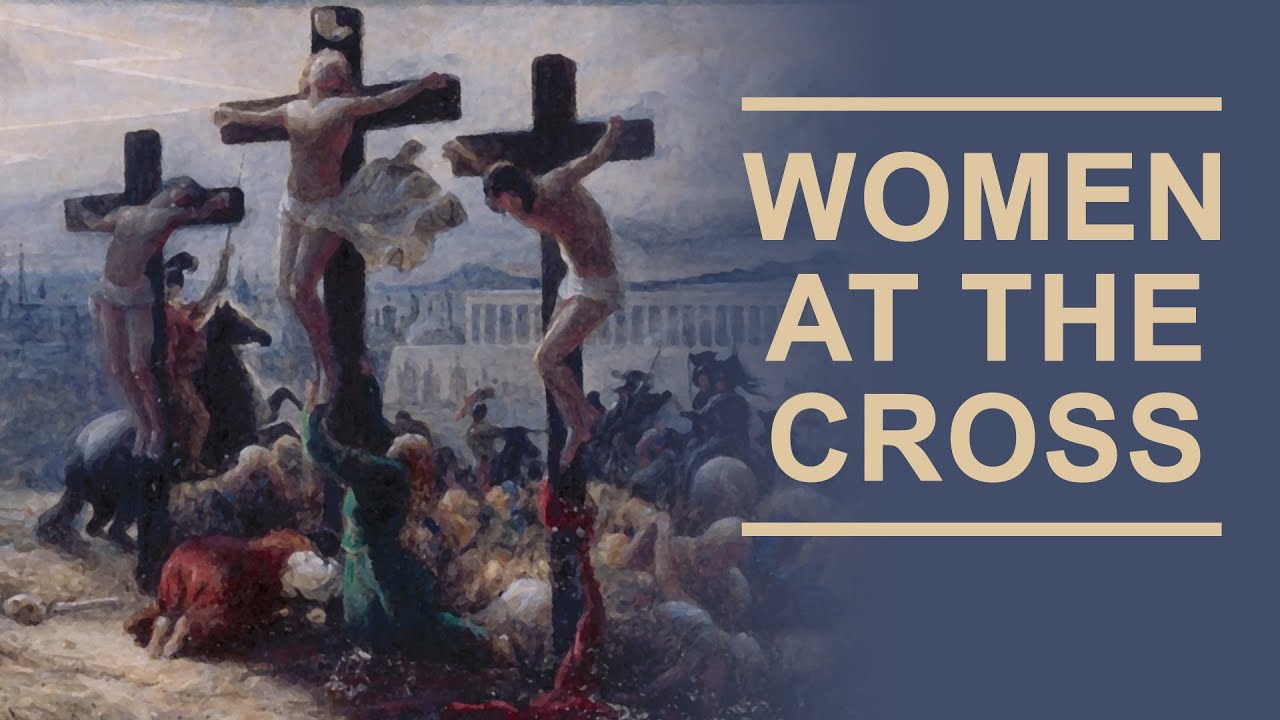
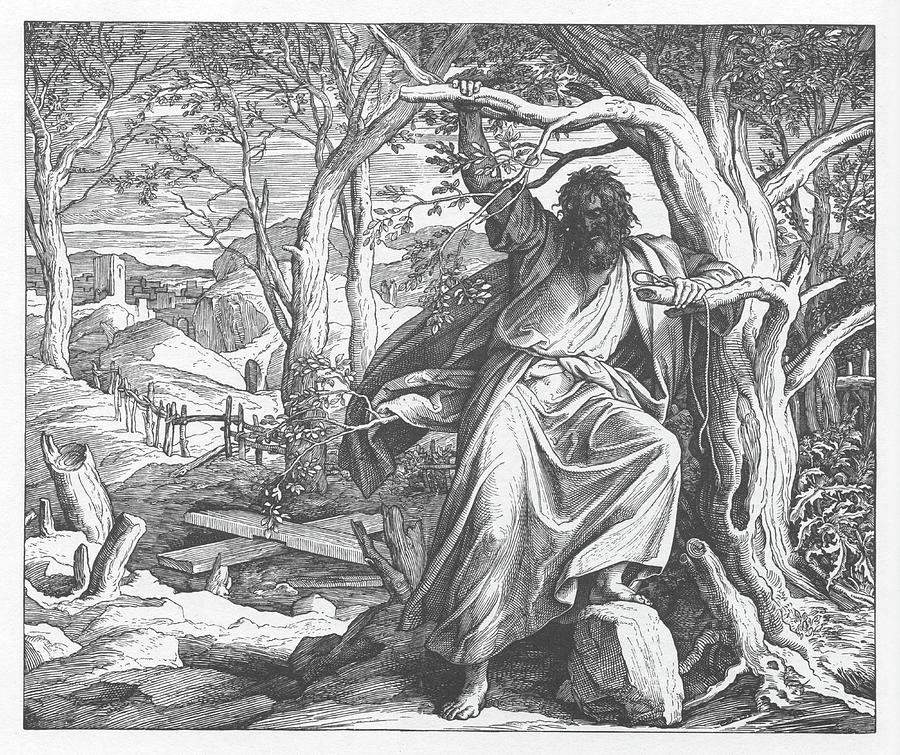
 inconceivable that God would sin.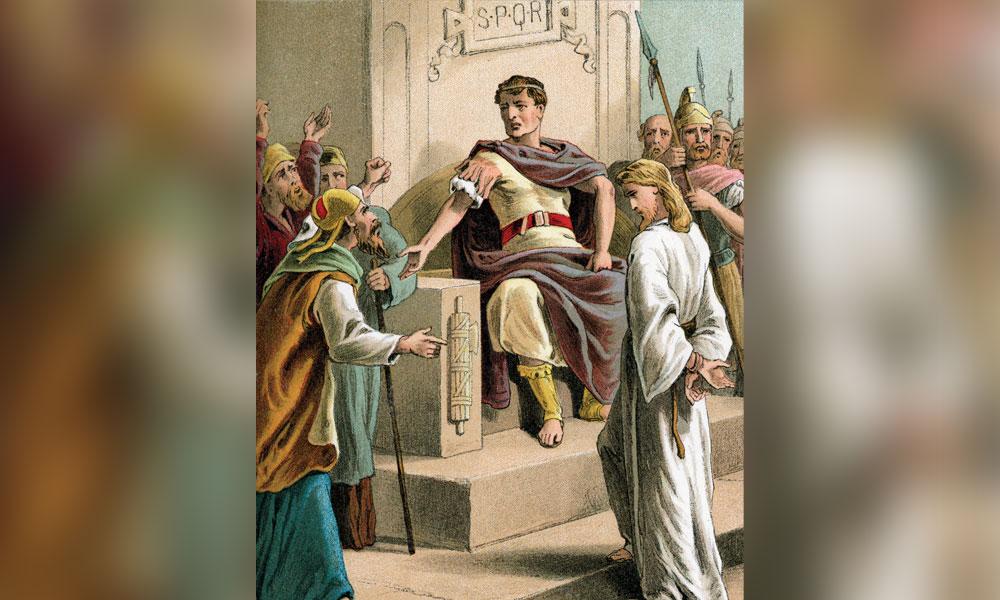
/Sanhedrin-GettyImages-91728330-5733700b3df78c6bb0a079d5.jpg)



 Proud to be TJ's man