RSS

A Closer Look at the Cross: Christ Died for our sins


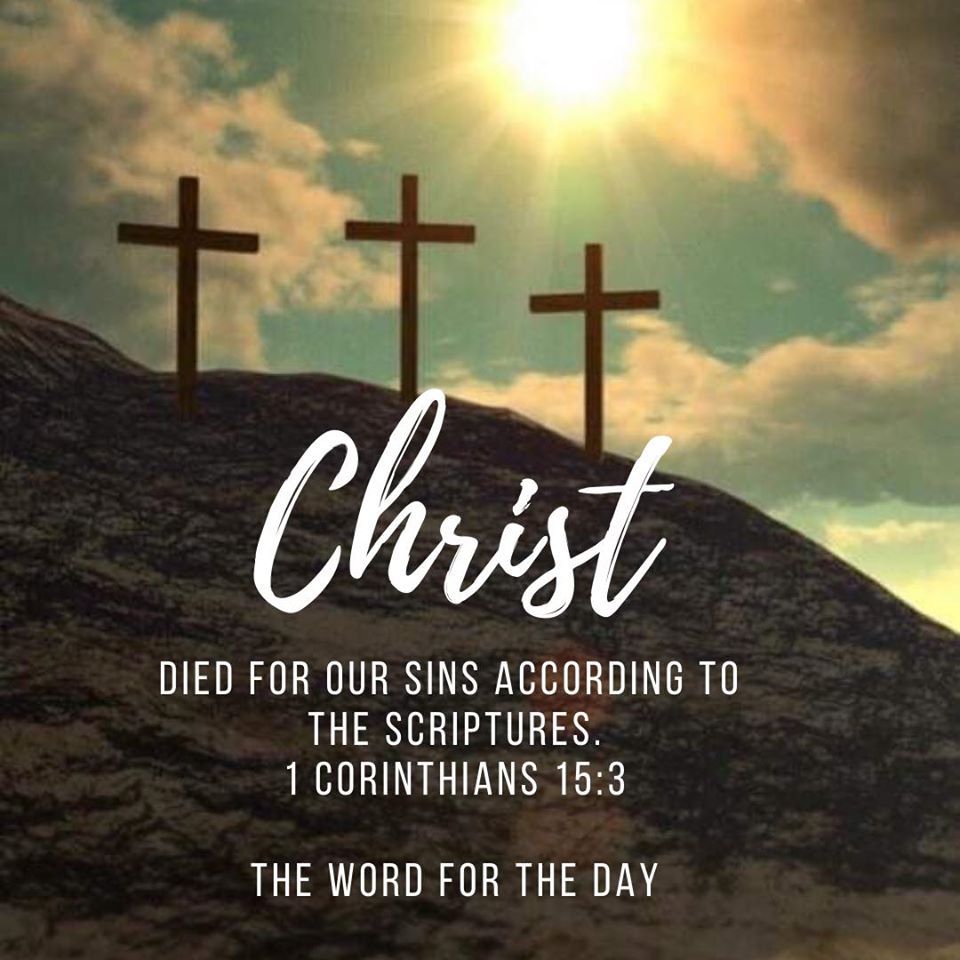
The Word For The Day — Christ died for our sins according to the...

1 Corinthians 15:1-4: “Now, brothers, I want to remind you of the gospel I preached to you, which you received and on which you have taken your stand. {2} By this gospel you are saved, if you hold firmly to the word I preached to you. Otherwise, you have believed in vain. {3} For what I received I passed on to you as of first importance : that Christ died for our sins according to the Scriptures, {4} that he was buried, that he was raised on the third day according to the Scriptures,”

There it is. Almost too simple. Jesus was killed, buried and resurrected. The part that matters the most in the world is the cross. No more and no less. The cross.

It rests on the time line of history like a compelling diamond. Its tragedy summons all sufferers. Its absurdity attracts all cynics. Its hope lures all searchers. And, according to Paul, the cross is what counts.

What a piece of wood! History has idolized it and despised it, gold-plated it and burned it, worn and trashed it. History has done everything to it but ignore it. That’s the one option that the cross does not offer.

No one can ignore it! You can’t ignore a piece of lumber that suspends the greatest claim in history. A crucified carpenter claiming that he is God on earth? Divine? Eternal? The death-slayer? No wonder Paul called it “the core of the gospel.” Its bottom line is sobering: if the account is true, it is history’s hinge. Period. If not, it is history’s hoax.

Dying is a dreadful thing from the human point of view; no amount of beautiful music or kind words can soften the blow.

We might work to camouflage the pain and deny the reality of it, but it is a grim, harsh, ugly, inescapable fact with which to reckon.

What is true for us today was true for our Lord when He faced the facts in His day. Being fully human, He did not relish the ultimate end of His earthly life: a crucifixion death.

But He accepted it. Isaiah 53:7: “like a lamb that is led to slaughter.”

Further background

Corinth was a Greek, city, and the Greeks did not believe in the resurrection of the dead. When Paul had preached at Athens and declared the fact of Christ’s resurrection, some of his listeners actually laughed at him (Acts 17:32). Most Greek philosophers considered the human body a prison, and they welcomed death as deliverance from bondage.

This skeptical attitude had somehow invaded the church and Paul had to face it head-on. The truth of the resurrection had doctrinal and practical implications for life that were too important to ignore. Paul dealt with the subject by answering four basic questions.

Are the Dead Raised? (1 Cor. 15:1-4)

It is important to note that the believers at Corinth did believe in the resurrection of Jesus Christ; so Paul started his argument with that fundamental truth. He presented three proofs to assure his readers that Jesus Christ indeed had been raised from the dead.

Proof #1their salvation (vv. 1-2). Paul had come to Corinth and preached the message of the Gospel, and their faith had transformed their lives. But an integral part of the Gospel message was the fact of Christ’s resurrection. After all, a dead Saviour cannot save anybody. Paul’s readers had received the Word, trusted Christ, been saved, and were now standing on that Word as the assurance of their salvation. The fact that they were standing firm was proof that their faith was genuine and not empty.

Proof #2—the Old Testament Scriptures (vv. 3-4). First of all means “of first importance.” The Gospel is the most important message that the church ever proclaims. While it is good to be involved in social action and the betterment of mankind, there is no reason why these ministries should preempt the Gospel. “Christ died… He was buried… He rose again… He was seen” are the basic historical facts on which the Gospel stands (1 Cor. 15:3-5). “Christ died for our sins” (author’s italics) is the theological explanation of the historical facts. Many people were crucified by the Romans, but only one “victim” ever died for the sins of the world.

When Paul wrote “according to the Scriptures” (1 Cor. 15:3) he was referring to the Old Testament Scriptures. Much of the sacrificial system in the Old Testament pointed to the sacrifice of Christ as our substitute and Saviour. The annual Day of Atonement (Lev. 16) and prophecies like Isaiah 53 would also come to mind.

But where does the Old Testament declare His resurrection on the third day? Jesus pointed to the experience of Jonah (Matt. 12:38-41). Paul also compared Christ’s resurrection to the “firstfruits,” and the firstfruits were presented to God on the day following the Sabbath after Passover (Lev. 23:9-14; 1 Cor. 15:23). Since the Sabbath must always be the seventh day, the day after Sabbath must be the first day of the week, or Sunday, the day of our Lord’s resurrection. This covers three days on the Jewish calendar. Apart from the Feast of Firstfruits, there were other prophecies of Messiah’s resurrection in the Old Testament: Psalm 16:8-11 (see Acts 2:25-28); Psalm 22:22ff (see Heb. 2:12); Isaiah 53:10-12; and Psalm 2:7 (see Acts 13:32-33).

* DEATH WAS A CONSTANT COMPANION FOR JESUS.

  1. HIS PURPOSE FOR COMING.

The shadow of the cross stretched more deeply across His path every day of His life. He had no other option except to face this premature death at about age 33, a time when most of us are just entering career paths and beginning to smell success in the distance.

His goal was to accomplish the mission of redemption… that He go to a cross and be nailed to its splintered surface… that His blood be poured out and that the cross-death be the answer for uniting man with God.

Luke 10:10: “For the Son of fan came to seek and save what was lost.”

Mark 10:45: “For even the Son of Han did not come to be served, but to serve, and to give his life as a ransom for many.”

Luke 9:28-31: (at His transfiguration: notice what they were talking about).

“About eight days after Jesus said this, he took Peter, John and James with him and went up onto a mountain to pray. {29} As he was praying, the appearance of his face changed, and his clothes became as bright as a flash of lightning. {30} Two men, Moses and Elijah, {31} appeared in glorious splendor, talking with Jesus. They spoke about his departure, which he was about to bring to fulfillment at Jerusalem.”

  1. COMMENTS DURING HIS MINISTRY.

Matthew 16:21-23: “From that time on Jesus began to explain to his disciples that he must go to Jerusalem and suffer many things at the hands of the elders, chief priests and teachers of the law, and that he must be killed and on the third day be raised to life. {22} Peter took him aside and began to rebuke him. “Never, Lord!” he said. “This shall never happen to you!” {23} Jesus turned and said to Peter, “Get behind me, Satan! You are a stumbling block to me; you do not have in mind the things of God, but the things of men.””

Having declared His person, Jesus now declared His work; for the two must go together. He would go to Jerusalem, suffer and die, and be raised from the dead. This was His first clear statement of His death, though He had hinted at this before (Matt. 12:39-40; 16:4; John 2:19; 3:14; 6:51). “And He was stating the matter plainly” (Mark 8:32, nasb).

Peter’s response to this shocking statement certainly represented the feelings of the rest of the disciples: “Pity Thyself, Lord! This shall never happen to Thee!” Jesus turned His back on Peter and said, “Get behind Me, adversary! You are a stumbling block to Me!” (literal translation) Peter the “stone” who had just been blessed (Matt. 16:18) became Peter the stumbling block who was not a blessing to Jesus!

What was Peter’s mistake? He was thinking like a man, for most men want to escape suffering and death. He did not have God’s mind in the matter. Where do we find the mind of God? In the Word of God. Until Peter was filled with the Spirit, he had a tendency to argue with God’s Word. Peter had enough faith to confess that Jesus is the Son of God, but he did not have the faith to believe that it was right for Jesus to suffer and die. Of course, Satan agreed with Peter’s words, for he used the same approach to tempt Jesus in the wilderness (Matt. 4:8-10).

Today the cross is an accepted symbol of love and sacrifice. But in that day the cross was a horrible means of capital punishment. The Romans would not mention the cross in polite society. In fact, no Roman citizen could be crucified; this terrible death was reserved for their enemies. Jesus had not yet specifically stated that He would be crucified (He did this in Matt. 20:17-19). But His words that follow emphasize the cross.

He presented to the disciples two approaches to life:

deny yourself live for yourself
take up your cross ignore the cross
follow Christ follow the world
lose your life for His sake save your life for your own sake
forsake the world gain the world
keep your soul lose your soul
share His reward and glory lose His reward and glory

To deny self does not mean to deny things. It means to give yourself wholly to Christ and share in His shame and death. Paul described this in Romans 12:1-2 and Philippians 3:7-10, as well as in Galatians 2:20. To take up a cross does not mean to carry burdens or have problems. (I once met a lady who told me her asthma was the cross she had to bear!) To take up the cross means to identify with Christ in His rejection, shame, suffering, and death.

But suffering always leads to glory. This is why Jesus ended this short sermon with a reference to His glorious kingdom (Matt. 16:28). This statement would be fulfilled within a week on the Mount of Transfiguration, described in the next chapter.

Further comments

Following the incident in which Peter acknowledged Jesus as being the Christ, Jesus began preparing his men for His imminent suffering, death, and resurrection.

Peter’s response: “Never, Lord! This shall never happen to You” Jesus said: “Get behind He, Satan! You are a stumbling block to me; you do not have in nind the things of God, but the things of men.”

16:21 From that time on Jesus began to explain to his disciples that he must go to Jerusalem and suffer many things at the hands of the elders, chief priests and teachers of the law, and that he must be killed and on the third day be raised to life.NIV The phrase “from that time on” marks a turning point.

In 4:17 it signaled Jesus’ announcement of the kingdom of heaven. Here it points to his new emphasis on his death and resurrection. The disciples still didn’t grasp Jesus’ true purpose because of their preconceived notions about what the Messiah should be. While they may have understood that he was the Messiah, they needed to prepare to follow him and to be loyal to him as he suffered and This cross saved and converted the world, drove away error, brought back truth, made earth Heaven, fashioned men into angels. Because of this cross, the devils are no longer terrible, but contemptible; neither is death, death, but a sleep.

John Chrysostom


died. So Jesus began teaching clearly and specifically what they could expect so that they would not be surprised when it happened. Contrary to what they thought, Jesus had not come to set up an earthly kingdom. He would not be the conquering Messiah because he first had to suffer many things . . . and . . . be killed. For any human king, death would be the end. Not so for Jesus. Death would be only the beginning, for on the third day, he would be raised to life.

Jesus’ teaching that he must suffer corresponds to Daniel’s prophecies that God’s plan for redemption could not be thwarted by any actions people might take: The Messiah would be cut off (Daniel 9:26); there would be a period of trouble (Daniel 9:27); and the king would come in glory (Daniel 7:13-14). The suffering also recalls Isaiah’s prophecy of the suffering Servant in Isaiah 53. His rejection looks back to the rejected “stone” in Psalm 118:22.

Jesus knew from what quarters the rejection would come: the elders, chief priests, and teachers of the law (also called “scribes”). The “elders” were the leaders of the Jews who decided issues of religious and civil law. Each community had elders, and a group of them was included in the Council (or Sanhedrin) that met in Jerusalem. “Chief priests” refers not only to the present high priest, but also to all those who formerly held the title and some of their family members. Teachers of the law did just that—taught the law. They were the legal experts. These three groups made up the Sanhedrin, the Jewish supreme court that ultimately sentenced Jesus to be killed (27:1). Notice that opposition came not from the people at large, but from their leaders—the very people who should have been the first to recognize and rejoice in the Messiah’s arrival.


TRIUMPHALISM
“Triumphalism” is a word that describes the kind of Christianity that seeks political prestige, social recognition, and temporal power. It forces itself on populations and begins to dictate on matters far removed from Jesus’ word. It says, “God will not let us lose because God cannot tolerate loss.” It presses toward victory by any means. It likes success. It is modern Christianity mimicking Peter’s advice to Jesus when he tried to talk him out of his mission.
But Jesus describes the path of faith in much humbler terms: injustice, misunderstanding, suffering, and death. These terms typify true faith for Jesus more than black-tie banquets celebrating multimillion-dollar fund-raising campaigns. When you think of what faith means, focus on Jesus, not on brochures, media presentations, or hyped-up public relations press releases.

16:22 Peter took him aside and began to rebuke him. “Never, Lord!” he said. “This shall never happen to you!”NIV This was too much for Peter. Having just confessed his heartfelt belief in Jesus as “the Christ, the son of the living God” (16:16) and having been given great authority in Jesus’ kingdom (16:18-19), Peter certainly found it most unnerving that the King would soon be put to death. His actions show that he really didn’t know what he was saying. If Jesus were going to die, what did this mean for the disciples? If he were truly the Messiah, then what was all this talk about being killed? So Peter took Jesus aside and began to rebuke him. The word for “rebuke” is a strong term meaning that Peter was rejecting Jesus’ interpretation of the Messiah as a suffering figure.

Peter, Jesus’ friend and devoted follower who had just eloquently proclaimed Jesus’ true identity, sought to protect him from the suffering he prophesied. But if Jesus hadn’t suffered and died, Peter would have died in his sins. Great temptations can come from those who love us and seek to protect us. Be cautious of advice from a friend who says, “Surely God doesn’t want you to face this.” Often our most difficult temptations come from those who try to protect us from discomfort.

16:23 But he turned and said to Peter, “Get behind me, Satan! You are a stumbling block to me; for you are setting your mind not on divine things but on human things.”NRSV Peter often spoke for all the disciples. In singling Peter out for rebuke, Jesus may have been addressing all of them indirectly. In his wilderness temptations, Jesus had been told that he could achieve greatness without dying (4:8-9). Peter, in his rebuke of Jesus’ words about dying, was saying the same thing. Trying to circumvent God’s plan had been one of Satan’s tools; Peter inadvertently used Satan’s tool in trying to protect his beloved Master. Although Peter had just proclaimed Jesus as Messiah, quickly he turned from God’s perspective and evaluated the situation from a human one. This would be a stumbling block to Jesus. Peter was speaking Satan’s words, thus Jesus rebuked Peter with the words, Get behind me, Satan! This didn’t make sense to Peter, who, Jesus said, was setting his mind not on divine things but on human things. This accusation provides us with an important principle for following Jesus today. We know, from God’s Word, Jesus’ true identity as God’s Son, but it is so easy for us to limit his impact on our life when we are preoccupied with earthly goals. It is so natural and comfortable for us to set our minds on human comfort, security, success, and prosperity that we forget our divine call to sacrifice and service. So we can see that Peter’s perspective was wrong. God’s plan included suffering and death for the Messiah. Jesus would fulfill his mission exactly as planned.

  1. STATEMENTS TO HIS DISCIPLES John 14:1-3

(John 14:1-3)  “”Do not let your hearts be troubled. Trust in God ; trust also in me. {2} In my Father’s house are many rooms; if it were not so, I would have told you. I am going there to prepare a place for you. {3} And if I go and prepare a place for you, I will come back and take you to be with me that you also may be where I am.”

This section opens and closes with our Lord’s loving admonition, “Let not your heart be troubled” (John 14:1, 27). We are not surprised that the Apostles were troubled. After all, Jesus had announced that one of them was a traitor, and then He warned Peter that he was going to deny his Lord three times. Self-confident Peter was certain that he could not only follow his Lord, but even die with Him and for Him. Alas, Peter did not know his own heart, nor do we really know our hearts, except for one thing: our hearts easily become troubled.

Perhaps the heaviest blow of all was the realization that Jesus was going to leave them (John 13:33). Where was He going? Could they go with Him? How could they get where He was going? These were some of the perplexing questions that rumbled around in their minds and hearts and were tossed back and forth in their conversation at the table.

How did Jesus calm their troubled hearts? By giving them six wonderful assurances to lay hold of, assurances that we today may claim and thus enjoy untroubled hearts. If you are a believer in Jesus Christ, you may claim every single one of these assurances.

You Are Going to Heaven (John 13:36-14:6)

Jesus did not rebuke Peter for asking Him where He was going, but His reply was somewhat cryptic. One day Peter would “follow” Jesus to the cross (John 21:18-19; 2 Peter 1:12-15), and then he would follow Him to heaven. Tradition tells us that Peter was crucified, though he asked to be crucified head-downward because he did not feel worthy to die as his Master died.

Just as Peter was beginning to feel like a hero, Jesus announced that he himself would soon become a casualty. The message not only shocked Peter, but it also stunned the rest of the disciples. After all, if brave Peter denied the Lord, what hope was there for the rest of them? It was then that Jesus gave His message to calm their troubled hearts.

According to Jesus, heaven is a real place. It is not a product of religious imagination or the result of a psyched-up mentality, looking for “pie in the sky by and by.” Heaven is the place where God dwells and where Jesus sits today at the right hand of the Father. Heaven is described as a kingdom (2 Peter 1:11), an inheritance (1 Peter 1:4), a country (Heb. 11:16), a city (Heb. 11:16), and a home (John 14:2).

The word Father is used fifty-three times in John 13-17. Heaven is “My Father’s house,” according to the Son of God. It is “home” for God’s children! Some years ago, a London newspaper held a contest to determine the best definition of “home.” The winning entry was, “Home is the place where you are treated the best and complain the most.” The poet Robert Frost said that home is the place that, when you arrive there, they have to take you in. A good definition!

The Greek word monē is translated “mansions” in John 14:2 and “abode” in John 14:23. It simply means “rooms, abiding places,” so we must not think in terms of manor houses. It is unfortunate that some unbiblical songs have perpetuated the error that faithful Christians will have lovely mansions in glory, while worldly saints will have to be content with little cottages or even shacks. Jesus Christ is now preparing places for all true believers, and each place will be beautiful. When He was here on earth, Jesus was a carpenter (Mark 6:3). Now that He has returned to glory, He is building a church on earth and a home for that church in heaven.

John 14:3 is a clear promise of our Lord’s return for His people. Some will go to heaven through the valley of the shadow of death, but those who are alive when Jesus returns will never see death (John 11:25-26). They will be changed to be like Christ and will go to heaven (1 Thes. 4:13-18).

Since heaven is the Father’s house, it must be a place of love and joy. When the Apostle John tried to describe heaven, he almost ran out of symbols and comparisons! (Rev. 21-22) Finally, he listed the things that would not be there: death, sorrow, crying, pain, night, etc. What a wonderful home it will be—and we will enjoy it forever!

Further comments

After predicting Peter’s denial (13:38), Jesus spoke to the deep concerns of the disciples. They were confused; he encouraged them to trust. They needed to anchor that trust in Jesus. He indicated that he and the Father would prepare a place for them while he was gone, but that he would return to gather them.

The disciples could not comprehend Jesus’ comments about leaving. Their question about his destination enabled Jesus to identify himself not only as their eternal companion, but also as the very means for them to see the Father. He claimed to be the unique and ultimate resource when he said: “I am the way and the truth and the life. No one comes to the Father except through me” (14:6 niv).

Characteristically, the disciples responded to Jesus’ revelation with a question that reveals how inadequately they grasped Jesus’ divine nature. In answering them, Jesus described four aspects of his unique identity: (1) Jesus and the Father share characteristics in such a way that anyone who has seen one has also seen the other. (2) Jesus and the Father are united in such a way that Jesus could speak of either of them being “in” the other. (3) Jesus gives special abilities to those who trust him to accomplish even greater signs than the disciples had already seen. (4) Requests to God made in Jesus’ name will be answered.

After this intimate opening dialogue, the Last Supper discourse began. The next several chapters have been among the most treasured of those who follow Jesus. They not only draw us close to him; they also give us compelling reasons to invite others into that fellowship with our Savior. By recording this private discussion between Jesus and his disciples, John hoped to attract all people to Jesus.

14:1 “Let not your heart be troubled.”NKJV In the Greek, the pronoun your is plural; therefore, Jesus was speaking to Peter (whose denial of Jesus had just been predicted—see 13:38) and to all the other disciples. According to Luke, Jesus had told Peter, “Satan has demanded to sift all of you like wheat . . .” (Luke 22:31 nrsv). All of the disciples must have been troubled about Jesus’ predictions of betrayal, denial, and departure. After all, if Peter’s commitment was shaky, then every disciple should be aware of his own weaknesses.


STRONG WEAK PEOPLE
Jesus did not want his followers to imitate Peter’s impulsive self-confidence. Potential weaknesses and possible failures trouble us. So we don’t like to think about them. Peter denied his own frailty and claimed more faith than he had. Jesus’ solution for troubled hearts requires us to trust in him. Trust does not mean pretending we are strong; it means recognizing our weakness and need for God’s help. If we believe for a moment that we can follow Jesus in our own strength, we will fail as miserably as Peter.

“Trust in God; trust also in me.”NIV Jesus urged his disciples to maintain their trust in the Father and in the Son, to continue trusting through the next few very difficult days. Jesus later told the disciples why he gave them glimpses of the future that would soon follow: “I have told you now before it happens, so that when it does happen you will believe” (14:29 niv). They would not need to be afraid because all that he promised would come true.

14:2 “In my Father’s house are many rooms.”NIV The traditional interpretation of this phrase teaches that Jesus is going to heaven to prepare rooms or “mansions” (nkjv) for his followers. Based on that imagery, entire heavenly subdivisions and elaborate “mansion blueprints” have been described. Many commentators think that Jesus was speaking about his Father’s house in heaven, where he would go after his resurrection in order to prepare rooms for his followers. Then he would return one day to take his believers to be with him in heaven. The day of that return usually has been regarded as the Second Coming.

The other view is that the passage primarily speaks of the believers’ immediate access to God the Father through the Son. The “place” Jesus was preparing has less to do with a location (heaven) as it had to do with an intimate relationship with a person (God the Father). This interpretation does not deny the comfort of heaven’s hope in this passage, but it does remove the temptation to view heaven purely in terms of glorious mansions. Heaven is not about splendid accommodations; it is about being with God. The point of the passage is that Jesus is providing the way for the believers to live in God the Father. As such, the way he prepared the place was through his own death and resurrection and thereby opened the way for the believers to live in Christ and approach God.

According to this view, the Father’s house is not a heavenly mansion, but Christ himself in whom all the believers reside. By expansion, the Father’s house is Christ and the church (see 1 Corinthians 3:16-17; Ephesians 2:20-22; Hebrews 3:2). The believers don’t have to wait until the Second Coming to live in this house; once Christ rose from the dead he brought them into a new, living relationship with God (see 20:19-23). He would be the means whereby the believers could come to dwell in the Father and the Father in them. As such, the promise in 14:2-3 relates to the corporate fellowship that would be possible through Christ’s departure and return in the Spirit. In this view, the “many rooms” would be the many members of God’s household. Christ went to prepare a place for each member in God’s household (1 Chronicles 17:9)—the preparation was accomplished by his death and resurrection.

 TRUST IN ME?
When we face troubling times we often feel overwhelmed by fear, doubts, grief, and conflict. Our outer resources may evaporate and our inner strength may prove inadequate. Though faced with possible or certain failure, we have assurances in Jesus’ words to remain calm and hopeful:
l God is trustworthy, and he has sent Christ, who is also trustworthy, to us. No one else deserves our trust.
l God has a gracious welcome and plenty of space in his “house.” We need not fear exclusion or separation from him.
l Jesus spoke the truth. His description of the future was realistic. He has never been proven wrong. We can rely on both Jesus’ teaching and his promises.
l Jesus did exactly what he said he would do, return to the disciples after the Resurrection. In so doing, he guaranteed our entrance into God’s presence and our place in God’s house.
l Jesus is always with us, and someday we will be face to face with him. Whatever the future holds, Jesus promised to be our companion. We know who Jesus is and how much he loves us.

The Greek word for “rooms” (monai) could be better translated “abodes” because it shares the same root as the Greek word for “abide” (meno). It simply means “a dwelling place.” The word mansions in the nkjv is misleading because it connotes spacious, luxurious houses. Incidentally, early in church history Origen made popular a similar belief that Jesus was speaking of “stages” or levels of heaven, through which believers advanced as they continued to “develop.” But Jesus’ words imply no value judgment between “rooms.” The “prepared place” is with Christ.

“If it were not so, I would have told you.”NKJV Jesus’ words give us great encouragement. Throughout his life he had warned the disciples of opposition (see 16:2). He never held back the truth from them. Because he always told the truth, we can trust him with our future as well.

14:3 “I go and prepare a place for you.”NKJV According to what has been discussed in 14:1-2, there are two ways to understand this statement. Either Jesus was speaking of preparing heavenly dwellings for the future life of the believers, or Jesus was preparing the way for the believers to live in God. Of course, the two views are not mutually exclusive. Now, we live in God because of our living relationship with Christ; in eternity we will live with Christ in the glory he shares with the Father. Eternal life begins in Christ now, not just at some future date when we get to heaven.

In either interpretation, Jesus offers spiritual comfort that begins immediately when we believe. And his Father’s many-roomed house represents gracious welcome and provision for us as we live in union with him.


ETERNITY TODAY
There are few verses in Scripture that describe eternal life, but these few verses are rich with promises. Here Jesus says, “I go to prepare a place for you,” and “I will come again.” We can look forward to eternal life because Jesus has promised it to all who believe in him. But we can actually begin to enjoy eternal life now, for it became ours the moment we believed in Jesus. We can live today with a new destiny in mind. Although we do not know all the details of eternity, we need not fear because Jesus is preparing us to share with him the eternity that he and the Father have prepared for us.

“I will come again and receive you to Myself.”NKJV There are three ways to understand this: (1) Jesus’ coming again to the disciples would be realized in a short while. This is confirmed by 16:16, “A little while, and you will not see Me; and again a little while, and you will see Me” (nkjv)—note the similar use of again. When Jesus said, “I will come again,” that coming again occurred on the day of his resurrection. (2) Jesus’ “coming again” is the Second Coming. (3) This “coming again” refers to both the Resurrection and the Second Coming—the former foreshadowing the latter. Those who hold this view, therefore, extract a double meaning from Jesus’ words in verses 2 and 3; they say the passage speaks both of the believers being brought into the risen Christ as the many “rooms” in the Father’s house, and of the believers being brought by the returned Christ into the Father’s house in heaven. It does seem that both meanings merge. Christ has us completely in his care.

  1. HIS ARREST AND TRIALS. (Matt. 26:36-46).

(Matthew 26:36-46)  “Then Jesus went with his disciples to a place called Gethsemane, and he said to them, “Sit here while I go over there and pray.” {37} He took Peter and the two sons of Zebedee along with him, and he began to be sorrowful and troubled. {38} Then he said to them, “My soul is overwhelmed with sorrow to the point of death. Stay here and keep watch with me.” {39} Going a little farther, he fell with his face to the ground and prayed, “My Father, if it is possible, may this cup be taken from me. Yet not as I will, but as you will.” {40} Then he returned to his disciples and found them sleeping. “Could you men not keep watch with me for one hour?” he asked Peter. {41} “Watch and pray so that you will not fall into temptation. The spirit is willing, but the body is weak.” {42} He went away a second time and prayed, “My Father, if it is not possible for this cup to be taken away unless I drink it, may your will be done.” {43} When he came back, he again found them sleeping, because their eyes were heavy. {44} So he left them and went away once more and prayed the third time, saying the same thing. {45} Then he returned to the disciples and said to them, “Are you still sleeping and resting? Look, the hour is near, and the Son of Man is betrayed into the hands of sinners. {46} Rise, let us go! Here comes my betrayer!””

26:36 Then Jesus went with them to a place called Gethsemane; and he said to his disciples, “Sit here while I go over there and pray.”NRSV After eating the meal, the disciples left Jerusalem and went out to a favorite meeting place (Luke 22:39; John 18:2). This gardenlike enclosure called Gethsemane, meaning “olive press,” was probably an orchard of olive trees with a press for extracting oil. The garden was in the Kidron Valley just outside the eastern wall of Jerusalem and just below the Mount of Olives. Jesus told eight of the disciples to sit down and wait, probably near the garden’s entrance, while he went farther in to pray. The disciples must have been physically and emotionally exhausted from trying to comprehend what would transpire. Instead of watching, however, they gave in to their exhaustion and fell asleep.

URGENT PRAYER

When pressed with a difficulty, what’s your first instinct: blame your mom? blame your kids? call 9-1-1? Jesus prayed.

When you’re sick with grief, worry, or guilt, prayer should be first on the list. In prayer, you settle things with God, and God strengthens you. It takes the sting from an emergency. It shares the burden with a big-shouldered friend. Pray first, especially when trouble is close at hand. Pray with others. There you will find strength and support.

26:37-38 He took Peter and the two sons of Zebedee along with him, and he began to be sorrowful and troubled. Then he said to them, “My soul is overwhelmed with sorrow to the point of death. Stay here and keep watch with me.”NIV Jesus then took the other three disciples, his inner circle (Peter, James, and John), farther into the garden with him. To these closest friends, Jesus revealed his inner turmoil over the event he was about to face.

Jesus was sorrowful and troubled over his approaching death because he would be forsaken by the Father (27:46), would have to bear the sins of the world, and would face a terrible execution. The divine course was set, but Jesus, in his human nature, still struggled (Hebrews 5:7-9).

His coming death was no surprise; he knew about it and had even told the disciples about it so they would be prepared. Jesus knew what his death would accomplish.

He also knew that the means to that end would mean taking upon himself the sin of the world, alienating him, for a time, from his Father who would be unable to look upon sin: “God made him who had no sin to be sin for us, so that in him we might become the righteousness of God” (2 Corinthians 5:21 niv).

Jesus bore our guilt by “becoming a curse for us” (Galatians 3:13 niv). As the time of this event neared, it became even more horrifying. Jesus naturally recoiled from the prospect.

Early in Jesus’ ministry Satan had tempted him to take the easy way out (4:1-11); later Peter had suggested that Jesus did not have to die (16:22). In both cases, Jesus had dealt with the temptation soundly. Now, as his horrible death and separation from the Father loomed before him, he was overwhelmed with sorrow to the point of death.

So he asked Peter, James, and John to stay with him and keep watch. Jesus knew Judas would soon arrive, and Jesus wanted to devote himself to prayer until that time came. Jesus also wanted them to stay awake and participate with him in his suffering.

Spiritual vigilance is a vital part of discipleship and a key theme in this book. Jesus wanted these disciples to understand his suffering and to be strengthened by his example when they faced persecution and suffering.

26:39 He went a little farther and fell on His face, and prayed, saying, “O My Father, if it is possible, let this cup pass from Me; nevertheless, not as I will, but as You will.”NKJV Jesus went still farther into the garden to be alone with God. His agony was such that he threw himself on the ground before God in deep spiritual anguish, praying that if possible let this cup pass—in other words, he was asking the Father to let the mission be accomplished some other way not requiring the agony of crucifixion, when he would become sin and be separated from the Father.

In the Old Testament, “cup” stood for the trial of suffering and the wrath of God (Isaiah 51:17). So Jesus referred to the suffering that he must endure as the “cup” he would be required to drink. Yet Jesus humbly submitted to the Father’s will. He went ahead with the mission for which he had come (1:21).

With the words “let this cup pass from Me,” Jesus was referring to the suffering, isolation from God, and death he would have to endure in order to atone for the sins of the world.

We must not think that it was the fear of death that made our Lord so agonize in the Garden. He did not fear death, but faced it with courage and peace. He was about to “drink the cup” that His Father had prepared for Him, and this meant bearing on His body the sins of the world (John 18:11; 1 Peter 2:24). Many godly people have been arrested, beaten, and slain because of their faith. But only Jesus experienced being made sin and a curse for mankind (2 Cor. 5:21; Gal. 3:13). The Father has never forsaken any of His own, yet He forsook His Son (Matt. 27:46). This was the cup that Jesus willingly drank for us.

Jesus was not wrestling with God’s will or resisting God’s will. He was yielding Himself to God’s will. As perfect Man, He felt the awful burden of sin, and His holy soul was repelled by it. Yet as the Son of God, He knew that this was His mission in the world. The mystery of His humanity and deity is seen vividly in this scene.

TRUE PRAYER

In times of suffering, people sometimes wish they knew the future, or they wish they could understand the reason for their anguish. Jesus knew what lay ahead of him, and he knew the reason.

Even so, his struggle was intense—more wrenching than any struggle we will ever have to face. What does it take to be able to say “as God wills”? It takes firm trust in God’s plans; it takes prayer and obedience each step of the way.

This is the heart of true prayer and should be our basic response to trials. Trust God that his way is best, even when it doesn’t seem like it.

God did not take away the “cup,” for the cup was his will. Yet he did take away Jesus’ extreme fear and agitation. Jesus moved serenely through the next several hours, at peace with God, knowing that he was doing his Father’s will.

PEACE

Some people believe their troubles are caused by bad people, bad germs, or bad luck. But Christians know that God rules, so we rightly make our appeal to his will, which

  • takes the bitterness out of the cup we may face, though it doesn’t always remove the cup. God’s will for each of us includes some pain, some loss, some struggle;
  • never breaks us or makes us feel hopeless or abandoned;
  • always assures us of God’s presence and care; and
  • ever promises reunion and relief.

Take comfort in God’s will for you. Pray sincerely, “Your will be done!”

Jesus was not only asking that they pray for him, but also that they pray for themselves. Jesus knew that these men would need extra strength to face the temptations ahead—temptations to run away or to deny their relationship with him.

“Enter into” could also be translated “fall into.” Jesus wanted the disciples to pray that their faith would not collapse. The word “temptation” can mean testing or trial. Jesus wanted his disciples to pray for strength to go through the coming ordeal. The disciples were about to see Jesus die. Would they still think he was the Messiah? The disciples would soon face confusion, fear, loneliness, guilt, and the temptation to conclude that they had been deceived.

“The spirit indeed is willing, but the flesh is weak.”NKJV Many have interpreted “spirit” to mean the “human spirit.” Thus, it would mean that while their spirit might be willing, their flesh would be weak. Their inner desires and intentions would be, as they had previously boasted, to never deny Jesus and to die with him. Their relationship with Jesus had made the disciples eager to serve him in any way possible. Yet their human inadequacies, with all their fears and failures, would make it difficult to carry out those good intentions. A willing spirit (see Psalm 51:12) needs the Holy Spirit to empower it and help it do God’s will.

Jesus used Peter’s drowsiness to warn him to be spiritually vigilant against the temptation he would soon face. The way to overcome temptation is to stay alert and to pray. This means being aware of the possibilities of temptation, sensitive to the subtleties, and morally resolved to fight courageously. Because temptation strikes where we are most vulnerable, we can’t resist alone. Prayer is essential because God’s strength can shore up our defenses and defeat Satan.

26:42 Again, a second time, He went away and prayed, saying, “O My Father, if this cup cannot pass away from Me unless I drink it, Your will be done.”NKJV Jesus left the three disciples and returned to his conversation with the Father (26:39).

26:43-45 And He came and found them asleep again, for their eyes were heavy.NKJV Jesus came back once again to the three disciples and found them asleep again. Despite his warning that they should be awake, alert, and praying not to fall to the coming temptations, their eyes were heavy, and all three went back to sleep. So He left them, went away again, and prayed the third time, saying the same words.NKJV Jesus continued his conversation with his Father, as before (26:39, 42). During these times of prayer, the battle was won. Jesus still had to go to the cross, but he would humbly submit to the Father’s will and accomplish the task set before him.

Then he came to the disciples and said to them, “Are you still sleeping and taking your rest? See, the hour is at hand, and the Son of Man is betrayed into the hands of sinners.”NRSV Jesus went away to pray a third time, only to come back and find the disciples still asleep. After much time in prayer, Jesus was ready to face his hour, which conveyed that all he had predicted about his death was about to happen (see John 12:23-24). The disciples had missed a great opportunity to talk to the Father, and there would be no more time to do so, for Jesus’ hour had come. Thus, Jesus did not again tell them to pray. Jesus had spent the last few hours with the Father, wrestling with him, and humbly submitting to him. Now he was prepared to face his betrayer and the sinners who were coming to arrest him. “Sinners” was the term used for Jews who did not live according to God’s will and for Gentiles, who were viewed collectively as sinners because they didn’t live by God’s law. Jesus probably used the term to refer to the priestly authorities who were disobeying God in their treachery, and to the Romans who were participating in Jesus’ arrest, mockery, and death.

26:46 “Rise, let us go! Here comes my betrayer!”NIV Jesus roused the three sleeping disciples (and perhaps the other eight as well) and called them together. His words “rise, let us go” did not mean that Jesus was contemplating running. Instead, he was calling the disciples to go with him to meet the traitor disciple, Judas, and the coming crowd. Jesus went forth of his own will, advancing to meet his accusers rather than waiting for them to come to him. Jesus’ betrayer, Judas, had arrived. Judas knew where to find Jesus and the disciples because Gethsemane had been a favorite meeting spot (John 18:1-2). It was to this quiet garden in the very early hours of the morning that Judas brought a crowd to arrest Jesus.

 
Leave a comment

Posted by on March 24, 2022 in cross


A Closer Look At The Cross – The Foolishness of God 1 Corinthians 1:18-31 (ESV)


For the foolishness of God is wiser than human wisdom... - SermonQuotes

Some speakers use impressive words, but they are weak on content. Some preachers make the Bible marginal in their sermons in order to hold people’s attention. Even Bible studies give less focus to the Bible than they do to fellowship.

Paul stressed solid content and practical help for his listeners. He wanted them to be impressed with his message, not just his style. You don’t need to be a great speaker with a large vocabulary to share the gospel effectively. The persuasive power is in the story, not the storyteller.

In this series we will seek to make Christ the center of our preaching, rather than trying to be impressive.

1:18 For the word of the cross is folly to those who are perishing, but to us who are being saved it is the power of God.

Paul had not come to Corinth to make disciples for himself; he had come to “preach the gospel” (1:17). But this preaching was not according to the world’s wisdom or desires—it was not filled with philosophical arguments or supernatural acts.

Paul’s preaching was the message of the cross—Jesus Christ crucified on behalf of sinners. Such a message always has two results, for ultimately all of humanity will end up in one of these two classes.

(1) The gospel message sounds foolish . . . to those who are on the road to destruction. For those who desire worldly wisdom, the message of the cross seems stupid. “Who wants a crucified king?” they might ask.

(2) But for those who are being saved . . . [the gospel message is] the very power of God.

Paul wrote to the Romans, “For I am not ashamed of the gospel of Christ, for it is the power of God to salvation for everyone who believes, for the Jew first and also for the Greek” (1:16 nkjv). The gospel message is more than a true story and a good way to live; it is “the very power of God.” Only with such power can the gospel message redeem sinful people and transform them into God’s people.

1:19 For it is written, “I will destroy the wisdom of the wise, and the discernment of the discerning I will thwart.”

Paul summarized Isaiah 29:14 to emphasize a point that Jesus often made: God’s way of thinking is not like the world’s way (normal human wisdom).

“The wisdom of the wise” and “the intelligence of the intelligent” refer to world-centered wisdom and intelligence. These are not wrong, but they are worthless as a means of salvation. The context of the passage in Isaiah is that God hates those who Isaiah 29:14 (ESV) therefore, behold, I will again do wonderful things with this people, with wonder upon wonder; and the wisdom of their wise men shall perish, and the discernment of their discerning men shall be hidden.

God says he will destroy their wisdom and intelligence because it can never help them find him. People can spend a lifetime accumulating human wisdom and yet never learn how to have a personal relationship with God. They must come to the crucified and risen Christ to receive eternal life and the joy of a personal relationship with the Savior.

Whether they use their “wisdom” and “intelligence” to search for God or to attempt to dismiss him, they will only find themselves doomed to frustration and, ultimately, to eternal separation from God.

1:20 Where is the one who is wise? Where is the scribe? Where is the debater of this age? Has not God made foolish the wisdom of the world?

No human wisdom or intelligence can either discover or disprove God. No human reasoning can bring salvation. So all those who have lived by their own wisdom—the philosophers, the scholars, and the world’s brilliant debaters—will be left with nothing.

God had already made them all look foolish and showed that their “wisdom” was no more than useless nonsense. Some have suggested that the “philosophers” (also translated “the wise ones”) may have been an allusion to the Greeks. The “scholars” (also translated “scribes”) may refer to the Jewish professionals who were skilled in God’s law. The “brilliant debaters” (or “philosophers or disputers of this age”) could refer to either Jews or Greeks who thought that any issue could be solved by human reasoning.

Paul may have been thinking of such distinctions, or he may have been simply using three different terms to describe people who think they are learned. For all their learning, God would show them to be fools. Their wisdom would be “useless” because it could do nothing to provide salvation. That can come only through the cross.

1:21 21  For since, in the wisdom of God, the world did not know God through wisdom, it pleased God through the folly of what we preach to save those who believe.

In his complete sovereignty and in his wisdom, God decided that people would never find him through human wisdom. Instead, he chose a crucified Savior and a message of salvation preached by weak and fallible human beings to save all who believe. This looks like absurdity to the “high and mighty” of this world.

Many people of Paul’s time, and many today, mocked the message of the gospel. In their human wisdom, they wanted to reason “above and beyond” and experience more than what they felt was offered in the foolish preaching of believers. In reality, the worldly wise will not find God; those who accept the message of the cross will find him and be saved.

1:22-24 For Jews demand signs and Greeks seek wisdom, 23  but we preach Christ crucified, a stumbling block to Jews and folly to Gentiles, 24  but to those who are called, both Jews and Greeks, Christ the power of God and the wisdom of God.

Many Jews considered the Good News of Jesus Christ to be foolish because they thought the Messiah would be a conquering king who did many spectacular signs and miracles.

Although Jesus had performed many miracles during his ministry on earth, many Jews who observed his miracles firsthand had refused to believe. Jesus had not restored David’s throne in the way that they had expected. Besides, he had been executed as a criminal—how could a criminal be the Savior? This proclamation of Christ crucified was a contradiction of all that they believed, and it became a stumbling block to them.

The Greeks (also here called Gentiles) did not believe in a bodily resurrection; they did not see in Jesus the powerful characteristics of their mythological gods, and they thought no reputable person would be crucified. To them, death was defeat, not victory. It did not make sense—in their worldly wisdom—that any god would do such a thing as come to earth to be killed. The Greeks worshiped wisdom and revered their great thinkers and philosophers. To them, the gospel message just didn’t measure up; to them, the proclamation of “Christ crucified” was foolishness.

While some Jews and Greek tripped over the message of “Christ crucified,” it was a different story for those who are called—those who embraced and believed the gospel. Many people, both Jews and Greeks, will not stumble over the message but will find that the gospel of Christ crucified is the power of God and the wisdom of God (see 1:18).

Our society worships power, influence, and wealth. Jesus came as a humble, poor servant, and he offers his kingdom to those who have faith, not to those who work hard or improve themselves. This may look ridiculous to the world, but Christ is our power, the only way we can be saved. Make sure you know Christ personally; then you’ll have the greatest wisdom anyone could desire.

1:25  For the foolishness of God is wiser than men, and the weakness of God is stronger than men.

This verse provides the key to Paul’s words in chapters 1-3. The message of Christ’s death for sins sounds foolish to those who don’t believe. They believe that they, by their own wisdom, can find the “ultimate reality” or make for themselves the best life; however, they will be woefully disappointed. Their wisest plans cannot even compare to God’s most insignificant act.

Paul’s words do not imply that God could ever be foolish or weak; instead, he was making the point that human wisdom and human strength cannot begin to compare to God. What the world sees as foolishness (Christ’s death for our sins as a display of God’s power) is God’s truth. The cross was reserved for criminals in Paul’s day. How could such an act have any power?

Death seems to be the end of the road, the ultimate weakness. But Jesus did not stay dead. His resurrection demonstrated his power over death. And through what had appeared to be weakness, Christ accomplished what no amount of human strength could ever accomplish. By his death, people are saved from eternal death and given everlasting life—if they trust him as Savior and Lord. The “foolish” people who simply accept Christ’s offer are actually the wisest of all, because they alone will live eternally with God.

    1:26 For consider your calling, brothers: not many of you were wise according to worldly standards, not many were powerful, not many were of noble birth.

The Corinthians had a tendency to be “puffed up” with pride (1 Cor. 4:6, 18-19; 5:2). But the Gospel of God’s grace leaves no room for personal boasting. God is not impressed with our looks, our social position, our achievements, our natural heritage, or our financial status. Note that Paul wrote many, not any. In the New Testament, we do meet some believers with “high social standing,” but there are not many of them. The description Paul gave of the converts was certainly not a flattering one (1 Cor. 6:9-11).

Paul reminded them of what they were (v. 26). They were not wise, mighty, or noble. God called them, not because of what they were, but in spite of what they were! The Corinthian church was composed primarily of ordinary people who were terrible sinners. Before his conversion, Paul had been very self-righteous; he had to give up his religion in order to go to heaven! The Corinthians were at the other end of the spectrum, and yet they were not too sinful for God to reach and save them.

Having shown the difference between God’s wisdom and what people of this world call wisdom, Paul urged his readers to remember that few of them had any worldly achievements when God called them. Few would have been considered wise in the world’s eyes (Greek, sophoi, referring to the intellectuals or philosophers). Few were powerful or influential (Greek, dunatoi, referring to the politicians and decision makers in government). Few were wealthy (Greek, eugeneis, literally “those of noble birth,” referring to the aristocracy).

Among the earliest disciples, five were fishermen, one was a tax collector, and the careers of the rest are unknown. None had the status of education or wealth (though Matthew may have had some money, he had gotten it through tax collection, not high status by any means).

By using these three terms, Paul was pointing out that intellectual, political, and social position are not necessary qualifications for being chosen by God. In fact, just the opposite was true. Yet they had been called by God.

Clearly, God does not seek out the people whom the world admires; instead, he reveals himself to humble and searching hearts, regardless of their worldly position. God can use us no matter what our position or status. To the worldly wise, it would have made more sense for God to call the leaders and the influential people. But God does what seems foolish to the world—he calls those who do not have these characteristics and achievements. Paul explains why in 1:27.

1:27 But God chose what is foolish in the world to shame the wise; God chose what is weak in the world to shame the strong

God “called” (1:26) and God chose—both of these works refer to conversion, God’s “call” on a person that draws him or her to salvation. God’s call and choice did not go out to the high and mighty; instead, God chose what is foolish in the world to shame the wise. . . what is weak in the world to shame the strong. Upon those “foolish and weak” people, God showered his mercy, giving them “Christ the power of God and the wisdom of God” (1:24). God would shame those thought to be wise and strong by the world by choosing not to reveal himself to them.

    This sounds strange to the world. Why would God not choose leaders and influential people who could make sweeping reforms and be followed by the masses? God does not choose as people choose. His sovereign choice is not based on anything that people can do or achieve. No amount of human knowledge or influence can replace or bypass Christ’s work on the cross.

Our trust in God will sometimes open us to the accusation of acting superior. When that happens, we must calmly assert that our confidence is not in ourselves. Our unashamed confidence is in God. Live with confidence. Boast in Christ.

     1:28-29 God chose what is low and despised in the world, even things that are not, to bring to nothing things that are, 29  so that no human being might boast in the presence of God. 30  And because of him you are in Christ Jesus, who became to us wisdom from God, righteousness and sanctification and redemption, 31  so that, as it is written, “Let the one who boasts, boast in the Lord.”

 God chose the foolish and the weak, the things despised by the world, so that those chosen can never boast in the presence of God. This choosing of ordinary people was a major theme of the Old Testament. God used Moses (Exodus 3), Deborah (Judges 4-5), Gideon (Judges 6-8), and many other people of humble origin to show that success came through his power, not theirs.

The foolish and weak can never say that God chose them because of their talent or intelligence. Instead, God chooses those who are counted as nothing at all by the world and turns them into great people for him. People’s abilities, social standing, or knowledge have nothing to do with God’s choice.

Skill and wisdom do not get a person into God’s kingdom—faith in Christ does—so no one can boast that his or her achievements helped him or her secure eternal life. Salvation is totally from God through Jesus’ death. No one can do anything to earn salvation; people need only accept what Jesus has already done for them.

1:30-31 He is the source of your life in Christ Jesus, who became for us wisdom from God, and righteousness and sanctification and redemption, in order that, as it is written, “Let the one who boasts, boast in the Lord.”NRSV Here Paul reminded the Corinthian believers that God alone is the source of . . . life in Christ Jesus. He used the word “your,” speaking directly to his audience of believers.

These believers in Corinth had received eternal life in Christ Jesus, not because of who they were or what they did but because of Christ Jesus alone, the “source of life.” God is the source of believers’ existence and the reason for their personal and living relationship with Christ. Their union and identification with Christ results in having God’s wisdom and knowledge (Colossians 2:3), possessing right standing with God (righteousness, 2 Corinthians 5:21), being made holy (sanctification, 1 Thessalonians 4:3-7), and having the penalty for their sins paid by Jesus (redemption, Mark 10:45).

Because salvation is completely by God’s grace, any boasting before God is sheer nonsense. If believers must boast, they must boast in the Lord. These words come from Jeremiah 9:23-24 and refer to saved people glorying in the Lord’s acts on their behalf. So the redeemed people of the New Testament boast not in their salvation, but in God alone, who provided that salvation through his grace alone.

I expect to be amazed by three things when I first arrive in heaven. I will be delighted by those I find are actually there. I will be shocked to note who isn’t there whom I assumed I would see. And then I will be speechless with wonder as I realize that by God’s grace I am there! Charles Spurgeon

 
Leave a comment

Posted by on March 21, 2022 in cross


A Closer Look At The Cross: The Cross Is a Radical Thing


We often hear the phrase “the crux of the matter” or “the crux of a situation.” The word crux comes from Latin and simply means “cross.” Why has the word crux come to be associated with a critical juncture or point in time? Because the cross of Jesus Christ is truly the crux of history. Without the cross, history itself cannot be defined or corrected.

There is another word we often hear when we are in the throes of indescribable pain—the word excruciating. That, too, derives from Latin and means “out of the cross.” Across time and human experience the cross has been the historical event that intersects time and space and speaks to the deepest hurts of the human heart.

But we live with more than pain and suffering. We also live with deep hungers within the human heart. These existentially gnaw at us with a desperate constancy. There are at least four such longings. The hunger for truth, as lies proliferate. The hunger for love, as we see hate ruling the day. The hunger for justice, as we see injustice mocking the law. The hunger for forgiveness, when we ourselves fail and stumble. These four stirrings grip the soul.

As I see it, there is only one place in the world where these four hungers converge. That is at the cross. I dare say, therefore, that in this mix of pain and longing the divine answer is restoring and sublime. For within the paradox of the cross is the coalescing of our need and God’s provision.

“Here Is Love.”

The melody is almost haunting, the words capturing the paradox of the cross.

Here is love, vast as the ocean Loving kindness as the flood When the Prince of Life, our Ransom Shed for us His precious blood Who His love will not remember?

Who can cease to sing His praise? He can never be forgotten Throughout Heaven’s eternal days On the mount of crucifixion

Fountains opened deep and wide Through the floodgates of God’s mercy Flowed a vast and gracious tide Grace and love, like mighty rivers Poured incessant from above
And Heaven’s peace and perfect justice Kissed a guilty world in love No love is higher, no love is wider No love is deeper, no love is truer

No lover is higher, no lover is wider No love is like Your love, O Lord

This is the paradox of the cross: Perfect peace and perfect justice became united in one death on a Friday afternoon over two thousand years ago. The thief who repented while hanging on the cross next to Jesus understood the paradox. No one else knew so well the physical agony of what Jesus was suffering in crucifixion. And the thief knew that he deserved his pain and suffering. He knew the fear of God. But he received the assurance of pardon from the blameless Man hanging beside him.

In this opening lesson, “The Cross Is a Radical Thing,” we exhort the believer to resist the downgrading of the cross to a mere symbol. If the cross has become to us a humdrum ornament to our faith, we have not understood it, and we have not felt its offense.

We need studies like this one in our day because we must understood the death of Christ in both its timeliness and timelessness.

The Apostle Paul captured this timelessness when he exhorted the Corinthian believers: “For as often as ye eat this bread, and drink this cup, ye do shew the Lord’s death till he come” (1 Corinthians 11:26). All the tenses were captured there—the present, the past and the future. The moment Christ died was an actual point in time in the past. He presently offers to live within us and promised to return.

Combined with the tenses are our tensions. Many of our modern-day sensibilities are offended by the brutality of a Roman crucifixion, and some people have even become persuaded that the atonement is a remote and irrelevant doctrine.

Never has it been more obvious that this world needs redemption, and that redemption is costly. The cross more than ever, in our language and in our longings, is necessary to bridge the divide between God and us. Without the cross the chasm that separates us all from truth, love, justice and forgiveness can never be crossed. The depths of mystery and love found in the cross can never be fully plumbed, but it must be the lifelong pursuit of the Christian to marvel at its costliness and to celebrate its meaning.

Crucifixes Banned in Poland

The government of Polish Prime Minister Jaruzelski had ordered crucifixes removed from classroom walls, just as they had been banned in factories, hospitals, and other public institutions. Catholic bishops attacked the ban that had stirred waves of anger and resentment all across Poland. Ultimately the government relented, insisting that the law remain on the books, but agreeing not to press for removal of the crucifixes, particularly in the schoolrooms.

But one zealous Communist school administrator in Garwolin decided that the law was the law. So one evening he had seven large crucifixes removed from lecture halls where they had hung since the school’s founding in the twenties.

Days later, a group of parents entered the school and hung more crosses. The administrator promptly had these taken down as well.

The next day two-thirds of the school’s six hundred students staged a sit-in. When heavily armed riot police arrived, the students were forced into the streets. Then they marched, crucifixes held high, to a nearby church where they were joined by twenty-five hundred other students from nearby schools for a morning of prayer in support of the protest.

Soldiers surrounded the church. But the pictures from inside of students holding crosses high above their heads flashed around the world. So did the words of the priest who delivered the message to the weeping congregation that morning. “There is no Poland without a cross.” Chuck Colson, Kingdoms in Conflict, pp. 202-203

  1. Jesus was crucified, not in a cathedral between two candles, but on a cross between two thieves. – George F. MacLeod
  2. The cross cannot be defeated, for it is defeat. – Gilbert K. Chesterton
  3. There will be no crown-wearers in heaven who were not cross-bearers here below. – Charles Haddon Spurgeon
  4. We need men of the cross, with the message of the cross, bearing the marks of the cross. – Vance Havner
  5. Christ’s cross is such a burden as sails are to a ship or wings to a bird. – Samuel Rutherford
  6. He came to pay a debt He didn’t owe because we owed a debt we couldn’t pay. – Anonymous
  7. The old cross slew men; the new cross entertains them. The old cross condemned; the new cross amuses. The old cross destroyed confidence in the flesh; the new cross encourages it. A.W. Tozer


Leave a comment

Posted by on March 17, 2022 in cross


Being a blessing…There is no plant in the ground but is full of his virtue. There is no form in the strand but is full of his blessing


“A man can do nothing better than to eat and drink and find satisfaction in his work. This too, I see, is from the hand of God.”

Solomon made it clear that not only were the blessings from God, but even the enjoyment of the blessings was God’s gift to us (v. 24). He considered it “evil” if a person had all the blessings of life from God but could not enjoy them (6:1-5).are-you-being-a-blessings

This is the first of six “conclusions” in Ecclesiastes, each of which emphasizes the importance of accepting life as God’s gift…enjoying it in God’s will. Solomon is not advocating “Eat, drink and be merry, for to-morrow we die!” That is the philosophy of fatalism not faith. Rather, he is saying, “Thank God for what you do have, and enjoy it to the glory of God.”


Paul gave his approval to this attitude when he exhorted us to trust “in the living God, who gives us richly all things to enjoy” (1 Tim. 6:17, nkjv).

It is easy to see why the Jewish people read Ecclesiastes at the Feast of Tabernacles, for Tabernacles is their great time of thanksgiving and rejoicing for God’s abundant provision of their needs.

The important thing is that we seek to please the Lord (v. 26) and trust Him to meet every need. God wants to give us wisdom, knowledge, and joy; these three gifts enable us to appreciate God’s blessings and take pleasure in them.

It is not enough to possess “things”; we must also possess the kind of character that enables us to use “things” wisely and enjoy them properly.

It is related that during the Civil War a Confederate soldier who was placed far out in a lonely wood to watch suddenly felt a strange dread and fear come over him. The moon was shining dimly in the deeply wooded place. And while it seemed strange and unwise, he felt constrained to sing softly the old song, “Jesus, Lover of my soul let me to Thy bosom fly,” and the stanza, “Other refuge have I none.” This he did, and immediately felt relieved of his fear.

A few years later, when the war was over, he was at a meeting and sang the same song. After the song, a stranger came up to him and said, “I never saw you before, but I have heard that voice before.” Then he asked him if he sang that song one night during the war. Then he related to him how he and some of his men, who were Union soldiers, were hidden behind trees and had their guns turned on him and were ready to fire! “But,” said he, “as we heard that song, ‘Jesus, Lover of my soul,’ and, ‘Other refuge have I none,’ I said to my men, Don’t shoot that man,’ and we slipped away and left you. I shall never forget the voice I heard that night.”

There is only one refuge and that is Jesus, and we need Him at the end of the way.

Allen Redpath wrote that you never lighten the load unless you first have felt the pressure in your own soul. You are never used of God to bring blessing until God has opened your eyes and made you see things as they really are.

All that is required to make men unmindful of what they owe to God for any blessing is that they should receive that blessing often and regularly.

The story is told of an only survivor of a wreck who was thrown on an uninhabited island. After a while he managed to build himself a hut, in which he placed the little all that he had saved from the ship. He prayed to God for deliverance and anxiously scanned the horizon each day to hail any passing ship. One day on returning from a hunt for food, he was horrified to find his hut in flames. All he had was going up in smoke! The worst had happened, it appeared; but that which seemed to have happened for the worst was in reality for the best. To the man’s limited vision it was the worst. To God’s infinite wisdom it was the best, for which he had prayed. The next day a ship arrived. “We saw your smoke signal,” the captain said.

That hardship can actually be a blessing–or “a severe mercy,” to recall Sheldon Vanauken’s book of that title–is a profoundly Christian insight seldom heard these days, even from the clergy, who so often seem preoccupied with being “pastoral” or superficially popular.

I’ve seen numerous ‘pictures’ of the pilgrims at the first American Thanksgiving. While their circumstances were alluded to slightly, it is often not realized the depth of their supposed despair.
Do you know half of their number died the first year they were here? They had a hard time, and it was a cold winter. Dangers lurked everywhere, but those pilgrims didn’t think of the death of their loved ones and the dangers and the cold weather. They didn’t let that obscure the blessings of God. They went together, and they thanked the Lord for the blessings they had received. Sometimes we need to put down our assets alongside our losses. Everyone of us is more blessed than we are hurt.

I remember reading a story not long ago about the “elevated” in Chicago–a train that when it comes into the downtown, it’s on a high track. A young man was riding that train day after day as a commuter. And as the train slowed up for the station where he got off, he could look through an open curtain into a room of a building and see a woman lying in a bed.

She was there day after day, for a long time, obviously quite ill. He began to get interested in her since he saw her every day. Finally he determined to find out her name. He discovered her address, and he wrote her a card, assuring her that he was praying for her recovery. He signed it: “The young man on the elevated.”

A few weeks later, he pulled into the station, and he looked through that window and the bed was empty. Instead there was a great huge sign: GOD BLESS YOU, MY FRIEND ON THE ELEVATED!
It sounds rather trite to say it, but it is a fact that the everyday blessings of life are so basic that we often take them for granted.

The late Dr. Paul Rees tells the true story of a man whose job was to transport people who had been committed to a mental hospital. After delivering a patient one day, he was walking back to his car when he heard a voice call out, “Hey you!” It came from one of the upper floors. Looking up, the man called back, “Are you speaking to me?” “Yes, I am,” came the reply, “I want to ask you a question. Have you ever thanked God that you have a healthy mind?” To say the least, the driver was stunned. He said, “I suddenly realized that I had been bringing people to this facility for some fifteen years. Yet I had never once thanked God for a good mind!”

When spring came to England after the devastating bombing raids of 1941 by Nazi Germany, a strange thing occurred. It brought a beautiful, botanical resurrection. The explosions brought to the surface seeds of plants which were thought to be extinct. Some 95 different flowers and shrubs were found suddenly growing and blooming in the bomb-pocked landscape of England. Likewise, adversity, in life often turns up unexpected and undeveloped parts of our lives. The bombs of adversity and suffering often resurrect long-dormant flowers.

It doesn’t say enough , but what it does say is good. I’m referring to Ralph Waldo Emerson’s reflection on success.

How do you measure success? To laugh often and much;
To win the respect of intelligent people and the affection of children; To earn the appreciation of honest critics and endure the betrayal of false friends;
To appreciate beauty; To find the best in others
To leave the world a bit better whether by a healthy child, a redeemed social condition, or a job well done;
To know even one other life has breathed because you lived, this is to have succeeded.

We had better bear our troubles bravely than try to escape them. Indeed, sometimes God will place certain obstacles in the life of a Christian to prevent sin or harm. However, if we try to remove these obstacles, we will ultimately come to regret it.

We must remember that no matter how difficult our tribulations may seem to us, there are always others who are in a worse situation than us!

A certified public accountant did something that maybe all of us should do. He decided to open a journal with God. He wanted to write everything that God gave him and everything that he gave to God. He started keeping a debit and credit book with God.

If someone did him a favor, he put it down as God’s gift to him. He credited God with the sun, his food, his health, his friends and relatives, and a thousand other benefits he received. On the other hand, he put down what he did for God. Finally he gave up saying, “It is impossible for me to balance the books. I find that God is indeed my creditor and what I have done for Him is next to nothing.”

Dr. James J. Walsh said, “Few people realize that their health actually varies due to this factor. Happy individuals recover from disease much more quickly than sad, complaining patients; and statistics show that those who laugh live longer.”

 
Leave a comment

Posted by on February 3, 2022 in Encouragement


God Loves To Give Gifts


God the Giver of All Good Gifts - Sabbath School Lesson - YouTube

Long before we took our first breath, our Creator showed Himself to be a great giver of everything a man or woman could ask for. Today, He still wants to give us the desires of our heart (Psalm 37:4).

As the Father of heaven, He is behind “every good gift and every perfect gift” (James 1:17).

When we say that “the best things in life are free,” it’s a way of acknowledging that when God gives life, and friendship, and laughter, He is showing that no one can give a better gift than He can. Yet His best offer is so priceless and so perfectly suited to our needs and happiness, many think it’s too good to be true.

It’s Described In The Bible

The most quoted of all books describes a wonderfully mysterious gift that goes far beyond anything we have ever received. When unwrapped, it includes peace of mind, acceptance, forgiveness, adoption into the family of heaven, and everlasting life. But does God offer to give us the desires of our heart as a reward for good living? Not according to the Bible. It refers to this spiritual package as salvation and calls it “the gift of God” (Romans 6:23; Ephesians 2:8-9).

It Cannot Be Earned

In most areas of life we work hard to earn respect and the right to be trusted and promoted. But God’s perfect gift of salvation is different. It comes not by merit but by mercy, not by trying but by trusting, and not by working but by resting. In the words of the apostle Paul, “By grace you have been saved through faith, and that not of yourselves; it is the gift of God, not of works lest anyone should boast” (Ephesians 2:8-9). In another of his New Testament letters, Paul added, “Not by works of righteousness which we have done, but according to His mercy He saved us” (Titus 3:5).

God Paid For It Himself

Long before wise men brought gifts to a Bethlehem manger, our Creator gave us the gift of choice. Knowing that love must be voluntary to be meaningful, He gave us the freedom to accept or reject Him. From the beginning, however, our first parents chose to walk away from Him. Instead of leaving them in their rebellion, He revealed a plan of rescue whereby an innocent victim would die on behalf of the guilty. An elaborate system of symbolic Temple ritual anticipated what God Himself would do for us on the center page of human history. At the time of God’s own choosing and in a moment of infinite and eternal significance, He did what can only be explained by love—He sacrificed His Son to pay for our sin (John 1:29; Hebrews 10:5-10).

It Comes With A Proof Of Purchase

The receipt we hold for His payment is the record of history. Jewish prophets predicted a Messiah who would deliver His people from their sin (Isaiah 53; Daniel 9:26). When He arrived, the Gospel writers tell us that He healed the sick, raised the dead, and gave hope to the oppressed. Then He did what no one expected Him to do. Instead of riding to power on the shoulders of adoring crowds, He silently bore the slander of critics, and voluntarily died at the hands of Roman executioners. Three days later, He walked out of a guarded tomb (Luke 24:1-7). Eyewitnesses of the resurrected Christ died at the hands of enemies rather than deny that they had seen Him alive.

It Was Wrapped With Care

God packaged His perfect gift in thousands of years of fulfilled predictions, widely observed miracles, and breathtaking rescues. Then after centuries of anticipation, the Lord of heaven visited a young Jewish woman named Mary and, in the greatest of all miracles, wrapped Himself in her womb. In the years that followed, He surrounded the gift in the irony of obscurity, the affection of unlikely followers, the envy of religious leaders, and the crushing disappointment of death. When all seemed lost, God wrapped His gift in the excited reports of witnesses who announced an unexpected resurrection from the dead. For a final touch, the Creator gave His gift of salvation a colorful bow of diversity—people from every nation on earth whose hearts and lives have been changed by His love (Revelation 5:9).

God Offers It By Grace

To those who had already accepted the offer of God’s mercy, the apostle Paul wrote, “By grace you have been saved through faith, and that not of yourselves; it is the gift of God, not of works lest anyone should boast” (Ephesians 2:8-9). Paul had once tried to earn his own way into God’s favor (Philippians 3:3-9). Now he wanted his readers to know what he himself had discovered—that it is only by the grace of God that the angels of heaven welcome fallen and broken rebels into the eternal family and presence of God. In another letter, Paul described the difference between Adam, who spread sin and death to all his descendants, and Christ, who brought grace and life to all who trust Him. So he wrote, “But the free gift is not like the offense. For if by the one man’s offense [Adam’s sin] many died, much more the grace of God and the gift by the grace of the one Man, Jesus Christ, abounded to many” (Romans 5:15).

It Can Be Received Only Through Faith and Baptism (by immersion) for remission of sins (Acts 2:38)

Paul’s carefully chosen words to the Ephesians were, “By grace you have been saved through faith.” In this qualifying phrase, we are reminded that God comes only where He is invited. The One who wants us to share the happiness of His eternal family knocks gently at the door of our hearts, waiting for us to welcome Him into our lives (John 1:12). So the gospel says, “For God so loved the world that He gave His only begotten Son, that whoever believes in Him should not perish but have everlasting life” (John 3:16). The first Christians responded in Acts 2:38 with repentance and baptism for remission of sins, to receive the gift of the Holy Spirit.

It’s Available To Anyone Willing To Receive It

Most of Jesus’ best friends were fishermen, not scholars. One was a tax collector. One had been possessed by demons. One sold her body for a living. What they had in common was their willingness to accept the gift of God. Together they were the kind of men and women Jesus loved to bring to His Father. Even in His dying hour, while hanging on a cross between two dying criminals, Jesus gave the gift of eternal life. One of the two mocked Him, saying, “If You are the Christ, save Yourself and us.” The other criminal rebuked the first and said, “Do you not even fear God, seeing you are under the same condemnation? And we indeed justly, for we receive the due reward of our deeds; but this Man has done nothing wrong.” Then he said to Jesus, “Lord, remember me when You come into Your kingdom.” Only because salvation is a gift of grace could Jesus say to him, “Today you will be with Me in Paradise” (Luke 23:39-43).

It Inspires Gratitude

Those who avoid asking for help often take pride in being obligated to no one. But those who are willing to admit their spiritual need discover something more meaningful than self-sufficiency. They join those grateful people who know they owe their lives to someone else. Those who have been saved from a burning car or building by a courageous firefighter or bystander know what it means to live the rest of their lives with a deep sense of gratitude. In a similar way, those who know they have been rescued by God’s grace from the fires of judgment have reason to live the rest of their lives out of the overflow of their gratefulness to God (Ephesians 2:10). Nothing puts a smile on a face or love in a heart like the overwhelming awareness that all we could ever ask for has been given to us in the perfect gift of God

 
Leave a comment

Posted by on January 31, 2022 in Encouragement, God


Constantly Together In Prayer  –  A study of prayer from Acts


“Prayer only makes sense when you have quit trying to do ministry alone. The following five passages were selected to provide a window into the prayer life of the early church in the book of Acts. 

97262076_640While there is not time to look at any of these passages at length, we will use them like a scrapbook to look through in order to get an idea of how and why they prayed.

Acts 2:42 
“They devoted themselves to the apostles’ teaching and to the fellowship, to the breaking of bread and to prayer.”

The first fellowship was eagerly and persistently engaged in the critical duty of prayer. Understanding the sense of loss His disciples were feelings as they anticipated His leaving, the Lord Jesus Christ had promised in John 14:13-14 that “whatever you ask in My name, that will I do, that the Father may be glorified in the  on. if you ask me anything in My name, I will do it.” 

The early church took that promise as the source of God’s provision for all their needs, and they relentlessly pursued divine help. Praying together was a hallmark of the early church:

(Acts 1:14) “They all joined together constantly in prayer, along with the women and Mary the mother of Jesus, and with his brothers.”

(Acts 1:24) “Then they prayed, “Lord, you know everyone’s heart. Show us which of these two you have chosen”

(Acts 4:24-37) “When they heard this, they raised their voices together in prayer to God. “Sovereign Lord,” they said, “you made the heaven and the earth and the sea, and everything in them. {25} You spoke by the Holy Spirit through the mouth of your servant, our father David: “‘Why do the nations rage and the peoples plot in vain? {26} The kings of the earth take their stand and the rulers gather together against the Lord and against his Anointed One.’ {27} Indeed Herod and Pontius Pilate met together with the Gentiles and the people of Israel in this city to conspire against your holy servant Jesus, whom you anointed. {28} They did what your power and will had decided beforehand should happen. {29} Now, Lord, consider their threats and enable your servants to speak your
word with great boldness. {30} Stretch out your hand to heal and perform miraculous signs and wonders through the name of your holy servant Jesus.” 

Acts 4:24-31 Notice the four parts of the believers’ prayer…
THEIR PRAISE v. 24 Sovereign Lord…you made the heaven and the earth and the sea…It is always appropriate to remember Who God is before we address any situation. 

SCRIPTURE w. 25-26 Quote from Psalm 2:1-2. They were comforted in that their opposition had been foretold by David. They were, in fact, a fulfillment of prophecy. Satan’s efforts only succeeded in fulfilling God’s eternal plan. 

THE PROBLEM w. 27-28 Their opposition was because they belonged to Jesus.

THEIR REQUEST w. 29-30 They did not ask for protection or a place to hide, but instead asked for even more courage to boldly proclaim God’s truth – the very thing they had been ordered not to do.

GOD’S RESPONSE v.31 God’s answer was not long in coming for the building was shaken and they spoke the word of God more boldly.

Acts 6:1-4
“In those days when the number of disciples was increasing, the Grecian Jews among them complained against the Hebraic Jews because their widows were being overlooked in the daily distribution of food. {2} So the Twelve gathered all the disciples together and said, “It would not be right for us to neglect the ministry of the word of God in order to wait on tables. {3} Brothers, choose seven men from among you who are known to be full of the Spirit and wisdom. We will turn this responsibility over to them {4} and will give our attention to prayer and the ministry of the word.””

Prayer and ministry of the word were inseparably linked. God’s people must always seek that marvelous harmony of Bible study and prayer. 

Bible study without prayer can lead to self-righteousness and spiritual dryness; Prayer without Bible study can lead to a perpetual condition of spiritual immaturity.

The apostles wisely recognized:
· that hurry and over commitment are the enemies of spirituality
· that we can do more than pray after we have prayed, but we cannot do more than pray until we have prayed! 

Still for most of us there is a great feeling that when we pray we are doing nothing, and this feeling makes us give undue importance to work, sometimes even to the hurrying over or even to the neglect of prayer. 

Like the early church, we must remember not to rest too much on the arm of flesh and to make of first Importance the practice of relying first and foremost upon the arm of God.

In the words of A.W. Tozer, “God wants us to take care of the depth of our ministry; He will take care of the breadth of our ministry.”

Acts 9:40-41 
“Peter sent them all out of the room; then he got down on his knees and prayed. Turning toward the dead woman, he said, “Tabitha, get up.” She opened her eyes, and seeing Peter she sat up. {41} He took her by the hand and helped her to her feet. Then he called the believers and the widows and presented her to them alive.”

As he had seen the Lord do when He raised Jairus’ daughter (Mark 5:40), Peter sent them all out of the room where Dorcas’ body lay. He would not put on a display before the crowd that would draw all attention to him; and wanted a quiet place to pray. 

Some might think that Peter, who had been involved in many healings should simply have commanded Dorcas to rise. He knew, however, the source of his power and presumed nothing about the will of God.

(Acts 12:1-12) “It was about this time that King Herod arrested some who belonged to the church, intending to persecute them. {2} He had James, the brother of John, put to death with the sword. {3} When he saw that
this pleased the Jews, he proceeded to seize Peter also. This happened during the Feast of Unleavened Bread. {4} After arresting him, he put him in prison, handing him over to be guarded by four squads of four soldiers
each. Herod intended to bring him out for public trial after the Passover. {5} So Peter was kept in prison, but the church was earnestly praying to God for him. {6} The night before Herod was to bring him to trial, Peter was sleeping between two soldiers, bound with two chains, and sentries stood guard at the entrance. {7} Suddenly an angel of the Lord appeared and a light shone in the cell. He struck Peter on the side and woke him up. “Quick, get up!” he said, and the chains fell off Peter’s wrists. {8} Then the angel said to him, “Put on your clothes and
sandals.” And Peter did so. “Wrap your cloak around you and follow me,” the angel told him. {9} Peter followed him out of the prison, but he had no idea that what the angel was doing was really happening; he thought he was seeing a vision. {10} They passed the first and second guards and came to the iron gate leading to the city. It opened for them by itself, and they went through it. When they had walked the length of one street, suddenly the angel left him. {11} Then Peter came to himself and said, “Now I know without a doubt that the Lord sent his angel and rescued me from Herod’s clutches and from everything the Jewish people were anticipating.” {12} When this had dawned on him, he went to the house of Mary the mother of John, also called Mark, where many people had gathered and were praying.”

While Peter was kept in prison, the church responded as they usually did when facing persecution: fervent prayer. They knew the battle was spiritual in nature and that only God had the power to release Peter. 

The church poured the maximum effort they were capable of into their prayers for Peter. They knew the truth James was later to express, that “the prayer of a righteous man is powerful and effective” (James 5:16). 

What would you conclude to be some of their basic beliefs about God and about prayer?
1. They relentlessly pursued divine help according to the promise of Jesus. 
2. They believed God would protect them, so they prayed for boldness instead! 
3. They understood the premier importance of bath prayer and the Apostles’ words. 
4. They knew God was the source of power and prayer was not for the sake of show. 
5. They prayed with maximum effort, knowing their battle was truly a spiritual one.

· Stephen prayed as he was being stoned (Acts 7:55-60). 
· Peter and John prayed for the Samaritans (Acts 8:14-17)
· Saul of Tarsus prayed after his conversion (Acts 9:11). 
· Cornelius prayed that God would show him how to be saved (Acts 10:1-4)
· Peter was on the housetop praying when God told him how to be the answer to Cornelius’ prayers (Acts 10:9).
· The church at Antioch fasted and prayed before sending out Barnabas and Paul (Acts 13:1-3; and note 14:23). 
· It was at a prayer meeting in Philippi that God opened Lydia’s heart (Acts 16:13)
· another prayer meeting in Philippi opened the prison doors (Acts 16:25ff). 
· Paul prayed for his friends before leaving them (Acts 20:36; 21:5). 
· In the midst of a storm, he prayed for God’s blessing (Acts 27:35)
· after a storm, he prayed that God would heal a sick man (Acts 28:8). 

In almost every chapter in Acts you find a reference to prayer, and the book makes it very clear that something happens when God’s people pray.

This is certainly a good lesson for the church today. Prayer is both the thermometer and the thermostat of the local church; for the “spiritual temperature” either goes up or down, depending on how God’s people pray. 

John Bunyan, author of Pilgrim’s Progress, said, “Prayer is a shield to the soul, a sacrifice to God, and a scourge to Satan.” In the Book of Acts, you see prayer accomplishing all of these things.

 
Leave a comment

Posted by on January 27, 2022 in Prayer


Why Doesn’t God Give Up On Me? 2 Peter 3:9-10 


2 Peter 3:9 Inspirational Images

This is an extremely skeptical world. We live in extremely skeptical times. We are suspicious of everything. We tend to think that everything is guided by ulterior motives. We tend to believe that true openness and genuine honesty do not exist.

Our skepticism profoundly impacts the way we look at God. We do not place as much emphasis on what God said as on what God did not say. We are devoted to determining what God actually wants. We often attempt to determine God’s true desires by “reading between the lines.”

I sincerely doubt that any of us are capable of imagining the enormous frustration that we inflict on God.

Have you ever considered how easily God could have “given up” on humanity? Have you ever considered how easily God could have decided that one of the worst mistakes He ever made was creating humans with a free will?

If God were human, He would have cut His losses a long time ago. To me the greatest evidences that God is not human are seen in His patience, His forgiveness, and His mercy.

No human, not even the best of the best, can endure as much abuse, misrepresentation, and neglect as does God, and remain patient, forgiving, and merciful.

Important for us to relate more and more with the nature of God…important that we come to know Him as He really is. We begin with a strange text:

Abraham’s Bargain (Genesis 18:16-33)

Relate context with faith of Abraham and Sarah. When God’s intentions regarding Sodom and Gomorrah becomes clear, Abraham is concerned because he has family down there. He begins bartering with God…think of his audacity….50…45…40…30…20 …10.

This is the very nature of God! He longs to save! The primary character of this text is not Abraham but God.

The Constant Refrain

(Exodus 34:6) “And he passed in front of Moses, proclaiming, “The LORD, the LORD, the compassionate and gracious God, slow to anger, abounding in love and faithfulness…” 

God is a holy God and His nature is not to be taken for granted…but His nature is clearly revealed again…He wants to save!

Relate rebellious nature of the children of Israel and see the end result:

(Numbers 14:18) “‘The LORD is slow to anger, abounding in love and forgiving sin and rebellion. Yet he does not leave the guilty unpunished; he punishes the children for the sin of the fathers to the third and fourth generation.'”

The law is read before a large group of people and, after standing for hours, they repented of their sins…and remembered God in the past and related it to their present:

(Nehemiah 9:17) “They refused to listen and failed to remember the miracles you performed among them. They became stiff-necked and in their rebellion appointed a leader in order to return to their slavery. But you are a forgiving God, gracious and compassionate, slow to anger and abounding in love. Therefore you did not desert them…”

Psalmist complains about the abuse he’s taken in life:

(Psalms 86:15) “But you, O Lord, are a compassionate and gracious God, slow to anger, abounding in love and faithfulness.”

(Psalms 103:8-14) “The LORD is compassionate and gracious, slow to anger, abounding in love. {9} He will not always accuse, nor will he harbor his anger forever; {10} he does not treat us as our sins deserve or repay us according to our iniquities. {11} For as high as the heavens are above the earth, so great is his love for those who fear him; {12} as far as the east is from the west, so far has he removed our transgressions from us. {13} As a father has compassion on his children, so the LORD has compassion on those who fear him; {14} for he knows how we are formed, he remembers that we are dust.”

This statement is like John 3:16 to the Jewish people……it is given as a constant reminder for the Israelites…..(Psalms 145:8) “The LORD is gracious and compassionate, slow to anger and rich in love.”

(Joel 2:13) “Rend your heart and not your garments. Return to the LORD your God, for he is gracious and compassionate, slow to anger and abounding in love, and he relents from sending calamity.”

(Jonah 4:2) “He prayed to the LORD, “O LORD, is this not what I said when I was still at home? That is why I was so quick to flee to Tarshish. I knew that you are a gracious and compassionate God, slow to anger and abounding in love, a God who relents from sending calamity.”

(Nahum 1:3) “The LORD is slow to anger and great in power; the LORD will not leave the guilty unpunished. His way is in the whirlwind and the storm, and clouds are the dust of his feet.”

What Patience Is/Is Not

Patience is “slow to anger” and “steadfastness.”

Patience is not: apathy or tolerance. God is holy and He will reckon eventually with the unholiness of man and his willful decisions…of his ignoring the teachings of God. “Whatever” will not be tolerated by God when all is made right on His timetable.

Patience With a Purpose

God’s patience is for the purpose of giving an opportunity to repent (2 Pet. 3:9-10; Rom. 2:4).

(Romans 2:4) “Or do you show contempt for the riches of his kindness, tolerance and patience, not realizing that God’s kindness leads you toward repentance?”

(2 Peter 3:9-10) “The Lord is not slow in keeping his promise, as some understand slowness. He is patient with you, not wanting anyone to perish, but everyone to come to repentance. {10} But the day of the Lord will come like a thief. The heavens will disappear with a roar; the elements will be destroyed by fire, and the earth and everything in it will be laid bare.”

Why has Christ not yet returned to earth? Because God loves man; He does not want any person to perish, not a single person. God is not slack in fulfilling His promise nor is He powerless to return and judge the earth. He has not returned for one reason and one reason only. He wants more and more people to come to repentance.

God wants no person to perish. To perish is a terrible thing. It means to be utterly lost and destroyed. It means to lose eternal life and to be cut off from life forever and ever. It means to be spiritually destitute, completely empty of all good. Itmeans to suffer the judgment, condemnation, and punishment of separation from God forever and ever. It means to perish; to be in a state of suffering forever and ever apart from God.

The point is this: God does not want us perishing; He does not want us cut off and separated from Him. God wants us to spend eternity with Him not apart from Him.

There are in this passage three great truths on which to nourish the mind and rest the heart.

(i)  Time is not the same to God as it is to man.  As the Psalmist had it:  “A thousand years in thy sight are but as yesterday when it is past, or as a watch in the night” (Psalm 90:4).  When we think of the world’s hundreds of thousands of years of existence, it is easy to feel dwarfed into insignificance; when we think of the slowness of human progress, it is easy to become discouraged into pessimism.  There is comfort in the thought of a God who has all eternity to work in.  It is only against the background of eternity that things appear in their true proportions and assume their real value.

(ii)  We can also see from this passage that time is always to be regarded as an opportunity.  As Peter saw it, the years God gave the world were a further opportunity for men to repent and turn to him.  Every day which comes to us is a gift of mercy.  It is an opportunity to develop ourselves; to render some service to our fellow-men; to take one step nearer to God.

(iii)  Finally, there is another echo of a truth which so often lies in the background of New Testament thought.  God, says Peter, does not wish any to perish.  God, says Paul, has shut them all up together in unbelief, that he might have mercy on all (Romans 11:32).  Timothy in a tremendous phrase speaks of God who will have all men to be saved (1 Timothy 2:4).  Ezekiel hears God ask:  “Have I any pleasure in the death of the wicked, and not rather that he should return from his way and live?”  (Ezekiel 18:23).

Ever and again there shines in Scripture the glint of the larger hope.  We are not forbidden to believe that somehow and some time the God who loves the world will bring the whole world to himself.

A Word Straight to You and Me

God hasn’t given up on you and me! It’s easy for us to think God acts toward us the way we act toward each other. We’ve all had people “give up on us” as a result of some disagreement or event. One of the great tragedies is when family “gives up on us.” The message today: God doesn’t give up on us.


Leave a comment

Posted by on January 24, 2022 in Encouragement


Faithful Feelings: Doing Emotions God’s Way #5 Giving Thanks When You Don’t Feel Like It – 1 Thessalonians 5:18


Give Thanks in All Circumstances Vinyl Wall Statement - 1 Thessalonians  5:18, Vinyl, SCR340

The story has been told of two men who were the sole survivors of a shipwreck. They were afloat on a life raft and after several days had given up any hope of rescue. Finally, one said to the other, “Do you think it would do any good to pray?” The other agreed that nothing could be lost by trying. Neither, however, had ever prayed. Finally, one recalled living next door to a church as a child. He had often heard their mid‑week meetings through an open window. Bowing his head he began to pray, repeating his recollection of the words he had heard uttered in that church so many years ago. His fervent prayer began, “I‑26, B‑15, N‑7. …”

We may smile at this but before we begin to feel too smug there are some who know little when it comes to worship.

In the book by Reggie McNeal’s A work of Heart: “God’s Sabbath did not mean a cessation of activity, but a different activity…it is not a day off to pursue whatever fancy is attainable and affordable. Rather, it is a day to restore eternity to our souls….a day of communion and reflection. God established Sabbath to accomplish a re-creation of eternity, a reminder of what is really real….and involves the worship of God and reflection on the work of our hands (what is going on in our lives).

It should go without saying that Christians are commanded to give thanks.

1 Thessalonians 5:18 (ESV) 18  give thanks in all circumstances; for this is the will of God in Christ Jesus for you.

Ephesians 5:20 (ESV) 20  giving thanks always and for everything to God the Father in the name of our Lord Jesus Christ.

But this is where the rub comes. Even in those times when we should feel like giving thanks we can neglect to do so because of our own sin:

Deuteronomy 6:10-12 (ESV) 10  “And when the LORD your God brings you into the land that he swore to your fathers, to Abraham, to Isaac, and to Jacob, to give you—with great and good cities that you did not build, 11  and houses full of all good things that you did not fill, and cisterns that you did not dig, and vineyards and olive trees that you did not plant—and when you eat and are full, 12  then take care lest you forget the LORD, who brought you out of the land of Egypt, out of the house of slavery.

Such forgetfulness can have serious consequences:

Deuteronomy 28:47-48 (ESV) 47  Because you did not serve the LORD your God with joyfulness and gladness of heart, because of the abundance of all things, 48  therefore you shall serve your enemies whom the LORD will send against you, in hunger and thirst, in nakedness, and lacking everything. And he will put a yoke of iron on your neck until he has destroyed you.

Romans 1:20-21 (ESV) 20  For his invisible attributes, namely, his eternal power and divine nature, have been clearly perceived, ever since the creation of the world, in the things that have been made. So they are without excuse. 21  For although they knew God, they did not honor him as God or give thanks to him, but they became futile in their thinking, and their foolish hearts were darkened. 

But these commands to continually give thanks become even more problematic to us on those occasions when God’s blessing is not immediately apparent. To take an extreme example, how can we give thanks when we read that a terrorist group has just attacked a Christian school and kidnapped several hundred school girls?

How do the Scriptures enable us to think biblically and thus to thank God when such an atrocity or tragedy occurs? The answer is much more complex than what will be suggested in the next few sentences; but let us at least make a start by pointing out how biblical thinking responds to the evils of this world.

First, we can thank God that the Bible squares with reality, so that the atrocities of this world should not come as a surprise to us (so-called prosperity preachers will struggle here). 

The Bible begins with the creation of a perfect world, but by the third chapter it is describing the fall of man and its devastating repercussions for the world in which we live; affirmed over and over again.

Romans 8:18-25 (ESV) 18  For I consider that the sufferings of this present time are not worth comparing with the glory that is to be revealed to us. 19  For the creation waits with eager longing for the revealing of the sons of God. 20  For the creation was subjected to futility, not willingly, but because of him who subjected it, in hope 21  that the creation itself will be set free from its bondage to corruption and obtain the freedom of the glory of the children of God. 22  For we know that the whole creation has been groaning together in the pains of childbirth until now. 23  And not only the creation, but we ourselves, who have the firstfruits of the Spirit, groan inwardly as we wait eagerly for adoption as sons, the redemption of our bodies. 24  For in this hope we were saved. Now hope that is seen is not hope. For who hopes for what he sees? 25  But if we hope for what we do not see, we wait for it with patience.

Man’s sin is never minimized, as we see in Romans 3:10-18 (ESV) 10  as it is written: “None is righteous, no, not one; 11  no one understands; no one seeks for God. 12  All have turned aside; together they have become worthless; no one does good, not even one.” 13  “Their throat is an open grave; they use their tongues to deceive.” “The venom of asps is under their lips.” 14  “Their mouth is full of curses and bitterness.” 15  “Their feet are swift to shed blood; 16  in their paths are ruin and misery, 17  and the way of peace they have not known.” 18  “There is no fear of God before their eyes.”

What we see going on in the world is what we should expect from reading the Bible. An accurate diagnosis is foundational to an adequate remedy, and for the Bible’s accurate diagnosis we can give thanks.

Second, we can give thanks to God for revealing to us that our sin and the brokenness of our world is not something that we can remedy.

Romans 3:19-20 (ESV) 19  Now we know that whatever the law says it speaks to those who are under the law, so that every mouth may be stopped, and the whole world may be held accountable to God. 20  For by works of the law no human being will be justified in his sight, since through the law comes knowledge of sin

Third, we can give thanks to God because He provided the solution for our sin and its disastrous consequences.

(Romans 3:21-26 (ESV) 21  But now the righteousness of God has been manifested apart from the law, although the Law and the Prophets bear witness to it— 22  the righteousness of God through faith in Jesus Christ for all who believe. For there is no distinction: 23  for all have sinned and fall short of the glory of God, 24  and are justified by his grace as a gift, through the redemption that is in Christ Jesus, 25  whom God put forward as a propitiation by his blood, to be received by faith. This was to show God’s righteousness, because in his divine forbearance he had passed over former sins. 26  It was to show his righteousness at the present time, so that he might be just and the justifier of the one who has faith in Jesus.

Titus 3:3-7 (ESV) 3  For we ourselves were once foolish, disobedient, led astray, slaves to various passions and pleasures, passing our days in malice and envy, hated by others and hating one another. 4  But when the goodness and loving kindness of God our Savior appeared, 5  he saved us, not because of works done by us in righteousness, but according to his own mercy, by the washing of regeneration and renewal of the Holy Spirit, 6  whom he poured out on us richly through Jesus Christ our Savior, 7  so that being justified by his grace we might become heirs according to the hope of eternal life.

God sent His Son into this world as the perfect God-man, who died in the sinner’s place, bearing the penalty for his sin. In exchange for our sin and condemnation He offers us His righteousness and the gift of eternal life. Jesus is the cure for the consequences of sin for all who will receive His gift of salvation.

2 Corinthians 5:17-21 (ESV) 17  Therefore, if anyone is in Christ, he is a new creation. The old has passed away; behold, the new has come. 18  All this is from God, who through Christ reconciled us to himself and gave us the ministry of reconciliation; 19  that is, in Christ God was reconciling the world to himself, not counting their trespasses against them, and entrusting to us the message of reconciliation. 20  Therefore, we are ambassadors for Christ, God making his appeal through us. We implore you on behalf of Christ, be reconciled to God. 21  For our sake he made him to be sin who knew no sin, so that in him we might become the righteousness of God.

Fourth, we can give thanks that Jesus is coming to this earth once again, this time to punish evil doers, to put away sin, and to establish a kingdom in which righteousness dwells.

2 Thessalonians 1:6-10 (ESV) 6  since indeed God considers it just to repay with affliction those who afflict you, 7  and to grant relief to you who are afflicted as well as to us, when the Lord Jesus is revealed from heaven with his mighty angels 8  in flaming fire, inflicting vengeance on those who do not know God and on those who do not obey the gospel of our Lord Jesus. 9  They will suffer the punishment of eternal destruction, away from the presence of the Lord and from the glory of his might, 10  when he comes on that day to be glorified in his saints, and to be marveled at among all who have believed, because our testimony to you was believed.

Fifth, we can give thanks that God is sovereign over all creation, and over all heavenly and earthly powers

John 16:11 (ESV) 11  concerning judgment, because the ruler of this world is judged.

Colossians 2:13-15 (ESV) 13  And you, who were dead in your trespasses and the uncircumcision of your flesh, God made alive together with him, having forgiven us all our trespasses, 14  by canceling the record of debt that stood against us with its legal demands. This he set aside, nailing it to the cross. 15  He disarmed the rulers and authorities and put them to open shame, by triumphing over them in him.

Sixth, we can give thanks that our God is a God who “causes all things to work together for good.”

Romans 8:28 (ESV) 28  And we know that for those who love God all things work together for good, for those who are called according to his purpose.) and thus He even uses the sinful acts of men to ultimately achieve His good and perfect purposes. 

We see that with the sins of Joseph’s brothers.

 (Genesis 50:20 (ESV) 20  As for you, you meant evil against me, but God meant it for good, to bring it about that many people should be kept alive, as they are today.

Seventh, we can give thanks that our God is mindful of the sufferings of those who are innocent, and that He will always do that which is right.

(Genesis 18:25 (ESV) 25  Far be it from you to do such a thing, to put the righteous to death with the wicked, so that the righteous fare as the wicked! Far be that from you! Shall not the Judge of all the earth do what is just?”

God’s wrath abides on those who are stumbling blocks to “little ones”

Matthew 18:5-7 (ESV) 5  “Whoever receives one such child in my name receives me, 6  but whoever causes one of these little ones who believe in me to sin, it would be better for him to have a great millstone fastened around his neck and to be drowned in the depth of the sea. 7  “Woe to the world for temptations to sin! For it is necessary that temptations come, but woe to the one by whom the temptation comes!

Eighth, we can give thanks that our struggles with the success of the wicked is one with which other saints have wrestled.

Psalm 73:1-28 (ESV)  Truly God is good to Israel, to those who are pure in heart. 2  But as for me, my feet had almost stumbled, my steps had nearly slipped. 3  For I was envious of the arrogant when I saw the prosperity of the wicked. 4  For they have no pangs until death; their bodies are fat and sleek. 5  They are not in trouble as others are; they are not stricken like the rest of mankind.

10  Therefore his people turn back to them, and find no fault in them. 11  And they say, “How can God know? Is there knowledge in the Most High?” 12  Behold, these are the wicked; always at ease, they increase in riches.

13  All in vain have I kept my heart clean and washed my hands in innocence. 14  For all the day long I have been stricken and rebuked every morning.

16  But when I thought how to understand this, it seemed to me a wearisome task, 17  until I went into the sanctuary of God; then I discerned their end. 18  Truly you set them in slippery places; you make them fall to ruin. 19  How they are destroyed in a moment, swept away utterly by terrors!

20  Like a dream when one awakes, O Lord, when you rouse yourself, you despise them as phantoms. 21  When my soul was embittered, when I was pricked in heart, 22  I was brutish and ignorant; I was like a beast toward you. 23  Nevertheless, I am continually with you; you hold my right hand. 24  You guide me with your counsel, and afterward you will receive me to glory. 25  Whom have I in heaven but you? And there is nothing on earth that I desire besides you. 26  My flesh and my heart may fail, but God is the strength of my heart and my portion forever. 27  For behold, those who are far from you shall perish; you put an end to everyone who is unfaithful to you. 28  But for me it is good to be near God; I have made the Lord GOD my refuge, that I may tell of all your works.

This give us instruction as to how we should handle our adversities.

Ninth, we can give thanks for the character of our God, which assures us of His mercy and kind intentions, and informs us that His desire is that men be saved, rather than to face eternal judgment.

Exodus 34:6-7 (ESV) 6  The LORD passed before him and proclaimed, “The LORD, the LORD, a God merciful and gracious, slow to anger, and abounding in steadfast love and faithfulness, 7  keeping steadfast love for thousands, forgiving iniquity and transgression and sin, but who will by no means clear the guilty, visiting the iniquity of the fathers on the children and the children’s children, to the third and the fourth generation.”

Ezekiel 18:23 (ESV) 23  Have I any pleasure in the death of the wicked, declares the Lord GOD, and not rather that he should turn from his way and live?

2 Peter 3:9 (ESV)  9  The Lord is not slow to fulfill his promise as some count slowness, but is patient toward you, not wishing that any should perish, but that all should reach repentance.


Leave a comment

Posted by on January 20, 2022 in Faithful Feelings


Faithful Feelings: Handling Emotions God’s Way #4 How to Battle Fear and Doubt – Genesis 15:1–6


4 Fears That Are Stopping You From Achieving Your Best Life (And How To Overcome It) | by Jari Roomer | Personal Growth Lab | Medium

After this, the word of the LORD came to Abram in a vision: “Do not be afraid, Abram. I am your shield, your very great reward.” But Abram said, “O Sovereign LORD, what can you give me since I remain childless and the one who will inherit my estate is Eliezer of Damascus?” And Abram said, “You have given me no children; so a servant in my household will be my heir.” Then the word of the LORD came to him: “This man will not be your heir, but a son coming from your own body will be your heir.” He took him outside and said, “Look up at the heavens and count the stars—if indeed you can count them.” Then he said to him, “So shall your offspring be.” Abram believed the LORD, and he credited it to him as righteousness. (Genesis 15:1–6)

How do we battle fear and doubt?

It has been said that the most repeated phrase in Scripture is, “Do not be afraid.” Some variation of it is mentioned over 350 times.

  • God said it to Gideon when calling him to lead Israel (Judg 6:23).
  • God said it to Jeremiah when calling him to be a prophet to the nations (Jer 1:8).
  • Christ said it to the women at his resurrection (Matt 28:10). Christ told his disciples, “Do not worry about what you will eat, drink, or wear” (Matt 6:25).
  • Philippians 4:6 says, “Be anxious for nothing.”

It was never God’s will for mankind to be fearful. It wasn’t until the advent of sin that fear became a problem for mankind. In Genesis 3, when Adam committed sin, a new word came into his vocabulary. In speaking to God, Adam said, “I was afraid so I hid.”

Mankind now struggles with fear. We struggle with fear about the past, present, and future, anxiety disorders, phobias, etc. Fear is natural to man; even though, it was never God’s will for us to be afraid.

First John 4:18 says, “Perfect love casteth out fear. He who fears has not been made perfect in love” (KJV). For those who know God and are born again, we have experienced a love that when perfected in us, can wipe away all our fears.

Fear is not only common to people in general, it is even common to believers. After calling down fire from heaven and having the priests of Baal put to death, Elijah runs out of fear, as Jezebel threatened to kill him (1 Kgs 19).

The disciples, after Christ was taken to be crucified, fled in fear. This is the very reason that we see so many admonitions in Scripture to not be afraid or to not be anxious. It is because we all struggle with fear in some way or another.

Application Question: What are some consequences of living in fear?

  • Fear often results in depression. Proverbs 12:25 says, “Anxiety in the heart of man bring depression.”
  • Fear or anxiety often leads to sin. We saw Abraham lie about his wife because he was afraid that the Egyptians would kill him to take her.
  • Fear will immobilize your spiritual life. Proverbs 29:25 says, “The fear of man will prove to be a snare.” When a person gets caught in a snare, he can no longer move. Many Christians are no longer progressing spiritually because they are afraid of what people think, what people say or have said, or what people can do to them. Fear will immobilize us spiritually.
  • Fear will also make God’s Word unproductive in our lives. In describing the thorny ground, Matthew 13:22 said, “the worries of this life and the deceitfulness of wealth choke it [the Word], making it unfruitful.” For many Christians, God’s Word is no longer alive to them because, instead of walking in faith, they walk in worry and fear. Therefore, God’s Word is choked and produces no fruit in their lives.

Because of all this, we can see why our enemy works so hard to bring fear in believers’ lives. It can severely handicap them from doing God’s will. It is through fear that Satan rules in many men’s hearts.

Interpretation Question: What was Abraham afraid of in Genesis 15?

In Genesis 15, Abraham was attacked by fear. We know he was afraid because God approached him and said, “Do not be afraid” (v.1). God is not like us. He does not waste words. If he says, “Do not be afraid,” we can be sure Abraham struggled with fear, and probably discouragement as a result of it.

What exactly was Abraham afraid of? It seems to be many things. In Genesis 14, he defeated a coalition of four kings from the east. One of them was a very strong king named Kedorlaomer, who oppressed five kings near the Dead Sea for twelve years. In fact, Kedorlaomer and his three alliances defeated the kings by the Dead Sea, including the king of Sodom, and ran off with Abraham’s nephew. Abraham, his 318 trained men, along with two alliances, defeated the four kings of the east through a night attack. They defeated these kings and took all their spoil, including Lot.

Perhaps, Abraham fears the repercussions of this attack. These kings were dangerous and probably wanted retribution. Some have speculated, maybe Abraham was also dealing with the natural consequences of battle. We were not made to kill or watch men die. The effects of battle leave scars on the greatest of men. Abraham may have been no different.

But, we can also discern through his exchange with God that Abraham was also worried about his future. He left everything to come to the promised land—the land of Canaan. God promised to make him great and a great nation. In fact, Abraham, at this point in time, has become great. He conquered the armies of the east and, no doubt, was now revered by all those living in Canaan.

However, Abraham still had no son—no heir to his household. The potential of retribution and death probably caused Abraham to consider who would be his heir and how God would fulfill his promise. As God appears to Abraham to comfort him, Abraham shares his concerns about not having an heir. God then renews his promise to Abraham saying that he would have a son from his body and that his seed would be like the stars in the sky (v. 4–5).

As we consider this dialogue between God and Abraham, many principles can be learned about battling fear and doubt, which will help enable us to walk in the peace and love God desires for us. What are secrets to battling fear and doubt?

Big Question: What can we learn about battling fear and doubt through Abraham’s dialogue with God in Genesis 15:1–6?

To Battle Fear and doubt, We Must Recognize the Root of It

After this, the word of the LORD came to Abram in a vision: “Do not be afraid, Abram. I am your shield, your very great reward.” (Genesis 15:1 )

Again, Abraham is probably afraid of retribution from the four kings of the east. He also is considering his future, as he does not have a child. God shows up and speaks directly to the root of his fears by declaring that he is Abraham’s shield and great reward. Abraham didn’t need to worry about protection or provisions because God would take care of him.

Similarly, one of the ways we battle fear is by being aware of the root causes of our fear.

Application Question: What are common roots of fear and doubt?

1. Fear and doubt are often rooted in physical issues.

No doubt, Abraham had just come off a spiritual and physical high, as he and his allies defeated the four kings of the east. He would have just gained a new level of respect from his Canaanite neighbors, and he had just seen God’s miraculous provision. A common physical response to an emotional high is an emotional low. When we are running on an adrenaline high, the next step is a crash that hits right before our bodies go back to a state of equilibrium. This is how our body chemistry works.

No doubt, this was the reason that Elijah struggled with fear, depression, and a desire to die after defeating Ahab and his prophets (cf. 1 Kgs 18). He ran in fear, asking for God to take his life (1 Kgs 19:4). His response didn’t make any sense. If he really wanted to die, why not just let Jezebel kill him instead of running away?

However, God does not even correct him; he simply gives him a good meal and rest (v. 5–7). Elijah needed to eat and sleep. Many times it’s the same for us; we have been running on adrenaline to meet deadlines and finally we complete them. Then soon after, we crash. With our inhibitions down, we are now more open to irrational thoughts, fear, anxiety, and discouragement.

Sometimes, we just need to take a rest and eat good food. In order to battle fear and doubt, we need to know the root of it.

2. Fear and doubt are often rooted in spiritual attack.

To fear is ultimately to not trust God, and for that reason, Satan always seeks to draw people into fear. To have faith is to receive God’s promises and to fear will often draw people away from them. The Israelites feared the giants in the promised land and, therefore, received God’s judgment instead of his blessing. Many people miss God’s best because of fear. They say, “I can’t do this! This is impossible!”

The enemy commonly draws people into fear, doubt, and depression because he realizes that a fearful and depressed person is not very effective for the kingdom. Scripture calls Satan a roaring lion seeking to devour anyone he can (1 Pet 5:8). It has been said that lions roar to paralyze their prey. In the same way, Satan wants to paralyze us with fear so he can devour us and keep us from God’s best.

King Saul actually had a tormenting demon that brought him anxiety and fear (1 Sam 16:14–15). He battled it by having the Psalmist of Israel, David, play worship music for him. Certainly, at times the root of our fear maybe spiritual in nature as well; therefore, we must combat it through spiritual means such as reading God’s Word, worship, and prayer. We need to resist the devil by using the spiritual weapons God gave us (Jas 4:7).

3. Fear and doubt are often rooted in a wrong focus.

Abraham is probably focusing on the kings of the east and them potentially seeking revenge, instead of God. Because he could potentially die, he probably questions his lineage and the fact that God gave him no seed. He had a wrong focus which led him to fear and depression. He also probably questioned his rejection of the king of Sodom’s spoils and thus why God calls himself Abraham’s reward.

Like Peter walking on water, when he started to look at the wind and the waves, he became afraid and started to sink. Commonly, we do the same. All we see are problems, difficulties, and deadlines, instead of Christ, and therefore, we begin to sink. Since fear and doubt often come from a wrong focus, we need to develop a right focus. Isaiah 26:3 says, “You will keep in perfect peace him whose mind is steadfast, because he trusts in you.” We gain this by focusing on Christ, as we prioritize our relationship with him.

Application Question: In what ways are you commonly led into fear and doubt? How do you deal with it?

To Battle Fear and doubt, We Must Have a Revelation of God

After this, the word of the LORD came to Abram in a vision: “Do not be afraid, Abram. I am your shield, your very great reward.” (Genesis 15:1)

While Abraham struggles with fear, God reveals himself to Abraham to calm his fears. In the same way, we should battle our fear by seeking God more. Many times in the midst of fear, doubt, and depression, God will reveal himself in new ways to us. Here, God tells Abraham that he is Abraham’s shield and very great reward.

God would protect him and, even though Abraham gave a tithe of all he owned to the king of Salem and rejected the wealth of Sodom, God would be his reward. God was enough for Abraham, and he is enough for us as well. If we just had a revelation of this, it would deliver us from all our fears.

Application Question: How can we battle fear and doubt through having a deeper revelation of God?

1. We must have a revelation of God through his Word.

Obviously, the first way we can battle fear is by knowing God through his Word. Genesis 15:1 says that “the word of the Lord came to Abram.” It must be remembered that when Abraham lived Scripture was not yet written. Moses, the narrator, is writing some of the first portions of Scripture, as he teaches Israel about Abraham in the book of Genesis.

God may choose to speak to us in a charismatic way, as he did with Abraham; however, his primary way of speaking to us is through the Word of God. Second Timothy 3:17 says that the Word of God equips the man of God for every good work. One of the good works God wants to equip us for through his Word is having peace and joy instead of fear and doubt.

David said, “The precepts of the LORD are right, giving joy to the heart. The commands of the LORD are radiant, giving light to the eyes” (Ps 19:8). One of the ways God wants to give us joy is through studying his Word—by living in Scripture. It gives joy to the heart and radiance to the eyes. If we are not living in the Word of God, we will lack joy.

Similarly, Paul said,

Finally, brothers, whatever is true, whatever is noble, whatever is right, whatever is pure, whatever is lovely, whatever is admirable—if anything is excellent or praiseworthy—think about such things. Whatever you have learned or received or heard from me, or seen in me—put it into practice. And the God of peace will be with you. (Philippians 4:8–9)

He told the Philippians to think on whatever was true, noble, right, pure, lovely, and admirable. No doubt, the primary thing that Paul had in mind was the Word of God. It is the truth. It is noble and righteous. It is pure and without fault. It is admirable. And he promises that the God of peace will be with whoever meditates on God’s Word and practices what it says (v. 9).

The way to encounter God, as Abraham did, is to study God’s Word and to practice it. God manifests himself to those who do, and he calms their fears and gives joy to their hearts.

2. We must have a revelation of God through experiencing his love.

Here, we see that God tells Abraham that he is his shield and great reward. I think this is a picture of God’s love for him. He would protect him, and he would satisfy him. Similarly, when we struggle with fear and doubt, we need to know how much God loves us. Again, this is what John said, “There is no fear in love. But perfect love drives out fear, because fear has to do with punishment. The one who fears is not made perfect in love” (1 John 4:18).

One of the reasons that we struggle with fear is because we don’t know the love of God, as we should. We fear the future, the past, the present, and people, all because we really don’t know how much God loves us. Perfect love casts out fear.

Application Question: How can we have a fuller revelation of God’s love?

  • To know God’s love, we must pray for it.

Consider what Paul prayed for the Ephesians:

And I pray that you, being rooted and established in love, may have power, together with all the saints, to grasp how wide and long and high and deep is the love of Christ, and to know this love that surpasses knowledge—that you may be filled to the measure of all the fullness of God. (Ephesians 3:17–19)

Paul prayed that the Ephesians would know the depth, the height, and the width of God’s love for them. We need to pray this as well. If we had a revelation of God’s love, it would deliver us from fear and the resulting discouragement.

  • To know God’s love, we must experience it through the body of Christ.

God has called for the church to be the body of Christ, and it is through his body that we often hear his words, feel his touch, and sense his care.

Many Christians don’t know God’s love because they refuse to really get involved with the body of Christ. The more you are involved with God’s body, the more you can start to experience “together with all the saints” the love of Christ (Eph 3:18).

In order to know God’s love, we should pray for it and also seek it through the fellowship of the saints. Are you thinking on God’s love so you can battle fear (cf. 1 John 4:18)?

What’s another way that we can experience a revelation of God that removes fear?

3. We must have a revelation of God through prayer.

Finally, to battle fear, we must be people of prayer. In this passage, we see something theologians call an “interchange.”[1] God and Abraham dialogue with one another. This seems to be the first interchange that Abraham experiences. Previously, God spoke, and Abraham just listened and obeyed. But here, he has a conversation with the Lord, and in this conversation, God quiets Abraham’s fears.

Having a conversation with the Lord really is just prayer. When attacked by fear and doubt, we should run to God in prayer. Abraham doesn’t hide his doubts. He acknowledges his fear of not having a son, and maybe even a doubt in God’s promises. I think there is a place for that in our prayer. We should not sin by accusing God, but we should be honest about our genuine feelings and emotions, even if only in confession. David wrestles with himself before God, “Oh soul why are you disquieted within me, we will trust in God” (Ps 43:5).

We may not feel comfortable being fully honest and transparent with everybody, because some people may use the information to harm us. However, God already knows our fears and worries, and therefore, we should constantly bring our cares and petitions before him. First Peter 5:7 says, “Cast your cares before the Lord for he cares for you.”

Paul taught the Philippians to go to God in prayer when struggling with fear and anxiety. In Philippians 4:6–7, he says:

Do not be anxious about anything, but in everything, by prayer and petition, with thanksgiving, present your requests to God. And the peace of God, which transcends all understanding, will guard your hearts and your minds in Christ Jesus.

When we live in prayer (talking to God, adoring, and worshiping him), petition (bringing our requests before the Lord), and thanksgiving, then God gives us his peace.

If we are going to battle fear and doubt, we must continually experience a revelation of God through his Word, his love, and through prayer. Are you running to the Word of God and prayer? Are you accepting and experiencing his love? This is necessary to battle fear and discouragement.

Application Question: In what ways have you experienced a revelation of God that took away your fear, doubt, or discouragement? How is he calling you to seek a deeper revelation of him?

To Battle Fear and doubt, We Must Choose to Reject Fear

After this, the word of the LORD came to Abram in a vision: “Do not be afraid, Abram. I am your shield, your very great reward.” (Genesis 15:1)

Application Question: Why do some people accept fear instead of rejecting it? Why is it rational for us to reject fear?

Again, the first thing God says to Abraham is “Do not be afraid.” As mentioned, God say this many times in Scripture. Because it is so often repeated, we must recognize its importance.

It is very common for people to accept fear rather than reject it. It must be noted that some fears are healthy. Scripture says the fear of God is the beginning of wisdom (Prov 9:10); however, if we experience any fears that prevent us from obeying God and knowing him, they must be rejected.

Why do people accept fear? For many, they accept fear because they see it as rational. When God called Moses to lead his people, Moses saw his lack of speaking ability as a rational reason to fear leading Israel (Exod 4:10). Many times our fears are rational. Maybe, we have a tendency towards fear and depression that is chemical. Maybe, we are not good speakers or good leaders. Maybe, we are unequipped for a certain job or ministry. However, these excuses are only rational if we don’t consider God.

Why is it rational to reject fear?

1. We should reject fear because of God’s resources.

God says to Abraham, “Do not be afraid, Abram. I am your shield, your very great reward.” God essentially says to Abraham, “I am enough for you! I’ve got everything you need! Therefore, don’t fear!” Paul said something similar to Timothy in 2 Timothy 1:7: “For God did not give us a spirit of timidity, but a spirit of power, of love and of self-discipline.”

He essentially says, “Timothy, don’t be afraid because God gave you power to accomplish his work. He gave you the ability to love difficult and needy people and self-discipline to complete your tasks. Timothy, God gave you his resources!” This is true for us, as well. God is so big, that we don’t need to be afraid.

Abraham did not have to worry about an army attacking him because God would protect him. He did not have to worry about the fact that he gave away and rejected so much wealth. God would provide for him. Certainly, this is true for us as well.

Do you know that God’s resources are at your disposal?

2. We should reject fear because of God’s person.

Not only was God referring to his resources, as he would protect and provide for Abraham, but primarily he was referring to himself. “I am your shield and your great reward.” The reality is that if we have God, we have everything.

Hebrews 13:7 says, “Keep your lives free from the love of money and be content with what you have, because God has said, ‘Never will I leave you; never will I forsake you.’” Essentially, the author says, “Don’t be anxious about money and possessions because you already have God.” Christians who are anxious for this and for that are Christians who don’t know God’s person as they should.

First Timothy 6:6–8 says, “But godliness with contentment is great gain. For we brought nothing into the world, and we can take nothing out of it. But if we have food and clothing, we will be content with that.” Why should we be content? We should be content because we have God. It’s like a married man who doesn’t look lustfully at other ladies because of contentment with his wife.

When we are not content with God, we find ourselves anxious for all the things in the world. Again, this is probably part of Abraham’s concerns. He is concerned about all the wealth he just rejected, and God says to him, “Abraham, I am enough. I am your reward.”

If we are going to battle fear and doubt, we must reject fear and worry. We must be “anxious for nothing.” We do this by recognizing our resources in God and enjoying his person.

Are you content with God? Do you know that he is enough? If not, you will be prone to fear and doubt. You will anxiously seek the things of this world because you ultimately hope that they will fill and satisfy you. However, they cannot—only God can.

Application Question: What do you think about Paul’s teaching that “Godliness with contentment is great gain … if we have food and clothing, we will be content with that” (1 Tim 6:6–8)? How do we implement this practically to avoid the anxiety that most of the world suffers from?

To Battle Fear and doubt, We Must Believe God’s Promises

But Abram said, “O Sovereign LORD, what can you give me since I remain childless and the one who will inherit my estate is Eliezer of Damascus?” And Abram said, “You have given me no children; so a servant in my household will be my heir.” Then the word of the LORD came to him: “This man will not be your heir, but a son coming from your own body will be your heir.” He took him outside and said, “Look up at the heavens and count the stars—if indeed you can count them.” Then he said to him, “So shall your offspring be.” Abram believed the LORD, and he credited it to him as righteousness. (Genesis 15:2–6)

Lastly, Abraham expresses his doubts about having a son. At this point, Abraham’s chief servant is his heir because he was the highest-ranking male in Abraham’s home. Since Lot left, he was next in line. However, God makes a promise to Abraham. He commands Abraham to look at the heavens and count the stars. He says to him, “So shall your offspring be.” Then the narrator says, “Abram believed the Lord, and he credited it to him as righteousness.”

The way Abraham settled and removed his doubts and fear was by believing God’s promises. Warren Wiersbe said this about the word “believe”:

Abraham believed God, which is literally, “Abraham said, ‘Amen, God!’” The Hebrew word translated “believed” means “to lean your whole weight upon.” Abraham leaned wholly on the promise of God and the God of the promise.[2]

“‘Amen’ in Scripture never means a petition (‘May it be so’), but is always a strong assertion of faith (‘It shall be so,’ or ‘It is so’).”[3] It meant “it is done.” Abraham believed and continued to believe the promise of God, and God counted it as righteousness.

Genesis 15:6 is a very important passage. It is quoted three times in full in the New Testament. It is quoted in Galatians 4, Romans 4, and James 2. Paul used this verse to teach how Abraham was saved by faith and not works. Believers were saved both in the Old Testament and in the New Testament by faith. Nobody has ever been saved by works. In fact, Romans 4:3–5 says:

What does the Scripture say? “Abraham believed God, and it was credited to him as righteousness.” Now when a man works, his wages are not credited to him as a gift, but as an obligation. However, to the man who does not work but trusts God who justifies the wicked, his faith is credited as righteousness.

It is not the man who works that is saved but the man who does not work. If anybody is trusting in their baptism, their practice of the Lord’s Supper, their church attendance, or any other good deed for salvation, they cannot be saved. It is the man who does not work but, instead, trusts solely in God who is justified—made righteous by God.

Hebrews 12:14 says, “Without holiness no one will see God.” Because our God is so holy and righteous, no sinner can have a relationship with him or enter heaven. Therefore, the only pathway to salvation is grace—God’s unmerited favor. We must trust in his provision—through Jesus Christ—alone for salvation. In fact, the righteousness credited to Abraham’s account is the same righteousness credited to our account. God saved people in the Old Testament through Christ’s righteousness as well. Revelation 13:8 says, “All inhabitants of the earth will worship the beast—all whose names have not been written in the book of life belonging to the Lamb that was slain from the creation of the world.”

Was Christ slain before the creation of the world? No, but his death and imputed righteousness applies to all with faith in God from the foundation of the world. Second Corinthians 5:21 says, “God made him who had no sin to be sin for us, so that in him we might become the righteousness of God.” The content of the faith may have been different. Ancient believers didn’t understand what we know now about Christ. However, they probably understood more than we think. Jesus did say that Abraham rejoiced to see his day (John 8:56), which meant he knew about the coming messiah. Either way, all are saved by faith in God alone.

With that said, we must all ask the question, “Does the narrator’s assertion of Abraham being made righteous mean that Abraham was not yet a believer?” He had followed God for fifteen years now, as he was eighty-five.

Interpretation Question: Was Abraham saved when he believed God in Genesis 15 or beforehand? If he was already saved in Genesis 15, why does Paul use his belief as an analogy for how all have been saved?

Most commentators believe that Genesis 15 is simply a confirmation of his early conversion. Hebrews 11 supports this interpretation. It gives Abraham’s faith in leaving Ur as a model for us all. It says,

By faith Abraham, when called to go to a place he would later receive as his inheritance, obeyed and went, even though he did not know where he was going. By faith he made his home in the promised land like a stranger in a foreign country; he lived in tents, as did Isaac and Jacob, who were heirs with him of the same promise. For he was looking forward to the city with foundations, whose architect and builder is God. (Hebrews 11:8–10)

Why would God describe Abraham’s early faith as a model if he were not truly converted? The text even says that he was looking forward to the city with foundations whose architect and builder is God. Abraham was not primarily looking for Canaan, but heavenly Canaan, which earthly Canaan is only a shadow of (Heb 12:22). Pastor Steven Cole, from Flagstaff Christian Fellowship, shared this about Calvin’s view on this passage:

“John Calvin thought that it is mentioned here, long after Abram was first justified, to prove that justification does not just begin by faith, only to be perfected later by works. Rather, justification is by faith alone, apart from works, from start to finish (Calvin’s Commentaries [Baker], 1:408–409)”.[4]

Abraham still possessed the same saving faith he initially had when he left his home in obedience to God. And this is true for all true believers; they are not perfected by works but by grace—through a continuing, persevering faith in God (cf. Eph 2:8–9). This is true saving faith that leads to justification.

With that said, the main principle we are focusing on in this text is that we, similarly, must by faith hold onto God’s promises to battle fear and doubt. Consider what Peter said about God’s promises:

His divine power has given us everything we need for life and godliness through our knowledge of him who called us by his own glory and goodness. Through these he has given us his very great and precious promises, so that through them you may participate in the divine nature and escape the corruption in the world caused by evil desires. (2 Peter 1:3–4)

God has given us his promises, so that by them, we can participate in the divine nature, which means looking more like God, and escape the sin and corruption of the world. The world is prone to worry, doubt, and anxiousness; however, as Christians, we don’t have to live that way. God gave us promises so we can be free from the corruption of the world.

Application Question: What are some of these precious promises that can deliver us from fear and doubt?

Here are a few: Matthew 6:33 says, “But seek first his kingdom and his righteousness, and all these things will be given to you as well.” If we put God first, he will take care of all our needs. This was given in the context of the disciples worrying about their future provisions. If we put God first, he will provide for us.

Similarly, when struggling with our future and what path to take, Proverbs 3:6 says, “in all your ways acknowledge him, and he will make your paths straight.” It can also be translated, “He will show you which path to take.” When worried about our future and what direction to take, we must focus on putting God first. We put him first by serving the church, by consistent devotions and prayer, and by being a light in the world, among other things. When we do this, God guides and delivers us from fear and worry.

In addition, as mentioned earlier, Philippians 4:6–7 says:

Do not be anxious about anything, but in everything, by prayer and petition, with thanksgiving, present your requests to God. And the peace of God, which transcends all understanding, will guard your hearts and your minds in Christ Jesus.

When we are living in prayer and petition, with thanksgiving, God promises to give us his peace. This peace will many times not make sense. How can we have peace in the midst of chaos? It is a divine blessing given to those who take hold of God’s promises.

Another great promise to consider and to continually drink deeply from is Psalm 23. It says:

The LORD is my shepherd, I shall not be in want. He makes me lie down in green pastures, he leads me beside quiet waters, he restores my soul. He guides me in paths of righteousness for his name’s sake. Even though I walk through the valley of the shadow of death, I will fear no evil, for you are with me; your rod and your staff, they comfort me. You prepare a table before me in the presence of my enemies. You anoint my head with oil; my cup overflows. Surely goodness and love will follow me all the days of my life, and I will dwell in the house of the LORD forever.

If we have not committed these verses to memory, we should. We will need them, when we, like Abraham, struggle with fear and doubt. We must by faith take hold of God’s promises and believe them. As we do, God will comfort and strengthen us.

Application Question: What promises of God are especially helpful to you when battling fear and doubt? How is God calling you to trust him more in your circumstances?

[1] Swindoll, Charles R. (2014-07-16). Abraham: One Nomad’s Amazing Journey of Faith (Kindle Locations 893–895). Tyndale House Publishers, Inc.. Kindle Edition.

[2] Wiersbe, W. W. (1991). Be Obedient (pp. 46–47). Wheaton, IL: Victor Books.

[3] Hughes, R. K. (2004). Genesis: Beginning and Blessing (p. 224). Wheaton, IL: Crossway Books.

[4] Steven Cole’s Sermon on Genesis 15:1–6, “Making God’s Promises Yours” accessed on 10/4/2014 https://bible.org/seriespage/lesson-30-making-god-s-promises-yours-genesis-151-6

 
Leave a comment

Posted by on January 17, 2022 in Faithful Feelings


Faithful Feelings: Doing Emotions God’s Way #3- Grief, Sorrow, and Anguish: How Do I Handle Difficult Situations? Matthew 26:36-46


Quotes About Grief and Sorrow - Awesome Quotes About Life

Even when one’s best is done to study about and meditate on the Lord Jesus Christ, it becomes clear that the mystery is far too deep for human comprehension. We know and believe that He is fully God and also fully man, but to state and even sincerely believe such a paradox is not to understand it.

By now it was probably near midnight on the Thursday of Passover week. Jesus’ three years of ministry were completed. He had preached His last public sermon and performed His last miracle. He also had celebrated the last Passover with His disciples. But infinitely more important than that, He had come to be the last and ultimate Passover Lamb, the perfect and only sacrifice for the sins of the world.

As we look further into our Lord’s last night before death, we grasp what we can of the sacredness of this powerful moment in His life and ministry. But we realize that no amount of study or insight can give more than a glimpse of the divine-human agony He experienced there.

One of Philip Bliss’s beautiful hymns contains the words,

Man of sorrows, what a name, For the Son of God who came, Ruined sinners to reclaim! Hallelujah, what a Savior!

The hymn writer borrowed his description of Christ from Isaiah, who predicted that the Messiah would be “a man of sorrows, and acquainted with grief” (Isa. 53:3).

There is no record in Scripture of Jesus’ laughing, but there are numerous accounts of His grieving, His sadness, and even His weeping:

  • He wept at the grave of Lazarus (John 11:35)
  • He wept over Jerusalem at the time of His triumphal entry (Luke 19:41).

Jesus knew sorrow upon sorrow and grief upon grief as no other man who has ever lived. But the sorrow He experienced in the Garden of Gethsemane on the last night before His crucifixion seemed to be the accumulation of all the sorrow He had ever known, which would accelerate to a climax the following day.

We cannot comprehend the depth of Jesus’ agony, because, as sinless and holy God incarnate, He was able to perceive the horror of sin in a way we cannot. Therefore even to attempt to understand the suffering of Jesus that night on the Mount of Olives is to tread on holy ground.

The mystery is too profound for human beings to comprehend and even for angels. We can only stand in awe of the God-Man.

Like every other aspect and detail of Jesus’ life and ministry, His agony in the garden was integral to the foreordained, divine plan of redemption. It was part of Jesus’ preparation for the cross, where the climactic event in the work of that redemption would transpire.

Ever and always the teacher; Jesus used even this struggle with the enemy in the garden the night before the cross to teach the disciples and every future believer another lesson in godliness, a lesson about facing temptation and severe trial. The Lord not only was preparing Himself for the cross but also, by His example, preparing His followers for the crosses He calls them to bear in His name (see Matt. 16:24).

Matthew 26:36-46 reveals three aspects of Jesus’ striving in the garden: His sorrow, His supplication, and His strength. And in clear contrast to their Lord’s unremitting struggle we see also the disciples’ indifferent lethargy

Sorrow

36  Then Jesus went with his disciples to a place called Gethsemane, and he said to them, “Sit here while I go over there and pray.”
37  He took Peter and the two sons of Zebedee along with him, and he began to be sorrowful and troubled.
38  Then he said to them, “My soul is overwhelmed with sorrow to the point of death. Stay here and keep watch with me.”
After the eleven disciples echoed Peter’s boast and insisted on their loyalty to Jesus even to the point of dying with Him if necessary (v. 35), they then moved with Him to a place on the Mount of Olives called Gethsemane. Although He had not announced in advance where He was going, “Jesus had often met there with His disciples,” and it was that fact that enabled Judas to find Him so easily later that night (John 18:2).

The name Gethsemane means “olive press,” and the garden probably belonged to a believer who allowed Jesus to use it as a place of retreat and prayer.

William Barclay points out, the owner of Gethsemane, like the owner of the donkey on which Jesus rode into Jerusalem and the owner of the upper room, was a nameless friend who ministered to the Lord during His final hours. “In a desert of hatred,” Barclay observes, “there were still oases of love” (The Gospel of Matthew, vol. 2 [Westminster, 1958], p. 384).

It is likely that the garden was fenced or walled and had an entrance, perhaps even a gate. Jesus asked His disciples to sit at the entrance and keep Him from being disturbed while He went into the garden to pray.

Our Lord took only three with Him to pray. He wanted to teach them further about facing strong temptation with confidence in God rather than in themselves. In light of their self-declared dependability (v. 35), the disciples needed to learn the humility and poverty of spirit that is necessary before God can effectively use His people (see Matt. 5:3).

He wanted Peter, James, and John to be convinced and convicted of their foolish smugness and feelings of invincibility. And He wanted them, in turn, to teach their fellow disciples that lesson. He took them along for their benefit, not His.

His purpose also was to teach that, as important and helpful as the fellowship and support of other believers can be, there are times when one’s only help is direct communion with God in prayer. He wanted to show them vividly that, in His humanness, even the divine Son of God needed the sustenance of His heavenly Father.

Fallen, sinful humanity refuses to acknowledge its weakness, but the unfallen, sinless Son of Man well knew His human weakness. When He became flesh and dwelt among men as a man, He accepted the weaknesses that are common to all humanity. He experienced the weaknesses of hunger, thirst, pain, and temptation. Now He was about to experience the supreme human weakness: death.

In acknowledging His human weakness and His consequent need for His heavenly Father’s presence and strength, Jesus did what the disciples saw no need for doing. It was because He looked to His Father that He endured and passed every temptation, including sin-bearing and death—the severest test of all. Every moment of Jesus’ life, from His first cry as an infant to His last cry from the cross, was lived in total submission to His heavenly Father. And through that sinless submission during His humanity He became a high priest who can fully “sympathize with our weaknesses,… one who has been tempted in all things as we are, yet without sin” (Heb. 4:15).

As He went into the garden with the three disciples, Jesus began to be grieved and distressed. It was not that He had never experienced grief or distress over sin and death and over the isolation from His heavenly Father they would bring.

He had always known that He had come to earth to suffer and die for the sins of the world. But the climax of His anguish now began to intensify as never before, as His becoming sin in our place and His consequent estrangement from God drew near. His very soul was repulsed by the encroachment of His sin bearing, not because of the physical pain. He would endure but because of His taking upon Himself there the full magnitude and defilement of all man’s iniquity. His agony over that prospect was beyond description or understanding.

When Jesus wept at the grave of Lazarus (John 11:35), it was not for Lazarus or for the grieving sisters, because He was about to restore His dear friend and their brother to life. He rather wept because of the power of sin and death over mankind.

But now a very deep and desolate kind of loneliness began to sweep over Him that caused Him to be severely distressed.

In addition to the rejections were the blatant injustices He would face. The very Creator of justice would Himself be subjected to the ultimate injustice of mankind. He would be vilified and defrauded in the petty courts of sinful, spiteful, lying men—and that in the name of God. The One whom angels praise and with whom God the Father is well pleased would be cursed and mocked by the vile and wicked multitudes, many of whom had a few days earlier sung His praises and attempted to make Him their king.

Jesus confronted a loneliness that no other man could experience. The Son of God, who communed with the Father and the Holy Spirit and with all the holy angels of heaven, would find Himself forsaken by His Father as He became sin. He would be so identified with iniquity that the hosts of heaven would have to turn their backs on Him. And the same sin that repulsed them repulsed Him, the sinless, holy, pure, and undefiled Son of righteousness.

The agony of this temptation was unequaled. It was Jesus’ most intense struggle with Satan, more agonizing even than the encounter in the wilderness. The magnitude of His grief apparently caused Jesus’ subcutaneous capillaries to dilate and burst. As the capillaries burst under the pressure of deep distress and blood escaped through the pores of His skin, it mingled with His sweat, “falling down upon the ground” (Luke 22:44).

It was to this experience, no doubt, that the writer of Hebrews referred in saying that Jesus Hebrews 5:7 (NIV)  During the days of Jesus’ life on earth, he offered up prayers and petitions with loud cries and tears to the one who could save him from death, and he was heard because of his reverent submission.

Jesus was not grieved because of fear He would succumb to Satan’s temptations. As mentioned above, He had already declared that Satan “has nothing in Me,” meaning that ‘there was no sin or evil in Him in which temptation could take root. Nor was He grieved over a possibility of not conquering sin or surviving death. He had repeatedly spoken of His coming resurrection and even of His ascension. There was no doubt in our Lord’s mind about the outcome of the cross, by which He would become victor over sin, death, and the devil. Jesus was deeply grieved, to the point of death because of His having to become sin. That was the unbearably excruciating prospect that made Him sweat great drops of blood. Holiness is totally repulsed by sin. The prophet Habakkuk revealed this when he wrote, “Thine eyes are too pure to approve evil, and Thou canst not look on wickedness with favor” (Hab. 1:13).

In that deep sorrow Jesus knew His only solace was with His heavenly Father, and with each wave of temptation and anguish He retreated to a place of seclusion some distance away (see vv. 36, 39, 42). Luke reports that “He withdrew from them about a stone’s throw” (Luke 22:41), which amounted to thirty to fifty yards. The intensity of temptation and of Jesus’ prayer response increased with each of the three sessions and is reflected in the positions the Lord took. At first He knelt (Luke 22:41), but as the intensity escalated He fell prostrate on His face (Matt. 26:39).

Supplication

39  Going a little farther, he fell with his face to the ground and prayed, “My Father, if it is possible, may this cup be taken from me. Yet not as I will, but as you will.”
40  Then he returned to his disciples and found them sleeping. “Could you men not keep watch with me for one hour?” he asked Peter.
41  “Watch and pray so that you will not fall into temptation. The spirit is willing, but the body is weak.”
42  He went away a second time and prayed, “My Father, if it is not possible for this cup to be taken away unless I drink it, may your will be done.”
43  When he came back, he again found them sleeping, because their eyes were heavy.
44  So he left them and went away once more and prayed the third time, saying the same thing.
45  Then he returned to the disciples and said to them, “Are you still sleeping and resting?

These verses focus alternately on Jesus’ supplication to His heavenly Father and on the three disciples’ falling asleep. On the one hand is Jesus’ intense, self-giving desire to do His Father’s will, even to the point of becoming sin to save sinners and by prayer to deal with temptation cast at Him.

On the other hand is the disciples’ indifferent, self-centered inability to watch and to confront the conflict and danger with intercession on their Lord’s behalf. While Jesus, understanding the power of the enemy, retreated to prayer, they retreated into sleep.

Again going a little beyond the three disciples, Jesus fell on His face and prayed to His Father.

Jesus implored the Father, “If it is possible, let this cup pass from Me.” By asking, “If it is possible,” Jesus did not wonder if escaping the cross was within the realm of possibility. He knew He could have walked away from death at any time He chose.

“I lay down My life that I may take it again,” He explained to the unbelieving Pharisees “No one has taken it away from Me, but I lay it down on My own initiative. I have authority to lay it down, and I have authority to take it up again” (John 10:17-18).

The Father sent the Son to the cross, but He did not force Him to go. Jesus was here asking if avoiding the cross were possible within the Father’s redemptive plan and purpose. The agony of becoming sin was becoming unendurable for the sinless Son of God, and He wondered aloud before His Father if there could be another way to deliver men from sin.

As always with Jesus, the determining consideration was God’s will. “I did not speak on My own initiative,” He declared, “but the Father Himself who sent Me has given Me commandment, what to say and what to speak” (John 12:49; cf. 14:31; 17:8).

He therefore said submissively, “Yet not as I will, but as Thou wilt.”

This conflict between what I will and what Thou wilt reveals the reality of the amazing fact that Jesus was truly being tempted. Though sinless and unable to sin, He clearly could he brought into the real conflict of temptation (see Heb. 4:15).

But when the Lord returned to the three disciples, He found them sleeping. That discovery; though not unexpected, must have added greatly to His grief and distress. No one can disappoint and hurt us so deeply as those we love. Jesus was not surprised, because in His omniscience He was perfectly aware of their weakness and had predicted that it would, that very night, he manifested even in desertion (see v. 31). But that knowledge did not alleviate the pain caused by their not being sensitive enough or caring enough to watch and pray with Him in the last hours of His life.

It was probably after midnight, and the need for sleep at that hour was natural. Jesus and the disciples had had a long and eventful day, and they had just finished a large meal and walked perhaps a mile or so from the upper room to the Mount of Olives. But even the disciples’ limited and confused perception of His imminent ordeal and of their desertion of Him that He had predicted should have motivated and energized them enough to stay awake with Him at this obviously grave time.

In fairness, it should he noted that sleep is often a means of escape, and the disciples may have slept more out of frustration, confusion, and depression than apathy. They could not bring themselves to face the truth that their dear friend and Lord, the promised Messiah of Israel, not only would suffer mockery and pain at the hands of wicked men but would even be put to death by them.

As a physician, Luke perhaps was especially diagnostic in viewing their emotional state, and he reports that, as we might expect, they were “sleeping from sorrow” (22:45).

But even that reason did not excuse their lack of vigilance. They did not fully believe Jesus’ predictions of His death and of their desertion primarily because they did not want to believe them. Had they accepted Jesus’ word at face value, their minds and emotions would have been far too exercised to allow sleep.

The disciples’ predicted desertion of Jesus began here, as they left Him alone in His great time of need. His heart must have broken when He said to Peter, but also for the benefit of James and John, “So, you men could not keep watch with Me for one hour?”

Considering the circumstances, the rebuke was especially mild. It was not Jesus’ purpose to shame the disciples but to strengthen them and teach them their need for divine help. “Keep watching and praying,” He implored, that you may not enter into temptation.”

The Greek verbs behind keep watching and praying are present imperatives and carry the idea of continuous action, indicated in the nasb by keep.

The need for spiritual vigilance is not occasional but constant. Jesus was warning His disciples to be discerning enough to know they were in spiritual warfare and to be prepared by God to resist the adversary. He was warning them of the danger of self-confidence, which produces spiritual drowsiness.

The only way to keep from being engulfed in temptation is to be aware of Satan’s craftiness and not only to go immediately to our heavenly Father in prayer when we are already under attack but to pray even in anticipation of coming temptation. Peter perhaps first began to learn that lesson on this night in the garden. And after serving faithfully as an apostle for many years, he admonished Christians: “Be of sober spirit, be on the alert. Your adversary, the devil, prowls about like a roaring lion, seeking someone to devour” (1 Pet. 5:8). He also gave the assurance, however, that “the Lord knows how to rescue the godly from temptation” (2 Pet. 2:9).

As our Lord taught, we are to pray for God not to “lead us into temptation, but deliver us from evil” (Matt. 6:13).

The fact that Jesus again… came and found them sleeping indicates that the disciples fell asleep even after He had awakened and admonished them. Their eyes were heavy, and because they would not seek the Father’s help they found themselves powerless even to stay awake, much less to offer intercession for or consolation to their Master.

After He found the disciples sleeping the second time, Jesus left them again, and went away and prayed a third time. Although the gospels do not indicate it specifically, it would seem possible that, as already mentioned, Jesus had three sessions of prayer in response to three specific waves of Satanic attack, just as in the wilderness. It took three attempts for Satan to exhaust his malevolent strategy against the Son of God. Each time Jesus suffered more extreme torment of soul, but each time He responded with absolute resolution to do the Father’s will. After the third siege, our Lord said the same thing once more to His heavenly Father, that is, “Thy will be done” (see v. 42).

After the third session of prayer, Jesus came to the disciples, and said to them, “Are you still sleeping and taking your rest?” Even after the two rebukes and heartfelt admonitions from the Lord, the three men were still sleeping. Their eyes were still heavy (cf. v. 43) because they were controlled by the natural rather than by the spiritual. They were so totally subject to the flesh and its needs that they were indifferent to the needs of Christ. They were even indifferent to their own deepest needs, because, just as Jesus had warned a short while before, they were about to be overwhelmed by fear for their own lives and by shame of Christ. Yet instead of following their Master’s example through agonizing in prayer, they blissfully rested in sleep.

Jesus was teaching the disciples that spiritual victory goes to those who are alert in prayer and who depend on their heavenly Father. The other side of that lesson, and the one the disciples would learn first, was that self-confidence and unpreparedness are the way to certain spiritual defeat.

Strength

Matthew 26:45-46 (NIV) Mt 45 (NIV)  Then he returned to the disciples and said to them, “Are you still sleeping and resting? Look, the hour is near, and the Son of Man is betrayed into the hands of sinners. 46  Rise, let us go! Here comes my betrayer!”

The word behold is used to call attention to something. As Jesus walked back to the three disciples, the men coming to arrest Him were already within sight. In fact, they arrived “while He was still speaking” (v. 47). As they approached, Jesus could make out the Roman soldiers from Fort Antonia and the chief priests and elders. Most clearly of all, He could see Judas, who led the motley contingent.

With great sadness, Jesus said, “The hour is at hand.” He was not sad because He was unwilling to face the cross but because He was about to become sin. And His sadness was made the more bitter because His beloved disciples would not stand with Him as He gave His all for them. With a strength made even more magnificent by its contrast with their weakness, the Son of Man graciously submitted to being betrayed into the hands of sinners.

There was nothing more that Jesus needed to do and nothing more the disciples were willing to do. “Arise” Jesus therefore said, “let us be going; behold, the one who betrays Me is at hand!” Rather than being weakened and deterred by the temptations, Jesus became stronger and more resolved; and instead of waiting for His enemies to come to Him, He went out to meet them.

With the courage of invincibility, Jesus had made the ultimate and final act of commitment to His heavenly Father, who He knew would raise Him from the dead on the third day. As He moved toward the crowd who came to arrest Him, He also resolutely moved toward the cross. “For the joy set before Him [He] endured the cross, despising the shame” (Heb. 12:2).

Matthew 26:36-46 gives the pattern and sequence of spiritual tragedy, which may be summarized in the words: confidence, sleep, temptation, sin, and disaster.

  • Self-confidence always opens the door to temptation. The first step of a believer’s falling into sin is false confidence that he is able to be faithful to the Lord in his own power. Like the disciples on the Mount of Olives, he is certain he would never forsake Christ or compromise His Word.
  • Following self-confidence comes sleep, representing indifference to evil and lack of moral and spiritual vigilance. The sleeping believer has little concern for what he reads or listens to, even when it is clearly unchristian and debasing.
  • The third step is temptation, which Satan’s system is constantly ready to place in the way of God’s people. As with Jesus, the temptation appeals to one’s personal rights and calls for rebellion against God.
  • The fourth step is sin, because a believer who is spiritually self-confident, who is indifferent to sin, and who does not turn to the Lord for help will inevitably fall into sin. No person, not even a Christian, has the capacity within himself to withstand Satan and avoid sin.
  • The fifth and final stage in the sequence is disaster. Just as temptation that is not resisted in God’s power always leads to sin, sin that is not confessed and cleansed leads to spiritual tragedy.

But this passage also contains the pattern for spiritual victory, manifested and exemplified by Jesus. The way of victory rather than tragic defeat:

  • confidence in God rather than self
  • moral and spiritual vigilance rather than indifference
  • resisting temptation in God’s power rather than in our own
  • and holding to obedience rather than to the rebellion of sin.


Leave a comment

Posted by on January 13, 2022 in Faithful Feelings