RSS

What I Owe God and My Local Congregation


The following anonymous statement sums up what I owe my local congregation: “To the church of my Lord in every locality, I am under solemn obligation to the extent of my ability; but unto my home congregation, I am under special obligation. I want my home congregation to radiate a wholesome influence in the community. Therefore, I owe it the example of a good life. For I must “live soberly, righteously, and godly.”

“I want the strangers who enter the door of the meeting house to feel at home, to learn to love us, to return from time to time. They are our guest: I must entertain them. I owe it to them, and to the church to show myself friendly. I must not stand back and wait for others to greet them: this I must do. No congregation can make progress without faithful and efficient leaders. To the end that our leaders may be stronger and more efficient, I must give my support, my prayers. As long as they are true men, I must not embarrass them in the work.

“My home congregation has financial obligations, which are due at regular intervals. Whether I give or do not give, these obligations must be paid. If it is right for my congregation to pay its obligations each week, it is right for me to give each week. Though circumstances may force me to be absent at times, my contributions should find their way to the treasury of the church. I should “give as I have prospered” and not give as it relates to ‘perceived needs.’

“I know that the very existence of my congregation depends upon the attendance of its members. In fact, the attendance is the life of the church. For this reason, I must attend the services…all service, if I can. For all that I have, I would not have it said my congregation perished because I would not attend the meetings.

“I want my home congregation to grow, to multiply in members. Therefore, I must set to the work of winning souls for Christ. This I do by preaching and persuading; this I can do by persistent effort; this I can do by bringing them to our assemblies.”

Accountability is one of the means God uses to bring about solid growth and maturity with the freedom to be what God has created us to be. Read some of his ‘accountability passages’ as we ponder this idea:

(Matthew 9:12-13)  On hearing this, Jesus said, “It is not the healthy who need a doctor, but the sick. {13} But go and learn what this means: ‘I desire mercy, not sacrifice.’ For I have not come to call the righteous, but sinners.”

(Matthew 11:28-30)  “Come to me, all you who are weary and burdened, and I will give you rest. {29} Take my yoke upon you and learn from me, for I am gentle and humble in heart, and you will find rest for your souls. {30} For my yoke is easy and my burden is light.”

Christ is more than a tradition, or belief. He is a Person who knows our needs, feels our pain, and sympathizes with our weaknesses. In exchange for our trust, He offers to forgive our sins, to intercede for us, and to bring us to the Father. He cried for us, died for us, and rose from the dead to show that He was all He claimed to be. Conquering death, He showed us that He can save us from our sins, and bring us safely to heaven.

Matthew 10:28-31  “Do not be afraid of those who kill the body but cannot kill the soul. Rather, be afraid of the One who can destroy both soul and body in hell. [29]  Are not two sparrows sold for a penny ? Yet not one of them will fall to the ground apart from the will of your Father. [30]  And even the very hairs of your head are all numbered. [31]  So don’t be afraid; you are worth more than many sparrows.”

(Luke 12:6)  Are not five sparrows sold for two pennies ? Yet not one of them is forgotten by God.

The apostle Paul warns the Christian community against the evil of judging one another concerning certain doubtful or debatable practices where one Christian holds one opinion and another a different opinion. He then concludes this portion of his argument with a reminder of every Christian’s accountability at the Judgment Seat of God. He writes: But why do you judge your brother or sister? Or again, why do you despise your brother or sister? For we will all stand before the judgment seat of God.  11 For it is written, “As I live, says the Lord, every knee will bow to me, and every tongue will give praise to God.” 12 Therefore, each of us will give an account of himself to God (Rom 14:10-12)..

The stark reality of Scripture is that every person, Christian and non-Christian, is accountable before a sovereign God (see Rom. 3:9-19) and will one day have to bow before Christ (Phil. 2:9-11). Jesus said, “From everyone who has been given much, much will be required; and from the one who has been entrusted with much, even more will be asked” (Luke 12:48b).

 
1 Comment

Posted by on April 30, 2018 in Church


Our Life Together: One Another Series – The Meaning of Loyalty (1 Corinthians 12:26) 


“If one part suffers, every part suffers with it; if one part is honored, every part rejoices with it.”

Most of the communities to which we belong are voluntary organizations. Because we share a common interest with others, we join them in forming a community based on that common interest. If we have children in school, we may join with others in forming a chapter of the P.T.A. If we are in business, we may join with others who share this particular interest. Our association with the group lasts as long as we share a common interest with it. When our situation changes, causing us no longer to share common goals with the group, our loyalty to it is likely to disappear. We enter voluntarily and leave voluntarily, because our loyalty and support depend on our shared common interests with the group.

We need only to take a cursory look at some texts of the New Testament to see that the church is quite unlike the voluntary association. When the New Testament speaks of the community, it has a rich and suggestive word in Greek for developing this idea. It is the word koinonia, which we translate as “fellowship” or “participation” or “partnership.” The church is not a voluntary association of like-minded people alone! It is a community of people who have first been called into fellowship with Jesus Christ. We belong to each other because we first belong to Jesus Christ.

Fellowship did not originate at our own initiative: We were called into fellowship: (1 Corinthians 1:9)  “God, who has called you into fellowship with his Son Jesus Christ our Lord, is faithful.” Our fellowship with him is not the result of our own goodness. It is his gracious summons that has made us his partners.

See how these verses express this idea: The Lord’s Supper is a participation in the body and blood of Christ: (1 Corinthians 10:16)  “Is not the cup of thanksgiving for which we give thanks a participation in the blood of Christ? And is not the bread that we break a participation in the body of Christ?”

A disciple shares in his sufferings: (2 Corinthians 1:5-7)  “For just as the sufferings of Christ flow over into our lives, so also through Christ our comfort overflows. {6} If we are distressed, it is for your comfort and salvation; if we are comforted, it is for your comfort, which produces in you patient endurance of the same sufferings we suffer. {7} And our hope for you is firm, because we know that just as you share in our sufferings, so also you share in our comfort.”

Paul described himself this way: (Philippians 3:10)  “I want to know Christ and the power of his resurrection and the fellowship of sharing in his sufferings, becoming like him in his death,” We have been called as his people into a life of sharing his way, the way of the cross. To be in fellowship with Christ is to adopt his kind of life.

We are brought together as one body: (1 Corinthians 12:12)  “The body is a unit, though it is made up of many parts; and though all its parts are many, they form one body. So it is with Christ.”

Paul’s words should help us realize that there is no relationship to Jesus without our being members of his body, the church! And fellowship is real only when every one of us, like parts of a body, contributes to the ongoing ministry. Even those members who seem not very gifted are vital to the fellowship, for the body cannot exist without the cooperation of its tiniest part.

Fellowship is never a reality unless the work is shared by all members. There is no justification for any church and its ministries to be carried out by staff members only. Christians within the body should not become spectators to the work of the church. Nor is their work to become simply that of financial benefactors.

Jesus established and loved the church. He commanded his people to be loyal to it and to always give it priority affection and faithful support. Loyalty has a martial ring to it. We think of our country and the nation’s flag. Loyalty stirs within us something high and holy. We like to think of ourselves as loyal, stalwart, and true.

The Place of Loyalty. Loyalty is the willing, practical devotion of self and substance to a person or a cause that is believed to be supremely worthwhile. It carries with it faithfulness, trust and confidence. I would suggest that church loyalty runs much deeper: it calls for devoted allegiance to a Person and a cause. It involves decision, devotion, faithfulness, trustworthiness, and sacrifice.

An individual without loyalty is like a ship without a compass. There may be much activity and much “going about” but it will often have little purpose and be unprofitable. Loyalty gives purpose, direction and drive to life. In any list of Christian virtues, loyalty ranks high…we recognize it in scripture as faithfulness:                            (over)

 (Mat 23:23) “”Woe to you, teachers of the law and Pharisees, you hypocrites! You give a tenth of your spices–mint, dill and cummin. But you have neglected the more important matters of the law–justice, mercy and faithfulness. You should have practiced the latter, without neglecting the former.”

(Rom 3:3) “What if some did not have faith? Will their lack of faith nullify God’s faithfulness?”

(Gal 5:22) “But the fruit of the Spirit is love, joy, peace, patience, kindness, goodness, faithfulness,”

(3 John 1:3) “It gave me great joy to have some brothers come and tell about your faithfulness to the truth and how you continue to walk in the truth.”

(Rev 13:10) “If anyone is to go into captivity, into captivity he will go. If anyone is to be killed with the sword, with the sword he will be killed. This calls for patient endurance and faithfulness on the part of the saints.”

In our daily lives, there are numerous ‘loyalties’ clamoring for devotion and interest. We must stand firm in our efforts to be loyal to God, to the faith, to the church, to friends and family, and to self!

 
Leave a comment

Posted by on April 26, 2018 in Our Life Together


Our Life Together: One Another Series – The Medium, Measure and Means of Loyalty — Ephesians 5:24-27.


These verses raise a very high standard for relationship between husbands and wives and the church toward Christ.  If the husband makes Christ’s love for the church the pattern for loving his wife, then he will love her sacrificially. Christ gave Himself for the church; so the husband, in love, gives himself for his wife.

The husband’s love will also be a sanctifying love. The word sanctify means “to set apart.” In the marriage ceremony, the husband is set apart to belong to the wife, and the wife is set apart to belong to the husband. Any interference with this God-given arrangement is sin.

Our Christian homes are to be pictures of Christ’s relationship to His church. Each believer is a member of Christ’s body, and each believer is to help nourish the body in love  We are one with Christ. The church is His body and His bride, and the Christian home is a divinely ordained illustration of this relationship. This certainly makes marriage a serious matter. The root of most marital problems is sin, and the root of all sin is selfishness.

Submission to Christ and to one another is the only way to overcome selfishness, for when we submit, the Holy Spirit can fill us and enable us to love one another in a sacrificial, sanctifying, satisfying way—the way Christ loves the church.

A Glorious Church — The church has a history with God in it: it is the church of the living God; it is the church for which the ages waited and God prepared; it is the church of God’s redeemed and of martyrs. Jesus built a church to withstand the ravages of time, the persecutions of men, and the destructive power of the devil.

It is the most sacred thing in the world: it is the body of Christ, the light of the world; it is commissioned to proclaim the truth; it is dependent for its success upon Christ as its head, the Holy Spirit as its guide, and the willing ministry of redeemed men and women.

An All-Inclusive Message — The message of the church is inclusive:  it is a message of salvation for all souls, of enlightenment for all minds, of comfort for all hearts, of relief for all needs, and of challenge for every life. It has a message from God and stands for a Redeemer with a message of liberty and a dispensation of grace. It is the guardian of human rights, the hope of humanity and of peace. It has not come without a high price. The cost of the church has been faithfulness and loyalty under persecution. The price has been paid in blood, from that of Christ and the first century Christians to hundreds martyred since.

We have a sacred obligation. The church is God’s tool for proclaiming Christ’s ideals and principles for life. It is founded on sacrifice and maintained by sacrifice. It appeals to the highest instincts of the human heart.

THE MEASURE OF LOYALTY — If our supreme loyalty is to Christ, then self and others will find their rightful place. Christ demands and deserves first place in our life. Read Matthew 10:32-42.

A tragedy of Christianity today is that, unlike the people in Jesus’ day, the shepherd-less masses look elsewhere for a savior.  The real peril is from within: “The compelling need of our churches is neither larger numbers, more money, nor different programs, but a fuller consecration of the lives of individual church members to Jesus Christ.  Carelessness, prayerlessness, indifference, lowering of ideals, and open inconsistency of professed Christians within the church constitutes a greater menace to the cause of our Lord than indifference, opposition, infidelity, atheism, or other issues without the church. “The neglect of the devotional life brings flabbiness, indifference and unhappiness. Church discipline seems to have been largely discarded. The standard of Christ is the demand of the times.”

THE MEANS OF EXPRESSING LOYALTY — If a husband and wife belong to each, or as children belong to parents, the church will have a real claim upon my personality, my powers, and my possessions.  We ought to be ashamed of ourselves when we put our children’s sports, homework, or recreation activities ahead of our worship and Bible classes!  We ought to be ashamed of ourselves when we work all week no matter how we feel and use a headache or the “fear of getting sick” as an excuse to miss worship!

Loyalty to the church would cause us to pray for each other; would lead us to want to meet together and make the necessary plans ahead of time to be ready to worship when we get here; would cause us to take positive stands against those things which would interfere with our worship and work. Jesus demands from each of us a high standard of moral and ethical conduct.

He demands personal purity…” Eph 5:3 But among you there must not be even a hint of sexual immorality, or of any kind of impurity, or of greed, because these are improper for God’s holy people.”  We might not see ourselves as flattering pictures of Christ, but in the things we say and do, we remind people that Christ dwells upon earth.  “Christianity is more than a vision…it is a life, a power, a mission for God. It is going somewhere; it is accomplishing something; it is increasing the forces of righteousness; it is translating routine into duty; it is making drudgery divine; it is finding out God and cooperating with Him in everyday life.”

 
Leave a comment

Posted by on April 23, 2018 in Our Life Together


Our Life Together: One Another Series – Fellowship is God’s Way of Accomplishing His Plan of Glorifying Christ


The importance of fellowship to the church can be seen first in the fact that fellowship occurred naturally as a result of the establishment of the church.

Nobody had to come to the disciples and other new believers on the day of Pentecost and say, “You need to practice fellowship.” The Holy Spirit had come upon these people and formed an inner unity and their natural inclination was to exercise it outwardly. Acts 2:44-47 says this: And all those who had believed were together, and had all things in common; and they began selling their property and possessions, and were sharing them with all, as anyone might have need. And day by day continuing with one mind in the temple, and breaking bread from house to house, they were taking their meals together with gladness and sincerity of heart,  praising God, and having favor with all the people. And the Lord was adding to their number day by day those who were being saved.

This working together to accomplish God’s will continued in the church with the practice of a multiplicity of leadership, diversification of activities, giving to the needy, exercise of different spiritual gifts, support of missionaries, calls to different mission fields, corporate prayer, group worship, and in other ways.

But the importance of fellowship to the church does not rest solely upon the fact that it was the natural result of the coming of the Holy Spirit. Rather, its primary importance stems from the fact that:

Fellowship is the indispensable means of accomplishing the God-given purpose of the church. Let’s read together Ephesians 3:8-11.

We see in this passage that God has an eternal plan. The church has a part in accomplishing that plan. The phrase “through the church” in vs. 10 shows that the church is to be God’s instrument in accomplishing His plan. The purpose of the church as stated in vs. 10 is to show to the world the manifold or the many-faceted wisdom of God. So then, the purpose of the church is to hold God up to the world and display every glorious aspect of His being for all to see.

What is important to see here is that no individual working alone could ever fulfill this plan of showing every perfection of God for all have sinned and fall short of the glory of God. So you see, the very nature of God’s plan necessitates the Godly capacities of many individuals added together to show His perfections to the world. You might say that God’s plan must be compared not to a solo but to a symphony.

Its beauty is impossible to capture in one note no matter how loud. Only by a full orchestra playing together can the beautiful harmony be fully captured. And this is what the Church is, God’s orchestra! In order to fully manifest God, each person must not only play his part but must play it together. So in God’s symphony—His plan, the score is the Bible which reveals His Son, Jesus Christ.

fellowshipThe instruments are our spiritual gifts and natural abilities. And the indispensable means we use to perform is fellowship, our co-participation in accomplishing His purpose. It is only as we work together in this way that it is possible to accomplish God’s plan. This is why fellowship is indispensable to the church. Some people are too quick to become church-hoppers and non-participants. They think the church can make it without them. However, 1 Corinthians 12 makes it clear that every single member of the body is necessary for its proper functioning. Because of the importance of fellowship, no one has the right to amputate themselves from the functioning body of Christ.
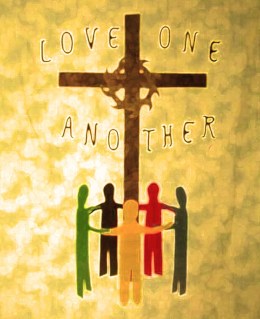
Practicing Fellowship  — You can practice fellowship by recognizing our goal and taking an active part where you can best help. People must recognize our goal. People often do not take part in a church because they see no clear purpose. As previously discussed, our purpose is to show God’s glory to the world in all the many ways He has instructed us in the Bible. We participate together seven days a week to glorify God, to do it His way, and to do it together.

You can practice fellowship by taking an active part where you can best help with this goal. You can discover where you can best help by recognizing your spiritual gifts and natural abilities and by knowing the needs of our church. Then help where you can make not just yourself, but the church as a whole, to be the most fruitful. If you do not know your spiritual gift, pitch in where you have a natural ability. As you work with others, your gifts will surface and you’ll find places you might function in our church according to your gifts and abilities.

Conclusion – Story of a man who had spent a summer on a pipeline crew. The first day, he was given a shovel and a piece of ground and told to dig six feet deep and three feet wide. By noon, he had dug down over his head and felt all alone at his work. By the middle of the afternoon he was pretty discouraged as he thought of the miles of line still to be dug. Finally, however, about five o’clock, he broke through into the trench the man in front of him was digging. As he cleared away the loose dirt, this man broke through into the next hole, and as they stood and watched, man after man broke through until several hundred feet of ditch was visible and my pastor felt quite a sense of accomplishment.

 
Leave a comment

Posted by on April 19, 2018 in Our Life Together


Hindrances to Loving Others


There are many “one another” statements in the Bible, but in the ‘negative commands’ we find hindrances to loving one another and hindrances to fellowship. These negative injunc­tions stress and point to what we natu­rally tend to do without the exchanged life of Christ, without the life-changing power of the Lord, the ministry of the Spirit, and daily renewal in the Word.

Do Not Judge One Another

“Therefore let us not judge one another anymore, but rather determine this—not to put an obstacle or a stumbling block in a bro­ther’s way” (Rom 14:13).

Do Not have Lawsuits With One Another

“Actually, then, it is already a defeat for you, that you have lawsuits with one anoth­er. Why not rather be wronged? Why not rather be defrauded?” (1 Cor. 6:7)

Do Not Bite and Devour One Another

“But if you bite and devour one another, take care lest you be consumed by one another” (Gal. 5:15).

Do Not Challenge and Envy One Another

“Let us not become boastful, challenging one another, envying one another” (Gal. 5:26).

Do Not Speak Evil or Complain Against One Another

“Do not speak against one anoth­er, brethren. He who speaks against a brother, or judges his brother, speaks against the law, and judges the law; but if you judge the law, you are not a doer of the law, but a judge of it” (James 4:11).

 “Do not complain, brethren, against one another, that you yourselves may not be judged; behold, the Judge is standing right at the door” (James 5:9).

Do Not Seek Glory from One Another

“How can you believe, when you receive glory from one another, and you do not seek the glory that is from the one and only God?” (John 5:44).

While this command was addressed to the unbelieving religious leaders in Israel, there is a principle here that obviously applies to us all, and is tremendously important to the entire process of our ability to love one another.

In John 5:37-40 these Jews were studious and knew the Old Testament Scriptures, but they had missed the purpose of Scripture and had become self-righteous and proud of their knowledge. Failing to see their sinfulness they were self-confident externalists who sought acceptance with God and the praise of men by their legalistic obedience to the Law. They failed to see their need of the cross and a suffering Savior.

Because they failed to see their sinfulness and weak­ness, they saw no need for faith in Christ. There was also no genuine love for God in them because of their pride and self-love (John 5:42). What they did religious­ly, they did for their own glory and admiration from men as chapters 6 and 23 of Matthew make perfectly clear.

John 5:44 points us to the heart of the problem. John writes: “How can you believe, when you receive glory from one another, and you do not seek the glory that is from the one and only God?”

They were seeking glory from men or from one another. Without awareness and recognition of our sinfulness and need, without faith in God’s Son and the cross, without truly resting in who we are in Christ and His acceptance of us, we are left to justify ourselves and find our sense of security and significance from people. When we seek glory from one another, we are unable to love one another in the biblical sense according to the character of the Word. Rather, we become engrossed with such things as

Performance: How do I do?

Appearance: How do I look?

Status: How important am I?

The religious leaders did not approve of Christ’s act of love when he healed the sick man on the Sabbath. Rather, they were infuriated because Christ had broken the Sabbath. They failed to see that the Sabbath according to God’s purpose as a blessing for man (Mark 2:27). Their self-righteousness had blinded them to the ultimate goal of Scripture—love for God and love for man.

 
Leave a comment

Posted by on April 16, 2018 in Encouragement


Our Life Together: One Another Series – An Intimate Household (Mark 3:35)


“Whoever does God’s will is my brother and sister and mother.”

Jesus not only called men into a personal relationship with himself, he called them into a fellowship with each other. There is a tendency today to employ terms from secular experiences to describe the fellowship of Christians.

Sometimes the athletic metaphor is used, and the church becomes a “team” intent on victory. From the business world comes the idea of the church as a business or a corporation, and its leaders take on the function of corporate board members. These terms have a limited usefulness but do not convey the depth and quality of the fellowship which Jesus intended.

Our Lord’s friends were sure that Jesus was confused, and possibly deranged! The great crowds they saw following Him, and the amazing reports they heard about Him, convinced them that He desperately needed help. He simply was not living a normal life, so His friends came to Capernaum to “take charge of Him.”

Then his mother and “brethren” (Mark 6:3) traveled thirty miles from Nazareth to plead with Him to come home and get some rest, but even they were unable to get near Him. This is the only place in the Gospel of Mark where Mary is seen, and her venture was a failure.

History reveals that God’s servants are usually misjudged by their contemporaries, and often misunderstood by their families. The great Apostle Paul was called mad (Acts 26:24-25).

Our Lord was not being rude to His family when He remained in the house and did not try to see them. He knew that their motives were right but their purpose was definitely wrong. If Jesus had yielded to His family, He would have played right into the hands of the opposition. The religious leaders would have said, “See, He agreed with His family—He needs help! Don’t take Jesus of Nazareth too seriously.”

Instead of giving in, He used this crisis as an opportunity to teach a spiritual lesson: His “family” is made up of all those who do the will of God. Our Lord’s half brothers were not believers  (John 7:1-5)  “After this, Jesus went around in Galilee, purposely staying away from Judea because the Jews there were waiting to take his life. {2} But when the Jewish Feast of Tabernacles was near, {3} Jesus’ brothers said to him, “You ought to leave here and go to Judea, so that your disciples may see the miracles you do. {4} No one who wants to become a public figure acts in secret. Since you are doing these things, show yourself to the world.” {5} For even his own brothers did not believe in him.”

Jesus felt closer to the believing publicans and sinners than He did to James, Joses, Judah, and Simon, His half-brothers. Our Lord was not suggesting that believers ignore or abandon their families in order to serve God, but only that they put God’s will above everything else in life. Our love for God should be so great that our love for family would seem like hatred (“love less”) in comparison (Luke 14:26)  “”If anyone comes to me and does not hate his father and mother, his wife and children, his brothers and sisters–yes, even his own life–he cannot be my disciple.”).

Certainly it is God’s will that we care for our families and provide for them (1 Timothy 5:8)  “If anyone does not provide for his relatives, and especially for his immediate family, he has denied the faith and is worse than an unbeliever.”), but we must not permit even our dearest loved ones to influence us away from the will of God. When you consider the importance of the family in the Jewish society, you can imagine how radical Christ’s words must have sounded to those who heard them.

The church is God’s household : (1 Timothy 3:15)  “if I am delayed, you will know how people ought to conduct themselves in God’s household, which is the church of the living God, the pillar and foundation of the truth.”

Christ was their older brother, spiritually: (Hebrews 2:11)  “Both the one who makes men holy and those who are made holy are of the same family. So Jesus is not ashamed to call them brothers.”

They formed a brotherhood: (1 Peter 2:17)  “Show proper respect to everyone: Love the brotherhood of believers, fear God, honor the king.” If the church loses this intimate sense of family life, it becomes an anonymous crowd of worshippers. It also loses an essential element of power which originally gave many people their security in an uncertain world.

In keeping with Jesus’ imagery of the family, the term which Jesus uses for individual believers is “brother.” At times the word can be used in a general sense to refer to the needy and the helpless, as in the story of the last judgment of Matthew 25.

Because the church is a family composed of brothers and sisters, there should be the unity that can overcome any kind of tension. However, even in the best of families there are times of tension. Discord is always the possibility where brothers and sisters live in close proximity to each other. Family unity does not just happen!  The point is that each of us stands in the identical place of this unmerciful servant: halfway between God and our brother. We’re between the forgiveness that is granted us and the forgiveness that is asked of us. There should be in the Christian community a capacity for forgiveness that is not found in other institutions, for the Christian is motivated by the forgiveness he has received.

 
Leave a comment

Posted by on April 12, 2018 in Our Life Together


What Does A ‘Healthy Church’ Look Like?


Play a word game with me. What comes to your mind when you read the word church?  Do you picture a steepled building, dark wooden pews, crosses, offering plates? Do you hear hearty singing? Or does church trigger childhood memories of wiggling through sermons, playing tag on the parking lot, and Sunday school teachers telling stories about Samson and David and Daniel and, of course, Jesus.

Or do you experience again the flat taste of the bread and the sweet taste of grape juice at communion? Do you remember a particular Sunday morning when a sermon gripped you as though you were the only one in the crowd, or the day you became a Christian through baptism? Or does church sketch other pictures on your mind? A wedding, funerals, evangelistic services, going forward, committee meetings, suppers served in Tupperware dishes, that time at camp when you determined God would have all of you.

When you read the word church, do you have good feelings? Like laughter? Warmth? A quietness? Acceptance? Happiness? Awe? Love? Closeness to God? Or are your feelings negative? Like boredom? Anger? Confusion? Guilt? Rejection? Does church remind you of arrogance, hostility, manipulation, anger, or irrelevance? Do you think of it as a poor substitute for a picnic or a ball game?

Church dredges up memories and emotions from deep within you, doesn’t it? Some are healthy, some painful, most somewhere in between. Have you noticed that when Christians think negatively about church, they think of “them” not “me”? Church is an institution out there, a group apart from them.

But we are the church, aren’t we? You and me. We may have a personal faith, but we can’t have an individual faith. We can’t be Christians by ourselves. Every Christian, to be complete, must be a member of a body of men and women who are followers of Christ. Therefore, whether we are part of a vital, growing, glowing assembly of believers depends in some measure upon us.

If we hope to make a difference in our churches, we need to know what a healthy church looks like. More important, we need to know how sick churches can be made well.  What would you say constitutes the foundation of a healthy church ministry? Many slogans suggest ideas, but wouldn’t you agree that the Word of God and prayer are fundamental? They are two of God’s greatest gifts to us. In them we find comfort, direction, and hope. In them we discover God through his Spirit. In them we grow in our relationship with our Savior. In them we learn about where we have come from and who we are to become today.

Scripture and Prayer Are Essential  — Yes, the Scriptures and prayer are the bedrock of our existence as Christ’s followers, yesterday, today, and forever. Both the study of  reflection on, and obedience to the Word of God and the cultivation of our relationship with the Almighty One in prayer are to permeate our experience and expression as Christians.

In a recent survey of 1,899 Christians, most people strongly agreed that local churches should “be prayerful in all aspects of church life and ministry” as well as be “reliant upon God’s power and the authority of his Word.” With nine points being the highest, prayerfulness got a mean score of 8.71, and God’s power and Word got a mean score of 8.84. Strangely, though Scripture and prayer are highly valued, they are more often promoted than practiced. We not only need to reinvigorate our congregations toward greater biblical literacy, but we must reevaluate our traditional view of prayer meetings and introduce prayer into every context of the ministry.

Biblical Analogy of Health — Jesus said to them, “It is not the healthy who need a doctor, but the sick.  I have not come to call the righteous, but sinners.” (Mk. 2.17) People in rebellion to the basics of God’s laws are spiritually unhealthy. Churches that ignore God’s fundamental laws are spiritually unhealthy. But what are those fundamental laws?

Paul wrote to Titus, “You must teach what is in accord with sound (hygiainõ) doctrine.  Teach the older men to be temperate, worthy of respect, self-controlled, and sound (hygiainõ)  in faith, in love and in endurance.” (Tit. 2.1-2 ). Paul implies that the teaching that produces spiritual health is indicated by several moral characteristics. Paul then illustrates how this spiritual health could be seen among individual Christians.

But what are we looking for in healthy churches today?

1. Loving Relationships

“People feel included.”                                           “People spend lots of time together.”

“People have a sense of being a family.”            “A healthy church is where you feel loved.”

“People put each other first.”                                “People hug each other.”

“There is a sense of connectedness.”

2. People spend time in God’s Word

“They are given biblical instructions.”                “They read their Bibles daily.”

“Biblically focused.”                                                “Bible based.”

3. Exemplary and Equipping Leaders

Role Models                                                 Knowledgeable in the Scriptures

Spiritual or Spirit-filled                             Empowers, delegates, or encourages participation

Approachable 

Other Definitions of Church Health — by Peter Steinke, Healthy Congregations: A Systems Approach

A Sense of Purpose                                  Effective Conflict Management

Clear and Direct Communication        A Mood of Energy and Optimism

Mature Interaction between Leaders and Members

Patience for Healing                               Focus on Healing Resources

Leadership Principles from Jesus (Matthew 23)

Knowledgeable in the Scriptures (v. 1)       Personal integrity (v. 3)

Sensitivity to others’ weaknesses in obedience (v. 4)

Humility (vs. 5-10, 12)                                     Servant-minded (v. 11)

Just, merciful and faithful (vs. 23, 24)

Leadership in Healthy Churches

Unhealthy                              Healthy

Either/Or Thinking               Takes a stand

Tries for “quick fixes”         Increases self-awareness

Resists insights                     Changes self

No self –awareness             Tolerates differences

Looks for blame                  Sets clear goals

Coerces/Manipulates         Accepts challenges

Seeks to eliminate those who cause him anxiety

The Health Challenge

Our challenge isn’t to make Christ’s church healthy.  It must be remembered that first and foremost, the heavenly body of Christ is healthy. Paul told the Ephesians, “In him the whole building (i.e. the heavenly church) is joined together and rises to become a holy temple in the Lord.  (Eph. 2:21)

Our challenge is to urge churches and her Christian leaders to recognize that Christ is working to build her up…live obediently to Christ’s teaching…live as a Spirit indwelt community.

Again Paul told the Ephesians, “And in him you too are being built together to become a dwelling in which God lives by his Spirit.” (Eph. 2:22)

 
Leave a comment

Posted by on April 9, 2018 in Church


Our Life Together: One Another Series – Foundations and Motivations (Acts 2:42) 


“They devoted themselves to the apostles’ teaching and to the fellowship, to the breaking of bread and to prayer.”

2.42Fellowship is second on God’s spiritual ‘hall of fame” items! Only doctrine comes before it, and that makes sense because “fellowship is based upon proper truth.” Fellowship rightfully follows obedience.

Life is not all vertical, any more than it is only horizontal. One writer suggested that “the cross points toward heaven-from earth; it also points to man while on earth.”

What if an observer came to this congregation to make a careful analysis of the church’s life in fellowship. He is a specialist in studying how groups work together, and he intends to compare us as a “community” to other secular groups in our city. When he comes, he will notice how we interact with each other in the worship assembly and in our Bible classes. He will also want to study to see if we really share in a common life outside of this building during the week.

What kind of things will he want to investigate? Group loyalty, our willingness to support each other in time of need, and the amount of time we spend enjoying the company of others. He will also pay attention to how well those who sit by each other during the assembly Sunday after Sunday really know each other.

Those who have put themselves in such a circumstance, and allowed others to come study them, find that the great majority of church members finally admit that they know only a small percentage of the people with whom they have been worshipping week after week. They were essentially an anonymous group of worshipers.

And what could be worse? Many questioned expressed little interest in becoming more involved in the lives of other members. They admitted that they needed to be able to bear the burdens of others and help when difficulties came into their lives…but they also admitted they had done very little of either of the two!

The New Testament exhorts us to care for one another as fellow members of the body of Christ. In fact, the Lord Jesus desires all believers to be functioning effectively as a partner/ members of His body, the church.

Paul has an important word for us on this very important matter in Ephesians 4:15-16: “Instead, speaking the truth in love, we will in all things grow up into him who is the Head, that is, Christ. {16} From him the whole body, joined and held together by every supporting ligament, grows and builds itself up in love, as each part does its work.”

If the local church becomes a near-anonymous group of worshippers, we miss an indispensable part of what the Christian faith can do to enrich our lives. (Romans 1:11-12)  “I long to see you so that I may impart to you some spiritual gift to make you strong– {12} that is, that you and I may be mutually encouraged by each other’s faith.”

People still need human contact. The church is the glue that keeps us together when we disagree. It is the gasoline that keeps us going during the tough times. It is the guts that enables us to take risks when we need to.  Community … means people who have to learn how to care for each other. One of the greatest expressions of love is simply to notice people and to pay attention to them.

There are some issues within our society that works against fellowship: We are far more mobile and far busier than other generations; It’s tempting to avoid getting involved in the lives of others because they will likely move away and “it hurts too much” to say goodbye; We become so involved with ourselves that we cease to care for others; Some just fail to understand the Biblical teaching regarding this subject. Fellowship involves: relationship, partnership, companionship, and stewardship. The meaning of these two word groups can be boiled down to two main ideas: (1) “To share together, take part together” in the sense of participation and partnership, and (2) “To share with” in the sense of giving to or receiving from others, sharing what we have with one another.

Fellowship Means Relationship.  In the New Testament what is shared in common is shared first of all because of a common relationship that all Christians share together in Christ. The idea of an earthly fellowship founded upon just common interests, or human nature, or physical ties like in a family, or purely physical church affiliation, or merely self-centered interests that sport enthusiasts might share together was completely foreign to the Apostles. In the New Testament, believers can have fellowship on a horizontal plane and share together because they first of all have a vertical relationship with God through His Son, the Lord Jesus, and because they can share together in Christ’s life and hold His purposes in common.  No man should be alone when he opposes Satan. The church and the ministry of the Word were instituted for this purpose, that hands may be joined together and one may help another. If the prayer of one doesn’t help, the prayer of another will.

 
Leave a comment

Posted by on April 7, 2018 in Our Life Together


A Letter From Jesus To His Church


A writer suggested that if Jesus were to write us a letter, it would, perhaps, read as follows:

Dear Church:

If I’m your head, make your plans ridiculously big! Be done with the drudgery of placid plodding, low aim, dwarfed planning and mini-dreams.

I want you into the Word, on your knees, out of yourselves, above mediocrity, below my Lordship, about my business, beyond your sight and full of my Spirit.

I want to see a glow on your face, a leap in your pace, as you speak of my grace. Preach hell-hot, sin-black, judgment – sure, repentance – necessary and salvation – free. I hope you’ll run – not walk; hemorrhage – not bleed; shout – not whisper; and speak with clarity – not fuzziness I as you preach the gospel to the world.

I hope you’ll learn to swim any river, climb any mountain, walk any distance, suffer any hardship, experience any inconvenience, pay any price, give any amount, for the cause of the Kingdom.

I hope you’ll be liberal in love, long in prayer, short on business, deep in giving, shallow in selfishness turned on to sharing the Word, and turned off to sin.

Love, preach, teach, heal, love, work, pray, give, bind, loose, love, learn, follow, evangelize, love, urge, encourage, wait, love, above all… love! It’s by that and nothing else that all the world will truly know you are my disciples.

I’m coming soon! Go for broke. Get rid of your worldly caution. Pull out all the stops. Hold nothing back. It’s full speed ahead! Trust me. I have available now all you need to do the job.

I’ll see you soon!!

 
Leave a comment

Posted by on April 5, 2018 in Church, Encouragement


What Happened to the Apostles?


We often talk about the ‘doubt’ of John the Baptist and Thomas. Lest we speak too harshly, it would be better to think what we would want our ‘life response’ to be: faithful to the end! The apostles were promised they would be persecuted, and some would have to drink the cup of death (Matthew 10:25; 20:23; Mark 14:31, 36; John 13:37; 15:20, 17:1); history and tradition also tell us that the apostles gave their lives for Christ.

  • James the son of Zebedee (James the Great) felt Herod’s sword in 44 A.D., the first apostle to die (Acts 12).
  • Philip, after preaching in upper Asia, was scourged, thrown in prison, and then crucified in 54 A.D. at Heliopolis in Phrygia.
  • Matthew, after preaching in Parthia and in Ethiopia, was slain in A.D. 60 by a halberd at Nadabah, Ethiopia.
  • James the Less, at 94 years, after being beaten and stoned by the Jews, “finally had his brains dashed out with a fuller’s club.”
  • As to Peter, “Jerome saith that he was crucified, his head being down and his feet upward, himself so requiring, because he was [he said] unworthy to be crucified after the same form and ”
  • Jude (Thaddeus), brother of James the Less, was crucified at Edessa, 72 A.D.
  • Bartholomew, after preaching in India, was “cruelly beaten and then crucified by the impatient idolaters.”
  • Thomas’ ministry in Parthia and India was ended with a spear thrust.
  • Simon Zelotes evangelized in Mauritania, Africa, and Britain before his crucifixion in 74 A.D.
  • Matthias was stoned at Jerusalem and then beheaded.
  • Andrew’s service was in Asia; at Edessa he was baptized in suffering, being “crucified on a cross, the two ends of which were fixed transversely in the ground.”
  • The beloved John, at the command of anti-christ Domitian, was exiled “in the isle that is called Revelation 1:9). After being 23).
  • After Paul had been stoned, left for dead, beaten with rods, jailed for years, he still aspired to “fill up . . . that which is lacking of the afflictions of Christ” in his flesh (Colossians 1 :24). He is said to have been beheaded by Nero in Rome. (by Hugo McCord, The Beatitudes)
 
Leave a comment

Posted by on April 2, 2018 in Church