RSS

Was Jesus all that John claimed for Him?


John wrote his Gospel to encourage belief in Christ. Does the available evidence sustain his claims? As we examine the testimony presented by John, we must weigh it according to reason and then determine the answer. For a possible conclusion, we are left with five alternatives.

Conclusion 1. Jesus never lived, but was a product of the human mind—a figment of the imagination of John and other evangelists who have left records of His life and activities.

Since we are considering John’s presentation of Jesus, this conclusion would mean that both the claims John made for Jesus and the evidence he offered were the product of his own unfounded fancy.

Conclusion 2. Jesus lived, but He was merely a good man, a great teacher, a wise philosopher, and a profound moralist. He possessed a greater and deeper concept of God as Spirit than anyone living before or after Him. Jesus was able by His own greatness and goodness to beget and develop in the minds of His disciples the concept of Himself as presented by John.

Conclusion 3. Jesus was not the Messiah, but as a deeply religious Jew of northern Palestine, He believed that He was. In this confidence and in His thorough knowledge of the Old Covenant, He was able to impress the naive and gullible peasants and village folk of Galilee so much that they, too, came to believe that He was the Christ.

Conclusion 4. Jesus was a shrewd and cunning impostor, able to deceive John and others whom He convinced that He was the Messiah of their expectations. He is, in fact, the archdeceiver of history, for He so completely deceived them that millions since have been deceived and deluded by His imposture.

Conclusion 5. Jesus was what John claimed for Him and what He claimed for Himself: the Christ, the Son of God, the Messiah of prophecy.

When we consider the first of these alternatives, we are faced with questions about John.

Was he great enough to create a character for whom he could make such claims? Was he able to create out of his own imagination the teaching which he ascribed to Jesus? Was he able to create the characters who live in his Gospel and to array their testimony in such a way as to make his book live through the centuries?

Plainly posed, which is the greater wonder: Jesus and the evidence of facts as John presented them, or the creation of such a character as Jesus and the evidence from the imagination of a Galilean fisherman? Reason must determine the answer.

The second alternative is ruled out on the ground of Jesus’ claims. His claims are such that either He was the Christ or He was not a good man. Unless He was who He claimed to be, He was an impostor, a blasphemer, a hypocrite, a deceiver, and a liar. He could not make false claims about Himself and at the same time be a good man.

The third alternative does not explain the empty tomb, the conversion and work of Saul of Tarsus, or the impression of Jesus upon the Gentile world and upon history.

The fourth alternative leaves us with the problem of accepting the greatest concept of God and the greatest system of ethics and morals known to man as the offspring of the world’s greatest fraud, deceiver, and liar. This is an absurdity, for all accept the axiom that a tree bears fruit after its own kind. An evil tree could not have produced such good fruit.

If it can be shown that Jesus was a good man, that He did reveal the world’s loftiest concept of God, and that the system of ethics and morals taught by Him are without flaw, then we are left with only the fifth alternative as one that can be reasonably accepted.

As reason weighs the evidence presented by John, the reader must determine what he will do with Jesus. The book is here: What it says, it says; and it is either fact or fiction. If it is fact, then Jesus is the Christ, the Son of God, and the Savior of the world. If it is fiction, then John perpetrated upon mankind a fraud of gigantic proportions with no known motive for his fraud.

 
Leave a comment

Posted by on March 1, 2017 in Jesus Christ


“Soar Like Eagles” The Gospel of John #8 – Equality With God! John 5:19-47


Jesus was “crossing the Rubicon”!

As I approach our text, I am reminded of a story circulating among the outdoor types, which goes something like this. In the mountains of the Northwest, a man was sitting beside a campfire while he roasted some kind of bird over the fire with eager anticipation. About this time, a forest ranger came upon the camp and asked the camper what he was preparing for dinner. The camper replied that it was a seagull. A frown came over the ranger’s face as he informed this fellow that it was against the law to kill that particular bird, and that he would have to give him a citation.

The camper responded by telling the ranger how he had lost his way and had consumed all of his food. In desperation, he had managed to kill this seagull to maintain his strength. After listening sympathetically, the forest ranger told the fellow he would let him go this time with just a warning, and the camper thanked the ranger profusely. Just as the ranger was about to leave, he asked the camper, “Just out of curiosity, what does seagull taste like?” Thinking for a moment, the camper responded, “Well, I would place it somewhere between a spotted owl and a bald eagle.”

Needless to say, this camper’s words got him into even more trouble. He would have been better off not to say anything at all.

Some may think our Lord’s words in our text are something like this camper’s statement. At the outset, Jesus is deemed guilty of breaking the Sabbath, and of instructing the healed paralytic to do likewise. But after our Lord defends His actions to the Jewish authorities,[1] He is considered guilty of an even greater offense—claiming to be equal with God.

Our text is our Lord’s response to the accusations made against Him. Some may be tempted to think it is less than spectacular, for no debate is actually recorded, and there is no interchange between our Lord and the Jewish authorities. Only our Lord’s words are recorded.[2] Our text contains a three-fold use of the (King James) expression, “Verily, verily, I say unto you …” (verses 19, 24, 25).[3] Surely this tells us that the words spoken here are vitally important, both to be heard and to be heeded.

Listen to what others have said about our text:

“Nowhere else in the Gospels do we find our Lord making such a formal, systematic, orderly, regular statement of His own unity with the Father, His divine commission and authority, and the proofs of His Messiahship, as we find in this discourse” (Ryle).[4]

Ryle adds: ‘To me it seems one of the deepest things in the Bible.’ Similarly Phillips in his translation inserts a sub-heading ‘Jesus makes His tremendous claim.’[5]

It is, as Barclay says, ‘an act of the most extraordinary and unique courage … He must have known that to speak like this was to court death. It is His claim to be King; and He knew well that the man who listened to words like this had only two alternatives—the listener must either accept Jesus as the Son of God, or he must hate Him as a blasphemer and seek to destroy Him. There is hardly any passage where Jesus appeals for men’s love and defies men’s hatred as He does here.’[6]

Our Lord’s words are a bold stroke. If Jesus wishes to avoid trouble with the Jews, this is the time for Him to deny, to “clarify,” or to minimize, His previous claim to be equal with God. Instead, He makes His claim even more emphatically.

This is one of the great texts in the Gospel of John and in the entire New Testament. The truths set down here are the very foundation of the gospel and of our faith.

By 49 B.C., Julius Caesar had become the most powerful man in Rome. For two years he had been away from the city, fighting warring tribes and demonstrating his tremendous skills as a general and an administrator. Much to the dismay of his political opponents, his time in Gaul had only made Caesar more powerful back in Rome.

When Caesar was ordered home by the Roman Senate, he became aware that his enemies were trying to destroy him. To return home he would have to cross the Rubicon River and leave his loyal army behind. For years that river had served as an absolute boundary, beyond which a general could not bring his army.

Because his enemies would be allowed to keep their armies, Caesar knew that to enter Rome alone would be walking into a death sentence. Consequently, he made the bold decision to bring his army across the Rubicon and with him to Rome!

When word arrived in the city that Caesar had “crossed the Rubicon,” everyone knew that civil war had begun. He was acting in defiance of the Roman Senate, and his enemies quickly fled the city. Within two months, Julius Caesar had crushed all opposition and had all of Italy under his power.

Because of this story, “crossing the Rubicon” is an expression used even today to describe a decision that cannot be revoked or a decisive action that cannot be changed. We must not skip this section in our haste to find another narrative section, because something of critical importance was happening here: Jesus was “crossing the Rubicon”!

  Preceding Christ’s remarkable of verses 17-18 was the miraculous healing of a man who had been sick for 38 years! But the Jews’ reactions scandalized His merciful act because it took place on the Sabbath. In His response, Jesus claims equality with the Father and incurs a whirlwind of religious wrath!

This is the first of the long discourses of this gospel. When we read passages like this we must remember that John is not seeking so much to give us the words that Jesus spoke as the things which Jesus meant. He was writing around 100 A.D., so he had some 70 years to think about Jesus and the wonderful things which Jesus said.

  1. He claimed to be Equal with God. (5:19-21)

Throughout the passage, Jesus never refers to God generically as our Father. It is always MY Father or the Father. Instead of denying their accusation, He endorsed it!  If today a man made this kind of a claim, we would conclude that he was joking or mentally disturbed. Jesus was certainly not insane, and neither was He a liar!

* Jesus claimed to be one with His Father in His works— (“I’m the giver of life” vs. 19-20).

“Jesus gave them this answer: “I tell you the truth, the Son can do nothing by himself; he can do only what he sees his Father doing, because whatever the Father does the Son also does. {20} For the Father loves the Son and shows him all he does. Yes, to your amazement he will show him even greater things than these.”

Here we come to the first of the long discourses of the Fourth Gospel.  When we read passages like this we must remember that John is not seeking so much to give us the words that Jesus spoke as the things which Jesus meant.  He was writing somewhere round about a.d. 100.  For seventy years he had thought about Jesus and the wonderful things which Jesus had said. 

* Jesus claimed to be equal with the Father in executing judgment—(“I am the final judge” vs. 21, 26).

“For just as the Father raises the dead and gives them life, even so the Son gives life to whom he is pleased to give it.  {26} For as the Father has life in himself, so he has granted the Son to have life in himself.”

To orthodox Jew, Jehovah God was “the Judge of all the earth” (Gen. 18:25); and no one dared to apply that august title to himself. But Jesus did! By claiming to be the Judge, He claimed to be God.

Most people mistakenly believe that God the Father is the final judge of mankind. But this verse, along with several others, indicates that Jesus will be the judge:

Acts 10:42: “He commanded us to preach to the people and to testify that he is the one whom God appointed as judge of the living and the dead.”

2 Corinthians 5:11: “For we must all appear before the judgment seat of Christ, that each one may receive what is due him for the things done while in the body, whether good or bad.”

 * Jesus claimed to be equal to the Father in honor—(vs. 22-23).

 “Moreover, the Father judges no one, but has entrusted all judgment to the Son, {23} that all may honor the Son just as they honor the Father. He who does not honor the Son does not honor the Father, who sent him…. {27} And he has given him authority to judge because he is the Son of Man.”

He claimed that there are valid witnesses who support His claim to Deity (5:30-47).

Jesus calls six witnesses to testify on His behalf.  We might seek to put these verses in a courtroom scene…Jesus, in essence, is on trial…but really it’s the hearers who are on trial!

The word “witness” is a key word in John’s gospel; it is used 47 times. Jesus did bear witness to Himself but He knew they would not accept it; so He called in other witnesses.

WITNESS #1: HIS WITNESS CONCERNING HIMSELF (vs. 30-31).

By myself I can do nothing; I judge only as I hear, and my judgment is just, for I seek not to please myself but him who sent me. {31} “If I testify about myself, my testimony is not valid.”

WITNESS #2: THE WITNESS OF JOHN THE BAPTIST (vs. 32-35).

“There is another who testifies in my favor, and I know that his testimony about me is valid. {33} “You have sent to John and he has testified to the truth. {34} Not that I accept human testimony; but I mention it that you may be saved. {35} John was a lamp that burned and gave light, and you chose for a time to enjoy his light.

WITNESS #3: THE WITNESS OF HIS WORK (S) (vs. 36).

“I have testimony weightier than that of John. For the very work that the Father has given me to finish, and which I am doing, testifies that the Father has sent me.”

Remember Nicodemus in John 3:2? “He came to Jesus at night and said, “Rabbi, we know you are a teacher who has come from God. For no one could perform the miraculous signs you are doing if God were not with him.”

Remember the brothers of our Lord in John 7:3? “Jesus’ brothers said to him, “You ought to leave here and go to Judea, so that your disciples may see the miracles you do.”

Remember the Jewish leaders in Acts 4:16 when describing the apostles? “What are we going to do with these men?” they asked. “Everybody living in Jerusalem knows they have done an outstanding miracle, and we cannot deny it.”

Jesus had used His works to convince the disciples of John the Baptist, who had been put in prison. Matthew 11:1-6: “After Jesus had finished instructing his twelve disciples, he went on from there to teach and preach in the towns of Galilee. {2} When John heard in prison what Christ was doing, he sent his disciples {3} to ask him, “Are you the one who was to come, or should we expect someone else?” {4} Jesus replied, “Go back and report to John what you hear and see: {5} The blind receive sight, the lame walk, those who have leprosy are cured, the deaf hear, the dead are raised, and the good news is preached to the poor. {6} Blessed is the man who does not fall away on account of me.”

WITNESS #4: THE WITNESS OF THE FATHER (vs. 37-38).

“And the Father who sent me has himself testified concerning me. You have never heard his voice nor seen his form, {38} nor does his word dwell in you, for you do not believe the one he sent.”

Verse 37 is a connecting verse between Jesus’ miracles (vs. 36) and the scriptures (vs. 38-39). The direct testimony of the Father is referred to here, and it’s unsure if Jesus was talking about the three voices from heaven:

– at the baptism of Jesus (Matt. 3:17; Mark 1:11; Luke 3:22)

– at the transfiguration (Matt. 17:5-6; Mark 9:7; Luke 9:35)

– after the triumphal entry (John 12:28)

The gospel of John does not even give two of them!…and verse 37 says that “you have never heard his voice nor seen his form.”

WITNESS #5: THE WITNESS OF THE SCRIPTURES (vs. 39-44).

“You diligently study the Scriptures because you think that by them you possess eternal life. These are the Scriptures that testify about me, {40} yet you refuse to come to me to have life. {41} “I do not accept praise from men, {42} but I know you. I know that you do not have the love of God in your hearts. {43} I have come in my Father’s name, and you do not accept me; but if someone else comes in his own name, you will accept him. {44} How can you believe if you accept praise from one another, yet make no effort to obtain the praise that comes from the only God ?”

At least 18 unmistakable references to the Old Testament are found in John. There is little doubt that Christ was coming and that He had now come.

The practice of the Jews at that time was to study each word minutely, and to build absurd mystical and allegorical interpretations around those word studies. As a result, they rejected the Messiah, because their minds were made up as to what the Messiah must be before they read the Scriptures

   They were BIBLIOTRISTS (Bible worshippers)! They worshipped the words of the Bible, but not the Christ of the Bible.

WITNESS #6: THE WITNESS OF MOSES (vs. 45-47).

“But do not think I will accuse you before the Father. Your accuser is Moses, on whom your hopes are set. {46} If you believed Moses, you would believe me, for he wrote about me. {47} But since you do not believe what he wrote, how are you going to believe what I say?””

* There are two more witnesses which we have, which were not available for the Jews.

– the Holy Spirit (15:26) dwelling within each Christian

– the witness of individual apostles (15:27), who would be ready to speak on His behalf only after being empowered by the Holy Spirit (Acts 1:8)

Certainly, today, we are without excuse!

[1] In the Greek text, John simply refers to these folks as “the Jews.” From the context, we would infer they are the “Jewish religious authorities.”

[2] This is not at all to suggest that the Jews said nothing. It is to say that John did not find their words profitable for us, and thus included only our Lord’s words.

[3] In the NET Bible this expression is rendered, “I tell you the solemn truth.”

[4] Leon Morris, The Gospel According to John (Grand Rapids: Wm. B. Eerdmans Publishing Co., 1971), p. 311.

[5] Morris, p. 311, fn. 52.

[6] Morris, p. 311, fn. 53.

 
Leave a comment

Posted by on February 23, 2017 in Gospel of John


“Soar Like Eagles” The Gospel of John #7- Do You Wish To Get Well? John 5:1-18


c5f6b188dcd185fbe7f76b5ab2474b96The first period in the life of Jesus recorded in this gospel contained His claims. He Himself presented some of them through an explicit avowal of Messiahship, some were implicit in the titles ascribed to Him by His friends, and still others were latent in the miracles that He performed.

He claimed nothing less for Himself than Deity. He demanded nothing less from His followers than obedient faith.

Between chapters 4 and 5:1, the following incidents occurred in Jesus’ life:

  1. Returned to Nazareth, taught in the synagogue, and was rejected (Luke 4).
  2. Called four fishermen the second time, and healed many (Matt. 4; Mark 1; Luke 5).
  3. Made the Galilean tour among crowds (Matt. 9).
  4. Healed a leper (Matt. 8).
  5. Healed a paralytic (Matt. 9).
  6. Called Matthew (Matt. 9).
  7. Ran into controversies about eating and fasting (Matt. 9; Mark 2; Luke 5).

Because of His claims, He met opposition. Chapters 6 and 7 will show the development of this opposition in debate and controversy before it broke into deadly conflict.

The subject matter in this Period of Controversy was centered around two events: the healing of the impotent man at the pool of Bethesda and the feeding of 5,000 men in Galilee.

These two differ in character, in scope, in locality, and in response:

– One was negative, for it removed the handicap of a long standing disease. The other was positive, for it provided nourishment for the healthy crowd.

– One pertained to one individual, the other to 5,000 men.

– One took place in Galilee, the other in Jerusalem.

– One evoked the enmity of the Jews; the other brought acclamation of the multitude.

BOTH PRODUCED CONTROVERSY!

* THE NEED (5:1-5)

“Some time later, Jesus went up to Jerusalem for a feast of the Jews. {2} Now there is in Jerusalem near the Sheep Gate a pool, which in Aramaic is called Bethesda and which is surrounded by five covered colonnades. {3} Here a great number of disabled people used to lie–the blind, the lame, the paralyzed. [and they waited for the moving of the waters. {4} From time to time an angel of the Lord would come down and stir up the waters. The first one into the pool after each such disturbance would be cured of whatever disease he had.]  {5} One who was there had been an invalid for thirty-eight years

There were three Jewish feasts which were feasts of obligation– Passover, Pentecost and Tabernacles. Every adult male Jew who lived within 15 miles of Jerusalem was legally bound to attend them.

It’s most likely that this feast was Pentecost, since the events of John 6 occur when the Passover was near.  The Passover was in mid- April, and Pentecost was seven weeks later.

Make this special note: Verses 3b and 4 are not found in the latest translations of the original Greek…they aren’t even found in most translations except as a footnote. They were added in the later centuries to explain why the sick were gathered, and listed the superstitious feelings of the people.

Beneath the pool was a subterranean stream which every now and again bubbled up and disturbed the waters. The belief  was that the disturbance was caused by an angel, and that the first person to get into the pool after the troubling of the water would be healed from any illness from which he was suffering.

For 38 years, this pathetic man has lain here in the poverty, the repulsion, and the despair. To us this is mere superstition.  But it was the kind of belief which was spread all over the world in ancient days and which still exists in certain places.

Suddenly, the waters of the pool begin to boil, or bubble, or froth in some way, and pandemonium breaks out. Only one person will be healed per “stirring”—the first one into the pool. Every ailing person there at the pool is in competition with the rest of the multitude who are also hoping for a healing. If and when the waters are actually troubled, no one dares to tell anyone else, for fear they might reach the pool first. Can you imagine the pushing, shoving, and tripping that takes place as every ailing person desperately strives to be the first into the water?

What a pathetic sight, to see cripples crawling, hopping, rolling, clawing their way to the water’s edge. What chaos there would be! And then, even if one person was healed, it would not be the most needy person, because the one with the smallest ailment would be the most likely one to reach the pool first. The most needy person would be the least likely to get into the water first. Therefore, the least needy would probably be the one cured, while all the rest struggle to get out of the pool, get back to their “stations,” and await their next chance. What a very pathetic scene.

In this story we see very clearly the conditions under which the power of Jesus operated.  He gave his orders to men and, in proportion as they tried to obey, power came to them.

(i)  Jesus began by asking the man if he wanted to be cured.  It was not so foolish a question as it may sound.  The man had waited for thirty-eight years and it might well have been that hope had died and left behind a passive and dull despair.  In his heart of heart the man might be well content to remain an invalid for, if he was cured, he would have to shoulder all the burden of making a living.  There are invalids for whom invalidism is not unpleasant, because someone else does all the working and all the worrying.  But this man’s response was immediate.  He wanted to be healed, though he did not see how he ever could be since he had no one to help him.

The first essential towards receiving the power of Jesus is to have intense desire for it.  Jesus says:  “Do you really want to be changed?”  If in our inmost hearts we are well content to stay as we are, there can be no change for us.

(ii)  Jesus went on to tell the man to get up.  It is as if he said to him:  “Man, bend your will to it and you and I will do this thing together!”  The power of God never dispenses with the effort of man.  Nothing is truer than that we must realize our own helplessness; but in a very real sense it is true that miracles happen when our will and God’s power co-operate to make them possible.

(iii)  In effect Jesus was commanding the man to attempt the impossible.  “Get up!”  he said.  His bed would simply be a light stretcher-like frame-the Greek is krabbatos, a colloquial word which really means a pallet-and Jesus told him to pick it up and carry it away.  The man might well have said with a kind of injured resentment that for thirty-eight years his bed had been carrying him and there was not much sense in telling him to carry it.  But he made the effort along with Christ-and the thing was done.

(iv)  Here is the road to achievement.  There are so many things in this world which defeat us.  When we have intensity of desire and determination to make the effort, hopeless though it may seem, the power of Christ gets its opportunity, and with him we can conquer what for long has conquered us.

* THE MIRACLE (5:6-9a)

“When Jesus saw him lying there and learned that he had been in this condition for a long time, he asked him, “Do you want to get well?” {7} “Sir,” the invalid replied, “I have no one to help me into the pool when the water is stirred. While I am trying to get in, someone else goes down ahead of me.” {8} Then Jesus said to him, “Get up! Pick up your mat and walk.” {9} At once the man was cured; he picked up his mat and walked.”

Not only would this man’s plight be seemingly hopeless, but the man himself seemed resigned to his fate and had accepted the inevitable. Verse 7 is a further explanation of their superstition: the people believed the angels stirred the water, and the first one in would be healed.

Just think: 38 years of misery, shame, embarrassment and despair; in a split second, it was all history!

No matter how long we have been struggling with some particular sin or situation from our past, Jesus can change it! The real question is: do you wish to get well?

* THE CONFRONTATION (5:9b-17)

“The day on which this took place was a Sabbath, {10} and so the Jews said to the man who had been healed, “It is the Sabbath; the law forbids you to carry your mat.”

Undoubtedly, the witnesses around the pool were bustling with excitement. But the miracle leaves the legalists bristling with anger. When they should have been on their knees in praise, the only thing these Pharisees can do is pull out their principle-book and quote condemnation, chapter and verse.

The law said simply that the Sabbath Day must be different from other days and that on it neither a man nor his servants nor his animals must work; the Jews set out 39 different classifications of work, one of which was that it consisted in carrying a burden.

The Rabbis of Jesus’s day solemnly argued that a man was sinning if:

– he carried a needle in his robe

– if he wore artificial teeth or his wooden leg

– if a woman wore a broach

The authorities levelled their accusations against Jesus.  The verbs in verse 18 are imperfect tense, which describes repeated action in past time.  Clearly this story is only a sample of what Jesus habitually did.

His defense was shattering.  God did not stop working on the Sabbath day and neither did he.  Any scholarly Jew would grasp its full force.

Jesus said:  “Even on the Sabbath God’s love and mercy and compassion act; and so do mine.”  It was this last passage which shattered the Jews, for it meant nothing less than that the work of Jesus and the work of God were the same.  It seemed that Jesus was putting himself on an equality with God.  What Jesus really was saying we shall see in our next section; but at the moment we must note this-Jesus teaches that human need must always be helped; that there is no greater task than to relieve someone’s pain and distress and that the Christian’s compassion must be like God’s-unceasing.  Other work may be laid aside but the work of compassion never.

But he replied, “The man who made me well said to me, ‘Pick up your mat and walk.'” {12} So they asked him, “Who is this fellow who told you to pick it up and walk?” {13} The man who was healed had no idea who it was, for Jesus had slipped away into the crowd that was there. {14} Later Jesus found him at the temple and said to him, “See, you are well again. Stop sinning or something worse may happen to you.” {15} The man went away and told the Jews that it was Jesus who had made him well. {16} So, because Jesus was doing these things on the Sabbath, the Jews persecuted him. {17} Jesus said to them, “My Father is always at his work to this very day, and I, too, am working.”

The Pharisees took this occasion (vs. 16) as one excuse to persecute Him. They disliked Jesus when here the first time (2:18) and were suspicious of His popularity (4:1).

Now they have cause for an open breach. They would watch His conduct on the Sabbath from now on (Mark 2:23; 3:2, 6). Of course, the penalty for blasphemy was death. It is here that the “official persecution” of Jesus began!

* THE REACTION (5:18)

“For this reason the Jews tried all the harder to kill him; not only was he breaking the Sabbath, but he was even calling God his own Father, making himself equal with God.”

The reply of Jesus to these accusations contained not only a new ethical concept of the Sabbath, but also a new theology. Jesus indicated that He made the Father His pattern, and that He felt that the Father’s work constituted sufficient precedent and reason for Him. They understood what He meant, because they sought to kill Him.

Essentially, the indictments of the legalists were two fold:

  1. Jesus broke the Sabbath (vs. 16, 18)
  2. Jesus claimed equality with God by claiming Him as His Father (vs. 17-18).

Ironically, the Pharisees were the guilty ones: they judged Jesus, refused to rejoice or give praise at the healing, and even went so far as to plot Christ’s assassination.

These Jewish leaders are seen for who they are. They suppose that they love God and their fellow man, in obedience to the law of Moses. They think themselves pious, and expect to be the first to enter the kingdom of God. Indeed, they expect a prominent leadership role in that kingdom. And yet when Jesus comes to town and heals a paralytic, their only concern is that the healed man is “walking illegally” (with his mat). They hardly seem to notice or care that the man is “walking”—the paralytic has been healed! And then, because Jesus has performed such a miracle, they begin to persecute the Son of God. When Jesus points out that this is exactly who He is, they redouble their efforts to kill Him. The wickedness of man never ceases to amaze us.

The second thing this incident in John’s Gospel does is to provide the occasion for Jesus to state very clearly (and very early in this Gospel) just who He is.

The most important question you will ever answer is this: “Who is Jesus Christ?” John gives us the answer, clearly. Jesus Christ is the Son of God, who speaks and acts for God, and as God. Jesus Christ is the “Lamb of God, who takes away the sin of the world.” He is the only One through whom your sins can be forgiven, the only way to heaven (John 14:6). Do you believe this?

 
1 Comment

Posted by on February 16, 2017 in Gospel of John


Six Behaviors for Husbands to Love their Wives


Husbands-love-your-wives-well(1) He observes the hidden person of her heart

1 Peter 3:4 (ESV) 4  but let your adorning be the hidden person of the heart with the imperishable beauty of a gentle and quiet spirit, which in God’s sight is very precious.

(2) He lives with his wife in an understanding way and honors her

1 Peter 3:7 (ESV) 7  Likewise, husbands, live with your wives in an understanding way, showing honor to the woman as the weaker vessel, since they are heirs with you of the grace of life, so that your prayers may not be hindered. (3) He honors his wife

(3) He does not act bitterly to his wife

Colossians 3:19 (ESV) 19  Husbands, love your wives, and do not be harsh with them.

(4) He encourages his wife’s godly and chaste behavior

1 Timothy 2:10 (ESV) 10  but with what is proper for women who profess godliness—with good works.

1 Peter 3:2 (ESV) 2  when they see your respectful and pure conduct.

(5) He supports her good works

1 Timothy 2:10 (ESV) 10  but with what is proper for women who profess godliness—with good works.

 
Leave a comment

Posted by on February 15, 2017 in Marriage


Strengthening Our Grip…on Money 1 Timothy 6:3-19


0ee131c050c4792d6ad5b3a3eee48d87   JesusIsLordofthisWebSite placeforyou2 575273_579331012148169_1163921425_n

Yeah, right. I wouldn’t mind strengthening my grip on a briefcase of money,” you say. But lest the title make a promise it can’t deliver on, the lesson today is not about money grabbing! It offers no get-rich-quick formulas. It won’t help you get your hands on a low-interest mortgage. And it won’t help you understand APRs or ATMs, IRAs or the IRS.

What it will help you with, however, is getting a firm grasp on what the Bible says about money. And it says a lot. Surprisingly, giving is only one of the subjects it addresses. It talks about the nature of money as well as the nature of man in relation to money. It talks of spending, saving, and investing.

No matter how greatly monetary systems have changed since the Bible was penned, God’s principles regarding money are still applicable. Today, we want to try on some of those ancient principles to see just how well they fit in today’s ever-changing world of yen and francs, of dollar signs and decimal points. Read 1 Timothy 6:3-10, 17-19.

A Reminder to Those Who Are Not Rich — From a biblical point of view, money is amoral-neither moral nor immoral. It’s the human heart and our attitude toward money that determines the issue of morality or immorality. Godliness is validated neither by wealth nor poverty. The Bible is replete with godly people who were poor-for example, John the Baptist (Matt. 3:4) and the widow who gave her last penny to the temple treasury (Mark 12:42). The Bible is also full of godly people who were rich, Abraham (Gen. 24:34-35) and Job (Job 1:1-3), for instance.

Paul is quick to show in verse 6 that gaining godliness is a higher goal than gaining anything of material merit. But godliness actually is a means of great gain, when accompanied by contentment. Godliness + Contentment = Great Gain. So, to those who are not rich, the advice is clear. First, we need an eternal perspective (v. 7), and second, we need a simple acceptance of the essentials (v. 8). And what are these essentials? Food and coverings! With these we should be content, as Paul says in Philippians 4:11-13.

What, then, is necessary to help us quit striving for more and be contented and at peace with what we have? The first half of the answer is found in 1 Timothy 6:7. Babies are born empty-handed, and who ever saw a hearse pulling a U-Haul? That’s why Paul tells us in Colossians 3:2 to “set your mind on the things above, not on the things that are on earth.” We are to have an eternal perspective.

Having our sights telescoped on things above will cause our material longings to blur into the periphery. That’s when we can relax-when our real needs are brought into focus: (1 Tim. 6:8).

Warning to Those Who Want to Get Rich — In verses 9-10, the pronoun shifts from “we” to “those.” Paul is addressing those who have made it their ambition to follow the rainbow’s end in a frenzied search for that elusive, often illusory, pot of gold. The term want seems tame enough in verse 9, but in the original Greek it indicates “resolve” or “determination.” So for this person, the pursuit of money is not a passing fancy but a passionate obsession. For those possessed individuals, this verse offers a series of stern warnings: First: They fall into temptation and a snare. Second: They fall into many foolish and harmful desires. Third: Those things plunge them into ruin and destruction.

Verse 10 tells us that it is not money itself that is the problem, but the intimacy of our relationship with it. Notice this verse carefully-it does not say money is the root of all evil. Nor that the love of money is the root of evil. Love of money is a root, not the root, of all sorts of evil.

Instructions for Those Who Are Rich — Paul now turns his attention away from the frustrated have-nots to the financially endowed. In doing so, he offers three pieces of advice in verses 17 -19: two negative and one positive. First: Don’t be conceited. Conceit is the first temptation money throws across our path, to become highbrowed and look down our nose at others who are not so well-heeled. Second: Don’t trust in your wealth for security. Third: Become a generous person.

What the whole world really longs for is not an abundance of things but an abundant life. So often, however, that longing drives us to all the wrong places, off the right road to wander somewhere in the tall weeds and tangled overgrowth.

John 10:10b: “I came that they might have life, and might have it abundantly.”

 
Leave a comment

Posted by on February 13, 2017 in Encouragement


“Soar Like Eagles” The Gospel of John #6 – “An Expose of Legalism” John 5:1-18


god-is-love   #Thou shalt.”

   “Thou shalt not.”

   “Thou shalt.”

   “Thou shalt not.”

   “Shalt.”

   “Shalt not.”

   “SHALT!” “SHALT NOT!”

Sounds like angry children arguing on the playground, doesn’t it? But what you’re hearing is the insistent bickering of adult Christians entrenched in legalism.

* LEGALISM: LET’S UNDERSTAND IT.

When we lift the veil on legalism, we find hypocrisy instead of holiness.

What is it? Legalism is conforming to a code of behavior for the purpose of exalting self. Legalists make lists of “dos” and “don’t” based not on Scripture but on tradition or personal preference. Then they judge themselves and others on their performance. In a nutshell, it’s a “checklist Christianity.”

How does it appear? It slips into a congregation unnoticed and usually preys especially on young, naive believers. Paul describes legalists in Galatians 2:4: “<This matter arose> because some false brothers had infiltrated our ranks to spy on the freedom we have in Christ Jesus and to make us slaves.”

Why is it wrong? First and foremost, legalism is unbiblical. Grace and freedom are the hallmarks of the Christian life, not law and bondage. Second, it promotes the flesh, which cannot please God (Rom. 8:8). Third, it is based on pride, a prime example of which is the parable of the Pharisee and the tax gatherer in Luke 18:9-14.

When did it start? Legalism is an ancient art, begun by the Pharisees and implemented by subsequent generations of apprentices who have been narrow, rigid, and often intolerably religious.

Legalists have refused to accept the doctrine of grace. Instead, they have sought to supplement grace with their own works or ideas.

I was made aware of a book which records some very strange laws still on the books in our country. Some of these “whacky laws” are listed below:

  • “In Pennsylvania, the penalty for cursing is a forty-cent fine. However, if God is mentioned in the curse, the fine is sixty-seven cents.”
  • “It is illegal to mispronounce the name of the city of Joliet, Illinois.”
  • “In San Francisco, you are not permitted to carry a basket suspended from a pole.”
  • “It is unlawful for goldfish to ride on a Seattle, Washington, bus unless they lie still.”
  • “Michigan law once required taking a census of bees every winter.”
  • “In Natchez, Mississippi, it is against the law for elephants to drink beer.”
  • “An old Hollywood, California, ordinance forbids driving more than two thousand sheep down Hollywood Boulevard at one time.”
  • “In Muncie, Indiana, you cannot bring fishing tackle into a cemetery.”
  • “The California penal code prohibits the shooting of any animal, except a whale, from an automobile.”
  • “In Kansas City, Missouri, children are prohibited by law from buying cap pistols. However, the law does not restrict them from buying shotguns.”
  • “A Minnesota law requires that men’s and women’s underwear not be hung on the same clothesline at the same time.”
  • “In Joliet, Illinois, women are not allowed to try on more than six dresses in one store.”[1]

I mention these “whacky laws” of our own land because I am about to point out some of the “whacky Jewish laws” of Jesus’ day. We are inclined to look at these laws and laugh, amazed at how ridiculous they seem. Before getting too carried away with our laughter, let me say this. Every one of these apparently ridiculous laws made sense to the lawmakers at the time they became law. These “whacky laws” did not come about in a vacuum; they were a legislative attempt to prevent or solve a real problem of some kind. Lest we think lawmakers wish to spend all their time making up silly laws, let me suggest that they must do so because of “whacky” folks like you and me.

As parents, we should be able to understand how this happens. We would love to be able to give our children a very general principle or guideline, and trust them to follow it. For example, we wish we could say to our child, “Just be home at a reasonable hour.” The trouble is that they do not agree with us about what “reasonable” means, and so we have to give an exact time.

Our child says, “Mom, can I go down the street and play with Charlie?” We say, “No, I don’t want you to play with Charlie at his house.” So our child goes down the street and plays with Charlie out in the yard (to keep our rules), or he plays with Charlie’s brother in his house. We therefore learn to make our rules more and more specific, lest our child fail to behave as we intended. The more specific we make these rules, the sillier they appear to others.

I am not defending Pharisaism or the legalism of the Jews of Jesus’ day. Many of their rules would be very difficult to defend. Nevertheless, I must also say that most of the regulations I am about to call to your attention were probably necessitated by people who were unwilling to abide by principles; thus, religious leaders were forced to become more and more specific, to the point of unbelievable gnat-straining. Here are some of the regulations of the Jews in our Lord’s time:

Some of the detailed regulations are passing wonderful. For example, ‘(On the Sabbath) a man may borrow of his fellow jars of wine or jars of oil, provided that he does not say to him, ‘Lend me them’ (Shab. 23:1). This would imply a transaction, and a transaction might involve writing, and writing was forbidden. Or again, ‘If a man put out the lamp (on the night of the Sabbath) from fear of the gentiles or of thieves or of an evil spirit, or to suffer one that was sick to sleep, he is not culpable; (but if he did it with a mind) to spare the lamp or to spare the oil or to spare the wick, he is culpable’ (Shab. 2:5). The attitude to healing on the sabbath is illustrated by a curious provision that a man may not put vinegar on his teeth to alleviate toothache. But he may take vinegar with his food in the ordinary course of affairs, and the Rabbis philosophically concluded, ‘if he is healed he is healed’ (Shab. 14:4)![2]

The Mishna says: ‘He that reapeth corn on the Sabbath to the quantity of a fig is guilty; and plucking corn is reaping.’ Rubbing the grain out was threshing. Even to walk on the grass on the Sabbath was forbidden because it was a species of threshing. Another Talmudic passage says: ‘In case a woman rolls wheat to remove the husks, it is considered sifting; if she rubs the head of wheat, it is regarded as threshing; if she cleans off the side-adherences, it is sifting out fruit; if she throws them up in her hand, it is winnowing’ [Jer. Shabt, page 10a]. The scrupulosity of these Jews about the Sabbath was ridiculously extreme. A Jewish sailor caught in a storm after sunset on Friday refused to touch the helm though threatened with death. Thousands had suffered themselves to be butchered in the streets of Jerusalem by Antiochus Epiphanes rather than lift a weapon in self-defense on the Sabbath! To these purists, the act of the disciples was a gross desecration of the Sabbath law. The worst of all was that Jesus permitted and approved it.[3]

In the above citations, J. W. Shepard is referring to the Sabbath laws of Jesus’ day, but we would be incorrect to suppose things have improved with time. A friend loaned me a book by Rav Yehoshua Y. Neuwirth entitled, Shemirath Shabbath: A Guide to the Practical Observance of Shabbath.[4] This volume (my friend reminds me that it is the first volume) goes into great detail concerning the interpretation and application of the Sabbath for contemporary Judaism. In the preface to this work the author writes, “The Mishna (Chagiga: Chapter 1, Mishna 8) likens the laws of Shabbath to ‘mountains hanging by a hair,’ in that a multitude of precepts and rules, entailing the most severe penalties for their breach, depend on the slightest of indications given by a biblical verse.”[5]

He also reminds us of the importance which Judaism has placed, and continues to place, on the keeping of the Sabbath:

May we be privileged, by virtue of the proper observance of the Shabbath, to see the final redemption of Israel. Rabbi Yochanan said in the name of Rabbi Shimon ben Yochai, “Were Israel properly to observe two Shabbathoth, they would immediately be redeemed” (Shabbath 118b). Until such time, God’s only dwelling-place on this earth is within the four walls of the Halacha (Berachoth 8a).[6]

The book contains many instructions about the keeping of the Sabbath, but I will mention only a few:

Cooking in most all forms (boiling, roasting, baking, frying, etc.) is forbidden on the Sabbath, in particular when the temperature is raised above 45 degrees centigrade (113 Fahrenheit).[7]

If the hot water tap is accidentally left on, it cannot be turned off on the Sabbath.[8]

Escaping gas can be turned off, but not in the normal way. One must turn off the tap of a gas burner with the back of the hand or the elbow.[9]

The preparation of food is greatly affected by the Sabbath. One cannot squeeze a lemon into a glass of ice tea, but one can squeeze lemon on a piece of fish.[10]

That one cannot light a fire on the Sabbath is taught in the Old Testament law (cf. Exod. 35:3). Strict Judaism views this to prohibit turning electric lights on or off on the Sabbath. The problem can be solved, however, by using a timer, which automatically handles this task.[11]

So, too, an air conditioner cannot be turned on by a Jew on the Sabbath, although a Gentile might be persuaded to do so.[12]

One cannot bathe with a bar of soap on the Sabbath, but liquid detergent is acceptable.[13]

I find the section dealing with “discovered articles” (pp. 233-235) most interesting. One is prohibited from transporting goods on the Sabbath. This would prevent merchants from conducting business on the Sabbath. It has been so highly refined that now one cannot carry something which he unknowingly took with him. If one is walking along on the Sabbath and discovers that he is carrying something in his pocket, he has several courses of action so as not to violate the Sabbath.

He may, for example, drop the item out of his pocket, but not in the normal or usual fashion (by grasping it, removing it from the pocket, and dropping it on the floor). He can, however, reverse his pocket, expelling the object unnaturally, and thus legitimately. If the item is valuable, and he does not wish to leave it on the ground, he can ask a Gentile to watch the item for him.

Otherwise, the item could be carried, but not in the usual way. He can carry it for a prescribed distance (just under four amoth), put it down, then take it up, and so on. Or, the man could relay it between himself and a fellow-Israelite, each one carrying the object for no more than the prescribed distance. If this is not advisable, the object can be carried in an unusual way, such as placing it in the shoe, tying it to his leg, or managing to suspend it between his clothing and his body.

Morris adds this regulation regarding work on the Sabbath: Mishnah, Shab. 7:2 lists thirty-nine classes of work forbidden on a sabbath, the last being ‘taking out aught from one domain into another.’ An interesting regulation provides that if a man took out ‘a living man on a couch he is not culpable by reason of the couch, since the couch is secondary’ (Shab. 10:5). This clearly implies that the carrying of the ‘couch’ by itself is culpable.[14]

This information is not supplied to amuse you, but to prepare you for the issues that arise in our study of John chapter 5, as well as later on in John’s Gospel. A decisive change takes place here. Until now, signs and miracles may not have convinced all, but they definitely were instrumental in drawing some to faith. When Jesus turned the water into wine, a few realized what had happened, but only the disciples of our Lord are said to have “believed” (John 2:11).

When our Lord went to Jerusalem and cleansed the temple (John 2:12-22), He also performed a number of signs, which caused a number to “believe in His name” (2:23-25). Nicodemus was at least impressed by the signs Jesus performed (3:2). The Samaritans did not require a sign, but many believed in Jesus when they heard His words (4:4ff.). The royal official who came to Jesus was forced to believe the word which Jesus spoke to him, and the miracle that resulted was instrumental in his coming to faith, along with his whole house (4:43-54).

What is the main issue with legalism? It leaves us uncertain about our relationship with God! We never quite know ‘how we stand’ with our Redeemer, Lord, and Savior!

And any system that diminishes the work of grace on our behalf is wrong! It is just wrong!

——————————————

[1] Barbara Seuling, More Whacky Laws (New York: Scholastic Inc., 1975).

[2] Leon Morris, The Gospel According to John (Grand Rapids: Wm. B. Eerdmans Publishing Co., 1971), p. 305, fn. 25.

[3] J. W. Shepard, The Christ of the Gospels (Grand Rapids: Wm. B. Eerdmans Publishing Company, 1939), p. 161.

[4] Rav Yehoshua Y. Neuwirth, Shemirath Shabbath: A Guide to the Practical Observance of Shabbath, English edition, prepared by W. Grangewood (Jerusalem: Feldheim, 1984).

[5] Ibid, p. xxx.

[6] Ibid, p. xxxii.

[7] Ibid, p. 1.

[8] Ibid, p. 17.

[9] Ibid, p. 11.

[10] This is my understanding of the view expressed on pages 66-67.

[11] Ibid, pp. 141-142.

[12] Ibid, p. 146.

[13] Ibid, p. 154.

[14] Morris, p. 306, fn. 28.

 
Leave a comment

Posted by on February 9, 2017 in Gospel of John


“Soar Like Eagles” The Gospel of John #5 – “Using Scripture To Avoid Truth” John 4:1-41


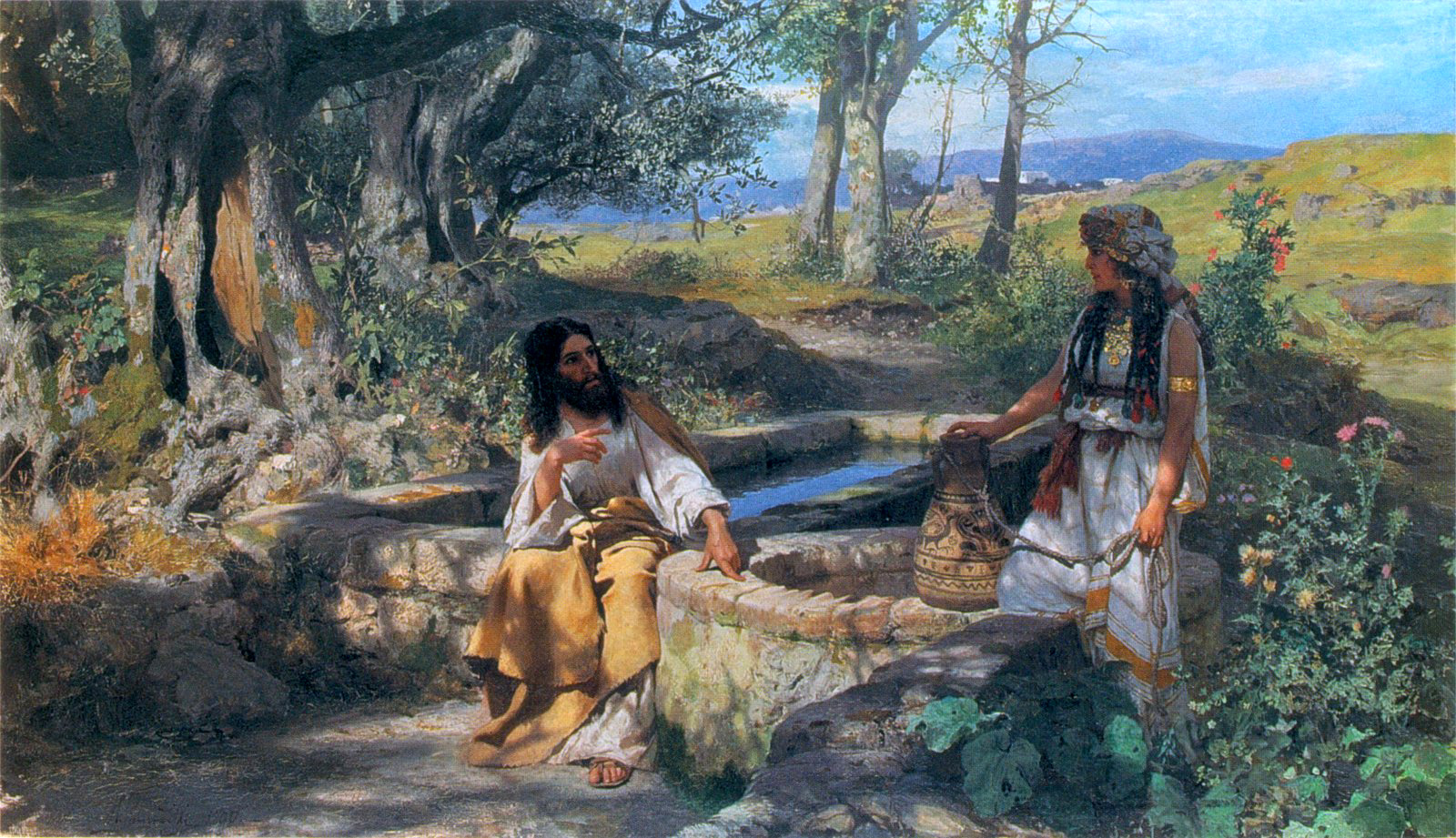
christ_and_samaritan_woman_henryk_siemiradzki“The Pharisees heard that Jesus was gaining and baptizing more disciples than John, {2} although in fact it was not Jesus who baptized, but his disciples. {3} When the Lord learned of this, he left Judea and went back once more to Galilee.

This chapter is filled with many “nuggets” of information about our Lord:

 – we see the humanity of Jesus (“tired”)

 – we see the Deity of Jesus

 – we see the universality of the gospel

 – we see spontaneous evangelism

 – we see true worship defined

Beginning with His cleansing of the temple at Jerusalem (John 2:13-22), including a considerable public ministry in the environs of Jerusalem and ending with the Lord’s departure into Galilee, a period of approximately 8-9 months have transpired.

Jesus made the move from Judea to Galilee. He is likely avoiding an imminent confrontation with the Pharisees. Jesus’ popularity is swelling (John 3:26). The crowds are growing, even more than they had for John. This irritated the competitive, jealous spirits of the Pharisees (cf. Mt 27:18).

Meanwhile, Jesus is practicing immersion. This is obviously not Christian baptism since Jesus has neither died nor risen again (cf. Rom 6:1-6). It is simply the continuation of John’s baptism for remission of sins (Mk 1:4) as the entrance into the kingdom (Jn 3:5). But for now, it marks those who are willing to become like children (Lk 18:16-17) and be born again (Jn 3:5).

In a typical parenthetical comment (cf. Jn 3:24; 4:8,9b), we learn that Jesus delegates the baptismal act to his disciples (Jn 4:2).

It was not yet time for our Lord to take on the Pharisees. That time would come soon enough. To let the situation cool a bit, Jesus left Judea and returned north to Galilee, no doubt relieving the fears of the Pharisees. They must have felt that Jesus could cause them little trouble there.

{4} Now he had to go through Samaria. {5} So he came to a town in Samaria called Sychar, near the plot of ground Jacob had given to his son Joseph. {6} Jacob’s well was there, and Jesus, tired as he was from the journey, sat down by the well. It was about the sixth hour.”

The name Samaritans originally was identified with the Israelites of the Northern Kingdom (2 Kings 17:29). When the Assyrians conquered Israel and exiled 27,290 Israelites, a “remnant of Israel” remained in the land. Assyrian captives from distant places also settled there (2 Kings 17:24).

This led to the intermarriage of some though not all, Jews with Gentiles and to widespread worship of foreign gods. By the time the Jews returned to Jerusalem to rebuild the Temple and the walls of Jerusalem, Ezra and Nehemiah refused to let the Samaritans share in the experience (Ezra 4:1-3; Neh. 4:7). The old antagonism between Israel to the north and Judah to the south intensified the quarrel.

The Jewish inhabitants of Samaria identified Mount Gerizim as the chosen place of God and the only center of worship, calling it the “navel of the earth” because of a tradition that Adam sacrificed there. Their scriptures were limited to the Pentateuch, the first five books of the Bible.

      The Samaritans professed to believe in the God of Israel and awaited the coming of Messiah (see John 4:25). They accepted only the first five books of the Law, but rejected the rest of the Old Testament Scriptures. Wherever they found it necessary to justify their religion and their place of worship, they modified the Law. The relationship between the Jews and the Samaritans was definitely strained.

Notice Jesus’s tact and persistence—and her growth.

– He began on the ground of her kindness…she saw Jesus as a Jew (vs. 7-9).

“When a Samaritan woman came to draw water, Jesus said to her, “Will you give me a drink?” {8} (His disciples had gone into the town to buy food.) {9} The Samaritan woman said to him, “You are a Jew and I am a Samaritan woman. How can you ask me for a drink?” (For Jews do not associate with Samaritans.)”

Three things about this woman seem to put her at a distinct disadvantage. First, she is a Samaritan. Second, she is guilty of sexual immorality, and third, she is a woman. We have already commented about the way the Jews felt toward the Samaritans.

The Pharisees had a very simple system for being holy—they simply kept their (physical) distance from sinners. They thought sin was contagious, and that one could catch it by merely being close to sinners.

The “woman at the well” is a woman whose sins are apparent, but she has not sinned alone. In those days, husbands divorced their wives, but wives did not divorce their husbands. If this woman was married and divorced five times, then five men divorced her.

“A woman could not divorce her husband in Jewish law. But under certain circumstances she could approach the court which would, if it thought fit, compel the husband to divorce her (see for example, Mishnah, Ket. 7:9, 10). Or she might pay him or render services to induce him to divorce her (Git. 7:5, 6). In theory there was no limit to the number of marriages that might be contracted after valid divorces, but the Rabbis regarded two, or at the most three marriages as the maximum for a woman (SBk, II, p. 437).” Morris, p. 264, fn. 43.

This woman was “put away” five times. Think of how she must feel about herself. And the man she is now living with is not her husband. She isn’t even married this time, but just living with (or sleeping with) a man, perhaps another woman’s husband. This woman has been passed around by some of the male population of Sychar. Jesus’ words not only call the woman’s attention to her sins; they call our attention to the sins of the men of that city.

The Rabbinic precept ran:  “Let no one talk with a woman in the street, no, not with his own wife.”  The Rabbis so despised women and so thought them incapable of receiving any real teaching that they said:  “Better that the words of the law should be burned than deliver to women.” 

They had a saying:  “Each time that a man prolongs converse with a woman he causes evil to himself, and desists from the law, and in the end inherits Gehinnom.” 

One of their sayings ran: ‘A man shall not be alone with a woman in an inn, not even with his sister or his daughter, on account of what men may think. A man shall not talk with a woman in the street, not even with his own wife, and especially not with another woman, on account of what men may say.’” Morris, p. 274, citing SBk, II, p. 438.

Here is Jesus taking the barriers down. The disciples seem to embrace this view. They cannot fathom why Jesus would be “wasting His time” talking to a woman.

There were several different kinds of Pharisees. One of the groups was called the “bruised and bleeding” Pharisees because they closed their eyes when they saw a woman approaching and would then walk into walls, houses, etc., and hurting themselves. They were bruised and bleeding because they were always running into things to avoid seeing a woman in public!

– Jesus took no offense..and appealed to her curiosity (vs. 10-12).

Jesus answered her, “If you knew the gift of God and who it is that asks you for a drink, you would have asked him and he would have given you living water.” {11} “Sir,” the woman said, “you have nothing to draw with and the well is deep. Where can you get this living water? {12} Are you greater than our father Jacob, who gave us the well and drank from it himself, as did also his sons and his flocks and herds?”

Like all good personal workers, Jesus refused to get involved with needless discussion. She was doing what many people do when truth comes into the picture…she was using “scripture (her beliefs, etc.) to avoid truth.” Her reference in verses 11-12 showed that the wall was broken down and she was ready for serious conversation.

 The Samaritans claimed descent from Jacob through Joseph and the tribes of Ephraim and Manasseh.

Jesus appealed to her desire for physical satisfaction…she saw Jesus as greater than Jacob (vs. 13-15)

Jesus answered, “Everyone who drinks this water will be thirsty again, {14} but whoever drinks the water I give him will never thirst. Indeed, the water I give him will become in him a spring of water welling up to eternal life.” {15} The woman said to him, “Sir, give me this water so that I won’t get thirsty and have to keep coming here to draw water.”

She did not realize Jesus was speaking of spiritual things. To her, His promise was a gratification of common human laziness. She made the mistake great crowds made later in John 6:26: she sought Jesus for the physical good she could get from Him, not the signs.

– Jesus appealed to her ambition (vs. 16).

“He told her, “Go, call your husband and come back.”

If she wanted badly enough what He had to offer, she would be willing to exert herself to obtain it. It would require a walk of a mile in the hot sun with only the word of a stranger to make it worthwhile. But the command had a double edge for it cut sharply at her heart: she must disclose some of her personal life. Her reply: “I’m not ready for that, least of all an investigation by a Jew.”

Why would Jesus now ask her to go call her husband? Is Jesus calling her to submit to her husband’s spiritual leadership? Is he calling her to repent of her sinfulness? Is he allowing the reader to understand his love for the sinful? Is he seizing the opportunity to demonstrate his omniscience?

It is not so surprising that she has had five husbands. Divorce was especially common among the Romans of the day who generally kept a wife at home and a mistress for social events. Even the Jews, following the liberal teachings of Hillel, divorced their wives with alarming regularity. Hillel even permitted divorce “if she burnt his dinner while cooking.” The Samaritan ethic of marriage was likely somewhere in between that of the Romans and that of the Jews.

– Jesus appealed to her moral sense…she recognized him as a prophet (vs. 17-20).

“I have no husband,” she replied. Jesus said to her, “You are right when you say you have no husband. {18} The fact is, you have had five husbands, and the man you now have is not your husband. What you have just said is quite true.” {19} “Sir,” the woman said, “I can see that you are a prophet. {20} Our fathers worshiped on this mountain, but you Jews claim that the place where we must worship is in Jerusalem.”

Jesus turned her life inside out before her very eyes! It shocked her and put her on the defensive. It’s been accurately observed that “like many others whose moral position is challenged, she took refuge in arguing impersonally about religion. She used “religion” to avoid truth!”

Jesus, by His power to search her heart and reveal her past sins, has revealed her sin and made her desirous of righteousness and also manifested, to some extent, His omniscient and divine nature, and thus provided the way to righteousness.

Her response in verse 20 had to do with a long-standing fight between the Jews and the Samaritans. This was a “hot-button” for her people.

According to the Jews, Jerusalem was the only God-ordained place of worship (Deut 12:5-11; 1 Kgs 9:3; 2 Chr 3:1). According to the Samaritans it was Gerizim. The Samaritans taught that Adam was created from the dust of Mount Gerizim, that the flood never covered it, that the ark came to rest there, and that Jacob wrestled with the angel there. They also felt that Abraham offered Isaac on Gerizim.

Because he was a Jew, she assumed that Jesus would “fight” that Mount Moriah in Jerusalem was the acceptable place; she sought to involve him in this age-long controversy.

Jesus skillfully dealt with both the controversial issue and the deeper personal need concealed behind it ( was a sensitive issue, and He spoke only the truth).

  – Jesus appealed to her religious sense…she recognized him as the Christ (vs. 21-25).

  “Jesus declared, “Believe me, woman, a time is coming when you will worship the Father neither on this mountain nor in Jerusalem. {22} You Samaritans worship what you do not know; we worship what we do know, for salvation is from the Jews. {23} Yet a time is coming and has now come when the true worshipers will worship the Father in spirit and truth, for they are the kind of worshipers the Father seeks. {24} God is spirit, and his worshipers must worship in spirit and in truth.” {25} The woman said, “I know that Messiah” (called Christ) “is coming. When he comes, he will explain everything to us.”

Jesus begins with a tremendous statement: “Salvation is from the Jews.” He made no concession to her position, and He was blunt. But He also very quickly made the matter not of time or space, but of the heart.

God is spirit, and not confined to things or places. And here reply showed a measure of sincerity in her heart. They revealed both hope and ignorance.

Both Jews and Samaritans erred in thinking that worship was a specific deed done with the body at a certain locale rather than a heart bent on knowing and loving God. Jesus now introduces a new relationship with God (Jer 31:31-34; Heb 8:8-12), where the Spirit of God and the spirit of man commingle (1 Cor 2:10-14; 6:19).

“God is Spirit.”  Theology flows from the lips of Jesus in simple chunks that children can get a hold of but that theologians cannot fathom. Such is this little nugget of truth. It answers so many questions about the nature of God and yet leads us to just as many more.

She doesn’t know how to respond to Jesus. He has her pinned. So she just blows it off saying, “Well, the Messiah will make it all clear to us.” So Jesus said: “Lady, I am the Messiah.” It would be another two years before Jesus is this clear again about his identity (Mt 16:16-18). He knows the Samaritans are not going to force him to be a political Messiah (cf. Jn 6:15). Furthermore, since he is only going to be there for two days he is able to be a bit more forward. The Samaritans did, indeed, have a high Messianic expectation (Acts 8:9; Josephus, Antiquities of the Jews 18. 85), as is evidenced by their response.

 – Jesus appealed to her faith (vs. 26).

“Then Jesus declared, “I who speak to you am he.”

Hearing His words created faith in her heart.

Jesus wasted no words: He revealed Himself more openly to her than He had even to Nicodemus. In this one instance Jesus had overcome the woman’s indifference, materialism, selfishness, moral turpitude, and religious prejudice, ignorance, and indefiniteness.

   “Just then his disciples returned and were surprised to find him talking with a woman. But no one asked, “What do you want?” or “Why are you talking with her?” {28} Then, leaving her water jar, the woman went back to the town and said to the people, {29} “Come, see a man who told me everything I ever did. Could this be the Christ?” “ They came out of the town and made their way toward him.”

These verses reveal to us the consciousness Jesus had of His mission and verse 30 implies that the people from the town were not skeptical but were looking for the Deliverer. Her leaving the water pots indicated her excitement and plans to come back.

 Note the lessons, or steps here:

– The experience to face herself and see herself as she really was. It was similar to Peter when he caught the many fish in Luke 5:8: “When Simon Peter saw this, he fell at Jesus’ knees and said, “Go away from me, Lord; I am a sinful man!”

– She staggered at Christ’s ability to see into her heart. He is like the surgeon who sees the evil and diseased, and takes it away.

‘Her first instinct? To share her discovery? “First to find, then find, then to tell” are two great steps of the Christian life.

    “Meanwhile his disciples urged him, “Rabbi, eat something.” {32} But he said to them, “I have food to eat that you know nothing about.” {33} Then his disciples said to each other, “Could someone have brought him food?” {34} “My food,” said Jesus, “is to do the will of him who sent me and to finish his work”

   The disciples also got involved with the physical, rather than the spiritual. They couldn’t figure out why Jesus was not hungry and thirsty.

It is his great desire that we should be as he was.

(i)  To do the will of God is the only way to peace.  There can be no peace when we are at variance with the king of the universe.

(ii)  To do the will of God is the only way to happiness.  There can be no happiness when we set our human ignorance against the divine wisdom of God.

(iii)  To do the will of God is the only way to power.  When we go our own way, we have nothing to call on but our own power, and therefore collapse is inevitable.  When we go God’s way, we go in his power, and therefore victory is secure.

“Do you not say, ‘Four months more and then the harvest’? I tell you, open your eyes and look at the fields! They are ripe for harvest. {36} Even now the reaper draws his wages, even now he harvests the crop for eternal life, so that the sower and the reaper may be glad together. {37} Thus the saying ‘One sows and another reaps’ is true. {38} I sent you to reap what you have not worked for. Others have done the hard work, and you have reaped the benefits of their labor.” {39} Many of the Samaritans from that town believed in him because of the woman’s testimony, “He told me everything I ever did.” {40} So when the Samaritans came to him, they urged him to stay with them, and he stayed two days. {41} And because of his words many more became believers.”

John 4:39-42: “Many of the Samaritans from that city believed on him, because of the woman’s story, for she testified:  “He told me all things that I have done.”  So when the Samaritans came to him, they asked him to stay amongst them, and he stayed there two days.  And many more believed when they heard his word, and they said to the woman:  “No longer do we believe because of your talk.  We ourselves have listened to him, and we know that this is really the Saviour of the World.”

God cannot deliver his message to those who have never heard it unless there is someone to deliver it.

      A song: “He has no hands but our hands To do his work today: He has no feet but our feet To lead men in his way: He has no voice but our voice To tell men how he died: He has no help but our help To lead them to his side.”

It is our precious privilege and our terrible responsibility to bring men to Christ.  The introduction cannot be made unless there is a man to make it.

We often wonder how we can begin a conversation on spiritual things when we find someone ‘who thinks of spiritual things.’ We have the beginning point: “Look what he has done for me and to me.” 


Leave a comment

Posted by on February 2, 2017 in Gospel of John


Why People Reject Christ – John 3:19-21


God-is-good-all-the-time_re-500x500Picture a guy floating downstream on a raft on a hot summer day. He’s having the time of his life, enjoying the ride as the cool water gently splashes on him. You’re on the shore and you know that there’s a deadly waterfall not far downstream. This guy is floating blissfully and ignorantly toward certain destruction! So you yell to warn him. You throw him a rope. But he rejects it and keeps floating toward certain death. Why won’t he grab the life preserver? Because he loves what he’s doing and he doesn’t want to believe your warning.

Why do people reject God’s wonderful offer of salvation through Jesus Christ? You would think that everyone would eagerly grab the life preserver that God has thrown out through the gospel (John 3:16): “For God so loved the world, that He gave His only begotten Son, that whoever believes in Him shall not perish, but have eternal life.” Why would anyone reject such a wonderful offer? Why would anyone want to keep heading for eternal destruction? In our text, John shows us:

People reject Christ because they love their sin and they hate having it exposed by God’s light.

People don’t want God interfering with what they consider “a good time,” and they don’t believe the warnings of Scripture that they are under God’s judgment now and will face it eternally when they die.

People think that they’re basically good and that God will overlook their faults and give them credit for their good deeds on judgment day. So they don’t repent of their sin and believe in Jesus Christ to save them from God’s judgment.

The Greek philosopher, Plato, observed (source unknown), “We can easily forgive a child who is afraid of the dark. The real tragedy of life is when men are afraid of the light.”

1. The light came into this world in the person of Jesus Christ, and His presence condemned those in darkness.

John 3:19a: “This is the judgment, that the Light has come into the world ….”

John has already introduced Jesus as the Light (1:4-5): “In Him was life, and the life was the Light of men. The Light shines in the darkness, and the darkness did not comprehend it.”

Later (8:12; also, 9:5; 12:46), Jesus states, “I am the Light of the world; he who follows Me will not walk in the darkness, but will have the Light of life.”

In the Bible, light is used symbolically in two main ways: First, it refers to God’s absolute holiness and, by extension, to the holiness of His people; whereas darkness symbolizes Satan’s domain and sin (Col. 1:13; Acts 26:18).

Paul says (1 Tim. 6:16) that God “dwells in unapproachable light.” In 1 John 1:5, the apostle declares, “God is Light, and in Him there is no darkness at all.”

In this vein, Paul exhorts us (Eph. 5:7-10): Therefore do not be partakers with them; for you were formerly darkness, but now you are Light in the Lord; walk as children of Light (for the fruit of the Light consists in all goodness and righteousness and truth), trying to learn what is pleasing to the Lord.

Second, light refers to the spiritual illumination or understanding that we get when we are born again, whereas darkness refers to our natural spiritual blindness before we are saved (2 Cor. 4:3-4, 6): And even if our gospel is veiled, it is veiled to those who are perishing, in whose case the god of this world has blinded the minds of the unbelieving so that they might not see the light of the gospel of the glory of Christ, who is the image of God…. For God, who said, “Light shall shine out of darkness,” is the One who has shone in our hearts to give the Light of the knowledge of the glory of God in the face of Christ.

In that sense, God’s Word is a lamp to our feet and a light to our path (Ps. 119:105). Proverbs 6:23 says, “For the commandment is a lamp and the teaching is light; and reproofs for discipline are the way of life ….” God’s Word gives spiritual light so that we understand God’s truth and how He wants us to live.

God’s light is embodied in Jesus Christ, the eternal Son of God who took on human flesh. John has told us (1:9), “There was the true Light which, coming into the world, enlightens every man.” When Jesus came into the world, His very presence exposed the world to who God is as holy and to the fact that we are not holy.

  1. A. Carson explains John 1:9 (The Gospel According to John [Eerdmans/Apollos], p. 124): It shines on every man, and divides the race: those who hate the light respond as the world does (1:10): they flee lest their deeds should be exposed by this light (3:19-21). But some receive this revelation (1:12-13), and thereby testify that their deeds have been done through God (3:21). In John’s Gospel it is repeatedly the case that the light shines on all, and forces a distinction (e.g. 3:19-21; 8:12; 9:39-41).

Leon Morris (The Gospel According to John [Eerdmans], p. 233, italics his) explains John 3:19: The word translated “judgment” here denotes the process of judging, not the sentence of condemnation…. It is not God’s sentence with which [John] is concerned here. He is telling us rather how the process works. Men choose the darkness and their condemnation lies in that very fact…. They refuse to be shaken out of their comfortable sinfulness.

As we saw in 3:17-18, even though Jesus did not come for the purpose of judgment, because of who He is, His very presence brought judgment and divided people. Have you ever been in the presence of a very godly man, so that his very presence made you uncomfortable?

How much more would we all have felt condemned to be in the presence of Jesus Christ! Do you remember one of Peter’s early encounters with Jesus, when Jesus caused the miraculous catch of fish? Peter fell down at Jesus’ feet and said (Luke 5:8), “Go away from me Lord, for I am a sinful man, O Lord!”

Have you had that experience with Jesus Christ? Have you seen who Jesus is and instantly recognized, “He is holy and I am not holy! I am under God’s judgment because Jesus is Light and I am darkness!” When you’ve that kind of encounter with Jesus, you can go one of two ways. First, John presents the negative reaction:

2. People love darkness rather than the light because their deeds are evil.

John 1:19b: “… men loved darkness rather than light, because their deeds are evil.” This phrase contains several significant truths about sin. First, sin is far deeper than outward deeds; sin is a matter of our affections or desires. “Men loved darkness.” The past tense (Greek aorist) could be translated, “Men set their love on darkness” (Morris, p. 233). Loved indicates that this was not a cool, rational decision: “Having weighed all the factors involved, I think the best decision is to love darkness rather than light.” No, it was in large part an emotional choice that stems from desires that dwell in our hearts due to the fall. We love darkness rather than light.

This leads to a second significant truth about sin: Our sin problem is far deeper than we ever imagined. The Bible does not teach that we are basically good people who need to overcome a few flaws in our character. We’re not merely in need of more education or learning some anger management skills so that we can develop better relational skills. We don’t need to go through therapy to explore our pasts and figure out why our parents treated us as they did so that we can now understand why we are the way we are. All of these approaches to sin are too superficial from a biblical standpoint. The Bible shows that our root problem is that we love our sin rather than God’s holiness. It’s a matter of the heart, and the only remedy that goes deep enough is the new birth, which gives us new hearts that hunger and thirst after righteousness.

This phrase also shows us a third truth about sin: The reason that people reject Christ is not primarily intellectual, but moral. Unbelievers do not love darkness rather than light because they have thought it through carefully and concluded that darkness makes more sense. No, unbelievers love darkness rather than light because their deeds are evil. The light exposes their evil deeds and convicts them of their true moral guilt before the holy God. But, frankly, they like sinning!

Aldous Huxley, the famous atheist of the last century, once admitted that his rejection of Christianity stemmed from his desire to sin. He wrote (Ends and Means [Garland Publishers], pp. 270, 273, cited in James Boice, Genesis [Zondervan], 1:236):

I had motives for not wanting the world to have a meaning; consequently assumed that it had not; and was able without any difficulty to find satisfying reasons for this assumption. The philosopher who finds no meaning for this world is not concerned exclusively with the problem of pure metaphysics; he is also concerned to prove that there is no valid reason why he personally should not do as he wants to…. For myself … the philosophy of meaninglessness was essentially an instrument of liberation, sexual and political.

This means that when you’re sharing the gospel, don’t be intimidated by a Ph.D. who argues in favor of evolution or who cites arguments from the latest popular atheist. Don’t panic if someone says, “I don’t believe in the Bible because of its contradictions.” You can give philosophic arguments for the existence of God or scientific arguments against evolution all day long, but even if you were to convince the unbeliever intellectually, you have not dealt with his main problem. His main problem is that he loves his sin and he stands guilty before the holy Judge of the universe.

I’m not saying that we should not have good answers to these intellectual questions. But I am saying that they are usually not the real issue. You can ask the person raising the objection, “Are you saying that if I can give reasonable answers to these questions, you will repent of your sins and trust in Christ as your Savior and Lord?” Invariably, the answer will be, “Well, I have other objections, too.” The objections are smokescreens to hide the fact that unbelievers love their sin.

This phrase shows us a fourth truth about sin: Sin must be determined by God’s absolute standards of holiness, not by men’s relative standards of goodness. When John says that men’s “deeds are evil,” we may recoil and think, “Terrorists and drug dealers and pedophiles and pimps are evil. But most people are not evil. Just look at all the good people in this world!”

The Bible acknowledges that there are unbelievers who are relatively good people. Because of God’s common grace, all people are not as evil as they could be. The human race would have self-destructed millennia ago if everyone acted as badly as they could. God restrains outward evil through civil government, through social disapproval, and through the fear of shame and the desire to look good to others. But God looks on the heart. Hebrews 4:13 reminds us, “And there is no creature hidden from His sight, but all things are open and laid bare to the eyes of Him with whom we have to do.” When God looks at our hearts, even the best of people, humanly speaking, are filled with pride, selfishness, greed, lust, and other sins that may never come into public view.

But the situation of loving darkness rather than light is far worse than just loving sin:

3. Those who practice evil hate Jesus, who is light, and do not come to Him for fear that their deeds will be exposed.

John 3:20: “For everyone who does evil hates the Light, and does not come to the Light for fear that his deeds will be exposed.”

Unbelievers do not just love their sin; they also hate Jesus! They hate the One who out of love offered Himself on the cross so that every sinner might not perish but have eternal life simply by believing in Him! They hate Him because He exposes their evil deeds.

A teacher assigned his fourth-grade students to write a topic sentence for the following phrases: “Sam always works quietly. Sam is polite to the teacher. Sam always does his homework.” The student’s topic sentence? “I hate Sam.” (Reader’s Digest [November, 2007], p. 59)

We need to understand several things about this verse. First, John does not mean that all sinners do their evil deeds in secret. Many do, of course. Many otherwise respectable men would never frequent a strip club in their own city, for fear of being seen. But if they’re traveling far from home, where they think they’re safe, they might yield to that sin. But in our day, when people call good evil and evil good (Isa. 5:20), it’s cool to flaunt your sin. Movie stars and other celebrities go on television to tell about their immoral behavior. We have “gay pride” celebrations to boast in what God condemns as evil. John is merely pointing out that such sinners do not come to the Light (Jesus) because they know that He would condemn their behavior as evil.

Second, John does not say that those who practice evil are neutral toward Jesus; rather, they hate Him. Many unbelievers would object. They would say that they don’t have anything against Jesus; they’re indifferent towards Him. They think that Jesus was a good man. Some may think that He was a prophet. They may say that He was a good moral teacher. They might even feel bad that He got crucified for His teachings and beliefs. They recognize that that was a miscarriage of justice. But they would protest if you said that they hate Jesus. They’re just indifferent. But John says that they hate Jesus. Jesus Himself told His then unbelieving brothers (John 7:7), “The world cannot hate you, but it hates Me because I testify of it, that its deeds are evil.”

Third, John gives the reason why unbelievers hate Jesus: they fear that He will expose their evil deeds. Just being around a guy like that makes you nervous because you’re always afraid that you’ll slip and utter a swear word or say or do something that will expose your evil heart.

The word translated “exposed” means to be convicted in a court of law. It was used of an attorney proving his case. Jesus uses it in John 16:8 when He says that the Holy Spirit “will convict the world concerning sin and righteousness and judgment.” Guilty criminals hate judges who convict them of their crimes, even though it’s not the judges’ fault. Guilty sinners hate Jesus because He convicts them of their sins.

But, because of God’s grace, not all reject Christ:

4. True believers practice the truth and come to the Light, so that their deeds are shown to have God as their source.

John 3:21: “But he who practices the truth comes to the Light, so that his deeds may be manifested as having been wrought in God.” John does not mean that some have a natural bent toward practicing the truth or that doing so brings salvation. He has just made it plain that we all need the new birth and that salvation comes through believing in Jesus Christ (3:1-16).

Rather, John is describing two types of people in the world: Those that have not believed in Christ avoid the light and hate it, because it exposes their sinful deeds. Those that have believed in Christ gladly come to Him and give Him all credit for their good deeds, because they know that those good deeds came from God, who caused them to be born again (1 Pet. 1:3; James 1:18).

“Practicing the truth” is a Semitic expression which means to act faithfully or honorably (Carson, p. 207). But it also shows us that the truth is to be lived, not just spoken (1 John 1:6). “Truth” is an important concept for John He uses the word 25 times in his gospel and 20 more times in his epistles. Truth is embodied in Jesus Himself, who said (14:6), “I am the way, and the truth, and the life; no one comes to the Father but through Me.” Jesus told Pilate (18:37), “For this I have been born, and for this I have come into the world, to testify to the truth. Everyone who is of the truth hears My voice.” This has two implications:

First, there is such a thing as absolute truth in the spiritual and moral realms and you can spot believers by their obedience to that truth. Contrary to the postmodern mindset, truth is not relative to the culture or situation. All truth is in Jesus (Eph. 4:21) and He declared that God’s Word is truth (John 17:17). This means that believers are committed to the truth. We seek to understand the truth more deeply. We hold to the truth of God’s Word even when our culture goes against it.

Second, believers willingly, gladly, and repeatedly come to the light of God’s Word in order to grow in holiness and to give God glory for His work in their hearts. True believers read God’s Word over and over, allowing it to shine into the dark corners of their lives and expose the sinful thoughts and intentions of their hearts (Heb. 4:12). False believers avoid the Word and they find churches that don’t preach the Word to expose sin. False believers try to keep up a good front to impress others, but they don’t live openly in the light of God’s presence on the heart level.

Conclusion

C. Ryle (Expository Thoughts on the Gospels [Baker], 3:164) points out that eventually sinners will get what they desired while on earth: they loved darkness; they will be cast into outer darkness. They hated the light; they will be shut out from the light eternally. God will be perfectly just in condemning those who rejected Christ. They saw the Light, but hated it and turned away from it because they loved their sin.

John Piper summarizes our text (DesiringGod.org, “This is the Judgment: Light has come into the World”): “The coming of Jesus into the world clarifies that unbelief is our fault, and belief is God’s gift. Which means that if we do not come to Christ, but rather perish eternally, we magnify God’s justice. And if we do come to Christ and gain eternal life, we magnify God’s grace.”

I pray that we all will believe in Jesus and rejoice in His light, so that we magnify God’s grace!

 
1 Comment

Posted by on January 28, 2017 in Jesus Christ


1 Corinthians #3 True Wisdom -1 Corinthians 2:1-16


global_443897981

When I came to you, brothers, I did not come with eloquence or superior wisdom as I proclaimed to you the testimony about God. 2  For I resolved to know nothing while I was with you except Jesus Christ and him crucified. 3  I came to you in weakness and fear, and with much trembling. 4  My message and my preaching were not with wise and persuasive words, but with a demonstration of the Spirit’s power, 5  so that your faith might not rest on men’s wisdom, but on God’s power.

Simple and Straightforward. Paul came not with excellence of speech or wisdom, but with the testimony of God. Wisdom refers to man’s wisdom. Paul preached one message: Jesus Christ and Him crucified.

It is worth noting that Paul had come to Corinth from Athens. It was at Athens that, for the only time in his life, as far as we know, he had attempted to reduce Christianity to philosophic terms. There, on Mars’ Hill, he had met the philosophers and had tried to speak in their own language (Ac 17:22-31); and it was there that he had one of his very few failures.

Some suggest that Paul seemed to say to himself, “Never again! From henceforth I will tell the story of Jesus in utter simplicity. I will never again try to wrap it up in human categories. I will know nothing but Jesus Christ, and him upon his Cross.”

I disagree! It is not unusual to find out ‘where people are’ in their understandings and then seek to ‘teach them’ to a different place.

Not With Superiority of Speech. Paul preached the simple gospel in simple terms. The gospel is: the salvation God has provided for man through the death of Christ on the cross. The death of Christ is in the past, but the effect is ongoing even to today.

The Source of Paul’s Message. Paul explains that the message came not from him, but from God. Paul admits that he came with fear and trembling, so they had no reason to glory in him. The message was a demonstration of what the Spirit of God had taught him.

Here we have to be careful to understand. It was not fear for his own safety; still less was it that he was ashamed of the gospel that he was preaching. It was what has been called “the trembling anxiety to perform a duty.”

The very phrase which he uses here of himself Paul also uses of the way in which conscientious slaves should serve and obey their masters. (Eph 6:5). It is not the man who approaches a great task without a tremor who does it really well.

The really effective preacher is he whose heart beats faster while he waits to speak. The man who has no nervousness, no tension, in any task, may give an efficient performance; but it is the man who has this trembling anxiety who can produce an effect which artistry alone can never achieve.

The message was not a demonstration of the wisdom of man, but of the power of God.  Paul did not rely on any type of trick with regard to the gospel, but simply let the facts speak for themselves.

Paul’s approach in Corinth.

  • His method (v. 1) – Did not use human rhetoric (eloquence).
  • His message (v. 2) – Simple, clear and frank presentation of both the person of Christ and His redemptive work.
  • His manner (v. 3) – In weakness, in fear, in trembling.
  • His means (v. 4) – Not in persuasive words of wisdom but in demonstration of the Spirit of power.
  • His motive (v. 5) – So that your faith may be not in the wisdom of man but in the power of God.

No one can argue against the proof of a changed life. It is our weakness that too often we have tried to talk men into Christianity instead of, in our own lives, showing them Christ.

Paul’s actions in Corinth were purposeful, not accidental or haphazard. It was not that Paul was ignorant or uneducated, nor was it that Paul only knew about Christ and Christ crucified (verse 2). Paul determined that this was all he would know while ministering in Corinth (or anywhere else). He chose to limit his knowledge to those truths which would save men from their sins and transfer them from the kingdom of darkness to the kingdom of light.

God’s Wisdom and the Wisdom of This Age (2:6-9)

We do, however, speak a message of wisdom among the mature, but not the wisdom of this age or of the rulers of this age, who are coming to nothing. 7  No, we speak of God’s secret wisdom, a wisdom that has been hidden and that God destined for our glory before time began. 8  None of the rulers of this age understood it, for if they had, they would not have crucified the Lord of glory. 9  However, as it is written: “No eye has seen, no ear has heard, no mind has conceived what God has prepared for those who love him”–

The wisdom which Paul proclaimed was not of this world; for it was worldly wisdom which caused Christ to be crucified.

  1. Mature – Those who have reached a certain goal in their lives; for they have honestly accepted and obeyed the message of Christ.
  2. The immature reject the message of Christ; preferring the wisdom of man.

The Nature of God’s Wisdom. We speak God’s wisdom in a mystery.”

Salvation was purchased by the Son, but it was planned by the Father. Those who talk about “the simple Gospel” are both right and wrong. Yes, the message of the Gospel is simple enough for an illiterate pagan to understand, believe, and be saved. But it is also so profound that the most brilliant theologian cannot fathom its depths.

“Mystery” – That which would not have been known if it had not been revealed. Before God created anything, He thought about and planned our eternal destiny through His Son (Ephesians 3:3-5).

The Rejection of God’s Wisdom. Rulers of this age were motivated by worldly wisdom. Paul refers back to the Jewish leaders. If they had based their wisdom solely on God’s word, they would have accepted Christ as the Messiah.

The idea did not originate with man, but with God. The idea originated with God before the foundation of the world. God reveal them through the Holy Spirit, who searches the deep things of God.

Let’s notice the characteristics of this wisdom.

This wisdom comes from God, not man (v. 7). This wisdom tells the mature saint about the vast eternal plan that God has for His people and His creation. The wisest of the “princes of this world [age]” could not invent or discover this marvelous wisdom that Paul shared from God.

This wisdom is hidden from the unsaved world (v. 8).

Who are “the princes of this world [age]” that Paul mentions? Certainly the men who were in charge of government when Jesus was on earth did not know who He was (Acts 3:17; 4:25-28). When Jesus on the cross prayed “Father, forgive them: for they know not what they do” (Luke 23:34), He was echoing this truth. Their ignorance did not excuse their sin, of course, because every evidence had been given by the Lord and they should have believed But there is another possibility.

Judaism, under the rule of the chief priests, in an uneasy relationship with Herod Antipas, ‘the king of the Jews’, played their part by keeping the local people on side with Rome’s decision.

The satanic forces, including Satan himself, did not understand God’s great eternal plan! They could understand from the Old Testament Scriptures that the Son of God would be born and die, but they could not grasp the full significance of the cross because these truths were hidden by God. In fact, it is now, through the church, that these truths are being revealed to the principalities and powers (Eph. 3:10).

Satan thought that Calvary was God’s great defeat; but it turned out to be God’s greatest victory and Satan’s defeat! (Col. 2:15) From the time of our Lord’s birth into this world, Satan had tried to kill Him, because Satan did not fully understand the vast results of Christ’s death and resurrection. Had the demonic rulers known, they would not have “engineered” the death of Christ. (Of course, all of this was part of God’s eternal plan. It was God who was in control, not Satan.)

This verse is a quotation (with adaptation) from Isaiah 64:4. The immediate context relates it to Israel in captivity, awaiting God’s deliverance. The nation had sinned and had been sent to Babylon for chastening. They cried out to God that He would come down to deliver them, and He did answer their prayer after seventy years of their exile. God had plans for His people and they did not have to be afraid (Jer. 29:11).

Paul applied this principle to the church. Our future is secure in Jesus Christ no matter what our circumstances may be. In fact, God’s plans for His own are so wonderful that our minds cannot begin to conceive of them or comprehend them! God has ordained this for our glory. It is glory all the way from earth to heaven!

For those who love God, every day is a good day…God will use it for good or cause all things to work out for good. It may not look like a good day, or feel like it; but when God is working His plan, we can be sure of the best. It is when we fail to trust Him or obey Him, when our love for Him grows cold, that life takes on a somber hue. If we walk in God’s wisdom, we will enjoy His blessings.

How God’s Wisdom Is Revealed (2:10-13)

“…but God has revealed it to us by his Spirit. The Spirit searches all things, even the deep things of God. 11  For who among men knows the thoughts of a man except the man’s spirit within him? In the same way no one knows the thoughts of God except the Spirit of God. 12  We have not received the spirit of the world but the Spirit who is from God, that we may understand what God has freely given us. 13  This is what we speak, not in words taught us by human wisdom but in words taught by the Spirit, expressing spiritual truths in spiritual words.

Paul shared deep things:

  • Things that are for the “mature” (teliois).
  • Things that are not “from” the pagans or the
  • Things that are “of” God.
  • Things that are a “mystery” and have been “hidden.”
  • Things which manifest the eternal plan of God.
  • Things that cannot be “discovered” by men.
  • Things prepared by God only “for those who love Him.”

The Holy Spirit and Revelation. The Holy Spirit brought these things into view.

“Deep things of God” – The very core of God’s mind. Includes God’s redemptive plan. The Spirit revealed the entire plan of redemption and so we cannot expect additional revelation from God on the subject. These are just some of the ‘deep things of God.

God revealed them through the Holy Spirit. This has always been the work of the Holy Spirit.

  • The Old Testament writers wrote and spoke by Him (2 Peter 1:21; 1 Peter 1:11).
  • The prophets spoke by the Spirit (cf. Micah 3:8).
  • Jesus also spoke by the Spirit (Luke 4:18-19; Acts 10:38).
  • His apostles and prophets did the same (John 16:12-14; 1 Peter 1:12).

2 Peter 1:20-21 (NIV)  Above all, you must understand that no prophecy of Scripture came about by the prophet’s own interpretation. 21  For prophecy never had its origin in the will of man, but men spoke from God as they were carried along by the Holy Spirit.

2 Timothy 3:16-17 (NIV) All Scripture is God-breathed and is useful for teaching, rebuking, correcting and training in righteousness, 17  so that the man of God may be thoroughly equipped for every good work.

Who really knows the thought of a man except the man himself; by the same token who knows the mind of God except the Spirit of God.

The Holy Spirit understands the mind of God. Therefore it became the Holy Spirit’s function to reveal that thought process to men such as Paul, who delivered it to man through the spoken and written word.

Promises Made By Jesus Regarding Inspiration

  1. Matthew 10:19 – The apostles were promised that whatever words they needed would be given to them by God.
  2. Luke 12:11-12 – The Holy Spirit will teach the apostles how and what they were to say.
  3. John 16:12-15 – The Holy Spirit will remind the apostles of all that Jesus taught and will guide them into all truth.

NECESSITY OF SPIRITUAL RECEPTION OF GOD’S WISDOM (2:14-16)

The Natural Man (v. 14). Unspiritual one who does not welcome openly and freely the things (ideas taught by the apostles in verse 13) of the Spirit.

They are foolishness to him. He cannot know them because they are spiritually examined. He views life physically.

The word accept (NIV), in verse 14 means to receive as a guest, to welcome one openly and freely.

The Spiritual Man (v. 15). “One who is governed and filled by the Spirit of God.” (Thayer p. 523)

  1. His identity – spiritual.
  2. His ability – judges all things.
  3. His immunity – judged by not man.
  4. His secret – possesses mind of Christ (cf. Philippians 2:5ff).

Spiritual Understanding Prohibits Glorying In Men.

If the church understood the spiritual message of the redemptive nature of the cross, they could not glory in the men who brought the message and thereby cause division.

 
Leave a comment

Posted by on January 22, 2017 in 1 Corinthians


Obedience


 0ee131c050c4792d6ad5b3a3eee48d87   JesusIsLordofthisWebSite placeforyou2 575273_579331012148169_1163921425_n

 ——————————————–

It’s Not Always Easy

It’s not always easy to smile and be nice, When we are called to sacrifice.

It’s not always easy to put others first, Especially when tired and feeling our worst.

It’s not always easy to do the Father’s will. It wasn’t so easy to climb Calvary’s hill.

But we as His children, should learn to obey; Not seeking our own but seeking His way.

It’s not always easy to fight the good fight. But it is always good and it is always right!  – Glenda Fulton Davis

—————————————

What radical thinking, both for his own time and for ours! But it is particularly offensive to our time, I suspect, in view of the fact that we have created a sort of pick-and-choose Christianity that permits would-be disciples alternately to select or to opt out of the demands of discipleship.

“The man who says, ‘I know him,’ but does not do what he commands is a liar, and the truth is not in him. . . . This is love for God: to obey his commands. And his commands are not burdensome . . .”

Before proceeding with today’s sermon, I must warn you that it has been given a “rating” for language that will be offensive to some. In this case, I am more worried about adults than children or adolescents. The word that may offend some as it occurs again and again in the lesson is obey, that’s o-b-e-y.

Strange as it may sound to those who are offended by this term, Jesus used both the concept and the very word throughout his teaching career. So that any doubters out there will know that I am not misrepresenting him on this matter, I will quote him only as he is cited by his dear friend John.

First, the concept from his lips: “My food,” said Jesus, “is to do the will of him who sent me and to finish his work” (John 4:34). To do the will of someone else is obedience by anyone’s definition. It is surrendering oneself to another as a slave in Jesus’ culture would have been required to do to his master.

Second, not merely the ideology of obedience but the very four-letter word in question came from his lips in statements like this one: “If anyone loves me, he will obey my teaching” (John 14:23). As if it were not enough that Jesus practiced obedience in his own life, he enjoined it on all who would claim to love and follow him. Because he was able to surrender his will to God, he did not think it unfair to ask those who were going to call themselves his disciples to adopt the same manner of life.

What radical thinking, both for his own time and for ours! But it is particularly offensive to our time, I suspect, in view of the fact that we have created a sort of pick-and-choose Christianity that permits would-be disciples alternately to select or to opt out of the demands of discipleship. The word definitely belongs in the vocabulary of someone who has committed himself to be Jesus’ disciple on his terms. I warned you: The language of today’s sermon may offend some.

We don’t have the experience of slavery to explain how discipleship entails submission, apprenticeship, and obedience. But our culture does have a few relationships left that epitomize how discipleship and obedience go hand in hand. The true devotee of — let’s say — some great musician or painter yields his master a wholehearted submission. In practicing scales or mixing colors, he knows it is wisdom simply to watch, do as told, and learn the techniques of his mentor. It is no different with a medical student interning under her professor, a trainee working with the company’s best salesman, or an athlete under a great coach. In one’s wholehearted surrender to the tutelage of his maestro, professor, or coach, he or she is being discipled to a vocation and career.

It is fundamentally the same in spiritual things. This much is certain: One does not have the right to call himself a “disciple” so long as he is still charting his own course. A disciple is a pupil, a novice in spiritual things who looks constantly to a tutor and coach. Thus Christ’s disciples come to him and ask to learn the lost art of obeying God as he did. And the only way of learning faithfulness from him is to give up your will to him and to make the doing of his will the one passion and delight of your heart.

Did you happen to see the movie City Slickers? Billy Crystal is Mitch, one of several guys who set out to resolve their mid-life crises by going to a dude ranch and helping with a cattle drive. The boss of the drive is a crusty old cowboy named Curly, played by Jack Palance. In a contemplative scene in that otherwise comedic film, Mitch asks Curly to tell him the secret of life. Holding up a single gloved finger, Curly responds, “One thing. Figure out that ‘one thing’ and nothing else matters.”

Do you know your “one thing”? Have you figured out the meaning of life? For Jesus, the meaning of life — his “food” he called it — was his Father’s will. For his disciples, it is to live as he lived and to learn how to obey his Father’s will in the fulness of joy.

Ralph Barton was one of the original cartoonists for The New Yorker magazine. When he was found dead by his own hand on May 20, 1931, he had left a detailed suicide note. He wrote, in part: “I have had few difficulties, many friends, great successes; I have gone from wife to wife, and from house to house, visited great countries of the world, but I am fed up with inventing devices for getting through twenty-four hours a day.” Barton never found his “one thing.” Many others who don’t commit suicide never find theirs either, and they have this awful sense of enduring a pointless existence. They want it to end, but they fear death as much or more as they hate life.

There is only one thing worthy of being the single defining commitment for your life. And it isn’t career, fame, or money. It isn’t even being a good citizen and having a family to love and by whom to be loved. It is the duplication of Jesus’ life of single- minded devotion to God, pouring out your life in obedience to him.

 
1 Comment

Posted by on January 19, 2017 in Doctrine