RSS

“Soar Like Eagles” The Gospel of John #5 – “Using Scripture To Avoid Truth” John 4:1-41


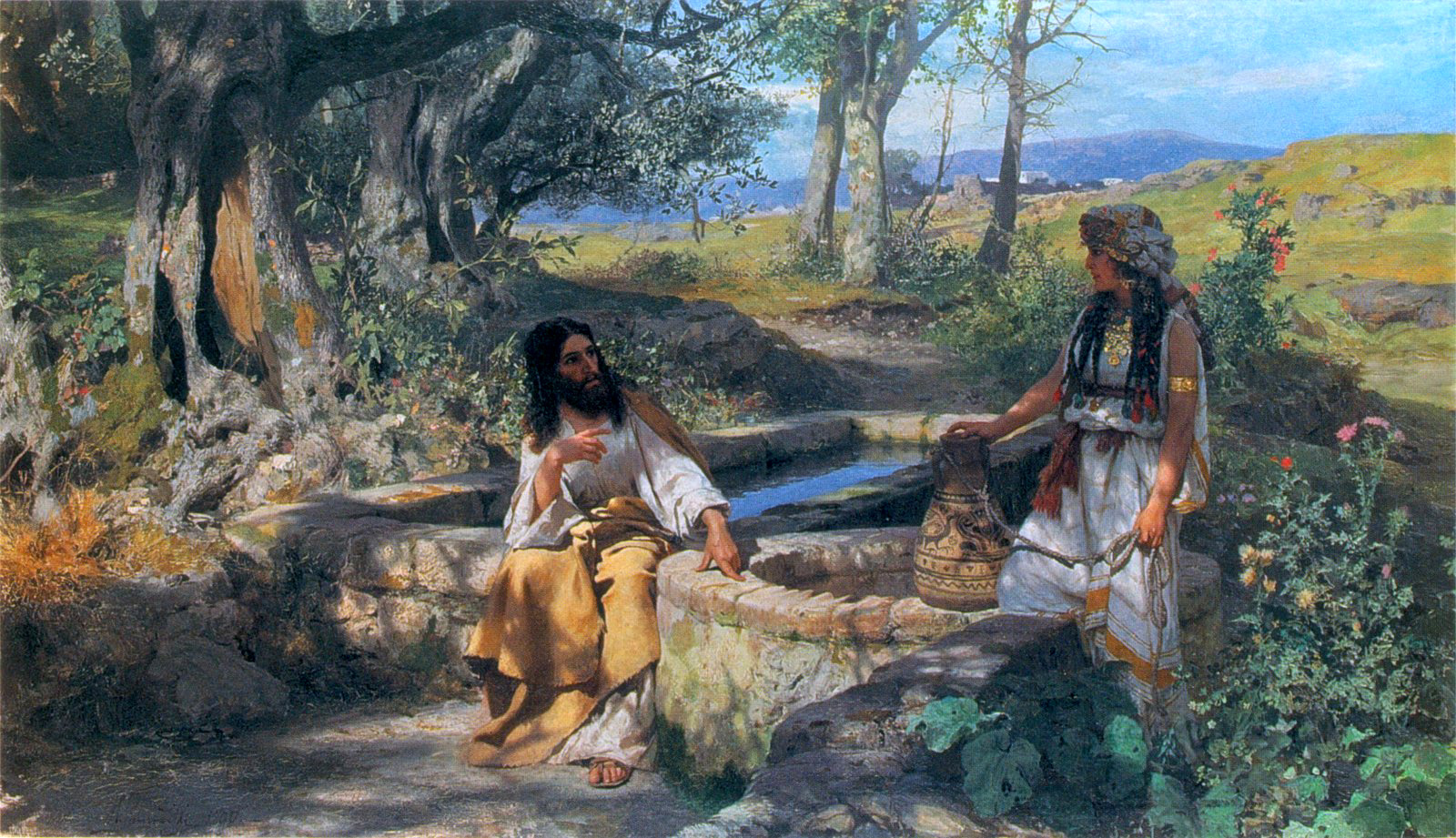
christ_and_samaritan_woman_henryk_siemiradzki“The Pharisees heard that Jesus was gaining and baptizing more disciples than John, {2} although in fact it was not Jesus who baptized, but his disciples. {3} When the Lord learned of this, he left Judea and went back once more to Galilee.

This chapter is filled with many “nuggets” of information about our Lord:

 – we see the humanity of Jesus (“tired”)

 – we see the Deity of Jesus

 – we see the universality of the gospel

 – we see spontaneous evangelism

 – we see true worship defined

Beginning with His cleansing of the temple at Jerusalem (John 2:13-22), including a considerable public ministry in the environs of Jerusalem and ending with the Lord’s departure into Galilee, a period of approximately 8-9 months have transpired.

Jesus made the move from Judea to Galilee. He is likely avoiding an imminent confrontation with the Pharisees. Jesus’ popularity is swelling (John 3:26). The crowds are growing, even more than they had for John. This irritated the competitive, jealous spirits of the Pharisees (cf. Mt 27:18).

Meanwhile, Jesus is practicing immersion. This is obviously not Christian baptism since Jesus has neither died nor risen again (cf. Rom 6:1-6). It is simply the continuation of John’s baptism for remission of sins (Mk 1:4) as the entrance into the kingdom (Jn 3:5). But for now, it marks those who are willing to become like children (Lk 18:16-17) and be born again (Jn 3:5).

In a typical parenthetical comment (cf. Jn 3:24; 4:8,9b), we learn that Jesus delegates the baptismal act to his disciples (Jn 4:2).

It was not yet time for our Lord to take on the Pharisees. That time would come soon enough. To let the situation cool a bit, Jesus left Judea and returned north to Galilee, no doubt relieving the fears of the Pharisees. They must have felt that Jesus could cause them little trouble there.

{4} Now he had to go through Samaria. {5} So he came to a town in Samaria called Sychar, near the plot of ground Jacob had given to his son Joseph. {6} Jacob’s well was there, and Jesus, tired as he was from the journey, sat down by the well. It was about the sixth hour.”

The name Samaritans originally was identified with the Israelites of the Northern Kingdom (2 Kings 17:29). When the Assyrians conquered Israel and exiled 27,290 Israelites, a “remnant of Israel” remained in the land. Assyrian captives from distant places also settled there (2 Kings 17:24).

This led to the intermarriage of some though not all, Jews with Gentiles and to widespread worship of foreign gods. By the time the Jews returned to Jerusalem to rebuild the Temple and the walls of Jerusalem, Ezra and Nehemiah refused to let the Samaritans share in the experience (Ezra 4:1-3; Neh. 4:7). The old antagonism between Israel to the north and Judah to the south intensified the quarrel.

The Jewish inhabitants of Samaria identified Mount Gerizim as the chosen place of God and the only center of worship, calling it the “navel of the earth” because of a tradition that Adam sacrificed there. Their scriptures were limited to the Pentateuch, the first five books of the Bible.

      The Samaritans professed to believe in the God of Israel and awaited the coming of Messiah (see John 4:25). They accepted only the first five books of the Law, but rejected the rest of the Old Testament Scriptures. Wherever they found it necessary to justify their religion and their place of worship, they modified the Law. The relationship between the Jews and the Samaritans was definitely strained.

Notice Jesus’s tact and persistence—and her growth.

– He began on the ground of her kindness…she saw Jesus as a Jew (vs. 7-9).

“When a Samaritan woman came to draw water, Jesus said to her, “Will you give me a drink?” {8} (His disciples had gone into the town to buy food.) {9} The Samaritan woman said to him, “You are a Jew and I am a Samaritan woman. How can you ask me for a drink?” (For Jews do not associate with Samaritans.)”

Three things about this woman seem to put her at a distinct disadvantage. First, she is a Samaritan. Second, she is guilty of sexual immorality, and third, she is a woman. We have already commented about the way the Jews felt toward the Samaritans.

The Pharisees had a very simple system for being holy—they simply kept their (physical) distance from sinners. They thought sin was contagious, and that one could catch it by merely being close to sinners.

The “woman at the well” is a woman whose sins are apparent, but she has not sinned alone. In those days, husbands divorced their wives, but wives did not divorce their husbands. If this woman was married and divorced five times, then five men divorced her.

“A woman could not divorce her husband in Jewish law. But under certain circumstances she could approach the court which would, if it thought fit, compel the husband to divorce her (see for example, Mishnah, Ket. 7:9, 10). Or she might pay him or render services to induce him to divorce her (Git. 7:5, 6). In theory there was no limit to the number of marriages that might be contracted after valid divorces, but the Rabbis regarded two, or at the most three marriages as the maximum for a woman (SBk, II, p. 437).” Morris, p. 264, fn. 43.

This woman was “put away” five times. Think of how she must feel about herself. And the man she is now living with is not her husband. She isn’t even married this time, but just living with (or sleeping with) a man, perhaps another woman’s husband. This woman has been passed around by some of the male population of Sychar. Jesus’ words not only call the woman’s attention to her sins; they call our attention to the sins of the men of that city.

The Rabbinic precept ran:  “Let no one talk with a woman in the street, no, not with his own wife.”  The Rabbis so despised women and so thought them incapable of receiving any real teaching that they said:  “Better that the words of the law should be burned than deliver to women.” 

They had a saying:  “Each time that a man prolongs converse with a woman he causes evil to himself, and desists from the law, and in the end inherits Gehinnom.” 

One of their sayings ran: ‘A man shall not be alone with a woman in an inn, not even with his sister or his daughter, on account of what men may think. A man shall not talk with a woman in the street, not even with his own wife, and especially not with another woman, on account of what men may say.’” Morris, p. 274, citing SBk, II, p. 438.

Here is Jesus taking the barriers down. The disciples seem to embrace this view. They cannot fathom why Jesus would be “wasting His time” talking to a woman.

There were several different kinds of Pharisees. One of the groups was called the “bruised and bleeding” Pharisees because they closed their eyes when they saw a woman approaching and would then walk into walls, houses, etc., and hurting themselves. They were bruised and bleeding because they were always running into things to avoid seeing a woman in public!

– Jesus took no offense..and appealed to her curiosity (vs. 10-12).

Jesus answered her, “If you knew the gift of God and who it is that asks you for a drink, you would have asked him and he would have given you living water.” {11} “Sir,” the woman said, “you have nothing to draw with and the well is deep. Where can you get this living water? {12} Are you greater than our father Jacob, who gave us the well and drank from it himself, as did also his sons and his flocks and herds?”

Like all good personal workers, Jesus refused to get involved with needless discussion. She was doing what many people do when truth comes into the picture…she was using “scripture (her beliefs, etc.) to avoid truth.” Her reference in verses 11-12 showed that the wall was broken down and she was ready for serious conversation.

 The Samaritans claimed descent from Jacob through Joseph and the tribes of Ephraim and Manasseh.

Jesus appealed to her desire for physical satisfaction…she saw Jesus as greater than Jacob (vs. 13-15)

Jesus answered, “Everyone who drinks this water will be thirsty again, {14} but whoever drinks the water I give him will never thirst. Indeed, the water I give him will become in him a spring of water welling up to eternal life.” {15} The woman said to him, “Sir, give me this water so that I won’t get thirsty and have to keep coming here to draw water.”

She did not realize Jesus was speaking of spiritual things. To her, His promise was a gratification of common human laziness. She made the mistake great crowds made later in John 6:26: she sought Jesus for the physical good she could get from Him, not the signs.

– Jesus appealed to her ambition (vs. 16).

“He told her, “Go, call your husband and come back.”

If she wanted badly enough what He had to offer, she would be willing to exert herself to obtain it. It would require a walk of a mile in the hot sun with only the word of a stranger to make it worthwhile. But the command had a double edge for it cut sharply at her heart: she must disclose some of her personal life. Her reply: “I’m not ready for that, least of all an investigation by a Jew.”

Why would Jesus now ask her to go call her husband? Is Jesus calling her to submit to her husband’s spiritual leadership? Is he calling her to repent of her sinfulness? Is he allowing the reader to understand his love for the sinful? Is he seizing the opportunity to demonstrate his omniscience?

It is not so surprising that she has had five husbands. Divorce was especially common among the Romans of the day who generally kept a wife at home and a mistress for social events. Even the Jews, following the liberal teachings of Hillel, divorced their wives with alarming regularity. Hillel even permitted divorce “if she burnt his dinner while cooking.” The Samaritan ethic of marriage was likely somewhere in between that of the Romans and that of the Jews.

– Jesus appealed to her moral sense…she recognized him as a prophet (vs. 17-20).

“I have no husband,” she replied. Jesus said to her, “You are right when you say you have no husband. {18} The fact is, you have had five husbands, and the man you now have is not your husband. What you have just said is quite true.” {19} “Sir,” the woman said, “I can see that you are a prophet. {20} Our fathers worshiped on this mountain, but you Jews claim that the place where we must worship is in Jerusalem.”

Jesus turned her life inside out before her very eyes! It shocked her and put her on the defensive. It’s been accurately observed that “like many others whose moral position is challenged, she took refuge in arguing impersonally about religion. She used “religion” to avoid truth!”

Jesus, by His power to search her heart and reveal her past sins, has revealed her sin and made her desirous of righteousness and also manifested, to some extent, His omniscient and divine nature, and thus provided the way to righteousness.

Her response in verse 20 had to do with a long-standing fight between the Jews and the Samaritans. This was a “hot-button” for her people.

According to the Jews, Jerusalem was the only God-ordained place of worship (Deut 12:5-11; 1 Kgs 9:3; 2 Chr 3:1). According to the Samaritans it was Gerizim. The Samaritans taught that Adam was created from the dust of Mount Gerizim, that the flood never covered it, that the ark came to rest there, and that Jacob wrestled with the angel there. They also felt that Abraham offered Isaac on Gerizim.

Because he was a Jew, she assumed that Jesus would “fight” that Mount Moriah in Jerusalem was the acceptable place; she sought to involve him in this age-long controversy.

Jesus skillfully dealt with both the controversial issue and the deeper personal need concealed behind it ( was a sensitive issue, and He spoke only the truth).

  – Jesus appealed to her religious sense…she recognized him as the Christ (vs. 21-25).

  “Jesus declared, “Believe me, woman, a time is coming when you will worship the Father neither on this mountain nor in Jerusalem. {22} You Samaritans worship what you do not know; we worship what we do know, for salvation is from the Jews. {23} Yet a time is coming and has now come when the true worshipers will worship the Father in spirit and truth, for they are the kind of worshipers the Father seeks. {24} God is spirit, and his worshipers must worship in spirit and in truth.” {25} The woman said, “I know that Messiah” (called Christ) “is coming. When he comes, he will explain everything to us.”

Jesus begins with a tremendous statement: “Salvation is from the Jews.” He made no concession to her position, and He was blunt. But He also very quickly made the matter not of time or space, but of the heart.

God is spirit, and not confined to things or places. And here reply showed a measure of sincerity in her heart. They revealed both hope and ignorance.

Both Jews and Samaritans erred in thinking that worship was a specific deed done with the body at a certain locale rather than a heart bent on knowing and loving God. Jesus now introduces a new relationship with God (Jer 31:31-34; Heb 8:8-12), where the Spirit of God and the spirit of man commingle (1 Cor 2:10-14; 6:19).

“God is Spirit.”  Theology flows from the lips of Jesus in simple chunks that children can get a hold of but that theologians cannot fathom. Such is this little nugget of truth. It answers so many questions about the nature of God and yet leads us to just as many more.

She doesn’t know how to respond to Jesus. He has her pinned. So she just blows it off saying, “Well, the Messiah will make it all clear to us.” So Jesus said: “Lady, I am the Messiah.” It would be another two years before Jesus is this clear again about his identity (Mt 16:16-18). He knows the Samaritans are not going to force him to be a political Messiah (cf. Jn 6:15). Furthermore, since he is only going to be there for two days he is able to be a bit more forward. The Samaritans did, indeed, have a high Messianic expectation (Acts 8:9; Josephus, Antiquities of the Jews 18. 85), as is evidenced by their response.

 – Jesus appealed to her faith (vs. 26).

“Then Jesus declared, “I who speak to you am he.”

Hearing His words created faith in her heart.

Jesus wasted no words: He revealed Himself more openly to her than He had even to Nicodemus. In this one instance Jesus had overcome the woman’s indifference, materialism, selfishness, moral turpitude, and religious prejudice, ignorance, and indefiniteness.

   “Just then his disciples returned and were surprised to find him talking with a woman. But no one asked, “What do you want?” or “Why are you talking with her?” {28} Then, leaving her water jar, the woman went back to the town and said to the people, {29} “Come, see a man who told me everything I ever did. Could this be the Christ?” “ They came out of the town and made their way toward him.”

These verses reveal to us the consciousness Jesus had of His mission and verse 30 implies that the people from the town were not skeptical but were looking for the Deliverer. Her leaving the water pots indicated her excitement and plans to come back.

 Note the lessons, or steps here:

– The experience to face herself and see herself as she really was. It was similar to Peter when he caught the many fish in Luke 5:8: “When Simon Peter saw this, he fell at Jesus’ knees and said, “Go away from me, Lord; I am a sinful man!”

– She staggered at Christ’s ability to see into her heart. He is like the surgeon who sees the evil and diseased, and takes it away.

‘Her first instinct? To share her discovery? “First to find, then find, then to tell” are two great steps of the Christian life.

    “Meanwhile his disciples urged him, “Rabbi, eat something.” {32} But he said to them, “I have food to eat that you know nothing about.” {33} Then his disciples said to each other, “Could someone have brought him food?” {34} “My food,” said Jesus, “is to do the will of him who sent me and to finish his work”

   The disciples also got involved with the physical, rather than the spiritual. They couldn’t figure out why Jesus was not hungry and thirsty.

It is his great desire that we should be as he was.

(i)  To do the will of God is the only way to peace.  There can be no peace when we are at variance with the king of the universe.

(ii)  To do the will of God is the only way to happiness.  There can be no happiness when we set our human ignorance against the divine wisdom of God.

(iii)  To do the will of God is the only way to power.  When we go our own way, we have nothing to call on but our own power, and therefore collapse is inevitable.  When we go God’s way, we go in his power, and therefore victory is secure.

“Do you not say, ‘Four months more and then the harvest’? I tell you, open your eyes and look at the fields! They are ripe for harvest. {36} Even now the reaper draws his wages, even now he harvests the crop for eternal life, so that the sower and the reaper may be glad together. {37} Thus the saying ‘One sows and another reaps’ is true. {38} I sent you to reap what you have not worked for. Others have done the hard work, and you have reaped the benefits of their labor.” {39} Many of the Samaritans from that town believed in him because of the woman’s testimony, “He told me everything I ever did.” {40} So when the Samaritans came to him, they urged him to stay with them, and he stayed two days. {41} And because of his words many more became believers.”

John 4:39-42: “Many of the Samaritans from that city believed on him, because of the woman’s story, for she testified:  “He told me all things that I have done.”  So when the Samaritans came to him, they asked him to stay amongst them, and he stayed there two days.  And many more believed when they heard his word, and they said to the woman:  “No longer do we believe because of your talk.  We ourselves have listened to him, and we know that this is really the Saviour of the World.”

God cannot deliver his message to those who have never heard it unless there is someone to deliver it.

      A song: “He has no hands but our hands To do his work today: He has no feet but our feet To lead men in his way: He has no voice but our voice To tell men how he died: He has no help but our help To lead them to his side.”

It is our precious privilege and our terrible responsibility to bring men to Christ.  The introduction cannot be made unless there is a man to make it.

We often wonder how we can begin a conversation on spiritual things when we find someone ‘who thinks of spiritual things.’ We have the beginning point: “Look what he has done for me and to me.” 


Leave a comment

Posted by on February 2, 2017 in Gospel of John


Why People Reject Christ – John 3:19-21


God-is-good-all-the-time_re-500x500Picture a guy floating downstream on a raft on a hot summer day. He’s having the time of his life, enjoying the ride as the cool water gently splashes on him. You’re on the shore and you know that there’s a deadly waterfall not far downstream. This guy is floating blissfully and ignorantly toward certain destruction! So you yell to warn him. You throw him a rope. But he rejects it and keeps floating toward certain death. Why won’t he grab the life preserver? Because he loves what he’s doing and he doesn’t want to believe your warning.

Why do people reject God’s wonderful offer of salvation through Jesus Christ? You would think that everyone would eagerly grab the life preserver that God has thrown out through the gospel (John 3:16): “For God so loved the world, that He gave His only begotten Son, that whoever believes in Him shall not perish, but have eternal life.” Why would anyone reject such a wonderful offer? Why would anyone want to keep heading for eternal destruction? In our text, John shows us:

People reject Christ because they love their sin and they hate having it exposed by God’s light.

People don’t want God interfering with what they consider “a good time,” and they don’t believe the warnings of Scripture that they are under God’s judgment now and will face it eternally when they die.

People think that they’re basically good and that God will overlook their faults and give them credit for their good deeds on judgment day. So they don’t repent of their sin and believe in Jesus Christ to save them from God’s judgment.

The Greek philosopher, Plato, observed (source unknown), “We can easily forgive a child who is afraid of the dark. The real tragedy of life is when men are afraid of the light.”

1. The light came into this world in the person of Jesus Christ, and His presence condemned those in darkness.

John 3:19a: “This is the judgment, that the Light has come into the world ….”

John has already introduced Jesus as the Light (1:4-5): “In Him was life, and the life was the Light of men. The Light shines in the darkness, and the darkness did not comprehend it.”

Later (8:12; also, 9:5; 12:46), Jesus states, “I am the Light of the world; he who follows Me will not walk in the darkness, but will have the Light of life.”

In the Bible, light is used symbolically in two main ways: First, it refers to God’s absolute holiness and, by extension, to the holiness of His people; whereas darkness symbolizes Satan’s domain and sin (Col. 1:13; Acts 26:18).

Paul says (1 Tim. 6:16) that God “dwells in unapproachable light.” In 1 John 1:5, the apostle declares, “God is Light, and in Him there is no darkness at all.”

In this vein, Paul exhorts us (Eph. 5:7-10): Therefore do not be partakers with them; for you were formerly darkness, but now you are Light in the Lord; walk as children of Light (for the fruit of the Light consists in all goodness and righteousness and truth), trying to learn what is pleasing to the Lord.

Second, light refers to the spiritual illumination or understanding that we get when we are born again, whereas darkness refers to our natural spiritual blindness before we are saved (2 Cor. 4:3-4, 6): And even if our gospel is veiled, it is veiled to those who are perishing, in whose case the god of this world has blinded the minds of the unbelieving so that they might not see the light of the gospel of the glory of Christ, who is the image of God…. For God, who said, “Light shall shine out of darkness,” is the One who has shone in our hearts to give the Light of the knowledge of the glory of God in the face of Christ.

In that sense, God’s Word is a lamp to our feet and a light to our path (Ps. 119:105). Proverbs 6:23 says, “For the commandment is a lamp and the teaching is light; and reproofs for discipline are the way of life ….” God’s Word gives spiritual light so that we understand God’s truth and how He wants us to live.

God’s light is embodied in Jesus Christ, the eternal Son of God who took on human flesh. John has told us (1:9), “There was the true Light which, coming into the world, enlightens every man.” When Jesus came into the world, His very presence exposed the world to who God is as holy and to the fact that we are not holy.

  1. A. Carson explains John 1:9 (The Gospel According to John [Eerdmans/Apollos], p. 124): It shines on every man, and divides the race: those who hate the light respond as the world does (1:10): they flee lest their deeds should be exposed by this light (3:19-21). But some receive this revelation (1:12-13), and thereby testify that their deeds have been done through God (3:21). In John’s Gospel it is repeatedly the case that the light shines on all, and forces a distinction (e.g. 3:19-21; 8:12; 9:39-41).

Leon Morris (The Gospel According to John [Eerdmans], p. 233, italics his) explains John 3:19: The word translated “judgment” here denotes the process of judging, not the sentence of condemnation…. It is not God’s sentence with which [John] is concerned here. He is telling us rather how the process works. Men choose the darkness and their condemnation lies in that very fact…. They refuse to be shaken out of their comfortable sinfulness.

As we saw in 3:17-18, even though Jesus did not come for the purpose of judgment, because of who He is, His very presence brought judgment and divided people. Have you ever been in the presence of a very godly man, so that his very presence made you uncomfortable?

How much more would we all have felt condemned to be in the presence of Jesus Christ! Do you remember one of Peter’s early encounters with Jesus, when Jesus caused the miraculous catch of fish? Peter fell down at Jesus’ feet and said (Luke 5:8), “Go away from me Lord, for I am a sinful man, O Lord!”

Have you had that experience with Jesus Christ? Have you seen who Jesus is and instantly recognized, “He is holy and I am not holy! I am under God’s judgment because Jesus is Light and I am darkness!” When you’ve that kind of encounter with Jesus, you can go one of two ways. First, John presents the negative reaction:

2. People love darkness rather than the light because their deeds are evil.

John 1:19b: “… men loved darkness rather than light, because their deeds are evil.” This phrase contains several significant truths about sin. First, sin is far deeper than outward deeds; sin is a matter of our affections or desires. “Men loved darkness.” The past tense (Greek aorist) could be translated, “Men set their love on darkness” (Morris, p. 233). Loved indicates that this was not a cool, rational decision: “Having weighed all the factors involved, I think the best decision is to love darkness rather than light.” No, it was in large part an emotional choice that stems from desires that dwell in our hearts due to the fall. We love darkness rather than light.

This leads to a second significant truth about sin: Our sin problem is far deeper than we ever imagined. The Bible does not teach that we are basically good people who need to overcome a few flaws in our character. We’re not merely in need of more education or learning some anger management skills so that we can develop better relational skills. We don’t need to go through therapy to explore our pasts and figure out why our parents treated us as they did so that we can now understand why we are the way we are. All of these approaches to sin are too superficial from a biblical standpoint. The Bible shows that our root problem is that we love our sin rather than God’s holiness. It’s a matter of the heart, and the only remedy that goes deep enough is the new birth, which gives us new hearts that hunger and thirst after righteousness.

This phrase also shows us a third truth about sin: The reason that people reject Christ is not primarily intellectual, but moral. Unbelievers do not love darkness rather than light because they have thought it through carefully and concluded that darkness makes more sense. No, unbelievers love darkness rather than light because their deeds are evil. The light exposes their evil deeds and convicts them of their true moral guilt before the holy God. But, frankly, they like sinning!

Aldous Huxley, the famous atheist of the last century, once admitted that his rejection of Christianity stemmed from his desire to sin. He wrote (Ends and Means [Garland Publishers], pp. 270, 273, cited in James Boice, Genesis [Zondervan], 1:236):

I had motives for not wanting the world to have a meaning; consequently assumed that it had not; and was able without any difficulty to find satisfying reasons for this assumption. The philosopher who finds no meaning for this world is not concerned exclusively with the problem of pure metaphysics; he is also concerned to prove that there is no valid reason why he personally should not do as he wants to…. For myself … the philosophy of meaninglessness was essentially an instrument of liberation, sexual and political.

This means that when you’re sharing the gospel, don’t be intimidated by a Ph.D. who argues in favor of evolution or who cites arguments from the latest popular atheist. Don’t panic if someone says, “I don’t believe in the Bible because of its contradictions.” You can give philosophic arguments for the existence of God or scientific arguments against evolution all day long, but even if you were to convince the unbeliever intellectually, you have not dealt with his main problem. His main problem is that he loves his sin and he stands guilty before the holy Judge of the universe.

I’m not saying that we should not have good answers to these intellectual questions. But I am saying that they are usually not the real issue. You can ask the person raising the objection, “Are you saying that if I can give reasonable answers to these questions, you will repent of your sins and trust in Christ as your Savior and Lord?” Invariably, the answer will be, “Well, I have other objections, too.” The objections are smokescreens to hide the fact that unbelievers love their sin.

This phrase shows us a fourth truth about sin: Sin must be determined by God’s absolute standards of holiness, not by men’s relative standards of goodness. When John says that men’s “deeds are evil,” we may recoil and think, “Terrorists and drug dealers and pedophiles and pimps are evil. But most people are not evil. Just look at all the good people in this world!”

The Bible acknowledges that there are unbelievers who are relatively good people. Because of God’s common grace, all people are not as evil as they could be. The human race would have self-destructed millennia ago if everyone acted as badly as they could. God restrains outward evil through civil government, through social disapproval, and through the fear of shame and the desire to look good to others. But God looks on the heart. Hebrews 4:13 reminds us, “And there is no creature hidden from His sight, but all things are open and laid bare to the eyes of Him with whom we have to do.” When God looks at our hearts, even the best of people, humanly speaking, are filled with pride, selfishness, greed, lust, and other sins that may never come into public view.

But the situation of loving darkness rather than light is far worse than just loving sin:

3. Those who practice evil hate Jesus, who is light, and do not come to Him for fear that their deeds will be exposed.

John 3:20: “For everyone who does evil hates the Light, and does not come to the Light for fear that his deeds will be exposed.”

Unbelievers do not just love their sin; they also hate Jesus! They hate the One who out of love offered Himself on the cross so that every sinner might not perish but have eternal life simply by believing in Him! They hate Him because He exposes their evil deeds.

A teacher assigned his fourth-grade students to write a topic sentence for the following phrases: “Sam always works quietly. Sam is polite to the teacher. Sam always does his homework.” The student’s topic sentence? “I hate Sam.” (Reader’s Digest [November, 2007], p. 59)

We need to understand several things about this verse. First, John does not mean that all sinners do their evil deeds in secret. Many do, of course. Many otherwise respectable men would never frequent a strip club in their own city, for fear of being seen. But if they’re traveling far from home, where they think they’re safe, they might yield to that sin. But in our day, when people call good evil and evil good (Isa. 5:20), it’s cool to flaunt your sin. Movie stars and other celebrities go on television to tell about their immoral behavior. We have “gay pride” celebrations to boast in what God condemns as evil. John is merely pointing out that such sinners do not come to the Light (Jesus) because they know that He would condemn their behavior as evil.

Second, John does not say that those who practice evil are neutral toward Jesus; rather, they hate Him. Many unbelievers would object. They would say that they don’t have anything against Jesus; they’re indifferent towards Him. They think that Jesus was a good man. Some may think that He was a prophet. They may say that He was a good moral teacher. They might even feel bad that He got crucified for His teachings and beliefs. They recognize that that was a miscarriage of justice. But they would protest if you said that they hate Jesus. They’re just indifferent. But John says that they hate Jesus. Jesus Himself told His then unbelieving brothers (John 7:7), “The world cannot hate you, but it hates Me because I testify of it, that its deeds are evil.”

Third, John gives the reason why unbelievers hate Jesus: they fear that He will expose their evil deeds. Just being around a guy like that makes you nervous because you’re always afraid that you’ll slip and utter a swear word or say or do something that will expose your evil heart.

The word translated “exposed” means to be convicted in a court of law. It was used of an attorney proving his case. Jesus uses it in John 16:8 when He says that the Holy Spirit “will convict the world concerning sin and righteousness and judgment.” Guilty criminals hate judges who convict them of their crimes, even though it’s not the judges’ fault. Guilty sinners hate Jesus because He convicts them of their sins.

But, because of God’s grace, not all reject Christ:

4. True believers practice the truth and come to the Light, so that their deeds are shown to have God as their source.

John 3:21: “But he who practices the truth comes to the Light, so that his deeds may be manifested as having been wrought in God.” John does not mean that some have a natural bent toward practicing the truth or that doing so brings salvation. He has just made it plain that we all need the new birth and that salvation comes through believing in Jesus Christ (3:1-16).

Rather, John is describing two types of people in the world: Those that have not believed in Christ avoid the light and hate it, because it exposes their sinful deeds. Those that have believed in Christ gladly come to Him and give Him all credit for their good deeds, because they know that those good deeds came from God, who caused them to be born again (1 Pet. 1:3; James 1:18).

“Practicing the truth” is a Semitic expression which means to act faithfully or honorably (Carson, p. 207). But it also shows us that the truth is to be lived, not just spoken (1 John 1:6). “Truth” is an important concept for John He uses the word 25 times in his gospel and 20 more times in his epistles. Truth is embodied in Jesus Himself, who said (14:6), “I am the way, and the truth, and the life; no one comes to the Father but through Me.” Jesus told Pilate (18:37), “For this I have been born, and for this I have come into the world, to testify to the truth. Everyone who is of the truth hears My voice.” This has two implications:

First, there is such a thing as absolute truth in the spiritual and moral realms and you can spot believers by their obedience to that truth. Contrary to the postmodern mindset, truth is not relative to the culture or situation. All truth is in Jesus (Eph. 4:21) and He declared that God’s Word is truth (John 17:17). This means that believers are committed to the truth. We seek to understand the truth more deeply. We hold to the truth of God’s Word even when our culture goes against it.

Second, believers willingly, gladly, and repeatedly come to the light of God’s Word in order to grow in holiness and to give God glory for His work in their hearts. True believers read God’s Word over and over, allowing it to shine into the dark corners of their lives and expose the sinful thoughts and intentions of their hearts (Heb. 4:12). False believers avoid the Word and they find churches that don’t preach the Word to expose sin. False believers try to keep up a good front to impress others, but they don’t live openly in the light of God’s presence on the heart level.

Conclusion

C. Ryle (Expository Thoughts on the Gospels [Baker], 3:164) points out that eventually sinners will get what they desired while on earth: they loved darkness; they will be cast into outer darkness. They hated the light; they will be shut out from the light eternally. God will be perfectly just in condemning those who rejected Christ. They saw the Light, but hated it and turned away from it because they loved their sin.

John Piper summarizes our text (DesiringGod.org, “This is the Judgment: Light has come into the World”): “The coming of Jesus into the world clarifies that unbelief is our fault, and belief is God’s gift. Which means that if we do not come to Christ, but rather perish eternally, we magnify God’s justice. And if we do come to Christ and gain eternal life, we magnify God’s grace.”

I pray that we all will believe in Jesus and rejoice in His light, so that we magnify God’s grace!

 
1 Comment

Posted by on January 28, 2017 in Jesus Christ


1 Corinthians #3 True Wisdom -1 Corinthians 2:1-16


global_443897981

When I came to you, brothers, I did not come with eloquence or superior wisdom as I proclaimed to you the testimony about God. 2  For I resolved to know nothing while I was with you except Jesus Christ and him crucified. 3  I came to you in weakness and fear, and with much trembling. 4  My message and my preaching were not with wise and persuasive words, but with a demonstration of the Spirit’s power, 5  so that your faith might not rest on men’s wisdom, but on God’s power.

Simple and Straightforward. Paul came not with excellence of speech or wisdom, but with the testimony of God. Wisdom refers to man’s wisdom. Paul preached one message: Jesus Christ and Him crucified.

It is worth noting that Paul had come to Corinth from Athens. It was at Athens that, for the only time in his life, as far as we know, he had attempted to reduce Christianity to philosophic terms. There, on Mars’ Hill, he had met the philosophers and had tried to speak in their own language (Ac 17:22-31); and it was there that he had one of his very few failures.

Some suggest that Paul seemed to say to himself, “Never again! From henceforth I will tell the story of Jesus in utter simplicity. I will never again try to wrap it up in human categories. I will know nothing but Jesus Christ, and him upon his Cross.”

I disagree! It is not unusual to find out ‘where people are’ in their understandings and then seek to ‘teach them’ to a different place.

Not With Superiority of Speech. Paul preached the simple gospel in simple terms. The gospel is: the salvation God has provided for man through the death of Christ on the cross. The death of Christ is in the past, but the effect is ongoing even to today.

The Source of Paul’s Message. Paul explains that the message came not from him, but from God. Paul admits that he came with fear and trembling, so they had no reason to glory in him. The message was a demonstration of what the Spirit of God had taught him.

Here we have to be careful to understand. It was not fear for his own safety; still less was it that he was ashamed of the gospel that he was preaching. It was what has been called “the trembling anxiety to perform a duty.”

The very phrase which he uses here of himself Paul also uses of the way in which conscientious slaves should serve and obey their masters. (Eph 6:5). It is not the man who approaches a great task without a tremor who does it really well.

The really effective preacher is he whose heart beats faster while he waits to speak. The man who has no nervousness, no tension, in any task, may give an efficient performance; but it is the man who has this trembling anxiety who can produce an effect which artistry alone can never achieve.

The message was not a demonstration of the wisdom of man, but of the power of God.  Paul did not rely on any type of trick with regard to the gospel, but simply let the facts speak for themselves.

Paul’s approach in Corinth.

  • His method (v. 1) – Did not use human rhetoric (eloquence).
  • His message (v. 2) – Simple, clear and frank presentation of both the person of Christ and His redemptive work.
  • His manner (v. 3) – In weakness, in fear, in trembling.
  • His means (v. 4) – Not in persuasive words of wisdom but in demonstration of the Spirit of power.
  • His motive (v. 5) – So that your faith may be not in the wisdom of man but in the power of God.

No one can argue against the proof of a changed life. It is our weakness that too often we have tried to talk men into Christianity instead of, in our own lives, showing them Christ.

Paul’s actions in Corinth were purposeful, not accidental or haphazard. It was not that Paul was ignorant or uneducated, nor was it that Paul only knew about Christ and Christ crucified (verse 2). Paul determined that this was all he would know while ministering in Corinth (or anywhere else). He chose to limit his knowledge to those truths which would save men from their sins and transfer them from the kingdom of darkness to the kingdom of light.

God’s Wisdom and the Wisdom of This Age (2:6-9)

We do, however, speak a message of wisdom among the mature, but not the wisdom of this age or of the rulers of this age, who are coming to nothing. 7  No, we speak of God’s secret wisdom, a wisdom that has been hidden and that God destined for our glory before time began. 8  None of the rulers of this age understood it, for if they had, they would not have crucified the Lord of glory. 9  However, as it is written: “No eye has seen, no ear has heard, no mind has conceived what God has prepared for those who love him”–

The wisdom which Paul proclaimed was not of this world; for it was worldly wisdom which caused Christ to be crucified.

  1. Mature – Those who have reached a certain goal in their lives; for they have honestly accepted and obeyed the message of Christ.
  2. The immature reject the message of Christ; preferring the wisdom of man.

The Nature of God’s Wisdom. We speak God’s wisdom in a mystery.”

Salvation was purchased by the Son, but it was planned by the Father. Those who talk about “the simple Gospel” are both right and wrong. Yes, the message of the Gospel is simple enough for an illiterate pagan to understand, believe, and be saved. But it is also so profound that the most brilliant theologian cannot fathom its depths.

“Mystery” – That which would not have been known if it had not been revealed. Before God created anything, He thought about and planned our eternal destiny through His Son (Ephesians 3:3-5).

The Rejection of God’s Wisdom. Rulers of this age were motivated by worldly wisdom. Paul refers back to the Jewish leaders. If they had based their wisdom solely on God’s word, they would have accepted Christ as the Messiah.

The idea did not originate with man, but with God. The idea originated with God before the foundation of the world. God reveal them through the Holy Spirit, who searches the deep things of God.

Let’s notice the characteristics of this wisdom.

This wisdom comes from God, not man (v. 7). This wisdom tells the mature saint about the vast eternal plan that God has for His people and His creation. The wisest of the “princes of this world [age]” could not invent or discover this marvelous wisdom that Paul shared from God.

This wisdom is hidden from the unsaved world (v. 8).

Who are “the princes of this world [age]” that Paul mentions? Certainly the men who were in charge of government when Jesus was on earth did not know who He was (Acts 3:17; 4:25-28). When Jesus on the cross prayed “Father, forgive them: for they know not what they do” (Luke 23:34), He was echoing this truth. Their ignorance did not excuse their sin, of course, because every evidence had been given by the Lord and they should have believed But there is another possibility.

Judaism, under the rule of the chief priests, in an uneasy relationship with Herod Antipas, ‘the king of the Jews’, played their part by keeping the local people on side with Rome’s decision.

The satanic forces, including Satan himself, did not understand God’s great eternal plan! They could understand from the Old Testament Scriptures that the Son of God would be born and die, but they could not grasp the full significance of the cross because these truths were hidden by God. In fact, it is now, through the church, that these truths are being revealed to the principalities and powers (Eph. 3:10).

Satan thought that Calvary was God’s great defeat; but it turned out to be God’s greatest victory and Satan’s defeat! (Col. 2:15) From the time of our Lord’s birth into this world, Satan had tried to kill Him, because Satan did not fully understand the vast results of Christ’s death and resurrection. Had the demonic rulers known, they would not have “engineered” the death of Christ. (Of course, all of this was part of God’s eternal plan. It was God who was in control, not Satan.)

This verse is a quotation (with adaptation) from Isaiah 64:4. The immediate context relates it to Israel in captivity, awaiting God’s deliverance. The nation had sinned and had been sent to Babylon for chastening. They cried out to God that He would come down to deliver them, and He did answer their prayer after seventy years of their exile. God had plans for His people and they did not have to be afraid (Jer. 29:11).

Paul applied this principle to the church. Our future is secure in Jesus Christ no matter what our circumstances may be. In fact, God’s plans for His own are so wonderful that our minds cannot begin to conceive of them or comprehend them! God has ordained this for our glory. It is glory all the way from earth to heaven!

For those who love God, every day is a good day…God will use it for good or cause all things to work out for good. It may not look like a good day, or feel like it; but when God is working His plan, we can be sure of the best. It is when we fail to trust Him or obey Him, when our love for Him grows cold, that life takes on a somber hue. If we walk in God’s wisdom, we will enjoy His blessings.

How God’s Wisdom Is Revealed (2:10-13)

“…but God has revealed it to us by his Spirit. The Spirit searches all things, even the deep things of God. 11  For who among men knows the thoughts of a man except the man’s spirit within him? In the same way no one knows the thoughts of God except the Spirit of God. 12  We have not received the spirit of the world but the Spirit who is from God, that we may understand what God has freely given us. 13  This is what we speak, not in words taught us by human wisdom but in words taught by the Spirit, expressing spiritual truths in spiritual words.

Paul shared deep things:

  • Things that are for the “mature” (teliois).
  • Things that are not “from” the pagans or the
  • Things that are “of” God.
  • Things that are a “mystery” and have been “hidden.”
  • Things which manifest the eternal plan of God.
  • Things that cannot be “discovered” by men.
  • Things prepared by God only “for those who love Him.”

The Holy Spirit and Revelation. The Holy Spirit brought these things into view.

“Deep things of God” – The very core of God’s mind. Includes God’s redemptive plan. The Spirit revealed the entire plan of redemption and so we cannot expect additional revelation from God on the subject. These are just some of the ‘deep things of God.

God revealed them through the Holy Spirit. This has always been the work of the Holy Spirit.

  • The Old Testament writers wrote and spoke by Him (2 Peter 1:21; 1 Peter 1:11).
  • The prophets spoke by the Spirit (cf. Micah 3:8).
  • Jesus also spoke by the Spirit (Luke 4:18-19; Acts 10:38).
  • His apostles and prophets did the same (John 16:12-14; 1 Peter 1:12).

2 Peter 1:20-21 (NIV)  Above all, you must understand that no prophecy of Scripture came about by the prophet’s own interpretation. 21  For prophecy never had its origin in the will of man, but men spoke from God as they were carried along by the Holy Spirit.

2 Timothy 3:16-17 (NIV) All Scripture is God-breathed and is useful for teaching, rebuking, correcting and training in righteousness, 17  so that the man of God may be thoroughly equipped for every good work.

Who really knows the thought of a man except the man himself; by the same token who knows the mind of God except the Spirit of God.

The Holy Spirit understands the mind of God. Therefore it became the Holy Spirit’s function to reveal that thought process to men such as Paul, who delivered it to man through the spoken and written word.

Promises Made By Jesus Regarding Inspiration

  1. Matthew 10:19 – The apostles were promised that whatever words they needed would be given to them by God.
  2. Luke 12:11-12 – The Holy Spirit will teach the apostles how and what they were to say.
  3. John 16:12-15 – The Holy Spirit will remind the apostles of all that Jesus taught and will guide them into all truth.

NECESSITY OF SPIRITUAL RECEPTION OF GOD’S WISDOM (2:14-16)

The Natural Man (v. 14). Unspiritual one who does not welcome openly and freely the things (ideas taught by the apostles in verse 13) of the Spirit.

They are foolishness to him. He cannot know them because they are spiritually examined. He views life physically.

The word accept (NIV), in verse 14 means to receive as a guest, to welcome one openly and freely.

The Spiritual Man (v. 15). “One who is governed and filled by the Spirit of God.” (Thayer p. 523)

  1. His identity – spiritual.
  2. His ability – judges all things.
  3. His immunity – judged by not man.
  4. His secret – possesses mind of Christ (cf. Philippians 2:5ff).

Spiritual Understanding Prohibits Glorying In Men.

If the church understood the spiritual message of the redemptive nature of the cross, they could not glory in the men who brought the message and thereby cause division.

 
Leave a comment

Posted by on January 22, 2017 in 1 Corinthians


Obedience


 0ee131c050c4792d6ad5b3a3eee48d87   JesusIsLordofthisWebSite placeforyou2 575273_579331012148169_1163921425_n

 ——————————————–

It’s Not Always Easy

It’s not always easy to smile and be nice, When we are called to sacrifice.

It’s not always easy to put others first, Especially when tired and feeling our worst.

It’s not always easy to do the Father’s will. It wasn’t so easy to climb Calvary’s hill.

But we as His children, should learn to obey; Not seeking our own but seeking His way.

It’s not always easy to fight the good fight. But it is always good and it is always right!  – Glenda Fulton Davis

—————————————

What radical thinking, both for his own time and for ours! But it is particularly offensive to our time, I suspect, in view of the fact that we have created a sort of pick-and-choose Christianity that permits would-be disciples alternately to select or to opt out of the demands of discipleship.

“The man who says, ‘I know him,’ but does not do what he commands is a liar, and the truth is not in him. . . . This is love for God: to obey his commands. And his commands are not burdensome . . .”

Before proceeding with today’s sermon, I must warn you that it has been given a “rating” for language that will be offensive to some. In this case, I am more worried about adults than children or adolescents. The word that may offend some as it occurs again and again in the lesson is obey, that’s o-b-e-y.

Strange as it may sound to those who are offended by this term, Jesus used both the concept and the very word throughout his teaching career. So that any doubters out there will know that I am not misrepresenting him on this matter, I will quote him only as he is cited by his dear friend John.

First, the concept from his lips: “My food,” said Jesus, “is to do the will of him who sent me and to finish his work” (John 4:34). To do the will of someone else is obedience by anyone’s definition. It is surrendering oneself to another as a slave in Jesus’ culture would have been required to do to his master.

Second, not merely the ideology of obedience but the very four-letter word in question came from his lips in statements like this one: “If anyone loves me, he will obey my teaching” (John 14:23). As if it were not enough that Jesus practiced obedience in his own life, he enjoined it on all who would claim to love and follow him. Because he was able to surrender his will to God, he did not think it unfair to ask those who were going to call themselves his disciples to adopt the same manner of life.

What radical thinking, both for his own time and for ours! But it is particularly offensive to our time, I suspect, in view of the fact that we have created a sort of pick-and-choose Christianity that permits would-be disciples alternately to select or to opt out of the demands of discipleship. The word definitely belongs in the vocabulary of someone who has committed himself to be Jesus’ disciple on his terms. I warned you: The language of today’s sermon may offend some.

We don’t have the experience of slavery to explain how discipleship entails submission, apprenticeship, and obedience. But our culture does have a few relationships left that epitomize how discipleship and obedience go hand in hand. The true devotee of — let’s say — some great musician or painter yields his master a wholehearted submission. In practicing scales or mixing colors, he knows it is wisdom simply to watch, do as told, and learn the techniques of his mentor. It is no different with a medical student interning under her professor, a trainee working with the company’s best salesman, or an athlete under a great coach. In one’s wholehearted surrender to the tutelage of his maestro, professor, or coach, he or she is being discipled to a vocation and career.

It is fundamentally the same in spiritual things. This much is certain: One does not have the right to call himself a “disciple” so long as he is still charting his own course. A disciple is a pupil, a novice in spiritual things who looks constantly to a tutor and coach. Thus Christ’s disciples come to him and ask to learn the lost art of obeying God as he did. And the only way of learning faithfulness from him is to give up your will to him and to make the doing of his will the one passion and delight of your heart.

Did you happen to see the movie City Slickers? Billy Crystal is Mitch, one of several guys who set out to resolve their mid-life crises by going to a dude ranch and helping with a cattle drive. The boss of the drive is a crusty old cowboy named Curly, played by Jack Palance. In a contemplative scene in that otherwise comedic film, Mitch asks Curly to tell him the secret of life. Holding up a single gloved finger, Curly responds, “One thing. Figure out that ‘one thing’ and nothing else matters.”

Do you know your “one thing”? Have you figured out the meaning of life? For Jesus, the meaning of life — his “food” he called it — was his Father’s will. For his disciples, it is to live as he lived and to learn how to obey his Father’s will in the fulness of joy.

Ralph Barton was one of the original cartoonists for The New Yorker magazine. When he was found dead by his own hand on May 20, 1931, he had left a detailed suicide note. He wrote, in part: “I have had few difficulties, many friends, great successes; I have gone from wife to wife, and from house to house, visited great countries of the world, but I am fed up with inventing devices for getting through twenty-four hours a day.” Barton never found his “one thing.” Many others who don’t commit suicide never find theirs either, and they have this awful sense of enduring a pointless existence. They want it to end, but they fear death as much or more as they hate life.

There is only one thing worthy of being the single defining commitment for your life. And it isn’t career, fame, or money. It isn’t even being a good citizen and having a family to love and by whom to be loved. It is the duplication of Jesus’ life of single- minded devotion to God, pouring out your life in obedience to him.

 
1 Comment

Posted by on January 19, 2017 in Doctrine


“Soar Like Eagles” The Gospel of John #4 – Attitude Is Everything!” John 3:1-15


god-is-loveThe opening ministry of Jesus in Jerusalem had attracted a great deal of attention, both favorable and unfavorable. Many of the people believed (2:23).

Jesus knew their hearts and that their faith was weak and unstable and so while He encouraged their belief, He did not trust Himself to them for more. They needed more time.

The story of Nicodemus is presented by John as a contrast to those who were described in John 2:23-24 (NIV)
23  Now while he was in Jerusalem at the Passover Feast, many people saw the miraculous signs he was doing and believed in his name. 24  But Jesus would not entrust himself to them, for he knew all men..

Nicodemus is an instance of Christ’s knowledge of men and of one to whom He could trust Himself.

THE INTERVIEW WITH NICODEMUS

John 3:1-3 (NIV) Now there was a man of the Pharisees named Nicodemus, a member of the Jewish ruling council. 2  He came to Jesus at night and said, “Rabbi, we know you are a teacher who has come from God. For no one could perform the miraculous signs you are doing if God were not with him.”

For the most part we see Jesus surrounded by the ordinary people, but here we see him in contact with one of the religious leaders of Jerusalem.

And “religious” people are often the most difficult to lead to Christ. They may be brilliant scholars, gifted leaders, or just “good folks,” but they can suffer from a blindness that is almost impenetrable.

He had an impeccable resume. If heaven could be earned from one’s accomplishments, Nicodemus would have had change left over!

But when he met Jesus, he, the leading teacher of Israel, would be the one raising his hand and asking the elementary-school questions.

There are certain things we need to know:

– Nicodemus must have been wealthy.

When Jesus died Nicodemus brought for his body “a mixture of myrrh and aloes about an hundred pound weight” (John 19:39), and only a wealthy man could have brought that.

– He was a Pharisee.

In many ways the Pharisees were the best people in the whole country. There were never more than 6,000 of them; they were what was known as a brotherhood. They entered into this brotherhood by taking a pledge in front of three witnesses that they would spend all their lives observing every detail of the scribal law.

– He was a ruler of the Jews.

This is to say he was a member of the Sanhedrin, which was a court of 70 members and was the supreme court of the Jews. Of course, under the Romans its power was limited, but they were still exclusive.

Nicodemus is the “cream of the Jewish crop.” One dare not dream of having life any better than he has it. He is a Jew, a Pharisee, a member of the Sanhedrin (the highest legal, legislative and judicial body of the Jews), and a highly respected teacher of the Old Testament Scriptures.

Can you imagine being Nicodemus and having Jesus tell you that all of this is not enough to get you into the kingdom of God? Yet this is precisely what Jesus tells Nicodemus.

John 3:3 (NIV) In reply Jesus declared, “I tell you the truth, no one can see the kingdom of God unless he is born again.”

If a man like Nicodemus is not good enough for the kingdom of God, then who is? That is the question, and Jesus has the answer, which John records for us. Let us listen well to the inspired words of this Gospel to learn how one must enter the kingdom of God.

There are two reasons why he could have come at night: First, it may have been a sign of caution. It’s likely that Nicodemus may not have wished to commit himself by coming to Jesus by day. We must not condemn him; the wonder is that with his background, he came to Jesus at all! It was infinitely better to come at night than not at all.

Second, (the reason I prefer) the rabbis declared that the best time to study the law was at night when a man was undisturbed. Throughout the day Jesus was surrounded by crowds of people all the time.

“How can a man be born when he is old?” Nicodemus asked. “Surely he cannot enter a second time into his mother’s womb to be born!”” Jesus answered, “I tell you the truth, no one can enter the kingdom of God unless he is born of water and the Spirit.” “Flesh gives birth to flesh, but the Spirit gives birth to spirit.” (3:3-6).

The reply of Jesus must have been startling because of its abruptness. At first the statement seemed almost irrelevant; yet it really was the expression of Jesus’ discernment.

Because “He knew what was in man,” He saw in Nicodemus a man who was truly seeking the kingdom of God!

To a Jew, the idea of baptism would be repugnant since it connoted the ceremony by which an unclean Gentile became a member of the Jewish faith. It would involve humiliation, and an acknowledgment that he, a Pharisee, needed to repent just like the Gentile “dogs.”

The water and the Spirit are the agents and instruments in producing the birth. The Spirit is living and active…the water is inanimate. The Spirit is the active agent, the water the instrument of birth. It is the fleshly part of man that is born of the flesh; but it is the spirit within man that must be born again or begotten of the Spirit.

And, without doubt, Jesus realized that He surprised him with the answer:

“You should not be surprised at my saying, ‘You must be born again.’ {8} The wind blows wherever it pleases. You hear its sound, but you cannot tell where it comes from or where it is going. So it is with everyone born of the Spirit.””

In the Hebrew and Greek, the word for wind (“pneuma”) can also be translated “spirit.” It is likely that the evening wind was blowing as Nicodemus and Jesus sat on the housetop conversing.

One of the symbols of the Spirit of God in the Bible is the wind or breath (Job 33:4; John 20:22; Acts 2:2). When Jesus used this symbol, Nicodemus should have readily remembered Ezekiel 37:1-14. The prophet saw a valley full of dead bones; but when he prophesied to the wind, the Spirit came and gave the bones life.

Again, it was the combination of the Spirit of God and the Word of God that gave life.

No one has seen the wind, but all of us have seen its effects, the devastation caused by severe wind storms.  This mighty wind has lowered trees, razed homes, and destroyed lives. We have not seen the wind, but we have seen what the wind has done.

So one cannot see the quiet working of the Holy Spirit, but all who are saved can testify to the fact that its effects are visible.

Water is the symbol of cleansing. When Jesus takes possession of our lives, when we love him with all our heart, soul, mind and strength…the sins of the past are forgiven and forgotten.

The Spirit is the symbol of power. When Jesus takes possession of our lives it is not only that the past is forgotten and forgiven; if that were all, we might well proceed to make the same mess of life over again. But into life there enters a new power which enables us to be what by ourselves we could never be and to do what by ourselves we could never do.

Water and Spirit stand for the cleansing and the strengthening power of God, which wipes out the past and gives victory in the future!

“”How can this be?” Nicodemus asked. {10} “You are Israel’s teacher,” said Jesus, “and do you not understand these things? {11} I tell you the truth, we speak of what we know, and we testify to what we have seen, but still you people do not accept our testimony. {12} I have spoken to you of earthly things and you do not believe; how then will you believe if I speak of heavenly things? {13} No one has ever gone into heaven except the one who came from heaven–the Son of Man. {14} Just as Moses lifted up the snake in the desert, so the Son of Man must be lifted up, {15} that everyone who believes in him may have eternal life.”

Nicodemus came “by night,” and he was still in the dark! Our Lord stated clearly that his knowledge of the Old Testament should have given him the light he needed (vs. 10). Nicodemus knew the facts recorded in scripture, but he could not understand the truths.

Nicodemus has now responded in three ways:

– “Rabbi, you are a teacher from God…your signs show that”

– “How can a man be born old? Can He enter his mother’s womb again?”

– “How can this be?”

Nicodemus was earnestly seeking for answers…and was not afraid to reveal his lack of understanding. Christ did not answer him directly, but rebuked him for his spiritual incompetency…as if to say, “you ought to know.”

Nicodemus was not just an ordinary teacher…he was a well-known teacher of high rank and position, respected and ad

A special study of the attitude behind this important command:

Jesus often said in His ministry what I believe that these verses are trying to say; to show us in fuller form what Jesus said many times in His earthly ministry: “Unless you can humble yourself and become like a little child, you cannot enter the kingdom of God.”

This metaphor about humbling self is expressed in the extreme context here with Nicodemus…and he even talks about grown ups, even needing to “be born again.”

This humbling process involves:

– starting their spiritual life from scratch

– seeking grace from God

– looking to Jesus for faith for what we cannot do of ourselves

– willing to accept a divine analysis of the human condition

– willing to accept the divine cure for the human ailment

Jesus was saying: “The fact that you are who you are could make it harder for you to enter the kingdom of God than some others. You need to forget everything you ever heard or thought about being saved…and listen to my commands and do them.”

Prostitutes and thieves may enter the kingdom ahead of someone with the background of Nicodemus. It will always be harder for those who stand on plateaus and have to step down, give up their position of pride, or give up the notion that men should come to them for answers, as they did to Nicodemus!

Humility! It’s the most difficult of all virtues!  YET it’s the foundation for the Christian! Remember Matthew 5:3: “Blessed are the poor in spirit, for theirs is the kingdom of heaven.” It’s the first “Be-attitude” and it’s first for a purpose:

– to be “poor in spirit” means to be “poor in ego”

– without this attitude, the other be-attitudes won’t come!

This is difficult, isn’t it?  It’s difficult for anyone to admit they might be wrong, that we might need to change our viewpoint and our ways! And Jesus blows Nicodemus out of his saddle here. Nicodemus had all the credentials and they wouldn’t be the right ones!

When a person is unfamiliar with an idea, use something they are familiar with…Jesus went to the brazen serpent; He made a direct comparison between the serpent and Himself.

Numbers 21:8 (NIV) The LORD said to Moses, “Make a snake and put it up on a pole; anyone who is bitten can look at it and live.”

On their journey through the wilderness the people of Israel murmured and complained and regretted that they had ever left Egypt. To punish them God sent a plague of deadly fiery serpents; the people repented and cried for mercy.

God instructed Moses to make an image of a serpent and to hold it up in the midst of the camp; and those who looked upon it were healed. The serpent was the emblem of sin, as Nicodemus would recognize. The destiny of the individual was determined by his  response to God’s invitation. The serpent seems to have been given as a test of their faith in Moses.

I wonder how many Israelites died on that occasion because the idea of looking at a serpent was so preposterous!?!

In both cases (Christ and the serpent):

– death threatens as a punishment for sin

– it is God Himself who, in His sovereign grace, provides a remedy

– this remedy consists of something (or some One) which (who) must be lifted up, in public view

– the belief or faith of the individual was crucial in the healing

The idea of being “lifted up” has a double meaning: Jesus was lifted up upon the cross; and  Jesus was also lifted up into glory at His ascension. The same Greek word (“hupsoun”) is used here relating to the cross (8:28; 12:32) and also of Jesus’s ascension (Acts 2:33; 5:31; Phil. 2:9). And the two are connected…for without one, the other would not be possible!

—————————————————-

The new birth begins and ends with the power of God. Jesus declared to Nicodemus that the new birth is both possible and available because of the power of the Holy Spirit (3:6-8). We can become so caught up in how to receive the gift of God that we forget how incredible it is that the Spirit of God is available to us in the first place!

Because being born again is rooted in the power of God, it also gives us hope of real and significant change in our lives. When we make plans to see old friends we have not seen in years, we always wonder how much they have changed. Having known them years earlier and having been acquainted with their basic personalities, it is easy for us to assume that they are still the same people we knew twenty or forty years earlier. Could they have experienced serious changes in their lives? For Christians, the answer is a resounding “Yes!” By the power of God we are being changed.

Faith is a crucial aspect of the new birth. This faith is not just any decision about Jesus (3:2), but the decision to trust Him as the Christ, the Son of God (20:31). Jesus compared this faith to the faith that was required of the Israelites in the wilderness when Moses raised up the bronze serpent (3:14; Numbers 21:4-9).

  • To all who think that basic goodness is enough for God, Jesus says, “You must be born again.”
  • To all who are comfortable with their cultural religions, Jesus says, “You must be born again. “
  • To all who seek only a personal, private religion, Jesus says, “You must be born again.”
  • To all who view baptism as a meaningless, irrelevant historic relic, Jesus says, “You must be born again.”

There are two kinds of misunderstanding:

  1. There is the man who misunderstands because he has not yet reached a stage of knowledge and of experience at which he is able to grasp the truth.

When one is in this state, our duty is to do all we can to explain to him so he will be able to grasp the knowledge which is being offered to him.

  1. There is also the man who is unwilling to understand.

There is a failure to see which comes from the refusal to see. A man can deliberately shut his mind to truth which he does not wish to accept. If a man does not wish to acknowledge his own failings or does not wish to be changed, he will deliberately shut his eyes and his mind and his heart to the power which can change him.

Did Nicodemus believe on this occasion? Verse 11 tells us that he did not accept Jesus’ testimony at that time. Verse 12 implies that the earthly should have made the heavenly easier. We don’t know for sure, but John’s style throughout the gospel up to this point says that if he had obeyed here, John would have told us about it…that’s been his pattern thus far.

But notice:

– Nicodemus spoke on behalf of fairness in judging Jesus (7:50).

– He assisted Joseph of Arimathea in removing the body of Jesus from the cross and burying it (19:38-42).

– He was willing to admit that Jesus performed miracles and that He was a teacher of God (cpt. 3).

 
1 Comment

Posted by on January 19, 2017 in Jesus Christ


“Soar Like Eagles” The Gospel of John #3 “Zeal For My House!” John 2:12-25


0ee131c050c4792d6ad5b3a3eee48d87Getting between God and the worshiper a good reason for anger

The text of this study, John 2:12-22, allows us to watch Jesus in another setting. This time it is at a place which is larger, more intimidating, and more impersonal than the wedding scene in Cana. This passage takes us to the temple in Jerusalem, the center of the Jewish faith and the place where Jesus would later be sentenced to crucifixion.

Watching and listening to Jesus in this hostile setting allows us to see yet another side of the one who claimed to be the Son of  God. What we see in this text will allow us all to know Jesus better than we did before.

The focus of this incident is on the temple and its corruption as much as it is on Jesus and His person.

“After this he went down to Capernaum with his mother and brothers and his disciples. There they stayed for a few days.”

The “temple” of our text is the temple in Jerusalem. It was not the first temple, built by Solomon (see 1 Kings 6-7), nor the second temple, rebuilt by the Jews returning from their Babylonian captivity (Ezra 6:15). It was the third temple, known as “Herod’s Temple.”

In His early infancy, Jesus had been taken to the temple in Jerusalem for His purification, and there both Simeon and Anna worshipped Him as the promised Messiah (Luke 2:21-38). When our Lord was 12 years of age, He accompanied His parents to Jerusalem, where He absolutely amazed them and others.

Our Lord’s parents certainly found Jesus a model child, a young man whom they could trust. They felt no need to check on Him, and as they were traveling in a caravan, they didn’t even miss Him on their return from Jerusalem. Eventually, they realized He was not with them and made their way back to Jerusalem, where they found Him in the temple.

There He was, sitting in the midst of the Old Testament scholars, not only asking intelligent questions, but giving answers to their questions The scholars were amazed, and most certainly so were our Lord’s parents.

Nevertheless, Jesus caused them considerable inconvenience by not telling them He was staying behind. His absence caused them to leave the caravan of worshippers and return to Jerusalem, a day’s journey away. There was certainly a hint of frustration in their rebuke when they scolded Him for staying behind, but Jesus was not taken aback. He was surprised they had to look for Him. Did they not know where He would be? Did they think it was wrong for Him to be there? He was in His Father’s house, doing “His Father’s business” (verse 49).

It was not He who was wrong, but they, for not seeing this situation for what it was. Even at the age of 12, our Lord had a good grasp of who He was and what He was sent to do. The “temple” Jesus visited in Luke 2 was the kind of place it should have been, a place to worship God and to study His Word. The “temple” Jesus finds nearly 20 years later seems to have greatly changed, and thus the need for its cleansing.

One may wonder about John’s reasons for including this verse. John is not a man to waste time or space. His words are carefully selected (John 20:30-31; 21:25). Why then does he include them? One reason is that we know Capernaum will become our Lord’s headquarters for His ministry. His family appears to have relocated there.

It is where the centurion (and others—see John 6:24) come to find Jesus, to plead with Him to heal his servant (Matthew 8:5-13). Capernaum is deemed worthy of greater condemnation, because the people of this city have seen more of our Lord and His miracles (Matthew 11:23; see Luke 4:23). Another reason is that this seems to have been our Lord’s final stay with His family. His “family” is about to change (see Mark 3:31-35).

John wants us to see these events as closely following one upon the other. He is maintaining a rather precise account of the timing of the crucial events at the outset of our Lord’s ministry. John therefore describes the first few days of our Lord’s public ministry in chapter 1 and the first 11 verses of chapter 2. Then, he tells us that after the wedding, Jesus, His disciples, and His family make their way down to Capernaum.

There were at least three reasons why Jesus acted as he did, and why anger was in his heart.

(i)  He acted as he did because God’s house was being desecrated.  In the Temple there was worship without reverence.  Reverence is an instinctive thing.

Worship without reverence can be a terrible thing.  It may be worship which is formalized and pushed through anyhow; the most dignified prayers on earth can be read like a passage from an auctioneer’s catalogue.  It may be worship which does not realize the holiness of God.

It may be worship in which leader or congregation are completely unprepared.  It may be the use of the house of God for purposes and in a way where reverence and the true function of God’s house are forgotten.  In that court of God’s house at Jerusalem there would be arguments about prices, disputes about coins that were worn and thin, the clatter of the market place.  That particular form of irreverence may not be common now, but there are other ways of offering an irreverent worship to God.

(ii)  Jesus acted as he did in order to show that the whole paraphernalia of animal sacrifice was completely irrelevant.  For centuries the prophets had been saying exactly that.

“What to me is the multitude of your sacrifices?  says the Lord; I have had enough of burnt offerings of rams and the fat of fed beasts; I do not delight in the blood of bulls, or of lambs, or of goats. . . .  Bring no more vain offerings” (Isaiah 1:11-17). 

“For in the day that I brought them out of the land of Egypt, I did not speak to your fathers or command them concerning burnt offerings and sacrifices” (Jeremiah 7:22). 

“With their flocks and herds they shall go to seek the Lord, but they will not find him” (Hosea 5:6). 

“They love sacrifice; they sacrifice flesh and eat it; but the Lord has no delight in them” (Hosea 8:13). 

There was a chorus of prophetic voices telling men of the sheer irrelevancy of the burnt offerings and the animal sacrifices which smoked continuously upon the altar at Jerusalem.  Jesus acted as he did to show that no sacrifice of any animal can ever put a man right with God.

We are not totally free from this very tendency today.  True, we will not offer animal sacrifice to God.  But we can identify his service with the installation of stained glass windows, the lavishing of money on stone and lime and carved wood, while real worship is far away.

It is not that these things are to be condemned-far from it.  They are often-thank God-the lovely offerings of the loving heart.  When they are aids to true devotion they are God-blessed things; but when they are substitutes for true devotion they make God sick at heart.

“In the temple courts he found men selling cattle, sheep and doves, and others sitting at tables exchanging money.”

The Jewish Passover celebration commemorates the deliverance of the Israelites from Egypt, when the death angel passed over every home where the first Passover was observed and the blood of the paschal lamb was placed on the two door posts and the lintel (see Exodus 12 and 13). The celebration of the Passover also commenced the Feast of Unleavened bread, so that the entire Passover celebration took a week.

Attendance for adult Israelite males was compulsory: Every male Jew, from the age of twelve and up, was expected to attend the Passover at Jerusalem, a feast celebrated to commemorate the deliverance of the people of Israel from Egyptian bondage. On the tenth of the month Abib or Nisan (which generally corresponds to our March, though its closing days sometimes extend into our April) a male lamb, of the first year, without blemish, was taken, and on the fourteenth day, between three and six o’clock in the afternoon, it was killed.[1]

It is very difficult to imagine the scene that our Lord’s eyes fall upon as He enters Jerusalem and approaches the temple. We know from the scene at Pentecost, described in Acts 2, that a great many people thronged to Jerusalem to celebrate the Passover, as they also did to the Feast of Tabernacles and the Feast of Pentecost (or, the Feast of Weeks).

It is very difficult to estimate the influx of people to Jerusalem, not only from other parts of Israel, but from all over the world (see Acts 2:5-12). These Jews and proselytes would have to pay the half-shekel temple tax in the coinage of the temple, and thus foreign monies were unacceptable and had to be exchanged for the proper coins. These worshippers also had to offer up their sacrifices, and for many of these travelers, the only solution was to buy a sacrificial animal there in Jerusalem.

In days gone by, they would have been able to purchase these animals and exchange their money in a place outside the temple courts: “At one time the animal merchants set up their stalls across the Kidron Valley on the slopes of the Mount of Olives, but at this point they were in the temple courts, doubtless in the Court of the Gentiles (the outermost court).”[2] For some reason, the animals have now been brought into the temple courts. It is certainly more “convenient.” People can purchase their sacrificial animals right at the temple, and they can also exchange their money. It is very difficult to believe that this is the real reason this is done, however.

It is true, in the abstract, that each worshipper was allowed to bring to the temple an animal of his own selection. But let him try it! In all likelihood it would not be approved by the judges, the privileged venders who filled the money-chests of Annas! Hence, to save trouble and disappointment, animals for sacrifice were bought right here in the outer court, which was called the court of the Gentiles because they were permitted to enter it. Of course, the dealers in cattle and sheep would be tempted to charge exorbitant prices for such animals. They would exploit the worshippers. And those who sold pigeons would do likewise, charging, perhaps, $4 for a pair of doves worth a nickel (A. Edersheim, The Life and Times of Jesus the Messiah, New York, 1897, vol. I, p. 370). And then there were the money-changers, sitting cross-legged behind their little coin-covered tables. They gave the worshipper lawful, Jewish coin in exchange for foreign currency. It must be borne in mind that only Jewish coins were allowed to be offered in the temple, and every worshipper—women, slaves, and minors excepted—had to pay the annual temple tribute of half a shekel (cf. Ex. 30:13). The money-changers would charge a certain fee for every exchange-transaction. Here, too, there were abundant opportunities for deception and abuse. And in view of these conditions the Holy Temple, intended as a house of prayer for all people, had become a den of robbers (cf. Isa. 56:7; Jer. 7:11; Mark 11:17).[3]

The view represented here is one commonly accepted by students of the New Testament Gospels. Those who attempted to bring their own sacrificial animals may very well have had them “rejected” by the temple priests, and thereby were forced to purchase “approved” animals at much higher prices. The same gouging no doubt took place at the money-exchangers’ tables.

I doubt very much that our Lord later called the temple a “robbers’ den” (Mark 11:17) without having such corruption in mind. In our text, however, John does not focus on the way in which these merchandisers go about their business, but rather on where they are conducting their business—in the temple courts.

Mark’s Gospel seems to take up this theme as well, pointing out that “where” these businessmen are doing business interferes with an essential purpose of the temple. The temple was to be a “house of prayer for all nations” (Mark 11:17).

The outer courts of the temple are the only places where Gentiles could worship. They are not allowed to pass beyond a certain point (see Acts 21:27-30). If the outer courts are filled with oxen and lambs and doves, there is no place for the Gentiles to pray and to worship God.

Can you imagine trying to pray in the midst of a virtual stockyard, with all the noises of the animals and the bickering businessmen? Can you conceive of trying to squeeze in between cattle who are tied up in the courts? Think of what it would be like to have to watch where you walked, lest you step in something undesirable?[4] It appears that Gentile worship is functionally prohibited, and I doubt this troubled many of the Jews, who are not all that excited about including the Gentiles in their worship in the first place.

What Jesus sees going on in the temple courts troubles Him a great deal! The place of prayer has become a place of profit-taking. It sounds more like the trading floor of the New York Stock Exchange than the outer courts of the temple of God. It smells more like a barnyard than the place where one would seek God’s presence.[5] Jesus enters the outer court of the temple, fashioning a whip from materials at hand (probably from the cords used to tie up the animals). He then drives them all out of the temple area. By the word “all,” I understand Him to have driven out not only the animals, but also those who are selling them as well. The coins of the moneychangers are poured out and scattered on the ground and their tables overturned. To those selling the doves, Jesus says, “Take these things away from here! Do not make my Father’s house a marketplace![6]

Several things catch my attention in these two verses. The first is that this Messianic Psalm speaks of the alienation of the Messiah from his “mother’s children.” Could this be part of the reason for John’s mention of the brief family gathering in Capernaum (John 2:12)? Our Lord’s mother is not mentioned again until the cross, and the reference to our Lord’s “brothers” in John 7:3-5 reveals their skepticism about Jesus and His ministry. Has Jesus already begun to feel alienated from His own brothers?

In addition, you will notice that in Psalm 69:9 David writes in the past tense: “Because zeal for Your house has eaten me up.” There are some differences in the Greek texts of John, so that the KJV and the NKJV employ the past tense: “Zeal for Your house has eaten Me up.” As a rule, the other versions render it in the future tense, following what appear to be the best Greek texts.[7] I like the way the New English Bible renders it best:

“Zeal for thy house shall destroy me.”

When Jesus walked into the temple, He saw what was going on differently than everyone else there.

“So he made a whip out of cords, and drove all from the temple area, both sheep and cattle; he scattered the coins of the money changers and overturned their tables. {16} To those who sold doves he said, “Get these out of here! How dare you turn my Father’s house into a market!”

Jesus revealed His zeal for God first of all by cleaning the temple. The tragedy, of course, is that the business being conducted was in the court of Gentiles, the place where the Jews should have been meeting the Gentiles and telling them about the true God. Any Gentile searching for truth would not likely find it among the religious leaders in the temple.

Jesus had come to assert the claims of God upon His own nation, and He felt keenly the spiritual indifference which had turned worship into a means of profit!  His act presupposed authority as the representative of God. His resurrection would be the chief proof of His ministry!

Jesus was careful not to destroy anyone’s property (He did not release the doves, for instance); but He made it clear that He was in command.

How is it that Jesus got away with this when he is so totally outnumbered? There may be several explanations:

  • Even in his incarnate state, Jesus’ purity and passion were divine. That, in itself, is intimidating.
  • The money changers are hirelings. They run in the face of danger. Besides, some of them likely have a deep sense of guilt about what they are doing—they know it is not right.
  • The people must have been cheering as Jesus turned over tables and spilled change all over the floor. It was a popular move and in his angry zeal the people would no doubt support him.
  • There is a Roman garrison watching the proceedings of the feast from the Tower of Antonia. Jesus has already captured their attention. The last thing the Sadducees want to do is to fan it into flame. They could lose their positions and possibly even their lives. These are perilous times. People are looking for a savior and are willing to fight if they find one.

The temple (church) can be abused by…

  • forgetting what worship is all about and putting something between the worshipper and God.
  • misusing the facilities and buildings of God’s house.
  • ignoring God’s holiness and forgetting one’s duty to reverence God.
  • allowing questionable, non-worshipful activities.

He says to them “Stop making my Father’s house a house of commerce.” John weaves into the narrative his own commentary in v. 17. The disciples remember Psalm 69:9a, “Zeal for thy house will consume me.”

That is an interesting quotation for several reasons.

First, Psalm 69 is Messianic (cf. v. 21). This is part of their very early understanding of Jesus.

Second, the word “consume” is literally “eaten up.” This verse does not merely mean to suggest that Jesus had a driving passion for the temple. In its original context it is a cry of pain and desperation. Like David, Jesus’ passion for God is going to get him into trouble.

Third, the verb tense of this word “consume” has been changed from the past in the LXX to the future here in John.

Historically, as David wrote Psalm 69, he had already experienced suffering because of his zeal for God. Jesus, however, was looking for it in the future. Even now, he was challenging the authority of both the High Priest and the Procurator, both of whom claimed control of the central bank of the temple.

The condition of the temple was a vivid indication of the spiritual condition of the nation. Their religion was a dull routine, presided over by worldly minded men whose main desire was to exercise authority and get rich.

This was the beginning of a struggle that continued for three years. The rulers hardly let it rest for a moment from this time forth!

When Matthew, Mark, and Luke related the story of the cleansing of the temple, they indicated that Jesus objected to the way the merchants had made the temple a “robbers’ den,” indicating that Jesus was angry about dishonest business.

John, however, indicated that Jesus was objecting to the presence of any business in the temple. The temple was designed as a house of prayer, a place where people from all nations could come and worship God.

What Jesus saw looked more like an emporium or a marketplace than a spiritual retreat. He must have been impressive, even frightening, as He took control of the situation and ran the merchants and the animals out of the temple.

Anger as a way of life is condemned by both Jesus and Paul; but Jesus, on occasion, did become angry–and was able to do so without sinning.”

   What is the difference between these two types of anger? One apparently is anger that springs from human pettiness, insecurity, or frustration. Godly anger, on the other hand, is anger that arises when people are being hurt or kept from God by the actions of others.

Jesus saw that the transactions in the temple were keeping people away from God, and that could not be tolerated!

Periodically, we all need to be reminded to leave business outside our church assemblies so that everyone can worship unhindered.

In our lives, the major application of Jesus’ behavior in the temple comes from asking ourselves, “Do we get angry over the situations that would anger Jesus'”

The temptation is for us to become angry over matters that do not anger Jesus and then to be calm over problems such as the one that led Jesus to cleanse the temple. Jesus’ anger was appropriate, positive, and focused. It was always an outgrowth of His love, leading Him to act in the interest of others.

The temple is not to be used as a commercial center. It is not to be a place for buying and selling, marketing and retailing, stealing and cheating. It is not to be profaned. The temple is the House of God, God’s House of worship. It is to be a place of sanctity, refined and purified by God Himself. It is to be a place of quietness and meditation, a place set aside for worship, not for buying and selling where man gets gain.

His disciples remembered that it is written: “Zeal for your house will consume me.” {18} Then the Jews demanded of him, “What miraculous sign can you show us to prove your authority to do all this?” {19} Jesus answered them, “Destroy this temple, and I will raise it again in three days.” {20} The Jews replied, “It has taken forty-six years to build this temple, and you are going to raise it in three days?” {21} But the temple he had spoken of was his body. {22} After he was raised from the dead, his disciples recalled what he had said. Then they believed the Scripture and the words that Jesus had spoken.”

Jesus does not give them a sign. He does not even refer to any of the signs He seems to have already performed in Jerusalem (see 2:23; 3:2). He is not about to jump through their hoops. He does not even try to convince them who He is. Instead, He speaks to them of the “ultimate sign,” His death and resurrection: “Destroy this temple and in three days I will raise it up again” (verse 19). Typically, the Jews can think only in the most literal terms (see Nicodemus in chapter 3). They assume Jesus is referring to Herod’s temple, a temple which has been under construction for “forty-six years.” Does Jesus think He can build a temple in three days that has already been under construction for forty-six years and is not yet complete?

John tells his readers what we already know. Jesus is not speaking of that earthly temple; He knows that it, too, will soon be destroyed (Mark 13:1-2). But He is speaking of Himself as the temple of God, and of His coming crucifixion. He is not trying to persuade these Jews to believe in Him, but rather to prophesy that they will not believe, and that they will put Him to death on Calvary. His triumph will be evident in three days, when He will be “raised up” from the dead.[8]

Jesus doesn’t want to play their game. The only sign Jesus offers is the resurrection. They misunderstand him because they take his words literally (cf. Jn 3:3-4; 4:14-15; 4:32-33; 6:51-52; 7:34-35; 8:51-52; 11:11-12; 14:4-5). They can’t see how Jesus could rebuild an edifice in three days that it took construction crews forty-six years to build.

This will come up again at Jesus’ trial (Mt 26:61; Mk 14:58) as well as at Stephen’s (Acts 6:14), when they are charged with threatening to destroy the temple. And yet it would appear that the Pharisees understood what Jesus intended when they put guards at the tomb (Mt 27:62-66).

When He cleared the temple, Jesus declared ‘war’ on the hypocritical religious leaders (Matt. 23), and this ultimately led to His death.

Conclusion

The cleansing of the temple does not permanently eliminate the abuses described in our text. We know that conditions in the temple were the same at the time of the second cleansing (described in the Synoptic Gospels) as they were in the first cleansing (as described by John).

The temple is being abused, and Jesus rightly responds to such abuse. Even the hard-hearted Jewish religious leaders realize that more is going on here than this. They understand that Jesus is making a claim. He is claiming to have the authority to correct evils performed in the temple.

God has the right to possess what is His. Here, Jesus claims the right to possess the temple because it is His. This incident may seem very distant and detached from us today. We live in a place very distant from Jerusalem, where no temple (like Herod’s temple, which was destroyed) exists. How can this event possibly relate to us? It does, my friend; it really does.

Finally, let me say a word about Jesus and judgment. Many like to think of Jesus as a “God of love,” who never criticizes, never judges, never condemns, whose calling is to affirm everyone and to make them happy. I must remind you that the way our Lord chose to publicly reveal Himself to the world was not by the turning of water into wine, or by raising the dead or healing the sick; Jesus revealed Himself to Israel as her Messiah by His cleansing of the temple.

I would remind you that while John the Baptist foretold the coming of one who was the “Lamb of God, who takes away the sin of the world,” he likewise urged men and women to repent, because the Messiah was coming to judge the world. The Jesus of the Bible, the “real Jesus,” is the One who is merciful and gracious to those who trust and obey and the One who will judge those who resist and reject Him.

[1] Hendriksen, p. 121. Hendriksen then goes on to detail the events of the Passover meal itself.

[2] Carson, p. 178.

[3] Hendriksen, p. 122.

[4] “Now at this occasion Jesus, entering Jerusalem’s temple, notices that the court of the Gentiles had been changed into what must have resembled a stockyard. There was the stench and the filth, the bleating and the lowing of animals, destined for sacrifice.” Hendriksen, p. 122.

[5] Grocery stores very often have a bakery, and the smell of freshly baked goods beckons one to the bakery to buy something. As one came to the temple, one would smell the aroma of the sacrificial offerings, and the fragrance of the incense (Luke 1:9-11). It would surely be a pleasant aroma, but not when the temple courts were turned into a stock market.

[6] The Greek word John uses here could be transliterated “emporium.” The temple courts had been transformed into a shopping mall.

[7] “It was the failure to understand that the disciples regarded the Psalmist’s words as prophetic of Christ’s death and the assumption that they referred to the energy and fearlessness of Jesus on this occasion, that gave rise to the later and poorly attested reading followed by AV hath eaten me up in verse 17.” R. V. G. Tasker, The Gospel According to St. John: An Introduction and Commentary (Grand Rapids: Wm. B. Eerdmans Publishing Company, 1980 [tenth printing]), p. 63.

[8] In our text, it is our Lord who raises Himself from the dead: “Destroy this temple and in three days I will raise it up again” (verse 19; see also John 10:18). Elsewhere, the resurrection of our Lord is viewed as the work of the Father (Acts 2:24, etc.) and of the Spirit (Romans 8:11). The resurrection, like creation, is the work of the Trinity.

 
1 Comment

Posted by on January 12, 2017 in Gospel of John


House to House


house-to-house

This publication is one of the best out there…used by congregations to mail to those in their chosen zipcodes. This is the archives site for the past years, free of charge for your enjoyment.

http://housetohouse.com/print-archives/

2016

2015

2014

2013

2012

2011

2010

2009

2008

2007

2006

2005

2004

2003

2002

2001

2000

 
Leave a comment

Posted by on January 5, 2017 in Encouragement


The Fellowship of the Unashamed


I am part of the Fellowship of the Unashamed. I have Holy Spirit power. The die has been cast.

I’ve stepped over the line. The decision has been made. I am a disciple of Jesus Christ.

I won’t look back, let up, slow down, back away, or be still. My past is redeemed, my present makes sense, and my future is secure.

Psalm 80:19 (31 kb)I am finished and done with low living, sight walking, small planning, smooth knees, colorless dreams, tame visions, mundane talking, chintzy giving, and dwarfed goals.

I no longer need preeminence, prosperity, position, promotions, plaudits, or popularity.

I don’t have to be right, first, tops, recognized, praised, regarded, or rewarded.

I now live by presence, learn by faith, love by patience, live by prayer, and labor by power.

My face is set, my fait is fast, my goal is heaven, my road is narrow, my way is rough, my companions few, my guide reliable, my mission clear.

I cannot he bought, compromised, detoured, lured away, turned back, diluted, or delayed.

I will not flinch in the face of sacrifice, hesitate in the presence of adversity, negotiate  at the table of the enemy, ponder at the pool of popularity, or meander in the maze of mediocrity.

I won’t give up, shut up, let up, or slow up until I’ve preached up, prayed up, paid up, stored up,  and stayed up for the cause of Christ I am a disciple of Jesus.

I must go till He comes, give till I drop, preach till all know, and work till He stops.

And when He comes to get His own, He’ll have no problem recognizing me.

My colors will be clear!

 
Leave a comment

Posted by on January 3, 2017 in Church, Encouragement


Blog stats for 2016


screenshot-2016-12-28-12-09-38

United States 1636
China 159
Brazil 113
United Kingdom 39
Canada 39
France 33
Kuwait 16
European Union 16
Philippines 15
Australia 14
India 14
Italy 10
Indonesia 10
South Africa 10
Malaysia 9
Germany 8
Norway 8
New Zealand 7
Tanzania 5
Spain 5
Hong Kong SAR China 5
Cambodia 4
Mexico 4
Ireland 4
Portugal 4
Sweden 3
Israel 3
Netherlands 3
Romania 3
Singapore 3
Ghana 3
Argentina 2
Ecuador 2
Serbia 2
Belgium 2
Russia 2
Austria 2
United Arab Emirates 2
Jamaica 2
Thailand 2
Liberia 2
Ukraine 2
Paraguay 1
Madagascar 1
Saudi Arabia 1
Solomon Islands 1
Guam 1
Bangladesh 1
Puerto Rico 1
Colombia 1
Nigeria 1
Turkey 1
Brunei 1
Qatar 1
Morocco 1
Kenya 1
Hungary 1
Angola 1
Albania 1
Peru 1
Curaçao 1
Japan 1
 
Leave a comment

Posted by on January 1, 2017 in Main


“Soar Like Eagles: The Gospel of John” #1 “The Eternal Word”


c5f6b188dcd185fbe7f76b5ab2474b96Open our eyes, Lord, we want to see Jesus, To reach out and touch Him, and say that we love HimOpen our eyes, Lord, and help us to listen. Open our eyes, Lord, we want to see Jesus.”

—————————–

The cover of an issue of U.S. News and World Report asked the question “Who was Jesus?”

Inside it reported on some academic discussions about the identity of the one we call “Lord.” Listen to some of their confusing conclusions: “In just the past two years, Jesus has been depicted variously as a magician and healer, as a religious and social revolutionary and as a radical peasant philosopher. One author has even theorized that Jesus was the leader of the Dead Sea Scrolls community in Qumran, that he survived the Crucifixion and went on to marry twice and father three children.”

Newsweek magazine ran a similar cover story, this one on “The Death of Jesus.” One of the articles focused on a group of seventy-seven liberal scholars known as the “Jesus Seminar.” These people meet twice a year to talk about their opinions regarding who Jesus was and what He actually did.

One of their most curious practices is that of voting about the authenticity of specific passages in the Gospels. Every person is given four beads; when it is time to vote, they simply drop in the appropriate beads. Red beads mean they believe Jesus certainly said or did what the text says. Pink beads indicate that they think Jesus said or did something close to what the text describes. Gray beads signify their doubt that Jesus said or did what the text relates, and black beads represent their certainty that Jesus never thought or did anything like what the text declares.

The following conclusions by the majority in the “Jesus Seminar” are shocking and, I believe, blasphemous! “This “historical” Jesus performed no miracles, but he did have a healer’s touch, a gift for alleviating emotional ills through acceptance and love. He called for an utterly egalitarian Kingdom of God—not on some day of judgment, but in the here and now. He wanted people to experience God directly, unimpeded by hierarchy of temple or state. The authorities executed him, almost casually, after he caused a disturbance in Jerusalem during Passover. Jesus lived on in the hearts of followers old and new, but he did not physically rise from the dead. Taken down from the cross, his body was probably buried in a shallow grave–and may have been eaten by dogs.’”

The identity of Jesus is a topic of discussion not only in scholarly circles today, but also in homes, at coffee shops, and on street corners all around the world!

Some hold that He was “a nice man.” Others believe that He was “an outstanding teacher.” Still others contend that He was “the wisest man who ever lived.” Most people in the world have some opinion of who Jesus of Nazareth really was.

What are we to make of this discussion? While I disagree strongly with the conclusions expressed in the above-mentioned news magazines and am deeply concerned with many popular notions about Jesus, I am fascinated by the fact that 2,000+ years after He lived on the earth, people are still asking about Jesus. The good news for us is that the Gospel of John begins with a definite answer to the question.

————————————

It was not long before the Christian church was confronted with a very basic problem.  It had begun in Judaism.  In the beginning all its members had been Jews.  By human descent Jesus was a Jew, and, to all intents and purposes, except for brief visits to the districts of Tyre and Sidon, and to the Decapolis, he was never outside Palestine. 

Christianity began amongst the Jews; and therefore inevitably it in spoke in the Jewish language and used Jewish categories of thought.

But although it was cradled in Judaism, it very soon went out into the wider world.  Within thirty years of Jesus’s death it had travelled all over Asia Minor and Greece and had arrived in Rome.  By A.D. 60 there must have been a 100,000 Greeks in the church for every Jew who was a Christian. 

Jewish ideas were completely strange to the Greeks.  One outstanding example, the Greeks had never heard of the Messiah.  The very center of Jewish expectation, the coming of the Messiah, was an idea that was quite alien to the Greeks.  The very category in which the Jewish Christians conceived and presented Jesus meant nothing to them.  Here then was the problem-how was Christianity to be presented to the Greek world?

0ee131c050c4792d6ad5b3a3eee48d87The task of the Christian church was to create in the Greek world a predisposition to receive the Christian message.  As E. J. Goodspeed put it, the question was, “Must a Greek who was interested in Christianity be routed through Jewish Messianic ideas and through Jewish ways of thinking, or could some new approach be found which would speak out of his background to his mind and heart?”  The problem was how to present Christianity in such a way that a Greek would understand.

About the year A.D. 98 there was a man in Ephesus who was fascinated by that problem.  His name was John.  He lived in a Greek city.  He dealt with Greeks to whom Jewish ideas were strange and unintelligible and even uncouth.  How could he find a way to present Christianity to these Greeks in a way that they would welcome and understand? 

Suddenly the solution flashed upon him.  In both Greek and Jewish thought there existed the conception of the word.  Here was something which could be worked out to meet the double world of Greek Jew.  Here was something which belonged to the heritage of both races and that both could understand.

Where the Book Begins

The way John began his Gospel is significant. First, he did not “quietly slip in the back door.” He ‘put it out there at the outset.

Second, John did not begin with the easiest matters and then slowly work toward the more difficult.

Third, John did not introduce his Gospel with an area of universal agreement and then move toward more divisive topics.

Politicians are often masters of saying what people want to hear. They know their crowds and say whatever will please and excite them. Later, when faced with different crowds, they alter their messages to please their new listeners. They try to avoid, or at least delay, any mention of matters that may be controversial. John, as he began his Gospel, demonstrated that he had absolutely no political instincts!

The Gospel of John storms up the sidewalk, bangs on the front door of our hearts, and immediately confronts us with the most demanding and potentially divisive message ever heard! We should brace ourselves, for John begins with an earthshaking declaration! 

John 1:1-2 (ESV) In the beginning was the Word, and the Word was with God, and the Word was God. 2  He was in the beginning with God.

God’s glory had dwelt in the tabernacle (Exodus 40:34) and in the temple (1 Kings 8:10-11); but that glory had departed from the disobedient Israel (Ezek. 9:3; 10:4, 18; 11:22-23).

When Solomon dedicated the temple, he asked this question in 1 Kings 8:27: “But will God indeed dwell on the earth?”

Then this marvelous thing happened: the glory of God came to His people again, in the person of His Son, Jesus Christ! It was John’s task to write to both Jews and Gentiles.

John’s prologue gives us a glimmer of the book’s major themes: the deity of Christ; Christ as light and life, the word shrouded in darkness, the witness of John the Baptist, Israel’s rejection of their Savior, Gentile acceptance, and examples of the glory, grace, and truth of Christ.

In this prologue, John establishes five arguments as to why Jesus was, in fact, divine:

   1. He was eternal (vs. 1-2)

   2. He was the Creator (vs. 3-5, 9)

   3. He gave spiritual life (vs. 10-13)

   4. He manifested glory (vs. 14-17)

   5. He explained God (vs. 18)

We will look at the first one today…and Lord willing, the others in coming weeks.

Jesus is the eternal word, the creative word, and the incarnate word.

The LOGOS, or Word, is the subject here of main discussion. It means “to lay by, to collect, to put words side by side, to speak, to express an opinion.” It implies the intelligence behind the idea, the idea itself, and the transmissible expression of it.

To the Jew, a word was far more than a sound. It had an active and independent existence and which actually did things. “The spoken word to the Hebrew was fearfully alive…It was a unit of energy charged with power.

“It flies like a bullet to its billet,” one writer said. For that very reason the Hebrew was sparing of words. Hebrew speech has fewer than 10,000 words…Greek speech has 200,000.

The words “God said…” in the creative chapters of Genesis remind us of God’s power. In fact, whenever it (logos) is used, it brought to mind the Word of God and the Reason of God:

The Old Testament depicted God’s utterance, the actual statement of His purpose, as having power in itself to effect the thing purposed. Genesis 1 tells us how at creation ‘God said, Let there be …and there was …’ (Gen. 1:3). ‘By the word of the LORD were the heavens made … he spake, and it was done’ (Ps. 33:6, 9). The Word of God is thus God at work.” J. I. Packer, p. 48.

3  And God said, “Let there be light,” and there was light. 4  And God saw that the light was good. And God separated the light from the darkness. 5  God called the light Day, and the darkness he called Night. And there was evening and there was morning, the first day.

 6  And God said, “Let there be an expanse in the midst of the waters, and let it separate the waters from the waters.” 7  And God made the expanse and separated the waters that were under the expanse from the waters that were above the expanse. And it was so.

9  And God said, “Let the waters under the heavens be gathered together into one place, and let the dry land appear.” And it was so.

11  And God said, “Let the earth sprout vegetation, plants yielding seed, and fruit trees bearing fruit in which is their seed, each according to its kind, on the earth.” And it was so.

14  And God said, “Let there be lights in the expanse of the heavens to separate the day from the night. And let them be for signs and for seasons, and for days and years, 15  and let them be lights in the expanse of the heavens to give light upon the earth.” And it was so.

20  And God said, “Let the waters swarm with swarms of living creatures, and let birds fly above the earth across the expanse of the heavens.” 21  So God created the great sea creatures and every living creature that moves, with which the waters swarm, according to their kinds, and every winged bird according to its kind. And God saw that it was good.

22  And God blessed them, saying, “Be fruitful and multiply and fill the waters in the seas, and let birds multiply on the earth.” 23  And there was evening and there was morning, the fifth day.

24  And God said, “Let the earth bring forth living creatures according to their kinds—livestock and creeping things and beasts of the earth according to their kinds.” And it was so.

26  Then God said, “Let us make man in our image, after our likeness. And let them have dominion over the fish of the sea and over the birds of the heavens and over the livestock and over all the earth and over every creeping thing that creeps on the earth.” 27  So God created man in his own image, in the image of God he created him; male and female he created them.

28  And God blessed them. And God said to them, “Be fruitful and multiply and fill the earth and subdue it, and have dominion over the fish of the sea and over the birds of the heavens and over every living thing that moves on the earth.”

29  And God said, “Behold, I have given you every plant yielding seed that is on the face of all the earth, and every tree with seed in its fruit. You shall have them for food. 30  And to every beast of the earth and to every bird of the heavens and to everything that creeps on the earth, everything that has the breath of life, I have given every green plant for food.” And it was so. 31  

    The Son of God in Eternity

Matthew and Luke begin with the birth of John the Baptist and the Lord Jesus, and Mark begins with the ministry of John the Baptist.

The first words of John’s Gospel, “In the beginning … ,” bring to mind the account of creation in Genesis 1. In the Septuagint, the Greek translation of the Old Testament, the phrase in Genesis 1:1 is the same as the phrase in the Greek text of John 1:1.

This cannot be merely coincidental; it must be intentional. When Moses wrote the Book of Genesis, he began, “In the beginning God …” John is doing virtually the same thing in the first two verses of his Gospel.

As we step into John’s gospel, we immediately slide through a time tunnel that transports us to eternity past. In eternity–before man, before creation, before time itself–there existed the everlasting, triune God.

The first predicate of the LOGOS is eternity. This passage is one of the summits of Scripture. In fact, it probably reaches the highest of human thought. What is the thought that reaches the height of human concepts? It is this: Jesus Christ, the Son of God, is…

  • the Word of God
  • the Creator of Life
  • the Very Being and Essence of Life.

If Jesus Christ is the Word of God, then men must hear and understand that Word or else be lost forever in ignorance of God Himself.

Christ was preexistent. This means He was there before creation. He had always existed.

In the beginning [en archei]” does not mean from the beginning. Jesus Christ was already there. He did not become; He was not created; He never had a beginning. He “was in the beginning with God” (cp. John 17:5; John 8:58).

The word “was” (en) is the Greek imperfect tense of eimi which is the word so often used for deity. It means to be or I am. To be means continuous existence, without beginning or origin.

The phrase “In the beginning” is essentially the same as that of Genesis 1:1. The expression does not refer to the beginning of some particular process, a definite localized point of time, but rather to the indefinite eternity which preceded all time, the immeasurable past.

In this first chapter of his Gospel, John does not mention the name “Jesus” until verse 17, and then not again until verse 29. He does not say, nor can he, that “Jesus” was in the beginning. “Jesus” is the name given to the God-man, born of the virgin Mary. It is His human name, which is given Him only after His incarnation.

In John 1:1-3, John is speaking of our Lord’s pre-existence as “the second person of the Godhead.” When John refers to our Lord here, he calls Him “the Word.”

There was no danger of this being misunderstood; Old Testament readers would pick up the reference at once. God’s Word in the Old Testament is His creative utterance, His power in action fulfilling His purpose.

By and large, the terms “Messiah,” “Son of God,” and “Jesus” are only appropriate when referring to our Lord after His incarnation.  Our Lord has always existed as God, and He has always existed in unity and fellowship with God the Father. But He did not become God incarnate (Jesus) until the incarnation, described by Matthew and Luke.

The most obvious and important connection John makes is this: The God who created the universe is the One who was found lying in a Bethlehem manger.  

This affirmation of the deity of Jesus Christ is constantly made in the Gospel of John. Jesus claims not only to be God, but to have come down from the Father in heaven. This is what those who trust in Him come to believe. This is what His enemies seek to deny:

 “The one who comes from above is superior to all. The one who is from the earth belongs to the earth and speaks about earthly things. The one who comes from heaven is superior to all” (John 3:31).

For this reason the Jewish authorities were trying even harder to kill him, because not only was he breaking the Sabbath, but he was also calling God his own Father, thus making himself equal with God (John 5:18).

31 “Our ancestors ate the manna in the desert, just as it is written, ‘He gave them bread from heaven to eat.’”[1] 32 Then Jesus said to them, “I tell you the solemn truth, it is not Moses who has given you the bread from heaven, but my Father is giving you the true bread from heaven. 33 For the bread of God is the one who comes down from heaven and gives life to the world” (John 6:31-33).

“For I have come down from heaven not to do my own will but the will of the one who sent me” (John 6:38).

47 I tell you the solemn truth, the one who believes has eternal life. 48 I am the bread of life. 49 Your ancestors ate the manna in the desert, and they died. 50 This is the bread that has come down from heaven, so that a person may eat of it and not die. 51 I am the living bread that came down from heaven. If anyone eats from this bread he will live forever. The bread that I will give for the life of the world is my flesh.” … 58 This is the bread that came down from heaven, not like your ancestors ate and died. The one who eats this bread will live forever” (John 6:47-51,58)

28 Then Jesus shouted out while teaching in the temple, “You both know me and know where I come from! And I have not come on my own initiative, but the one who sent me is true. You do not know him, 29 but I know him, because I have come from him and he sent me” (John 7:28-29).

Jesus answered, “Even if I testify about myself, my testimony is true, because I know where I came from and where I am going. But you people do not know where I came from or where I am going” (John 8:14).

Jesus replied, “You people are from below; I am from above. You people are from this world; I am not from this world” (John 8:23).

40 But now you are trying to kill me, a man who has told you the truth I heard from God. Abraham did not do this! 41 You people are doing the deeds of your father.” Then they said to Jesus, “We were not born as a result of sexual immorality! We have only one Father, God himself. 42 Jesus replied, “If God were your Father, you would love me, for I have come from God and am now here. I have not come on my own initiative, but he sent me” (John 8:40-42).

56 Your father Abraham was overjoyed to see my day, and he saw it and was glad.” 57 Then the Jewish people who had been listening to him replied, “You are not yet fifty years old! Have you seen Abraham?”


1 Comment

Posted by on December 28, 2016 in Gospel of John