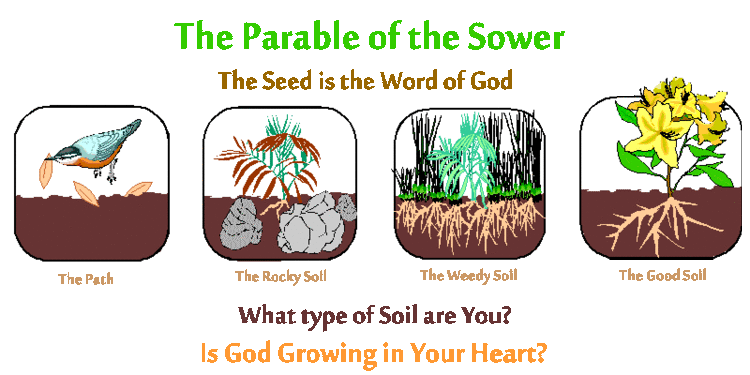
There are two chapters in Mark that focus on Jesus’ teaching. Chapter 13 contains his private teaching to the disciples concerning the destruction of Jerusalem and the second coming. Chapter 4:1–34 is a “sampler” of his public teaching in parables. It contains the parable of the Sower, the parable of the Growing Seed, and the parable of the Mustard Seed. Since Mark used the term “parable” to refer to various figurative sayings (cf. 3:23), he would also include the sayings in vv. 21–25 as parables. V. 35 suggests that this parable section is all from one day of teaching.
There has been and continues to be significant discussion and debate over the proper principles for interpreting Jesus’ parables.1 In the twentieth century interpreters have rightly turned away from the allegorizing interpretations that characterized previous centuries, although many also correctly conclude that there are allegorical elements in many of the parables. Mark’s account of Jesus’ interpretation of the parable of the Sower (vv. 14–20) clearly indicates that the parables may contain allegorical elements. However, it is important not to “allegorize” the parables and give them meanings that neither Jesus nor Mark would have had in mind. In general, we should acknowledge those allegorical elements that are clearly present in the story and its context, but remain skeptical of further allegorization. For example, the church father Augustine erred in his allegorizing of the parable of the Good Samaritan in which he taught that the man going down to Jericho represented Adam, the priest and the Levite represented the Old Testament Law, the Samaritan represented Christ, the inn represented the church, and the innkeeper represented Paul.2
The Parable of the Sower (4:1–9)
1 Again Jesus began to teach by the lake. The crowd that gathered around him was so large that he got into a boat and sat in it out on the lake, while all the people were along the shore at the water’s edge. 2 He taught them many things by parables, and in his teaching said: 3 “Listen! A farmer went out to sow his seed. 4 As he was scattering the seed, some fell along the path, and the birds came and ate it up. 5 Some fell on rocky places, where it did not have much soil. It sprang up quickly, because the soil was shallow. 6 But when the sun came up, the plants were scorched, and they withered because they had no root. 7 Other seed fell among thorns, which grew up and choked the plants, so that they did not bear grain. 8 Still other seed fell on good soil. It came up, grew and produced a crop, multiplying thirty, sixty, or even a hundred times.”
9 Then Jesus said, “He who has ears to hear, let him hear.”
The longest and most allegorical parables in Mark are the Sower and the Tenants (12:1–12). The Sower is the only Markan parable with a detailed explanation (4:14–20). I will reserve comments on the interpretation of the story for vv. 14–20.
1–2. The setting for Jesus’ teaching recalls (“again”) Mark 3:7–10. With immense crowds following him and trying to touch him, it was convenient for him to teach from a boat. The crowd could gather on the land and listen. Jesus used parables for reasons that are discussed later in the chapter. Apparently, the parable was his primary mode of teaching (see 4:34).
4:1 Jesus began to teach again by the Sea of Galilee. A very large crowd gathered around him, so he got into a boat and sat in it. The boat was in the water while the entire crowd lined the shore.
For the first time in the Gospel of Mark, we experience the teaching of Jesus directed toward those who appear to be His sincere followers. In our previous discussions, we learned the teachings of Jesus as a result of His confrontations with the scribes and the Pharisees. Now, at last, we are brought into the experience of His followers.
Jesus returned to the sea, one of His favorite spots. The multitude was so great that there was not enough room for everybody. Previously, Jesus had a boat prepared in case the crowd grew too large (Mark 3:9). Now, Jesus entered the boat, sat down, and taught the multitude. Thanks to Mark’s excellent word picture, we see the scene unfold as we join the crowd on land. Our attention is drawn to Jesus sitting in a small boat on the Sea of Galilee.[1]
4:2 He used stories as illustrations to teach them many things. While he was teaching them, he said,
Jesus taught them many things, some of which are recorded in Mark’s gospel, but Mark does not relate all of His teachings. In the Gospel of John, we read that the total accumulation of Jesus’ teachings is immeasurable (John 21:25).
Jesus typically taught the crowd by using parables. The word parable, a direct transliteration of the Greek word παραβολαις (parabowlais), might today be called an “illustration.” Jesus taught the crowd using illustrations that drew on familiar, common experiences. He stated the obvious, that which everyone knew to be true, but buried in the parable was a deeper meaning that related the illustration to an eternal truth. Many people understood the obvious analogy, but only a few perceived the eternal truth that Jesus taught them.
4:3 “Listen! A farmer went to plant a seed.
Jesus started with the instruction, “Listen!” The Greek verb is in the imperative, meaning that Jesus commanded the crowd to pay attention. What followed was a story about a farmer who sowed his seed on the land. Since many in the crowd were likely from an agricultural background, they could well relate to such a story.
4:4 Some seeds were planted along the road, and birds came and devoured them.
Long before the first seed was sown, much time and effort was spent preparing the soil. The field was plowed to bring fresh soil to the top. The big clumps of earth were broken into a smoother mixture of soil. All preparations were made to enhance an optimum yield.
When the time came to sow the seed, the farmer knew that much seed would be spread on the ground. There would never be one hundred percent yield because some seed did not fall on the soil that was prepared to receive the seed. Some would fall on the hardened earth surrounding the prepared soil. That seed simply lay on top of the hard ground, making it available to hungry birds, which ate the exposed seeds.
4:5 Other seeds were planted on rocky ground, where there wasn’t much soil. The plants sprouted quickly because the soil wasn’t deep.
At the side of the field remained some areas that had not been prepared and were quite full of stones. Generally, these areas were hard and lacked depth. When the seed fell on this type of earth, it might have germinated and pushed its roots down into the shallow soil. It would not take long for this seed to sprout because it was not deeply planted.
4:6 When the sun came up, they were scorched. They didn’t have any roots, so they withered.
Just as it did not take long for this seed to sprout, it also quickly disappeared because the root structure was restricted as a result of the shallow soil. Consequently, when the sun reached its peak, the earth baked, and the seedling disappeared. It was deprived of the moisture that would have been provided from a deeper root structure and could not maintain its strength.
4:7 Other seeds were planted among thornbushes. The thornbushes grew up and choked them, and they didn’t produce anything.
On the perimeter of the prepared soil grew thorns. These thornbushes had a much deeper root structure and had apparently been growing for a long time. As the weeds developed, their roots sucked precious moisture and nutrients from the new seed and literally choked the life from the seeds. The seed may have sprouted and started growing, but inevitably, the thorns won this battle.
4:8 But other seeds were planted on good ground, sprouted, and produced thirty, sixty, or one hundred times as much as was planted.”
However, the seed that fell “on good ground,” on soil properly cultivated, sprouted vigorously and grew to full maturity. In its mature stage, this seed would bear fruit, exceedingly multiplying the simple little seed that was originally planted. This seed was profitable to the sower because there was a reward to show for all his hard work.
4:9 He added, “Let the person who has ears listen!”
This simple story of the sower drew to a close. Jesus had really said nothing new. He had not helped anyone to improve his farming technique. The people knew everything He had just told them. Why would the crowd grow to such unmanageable proportions just to hear someone tell them something they already knew? Would it not be far better to be at home planting the seed for one’s own gain? Would it not be more profitable to be fishing in the sea than listening to someone tell stories about the obvious?
Just then, Jesus issued a summation requiring special attention. At the beginning, He said, “Listen!” Now, Jesus admonished, “Let the person who has ears listen!” We have all been sitting in this crowd and have heard everything He said. Of course, we have ears. Of course, we heard His message. What more did He want us to understand from this message?
3–8. The opening word, “Listen!”, corresponds to the concluding comment in v. 9: “He who has ears to hear, let him hear.”3 Jesus is not trying to get the crowd to stop talking. He is calling for understanding. He wants the audience to do more than simply hear words. His meaning is similar to a parent who tells a child, “Now I want you to listen to what I am saying.”
The story fits primitive agricultural practices in which a sower casts the seed on the ground. The first three soil types are fairly easily understood even by modern city dwellers. The yield of the fourth soil type needs some clarification. The thirty, sixty, and one hundred-fold yield were quite remarkable by ancient standards. The seeds produced thirty, sixty, and one hundred times the number sowed. According to the careful research of Robert McIver, yields of four or five-fold would have been typical.4 Gen. 26:12 says that Isaac reaped one hundred-fold, but only because the Lord blessed him to become rich. Jesus’ audience would have been amazed at such high yields. 9. Jesus urges his listeners to hear with understanding. The same saying is found in v. 23.5 V. 24, “Pay attention to what you hear; the measure you give will be the measure you get, and still more will be given you,” could be viewed as Jesus’ own commentary on this saying.
Notes/Applications
If we close our eyes and see the picture unfold around us, we can almost become another member of this crowd gathered around Jesus by the sea. Anticipation would grow as the rabbi from Nazareth spoke, but would we be somewhat disappointed by such a simple message about a farmer sowing seed on the earth?
Obviously, Jesus emphasized the extreme significance of His message to His listeners. Twice, He urged them to listen. Apparently, Jesus spoke about much more than farming, but His meaning was not readily understood by the crowd. The scribes tried to understand Jesus’ teaching through their own frame of reference, and the people depicted in this passage also struggled to gain insight, wanting desperately to understand His words.
Like those gathered at the sea that day, we must listen with our hearts to hear what the Son of God is saying to us. How do we hear Him when He does not stand before us in physical form? We hear Him through communing with the Holy Spirit, through praying, through studying the Word, and through allowing His truth, principles, and insights to take root in our hearts and minds. Through His Holy Spirit, these teachings will be cultivated like seed sown in soil and brought to mind as we go about our day. “Help me understand your guiding principles so that I may reflect on your miracles” (Psalm 119:27). “35You were shown these things so that you would know that the Lord is God. There is no other god. 36He let you hear his voice from heaven so that he could instruct you. He showed you his great fire on earth, and you heard him speak from the column of fire” (Deuteronomy 4:35–36). Making Jesus our frame of reference as the source of all truth, we can “live out loud” the message He conveyed to mankind.[2]
The Purpose of the Parables (4:10–12)
10 When he was alone, the Twelve and the others around him asked him about the parables. 11 He told them, “The secret of the kingdom of God has been given to you. But to those on the outside everything is said in parables 12 so that,
“ ‘they may be ever seeing but never perceiving,
and ever hearing but never understanding;
otherwise they might turn and be forgiven!’a”
Most Bible readers think of the parables as aids to understanding, as stories which use the familiar to teach about the unfamiliar. They are surprised to read that Jesus spoke in parables so that some of his listeners would not be able to understand. It is true that Jesus called upon his listeners to listen and understand (see 4:3, 9, 23). But it is also true that these appeals were for those with “ears to hear.” Some of Jesus’ listeners were spiritually deaf.
- 10. This is the first of many indications that the disciples, even the twelve, often failed to understand Jesus. In some ways the parables are easier for us to understand than they were for their original hearers. We know more than they did about Jesus’ identity and intentions.
4:10 When he was alone with his followers and the twelve apostles, they asked him about the stories.
In the preceding section, Jesus gave the illustration of a farmer sowing seed, a subject most of those gathered knew from personal experience. There was a level at which everyone observed what Jesus taught. However, there was a deeper message based on Jesus’ identity as the Son of God.
Now, Jesus, alone with the Twelve and some other followers, was queried about this illustration. Evidently, the disciples, too, searched for the real message. They had heard the same thing as everyone else but attained no better understanding.
It is possible to read some deeper meaning and render an interpretation that could be substantiated by the content of the message. However, in this passage Jesus issued His interpretation. This is an important principle for all Bible study. We must always look for the message to be interpreted by the context itself and by other related passages as we draw on the resources of the Bible itself. Failure to do so leads to conclusions from personal experience and not from the mind and heart of God. Such conclusions are usually erroneous and often lead to misinterpretation. Many cults have started in this manner. Even our Christian perspectives may be tainted, and the message may fail to deliver the impact that God intended. We might end up like the scribes and the Pharisees, defending man’s interpretation and totally losing sight of Jesus, God’s Anointed Redeemer.[3]
11–12. It is not clear what “the secret (μυστήριον, mystērion; Matt 13:11 and Luke 8:10 say secrets) of the kingdom of God” means. The most common view of Mark’s meaning is that it is the secret that the kingdom of God was dawning in Jesus.6 If so, then in Matthew and Luke the secrets may be multiple elements bound up with this basic concept.7
“Those on the outside” surely include the opponents of Jesus (3:6, 22, 30), and might be basically limited to them. For them the parables are meant to conceal the message so that they would not understand, turn, and be forgiven. The words of v. 12 come from Isa 6:9–10 where the Lord gave Isaiah a mission of wrath against his disobedient child, Israel. Part of Jesus’ mission was also one of divine recompense.
4:11 Jesus replied to them, “The mystery about the kingdom of God has been given directly to you. To those on the outside, it is given in stories:
Previously noted were three groups that encountered this rabbi: the scribes and Pharisees, the followers, and the demons. Through Mark’s gospel and Peter’s witness, we now share in a fourth group, called the Twelve.
Since Mark was Peter’s disciple, we are privileged to have a record of Jesus’ explanation of the parable. We have the great opportunity to participate not only in the experience of the thousands of people who followed Jesus but in the experience of the chosen Twelve. When we join them in this privileged, intimate conversation with their Lord, we share the experience of Jesus’ inner circle. Jesus told them something wonderful. They had been given the opportunity of knowing the mystery of God’s kingdom. They would not only know the mystery of this life but the mystery of God’s own heart as well.
Jesus further explained to them that those “on the outside” would only be taught about the kingdom in parables. This verse shows that even those who follow Jesus are divided into two groups, the chosen and those on the outside. It is a life-changing experience to be among the inner circle of God’s chosen. The reality of this world’s fragile existence is that “many are called, but few chosen” (Matthew 20:16, ).
4:12 ‘They see clearly but don’t perceive. They hear clearly but don’t understand. They never return to me and are never forgiven.’ ”
This verse reveals a hard and difficult truth. It is a statement that grinds our preconceived notions about God into nothing. It grates on our sensibilities and our sensitivities and flies in opposition to everything we believe about a “loving, forgiving God.” It is offensive to our human ways of thinking.
Jesus declared His explanation, His reasons, for teaching the masses in parables. In this verse, Jesus paraphrased the words of Isaiah the prophet.
9And he said, “Go and tell these people, ‘No matter how closely you listen, you’ll never understand.
No matter how closely you look, you’ll never see.’ 10Make these people close-minded.
Plug their ears. Shut their eyes. Otherwise, they may see with their eyes, hear with their ears,
understand with their minds, and return and be healed.” (Isaiah 6:9–10)
During Isaiah’s time, God issued this order to His chosen messenger so that the wrath of God would visit the rebellious and wicked nation that had defied His rule and transgressed His Law. Isaiah knew at the very beginning of his ministry that he was doomed to fail, even though he was faithful to the message God had given him.
Jesus endorsed Isaiah’s words. The reason He spoke to the crowds in parables was unthinkable. He intended for them to continue in their sin-blinded ways so that they would perish in their sins. This seemingly benign teaching about a farmer sowing seed now began to take on some ominous undertones.[4]
The Interpretation of the Sower (4:13–20)
13 Then Jesus said to them, “Don’t you understand this parable? How then will you understand any parable? 14 The farmer sows the word. 15 Some people are like seed along the path, where the word is sown. As soon as they hear it, Satan comes and takes away the word that was sown in them. 16 Others, like seed sown on rocky places, hear the word and at once receive it with joy. 17 But since they have no root, they last only a short time. When trouble or persecution comes because of the word, they quickly fall away. 18 Still others, like seed sown among thorns, hear the word; 19 but the worries of this life, the deceitfulness of wealth and the desires for other things come in and choke the word, making it unfruitful. 20 Others, like seed sown on good soil, hear the word, accept it, and produce a crop—thirty, sixty or even a hundred times what was sown.”
- 13. The questions Jesus asked about the Sower and the other parables may imply that Jesus thought the Sower was one of the easier parables to understand or, less probably, that he considered understanding the Sower to be foundational for understanding the others.
4:13 Jesus asked them, “Don’t you understand this story? How, then, will you understand any of the stories I use as illustrations?
Jesus then questioned His followers. This parable was relatively simple. Could it be true that His closest followers, maybe even the chosen Twelve, did not understand this simple lesson on the reality of God’s world? If they had such difficulty understanding this basic illustration, how would they understand the other parables that He had taught to the crowds and that He intended to continue using to teach them? The Twelve needed to be led step-by-step through an explanation of this illustration so that they could rightly comprehend His message. Even the Twelve required being led from the blindness of their sin nature into the correct understanding of Jesus and the message that He brought to the lost world.
4:14 “The farmer plants the word.
Jesus patiently and carefully began His explanation. The seed represents the word from God. The familiar Greek word λογος (logos) is used here, but it should not be understood in the same manner as the apostle John used it in his gospel account (John 1:1, 14). In this context, word carries the meaning of “message.” The sower gave forth the message, and we know that from the beginning of this gospel, Jesus Himself preached the message, “The kingdom of God is near. Change the way you think and act, and believe the Good News” (Mark 1:15).
4:15 Some people are like seeds that were planted along the road. Whenever they hear the word, Satan comes at once and takes away the word that was planted in them.
Some seed fell by the wayside. The message was told to some who heard it yet immediately withdrew from it. The message was sown “in their hearts,” but Satan never gave it a chance to sprout and flourish, so it was destroyed almost as soon as it was received.
4:16–17 16Other people are like seeds that were planted on rocky ground. Whenever they hear the word, they accept it at once with joy. 17But they don’t develop any roots. They last for a short time. When suffering or persecution comes along because of the word, they immediately fall from faith.
Some seed fell upon hard, rocky soil. The people represented by this soil heard the message and were immediately overjoyed to receive it. It appears that they accepted the message without much thought. They based their decision to receive the word primarily on the impulse of the moment. Consequently, they were swept along on the tide of their own emotion.
As a result, these individuals would not possess much depth and their commitment would be short-lived. They mistakenly believed that everything would always be pleasant and enjoyable. Their decision consisted of euphoric emotion based on an expectation of personal benefit. However, when adversity came and things did not go right, the shallowness of their conviction was exposed. In contrast, the reality of the Christian experience has demonstrated on numerous occasions that with faith comes persecution and trial.
4:18–19 18Other people are like seeds planted among thornbushes. They hear the word, 19but the worries of life, the deceitful pleasures of riches, and the desires for other things take over. They choke the word so that it can’t produce anything.
Some seed fell among the thorns. Weeds constantly threaten the farmer’s crop. In fact, whatever the crop, the farmer must battle with the weeds if the crop is to yield a harvest.
Jesus defined three of these weeds: 1) “the worries of life,” 2) “the deceitful pleasures of riches,” and 3) “the desires for other things.” This definition probably requires little comment, primarily because we recognize these realities in our own lives.
Who of us is not concerned with the worries of life? Who of us does not struggle with budgeting our income and providing for our families? These are essential to our human existence, but they must never supplant our reliance upon the Lord’s provision.
Who of us is not concerned with the deceitful pleasures of riches? No matter where we are on the financial spectrum, we always need a little more. We spend our entire lives trying to improve our financial situation, yet Jesus cautioned that this constant chase after riches is destructive. Our lust for wealth and our greed will consume our very souls in the end. “15Don’t love the world and what it offers. Those who love the world don’t have the Father’s love in them” (1 John 2:15). Who of us is not concerned with the accumulation of more things? We want more not because we need it but because we are captives of the concept that material possessions provide happiness, security, and social position (Matthew 6:31–33).
4:20 Others are like seeds planted on good ground. They hear the word, accept it, and produce crops—thirty, sixty, or one hundred times as much as was planted.”
Finally, the message was heard by some referred to as “good ground.” On such good soil, the message sprouted, grew, matured, and yielded fruit. The primary purpose of sowing the seed was that it might bear fruit. The “word” in these people was the living, growing, dynamic Word of God. Nothing choked its growth. Their focus and direction remained clear.
It is important to recognize that all of the seeds did not yield equal production. However, the amount of fruit produced is not the issue here. It is simply that when the word is sown in good ground it will bear fruit.
Notes/Applications
Jesus explained the deeper meaning of the parable of the sower. As we listen along with the small group gathered with the Twelve, a terrible sense of foreboding overwhelms us. Jesus predicted a grim future for the masses. Moreover, He said that what awaited them was not redemption but judgment.
Could this be true? Did the Son of God deny the crowd the information they needed? Why didn’t He declare to the crowd the truth about His identity so that many might be saved?
Apparently, Jesus, as Isaiah before Him, declared a message that confounded the hearers rather than clarified any anomalies. Jesus proclaimed a message to the nations, but He did not remove the scales from the eyes of those who remained in darkness as the result of centuries of sinful, willful rebellion against God.
The Gospel of John describes Jesus as “the Lamb of God who takes away the sin of the world” (John 1:29), but despite Jesus’ centrality in Scripture and in the saga of human history, it is the work of the Holy Spirit to guide men into understanding and redemption. It is the work of the Holy Spirit to prepare the soil of a person’s corrupt soul for the planting of the seed that leads to redemption and a life of fruitful service to God. Jesus Himself defined, as well as confirmed, this work of the Spirit in the Gospel of John.
16I will ask the Father, and he will give you another helper who will be with you forever. 17That helper is the Spirit of Truth. The world cannot accept him, because it doesn’t see or know him. You know him, because he lives with you and will be in you.…
26However, the helper, the Holy Spirit, whom the Father will send in my name, will teach you everything. He will remind you of everything that I have ever told you. (John 14:16–17, 26)
Anyone who clings to the truth of Scripture and calls upon Christ as Lord and Savior has the assurance of salvation. In this, we know the seed of the Word has been sown on good soil in our hearts. Each of us stumbles from time to time along our spiritual journey, but God promises to complete the work He began in us by bringing the seed to full fruition: “I’m convinced that God, who began this good work in you, will carry it through to completion on the day of Christ Jesus” (Philippians 1:6).
14–20. The primary point of the Sower parable is to encourage people to hear the word, accept it, and let it bear fruit in their lives. The reactions of the seed in the four types of soil represent different ways in which people receive the word of God. Like the seed on the path which the birds ate, some people never respond to the word. Satan turns them against it from the beginning. A second group is like the seed that fell on rocky ground. They initially receive the word, but they do not have much depth. They fall away at the first sign of trouble or persecution. Like the seed sown among thorns, the third group receives the word, but spiritual thorn bushes—“the worries of this life, the deceitfulness of wealth, and the desire for other things”—choke it out.
Only the fourth group, the good soil group, bears fruit. Fruit bearing may represent the life of discipleship, the outcome of obedience to the word.8 As documented in the above comments on v. 8, the yield Jesus proposed is exceptionally high by ancient standards. Wherever the word takes hold and stays in a life, that life is changed enormously.
In addition to the purpose of exhorting those who listen to hear and accept the word, the great outcome of the fourth soil may indicate that Jesus was also seeking to encourage those who sow (like his disciples). Many hearers may not receive the word, or may quickly fall away, but those who sow may rest assured that the word will bear great fruit in many lives.
The Parable of the Lamp (4:21–23)
21 He said to them, “Do you bring in a lamp to put it under a bowl or a bed? Instead, don’t you put it on its stand? 22 For whatever is hidden is meant to be disclosed, and whatever is concealed is meant to be brought out into the open. 23 If anyone has ears to hear, let him hear.”
The parable of the Lamp does not fit the modern definition of a parable, but it does fit Mark’s understanding. As noted above, Mark 3:23 exemplifies the Gospel writers’ use of the term to apply to any figurative saying.
The sayings in vv. 21–25 are extraordinarily difficult to understand. Some of them occur in other contexts in Matthew or Luke (Matt 7:2; 10:26; 25:29; Luke 6:38; 12:2; 19:26), but of course the same saying may have differing meanings in different contexts. What is needed in interpreting Mark is close attention to the context of Mark 4. One important consideration is the question of Jesus’ audience for vv. 21–25. Even though the translation “he continued” in v. 24 obscures the parallel, in the Greek text both v. 21 and v. 24 begin “And he was saying to them.” Vv. 10–13 suggest that “them” means the disciples in private rather than the crowds. It clear from vv. 33–34 that at some point in the chapter Jesus returns to addressing the crowds. I take that to be in v. 26 with the parable of the Seed Growing Secretly.
Another contextual clue to understanding vv. 21–25 is also partially obscured by the . In the Greek text both v. 22 and v. 25 begin with “for,” which suggests that in each pair of sayings (vv. 21–22 and 24–25) the second saying is meant to explain the first. Even though the explanatory sayings are somewhat parabolic themselves, the fact that Jesus offers an explanation supports the understanding (see the previous paragraph) that these sayings were addressed to the disciples in private. Vv. 33–34 say that Jesus’ method was to teach in parables and explain everything privately to his disciples.
- 21. It is not difficult to understand the literal meaning of this one sentence parable. Lamps are put on lamp stands to provide light. People do not bring in lamps in order to hide their light under a bowl (the Greek term [μόδιον, modion] refers to a bowl or basket used to measure a peck of grain) or a bed.9 The problem is to decide what the lamp stands for.
- 22. The opening “for” (γάρ, gar) indicates that this saying is explanatory. The lamp stands for something which is hidden or concealed, but is meant to be disclosed and brought out into the open. It is often suggested that the lamp refers to the kingdom of God as it is present in the ministry of Jesus. The lesson would be that even though the kingdom in its present state during Jesus’ ministry seems hidden or obscure, it will be brought out into the open in the future.10
The context, however, suggests another understanding. If vv. 21–22 are directed to the disciples in the context of their question about the meaning of the parables, then the lamp may refer to the meaning of Jesus’ parabolic teaching. Although Jesus teaches in a form that obscures his message for those outside (vv. 11–12), his message is meant to be made known and will be made known to the disciples through his explanations. His message is not meant to be hidden under a bowl or a bed, but set up on a lamp stand as a source of light.11
4:21 Jesus said to them, “Does anyone bring a lamp into a room to put it under a basket or under a bed? Isn’t it put on a lamp stand?
Jesus continued speaking to the Twelve. As in the parable of the sower, Jesus gave another common illustration. He reminded them that a lamp is designed to dispel the darkness. No one would light a lamp and then cover it so that it could not fulfill the purpose for which it was designed. Rather, the lamp would be placed high “on a lamp stand” in order to spread its illumination as far as possible.
14You are light for the world. A city cannot be hidden when it is located on a hill. 15No one lights a lamp and puts it under a basket. Instead, everyone who lights a lamp puts it on a lamp stand. Then its light shines on everyone in the house. 16In the same way let your light shine in front of people. Then they will see the good that you do and praise your Father in heaven. (Matthew 5:14–16)
4:22 There is nothing hidden that will not be revealed. There is nothing kept secret that will not come to light.
Jesus taught the Twelve the true purpose of the message. Previously, He stated that He spoke to the crowds in parables so that they would not fully understand. Now, Jesus began to develop a complimentary theme in a paradoxical tone. He had not come to preach a message that would be hidden forever but one that would soon be broadcast. The tense of the verbs used here implies that this was always the intention. There was no divine conspiracy to send Jesus into the world and then forever conceal His identity from the world.
At this time, Jesus taught in parables, and His message was obscured by the very simplicity of His illustrations (2 Corinthians 4:3–4). However, the purpose of the message would not remain hidden forever. It would soon be plain for all whose eyes He opened.
4:23 Let the person who has ears listen!”
Again, Jesus admonished His chosen Twelve, and those of us called to be His disciples, to listen carefully to Him. Jesus was speaking of more than the physical act of hearing. He was urging us to listen with the ears of our hearts and to understand the message that would bring us light. “We are his servants because the same God who said that light should shine out of darkness has given us light. For that reason we bring to light the knowledge about God’s glory which shines from Christ’s face” (2 Corinthians 4:6).
4:24 He went on to say, “Pay attention to what you’re listening to! Knowledge will be measured out to you by the measure of attention you give. This is the way knowledge increases.
Jesus expanded His admonition of hearing to include the responsibility of applying the precepts of His message. He warned His listeners to approach understanding with care. This verse implies that the degree of our understanding is directly proportional to the effort put into listening. It would be pointless to listen to the teacher only to disregard His teaching.
4:25 Those who understand these mysteries will be given more knowledge. However, some people don’t understand these mysteries. Even what they understand will be taken away from them.”
Jesus further intensified the impact of His admonition. Those who heeded that which they heard would be entrusted with greater spiritual understanding. However, the opposite also held true. Those who forsook Christ’s message would forfeit what little understanding they did possess.
This verse affirms the parable of the sower: “16Other people are like seeds that were planted on rocky ground. Whenever they hear the word, they accept it at once with joy. 17But they don’t develop any roots. They last for a short time. When suffering or persecution comes along because of the word, they immediately fall from faith” (Mark 4:16–17). Apparently, some relationship exists between our response in understanding and the degree of understanding that we receive. As we focus on Jesus and perceive more of His message, we grow in our understanding of the truth.
Notes/Applications
If there were ever any encouragement for the Christian to apply himself to the study of God’s Word, this passage is it. Jesus told those gathered around Him that anyone having spiritual understanding would be given even more understanding. He was, in essence, saying, “Do you grasp the truths I am telling you? If so, rejoice, for you will understand even more of what I have to teach you.”
The apostle Paul exhorted Timothy, his “son” in the Lord, to become an expert, living testament: “Do your best to present yourself to God as a tried-and-true worker who isn’t ashamed to teach the word of truth correctly” (2 Timothy 2:15). “16Every Scripture passage is inspired by God. All of them are useful for teaching, pointing out errors, correcting people, and training them for a life that has God’s approval. 17They equip God’s servants so that they are completely prepared to do good things” (2 Timothy 3:16–17).
Jesus’ admonition in Mark 4:21–25 is far more stringent than Paul’s. Paul exhorted Timothy in a church environment that probably had little opposition, and Timothy had proven himself to be an apt pupil. Jesus, on the other hand, chided His disciples who did not yet comprehend or who barely perceived the message He so passionately wanted them to understand.
Jesus’ admonition addressed both sides of the coin. If we seek, we will find. If we listen, we will hear. If we seek to understand, understanding will be given to us. Conversely, if we do not seek, we will not find. If we do not listen, we will not hear. If we do not understand, the little bit of understanding we have will be taken away.
The most important thing to note in this passage is that spiritual understanding is a gift. What we learn about Jesus in the context of human philosophy is simple knowledge. After all, the scribes and Pharisees had seen and heard Jesus, yet they were more interested in maintaining their status quo than in really understanding this rabbi. They learned about Jesus, but they failed to accept His significance. The mystery of the kingdom of God is given only to those who yearn to understand. We who are committed to following Jesus are God’s remnant of faithful followers in this age, so let us ask ourselves: Are we diligently applying ourselves to the study of His Word?
The Parable of the Measure (4:24–25)
24 “Consider carefully what you hear,” he continued. “With the measure you use, it will be measured to you—and even more. 25 Whoever has will be given more; whoever does not have, even what he has will be taken from him.”
24–25. As explained in the introductory comments on vv. 21–22, these verses also seem to be private teaching to the disciples. In this case the parable of the Measure is introduced by a non-parabolic explanatory comment (“Consider carefully what you hear”) and followed by a parabolic explanatory comment (see again the introductory comments on vv. 21–22 for the observation that in the Greek text v. 25 begins with the word “for” [γάρ, gar], which indicates that it is an explanatory comment on v. 24).
The parable is about how one hears the parables. It fits well the context which has explained that the parables are meant to conceal the message from those outside, but that those inside have been given the secret to understanding. The difference between those outside and those inside is the measure they give in the way they hear the parables. The disciples who consider carefully what they hear will be given more. They even receive private explanations (vv. 13–20, 33–34). But “those on the outside” do not listen discerningly and the parables are meant to obscure the message to them. They have no knowledge of Jesus’ meaning and are not supposed to. The saying in v. 25 can be considered in economic terms: “The rich get richer and the poor get poorer.” Jesus is speaking of the economics of spirituality. Those who are open to his teaching will learn more, those who are spiritually obstinate will never learn.
The Parable of the Growing Seed (4:26–29)
26 He also said, “This is what the kingdom of God is like. A man scatters seed on the ground. 27 Night and day, whether he sleeps or gets up, the seed sprouts and grows, though he does not know how. 28 All by itself the soil produces grain—first the stalk, then the head, then the full kernel in the head. 29 As soon as the grain is ripe, he puts the sickle to it, because the harvest has come.”
I have argued above that with the two last parables Mark returns to Jesus’ public teaching. In both cases Jesus says that the parables are about the kingdom of God.
26–28. Apparently, the seed is the kingdom. The bottom line is that the seed will produce. The kingdom of God dawning in Jesus’ ministry is like seed which will grow into a full field to be harvested. It will become a great kingdom ready for the judgment.
The last words of v. 27 (“though he does not know how”) and the first word of v. 28 (αὐτομάτη, automatē, “all by itself”) may add their own special significance. Their meaning may be that it does not matter whether those who observe or participate in Jesus’ ministry can visualize or understand the development of the kingdom. The maturation of the kingdom is God’s work.
- 29. The conclusion of the parable adds a reference to judgment. The use of harvesting as an image for judgment has Old Testament precedents (Joel 3:12–13). In Matt 13:39–43 (in connection with another parable of the kingdom) Jesus uses harvesting as an image for the final judgment.
4:26–27 26Jesus said, “The kingdom of God is like a man who scatters seeds on the ground. 27He sleeps at night and is awake during the day. The seeds sprout and grow, although the man doesn’t know how.
Jesus continued His discourse on the kingdom of God. In the earlier sower parable, the points of focus were the ground upon which the seed fell and, more specifically, how the ground received the seed. These verses, however, draw attention to the man who had sown the seed. After planting the seed and without any further labor on the man’s part, the seed sprouted and grew.
The man did not make this happen. He simply served as the agent who placed the seed in the ground. The sower performed his task even though he was utterly incapable of understanding the mystery in the seed. He did not understand the nutritional requirements of that seed. He merely served as the means by which the seed came into contact with the fertile soil. Nevertheless, the seed broke through the earth and began to grow, and the mystery of that transformation remained outside the man’s understanding.
4:28 The ground produces grain by itself. First the green blade appears, then the head, then the head full of grain.
Jesus, the Master Teacher, again stated the obvious to His hearers. They knew that, once planted, the seed would naturally produce a crop and provide food for the person who had sown it. “The ground produces grain by itself” shows that it did so without human intervention. The Greek word is αυτοματη (automatay), from which we get the word automatic. God alone would complete the work. In fact, when man attempts to intervene in the affairs of the kingdom, there is increased likelihood of disruption rather than growth.
4:29 As soon as the grain is ready, he cuts it with a sickle, because harvest time has come.”
At the appointed time, once the grain ripened, the man set himself about the task of reaping the reward of the harvest, all of which had been produced outside the realm of his control.
The Parable of the Mustard Seed (4:30–32)
30 Again he said, “What shall we say the kingdom of God is like, or what parable shall we use to describe it? 31 It is like a mustard seed, which is the smallest seed you plant in the ground. 32 Yet when planted, it grows and becomes the largest of all garden plants, with such big branches that the birds of the air can perch in its shade.”
- 30. The Mustard Seed parable is also about the kingdom of God.
31–32. Once again the kingdom is represented as a growing seed. The mustard seed was known for its tiny size (cf. Matt 17:20). The shrub it produces is not huge (c. 8–10 feet high),13 but the point lies in the contrast. Jesus assures his listeners that the kingdom will achieve greatness. This parable speaks to either supporters or detractors who might view what they saw in Jesus’ ministry as inappropriate for the great kingdom of God.14
4:30 Jesus asked, “How can we show what the kingdom of God is like? To what can we compare it?
Without any interpretation of the preceding parable, Jesus continued to explain the essence of the kingdom of God. He had already told two parables in which the subject of farming served as an analogy. In both of these, the subject was an intimate part of their everyday life. How could it be any easier to understand?
It is wise to remember Jesus’ comments when He explained the parable of the sower to His disciples and to recall that his simple message was for those He chose to follow Him. The very parables that helped His disciples understand had the dual purpose of making it difficult for others to grasp the meaning.
4:31 It’s like a mustard seed planted in the ground. The mustard seed is one of the smallest seeds on earth.
In this parable, our attention is directed to a mustard seed, the smallest of seeds. Jesus chose this particular seed because of its size to illustrate further how the kingdom of God works.
4:32 However, when planted, it comes up and becomes taller than all the garden plants. It grows such large branches that birds can nest in its shade.”
The resulting plant would tower in comparison to the tiny seed from which it came. As a part of the natural order of God’s creation, the mustard plant would become a home for birds that would build their nests and raise their young in the shade of its branches.
Teaching in Parables (4:33–34)
33 With many similar parables Jesus spoke the word to them, as much as they could understand. 34 He did not say anything to them without using a parable. But when he was alone with his own disciples, he explained everything.
These verses indicate that Jesus’ standard procedure was to teach in parables. “As they were able to hear it” indicates that he sought to use parables so as to be understood by those who had ears to hear. He taught according to their ability to understand. Just as parables had the ability to conceal the word (vv. 11–12), so they also had the ability to reveal it (vv. 3, 9, 23, 33). In addition to his public teaching in parables, Jesus gave private explanations to his disciples. (If Mark had recorded all of these, the need for some of the above comments would be considerably lessened.)
4:33 Jesus spoke God’s word to them using many illustrations like these. In this way people could understand what he taught.
This verse further confirms the great number of parables that Jesus must have told. Jesus employed this teaching method throughout His earthly ministry. Mark notes that Jesus spoke to the people using parables so the “people could understand what he taught.” Perhaps the listeners experienced some sort of emotional overload. Was Jesus’ message so intense that it was necessary for people to have some time to assimilate His teaching? What was so hard to understand about a sower sowing seed or the growth of that seed or a mustard seed? These were common, everyday occurrences, yet it appears that Jesus had to deliver the “food” of the kingdom at some measured pace so that the people had time to digest it.
4:34 He did not speak to them without using an illustration. But when he was alone with his disciples, he explained everything to them.
We are again reminded that Jesus avoided any method of speaking to the people other than by parable. Even these simple teachings were difficult for the crowds to understand, but in private Jesus explained the parables’ meanings to the Twelve.
Mark could be perceived as the purveyor of the cryptic message. In the earlier chapters, he tells us that Jesus taught the crowds, but the only way we learn His message is through His adversarial conversations with His opponents. Now, the opposite holds true. Mark retells these kingdom parables and, except for the first one, does not explain them. Only the Twelve benefited from Christ’s illumination of the mysteries shared with the masses.
Notes/Applications
It is easy to discuss the interpretation of Jesus’ earlier parable when Jesus Himself did the interpreting. However, we do not have that luxury in this passage, nor can we go to the other gospels to see if they shed light on this particular parable, because it is unique to the Gospel of Mark.
Some believe that this is a parable about evangelism, urging the Christian to swing the sickle and harvest the seed that is fully grown and ready. Others see it as an analogy of how the Word grows inside a believer—growing to full maturity until the time when the Son of Man swings the sickle and receives the fruit of His followers’ labors. Though either of these two interpretations could be argued using this text, Jesus clearly explained that the parable depicts what the kingdom of God is like.
This parable focused on the growth process rather than the condition of the soil. Perhaps the first parable of the sower is spoken from God’s perspective, showing His full knowledge of the process by which the seed grows in varying soils of the human heart, whereas the second parable demonstrates the growth of the kingdom of God from man’s perspective. The seed is sown. How it sprouts and grows, we do not know, but we can be sure that it does grow. We can be certain that it bears fruit. Nevertheless, the process of growth is beyond our ability to control or understand. It rests in God’s hands. We share the Good News not because others’ salvation depends on us. We witness out of obedience and leave the results to Him.
We cannot make things happen but must trust God to work out every detail as we seek His guidance: “We know that all things work together for the good of those who love God—those whom he has called according to his plan” (Romans 8:28).
JESUS’ AUTHORITY OVER NATURE, DEMONS, DISEASE, AND DEATH (4:35–5:43)
Mark follows his “sampler” of Jesus’ teaching in parables with a “sampler” of Jesus’ miraculous powers. The next four stories portray Jesus’ authority over nature, demons, disease, and death. At the end of the first of these miracles, the disciples ask “Who is this? Even the wind and the sea obey him!” The following stories add more dimensions to the question: even a legion of demons obey him; a severely ill woman was healed by touching his garment; he raised a young girl from the dead. “Who is this?” This section of Mark is his best overview of the range of Jesus’ miraculous power. It underscores what the reader already knows about Jesus’ identity. He is the Christ, the Son of God.
Furthermore, these stories provide important lessons on discipleship. The first, third, and fourth focus attention on the importance of faith and the need to overcome fear. Faith and fear are directly contrasted in each of these three stories. Discipleship involves faith, and faith overcomes fear. The second story, the Gerasene demoniac, contains a similar contrast in a less overt way.
Authority Over Nature (4:35–41)
35 That day when evening came, he said to his disciples, “Let us go over to the other side.” 36 Leaving the crowd behind, they took him along, just as he was, in the boat. There were also other boats with him. 37 A furious squall came up, and the waves broke over the boat, so that it was nearly swamped. 38 Jesus was in the stern, sleeping on a cushion. The disciples woke him and said to him, “Teacher, don’t you care if we drown?”
39 He got up, rebuked the wind and said to the waves, “Quiet! Be still!” Then the wind died down and it was completely calm.
40 He said to his disciples, “Why are you so afraid? Do you still have no faith?”
4:35 That evening, Jesus said to his disciples, “Let’s cross to the other side.”
Evidently, Jesus presented these kingdom parables in one day. At the end of the day, He again sought to escape the pressure of the crowd. He now desired silence and rest. Remember that Jesus had been in a small boat as He taught the crowd. Now, He instructed His disciples to push off and cross to the other side of the Sea of Galilee.
4:36 Leaving the crowd, they took Jesus along in a boat just as he was. Other boats were with him.
Jesus sought rest from the crowd, but even with this maneuver, a small flotilla of boats followed along with Him. There was no relief from the sensation-hungry crowd. They were determined to follow Him no matter where He went or what method of transportation He used.
From this translation, it appears that Jesus simply got tired and left the crowd sitting on the shoreline. The Greek text used to describe the separation of Jesus from the crowd means to “send away.”1 It is good to note that Jesus was very aware of the emotions of the crowd. Therefore, He did not leave them sitting by the shore but dismissed them, thus bringing closure to an exciting day.
As tired as He was, Jesus allowed a small group of boats to accompany Him across the sea. Some of His disciples were accomplished fisherman, and this was their home territory. Since Jesus was already in the boat, they simply hoisted anchor and set sail.
4:37 A violent windstorm came up. The waves were breaking into the boat so that it was quickly filling up.
It is not uncommon for sudden squalls to arise on the Sea of Galilee. The configuration of the surrounding terrain can create treacherous conditions, the hills and valleys functioning as wind tunnels capable of quickly funneling normal winds into a whirling tempest.2
4:38 But he was sleeping on a cushion in the back of the boat. So they woke him up and said to him, “Teacher, don’t you care that we’re going to die?”
Jesus, exhausted from the day’s efforts, slept despite the storm. He was perfectly at rest, both physically, on a pillow in the back of the boat, and spiritually, knowing that all things remained in His hands.
However, the fishermen who earlier took charge of this voyage were deathly afraid. This was out of their control. Certainly, as seasoned fishermen familiar with this body of water, they had been in storms before, but this must have been one exceptional storm if it so frightened these veterans. The group of boats following them were also facing the peril of this angry storm.
The disciples woke Jesus by calling out, “Teacher!” Whatever their perception of Jesus at this time, they knew Him as Teacher. For everything He said and did, they understood little more than that He was their teacher and that He possessed unusual wisdom and power.
4:39 Then he got up, ordered the wind to stop, and said to the sea, “Be still, absolutely still!” The wind stopped blowing, and the sea became very calm.
Jesus awoke to the disciples’ fear and to the howling storm, the source of their fear. He responded first by addressing the problem. He rebuked the wind and stilled the sea. The Greek word is πεφιμωσο (pefimowso), which was the same command He spoke when He rebuked the demon to “keep quiet, and come out of him”
(Mark 1:25). This did not simply mean for the demon to be silent, but that Jesus muzzled it. Jesus now also essentially “muzzled” the sea.
Could it be that these veteran fishermen were frightened out of their wits by a simple storm? Probably not, since they had survived on this sea through many storms. Could it be that these seasoned fishermen were terrorized by a sea that had gone wild beyond anything in their experience? Could it be that the storm was generated by demons?3 Such a storm would have been great cause for alarm no matter how experienced they were. No wonder they feared for their lives, yet with one word from Jesus, the winds ceased and the sea grew calm.
4:40 He asked them, “Why are you such cowards? Don’t you have any faith yet?”
Jesus then directed His attention from the source of the disciples’ fear toward the fearful ones themselves. Jesus was disappointed with His chosen disciples. They had been with Him and had seen Him perform various miracles that defied human explanation. He had just spent the entire day with them discussing the parables of the kingdom. If they really comprehended the identity of this teacher, they did not need to be afraid. They should have known that, as the Son of God, He was always in control. In the midst of the most terrible storm they had ever seen, they should have experienced calm assurances concerning their physical safety.
4:41 They were overcome with fear and asked each other, “Who is this man? Even the wind and the sea obey him!”
The sea grew calm. The winds died. All was peaceful. Their lives were spared, but Jesus had rebuked them for their lack of faith. The result? A new fear greater than their fear of the rolling sea. How could this be? After witnessing Jesus silence the winds and the sea, they became more frightened than before.
How amazing that the disciples were now afraid of the one Who had saved their lives! This provides ample evidence of their lack of comprehension of Who Jesus was or the scope of His authority. After everything they had witnessed, they had not yet grasped that they had been chosen by the Creator of all, Who has total authority over His creation. Those participating in this voyage would never be the same because they had seen the power of Almighty God in the person of Jesus Christ (John 1:1–3).
41 They were terrified and asked each other, “Who is this? Even the wind and the waves obey him!”
This is the first of three scenes in Mark (4:35–41; 6:45–52; 8:13–21) in which the disciples have a special learning experience with Jesus while crossing the Sea of Galilee.15 The lake was one place where Jesus and the disciples could be alone—although in this first instance, there were other boats with them (4:36).
35–36. The teaching segment in vv. 1–34 must have taken place on the western shores of the lake. Jesus’ request to go to the other side may be motivated by a desire to retreat from the crowds, as in 6:31–32. They set out in the evening.
37–39. The storm that arose must have been a major storm to strike fear into even experienced Galilean fishermen. Yet Jesus was able to calm the storm by his command. Although it cannot be seen in the translation, Jesus’ rebuking of the wind in 4:39 is reminiscent of his rebuking of a demon in 1:25. In both cases Mark describes Jesus’ comments as “rebuking” (ἐπιτιμάω, epitimaō) and in both cases Jesus says “Be silent!” (φιμάω, phimoō).16 Not only did the wind cease, but there was a great calm on the lake.
40–41. Most readers probably find the disciples’ fear understandable. Jesus did not. If they had had faith, they would not have been afraid. Presumably he meant faith in his identity as the Christ, the Son of God. If they knew who it was that accompanied them in the boat, they would not have feared death in the waves. The last verse underscores the fact that they did not know Jesus’ true identity. They were now filled with a new kind of fear or terror—awe at the marvelous power of Jesus. In the four miracles of 4:35–5:43, Mark seeks to lead the reader into deeper faith and less fear.
Notes/Applications
When Jesus arose to face the storm, He did something so extraordinary it frightened the disciples more than the churning sea had moments before. He commanded the elements to be still, and they obeyed.
Until this point, Jesus’ followers knew Him as a teacher. They knew Him as a healer, yet they still perceived Him to be merely a great man. Only the demons had acknowledged Him as the Son of God, yet when Jesus calmed the sea, there could be no more doubt. Forgiving sins was an internal, spiritual matter. Stopping a raging storm and calming the violent waves was a tangible, physical matter, verifiable by hard evidence. Here was a feat that lay solely within the realm of the Creator’s power. Realizing just Who was in the boat with them, the disciples grew afraid of the one Who had saved them.
The scriptural record shows this to be a consistent response of human beings when they encounter the living God. From Genesis to Revelation, we witness humans trembling and falling on their faces in God’s presence. When the suffering Job demanded an explanation from God, surely Job must have quaked in his sandals (Job 40:6–7). After God interrogated him, Job answered meekly,
3You said, “Who is this that belittles my advice without having any knowledge about it?”
Yes, I have stated things I didn’t understand, things too mysterious for me to know.…
5I had heard about you with my own ears, but now I have seen you with my own eyes. 6That is why I take back what I said, and I sit in dust and ashes to show that I am sorry. (Job 42:3, 5–6)
As fallible humans ourselves, we can sympathize with the disciples’ fear, yet still, Jesus chastised them for their lack of faith. The Son of God was gradually stretching the faith of these simple men just as He stretches our faith day by day through the circumstances of our lives. No one prefers hard times, yet God assures us that these times of spiritual testing serve a purpose of maturing us in the faith: “2My brothers and sisters, be very happy when you are tested in different ways. 3You know that such testing of your faith produces endurance. 4Endure until your testing is over. Then you will be mature and complete, and you won’t need anything” (James 1:2–4). Like the disciples caught in a surging sea, we grow stronger “faith muscles” not in merely talking about the things of God but in the laboratory of real life, and in the process, we grow more in sync with the captain of our souls.[5]
1 See especially Craig L. Blomberg, Interpreting the Parables (Downers Grove: InterVarsity, 1990).
2 Augustine Quaestiones Evangeliorum 2.19.
[1] Practical Christianity Foundation, Mark: Jesus Christ, Love in Action, The Easy-To-Read Commentary Series (Green Key Books, 2004), 91.
3 “Listen” and “hear” translate the same Greek word, ἀκούω (akouō).
4 Robert K. McIver, “One Hundred-Fold Yield—Miraculous or Mundane? Matthew 13.8, 23; Mark 4.8, 20; Luke 8.8,” New Testament Studies 40 (1994): 606–608. “Yields of thirty-fold have been achieved in modern Israel, using sophisticated farming technology and fertilizers, but even so this happens only in good years” (p. 607).
5 And Matt 11:15; 13:43; Luke 14:35; Rev 2:7, 11, 17, 29; 3:6, 13, 22; 13:9.
[2] Practical Christianity Foundation, Mark: Jesus Christ, Love in Action, The Easy-To-Read Commentary Series (Green Key Books, 2004), 94–95.
a Isaiah 6:9, 10
[3] Practical Christianity Foundation, Mark: Jesus Christ, Love in Action, The Easy-To-Read Commentary Series (Green Key Books, 2004), 96.
6 Guelich, p. 206; Lane, p. 158.
7 Carson, “Matthew,” p. 308.
[4] Practical Christianity Foundation, Mark: Jesus Christ, Love in Action, The Easy-To-Read Commentary Series (Green Key Books, 2004), 96–98.
8 Gundry, p. 206.
9 Lane, p. 165, makes a point of Mark’s somewhat unusual use of ἔρχομαι (erchomai) and suggests that Mark means the lamp “comes” rather than “is brought.” However, BAGD, p. 311, provides ancient parallels which use erchomai with various objects to mean “be brought.”
10 So, e.g., Guelich, pp. 231–232.
11 See Gundry, p. 212.
13 Lane, p. 171 n. 76.
14 Blomberg, Parables, pp. 284–286.
1 George Ricker Berry, Greek to English Interlinear New Testament (KJV) (Grand Rapids: Word Publishing, 1981), 100.
2 Charles F. Pfeiffer and Everett F. Harrison, The Wycliffe Bible Commentary (Chicago: Moody Press, 1962), 997.
3 Warren W. Wiersbe, Wiersbe’s Expository Outlines on the New Testament (Colorado Springs: Victor Books, 1992), 114.
15 In Mark 4–8 Jesus travels on the lake five times (4:35; 5:21; 6:32; 6:53; 8:10).
16 See Gundry, p. 240, vs. the frequent claim that Mark portrays the storm as literally demonic.
[5] Practical Christianity Foundation, Mark: Jesus Christ, Love in Action, The Easy-To-Read Commentary Series (Green Key Books, 2004), 114–115.


 Proud to be TJ's man