Luke 8:47 (ESV) — 47 And when the woman saw that she was not hidden, she came trembling, and falling down before him declared in the presence of all the people why she had touched him, and how she had been immediately healed.
On July 19, 1848, a convention of women and men, most of whom had worked together in the movement to abolish slavery, ratified the Seneca Falls Declaration of Sentiments and Resolutions.
This declaration deliberately used the language of the Declaration of Independence in its insistence that all men and women were created equal. The convention and this declaration were the beginning of a 70-year campaign to secure for women the right to vote in this country, and it is hailed as the beginning of modern feminism.
The desire for significance and respect is God-given. Men and women are made in God’s image, created to lead lives of dignity and purpose.
However, those who celebrate the Seneca Falls convention of 1848 do not go back far enough in history in seeking to renew a commitment to the dignity of all persons. Despite the fact that Christian teaching and practice have often been accused of undermining women, in reality it is Jesus Christ who gives meaning and worth to every life, to women and men alike.
THE SUFFERING OF UNCLEANNESS. The question in this message is “Who touched me?” It is answered by a woman in desperate circumstances stemming from a physical malady unique to women.
The woman in this story suffered from a trouble which was very common and very hard to deal with. The Talmud itself gives no fewer than eleven cures for such a trouble. Some of them are tonics and astringents; but some of them are sheer superstitions like carrying the ashes of an ostrich-egg in a linen rag in summer and a cotton rag in winter.
One can only imagine the pain and emotional pressure that sapped her strength day after day. When you consider her many disappointments with the doctors and the poverty it brought her, you wonder how she endured as long as she did.
But there was one added burden: according to the Law, she was ceremonially unclean, which greatly restricted both her religious and her social life (Lev. 15:19ff). What a burden she carried!
The physicians had had no success with the treatment of this woman’s case, and she had heard of Jesus. But she had this problem-her trouble was an embarrassing thing; to go in the crowd and to state it openly was something she could not face; and so she decided to try to touch Jesus in secret.
The twelve-year span of uncleanness that this woman experienced meant that she must have lived with questions about herself: “What is it about me that makes me the object of such unending struggle? Where is God, and why doesn’t he answer my prayers? Why am I forced away from him, forbidden to go into the temple for refreshment of public worship?”
She was isolated from people, too. Others would stay away to avoid ritual contamination.
However, she let nothing stand in her way as she pushed through the crowd and came to Jesus. She could have used any number of excuses to convince herself to stay away from Him. She might have said: “I’m not important enough to ask Jesus for help!” or “Look, He’s going with Jairus, so I won’t bother Him now.”
She could have argued that nothing else had helped her, so why try again? Or she might have concluded that it was not right to come to Jesus as a last resort, after visiting all those physicians. However, she laid aside all arguments and excuses and came by faith to Jesus.
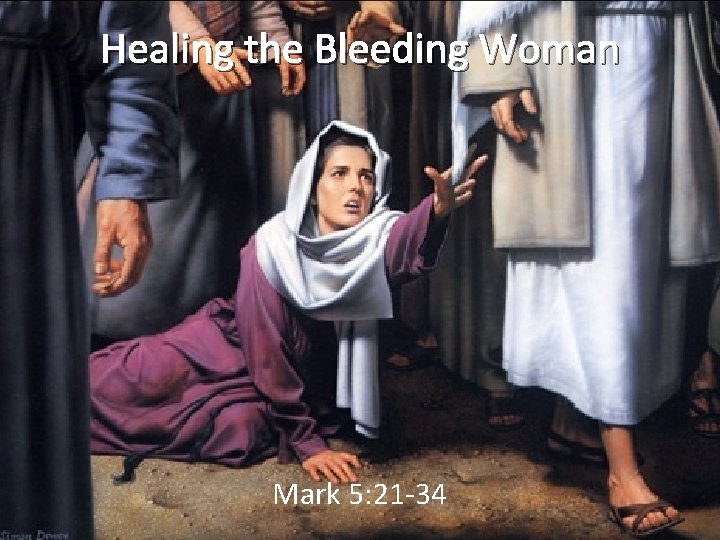
This woman is apparently acting out of Hellenistic superstition which assumed that a healer’s power was transferred to his clothes. But she gets results! Jesus respects her faith, and she is healed through her deliberate act of touching the edge of his cloak.
Here was a woman who came to Jesus as a last resort; having tried every other cure that the world had to offer she finally tried him.
“When other helpers fail and comforts flee, Help of the helpless, O abide with me.”
Faith of the hopeless
This approach always lays hold of Jesus. Jesus senses the touch of the hopeless and always helps the hopeless who come to Him. A hopeless approach involves four attitudes.
* There is the last resort attitude. The woman had been hemorrhaging for twelve years; it was uncontrollable. No one could touch her nor anything she had touched. By law she was considered unclean, so unclean that she was to be divorced by her husband (Leviticus 15:25-27).
She was to be totally cut off from society and religious worship. This particular woman had tried all she knew. She had seen “many physicians” and “spent all that she had,” and yet she “grew worse.” There was nowhere else to turn except to Jesus.
There is no need to reach the point of hopelessness; no need to reach the end of our ropes; no need to become utterly depressed.
Circumstances should never be allowed to destroy us, not to the point of utter hopelessness. Nevertheless, many reach that point. The one thing to remember is that Jesus does care and will never turn away from the hopeless. He opens His arms to all who come—even to the hopeless.
*There is the shy, embarrassed, unworthy attitude.
Note the woman elbowed her way through the crowd and came up behind Jesus. She wanted to touch Jesus without being seen or noticed. Why? She was embarrassed and felt unworthy.
She was considered unclean; therefore, she felt unworthy to approach Jesus.
It is the sense of unworthiness and hopelessness that touches the heart of Jesus. Jesus accepts any of the hopeless who truly come to Him, no matter what causes their sense of unworthiness.
Embarrassing matters, personal matters, secret matters—all are understood by Christ. He wishes no one to suffer ridicule or shame. He will accept the shy, quiet approach that comes to Him.
There are personal, embarrassing matters that we all wish to keep secret. These sometimes cause problems for us, serious problems that drive us to the point of hopelessness. Even a shy, embarrassed attitude that approaches Jesus will be acceptable. A sense of unworthiness and hopelessness touches His heart.
There is the expectant, believing attitude. Note that the hopeless woman believed what “she had heard of Jesus.” She believed that Jesus loved and cared and would make her whole. She believed in her thoughts, in her heart. She believed two things: the gospel (what she had heard about Jesus) and the power of Jesus to make her whole.
There is the confessing attitude. Jesus had made the way easy for her. He had allowed her to be healed without embarrassment, but it was not enough to believe in secret. The secret disciple had to be brought to the point of confessing her faith.
Jesus granted the request of the hopeless. “Daughter, thy faith hath made thee whole, go in peace, and be whole” (Mark 5:34). The result was twofold. She received peace. The fear and trembling were taken away and she was flooded with peace. Second, she was made whole both physically and spiritually.
There is a good lesson here for all of us. Not everybody has the same degree of faith, but Jesus responds to faith no matter how feeble it might be. When we believe, He shares His power with us and something happens in our lives.
The woman planned to slip away and get lost in the crowd, but Jesus turned and stopped her. Tenderly, He elicited from her a wonderful testimony of what the Lord had done for her. Why did Jesus deal with her publicly? Why did He not simply permit her to remain anonymous and go her way?
For one thing, He did it for her own sake. He wanted to be to her something more than a healer: He wanted to be her Savior and Friend as well.
He wanted her to look into His face, feel His tenderness, and hear His loving words of assurance. By the time He finished speaking to her, she experienced something more than physical healing.
To “be made whole” meant much more than receiving mere physical healing. Jesus had given her spiritual healing as well!
Here is the only place where Jesus addresses someone as “daughter.” Furthermore, his words, “Go in peace” would echo the Hebrew word, “Shalom.” This was more than a greeting or a wish for one’s physical well-being. It was a prayer for a person’s wholeness before man and God. For the first time in twelve years she can receive such a greeting.
JESUS’ RESPONSE TO AN APPEAL FOR HELP
We can all learn from this story to be more sensitive. It’s not required that we always be completely clueless as these first disciples of Jesus were. We can learn to think as the Lord does. We can learn to expect that there are people everywhere who want him more than they are able to articulate, who are reaching out on some level for the life-restoring power of God.
They don’t always know how to ask for help. They may not know what to say, what to do, or where to go, but they desperately want God to love them and they want the freedom to love him back.
We can learn to see what’s going on in people’s hearts and lives. We should be more tender, more caring, more expectant, more compassionate. We’re supposed to be like our Lord.
RELATIONSHIP WITH JESUS, NOT JUST HELP
We’ve had many anniversaries of the Seneca Falls Declaration. The best things the women’s movement in western culture has done in the last 220+ years have been very good: securing for women the right to vote, opened doors to employment and education, giving attention to reproductive health.
But none of them are ultimately liberating. It is not enough for any group to articulate areas of need and call for the culture and the laws and the institutions to change to meet them. We do not achieve peace and wholeness and healing that way. The only One who can give us what we long to have, men or women, is Jesus.
Jesus’ Attitude Toward Women: A Biblical Perspective
Jesus challenged cultural norms of his time, treating women with dignity and as equals.
– Healing, Teaching, Forgiveness, Empowerment.
– Galatians 3:28 – “There is neither… male nor female, for you are all one in Christ Jesus.”
Compassion and Healing
- Woman with Bleeding (Mark 5:25-34):
Calls her “Daughter” and praises her faith: “Your faith has made you well; go in peace.”
- Crippled Woman (Luke 13:10-17): Heals on Sabbath, calls her “daughter of Abraham,” defends against critics.
- Widow’s Son (Luke 7:11-17): compassionately raises son: “Don’t cry,” restores her security.
Teaching and Friendship
- Samaritan Woman (John 4:7-42): Reveals himself as Messiah: “I, the one speaking to you—I am he.” Her testimony evangelizes village.
- Mary and Martha (Luke 10:38-42): Affirms Mary’s learning: “Mary has chosen what is better.”
- Lazarus’ Sisters (John 11:17-44): Teaches resurrection: “I am the resurrection and the life.” Weeps with them.
Defender of Women
- John 8:3–11 – Woman caught in adultery.
- Jesus protects her from condemnation and calls to repentance.
Honoring Women’s Ministry
- Luke 8:1–3 – Women supported Jesus’ ministry.
- Matthew 26:6–13 – Woman anoints Jesus; He honors her act as memorable.
Resurrection Witness
- John 20:11–18 – Jesus first appeared to Mary Magdalene.
- He entrusted her with the message of His resurrection.
Invitation
Jesus asked, “Who touched me?” He asks it still. Some in the crowd today have reached out a hand to him for help, but remained afraid to say the whole truth.
But as scary as it is to respond to his question “Who touched me?” it is far worse to fail to respond, to have a relationship with God that you are in charge of, to get only an occasional gift instead of being made whole and given peace on the inside.
It’s a terrible mistake to fail to answer, when he’s looking intently for you, wanting to bless you.


