Mk 10:32-34 with Mt 20:17-19; Lk 18:31-33 — MK 10:32They were on their way up to Jerusalem, with Jesus leading the way, and the disciples were astonished, while those who followed were afraid. Again he took the Twelve [disciplesMT] aside and told them what was going to happen to him. 33“We are going up to Jerusalem,” he said, “and [everything that is written by the prophets about the Son of Man will be fulfilled: LK] the Son of Man will be betrayed to the chief priests and teachers of the law. They will condemn him to death and will hand him over to the Gentiles, 34who will mock him [[and] insult himLK] and spit on him, flog him and kill [crucifyMT] him. Three days later he will rise.”
Lk 18:34 — 34The disciples did not understand any of this. Its meaning was hidden from them, and they did not know what he was talking about.
Jesus was on His way to Jerusalem. This was to be a momentous visit to the capital. This was the visit when the crises of His death and resurrection were to take place. He had just shared the fact of the crisis again (Mark 10:17-19). For months it had consumed His attention and private messages to the disciples (Matthew 16:13-20; Matthew 16:21-28; Matthew 17:1-13; Matthew 17:22; Matthew 17:24-27; Matthew 20:17). There was no question in the disciples’ minds: this visit to Jerusalem was the momentous event for which they had long looked.
We, who live today, know what Jesus meant by His death and resurrection. He was to die for our sins and be raised again to impart new life to us. But the disciples did not know this. Jesus had not yet died and been raised from the dead. To them He was speaking of an earthly and material kingdom. Therefore, if He was about to set up His kingdom, now was the time to seize the positions of power in His kingdom. Now was the time to secure the positions of rule and authority.
This is a graphic scene. After three particularly potent encounters with the Pharisees (19:3), his disciples (19:13), and this rich young ruler (19:16), Jesus is back on route to Jerusalem. He seems to be walking with a vengeance toward the capital city, his terminal destination. It appears that Jesus is walking out ahead, leading the pack with a furious pace. His disciples follow close behind, astonished, while the more uncommitted crowds lag further behind, afraid.
Just what was going through their minds, we may never know. But this is certain, there is something in Jesus’ pace and resoluteness that shouts just how serious are these moments and movements. For whatever else this holy city represented to these people, for Jesus it meant death.
What terrible expectations! One who loved him would betray him. Leaders of his own people would condemn him. He would be given over to the hated (Gentile) Romans to be humiliated and killed. He would endure these things and then rise again.
Jesus was certainly courageous enough to face martyrdom by himself. He could have told his followers, “I am going to lose my life, but I love you too much to put you through what lies ahead.” He could have tried to soften the blow, but he didn’t. Instead, he expected them to travel with him to the cross. Jesus knew that his cross was their only hope.
He takes the Twelve aside to teach them privately once again (cf. 16:21 and 17:22-23). Away from the crowd, he explains to his faithful band what this is all about. This is the third time Jesus clearly predicts his own death (cf. 83, 86, 88), although he has alluded to it a number of times. This particular prediction goes beyond the other two by stating the specific involvement of the Gentiles and the specific mode of execution—crucifixion.
There are essentially six elements to this prediction:
- It must take place in Jerusalem.
- He will be betrayed.
- The chief priests and teachers of the law (i.e., Pharisaic and Sadducean leaders) will be responsible for his death.
- He will be delivered over to the Gentiles for a death sentence
- They will mock (insult and spit), flog, and crucify
- He will rise on the third day.9-95
Many have doubted the integrity of this narrative. Because it is such a specific prediction, they assert that it must have been written after Jesus’ death and then credited to Jesus. But if Jesus was who he claimed, and did what the Gospel writers say, then predictive prophecy is a minor miracle for Jesus. The issue boils down to this: Do you believe that Jesus was a mere man or was he God incarnate?
Luke offers two significant contributions to this narrative. First, he reminds the disciples that the prophets predicted his death (v. 31). Certainly Isaiah 53 and Psalm 22 must have come to mind as well as Psalm 16:10; 118:22; Genesis 3:15. Second, he highlights their ignorance, as he did with the second passion prediction (Lk 9:45). This matter was hidden from them. The word seems to indicate that God concealed the matter from the Apostles; it wasn’t merely that they were obtuse.
The events of this passage took place near the end of Jesus’ life. Jerusalem was the city of God, a royal city where Messiah was to claim David’s throne. Jesus had been to Jerusalem many times, but on this journey, he was entering the city as a king leading his subjects.As royal processions go, however, this was an unusual one. There was no army. The followers were few, and they were neither wealthy nor important. Of course, Jesus was an unusual king. Angelic choirs heralded his birth, but, with the exception of a few shepherds and some wise men from the far east, his birth went virtually unnoticed on earth. His life and ministry fulfilled Old Testament prophecy, though there was little recognition of this until after his resurrection. And, though they did not fully understand who he was, and were often frightened by circumstances that surrounded him, Jesus’ disciples continued to follow him on this journey to Jerusalem.
If they weren’t Apostles, we would be tempted to dismiss them as selfish fools when James and John ask for special position with Jesus. They think they are en route to the “inaugural ball” when, in fact, they are on their way to an excruciating execution.
Mk 10:35-37 with Mt 20:20-22 — MK 10:35Then [the mother ofMT] James and John, the sons of Zebedee, came to him [kneeling down.MT] “Teacher,” they said, “we want you to do for us whatever we ask.”
36“What do you want me to do for you?” he asked.
37They replied, “Let [grantMT] one of us sit at your right and the other at your left in your glory [kingdom.MT]”
According to Matthew, it was Salome (Mt 27:55-56 with Mk 15:40), the mother of James and John, who makes this request. Likely the two boys put her up to it, thinking she will have more pull with Jesus. It is likely that Salome was Jesus’ aunt (cf. Jn 19:25), and as a woman she might be able to tug his heart strings better than they. Besides, the request looks less selfish coming from their mother. But Jesus sees through their little scheme and speaks directly to James and John.
James and John, whom Jesus had nicknamed “Sons of Thunder,” had been disciples of John the Baptist. They heard John declare Jesus to be the promised one sent by God. They had been present with Jesus on the Mount of Transfiguration and heard a voice from heaven say, “this is my Son.” Their love for Christ was deep, but, as it is with most of us, their love contained self-serving motives. They hoped Jesus would claim his throne and elevate his loyal followers.
Ambition: the deceitfulness of wrong ambition. Note what James and John did.
- They made a secret approach to Jesus. They wanted to get the upper hand on the other disciples; they were aware that the other disciples were also ambitious for position (cp. Luke 9:46). They knew that they must get some kind of inside track. They persuaded their mother to go with them, and they approached Jesus when He was off by Himself (Matthew 20:20-21). Remember that Salome was probably the sister of Mary, the aunt of Jesus. Most likely James and John felt she would add weight to their request. Therefore, they made a secret approach to Jesus. The ambition that was gripping their heart was not healthy ambition; it was evil ambition. And evil ambition is sneaky. It tries to get an inside track, the upper hand by hook or crook. It uses any means whatsoever, including the use and misuse of people, even loved ones (cp. Salome).
- They made an unlimited appeal. Note their words, “Do for us whatsoever we shall desire.” Again, they were being sneaky. They tried to get a commitment before they revealed their request. They sensed their desire might be wrong and evil; but they subdued the sense of conscience, blinded by the lust for honor, position, power, wealth, and recognition.
These Sons of Thunder had mixed motives. They wanted personal advantage, but they were also willing to face danger because of their love for Jesus. They fully expected that God would give him the throne of David and that there would be a glorious outcome to his mission. Their request is based as much on faith as it is on self-centeredness.
Shortly before this incident, Jesus said, “I tell you the truth, at the renewal of all things, when the Son of Man sits on his glorious throne, you who have followed me will also sit on twelve thrones, judging the twelve tribes of Israel.” (Matthew 19:28) Jesus was a poor Galilean heading into terrible times, but his followers believed in his future victory and wanted to be included when he came into his glory.
It is significant that the Lord showed no hint of condemnation, either of James and John for their self-seeking attitude or of the other ten for their jealousy. Their desire was simply that they might be great someday. “Lord, I want to join you in your victory and be with you in your glory. I want significance that outshines every other hope for significance that I have ever had. I want to know joy and love. I want to be the person I was intended to be. I was made in the image of God, and I am destined for greatness.”
Too many of us never ask to be great. We see ourselves through a lens of failure and inadequacy. We don’t even know how to imagine ourselves being worthy of the love of God, of being at his side and hearing him say, “Well done.” James 4:2 says we don’t have because we don’t ask. What do you want Jesus to do for you? He never turns aside those who ask to be made great.
Jesus fully intends to make us great, but the means for achieving greatness is not what we expect. The only way to greatness is by his cross. To become who he intends us to be, we must join him in the execution of our flesh.
Their request is open-ended: “Do for us whatever we ask.” It appears that they know their request is a bit out of bounds. After all, Jesus has already confronted the whole group about seeking rank and position. And he has just reiterated the importance of becoming like children , and his own impending death. As usual, they have not been listening. To make matters worse, they are going to continue to argue about which of them is the greatest even up to the very night Jesus is betrayed (Luke 22:24-27).
Jesus isn’t going to fall for their ploy. He asks them, “What is it you want?” They reply, “We want the #1 and #2 seats in the kingdom.” They are dangerously close to Jerusalem. This city represents danger for Jesus. But like Superman, Jesus consistently dodges and deflects bullets. Neither plots of the Jews, storms of the sea, nor demonic forces have overpowered him. Undoubtedly the Twelve share the expectation of the crowds that Jesus will establish his kingdom upon arriving in Jerusalem. Therefore, James and John want to beat the others to the punch. They want to seize the highest administrative appointments in the coming Messianic kingdom. And why shouldn’t they? They have the majority vote in the inner three!
Ambition—Motive: the possible motives for ambition. Jesus asked the two men what their request was. They answered straight to the point, wasting no time, as any conscientious leader would: “Grant us the top positions in your kingdom [glory, government] which you are going to set up when we get to Jerusalem.” The men were extremely ambitious. They wanted to be the top ministers of state in Christ’s government.
What needs to be noted is that ambition can be good or bad. The determining factor is motive. One’s motive makes ambition either good or bad. The ambition of James and John exposes several possible motives. Each one touches a sensitive spot within every man, and urges every man to examine the motives of his heart.
- There was the motive of favoritism. James and John, along with Peter, formed an inner circle around Christ. They apparently had some feeling that they were special, the favorites of Christ; therefore, they were due the top positions.
- There was the motive of wealth. Zebedee, the father of James and John, was apparently wealthy. He owned a fishing business large enough to furnish fish for the palace. They were better off financially than some of the other disciples. There was the possibility that the two men were acting as selfish, pampered young men seeking more. Wealth did carry weight with monarchs of their day, and they knew it.
Wealth can make a man self-centered. It can pamper and make one selfish. It can cause one to expect more attention, more honor, more recognition, more favor. Those who have wealth often want more. And they set out to get more, whether wise or unwise, whether right or wrong. The wisdom and righteousness of having wealth are determined by a person’s motive and true need.
- There was the motive of power, position, influence, and authority. This was clearly one of the motives of James and John. They wanted to be right next to Jesus in position and influence, power and authority. It is the very thing they asked.
Men want position. Men think in terms of position and influence. Within the business world, men want a position that assures influence and reward. Within the church, some want a position of leadership and of influence. Men seldom think in terms of service or in terms of how they can help the company or the church. Too often their thoughts are on the honor, the reward, the influence, the position they will receive.
- There was the motive of social status. James and John did have some social standing. They were somewhat wealthy and were accepted within the palace, and were personally known by the High Priest. Social standing often makes a person feel that he is entitled to more—more position, more recognition, a higher seat. Social standing can also make one feel he is better or above others. Perhaps James and John had a tinge of both feelings.
- There was the motive of love, faith, and loyalty. When ambition is rooted in the Lord and steeped in love and loyalty, it is always right and healthy. There is the possibility that James and John wanted to be next to Jesus because they were sensing some degree of love and loyalty to Him. Their love and loyalty to Him would not be the dominant force in their ambition right now, but it was definitely present.
They definitely believed Jesus: His Word, His promises, His kingdom, His power. They were showing loyalty to Christ by expressing confidence in His power to usher in the Kingdom of God. They were asking for positions in His kingdom. They knew He was the true Messiah, the Son of the living God who was to become the King of kings and Lord of lords.
They definitely wanted the positions because they wanted to be next to Him. To them He deserved the kingdom and the honor. He deserved it because He had done so much and was going to do so much for them and for the people of God.
Mk 10:38-40 with Mt 20:23 — 38“You don’t know what you are asking,” Jesus said. “Can you drink the cup I drink or be baptized with the baptism I am baptized with?”
39“We can,” they answered.
Jesus said to them, “You will drink the cup I drink and be baptized with the baptism I am baptized with, 40but to sit at my right or left is not for me to grant. These places belong to those for whom they have been prepared [by my Father.MT]”
Jesus tries to open their eyes by using two metaphors for suffering: Baptism (Mt 3:11-12) and Cup (Ps 75:8; Isa 51:17; Jer 25:15-28). They aren’t headed to Jerusalem for a victory celebration but for suffering. James and John want to be singled out as Jesus’ closest associates. Presently that won’t mean promotion but persecution. They are ignorantly confident that they can share Jesus’ impending experiences.
Indeed, both of them will be baptized with the fire of persecution. James will be the first Apostolic martyr (Acts 12:2). John, on the other hand, will be the last surviving Apostle. According to tradition he was the only one who did not die as a martyr. Although his life was spared, he was not exempt from suffering. In the waning years of his life, he was exiled to Patmos where he saw the vision of Revelation (1:1).
Jesus can promise them persecution but not position. That is his Father’s prerogative alone. Although Jesus will be given all authority after his resurrection (Mt 28:18), during his ministry, he lives in submission to his Father (Jn 14:28). Not only that, he submits himself to the physical and spiritual needs of sinful humanity. He comes as a servant and invites his disciples to no greater position.
Mk 10:41-45 with Mt 20:28; Lk 22:26 — 41When the ten heard about this, they became indignant with James and John. 42Jesus called them together and said, “You know that those who are regarded as rulers of the Gentiles lord it over them, and their high officials exercise authority over them. 43Not so with you. Instead, whoever wants to become great among you must be your servant [as the youngest,LK] 44and whoever wants to be first must be slave of all. 45For even [just asMT] the Son of Man did not come to be served, but to serve, and to give his life as a ransom for many.”
The ten are predictably upset, not because James and John misconstrue Jesus’ teaching but because they beat them to the punch. All twelve want those coveted chief seats. Even after three years of walking with Jesus, watching him serve and taking notes on his sermons, they still don’t grasp the basic purpose and method of his ministry—to die as a servant of humanity. You would think Jesus’ closest disciples would know better. But even after 2,000 years, the lesson is hardly better understood or implemented.
The problem is simply this: We are imitating the ways of the world (Gentiles), rather than Jesus. We pattern our churches after governments and businesses. We vie for power and position through titles, salaries, recognition, votes, perks, boards and authority. Jesus’ heart is broken.
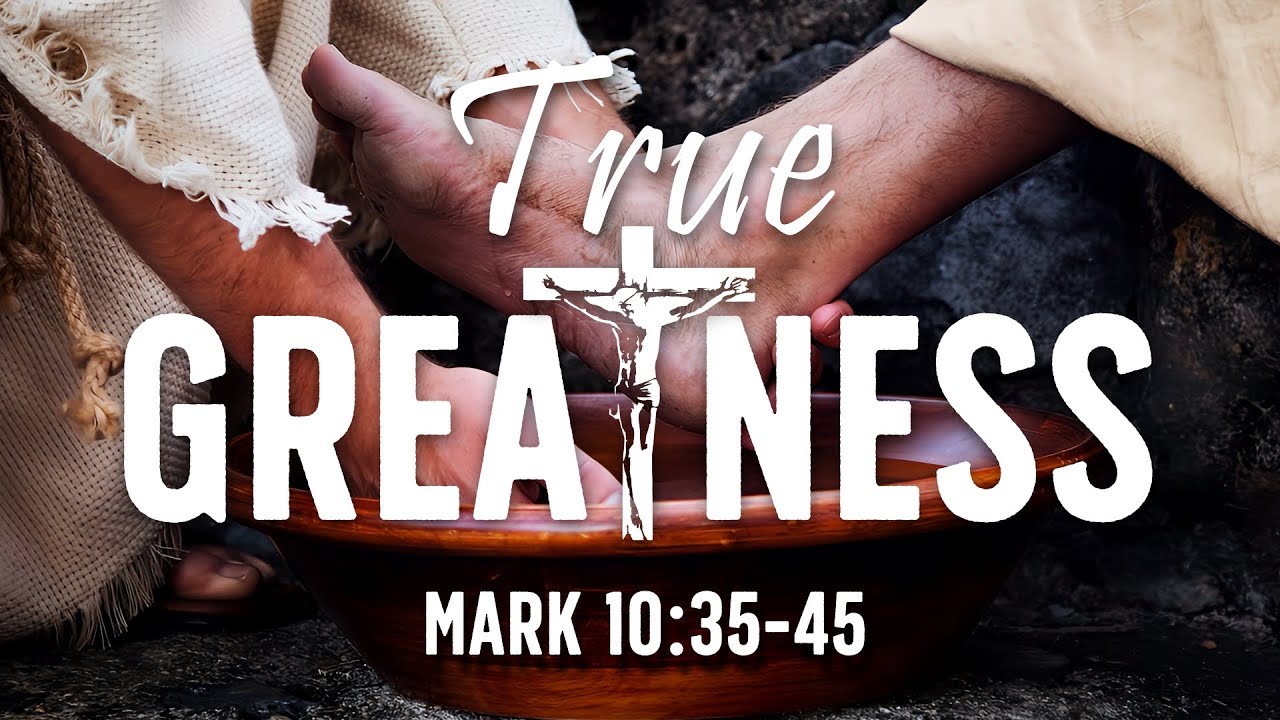
The pathway to greatness in the kingdom is not up some corporate ladder. Rather, it is paved with a basin and a towel (Jn 13:1-17). This is not difficult to understand. Jesus repeats it too much for us to forget it. But our obvious neglect to live it out reveals the difficulty we have with this sublime paradox that the greatest in the kingdom of God is to be a servant (1 Cor 9:19; 2 Cor 4:5; 1 Pet 5:2-3).
Jesus’ ultimate example of the theology of humility is around the next corner, at the cross. Liberal theologians have attempted to whisk away Mk 10:45 (and Mt 20:28). It is too clear to be comfortable. But it tenaciously stands its ground. This is Jesus’ mission statement: To serve humanity by dying for our sins. The word “ransom” was commonly used in Greek circles for the price that was paid for the release of a slave. Furthermore, in the lxx it is used for “deliverance” of God’s people (Exod 30:12; Ps 49:7-9). Here, the Greek and Hebrew worlds come together as Jesus is pictured releasing captives from their slavery to sin (Rom 6:16-18; Isa 53:10-12).
We also find in Mark 10:45 the preposition “for” which means “in place of.” It could hardly be clearer that Jesus died “instead of many” (Titus 2:14; 1 Pet 1:18). His death is a replacement, a substitute for ours.
This passage does not teach that living in the world is wrong. There is nothing wrong with Bible scholars using computers or Christians building modern hospitals or means of transportation and communication. Modern media can be used for God. The worldliness that is being condemned here is competitiveness, self-promotion, manipulation, looking down upon others-that is wrong. Instead, if we want to be great, we must be servants. Those who are greatest are those who are fully, frequently, and profoundly learning how to forget themselves and to find others they can help. Those who are great do not ask, “What’s in it for me?” They do not seek to spread their name or reputation. Those who are great look for ways of giving themselves away and blessing others. If you want to recognize greatness in the world, you will look for those who serve others. If you want to be great-and you should, because you were made for greatness-the way to greatness is through the cross, through crucifying what is unholy, ungodly, and selfish.
Do you want to be great? You should, because you were made for greatness. Jesus asked his disciples, “What do you want me to do for you?” He asks us the same question today.
Some summation comments (Mark 10:32-45)
The destination was still Jerusalem, and Jesus was still leading the way. As Mark wrote his account of the Saviour’s journey to Calvary, he must have meditated much on the great “Servant Songs” in Isaiah 42-53. “For the Lord God will help me; therefore shall I not be confounded: therefore I have set my face like a flint, and I know that I shall not be ashamed” (Isa. 50:7). We cannot but admire the courage of God’s Servant as He made His way to Calvary, and we should adore Him all the more because He did it for us.
We must try to understand the bewilderment and fear of His followers, for this was a difficult experience for them and not at all what they had planned or expected. Each new announcement of His death only added to their perplexity. In the first two announcements (Mark 8:31; 9:31), Jesus had told them what would occur; but now He told them where His passion will take place—in the Holy City of Jerusalem!
In this third announcement, He also included the part that the Gentiles would play in His trial and death, and for the fourth time, He promised that He would rise again (note Mark 9:9). He told His disciples the truth, but they were in no condition to understand it.
In the light of our Lord’s announcement of His death, we are embarrassed and ashamed to read of James and John asking for thrones. How could they and their mother (Matt. 20:20-21) be so callous and selfish? Peter had responded to the first announcement by arguing with Jesus; after the second announcement, the disciples responded by arguing among themselves over who was the greatest (Mark 9:30-34). These men seemed blind to the meaning of the Cross.
Except for one thing: they were praying selfishly, and God does not answer selfish prayers (James 4:2-3). If He does, it is only that He might discipline us and teach us how to pray in His will (Ps. 106:15; 1 John 5:14-15). James, John, and Salome did not realize that it costs something to get answers to prayer. For Jesus to grant their request, He would have to suffer and die. Why should He pay such a great price just so they could enjoy free thrones? Is that the way to glorify God?
Jesus compared His approaching suffering and death to the drinking of a cup (Mark 14:32-36) and the experiencing of a baptism (Luke 12:50; also see Pss. 41:7; 69:2, 15). It would be a devastating experience—and yet James and John said they were able to go through it with Jesus! Little did they realize what they were saying, for in later years they would indeed have their share: James would be the first of the disciples to be martyred (Acts 12:1-2), and John would experience great persecution.
Because their prayer was motivated by earthly wisdom, not heavenly wisdom, James and John aroused the anger of the other disciples and brought disunity to the group (see James 3:13-4:1). No doubt the men were unhappy because they had not thought of asking first! Once again, Jesus tried to teach them what it means to be an “important person” in the kingdom of God (see Mark 9:33-37).
Like many people today, the disciples were making the mistake of following the wrong examples. Instead of modeling themselves after Jesus, they were admiring the glory and authority of the Roman rulers, men who loved position and authority. While there is nothing wrong with aspiring to greatness, we must be careful how we define “greatness” and why we want to achieve it. Jesus said, “Whoever wishes to become great among you shall be your servant; and whoever wishes to be first among you shall be slave of all” (Mark 10:43-44, n).
God’s pattern in Scripture is that a person must first be a servant before God promotes him or her to be a ruler. This was true of Joseph, Moses, Joshua, David, Timothy, and even our Lord Himself (Phil. 2:1-11).
Unless we know how to obey orders, we do not have the right to give orders. Before a person exercises authority, he or she must know what it means to be under authority. If Jesus Christ followed this pattern in accomplishing the great work of redemption, then surely there is no other pattern for us to follow.


