RSS

Category Archives: Church

Uncommon Things We Believe Series #5 Miraculous Gifts Have Ceased


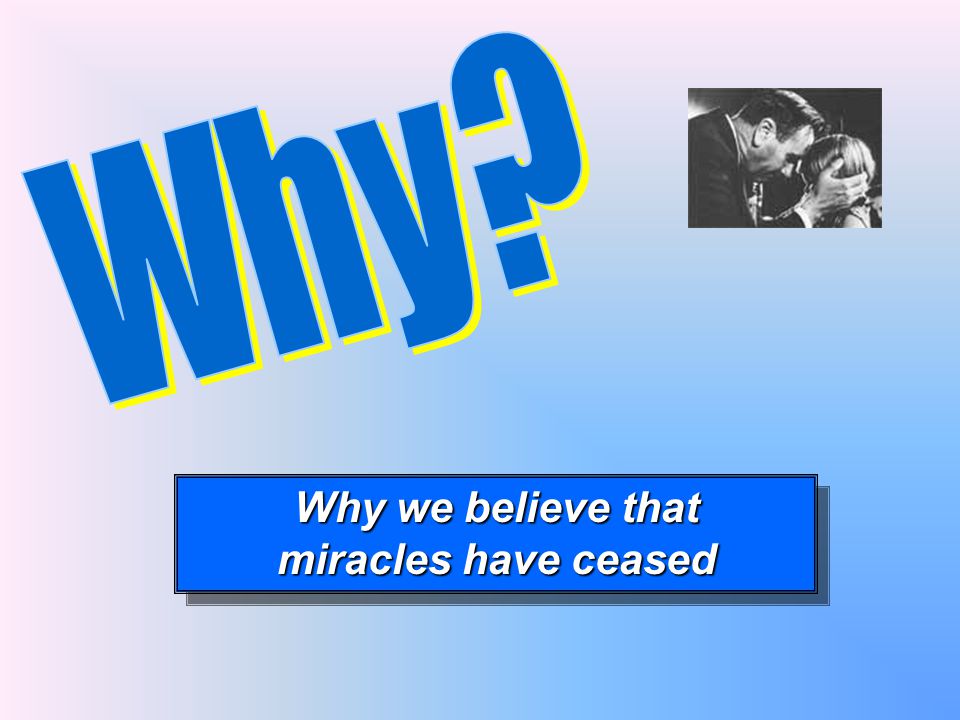
Image result for miracles have ceased

One of the most emotionally charged issues in contemporary expressions of religion has to do with the subject of miracles. Most every television or radio program that has a religious emphasis will teach that miracles are an active part of today’s Christianity.

When something amazing happens, we often say, “It’s a miracle!” But more than likely that is not technically correct. It was not a true miracle. It was amazing, it was abnormal, etc., but was it a miracle?

The Jews of our Lord’s day did not challenge the actual events, but rather the power by which these miracles were performed (cf. Mark 3:22ff.). They associated his power to Beelzebub…evil….and Jesus clearly taught them (to their shame) that a “kingdom divided against itself will not stand.”

Nicodemus stated the belief that most of us here today would understand:

(John 3:1-5)  Now there was a man of the Pharisees named Nicodemus, a member of the Jewish ruling council. {2} He came to Jesus at night and said, “Rabbi, we know you are a teacher who has come from God. For no one could perform the miraculous signs you are doing if God were not with him.”

(Luke 7:18-23)  John’s disciples told him about all these things. Calling two of them, {19} he sent them to the Lord to ask, “Are you the one who was to come, or should we expect someone else?” {20} When the men came to Jesus, they said, “John the Baptist sent us to you to ask, ‘Are you the one who was to come, or should we expect someone else?'” {21} At that very time Jesus cured many who had diseases, sicknesses and evil spirits, and gave sight to many who were blind. {22} So he replied to the messengers, “Go back and report to John what you have seen and heard: The blind receive sight, the lame walk, those who have leprosy are cured, the deaf hear, the dead are raised, and the good news is preached to the poor. {23} Blessed is the man who does not fall away on account of me.”

What is a miracle?

If we look at the words the New Testament uses for miracles we see the following:

(1) It is an act of a supernatural being. The word dunamis has the idea of a supernatural power. It speaks primarily of the agent of the act. That power may be delegated to a human agent.The question is where did Jesus’ power to do the miracle come from. There are two options – either from God or from Satan. Obviously, Jesus’ power came from God.

(2) A miracle is an unusual event. Another word – terasa – speaks of the effect.  Terasa speaks of the wonderment of the event – as in signs and wonders. As a matter of fact, terasa is always used with semeion.

(3) A miracle is a significant event. The Greek word semeion means sign. It has purpose. Matthew, Mark and Luke uses the first two more. John uses the word semion, because he is focused on the purpose of Jesus in performing the miracles.  The concept of semeion is to point to something greater…such as a miracle in John points the participants or viewer to God.

Definition: A miracle is an unusual and significant event (terasa) which requires the working of a supernatural agent (dunamis) and is performed for the purpose of authenticating the message or the messenger (semeion).

I don’t want to imply that God can’t do a miracle without a miracle worker or that He can only do miracles when He needs to authenticate His message. But, examination of Old Testament and New Testament miracles shows that when a human is the agent performing a miracle, the purpose is authentication of the person and his message.

For example: Moses, Elijah, Jesus, Apostles… That is the norm. It is a little oxymoronic to use the words norm and miracles in the same sentence, but I think it is important to establish what the norm is if possible because of what various people teach concerning miracles.

We commonly call God’s work that stays within the recognized laws of nature, “providence.” Consequently we do pray, believing that God hears and will answer providentially.

Therefore, when someone calls something a “miracle,” we should understand that they may simply mean what we mean by the word “providence.” We need to not debate with those with whom we merely differ semantically.

Nevertheless, in a theological manner, we do believe that there is a work of God that is above our common understanding of how nature functions, and we call this kind of work a “miracle.” We commonly believe in this sense of the word that miracles have ceased.

Our basis for this belief is rooted in the Holy Spirit’s teaching in the Scriptures relative to a special kind of work that would cease at the close of the Apostolic Age of the first century. We do not believe that God is incapable of working miracles, but that He has revealed that He would not do so in Post Apostolic times.

Miraculous Gifts: their purpose and method of reception

What was the purpose of miracles in the ministry of Christ, or in the apostolic age? As noted above, their design must be consistent with the lofty theme of redemption.

Of the early disciples who were endowed with spiritual gifts, Mark declares:

“And they went forth, and preached everywhere, the Lord working with them, and confirming the word by the signs that followed” (Mk. 16:20).

The function of the signs was to confirm the revelatory process, i.e., the word of truth being communicated from God to man.

The writer of Hebrews argues similarly. He declares that the message regarding the “great salvation,” which at the first had been  “spoken through the Lord, was confirmed unto us by them that heard; God also bearing witness with them, both by signs and wonders, and by manifold powers, and by gifts of the Holy Spirit, according to his own will” (Heb. 2:3-4).

Of special interest in these passages is the term “confirm” (Grk. bebaioo). The word denotes evidence that establishes the validity of the divinely-given word (Brown, I.658). The supernatural gifts of the primitive age, therefore, had as their design the establishment of the credibility of Christ and His spokesmen, and so ultimately, the validation of their message, namely, that Jesus Christ is the Son of God, the Savior of the world!

Now observe this very important point. If it can be established that those early miracles do corroborate the testimony of Christ, and those commissioned by Him; and further, that the recording of these events in the New Testament was designed to perpetually accomplish that function, then it stands as demonstrated that the repetition of such signs is not needed today.

The fact is, that is exactly what is affirmed by the apostle John. He declares that the “signs” of Christ, which he records in his gospel account, “are written [gegraptai – perfect tense, abiding effect] that ye may believe that Jesus is the Christ, the Son of God . . .” (Jn. 20:31).

It ought to be abundantly clear, therefore, that since the miracles of the Bible continue to accomplish their original purpose, there is no need for a repetition of them today. They are not being replicated in this age!

Next, we should explore the method of gift reception, as that concept is set forth in the New Testament. Christ, of course, was empowered directly by God to work miracles. Such signs demonstrated that He was a “man approved of God” (Acts 2:22).

So far as New Testament information goes, there were only two ways by which others received spiritual gifts in the apostolic era. The first was by means of Holy Spirit baptism, i.e., an overwhelming direct endowment of the Spirit’s power. Second, miraculous gifts were bestowed by the imposition of the apostles’ hands. Let us consider the biblical facts regarding these two matters.

Holy Spirit baptism was demonstrated in only two New Testament situations. It was given to the apostles of Christ (Acts 1:5; 2:4), and then, as a very special case, it was received by the household of Cornelius (Acts 10:44-47; 11:15-17). Is Holy Spirit baptism available today? We can show that it is not by the following logical arguement.

First, when Paul wrote to the Ephesians (c. A.D. 62), he affirmed that there was but “one baptism” at that time (Eph. 4:5). It is generally conceded that this baptism must be either Holy Spirit baptism, or water baptism. If it can be established that the “one baptism” of Ephesians 4:5 is water baptism, then it is obvious that “Spirit baptism” was no longer available.

That water baptism is age-lasting is demonstrated by the fact that it is the baptism of the great commission (cf. Mt. 28:19-20; Mk. 16:16). In Matthew’s account, the Lord promised that as long as his people were making disciples, baptizing, teaching, etc., He would accompany them always, even to the end of the age. Whatever the baptism of this passage is, therefore, it continues in force until the end.

This baptism, however, must be water baptism, as evidenced by the fact that it is administered by human beings: “Go . . . make disciples . . . baptizing . . . .” On the other hand, Holy Spirit baptism had no human administrator; it was bestowed directly by Christ (Mt. 3:11).

It must be concluded, therefore, that the “one baptism” of Ephesians 4:5 was water baptism; consequently, Holy Spirit baptism had become obsolete. Such being the case, spiritual gifts are not received via Holy Spirit baptism today.

The Evidence For Our “Uncommon” Belief.

Jesus said that the Holy Spirit would lead the Apostles into “all things,” and “all truth” (Jn.14:16-18, 26; 16:13).

(John 14:16-18)  And I will ask the Father, and he will give you another Counselor to be with you forever– {17} the Spirit of truth. The world cannot accept him, because it neither sees him nor knows him. But you know him, for he lives with you and will be in you. {18} I will not leave you as orphans; I will come to you.

(John 14:26)  But the Counselor, the Holy Spirit, whom the Father will send in my name, will teach you all things and will remind you of everything I have said to you.

(John 16:13)  But when he, the Spirit of truth, comes, he will guide you into all truth. He will not speak on his own; he will speak only what he hears, and he will tell you what is yet to come.

It is important that we understand to whom Jesus intended the words of the Scriptures just cited. We must “rightly divide” or “accurately handle” the Bible to determine to whom words are spoken (2 Tim. 2:15).

The words of John 14:16-18, 26; 16:13 were for the Apostles.

The promise included that the Apostles would not forget what Jesus had said to them—we were not alive during Jesus’ ministry and thus He said nothing to us directly. Therefore “all things” and “all truth” came in the lifetime of the Apostles.

The Apostles’ ministry contributed to the “foundation” or initial work of the Church Age (Eph. 2:20).

(Ephesians 2:20)  built on the foundation of the apostles and prophets, with Christ Jesus himself as the chief cornerstone.

They were told to wait for the Holy Spirit in Jerusalem and then preach the gospel throughout the world—they received the Spirit and then began to preach (Lk. 24:49; Acts 1:5, 8; 2:1-4).

(Luke 24:49)  I am going to send you what my Father has promised; but stay in the city until you have been clothed with power from on high.”

(Acts 1:5)  For John baptized with water, but in a few days you will be baptized with the Holy Spirit.”

(Acts 1:8)  But you will receive power when the Holy Spirit comes on you; and you will be my witnesses in Jerusalem, and in all Judea and Samaria, and to the ends of the earth.”

(Acts 2:1-4)  When the day of Pentecost came, they were all together in one place. {2} Suddenly a sound like the blowing of a violent wind came from heaven and filled the whole house where they were sitting. {3} They saw what seemed to be tongues of fire that separated and came to rest on each of them. {4} All of them were filled with the Holy Spirit and began to speak in other tongues as the Spirit enabled them.

Through them “the faith” was “once for all delivered” (Jude 3). Miracles were a special sign to confirm the work of the Apostolic Age.

The miracles confirmed the commission of the Apostles and were given through their hands (2 Cor. 12:12; cf. Rom. 15:18-19; Mk. 16:20; Heb. 2:3-4).  Only the Apostles could impart miraculous gifts.

(Mark 16:20)  Then the disciples went out and preached everywhere, and the Lord worked with them and confirmed his word by the signs that accompanied it.

(Romans 15:18-19)  I will not venture to speak of anything except what Christ has accomplished through me in leading the Gentiles to obey God by what I have said and done– {19} by the power of signs and miracles, through the power of the Spirit. So from Jerusalem all the way around to Illyricum, I have fully proclaimed the gospel of Christ.

(2 Corinthians 12:12)  The things that mark an apostle–signs, wonders and miracles–were done among you with great perseverance.

(Hebrews 2:3-4)  how shall we escape if we ignore such a great salvation? This salvation, which was first announced by the Lord, was confirmed to us by those who heard him. {4} God also testified to it by signs, wonders and various miracles, and gifts of the Holy Spirit distributed according to his will.

For a time they were the only ones performing miracles (Acts 2:43; 3:1-10; 5:33).

(Acts 2:43)  Everyone was filled with awe, and many wonders and miraculous signs were done by the apostles.

(Acts 3:1-10)  One day Peter and John were going up to the temple at the time of prayer–at three in the afternoon. {2} Now a man crippled from birth was being carried to the temple gate called Beautiful, where he was put every day to beg from those going into the temple courts. {3} When he saw Peter and John about to enter, he asked them for money. {4} Peter looked straight at him, as did John. Then Peter said, “Look at us!” {5} So the man gave them his attention, expecting to get something from them. {6} Then Peter said, “Silver or gold I do not have, but what I have I give you. In the name of Jesus Christ of Nazareth, walk.” {7} Taking him by the right hand, he helped him up, and instantly the man’s feet and ankles became strong. {8} He jumped to his feet and began to walk. Then he went with them into the temple courts, walking and jumping, and praising God. {9} When all the people saw him walking and praising God, {10} they recognized him as the same man who used to sit begging at the temple gate called Beautiful, and they were filled with wonder and amazement at what had happened to him.

(Acts 5:33)  When they heard this, they were furious and wanted to put them to death.

Other than by Holy Spirit baptism, miraculous gifts could be conveyed only by an apostle of Christ. Note the evidence:

  1. Philip, the evangelist (not an apostle), could perform miracles, but he could not pass that gift along to others. Accordingly, apostles, namely Peter and John, were sent to Samaria, where Philip had been preaching, so that the church there might be furnished with certain divine gifts (cf. Acts 8:5-6; 14-17).
  2. In connection with the foregoing circumstances, Simon the sorcerer “saw that through the laying on of the apostles’ hands the Holy Spirit was given” (8:18). He wanted to purchase that privilege for himself, but he was informed that he had neither part nor lot in that matter, i.e., the impartation of spiritual gifts.
  3. At Ephesus, Paul laid his hands on twelve converts and “they spake with tongues and prophesied” (Acts 19:6).
  4. There was an unruly element within the church at Corinth that denied Paul’s apostleship. Such, however, was a very illogical position, for that church possessed spiritual gifts (1 Cor. 12-14), and they had received them from none other than Paul. The “signs of an apostle” had been wrought among them (2 Cor. 12:12), so Paul forcefully could say:

“If to others I am not an apostle, yet at least I am to you; for the seal of mine apostleship are ye in the Lord” (1 Cor. 9:2).

The Corinthian church (with its spiritual gifts) was, therefore a “seal” (divine documentation of Paul’s apostleship), and accordingly, indirect evidence that such gifts were received only from an apostle!

  1. Paul urged Timothy to “stir up the gift of God,” which, says he, “is in you through [dia – denoting the instrument or agency by means of which the gift was imparted (Arndt, 179)] the laying on of my hands” (2 Tim. 1:6).

Since, therefore, there is no Holy Spirit baptism today; and further, since there are no apostles (or successors to them) in this age, it should be quite clear that men are not in possession of supernatural gifts of the Spirit in this post-apostolic era of the Christian dispensation.

The miraculous gifts were to cease when their purpose was complete (I Cor. 13:8-13; Eph. 4:11-16).

(1 Corinthians 13:8-13)  Love never fails. But where there are prophecies, they will cease; where there are tongues, they will be stilled; where there is knowledge, it will pass away. {9} For we know in part and we prophesy in part, {10} but when perfection comes, the imperfect disappears. {11} When I was a child, I talked like a child, I thought like a child, I reasoned like a child. When I became a man, I put childish ways behind me. {12} Now we see but a poor reflection as in a mirror; then we shall see face to face. Now I know in part; then I shall know fully, even as I am fully known. {13} And now these three remain: faith, hope and love. But the greatest of these is love.

(Ephesians 4:11-16)  It was he who gave some to be apostles, some to be prophets, some to be evangelists, and some to be pastors and teachers, {12} to prepare God’s people for works of service, so that the body of Christ may be built up {13} until we all reach unity in the faith and in the knowledge of the Son of God and become mature, attaining to the whole measure of the fullness of Christ. {14} Then we will no longer be infants, tossed back and forth by the waves, and blown here and there by every wind of teaching and by the cunning and craftiness of men in their deceitful scheming. {15} Instead, speaking the truth in love, we will in all things grow up into him who is the Head, that is, Christ. {16} From him the whole body, joined and held together by every supporting ligament, grows and builds itself up in love, as each part does its work.

Prophecy (miraculous pronouncements, Acts 2:17), tongues (languages given miraculously, Acts 2:5-12), knowledge (miraculous knowledge, I Cor. 12:8), would all cease when they completed their work (I Cor. 13:9-10).

These gifts would cease, but faith hope and love would abide (I Cor. 13:13). The gifts, therefore, were designed to cease before Jesus returned, since faith and hope would end at Jesus’ Second Coming.

The “perfect” was simply the completion of Jesus’ promise to His disciples in John 14:26; 16:13. The gifts were part of a process that went from a partial knowledge to the faith “once for all delivered to the saints” (Jude 3).

When the “unity of the faith” (the faith as a unit) was realized, the miraculous work of the Apostolic Age would cease (Eph. 4:13). This must be referring to a first century event since the church was to be given no additional instruction beyond the “all things” and “all truth” given the Apostles.

To go beyond Apostolic teaching was to be “accursed” (Gal. 1:8-9).

(Galatians 1:8-9)  But even if we or an angel from heaven should preach a gospel other than the one we preached to you, let him be eternally condemned! {9} As we have already said, so now I say again: If anybody is preaching to you a gospel other than what you accepted, let him be eternally condemned!

The Scriptures supply everything we need to do every good work (II Tim. 3:16-17). The Bible has long since been complete—since the first century.

The miracles of the Apostolic Age both revealed and confirmed the truth God had promised to give (Heb. 2:3-4).

Cessation of miracles: two contexts considered

Were miraculous gifts to abide with the church until the end of time, or, due to their specific design, were they only a temporary phenomena? This matter is discussed rather comprehensively in two New Testament contexts. We will consider each of these.

In 1 Corinthians 13, the inspired apostle addresses the duration of spiritual gifts in the Lord’s church. He commences by showing that these gifts must be exercised in love, for miraculous powers, void of love, were worthless. This theme was quite appropriate in view of the disposition of rivalry which threatened the unity of the Corinthian congregation (some exalting certain gifts above others, etc.).

From this initial instruction there is a very natural transition into the character and permanence of love, in contrast to the transitory function of spiritual gifts.

Of the nine gifts mentioned in chapter 12:8-10, Paul selects three to illustrate his argument. Significantly, all three were related directly to the revealing of God’s will to man. The apostle affirms that prophecies shall be done away; tongues shall cease; knowledge, i.e., supernatural knowledge, shall be done away. It is wonderfully clear, therefore, that these three gifts (and by implication all miraculous gifts) were not designed to be a permanent fixture within the church.

In 1 Corinthians 13:9, Paul contends that God’s will, by means of these spiritual gifts (knowledge, prophecy, etc.) was made known gradually, i.e., “in part.” The expression “in part” translates the Greek to ek merous, literally, “the things in part.” It denotes “a part as opposed to the whole” (Abbott-Smith, 284).

And so, we make the following argument;

  1. The “in part” things shall be done away.
  2. But, the “in part” things are the supernatural gifts by which the will of God was revealed.
  3. Thus, the supernatural gifts, by which the will of God was made known, were to be terminated.

But the question is: when were these gifts to pass away?

The answer is: “when that which is perfect is come.” In the Greek Testament, the expression literally reads, to teleion, “the complete thing.” The term “perfect,” when used of quantity, is better rendered “complete” or “whole.”

So, we may reason as follows:

  1. Whatever the “in part” things are partially, the “whole” is, in completed form.
  2. But, the “in part” things were the spiritual gifts employed in the revealing of God’s will (word).
  3. Therefore, the “whole” was God’s will (word) – as conveyed through the gifts – completely revealed.

Within this context, therefore, the apostle actually is saying this:

God’s revelation is being made known part-by-part, through the use of spiritual gifts; when that revelation is completed, these gifts will be needed no longer, hence, will pass away from the church’s possession.

As noted scholar W. E. Vine observed: “With the completion of Apostolic testimony and the completion of the Scriptures of truth (‘the faith once for all delivered to the saints’, Jude 3. R.V.), ‘that which is perfect’ had come, and the temporary gifts were done away” (184).

Remember this vital point. Spiritual gifts and the revelatory process were to be co-extensive. If men are performing miracles today, their messages are as binding as the New Testament record! If such is the case, the New Testament is not the final word.

This theme is similarly dealt with in Ephesians 4, where it is affirmed that when Christ “ascended on High” He “gave gifts unto men” (8ff). The gifts were miraculously endowed functions in the church (e.g., apostles, prophets, evangelists, pastors, and teachers). The design of these capacities was “for the perfecting [katartismos] of the saints.”

The original word denotes “complete qualification for a specific purpose” (Analytical Greek Lexicon, 220). Or, as Arndt & Gingrich render it, “to equip the saints for service” (419).

Moreover, the duration of these supernatural governments was specified. They were to continue “till we all attain unto the unity of the faith” (4:13). “Till” is from mechri, and it suggests a “specification of time up to which this spiritual constitution was designed to last” (Ellicott, 95).

The word “unity” (henotes) basically means “oneness” (Analytical, 119). It derives from the term hen, the neuter of heis, and it emphasizes oneness “in contrast to the parts, of which a whole is made up” (Arndt, 230).

Finally, the expression “the faith” refers to the revealed gospel system (cf. Gal. 1:23; 1 Tim. 5:8).

And so, to sum up: the apostle contends that spiritual gifts would continue until the gospel system, in its individual parts (as portrayed in 1st Corinthians 13) came together in oneness, i.e., the completed or whole revelation (New Testament record) (see MacKnight, 335). Ephesians 4 and 1st Corinthians 13 are wonderfully complimentary.

Two common objections considered

We will now consider a couple of arguments that frequently are employed in an attempt to prove that miracles did not cease with the apostolic age.

First, some contend Paul taught that spiritual gifts would continue to the very end, i.e., unto the coming of Christ. 1st Corinthians 1:6-8 is cited to establish this. We offer the following points:

  1. It is not certain that miraculous gifts are even in view within this context. Meyer argues that spiritual blessings in general are under consideration, not miraculous gifts (I.19).
  2. Even if miraculous gifts are in view, the text no more asserts that they will be operative until the Lord’s return, than it does that the Corinthians themselves would remain alive until that event.
  3. The word “end” can mean “to the uttermost” (cf. Jn. 13:1), and thus the reference may not be to the end of “time.”
  4. One may be confirmed (sustained) through the message of the inspired Word (2 Tim. 3:16,17), hence, be unreprovable in the day of Christ, without needing to possess supernatural gifts.

Second, it is claimed that the Lord is as powerful today as He was in the first century; and so, He can perform signs today.

But the question is not one of God’s power; it is a matter of His will. Does He will to perform miracles today? He does not will to create men directly from the dust of the earth. He does not will to feed us with manna from heaven, etc., though He is powerful enough to do such feats. The “He-has-the-power” quibble proves nothing.

The scholarly T. H. Horne presented a remarkable summary statement of this matter that is worthy of consideration.

“Why are not miracles now wrought? – we remark that, the design of miracles being to confirm and authorize the Christian religion, there is no longer any occasion for them, now that it is established in the world, and is daily extending its triumphs in the heathen lands by the divine blessing of the preached gospel. Besides, if they were continued, they would be of no use, because their force and influence would be lost by the frequency of them; for, miracles being a sensible suspension or controlment of – or deviation from – the established course or laws of nature, if they were repeated on every occasion, all distinctions of natural and supernatural would vanish, and we should be at a loss to say, which were the ordinary and which the extraordinary works of Providence. Moreover, it is probable that, if they were continued, they would be of no use, because those persons who refuse to be convinced by the miracles recorded in the New Testament, would not be convinced by any new ones: for it is not from want of evidence, but from want of sincerity, and out of passion and prejudice, that any man rejects the miracles related in the Scriptures; and the same want of sincerity, the same passions and prejudices, would make him resist any proof, any miracle whatever. Lastly, a perpetual power of working of miracles would in all ages give occasion to continual impostures, while it would rescind and reverse all the settled laws and constitutions of Providence. Frequent miracles would be taught to proceed more from some defect in nature than from the particular interposition of the Deity; and men would become atheists by means of them, rather than Christians” (I.117).

What about modern “miracles”?

How does one deal with the alleged “miracles” of this modern age? In the first place, we really are not obligated to defend, as divine, a modern event simply because it may have certain elements that are difficult to explain.

There are many illusions that modern magicians perform which the average person cannot explain; they do have natural explanations though. They are not miracles.

That aside, there are several possible bases for so-called modern miracles. As an example, let us focus upon alleged “faith healings.”

  1. Some instances of “faith healings” are pure fakery. Consider the case of Peter Popoff, miracle-working cleric of Upland, California. Popoff, who claimed the supernatural ability to provide secret information about people in his audiences (in conjunction with “healing” them), was receiving such data through a tiny hearing aid, the messages being transmitted by his wife from backstage.

Prominent magician James Randi exposed the entire affair on nation-wide television (139-181). Randi also demonstrated that Popoff was providing rented wheelchairs for people who could actually walk; then, at his services, he was pronouncing them healed.

  1. Some “miracle cures” are claimed by people who honestly believe that God has healed them. The fact is, however, they had nothing organically wrong with them. Their ailment was psychosomatic. This means that though some bodily feature was actually affected, the real root of the problem was mental or emotional; hence, by suggestion a cure might be effected.

It has been estimated that some 55% (or more) of the patients applying for medical treatment in the United States suffer from psychosomatic illnesses. In fact, Dr. William S. Sadler has written:

“It is generally believed by experienced physicians that at least two-thirds of the ordinary cases of sickness which doctors are called upon to treat would, if left entirely alone, recover without the aid of the doctor or his medicine” (15).

Taking advantage of this type of sickness, the faith-healer, in an atmosphere of hysteria and feverish emotionalism, produces some phenomenal “cures.” But there is nothing miraculous about such cases.

A physician in Toronto, Canada investigated thirty cases in which Oral Roberts claimed miraculous healing was effected; he “found not one case that could not be attributed to psychological shock or hysteria” (Randi, 288). Dr. William S. Sadler affirmed that after twenty-five years of sympathetic research into faith-healing, he had not observed a solitary case of an organic disease being healed.

It is commonly known that an African witch-doctor can literally command a believer in voodoo to die, and within the prescribed time, the victim will expire. This evidences the powerful control of the mind over the body. Surely no one will claim, though, that a witch-doctor has “the Spirit of God.”

  1. Another explanation for some so-called faith cures is a phenomenon known as spontaneous remission. Spontaneous remission is an unexpected withdrawal of disease symptoms, and an inexplicable disappearance of the ailment. It occurs in about one out of every 80,000 cancer patients.

Joseph Mayerle of Bremerton, Washington had exploratory surgery; it was discovered that he was consumed with cancer. His physicians gave him only a few months to live. Months sped by and his disease utterly vanished. There was nothing miraculous about it. According to newspaper accounts, Mr. Mayerle, a bartender, made no claim to faith, prayer, or a miracle-cure. Wouldn’t a faith-healer have delighted in taking credit for that case?

Conclusion

There is one final point of this presentation that needs to be pressed with great vigor. There is no alleged miracle being performed today by Pentecostals, or those of a similar “Christian” persuasion, that cannot be duplicated by various cults and “non-Christian” sects.

Those who practice Christian Science, Mormonism, Catholicism, Transcendental Meditation, Yoga, Psychic Healing, Scientology, New Age Crystal Healing, etc., claim the same type of “signs” as the Pentecostals. In fact, more than 20 million Americans annually report mystic experiences (including healing) in their lives (Psychology Today, 64).

Since the Scriptures clearly teach that the purpose of miracles, as evidenced in biblical days, was to confirm the message proclaimed, hence, to validate the Christian system, do the multiple alleged examples of miracle-workings indicate that the Lord has authenticated all of these woefully contradictory systems? Think of the implications of that – especially in light of Paul’s affirmation that God is not the author of confusion (1 Cor. 14:33).

There is abundant evidence that genuine miracles were performed by divinely appointed persons in the first century, but there is no proof whatever that such wonders are being replicated in this modern age.

Practical considerations.

The miracles of Jesus and the Apostles would fully heal large crowds instantly (Matt. 4:23-24; 8:16; 14:14; Acts 5:16; 8:7). Do people go into hospitals today and heal everyone?

Even Jesus’ strongest critics could not dispute His healings—where is the indisputable evidence today?

Additionally,…Where are the dead being raised? Where are thousands being fed from a few scraps of food.  Who is walking on water?

Can God heal us? Certainly, and we should pray for that if it is His will, but we must also seek His wisdom in finding other solutions (diet, medical help, etc.) and have the faith to rest in what He wants to do in and through us in the process.

Above all, we know He wants to mature us spiritually regardless of whether He suddenly or gradually heals us or not. Our need is to seek help, pray for wisdom, removal if it’s His will, but above all to rest in His fatherly grace and plan.

God is still at work on earth and in the church, but we are convinced that what we have defined as miracle is no longer a part of the Father’s plan.



Leave a comment

Posted by on April 22, 2021 in Church, Doctrine


Uncommon Things We Believe #4 Autonomous Church Government Acts 14:19-23


Uncommon Things We Believe Series #3aThe church of our Lord is a wonderful institution, built according to a Divine pattern and purpose.

(Ephesians 3:10-11)  His intent was that now, through the church, the manifold wisdom of God should be made known to the rulers and authorities in the heavenly realms, {11} according to his eternal purpose which he accomplished in Christ Jesus our Lord.

 As we look around the religious world, we find that there are a number of  kinds of church government.  One question that comes to mind in seeing this considerable diversity is, “Does the Bible have anything to say on the subject?”

In churches of Christ, we commonly believe that the Scriptures supply us with the form of church government that God desires. We believe that this biblical pattern includes: local autonomy, heavenly rather than earthly headquarters, qualifications and responsibilities for elders and deacons, and a style of leadership that is very different from that of the world.

The Local Autonomy Of The Church

(Acts 14:23)  Paul and Barnabas appointed elders for them in each church and, with prayer and fasting, committed them to the Lord, in whom they had put their trust.

 (Titus 1:5)  The reason I left you in Crete was that you might straighten out what was left unfinished and appoint elders in every town, as I directed you.

The New Testament shows no government beyond that of the local congregation. Each congregation was to develop its own autonomous government overseen by a plurality of elders.

(Ephesians 4:11-12)  It was he who gave some to be apostles, some to be prophets, some to be evangelists, and some to be pastors and teachers, {12} to prepare God’s people for works of service, so that the body of Christ may be built up

The church of the New Testament is an absolute Monarchy (with Christ as the head) but is granted democratic self-government power, exercised indirectly through the elders who are the official representatives, rulers, and overseers of the people. It is limited to matters of opinion and expediency.

The wrong kind of leadership: (Luke 22:25)  Jesus said to them, “The kings of the Gentiles lord it over them; and those who exercise authority over them call themselves Benefactors.

THE MEANING OF CONGREGATIONAL AUTONOMY

1. Congregational autonomy means equality before God. Each congregation stands before God on equal ground. No church can exercise authority over another church “in the name of” Christ or “ by faith.”

2. It means to be self-governing. Each congregation has equal authority to plan, manage and do its own work, to discipline its own members, within its divinely ordained framework, without interference, coercion, or dictation from regional presbyters, district superintendent, general overseer, pope, or any human authority.

3. It means proper respect for the jurisdiction of elders. The Bible teaching concerning the jurisdiction of elders helps to clarify how congregations are to function under their leadership.

(1 Thessalonians 5:1-28 (ESV) We ask you, brothers, to respect those who labor among you…

“Over you in the Lord” (defines the realm and nature of their leadership) and admonish you,

It is spiritual (“in the Lord), not political or worldly.

Elders are over (not under) the entire congregation in which the Holy Spirit made them bishops.

Acts 20:28 (ESV)  Pay careful attention to yourselves and to all the flock, in which the Holy Spirit has made you overseers, to care for the church of God, which he obtained with his own blood..)

The nature of their authority is not legislative, but administrative. They cannot authorize what God has not, or forbid what he commands and allows.

It is not arbitrary authority, but loving leadership motivated, tempered and governed by the will and purpose of God.

It is not individual or a pyramid-like authority, but a collective, group, shared authority of equals who stand on the same ground.

It is not the absolute, high-handed rule of domineering commanders, but the work of loving pastors who follow the meek and lowly Son of Man in feeding, leading and living among the flock of God-men who rule well by example in a faithful and humble way that inspires imitation.

1 Peter 5:1-4 (ESV)

1  So I exhort the elders among you, as a fellow elder and a witness of the sufferings of Christ, as well as a partaker in the glory that is going to be revealed:
2  shepherd the flock of God that is among you, exercising oversight, not under compulsion, but willingly, as God would have you; not for shameful gain, but eagerly;
3  not domineering over those in your charge, but being examples to the flock.
4  And when the chief Shepherd appears, you will receive the unfading crown of glory.

Hebrews 13:7 (ESV)

7  Remember your leaders, those who spoke to you the word of God. Consider the outcome of their way of life, and imitate their faith.

It means to be independent but not isolationist. Each congregation is truly independent, without being isolationist. When a congregation adopts an unfeeling, unconcerned, isolationist attitude, it departs from the Lord’s teaching.

It means to be mutually free and mutually helpful. Each congregation is obligated to assist sister congregations. They must share the material and spiritual blessings of life with the needy. (Acts 11: 22-24; 11:27-30; Phil. 4: 15-17)

Leo Boles wrote in Feb., 1940: “The wisdom of God is seen in such an arrangement for His church. If one became corrupted in doctrine or affected by evil practices, the other churches would not be so affected. If dissension arose in one, it would not spread to the others; if one perished, the others would not be dragged down. If a window is made of one large pane, a break injures the entire pane; but if it can be made of several panes, it is not so bad to break one. The independence of the churches is a protection for each other.”

Even the Apostles worked within the context of local congregations (Acts 13:1-3).

(Acts 13:1-3)  In the church at Antioch there were prophets and teachers: Barnabas, Simeon called Niger, Lucius of Cyrene, Manaen (who had been brought up with Herod the tetrarch) and Saul. {2} While they were worshiping the Lord and fasting, the Holy Spirit said, “Set apart for me Barnabas and Saul for the work to which I have called them.” {3} So after they had fasted and prayed, they placed their hands on them and sent them off.

The Apostles gave doctrine to the churches and settled matters of dispute:

(1 Corinthians 11:1.)  In the following directives I have no praise for you, for your meetings do more harm than good.

 The Jerusalem Council of Acts 15 does not violate this principle of local independence. This was a miraculously endowed gathering (15:28), and thus the resolution adopted was clearly with the help of a direct revelation from the Holy Spirit. No such revelation is available today.

The New Testament in its complete form is the standard that thoroughly furnishes us today. No council of men has any authority over groups of churches.

The Heavenly Headquarters Of The Church (Eph. 1:19-23).

(Ephesians 1:19-23)  and his incomparably great power for us who believe. That power is like the working of his mighty strength, {20} which he exerted in Christ when he raised him from the dead and seated him at his right hand in the heavenly realms, {21} far above all rule and authority, power and dominion, and every title that can be given, not only in the present age but also in the one to come. {22} And God placed all things under his feet and appointed him to be head over everything for the church, {23} which is his body, the fullness of him who fills everything in every way.

The church Jesus built has no earthly headquarters, simply because the Head of the church is quartered in Heaven (Acts 2:33; Col. 3:1-3). Even Jerusalem in the early days of the church was not the headquarters for the church (Gal. 2:1-10).

Paul took his orders from Christ, not from Jerusalem (vv. 7-10).  Those in Jerusalem were not above others in the church (v. 6).  Again, we are reminded that the local congregation was the highest expression of earthly church government.

Extra Material–The Qualifications And Work Of Elders And Deacons (I Tim. 3:1-13; Titus 1:5-9).

As we might expect, if God gave offices for the local church (Phil. 1:1), then He gave qualifications for the offices. Elders or presbyters, overseers or bishops, pastors or shepherds (the KJV uses six English words to translate three Greek words) are designations all referring to the same office (Acts 20:17, 28; I Pet. 5:1-4).

Today, contrary to New Testament revelation, a “pastor” is commonly seen to be a preacher with nothing to do with work within an eldership. It is very uncommon to find the common New Testament pattern of local church government present today.

The work of elders was primarily that of shepherding and overseeing the local church in a mature manner—as the biblical designations for the work imply.

Deacons served under elders in the church of the New Testament (Phil. 1:1). The name “deacon” is but the common term for a servant or minister.  In the special work that also used this name, there were qualification relating both to character and life situation.

Unlike today, when the place of deacons often replaces that of elders, in New Testament times deacons were not congregational decision makers. Acts 6:1-6 demonstrates the role of deacons in relationship to church leadership (as the church was developing toward maturity, Apostles, at first, functioned somewhat as elders in a local congregation).

The leadership of the local congregation, though authoritative (Heb. 13:17), is not exercised as in secular institutions (Matt. 20:20-28). Serving, not lording over, is a distinctive feature of biblical leadership.

In fact, no one elder has any more authority than any other member of the church, that is why “elder(s)” were appointed in all the churches.  An elder’s authority is exercised in pursuing the decisions of an eldership, as these decisions reflect the will of Christ (Eph. 2:20).

There is no “one man” rule in the church, except as it is in the Man Jesus Christ. Elders, therefore, must be careful not to speak unilaterally for the eldership.

Shepherds are to know the congregation and be willing to serve the best interests of the brethren with their very lives (cf. Jn. 10:11-15). It might well be said of shepherds that they should “smell like sheep.”

Though “uncommon” in this world, the pattern for the church’s government is nevertheless easy to see. If God had wanted it another way, He would have given it another way.       We were promised all things in Christ (Jn. 14:26; 16:13; II Pet. 1:2-3).  Let us “contend earnestly” for what we were “once for all given” (Jude 3).

 
Leave a comment

Posted by on April 15, 2021 in Church, Doctrine


Uncommon Things We Believe Series #2 A Christian Can Fall From Grace 2 Peter 2:18-22


A great many people within the religious world believe that a child of God cannot fall from grace.

This view is summed up by the words of Sam Morris, in a booklet published at the beginning of this century, “We take the position that a Christian’s sins do not damn his soul. The way a Christian lives, what he says, his character, his conduct, or his attitude toward other people have nothing whatever to do with the salvation of his soul.”

This is why those who follow the New Testament pattern for their work, worship, and doctrine must look at scripture. Why have we chosen to be so uncommon by rejecting this teaching?

Where Did It All Come From?

  • Plato had a view of God and His sovereignty that was taken to develop a philosophy holding matter to be evil and spirit to be good.
  • The epistles of John were written against the teachings of the Gnostics, who came to practice this entirely
  • Augustine, much influenced by Plato, disassociated works done in the flesh from having anything to do with salvation—how could that which was thought to be evil do any useful thing?
  • Calvin further developed Augustine’s theology to come up with a concept of God’s sovereignty that left no place for humanity to contribute anything, even secondary contributions—he believed any contribution man might make would compromise God’s exalted place over the creation.
  • Though not believing there were any conditions to salvation, he avoided universalism by having God simply pick some (1,400) to be saved and some to be lost.
  • Since man had nothing to do with the process, there were no conditions, the gift was only offered to those God willed to have it, it could not be rejected by the elect or embraced by the non-elect, and you could not lose it after you got it.

Salvation is a gift from God offered to all mankind. We are free to accept or reject salvation. Once we accept salvation, we are still free to make choices. We can become unfaithful and lose our salvation or we can remain faithful until death and receive a crown of life. (Revelation 2:10)

Most of the New Testament was written to Christians encouraging them to remain faithful and receive eternal life. If a man could not lose his salvation, why write all these letters encouraging him not to lose it?

It has long been my personal view that no one who has put their faith in Christ should fall from grace…they almost have to ‘want’ to be lost (based on their habitual choices) since God is so willing to forgive us!

In short, a view of man’s nature from Greek philosophy, rather than from the Bible, came to influence the way people viewed Christianity.

First, Some Clarification.

We do not mean that a Christian has no security. Faithful Christians do have security.


(1 John 5:13)  I write these things to you who believe in the name of the Son of God so that you may know that you have eternal life.

(John 10:27-28)  My sheep listen to my voice; I know them, and they follow me. {28} I give them eternal life, and they shall never perish; no one can snatch them out of my hand.

(1 Corinthians 10:13)  No temptation has seized you except what is common to man. And God is faithful; he will not let you be tempted beyond what you can bear. But when you are tempted, he will also provide a way out so that you can stand up under it.

(1 John 1:7)  But if we walk in the light, as he is in the light, we have fellowship with one another, and the blood of Jesus, his Son, purifies us from all sin.

However, we believe the Bible teaches that a faithful Christian can become habitually (it become the pattern of their life) unfaithful: (Hebrews 10:26-31)  If we deliberately keep on sinning after we have received the knowledge of the truth, no sacrifice for sins is left, {27} but only a fearful expectation of judgment and of raging fire that will consume the enemies of God. {28} Anyone who rejected the law of Moses died without mercy on the testimony of two or three witnesses. {29} How much more severely do you think a man deserves to be punished who has trampled the Son of God under foot, who has treated as an unholy thing the blood of the covenant that sanctified him, and who has insulted the Spirit of grace? {30} For we know him who said, “It is mine to avenge; I will repay,” and again, “The Lord will judge his people.” {31} It is a dreadful thing to fall into the hands of the living God.

Those verses explain themselves but they have a special significance due to the verses which preceded them: Hebrews 10:19-25 (ESV)
19  Therefore, brothers, since we have confidence to enter the holy places by the blood of Jesus,
20  by the new and living way that he opened for us through the curtain, that is, through his flesh,
21  and since we have a great priest over the house of God,
22  let us draw near with a true heart in full assurance of faith, with our hearts sprinkled clean from an evil conscience and our bodies washed with pure water.
23  Let us hold fast the confession of our hope without wavering, for he who promised is faithful.
24  And let us consider how to stir up one another to love and good works,
25  not neglecting to meet together, as is the habit of some, but encouraging one another, and all the more as you see the Day drawing near.

We do not mean that the works of a Christian are the basis of his/her salvation. Works cannot save in the primary sense, only in the secondary sense.

In the primary sense, the sense that accounts for salvation and pays the price for it, we cannot be saved by works (Rom. 4:1-8). Only through Christ can we who are sinners be saved (Rom. 3:21-27).

Works relate to our salvation in the secondary sense, the accessing of the gift of salvation. Faith without works is dead (James 2:26).

  • In the sense of merit, our works have nothing to do with our initial or continued salvation. 
  • In the sense of faith in God, our works are a necessary expression of true faith.

We do what we do as Christians out of appreciation and due to maturity…not in order to earn salvation. It’s the idea of “bringing our salvation to maturity.”

The Bible Clearly Teaches That A Child Of God Can Fall From Grace.

Those who trust in law keeping can fall from grace.

(Galatians 5:4)  You have been severed from Christ, you who are seeking to be justified by law; you have fallen from grace.

Those who become partakers of the Holy Spirit can fall from grace.

(Hebrews 6:4-6)  For it is impossible for those who were once enlightened, and have tasted the heavenly gift, and have become partakers of the Holy Spirit, {5} and have tasted the good word of God and the powers of the age to come, {6} if they fall away, to renew them again to repentance, since they crucify again for themselves the Son of God, and put Him to an open shame.

Those who escape the defilement’s of the world can fall from grace.

(2 Peter 2:18-22)  For they mouth empty, boastful words and, by appealing to the lustful desires of sinful human nature, they entice people who are just escaping from those who live in error. {19} They promise them freedom, while they themselves are slaves of depravity–for a man is a slave to whatever has mastered him. {20} If they have escaped the corruption of the world by knowing our Lord and Savior Jesus Christ and are again entangled in it and overcome, they are worse off at the end than they were at the beginning. {21} It would have been better for them not to have known the way of righteousness, than to have known it and then to turn their backs on the sacred command that was passed on to them. {22} Of them the proverbs are true: “A dog returns to its vomit,” and, “A sow that is washed goes back to her wallowing in the mud.”

But What About Ephesians 2:8-9?

(Ephesians 2:8-9)  For by grace you have been saved through faith, and that not of yourselves; it is the gift of God, {9} not of works, lest anyone should boast.

We are saved through faith, but not a dead, inactive faith. We are not saved by works that attempt to earn our salvation. Thus, salvation is of grace, even though we must respond to grace.

Conditional Grace.

The Bible teaches that grace is unearned, yet conditioned on responsive faith. Acts 2:36-38 shows there are conditions to be met before salvation can be received.

Acts 2:36-38 (ESV)
36  Let all the house of Israel therefore know for certain that God has made him both Lord and Christ, this Jesus whom you crucified.” 37  Now when they heard this they were cut to the heart, and said to Peter and the rest of the apostles, “Brothers, what shall we do?” 38  And Peter said to them, “Repent and be baptized every one of you in the name of Jesus Christ for the forgiveness of your sins, and you will receive the gift of the Holy Spirit.

Colossians 1:22-23 demonstrates that there are conditions to be met to remain in salvation. Colossians 1:22-23 (ESV)
22  he has now reconciled in his body of flesh by his death, in order to present you holy and blameless and above reproach before him, 23  if indeed you continue in the faith, stable and steadfast, not shifting from the hope of the gospel that you heard, which has been proclaimed in all creation under heaven, and of which I, Paul, became a minister.

If there were no conditions to grace, everyone would be saved, yet conditions are not necessarily associated with earning salvation.

  • If I offered ten dollars to everyone here unconditionally, would you think you should get ten dollars?
  • If I conditioned the ten dollars on you coming up and getting it, do you think you would accept a “gift” by coming forward?

If I agree to pay you five dollars an hour to stripe the parking lot and you worked two hours, would you think you had earned your ten dollars?

When we look at all of what the Bible has to say—The Big Picture—we see that a Christian can fall from grace, but not a faithful Christian. What we have commonly believed, though uncommon in the religious world, is in complete harmony with the Scriptures.

Our response?

Realize the worst situation a person can place their soul’s condition in—is to be an unfaithful Christian. There is no hope at all because they have rejected the one hope that is offered to the sinner!

(Galatians 6:1-2)  Brothers, if someone is caught in a sin, you who are spiritual should restore him gently. But watch yourself, or you also may be tempted. {2} Carry each other’s burdens, and in this way you will fulfill the law of Christ.

The Greek word is “kartartizo” and is the same word used in:

(Matthew 4:21)  Going on from there, he saw two other brothers, James son of Zebedee and his brother John. They were in a boat with their father Zebedee, preparing their nets. Jesus called them,

(Hebrews 11:3)  By faith we understand that the universe was formed at God’s command, so that what is seen was not made out of what was visible.

Imagine the picture of mature Christians working diligently to mend or form or restore the lives of individual brothers and sisters in Christ who are struggling and “drifting” away.

 
Leave a comment

Posted by on April 1, 2021 in Church, Doctrine


Uncommon Things We Believe Series #1 A Proper View of Scripture 2 Peter 1:19-21  


Most people know they need guidance for their lives. Just over a thousand randomly selected persons were surveyed recently on behalf of a life insurance/financial services company. 75% said they believed they were created by God for a purpose, but only 45% of those said they understood what that purpose was.

The questions more people in that survey said they would like to ask God than any other?

  1. “What is my purpose on Earth?”
  2. “Will I have life after death?”
  3. “Why do bad things happen?”

To some of us, it would seem strange that anybody would want to ask such things of God. We’d likely reply that He has already answered them.

Christians believe that God does communicate with the men and women He has created in His image and that the primary vehicle through which He does so is the Bible.

The Barna Research Group discovered a few years back that 10 % of the 1,000 people in one of its polls thought Joan of Arc was Noah’s wife, 16% were sure the New Testament contained a book written by Thomas the apostle, and 38% thought the Old and New Testaments were written a few years after the death of Jesus.

While it may be impractical and impossible for every Christian to be a genuine biblical scholar. It’s not unreasonable to expect that every Christian should be a regular reader and prayerful student of Scripture.

  • A goal for this  congregation in 2015 is to create an attitude toward the Word of God that will carry outside the walls of our classrooms and beyond the experience of a given worship assembly.
  • We want people to revere Scripture.
  • I will want to challenge us to dedicate more time to our 9:30 a.m. Bible classes here
  • We want to communicate both the importance, fun, and reward of Bible study.

Important Truth Concerning the Bible
Origin — The Bible is ultimately from God.

The psalmist declared, Psalm 119:11 (ESV) I have stored up your word in my heart, that I might not sin against you.

Our Lord himself announced that “Man shall not live by bread alone, but by every word that proceeds out of the mouth of God” (Matt. 4: 4).

Paul had words of praise for the Christians at Thessalonica in that they received the gospel message, not as the word of men, “but, as it is in truth, the word of God” (I Thess. 2: 13).

There is surely a sense in which we may say God speaks to us through both nature and persons or events in our lives. But ultimately he has communicated with us through select persons called “prophets” and through the written accounts of their God-supplied messages.

(2 Peter 1:19-21)  And we have the word of the prophets made more certain, and you will do well to pay attention to it, as to a light shining in a dark place, until the day dawns and the morning star rises in your hearts. {20} Above all, you must understand that no prophecy of Scripture came about by the prophet’s own interpretation. {21} For prophecy never had its origin in the will of man, but men spoke from God as they were carried along by the Holy Spirit.

In this text, Peter affirms the value and trustworthiness of the early church’s Bible — the writings of the Old Testament prophets. He was emphatic in urging his own readers to “pay attention” to the words of Scripture for themselves.

This parallels Paul’s text about the Word of God: “All Scripture is God-breathed and is useful for teaching, rebuking, correcting and training in righteousness, so that the man of God may be thoroughly equipped for every good work” (2 Tim. 3:16-17).

Inspiration

Can we be sure that the writers who penned the original manuscripts did so infallibly?

Yes we can, and the process by which God protected the integrity of his word is called “inspiration.”

The expression “inspired of God” (literally in the Greek Testament, “God-breathed”) suggests that the divine Author of the sacred writings breathed into the minds of his select writers the exact message he wanted conveyed to mankind. And the biblical writers happily acknowledged this; they did not claim originality for their productions.

It is true, of course, that God utilized the talents, backgrounds, personalities, etc. of the inspired writers to convey His divine message. Nonetheless, it is an indisputable fact that the Lord so guided the sacred writers that they expressed Heaven’s will with absolute precision.

God enabled certain specially chosen individuals to know the otherwise unknowable or interpret the otherwise merely puzzling and communicate those insights correctly.  We believe the Bible in inerrant (without error) and authoritative.

Transmission

The original writings, which collectively came to be called the “Bible,” have faded into oblivion. Not a single one of those original autographs remains – and doubtless for good reason. Men, had they access to those ancient scrolls, would likely worship them rather than their Author. And so, in the providence of God, they have long since vanished.

Does that suggest, though, that the copies we now possess are not reliable as depositories of divine truth? Not in the least. Sacred oversight has seen to it that the Scriptures have been remarkably and accurately preserved – and the biblical record bears testimony to this.

For instance, Paul states that Timothy, from his earliest years, had known the sacred writings which were able to make the young man wise unto salvation (2 Tim. 3:15). The “sacred writings” here referred to are the books of the Old Testament.

Timothy had perhaps been guided by his godly mother and grandmother (2 Tim. 1:5) who doubtless took him to synagogue services whenever opportunity presented itself.

In the synagogue, the sacred text would be read. Obviously, however, those ancient synagogues possessed only copies of the original Old Testament autographs. The integrity of those narratives was so preserved, though, that Paul could affirm that their original design remained intact, that is, making men wise unto salvation.

Translation

The original text of the Bible was in three languages. The Old Testament was written in Hebrew (with some minor portions in Aramaic) and the New Testament was penned in Greek. Since most people do not read their Bibles in the original languages, they are dependent upon a translation.

The question is therefore appropriate: can one know that he is reading the genuine word of God even though he is employing a translation? Of course he can, and we need only to appeal to the New Testament itself to prove the point.

The most important version of the Old Testament was the Septuagint. In about 250 B.C., down in Alexandria, Egypt, the Hebrew Pentateuch was translated into Greek. The remainder of the Old Testament was done in piecemeal fashion, being completed by at least 117 B.C.

At the time Christ came to earth, this Greek translation had become the Bible of the Jewish people. This is doubtless why the writers of the New Testament, when appealing to the Old Testament, most often quoted from the Septuagint. In fact, of the three hundred or more quotations in the New Testament, the vast majority agree with the Septuagint.

The Lord Jesus himself frequently quoted from this version. Christ could even quote from the Greek translation and say:

(Matthew 22:31-32)  But about the resurrection of the dead–have you not read what God said to you, {32} ‘I am the God of Abraham, the God of Isaac, and the God of Jacob’ ? He is not the God of the dead but of the living.”…demonstrating that the translation process did not destroy sacred truth.

Comprehension

But here is another question of great importance. What if one grants that the Scriptures have been faithfully transmitted and translated: is it not a fact that man’s mind is so hopelessly corrupt, and the Bible is a book so shrouded in mystery, that one cannot understand it without supernatural guidance?

No, that is not the truth (though it is commonly taught by both Catholic and Protestant theologians). Romanism alleges that the Bible “is but a dead letter calling for a divine interpreter” [Conway, The Question Box, 76], which is supposed to be the clergy of the Catholic Church.

And many sectarian groups contend that man is so depraved by sin that he cannot comprehend the teaching of the Bible; he is thus in “need of an inward supernatural teaching of the Spirit” [Hodge, Systematic Theology, 1, 671. Both of these views are quite erroneous.

In the parable of the sower, Jesus said that the good soil is “he that hears the word, and understands it” (Mt. 13:23).

(Ephesians 3:4)  In reading this, then, you will be able to understand my insight into the mystery of Christ,

(Ephesians 5:17)  Therefore do not be foolish, but understand what the Lord’s will is.

It has never ceased to amaze me that a host of demoninational teachers can all claim to have a supernatural, illuminating guidance of the Holy Spirit, and yet teach a hundred contradictory doctrines.

Any person who has an honest heart and strong desire to understand the will of God, if he will but exercise enough discipline to study hard, applying sound principles of interpretation, can comprehend the plain and essential elements of the Scriptures.

Demonstration

A mere theoretical knowledge of the Bible is worthless. Christ declared: Luke 11:28 (ESV)  But he said, “Blessed rather are those who hear the word of God and keep it!”

We must allow the word of God to work in us: James 1:22 (ESV) But be doers of the word, and not hearers only, deceiving yourselves.

The Low View of Scripture Shared By Many

In general, the ungodly have a dangerously low view of Scripture. It is often so low that they reject it, hate it and in some cases try to destroy it and the person speaking it out. It can be like that even for the religiously ungodly:

I know you are Abraham’s descendants. Yet you are ready to kill me, because you have no room for my word. (John 8:37)

Therefore, as tongues of fire lick up straw and as dry grass sinks down in the flames, so their roots will decay and their flowers blow away like dust; for they have rejected the law of the LORD Almighty and spurned the word of the Holy One of Israel. (Isa 5:24)

But to the wicked, God says: “What right have you to recite my laws or take my covenant on your lips? You hate my instruction and cast my words behind you.” (Psa 50:16,17)

For rebellion is like the sin of divination, and arrogance like the evil of idolatry. Because you have rejected the word of the LORD, he has rejected you as king. (1 Sam 15:23)

But for those who are self-seeking and who reject the truth and follow evil, there will be wrath and anger. (Rom 2:8)

Propositions to govern our thinking as we approach the subject of the authority of the Scriptures

  1. We have no right to hold a different view of Scripture than that held by Jesus himself.

There is a judge for the one who rejects me and does not accept my words; that very word which I spoke will condemn him at the last day. (John 12:48)

That is the first fact we must hold in mind as we come to this subject of the authority of the Word. To put it another way, the authority of the Bible rests squarely upon the authority of Jesus Christ himself.

To be a Christian at all means that we have fully accepted the authority of Jesus. It is an utter inconsistency to say that we accept what the Bible says about Christ and reject what He says about Scripture.

You see the utter inconsistency of that position? We cannot call him Lord, and say he has the right to choose our mates, and to pick our line of work, and to govern our life in all its attitudes and ways — even to trust our eternal destiny into his hands — but we cannot believe him when he speaks of the creation of man, or the sanctity of marriage, or the sinfulness of certain sexual acts.

  1. We have no right to views of Scripture which are different from the apostles’ view of Scripture.

The apostles, like our Lord, are our teachers. We are not theirs. It is Karl Barth who says, “We cannot stand and look over the apostles’ shoulders, correcting their work. It is they who stand looking over our shoulders, correcting our work.”

The apostles, in writing the New Testament, everywhere declare that their authority is simply the Lord’s authority. They, too, rest the authority of their words squarely upon the authority of the Lord Jesus.

These men who lived in the 1st century and associated with the Lord Jesus, who heard his words, and who so ministered in power throughout the world of their day as to transform the generation in which they lived, knew far more about what God thought and said than any man studying theology today.

  1. We can never discover the depths of Scripture’s insights into life without first accepting it as true and authoritative.

What I am saying is that we must first believe Scripture before we can understand it. As long as we keep asking, “Should this passage be here? Is it genuine, is it real? Has it been inserted? Is it a legend? Is it a fairy tale? Is it something that is merely the thinking of the apostles and was never in the mind of Christ?”

— if this is our constant approach then we can never get around to asking, “What does this say to me? What does it mean? Where is the wisdom hidden in this that I need so desperately in my life?”

Those students and pseudo-scholars who feel they are a final authority on what ought to be here, and what ought not to be here, never seem to be able to understand what is written. They never seem able to say anything about the depths of Scripture or the teaching of it, for they exclude themselves from understanding by their attitude of judgment over it.

  1. Scripture does not need to be defended, but simply declared.

No one today has access to divine truth by means of any personal interview with deity. God does not speak in dreams, visions, or by a supernatural illumination of the Holy Spirit.

Objective revelation has been made known through the completed Bible, and men will only be exposed to the message of the Scriptures as we distribute the sacred volume and proclaim its saving message.

Every single Christian must take seriously his obligation to teach the Bible consistent with his divinely appointed role, ability, and opportunity.

The whole testimony of this church is to the fact that it is the preaching and the exposition of the Bible that establishes its authority. We do not need to defend it, just declare it, proclaim it.

 
Leave a comment

Posted by on March 25, 2021 in Church, Doctrine


Challenges a congregation must meet: four practical challenges to congregational life


(Revelation 3:11-13)  “I am coming soon. Hold on to what you have, so that no one will take your crown. {12} Him who overcomes I will make a pillar in the temple of my God. Never again will he leave it. I will write on him the name of my God and the name of the city of my God, the new Jerusalem, which is coming down out of heaven from my God; and I will also write on him my new name. {13} He who has an ear, let him hear what the Spirit says to the churches.”Isaiah 26:4 (66 kb)

If he can, the devil would like to hinder the gospel from being spread. He is intelligent enough to be very subtle and shrewd in his attempt to obstruct our progress in the Lord’s work.

(Genesis 3:1)  “Now the serpent was more crafty than any of the wild animals the LORD God had made. He said to the woman, “Did God really say, ‘You must not eat from any tree in the garden’?””

(2 Corinthians 11:3)  “But I am afraid that just as Eve was deceived by the serpent’s cunning, your minds may somehow be led astray from your sincere and pure devotion to Christ.”

The result is that we may attend to certain of the devil’s “diversionary tactics” — all the while overlooking some of the things that are really holding us back.  There are some challenges that any congregation of Christians must meet in order to serve the Lord faithfully.

I. A CONGREGATION MUST REMEMBER WHAT ITS WORK IS: SOWING THE SEED

It requires constant discipline to stick to our work and let the Lord do His.

(Jeremiah 7:27)  “”When you tell them all this, they will not listen to you; when you call to them, they will not answer.”

 (Ezekiel 2:7)  “You must speak my words to them, whether they listen or fail to listen, for they are rebellious.”

It is our work to “plant” and “water”; it is the Lord’s work to give the “increase”

(1 Corinthians 3:1-6)  “Brothers, I could not address you as spiritual but as worldly–mere infants in Christ. {2} I gave you milk, not solid food, for you were not yet ready for it. Indeed, you are still not ready. {3} You are still worldly. For since there is jealousy and quarreling among you, are you not worldly? Are you not acting like mere men? {4} For when one says, “I follow Paul,” and another, “I follow Apollos,” are you not mere men? {5} What, after all, is Apollos? And what is Paul? Only servants, through whom you came to believe–as the Lord has assigned to each his task. {6} I planted the seed, Apollos watered it, but God made it grow.”

Ultimately, the Lord will want to know not how many people we baptized, but how many people were left in our community that we never confronted with the gospel.  We are constantly tempted to bypass the work of seed-sowing or to believe that we are doing “enough” — we must resist both of these temptations.

FaithAtHome bookmark WEBII. A CONGREGATION MUST LIVE ABOVE PETTINESS

It requires constant discipline to keep away from “itsy-bitsy thinking.”  Selfishness, gossip, and factionalism are the bane of the Lord’s work in many places.

(Philippians 2:3-4)  “Do nothing out of selfish ambition or vain conceit, but in humility consider others better than yourselves. {4} Each of you should look not only to your own interests, but also to the interests of others.”

 (Philippians 4:2)  “I plead with Euodia and I plead with Syntyche to agree with each other in the Lord.”

 We need a sense of proportion and priorities. It is disastrous to “major in minors.” We must be able to see the largeness and importance of the work we are doing in comparison to our own personal concerns.

(Philippians 1:12-18)  “Now I want you to know, brothers, that what has happened to me has really served to advance the gospel. {13} As a result, it has become clear throughout the whole palace guard and to everyone else that I am in chains for Christ. {14} Because of my chains, most of the brothers in the Lord have been encouraged to speak the word of God more courageously and fearlessly. {15} It is true that some preach Christ out of envy and rivalry, but others out of goodwill. {16} The latter do so in love, knowing that I am put here for the defense of the gospel. {17} The former preach Christ out of selfish ambition, not sincerely, supposing that they can stir up trouble for me while I am in chains. {18} But what does it matter? The important thing is that in every way, whether from false motives or true, Christ is preached. And because of this I rejoice. Yes, and I will continue to rejoice,”

What the Lord’s work is about is co-operation

(Philippians 1:27)  “Whatever happens, conduct yourselves in a manner worthy of the gospel of Christ. Then, whether I come and see you or only hear about you in my absence, I will know that you stand firm in one spirit, contending as one man for the faith of the gospel”

The emphasis on “together” in: (Ephesians 2:19-22)  “Consequently, you are no longer foreigners and aliens, but fellow citizens with God’s people and members of God’s household, {20} built on the foundation of the apostles and prophets, with Christ Jesus himself as the chief cornerstone. {21} In him the whole building is joined together and rises to become a holy temple in the Lord. {22} And in him you too are being built together to become a dwelling in which God lives by his Spirit.”

 (Ephesians 4:16)  “From him the whole body, joined and held together by every supporting ligament, grows and builds itself up in love, as each part does its work.”

III. A CONGREGATION MUST BELIEVE IT CAN MAKE A DIFFERENCE IN ITS COMMUNITY

It requires constant discipline to be confident we can bring about significant changes for good where we live.  Without some hope (desire + expectation), our work will cease altogether. When Christ sets before us an “open door” (Revelation 3:8)  “I know your deeds. See, I have placed before you an open door that no one can shut. I know that you have little strength, yet you have kept my word and have not denied my name.” ), no one can shut it.

We simply must keep in mind that He who is in us is greater than he who is in the world

(1 John 4:4)  “You, dear children, are from God and have overcome them, because the one who is in you is greater than the one who is in the world.”

IV. A CONGREGATION MUST MAINTAIN GRATITUDE FOR ITS BLESSINGS

It requires constant discipline to emphasize the positive rather than the negative aspects of our congregational situation.  Few congregations have had more problems than Corinth — yet there were still things to be thankful for:

(1 Corinthians 1:4-9)  “I always thank God for you because of his grace given you in Christ Jesus. {5} For in him you have been enriched in every way–in all your speaking and in all your knowledge– {6} because our testimony about Christ was confirmed in you. {7} Therefore you do not lack any spiritual gift as you eagerly wait for our Lord Jesus Christ to be revealed. {8} He will keep you strong to the end, so that you will be blameless on the day of our Lord Jesus Christ. {9} God, who has called you into fellowship with his Son Jesus Christ our Lord, is faithful.”

Conclusion

We must determine to meet these challenges successfully.  It is true, congregationally as well as individually, that with every temptation there is a “way of escape” (1 Cor. 10:13).

But we must have the honesty to see temptation for what it is and arm ourselves against it – (Ephesians 6:10-11)  “Finally, be strong in the Lord and in his mighty power. {11} Put on the full armor of God so that you can take your stand against the devil’s schemes.”

Our salvation is nearer than when we first believed –

(Romans 13:11-12)  “And do this, understanding the present time. The hour has come for you to wake up from your slumber, because our salvation is nearer now than when we first believed. {12} The night is nearly over; the day is almost here. So let us put aside the deeds of darkness and put on the armor of light.”

(Hebrews 4:1)  “Therefore, since the promise of entering his rest still stands, let us be careful that none of you be found to have fallen short of it.”

 
Leave a comment

Posted by on July 11, 2019 in Church


Pursuing Peace… “No sleep can be tranquil unless the mind is at rest.” Peace is not the absence of trouble, but the presence of God


“God made man simple; man’s complex problems are of his own devising.” –King Solomon.

“Because we lack a Divine Center, our need for security has led us into an insane attachment to things. We really must understand that the lust for affluence in contemporary society is psychotic. It is psychotic because it has completely lost touch with reality. We crave things we neither need nor enjoy. ‘We buy things we do not want to impress people we do not like.’ … We are made to feel ashamed to wear clothes or drive cars until they are worn out. The mass media have convinced us that to be out of step with fashion is to be out of step with reality. It is time we awaken to the fact that conformity to a sick society is to be sick.” —-Richard Foster.

peace
Peace is rare: Less than 8 percent of the time since the beginning of recorded time has the world been entirely at peace. In a total of 3,530 years, 286 have been warless. Eight thousand treaties have been broken in this time.

But we don’t always want to be so grandeur in our thinking. After all, I don’t start wars and I certainly can’t halt them.

We might rather dwell on this little piece of real estate that can be called ‘mine’ and leave it at that…to work on the attainable, casting aside the greater ideals. Why not think more simply?

Well, life doesn’t always allow for that. While it is true that the bathtub was invented in 1850 and the phone in 1875, and in 1850, you could have sat in the tub without having the phone ring, that doesn’t always answer the day’s issue.

Peace is not the absence of trouble, but the presence of God.

Media mogul Ted Turner wanted to see if anybody had a real vision of a future world at peace and in harmony with the environment. He said his quest ended in disappointment. Turner told an Atlanta gathering of contributors to his Cable News Network’s World Report a few years back that he funded a competition to find a book that gave a workable plan for a world of peace.

“With 10,000 manuscripts, we did not have one plausible treatise on how we could get to a sustainable, peaceful future,” Turner told the gathering. The board chairman of Turner Broadcasting System Inc. said that, without a feasible plan, the prospects of creating peace are grim. “You’ve got to have a vision,” Turner said. “We can achieve it.” It’s too bad that Ted didn’t read the manuscript about the Prince of Peace.

In the fall of 1892, D. L. Moody boarded a ship in Southampton bound for New York. Three days into the journey, Moody, lying on his bunk, was startled by a loud noise, and the vessel began to shudder. The large shaft that drove the propeller had broken and smashed through the side of the ship. Water began pouring in and it was soon apparent that the ship would sink.

Moody was no stranger to dangerous situations. He’d been shot at in the Civil War. In Chicago, during the great cholera epidemic, he fearlessly visited the sick and dying. “But on the sinking ship,” Moody wrote in his memoirs, “it was different. It was the darkest hour of my life. I had thought myself superior to the fear of death,” but that illusion quickly vanished. “I could not endure it.”

Moody went to his cabin and on his knees poured out his heart to God. What happened? Moody said, “God heard my cry, and enabled me to say, ‘Thy will be done!'” He went to bed and fell asleep. He wrote, “I never slept any more soundly in all my life.”

At three in the morning, Moody’s son awakened him with good news: a steamer had heard their distress signals. Seven days later, they were towed into safe harbor.

I remember hearing of a young man who went to a minister of Christ in great distress about his spiritual state. He said to the minister, “Sir, can you tell me what I must do to find peace?” The minister replied, “Young man, you are too late.” “Oh!” said the young man, “you don’t mean to say I am too late to be saved?” “Oh, no,” was the reply, “but you are too late to do anything. Jesus did every thing that needed to be done twenty centuries ago.”

All men desire peace, but very few desire those things that make for peace. The second of the two most popular Christian greetings is “peace” (eirene). It is roughly the equivalent of the Hebrew shalom. But, though it is related to this word, it also means more.

Above all, peace is God’s gift to man, achieved by him at the cross of Christ. It is peace with God (Rom 5:1) and is to express itself both in peace of mind (Philippians 4:6, 7) and in a very practical peace between all those who know God.

This latter peace should be seen, as William Barclay notes: in the home (1 Cor. 7:12-16), between Jew and Gentile (Eph. 2:14-17), within the church (Eph. 4:3; Col. 3:15), and indeed in the relationships of the believer with all men (Heb. 12:14). The apostle Peter suggested its priority for our life: “.…he must seek peace and pursue it.” (1 Peter 3:11b).

However painful or difficult, or, on the other hand, however inconspicuous or humdrum life may be, the Christian finds his peace in accepting and playing his part in the master plan.

In life troubles will come which seem as if they never will pass away. The night and storm look as if they would last forever; but the calm and the morning cannot be stayed; the storm in its very nature is transient. The effort of nature, as that of the human heart, ever is to return to its repose, for God is peace.

Jesus Christ lived in the midst of his enemies. At the end all his disciples deserted him. On the cross he was utterly alone, surrounded by evildoers and mockers. For this cause he had come, to bring peace to the enemies of God. So the Christian, too, belongs not in the seclusion of a cloistered life but in the thick of foes.

I believe it to be a grave mistake to present Christianity as something charming and popular with no offense in it. We cannot blink the fact that gentle Jesus meek and mild was so stiff in His opinions and so inflammatory in His language that He was thrown out of church, stoned, hunted from place to place, and finally gibbeted as a firebrand and a public danger. Whatever His peace was, it was not the peace of an amiable indifference.

Peacemaking is an action that springs out of an attitude. When the heart’s wrong, there can’t be peace. Selfishness is a gangrene, eating at the very vitals. Sin is a cancer, poisoning the blood. Peace is the rhythm of our wills with Jesus’ love-will. Disobedience breaks the music. Failure to keep in touch makes discord. The notes jar and grate. We have broken off. The peace can’t get in. Jesus made peace by his blood. We get it only by keeping in full touch with him.

We would do well to acknowledge that which cannot be changed. Edwin Markham put it well:
At the heart of the cyclone tearing the sky And flinging the clouds and the towers by,
Is a place of central calm; So here in the roar of mortal things,
I have a place where my spirit sings, In the hollow of God’s palm.

A few years ago Ann Landers wrote a column in which she tried to depict what the earth would be like after a nuclear war. And she asked all of her readers to clip the article and to send it to the White House. The President, Ronald Reagan, wrote her a letter about two weeks later in which he acknowledged that he had received over two hundred clippings. But then he went on to suggest, “I think you sent them to the wrong place. They should have been sent to the Kremlin.”

While it may have been true that much of the problem could be laid at the feet of the Soviet Union rather than the United States, it’s also true that we often look at the problem with “those other guys” and fail to examine ourselves.. That’s often the problem about peace, isn’t it? It’s with those other guys.

I’ve been told that there are places in Europe where you can sink a spade into the earth, and in just two or three spadefuls of earth, you can dig up prehistoric artifacts and also bits of metal from much more modern times. In one spadeful of earth you might come up with a flint fist hatchet, which was used in prehistoric times to crush the skull of an enemy, and in that same bunch of earth, you will also find a bit of shrapnel from some shell fired during the Second World War.

Crushing the skull in the one instance, blowing a person to bits in the other–that is a kind of parable of the history of humankind, isn’t it? War after war after war. The absence of peace.

Frustrated? Wondering where to turn? Paul’s formula for understanding peace comes from a spiritual perspective, but we might need to make one more acknowledgement: I’m reminded of the Peanuts cartoon with Lucy saying to Charlie Brown, “I hate everything. I hate everybody. I hate the whole wide world!” Charlie says, “But I thought you had inner peace.” Lucy replies, “I do have inner peace. But I still have outer obnoxiousness”

Paul has the better response: “All this is from God, who reconciled us to himself through Christ and gave us the ministry of reconciliation: {19} that God was reconciling the world to himself in Christ, not counting men’s sins against them. And he has committed to us the message of reconciliation. {20} We are therefore Christ’s ambassadors, as though God were making his appeal through us. We implore you on Christ’s behalf: Be reconciled to God. {21} God made him who had no sin to be sin for us, so that in him we might become the righteousness of God.” (2 Corinthians 5:18-21).

 
1 Comment

Posted by on May 30, 2019 in Church, Encouragement


Thinking About Leaving Your Church? Not So Fast…by Ben Giselbach


This is an article I wanted more to see.

Sam and Jennifer Johnson just returned from their 2-year anniversary trip. While traveling, they attended a congregation that had a great preacher. His sermons were passionate, dynamic, and interesting. When they returned to their home congregation, they noticed just how dull their own preacher really is. Now in his late sixties, his sermons are predictable, long, difficult to follow, and he has no plans on retiring.

Jack, the deacon over the bus ministry, is upset that his elders have not purchased a newer church van. The current van, a 1997 Dodge Ram with 240,000 miles on it, is now unreliable. It’s had a rough life of senior trips, benevolence, youth events, and regular Sunday morning routes. Now, the bottom of this ugly van is rusted out, the transmission has been rebuilt twice, and the gas mileage is terrible. Yet the elders still won’t sell it and buy a new one. And Jack is the one delegated to drive the van most of the time.

Conflict-ResolutionMarilyn, a 56-year-old single woman, loves to decorate for events. This past month, however, the Vacation Bible School planning team did not choose the theme she wanted this year. She already had several decorations and prop ideas for the theme she suggested, and now thinks to herself, “They knew what I wanted, but decided to go with a more boring theme. How could they do this to me? They just don’t care! I don’t think I can work with these people.”

What do these people all have in common? They are all thinking about leaving their church.

No, they are not upset about moral compromise, false doctrine, or spiritual infidelity within the church. Marilyn, Jack, and the Johnsons are simply suffering from a ‘consumer’ mentality. They have contributed emotionally and financially to their respective congregations, and now expect a return on their investment. “What is the church doing for me?” is the unspoken attitude.

Their stories illustrate the common reasons people decide to leave: personality conflicts, hurt feelings, pride, and selfish preferences. People rarely leave over legitimate biblical issues. When things get difficult, their grievances start multiplying. “I’m not being fed here.” “The elders don’t do anything.” “They aren’t using me.” “There aren’t enough activities for my kids.” “I’m tired of all the hypocrites.” “The elders won’t listen to me.”

Sound familiar?

Yes, the church has plenty of people whose lives do not resemble the life of Christ. There are elders who abuse their authority or are really bad at leading. Big decisions are sometimes made haphazardly and without the consent of others. And there are plenty of personality conflicts, power fights, and relationship squabbles. The temptation to find refuge in a “stronger” congregation can be very appealing.

But the church is not a business, and you are not a consumer. You are Christian who is part of a community – a church family that is imperfect. Your commitment – not your circumstances – to the body of Christ is what matters the most. Regardless of whether your circumstances are delightful or dreadful, it is your dedication to Christ that should determine whether you should stay or go.

“But you don’t understand. My church has a lot of problems!” Yes, and so do you. So do I. We were slaves to sin, and now – by the grace of God – we have been rescued (cf. Eph. 2:8-9; Luke 15:11-32). For the rest of our Christian walk, we will be in a state of transformation into the image of Christ (Rom. 12:2; Gal. 2:20). If Christ is committed to us, despite our shortcomings, should we not be committed to His Bride, despite her human imperfections?

More than likely, church problems aren’t keeping you from becoming more like Christ. It is your commitment to building up the church (1 Cor. 14:12), despite her problems, that is making you more like Christ.

Would Christ have you run away from your church the moment a bad decision is made? Or would He ask you to be His light in the period of darkness?

“They aren’t using me.” Maybe you haven’t been given the job you want. But maybe that is because you could serve a greater role doing something else.

“I’m not being fed here.” Maybe you are confusing real spiritual growth with faux spiritualism. Maybe you are relying too much on the church, rather than your own study of the Scripture, to grow closer to God.

“The elders don’t do anything.” Maybe they do, maybe they don’t. What they need, however, is your encouragement. “The elders won’t listen to me.” Maybe you just need to learn to be submissive to their decisions (Heb. 13:17).

“There aren’t enough activities for my kids.” Then you need to step up and help with the children’s ministry at your church. If you think of church as a daycare for your kids, you have other problems to deal with.

“I’m tired of all the hypocrites.” If your brother or sister is wrestling with sin, then they need you to help them overcome their inconsistencies (cf. Heb. 10:24-25). They need the encouragement and support of faithful Christians like you. The last thing they need is for strong Christians to flee.

God has given us His church, and through it His grace transforms us (Titus 2:11-12). Christians are to build one another up (1 Thess. 5:11), but that can only happen if we are committed to one another.

Think twice about leaving. Perhaps your congregation needs you now more than ever before. And perhaps fleeing the moment the road gets bumpy will keep you from maturing in an area in which you need to grow spiritually the most.

When It Is Time To Leave
[A few days ago I wrote, “Thinking About Leaving Your Church? Not So Fast.” It has generated quite a bit of traffic, and many of you have written some very good responses, both publicly and privately. Some readers have asked: When, if ever, is it okay to leave?]

The disease of consumerism is a plague within the Lord’s church. Since we stop shopping at stores that no longer carry the products that we want, and since we stop eating at restaurants that change the recipe of our favorite menu items, we think we should leave our congregation when things no longer go our way.

Yet, consumerism – “The church owes me for my patronage” mentality – is foreign to what God wants for His church. The moment we became Christians, the Lord added us involuntarily to His church (cf. Acts 2:38, 47). Since we have been raised with Christ, we are now seeking what is best for Him and His kingdom, not ourselves (Matt. 6:33, Col. 3:1-4:6). The local congregation of Lord’s church needs us (Heb. 10:24-25, 1 Cor. 14:12), and when we leave for petty reasons, we are guilty of abusing – not building up – the Bride of Christ (cf. Eph. 5:23, 25-27, 30). If Christ is dedicated to me despite my imperfections (1 John 1:7-2:1), I need to be dedicated to His church despite her human imperfections.

But is it ever appropriate to leave your congregation and attend another? Yes.

Knowing when to leave is a matter of judgment. But that does not mean the Bible does not have anything to say about the matter. I like the advice of Jonathan Leeman in his book, Church Membership: How The World Knows Who Represents Jesus. He writes:

All of us, at times, will be called to endure humbly a leader’s mistakes and sins. Nonetheless, should you find yourself in a church were the leadership is characteristically abusive, I would, in most cases, encourage you to flee. Flee to protect your discipleship, to protect your family, to set a good example for the members left behind, and to serve non-Christian neighbors by not lending credibility to the church’s ministry. (p. 118)

I believe you should leave when the leadership is characteristically abusive. The key word is “characteristically,” meaning “indicative of character or typical of personality.” The fruit of the spirit is characterized by longsuffering (Gal. 5:22), meaning we need to lovingly endure the occasional human blunders of our otherwise godly leaders (cf. Heb. 13:17). Such mistakes are not characteristic of penitent, spiritual men who simply want to shepherd the flock of God (Acts 20:28). In other words, mistakes are the exception, not the norm, for godly leaders.

Yet, things that characterize an abusive leadership include (a) lacking of respect for the silence of the Scriptures in matters of religion and worship, (b) depending on charm or passive aggression rather than God’s Word and prayer, (c) playing favorites, (d) using extreme forms of communication (tempers, silent treatment), (e) speaking often and quick to pompously bloviate, (f) rarely serving others in secret, (g) teaching others without grounding them in God’s Word, and (h) emphasizing outward conformity rather than genuine repentance and contrition in spirit.

I understand the above characteristics are sometimes subjective. So here are some more specific qualities of an abusive leadership which, I believe, require you no choice but to leave.

Flee Your Church

1. When leaders teach blatant false doctrine (Gal. 1:7-9)

If elders are teaching or endorsing flat out error, and refuse to repent, it is time to leave. Staying to ‘fight’ may not be as fruitful as the statement you make by leaving. Of course, make sure you are leaving over a specific scriptural issue, not merely a matter of opinion.

2. When leaders tolerate outright error from those who teach (Rom. 16:17)

When we no longer hold to “one faith” (Eph. 4:5), we are no longer unified in the apostle’s teaching (John 17:20-21). When elders permit ‘alternate views’ to be taught within the assembly, it is time to leave.

I have experience with one church that permitted a man to teach an entire class on the subject of the Holy Spirit, wherein he taught obvious untruths about how the Spirit leads Christians & non-Christians alike, and how the Spirit supposedly still gives Christians miraculous abilities today. I know of another church that would permit a sermon on Matthew 19:9 so long as an ‘alternate teaching’ to what Christ taught was presented.

In cases like these, I would suggest leaving immediately in order to protect your family and to set a good example to the rest of the church.

3. When leaders no longer demand holiness (1 Cor. 5; 2 Thess. 3:6, 14)

If a church not longer expects saints to live like saints (1 Cor. 1:2; John 17:17), you must leave. Any church that tolerates open, impenitent sin among its members is no true church of God (1 Cor. 5:12-13).

I know of several churches that refused to discipline a man and a woman who had no scriptural right from God to be married (cf. Matt. 19:9). I know of another congregation that refused to discipline a man for living with a woman – as though they were husband and wife – though they were not married. And I know of still another congregation who tolerates a member (because she is a major financial supporter of the church) who openly supports the LGBT agenda. All of these serve as examples of downright wickedness.

If any of this describes your church, my advice is to leave immediately. I fear there will be many who will stand before the judgment seat of Christ and hear Him ask, “Why did you continue to attend that congregation when you knew they had lost their first Love?” (2 Cor. 5:10; Rev. 2:4).

And When It Is Time To Leave…

1. Don’t burn bridges. Chances are – if you were building the relationships within the church community that God wanted (1 Cor. 12:25; Eph. 4:25) – you will still encounter members of that church from time to time. You’ll see them at the grocery store, at weddings, at funerals, at ballgames, and maybe even at family reunions. Do what you can to keep those meetings from being awkward. Try to leave your congregation on the best terms possible.

2. Leave graciously. Any time someone leaves a congregation (e.g. moving to a new address or graduating school), it is a painful experience. The pain is exacerbated when someone leaves for doctrinal reasons. Fight feelings of bitterness and anger. The temptation to leave a gaping wound will be strong. However, recognize that vengeance does not belong to you (Rom. 12:19). Rather, if the church – particularly the eldership – is guilty of abuse, then it has the judgment of the Lord to fear. Leave with gentleness, and let the Lord handle how they have treated His Bride.

3. Tell the elders why you are leaving. This is deeply important. Too many just ‘drop out’ from attending without telling anyone why or where they have gone. This makes the job of shepherding much more difficult (cf. Matt. 18:12-14). If you tell the elders you are leaving and why, maybe they can repent or clear up a misunderstanding or miscommunication. Maybe they need to learn from you. Since the Lord will judge them for their mistake (Heb. 13:17), the loving thing to do is expose their error before that Day.

4. Make it a ‘clean cut.’ If you’re going to leave, then leave. Don’t fade away, slowly dropping your commitments and relationships. If you are part of that church family, then be part of the church family. If you are leaving, then leave completely. Place yourself under another faithful, godly eldership as soon as possible so they can watch over your soul. (Read: Yes, Local Church Membership Is Essential)

5. Keep praying for the congregation you left. Pray for your former elders. Pray for the sheep still in their perilous care. Pray that those who are guilty of abuse will come to repentance. Pray for reconciliation.

 
Leave a comment

Posted by on May 16, 2019 in Church


One of the most helpful things to us…coming to know God, the most fascinating ‘person’ alive


One day it occurred to me that God is the most fascinating ‘person’ alive and that getting to know Him could well be the most helpful thing that ever happened to me. The more I probed His nature the more convinced I became that knowing Him is the solution to most of my problems.

In the early days of the automobile a man’s Model-T Ford stalled in the middle of the road.  He couldn’t get it started no matter how hard he cranked nor how much he tried to advance the spark or adjust things under the hood.  Just then a chauffeured limousine pulled up behind him, and a wiry, energetic man stepped out from the back seat and offered his assistance.  After tinkering for a few moments the stranger said, “Now try it!”  Immediately the engine leaped to life.  The well-dressed individual then identified himself as Henry Ford.  “I designed and built these cars,” he said, “so I know what to do 2 Corinthians 9:15 (60 kb)when something goes wrong.”

God, as our creator knows how to “fix” us when our lives are broken by sin.

God is not discoverable or demonstrable by purely scientific means, unfortunately for the scientific minded.  But that really proves nothing.  It simply means that the wrong instruments are being used for the job.

A Sunday School teacher saw one of her little boys drawing furiously with a set of crayons. “What are you doing, Johnny?” she asked. “I’m drawing a picture of God,” said Johnny. “But Johnny,” said the teacher, “nobody knows what God looks like.” Replied Johnny: “Well, they will by the time I’m through with THIS!”

In looking for a challenge or some direction in life, the most challenging task we can approach is the zeal to come to know God. Think how that process might begin with some questions/answers:

Name: God.
Also known as: The Almighty, Jehovah, the Father, Lord.
Occupation: Sustainer and ruler of the universe.
Address: Everywhere.
Sex: Does not apply.
Place of birth: Does not apply.
Social Security: None.
Mother’s maiden name: None.
Dependents: Everyone.
Honors received: Too numerous to list.

God doesn’t fit a mold, does he? He is, to put it mildly, unique. One of a kind. Indescribable, some would say! God is beyond cataloging, and no computer resume, no investigating committee, not even a CIA computer could give an exhaustive profile of who He is and all that He’s done.

God cannot be grasped by the mind. If he could be grasped, he would not be God. Yet we cannot give up! We can’t throw up our hands and dismiss Him as a mystery…we need Him!

Imagine a sheer, steep crag with a projecting edge at the top. Now imagine what a person would probably feel if he put his foot on the edge of this precipice and, looking down into the chasm below, saw no solid footing nor anything to hold on to.

This is what I think the soul experiences when it goes beyond its footing in material things, in its quest for that which has no dimension and which exists from all eternity. For here there is nothing it can take hold of, neither place nor time, neither measure nor anything else; our minds cannot approach it.

And thus the soul, slipping at every point from what cannot be grasped, becomes dizzy and perplexed and returns once again to what is connatural to it, content now to know merely this about God, that it is completely different from the nature of the things that the soul knows.

It’s amazing in this world the way people respond to God, as they understand Him…it’s very different: some grovel before totems; others bring offerings of chickens and goats; others kneel five times daily to chant prayers; others go into trances. Some believe in God so intensely they preach in foreign lands; others deny His existence by their silence.

We need to come to see God in people around us. We need to know Him in a personal way.

I’m thinking of a little boy named Timmy. Timmy was very afraid of the lightning and the thunder. His mom and dad went into his room during a thunderstorm and said, “Now, Timmy, don’t be afraid. God is right here in the room with you.”

He said, “Okay, Mommy and Daddy, I won’t be afraid.”

But then as the mommy and daddy went into their room and started to get ready for bed, the lightning clapped, and the thunder rolled, and Timmy screamed bloody murder. Timmy’s daddy and mommy went back into the room and said, “Honey, we thought we told you, you don’t need to be afraid. God is right here in the room with you.”

Timmy said, “Mommy and Daddy, I know God is right here in the room with me, but I need someone with skin on.” [1]

What is God like? Answers don’t come easy, because of the immensity of the subject. God is huge, filling the universe. Also people might know the right words, but they seem to become hollow shells because they can’t comprehend them.

We say that God is holy, righteous, loving, gracious, Father-Son-Spirit, but we don’t know what all this means. How do we know the words are empty? We can tell by the way many Christians behave!

Our behavior exposes our failure to understand the words coming out of our mouths. We can talk about God, but we do not know Him! God is not like us — He’s one of a kind! God is different from men. Anyone trying to know God and learn to relate to Him must begin with this fundamental truth.

God is not optional! Unlike everything else, God is absolutely necessary, like water for fish. We can’t just “take God or leave Him” — He is inescapable, even more so than death and taxes. We must not be too “familiar” with God, or regard Him as optional…we must learn to let God be God.

A. W. Tozer wrote concerning the desperate need for the church to revise its concept of God due to a very distorted conception of Him: It is my opinion that the Christian conception of God current in these middle years of the twentieth century is so decadent as to be utterly beneath the dignity of the Most High God and actually to constitute for professed believers something amounting to a moral calamity.[2]

Tozer goes on to say, The heaviest obligation lying upon the Christian Church today is to purify and elevate her concept of God until it is once more worthy of Him—and of her.[3]

A. W. Pink is of the same opinion: The god of this century no more resembles the Sovereign of Holy Writ than does the dim flickering of a candle the glory of the midday sun. The god who is talked about in the average pulpit, spoken of in the ordinary Sunday school, mentioned in much of the religious literature of the day, and preached in most of the so-called Bible conferences, is a figment of human imagination, an invention of maudlin sentimentality. The heathen outside the pale of Christendom form gods of wood and stone, while millions of heathen inside Christendom manufacture a god out of their carnal minds.[4]

One day it occurred to me that God is the most fascinating person alive and that getting to know Him could well be the most helpful thing that ever happened to me. The more I probed His nature the more convinced I became that knowing Him is the solution to most of my problems. I became convinced that knowing God better was the answer to many of their problems as well. I decided that I want to get to know God intimately, and that I want to help others get to know Him as well, if I possibly can.

God is knowable, and He does want to be known. As a matter of fact, He tells us that our eternal state depends upon knowing Him. Jesus said, “And this is eternal life, that they may know Thee, the only true God, and Jesus Christ whom Thou hast sent” (John 17:3). Knowing God and His Son Jesus is the heart of the whole matter of eternal life. The word know in this verse does not refer to a casual acquaintance either. It is the kind of knowledge that comes through living contact and personal relationship. If knowing God is that important, maybe we ought to talk about how we can get to know Him.

A mother was approached by her young son, who asked, “Mommy, did God make Himself?”  Realizing that such questions by children are very important and must be answered, she dropped what she was doing and sat down with her youngster for a little talk.  Pointing to her wedding band, she said, “This is a ‘love ring,’ which your daddy gave me when we were married.  Look at it closely and tell me where it begins and where it ends.”

   The youngster examined it carefully and then said, “There’s no starting place and stopping place to a ring.”  The mother replied, “That’s the way it is with God.  He had no beginning and has no end, yet He encircles our lives with His presence. He is too wonderful, too great, for our minds to understand. Nobody ever made God — He always was!”  Somehow the boy realized that for God to be God, He could not have been created. He had to be without beginning and without end.

Martin Luther once was so depressed over a prolonged period that one day his wife came downstairs wearing all black.  Martin Luther said, “Who died?”  She said, “God has.”  He said, “God hasn’t died.” And she said, “Well, live like it and act like it.”

WHY IS KNOWING GOD SO IMPORTANT?

  1. It shapes our moral and ethical standards.
  2. It directly affects our response to pain and hardship.
  3. It motivates our response toward fortune, fame, power, and pleasure.
  4. It gives us strength when we are tempted.
  5. It keeps us faithful and courageous when we are outnumbered.
  6. It enhances our worship and prompts our praise.
  7. It determines our lifestyle and dictates our philosophy.
  8. It gives meaning and significance to relationships.
  9. It sensitizes our conscience and creates the desire to be obedient.
  10. It stimulates hope to go on, regardless.
  11. It enables us to know what to reject and what to respect while I’m invited to planet Earth.
  12. It is the foundation upon which everything rests!

[1] Thomas Tewell, “The Tenacity of a Bulldog,” Preaching Today, Tape No. 141.

[2] A. W. Tozer, The Knowledge of the Holy (New York: Harper and Row, Publish­ers, 1961), p. 10.

[3] Ibid., p. 12.

[4] Arthur W. Pink, Gleanings in the Godhead, pp. 28-29.

 
Leave a comment

Posted by on April 25, 2019 in Church


Why Do Bad Things Happen To Good People? James 1:1-5


The Omniscient God knew that His people would have to suffer persecution, and even death for some of them, at the hands of their enemies, in a godless world. He made certain to make known that fact so we’d know that their (our) suffering would not be in vain.

 (2 Thessalonians 3:1-3 NIV)  Finally, brothers, pray for us that the message of the Lord may spread rapidly and be honored, just as it was with you. {2} And pray that we may be delivered from wicked and evil men, for not everyone has faith. {3} But the Lord is faithful, and he will strengthen and protect you from the evil one.

 Acts 17:27 (153 kb)(2 Timothy 3:12 NIV)  In fact, everyone who wants to live a godly life in Christ Jesus will be persecuted,

 (Revelation 2:12-13 NIV)  “To the angel of the church in Pergamum write: These are the words of him who has the sharp, double-edged sword. {13} I know where you live–where Satan has his throne. Yet you remain true to my name. You did not renounce your faith in me, even in the days of Antipas, my faithful witness, who was put to death in your city–where Satan lives.

Life just doesn’t seem fair. It’s often the very best people we know who go through the worst things we can imagine. All too often it seems that the crooks get away with their meanness and even seem to have a pipeline of blessings coming into their lives.

Our human sense of logic would like to pigeon hole everything to such a degree that when people are having troubles we can know they aren’t doing right or they wouldn’t have such things happen.

  • Of a Christian in business and it goes bankrupt. Many will look at it and say something had to be wrong with the way they were living or such a thing would never have happened.
  • Of parents whose children become tyrants. We have a tendency to declare them unfit parents of their children wouldn’t have made such a horrible error.
  • Of couples in marriage. One leaves. The marriage falls apart. People begin to wonder about the Christianity of the one who was left. Must not have been living right or the other one would never have left. In so doing we ignore the teachings of the Bible.

 (1 Corinthians 7:14-15 NIV)  For the unbelieving husband has been sanctified through his wife, and the unbelieving wife has been sanctified through her believing husband. Otherwise your children would be unclean, but as it is, they are holy. {15} But if the unbeliever leaves, let him do so. A believing man or woman is not bound in such circumstances; God has called us to live in peace.

 Remember the disciples when they saw the man born blind.

John 9:1-5: “As he went along, he saw a man blind from birth. {2} His disciples asked him, “Rabbi, who sinned, this man or his parents, that he was born blind?” {3} “Neither this man nor his parents sinned,” said Jesus, “but this happened so that the work of God might be displayed in his life. {4} As long as it is day, we must do the work of him who sent me. Night is coming, when no one can work. {5} While I am in the world, I am the light of the world.”

Silly question. What could he have done before birth to have violated God’s will and cause him to be born blind? Jesus declared, “Neither”. They had missed the whole point.

 But there is no doubt good people suffer, are persecuted, are hated by the world, are mistreated by neighbors and fellow workers and generally have problems. Why? Why do bad things happen to good people?

 BECAUSE WE LIVE IN A WORLD INFLUENCED BY SATAN.

When sin entered the world at Eden its affects passed on all, even those who hadn’t sinned.

(Genesis 3:16 NIV)  To the woman he said, “I will greatly increase your pains in childbearing; with pain you will give birth to children. Your desire will be for your husband, and he will rule over you.”

 God told Adam (Genesis 3:17-19 NIV)  To Adam he said, “Because you listened to your wife and ate from the tree about which I commanded you, ‘You must not eat of it,’ “Cursed is the ground because of you; through painful toil you will eat of it all the days of your life. {18} It will produce thorns and thistles for you, and you will eat the plants of the field. {19} By the sweat of your brow you will eat your food until you return to the ground, since from it you were taken; for dust you are and to dust you will return.”

 Much of what happens that is bad is simply because we live in the world we do. Satan is powerful. His reign has been upset and he is like a tyrant over some country who has been voted out of office and is mad at the whole world now. Whatever he can do to cause pain and agony he is ready to do it. This is what Satan does when he controls.

 BECAUSE TROUBLES CAUSE US TO GROW.

If only good came to those who do good, we would become soft and tender footed in our spiritual life. One of the things wrong with the whole health, wealth and prosperity gospel is that it brings people into Christianity for the wrong reasons. They want something, which solves all their problems.

 But trials produce endurance. They bring a spiritual toughness to us.

(James 1:1-5 NIV)  James, a servant of God and of the Lord Jesus Christ, To the twelve tribes scattered among the nations: Greetings. {2} Consider it pure joy, my brothers, whenever you face trials of many kinds, {3} because you know that the testing of your faith develops perseverance. {4} Perseverance must finish its work so that you may be mature and complete, not lacking anything. {5} If any of you lacks wisdom, he should ask God, who gives generously to all without finding fault, and it will be given to him.

 Persecution causes us to turn to God many times.

(Matthew 5:10-12 NIV)  Blessed are those who are persecuted because of righteousness, for theirs is the kingdom of heaven. {11} “Blessed are you when people insult you, persecute you and falsely say all kinds of evil against you because of me. {12} Rejoice and be glad, because great is your reward in heaven, for in the same way they persecuted the prophets who were before you.

 (1 Peter 4:14 NIV)  If you are insulted because of the name of Christ, you are blessed, for the Spirit of glory and of God rests on you.

 Suffering turns our hearts to the Lord.

(Psalms 119:67 NIV)  Before I was afflicted I went astray, but now I obey your word.

 (Psalms 119:71 NIV)  It was good for me to be afflicted so that I might learn your decrees.

What needs to happen for us is for us to glory in our tribulation, since such troubles bring perseverance, which produces character, which produces hope, and hope doesn’t disappoint us.

 (Romans 5:1-5 NIV)  Therefore, since we have been justified through faith, we have peace with God through our Lord Jesus Christ, {2} through whom we have gained access by faith into this grace in which we now stand. And we rejoice in the hope of the glory of God. {3} Not only so, but we also rejoice in our sufferings, because we know that suffering produces perseverance; {4} perseverance, character; and character, hope. {5} And hope does not disappoint us, because God has poured out his love into our hearts by the Holy Spirit, whom he has given us.

We are more than conquerors in all the tribulation, distress, persecution, famine, nakedness, peril or sword.

 (Romans 8:35-37 NIV)  Who shall separate us from the love of Christ? Shall trouble or hardship or persecution or famine or nakedness or danger or sword? {36} As it is written: “For your sake we face death all day long; we are considered as sheep to be slaughtered.” {37} No, in all these things we are more than conquerors through him who loved us.

 CONCLUSION

Whatever the reason we have the troubles or bad things, which happen, the result can be marvelous. Our light, momentary afflictions work for us a far more exceeding and eternal weight of glory.

 (2 Corinthians 4:16-18)  Therefore we do not lose heart. Though outwardly we are wasting away, yet inwardly we are being renewed day by day. {17} For our light and momentary troubles are achieving for us an eternal glory that far outweighs them all. {18} So we fix our eyes not on what is seen, but on what is unseen. For what is seen is temporary, but what is unseen is eternal.

 Our afflictions remind us what we already have in this life and that we certainly don’t want to go to a place where that is all there is.

 I may never understand all the why’s of this life, but God still loves me and  He longs to get me ready for an eternal home with Him. Are you ready to meet the Lord today?

 
1 Comment

Posted by on April 4, 2019 in Church, Encouragement


A Question We All Ask: Why Do Good Things Happen to Bad People? – Psalm 73:1-18


Have you ever wondered if it pays to be a godly person? It is very easy when we are trying to live right, to look around us and see people openly living in sin who seem to get along better in this world than we do. It isn’t uncommon to see known drug dealers get away with it for long periods of time without ever being caught.

We often see people who cheat on their taxes or cheat in business, but still seem to prosper. We see those who are immoral, cheaters in their marriage, still rise to the top in the political arena or even the business arena. It often seems we make heroes of the ones living in rebellion to what is right.

difficult peopleWhy is that the case? (Ecclesiastes 8:11 NIV)  When the sentence for a crime is not quickly carried out, the hearts of the people are filled with schemes to do wrong.

 GOOD COMES ON BAD FOLKS BECAUSE GOD DOESN’T SETTLE HIS ACCOUNTS AT THE END OF EACH DAY.

Notice David’s picture of the wicked, which caused him to be envious of them in their prosperity and arrogance. (Psalm 78)

  • No pains in their death and their body is fat. Vs. 4
  • No trouble as other men, nor are they plagued like mankind. Vs. 5
  • They mock and wickedly speak of oppression; they speak from on high. Vs. 8
  • They are always at ease, they have increased in wealth. Vs. 12

 To David it seemed that he had kept his heart pure in vain. Vs. 13. When he pondered all this it was troublesome to him, “Until he came into the sanctuary of God; then he perceived their end. Vs. 16,17

 Surely God has set them in a slippery place. Vs. 18

Imagine what would happen with shoplifting if every time someone shoplifted, they were caught and had their right hand cut off. What would happen to those who manufacture drugs to sell to children or unsuspecting adults if every time they made the drugs to sell, they were caught and put into hard labor for the next 30 years?

 God wants people to change their lives and come to Him. But He doesn’t want folks to give their lives to Him only out of fear of hell.  (Romans 2:5 NIV)  But because of your stubbornness and your unrepentant heart, you are storing up wrath against yourself for the day of God’s wrath, when his righteous judgment will be revealed.

 GOOD THINGS HAPPEN TO BAD PEOPLE TO SHOW GOD’S LOVE FOR ALL.

(Matthew 5:43-48 NIV)  “You have heard that it was said, ‘Love your neighbor and hate your enemy.’ {44} But I tell you: Love your enemies and pray for those who persecute you, {45} that you may be sons of your Father in heaven. He causes his sun to rise on the evil and the good, and sends rain on the righteous and the unrighteous. {46} If you love those who love you, what reward will you get? Are not even the tax collectors doing that? {47} And if you greet only your brothers, what are you doing more than others? Do not even pagans do that? {48} Be perfect, therefore, as your heavenly Father is perfect.

a. We are challenged to love our neighbor as ourselves.

b. In application we are challenged to love our enemies, bless those who curse us and pray for those who spitefully use us and persecute us.

c. That you may be sons of your Father in heaven; for He makes His sun rise on the evil and on the good, and sends rain on the just and on the unjust. Vs. 45

d. If we do good only to those who are good, we miss the Lord. Even tax collectors are good to those who are good to them and greet those who greet them.

e. We are to be perfect as the Father is perfect by loving even the sinner, the unlovable. Vs. 48

f. In the doing good even to the wicked God is giving them a witness that it might turn them to Him in time.

(Acts 14:17 NIV)  Yet he has not left himself without testimony: He has shown kindness by giving you rain from heaven and crops in their seasons; he provides you with plenty of food and fills your hearts with joy.”

 g. All of one blood and God has before determined their preappointed times and the boundaries of their habitation, so that they should seek the Lord, in hope they might grope after Him and find Him, though He is not far from each one of us.

 (Acts 17:24-28 NIV)  “The God who made the world and everything in it is the Lord of heaven and earth and does not live in temples built by hands. {25} And he is not served by human hands, as if he needed anything, because he himself gives all men life and breath and everything else. {26} From one man he made every nation of men, that they should inhabit the whole earth; and he determined the times set for them and the exact places where they should live. {27} God did this so that men would seek him and perhaps reach out for him and find him, though he is not far from each one of us. {28} ‘For in him we live and move and have our being.’ As some of your own poets have said, ‘We are his offspring.’

 SATAN BRINGS GOOD THINGS TO BAD PEOPLE TO KEEP THEM IN THE EVIL.

a. By giving good things to bad people convinces them to trust in their riches.

(Luke 12:13-21 NIV)  Someone in the crowd said to him, “Teacher, tell my brother to divide the inheritance with me.” {14} Jesus replied, “Man, who appointed me a judge or an arbiter between you?” {15} Then he said to them, “Watch out! Be on your guard against all kinds of greed; a man’s life does not consist in the abundance of his possessions.” {16} And he told them this parable: “The ground of a certain rich man produced a good crop. {17} He thought to himself, ‘What shall I do? I have no place to store my crops.’ {18} “Then he said, ‘This is what I’ll do. I will tear down my barns and build bigger ones, and there I will store all my grain and my goods. {19} And I’ll say to myself, “You have plenty of good things laid up for many years. Take life easy; eat, drink and be merry.”‘ {20} “But God said to him, ‘You fool! This very night your life will be demanded from you. Then who will get what you have prepared for yourself?’ {21} “This is how it will be with anyone who stores up things for himself but is not rich toward God.”

 b. Get to thinking that life consist in the abundance of things we have or possessions. Vs. 15

c. Thought he could satisfy the soul with what he had.

d. Thus Satan claimed his soul and he lived like a fool.

e. Satan brings temporary pleasure in sin and makes us think it will last forever if we just stay with Him.

 (Hebrews 11:24-25 NIV)  By faith Moses, when he had grown up, refused to be known as the son of Pharaoh’s daughter. {25} He chose to be mistreated along with the people of God rather than to enjoy the pleasures of sin for a short time.

 f. He shouts to the world how much fun is in immorality. Now whole countries are losing population to aids. People even quoted, as saying can’t live without immoral relationships. Satan must be thrilled with such attitudes. World is paying a heavy price.

 g. Need to see where the evil and ungodly life ultimately leads.  (Romans 6:23 NIV)  For the wages of sin is death, but the gift of God is eternal life in Christ Jesus our Lord.

 SOMETIMES WHAT SEEMS GOOD TO THOSE LOOKING ON MAY NOT BE.

  • Very prosperity, which causes some to envy, can become more a source of pain than pleasure. Hoard it. Make it my god.
  • The fun which evil seems to have often a place to hide from their empty hearts. Must keep laughing, adding to the worldly pleasure, because simple joys of like are being missed.
  • Only God can see the inside of a person. Nothing hidden from His view.

(Hebrews 4:13 NIV)  Nothing in all creation is hidden from God’s sight. Everything is uncovered and laid bare before the eyes of him to whom we must give account.

  • He will ultimately judge by truth, not what we think or feel.

 CONCLUSION

Real joy will last all through life and eternity. Are you living in such a relationship with God that you can face even death without the fear of losing all that is good?

Close with verses from Psalm 37


Leave a comment

Posted by on January 24, 2019 in Church, Encouragement