RSS

Category Archives: cross

A Closer Look at the Cross: The Joy Set Before Him Hebrews 12


reason Jesus endured the cross | Beth ArmstrongChapter 12 contains clues regarding the situation of the believers to whom this letter was written. They have been encouraged not to drift away (2:1), but in this chapter we perceive a community weary of persecution, struggling to stay strong in an increasingly hostile environment, but weakening perhaps to the point of giving up and turning away from their faith.

All that has been addressed so far comes to focus as these weary believers are encouraged to look not around them but at Jesus, their ultimate example of faithfulness and endurance in the face of hatred and humiliation. Not only is Jesus Christ superior to all that the Jews had previously known, but he also had suffered just as they were presently suffering—in fact, Jesus had suffered even more deeply. Yet Christ is now enthroned in the heavens, and the believers can trust that this will be their future as well.

Believers were also encouraged to look upon their suffering as though it were the discipline of a loving Father, not for wrong actions but for helping them to mature spiritually. God alone can take unbelievers’ hostility and turn it into an avenue of blessing and growth for his children. It would be important for believers to carry that perspective into the coming days.

12:1 Therefore we also, since we are surrounded by so great a cloud of witnesses, let us lay aside every weight, and the sin which so easily ensnares us, and let us run with endurance the race that is set before us.NKJV After hearing the roll call of faithful believers throughout the centuries, illustrating true faith (chapter 11), the readers are challenged to also persevere in their faith. These faithful people from the past now stand as so great a cloud of witnesses. Hebrews uses the athletic imagery of a Greek amphitheater that has rows and rows of spectators, a “great cloud” or a large group.

They do not “witness” as if they were merely spectators, looking down from heaven and watching believers’ lives; instead, they witness through the historical record of their faithfulness that constantly encourages those who follow them. We do not struggle alone, and we are not the first to struggle with problems, persecution, discouragement, even failure. Others have “run the race” and crossed the finish line, and their witness stirs us to run and win also.

What an inspiring heritage we have! These great believers’ lives, examples, and faithfulness in God, without seeing his promises, speak to all believers of the rewards of staying in “the race.” This metaphor of a footrace run “with endurance” describes a marathon, a test of stamina and commitment. This provided an apt description of the lives of these suffering believers.

Three aspects to this “race” are set before all believers:

Preparation. The first step of preparation to run the race requires that each racer lay aside every weight. This had two meanings for the racers of the ancient world: the clothes that hold back (races often were run naked) or the fat or superfluous weight that would keep an athlete from running efficiently. Christians must be “spiritually trim” and able to run the race unencumbered (see 1 Corinthians 9:25; 2 Timothy 2:3-4). Many “weights” may not be necessarily sinful acts, but could be things that hold us back, such as use of time, some forms of entertainment, or certain relationships.

The second step of preparation requires believers to avoid the sin which so easily ensnares. Classical Greek runners would race nude so that a garment would not impede or slow them down. Spiritually speaking, Christians should put away any sin that might entangle, impede, or trip them up. Sins such as greed, pride, arrogance, lust, gossip, dishonesty, and stealing can cause believers to drift off spiritual course.

Participation. After Christians prepare, they must participate in the race—they must run. Hebrews gives examples of what it means to “run”: having faith, visiting prisoners, entertaining strangers, believing God, trusting God, worshiping God, knowing Christ, having courage, praying, encouraging others, and confessing sin. These can be summarized as loving God and loving others.

Perseverance. The race that we run is not our own. We did not select the course; it is God who marks it out before us. We should be running for Christ, not ourselves, and we must always keep him in sight. The “race that is set before us” refers to the trials Christians will experience as outlined in 12:4-11.

Finally, Christians persevere, running with endurance the race that is set before [them]. The writer has often referred to having endurance, being diligent, and persevering (see 2:1; 4:11; 6:11; 10:34, 36; 11:27; 12:7; 13:14). The Christian life involves opposition and suffering, requiring believers to give up whatever endangers their relationship with God, to run patiently, and to struggle against sin with the power of the Holy Spirit. To live effectively, believers must keep their eyes on Jesus. We will stumble if we look away from him to stare at ourselves or at the circumstances surrounding us.

Running a race requires preparation, participation, and perseverance. Christians prepare to run the race through daily training. We pray, read the word of God, and examine our life for habits that would impede us in the race. We participate in worship, and we persevere by maintaining a Christlike and God-honoring attitude even when the trials are strong and we feel weak.

12:2 Looking to Jesus the pioneer and perfecter of our faith, who for the sake of the joy that was set before him endured the cross, disregarding its shame, and has taken his seat at the right hand of the throne of God.NRSV Jesus, our example, perfectly finished his race. Because he stands at the finish line, Christians should fix [their] eyes on Jesus, looking away from other distractions or options (see also 3:1). This is the same focused attention Moses had, as recorded in 11:26, “He was looking ahead to his reward” (niv). Jesus is the ultimate “hero of faith” as carried over from the list of heroes in chapter 11.

The name “Jesus” focuses on Jesus’ humanity; in the flesh, he faced suffering and thus is able to help us. Each member of the “great cloud of witnesses” can be inspiring, but Jesus provides the ultimate example. Jesus is described in two ways:

Pioneer. The Greek word is archegon; it means pioneer, pathfinder, or leader. Perhaps “champion” conveys the best meaning. Jesus is our hero, the first who obeyed God perfectly and thus began the new covenant (see also 2:10). He set the course of faith, ran the race first (6:20), and now waits for us to join him at the end, encouraging us all the way.

Perfecter of our faith. “Perfecter” is teleioten in Greek, meaning finisher, the one who brings us to our intended goal. Jesus is our perfecter, both because he was made the perfect High Priest through suffering and obedience (see 2:10, 5:8) and because he perfects us as we draw closer to him.

After explaining some of Jesus’ credentials and reasons for keeping our eyes him, Hebrews tells how Jesus must be the believers’ example in facing trials. He endured the cross, disregarding its shame. Crucifixion was a horrible and shameful way to die. Jesus endured this disgraceful and degrading death; even more, he “disregarded” the shame it represented, despising and scorning it. The human shame amounted to nothing compared to the shame that Jesus felt when he took on the sins of the world. So great were the sins that even the Father had to turn his face away from his Son.

Yet Jesus endured all this suffering on account of the joy that was set before him. He kept his eyes focused on the goal of his appointed course, the accomplishment of his priestly work, and his seat at the right hand of God. Knowing that a great reward was coming for God’s people gave Jesus great joy. He did not look at his earthly discomforts, but he kept his eyes on the spiritual, invisible realities.

When the suffering was complete and Jesus had finished the race appointed for him, he took his seat at the right hand of the throne of God. Again Hebrews returns to the focus of Psalm 110 (see commentary on 1:13; 8:1). Christ “sat down” because when he offered up his life, he completed his work. He no longer needs to provide sacrifices or pave a way to God. Just as Christ, our forerunner, received great reward for finishing the race before him and now sits enthroned by God, exalted to a place of highest honor, Christians will also share his reward when they finish the race set before them (see Luke 22:28-30). So, like Christ, we should persevere in times of suffering, looking to Christ as our model and concentrating on our heavenly destination.

12:3 Think about all he endured when sinful people did such terrible things to him, so that you don’t become weary and give up.NLT Christ endured great suffering to finish his race. As a result, he can be an inspiring example for believers who face suffering and persecution. When these believers were tempted to focus on their trials, even to the point of considering renouncing their faith, Hebrews encouraged them to think about all [Jesus] endured when sinful people did such terrible things to him. Christ was ridiculed, whipped, beaten, spit upon, and crucified. Even so, he did not give in to fatigue, discouragement, or despair.

By focusing on Christ and what he did on our behalf, we won’t become weary and give up. Trials can cause us to become discouraged and even to despair. During these difficult times, we can remember how Christ endured, and that endurance can inspire us.

Throughout the history of the church, meditation on the suffering of Christ has helped countless martyrs, prisoners, and those being persecuted. Christ’s suffering surpassed any suffering we humans might face.

We can also remember the great cloud of witnesses who demonstrated faith (chapter 11), and they can inspire us.

Facing hardship and discouragement, we must not lose sight of the big picture.

We are not alone; Jesus stands with us. Many have endured far more difficult circumstances than we have experienced.

Suffering trains us for Christian maturity, developing our patience and making our final victory sweet.

 
Leave a comment

Posted by on May 26, 2022 in cross


A Closer Look at the Cross: Female Finalists


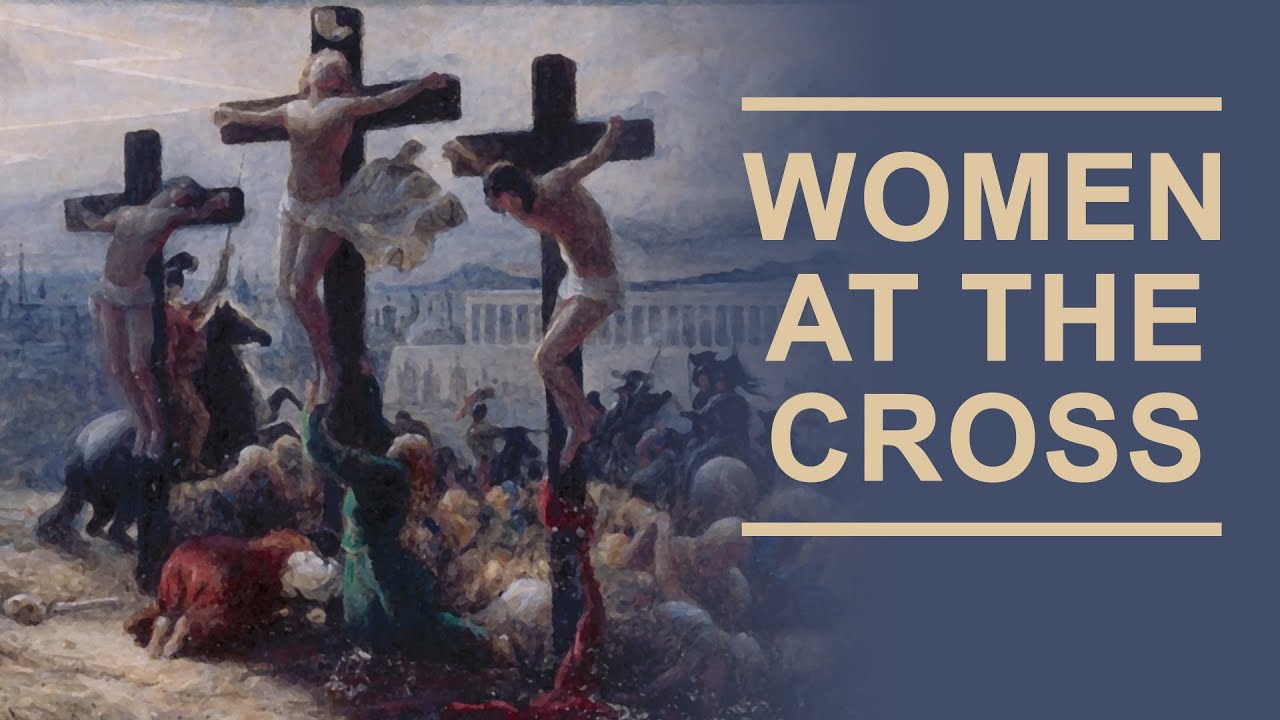
The Women at the Cross of Jesus - YouTube

A closer look at the seven women who stood by at the cross

Matthew 27:55-56 Many women were also there, looking on from a distance; they had followed Jesus from Galilee and had provided for him. Among them were Mary Magdalene, and Mary the mother of James and Joseph, and the mother of the sons of Zebedee.

Jn 19:25-27 25Near the cross of Jesus stood his mother, his mother’s sister, Mary the wife of Clopas, and Mary Magdalene. 26When Jesus saw his mother there, and the disciple whom he loved standing nearby, he said to his mother, Dear woman, here is your son, 27and to the disciple, Here is your mother. From that time on, this disciple took her into his home.

“For in Christ you are all sons of God, through faith.  For as many of you as were baptized into Christ have put on Christ.  There is neither Jew or Greek, there is neither slave or free, there is neither male or female; for you are all one in Christ Jesus” (Galatians 3:26-28).

Until Jesus came on the scene, women were treated as inferior beings.

* In the Mediterranean region and the near East, women were viewed as inferior beings because of the Patriarchal society.

*  In the Greek society women were held as inferior to men and destined only for childbearing.

*  In the Roman society a wife was the property of her husband.

*  In the Jewish societies, women were only sexual beings, servants of their husbands, with limited religious roles.  They were not required to make the annual pilgrimages to Jerusalem for the feasts. They didn’t go to school where the Torah was taught. They were not allowed to read or recite scriptures.

After Jesus began his ministry, his treatment and acceptance of women caused problems with the Jewish leaders, his apostles, and others who had allowed women to become stereotyped as lower class beings.  The women Jesus met were astonished at his attitude and acceptance of them [Examples: the Samaritan woman at Jacob’s well (John 4:7-26); the woman caught in adultery (John 8:1-11)].  Jesus was the original women’s liberator of his day.

It is no wonder then that women became devoted to Jesus and his teachings.  It offered them freedom they never had before.  Several women became disciples of Jesus and supported him in his ministry – Mary Magdalene, Joanna, Susanna and many other unnamed women (Luke 8:2). These women, along with others mentioned in other scriptures – Salome, Mary of Bethany, and Mary the wife of Clopas, along with Mary the mother of Jesus, followed Jesus throughout his ministry to his crucifixion on the cross.

These women not only supported Jesus with their means, but they also stood by Jesus and accompanied him throughout his arrest and trial (Luke 23:39-43) and the crucifixion (Matthew 27:56; Mark 15:40; John 19:25).

What caused these women to be so dedicated to Jesus and his ministry? The answer, in part, is that they had benefited so greatly from Jesus (some had been healed of evil spirits and infirmities by Jesus) and his teachings (like that of Galatians 3:26-28) that they couldn’t help but want to show their gratitude and love by using their time, talents, and treasury in the support of Jesus’ ministry.

These women could do very little. They couldn’t speak before the Sanhedrin in Jesus’ defense; they couldn’t appeal to Pilate; they couldn’t stand against the crowds; they couldn’t overpower the Roman guards.

But they did what they could. They stayed at the cross when the disciples had not even come; they followed Jesus’ body to the tomb; they prepared spices for his body. Because these women used the opportunities they had, they were the first to witness the resurrection.

God blessed their devotion, initiative, and diligence. As believers, we should take advantage of the opportunities we have and do what we can for Christ.

The phrase ‘Afar off” indicates that some did stand far off, but some stood at the very foot of the cross (John 19:25). Their love ran deep and their devotion and courage clear. They triumphed over fear. They did not fear the enemies of Christ: they triumphed simply because they loved (1 John 4:18).

Some of these people followed Jesus for the wrong reasons.  Some wanted only physical nourishment and were rebuked by Jesus (John 6:22-26).  Others, when they realized what was necessary to follow Jesus, no longer went about with him (John 6:66).  At times even his own apostles denied knowing him (Matthew 26:69-75), fled from his presence (Matthew 26:56) and followed from afar (Matthew 26:58).

However, there was one group who stuck with Jesus throughout his ministry, from beginning to end.  These were the women, we’ll call them “female finalists,” who had totally committed themselves to Jesus and his ministry.  Through thick and thin, good times and bad, these women were always there, ready to assist and help Jesus in any way that they could.  These women deserve a closer look from us today.

Who were these women who stuck with Jesus through thick and thin?  What were their backgrounds, their names, their reason for such devotion to Jesus’ ministry? What is their backgrounds, their names, their reason for such devotion to Jesus’ ministry?  To answer these questions, we must go to the gospel accounts.

Seven women are mentioned in scripture by name as being followers and/or active supporters of Jesus and his ministry:

  1. Mary Magdalene:

This Mary was distinguished from other Marys by her second name. It signified the place of her birth.  Just as Jesus was sometimes called the Nazarene because of the town Nazareth, Mary was called Magdalene because of the town Magdala.  Magdala means “tower or castle” and in the time of Christ was a thriving1 populous town on the coast of Galilee, about three miles from Capernaum.

Dye works and primitive textile factories contributed to the wealth of the community.  It may be that Mary Magdalene’s source of funds from which she supported Jesus’ ministry was somehow derived from these town industries.

Mary Magdalene was one of the women that Jesus healed of evil spirits and infirmities (Luke 8:2).  She was said to have had seven demons cast out from her by Jesus (Mark 16:9, Luke 8:2).  She supported the ministry of Jesus from out of her means (Luke 8:2). She was present at Jesus’ crucifixion, standing afar off with several other women (Matthew 27:56: Mark 15:40; John 19:25).

She was also present at the tomb of Jesus when Joseph of Arimathea and Nicodemus rolled the stone to the door of Jesus’ tomb (Matthew 27:61; Mark 16:47; John 19:38-42).  She went to the tomb of Jesus after the sabbath, toward the dawn of the first day of the week, and witnessed the great earthquake and the angel rolling the stone away from the tomb of Jesus (Matthew 28:1-2; Mark 16:1; Luke 24:10; John 20:1).  Jesus appeared to her as she stood weeping outside the tomb (John 20:11-17).

  1. Joanna

Joanna’s husband was Chuzas, the house-steward of Herod.  As a steward, Chuzas was responsible for the management of Ilerod’s monetary expenditures, a position which would require both intelligence and ability.  This position of importance in all probability afforded both Chuzas and his wife Joanna an excellent income, from which Joanna may have supported the ministry of Jesus.

This Joanna was the wife of Chuzas, Herod’s steward (Luke 8:3). She was one of the women that Jesus healed of evil spirits and infirmities (Luke 8:2).  She supported the ministry of Jesus from out of her means (Luke 8:2).  She went to the tomb of Jesus after the sabbath, toward the dawn of the first day of the week, and witnessed the great earthquake and the angel rolling the stone away from the tomb of Jesus (Matthew 28:1-2; Mark 16:1; Luke 24:10).

  1. Salome

Salome was possibly one of Jesus’ earliest female disciples, having ministered to him when he was in Galilee.

This Salome was the wife of Zebedee, the mother of the two apostles James and John, and the sister of Mary, the mother of Jesus (John 19:25).  She ministered to Jesus when he was in Galilee (Matthew 20:20-28; Mark 15:40-41).  She sought seats of honor for her sons from Jesus (Matthew 20:20-24; Mark 10:35-40).  She was present at Jesus’ crucifixion, standing afar off with several other women (Matthew 27:56; Mark 15:40; John 19:25).

She went to the tomb of Jesus after the sabbath, toward the dawn of the first day of the week, and witnessed the great earthquake and the angel rolling the stone away from the tomb of Jesus (Matthew 28:1-2; Mark 16:1; Luke 24:10).

  1. Mary of Bethany

This Mary was the Mary that annointed the head of Jesus with an alabaster jar of expensive ointment (pure nard) and wiped his feet with her hair (Matthew 26:6-13; Mark 14:3-9; John 12:1-8).  Mary sat at the feet of Jesus when he visited in the house of her sister, Martha (Luke 10:38-42).  Mary also had a brother named Lazarus whom Jesus raised from the dead (John 11:5-44).  Mary, Martha and Lazarus were among those whom Jesus loved (John 11:5).

  1. Susanna

This Susanna was one of the women that Jesus healed of evil spirits and infirmities (Luke 8:2). She supported the ministry of Jesus from out of her means (Luke 8:2).

  1. Mary, “the other Mary” Scripture References:

This Mary was the wife of Clopas and the mother of the apostle James the younger and Joses (Joseph).

She was present at Jesus’ crucifixion, standing afar off with several other women (Matthew 27:56; Mark 15:40; John 19:25).  She was also present at the tomb of Jesus when Joseph of Arimathea and Nicodemus rolled the stone to the door of Jesus’ tomb (Matthew 27:61; Mark 16:47; John 19:38-42).  She went to the tomb of Jesus after the sabbath, toward the dawn of the first day of the week, and witnessed the great earthquake and the angel rolling the stone away from the tomb of Jesus (Matthew 28:1-2; Mark 16:1; Luke 24:10).

  1. Mary, the mother of Jesus Scripture References:

Mary was the earthly mother of Jesus (Matthew 1:18,25).  Mary’s husband was Joseph (Matthew 1:18), a carpenter by trade (Mark 6:3).  An angel appears to her and tells her she will conceive (Luke 1:26-38).  Mary visits Elizabeth for three months (Luke 1:39-56).  Mary travels with Joseph to Bethlehem; gives birth while there (Luke 2:1-7).  Mary travels with Joseph to Jerusalem with Jesus, who is now 12 years old (Luke 2:41-42).  She asks Jesus to help at a marriage feast when wine runs out (John 2:1-11).

She went with her sons to the temple to see Jesus but crowds prevented them (Matthew 12:46-50; Mark 3:31-35; Luke 8:19-21).  She was also the mother of four other sons – James, Joses, Judas and Simon – and at least two daughters (Matthew 13:55-56; Mark 6:3).  She was present at Jesus’ crucifixion, standing afar off with several other women (Matthew 27:56; Mark 15:40; John 19:25).  Her future care was entrusted to the apostle John by Jesus as he hung on the cross (John 19:26-27).  She was present with the 11 apostles in the upper room in Jerusalem after Jesus’ ascension (Acts 1:14).

Additional comments

(Matthew 27:55-56) Women: the courage and love of the women. Note the following phrases.

“Many women”: many were there. When the men fled, many women demonstrated courage.

“Afar off”: some did stand far off, but some stood at the very foot of the cross (John 19:25). Their love ran deep and their devotion and courage clear. They triumphed over fear. They did not fear the enemies of Christ: they triumphed simply because they loved (1 John 4:18).

27:55-56 Many women were also there, looking on from a distance; they had followed Jesus from Galilee and had provided for him. Among them were Mary Magdalene, and Mary the mother of James and Joseph, and the mother of the sons of Zebedee.NRSV There had been many people at the cross who had come only to mock and taunt Jesus or, like the religious leaders, to revel in their apparent victory. Some of Jesus’ faithful followers were at the cross as well. Among the disciples, only John was there, and he recorded in his Gospel in graphic detail the horror he observed. Many women were also there, looking on from a distance, perhaps out of custom or out of respect for the victims.

Some of these women had come from Galilee with Jesus for the Passover. Mary Magdalene was from Magdala, a town near Capernaum in Galilee. She had been released from demon possession by Jesus (Luke 8:2). Another Mary is distinguished (from Mary Magdalene and Mary, Jesus’ mother) by the names of her sons who may have been well known in the early church. The mother of the sons of Zebedee was the mother of the disciples James and John. Her name was Salome (20:20-21), and she was probably the sister of Jesus’ mother. These women had been faithful to Jesus’ ministry, following him and providing for his material needs (see Luke 8:1-3). John wrote that Jesus’ mother, Mary, was present and that, from the cross, Jesus spoke to John about taking care of Mary (John 19:25-27).

These women could do very little. They couldn’t speak before the Sanhedrin in Jesus’ defense; they couldn’t appeal to Pilate; they couldn’t stand against the crowds; they couldn’t overpower the Roman guards. But they did what they could. They stayed at the cross when the disciples had not even come; they followed Jesus’ body to the tomb; they prepared spices for his body. Because these women used the opportunities they had, they were the first to witness the Resurrection. God blessed their devotion, initiative, and diligence. As believers, we should take advantage of the opportunities we have and do what we can for Christ.

Jn 19:25-27 25Near the cross of Jesus stood his mother, his mother’s sister, Mary the wife of Clopas, and Mary Magdalene. 26When Jesus saw his mother there, and the disciple whom he loved standing nearby, he said to his mother, Dear woman, here is your son, 27and to the disciple, Here is your mother. From that time on, this disciple took her into his home.

There is a glaring absence of Jesus’ men at the cross. To our knowledge, John was the only one who showed up. He stands in the midst of a group of women. John mentions four of them while Mark and Matthew mention only three. Of course Mark and Matthew list the women who were there when Jesus died and John lists the women present when Jesus was first crucified. It may be that John and Mary leave right after Jesus speaks to them.

In Jesus’ third recorded statement from the cross, he commits his mother into the care of John, his beloved friend. This makes sense when you understand that Jesus’ “family” consists of faithful believers and Jesus’ half-brothers don’t fit that category until after his resurrection. Furthermore, John is likely Jesus’ cousin (see chart below). Therefore, he is the closest believing relative. John takes her home and gently cares for this dear saint who had a “sword wound” in her soul (Lk 2:35).

John 19:25 Mark 15:40 Matthew 27:56
Mary, Jesus’ mother
Mary’s sister Salome Mother of Zebedee’s sons (i.e., James and John)
Mary, wife of Clopas Mary, mother of James the younger & Joses Mary, mother of James and Joses
Mary Magdalene Mary Magdalene Mary Magdalene

Section 168 – Women Watch the Tomb, Soldiers Guard It (Mt 27:61-66; Mk 15:47; Lk 23:55-56)

[MT 27:]61Mary Magdalene and the other Mary {the mother of JosesMK} were sitting there opposite the tomb {[and] saw where he was laid.MK)

[LK 23:]55[These] women, who had come with Jesus from Galilee, followed Joseph and saw the tomb and how his body was laid in it. 56Then they went home and prepared spices and perfumes. But they rested on the Sabbath in obedience to the commandment.

The women want to pay their respects to Jesus but they keep their distance from these two prominent members of the Sanhedrin. How could they know these two are sympathetic to Jesus? They also stand aloof due to the social stigma of men and women interacting. In addition, Carson states that Roman law forbade mourning executed criminals (p. 584). These two Marys want, in the worst way, to show their love for Jesus, but are simply not able to at this time. So they do the next best thing. They find out where Jesus is laid and plan to return at the first available opportunity. That will be at the crack of dawn on Sunday. For now, they must run back to town before sundown to prepare the necessary spices for anointing the dead.

Mt 27:62-66 62The next day, the one after Preparation Day, the chief priests and the Pharisees went to Pilate. 63 Sir, they said, we remember that while he was still alive that deceiver said, After three days I will rise again. 64So give the order for the tomb to be made secure until the third day. Otherwise, his disciples may come and steal the body and tell the people that he has been raised from the dead. This last deception will be worse than the first.

65Take a guard, Pilate answered. Go, make the tomb as secure as you know how. 66So they went and made the tomb secure by putting a seal on the stone and posting the guard.

Pilate thinks that he is through with Jesus at 9 a.m. on Friday. But about 3 p.m. the Jews come and ask that he order Jesus’ legs broken. Shortly after that Joseph arrives and asks for the body of Jesus. Now, Saturday morning a third delegation arrives asking Pilate to provide a guard for the tomb.

It’s not that the chief priests believe Jesus could raise from the dead. They are merely afraid that his disciples will try to propagate a hoax by stealing Jesus’ body and claiming a resurrection in fulfillment of Jesus’ “supposed” prophecy. Now it should not surprise us that the chief priests were more perceptive than the disciples in interpreting Jesus’ words. They were pretty good at hermeneutics, just miserably poor at faith.

They ask Pilate for a Roman guard for three days. Pilate’s response is somewhat ambiguous: “You have a guard” [echete koustōdian]. Does he mean, “You got it. Take what you need” (as the NIV implies)? Or does he mean, “You have your own temple guards, use them!”? While both are possible, it seems that Pilate actually gives the Jews a Roman guard. First, he wants to avoid any potential conflicts which could flair into civil disorder. Second, after the resurrection, these guards are worried about the report getting back to Pilate (Mt 28:14). Temple guards wouldn’t be concerned about that. The Roman guards, on the other hand, might very well report first to the Sanhedrin rather than to Pilate since it was the Sanhedrin’s corpse that they “lost” (Mt 28:11). Third, Pilate puts his seal on the stone in front of the tomb. This is nothing more than a bit of clay or wax impressed with a signet ring, which holds a cord in front of the tomb. By moving the stone you would break the seal of clay/wax. It is not hard to do, but by doing so you violate the authority of the one whose seal is on the clay/wax. In other words, with Pilate’s seal on the stone, they would be trespassing against the authority of Rome — a violation of no small consequence. Thus, this little seal would dissuade would-be thieves. God, however, is not intimidated by it in the least.

Conclusion of Lesson

Love is like that.  When you love Jesus and his church, you don’t hesitate to give yourself totally to see the kingdom grow.  Your time becomes God’s time; your talents become God’s talents; your money and material possessions become God’s money and possessions.  You want to take a stand for his kingdom.  Jesus becomes the center of your life, number one in your heart.  The “female finalists” of this study knew that they had found the pearl of great price.  Their actions, their deeds, everything they said and did, proclaimed that they were followers of Jesus.  They were like the seed grown in the good soil in the parable of the sower (Matthew 13:18-23).  They stuck with Jesus through thick and thin.

As you look at your own life today, can you say that others see Jesus reflected in your life?  Does your light shine brightly for Jesus and his church or is it hid under a basket?  Does your checkbook prove that Jesus is first in your life?  If you punched a time clock for the Lord, how long would it show you that you actually put in for the work of the kingdom? Can you really say that Jesus is the lord of your heart?  Why not put him first right now and forever more.  Look what God has done for you – what are you doing for him?

 
Leave a comment

Posted by on May 23, 2022 in cross


A Closer Look at the Cross: Forgotten Forgiveness (Judas Iscariot)


A closer look at the apostle who was never at the cross

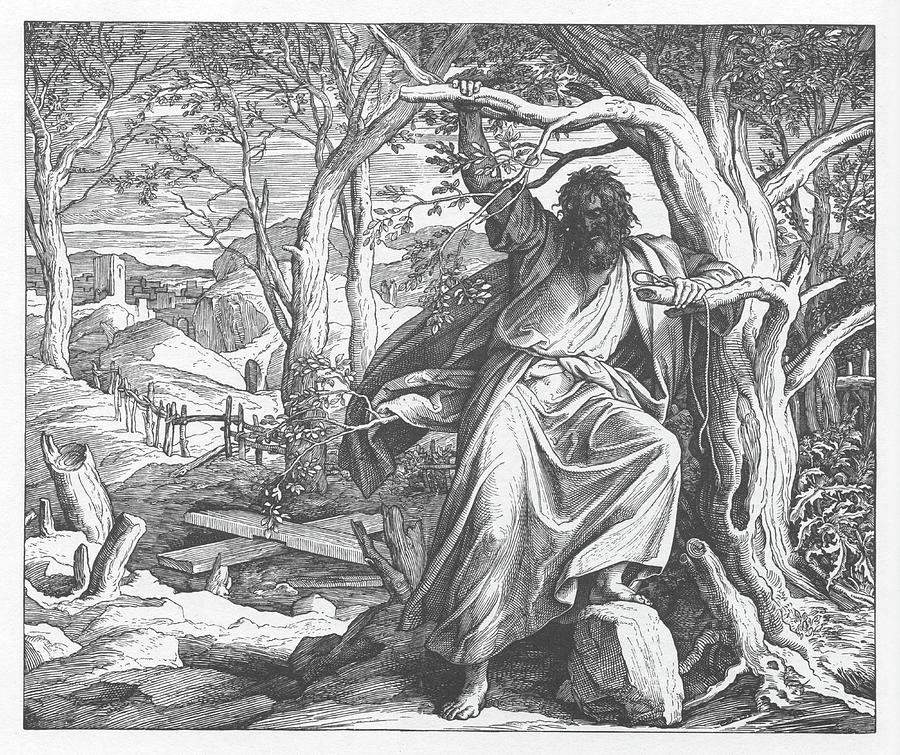
Death of Judas Iscariot, Gospel of Matthew Painting by New Digital Museum

61 Because Jesus was aware that his disciples were complaining about this, he said to them, “Does this cause you to be offended? 62 Then what if you see the Son of Man ascending where he was before? 63 The Spirit is the one who gives life; human nature is of no help! The words that I have spoken to you are spirit and are life. 64 But there are some of you who do not believe.” (For Jesus had already known from the beginning who those were who did not believe, and who it was who would betray him.) 65 So Jesus added, “Because of this I told you that no one can come to me unless the Father has allowed him to come.” 66 After this many of his disciples quit following him and did not accompany him any longer. 67 So Jesus said to the twelve, “You don’t want to go away too, do you?” 68 Simon Peter answered him, “Lord, to whom will we go? You have the words of eternal life. 69 We have come to believe and to know that you are the Holy One of God!” 70 Jesus replied, “Didn’t I choose you, the twelve, and yet one of you is the devil?” 71 (Now he said this about Judas son of Simon Iscariot; for Judas, one of the twelve, was going to betray him.) (John 6:61-71)

1 Then, six days before the Passover, Jesus came to Bethany, where Lazarus lived, whom he had raised from the dead. 2 So they prepared a dinner for Jesus there. Martha was serving, and Lazarus was among those present at the table with him. 3 Then Mary took three quarters of a pound of perfumed oil made of pure nard and anointed the feet of Jesus. She then wiped his feet dry with her hair. (Now the house was filled with the fragrance of the perfumed oil.) 4 But Judas Iscariot, one of his disciples (the one who was going to betray him) said, 5 “Why wasn’t this perfumed oil sold for three hundred silver coins and the money given to the poor?” 6 (Now Judas said this not because he was concerned about the poor, but because he was a thief. As keeper of the money box he used to take what was put into it.) 7 So Jesus said, “Leave her alone. She has kept it for the day of my burial. 8 For you always have the poor with you, but you don’t always have me” (John 12:1-7).

In this life there are a good many things that are very difficult to understand or to explain. In our text, the disciples found it extremely difficult to comprehend what Jesus was saying when He told them that one of them was about to betray Him.

When we read John’s account of this event in John chapter 13, we find it hard to understand why the disciples didn’t quickly grasp what Jesus was telling them. When we marvel at the “dullness” of the disciples, we forget that we read through John’s Gospel somewhat like I watch one of my favorite movies—“What’s Up, Doc?”

I know that movie so well I start laughing a full minute before one of my favorite funny scenes occurs on screen. For example, I love the chase scene down the hills of San Francisco, especially the one in which the plate glass window is finally broken, after a number of near misses. And so, when that part gets close, I start warming up for it, laughing at what seems to be nothing at all.

We are tempted to read the Gospels like I watch my favorite movies. We know the entire story, from beginning to end. And thus, when we read any one text, we know what came before, just as we know how it all will end. We know, for example, that Jesus is going to be arrested, found guilty, and crucified—all within a few hours. We also know that He is going to be raised from the dead, and that He will ascend into heaven and return to the Father. But what is so clear to us in hindsight was not at all clear to the disciples.

They heard Jesus say that He was about to be betrayed by one of them. Peter even inquired of Jesus (through John, it would seem) about just who the betrayer was. And Jesus told John that it would be the one who took from His hand the piece of bread that He dipped into the dish. Yet when Jesus dipped the bread into the dish and gave it to Judas, who took it, no one did anything. No one even seemed to grasp what Jesus had just indicated. You have to understand that what Jesus was saying was so far from what they expected, they simply could not grasp what seemed to be clearly indicated.

All of this was for a reason—a very important reason. This reason we shall see as we study our text in this lesson. There are many important truths for us to consider and to apply here, so let us listen well, and let us ask the Spirit of God to make the meaning and the application of this text clear to us.

Judas—Putting the Pieces Together

In every listing of the names of the twelve apostles in the New Testament, this apostle’s name is always listed last (Matthew 10:1-4; Mark 3:14-19; Luke 6:13-16).  In addition, every listing of this apostle’s name carries with it a derogatory comment that always follows. It is either “who betrayed him” (Matthew 10:4; Mark 3:14) or “who became a traitor” (Luke 6:16).  The apostle’s name is Judas.


The name “Judas” is the Greek form of the Hebrew name “Judah1‘.  One of the twelve tribes of Israel had this name.  It was also the name of a famous soldier who led the Jews in a successful revolt against Syria.  To a Jew, the name “Judas” had the same honor as the name George Washington or Abraham Lincoln would have to an American citizen.  Its small wonder then that many Jewish parents named their sons Judas during the period when Jesus was born on the earth.  It was a practice soon to end.

To distinguish the apostle Judas from the other men named Judas, a second name was attached to his name.  It was “Iscariot”.  Iscariot could have meant many things – gain or reward; an inhabitant of Jericho, or a dagger-bearer.  Whatever it meant, Iscariot was also the name Judas’ father wore.  His name was Simon Iscariot (John 6:71; 13:26).  Some biblical scholars think Iscariot meant leather coat, implying that Simon and Judas may have been leatherworkers by trade.  Others think Iscariot meant the name of a place, Kerioth or Cariot, an Old Testament town in the region of Judea (Joshua 15:25).

Each of the Gospel writers has chosen to include certain details about Judas and to exclude others. It may be helpful for us to begin this lesson by reviewing what we know about Judas in sequential order:[1]

  • Judas is chosen as one of the 12 (Luke 6:12-16; Mark 3:13-19).
  • Judas is sent out as one of the 12 (Matthew 10:4).
  • Judas accompanies Jesus with the other 11 disciples, beholding our Lord’s character and power, and hearing Him teach and claim to be the Messiah (Mark 3:14).
  • In all of this, Judas never comes to faith in Jesus as his Messiah (John 6:64-65; 13:10-11, 18; 17:12).
  • Judas is put in charge of the money box (John 12:6; 13:29).
  • Judas begins to steal money from the money box (John 12:6).
  • When Mary anoints the feet of Jesus, Judas is incensed by her extravagance, and is distressed that Jesus would allow such “waste” when this ointment could have been sold, and the proceeds given to the poor. He apparently manages to convince his fellow-disciples, so that they verbally harass Mary also (John 12:1-8; Matthew 26:6-13; Mark 14:3-9).
  • [At this same point in time the chief priests and Pharisees are panic-stricken by our Lord’s growing popularity, as a result of the raising of Lazarus and then the triumphal entry (John 11:45-53, 57; 12:9-11). They wanted to seize Jesus privately, but not during the feast of Passover, lest they stir up the crowds (Matthew 26:3-5; Mark 14:1-2). They become so desperate they decide to kill not only Jesus (John 11:53), but Lazarus as well (John 12:10). The time was “ripe” for Judas to come to them with his proposal of betrayal.]
  • Shortly after this incident with Mary, in which Jesus rebukes Judas and the other disciples, Judas goes to the chief priests and strikes a deal with them to betray Jesus and to hand Him over to them (Matthew 26:14-15; Mark 14:10-11).
  • Judas begins to look for the right moment to hand Jesus over to the chief priests and Pharisees (Mark 14:11).
  • Judas is with Jesus and the disciples during the first part of the Last Supper, apparently in the place of honor, next to Jesus (John 13:26).
  • At the meal, Jesus indicates that one of the disciples will betray Him (Matthew 26:20-25; Mark 14:17-21), and then, by means of His dipping a piece of bread and handing it to Judas, our Lord indicates that it is Judas who will betray Him (Mark 14:20; John 13:21-27).
  • Judas accepts the bread Jesus offers him, after which Satan immediately possesses him (John 13:27).
  • Jesus dismisses Judas to carry out his terrible deed (John 13:27-30).
  • Judas leads the soldiers to Jesus, where he identifies Jesus as the One they are to arrest by kissing Him (Matthew 26:47-50; Mark 14:43-46; Luke 22:47-48; John 18:1-9).
  • Judas regrets his betrayal and tries to reverse his actions by returning the money, but it is too late. Judas then goes out and hangs himself (Matthew 27:3-10; Acts 1:15-19).

Judas—Who Would Have Ever Thought …

John 13:18-20 (NIV) 18“I am not referring to all of you; I know those I have chosen. But this is to fulfill the scripture: ‘He who shares my bread has lifted up his heel against me.’19“I am telling you now before it happens, so that when it does happen you will believe that I am He. 20 I tell you the truth, whoever accepts anyone I send accepts me; and whoever accepts me accepts the one who sent me.”


“This is to fulfill the scripture: ‘He who shares my bread has lifted up his heel against me.'”NIV Jesus’ betrayal was necessary to fulfill Scripture—specifically, Psalm 41:9. The expression pictures a horse lifting his heel ready for a swift (and sometimes deadly) kick. Jesus drew from Psalm 41 because it describes how one of David’s friends turned against him:

 “Even my close friend, whom I trusted, he who shared my bread, has lifted up his heel against me” (Psalm 41:9 niv). This may have referred to the story of David’s trusted companion, Ahithophel, who betrayed David and then went and hanged himself (see 2 Samuel 16:20-17:3, 23). Judas, who had been with Jesus and was a trusted companion (Judas was keeper of the money), would betray Jesus and then hang himself. Next to the Blessed Sacrament itself, your neighbor is the holiest object presented to your senses. If he is your Christian neighbor, he is holy in almost the same way, for in him also Christ vere latitat—the glorifier and the glorified, God Himself, is truly hidden.

C. S. Lewis


Jesus had known all along that Judas would betray him (see 6:64, 70-71; Matthew 17:22-23; 20:17-19), but he predicted the betrayal in the presence of his disciples so that they would realize, when the betrayal actually occurred, that it had been prophesied in Scripture (see Acts 1:16). This would strengthen their faith.

13:20 “Whoever receives one whom I send receives me; and whoever receives me receives him who sent me.”NRSV This verse follows the thought of verse 16, where Jesus spoke of being a servant to the one who sent him. He would send forth his disciples so that whoever would receive them would receive Jesus and, in turn, receive the one who sent Jesus—God the Father.

The word betrayal denotes horrible breaches of trust, unfaithfulness, treachery, and duplicity. In the history of a nation, it is acts of treason whereby someone gives “aid and comfort to the enemy.” In the history of the church, it is the immoral behavior of pedophile priests, money-grubbing televangelists, and inexcusable silence in the face of racism or sexism. In families, it is adultery or child abuse. In our individual Christian lives, it is following the tugs of flesh over Spirit and offering our pitiful rationalizations for sin over repenting in genuine sorrow.

Today’s sermon is about betrayal. No, actually it is about two acts of betrayal. And I hope there is more to be learned here this morning from the second than the first. I have certainly prayed while preparing it that God will use this sermon not to drive anyone to the despondency of a Judas-response to failure but to the gracious restoration of a Simon Peter-response. For this lesson is ultimately not about Judas or Peter but – as all the Gospel of John was originally crafted to be – Jesus.

The light of Jesus dispels the darkness of Satan. The grace of Jesus conquers the sins we commit and even the addictive power of sin in our hearts. The forgiveness of Jesus is greater than the judgment and condemnation of our arrogant disobedience.

Yes, Jesus knew what Judas was up to that night. But when did he know? It isn’t clear. One thing that does seem clear to me is that Jesus did not pick Judas back at the start of his ministry and manipulate him to that awful deed.

If Judas betrayed the Son of Man because God willed and arranged the event, he was obedient rather than disobedient to the divine will and thus should be honored rather than despised for his deed. Judas wound up fulfilling a divine prediction, but the ability to predict accurately testifies to God’s timelessness (i.e., ability to know past, present, and future simultaneously) rather than to his activity in bringing about all things that happen.

Who would have ever thought that Jesus would be betrayed, and by one of His 12 disciples? Answer: none of the 12, except for Judas. The Gospels do not really mention Judas all that often, but we do read of Judas being sent out by Jesus, along with the other 11 (Matthew 10:1ff.; Mark 3:19; Luke 9:1ff.).

Imagine, Judas was used of our Lord to manifest His power over the demons, and over every kind of illness: “He called his twelve disciples and gave them authority over unclean spirits so they could cast them out and heal every kind of disease and sickness” (Matthew 10:1).

Who would have ever imagined that he would refuse to trust in Jesus as his Messiah?

Think of all the miracles which took place before the eyes of Judas. He witnessed the casting out of demons, the giving of sight to the blind (even a man born blind—John 9), and the raising of the dead (e.g., John 11). He was there when Jesus stilled the storm (see Luke 8:22-25) and when He walked on the sea (John 6:19-21). He took part in the feeding of the 5,000 (John 6:1-14) and then of the 4,000 (Matthew 15:29-39). Each of the other disciples grew in their faith at each new manifestation of our Lord’s power, love, mercy, and holiness. Not so with Judas.

And yet Judas seems to be the last one any of the disciples would have suspected of being the betrayer of whom our Lord was speaking. He seems to have been seated in the place of honor at the Last Supper, beside our Lord. He was the one entrusted with the money that was given to our Lord (John 12:6). Even when Jesus indicated that Judas was His betrayer by giving him the bread, the disciples still did not recognize him for who he really was. In this sense, I think, Judas was just like his “real father,” the devil:

13 For such people are false apostles, deceitful workers, disguising themselves as apostles of Christ. 14 And no wonder, for even Satan disguises himself as an angel of light. 15 Therefore it is not surprising his servants also disguise themselves as servants of righteousness, whose end will correspond to their actions (2 Corinthians 11:13-15).

A dark shadow now falls across the scene as Jesus deals with Judas, the traitor. Judas was the treasurer of the group (12:6) and was certainly held in high regard by his fellow disciples.

At this hour, Jesus had TWO great concerns: (1) to fulfill the Word of God (13:18-30), and (2) to magnify the glory of God (vs. 31-35).

Jesus tells His disciples that what He is saying does not apply to all of them. His words apply to those whom He has chosen. The inference is clear: there is someone among them whom He has not chosen, who is not a true believer. It is to this person that our Lord’s words do not apply. But what has Jesus been “saying” that doesn’t apply to Judas? In particular, I think it is the words of verse 17: “If you understand these things, you will be blessed if you do them.”

Jesus has been speaking of following His example by serving one another. They, as His disciples, are to do as their Master has shown them. But Judas is not truly one of our Lord’s own; he is not a true disciple of Jesus. He, of course, is not “clean,” as the other disciples are (13:10-11). Jesus has just said that the real blessing is not just in knowing and understanding what He has taught them, but in doing what He commands. If they (His disciples) do what He has commanded, they will be blessed. Good works are of great benefit to the Christian.

They contribute nothing to his salvation, but they do evidence true conversion, and they are the basis for the believer’s rewards. Good works benefit the Christian, but good works don’t benefit the unbeliever. When good works are done apart from faith in Jesus Christ for salvation and sanctification, they are actually an insult to God. Unbelievers who work to please Him while rejecting His Son are saying, in effect, “No thanks. I don’t need your righteousness, I’ll just produce my own. And so I won’t need your Son, either.”

Trusting and obeying God is a blessing; working hard to please God by our own efforts is an offense. Thus, only the Christian can be truly blessed by doing what God commands.

The things of which our Lord is speaking to His disciples are very important, and of great value to His true disciples (excluding Judas). His words are prophetic, spelling out what the future holds for Him and for Judas. The things of which He is speaking actually fulfill prophecy. Judas, who is reclining beside Jesus, and is about to take the bread which He offers, is one whose terrible betrayal has been foretold. John now cites Psalm 41:9, which says, ‘The one who eats my bread has turned against me.’

It was a very significant thing to sit at a man’s table and to eat his bread. In the ancient world, sharing a meal together was almost to make a covenant (in fact covenants were often made in association with a meal).[2] You will remember the story of Lot, who invites perfect strangers into his home in Sodom, and then makes a shocking offer to the men of Sodom, in an attempt to protect his guests:

1 Now the two angels came to Sodom in the evening, and Lot was sitting in the gate of Sodom. When Lot saw them, he rose to meet them, and he bowed himself with his face toward the ground. 2 And he said, “Here now, my lords, please turn in to your servant’s house and spend the night, and wash your feet; then you may rise early and go on your way.” And they said, “No, but we will spend the night in the open square.” 3 But he insisted strongly; so they turned in to him and entered his house. Then he made them a feast, and baked unleavened bread, and they ate. 4 Now before they lay down, the men of the city, the men of Sodom, both old and young, all the people from every quarter, surrounded the house. 5 And they called to Lot and said to him, “Where are the men who came to you tonight? Bring them out to us that we may know them carnally.” 6 So Lot went out to them through the doorway, shut the door behind him, 7 and said, “Please, my brethren, do not do so wickedly! 8 See now, I have two daughters who have not known a man; please, let me bring them out to you, and you may do to them as you wish; only do nothing to these men, since this is the reason they have come under the shadow of my roof” (Genesis 19:1-8, NKJV).

To share a meal with guests was to offer them not only provisions, but protection. Lot was so committed to his obligation to protect these “strangers” that he was willing to sacrifice the sexual purity of his daughters to protect his guests. I don’t pretend to comprehend this, or to defend it. I am simply pointing out that in the ancient Jewish (and perhaps more broadly, the Near Eastern) culture, inviting a man into one’s home and to his table was a most significant act.

If the host made such commitments to his guest(s), one would expect the guest to reciprocate in some way. And yet the one who sat at our Lord’s table and ate His bread actually betrayed Him. What a horrible thing Judas is about to do to His Master, and immediately after eating His bread.

John wants us to see that all this was prophesied ahead of time. He wants His disciples to know that much prophecy will not be understood at the time it is being fulfilled, but in hindsight, it can be seen clearly.[3] Jesus is not telling His disciples these things so that they will understand Him and believe what He has said at that very moment. He tells them these things which will occur in the future so that they will believe when these prophecies are fulfilled. Then His disciples will know that Jesus was in full control, bringing about that which the Father had purposed in eternity past. In His earthly sojourn, Jesus was always in control. He was never, a helpless victim.

In verses 19 and 20, Jesus makes it very clear that all of this is about believing in Him. Jesus tells His disciples what is going to happen ahead of time, so that when these things take place they will remember He told them beforehand and believe in Him as the Messiah.[4]

While Jesus is indirectly exposing Judas as an unbeliever here, His emphasis is on believing, believing in Him. This is the thrust of verse 20. Whoever accepts the one Jesus sends (and He will soon be sending them out, as we see in the “Great Commission”—Matthew 28:18-20) accepts Jesus Himself. Whoever accepts Jesus as God’s “sent One” (see John 1:1-18) accepts the Father, who sent Him.

Although these words seem to be directed to His believing disciples, I cannot help but wonder if this is not also one last appeal to Judas to believe. To betray Jesus is certainly the opposite of believing in Him.

He quotes from Psalm 41:9: “Even my close friend, whom I trusted, he who shared my bread, has lifted up his heel against me.”

Jesus was concerned that Judas’ treachery would not weaken His disciples’ faith. This is why He related it to the  Word of God: when the disciples saw all of this fulfilled, it would make their faith stronger (see John 8:28). Judas had been disloyal, but He expected them to be loyal to Him and His cause.

After all, He was God the Son sent by God the Father. They were the Christ’s chosen representatives; to receive them would be the same as receiving the Father and the Son: “I tell you the truth, whoever accepts anyone Isend acceptsme; and whoever accepts me accepts the one who sent me.”

The remarkable thing is that the others at the table with Jesus did not know that Judas was an unbeliever and a traitor. Up to the very hour of his treachery, Judas  was protected by the Savior whom he betrayed.

  1. Judas, the Trusted Apostle

Very little is known about Judas Iscariot until the last week of Jesus life.  Until then, only his name, the accompanying derogatory remarks, and one other reference is ever made about him.  This other reference is found in John 6:70 where Jesus stated to Peter, “Did I not choose you, the twelve, and one of you is a devil?”  John states in the following verse that Jesus “spoke of Judas, the son of Simon Iscariot, for he, one of the twelve, was to betray him”.  These references paint a negative picture of Judas Iscariot, but remember Matthew, Mark, Luke and John wrote their gospel accounts after the fact, thereby prejudicing their views of Judas because of what he had done.

Until Judas Iscariot committed his betrayal act, the apostles apparently placed great trust in Judas.  They made him their treasurer and entrusted him with the financial affairs of the group (John 13:29).  This, in spite of the fact that Matthew would have been the logical member of the group to perform this important duty because of his background, training and experience as a tax collector.  At the Last Supper, it is thought that

Judas held the seat of honor next to Jesus, sitting to his left.  If so, Jesus would have been reclining on Judas at the table and, as the host, would have been passing the prepared food to Judas first.  This appears to have been the case when Jesus said he would pass the morsel of food to the one that was to betray him (John 13:26).  When Judas left the table to perform his infamous betrayal, none of the other apostles suspected anything, for they assumed he was leaving to perform a noble deed or purchase additional supplies (John 13:29);  it being a tradition among the Jews to give something to the poor on the passover night.  The apostles must have put complete trust in Judas until the very moment of his evil deed.

  1. Judas, the Treacherous Apostle

As the last days of Jesus’ life on earth unfold, additional glimpses of Judas Iscariot are shown.  Two days before the Passover, Jesus was in Bethany at the house of Simon the leper (Matthew 26:6-13; Mark 14:3-9; Luke 7:37-38; John 12:1-8).  A supper had been prepared for Jesus; Martha was serving and her brother Lazarus was seated at the table with Jesus (John 12:2).  Mary, the sister of Martha and Lazarus, brought an alabaster jar of very expensive ointment – a pound of pure nard, and poured it on the head of Jesus as he sat at the table (Matthew 26:7; Mark 14:3; John 12:3).  She wiped his feet with her hair (John 12:3).  The house filled with the fragrance of the ointment (John 12:3).  When the apostles saw what took place, Judas Iscariot said, “Why was this ointment wasted?  For this ointment might have been sold for more than three hundred denani, and given to the poor” (Mark 14:4-5).

John’s account explains Judas’ motive for his remark, “This he said, not that he cared for the poor but because he was a thief, and as he had the money box he used to take what was put into it” (John 12:6).  Thus Judas was found to possess the root of all evil – the love of money (I Timothy 6:10).  It may have been Judas that the apostle was referring to when he wrote, “It is through this craving that some have wandered away from the faith and pierced their hearts with many pangs.” (I Timothy 6:10).  If only Judas could have known the words of Hebrews 13:5, “Keep your life free from love of money, and be content with what you have.”

Money was Judas’ main motivation for betraying Jesus.  He bargained with the chief priests to betray Jesus for thirty pieces of silver (Matthew 26:14-16; Mark 14:10-11; Luke 22:3-6).  Thirty pieces of silver was the price of a good slave; the wages of the foolish shepherd in Zechariah 11:12-13.  Judas had seen Jesus escape from hostile crowds in the past (Luke 4:29-30; John 8:59; 10:31,39).  In his own mind Judas probably reasoned that Jesus would do it once again.  He would be thirty pieces of silver richer and Jesus would still remain free.  What could be better? But this time things did not go as Judas had expected they would.  Jesus did not try to escape.  He was arrested and taken away by the crowd. Judas had made a terrible error. in judgement.  He had found out what happens when Satan enters your heart (Luke 22:3; John 13:2).  Even an appeal from Jesus himself had not stopped him.  When Jesus told the apostles that one of them would betray him (Matthew 26:21-25; Mark 14:18-21; Luke 22:21-23; John 13:18-30), Judas had asked, “Is it I, Master?” and Jesus had said to him, “You have said so.” (Matthew 26:25).

III. Judas, the Terminated Apostle

When Judas realized that Jesus wasn’t going to escape from his captors, he began to rethink his plan.  He repented and took back the thirty pieces of silver to the chief priests and elders saying, “I have sinned in betraying innocent blood” (Matthew 27:4).  But the chief priests and elders would not take back the money saying, “What is it to us?  See to it yourself” (Matthew 27:4).  Judas then threw down the money in the temple and departed.  He then went out and hanged himself (Matthew 27:5).  His body later fell and burst open (Acts 1:18).

Conclusion of Lesson

Judas had tried to make things right with himself and Jesus.  He had urged the chief priests and elders to take the money back, hoping possibly that they would let Jesus go.  When that attempt failed, he lost all sense of reality.  He forgot what he had seen Jesus do in the past forgive the sins of other people – the paralytic let down through the roof (Matthew 9:2-8; Mark 2:1-5; Luke 5:17-26); the Samaritan woman at Jacob’s well (John 4:7-26), the man who had been lame for thirty-eight years (John 5:2-14); the woman caught in adultery (John 8:3-11).

Time and time again he had seen the bad situations Peter had gotten himself into, seen him turn to Jesus for help, and each time be restored to the good graces of the Lord.  He had heard Jesus teaching, “if you do not forgive men their trespasses, neither will your Father forgive your trespasses” (Matthew 6:15); and “Come unto me all who labor and are heavy laden, and I will give you rest.  Take my yoke upon you, and learn from me; for I am gentle and lowly in heart, and you will find rest for your souls” (Matthew 11:28).  He had heard Jesus’ reply to Peter’s question about how many times a brother should be forgiven, M1 do not say to you seven times, but seventy times seven” (Matthew 18:21)   He had heard Jesus teach that, “All sins will be forgiven the sons of men, and whatever blasphemes they utter; but whoever blasphemes against the Holy Spirit never has forgiveness, but is guilty of an eternal sin” (Mark 3:28-29).  He had seen the compassion Jesus had for men and women who were possessed of demons.

Yes, he had seen and heard all this, but he did not apply what he had seen and heard to his own situation he found himself in.  He thought life wasn’t worth living and that Jesus would never forgive him.  He did not give himself a second chance.  He forgot the compassion and comfort available to him through Jesus.  He took matters into his own hands and committed suicide.

When life’s burdens crumble in around you, suicide is not the answer. When you think you are in bad situations that you can never get out of, suicide is not the answer.  When you have done things that you think you can’t forgive yourself for, suicide is not the answer answer.’  Christ is the answer!  He can made life’s darkest hour light again. He can turn night into day.  He can restore your self-respect and help you work your problems out.  He can be the lighthouse in the storm.  Don’t give up on yourself; give yourself to Jesus.  Suicide is not the answer, but the Savior is!


The Hill of Regret by Max Lucado

While Jesus was climbing up the hill of Calvary, Judas was climbing another hill; the hill of regret. He walked it alone. Its trail was rock-strewn with shame and hurt. Its landscape was as barren as his soul. Thorns of remorse tore at his ankles and calves. The lips that had kissed a king were cracked with grief And on his shoulders he bore a burden that bowed his back-his own failure.

Why Judas betrayed his master is really not im­portant. Whether motivated by anger or greed, the end re­sult was the same-regret. A few years ago I visited the Supreme Court. As I sat in the visitor’s chambers, I observed the splendor of the scene. The chief justice was flanked by his colleagues. Robed in honor, they were the apex of justice. They repre­sented the efforts of countless minds through thousands of decades. Here was man’s best effort to deal with his own failures.

How pointless it would be, I thought to myself, if I approached the bench and requested forgiveness for my mistakes. Forgiveness for talking back to my fifth grade teacher. Forgiveness for being disloyal to my

friends. Forgiveness for pledging “I won’t” on Sunday and saying “I will” on Monday. Forgiveness for the countless hours I have spent wandering in society’s gutters.

It would be pointless because the judge could do nothing. Maybe a few days in jail to appease my guilt, but forgiveness? It wasn’t his to give. Maybe that’s why so many of us spend so many hours on the hill of regret. We haven’t found a way to forgive ourselves.

So up the hill we trudge. Weary, wounded hearts wrestling with unresolved mistakes. Sighs of anxiety. Tears of frustration. Words of rationalization. Moans of doubt. For some the pain is on the surface. For others the hurt is submerged, buried in a rarely touched 3ubsrrata of bad memories. Parents, lovers, professionals. Some trying to forget, others trying to remember, all trying to cope. We walk silently in single file with leg irons of guilt. Paul was the man who posed the question that is on all of our lips, “Who will rescue me from this body of death?”

At the trail’s end there are two trees.

One is weathered and leafless. It is dead but still sturdy. Its bark is gone, leaving smooth wood bleached white by the years. Twigs and buds no longer sprout, only bare branches fork from the trunk. On the strongest of these branches is tied a hangman’s noose. It was here that Judas dealt with his failure.

If only Judas had looked at the adjacent tree. It is also dead; its wood is also smooth. But there is no noose tied its crossbeam. No more death on this tree. Once was enough. One death for all.

Those of us who have also betrayed Jesus know better than to be too hard on Judas for choosing the tree he did. To think that Jesus would really unburden our shoulders and unshackle our legs after all we’ve done to him is not easy to believe. In fact, it takes just as much faith to believe that Jesus can look past my betrayals as it does to believe that he rose from the dead. Both are just as miraculous.

What a pair, these two trees. Only a few feet from the tree of despair stands the tree of hope. Life so paradox­ically close to death. Goodness within arm’s reach of dark­ness. A hangman’s noose and a life preserver swinging in the same shadow.

But here they stand.

One can’t help but be a bit stunned by the incon­ceivability of it all. Why does Jesus stand on life’s most bar­ren hill and await me with outstretched, nail-pierced hands? A “crazy, holy grace” it has been called. A type of grace that doesn’t holdup to logic. But then I guess grace doesn’t have to be logical. If it did, it wouldn’t be grace.

[1] This sequence may not be flawless, although I think it comes close to reality, but let the reader judge for himself.

[2] See Exodus 24:9-11.

[3] See Isaiah 48:5-7.

[4] Our text reads, “… so that when it happens you may believe that I am he.” The “I am” is, of course, significant, and the “he” must be referring to His identity as Israel’s Messiah.

 
1 Comment

Posted by on May 19, 2022 in cross


A closer look at the cross of Christ – If God became man, we kind of man would He be?  


  1. IF GOD BECAME MAN, we would expect His human life to be sinless, since it isIncarnation (Christianity) - Wikipedia inconceivable that God would sin.

Jesus fulfilled this expectation in that He lived completely above sin.

2 Cor. 5:21: “God made Him who had no sin to be sin for us, so that in Him we might become the righteousness of God.”

Because He possessed perfect moral purity, He is never seen to admit the need of penitence, and never confessed himself to be guilty of sin.

“In vain do we look through the entire biography of Jesus for a single stain or the slightest shadow of his moral character. There never lived a more harmless being on earth. He injured nobody, he took advantage of nobody. He never spoke an improper word, he never committed a wrong action.”

Hebrews 4:15: “For we do not have a high priest who is unable to sympathize with our weaknesses, but we have one who has been tempted in every way, just as we are–yet was without sin.”

  1. IF GOD BECAME MAN, we would expect Him to be holy in character.

Not only would there be an absence of sin in His life, but there would be in Him a superb degree of holiness (This is one of the strongest proofs that Jesus was God incarnate).

  1. IF GOD BECAME MAN, it would be expected that His words be the greatest ever spoken.

Jesus is called the Master Teacher, and is lauded in the greatest of human literatures. His teachings in the gospels are read more, quoted more, translated into more languages, loved more, believed more, represented more in art, and set to more music.. .than the words of any other person.

He never had a course in teaching, yet knew more about it than anybody else. He had perfect knowledge about God and about God’s will, and it showed in His lifestyle. He never had to guess what God wanted Him to do.

He also had perfect knowledge of the people whom He taught. He knew what was in man (John 2:25).

He taught new things in terms of old ones, and used farming, fishing, cooking, and buying land to make his points clear.

He adapted this method to the particular person or group He wished to teach.

He was the  Master Teacher, too, because He practiced what He taught. Even His enemies said: “No one ever spoke the way this man does?” (John 7:46).

  1. IF GOD BECAME MAN, it would be expected that He exert tremendous influence over human minds.

“Whether Jesus be man or God, whether the gospels be mainly fiction or fancy, certainly a historic person named Jesus gave men such an impact as to be unequaled by far in the entire annals of human history.”

Just think.. some 2,000 after His life, he is still quoted by so many!

  1. IF GOD BECAME MAN it would be expected that He would perform supernatural deeds.

The life of Christ is a constant illustration of the supernatural in Him:

* Protection by hosts of angels.

* His supernatural knowledge.

* His supernatural death.

* His supernatural resurrection.

* His supernatural ascension.

Turn to Matthew 11:3-5: relate context and discuss verses.

Matthew 11:3-5: “Are you the one who was to come, or should we expect someone else?” {4} Jesus replied, “Go back and report to John what you hear and see: {5} The blind receive sight, the lame walk, those who have leprosy are cured, the deaf hear, the dead are raised, and the good news is preached to the poor.”

* Remember what the Pharisee, Nicodemus said, in John 3:2, when he came to Jesus by night? “For no one could perform the  miraculous signs you are doing if God were not with him.”

The main purpose of his miracles were to cause people to believe on Him. Jesus wanted to prove to all honest hearts that He was sent from God to save men. Sickness and disease were used to furnish an occasion for Christ to heal and God to be glorified.

The resurrection of Christ alone is sufficient to convince any one and every one, if they are honest, that Jesus is the Son of God!

  1. IF GOD BECAME MAN, it would be expected that He manifest incomparable love for humanity.

He did this in a way no other has ever done.. He died even for His enemies. He demonstrated throughout His life that He was a friend of sinners.. the poor.. .the despised.. the broken-hearted.. .the downcast. His constant attituue was gentle, tneder, sympathetic, loving, and kind.

  1. IF GOD BECAME MAN, that He would be the most divine, unique, and incomparable person who ever lived.

This is confirmed by atheists, infidels, and unbelievers.. .who will at least appraise His character.

He was raised in an illiterate province, and had no special training…yet was (and is) accepted by the most scholarly, wealthy, powerful, and influential as being truly the Son of God.

‘Here is a man who was born in an obscure village, the child of a peasant woman. He grew up in another village, and that a dispised one. He worked in a carpenter shop for 30 years, and then for three years He was an itinerant preacher. he never wrote a book. He never held an office. He never owned a house. He never had a family. He never went to college. He never put His foot inside a really big city. He never traveled, except in His infancy, more than 200 miles from the place where He was born. He had no credentials but himself.

“While still a young man, the tide of popular opinion turned against Him. His friends ran away; one of them betrayed Him. He was turned over to His enemies…He went through the mockery of a trail. He was nailed upon a Gross between two thieves. His executors gambled for the only piece of property He had on earth, His seamless robe.

“When He was dead, He was taken down from the cross and laid in a borrowed grave through the courtesy of a friend. Nineteen wide centuries have come and gone, and today Jesus is the centerpiece of the human race, and the leader of all human progress. I am well within the mark when I say that all the armies that ever marched, all the navies that were ever built, all the parliaments that have ever sat, and all the kings that have ever ruled PUT TOGETHER have not affected the life of man upon this earth like this one solitary personality.

“All times dates from his birth, and it is impossible to understand or interpret the progress of human civilization in any nation on earth apart from His influence.

“Slowly through the ages man is coming to realize that the greatest necessity in the world is not water, Iron, gold, food, clothing, or even nitrate in the soil…but rather, Christ enshrined in human hearts, thoughts, and motives.”

 
Leave a comment

Posted by on May 16, 2022 in cross


A Closer Look at the Cross: An Unlikely Alliance (Herod and Pilate)


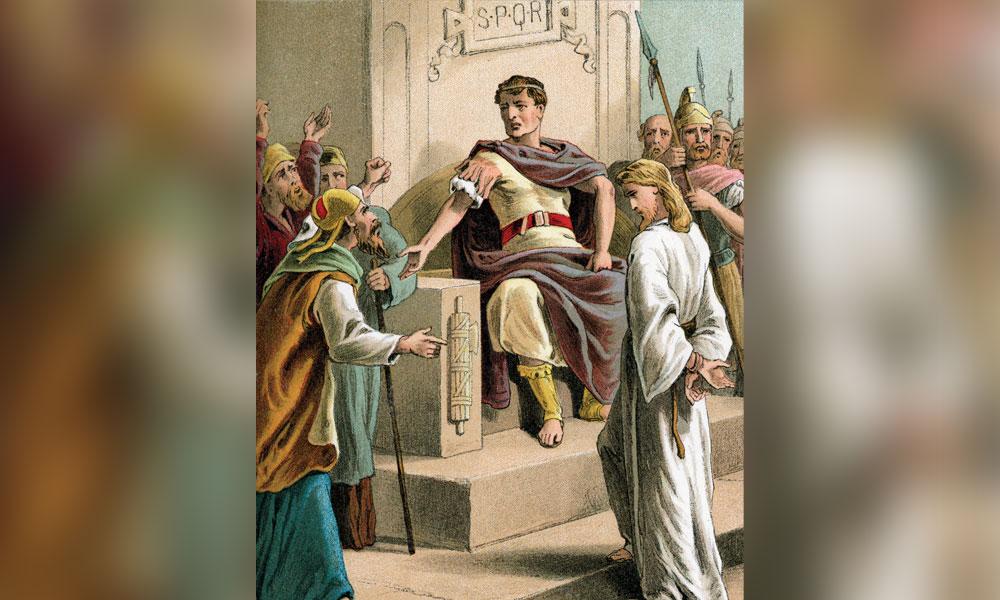
Who Was Pontius Pilate? | Faith Magazine

A closer look at the two Roman officials who found no sin in Jesus at the cross (Pilate and Herod)

 The Cross Does Interfere

Things have come to a pretty pass,” said a famous Englishman testily, “when religion is permitted to interfere with our private lives.”

To which we may reply that things have come to a worse pass when an intelligent man living in a Protestant country could make such a remark. Had this man never read the New Testament? Had he never heard of Stephen? or Paul? or Peter? Had he never thought about the millions who followed Christ cheerfully to violent death, sudden or lingering, because they did allow their religion to interfere with their private lives?

But we must leave this man to his conscience and his Judge and look into our own hearts. Maybe he but expressed openly what some of us feel secretly. Just how radically has our religion interfered with the neat pattern of our own lives? Perhaps we had better answer that question first.

I have long believed that a man who spurns the Christian faith outright is more respected before God and the heavenly powers than the man who pretends to religion but refuses to come under its total domination. The first is an overt enemy, the second a false friend. It is the latter who will be spewed out of the mouth of Christ; and the reason is not hard to understand.

One picture of a Christian is a man carrying a cross. “If any man will come after me, let him deny himself, and take up his cross daily, and follow me” (Luke 9:23). The man with a cross no longer controls his destiny; he lost control when he picked up his cross. That cross immediately became to him an all-absorbing interest, an overwhelming interference. No matter what he may desire to do, there is but one thing he can do; that is, move on toward the place of crucifixion.

The man who will not tolerate interference is under no compulsion to follow Christ. “If anyone would,” said our Lord, and thus freed every man and placed the Christian life in the realm of voluntary choice.

Yet no man can escape interference. Law, duty, hunger, accident, natural disasters, illness, death, all intrude into his plans, and in the long run there is nothing he can do about it. Long experience with the rude necessities of life has taught men that these interferences will be thrust upon them sooner or later, so they learn to make what terms they can with the inevitable. They learn how to stay within the narrow circular rabbit path where the least interference is to be found. The bolder ones may challenge the world, enlarge the circle somewhat and so increase the number of their problems, but no one invites trouble deliberately. Human nature is not built that way.

Truth is a glorious but hard mistress. She never consults, bargains or compromises. She cries from the top of the high places: “Receive my instruction, and not silver; and knowledge rather than choice gold” (Proverbs 8:10). After that, every man is on his own. He may accept or refuse, receive or set at naught as he pleases; and there will be no attempt at coercion, though the man’s whole destiny is at stake.

Let a man become enamored of eternal wisdom and set his heart to win her and he takes on himself a full-time, all-engaging pursuit. Thereafter he will have room for little else. Thereafter his whole life will be filled with seekings and findings, self-repudiations, tough disciplines and daily dyings as he is being crucified unto the world and the world unto him.

Were this an unfallen world the path of truth would be a smooth and easy one. Had the nature of man not suffered a huge moral dislocation there would be no discord between the way of God and the way of man. I assume that in heaven the angels live through a thousand serene millenniums without feeling the slightest discord between their desires and the will of God. But not so among men on earth. Here the natural man receives not the things of the Spirit of God; the flesh lusts against the Spirit and the Spirit against the flesh, and these are contrary one to the other. In that contest there can be only one outcome. We must surrender and God must have His way. His glory and our eternal welfare require that it be so.

Another reason that our religion must interfere with our private lives is that we live in the world, the Bible name for human society. The regenerated man has been inwardly separated from society as Israel was separated from Egypt at the crossing of the Red Sea. The Christian is a man of heaven temporarily living on earth. Though in spirit divided from the race of fallen men he must yet in the flesh live among them. In many things he is like them, but in others he differs so radically from them that they cannot but see and resent it. From the days of Cain and Abel the man of earth has punished the man of heaven for being different. The long history of persecution and martyrdom confirms this.

But we must not get the impression that the Christian life is one continuous conflict, one unbroken irritating struggle against the world, the flesh and the devil. A thousand times no. The heart that learns to die with Christ soon knows the blessed experience of rising with Him, and all the world’s persecutions cannot still the high note of holy joy that springs up in the soul that has become the dwelling place of the Holy Spirit.

In 4 B.C. Herod the Great, king of Palestine for almost 44 years, died and left his territory to his three sons – Philip, Archelaus, and Herod Antipas.  To Philip were given the territories northeast of the Sea of Galilee.  To Archelaus were given the territories of Samaria, Judea, and the northern part of Idumea.  To Herod Antipas were given the territories of Galilee and Persia east of the Jordan.

In 6 A.D., Archelaus was deposed of his territories because of his incapability.  Rather than replace him with a suitable ruler from the Jews, the Romans decided to place Judea under direct control of Roman governors, who became known as procurators.  From 26-36 A.D., this post was held by Pontius Pilate.

The idea of Roman control was a constant irritant to the Jews.  Because of this, the Jews made sure they were also a constant irritant to the Romans.  Some Jews hated the Romans so much that they organized themselves into a subversive political party known as “Zealotswhose sole purpose became the advocation of the overthrow of the Roman government.  In an effort to appease the Jews in Jerusalem, the procurators of Judea moved their headquarters from Jerusalem to Caesarea, on the Mediterranean coast.

However, they left occupation troops in the city, and whenever large crowds of Jews were expected to assemble in Jerusalem for a religious holiday, the procurators usually made sure they were in the city to help maintain peace and order if it was needed. While there, they always stayed at the palace of Herod the Great.  This is why Pilate was in the city of Jerusalem before the annual passover feast at the time of Jesus1 arrest.

At this time in Jewish history, the Sanhedrin council’s jurisdiction had been reduced to the point that it really had very little authority over anything that was not strictly religious, and all its decisions had to be reported to the Roman government.  For this reason, the council had to get the procurator of Judea, Pontius Pilate, to confirm the sentence of death on Jesus before he could be executed.

When the Jews brought Jesus before Pilate for this confirmation, upon learning that Jesus had been in Galilee preaching (and therefore subject to Herod Antipas), Pilate attempted to avoid confirming Jesus’ sentence by sending Jesus to Herod, who also happened to be in the city because of the Passover feast. However, Herod spoiled Pilate’s plan by sending Jesus back to Pilate to make him pronounce the confirmation on Jesus’ death.

What type of men were these Roman officials who held Jesus’ life in their hands?  Could they be expected to use good judgment in their decisions concerning Jesus’ guilt or innocence?  How easily could they be influenced by their Jewish subjects?  In this lesson we will take a closer look at these two Roman officials involved in Jesus’ crucifixion.

  1. Herod Antipas

Herod Antipas was the son of Herod the Great by his Samaritan wife, Matthaec (Maithace).  He was a Sadducee and as such denied a moral government and a future state.  Sadducees were distinguished for their ferocity and inhumanity in their judicial capacity.  Herod Antipas had a historical profile that was far from commendable.  He was superstitious, inquisitive about truth without loving it, crafty, incestuous and wholly immoral, and foxlike in his cunning (Luke 13:32).

John the Baptist, who openly rebuked Herod Antipas for his gross immorality and defiance of the Mosaic law, paid for his courage with his life (Matthew 14:1,10; Luke 13:31; Leviticus 18:16).  To Herod’s credit, he was a subtle diplomat and an astute manager of difficult situations.

When Jesus was brought to Herod Antipas at Pilate’s direction (Luke 23:6-7), Herod was very glad to see Jesus (Luke 23:8).  In fact, Herod had long desired to see him (Luke 23:8).  This may have been because of Herod’s steward, Chuza.  His wife, Joanna, was a long-time follower and supporter of the ministry of Jesus (Luke 8:3).  It could have been through Chuza that Herod learned about Jesus’ ministry.  [It is also interesting to note that in later years, Manaen, a member of Herod’s court, became a member of the church at Antioch (Acts 13:1)).  However, Herod was confused about who Jesus may have been.  He at first thought Jesus might have been John the Baptist, raised from the dead (Matthew 14:1-2; Mark 6:14-16; Luke 9:7-9).  But the real reason Herod longed to see Jesus was not to learn of his ministry, but to see if some sign would be done by Jesus in his presence (Luke 23:8).

Herod questioned Jesus at some length, but Jesus made no answer (Luke 23:9).  As the chief priests and scribes stood near by, Herod and his soldiers treated Jesus with contempt and mocked him (Luke 23:10-11).  Herod then had Jesus arrayed in gorgeous apparel and sent him back to Pilate (Luke 23:11) without finding Jesus guilty of any crime.


  1. Pontius Pilate

Pontius Pilate was the 5th procurator or governmental representative of imperial Rome in Palestine.  He reigned from 26-36 A.D.  Pontius, his famtly name, meant “belonging to the sea”; Pilate, taken from a Latin word, meant 11one armed with a javelin”. He was hated by the Jews and Samaritans for his covetous and cruel government and actions.  History tells us that he was recalled from his office by the emperor Tiberius and banished to Vienna in Gaul by Caligua, where he took his own life by drowning in 41 A.D.

Pilate’s first encounter with Jesus:

Jesus is brought before Pilate by the Jewish leaders on the morning of Jesus’ crucifixion (Matthew 27:1-2; Mark 15:1; Luke 23:1; John 18:28) Pilate asks the leaders, “What accusation do you bring against this man?”  (John 18:29)

The Jewish leaders tell Pilate, “If this man were not an evildoer we would not have handed him over.”  (John 18:30)

The Jewish leaders accuse Jesus saying, “We found this man perverting our nation, and forbidding us to give tribute to Caesar, and saying that he himself is Christ a king.” (Luke 23:2)

Pilate tells the leaders, “Take him yourselves and judge him by your own law.”  (John 18:31)

The Jewish leaders respond, “It is not lawful for us to put any man to death.”  (John 18:31)

The chief priests and elders accuse Jesus, but Jesus makes no answer to them.  Pilate asks Jesus, “Have you no answer to make?  Do you not hear (see) how many things they testify (bring) against you?”  (Matthew 27:13; Mark 15:4)

Jesus gives Pilate no answer.  Pilate wonders greatly. (Matthew 27:14; Mark 15:5)

Pilate questions Jesus, ”Are you the King of the Jews?” (Matthew 27:11; Mark 15:2;Luke 23:3; John 18:33)

Jesus asks Pilate, “Do you say this of your own accord, or did others say It to you about me?”  (John 18:34)

Pilate answers Jesus, “Am I a Jew?  Your own nation and the chief priests have handed you over to me; what have you done?” (John 18:35)

Jesus answers Pilate, “My kingship Is not of this world; if my kingship were of this world, my servants would fight; that I might not be handed over to the Jews; but my kingship is not from the world.”  (John 18:36)

Pilate asks Jesus, “So you are a king?”  (John 18:37)

Jesus answers Pilate, “You have said so.” “You say that I am a king.  For this I was born, and for this I have come into the world, to bear witness to the truth.  Every one who is of the truth hears my voice.” (Matthew 27:11; Mark 15:2; Luke 23:3; John 18:37)

Pilate asks Jesus, “What is truth?”  (John 18:38) Pilate tells the chief priests and multitudes, “I find no crime

In this man.”  (Luke 23:4; John 18:38)

The chief priests tell Pilate, “He stirs up the people, teaching throughout Judea, from Galilee even to this place.” (Luke 23:5)

In an effort to shirk the responsibility of sentencing Jesus to death  Pilate, upon hearing that Jesus had taught in Galilee, sends Jesus to Herod (Galilee was Herod’s territory) to let him deal with the Jews.  However, Herod spoils Pilate’s plan and returns Jesus to Pilate to make him pronounce the final decision on Jesus.

Pilate’s second encounter with Jesus:

Pilate calls together the chief priests, rulers, and the people and says, “You brought me this man as one who was perverting the people; and after examining him before you, behold I did not find this man guilty of any of your charges against him; neither did Herod, for he sent him back to us.  Behold, nothing deserving death has been done by him; I will therefore chastise him and release him.”  (Luke 23:13-17)

The crowd at the feast comes up to Pilate and asks him to do what he was wont to do for them.  (Mark 15:8) Pilate addresses the crowd at the feast, “I find no crime in him. Whom do you want me to release for you, Barabbas or Jesus who is called Christ?” (Matthew 27:16; Mark 15:9; Luke 23:18; John 16:39)

Pilate knew it was out of envy that they (Jews) had delivered him (Jesus) up.  (Matthew 27:18; Mark 15:10) Pilate’s wife sends word to Pilate, “Have nothing to do with that righteous man, for I have suffered much over him today in a dream.”  (Matthew 27:19)

The crowd said to Pilate, “Away with this man, and release to us Barabbas11  (Luke 23:18; John 18:40)

Desiring to release Jesus, Pilate again addresses the crowd, “Behold, I am bringing him out to you, that you may know that I find no crime in him.  Which of the two do you want me to release for you?” (Matthew 27:21; Luke 23:20; John 19:4)

After the crowd demands Barabbas, Pilate asks them, “Then what shall I do with Jesus who is called Christ?” (Matthew 27:22; Mark 15:12)


After the crowd demands Jesus be crucified, Pilate asks them,

Why, what evil has he done?  I have found in him no crime deserving death; I will therefore chastise him and release him.” (Matthew 27:23; Mark 15:14; Luke 23:22)

Pilate tells the crowd, “Take him yourselves and crucify him, for I find no crime in him.”  (John 19:6)

The Jews answer Pilate, “We have a law, and by that law he ought to die, because he has made himself the Son of God.” (John 19:7)

Pilate asks Jesus, “Where are you from?” but Jesus makes no answer.  Pilate then says, “Will you not speak to me?  Do you not know that I have the power to release you, and power to crucify you?”  (John 19:9-10)

Jesus answers Pilate, “You would have no power over me unless it had been given you from above; therefore he who delivered me to you has the greater sin.”  (John 19:11)

After the crowd demands again that Jesus be crucified, Pilate saw that he was gaining nothing and a riot was beginning.  He took water and washed his hands before the crowd, saying, .1 am Innocent of this man’s blood; see to it yourselves.” (Matthew 27:24; John 19:12)

The crowd answers, “1f you release this man, you are not Caesars’ friend; every one who makes himself a king sets himself against Caesar.”  (John 19:12)

Pilate says to the Jews, “Here is your King!”  (John 19:14)

The crowd answers,  “Away with him, away with him, crucify him!” (John 19:15)

Pilate asks the crowd, “Shall I crucify your King?” (John 19:15)

The chief priests answer, “We have no king but Caesar!” (John 19:15)

Pilate has Jesus scourged and releases him to be crucified. (Matthew 27:26; Hark 15:15; Luke 23:25; John 19:16)

Pilate wrote a title and put it on the cross.  It read “Jesus of Nazareth, the King of the Jews.”

(Matthew 27:37; Mark 15:26; John 19:19-22)

Conclusion of Lesson

Two men stood in the way of the Jews sending Jesus to his death – Herod and Pilate.  When confronted by the angry multitude of Jews who brought Jesus to them, both Herod and Pilate found no wrongdoing in Jesus, but allowed him to be crucified because of their fear of the Jews.

Today, we as Christians also allow Jesus to be crucified anew in the world we live in.  Because of our own fears, we often let others be critical of Jesus, the church  members of the church, God’s word, ministers and missionaries of the gospel, and our brothers and sisters Christ.

We do this by not speaking up and taking a stand when others speak evil of God’s workers on the earth now.  Are we any better than Herod or Pilate in this regard?  No, the truth is we are just as guilty as both these men were because of our fears also.  Christians have been the “silent majority” for too long.


ADDITIONAL THOUGHTS

23:11-12 Now Herod and his soldiers began mocking and ridiculing Jesus. Then they put a royal robe on him and sent him back to Pilate. Herod and Pilate, who had been enemies before, became friends that day.NLT With this prisoner refusing to answer, and looking very little like a great miracle worker, Herod and his soldiers began mocking and ridiculing Jesus. Angry at Jesus’ refusal to even answer questions for him, Herod resorted to making a mockery of this man who was supposedly such a great prophet, teacher, and miracle worker. To make fun of Jesus’ claim to be a king (probably Pilate had sent along this information when he sent Jesus to Herod), Herod put a royal robe on him, probably a purple color with fine workmanship. Herod did not even take the charge seriously. So he neither released the prisoner nor made a judgment about his guilt. He simply sent him back to Pilate.

Herod and Pilate had a rather tenuous relationship. Herod was the part-Jewish ruler of Galilee and Perea. Pilate was the Roman governor of Judea and Samaria. Those four provinces, together with several others, had been united under Herod the Great. But when Herod the Great died in 4 b.c., the kingdom was divided among his sons, each of whom was called “tetrarch” (meaning “ruler of a fourth part of a region”). Archelaus, the son who had received Judea and Samaria, was removed from office within ten years, and his provinces were then ruled by a succession of Roman governors, of whom Pilate was the fifth.

Herod Antipas had two advantages over Pilate: he had come from a part-Jewish monarchy, and he had held his position much longer. But Pilate had two advantages over Herod: he was a Roman citizen and an envoy of the emperor, and his position was created to replace that of Herod’s ineffective half brother. It is not surprising that the two men were uneasy around each other. Jesus’ trial, however, brought them together. Because Pilate had recognized Herod’s authority over Galilee, Herod had stopped feeling threatened by the Roman politician. And because neither man knew what to do in this predicament, their common problem united them.

PILATE HANDS JESUS OVER TO BE CRUCIFIED / 23:13-25 / 232

According to the Roman custom of releasing a criminal during the Passover season, Pilate presented Jesus to the people. Pilate did not want to bear the responsibility of putting an innocent man to death. But the crowd insisted on Barabbas’s freedom, the release of a known murderer. That Jesus literally died in Barabbas’s place vividly illustrates the ultimate significance of Jesus’ death. He took the place of not only Barabbas but also all who stand condemned before God’s perfect standard and trust in Christ for salvation.

23:13-14 Pilate then called together the chief priests, the leaders, and the people, and said to them, “You brought me this man as one who was perverting the people; and here I have examined him in your presence and have not found this man guilty of any of your charges against him.”NRSV Pilate thought he had gotten rid of his problem, only to have Jesus sent back. The decision still rested on his shoulders. So he attempted to let this innocent man go by telling Jesus’ accusers that he had examined him and not found this man guilty of any of their charges—including subversion, refusal to pay taxes, causing riots, or perverting the people. He didn’t even find Jesus guilty of being the king he claimed to be. Pilate may have incorrectly thought that Jesus was just a poor, deluded man; he did know, however, that Jesus was innocent.


DO WHAT’S RIGHT
When the stakes are high, it is difficult to stand up for what is right, and it is easy to see opponents as problems to be solved rather than as people to be respected. Had Pilate been a man of real courage, he would have released Jesus regardless of the consequences. But the crowd roared, and Pilate buckled. People are like Pilate when they know what is right but decide not to do it. When you have a difficult decision to make, don’t discount the effects of peer pressure. Realize beforehand that the right decision could have unpleasant consequences: social rejection, career derailment, public ridicule. Then think of Pilate and resolve to stand up for what is right no matter what other people pressure you to do.

23:15 “Herod came to the same conclusion and sent him back to us. Nothing this man has done calls for the death penalty.”NLT Pilate could back up his decision with Herod’s conclusion about Jesus. Herod had mocked Jesus but apparently had sent back word to Pilate that he could find nothing worthy of the death penalty. Jesus was tried a total of six times, by both Jewish and Roman authorities, but he was never convicted of a crime. Even when condemned to execution, he had been convicted of no felony. Today, no one can find fault in Jesus. Just like Pilate, Herod, and the religious leaders, however, many still refuse to acknowledge him as Lord.

23:16 “Therefore, I will punish him and then release him.”NIV The word “punish” here may not indicate the severe flogging that Jesus received after being sentenced, prior to his crucifixion (as noted in Matthew 27:26; Mark 15:15), although John 19:1 reports Jesus being flogged and then brought before the crowd. Pilate may have hoped that the flogging would appease the crowd, and they would pity the man and let him go. Pilate was planning to release Jesus, but first he would punish him—to pacify the Jews and teach the prisoner a lesson to stay out of trouble in the future.


RIDING THE FENCE
Pilate knew that Jesus had done nothing deserving punishment, and certainly not the death penalty. Even so, he didn’t have the courage or the decency to release Jesus; he tried to find a middle position that would allow Jesus to live and still appease the chief priests and the Jewish rulers. He failed, and Pilate is known forever as the man who ordered the crucifixion of the Son of God. Where do you stand? Have you made up your own mind about Jesus, whether to follow him as Lord and Messiah, or to dismiss him as a misguided martyr? There is no middle ground, no way to ride the fence when it comes to Jesus. You must either embrace him as Lord or reject him as a fraud.

23:17 (For it was necessary for him to release one to them at the feast).NKJV This verse does not exist in most modern English versions because it does not appear in any of the earliest Greek manuscripts. It may have been added later, perhaps picked up from Mark 15:6 to make a smoother transition between what is recorded in verses 16 and 18. This information helps the reader understand why the Jews called for the release of a prisoner in 23:18. But the text without 23:17 reads just as well; Pilate’s statement about releasing Jesus (23:16) is followed (23:18) by an immediate plea from the crowd to release Barabbas instead.

Each year at Passover, Pilate had made it a custom to release any prisoner the people requested. He may have instituted this custom to be on good terms with them as well as to help cover his many wrongful acts toward them. In any case, it became expected. So, according to the people, it was necessary for him to release a prisoner to them at the feast.

23:18-19 With one voice they cried out, “Away with this man! Release Barabbas to us!” (Barabbas had been thrown into prison for an insurrection in the city, and for murder.)NIV The suggestion that Pilate was going to release Jesus (23:16) sent the leaders into a frenzy. Pilate had wanted to release Jesus as the Passover gift (Mark 15:8-9). This had been a public announcement, so many people in the crowd cried out with one voice that Jesus must be put to death. The prisoner they wanted set free was a man named Barabbas. Oddly enough, Barabbas had been thrown into prison for an insurrection. Barabbas may have been somewhat of a hero among the Jews for his acts of rebellion against Rome, but he was on death row in a Roman prison. He was a true rebel and revolutionary and had even committed murder. The religious leaders had tried to pin this accusation on Jesus in order to have him put to death, but they chose a man who had done such acts and wanted him set free. Clearly their actions followed no logic. They merely wanted Jesus put to death and would go to any lengths to make sure it happened.

Who was Barabbas? Jewish men had names that identified them with their fathers. Simon Peter, for example, was called Simon, son of Jonah (Matthew 16:17). Barabbas is never identified by his given name, and this name, “Bar-abbas,” simply means “son of ‘Abba'” (or “son of daddy”). He could have been anybody’s son—and that makes for interesting commentary in that he represents all sinners. Barabbas, son of an unnamed father, committed a crime. Because Jesus died in his place, this man was set free. All people too, are sinners and criminals who have broken God’s holy law. Like Barabbas, they deserve to die. But Jesus has died in their place, for their sins, and, by faith, they have been set free.


THE DEBT
If you were heavily in debt—to the point where you could never pay it off on your own—and someone offered to pay your debt for you, what would you say? Or if you were sentenced to life in prison, and someone offered to serve your sentence for you, how would you respond? That is what Jesus has done for believers in his death on the cross. He has paid a debt that they could never repay; he has served a sentence that they deserved. Jesus was sentenced to death by crucifixion, a horrible form of death normally reserved for slaves and non-Roman citizens. In addition, the Old Testament taught (Deuteronomy 21:23) that anyone who died by hanging on a tree was cursed. His death atoned for our sins and fulfilled the requirements for breaking the covenant with God. How do you respond toward the one who has done all that for you? The only appropriate response is to live a life of gratitude and obedience before him.

23:20-21 Wanting to release Jesus, Pilate appealed to them again. But they kept shouting, “Crucify him! Crucify him!”NIV Pilate really wanted to release Jesus. Matthew recorded that even Pilate’s wife had experienced a dream about Jesus and had urged Pilate to let Jesus go (Matthew 27:19). Pilate must have been in a tight spot, because for some reason he put himself in the position of bargaining with the crowd. He had the authority to let Jesus go and then get on with his day; instead, he appealed to them again but to no avail. They wanted Jesus to be crucified.

This was, in itself, an amazing request. Crucifixion was the Roman penalty for rebellion and abhorrent to the Jews. They thought that Jesus’ crucifixion would demonstrate that his life and message had been under God’s curse, for Deuteronomy 21:23 says, “Anyone who is hung on a tree is under God’s curse” (niv). This is just what the Jewish religious leaders wanted. If Jesus were to be executed, it would be by crucifixion. He would die the death of a rebel and slave, not the death of the king he claimed to be. The crucifixion, from the Jewish perspective, was meant to brand Jesus as cursed by God; the crucifixion, from the Christian perspective, pictures Jesus as taking God’s curse against sin upon himself and allowing his people to be set free from sin.


TAKING A STAND
What are the nonnegotiables in your life? What are those core principles and bedrock beliefs that you will not compromise or sell out no matter what? Consider this question before you are in a crisis whereby your principles and beliefs are put to the test. Pilate seems to have had no such convictions. He knew Jesus was innocent and undeserving of punishment, yet he yielded to pressure from his political enemies to sacrifice him. Like Pilate, most people are put in positions where they have to decide where they will stand. Unlike Pilate, Christians must decide to stand firm on the truth revealed to them by God. Where do you stand?

23:22 For the third time he spoke to them: “Why? What crime has this man committed? I have found in him no grounds for the death penalty. Therefore I will have him punished and then release him.”NIV Pilate tried for the third time. He could not fathom why the crowd so badly wanted this man’s death. Jesus had not committed any crime; there were no grounds for the death penalty. Pilate repeated what he had said in 23:16. He would have Jesus punished and then release him.

There are two reasons why Luke stressed these three attempts Pilate had made to release Jesus. First, Luke wanted to show through his Gospel the innocence of Jesus before Roman law. Luke was giving evidence to prove the acceptability of Christianity to his Gentile readers. Second, he was establishing the Jewish guilt for Jesus’ death. In Acts, this is the basis of the evangelistic sermons to the Jews—you killed him; he died for you and rose again; now repent and be converted (Acts 2:36-38; 3:13-16; 13:26-41).

23:23-24 But the crowd shouted louder and louder for Jesus’ death, and their voices prevailed. So Pilate sentenced Jesus to die as they demanded.NLT Pilate wanted to release Jesus, but the crowd shouted louder and louder for Jesus’ death . . . so Pilate sentenced Jesus to die. No doubt Pilate did not want to risk losing his position, which may already have been shaky, by allowing a riot to occur in his province. As a career politician, he knew the importance of compromise, and he saw Jesus more as a political threat than as a human being with rights and dignity.

23:25 He released the man who had been thrown into prison for insurrection and murder, the one they asked for, and surrendered Jesus to their will.NIV Pilate did not want to give Jesus the death sentence. He thought the Jewish leaders were simply jealous men who wanted to get rid of a rival. When they threatened to report Pilate to Caesar (John 19:12), however, Pilate became frightened. Historical records indicate that Pilate had already been warned by Roman authorities about tensions in this region. The last thing he needed was a riot in Jerusalem at Passover time when the city was crowded with Jews from all over the Empire. So Pilate released Barabbas, the man who had been thrown into prison for insurrection and murder, and then surrendered Jesus to their will. One must wonder if Pilate ever questioned himself later—why he had allowed a mob to convince him to set a murderer free and execute an innocent man. Clearly Pilate was a man of little conviction and even less courage. But don’t forget the responsibility of these Jewish leaders who demanded that Jesus die—Matthew recorded that they accepted the responsibility, stating that Jesus’ blood could remain on them and on their children (Matthew 27:25).

Matthew’s Gospel explains that Pilate took water and washed his hands in front of the crowd to symbolize his innocence in condemning Jesus (Matthew 27:24), but this act was no more than self-deception. Jesus may have been surrendered to the will of the mob, but this was still a purely Roman execution. Pilate had to command it in order for it to happen. After releasing Barabbas, Pilate did allow Jesus to be flogged (Matthew 27:26; Mark 15:15) as part of the Roman legal code that demanded flogging before a capital sentence was carried out. The Romans did it to weaken the prisoner so that he would die more quickly on the cross. Jesus had predicted that he would be flogged (18:32).


ALMOST

Almost. It’s a sad word in any man’s dictionary.

“Almost.” It runs herd with “nearly,” “next time,” “if only,” and “just about.” It’s a word that smacks of missed opportunities, aborted efforts, and fumbled chances. It’s honorable mention, right field, on the bench, runnerup, and burnt cookies.

Almost. The one that got away. The sale that nearly closed. The gamble that almost paid off. Almost.

How many people do you know whose claim to fame is an almost?

  • “Did I ever tell you about the time I almost was selected as the Employee of the Year?”
  • “They say he almost made the big leagues.”
  • “I caught a catfish that was taller than me! Well … almost.”

As long as there have been people, there have been almosts. People who almost won the battle, who almost climbed the mountain, who almost found the treasure.

One of the most famous “almost’s” is found in the Bible. Pilate. Yet, what he missed was far more significant than a catfish or an award.

He almost performed what would have been history’s greatest act of mercy. He almost pardoned the Prince of Peace. He almost released the Son of God. He almost opted to acquit the Christ. Almost. He had the power. He had the choice. He wore the signet ring. The option to free God’s Son was …. . and he did ….. al­most.

Almost. How many times do these six ugly letters find their way into despairing epitaphs?

  • “He almost got it together.”
  • “She almost chose not to leave him.”
  • “They almost tried one more time.”
  • “We almost worked it out.
  • ‘He almost became a Christian.”

What is it that makes almost such a potent word? why is there such a wide gap between “he almost” and “he did”?

In the case of Pilate, we don’t have to look far to find an answer. It is Dr. Luke’s acute commentary in chap­ter 23 that provides the reason. Let’s tune in at verse 22: “A third time he [Pilate] said to them [the crowd], “why, what evil has he done? I have found in him no crime deserving death; I will therefore chastise him and release him.” But they were urgent, de­manding with loud cries that he should be crucified. And their voices prevailed (italics mine, RSV).

You’re right, Luke. Their voices prevailed. And, as a result, Pilate’s pride prevailed. Pilate’s fear prevailed. Pilate’s power-hunger prevailed.

“Their” voices were not the only voices, you know. There were at least three others Pilate could have heard.

He could have heard the voice of Jesus. Pilate stood eye to eye with him. Five times he postponed the decision hoping to gratify the mob with policies or lashings. Yet Jesus was always sent back to him. Three times he stood eye to eye with this compelling Nazarene who had come to reveal the truth. “what is truth?” Pilate asked rhetorically (or was it honestly?). Jesus’ silence was much louder than the crowd’s demands. But Pilate didn’t listen.

He could have heard the voice of his wife. She pleaded with him to have nothing to do with that righ­teous man for I have suffered much over him today in a dream.” One has to pause and wonder about the origin of such a dream that would cause a lady of purple to call a small-town Galilean righteous. But Pilate didn’t.

Or he could have heard his own voice. Surely he could see through the facade. “Ananias, Caiaphas, cut the phoney allegiance, you slobs; I know where your interests are.” Surely his conscience was speaking to him. “There is nothing wrong with this man. A bit mysterious maybe, but that’s no reason to string him up.”

He could have heard other voices. But he didn’t. He almost did. But he didn’t. Satan’s voices prevailed.

His voice often does prevail. Have you heard his wooings?

  • “0ne time won’t hurt.”
  • “She’ll never know.”
  • “Other people do much worse things.”
  • “At least you’re not being hypocritical.”

His rhetoric of rationalization never ends. The father of lies croons and woos like a traveling peddler, promising the moon and delivering disaster. “Step right up. Taste my brew of pleasure and sing my song ofsensu­ality. After all, who knows about tomorrow?”

God, meanwhile, never enters a shouting match with Satan. Truth need not scream. He stands perma­nently, quietly pleading, ever present. No tricks, no side shows, no temptations, just open proof.

People’s reactions vary. Some flow immediately to the peddler of poison. Others turn quickly to the Prince of Peace. Most of us, however, are caught somewhere in between, lingering on the edge of Satan’s crowd yet hover­ing within earshot of the message of God.

Pilate learned the hard way that this stance of “al­most” is suicidal. The other voices will win. Their lure is too strong. Their call too compelling. And Pilate also learned that there is no darker hell than the one of remorse. Washing your hands a thousand times won’t free you from the guilt of an opportunity ignored. It’s one thing to for-give yourself for something you did. It is something else to try to forgive yourself for something that you might have done, but didn’t.

Jesus knew that all along. For our own good, he demanded and demands absolute obedience. He never has had room for “almost” in his vocabulary. You are either with him or against him. With Jesus “nearly” has to be­come “certainly.” “Sometimes” has to become ‘(always.” “1f only” has to become “regardless.” And “next time” has to become   time.”

No, Jesus never had room for “almost” and he still doesn’t. “Almost” may count in horseshoes and hand grenades, but with the Master, it is just as good as a “never.”

From Holman Bible Dictionary

PILATE, PONTIUS (Pi’ luhte, Pahn’ shuhs) Roman governorof Judea remembered in history as a notorious anti-Semite and in Christian creeds as the magistrate under whom Jesus Christ “suffered” (1 Tim 6:13). The New Testament refers to him as “governor,” while other sources call him “procurator” or “prefect” (an inscription found in Caesarea in 1961). Pilate came to power about A.D. 26, close to the time when two of his contemporaries, Sejanus in Rome and Flaccus in Egypt, were pursuing policies apparently aimed at the destruction of the Jewish people. Pilate’s policies were much the same. His procuratorship consisted of one provocation of Jewish sensibilities after another. He broke all precedent by bringing into Jerusalem military insignia bearing the image of Caesar in flagrant defiance of Jewish law. He removed them only when the Jews offered to die at the hands of his soldiers rather than consent to such blasphemy. He brutally suppressed protest by planting armed soldiers, disguised as civilians, among the Jewish crowds. Against such a backdrop, it is not hard to understand the reference in Luke 13:1 to “The Galileans whose blood Pilate had mingled with their sacrifice (NIV).” Pilate was finally removed from office as the result of a similar outrage against Samaritan worshipers who had gathered on Mount Gerizim, their holy mountain, to view some sacred vessels which they believed Moses had buried there. When the Samaritans complained to Vitellius, the governor of Syria, Pilate was ordered to Rome to account for his actions to the emperor and is not mentioned again in reliable contemporary sources.

In view of his record, it is surprising that Pilate allowed himself to be pressured by a group of Jewish religious authorities into allowing Jesus to be executed. A possible explanation is that he already felt his position in the empire to be in jeopardy (note the threat implicit in John 19:12). Pilate seems to have had no personal inclination to put Jesus to death, and the New Testament writers are eager to show that he did not (Luke 23:4, 14, 22; John 18:38; 19:4, 6; compare Matt. 17:19). The Gospel writers sought to demonstrate that Jesus was innocent from the standpoint of Roman law and that consequently Christianity in their day was not a threat to the Roman political and social order. The fact that Jesus was brought to Pilate at all probably means that He had not been formally tried and convicted by the Sanhedrin, or Jewish ruling Council (if he had, he would probably have been stoned to death like Stephen, or like James the Just in A.D. 62). Instead, a relatively small group of Jerusalem priests, including the high priest, wanted to forestall any kind of a messianic movement by the people because of the repression it would provoke from the Romans (see John 11:47-50, 53). They maneuvered Pilate into doing their work for them (compare Luke 23:2). Pilate is represented in all the Gospels as questioning Jesus especially on the subject of kingship, but he remained unconvinced that Jesus was in any way a serious claimant to Jewish or Roman political power. The inscription he insisted on placing over the cross according to all the Gospels was Pilate’s last grim joke at Jewish expense: “This is the King of the Jews.” Anti-Jewish to the end, Pilate was telling the world, “What a sorry race this is, with such a pitiful figure for their king!”

HEROD (Hehr’ uhd) The name given to the family ruling Palestine immediately before and to some degree during the first half of the first Christian century. Their family history was complex, and what information has come down has been frequently meager, conflicting, and difficult to harmonize. The chief sources are the references in the New Testament, the Jewish historian Flavius Josephus, and a few obscure references by Roman historians, such as Dio Cassius, Plutarch, and Strabo.

The most prominent family member and ruler was Herod, son of Antipater who had been appointed governor of Idumea by Alexandra Salome, the Maccabean queen who ruled Palestine 78-69 B.C. With the permission of the Romans, Antipater left his son Phasael as Prefect of Jerusalem and his second son, Herod, governor of Galilee. See Intertestamental History.

Herod the Great. Herod the Great was born about the year 73 B.C. and was a son of the desert, well adapted to the political intrigues of ambition, lust for power, and efficiency at warfare. He made a trip to Rome and was confirmed by the Senate as “king of Judea” in the year 40 B.C. He routed some persistently threatening robber bands in Galilee and gained the esteem of the Romans and even the support of some of the Jews by his decisive action. He finally brought Jerusalem under his control in the year 37 B.C.

His rule of Judea is usually divided into three periods: (a) The Period of Consolidation (37-25 B.C.), (b) The Period of Prosperity (25-13 B.C.), and (c) The Period of Domestic Troubles (13-4 B.C.).

During the period of consolidation, he had many adversaries, coming from at least four fronts. Jewish people refused to support him because he was not a full-blooded Jew, but a descendant of Esau. Herod also had difficulties with the Hasmonean family. See Hasmoneans. Chief among them was Alexandra, the evil and vicious daughter of Hyrcanus II. She interceded with Cleopatra, the queen of Egypt, who brought pressure on Mark Antony in an effort to put Herod under her control. This constant intrigue multiplied as time progressed.

Charges were brought against various members of the family. Within a short time Herod had executed Hyrcanus II, the son of Alexandra Salome who had returned from exile, Hyrcanus’ daughter Alexandra, and her daughter Mariamne I, who was also Herod’s favorite wife, the one whom he deeply and passionately loved. Mariamne had Maccabean blood flowing through her veins, was most beautiful, and Herod’s hopes for establishing a dynasty rested with her and their two sons, Alexander and Aristobulus. Suspicious that Mariamne committed adultery and that her sons would use their Maccabean lineage for political advantage, Herod had them put to death. Herod also had executed Aristobulus III, son of Alexandra and brother of Mariamne soon after he was appointed by Herod to be high priest. Herod had him drowned at a celebration in Jericho soon after his inauguration.

Herod also faced an adversary in the person of Cleopatra, the famous queen of Egypt, but his craftiness enabled him to maintain his independence from her. Herod was successful in ingratiating himself to the Romans. By sheer force of personality and lack of hesitancy in executing even the close members of his own family, he strengthened his position as undisputed ruler of Palestine under the permission of Roman authority.

The second period of Herod’s life involved the prosperity of his vast building programs. With the aid of the Romans the territory was extended to what had been unparalleled since the reign of Solomon (died 931 B.C.). His taxation of the people to support his building activity was extensive, but he virtually rebuilt every city in the land, even constructing entire cities from the ground up. He also built many palaces for himself.

Soon the now nearly four hundred-year-old Temple of Zerubbabel was pale in contrast to the magnificence of his new palaces and structures in Jerusalem. In the year 19 B.C. he embarked on an extensive remodeling of the Temple, which captured the imagination of the world of that day. It was frequently said that if one had not seen Herod’s Temple, he had never seen a truly beautiful building (compare John 2:19-20).

The periods of Herod’s life overlapped to some degree, but it was from the years 13-4 B.C. that his domestic troubles intensified and preoccupied him. Antipater, his firstborn son, and Salome, his sister, continually agitated the household and brought accusations against Alexander and Aristobulus, the sons of Herod and Mariamne. Finally, the charges of sedition could not be ignored. Herod brought charges against them before the Emperor in the year 12 B.C. Herod finally gave the order, and in 7 B.C. they were carried to Sebaste (Samaria) and strangled. Antipater continued to be an ambitious thorn in Herod’s side. On his deathbed Herod gave the orders to execute Antipater, fearing that he would take the throne even before Herod himself died. Antipater was executed immediately. Herod himself died five days later (4 B.C.). He was seventy years old, a man racked with ill health and mental deterioration, now thought by some to be a form of progressive arteriosclerosis. He had reigned for 37 years since his confirmation by the Senate and 34 years since his capture of Jerusalem.

Herod, of course, was king of Judea under the Roman authority when Jesus was born in Bethlehem (Matt. 2:1). He received the Wise Men and sent them on to the Christ child with orders to return to him and let him know where he could find the newly born “King of the Jews” (Matt. 2:2-8). He gave the orders to kill the babies of Bethlehem two years old and under, in hopes of getting this One whom he saw as a successor to his throne (Matt. 2:16).

Herod had several wills. His final one designated Archelaus to succeed him as king of Judea (Matt. 2:22), another son Antipas to be tetrarch (governor) of Galilee and Perea, and another son Philip as tetrarch of the Northeastern Districts. The Romans banished Archelaus after a ten-year rule, and the kingdom was then transformed into an Imperial Province of the Roman Empire with Coponius as the first procurator (governor). Antipas continued to rule Galilee and Perea and was the one who had John the Baptist put to death (Matt. 14:1-12; Mark 6:16-29; Luke 9:9). Also, Jesus appeared before him during his trial, as Pilate the procurator sent Jesus to him for a possible decision (Luke 23:6-12).

See picture, This aqueduct built by Herod the Great brought fresh water to Caesarea Maritima.

Other Herods named in the New Testament include the following:

Agrippa I, the son of Aristobulus and grandson of Herod. He ruled with the title of king from A.D. 41-44. Agrippa I ordered James the son of Zebedee killed with the sword and imprisoned Peter (Acts 12:1-23).

Agrippa II, the son of Agrippa I, heard Paul’s defense (Acts 25:13-27; compare Acts 26:32). With his death the Herodian dynasty came to an end, in title as well as in fact.

Drusilla (Acts 24:24) was the third and youngest daughter of Agrippa I. She had been married briefly at age 14 to Azizus, king of Emessa, probably in the year 52. In 53 or 54 she was married to Felix, the Roman procurator.

Bernice was the sister of Drusilla and Agrippa II, and also his wife. Paul appeared before them in Acts 25.

Herod Philip was the son of Herod the Great and Cleopatra of Jerusalem (Luke 3:1). He built Caesarea Philippi and was governor of the Northeastern districts of Iturea, Gaulinitis, Trachonitis, and Decapolis. He was married to Salome, the daughter of Herodias.

A Herod Philip is mentioned in Mark 6:17 as the first husband of Herodias. In some places he is mentioned simply as Herod, or Herod II. Most scholars do not believe that he was the same person as the governor of the northeastern districts.

Herodias (Matt. 14:3) was the daughter of Aristobulus (son of Herod and Mariamne I) and Bernice, the daughter of Herod’s sister, Salome. She was the second wife of Herod Antipas and called for the head of John the Baptist (Matt. 14:3-12; Mark 6:17-29; compare Luke 3:19-20).

Salome was the daughter of Herodias. She was married to Philip. After his death in 34, she married a relative Aristobulus, prince of Chalcis and had three children (Matt. 14:6-12; Mark 6:22-29).

Herod was a paradox. He was one of the most cruel rulers of all history. His reputation has been largely one of infamy. He seemed fiercely loyal to that which he did believe in. He did not hesitate to murder members of his own family when he deemed that they posed a threat to him. Yet marital unfaithfulness and drunkenness did not seem to be among his vices. Because of his effective administration, he virtually made Palestine what it was in the first Christian century. He has gone down in history as “the Great,” yet that epithet can only be applied to him as his personality and accomplishments are compared to others of his family.


Leave a comment

Posted by on May 11, 2022 in cross


A closer look at the cross of Jesus: The Trials


What Is the Definition in the Bible of Sanhedrin?

Jesus underwent six trials. The first three were Jewish, before Annas, Caiphas and the Sanhedrin. The second three were civil, before Pilate, Herod, and then back to Pilate again. It is hardly fair to call these trials, such a mockery was made of Jewish law. As for the Jewish verdict, it was already decided, not on the basis of truth or justice, but on the basis of jealousy and expediency. As for the Roman verdict, Jesus was never found guilty of any crime. Rather, Pilate handed him over to avoid another nasty confrontation with the Jewish leaders which surely would have ended his political career.

The following points catalogue the major breaches of justice in regard to Jesus’ trials (especially according to the Mishnaic tractate Sanhedrin):

  1. He was arrested through a bribe (i.e., blood money).
  2. He was arrested without a clear charge.
  3. Trials could not be held at night or on feast days.
  4. They used physical force to try to intimidate Jesus during the trial.
  5. False witnesses offered conflicting testimony against him.
  6. Witnesses were not supposed to testify in the presence of each other.
  7. Jesus was asked to incriminate himself, which he really didn’t do!
  8. Jesus was not given the opportunity to cross-examine the witnesses.
  9. The high priest never asked for a vote from the Sanhedrin, which should have started with the youngest and gone to the oldest.
  10. He was charged with blasphemy and temple violation at his Jewish
  11. trial but the charges were changed at his civil trial to claiming to be king, causing disturbances, and refusing to pay taxes. 11. He was convicted and executed the same day as his trial.

Some people doubt the credibility of the Gospel accounts of Jesus’ trial because they have a hard time believing that these respectable religious leaders would have allowed so many illegalities. What complicates the issue further is these accounts have served as a platform for anti-Semitism on more than one occasion. Because the Jewish leaders were the perpetrators of this crime against Jesus, their descendants have been brutalized throughout church history. That is repulsive and illogical, especially since Jesus died as a result of every person’s sin, not as a result of Jewish schemes. We are all culpable. Furthermore, Matthew, Mark and John (not to mention Jesus and later Paul), were Jews and could hardly be accused of anti-Semitism (Carson, pp. 549-552).

While it is illogical to persecute Jewish people for what a few Jewish leaders did centuries ago, it is also illogical to rewrite history so as to exculpate those Jewish leaders who perpetrated this crime. They were guilty, along with the Romans, for a heinous crime and radical breaches of justice. God has already judged this act (Mt 23:37-39; Lk 13:34-35; 23:27-30). “Christians” don’t need to add to God’s judgment nor execute it.

As for these illegalities, they may not be as radical as they first appear. (1) The Mishnaic regulations may have had more relevance to the local courts (Beth Din) than to the Sanhedrin. (2) There may have been exceptions made for special cases held on feast days due to their exceptional nature and the constraints of time. (3) These regulations may not have all been extant during the time of Jesus’ trial. (4) It seems clear that the Sanhedrin here acted out of expediency (i.e., to avoid a riot among the people). Because of time constraints of the coming Sabbath and the fact that Pilate, as a Roman governor, probably only entertained new cases early in the morning, the Jewish council had to act quickly.

The bottom line is this: There were significant breaches of justice which are understandable considering the pressures the Jewish leaders felt and the volatile nature of these events. There is nothing here that is historically unreasonable. Furthermore, while we are horrified by this judicial travesty allowed by both the Jewish and Roman leaders involved, we all must accept our own role in the death of Jesus. Ours is not to place blame, but to proclaim the wonderful news that Jesus died for our sins and freed us from the guilt and punishment deserved by all.


Section 154 – Phase #1: Annas (Jn 18:12b-14, [15-18] 19-23)

They bound him 13and brought him first to Annas, who was the father-in-law of Caiaphas, the high priest that year. 14Caiaphas was the one who had advised the Jews that it would be good if one man died for the people.

Jesus is escorted from Gethsemane to the palace of the high priest. Annas served as high priest from a.d. 7-14. Since the Jews accepted a high priest for life, Annas still holds sway over the people in spite of the fact that the Romans have installed another high priest in his place. He is an immensely wealthy and powerful man. He is the one who controls the buying and selling in the temple court. Hence, Jesus’ two cleansings of the temple have been particularly irksome to Annas. His vicious greed and political clout are a deadly combination for anyone who stands in his way.

Annas uses his wealth and influence to get his way with the Romans as well as with the Jews. Five of his sons, his son-in-law, Caiaphas, and one grandson are installed by Rome as high priests. This allows Annas to manipulate their decisions without the constraints of the office (a very lucrative position, indeed). Thus, it is no surprise that Jesus is first brought to Annas even before his son-in-law, Caiaphas, the current “Roman” high priest (a.d. 18-36).

This preliminary investigation takes place in Annas’ palace. It is likely that Caiaphas also lives in one wing of the palace. Thus, it will not take long to “transfer” Jesus from Annas to Caiaphas. Both men are in agreement that Jesus must die. Caiaphas has explicitly stated so much a month or two earlier (Jn 11:49-50). If Annas and Caiaphas both live in the same palace, this would also explain how Peter’s denial takes place in both the house of Annas and later in the house of Caiaphas (Cf. Mt 26:57-58 & Jn 18:13, 15, 24). All three denials take place in the same courtyard, which is surrounded by wings of rooms.

Jn 18:19-23 19Meanwhile, the high priest questioned Jesus about his disciples and his teaching.

20I have spoken openly to the world, Jesus replied. I always taught in synagogues or at the temple, where all the Jews come together. I said nothing in secret. 21Why question me? Ask those who heard me. Surely they know what I said.

22When Jesus said this, one of the officials nearby struck him in the face. Is this the way you answer the high priest? he demanded. 23If I said something wrong, Jesus replied, testify as to what is wrong. But if I spoke the truth, why did you strike me?

Annas opens the investigation with some rather inane questions about Jesus’ disciples and teachings. Jesus points out how senseless his questions are since his ministry has been public. One doesn’t need a special investigation to ascertain what Jesus did and said. It is a matter of public record. Annas is, at best, buying time, and at worst, attempting to get Jesus to incriminate himself.

One of Annas’ bruisers takes offense at Jesus’ response and slaps him in the face (cf. Acts 23:1-5). Jesus may have been impudent, but nothing in his response was illegal or illogical. Jesus demands an explanation from the guard, which he has yet to receive.


Section 155 – Phase #2: Caiaphas (Mt 26:57, 59-68; Mk 14:53, 55-65; Lk 22:54a, 63-65; Jn 18:24)

While Annas is investigating Jesus, Caiaphas is rounding up the troops. He has gathered certain members of the Sanhedrin, likely those privy to the plot. He has also subpoenaed a number of “friendly” but false witnesses. They are eager to testify against Jesus though they aren’t really qualified to do so.

[JN 18:]24Then Annas sent him, still bound, to Caiaphas the high priest.

Mk 14:55-59 with Mt 26:59-60 55The chief priests and the whole Sanhedrin were looking for {falseMT} evidence against Jesus so that they could put him to death, but they did not find any. 56Many testified falsely against him, but their statements did not agree.

57Then some {twoMT} stood up and gave this false testimony against him: 56We heard him say, I will {am able toMT} destroy this man-made temple {of GodMT} and in three days will build another, not made by man. 59Yet even then their testimony did not agree.

When Annas’ interview comes to a sudden dead end, Jesus is transferred to another wing of the palace where Caiaphas resides. The High Priest bolsters himself with other members of the Sanhedrin. They are looking for evidence against Jesus. A number of antagonists volunteer to testify against Jesus but none of the them get their stories straight.

Finally a couple of stories gel. They remember a three-year-old incident. It took place at the beginning of Jesus’ ministry when he claimed that he could rebuild the temple (Jn 2:19). Both witnesses, however, misrepresent what Jesus said. They accuse him of threatening to destroy the temple of Jerusalem. But that is not what Jesus said. He said, “If YOU destroy this temple, I will rebuild it.” In addition, he was talking about his own body, not the mortar and bricks of the building. While they misrepresent his words, they very correctly understand Jesus’ symbolic action of cleansing the temple. That was a very real threat (cf. Lk 19:41-44; Mk 11:11-25; Jer 7:1-11).


Mt 26:62-64 with Mk 14:61-62 62Then the high priest stood up and said to Jesus, Are you not going to answer? What is this testimony that these men are bringing against you? 63But Jesus remained silent. The high priest said to him, I charge you under oath by the living God: Tell us if you are the Christ, the Son of God {The Blessed One.MK}

64Yes {I am,MK} it is as you say, Jesus replied. But I say to all of you: In the future you will see the Son of Man sitting at the right hand of the Mighty One and coming on the clouds of heaven.

Jesus doesn’t answer this foolish accusation about him threatening the temple. Why should he? Since their testimony doesn’t agree, it is not admissible as evidence. In addition, Jesus has not come to defend himself but to die for the sins of the world. Therefore, he remains silent as prophesied (Isa 53:7).

Illegally, the high priest places Jesus under oath to testify against himself: “Are you the Messiah, the Son of God?” (Obviously Caiaphas used those two titles synonymously). Jesus’ response in Matthew’s rendition is somewhat ambiguous. It might be interpreted as “Well, that’s what you say,” or “If that’s what you want to think, then sure.” In Mark, however, Jesus is all too clear, “I am.” The time for veiled references and subtle suggestions is over. Caiaphas asks a straightforward question and gets a straightforward reply right between the eyes.

Caiaphas gets more than he has bargained for. Not only does Jesus claim to be the Messiah; he applies messianic prophesy to himself. “In the future [lit., “from now on”] you will see the Son of Man sitting at the right hand of God…” is a clear reference to Daniel 7:13 and Psalm 110:1, two of the most obviously messianic texts of the OT. These verses will be fulfilled literally when Jesus comes back to earth. But from the day that Jesus is crucified, he will not reveal himself to the Jewish leaders incarnationally anymore. Any glimpse they get of Jesus after that day will be the majestic, nonincarnational Christ.

Mt 26:65-68 with Mk 14:64-65; Lk 22:63-64 65Then the high priest tore his clothes and said, He has spoken blasphemy! Why do we need any more witnesses? Look, now you have heard the blasphemy. 66What do you think? {They all condemned him.MK} He is worthy of death, they answered.

67Then they {[t]he men who were guarding Jesus,LK} spit in his face, {blindfolded himMK} and struck him with their fists. Others slapped him 68and said {demanded,LK} Prophesy to us, Christ. Who hit you? {The guards took him and beat him.MK}

Lk 22:65 65And they said many other insulting things to him.

This kind of talk sends Caiaphas into orbit. His fury at such “blasphemy” is fueled by delight — he finally has an excuse to kill Jesus. He tears his robe (a typical Jewish gesture of consternation either of sadness or anger: Gen 37:29; 2 Kgs 18:37; Judg 14:19; Acts 14:14). He shouts to his peers that Jesus had blasphemed. In Caiaphas’ mind, such blatant blasphemy overrides any need for proper jurisprudence. They need no more witnesses, no more formalities, no more legalities. They gave Jesus enough rope and he hanged himself. All that’s left for them to do is kick the stool out from under his feet. The other counsel members present agree with Caiaphas.

Literally, blasphemy is reviling God. This can be done by bringing God down to the human level by criticism or accusations. Or it can be done by elevating yourself to God’s level, thus making a human equal to God. This is what they accuse Jesus of doing. In their minds Jesus has scandalized God by making himself equal to God. Now, if Jesus is not who he claims to be, he deserves to die as a blasphemer according to the OT (Lev 24:10-23). But if Jesus is who he claims to be, these men are about to make a galactic mistake.

Convinced of Jesus’ guilt, they feel perfectly justified in roughing him up a bit. The guards surrounding Jesus spit in his face and begin to slap him around and perhaps even beat him with billy-clubs. Then they blindfold him and punch him in the face. It is kind of a game they played which might be called “Pop the Prophet.” Mocking him, they demand that he reveal which one of them hit him. Beyond the beating and the extended ridicule, Peter adds to Jesus’ suffering by denying him.


Section 156 – Peter’s Denials (Mt 26:58, 69-75; Mk 14:54, 66-72; Lk 22:54b-62; Jn 18:15-18, 25-27)

Trying to harmonize this event is a mess! All four Gospels represent different people talking to Peter. And all four evangelists intermix the narrative of Jesus’ trial inside the palace and Peter’s trial in the courtyard. As a result many of the verses describing Peter’s denial are separated from each other. This does not mean, however, that this story is merely a literary product nor does it mean that all four evangelists do not represent the events accurately. Consider these things: (1) There are two major events taking place here at the same time, one with Jesus and one with Peter. Thus one might expect a “soap-opera effect” when retelling the story. That is, they switch from one scene to another and then back again. (2) Out in the courtyard there was little light. Aside from the Passover moon all you had was the dim light of a charcoal fire with perhaps a few torches off to the side. It was difficult for the servants to see Peter. In fact, they finally identify him clearly not by sight but by his Galilean accent. If they find it difficult to see Peter surely he and John would find it difficult to clearly identify who exactly was speaking. (3) Furthermore, there were likely several people speaking at once. Thus, two evangelists might identify two different speakers and both be right. For instance, Luke says a man made the second accusation while Matthew and Mark identify a slave girl. And Mark says it was the same girl who made the second accusation while Matthew says it was a different one. John identifies a relative of Malchus who made the third accusation while Matthew and Mark say the whole group charged him. It is entirely possible that they are all correct. (4) This incident was an embarrassment to Peter and his friend John. It is not the kind of thing they would want to talk about in great detail. Perhaps their reticence to talk about it resulted in the paucity of details we now have.

We do have divergent (but not contradictory) details. The fact that this event was an embarrassment to Peter, and thus the church at large, lends credibility to its historicity. In other words, who is going to invent a story like this?! Furthermore, the confusion of detail is just what one would expect from an event on such a night as this, filled with tragedy, veiled in darkness and bathed in tears.

Yet we must not overlook the details that are consistent through each of the four Gospels. First, the confrontation with Peter began with a slave girl. The great Apostle, the manly fisherman, fell prey to fear, intimidated by a teeny-bopper doorkeeper. Second, there is Jesus. While he is on trial inside, getting beat up by diabolical men, Peter, out in the courtyard, is being sifted by Satan. Both trials are going badly but for very different reasons. Third, there is the fire. Specifically it was a heap of burning charcoal. Hence, it gave little light. There were dark shadows cast across the courtyard of the high priest that night. It was quite symbolic of the spiritual condition shrouding that palace. Finally, there is the rooster, a clarion reminder that Jesus is still in control. Although his crows were a horrific sound for Peter, they echo the sovereignty of God.

Jn 18:15-17 with Mt 26:58; Mk 14:54; Lk 22:54 15Simon Peter and another disciple were following Jesus {at a distance.MT, MK, LK} Because this disciple was known to the high priest, he went with Jesus into the high priest’s courtyard, 16but Peter had to wait outside at the door. The other disciple, who was known to the high priest, came back, spoke to the girl on duty there and brought Peter in.

17You are not one of his disciples, are you? the girl at the door asked Peter.

He replied, I am not.

Although Peter flees from Gethsemane he doesn’t go far. Ducking behind buildings and shrubs, Peter follows at a distance with another disciple. It is almost certainly John. (1) Peter and John were known to spend a lot of time together (Jn 13:23-24; 20:2-3; Acts 3:1-2; 8:14). (2) John characteristically doesn’t mention himself in his Gospel. Surely he is the “disciple whom Jesus loved” (Jn 13:23; 19:26; 20:2-3; 21:20, 24). (3) There were likely priestly ties in his family which may have allowed him access to the high priest’s house.

While John is able to march right in, Peter is held up outside the gate. John goes out, talks to the girl at the door and then ushers Peter in. On his way inside she gets a good, up-close look at him and asks if he was one of Jesus’ disciples. She thinks she recognizes him; besides, he is with John. That’s a dead giveaway. The NIV has translated her question well. This English phrase (v. 17), like the Greek original, expects a negative answer. Although the question calls for Peter to say “No,” she knows better and refuses to let it go. At this point, Peter’s motives may not be to save his own skin but to gain access to the palace in order to be near Jesus or perhaps even to effect his escape.

Jn 18:18 with Mt 26:58, 69; Mk 14:54, 66; Lk 22:55 18It was cold, and the servants and officials stood {satMT, MK, LK} around a fire they had made to keep warm. Peter also was standing {sittingMT/seatedLK} with them, warming himself.

Mk 14:66-68 with Lk 22:56-57; Mt 26:70 66While Peter was below in the courtyard, one of the servant girls of the high priest came by. 67When she saw Peter {in the firelightLK} warming himself, she looked closely at him.

{This man was with him.LK} You also were with that Nazarene, Jesus, she said. 68But he denied it {before them all.MT} {Woman, I don’t know him.LK} I don’t know or understand what you re talking about, he said, and went out into the entryway.

The spring air in Jerusalem, at 2,600’ above sea level, can get pretty chilly at night. So the servants and officials stoke up a charcoal fire [anthrakian] and sit around narrating their “heroic capture” of this villain. There must have been much speculation flipped around the fire as to what would come of all this. Perhaps they even mention the eleven fugitives that they allowed to escape. Peter gets close enough to the fire to absorb the heat but is surely careful not to allow the glowing embers to illuminate his face. Some of them sit near the coals, others stand around the perimeter. They alternate positions as they get too warm or if their knees get tired from crouching. This may explain why John says they were standing and why the Synoptics say they were sitting.

While Peter huddles among the crowd around the fire, a slave girl approaches him again. It is likely the same girl who has been watching the gate. After thinking about it for a while and then watching Peter from a distance she can’t let it go. She comes over to him and gets a better look at his face, orange with the glow of the embers. He squirms as she stares at him. Finally she blurts it out: “This man was with him!” You know she is no friend of the Jesus band by the way she refers to the Lord, “That Nazarene, Jesus” (Mk 14:67). Now the little twit is raising the suspicion of all the servants and officials in the courtyard. The situation around the fire is too hot to handle so Peter categorically and repeatedly denies knowing Jesus, pleads total ignorance, and then excuses himself. He will feel a bit more comfortable at the gate of the courtyard. It’s not so well lit, it’s away from the gawking group of servants, and it’s near the easiest escape route from the palace just in case things get out of hand.

Mk 14:69 with Mt 26:71; Lk 22:58 69When the {anotherMT} servant girl saw him there {a little later,LK} she said again to those standing around, This fellow is one of them {with Jesus of Nazareth.MT}

Mt 26:72 72He denied it again, with an oath: I don’t know the man!

Lk 22:59 with Mt 26:73 59About an hour later another {those standing near went up to Peter andMT} asserted, Certainly this fellow was with him, for he is a Galilean. {Your accent gives you away.MT}

Jn 18:26 26One of the high priest’s servants, a relative of the man whose ear Peter had cut off, challenged him, Didn’t I see you with him in the olive grove?

Mk 14:71-72 71He began to call down curses on himself, and he swore to them, I don’t know this man you re talking about.

72Immediately the rooster crowed the second time.

Lk 22:61-62 with Mk 14:72 61The Lord turned and looked straight at Peter. Then Peter remembered the word the Lord had spoken to him: Before the rooster crows today {twice ,MK} you will disown me three times. 62And he went outside, {broke downMK} and wept bitterly.

Apparently Peter had a reprieve at the gate, but it was short lived. Another servant girl notices him and she too calls attention to the whole group, “Hey look what I found! It’s one of Jesus’ disciples.” This time Peter denies it more vehemently, even swearing with an oath that he doesn’t know Jesus.

The crowd around the fire isn’t all that intent on pursuing Peter. But after about an hour, when they had talked it over, and after getting a good long look at him in the shadows, several of the men decide to go have a chat with this fellow. That pretty much settled the issue in their minds. Their questions (expecting a negative answer) now become bold assertions: “You are a disciple of Jesus!” After all, they could tell by his accent that he was a hillbilly from the northern country. Then one of Malchus’ relatives confirmed it as an eyewitness, “Yes, I do know you! I saw you in the garden when you took a swipe at Malchus.”

Things are now looking rather desperate. His cover is blown. This calls for drastic measures. Peter calls down curses on himself [anatbematizō]! Essentially he swears on the penalty of hell that he doesn’t know Jesus. But he is interrupted by a rooster… just two crows. It snaps Peter out of his hypnotic desertion. At that moment he glances inside the room where Jesus is being tried. Their eyes lock. He sees Jesus’ swollen and bloodied face. But by the look in his eyes, Peter knows that none of those blows hurt quite so deeply as what Peter has just done to him. Then, like a cannon blast, the words of Jesus ring inside his head, “Before the rooster crows today, you will disown me three times.” He has denied his Lord! He has fallen, and is a broken man. He runs out into the darkness, breaks down and weeps bitterly. This marks the end for Peter. In a way, it is. He will never again be the same.


Section 157 – Phase #3: The Sanhedrin (Mt 27:1; Mk 15:1a; Lk 22:66-71)

Luke is the only Gospel to record this third phase in detail. In fact, Matthew 27:1 and Mark 15:1 could easily be seen as the conclusion to phase two rather than a separate third phase. Furthermore, Luke does not record the first two phases of the trial at all. This has led some to say that phase 2 (Matthew & Mark) and phase 3 (Luke) are one and the same (compare Lk 22:67-71 & Mt 26:63-66), and that there are only five phases rather than six. While this is possible, it still appears that Jesus was led before the whole council at daybreak, probably in their official meeting place, the hall of Gazith. They wanted to try and make this whole messy business look as proper as possible before they led Jesus to Pilate.


Lk 22:66-71 with Mk 15:1; Mt 27:1 66At daybreak the council of the elders of the people, both the chief priests and teachers of the law, {the whole Sanhedrin,MK} met together, and Jesus was led before them. {[They] came to the decision to put Jesus to death.MT}67 If you are the Christ, they said, tell us.

Jesus answered, If I tell you, you will not believe me, 68and if I asked you, you would not answer. 69But from now on, the Son of Man will be seated at the right hand of the mighty God.

70They all asked, Are you then the Son of God?

He replied, You are right in saying I am.

71Then they said, Why do we need any more testimony? We have heard it from his own lips.

It must have been about 5:30-6:00 a.m. Jesus is led to the Sanhedrin. Most of its members have been involved in the arrest and preliminary hearings (Mt 26:59; Mk 14:55). There still may have been a few members, especially those with “pro-Jesus” leanings, who missed the “goings on” of the previous evening. They will now have to be brought into the loop for this “rubber-stamp” conviction to make it official. Even if a few vote “nay” or withhold their verdict, there is no doubt the majority will support the foregone conclusion that Jesus must die. Caiaphas and his cronies have this one all but in the bag.

The Sanhedrin was the high court of the land, much like the Supreme Court of America. There were seventy members who sat in three semicircles with the defendant in the middle. They had the right to proclaim a death sentence but were not allowed to execute capital punishment (except in matters of temple violation). Any verdict of execution will have to be passed on to the Roman Governor, Pilate. Since Roman governors generally entertained new cases only early in the morning, this decision to kill Jesus must be reached “posthaste.” This trial will be short and sweet. Perhaps this can account for the brevity of our narrative on this third phase. It could also explain why the Sanhedrin covers the same ground as Caiaphas. After all, this is what solicited Jesus’ “blasphemous” confession the first time. If it worked once, surely it would work again.

Jesus is again asked to incriminate himself (cf. Mt 26:63-66; Mk 14:61-64). Jesus answers in much the same way he did before. He points out what a farce this hearing was. Their questions are not designed to discern the truth but to trap Jesus. Furthermore, if Jesus were to ask any questions of them, they will refuse to answer. Therefore, the examination is bogus and the cross-examination impossible. The trial is a sham!

Unlike Caiaphas’ earlier question (Mt 26:63), the Sanhedrin asks separately if Jesus believes he is the Messiah and if he believes he is the Son of God. Instead of just coming right out and saying “Yes,” Jesus says, “You’ll see.” When the Christ comes in the clouds with all his angels, there will be no doubt that he is who he claims to be. From this point on (v. 69) Jesus’ enemies will no longer see the incarnate Christ. Any glimpse they get of him, whether in visions (Acts 9:1-5; Rev 1:12-16) or in vindication (Lk 21:27), will be of the glorified Christ. This is a bold assertion.

This leads to their second question: “Are you the Son of God?” Jesus responds boldly and clearly: “It is as you say.” Their response is predictable; we’ve already seen it in Caiaphas. They all decide to have Jesus put to death. What an irony! The Sanhedrin finally procures the evidence needed to condemn Jesus. Yet this is also the evidence needed to believe in him. By condemning Jesus to death, the Sanhedrin condemns itself to ultimate unbelief.

Jesus must now be handed over to Pilate. The problem is that Pilate is uninterested in their accusation of blasphemy. That is not enough to get Jesus executed by the Romans. So the last bit of business for the Sanhedrin is to trump up some Roman charges that are serious enough to get Pilate’s attention. They come up with three: (1) He subverts the nation (i.e., causes riots), (2) refuses to pay taxes, and (3) claims to be a king (Lk 23:2).


Section 158 – Suicide of Judas Iscariot (Mt 27:3-10; Ac 1:18-19)

Matthew and Luke are the only two evangelists to record Judas’ suicide. Luke reserves it for his second volume. In Acts this pericope proves the need for an apostolic “replacement” for one who abandoned his role. In Matthew, it serves to contrast the terrible end of Judas with the righteous suffering of Jesus. It also serves as a warning of the terrible consequences of rejecting Jesus. Just as Peter’s denial “interrupts” the narrative of Jesus’ trial before Caiaphas, so Judas’ suicide “interrupts” Jesus’ trial before the Sanhedrin. Again Matthew uses this “soap-opera” style for these simultaneous scenes.

Mt 27:3-8 with Ac 1:18-19 3When Judas, who had betrayed him, saw that Jesus was condemned, he was seized with remorse and returned the thirty silver coins to the chief priests and the elders. 4I have sinned, he said, for I have betrayed innocent blood.

What is that to us? they replied. That’s your responsibility.

5So Judas threw the money into the temple and left. Then he went away and hanged himself. {There he fell headlong, his body burst open and all his intestines spilled out.AC} 6The chief priests picked up the coins and said, It is against the law to put this into the treasury, since it is blood money. 7So they decided to use the money to buy the potter’s field as a burial place for foreigners. 8{Everyone in Jerusalem heard about thisAC} That is why it has been called {in their language Akeldama, that isAC} the Field of Blood to this day.

The inevitable verdict of the Sanhedrin has finally and officially been announced. We’re not told how or why Judas is privy to this announcement. But we do know that it breaks his spirit. He feels terrible about what happened [metamelomai]. Perhaps he never expected Jesus to actually be condemned. He may have thought that Jesus would overpower them as he had done before or that the people would rise to his rescue. Perhaps Judas didn’t think at all about what the consequences might be and is now overwhelmed by the result of his actions. He would not be the first (or last) person to be blinded by greed. It is good and right for him to feel bad, but that is a far cry from biblical repentance.

When Judas tries to “undo” his deed by returning the money, it is too little too late. This is a significant gesture for a man who loves money as much as Judas did. The chief priests show how little they cared about Judas or about the truth. Try as he might, Judas couldn’t stop what he has started.

So, in one last spiteful gesture, he throws the money into the temple. Now the temple is a big place so it may be difficult to pinpoint just where the coins landed. One good possibility is that he threw it back into the treasury [korbanas, a cognate of the word korban (see comments on Mt 15:5)], where the chief priests said blood money could not go. A more colorful possibility is that he threw it into the holy place [naos]. Of course no one but the priests were allowed in there. But Judas considers himself a dead man already, damned by God (Deut 21:23; Acts 1:20), so he would have few qualms about defiling the holy place, especially after how he was just treated by the chief priests. This supposition also respects Matthew’s distinction between the temple compound [hieron] and the temple proper [naos].

Judas runs out of the temple to the potter’s field where he commits suicide. Afterward the field is used as a burial plot and renamed “The Field of Blood” (“Akeldama” in Aramaic). Whether that was because it was a cemetery, because Judas died there, or because it was purchased with blood money makes little difference since all three of them are related. According to tradition, this field was on the south side of the city, on the steep hill overlooking the valley of Hinnom (i.e., Gehenna). It was a useless piece of ground where the potters of the city would come gather their clay.

We must now settle two discrepancies. First, why does Matthew say that chief priests purchased the field when Luke says that Iscariot purchased it? Answer: Luke is using “shorthand.” Since the field was purchased with Judas’ money, the sale is credited to him (posthumously) even though the chief priests actually did the paperwork. Second, why does Matthew say he hanged himself when Luke says that he fell and burst open? Is it not possible that both are true? The potter’s field is on the side of a steep hill. When Judas hanged himself, if the knot failed or if the branch broke (perhaps as a result of the earthquake), he could have fallen to a grisly death. A second more gruesome option is that he hanged himself on Friday morning and wasn’t found until after the Sabbath. In the hot Palestinian sun he could have bloated and subsequently fallen with gruesome results.


Mt 27:9-10 9Then what was spoken by Jeremiah the prophet was fulfilled: They took the thirty silver coins, the price set on him by the people of Israel, 10and they used them to buy the potter’s field, as the Lord commanded me.

This prophecy presents some difficulty. The words most closely resemble Zechariah 11:12-13. But Matthew attributes the prophecy to Jeremiah. Now, there are some verbal similarities to Jeremiah 32:6-16 and 18:2-3, but these passages aren’t talking about the same thing. So how are we to understand this prophetic fulfillment? A number of “solutions” have been proposed (cf. Carson, pp. 562-566). (1) Matthew made a mistake. (2) Matthew is citing the OT section which is headed by Jeremiah rather than the specific book from which the prophecy comes. (3) There is a textual variant, with weak support, which uses “Zechariah” rather than “Jeremiah.” (4) Some have gone so far as to say that Matthew followed a lost portion of Jeremiah or that Jeremiah was actually the author of Zechariah 9-11. None of these solutions, however, are satisfying.

Carson presents a more reasonable solution. Instead of looking for verbal correspondence (word by word), we should look for correspondence of ideas (thought by thought). Furthermore, we should analyze Matthew’s use of these ideas through typological exegesis so common in Matthew’s work. Here’s what we find. The thoughts of Matthew 27:9-10 correspond to Jeremiah 19:1-13. Here Jeremiah is ordered by the Lord to purchase a clay jar from the potter. He is to take it, along with the priests and elders, to the valley of Hinnom. There he is to smash the jar on the ground as a symbol of what God was about to do to Jerusalem because of its idolatry and disobedience. Furthermore, Matthew not only uses the ideas of Jeremiah 19:1-13 but the words of Zechariah 11:12-13. When he combines the two passages he only gives credit to the more prominent one (cf. Mk 1:2 citing Isa 40:3 & Mal 3:1). This comes as no great surprise.

Now for the meaning of the prophecy. When we take the ideas from Jeremiah 19, couched in the words from Zechariah 11, and apply them typologically in Matthew 27, we come up with something like this: The shepherds of God’s people were corrupt. In fact, they devalued God’s true shepherd to thirty pieces of silver, the price of a slave (Exod 21:32). Instead of purchasing independence, their “dirty money” purchased punishment and death. What’s worse, not only did the leaders of Israel reject God, so did the people. Instead of following the ones God sent to them (Jeremiah, Zechariah, and Jesus), they followed corrupt leaders and paid dearly for that mistake.


Section 159 – Phase #4: Pilate (Mt 27:2, 11-14; Mk 15:1b-5; Lk 23:1-5; Jn 18:28-38)

The Sanhedrin has rubber-stamped Jesus’ death sentence. They’ve trumped up several charges acceptable to a Roman tribunal. They are now ready to lead him to Pilate. Normally Pilate resided in Caesarea. But during the feasts he would often come to Jerusalem to keep a close eye on the explosive Jewish population.

[JN 18:]28Then the Jews {the whole assembly rose andLK} {bound [him and]MT, MK} led Jesus from Caiaphas to the palace of the Roman governor, {Pilate.MT, MK, LK} By now it was early morning, and to avoid ceremonial uncleanness the Jews did not enter the palace; they wanted to be able to eat the Passover.

Jesus is tied up and led from the Hall of Gazith to the governor’s palace. We’re not exactly sure where that was. It could have been in the Tower of Antonia on the northwest corner of the temple compound where the Roman garrison was stationed. A more likely spot, however, is Herod the Great’s old palace on the west side of the city. Pilate often stayed there when he came to town. If Pilate is in Herod’s palace, that would explain why Jesus is transferred so quickly to and from Herod. After all, Herod, no doubt, would also stay in this same palace when he visited Jerusalem.

Our ancient sources are even less flattering to Pilate than the Gospels. He was a self-seeking political opportunist who disdained the Jews. He was procurator of Palestine which gave him absolute power of life and death. The only court higher would be Caesar, and appeal to the emperor was reserved for Roman citizens. Upon entering office, he wanted to flatter Emperor Tiberius by hanging shields in the temple compound which had the emperor’s picture on them. The Jews were appalled. When they arrived at Pilate’s palace in Caesarea (several hundred strong) and asked him to remove the shields, not only did Pilate refuse, but he threatened to have them killed if they didn’t leave. Far from being intimidated, the Jews laid on the ground and exposed their necks for slaughter. Fortunately, Pilate realized that such a massacre would end his political career (if not his life) and granted the Jews’ request. Later, Pilate wanted to build an aqueduct in Jerusalem. He confiscated money from the temple treasury for the project. This infuriated the Jews to riot. But this time Pilate refused to back down. Obviously the emperor was well aware of these incidents and the tension between the Jews and Pilate. To make matters worse, there were rumors floating around Rome that Pilate was an accomplice in some of the uprisings against the emperor. Now, the rumors were likely not true. But Pilate was, nonetheless, being carefully watched by Rome. All this resulted in undue leverage for the Sanhedrin to coerce Pilate into executing an innocent man.

The Jewish leaders escort Jesus to the Praetorium but refuse to enter themselves lest they be defiled. If they came in contact with a Gentile, idolater, unclean foods, or any number of other such items which abounded in a pagan’s household, they would not be able to celebrate the Passover. Now, according to the chronology outlined in § 143, the Passover meal was eaten on Thursday evening. It is now Friday morning. Is there a discrepancy between the Synoptics? We think not! The Passover/Feast of Unleavened Bread lasted for seven days. On Friday there was another important meal called the Chagigah, “the leaders.” These Sanhedrinites would not want to miss it. What is striking about this verse is that these men are so scrupulous about the religious observances and so corrupt in their judicial practices at the same time (Mt 12:9-14; 15:1-9; 23:23; 28:12-13).

Jn 18:29-32 29So Pilate came out to them and asked, What charges are you bringing against this man?

30If he were not a criminal, they replied, we would not have handed him over to you.

31Pilate said, Take him yourselves and judge him by your own law.

But we have no right to execute anyone, the Jews objected. 32This happened so that the words Jesus had spoken indicating the kind of death he was going to die would be fulfilled.

Lk 23:2 2And they began to accuse him, saying, We have found this man subverting our nation. He opposes payment of taxes to Caesar and claims to be Christ, a king.

This scene is incredible! These men are asking Pilate to condemn Jesus without so much as raising a charge against him. They want Pilate to rely on their own Jewish judicial process. He is not about to fall for it.

Surely Pilate is aware that a major arrest has taken place the night before. It was likely that Pilate’s own troops apprehended Jesus in Gethsemane. What Pilate is not aware of is that the Sanhedrin wants an execution. So when Pilate says, “Take him yourself,” they respond, “We can’t! Rome has stripped us of our authority for capital punishment.” That must have stopped Pilate’s pulse for just a second.

The Sanhedrin may feel that they have been constricted by Rome. The truth is, this whole scenario has been designed by God. It was he who said that the Messiah was to be crucified (Ps 22), as a cursed sin offering (Deut 21:23, Gal 3:13). Jesus knew that and predicted it (Mt 20:19; 26:2; Jn 12:32-33). Had he been executed by the Jews, he would have been stoned. However, the Roman method of execution for foreigners and traitors was crucifixion.

The Jews bring three specific charges against Jesus. (1) He subverts the nation. Now, if they could show that Jesus caused riots then Pilate would take this charge seriously. The Roman empire was so huge that they were constantly stamping out little rebellions. Consequently, they took a no-nonsense approach to rebel leaders. Furthermore, Palestine was one of the most difficult pockets to govern. Hence, this charge alone could have gotten Jesus killed. However, when Pilate sees the mild disposition of Jesus, resigned to his inevitable suffering, and contrasts that with the boisterous, demanding leaders, it is clear who is the cause of the riots. (2) They say Jesus opposes paying taxes to Caesar. That is such an obvious lie that Pilate doesn’t even touch it. Just three days earlier in the temple, in front of hundreds of witnesses, Jesus commanded the payment of taxes to Caesar (Mt 22:21). (3) Jesus claims to be the Christ, a king. That is the most serious charge, for there is only one king allowed in this empire and that is the emperor. Anyone else who makes such a claim would be executed for sedition. While it is true that Jesus claimed to be king, it doesn’t take Pilate very long to discover that Jesus’ kingdom poses no political threat to Rome.


Jn 18:33-38a 33Pilate then went back inside the palace, summoned Jesus and asked him, Are you the king of the Jews?

34Is that your own idea, Jesus asked, or did others talk to you about me?

35Am I a Jew? Pilate replied. It was your people and your chief priests who handed you over to me. What is it you have done?

36Jesus said, My kingdom is not of this world. If it were, my servants would fight to prevent my arrest by the Jews. But now my kingdom is from another place.

37You are a king, then! said Pilate.

Jesus answered, You are right in saying I am a king. In fact, for this reason I was born, and for this I came into the world, to testify to the truth. Everyone on the side of truth listens to me.

38What is truth? Pilate asked.

Pilate, in typical Roman judicial form, interviews the defendant. He begins with the most serious charge. (It turns out to be the only serious charge.) Jesus’ response (v. 34) is not flippant. The verdict will hinge on the definition of the term “king” and Jesus must determine whose definition Pilate is using. While Pilate was wanting a “yes” or “no” answer, either one would have been incomplete and therefore deceptive.

Pilate appears to be a little edgy from the “get-go.” Why shouldn’t he be? He has had nothing but trouble from the Jews. His response is basically this: “Now look, your own people delivered you to me. Now work with me on this! Tell me what you’ve done to upset them.” So Jesus does. He answers both questions Pilate has asked up to this point: “Are you a king?” and “What have you done?” Answer: “I’ve established a spiritual kingdom.”

Now that Jesus and Pilate are on the same page, Jesus freely admits, “Yes, I am that kind of a king!” Here the trial turns evangelistic! Jesus, as he has done so many times before, testifies to who he is and where he came from and attempts to get Pilate to listen to truth. But he is too sophisticated and cynical for any of that! He shuts Jesus off by asking a critical question which he doesn’t even allow Jesus to answer. How different this trial could have been had Pilate listened. How different his own life could have been; how different his mark on history.

Jn 18:38b with Lk 23:4 With this he went out again to the Jews {chief priests and the crowdLK} and said, I find no basis for a charge against him.

Mt 27:12-14 with Mk 15:4 12When he was accused by the chief priests and the elders, he gave no answer. 13Then Pilate asked him, Don’t you hear the testimony they are bringing against you? {Aren’t you going to answer? See how many things they are accusing you of.MK} 14But Jesus made no reply, not even to a single charge to the great amazement of the governor.

Lk 23:5 5But they insisted, He stirs up the people all over Judea by his teaching. He started in Galilee and has come all the way here.

John 18:38 records Pilate’s second of ten attempts to release Jesus. When he goes out to the courtyard where the Jews are awaiting a verdict, he plainly tells them, “The man is innocent!” That isn’t what they want to hear and they throw a fit [epischyon]. They pester, demand, and threaten Pilate until he finally gives in.

They begin by laying one accusation after another against Jesus. He is as silent then as he had been before Caiaphas. This amazes Pilate. But what can Jesus say to change their minds? He has already addressed their major accusations. There is no reason to waste his breath, and it was predicted that he wouldn’t (Isa 53:7).


Section 160 – Phase #5: Herod (Lk 23:6-12)

Only Luke mentions this incident. We are not surprised for he shows more interest in politics than the other evangelists. Furthermore, Luke has already mentioned Herod on several different occasions (Lk 3:1; 9:7-9; 13:31). It is an interesting and unusual encounter when the king of the Jews meets the King of kings.

Lk 23:6-12 6On hearing this, Pilate asked if the man was a Galilean. 7When he learned that Jesus was under Herod’s jurisdiction, he sent him to Herod, who was also in Jerusalem at that time.

8When Herod saw Jesus, he was greatly pleased, because for a long time he had been wanting to see him. From what he had heard about him, he hoped to see him perform some miracle. 9He plied him with many questions, but Jesus gave him no answer. 10The chief priests and the teachers of the law were standing there, vehemently accusing him. 11Then Herod and his soldiers ridiculed and mocked him. Dressing him in an elegant robe, they sent him back to Pilate. 12That day Herod and Pilate became friends before this they had been enemies.

While the chief priests are shouting venomous accusations at Jesus, one of them says, “He started all this in Galilee and it has slithered all the way down here!” Bells and whistles go off in Pilate’s mind. Galilee was not his jurisdiction. That area is governed by Herod Antipas who just happens to be in Jerusalem for the Passover.

How fortunate all this is for Pilate! Herod is a convert to Judaism and appointed by Rome as a ruler of the Jews. He would be more familiar with Jewish legalities and more accepted by the Jewish populace to try this case. Here’s Pilate’s chance to rid himself of this political hot potato. In addition, he and Herod have been political rivals up to this point (perhaps vying for power with Rome). This conciliatory move by Pilate seals their friendship afterwards.

Jesus is escorted by the guards to Herod. They don’t have too far to go if Pilate and Herod are both staying in the palace of Herod the Great. Herod Antipas is eager to see Jesus for several reasons. First, he had attracted much attention in Galilee and Perea, some of which had been misconstrued as political aspirations. Herod is eager to ask him about his intentions but he hasn’t been able to catch up with this traveling evangelist (Lk 13:32). Especially in these last twelve months, Jesus has moved quickly and laid low much of the time. Second, Herod had murdered Jesus’ relative and forerunner, John the Baptist. Being superstitious, he assumed that John’s spirit had empowered Jesus to perform miracles (Mt 14:2; 16:14). Third, out of crass curiosity, he wants to watch one of Jesus’ miracles to see if they are as impressive as people say they are.

Not only does Jesus refuse to entertain Herod with a miracle, he won’t even talk to the man! Oddly enough, this “Jewish” Edomite is the only person in the Gospels that Jesus refuses to talk to. His silence continues (Isa 53:7), even before Herod. Herod’s last chance to repent had been at the preaching of John the Baptist, which he himself cut short.

The chief priests follow Jesus, spewing charges as they go. Herod grills Jesus who just stands there in stoic silence. Such a response (or lack of it) infuriates Herod. So he delivers Jesus to his guards to “toy” with him. Herod himself joins in the abuse and mockery. Such behavior is well beneath a king and betrays his lowly character. In fact, it is possibly Herod’s own expensive garment which is placed on Jesus’ back. Perhaps he says something like “Well, if you are the king of the Jews, you ought to dress like one. Here, let me help.” When they have exhausted the entertainment afforded by such derision, they send Jesus back to Pilate, much to Pilate’s chagrin.


Section 161 – & 162 Phase #6: Pilate (Mt 27:15-30; Mk 15:6-20a; Lk 23:13-25; Jn 18:39-19:16a)

[LK 23:]13Pilate called together the chief priests, the rulers and the people, 14and said to them, You brought me this man as one who was inciting the people to rebellion. I have examined him in your presence and have found no basis for your charges against him. 15Neither has Herod, for he sent him back to us; as you can see, he has done nothing to deserve death. 16Therefore, I will punish him and then release him.

Pilate’s heart surely sinks when he sees Jesus returning from Herod. He wears a royal robe of mockery, but there is no guilty verdict. There are only accusations from the chief priests who continue to trail Jesus through these trials. Pilate assembles these leaders and says, “Now look, you have accused him of sedition. You’ve watched and listened as we interrogated him. But neither Herod nor I have found any substance to your allegations.”

Pilate knows that the Jews will never for a minute allow Jesus off “scot-free.” So he attempts to take the middle ground — beat him up real good and then let him go. Pilate is attempting to gain clemency through pity.

Mk 15:6-10 with Mt 27:15-17 6Now it was the {governor’sMT} custom at the Feast to release a prisoner whom the people requested. 7{At that time they had a notorious prisoner,MT} A man called Barabbas was in prison with the insurrectionists who had committed murder in the uprising. 8The crowd came up and asked Pilate to do for them what he usually did.

9Do you want me to release to you {Barabbas, orMT} the king of the Jews, {Jesus who is called ChristMT}? asked Pilate, 10knowing it was out of envy that the chief priests had handed Jesus over to him.

Up to this point, the primary movers and shakers of this trial have been the Jewish leaders of the Sanhedrin. It now appears that another crowd has shown up on Pilate’s doorstep. They are Jewish citizens, probably most of whom live in Jerusalem. They’ve not come specifically for Jesus’ trial. In fact, very few know about it outside the Apostles and the Sanhedrin. This group comes to ask Pilate to release a prisoner in celebration of the Passover. It is a mystery just when and how this custom developed. Nonetheless, it would certainly endear Pilate to the Jews (which he badly needed). It also affords Pilate yet another opportunity to try to release Jesus.

Pilate is well aware, through his informants, that Jesus is an immensely popular man. Surely Jesus did not escape his notice at the Feast of Tabernacles six months ago or the Feast of Dedication three months ago. Surely Pilate is acutely aware of the Triumphal Entry, cleansing of the temple and the day of discussions on Sunday, Monday, and Tuesday of this week. The bottom line is this: The crowds love Jesus. Pilate knows this and is now going to attempt to turn the populace against their leaders.

Pilate gives them a choice: Jesus or Barabbas. That’s not a choice between good and bad. To many in this crowd, Barabbas would be a hero as an insurrectionist against Rome. Although the NIV says he was “notorious,” the word could also be understood as “noted” or “famous” (cf. Rom 16:7). It describes a person who was well-known whether it was for good or bad. He is called an insurrectionist (Lk 23:19), a murderer (Lk 23:19) and a robber (Jn 18:40). Most likely what we have here is someone who opposed Rome by plundering and even killing Roman soldiers and collaborators. It is interesting that the two other criminals crucified with Jesus are also described as “robbers” [lēstēs] like Barabbas. It is entirely possible that they are partners with Barabbas and that the three of them were already scheduled for crucifixion that day. If this is the case, then Jesus took Barabbas’ place. Now that would be an odd turn of events. Jesus, the Son of God, takes the place of Barabbas, whose name means, “the son of a father.”

While most of the crowd will be pleased with either option, Pilate is sure they will choose Jesus over Barabbas. After all, the people love Jesus; it’s the Jewish leaders who hate him. Pilate sees through the veneer of their false accusations to the deep envy which motivates their castigation of the Christ. Envy was not merely a vice according to Hellenistic moral philosophy, it was a social construct within the broader values of shame/honor. By the very nature of things, one only envies those of equal status. Thus, Jesus is recognized as a peer with these religious elites. They attempt to reduce Jesus’ status (and thus increase their own) by murdering him.

Mt 27:19-21 with Mk 15:11 19While Pilate was sitting on the judge’s seat, his wife sent him this message: Don’t have anything to do with that innocent man, for I have suffered a great deal today in a dream because of him. 20But the chief priests and the elders persuaded {stirred upMK} the crowd to ask for Barabbas and to have Jesus executed.21 Which of the two do you want me to release to you? asked the governor.

Lk 23:18 18With one voice they cried out, Away with this man! Release Barabbas to us!

The trial is interrupted by an urgent message from Pilate’s wife. She warns him not to get tangled up with Jesus because he is innocent. The night before she had a nightmare about him. Perhaps it was prompted by hearing that her husband dispatched a cohort to arrest Jesus at the request of the Jews. Whatever prompted it, the Romans interpreted dreams as messages from the gods. Pilate, as a superstitious man, must be deeply moved by this communique which confirms what he has already unequivocally stated several times: Jesus is innocent. The dream would also start Pilate thinking that this execution involved more than the affairs of men.

The crowds, stirred by their leaders, begin to shout: “Away with this man!” That must have taken Pilate aback. They were shouting for him on Sunday and against him on Friday. How could this fickle crowd turn so quickly? First, the two crowds were not entirely the same. The majority of this crowd would have been Jerusalemites while the crowd on Sunday was primarily pilgrims coming up to Jerusalem. We have already seen at the Feast of Dedication (Jn 7) that the majority of the Jerusalemites were against Jesus while the majority of the pilgrims were for him. Second, the crowds supported Jesus as a political Messiah. Right now he doesn’t look too much like a triumphant king, vanquishing the oppressive Roman empire. That may have quickly turned them off. Third, most commoners would buckle under the face-to-face pressure of these prominent leaders. These were desperate times, charged with emotion. These reactionary people were easily moved to action, whether right or wrong.

Lk 23:20-22 with Mt 27:22-23; Mk 15:12-14 20Wanting to release Jesus, Pilate appealed to them again. {What shall I do, then, with Jesus who is called Christ, king of the Jews?MT, MK} 21But they kept shouting, Crucify him! Crucify him! 22For the third time he spoke to them: Why? What crime has this man committed? I have found in him no grounds for the death penalty. Therefore I will have him punished and then release him. {But they shouted all the louder, Crucify him! MT, MK}

The judicial process has long since broken down. Reason is out the window. Pilate’s attempts to release Jesus through Herod and through Barabbas have failed. The leaders are more fervent than ever, and now the crowds have jumped on their bandwagon. Yet Pilate is more convinced than ever that Jesus is innocent and may even suspect that “the gods” are involved in this contest. Pilate wants, in the worst way, to let Jesus go. But things look pretty grim.

He now returns to his earlier plan (Lk 23:16), to beat Jesus soundly and hope for pity from the people. When he announces this to the crowd, they object all the louder. With one voice they chant: “Crucify him!”

Jn 19:1 1Then Pilate took Jesus and had him flogged.

Mt 27:27 with Mk 15:16 27Then the governor’s soldiers took Jesus into the Praetorium {palaceMK} and gathered the whole company of soldiers around.

Jn 19:2-3 with Mt 27:28-29 2The soldiers twisted together a crown of thorns and put it on his head. They {stripped him andMT} clothed him in a purple {scarletMT} robe 3and went up to him again and again, {and knelt in front of him and mocked himMT} saying, Hail, king of the Jews! And they struck him in the face.

Mk 15:19 19Again and again they struck him on the head with a staff and spit on him. Falling on their knees, they paid homage to him.

Jn 19:4-5 4Once more Pilate came out and said to the Jews, Look, I am bringing him out to you to let you know that I find no basis for a charge against him. 5When Jesus came out wearing the crown of thorns and the purple robe, Pilate said to them, Here is the man!

Mk 15:20a 20And when they had mocked him, they took off the purple robe and put his own clothes on him.

Jesus is whisked back inside the Praetorium under guard. All the soldiers on duty from that cohort join in the attack. Flogging was a gruesome punishment which these soldiers seemed to enjoy. Their inhumane and indecent treatment of Jesus springs not so much from anger at him personally, but at his people who had caused so much trouble for the Romans. To these soldiers, who are merely peace-keeping forces in an occupied territory, all this was mere sport. Like a cat who has caught a mouse, the joy is not in the kill but in the torture of its victim.

Flogging was such a horrible punishment that it was illegal to flog Roman citizens without a direct edict from the Caesar. The victim was tied to a post or hung from a wall. Either method drew the muscles taut across the victim’s back. The soldier would then use a flagellum, also called a “cat of nine tails.” It was a short wooden stick with (often) nine thong strands attached to it. At the end of each strand was tied something sharp (e.g., bone, metal, glass), or metal balls. The purpose was not to lash out quickly so as to inflict welts. Rather, the soldier would attempt to rake the victim’s back with the sharp objects, literally shredding the muscles of the back, buttocks and legs. The Jews limited the lashes to thirty-nine. The Romans, however, were hindered only by their animosity and endurance. So much muscle was left shredded and hanging that the victim’s vertebrae were exposed and sometimes even his intestines. Often the “tails” would whip around the victim’s face, gouging out his eyes.

It is not surprising then, that flogging alone was lethal about six out of ten times. Those that survived were usually carried out on a stretcher with permanent mutilation.

Even after all this, the soldiers’ thirst for blood is not satisfied. They find a thorny branch and weave it into a mock crown, imitating the coronation wreath of Roman leaders. They place it on his head, then press it down on his brow. The pain from this would be minimal compared to what he has already suffered. There are not an abundance of nerve endings in the forehead, but there are many capillaries. The result would be a bloody mess which would mat Jesus’ hair, fill his ears, and cloud his vision.

The mock coronation continues. Jesus is stripped (a shameful experience for a modest Jew), and dressed in a purple robe, most likely an old faded military cape. They put a rod in his hand to imitate a ruler’s staff. Then the soldiers come up one at a time to pay their homage to him. They kneel before him and mockingly say, “Hail, king of the Jews!” They rise, spit in his face, slap him upside the head, grab the rod from his hand and used it to drive the crown of thorns deeper into his brow.

When the soldiers are finished with him, Jesus is returned to the governor. Pilate goes out to the clamoring crowd and again affirms Jesus’ innocence. Then with a dramatic flair he calls for the bloody spectacle. Surely this is enough to solicit their pity…. But it isn’t. Against all humanity and sensibility, as if controlled by a Satanic spell of hatred, they shout all the more, “Crucify him!”

The blood from Jesus’ back begins to coagulate in the fiber of the purple cloak. When they bring Jesus back inside, the soldiers callously rip the robe from his back, opening afresh the gaping wounds of the flogging. They return to him his simple garb, the cloak and tunic of a Palestinian peasant.


Lk 23:20-22 with Mt 27:22-23; Mk 15:12-14 But Pilate answered, You take him and crucify him. As for me, I find no basis for a charge against him.

7The Jews insisted, We have a law, and according to that law he must die, because he claimed to be the Son of God.

8When Pilate heard this, he was even more afraid, 9and he went back inside the palace. Where do you come from? he asked Jesus, but Jesus gave him no answer. 10Do you refuse to speak to me? Pilate said. Don’t you realize I have power either to free you or to crucify you?

11Jesus answered, You would have no power over me if it were not given to you from above. Therefore the one who handed me over to you is guilty of a greater sin.

Pilate is frustrated and wants no part of this messy business. Snidely he says, “You take him and crucify him.” The fact is, they cannot legally do that. That’s Pilate’s point: “This is nothing more than a lynching, and I want no part of it.” There is no evidence to support their charge of sedition against Jesus.

Now the truth comes out. The Jews want Jesus executed, not for sedition, but for blasphemy. Jesus has claimed to be the Son of God. That is true. Blasphemy, according to the OT, held the penalty of death. That was true. But what if Jesus really is the Son of God? That is the question racing through Pilate’s mind now. His superstitious nature, his wife’s dream, and the Sanhedrin’s new accusation all clash together in Pilate’s mind in a single question: What if Jesus is who he claims to be?! This was a frightening thought (cf. v. 8).

Pilate is now at square one — interrogating Jesus again. Well, that makes sense; he has just received a new charge against him which must be investigated. The problem is, Jesus won’t talk with him this time! Why? Because Pilate asks a stupid question. Pilate knows that Jesus is from Galilee; that’s why he sent him over to Herod. Pilate knows that Jesus’ kingdom is not from this world; that is the first thing they talked about (Jn 18:36). So why should he ask where Jesus is from? The problem is that Pilate is merely at a loss as to how to investigate this new charge. He is a Roman, not a Jew. He neither understands nor cares about this theological debate about blasphemy.

Jesus’ silence adds to Pilate’s frustration and fear. He lashes out at Jesus saying, “Don’t you know that I have the power of life and death over you?” That is true; and Jesus doesn’t deny it. But Jesus reminds Pilate that any power he has was bestowed to him as a trust. They may disagree on its origin. Jesus says it is from his Father, God. Pilate would claim that it was from Tiberius, the Roman emperor. Nonetheless, they agree that Pilate has an obligation to wield his power for justice, not for political expedience. Jesus’ claim that God is indeed his Father again opens the floodgate in Pilate’s mind to that single ominous question, “What if…?” This discussion so moves Pilate, in fact, that he tries all the more earnestly to release Jesus from this moment on.

Jesus also points out another truth in his brief reply (v. 11). While Pilate has an obligation to execute justice and will be held liable if he does not, the Jewish leaders who arrested Jesus and press for his execution will be even more liable. Neither the Jews nor the Romans can be exonerated for this crime. In fact, the crowds will call for Jesus’ blood to be on them and on their children (Mt 27:25). We have no way to know if God honored their request, but it would be a gross misinterpretation and a horrific injustice against humanity to use Matthew 27:25 to support anti-Semitism. At the same time it would be irresponsible exegesis and inaccurate history to say that the Jewish leaders were not the primary force behind the death of Jesus of Nazareth.

Jn 19:12 12From then on, Pilate tried to set Jesus free, but the Jews kept shouting, If you let this man go, you are no friend of Caesar. Anyone who claims to be a king opposes Caesar.

Lk 23:23 23But with loud shouts they insistently demanded that he be crucified.

Jn 19:13-15 with Lk 23:23 13When Pilate heard this, he brought Jesus out and sat down on the judge’s seat at a place known as the Stone Pavement (which in Aramaic is Gabbatha). 14It was the day of Preparation of Passover Week, about the sixth hour.

Here is your king, Pilate said to the Jews.

15But they shouted, Take him away! Take him away! Crucify him!

Shall I crucify your king? Pilate asked.

We have no king but Caesar, the chief priests answered. {And their shouts prevailed.LK}

Mt 27:24-25 24When Pilate saw that he was getting nowhere, but that instead an uproar was starting, he took water and washed his hands in front of the crowd. I am innocent of this man’s blood, he said. It is your responsibility! 25All the people answered, Let his blood be on us and on our children!

Lk 23:24 24So Pilate decided to grant their demand.

Mk 15:15 with Jn 19:16; Lk 23:25 {FinallyJN} 15Wanting to satisfy the crowd, Pilate released Barabbas to them. He had Jesus flogged, and handed him over to be crucified {and surrendered Jesus to their will.LK}

Pilate knows that Jesus is right. He has to execute justice! He marches out to this clamoring mob with a new resolve to release Jesus. But now they start playing dirty. They say that if Pilate releases Jesus, he is no friend of Caesar because Jesus opposes Caesar when he claims to be a king. Translation: “If you don’t kill Jesus for us, we will accuse you before Tiberius as a seditionist along with Jesus and your political career (if not your life), will be over!” That was a hit below the belt. Pilate begins to crack. He will not give Jesus over merely for the avarice and envy of the high priests. But he will give him over to save his petty political career which would end in a mere three years anyway. (He will be banished by the emperor.) As feeble as that sounds, many have betrayed Jesus for much less.

Pilate brings Jesus out before the mob once again. Now he stands on the stone pavement (Gabbatha) where he will hear his sentence. All is now mockery: the Sanhedrin pretends to be loyal to Caesar; Pilate pretends to absolve himself of Jesus’ murder; and both parties pretend to practice judicial proceedings. All that remains of justice is a veneer of formality. All senses are dulled by the incessant chant, “Crucify him!” When Pilate mocks the crowd saying, “Here is your king,” they nearly riot in response. He knows he has lost and will cave in to their demands. He washes his hands. This too is a mockery of the Jews. The practice was probably Jewish, not Roman (cf. Deut 21:6; Ps 26:6). With a visual demonstration that his antagonistic audience would understand, Pilate says one last time, “I want no part of this!”

So Barabbas is released. Jesus is prepared for execution. We are horrified by the scene; repulsed by each player. Yet we strangely feel a part of the plot. Somehow we are there, on the wrong side of justice. As we survey the hordes we have come to loathe, we realize that we are among them.

John looks at his watch and marks the hour. It was approaching noon on Friday, the day of preparation. However, Mark 15:25 says that Jesus was crucified about 9:00 a.m. It would appear that we have a contradiction on our hands. How can Jesus be crucified at nine if Pilate gives his sentence at noon? In an attempt to solve this apparent discrepancy, some scholars propose that John uses a Roman-civil timing which begins counting the hours of a day from midnight and noon as we do today (cf. Hendriksen, pp. 104-105; B. F. Westcott, 2:324-326). Their main support is Pliny (Natural History, 2.79.188), who says that the Roman priests reckoned a civil day as lasting from midnight to midnight for the purposes of legal leases. However, in the previous sentence he said that “the common people everywhere” count the hours of a day from dawn until dark. In fact, the Roman sundials reflect this practice. The middle of the day is “VI” not “XII.”

How then do we solve this apparent discrepancy? A number of suggestions have been offered (cf. Brown, pp. 882-883; & Morris; pp. 649-650). The most likely solution, however, is simply this: Neither Mark nor John can be expected to speak with chronological precision. Neither of them had a Timex. Nor is it likely there were sundials on every street corner. When each of them look into the sky and see the sun, they roughly estimate how late in the morning it is. The fact that their estimates differ by three hours is uncomfortable but certainly not an insurmountable difficulty. Furthermore, both of them likely record the time for rhetorical emphasis rather than chronological precision. John may be trying to emphasize how the trial drug on through the morning. Mark, on the other hand, divides the crucifixion into three segments, each three hours long. For both of them, the mention of time is not about punching a clock, but painting a picture.

 
Leave a comment

Posted by on May 9, 2022 in cross


A closer look at the cross of Christ – Walk as Jesus walked 1 John 2:6


Our lesson begins today with an idea that comes from I John 2:6, where John said that “whoever claims to live in him must walk as Jesus did.” I’d like us to look at Jesus, both God and man today…and fully come to appreciate the lifestyle He lived.

The word “incarnation” is a vital point for us: it is the union of God and man in one person… God being every bit God, becoming man in every way.

John 1:1: “The Word was with God, and the Word was God… and the Word became flesh and dwelt among us.” (vs. 14).

This passage is one of the summits of Scripture. In fact, it probably reaches the highest of human thought. What is the thought that reaches the height of human concepts? It is this: Jesus Christ, the Son of God, is…

  • the Word of God
  • the Creator of Life
  • the Very Being and Essence of Life.

These three truths have to be deeply thought about to understand their meaning. A quick reading of this passage leaves a person disinterested, not even close to understanding what is being said. However, the importance of the truths lie at the very foundation of life. They cannot be overstated, for they determine a man’s destiny. If Jesus Christ is the Word of God, then men must hear and understand that Word or else be lost forever in ignorance of God Himself.

  1. Christ is eternal (v.1-2).
  2. Christ is the Creator (v.3).
  3. Christ is Life (v.4-5).

Jesus revealed his essential nature in what he taught and did. John wrote about Jesus as fully human and fully God. Although Jesus took upon himself full humanity and entered history with the limitations of a human being, he never ceased to be the eternal God, eternally existing, the Creator and Sustainer of all things, and the source of eternal life. John’s Gospel tells the truth about Jesus, the foundation of all truth. If we cannot or do not believe in Jesus’ true identity, we will not be able to trust our eternal destiny to him. John wrote his Gospel to build our faith and confidence in Jesus Christ so that we might believe that Jesus truly was and is the Son of God (20:30-31).

John starts at the “beginning,” with the first eighteen verses of John, called the prologue. Many commentators consider the prologue to be a poem or, at least, rhythmical prose. Some commentators suggest that verses 1-5, 10-12, and 14-18 may have been parts of one or several early Christian hymns. Others have thought that verses 14-18 were used as an early church confessional statement, to which John added his stamp of approval.

Furthermore, the prologue to John’s Gospel provides a miniature of the entire Gospel. John’s goal and guiding purpose in writing can be found in almost every phrase of his work. The prologue highlights most of the insights and truths that we find in the rest of the Gospel. John introduced key terms: the Word, God, life, light, darkness, witness, the world, rejection/reception, belief, regeneration (becoming a child of God), incarnation (the Word become flesh), the one and only Son of the Father, glory, grace, truth, fullness. In the rest of the Gospel, John expanded and illustrated each of these from Jesus’ life and ministry.

THE REAL JESUS
Throughout John’s Gospel, Christ is presented in the following ways:
the one who expresses God (the Word)
God himself
the giver of eternal life to those who believe
the bringer of light into a dark world
the giver of grace to those who receive him
the unique Son sharing an intimate relationship with his Father
the bearer of heavenly truth
the expression of God’s glory and fullness.

1:1 In the beginning. When John wrote of the beginning, he was paralleling the words of the creation account. He stressed that “the Word” already existed at the time of creation (as is translated in the neb). More likely, John was thinking of a beginning before “the beginning” in Genesis 1:1, a timeless beginning. Thus, we could translate the first part of the verse as “in eternity the Word existed.”

BEGINNINGS
Each of the Gospel writers chose a different starting point for their accounts of the life of Jesus. Matthew began with Abraham, showing how Jesus came from Abraham’s family and was the fulfillment of God’s promise to Abraham. Mark skipped most of the preliminaries and moved right to the action, beginning with the ministry of John the Baptist. Luke began with a review of his research method and rooted Jesus’ life in the wider historical events of his time. But John presented the largest perspective of all, describing Jesus as the very source of everything we understand as beginning. His purpose was to record, in outline form, the biography of the Son of God, who even in becoming a human being accomplished so much that “if every one of them were written down, I suppose that even the whole world would not have room for the books that would be written” (21:25 niv).

The Word. John called the Son of God, who was with God his Father in the beginning, the Word. John did not identify this person immediately, but described his nature and purpose before revealing his name (see vv. 14, 17). As the Word, the Son of God fully conveys and communicates God. What does John mean by “the Word”? Theologians and philosophers, both Jews and Greeks, used the term word in a variety of ways. The Greek term is logos. In the Hebrew language of the Old Testament, “the Word” is described as an agent of creation (Psalm 33:6), the source of God’s message to his people through the prophets (Hosea 1:2), and God’s law, his standard of holiness (Psalm 119:11).

The Greeks used “the Word” in two ways. It could mean a person’s thoughts or reason, or it might refer to a person’s speech, the expression of thoughts. As a philosophical term, logos conveyed the rational principle that governed the universe, even the creative energy that generated the universe.

In both the Jewish and Greek conceptions, logos conveyed the idea of beginnings—the world began through the Word (see Genesis 1:3ff., where the expression “God said” occurs repeatedly). John may have had these ideas in mind, but his description shows clearly that he spoke of Jesus as a human being he knew and loved (see especially 1:14), who was at the same time the Creator of the universe, the ultimate revelation of God, and also the living picture of God’s holiness, the one in whom “all things hold together” (Colossians 1:17 niv). Jesus as the logos reveals God’s mind to us.

To strict Jewish readers, “the Word was God” sounded like blasphemy. Strongly monotheistic, they found it difficult to even speak about God without running the danger of offending the One and Only. Certainly God “spoke” words, but to say “the Word was God” equated the two realities; the Hebrew mind resisted any such thinking about God. One of the most compelling reasons to believe the doctrine of the Trinity comes from the fact that it was revealed through a people most likely to reject it outright. In a world populated by many gods, it took the tough-minded Hebrews to clarify the revelation of God’s oneness expressed through Three-in-oneness. We humbly bow before the one God, but we do not presume to easily comprehend his essential being.

To John, this new understanding of “the Word” was gospel, the Good News of Jesus Christ. Although it had been right in front of philosophic minds for centuries, they had been blind to it. Jesus revealed the truth in the light of his identity. He is the image of the invisible God (Colossians 1:15), the express image of God’s substance (Hebrews 1:3), the revealer of God, and the reality of God. The theme of the real identity of Jesus dominates the Gospel of John. We should be grateful that the Son of God has expressed the Father to us and made him real to us. Otherwise, we could not know God intimately and personally.

The Word was with God. By using this expression, John was explaining that the Word (the Son) and God (the Father) already enjoyed an intimate, personal relationship in the beginning. The last verse of the prologue (1:18) tells us that the Son was at the Father’s side; and in Jesus’ special prayer for his followers (chapter 17), he expressed that the Father loved him before the foundation of the world.

The Word was God. Not only was the Son with God, he was himself God. According to the Greek, this phrase could be translated “the Word was divine.” John’s Gospel, more than most books in the New Testament, asserts Jesus’ divinity. Jesus is called “God” in 1:1; 1:18; and 20:28.

BAD NEWS
Often little words become large issues. Cults like Jehovah’s Witnesses attempt to insert an indefinite article in verse 1, making it “and the Word was a god” (New World Translation, a specific “translation” by Jehovah’s Witnesses). It is a small addition with devastating results. The added a serves to bolster the teaching that Jesus was a created being who “earned” divine qualities that are attainable by the rest of us. If Jesus is only a god, then the so-called gospel is only bad news. However, John was writing not about gods but about God, and he clearly claimed that “the Word was God”!

1:2 He was in the beginning with God.NKJV The second verse of the prologue underscores the truth that the Word coexisted with the Father from the beginning. A wrong teaching called the “Arian heresy” developed in the fourth century of Christianity. Arius, the father of this heresy, was a priest of Alexandria (in Egypt) during the reign of Emperor Constantine. He taught that Jesus, the Son of God, was not eternal but was created by the Father. Therefore, Jesus was not God by nature; Christ was not one substance with the Father. He also taught that the Holy Spirit was begotten by the logos. Arius’s bishop, Alexander, condemned Arius and his followers. But Arius’s views gained some support. At the Church Council in Nicea in 325 a.d., Athanasius defeated Arius in debate and the Nicene Creed was adopted, which established the biblical teaching that Jesus was “one essence with the Father.” Yet this controversy raged until it was defeated at the Council of Constantinople in 381 a.d.

This heresy still exists, however, in several so-called Christian cults (see box above). Yet John’s Gospel proclaims simply and clearly that the Son of God is coeternal with the Father.

(1:1-2) Jesus Christ, Son of God—Eternal—Preexistent—Revelation: Christ is eternal. Note three profound statements made about Christ, the Word.

  1. Christ was preexistent. This means He was there before creation. He had always existed.
  2. “In the beginning [en archei]” does not mean from the beginning. Jesus Christ was already there. He did not become; He was not created; He never had a beginning. He “was in the beginning with God” (cp. John 17:5; John 8:58).
  3. The word “was” (en) is the Greek imperfect tense of eimi which is the word so often used for deity. It means to be or I am. To be means continuous existence, without beginning or origin.

      “Before the mountains were brought forth, or ever thou hadst formed the earth and the world, even from everlasting to everlasting, thou art God” (Psalm 90:2).

      “I was set up from everlasting, from the beginning, or ever the earth was” (Proverbs 8:23).

      “And now, O Father, glorify thou me with thine own self with the glory which I had with thee before the world was” (John 17:5).

      “[Christ Jesus] who, being in the form of God, thought it not robbery to be equal with God: but made himself of no reputation, and took upon him the form of a servant, and was made in the likeness of men: and being found in fashion as a man, he humbled himself, and became obedient unto death, even the death of the cross” (Phil. 2:6-8; cp. 2 Cor. 8:9).

      The testimony of John is that Jesus Christ was the Word, the One who had always existed. He was the Son of the living God.

  1. Christ was coexistent. He was and is face to face with God forever. The word “with” (pros) has the idea of both being with and acting toward. Jesus Christ (the Word) was both with God and acting with God. He was “with God”: by God’s side, acting, living, and moving in the closest of relationships. Christ had the ideal and perfect relationship with God the Father. Their life together—their relationship, communion, fellowship, and connection—was a perfect eternal bond. This is exactly what is said: “The same was in the beginning with God” (John 1:2).

      “That which was from the beginning, which we have heard, which we have seen with our eyes, which we have looked upon, and our hands have handled, of the Word of life; (for the life was manifested, and we have seen it, and bear witness, and show unto you that eternal life, which was with the Father, and was manifested unto us)” (1 John 1:1-2).

The testimony of John was that Jesus Christ was the Word, the One who had always co-existed with God. Jesus Christ was the Son of the living God.

  1. John did not say that “the Word” was the God (ho Theos). He says “the Word” was God (Theos). He omits the definite article. John was saying that “the Word,” Jesus Christ…

is of the very nature and character of God the Father, but He is not the identical person of God the Father.

is a distinct person from God the Father, but He is of the very being and essence (perfection) of God the Father.

When a man sees Christ, he sees a distinct person, but he sees a person who is of the very substance and character of God in all of His perfect being.

      “Who being the brightness of his glory, and the express image of his person, and upholding all things by the word of his power, when he had by himself purged our sins, sat down on the right hand of the Majesty on high” (Hebrews 1:3).

      “Jesus saith unto him, Have I been so long time with you, and yet hast thou not known me, Philip? he that hath seen me hath seen the Father; and how sayest thou then, Show us the Father?” (John 14:9).

      “Christ came, who is over all, God blessed for ever” (Romans 9:5).

      “Who is the image of the invisible God, the firstborn of every creature” (Col. 1:15).

      “For in him dwelleth all the fulness of the Godhead bodily” (Col. 2:9).

      “And without controversy great is the mystery of godliness: God was manifest in the flesh, justified in the Spirit, seen of angels, preached unto the Gentiles, believed on in the world, received up into glory” (1 Tim. 3:16).

      “Which in his [Jesus Christ] times he shall show, who is the blessed and only Potentate, the King of kings, and Lord of lords; who only hath immortality, dwelling in the light which no man can approach unto; whom no man hath seen, nor can see: to whom be honour and power everlasting” (1 Tim. 6:15-16).

      “And he [Jesus Christ] hath on his vesture and on his thigh a name written, KING OF KINGS, AND LORD OF LORDS” (Rev. 19:16).

The testimony of John was that Jesus Christ was the Word, self-existent and eternal, the Supreme Majesty of the universe who owes His existence to no one. Jesus Christ was the Son of the living God.

Jesus Christ is eternal. This says several critical things about Christ.

1)   Christ reveals the most important Person in all the universe: God. He reveals all that God is and wants to say to man. Therefore, Christ must be diligently studied, and all that He is and says must be heeded to the utmost (cp. John 5:24).

2)   Christ reveals God perfectly. He is just like God, identical to God; therefore, when we look at Christ we see God.

3)   Christ reveals that God is the most wonderful Person. God is far, far beyond anyone we could have ever dreamed. He is loving and caring, full of goodness and truth; and He will not tolerate injustices: murder and stealing, lying and cheating of husband, wife, child, neighbor, brother, sister or stranger. God loves and is working and moving toward a perfect universe that will be filled with people who choose to love and worship and live and work for Him (cp. John 5:24-29).

The very nature of Christ is…

to exist eternally.

to exist in a perfect state of being, knowing nothing but eternal perfection.

to exist in perfect communion and fellowship eternally (cp. 1 John 1:3).

Note: it is the very nature of Christ that shall be imparted to believers; therefore, all three things will become our experience.

      “At that day ye shall know that I am in my Father, and ye in me, and I in you” (John 14:20).

      “For whom he did foreknow, he also did predestinate to be conformed to the image of his Son, that he might be the firstborn among many brethren” (Romans 8:29).

      “But we all, with open face beholding as in a glass the glory of the Lord, are changed into the same image from glory to glory, even as by the Spirit of the Lord” (2 Cor. 3:18).

      “Who shall change our vile body, that it may be fashioned like unto his glorious body, according to the working whereby he is able even to subdue all things unto himself” (Phil. 3:21).

      “Whereby are given unto us exceeding great and precious promises: that by these ye might be partakers of the divine nature, having escaped the corruption that is in the world through lust” (2 Peter 1:4).

      “Beloved, now are we the sons of God, and it doth not yet appear what we shall be: but we know that, when he shall appear, we shall be like him; for we shall see him as he is” (1 John 3:2).

INCARNATION (in kahr nay’ shuhn) God’s becoming human; the union of divinity and humanity in Jesus of Nazareth.

Definition of Doctrine Incarnation [Lat. incarnatio, being or taking flesh], while a biblical idea, is not a biblical term. Its Christian use derives from the Latin version of John 1:14 and appears repeatedly in Latin Christian authors from about A.D. 300 onward.

As a biblical teaching, incarnation refers to the affirmation that God, in one of the modes of His existence as Trinity and without in any way ceasing to be the one God, has revealed Himself to humanity for its salvation by becoming human. Jesus, the Man from Nazareth, is the incarnate Word or Son of God, the focus of the God-human encounter. As the God-Man, He mediates God to humans; as the Man-God, He represents humans to God. By faith-union with Him, men and women, as adopted children of God, participate in His filial relation to God as Father.

The Humanity of Jesus The angel of the Lord, in a prophecy of Jesus’ birth, plainly stated the purpose of the incarnation: “[Mary] shall bring forth a son, and thou shalt call his name Jesus: for he shall save his people from their sins” (Matt. 1:21; compare Luke 19:10; John 3:17; 1 Tim. 1:15). The liberation of humanity from everything that would prevent relationship with God as Father requires incarnation. The biblical materials related to incarnation, though not systematically arranged, portray Jesus as the One who accomplished the mission of salvation because He was the One in whom both full divinity and full humanity were present.

Jesus referred to Himself as a man (John 8:40), and the witnesses in the New Testament recognized Him as fully human. (For example, Peter, in his sermon at Pentecost, declared that Jesus is “a man approved of God among you…” Acts 2:22). That the Word was made flesh is the crux of the central passage on incarnation in the New Testament (John 1:14).

The respective genealogies of Jesus serve as testimonies to His natural human descent (Matt. 1:1-17; Luke 3:23-37). In addition, Jesus attributed to Himself such normal human elements as body and soul (Matt. 26:26, 28, 38). He grew and developed along the lines of normal human development (Luke 2:40). During His earthly ministry, Jesus displayed common physiological needs: He experienced fatigue (John 4:6); His body required sleep (Matt. 8:24), food (Matt. 4:2; 21:18), and water (John 19:28). Human emotional characteristics accompanied the physical ones: Jesus expressed joy (John 15:11) and sorrow (Matt. 26:37); He showed compassion (Matt. 9:36) and love (John 11:5); and He was moved to righteous indignation (Mark 3:5).

A proper understanding of the events preceding and including His death requires an affirmation of His full humanity. In the garden, He prayed for emotional and physical strength to face the critical hours which lay ahead. He perspired as one under great physical strain (Luke 22:43-44). He died a real death (Mark 15:37; John 19:30). When a spear was thrust into His side, both blood and water poured from His body (John 19:34). Jesus thought of Himself as human, and those who witnessed His birth, maturation, ministry, and death experienced Him as fully human.

Although Jesus was fully human in every sense of the word, His was a perfect humanity—distinct and unique. His miraculous conception highlights distinctiveness and originality of His humanity. Jesus was supernaturally conceived, being born of a virgin (Luke 1:26-35). To be sure, the Bible records other miraculous births such as those of Isaac (Gen. 21:1-2) and John the Baptist (Luke 1:57), but none attained to the miraculous heights of a human being supernaturally conceived and born of a virgin.

The New Testament also attests to the sinless character of Jesus. He, Himself, asked the question, “Which of you convinceth me of sin?” (John 8:46). Paul declared, God “made him to be sin for us who knew no sin” (2 Cor. 5:21). The writer of Hebrews held that Christ was “without sin” (4:15). The New Testament presents Jesus as a man, fully human, and as a unique man, the ideal human.

The Deity of Jesus Paul, in a statement on the supremacy of Christ, asserted, “For it pleased the Father that in him should all fulness dwell” (Col. 1:19; compare John 20:28; Titus 2:13). Jesus, was aware of His divine status (John 10:30; 12:44-45; 14:9). With the “I am” sayings, He equated Himself with the God who appeared to Moses in the burning bush (Ex. 3:14). The assertion of the New Testament is that Jesus was God (John 6:51; 10:7, 11; 11:25; 14:6; 15:1; esp. 8:58).

The Bible affirms the preexistence of Jesus: “In the beginning was the Word, and the Word was with God, and the Word was God. The same was in the beginning with God” (John 1:1-2; see also John 1:15; 8:58; 17:5; Phil. 2:5-11). Jesus realized accomplishments and claimed authority ascribed only to divinity. He forgave sins (Matt. 9:6) and sent others to do His bidding, claiming all authority “in heaven and in earth” (Matt. 28:18-20).

The central proclamation of the gospel is that He is the only way to eternal life, a status held by deity alone (John 3:36; 14:6; compare Acts 4:12; Rom. 10:9). The New Testament pictures Him as worthy of honor and worship due only to deity (John 5:23; Heb. 1:6; Phil. 2:10-11; Rev. 5:12). He is the Agent of creation (John 1:3) and the Mediator of providence (Col. 1:17; Heb. 1:3). He raised the dead (John 11:43-44), healed the sick (John 9:6), and vanquished demons (Mark 5:13). He will effect the final resurrection of humanity either to judgment or to life (Matt. 25:31-32; John 5:27-29).

The titles ascribed to Jesus provide conclusive evidence for the New Testament’s estimate of His person as God. Jesus is “Lord” (Phil 2:11), “Lord of lords” (1 Tim. 6:15), “the Lord of glory” (1 Cor. 2:8), “the mediator” (Heb. 12:24), and “who is over all, God blessed for ever” (Rom. 9:5). In addition, the New Testament repeatedly couples the name “God” with Jesus (John 1:18; 20:28; Acts 20:28; Rom. 9:5; 2 Thess. 1:12; Titus 2:13; Heb. 1:8; 2 Pet. 1:1; 1 John 5:20).

Formulation of the Doctrine The problems of the incarnation begins with John’s assertion, “the Word was made flesh” (1:14). Clear expression of the relation of the Word to the flesh, of divinity to humanity within the person of Jesus became a matter of major concern during the first five centuries of the Christian era. The unsystematized affirmations of the New Testament were refined through controversy, a process which culminated in the ecumenical councils of Nicaea (A.D. 325), Constantinople (A.D. 381), Ephesus (A.D. 431), and Chalcedon (A.D. 451).

The Council of Nicaea marked the meeting of church representatives from throughout the Christian world. Its purpose was to settle the dispute over the teachings of Arius, a presbyter in the church of Alexandria. He taught a creature christology—that is, he denied the Son’s eternal divinity. Against Arius, the council asserted that the Son was of one substance with the Father. Jesus was fully divine.

The Council of Constantinople met to clarify and refute the christology of Apollinarius, Bishop of Laodicea. Apollinarius insisted that Jesus was a heavenly man dissimilar to earthly men. If a human is body, soul, and spirit, the bishop asserted that Jesus was a body, soul, and Logos [lit. “word”], a man not having a human spirit, or mind. Against this doctrine, the council affirmed the full humanity of Christ.

The Council of Ephesus considered the marriage christology of Nestorius, Bishop of Constantinople. He held that the union of the human and divine in Jesus was like the marriage of a husband and wife. As a result, the Council accused him of teaching that there were two separate persons in Christ.

The Council of Chalcedon was perhaps the most significant church council for Christianity. It met in debate over the teaching of Eutyches, a monk from Constantinople. He denied that Jesus had two natures. This reaction against the christology of Nestorius prompted the council to express the incarnation of Jesus in terms of one person with two natures—human and divine.

The mystery of the incarnation continues, and the statements of the first four councils of the Christian church preserve that mystery. Jesus, God incarnate, was one Person in two natures—fully divine and fully human. (by Walter D. Draughon III from the Holman Bible Dictionary)

Do we fully comprehend this concept? Do we believe that…”when Jesus was cut, He bled; when struck, He bruised; when He was sad, He cried; when He was angry, He revealed it; when He got cold, He chilled…when hot, He perspired…when His heart stopped beating and His lungs no longer processed air… He died.”

INCARNATION

  1. Christ did not only come into our flesh, but also into our condition, into the valley and shadow of death, where we were, and where we are, as we are sinners. John Bunyan (1628–1688)
  2. God became man; the divine Son became a Jew; the Almighty appeared on earth as a helpless human baby, unable to do more than lie and stare and wriggle and make noises, needing to be fed and changed and taught to talk like any other child. And there was no illusion or deception in this: the babyhood of the Son of God was a reality. The more you think about it, the more staggering it gets. Nothing in fiction is so fantastic as is this truth of the Incarnation. I. Packer (1926– )
  3. God clothed himself in vile man’s flesh so he might be weak enough to suffer. John Donne (1572–1631)
  4. God, who had fashioned time and space in a clockwork of billions of suns and stars and moons, in the form of his beloved Son became a human being like ourselves. On the microscopic midge of planet he remained for thirty-three years. He became a real man, and the only perfect one. While continuing to be the true God, he was born in a stable and lived as a workingman and died on a cross. He came to show us how to live, not for a few years but eternally. Fulton Oursler (1949– )
  5. He clothed himself with our lowliness in order to invest us with his grandeur. Richardson Wright (b. 1885)
  6. In the humanity of Jesus, God was truly speaking our language. John Powell
  7. Jesus’ coming is the final and unanswerable proof that God cares. William Barclay (1907–1978)
  8. No one could ever have found God; he gave himself away. Meister Eckhart (c. 1260–c. 1327)
  9. The Christian faith is founded upon . . . a well attested sober fact of history; that quietly, but with deliberate purpose, God himself has visited this little planet. B. Phillips (1906–1982)
  10. The coming of Jesus into the world is the most stupendous event in human history. Malcolm Muggeridge (1903–1990)
  11. The shepherds didn’t ask God if he was sure he knew what he was doing. Had the angel gone to the theologians, they would have first consulted their commentaries. Had he gone to the elite, they would have looked around to see if anyone was watching. Had he gone to the successful, they would have first looked at their calendars. So he went to the shepherds. Men who didn’t have a reputation to protect or an ax to grind or a ladder to climb. Men who didn’t know enough to tell God that angels don’t sing to sheep and that messiahs aren’t found wrapped in rags and sleeping in a feed trough. Max L. Lucado (1955– )
  12. We know how God would act if he were in our place—he has been in our place. W. Tozer (1897–1963)
  13. What a terrific moment in history that was . . . when men first saw their God in the likeness of the weakest, mildest and most defenseless of all living creatures! Malcolm Muggeridge (1903–1990)
 
Leave a comment

Posted by on May 5, 2022 in cross


A Closer Look at the Cross – Sanhedrin Sins


What Is the Definition in the Bible of Sanhedrin?

A closer look at the laws the Jewish leaders broke to bring Jesus to trial and crucifixion at the cross

No One Wants to Die on a Cross

If we should suddenly be revealed to those around us on the outside as Almighty God sees us within our souls, we would become the most embarrassed people in the world. If that should happen, we would be revealed as people barely able to stand, people in rags, some too dirty to be decent, some with great open sores. Some would be revealed in such condition that they would be turned out of skid row. Do we think that we are actually keeping our spiritual poverty a secret, that God doesn’t know us better than we know ourselves? But we will not tell Him, and we disguise our poverty of spirit and hide our inward state in order to preserve our reputation.

We also want to keep some authority for ourselves. We cannot agree that the final key to our lives should be turned over to Jesus Christ. Brethren, we want to have dual controls—let the Lord run it but keep a hand on the controls just in case the Lord should fail!

We are willing to join heartily in singing, “To God Be the Glory,” but we are strangely ingenious in figuring out ways and means by which we keep some of the glory for ourselves. In this matter of perpetually seeking our own interests, we can only say that people who want to live for God often arrange to do very subtly what the worldly souls do crudely and openly.

A man who doesn’t have enough imagination to invent anything will still figure out a way of seeking his own interests, and the amazing thing is that he will do it with the help of some pretext which will serve as a screen to keep him from seeing the ugliness of his own behavior.

Yes, we have it among professing Christians—this strange ingenuity to seek our own interest under the guise of seeking the interests of God. I am not afraid to say what I fear—that there are thousands of people who are using the deeper life and Bible prophecy, foreign missions and physical healing for no other purpose than to promote their own private interests secretly. They continue to let their apparent interest in these things serve as a screen so that they don’t have to take a look at how ugly they are on the inside.

So we talk a lot about the deeper life and spiritual victory and becoming dead to ourselves—but we stay very busy rescuing ourselves from the cross. That part of ourselves that we rescue from the cross may be a very little part of us, but it is likely to be the seat of our spiritual troubles and our defeats.

No one wants to die on a cross—until he comes to the place where he is desperate for the highest will of God in serving Jesus Christ. The Apostle Paul said, “I want to die on that cross and I want to know what it is to die there, because if I die with Him I will also know Him in a better resurrection” (see Philippians 3:10-11). Paul was not just saying, “He will raise me from the dead”—for everyone will be raised from the dead. He said, “I want a superior resurrection, a resurrection like Christ’s.” Paul was willing to be crucified with Christ, but in our day we want to die a piece at a time, so we can rescue little parts of ourselves from the cross….

People will pray and ask God to be filled—but all the while there is that strange ingenuity, that contradiction within which prevents our wills from stirring to the point of letting God have His way….

Those who live in this state of perpetual contradiction cannot be happy Christians. A man who is always on the cross, just piece after piece, cannot be happy in that process. But when that man takes his place on the cross with Jesus Christ once and for all, and commends his spirit to God, lets go of everything and ceases to defend himself—sure, he has died, but there is a resurrection that follows!

If we are willing to go this route of victory with Jesus Christ, we cannot continue to be mediocre Christians, stopped halfway to the peak. Until we give up our own interests, there will never be enough stirring within our beings to find His highest will.

Many remarkable trials have characterized the judicial history of mankind.

The trial of Socrates before the dicastery of Athens, charged with corrupting Athenian youth, with blaspheming the Olympic gods, and with seeking to destroy the constitution of the Attic Republic, is still a sublime and thrilling chapter in the history of the Athenians.

The trial of Charles the First of England sealed with royal blood a new covenant of British freedom, and erected upon the highway of national progress an enduring landmark to civil liberty.  A philosopher of history declares that these condemnatory and executory proceedings against a Stuart king worthy of all the epoch-making movements that have glorified the centuries of England constitutional growth.

The trial of Aaron Burr is the blackest chapter in the annuals of our republic.  Burr was the most extraordinary man of the first half century of American national history.  His arraignment at the bar of public justice on the charge of high treason – that he sought to destroy the Country of Washington, the Republic of Jefferson – was the sad and melancholy close of a long and lofty life.

But these trials, one and all, were tame and commonplace when compared with the trial and crucifixion of the Galilean peasant, Jesus of Nazareth.  The trial of the Nazarene was before the high tribunals of both heaven and earth; before the Great Sanhedrin, whose judges were the master’spirits of a divinely commissioned race; before the court of the Roman Empire that controlled the legal and political rights of men throughout the known world, from Scotland to Judea and from Dacia to Abyssinia.

The trial of Jesus was twofold: Hebrew and Roman, or Ecclesiastical and Civil.  The Hebrew trial took place before the Great Sanhedrin.  The Roman trial was held before Pontius Pilate, Roman governor of Judea, and before Herod, Tetrarch of Galilee.  These trials – all made one, were links in a chain, and took place within a space of time variously estimated at from ten to twenty hours.

During these trials, the legal rights of the man Jesus at the bar of human justice under Jewish and Roman law were under suspicion.  Upon what were the complaints against Jesus based?  What were the rules and regulations of Hebrew and Roman law directly applicable in the trials before the Sanhedrin and before Pilate?  Were these rules and regulations followed during Jesus’ trial?  As we take a closer look at the trial of Jesus, we hope these questions will be answered fully.

Background Information

The gospels of the New Testament form almost the entire record of fact available on the trial of Jesus.  Except for a line from Philo, a passage from Josephus, a mention from Tacitus, and a few fragments from the Talmud, all else is darkness except for the gospel records.  The trial of Jesus is recorded in Matthew 26:47-28:26; Mark 14:43-15:15; Luke 22:47-23:24; John 28:3-29:16.

The Pentateuch and the Talmud form the double basis of Hebrew jurisprudence.  The Mosaic Code furnished the necessary platform of justice; ancient tradition and Rabbinic interpretation contained in the Talmud supplied needed rules of practical application.  The Pentateuch was the foundation, the cornerstone; the Talmud was the superstructure, the gilded dome of the great temple of Hebrew justice.

Thirty-six capital crimes are mentioned by the Pentateuch and the Talmud.  Hebrew jurisprudence provided four methods of capital punishment for these crimes – beheading, strangling, burning and stoning.  Other noncapital punishments included imprisonment, flagellation (scourging), slavery, and internment.

Hebrew tribunals were three in kind:  the Great Sanhedrin, the Minor Sanhedrin, and the Lower Tribunal or Court of Three.  The Great Sanhedrin was the high court of justice and the supreme tribunal of the Jews.  It sat in Jerusalem, and numbered seventy-one members.  Its powers were legislative, executive, and judicial.  It exercised all the functions of education, government and religion.  The Great Sanhedrin was divided into three chambers – the chamber of priests, the chamber of scribes, the chamber of elders.  Theoretically, each chamber consisted of twenty-three members, who)along with two presiding officers, total~ the seventy-one members.  The officers were the president (High Priest) and vice-president.

Membership in the Great Sanhedrin required certain member qualifications.  To qualify for membership the person had to:

  • Have been a Hebrew and a lineal descendent of Hebrew parents.
  • Have had judicial experience.
  • Have been thoroughly proficient in scientific knowledge.
  • Have been an accomplished linguist.
  • Have been popular, modest, of good appearance, and free from haughtiness.
  • Have been pious, strong, and courageous.

Disqualification automatically occurred if the person:

  • Never had any regular trade, occupation or profession.
  • Was a gambler, dice player, bettor, usurer, or slave dealer.
  • Had dealt in the fruits of the seventh year.
  • Had obtained the position by fraud or unfair means (monetary payment).

Disqualification could also occur on specific cases before the court if a member of the Sanhedrin:

  • Was an aged man, never had any children, or was an illegitate child.
  • Was concerned or interested in the matter to be judged.
  • Was a relative of the accused person.
  • Would benefit from the death or condemnation of the accused person.

The process of the trial of Jesus is not altogether easy to follow. It seems to have fallen into three parts. The first part took place after the arrest in the Garden, during the night and in the High Priest’s house, and is described in this section.

The second part took place first thing in the morning, and is briefly described in Matt 27:1-2.

The third part took place before Pilate and is described in Matt 27:11-26. The salient question is this—was the meeting during the night an official meeting of the Sanhedrin, hastily summoned, or was it merely a preliminary examination, in order to formulate a charge, and was the meeting in the morning the official meeting of the Sanhedrin?

However that question is answered, the Jews violated their own laws in the trial of Jesus; but if the meeting in the night was a meeting of the Sanhedrin, the violation was even more extreme. On the whole, it seems that Matthew took the night meeting to be a meeting of the Sanhedrin, for in Matt 26:59 he says that the whole Sanhedrin sought for false witness to put Jesus to death. Let us then first look at this process from the Jewish legal point of view.

The Sanhedrin was the supreme court of the Jews. It was composed of Scribes, Pharisees, Sadducees and elders of the people; it numbered seventy-one members; and it was presided over by the High Priest.

  • For a trial such as this a quorum was twenty-three.
  • It had certain regulations. All criminal cases must be tried during the daytime and must be completed during the daytime.
  • Criminal cases could not be transacted during the Passover season at all.
  • Only if the verdict was Not Guilty could a case be finished on the day it was begun; otherwise a night must elapse before the pronouncement of the verdict, so that feelings of mercy might have time to arise.
  • Further, no decision of the Sanhedrin was valid unless it met in its own meeting place, the Hall of Hewn Stone in the Temple precincts.
  • All evidence had to be guaranteed by two witnesses separately examined and having not contact with each other. And false witness was punishable by death. The seriousness of the occasion was impressed upon any witness in a case where life was at stake: “Forget not, O witness, that it is one thing to give evidence in a trial for money, and another in a trial for life. In a money suit, if thy witness-bearing shall do wrong, money may repair that wrong; but in this trial for life, if thou sinnest, the blood of the accused and the blood of his seed unto the end of time shall be imputed unto thee.”
  • Still further, in any trial the process began by the laying before the court of all the evidence for the innocence of the accused, before the evidence for his guilt was adduced.

These were the Sanhedrin’s own rules, and it is abundantly clear that, in their eagerness to get rid of Jesus, they broke their own rules. The Jews had reached such a peak of hatred that any means were justified to put an end to Jesus.

The following points catalogue the major breaches of justice in regard to Jesus’ trials (especially according to the Mishnaic tractate Sanhedrin):

  1. He was arrested through a bribe (i.e., blood money).
  2. He was arrested without a clear charge.
  3. Trials could not be held at night or on feast days.
  4. They used physical force to try to intimidate Jesus during the trial.
  5. False witnesses offered conflicting testimony against him.
  6. Witnesses were not supposed to testify in the presence of each other.
  7. Jesus was asked to incriminate himself, which he really didn’t do!
  8. Jesus was not given the opportunity to cross-examine the witnesses.
  9. The high priest never asked for a vote from the Sanhedrin, which should have started with the youngest and gone to the oldest.
  10. He was charged with blasphemy and temple violation at his Jewish
  11. trial but the charges were changed at his civil trial to claiming to be king, causing disturbances, and refusing to pay taxes. 11. He was convicted and executed the same day as his trial.

The Sanhedrin convened as occasion required.  Mondays and Thursdays were regular court days.  The court sat from the close of the morning sacrifice to the time of the evening sacrifice.  The official hours for holding court were between the morning sacrifice and noon; but a suit entered upon during the legal hours could be carried on until evening and civil cases could be continued even after nightfall.  But in no case of a criminal nature could the court continue its session during the night.

Twenty-three members constituted a quorum of the Great Sanhedrin.  In criminal trials a majority of one vote was sufficient for an acquittal. For condemnation, a majority of two was necessary.  A very peculiar rule of Hebrew law also provided that a simultaneous and unanimous verdict of guilty rendered on the same day of the trial had the effect of an acquittal.  Appeals were allowed from a Minor Sanhedrin to the Great Sanhedrin, but there was no appeal from a mandate, judgment, or decree of the Great Sanhedrin.

There were no lawyers or advocates in Hebrew trials.  There were no bodies similar to today’s Grand jury.  There were no public prosecutors or State’s attorneys.  No court could consist of a single judge.  Three judges were required for the lowest court, three and twenty for the next highest, and seventy-one for the Great Sanhedrin.

Certain witnesses were disallowed in Hebrew trials – Gentiles, women, minors, slaves, idiots and lunatics, deaf mutes, blind men, gamblers, usuers, illiterate or immodest persons, persons convicted of irrrligion or immorality, relatives by affinity or consanguinity, and all persons interested in the case.  Two witnesses were required to convict an accused person; the prosecuting witness being included, three were necessary.  Witnesses were required to agree in all essential details, their testimony was invalid and had to be rejected.  No oath of the witnesses was required.

Trial witnesses were examined by a special committee of the Sanhedrin. They were kept separate and two distinct sets of questions were asked of each.  The first set consisted of an established series of seven questions relating to the time and place of the crime – ~Was it during a year of jubilee?  Was it in an ordinary year?  In what month?  On what day of the month?  At what hour?  In what place?  Do you identify this person?  The failure of any witness to answer satisfactorily any of these seven questions entitled the accused to immediate acquittal.

The second set of questions embraced all matters not brought out by the first set of seven questions.  However certain questions could not be asked of the witnesses – evidence of character  good or bad; previous convictions of the accused; and evidence as to the prisoner’s antecedents.  By Hebrew law, false witnesses were to suffer the penalty provided for the commission of the crime they sought by their testimony to fix upon the accused.

The accused was never compelled to testify against himself’ but was permitted and encouraged to offer testimony in his own behalf.  His confession of guilt was accepted in evidence and considered in connection with other facts of the case, but was never permitted to stand alone as the basis of a conviction.  Hearsay and circumstantial evidence was irrelevant under Hebrew law.  Written or documentary evidence was also inadmissible.  Some oral testimony (vain and standing) was also not allowed.

One interesting part of Hebrew law without parallel in the jurispridence of the world was called “Antecedent Warning”.  This simply meant t~ no person charged with a crime involving life and death, or even corporal punishment, could be convicted, unless it was shown by competent testimony that immediately before the commission of the crime the offender was warned that what he was about to do was a crime and that a certain penalty was attached to its commitment.

The principal features of a Hebrew capital trial included (1) the Morning Sacrifice, (2) the Assembling of the 3udges in the Hall of Hewn Stones, (3) the Examination of the witnesses, and (4) the Debates and Balloting of the 3udges on the guilt or innocence of the accused.  Three scribes were present to record the proceedings.  The first recorded the names of the judges who voted for the acquittal of the accused and the arguments on which the acquittal was grounded.  The second recorded the names of the judges who voted for the condemnation of the accused and the arguments on which the conviction was based.  The third kept an account of both matters so as to be able to supply omissions or check inaccuracies that the other scribes reported.  Hebrew law made no provision for a judge to change his vote once he had voted for acquittal.  Only a vote for conviction could be changed to acquittal in later balloting.

When voting began, the youngest of the council members were required to vote first, to prevent them from being influenced by older members.  To vote, the concil member rose from his position, declared his vote, and gave a short explanation for voting as he did.  A majority of two was necessary to convict   A majority of one was necessary to acquit.  In event of conviction, sentence could not be pronounced until the next afternoon and the session of the court was accordingly adjourned until the following day.  There were always two trials in every Hebrew capital case.

The Accusations Against Christ

  1. Extra-judicial Charges
  2. He was a preacher of turbulence and faction.
  3. He flattered the poor and inveighed against the rich.
  4. He denounced whole cities.
  5. He gathered about him a rabble of Publicans, harlots and drunkards under a mere pretense of reforming them.
  6. He subverted the laws and institutions of the Mosaic commonwealth and substituted an unauthorized legislation of his own.
  7. He disregarded not only all distinctions of society, but even those of religion, and commended the idolatrous Samaritan as of greater worth than the holy priest and pious Levite.
  8. Though he pretended to work miracles, he had invariably refused to preform them in the presence and at the request of the Rabbis of the church.
  9. He had condemned the solemn sanctions of their holy religion
  10. He had sat down to eat with publicans and sinners.
  11. He ate with unwashed hands.
  12. He had disregarded the obligations of the Sabbath.
  13. He had attended the Jewish feasts with great irregularity or not at all.
  14. He had declared that God could be worshiped in any other place as well as in his Holy Temple.
  15. He had openly and violently interfered with the temple’s sacred services by driving away the cattle gathered there for sacrifice.

None of these extra-judicial charges were ever brought against Jesus during his trial, but they would have been in the back of the judges’ minds as they tried Jesus for the actual judicial charges brought against him during his trial.

  1. Judicial Charges
  2. Sedition

The judicial charge of sedition was dropped during the trial when the witnesses’ testimony did not agree.

  1. Blasphemy

The charge of blasphemy was ultimately the only judicial charge brought against Jesus and the one he was finally convicted of by the Sanhedrin.

The following illegalities took place during Jesus’ arrest and trial:

  1. The Arrest of Jesus
  2. The arrest took place at night.
  3. The arrest was effected through the agency of a traitor and informer.
  4. The arrest was not the result of a legal mandate from a court whose intentions were to conduct a legal trial for the purpose of reaching a righteous judgment.
  5. The Private Examination of Jesus before Annas (or Caiaphas)
  6. The examination was conducted at night.
  7. No judge, or magistrate, sitting alone, could interrogate an accused judicially or sit in judgment upon his legal rights.
  8. Private preliminary examinations of accused persons were not allowed.

III. The Indictment Against Jesus

  1. The accusation, at the trial, was twofold, vague, and indefinite
  2. The accusation was made in part, by Caiaphas, the high priest, who was one of the judges.
  3. The Proceedings of the Sanhedrin Against Jesus
  4. The proceedings were conducted at night.
  5. The proceedings were conducted on the day preceding a Jewish Sabbath.
  6. The proceedings were conducted on the first day of the Feast of Un~eavened Bread.
  7. The proceedings were conducted on the eve of the Passover.
  8. The trial proceedings were conducted within one day.
  9. The sentence of condemnation was founded upon Jesus’ uncorrobated confession.
  10. The verdict against Jesus was unanimous.
  11. The sentence of condemnation was pronounced in a place forbidden by law.
  12. The High Priest rent his clothes.
  13. The balloting was irregular.
  14. The members of the Sanhedrin were disqualified to try Jesus.
  15. The merits of the defense were not considered

The Sanhedrin was competent to take the initiative in the arrest and trial of Jesus on the charge of blasphemy, this being a religious offense of the most awful gravity.  The court was also competent not only to try but to pass sentence of death upon Jesus if he should be found guilty of the charge.  However, even though the council had these rights, they forsook their own laws and traditions in many instances to bring about the condemnation of Jesus.  By actual count, at least twenty laws and traditions of the Pentateuch and Talmud were broken during Jesus1 arrest and trial.

The Sanhedrin were so fixed on the outcome they wanted to see occur that they, supposedly the most righteous and religious men of the Hebrew nation, intentionally broke their own laws to effect the desired outcome.  They purposely ignored parts of their own laws to bring Jesus to the crucifixion.  In the case of Jesus, it was okay to ignore and bend the laws, because the end result was for good, at least in their own eyes.

Isn’t this the way many so-called Christians practice their religion today?  They pick and choose only those parts of God’s religion that fits them for the occasion they find themselves in.  They ignore the parts that seem to get in their way, that crimp their style, that hinder their daily lives.  Theirs is a cafeteria-style religion where they go through the line many times a day, picking and choosing what best fits their needs at the time.  For them, its okay to be religious, but it better not ever get in the way of their everyday lives!

What type of religion are you following today?  Is all of God’s word entering your heart or do you screen out portions that make you uncomfortable or don’t quite fit your everyday activities?  Are you crucifying Jesus with your own style of religion – like the Sanhedrin did?  You are if you aren’t taking all of God’s word and applying it to your own life.  Is it time for you to stop and evaluate your attitude and practices in light of all of God’s word?

Christ was tried six times, three times before the Romans and three times before the Jewish tribunals:

  1. Before Annas
  2. Before Caiaphas
  3. Before the Sanhedrin
  4. Before Pontius Pilate
  5. Before Herod Antipas
  6. Before Pilate again

The First Trial

Matthew omitted the first trial and arraignment before Annas, the ancient head of the high priestly conclave who was doubtless the prime mover of the cabal against Jesus. Annas lived into his nineties and appears in history as a venomous and zealous bigot, deformed in mind and body. He covered his deformed hands with silken gloves, but there was no covering for the mind of this man who was described by the infidel Reman as a “fit architect indeed to fashion the death of Christ.” Annas remained head of religious Jewry, although his excess in ordering the death of one of his enemies had resulted in his being deposed upon the accession of Tiberius in 14 A.D. In spite of his deposition, however, Annas for more than half a century retained the power of the office, and was accorded the title by the Jews; but the LEGAL title and office rotated among the sons and sons-in-law of Annas. It was significant that Christ was first arraigned before Annas.

The Second Trial

This was conducted before Caiaphas who also later presided over the convention of the Sanhedrin at daybreak (Luke 22:66). Luke’s arrangement of the details is more chronological. Matthew’s topical summary naturally includes portions of the narrative out of chronological sequence. However, it is plain that Peter’s triple denial took place at the long night-trial, at which only a part of the Sanhedrin was present, and during which Christ was mocked, taunted, smitten, and abused throughout the night by the soldiers. Presumably, during this long travesty on judicial procedure, Caiaphas and his aides were trying to formulate some pattern of the charges they would prosecute before the whole Sanhedrin at daybreak.

Matthew 26:58 But Peter followed him afar off, unto the court of the high priest, and entered in, and sat with the officers, to see the end.

The court and the house of the high priest were the same. Peter’s following the Lord “afar off” in this instances has been cited as one of the reasons that he faltered and denied Jesus. Had he been with Jesus as was that “other disciple,” presumably John, he might have endured without denying his Lord (John 18:13). Other preconditions that led to Peter’s fall are seen in that he: (1) contradicted Jesus’ word, (2) relied on his own strength, (3) turned to carnal weapons, (4) sustained the Lord’s rebuke, (5) followed afar off, (6) accepted a place in the company of Christ’s enemies, and (7) warmed himself at their fire.

Matthew 26:59 Now the chief priests and the whole council sought false witness against Jesus, that they might put him to death.

Having changed their strategy from murdering Christ secretly to the more open method of seeking a legal execution, the high priests and their followers worked throughout the long night to put together some kind of case that would stand up against Christ. This frenzied endeavor on their part continued all night and into the third trial and was the consuming passion at both the second and third trials. It is evident that considerable consternation came upon that evil company as the long night wore on. Things were not going according to plan. False witnesses indeed came, but their testimony was so absurdly false and unconvincing that it was unusable. Furthermore, if they had thought that Judas would provide the inside details needed to sustain a capital charge against the Lord, they were utterly confounded when Judas returned the money, confessed his own sin, and proclaimed the innocence of the Master. Those wily hypocrites were caught in their own net. They would not be able to extricate themselves until the whole sorry business, and their REAL reasons for seeking Jesus’ death would be spat out in public before the Roman governor. It must have been a long night for Caiaphas, as well as for Jesus!

Matthew 26:60 And they found it not, though many false witnesses came. But afterwards came two and said, This man said, I am able to destroy the temple of God, and to build it in three days.

If such a tale as these words of the false witnesses was all they had to report, one must be amazed at the plight of the evil men who had relied on it. This was nothing more than a garbled version of what Christ had said, not of the temple but of himself, who is the greater Temple (John 2:19). After searching all night that was all they had, and no one knew any better than Caiaphas that it was not enough for their purpose. Matthew’s “afterwards” indicates that that weak and inconclusive charge was all that could be culled from a whole night of coaching and hearing false witnesses. It was hardly enough to justify convening the entire Sanhedrin, as Caiaphas’ subsequent actions proved.

The Third Trial

This trial was the formal arraignment and prosecution before the whole Sanhedrin and immediately following the all-night circus in the house of Caiaphas, where it may be assumed that Christ made limited answers if any at all. He well knew the preliminary trial was only a fishing expedition and that the issue would be decided before the whole council after daybreak. The night runners had fanned out over the dark city, and the emergency meeting of the most sacred court of the Hebrews got under way very early, perhaps by four o’clock in the morning, as the first rays of morning light brightened the summit of the Mount of Olives. The trial began, Caiaphas presiding; the arraignment was made; the suborned witnesses came on with their lie re: “destroying the temple and building it in three days”! Much to the discomfiture of Caiaphas, Jesus did not even reply. Why? It was not necessary. Nothing stated even by the suborned and lying witnesses could be made the grounds for demanding of Pilate the death penalty for Christ. Caiaphas stood up. The judicial bench had suddenly become a very hot seat for him. The whole wretched business was badly out of hand, and they were at their wits’ end to know how to get out of it. Little did they dream that at the precise moment decided by Christ, he would stand forth in all his solemn majesty and hand them, of his own volition, the key to his crucifixion; but it would not be upon their terms, but upon his!

Matthew 26:62 But Jesus held his peace.

He held his peace until the full import of the impasse in which the Sanhedrin found itself was apparent to all of them. Without him, they could do nothing. It was true of them no less than of Pilate, to whom Christ said, “Thou wouldst have no power against me except it were given thee from above” (John 19:11). Christ could surely have escaped execution at the hands of that court, merely by continuing to be silent. They were already defeated.

Then came the climax of that third trial, like a stroke of lightning!

Matthew 26:63 And the high priest said unto him, I adjure thee by the living God, that thou tell us whether thou art the Christ, the Son of God.

That was the very instant toward which Christ had unerringly moved from the very first moment of his public life to that precise moment. At last, there was no danger of being misunderstood as a seditionist; there, before the assembled elders of his nation, in solemn convocation, before the sacred Sanhedrin, the high priest placed the Christ upon judicial oath, lifting his hands over his own head after the customs of Israel, and intoning the solemn oath, “I adjure thee by the living God, tell us whether thou art the Christ,” the Son of God. The answer of Jesus as recorded by Mark (Mark 14:62), while more satisfactory to English ears, is not so dramatic as Matthew’s before the Hebrew court where it was delivered. Both accounts record the dramatic shock with which Jesus’ words were received.


The Illegal, Unjust Trial of Christ (Matthew 26:57-68)

And those who had seized Jesus led Him away to Caiaphas, the high priest, where the scribes and the elders were gathered together. But Peter also was following Him at a distance as far as the courtyard of the high priest, and entered in, and sat down with the officers to see the outcome. Now the chief priests and the whole Council kept trying to obtain false testimony against Jesus, in order that they might put Him to death; and they did not find any, even though many false witnesses came forward. But later on two came forward, and said, “this man stated, ‘I am able to destroy the temple of God and to rebuild it in three days.'” And the high priest stood up and said to Him, “Do you make no answer? what is it that these men are testifying against You?” But Jesus kept silent. And the high priest said to Him, “I adjure You by the living God, that You tell us whether You are the Christ, the Son of God.” Jesus said to him, “You have said it yourself; nevertheless I tell you, hereafter you shall see the Son of Man sitting at the right hand of Power, and coming on the clouds of heaven.” Then the high priest tore his robes, saying, “He has blasphemed! what further need do we have of witnesses? Behold, you have now heard the blasphemy; what do you think?” They answered and said, “He is deserving of death!” Then they spat in His face and beat Him with their fists; and others slapped Him, and said, “Prophecy to us, You Christ; who is the one who hit You?” (26:57-68)

The Jews had always prided themselves on their sense of fairness and justice, and rightly so. The judicial systems in the modern Western world have their foundations in the legal system of ancient Israel, which itself was founded on the standards set forth in their Scriptures, the Old Testament.

The essence of the Old Testament system of jurisprudence is found in Deuteronomy:

You shall appoint for yourself judges and officers in all your towns which the Lord your God is giving you, according to your tribes, and they shall judge the people with righteous judgment. You shall not distort justice; you shall not be partial, and you shall not take a bribe, for a bribe blinds the eyes of the wise and perverts the words of the righteous. Justice, and only justice, you shall pursue, that you may live and possess the land which the Lord your God is giving you. (16:18-20)

As the Hebrews worked out specific judicial procedures following those general principles, they determined that any community that had at least 120 men who were heads of families could form a local council. In later years, after the Babylonian exile, that council often was composed of the synagogue leadership. The council came to be known as a sanhedrin, from a Greek term (sunedrion) that had been transliterated into Hebrew and Aramaic, as it now is into English. It literally means “sitting together.” A local sanhedrin was composed of up to 23 members, and the Great Sanhedrin in Jerusalem was composed of 70 chief priests, elders, and scribes, with the high priest making a total of 71. In both the local and Great sanhedrins an odd number of members was maintained in order to eliminate the possibility of a tie vote.

When referring to the national body in Jerusalem, sunedrion is usually translated “Council” in the New American Standard Bible (see, e.g., Matt. 26:59; Mark 14:55) and when referring to a local body is translated “court” (see Matt. 5:22; 10:17; Mark 13:9). As we learn from Luke, the Great Sanhedrin in Jerusalem was also sometimes referred to as “the Senate of the sons of Israel” (Acts 5:21) or “the Council of the elders” (Luke 22:66; Acts 22:5).

Members of local sanhedrins were to be chosen because of their maturity and wisdom, and the Great Sanhedrin was to be composed of those who had distinguished themselves in a local council and had served a form of apprenticeship in the national council. But long before Jesus’ day membership in the Great Sanhedrin had degenerated largely into appointments based on religious or political favoritism and influence. The Herods, especially Herod the Great, exercised considerable control over the Great Sanhedrin, and even the pagan Romans sometimes became involved in the appointment or removal of a high priest.

The general requirements of fairness and impartiality prescribed in Deuteronomy 16:18-20 and elsewhere in the Mosaic law were reflected in the rabbinical requirements that guaranteed an accused criminal the right to a public trial, to defense counsel, and conviction only on the testimony of at least two reliable witnesses. Trials were therefore always open to public scrutiny and the defendant had the right to bring forth evidence and witnesses in his own behalf no matter how damning the evidence and testimony against him might be.

To guard against false witnessing, whether given out of revenge or for a bribe, the Mosaic law prescribed that a person who knowingly gave false testimony would suffer the punishment the accused would suffer if found guilty (Deut. 19:16-19). A person who gave false testimony in a trial that involved capital punishment, for example, would himself be put to death. For obvious reasons, that penalty was a strong deterrent to perjury and an effective protection of justice. An additional deterrent was the requirement that accusing witnesses in a capital case were to initiate the execution, making them stand behind their testimony by action as well as words (Deut. 17:7). It was that law to which Jesus made indirect reference when He told the accusers of the woman taken in adultery “He who is without sin among you, let him be the first to throw a stone at her” (John 8:7).

Rabbinical law required that a sentence of death could not be carried out until the third day after it was rendered and that during the intervening day the members of the court were to fast. That provision had the effect of preventing a trial during a feast, when fasting was prohibited. The delay of execution also provided additional time for evidence or testimony to be discovered in the defendant’s behalf.

Simon Greenleaf was a famous professor of law at Harvard University in the last century. In his book The Testimony of the Evangelists ([Jersey City, NJ: Frederick P. Linn, 1881], pp. 581-84) a section written by lawyer Joseph Salvador gives fascinating and significant information about proper Sanhedrin trial procedure. Because a defendant was protected against self-incrimination, his confession, no matter how convincing, was not sufficient in itself for conviction.

On the day of the trial, according to Salvador, the court officers would require all evidence against the accused person to be read in the full hearing of open court. Each witness against him would be required to affirm that his testimony was true to the best of his knowledge and was based on his own direct experience and not on hearsay or presumption. Witnesses also had to identify the precise month, day hour, and location of the event about which they testified. A council itself could not initiate charges against a person but could only consider charges brought before it by an outside party.

A woman was not allowed to testify because she was considered to lack the courage to give the first blow if the accused were convicted and sentenced to death. Children could not testify because of their immaturity, nor could a slave, a person of bad character, or a person who was considered mentally incompetent.

There was always to be presumption of innocence, and great latitude was given the accused in presenting his defense. In a local council, eleven votes out of the total of twenty-three were required for acquittal, but thirteen were required for conviction. If the accused was found innocent, he was freed immediately. But if he was found guilty, the sentence was not pronounced until two days later and, as mentioned above, the council members were required to fast during the intervening day. On the morning of the third day the council was reconvened, and each judge, in turn, was asked if he had changed his decision. A vote for condemnation could be changed to acquittal, but not the reverse.

If a guilty verdict was reaffirmed, an officer with a flag remained near the council while another officer, often mounted on horseback, escorted the prisoner to the place of execution. A herald went before the slow-moving procession declaring in a loud voice, “This man [stating his name] is led to punishment for such a crime; the witnesses who have sworn against him are such and such persons; if any one has evidence to give in his favor, let him come forth quickly.” If, at any time before the sentence was carried out, additional information pertaining to innocence came to light, including the prisoner’s recollection of something he had forgotten, one officer would signal the other, and the prisoner would be brought back to the council for reconsideration of the verdict. Before the place of execution was reached, the condemned person was urged to confess his crime, if he had not already done so, and was given a stupefying drink to dull his senses and thereby make his death less painful.

The governing principle in capital cases was: “The Sanhedrin is to save, not destroy, life.” In addition to the above provisions, the president of the council was required to remind prospective witnesses of the preciousness of human life and to admonish them to be certain their testimony was both true and complete. No criminal trial could be begun during or continued into the night, the property of an executed criminal could not be confiscated but was passed to his heirs, and voting was done from the youngest member to the oldest in order that the former would not be influenced by the latter. And if a council voted unanimously for conviction, the accused was set free, because the necessary element of mercy was presumed to be lacking.

It is obvious that, when properly administered, the Jewish system of justice was not only eminently fair but merciful. It is just as obvious that the system did not operate either fairly or mercifully in Jesus’ trial, because the Sanhedrin violated virtually every principle of its own system of jurisprudence. Jesus was illegally tried without first having been charged with a crime. He was tried at night and in private, no defense was permitted Him, and the witnesses against Him had been bribed to falsify their testimony. He was executed on the same day He was sentenced, and, consequently, the judges could not have fasted on the intervening day that should have transpired and had no opportunity to reconsider their verdict. The only procedure that was properly followed was the offering of the stupefying drink, but that was done by Roman soldiers, not by representatives of the Sanhedrin (Mark 15:23).

As is clear from the gospel accounts, Jesus had two major trials, one Jewish and religious and the other Roman and secular. Because Rome reserved the right of execution to its own courts and administrators, the Sanhedrin was not allowed to dispense capital punishment (John 18:31). The fact that it did so on several occasions, as with the stoning of Stephen (Acts 6:12-14; 7:54-60), does not prove the legality of it. It is likely however, that many illegal executions by the Sanhedrin were simply overlooked by Roman authorities for the sake of political expediency. For them, the loss of a single life was a small price to pay to keep order and peace. The only blanket exception that Rome granted was for the summary execution of a Gentile who trespassed a restricted area of the Temple.

It is also significant that both the Jewish religious and Roman secular trials of Jesus had three phases, meaning that, within about twelve hours, Jesus faced legal proceedings on six separate occasions before His crucifixion. The Jewish trial began with His being taken before the former high priest Annas in the middle of the night. Annas then sent Him to the presiding high priest, Caiaphas, who had quickly convened the Sanhedrin at his own house. Caiaphas and the Sanhedrin met a second time after daylight on Friday morning.

After the Jewish religious leaders had concluded their sham hearings, they took Jesus to the Roman procurator, Pilate, first of all because they could not carry out a death sentence without his permission. But they also went to him because a Roman crucifixion would help obscure their own nefarious involvement in what they knew were totally unjust proceedings and condemnation.

When Pilate discovered Jesus was a Galilean, he sent Him to Herod Antipas, the tetrarch of Galilee and Perea, who was in Jerusalem for the Passover. After being questioned and treated with contempt by Herod and his soldiers, Jesus was sent back to Pilate, who reluctantly consented to His crucifixion.

Matthew 26:57-68 reveals at least five aspects of that illegal and unjust treatment of our Lord: the convening of the Sanhedrin (vv. 57-58), the conspiracy to convict Jesus without evidence (vv. 59-61), the confrontation to induce His self-incrimination (vv. 62-64), the condemnation based on false charges and testimony (vv. 65-66), and the conduct of the court in the physical and verbal abuse of Jesus (vv. 67-68).

The Illegal and Unjust Convening of the Sanhedrin

And those who had seized Jesus led Him away to Caiaphas, the high priest, where the scribes and the elders were gathered together. But Peter also was following Him at a distance as far as the courtyard of the high priest, and entered in, and sat down with the officers to see the outcome. (26:57-58)

After the disciples fled in fear, the Temple police, Roman soldiers, and the others who had seized Jesus then led Him away. But we learn from John that, before they took Him to Caiaphas, they “led Him to Annas first; for he was father-in-law of Caiaphas, who was high priest that year” (John 18:13).

Some twenty years earlier, Annas had served as high priest for a period of four or five years. But although he had been replaced as ruling high priest, he not only continued to carry the title but also continued to wield great influence in Temple affairs, largely through the five sons who succeeded him and now through Caiaphas, his son-in-law.

It was God’s design for high priests to serve for life. But the position had become so politicized that some of them served only a few years or even months, because they came into disfavor with a king or a Roman official. Some scholars believe that Annas had been removed from office by Rome because they feared too much power was being amassed by one man.

Annas controlled the Temple money changers and sacrifice sellers to such an extent that their operations were sometimes referred to as the Bazaars of Annas. It is likely that no Temple merchant could operate without being approved by Annas and agreeing to give him a large percentage of the profits.

A Jew never came to the Temple empty-handed. He always brought either a gift of money or a sacrifice to offer the Lord. But he could not offer Gentile coins, because they often carried the likeness of a ruler, which was considered a form of idolatry. Since the vast majority of coins used during New Testament times were either Roman or from a Gentile country under Roman control, Jews had to exchange such coins for Jewish ones before they could place their offerings in the bell-shaped receptacles in the Temple. And because the money changers in the Temple held a monopoly, they were able to charge exorbitant exchange fees.

A Jew who came to offer a sacrifice to God had to use an unblemished animal that had been certified by the priests. And although he could legitimately bring one of his own animals, the corrupt priests who were in charge of certification would seldom accept an animal not bought from a Temple merchant. Like those who, needed to exchange their money, Jews who wanted to sacrifice were at the mercy of Annas’s Temple establishment. It was for that reason that Jesus had twice cleansed the Temple of the money changers and sacrifice sellers, declaring in anger that they had profaned His Father’s house of prayer by making it a den of robbers (John 2:13-17; Mark 11:15-17). It was immediately after the second cleansing that the infuriated Temple authorities “began seeking how to destroy Him” (Mark 11:18).

Jesus was a persistent threat to Annas’s power, prestige, security and prosperity for which He was bitterly despised by the high priest. In addition to that, Annas resented Jesus for His holiness, truth, and righteousness, because those virtues were a judgment on his own vile character. Everything Jesus said and did angered Annas, because, like Judas, his absolute rejection of Christ had placed him utterly in the hands of Satan, the great choreographer who was staging this heinous travesty against God’s Son. Annas was one of a large cast of characters who were now manipulated by hell.

Annas may have instructed the arresting officials to bring Jesus to him first, or the officials may have reasoned that a charge against Jesus by such a powerful dignitary would not be contested when He was brought before the Sanhedrin for trial. In any case, taking Him first to Annas allowed Caiaphas time to assemble the Sanhedrin at his own house (see v. 59).

Although Annas had many personal reasons for hating Jesus and wanting Him dead, his first comments to the Lord indicate that he was still searching for a capital charge that would appear legal. In questioning Jesus “about His disciples, and about His teaching,” (John 18:19), Annas violated two major procedural requirements. First, he had Jesus arraigned before an indictment was brought against Him, and, second, he tried to induce Jesus to incriminate himself.

Jesus did not answer the question directly but His response was a stinging exposure and indictment of Annas’s duplicity and chicanery “I have spoken openly to the world,” He said; “I always taught in synagogues, and in the temple, where all the Jews come together; and I spoke nothing in secret. Why do you question Me? Question those who have heard what I spoke to them; behold, these know what I said” (John 18:20-21). Jesus merely pointed out the obvious. Countless thousands had heard Him teach and preach and could testify first-hand about who His disciples were and about what He taught. Jesus also, in effect, challenged Annas’s illegal attempt to make Him testify against Himself.

Annas was embarrassed, infuriated, and frustrated. Because of their complicity the entire assemblage was also angered, and “one of the officers,” perhaps to help his superior save face, “gave Jesus a blow, saying. ‘Is that the way You answer the high priest?'” (John 18:22).

Some years later, the apostle Paul was brought before the Sanhedrin and, like His Lord, was struck simply for telling the truth. But unlike His Lord, he became angry and vehemently rebuked the presiding officer for his illegal treatment. Only when he learned that he was addressing the high priest did he apologize (Acts 23:1-5).

Jesus, however, never lost His composure, accepting His abuse with perfect calmness. He simply said to the officer who struck Him, “If I have spoken wrongly bear witness of the wrong; but if rightly why do you strike Me?” (John 18:23).

In complete exasperation and having no other recourse, “Annas therefore sent Him bound to Caiaphas the high priest” (v. 24). It was the middle of the night, perhaps shortly after midnight, because cock crowing, which normally began about 3:00 a.m., had not yet started (see Matt. 26:74).

Jesus was then brought before Caiaphas, the high priest, at whose house the scribes and the elders were illegally gathered together as the supreme Jewish Council (see v. 59). Contrary to expectations, however, no charge had yet been brought against Him. The high court of Judaism had been illegally convened at night to illegally try a man who had not even been indicted.

Though not as clever as his father-in-law, Caiaphas was equally devious and corrupt. He, too, was greedy unprincipled, materialistic, and power hungry. He, too, despised Jesus, truthfulness and righteousness because they were a judgment on his own wretched ungodliness.

During this time, Peter also was following Jesus at a distance, first to the house of Annas and then as far as the courtyard of the high priest Caiaphas. Out of a conflicting mixture of cowardice and commitment, Peter tried to be as near His Lord as prudence permitted without being discovered, and he sat down with the officers to see the outcome.

The fact that Peter and others were sitting in the courtyard of the high priest reveals still another infraction of Jewish legal protocol. As previously noted, the Sanhedrin was permitted to hold a trial involving capital punishment only in the Temple and only in public. The private meeting at Caiaphas’s house clearly violated both stipulations.

The Illegal and Unjust Conspiracy to Convict Jesus

Now the chief priests and the whole Council kept trying to obtain false testimony against Jesus, in order that they might put Him to death; and they did not find any, even though many false witnesses came forward. But later on two came forward, and said, “this man stated, ‘I am able to destroy the temple of God and to rebuild it in three days.'” (26:59-61)

The chief priests are mentioned separately probably because they were the primary instigators of Jesus’ arrest (see v. 47). But as Matthew makes clear, the whole Council, or Sanhedrin, was present.

The Council was empowered to act only as judge and jury in a legal proceeding. They could not instigate charges but could only adjudicate cases that were brought before them. But because they as yet had no formal charge against Jesus, they were forced to illegally act also as prosecutor in order to carry out their predetermined plan to convict and execute Him. Consequently they kept trying to obtain false testimony against Jesus, in order that they might put Him to death.

Because Jesus was innocent of any wrongdoing, the only possible way to convict Him would be on the basis of false testimony. His accusers would have to be liars. Because the Council was so controlled by satanic hatred of Jesus, they now were willing to do whatever was necessary to condemn Him, even if that meant violating every biblical and rabbinical rule of justice. To accomplish their wicked conspiracy they found themselves perverting the very heart of the Sanhedrin’s purpose, stated earlier in this chapter: “to save, not destroy life.” Their purpose now however, was not to discover the truth about Jesus and certainly not to save His life. Their single, compelling desire was to put Him to death.

But try as they would, they did not find any legitimate charges against Him, even though many false witnesses came forward. During that first attempt to manufacture a charge, even the many false witnesses who were willing to perjure themselves could not devise a story that would stand scrutiny even in that corrupt and biased proceeding! Their testimonies not only were spurious but grossly inconsistent with each other (Mark 14:56), as is typically the case with liars.

The frustration of the assembly continued to mount until later on two witnesses finally came forward with a charge that seemed usable. They asserted that Jesus stated, “I am able to destroy the temple of God and to rebuild it in three days.” Mark’s more detailed account reports that they claimed Jesus said, “I will destroy this temple made with hands, and in three days I will build another made without hands” (Mark 14:58). Or perhaps Matthew reported one of the witness’s words and Mark the other’s, in which case the testimony even of those two men was not consistent.

Jesus’ actual words were, “Destroy this temple, and in three days I will raise it up” (John 2:19), and His hearers concluded that He was referring to the Jerusalem Temple building He had just cleansed (v. 20). The two false witnesses not only shared that false assumption but accused Jesus of saying, on the one hand, that He Himself was able to destroy the temple of God, and on the other, “I will destroy this temple” (Mark 14:58, emphasis added). Mark notes that “not even in this respect was their testimony consistent” (v. 59).

In addition to the inconsistency of their statements, which itself made the testimonies inadmissable in a legitimate hearing, the two men did not relate the year, month, day and location of the incident they claimed to have witnessed, as they were required to do by law.

The fact that not a single witness could be found to convict Jesus of wrongdoing is one of the strongest apologetics in all of Scripture for His moral and spiritual perfection. If any fault could have been found in Him it would have come to light. Even if demons had to provide the information, it would certainly have been presented. Demons are not omniscient, but they would have known of any sin Jesus committed had He been guilty of it, and they would have rushed to produce such evidence against Him through their wicked minions in the Sanhedrin. But neither Jesus’ human nor demonic enemies could find in Him the least transgression of God’s moral or spiritual law. His only transgressions had been against the man-made, legalistic, and unscriptural rabbinic traditions.

The ones who were ultimately on trial that day were those who stood in judgment of the perfect, sinless Son of God. That tribunal of sinful, unjust, and hate-filled men will one day stand before God’s heavenly tribunal and themselves be eternally condemned to the lake of fire.

The Illegal and Unjust Confrontation to Induce Self-Incrimination

And the high priest stood up and said to Him, “Do you make no answer? What is it that these men are testifying against You?” But Jesus kept silent. And the high priest said to Him, “I adjure You by the living God, that You tell us whether You are the Christ, the Son of God.” Jesus said to him, “You have said it yourself; nevertheless I tell you, hereafter you shall see the Son of Man sitting at the right hand of Power, and coming on the clouds of heaven.” (26:62-64)

The frustration of the Council members became unbearable as they desperately tried to get the trial concluded before dawn, when people would start milling about the city and their illegal venture would risk being discovered. They also, no doubt, wanted to conclude the affair quickly so they could make preparations for their own Passover sacrifices and duties that afternoon.

Trying again to steer Jesus into self-incrimination, the high priest and presiding officer therefore said to Him, “Do you make no answer? What is it that these men are testifying against You?” Probably gazing squarely into Caiaphas’s eyes, Jesus kept silent, adding still more to the high priest’s consternation. Since the testimonies of the two men were inconsistent, they should have been rejected by the court. A rebuttal by Jesus not only would have been futile but would have given the false testimony and the entire illegal proceedings the appearance of legitimacy.

Jesus stood majestically silent. It was the silence of innocence, the silence of dignity the silence of integrity the silence of infinite trust in His heavenly Father. It was a silence in which the lying words against Him reverberated in the ears of the guilty judges and of the false witnesses they had bribed. Goaded by that silence, which accentuated the travesty of justice over which he presided, the enraged high priest continued to badger Jesus, saying, “I adjure You by the Living God, that You tell us whether You are the Christ, the Son of God.”

Appealing to the most sacred oath a Jew could utter, Caiaphas demanded that Jesus either affirm or deny His messiahship and deity. He was saying, in effect, “Answer my question truthfully on the basis that You are standing before the living God, who knows all things.”

Although none of the Council, except Joseph of Arimathea, if he was still present, believed in Jesus’ deity they were strongly hoping He would openly make that claim for Himself so that they could charge Him with blasphemy. The Mosaic law provided that “the one who blasphemes the name of the Lord shall surely be put to death.” (Lev. 24:16).

But a claim to deity would be blasphemous only if it were false, which it would be for any human being ever born—except Jesus. Although He had never flaunted or made public issue of His messiahship and deity, He had given numerous attestations to both, beginning early in His ministry. In the synagogue at His hometown of Nazareth, He read a well-known messianic passage from Isaiah and then declared, “Today this Scripture has been fulfilled in your hearing” (Luke 4:18-21). His first specific claim to messiahship was made to the Samaritan woman at Jacob’s well. In response to her statement that “Messiah is coming (He who is called Christ),” Jesus said, “I who speak to you am He” (John 4:25-26). He had readily accepted the messianic epithets shouted to Him as He entered Jerusalem the previous Monday (Matt. 21:9). He continually referred to God as His heavenly Father, which the Jewish leaders rightly interpreted as a claim of deity (John 5:17-18), and He had declared to the unbelieving Jewish leaders in Jerusalem, “Before Abraham was born, I am” (John 8:58), taking that ancient appellation of God (see Ex. 3:14) for Himself.

Jesus finally gave the affirmation the Sanhedrin had been waiting to hear. You have said it yourself; He replied. Mark’s account makes the acknowledgment of messiahship and deity even more explicit, as he quotes Jesus’ saying directly “I am” (Mark 14:62).

Then, referring to Psalm 110:1 and Daniel 7:13, Jesus added, “Nevertheless I tell you, hereafter you shall see the Son of Man sitting at the right hand of Power, and coming on the clouds of heaven.” “Not only am I the Messiah and the Son of God,” He was saying, “but one day you will see Me glorified with My Father in heaven and returning to earth as your Judge.” (cf. Matt. 25:31-46).

Son of Man was a commonly acknowledged title of the Messiah, the one Jesus most often used of Himself, and Power was a figurative designation of God. Because the ungodly members of the Sanhedrin had refused to receive Jesus as their Lord and Savior, they had sealed their doom to face Him at the end time as their Judge and Executioner. The accused would then become the accuser, and the judges would become the judged.

The Illegal and Unjust Condemnation of Jesus

Then the high priest tore his robes, saying, “He has blasphemed! What further need do we have of witnesses? Behold, you have now heard the blasphemy; what do you think?” They answered and said, “He is deserving of death!” (26:65-66)

Upon that unambiguous confession by Jesus, the high priest tore his robes in horror, saying, “He has blasphemed!” The unbelieving members of the Sanhedrin had long ago discounted Jesus’ claims of deity. He had pleaded with them, “If I do not do the works of My Father, do not believe Me; but if I do them, though you do not believe Me, believe the works, that you may know and understand that the Father is in Me, and I in the Father” (John 10:37-38). In other words, even if they could not believe the divine source of His teaching, how could they argue against the divine power behind His countless public miracles?

They had closed their minds to the truth, and no amount of evidence would open their eyes to it. Like many people throughout the ages who have rejected Christ, it was not that they had carefully examined the evidence about Him and found it to be untrue or unconvincing but that they refused to consider the evidence at all. Even God’s own Holy Spirit cannot penetrate such a willful barrier to His truth and grace. Miracles do not convince the hard-hearted.

When the high priest ceremoniously tore his robes, he did so not out of grief and indignation over the presumed dishonor of God’s name but rather out of joy and relief that, at last, Jesus had placed Himself into their hands, condemning Himself out of His own mouth. Although Leviticus 21:10 strictly forbade the high priest’s tearing his garments, the Talmud held that judges who witnessed blasphemy had a right to tear their robes if they later sewed them up. By his traditional and theatrical display, Caiaphas dramatically gave the appearance of defending God’s name, but inwardly he gloated over the illegal, unjust, and devilish victory he imagined he had just won.

“What further need do you have of witnesses?” he asked the Council rhetorically. And with that he asked for an immediate verdict: “Behold, you have now heard the blasphemy; what do you think?” He did not bother to have the members polled individually and the results tabulated by scribes, as judicial protocol required, but simply called for verbal support of the predetermined conclusion of guilt.

With one voice they answered and said, “He is deserving of death!” The decision was unanimous as “they all condemned Him to be deserving of death” (Mark 14:64). The unanimous vote to convict should have given Jesus His freedom automatically because the necessary element of mercy was lacking. But by this time the Sanhedrin had relinquished even the semblance of legality and justice. Because we know that Joseph of Arimathea was a member of the Council but did not consent to Jesus’ condemnation (Luke 23:50-51), he obviously had left the proceedings before this final judicial farce transpired.

The verdict of guilty and the sentence of death were not based on careful consideration of full and impartial evidence and testimony. It was a senseless mob reaction, much like the one which, a few hours later, these same leaders would instigate and orchestrate regarding the release of Barabbas and the crucifixion of Jesus (Matt. 27:20-21).

The Illegal and Unjust Conduct of the Court

Then they spat in His face and beat Him with their fists; and others slapped Him, and said, “Prophecy to us, You Christ; who is the one who hit You?” (26:67-68)

Discarding the last vestige of decorum and decency the supreme court of Israel degenerated into a crude, mindless rabble. With total lack of inhibition, the religious aristocracy of Judaism—the high priest and chief priests, the elders, the scribes, the Pharisees, and the Sadducees—revealed their true decadence, as some of them spat in Jesus’ face and beat Him with their fists.

To Jews, the supreme insult was to spit in another’s face (see Num. 12:14; Deut. 25:9). The impressive tomb of Absalom is still standing in the Kidron Valley just outside Jerusalem. But for thousands of years that monument has been spat on by Jewish passersby to show their contempt for Absalom’s treacherous rebellion against his father, David.

Others in the Council, perhaps the less rowdy older members, merely slapped Him. And instead of spitting on Jesus they threw verbal abuse in His face. After blindfolding Him (Luke 22:64), they demanded sarcastically “Prophecy to us, You Christ; who is the one who hit You?”

Luke also reports that “they were saying many other things against Him, blaspheming” (22:65). The true blasphemers here were the accusers, not the accused. Jesus had not blasphemed because He was indeed God, but the ungodly Sanhedrin blasphemed repeatedly as they condemned, humiliated, and abused the sinless Son of God. And when these judges of Israel tired of tormenting Jesus, they turned Him over to the Temple police for further maltreatment (Mark 14:65).

As the later mob reaction before Pilate would prove conclusively the ungodly religious leaders who rejected and profaned Jesus were a microcosm of the Jewish nation. Spiritually and morally Israel was a rotting carcass waiting to be devoured by vultures, as indeed it was devoured by Rome less than forty years later. In a.d. 70 the Temple was burned and razed, most of Jerusalem was destroyed, and hundreds of thousands of its citizens were slaughtered without mercy.

Every person who rejects Christ spits in His face, as it were, and is guilty of blasphemy against God, who sent His beloved Son to save that person and all mankind from sin. The irony is that all who misjudge Jesus will themselves be rightly judged by Him one day. Men continually misjudge Jesus, but He will never misjudge them. The tables will be turned. The criminals will no longer unjustly condemn and crush the innocent but will themselves be justly condemned and crushed.

Even in the midst of the cruel injustice against Him, our Lord’s grace shined undiminished. Throughout His ordeal, “while being reviled, He did not revile in return; while suffering, He uttered no threats, but kept entrusting Himself to Him who judges righteously” (1 Pet. 2:23). This was His divinely-appointed time, and He resolutely and gladly faced hell’s moment of seeming victory. He would not turn or be turned from suffering and death, because only in that way could He bear “our sins in His body on the cross, that we might die to sin and live to righteousness” (v. 24).

From Holman Bible Dictionary

SANHEDRIN (san hee’ drihn) The highest Jewish council in the first century. The council had 71 members and was presided over by the high priest. The Sanhedrin included both of the main Jewish parties among its membership. Since the high priest presided, the Sadducea priestly party seems to have predominated; but some leading Pharisees also were members (Acts 5:34; 23:1-9).

The word Sanhedrin is usually translated “council” in the English translations of the Bible. Because of the predominance of the chief priests in the Sanhedrin, at times the words chief priests seem to refer to the action of the Sanhedrin, even though the name itself is not used.

According to Jewish tradition, the Sanhedrin began with the 70 elders appointed by Moses in Numbers 11:16 and was reorganized by Ezra after the Exile. However, the Old Testament provides no evidence of a council that functioned like the Sanhedrin of later times. Thus, the Sanhedrin had its origin sometime during the centuries between the Testaments. See Intertestamental History; Jewish Parties.

During the first century, the Sanhedrin exerted authority under the watchful eye of the Romans. Generally, the Roman governor allowed the Sanhedrin considerable autonomy and authority. The trial of Jesus, however, shows that the Sanhedrin did not have the authority to condemn people to death (John 18:31). Later, Stephen was stoned to death after a hearing before the Sanhedrin, but this may have been more a mob action than a legal execution authorized by the Sanhedrin (Acts 6:12-15; 7:54-60).

The Gospels describe the role of the Sanhedrin in the arrest, trials, and condemnation of Jesus. The Sanhedrin, under the leadership of Caiaphas the high priest, plotted to have Jesus killed (John 11:47-53). The chief priests conspired with Judas to betray Jesus (Matt. 26:14-16). After His arrest they brought Jesus into the council (Luke 22:66). They used false witnesses to condemn Jesus (Matt. 26:59-60; Mark 14:55-56). They sent Him to Pilate and pressured Pilate into pronouncing the death sentence (Mark 15:1-15).

The Book of Acts describes how the Sanhedrin harassed and threatened the apostles. The healing of the man at the Temple and Peter’s sermon attracted the attention of the chief priests. Peter and John were called before the council and warned not to preach anymore in the name of Jesus (Acts 4:5-21). When the apostles continued to preach, the council had them arrested (Acts 5:21, 27). The wise counsel of Gamaliel caused the council to release the apostles with a beating and a warning (Acts 5:34-42). Stephen had to appear before the Sanhedrin on charges that sounded like the false charges against Jesus (Acts 6:12-15).

After Paul was arrested in Jerusalem, the Roman commander asked the council to examine Paul to decide what was Paul’s crime (Acts 22:30; 23:28). Paul identified himself as a Pharisee who was on trial for his hope of resurrection. This involved the council in a debate of the divisive issue of the resurrection (Acts 23:1-9). The chief priests and elders were part of a plot to have Paul assassinated as he was led to another hearing before the council (Acts 23:13-15, 20).

 
Leave a comment

Posted by on May 2, 2022 in cross


A closer look at the cross of Christ: Tried and Tempted


The 3 Temptations of Jesus Christ | Biblical Christianity

For 40 days and nights, Jesus fasted in the wilderness (Matthew 4:2).  He had been led up (Matthew 4:1; Luke 4:ff) or driven (Mark 1:2) there by the spirit to be tempted by the devil (Matthew 4:1).  He was with the wild beasts (Mark 1:13).  He ate nothing in those days and when they were ended, he was hungry (Matthew 4:2; Luke 4:2).

Satan then tempted Jesus (Mark 1:13) by saying to him, “If you are the son of God, command these stones to become loaves of bread” (Matthew 4:3; Luke 4:3).  Jesus resisted Satan’s temptation by quoting Deuteronomy 8:3, “Man shall not live by bread alone, but by every word that proceeds from the mouth of God” (Matthew 4:4; Luke 4:4).

Satan then took Jesus to the Holy City, and set him on the pinnacle of the temple (Matthew 4:5; Luke 4:9).  Satan then said, “If you are the Son of God, throw yourself down from here; for it is written (Psalm 91:11,12), ‘He will give his angels charge of you, to guard you’ and ‘on their hands they will bear you up, lest you strike your foot against a stone'” (Matthew 4:6; Luke 4:9-11).  Jesus again resisted Satan’s temptation by quoting another scripture, Deuteronomy 6:16, “You shall not tempt the Lord your God” (Matthew 4:7; Luke 4:12).

Satan then took Jesus to a very high mountain and showed him all the kingdoms of the world and the glory of them in a moment of time (Matthew 4:8; Luke 4:5).  Satan then said to Jesus, “To you I will give all this authority and their glory, for it has been delivered to me, and I give it to whom I will.  If you, then, will worship me, it shall all be yours” (Matthew 4:9; Luke 4:6-7).

For a third time Jesus resisted Satan’s temptation by quoting scripture, Deuteronomy 6:13, “You shall worship the Lord your God and him only shall you serve” (Matthew 4:10; Luke 4:12).

When Satan had ended every temptation, he departed (Matthew 4:11; Luke 4:13) until an opportune time (Luke 4:13).

Have you ever wondered when those opportune times might have been? Scripture tells us that Jesus was “In every respect . . . tempted as we are” (Hebrews 4:15), yet did not sin (2 Corinthians 5:21; I Peter 2:21-24; Hebrews 2:18; 4:15). 

These verses imply that there had to be other occasions when Satan returned to Jesus to again tempt him.  For this study, we will take a closer look at those other occasions mentioned in scripture when Satan or a person under the influence of Satan, tried to tempt Jesus again.

Context of Lesson

  1. Temptation by Unbelievers

Question:  When you’re made fun of, laughed at for what you believe or say, and made to believe that you’re wrong, isn’t that a form of temptation?  Don’t you want to immediately verbally or physically strike back at those ridiculing you or just run away and hide?  It wasn’t the unbelieving crowd tempting Jesus, it was Satan.  Satan wanted to plant a seed of doubt and unbelief in Jesus and use peer pressure to drive it home.

The Raising of Jairus’ Daughter from the Dead (Matthew 9:18, 23-26; Mark 5:2, 21-14; Luke 8:40-42, 49-56) Jairus was a ruler of the Jewish synagogue (Matthew 9:18; Mark 5:22; Luke 8:40).  He had a twelve year old daughter (Luke 8:42) who was at the point of death (Mark 5:23; Luke 8:42).  Jairus asked Jesus to come to his house (Luke 8:41) and lay his hands on his daughter so that she might be made well (Mark 5:23).  While Jesus was detained by a woman who had had an issue of blood and wished to be healed (Matthew 9:20-22; Mark 5:24-34; Luke 8:42-48), some came from Jairus’ house and told him that his daughter had died (Mark 5:35; Luke 8:49).

These people also asked Jairus, “Why trouble the teacher any further?” (Mark 5:35; Luke 8:49).  Jesus then said, “Do not fear, only believe, and she shall be made well” (Mark 5:36; Luke 8:50).  Then Jesus stopped these people and the great crowd (Mark 5:21) from following him, allowing only Peter, James and John to accompany he and Jairus to his house (Mark 5:37).  When Jesus, Jairus and the three apostles arrived at Jairus’ house, flutists were playing and the crowd was making a tumult, weeping and wailing loudly (Matthew 9:23; Mark 5:38).

Then Jesus asked the crowd, “Why do you make a tumult and weep?  The child is not dead but sleeping” (Matthew 9:24; Mark 5:39).  The crowd then laughed at Jesus (Matthew 9:24; Mark 5:40; Luke 8:53).

Did Satan’s temptation of Jesus work?  No it didn’t.  Jesus had the unbelieving crowd put outside the house (Matthew 9:25; Mark 5:40). Jesus then allowed only Peter, James, John and the child’s father and mother to go into the house with him (Mark 5:40; Luke 8:52). Taking the girl’s hand (Matthew 9:25), Jesus said to her, “Little girl, I say to you, arise” (Mark 9:25).  The girl immediately got up (Matthew 9:26) and walked (Mark 5:42).

  1. Temptations by Religious Leaders

Question:  When you become angry at someone, do you become so frustrated and get so out of control that you get sidetracked and forget what you were trying to accomplish?  Does your anger so overtake you that you lose an opportunity to show others the good within you?  It wasn’t the scribes and pharisees tempting Jesus, it was Satan.  Satan wanted Jesus to become so angry that this opportunity to do good would be lost forever.

On several occasions Satan used the religious leaders of the day in efforts to tempt Jesus.  Scripture describes these efforts as attempts “to test, to entangle, to accuse, to put him to the test.”

One example of these attempts occurred when the Scribes and Pharisees questioned Jesus as he taught in the synagogue.  They asked, “Is it lawful to heal on the Sabbath?” (Matthew 12:10).  The purpose of their question was to find an accusation against him (Luke 6:7), for they knew a man with a withered hand was present (Matthew 12:10; Mark 3:1; Luke 6:6).

Jesus knew their thoughts (Luke 6:8) and why they had asked the question.  He asked the man to “come and stand here” (Luke 6:8).  He then asked the tempters, “Is it lawful on the Sabbath to do good or to do harm, to save life or to kill?” (Mark 3:4; Luke 6:9) and “What man of you, if he has one sheep and it falls into a pit on the Sabbath will not lay hold of it and lift it out?  Of how much more value is a man than a sheep.  So it is lawful to do good on the Sabbath.” (Matthew 12:11-12).   His tempters remained silent (Mark 3:4).  Jesus looked around at his tempters with anger, grieved at their hardness of heart (Mark 3:5).

Did Satan’s temptation of Jesus work?  No it didn’t.  Jesus asked the man to “stretch out your hand” (Matthew 12:13; Mark 3:5; Luke 6:10).  Jesus then restored the man’s right hand and made it whole (Matthew 12:13; Mark 3:5; Luke 6:10).  Jesus had controlled his anger, overcome the temptation, and was able to make the best of an otherwise bad situation bring glory to God.

For additional study, other examples of religious leaders tempting Jesus include:

  1. The Pharisees and Sadducees asking Jesus for a sign from heaven (Matthew 16:1-4; Mark 8:11-21; Luke 11:16-26).
  2. The Scribes and Pharisees bring the woman caught in adultery to Jesus (John 8:3-11)
  3. The Pharisee’s questioning Jesus about the lawfulness of divorcing one’s wife for any cause (Matthew 19:3-12; Mark 10:2-12).
  4. The Pharisee’s questioning Jesus about the lawfulness of paying taxes to Caesar (Matthew 22:15-22; Mark 12:13-17; Luke 20:20-26).
  5. The Sadducees questioning Jesus about marriage and the resurrection (Matthew 22:23-33; Mark 12:18-27; Luke 20:27-38).
  6. The Pharisees quesioning Jesus about which is the greatest commandment in the law (Matthew 22:34-40; Mark 12:28-34).
  7. The lawyer’s questioning Jesus about what one had to do to inherit eternal life (Luke 10:25-37).
  8. Jesus cleansing of the temple of the sellers of animals and the money changers (Matthew 21:12-13; Mark 11:15-19; Luke 19:45-48; John 2:13-25).
  9. The Chief Priests, Scribes, and Elders seeking false witnesses against Jesus (Matthew 26:59-62; Mark 14:55-59; Luke 23:2).
  10. A Pharisee questioning Jesus about why he did not wash his hands before eating (Luke 11:37-44).
  11. Temptation by the Apostles

Question:  What do you do when your closest friend, relative, neighbor, or brother and sister in Christ betray or disappoint you?  Do you disassociate yourself from them and avoid them from then on?  Do you find new individuals to become your closest friends and acquaintances?  Satan wanted to tempt Jesus into thinking that his choices for his apostles had been wrong, that his use of these men in his ministry had been a bad mistake on his part.

Perhaps Satan’s greatest efforts at tempting Jesus occurred when he used those individuals closest to Jesus to tempt him – his own apostles, the men he had hand picked to work along side him in his ministry and after his death, continue the work he had started.

When Jesus called the twelve, he gave them authority over unclean spirits – to cast them out, and to heal every disease and infirmity (Matthew 10:1,8; Mark 6:7; Luke 9:1), to heal the sick, raise the dead, cleanse lepers, and cast out demons (Matthew 10:8; Mark 3:15), and to preach the kingdom (Matthew 10:7; Mark 3:14; 6:12; Luke 9:2).

On occasions when the apostles were unable to heal (Matthew 17:14-21; Mark 9:14-29; Luke 9:37-43), Jesus told them it was “because of your little faith” (Matthew 9:20).  When the apostles did not understand Jesus’ teachings, instructions or words (Matthew 16:5-7; Mark 8:14-17), Jesus told them, “0 men of little faith…do yo not yet perceive?” (Matthew 16:9), “Are your hearts hardened?” (Mark 8:17).  There were times when the apostles’ hearts were hardened (Mark 6:52) and Jesus’ words were concealed from them (Luke 9:45; 18:34).  Was it Satan who hardened the apostles’ hearts?  Since it was detrimental to Jesus’ ministry it must have been.  We know for certain that it was Satan who entered Judas Iscariot’s heart when he betrayed Jesus (Luke 22:3; John 13:2,27). We also know that Jesus called Peter “Satan” on one occasion (Matthew 16:21-23; Mark 8:31-33).

Did Satan’s use of the apostles to tempt Jesus work?  No it didn’t.  Jesus didn’t write off the twelve as wrong choices for apostles.  He didn’t find new individuals to work along side him in his ministry.  Instead, he continued to teach, train, and help the apostles to learn, grow, and mature in his ministry, to develop into the kind of leaders he knew the church would need to grow and multiply following his death.  He didn’t give up on his choices.

  1. Satan’s Last Temptation

Question:  When your life seems to be crumbling in on you, when all hope seems to be gone, when there seems to be no escape from life’s pain and suffering, trials and tribulations, sorrow and agony, where do you turn?  To painkillers?  tranquilizers?  alcohol? drugs?  stimulants?  caffeine?  chocolate?  marijuana?  heroin? opium?  crack?  quaaludes?  valium?  Or some other type of human remedy?  Satan wanted Jesus to take the drugged drink and lessen Jesus’ suffering on the cross.

Satan’s last effort to tempt Jesus, like his first, came at a time when the physical, human side of Jesus was weakest.  It occurred as Jesus hung on the cross.  His physical body had gone without food, drink, or rest for almost 24 hours.  He had been bound at his arrest (John 18:12); spat on, struck and slapped by the Jewish authorities (Matthew 26:67; Mark 14:65; Luke 22:64); his head pierced by the crown of thorns as it was struck by a reed (Matthew 27:29-30; Mark 15:17-19; John 19:2-3); his back torn into shreads from being scourged (Matthew 27:26; Mark 15:15); his body weakened from carrying the weight of the cross (John 19:17); his hands pierced by the spikes that held him to the cross;  his body weakened from loss of blood.  In physical pain and torment that would have already killed many a man, Jesus was tempted one final time by Satan.

As Jesus hung on the cross, a Roman soldier, perhaps, offered him a drink made of wine mingled with myrrh (Mark 15:23) or gall (Matthew 27:34) that had been made by some wealthy Jewish women.  Why was this drink a temptation?  To answer this question, one must take a closer look at the drink that was offered to Jesus.  It was made of gall, a bitter and poisonous herb, that was commonly used to dull a person’s senses and nerves, lessen pain, and hasten death.  It is mentioned in scripture as “poisoned water” (Jeremiah 8:14; 9:15; 23:15), “poisonous weeds” (Hosea 10:4), and “poison for food . vinegar to drink” (Psalm 69:21).  It was a narcotic painkiller.

Perhaps not knowing what was being offered to him, Jesus tasted it (Matthew 27:34).  When it touched his lips and he realized what it was, he would not drink it (Matthew 27:34; Mark 15:23).  To have done so would have lessened Jesus’ pain and agony on the cross, negating everything he had lived for.  Instead of tasting the drink further, Jesus chose instead to taste death for all mankind (Hebrews 2:9).

Did Satan’s effort to tempt Jesus with drugs work?  No it didn’t. When Jesus could have taken drugs to kill his physical pain, end his mental suffering, and hasten death on the cross, he chose to “just say no” to the licit (legal) drug used by the physicians and executioners of his day.  He said no to the drugs and no to Satan. The next time you have a hard day and are tempted to “pop a pill,” take a closer look at the cross.

 
Leave a comment

Posted by on April 28, 2022 in cross


A closer look at the cross: Understanding Temptations  


Message: “Understanding Temptation” from Steve Adamson – Faith AG

1 John 2:15-17 (ESV)  Do not love the world or the things in the world. If anyone loves the world, the love of the Father is not in him. 16  For all that is in the world—the desires of the flesh and the desires of the eyes and pride of life—is not from the Father but is from the world. 17  And the world is passing away along with its desires, but whoever does the will of God abides forever.

  Temptation of Eve (Genesis 3:4-6)


Temptation of Christ (Matthew 4:1-11; Luke 4:1-13) Temptation of Christians Today
Lust of the flesh
The desire to fulfill pleasures, physical desires.
The fruit looked delicious and would be good to eat. Turn the stones into bread. Take what is easier or more pleasurable rather than God’s best.
Lust of the eyes
The constant craving for more.
The fruit was a pleasure to look at. Gain all the kingdoms of the world, as far as the eye can see. Respond impulsively, without restraint or self-control.
The pride of life
The desire for power or possessions
The fruit was desirable for gaining wisdom; Eve wanted to “be like God.” Throw yourself down and the angels will come and rescue you for God will not allow you to be hurt. Build a power base rather than seek to serve others

LET IT GOWhen the desire for possessions and sinful pleasures feels so intense, we probably doubt that these objects of desire will all one day pass away. It may be even more difficult to believe that the person who does the will of God will live forever.

But this was John’s conviction based on the facts of Jesus’ life, death, resurrection, and promises. Knowing that this evil world will end can give you the courage to deny yourself temporary pleasures in this world in order to enjoy what God has promised us for eternity.

 James 1:13-15 (ESV) Let no one say when he is tempted, “I am being tempted by God,” for God cannot be tempted with evil, and he himself tempts no one. 14  But each person is tempted when he is lured and enticed by his own desire. 15  Then desire when it has conceived gives birth to sin, and sin when it is fully grown brings forth death.

1:13 We must have a correct view of God in order to persevere during times of trial. Specifically, we need to understand God’s view of our temptations.

Trials and temptations always present us with choices. God wants us to make good choices, not evil ones. Hardships can produce spiritual maturity and lead to eternal benefits if endured in faith.

But tests can also be failed. We can give in to temptation. And when we fail, we often use all kinds of excuses and reasons for our actions. The most dangerous of these is to blame God for tempting us. James turns his attention to this problem.

When tempted. As used here, the Greek word for temptation stands for a direct evil impulse. It can be used to indicate a trial (1:12), a temptation from within (1:14), or a temptation from without, usually relating to Satan’s work (Matthew 4:1).

In Jesus’ best-known prayer, he told his disciples to ask God, “And do not lead us into temptation, but deliver us from the evil one” (Matthew 6:13 nkjv). It is crucial for us to remember always that God tests people for good; he does not tempt people for evil. Even during temptation we can see God’s sovereignty in permitting Satan to tempt us in order to refine our faith and help us grow in our dependence on Christ.

No one should say, “God is tempting me.”NIV Instead of persevering, we may give in or give up in the face of trial. We might even rationalize that God is at fault for sending such a trying experience, and thus blame God for our failure. From the beginning it has been a natural human response to make excuses and blame others for sin. Excuses include:

“It’s the other person’s fault.”  “I couldn’t help it.”   “Everybody’s doing it.”      “It was just a mistake.”

“Nobody’s perfect.”    “I didn’t know it was wrong.”  “The devil made me do it.”     “I was pressured into it.”

A person who makes excuses is trying to shift blame from himself or herself to something or someone else. A Christian, on the other hand, accepts responsibility for his or her wrongs, confesses them, and asks God for forgiveness.

For God cannot be tempted by evil. Because God cannot be tempted by evil, he cannot be the author of temptation.

Nor does he himself tempt anyone.NKJV God does not wish evil on people; he does not cause evil; he does not try to trip people up. Our failures are not God’s fault.

God may test believers in order to strengthen their faith, but he never tries to induce sin or destroy faith. God does not want us to fail, but to succeed.

At this point, the question may be rightly asked: “If God really loves us, why doesn’t he protect us from temptation?”

A God who kept us from temptation would be a God unwilling to allow us to grow. In order for a test to be an effective tool for growth, it must be capable of being failed. God actually proves his love by protecting us in temptation instead of protecting us from temptation.

He provides a way to resist: “No temptation has seized you except what is common to man. And God is faithful; he will not let you be tempted beyond what you can bear. But when you are tempted, he will also provide a way out so that you can stand up under it” (1 Corinthians 10:13).

GOD’S WAY OUT OF TEMPTATION. God gives us these resources during temptation:

  • His presence. “He will not leave you nor forsake you” Deuteronomy 31:6 (ESV) “Be strong and courageous. Do not fear or be in dread of them, for it is the LORD your God who goes with you. He will not leave you or forsake you.” Hebrews 13:5 (ESV) Keep your life free from love of money, and be content with what you have, for he has said, “I will never leave you nor forsake you.”
  • His model—Jesus. “For this reason he had to be made like his brothers in every way, in order that he might become a merciful and faithful high priest in service to God, and that he might make atonement for the sins of the people. Because he himself suffered when he was tempted, he is able to help those who are being tempted” (Hebrews 2:17-18 niv).
  • His guidance. “Your word is a lamp to my feet and a light for my path” (Psalm 119:105 nrsv).
  • His mission for our life that keeps us directed. “Therefore, since we are surrounded by such a great cloud of witnesses, let us throw off everything that hinders and the sin that so easily entangles, and let us run with perseverance the race marked out for us” (Hebrews 12:1 niv).
  • His other people with whom we share encouragement. “And let us consider how we may spur one another on toward love and good deeds. Let us not give up meeting together, as some are in the habit of doing, but let us encourage one another—and all the more as you see the Day approaching” (Hebrews 10:24-25 niv).
  • His forgiveness when we fall and fail. “If we confess our sins, he who is faithful and just will forgive us our sins and cleanse us from all unrighteousness” (1 John 1:9 nrsv).

1:14 Some believers thought that since God allowed trials, he must also be the source of temptation. These people could excuse their sin by saying that God was at fault. James corrects this. Temptations come from within. Here James highlights individual responsibility for sin.

But each one is tempted when, by his own evil desire.NIV Behind the idea of the evil desire is the Jewish doctrine of the two yetzers. This has to do with the Jewish belief that all people have two yetzers or impulses—an impulse to good and an impulse to evil—and that these impulses war within them. It is possible, perhaps even likely, that James is building upon this Jewish idea.

Desires can be either fed or starved. If the desire itself is evil, we must deny its wish. It is up to us, with God’s help. If we encourage our desires, they will soon become actions.

The blame for sin is ours alone. The kind of desire James is describing here is desire out of control. It is selfish and seductive.

When he is drawn away by his own desires and enticed.NKJV The enticement of evil is expressed in two ways—being dragged away or being lured like a fish to bait, and being enticed.

Temptation comes from evil desires within us, not from God. We can both build and bait our own trap. It begins with an evil thought and becomes sin when we dwell on the thought and allow it to become an action.

Like a snowball rolling downhill, sin grows more destructive the more we let it have its way. The best time to stop a temptation is before it is too great or moving too fast to control.

So we meet the enemy called temptation and discover it is in us. How can we withstand the attacks we know will come?

  • We must continually place ourselves under God’s protection.
  • We must reject the enticement, or temptation by recognizing it as a false promise.
  • We must bring into our life those activities that we know God has provided for our benefit—knowledge of Scripture, fellowship with Christ and other believers, good music, appreciation of all God has made—activities that expand our awareness in life.

     THE DEVIL AND OUR DESIRES. How does the devil make our desires serve his purposes?

He offers suggestions from within our environment and experience. What seems at first glance to be harmless may lead to evil. The person who takes Satan’s suggestions into his mind is fighting on dangerous ground. But the devil can’t entice our mind against our will.

He deceives with false advertising. Fame, sex, wealth, and power are presented to us as though they satisfy. But we don’t have to take his suggestions.

He singles us out through fear, making us feel as though we are struggling alone. But we are warned to “Be self-controlled and alert. Your enemy the devil prowls around like a roaring lion looking for someone to devour” (1 Peter 5:8 niv).

Knowing that we have these potential weaknesses in our defenses should motivate us to be careful to control our desires.

   1:15 Then, when that desire has conceived, it gives birth to sin.NRSV James traces the result of temptation when a person yields to it. Desire in itself is not sin, but assenting to its enticement eventually gives birth to sin.

Desire, Deception, Disobedience, and Death. It takes spiritual growth and consistent dependence on God to know when a desire can be calmly evaluated and when a desire can easily become lustful and controlling.

Desires that present themselves to us in expressions that begin with “I have to have,” “I can’t do without,” or even “I would do anything if only I could” are all ripe for conception and birth into sin. It is helpful to ask ourselves occasionally, “What reasoning do I use that tends to lead me into sin?”

And sin, when it is full-grown, gives birth to death.NIV Life is given to those who persevere in trials (1:12); death comes to those who allow their desire to run its course. Sin is full-grown when it becomes a fixed habit. Death is referring to spiritual separation from God that comes as the result of sin (see also Romans 6:23; 7:7-12; 1 John 2:16-17; 3:14).

When we yield to temptation, our sin sets deadly events into motion. There is more to stopping sin than just stopping sinning. Damage has been done. Deciding to “sin no more” may take care of the future, but it does not heal the past. That healing must come through repentance and forgiveness. Sometimes restitution must be made. As serious as the remedy sounds, we can be deeply grateful that there is a remedy at all. God loves us. It is his gracious love that breaks the cycle of desire-sin-death. Wherever we find ourselves in the process, we can turn to God in repentance for help. His way leads to life.

1:16 Do not be deceived. The Greek expression means “stop being deceived”—deceived about God’s goodness and about the source of temptation. Simply claiming that God is not the author of evil doesn’t automatically mean that he will help us fight it.

If life was fully defined by 1:13-15, our situation would be desperate. We might be faced with struggling against sin while God watched, uninvolved either way. James hurries on to spell out our hope. Not only does God not tempt us, he is also actively providing everything good that we find in life.

We are not to attribute evil intent to God—God is the source of good gifts, especially the new birth (1:18). He is the author of salvation, not temptation. Paragraph 1:16-18 is the positive side of the picture painted in 1:13-15.

The danger behind James’s warning to us not to be deceived is the temptation to believe that God does not care, or won’t help us, or may even be working against us. The picture is not pretty. If we come to believe we are alone, we have been deceived. If we distrust God, we have been deceived. And if we dare to accuse God of being the tempter, we have been thoroughly deceived.

What more devastating example of deception could there be than seeing the source of all good as the source of evil? Is it any wonder that Jesus leveled this charge at those who had a twisted view of God? “You belong to your father, the devil, and you want to carry out your father’s desire. He was a murderer from the beginning, not holding to the truth, for there is no truth in him. When he lies, he speaks his native language, for he is a liar and the father of lies” (John 8:44).

Believing in God is important, but it also matters how we believe in him. As James will illustrate later (2:19), we are capable of believing in God—the wrong way. It is this very deception that James is attacking by his entire letter.

I can’t do without,” or even “I would do anything if only I could” are all ripe for conception and birth into sin. It is helpful to ask ourselves occasionally, “What reasoning do I use that tends to lead me into sin?”

And sin, when it is full-grown, gives birth to death.NIV Life is given to those who persevere in trials (1:12); death comes to those who allow their desire to run its course. Sin is full-grown when it becomes a fixed habit. Death is referring to spiritual separation from God that comes as the result of sin (see also Romans 6:23; 7:7-12; 1 John 2:16-17; 3:14).

When we yield to temptation, our sin sets deadly events into motion. There is more to stopping sin than just stopping sinning. Damage has been done. Deciding to “sin no more” may take care of the future, but it does not heal the past. That healing must come through repentance and forgiveness. Sometimes restitution must be made. As serious as the remedy sounds, we can be deeply grateful that there is a remedy at all. God loves us. It is his gracious love that breaks the cycle of desire-sin-death. Wherever we find ourselves in the process, we can turn to God in repentance for help. His way leads to life.

1:16 Do not be deceived. The Greek expression means “stop being deceived”—deceived about God’s goodness and about the source of temptation. Simply claiming that God is not the author of evil doesn’t automatically mean that he will help us fight it. If life was fully defined by 1:13-15, our situation would be desperate. We might be faced with struggling against sin while God watched, uninvolved either way. James hurries on to spell out our hope. Not only does God not tempt us, he is also actively providing everything good that we find in life. We are not to attribute evil intent to God—God is the source of good gifts, especially the new birth (1:18). He is the author of salvation, not temptation. Paragraph 1:16-18 is the positive side of the picture painted in 1:13-15.

The danger behind James’s warning to us not to be deceived is the temptation to believe that God does not care, or won’t help us, or may even be working against us. The picture is not pretty. If we come to believe we are alone, we have been deceived. If we distrust God, we have been deceived. And if we dare to accuse God of being the tempter, we have been thoroughly deceived.

What more devastating example of deception could there be than seeing the source of all good as the source of evil? Is it any wonder that Jesus leveled this charge at those who had a twisted view of God? “You belong to your father, the devil, and you want to carry out your father’s desire. He was a murderer from the beginning, not holding to the truth, for there is no truth in him. When he lies, he speaks his native language, for he is a liar and the father of lies” (John 8:44). Believing in God is important, but it also matters how we believe in him. As James will illustrate later (2:19), we are capable of believing in God—the wrong way. It is this very deception that James is attacking by his entire letter.

The sequence, described clearly in sexual language, represents the course any sins have taken by the time they are apparent to others. Since it begins within, the help we need the most in combating sin is internal. That help comes from God. The best time to stop sin is at the moment we realize the desire is about to become focused, before it has conceived.

At first it [temptation] is a mere thought confronting the mind; then imagination paints it in stronger colors; only after that do we take pleasure in it, and the will makes a false move, and we give our assent. Thomas à Kempis, The Imitation of Christ.

 1. A temptation is not present if the possibility for a wrong choice is not there.

Though I don’t fully understand why or how, I believe, from Luke 4, when the devil tempted Jesus:

* That he led Jesus to the highest point of the temple.

* That the devil somehow had the power to grant Jesus the power and splendor and control of all the kingdoms of the world.

I don’t know how.. but it would have not been tempting to Jesus unless the devil could have delivered on his promises?

  1. Jesus felt the full power of the Devil’s temptations…temptation at its greatest
  2. He was tempted through the flesh, eyes, and pride of life.
  3. He did not sin, though He felt this full power.

* We might not understand all these verses could say.. .but we must clearly see that the Savior can identify with us, and is therefore sympathetic with us.. and “let us then approach the throne of grace with confidence…

It takes spiritual growth and consistent dependence on God to know when a desire can be calmly evaluated and when a desire can easily become lustful and controlling. Desires that present themselves to us in expressions that begin with “I have to have,” ”


Leave a comment

Posted by on April 25, 2022 in cross