RSS

Category Archives: Marriage

“Heaven In The Home: God’s Plan For His Family” Series #5  Marriage: Honor and Purity Hebrews 13:4; 1 Cor. 7:1-9


marriage2(Hebrews 13:4) Marriage should be honored by all, and the marriage bed kept pure, for God will judge the adulterer and all the sexually immoral.

We need to discuss a sensitive issue today, and I can assure you I will be very aware of what is being said and how it is discussed.

I heard a list some time ago of some topics that are sure to “draw a crowd.” Issues related to sexuality are a sure thing, And studies of the “end times” is also on the list. It only seems normal to assume that a sermon on whether there is “sex at the end of time” would really draw a crowd.

I do feel a strong connection to the minister who was asked to speak on the subject of Sexuality at a ladies community group. He was a little embarrassed and stammered around when his wife asked him the subject he’d been assigned – she thought he said “sailing” when she asked for the topic.

The next day his wife met a lady from the community group and she just went on and on about how good her husband’s talk went. “I’m a little surprised,” she said (thinking his subject had been sailing). “He’s only actually done it twice in his life.  The first time he lost his favorite hat, and the second time he threw up.”

The erosion of marriage is a constant refrain in political debate and a legitimate concern for society in general. In God’s eyes, marriage is honorable. He established it at creation and has honored it ever since. In much of the world today, of course, marriage is anything but honored. A great many couples who marry do so as a temporary convenience, not as a social, much less a divine, requirement for their living together.

Under relentless attack from every direction especially the Media portrayal of family on TV and in the movies and in magazines. cheapening of sexual intimacy; reality TV sleaze shows – auction off a bride or groom…government policy – marriage tax penalty…marriage is passé, out of date, no longer valid – we’ve evolved past needing it…

For us, however, as Christians, this is not a matter of mere tolerance or benign approval of an institution, but a commitment to honor!

Marriage can be held in honor in many ways.

  1. One is by the husband’s being the head. God is glorified in a family where the husband rules. “The husband is the head of the wife, as Christ also is the head of the church” (Eph. 5:23).
  2. Another way is a corollary of the first, namely, that wives be submissive to their husbands (1 Pet. 3:1, 6).

(1 Peter 3:1)  “Wives, in the same way be submissive to your husbands so that, if any of them do not believe the word, they may be won over without words by the behavior of their wives,”

  1. A third way marriage is honored is by being regulated by mutual love and respect. “You husbands likewise, live with your wives in an understanding way, as with a weaker vessel, since she is a woman; and grant her honor as a fellow heir of the grace of life, so that your prayers may not be hindered” (v. 7).

Scripture gives at least three reasons for marriage.

  1. One is the propagation of children.

At creation, mankind was commissioned to “be fruitful and multiply, and fill the earth” (Gen. 1:28).

  1. Marriage is also provided as a means of preventing sexual sin.

“Because of immoralities, let each man have his own wife, and let each woman have her own husband” (1 Cor. 7:2), Paul advises, and then goes on to counsel the unmarried and widows to marry if they do not have self-control (vv. 8-9).

1 Cor 7:1 – 9: “Now for the matters you wrote about: It is good for a man not to marry.£  2But since there is so much immorality, each man should have his own wife, and each woman her own husband.  3The husband should fulfill his marital duty to his wife, and likewise the wife to her husband.  4The wife’s body does not belong to her alone but also to her husband. In the same way, the husband’s body does not belong to him alone but also to his wife.  5Do not deprive each other except by mutual consent and for a time, so that you may devote yourselves to prayer. Then come together again so that Satan will not tempt you because of your lack of self-control.  6I say this as a concession, not as a command.  7I wish that all men were as I am. But each man has his own gift from God; one has this gift, another has that. 8Now to the unmarried and the widows I say: It is good for them to stay unmarried, as I am.  9But if they cannot control themselves, they should marry, for it is better to marry than to burn with passion.”

  1. Marriage is also provided for companionship.

“God said, ‘It is not good for the man to be alone; I will make him a helper suitable for him’” (Gen. 2:18).

REASONS IT IS CONFUSING IN OUR SOCIETY

  1. Sex as a commodity. Sex sells. Why does the poster for welding equipment feature a woman in a bikini? That’s not proper attire for welding. We know why. We have been taught that sex sells. The sports car does not come with the beautiful girl, but men buy the sports car anyway. We have been taught that sex sells. Sex has become a commodity. The buying and selling of sexuality is not limited to prostitution. Victoria’s Secret does not sell underwear. It sells sexuality.

We are always pressured to buy the lie. The cosmetic surgery industry is growing at an astonishing rate. The goal is to enhance features of the human anatomy to make one sexy and youthful. Sex sells. It is good business. Pharmaceuticals to enhance and effect sexual ability are also a growing industry.

God didn’t intend for sex to be merchandise. Sex and sexuality are powerful forces, much more powerful than capitalism and consumerism. When sex is regarded as a commodity, people just might break the rules to “get it.”

2. Sex as an idol. God has already given us a word to live by regarding idolatry. Throughout history, people have carved images of sex gods. Sex has been worshipped and humans have submitted to sex as a power for ages. But that mythological nonsense is all in the past yes? We don’t have temples to sex gods and goddesses anymore, do we? Not with bricks and mortar, no. But we do build shrines of electronic lights and pixels. Pornography is a real power that can work its “magic” in someone’s life as effectively as any force. We like to think that we can control our idols, but in the end they tend to dominate us. 

3. Sex as (nothing more than) a personal choice. Even if we aren’t gratuitous or shocking, talking about sex publicly can be uncomfortable. That’s part of our problem. Although sex is a very intimate subject and does have something to do with our private world, we can go to the extreme of making it so private and personal that we no longer have anything to say about it publicly. And yet, that’s what this word from God is all about. God is affirming that there are certain societal covenants and boundaries that must be respected by all of us when it comes to sex.

This is what the marriage ceremony is all about. We are affirming as a people (single and married) a public statement about human sexuality. This is why the arguments about the definition of marriage are so fierce. It isn’t merely personal choice. If I go into my neighbor’s back yard and move the fence simply because I wanted it moved I am going to have a fight on my hands. Likewise, the ancient boundaries and covenants are not casually tampered with.

So it is doesn’t really work when we trample on marital fidelity and dismiss the breaking of covenants as a matter of personal choice. God intended sex to be something that everyone respects and when everyone doesn’t respect it the way God does, it is cheapened.

Sins Harming Marriage

Premarital sex

(Matthew 19:4-6) “”Haven’t you read,” he replied, “that at the beginning the Creator ‘made them male and female,’ {5} and said, ‘For this reason a man will leave his father and mother and be united to his wife, and the two will become one flesh’? {6} So they are no longer two, but one. Therefore what God has joined together, let man not separate.””

(Acts 15:29) “You are to abstain from food sacrificed to idols, from blood, from the meat of strangled animals and from sexual immorality. You will do well to avoid these things. Farewell.”

(Galatians 5:19-21) “The acts of the sinful nature are obvious: sexual immorality, impurity and debauchery; {20} idolatry and witchcraft; hatred, discord, jealousy, fits of rage, selfish ambition, dissensions, factions {21} and envy; drunkenness, orgies, and the like. I warn you, as I did before, that those who live like this will not inherit the kingdom of God.”

Homosexuality

Homosexuals want our children to believe their relationships are acceptable.

(Romans 1:26-27)  “Because of this, God gave them over to shameful lusts. Even their women exchanged natural relations for unnatural ones. {27} In the same way the men also abandoned natural relations with women and were inflamed with lust for one another. Men committed indecent acts with other men, and received in themselves the due penalty for their perversion.”

Adultery

(Matthew 5:28)  “But I tell you that anyone who looks at a woman lustfully has already committed adultery with her in his heart.”

1 Corinthians 6:9-11 (ESV) Or do you not know that the unrighteous will not inherit the kingdom of God? Do not be deceived: neither the sexually immoral, nor idolaters, nor adulterers, nor men who practice homosexuality,
10  nor thieves, nor the greedy, nor drunkards, nor revilers, nor swindlers will inherit the kingdom of God.
11  And such were some of you. But you were washed, you were sanctified, you were justified in the name of the Lord Jesus Christ and by the Spirit of our God.


Leave a comment

Posted by on January 30, 2020 in Family, Marriage


Heaven In The Home: God’s Plan For His Family #4 – “The Biblical Model for Love”


The meaning of love.

  1. Storge: family love; the love of parents for children, children for parents, brothers and sisters for each other.
  2. Eros: sensual love. It means a love that is egocentric, “wanting to have,” seeking union with the object of its desire. The value that evokes it is found in the thing loved.
  3. Philia: friendship; love given to all kinds of human beings, shown in such terms as philadelphia, brotherly love.
  4. Agape: a spontaneous impulse of the heart to desire that which is good for the one loved, and it will be at my cost. There are no prerequisites, no conditions, no requirements.

What these words mean to marriage.

  1. Storge: “my family is important to me. I want my family to be important to you. I recognize that your family is important to you. Your family will also be important to me.”
  2. Eros: “I am physically attracted to you.”
  3. Philia: “Í like you. I enjoy being with you, going places with you, experiencing things with you.”
  4. Agape: “I will be good to you. I will treat you with patience and kindness, with courtesy, consideration, and deep concern. That is an unconditional promise. I will always, under all circumstances, treat you that way.”

Agape

Agape is self-giving love, gift love, the love that goes on loving even when the other becomes unlovable. Agape love is not just something that happens to you; it is something you make happen.  Love is a personal act of commitment. Christ’s love (and hence the pattern for our love) is a gift love. Christ’s love for us is a sacrificial love. Christ’s love is unconditional. Christ’s love is an eternal love.

Agape is unconditional

That means:

  1. There are no conditions necessary.
  2. You don’t have to earn my love.
  3. You don’t have to deserve my love.
  4. You don’t have to measure up to any standard to get me to love you.
  5. You don’t have to work for my love.
  6. You don’t even have to appreciate my love.

Agape is not a feeling. It is an act of the will. Agape is a commitment to act in the best interest of another without any conditions on his/her part, except his/her need. Love is an unconditional commitment to an imperfect person.

Philia

In a good marriage, the husband and wife are also friends. Philia’s companionship is many things…being reasonably happy to go shopping with her…watching TV together and munching popcorn…feeling lonely when he/she is out of town.

Friendship also means communication. Philia’s communication is many things…sharing something you read in a book or magazine…reminiscing how you had to catch all the mice and remove all the bats before you could move into your apartment…eating breakfast together without the morning paper…agreeing on the design of the new wallpaper for Jane’s room…having the courage to tell you her you don’t that dress she’s trying on.

Philia is also cooperation. While eros is almost always face-to-face relationship, philia is very often a shoulder-to-shoulder relationship. When there is philia, husband and wife are working together on something greater than both of them. They are finding their oneness, not directly in each other, but in their interest in a common cause. In eros, each seeks fulfillment in the other; in philia, they both seek fulfillment in one mutual goal.

Married Love

“You have said to another, “I will,” and with those words you have declared your voluntary assent and turned a crucial point in their lives. You know full well all the doubts and suspicions with which a life-long partnership between two persons is faced. It is you as a married couple who must bear the whole responsibility for the success of your married life, with all the happiness it will bring. It is not your love which sustains the marriage, from now on the marriage sustains your love.”

“I will give to you a love that is patient…a love that is kind, a love that endures. I will pledge to you a love that is not jealous or possessive, a love that is not proud or selfish, a love that is not rude or inconsiderate.

“My love for you will not insist in its own way, will not be irritable or resentful, will not keep account of wrongs or failures. I will rejoice when good prevails.

“Our love will know no limit to its endurance, no end to its trust, no fading of its hope. It will outlast everything. Our love will stand when all else has fallen. Our life together will have three great qualities: faith, hope and love. But the greatest is love.”

Marriage was designed by God to provide companionship.

“…not good to be alone” the key to a great marriage is delightful companionship. Long-term, delightful companionship is at its best in an intimate friendship!

How Love Acts (1 Cor. 13:4-7)

(1 Corinthians 13:4-7) “Love is patient, love is kind. It does not envy, it does not boast, it is not proud. {5} It is not rude, it is not self-seeking, it is not easily angered, it keeps no record of wrongs. {6} Love does not delight in evil but rejoices with the truth. {7} It always protects, always trusts, always hopes, always perseveres.”

Some reasons why our families are in trouble

  1. Lack of commitment.

“When reference is made to an individual’s ‘commitment’ to marriage, what is being described is the degree to which that person is willing to compromise self-interest, personal ideals of perfection, indulgence in tastes, and so forth, so that a particular relationship can continue. The alternative to making a commitment is not having a relationship – that is remaining alone.” — William J. Lederer, The Mirages of Marriage, 1968, p. 196.

  1. Too much attention to the urgent; not enough attention to the important.
  2. Decentralization – the average home has released or delegated too much of its responsibility to others who are not as crucial to raising good children.
  3. The expectations for a marriage are set too high

Whatever marriage can be, it ought to be! Marriage is sustained by self-discipline and evaluated through growth.

Practical advice for the wife

  1. Remember why he fell in love with you in the first place. Remember and build on them. Don’t stop the courtship.
  2. Be his wife not his child….and don’t be his mother. Learn to handle difficulties like an adult. Be a helper – not a burden. He will worship the ground you walk on if you are a “trooper” when the going gets rough!
  3. Build him up. No one on earth can build him up as high as you can, and by the same token, no one on earth can tear him down as low as you can. If there is some way you want him to change or develop, encourage him in that direction, but don’t try to push him! Be very considerate of his feelings.
  4. Learn to live on his salary and make him feel like he is a very good provider. Never make him feel that he is a failure as a provider.
  5. Make his home his castle. Make home a refuge for him. Most men don’t notice if a house is deep-down clean, but they notice if it is upside down. Feed him meals he enjoys. Make sure he realizes that he is more important to you than your parents or your children. Make him glad he came home. Make it obvious to children as well as friends that he is the head of the family.
 
Leave a comment

Posted by on January 23, 2020 in Family, Marriage


Heaven in the Home: God’s Plan for His Family #3 – Wisdom in Family Matters


wisdomProverbs 22:17-21 (NIV)
17  Pay attention and listen to the sayings of the wise; apply your heart to what I teach,
18  for it is pleasing when you keep them in your heart and have all of them ready on your lips.
19  So that your trust may be in the LORD, I teach you today, even you.
20  Have I not written thirty sayings for you, sayings of counsel and knowledge,
21  teaching you true and reliable words, so that you can give sound answers to him who sent you?

Luke 8:18 (NIV)
18  Therefore consider carefully how you listen. Whoever has will be given more; whoever does not have, even what he thinks he has will be taken from him.”

There is a cost to acquiring wisdom, but it’s worth it! It isn’t enough to own a study Bible and read books about the Bible, helpful as they are. It’s one thing to know about the Bible and quite something else to hear God speak through His Word and teach us His wisdom so that we become more like Jesus Christ.

During my years of ministry, I’ve met several people whose knowledge of Scripture was phenomenal, but who failed to manifest the fruit of the Spirit: Galatians 5:22-23: “But the fruit of the Spirit is love, joy, peace, patience, kindness, goodness, faithfulness, {23} gentleness, self-control; against such things there is no law.”

Of these ‘knowledgeable” people, these words speak: “Knowledge puffs up, but love builds up” (1 Cor. 8:1).

But there’s a positive side to this as well: Wise (and blessed) people don’t waste their time listening to foolishness and lies.

Psalm 1:1-6 (NIV) Blessed is the man who does not walk in the counsel of the wicked or stand in the way of sinners or sit in the seat of mockers.
2  But his delight is in the law of the LORD, and on his law he meditates day and night.
3  He is like a tree planted by streams of water, which yields its fruit in season and whose leaf does not wither. Whatever he does prospers.
4  Not so the wicked! They are like chaff that the wind blows away.
5  Therefore the wicked will not stand in the judgment, nor sinners in the assembly of the righteous.
6  For the LORD watches over the way of the righteous, but the way of the wicked will perish.

Wise people are careful about what they read, what they hear and see, and what they talk about in daily conversation.  They’re diligent to keep trash out of their minds and hearts, because “garbage in” ultimately means “garbage out.” For this reason, they carefully control the radio and television and they are selective in their reading.

Those who are wise profit from rebuke and from advice: Proverbs 9:8-9 (NIV)  Do not rebuke a mocker or he will hate you; rebuke a wise man and he will love you. 9 Instruct a wise man and he will be wiser still; teach a righteous man and he will add to his learning.

They don’t think so highly of themselves that they can’t learn from others: Proverbs 26:12: “Do you see a man wise in his own eyes? There is more hope for a fool than for him.”

We should keep in mind two things:

  1. Life is short
  2. Our eternal existence is greatly influenced by how we live during this short life

It is imperative, then, that we not waste our time through rash and foolish decisions which not only jeopardize our eternal destiny but can also make this life miserable. Life is too short and families grow too fast for us to raise a family through “trial and error”

The value of wisdom is especially seen in family relationships: “He who troubles his own house will inherit the wind.” (Prov. 11:29).

Consider what many people think is most important in providing for a family. Many would say it is the “necessities” of life such as food and clothing, and a place of shelter. Most would feel that other things are also necessary such as the “finer things” (luxuries) for the children, which parents never had as children. A good “education” for the children, so they too can be affluent.

  1. Instilling a fear of the Lord (reverence and awe). Proverbs 15:16: “Better is a little with the fear of the LORD than great treasure and turmoil with it.”

The fear of the Lord provides: Proverbs 16:6: “By loving kindness and truth iniquity is atoned for, And by the fear of the LORD one keeps away from evil.”

  1. Giving them love.

Proverbs 15:17: “Better is a dish of vegetables where love is Than a fattened ox served with hatred.”

Proverbs 27:5: “Better is open rebuke Than love that is concealed.”

Providing an environment where love reigns is more important than providing material abundance. Troubled children come from homes where “love” is lacking, not money!

  1. Providing a peaceful family life.

Proverbs 17:1: “Better is a dry morsel and quietness with it Than a house full of feasting with strife.”

What can be done to insure adequate material provisions for the family: Be righteous!

Proverbs 20:7: “A righteous man who walks in his integrity– How blessed are his sons after him.”
Today that means putting the kingdom of God first in your life. Then God will watch out for you and providentially see that your needs are adequately met! Children of righteous parents are truly blessed! But parents who fail to put God first go through life without God’s providential help, and their children may suffer as a result!

WISDOM IN RAISING CHILDREN

Inspired wisdom is explicit in the proper use of “corporeal punishment.” Used properly, it is a demonstration of true love.

Proverbs 13:24: “He who withholds his rod hates his son, But he who loves him disciplines him diligently.”

Proper discipline has proper objectives…

Proverbs 22:15: “Foolishness is bound up in the heart of a child; The rod of discipline will remove it far from him.”

Proverbs 23:13-14: “Do not hold back discipline from the child, Although you strike him with the rod, he will not die. {14} You shall strike him with the rod And rescue his soul from Sheol.”

Proverbs 29:15: “The rod and reproof give wisdom, But a child who gets his own way brings shame to his mother.”

Proper discipline has its rewards

Proverbs 29:17: “Correct your son, and he will give you comfort; He will also delight your soul.”

Proverbs 19:18: “Discipline your son while there is hope, And do not set your heart on his destruction.”

It is to be applied before the situation gets of out hand (“while there is hope”). It is also to be applied under controlled circumstances (“do not set your heart on his destruction”). i.e., do not put it off until you strike in anger.

There IS a difference between proper “spanking” and “child abuse”! Corporeal punishment should never be a vent for letting off steam. Rather, a controlled use of one method to discourage bad behavior. To be accompanied with love!

These important points:

  • when you discipline your children, you’re acting like God
  • discipline is a function of love, and appropriate punishment is not something done to a child but for the child
  • spanking before 18 months of age is not wise and after 10 years of age is not effective
  • it should be reserved for times of defiant or rebellious behavior
  • when love is abundant at home, proper discipline (even a spanking) won’t be resented

Children are gifts from the Lord but between 15-36 months they don’t want to be restricted in any way. They are the most self-centered, manipulative, and controlling things on the planet…parents must be adults and be in charge

James Dobson: “The proper time to begin disarming the teenage time bomb is 12 years before it arrives. Children thrive best in an atmosphere of genuine love, undergirded by reasonable and consistent discipline. In a day of widespread drug usage, immorality, sexually transmitted diseases, vandalism, and violence, we must not depend on hope and luck to fashion the critical attitudes we value in our children.”

    “In those situations when the child fully understands what he is being asked to do or not to do but refuses to yield to adult leadership, an appropriate spanking is the shortest and most effective route to an attitude adjustment.” (The New Dare to Discipline, page 28, 7, and 60-61)
Ephesians 6:4: “Fathers, do not provoke your children to anger, but bring them up in the discipline and instruction of the Lord.” (as implied by the word “nurture”)

Proverbs 22:6: “Train up a child in the way he should go, Even when he is old he will not depart from it.”
This allows for the common interpretation in which a child’s outcome is virtually dependent upon his training, especially in spiritual matters. i.e., if the child is brought up right by godly parents, the child “must” turn out all right…so if a child is not a faithful Christian, it must always be a failing of the parents.

The original root word for “train” is the term for “the palate, the roof of the mouth, the gums.” In verb form, it’s the term used for breaking and bringing into submission a wild horse by a rope in the mouth. But the term was also used in the days of Solomon to describe the action of a midwife, who, soon after helping deliver a child, would dip her finger into the juice of chewed or crushed dates, reach into the mouth of the infant, and massage the gums and the palate within the mouth so as to create a sensation of sucking – a sense of taste.

The juice was thought to also have a cleansing agent. They would then place the child into his mother’s arms to begin feeding.

It was a word, used, then, to “describe a thirst.” And when we see this application from the original language, it takes on a whole new meaning for Christian mothers and fathers. We must develop a thirst within our children for God and His church. The idea reminds one of Matthew 5:6: “Blessed are those who hunger and thirst for righteousness, for they will be filled.” 

The verse can also be translated: “train up a child according to HIS way…” that is, train up a child according to his or her inclinations. The key in developing this thirst is sensitivity – an awareness of our children and what they are and what they need.

Adapt the training of your child so that it is in keeping with his God-given characteristics and tendencies; when he comes to maturity, he will not depart from the training he has received.”

Therefore, this verse, like so many in Proverbs, is simply giving us practical advice in raising our children (without necessarily any spiritual implications). However, I might add that trying to force a child to go against their “aptitude” may encourage a child to rebel in ALL areas of parental influence (including spiritual).


1 Comment

Posted by on January 16, 2020 in Family, Marriage


“Heaven In The Home: God’s Plan For His Family” Series #2 – Walking and Talking


goChristWithChild 001

What would you be willing to do for your children? The quick response is “everything…anything.” When they are infants, they literally depend upon their parents for everything!

In Man in the Mirror, Patrick Morley tells of a group of fishermen who landed in a secluded bay in Alaska and had a great day fishing for salmon. But when they returned to their sea plane, they found it aground because of the fluctuating tides. They waited until the next morning for the tides to comes in, but when they took off, they only got a few feet into the air before crashing back into the sea. Being aground the day before had punctured one of the pontoons, and it had filled up with water.

The sea plane slowly began to sink. The passengers, three men and a 12-year-old son of one of the men, prayed and then jumped into the icy cold waters to swim to shore. The riptide was strong, but two of the men reached the shore exhausted. They looked back, and saw the father with his arms around his son being swept out to sea.

The boy had not been strong enough to make it. The father was a strong swimmer, but he had chosen to die with his son rather than to live without him.”

Morley went on to say: “The most important thing my dad ever taught me is that there are more important things than me. My major effort as a parent must be devoted to my children. If they turn out badly, nothing I could do in the public eye would have any meaning.’   

That remind me of Paul’s statement: Romans 9:1-3 (ESV) I am speaking the truth in Christ—I am not lying; my conscience bears me witness in the Holy Spirit— 2  that I have great sorrow and unceasing anguish in my heart.
3  For I could wish that I myself were accursed and cut off from Christ for the sake of my brothers, my kinsmen according to the flesh.

   The Message renders these verses this way: Romans 9:1-3 (MSG) At the same time, you need to know that I carry with me at all times a huge sorrow. 2  It’s an enormous pain deep within me, and I’m never free of it. I’m not exaggerating—Christ and the Holy Spirit are my witnesses. It’s the Israelites… 3  If there were any way I could be cursed by the Messiah so they could be blessed by him, I’d do it in a minute. They’re my family.

Parents give us a sense of self-worth and confidence. It’s advice we can pass on to any parent: Morley: “They always answered my question ‘Do you think I can do it?’ with ‘Of course you can.’ And they were never too busy to give me attention. Even as a teenager, I thought I must be the most entertaining company in the world because my folks loved to be with me–and with each of my siblings. It didn’t occur to me until years later that they chose to spend time with us.”

 There are some Christian homes which are no better than some of the worst of secular homes; affairs there can be in utter chaos and confusion. Instead of orderly, love-filled peaceful homes, they can be battlegrounds from morning to night, arenas of constant bickering and squabbling and fighting and rebellion.

Deuteronomy 6:1-6 (ESV)
1  “Now this is the commandment—the statutes and the rules—that the LORD your God commanded me to teach you, that you may do them in the land to which you are going over, to possess it,
2  that you may fear the LORD your God, you and your son and your son’s son, by keeping all his statutes and his commandments, which I command you, all the days of your life, and that your days may be long.
3  Hear therefore, O Israel, and be careful to do them, that it may go well with you, and that you may multiply greatly, as the LORD, the God of your fathers, has promised you, in a land flowing with milk and honey.
4  “Hear, O Israel: The LORD our God, the LORD is one.
5  You shall love the LORD your God with all your heart and with all your soul and with all your might.
6  And these words that I command you today shall be on your heart.

That is a word addressed to parents. The place to begin, the place to recover the proper functioning of the home, is with the parents. We must begin to heal ourselves before God in order to heal our children. There is no escape from that. We cannot pass on to them something which we ourselves are not. Parents are models, and children will invariably follow the model.

They will live with us in exactly the same way we have lived with them. So we must begin the correction with ourselves. We must discover and develop our own personhood before we can help our children to discover and develop theirs. That is absolutely essential.

Parents who do not recognize that their first responsibility is to what they are before God, and not to what their children become, will ultimately lose both.

Parents who give everything to their children and ask nothing in return quite unknowingly are teaching their children to expect to have everything done for them, and to give nothing in return. It is no wonder, therefore, that is exactly what so many children expect these days. They have been taught that in the home. So the first step is for parents to begin with themselves.

Now we come to the second step, which is found in the first part of Verse 7 in this great summary passage. Moses said, Deuteronomy 6:7 (NIV) Impress them on your children. Talk about them when you sit at home and when you walk along the road, when you lie down and when you get up.

This means that along with, and as a result of, obedience to the first step will come this second step. While you are learning to become a person yourself, as a parent, you will at that same time, and in the same process, pass it along to your children. You don’t wait until you have reached ultimate maturity. None of us ever do that anyway. But what you are learning, and while you are learning it, you are passing along to your children.

Some time ago I came to the realization that every day is hut a miniature of life itself, and that a child needs, every day, what a person needs for his whole life. At the beginning of life our needs are obvious — security, a sense of identity, assurance that we belong in a family. Therefore, parents are tremendously important to a child at the beginning of his life.

It occurred to me that this is true also at the beginning of each day, and that every day ought to start with an expression of security, of identity, of appreciation. So in our home we started greeting one another with a hug the first thing in the morning, the first time we meet for the day — just to say, “I love you and you’re important to me, and you belong here.” And it had been wonderful to watch a sense of trust develop, a sense of relaxation in the feeling of a secure home. That’s what God does with us, and this is what is important in the display of love.

We are preparing our children to live lives independent from us, and that, therefore, the acquisition of all the knowledge they will need must start, at least, in the home. It may be continued in school, but the acquisition of all knowledge starts at home:

  • We want our children to know the names and the natures of things. This is the beginning of science.
  • We want them to know how to count and to reason, and there you have the foundation of mathematics.
  • We want them to learn the relationships of cause and effect — why one thing does this, and another does that — and there you have philosophy.
  • We want them to learn how to enjoy themselves, so there you have the arts and crafts and sports.
  • We want them to learn how to exert their influence properly upon other people, and there you have social sciences coming in.
  • We want them to learn how to use their imagination, which brings up the whole realm of literature and drama.
  • We want them to learn how to behave themselves responsibly, how to take responsibility for their own actions and not to blame them on somebody else, and there you have the humanities.
  • And above everything else — that which no school can ever impart — we want our children to learn how to handle failure and guilt. Nothing plagues human beings more than the sense of failure and the terribly agony of guilt. Therefore, the one thing that Christian parents ought to be responsible for, above all else, is to learn how to handle failure and guilt, and to teach their children how to handle it also.

    There is the story of a woman who came to an authority on child raising and asked him, “Sir, when should I begin to teach my child about God?” He said, “How old is your child?” She answered, “Six.” He said, “Madam, hurry home. You’ve already lost five of the most important years!”

Proverbs 22:6: “Train a child in the way he should go, and when he is old he will not turn from it.”

Unfortunately, it is a most misunderstood verse. Most people understand this verse to mean, “If you teach your child the way you want him to live, while he is a child, then, when he has grown up, he will not leave that way.” But, unfortunately, that notion is not confirmed by experience.

What the text says literally is, “Train up a child according to his own way.” What it is referring to is the fact that children are basically different. There is a mystery built into every child. And the job of a parent is to discover the particular form of the mystery which is there in each child — and no two children are the same. There is a creative urge built by the Creator himself into every child. It is usually related to one of the five senses. That is,

  • Some children love to see things. They love to look at pictures and to investigate and perceive. They are the ones who become the philosophers and the thinkers, etc.
  • Some children are related more to movement. They love to move and they enjoy the feel of movement. They are the ones who build cars and locomotives and airplanes.
  • Some will relate to smell and taste, and they are the ones who make good chefs.
  • Some like sound, and they become musicians and audio engineers, and so forth.

So what this text is saying is that God has built into every child a uniqueness that is “his/her own way,” and the parents have to find that. And when they find it, and help a child find it, that child will find fulfillment, a fulfillment so rich and full that when he is old he will not leave it. When he has grown up he will have found himself. This is true not only of natural abilities, but of spiritual gifts as well. And the role of a parent is to help him in this discovery.

Here is where love comes in — love which spends time with children, love which watches them, and thinks about them, and leads them out in various exploratory paths to find out what interests them, and what they like, love which gives security and identity, and helps a child find out who he is in an atmosphere of acceptance and encouragement. And when these two factors interplay, one against the other — law which regulates, and love which discovers — then, you see, you have the pattern for raising children in a way which will produce God-reliant men and women, able to cope with life the way it was intended to be.

We are going to look at many other concepts as we go along in this series. Some of them will be more specific. Some will teach us how to apply these principles to the various methods of handling the education of children. But I hope we will understand that only as we begin with ourselves, and apply these principles first to ourselves, so that our children can see the changes which are occurring in us, only then can they be passed along to those who are coming behind us.

WORDS TO A GROWN UP SON/DAUGHTER

My hands were busy through the day I didn’t have much time to play

The little games you asked me to I didn’t have much time for you.

I’d wash your clothes, I’d sew and cook but when you’d bring your picture book

And ask me please to share your fun I’d say, “A little later, son.”

I’d tuck you in all safe at night and hear your prayers, turn out the light

Then tiptoe softly to the door I wish I’d stayed a minute more.

For life is short, the years rush past A little boy grows up so fast

No longer is he at your side His precious secrets to confide.

The picture books are put away There are no more games to play no goodnight kiss,

No prayers to hear That all belongs to yesteryear.

My hands once busy now lie still The days are long and hard to fill

I wish I might go back and do The little things you asked me to. –Anonymous

 
Leave a comment

Posted by on January 9, 2020 in Family, Marriage


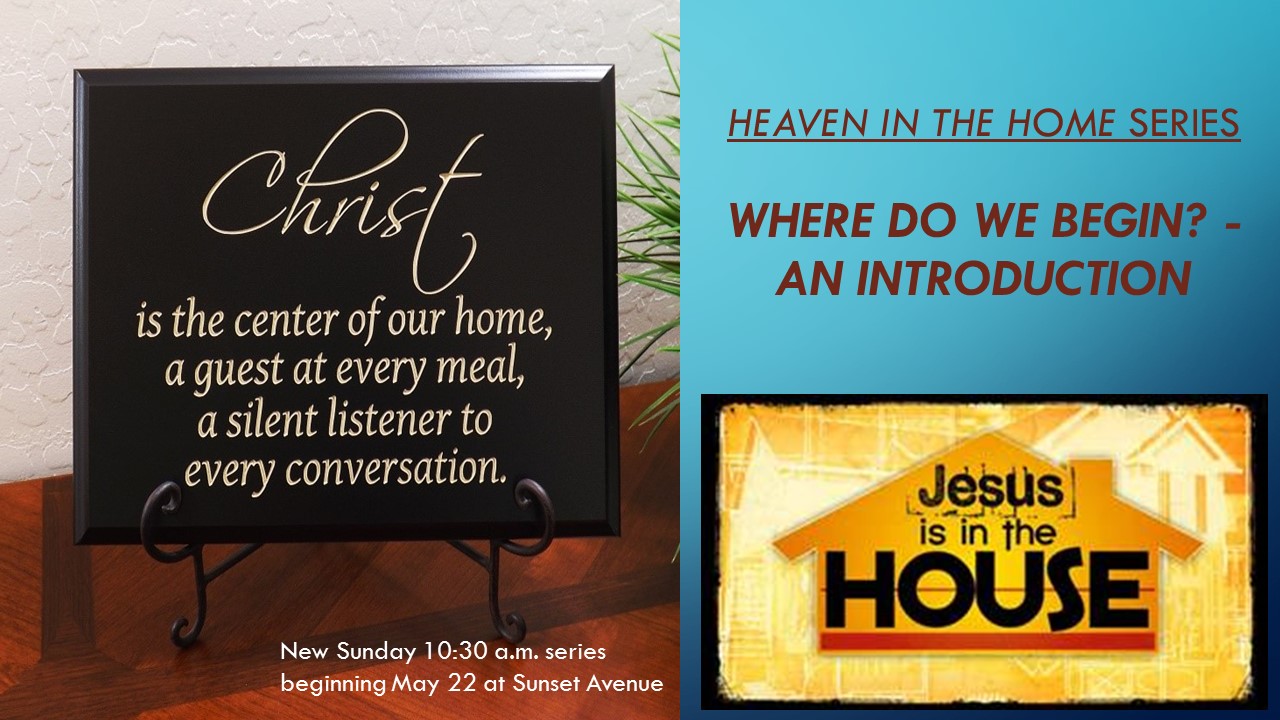
Heaven in the Home Series – Where Do We Begin?


Christ In The Home seriesA question asked by many people in this 21st century is a complex and deeply felt one: is it possible to have a Christ centered home in today’s world of trouble and sin?

If you are a Christian, you are concerned about this problem. Recent studies have listed many issues with which parents must cope today:

— finances (the cost of bearing, clothing, feeding, entertaining and educating children is the greatest in our history)
— working mothers (a majority of American mothers hold jobs out-side the home, many out of necessity)

– drugs, divorce, alcohol, crime, runaways, and abuse.

More than 1.9 million couples were divorced last year. Drugs and alcohol are on the rise among youngsters. The second leading cause of death between ages 14-24 is now suicide, and one child in eight can expect to appear in juvenile court before he turns 18.

It might be of comfort to realize that the world has always been a difficult place in which Christians must live. It has always been opposed to God’s values and God’s will.

Satan longs for the soul of any age person who will reject good, right, and truth and turn to his way of thinking. Christians must daily remind themselves of the clear, simple words of Jesus, from Matthew 7:13-14: “”Enter through the narrow gate. For wide is the gate and broad is the road that leads to destruction, and many enter through it. But small is the gate and narrow the road that leads to life, and only a few find it.”

We might also be encouraged to remember a story recorded in 2 Chronicles 20, which shows a situation similar to the one we face today. Jehoshaphat had some men before him reporting the approach of a vast army, one the size of which his army could not defeat.

He inquired of the Lord his future and God’s answer is recorded for us in 2 Chronicles 20:15-17: “He said: “Listen, King Jehoshaphat and all who live in Judah and Jerusalem! This is what the LORD says to you: ‘Do not be afraid or discouraged because of this vast army. For the battle is not yours, but God’s. Tomorrow march down against them. They will be climbing up by the Pass of Ziz, and you will find them at the end of the gorge in the Desert of Jeruel. You will not have to fight this battle. Take up your positions; stand firm and see the deliverance the LORD will give you, O Judah and Jerusalem. Do not be afraid; do not be discouraged. Go out to face them tomorrow, and the LORD will be with you.'””

That message is an eternal one! It remains for Christians today who feel the odds against them in this sin-filled world.   

Man’s domestic problems begin when he departs from God’s counsel regarding the home. And this study is vital because our understanding of Christ’s relationship to the church is dependent upon his conception of the home. God is interested in our homes because our spiritual understanding is at stake.

Home Means Different Things To Different People

There are many reasons why people look upon the home in different lights. In the first place, we have all had different backgrounds. Our home training has been varied, the emphases have been placed in many different spots as we have been reared through the years of childhood and adolescence.

It is no wonder that the word “home” means something different to one than to another:

  • we may look upon the home as a place for protection where our simple needs are met
  • it might be a place where we have been taught respect and obedience, where character and service have been taught
  • young married couples view the home as the ideal situation, anticipating their life with optimism and ambition
  • older people define home in terms of memories, and because of their mature minds, they certainly describe it with reality…it takes on a sense of reward and meaning

A truly Christian home is a place where sinners live; but it is also a place where the members of that home admit the fact and understand the problem, know what to do about it, and as a result grow by grace.

It is important that this environment be in place so all members of the family will have a loving, graceful, safe, and warm place in which to grow. It’s vital that we treat each other in the same way Jesus treated His 12 apostles.

As they stumbled and fell and made mistakes, he was patient with them because of one simple point: He knew they were not yet what they would become. We need to “be patient, God’s not finished with me yet!”

Strong Church Families– Case Examples (from actual minister from a large Southern congregation):

ITEM: A sixteen year old boy with this startling confession: “I can’t stand my parents. I hate my dad, I wish he was dead. “

ITEM: A seventeen year old youth With this pleading request: “Can I please talk with you. My parents won’t listen. My dad is an elder. He has time for everyone else, but he doesn’t have time for me. He thinks I don’t have anything worthwhile to say.”

ITEM: A nineteen year old coed on a Christian college campus asks for help. Her problem? For the past six years her father has been involved with her sexually. Her father is supposedly a leader in the Lord’s church.

ITEM: An adolescent, between the ages of 9 and 14, a resident in a children’s home in California, writes a night time prayer for sinners, wherein she prays: “I admit I am very sinful. I had a hard time with the family. Now I have no family. I was starved when I was little.”

ITEM: A college junior relays a sad message: “My parents have just informed me that I can never come home again. I am no longer their daughter. They never want to see me again.”

ITEM: On the afternoon prior to the concluding service of a gospel meeting that evening, a seventeen year old girl that has been attending the meeting, calls with this message and plea: “My mother has just kicked me out of the house. I have no place to go. I wish I were dead. In fact, about a year ago I tried to kill myself. I have been under psychiatric care. Can you help me?”

ITEM: An early morning emergency phone call, an urgent Saturday morning visit to the office and a desperate plea for help from a hurting and frustrated mother is a nearby congregation. Her problem? The night before she had discovered that her husband had been going to their daughter’s bed before coming to hers.

Each of these case examples have a least three major things in common.

  1. They are true . . . they actually happened.
  2. They each suggest some serious problems in the area of parent/child relationships in some homes.
  3. Are you ready for #3 . . . They each involve a supposedly Christian home or environment

They are not the strong families of which strong congregations are built. I am not plowing new ground when I tell you that today many homes and families, in the church and outside the church, are in serious trouble.

  1. No doubt, you know some.
  2. No doubt you have shed tears over some.
  3. No doubt, you will again.

Tragic things are happening in and to homes and families today.

  1. 53% of all marriages end in divorce.
  2. One-half of all children now live with one parent.
  3. 700,000 young people drop out of school annually.
  4. 5,000 to 6,000 young people commit suicide annually.
  5. 40% of all teenage girls become pregnant one or more times before reaching the age of 20.
  6. 52% or youth fatalities are alcohol related.
  7. Child abuse and abandonment are on the rise. In the past several years, there has been a 300% increase in placement of children outside the home.
  8. Homosexual marriages (men marrying men, women marrying women) then wanting to adopt and rear children in such an unscriptural and unwholesome environment.
  9. Abuses (sexual, physical, parental, etc.) running rampant through our society.

Let’s look in detail for a moment at three significant items that make all the difference in the world; (as they are discussed, think of the atmosphere or environment which these will create in the home):

  1. Christians admit their sins.

Because they know the Bible says that no Christian is ever perfect in this life, they are free to admit their sins.

1 John 1:8-10: “If we claim to be without sin, we deceive ourselves and the truth is not in us, if we confess our sins, he is faithful and just and will forgive us our sins and purify us from all unrighteousness. If we claim we have not sinned, we make him out to be a liar and his word has no place in our lives.”

What does it mean to you to know that your boss, parents, etc., can admit when they make a mistake and acknowledge sin? What response do you give to this kind of person? What kind of response is given to the person who thinks they are perfect, who acts like they never do wrong?

Christians are able to acknowledge the fact and, in time, learn to anticipate and prepare for sin. Christians, of all persons, should never rely upon rationalizations, excuses or blame-shifting to try to euphemize their sins.

Because they can admit their sins, there can also be a certain amount of openness, honesty, and relaxation about the relationships that Christians sustain to one another, especially at home. Christians can pour their time and energies into the endeavor to replace sinful patterns with Biblical patterns of life.

Rather than wasting time minimizing or denying the fact of sin, Christians can concentrate on dealing with sin.

  1. Christians know what to do about their sins.

Because they have the Bible as the standard of faith and practice, Christians not only know why problems occur in the home, but they know what to do about them!

Is any sin too big for God? Can any sin be overcome in a loving, forgiving environment? We need to realize that each person in the Bible who stands before us a “great men and women of faith” are average people with sin in their life, which God helped remove.

  1. Christians progress out of their sins.

Where there is spiritual life, there also will be spiritual growth. No Christian may remain the same yesterday, today, and tomorrow.

A fundamental presupposition of the Christian faith is that there will be growth out of sin into righteousness. Where there is Bible study, prayer and the fellowship of the saints, the Spirit of God will be at work to produce His fruit.

The Christian home, then, is a place where sinful persons face the problems of a sinful world. Yet, they face them together with God and His resources, which are all centered in Christ. Sinners live in the Christian home, but the sinless Savior lives there too! “That is what makes the difference!

What purposes shall we try to achieve in our homes?
The first purpose is the personal development of each family member. This is not to say that one should view his home selfishly and think only in terms of what he can get out of it himself. Each family member experiences personal growth and receives a sense of genuine fulfillment by giving of himself in order to build a happy home.

The second purpose involves the accomplishment of certain social functions of the home. The primary social function is to provide a special companionship for each member of the family. To feel alone and unloved is one of the emptiest feelings on earth. But we must also prepare each member to be part of the larger group of society.

But the third purpose reaches into eternity: we must work toward achieving the spiritual development of the family members. We must never forget that marriage and the home is primarily a spiritual relationship.

We should daily be reminded of the question asked by Jesus in one of his most penetrating sermons, recorded for us in Matthew 16:26-27: “What good will it be for a man if he gains the whole world, yet forfeits his soul? Or what can a man give in exchange for his soul? For the Son of Man is going to come in his Father’s glory with his angels, and then he will reward each person according to what he has done.”

What qualities of character do we need to possess and demonstrate in our homes in order to fulfill these purposes?

Generally speaking, the development of Christian character is the single most important factor in achieving a successful home. The two marriage partners must desire success in their home, and genuine love is absolutely necessary! Each member of the family must take their differences into account and strive to communicate their feelings to each other.

This also relates to the church family

Paul Tournier once said there are two things one cannot do alone – be married and be a Christian.

The essence of being a Christian is not an extended set of correct doctrinal beliefs or even well-formed personal character. To be a Christian is to be connected to Christ in such a unique and special way that all other relationships are defined by that union. The perfect triune fellowship of God as Father, Son, and Spirit from eternity past has been opened to me by the blood of Jesus at Calvary. But I cannot experience their fellowship in isolation from all others who have been called into it.

Having others around is not a nuisance but a necessity for families. These interactions shape us. We sing and read, stand and bow, laugh and cry. And, yes, we certainly eat and drink together. But we do all these things as a network of friends. A gathering of family members. A church whose identity is not contained in itself but is found in the God who has formed it.

We are the community of the children of God! We carry his spiritual DNA. We bear his name. We have a great inheritance. Awareness of these things makes a difference in how we see ourselves and function in this world.

Perhaps if more of us saw ourselves as children of God rather than members of the church, we would claim a nobler inheritance. If we understood church as persons in relationship rather than names on the roll, we would function differently as the church. If we saw sin as the breaking of relationships rather than the breaking of rules, we would both live better and deal with one another more gracefully.

If we really love God the Father, we will create churches that are communities of love, accountability, and nurture where gradual spiritual transformation takes place over time. We will live gently with one another. Listen to one another’s stories. Teach and learn from one another.

A PRAYER FOR THE CHILDREN

     We pray for the children who …… sneak popsicles before supper… erase holes in their math workbooks and can never find their shoes.

    We pray for the children who …… don’t know how to run down the street in a new pair of sneakers… are born in places where we wouldn’t be caught dead… and, have never been to the circus.

    We pray for the children who …… bring us sticky kisses and fistfuls of dandelions… hug us in a hurry and forget their lunch money.

    We pray for the children who …… never get dessert or have a “safe” blanket to drag behind them… watch their parents watch them die… can’t find bread to steal… don’t have any rooms to clean up… don’t have pictures on anybody’s dresser and… whose monsters are real.

    We pray for the children who …… spend all their allowance before Tuesday… throw tantrums in the store and pick at their food… like ghost stories and shove dirty clothes under the bed… never rinse out the tub and get visits from the tooth fairy, and… whose tears we sometimes laugh at and smiles can make us cry.

    We pray for the children who …… whose nightmares come in the daytime… will eat anything and have never seen a dentist… aren’t spoiled by anybody, and… go to bed hungry and cry themselves to sleep.

     We pray for the children who …… want to be carried and for those who must, and… we never give up on and for those who don’t get a second chance.

    We pray for the children who …… we smother with love and affection and… will grab the hand of anybody kind enough to offer it.

 
Leave a comment

Posted by on January 2, 2020 in Family, Marriage


Quiz for Couples — How’s Your Marriage?


This quiz is based on an understanding of many key studies in the field. Following the Quiz you can add up your points and use the scale to see how you are doing. You should take the scores seriously, but realize that there is a lot that the quiz doesn’t take into account about your relationship.

While these questions are based on studies that assess such things as the likelihood of a marriage working out, we would hate for any one person to take this and assume the worst about their future. Rather, we believe that the quiz can motivate high and medium- high scoring couples to take a serious look at where their marriage is heading–and take steps to turn negative patterns around for the better.

Please answer each of the following questions to see how you are doing. We recommend that you answer these questions by yourself and not share scores with your partner.

Use the following 3 point scale to rate how often you and your mate or partner experience the following:

1 = Never or almost never  2 = Once in awhile  3 = Frequently 

1 2 3 Little arguments escalate into ugly fights with accusations, criticisms, name calling, or bringing up past hurts.

1 2 3 My partner criticizes or belittles my opinions, feelings, or desires.

1 2 3 My partner seems to view my words or actions more negatively than I mean them to be.

1 2 3 When we have a problem to solve, it is like we are on opposite teams.

1 2 3 I hold back from telling my partner what I really think and feel.

1 2 3 I think seriously about what it would be like to date or marry someone else.

1 2 3 I feel lonely in this relationship.

1 2 3 When we argue, one of us withdraws, that is, doesn’t want to talk about it anymore; or leaves the scene.

Determining Your Score:
Add up your points to determine your score. (Include only your scores, do not add to your partner’s!) The ranges we suggest for the quiz are based on results from a nationwide, random phone survey of 947 people (85% married).

8 to 12 “Green Light”
If your total points is in the 8 – 12 range, your relationship is probably in good or even great shape AT THIS TIME, but we emphasize “AT THIS TIME” because relationships don’t stand still. In the next 12 months, you’ll either have a stronger, happier relationship, or you could head in the other direction. To think about it another way, it’s like you are traveling along and have come to a green light. There is no need to stop, but it is probably a great time to work on making your relationship all it can be.

13 to 17 “Yellow Light”
If you scored in the 13-17 range, it’s like you are coming to a “yellow light.” You need to be cautious. While you may be happy now in your relationship, your score reveals warning signs of patterns you don’t want to let get worse. You’ll want to be taking action to protect and improve what you have. Spending time to strengthen your relationship now could be the best thing you could do for your future together.

18 to 24 “Red Light”
Finally, if you scored in the 18-24 range, it’s like approaching a red light. Stop, and think about where the two of you are headed. Your score indicates the presence of patterns that could put your relationship at significant risk. You may be heading for trouble–or already may be there. But there is GOOD NEWS. You can stop and learn ways to improve your relationship now!

 
Leave a comment

Posted by on August 29, 2019 in Marriage


Witness Without Words – 1 Peter 3:1-2


1 Peter 3:1-2 (ESV)
1  Likewise, wives, be subject to your own husbands, so that even if some do not obey the word, they may be won without a word by the conduct of their wives, 2  when they see your respectful and pure conduct.

In an intimate relationship like marriage, actions often speak louder than words. Words get preachy, but actions demonstrate reality.

Words can create division, but loving action builds trust. Words lay out propositional truth—the information about salvation—but actions show the living Christ in the believer’s heart and life.

Did Peter forbid a spouse to witness? Obviously not. Words built on trust and love can transform a life.

Does Peter downplay street preaching, testimonies, sermons, and personal witnessing? Truly not. He was advising married partners how to treat unbelieving spouses.

If your husband is a nonbeliever, you can strengthen your marriage not by preaching, but by living, loving, and letting God provide the opportunity for you to witness.

Under the circumstances, the wives’ best approach would be witnessing by their behavior. Their attitude should reflect loving service: They should show their husbands the kind of self-giving love that Christ showed the church.

Their lives should reflect both purity and reverence. “Purity” refers to behavior that is free from moral defilement. The wives should be pure for their husbands’ sakes, yet they would have to disobey should their husbands ask them to do something morally wrong or to participate in pagan practices.

“Reverence” is the same word translated as “respect” in 2:18 (phobos), referring to healthy fear. The wives had no protection from violence (other than murder) under the law. So these wives should not do anything to incur the displeasure of their husbands. By being exemplary wives, they would please their husbands.

At the very least, the men would then allow these wives to continue practicing their “strange” religion. At best, their husbands would join them and become Christians too.

A changed life speaks loudly and clearly and is often the most effective way to influence a family member. Peter instructs Christian wives to develop inner beauty rather than being overly concerned about their outward appearance. Their husbands will be won over by their love rather than by their looks.

This does not mean that Christian women should be dowdy and frumpy; it is good to be cheerful and attractive. But their priorities should be virtue and moderation. Live your Christian faith quietly and consistently in your home, and your family will see Christ in you.


Leave a comment

Posted by on June 27, 2019 in 1 Peter, Marriage


Is God inclusive or exclusive?


Exclusive Is God inclusive or exclusive? Both! He wants all to be saved but there are “steps of faith.” Peter proclaimed the clear answer in 2 Peter 3: The Lord is not slow in keeping his promise, as some understand slowness. He is patient with you, not wanting anyone to perish, but everyone to come to repentance.”

Churches today are less and less likely to ask “What does the Bible say?” and more likely to ask, “What does the community want?” We need to be reminded that the church belongs to the Lord, not the community. The church is uniquely His and was designed to be His servant to take His gospel to a lost and dying world.

Truth has become trivial, irrelevant. Realize that 72% of Americans between the ages of 18-25 now believe that there is no such thing as absolute truth!

David F. Wells, God in the Wasteland, “We have turned to a God that we can use rather than to a God we must obey; we have turned to a God who will fulfill our needs rather than to a God before whom we must surrender our rights to ourselves. He is a God for us, for our satisfaction – not because we have learned to think of him in this way through Christ but because we have learned to think of him this way through the marketplace.
   “In the marketplace, everything is for us, for our pleasure, for our satisfaction, and we have come to assume that it must be so in the church as well. And so we transform the God of mercy into a God who is at our mercy.”

Jesus once asked regarding John the Baptizer, (Matthew 11:7) “As John’s disciples were leaving, Jesus began to speak to the crowd about John: “What did you go out into the desert to see? A reed swayed by the wind?” A reed is a symbol of instability; it pictures that which yields to other forces.

On the other hand, Paul described the church as the “pillar and ground of the truth” (1 Tim. 3:15). The imagery here is that of a solid, immovable foundation. It is a question that the church of today must ask. Are we a “reed shaken in the wind,” or are we the “pillar and ground of the truth”?

Real Love – Real love doesn’t leave another person in error. Real love takes the time to show them the error of their way:  (Galatians 6:1) “Brothers, if someone is caught in a sin, you who are spiritual should restore him gently. But watch yourself, or you also may be tempted.”
(2 Timothy 2:24-26) “And the Lord’s servant must not quarrel; instead, he must be kind to everyone, able to teach, not resentful. {25} Those who oppose him he must gently instruct, in the hope that God will grant them repentance leading them to a knowledge of the truth, {26} and that they will come to their senses and escape from the trap of the devil, who has taken them captive to do his will.”

inclusion-wordle11Jesus was exclusive! (John 14:6) “Jesus answered, “I am the way and the truth and the life. No one comes to the Father except through me.”

Unless you believe that I am He (John 8:24) “I told you that you would die in your sins; if you do not believe that I am the one I claim to be, you will indeed die in your sins.””

One Gospel  – (Galatians 1:6-9) “I am astonished that you are so quickly deserting the one who called you by the grace of Christ and are turning to a different gospel– {7} which is really no gospel at all. Evidently some people are throwing you into confusion and are trying to pervert the gospel of Christ. {8} But even if we or an angel from heaven should preach a gospel other than the one we preached to you, let him be eternally condemned! {9} As we have already said, so now I say again: If anybody is preaching to you a gospel other than what you accepted, let him be eternally condemned!”

 
1 Comment

Posted by on May 20, 2019 in Encouragement, Marriage


CHECK LIST FOR HUSBANDS/WIVES


Allow at least 30 minutes for this exercise. Make sure you are alone and undisturbed. Husbands should fill in the answers first, then fold, the answers under while the wife answers. The wife’s answers apply to the husband’s behavior, not hers. The two should then dialogue on their responses, each one from the “feeling” point of view (non-judgmental).

                                                               Yes           No

  1. I write a personal, affectionate note or letter to my wife regularly (weekly?).
  2. I never have to be reminded of her birthday or our anniversary.
  3. I plan an honest evaluation of our marriage regularly (perhaps with testing).On your anniversary do you recommit? Perhaps listen to the tape of your marriage ceremony.
  4. We have developed specific goals for n our family spiritually, emotionally and economically.
  5. We have at least one meal daily with all the family members together.
  6. My wife has confirmed to me that the money she receives is reasonable and adequate under our financial circumstances.
  7. I encourage my wife to develop her own potentialities (by taking courses, etc.)
  8. I am aware of what is going on in my house between my wife and our children.
  9. In dealing with all family members, I am more positive than negative.
  10. I regularly help my wife with the children and the “necessary drudgery.”
  11. 11.I never ask others to our house without my wife knowing in advance and with assurance of my help.
  12. I respond to her preferences in buying a new house or automobile.
  13. I seldom tire of talking with my wife.
  14. I still court my wife.
  15. I spend at least one hour each week, alone with my wife, talking about our mutual interests.
  16. I am closer to my wife now than I was one year ago.
  17. I make most decisions of my family’s welfare rather than my own (Phil. 2:3,4).
  18. I allow my wife to use her abilities and talents to their fullest.
  19. I show patience in most situations.
  20. I allow her to make many decisions.
  21. I treat her as a partner, not as a servant.
  22. I forgive her when she makes bad decisions.
  23. I try to guide (vs. boss) when she needs
  24. She can talk with me about anything without my getting angry.
  25. There is nothing about which she is afraid to talk with me.
  26. I try basically to be an unselfish person.
  27. I am primarily a Christian who loves the Lordship of Jesus.
  28. Is the Lord really first in your life?
  29. Are nagging, bickering or picking general occurrences at your home?
  30. Are you in subjection to your husband? Do you place him in the position of leadership?
  31. Are you a happy person? Do you take life, generally, without complaint
  32. Are you a positive, affirming person?
  33. Are you a forgiving person?
  34. Do you often interrupt your husband when he talking or telling a story?
  35. Do you put your husband down in public? In private?
  36. Do you have reasonable control of your weight?
  37. Are you sexually responsive to your husband at least 95% of the time?
  38. How do you handle problems and pressures? Do you remain indecisive or blame others when things go wrong?
  39. Do you call your husband any ugly names? (Any name he does not like is ugly.)
  40. Do you have any resentments against your husband (because he is “fat,” “late,” ill-mannered, uneducated, etc.)?
  41. Is your house reasonably organized and clean?
  42. How do you feel about housework? Do you do it willingly?
  43. Are you too “fussy” about how the house looks?
  44. How is your credit? Are you inclined to buy things on impulse, then have trouble paying your bills?
  45. What is your social life like? Do you find yourself spending most of your spare time with your family and friends and very little with your husband’s family and friends?
  46. Would you prefer to watch TV rather than talk with your husband?
  47. Do you spend at least one-half of your leisure time together?
  48. Do you ask which film or TV program he would like to see and then somehow you end up seeing the one you prefer?
  49. Do you treat his mother (or yours) with disrespect?
  50. Are in-laws allowed to interfere or set policies for your family?
  51. How is your sense of humor? Do you laugh easily – even at yourself?
  52. Has your husband caught you in little lies which you have tried to wriggle out of?
  53. When you are wrong, do you find it hard to admit?
  54. Do your prime interests in life center around things more than people?
  55. Have you thought about who you are and what you will be like in 25 years
 
Leave a comment

Posted by on January 14, 2019 in Marriage


Quiz for Couples — How’s Your Marriage?


This quiz is based on an understanding of many key studies in the field. Following the Quiz you can add up your points and use the scale to see how you are doing. You should take the scores seriously, but realize that there is a lot that the quiz doesn’t take into account about your relationship. While these questions are based on studies that assess such things as the likelihood of a marriage working out, we would hate for any one person to take this and assume the worst about their future. Rather, we believe that the quiz can motivate high and medium- high scoring couples to take a serious look at where their marriage is heading–and take steps to turn negative patterns around for the better.

Please answer each of the following questions to see how you are doing. We recommend that you answer these questions by yourself and not share scores with your partner.

Use the following 3 point scale to rate how often you and your mate or partner experience the following:

1 = Never or almost never 2 = Once in awhile 3 = Frequently

1 2 3  Little arguments escalate into ugly fights with accusations, criticisms, name calling, or bringing up past hurts.

1 2 3  My partner criticizes or belittles my opinions, feelings, or desires.

1 2 3  My partner seems to view my words or actions more negatively than I mean them to be.

1 2 3  When we have a problem to solve, it is like we are on opposite teams.

1 2 3  I hold back from telling my partner what I really think and feel.

1 2 3  I think seriously about what it would be like to date or marry someone else.

1 2 3  I feel lonely in this relationship.

1 2 3  When we argue, one of us withdraws, that is, doesn’t want to talk about it anymore; or leaves the scene.

Determining Your Score:
Add up your points to determine your score. (Include only your scores, do not add to your partner’s!) The ranges we suggest for the quiz are based on results from a nationwide, random phone survey of 947 people (85% married).

8 to 12 “Green Light”
If your total points is in the 8 – 12 range, your relationship is probably in good or even great shape AT THIS TIME, but we emphasize “AT THIS TIME” because relationships don’t stand still. In the next 12 months, you’ll either have a stronger, happier relationship, or you could head in the other direction. To think about it another way, it’s like you are traveling along and have come to a green light. There is no need to stop, but it is probably a great time to work on making your relationship all it can be.

13 to 17 “Yellow Light”
If you scored in the 13-17 range, it’s like you are coming to a “yellow light.” You need to be cautious. While you may be happy now in your relationship, your score reveals warning signs of patterns you don’t want to let get worse. You’ll want to be taking action to protect and improve what you have. Spending time to strengthen your relationship now could be the best thing you could do for your future together.

18 to 24 “Red Light”
Finally, if you scored in the 18-24 range, it’s like approaching a red light. Stop, and think about where the two of you are headed. Your score indicates the presence of patterns that could put your relationship at significant risk. You may be heading for trouble–or already may be there. But there is GOOD NEWS. You can stop and learn ways to improve your relationship now!

 
Leave a comment

Posted by on January 7, 2019 in Marriage