RSS

Eight steps to marital harmony


  JesusIsLordofthisWebSite placeforyou2 575273_579331012148169_1163921425_n

 ——————————————–

The formula for marital harmony and success is not a mysterious secret. It’s actually very straightforward. The “behind the scenes” part is the constant work that’s required to keep the channels of love and communication clear from obstruction. Diligent spouses consistently spend time and energy addressing issues as they come up so that anger and hurt feelings don’t accumulate.

Spouses who want satisfying marriages also look for ways to keep their love strong, such as remembering to show affection and appreciation frequently. They know that the more they feel connected and bonded, the more motivated they will be to resolve problems and hang in there when things are difficult.

The following steps will guide you in looking at what you can do to increase your chances for creating a happy, harmonious marriage:

  1. Work on yourself and your own issues that you brought with you into the marriage. Many responses that you have to your spouse’s actions are triggered by past events going back to your childhood. If one of your emotional wounds is to feel disrespected, then when your partner inadvertently does something that triggers those feelings, you’ll experience an intense reaction. Individual counseling can help you to be more self-aware of what’s behind your intense reactions and what you can do so that you don’t over-react to issues in your marriage.
  2. Avoid blaming your partner for problems in the marriage. Blame only causes the other person to become defensive and angry, and it decreases the probability that the two of you can find a win-win solution to your problems. When you focus on blaming your spouse for what’s happening in the marriage, you are planting seeds of resentment that can hurt the relationship. A marriage is composed of two people, and each contributes to the quality of the relationship and shares responsibility for it.
  3. Be empathetic and put yourself in your partner’s place when issues come up. Really try to understand where your partner is coming from when you disagree or when your partner does something that you can’t make sense of. Ask your spouse to talk about his or her feelings. Listen respectfully and ask your spouse to clarify points that you don’t understand.
  4. Look for ways to make your partner’s life easier and to show your love. Many of the irritants and stressors in modern day life are the little things—the extra time it takes to pick up the cleaning on the way home from work or to put the clean dishes in the dishwasher away. When you see some errand or task that you can do to save your partner time, offer to do it. Look for opportunities to give your spouse a few minutes to relax or have downtime. Watch for things you can do to pamper your partner when you can. It’s often the little things that can make a big difference in marital happiness and satisfaction.
  5. Express appreciation often and say form the habit of saying “thank you.” As months and years go by, many spouses take each other for granted and neglect to express appreciation or say “thank you” to each other. Numerous spouses complain that their partners only focus on what they do wrong and never compliment them. It’s sad to think that the one person who means the most to you might have to wonder whether or not you appreciate them. Let your spouse know on a frequent basis how much he or she means to you. Give compliments and praise freely, and express thanks for all that your partner does to enrich your life and marriage.
  6. Apologize quickly and sincerely, taking responsibility for your part in whatever happens in the marriage. The truth is that sometimes it’s hard to say “I’m sorry.” That’s when it’s time to remember the question, “Would you rather be right or would you rather be happy?” Accept that things don’t always make sense in a relationship and that confusion and misunderstandings can happen easily. It’s a mark of maturity when you can say, “I’m so sorry for my part in what has happened between us.”
  7. Have interests, hobbies and activities in your life that you enjoy so you’re not thrown off center so easily if you have a tiff or quarrel with your spouse. It’s important to have interests and activities of your own that are satisfying to you that can help to keep you balanced and anchored if other areas of your life are upsetting. That way, you can more easily regain a sense of perspective and be able to withstand the on-going stress.
  8. Look for fun activities and bonding experiences to share with your mate. Be on the lookout for activities that could be fun for you and your spouse to do together. Search the local newspaper for plays, concerts, new movies, museum exhibits, neighborhood fairs and festivals, and new restaurants that are advertised. Laughter and having fun is bonding and can help to create those “Kodak moments” that are so delightful. (By Nancy Wasson, Phd.


Leave a comment

Posted by on July 14, 2016 in Marriage


Free to Fail — Matthew 25:24-25; Philippians 4:13


     (Matthew 25:24-25 NIV)  “Then the man who had received the one talent came. ‘Master,’ he said, ‘I knew that you are a hard man, harvesting where you have not sown and gathering where you have not scattered seed. {25} So I was afraid and went out and hid your talent in the ground. See, here is what belongs to you.’

     (Philippians 4:13 NIV)  I can do everything through him who gives me strength.

Matthew 25:25 and Philippians 4:13 are two very different statements. One was made by a man who was afraid to fail and did nothing. The other was made by a man who was free to fail and did everything.

As far as the biblical record is concerned, some of the greatest achievements in the history of God’s kingdom have come from very ordinary, imperfect people who have overcome failure to be used of God in a significant way. Their lives model some biblical principles for overcoming failure.

Do not try to hide or conceal your failures. Some people spend their lives trying to cover-up their mistakes. They become “prisoners of pretense,” retreating into fabrication and delusion. Their entire lives become a charade, a great hypocrisy.

The first step in overcoming our failures is to admit them. We must be willing to honestly confess them before God and seek his forgiveness and restoration (1 John 1:8-9). If there is any place where we should be able to admit our failures, it is the church. Christians are not perfect, just forgiven.

Do not be discouraged by your failures. When you fail in life, you are in good company. Sir Walter Scott, Thomas Edison, Richard Byrd, Walt Disney all were considered failures before they went on to their greatest achievements.

In the Bible, too, we read of failures whom God took and used to accomplish great things in his service. He took a slave hiding as a fugitive from justice and used him to deliver an entire nation from bondage. He took a woman who failed in marriage seven times and used her to win a city to the Savior. He took a crooked tax collector and made him into an apostle and a biographer of the Christ. He took a man who failed Christ in his darkest hour, denying Him three times, and used him to open the doors to the kingdom of God.

He can do the same thing in our lives. God does not easily give up on His children. Like the tireless potter bending over the spoiled clay, He yet desires to make something good and noble of our lives (Jeremiah 18:1ff).

Do not let fear of failure keep you from attempting great things for God. Some people are petrified at the thought of failure. They would rather face anything than the ego shattering experience of trying something and having it end in failure. So they adopt a “play-it-safe” philosophy and end up not doing anything at all. Just like the steward in the story of the talents they bury their potential in the ground and end up standing before their Master with little in their hands.

It is not until we are free to fail that we are free to succeed. No one was more free to fail (from the world’s view) than Jesus. It is impossible to look like a success when you are hanging on a cross. Yet he let it happen. In selfless abandonment to the will of God, He was free to fail in the eyes of man that He might succeed in the eyes of God. If the church cannot risk failure in the sight of men, how can we succeed in the sight of God?

Conclusion — In Christ we are called to be secure enough in God’s grace to conquer our fear of failure. We are called to be free enough in our faith to take the risks that bring reward.

Abraham Lincoln suffered a string of failures before he was elected to the presidency. His country store went out of business. As a young lawyer he had trouble getting clients. He was defeated in his campaigns for the state legislature, the House of Representatives, the Senate and the Vice Presidency. Yet very few, if any, Americans have had more impact on our history than he.

 
Leave a comment

Posted by on July 11, 2016 in Small groups


“Heaven In The Home: God’s Plan For His Family” Series #5  Marriage: Honor and Purity Hebrews 13:4; 1 Cor. 7:1-9


marriage2(Hebrews 13:4) Marriage should be honored by all, and the marriage bed kept pure, for God will judge the adulterer and all the sexually immoral.

We need to discuss a sensitive issue today, and I can assure you I will be very aware of what is being said and how it is discussed.

I heard a list some time ago of some topics that are sure to “draw a crowd.” Issues related to sexuality are a sure thing, And studies of the “end times” is also on the list. It only seems normal to assume that a sermon on whether there is “sex at the end of time” would really draw a crowd.

I do feel a strong connection to the minister who was asked to speak on the subject of Sexuality at a ladies community group. He was a little embarrassed and stammered around when his wife asked him the subject he’d been assigned – she thought he said “sailing” when she asked for the topic.

The next day his wife met a lady from the community group and she just went on and on about how good her husband’s talk went. “I’m a little surprised,” she said (thinking his subject had been sailing). “He’s only actually done it twice in his life.  The first time he lost his favorite hat, and the second time he threw up.”

The erosion of marriage is a constant refrain in political debate and a legitimate concern for society in general. In God’s eyes, marriage is honorable. He established it at creation and has honored it ever since. In much of the world today, of course, marriage is anything but honored. A great many couples who marry do so as a temporary convenience, not as a social, much less a divine, requirement for their living together.

Under relentless attack from every direction especially the Media portrayal of family on TV and in the movies and in magazines. cheapening of sexual intimacy; reality TV sleaze shows – auction off a bride or groom…government policy – marriage tax penalty…marriage is passé, out of date, no longer valid – we’ve evolved past needing it…

For us, however, as Christians, this is not a matter of mere tolerance or benign approval of an institution, but a commitment to honor!

Marriage can be held in honor in many ways.

  1. One is by the husband’s being the head. God is glorified in a family where the husband rules. “The husband is the head of the wife, as Christ also is the head of the church” (Eph. 5:23).
  2. Another way is a corollary of the first, namely, that wives be submissive to their husbands (1 Pet. 3:1, 6).

(1 Peter 3:1)  “Wives, in the same way be submissive to your husbands so that, if any of them do not believe the word, they may be won over without words by the behavior of their wives,”

  1. A third way marriage is honored is by being regulated by mutual love and respect. “You husbands likewise, live with your wives in an understanding way, as with a weaker vessel, since she is a woman; and grant her honor as a fellow heir of the grace of life, so that your prayers may not be hindered” (v. 7).

Scripture gives at least three reasons for marriage.

  1. One is the propagation of children.

At creation, mankind was commissioned to “be fruitful and multiply, and fill the earth” (Gen. 1:28).

  1. Marriage is also provided as a means of preventing sexual sin.

“Because of immoralities, let each man have his own wife, and let each woman have her own husband” (1 Cor. 7:2), Paul advises, and then goes on to counsel the unmarried and widows to marry if they do not have self-control (vv. 8-9).

1 Cor 7:1 – 9: “Now for the matters you wrote about: It is good for a man not to marry.£  2But since there is so much immorality, each man should have his own wife, and each woman her own husband.  3The husband should fulfill his marital duty to his wife, and likewise the wife to her husband.  4The wife’s body does not belong to her alone but also to her husband. In the same way, the husband’s body does not belong to him alone but also to his wife.  5Do not deprive each other except by mutual consent and for a time, so that you may devote yourselves to prayer. Then come together again so that Satan will not tempt you because of your lack of self-control.  6I say this as a concession, not as a command.  7I wish that all men were as I am. But each man has his own gift from God; one has this gift, another has that. 8Now to the unmarried and the widows I say: It is good for them to stay unmarried, as I am.  9But if they cannot control themselves, they should marry, for it is better to marry than to burn with passion.”

  1. Marriage is also provided for companionship.

“God said, ‘It is not good for the man to be alone; I will make him a helper suitable for him’” (Gen. 2:18).

REASONS IT IS CONFUSING IN OUR SOCIETY

  1. Sex as a commodity. Sex sells. Why does the poster for welding equipment feature a woman in a bikini? That’s not proper attire for welding. We know why. We have been taught that sex sells. The sports car does not come with the beautiful girl, but men buy the sports car anyway. We have been taught that sex sells. Sex has become a commodity. The buying and selling of sexuality is not limited to prostitution. Victoria’s Secret does not sell underwear. It sells sexuality.

We are always pressured to buy the lie. The cosmetic surgery industry is growing at an astonishing rate. The goal is to enhance features of the human anatomy to make one sexy and youthful. Sex sells. It is good business. Pharmaceuticals to enhance and effect sexual ability are also a growing industry.

God didn’t intend for sex to be merchandise. Sex and sexuality are powerful forces, much more powerful than capitalism and consumerism. When sex is regarded as a commodity, people just might break the rules to “get it.”

2. Sex as an idol. God has already given us a word to live by regarding idolatry. Throughout history, people have carved images of sex gods. Sex has been worshipped and humans have submitted to sex as a power for ages. But that mythological nonsense is all in the past yes? We don’t have temples to sex gods and goddesses anymore, do we? Not with bricks and mortar, no. But we do build shrines of electronic lights and pixels. Pornography is a real power that can work its “magic” in someone’s life as effectively as any force. We like to think that we can control our idols, but in the end they tend to dominate us. 

3. Sex as (nothing more than) a personal choice. Even if we aren’t gratuitous or shocking, talking about sex publicly can be uncomfortable. That’s part of our problem. Although sex is a very intimate subject and does have something to do with our private world, we can go to the extreme of making it so private and personal that we no longer have anything to say about it publicly. And yet, that’s what this word from God is all about. God is affirming that there are certain societal covenants and boundaries that must be respected by all of us when it comes to sex.

This is what the marriage ceremony is all about. We are affirming as a people (single and married) a public statement about human sexuality. This is why the arguments about the definition of marriage are so fierce. It isn’t merely personal choice. If I go into my neighbor’s back yard and move the fence simply because I wanted it moved I am going to have a fight on my hands. Likewise, the ancient boundaries and covenants are not casually tampered with.

So it is doesn’t really work when we trample on marital fidelity and dismiss the breaking of covenants as a matter of personal choice. God intended sex to be something that everyone respects and when everyone doesn’t respect it the way God does, it is cheapened.

Sins Harming Marriage

Premarital sex

(Matthew 19:4-6) “”Haven’t you read,” he replied, “that at the beginning the Creator ‘made them male and female,’ {5} and said, ‘For this reason a man will leave his father and mother and be united to his wife, and the two will become one flesh’? {6} So they are no longer two, but one. Therefore what God has joined together, let man not separate.””

(Acts 15:29) “You are to abstain from food sacrificed to idols, from blood, from the meat of strangled animals and from sexual immorality. You will do well to avoid these things. Farewell.”

(Galatians 5:19-21) “The acts of the sinful nature are obvious: sexual immorality, impurity and debauchery; {20} idolatry and witchcraft; hatred, discord, jealousy, fits of rage, selfish ambition, dissensions, factions {21} and envy; drunkenness, orgies, and the like. I warn you, as I did before, that those who live like this will not inherit the kingdom of God.”

Homosexuality

Homosexuals want our children to believe their relationships are acceptable.

(Romans 1:26-27)  “Because of this, God gave them over to shameful lusts. Even their women exchanged natural relations for unnatural ones. {27} In the same way the men also abandoned natural relations with women and were inflamed with lust for one another. Men committed indecent acts with other men, and received in themselves the due penalty for their perversion.”

Adultery

(Matthew 5:28)  “But I tell you that anyone who looks at a woman lustfully has already committed adultery with her in his heart.”

1 Corinthians 6:9-11 (ESV) Or do you not know that the unrighteous will not inherit the kingdom of God? Do not be deceived: neither the sexually immoral, nor idolaters, nor adulterers, nor men who practice homosexuality,
10  nor thieves, nor the greedy, nor drunkards, nor revilers, nor swindlers will inherit the kingdom of God.
11  And such were some of you. But you were washed, you were sanctified, you were justified in the name of the Lord Jesus Christ and by the Spirit of our God.


Leave a comment

Posted by on July 11, 2016 in Marriage


The Establishment of the Church


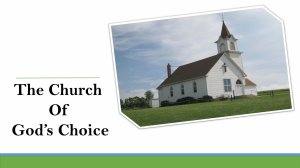
The_Church_Of_Gods_Choice_Title_PicThe Importance of knowing when the church began

It is a matter of identity so that one may be able to distinguish it from Old Testament agencies and from religious institutions of modern human origin.

It is also in order to identify its laws so that one may see when the law governing the church of God went into effect.

The church was foreshadowed in the Old Testament

The Old Testament spoke of those things in the Old Law which were “copies” and “shadows” of “the good things to come”

(Hebrews 9:11)  “When Christ came as high priest of the good things that are already here, he went through the greater and more perfect tabernacle that is not man-made, that is to say, not a part of this creation.”

(Hebrews 9:23)  “It was necessary, then, for the copies of the heavenly things to be purified with these sacrifices, but the heavenly things themselves with better sacrifices than these.”

(Hebrews 10:1)  “The law is only a shadow of the good things that are coming–not the realities themselves. For this reason it can never, by the same sacrifices repeated endlessly year after year, make perfect those who draw near to worship.”

The church was not in existence in Old Testament days. Acts 7:38 refers to the host of Jews who were in the wilderness not to the church of Jesus Christ.

(Matthew 16:18)  “And I tell you that you are Peter, and on this rock I will build my church, and the gates of Hades will not overcome it.” 

(Acts 7:38)  “He was in the assembly in the desert, with the angel who spoke to him on Mount Sinai, and with our fathers; and he received living words to pass on to us.”

Old Testament worthies desired to see its time.

(1 Peter 1:10-12)  “Concerning this salvation, the prophets, who spoke of the grace that was to come to you, searched intently and with the greatest care, {11} trying to find out the time and circumstances to which the Spirit of Christ in them was pointing when he predicted the sufferings of Christ and the glories that would follow. {12} It was revealed to them that they were not serving themselves but you, when they spoke of the things that have now been told you by those who have preached the gospel to you by the Holy Spirit sent from heaven. Even angels long to look into these things.”

The Establishment of the Church is a subject of prophecy

Isaiah 2:1-4 and Micah 4:1-2 both prophesy of its beginning.

(Isaiah 2:1-4)  “This is what Isaiah son of Amoz saw concerning Judah and Jerusalem: {2} In the last days the mountain of the Lord’s temple will be established as chief among the mountains; it will be raised above the hills, and all nations will stream to it. {3} Many peoples will come and say, “Come, let us go up to the mountain of the LORD, to the house of the God of Jacob. He will teach us his ways, so that we may walk in his paths.” The law will go out from Zion, the word of the LORD from Jerusalem. {4} He will judge between the nations and will settle disputes for many peoples. They will beat their swords into plowshares and their spears into pruning hooks. Nation will not take up sword against nation, nor will they train for war anymore.”

(Micah 4:1-2)  “In the last days the mountain of the Lord’s temple will be established as chief among the mountains; it will be raised above the hills, and peoples will stream to it. {2} Many nations will come and say, “Come, let us go up to the mountain of the LORD, to the house of the God of Jacob. He will teach us his ways, so that we may walk in his paths.” The law will go out from Zion, the word of the LORD from Jerusalem.”

It was to be established:

  • In Jerusalem
  • In the “last days” (the age ushered in by the New Testament is the “last days.” (Acts 2:16-17)  “No, this is what was spoken by the prophet Joel: {17} “‘In the last days, God says, I will pour out my Spirit on all people. Your sons and daughters will prophesy, your young men will see visions, your old men will dream dreams.”

(Acts 2:16-17)  “No, this is what was spoken by the prophet Joel: {17} “‘In the last days, God says, I will pour out my Spirit on all people. Your sons and daughters will prophesy, your young men will see visions, your old men will dream dreams.”

(Hebrews 1:1-2)  “In the past God spoke to our forefathers through the prophets at many times and in various ways, {2} but in these last days he has spoken to us by his Son, whom he appointed heir of all things, and through whom he made the universe.”

The prophetic dream of Nebuchadnezzar, king of Babylon (604-562 B.C.) indicated the time of its establishment:

(Daniel 2:31-35)  “”You looked, O king, and there before you stood a large statue–an enormous, dazzling statue, awesome in appearance. {32} The head of the statue was made of pure gold, its chest and arms of silver, its belly and thighs of bronze, {33} its legs of iron, its feet partly of iron and partly of baked clay. {34} While you were watching, a rock was cut out, but not by human hands. It struck the statue on its feet of iron and clay and smashed them. {35} Then the iron, the clay, the bronze, the silver and the gold were broken to pieces at the same time and became like chaff on a threshing floor in the summer. The wind swept them away without leaving a trace. But the rock that struck the statue became a huge mountain and filled the whole earth.”

The four kingdoms of the vision

  1. Babylonian, the head of gold. The Babylonian Empire fell in 536 B.C.
  2. Medo-Persian, the breasts and arms of silver. Established by Cyrus, king of Persia (538-530 B.C.); it fell in 330 B.C.
  3. Greek or Macedonian, the torso and thighs of brass. Formed by Alexander the Great in 336 B.C. after his father, Philip of Macedon, had laid the foundations for it. It was divided among Alexander’s generals after his death in 323 B.C.
  4. Roman, the legs of iron and feet of iron and clay. It was established as a world power by Octavius Caesar in 30 B.C.

“In the days of these kings” (vs. 44), therefore, refers to the time of universal empires and “struck the image upon its feet” signifies the establishment of God’s eternal kingdom which would take place after the beginning of the Roman empire and during its existence.

The New Testament begins its accounts while the Caesars still ruled the world. “In those days John the Baptist came preaching”

(Matthew 3:11-12)  “”I baptize you with water for repentance. But after me will come one who is more powerful than I, whose sandals I am not fit to carry. He will baptize you with the Holy Spirit and with fire. {12} His winnowing fork is in his hand, and he will clear his threshing floor, gathering his wheat into the barn and burning up the chaff with unquenchable fire.””

(Luke 3:1-3)  “In the fifteenth year of the reign of Tiberius Caesar–when Pontius Pilate was governor of Judea, Herod tetrarch of Galilee, his brother Philip tetrarch of Iturea and Traconitis, and Lysanias tetrarch of Abilene– {2} during the high priesthood of Annas and Caiaphas, the word of God came to John son of Zechariah in the desert. {3} He went into all the country around the Jordan, preaching a baptism of repentance for the forgiveness of sins.”

The church was not established by John. He preached that the kingdom was “at hand” or approaching (Matt. 3:1-2). He was not in the kingdom: (Matthew 11:11)  “I tell you the truth: Among those born of women there has not risen anyone greater than John the Baptist; yet he who is least in the kingdom of heaven is greater than he.”

The church was not established during the personal ministry of Jesus.

The church was yet in the future while Jesus was upon the earth.The kingdom was “at hand.”

(Matthew 10:7)  “As you go, preach this message: ‘The kingdom of heaven is near.'”

(Mark 1:15)  “”The time has come,” he said. “The kingdom of God is near. Repent and believe the good news!””

The kingdom had “come near.”

(Luke 10:9)  “Heal the sick who are there and tell them, ‘The kingdom of God is near you.'”

He  taught His disciples to pray for the coming of the kingdom.

(Matthew 6:9-10)  “”This, then, is how you should pray: “‘Our Father in heaven, hallowed be your name, {10} your kingdom come, your will be done on earth as it is in heaven.”

He promised to build His church.

(Matthew 16:18)  “And I tell you that you are Peter, and on this rock I will build my church, and the gates of Hades will not overcome it.”

His disciples were not in the kingdom.

(Matthew 18:1-3)  “At that time the disciples came to Jesus and asked, “Who is the greatest in the kingdom of heaven?” {2} He called a little child and had him stand among them. {3} And he said: “I tell you the truth, unless you change and become like little children, you will never enter the kingdom of heaven.”

He promised the kingdom would come in that generation.

(Mark 9:1)  “And he said to them, “I tell you the truth, some who are standing here will not taste death before they see the kingdom of God come with power.””

The beginning? On the Pentecost following the ascension of Jesus.

The kingdom was to begin and the law go forth from Jerusalem.

(Isaiah 2:1-3)  “This is what Isaiah son of Amoz saw concerning Judah and Jerusalem: {2} In the last days the mountain of the Lord’s temple will be established as chief among the mountains; it will be raised above the hills, and all nations will stream to it. {3} Many peoples will come and say, “Come, let us go up to the mountain of the LORD, to the house of the God of Jacob. He will teach us his ways, so that we may walk in his paths.” The law will go out from Zion, the word of the LORD from Jerusalem.”

(Luke 24:47)  “and repentance and forgiveness of sins will be preached in his name to all nations, beginning at Jerusalem.”

The law went forth from Jerusalem on the Pentecost following the death, burial, resurrection, and ascension of Jesus Christ:

(Acts 2:37-38)  “When the people heard this, they were cut to the heart and said to Peter and the other apostles, “Brothers, what shall we do?” {38} Peter replied, “Repent and be baptized, every one of you, in the name of Jesus Christ for the forgiveness of your sins. And you will receive the gift of the Holy Spirit.”

That day of  Pentecost was the beginning of Christ’s kingdom and church:

(Acts 2:1-4)  “When the day of Pentecost came, they were all together in one place. {2} Suddenly a sound like the blowing of a violent wind came from heaven and filled the whole house where they were sitting. {3} They saw what seemed to be tongues of fire that separated and came to rest on each of them. {4} All of them were filled with the Holy Spirit and began to speak in other tongues as the Spirit enabled them.”

(Acts 11:15)  “”As I began to speak, the Holy Spirit came on them as he had come on us at the beginning.”

The “power” is evidence the kingdom came on Pentecost. The kingdom came with power.

(Mark 9:1)  “And he said to them, “I tell you the truth, some who are standing here will not taste death before they see the kingdom of God come with power.””

The power was to come with the Holy Spirit.

(Acts 1:8)  “But you will receive power when the Holy Spirit comes on you; and you will be my witnesses in Jerusalem, and in all Judea and Samaria, and to the ends of the earth.””

The Holy Spirit came on Pentecost. Therefore, the kingdom came on  Pentecost.

 (Acts 2:1-4)  “When the day of Pentecost came, they were all together in one place. {2} Suddenly a sound like the blowing of a violent wind came from heaven and filled the whole house where they were sitting. {3} They saw what seemed to be tongues of fire that separated and came to rest on each of them. {4} All of them were filled with the Holy Spirit and began to speak in other tongues as the Spirit enabled them.”

The law going forth from Jerusalem is evidence the kingdom came on Pentecost. The law was to go forth from Jerusalem.

(Isaiah 2:1-3)  “This is what Isaiah son of Amoz saw concerning Judah and Jerusalem: {2} In the last days the mountain of the Lord’s temple will be established as chief among the mountains; it will be raised above the hills, and all nations will stream to it. {3} Many peoples will come and say, “Come, let us go up to the mountain of the LORD, to the house of the God of Jacob. He will teach us his ways, so that we may walk in his paths.” The law will go out from Zion, the word of the LORD from Jerusalem.”

The apostles were commissioned to preach

(Matthew 28:18-20)  “Then Jesus came to them and said, “All authority in heaven and on earth has been

given to me. {19} Therefore go and make disciples of all nations, baptizing them in the name of the Father and of the Son and of the Holy Spirit, {20} and teaching them to obey everything I have commanded you. And surely I am with you always, to the very end of the age.””

(Mark 16:15-16)  “He said to them, “Go into all the world and preach the good news to all creation. {16} Whoever believes and is baptized will be saved, but whoever does not believe will be condemned.”

But they had been instructed to wait in Jerusalem for the Holy Spirit to come and guide them before beginning:

(Luke 24:49)  “I am going to send you what my Father has promised; but stay in the city until you have been clothed with power from on high.””

The  Spirit came on Pentecost and the preaching of the Gospel, the law of the kingdom, began on Pentecost:

(Acts 2:31-38)  “Seeing what was ahead, he spoke of the resurrection of the Christ, that he was not abandoned to the grave, nor did his body see decay. {32} God has raised this Jesus to life, and we are all witnesses of the fact. {33} Exalted to the right hand of God, he has received from the Father the promised Holy Spirit and has poured out what you now see and hear. {34} For David did not ascend to heaven, and yet he said, “‘The Lord said to my Lord: “Sit at my right hand {35} until I make your enemies a footstool for your feet.”‘ {36} “Therefore let all Israel be assured of this: God has made this Jesus, whom you crucified, both Lord and Christ.” {37} When the people heard this, they were cut to the heart and said to Peter and the other apostles, “Brothers, what shall we do?” {38} Peter replied, “Repent and be baptized, every one of you, in the name of Jesus Christ for the forgiveness of your sins. And you will receive the gift of the Holy Spirit.”

After that Pentecost, both the church and kingdom were always spoken of as in existence:

(Acts 2:47)  “praising God and enjoying the favor of all the people. And the Lord added to their number daily those who were being saved.”

(Acts 5:11)  “Great fear seized the whole church and all who heard about these events.”

(Acts 8:1)  “And Saul was there, giving approval to his death. On that day a great persecution broke out against the church at Jerusalem, and all except the apostles were scattered throughout Judea and Samaria.”

(Acts 11:22)  “News of this reached the ears of the church at Jerusalem, and they sent Barnabas to Antioch.”

(Acts 13:1)  “In the church at Antioch there were prophets and teachers: Barnabas, Simeon called Niger, Lucius of Cyrene, Manaen (who had been brought up with Herod the tetrarch) and Saul.”

(Acts 14:27)  “On arriving there, they gathered the church together and reported all that God had done through them and how he had opened the door of faith to the Gentiles.”

(Colossians 1:13)  “For he has rescued us from the dominion of darkness and brought us into the kingdom of the Son he loves,”

(Revelation 1:9)  “I, John, your brother and companion in the suffering and kingdom and patient endurance that are ours in Jesus, was on the island of Patmos because of the word of God and the testimony of Jesus.”


 
Leave a comment

Posted by on July 8, 2016 in Church


The Movement to Restore Original Christianity


churchThere are Christians today who are part of a great religious movement launched on the North American Continent in the early 1800s, to restore the pure Christianity of the first century. The pioneers of this movement made it their aim to go back to the Bible for their faith, worship and practice. To maintain the Restoration commitment in our day, we must remind ourselves of what it was. To properly appreciate it, we must know wherein it was great.

The first clearly discernible call here, in America, to go back to Bible was heard among the Methodists. Jams O’Kelly led a revolt against bishop Francis Asbury’s autocratic rule.  At a meeting at the old Lebanon Church in Surry County, VA, on August 4, 1794, Rice Haggard, with Bible in hand, challenged his brethren his brethren thusly: “Brethren, this is a sufficient rule of faith and practice.  By it we are told that the disciples were called Christians, and I move that henceforth and forever the followers of Christ be known as Christians simply.” A Brother Hafferty then moved that they take the Bible as their only creed. From that meeting came, “Five Cardinal Principles of the Christian Church:”

  The Lord Jesus Christ as the only Head of the Church.
  The name Christian to the exclusion of all party and sectarian names.
  The Holy Bible…our only creed, and a sufficient rule of faith and practice.
  Christian character…the only test of church fellowship and membership.
  The right of private judgment and liberty of conscience the privilege and duty of all. (W. E. McClenny, Life of Rev. James O’Kelly, p.  111)

Shortly thereafter in 1803, a similar back to the Bible movement emerged among the Baptists of New England.  The principal leaders were Drs. Abner Jones and Elias Smith. Smith wrote:

“When our number was some short of twenty, we agreed to consider ourselves a Church of Christ, owning him as our only Master, Lord and Lawgiver, and we agreed to consider ourselves Christians, without the addition of any unscriptural name” (Elias Smith, Life and Conversion of Elias Smith, pp. 313-314).

About the same time, in Century Kentucky a group of dissident preachers broke with the Presbyterian Church.  They first organized themselves as the Springfield Presbytery of the Presbyterian Church. After further study of the Scriptures they met and resolved to dissolve their presbytery. They framed a document entitled, “Last Will and Testament.”  Among its remarkable items are the following:

  “We will, that this body die, be dissolved, and sink into union with the Body of Christ at large; for there is but one Body…”
  “We will, that our power of making laws for the government of the church and executing them by delegated authority forever cease; that the people may have free course to the Bible…”
  “We will, that the Church of Christ resume her native right of internal government…”
    We will, that the people henceforth take the Bible as the only sure guide to heaven…”On June 28, 1804, the Will was signed by Robert Marshall, John Dunlavy, Richard McNemar, John Thompson, David Purviance, and B. W. Stone.
  In 1809 Thomas Campbell, a Presbyterian immigrant preacher from Northern Ireland, broke with his church and issued a Declaration and Address of the Christian Association of Washington, Pennsylvania. Among Campbell’s declarations were the following:
  “That the Church of Christ is essentially, intentionally and constitutionally one.”
   “That the Bible is the only rule of faith and practice for Christians.”
  “That the Old and New Testaments alone contain the authoritative constitution of the Church of Christ.”
  “That no human authority has power to amend or change the original constitution and laws of the church.”
  “That faith in Jesus Christ as the Son of God is a sufficient profession to entitle a man or woman to become a member of the Church of Christ.”
  “That division among Christians is anti-Christian, anti-scriptural, unnatural, and to be abhorred.”
  “That neglect of the revealed will of God and the introduction of human innovations are and have been the causes of all the corruptions and divisions that have ever taken place in the church…”
   “That all that is necessary to secure the highest state of purity and perfection in the church is to restore the original ordinances and constitution as exhibited in the New Testament.”

These men thought not to found a new denomination, rather they worked to restore the original church of the Bible to its pristine purity.

Is it possible to read your Bible, and from your reading, see that in the New Testament there is a Church that Jesus established? Is it possible to see in the Bible, that God set forth His standard of acceptance in salvation, worship, church organization and daily living? Is it possible to follow the teachings of God, revealed in the New Testament, to direct our lives in the same way as He did first century Christians?

The answer to all the questions above is a resounding, yes! For since the writing of the New Testament, men and women of all walks of life have studied their Bibles, and seen how one, even to this day, can become a Christian the way those in New Testament times became Christians.

They have seen how one can establish the church of the New Testament and emulate its structure, worship, and activity.

Someone has rightfully expressed that we should always remember to stop and show appreciation for the bridges we have crossed. For the Christian this is especially true! Not only are we to be thankful for the work of the apostles and early church workers in the 1st century A.D., but we should also remember the value of all those since who have directed others to give up the shackles of religious error, only to take on the truth revealed in God’s Word. 

 
Leave a comment

Posted by on July 3, 2016 in Church


When A Sparrow Falls!


Occasionally we see a beautiful email; here is one.
Birds are so fragile and vulnerable. These amazing photos captured a drama with two of these little creatures that is every bit as poignant and heart-wrenching as any human story. Kudos to the photographer. The newspapers that carried these photos sold out in every country.
HIS EYE IS ON THE SPARROW
A female bluebird was hit by a car as she swooped low across the road, and the condition was soon fatal.
mime-attachment
Her male mate brought her food and attended her with love and compassion.
mime-attachment (1)
He brought her food again, but was shocked to find her dead.
mime-attachment (2)
He tried to move her – a rarely seen effort.
mime-attachment (3)
Aware his mate was dead and would never come back to him
again, he cried out with adoring love. . . and stood beside her with sadness and sorrow.
mime-attachment (4)
Millions of people were touched after seeing these photos in America, Europe, Australia, and even India. The photographer sold these pictures for a nominal fee to the most famous newspaper in France.
All copies of that edition sold out on the day these pictures were published.
You have just witnessed love and sorrow felt by God’s creatures.
The Bible says that God knows when a sparrow falls.
Imagine how much He cares for us!
Live simply, love generously, care deeply, and give fully!
 
Leave a comment

Posted by on July 1, 2016 in Encouragement


Church History and the Restoration Movement


1The goal of the Restoration Movement has always been a commitment to reproduce the original Christianity of the first century. God designed and Jesus built the church exactly as they wanted it (Matt. 16:18). When changes were imposed on the church they were always destructive, never beneficial.  Like a masterpiece of art, we should restore the Lords’s church to its original state of existence. In the words of the prophet, “thou shalt be called the repairer of the breach, The restorer of paths to dwell in” (Is. 58:12).


The Restoration Movement is a non-denominational effort, dedicated to serving do in a nonsectarian way.  Jesus built but one church (Matt. 16:18; I Cor. 12:13).  It was his dying prayer that his followers be one as were He and His father (John 17:20-21). 

Denominational division is soundly condemned in Scripture.  Paul besought the Corinthians “that there be no divisions among them” (I Cor. 1:10). He labeled as immature and carnal those who denominated themselves as followers of Peter, Apollos and Paul (I Cor. 3:1-4). Even those most deeply involved in denominationalism concede the undesirable nature of that system.


It is a “back to the Bible “ movement. Catholicism has elevated tradition, the decisions of councils and declarations of popes above the Bible.  Liberal Protestantism has attacked the Bible as unreliable and irrelevant.  Evangelical churches give lip service to believing the Scripture, while placing their creeds and subjective experiences about it in practice.

We should exalt God’s Word above all creeds and philosophies of men.  We should speak as the oracles of God (I Pet. 4:11). “The God-breathed Word is profitable for teaching, for reproof, for correction, for instruction which is in righteousness: that the man of God may be complete…” (II Tim. 3:16-17). 

Furthermore we should properly distinguish between the two great covenants. While the entire Bible is from God, the words which Christ spoke will judge us in the last day (John 12:48). Because of this truth we do not look to Moses or David’s writings for instructions on salvation, worship or practice of our faith.


It is also a doctrinal movement. Our message is not one of human theology, philosophy, speculation, or experience.  We should seek always to abide in “the doctrine of Christ” (2 John 9). 

We should advocate strong, clear Bible preaching. Preachers are urged to cite chapters and verses so their hearers can verify for themselves the lesson taught.  We expect our spokesmen to “preach the Word” (II Tim. 4:2). We demand “sound doctrine” from our pulpits (Tit. 2:1).  Our preachers can generally be distinguished from their denominational counterparts by the “Biblical ring” of their lessons.

A modern generation must be reminded that all the social activities, marriage enrichment seminars and self-improvement courses will not save a single soul. Only by preaching the gospel will sinners be brought to the Savior (Mk. 16:15; Rom. 1:16).


Because it offers a reasonable, common sense approach to religion, the Restoration Movement is great.  God expects a person to use his head, to think rationally if he would be a Christian. 

Faith comes by hearing the Word of Christ (Rom. 10:17). Christianity is not a fuzzy, emotional response to some vague religious impulse; rather it is reasonable.  It is logical and sensible. 

The emotionalism of the old mourner’s bench system, the irrational behavior of the charismatics and the mysticism of the ritualistic churches all give way before the simple truth of our plea (John 8:32). Faith is not foolishness.

The Restoration plea is also universal both in nature and appeal. It alone can bring religious unity to a world torn by sectarian confusion and division.  Can any man who sincerely loves Christ object to being called a Christian?  Visit any minister in your community and inquire of him, “Are you Christian?”  I can safely predict a favorable reply.


But ask the Methodist parson is he is a Baptist and he will quickly deny it.  Call him a Baptist and you will insult him.

Ours is a universally accepted name. Who will oppose calling Bible things by Bible names? This in itself would eliminate most of the confusion in the religious word.

Who would criticize doing Bible things in Bible ways?  Who would condemn preaching the Bible, only the Bible and all of the Bible?  Can anyone conceive a better way to serve God than his own divinely appointed way?


The plea to restore the ancient faith and practice of the first Christian is great because it is thoroughly Biblical.  Jeremiah exhorts the people of his day to ask for the “ the old paths” and walk therein (Jere. 6:16). 

King Josiah labored to restore the true worship of Jehovah in Israel (II Kings 22:8; 23:5). Paul exhorts us to hold the pattern of sound words (II Tim.  1:13).  The author of Hebrews reminds us to build according to the revealed pattern (Heb. 8:5).  The New Testament is our pattern, and we must conform to its divine standard.


May we never neglect, forsake or betray that is noble movement of which we are part. Let us always labor to restore the ancient church, her doctrine, worship and practice.  May we pass it on safely to those who come after us.

 
Leave a comment

Posted by on June 29, 2016 in Church


Worry has become an obsession?


  JesusIsLordofthisWebSite placeforyou2 575273_579331012148169_1163921425_n

—————————————————————————

It’ ain’t  no use putting up your umbrella till it rains. – Alice Caldwell Rice

Worry has become an obsession in our modern world. A look at the self-help section in any bookstore will reveal its prevalence. Hospitals and waiting rooms are filled with people who have physical problems caused by overwhelming anxiety. In addition, there are many people whose lives are disrupted or made unenjoyable because of paralyzing fear.

Simon Patrick said, “It is distrust of God to be troubled about what is to come; impatience against God to be troubled with what is present; and anger at God to be troubled for what is past.”

What seems clear is that we often worry about things over which we have no control, or about events and circumstances that never occur. For this, we lose the joy of today and add a burden to an already difficult day.

Life’s too short for worrying. “Yes, that’s what worries me,” we reply.

I saw this saying recently on a church sign along the road: worry does not take the trouble, it takes the peace of the day.

Rather we should know that one is given strength to bear what happens to one, but not the one hundred and one different things that might happen. [1]

John Dryden commented that “Only man clogs his happiness with care, destroying what is, with thoughts of what may be.”

Only one type of worry is correct: to worry because you worry too much.

Christians like to hide their worry by labeling it Christian concern. In spite of protestations to the contrary, Christians do worry. But, do they have to? Not if they learn from Jesus how to win over worry.

Paul spoke in similar terms in 1 Timothy 6:6-10: “But godliness with contentment is great gain. For we brought nothing into the world, and we can take nothing out of it. But if we have food and clothing, we will be content with that. People who want to get rich fall into temptation and a trap and into many foolish and harmful desires that plunge men into ruin and destruction. For the love of money is a root of all kinds of evil. Some people, eager for money, have wandered from the faith and pierced themselves with many griefs.”

The believer can be content no matter what the outward circumstances: Philippians 4:11-13: “I am not saying this because I am in need, for I have learned to be content whatever the circumstances.  I know what it is to be in need, and I know what it is to have plenty. I have learned the secret of being content in any and every situation, whether well fed or hungry, whether living in plenty or in want.  I can do everything through him who gives me strength.”

When we look at life against the message of the life of Jesus and His teachings, the risen life is not easy: it is also a dying life. [1] We should make it our priority and purpose.

Contentment finds an opposite in the form of worry. The words of Jesus early in His public ministry suggest that food and lodging should be enough for the godly: Matthew 6:34: “Therefore do not worry about tomorrow, for tomorrow will worry about itself. Each day has enough trouble of its own.”

There is plenty to worry about (vs. 25). There is no shortage of potential items to worry about. Jesus mentions several matters of common concern: life, health, possessions, We could add our own list of concerns: accidents, aging, weather, or criticism.

There is nothing accomplished by worry (vv. 26-33). It is senseless. The rest of God’s creation does not worry, but God provides for them. Will he not do the same for us. This does not say we should not work, only that we should not worry while we work (v. 26, 28). It is fruitless. It will not add an inch to your height or a hour to your life. In fact, it may well take away from your life (v. 27). It is harmful. Worrying makes us look like the heathen, and it destroys our witness. [2]

Worry, he says, is characteristic of a heathen, and not of one who knows what God is like (verse 32). Worry is essentially distrust of God. Such a distrust may be understandable in a heathen who believes in a jealous, capricious, unpredictable god; but it is beyond comprehension in one who has learned to call God by the name of Father. The Christian should not worry because he believes in the love of God.

Worry gives a small thing a big shadow. Worry is an indication that we think God cannot look after us. Worry is like a rocking chair. It gives you something to do but doesn’t get you anywhere.

[1] C. S. Lewis (1898–1963)

[2] Thomas Merton in He Is Risen. Christianity Today, Vol. 43, no. 5.

[3] Sermon Outlines For Seekers by J. Michael Shannon.

 
Leave a comment

Posted by on June 24, 2016 in Encouragement


Heaven In The Home: God’s Plan For His Family #4 – “The Biblical Model for Love”


151459597_640The meaning of love.

  1. Storge: family love; the love of parents for children, children for parents, brothers and sisters for each other.
  2. Eros: sensual love. It means a love that is egocentric, “wanting to have,” seeking union with the object of its desire. The value that evokes it is found in the thing loved.
  3. Philia: friendship; love given to all kinds of human beings, shown in such terms as philadelphia, brotherly love.
  4. Agape: a spontaneous impulse of the heart to desire that which is good for the one loved, and it will be at my cost. There are no prerequisites, no conditions, no requirements.

What these words mean to marriage.

  1. Storge: “my family is important to me. I want my family to be important to you. I recognize that your family is important to you. Your family will also be important to me.”
  2. Eros: “I am physically attracted to you.”
  3. Philia: “Í like you. I enjoy being with you, going places with you, experiencing things with you.”
  4. AgapSe: “I will be good to you. I will treat you with patience and kindness, with courtesy, consideration, and deep concern. That is an unconditional promise. I will always, under all circumstances, treat you that way.”

Agape

Agape is self-giving love, gift love, the love that goes on loving even when the other becomes unlovable. Agape love is not just something that happens to you; it is something you make happen.  Love is a personal act of commitment. Christ’s love (and hence the pattern for our love) is a gift love. Christ’s love for us is a sacrificial love. Christ’s love is unconditional. Christ’s love is an eternal love.

Agape is unconditional

That means:

  1. There are no conditions necessary.
  2. You don’t have to earn my love.
  3. You don’t have to deserve my love.
  4. You don’t have to measure up to any standard to get me to love you.
  5. You don’t have to work for my love.
  6. You don’t even have to appreciate my love.

Agape is not a feeling. It is an act of the will. Agape is a commitment to act in the best interest of another without any conditions on his/her part, except his/her need. Love is an unconditional commitment to an imperfect person.

Philia

In a good marriage, the husband and wife are also friends. Philia’s companionship is many things…being reasonably happy to go shopping with her…watching TV together and munching popcorn…feeling lonely when he/she is out of town.

Friendship also means communication. Philia’s communication is many things…sharing something you read in a book or magazine…reminiscing how you had to catch all the mice and remove all the bats before you could move into your apartment…eating breakfast together without the morning paper…agreeing on the design of the new wallpaper for Jane’s room…having the courage to tell you her you don’t that dress she’s trying on.

Philia is also cooperation. While eros is almost always face-to-face relationship, philia is very often a shoulder-to-shoulder relationship. When there is philia, husband and wife are working together on something greater than both of them. They are finding their oneness, not directly in each other, but in their interest in a common cause. In eros, each seeks fulfillment in the other; in philia, they both seek fulfillment in one mutual goal.

Married Love

“You have said to another, “I will,” and with those words you have declared your voluntary assent and turned a crucial point in their lives. You know full well all the doubts and suspicions with which a life-long partnership between two persons is faced. It is you as a married couple who must bear the whole responsibility for the success of your married life, with all the happiness it will bring. It is not your love which sustains the marriage, from now on the marriage sustains your love.”

“I will give to you a love that is patient…a love that is kind, a love that endures. I will pledge to you a love that is not jealous or possessive, a love that is not proud or selfish, a love that is not rude or inconsiderate.

“My love for you will not insist in its own way, will not be irritable or resentful, will not keep account of wrongs or failures. I will rejoice when good prevails.

“Our love will know no limit to its endurance, no end to its trust, no fading of its hope. It will outlast everything. Our love will stand when all else has fallen. Our life together will have three great qualities: faith, hope and love. But the greatest is love.”

Marriage was designed by God to provide companionship.

“…not good to be alone” the key to a great marriage is delightful companionship. Long-term, delightful companionship is at its best in an intimate friendship!

How Love Acts (1 Cor. 13:4-7)

(1 Corinthians 13:4-7) “Love is patient, love is kind. It does not envy, it does not boast, it is not proud. {5} It is not rude, it is not self-seeking, it is not easily angered, it keeps no record of wrongs. {6} Love does not delight in evil but rejoices with the truth. {7} It always protects, always trusts, always hopes, always perseveres.”

Some reasons why our families are in trouble

  1. Lack of commitment.

“When reference is made to an individual’s ‘commitment’ to marriage, what is being described is the degree to which that person is willing to compromise self-interest, personal ideals of perfection, indulgence in tastes, and so forth, so that a particular relationship can continue. The alternative to making a commitment is not having a relationship – that is remaining alone.” — William J. Lederer, The Mirages of Marriage, 1968, p. 196.

  1. Too much attention to the urgent; not enough attention to the important.
  2. Decentralization – the average home has released or delegated too much of its responsibility to others who are not as crucial to raising good children.
  3. The expectations for a marriage are set too high

Whatever marriage can be, it ought to be! Marriage is sustained by self-discipline and evaluated through growth.

Practical advice for the wife

  1. Remember why he fell in love with you in the first place. Remember and build on them. Don’t stop the courtship.
  2. Be his wife not his child….and don’t be his mother. Learn to handle difficulties like an adult. Be a helper – not a burden. He will worship the ground you walk on if you are a “trooper” when the going gets rough!
  3. Build him up. No one on earth can build him up as high as you can, and by the same token, no one on earth can tear him down as low as you can. If there is some way you want him to change or develop, encourage him in that direction, but don’t try to push him! Be very considerate of his feelings.
  4. Learn to live on his salary and make him feel like he is a very good provider. Never make him feel that he is a failure as a provider.
  5. Make his home his castle. Make home a refuge for him. Most men don’t notice if a house is deep-down clean, but they notice if it is upside down. Feed him meals he enjoys. Make sure he realizes that he is more important to you than your parents or your children. Make him glad he came home. Make it obvious to children as well as friends that he is the head of the family.
 
Leave a comment

Posted by on June 23, 2016 in Family, Marriage


10 Commandments for Guiding Our Children


http://www.dreamstime.com/-image9248825

What is the most powerful word in the English language? Is it “honor” or “love” or “country”? Maybe it’s “sacrifice.”

Stu Weber, who has written the book called Tender Warrior, says, “How about the word ‘dad’? Just walk through what you know about life. When it comes to power in a youngster’s world, I’ll put my money on the word ‘dad.’ As words go, hope, vision, and sacrifice don’t mean a whole lot to little ones, but the power of the word ‘dad’ reaches far beyond a youngster’s childhood.

   “In fact, it spans generations. There are two ways to recognize power. One is to see it at work. The other is to measure what happens when it is gone. Either way, the word ‘dad’ is pretty potent. Present or absent, positive or negative, the power of the father is incredible.”

To assist in your quest to be good parents, here are ten commandments for guiding your children.

  1. Teach them, using God’s Word – Deuteronomy 6:4-9 (ESV) “Hear, O Israel: The LORD our God, the LORD is one. 5  You shall love the LORD your God with all your heart and with all your soul and with all your might. 6  And these words that I command you today shall be on your heart.
    7  You shall teach them diligently to your children, and shall talk of them when you sit in your house, and when you walk by the way, and when you lie down, and when you rise. 8  You shall bind them as a sign on your hand, and they shall be as frontlets between your eyes. 9  You shall write them on the doorposts of your house and on your gates.
  2. Tell them what’s right and wrong – ( 1 Kings 1:6 (ESV) His father had never at any time displeased him by asking, “Why have you done thus and so?” He was also a very handsome man, and he was born next after Absalom. 
  3. See them as gifts from God –  Psalm 127:3 (ESV) Behold, children are a heritage from the LORD, the fruit of the womb a reward.
  4. Guide them in godly ways – Proverbs 22:6 (ESV) Train up a child in the way he should go; even when he is old he will not depart from it.
  5. Discipline them –  Proverbs 29:17 (ESV) Discipline your son, and he will give you rest; he will give delight to your heart.
  6. Love them unconditionally –  Luke 15:11-32 (ESV) And he said, “There was a man who had two sons. 12  And the younger of them said to his father, ‘Father, give me the share of property that is coming to me.’ And he divided his property between them. 13  Not many days later, the younger son gathered all he had and took a journey into a far country, and there he squandered his property in reckless living. 14  And when he had spent everything, a severe famine arose in that country, and he began to be in need. 15  So he went and hired himself out to one of the citizens of that country, who sent him into his fields to feed pigs. 16  And he was longing to be fed with the pods that the pigs ate, and no one gave him anything. 17  “But when he came to himself, he said, ‘How many of my father’s hired servants have more than enough bread, but I perish here with hunger! 18  I will arise and go to my father, and I will say to him, “Father, I have sinned against heaven and before you. 19  I am no longer worthy to be called your son. Treat me as one of your hired servants.”’ 20  And he arose and came to his father. But while he was still a long way off, his father saw him and felt compassion, and ran and embraced him and kissed him. 21  And the son said to him, ‘Father, I have sinned against heaven and before you. I am no longer worthy to be called your son.’ 22  But the father said to his servants, ‘Bring quickly the best robe, and put it on him, and put a ring on his hand, and shoes on his feet.
    23  And bring the fattened calf and kill it, and let us eat and celebrate. 24  For this my son was dead, and is alive again; he was lost, and is found.’ And they began to celebrate. 25  “Now his older son was in the field, and as he came and drew near to the house, he heard music and dancing. 26  And he called one of the servants and asked what these things meant.
    27  And he said to him, ‘Your brother has come, and your father has killed the fattened calf, because he has received him back safe and sound.’ 28  But he was angry and refused to go in. His father came out and entreated him, 29  but he answered his father, ‘Look, these many years I have served you, and I never disobeyed your command, yet you never gave me a young goat, that I might celebrate with my friends. 30  But when this son of yours came, who has devoured your property with prostitutes, you killed the fattened calf for him!’ 31  And he said to him, ‘Son, you are always with me, and all that is mine is yours. 32  It was fitting to celebrate and be glad, for this your brother was dead, and is alive; he was lost, and is found.’”
  7. Do not provoke them to wrath –  Ephesians 6:4 (ESV) Fathers, do not provoke your children to anger, but bring them up in the discipline and instruction of the Lord.
  8. Earn their respect by example –  1 Timothy 3:4 (ESV) He must manage his own household well, with all dignity keeping his children submissive…
  9. Provide for their physical needs –  1 Timothy 5:8 (ESV) But if anyone does not provide for his relatives, and especially for members of his household, he has denied the faith and is worse than an unbeliever.
  10. Pass your faith along to them –  2 Timothy 1:5 (ESV) I am reminded of your sincere faith, a faith that dwelt first in your grandmother Lois and your mother Eunice and now, I am sure, dwells in you as well.

What if God should place in your hand a diamond, and tell you to inscribe on it a sentence which should e read at the last day, and be shown then as an index of our own thoughts and feelings? What care, what caution, would you exercise in the selection!

Now, this is what God has done, He has placed before you, the immortal minds of your children, more imperishable than the diamond, on which you are about to inscribe every day and every hour, by your instructions, by our spirit, or by your example, something which will remain, and be exhibited for or against you at the judgment day.

 
Leave a comment

Posted by on June 21, 2016 in Family