RSS

“Bringing Dry Bones Back to Life” (a study of Hebrews) An Introduction


“Bringing Dry Bones Back to Life” (a study of Hebrews)

An Introduction

Many people believe Christianity faces a fate where its buildings will become museums to be visited by those wanting to review history. It’s believed that Christianity will live in small groups of people, but the vitality will be gone.

People base these pessimistic predictions on reports that say religion is declining in American life. Sociologists tell about a startling contradiction: people are as religious as they were in generations ago, but they go to church less.

How does any person sitting here today evaluate the “spiritual health of this congregation?” Do we look at budgets, attendance, ministries, or patterns of growth? They certainly offer ‘indicators’ but we quickly acknowledge that ‘vital signs’ are taken from the ‘inside out.’

Because we worry about the future of the church, we should recall that the Bible is not a story of triumph after triumph: Discouragement overtook the children of Israel many times. Elijah complained in 1 Kings 19:10: “He repliedezekiel_s_valley_of_the_dry_bones_by_ufrugger-d5tc7n3, “I have been very zealous for the LORD God Almighty. The Israelites have rejected your covenant, broken down your altars, and put your prophets to death with the sword. I am the only one left, and now they are trying to kill me too.””

Do you remember God’s response? Verse 18: “Yet I reserve seven thousand in Israel–all whose knees have not bowed down to Baal and all whose mouths have not kissed him.”

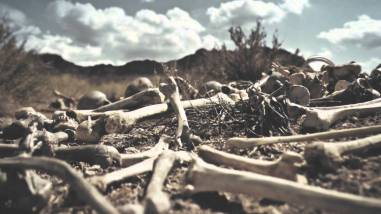
I especially like Ezekiel 37:1-10: “The hand of the LORD was upon me, and he brought me out by the Spirit of the LORD and set me in the middle of a valley; it was full of bones. {2} He led me back and forth among them, and I saw a great many bones on the floor of the valley, bones that were very dry. {3} He asked me, “Son of man, can these bones live?” I said, “O Sovereign LORD, you alone know.” {4} Then he said to me, “Prophesy to these bones and say to them, ‘Dry bones, hear the word of the LORD! {5} This is what the Sovereign LORD says to these bones: I will make breath enter you, and you will come to life. {6} I will attach tendons to you and make flesh come upon you and cover you with skin; I will put breath in you, and you will come to life. Then you will know that I am the LORD.'” {7} So I prophesied as I was commanded. And as I was prophesying, there was a noise, a rattling sound, and the bones came together, bone to bone. {8} I looked, and tendons and flesh appeared on them and skin covered them, but there was no breath in them. {9} Then he said to me, “Prophesy to the breath; prophesy, son of man, and say to it, ‘This is what the Sovereign LORD says: Come from the four winds, O breath, and breathe into these slain, that they may live.'” {10} So I prophesied as he commanded me, and breath entered them; they came to life and stood up on their feet–a vast army.”

Jesus’ ministry didn’t always look like a success story. There were instances when ” From this time many of his disciples turned back and no longer followed him.” (John 6:66 (NIV) There have always been periods of decline among the people of God.

What resources do we have to bring life to a tired community? Of course, it is God who ultimately works to bring life to the church. In the past (and in many places today) periodic “revivals” or “meetings” were tried to achieve renewal. In many instances, these occasions were very useful in stimulating the church to greater service. Meetings, campaigns, and other special programs indicate our awareness that communities do grow tired and that one of our great needs is to find the resources for renewal.

In reality, we have likely been more successful in providing momentary diversions than in providing on going renewal of the church.

If the writer to the Hebrews had one text it was: “Let us draw near.”

Hebrews 10:19-23: “Therefore, since we have confidence to enter the sanctuary by the blood of Jesus, by the new and living way which he opened for us through the curtain, that is, through his flesh, . . . let us draw near with a true heart in full assurance of faith.”

(Hebrews 4:14-16 NIV) “Therefore, since we have a great high priest who has gone through the heavens, Jesus the Son of God, let us hold firmly to the faith we profess. {15} For we do not have a high priest who is unable to sympathize with our weaknesses, but we have one who has been tempted in every way, just as we are–yet was without sin. {16} Let us then approach the throne of grace with confidence, so that we may receive mercy and find grace to help us in our time of need.”

(Hebrews 6:1 NIV) “Therefore let us leave the elementary teachings about Christ and go on to maturity, not laying again the foundation of repentance from acts that lead to death, and of faith in God…”

(Hebrews 10:22 NIV) “…let us draw near to God with a sincere heart in full assurance of faith, having our hearts sprinkled to cleanse us from a guilty conscience and having our bodies washed with pure water.”

The Christians here were in danger of committing apostasy (of turning their back on Christ and going back to the law). They had been Christians long enough to have developed spiritual depth and insight…yet they were said to be “dull of hearing” and still needed “milk instead of solid food.”

As Christians, we know the answer to the world’s problems, but the problem was: “How to make the world believe the answer?” Story of a young Christian who seemed considerably troubled. With a deeply concerned look on his face, he said, ” Why doesn’t the world believe what we have to say?” Then he added, “I think it’s because so many Christians don’t act like they believe it themselves.” Then he asked the logical, but thorny, question: “How can we make Christians believe what they believe?”

That is the very theme of the book of Hebrews: How to make Christians believe, how to make Christians act like Christians. This is what the world is waiting to see and what the epistle was written to effect. It is addressed to a group of Jewish Christians who had begun to drift, to lose their faith.

They had lost all awareness of the relevancy of their faith to the daily affairs of life. They had begun to drift into outward formal religious performance, but to lose the inner reality. Doubts were creeping into their hearts from some of the humanistic philosophies that abounded in the world of their day, as they abound in the world of our day. Some of them were about to abandon their faith in Christ, not because they were attracted again by Jewish ritual and ceremony, but because of persecution and pressure.

They felt it was not worthwhile; they were losing too much, and that it was possible, just possible, that they had been deceived and the message of Christ was not true after all.

Hebrews 1:1-2 (NIV)
1  In the past God spoke to our forefathers through the prophets at many times and in various ways,
2  but in these last days he has spoken to us by his Son, whom he appointed heir of all things, and through whom he made the universe.

The great tragedy is this: men have groped and grasped after God as though they were in a dark world maxresdefaultthat gave no evidence of God. But this is just not so; there is no need for man to be in the dark about God. Why? Because God has revealed Himself, and He has revealed Himself in many different ways:
  • through nature or what might be called a revelation of His Supreme deity and power. A person can look at nature and clearly see God’s deity and power
  • through conscience or what might be called an inner witness or sense of duty to God.
  • through law or what might be called a revelation of Supreme justice
  • through religion or what might be called a revelation of how to worship and become acceptable to God
  • through prophets and priests or what might be called the revelation of God through human spokesmen and mediators.

The list could go on and on, but the point is that God has revealed Himself to man, and each revelation has been very important for man’s understanding of God. But despite all these revelations, something vital is still missing. If man is ever to know God, there is only one way, the very same way that man gets to know anybody.

Man can know about a person, know all the facts about a person’s life; but until he personally meets the person and associates and fellowships with him, he does not personally know him.

Therefore if man was to ever know God, God had to reveal Himself in the most supreme way possible: He had to come to earth and show Himself to man, revealing exactly who He is and what He is like. This is the whole point of the first four chapters.

The word better is used thirteen times in this book as the writer shows the superiority of Jesus Christ and His salvation over the Hebrew system of religion. Christ is “better than the angels” (Heb. 1:4). He brought in “a better hope” (Heb. 7:19) because He is the Mediator of “a better covenant, which was established on better promises” (Heb. 8:6).

Another word that is repeated in this book is perfect; in the original Greek it is used fourteen times. It means a perfect standing before God. This perfection could never be accomplished by the levitical priesthood (Heb. 7:11) or by the Law (Heb. 7:19), nor could the blood of animal sacrifices achieve it (Heb. 10:1). Jesus Christ gave Himself as one offering for sin, and by this He has “perfected forever them that are sanctified” (Heb. 10:14).

Eternal is a third word that is important to the message of Hebrews. Christ is the “author of eternal salvation” (Heb. 5:9). Through His death, He “obtained eternal redemption” (Heb. 9:12) and He shares with believers “the promise of eternal inheritance” (Heb. 9:15). His throne is forever (Heb. 1:8) and He is a priest forever (Heb. 5:6; 6:20; 7:17, 21). “Jesus Christ, the same yesterday, and today, and forever” (Heb. 13:8).

When you combine these three important words, you discover that Jesus Christ and the Christian life He gives us are better because these blessings are eternal and they give us a perfect standing before God. The religious system under the Mosaic Law was imperfect because it could not accomplish a once-for-all redemption that was eternal.

These people were “second generation believers,” having been won to Christ by those who had known Jesus Christ during His ministry on earth (Heb. 2:3). They were true believers (Heb. 3:1) and not mere professors.

They had been persecuted because of their faith (Heb. 10:32-34; 12:4; 13:13-14), and yet they had faithfully ministered to the needs of others who had suffered (Heb. 6:10). But they were being seduced by teachers of false doctrine (Heb. 13:9), and they were in danger of forgetting the true Word that their first leaders, now dead, had taught them (Heb. 13:7).

The tragic thing about these believers is that they were at a standstill spiritually and in danger of going backward (Heb. 5:12ff). Some of them had even forsaken the regular worship services (Heb. 10:25) and were not making spiritual progress (Heb. 6:1). In the Christian life, if you do not go forward, you go backward; there is no permanent standing still.

“How can you go back into your former religion?” the writer asked them. “Just take time to evaluate what you have in Jesus Christ. He is better than anything you ever had under the Law.”

Much like our own times, the writer of Hebrews and his audience are not accustomed to daily miraculous experiences that make God’s presence in our world glaringly obvious. These people are not first-generation followers. None of them saw Jesus; apparently they are not accustomed to the miracle-working of the early apostles and leaders.

Like us, the activity of God in their world is apparently more subtle. When the social world around them seems to be doing just fine without God or when they seem to be suffering and ridiculed and excluded from the materialistic successes around them, they could decide that God really isn’t active. Their faith has cost them a great deal in the social setting in which they live.

They could decide to just blend back in, find their identity in the social structures and material world around them. Or they could believe that God has acted in Christ in ways that have eternal import for their lives.

“God Speaks To Us…Through Jesus

God, after He spoke long ago to the fathers in the prophets in many portions and in many ways. (1:1)

Here is an indication of how God wrote the Old Testament. Its purpose was to prepare for the coming of Christ. Whether by prophecy or type or principle or commandment or whatever, it made preparation for Christ.

This He did through the words of the Old Testament. He used men as instruments, but was Himself behind them, enlightening and energizing them. The deists teach that God started the world going and then went away, leaving it to run by itself. But God is not detached from His creation; He is not uninvolved in our world. The true and living God, unlike the false gods of man’s making, is not dumb or indifferent. The God of Scripture, unlike the impersonal “First Cause” of some philosophers, is not silent. He speaks. He first spoke in the Old Testament, which is not a collection of the wisdom of ancient men but is the voice of God.

The senses of man, marvelous as they are, are incapable of reaching beyond the natural world. For us to know anything about God, He must tell us. We could never know God if He did not speak to us. Thus, in the Old Testament, the writer reminds us, “God … spoke.”

How does God work in our world? Through Jesus!

In these last days [God] has spoken to us in His Son, whom He appointed heir of all things, through whom also He made the world. (1:2)

God’s full, perfect revelation awaited the coming of His Son. God, who used to speak in many different ways through many different people, has finally spoken in one way, through one Person, His Son Jesus Christ.

The whole New Testament is centered around Christ. The gospels tell His story, the epistles comment on it, and the Revelation tells of its culmination. From beginning to end the New Testament is Christ. No prophet had been given God’s whole truth. The Old Testament was given to many men, in bits and pieces and fragments. Jesus not only brought, but was, God’s full and final Revelation.

Yes, he has always cared about and paid attention to our needs. He has desired to be in communication with us from the start. He spoke to Adam and Eve in the Garden of Eden. He talked to Abraham through angels and in bodily form. He came to Joseph and Daniel in dreams. Oh, he even raised up a string of prophets to give a more general word to people – Moses, Deborah, Isaiah, Amos. But we weren’t getting his point. We were garbling the message. We were fighting over words and their interpretation.

So heaven pulled out all the stops and God chose to enflesh his message in a Son. Love became incarnate in Jesus of Nazareth. In the mind of the unnamed writer of the Epistle to the Hebrews, Jesus is the final and unanswerable proof that God not only knows about our human plight but cares for us with love that knows no boundaries.

Jesus isn’t almost divine but “the exact imprint of God’s very being.” He isn’t trying to come up with a remedy for sin but “made purification for sins” and sat down at God’s right hand. He isn’t as good as God’s other servants and messengers but has inherited “the name” that is “more excellent than theirs.”

He isn’t as good as God’s other servants and messengers but has inherited “the name” that is “more excellent than theirs.”

This preacher-writer of ours can’t say enough about Jesus! He strings together a series of descriptors for him that anticipate the all-important, incomparable role assigned to him in this sermon-epistle. These verses are very simple. They tell us Christ is superior to everyone and everything. The three primary features of His superiority are: preparation, presentation, and preeminence. Keep in mind that all through the book Christ is presented as being better than the best of everyone and everything that was before Him—absolutely better than anything the Old Testament, the Old Covenant, provided.

*Appreciation to James Thompson and “Strategy for Survival” book

 
Leave a comment

Posted by on April 5, 2015 in Article


Passover, Easter, and Christians today…


 placeforyou2mp3iconFacebook    YouTube JesusIsLordofthisWebSite

 ——————————————–

From the Passover Lamb to Jesus, the Lamb of God

by Stan Kellner with Pam Woody

Having grown up in a Conservative Jewish home, my first Passover celebration was at age 5. I remember it like it was yesterday: my family scurrying about to clean leaven out of the house, the smell of wonderful food cooking in the kitchen, the excitement of setting the special table and preparing the elements unique to Passover. My dad explained that this meal symbolized the freedom Israel received after more than 400 years of slavery in Egypt.

6a00e54fb77662883301156fdbb7b7970b-800wiWhile Passover is recognized as a Jewish holiday, you don’t have to be Jewish to appreciate the Old Testament symbolism associated with it. I’ve been a follower of Jesus for more than 35 years and feel confident that Christian families can experience this meaningful ritual together as they prepare for the triumph of Easter.

According to the account of the first Passover recorded in Exodus 12, a lamb’s blood was shed and doorposts were painted so God would “pass over” that house, sparing the family from death. As a spiritual picture, this symbolizes the blood of the Lamb of God, Jesus, being painted on the doorposts of our heart. What a beautiful picture of forgiveness!

When we compare the principles of the Passover to the details surrounding the death and resurrection of Jesus, it’s exciting to see how the two are related. God’s directives to His people thousands of years ago foreshadowed His plan to deliver each one of us through Jesus’ death and resurrection hundreds of years later.

Practical ways to celebrate

The Seder (pronounced say-der) is the religious ceremony telling the story of Passover. It’s a family-oriented ritual where everyone gathers around the table for a service that may include a meal. It often includes reading from a 48-page text — the Haggadah (a Jewish text that sets forth the order of the Passover Seder).

The Seder is traditionally celebrated in one night and consists of 15 steps, but families can celebrate it as they see fit. In many Christian circles, the Seder is celebrated on the Thursday before Easter as a part of Holy Week. Consider sharing the Seder as a family during a one-evening ceremony, or partake of these elements a little each day during the week leading up to Easter.

The following is a sample Seder that incorporates Jewish tradition with my family’s Christian perspective. I hope your family enjoys the celebration as much as mine has!

Preparation for the Seder

After all leaven has been removed from the house, the traditional Seder begins just after sundown as the mother lights the candles and recites a blessing. Throughout the meal, the family maintains a posture of reclining; using pillows or cushions to lean against.

A list of basic Seder elements includes:

For each individual:

1 2 parsley sprigs

2 1 tablespoon of charoset

3 wine/grape juice — 4 servings of 3 oz. each

4 saltwater — 1 bowl per 4-5 people

5 ½ teaspoon fresh horseradish (bitter)

6 ¼ square matzah (available in most grocery stores in the kosher or ethnic food section — use plain style)

Elijah’s place:

Same as the “individual” amounts with the exception that only one serving of wine or juice is poured and left next to the place setting for the duration of the ceremony.

For the leader’s use:

1 2 white candles and candlesticks with matches

2 1 bowl of saltwater

3 1 lamb bone with no meat, roasted in oven until brown

4 3 whole squares of matzah (unleavened bread) and 4 napkins

5 1 roasted egg

6 1 bowl of clear water and a hand towel

7 1 pillow or cushion for reclining

8 1 small reward, such as a small toy or piece of candy

9 vegetable (optional)

1. The First Cup: The Cup of Sanctification

Each person fills a glass with wine or juice.Explain: This is the cup of sanctification. The word sanctification means to be set apart for God. Jewish families remember that God performed miraculous deeds to free (set apart) Israel from Egypt. We remember that Christ set us apart from the world as a holy nation to himself (1 Peter 2:9).Everyone drinks the first cup.

2. Washing of Hands

The leader dips his hands in a washbasin and wipes his hands on the towel.

Explain: Jewish families remember how the priest washed in the basin before he could come before God on behalf of Israel (Exodus 30:17-21). That ritual pointed to Jesus, who washes away our guilty conscience so that we can draw near to God (Hebrews 10:22). This symbol of cleansing also provides insight concerning the comments and reactions of the disciples when Jesus washed their feet at His Passover Seder (John 13:1-17).

3. Dipping of the Parsley

Everyone dips parsley in the saltwater, one sprig at a time.

Explain: The first dip refers to the tears shed by the Israelites while they were enslaved; the second dip refers to the drowning of the Egyptian army in the Red Sea and the miraculous deliverance that came for the nation of Israel (Exodus 14:13-31). In the New Testament, the apostle Paul compares the crossing of the Red Sea to baptism, which symbolizes our redemption from sin (1 Corinthians 10:1-2).

4. Breaking of the Middle Matzah

The leader takes the middle square from a stack of three matzah, breaks it in half, puts one half back in the middle of the three and wraps the other half in a napkin. Now the leader hides the middle half of matzah as the rest of the family closes their eyes.

Explain: We can see the beautiful picture of the Trinity in the matzah — the top piece representing the Father; the bottom piece representing the Holy Spirit; and the middle piece representing Jesus, who was broken for us and then wrapped in linen to be hidden away (Mark 15:46).

5. The Four Questions and the Passover Story

The leader and the youngest child in the family now ask and answer four important questions that explain why the Passover is celebrated. (Search “Passover: Four Questions” at ThrivingFamily.com.) Next, the leader reads Exodus 12:1-13 as he holds up the lamb bone.

Explain: At the original Passover celebration, a lamb was killed and its blood was spread on the doorposts and lintel of the house to protect the home from the 10th plague, the slaying of the firstborn. God said He would pass over the house when He saw the blood (Exodus 12:13). Each person had to eat of this sacrificial lamb — no one could eat for another person. We understand that we must each make a personal decision to spiritually apply the blood of Jesus to the doorposts of our heart so we never experience sin’s judgment (1 John 1:7-8).

6.The Second Cup: The Cup of Plagues

Everyone fills the cup a second time.

Explain: This is the cup of plagues. God poured out 10 plagues on Egypt in order to show His strength and deliver the nation of Israel. Thank God that He delivered Israel and He delivers us.

Next, each person dips a spoon into his cup, then makes 10 drops of wine fall onto his plate as he says the name of each plague: blood, frogs, lice, flies, cattle disease, boils, hail, locusts, darkness and slaying of the firstborn. Finally, each person drinks from his cup.

7. Eating of the Bitter Herbs

Everyone takes a piece of matzah, adds a small portion of horseradish and eats it.

Explain: Eating bitter herbs (horseradish) symbolizes the bitterness of slavery the nation of Israel endured in Egypt. We also remember the bitterness of our slavery to sin (John 8:34).

8. Eating of the Charoset

Each person enjoys a piece of matzah with a little charoset. (Search“Passover: Charoset Recipe” at ThrivingFamily.com.)

Explain: This mixture symbolizes the mortar that was used by the Israelites to make bricks while in Egypt. This sweet mixture represents bitter toil because even harsh labor is sweetened by the promise of redemption. We know that it was through Christ’s bitter suffering that the sweetness of redemption also came to us (Hebrews 2:9-10).

9. Sharing of the Charoset

Everyone takes another piece of matzah with charoset and feeds it to the person on his right, saying, “Shalom, peace to you.”

Explain: When Jesus brought sweetness into our lives through His forgiveness, He never intended for us to keep it to ourselves. As we feed each other the charoset, we are showing that we want to pass this sweet message on to others (Matthew 28:19-20).

10. Explanation of the Egg

The leader picks up the egg.

Explain: The egg is a reminder that because the temple was destroyed in A.D. 70, the Jews were no longer able to sacrifice. The egg is referred to as the Hagigah, the holiday sacrifice that was made during temple times. We are also reminded that Jesus was the final sacrifice that took away sin once and for all (Hebrews 10:1-18).

11. The Eating of the Meal

Your family can now eat a full meal to recreate the meal that took place in Exodus 12. (Seder menus may vary, including items such as roasted lamb and potatoes, matzo ball soup and sponge cake. Research online to create your own Passover meal.)

12. Finding and Eating of the Afikomen

The Afikomen (“ah-fee-koe’-men”) is the piece of matzah that was hidden earlier. It’s time to play a fun game as you send all the kids on a hunt to look for the hidden matzah. Whoever finds the piece gets a token reward — a ransom is paid for the Afikomen. When found, the Afikomen is broken in pieces and distributed to everyone.

Explain: Jesus himself used matzah as a picture of His sacrifice when He broke the bread during the Last Supper and said, “This is my body given for you” (Luke 22:19).

13. The Third Cup: The Cup of Redemption

Everyone fills the cup a third time.

Explain: This is the cup of redemption. The word redemption suggests the idea of a price being paid to bring someone out of slavery. The sacrificial lamb offered on Passover paid the price to deliver the nation of Israel from the bondage of Egypt. We know that Jesus drank with His disciples and declared, “Drink from it, all of you. This is my blood of the covenant, which is poured out for many for the forgiveness of sins” (Matthew 26:27-28). Drink the third cup in remembrance of Jesus.

14. Looking for Elijah

As the ceremony draws to a close, one of the children goes to the door and peeks his head out to see if Elijah is coming.

“Is Elijah there?” the leader asks.

“No, he is not here,” the child says.

“Maybe next year Elijah will come!” the leader replies.

Explain: According to Malachi 4:5-6, the Jewish people know that Elijah will prepare the way for the Messiah. When they ask if Elijah is coming, they are actually proclaiming that they are waiting for the Messiah. We recognize that John the Baptist prepared the way of the Lord more than 2,000 years ago (Luke 1:13-17).

15. The Fourth Cup: The Cup of Praise

Everyone fills the cup a fourth time.

Explain: This final cup is a reminder of God’s promise to Israel (Exodus 6:7): “I will take you as my own people.” The Jewish people look forward to a golden age when everyone will be at peace and will be reunited with God. In Jewish homes, it is traditional to close with “Next Year in Jerusalem,” a further indication of their waiting for Messiah. As followers of Jesus, we, too, have been chosen by God to be His people, and we eagerly wait for the return of the Messiah so that we will be with Him forever (1 Thessalonians 4:13-17). So, with the Passover ceremony finished, let us drink the fourth cup, proclaiming, “Come, Lord Jesus!”

Passover: Four Questions

Introductory Question

Child: Why is this night different from all other nights?

Leader: Once we were slaves of Pharaoh in Egypt, but now we are free. We set aside this night each year to remember the great things God did for us.

Question 1

Child: On all other nights we eat either bread or matzah, but why, on this night, do we eat only matzah?

Leader: Matzah reminds us of two things — we were delivered from slavery in Egypt, and we have a new life.

Question 2

Child: On all other nights we eat whatever kind of vegetables we want, but why, on this night, do we eat only a bitter one?

Leader: We remember how bitter our ancestors’ slavery was while they lived in Egypt.

passover-four-questions-artiQuestion 3

Child: On all other nights we do not dip our vegetables even once, but why, on this night, do we dip twice?

Leader: We are reminded of tears and of a miraculous deliverance, as we just saw portrayed with the parsley.

Question 4

Child: On all other nights we eat either sitting up straight or reclining, but why, on this night, do we all recline?

Leader: Before, we were slaves, but now we are able to recline to express the rest we enjoy as free people. This pillow represents our freedom.


Leave a comment

Posted by on April 5, 2015 in Article


A Special Study: The Appearances of Christ After the Resurrection 


The number of the Lord’s appearances during the forty days following the resurrection, before His ascension, is generally said to be nine. Of these, five were on the day of the resurrection, one on the Sunday following, two at some later period, and one when He ascended. As to place, five were in Jerusalem, one in Emmaus, two in Calilee, and one perhaps on the Mount of Olives. 

If to these we add the appearance to James (mentioned only by the apostle Paul in I Cor. 15:7), which probably was at Jerusalem; then add also the appearance to Paul mentioned in I Cor. 15:8, we have eleven appearances. Most writers come to this conclusion, differing only on some fine points concerning some of the appearances. 

However, we do not need to say that these recorded and stated appearances were the only actual ones. Acts 1:3 “To whom he also showed himself alive after his passion by many proofs; appearing unto them by the space of forty days, and speaking the things concerning the kingdom of God.” 

It is quite possible that there were other unrecorded appearances during this period of fifty days.
I. The appearances on the day of the resurrection. (5)

A. To Mary Magdalene, at the Tomb, just outside Jerusalem.
1. Problem of when was this, at what time in the morning?
a. How to harmonize Mart. 28:1 with Mark 16:2; Luke 24:1 and John 20:l. The first part of the verse must be interpreted by the added
specification of what is added in the last part of the verse. 
b. When did the women arrive at the tomb! 
1. Luke says, “Very early in the morning.” 
2. John says, “early, while it was yet dark.” 
3. Mark says, “and very early on the First day of the week”
4. Matt. says, “as it began to dawn, toward the first day of the  week.”
c. We must consider where they came from. Probably from Bethany about two miles away.
d. The time was probably about 5 A.M. for at this time of the year the sun would rise about 5:30 A.M. Objects would be discernible one-half hour before sunrise very likely.
3. Wieand Harmony places the appearance to Peter first.
4. Lightfoot supposes one of the two at Emmaus to have been Peter.
a. Since there are not actual details given, it is hard to harmonize the accounts.
b. From Luke 24:34, it seems as if Jesus did appear to Simon (if the Simon talked of is Peter) before He did to the two disciples at Emmaus. McGarvey harmonized this verse with I Cor. 15:5.

D. Jesus appears to the two Disciples going to Emmaus. Mark 16:12, 13; Luke 24:13-35.
1. Who were these two disciples! One was Cleopas, of whom nothing further is known. Luke 24:18)
a. Some say the other was Luke, for he writes almost like one that might have been present during this experience.
b. Lightfoot (mentioned above) supposes him to be Peter.
2. About Earmaus and its location from Jerusalem.
a. Luke 24:13, “village named Emmaus which was three score furlongs from Jerusalem.” 
1. How far is this! If the ruins called el Kukeibeh is the ancient city of Emmaus, then it would be a distance of seven and
thirteen-sixteenths of a mile from Jerusalem. The village has not yet been identified beyond dispute.
2. Time of this meeting. Probably leaving Jerusalem about noon, and allowing for a slow walk, they would arrive in Emmaus a good while before sundawn.
3. Although the Lord met these two while on their way, their eyes were holden until the meal was being eaten. Luke gives the cause in Luke
24:31, “And their eyes were opened and they knew him; and he vanished out of their sight.” Mark gives the affect or their reaction in Mark 16:13,
“And they went away and told it unto the rest; neither believed they them.”

E. Jesus appears to the ten. Luke 24:36-43; John 20:19-25.
1. Thomas is absent at this time. 
2. Place and time!
a. Place- In Jerusalem. In all probability, they were gathered in the same room in which they had eaten the paschal supper.
3. Problem: did Mary come alone or with others and perhaps run on ahead so that she was first at the tomb! She undoubtedly came with the rest. Then, seeing the stone rolled away, she ran immediately to tell John and Peter before even going to the tomb.
a. When telling Peter and John, Mary used the pronoun we signifying that she was not alone.
b. After telling Peter and John she returned to the tomb, probably following Peter and John. Then while she was alone outside the tomb the Lord appeared to her. 
4. John writes of this appearance in detail, Jolm 20:11-18.
a. The account is personal to Mary.
b. She alone acknowledged the questions of Jesus.
c. Jesus addressed her in the singular.

B. The other women soon after appearing to Mary; while they are on their way to tell the message of the angels. (Matt. 28:9, 10) 
1. Who were these other women! How many were there! (Lk. 24:9-11)
a. Mark 15:41, saysthatmzmyotherwame~ came up to Jerusalenn.
b. These names are motioned: Mary Magdalene, Mary, mother of James, Salorne, Joanna, Susanna imd “many others.
1. John mentions only Mary Magdalene.
2. Matt. mentions Mary Magdalene and “the other Mary.” Matt. 28.1.
3. Mark mentions Mary Magdalene, Mary the mother of James, and Salome.
4. Luke mentions Mary Magdalene, Joanna, Mary the mother of lames, and the “other women.” Thus we see there are five, and possible others.
2. Many variations of order are given for this account, due to our not being able to tell whether these women arrived at the tomb in one or two groups.

C. Jesus appears to Peter. (I Cor. 15:5; Luke 24:33, 34)
1. McGarvey places this before the appearances to the two disciples on the road to Emunaus and at Emmaus.
2. R. C. Foster writing in Standard Bible Tearhev, Vol. 38, No. 2; Apr.-May-June 1936, article “The Risen Christ in Galilee” places this
appearance after the Emmaus appearance.
a. Time — In the evening, fbr the two disciples who went to Emmaus arrived back in time to tell them of their experience.
3. The actual appearance of Jesus in the room.
a. John writes that when they saw Jesus they were glad.
b. Luke writes that they were terrified and frightened.
c. Why the apparent difference!
1. Luke tells the immediate reaction as Jesus stands in the midst of them. How did he get here! They knew nothing of the
possibilities of a resurrected body.
2. John tells their attitude after they had been satisfied this was not a ghost, but their Lord!

II. Jesus appears to the eleven, Thomas being present this time. Mark 16:14; John 20:26-31; I Cor. 15:5,
A. When and Where! In Jerusalem, probably the same as where Jesus appeared to the to. When! The first day of die week. (Jn. 20.26).
B. Main object ofthought. Getting Thomas to believe
1. While so doing, this was also reassuring proof the others.
2. Thomas asked to place his hand into Jesus’ side.
a. Thomas’ answer, “My Lord and my God !” (Jn. 20:28).

III. Jesus appears to the Seven disciples by the Sea of Galilee. John 21:1-25. Only John records this incident.
A. Time – Some suggest the next Lord’s Day
B. The seven disciples: Simon Peter, Thomas, Nathanael, James and John, and two other disciples. 
C. Order of events that happened:
1. Peter and the others probably gathered in Peter’s home in Capernawn.
2. This waiting made then impatient. Thinking of an honest means of getting food, Peter said “I am off to fish tonight.” The rest join in,
‘We are going with you.”
3. With all the old enthusiasm they go fishing, but luck was against them that night, remindfUl of an experience three years earlier.
4. At early moming someone appeared on the beach and asked, “Lads, have you anything to eat!” Their answer was, “No!”
a. Advice from the man on the shore. “Cast on the right side of the boat.” 
b. The results: 153 fishes were caught in the net.
c. John at this, turned to Peter and said, “it’s the Lord.”
d. Peter immediately started swimming for the shore.
e. They all had fish forbreakfast.

5. Jesus turned to Simon Peter and probed the recesses of Peter’s heart to secure for him the humility necessary for service.

6. Peter asks about John.
a. Jesus’ answer: John 21:221 “If I will that he tarry till I come, what is that to thee! Follow thou me.

IV. Jesus appears to the five hundred in Galilee. Matt. 28:16-20; I Cor. 15:6.
A. Problem: Some would separate this appearance, and make two appearances here, one to the eleven separately, then to the eleven as counted with the five hundred.
a. If Jesus gave the Great Commission at this time, would he give it to the eleven gathered together with so large a group!
b. But in Matt. 28:17, “some doubted,” could be evidence that the groups were together.
c. Solution, if we separate these two appearances it eliminates this problem.

B. Where is this mountain that is spoken of in Matt. 28:16!
1. Some possible places: The Place of the Sermon on the Mount; The Mount of Transfiguration; The place where He choose the twelve, The place on the east side of the lake where Jesus fed the 5.000.

V. Jesus appears to James. I Cor. 15:7. 
A. No details given of this appearance. 
B. Who is this James!
1 . Possibly one of Jesus’ half-brothers, who had been converted after the resurrection.
2. Later served as pastor of the Church at Jerusalem.

VI. Jesus appears to the eleven in Jerusalem and leads them to the place of Ascension. Mark 16:19, 20; Luke 24:44-53; Acts 1:2-12.
A. Luke, who also wrote Acts, gives us the account of this in both of his writings, one a continuation of the other.
B. What Jesus told them at this time.
1. Charged them not to depart from Jerusalem.
2. For continuity and the progressive nature of the Lord’s redemption work (Not only in seeing the Lord in His resurrected body, but most important, hearing what He taught after His resurrection.

JOHN 21 IN REVIEW
The final chapter shows Christ as the Master of our service and the Friend of sinners. Were it not for this chapter, we would wonder what happened between Peter and the Lord and whether or not his disobedience was really dealt with. 

I. A Night of Defeat (21:1-3)
Some make the strong suggestion that Peter acted without orders in returning to his fishing, that he had forsaken all to follow Christ (Luke 5:1-11), and now he was turning back to the old life. This is not certain, though Peter is definitely called back into service to His Lord.

Everything about this scene speaks of defeat:

(1) it is dark, indicating that they are not walking in the light;

(2) they had no direct word from the Lord;

(3) their efforts met with failure;

(4) they did not recognize Christ when He did appear, showing that their spiritual vision was dim. 

How tragic is a bad influence! We need to keep in mind that God blesses us only when we abide in Christ and obey the Word. “Without Me you can do nothing” (15:5). Too many Christians enter into well-meaning but unscriptural activities, only to waste time, money, and energy for nothing. Let us beware of impatience. It is better to wait on the Lord for directions, and then let Him bless, than to involve ourselves in useless activities. 

II. A Morning of Decision (21:4-17)
When Christ appears on the scene, then the light begins to shine. He instructs them from the shore, and they catch a great host of fish! A few minutes’ labor with Christ in control will accomplish more than a whole night of carnal efforts! It is interesting to compare this miracle with the one at the beginning of Peter’s career in Luke 5:

Luke 5    John 21
1. Followed a night of failure    1. Followed a night of failure
2. No exact number of fish given    2. 153 fish (v. 11)
3. The nets began to break    3. The net did not break
4. Christ instructed from the boat    4. Christ instructed from the shore

Some see in these scenes a picture of the church today (Luke 5) and of the church at the end of the age when Christ returns (John 21). Today we are casting out the Gospel net, but often the nets break, there is seeming failure, and we do not know how many souls are really won. But when Christ returns the exact number will be known, and none will be lost. Today there are many boats and fishermen at work, but when Christ returns, we will see the one church and all the redeemed in the one Gospel net.

There are actually several miracles in this chapter, besides the catch of fish. Peter is given miraculous strength to draw up a net that seven men were not able to draw together (v. 6 and v. 11). 

The fact that the net did not break is amazing. The fire of coals and the cooked breakfast were certainly supplied miraculously. The entire scene was designed to awaken Peter’s conscience and open his eyes. The catch of fish reminded him of his past decision to forsake all and follow Christ. The fire of coals would take him back to his denial (John 18:18). The location—the Sea of Galilee—reminded him of several past experiences with Christ: feeding the 5,000, walking on the water, catching the fish with the coin, stilling the storm, etc.

Because Peter had denied Christ three times publicly, he had to make it right publicly. Note that Christ fed Peter before He dealt with his sins. How like the Lord to bless us first, then deal with us! The issue was Peter’s love for Christ. 

If a man really loves Christ, his life will be devoted and dedicated. Note that Christ gives Peter a new commission: he is now a shepherd (pastor) besides being a fisher of men. (See 1 Peter 5.) He is now to shepherd the lambs and sheep and feed them the Word of God. All Christians are expected to be fishers of men (soul-winners), but some have been called into the special ministry of shepherding the flock. What good is it to win the lost if there is no church where they might be fed and cared for?

 
Leave a comment

Posted by on April 5, 2015 in 1 Corinthians, Jesus Christ


Following after Faith…Faith builds a bridge across the gulf of death


 mp3iconFacebook    YouTube JesusIsLordofthisWebSite placeforyou2

 ——————————————–

The story is told of a good woman known for her great calmness in the midst of many trials and for her simple faith.  Another woman heard of her and said, “I must go and see that woman, and learn the secret of her strong and happy life.”  She went, and speaking to her asked:  “Are you the woman with the great faith?” “No,” she replied, “I am not the woman with the great faith; but I am the woman with the little faith in the great God.”

It’s my greatest blessing in life to have known some men and women who “lived their whole life for their death.” People who loved the Lord daily and longed for eternity moment by moment.cropped-cropped-394466_10150708621696040_1634662704_n1.jpg

They understood that the most important things in life are things we cannot see.  They knew a faith that hasn’t been tested can’t be trusted. Their motto: without Christ, not one step; with him, anywhere!

As Abraham Lincoln said, “Faith is not believing that God can, but that God will!” Faith has never yet outstripped the bounty of the Lord. And faith is a gift but we can ask for it.

Faith comes by the word of God (Rom. 10:17). Thus, we trust a book, whose original we have never seen, to help us learn about a man we have never met, to save us through an event we have never seen, and take us to a place we have never visited. Nevertheless, we believe.

There are three kinds of faith in Christ: 1. Struggling faith, like a man in deep water desperately swimming; 2. Clinging faith, like a man hanging to the side of a boat.; 3. Resting faith, like a man safely within the boat (and able to reach out with a hand to help someone else get in).[1]

When people come in for counsel, and begin to list their many difficulties, I often ask a simple question, “How much time have you spent in Bible study the past month?” Without exception, those who have ‘little faith’ in themselves and in God working with them in their circumstances have spent little or no time in His Word.

   Our need to be in charge of ourselves, others, and situations often makes our relationship with Christ life’s biggest power struggle.  We are reluctant to relinquish our control and allow Him to run our lives.  We may believe in Him and be active in the church and Christian causes, but trusting Him as Lord of everything in life can be scary.

We live under the illusion that if we can acquire complete control, we can understand God, or we can write the great American novel.  But the only way we can brush against the hem of the Lord, or hope to be part of the creative process, is to have the courage, the faith, to abandon control.  For the opposite of sin is faith, and never virtue, and we live in a world which believes that self-control can make us virtuous.  But that’s not how it works. [2]

Even though we pray about our challenges and problems, all too often what we really want is strength to accomplish what we’ve already decided is best for ourselves and others.  Meanwhile we press on with our own priorities and plans.  We remain the script writer, casting director, choreographer, and producer of the drama of our own lives, in which we are the star performer. [3]

The principal work of the Spirit is faith … the principal exercise of faith is prayer. [4]   Our faith becomes practical when it is expressed in two books:  the date book and the check book. [5]

We are encouraged to never doubt in the dark what God told us in the light. We should not put a question mark where God has put a period. To have faith is to believe the task ahead of us is never as great as the Power behind us. To me, faith means not worrying.

Faith is a reasoning trust, a trust which reckons thoughtfully and confidently upon the trustworthiness of God. [6] Faith is a refusal to panic. [7] Faith is a strong power, mastering any difficulty in the strength of the Lord who made heaven and earth. Faith is an activity; it is something that has to be applied.[8]

We human beings instinctively regard the seen world as the “real” world and the unseen world as the “unreal” world, but the Bible calls for almost the opposite. Through faith, the unseen world increasingly takes shape as the real world and sets the course for how we live in the seen world.[9]

Understanding is the reward of faith. Therefore seek not to understand that you may believe, but believe that you may understand.

The Bible recognizes no faith that does not lead to obedience, nor does it recognize any obedience that does not spring from faith.  The two are at opposite sides of the same coin. [10]

The writer to the Hebrews went on to say: “Now faith is being sure of what we hope for and certain of what we do not see. This is what the ancients were commended for. By faith we understand that the universe was formed at God’s command, so that what is seen was not made out of what was visible.”(Heb. 11:1-3)

Faith is absolutely certain that what it believes is true and that what it expects will come.  It is not the hope which looks forward with wistful longing; it is the hope which looks forward with utter conviction.  Faith is not a sense, nor sight, nor reason, but taking God at his Word.

In the early days of persecution they brought a humble Christian before the judges.  He told them that nothing they could do could shake him because he believed that, if he was true to God, God would be true to him.  “Do you really think,” asked the judge, “that the like of you will go to God and his glory?” “I do not think,” said the man, “I know,” [11]

A person who has faith is prepared for life and to do something with it. [12]

Moffatt distinguishes three directions in which the Christian hope operates. It is belief in God against the world.  If we follow the world’s standards we may well have ease and comfort and prosperity; if we follow God’s standards we may well have pain and loss and unpopularity.  It is the conviction of the Christian that it is better to suffer with God than to prosper with the world. 

In the book of Daniel, Shadrach, Meshach and Abednego are confronted with the choice of obeying Nebuchadnezzar and worshipping the king’s image or obeying God and entering the fiery furnace.  Without hesitation they choose God (Daniel 3).  The Christian attitude is that in terms of eternity it is better to stake everything on God than to trust to the rewards of the world.

The Christian hope is belief in the spirit against the senses.  The senses say to a man:  “Take what you can touch and taste and handle and enjoy.”

The Christian hope is belief in the future against the present.  Long ago Epicurus said the chief end of life was pleasure.  But he did not mean what so many people think he meant.  He insisted that we must take the long view.  The thing which is pleasant at the moment may bring pain in the long run; the thing which hurts like fury at the moment may bring joy in the long run.  The Christian is certain that in the long run no man can exile the truth for “great is truth, and in the end she will prevail.”[13]

It was precisely because the great heroes of the faith lived on that principle that they were approved by God.  Every one of them refused what the world calls greatness and staked everything on God and history proved them right.

Many of us need to be more like the little girl whom the farmer found lost in his meadow.  The farmer said to her, “Do not cry; I’ll take you home.”  The little child snuggled up to him, and with a smile, said, “I knew you would; I was waiting for you.”  “Waiting for me?” said the man. “What made you think I was coming?”  “I was praying you would” she said.  “Praying?  When I first heard you, you were saying A B C D E F G.  What was that for?” She looked up again and said, “I’m just a little girl.  I was praying all the letters of the alphabet and letting God put them together the way He wanted to.  He knows I was lost, and He knows how to put them together better than I do.”

What a difference if we would only let God put the letters of our lives together.[14] Faith does not struggle; faith lets God do it all. [15]

Hope stands up to its knees in the past and keeps its eyes on the future. There has never been a time past when God wasn’t with us as the strength beyond our strength, the wisdom beyond our wisdom, as whatever it is in our hearts–whether we believe in God or not–that keeps us human enough at least to get by despite everything in our lives that tends to wither the heart and make it less than human. To remember the past is to see that we are here today by grace, that we have survived as a gift. [16]

Two little girls were on their way to school one morning. Having been detained in starting, they were very much afraid that they would be late. One said, “Let us kneel down and ask the Lord to not let us be late.” The other said, “No, I think I will run as fast as I can, and pray to God while I am running to help me to get there on time.”

Folding our hands in prayer is not an act of resignation. Prayer does not lead us to accept every circumstance with passive calm. Is prayer our steering wheel or our spare tire?

Two gentlemen were one day crossing the river in a ferryboat. A dispute about faith and works arose, one saying that good works were of small importance and that faith was everything, the other asserting the contrary. Neither being able to convince the other, the ferryman asked permission to give his opinion. Upon consent he said, “I hold in my hand two oars. That in my right hand, I call ‘faith’; the other, in my left, ‘works.’ Now, gentlemen, please observe. I pull the oar of faith and pull that alone. See! the boat goes round and round, and the boat makes no progress. I do the same with the oar of works with precisely similar results — no advance. Mark! I pull both together. We go on apace, and in a very few minutes we shall be at our landing place. So, in my humble opinion neither faith without works nor works without faith will suffice.  Let there be both, and the haven of eternal rest is sure to be reached.”[17]

Faith and works should travel side by side, step answering to step, like the legs of men walking.  First faith, and then works; and then faith again, and then works again–until you can scarcely distinguish which is one and which is the other. [18]

When G. Campbell Morgan was young he used to visit several elderly ladies once a week to read the Bible to them. When he came to the end of Matthew’s Gospel, Morgan read, “Lo, I am with you always, even unto the end of the age.” He added, “Isn’t that a wonderful promise?” One of the ladies quickly replied, “Young man, that is not a promise. It is a fact!”

Saving faith is always a working faith.  It not only trusts God for everyday needs but also motivates the doing of good deeds. One of the strongest evidences of the relevance of Christianity to human suffering and need is the good that believers do because of their relationship to Christ.

John Stott observed that ”every Christian should be both conservative and radical; conservative in preserving the faith and radical in applying it.” Put another way,  if there are two words that should be said in the same breath and said regularly to ventilate our hope, that should be flamed together, branded as a signature of our faith, they are the words “faith” and “courage.”  It takes courage to believe, and in order to have that courage, we must believe. [19]

On day six of the ill-fated mission of Apollo 13, the astronauts needed to make a critical course correction. If they failed, they might never return to Earth.

   To conserve power, they shut down the onboard computer that steered the craft. Yet the astronauts needed to conduct a thirty-nine-second burn of the main engines. How to steer? Astronaut Jim Lovell determined that if they could keep a fixed point in space in view through their tiny window, they could steer the craft manually. That focal point turned out to be their destination–Earth.

   As shown in 1995’s hit movie, Apollo 13, for thirty-nine agonizing seconds, Lovell focused on keeping the earth in view. By not losing sight of that reference point, the three astronauts avoided disaster.

   Scripture reminds us that to finish your life mission successfully, “Fix your eyes on Jesus, the author and perfecter of our faith” (Heb. 12:2).

There was a tightrope walker, who did incredible aerial feats. All over Paris, he would do tightrope acts at tremendously scary heights. Then he had succeeding acts; he would do it blindfolded, then he would go across the tightrope, blindfolded, pushing a wheelbarrow. An American promoter read about this in the papers and wrote a letter to the tightrope walker, saying, “Tightrope, I don’t believe you can do it, but I’m willing to make you an offer. For a very substantial sum of money, besides all your transportation fees, I would like to challenge you to do your act over Niagara Falls.” Now, Tightrope wrote back, “Sir, although I’ve never been to America and seen the Falls, I’d love to come.” Well, after a lot of promotion and setting the whole thing up, many people came to see the event. Tightrope was to start on the Canadian side and come to the American side. Drums roll, and he comes across the rope which is suspended over the treacherous part of the falls — blindfolded!! And he makes it across easily.

The crowds go wild, and he comes to the promoter and says, “Well, Mr. Promoter, now do you believe I can do it?” “Well of course I do. I mean, I just saw you do it.” “No,” said Tightrope, “do you really believe I can do it?” “Well of course I do, you just did it.” “No, no, no,” said Tightrope, “do you believe I can do it?” “Yes,” said Mr. Promoter, “I believe you can do it.” “Good,” said Tightrope, “then you get in the wheel barrow.”

Often, God is ready and willing to provide help and security to us, yet we’re not strong enough in faith to allow it to occur.

One night a house caught fire and a young boy was forced to flee to the roof. The father stood on the ground below with outstretched arms, calling to his son, “Jump! I’ll catch you.” He knew the boy had to jump to save his life. All the boy could see however, was flame, smoke, and blackness. As can be imagined, he was afraid to leave the roof. His father kept yelling: “Jump! I will catch you.” But the boy protested, “Daddy, I can’t see you.”  The father replied, “But I can see you and that’s all that matters.”

At other times we place our aspirations for the future on items which are temporary or vain or weak.

In April of 1988, a TV cameraman jumped out of a plane with some other skydivers.  His goal was to record the exciting jump of the skydivers as they fell to the earth.  What’s more, this footage was shown on the local TV news, but not for the reasons why the cameraman had originally recorded the event.

After several minutes of “free fall,” the cameraman then filmed the skydivers as they one by one opened their parachutes. Of course, the final skydiver was the cameraman himself and the time came for him to pull his parachute ripcord.

However, when the cameraman reached for his ripcord, he realized to his horror and shock that he had no ripcord.  It turns out that he had completely forgotten to put on his parachute.

For the next several minutes, the cameraman was able to capture the sheer terror as he ultimately fell to his death. Indeed, toward the end of the film, the picture went berserk and eventually went dead.

This story is not only tragic, but it is also ironic.  Ironic because the cameraman took a plunge into what appeared to be an exciting and thrilling jump.  But tragically, in a moment of foolish carelessness, he made the worst mistake of his entire life: he jumped to his own death.  Yes, his faith had been based upon a parachute — a life support — that wasn’t there.

In the same way, if we based our lives upon anything other than faith in our Lord Jesus Christ, then we will make the biggest mistake of our entire lives as well.  That is, faith other than in Christ will lead to our spiritual deaths!  What’s more, this spiritual death will be for all eternity — forever and ever!

Dr. John MacNeill once said that if he heard his little three-year-old girl crying piteously for a piece of bread, knowing that she must be very hungry and having the bread with him, he would not think of telling her to cry on for another hour and if she coaxed hard enough he would give it to her!  Yet how slow we are to believe that God means what He says, “How much more shall your heavenly Father give the Holy Spirit to them that ask him?” (Luke 11:13) God is eager to come in His fullness.  We need not to coax, but to receive.

Michael Faraday, the great scientist, was taken ill.  When it  became evident that the sickness that had fastened itself upon him would soon result in his death, a group of fellow scientists came to see him–not so much to talk about science as to talk about death.

One of them said to him:  “Mr. Faraday, what are your  speculations about your future?”  With evident surprise to them he replied: “Speculations!  I have none.  I am resting on certainities.”  Then he quoted II Tim. 1:12:  “For I know whom I have believed, and am persuaded that he is able to keep that which I have committed unto him against that day.”

Several years ago a scientist wrote an article entitled, “Seven Reasons Why I Believe in God.” He said, “Consider the rotation of the earth. Our globe spins on its axis at the rate of one thousand miles an hour. If it were just a hundred miles an hour, our days and nights would be ten times as long. The vegetation would freeze in the long night or it would burn in the long day; and there could be no life.”

   He said, “Consider the heat of the sun. Twelve thousand degrees at surface temperature, and we’re just far enough away to be blessed by that terrific heat. If the sun gave off half its radiation, we would freeze to death. If it gave off one half more, we would all be crispy critters.”

   He said, “Consider the slant of the earth.” I think he said twenty-three degrees. “If it were different than that, the vapors from the oceans would ice over the continents. There could be no life.”

   He said, “Consider the moon. If the moon were fifty thousand miles away rather than its present distance, twice each day giant tides would inundate every bit of land mass on this earth.”

   He said, “Think of the crust of the earth. Just a little bit thicker and there could be no life because there would be no oxygen. Or the thinness of the atmosphere. If our atmosphere was just a little thinner, the millions of meteors now burning themselves out in space would plummet this earth into oblivion. These are reasons,” he said, “why I believe in God.” [20]

Imagine a ship filled with people crossing the Atlantic. In the middle of the ocean there is an explosion. The ship is severely damaged and slowly sinking. Most are dead, and the rest are rushing for the lifeboats. Now suppose one man doesn’t know about the lifeboat, so he does not get aboard. He doesn’t have knowledge, so he is not saved. Suppose another man knows about the lifeboat and believes it will save his life, but he is grief-stricken over seeing his wife killed, so he chooses not to get aboard and dies with his wife. He has knowledge and mental assent, but he is not saved. Others believe the lifeboat will save them, and they get into the boat. They are saved by faith, that is they have knowledge, mental assent, and trust. However, it is not their faith that saves them–no matter how much they have. It is the boat. Saving faith trusts Christ, and Christ saves. [21]

Everyone has faith in something–faith in some religion, faith in one’s self, faith in fate, faith in evolution, faith in mankind. Even the atheist has faith in his own reason.

But there is only one real faith that works for time and eternity. True faith is faith in the one true God–the God who made us, who will judge us, and who has paid the price to save us. This faith is an understanding faith, for it is “through faith we understand that the worlds were framed by the word of God” (Hebrews 11:3).

It is a saving faith, “for by grace ye are saved through faith, “for by grace ye are saved through faith” (Galations 3:11), it is, therefore, a living faith, and a growing faith, “because that your faith groweth exceedingly” (II Thessalonians 1:3), and a working faith, because “faith without works is dead” (James 2:20).

There is more. The true faith is a justifying faith (it makes us righteous in the sight of God) because, “being justified by faith, we have peace with God through our Lord Jesus Christ” (Romans 5:1). It is a protecting faith because, with “the shield of faith…ye shall be able to quench all the fiery darts of the wicked” (Ephesians 6:16). It is a stable faith, “for by faith ye stand” (II Corinthians 1:24).

This faith is also a purifying faith, “purifying their hearts by faith” (Acts 15:9). Furthermore, asking faith receives answers to its prayers, “in faith, nothing wavering” (James 1:6), and a strong faith recoiling “not at the promise of God through unbelief; but…strong in faith, giving glory to God” (Romans 4:20).

Finally, the Christian faith is a triumphant faith. “For whatsoever is born of God overcometh the world: and this is the victory that overcometh the world, even our faith” ( I John 5:4).

This faith–even our faith(!)–is an understanding, saving, living, growing, justifying, purifying, working, protecting, stable, asking, strong, triumphant faith!

We need to feed our faith and our doubts will starve to death.  Faith is nothing at all tangible.  It is simply believing God; and, like sight, is nothing apart from its object.  We might as well shut our eyes and look inside to see whether we have sight, as to look inside to discover if we have faith.

We are all asked to do more than we can do. Every hero and heroine of the Bible does more than he would have thought it possible to do, from Gideon to Esther to Mary.

Faith is not a contract. Faith is surrender. If no other relationship in our experience is one of self-surrender, it’s all contractual; people won’t know how to believe.

Some people think the prayer of faith is crawling out on a limb and then begging God to keep someone from sawing it off. But that is not real prayer, that is presumption. If God makes it clear that he wants you out on a limb, fine–you will be perfectly safe there. If not, it is presumptuous to crawl out on that limb, expecting God to keep you there. [22]

An old lady in England who had stood the bombings with amazing fortitude was asked the secret of her calmness in the midst of such frightful danger. She replied, “Well, every night I says my prayers and then I remembers how the parson told us God is always watching; so I go to sleep. After all, there’s no need for both of us to stay awake!”


[1] Dwight Lyman Moody (1837–1899)

[2] Madeleine L’Engle in Walking on Water. Christianity Today, Vol. 36, no. 4.

[3] Lloyd Ogilvie in 12 Steps to Living Without Fear. Christianity Today, Vol. 32,  no. 3.

[4] John Calvin, Christian History, no. 12.

[5] Elton Trueblood.  Leadership, Vol. 11, no. 1.

[6] John R. W. Stott (1921– )

[7] D. Martyn Lloyd-Jones (1899–1981)

[8] Corrie ten Boom (1892–1983)

[9] Philip Yancey (1949– )

[10] A.W. Tozer.  Leadership, Vol. 12, no. 4.

[11] William Barclay, The Letter to the Hebrews

[12] Sadie and Bessie Delany, Christian Reader, Vol. 33, no. 2.

[13] Ibid, William Barclay.

[14] Knight’s Illustrations  p. 186

[15] Corrie ten Boom (1892–1983)

[16] Frederick Buechner, Christian Reader, Vol. 35, no. 2.

[17] William Moses Tidwell, “Pointed Illustrations.”

[18] William Booth in The Founders’ Messages to Soldiers. Christianity Today, Vol. 36, no. 10.

[19] Fay Angus in Running Around in Spiritual Circles. Christianity Today, Vol. 36, no. 5.

[20] Frank Pollard, “Our Greatest Victory,” Preaching Today, Tape No. 175.

[21] Evangelism, A Biblical Approach, M. Cocoris, Moody, 1984, p. 77

[22] Ray C. Stedman in Man of Faith.  Christianity Today, Vol. 40, no. 7.

 
Leave a comment

Posted by on April 1, 2015 in Sermon


Benefits which come from beginning the day with prayer


mp3icon Facebook    YouTube JesusIsLordofthisWebSite

 ——————————————–

1. It enables us to form a habit of close and ultimate union, communion, and fellowship with God. The law and force of habit are well understood; for all men live and act, more or less under the influence of habit. Those who neglect their duty, or engage in sinful practices, will soon find that they are drawn to these things by an invisible and almost irresistible influence.  

They may see many examples to warn them of the dangers which confront them, and they may feel keenly the awful forebodings and warnings of a guilty and an aroused conscience; but, in spite of all these, the force of habit generally overcomes all their fears and feeble resolutions. Under its still-increasing power they continue their neglect, or sinful practices, until their characters have been largely developed; and then it is well-nigh impossible to change them. “An act often repeated hardens into a habit, and a habit long continued petrifies into character.”

thOn the other hand, if one begins his life on the ascending scale, and forms the right kind of habits, he will soon find that he will have little difficulty in ascending still higher and higher on his way to eternal life and a home with God.

These habits become helps and encouragements to him, and will cause him to hunger and thirst after the Kingdom of God and His righteousness.

The habit of prayer, and especially of secret prayer, is altogether in harmony with this general law of habit and the growth and development of human character. In no other religious exercise is one brought so near to God; and in no other can he be so familiar with the Creator of his body and the Father and Preserver of his spirit.

Furthermore, it is a law of nature that one forms attachment to and for those with him he associates, and even becomes like them in his character; and since this is true, it follows that no other act of devotion is so favorable for the cultivation of godliness. Those therefore, who have been most devoted to prayer, in its true sense, have always been the most pious and the happiest of men.

2. It serves to cultivate and educate our spiritual nature. It is generally understood that all parts of our nature are developed and strengthened by exercise; and if that is a law of our human constitution, then what can be more serviceable in the way of spiritual culture than the devotion to the practice of prayer, and especially private prayer?

When one prays in secret there is no motive; to try to deceive God, or to make a vain display of his person, dress, or good works. Instead, his mind turns upon itself; the conscience is awakened; and he sees himself in the light of God.

The practice of secret devotions brings one under the deep and solemn conviction that he is on holy ground, and that the eye of God is upon him; and with that feeling he is almost compelled to be humble, to repent of his sins, to forgive those who have sinned against him, to sympathize with the afflicted, to love and honor the Lord, and to endeavor to exercise all the powers of his being in harmony with the will of God.

There is, therefore, a deep significance in the words of Jesus: “But thou, when thou prayest, enter into thine inner chamber, and having shut thy door, pray to thy Father who is in secret, and thy Father who seeth in secret shall recompense thee.” (Matt. 6:6).

3. It serves to preserve us from many evils. It is impossible to live in this world without coming in contact with the influence of evil to some extent.

(John 17:15)  My prayer is not that you take them out of the world but that you protect them from the evil one.

(1 Corinthians 5:9)  I have written you in my letter not to associate with sexually immoral people–

(Ephesians 6:10-15)  Finally, be strong in the Lord and in his mighty power. {11} Put on the full armor of God so that you can take your stand against the devil’s schemes. {12} For our struggle is not against flesh and blood, but against the rulers, against the authorities, against the powers of this dark world and against the spiritual forces of evil in the heavenly realms. {13} Therefore put on the full armor of God, so that when the day of evil comes, you may be able to stand your ground, and after you have done everything, to stand. {14} Stand firm then, with the belt of truth buckled around your waist, with the breastplate of righteousness in place, {15} and with your feet fitted with the readiness that comes from the gospel of peace.

The worst enemies that anyone has are his lusts and passions.prayer

(James 1:13-16)  When tempted, no one should say, “God is tempting me.” For God cannot be tempted by evil, nor does he tempt anyone; {14} but each one is tempted when, by his own evil desire, he is dragged away and enticed. {15} Then, after desire has conceived, it gives birth to sin; and sin, when it is full-grown, gives birth to death. {16} Don’t be deceived, my dear brothers.

(1 Peter 2:1-2)  Therefore, rid yourselves of all malice and all deceit, hypocrisy, envy, and slander of every kind. {2} Like newborn babies, crave pure spiritual milk, so that by it you may grow up in your salvation,

4. It secures to us and for us much positive good by fulfilling a condition upon which God has promised to bestow His blessings. Some have erroneously supposed that the influence of prayer is wholly subjective, or, at least, that it never extends beyond the narrow limits of our own earthly associations. The Bible, however, plainly teaches that God hears the prayers of His faithful children, and that He is influenced for good by them.

5. Prayer is a powerful and divinely appointed means of convicting, sanctifying and saving others. This is especially true of the family. The relation of the parent to a child is one of the nearest, dearest, and most interesting on earth; and for that reason it involves an influence which is peculiar to itself.

The example of the parent is to the child, during the most tender and impressible period of its existence, the standard of all that is right, noble, and magnanimous. The child’s greatest concern is to imitate the parent, whether it be good or bad; and if the parent prays or neglects to pray, he may expect the child to follow.

The parent, therefore, is responsible for the proper exercise of the influence of prayer over his child; and it will be a terrible thing for him to stand before the Judge of all the earth and have his child say to him, “You were responsible for bringing me into the world, but you never taught me to read and study the Bible and to pray to the heavenly Father; and now it is too late.”

Heaven is full of answers to prayers for which no one ever bothered to ask. On a gloomy day in 1857 a man in New York City by the name of Jeremiah Lanthier scanned the morning newspaper as he rode to his office. He was distressed to read that the depression gripping the nation was causing fear and panic among the people. Factories were stopping production and thousands were unemployed. Although Lanthier was not a big industrialist, but only a clerk, he had one important distinction. He was a man who had great faith in God!

Concerned with the grim economic situation, he sent a note to all his business acquaintances, telling them that each day at noon a prayer meeting would be held in his office. With high hopes he arranged 20 chairs in a circle, but the first day no one came. All alone he prayed fervently that God would bring about a great change in him and in America. The second day he was encouraged, for a few friends joined him. A short time later a similar gathering was started on Wall Street, another on Williams Street, and finally a fourth on Broadway. Then like wildfire the movement spread to all parts of the country. The moral tone of the nation was affected, and there was a great upsurge in the spiritual life of the people. Some historians say that this effort of united prayer and faith was an integral part of the improvement in the economy which soon followed.

I learned early in life that we need to be careful what we pray for, because God might grant it. I prayed for patience, and it seemed my whole world fell apart…..disaster, difficulty, and despair one after the other. My mother had a simple explanation: “you prayed for patience and God put you in circumstances when patience was required.”

The following is also true: I asked God to take away my pride, and God said, “NO.” He said it was not for Him to take away, but for me to give it up. I asked God to make my handicapped child whole, and God said, “NO.” He said the child’s spirit is whole, the body is only temporary. I asked God to grant me patience and God said, “NO.” He said that patience is a by product of tribulation. It isn’t granted it’s earned. I asked God to give me happiness and God said, “NO.” He said He gives blessings, happiness is up to me. I asked God to spare me pain, and God said, “NO.” He said suffering draws you apart from worldly cares and brings you closer to Me. I asked God to make my spirit grow, and God said, “NO.” He said I must grow on my own, But He will prune me to make me fruitful. I asked God if He loved me, and God said, “YES.” He gave me his only Son who died for me, and I will be in Heaven someday because I believe. I asked God to help me love others as much as He loves me, and God said, “AH, FINALLY, YOU HAVE THE IDEA.”

Many successful people have acknowledged in their memoirs that whenever they came to an impasse in their work and were completely baffled, they sought wisdom from the Lord.

This was true in the life of the inventor of the telegraph, Samuel F. B. Morse. In an interview, George Hervey inquired, “Professor Morse, when you were making your experiments at the university, did you ever come to a standstill, not knowing what to do next?” “I’ve never discussed this with anyone, so the public knows nothing about it. But now that you ask me, I’ll tell you frankly — I prayed for more light” “And did God give you the wisdom and knowledge you needed?” Yes He did,” said Morse. “That’s why I never felt I deserved the honors that came to me from America and Europe because of the invention associated with my name. I had made a valuable application of the use of electrical power, but it was all through God’s help. It wasn’t because I was superior to other scientists. When the Lord wanted to bestow this gift on mankind. He had to use someone. I’m just grateful He chose to reveal it to me.” In view of these facts, it’s not surprising that the inventor’s first message over the telegraph was: “What hath God wrought!”

Every time you face a perplexing problem, seek wisdom from above. And when the answer comes, always be sure to thank God and give Him all the glory.

Good advice for difficult times? A sign in front of a church carried this admonition: “When your knees knock together, kneel on them.” That’s good advice! Quieting our hearts before God will calm our fears and renew our courage.

 
Leave a comment

Posted by on March 30, 2015 in Article


The Meaning of the Miracles  Mark 4: 35-41


 mp3iconFacebook    YouTube JesusIsLordofthisWebSite

 ——————————————–

It is a sad truth is that many theologians throughout the history of the church have not taken any of the miracles of our Lord seriously. The Jews of our Lord’s day did not challenge the actual events, but rather the power by which these miracles were performed (cf. Mark 3:22ff.)

The heathen Greek did not challenge the miraculous event either, but only its interpretation.93 Others, such as Spinoza, held the pantheistic view that miracles were contrary to the nature of God.94

Miracles were considered impossible by Spinoza because of his presuppositions. Skeptics, like Hume, held that miracles are simply incredible, because they contradict man’s normal experience.95 Since Hume doubted that nothing could be known with absolute certainty, those phenomenon which took place outside of the normal course of nature could never be accepted as true.

Schleiermacher and others explained the miraculous in terms of the unknown and misunderstood. Our Lord’s miracles were ‘relative miracles,’ as a savage might consider television, which he does not understand.96 The Rationalistic School would have men believe that Christ never claimed to perform any miracles. Only those who sought the spectacular found something miraculous in the records.97 Christ did not change the water to wine at Cana, but merely provided a new supply of wine. He did not walk on the water, but on the nearby shore. Others, Like Woolston have found the Gospel miracles to have no factual or historical validity, but are merely ‘tales’ which contain a much deeper spiritual truth.98

Such are the views of the skeptics and critics of God’s Word. But for the sincere student of Scripture, there is no satisfaction in these theories. The miracles are an integral part of our Lord’s ministry. They not only authenticate His message; they are a vital part of it.99

The Terms Employed

The miraculous works of our Lord Jesus were communicated by the use of three primary terms, each of which accentuated one particular facet of the supernatural activity of Christ. These three terms are found together in several passages. “Men of Israel, listen to these words: Jesus the Nazarene, a man attested to you by God with miracles and wonders and signs which God performed through Him in your midst, just as you yourselves know” (Acts 2:22, cf. also 2 Corinthians 12:12; 2 Thessalonians 2:9).

The term ‘miracle’ (dunamis), emphasizes the mighty work that has been done, and, in particular, the power by which it was accomplished. The event is described in terms of the power of God in action.

If ‘miracle’ emphasizes the cause of the miraculous event, ‘wonder’ (teras) , underscores its effect on those who are witnesses. On many occasions, the crowds (even the disciples) were amazed and astonished by the works of our Lord (e.g. Mark 2:12; 4:41; 6:51, etc.). Origen pointed out long ago that this term ‘wonder’ is never employed alone in the New Testament, but always in conjunction with some other term which suggests something far greater than a mere spectacle.100

The most pregnant term used with reference to the miracles of our Lord is ‘sign’ (se„meion), which focuses upon the deeper meaning of the miracle.101 A sign is a miracle which conveys a truth about our Lord Jesus. A miracle is usually a sign, but a sign need not always be a miracle (cf. Luke 2:12).

The miracles of our Lord are at one and the same time a visible manifestation of divine power (miracle) an awe-inspiring spectacle (wonder), and an instructive revelation about God (sign).102

Classification of the Miracles

Perhaps the most common classification of the miracles of our Lord is into three categories: (1) those which pertain to nature; (2) those which pertain to man; and, (3) those which pertain to the spirit world.103

I find it helpful to distinguish between what can be called ‘Class A’ and ‘Class B’ miracles. ‘Class A’ miracles overrule or transcend the laws of nature. Such would be the case of our Lord’s walking on the water (Mark 6:45-52). Here the law of gravity was overruled. ‘Class B’ miracles do not overtly violate natural laws. For example, the stilling of the storm did not appear to violate any natural law. Storms on this lake, we are told, stopped as quickly as they commenced. The fact that it stopped at the time of our Lord’s rebuke is evidence of His sovereignty over nature. ‘Class B’ miracles would be viewed by unbelievers as mere coincidence. ‘Class A’ miracles, such as the raising of Lazarus were an outright affront to natural laws and processes (thus the statement, ‘he stinks’ in John 11:39, stressing the normal course of nature). Both categories, ‘Class A’ and ‘Class B,’ are miracles, but ‘Class A’ miracles are more undeniably so to the skeptic.

Characteristics of the Miracles of Our Lord

Miraculous deeds were not unknown to the age in which our Lord revealed Himself to men. But the miracles which He accomplished were far different than those claimed by other religions. For a few moments, we shall attempt to characterize the miracles of our Lord:104

(1) They were truly historical. In the Gospel accounts, the writers have not presented the miracles of our Lord as anything other than actual events. They are not true myths, mythical stories with ‘spiritual lessons,’ but real events conveying spiritual truths. The Miracles of other religions are far more mythical in nature. Though perhaps not precisely stated, we can sense a kind of ‘once upon a time’ mood. Not so in the Gospels.

(2) They were reasonable. The miracles of the Apocryphal Gospels are fantastic and questionable.105 They are completely out of character, with Jesus arbitrarily and capriciously using His supernatural powers. In contrast, the Gospels show a highly ethical use of His power, in a way totally consistent with His person.

(3) They were useful. Almost every miracle of our Lord was designed to meet a physical need. Our Lord refused to employ His powers to satisfy His own appetites, or to ensure His protection. He turned down every invitation to do the miraculous to satisfy idle curiosity (cf. Luke 23:8).

(4) They were accomplished openly. The miracles were performed in the most public situations, not oft in a dark corner. While so many alleged ‘miracles’ of today defy documentation, those of our Lord were mainly public.

(5) They were accomplished simply. Others who claimed to be ‘miracle workers’ always operated with a great deal of ritual and ceremony. A ‘miracle’ was an extravaganza, a carrying-on with pomp and circumstance. Our Lord most often merely spoke a word, and at times performed His miraculous deeds at a distance (cf. Matthew 8:5-13).

(6) They were accomplished instantly. With very few exceptions, the miracles of Jesus were completed instantly and completely.

(7) They were accomplished in a variety of circumstances. While some could do their deeds only under the most controlled environment, Jesus did His works under a great variety of circumstances. His powers were demonstrated over nature, over sickness and disease, and over the forces of Satan. The sicknesses He healed were of amazing variety.106

(8) They were accomplished on the basis of faith. The miracles of the Gospels were accomplished on the basis of faith, either that of our Lord (cf. John 11:41-43), or of the one cured (cf. Mark 5:34), or of others who are concerned (cf. Matthew 8:10, Mark 2:5). Where there was little faith, little was accomplished (cf. Mark 6:5,6).

(9) They were gratuitous. While in the cults, a fee of payments was expected, the miracles of our Lord were free of charge. No fee was expected or accepted. Our Lord’s ministry, from start to finish, was one of grace.

(10) They were free from retaliation. With the possible exception of the cursing of the fig tree (Mark 11:12-14) none of the miracles of Jesus were of a punitive or negative variety. This is in contrast, not only to the desires of his own disciples (Luke 9:52-56), but also the practices of other ‘healers’ of His day, and even of what often occurred in the Old Testament.107

(11) They were eschatological. The miracles of Jesus were evidence of the dawn of a new age. With the presentation of Jesus as Messiah, a new age had begun. He had come to restore man from his fallen state, and creation from the chaos resulting from sin. He had come to restore and to save. Man had been placed an the earth to rule over it. When the last Adam (Jesus Christ) came nature immediately recognized its master. When our Lord confronted sickness and disease He mastered it. He came to save, and thus the word often used for healing was ‘to save.’108

The Purpose of the Miracles

Several purposes emerge from the Scriptures for the exercise of miracles by our Lord.

(1) They attracted men. Though not the primary thrust of our Lord’s miraculous ministry, one outcome was that His miracles attracted men and women who were anxious to hear His message. To many, His deeds were at least those of a prophet (cf. John 3:2; 4:19). Here was a man with a message from God.

Our Lord made many attempts to avoid the spectacular and to arouse misdirected Messianic hopes (Matthew 8:4; 12:16; 16:20, etc.). But we must also recall that it was the miraculous healing ministry of Jesus which drew the multitudes to the place where the Sermon on the Mount was delivered (Matthew 4:24-25).

(2) They accredited Jesus. It was expected that when Messiah came He would be accredited by miracles. When our Lord presented Himself at the synagogue in Nazareth, He quoted a passage from Isaiah chapter 61:

“And the book of the prophet Isaiah was handed to Him. And He opened the book, and found the place where it was written, ‘The Spirit of the Lord is upon Me, because He anointed Me to preach the gospel to the poor. He has sent Me to proclaim release to the captives, and recovery of sight to the blind, to set free those who are downtrodden, to proclaim the favorable year of the Lord” (Luke 4:17-19) .

The people expected Messiah to present Himself by signs (John 7:31). Our Lord’s power over demons demonstrates the coming of the Kingdom: “But if I cast out demons by the finger of God, then the Kingdom of God has come upon you” (Luke 11:20). By reason of His work alone, men should receive Him as Messiah (John 10:37-38).

(3) They reveal God. As we have previously noted, the miracles of Jesus were not merely deeds to authenticate the message of Messiah, but a vital part of that message. The miracles not only revealed the power of God, but His person. In the miracles of Jesus we see the sympathy and compassion of God. Jesus was deeply moved by human suffering and need (cf. John 11:35). These needs prompted Him to action. Again, the miracles reveal Jesus to be the Redeemer and Restorer of a fallen universe. He came to save.

 
Leave a comment

Posted by on March 26, 2015 in Article


Countries that are connecting to this blog


2015: COUNTRY

United States

2015: NUMBERS

337

China 25
Brazil 6
Philippines 5
Canada 3
Italy 2
Romania 2
United Kingdom 1
Hong Kong SAR China 1
India 1
Netherlands 1
Singapore 1
Malaysia 1
Nigeria 1
Kuwait 1
France 1
   
 
Leave a comment

Posted by on March 25, 2015 in Sermon


Overcoming Disappointment


mp3icon Facebook    YouTube JesusIsLordofthisWebSite

 ——————————————–

One of the biggest causes of anger is disappointment over not getting what we expect. We expect life to work out in our favor–we want to be loved and appreciated and all that. But the truth is we’ll never get everything we want or expect. If we can accept that fact, it will do a lot to minimize our big disappointments. Disappointment is often the salt of life. [1]

John Calvin understood it when he expressed that we should “…let us not cease to do the utmost that we may incessantly go forward in the way of the Lord; and let us not despair because of the smallness of our accomplishments.”

disappointment-signLife often comes in horrible waves of despair and disappointment. But behind those realities is also the goal of discipline, with the purpose of character and holiness:

“And you have forgotten that word of encouragement that addresses you as sons: “My son, do not make light of the Lord’s discipline, and do not lose heart when he rebukes you, because the Lord disciplines those he loves, and he punishes everyone he accepts as a son.” Endure hardship as discipline; God is treating you as sons. For what son is not disciplined by his father? If you are not disciplined (and everyone undergoes discipline), then you are illegitimate children and not true sons. Moreover, we have all had human fathers who disciplined us and we respected them for it. How much more should we submit to the Father of our spirits and live! Our fathers disciplined us for a little while as they thought best; but God disciplines us for our good, that we may share in his holiness. No discipline seems pleasant at the time, but painful. Later on, however, it produces a harvest of righteousness and peace for those who have been trained by it.”(Hebrews 12:5-11).

Robert Hamilton understood this eternal concept and expressed it well:

“I walked a mile with Pleasure, She chattered all the way,

And left me none the wiser, For all she had to say.

“I walked a mile with Sorrow, And not a word said she.

But oh, the things I learned from her, When Sorrow walked with me.”

—————————

[1] Theodore Parker, Instant Quotation Dictionary, p. 97.

 
Leave a comment

Posted by on March 25, 2015 in Sermon


Modern denominational myths


mp3icon Facebook    YouTube JesusIsLordofthisWebSite

 ——————————————–

In our present age many myths are being circulated as biblical truths. In this article we will examine some of them.

1. Salvation by Faith Only.
One myth being circulated which is contrary to God’s Word is that we are saved by faith only. Romans 5:1 tells us we are justified by faith. James 2:24 tells us we are justified by works and not by faith only. Is there a contradiction between these two scriptures. No! James 2:24 says in essence “Yes, you are justified by faith, but not by faith alone, some works are required.” Do we then merit our salvation? No, salvation comes only by undeserved favor or grace. We do however have to follow God’s plan to accept or receive that grace. Faith defined is “A conviction of things not seen”. We must have faith. “Without faith it is impossible to please God…” Hebrews 11:6. So we see that faith is essential to seo-myths-mythbustersalvation but in itself it is useless. James says, “Faith if it has not works is dead.” No one, not I anyone else, refutiates the fact that we are saved and justified by faith, Ephesians 2:8 and Romans 5:1 both say so, but it is not faith alone because James 2:24 says so.

You say it is confusing. No, not really. Let me illustrate. Say you have a real bad infection and you go to the doctor. He tells you to fill the prescription he lays down in front of you and you will be made well. Faith tells you he knows what he is talking about and that following his instructions will save you heartaches. Now the question is “Does that faith by itself make you well?” Of course not! It does however cause you to fill the prescription and follow the doctor’s orders to the letter.

The same principle applies to God’s Word, the Bible. It tells us that faith in Jesus as the Son of God, His death and resurrection will save us from sin, but it goes on to say faith alone will not save. For faith to be any good, it must immediately be followed by action. The faith does not save, but it leads us to take certain steps which do save us. So then in the sense that faith leads us to obey Jesus” commandments, it does save. That is what the Hebrew writer, Paul and James were saying. Faith saves only in that it leads us to obey.

2. Saved by Faith and Repentance Only.
Another fallacy in our modern day religious circles is that if we have faith and repent only we will be saved. The Bible very clearly lays down a pattern through which we may be saved. Though repentance is a necessary part of salvation, salvation does not stop there. We see in Luke 13:3 and Acts 17:30 that repentance is commanded. We cannot be saved without repenting, just as we could not be saved without faith, believing. To be saved without repenting would be to say, “Okay God, save me, but I want to continue to sin against you and never come to realize my sins hurt and grieve you or turn from them.” To repent means literally to turn, to change one’s mind.

Paul says to repent we must first be sorry for our sins ( 2 Corinthians 7:10 ). Being sorry then is not repentance, but it leads us to repent. Who can be truly sorry for doing wrong, and continue to do so? If we truly are sorry, then we will repent or turn from sin?

3. Faith, Repentance, Confession alone are not Salvation.
In other religious circles it is taught that if we have faith or believe, repent and confess only we will be saved. Although admittedly Romans 10:10 says if we confess we shall be saved, we cannot say that salvation stops at confession without doing a great injustice to the Bible, God’s Word. We know that without coming into contact with Christ’s blood we cannot be saved. Confession does not bring us into contact with His blood nor does faith and repentance. Without confession though, we cannot be saved. Luke 12:8,9 says so. We must confess Christ before men for Him to  onfess us before God. If we deny Him, He’ll deny us!! Our confessions must be by mouth. ( Romans 10:10 ). We cannot sign a card or such thing. We must verbally confess our belief in Christ.

4. To be saved we do not confess our sins.
Many would have us think that to be saved we must confess our sins. There is no scriptural authority for this. Christians are instructed to confess their sins. (1 John 1:9 ) and do so before men (James 5:16 ) where their faults are concerned, but with praying for forgiveness this applies ONLY to Christians. 

5. Baptism does not save.
Such a statement is contrary to all the apostles taught, Jesus ordered, and history shows! In Mark 16:16, Jesus said, “He who believes and is baptized shall be saved, but he who believes not ( hasn’t faith ) is damned.” People in most religious circles like to omit baptism in the first part of this statement and over emphasize “believes not” in the second part. I agree one hundred percent that if we do not believe (have faith) it is impossible to please God! That does not however release us from the command to be baptized. Contrary to what they teach, the Bible teaches that baptism is essential by reason for it, what it does and the actions of the early preachers and apostles!

Let us consider why we are to be baptized.

  • (A) Baptism was commanded by Jesus ( Matthew 28:18,19; Mark 16:16 ).
  • (B) Baptism is for the remission or forgiveness of sins. We all know that when we are saved our sins are forgiven. It is impossible to be saved otherwise. Acts 2:38 makes it clear that if our sins are to be forgiven we must “repent and be baptized for the remission of sins.” The word remission here means “pardon” or “forgiveness”. That is real clear then that for forgiveness of sins we are to be baptized.
  • The apostle Paul was told at his conversion “Arise and be baptized and wash away thy sins” ( Acts 22:16 ). Notice here that Ananias would not wait, he wanted it done right then. He says, “Why tarriest thou; arise and be baptized and wash away thy sins.” Even though Jesus told Ananias He had a special purpose in Paul. Ananias would take no risks and he rushed to get him baptized then and there. It must have been extremely important then, wouldn’t you say?
  • Another important scripture to consider is Galatians 3:27, not to mention Romans 6:3. These both say, we are “baptized into Christ.”

What is in Christ? “Spiritual blessings” ( Ephesians 1:3 ); “no condemnation” ( Romans 8:1 ); “eternal life” ( 1 John 5:11,12); “salvation” ( 2 Timothy 2:10 ). How do we get into Christ to receive all these things? Baptism! ( Romans 6:3; Galatians 3:27). Baptism then is important! Even essential! 1 Peter 3:21 says, “The like figure whereunto even baptism doth also now save us…”

6. Baptism does not refer to water.
Many will say, “Well, baptism does not refer to water, it refers to the spirit.” Just two points to mention on that subject. First, Jesus refers to being born of the water and of the Spirit in John 3:5. They will refutiate that by saying water means physical birth. The very verse before it tells us differently as do the context and circumstances. It is very clear from the previous verse that Nicodemus knew Jesus was talking about a “second birth” and the context of the whole scripture tells us that is what Jesus meant. For this to have meant physical birth Jesus would have insulted the intelligence of Nicodemus. Nicodemus was a member of the Sanhedren, the Jewish ruling council. I think he had enough sense to know that if you were to do something the second time you had to have done it the first! I just cannot picture my Lord and Savior as being so arrogant as to spring that newsflash on an old man!

Second, Romans 6:4 says, “We are buried in baptism, so that like Christ was raised from the dead, so we can be to walk in the newness of life”. Couple this with John 3:5 and the other scriptures we have studied such as Galatians 3:27 and those referring to all things being in Christ and add to all this one dash of Acts 10:47 in which Cornelius and his family have already received Holy Spirit baptism and Peter wants them baptized in water and what do you have? WATER BAPTISM: resulting in the second birth.

We are buried with Christ, ( Romans 6:4 ) in water baptism ( Acts 10:47; 8:37-38 ) and raised to newness of life ( Romans 6:4 ). This obviously is the second birth spoken of in John 3:5. Baptism then brings us in contact with Christ ( Romans 6:3; Galatians 3:27 ) and hence forth His blood where in is atonement for our sins.

We see then that to be saved we must have faith and believe ( Hebrews 11:6; John 3:24 ) but believing only is not enough nor is faith only (James 2:19,24 ) or the devils would be saved.

We must also repent, which is merely changing one’s mind, no prayers involved. Then we must confess Christ and our belief in Him ( Luke 12:3,9; Romans 10:9,10; Acts 17:30; Luke 13:3; John 9:31 ).

Then we must be baptized for remission of sins, ( Acts 2:38 ), to get into Christ ( Galatians 3:27; Romans 6:3 ) to obtain salvation which is in Christ ( 2 Timothy 2:10 ). 

7. Baptism is sprinkling or pouring.

This cannot be so! We see from Romans 6:3-5 that baptism is a burial so it couldn’t possibly be done by sprinkling or pouring, but would have to be done by immersion.

For what reason were you baptized? Were you saved by the above method? Were you baptized before you were saved, for the remission of sins following belief, repentance, and confession of faith? We see in Ephesians 4:5 there is only one baptism. It is before salvation for remission of sins and to get into Christ ( Galatians 3:27; Romans 6:3) where salvation lies ( 2 Timothy 2:10 ). It is a burial, signifying submersion or immersion.

Baptism alone after you are saved does not count, or for any reason besides remission of sins does not count or without faith, belief, repentance and confession of faith does not count or by any means other than immersion such as sprinkling, pouring does not count or by any authority other than Christ ( Matthew 28:18,19 ) does not count.

Do you fall under any of these? There is a Church of Christ in your community. Contact them and they will be glad to Scripturally baptize you. Call on them, will you? Don’t wait another minute because it may then be too late ( James 4:14 ), and good intentions will not save (Matthew 7:21-23 ).

Please do not take our word as final on anything you read here. May God bless you as you search for His truth!

 
1 Comment

Posted by on March 20, 2015 in Church, Doctrine


“Disappointments New Christians Face”


mp3icon Facebook    YouTube JesusIsLordofthisWebSite

 ——————————————–

There is great joy in seeing new Christians grow in the faith:
(2 John 1:4) “It has given me great joy to find some of your children walking in the truth, just as the Father commanded us.”

(3 John 1:3-4) “It gave me great joy to have some brothers come and tell about your faithfulness to the truth and how you continue to walk in the truth. {4} I have no greater joy than to hear that my children are walking in the truth.”

Unfortunately not all new Christians grow as they should. Problems and disappointments often overwhelm them, and some even fall away.

This ought to concern older Christians, for we have a responsibility to those who are young in the faith:

(Rom 15:1-2) “We who are strong ought to bear with the failings of the weak and not to please ourselves. {2} Each of us should please his neighbor for his good, to build him up.”

(Gal 6:1-2) “Brothers, if someone is caught in a sin, you who are spiritual should restore him gently. But watch yourself, or you also may be tempted. {2} Carry each other’s burdens, and in this way you will fulfill the law of Christ.”

1. SAME WEAKNESSES AS BEFORE (Disappointed with themselves)
Many become Christians with joyful anticipation…

1. Excited about forgiveness of sins…
2. ” the chance to start over…”
3. “the help God is going to give them to change…”

…but they soon discover….
1. That the temptations are just as strong as before (sometimes even stronger!)

2. They can easily be discouraged and overcome

HOW CAN WE HELP?

1. By teaching them that “transformation” is an on-going process:
(Rom 12:1-2) “I urge you therefore, brethren, by the mercies of God, to present your bodies a living and holy sacrifice, acceptable to God, which is your spiritual service of worship. {2} And do not be conformed to this world, but be transformed by the renewing of your mind, that you may prove what the will of God is, that which is good and acceptable and perfect.”

2. By reminding them of God’s willingness to forgive and provide strength???????????????????????????
(Phil 2:12-13) “Therefore, my dear friends, as you have always obeyed–not only in my presence, but now much more in my absence–continue to work out your salvation with fear and trembling, {13} for it is God who works in you to will and to act according to his good purpose.”

(1 John 1:9) “If we confess our sins, he is faithful and just and will forgive us our sins and purify us from all unrighteousness.”

(1 John 2:1) “My dear children, I write this to you so that you will not sin. But if anybody does sin, we have one who speaks to the Father in our defense–Jesus Christ, the Righteous One.”

2. IMPERFECT CHRISTIANS (Disappointed by their brethren)
They witness inconsistency in the lives of others…
1. They see those who do not practice what they preach

2. It really hurts when seen in those they had looked up to
3. But this problem is not a new one

Ill treatment  by Christians…
1. May occur in Bible classes, business meetings, at work, at play

2. Harsh words can be devastating to those new in the faith

WHAT CAN WE DO?
1. First, set better examples!

(1 Tim 4:12) “Don’t let anyone look down on you because you are young, but set an example for the believers in speech, in life, in love, in faith and in purity.”

2. Confess wrong when it occurs

3. Help the new Christian realize that older Christians are ALSO going through the process of “transformation”

(Phil 3:12-14) “Not that I have already obtained all this, or have already been made perfect, but I press on to take hold of that for which Christ Jesus took hold of me. {13} Brothers, I do not consider myself yet to have taken hold of it. But
one thing I do: Forgetting what is behind and straining toward what is ahead, {14} I press on toward the goal to win the prize for which God has called me heavenward in Christ Jesus.”

3. TRIALS AND TEMPTATIONS (Disappointed by the world)
Such as pleasures and responsibilities of the world…
1. Often drawing the new Christian away (e.g., job, family, hobbies)…choking them to the point of unfruitfulness. Discouragement by unconverted friends and family…

2. Want them to come back to the things of the world

3. As Paul warned in (1 Cor 15:33-34) “Do not be misled: “Bad company corrupts good character.” {34} Come back to your senses as you ought, and stop sinning; for there are some who are ignorant of God—I say this to your shame?”

 WHAT CAN WE DO?

1. Demonstrate what it means to “seek first the kingdom of God”
2. Make it clear by our own example who it is we love the most (i.e., not our jobs, hobbies, etc.)
3. Develop close friendships with new Christians IN THE LORD; friendships centered around Christ and His work

4. FALSE CONCEPTIONS ABOUT PROSPERITY (Disappointed by lack of success)
Thinking that now all our problems will go away…an idea propagated by the gospel of health and wealth” teachers.

 But such is not always the case, even as it was in the days of the first century (James 1:2-4) “Consider it pure joy, my brothers, whenever you face trials of many kinds, {3} because you know that the testing of your faith develops perseverance. {4} Perseverance must finish its work so that you may be mature and complete, not lacking anything.”

(1 Pet 1:6-9) “In this you greatly rejoice, though now for a little while you may have had to suffer grief in all kinds of trials. {7} These have come so that your faith–of greater worth than gold, which perishes even though refined by fire–may be proved genuine and may result in praise, glory and honor when Jesus Christ is revealed. {8} Though you have not seen him, you love him; and even though you do not see him now, you believe in him and are filled with an inexpressible and glorious joy, {9} for you are receiving the goal of your faith, the salvation of your
souls.”

We need to prepare new Christians for possible adversity; this need is especially great because Satan often strikes hardest when one is new in the faith

5. TOO MUCH “NEGATIVE” TEACHING (Disappointed by their teachers)
1. Certainly there is a place for learning about those in error

2. But there can be dangers involved in doing so…
   a. If it is done in an arrogant, self-righteous spirit
   b. If it is done to make us feel good or superior
   c. If it is done to the exclusion of learning what WE need to do

3. If we are not careful, it can create carnal Christians, given to strife and envy

When “negative teaching” is called for…
1. It should be done: for the purpose of trying to understand and each those in
error…out of love for those in error. It should be done as Paul did it…

   a. With prayer for their souls

   b. With recognition for their accomplishments

3. It should be done with the qualities mentioned in (2 Tim 2:24-26) “And the Lord’s servant must not quarrel; instead, he must be kind to everyone, able to teach, not resentful. {25} Those who oppose him he must gently instruct, in the hope that God will grant them repentance leading them to a knowledge of the truth, {26} and that they will come to their senses and escape from the trap of the devil, who has taken them captive to do his will.”

CONCLUSION
It may help to quickly point that Christians generally go through four stages of spiritual growth…

a. The “ball of fire” stage, following their conversion to Christ
b. The “reality” stage, when the disappointments start to come in
c. The “up and down” stage…here, people either grow through it to the next stage…or they fall away, or become apathetic (i.e., “pew-warmers”)
d. Finally, those who persevere reach the stage of “steady as she goes”, where growth is progressive and steady:

 
Leave a comment

Posted by on March 15, 2015 in Church, Encouragement