RSS

Category Archives: Romans

A study of Romans: The Righteousness of God #15 The Law Principle and the Gospel – Romans 7:1-6


Something in human nature makes us want to go to extremes, a weakness from which Christians are not wholly free. “Since we are saved by grace,” some argue, “we are free to live as we please,” which is the extreme of license.

“But we cannot ignore God’s Law,” others argue. “We are saved by grace, to be sure; but we must live under Law if we are to please God.” This is the extreme expression of legalism.

My greatest need is to be right with God. If I am to have that need met, three other needs must also be met. Romans 7 begins with Paul giving us this direction: the need to be forgiven, the need to be changed, and the need to win the victory over the flesh.

Paul answered the first group in Romans 6; the second group he answered in Romans 7. The word law is used twenty-three times in this chapter. In Romans 6, Paul told us how to stop doing bad things; in Romans 7 he told how not to do good things. “You were not justified by keeping the Law,” he argued, “and you cannot be sanctified by keeping the Law.”

Every growing Christian understands the experience of Romans 6 and 7. Once we learn how to “know, reckon, and yield,” we start getting victory over the habits of the flesh, and we feel we are becoming more spiritual. We set high standards and ideals for ourselves and for a while seem to attain them.

Then everything collapses! We start to see deeper into our own hearts and we discover sins that we did not know were there. God’s holy Law takes on a new power, and we wonder if we can ever do anything good! Without realizing it, we have moved into “legalism” and have learned the truth about sin, the Law, and ourselves.

What really is “legalism”? It is the belief that I can become holy and please God by obeying laws. It is measuring spirituality by a list of do’s and don’ts. The weakness of legalism is that it sees sins (plural) but not sin (the root of the trouble). It judges by the outward and not the inward. Furthermore, the legalist fails to understand the real purpose of God’s Law and the relationship between Law and grace.

These verses actually continue the discussion that Paul began in Romans 6:15, answering the question, “Shall we sin because we are not under the Law, but under grace?” He used the illustration of a master and servant to explain how the Christian should yield himself to God.

In this passage he used the illustration of a husband and wife to show that the believer has a new relationship to the Law because of his union with Jesus Christ.

7:1 The law has authority over a man only as long as he lives.NIV Paul continues his thought from 6:14, “For sin shall not be your master, because you are not under law, but under grace.”

Obviously, the law has authority only while someone is alive—a dead body cannot be expected to follow any laws, nor can it make restitution for sins committed. Paul’s word for has authority includes the idea of the “master”—literally, “The law lords it over a person.”

Paul’s rhetorical question creates a chilling afterthought. Death brings an end to the authority of the law, but what remains is judgment. Death removes a person from the frying pan of the law, but then drops him or her into the fire of judgment. But if a person can get out from under the authority of the law without coming under the judgment of law, that would be good news!

7:2 For a married woman is bound by law to her husband while he lives, but if her husband dies she is released from the law of marriage.

The illustration is a simple one, but it has a profound application. When a man and woman marry, they are united for life. Marriage is a physical union (“They two shall be one flesh” Gen. 2:24) and can only be broken by a physical cause. One such cause is death. (Matt. 5:31-34; 19:1-12 indicate that unfaithfulness also breaks the marriage bond, but Paul does not bring this up. He is not discussing marriage and divorce; he is using marriage to illustrate a point.)

As long as they live, the husband and wife are under the authority of the law of marriage. If the woman leaves the man and marries another man, she commits adultery. But if the husband dies, she is free to remarry because she is no longer a wife. It is death that has broken the marriage relationship and set her free.

The marriage vows bind a woman to her husband while he lives. If he dies, she is free from her vows to him.

Paul uses marriage to illustrate our relationship to the law. When a spouse dies, the law of marriage no longer applies. Because we have died with Christ, the law can no longer condemn us. We rose again when Christ was resurrected, and now we belong to Christ. His Spirit enables us to produce good fruit for God. The result is that we serve God, not by trying hard to obey a set of rules, but out of renewed hearts and minds that overflow with love for him. Why do you serve God?

7:3 Accordingly, she will be called an adulteress if she lives with another man while her husband is alive. But if her husband dies, she is free from that law, and if she marries another man she is not an adulteress.

If the wife leaves her husband for another man, she is called an adulteress (except for the provisions described in Matthew 19:9 and 1 Corinthians 7). The Greek word for called means “to be publicly known as” or “to receive the stigma of.” If this woman is widowed, she is free to marry another man and not be an adulteress.

Again, Paul was having to put this in “human terms” (6:19), by developing an analogy from common living to emphasize his lesson. Having begun the theme of marriage, Paul wants his readers to remember that under normal circumstances any breaking of the marriage vows would be adultery. Having stated that fact, Paul explains its significance.

7:4  Likewise, my brothers, you also have died to the law through the body of Christ, so that you may belong to another, to him who has been raised from the dead, in order that we may bear fruit for God.

Just as death breaks the bond between a husband and wife, so a believer’s “death” (death to his old self) breaks his bond with the law. The old contractual arrangement had to be completely severed before the new one could begin. This had to be as final as death.

Jewish believers could not live with a dual allegiance. They could not be under the lordship of Christ and the lordship of the law. Total commitment to Christ cannot coexist with a total commitment to the law. That would be spiritual adultery. A believer belongs fully to Christ. This happens through the body of Christ, that is, because of Christ’s death on the cross. The believer is then freed to belong to another, to Christ.

Bear fruit to God.NKJV Just as there is fruit (i.e., children) from a marriage, so there is fruit from our relationship with Christ. In 6:20-21, Paul reminded the Romans that their old life had borne fruit that was reason for shame. But now there are prospects for a harvest of good. Only by belonging to Christ can we do good works and live a life pleasing to God. This is how we serve in the new way of the Spirit (7:6).

A NEW WAY OF LOOKING
When a person dies to the old life and belongs to Christ, a new life begins. The unbeliever’s mind is centered on his or her own personal gratification. Those who don’t follow Christ have only their own self-determination as their source of power. By contrast, God is at the center of a Christian’s life. God supplies the power for the Christian’s daily living. Believers find that their whole way of looking at the world changes when they belong to Christ.


Paul is drawing a contrast between the two states of man—without Christ and with him. Before we knew Christ we tried to rule life by obedience to the written code of the law. That was when we were in the flesh. By the flesh Paul does not mean simply the body, because a man retains a physical body to the end of the day. In man there is something which answers to the seduction of sin; and it is that part of man which provides a bridgehead for sin that Paul calls the flesh.

The flesh is human nature apart from and unaided by God. Paul says that, when our human nature was unaided by God, the law actually moved our passions to sin. What does he mean by that? More than once he has the thought that the law actually produces sin, because the very fact that a thing is forbidden lends it a certain attraction. When we had nothing but the law, we were at the mercy of sin.

Then Paul turns to the state of a man with Christ. When a man rules his life by union with Christ he rules it not by obedience to a written code of law which may actually awaken the desire to sin but by an allegiance to Jesus Christ within his spirit and his heart. Not law, but love, is the motive of his life; and the inspiration of love can make him able to do what the restraint of law was powerless to help him do.

7:5 5  For while we were living in the flesh, our sinful passions, aroused by the law, were at work in our members to bear fruit for death.  or, “When we were in the flesh.” Paul reminds his readers that the law did little more for them than fuel their passion for sin. They were under the authority of the law, but they disobeyed it. In the New Testament, when Paul used the term flesh (sarx), translated here as sinful nature, he had two concepts in mind: (1) basic humanity, or the mortal body (see 2 Corinthians 4:11; 10:3; Galatians 2:20; Philippians 1:22, 24), and (2) the human tendency to be dominated by desire and sin (see 8:7; Galatians 3:3, 5:24). Here, Paul is using the second meaning.

Bear fruit for death.NRSV The only fruit produced by a life that is under the law is sin and death. Why? Because sinful passions aroused by the law were at work in our bodies.NIV

  • The law had authority, but it did not effectively control human passions.
  • Sinful passions rebel against the law, seeing it as a “to do” list rather than God’s standard to be obeyed.
  • Sinful people, unwilling to obey God, are just as unwilling to obey his law.

The law restrains us and teaches us God’s will, but it also reveals and stimulates our sinful nature. At the same time it identifies sin, it also generates sin.

Paul expands on these thoughts at length in verses 7-13.


WHY DO WE ENJOY DOING WRONG JUST FOR THE SAKE OF IT?
l It temporarily satisfies our itching desires.
l It provides an instant and intense sense of power.
l Passionate wrongdoing can be intoxicating and addictive.
l It feels good to rebel.
l We easily jump to a host of wrong conclusions:
—If one cookie tastes good, the whole bag will taste better.
—If some of anything is satisfactory, then a lot of the same thing will be intensely satisfactory.
—More is always better than less.
—Wanting really isn’t different than needing.
—Nothing is wrong unless you get caught.
l Once an improper desire is seriously considered, it quickly intensifies in appeal and power.

7:6  But now we are released from the law, having died to that which held us captive, so that we serve in the new way of the Spirit and not in the old way of the written code.

This statement anticipates the spiritual solution to the problems Paul will address in this chapter. Because we have been released from the law, we no longer Wave to obey in the old way of the written code.NIV In other words, the law is not erased, but it is no longer to be obeyed on the superficial level of “works” (the way of obedience familiar to the Jews).

Nor are we freed from all responsibility to serve. God still desires our moral obedience, but we are to serve Christ out of love as our chosen master. Our focus should be on his desires, not on a list of commands. We have been released so that we can serve in the new way of the Spirit living within us, guiding us, and showing us how to please God. We are still called to serve, but our master is gracious, and we are no longer trapped by the cycle of effort, failure, and guilt.

We are delivered from Law (v. 6). This is the logical conclusion: the Law cannot exercise authority over a dead person. The Authorized Version reads as though the Law died; but Paul wrote, “We having died to that wherein we were held.” Death means deliverance (note Rom. 6:9-10).

But we were delivered that we might serve. The Christian life is not one of independence and rebellion. We died to the Law that we might be “married to Christ.” We were delivered from the Law that we might serve Christ.

This truth refutes the false accusation that Paul taught lawlessness. What is different about Christian service as opposed to our old life of sin? To begin with, the Holy Spirit of God energizes us as we seek to obey and serve the Lord. (The word spirit ought to be capitalized in Romans 7:6—”newness of Spirit.”)

Under Law, no enablement was given. God’s commandments were written on stones and read to the people. But under grace, God’s Word is written in our hearts (2 Cor. 3:1-3). We “walk in newness of life” (Rom. 6:4) and serve “in newness of Spirit.” The believer, then, is no longer under the authority of the Law.


FREED TO SERVE
Some people try to earn God’s approval by keeping a set of rules (e.g., obeying the Ten Commandments, attending church faithfully, or doing good works), but all they earn for their efforts is frustration and discouragement. However, because of Christ’s sacrifice, the way to God is already open—we can become his children simply by putting our faith in Christ. No longer trying to reach God by keeping rules, we can become more and more like Jesus as we live with him day by day.
Let the Holy Spirit turn your eyes away from your own performance and toward Christ. He will free you to serve him out of love and gratitude. This is living “in the new way of the Spirit.”


Leave a comment

Posted by on July 26, 2021 in Romans


A study of Romans: The Righteousness of God #14 The Doctrine of Sin – Romans 7:18-20


Deuteronomy 22:1-4 (ESV)
1  “You shall not see your brother’s ox or his sheep going astray and ignore them. You shall take them back to your brother.
2  And if he does not live near you and you do not know who he is, you shall bring it home to your house, and it shall stay with you until your brother seeks it. Then you shall restore it to him.
3  And you shall do the same with his donkey or with his garment, or with any lost thing of your brother’s, which he loses and you find; you may not ignore it.
4  You shall not see your brother’s donkey or his ox fallen down by the way and ignore them. You shall help him to lift them up again.

Proverbs 3:27 (ESV)
27  Do not withhold good from those to whom it is due, when it is in your power to do it.

Proverbs 21:13 (ESV)
13  Whoever closes his ear to the cry of the poor will himself call out and not be answered.

Ecclesiastes 7:20 (ESV)
20  Surely there is not a righteous man on earth who does good and never sins.

What are some of the problems in life that we must face and overcome? Number one on the list is sin, because nobody on earth is sinless. We are all guilty of both sins of omission (“doeth good”) and sins of commission (“sinneth not”). If we walk in the fear of God and follow His wisdom, we will be able to detect and defeat the wicked one when he comes to tempt us. Wisdom will guide us and guard us in our daily walk.

 James 4:17 (ESV)
17  So whoever knows the right thing to do and fails to do it, for him it is sin.

Romans 7:18-20 (ESV)
18  For I know that nothing good dwells in me, that is, in my flesh. For I have the desire to do what is right, but not the ability to carry it out.
19  For I do not do the good I want, but the evil I do not want is what I keep on doing.
20  Now if I do what I do not want, it is no longer I who do it, but sin that dwells within me.

Paul had a deep desire to do only good. The wishing to do God’s will was very much present within his redeemed being.

Paul is not saying that he was totally incapable of doing anything that was good and acceptable. He is saying that he was incapable of completely fulfilling the requirements of God’s holy law

As a believer grows in his spiritual life, he inevitably will have both an increased hatred of sin and an increased love for righteousness. As desire for holiness increases, so will sensitivity to and antipathy toward sin.

The other side of the predicament, Paul says, is that I practice the very evil that I do not wish. Again, it is important to understand that this great inner struggle with sin is not experienced by the undeveloped and childish believer but by the mature man of God.

It demonstrates the inadequacy of human resolution. To resolve to do a thing is very far from doing it. There is in human nature an essential weakness of the will. The will comes up against the problems, the difficulties, the opposition—and it fails.

Once Peter took a great resolution. “Even if I must die with you,” he said, “I will not deny you” (Matt 26:35); and yet he failed badly when it came to the point. The human will not strengthened by Christ is bound to crack.

It demonstrates the limitations of diagnosis. Paul knew quite clearly what was wrong; but he was unable to put it right. He was like a doctor who could accurately diagnose a disease but was powerless to prescribe a cure. Jesus is the one person who not only knows what is wrong, but who can also put the wrong to rights. It is not criticism he offers but help.

When we are made aware of sin, we have a clear responsibility: “If we confess our sins, he is faithful and just and will forgive us our sins and purify us from all unrighteousness” (1 John 1:9 niv).

1 John 3:16-18 (ESV)
16  By this we know love, that he laid down his life for us, and we ought to lay down our lives for the brothers.
17  But if anyone has the world’s goods and sees his brother in need, yet closes his heart against him, how does God’s love abide in him?
18  Little children, let us not love in word or talk but in deed and in truth.

Popular sitcom, he characters are arrested on a duty to rescue violation. This law requires people to act as good Samaritans, and holds citizens legally liable for their failure to act. In common parlance, a lie of omission may be referred to as “playing dumb.”

Any treatment of Christian doctrine would be incomplete if the biblical statement concerning sin were omitted. Modern Philosophy denies the existence of sin, but any such denial is part of a false philosophy. All refusal to admit the existence of sin can neither be controverted nor challenged. The Bible declares sin’s existence and the human heart displays it. Sin is not a myth, it is not a figment of the mind; sin is a fact.

The Explanation of Sin

What is sin? Dr. Charles Ryrie has given a listing of Hebrew and Greek words which describe sin. He says that in the Hebrew there are at least eight basic words. The usage of these words leads to certain conclusions about the doctrine of sin in the Old Testament.

(1) Sin was conceived of as being fundamentally disobedience to God.

(2) While disobedience involved both positive and negative ideas, the emphasis was definitely on the positive commission of wrong and not the negative omission of good. In other words, sin was not simply missing the right mark, but hitting the wrong mark.

(3) Sin may take many forms, and the Israelite was aware of the particular form which his sin did take.”

“The New Testament uses twelve basic words to describe sin. From the uses of these words several conclusions may also be drawn.

(1) There is always a clear standard against which sin is committed.

(2) Ultimately all sin is a positive rebellion against God and a transgression of His standards.

(3) Evil may assume a variety of forms.

(4) Man’s responsibility is definite and clearly understood.”

The word that is used most frequently is missing the mark. It is the most comprehensive term for explaining sin. Paul used the verb hamartano when he wrote, “For all have sinned, and come short of the glory of God” (Romans 3:23).

God has a high and holy standard of what is right, and so long as man follows the Divine standard he will see himself as he truly exists in God’s eyes.

The Book of Judges contains the record of 700 men in the Tribe of Benjamin, all left‑handed, and “everyone could sling stones at an hair breadth, and not miss” (Judges 20:16). The word translated “miss” is chata, rendered “sin” in Exodus 20:20 and so translated about 200 times in our English Bible. The left‑handed marksmen in the Tribe of Benjamin rarely if ever fell short of their target. They were known as men of the sling, with a deadly accuracy which never missed the bull’s eye. On the other hand, the Bible contains no record of a man, save Jesus Christ, who never missed the moral standard of Almighty God

Every man has failed to do what he ought, therefore the term is fittingly applied to sins of omission. Every man can be charged with the sin of the Pharisees whom our Lord charged with leaving undone the things they ought to have done (Matthew 23:23; Luke 11:42).

The Bible says, “Therefore to him that knoweth to do good, and doeth it not, to him it is sin” (James 4:17). You see, sinning is not limited to the doing and saying things that are wrong, but it extends to our failure to do what in God’s standard is perfectly right, missing that mark, falling short of the honor and worth of Almighty God.

The Entrance of Sin

With respect to the entrance of sin in the human race we are confined to God’s revelation to us in His Word. The Word of God leaves no room for doubt in this matter of sin’s origin.

According to Scripture sin first made its appearance in the world in the angelic creation. Peter wrote, “God spared not the angels that sinned, but cast them down to hell, and delivered them into chains of darkness, to be reserved unto judgment” (II Peter 2:4).

To this Jude adds, “And the angels which kept not their first estate, but left their own habitation, He hath reserved in everlasting chains under darkness unto the judgment of the great day” (Jude 6).

The obvious deduction is that the sin of these fallen angels was a free act on their part, arising from their dissatisfaction with the place God assigned to them when He created them. Lucifer, who became the Devil, appears to have been the leader of the rebellion (Isaiah 14:12‑14), so that the Devil and demons were not created by God as such.

They were angels who rose up in rebellion against God. Exactly how such dissatisfaction and rebellion could arise in beings whom God created is not revealed by the sacred writers. We assume that they possessed personality and freedom of will and thereby had the capability of making right or wrong choices.

The Scripture is clear in its declaration that “by one man sin entered into the world . . .” (Romans 5:12). Sin is a very real and terrible fact of human life. The problem as to its earthly origin is solved in Romans 5. It came through the sin of “one man,” Adam, and thereby “passed” to “all men.”

The Extent of Sin

The seat of sin is in man himself. Our Lord said, “For out of the heart proceed evil thoughts, murders, adulteries, fornications, thefts, false witness, blasphemies” (Matthew 15:19).

The Effects of Sin

Genuine guilt toward God arises from illumination we receive from the Bible. It appears as the result of a breakdown in man’s obedience to God and his utter dependence upon God. It is a truly genuine guilt when the sinner knows in his innermost heart that he has disobeyed God, and that all such disobedience is sin. If a person is gripped with guilt‑feelings which are a result of sin and the convicting power of the Holy Spirit, there is one solution, and only one. He must turn to God, trusting the redeeming work of Christ, and he may be veritably assured of forgiveness and cleansing.

When a person feels guilty because of sin, he does so because God has disapproved of that sin. He knows he has transgressed God’s law and therefore deserves to be punished. The guilt‑feeling grows out of the fact that his fellowship with God has been marred.

Every sin is an offense against God and stands in opposition to the holiness of God. We should be thankful to God that He has provided in man’s make‑up and constitution the genuine and real guilt‑feeling whenever sin enters.

Another consequence of sin is the punishment imposed upon the sinner by God. Since sin is a capital crime against God, man is guilty of death. The Scriptures repeatedly tell us that sin and death are inseparably linked together.

 “For the wages of sin is death . . .” (Romans 6:23). “For sin, taking occasion by the commandment, deceived me, and by it slew me” (Romans 7:11). “Then when lust hath conceived, it bringeth forth sin: and sin, when it is finished, bringeth forth death” (James 1:15). The guilty sinner cannot escape the Divine sentence, “As it is appointed unto men once to die . . .” (Hebrews 9:27).

The Expiation For Sin

Expiation is the act of making satisfaction or atonement for a crime or fault. God, because of His nature, not only demands that sin be punished but He also has provided for the sinner’s restoration to fellowship with Himself. It is at this point where the death of Christ enters the scene.

God could not be satisfied until sin had been fully atoned for. The Bible teaches that by the sufferings and death of Christ, the acceptable Substitute was provided for the sin of man, thereby making His sufferings and death to be vicarious, that is, in the room and stead of the sinner.

There could be no expiation for sin apart from the sacrifice of blood, the reason being that God so declared it. “Without shedding of blood is no remission” (Hebrews 9:22). “It is the blood that maketh an atonement for the soul” (Leviticus 17:11). Christ was the sinner’s bleeding sacrifice. “Neither by the blood of goats and calves, but by His own blood He entered in once into the holy place, having obtained eternal redemption for us” (Hebrews 9:12).

Paul wrote, “One died for all” (II Corinthians 5:14). “For He hath made Him to be sin for us . . .” (II Corinthians 5:21). Peter added, “For Christ also hath once suffered for sins, the just for the unjust, that He might bring us to God, being put to death in the flesh, but quickened by the Spirit” (I Peter 3:18).

Expiation means that our sins were laid upon Christ. “The LORD hath laid on Him the iniquity of us all” (Isaiah 53:6).

The chief purpose of the Incarnation of Christ was to offer Himself a ransom for sinners. “Even as the Son of Man came not to be ministered unto, but to minister, and to give His life a ransom for many” (Matthew 20:28).

“For the Son of Man is come to seek and to save that which was lost” (Luke 19:10).

 
Leave a comment

Posted by on July 22, 2021 in Romans


A study of Romans: The Righteousness of God #13 Adam and Christ Contrasted – Romans 5:12-21


Romans 5:12-21 Adam And Christ — Tell the Lord Thank You

How is it possible for God to save sinners in the person of Jesus Christ? We understand that somehow Christ took our place on the cross, but how was such a substitution possible?

Paul answered the question in this section, and these verses are the very heart of the letter. To understand these verses a few general truths about this section need to be understood. First, note the repetition of the little word one. It is used eleven times. The key idea here is our identification with Adam and with Christ. Second, note the repetition of the word reign which is used five times. Paul saw two men—Adam and Christ—each of them reigning over a kingdom. Finally, note that the phrase much more is repeated five times. This means that in Jesus Christ we have gained much more than we ever lost in Adam!

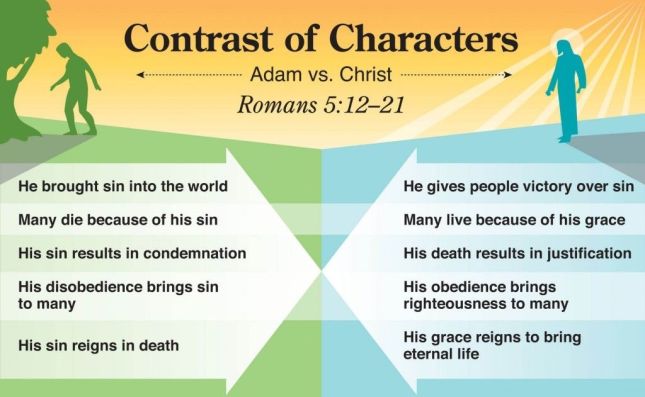
In short, this section is a contrast of Adam and Christ. Adam was given dominion over the old creation, he sinned, and he lost his kingdom. Because of Adam’s sin, all mankind is under condemnation and death. Christ came as the King over a new creation (2 Cor. 5:17). By His obedience on the cross, He brought in righteousness and justification. Christ not only undid all the damage that Adam’s sin effected, but He accomplished “much more” by making us the very sons of God. Some of this “much more” Paul has already explained in Romans 5:1-11.

Skeptics sometimes ask, “Was it fair for God to condemn the whole world just because of one man’s disobedience?” The answer, of course, is that it was not only fair; but it was also wise and gracious. To begin with, if God had tested each human being individually, the result would have been the same: disobedience. But even more important, by condemning the human race through one man (Adam), God was then able to save the human race through one Man (Jesus Christ)! Each of us is racially united to Adam, so that his deed affects us. (See Heb. 7:9-10 for an example of this racial headship.) The fallen angels cannot be saved because they are not a race. They sinned individually and were judged individually. There can be no representative to take their judgment for them and save them. But because you and I were lost in Adam, our racial head, we can be saved in Christ, the Head of the new creation. God’s plan was both gracious and wise.

Our final question must be answered: how do we know that we are racially united to Adam? The answer is in Romans 5:12-14, and the argument runs like this: We know that all men die. But death is the result of disobeying the Law. There was no Law from Adam to Moses, but men still died. A general result demands a general cause. What is that cause? It can be only one thing: the disobedience of Adam. When Adam sinned, he ultimately died. All of his descendants died (Gen. 5), yet the Law had not yet been given. Conclusion: they died because of Adam’s sin. “For that all have sinned” (Rom. 5:12) means “all have sinned in Adam’s sin.” Men do not die because of their own acts of sin; otherwise, babies would not die (Rom. 9:11). Men die because they are united racially to Adam, and “in Adam all men die” (1 Cor. 15:22).

Having linked Jews and Gentiles through Abraham to the promises of God, Paul now shows how the gospel applies to all humankind. Paul made important points by going back to Abraham; but by going back to Adam, he will draw conclusions that affect the fate of every person.

Twice in the last paragraph Paul expressed one idea and then followed it with an equally marvelous parallel idea (from the niv): “Since we have now been justified by his blood, how much more shall we be saved from God’s wrath,” (5:9); and “If . . . we were reconciled to him through the death of his Son, how much more . . . shall we be saved through his life!” (5:10). Here, in verses 12-21, Paul also uses a series of parallels, only this time they express ideas moving in opposite directions: “Just as sin entered the world . . . and . . . death came to all men” (5:12). . . “how much more did God’s grace and the gift . . . overflow to the many” (5:15); “For if.. death reigned through that one man, how much more will . . . righteousness reign in life through the one man, Jesus Christ’ (5:17 niv); and “For just as . . . many were made sinners, so also . . . many will be made righteous” (5:19). Paul shows that all of us are affected by Adam’s disobedience and Christ’s obedience.

5:12 Sin came into the world through one man.NRSV This one man is Adam, who sinned against God and brought alienation from God and death to all humanity (Genesis 2-3). God had warned Adam, “You must not eat from the tree of the knowledge of good and evil, for when you eat of it you will surely die” (Genesis 2:17). Because Adam disobeyed God’s command, the judgment of both spiritual and physical death fell on him and all his descendants—death spread to all men, because all sinned.NKJV Death is the consequence of being under the power of sin. “In Adam all die” (1 Corinthians 15:22 niv). It was not in God’s original plan for human beings to die, but it was the result when sin entered the world. Inevitably, the gift of life we bequeath to our children includes with it the sting of death. All human beings have two characteristics in common: They are sinners, and they will die.

5:13 Before the law was given, sin was in the world.NIV Verses 13-15 are a lengthy parenthesis to Paul’s statement beginning in verse 12. God’s law was not given until the time of Moses, so the people who lived between Adam and Moses did not have any specific laws to obey or break. Paul explains that sin is not taken into account when there is no law.NIV What Paul is saying is that the sin that was in the world was the power or force that causes people to act independently of God. All people are under the power of sin, and all people act in rebellion against God. Those sins did not count the same as Adam’s sin because they were not deliberate actions against God’s commands (as was Adam’s, see 5:12) because there were no commands. Thus, they were not taken into account. Paul continues this thought in 5:20 and in chapter 7, when he describes the law’s role in defining sin. Sin was in the world from the beginning, but it came into sharp focus when the law was given.

With this statement, Paul follows through his argument from chapter 2 regarding the pride of the Jews in their role as keepers of God’s law. The very fact that they had the law, and that it is the law that makes people accountable for sin, means that the Jews’ sin was deadly—they were certainly in as much need of redemption as the rest of the world.

5:14 Death reigned . . . even over those who did not sin by breaking a command.NIV Adam had knowingly broken a specific command (5:12). His descendants who lived prior to the time of Moses could not break any specific laws because there were none. But they still sinned, witnessed by the fact that death reigned. Adam’s descendants had sinned with Adam (5:12). Death is the result of Adam’s sin and ours, even if our sins don’t resemble Adam’s. For thousands of years, the law had not been explicitly given, and yet people died. The law was added (5:20) to help people see their sinfulness, to show them the seriousness of their offenses, and to drive them to God for mercy and pardon. This was true in Moses’ day and in Paul’s day, and it is still true today. Sin is a deep rupture between who we are and

who we were created to be. The law points out our sin and places the responsibility for it squarely on our shoulders, but it offers no remedy.

Adam . . . a pattern of the one to come.NIV Paul uses the word pattern (typos), or “type” to describe Adam’s role in history compared with Christ’s. Adam, the first man, was a counterpart of Christ, whom Paul calls “the last Adam” in 1 Corinthians 15:45. Adam’s one act determined the character of the world; Christ’s one act determined the character of eternity. In modem terminology, we could say that Adam was a flawed prototype, but Christ was the perfect original. Just as Adam was a representative of created humanity, so is Christ the representative of the new, spiritual humanity.

5:15 The free gift is not like the trespass.NRSV The gift from God through Christ (justification) has a greater but opposite effect than the trespass of Adam and its consequences. Yet in each case, the act of one affected the lives of many.

Many died by the trespass of the one man.NIV Because of Adam’s sin, death entered the human race, and since then all people have died (with the Bible’s exceptions of Enoch and Elijah). All people will die until the end of this age.

The gift that came by the grace of . . . Jesus Christ, overflow to the many.NIV God’s gift because of his grace—salvation and eternal life—overflows to the entire human race. It is available to all, but not everyone will choose to receive it.

Every human being is born into Adam’s physical family the family line that leads to certain death. All of us reap the results of Adam’s sin. We have inherited his guilt, the tendency to sin, and God’s punishment. Because of Jesus, however, we can trade judgment for forgiveness. We can trade our sin for Jesus’ goodness. Jesus offers us the opportunity to be born into his spiritual family—the family line that begins with forgiveness and leads to eternal life. If we do nothing, we have death through Adam; but if we come to God by faith, we have life through Christ.

Adam’s offense is contrasted with Christ’s free gift (v. 15). Because of Adam’s trespass, many died; because of Christ’s obedience the grace of God abounds to many bringing life. The word “many” (literally “the many”) means the same as “all men” in Romans 5:12 and 18. Note the “much more”; for the grace of Christ brings not only physical life, but also spiritual life and abundant life. Christ did conquer death and one day will raise the bodies of all who have died “in Christ.” If He stopped there, He would only reverse the effects of Adam’s sin; but He went on to do “much more.” He gives eternal life abundantly to all who trust Him (John 10:10).

5:16 Judgment followed one sin and brought condemnation.NIV God passed judgment on Adam’s one sin of disobedience. As a result, Adam and the entire human race received condemnation.

The gift followed many trespasses and brought justification.NIV Everyone since Adam has sinned, and yet Christ overcame those many trespasses and brought justification to those who accept him. The result of sin is death; the gift of God—his justifying sinners—results in reigning forever with Christ.

The effect of Adam’s sin is contrasted with the effect of Christ’s obedience (v. 16). Adam’s sin brought judgment and condemnation; but Christ’s work on the cross brings justification. When Adam sinned, he was declared unrighteous and condemned. When a sinner trusts Christ, he is justified—declared righteous in Christ.

5:17 By the trespass of the one man, death reigned through that one man.NIV By capitulating to sin Adam allowed the whole human race to succumb to death. Death is inescapable; it comes to every living thing. We all live close to the valley of the shadow of death. And the reign of death over creation began because of Adam’s sin.

Will those who receive.NRSV The only condition upon these wonderful provisions of grace is that we receive them by faith. God’s love and Christ’s work are for all men and women, but they are appropriated by faith.

Reign in life through the One, Jesus Christ.NKJV Those who believe in Christ will become rulers, reigning in his kingdom of life, where there is no death (Revelation 1:6). What a promise this is to those who love Christ! We can reign over sin’s power, over death’s threats, and over Satan’s attacks. Eternal life is ours now and forever. Though this promise has its greatest fulfillment in the future, it also has a significant immediate impact. In Christ, death loses its sting (see 1 Corinthians 15:50-57). We are still subject to the physical suffering and death brought by sin in the world, but we are free from the eternal spiritual separation that we would experience outside of Christ. Also, in the power and protection of Jesus Christ, we can overcome temptation (see 8:17 for more on our privileged position in Christ).

The two “reigns” are contrasted (v. 17). Because of Adam’s disobedience, death reigned. Read the “book of the generations of Adam” in Genesis 5, and note the solemn repetition of the phrase “and he died.” In Romans 5:14, Paul argued that men did not die “from Adam to Moses” for the same reason that Adam died—breaking a revealed law of God—for the Law had not yet been given. “The wages of sin is death” (Rom. 6:23). Because sin was reigning in men’s lives (Rom. 5:21), death was also reigning (Rom. 5:14, 17).

But in Jesus Christ we enter a new kingdom: “For the kingdom of God is not meat and drink; but righteousness, and peace, and joy in the Holy Ghost” (Rom. 14:17). “Therefore being justified by faith” we are declared righteous, we have peace with God, and we rejoice in the hope of the glory of God. Note that it is we who reign! “Much more they… shall reign in life by one, Jesus Christ.” In Adam we lost our kingship, but in Jesus Christ we reign as kings. And we reign “much more”! Our spiritual reign is far greater than Adam’s earthly reign, for we share “abundance of grace and of the gift of righteousness” (Rom. 5:17).

5:18 Just as the result of one trespass was condemnation.NIV Paul emphasizes the contrasting roles of two single agents, Adam and Christ. Adam’s sin brought condemnation on the human race. Christ’s sinless sacrifice, or as Paul writes, his one act of righteousness opened the way for justification that brings life.

5:19 By the one man’s disobedience the many were made sinners.NRSV The same statement is made in different words: Here Adam’s trespass is called “disobedience,” and it resulted in all people becoming sinners and thus unacceptable to God. The word trespass describes the specific act of Adam’s sin, while disobedience describes its intent. The original temptation downplayed the importance of the act (see Genesis 3:1-7) and focused attention on the desired ends: “You will be like God” (Genesis 3:5 niv). Temptation still takes that same form, rationalizing deliberate disobedience to God in pursuit of some supposedly higher ideal. Ends and means do not justify one another. In Adam’s case, neither the ends (disobedience) nor the means (trespass) turned out to be right.

By the one man’s obedience the many will be made righteous.NRSV Again, in contrast, here the act of righteousness is called Christ’s “obedience.” Adam’s response to temptation was “My will be done”; but Christ’s prayer to God was “Thy will be done” (Luke 22:42). Because of Christ’s obedience, those who believe will be made righteous. Becoming righteous is both an immediate standing before God and an ongoing process to be completed when he returns.

The two “one acts” are contrasted (vv. 18-19). Adam did not have to commit a series of sins. In one act God tested Adam, and he failed. It is termed an “offense” and an act of “disobedience.” The word offense means “trespass—crossing over the line.” God told Adam how far he could go, and Adam decided to go beyond the appointed limit. “Of every tree of the Garden thou mayest freely eat: but of the tree of the knowledge of good and evil, thou shalt not eat of it: for in the day that thou eatest thereof, thou shalt surely die” (Gen. 2:16-17).

In contrast to “the trespass of one” is “the righteousness of one,” meaning the righteous work of Christ on the cross. In Romans 5:19 Paul calls it “the obedience of One” (see Phil. 2:5-12). Christ’s sacrifice on the cross not only made possible “justification,” but also “justification of life” (italics mine). Justification is not merely a legal term that describes our position before God (“just as if I’d never sinned”); but it results in a certain kind of life. “Justification of life” in Romans 5:18 is parallel to “be made righteous” in Romans 5:19. In other words, our justification is the result of a living union with Christ. And this union ought to result in a new kind of life, a righteous life of obedience to God. Our union with Adam made us sinners; our union with Christ enables us to “reign in life.”

5:20 Law was added so that the trespass might increase.NIV This statement is certainly not what Paul’s Jewish readers expected to hear. Paul had already explained that the law was ineffective for salvation, but now he says that rather than being an antidote for sin, it actually increases sin! Paul is winding up the argument he has been carrying on through the first five chapters of his letter. The purpose of the law for his own people, the Jews, had been to make them aware of their need for salvation; thus, their trespass was increased. Sin was present from Adam, but the giving of the law was like having a huge spotlight turned on—the sinfulness of people became all the more defined (see also Romans 7:7-13). The solution to sin was not law, but grace.

Where sin increased, grace increased all the more.NIV No matter how much people sin, God’s grace is greater. There are occasions of insight in life when people realize in a new way the reality of their sinfulness. Sometimes, reflecting on the commandments reminds us of our tendency to fall. Our consciences also flare with guilt from time to time. At other times, a loving friend may confront us with a sinful act or habit. When our awareness of sin increases, we need to ask God to help us see that his grace is always greater in its capacity to forgive than our capacity to sin.

 OPEN ARMS
As sinners, separated from God, we see his law from below. Sometimes it seems like a ladder to be climbed to get to God. Perhaps we have repeatedly tried to climb it, only to fall to the ground every time we have advanced one or two rungs. Or perhaps the sheer height of the ladder is so overwhelming that we have never even started up. In either case, what relief we should feel to see Jesus with open arms, offering to lift us above the ladder of the law, to take us directly to God. Once Jesus lifts us into God’s presence, we are free to obey—out of love, not necessity, and through God’s power, not our own. Then we know that if we stumble, we will not fall back to the ground. Instead, we will be caught and held in Jesus’ loving arms.

5:21 As sin reigned in death, so also grace might reign through righteousness to bring eternal life.NIV Our age is characterized by sin and inevitable death; but the age to come will be characterized by grace, righteousness, and eternal life. It is common to call the ultimate struggle that is going on in the universe “the conflict between good and evil.” Paul was picturing here the outcome of the war between the kingdom of grace and the kingdom of sin. Until Christ, the war appeared to be decided, because sin reigned in death. But Christ’s death and resurrection provided the decisive victory by which grace will reign. Under the reign of grace, a righteousness is declared that will bring eternal life.

This ends the first section of Paul’s letter and his explanation of the law and its relation to salvation. But the law is not set aside as old and worthless. Paul will explain, in coming chapters, the role of the law for believers.

Law and grace are contrasted (vv. 20-21). “Then Law crept in” (WMS); or, “Then the Law came in beside” (literal translation). Grace was not an addition to God’s plan; grace was a part of God’s plan from the very beginning. God dealt with Adam and Eve in grace; He dealt with the patriarchs in grace; and He dealt with the nation of Israel in grace. He gave the Law through Moses, not to replace His grace, but to reveal man’s need for grace. Law was temporary, but grace is eternal.

But as the Law made man’s sins increase, God’s grace abounded even more. God’s grace was more than adequate to deal with man’s sins. Even though sin and death still reign in this world, God’s grace is also reigning through the righteousness of Christ. The Christian’s body is subject to death and his old nature tempts him to sin; but in Jesus Christ, he can “reign in life” because he is a part of the gracious kingdom of Christ.

An Old Testament story helps us understand the conflict between these two “reigns” in the world today. God rejected Saul as the king of Israel, and anointed David. Those who trusted David eventually shared his kingdom of peace and joy. Those who trusted Saul ended in shame and defeat.

Like David, Jesus Christ is God’s anointed King. Like Saul, Satan is still free to work in this world and seek to win men’s allegiance. Sin and death are reigning in the “old creation” over which Adam was the head, but grace and righteousness are reigning in “the new creation” over which Christ is the Head. And as we yield to Him, we “reign in life.”

In Romans 5:14, Adam is called “the figure of Him that was to come.” Adam was a type, or picture, of Jesus Christ. Adam came from the earth, but Jesus is the Lord from heaven (1 Cor. 15:47). Adam was tested in a Garden, surrounded by beauty and love; Jesus was tempted in a wilderness, and He died on a cruel cross surrounded by hatred and ugliness. Adam was a thief, and was cast out of Paradise; but Jesus Christ turned to a thief and said, “Today shalt thou be with Me in Paradise” (Luke 23:43). The Old Testament is “the book of the generations of Adam” (Gen. 5:1) and it ends with “a curse” (Mal. 4:6). The New Testament is “The book of the generation of Jesus Christ” (Matt. 1:1) and it ends with “no more curse” (Rev. 22:3).

You cannot help being “in Adam,” for this came by your first birth over which you had no control. But you can help staying “in Adam,” for you can experience a second birth—a new birth from above—that will put you “in Christ.” This is why Jesus said, “Ye must be born again” (John 3:7).


Leave a comment

Posted by on July 19, 2021 in Romans


A study of Romans: The Righteousness of God #12 Faith Brings Peace – Romans 5:1-11


Paul introduces some difficult concepts in this chapter. He demonstrates the truth of the gospel in ways that stretch our thinking.

To begin to understand the next four chapters, it helps to keep in mind the two-sided reality of the Christian life. On the one hand, we are complete in Christ (our acceptance with him is secure); on the other hand, we are growing in Christ (we are becoming more and more like him).

At the same time, we have the status of kings and the duties of slaves. We feel both the presence of Christ and the pressure of sin. We enjoy the peace that comes from being made right with God, but we still face daily problems that help us grow.

If we remember these two sides of the Christian life, we will not grow discouraged as we face temptations and problems. Instead, we will learn to depend on the power available to us from Christ, who lives in us by the Holy Spirit.

5:1 Therefore, since we are justified by faith.NRSV

Here he begins to describe how justification affects our relationship with God. First, there is peace with God through our Lord Jesus Christ. Peace anticipates Paul’s claim that we have been reconciled with God (5:10). Peace (eirene) means there is no more hostility between us and God, no sin blocking our relationship with him. More than that, a new relationship has been established, so we no longer dread the outcome of judgment but live under the protection established by God.

Peace with God is only possible through Christ, because on the cross he met the conditions required for peace. Not only was “the punishment that brought us peace” (Isaiah 53:5 niv) borne by him, but he also fully lived up to his given title, Prince of Peace (Isaiah 9:6).

The basic teaching is that through our Lord Jesus Christ peace is established between us and God, whether or not we feel it from moment to moment. In Christ we claim peace with God, even when we are experiencing turmoil.

5:2 Access . . . into this grace.NKJV

      Not only has Christ justified and reconciled us to God, but he also has given us personal access to God. The grace of God initiating our salvation is the same grace in which we stand.

The word access (prosagogein), has also been translated “introduction” (nasb), “brought us into” (tlb), “been allowed to enter” (neb).

The thought is not about possible access to God, but accomplished access to God. Having been introduced to grace, we, now . . .

Rejoice in the hope of the glory of God.NIV Mankind was created for glory (more about this will be said in chapter 8) but, because of sin, had fallen “short of the glory of God” (3:23). It is God’s purpose to recreate his image, his glory, fully in us.

Because of Christ, we now hope for (anticipate, look forward to) the time when we will share Christ’s glory. This hope helps us overcome our present frustrations when we fail to be all that we want to be or all that God wants us to be.

Paul mentions three occasions for rejoicing:

  1. In the hope of the glory of God (5:2). Anticipating our future with God ought to bring moments of joy. We stand in God’s grace, and the outcome of our lives is secure in his hands.
  2. In our suffering (5:3). We are not to be glad for our suffering, but to be glad that suffering can perfect a person’s faith.
  3. In God (5:11). Our faith in Jesus Christ frees us to deeply enjoy our relationship with God. We no longer need to be haunted by thoughts of judgment; now we can reflect upon and respond to his grace.

5:3 Rejoice in our sufferings . . . suffering produces perseverance.NIV

The key was that he learned to rejoice because he knew that suffering produces perseverance—the ability to face difficulties without giving in. For Christians, suffering does not negate the reality of God’s love, but provides the occasion to affirm and apply it.

DON’T JUDGE TRIBULATION BY ITS OUTWARD APPEARANCE
We rejoice in suffering not because we like pain or deny its tragedy, but because we know God is using life’s difficulties and Satan’s attacks to build our character. That is one of God’s loving purposes. Our problems will develop perseverance which, in turn, will strengthen our character, deepen our trust in God, and give us greater confidence about the future.

It is likely that our patience will be tested in some way every day. Rejoicing begins by thanking God for these opportunities to grow and then facing them, relying on his strength.

5:4 Perseverance, character.NIV Endurance, in turn, deepens character. The word character (dokime) includes the idea of “approved as a result of testing.” A person with this kind of character is known for his or her inward qualities rather than any outward appearances. There is a progression that begins with suffering and ends with character.

The end result of this chain reaction is hope—confidence that God is in control and will see us through. God’s work in us now, conforming us “to the likeness of his Son” (8:29), gives us a glimpse of the wonderful things he has in store for us in the future.

If we can maintain our love for Christ and see his work through all our difficulties, the result is increased faith, hope, and love. The difficulties of life are not random, meaningless, or wasted when we are trusting God.

5:5 Hope does not disappoint us.NRSV Our hope in God’s promises will never disappoint us by being unfulfilled. When our hope is in God, we are absolutely assured that he will fulfill all that he has promised—we will be resurrected to eternal life and will be with him in glory.

The first hope Paul mentioned (5:2) is one that primarily looks to the future, when we will share in God’s glory; this hope, the maturing product of a life trusting God, focuses on the more immediate experience of God’s love. So hope, for the believer in Jesus, includes a future worth rejoicing over and a present that will not disappoint either!

God has poured out his love into our hearts by the Holy Spirit, whom he has given us.NIV

It is the Holy Spirit who has filled our hearts with God’s love and who continues to encourage us as we hope in God.

Paul wrote to the Corinthians, “[God] anointed us, set his seal of ownership on us, and put his Spirit in our hearts as a deposit guaranteeing what is to come” (2 Corinthians 1:21-22).

5:6 Christ died for the ungodly. Paul wants to make sure that there is no misunderstanding about who Christ actually died for—the ungodly. Nor can there be any doubt about who the ungodly are, for Paul uses the same terminology at the end of 5:8, exchanging us in place of the ungodly.

We can have hope in God because of the nature of his love. God’s plan, from the beginning, was to send his Son to die for us, at just the right time, when we were still powerlessNIV.

The right time refers to both the timing in history and the timing in God’s plan (see Galatians 4:4). In the face of our powerlessness, God was fully in control.

The events in human history did not determine the plan of salvation; the plan of salvation was designed by God to happen at just the right time.

We are saved only because God took the initiative and demonstrated his incredible grace and love by sending his own Son to take the punishment we deserved.

5:7 For a good person someone might actually dare to die.RSV The highest expression of human love is when someone gives his or her life so that another person can continue to live. People are able to understand sacrificial love, even though it is rarely practiced. This kind of sacrificial gesture is almost always dependent on a relationship that already exists between the one sacrificing (parent, friend, lover, fellow soldier) and the one benefited. People do not readily die for their enemies.

5:8 God demonstrates His own love.NKJV People do not have to hope blindly that God loves them; he has openly demonstrated it.

While we were still sinners, Christ died for us.

Christ did not die so that we could be made lovable; Christ died because God already loved us and wanted to bring us close to himself. No matter how lonely or alienated we feel, we have the unalterable objective fact that Christ died for us. Every time we celebrate communion, we hear the words from Jesus, “this is my body broken for you; this is my blood shed for you.”

5:9 Justified by his blood. God bases our justification on the sacrificial death of Christ on the cross (see 3:25). Because God is holy, he could not accept us by simply disregarding or ignoring our sins. Instead, those sins had to be dealt with.

And God did this through the sacrificial death of his Son. Again, this justification is God’s approval, given to us only on the basis of what Christ did. It is an acquittal that sets free all of us who were otherwise hopeless prisoners of sin.

Saved from God’s wrath.NIV Those who have been justified and pronounced righteous are also delivered from God’s wrath at the final judgment. The comparison implies that justification is a present event, while the full display of God’s wrath will come only in the future.

5:10 Enemies . . . reconciled to him through the death of his Son. Alongside the theme of justification, Paul introduces the theme of reconciliation. Our peace with God has legal as well as relational aspects.

We were enemies because we were rebels against God. “Once you were alienated from God and were enemies in your minds because of your evil behavior. But now he has reconciled you by Christ’s physical body through death to present you holy in his sight without blemish and free from accusation” (Colossians 1:21-22 niv). Because of Christ’s death, we are reconciled—our proper relationship with God has been restored.

Much more. As in verse 9, Paul is using a comparison of wonder. He holds up one wonderful idea for consideration (our reconciliation with God through Christ’s death) and immediately follows with an even more wonderful thought of what Christ’s life accomplishes for us and in us.

Reconciled. Those who are reconciled are those who were once enemies of God but have now been brought into a relationship of peace with God.

There are two steps in the reconciliation process:

(1) God made the first move toward reconciliation by sending his Son to die on the cross (see 2 Corinthians 5:19),

(2) believers then accept the work Christ has done for them and thereby become reconciled to God (see 2 Corinthians 5:20). Reconciliation removes the hostility and establishes unity between believers and God.

Saved by his life.NKJV Because Christ’s death accomplished our reconciliation with God, so his life—his present resurrection life in which he intercedes for us (see Hebrews 7:25)—insures our complete and final salvation.

 POWER RESERVES
The love that caused Christ to die is the same love that sends the Holy Spirit to live in us and guide us every day. The power that raised Christ from the dead is the same power that saved us and is available to us in our daily lives. We can be assured that having begun a life with Christ, we have a reserve of power and love to call on each day for help to meet every challenge or trial. We can pray for God’s power and love as we need it.

5:11 Rejoice in God.NIV It is not enough to list the marvelous facts of our relationship with God. Knowing all that God has accomplished should cause us to be filled with joy.

Paul has already told his readers that they should rejoice in the hope of glory (5:2) and in their sufferings (5:3). Now he exclaims that they should rejoice in God.

We rejoice in God because Christ took our sins upon himself and paid the price for them with his own death, instead of punishing us with the death we deserve (see introduction to this chapter).

We have now received reconciliation.nrsv Through faith in his work, we become his friends (received reconciliation) and are no longer enemies and outcasts.


Leave a comment

Posted by on July 15, 2021 in Romans


A study of Romans: The Righteousness of God #11 The Wrong Way for a Man to be Justified Romans 4:13-25


Abraham's Faith In God

(Romans 4:13-17 NIV) “It was not through law that Abraham and his offspring received the promise that he would be heir of the world, but through the righteousness that comes by faith. {14} For if those who live by law are heirs, faith has no value and the promise is worthless, {15} because law brings wrath. And where there is no law there is no transgression. {16} Therefore, the promise comes by faith, so that it may be by grace and may be guaranteed to all Abraham’s offspring–not only to those who are of the law but also to those who are of the faith of Abraham. He is the father of us all. {17} As it is written: “I have made you a father of many nations.” He is our father in the sight of God, in whom he believed–the God who gives life to the dead and calls things that are not as though they were.”

To Abraham God made a very great and wonderful promise. He promised that he would become a great nation, and that in him all families of the earth would be blessed (Genesis 12:2, 3). In truth, the earth would be given to him as his inheritance. Now that promise came to Abraham because of the faith that he showed towards God. It did not come because he piled up merit by doing works of the law.

It was the outgoing of God’s generous grace in answer to Abraham’s absolute faith. The promise, as Paul saw it, was dependent on two things and two things only-the free grace of God and the perfect faith of Abraham.

The Jews were still asking, “How can a man enter into the right relationship with God so that he too may inherit this great promise?” Their answer was, “He must do so by acquiring merit in the sight of God through doing works which the law prescribes.” That is to say, he must do it by his own efforts. Paul saw with absolute clearness that this Jewish attitude had completely destroyed the promise. It had done so for this reason-no man can fully keep the law; therefore, if the promise depends on keeping the law, it can never be fulfilled.

Paul saw things in terms of black and white. He saw two mutually exclusive ways of trying to get into a right relationship with God. On the one hand there was dependence on human effort; on the other, dependence on divine grace. On the one hand there was the constant losing battle to obey an impossible law; on the other, there was the faith which simply takes God at his word.

On each side there were three things.

(i) On the one side there is God’s promise. There are two Greek words which mean promise. Huposchesis means a promise which is entered into upon conditions. “I promise to do this if you promise to do that.” Epaggelia means a promise made out of the goodness of someone’s heart quite unconditionally. It is epaggelia that Paul uses of the promise of God. It is as if he is saying, “God is like a human father; he promises to love his children no matter what they do.” True, he will love some of us with a love that makes him glad, and he will love some of us with a love that makes him sad; but in either case it is a love which will never let us go. It is dependent not on our merit but only on God’s own generous heart.

(ii) There is faith. Faith is the certainty that God is indeed like that. It is staking everything on his love.

(iii) There is grace. A gift of grace is always something which is unearned and undeserved. The truth is that man can never earn the love of God. He must always find his glory, not in what he can do for God, but in what God has done for him.

(i) On the other side there is law. The trouble about law has always been that it can diagnose the malady but cannot effect a cure. Law shows a man where he goes wrong, but does not help him to avoid going wrong. There is in fact, as Paul will later stress, a kind of terrible paradox in law. It is human nature that when a thing is forbidden it has a tendency to become desirable. “Stolen fruits are sweetest.” Law, therefore, can actually move a man to desire the very thing which it forbids. The essential complement of law is judgment, and, so long as a man lives in a religion whose dominant thought is law, he cannot see himself as anything other than a condemned criminal at the bar of God’s justice.

(ii) There is transgression. Whenever law is introduced, transgression follows. No one can break a law which does not exist; and no one can be condemned for breaking a law of whose existence he was ignorant. If we introduce law and stop there, if we make religion solely a matter of obeying law, life consists of one long series of transgressions waiting to be punished.

(iii) There is wrath. Think of law, think of transgression, and inevitably the next thought is wrath. Think of God in terms of law and you cannot do other than think of him in terms of outraged justice. Think of man in terms of law and you cannot do other than think of him as destined for the condemnation of God.

So Paul sets before the Romans two ways. The one is a way in which a man seeks a right relationship with God through his own efforts. It is doomed to failure. The other is a way in which a man enters by faith into a relationship with God, which by God’s grace already exists for him to come into in trust.

(4:13-16) Introduction: a man is not justified by the law and its works. The law is the wrong way for a man to seek acceptance and justification by God.

  1. The unmistakable statement: the promise is not through the law, but through faith (v.13).
  2. The argument against the law (v.14-15).
  3. The argument for faith (v.16).

The key word here is “promise.” Abraham was justified by believing God’s promise, not by obeying God’s Law; for God’s Law through Moses had not yet been given. The promise to Abraham was given purely through God’s grace. Abraham did not earn it or merit it. So today, God justifies the ungodly because they believe His gracious promise, not because they obey His Law. The Law was not given to save men, but to show men that they need to be saved (Rom. 4:15).

The fact that Abraham was justified by grace and not Law proves that salvation is for all men. Abraham is the father of all believers, both Jews and Gentiles (Rom. 4:16; Gal. 3:7, 29). Instead of the Jew complaining because Abraham was not saved by Law, he ought to rejoice that God’s salvation is available to all men, and that Abraham has a spiritual family (all true believers) as well as a physical family (the nation of Israel). Paul saw this as a fulfillment of Genesis 17:5: “I have made thee a father of many nations.”

(4:13) Promise, The—Faith vs. Law—Righteousness—Reward: the unmistakable statement—the promise of the inheritance is not through the law, but through faith.

Note several things.

  1. The promise involves inheriting the whole world. This is clear from several facts.
  2. Canaan was the promised land, a type of heaven and a type of the new heavens and earth God is to recreate for Abraham and his seed (the believer).
  3. Abraham was promised that he would be the “father” of many nations. He is said to be the father of all believers from all nations of the earth (Romans 4:11-12). He and his seed (believers) are promised a new world when Christ returns.
  4. Christ is to inherit the world and be exalted as the Sovereign Majesty of the universe, ruling and reigning forever and ever.

Abraham and his seed (believers) are said to be heirs of God and joint heirs with Christ. They shall all reign with Christ through all eternity.

  1. The “seed” of Abraham refers to all believers. This is clear from the promise that is said to be “sure to all the seed” (Romans 4:16). Every true believer is an heir of the promise. If a man believes, he receives the most glorious promise: he will inherit the world.
  2. God does not give the promise through the law, but through the righteousness of faith.
  3. A man will not receive an inheritance in the new world because he…
  • tried to keep the law.
  • did some great works.
  • lived by good deeds.
  • was moral and very religious.
  1. A man will receive an inheritance in the new world because he…
  • believed God for righteousness, and God took his belief and counted it for righteousness.

The point is clearly seen, and it is unmistakable:

 (1) Salvation is not of works, and only by faith. It should be clear that man can contribute nothing to his salvation. It is all of God; all of grace. And let us not make one last effort of claiming any part in our salvation by supposing that faith is our work, for even this is the gift of God (cf. Eph. 2:8, 9; Acts 13:48, 16:14).

Only this week I talked with a man who felt that we must contribute something to our salvation. I told him that man’s sin is like having greasy hands. When I work on the car and have grease on my hands, everything I touch is stained with grease also. When I come in with greasy hands, my wife quickly informs me not to touch anything until my hands are clean. So man’s hands are smudged with sin and there is nothing but the blood of Christ which can cleanse them. If we try to approach God by means of the works of our hands, those works will be smudged with sin and unacceptable to God. We must do as the words of the song instruct us, “Nothing in my hands I bring; simply to Thy cross I cling.”

 (2) Faith is the only way of receiving God’s blessing. Paul not only tells us that salvation is by faith, but also God’s blessings come only by faith.

 THE ADVENTURE AND THE PATIENCE OF FAITH

Hebrews 11:8-10: “It was by faith that Abraham, when he was called, showed his obedience by going out to a place which he was going to receive as an inheritance, and he went out not knowing where he was to go. It was by faith that he sojourned in the land that had been promised to him, as though it had been a foreign land, living in tents, in the same way as did Isaac and Jacob, who were his coheirs in the promise of it. For he was waiting for the city which has foundations, whose architect and builder is God.”

The call of Abraham is told with dramatic simplicity in Genesis 12:1. Jewish and eastern legends gathered largely round Abraham’s name and some of them must have been known to the writer to the Hebrews.

The legends tell how Abraham was the son of Terah, commander of the armies of Nimrod. When Abraham was born a very vivid star appeared in the sky and seemed to obliterate the others. Nimrod sought to murder the infant but Abraham was concealed in a cave and his life saved. It was in that cave the first vision of God came to him. When he was a youth he came out of the cave and stood looking across the face of the desert. The sun rose in all its glory and Abraham said: “Surely the sun is God, the Creator!” So he knelt down and worshipped the sun. But when evening came, the sun sank in the west and Abraham said: “No! the author of creation cannot set!” The moon arose in the east and the stars came out. Then Abraham said: “The moon must be God and the stars his host!” So he knelt down and adored the moon. But after the night was passed, the moon sank and the sun rose again and Abraham said: “Truly these heavenly bodies are no gods, for they obey law; I will worship him who imposed the law upon them.”

The Arabs have a different legend. They tell how Abraham saw many flocks and herds and said to his mother: “Who is the lord of these?” She answered: “Your father, Terah.” “And who is the lord of Terah?” the lad Abraham asked. “Nimrod,” said his mother. “And who is the lord of Nimrod?” asked Abraham. His mother bade him be quiet and not push questions too far; but already Abraham’s thoughts were reaching out to him who is the God of all. The legends go on to tell that Terah not only worshipped twelve idols, one for each of the months, but was also a manufacturer of idols. One day Abraham was left in charge of the shop. People came in to buy idols. Abraham would ask them how old they were and they would answer perhaps fifty or sixty years of age. “Woe to a man of such an age,” said Abraham, “who adores the work of one day!” A strong and hale man of seventy came in. Abraham asked him his age and then said: “You fool to adore a god who is younger than yourself!” A woman came in with a dish of meat for the gods. Abraham took a stick and smashed all the idols but one, in whose hands he set the stick he had used. Terah returned and was angry. Abraham said: “My father, a woman brought this dish of meat for your gods; they all wanted to have it and the strongest knocked the heads off the rest, lest they should eat it all.” Terah said: “That is impossible for they are made of wood and stone.” And Abraham answered: “Let thine own ear hear what thine own mouth has spoken!”

All these legends give us a vivid picture of Abraham searching after God and dissatisfied with the idolatry of his people. So when God’s call came to him he was ready to go out into the unknown to find him! Abraham is the supreme example of faith.

(i) Abraham’s faith was the faith that was ready for adventure. God’s summons meant that he had to leave home and family and business; yet he went. He had to go out into the unknown; yet he went. In the best of us there is a certain timorousness. We wonder just what will happen to us if we take God at his word and act on his commands and promises.

Bishop Newbigin tells of the negotiations which led to the formation of the United Church of South India. He had a share in these negotiations and in the long discussions which were necessary. Things were frequently held up by cautious people who wished to know just where each step was taking them, until in the end the chairman reminded them that a Christian has no right to ask where he is going.

Most of us live a cautious life on the principle of safety first; but to live the Christian life there is necessary a certain reckless willingness to adventure. If faith can see every step of the way, it is not really faith. It is sometimes necessary for the Christian to take the way to which the voice of God is calling him without knowing what the consequences will be. Like Abraham he has to go out not knowing where he is going.

(iii) Abraham’s faith was the faith which had patience. When he reached the promised land, he was never allowed to possess it. He had to wander in it, a stranger and a tent-dweller, as the people were some day to wander in the wilderness. To Abraham God’s promise never came fully true; and yet he never abandoned his faith.

It is characteristic of the best of us that we are in a hurry. To wait is even harder than to adventure. The hardest time of all is the time in between. At the moment of decision there is the excitement and the thrill; at the moment of achievement there is the glow and glory of satisfaction; but in the intervening time there is necessary the ability to wait and work and watch when nothing seems to be happening. It is then that we are so liable to give up our hopes and lower our ideals and sink into an apathy whose dreams are dead. The man of faith is the man whose hope is flaming bright and whose effort is intensely strenuous even in the grey days when there is nothing to do but to wait.

(iii) Abraham’s faith was the faith which was looking beyond this world. The later legends believed that at the moment of his call Abraham was given a glimpse of the new Jerusalem. In the Apocalypse of Baruch God says: “I showed it to my servant by night” (4:4). In 4 Ezra the writer says: “It came to pass when they practised ungodliness before thee, that thou didst choose one from among them whose name was Abraham; him thou didst love and to him only thou didst reveal the end of the times, secretly, by night” (4:13). No man ever did anything great without a vision which enabled him to face the difficulties and discouragements of the way. To Abraham there was given the vision; and, even when his body was wandering in Palestine, his soul was at home with God. God cannot give us the vision unless we permit him; but if we wait upon him, even in earth’s desert places he will send us the vision and with it the toil and trouble of the way become all worth while.

 BELIEVING THE INCREDIBLE

Hebrews 11:11, 12: “It was by faith that Sarah, too, received power to conceive and to bear a son, although she was beyond the age for it, for she believed that he who gave the promise could be absolutely relied upon. So from one man, and he a man whose body had lost its vitality, there were born descendants, as many as the stars of the sky in multitude, as countless as the sand upon the seashore.”

The story of the promise of a son to Abraham and Sarah is told in Genesis 17:15-22; 18:9-15; 21:1-8. Its wonder is that both Abraham and Sarah were ninety years old, long past the age of begetting or bearing a child; and yet, according to the old story, that promise was made and came true.

The reaction of Abraham and Sarah to the promise of God followed a threefold course.

(i) It began with sheer incredulousness. When Abraham heard the promise he fell upon his face and laughed (Genesis 17:17). When Sarah heard it she laughed within herself (Genesis 18:12). On first hearing of the promises of God, the human reaction often is that this is far too good to be true.

“How thou canst think so well of us, And be the God thou art,

Is darkness to my intellect, But sunshine to my heart.”

There is no mystery in all creation like the love of God. That he should love men and suffer and die for them is something that staggers us into sheer incredulity. That is why the Christian message is the gospel, good news; it is news so good that it is almost impossible to believe it true.

(ii) It passed into dawning realization. After the incredulity came the dawning realization that this was God who was speaking; and God cannot lie. The Jews used to lay it down as a primary law for a teacher that he must never promise his pupils what he was unwilling or unable to perform; to do so would be to accustom the pupils thus early to the broken word. When we remember that the one who makes the promise is God, there comes the realization that however astonishing that promise may be, it must none the less be true.

(iii) It culminated in the ability to believe in the impossible. That Abraham and Sarah should have a child, humanly speaking, was impossible. As Sarah said: “Who would have said that Sarah would suckle children?” (Genesis 21:7). But, by the grace and the power of God, the impossible became true. There is something here to challenge and uplift the heart of every man. Cavour said that the first essential of a statesman is “the sense of the possible.” When we listen to men planning and arguing and thinking aloud, we get the impression of a vast number of things in this world which are known to be desirable but dismissed as impossible. Men spend the greater part of their lives putting limitations on the power of God. Faith is the ability to lay hold on that grace which is sufficient for all things in such a way that the things which are humanly impossible become divinely possible. With God all things are possible, and, therefore, the word impossible has no place in the vocabulary of the Christian and of the Christian Church.

 SOJOURNERS AND STRANGERS

Hebrews 11:13-16: “All these died without obtaining possession of the promises. They only saw them from far away and greeted them from afar, and they admitted that they were strangers and sojourners upon the earth. Now people who speak like that make it quite clear that they are searching for a fatherland. If they were thinking of the land from which they had come out, they would have had time to return. In point of fact they were reaching out after something better, I mean, the heavenly country. It was because of that that God was not ashamed to be called their God, for he had prepared a city for them.”

None of the patriarchs entered into the full possession of the promises that God had made to Abraham. To the end of their days they were nomads, never living a settled life in a settled land. They had to be for ever moving on. Certain great permanent truths emerge from them.

(i) They lived for ever as strangers. The writer to the Hebrews uses three vivid Greek words about them.

(a) In 11:13 he calls them xenoi. Xenos is the word for a stranger and a foreigner. In the ancient world the fate of the stranger was hard. He was regarded with hatred and suspicion and contempt. In Sparta xenos was the equivalent of barbaros, barbarian. A man writes complaining that he was despised “because I am a xenos“. Another man write that, however poor a home is, it is better to live at home than epi xenes, in a foreign country. When clubs had their common meal, those who sat down to it were divided into members and xenoi. Xenos can even mean a refugee. All their lives the patriarchs were foreigners in a land that never was their own.

(b) In 11:9 he uses the word paroikein, to sojourn, of Abraham. A paroikos was a resident alien. The word is used of the Jews when they were captives in Babylon and in Egypt. A paroikos was not very much above a slave in the social scale. He had to pay an alien tax. He was always an outsider and only on payment a member of the community.

(c) In 11:13 he uses the word parepidemos. A parepidemos was a person who was staying there temporarily and who had his permanent home somewhere else. Sometimes his stay was strictly limited. A parepidemos was a man in lodgings, a man without a home in the place where life had sent him. All their lives the patriarchs were men who had no settled place that they could call home. It is to be noted that to dwell in a foreign land was a humiliating thing in ancient days; to the foreigner in any country a certain stigma attached. In the Letter of Aristeas the writer says: “It is a fine thing to live and to die in one’s native land; a foreign land brings contempt to poor men and shame to rich men, for there is the lurking suspicion that they have been exiled for the evil they have done.”

At any time it is an unhappy thing to be a stranger in a strange land, but in ancient days to this natural unhappiness there was added the bitterness of humiliation.

All their days the patriarchs were strangers in a strange land. That picture of the sojourner became a picture of the Christian life. Tertullian said of the Christian: “He knows that on earth he has a pilgrimage but that his dignity is in heaven.” Clement of Alexandria said: “We have no fatherland on earth.” Augustine said: “We are sojourners exiled from our fatherland.” It was not that the Christians were foolishly other-worldly, detaching themselves from the life and work of this world; but they always remembered that they were people on the way. There is an unwritten saying of Jesus: “The world is a bridge. The wise man will pass over it but will not build his house upon it.” The Christian regards himself as the pilgrim of eternity.

(ii) In spite of everything these men never lost their vision and their hope. However long that hope might be in coming true, its light always shone in their eyes. However long the way might be, they never stopped tramping along it. Robert Louis Stevenson said: “It is better to travel hopefully than to arrive.” They never wearily gave up the journey; they lived in hope and died in expectation.

(iii) In spite of everything they never wished to go back. Their descendants, when they were in the desert, often wished to go back to the fleshpots of Egypt. But not the patriarchs. They had begun and it never struck them to turn back. In flying there is what is called the point of no return. When the aero-plane has reached that point it cannot go back. Its petrol supply has reached such a level that there is nothing left but to go on One of the tragedies of life is the number of people who turn back just a little too soon. One further effort, a little more waiting, a little more hoping, would make a dream come true. Immediately a Christian has set out on some enterprise sent him by God, he should feel that he has already passed the point of no return.

(iv) These men were able to go on because they were haunted by the things beyond. The man with the wanderlust is lured on by the thought of the countries he has never yet seen. The great artist or composer is driven by the thought of the performance he has never yet given and the wonder he has never yet produced. Stevenson tells of an old byreman who spent all his days amidst the muck of the byre. Someone asked him if he never got tired of it all. He answered: “He that has something ayont (beyond) need never weary.” These men had the something beyond-and so may we.

(v) Because these men were what they were, God was not ashamed to be called their God. Above all things, he is the God of the gallant adventurer. He loves the man who is ready to venture for his name. The prudent, comfort-loving man is the very opposite of God. The man who goes out into the unknown and keeps going on will in the end arrive at God.

(4:14-15) Law—Faith vs. the Law: the argument against the law. The promise of the inheritance does not come through the law.

Three facts about the law show this.

  1. Law voids faith; it erases any hope of ever receiving the promise. The reason can be simply stated: law demands perfection; law insists that it be obeyed. Law cries out, “violate and break me and you become guilty and condemned and are to be punished.”

No man can live perfectly righteous before God; no man can keep from coming short and breaking the law of God at some point. Therefore every man is a lawbreaker, imperfect and short of God’s glory, and is to be condemned and punished.

  1. If the promise of God’s inheritance is by law, then no man shall inherit the promise, for the promise is given only to the righteous; and no man is perfectly righteous. This, of course, means something. If the promise is by law, then no man has hope of ever receiving the promise, for he does not and cannot keep the law. The law erases the promise, makes it of no effect or value whatsoever.
  2. If the promise of God’s inheritance is by law, then faith is voided and has absolutely nothing to do with securing the promise. A man would have to keep his mind and eyes, and most tragic of all, his heart upon the law, for it would be the law that would determine whether or not the man received the promise. Faith would not be entering the picture; it would be voided, irrelevent, having nothing to with receiving the promise.
  3. This point is often overlooked. If the promise of God’s inheritance comes by the law, then receiving the promise would have nothing to do with faith, nothing to do with…
  • trusting the love of God.
  • learning and knowing the love of God.
  • focusing one’s mind and thoughts upon God.
  • knowing God’s Son, the Lord Jesus Christ.

If God accepted us and gave us the promise of inheritance because we kept the law, then we would have to focus our lives upon the law. Believing and loving God and knowing God’s Son would have nothing to do with our salvation. The law would force us to seek God by keeping the law. Faith would have nothing to do with the promise. The law would void faith and make useless and ineffective the love of God and the Son of God.

  1. Law works wrath in three terrible ways.
  2. Law shouts out at a man, “Break me and you become guilty, condemned, and are to be punished.” Such is antagonistic and stirs and aggravates anger and wrath. When God is seen as a legalistic Person who hovers over us, watching every move we make, there is a tendency to view God as stringent, demanding, condemnatory, upset, angry, vengeful and full of wrath against us. Why? Because we fail and come short ever so often. Therefore if God is legalistic, then He is hovering over us, and not a single one of us is going to inherit the promise. We are guilty and to be judged, and we are not going to be rewarded with an inheritance. Therefore, law works wrath between God and man; it keeps a man from being acceptable to God and from ever receiving the promise of God.
  3. Law works wrath in that it keeps a man tied up in knots, under pressure and tension, and in a strain. The man who works to do the law struggles to do the right thing and guards against doing the wrong thing. He fights to avoid all the evil he can, wondering and worrying if he is ever doing enough to be acceptable to God.

Such a life is not full of love and joy and peace. There is no sense of purpose, meaning, and signifi-cance, no sense of completeness and fulfillment. Such a life is filled with uneasiness and turmoil, uncertainty and insecurity. Such a life of legalism works wrath: it keeps tension between God and man and establishes and builds a strained and uneasy relationship.

  1. Law works wrath in that it causes a man to focus his life upon the law and not upon God. His mind and attention and thoughts are…
  • upon keeping the rules, not upon trusting God.
  • upon watching where he steps, not upon drawing near God.
  • upon avoiding errors, not upon learning the truth of God.
  • upon observing certain rituals, not upon fellowshipping with God.
  • upon practicing religion, not upon worshipping God.
  1. Law means transgression. There are three reasons for this.
  2. If no law exists, there is no law to break; therefore, there is no transgression. But if there is a law, then breaking the law begins to exist; transgression becomes a reality, a living fact. Where there is no law, there is no transgression; where there is law, there is transgression. The point is this: the man who seeks God’s acceptance by keeping the law lives in a world of transgression, of breaking the law and coming short of God’s glory. The law means transgression, that a man fails and comes short of God’s acceptance; therefore, it means that the legalist is guilty and condemned and is not to receive the promise of God.
  3. When a law exists, there is an urge within man to stretch it to its limits and to break it. This is one of the paradoxes of human nature. Man has that within himself, an unregulated urge.

When a law exists, it tells a man he can go this far and no farther. He must not go beyond this limit or he becomes a lawbreaker, a transgressor (cp. a speed sign). The law actually pulls a man to go that far. It is within his nature to go to the limit, to do as much as he can. The urge within his nature even stirs him to stretch the law and to go beyond its limits.

When the law exists, there is transgression. Every man becomes guilty and is to be condemned and punished, not rewarded with the promise.

  1. When a law exists, it becomes an accuser, an antagonist. It shouts, “Break me and you become a law-breaker and are to be condemned and punished.” Now note: the law has no power to keep a person from transgressing; it can only shout: “Transgression!” The law is…
  • not a power to save, but a rule to control and condemn.
  • not a savior, but a judge.
  • This is the very problem with the law.
  • It can only accuse; it cannot deliver.
  • It can only point out sin; it cannot save from sin.
  • It can only show a man where he failed; it cannot show him how to keep from failing.
  • It can only condemn; it has no power to free.

The man who tries to live by law is left hopeless and helpless, for he transgresses and becomes a lawbreaker. He is to be condemned, never receiving the inheritance of God’s promise.

(4:16) Faith—Promise—Grace: the argument for faith. The promise of the inheritance comes through faith.

Three facts about faith show this.

  1. Faith brings grace. Grace (charis) means a gift, a free gift, a gift given without expecting anything in return. It means favor, approval, acceptance, goodwill, assistance, help, kindness—all freely given and given without expecting anything in return.

Now, who is the Savior, the Deliverer, the Subject who deserves the praise and the honor and the glory? The answer is obvious: God. God is the center of the picture. This is the very reason salvation and all its promises are by grace through faith. Grace puts God in the center. And when a man makes God the center of his life, casting himself completely upon God and putting all his faith and trust in God, God is bound to hear and answer the man. Why? Because the man is honoring God completely, and the man who honors God is always acceptable and heard by God.

Now note: when a man really believes God, his faith brings the grace of God to him. It causes him to focus upon God, to center his life upon the love of God, to see the presence of God, to secure the fellowship and companionship of God, to know the love, joy, peace, care and concern of God. Simply stated, it causes a man to seek a personal relationship with God, a relationship of trust and dependence. Such is the life of grace, the grace that is given to man by faith. It is faith that honors and praises and glorifies God, and because it does, it brings the grace of God to man.

  1. Faith makes the promise sure. This is seen in the above point. When God is honored and made the center and focus of one’s life and trust, that person can rest assured God will accept him and give him the promise of the inheritance. That man will inherit the earth.
  2. Faith assures that the promise is for everyone, that it is available to all. The promise is not given to an exclusive club of people, to an exclusive nation or race or class of people. The promise is given to all, to every person on earth. If the promise was by law, then it would be only for those who have the law and are able to keep the law. What then would happen to the heathen who do not have the law and to the handicapped who are unable to do some of the things the law commands? They could never be saved if the promise came by the law. However, when the promise is given by the grace of God through faith, no man is exempt from the inheritance. Every man can be saved and inherit the promise of eternal life in the new heavens and earth, for every man can believe and trust God (the very thing that even a human father wants of his children).

 Believing in the God who Makes Impossible Possible

Romans 4:18-25: “In hope Abraham believed beyond hope that he would become the father of many nations, as the saying had it, “So will be your seed.? He did not weaken in his faith, although he was well aware that by this time his body had lost its vitality (for he was a hundred years old), and that the womb of Sarah was without life. He did not in unfaith waver at the promise of God, but he was revitalized by his faith, and he gave glory to God, and he was firmly convinced that he who had made the promise was also able to perform it. So this faith was accounted to him as righteousness. It was not only for his sake this “it was accounted to him for righteousness” was written. It was written also for our sakes; for it will be so reckoned to us who believe in him who raised Jesus, our Lord, from the dead, who was delivered up for our sin and raised to bring us into a right relationship with God.”

 (Romans 4:18-25 NIV) “Against all hope, Abraham in hope believed and so became the father of many nations, just as it had been said to him, “So shall your offspring be.” {19} Without weakening in his faith, he faced the fact that his body was as good as dead–since he was about a hundred years old–and that Sarah’s womb was also dead. {20} Yet he did not waver through unbelief regarding the promise of God, but was strengthened in his faith and gave glory to God, {21} being fully persuaded that God had power to do what he had promised. {22} This is why “it was credited to him as righteousness.” {23} The words “it was credited to him” were written not for him alone, {24} but also for us, to whom God will credit righteousness–for us who believe in him who raised Jesus our Lord from the dead. {25} He was delivered over to death for our sins and was raised to life for our justification.”

The last passage ended by saying that Abraham believed in the God who calls the dead into life and who brings into being even things which have no existence at all. This passage turns Paul’s thoughts to another outstanding example of Abraham’s willingness to take God at his word. The promise that all families of the earth would be blessed in his descendants was given to Abraham when he was an old man. His wife, Sarah, had always been childless; and now, when he was one hundred years old and she was ninety (Genesis 17:17), there came the promise that a son would be born to them.

It seemed, on the face of it, beyond all belief and beyond all hope of fulfilment, for he was long past the age of begetting and she long past the age of bearing a son. Yet, once again, Abraham took God at his word and once again it was this faith that was accounted to Abraham for righteousness.

It was this willingness to take God at his word which put Abraham into a right relationship with him. Now the Jewish Rabbis had a saying to which Paul here refers. They said, “What is written of Abraham is written also of his children.” They meant that any promise that God made to Abraham extends to his children also.

Therefore, if Abraham’s willingness to take God at his word brought him into a right relationship with God, so it will be with us. It is not works of the law, it is this trusting faith which establishes the relationship between God and a man which ought to exist.

The essence of Abraham’s faith in this case was that he believed that God could make the impossible possible. So long as we believe that everything depends on our efforts, we are bound to be pessimists, for experience has taught the grim lesson that our own efforts can achieve very little. When we realize that it is not our effort but God’s grace and power which matter, then we become optimists, because we are bound to believe that with God nothing is impossible.

(4:18-22) Faith—Abraham: the strength of Abraham’s faith. Note two very significant lessons.

  1. Abraham’s faith was in what God said, the promise of a seed or of a son. He had nothing else to go on but God’s Word: “that which was spoken.”

The phrase “against hope believed in hope” means that Abraham was past hope, beyond all human help and any possibility of having a son. His situation was beyond hope, yet he believed God; he placed his hope in God and in what God had said.

  1. Abraham was not weak in faith despite thinking about his own physical inability. His body was “now dead”; he and Sarah were about one hundred years old. The word “dead” is a perfect participle in the Greek which means that his reproductive organs had stopped functioning and were dead forever and could never again function. Abraham could never have a son; it was not humanly possible. He and Sarah were almost one hundred years old, now sexually “dead.”

Abraham thought about the matter. The word “considered” (katanoeo) means He fixed his thoughts, his mind, his attention upon the matter. But he did not give in to the thoughts. He was not weak in faith.

Just imagine the personal relationship Abraham must have had with God! To know God so well—loving and trusting God so strongly—that God could give him an experience so meaningful that Abraham would believe the promise without even staggering in faith.

  1. Abraham was strong in faith—not staggering at the promise of God. Instead he walked about glorifying and praising God for His glorious promise. The word “staggered” (diakrino) means he did not waiver, did not vacillate, did not question God’s ability to fulfill His promise.
  2. Abraham was fully convinced of God’s ability and God’s power. He knew God could overcome the difficulty of his body being “dead,” and he believed God could and would either…
  • quicken his body, or
  • recreate his reproductive organs (Romans 4:17).

He did not know what method God would use, but he knew God was able to do what He had promised. Abraham believed God; He was fully persuaded that the promise would be fulfilled.

  1. Abraham’s faith was credited as righteousness.

(4:23-25) Faith—Abraham: the recording of Abraham’s faith is for two purposes.

  1. That men might read the account. It was not recorded just to honor Abraham as a great man. It was written so that we might read and understand how we are to become acceptable to God.
  2. That men might be counted righteous by believing. It is necessary to believe two things.
  3. That God raised Jesus our Lord from the dead.
  4. That Jesus died for our sins and was raised again for our justification.
 
Leave a comment

Posted by on July 12, 2021 in Romans


A study of Romans: The Righteousness of God #10 Abraham: Father of the Faithful Romans 4:9-12


(Romans 4:9-12 NIV) “Is this blessedness only for the circumcised, or also for the uncircumcised? We have been saying that Abraham’s faith was credited to him as righteousness. {10} Under what circumstances was it credited? Was it after he was circumcised, or before? It was not after, but before! {11} And he received the sign of circumcision, a seal of the righteousness that he had by faith while he was still uncircumcised. So then, he is the father of all who believe but have not been circumcised, in order that righteousness might be credited to them. {12} And he is also the father of the circumcised who not only are circumcised but who also walk in the footsteps of the faith that our father Abraham had before he was circumcised.”

That Abraham and David (and therefore all Old Testament saints) were justified by faith apart from works was a bitter pill to swallow for the Jews. But Paul is not willing to stop here, for there is much more to be learned from the faith of Abraham. At least the Jews could console themselves in the fact that Abraham was a Jew, and not a Gentile. If Abraham was saved as a Jew, then could the Jews not insist that every man must be saved as a Jew (cf. Acts 15:1f.)? Paul strikes this hope down by showing that Abraham was declared righteous while yet a Gentile.

At first glance we might be inclined to think that verses 9-12 are intended to prove that Abraham was saved by faith and not by works; specifically, not by the rite of circumcision. Although this is true, it is not the main point Paul is striving to prove. The point which Paul is driving at is the universality of justification by faith and that it is not for the Jews only, but for Gentiles.

Was Abraham saved as a Jew or as a Gentile? Was Abraham declared righteous as one who was circumcised or as uncircumcised? Abraham, in Genesis 15:6, was declared righteous on the basis of faith fourteen years before he was circumcised (compare Genesis 15:6 with 17:24). Technically, then, Abraham was saved as a Gentile, and not as a Jew, for he did not enter Judaism by circumcision, nor did he have the Law to keep. What a blow to the Jew who maintained that one could not be saved without becoming a Jew by circumcision and keeping the Law (Acts 15:1)!

What, then, is the value of circumcision? If entrance into Judaism through circumcision does not in any way contribute to one’s justification, what good is it? Circumcision is not the source of one’s salvation, but the sign of it. It is a symbolic testimony to what has happened inwardly in the man who has been justified by faith.

The mere presence of an inspection sticker on your car does not make that car road-worthy, but it does represent in a visible fashion its road-worthiness. On the other hand, putting an inspection sticker on a car with bald tires, a faulty muffler, and no brakes will be of little help in hazardous driving conditions. Circumcision was a seal which attested to the faith of Abraham. It signified that he was righteous in the eyes of God.

The outcome of all of this is that Abraham is the ‘father’ of all who are justified by faith. He is the father of those who are justified by faith and have not been initiated into Judaism and of all believers who are also Jews. Being a Jew or a Gentile has no bearing on one’s justification, nor does the keeping of the Old Testament Laws and rituals. The only determining factor is one’s faith in the Person and work of Jesus Christ.

To understand this passage we must understand the importance that the Jew attached to circumcision. To the Jew a man who was not circumcised was quite literally not a Jew, no matter what his parentage was. The Jewish circumcision prayer runs: “Blessed is he who sanctified his beloved from the womb, and put his ordinance upon his flesh, and sealed his offspring with the sign of the holy covenant.”

The rabbinic ordinance lays it down: “Ye shall not eat of the Passover unless the seal of Abraham be in your flesh.” If a Gentile accepted the Jewish faith, he could not enter fully into it without three things-baptism, sacrifice and circumcision.

The Jewish objector, whom Paul is answering all the time, is still fighting a rear-guard action. “Suppose I admit,” he says, “all that you say about Abraham and about the fact that it was his complete trust that gained him an entry into a right relationship with God, you will still have to agree that he was circumcised.” Paul has an unanswerable argument.

The story of Abraham’s call, and of God’s blessing on him, is in Genesis 15:6; the story of Abraham’s circumcision is in Genesis 17:10ff. He was not, in fact, circumcised until fourteen years after he had answered God’s call and entered into the unique relationship with God. Circumcision was not the gateway to his right relationship with God; it was only the sign and the seal that he had already entered into it. His being accounted righteous had nothing to do with circumcision and everything to do with his act of faith.

From this unanswerable fact Paul makes two great deductions.

(i) Abraham is not the father of those who have been circumcised; he is the father of those who make the same act of faith in God as he made. He is the father of every man in every age who takes God at his word as he did. This means that the real Jew is the man who trusts God as Abraham did, no matter what his race is. All the great promises of God are made not to the Jewish nation, but to the man who is Abraham’s descendant because he trusts God as he did. Jew has ceased to be a word which describes a nationality and has come to describe a way of life and a reaction to God. The descendants of Abraham are not the members of any particular nation, but those in every nation who belong to the family of God.

(ii) The converse is also true. A man may be a Jew of pure lineage and may be circumcised; and yet in the real sense may be no descendant of Abraham. He has no right to call Abraham his father or to claim the promises of God, unless he makes that venture of faith that Abraham made.

In one short paragraph Paul has shattered all Jewish thought. The Jew always believed that just because he was a Jew he automatically enjoyed the privilege of God’s blessings and immunity from his punishment. The proof that he was a Jew was circumcision. So literally did some of the Rabbis take this that they actually said that, if a Jew was so bad that he had to be condemned by God, there was an angel whose task it was to make him uncircumcised again before he entered into punishment.

Paul has laid down the great principle that the way to God is not through membership of any nation, not through any ordinance which makes a mark upon a man’s body; but by the faith which takes God at his word and makes everything dependent, not on man’s achievement, but solely upon God’s grace.

As we have seen, the Jews gloried in circumcision and the Law. If a Jew was to become righteous before God, he would have to be circumcised and obey the Law. Paul had already made it clear in Romans 2:12-29 that there must be an inward obedience to the Law, and a “circumcision of the heart.” Mere external observances can never save the lost sinner.

But Abraham was declared righteous when he was in the state of uncircumcision. From the Jewish point of view, Abraham was a Gentile. Abraham was ninety-nine years old when he was circumcised (Gen. 17:23-27). This was more than fourteen years after the events in Genesis 15. The conclusion is obvious: circumcision had nothing to do with his justification.

Then why was circumcision given? It was a sign and a seal (Rom. 4:11). As a sign, it was evidence that he belonged to God and believed His promise. As a seal, it was a reminder to him that God had given the promise and would keep it. Believers today are sealed by the Holy Spirit of God (Eph. 1:13-14). They have also experienced a spiritual circumcision in the heart (Col. 2:10-12), not just a minor physical operation, but the putting off of the old nature through the death and resurrection of Christ. Circumcision did not add to Abraham’s salvation; it merely attested to it.

Most people are religious in the sense that they keep some religious ordinances, rituals, and rules. This is both good and bad: good in the sense that rituals cause a person to think about some higher being, and bad in the sense that rituals are usually thought to be the way a person becomes acceptable to God. The present passage is as clear as can be: ritual is the wrong way for a man to seek acceptance and justification with God.

  1. Who receives the blessing of forgiveness (v.9)?
  2. Abraham was counted righteous when he believed (v.9).
  3. Abraham was counted righteous before circumcision, that is, before the ritual (v.10).
  4. Abraham received circumcision as a sign or symbol only (v.11).
  5. Abraham was chosen by God for a twofold purpose (v.11-12).

Who receives the blessing of forgiveness? The word “blessedness” or “blessing” refers back to the blessed man just discussed (Romans 4:6-8). The blessed man is the man who is justified by faith…

  • who is counted righteous without works.
  • whose sins are forgiven and covered.
  • whose sins are not counted against him.

Such a man is greatly blessed, blessed beyond imagination. But note a critical question. Is the blessing of forgiveness intended…

  • for the circumcised only, or for the uncircumcised also?
  • for the Jew only, or for the non-Jew (Gentile) also?
  • for the religious only, or for the non-religious also?
  • for the saved only, or for the unsaved also?
  • for the church member only, or for the unchurched also?
  • for the interested only, or for the disinterested also?
  • Is the blessing of forgiveness—of being justified by faith alone—for only a few people or for all people everywhere? Abraham’s experience illustrates the truth for us.

Abraham was counted righteous when he believed. His faith was “reckoned” for righteousness. The word “reckoned” (elogisthe) means to credit, to count, to deposit, to put to one’s account, to impute. Abraham’s faith was counted for righteousness or credited as righteousness.

Abraham was counted righteous before the ritual, that is, before circumcision. This is a crucial point and it is clearly seen. Abraham made his decision to follow God at least fourteen years before he was circumcised. The story of Abraham believing the promises of God is a dramatic picture (cp. Genesis 15:1-6, esp. Genesis 15:5-6). Scripture clearly says, “He believed in the Lord, and the Lord counted it to him for righteousness” (Genesis 15:6).

But the story of his circumcision is two chapters and fourteen years later (Genesis 17:9f). He was counted righteous long before he underwent any ritual. His righteousness—his being accepted by God—did not depend upon a ritual; it depended upon his faith and his faith alone. God accepted Abraham and counted him righteous because he believed God and His promises.

Abraham received circumcision as a sign or symbol only. Circumcision was not the road into God’s presence; it was not what made Abraham acceptable to God. Circumcision did not confer righteousness on him; it only confirmed that he was righteous. Circumcision did not convey righteousness on him; it only bore testimony that he was righteous.

Note that circumcision was both a sign and a seal. Circumcision was…

  • a sign of celebration: it was a picture of the joy that the believer experienced in being counted righteous by God.
  • a sign of witness: the believer was testifying that he now believed and trusted God.
  • a sign of a changed life and a separated life: the believer was proclaiming that he was going to live for God, to live a righteous and pure life that was wholly separated to God.
  • people.
  • a sign pointing toward Christ’s baptism.
  • Circumcision was a seal in that it stamped God’s justification upon Abraham’s mind. Abraham had believed God, and God had counted his faith as righteousness. Circumcision was given as a seal or a stamp upon his body to remind him that God had counted him righteous through belief.

Abraham was chosen by God for a twofold purpose. Before looking at the purposes, note that Abraham is said to have a unique relationship to the world. He is seen not as a mere private individual, but as a public man, a representative man of the human race, a pivotal figure in human history. He is seen as the “father” of all who believe God, as the head of the household of faith.

God chose Abraham for two specific purposes.

  1. Abraham was chosen that he might be the “father” of all believers regardless of ritual and ordinance. Abraham was chosen by God to be the father of faith to all—all the ungodly and heathen of the world—who repent and believe Jesus Christ to be their Lord and Savior. No matter how uncircumcised, irreligious, immoral and unclean a person is, he has a father in the faith, a father to follow.
  1. Abraham was chosen that he might be the “father” of the circumcised, of the religious who “follow in the steps of Abraham’s faith.” The religionist cannot earn, merit, or work his way into God’s presence and righteousness. He can only trust God for the righteousness of Jesus Christ.

The fact that Abraham was justified by grace and not Law proves that salvation is for all men. Abraham is the father of all believers, both Jews and Gentiles (Rom. 4:16; Gal. 3:7, 29). Instead of the Jew complaining because Abraham was not saved by Law, he ought to rejoice that God’s salvation is available to all men, and that Abraham has a spiritual family (all true believers) as well as a physical family (the nation of Israel). Paul saw this as a fulfillment of Genesis 17:5: “I have made thee a father of many nations.”

 
1 Comment

Posted by on July 8, 2021 in Romans


A study of Romans: The Righteousness of God #9 The Faith that takes God at His Word: Abraham Romans 4:1-11


Romans 4:18 -Against Hope #109 - In Due Time

The Jewish Christians in Rome would have asked, “How does this doctrine of justification by faith relate to our history? Paul, you say that this doctrine is witnessed to by the Law and the Prophets. Well, what about Abraham?”

Paul accepted the challenge and explained how Abraham was saved. Abraham was called “our father,” referring primarily to the Jews’ natural and physical descent from Abraham.

Our link to Abraham and God is faith. The gospel is the power of God unto salvation to everyone who believes. But what does it mean to believe? What does it mean to have faith?

It is important that we understand what faith means. Paul called two witnesses to prove that statement: Moses (Gen. 15:6) and David (Ps. 32:1-2).

Romans 4:1-3 (ESV) What then shall we say was gained by Abraham, our forefather according to the flesh? 2  For if Abraham was justified by works, he has something to boast about, but not before God. 3  For what does the Scripture say? “Abraham believed God, and it was counted to him as righteousness.”

Paul examined the experience of Abraham as recorded in Genesis 15. Abraham had defeated the kings (Gen. 14) and was wondering if they would return to fight again. God appeared to him and assured him that He was his shield and “exceeding great reward.”

But the thing that Abraham wanted most was a son and heir. God had promised him a son, but as yet the promise had not been fulfilled.

It was then that God told him to look at the stars. “So shall thy seed [descendants] be!” God promised; and Abraham believed God’s promise. The Hebrew word translated believed means “to say amen.” God gave a promise, and Abraham responded with “Amen!” It was this faith that was counted for righteousness.

THE MEANS OF IT: HOW WAS ABRAHAM MADE RIGHTEOUS? Faith does not mean simply giving mental assent to a truth. Biblical faith is a deeper and more meaningful concept.

No other name in ancient Israel was more revered than Abraham. He stood at the very head of that nation of people. Everyone in Israel understood that Abraham had a proper relationship with God.

But how did Abraham come to that right relationship with God? Let us look at the answer to that question from a negative viewpoint first.

Abraham was not right with God because of his ethnic background. Abraham lived in Ur of the Chaldees among idolatrous worshippers when he was called by God. Many people migrated from Mesopotamia into Canaan during the five hundred year period between 2000 to 1500 B.C. Abraham was one of them.

No one claims that Abraham was righteous because he came from Mesopotamia.

Abraham was not right with God because he was perfect. Even though Abraham was a great man, and his name was revered in Israel, no one claimed he was perfect.

In 4:2, Paul says, “For if Abraham was justified  by works, he has something to boast about, but not before God.

If Abraham  had  been perfect. God  would  have been indebted to him. Abraham would have gloried in his perfection.

Abraham was not declared righteous because of circumcision. In Genesis 15:6 the Bible says, “Abraham believed God, and it was counted to him for righteousness.

Two chapters later in Genesis 17 the practice of circumcision as a sign or symbol of the covenant that God made with Abraham and His people was instituted. Abraham, therefore, was declared to be righteous before he was circumcised. Paul makes this point in Romans 4. How was Abraham’s righteousness reckoned? When he was in circumcision or in uncircumcision? In uncircumcision.

Abraham was not righteous because he kept the law of Moses, for Abraham lived four hundred years before the law of Moses was given. He did not live under the law.

Romans 4:13 explains, “For the promise to Abraham or to his descendants that he would be heir of the world was not through the Law, but through the righteousness of faith.”

Why was Abraham declared to be right with God? The answer is found in 4:3, where Paul quotes from Genesis 15:6: “Then he believed in the Lord; and He reckoned it to him as righteousness. Abraham is declared right with God because of his faith.

Our faith is in the Christ who died and rose again. It is by that faith that we accept God’s action on our behalf. It is by faith that a man is declared to be right with God.

An important question: Why faith? Why is it that if we are to be right with God it has to be by faith? The simple answer is no man can be justified in the sight of God by works of law. Law can condemn, but law cannot save.

God demonstrated in the Old Testament law that the law cannot give man the answer to sin. Under the law of Moses, animal sacrifices were offered over and over, demonstrating the ineffectiveness of animal blood to save a sinner.

Hebrews 10:14 says, “By the blood of calves and goats sin cannot be removed. But those animal sacrifices in the Old Testament accomplished two objectives. First, they showed how man is a sinner and that those animal sacrifices could never remove sin. They also pictured the true Lamb of God, Jesus Christ, who was offered as a perfect sacrifice for sin, not over and over but one time only.

Man’s faith is to be in Christ. Even the Old Testament worthies who offered their animal sacrifices did so looking forward to the coming of the Messiah. When Jesus died on the cross, His blood was shed for those who lived in the Old Testament era, as well as for us.

If being right with God cannot be by law, then it must be by faith. That is exactly what the gospel is about. We place our confidence not in our  imperfect,  sinful  self,  but  in  the  perfect, sinless Son of God. When we place faith in Him, we are justified or declared to be right with God. It is a matter of grace, unmerited favor!

THE MEANING OF IT: WHAT WAS ABRAHAM’S FAITH?

If Abraham believed God, what was Abraham’s faith? If we can answer that question we will know what faith is. We will know how by faith we can be declared  righteous.

This threefold promise which God made to Abraham is found in Genesis 12:1-7. What was the promise? There will be a great nation; the nation will be given a land in which to dwell; God, in cooperation with that nation, will bring the Messiah into the world. The nation was Israel; the land was the land of Canaan; and the Messiah was Jesus Christ of Nazareth.

In the fulfillment of that threefold promise, Abraham himself never owned one foot of the Promised Land, yet God said He would give that land to his descendants. When God made the promise to Abraham, he did not have a child.

Add to this the fact that Abraham’s wife, Sarah, was barren. Yet God kept coming to him making that promise. In Genesis 15 God said to Abraham, “Look at the stars of heaven. As they are innumerable so shall your descendants be.” Abraham believed God. Paul says in regard to Abraham’s faith in Romans 4,

In hope against hope he believed, in order that he might become a father of many nations, according to that which had been spoken, “So shall your descendants be.” And without becoming weak in faith he contemplated his own body, now as good as dead since he was about a hundred years old, and the deadness of Sarah’s womb; yet, with respect to the promise of God, he did not waver in unbelief, but grew strong in faith, giving glory to God, and being hilly assured that what He had promised, He was able also to perform (vv. 18-21).

Eventually, God gave Abraham a son. But in Genesis 22 God startled Abraham by saying, “Abraham, I want you to offer Isaac as a burnt sacrifice to Me.” The great nation is to come through Isaac, but God says, “I want you to kill Isaac.”

In chapter 2 of his book, James brought up that very event. He said, Was not Abraham our father justified by works, when he offered up Isaac his son on the altar? You see that faith was working with his works, and as a result of the works, faith was perfected; and the Scripture was fulfilled which says, “And Abraham believed God, and it was reckoned to   him as righteousness, and he was called the friend of God (vv. 21-23).

Faith always responds to the will of God. You cannot be right with God by meritorious works. You cannot do enough  to be right with God. You are right with God by faith.

But what does faith mean? First of all, it means trust (4:18-21). Second, it means obedience (James 2:21-24). Faith that saves is faith that obeys.

Paul says in 4:23-25, “Now not for his sake onlwaiwrittentha‘iwareckoneto Him, but for our sake also, to whom it will be reckoned,  as  those  who  believe  in  Him  who raised Jesus our Lord from the dead, Him who was delivered up because of our transgressions, and  was  raised  because  of  our  justification.”

Abraham believed God, and his faith was counted righteousness. Romans 4:23-25 was written for our sakes because if we believe on the crucified, resurrected Lord we will be righteous too.

In Romans 4:6-8, Paul used David as a witness, quoting from one of David’s psalms of confession after his terrible sin with Bathsheba (Ps. 32:1-2).

David made two amazing statements: (1) God forgives sins and imputes righteousness apart from works; (2) God does not impute our sins.

In other words, once we are justified, our record contains Christ’s perfect righteousness and can never again contain our sins. Christians do sin, and these sins need to be forgiven if we are to have fellowship with God (1 John 1:5-7); but these sins are not held against us.

CONCLUSION.

Faith means to trust God to do what He says He will do—namely, save us through faith in Christ. But it is also obedience; it is obeying the commands of God. When one has biblical faith where he trusts and obeys God, he accepts Jesus’ statement:  “He  that  believes  and  is  baptized shall be saved.” It is only with manmade theological opinions that man has a problem. Biblical faith is a trusting, obedient faith. It is by that trusting, obedient faith that you can be right with God.


Leave a comment

Posted by on July 5, 2021 in Romans


A study of Romans: The Righteousness of God #8 The Riches of Redemption Romans 3:9-10, 21-31


For all have sinned and fall short of the glory of God ...

This year thousands of Americans will hear the much feared and dreaded diagnosis: “Cancer.” Cancer infects not only Americans but also people around the world. Suppose the newspaper headlines announce tomorrow, “A Cure Found for Cancer!” That would fill our lives with joy.

But there is another disease which is far more deadly than cancer, the disease of sin. It is a disease that infects not only a percentage of the population, but every human being. How encouraging it ought to be to each of us that a cure for this disease has been found.

In 1:16, 17, Paul announces the fundamental thesis of the entire book of Romans, “I am not ashamed of the gospel for it is the power of God unto salvation, to everyone who believes, to the Jew first and also to the Greek. For therein the righteousness of God is revealed.”

According to 3:9, 10, none is righteous. We are subjects of the wrath and judgment of God. Therefore, everyone needs the gospel of Christ which is the power of God unto salvation. Paul develops the theme of good news in 3:21.

THE RIGHTEOUSNESS OF GOD

Notice that Paul begins at 3:21 with the words, “But now.” Everybody is lost. Everybody is hopeless. However, that “but now” changes everything. It is the announcement that God has given us the cure to the disease of sin.

Following this “but now” he says, “But now. . . the righteousness of God” is revealed. When we meet “the righteousness of God” in the book of Romans, let us think of God’s holiness. God is just and cannot tolerate sin. God cannot simply pretend that sin does not exist. He is too holy to wink at sin.

God keeps His integrity; His righteous character is vindicated. Let us also think of the plan God has made known to us by which lost men may be right with Him. “The righteousness of God” in Romans is God’s plan revealed in the gospel to make men right with Himself.

He says, “But now apart from the Law the righteousness of God has been manifested.” The law here is the law of Moses. When Paul talked about the religious sinner in Romans 2 and 3, he had primarily in his mind the Jews who lived under the law.

Though man tried, they could never be justified by the law because the Old Testament law demanded perfection. The law could tell one when he sinned, but the law could not do one thing to save the sinner.

It is amazing that in our day there are many people who would like to return to the Old Testament and be under the Old Testament law. The Old Testament is inspired just like the New Testament. The Old Testament is the Word of God as much as the New Testament is.

But the Old Testament was the Old Covenant. It was for people who lived before Jesus came and was given primarily for the nation of Israel.

You and I were never under the law of Moses. The law of Moses was never intended for us.

When one enters a court of law as one who has violated the law, the law will say that he should be punished. The law does not give mercy. If one is guilty, he has to bear the consequences. If one receives mercy, he receives it from the judge or the jury.

The law just tells one that he has broken the law and must be punished. The law of the Old Testament pointed to Christ, showing people their need of Christ.

In Galatians 3:24 Paul said, “The law was our schoolmaster to bring us to Christ.” It led us to Christ. The law demonstrated the need for salvation and pointed to the Savior Jesus Christ.

Paul says that this “righteousness of God has been manifested, being witnessed by the Law and the Prophets.”

The law and the prophets spoke of the coming Savior. In Genesis 3:15, when Adam sinned in the Garden of Eden, God said, “And I will put enmity between you and the woman, and between your seed and her seed; He shall bruise you on the head, and you shall bruise him on the heel.”

That is the first promise of the Messiah. It demonstrates that the Messiah would be victorious over Satan. The law was pointing forward to the coming of Christ.

In the prophets, Isaiah said, But He was pierced through for our transgressions, He was crushed for our iniquities; the chastening for our wellbeing fell upon Him, and by His scourging we are healed. All of us like sheep have gone astray, each of us has turned to his own way; but the Lord has caused the iniquity of us all to fall on Him (Isaiah 53:5, 6).

Isaiah was pointing to the coming of Jesus and the reality of the good news. Next he says, “Even the righteousness of God through faith in Jesus Christ. . . .” (3:22).

The faithfulness of Christ made the gospel a reality. When God sent Jesus into the world, He came to do the Father’s will. What if He had chosen to do something else? God’s plan to make sinners righteous depended upon the faithfulness of Christ.

Christ came into the world, carried out God’s plan, became a man, and willingly went to the Roman cross to die. He was faithful in what God wanted Him to do. The faithfulness of Christ made it possible.

Verse 22 says, “. . . for all those who believe. . . .” The plan of God made known through Jesus Christ came unto all. “There is no distinction; for all have sinned and fall short of the glory of God” (3:22, 23).

The good news has come unto all. Why then are not all saved? Man has to accept it. The righteousness of God has come unto everybody, but it is upon only those who believe.

THE RICHES OF SALVATION

These verses, 3:21-23, set the stage for three key words in the Christian religion. Paul uses first of all the word justify in verse 24. He says, “Being justified as a gift by His grace.”

“Justify” means just as if I did not belong to the fallen race of Adam, just as if I had not sinned. God wants to treat me as though I had not sinned. He wants to look upon me as though I am not guilty.

God cannot pretend that I am not guilty. He has to place my guilt on somebody else. But He cannot place my guilt on another guilty part. The other party has to be a perfect party.

Jesus was the other party. We are justified, “as a gift by His grace.” It is a gift; it is an undeserved, unmerited, unearned gift.

The second word is redemption. Verse 24 says, “Being justified, as a gift by His grace through the redemption which is in Christ Jesus.” That is the freedom of slaves. We were enslaved in sin, but God freed us. We have been redeemed by a great price.

Third, he says, “[Jesus] whom God displayed publicly as a propitiation in His blood through faith” (3:25). Propitiation means satisfaction. Do we realize that our sins outrage the holiness of God? It infuriated God’s righteousness and holiness. His holiness and righteousness were satisfied, were propitiated by the blood of Jesus. He took my guilt and placed it on Christ.

THE MEANS OF ACCEPTANCE

No, He did not just pretend that sin did not exist. He dealt decisively with it. Second Corinthians 5:21 says, “He [Christ] made Him who knew no sin to be sin on our behalf, that we might become the righteousness of God in Him.”

God took our sin and placed it upon the sinless Christ, and He took the righteousness of the sinless Christ and placed it upon us. We cannot be indifferent toward God’s actions. Heaven and earth has moved to save sinners. We must not go merrily on our way as though nothing has taken place. He would have been just to have said, “Let them be lost forever. The wages of sin is death.

 God is just, but He is also merciful. To satisfy His justice Christ died in our place; to satisfy His mercy  He  is  willing  to  save  sinners.  We  can accept this righteousness, justification, redemption, and propitiation by faith. It is through faith in His blood. I do not know any word that is more misunderstood than the word faith. There are those who would have you believe that the moment you accept as true that God has acted on your behalf through Jesus that you are saved.

Such is not biblical. Many people in the first century believed that truth, but they were not saved people. The chief rulers believed on Him, but they would not confess Him because of the fear of the Jews (John 12:42). They believed, but they would not even confess Him. They loved the praise of men more than the praise of God. Do you believe they were saved?

James says the demons believe and tremble, but they are not saved. To be saved by faith we must have biblical faith. Is it not interesting that Paul, in 1:5 and 16:26, speaks of the obedience of faith? In Romans 6 he says, “You have obeyed from the heart the form of doctrine delivered, being then made free from sin you became the servants of righteousness” (6:17, 18). When do we become the servants of righteousness? When we obey from the heart. Having faith that obeys is not earning salvation; it is accepting salvation. We must move away from the theology of men and churches and move to the teaching of the New Testament.

CONCLUSION

How can I obey the form of doctrine so I can be made free from sin? What is the “doctrine”? It is the death, burial, and resurrection of Christ. That is the gospel summarized (1 Corinthians 15:3, 4). We are poured into the mold of the death, burial, and resurrection of Jesus. Romans 6:1-6 tells us how to do it. It says we are to die to sin as Christ died for sin. As Christ was buried, we are buried with Him in baptism. As Christ was raised, we are raised to walk in newness of life. I accept by obedient faith the free gift of God—justification,  redemption,  and  propitiation. I am made right with God when I accept His gracious gift by faith.


Leave a comment

Posted by on June 28, 2021 in Romans


A study of Romans: The Righteousness of God #7 The Religious Sinner Romans 2:17-29


Our Beliefs

Paul knew that among those in Rome who would vigorously agree with his first chapter, there would be legalistic Jews, proud of their heritage as God’s chosen people. But their agreement with his case would surely turn to anger as they realized that they were being included in the judgment, as equal members in the fallen human race. Possessing God’s law increased both privilege and responsibility. Because these Jews knew more, they were expected to do more. At first they thought they were Paul’s allies, but suddenly they were confronted by him.

For Paul, this was familiar territory. Throughout his ministry the antagonism from Jewish leaders had steadily grown:

Acts 13:42-52 (ESV) As they went out, the people begged that these things might be told them the next Sabbath. 43  And after the meeting of the synagogue broke up, many Jews and devout converts to Judaism followed Paul and Barnabas, who, as they spoke with them, urged them to continue in the grace of God. 44  The next Sabbath almost the whole city gathered to hear the word of the Lord. 45  But when the Jews saw the crowds, they were filled with jealousy and began to contradict what was spoken by Paul, reviling him. 46  And Paul and Barnabas spoke out boldly, saying, “It was necessary that the word of God be spoken first to you. Since you thrust it aside and judge yourselves unworthy of eternal life, behold, we are turning to the Gentiles. 47  For so the Lord has commanded us, saying, “‘I have made you a light for the Gentiles, that you may bring salvation to the ends of the earth.’” 48  And when the Gentiles heard this, they began rejoicing and glorifying the word of the Lord, and as many as were appointed to eternal life believed. 49  And the word of the Lord was spreading throughout the whole region. 50  But the Jews incited the devout women of high standing and the leading men of the city, stirred up persecution against Paul and Barnabas, and drove them out of their district. 51  But they shook off the dust from their feet against them and went to Iconium. 52  And the disciples were filled with joy and with the Holy Spirit.

Acts 14:1-4 (ESV) Now at Iconium they entered together into the Jewish synagogue and spoke in such a way that a great number of both Jews and Greeks believed. 2  But the unbelieving Jews stirred up the Gentiles and poisoned their minds against the brothers. 3  So they remained for a long time, speaking boldly for the Lord, who bore witness to the word of his grace, granting signs and wonders to be done by their hands. 4  But the people of the city were divided; some sided with the Jews and some with the apostles.

Acts 17:1-5 (ESV) Now when they had passed through Amphipolis and Apollonia, they came to Thessalonica, where there was a synagogue of the Jews. 2  And Paul went in, as was his custom, and on three Sabbath days he reasoned with them from the Scriptures, 3  explaining and proving that it was necessary for the Christ to suffer and to rise from the dead, and saying, “This Jesus, whom I proclaim to you, is the Christ.” 4  And some of them were persuaded and joined Paul and Silas, as did a great many of the devout Greeks and not a few of the leading women. 5  But the Jews were jealous, and taking some wicked men of the rabble, they formed a mob, set the city in an uproar, and attacked the house of Jason, seeking to bring them out to the crowd.

In their eyes, Paul was a heretic for continuing to hold up Jesus as the Messiah, and they were insulted by his open offer of salvation to the Gentiles. Even among early Christians, there were struggles to understand that a person did not have to become Jewish in order to be accepted by God.

The first church wide council (Acts 15:1-35) addressed this question. Their answer focused on the relationship of Gentile converts to the Jewish laws. The council made no statement regarding the expected behavior of Jewish believers. But Paul held the view that being Jewish did not automatically mean God’s acceptance. By the time he wrote Romans, his approach was to confront the attitude even before it surfaced. His diatribe gains in intensity as he focuses on what he sees as a major barrier between Gentiles and Jews.

The religious sinner is a believer in God; he understands that religion is important, and he trusts in his religion. The religious sinner believes that because he does some of what God wants him to do that God is under obligation to approve of him.

The religious sinner Paul has under consideration is the Jew. The Jew had certain wonderful benefits others did not have. For example, he belonged to the nation of Israel and for 1,500 years this nation had been the chosen people of God. To the nation of Israel God had given a written law through Moses at Mount Sinai. They tended to believe that they were better than others and that their religion would save them.

What then is the problem with the religious sinner of Romans 2 and 3? The problem is that he trusts in his religion.

Trusting in Religion

Begin with Romans 2:17-18 (ESV) But if you call yourself a Jew and rely on the law and boast in God 18  and know his will and approve what is excellent, because you are instructed from the law.

The religious sinner is the man who has a Bible in his hand; he is instructed in the way of God. He takes pride in the fact that he knows the words of God. Paul says, Romans 2:19-20 (ESV) and if you are sure that you yourself are a guide to the blind, a light to those who are in darkness, 20  an instructor of the foolish, a teacher of children, having in the law the embodiment of knowledge and truth—

Not only does this man have a Bible in his hand, but he is a teacher of others.

But notice what Paul says next: Romans 2:21 (ESV) you then who teach others, do you not teach yourself? While you preach against stealing, do you steal?

He has a Bible in his hand; he teaches other people the Word of God, but he breaks the Word of God. Even though he has a Bible, even though he teaches others, he is a sinner. That is what Paul wants all men to see. It does not matter if you are a rational man and reason God out of your thoughts, a reformed

sinner and try to be good, or a religious man and have a Bible in your hand and teach other people, you are imperfect. You are a sinner.

What is the problem with the religious man? He has a tendency to trust in his religion. Religion cannot save anyone. When one trusts in his religion, he is simply deluding himself. If the religious man kept the will of God perfectly he would not need the gospel. You say, “I have the Bible in my hand.” It does not matter. You say, “I teach others.” It does not matter. You are a sinner. You need Christ and the gospel.

Romans 2:23-24 (ESV) You who boast in the law dishonor God by breaking the law. 24  For, as it is written, “The name of God is blasphemed among the Gentiles because of you.”  

In the first century the Gentiles would look at the Jew. The Jew had the Word of God in his hand and was teaching others, but he broke the law. Through the breaking of the law, he dishonored God, and the Gentiles would see him living as a lawbreaker and blaspheme the name of God. The Gentiles turned away from God because of the activity of the religious man.

The religious man has a tendency to trust in his religion and live as he pleases. The religious man may say, “I go to church every Sunday.” I hope you go to church on Sunday, but going to church on Sunday does not make you a child of God. Practicing religion does not make you a child of God. Religion is not the savior of men; Christ is the Savior. The religious sinner is the man who trusts in his religion.

Trusting in Ceremony

The second truth Paul mentions regarding the religious sinner is he trusts in ceremony.

Romans 2:25 (ESV) For circumcision indeed is of value if you obey the law, but if you break the law, your circumcision becomes uncircumcision.

What can that mean to us living in the 21st century? For fifteen centuries the Jews were the chosen people of God, but when Jesus died on the cross Judaism was laid aside. Until the gospel came, circumcision was a religious practice that was very important to the Jews. It was a ceremony; it was a demonstration of the fact that they were God’s chosen people. Circumcision was profitable if they kept the law. But if one did not keep the law circumcision became uncircumcision. The religious sinner trusted in his ceremony. The New Testament teaches baptism in water. It is interesting that nearly every religious group practices something that it calls baptism.

Baptism  is  a  ceremony,  but  going  through  a ceremony is important only when it is done in obedience to Christ. For example, the New Testament teaches that baptism in water is for the remission of sins (Acts 2:38). It is a burial with Christ where the old man is planted together with Christ.

It is a resurrection with Christ to newness of life. The old man died to sin, was buried, and the new man was raised. But what does it profit a person to be immersed in water if there is no newness of life? It is not simply an immersion that makes baptism “baptism.” It is the purpose and result that make it biblical and right.

We may say with Paul that baptism is profitable. Jesus commanded it, remission of sins follows it, and we are buried with Christ and are raised with Him. But what profit is it if the will of God is not done? The will of God is what one is seeking to accomplish. True baptism occurs when a sincere person seeks to do God’s will as he is immersed.

The religious sinner trusts in religion. He trusts in religious ceremony. Paul says this man is a breaker of the law and is a sinner. He is a lost man.

A person can do some of what Christ wants us to do, but that does not mean he is right with God. A person may say, “Oh, but I am religious. I go to church. I’ve been baptized.” That is fine. But the question we are asking is this: “What does your practice of religious ceremony mean in your life on Monday? What difference does it make?”

A person has a tendency to believe, “I have been baptized and therefore it does not matter what I do.” How wrong can we be? The question is this: “Have we been converted to Christ?” That is the only hope. We have to be real and genuine. Being a religious person does not make one right with God.

 
Leave a comment

Posted by on June 24, 2021 in Romans


A study of Romans: The Righteousness of God #6 God’s Judgment of Sin – Romans 2:1-11


Romans 2:2 The Judgment Of God (yellow)

In this passage Paul is directly addressing the Jews. The connection of thought is this. In the foregoing passage Paul had painted a grim and terrible picture of the heathen world, a world which was under the condemnation of God. With every word of that condemnation the Jew thoroughly agreed. But he never for a moment dreamed that he was under a like condemnation. He thought that he occupied a privileged position. God might be the judge of the heathen, but he was the special protector of the Jews. Here Paul is pointing out forcibly to the Jew that he is just as much a sinner as the Gentile is and that when he is condemning the Gentile he is condemning himself. He will be judged, not on his racial heritage, but by the kind of life that he lives.

The Jews always considered themselves in a specially privileged position with God. “God,” they said, “loves Israel alone of all the nations of the earth.” “God will judge the Gentiles with one measure and the Jews with another.” “All Israelites will have part in the world to come.” “Abraham sits beside the gates of hell and does not permit any wicked Israelite to go through.” When Justin Martyr was arguing with the Jew about the position of the Jews in the Dialogue with Trypho, the Jew said, “They who are the seed of Abraham according to the flesh shall in any case, even if they be sinners and unbelieving and disobedient towards God, share in the eternal Kingdom.” The writer of the Book of Wisdom comparing God’s attitude to Jews and Gentiles said: “These as a father, admonishing them, thou didst prove; but those as a stern king, condemning them, thou didst search out” (Wis 11:9). “While therefore thou dost chasten us, thou scourgest our enemies a thousand times more” (Wis 12:22). The Jew believed that everyone was destined for judgment except himself. It would not be any special goodness which kept him immune from the wrath of God, but simply the fact that he was a Jew.

It would not be an easy task to find the Jews guilty, since disobedience to God was one sin they did not want to confess. The Old Testament prophets were persecuted for indicting Israel for her sins, and Jesus was crucified for the same reason. Paul summoned four witnesses to prove the guilt of the Jewish nation.

The Gentiles (vv. 1-3). Certainly the Jews would applaud Paul’s condemnation of the Gentiles in Romans 1:18-32. In fact, Jewish national and religious pride encouraged them to despise the “Gentile dogs” and have nothing to do with them. Paul used this judgmental attitude to prove the guilt of the Jews; for the very things they condemned in the Gentiles, they themselves were practicing! They thought that they were free from judgment because they were God’s chosen people. But Paul affirmed that God’s election of the Jews made their responsibility and accountability even greater.

God’s judgment is according to truth. He does not have one standard for the Jews and another for the Gentiles. One who reads the list of sins in Romans 1:29-32 cannot escape the fact that each person is guilty of at least one of them. There are “sins of the flesh and of the spirit” (2 Cor. 7:1); there are “prodigal sons” and “elder brothers” (Luke 15:11-32). In condemning the Gentiles for their sins, the Jews were really condemning themselves. As the old saying puts it, “When you point your finger at somebody else, the other three are pointing at you.”

2:1 You, therefore, have no excuse, you who pass judgment.NIV Paul’s style, as mentioned above, is diatribal—words are placed in the mouth of an imagined person who asks questions or raises objections, only to be refuted.

The critic here is Jewish, for Paul is focusing primarily on Jews in his words you . . . have no excuse (see 2:17). Paul had criticized the horrible evil of the Gentiles, their sins of idolatry and homosexuality and their general lifestyle. This Jewish critic nodded in agreement as Paul exclaimed that “those who do such things deserve death” (1:32), because the critic assumes that he is free from such vices, and thus free from their well-deserved judgment. But then Paul says that he has no right to pass judgment, because he is just as guilty.

In whatever you judge another you condemn yourself.NKJV A person may feel self-righteous because he is not guilty of the sins for which he judges others. But no one is guiltless—all have sinned. By our very capacity to judge others we demonstrate that we are responsible to judge ourselves. To judge another is to presume that you have nothing to be judged in yourself—that attitude reveals a sinful and hardened heart (see 2:5).

You, the judge, are doing the very same things.NRSV The critic, and Jews in general, were not guiltless. They were doing the same things but needed to be reminded or made aware of it (as is often the case with the examples given of greed, gossip, and arrogance). Their attitude condemns others’ sins but somehow overlooks those sins in themselves (see Matthew 7:2-3).

JUDGING OTHERS

The verb for “do” is the same one used in 1:32—Paul’s accusation cannot be missed. Whenever we find ourselves feeling justifiably angry about someone’s sin, we should be careful. We need to speak out against sin, but we must do so with a spirit of humility. Often the sins we notice most clearly in others are the ones that have taken root in us. If we look closely at ourselves, we may find that we are committing the same sin. The unrighteous excuse themselves while condemning others. The truly righteous overlook faults in others but try to see their own faults.

Why is Paul going against the Jews here? He is anticipating the Jewish argument. Even though the Jews were probably a minority in the Roman church, they were growing. In addition, the Gentiles had heard of Paul and no doubt were wondering where he stood on this issue.

2:2 God’s judgment against those who do such things is based on the truth.NKJV Paul assumes that all his readers will agree with him regarding God’s judgment. Human judgment is based on prejudice and partial perception; God’s judgment is based on the truth—he judges on the basis of the facts about what we do. We only know in part, but God knows fully. Whereas our judgment of others is imperfect and partial, his is perfect and impartial.

The truth of God’s judgment was clearly demonstrated in the Old Testament (see Deuteronomy 31:15-22; Psalms 75:2-8; Isaiah 1:2-20; Zephaniah 1:14-18) and often reflected in the New Testament (see Matthew 12:36; John 12:44-50; 2 Corinthians 5:10; James 2:13; 2 Peter 3:3-9; Revelation 14:6-7). Not only is God capable of judging rightly; eventually he will judge the entire human race at the Day of Judgment (Matthew 11:24).

RIGHTEOUSNESS AND WICKEDNESS

It is God who passes judgment on righteousness and wickedness, not people. The book of Proverbs often compares the lifestyles of the wicked and the righteous and makes a strong case for living by God’s pattern.

Righteous Wicked Proverbs references
Outlook on life Hopeful Fearful 10:24
Response to life Covered with blessings Covered with violence 10:6
How they are seen by others Conduct is upright Conduct is devious 21:8
Quality of life Stand firm Swept away 10:25
Short-term results Walk securely Will be found out 10:9
Long-term results God protects them God destroys them 10:29
Eternal expectations Attain life Go to death 11:19
God’s opinion of them Delights in the good Detests the perverse 11:20

2:3 Do you think you will escape God’s judgment?NIV Seven times in the first three verses, Paul used various forms of the Greek word for judgment (krima). Though human beings pass judgments, their judgments are judged by God. When we stand condemned before God, we have no higher court of appeal.

This is the first of two rhetorical questions. Paul ridicules the idea that a person might escape God’s judgment by correctly analyzing the wrong in others. The very fact that we can see the sins in others leaves us with no excuse before God. Those Jews, who were guilty of the same sins for which God was condemning the Gentiles, would not escape God’s judgment. Their national heritage could do nothing to save them, even though many Jews thought their privilege of birth ensured entrance into God’s kingdom (Matthew 3:8-9). All people, Jews and Gentiles, have sinned, and all stand condemned before God. Paul repeats this theme over and over.

HOW CAN WE ESCAPE?

We cannot escape God’s righteous judgment by avoiding or resisting it. We find our only hope in submitting to his verdict. If God says we have sinned, we must agree. When we agree with his judgment, we obtain his mercy. When we agree that we are lost, we find a savior. We escape God’s judgment by accepting it and claiming God’s mercy and grace that wait for us. As a result, those who have experienced God’s forgiveness overlook the faults in others while they recognize their own faults. On the other hand, those who have not yet received forgiveness are prone to excuse themselves while condemning and blaming others. This last group of people have not escaped God’s judgment.

God’s blessing (vv. 4-11). Instead of giving the Jews special treatment from God, the blessings they received from Him gave them greater responsibility to obey Him and glorify Him. In His goodness, God had given Israel great material and spiritual riches: a wonderful land, a righteous Law, a temple and priesthood, God’s providential care, and many more blessings. God had patiently endured Israel’s many sins and rebellions, and had even sent them His Son to be their Messiah. Even after Israel crucified Christ, God gave the nation nearly forty more years of grace and withheld His judgment. It is not the judgment of God that leads men to repentance, but the goodness of God; but Israel did not repent.

In Romans 2:6-11, Paul was not teaching salvation by character or good deeds. He was explaining another basic principle of God’s judgment: God judges according to deeds, just as He judges according to truth. Paul was dealing here with the consistent actions of a person’s life, the total impact of his character and conduct. For example, David committed some terrible sins; but the total emphasis of his life was obedience to God. Judas confessed his sin and supplied the money for buying a cemetery for strangers; yet the total emphasis of his life was disobedience and unbelief.

True saving faith results in obedience and godly living, even though there may be occasional falls. When God measured the deeds of the Jews, He found them to be as wicked as those of the Gentiles. The fact that the Jews occasionally celebrated a feast or even regularly honored the Sabbath Day did not change the fact that their consistent daily life was one of disobedience to God. God’s blessings did not lead them to repentance.

(i) He told them bluntly that they were trading on the mercy of God. In Rom 2:4 he uses three great words. He asks them: “Are you treating with contempt the wealth of his kindness, and forbearance and patience?” Let us look at these three great words.

(a) Kindness (chrestotes, <G5544>). Of this Trench says: “It is a beautiful word, as it is the expression of a beautiful idea.” There are two words for good in Greek; there is agathos (<G18>) and there is chrestos (<G5543>). The difference between them is this. The goodness of a man who is agathos (<G18>) may well issue in rebuke and discipline and punishment; but the goodness of a man who is chrestos (<G5543>) is always essentially kind. Jesus was agathos (<G18>) when he drove the moneychangers and the sellers of doves from the Temple in the white heat of his anger. He was chrestos (<G5543>) when he treated with loving gentleness the sinning woman who anointed his feet and the woman taken in adultery. So Paul says, in effect, “You Jews are simply trying to take advantage of the great kindness of God.”

(b) Forbearance (anoche, <G463>). Anoche is the word for a truce. True, it means a cessation of hostility, but it is a cessation that has a limit. Paul, in effect, is saying to the Jews, “You think that you are safe because God’s judgment has not yet descended upon you. But what God is giving you is not carte blanche to sin; he is giving you the opportunity to repent and to amend your ways.” A man cannot sin forever with impunity.

(c) Patience (makrothumia, <G3115>). Makrothumia is characteristically a word which expresses patience with people. Chrysostom defined it as the characteristic of the man who has it in his power to avenge himself and deliberately does not use it. Paul is, in effect, saying to the Jews: “Do not think that the fact that God does not punish you is a sign that he cannot punish you. The fact that his punishment does not immediately follow sin is not a proof of his powerlessness; it is a proof of his patience. You owe your lives to the patience of God.”

One commentator has said that almost everyone has “a vague and undefined hope of impunity,” a kind of feeling that “this cannot happen to me.” The Jews went further than that; “they openly claimed exemption from the judgment of God.” They traded on his mercy, and there are many who to this day seek to do the same.

2:4 Do you show contempt for the riches of his kindness, tolerance and patience?NIV Paul immediately follows his first rhetorical question with a second. While the first one emphasizes the unavoidability of God’s judgment, the next one emphasizes the vast spiritual benefits a person gives up by judging others. Paul wants his readers to understand that judging others shows contempt for God’s kindness, tolerance and patience. God demonstrates his kindness in giving us life and its fullness to enjoy; he is tolerant and patient as he bears our ingratitude and sin. He postpones punishment in order that his kindness will lead people to repentance (see 2 Peter 3:15). But Paul was concerned that these Jews, overconfident in their special status with God and unwilling to repent of sin, were showing contempt for God’s blessings. So Paul reminds them that God’s kindness is also meant to lead them to repentance, because all people need to repent!

AMAZING PATIENCE

It is easy to mistake God’s patience for approval of wrong living. self-evaluation is difficult, and it is even more difficult for us to expose our conduct to God and let him point out where we need to change, But as Christians we must pray constantly that God will show us our sins, so that he can remove them and heal us. Unfortunately we are more likely to be amazed at God’s patience with others than humbled at his patience with us.

2:5 Hard and impenitent heart.NRSV This kind of person has sat in self-righteous judgment of others for too long and has lived as described in verse 4—by showing contempt for all God has given (see also Deuteronomy 10:16 and Jeremiah 4:4). People receive blessings but stubbornly continue in sin, refusing to repent. It is difficult for self-righteous people to repent. Proverbs 26:12 says, “Do you see a man wise in his own eyes? There is more hope for a fool than for him” (niv).

Storing up wrath for yourself.NRSV Paul’s readers who boasted of their faith yet continued to sin were inviting retribution and ironically were contributing not to their benefit but to their own judgment when God’s wrath would be poured out upon them.

CRIME AND PUNISHMENT

We tend to expect punishment and consequences to follow immediately or closely behind sin. So we usually suspect that suffering is the result of some sin recently committed. Suffering is not always a consequence—see John 9 for a vivid example from Christ’s ministry. Passages like this make it clear that immediate punishment for sin would mean that humans would rarely live long enough to repent. Consequences occur frequently enough and intensely enough to work alongside God’s patience to bring us to repentance. It may be a popular lifestyle to “play now and pay later,” but when it comes to God’s judgment, the price is too high: eternal punishment. When we repent, we are given life, now and forever.

The day of God’s wrath, when his righteous judgment will be revealed.NIV Though we do not know the date of the day of God wrath, we do know that no one will escape that final encounter with our Creator, and that we are called to live with this day in mind. A summary of the biblical counsel on what our attitude ought to be is “the day of the Lord is near” (see Isaiah 13:6; Ezekiel 30:3; Acts 2:20; 1 Corinthians 1:8; 2 Corinthians 1:14; 1 Thessalonians 5:2). Though some are quick to point out that thousands of years have passed since these warnings were given, believers maintain that the warnings are valid. In the end, what matters most is not exactly when in history the day of God’s wrath arrives, but that the clock is ticking. “Man is destined to die once, and after that to face judgment” (Hebrews 9:27 niv). We do not know the day of the Lord, nor the day of our own death. We will treat both days with more respect if we call them “near.” On this day, the wicked will be punished and the righteous will be rewarded.

2:6 God “will give to each person according to what he has done.”NIV God’s judgment will be impartial, and it will be according to what people have done. Final judgment will be based upon character. All people will be held accountable for the truth that was available to them and what they did with it. (See also Job 34:11; Psalm 62:12; Proverbs 24:12; Jeremiah 17:10; 32:19; Matthew 16:27; 2 Corinthians 5:10; Revelation 20:12; 22:12.)

The moment when all doubt is removed will coincide with the moment when faith is no longer possible. What we have actually done in life will be the basis of God’s judgment. There will be no last-minute negotiations. See Ezekiel 33:30-33 for a prophecy against people who hedge at religion. When we know what God desires, we are responsible for how well we obey.

2:7 To those who by persistence in doing good seek glory, honor and immortality.NIV This doing good is a result of new life in Christ. Real faith generates good works in a believer’s life. Persistence is a characteristic of the growing and progressing Christian (see Luke 8:15; Hebrews 12:1; James 1:3). We must persist in doing good and in believing in Christ (see John 6:28-29). Again Paul is emphasizing God’s impartial treatment of all his creatures. He is not contradicting his previous statement that salvation comes by faith alone (1:16-17). The gospel simply informs us about the proper sequence for doing good as a response to God’s grace rather than as a way of gaining God’s grace. Paul told the Ephesians, “For it is by grace you have been saved, through faith—and this not from yourselves, it is the gift of God—not by works, so that no one can boast. For we are God’s workmanship, created in Christ Jesus to do good works, which God prepared in advance for us to do,” (Ephesians 2:8-10 niv).

LIVING OUR FAITH

We are not saved by good works, but when we commit our lives fully to God, we want to please him and do his will. As such, our good works are a grateful response to what God has done, not a prerequisite to earning his grace (see also 3:20). Think of what God has done for you. Then respond to God’s loving acts by trusting and obeying him fully, living out your faith.

He will give eternal life.NRSV Persistence and hope in God are rewarded by meeting the goal—glory, honor, and immortality in eternal life. In the end, people will receive what they really want. If we desire to be with God, he will gladly fulfill our wish; but if our inmost desire is to keep God at arm’s length, the distance will be preserved forever. Many people want it both ways: They think that eternal life might be nice as long as God doesn’t interfere with their present life. But we must choose. Will we persist in wanting our own way, or in wanting God’s way? Jesus himself defined the nature of eternal life in his prayer for believers: “Now this is eternal life: that they may know you, the only true God, and Jesus Christ, whom you have sent” (John 17:3 niv).

2:8 For those who are self-seeking and who reject the truth and follow evil.NIV Paul still has in mind the self-confident, self-righteous person, who through his own self-seeking has actually turned away from the truth and who resisted the gospel, and is following his own evil path. This attitude of self-seeking can be illustrated in the actions of the worker who is adamantly insistent and protective of his own rights and benefits as an employee, while at the same time he has no concern for the welfare of the company for which he works or the quality of the product he makes. He sees no farther than his own well-being. Selfish interests frequently do lead to a rejection of the truth and a pattern of doing evil.

Wrath and fury.NRSV In the previous verse, eternal life is promised to those doing good. Here, God’s wrath and anger are promised to those who have turned from him, yet are claiming to have a special place with him. They will receive the wrath and anger that they thought would fall on others.

2:9 Anguish and distress for everyone who does evil.NRSV God’s impartiality and our behavior ensure the final res

ults. There will be suffering and affliction for those who reject God. In simple terms, Jews or Gentiles who do evil, even if they don’t perceive it that way, will receive the consequences of final judgment. We must recognize the absolutes of the human condition apart from God before we will take seriously God’s offer of salvation.

First for the Jew, then for the Gentile.NIV Just as the gospel and salvation came first for the Jew and then for the Gentile (1:16), so will judgment by God. Those self-righteous Jews who thought they were somehow protected from judgment because of their heritage will not only find that they will be judged; they will be first in line!

2:10 Glory, honor and peace to everyone who works what is good.NKJV In contrast to verse 9, Jews or Gentiles who do good (those who fulfill the law in Christ), no matter how ‘incomplete they may feel that goodness to be, will receive a reward. As with the consequences of evil, there may be immediate benefits of a right relationship with God, but the full measure of glory, honor and peace is for the future.

We might misread a phrase like who works what is good so that it becomes “who does the best he or she can.” But Paul was not comparing various human behaviors and creating a scale of good and evil. This passage describes God’s righteous judgment on those who have done what is good or evil. God’s perception penetrates what we perceive as gray areas. His view of us is crystal clear.

Some have suggested that Paul might have had a broader group in mind here than those whose faith in Christ generates good works. Added possibilities have been: (1) those faithful Jews and moral Gentiles who did good before Christ came; (2) those non-Christians who responded to the limited light given them; and (3) those who actually did good by their own will and effort (a group Paul will shortly prove has no members). Within the context, however, these possibilities seem secondary. Paul’s main point is that God’s judgment is based on truth and results, not on who we are, where we came from, our upbringing, or our intentions. The final question will be, What did you do with what you knew?

God’s Law (vv. 12-24). Paul’s statement in Romans 2:11, “For there is no respect of persons with God” would shock the Jew, for he considered himself deserving of special treatment because he was chosen by God. But Paul explained that the Jewish Law only made the guilt of Israel that much greater! God did not give the Law to the Gentiles, so they would not be judged by the Law. Actually, the Gentiles had “the work of the Law written in their hearts” (Rom. 2:15). Wherever you go, you find people with an inner sense of right and wrong; and this inner judge, the Bible calls “conscience.” You find among all cultures a sense of sin, a fear of judgment, and an attempt to atone for sins and appease whatever gods are feared.

The Jew boasted in the Law. He was different from his pagan neighbors who worshiped idols! But Paul made it clear that it was not the possession of the Law that counted, but the practice of the Law. The Jews looked on the Gentiles as blind, in the dark, foolish, immature, and ignorant! But if God found the “deprived” Gentiles guilty, how much more guilty were the “privileged” Jews! God not only judges according to truth (Rom. 2:2), and according to men’s deeds (Rom. 2:6); but He also judges “the secrets of men” (Rom. 2:16). He sees what is in the heart!

The Jewish people had a religion of outward action, not inward attitude. They may have been moral on the outside, but what about the heart? Our Lord’s indictment of the Pharisees in Matthew 23 illustrates the principle perfectly. God not only sees the deeds but He also sees the “thoughts and intents of the heart” (Heb. 4:12). It is possible for a Jew to be guilty of theft, adultery, and idolatry (Rom. 2:21-22) even if no one saw him commit these sins outwardly. In the Sermon on the Mount we are told that such sins can be committed in the heart.

Instead of glorifying God among the Gentiles, the Jews were dishonoring God; and Paul quoted Isaiah 52:5 to prove his point. The pagan Gentiles had daily contact with the Jews in business and other activities, and they were not fooled by the Jews’ devotion to the Law. The very Law that the Jews claimed to obey only indicted them!

Circumcision (vv. 25-29). This was the great mark of the covenant, and it had its beginning with Abraham, the father of the Jewish nation (Gen. 17). To the Jews, the Gentiles were “uncircumcised dogs.” The tragedy is that the Jews depended on this physical mark instead of the spiritual reality it represented (Deut. 10:16; Jer. 9:26; Ezek. 44:9). A true Jew is one who has had an inward spiritual experience in the heart, and not merely an outward physical operation. People today make this same mistake with reference to baptism or the Lord’s Supper, or even church membership.

God judges according to “the secrets of the heart” (Rom. 2:16), so that He is not impressed with mere outward formalities. An obedient Gentile with no circumcision would be more acceptable than a disobedient Jew with circumcision. In fact, a disobedient Jew turns his circumcision into uncircumcision in God’s sight, for God looks at the heart. The Jews praised each other for their obedience to the Law, but the important thing is the “praise of God” and not the praise of men (Rom. 2:29). When you recall that the name “Jew” comes from “Judah” which means “praise,” this statement takes on new meaning (Gen. 29:35; 49:8).

2:11 God does not show favoritism.NIV God shows no favoritism for Jew over Gentile when it comes to judgment for sin, no matter what the Jews had come to assume or expect. This personally addresses those who adopt Israel’s mind-set that religious heritage guarantees salvation. This verse answers the most common perception on how God will judge. God is usually pictured as the deity who grades on the curve. In this scenario, everyone gets a goodness grade in comparison with everyone else. Somewhere in the middle of the system is the passing line. Everyone below the line fails, while everyone above passes.

Those holding this idea almost always express the hope that they are somehow just above the passing line, but they have no way of really knowing. They blatantly hope that God will show favoritism. Romans 2:11 obliterates that hope. There is no passing line. Instead, sin has created a moral chasm over which no one can leap. The gospel gives us a way to reach the other side. God offers us something far better than favoritism. He offers grace. Having Christian parents or attending the church of our ancestors does not guarantee one’s salvation. Salvation is given to individuals on the basis of personal faith in Jesus Christ.

 
Leave a comment

Posted by on June 21, 2021 in Romans