RSS

Life is a gift


 mp3iconYouTube JesusIsLordofthisWebSite placeforyou2 575273_579331012148169_1163921425_n

 ——————————————–

Today before you think of saying an unkind word – Think of someone who can’t speak.

Life is a giftBefore you complain about the taste of your food – Think of someone who has nothing to eat.

Before you complain about your husband or wife – Think of someone who’s crying out to God for a companion.

Today before you complain about life – Think of someone who went too early to into eternity.

Before you complain about your children – Think of someone who desires children but they’re barren.

Before you argue about your dirty house, someone didn’t clean or sweep – Think of the people who are living in the streets.

Before whining about the distance you drive – Think of someone who walks the same distance.

And when you are tired and complain about your job – Think of the unemployed, the disabled and those who wished they had your job.

But before you think of pointing the finger or condemning another- Remember that not one of us are without sin and we all answer to one Maker.

And when depressing thoughts seem to get you down – Put a smile on your face and thank God you’re alive and still around.

Life is a gift… Live it… Enjoy it… Celebrate it… And fulfill it.

Be not forgetful to entertain strangers: for thereby some have entertained angels unawares.” Hebrews 13:2

 
Leave a comment

Posted by on October 22, 2015 in Marriage


“God’s Person in an Upside-Down World” — The Be-attitudes Series #5 Happy Are the Merciful


Blessed are the merciful, for they shall receive mercy. (5:7) 

The first four beatitudes deal entirely with inner principles, principles of the heart and mind. They are concerned with the way we see ourselves before God. The last four are outward manifestations of those attitudes.

  • Those who in poverty of spirit recognize their need of mercy are led to show mercy to others (v. 7).
  • 0e1274645_mercifulThose who mourn over their sin are led to purity of heart (v. 8).
  • Those who are meek always seek to make peace (v. 9).
  • And those who hunger and thirst for righteousness are never unwilling to pay the price of being persecuted for righteousness’ sake (v. 10). 

The concept of mercy is seen throughout Scripture, from the Garden of Eden to the consummation of history at the return of Christ. Mercy is a desperately needed gift of God’s providential and redemptive work on behalf of sinners—and the Lord requires His people to follow His example by extending mercy to others. To discover its essence we will look at three basic aspects of mercy: its meaning, its source, and its practice. 

(Matthew 9:13)  “But go and learn what this means: ‘I desire mercy, not sacrifice.’ For I have not come to call the righteous, but sinners.”” 

 (Matthew 12:7)  “If you had known what these words mean, ‘I desire mercy, not sacrifice,’ you would not have condemned the innocent.” 

 (Matthew 23:23-24)  “”Woe to you, teachers of the law and Pharisees, you hypocrites! You give a tenth of your spices–mint, dill and cummin. But you have neglected the more important matters of the law–justice, mercy and faithfulness. You should have practiced the latter, without neglecting the former. {24} You blind guides! You strain out a gnat but swallow a camel.” 

 The Pharisees majored on minors. They had rules for every minute area of life, while at the same time they forgot about the important things. It is usually the case that legalists are sticklers for details, but blind to great principles.  

 Justice, mercy, and faithfulness are the important qualities God is seeking. Obeying the rules is no substitute. While it is good to pay attention to details, we must never lose our sense of priorities in spiritual matters. Jesus did not condemn the practice of tithing. But He did condemn those who allowed their legalistic scruples to keep them from developing true Christian character. 

For the most part, the days in which Jesus lived and taught were not characterized by mercy. The Jewish religionists themselves were not inclined to show mercy, because mercy is not characteristic of those who are proud, self-righteous, and judgmental. To many of Jesus’ hearers, showing mercy was considered one of the least of virtues, if it was thought to be a virtue at all. It was in the same category as love—reserved for those who had shown the virtue to you. You loved those who loved you, and you showed mercy to those who showed mercy to you.  

Yet many people have interpreted this beatitude in another way that is just as selfish and humanistic: they maintain that our being merciful causes those around us, especially those to whom we show mercy, to be merciful to us. Mercy given will mean mercy received. For such people, mercy is shown to others purely in an effort toward self-seeking.  

The best illustration of that fact is the Lord Himself. Jesus Christ was the most merciful human being who ever lived. He reached out to heal the sick, restore the crippled, give sight to the blind, hearing to the deaf, and even life to the dead. He found prostitutes, tax collectors, the debauched and the drunken, and drew them into His circle of love and forgiveness.

When the scribes and Pharisees brought the adulteress to Him to see if He would agree to her stoning, He confronted them with their merciless hypocrisy: “He who is without sin among you, let him be the first to throw a stone at her.” When no one stepped forward to condemn her, Jesus said to her, “Neither do I condemn you; go your way. From now on sin no more” (John 8:7-11). Jesus wept with the sorrowing and gave companionship to the lonely. He took little children into His arms and blessed them. He was merciful to everyone. He was mercy incarnate, just as He was love incarnate.  

 Yet what was the response to Jesus’ mercy? He shamed the woman’s accusers into inaction, but they did not become merciful. By the time the accounts of John 8 ended, Jesus’ opponents “picked up stones to throw at Him” (v. 59). When the scribes and Pharisees saw Jesus “eating with the sinners and tax-gatherers,” they asked His disciples why their Master associated with such unworthy people (Mark 2:16).  

 The more Jesus showed mercy, the more He showed up the lack of mercy of the Jewish religious leaders. The more He showed mercy, the more they were determined to put Him out of the way. The ultimate outcome of His mercy was the cross. In Jesus’ crucifixion, two merciless systems—merciless government and merciless religion—united to kill Him. 

 Jesus says in effect, “The people in My kingdom are not takers but givers, not pretending helpers but practical helpers. They are not condemners but mercy givers.” The selfish, self-satisfied, and self-righteous do not bother to help anyone—unless they think something is in it for them. Sometimes they even justify their lack of love and mercy under the guise of religious duty.  

 Mercy is meeting people’s needs. It is not simply feeling compassion but showing compassion, not only sympathizing but giving a helping hand. Mercy is giving food to the hungry, comfort to the bereaved, love to the rejected, forgiveness to the offender, companionship to the lonely. It is therefore one of the loveliest and noblest of all virtues.  

Mercy is also to be shown in our attitudes. Mercy does not hold a grudge, harbor resentment, capitalize on another’s failure or weakness, or publicize another’s sin.  

To illustrate the working of God’s mercy Jesus told the parable of a slave who had been graciously forgiven a great debt by the king. The man then went to a fellow slave who owed him a pittance by comparison and demanded that every cent be repaid and had him thrown into prison. When the king heard of the incident, he called the first man to him and said, ‘“You wicked slave, I forgave you all that debt because you entreated me. Should you not also have had mercy on your fellow slave, even as I had mercy on you?’ And his lord, moved with  anger, handed him over to the torturers until he should repay all that was owed him. So shall My heavenly Father also do to you, if each of you does not forgive his brother from your heart” (Matt. 18:23-35).  

 In that parable Jesus gives a picture of God’s saving mercy in relation to forgiving others (vv. 21-22). The first man pleaded with God for mercy and received it. The fact that he, in turn, was unmerciful was so inconsistent with his own salvation that he was chastened until he repented. The Lord will chasten, if need be, to produce repentance in a stubborn child.

Mercy to others is a mark of salvation. When we do not show it, we may be disciplined until we do. When we hold back mercy, God restricts His flow of mercy to us, and we forfeit blessing. The presence of chastening and the absence of blessing attend an unmerciful believer.  

 mp3iconYouTube JesusIsLordofthisWebSite placeforyou2 575273_579331012148169_1163921425_n

 
Leave a comment

Posted by on October 19, 2015 in Sermon


“Eight Beatitudes For a Good Marriage” Matthew 5:2-10


  • Blessed are the poor in spirit . . . Java Printing
       “I was wrong.”
  • Blessed are they that mourn . . .
       “I am sorry.”
  • Blessed are the meek . . .
       “Let’s do what’s best for you.”
  • Blessed are they which do hunger and thirst after righteousness . . .
       “Let’s do what is right, regardless.”
  • Blessed are the merciful . . .
       “I forgive you.”
  • Blessed are the pure in heart . . .
       “I love you only, and I trust you completely.
  • Blessed are the peacemakers . . .
       “Let me be the first to make up.”
  • Blessed are they which are persecuted for righteousness sake . . .
       “I will make allowance for your bad day.
 
Leave a comment

Posted by on October 15, 2015 in Encouragement


God’s Person in an Upside-Down World” — The Be-attitudes Series #4 Happy Are the Hungry (5:6)


Matthew 5:6: “Blessed are those who hunger and thirst for righteousness, for they will be filled. 

 hunger-and-thrist.jpgVery few of us in modern conditions of life know what it is to be really hungry or really thirsty. In the ancient world it was very different. A working man’s wage was the equivalent of three pence a day, and, even making every allowance for the difference in the purchasing power of money, no man ever got fat on that wage. A working man in Palestine ate meat only once a week, and in Palestine the working man and the day laborer were never far from the border-line of real hunger and actual starvation.

It was still more so in the case of thirst. It was not possible for the vast majority of people to turn a tap and find the clear, cold water pouring into their house. A man might be on a journey, and in the midst of it the hot wind which brought the sand-storm might begin to blow. There was nothing for him to do but to wrap his head in his burnoose and turn his back to the wind, and wait, while the swirling sand filled his nostrils and his throat until he was likely to suffocate, and until he was parched with an imperious thirst. In the conditions of modern western life there is no parallel at all to that.

This beatitude is in reality a question and a challenge. In effect it demands, “How much do you want goodness? Do you want it as much as a starving man wants food, and as much as a man dying of thirst wants water? “How intense is our desire for goodness?

Most people have an instinctive desire for goodness, but that desire is wistful and nebulous rather than sharp and intense; and when the moment of decision comes they are not prepared to make the effort and the sacrifice which real goodness demands.

At the back of it there is the meaning that the man who is blessed is not necessarily the man who achieves this goodness, but the man who longs for it with his whole heart. If blessedness came only to him who achieved then none would be blessed. But blessedness comes to the man who, in spite of failures and failings, still clutches to him the passionate love of the highest.

This beatitude speaks of strong desire, of driving pursuit, of a passionate force inside the soul. It has to do with ambition—ambition of the right sort—whose object is to honor, obey, and glorify God by partaking of His righteousness. This holy ambition is in great contrast to the common ambitions of men to gratify their own lusts, accomplish their own goals, and satisfy their own egos.

A starving person has a single, all-consuming passion for food and water. Nothing else has the slightest attraction or appeal; nothing else can even get his attention.

The heart of every person in the world was created with a sense of inner emptiness and need. Yet apart from God’s revelation men do not recognize what the need is or know what will satisfy it.

Jesus declares that the deepest desire of every person ought to be to hunger and thirst for righteousness. That is the Spirit-prompted desire that will lead a person to salvation and keep him strong and faithful once he is in the kingdom. It is also the only ambition that, when fulfilled, brings enduring happiness.

 People are warned not to “love the world, nor the things in the world. If anyone loves the world, the love of the Father is not in him. For all that is in the world, the lust of the flesh and the lust of the eyes and the boastful pride of life, is not from the Father, but is from the world. And the world is passing away, and also its lusts; but the one who does the will of God abides forever” (1 John 2:15-17).

Jesus’ call to spiritual hunger and thirst also follows logically in the progression of the Beatitudes. The first three are essentially negative, commands to forsake evil things that are barriers to the kingdom. In poverty of spirit we turn away from self-seeking; in mourning we turn away from self-satisfaction; and in meekness we turn away from self-serving.

The first three beatitudes are also costly and painful. Becoming poor in spirit involves death to self. Mourning over sin involves facing up to our sinfulness. Becoming meek involves surrendering our power to God’s control.

The fourth beatitude is more positive and is a consequence of the other three. When we put aside self, sins, and power and turn to the Lord, we are given a great desire for righteousness. The more we put aside what we have, the more we long for what God has.

Young man walking with older man…younger man did not understand the meaning of the lesson. (Describe what he did to teach the lesson).

Hungering for holiness—greedy for gain Matthew 23:16-22 (ESV) 16  “Woe to you, blind guides, who say, ‘If anyone swears by the temple, it is nothing, but if anyone swears by the gold of the temple, he is bound by his oath.’ 17  You blind fools! For which is greater, the gold or the temple that has made the gold sacred? 18  And you say, ‘If anyone swears by the altar, it is nothing, but if anyone swears by the gift that is on the altar, he is bound by his oath.’ 19  You blind men! For which is greater, the gift or the altar that makes the gift sacred? 20  So whoever swears by the altar swears by it and by everything on it. 21  And whoever swears by the temple swears by it and by him who dwells in it. 22  And whoever swears by heaven swears by the throne of God and by him who sits upon it.

“Blind guides” is a perfect description…Jesus had used it before (Matt. 15:14). The Pharisees were blind to the true values of life. Their priorities were confused. They would take an oath and use some sacred object to substantiate that oath—the gold in the temple, for example, or the gift on the altar. But they would not swear by the temple itself or the altar. It was the temple that sanctified the gold and the altar that sanctified the gift. They were leaving God out of their priorities.

Jesus knew that the Pharisees wanted both the gold and the gifts on the altar. These men were not seeking for the righteousness of God; they were greedy for gain. They worked out a “religious system” that permitted them to rob God and others and still maintain their reputations.

 
Leave a comment

Posted by on October 14, 2015 in Sermon


God’s Person in an Upside-Down World’: — The Be-attitudes Series: #3 ‘Reacting Responsibly’


 mp3iconYouTube JesusIsLordofthisWebSite placeforyou2 575273_579331012148169_1163921425_n

 ——————————————–

 We are studying the keys to real happiness in the form of beatitudes—attitudes of the heart. And they really do run against the grain of our modern culture.

The most misunderstood beatitude that we have is the first one before us this morning. Matthew 5:5 says, “Blessed (or happy) are the meek, for they will inherit the earth.”

A study of its usage in Scripture reveals that it is linked with and cannot be separated from lowliness: “Learn of Me: for I am meek and lowly in heart” (Matthew 11:29).

Second, it is associated with and cannot be divorced from gentleness: “I beseech you by the meekness and gentleness of Christ” (2 Cor. 10:1).

Third, the Divine promise is “the meek will He guide in judgment, and the meek will He teach His way” (Ps. 25:9), intimating that this grace consists of a pliant heart and will.

Meekness is the opposite of self-will toward God, and of ill-will toward men.

Meekness is a fruit of the Spirit. Galatians 5 gives several fruit of the Spirit: Peace, patience, kindness…one of them is gentleness. This is the same Greek word that Matthew translates as meekness.

“The meek are those who quietly submit themselves before God, to His Word, to His rod, who follow His directions and comply with His designs, and are gentle toward men” (Matthew Henry).

Aristotle, speaking of the ancient Greeks, listen to what he said about meek. “A meek man is angry on the right ground and against the right persons and in the right manner and at the right moment and for the right length of time.”

Our modern culture thinks and equates meekness with weakness. And people today crave power and strength and authority.

Meekness or gentleness…it’s not something that I can muster of my own power, of my own ability, it’s got to come from God, or it’s not going to come from me at all. And this word really is a word that was used to describe a wild animal that had been tamed or had been domesticated.

I want you to imagine a wild stallion. No one has ever ridden him. Bridle and bit have never been put upon him. He’s wild. He’s full of energy and strength and spirit. Now you take that horse and you tame him, you domesticate him. He becomes meek. You can put a saddle on him. His master can ride him, you can put a bit in his mouth and reins over his neck and he’s meek.

The only difference is, now that horse’s strength and energy, that horse’s life force are being controlled by his master and channeled for useful purposes.

Jesus is saying happy is that person who has all of his strength, all of his spirit, or all of her personality or energy, but they’ve allowed someone else to master them and to control them.

When we are meek…we’re no longer at the mercy of our own passion….at the mercy or the whim of our emotions or our anger or our temper. You can take an insult without giving one back. You can turn the other cheek but because you’re stable and because you’re strong in the Lord.

You’re happy because you’re free from bitterness, and you’re not easily provoked to anger. You don’t have to resort to revenge. You’re God-controlled, you’ve allowed his Spirit to direct your spirit.

When Jesus saw the merchants in the Temple, he was angry. They were making a mockery of the place of worship. And he made himself a weapon, and he drove them out. When Jesus denounced the Pharisees for their hypocrisy, he was angry.

But our Lord said of himself, “I am meek and lowly in heart.” He was angry at the right time. Near the end of Jesus’ life when he was beaten, when he was ridiculed and spat upon and crucified, he remained meek and compliant. Do you think he acted that way out of weakness? No. He acted that way out of the strength that he received from his Father.

Jesus gives us a great picture of this …look down at verse 38.Jesus says, ‘”You have heard that it was said, ‘An eye for an eye, and a tooth for a tooth.’ But I tell you, Do not resist an evil person. If someone strikes you on the right cheek, turn to him the other also. And if someone wants to sue you and take your tunic, let him have your cloak as well. If someone forces you to go one mile, go with him two miles. Give to the one who asks you, and do not turn away from the one who wants to borrow from you.'”

Meek inherit the earth—proud send souls to hell. Matthew 23:15 (ESV) Woe to you, scribes and Pharisees, hypocrites! For you travel across sea and land to make a single proselyte, and when he becomes a proselyte, you make him twice as much a child of hell as yourselves.

A proselyte is a convert to a cause. The Pharisees were out to win others to their legalistic system, yet they could not introduce these people to the living God. Instead of saving souls, the Pharisees were condemning souls!

A “child of hell” is the equivalent of “child of the devil,” which is what Jesus called the Pharisees (Matt. 12:34; 23:33; John 8:44). A “child of the devil” is a person who has rejected God’s way of salvation (righteousness through faith in Christ).

 
Leave a comment

Posted by on October 12, 2015 in Sermon


The best is yet to come


 mp3icon YouTube JesusIsLordofthisWebSite placeforyou2

Free book from Gary: The Measure of One’s Life book

——————————————–

1966865_3587262-plwfr2_lA minister was asked to pay a visit to one of the elderly members, who was concerned about the amount of time she had left upon this earth and wanted to make some preliminary funeral arrangements with him.

He was surprised, because she was not really sick that often, but he agreed.

After getting a list of her the favorite songs she wanted sung at her funeral, and some general comments and other important scriptures, thoughts, and poems, she closed with a surprising request: make certain to put this special spoon in the casket as the service ends…and she hands him a large special dessert spoon she had always used in her life.

After a few quiet moments, he just had to ask: what is the significance of this spoon?

Well, she began, when I was young they always began clearing the table of the dirty dishes at those special family meals…but always told us to keep the spoon, because the best was yet to come.spoon

Then, they would deliver large bowls of ice cream, which IS the best thing a child can ask for in this life.

But for a Christian, heaven is “the best yet to come” and I want that spoon in the casket to make that point to all my family and friends.

 
Leave a comment

Posted by on October 8, 2015 in Encouragement


God’s Person in an Upside-Down World” — The Be-attitudes Series #2 “How Sadness Becomes Happiness”


 placeforyou2mp3icon YouTube JesusIsLordofthisWebSite575273_579331012148169_1163921425_n

Gary’s blog: http://www.tjsman.wordpress.com;

As we said last week that if you really look at them as a whole, what Jesus is trying to get across in the Beatitudes is this, that our happiness is not a product of circumstances, it’s a product of our attitudes.

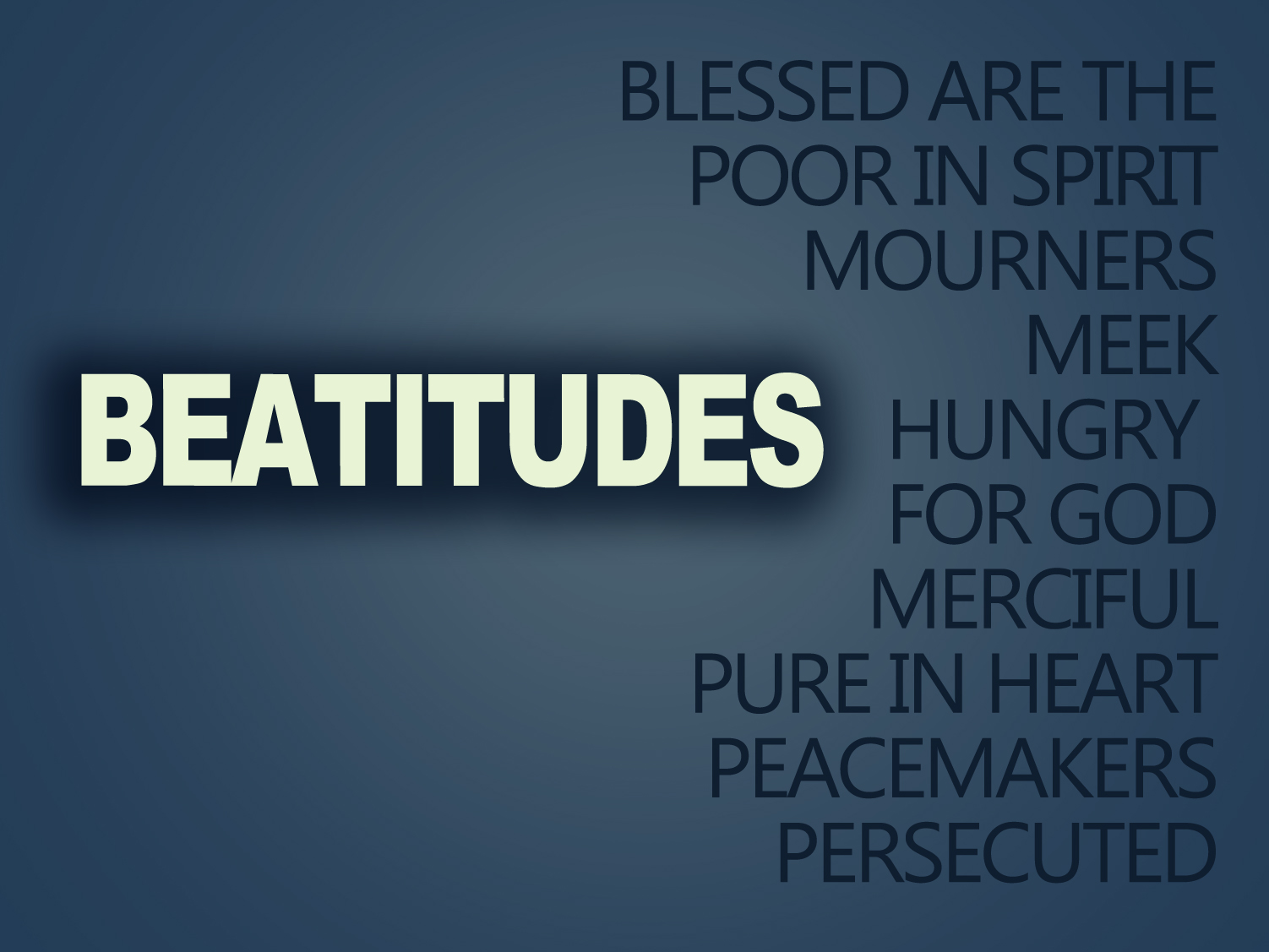
beatitudes-list-right-alignedAnd while most of the world buys into the “when and then” philosophy, you know, “When I get this…” or “When that changes…” or “When this happens, then I’ll be happy.” Jesus says, “No, it doesn’t work that way.” Your happiness is not a product of circumstances. Your happiness does not depend upon what’s happening around you, it depends upon what’s happening in you. It’s a series of attitudes.

Let’s look at the second beatitude. Found in verse 4 of Matthew 5, it simply said, “Blessed are those who mourn, for they will be comforted.”

Mourning is hateful and irksome to poor human nature. From suffering and sadness our spirits instinctively shrink. By nature we seek the society of the cheerful and joyous.

 The Greek word for to mourn, used here, is the strongest word for mourning in the Greek language. It is the word which is used for mourning for the dead, for the passionate lament for one who was loved.  

In the Septuagint, the Greek version of the Old Testament, it is the word which is used of Jacob’s grief when he believed that Joseph, his son, was dead (Genesis 37:34).

It is defined as the kind of grief which takes such a hold on a man that it cannot be hid. It is not only the sorrow which brings an ache to the heart; it is the sorrow which brings an ache to the heart; it is the sorrow which brings the unrestrainable tears to the eyes.

Now the first part of that really makes no sense. Happy are those who mourn? Happy are those who grieve? Happy are those who are expressing sorrow? That’s nonsensical, until you read the last part of the verse, “for they will be comforted.”

How can I be happy when I’m mourning? How can I be happy when I’m grieving? How can I be happy when I’ve experienced a great pain or loss? By receiving the comfort of God.

Now before we look at that comfort and how you receive it, I’ve got to give you a warning that’s straight from Scripture. Not all mourning is going to receive the comfort of God.

In II Corinthians 7:10, Paul says this. “Godly sorrow brings repentance that leads to salvation and leaves no regret, but worldly sorrow brings death.”

Did you hear that? There’s a godly sorrow and there’s a worldly sorrow, and the worldly sorrow we need not expect any comfort for that. You say, well what are you talking about? What do you mean worldly sorrow?

  1. Pessimism.

The world is full of people who can’t see the good in anything. They can’t see the good in anybody. They live in kind of a state of perpetual mourning. Somebody said, “You can’t have rosy thoughts about your future when your mind is filled with blues from the past.” That’s a pessimist. And that person, he or she just mourns all the time. God promises no comfort for that. That is contrary to his will.  

  1. There’s a second kind of worldly sorrow caused by discontentment.

Our society is geared for constant competitiveness and the urge to keep up with the Joneses. Madison Avenue advertising companies specialize in making us feel disenchanted. They create itches that we need to scratch and yet their real job is to create an itch that we never can adequately scratch.

There’s a kind of mourning that goes with discontentment and our Lord won’t comfort that kind of mourning. Instead, he warns against it. Luke 12:15, Jesus said, “‘Watch out! Be on your guard against all kinds of greed; a man’s life does not consist in the abundance of his possessions.'”

I Timothy 6:7: “We brought nothing into this world, and we can take nothing out of it. And he says in verse 8, “But if we have food and clothing, we will be content with that.”

  1. Punishment and the consequences of wrongdoing.

A thief may mourn over time that he’s spending in jail, only to be planning his next theft. Do you see what I’m getting at? He’s not grieving over his sin, he’s grieving over getting caught. Now that’s a worldly grief. And all of those things, God says, “Look, those things lead to death. Don’t think I’m going to come down and just take that kind of mourning away. I will not.”

But that same verse says, “There is a godly sorrow which God will comfort.” And this is a mourning that we experience when we hurt and when we have heartaches from the suffering that floods this world.

Suffering that brings pain and that brings death, suffering we have no control over, that we didn’t bring about, but we’re all victims of it.

There are three ways in which this beatitude can be taken.

(i) It can be taken quite literally: Blessed is the man who has endured the bitterest sorrow that life can bring. The Arabs have a proverb: “All sunshine makes a desert.” The land on which the sun always shines will soon become an arid place in which no fruit will grow. There are certain things which only the rains will produce; and certain experiences which only sorrow can beget.

Sorrow can do two things for us. it can show us, as nothing else can, the essential kindness of our fellow-men; and it can show us as nothing else can the comfort and the compassion of God. Many and many a man in the hour of his sorrow has discovered his fellow-men and his God as he never did before. When things go well it is possible to live for years on the surface of things; but when sorrow comes a man is driven to the deep things of life, and, if he accepts it aright, a new strength and beauty enter into his soul.

“I walked a mile with Pleasure, She chattered all the way,

But left me none the wiser For all she had to say.

I walked a mile with Sorrow, And ne’er a word said she,

But, oh, the things I learned from her When Sorrow walked with me!”

(ii) Some people have taken this beatitude to mean:

Blessed are those who are desperately sorry for the sorrow and the suffering of this world.

When we were thinking of the first beatitude we saw that is it always right to be detached from things, but it is never right to be detached from people. This world would have been a very much poorer place, if there had not been those who cared intensely about the sorrows and the sufferings of others.

Christianity is caring. This beatitude does mean: Blessed is the man who cares intensely for the sufferings, and for the sorrows, and for the needs of others.

(iii) No doubt both these thoughts are in this beatitude, but its main thought undoubtedly is: Blessed is the man who is desperately sorry for his own sin and his own unworthiness.

“It is mourning over the felt destitution of our spiritual state, and over the iniquities that have separated us and God; mourning over the very morality in which we have boasted, and the self-righteousness in which we have trusted; sorrow for rebellion against God, and hostility to His will; and such mourning always goes side by side with conscious poverty of spirit.”

As we have seen, the very first word of the message of Jesus was, “Repent!” No man can repent unless he is sorry for his sins. The thing which really changes men is when they suddenly come up against something which opens their eyes to what sin is and to what sin does.

A boy or a girl may go his or her own way, and may never think of effects and consequences; and then some day something happens and that boy or girl sees the stricken look in a father’’ or a mother’s eye’s; and suddenly sin is seen for what it is.

That is what the Cross does for us. As we look at the Cross, we are bound to say, “That is what sin can do. Sin can take the loveliest life in all the world and smash it on a Cross.”

One of the great functions of the Cross is to open the eyes of men and women to the horror of sin. And when a man sees sin in all its horror he cannot do anything else but experience intense sorrow for his sin.

Christianity begins with a sense of sin. Blessed is the man who is intensely sorry for his sin, the man who is heart-broken for what his sin has done to God and to Jesus Christ, the man who sees the Cross and who is appalled by the havoc wrought by sin.

It is the man who has that experience who will indeed be comforted; for the experience is what we call penitence, and the broken and the contrite heart God will never despise (Psalm 51:17). The way to the joy of forgiveness is through the desperate sorrow of the broken heart.

God is going to comfort people who go through that and that’s all of us. Godly grief is also the mourning that we do over our own sins, not the getting caught, but the sin itself.

God says, “If you’ll mourn over your own sin, I’ll come and comfort your heart.” And godly grief is also the sadness that we share for others in their loss. He said, “I’ll bless that if you hurt with other people. I’ll come and take that sorrow away.”

Here, then, are the first birthmarks of the children of God. He who has never come to be poor in spirit and has never known what it is to really mourn for sin has neither seen nor entered the Kingdom of God. How thankful the Christian reader ought to be that the great God condescends to dwell in the humble and contrite heart!

Now today and tomorrow, when you experience that kind of grief and that kind of mourning, sorrow that is left unattended will literally rob you of your happiness, how do you apply this beatitude? And how do you claim this promise?

If you really want to be happy in this world, you’ll not be happy by just avoiding sadness because you can’t. We’re all going to mourn, we’re all going to grieve, how do I get through that by the power of God so that I’m happy way yonder more than I’m sad?

Three simple steps, write them down.

  1. Number one, realize God is with you.

You know when we’re hurting, we tend to forget where God is. We think he’s distant that he is far away. Look at Psalm 34:18, “The Lord is close to the brokenhearted and saves those who are crushed in spirit.” When you’re mourning, when you’re in pain, remember three simple things: God is aware, God cares, and God is there. Just those three simple things. God is aware, he cares, and he’s there.

God is aware. Job said, “You keep a close watch on all my paths. There are many, many of you who have come today and you’re in pain, but I want you to know something, God is watching over you. Nothing escapes his eyes. The Bible says, not just the number of hairs on your hair are numbered, the Bible says, even your tears are numbered. I’ve heard people say hundreds of times, nobody knows what I’m going through. That may be right if you’re talking about somebody else in the flesh, but somebody knows what you’re going through. God is keenly aware of everything you’re going through.

  1. He is not only aware, number two, he cares.

Look at the little book of Nahum 1:7, “The Lord is good, a refuge in times of trouble. He cares for those who trust in him,” God’s not only aware, he cares, your pain matters to God.

  1. Number three, he’s there.

That’s the best thing of all. Hebrews 4:16 says, “Let us then approach the throne of grace with confidence, so that we may receive mercy and find grace to help us in our time of need.”

I thank God that he doesn’t just offer awareness and sympathy, he offers help when you hurt. He’s not powerless like you and I feel in times of mourning. He doesn’t just write a note like I do that says, “I’m thinking about you in this time of need.” God says, “I’m not just thinking about you, I’m right there and my hand is reaching down to help you.”

Isaiah 43:2, our God says, “‘Fear not, for I have redeemed you; I have summoned you by name; you are mine. When you pass through the waters, I will be with you; and when you pass through the rivers, they will not sweep over you. And when you walk through the fire, you will not be burned; the flames will not set you ablaze. For I am the Lord, your God,…'”

God says when you’re mourning, I want to come and build you up with my strength. I want to fortify you. I want to stand beside you.

  1. So the first step in being comforted, being happy when you’re sad, is to realize God’s presence.

Now having said that, have you ever noticed there are some people who grow in their pain and there are other people who get stuck there? Why is that? I think more than any other reason, it’s because they fail to apply step two.

  1. Release the hurt.

Somebody says, “I’m in pain.” Let it go. How do you let it go? Here’s the key thing, you stop focusing on what’s lost and start focusing on what’s left. After your loss, after your tragedy, after your pain, start focusing on what’s lost and start focusing on what’s left.

The whole idea here is to quit looking backward and start looking forward.

Isaiah 43:18 says, “‘Forget the former things; do not dwell on the past.'”

Philippians 3:13, Paul says, “But one thing I do: Forgetting what is behind and straining toward what is ahead, I press on toward the goal…” And it goes on to say the goal is the prize of the heavenward call of Christ Jesus.

The Bible says your past is your past, let it go. It doesn’t need to hurt you anymore. Some of you are letting memories of people who have hurt you in the past, hurt you right now. I don’t want to be cruel, but I want to be honest. That’s dumb.

If they’ve hurt you in the past, and you’re letting the memory hurt you now, all you are doing is letting them hurt you twice. Don’t let the pains of the past control you. Don’t let the guilt of your past strangle you. If you want the comfort of God, release your hurt. That power is within you.

See there are choices about what to do with the hurts and the pains and the grief sources of the past. Here are some things different folks do at different times, they are on your outline.

You can repress those hurts.

You know you can just push them down. You can swallow them, try to keep them way down deep inside. But I’ve said many times, if you swallow your feelings, your stomach keeps score. There are so many thousands and thousands of Christians right now who are walking wounded, and they are walking wounded because they have repressed their hurt. They’ve never dealt with them, they’ve never even admitted them, they just keep them deep.

You can rehearse them.

Just keep rehearsing the pain. Have you ever seen somebody who just won’t let it go? They keep bringing it up in their mind and going over and over and over. And some of them they do it verbally. That’s all they’ll tell you about. “Oh, I’ll never get over this…” “Oh, I’ll never…” They torture themselves by rethinking about it over and over. But God says don’t dwell on the past.

Folks, there is a big difference between mourning and moaning. A big difference—A big difference between mourning and moaning. Mourning is legitimate grief. There are times for bona fide sadness. And when you go through that, God wants to comfort that; but moaning is self pity. And if you’re moaning, you’re doing it honestly because you want to. You just kind of want to hold on to that hurt because that’s your attention-getter. That may be the only way you think you’re getting self esteem that’s tearing you up.

Resent those things.

I guess that’s the greatest tendency of all. We tend to resent what we believe to be the cause of our pain. If that’s another person, we tend to resent them. If it’s our job, we tend to resent it. If we can’t blame it on a specific person, place, or thing, then often God is resented for just letting it happen. The problem with resentment is, it hurts you more than the person you resent.

If you really want to handle your hurt, rightly, then the fourth choice is the best, re-channel them.

Don’t repress them, don’t rehearse them, don’t resent them—re-channel them. Use the energy that you would use repressing, rehearsing, resenting, turn it constructively outward instead of destructively inward.

Do you know who my model is for this—straight from the Bible? The apostle Paul. You talk about, can you imagine the pain and the guilt of knowing if you were Paul that you were the most destructive force on the early church. Read Acts 8:1, it says Paul was the ringleader. He was the one that was seeking to destroy it. And yet he was the very man who wrote what I read to a moment ago from Philippians, “Forgetting what lies behind, I press on…”

Do you know what he did? He didn’t repress his guilt, he didn’t rehearse his guilt, he didn’t resent his guilt, he re-channeled it. He said, “I could lie around all day on the couch and feel guilty, guilty, guilty, then I could do nothing or I could take that and say, “No God, I’ve learned and I’m going to re-channel this for your glory.” People, that’s not hypocrisy, God honors that. He honors that, and he blesses that, and he comforts you when you do that.

  1. The way God will comfort me is by relying on God’s resources.

When you’re mourning and when you’re hurting, people try all kinds of things. Some get drunk, some pop pills, some watch t.v. all day long, some escape in novels, or just 1,001 things, all trying to dull the pain. God says, “No, no, those don’t work.” There are escapes, diversions, but they’re all dead-ends, they bring you right back to where you were. But God has got some resources you can tap into that really will bring you the comfort and lead you through your mourning. Here they are.

The first resource: God’s word.

Look at Psalm 119:25, here’s what that verse says, “I am laid low in the dust; preserve my life according to your word.” A few verses later, verse 62, David says, “I remember your ancient laws O Lord, and I find comfort in them.”

But the second resource God wants to use to comfort you is his people. That’s why he designed his church. See we weren’t made to be individually isolated or islands unto ourselves. There’s no such thing as a “lone ranger” Christian. We need each other. We’re supposed to be a family. We’re a God-given resource to provide comfort.

I love II Corinthians 1:3,4, here’s what it says, “Praise be to the God and Father of our Lord Jesus Christ, the Father of compassion and the God of all comfort,” look at this, “who comforts us in all our troubles, so that we can comfort those in any trouble with the comfort we ourselves have received from God.”

I mean that says just in black and white, the function of comforting and encouraging one another is just as important a function of the church as worship is. That’s the reason God comforts us. One of the keys, he said, “I comfort you so you can be conduit, so that you’ll go out and comfort other people who are also hurting.”

One minister tells this story:

Years ago, I talked to a man who had been worshipping for two years at a congregation, a big church. And after worshipping for two years, he became ill with cancer, went through a couple of hospital stays and was diagnosed as being terminal. Then going to see him on one occasion, he was bitter. He said it just seems like nobody cares, nobody cared at all. And I wasn’t trying to trap him, it was just an honest question. I said, “Well tell me, who are some of your closest friends in church?” Do you realize that after being there for two years, he couldn’t name the name of one person, not one person that he would have listed as a dear friend.

Folks, the Bible says that we are to comfort one another. That’s why small groups, support groups, care groups, whatever it takes are beneficial so that we can pass along the comfort of God. It’s not that you have to give advice, it’s not that you have to have all the answers, it’s just by saying I’ve been there and I hurt with you.

And then finally, God uses his Spirit to comfort us. When Jesus was here physically, knowing he was going to a cross, he made a promise, John 14:26, he said, “But the Counselor,” (the King James Version says the Comforter) “the Holy Spirit, whom the Father will send in my name, will teach you all things and will remind you of everything I have said to you.”

Then he said, “My peace I leave with you;…” That was a promise to the apostles, but the Bible says that promise of the comfort from the Spirit is still applicable.

Romans 15:13 says, “May the God of hope fill you with all joy and peace as you trust in him, so that you may overflow with hope by the power of the Holy Spirit.”

Mourners comforted—destroyers condemned (v. 14; 5:4).

While this verse is not in some manuscripts of Matthew, it is found in Mark 12:40 and Luke 20:47. Instead of mourning over their own sins, and mourning with needy widows, the Pharisees took advantage of people in order to rob them. They used their religion as a “cloak of covetousness” (1 Thes. 2:5).


 
Leave a comment

Posted by on October 6, 2015 in Article


Why it’s difficult for some spouses to apologize


 mp3iconYouTube JesusIsLordofthisWebSite placeforyou2 575273_579331012148169_1163921425_n

 ——————————————–

Is it difficult for your spouse to apologize and tell you that he (or she) is sorry? Or is it hard for you to offer an apology?

Some individuals can say “I’m sorry” easily while others can’t ever seem to choke the words out. When a spouse is reluctant to apologize, the partner inevitably ends up carrying emotional baggage from the resulting hurt feelings, resentment, and anger.

It’s often easier to offer an apology to a total stranger or a casual acquaintance than it is to a spouse. Usually, in those cases, whatever we have done—temporarily blocked the aisle with our shopping cart at the grocery store or bumped into someone in a hallway—was done unintentionally.

There’s normally not any feeling that one person did something to the other in a personal way. Instead, it feels like an accident, a momentarily distraction, or a misjudgment of visual space.

But when things happen between two spouses, an oversight or mistake can take on more personal tones and meaning. A spouse may harbor strong feelings that whatever occurred was deliberate and intentional.

When intense feelings are triggered and the emotional climate becomes either icy or raging, the offending spouse may retreat, not knowing what else to do. Or he (or she) may be afraid of doing the wrong thing and making the situation worse.

Some spouses view apologizing as a sign of weakness that brings about a loss of power and status. A spouse with this perspective may equate apologizing with admitting inadequacy and incompetence, and thus be reluctant to apologize for mistakes, failures, or misjudgments.

To others, it’s humiliating to have to apologize. They may have been ridiculed and criticized harshly by their parents when they made mistakes growing up, and as a result, they try to avoid admitting to mistakes and the unpleasant feeling that brings.

Accepting responsibility for personal actions and decisions is challenging for some spouses. They operate in denial, as though by not admitting fault they haven’t done anything “wrong.” It’s almost as though they are afraid of owning any inappropriate behaviors because then they might have to also take responsibility for other actions. So it’s just easier to avoid and deny than to admit responsibility and apologize.

If a spouse views apologizing as “all or nothing”—that the person who is “wrong” has to ask for forgiveness from the one who is “right”—that can also make the task more daunting. So can viewing the person who apologizes as the “loser” in an argument or dispute, while the one accepting the apology is the “winner.”

What Can You Do if It’s Hard for Your Spouse to Apologize?

The following five tips offer specific actions that you can take:

  1. Become comfortable with saying, “I’m so sorry for my part in what happened between us” or ‘I’m so sorry for my part in the misunderstanding.” That acknowledges two people are involved in what happens in relationship interactions and makes it less threatening for each to accept personal responsibility.
  2. If your partner refuses to make an apology for behavior that deeply hurt you, ask her (or him) if she at least regrets what happened. Some spouses will find it easier to say “I really regret what happened at the party” than “I’m really sorry for my behavior at the party.”
  3. Practice being the kind of partner that you wish you had. Apologize readily and model healthy behavior for your spouse. Be open about your feelings when it’s hard to apologize. Say, “I don’t know why it’s so hard to apologize sometimes—but it is. This isn’t easy for me to say because I’d rather blame you than look at myself, but I am truly sorry for the things I said last night.” You can’t control what your spouse decides to do or not to do, so focus on what you do have control over—your own reactions and behavior.
  4. Write your spouse a handwritten letter (pen and paper—no emails) sharing your feelings and say that in order to move on, you really need some sort of acknowledgement of your feelings and the hurt you have experienced. State that it’s important for you to know your partner cares about your feelings enough to apologize or admit regret for what happened.
  5. Remember that if your spouse can’t apologize to you, it doesn’t necessarily mean your spouse doesn’t love you. In some cases, it can indicate a callousness and indifference to the partner’s feelings. But in other cases, it can indicate a lack of relationship skills or unresolved individual issues.

Your best strategy may be to see if your partner will agree to some marriage counseling sessions to improve communication and intimacy. Then, address the issue in the counselor’s office where your chances of being heard and opening the door for positive change are greatly increased. (By Nancy Wasson, Ph.D.)

 
Leave a comment

Posted by on October 1, 2015 in Marriage


An author’s background


 placeforyou2mp3icon YouTube JesusIsLordofthisWebSite575273_579331012148169_1163921425_n

 Free book from Gary: The Measure of One’s Life book

——————————————–

I am sometimes asked…”What is the particular religious persuasion reflected by the lessons on this homepage.

clear-vision-4581472These studies try to reflect a non-sectarian approach to the Bible, with a desire only to let the Scriptures speak for themselves. They are simply the results of my own personal studies of God’s Word, and are offered with a plea for you to apply “The Berean Test” (Acts 17:11) as you examine the studies.

As for me personally, I am simply a Christian, a disciple of Jesus Christ, and a member of the Lord’s body, the church, as one reads about in the New Testament. In view of our Lord’s prayer for unity (John 17:20-21), and Paul’s condemnation of division (1 Co 1:10-13), I dislike denominational distinctions and all forms of sectarianism.

I have been blessed to serve as a minister of the gospel of Christ for over 34+ years, having worked with churches made up of individuals  who are likewise trying to be simply Christians. Using the New Testament as their authority in matters pertaining to the work, worship, and organization of the local church, they are independent, self-governing churches, and totally non-denominational.

We have no written creed (other than the Bible), and constantly engage in Bible study (not creed rehearsal), fine-tuning our understanding and practice to what we learn from the Scriptures.

Frequently referred to as “churches of Christ” (Romans 16:16 ), they are not to be confused with any denomination that might be known as the “Church of Christ” (especially those that identify themselves as the “International Church of Christ,” or formerly the “Boston Church of Christ”).

DSC_0040With the religiously divided state of our society, I know many may find it hard to believe that you can be “a Christian only”. It is not easy, but I believe it is possible and from the Lord’s viewpoint, desirable. Therefore I often say that I am neither Jewish, Catholic, or Protestant; I am a Christian! And I am not a Mormon, Jehovah’s Witness, or member of any cult that believes in latter day revelations.

I believe that God has spoken fully and completely through His Son Jesus Christ and His apostles and prophets whose words are contained in the Bible. These studies reflect this belief…

I hope this helps to answer any questions you may have. — Gary Davenport

 
Leave a comment

Posted by on October 1, 2015 in Doctrine


The Problem of Suffering in the World


 placeforyou2mp3icon YouTube JesusIsLordofthisWebSite575273_579331012148169_1163921425_n

 Gary’s blog: http://www.tjsman.wordpress.com;

Free book from Gary: The Measure of One’s Life book

———————————————————-

Axioms we have heard:

“When the going gets tough, the tough get going.”

“When the world gives you a lemon, make lemonade.”

“If God sends us on stony paths, he provides strong shoes.” — Corrie Ten Boom.

“Great crises produce great men and great deeds of courage” —-John F. Kennedy, Profiles in Courage

sufferingYou know it’s going to be a bad day when:

* You call suicide prevention and they put you on hold.

* You see a 60 Minutes news team waiting in your office.

* Your birthday cake collapses from the weight of the candles.

* Your twin sister forgets your birthday.

Let’s make it clear: we’re NOT talking about “a bad day” when we hear some of the pleas offered in the midst of pain and suffering. While it is true that a crisis helps to make a person, it is also true that a crisis helps to reveal what a person is made of.

Life is filled with a variety of difficulties (Job 14:1-2)

“”Man born of woman is of few days and full of trouble. {2} He springs up like a flower and withers away; like a fleeting shadow, he does not endure.”….but God’s grace is sufficient (see “manifold” or “poikilos” in 1 Peter 1:6 and 4:10).

All we need to think of is Joseph, David, Daniel, Elijah, and Stephen. Jesus told us they would come:

(John 16:1-3) “”All this I have told you so that you will not go astray. {2} They will put you out of the synagogue; in fact, a time is coming when anyone who kills you will think he is offering a service to God. {3} They will do such things because they have not known the Father or me…. (32) “”But a time is coming, and has come, when you will be scattered, each to his own home. You will leave me all alone. Yet I am not alone, for my Father is with me. {33} “I have told you these things, so that in me you may have peace. In this world you will have trouble. But take heart! I have overcome the world.””

Paul said in 2 Timothy 3:12 : “In fact, everyone who wants to live a godly life in Christ Jesus will be persecuted.”

We occasionally sing a song which offers some powerful words for us:

“Come, ye disconsolate, where’er ye languish Come to the Mercyseat, fervently kneel. Here bring your wounded heart, here tell your anguish; Earth has no sorrow that Heav’n cannot heal.”

Paul reminds us in 1 Cor. 10:13 that God will limit their impact upon us. They cannot make our service to God in vain: (1 Cor 15:58) “Therefore, my dear brothers, stand firm. Let nothing move you. Always give yourselves fully to the work of the Lord, because you know that your labor in the Lord is not in vain.”

(2 Tim 4:6-8) “For I am already being poured out like a drink offering, and the time has come for my departure. {7} I have fought the good fight, I have finished the race, I have kept the faith. {8} Now there is in store for me the crown of righteousness, which the Lord, the righteous Judge, will award to me on that day–and not only to me, but also to all who have longed for his appearing.”

suffer-for-christ-e1344552240663“Are you going through a hard time? Maybe these words from a song called The Fire will help get us through them: “I’ve been through a fire that has deepened my desire, to know the living God more and more. It hasn’t been much fun, but the work that it has done in my life has been worth the hurt. You see sometimes we need the hard times to bring us to our knees, otherwise we do as we please and never heed him. For he always knows what’s best and it’s when we are distressed that we really come to know God as he is.”

There are things man cannot know…God knows all (chapters 38-41). We MUST avoid the warning of Job 40:8!

(Job 38:2) “”Who is this that darkens my counsel with words without knowledge?”

(Job 40:8) “”Would you discredit my justice? Would you condemn me to justify yourself?”

We know that sin and suffering are not linked; they are not proof of sin or guilt (reminded of Luke 13:1-5). Let those circumstances bring you to repentance. We will suffer (like many other Christians) when it is not deserved.

“The Sequoia trees of California tower as much as 300 feet above the ground. Strangely, these giants have unusually shallow root systems that reach out in all directions to capture the greatest amount of surface moisture. Seldom will you see a redwood standing alone, because high winds would quickly uproot it. That’s why they grow in clusters. Their intertwining roots provide support for one another against the storms.

“Suffering comes to all of us, and no one can suffer for us. Even so, just like those giant Sequoia trees, we can be supported in those difficult times by the prayers and understanding of loved ones and friends. It’s when we are too proud to admit our needs to others that we are in the greatest danger.”

We can benefit from the process.Hard times keep this world from becoming too attractive.

“Our citizenship is in heaven…we’re pilgrims passing through this life and we don’t need to let our roots get too deep.”

Suffering brings out our best and allows to development deep bonds.

Those we count as our closest and dearest friends are those who have gone through hard times in life with us.

Suffering makes us appreciative.

Words of ‘cheerful’ minister despite a hard time in his life: “I make the right use of my eyes. I look up to Heaven and realize that is where I am going. Next, I look down upon the earth and realize how small a place I shall occupy when I am dead and buried. Finally, I look around and see the many who are in some respects much worse than I am. This brings me to three conclusions: First, I learn where true happiness lies; Second, I realize where all our cares end; third, I realize how little reason I have to complain.”

God’s attributes can be displayed: (2 Cor 12:9-10) “But he said to me, “My grace is sufficient for you, for my power is made perfect in weakness.” Therefore I will boast all the more gladly about my weaknesses, so that Christ’s power may rest on me. {10} That is why, for Christ’s sake, I delight in weaknesses, in insults, in hardships, in persecutions, in difficulties. For when I am weak, then I am strong.”

We can develop a valuable attribute: (Phil 4:11-12) “I am not saying this because I am in need, for I have learned to be content whatever the circumstances. {12} I know what it is to be in need, and I know what it is to have plenty. I have learned the secret of being content in any and every situation, whether well fed or hungry, whether living in plenty or in want.”

What did Jesus learn from his suffering? (Heb 5:8-9) “Although he was a son, he learned obedience from what he suffered {9} and, once made perfect, he became the source of eternal salvation for all who obey him”

* Story of the man who helped a crysalis burst through the cocoon…didn’t have the strength needed to fly.

It will provide opportunities to make us sympathetic and to reach out to others: 2 Cor 1:3-6: that ‘comfort circle’ we’ve discussed before.

It will force us to depend upon God and to give thanks in all things. (Prov 3:5-6) “Trust in the LORD with all your heart and lean not on your own understanding; {6} in all your ways acknowledge him, and he will make your paths straight.”

(2 Cor 1:8-11) “We do not want you to be uninformed, brothers, about the hardships we suffered in the province of Asia. We were under great pressure, far beyond our ability to endure, so that we despaired even of life. {9} Indeed, in our hearts we felt the sentence of death. But this happened that we might not rely on ourselves but on God, who raises the dead. {10} He has delivered us from such a deadly peril, and he will deliver us. On him we have set our hope that he will continue to deliver us, {11} as you help us by your prayers. Then many will give thanks on our behalf for the gracious favor granted us in answer to the prayers of many.”

Teaches us to pray and that prayer works when nothing else will.

Use the events to glorify God (story of man born blind which Jesus used to glorify God…John 9:1-5).

“I asked God for strength that I might achieve, I was made weak, that I might learn humbly to obey.

I asked for health, that I might do greater things, I was given infirmity that I might do better things.

I asked for riches, that I might be happy, I was given poverty, that I might be wise.

I asked for power, that I might have the praise of men, I was given weakness, that I might feel the need of God.

I asked for all things, that I might enjoy life, I was given life, that I might enjoy all things.

I got nothing that I asked for — but everything I had hoped for.

Almost despite myself, my unspoken prayers were answered. I am among all men, most richly blessed.” ¨ From Max Cleland, Strong at the Broken Places.

 
Leave a comment

Posted by on September 28, 2015 in counsel